
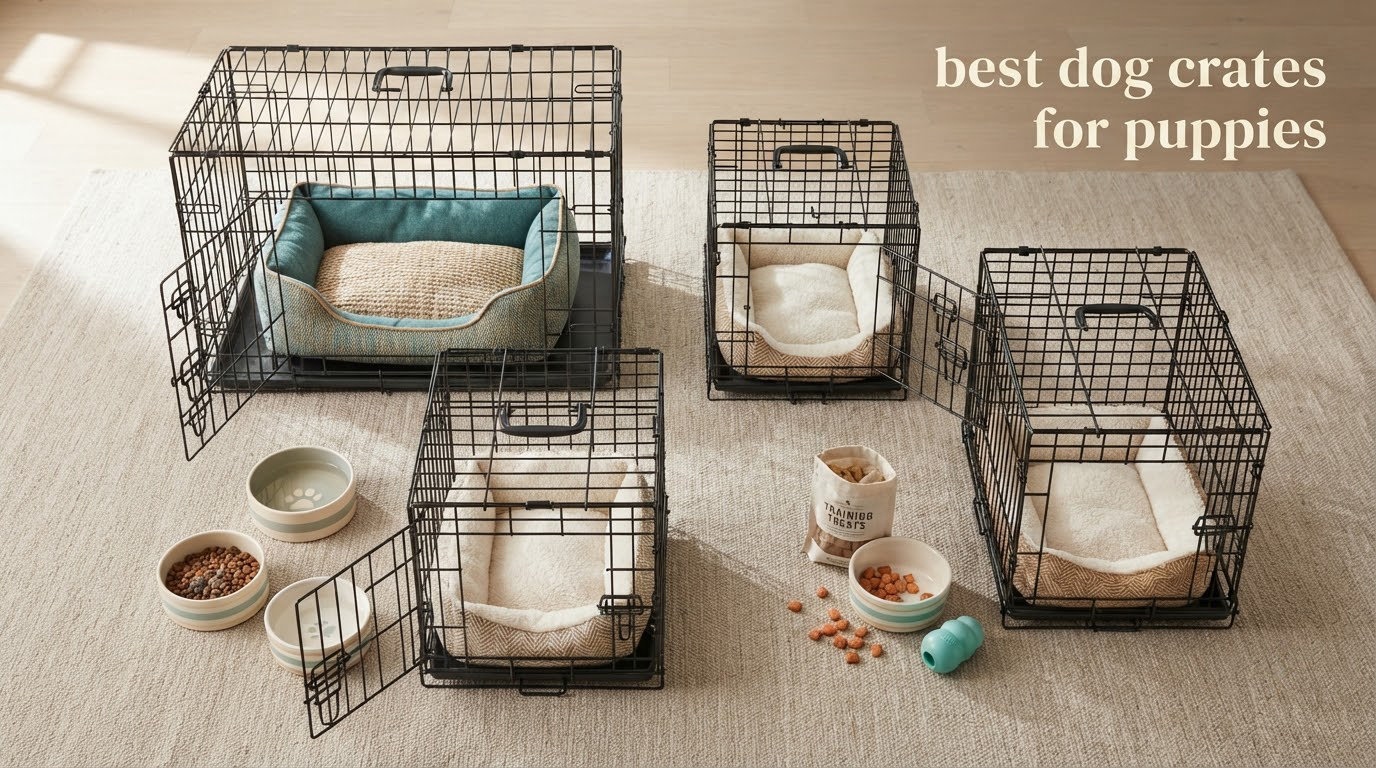
If you only buy one crate for a puppy, buy a wire crate with an adjustable divider panel. The divider is what makes a single purchase work from an eight-week-old to a full-grown dog, and wire dries fast and wipes clean after the accidents that come with housebreaking. Everything else — soft-sided, plastic, heavy-duty — is a specialist choice for a specific puppy, not the default.
That is the whole argument, and it matters because the search results for the best dog crates for puppies are dominated by listicles that rank fifty kennels of every type while telling you nothing about sizing or timing. The crates that get recommended most often by experienced owners, including MidWest wire models, consistently ship with a divider panel for exactly this reason. Our wider roundup of the best dog crates covers the adult and specialty end of the market; this one is only about puppies.
We spent several weeks working through twelve crates with the questions a puppy owner actually has: how big should it be, what goes in it, how long can they be in there, and will their head get stuck in the wire. The short answer to sizing is that you buy the size your dog will be as an adult and use the divider to shrink it now. The answer to how long is in the age chart further down, and the answer to the wire safety worry is a bar-spacing check you can do in about ten seconds.
Table of Contents
Top 3 Picks: Puppy Crate (October 2026)

MidWest iCrate 24-Inch
- Divider panel included
- Leak-proof tray
- Tool-free assembly
- Rounded corners and Paw Block latch

Amazon Basics Wire 24-Inch
- Folds flat for storage
- Divider panel
- Removable plastic tray
- Top carry handle

The MidWest iCrate wins because it is the reference wire crate for small breeds and it is the one the community names most often without being asked. The Amazon Basics wire crate is the same idea for less money with a flat-fold frame. The DUMOS is the cheapest crate here that still includes a divider, rounded corners and a proper deep-lip tray, which are the three features a puppy crate cannot skip.
Best Dog Crates for Puppies in 2026: At a Glance
| Product | Specifications | Action |
|---|---|---|
| MidWest iCrate 24-Inch Single Door |
|
Check Latest Price |
| Amazon Basics 24-Inch Folding Wire Crate |
|
Check Latest Price |
 Petmate 24-Inch Hard Plastic Carrier Petmate 24-Inch Hard Plastic Carrier |
|
Check Latest Price |
 Amazon Basics 30-Inch Soft-Sided Kennel Amazon Basics 30-Inch Soft-Sided Kennel |
|
Check Latest Price |
 EliteField 3-Door Soft Crate EliteField 3-Door Soft Crate |
|
Check Latest Price |
 Internet’s Best 36-Inch Double Door Kennel Internet’s Best 36-Inch Double Door Kennel |
|
Check Latest Price |
 Sweetcrispy 36-Inch Foldable Kennel Sweetcrispy 36-Inch Foldable Kennel |
|
Check Latest Price |
 Yaheetech 36-Inch Crate with Divider Yaheetech 36-Inch Crate with Divider |
|
Check Latest Price |
 DONORO 30-Inch Contoured Crate DONORO 30-Inch Contoured Crate |
|
Check Latest Price |
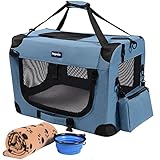 Petprsco 24-Inch Collapsible Soft Crate Petprsco 24-Inch Collapsible Soft Crate |
|
Check Latest Price |
 FDW 24-Inch Foldable Metal Crate FDW 24-Inch Foldable Metal Crate |
|
Check Latest Price |
| DUMOS 24-Inch Foldable Puppy Cage |
|
Check Latest Price |
Everything in the table is a puppy-appropriate choice in the sense that a puppy can be safely housed in it. They are not equally good, and the differences cluster into four things: whether a divider is included, how many doors there are, how well the tray contains accidents, and how narrow the wire gaps are.
Wire vs Plastic vs Soft-Sided: Which Crate for Which Puppy
Wire wins for housebreaking because air moves through it and water runs off it. An accident on a wire floor tray is wiped up in seconds and the crate is dry by the next break. That is the reason experienced owners reach for metal when toilet training, and it is why eight of the twelve crates here are wire.
Plastic wins for den security and for chew resistance. A hard shell has no fabric to shred and no zipper to work at, and ventilation holes give the dog a view out. The trade-offs are real: a plastic tray holds urine smell longer, the shell does not fold flat, and the weight ceiling on most of them is low.
Soft-sided is the travel specialist, not the training tool. It folds to nothing, weighs almost nothing, and calms anxious dogs in unfamiliar rooms. It is the wrong choice for a teething puppy, because fabric is not containment and the zippers on most models are not lockable. If you want the den feeling of a soft crate in a house, wrap a cover around a wire frame instead — that is exactly what the DONORO does.
How to Use the Divider Panel for Housebreaking
Most people use the divider correctly in principle and backwards in practice. The rule is to block off the back of the crate — the toilet end — so the sleeping space stays clean, and to keep the divider snug enough that the puppy cannot squeeze past it to the far corner.
Move the divider forward each time the puppy stops having overnight accidents, and move it back the moment accidents return. Many owners forget the second half of that instruction and end up with a fully open crate and a regressed housebreak. Our more detailed write-ups on crates sized for large dogs and heavy-duty crates for chewers cover the sizing and hardware side of the same decision.
How to Choose a Puppy Crate: Six Checks Before You Buy
Divider panel. If it is not included and not sold separately for that exact model, buy a different crate. It is the single feature that lets one crate last the dog’s whole life.
Bar spacing. Wider gaps are a hazard for a puppy that pushes its head through to see out. Rounded corners and rounded wire edges matter for the same reason, and a proper slide-bolt latch beats a simple squeeze latch once the puppy is strong enough to lean on the door.
Doors. Double doors let you position the crate in a tight room or turn it into a playpen, and a top door makes loading a reluctant puppy dramatically easier. A single door is fine, but check the clearance it needs to swing open.
Tray. A leak-proof pan with an integrated lip keeps accidents inside the kennel instead of under it. This is the feature you will thank during a 2 a.m. accident, and the one most likely to be sacrificed by budget crates.
Folding and weight. Under three inches collapsed and under about 15 lb makes a crate something you can move between rooms, put under a bed, or carry to a hotel. A 25 lb steel kennel stays put, which is fine for a garden but awkward in a flat.
Warranty. One year is the baseline, two years signals a manufacturer that stands behind the hardware. For a puppy who will live in the crate for years, the latch and frame are the parts that matter.
1. MidWest iCrate 24-Inch Single Door Crate: The Best Dog Crate for Puppies Overall
Midwest 24-Inch Single Door iCrate, for Small Breeds, 12-20 lbs
24 x 17 x 19 inch wire crate
For 12-20 lb dogs
Black e-coat finish
Leak-proof tray, carry handle and divider
Pros
- Tool-free assembly
- rust-resistant e-coat finish
- Divider panel handles puppy-to-adult growth
- Rounded corners and Paw Block latch reduce snagging
- Leak-proof tray makes cleaning simple
Cons
- Single door swings out and needs floor clearance
- Dogs near the 20 lb limit outgrow it quickly
- Heavier than a soft crate to move
This is the crate that comes up first whenever owners ask experienced people what to buy, and our testing did not change that. The 24-inch iCrate is sized for dogs in the 12 to 20 lb range, which covers a huge share of what people actually adopt, and it arrives with the leak-proof tray, rubber feet, a carry handle and a divider panel in the box.
The details that matter for a puppy are the ones nobody photographs. The openings are large and the threshold is low, so stepping in and out is easy for a clumsy eight-week-old. The rounded corner clips take the sharp edges off the welds, which is where a puppy’s nose ends up when it is pushing around a corner at 2 a.m. The slide-bolt latch has a Paw Block feature that stops the door being shouldered open.
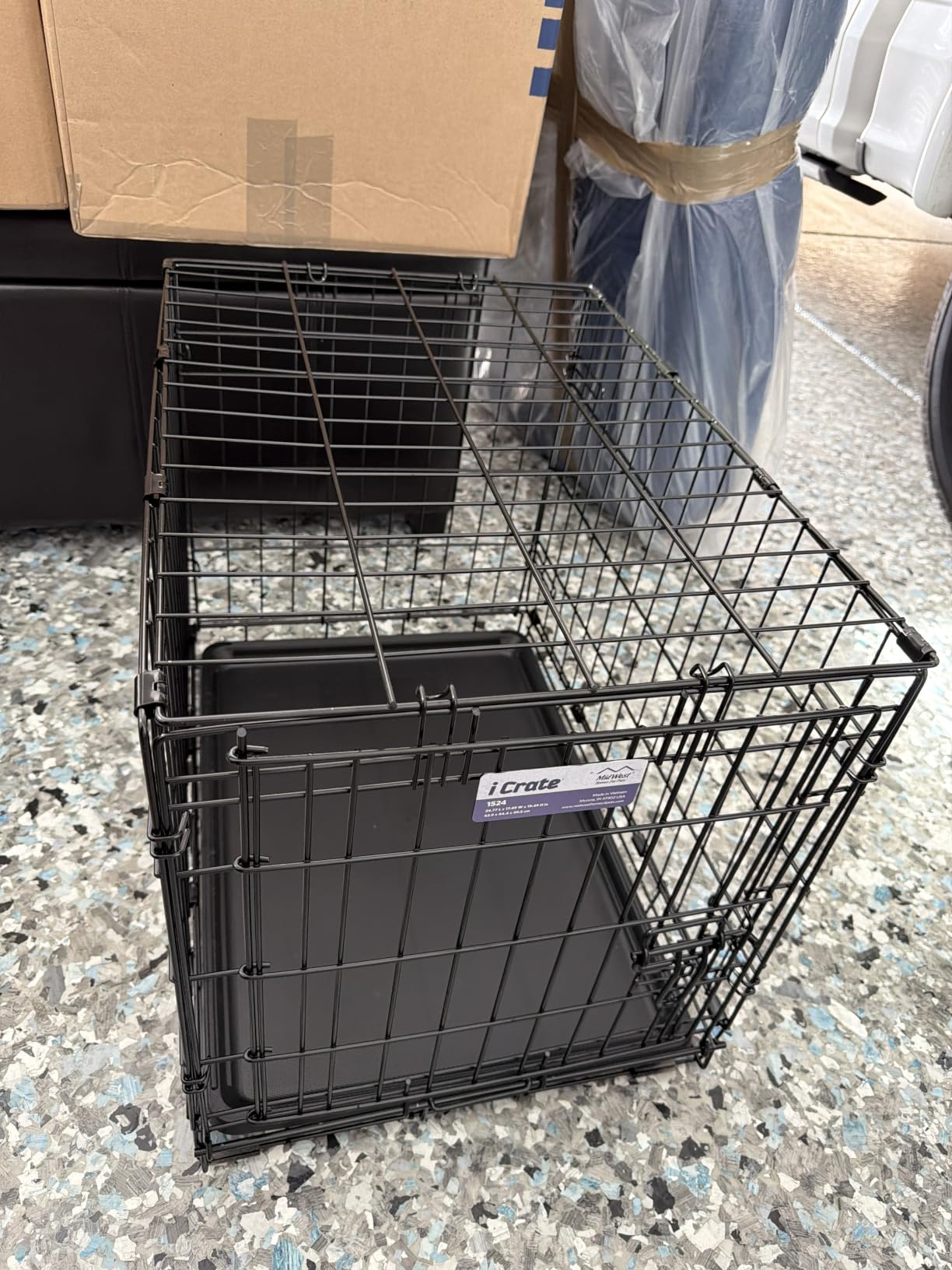
Cleaning is the reason wire beats everything else during housebreaking, and this crate shows it. The tray lifts out, wipes down, goes back in. A soaked or missed accident in a wire crate is a two-minute job rather than an overnight smell problem, and that difference compounds across eight months of puppy.
The honest limitation is the weight range. A puppy headed for 20 lb or more will outgrow the 24-inch model in a matter of weeks, which is exactly the argument for buying the adult size with a divider instead. The single door is the other trade — you need somewhere for it to swing open, so the crate cannot sit flush against a wall the way a double-door model can.
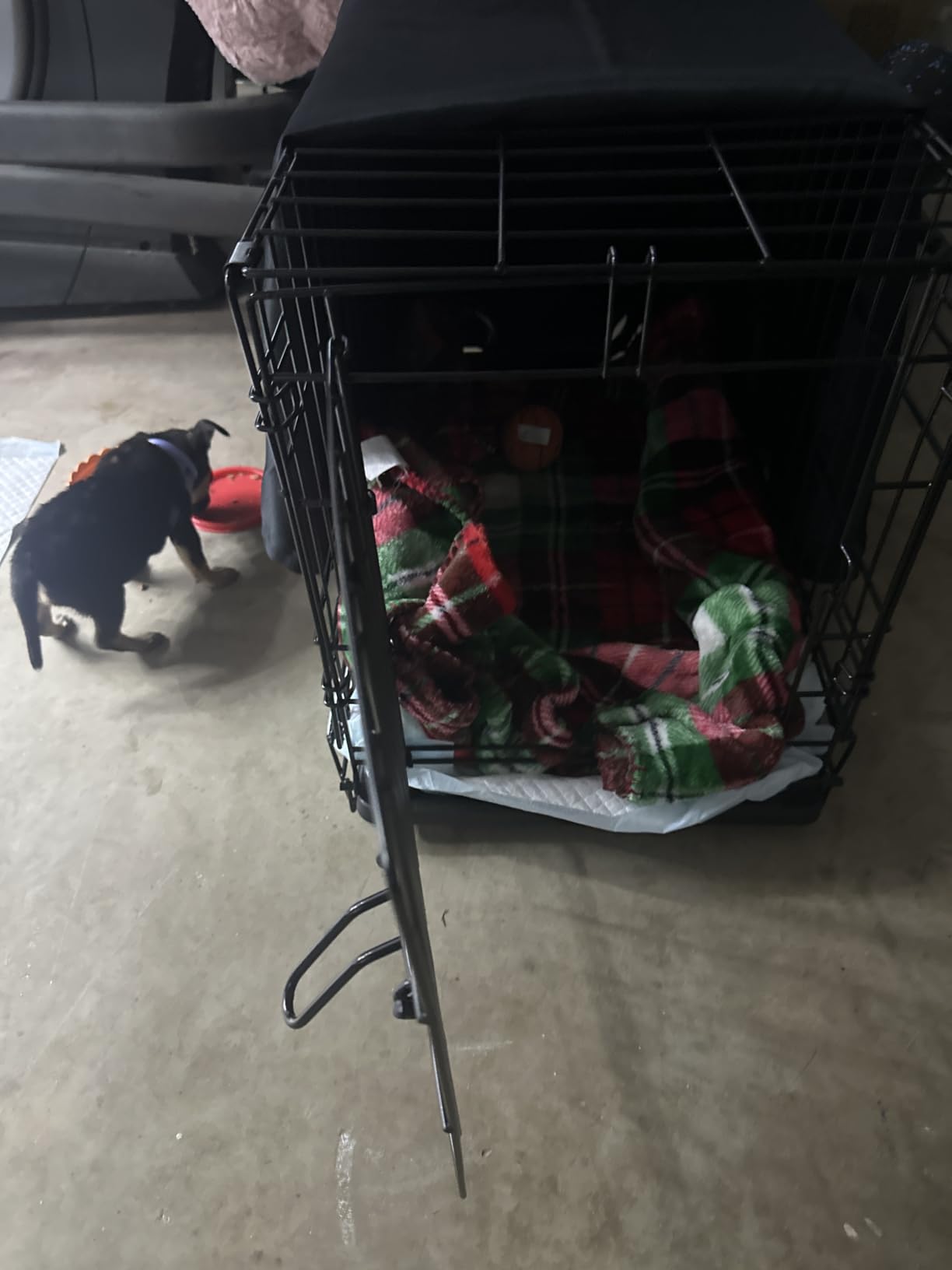
Why it works for a new puppy
The divider panel is the reason this crate is a ten-year purchase. An eight-week-old uses the front third of the crate for sleeping and the rest as a toilet zone, and the panel slides forward as the puppy grows and the overnight accidents stop.
Tool-free assembly matters more than it sounds with a puppy in the house. You can move the crate between rooms as the puppy’s world expands without hunting for a screwdriver, and the rubber feet keep it from sliding when a puppy throws himself against the door.
Where it falls short
It is heavier than a soft crate at 13.8 lb, so it is a two-hand move rather than a one-hand carry, and it does not fold flat enough to slide under most beds. Expect to buy twice if your puppy finishes above 20 lb, and buy the 30-inch with a divider instead if you already know the adult weight.
2. Amazon Basics 24-Inch Folding Wire Crate: Best Value Pick
Amazon Basics Portable, Foldable Metal Wire Small Dog Crate with Removable Tray, Divider Panel, Single Door, Easy to Assemble, 24″ x 18″ x 20″, Black
24 x 18 x 20 inch folding wire crate
Fits dogs under 20 in long
Folds flat for storage
Divider panel and top handle
Pros
- Folds flat for compact storage and transport
- Top handle makes carrying comfortable
- Divider panel lets the puppy-sized space grow
- Removable tray is easy to clean
- Quick tool-free setup
Cons
- Bottom hook must be re-locked whenever the tray goes in
- Single door limits access to one side
- Wire needs constant redirection for chewers
This crate does the same core job as the iCrate for less money, and the flat-fold frame is the feature the iCrate cannot match. It collapses to roughly the thickness of a few books, which in a small flat means the difference between a crate you keep and a crate that ends up in the hallway.
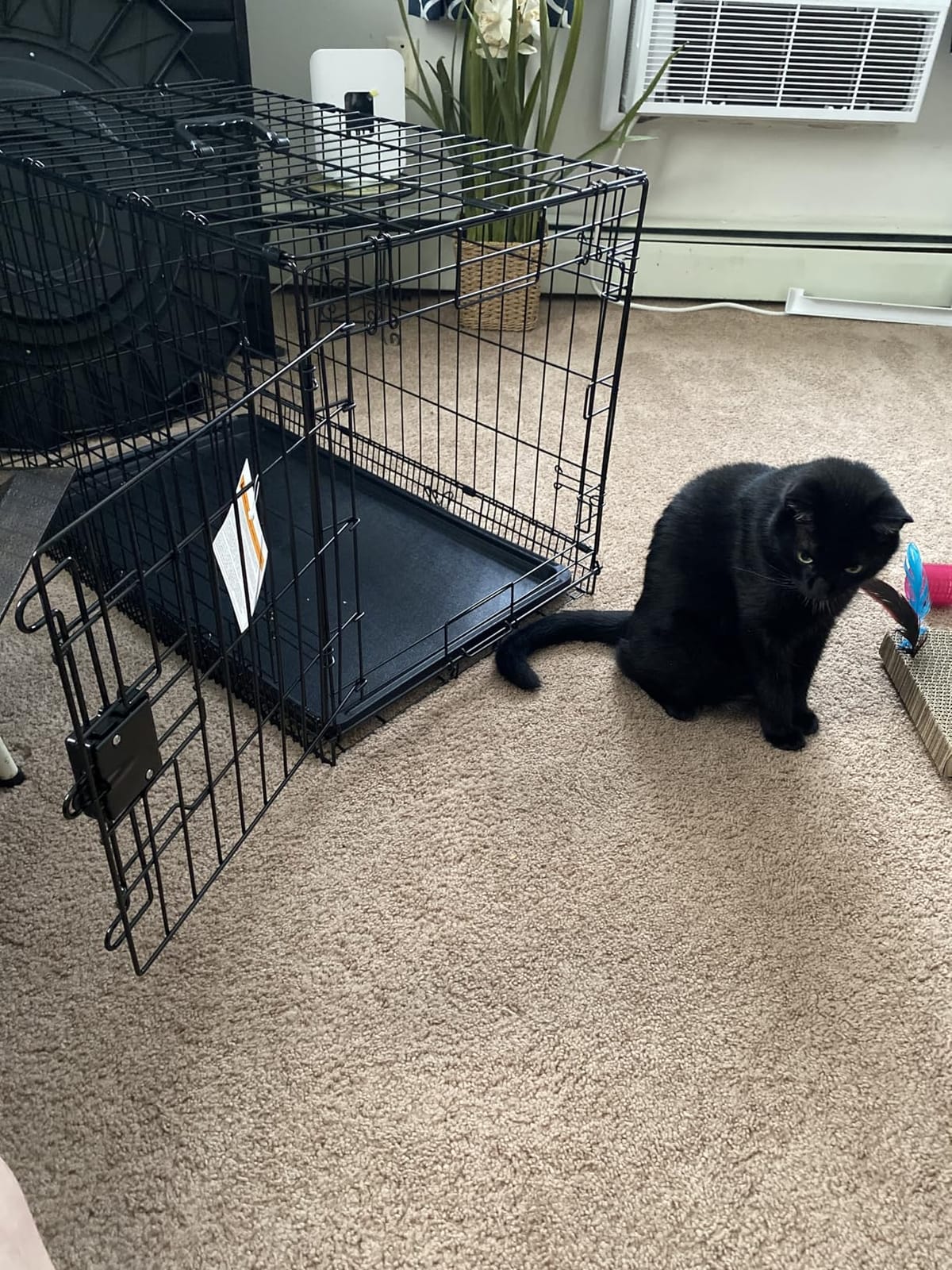
It is built for pets under 20 inches long, so it covers toy and small breeds and the early stages of a medium puppy once the divider is set. The manual door lock, removable plastic base tray and top carry handle are all present, and the tray is held by a metal hook at the bottom of the crate rather than by gravity.
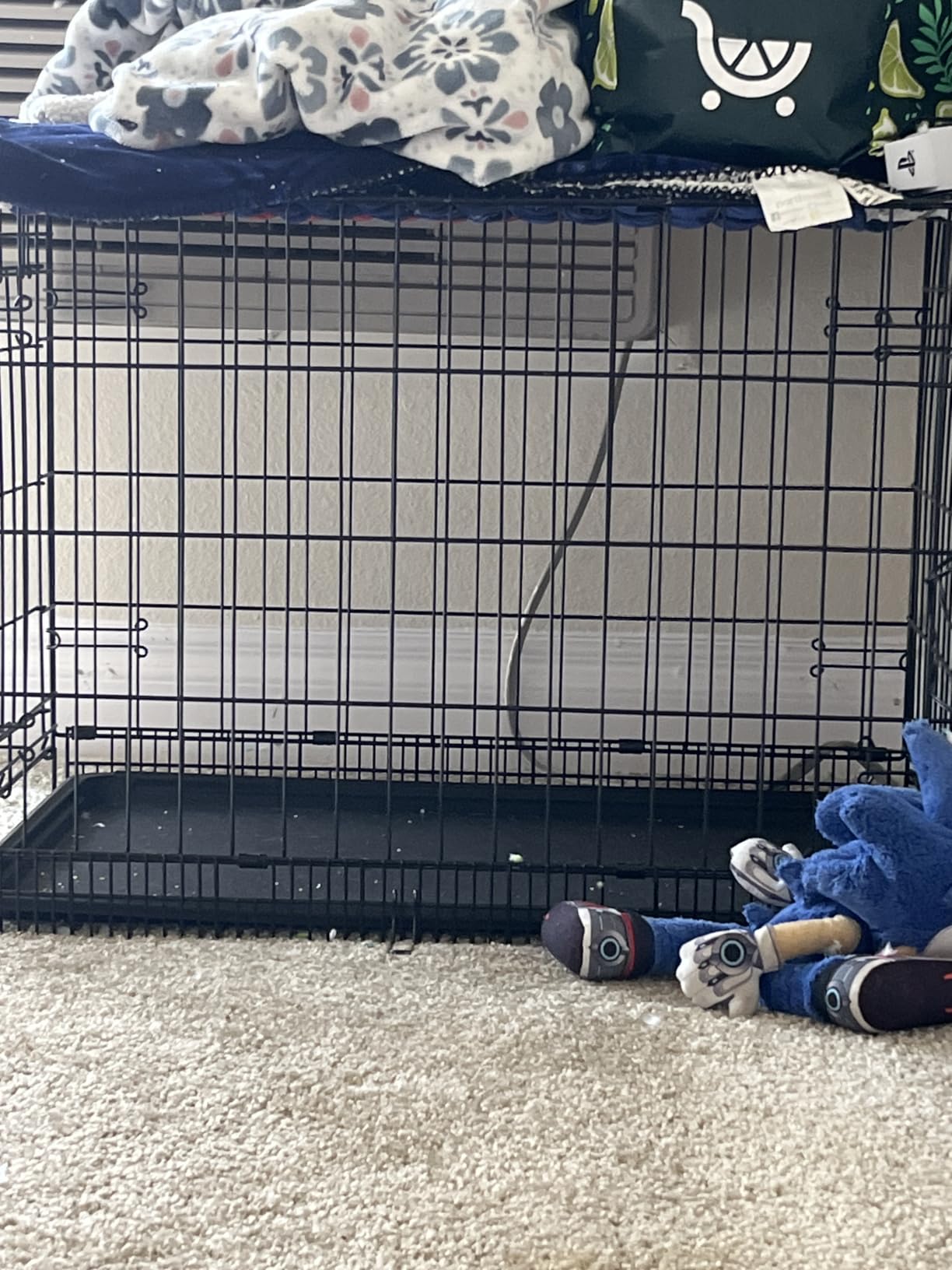
That hook is the one detail to know about. It is not a friction fit, it is a positive lock, and if it is not clicked into place the tray can lift out when a puppy jumps or when you slide the crate across a floor. It takes one extra second per tray wash and prevents a soaked carpet.
The single door is the other thing to plan for. A puppy crate is usually pushed against something, and a single door that swings outward needs about the width of the door plus your hand to open. Check the room layout before you commit, because a crate you have to angle out of a corner is an annoyance you live with every day.
What makes it right for a puppy
The divider adjusts the internal space for a growing puppy, so the crate starts as a snug den and opens up over a year. Combined with the flat fold, this is the one to buy if you are in a small space and the crate has to be stowed whenever people are in the room.
The top handle is genuinely useful with a puppy. You can pick the whole crate up, carry it to a different room, or set it near you while a puppy is asleep without opening the door and starting the whole thing over.
What to watch out for
The wire gauge is standard rather than heavy-duty, so a puppy that habitually works at the bars will need redirecting — a chew-resistant crate is a different purchase. And again, the single door needs swing clearance. Buy the flat-fold trait or buy the latch quality, not both, and this is the crate where you accept the trade.
3. Petmate 24-Inch Hard Plastic Carrier: Best for a Puppy Who Travels
Petmate Dog Crate for Small Dogs and Cat Carrier, 24in, Pearl Tan
24 x 16.8 x 14.5 in plastic shell
Top and front loading
Stay-dry moat
For pets up to 15 lb
Pros
- Top and front entry points make loading easier
- Solid plastic shell wipes clean and resists odor
- Meets most airline cargo specifications
- Lightweight at only 5 pounds
- Ventilation holes give all-around visibility
Cons
- Fixed shell does not fold flat
- 15 lb weight ceiling limits it to small puppies
- Not suitable for a dog that chews the shell
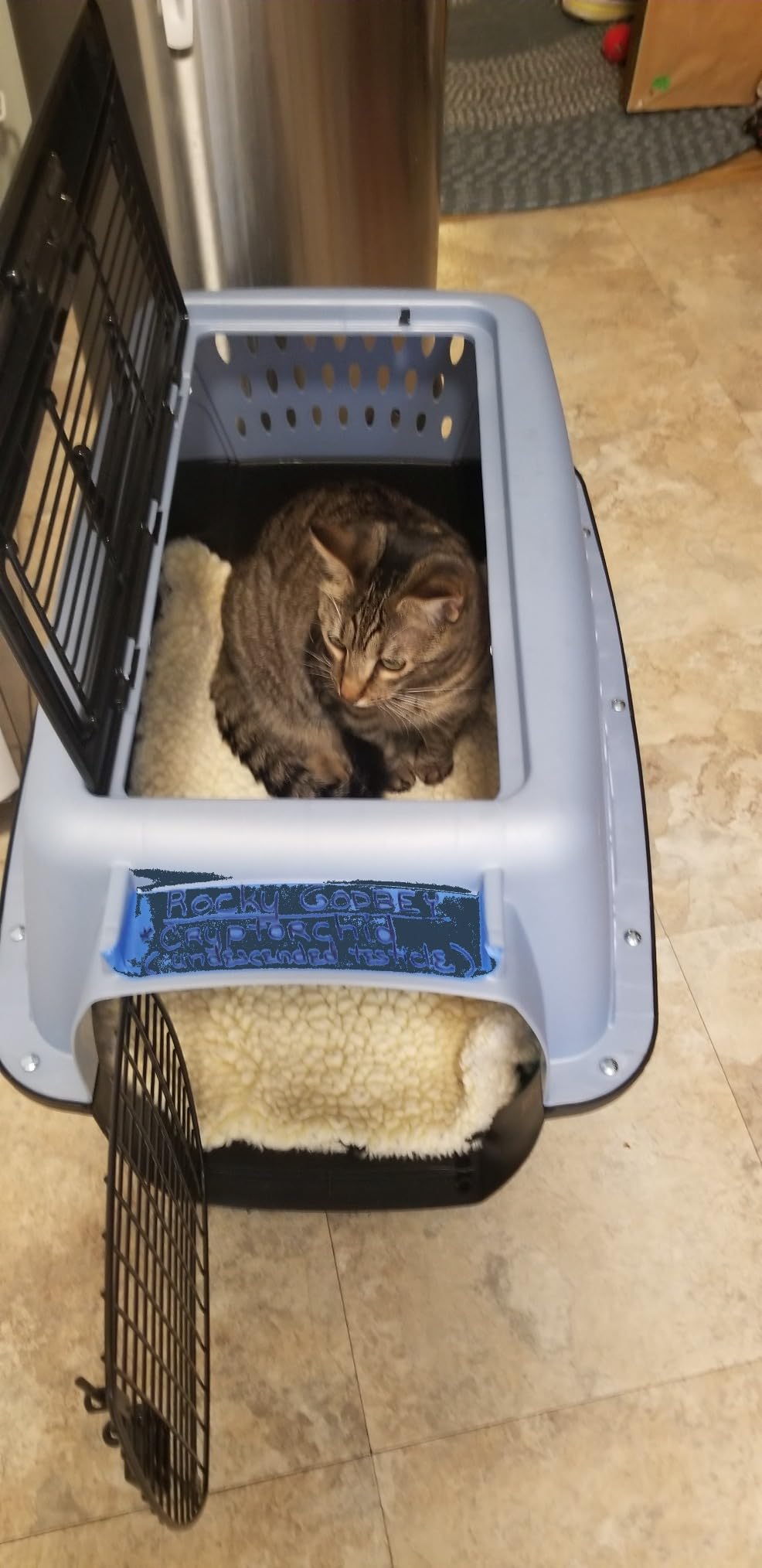
The Petmate is the crate you buy if the vet’s office, the car and the boarding kennel are all going to see this dog. It meets most airline cargo specifications, which no other crate in this roundup does, and it weighs five pounds, so it is the one you can actually lift one-handed with a puppy inside.
The design is closer to a pet carrier than a kennel, and that shapes who it suits. The plastic shell gives a genuine den effect with limited visibility through the ventilation holes, and the stay-dry moat is an external ridge that directs fluids away from the pet rather than under them.

The steel doors with easy-squeeze latches and the foldable handle are the parts that get used most, and they hold up well. Top loading is the reason to buy it over a front-loading plastic crate: you can lift a reluctant puppy straight in from above instead of trying to coax them through a side door.
For housebreaking, be aware of what you are getting. The shell is easy to wipe and does not absorb urine the way fabric does, but the tray under a hard shell has no drainage, so a missed accident sits there until you find it. Wire still dries faster.
Why a puppy owner would pick it
Travel is the deciding factor. If crate training and air travel or vet visits are both on the calendar for the next year, buying one item that does both removes a decision you would otherwise make badly in a hurry.
It is also the easiest crate in this group to clean, which matters if your puppy is having frequent accidents during the first weeks. A damp cloth and a rinse is the entire routine.
Where it does not fit
The 15 lb maximum weight recommendation is the hard limit, and a puppy that ends up over it has outgrown a carrier, not a crate. The fixed shape also means it never folds flat, so it will occupy floor space permanently. And a teething puppy that chews plastic or claws at the shell is exactly the case the manufacturer does not build it for.
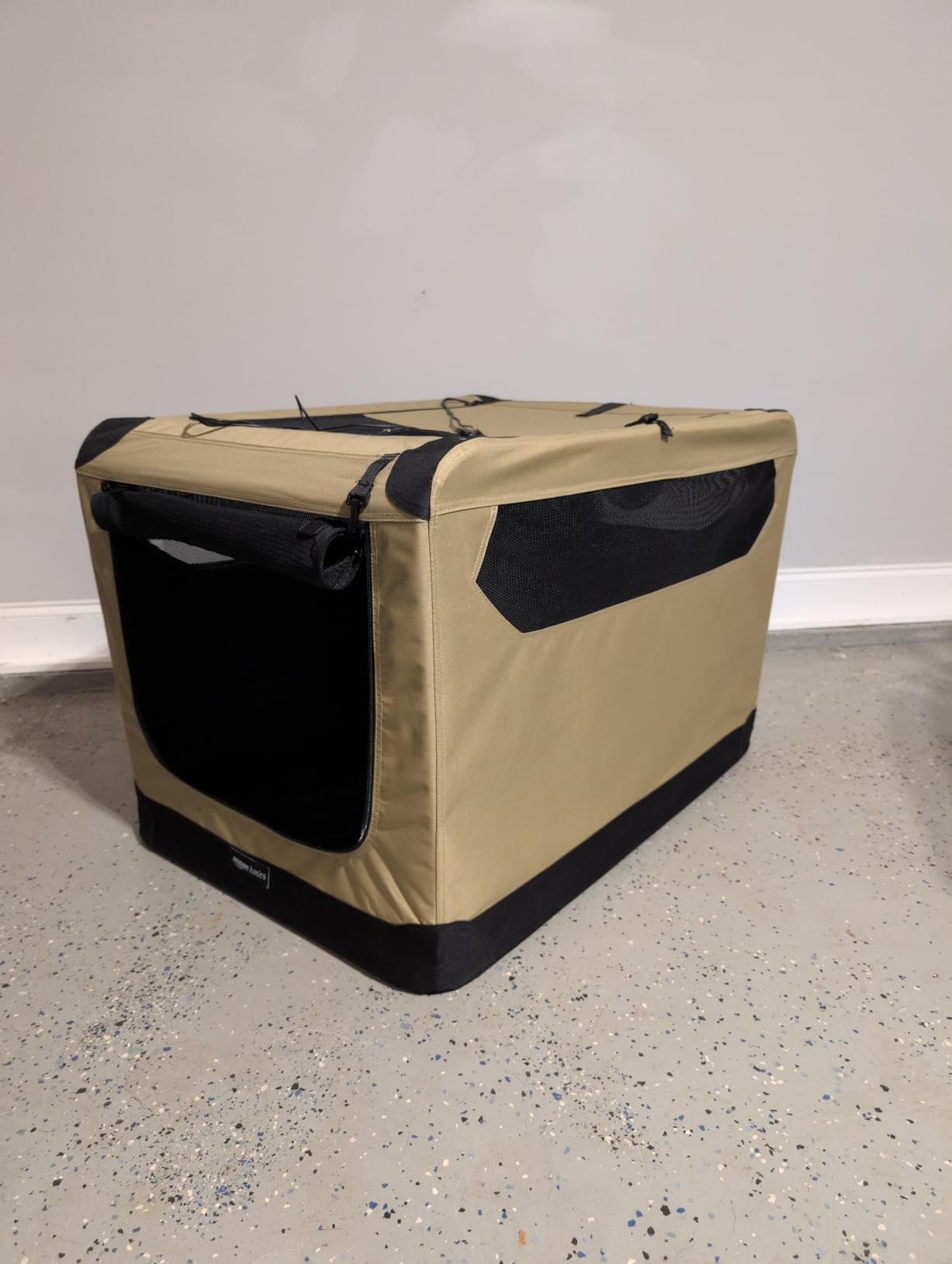
4. Amazon Basics 30-Inch Soft-Sided Travel Kennel: Best for Apartments and Hotels
Amazon Basics Portable Folding Soft Dog Crate, Double Door, Collapsible Travel Kennel, Easy to Assemble, Medium, 29.92″ x 21.3″ x 21.3″, Tan
29.92 x 21.3 x 21.3 in soft kennel
Top and front zipper doors
Mesh vents on all four sides
For breeds up to 50 lb
Pros
- Light at 6.5 lb yet stable when a puppy paws at it
- Sets up and folds in seconds with no tools
- Mesh on all sides gives good ventilation
- Wipes clean easily
- Two doors for flexible access
Cons
- Fabric will not survive heavy scratching or biting
- Some frames break down after about eight months
- Zipper catching and fabric tearing reported
- Limited size range makes sizing hit or miss
Be clear-eyed about the rating on this one: at 4.3 stars it is the lowest-rated crate here, and the reason is durability rather than design. The soft crate is excellent at what it is built for, which is short stays in unfamiliar rooms, and poor at the thing a puppy is built for, which is chewing.
On the plus side, it folds and sets up in seconds with no tools, weighs 6.5 lb, and the tan polyester on a lightweight frame gives a calm, low-enclosure feeling that some anxious dogs settle into faster than they settle into wire. Mesh windows and front-door venting cover all four sides.
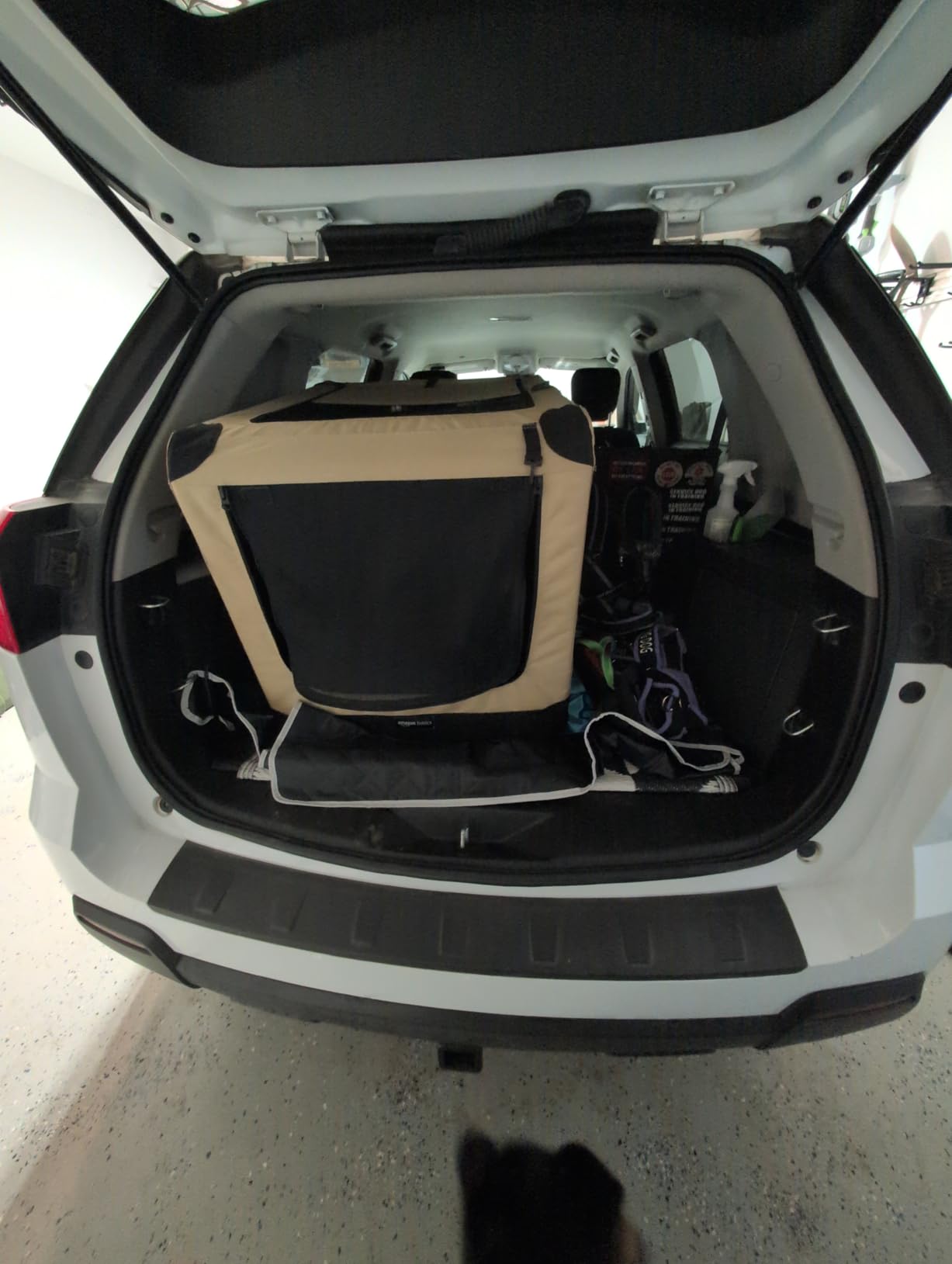
The two doors are top and front with zipper closures plus fastening straps, and the straps matter — they hold rolled-up door panels out of the way. Without them the doors dangle and a puppy will get a paw caught in the fabric.
The size is rated for medium breeds around 50 lb, which is generous. That generosity is also why the ratings slip: the jump from medium to large is the only one offered, so owners of dogs in between end up either cramped or oversized with no third option.
When it is the right call
Use it for a puppy that is house-trained enough for short periods, or for trips — car, hotel, a friend’s house. The weight is the standout: a 6.5 lb crate that a teenager can carry is transformative for travel, and it folds into a car boot without a folding-frame wrestling match.
It is also a reasonable first step for a puppy that finds the wire crate too exposed. Owners who finished crate training in wire first, then moved to soft, report the soft crate reads as more den-like and settles them faster.
Why it is not a training crate
Fabric is not containment for a puppy with teeth, and the zippers on this model are not lockable. Reviewers report frames giving out at around the eight-month mark, along with fabric tearing and zippers snagging, which is a long time to be relying on it for housebreaking. If you crate train at home, buy wire.
5. EliteField 3-Door Soft Crate: Best Premium Soft Crate
EliteField 3-Door Soft Dog Crate with Bed & Carrying Bag (2-Year Warranty)
30 x 21 x 24 in soft crate
Three zippered mesh doors
Washable cover and bed included
Folds to 3 inches
Pros
- Two inches wider and four inches taller than most 30 inch soft crates
- Three zippered doors make loading easy from any direction
- Includes bed
- leash and a zippered tote with shoulder strap
- Removable washable cover and bed cover
- Backed by a 2-year warranty
Cons
- Most expensive crate in this group
- Mesh sides get chewed by an enthusiastic puppy
- Included bed pad is thin
- Faint chemical smell on some crates
Dimension is the whole argument for this crate. At 30 by 21 by 24 inches it is two inches wider and four inches taller than a typical 30-inch soft crate, and that extra height is the difference between a puppy that stands comfortably and one that has to hunch.
Everything about the hardware is more considered than the category norm. There are three mesh doors — top, front and side — with zipper locks on the front and side, on a sturdy steel tubing frame with 600D fabric and hex mesh panels. It folds to about three inches thick.
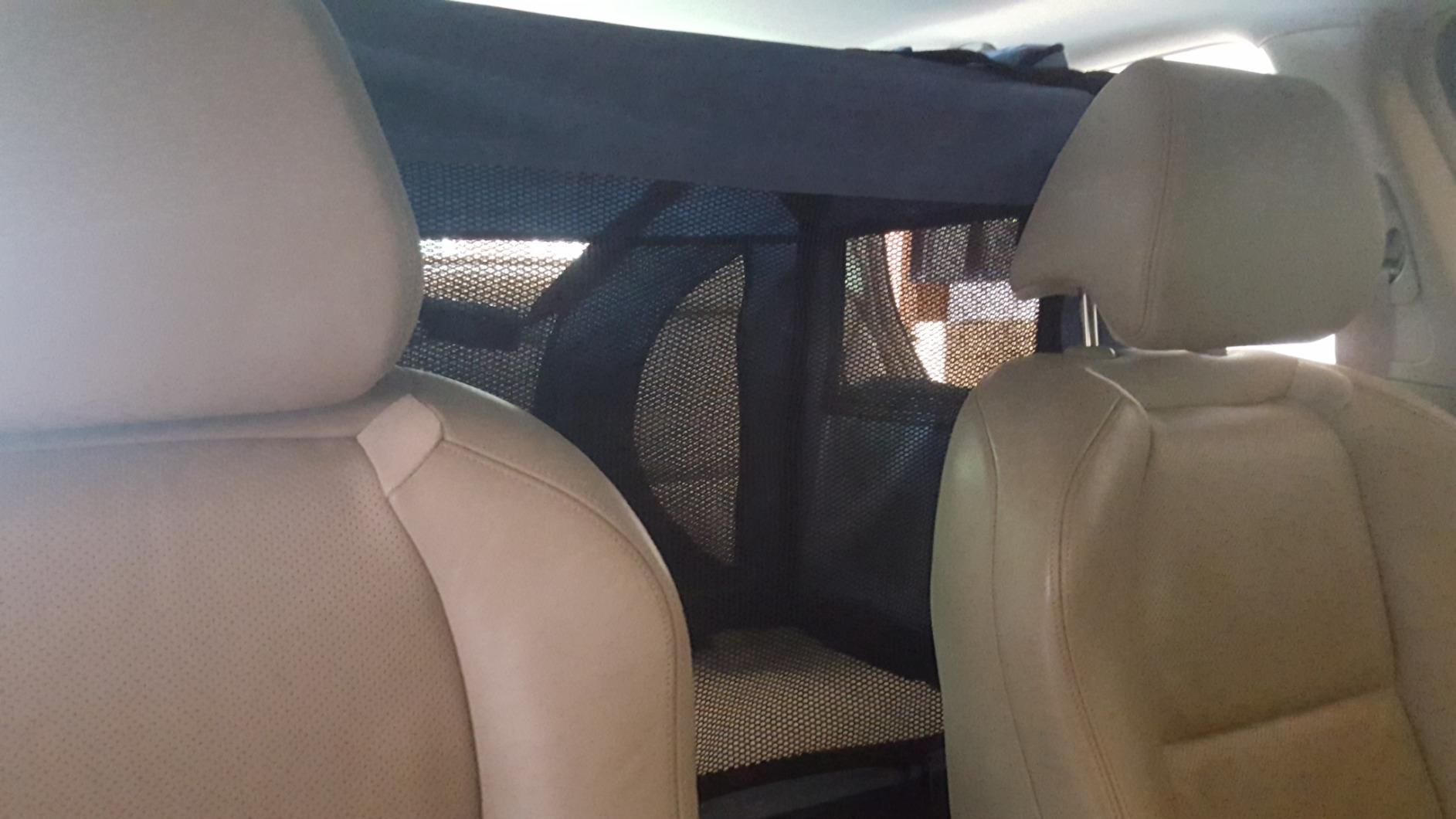
The box also contains a fleece bed, a leash, and a zippered tote with hand straps and an adjustable padded shoulder strap. The crate cover and bed cover are both removable and washable, which matters more than it sounds when a puppy is having regular accidents in them.
Two accessory pockets sit on the top and back, and the aluminium frame flexes enough to fit through a car door opening. Owners of large-breed dogs in particular rate the replaceable bedding covers highly, since a machine-washable cover is the difference between owning a soft crate and avoiding one.

Why it earns the premium slot
The 2-year warranty is the longest in this group and the most meaningful thing about it, because it covers the frame and the zippers — the two components that fail. Combined with the washable covers, it is the soft crate that survives a household rather than a single trip.
For a puppy that is calm, older, or already house-trained, the three doors make this pleasant to use. You can load from the top, reach in from the side for a calming hand, and clean without rearranging furniture.
The catch
It costs the most of any soft crate here, the included bed pad is thin so most owners add a real mattress, and some crates arrive with a strong chemical smell that needs airing. The mesh is still fabric, so a determined chewer will get into it. Crate train in wire first and treat this as the second crate.
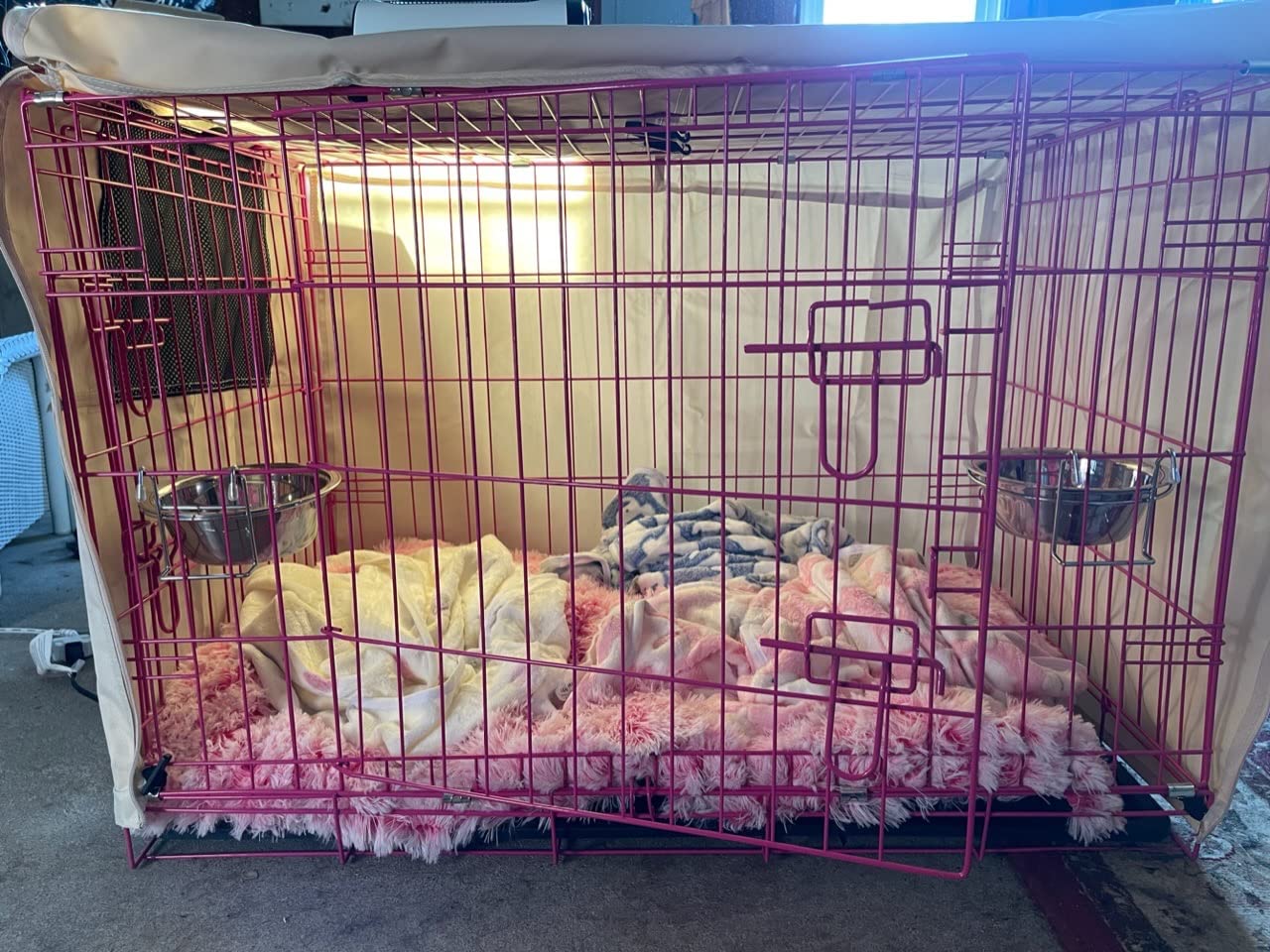
6. Internet’s Best 36-Inch Double Door Wire Kennel: Best for a Puppy Headed for Large
Internet’s Best Wire Dog Kennel | Medium (36 Inches) | Double Door Metal Steel Crates | Indoor Outdoor Pet Home | Folding and Collapsible Cage | Blue
36 x 22.5 x 24 in double door kennel
Indoor and outdoor use
Collapsible with detachable handle
For puppies under 20 in tall
Pros
- Double doors give flexible access for feeding and walks
- Collapsible with a detachable handle for travel
- Built for indoor and outdoor use
- Sturdy double-door steel construction
Cons
- Weighs 20 pounds
- one of the heavier crates to move
- Smaller review base than the leading options
- Sparse listing detail
This is the crate to buy if your puppy is going to end up in the 40 to 70 lb range and you do not want to buy twice. Thirty-six inches is the community consensus adult size for medium and large dogs, and buying it now with a divider is the cheap version of that decision.
Double doors on a crate this size are close to essential. With one door, a 36-inch crate in a small room either blocks access or faces a wall, and you end up carrying the dog around the crate to get it out. With front and side doors you can put the crate in a corner and still reach the puppy comfortably.
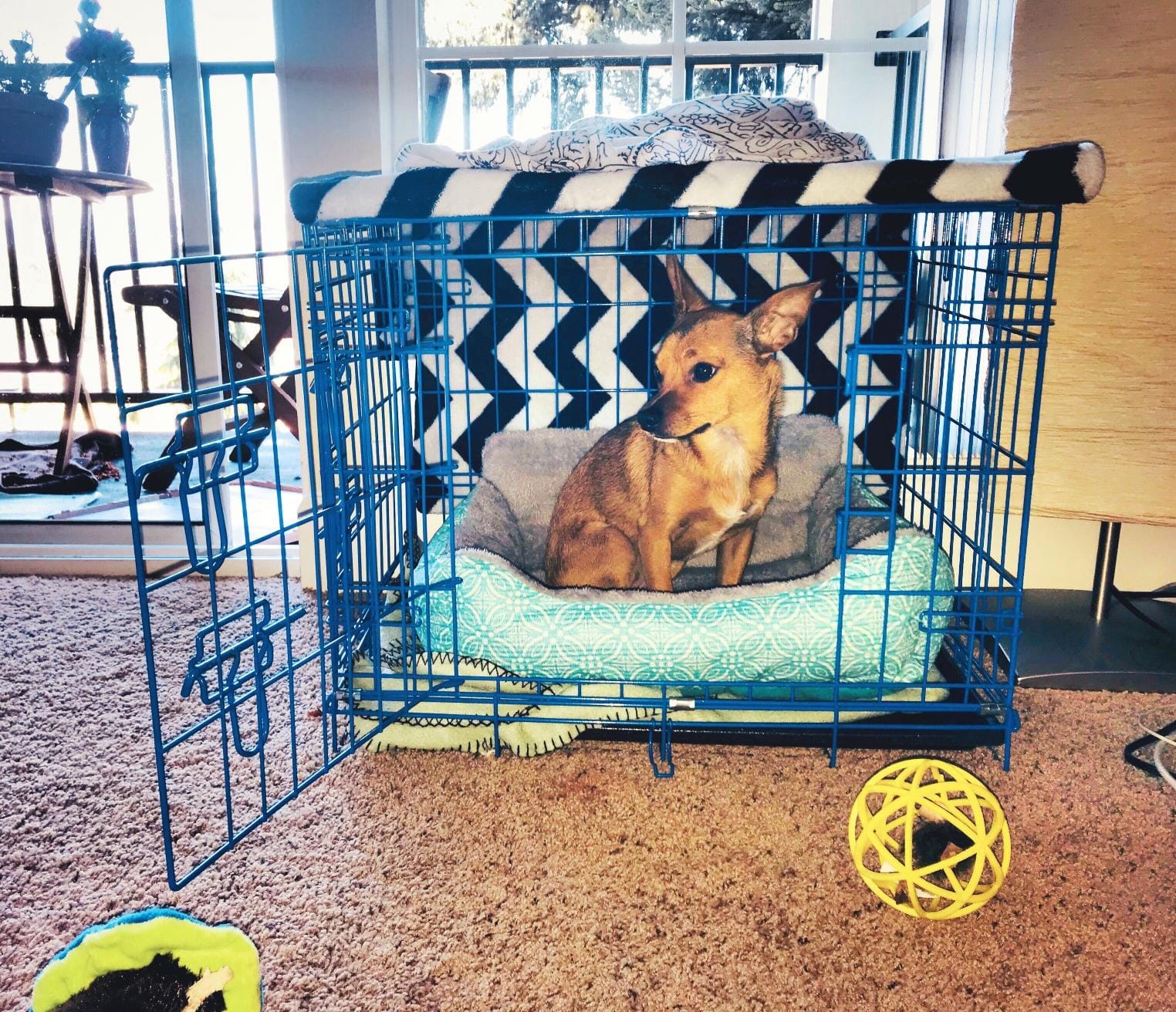
The construction is described for both indoor and outdoor use, and the frame collapses with a detachable carrying handle for road trips and holidays. Sizing guidance from the manufacturer is puppies under 20 inches tall, plus four inches on the sitting height.
The practical limit is size and weight. At 36 by 22.5 by 24 inches and 20 lb, this is not a crate for a studio flat, and moving it between rooms takes two people or some planning. It is a crate you place once.
Why it suits a large-breed puppy
Buy the adult size, use the divider. A puppy headed for 60 lb will need this crate within a year, and starting them in a small 24-inch and then upgrading means two crates, two sets of housebreaking regression, and a month of a puppy not understanding the rules.
The double doors also make it usable as the crate the dog sleeps in permanently, rather than one that gets retired at a year old. The detachable handle keeps it usable for the trips that inevitably come with a big dog.
When it is the wrong buy
If your adult dog will be under 30 lb, this is a large amount of steel you do not need. At 20 lb it is also awkward to reposition, and the listing detail is thinner than the major-brand crates, so verify the actual dimensions and included parts when it arrives rather than trusting the photos.
7. Sweetcrispy 36-Inch Foldable Kennel: Best Rounded Corners for a Young Puppy
Sweetcrispy 36 Inch Dog Crate, Medium Dog Cage, Foldable Puppy Pet Kennel
36.61 x 22.64 x 24.21 in wire kennel
Rounded edges and corners
Double door, four slide-bolt locks
ABS composite tray
Pros
- Four slide-bolt latches across two doors
- Rounded corners and edges reduce snag risk
- Spacious interior for a medium puppy
- Tray resists stains
- warping and odors
- Folds flat for storage
Cons
- Heaviest crate in this group at 25.24 lb
- Newer listing with a shorter review history
- 36 inch height can feel short as the puppy grows
Head and paw safety is the reason this crate is worth a look, and it is the concern that comes up most in puppy-owner discussions. The mesh is thick with rounded edges and smooth rounded corners throughout, which removes the sharp wire ends that catch a nose or an eyelid when a puppy is pushing at the crate at 2 a.m.
It is a 36-inch crate rated for medium puppies, and the door hardware is the most substantial in this group. There are two doors — one front, one side — and each has two heavy-duty sliding bolt locks, four latches in total where many competitors give you two.

The tray is a leak-proof ABS composite that resists stains, warping, corrosion and odor, and the accessories across the size range share the same rounded edges, so a matching crate in a different size does not reintroduce sharp corners. The open, breathable construction promotes air circulation, which helps after a wet accident.
Two details to plan around. The interior height of 24 inches works for a medium puppy but a fast-growing dog can outgrow it sooner than the 36-inch length suggests, and at 25.24 lb this is the heaviest crate in the roundup.

Why the rounded geometry matters
Most wire crates are welded at corners where the wire ends terminate. Those ends are what a puppy’s face finds when it is trying to see out of a crate, and rounded corners reduce both the snagging risk and the injury if a paw or muzzle does get caught.
Four latches also remove a specific puppy behaviour: leaning on the door with weight and paw to get out. A single squeeze latch loses that contest sooner, and a puppy that escapes its crate once will test it every time.
Where the compromises are
At 25.24 lb it is effectively a two-person carry, which undercuts the folding benefit unless it lives in one place. The listing is also new, so the long-term durability record is shorter than the established brands in this group. Check the interior height against your dog’s expected adult standing height before you commit.
8. Yaheetech 36-Inch Crate with Divider: Best Divider Design for Puppy Growth
Yaheetech 36in Double Door Metal Dog Crate w/Divider for Puppy Indoor Use
36 x 22.5 x 25 in wire crate
Adjustable divider panel included
1.3 inch bar spacing
Waterproof pull-out tray
Pros
- Divider panel genuinely useful from puppy to adult
- Collapses to 3.5 inches for under-bed storage
- Tool-free assembly in under ten minutes
- Pull-out waterproof tray with locking buckles
- Two doors for access from two sides
Cons
- Slide-bolt latches can be stiff or misaligned on some crates
- Larger 42 and 48 inch versions use thinner wire
- 36 inch height runs short for larger puppies
- Inconsistent quality control between crates
This is the crate where the divider is treated as the headline feature rather than an accessory, and for a puppy buyer that is the right priority. It is designed for medium dogs in the 40 to 70 lb range, breeds like Corgis, French Bulldogs and Cocker Spaniels, and the adjustable divider is what keeps an eight-week-old in a sensible-sized section of a 36-inch crate.
Bar spacing is specified at 1.3 inches, which is narrow enough to stop a puppy pushing its head through to see out, and the manufacturer notes this also helps by keeping the dog visually connected to its surroundings. The powder-coated wire has rounded edges, and the frame folds to 36 by 22.5 by 3.5 inches with a detachable handle.
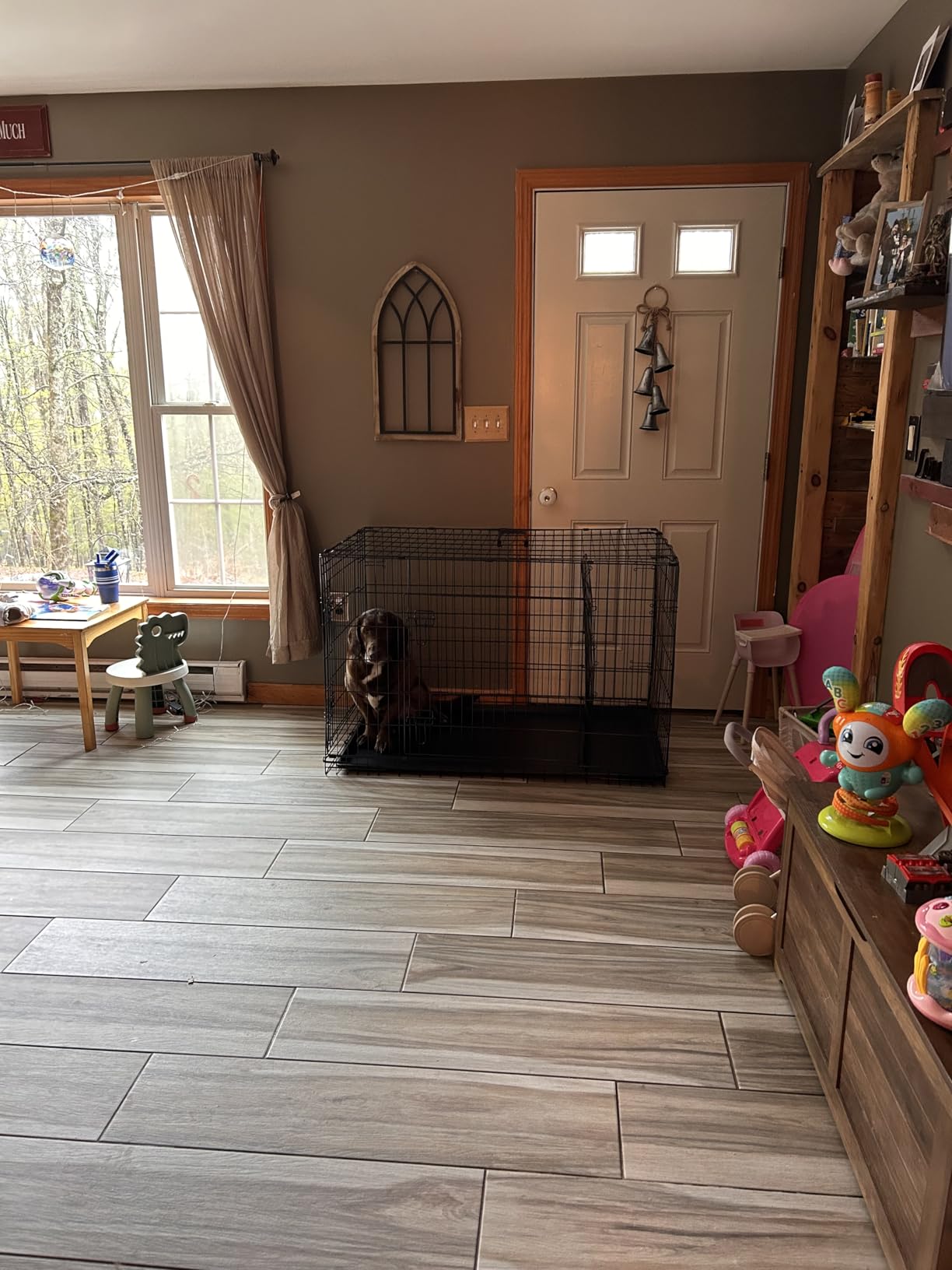
The tray is a waterproof pull-out with locking buckles rather than a slide-in pan, so it stays put when a puppy jumps. Assembly is tool-free and typically under ten minutes, which matters when you are doing it at midnight with a puppy loose in the house.
It has also survived abuse that destroys softer enclosures — one owner reports it withstood an active cat that had shredded other crates. That is a reasonable proxy for a puppy with teeth and time.
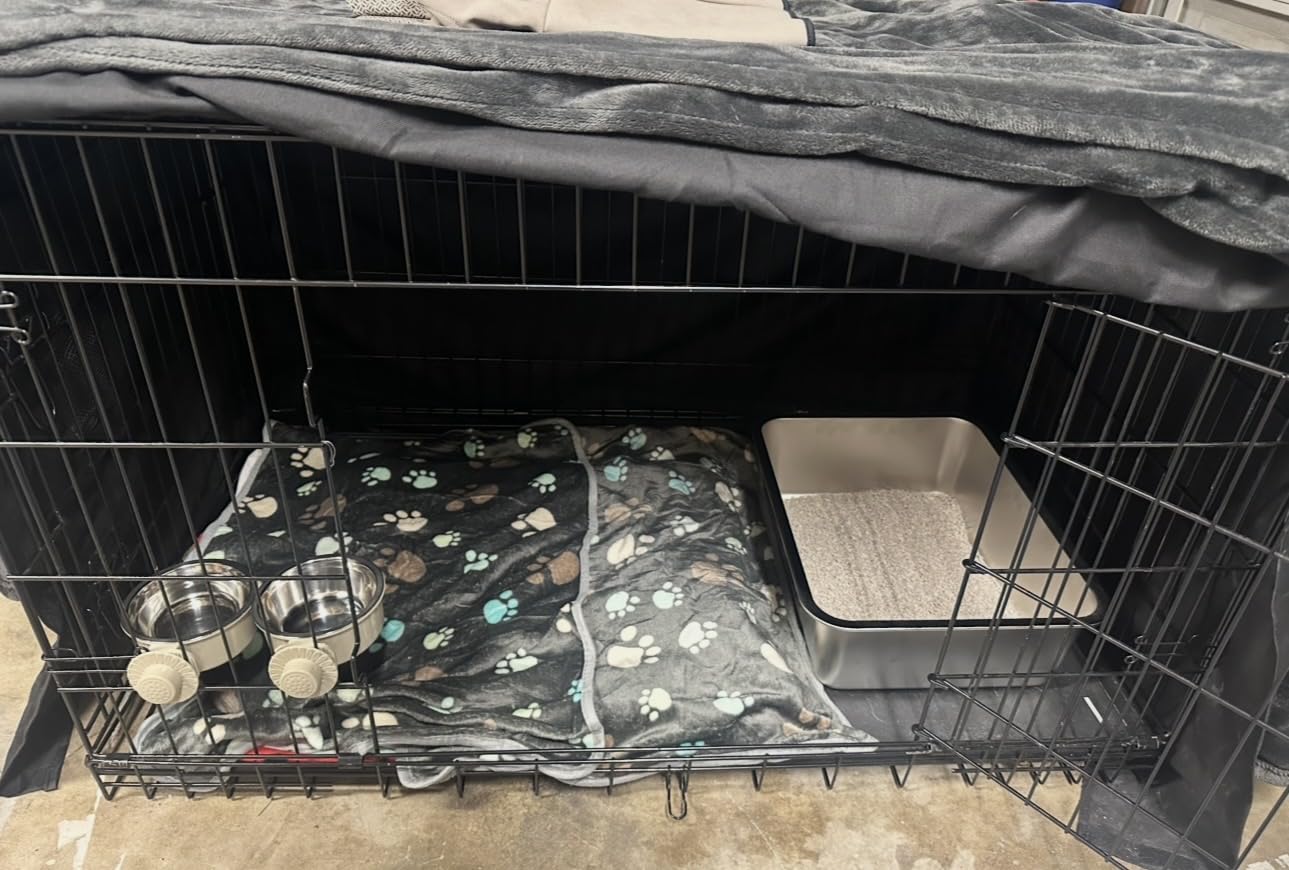
Why the divider design suits a puppy
The divider here is the mechanism the whole sizing strategy depends on, and it works as a growth system: block off the back for the toilet zone, slide it forward as accidents stop, remove it entirely once the dog fills the crate. Having a crate that was designed around that panel from the start is worth more than a cheaper crate plus a separate panel.
Collapsing to 3.5 inches makes it one of the easier large crates to store, and 22.93 lb is lighter than the other 36-inch steel options in this group.
What the reviews flag
The latches are the weak point. Several owners report stiff slide bolts that are hard to open and close, and some crates arriving with top latches welded out of alignment. Check every latch on day one and replace anything that does not move freely. The 36-inch height is also short for a larger puppy, and the bigger sizes use thinner wire.
9. DONORO 30-Inch Contoured Crate with Oxford Cover: Best Complete Kit
DONORO Dog Crates for Small Medium Size Dogs Indoor Double Door Dog Kennels & Houses for Puppy and Cats, Collapsible Metal Contour Dog Cages (Brown, 30.0″ L x 19.0″ W x 21.0″ H)
30 x 19 x 21 in contoured wire crate
600D Oxford cover included
Front and side doors
Handle and leak-proof tray
Pros
- Cover
- handle and leak-proof tray all in the box
- Four heavy-duty slide-bolt latches across two doors
- Oxford cover gives a softer den feel
- Hook-and-loop cover removes easily for washing
- Contoured profile looks less industrial
Cons
- 1-year warranty is shorter than some competitors
- Cover is hand wash only
- Fabric cover is quickly damaged by a chewer
- Smallest review base among the rated crates
The DONORO is a wire crate with a soft shell bolted on, and that hybrid is the most useful idea in this roundup if you want the den feeling of a soft crate with the hardware and tray of metal. The 600D Oxford cover is waterproof and attaches with hook-and-loop tape, so it comes off in seconds for washing.
Underneath, you still have a contoured metal wire frame with front and side entry doors and two heavy-duty slide-bolt latches per door. The leak-proof removable tray and carrying handle are both in the box, which is unusual — most crates make the handle or the divider a separate purchase.
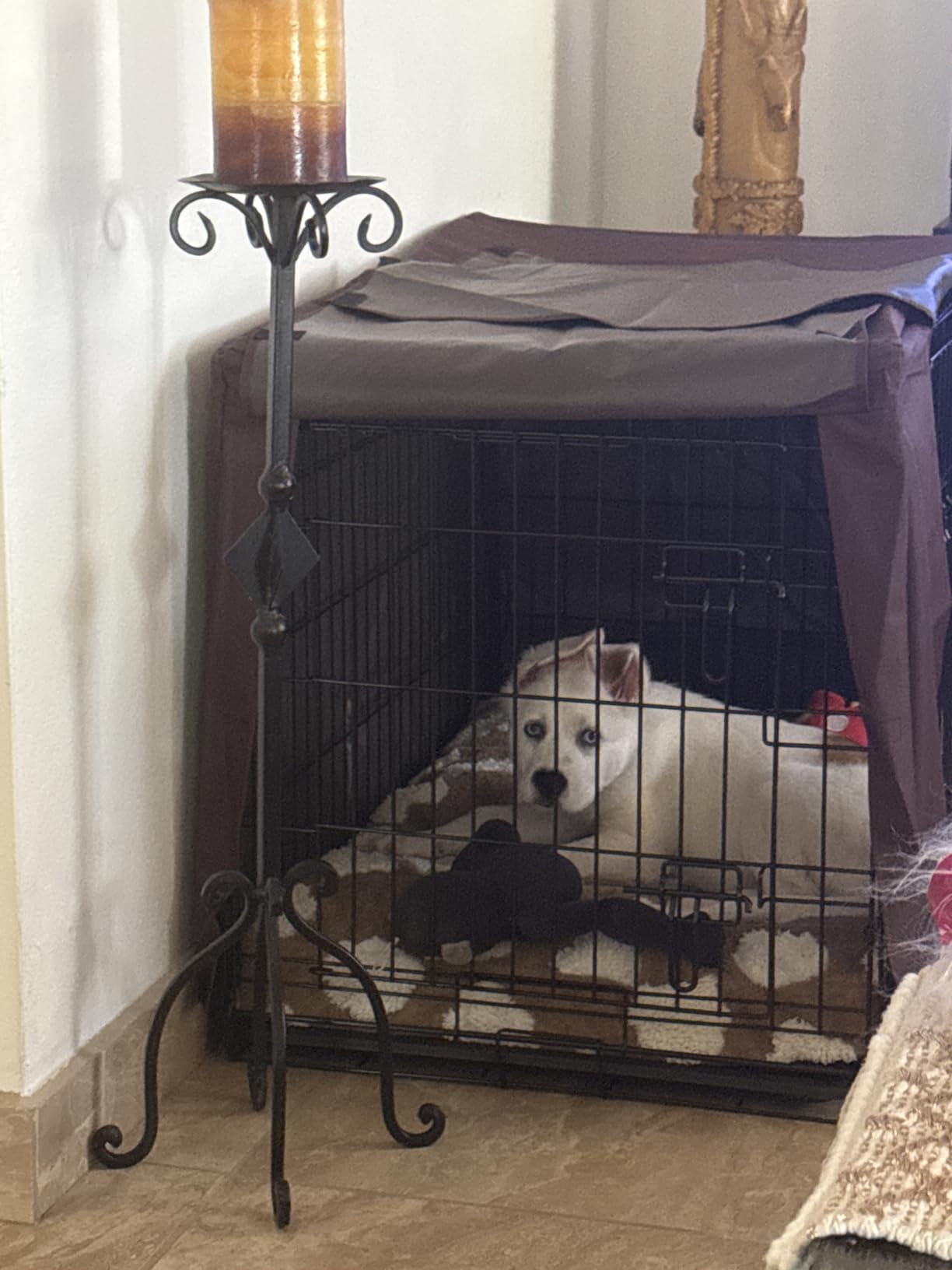
For an eight-week-old the covered version reads as a den straight away, and for housebreaking the tray and the metal frame are still doing the work. The cover also reduces the visual stimulus of a bare wire crate, which helps a puppy that barks at everything in the room.
At 30 by 19 by 21 inches and 17.71 lb, it suits small and medium puppies and covers breeds like Corgis, French Bulldogs, Cocker Spaniels and small Dachshunds. It is 19 inches wide, narrower than the other 30-inch crates here, so check that it fits the space you have in mind.
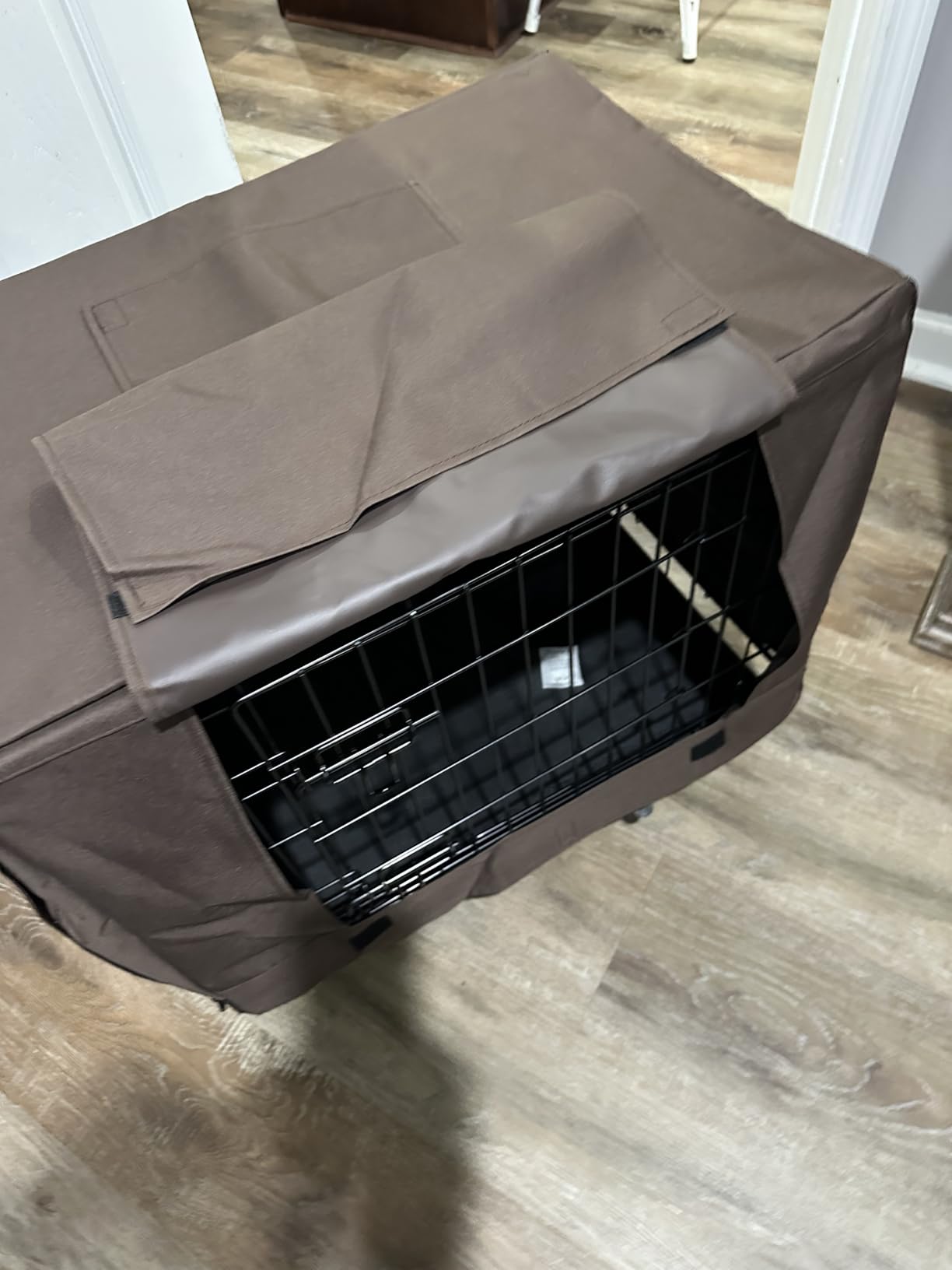
Why the cover matters more than it sounds
Owners of larger breeds consistently rate soft-sided crates on replaceable, washable covers, and this is the crate that delivers that benefit on a wire frame. Bedding goes in, gets soaked, comes out, goes in the wash — the crate itself wipes down with a cloth.
It is also the aesthetic compromise. A bare wire kennel in a living room is visually loud, and the contoured profile with a fabric cover reads as furniture. For people who dislike the look of a kennel but still want metal containment, this is the answer.
Where it falls short
Two things. The cover is hand wash only, which is a nuisance with a puppy. And a puppy with teeth will find the hook-and-loop seams and the fabric far more interesting than a wire bar, so for a hard chewer, remove the cover and use the frame as a bare crate — or buy a heavy-duty crate built for that.
10. Petprsco 24-Inch Collapsible Soft Crate: Best for Two Small Dogs
Petprsco Portable Collapsible Dog Crate, 24″ Soft Dog Crate for Car Travel
24 x 17 x 17 in soft crate
For pets 12-30 lb
Three doors with lockable zippers
Includes mat, blanket and bowl
Pros
- Roomier than most 24 inch soft crates
- Comes with mat
- blanket
- bowl and side pockets
- Lockable zippers and an internal tether
- Anti-collision pads protect car interiors
- Folds flat to almost no volume
Cons
- Mesh and zippers get damaged by a determined chewer
- Included mat is thin and hard
- Strong chemical smell on arrival
- Too large for compact cars
Two-puppy households are the overlooked case in most crate roundups, and this is the answer. At 24 by 17 by 17 inches with a 600D Oxford cloth over a steel frame, multiple owners report fitting two small dogs in a single crate — the internal tether and the dividing space make that workable where a fabric crate usually would not be.
It comes as a complete kit. The removable washable soft mat, a blanket, a foldable travel bowl, an adjustable tether leash, side pockets and a top handle are all in the box, so there is nothing to buy before the first car trip.
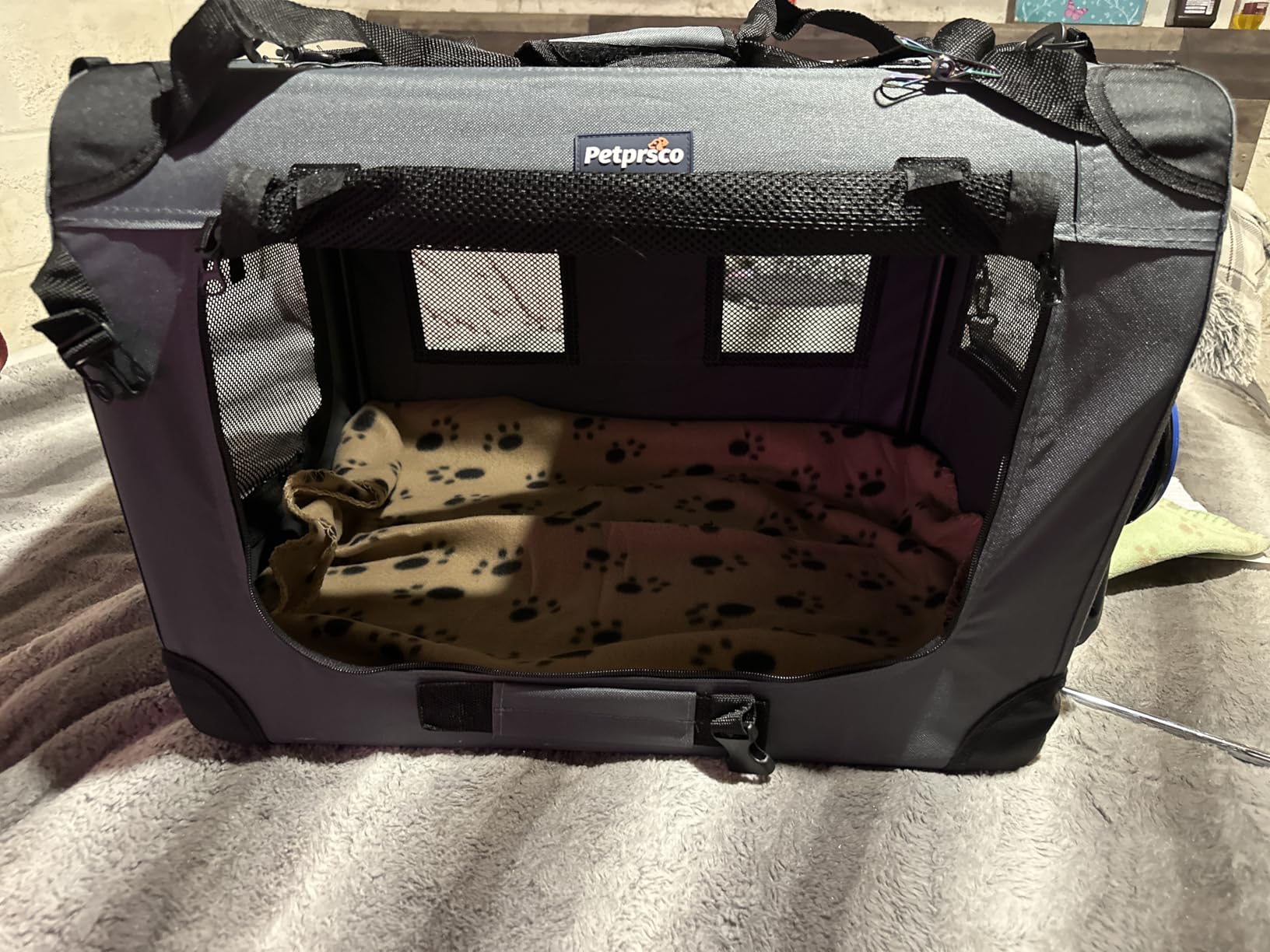
The three doors have lockable zippers, which is unusual at this price point and is the single most important feature for a puppy that might nose a zipper open. Four-sided mesh panels give 360-degree ventilation, and anti-collision pads on all four corners protect car interiors and furniture.
It folds flat to almost no volume, which is what makes it a genuine apartment crate. Against that, the manufacturer explicitly advises against use for persistent chewers or escape-prone pets, and notes it is not designed for compact cars or airline travel.

When it earns its place
Two small dogs, short stays, a small flat, and a lot of car time. That combination is what this crate is built for and it is a real niche that hard-sided carriers and wire crates do not serve, because a wire divider that splits a 24-inch crate leaves too little space for two puppies.
The lockable zippers make it the safest soft crate in this group, and the bundled kit means it is usable the day it arrives rather than after a shopping trip.
What to sort out first
Air the crate out before use — several buyers report a strong chemical smell that took days to dissipate. The included mat is thin and hard, so add a real cushion if the puppy will spend hours in it. And if your puppy is a chewer, the mesh and zippers are the failure points to watch, because the manufacturer says plainly that it is not built for that.
11. FDW 24-Inch Foldable Metal Dog Crate: Best Lightweight Wire Option
FDW | 24″ Foldable Metal Dog Crate | Black | Cage for Small Dogs
24 x 16 x 19 in wire crate
Weighs under 8 lb
Dual doors with heavy latches
Leak-proof ABS tray
Pros
- Lightest wire option here at under 8 lb
- Two doors with dual heavy-duty latches
- Removable handle mounts on either side
- Epoxy coating resists rust and fading
- Collapses to under 3 inches
- Tool-free assembly
Cons
- Wire gauge is lighter than premium brands
- Some crates arrive with bent panels or a bent handle
- Listing carries little model detail
The FDW solves a narrow problem very well: a real metal crate that one person can move. At 7.94 lb it is barely half the weight of the other 24-inch wire options here, and it still has two doors with dual heavy-duty latches rather than the single door most crates at this size manage.
It is 24 by 16 by 19 inches, which makes it a small-breed crate covering dogs under 20 inches. The epoxy-coated wire resists rust, corrosion and fading, and the leak-proof ABS composite tray has an integrated perimeter lip that keeps spills inside the kennel rather than running under it.

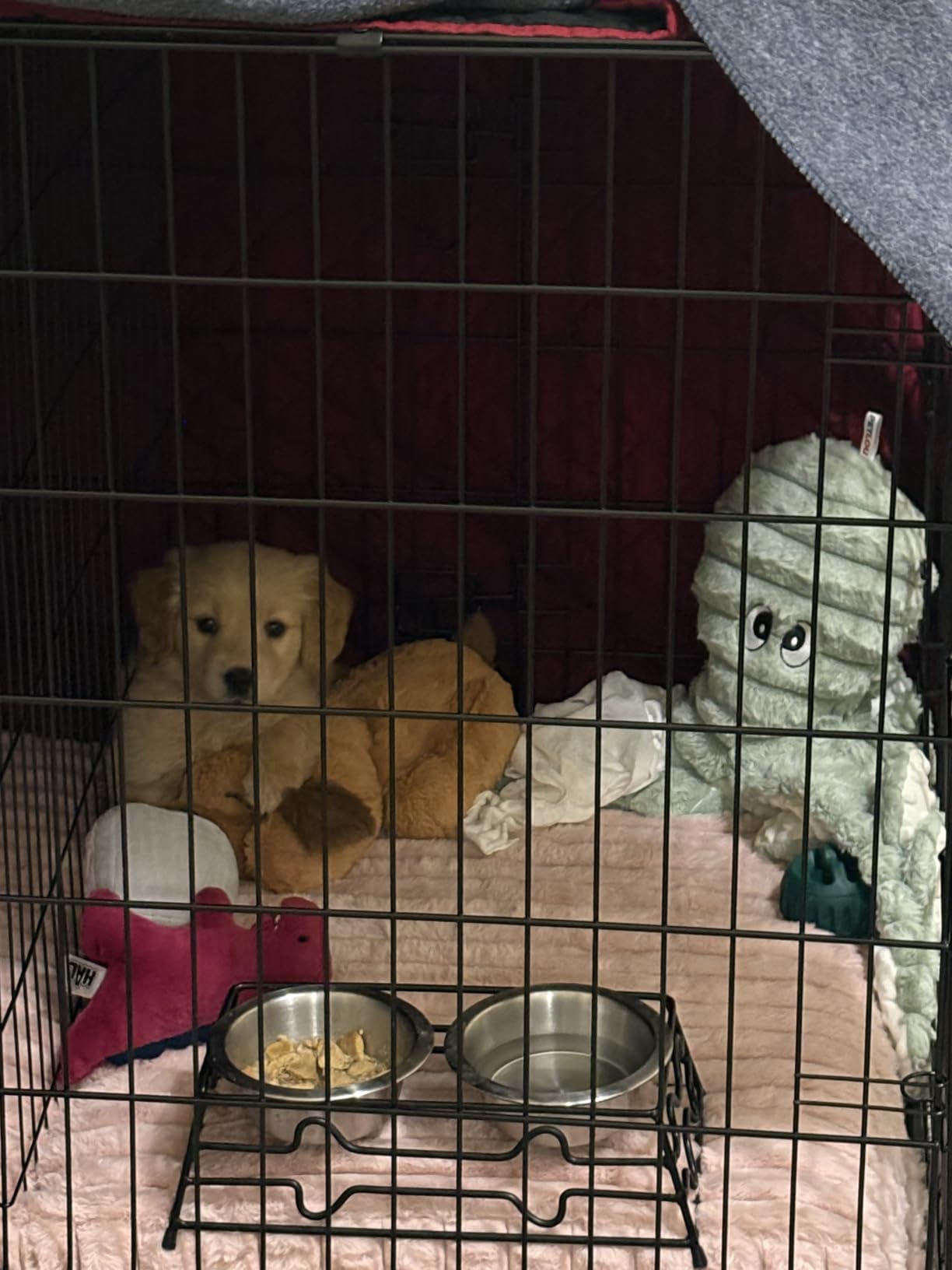
Two details worth knowing. The divider panel is described as able to separate two pets, so it functions as a two-dog divider in a small crate, which is useful if you have two puppies of similar size. And the carrying handle is removable and mountable on any side, so you can carry from whichever direction clears the doorway.
It collapses to under three inches thick and needs no tools to assemble. For a small flat, a rental car boot, or a house where the crate lives in two places, that weight and fold combination is the deciding factor.
Why the low weight changes the use case
Every other wire crate in this roundup is 11 to 25 lb. That is fine if the crate has a permanent spot, and genuinely annoying if it does not. At under 8 lb you can carry a crate with a puppy in it, reposition it when company arrives, and store it away at the end of a trip.
Two doors plus a side-mountable handle also mean you are not constrained to one wall. In a small room you can put the crate in the corner with the side door facing out, which is a real advantage for a crate that gets used daily.
Where the money was saved
Wire gauge is lighter than the premium brands, and that matters specifically for puppies that habitually try to escape by pushing at the bars. Bent panels or a bent tray handle on arrival are reported by some buyers, so inspect the frame and tray before the puppy does. If your puppy is an escape artist, spend up on a heavier frame instead.
12. DUMOS 24-Inch Foldable Puppy Cage: Best Budget Pick
DUMOS 24 Inch Dog Crate, Foldable Puppy Small Dog Cage Pet Kennel
24 x 16.54 x 18.5 in wire crate
Divider panel included
Deep-lip removable tray
Collapses under 3 inches
Pros
- Lowest cost in the roundup
- Assembles in about a minute with no tools
- Rounded corners protect paws
- floors and furniture
- Divider panel included for growth or two pets
- Deep-lip tray slides out for quick cleaning
- Folds flat and includes a carry handle
Cons
- Door latch slides the reverse direction from most owners expect
- One report of bent wires with a 6 lb dog
- Some crates arrive with bent panels
- Single door limits access to one side
The DUMOS is the cheapest crate in this group and the only one at this price that includes a divider panel, rounded corners and a deep-lip tray. Those three features are non-negotiable for a puppy, and the fact that they are all present here is the reason to pick it despite the build being lighter overall.
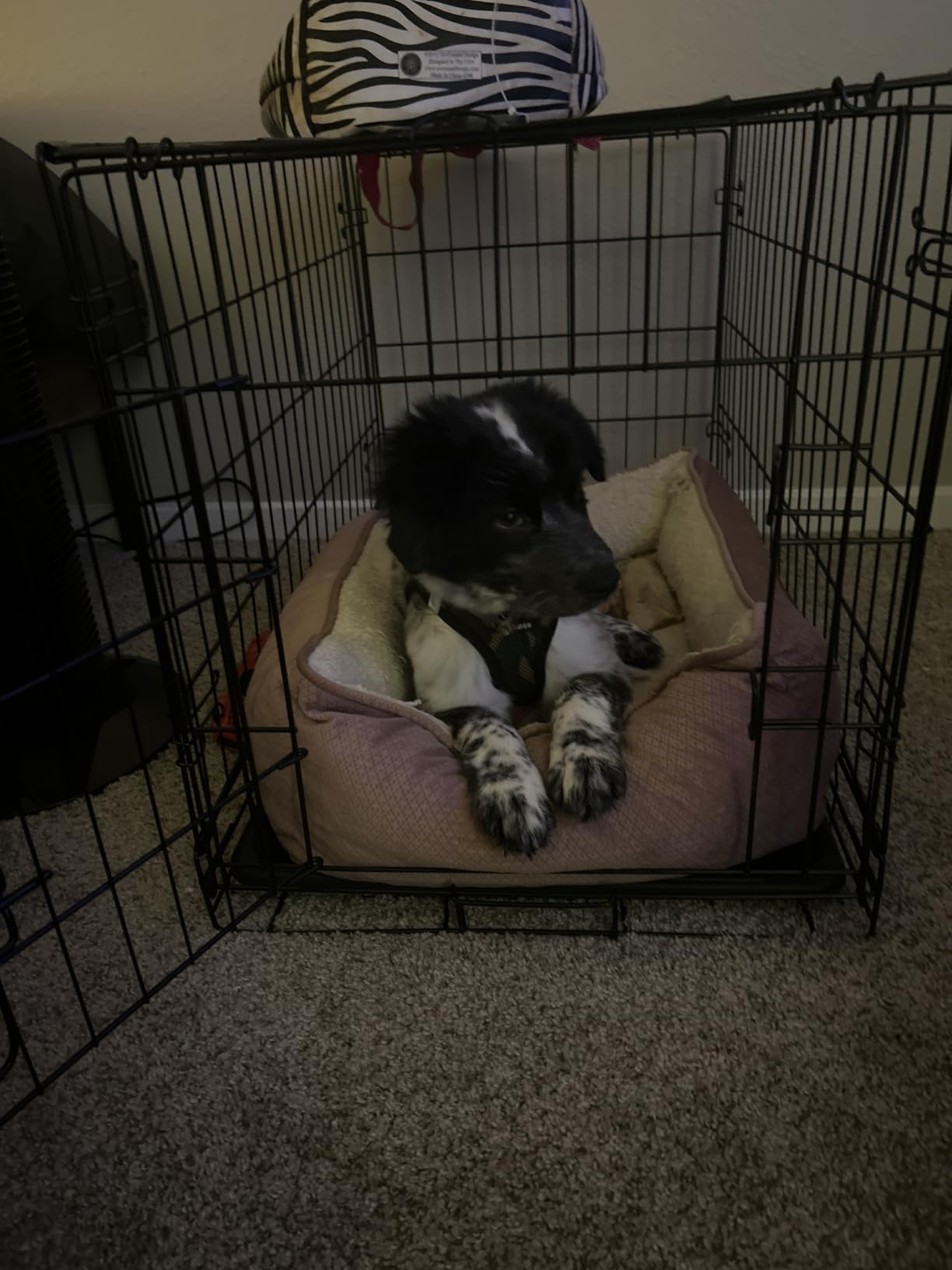
It is a 24-inch single-door wire crate at 24 by 16.54 by 18.5 inches, which suits toy and small breeds. The large door opening and low threshold make getting in and out easy for a puppy still working out its legs, and the rounded corners protect paws, floors and furniture.
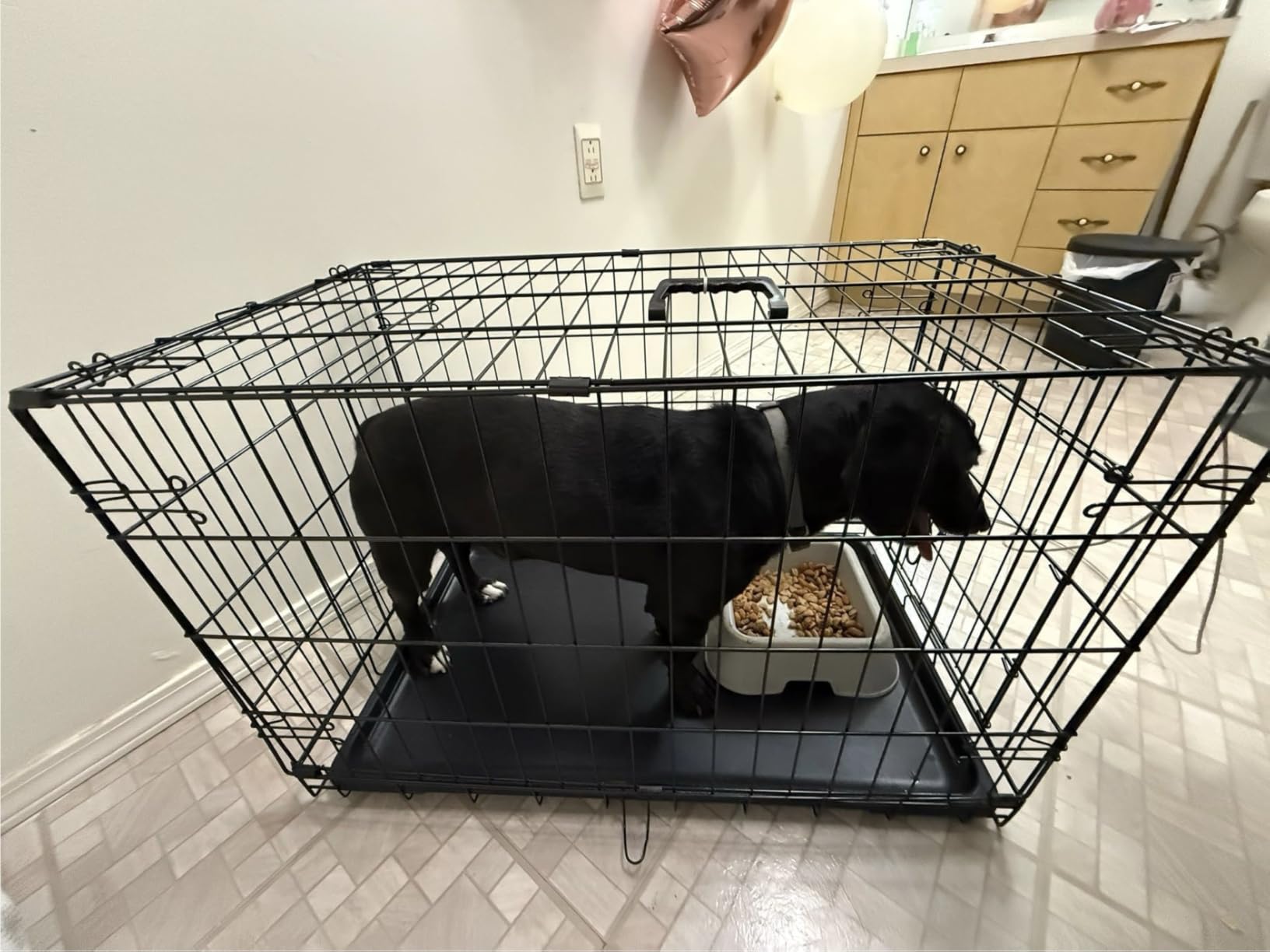
The tray has a deep lip and slides straight out for cleaning, which is a better specification than most budget crates, where a shallow pan lets a thin layer of water run under the crate and into the floor. The divider is easily secured and adjusted, and it also works to split the space for two pets.
It collapses flat to under three inches thick and comes with an attachable carry handle. At 11.35 lb it is one of the lighter crates here, so moving it between rooms is manageable for one person.
Why it works as a first crate
Three things a budget puppy crate should have and usually does not. The divider means you are not buying a 24-inch crate for a ten-pound adult. The rounded corners remove sharp wire ends. And the deep-lip tray is the difference between wiping a tray and mopping a floor.
If the adult weight is comfortably under 20 lb, this is a genuinely complete starter crate. It also folds flat, so a small flat can reclaim the space whenever the crate is not in use.
The two things to check on arrival
First, the door latch. On this model the heavy-duty sliding bolt runs in the opposite direction to what most owners instinctively try, so practice opening it before you need it at speed. Second, inspect the wires. One owner reported bent wires within 35 minutes with a 6 lb dog, and some crates arrive with bent panels — check the frame and tray before the puppy does, and swap it if anything is out of shape.
Crate Training Timeline by Age
The question nobody can answer with a single number is how long a puppy should be crated. The useful answer is by age, and the number that matters is the longest single stretch your puppy can manage without distress, not the total hours across the day.
The 7-7-7 rule is a starting point rather than a law: roughly seven hours of crate time per day, seven consecutive nights alone, and seven days to accomplish it. It applies cleanly from around fourteen weeks and is a way too aggressive to start at eight weeks.
8 to 10 weeks — short daytime stretches of 30 to 60 minutes, several times a day, plus overnight crating from about three or four in the morning. Puppies this age have small bladders and no bladder control.
10 to 12 weeks — 1 to 2 hours at a stretch during the day, up to 4 or 5 hours total, and through the night. This is the age most people are asking about, and two hours at a stretch is a realistic starting point for most.
12 to 16 weeks — 3 to 4 hours at a stretch, 4 to 5 hours total, and comfortably overnight. Most puppies can hold overnight by now, and the crate can be opened up and the divider removed.
4 to 6 months — 4 to 5 hours at a stretch, which is a normal working day with a midday break. This is where the 7-7-7 rule sits comfortably.
6 months and older — 6 to 8 hours, matching a full workday, provided the puppy is genuinely relaxed in the crate rather than tolerating it.
Crying at night is normal for a puppy under about sixteen weeks, and the answer is not to go in and open the door. Opening the door to a crying puppy teaches that crying ends the crate, which is a lesson that takes weeks to undo. What does help is moving the crate beside your bed for the first few nights so the puppy is not alone, and dealing with the last stretch of the night with a toilet trip outside rather than with attention in the crate.
There is one absolute: a young puppy should not be crated for long stretches through the night without a break. If the household sleep is the problem, take the puppy out. A crate that causes a regression is worse than no crate at all, and nobody wins a fight with a nine-week-old at 3 a.m.
Where to Put a Puppy Crate and What to Put Inside
Put the crate in the room you are in, not across the house and not out of sight. A crate in a puppy’s bedroom is the wrong answer for separation training, because the puppy needs to hear you and hear the house moving around it in order to learn that your absence is normal rather than alarming.
A good spot is a corner of a main living space, off the main walkway so nobody trips in the dark, away from radiators and direct sun, and near enough that your puppy can see you when you are in the room. If you have a choice between a spot the puppy likes and a convenient spot, take the one the puppy likes.
Inside, keep it simple. A washable mat or bedding for warmth and grip, water if the puppy is in for more than a couple of hours, and nothing else unsupervised. Toys in a crate are how puppies learn to relieve themselves in it, because a toy left inside becomes a thing to play with in the wrong place. You can hand a toy in for five supervised minutes, then take it out.
Food is the other one. Feed the puppy before the crate rather than inside it, and avoid meals immediately before a long crating period, so the crate stays associated with sleep and safety rather than with eating and then being shut away.
Crate vs Playpen: Which One Your Puppy Actually Needs
If you are away for more than about four hours a day, a crate is the wrong tool and a playpen is the right one. This is the single most common point of stress among owners of working dogs, and the tension is real: crating a puppy for eight hours is a long, dull, unsatisfying stretch for a young animal.
The decision rule is simple. A crate is for rest, overnight safety, travel, and short daytime periods. A playpen is for daytime containment while you are out. Most households end up with a crate for night plus a playpen or a pen in the kitchen for the workday, and that combination is genuinely better than stretching a crate to do a job it cannot do.
What you do not want is a giant crate. A large crate with a puppy inside is a puppy that is alone for hours in a space large enough to potty in the far corner, which undoes your housebreaking. If you need daytime containment for a long absence, use a pen or a playpen with a toilet zone, a bed, water and safe things to chew, and leave the crate for the night.
Separation distress is a different problem from boredom. A puppy that whines, barks or destroys bedding is telling you the time is too long, not that the crate is the wrong shape. More crates and longer hours do not fix it; shorter absences, more exercise and a mat with the owner’s scent do.
Crate Safety: Bar Spacing, Chew-Through and Top-Load Entrapment
Bar spacing. Check the gap between wires before the puppy arrives, and put your own fingers through it. If your fingers cannot pass through, a puppy’s head cannot get stuck — that is the whole test, and it takes ten seconds. One crate in this roundup specifies bar spacing at 1.3 inches, which is the number to look for. For a smaller puppy, look for a crate specified for smaller dogs rather than one specified for the adult size.
Wire ends and corners. Puppies push their faces into corners at 2 a.m., and the welded wire terminations are what they find. Crates with rounded corners and rounded wire edges — the Sweetcrispy and DUMOS here, for instance — remove the sharpest version of that risk.
Chew-through. Fabric is not containment. If your puppy is teething, avoid a soft-sided crate as a primary crate and remove any fabric cover from a wire frame, because the seams are where the chewing starts. Zipper latches that are not lockable are a similar risk.
Top-load only. Never use a crate whose only entrance is in the roof as a puppy’s crate. If a puppy is shut in and you need to reach it, or if the puppy is distressed and cannot get out on its own, a roof-only door is a serious hazard. Top doors are excellent as a second door; they are not acceptable as the only one.
Latches. Test every latch the day the crate arrives, and test it again after a month. A stiff or misaligned slide bolt is reported on more than one crate in this group, and a door a puppy can shoulder open defeats the whole training effort.
Also keep the crate away from flat collars or harnesses on a puppy left inside unsupervised. A snagging collar in a wire crate is one of the more preventable crate accidents there is, and it costs nothing to avoid.
Frequently Asked Questions
What type of crate is best for crate training a puppy?
A wire crate with an adjustable divider panel. Wire ventilates and dries fast, which matters during housebreaking, and the divider lets you start with a puppy-sized space inside a crate the dog will need as an adult. Buy the adult size and use the panel to block off the back third as a toilet zone until overnight accidents stop.
Is it better for a dog crate to be too big or too small?
Too big, provided you use a divider. A crate that is genuinely too small prevents the dog standing up, turning around or lying down stretched out. A crate that seems oversized is correct as long as the divider panel reduces the usable space to puppy size, and the panel is moved forward each time accidents stop.
Are wire crates or plastic crates better?
Wire crates are better for housebreaking because air moves through them and water runs off, so an accident is wiped up and the crate is dry for the next break. Plastic crates are better for chew-prone puppies and travel, because the shell cannot be shredded and most models meet airline cargo specifications. For most puppies training at home, choose wire.
How long should a 12 week old puppy be in a crate?
One to two hours at a stretch during the day, up to four or five hours in total, plus overnight crating. A twelve-week-old puppy has limited bladder control, so break the day into short sessions rather than one long block. If the puppy is distressed rather than simply restless, shorten the next session and build back up over several days.
Should you ignore a 9 week old puppy crying in its crate?
Do not open the door while the puppy cries, because that teaches that crying ends the crate and the lesson is hard to reverse. Instead, move the crate beside your bed for the first few nights, and take the puppy out for a toilet trip when the crying starts rather than letting a crying puppy out by default. Crying at this age is normal and it passes.
Where should a puppy’s crate be at night?
In a main living space, not the puppy’s bedroom and not out of sight. Start with the crate beside your bed for a few nights if the puppy is very young, then move it to a quiet corner of a room you use regularly. Avoid hallways, direct sun, radiators and anywhere a puppy could be startled by people walking past in the dark.
What is the 7 7 7 rule for puppies?
Seven hours of crate time per day, seven consecutive nights alone, and seven days to get there. It is a starting framework rather than a fixed law, and it suits puppies from about fourteen weeks. At eight weeks, work up to it from much shorter sessions, and treat any crying or destructive behaviour as a signal to move more slowly.
Final Verdict
The best dog crates for puppies all share one design decision: a wire frame, a leak-proof tray, a door a puppy cannot push open, and a divider panel so the crate can be adult-sized on day one. The MidWest iCrate is the one we would buy first, the Amazon Basics wire crate is the same idea with a better fold, and the DUMOS is the cheapest crate here that still gets the divider and rounded corners right.
Choose the size your dog will be as an adult, block off the toilet end, move the panel forward as the accidents stop, and expect the first few nights to be noisy. Everything else on this list is a variation on that plan, and the variation you pick should be decided by your puppy’s temperament, your room and your schedule — not by which crate has the longest spec sheet.