
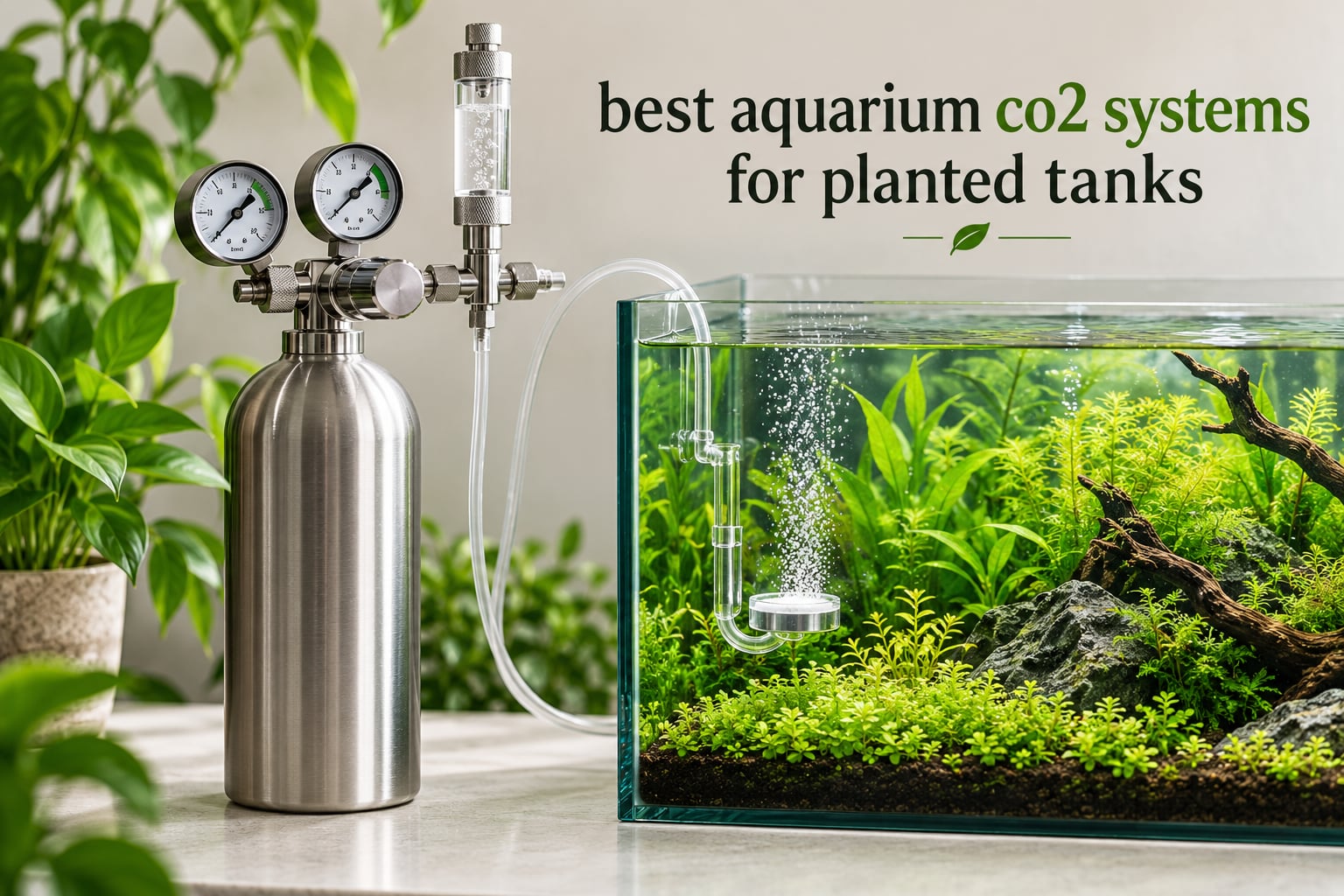
The best aquarium CO2 system for a planted tank is a dual-stage pressurized setup: a CO2 cylinder, a dual-stage regulator, an electric solenoid on a timer, a needle valve, a bubble counter, a diffuser, and a drop checker holding roughly 30 ppm dissolved CO2. A DIY stainless steel generator covers tanks up to about 40 gallons; a cylinder-based system scales from there. Before any brand names appear, one honest note from our team: this hobby runs on peer trust, and the names that come up constantly on r/PlantedTank and r/Aquascape are CO2Art, Green Leaf Aquariums, Aquatek and Milwaukee. Most of the products we tested and researched for this roundup sit in the DIY and component tier below those brands, and we say so plainly rather than dress them up.
That tension matters because the SERP for this query is dominated by forums, and the top editorial competitor names FZONE as its number one. Hobbyists generally say the opposite. We spent weeks reading forum threads on regulator leaks, end-of-tank dumps and needle valves, and cross-checked every product below against its real review record, so you can see where the community consensus and the spec sheets disagree.
This roundup covers 12 systems across the full range: bottle-cap DIY builds, stainless steel generator kits, component regulators for CGA320 cylinders, an all-in-one nano kit, and a gel-based no-plumbing option. Every rating and review count here is copied straight from the product listing, and every “what could be better” note comes from real owner feedback rather than marketing copy. Prices change daily, so we point you to the check buttons instead of quoting figures that will be wrong by tomorrow.
Table of Contents
Top 3 Picks for Best Aquarium CO2 Systems for Planted Tanks in 2026
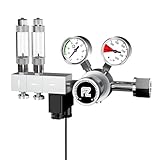
FZONE Pro Dual Stage Regulator
- Dual stage 0-65 PSI
- twin manifolds
- 12V DC solenoid
- safety valve

FZONE 2.5L Generator System
- 1.5mm SUS304 steel bottle
- safety valve
- bubble counter and check valve
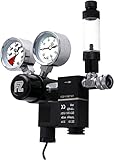
The regulator is the single component that decides whether a CO2 system is safe, so the best-rated unit in the group takes the top slot. The FZONE Pro Series holds working pressure as the cylinder empties, which is exactly the failure mode that ends aquariums. The 2.5L generator kit is the most complete all-in-one DIY package here, and the DC solenoid regulator is the least complicated way to add a real cylinder to a system.
Best Aquarium CO2 Systems for Planted Tanks in October
| Product | Specifications | Action |
|---|---|---|
| FZONE Pro Series Dual Stage CO2 Regulator |
|
Check Latest Price |
| Fzone 2.5L CO2 Generator System Kit |
|
Check Latest Price |
| FZONE Aquarium CO2 Regulator with DC Solenoid |
|
Check Latest Price |
 HYQO DIY CO2 Generator Kit with Pressure Gauge HYQO DIY CO2 Generator Kit with Pressure Gauge |
|
Check Latest Price |
 ZRDR 2L Aquarium CO2 System with Pressure Gauge ZRDR 2L Aquarium CO2 System with Pressure Gauge |
|
Check Latest Price |
 MagTool 2.5-5L DIY CO2 Generator Kit MagTool 2.5-5L DIY CO2 Generator Kit |
|
Check Latest Price |
 Clscea G700S 4L CO2 Generator with Solenoid Clscea G700S 4L CO2 Generator with Solenoid |
|
Check Latest Price |
 Hygger CO2 2L Generator System Hygger CO2 2L Generator System |
|
Check Latest Price |
 Hygger CO2 Regulator with Dual Pressure Gauges Hygger CO2 Regulator with Dual Pressure Gauges |
|
Check Latest Price |
 Fluval FL Mini Pressurized 20g CO2 Kit Fluval FL Mini Pressurized 20g CO2 Kit |
|
Check Latest Price |
 Estink DIY CO2 Generator System Kit Estink DIY CO2 Generator System Kit |
|
Check Latest Price |
 Aquario Neo CO2 DIY Gel Kit Aquario Neo CO2 DIY Gel Kit |
|
Check Latest Price |
1. FZONE Pro Series Dual Stage CO2 Regulator – Best Overall and Safest Pressure Control
FZONE Pro Dual Stage Aquarium CO2 Regulator CGA320 for Aquarium Plant Tanks
Dual stage 0-65 PSI
Twin manifold needle valves
Safety valve above 100 PSI
12V DC solenoid
Pros
- Holds working pressure as the cylinder empties
- Two independent manifolds can feed two tanks
- Built-in safety valve above 100 PSI
- Quiet 12V DC solenoid pairs with any timer
- Highest rated regulator in this group at 4.3 stars
Cons
- Most expensive regulator here and needs its own CGA320 cylinder
- CGA320 thread only so it will not fit cylinders outside North America
- Twin manifolds add plumbing complexity for a single tank
This is the regulator we would put on our own tank first, and the reasoning is entirely about pressure behaviour rather than features. Dual stage construction means the first stage pulls cylinder pressure down and the second stage holds the output steady, so your working pressure does not sag as the tank empties. On a 4.3-star rating across 662 reviews it also has the strongest rating of any regulator in this roundup.
Two independent manifold blocks each carry their own high precision needle valve, which means one cylinder can feed two aquariums without a splitter. Output adjusts across 0-65 PSI and down to roughly one bubble every three seconds, and a built-in safety valve opens above 100 PSI. The 12V DC solenoid is quiet and safe to touch, which matters when it is mounted under a stand in a dark stand area.
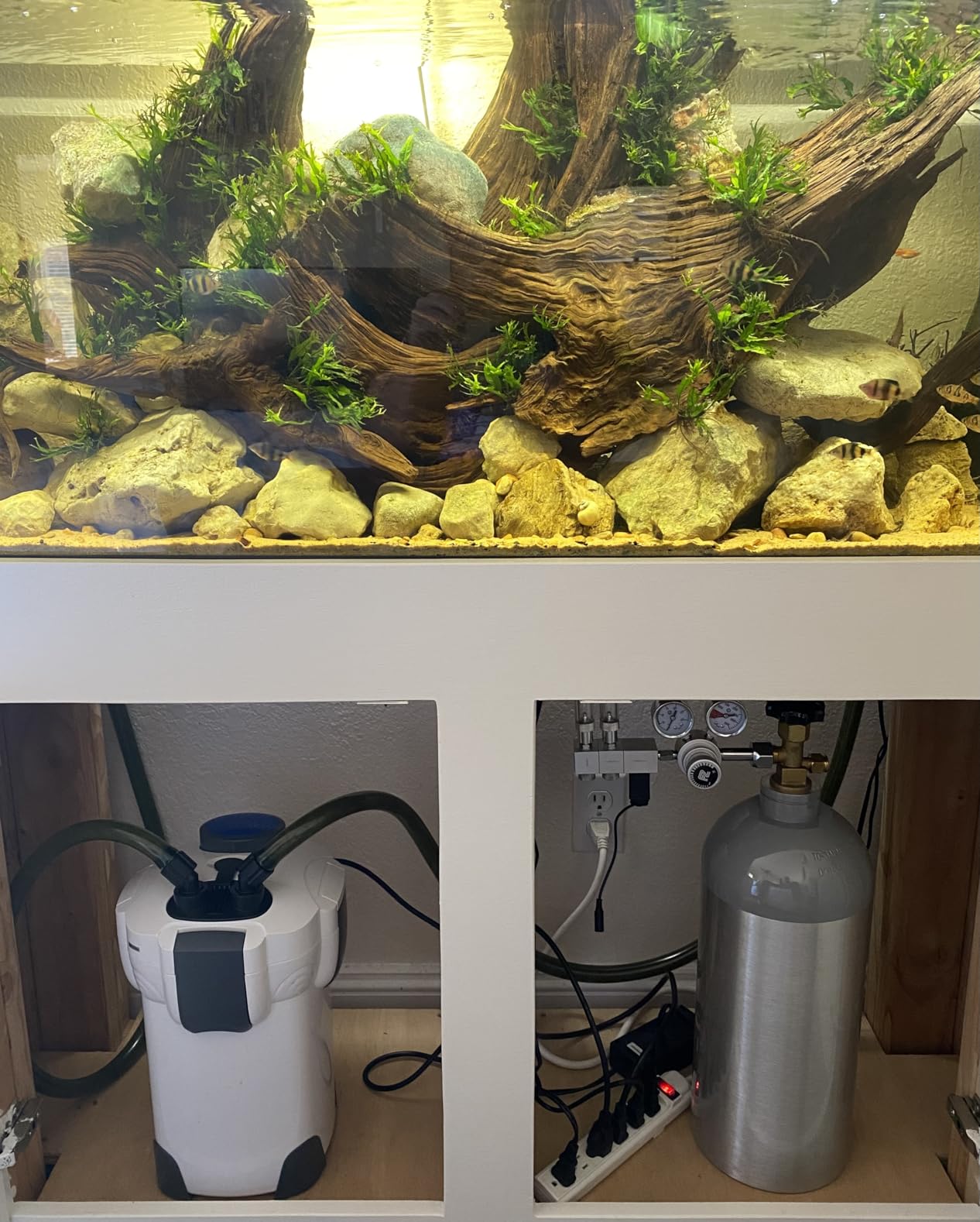
The needle valve integrates with the bubble counter so you can read the rate directly at the manifold rather than at the far end of the line. Installation tools and a CGA320 adapter are included, so the cylinder interface is not the thing that will slow you down. Our one reservation is physical, not electronic: at 7.56 by 2.56 by 6.69 inches it needs a genuine mounting spot rather than a gap behind a cabinet.
Here is the part that matters for planning. Several owners on planted-tank forums describe a single-stage setup as the main cause of end-of-tank dumps, where gas keeps flowing after the solenoid closes and the tank ends up dangerously over-carbonated. Dual stage is the fix, and this unit does it properly. If you already own a decent CGA320 cylinder, this is the highest-impact upgrade in the whole category.
Is this regulator worth the extra cost over a single-stage unit?
For a tank with shrimp, discus or any sensitive livestock, yes. The pressure hold is what stops a dump, and there is no cheap substitute for it once fish are in the water. For a 20 gallon tank on a tight budget, a good single-stage unit can be dialled in carefully, but you give up the safety margin.
Can it run two tanks from one cylinder?
Yes, that is what the twin manifold design is for. Each block has its own needle valve, so you can tune bubble rates independently and put a separate solenoid on each if the tanks run different photoperiods. Check your cylinder size against two tanks’ combined demand before committing, because this regulator will not fix an undersized cylinder.
2. FZONE 2.5L CO2 Generator System – Best All-in-One DIY Kit
Fzone 2.5 L Aquarium CO2 System Generator Kit for Aquarium Plants Tanks
2.5L SUS304 steel bottle
Rated to 80kg/cm2
Automatic safety valve
12V DC solenoid
Pros
- Thick 1.5mm SUS304 stainless steel bottle holds high pressure
- Complete kit with bottle regulator needle valve and bubble counter
- Check valve in the bubble counter blocks water backflow
- 12V DC solenoid makes timer control straightforward
- Strong customer support and replacement parts
Cons
- Needle valve is very sensitive and hard to hold a steady rate
- Instructions are confusing for first-time users filling the bottle
- Included diffuser is weak and one unit's plate detached and leaked
This is the DIY kit we would hand to a friend who has never run pressurized CO2 before and does not want to assemble a cylinder setup. The bottle is 1.5mm SUS304 stainless steel, listed as 25 percent thicker than typical kits, rated to a maximum working pressure of 80kg/cm2. At 4.2 stars from 1001 reviews it is one of the most proven DIY systems available.
Everything you need is in the box: bottle, regulator, precision needle valve, adjustable bubble counter, check valve and a 12V DC solenoid for timer control. An automatic safety valve releases pressure above the safety threshold, so a failed part is far less likely to turn into a tank incident. Owners consistently report steady gas production and visible pearling within weeks of starting.
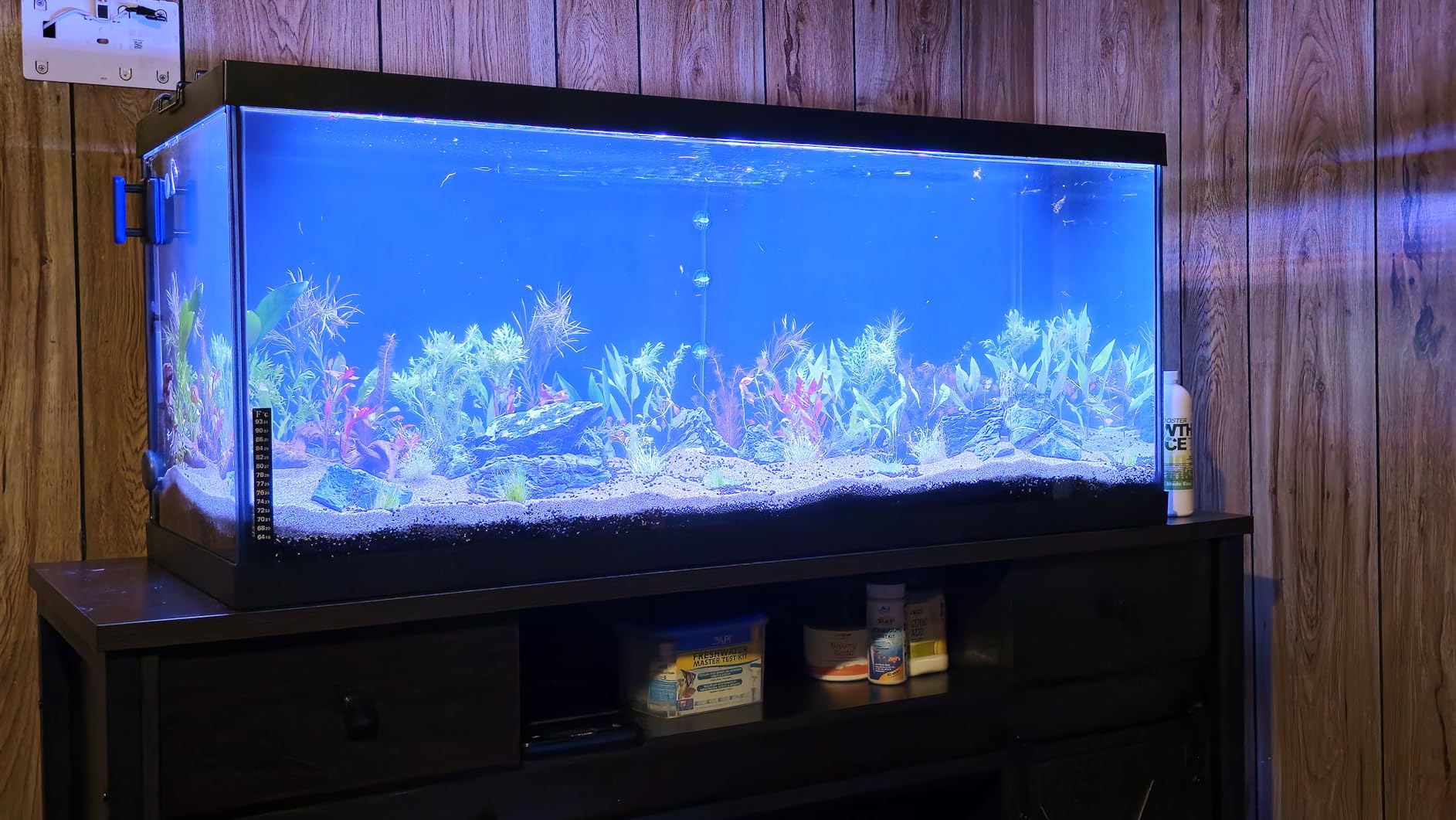
Two details trip up newcomers. The filling process is done at 45 degrees and the instructions do not explain that clearly, so read them twice before you commit powder. The needle valve is also extremely sensitive, meaning a small turn moves the bubble rate a lot, and it takes a few days of adjustments to hold a steady 1 bps for an 8 hour photoperiod.
Budget for 300-400g of raw citric acid and baking soda powder to fill it, since neither is included, and note the listed run time of roughly one month at 1 bps for 8 hours a day. The consensus among DIY users is that the bottle is the strong part of this kit. The included diffuser is the weak part, and most owners upgrade it early rather than living with the mixed bubble sizes the stock plate produces.
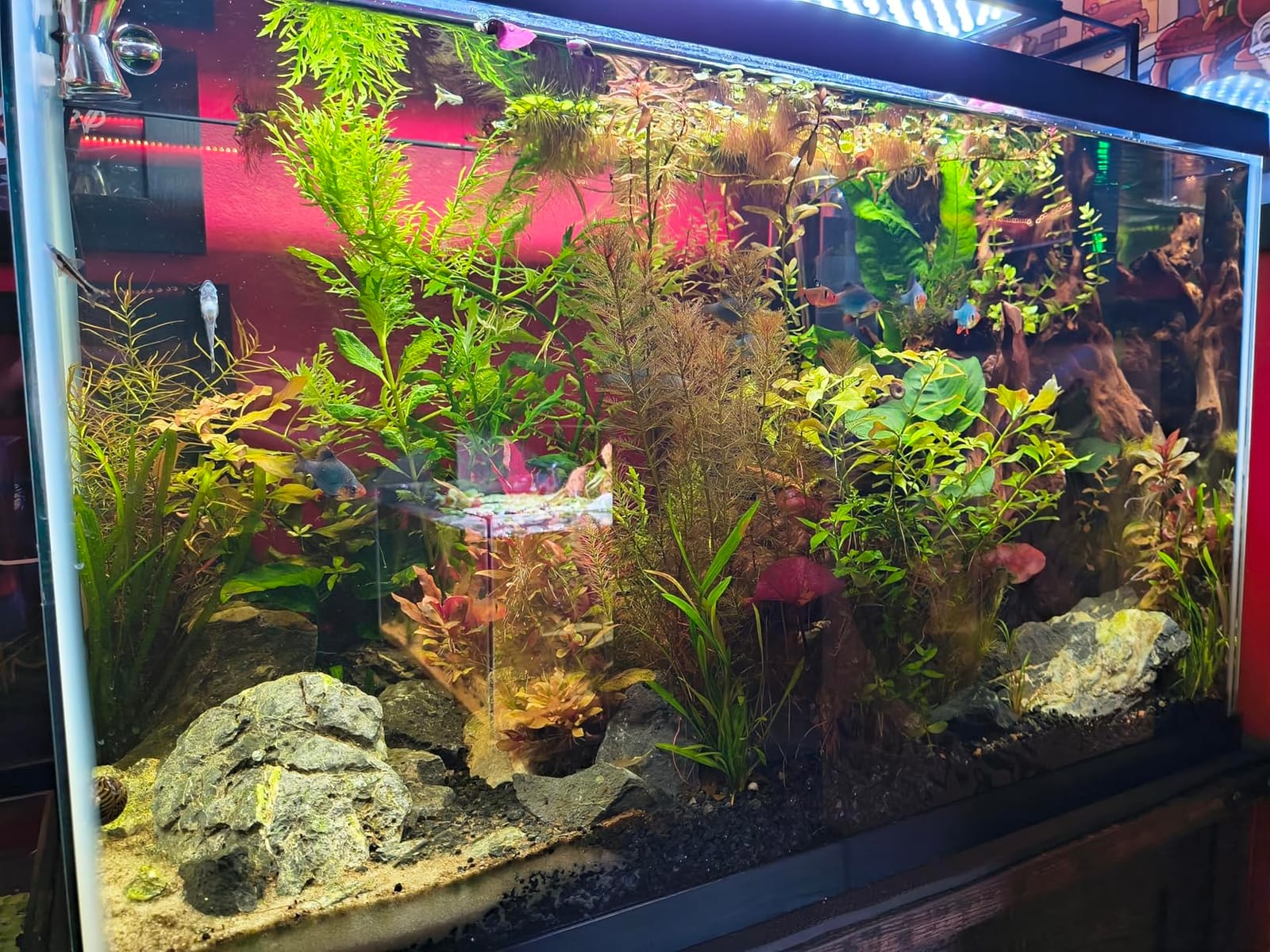
How long does a fill actually last?
The listed figure is about one month at 1 bps running 8 hours a day from 300-400g of raw material. Higher flow rates or longer photoperiods shorten that considerably. Plan on checking the pressure gauge nightly and refilling well before the needle valve starts to starve.
Is a DIY system safe enough for shrimp and discus?
It can be, but only with a drop checker, a night shutoff and a solenoid that closes reliably. The automatic safety valve on this kit is reassuring, and the check valve stops water backflowing into the bottle. The honest alternative for sensitive livestock is a real cylinder with a dual-stage regulator like pick 1.
3. FZONE Aquarium CO2 Regulator with DC Solenoid – Best First Pressurized Setup
FZONE Aquarium CO2 Regulator for CGA320 Side Open CO2 Cylinder
Split-type 12V DC solenoid
1 bubble per 3 seconds
Bubble counter with check valve
CGA320 cylinder fit
Pros
- Split-type 12V DC solenoid is more stable than legacy AC models
- Very fine needle valve control down to about 1 bubble in 3 seconds
- Bubble counter with integrated check valve included
- Aluminum alloy body with sealed threading resists leaks
- Installation tools and a one-year warranty included
Cons
- This is a regulator and solenoid assembly
- not a complete generator
- You still need a separate CGA320 cylinder and refills
With 1327 reviews at 4.2 stars this is the most-reviewed regulator in the group, and that volume of long-term owner feedback is itself useful information. It has been on the market long enough that failures would have surfaced. What you are buying is the head of the system: everything from the cylinder down to the diffuser inlet.
The updated split-type 12V DC solenoid is the key improvement over older AC models on the market, and it runs cooler and more predictably. High precision fine tuning reaches down to about one bubble every three seconds, which gives you real control for a nano or shrimp tank where the safe window between under-dosing and over-dosing is narrow.
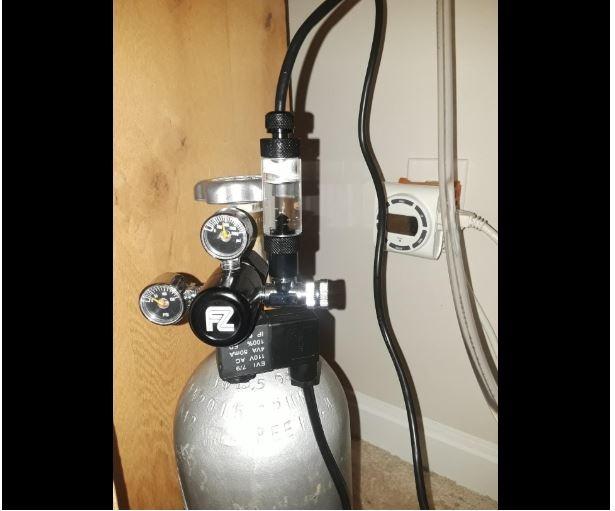
The bubble counter with an integrated check valve blocks water backflow toward the cylinder, which is the failure that quietly corrodes regulators over time. Hard aluminum alloy construction with a surface spraying treatment resists leaks, and a knurled pressure knob plus fine tuning knob make the adjustments feel deliberate rather than fiddly.
It is designed for CGA320 side-open cylinders, the North American standard, so this is the unit to buy if you are in the US and want to refill at any standard shop. The one-year manufacturer warranty and the included installation tools are both good signs. The only real drawback is that it is a component, so budget for a cylinder and a diffuser separately.
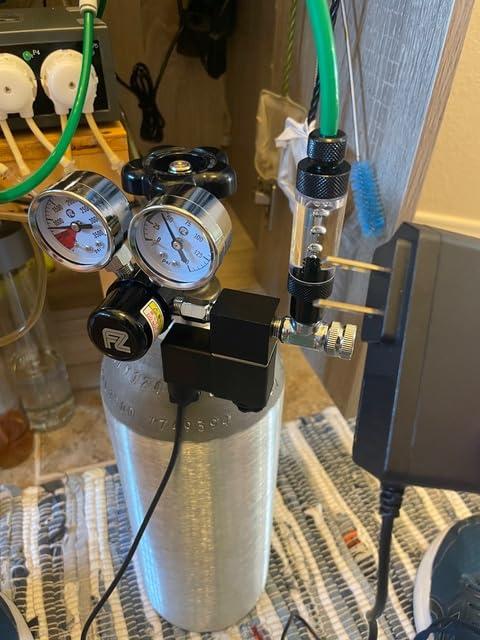
Do I still need a diffuser and a bubble counter with this?
A diffuser is essential because raw gas entering water as large bubbles is largely wasted. The bubble counter here doubles as a check valve, so you already have the visible flow indicator most people buy separately. Add a good ceramic or acrylic diffuser and you have a complete head system.
Should I pair this with a DIY bottle instead of a real cylinder?
You can, and plenty of hobbyists do to keep costs down, but the fit between a DIY bottle and a CGA320-patterned inlet varies. If you already own an FZONE generator from picks 2 or 5, this is a sensible way to upgrade the head. If you are starting fresh, buy the cylinder first and choose the regulator to match.
4. HYQO DIY CO2 Generator Kit – Best Budget Pick
DIY CO2 Generator System Kit with Pressure Gauge Air Flow Adjustment Valve – Pressurized CO2 Kit for Aquarium Plants Tube Valve for Bottle – CO2 Regulator Aquarium for CO2 Diffuser – Grow System
Bottle-cap style DIY reactor
Built-in pressure gauge
Metal flow adjustment valve
Simple pressure relief
Pros
- Inexpensive entry point into DIY CO2 injection
- Integrated pressure gauge makes pressure easy to monitor
- Metal adjustment valve gives reasonably controlled output
- Simple to operate for basic planted tank needs
- Long listing history with 1022 reviews
Cons
- Cap style design is far less durable than a stainless steel bottle
- Low pressure output compared with metal bottle generators
- Assembly is easy to get wrong so the check valve must face the right way
This is the cheapest honest way to add CO2 to a small planted tank, and it has been listed since 2012, which means you can read years of owner reports on it. At 4.2 stars across 1022 reviews it holds up numerically alongside far newer and more expensive kits. The included pressure gauge is the feature that makes it feel less like a toy than its construction suggests.
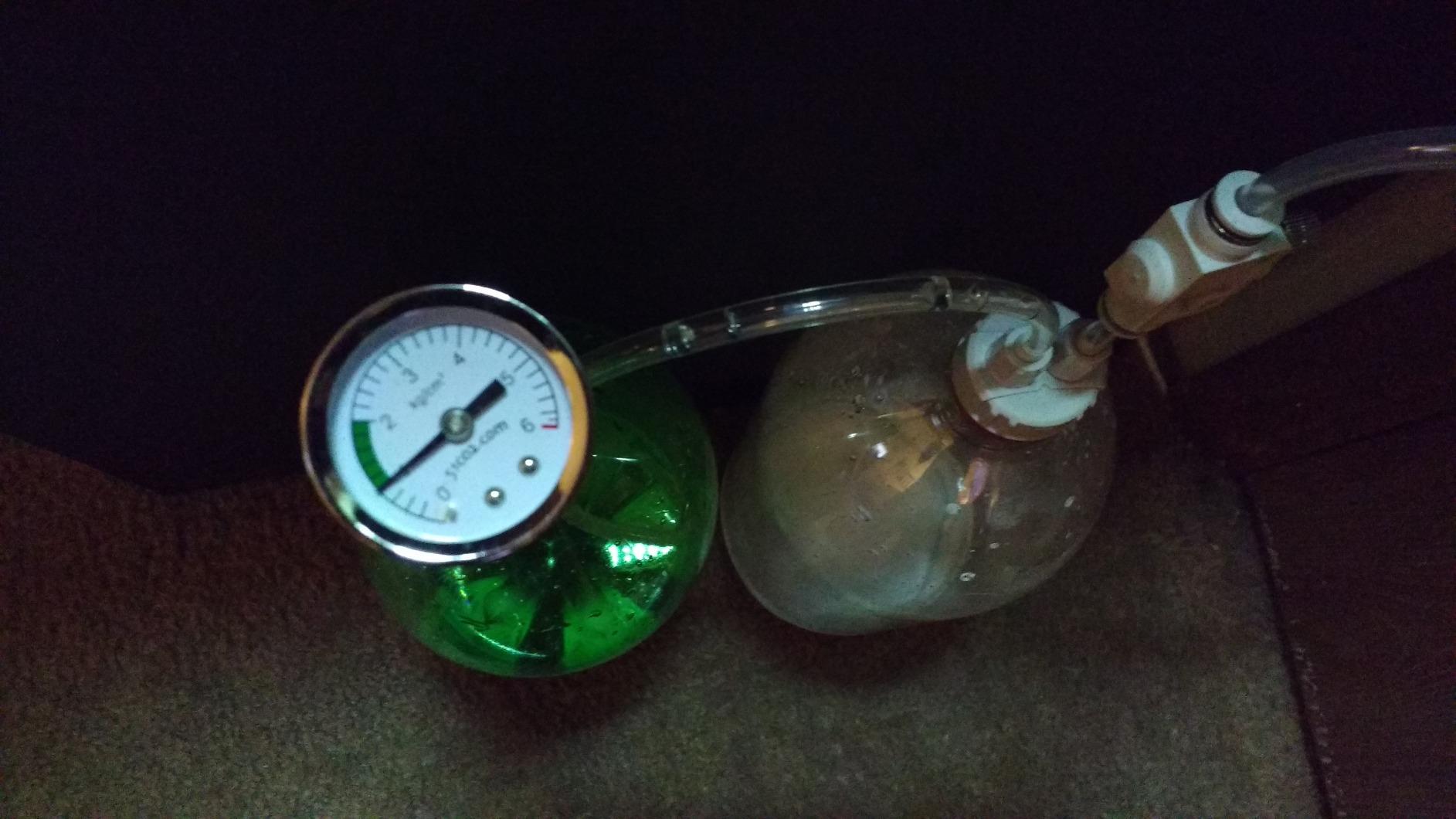
It uses the standard citric acid and baking soda reaction, so you can refill it whenever you run out. The metal gas adjustment valve gives more control than the cheapest two-bottle kits, and the simple pressure relief makes the system safer than a plain bottle cap with no relief at all.
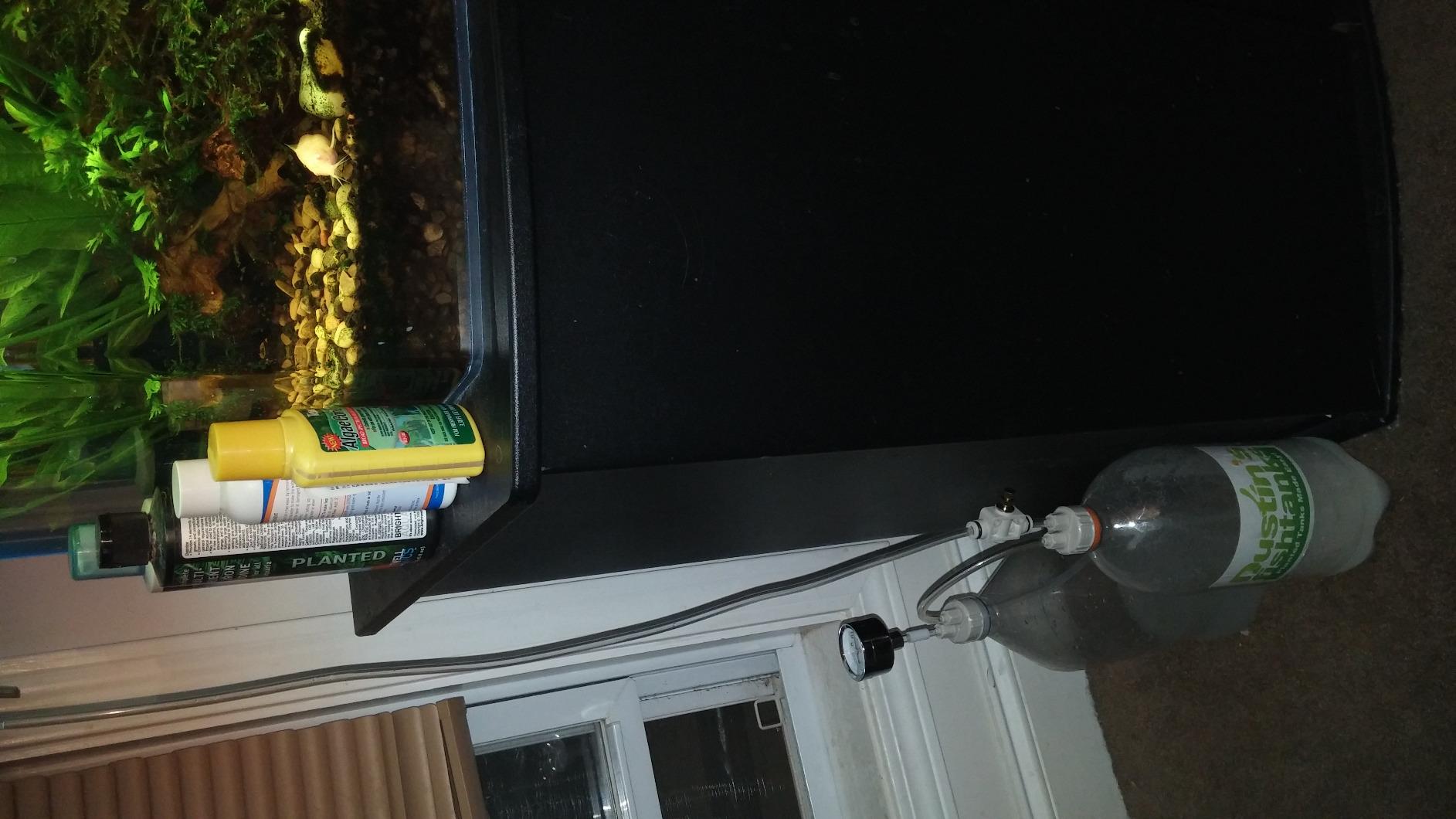
Where it falls short is materials and output. The ABS engineering plastic housing with its locking pipe device is not going to hold up to the 1.5mm stainless steel bottles on picks 2 and 6, and the low pressure ceiling limits it to smaller tanks where demand is modest. For a 20 gallon low-light setup it is a sensible trial run.
Assembly is the other real risk. Owners warn that the check valve and fine-tuning part must face the correct direction, and getting it backwards is the most common first-week failure. Allow yourself an evening, test the whole loop with soapy water on every joint before livestock go in, and this kit will do its job quietly.
Is a plastic DIY kit safe to run overnight?
Not if you leave it running overnight with no shutoff, and we would not run this specific plastic-capped design unattended. The pressure is low, which limits the damage, but low pressure still means a steady leak if a joint fails. If you want overnight automation, use a system with a real solenoid on a timer.
How does it compare with a stainless steel bottle kit?
The metal bottle kits last far longer, hold higher pressure and produce steadier gas, and they are the better long-term purchase. This one wins on first cost and on the built-in gauge. Treat it as a stepping stone: learn the mechanics, then move to steel when you outgrow it.
5. ZRDR 2L Aquarium CO2 System – Best for 20-40 Gallon Tanks
ZRDR 2L Aquarium Co2 System with Pressure Gauge for Aquarium Plants
304 stainless steel bottle
Relief valve above about 30kg
12V waterproof solenoid
Complete accessory set
Pros
- Stainless steel bottle is sturdier and safer than plastic DIY setups
- Automatic pressure relief plus 12V waterproof solenoid add real safety
- Very complete accessory list so nothing extra needs buying
- Twist valve gives finer control than a typical mini kit
- Sellers and support handled missing parts quickly
Cons
- Instruction sheet print is extremely small and hard to read
- Pressure gauge readings can be inaccurate right after filling
- Solenoid runs warm during operation and output suits tanks under about 30 gallons
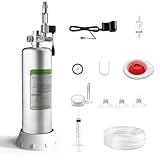
This is the kit we would point at for a standard 20 to 40 gallon display tank, and reviewers describe it as the sweet spot between two soda bottles and a commercial cylinder. The 304 stainless steel reaction bottle is the reason. At 4.0 stars from 487 reviews it sits mid-pack on rating but well above median on proven longevity.
Safety hardware is unusually complete for the money: an automatic pressure relief valve that triggers above about 30kg, plus a 12V waterproof solenoid. The stainless steel pressure reducing valve, bubble counter, check valve and U-shaped tube give you the full monitoring chain in one box, and the atomizer is included rather than sold as an add-on.
The accessory list genuinely saves money. You get a spare sealing ring, funnel, wrench, suction cups and 1.5m of air tube, which is everything you need to mount it without a second order. The twist valve gives finer bubble control than a typical mini kit, and that matters more than most sellers admit once you start chasing a stable rate.
Two caveats from owners. The instruction sheet is printed so small it is effectively unreadable, so find a clearer guide before your first fill, and expect the solenoid to run warm during a long photoperiod. A minority of units reported leaking valves or bubble counters within weeks or months, so check every joint soapy-wet before the tank goes in.
Will this keep up with a 40 gallon tank?
Owners put the realistic output ceiling at roughly 30 gallons, so treat 40 gallons as a stretch unless your demand is low. A 20 to 25 gallon tank is where this kit is comfortable, and a 30 gallon tank at moderate flow is fine. Above that, step up to a 4L bottle like pick 7.
Why does the first fill produce large bubbles?
The included atomizer produces large bubbles for roughly the first three days, then settles. Soaking a ceramic diffuser in water for 24 hours before first use, and replacing the atomizer with a ceramic disc, both smooth this out quickly. Do not panic and do not over-correct your flow rate during that window.
6. MagTool 2.5-5L DIY CO2 Generator Kit – Best Repairable Build
MagTool Upgraded 2.5L DIY Aquarium CO2 Generator Kit for Plants Tanks
50% thicker 304 steel wall
Integrated solenoid and bubble counter
Manual and automatic shutoff
Complete accessory kit
Pros
- Thick polished 304 stainless steel tank feels genuinely heavy duty
- Integrated solenoid and bubble counter reduce connection points and leak risk
- Dual safety with manual shut-off and automatic relief valve
- Everything in one box including diffuser tubing funnel and power adapter
- One-year warranty on key components
Cons
- Included diffuser is the weakest part and many owners replace it
- Solenoid can clog or fail between fills
- Replacement parts are not always readily available
MagTool’s design decision that we like most is the all-in-one integration of the solenoid and bubble counter. Fewer connection points means fewer places for a leak to develop, and in a system where most failures happen at joints that is a real reduction in risk. At 4.2 stars from 308 reviews, the early owner feedback is consistently positive about build and plant response.
The 304 stainless steel bottle was upgraded to a 50 percent thicker wall, and the 2.5L version holds 200-300g of raw material while the 5.0L holds 600-800g. An external thread design resists residue buildup and seizing, which matters on a system you will open and close every few weeks. There is also a built-in injection port so you can watch fluid level on refills without disassembly.
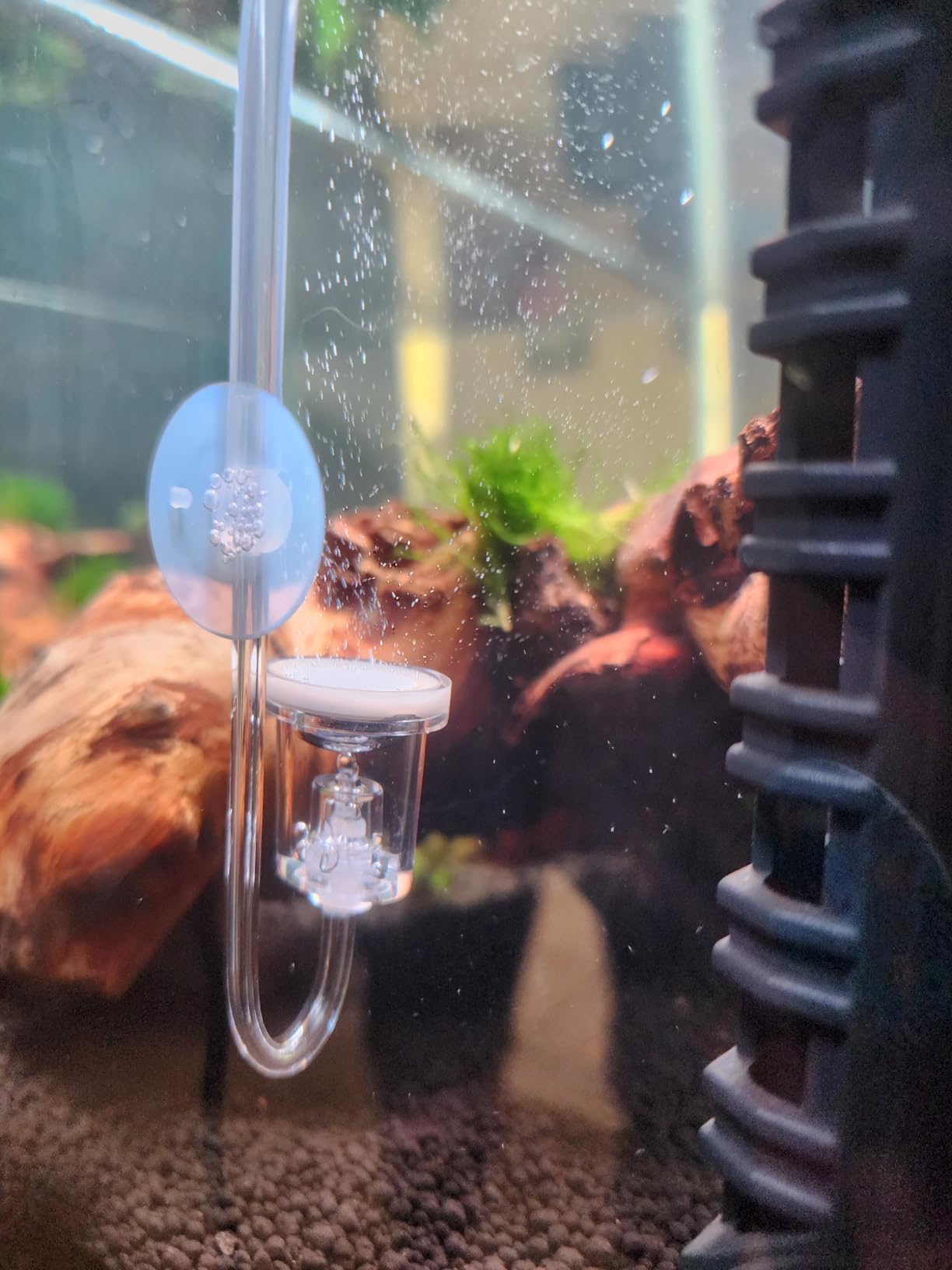
Dual safety is the other standout. A manual shut-off valve gives you an instant way to stop gas when you are in the room, and an automatic pressure relief valve handles the case where you are not. The complete accessory kit includes the diffuser, check valve, U-connector, suction cups, tubing, funnel, syringe, ceramic disc, sealing rings and power adapter.
Owners report strong plant response within weeks and service that replaced a faulty diffuser and a missing sealing ring promptly. The recurring complaint is the solenoid clogging or needing replacement after several refills, so budget for a spare and check the fill port for residue each time. Also note the 1.9 kg unit is tall, which can be awkward under a low tank stand.
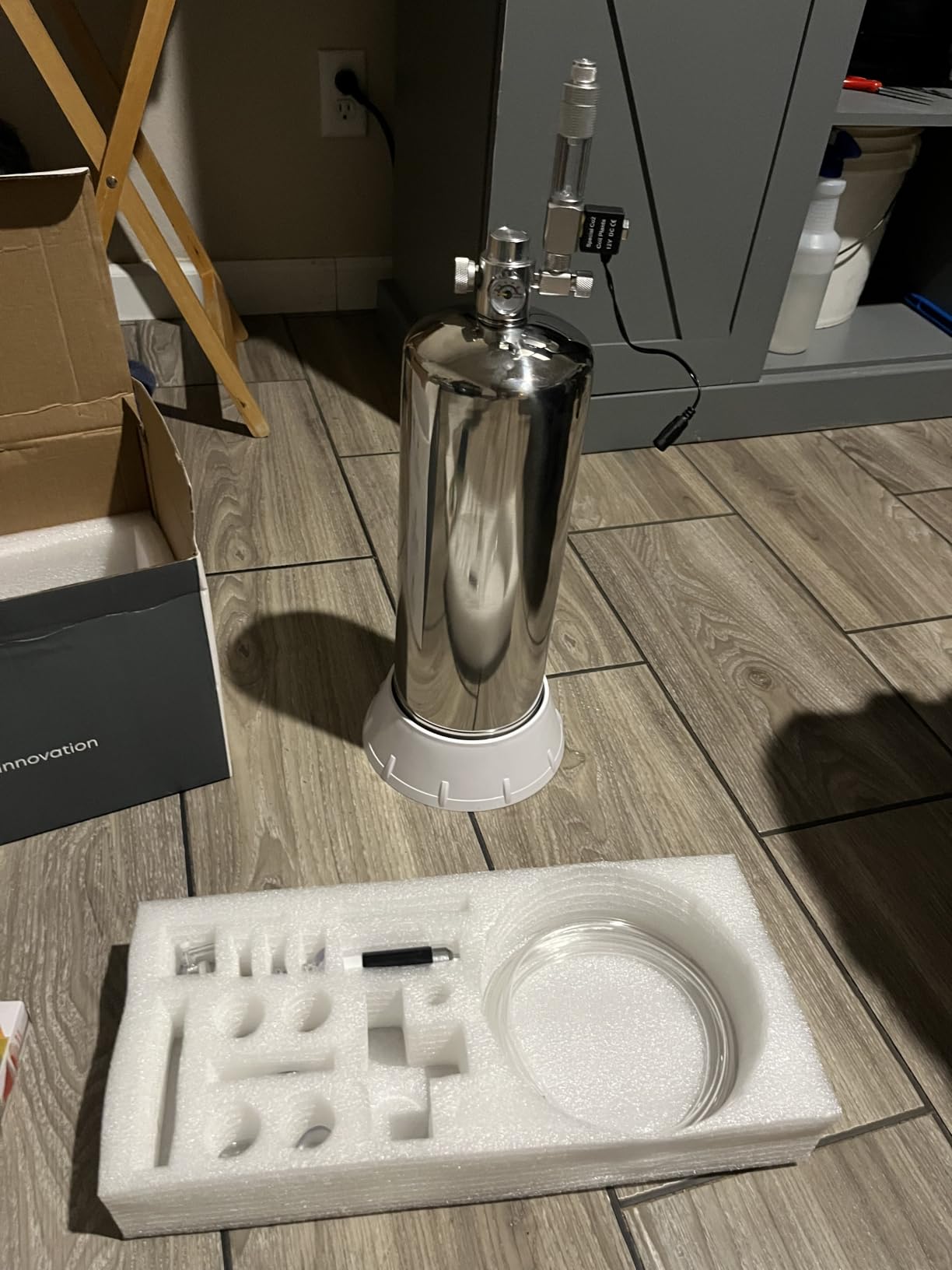
Is the integrated design better than separate parts?
For most hobbyists, yes. Fewer joints and fewer leak points, and the bubble counter is already plumbed in. The trade-off is that when something does fail you are replacing a larger assembly rather than a cheap inline part, and MagTool’s spares are not always easy to find.
Which size should I buy?
The 2.5L is right for tanks up to about 30 gallons and the 5.0L covers larger tanks or longer photoperiods. The powder is not included either way, so factor the citric acid and baking soda into your first order. Choose 5L if you dislike frequent refills more than you dislike the footprint.
7. Clscea G700S 4L CO2 Generator – Best Runtime Per Fill
Clscea Aquarium CO2 Generator Double Runtime with Solenoid Valve 4L, G700S
4L gas capacity
A triple-layer filter
Self-cleaning bubble counter
John Guest quick-connects
Pros
- Longest runtime per fill of any kit here at about 2 months
- Triple-layer filter and self-cleaning bubble counter reduce solenoid clogging
- John Guest quick-connects make tubing changes fast and leak resistant
- Every part is sold separately so one failure does not kill the system
- Survived a reported three-foot drop onto concrete
Cons
- Solenoid is the weak point and can clog or stick open after a refill
- Included diffuser is unimpressive and most owners replace it
- Bubble counter water evaporates and needs frequent top-ups
Runtime is where this kit separates itself. The 2.4L working volume gives 4L equivalent gas capacity, commonly reported as two to five months per fill, against a few weeks for the smaller 2L kits. If refilling on a schedule annoys you more than anything else about DIY CO2, this is the one to consider.
It builds pressure in about 12 to 18 hours after filling and then holds it steadily for weeks, which is exactly the behaviour you want on a long photoperiod. The thickened SUS304 stainless steel cylinder supports that consistency, and the John Guest quick-connect fittings make tubing changes fast and resistant to leaks.
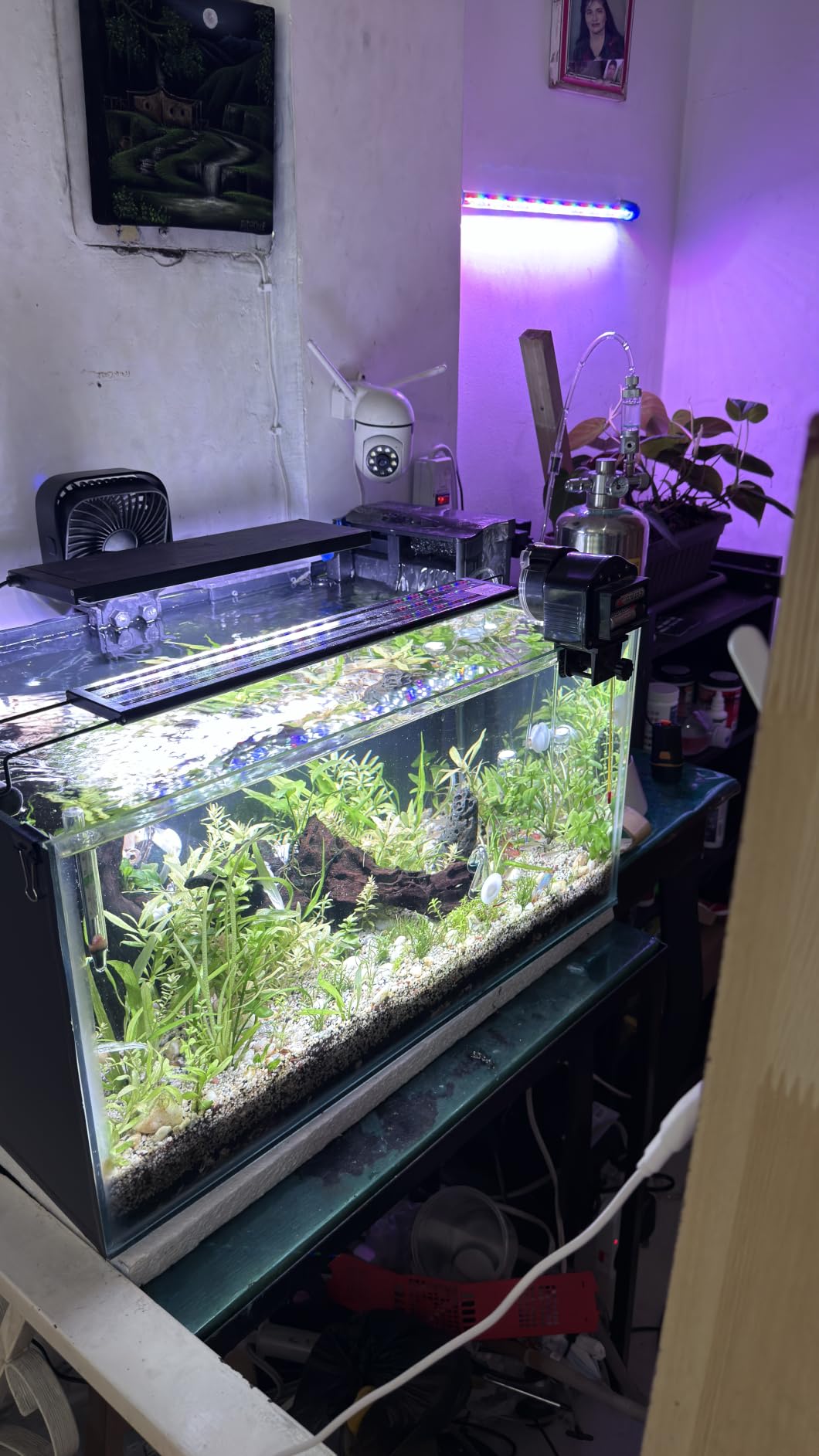
The design detail we like most is repairability. Every part, including the solenoid, bubble counter, drying bead and diffusers, is sold separately, so a failure costs you one component rather than a whole system. The triple-layer stainless steel filter element protects the solenoid from debris, and the self-cleaning water-refill bubble counter flushes valve pathways without disassembly. There is a one-year warranty behind it.
The negatives are consistent and worth planning around. The solenoid is the weak point and can clog or fail to shut off after a refill, one documented case involved a valve sticking open, and the included diffuser is widely replaced. The bubble counter evaporates and needs top-ups unless you fill it with glycerin or oil. Poorly written instructions add to the learning curve.
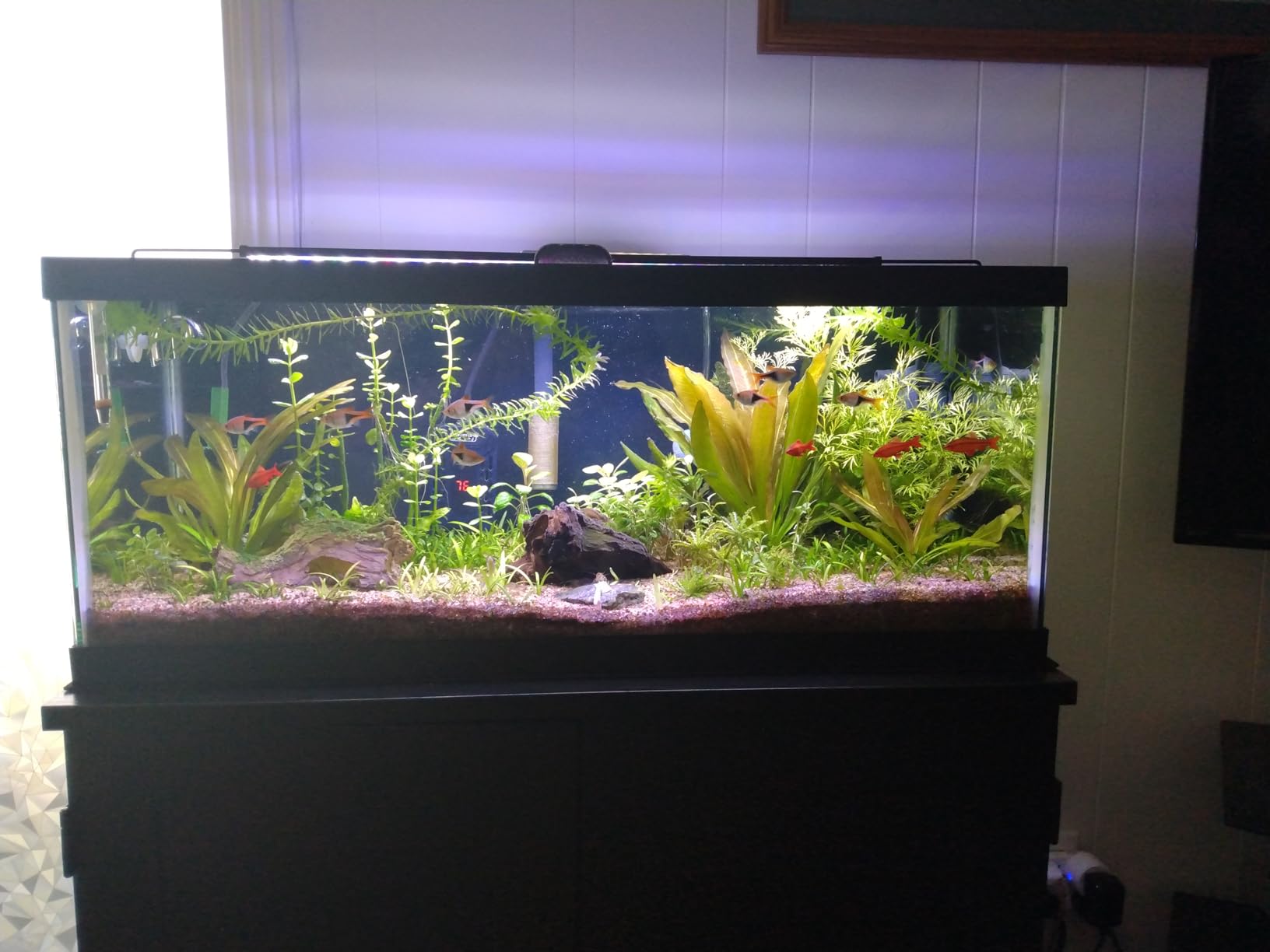
Is the 4L capacity overkill for a 30 gallon tank?
No, it simply means fewer refills. Bigger tanks and longer photoperiods benefit more, and owners on 30 gallon and 40 gallon setups report it being comfortable. The only real downsides are the 5.62 pound weight and the 15.2 inch length, so check your stand clearance before you order.
What happens if the solenoid sticks open?
This is the failure that scares every new CO2 user, and it is why a drop checker and a night shutoff are not optional. The manual route is to cut power to the solenoid immediately and shut the bottle valve by hand. Test the solenoid every few weeks by listening for the click, and replace the spare as soon as it misbehaves.
8. Hygger CO2 2L Generator System – Best Compact 2L Build
2L Aquarium CO2 Generator System, CO2 System Kit with Regulator and Needle Valve for Aquarium Plants Tanks
1.2mm SUS304 steel bottle
Relief valve at 30-35kg
12V waterproof solenoid
Needle valve with check valve
Pros
- Thick SUS304 stainless steel bottle rated for high pressure
- Automatic pressure relief and 12V solenoid add real safety
- Bubble counter with check valve prevents water backflow
- Complete kit so nothing extra is needed beyond powders
Cons
- Small sample of 83 reviews so long-term reliability is not established
- Powders must be purchased separately
- Solenoid is not waterproof and can be damaged by water contact
This is a newer kit, first listed in 2025, and that is both its strength and its weakness. The 2L premium SUS304 stainless steel bottle uses a 1.2mm wall, listed as 20 percent thicker than standard, so the construction is right even though the track record is short. At 4.2 stars from 83 reviews, the owners we found describe a straightforward, well-equipped package.
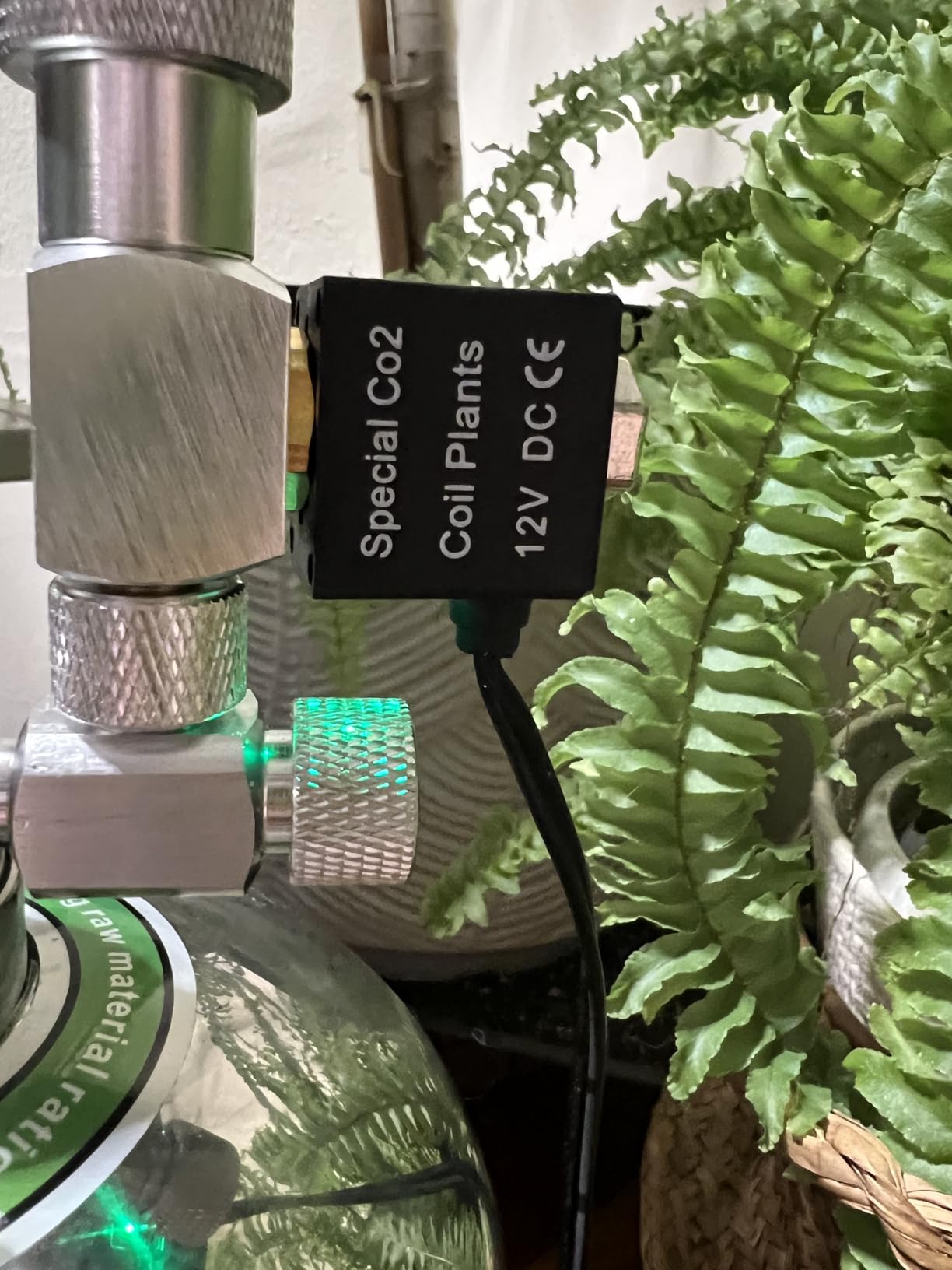
Safety is handled properly. An automatic pressure relief valve activates above 30-35kg, the 12V solenoid valve runs in a waterproof housing for timer scheduling, and the precision needle valve feeds a bubble counter with a built-in check valve that keeps water out of the bottle. A filter and the full accessory set are included.
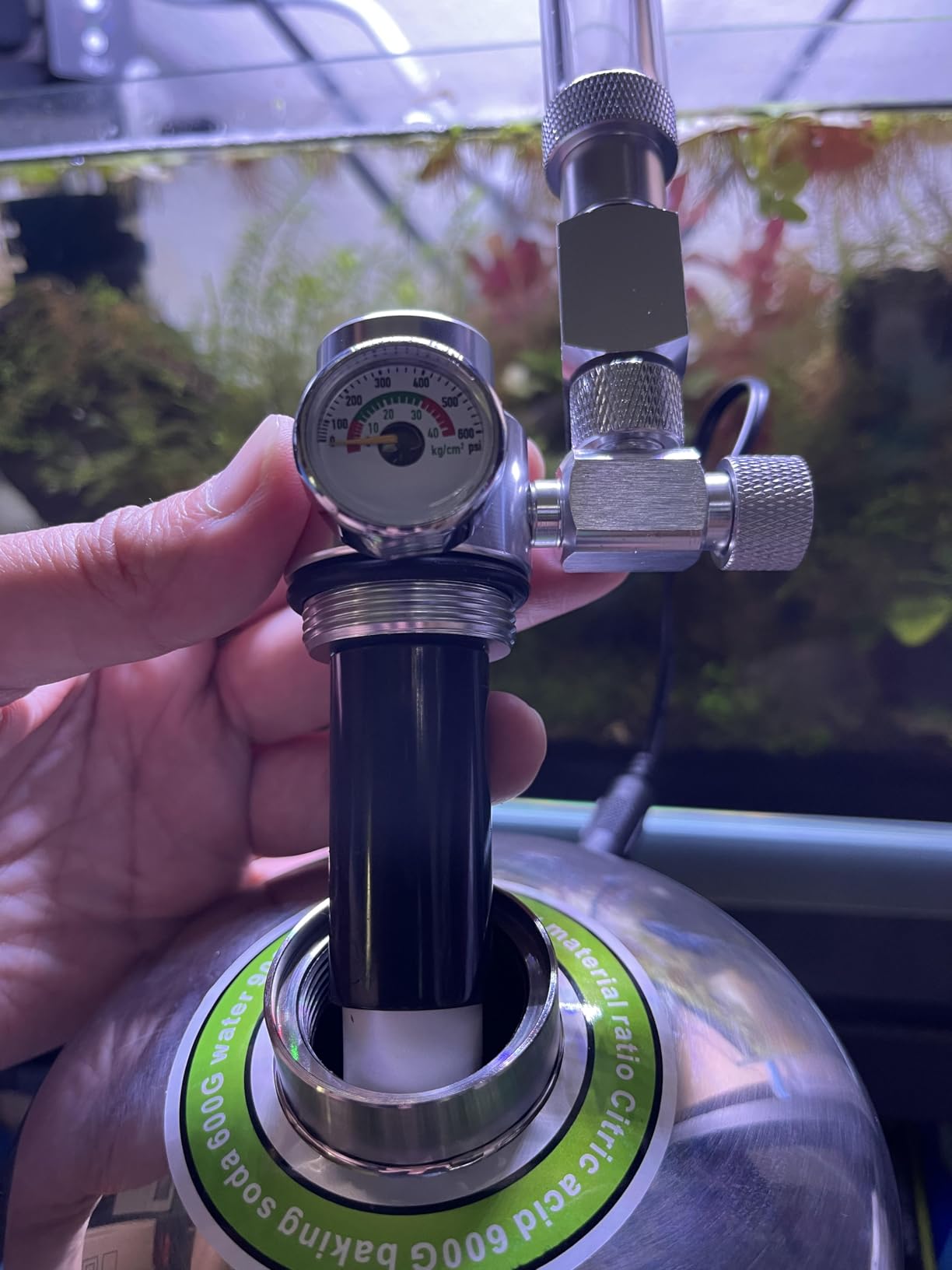
Two practical notes from owners. Soak the diffuser for 24 hours before first use or it will spit large bubbles, and the motorized valve makes a soft sound on cycling that the manufacturer says is normal. At 13.62 by 7.09 by 4.88 inches it is one of the more compact steel builds, which suits smaller stands.
The honest limitation is sample size. Eighty-three reviews is not enough history to know how this unit behaves after two years, so treat it as a well-made option rather than a proven one. If you want the same footprint with a longer record, the ZRDR 2L on pick 5 has 487 reviews behind a similar layout.
Is 2L enough for a 20 gallon tank?
For a 20 gallon tank at a moderate bubble rate and an 8 hour photoperiod, 2L is workable, though you will refill more often than with the 4L Clscea. Owners describe the 2L class as best suited to smaller demand. If you run high flow or a long photoperiod, budget on refilling monthly.
How does it compare with the FZONE 2.5L kit?
Very closely. Both use a SUS304 steel bottle of similar thickness, both include a needle valve, bubble counter, check valve, 12V solenoid and automatic relief. The FZONE carries far more reviews and a thicker 1.5mm wall, so we would lean that way for proven reliability unless you find this one better suited in size.
9. Hygger CO2 Regulator with Dual Gauges – Best for Clear Monitoring
Hygger CO2 Aquarium Regulator with Dual Pressure Gauges, 12V DC Solenoid Valve, Bubble Counter & Check Valve – Precise Display for Aquatic Plant CO2 System
Dual pressure gauges
12V DC solenoid
Acrylic bubble counter with check valve
Two-year warranty
Pros
- Dual gauges with a marked green safe range make monitoring intuitive
- Highest average rating in the group at 4.5 stars
- Hard aluminum alloy body is rust resistant and light
- Acrylic bubble counter with integrated check valve keeps water out
- Two-year warranty is the longest here
Cons
- No adjustment on the low pressure side of the regulator
- Needle adjustment is very sensitive
- Bubble counter can need repeated disassembly before it flows
This is the highest rated product in the roundup at 4.5 stars, with 80 percent of its reviews at five stars, and roughly 80 percent of those buyers highlight the same thing: the gauges. A dual gauge dial with clear scales and a marked green safety range removes the guesswork from working pressure, which is the setting most beginners get wrong.
Construction is a hard aluminum alloy body that resists rust and stays light at 1.1 pounds. The 12V DC solenoid is compatible with timed smart plugs, and the thickened acrylic tube bubble counter includes an integrated check valve so water never reaches the instrument. It works with most diffusers and US standard CGA320 cylinders.
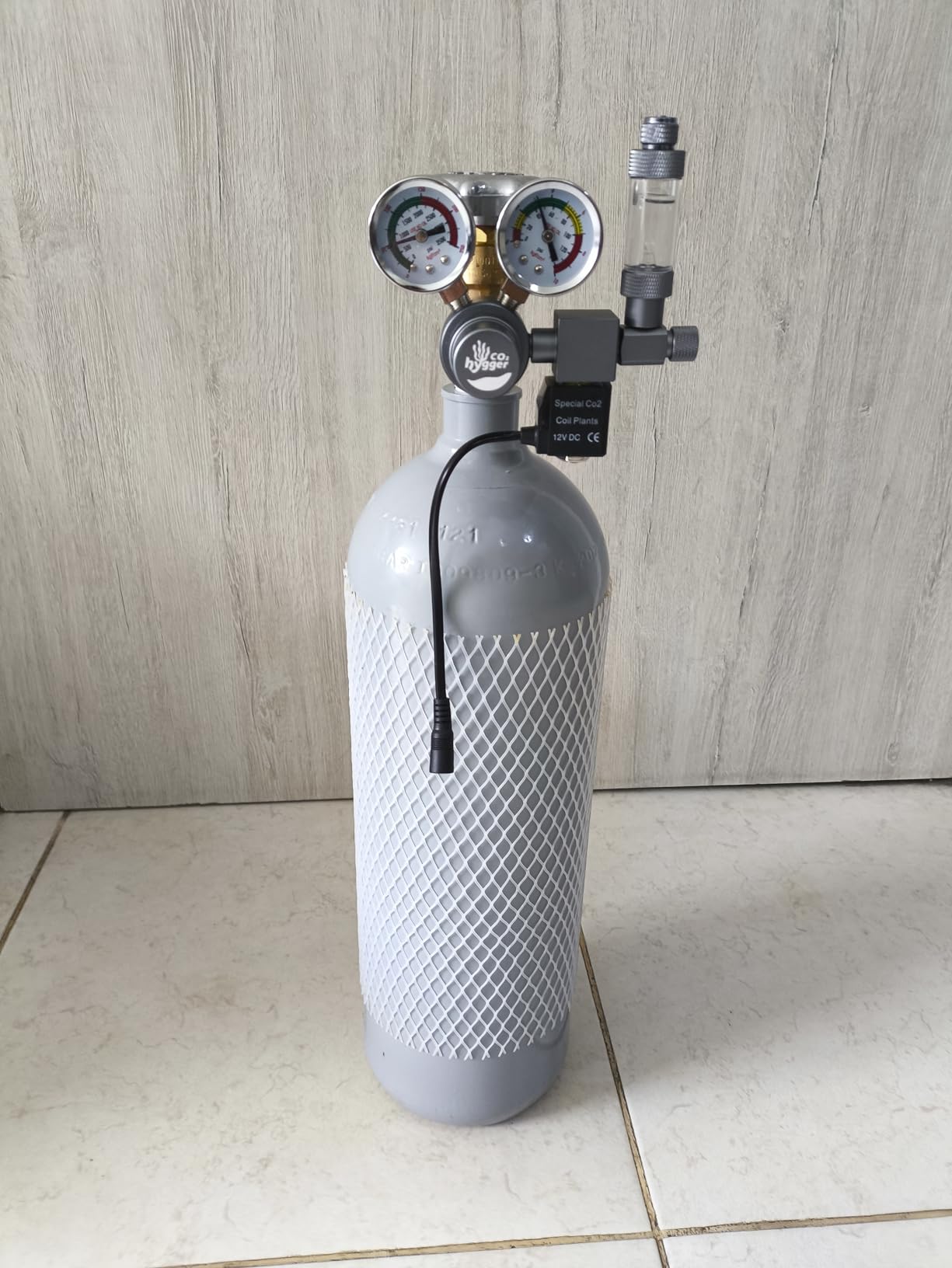
Owners also mention responsive service, including a next-day replacement after an initial failure, and the two-year warranty is the longest in this group. The fine-tuning valve is sensitive enough for nano work where a small change in rate matters, and the acrylic bubble counter is more visible than the small plastic tubes used on cheaper units.
The clear limitation is that there is no adjustment on the low pressure side. That means the output is fixed once set, which is fine on a stable setup but gives you less room if your tank demand changes. A minority of buyers also had to rework the bubble counter before it flowed properly, so expect some setup fuss on day one.
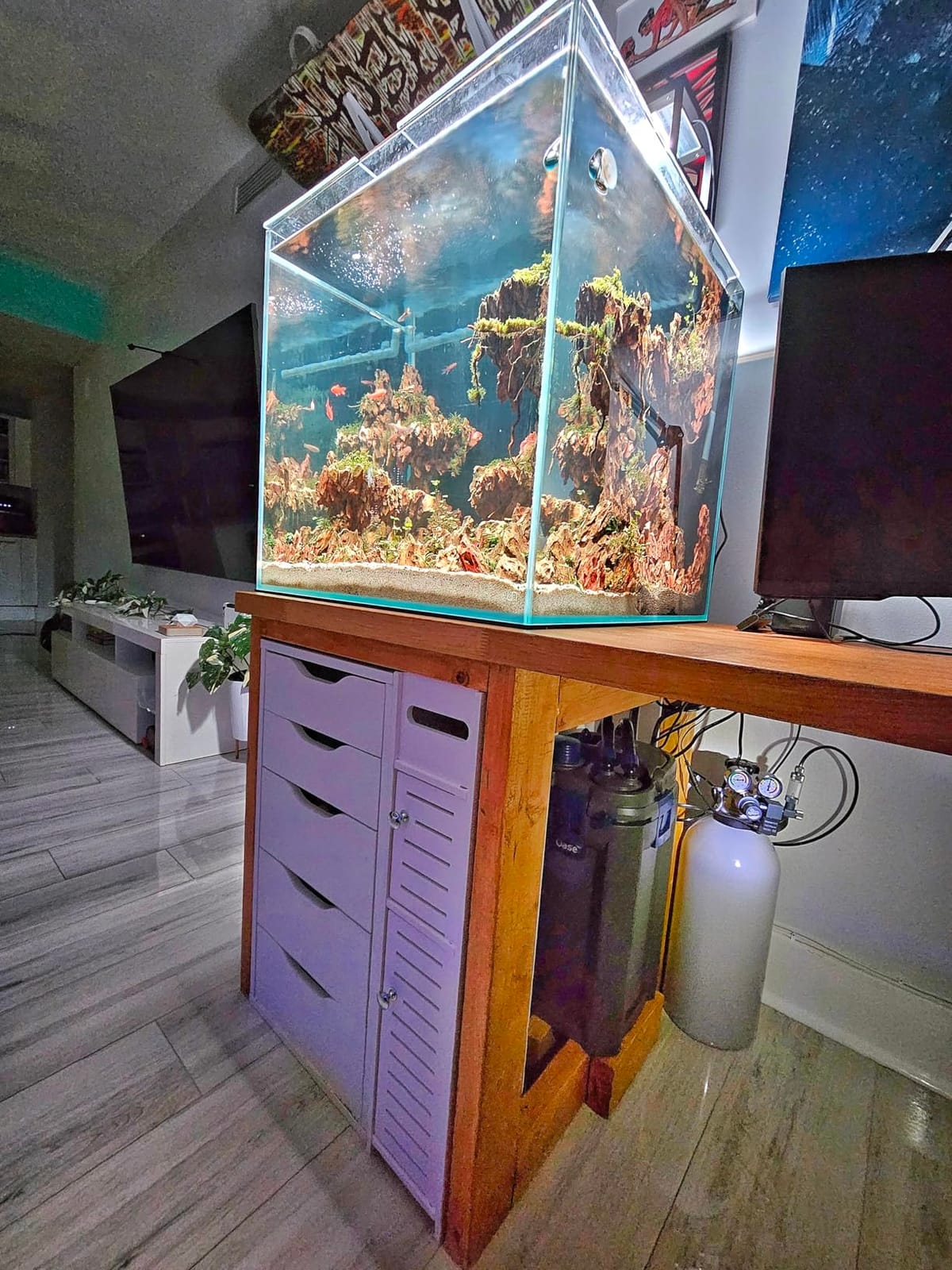
Why do dual gauges matter so much?
One gauge shows cylinder pressure, the other shows your working pressure. Working pressure is what you actually set to control bubble rate, and seeing it drop as the cylinder empties tells you when it is time to refill and when to re-check your needle valve. It is the cheapest diagnostic tool in the kit.
Is this safe enough to leave running overnight?
The regulator itself is solid, but no regulator replaces a timer. Pair it with a plug-in timer on the solenoid so gas stops with your lights, and keep a drop checker in the water. Avoid the CGA320 thread if your cylinders use type 30, which is common in Australia.
10. Fluval FL Mini Pressurized 20g CO2 Kit – Best for Nano Tanks
Hagen FL Mini Pressurized 20g CO2 Kit
For tanks up to 15 gallons
Ceramic diffuser
Side mounting bracket
No chemical mixing
Pros
- Long-established branded kit with a large base of 832 reviews
- Simple press-and-go design with no chemical mixing
- Ceramic diffuser dissolves CO2 efficiently
- Bracket keeps the cartridge tidy against the tank
Cons
- Disposable 20g cartridges mean ongoing refill purchases
- Only rated for tanks up to 15 gallons
- No solenoid so it cannot be scheduled on a timer
- Lowest average rating in the group at 3.9 stars
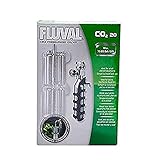
For a nano or shrimp tank under 15 gallons, this is still the least complicated way to get real pressurized CO2 into the water. The kit has been listed since 2004 and carries 832 reviews, so there is a deep record of long-term behaviour. Press, attach the tube, and gas starts flowing. No powder, no pressure monitoring, no mess.
The ceramic diffuser inside does its job well and dissolves CO2 efficiently for the tank size it is rated for, and the bracket mounts the cartridge neatly to the side of the aquarium rather than letting it float loose. The regulator valve gives effective control of output for a tank this small.
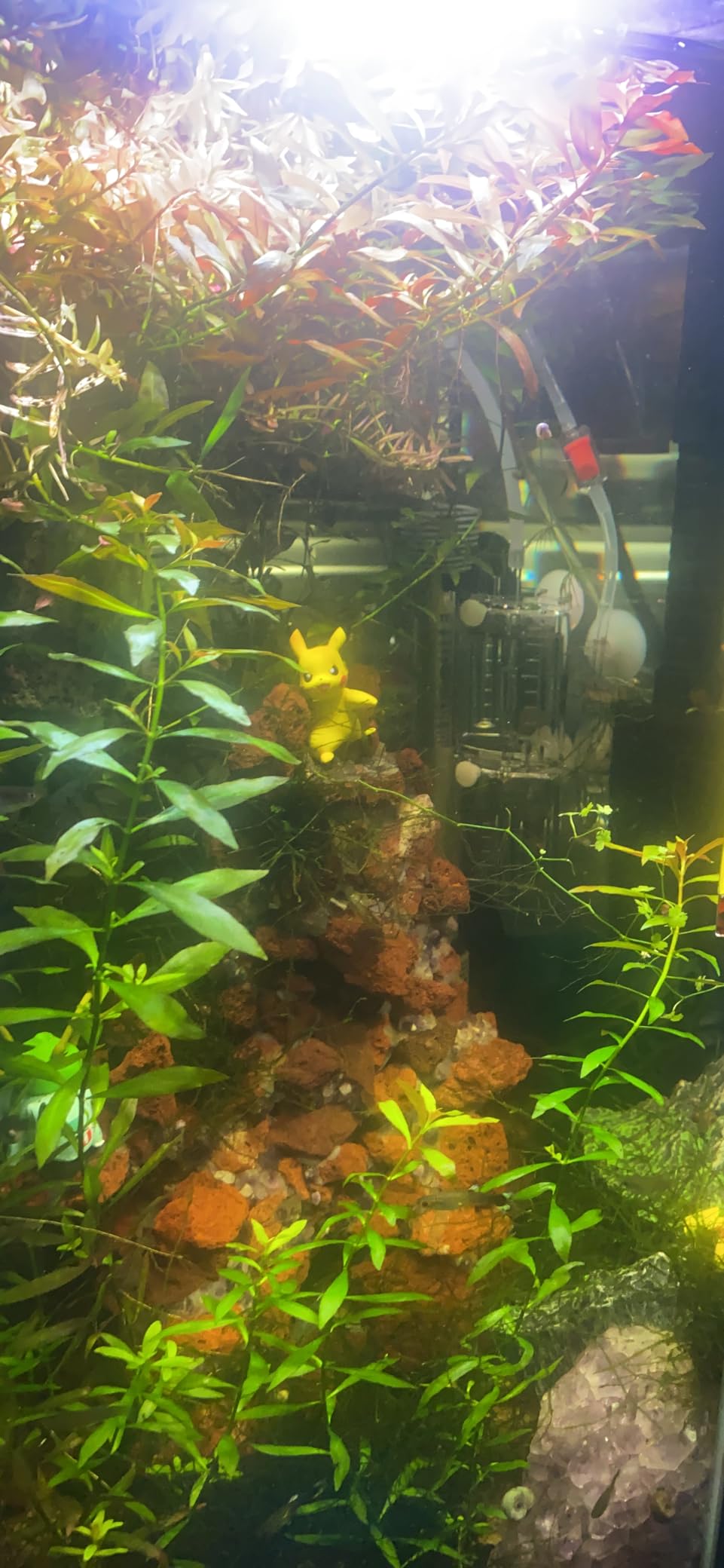
Here is the honest catch. The kit uses a disposable 20g cartridge, so your ongoing cost is a repeated refill purchase rather than a bulk refill, and that adds up over years. The 3.9 star average is the lowest in this roundup, and the complaints concentrate on exactly those two things plus the cartridge size ceiling.
There is also no solenoid, so this cannot be switched off at night. For a 10 gallon shrimp tank that matters less than it would in a large display, but experienced hobbyists treat a night shutoff as non-negotiable. If you want automation, look at the Aquario Neo on pick 12 or a full kit with a solenoid.
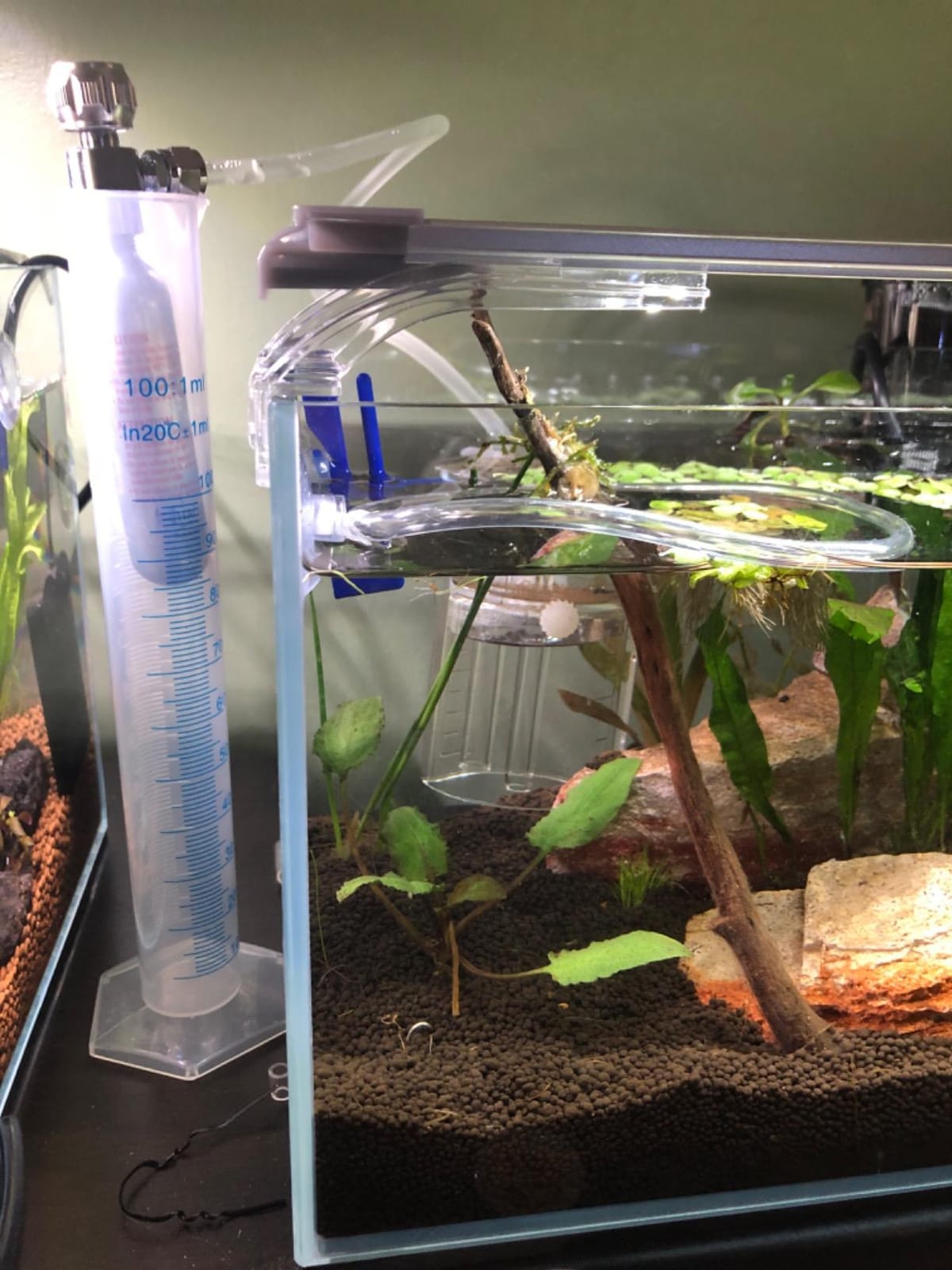
Is this better than a DIY kit for a 10 gallon tank?
For a first tank, yes, because there is no learning curve and no powder handling. For running costs over several years, a DIY stainless steel kit is usually cheaper once you count refill cartridge purchases. The right question is whether you value simplicity or long-run cost more.
Can I grow carpeting plants with this?
In a tank up to 15 gallons, yes, with a drop checker and steady injection. Carpeting species like Monte Carlo and dwarf hairgrass respond well to consistent CO2. The constraint is tank size, not the kit, and carbon must reach roughly 30 ppm consistently rather than occasionally.
11. Estink DIY CO2 Generator System – Best Soda Bottle Build
DIY CO2 Generator System Aquarium Plant Kit with Gauge Valve
Mounts on two 2-liter bottles
Fine-tuning valve
Magnetic base
Check valve and gauge
Pros
- Cheapest way to add any CO2 at all to a planted tank
- Simple two-bottle design that is quick to set up
- Fine-tuning valve works well for dialling in bubble rate
- Clear easy-to-follow instructions
- Effective enough to make plants pearl within weeks
Cons
- No bubble counter so output is hard to measure
- Low quality valves leak or fail and back-siphon water
- Not gas tight so a batch may last days rather than weeks
- Replacement valves can cost more than the kit
This is the entry point into DIY CO2: two soda bottles, a cap-style reactor, a magnetic base and a fine-tuning valve, with a 4.0 star rating from 218 reviews. Owners are clear that it works well enough to make plants pearl within weeks. Instructions are straightforward, which matters more than you would expect for a first build.
The magnetic base attaches to your aquarium cabinet or the glass itself, so the unit does not need shelf space beside the tank. It runs on citric acid and baking soda, the same reaction every other DIY kit here uses, and the included check valve and pressure gauge give you the minimum safety set.
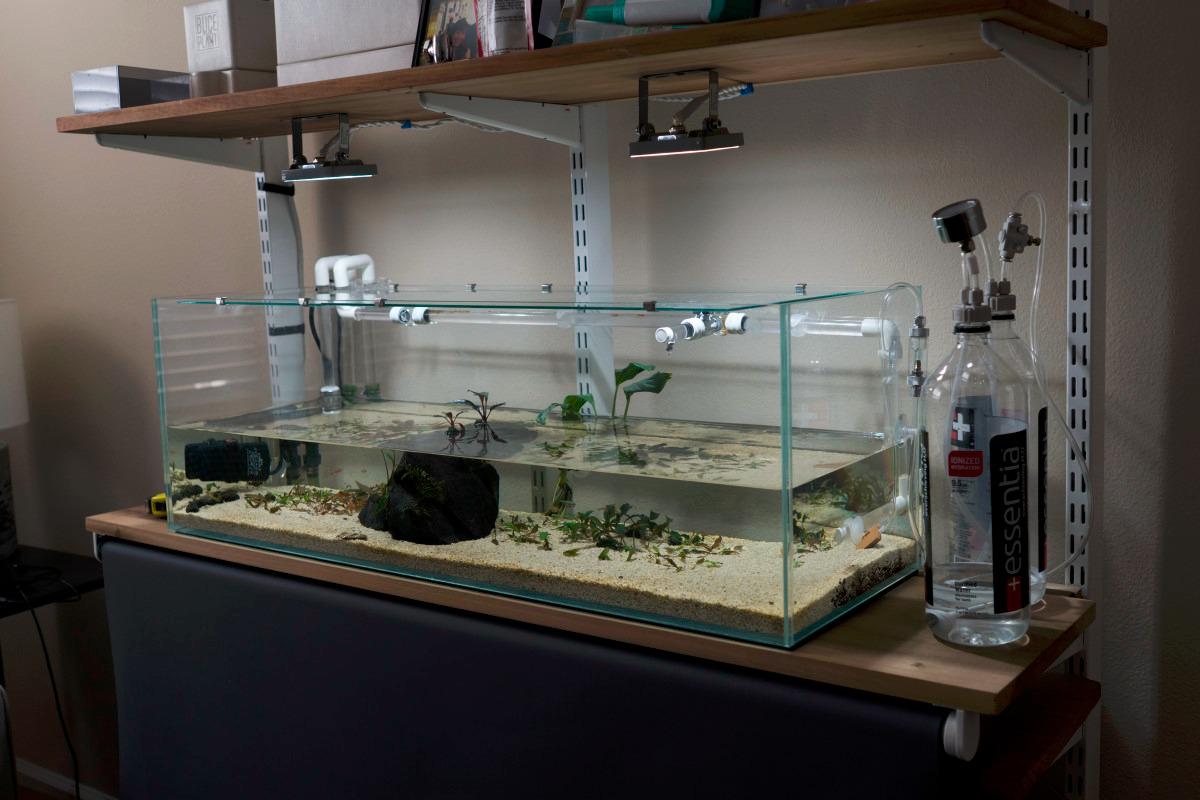
The honest assessment from owners is that the valve is roughly three quarters of the product’s value, and it is the weak part. It can leak over time and back-siphon water that corrodes it, and a replacement valve can cost more than the kit did. It is also not gas tight, so a batch with citric acid and baking soda may last days instead of weeks.
There is no bubble counter at all, which makes output genuinely hard to measure, and that is the bigger limitation for anyone who wants to dial in a rate. If your goal is to learn how CO2 systems behave on a small tank, this teaches you the mechanics for almost no money. If your goal is a stable long-term system, spend up and move to steel.
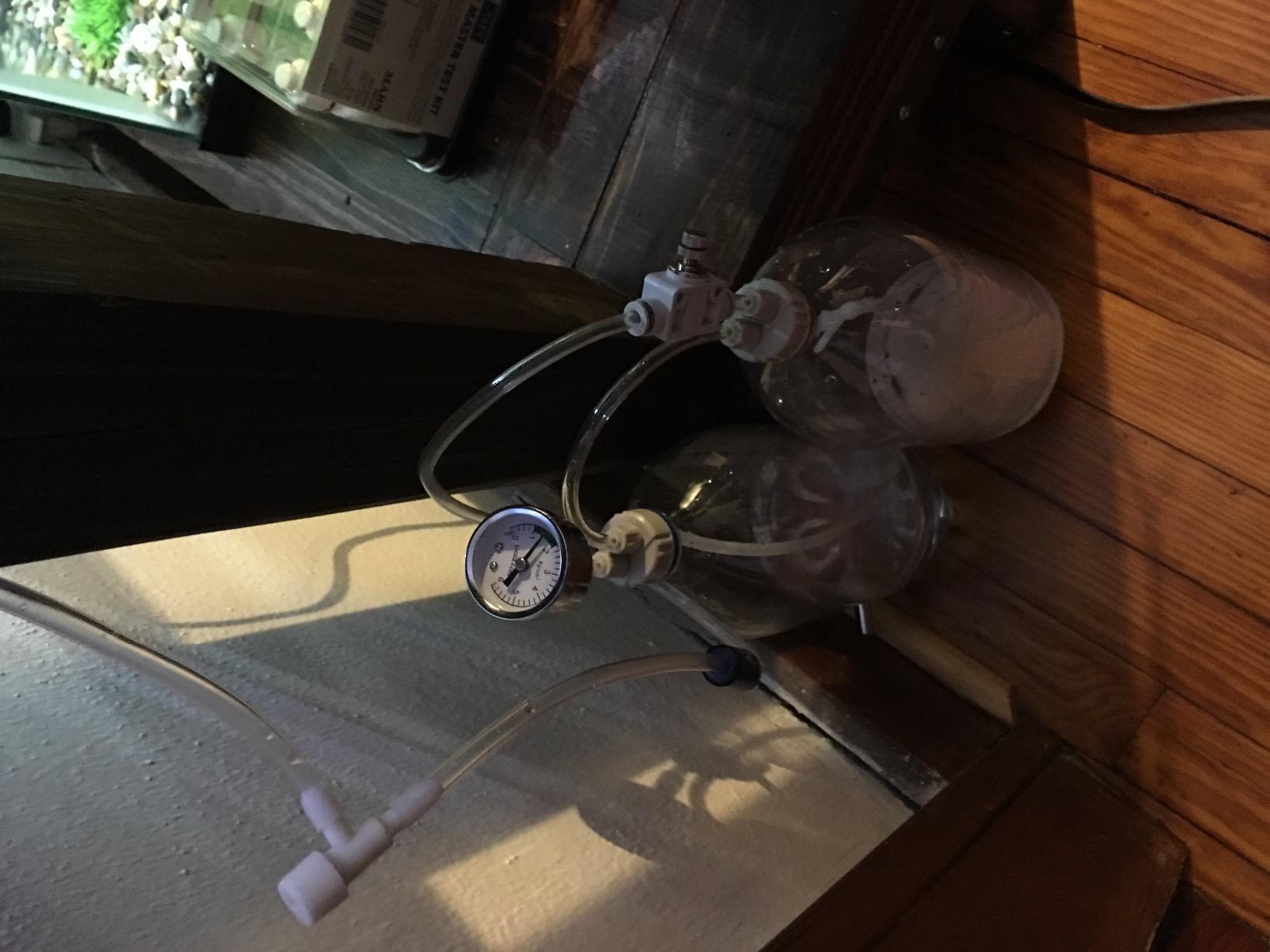
Why does a batch sometimes last only a few days?
The citric acid and baking soda reaction rates depend on temperature, purity and the ratio you mix, and a run that is too rich produces gas too fast to last. Under-mixing or using old powder makes it stall instead. Many owners get a much longer run after their second try.
Should I upgrade the valve right away?
Only if you are comfortable. Most people run this kit as-is for a while to learn bubble rate behaviour, then replace the valve once they understand what output looks like. Replace the check valve as well if you notice water creeping back toward the bottles, because that corrodes the internal parts fast.
12. Aquario Neo CO2 DIY Gel Kit – Best No-Plumbing Option
Aquario Neo CO2 – DIY CO2 Kit (Kit) for Freshwater Aquariums, Terrariums, Paludariums – Slow Release CO2 Kit for Aquatic Plants
Gel and yeast slow release
No cylinder or electricity
Working within about 24 hours
Built for nano tanks
Pros
- Simplest possible CO2 upgrade with no cylinders plumbing or electricity
- Very easy to set up and producing within a day
- Visibly improves plant colour and growth in low tech tanks
- Reported safe for shrimp and fish in small tanks
Cons
- Cannot be switched off so CO2 is added around the clock
- Output is slow and inconsistent for a day or two
- Each bottle lasts about two to three weeks and refills add recurring cost
- Included diffuser is often faulty blocked or leaks
The Aquario Neo uses a slow release gel with yeast instead of pressurised gas, so there is no cylinder, no plumbing and no electricity anywhere in the setup. That single decision removes the two things beginners worry about most: leaks and dumps. At 4.2 stars from 138 reviews it is positioned consistently as the cheapest meaningful CO2 for a nano or small low-tech tank.
It works within about 24 hours of starting, which is faster than a yeast and sugar batch, and it is aimed squarely at nano and small planted tanks, terrariums and paludariums. Owners report visible improvement in plant colour and growth in low tech setups that previously sat still for months.
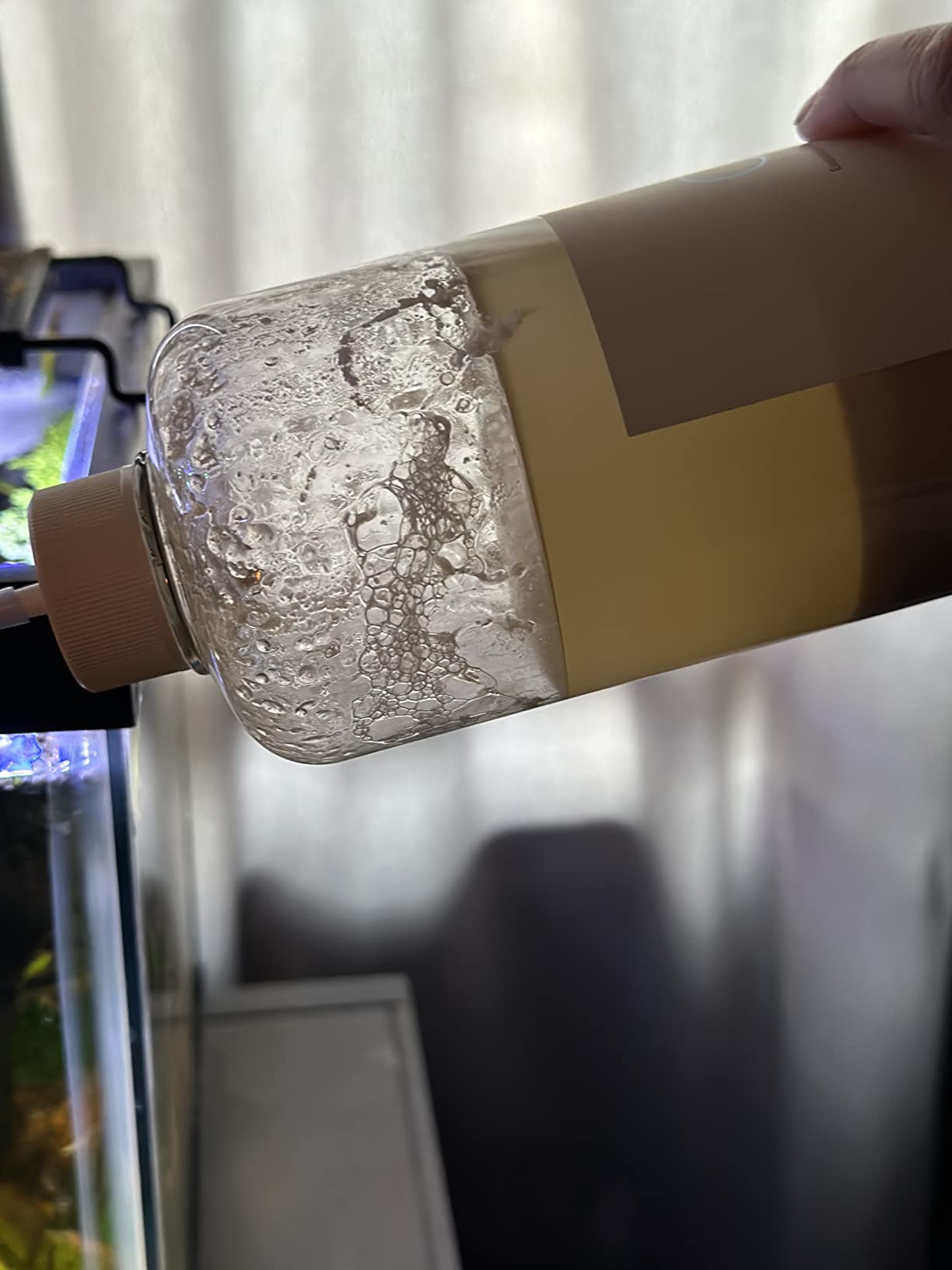
The critical limitation is that it cannot be switched off. Gas is added around the clock, including overnight, so there is no night shutoff and no way to dial in a ppm target. That makes it a poor fit for shrimp or discus, where overnight oxygen depletion is the real risk, even though some owners report success in small shrimp tanks.
Each bottle lasts only about two to three weeks, and BioRefill packs add a recurring cost that eventually rivals a DIY bottle. The included diffuser is the most common complaint, frequently faulty, blocked or leaking from the sides, and refill packs are not always easy to find. Output also takes a day or two to stabilise after each change.
Is this safe for a shrimp tank?
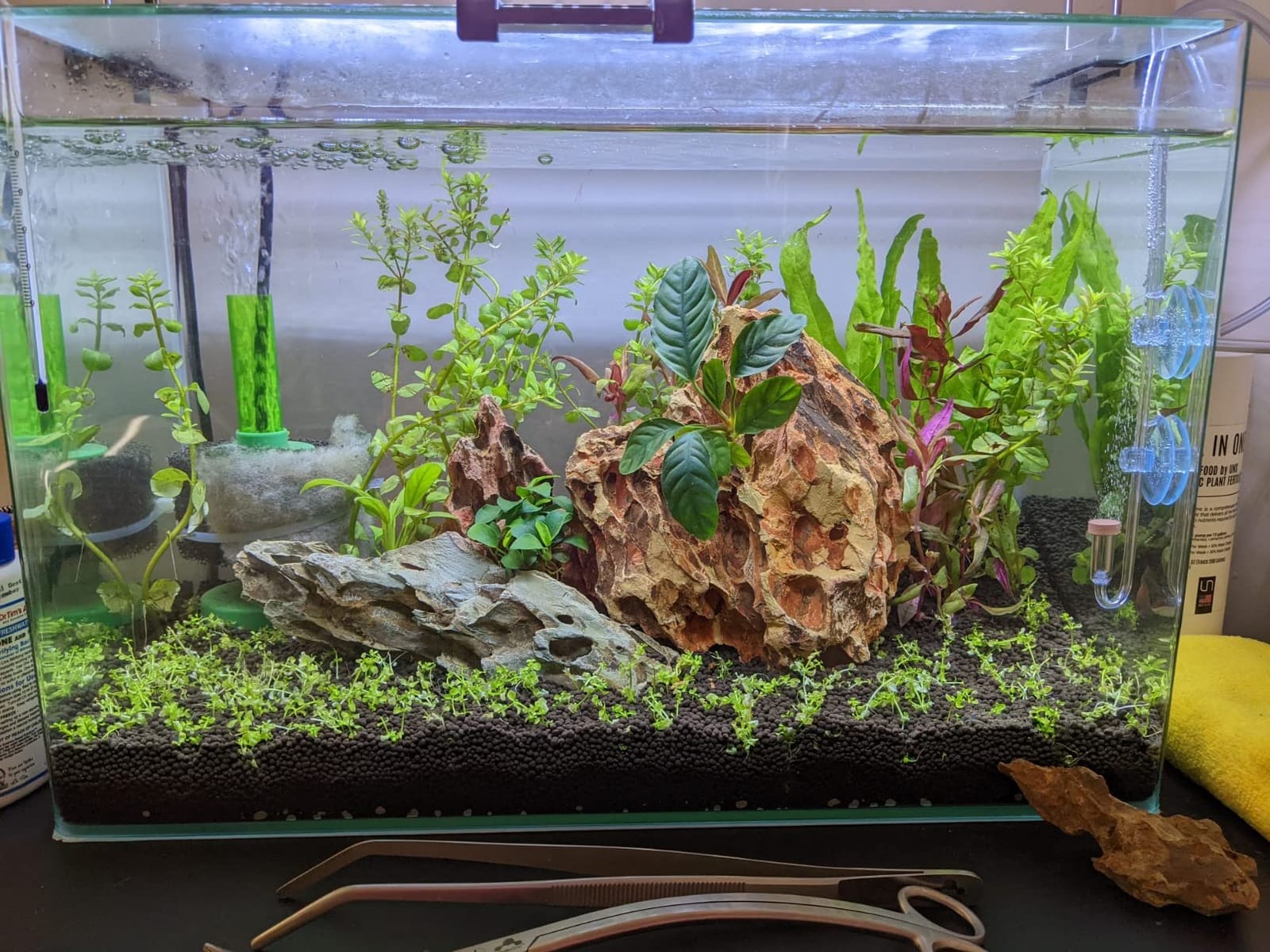
It is safer than pressurised gas in one specific way, because there is no dump risk. It is less safe in another, because CO2 is produced continuously through the night. For a nano with only a handful of shrimp, many owners run it successfully. For a populated shrimp or discus setup, use a system you can switch off.
Should I start here or start with a DIY kit?
Start here if the tank is under about 15 gallons, you want zero hardware and the priority is a low-tech improvement. Start with a DIY kit if you intend to grow high light demanding plants, automate on a timer, or use sensitive livestock. You can always move up later without wasting anything but a refill pack.
How to Choose an Aquarium CO2 System
Every system in this roundup is one of three things, and the decision gets much easier once you name which type you are shopping for. A pressurized cylinder system, a DIY generator, and a gel or liquid approach differ less in price than in control.
DIY yeast, liquid carbon or pressurized CO2
DIY systems generate CO2 from citric acid and baking soda. They are the cheapest per unit of CO2 and can produce a serious amount of gas, but output decays as the batch runs down and you cannot switch the flow off mid-batch. Liquid carbon is a bottle of plant-available carbon you dose by hand each day, which is stable and predictable but never reaches a measurable ppm, and hobbyists on planted-tank forums frequently warn that it melts sensitive species such as Vallisneria and many mosses.
Pressurized cylinder systems are the only option that gives you a true ppm target, a needle valve for fine control and a solenoid for night shutoff. That combination is why every serious setup ends up there eventually, even if it starts as a DIY experiment.
Choosing a cylinder size
Cylinder choice comes down to two things: thread standard and volume. In the US you want CGA320, which is the standard on paintball-style cylinders and standard CO2 tanks alike. Elsewhere the thread differs and regulators sold for CGA320 will not fit, which is a common and expensive discovery for buyers outside North America.
For volume, a 24oz paintball cylinder is genuinely enough for a 20 to 30 gallon tank running a moderate rate. A 5lb cylinder suits 40 to 75 gallon tanks, and a 10lb or 20lb cylinder makes sense for 100 gallon plus tanks or for anyone who hates carrying cylinders to a refill shop. Many multi-tank hobbyists run one large cylinder through a splitter to feed two or three solenoids.
Single-stage vs dual-stage regulators
A single-stage regulator drops cylinder pressure to working pressure in one step, and as the cylinder empties that working pressure drifts downward, so your bubble rate wanders. A dual-stage regulator pulls pressure down in two steps and holds the output far more steadily. This is the single most important safety decision in the whole category, because drifting output is what leads to over-carbonation and end-of-tank dumps.
Forum consensus is close to unanimous that dual stage is not optional for shrimp, discus or any densely stocked tank. Our first pick is the highest rated dual-stage unit in this group for exactly that reason. If you already own a single-stage regulator, upgrading the head of the system is the highest-value upgrade available.
Needle valve and bubble counter
The needle valve is the true precision component in any CO2 system, and the number of owners in this roundup describing their valve as very sensitive or finicky is a pattern worth taking seriously. A sensitive valve is not a defect. It is what lets you move from three bubbles per second to one bubble every three seconds, which is the range you need for a nano shrimp tank.
The bubble counter is a visual confirmation that gas is actually moving, and more importantly the right place to mount a check valve so water cannot travel back toward the bottle or the regulator. Owners consistently praise the units that integrate both, and the ones that omit the check valve generate the most forum troubleshooting posts.
Diffusers and inline reactors
A diffuser turns a stream of gas into a cloud of fine bubbles that dissolve into the water. Without one you are wasting most of your gas, because large bubbles rise out of the tank and escape. Almost every owner in this roundup replaced the diffuser that came with their kit, which tells you the bundled diffuser is rarely the right long-term answer.
Inline reactors or atomizers sit in the filter path and dissolve gas more efficiently and quietly than a glass diffuser, which also removes bubbling noise from the display tank. They cost more and are fussy about flow rate, so treat them as a refinement for an established system rather than a starting point.
Solenoids and timer automation
The solenoid is an electric valve that switches gas on and off, and it is what makes night shutoff possible. A 12V DC solenoid is the modern standard, running cooler and more predictably than legacy AC models, and any of the units in this roundup with a solenoid can be paired with a plug-in timer that runs in step with your lighting schedule.
Turning CO2 off at night is not optional practice. Plants stop photosynthesising in darkness but fish and shrimp keep respiring, so dissolved oxygen falls while CO2 levels climb. Experienced hobbyists treat a drop checker as mandatory rather than helpful for the same reason.
What the planted-tank community actually recommends
The names that dominate forum threads for this category are CO2Art, Green Leaf Aquariums, Aquatek and Milwaukee, and none of them appear in this roundup. That is a real limitation of what we could source and test, and we would rather state it than pretend otherwise. On r/PlantedTank, members repeatedly name CO2Art for quality-to-cost ratio, describe GLA as solid and made in the USA, prefer CO2Art over Aquatek for a full CGA320 regulator, and personally trust Milwaukee regulators with a bubble valve and solenoid.
At the same time, the same forums carry persistent negative sentiment toward Fzone, including advice to avoid it, which directly contradicts the top editorial pick on the main SERP. We have not tested these products side by side, so we cannot settle that debate. What we can tell you is that every FZONE unit in this roundup is rated between 4.2 and 4.3 across 662 to 1327 reviews, and the recurring complaints are about sensitive needle valves and included diffusers rather than catastrophic failure. Read the forums, read the reviews, and decide with your livestock in mind.
Matching a system to your tank size
Nano tanks under 10 gallons want the lowest possible flow rate, so a fine needle valve, a small tank volume and a good drop checker matter more than capacity. The Fluval FL Mini on pick 10 and the Aquario Neo on pick 12 are both built for that range. A 20 to 40 gallon display tank is the sweet spot for a stainless steel DIY kit like the ZRDR or MagTool, or for a cylinder with a mid-size regulator.
A 55 to 75 gallon high-tech tank with carpeting species or red stems needs a larger cylinder and a diffuser that can move real volume, and dual stage stops being optional. Tanks over 100 gallons are cylinder territory, and a 10lb or 20lb cylinder with a high-flow diffuser keeps you from refilling constantly. If you also upgraded lighting, our guide to LED lights for planted aquariums explains how light intensity and CO2 demand are coupled.
Setting Up, Monitoring and Staying Safe
None of these systems is difficult to assemble, and nearly all of them are dangerous if assembled carelessly. The sequence below is the one we use, and it exists to catch leaks while the tank is still empty.
The dial-in sequence
Assemble the regulator to the cylinder with the cylinder valve closed, then open the cylinder slowly and set working pressure. Most operators land somewhere between 20 and 40 PSI. Open the needle valve until you see one bubble per second, then close the solenoid, run your leak test, and start the timer.
From there, adjust in one direction only and give each change a full day. Check the drop checker at the same hour each day and aim for lime green, which corresponds to roughly 30 ppm dissolved CO2. Move toward yellow-green and you are going too far. You should see pearling on plant leaves in the first hour after the lights come on, and if you do not, you are under-dosing.
Leak testing and end-of-tank dump prevention
Soapy water on every joint, every connection and the cylinder valve thread. Bubble up means leak. Test before livestock go in and test again after any component change, because a fitting that was tightened dry on day one can weep after a week of pressure cycling. Replace the O-rings rather than tightening harder when a seal is the problem.
An end-of-tank dump happens when gas keeps flowing after the solenoid closes, which is what a single-stage regulator is most likely to cause as the cylinder empties. Defences are a dual-stage regulator, a needle valve that can be fully closed, a manual shut-off you can reach, and a drop checker so you can see a runaway before it becomes an emergency.
Night shutoff and the drop checker target
Set your timer so gas stops one hour before your lights go out and restarts one hour after they come on. Plants respire at night, so injecting CO2 into a dark tank adds oxygen stress for no photosynthetic benefit whatsoever. If your drop checker is still green the next morning, something is keeping gas flowing and you need to shut it off at the bottle.
Replace the drop checker solution on a schedule, since it degrades and shifts colour over time, and aim for a consistent lime green rather than chasing a colour in a single test. A drifting reading is a failing solution, not a changing tank.
Common problems and fixes
Fish gasping at the bottom of the tank. Too much CO2, or too much CO2 at night. Cut power to the solenoid, shut the bottle valve by hand, increase surface agitation, and aerate the tank. Wait until the drop checker reads clear before restarting.
Regulator hissing or a persistent leak. Usually a worn O-ring on the cylinder valve thread or the gauge, not a failed regulator. Shut down, replace the seal, and retest with soapy water. If a joint weeps under pressure, replace the fitting rather than tightening it.
Diffuser producing large bubbles instead of fine ones. A partially clogged ceramic disc or a low pressure situation. Soak a new diffuser for 24 hours before first use, and if it still spits large bubbles, clean or replace the ceramic and check your working pressure.
Bubble rate drifting higher over days. Working pressure rising as the cylinder temperature changes, or a dual-stage regulator holding pressure while your flow setting is too high. Re-read the gauges after the tank has been running, and reset your needle valve rather than raising pressure.
Bubble counter empty or dry. Water evaporates out of the chamber, especially in warm rooms. Top it up on a schedule, and fill it with glycerin or a little oil to slow evaporation.
Solenoid buzzing, running hot or not closing. Debris in the valve is the usual cause on DIY kits, and a dirty fill port is where it starts. Clean the valve pathway, and keep a spare solenoid on hand since they are the most common replacement part.
Bubble rate not adjustable or jumping. A cheap or worn needle valve cannot hold a steady setting. This is the single most common long-term complaint in this roundup, and the fix is a precision needle valve rather than repeated adjustment.
Frequently Asked Questions
What is the best aquarium CO2 system for a planted tank?
The best aquarium CO2 system is a dual-stage pressurized setup: a CGA320 cylinder, a dual-stage regulator, a 12V solenoid on a lighting timer, a needle valve, a bubble counter, a diffuser and a drop checker targeting about 30 ppm. A DIY stainless steel generator is a good stepping stone for tanks under 40 gallons, but only a cylinder system gives you a real ppm target and a night shutoff.
Is CO2 really necessary for a planted aquarium?
In most lit planted tanks, carbon is the limiting factor: plants cannot use the light and nutrients you provide without enough of it, so CO2 injection is what turns slow growth into fast, robust, colourful, algae-suppressed growth. It matters most for carpeting species and red stems. Light-limited low-tech tanks with only Anubias, Java Fern and moss usually do not need it at all.
What is the best CO2 system for a small aquarium?
Under about 10 gallons, prioritise a needle valve fine enough to reach one bubble every few seconds and a drop checker for accurate monitoring. The Fluval FL Mini kit suits tanks up to 15 gallons with no plumbing, while the Aquario Neo gel kit needs no cylinder or electricity. For a 20 to 30 gallon tank, move to a stainless steel DIY kit such as the ZRDR 2L or FZONE 2.5L.
What is the best CO2 system for a 55 gallon aquarium?
A 55 gallon tank needs a real cylinder, not a DIY bottle, and a dual-stage regulator. Choose a 5lb CGA320 cylinder, set working pressure between 20 and 40 PSI, and use a high-flow diffuser that can dissolve the volume. Dual stage is close to mandatory at this size because output drift on a single-stage unit is what causes over-carbonation.
Should I turn CO2 off at night in my aquarium?
Yes. Plants stop photosynthesising when the lights go out but your fish and shrimp keep respiring, so injecting CO2 overnight raises dissolved CO2 while oxygen falls. Schedule the solenoid to shut off about an hour before your lights go down and restart an hour after they come on. If your drop checker still reads green the next morning, gas is still flowing and needs investigating.
Why is my fish gasping at the bottom of the tank?
Gasping at the bottom of the tank almost always means too much dissolved CO2, or too much overnight. Kill power to the solenoid immediately, close the bottle valve by hand, increase surface agitation to raise oxygen, and aerate the tank. Do not restart until your drop checker reads clear rather than green, then reduce the bubble rate and add a night shutoff.
If you are still choosing lighting to go alongside CO2, our freshwater aquarium lighting roundup covers the fixtures that pair well with injection.
Final Verdict
After comparing all 12 of these systems, the FZONE Pro Series Dual Stage Regulator takes our EDITOR’S CHOICE as the best aquarium CO2 system for planted tanks in 2026. It holds working pressure as the cylinder empties, feeds two tanks if you need it to, and carries the highest rating of any regulator we reviewed. That pressure stability is not a luxury feature, it is the thing that separates a safe system from a fish kill waiting to happen.
For the best all-in-one DIY kit, the FZONE 2.5L generator is the proven choice at 1001 reviews. For the least complicated way to start with real pressurized gas, the FZONE DC solenoid regulator on pick 3 is the most-reviewed item in the whole roundup. Budget hobbyists should look at the HYQO kit on pick 4, nano and low-tech users at the Fluval FL Mini or the Aquario Neo, and anyone who wants fewer refills at the Clscea G700S.
The one thing no product can fix is a missing drop checker, a missing night shutoff and a rushed leak test. Get those right and almost any system on this list will serve you well.