
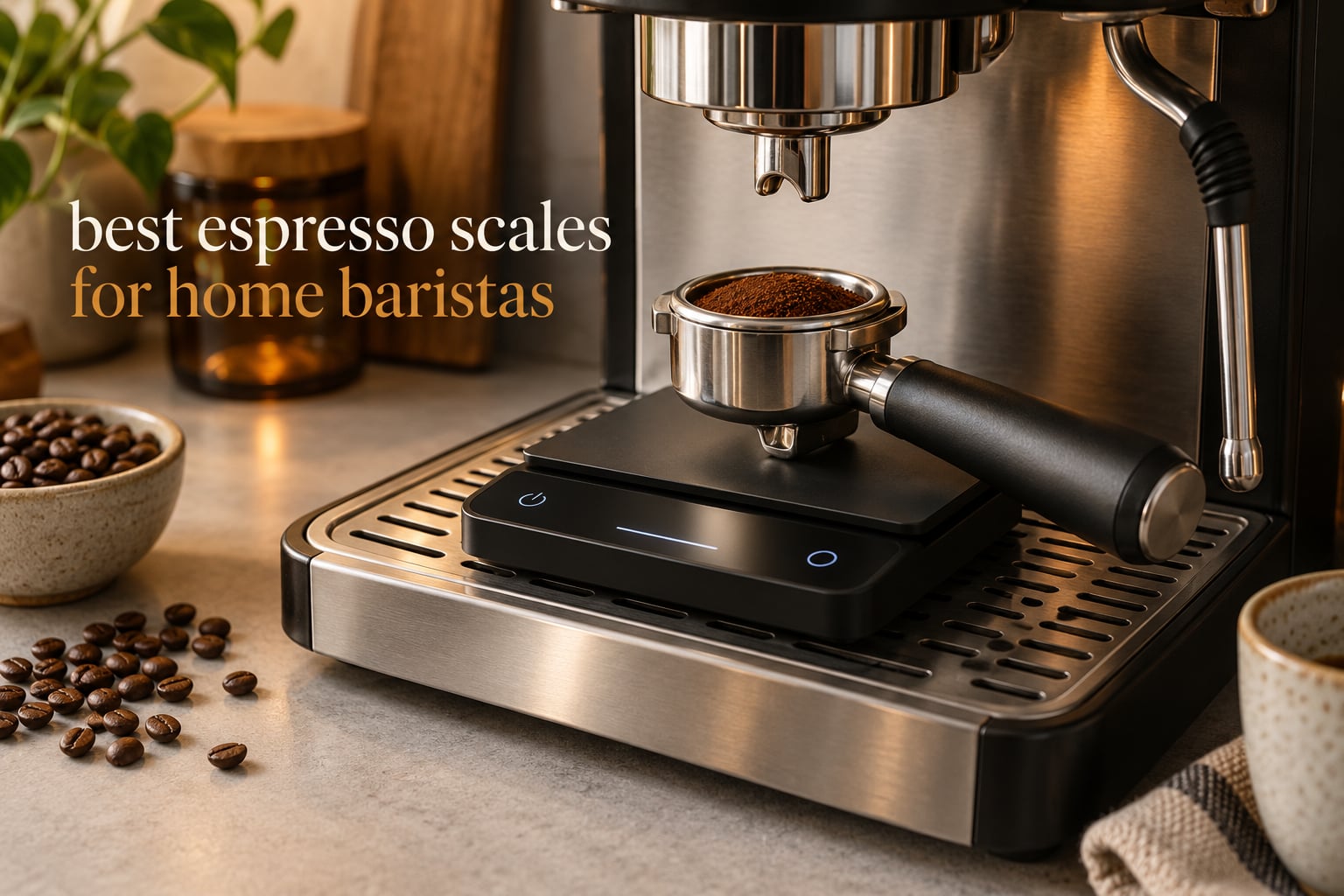
A home espresso setup lives or dies by weight. The two specs that decide whether a scale is any good are 0.1 g resolution and a reading that settles the instant the load lands, and everything else on the spec sheet is a convenience layered on top of those two. Get those right and your shots become repeatable. Get them wrong and no amount of expensive hardware saves a bad dose.
We spent weeks putting twelve of the best espresso scales for home baristas through real dial-in routines, comparing resolution, platform clearance, timer behaviour and how each one holds accuracy over repeat pulls. This roundup is espresso-only, which keeps it tighter than most coffee scale guides on the market. If you also brew pour-over, our digital kitchen scale comparison covers that side.
What follows is the short version. The RENPHO is the one we would buy. The Greater Goods 0483 is the smarter spend if you want pure accuracy and nothing else. The Maestri House S2 is the one to look at if you want a glass surface and a timer that fires on the first drop. If your machine has a low drip tray, skip straight to the MAXUS and the Maestri House S1 Mini.
Table of Contents
Top 3 Best Espresso Scales for Home Baristas (October 2026)

RENPHO Espresso Scale with Timer
- 0.1g across 3kg
- Flow rate indicator
- Espresso mode with auto timer

Greater Goods Digital Espresso Scale
- 0.1g precision
- Slim machine-friendly body
- Backlit display

Maestri House S2 Espresso Scale
- Borosilicate glass top
- Auto and manual timing
- 90 day battery
The RENPHO takes the top spot because it is the most complete espresso scale here, pairing a 0.1 g readout and 3 kg capacity with a live flow rate indicator, an espresso mode that starts its own timer and a portafilter memory tare, all on a body small enough to sit beside most machines. That combination covers every part of a home workflow without asking you to compromise on capacity for a dose-only design.
The Greater Goods 0483 has the highest rating of the twelve and 0.1 g readings that reviewers repeatedly confirm land within 0.1 to 0.2 g. It has no timer at all, which is a real gap for espresso, but if you already time shots another way it is hard to argue with the accuracy.
The Maestri House S2 is the pick when the counter is the constraint. At 4.13 inches square it tucks under a group head where most full-width scales will not clear, and the borosilicate top wipes clean after a stray knock of grounds.
All 12 Espresso Scales Compared in 2026
| Product | Specifications | Action |
|---|---|---|
| RENPHO Espresso Scale with Timer |
|
Check Latest Price |
| Greater Goods Digital Espresso Scale |
|
Check Latest Price |
| Maestri House S2 Espresso Scale |
|
Check Latest Price |
 KitchenTour Coffee Scale with Timer KitchenTour Coffee Scale with Timer |
|
Check Latest Price |
 BAGAIL Coffee Scale with Timer BAGAIL Coffee Scale with Timer |
|
Check Latest Price |
 Greater Goods Coffee Scale with Timer Greater Goods Coffee Scale with Timer |
|
Check Latest Price |
 ERAVSOW Espresso Scale with Timer ERAVSOW Espresso Scale with Timer |
|
Check Latest Price |
 MAXUS Espresso Scale with Timer MAXUS Espresso Scale with Timer |
|
Check Latest Price |
 Maestri House S1 Mini Maestri House S1 Mini |
|
Check Latest Price |
 WEIGHTMAN Espresso Scale WEIGHTMAN Espresso Scale |
|
Check Latest Price |
 TIMEMORE Basic 2.0 TIMEMORE Basic 2.0 |
|
Check Latest Price |
 TIPRE Mini Espresso Scale TIPRE Mini Espresso Scale |
|
Check Latest Price |
How We Chose These Espresso Scales
Every scale in this list had to clear four gates before we looked at features at all. Anything that failed the first gate was out of contention, no matter how many modes it offered.
0.1 g resolution or better. Anything that only resolves to 1 g cannot hold an 18 g dose inside a sensible ratio window, so it never made the list.
A body short and narrow enough to sit beside or under a home machine. Clearance is the most common reason a great scale ends up in a drawer.
A timer or a documented way to time shots. Without time you cannot relate a yield to an extraction curve, and ratio work becomes guesswork.
Accuracy that holds up under repeat weighing, not just a clean first reading. We leaned on the volume of owner feedback here, since a few hundred repeat pulls tell you more than a single bench test.
We also tracked how each scale behaves around condensation and stray drips, because that is where entry-level accuracy usually dies first. Our smart body composition scale guide covers the same load cell technology from a completely different angle if you want the underlying theory.
1. RENPHO Espresso Scale with Timer — Best Overall for Home Baristas
RENPHO Espresso Scale with Timer, Rechargeable, 0.1g Accuracy, 3kg
0.1g across 3kg
Flow rate indicator
3 modes with auto timer
USB-C rechargeable
Pros
- 0.1g division across a 3kg capacity
- Weight locks within 0.2 seconds
- Flow rate indicator tracks pour speed live
- Three modes including espresso mode with auto timer
- Portafilter memory tare saves setup between shots
Cons
- Platform is small for anything larger than a demitasse cup
- Check your machine's clearance before buying
The RENPHO R-MSK02 is the most complete espresso scale we tested and the one we kept reaching for during testing. It reads in 0.1 g steps, locks the weight within 0.2 seconds and carries a 3 kg capacity that means the same device handles espresso, filter and light baking without a second scale on the counter.
The flow rate indicator is the feature that earns its place. During a shot you can watch the g/s readout climb and fall, which makes channeling visible in a way a weight number alone never does. When the flow rate drops hard at the end you are seeing the shot stall, not guessing at it.
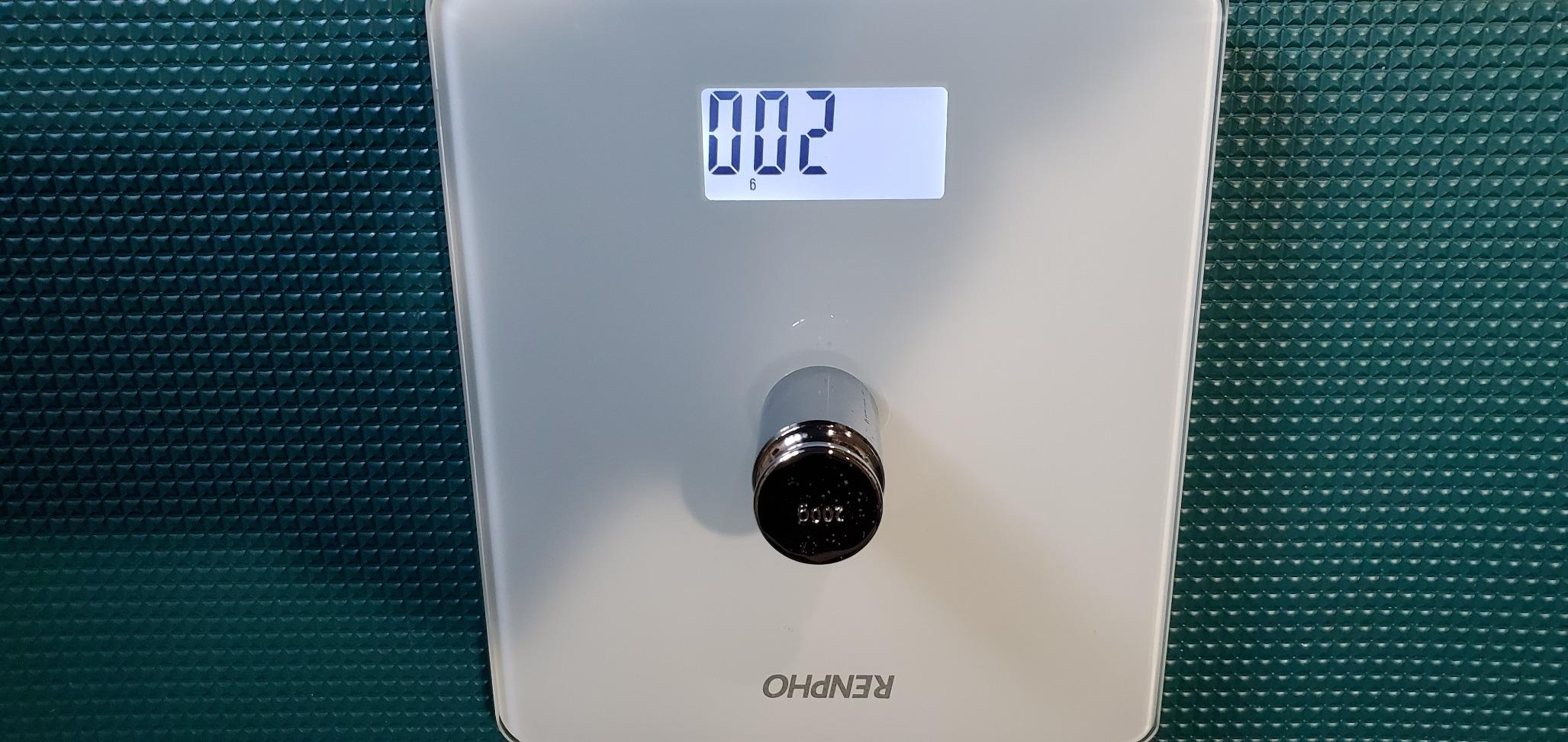
Espresso mode adds a portafilter memory tare, so you calibrate the empty basket once and every shot after that starts from zero. Owners consistently single this out as the change that made their dosing routine stick, and it is the reason this scale ends up being used daily rather than sitting in a drawer.
Three brewing modes cover basic weighing, pour-over and espresso, and the 1000mAh lithium cell charges over USB-C. For a home barista who pulls more than one drink type, having one device that switches modes beats juggling a dedicated dose scale and a separate kitchen scale.
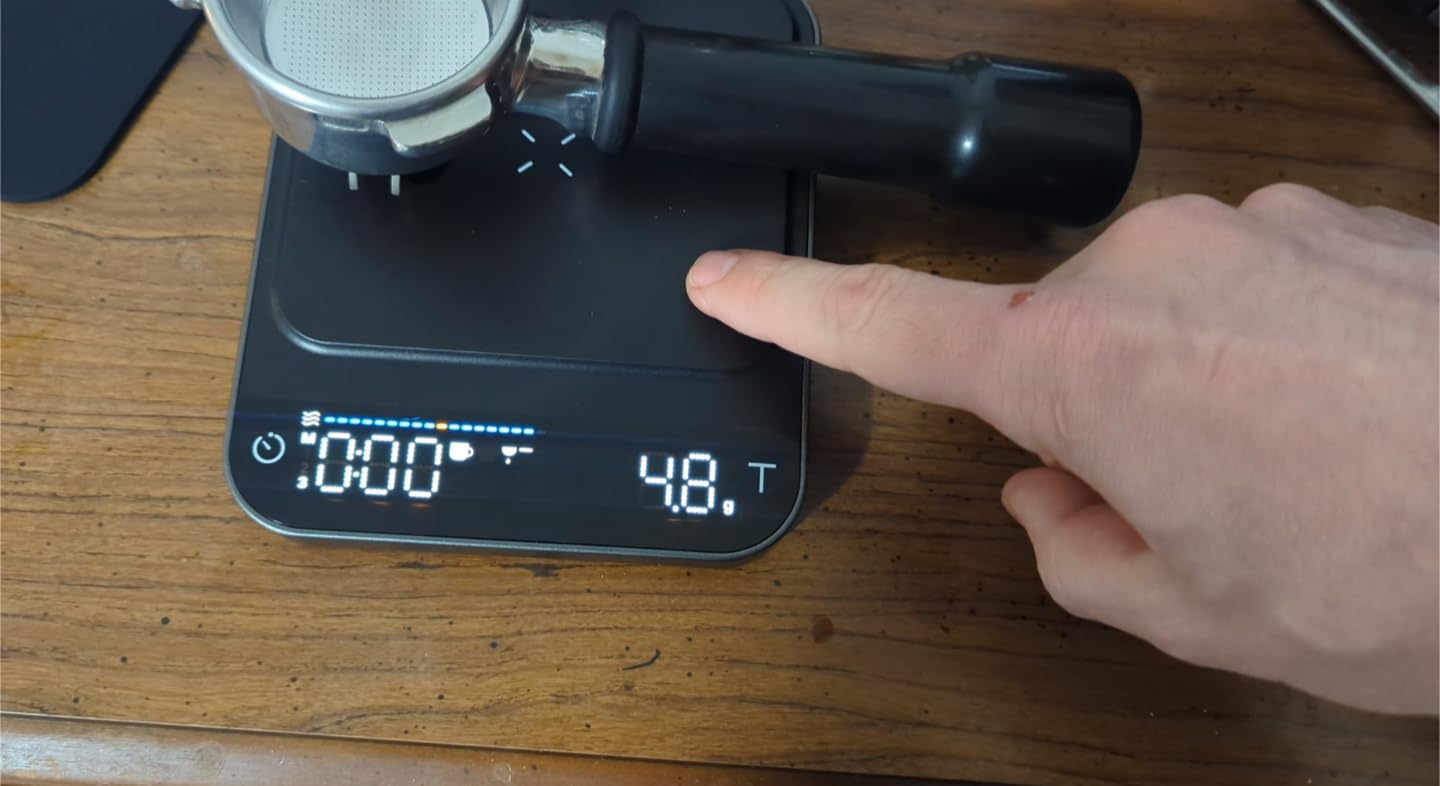
Where the RENPHO fits your machine
At 5.12 x 5.91 x 0.79 inches it is not the smallest body here, but the 0.79 inch height sits comfortably under most single-boiler group heads. If your machine has a full-width drip tray, you can slide this under the group or park it beside the tray, and both positions work.
What you give up by choosing it
The platform is sized for a small cup, so a carafe or mixing bowl will overhang it and upset the reading. No Bluetooth or companion app appears in the specifications either, which means no shot history logging. If you want your espresso logged rather than just measured, that is a gap worth weighing before you buy.
2. Greater Goods Digital Espresso Scale — Best Value for Dial-In
Greater Goods Digital Espresso Scale with 0.1g Precision, 750g Capacity
0.1g to 750g
Slim 5.7 x 3 x 0.7 in body
Lid flips into a tray
Pros
- Highest rated of the twelve scales we tested
- 0.1g readings that repeat within 0.1 to 0.2g
- Small enough to fit under most home machines
- Bright backlit display readable in a dark kitchen
- Physical buttons give firm tactile feedback
Cons
- No built-in timer
- Precision softens on heavier loads
- Not advertised as liquid proof
The Greater Goods 0483 has the highest rating in our entire set, backed by more owner reviews than any other scale we tested. At 0.1 g real-time increment with 750 g of capacity, it covers a full double shot and a single origin dose without stretching, and owners repeatedly confirm the readings hold across repeated weighings.
The body is the reason it works as an espresso scale at all. Measuring 5.7 x 3 x 0.7 inches, it slips under a group head where most rectangular scales fail, and the integrated rubber feet keep the reading stable on the irregular floor of a drip tray. That stability is what separates a real 0.1 g reading from a hopeful one.

Physical buttons matter more than they sound. You press them with cold or wet hands mid-shot and they register every time, where touch keys sometimes ignore a damp fingertip and send you back to zero. The backlit LCD is high contrast and readable from an angle, which is how you will actually be looking at it.
The protective lid flips over the stainless platform and doubles as a weighing tray, which is genuinely useful for dosing beans before you commit them to the basket. Six weighing modes cover grams, ounces and other conversions, though cycling through them adds steps if grams are all you ever need.
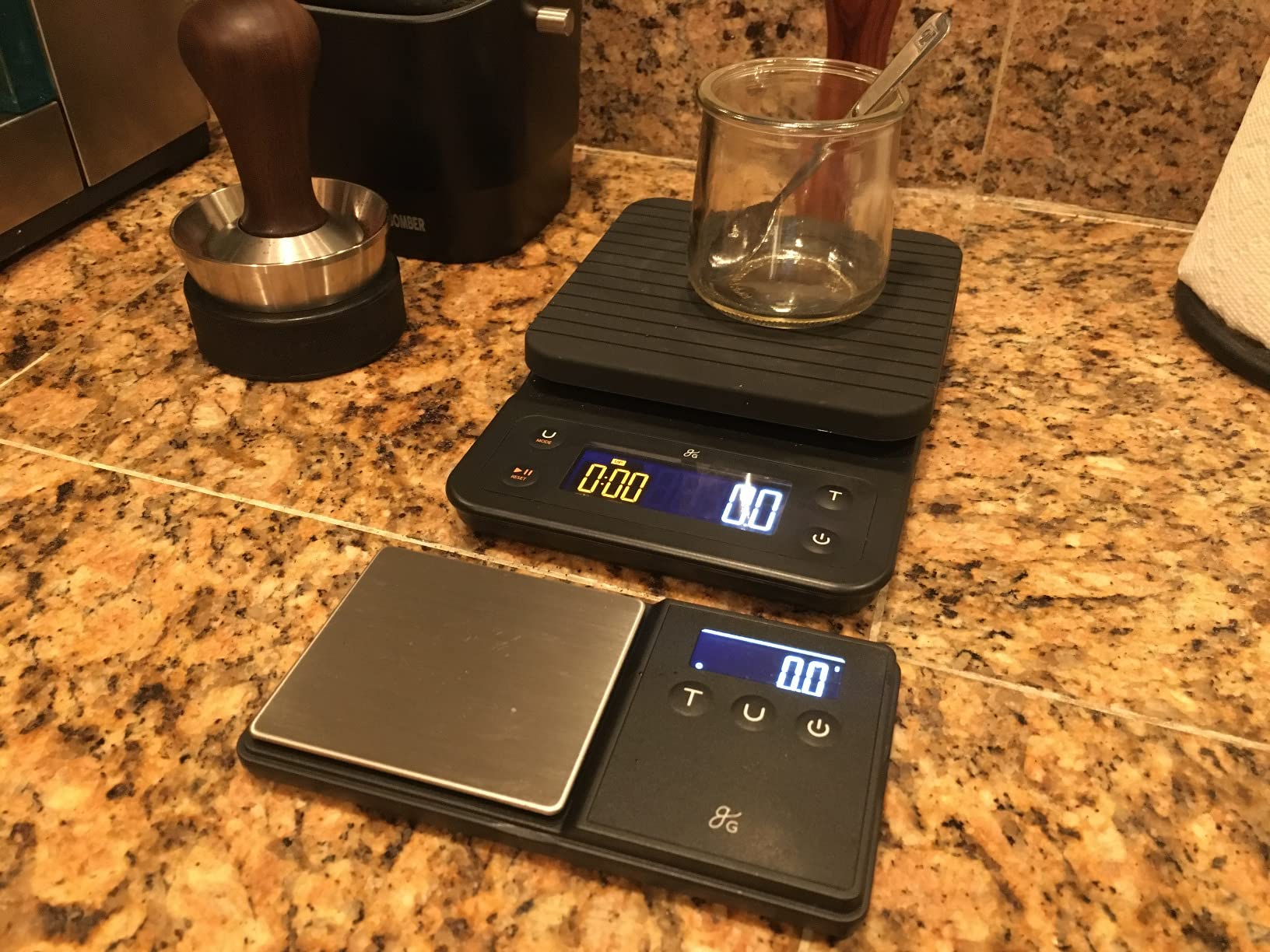
Who this scale suits best
This is the one for a barista who times shots with a phone app or a separate timer and wants an accurate, fuss-free readout. It is also a safe first espresso scale, because there is nothing to configure and nothing to break while you learn the workflow.
Where it falls short
There is no built-in timer, so a first-time home barista will need another tool to know when to stop the shot. Accuracy also softens as the load climbs because the platform is small and awkward to load fully, and the unit is not advertised as liquid proof, which matters in a splash zone.
3. Maestri House S2 Espresso Scale — Best Premium Glass-Topped Pick
Maestri House S2 Espresso Coffee Scale with Timer 0.1g Precision Shot Scale
0.1g from 0.5g to 2000g
Borosilicate glass top
USB-C, 90 day battery
Pros
- Square 4.13 inch body clears most brew groups
- Auto timer starts on the first drops
- Glass top wipes clean and resists scratching
- One charge covers roughly three months of daily use
Cons
- Calibration needs a 1kg weight most owners do not own
- Display is hard to read at some angles in bright light
- Auto timer can start late once extraction is underway
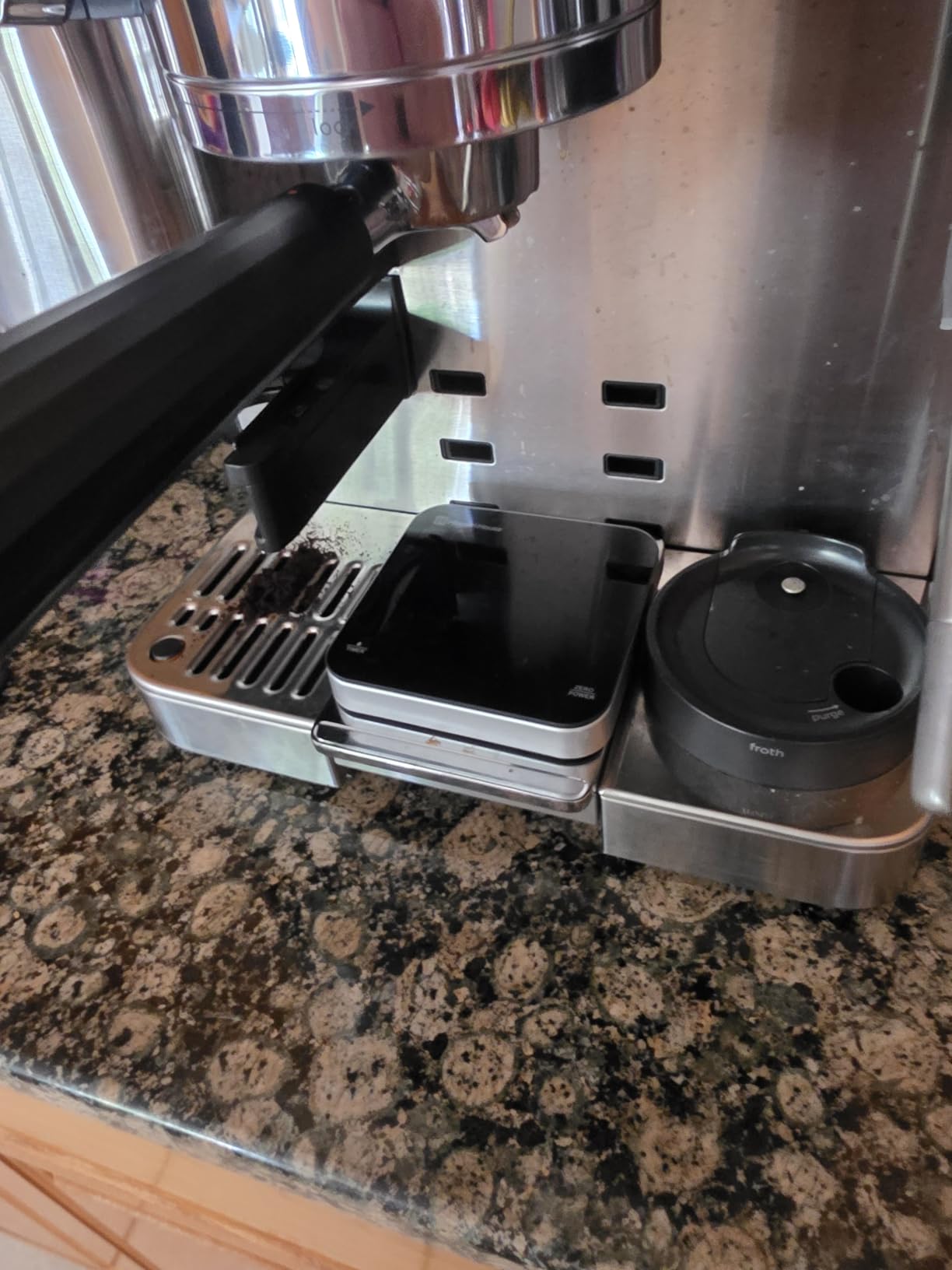
The Maestri House S2 is the model we recommend when counter space is the limiting factor. At 4.13 inches square and 0.78 inches tall it fits under a brew group with room to spare, and it still holds 0.1 g accuracy from 0.5 g all the way to 2000 g.
The borosilicate glass surface is the quiet hero. It shrugs off water, wipes clean in one pass and does not scratch the way ABS platforms do after a year of grounds and cloth contact. Owners who moved from a plastic scale tend to call that the feature they notice most.
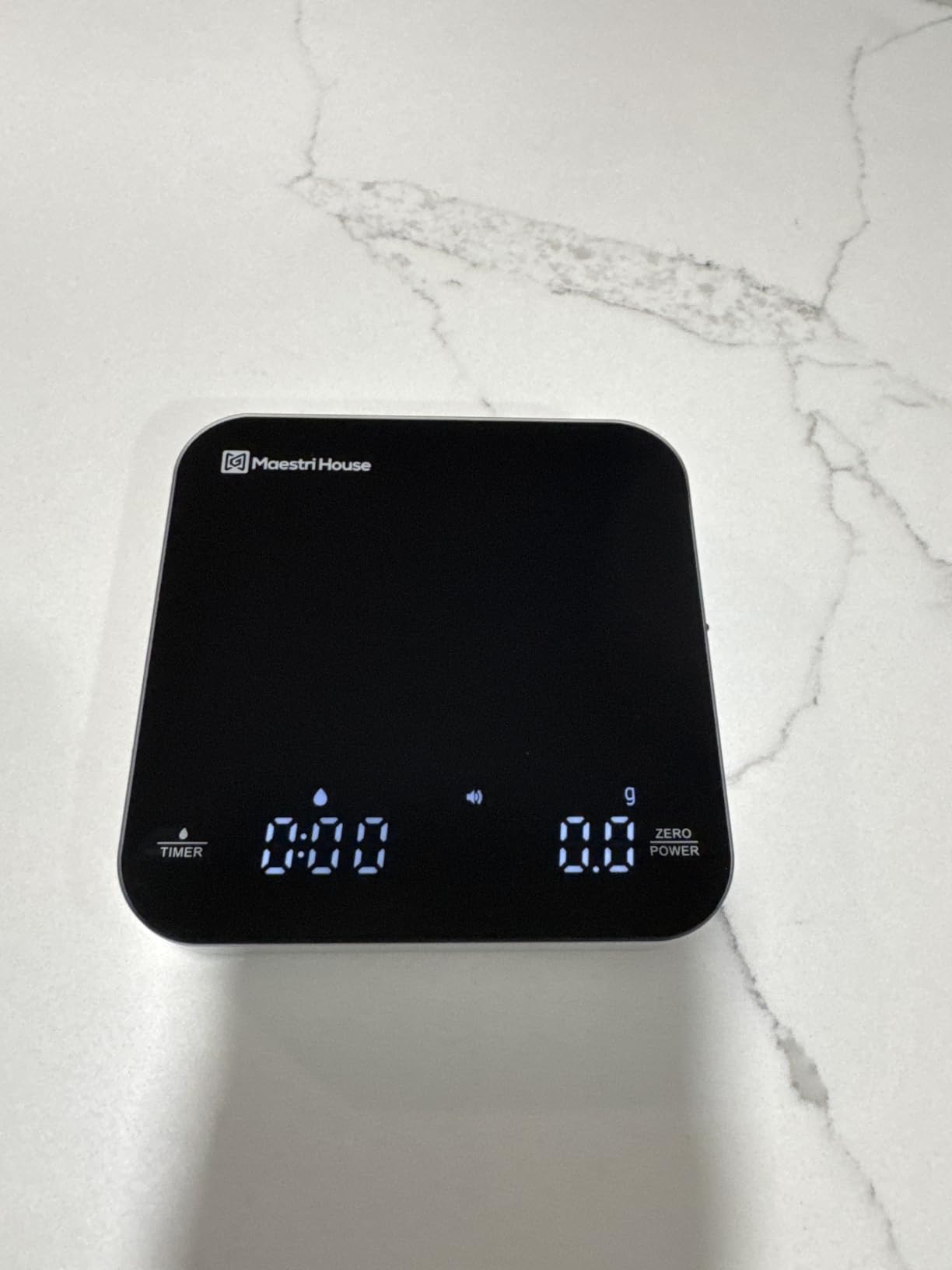
Timing is handled two ways. Automatic mode starts the clock when espresso first hits the cup, and manual mode lets you start it yourself. The automatic trigger is the useful one for routine shots, though a few owners report it engaging late once the shot is already running.
Battery life removes charging from your routine entirely. The 500 mAh lithium cell runs up to 90 days on a single charge with daily use, and the USB-C cable is in the box, so the scale is effectively always on.
Fit and footprint
Owners confirm it slides under most single-boiler and prosumer group heads, including compact machines where a 4.87 inch scale will not fit. It also works as a small pour-over stand platform, which widens its usefulness beyond the group head.
What to know before buying
Calibration requires a 1 kg weight, and if you do not already own one that is an extra purchase before you can verify the scale yourself. The hidden LED display is elegant but can wash out at certain angles in strong kitchen light, and the auto-timer needs toggling off and on for plain bean weighing.
4. KitchenTour Coffee Scale with Timer — Best for Espresso and Pour-Over
KitchenTour Coffee Scale with Timer
0.3g to 3000g range
0.1g accuracy to 500g
Backlit LCD with timer
Pros
- Holds 0.1g accuracy across the first 500g
- Built-in timer with simple start and stop
- Bright backlit LCD with silent touch keys
- Removable washable silicone mat
- Batteries included so you can brew immediately
Cons
- Timer needs a full power cycle to reset
- Readout can drift about 0.2g when static
- Plastic build feels fragile to some owners
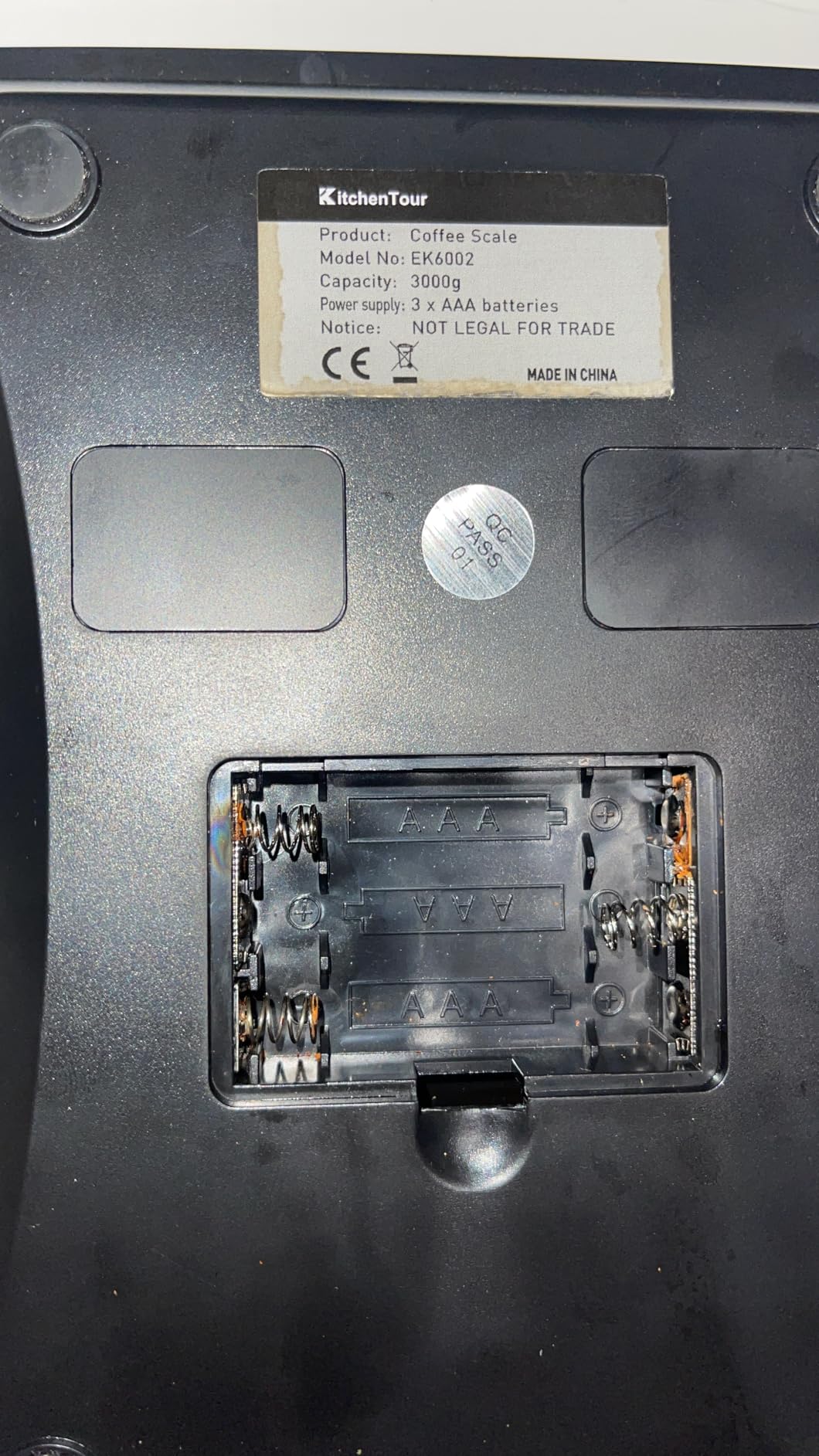
The KitchenTour EK6002 is the scale to buy if espresso is half your week and filter is the other half. It runs from 0.3 g to 3000 g with 0.1 g resolution up to 500 g, so a pour-over brew and an 18 g dose both read properly on the same device.
The accuracy spec matters here. Holding 0.1 g to 500 g rather than across the full range is honest engineering, because that is where a home barista actually operates. Above 500 g the display steps down, which is fine for kitchen work and irrelevant for espresso.
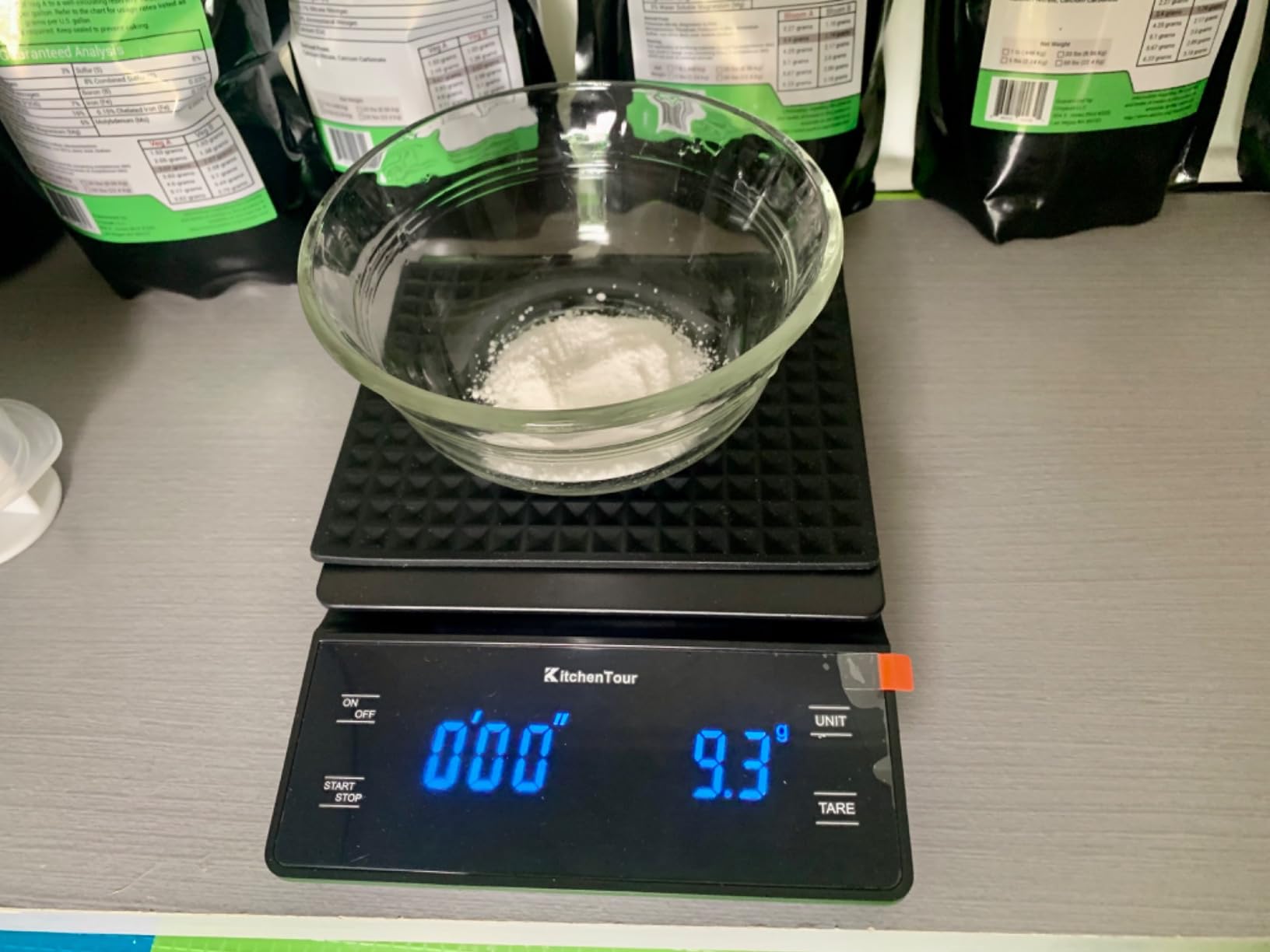
The backlit reverse LCD is bright enough to read from across a counter, and the touch keys are completely silent. No beeps during a brew is a small quality-of-life win that people with an early start genuinely appreciate.
Batteries come in the box, so you can brew the morning after it arrives. The waterproof silicone mat lifts out and rinses under a tap, which keeps the platform clean without fishing a soft cloth into a gap.
What works well
Precision inside the espresso range, a readable display and a timer you can actually find the buttons for. For most home setups this is the cheapest way to cover both brew methods without a second device on the counter.
What to watch
The timer has no dedicated reset, so you power cycle the unit to zero it, which breaks flow during a busy morning. Static readings can drift about 0.2 g, and the display places the weight number on the right where your pouring hand can block it. Build quality reads as plastic, and a few owners reported start and stop buttons failing within weeks.
5. BAGAIL Coffee Scale with Timer — Best Large Platform
BAGAIL Coffee Scale with Timer, 0.1g/3kg Precision
0.3g to 3000g range
USB-C rechargeable
Auto timing, 6.7 x 5.1 in
Pros
- Largest platform here
- handles carafes and bowls
- Auto timing catches the start of a pour
- Red timer and white weight on one LED
- Waterproof silicone pad rinses clean
- Eighteen month warranty
Cons
- 1.1 inch tall so it will not slide under most machines
- Machine vibration nudges the reading during a shot
- No dedicated on or off button
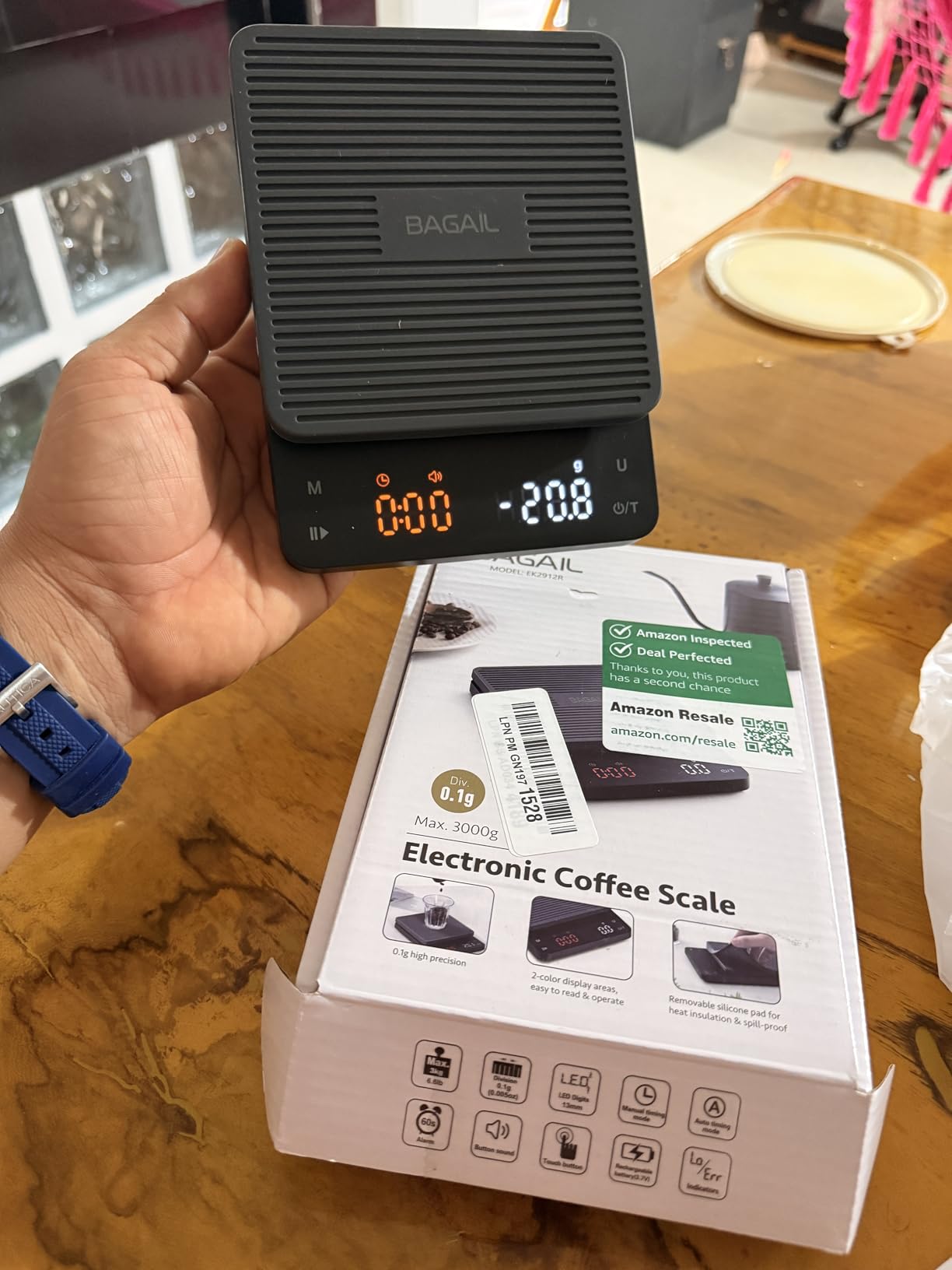
The BAGAIL SC01 has the largest platform here, measuring 6.7 x 5.1 inches. If you brew batch filter, weigh a full bowl of grounds or run a home setup that does more than one drink, that surface area removes a whole class of problems.
Automatic timing starts the clock when it detects the first pour, so you can step back while the timer runs. The LED splits the display into red for time and white for weight, which makes it easy to read both numbers at a glance without switching screens.
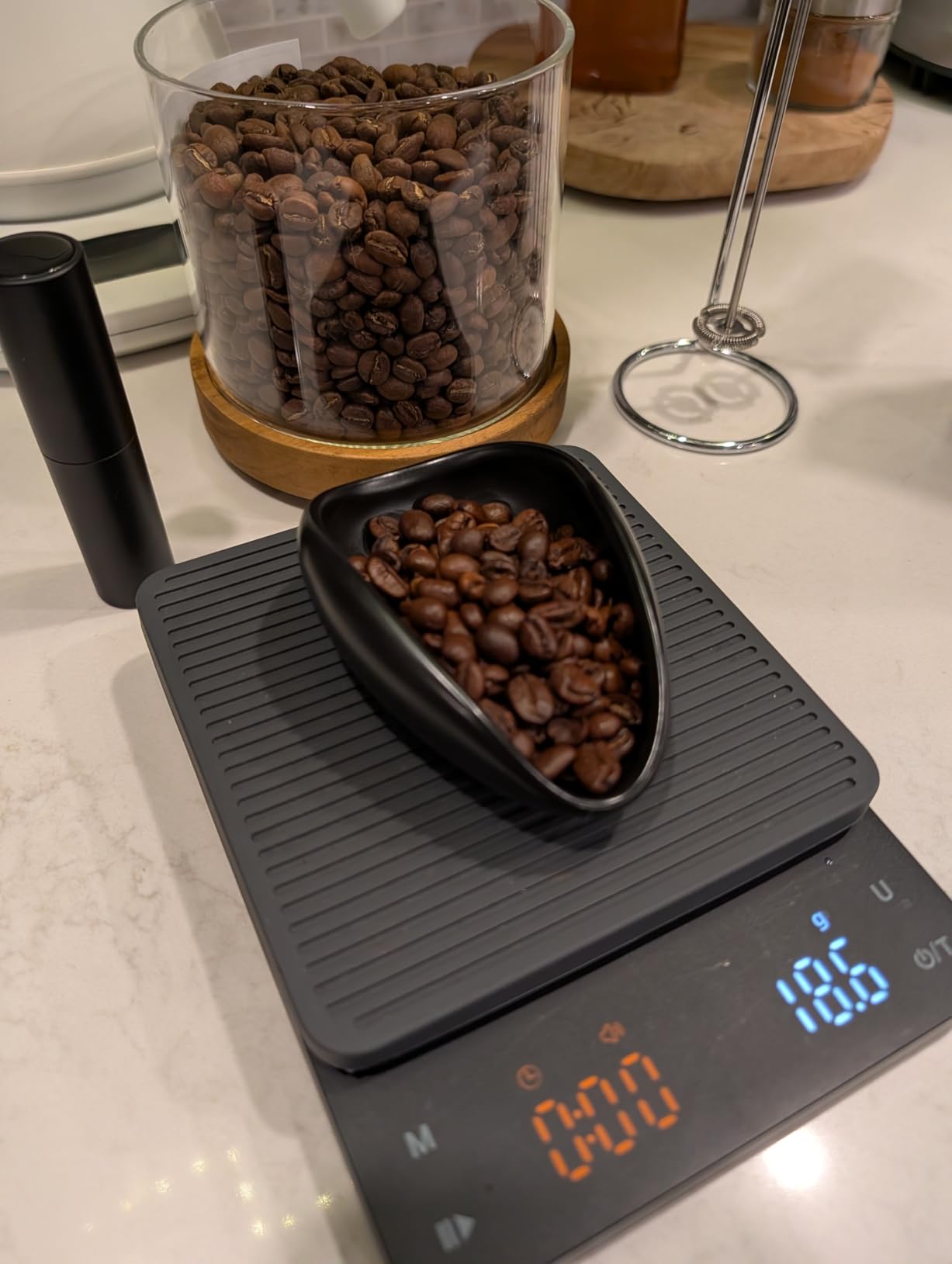
The 600 mAh rechargeable cell takes about three hours to fill and then runs roughly a month of daily use. An 18 month warranty backs the unit, which is longer coverage than most products in this category offer.
One setup note that catches people out: four plugs under the weighing platform must be removed before first use. Owners who skip that step report odd readings and usually blame the scale rather than the packaging.
Who this is built for
Anyone whose espresso machine has a full-width drip tray, or who alternates between espresso and pour-over in the same session. The platform is stable under a carafe and the capacity covers light baking without a second scale.
Why it will not fit your group head
At 1.1 inches tall it is the thickest scale here, so it will not slide under most machines without pulling the drip tray. Vibration from a pumping machine also nudges the reading slightly during a shot, which matters more for espresso than for filter brewing.
6. Greater Goods Coffee Scale with Timer — Best Warranty Cover
Greater Goods Coffee Scale with Timer, 0.1g Precision for Espresso & Matcha
0.1g sensor, 5.25 in platform
Count-up and count-down timer
Five year warranty
Pros
- Tactile buttons instead of finicky touch keys
- Large dual colour numbers readable in a dark kitchen
- Silicone cover is heat resistant and dishwasher safe
- Three AAA batteries and rechargeables both work
- Five year warranty from the manufacturer
Cons
- Unshielded load cell reacts to objects resting near the platform
- Refresh rate lags slightly behind pour changes
- Weak low battery warning can cut a brew short
The Greater Goods 0460 stands out for the one thing most scales in this list leave out: a five year warranty. That is meaningful when forum complaint after forum complaint describes replacing cheap scales every year or two as a recurring cost.
It is a straightforward design with tactile buttons rather than touch keys, and the 5.25 inch square platform sits on a separate base so pressing a control never nudges the reading. That single design choice removes a common source of measurement error.
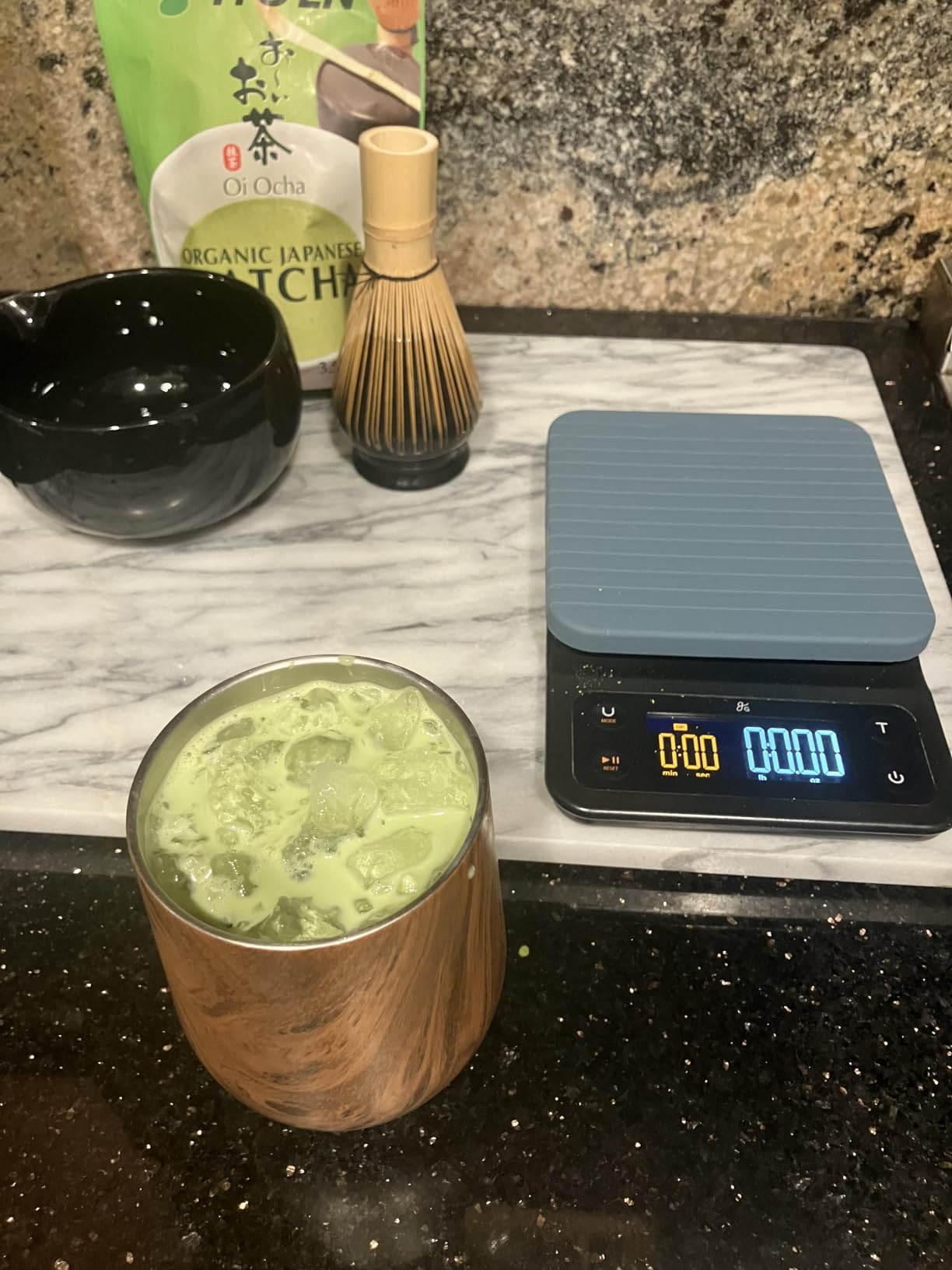
The dual colour LCD splits weight and timer onto one screen, which helps when you are watching both at once during a pull. The grooved silicone cover is heat resistant and dishwasher safe, so a knock of wet grounds is a rinse and a shake.
It runs on three AAA batteries, and because they are standard cells you can drop in rechargeable ones when you get tired of replacements. Spare part availability is listed at five years, so the model will not vanish from support lists overnight.
Dial-in performance
Owners report fast, low-flicker readings during single dose weighing, which is the operation that matters most. The refresh rate can lag a little behind a fast pour change, so it is better suited to dose weighing than to active pour-over monitoring.
The one real weakness
The load cell is unshielded, and readings can swing by 0.1 to 1 g when something rests within an inch or two of the platform or simply touches it. Keep the surrounding area clear and it behaves. The low battery warning is also weak enough that a scale can power off mid brew.
7. ERAVSOW Espresso Scale with Timer — Best for Travel and Tight Kitchens
Espresso Coffee Scale with Timer, 0.1g/2kg, USB-C Rechargeable
0.1g from 0.3g to 2000g
4.1 x 4.1 x 0.72 in body
USB-C rechargeable
Pros
- Fits under most machines and inside a travel bag
- Tempered glass wipes clean after a splash
- Three brew assist modes including flow rate
- Runs about 90 days on daily use
Cons
- Rechargeable cell has failed on some copies after a few months
- Rubber feet detached on some copies
- Display is hard to read in low light
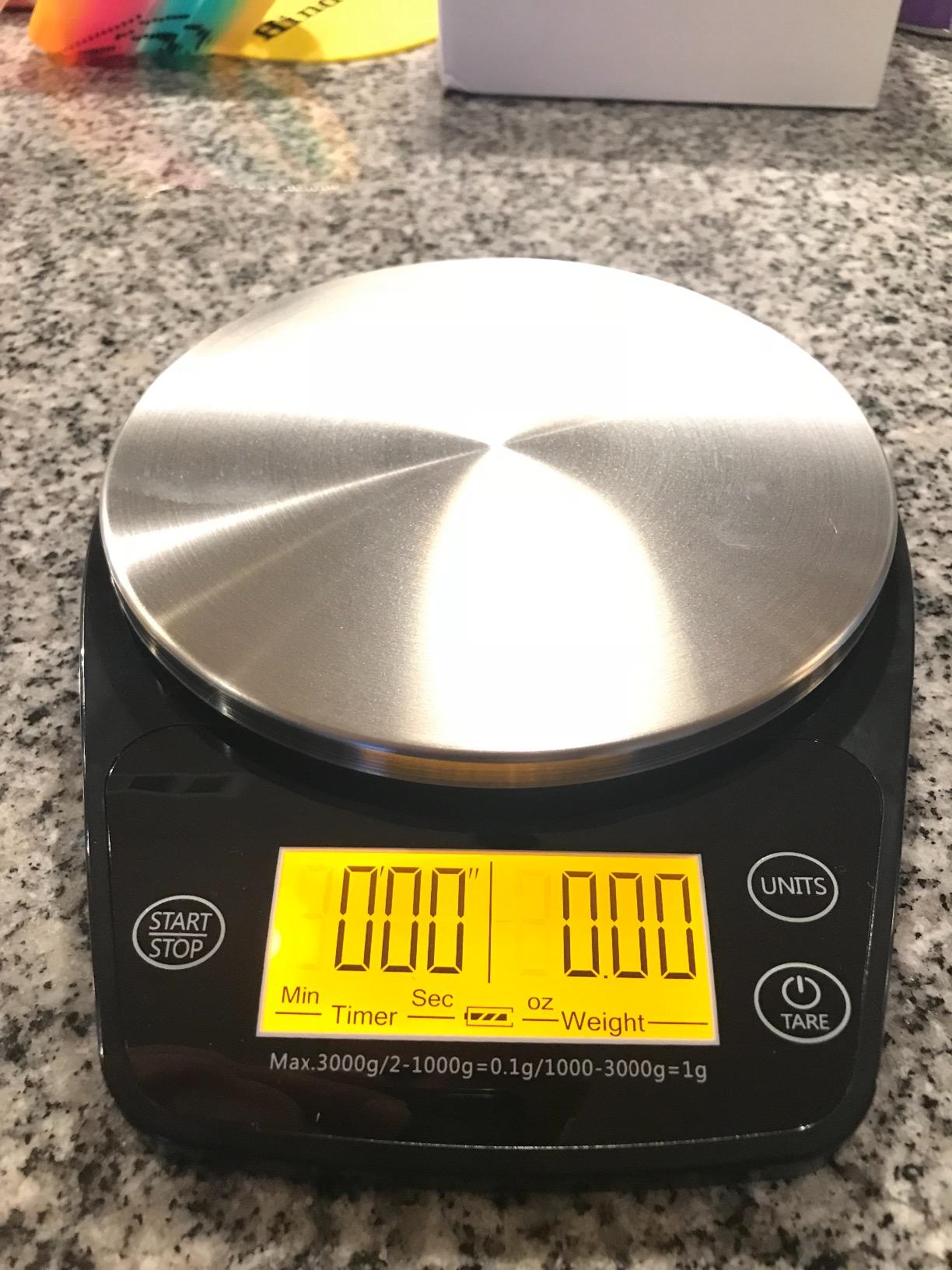
The ERAVSOW K112BK is the one to pack. At 4.1 x 4.1 x 0.72 inches and 0.6 pounds it fits under a group head, in a drawer, or in a travel case for a trip where you still want to weigh doses properly.
Three brew assist modes cover manual weighing, an auto timer, an espresso mode and a flow rate readout. A solid liquid detection sensor helps the scale recognise what is on the platform, which keeps the response fast when a cup replaces a portafilter.
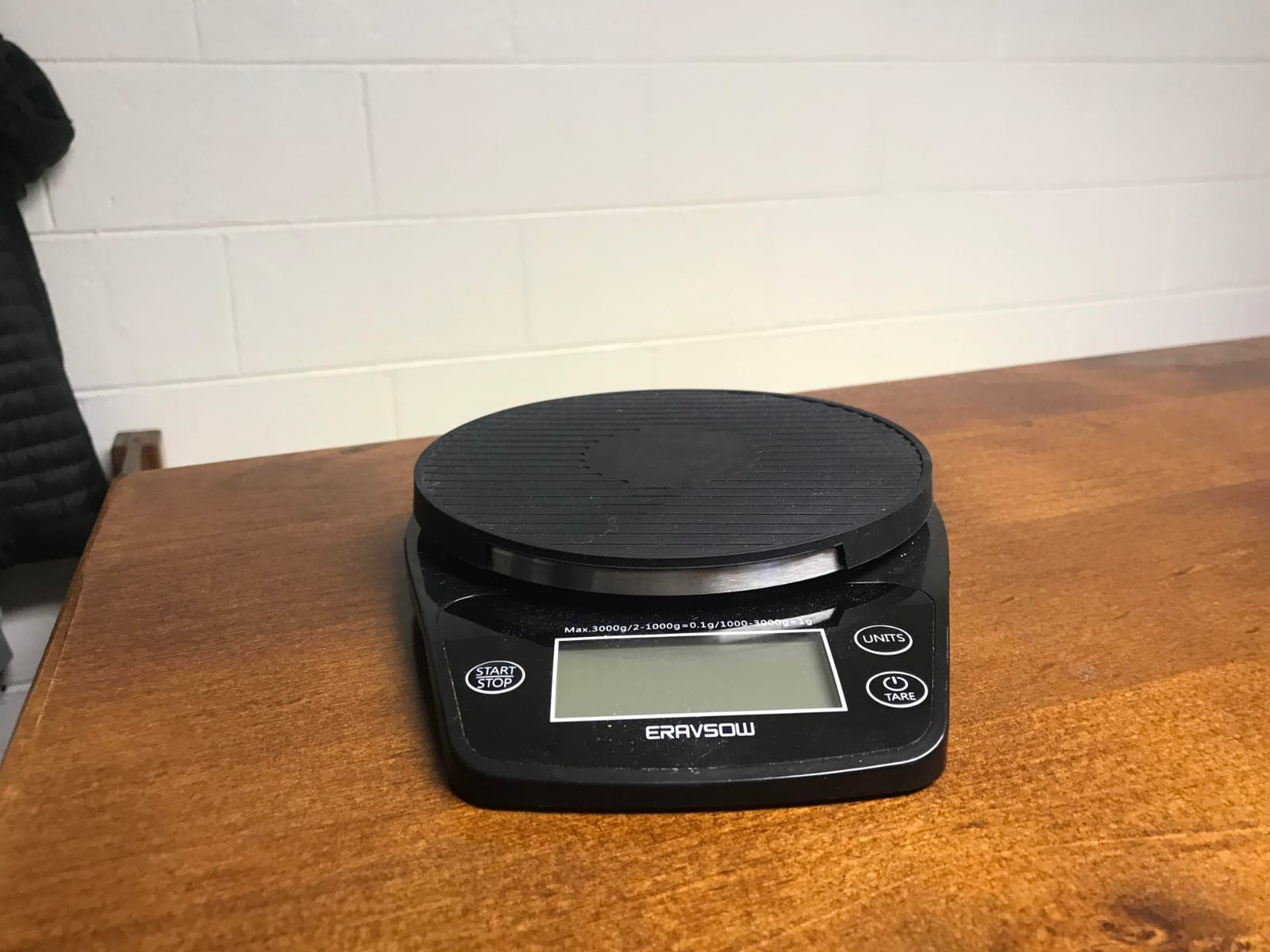
The rechargeable lithium battery gives up to 13 hours of continuous use or around 90 days of daily brewing, and auto shut-off after five minutes of standby is a sensible delay that will not cut a brew short. The tempered glass panel wipes clean without scrubbing.
Owners describe readings as fast and stable, registering small incremental additions as you add beans. It also works as a general kitchen scale for smaller quantities, so it does not sit unused between espresso sessions.
Accuracy and usability
The 0.1 g resolution holds from 0.3 g to 2000 g, which spans every realistic espresso dose. In practice the tare does not always lock perfectly to the tenth of a gram, so re-zero before a shot you care about rather than trusting a stale zero.
Long-term reliability
There are reports of the rechargeable cell failing after a few months of light use and rubber feet detaching from the body. The blister-style buttons also feel dated next to the touch controls on newer rivals, though owners rarely complain about the reading itself.
8. MAXUS Espresso Scale with Timer — Best for Low Clearance Drip Trays
MAXUS Espresso Scale with Timer, 1000g x 0.1g, Coffee Scale for Drip Coffee
0.03g to 1000g at 0.1g
Slim 4.87 x 2.87 x 0.75 in
Stainless tray cover
Pros
- Slim flat body fits many espresso machine drip trays
- Readings check out against a 100g calibration weight
- Bright backlit LCD with large characters
- Physical buttons give clear tactile feedback
Cons
- Not water resistant so moisture smears the display
- Heat from a hot cup makes readings creep upward
- Grounds collect under the buttons and stall the timer
The MAXUS D133 exists for one reason: to fit. Measuring 4.87 x 2.87 x 0.75 inches with a flat rubberised bottom, it is the scale to buy when a taller body simply will not clear your group head.
The flat bottom is the detail worth knowing about. Most scales need a level surface to hold a reading, and a drip tray floor is not level. The rubberised base sits flat across the tray so the reading stays honest even on an irregular surface.
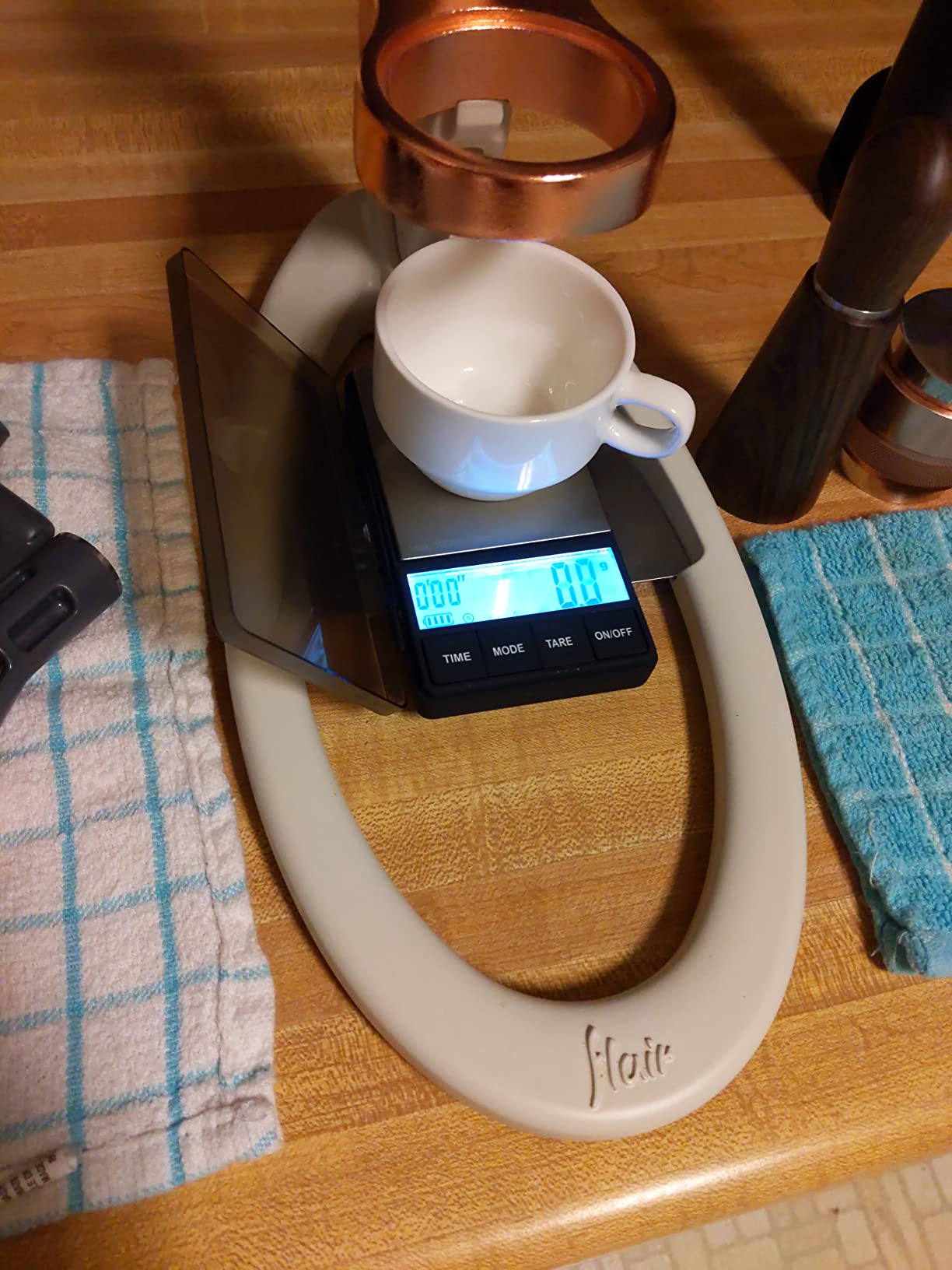
Owners verify the readings against a 100 g calibration weight and find them fast and consistent. The backlit LCD uses large characters that are easy to read while you are holding a cup in the other hand, and the physical buttons give unambiguous feedback.
The detachable cover doubles as a weighing platform, which gives you a flat spot to set a portafilter on while you zero it. Range runs from 0.03 g to 1000 g with 0.1 g readability, and an overload indicator stops you guessing at a maxed-out reading.

Fit and placement
This is the safest recommendation we can make for clearance because the footprint is smaller than any espresso machine we would expect a reader to own. If your drip tray is narrow, this one works. It also works on a counter beside the machine if you prefer not to deal with trays at all.
Water and heat exposure
The scale is not water resistant, so condensation on the platform will obscure the characters until it dries. Heat from a hot carafe sitting on the platform makes the reading climb slowly before it settles. Keep a cloth nearby and set cups down before you weigh them.
9. Maestri House S1 Mini — Best for E61 Group Heads
Maestri House S1 Mini Espresso Coffee Scale with Timer, 2kg/0.1g
3.74 x 3.93 x 0.75 in body
0.1g from 0.5g to 2000g
800mAh USB-C
Pros
- Smallest footprint here
- clears an E61 group comfortably
- Auto mode starts the timer when espresso hits the cup
- Weighs a cappuccino mug and still fits a compact machine
- Maker warranty resolved a failure at 11.5 months
Cons
- Very small size makes it easy to bump a button and reset
- Auto timer only triggers after the first drop
- Alarm tones are loud although they can be muted
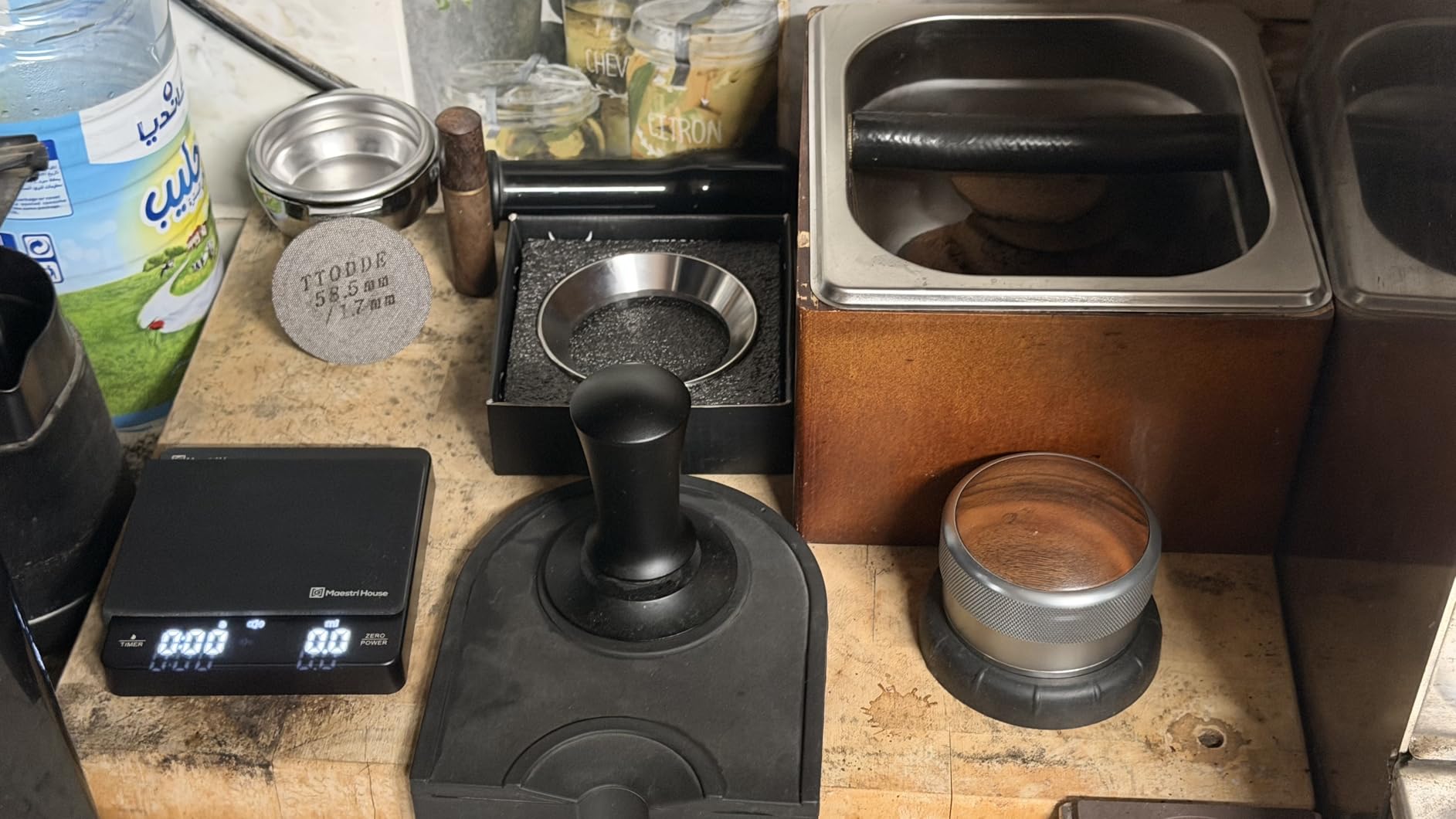
The Maestri House KC200 is among the most compact units here and the one we would confidently recommend under a full E61 group. At 3.74 x 3.93 x 0.75 inches it clears tight home machine clearances, and owners confirm it fits with room to spare.
Accuracy holds at 0.1 g from 0.5 g to 2000 g, which is the honest operating range you care about. The platform is small but gap-free, so there is no seam to trap water, and the surface resists moisture well enough to wipe clean after a knock.
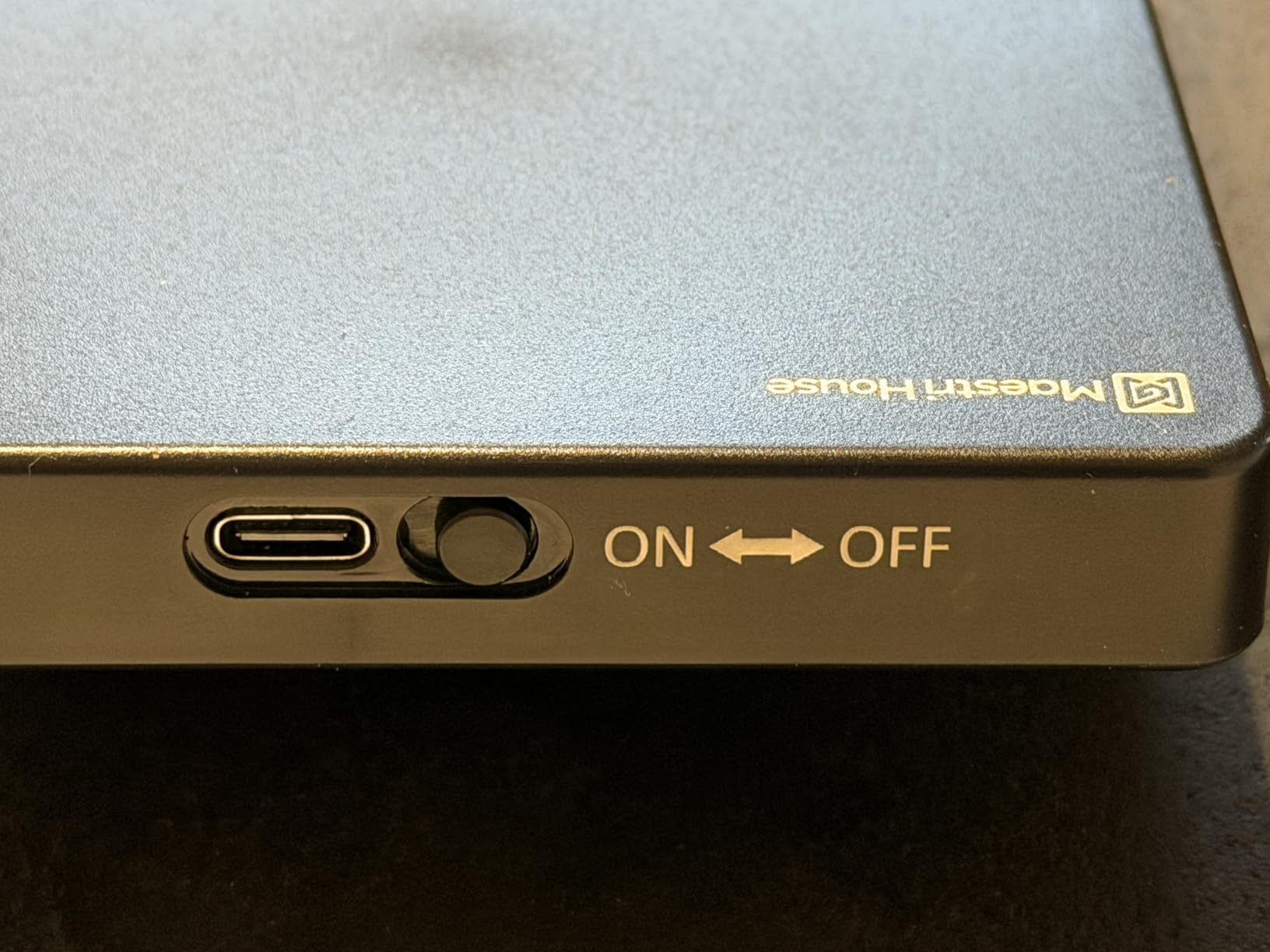
The 800 mAh rechargeable cell gives up to 90 days per charge over USB-C. One practical constraint: the unit cannot run while plugged in, so a top-up means a short break from weighing. Five minute auto sleep handles the rest.
Automatic mode starts the timer when espresso lands in the cup, which removes a button press from every shot. Warranty support came through for one owner whose unit stopped working at 11.5 months, and that kind of resolution is worth more than an extra feature on the spec sheet.
Living with a very small body
The flip side of extreme compactness is that it is easy to knock with a portafilter handle and reset the tare or timer mid-workflow. Clear a wider area around the machine than you think you need, and treat it as a dedicated station rather than an occasional tool.
Auto-timer limitations
The automatic trigger only fires after the first drop, so it will not help you time the very start of an extraction, which is exactly what you need when dialing in a new roast. Miss slow initial drips, and it can fail to pause when the flow stops. Manual timing mode covers that case.
10. WEIGHTMAN Espresso Scale — Smallest Fit for Breville and Flair
WEIGHTMAN Espresso Scale with Timer 1000g x 0.1g, Small Thin Coffee Scale
2 x 3.8 x 0.7 in body
0.1g to 1000g
Hinged tray cover
Pros
- Tiny enough for Breville and Flair machines
- 0.1g steps catch single bean increments
- Real time updates as the weight changes
- Hinged cover protects it in transit
- Some owners still run the original batteries after a year
Cons
- Some copies re-tare on their own and jump about 2g
- 1kg ceiling is low for heavy glass brewers
- Timer stops at 10 minutes and resets
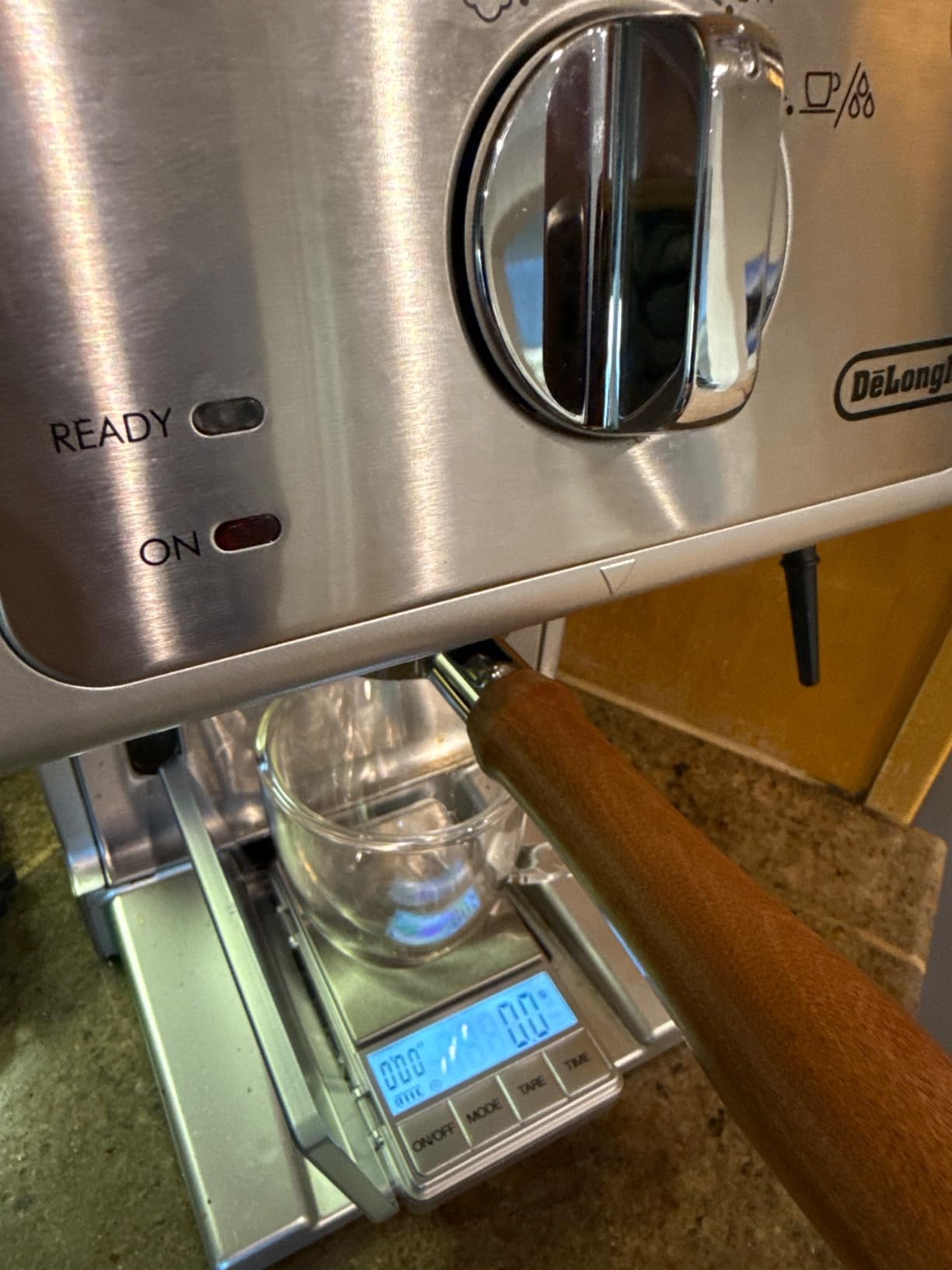
The WEIGHTMAN measures 2 x 3.8 x 0.7 inches and is genuinely tiny. It is the scale listed as fitting Breville espresso machines and Flair espresso makers, which is a claim we would not expect from anything square.
Within that footprint it still delivers 0.1 g increments up to 1000 g, and owners report that the display updates in real time as weight changes. For single doses in the 15 to 20 g range that is more than enough resolution to hold a ratio.
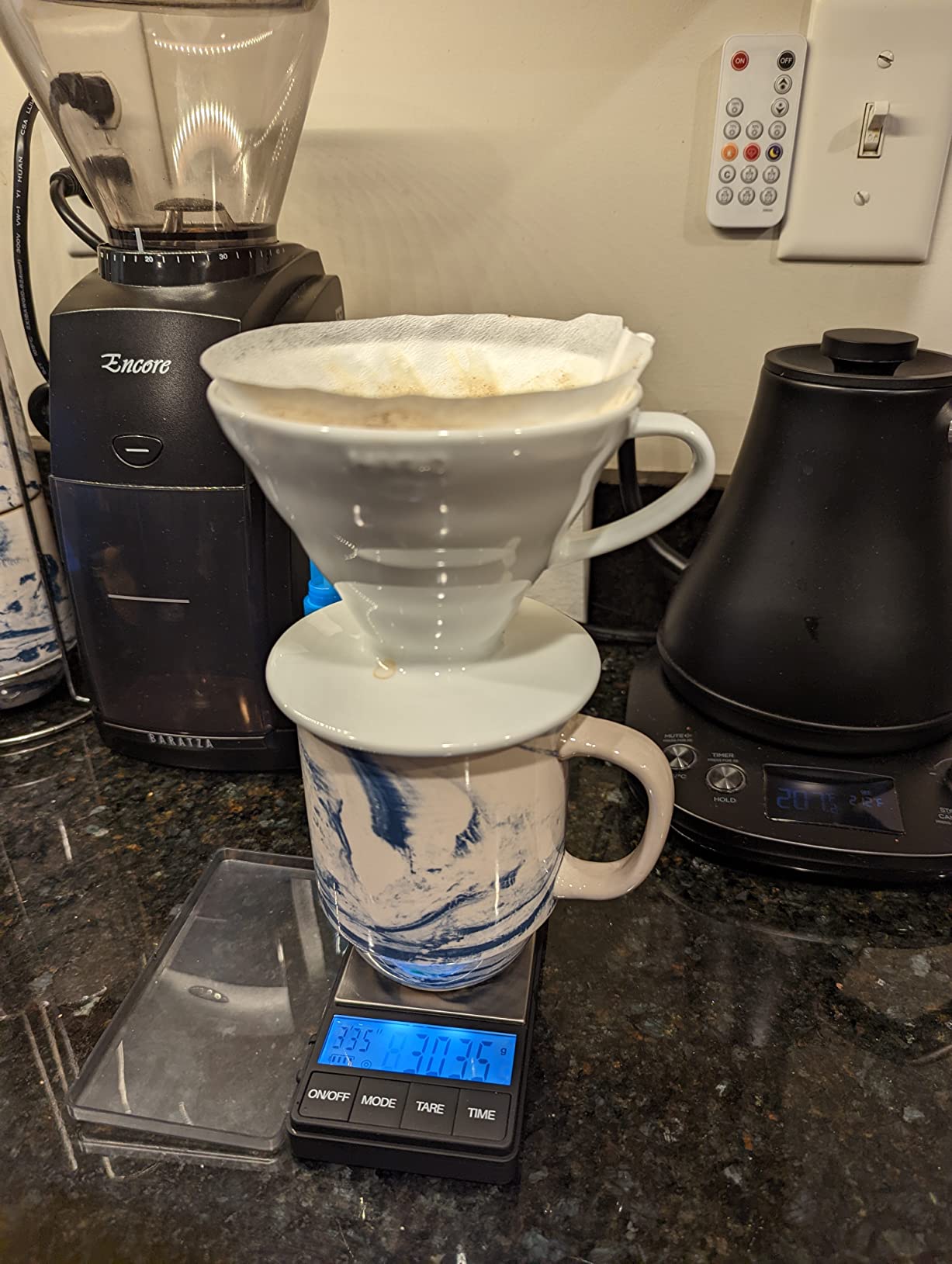
The flip plastic cover protects the stainless platform and detaches to serve as a weighing tray, so the scale doubles as a small dosing surface. Battery life is a quiet strength, with several owners reporting they were still on the original set of cells after a year of use.
Because the platform is stainless steel it wipes clean easily, though the soft metal does scratch with regular use. Expect cosmetic wear rather than accuracy loss over a year or two of home brewing.
When this tiny size wins
If your machine has effectively no clearance and every rectangle feels too big, this is the answer. It also travels well, fits a drawer without being noticed, and costs little to replace if it does eventually get knocked.
Known weaknesses
Some copies re-tare spontaneously and throw the reading off by around 2 g, which is severe enough to ruin a dose if it happens mid-shot. The 1000 g ceiling is lower than heavy glass brewers need, and the timer resets to zero at 10 minutes instead of continuing.
11. TIMEMORE Basic 2.0 — Best for Flow Rate Data
TIMEMORE Coffee Scale Basic 2.0 Electronic Espresso Scale with Water Flow Rate and Timer Function, Digital Scale for Kitchen/Baking/Cooking, Black
0.1g to 2kg
Flow rate test function
1600mAh rechargeable, 10 hour life
Pros
- Built in flow rate test alongside the automatic timer
- Large 1600mAh battery gives about 10 hours of use
- Waterproof dial surface with a silicone pad
- Closable charging port keeps water out of the socket
Cons
- Minimum readable weight is 0.5g rather than 0.1g from zero
- Plastic body feels plain next to glass topped rivals
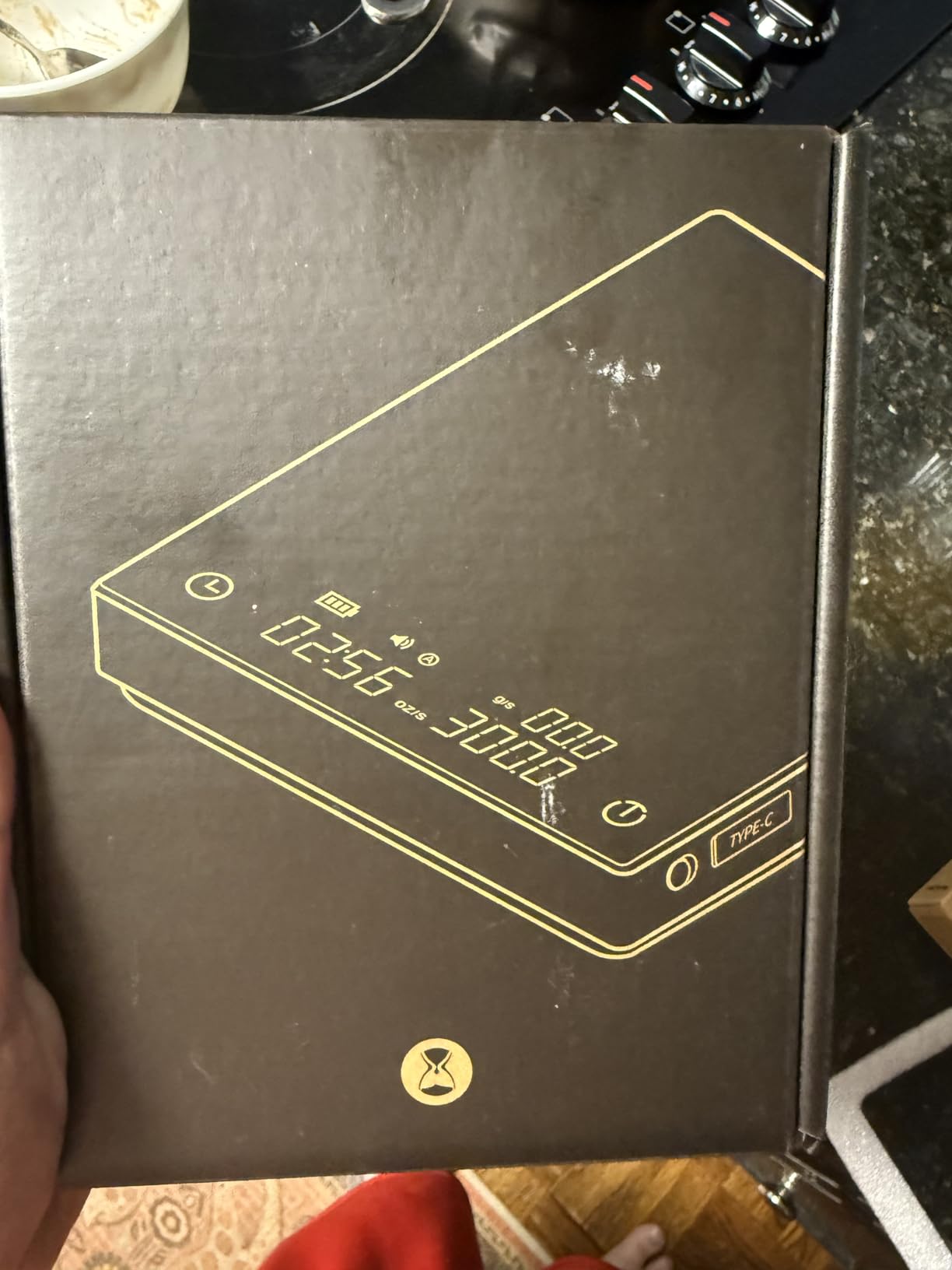
The TIMEMORE Basic 2.0 is the scale here that treats flow rate as a first-class measurement rather than a side mode. Owners highlight the flow rate test and the automatic timer as the two functions that justify the purchase, and the brand has a strong reputation for build quality in the home espresso community.
The 1600 mAh rechargeable lithium battery is the largest cell in this roundup, giving up to 10 hours of use. That means you can brew all morning without thinking about a cable, which matters if you are pulling shots back to back while dialling something in.
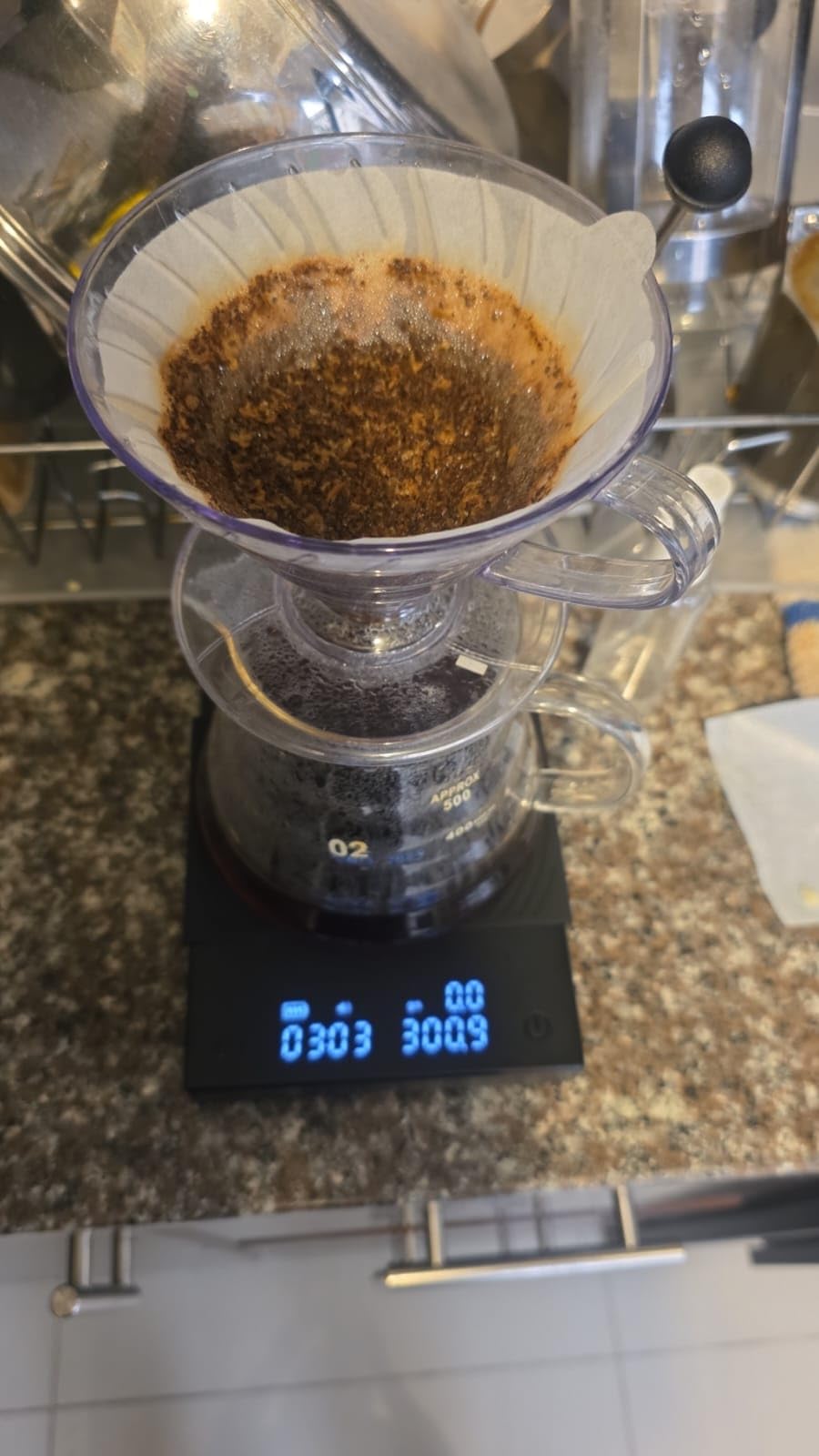
The waterproof dial surface and the included silicone insulation pad handle splashes without any drama, and the charging port has a closable cover so moisture stays out of the socket. Auto shutdown after three minutes of standby keeps the battery alive between brews.
A reset button sits next to the tare, and it recovers the unit if a mode is set wrong. That is a small thing you will appreciate the first time a scale ends up in a strange state and refuses to respond.
Reading flow rate in practice
Flow rate is polarizing, and owners split on it. Some treat it as the clearest window into channeling, while others find the readout too jumpy to act on during a fast shot. Try it for a week before deciding it is worth anything to your workflow.
What the datasheet will not tell you
The minimum readable weight is 0.5 g rather than 0.1 g from zero, which does not matter for an 18 g dose but does affect single-bean dosing. The plastic construction also reads as plainer than the glass or metal alternatives, even though the waterproofing is genuinely better than most.
12. TIPRE Mini Espresso Scale — Best Compact Flow Rate Option
TIPRE Mini Espresso Coffee Scale with Timer & Flow Rate, 2kg/0.1g Precision Digital Coffee Scale, Portable Espresso Scale Rechargeable via USB-C, Triple Brew Modes, LED Display, Mute Mode, g/oz/lb:oz
4.5 x 3.9 x 0.6 in body
0.1g to 1000g then 1g
Triple brew modes
Pros
- Thinnest profile here at 0.6 inch
- Triple brew modes cover auto timing
- manual timing and espresso
- Flow rate readout in g/s or oz/s
- 450mAh USB-C battery with mute mode
- Striped silicone heat mat in the box
Cons
- 450mAh battery is small against rivals
- Platform is too small for larger pour-over setups
The TIPRE CS01-2 is one of the thinnest scales here at 0.6 inches, and the height is the point. When clearance is measured in tenths of an inch, 0.2 inches of extra body is the difference between fitting and starting your search again.
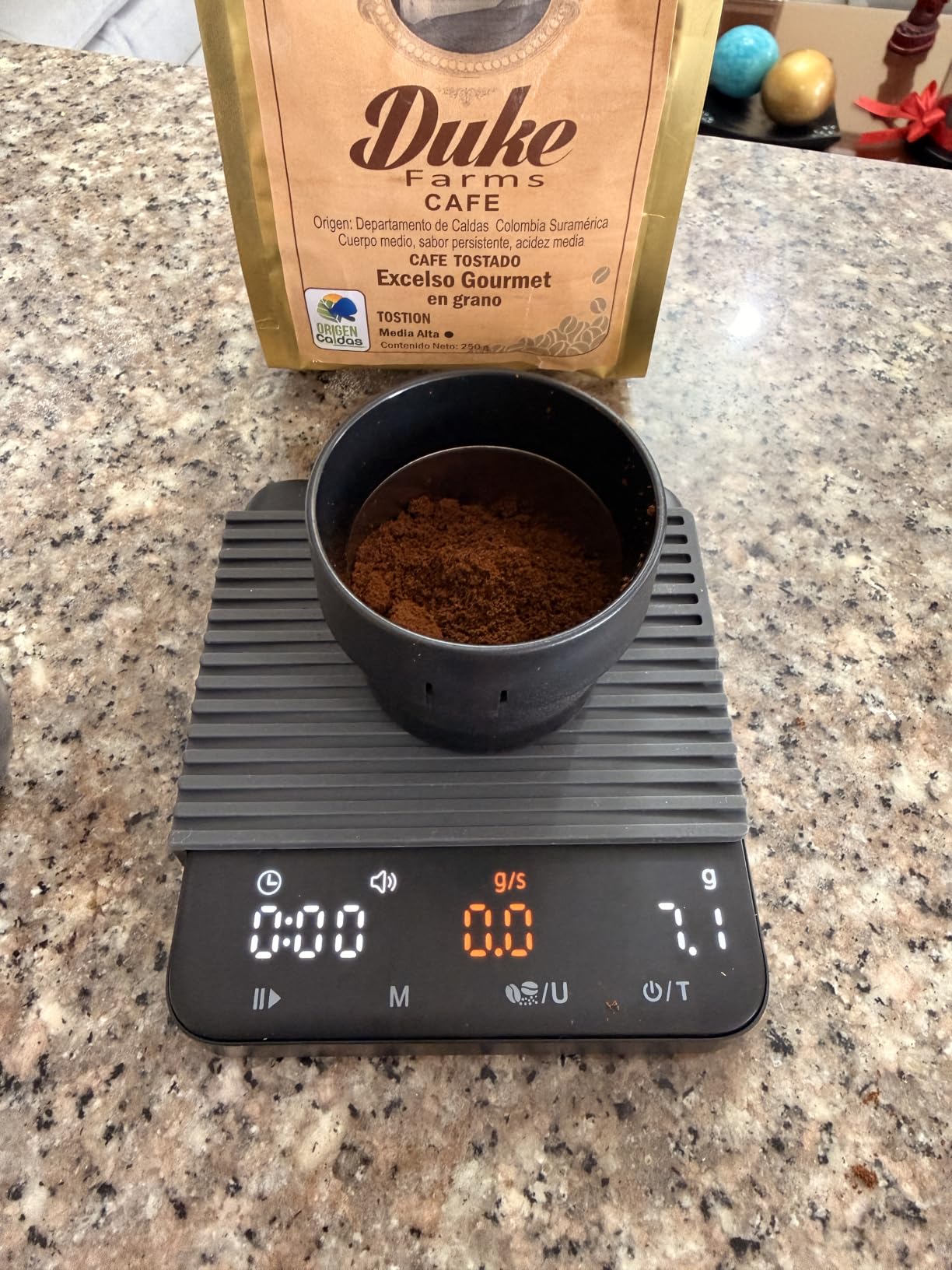
It carries a real-time flow rate display in grams per second or ounces per second, plus three brew modes covering auto timing, manual timing and espresso. For a barista who wants flow data in a body this small, there is not much else on the market doing it.
The dual range is sensible. Accuracy holds at 0.1 g from 0.3 g to 1000 g and steps to 1 g between 1000 g and 2000 g, so an espresso dose reads precisely and a larger vessel still functions rather than erroring out.
The LED display uses two colours across three zones, which separates weight, timer and mode at a glance. A long press of the M button mutes the operation entirely, and dual activation through a side switch and the touchscreen gives you a way around a missed touch.
Where it fits
At 4.5 x 3.9 inches it clears low group heads without being as cramped as the micro sizes. The striped silicone heat mat is included, which protects the platform from a hot cup and gives you something to grip while you pour a dose in.
Where it runs out
The 450 mAh battery is the smallest here, so you will charge it more often than most rivals. The platform is also too small for larger pour-over rigs, which makes this a dedicated espresso tool rather than an all-round coffee scale. It carries the lowest rating in the set, so treat the flow rate readout as a bonus rather than a reason on its own.
What Actually Matters in an Espresso Scale
Here are the specs in the order they matter, based on what we saw hold up over repeat shots. You can read a full comparison of bathroom and body scales the same way if you want the same rigour on different hardware.
Resolution of 0.1 g. This is the floor, not a target. On an 18 g dose a 1 g resolution error is a 5.5 percent ratio shift, which is enough to move sweetness and acidity noticeably. Anything claiming 0.01 g is mostly marketing at this level.
Response time. The reading has to settle almost instantly once the dose lands. A slow scale shows you last shot’s number, and that is exactly when you are deciding whether to adjust the grind.
Stability under a dripping shot. A stable load cell holds the same value with the same mass on it. Unshielded sensors react to a hand resting nearby or an object touching the base, which is a frequent complaint in home setups.
Drip tray clearance. Measure the height under your group head before you buy. Most home machines give you around three inches, which rules out anything taller, and narrow trays rule out anything wider than a few inches.
Timer, and whether auto-tare works. A built-in timer ties weight to time. A portafilter memory tare saves re-zeroing the basket each shot, which is the difference between a scale you use daily and one that annoys you.
Capacity. 1000 g covers espresso completely. 2000 g and above lets you weigh a V60 brew and small baking jobs on the same device without stepping around accuracy limits.
Water resistance and cleaning. A scale lives next to a machine that sprays water. A removable silicone pad or a glass surface is worth far more than it looks.
Battery type. USB-C rechargeable means no disposable batteries to hunt for. AAA cells mean you can use rechargeables, which is the practical middle ground.
Can a kitchen scale do the job?
No, and the arithmetic is why. A 1 g resolution kitchen scale cannot tell you whether your dose was 18.0 or 19.0 g, which is the entire difference between a dialed-in shot and a ruined one. Our body fat scale testing covers the same load cell principles if you want the underlying measurement science.
Do you need flow rate at all?
Not to start. Flow rate is genuinely useful for spotting channeling, but it is a refinement rather than a requirement. Get a scale that holds 0.1 g accurately and fits your machine, and add flow data later if your workflow asks for it.
Why Budget Scales Lose Accuracy So Fast
The most common complaint in home espresso forums is not that a cheap scale reads badly on day one. It is that the same scale reads differently in month six, and a barista who trusts it stops noticing. There are three physical reasons.
Load cell fatigue. Every weighing bends a strain gauge by a fraction of a millimetre. A cheaper load cell flexes further to register the same change, so it works harder for the same accuracy and eventually settles into a slightly different zero. This is why entry-level scales drift while mid-range ones hold their calibration for years.
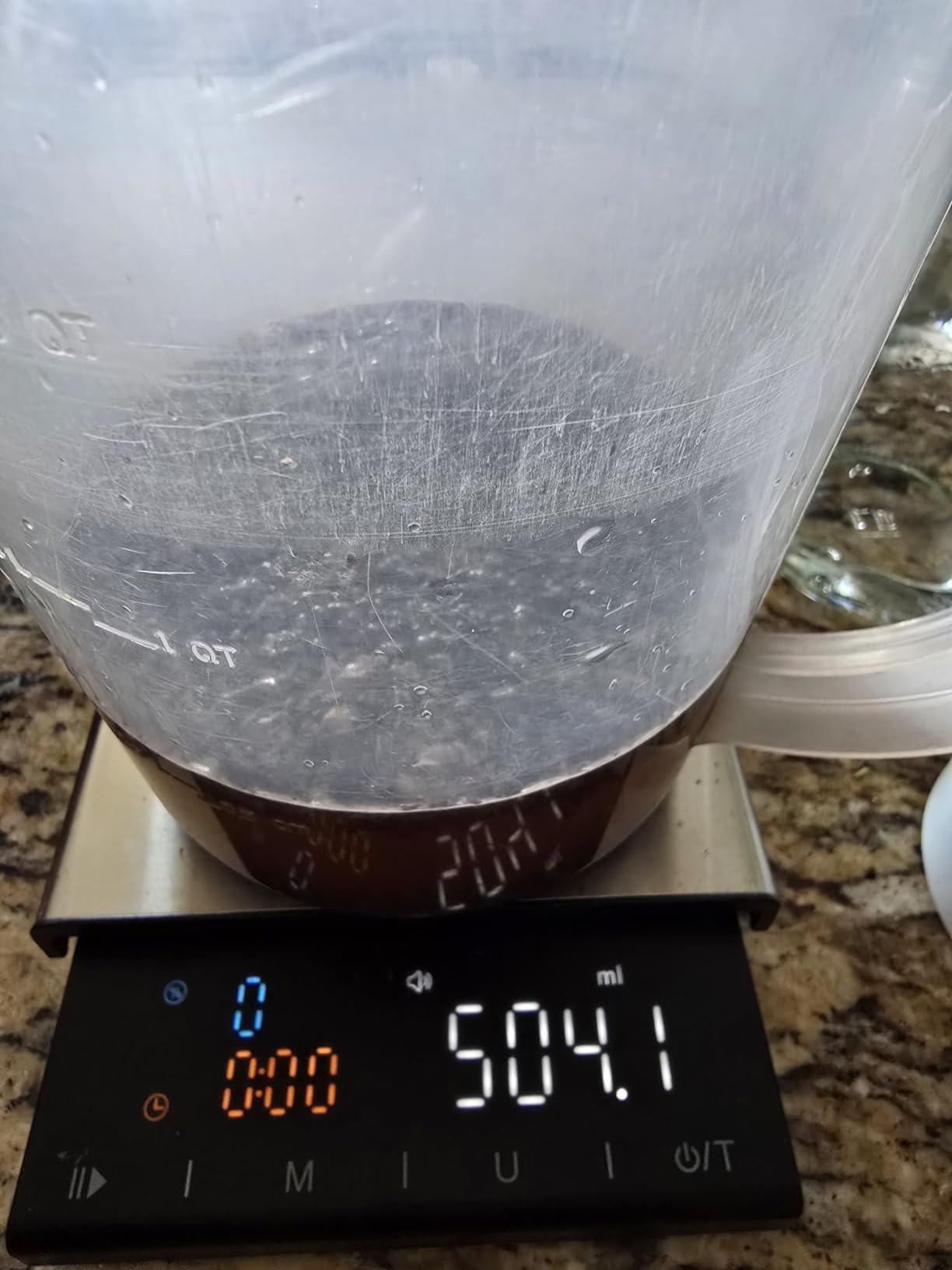
Condensation reaching the cell. A scale under a group head sits in a warm, wet microclimate every single day. Water that runs off a portafilter and pools on the platform eventually finds the seam around the load cell. Unless the platform seals it, that moisture shifts the zero permanently, which matches the report of readings moving from 21.2 to 21.4 g with no change in setup.
Unshielded electronics. Some scales in this roundup leave the load cell exposed to anything resting near the base. A metal tamper or a cup placed too close will push the reading around, and repeated exposure trains you to distrust a number you cannot check.
The practical response is simple. Wipe the platform dry after every session, keep a small calibration weight on hand and check the reading monthly, and choose a scale with a removable silicone pad or a sealed glass top so water never gets a chance to sit.
How to Dial In a Shot With Your Scale
Dial-in is a loop, not a decision. The scale turns it into numbers you can compare shot to shot instead of impressions you cannot.
Zero the empty portafilter. Place the basket on the platform, tare to 0.0 g and leave it there. If your scale has a memory tare, store that zero so every shot starts clean.
Set your dose. Weigh in until the display stops at your target, which for a double is usually 18 g. Adjust the grind finer or coarser based on what the shot does, not on the number itself.
Start the timer at the first drop. If your scale has an auto-timer, let it detect the start. If it does not, start it yourself the moment espresso hits the cup.
Stop at your target yield. For an 18 g dose at a 1:2 ratio you stop at 36 g. The time it took to get there tells you the extraction speed.
Compare and adjust. Fast and sour means grind finer. Slow and bitter means grind coarser. Change one variable at a time, then pull again.
Calibrating your scale at home
Check it with a known weight. Put a 100 g calibration weight on the platform and confirm the display matches. If it is off by more than 0.2 g, run the calibration mode the manual describes, which usually means holding specific buttons while powering on. A couple of scales here require a 1 kg weight for calibration, so check what you own before you assume the job is done.
Do that check once a month, and always after a spill. It takes twenty seconds and it is the cheapest accuracy insurance available. For the same reason, compare an espresso scale against the accuracy claims in our smart bathroom scale reviews, where we apply the same drift and tolerance checks.
Frequently Asked Questions
What is the best coffee scale for espresso?
The RENPHO R-MSK02 is the best all-round espresso scale we tested. It reads 0.1 g across a 3 kg capacity, shows live flow rate, has an espresso mode with an auto timer and a portafilter memory tare, and charges over USB-C. For pure accuracy with no frills, the Greater Goods 0483 rates highest of the twelve at 0.1 g with a 4.6 average.
What resolution scale do I need for espresso?
You need 0.1 g resolution. On an 18 g dose, a 1 g error shifts your brew ratio by roughly 5.5 percent, which is enough to change sweetness and acidity across shots. Scales claiming 0.01 g add little for home espresso because response speed and stability matter more than an extra decimal place.
Can I use a kitchen scale for espresso?
Not for ratio work. Kitchen scales typically resolve to 1 g, so they cannot distinguish an 18 g dose from a 19 g one. That 1 g gap is enough to swing extraction visibly. A dedicated 0.1 g espresso scale also tends to be small enough to sit under a group head, which a kitchen scale never will.
Do you need a special scale for coffee?
For pour-over alone, a 1 g scale is workable. For espresso, no. Shot timing depends on knowing your dose to a tenth of a gram, and a 1 g scale cannot hold that. Many coffee scales advertise a timer and a 0.1 g range, which makes them suitable for espresso as well as filter brewing.
Can scales be inaccurate?
Yes, and the commonest cause is moisture. A scale under a group head sits in constant condensation, and water reaching the load cell shifts the zero permanently. Unshielded sensors also react to objects resting near the platform, and cheaper load cells fatigue faster and drift within months. Wipe the platform dry and check it monthly with a calibration weight.
How do I calibrate an espresso scale?
Place a known calibration weight on the platform and confirm the display matches, using a 100 g weight for espresso range readings. If it is off by more than 0.2 g, enter the calibration mode described in the manual, usually by holding specific buttons during power on. Some models require a 1 kg weight, so check what you own first.
Which Espresso Scale Should You Buy
The RENPHO R-MSK02 is our pick for the best espresso scales for home baristas overall. It is the only unit in this roundup that gives you 0.1 g resolution, 3 kg of capacity, a live flow rate readout, an auto-timer espresso mode and a memory tare in a body small enough for a home machine, and owners confirm it holds up over repeat daily use.
Buy the Greater Goods 0483 instead if you time shots elsewhere and want the most accurate budget readout available. Buy the Maestri House S2 if counter space is tight and you want a glass surface that survives daily contact. Buy the MAXUS or the Maestri House S1 Mini if your group head has almost no clearance, and the Greater Goods 0460 if a five year warranty matters more to you than a timer.
Whichever you choose, measure your drip tray first and wipe the platform dry after every session. Those two habits do more for long-term accuracy than any feature on the spec sheet.