
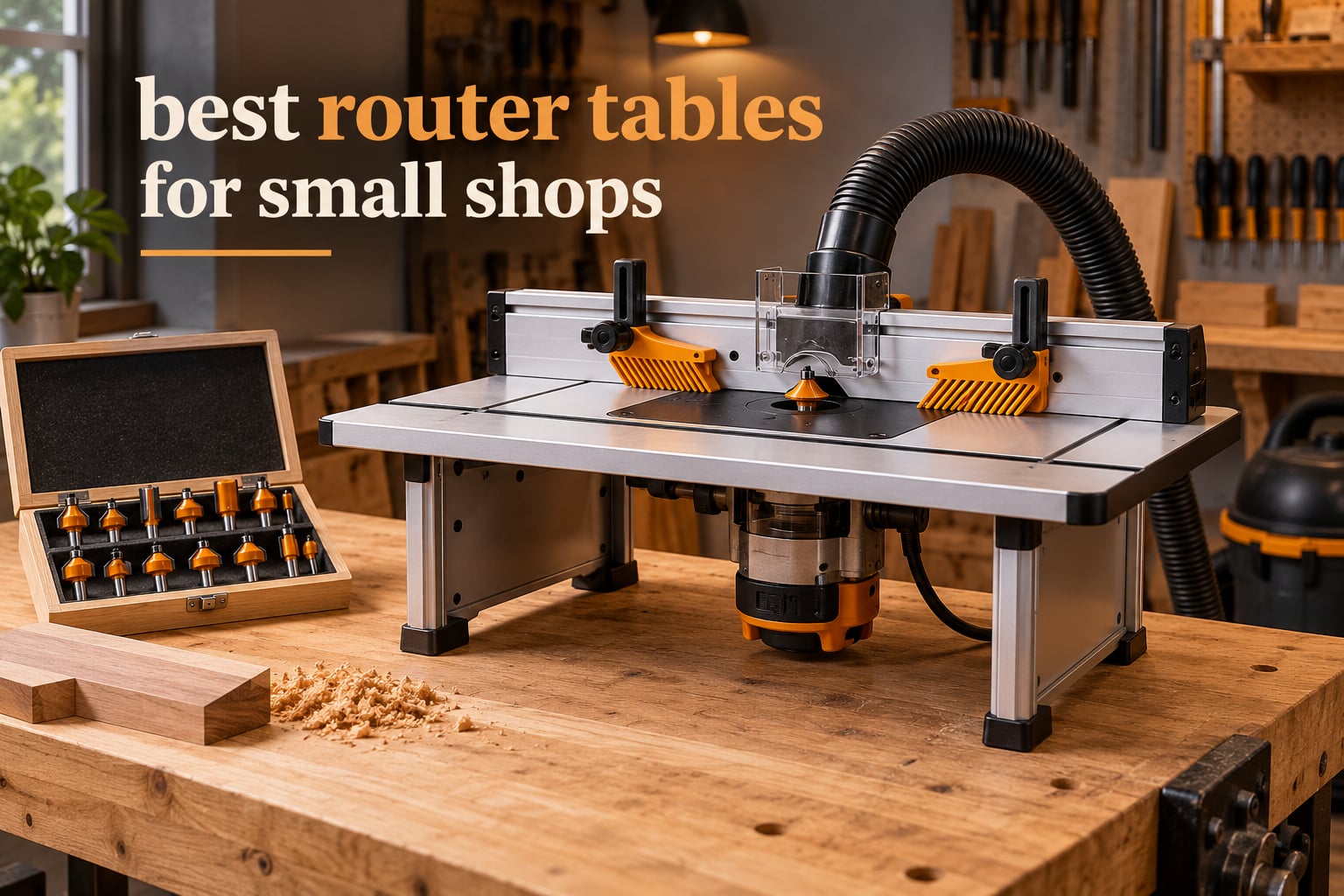
A small shop rarely has spare floor space, and a full-size cabinet router table needs about three feet of it permanently. What you want instead is a benchtop router table: a rigid aluminum or cast iron top under 30 inches wide, a fence you can adjust in seconds, and a weight that keeps the bit from walking up into your workpiece. That is the whole logic behind the best router tables for small shops we picked below, and it is why every table in this list is measured against your bench, not against a factory floor.
A router table mounts your handheld router upside down through an insert plate so you can push the workpiece across the top with both hands on it. The motor hangs below, the bit protrudes through a removable plate opening, and the fence and featherboards guide the cut. In a 10×12 or 12×16 shop that matters because the table adds a full cutting station without giving up a permanent square of floor.
Three brands dominate this category: Bosch, Kreg and Rockler at the top, with a value tier from SKIL, POWERTEC and RYOBI underneath. Who makes the best router table depends on your bench and your router rather than on brand alone, and that is the question this guide answers first. We also cover the top request on woodworking forums, which is bit changes from above the table, and the question that decides most purchases, which is whether your router’s mounting pattern actually fits the plate. If lighting your bench is the other thing on your list, our picks for LED tube lights for shops cover the same floor space.
Table of Contents
Top 3 Best Router Table for Small Shops (October 2026)

Bosch RA1181 Benchtop Router Table
- Large aluminum top
- Pre-drilled mounting plate
- Extra tall aluminum fence
- 2-1/2 inch dust port
SKIL RT1323-01 Table and Router Kit
- Table plus 2.0 HP router
- Above-table adjustment
- 26 x 16 inch MDF top
- 24 inch fence

POWERTEC 71402V Benchtop Router Table
- Steel stand with rubber feet
- Eight-point plate leveling
- 24 x 16 inch MDF top
- Tool-free reducing rings
All 8 Router Tables Compared for Small Shops in 2026
| Product | Specifications | Action |
|---|---|---|
| Bosch RA1181 Benchtop Router Table |
|
Check Latest Price |
| SKIL RT1323-01 Table and Router Kit |
|
Check Latest Price |
| POWERTEC 71402V Benchtop Router Table |
|
Check Latest Price |
 SKIL SRT1039 Benchtop Router Table SKIL SRT1039 Benchtop Router Table |
|
Check Latest Price |
 Kreg PRS2100 Benchtop Router Table Kreg PRS2100 Benchtop Router Table |
|
Check Latest Price |
 RYOBI A25RT03 Universal Router Table RYOBI A25RT03 Universal Router Table |
|
Check Latest Price |
 Bench Dog Rockler Cast Iron Router Table Bench Dog Rockler Cast Iron Router Table |
|
Check Latest Price |
 VIYUKI Universal Electric Benchtop Router Table VIYUKI Universal Electric Benchtop Router Table |
|
Check Latest Price |
What Size Router Table Do You Need for a Small Shop?
For most benchtop routing, a top of at least 24 by 16 inches is the minimum usable size, and 26 by 16 inches gives you a full-length workpiece with fence and featherboard still in the picture. For raised panels, wide face frames or sliding dovetails, look for 30 inches of width or more. On height, budget 12 to 16 inches of clearance under the top for the router body, and measure your bench before you order: the Bosch RA1181 is listed at 18 inches wide by 14.5 inches high with a base that is wider than the top, so the footprint you need is larger than the spec sheet suggests.
Two rules cover most mistakes. First, leave a 2 inch gap at the front and back of the bench so you can clamp the table down and still reach the fence and the plate levelers. Second, check the fence position, not just the table, because a fence set to one side cuts usable top nearly in half and a center-mounted fence wastes the same surface on a small table. If a shop shares its footprint with other large equipment, the same space math shows up again in our guide to dining tables for small kitchens, where bench length rather than top width is the deciding dimension.
1. Bosch RA1181 Benchtop Router Table – Best Overall Router Table for a Small Shop
Bosch RA1181 Benchtop Router Table
Aluminum top
18 W x 14.5 H
30 lb
2-1/2 in dust port
1 year warranty
Pros
- Large aluminum top resists warping and stays flat
- Extra tall fence with adjustable faceplates and featherboards
- Pre-drilled plate takes most full-size routers
- Dedicated dust port and accessory power outlet
- Very clear illustrated assembly manual
Cons
- Plastic base and switch fascia feel less robust than the top
- Plastic legs need clamping to a solid level bench
- All hardware arrives in one bag so sorting adds setup time
The Bosch RA1181 is the one we keep coming back to in small shops because the aluminum top and aluminum fence are the pair that refuse to move. At 30 pounds it is heavy enough to resist climb cut but light enough that two people can carry it to a new bench, and at 18 inches wide it slots into a shallow corner of a 10×12 shop without eating the walking space.
Owners in the reviews consistently call out build quality, the flatness of the top over time, fence accuracy and the dust connection. Leveling the plate is a one-time task, and once it is done most owners report the table stays consistent. The included 1/16 inch jointing shims that slide behind the outfeed fence are a small detail that matters more than it sounds, because they let you register thin stock for edge jointing without remeasuring.
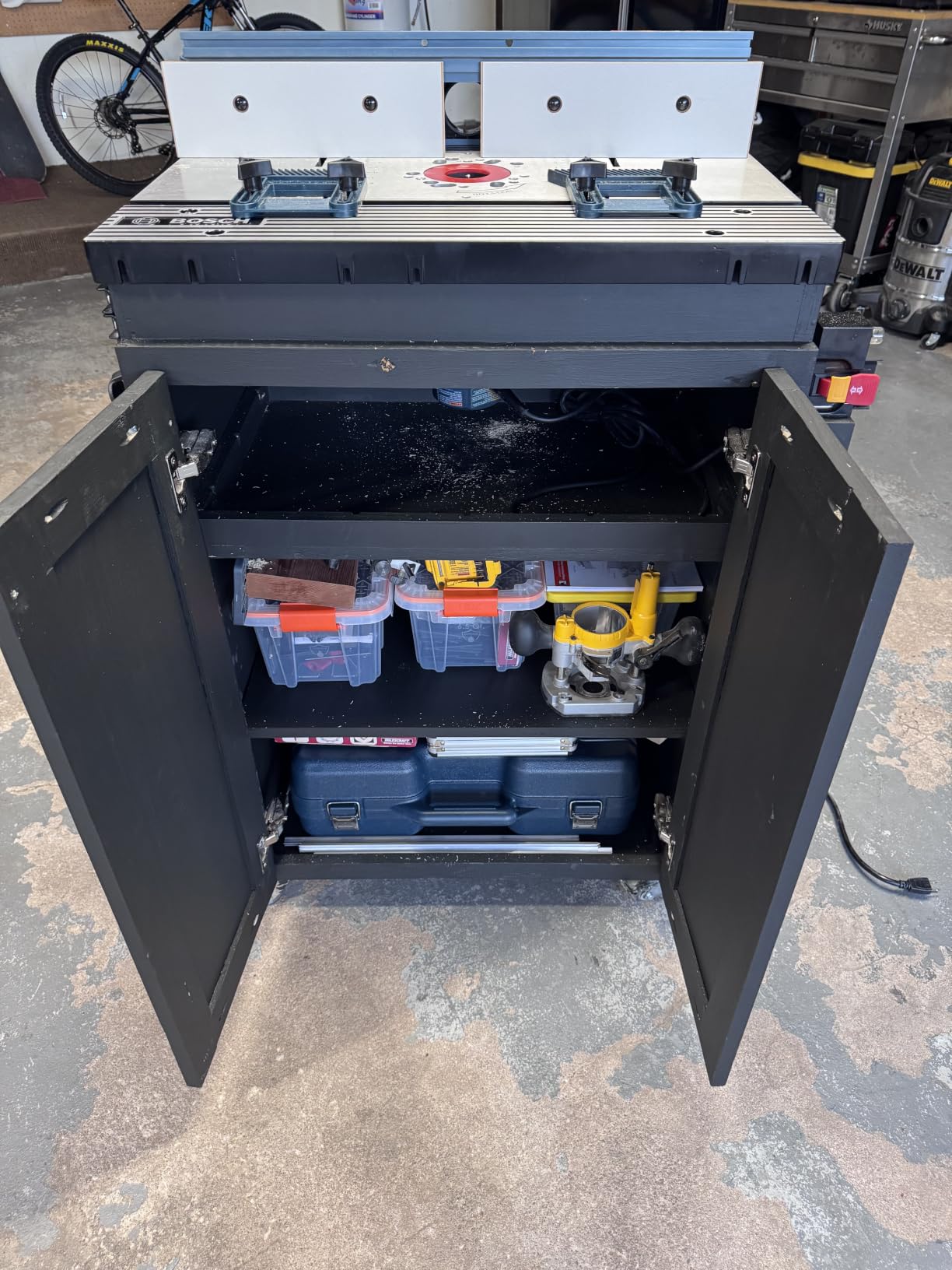
The pre-drilled aluminum mounting plate is the reason this table fits so many routers without modification, and the accessory slot accepts a 3/4 inch miter gauge or third-party featherboards. The taller fence with adjustable faceplates handles taller workpieces than most benchtop fences, which is the difference between routing a 2 inch rail and routing a 4 inch stile. The dedicated dust port fits a standard 2-1/2 inch vacuum hose, and a storage pocket plus cord-wrap storage keep accessories from scattering across your bench.
Multiple owners pair this table with a rolling stand or a custom cart to raise or lower it to a comfortable working height, which solves the common complaint that a benchtop router table leaves you bent over. A few buyers note that compatibility is limited to routers with standard mounting holes unless an adapter plate is added, so check your hole pattern before you commit.
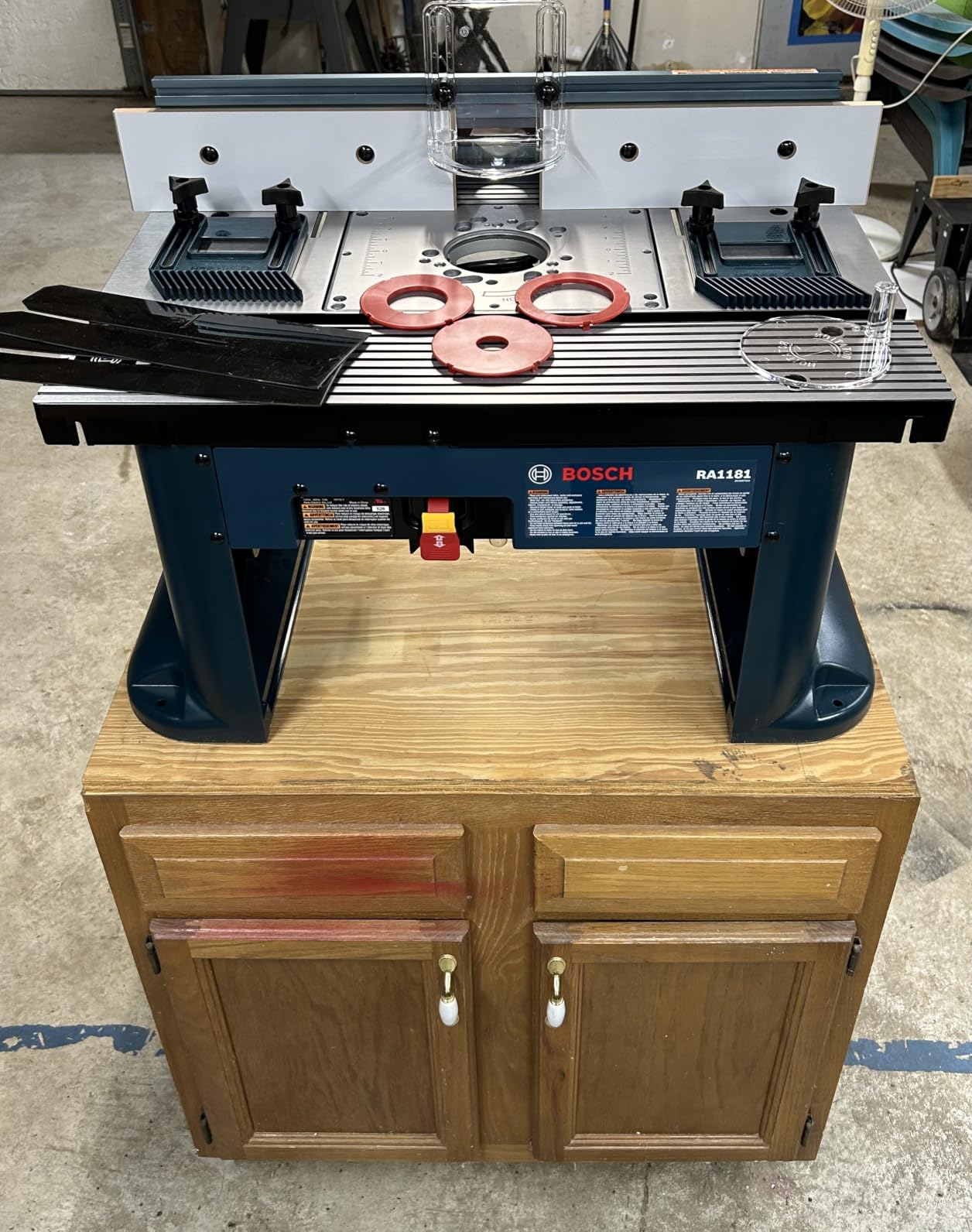
What the Bosch RA1181 does well in a cramped shop
The 18 inch width is the headline advantage. On a 30 inch bench it leaves a usable strip on either side for clamps, glue, or a parts tray, and it fits between table saw supports where a 30 inch top would not. The tall aluminum fence and adjustable featherboards give you reference on both sides of the cut, which is what makes flush trimming and edge profiling repeatable rather than a matter of feel.
Dust collection that connects is rarer than it should be. A dedicated port sized to a standard hose, plus an outlet for the shop vac, means chips leave with the cut instead of settling on the fence faceplates.
Where the Bosch RA1181 falls short
The plastic base and switch fascia do not match the aluminum top and fence, and reviewers say so directly. It is a cosmetic and longevity compromise rather than a performance one, but if you expect the table to outlive two shop moves, that is worth knowing. The molded plastic legs also need to be clamped to a solid, level bench or the table can creep during a climb-prone cut.
Assembly takes longer than it should because all the hardware arrives in a single bag and you will be sorting screws by size as you go. Budget an hour rather than fifteen minutes, and read the illustrated manual first, since owners single it out as unusually clear. If your bench is under 20 inches deep, measure twice: the base is wider than the top, which is the single most common surprise with this model.
2. SKIL RT1323-01 Table and Router Kit – Best Value Router Table for a Small Shop
SKIL RT1323-01 Router Table and 10Amp Fixed Base Router Kit
Table plus 2.0 HP router
26 x 16 top
24 in fence
18.82 kg
1 year warranty
Pros
- Complete table and router kit in one box
- 2.0 HP 10 Amp motor handles MDF pine and hardwood
- Above-table adjustment speeds up bit changes
- Starting pin and bit guard improve safety
- Soft start reduces startup torque
Cons
- MDF fence and top flex so jointing needs a sturdier fence
- Switch box can block the dust port when set up as supplied
- Side storage cubbies are minimal
- Table sits high on a standard bench
Most small shops do not own a second router, and this kit removes the two-part budget problem entirely: the SRT1039 table and the RT1323-00 10 Amp fixed base router arrive in one box. Buyers rate it as the strongest value in the category, and the 4.6 rating across more than 1500 reviews is the second highest here. For anyone starting from zero tools, that combination is hard to beat.
The 2.0 HP motor has enough power for MDF, pine and solid hardwoods, which is more than many entry routers manage. Soft start reduces startup torque, speed control runs from 10000 to 25000 rpm, and the die-cast motor housing means the tool is still usable handheld when the table is not the job. Owners describe assembly as straightforward, roughly 15 minutes to an hour.
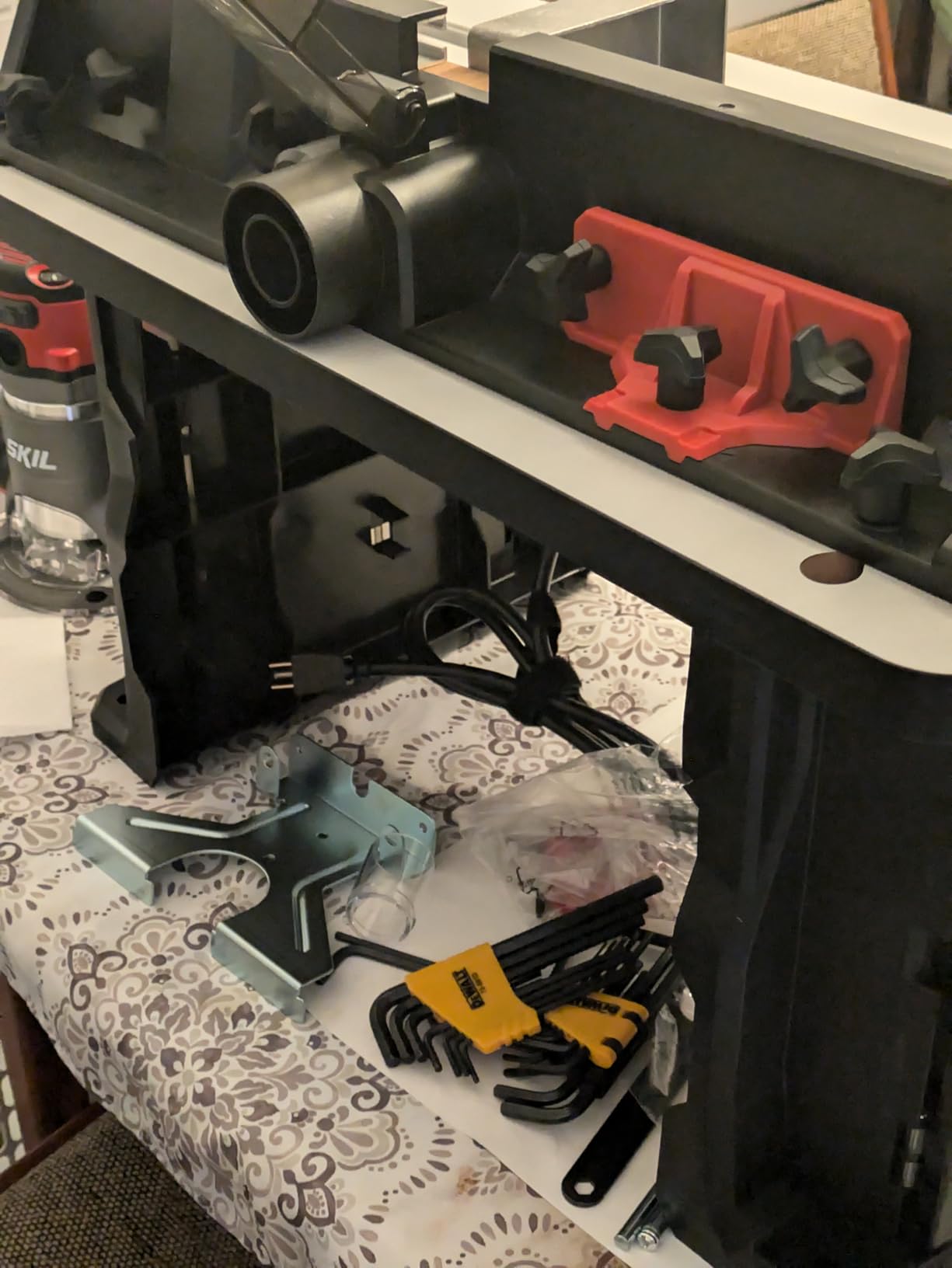
Above-the-table height adjustment is the feature that changes daily workflow. Instead of kneeling on the shop floor to reach under the table with a wrench, you turn a crank from the top surface. The table also carries integrated bit storage, an aluminum miter gauge slot, a quick router clamp, a starting pin and two featherboards, which is a longer accessory list than most tables at this tier include.
The 24 inch fence comes with adjustable MDF face plates, a starter pin and a guard, and the router power switch has a pass-through outlet so the shop vac cycles with the router. That is a small electrical convenience that removes a switch trip every time you start a cut. Reports of table instability are mostly resolved by clamping the legs to a bench.
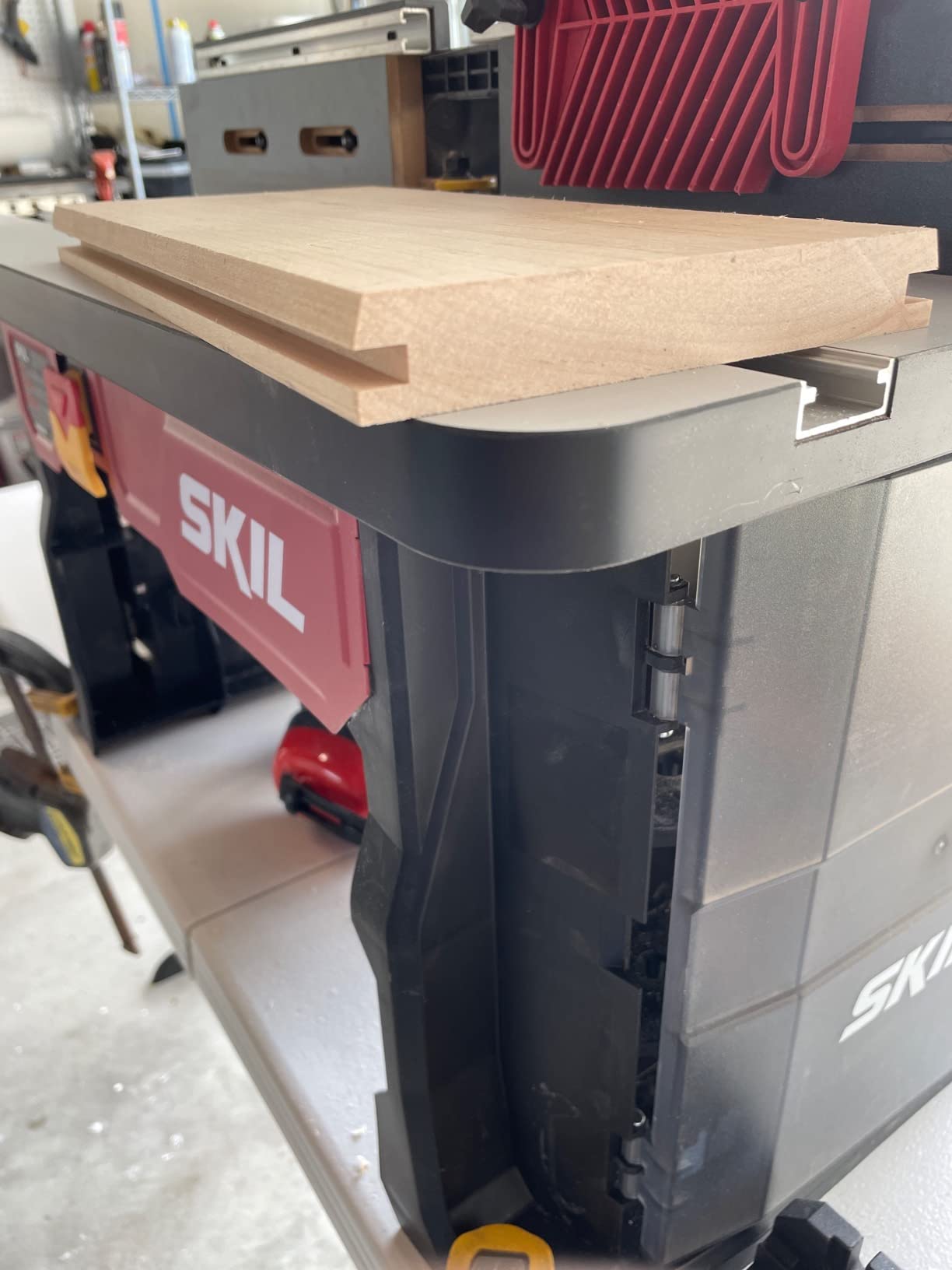
Why the SKIL kit suits a first router setup
You are buying one box instead of researching a router and a table separately, and the two parts are guaranteed to fit each other. The router is a fixed base design, which is what a benchtop table wants, and the quick clamp releases the motor so you can use it handheld for freehand work on the same bench. For a shop doing picture frames, sign work and trim, that flexibility is worth more than raw horsepower.
Two featherboards and a starting pin cover the two operations beginners need first, guided profiling and any cut where the workpiece is not held against the fence.
Where the SKIL kit falls short
The MDF fence and top can flex, so jointing and very fine precision work want a sturdier fence than the one supplied. Several owners solved this by building a wood replacement fence, which is a reasonable weekend project if you already have a bench. The included 1/4 inch collet also nests inside the 1/2 inch rather than replacing it, so you are carrying one spare rather than two.
Set the table up as the instructions specify and the switch box can sit where it blocks the dust port, which owners flag directly. The side storage cubbies are minimal and not especially well designed, so plan on your own bit storage. Stock plastic legs need clamping to a workbench, and the table sits high on a standard bench, so check your standing height before this goes on your list.
3. POWERTEC 71402V Benchtop Router Table – Best Router Table for a Weak Bench
POWERTEC Benchtop Router Table with Steel Stand and Adjustable Fence – 24″ x 16″ MDF Laminated Top, Insert Plate, 2-1/2″ Dust Port, Fence Stop, Featherboard & Additional Accessories (71402V)
Aluminum fence and plate
24 W x 16 H top
27.5 lb
Steel stand
Made in USA
Pros
- Steel stand and rubber feet absorb vibration
- Eight-point leveling flattens the insert plate
- Four reducing rings swap without tools
- 24 inch fence is rigid and heavily adjustable
- Flip stop featherboard and jointing rods included
Cons
- Insert plate hole pattern may not match every router
- No drilling template ships with the plate
- Fence securing rods feel thin by hand
- Laminated MDF top wears faster than cast iron
If your bench is light, climb cut is the risk that ends the experiment. The POWERTEC 71402V is the answer here because it does two things most budget tables skip: it puts the table on a steel stand with vibration-absorbing rubber feet, and it gives you eight leveling points to tune the insert plate flat to the top. The stand is the part that matters, because a 27.5 pound table on a solid base does not skate the way a molded-leg table does.
Reviewers repeatedly praise the fence, plate and reducing rings for build quality and adjustability, and note the parts are machined well with a quality finish. The 24 inch fence assembly includes an adjustable bit guard, a featherboard, a reversible flip stop, an integrated 2-1/2 inch dust port and a measuring scale, so you can set fence position by number rather than by eye on every job.
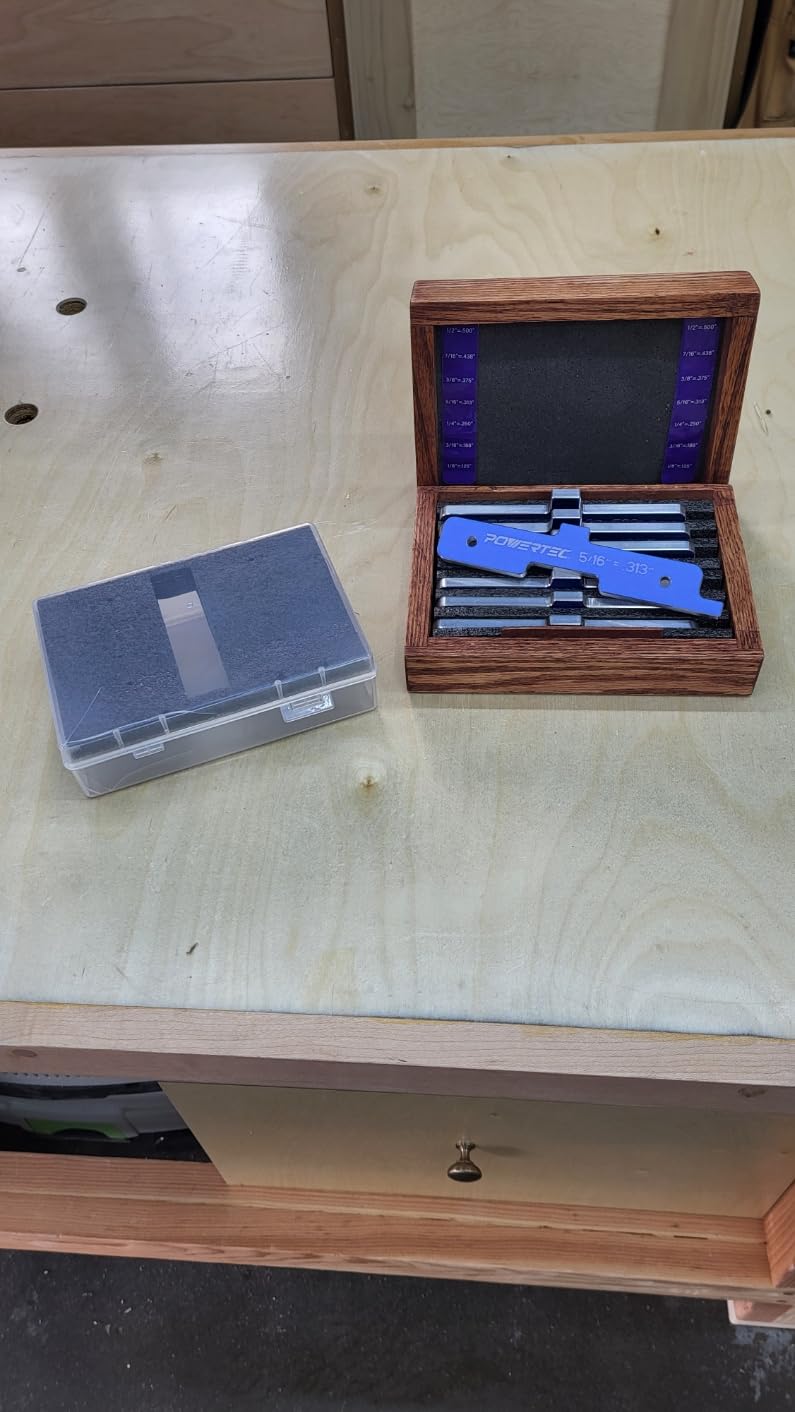
The insert plate comes with four reducing rings, in solid, 1 inch, 1-7/8 inch and 2-5/8 inch, and they swap with the included ring wrench without tools. That matters more than it sounds: an insert that is too small for your bit lets the router body climb into the workpiece, which is the most common way a climb cut actually starts. The eight leveling screws, in 3/8 inch or 5/8 inch, let you flatten the plate to a large or small opening as needed.
A starting pin minimizes material pull when you are routing a profile edge, and jointing rods, the flip stop, the featherboard, the bit guard and the full assembly hardware all ship in the box. That is a more complete box than most competitors assemble at twice the size, and it is made in the USA. Assembly is required, so budget an hour with the manual open.
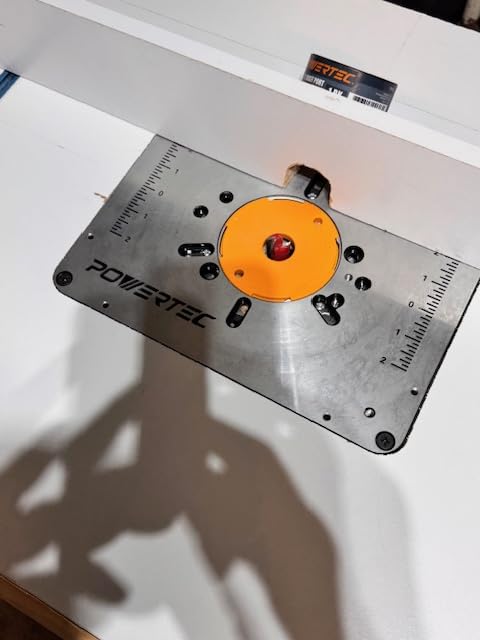
What makes the POWERTEC stable where others flex
The steel stand with rubber feet is the difference. Rubber feet are not a marketing detail here, they are the mechanism that kills the high-frequency buzz you get when a light bench and a light table ring together under a spinning bit. Combined with the aluminum fence and plate, this is the benchtop table in our list that least rewards a climb cut complaint.
Eight leveling points is more adjustment than most tables at this level offer, and it is the difference between a plate that is level once and a plate that stays level after you swap bit sizes.
Where the POWERTEC falls short
Compatibility is the first check. The insert plate hole pattern may not match every router, and the plate ships without a drilling template, so if your pattern does not match you will be making your own template. Confirm your router collar and hole spacing before ordering rather than after. The fence securing rods and sticks also feel thin and awkward to tighten by hand, which owners mention more than once.
The laminated MDF top is less durable in the long run than cast iron or solid aluminum, and it will mark if you wipe it with a wet rag. If you are buying the standalone fence kit version rather than the full 71402V table, note that the T-bolt spacing narrows only to 18 inches, so a narrower table needs modification and your own drilling.
4. SKIL SRT1039 Benchtop Router Table – Best Router Table if You Already Own a Router
SKIL SRT1039 Benchtop Portable Router Table for SKIL Routers RT1323-00 & RT1322-00 (Router Not Included)
Table only
26 x 16 top
24 in fence
24.2 lb
1 year warranty
Pros
- Table-only pricing if you already own a router
- Above-table adjustment avoids pulling the router out
- 26 x 16 inch MDF top with aluminum miter gauge slot
- Dual-sided quick-latch bit storage
- Quick clamp fits most major router brands
Cons
- Router not included so the full kit costs more
- Best suited to SKIL RT1323-00 and RT1322-00
- MDF top and fence are less rigid than aluminum or cast iron
- Fence faceplates flex when jointing
This is the table half of the SKIL combo kit, and it is the right buy if you already own a router or if you want the table and the router as separate decisions. The 26 by 16 inch MDF top is the largest in our list apart from the Kreg, and the aluminum miter gauge slot gives you a captured reference for crosscuts on the table surface without a separate jig.
Owners like the above-the-table adjustment, the integrated bit storage and the pair of featherboards, and they typically pair it with the SKIL router sold separately. Two featherboards, a starter pin, a miter gauge, a hex key and three inserts are in the box, so the accessory list is complete even without a router. The quick clamp fits most major router brands rather than a single model.
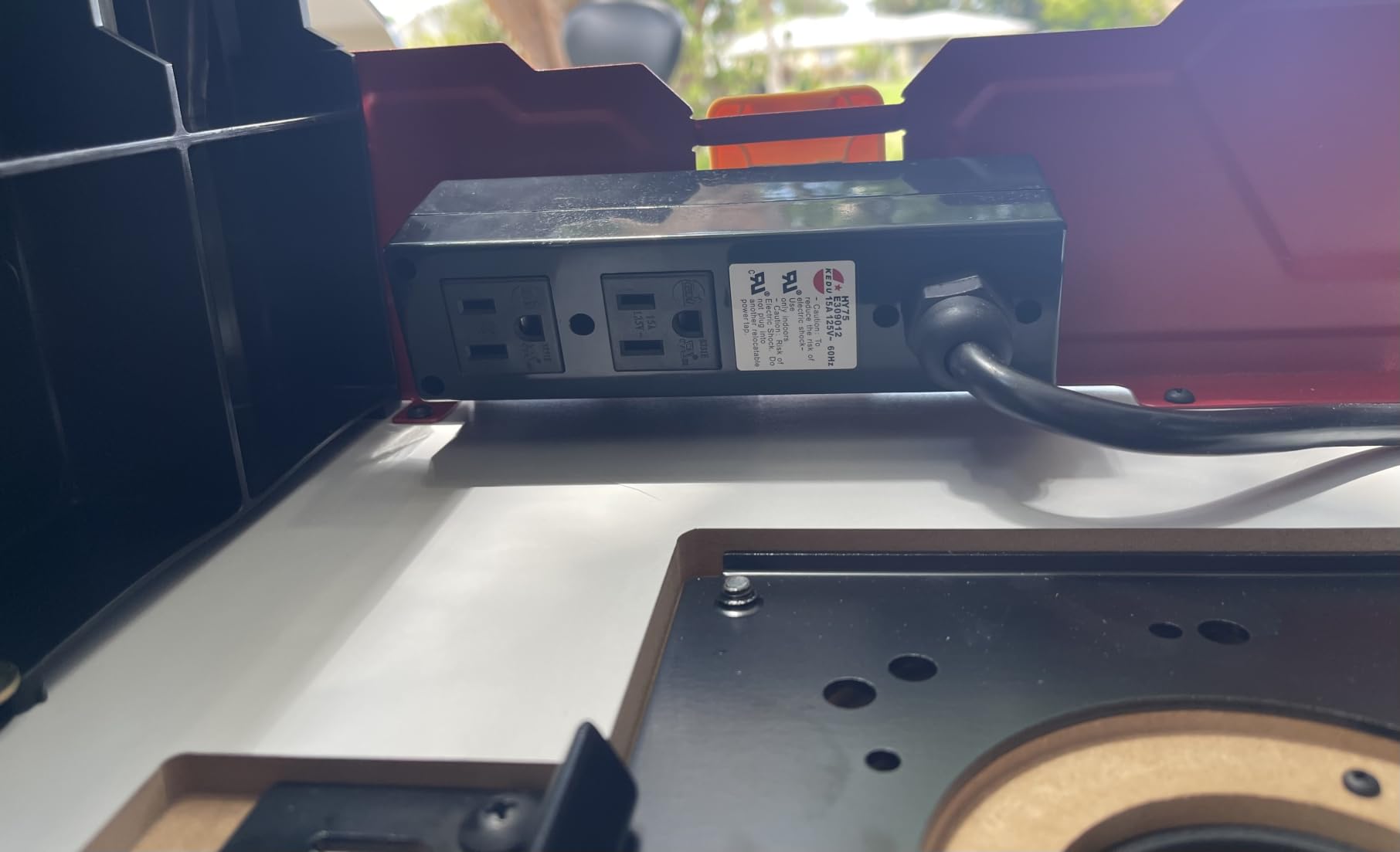
Dual-sided integrated bit storage is a quick-latch case for bits, and in a shop where a router table shares a bench with other tools, that is the difference between finding a 1/4 inch roundover in ten seconds and not finding it at all. The fence is 24 inches long with adjustable MDF face plates for taller workpieces, and the two featherboards are adjustable edge guides that fit most major router brands.
Assembly is straightforward and the table is 24.2 pounds, so one person can lift it on and off a bench. That weight figure is also the reason it needs clamping down rather than just sitting there, which is the standard fix owners describe. A rolling cart under the bench is the usual companion if you want it out of the way between jobs.
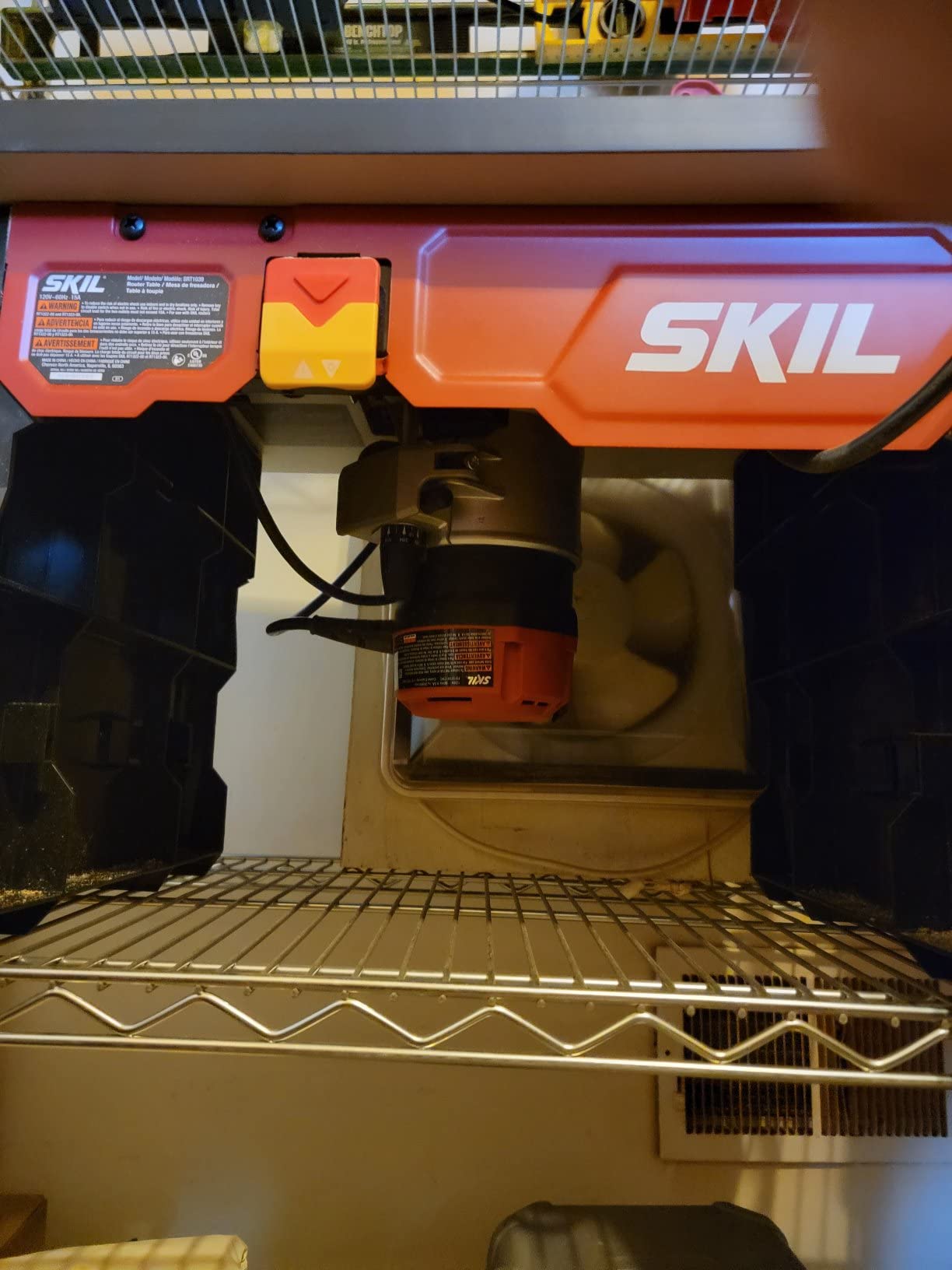
Why this is the pick when a router is already on the shelf
Buying a table alone avoids paying twice for hardware you already have. If you own a fixed base router with a standard hole pattern, the total cost of a working benchtop station drops considerably compared with any kit, and you keep the freedom to choose a different router later without losing the table. The 26 by 16 inch top also handles a full-length board better than the 24 inch entries here.
Above-the-table height adjustment means bit changes happen from the top of the table, which is the biggest quality-of-life difference in a shop with no room to lie down under the bench.
Where the SRT1039 falls short
The router is not included, so budget for one separately and the full cost lands above the table price. It is designed for the SKIL RT1323-00 and RT1322-00, and other brands may need an adapter plate or drilling, so check your pattern. The MDF top and fence are less rigid than cast iron or solid aluminum, and the face plates can flex during jointing.
MDF marks workpieces easily and has to be kept dry, which in a humid shop or a garage with a concrete floor is a real maintenance note. The molded legs benefit from being clamped down rather than left free. If jointing accuracy is your primary goal rather than shaping and profiling, spend the upgrade on an aluminum fence instead.
5. Kreg PRS2100 Benchtop Router Table – Best Router Table for Full-Size Projects
Kreg PRS2100 Bench Top Router Table – Full Size Portable Router Table for Workshops – Workbench Accessory – Holiday Home Improvement Gifts for Him
30 W x 19.25 D top
16 in tall
12 kg
Aluminum fence
Assembly required
Pros
- Rigid steel and aluminum frame resists vibration and noise
- Level-Loc insert plate leveling is excellent for accuracy
- Jointing rods behind the fence
- 30 inch top handles larger workpieces
- Portable enough to move in and out of a small shop
Cons
- Assembly is difficult with weak instructions and unlabeled bags
- Fence cam-lock plastic pieces can bend
- Fence can sit out of square with no built-in adjustment
- Switch and featherboards are sold separately
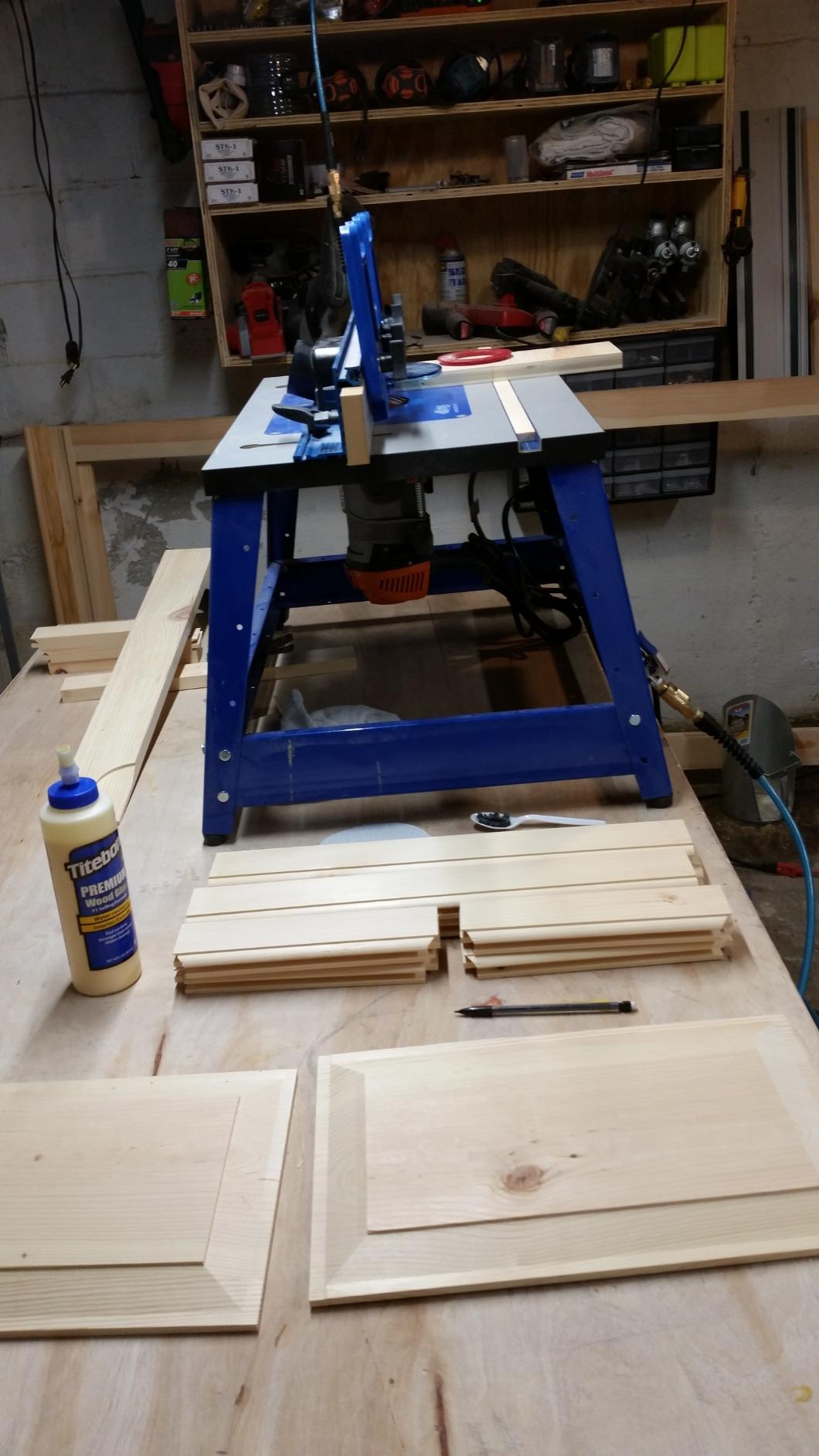
At 30 inches wide and 19.25 inches deep, the Kreg PRS2100 is the largest benchtop table in this roundup, and it is the one to buy if a raised panel or a full-size door is on the bench. Owners keep these for a decade or more and describe the top as quiet and rigid, which in a small shop means less noise bouncing off a wall three feet behind you.
The edge-banded, low-friction MDF board top with a micro-dot skin is designed to lessen vibration, and the insert plate uses Level-Loc rings plus separate plate levelers to dial accuracy in. The aluminum fence has sliding faces, locking levers and a dust-collection port, and the jointing rods behind the fence give you real jointing capability on small boards rather than a nominal feature.
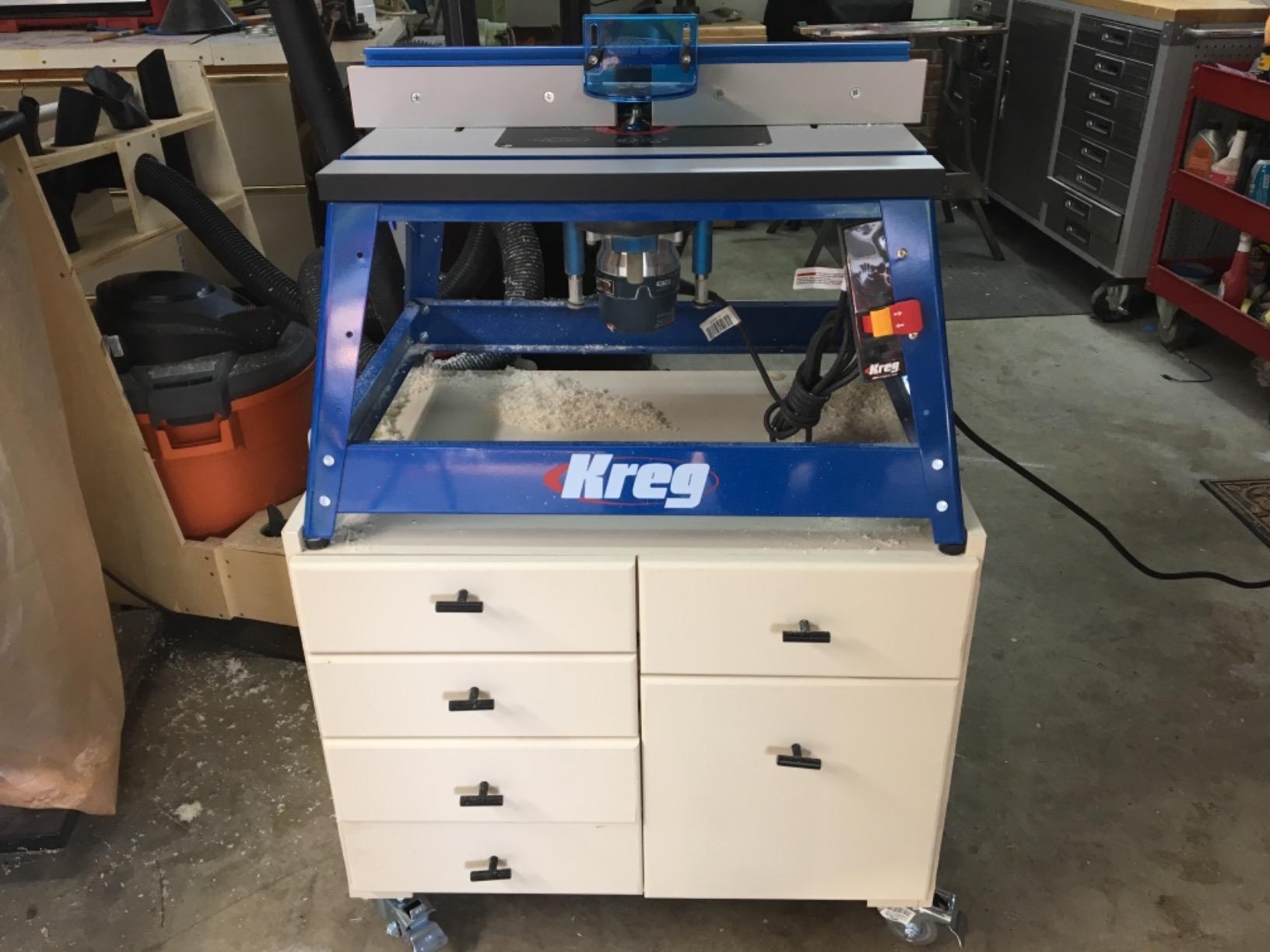
For a small shop, the practical argument is that this is the one table in the list that buyers report is widely compatible with router lifts, including JessEm units. That matters because changing bits from above the table is the loudest request in the woodworking forums, and owners pair the PRS2100 with a lift and a separate switch box to complete the station. Kreg customer service and replacement parts are also a plus over the lifetime of the table.
It is portable enough to move in and out of a small shop workflow, which means the 30 inch of top is a working surface you deploy for panel work and fold away for everything else. The bit guard and a miter gauge slot are included, and the table is 16 inches tall so a full-size plunge or fixed base router clears underneath. Assembly instructions and an owner manual ship with it.
When the extra 4 inches of width is worth it
Raised panels, wide face frames, sliding dovitails and sliding dovetail door layouts all need a workpiece that can lie flat and still have fence and featherboard contact. A 30 inch top handles a door slab that a 24 inch top will not, and owners cite jointing capability and larger workpieces as the reasons they stayed with this table for a decade.
The steel and aluminum frame stays flat without the mass of cast iron, which is why it moves in and out of a small shop workflow instead of becoming a permanent fixture.
Where the Kreg falls short
Assembly is the dominant complaint, and it is a real one: instructions are weak, parts bags are unlabeled, and the fence cam-lock takes practice to understand. Allow a full evening rather than an hour, and sort the hardware by size as you go because Kreg does not do that for you. The plastic pieces in the cam-lock are a known weak point and can bend if you overtighten them.
The fence can sit out of square to the top with no built-in adjustment mechanism, so check squareness before a long production run. Switch and featherboards are sold separately, which pushes the real system cost higher than the table price suggests. A minority of owners have reported tops slightly out of flat and inserts prone to sagging over time, though Kreg support has resolved those cases.
6. RYOBI A25RT03 Universal Router Table – Best Router Table for RYOBI Owners
RYOBI Universal Router Table A25RT03
Metal construction
18.25 W x 32 H
28 lb
Adjustable fence
Corded
Pros
- Well-made sturdy metal construction
- Adjustable fence with featherboard miter gauge and guard
- Fits RYOBI corded routers including older models
- Dual-outlet switch runs router and dust collector
- Compact footprint suits a small bench
Cons
- Not truly universal
- Ryobi One and some Wen models do not fit
- Fence halves do not align perfectly
- Single center fence lock lets the fence pivot when jointing
- Table slide guide is wider than standard 3/4 inch
The RYOBI A25RT03 is metal, and that single fact puts it ahead of the MDF entries on rigidity for the money. Owners report it holds up under real projects and is far more capable than cheaper budget router tables, which is the usual complaint about tables at the bottom of the category. At 28 pounds it stays put on a normal bench.
The fence comes with a featherboard, a miter gauge and a functional bit guard, so the accessory set is complete. A dual-outlet power switch runs the router and the dust collector together, which removes a step from every cut and is the feature owners mention most in a shop that is already tight on space. The compact footprint suits a small bench better than most of this list.
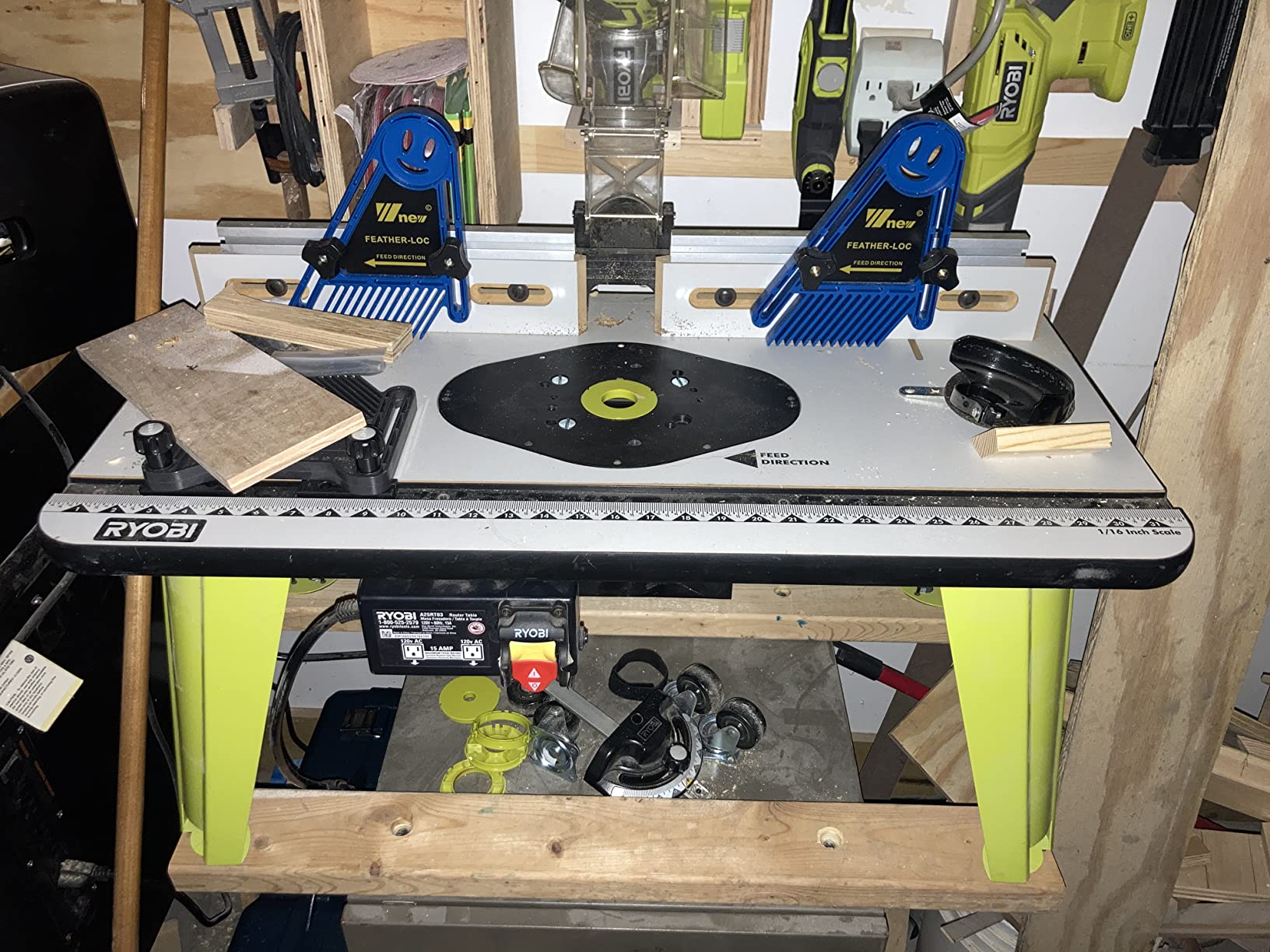
The word universal in the name is where most trouble comes from. It fits RYOBI corded fixed base routers perfectly, including older models, and works with many other corded fixed base routers, but it does not fit every router. Owners who assumed universal meant their compact or newer router would fit have had to modify the table or return it, so verify your throat plate dimensions before buying.
The metal table sits high and requires a suitable stand or bench height, and the power cord on the dual-outlet switch is short enough that most owners add an extension cord. Weigh that against the two fence alignment complaints, and the picture is a rigid, well-equipped table that rewards the buyer who checks compatibility first.
What the RYOBI table does better than the MDF entries
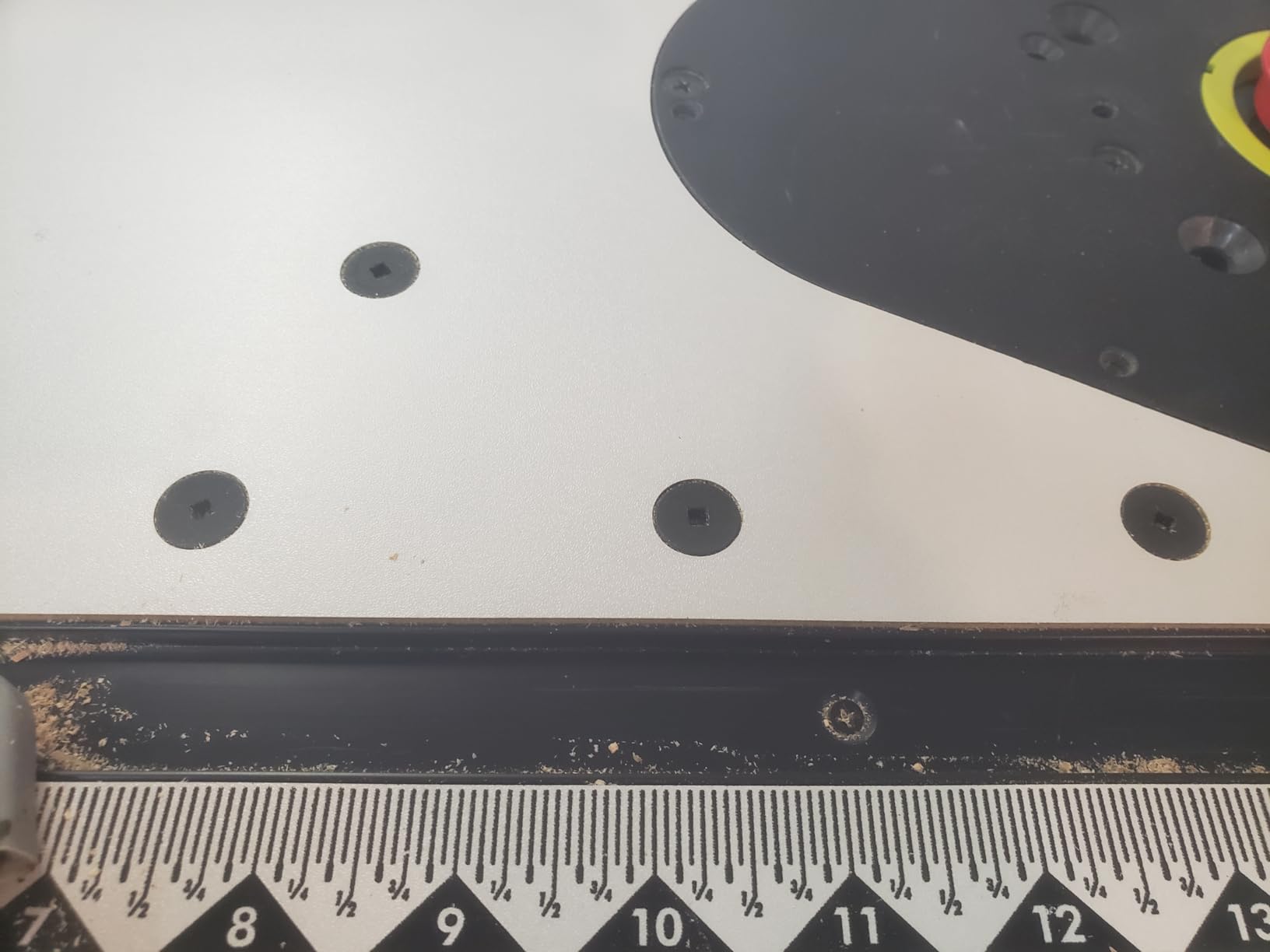
Metal construction means the top does not deflect the way laminated MDF does, so your fence stays square to the surface through a long run of repetitive work. For a shop producing batches of cabinet doors or trim, that consistency is the reason to choose metal over a larger MDF top. The 28 pound weight also resists the creep that produces climb cut on a light bench.
Running the dust collector from the same switch as the router means the collector starts and stops with the cut, so chips get pulled from the moment the bit enters the wood.
Where the RYOBI table falls short
Check compatibility before you order. The name overpromises: it does not fit every router, including the Ryobi One and some Wen models, and throat plate dimensions vary enough to matter. Owners who skipped that step are the source of most of the one-star reactions in the reviews.
Two fence issues recur. The fence halves do not align perfectly, and a single center fence lockdown lets the fence pivot when you set it for jointing, which is exactly when you least want movement. The table slide guide is also slightly wider than a standard 3/4 inch, so table-saw featherboards will not fit, and the short switch cord means an extension cord is effectively required.
7. Bench Dog Rockler Cast Iron Router Table – Best Router Table if You Already Have a Table Saw
Rockler Router Table w/ 28” ProFence and Plate, Cast Iron Top (40-120)
Cast iron top
18 x 29 x 4
60 lb
28 in ProFence
Limited lifetime warranty
Pros
- Mounts to a table saw and adds no footprint
- Super heavy construction gives very little vibration
- Plate levels with about 10 adjustment points
- 28 inch ProFence locks solidly with a tape measure guide
- Dual fence slots rotate the fence to use the full top
Cons
- Router mounting plate is not included and ordered separately
- 60 pounds needs a second person or a jack stand to mount
- Cannot mount on the tilt side of a left-tilting saw
- Some units arrive slightly curved
This is the only pick here that solves the space problem rather than managing it. The cast iron top mounts in place of a table saw extension wing, so your router station occupies no floor and no additional bench at all. In a sub-200 square foot shop that is the difference between having a router table and wondering where to put one.
At 60 pounds the cast iron is the heaviest item in this roundup by a wide margin, and that mass is the point. Owners report very little vibration and precise routing as a direct result, and the 28 inch Bench Dog ProFence adjusts in width, locks solidly and carries a built-in tape measure guide. The router plate levels with about 10 adjustment points, which is the flattest plate setup in the list.
Dual fence slots let you rotate the fence and work from either side, which maximizes the usable surface on a top that is only 18 by 29 inches. A third miter slot handles crosscut sleds. The dust port adapter works with common shop vacs and captures the large majority of debris, and the whole thing pairs naturally with a router lift system, which is the setup owners in r/woodworking describe as the enthusiast end of this category.
The limited lifetime warranty is the strongest in the roundup, and resale value holds up well because cast iron router tables keep their demand. The included component is the table and fence without a plate, so the plate is a separate order and is best placed in the same transaction so the two arrive together.
Why a table saw mount beats a benchtop table in a tiny shop
No extra footprint is the headline. A benchtop table permanently occupies 20 to 30 inches of the most valuable surface in the shop, and in a 10×12 space that is a real cost every time you are not routing. A saw-mounted top is there when you need it and gone when you do not, without any moving parts to store.
Sixty pounds of cast iron does not ring, so climb cut is close to a non-issue and the cut stays where the fence put it.
Where the Bench Dog falls short
Two constraints stop this from being a universal answer. It cannot be mounted on the tilt side of a left-tilting saw, or the right side of a right-tilting one, with large router motors, so check your saw before anything else. And the 60 pound weight means mounting it needs a second person or a jack stand, which is a one-time job but not a solo job.
Mounting holes may need enlarging to fit certain table saw rails, and that means drilling cast iron, so confirm rail spacing in advance. Some units arrive slightly curved, which can leave the plate and ring sitting proud of the top, and hole patterns on older saw models require buying grade 8 hardware separately.
8. VIYUKI Universal Electric Benchtop Router Table – Best Starter Router Table on a Budget
VIYUKI Universal Electric Benchtop Router Tables Wood Working Craftsman Tool
Die-cast aluminum top
14.5 lb
Iron stands
11.22 in working height
Pros
- Lightest and most portable option at 14.5 lb
- Die-cast aluminum top is rustproof and stable
- Iron extension legs give it a wide stance
- Retractable fence guard contains chips
- Can also accept a jig saw or circular saw
Cons
- Wing-nut router clamps can let a heavier router shift
- Manual does not explain how to mount the router
- Fence is too short and too low for many projects
- Limited to routers with a 6 inch or smaller base plate
The VIYUKI is the lightest table in this roundup at 14.5 pounds, and in a small shop that is a feature rather than a compromise. It moves between the bench and a wall hook by one person, it needs no stand, and when it is not in use it stops being a piece of furniture. Owners are pleasantly surprised by the sturdiness and portability for the money.
The top is die-cast aluminum with iron extension tables, and the heavy-duty iron stands give it a wider stance than most tables at this level. A retractable guard inserted into the fence contains chips and debris, which is unusual on an entry-level table and useful in a garage where a wet rag is the cleanup plan. It can also be set up for a jig saw or a circular saw if you want one surface to do three jobs.
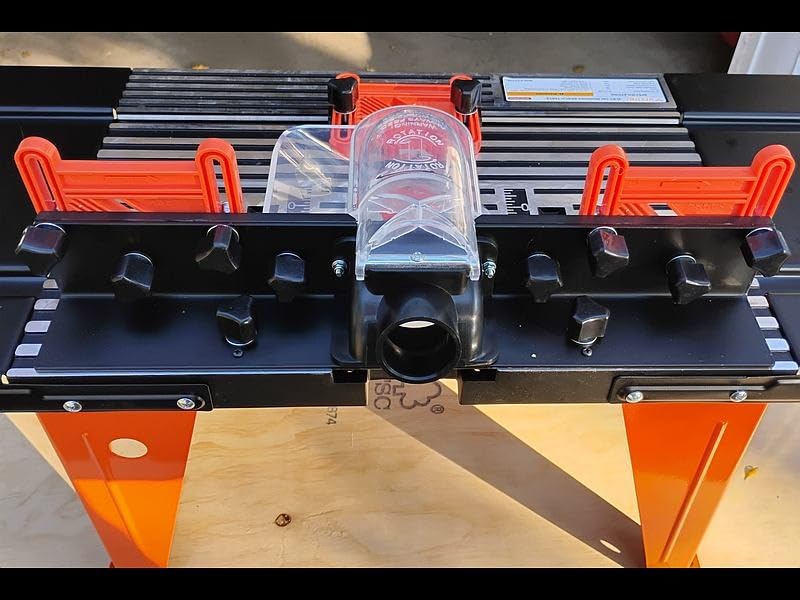
Two limitations define the ceiling here. First, it is designed for routers with up to a 6 inch diameter base plate, so a larger assembled board will not fit. Second, the router mounts on four wing-nut clamps, and several owners report a heavier router loosening and shifting, which is a direct path to a climb cut and a damaged workpiece. If your router is compact, this works; if it is full size, look elsewhere.
The manual does not explain how to mount the router, which owners single out as the most important missing step, and the instructions overall are minimal. Assembly is also described as difficult, with one owner reporting a missing bolt, and the safety switch has been reported as not working. Budget extra time and check the switch before you rely on it.
What 14.5 pounds buys a small shop
Stowability. This is the only table here light enough to move with one hand, which means it can come off the bench when you need the surface for assembly, clamping or finishing and go back when you need to route. In a shop where the router table permanently costs you a working surface, that reversibility is worth more than another two inches of top width.
Die-cast aluminum will not rust and does not need to be kept dry the way MDF does, which matters in a garage or a basement shop. The retractable fence guard containing chips is a genuine quality-of-life feature at this end of the category, and the ability to accept a jig saw or circular saw turns one lightweight frame into a shared station.
Where the VIYUKI falls short
The fence is too short and too low for many projects, and owners fabricate a better one, which turns a quick setup into a project. Wide gaps between the raised aluminum extrusion sections can trap workpieces that have been profiled, a problem several owners fixed by filling the grooves themselves. That is a real time cost for a table you might use to save time.
The router security issue is the serious one: four wing-nut clamps holding a heavier router can loosen under cutting load, and the documentation around mounting is thin. Add the 6 inch base plate limit, the missing router-mounting instructions and the reported safety switch issue, and this is a table for a beginner with a compact router, not a production station.
Router Table or Router Lift: What Changes in a Small Shop
A router table and a router lift solve different problems, and in a small shop you may want the lift more than the table. The lift changes bit height from above the surface instead of from below, so you stop kneeling on the shop floor with a wrench. That is the loudest request on woodworking forums: the most-upvoted thread on r/Carpentry is explicitly for something with a lift and easy adjustment, and the consensus answer there is that a mid-price table with a lift beats a premium table without one.
Among the eight tables here, three are the ones owners pair with lifts in practice. The Kreg PRS2100 is the most commonly reported lift-compatible table, and it is also the one with a 30 inch top, so it is the natural pairing for panel work. The Bench Dog Rockler cast iron table is listed as compatible with router lift systems and is the natural partner for a heavy 3-3/4 HP router. The Bosch RA1181’s pre-drilled aluminum plate is rigid enough to carry a lift, and the common build in that thread bolts a JessEm Rout-R-Lift onto a Bosch 1617 rather than buying a premium system.
The SKIL SRT1039 and the SKIL RT1323-01 already offer above-the-table height adjustment on their own motor, so you do not need a separate lift for bit changes. That is the cheapest path to the same workflow if your router is a SKIL fixed base model. The POWERTEC, RYOBI and VIYUKI tables in this roundup do not list lift compatibility, and the VIYUKI wing-nut mounting in particular is not a lift-friendly architecture.
One honest caution: a lift adds height above the table, and on a low bench in a small shop that can mean leaning over the work rather than sitting at it. Measure your working height with the lift installed before you commit, and check that the lift’s crank side clears the fence when the fence is on your dominant hand side.
How to Choose a Router Table for a Small Shop
Measure the bench before the table. Measure the clear span, not the whole bench, and subtract 2 inches front and back for clamping and access. Then check the base footprint, not the top: the Bosch RA1181 has a top narrower than its base, which is the detail that trips people up. If your clear span is under 20 inches, a clamp-on or a saw-mounted table is the only honest answer.
Verify throat plate fit before you order. Not all routers fit all tables. Check your router collar diameter, compare the plate hole pattern to your router’s base, confirm the opening is large enough for your bit without letting the body rise into the workpiece, and know that drilling your own plate holes is a common workaround. The POWERTEC plate ships without a drilling template, and the RYOBI table’s universal name is not a guarantee, so this step is where a return is avoided.
Choose the top material for the work. Cast iron is the flattest and heaviest, and it is the right answer for a table saw mount. Die-cast or solid aluminum resists warping and rust, and is the best compromise for a benchtop table that has to move. Laminate-covered MDF gives you the largest top for the money and can flex during jointing, and it needs to be kept dry. Die-cast aluminum at the budget end is affordable but is usually paired with an adjustable fence, so check the fence before the top.
Look for a fence you can adjust from the front. Split fences, sliding face plates, micro-adjust wheels and locking levers all matter more than the fence material. Front adjustment means you can set the gap between the bit and the fence without reaching around the workpiece. The Kreg fence has no built-in squareness adjustment, and the RYOBI fence can pivot when set for jointing, so those two want a check before a production run.
Size the dust port to your hose. A 2-1/2 inch port fits a standard shop vac hose, and the Bosch, POWERTEC and Bench Dog tables use that standard. Position matters as much as diameter: a port that sits behind the fence catches most debris, and one mounted to the side or blocked by a switch box will not. If you already have a hose of a different diameter, add an adapter to your list rather than assuming it fits.
Check bench weight and vibration. This is the climb cut question. A light bench plus a light table plus a heavy router is the combination that produces burned edges and chatter. The POWERTEC steel stand with rubber feet and the Bench Dog cast iron are the two answers here, and both need to be clamped or firmly seated. The molded plastic legs on the Bosch and SKIL tables work fine when clamped to a solid, level bench.
Plan for stowage and the bench space it costs. A benchtop router table permanently removes 20 to 30 inches of your most useful surface. The lightest table here, at 14.5 pounds, can be lifted off and stored, and a saw-mounted top disappears entirely between jobs. If your shop is under 150 square feet, weight and stowability should outrank top size in your ranking. Our picks for pool tables for small rooms solve a similar floor-space puzzle from the opposite direction, and if space is a recurring theme at home, our guide to nesting tables for small spaces covers the same principle for furniture.
Decide build versus buy honestly. A DIY plywood router table built from 2x4s with a thick MDF top is a recurring recommendation in r/woodworking, and members on LumberJocks and NC Woodworker generally frame a well-built plywood table as better value than a nameplate table. A plywood table you clamp to an existing bench can be made for the cost of a few sheets, and you can size it exactly to your space. What you give up is a warranty, a known-good plate leveling system, and the fence adjustability that a machined fence provides out of the box. Buy when you want repeatability, build when you want a custom footprint.
Budget the system, not the table. Forum threads ask about a fixed total budget far more often than the table price alone, and the reason is straightforward: a table plus a router plus a lift plus dust collection is what a working station costs. Kreg sells the switch and featherboards separately, and the Bench Dog plate is a separate order, so those line items belong in your total from the start. Count the router if you do not own a fixed base model, count a lift if you want above-table bit changes, and count a hose adapter if your vacuum does not match.
Frequently Asked Questions
Who makes the best router table?
For a small shop, Bosch, Kreg and Rockler are the three dominant makers, and the value tier from SKIL, POWERTEC and RYOBI covers most first-time buyers. The Bosch RA1181 is the strongest all-round benchtop choice for most shops because the aluminum top and fence stay flat, the pre-drilled plate fits many routers, and 18 inches of width suits a tight bench. Which brand is best still depends on your router and your bench rather than on brand alone.
What is the ideal size for a router table?
For most benchtop routing, the minimum usable top is about 24 by 16 inches, and 26 by 16 inches lets you handle a full-length workpiece with the fence and featherboards still in contact. For raised panels, wide face frames or sliding dovetails, look for 30 inches of width or more. Leave roughly 2 inches of clearance at the front and back of the bench for clamping, and check the base footprint, which on some tables is wider than the top.
Are benchtop router tables good?
Yes, provided the bench is solid and the table is clamped down. Benchtop tables are the correct format for small shops because they add a cutting station without permanently taking floor space. The two caveats are bench weight and table weight together, since a light bench and a light table under a heavy router is what produces climb cut, and MDF tops and fences, which can flex during jointing. Die-cast aluminum and cast iron tops stay flatter.
Do all routers fit all router tables?
No. Check three things before you buy: your router collar diameter, the table insert plate hole pattern against your router base, and whether the plate opening is large enough for your bit without letting the router body rise into the workpiece. Universal mounting plates reduce but do not eliminate the problem, and some compact or newer routers will not mount cleanly. Drilling your own plate holes is a common and workable fallback, but templates are not always included.
Do I need a router lift in a small shop?
Not to start, but it is the most requested upgrade on woodworking forums. A lift changes bit height from above the table so you stop kneeling on the shop floor with a wrench, which matters more in a small shop where there is nowhere to lie down under the bench. The Kreg PRS2100 and the Bench Dog Rockler cast iron table are the two picks here most often paired with lifts. The SKIL tables offer above-the-table adjustment on their own motor instead.
Are MDF router tables durable enough?
They are durable enough for general shaping and profiling if you keep them dry, but they are the first thing to show wear in a long run of jointing. MDF face plates can flex, which costs you accuracy, and the surface marks workpieces easily. Humidity and wet rags are what delaminate an MDF top, so wipe spills promptly. If jointing accuracy or a flat surface over years is the priority, spend the upgrade on aluminum or cast iron.
Should I buy a router table or build one?
Build one if your shop has an unusual footprint or you want a size no catalog table offers, since a clamped plywood top on a 2×4 base is a recurring recommendation in woodworking forums and can be made for a few sheets of material. Buy one if you want a known-good plate leveling system, a machined fence with front adjustment, and a warranty. Buy when repeatability matters, build when a custom footprint matters more.
Which Router Table Fits Your Small Shop Best?
For most small shops, the Bosch RA1181 is the pick: the aluminum top and fence hold flatness, the pre-drilled plate fits many routers, and 18 inches of width leaves a working bench around it. If you are starting from zero tools, the SKIL RT1323-01 kit gives you a table and a capable 2.0 HP router in one box at the best rating in this roundup. If your bench is light, the POWERTEC 71402V and its steel stand with rubber feet are the answer to climb cut.
Match the rest to your space. The Kreg PRS2100 buys you a 30 inch top and lift compatibility for panel work. The RYOBI A25RT03 fits RYOBI owners and metal-construction fans. The Bench Dog cast iron table takes no floor space at all if you have a table saw. And the VIYUKI is the one to carry off the bench and hang up when the day is done. Measure your clear bench span, confirm your router’s plate pattern, and check that the table clamps down before the router goes in.