
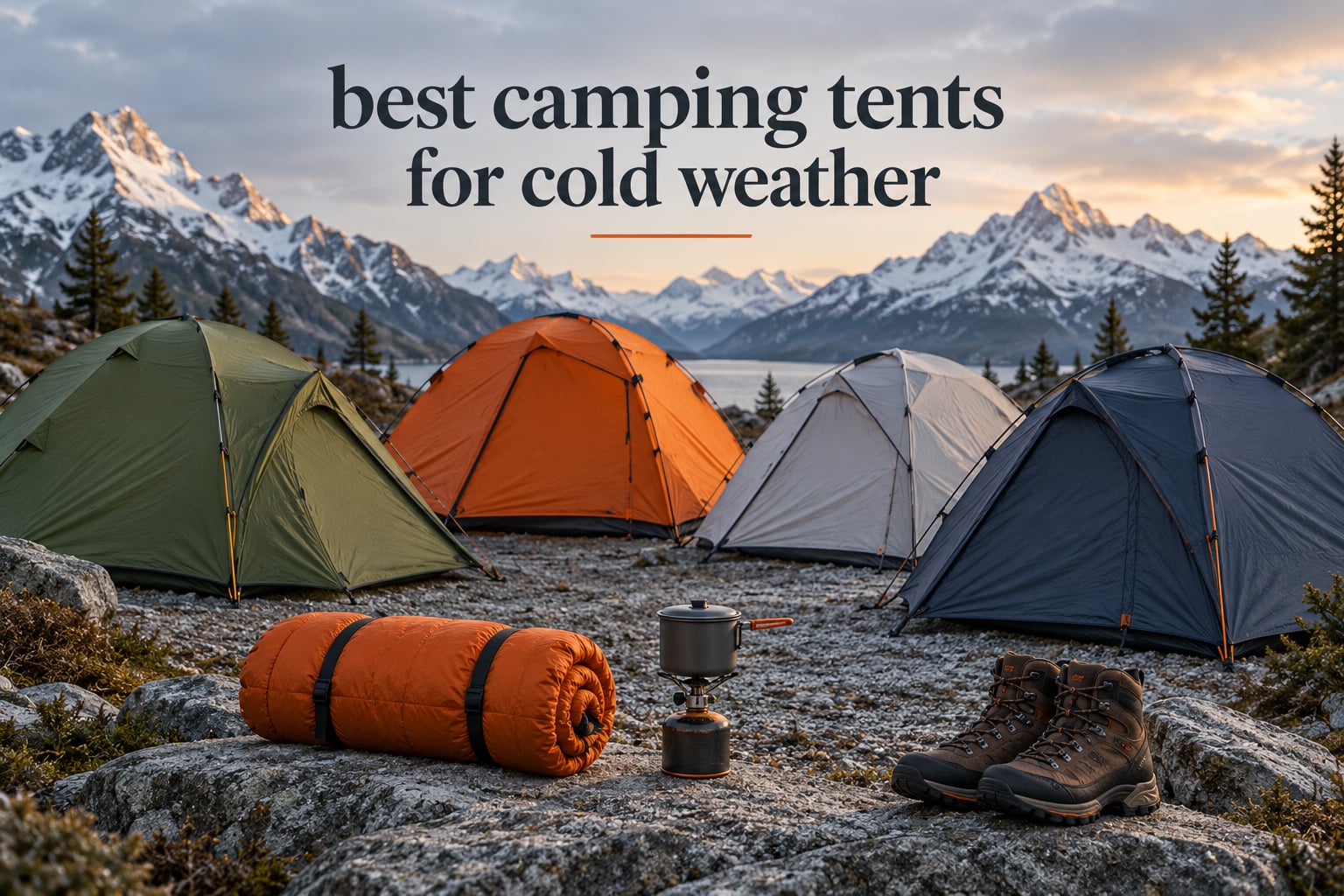
Two variables decide whether a tent works below freezing: how much heat it holds, and how much moisture it lets escape. Our best overall pick, the GEERTOP 2 Person Backpacking Tent, is the one that balances both without turning into a packweight problem, so it leads our list of the best camping tents for cold weather this year. The rest of the list covers the other cold camp: stove-jack hot tents for basecamp, and lighter double-wall shelters for ski touring and shoulder-season trips.
We spent six weeks comparing twelve 4-season shelters on the criteria that actually change how warm you sleep: fabric weight, waterproof rating, pole material, ventilation, packed weight and real owner reports about condensation, leaks and pitchability in gloves. Every tent here is rated for four seasons by its manufacturer, and every one has published owner reviews we could read rather than marketing copy alone.
If you are new to winter camping, our base layer guide for cold weather matters more than the tent does. Clothing, a sleeping bag rating and a closed-cell foam pad under your sleeping pad account for most of your warmth, and no shelter fixes a cold sleep system. What the tent does is stop wind and precipitation, hold a little still air, and give you somewhere to control the temperature you are making.
Table of Contents
Top 3 Picks for Cold-Weather Camping in 2026

GEERTOP 2 Person Backpacking Tent
- 6.9 lb packed weight
- PU 3000mm taped-seam fly and snow skirt
- 4290 sq in floor with two vestibules
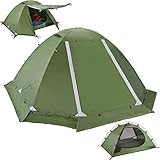
Clostnature 4 Season Winter Tent
- PU 5000mm fly and bathtub floor
- 5133 sq in interior with two doors
- 5.3 lb minimum trail weight

OneTigris Stella 4 Season Tent
- 4.4 lb trail weight
- 20D silicone-coated nylon at 3000mm
- Removable blackout outer fly
Best Camping Tents for Cold Weather by Use Case (October 2026)
The quick read below is the whole list at a glance. If you want the reasoning behind the ranking, the individual reviews follow in order, and the buying guide after that covers the specs that decide a cold-weather pick.
| Product | Specifications | Action |
|---|---|---|
| GEERTOP 2 Person 4-Season Backpacking Tent |
|
Check Latest Price |
| Clostnature 4 Season Winter Backpacking Tent |
|
Check Latest Price |
| OneTigris Stella 4 Season Backpacking Tent |
|
Check Latest Price |
 Underwood Aggregator 1/2 Person Winter Tent Underwood Aggregator 1/2 Person Winter Tent |
|
Check Latest Price |
 Naturehike Dune Hot Tent with Stove Jack Naturehike Dune Hot Tent with Stove Jack |
|
Check Latest Price |
 GEERTOP 4 Person 4 Season Family Tent GEERTOP 4 Person 4 Season Family Tent |
|
Check Latest Price |
 AYAMAYA 4 Season Backpacking Tent AYAMAYA 4 Season Backpacking Tent |
|
Check Latest Price |
 POMOLY Chalet 70 Pro Hot Tent POMOLY Chalet 70 Pro Hot Tent |
|
Check Latest Price |
 Naturehike Massif Hot Tent with Stove Jack Naturehike Massif Hot Tent with Stove Jack |
|
Check Latest Price |
 BISINNA 4 Season Winter Backpacking Tent BISINNA 4 Season Winter Backpacking Tent |
|
Check Latest Price |
 ShinHye Ultralight 4 Season Tent ShinHye Ultralight 4 Season Tent |
|
Check Latest Price |
 REDCAMP Hammock Hot Tent with Stove Jack REDCAMP Hammock Hot Tent with Stove Jack |
|
Check Latest Price |
1. GEERTOP 2 Person Backpacking Tent – Best Overall Cold-Weather Shelter
GEERTOP 2 Person Backpacking Tent, Lightweight Waterproof 4-Season Tent
6.9 lb packed
82.6 x 55 x 45 in
4290 sq in floor
PU 3000mm fly
Aluminum poles
Two doors
Pros
- Freestanding clip-on frame pitches in 5 to 8 minutes
- 210T ripstop fly with PU 3000mm coating and fully taped seams
- Two doors and two vestibules keep gear out of the sleeping space
- Breathable mesh panels help move moisture outward
- Freestanding design lets you reposition it before staking
Cons
- 6.9 lb is heavy for a two-person backpacking tent
- Only one interior storage pocket is listed
- Included stakes are basic
More than 2500 owners have rated this tent, and that volume of long-term feedback is the main reason it takes the top slot. It is the rare budget shelter that does everything right at once: a taped-seam 210T ripstop fly, an aluminum two-pole frame, a snow skirt and enough floor area to sleep two with gear inside.
The 4290 square inch interior is not generous, but it is honest. Two campers at 6 foot get a workable night with packs stashed in the dual vestibules rather than on their chests.
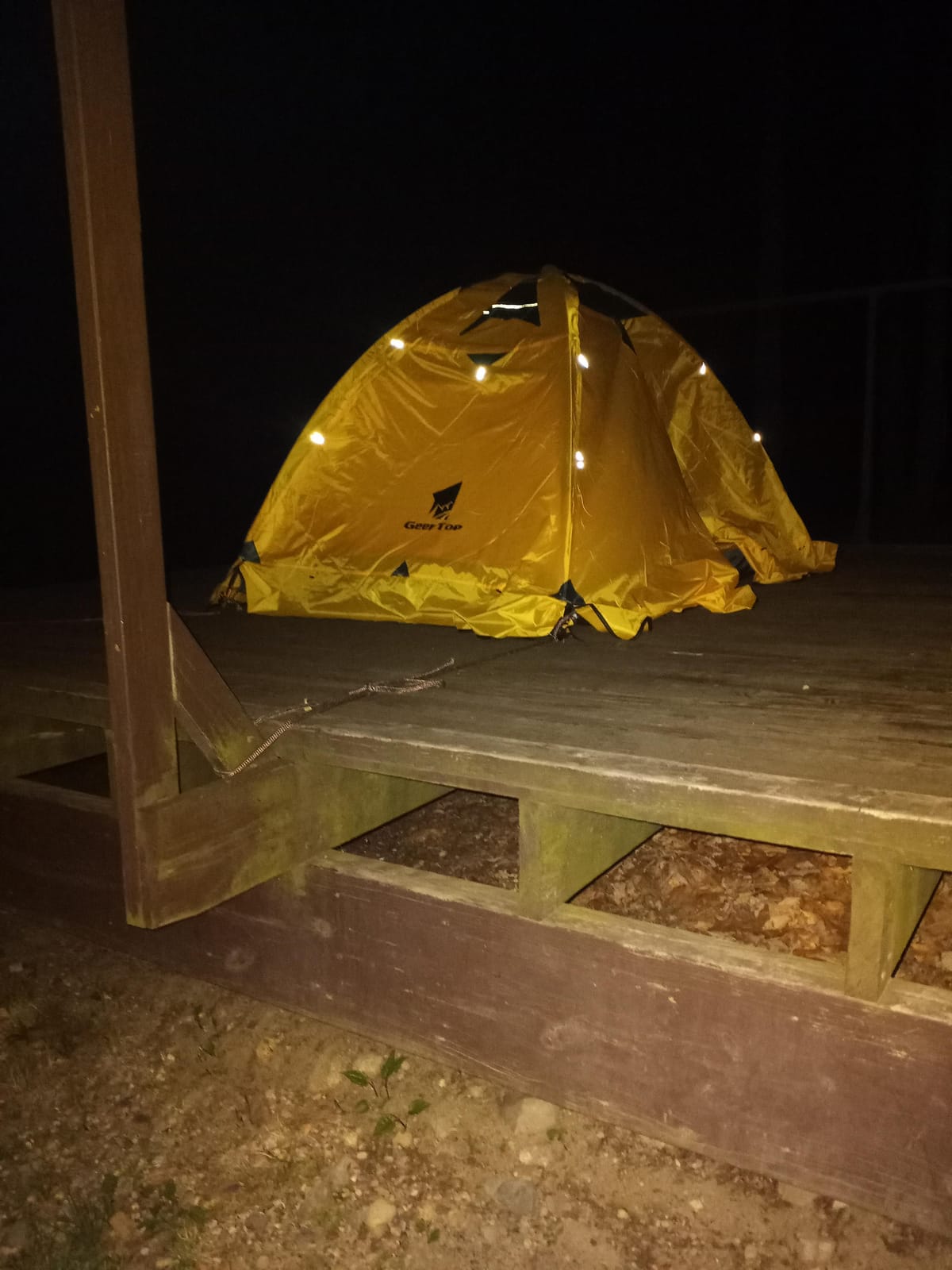
Owner reports describe it holding together through heavy rain and snow with taped seams that did not give up. The freestanding frame matters in winter too: you can lift the whole thing, walk it to a snow-free pitch, then stake it, which counts when the ground is frozen.
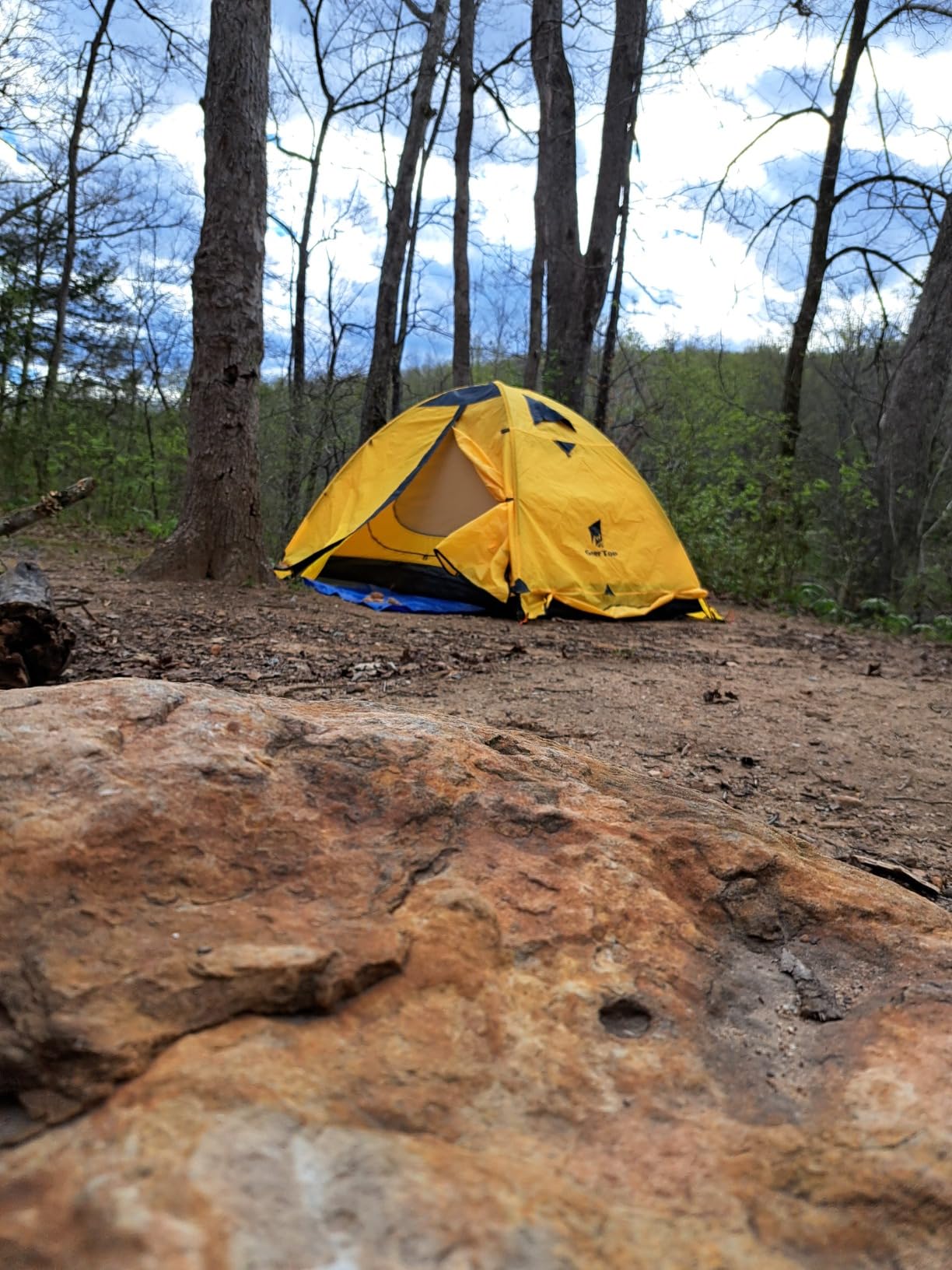
The breathable mesh panels earn their place here. A fully solid canopy at this size would trap moisture faster than most people expect, and the ventilation is one reason this tent stays drier than its fabric weight suggests.
What you get for the weight
At 6.9 lbs the packed weight is the main argument against this tent. For a vehicle-side camp or short hike-in it does not matter, but on a trip where you carry the shelter for miles the OneTigris Stella at 4.4 lb is the better tool.
Where it falls short
Only one interior storage pocket is listed and the included stakes bend in hard ground, so better pegs are the first upgrade. This is a double-wall shelter rather than a heated one, so single-digit nights still need a good bag and a closed-cell pad underneath it.
2. Clostnature 4 Season Backpacking Tent – Best Value for Cold Ground
Clostnature 4 Season Backpacking Tent – 2 Person Cold Weather Winter Tent
6.3 lb total, 5.3 lb trail
86.6 x 59 x 45.8 in
5133 sq in floor
PU 5000mm bathtub floor
Snow flaps
Pros
- Factory-sealed seams with a PU 5000mm bathtub floor
- One-person pitch in about 3 minutes even in gloves
- Two D-shaped doors plus two vestibules
- Packs to 16.5 x 5.9 x 5.9 inches
- Snow flaps seal out spindrift
Cons
- Rainfly fabric is thin and tears easily
- Supplied stakes bend in hard soil
- Fly resists going back into its own stuff sack
This one carries one of the strongest waterproof builds in the group: a PU 5000mm coating across the fly, the groundsheet and the bathtub floor, with factory-sealed seams, and reviewers describe keeping gear dry through freezing rain and multi-day snow.
At 5133 square inches it is also one of the larger two-person interiors here, with real vestibule space on both sides. That volume is a liability when you are trying to heat it, and a bonus when you are trying to live in it.
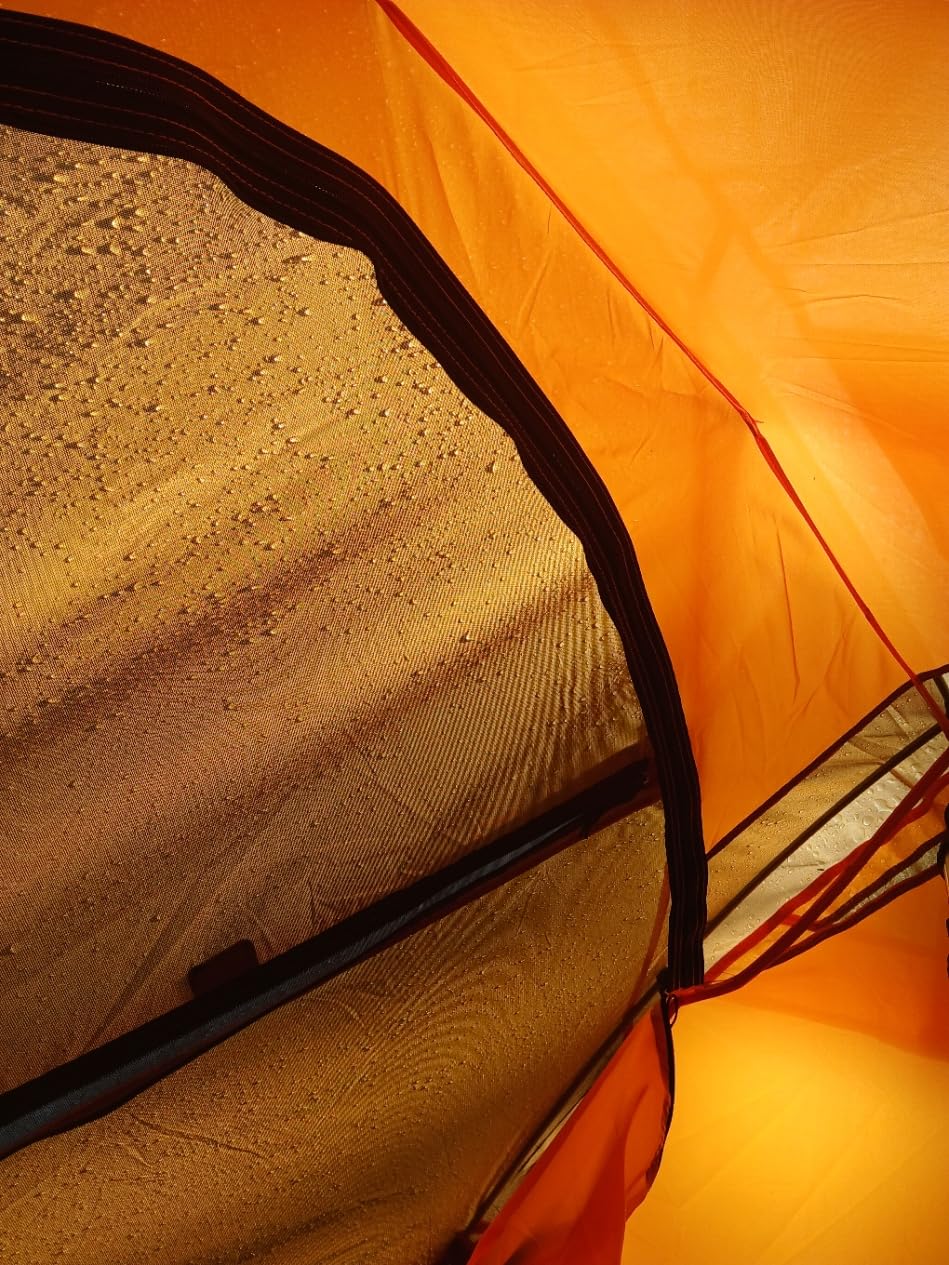
The two doors matter more than they look. When one camper has to leave at 4 am to check the temperature, the other stays warm, and that single feature does more for shared cold nights than a heavier fabric would.
Owners also report pitching it alone in the dark with gloves on, a persistent complaint about most tents in this class, and the 3-minute setup keeps the tent out of the way when your hands are cold.
Why the fabric rating matters here
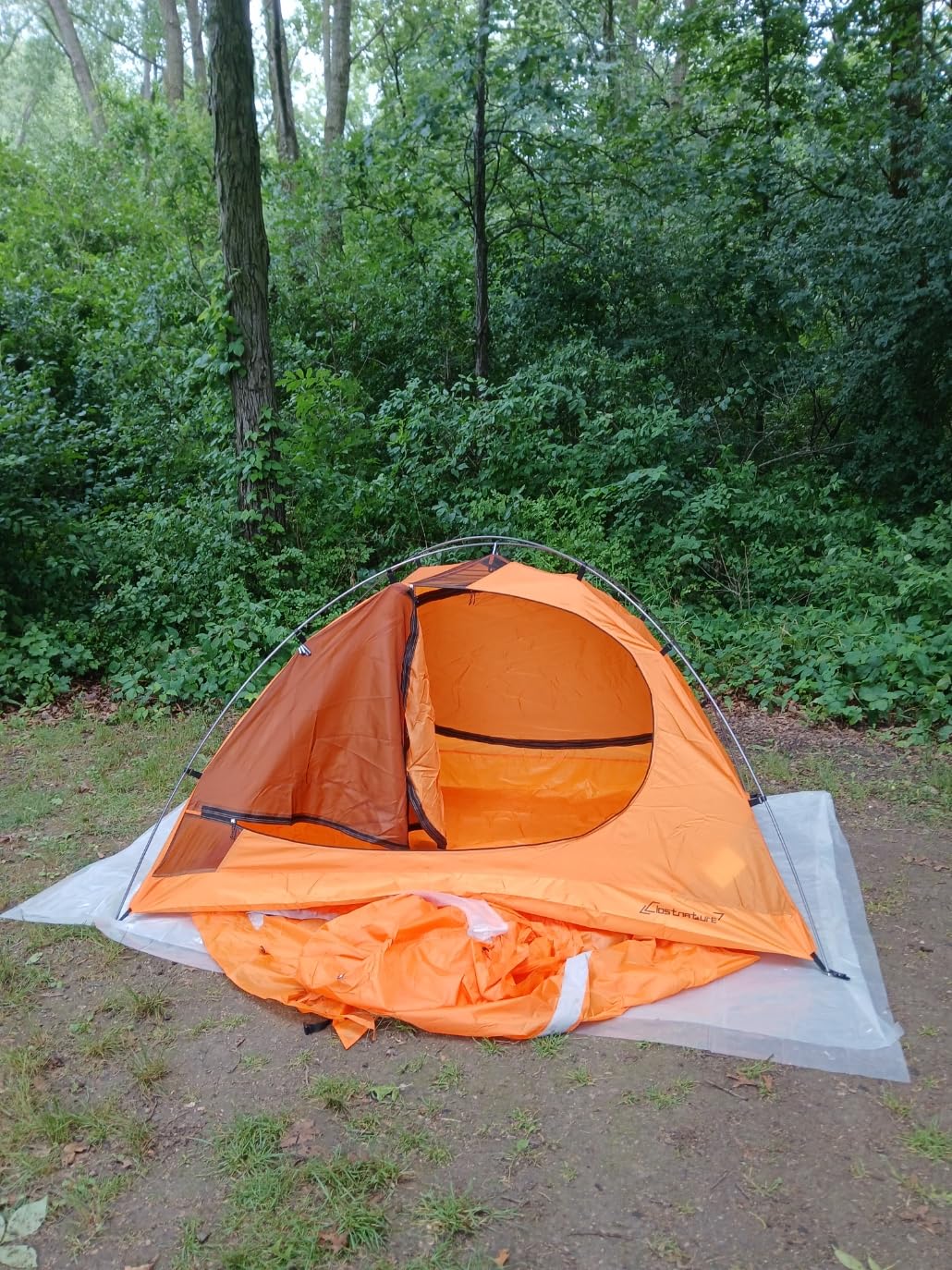
Waterproof rating is only comparable when the seams are sealed the same way. This tent pairs a 5000mm coating with factory-sealed seams, the combination that stops meltwater wicking through needle holes, and that pairing is the most useful spec on the sheet in wet snow.
What we would change
The rainfly is thin and tears easily once it snags on a branch, which is the most repeated complaint in the reviews, and the supplied stakes bend in hard soil. The fly also resists repacking into its own stuff sack, and the room is tight for two adults plus gear, so solo campers get the most out of the floor area.
3. OneTigris Stella 4 Season Camping Tent – Top Rated for Lightweight Winter
OneTigris Stella 4 Season Camping Tent Backpacking 2 Person Waterproof Lightweight Easy Setup Instant 3000mm Waterproof Rating Outdoor Hiking Tent, Black
4.4 lb packed
6.9 x 4.1 x 3.7 ft
28.29 sq ft floor
3000mm rating
20D nylon
Single door
Pros
- A light 4.4 lb 4-season double-wall shelter
- Pitches in 3 to 5 minutes with simple crossing poles
- Removable blackout outer fly blocks starlight
- Owners report holding through a coastal thunderstorm with 30-40 mph gusts
- Ten stakes and four 8.2 ft guylines included
Cons
- Interior is snug for two once gear is inside
- Ventilation is hard to control with the inner doors zipped
- Vestibules are small
- Length runs short for taller campers
This is the shelter to carry when the tent is the heaviest thing you own. At 4.4 lb it is one of the lightest 4-season double-walls available, and the 20D nylon outer with a single silicone layer and 40D bottom keeps the weight honest without going transparent.
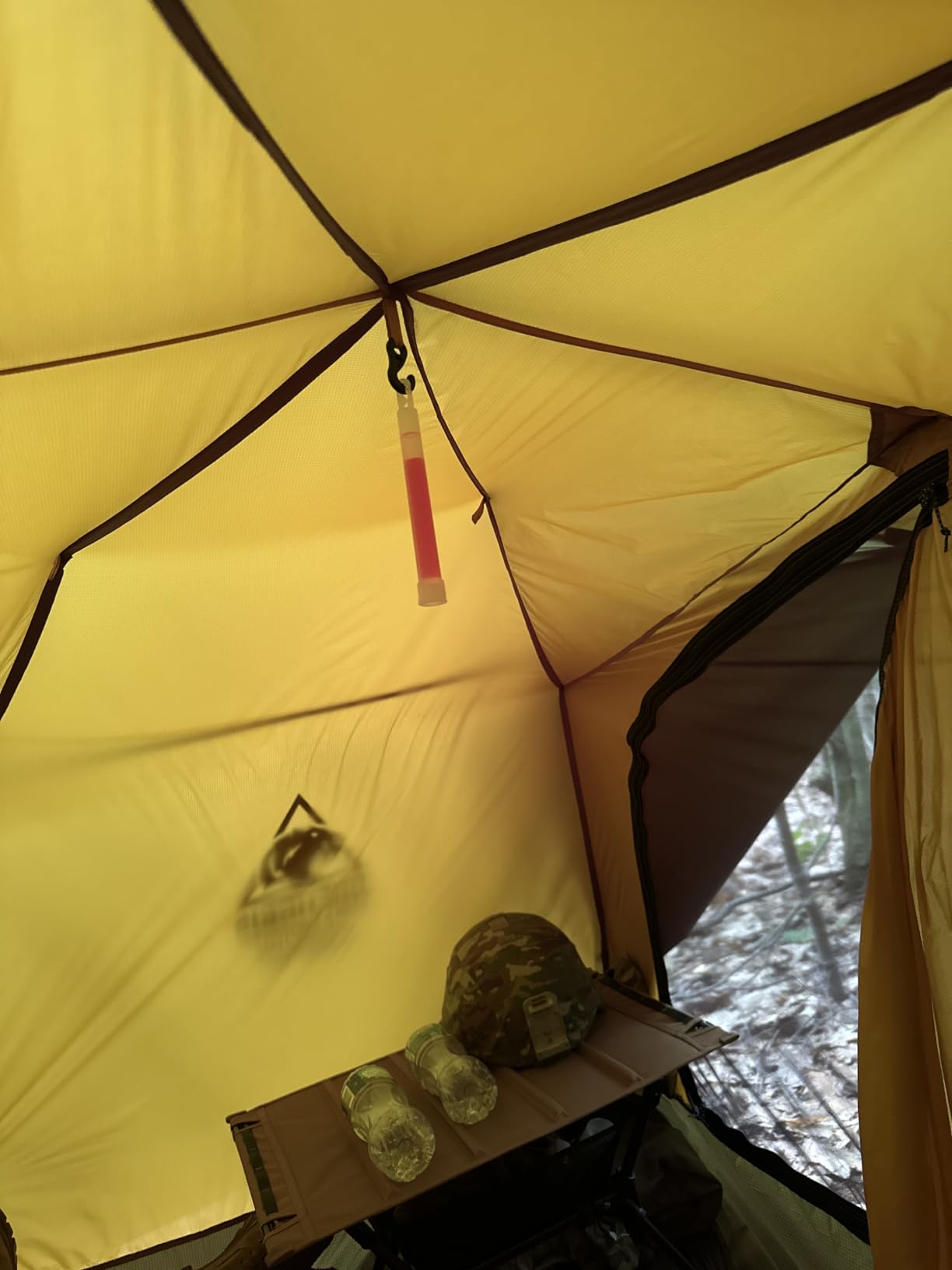
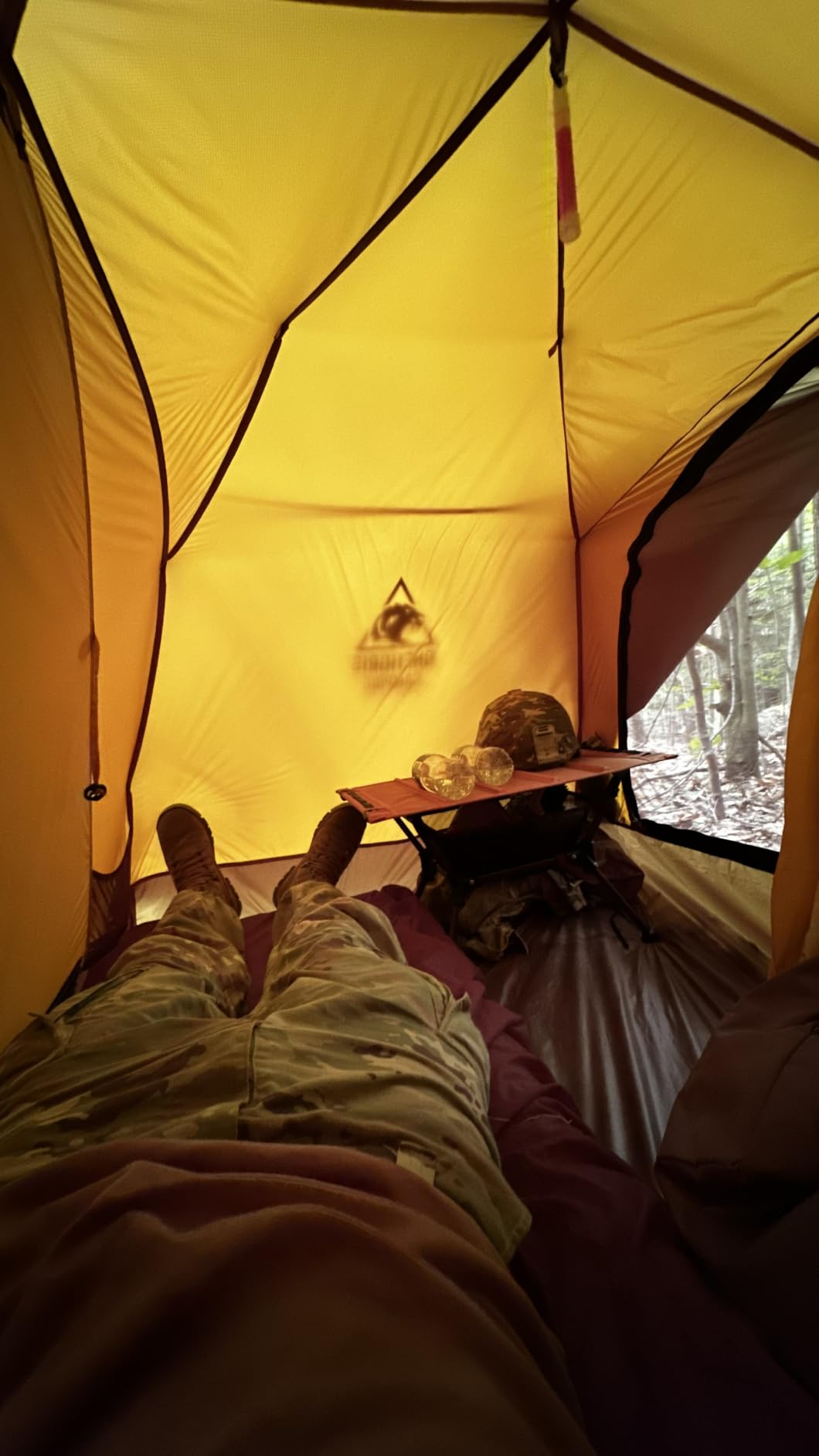
Owners report staying bone dry through three nights of heavy rain and a thunderstorm with gusts in the 30 to 40 mph range, and holding heat in the low 20s Fahrenheit. The flexible poles cross at the top of the dome and anchor at all four corners, a layout that resists wind well, and the removable blackout outer is unusual at this weight and genuinely useful in winter, where a warm interior matters more than a starry sky.
When its weight matters most
At 4.4 lb with a 19.7 inch pole package, this is the pick for winter backpacking, ski-in camps and multi-day snow approaches where pack weight decides the trip. Check the dimensions first: the 6.9 foot length runs about six inches short for taller campers and most cots.
Where the size becomes the problem
The 28.29 square foot interior is closer to a one-person tent with gear than a roomy two-person shelter, the small vestibules leave nowhere for wet boots, and ventilation is hard to control once the inner doors are zipped. Some owners also find the listed weight closer to 5 lb in practice, and only one door means two people will negotiate for entry.
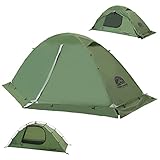
4. Underwood Aggregator 1/2 Person Winter Tent – Best for Solo Campers
1 Person 4 Season Backpacking Tent, Lightweight Waterproof Winter Tent
4 lb packed
86.6 x 31.8 x 35.8 in
2748 sq in floor
PU 5000mm fly
Aircraft-grade aluminum poles
Pros
- 4 lb packed weight
- Double-layer corners add high-wind resistance
- Full-cover rain fly with PU 5000mm coating
- Packs to 5.1 x 15 inches
- First-time users and kids can pitch it
Cons
- Floor is standard tent fabric so a footprint is advised
- 35.8 in peak height is a squeeze over six feet
- One door only
- Limited ventilation when fully closed
For a solo camper, this answers the volume question in a very small package. At 2748 square inches with a 31.8 inch width, there is barely room to spare, and a small shelter is dramatically easier to keep warm than a large one.
It weighs 4 lb and packs to 5.1 by 15 inches, which makes it practical for motorcycle and bike camping where packed volume is the constraint that actually stops you from going.
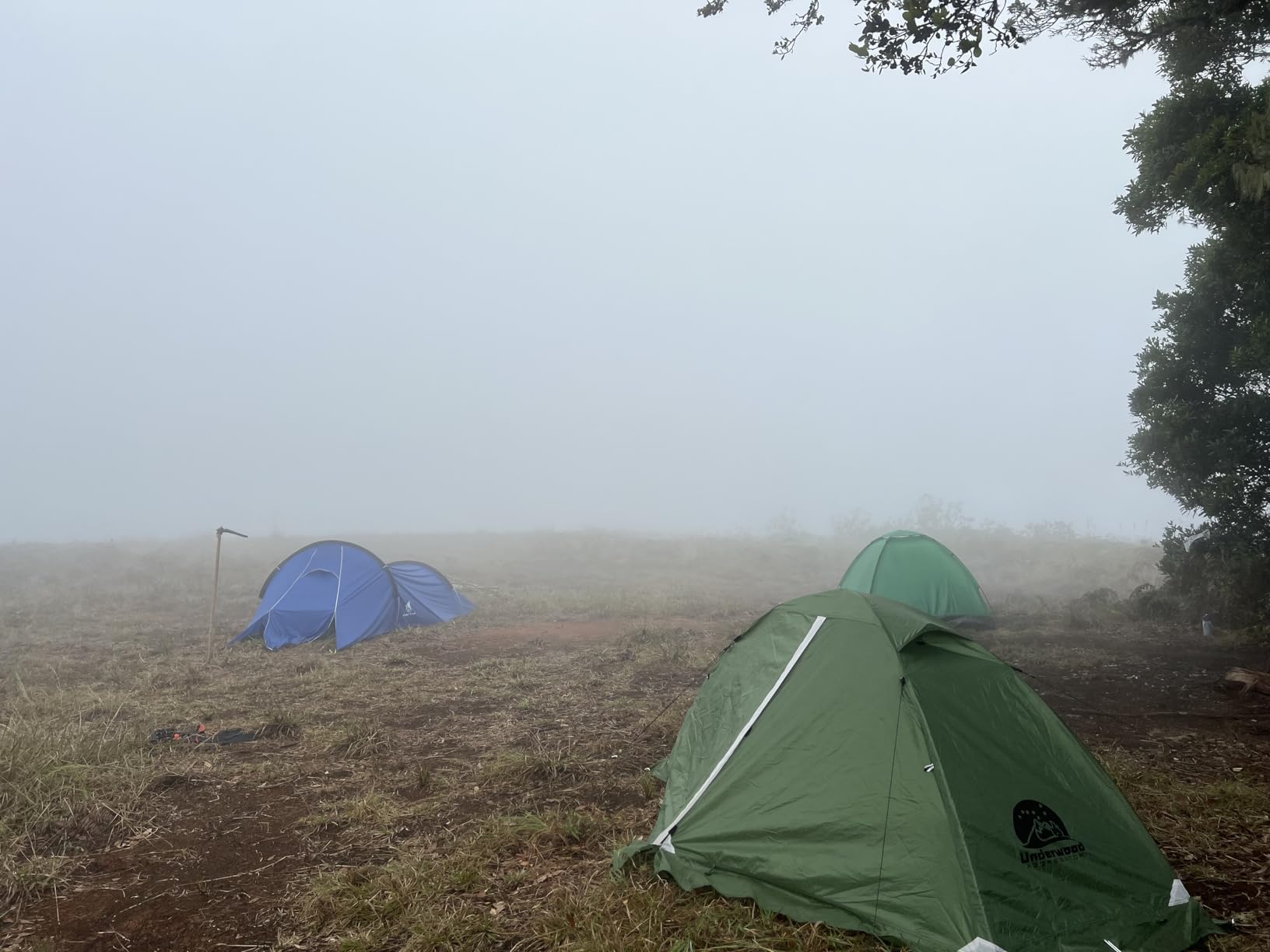
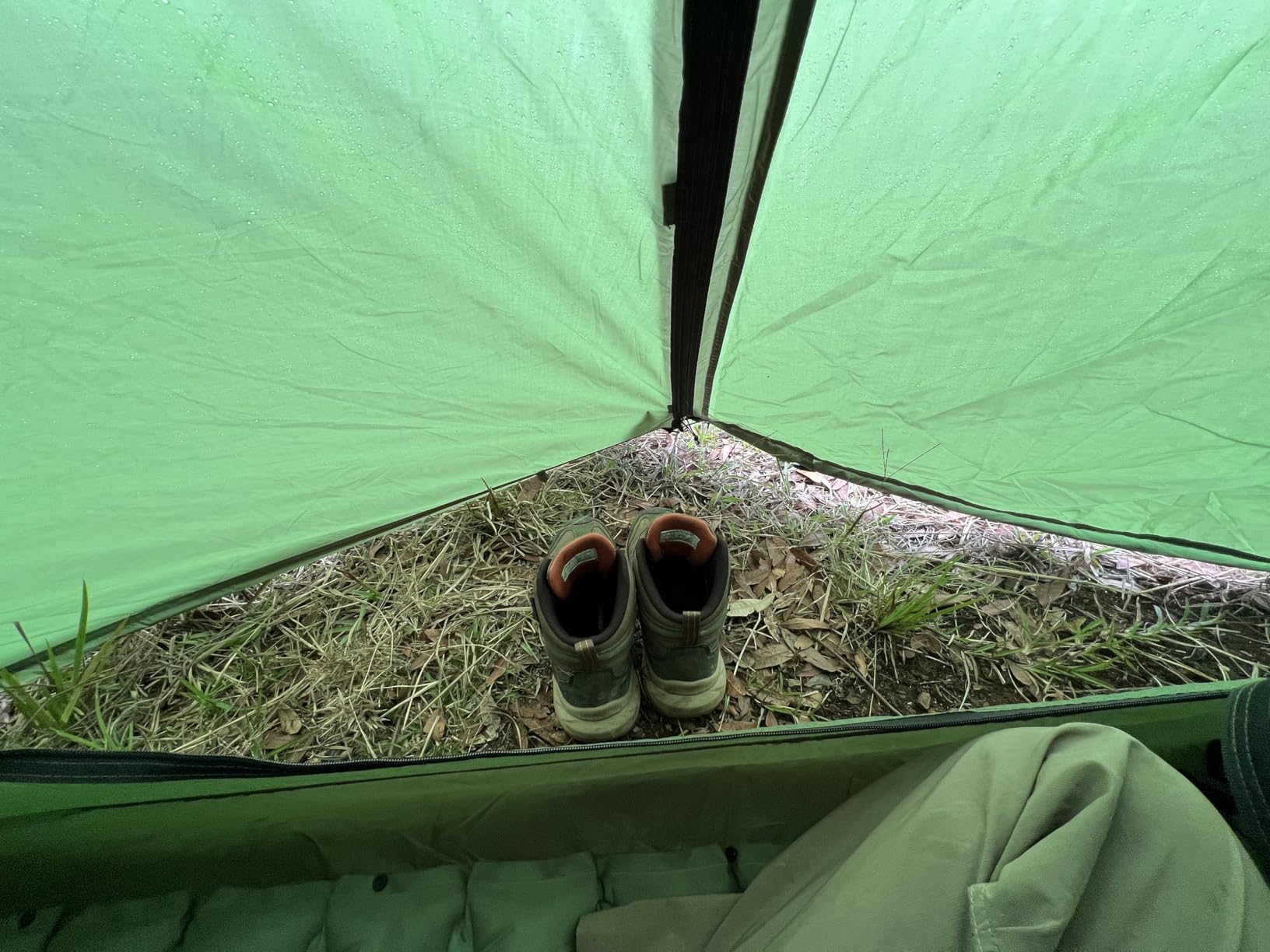
The rollable snow skirt is the feature that matters most below freezing. It blocks spindrift and ground-level wind at the base of the fly, and it rolls back for summer use, so the tent earns its keep for more than three months of the year. Owners report completing Patagonian treks and near-freezing scout trips with the interior staying dry, and pegs that hold in rocky soil.
Why size down for one person
Heating a shelter means heating air, and the amount of air scales with volume. A small interior loses far less heat through its surface than the 5133 square inch Clostnature does, which is why this tent feels warmer per square foot despite a cheaper spec sheet. If you sleep cold, the smallest tent that fits is the right choice.
Who should pass
The 35.8 inch peak height is a genuine squeeze for anyone over six feet, and the length assumes you are not wearing boots inside. The floor is ordinary tent fabric rather than tarp material, so carry a footprint for wet or rocky ground, and the single door makes this a solo shelter rather than a shared one.
5. Naturehike Dune Hot Tent – Best Heat Retention with a Stove
Naturehike Dune Hot Tent with Stove Jack,Double Layer 4 Season Tent,Waterproof 2-4 Person Tents for Camping
16.5 lb packed
126 x 94.5 x 70.8 in fly
Stove jack
75D polyester
4000mm floor
Four doors
Pros
- Reflective inner material holds heat with a wood stove in cold weather
- Four double-layer doors plus a removable inner tent
- 70.8 in peak height lets a taller camper stand
- Four window panels for airflow when the stove is off
- Owners report zero seam leaks in sustained rain
Cons
- Two-person rating is optimistic with the inner tent and stove inside
- 16.5 lb makes this a car camping tent
- Stove jack sits close to the inner tent
- First-time setup runs 20 to 30 minutes
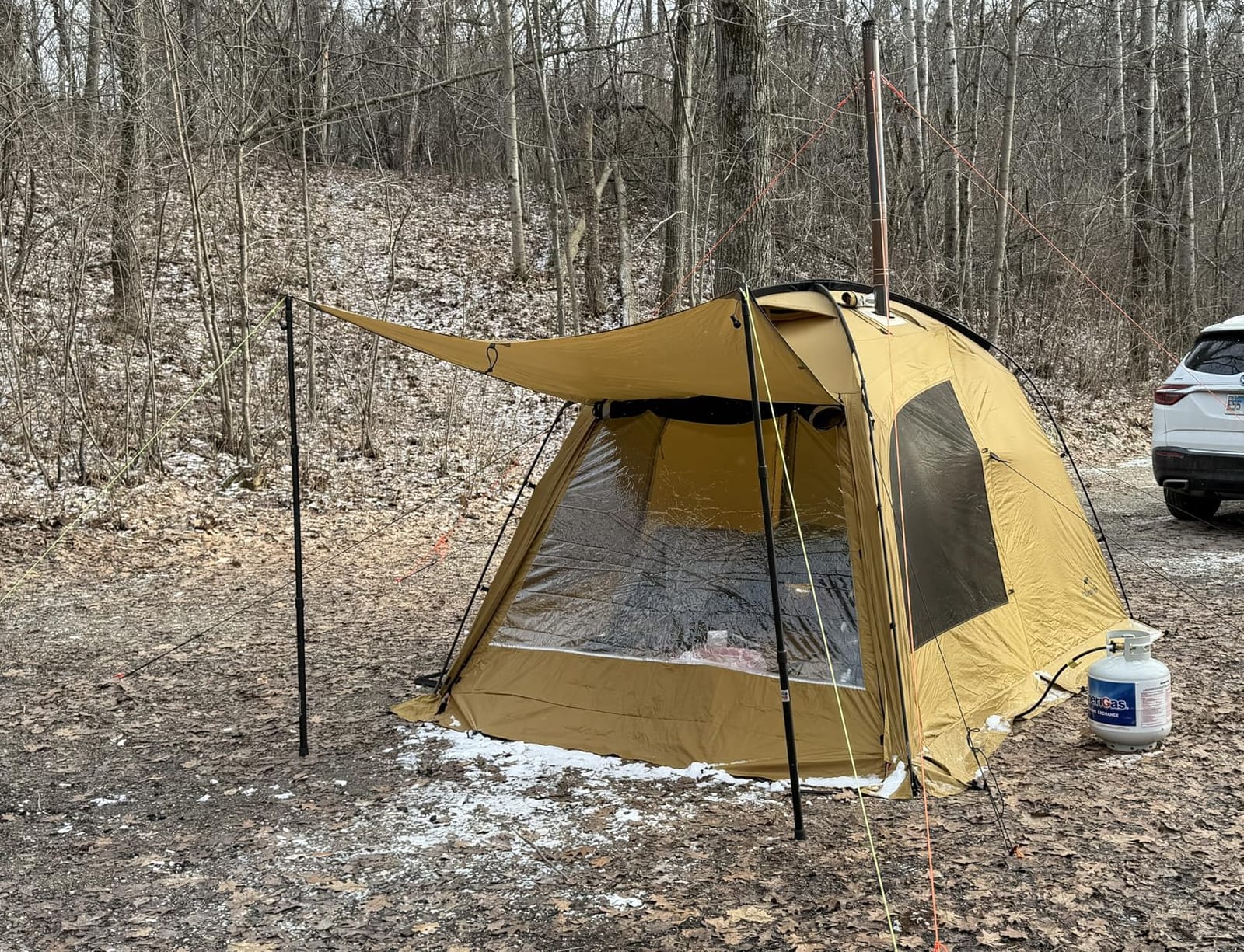
Once a stove is running, tent choice stops being about fabric weight and starts being about volume, ceiling height and how well the tent seals. The Dune delivers on all three, with a 70.8 inch peak, a 7.6 square meter footprint and a stove jack sized for a standard camping stove. The removable inner tent at 86.6 by 59 by 63 inches is the clever part: with it in you get a sleeping chamber and a stove-safe outer shell, and take it out the fly works alone as a sun shade, which is how you run it in summer without buying a second shelter.
Owners running a wood stove describe reflective inner material that holds heat well at around 10 F, and one reports the tent surviving 50 mph winds and quarter-size hail without damage. That is a different class of weather event than most shelters here ever see.
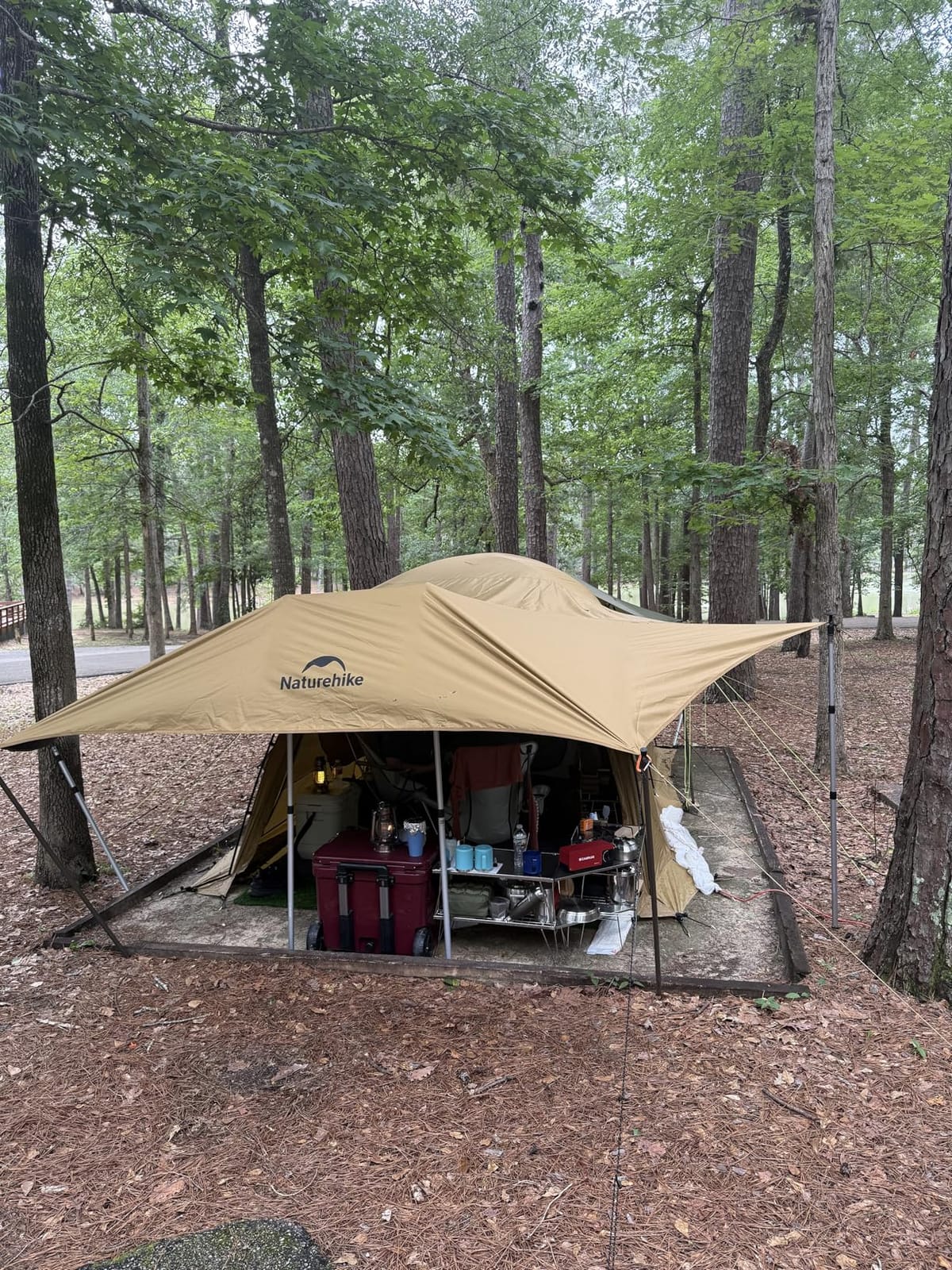
The 75D polyester outer carries a silver coating and UPF50+, and the 150D oxford floor is rated at 4000mm with taped corners, which is the surface that actually has to hold back meltwater.
What a stove changes about the equation
A cold-weather tent holds your body heat. A hot tent manufactures heat, and once a stove is in play the interior stops being a temperature problem and becomes a safety and airflow problem. Four double-layer doors and four windows give more venting surface than most hot tents at any weight, and standing height matters more in a stove tent than in any other configuration.
Before you light anything
The stove jack sits close to the inner tent, so the inner has to come out or be carefully isolated before you burn anything. Owners also report the snow skirt flaps in wind unless it is weighted down, and staking is the fix.
Any heater or stove used inside a tent needs a low-oxygen shutoff certified to CSA 4.98 or ANSI Z21.103. Those certifications exist because unvented combustion in a small enclosed space produces carbon monoxide, and no fabric rating substitutes for a working sensor.
6. GEERTOP 4 Person 4 Season Family Tent – Best for Family Cold-Weather Camping
GEERTOP Waterproof 4 Person 4 Season Family Camping Tent
9.1 lb packed
94.49 x 82.68 x 55.12 in
7797 sq in floor
PU 3000mm fly
PU 5000mm Oxford floor
Pros
- Held through a 60 mph thunderstorm with heavy rain
- Two large doors and dual ventilation windows
- Integrated snow skirt blocks wind and blowing snow
- Vestibule can be propped with trekking poles
- Freestanding and quick to pitch even in the dark
Cons
- Poles are flimsy and one owner reported buckling in gusts
- Thin nylon floor wore through on sandy ground
- Plastic rain fly clips are reported to break
- Four-person rating is optimistic
At 7797 square inches this is one of the largest shelters here, and that is exactly the right call for a family and exactly the wrong call for someone trying to stay warm. Two adults plus a cot and gear fit comfortably; four campers fit technically and feel it.
Living space is the selling point. Two large doors, dual ventilation windows, breathable mesh panels and a vestibule that can be propped open with trekking poles give you somewhere to cook, sort wet gear and keep muddy boots out of the sleeping area. At 9.1 lb it also packs down small relative to its interior volume, which matters when it has to share a vehicle with a family and cold-weather clothing.
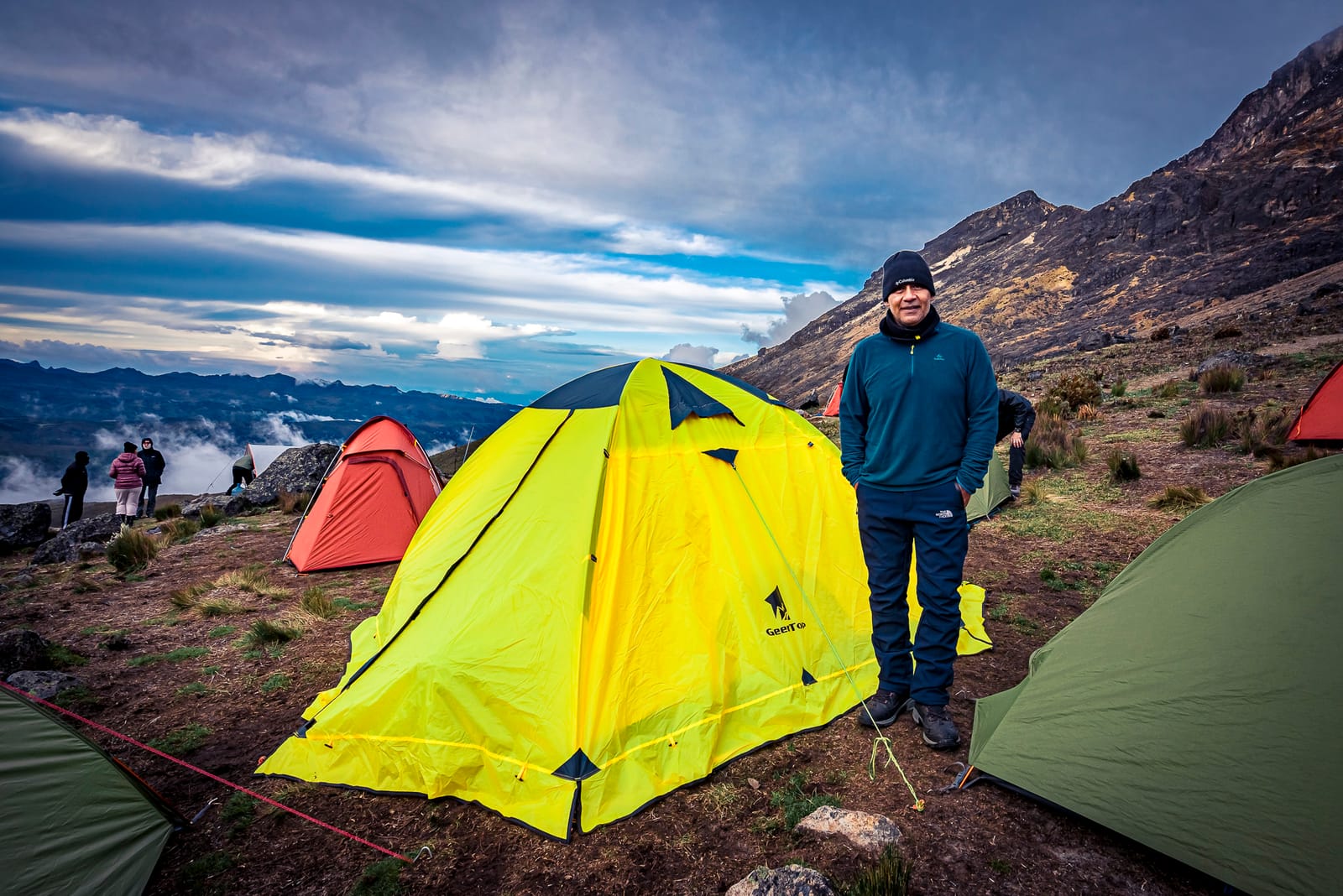
The PU 3000mm fly over a PU 5000mm Oxford floor with fully taped seams is a sensible pairing, and owners report the interior staying dry through heavy snow and rain on multi-day British Columbia trips. The integrated snow skirt blocks wind, blowing snow and dust at ground level.
What to check before you book it
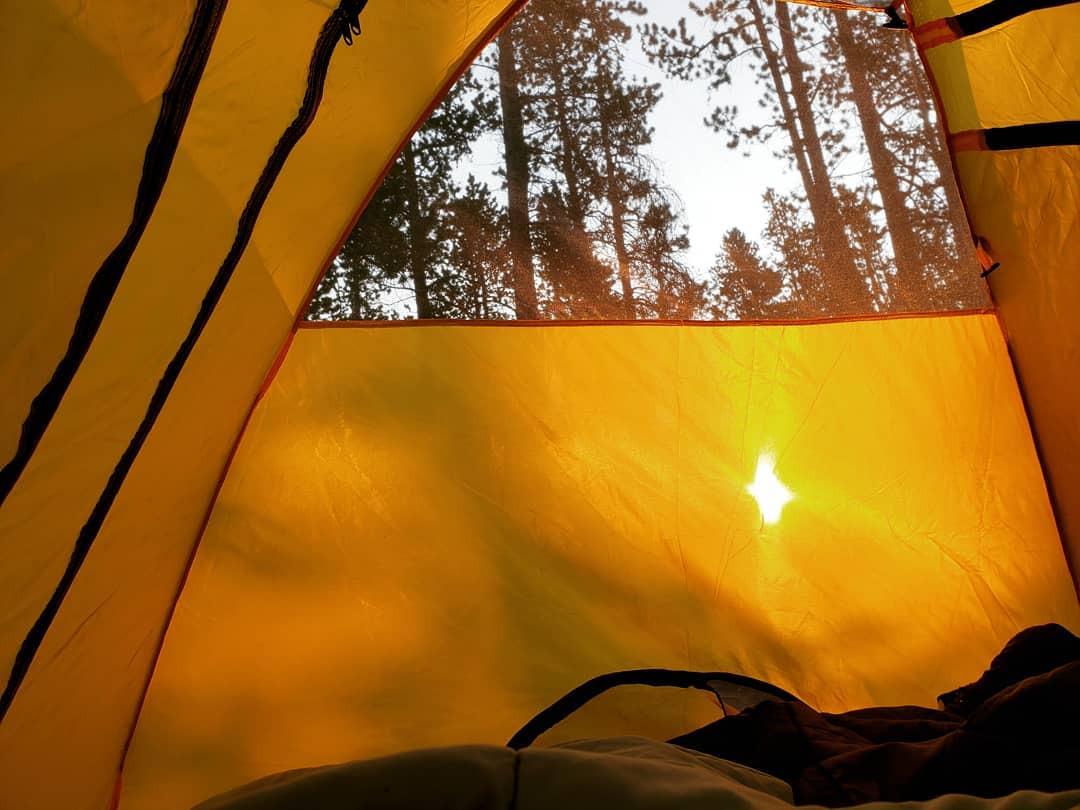
Measure your sleeping setup first. A queen mattress fills roughly 90 percent of the floor per owner reports, so a family of four should plan on a cot arrangement rather than a bed setup. If you want warmth rather than room, our canvas tent picks follow a similar logic of a larger shelter you heat deliberately rather than trying to heat raw volume.
Where the durability worries sit
The most repeated criticisms are mechanical, not fabric: poles buckling in gusty wind even fully staked, plastic rain fly clips that break, and a thin nylon floor that wore through after two days on sandy ground. The 4.3 average with a 66 percent five-star share reflects that, so treat this as a capable storm shelter with consumable parts, not a lifetime purchase.
7. AYAMAYA 4 Season Backpacking Tent – Best for a Three-Minute Pitch
AYAMAYA 4 Season Waterproof 2 Person Backpacking Tent with Aluminum Poles
5.7 lb packed
86.6 x 55.1 x 47.2 in
33 sq ft plus 8 sq ft vestibule
2000mm roof
7001 aluminum poles
Pros
- Sets up and packs down in about 3 minutes
- Each layer works alone as a separate shelter
- Two vestibules add 8 sq ft of gear storage
- Top vents and mesh upper walls help clear condensation
- 7.9 mm 7001 aluminum poles
Cons
- 2000mm roof rating is the lowest in this group
- Included stakes and guylines are basic
- Vestibule space is limited for two with full gear
Two top vents on the outer fly plus a large mesh section in the upper inner wall make this one of the best-ventilated shelters in the group, and ventilation is the single most effective lever you have against condensation in a winter shelter.
The layering is unusually flexible. The 190T polyester inner works alone in warm weather, the fly works alone as a sunshade, and the two together give a full double-wall 4-season build. That versatility is why it earns a place on a list about winter.
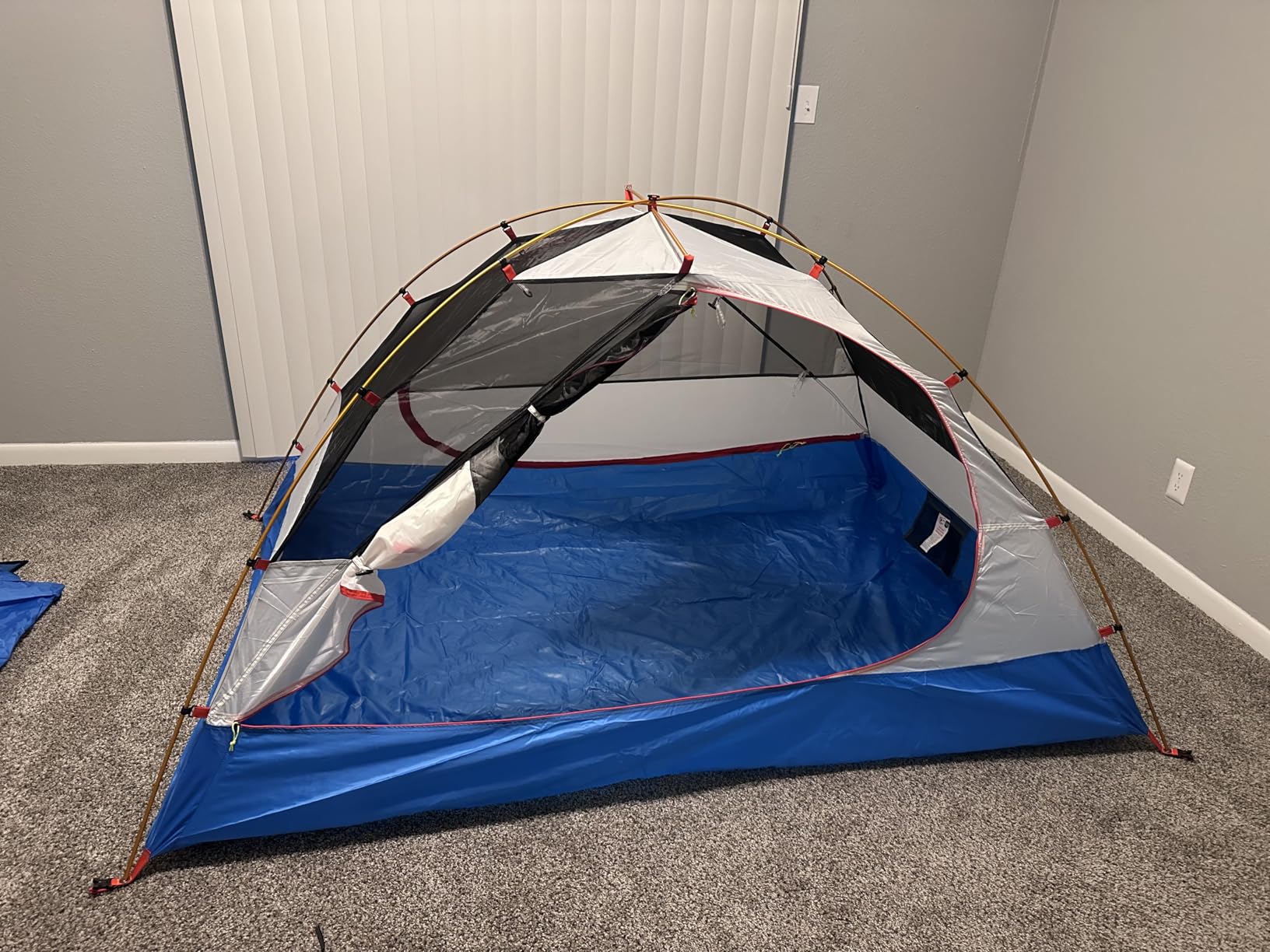
At 5.7 lb for a fully double-wall 4-season tent with 7.9 mm 7001 aluminum poles, the weight-to-specification ratio is strong. The floor is a 3000mm PU-coated 210D Oxford groundsheet, a tougher surface than the 2000mm 190T polyester roof above it, and owners highlight the 3-minute pitch and the flexibility of the layers. The 4.4 average with a 71 percent five-star share suggests solid consistency without many standout outliers.
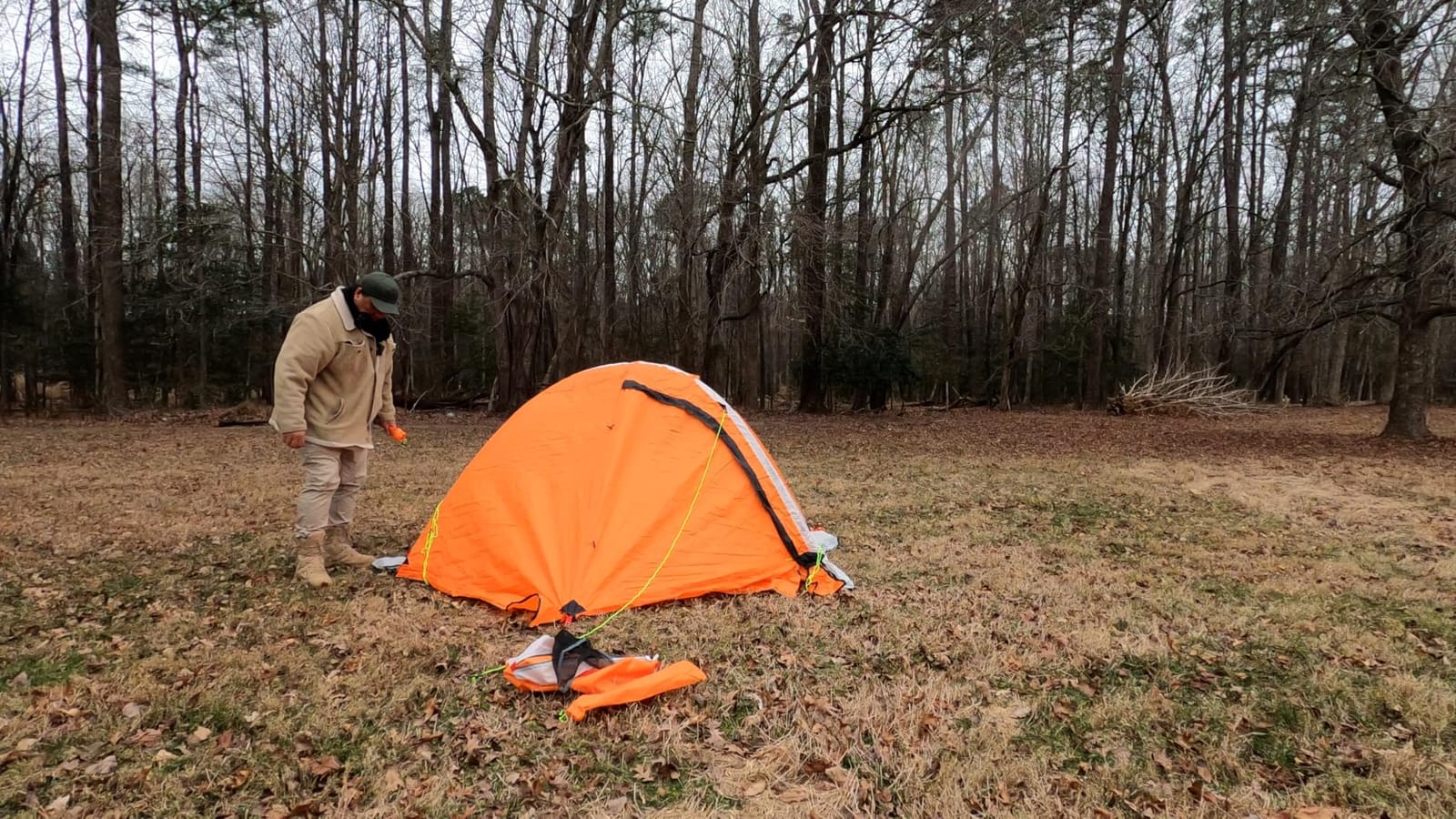
Why vents matter more than fabric weight
In a small shelter at low temperature, your breath and body moisture turn to frost on any surface they can reach. Vents let that moisture out before it deposits, which is why the mesh upper wall and twin top vents here are worth more than an extra layer of fabric would be. If condensation is your recurring complaint on winter trips, ventilation is the first spec to check on any tent.
What the lower rating reflects
The 2000mm roof rating is the lowest of the twelve, so in prolonged heavy rain you rely on seam sealing rather than a heavy coating, and included stakes and guylines are basic. For shoulder-season cold and rain that trade is reasonable; for sustained winter precipitation, pick a tent rated at 3000mm or above.
8. POMOLY Chalet 70 Pro – Best Stove Jack Design for Hot Tent Campers
POMOLY Camping Hot Tent Cabin Tent, Chalet 70 Pro Portable Wall Tents with Stove Jack and Two Poles for 2-3 Person Hiking, Backpacking (M)
54 sq ft cabin interior
98.4 x 78.74 x 59.1 in
2500mm fly
Fireproof floor with ember mat
Stove jack
Pros
- Integrated fireproof silicone and fiberglass ground sheet with ember mat
- Seams inspected clean with no pinholes
- Two-pole setup that packs down smaller than expected
- Two opposing roll-up doors with side rain curtains
- Strong heat retention for a fabric tent of this size
Cons
- No high vents so condensation builds fast in cold weather
- Doors cannot fully seal against wind and cold
- A queen air mattress is a tight fit
- Included stakes are bulky enough that owners replace them
The feature that separates this tent from most other hot tents here is the floor. A 100 percent 70D plaid ripstop shell over an integrated fireproof silicone and fiberglass ground sheet, with an ember mat included, is a direct answer to the single biggest safety objection people raise about stoves inside tents.
Two 7001 aluminum alloy main poles with two sets of guylines and eight tie-down points give you more anchoring options than most, and owners report solid seams with no pinholes on inspection. The cabin shape at 54 square feet with a 59.1 inch peak is closer to a small room than a tent, and the two opposing roll-up doors with side rain curtains let you cook in the rain without wetting the interior. In winter, those same doors are the stove air intake.
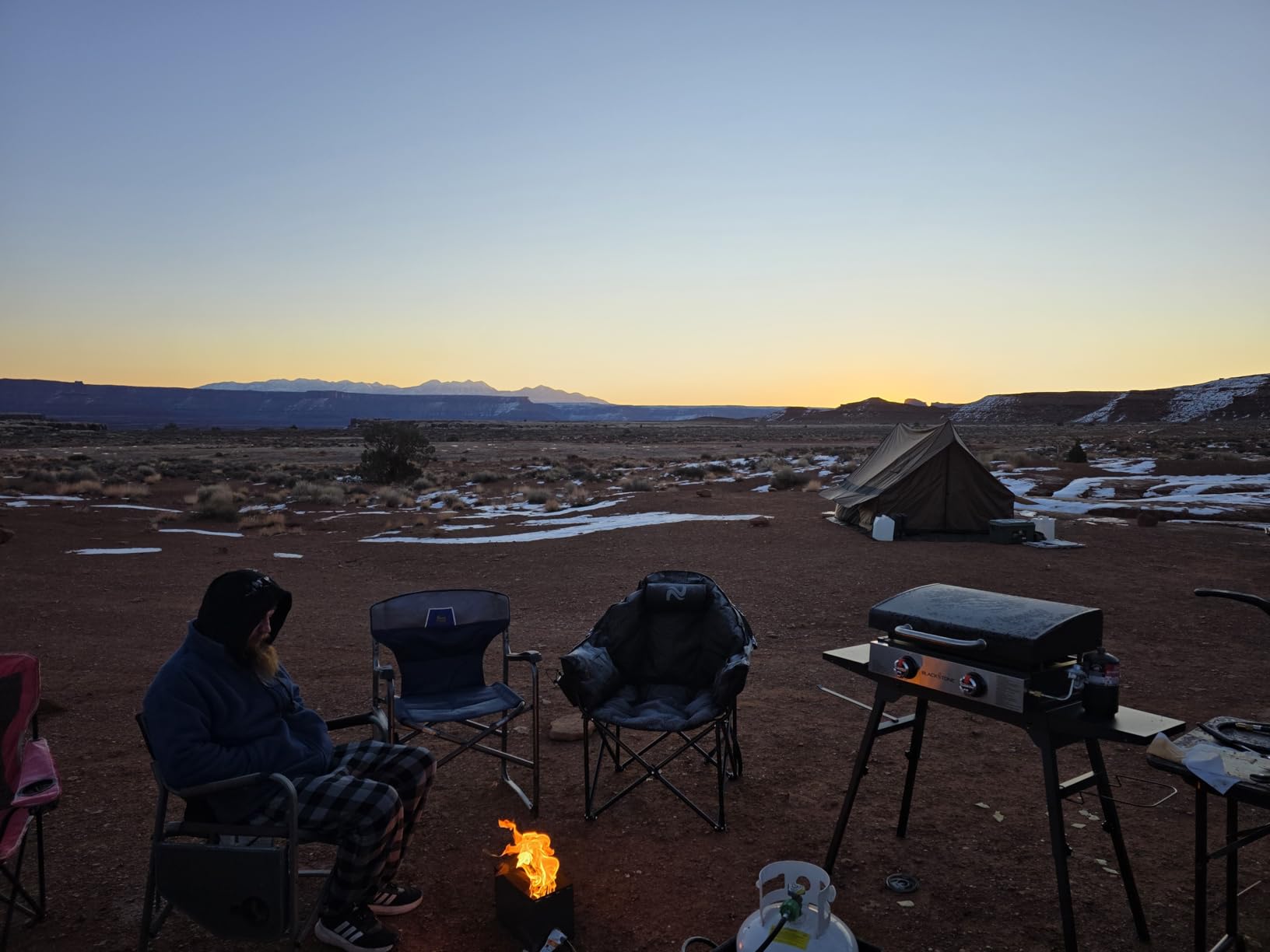
Heat retention is the reported strength: owners describe the tent holding heat as well as or better than other hot tents in its class, and treating the fabric as a warm dark shell rather than an insulator.
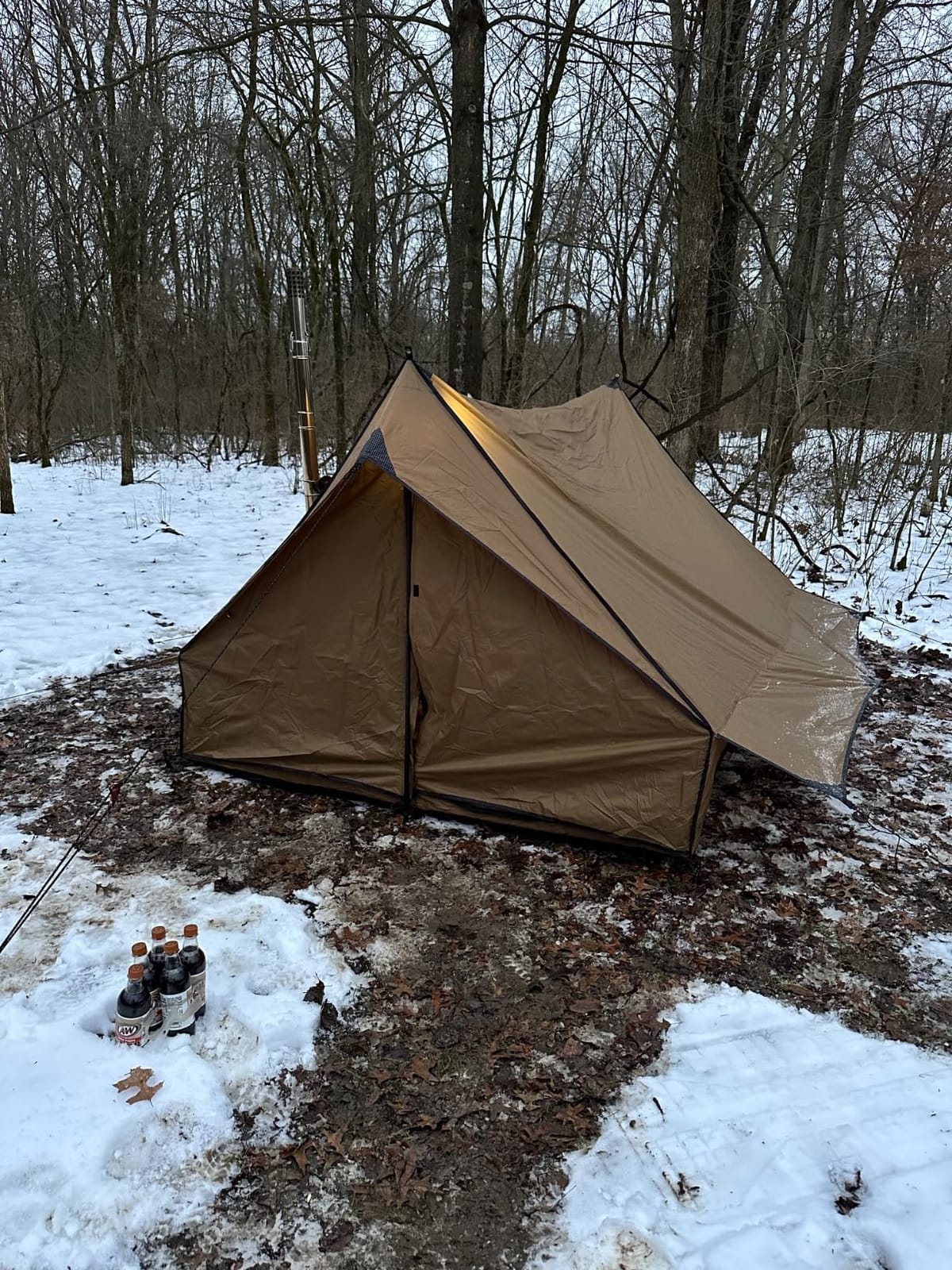
Read the venting warnings carefully
There are no high vents on this tent, and owners report condensation building intensely in cold weather as a direct result. That is the central trade-off of a fabric hot tent: the same tight cabin that holds heat also traps the moisture your stove and your body produce, so plan on a deliberate venting routine and make sure any stove carries a low-oxygen shutoff certified to CSA 4.98 or ANSI Z21.103.
Who should pass on it
The solid fabric door covers have no zipper over the mesh, so the tent will not seal against wind and cold, and in genuinely freezing wind that defeats the purpose of a shelter. The 2500mm fabric is also a low rating among the twelve, and a queen air mattress is a tight fit inside. The 4.2 average and 7 percent one-star share reflect those limits, so treat this as a shoulder-season and mild-winter shelter with a genuinely good floor.
9. Naturehike Massif Hot Tent – Best for Basecamp Livability
Naturehike Massif Hot Tent with Stove Jack, Waterproof Windproof 4 Season Tent, 2/4 Person Cold Weather Winter Tents for Camping
10.47 lb packed, 7.3 lb trail
141.7 x 90.6 x 57.1 in
89.13 sq ft floor
Stove jack
7001 aluminum cross frame
Pros
- Room hall and porch layout gives real livability for two
- Stove jack and hall create a semi-private warm space
- 7001 aluminum cross frame holds in poor weather
- Two ventilation windows plus a breathable mesh inner
- Packs to 20.5 x 9 x 6.7 inches
Cons
- Peak height of 57.1 in is low for a stove tent
- Footprint makes it impractical to carry far from a vehicle
- Stakes and wind ropes must be firmly fixed before using a stove
- Rating sits below most of the group
The Massif is designed around a layout rather than a shape. A sleeping room, a hall and a 10 square foot vestibule give you somewhere to put wet gear, a sheltered place to sit and a defined boundary for the stove, and that zoning is what turns a tent into basecamp living space.
It also ships with a stove jack and snow skirt, and the instructions are explicit that stakes and wind ropes must be firmly fixed before a stove is used inside. We would add a second layer of caution: any combustion heater in a tent needs a low-oxygen shutoff to CSA 4.98 or ANSI Z21.103.
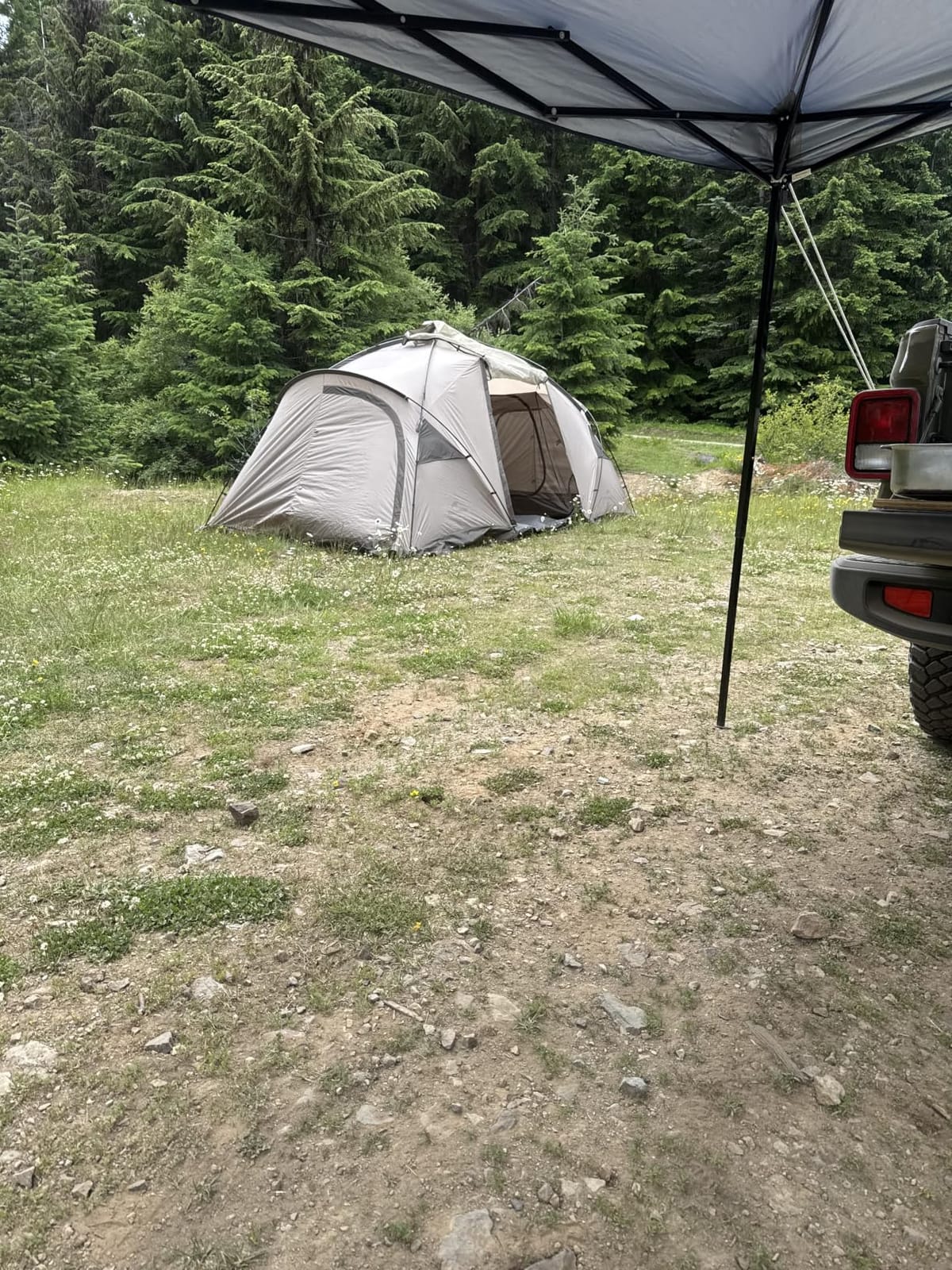
At 89.13 square feet it is the largest hot tent here and still packs to 20.5 by 9 by 6.7 inches, smaller than the Naturehike Dune bundle despite the bigger floor. The 30D silicone-coated fly over a 70D nylon inner balances weight and durability well, and two ventilation windows with a breathable mesh inner are the mitigation for the condensation that comes with a large interior. Owners report the layout working in practice for two people through winter trips.
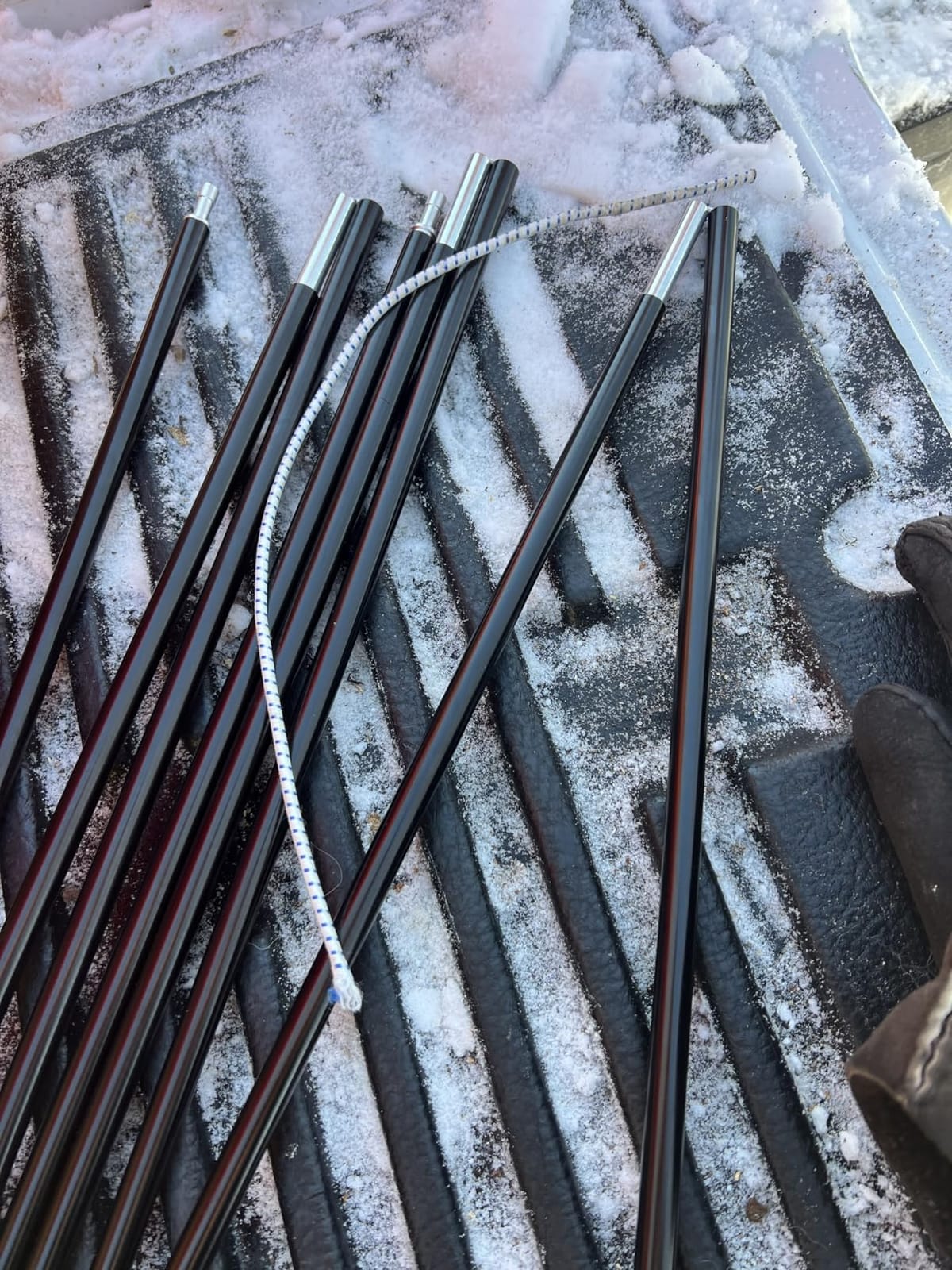
What livability actually buys you
Basecamp living is the difference between surviving a night and enjoying a week. A hall gives you a place to sit upright, dry gloves and cook without cooling the sleeping chamber, and the vestibule keeps boots and packs out of the wind, so if you are in one site for more than two nights that layout is worth more than an extra pound of weight savings.
The compromises to accept
The 57.1 inch peak is low for a hot tent, and a stove plus a seated adult is exactly where low ceilings become frustrating. The footprint also makes this impractical to carry far from a vehicle, so it is a basecamp shelter rather than a walk-in camp, and the 4.3 average with a 6 percent one-star share suggests a good product with a small number of owners unhappy enough to score it low.
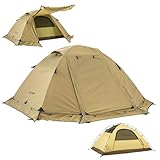
10. BISINNA 4 Season Winter Tent – Best for Scout and Group Camp
BISINNA 4 Season Tent for Backpacking Lightweight Winter Tents 2 Person
6.4 lb packed
82.6 x 59 x 43.3 in
210T polyester PU 3000mm
Rollable snow skirt
Two aluminum poles
Pros
- Owners report staying warm with a dry fly in 25 degree conditions
- Freestanding two-pole design pitches solo
- Waterproof foyer for wet boots and gear
- Packs to 18 x 7 x 7 inches
- Rollable snow skirt extends the season
Cons
- Interior runs small and length is tight near 6 ft 4 in
- Bottom fabric and fly are thinner than photos suggest
- One report of aluminum poles snapping after two weeks
This is the tent our testers would hand to a troop leader running a winter camp. It is simple, it is cheap to replace when a kid puts a pole through it, and owners report it holding warmth with a dry interior at around 25 F during a Boy Scouts winter Klondike camp.
The double layer of mesh and fabric, two doors and two windows give the ventilation that bigger tents often lack, and a single person can pitch it with two aluminum poles and hooks in a couple of minutes.
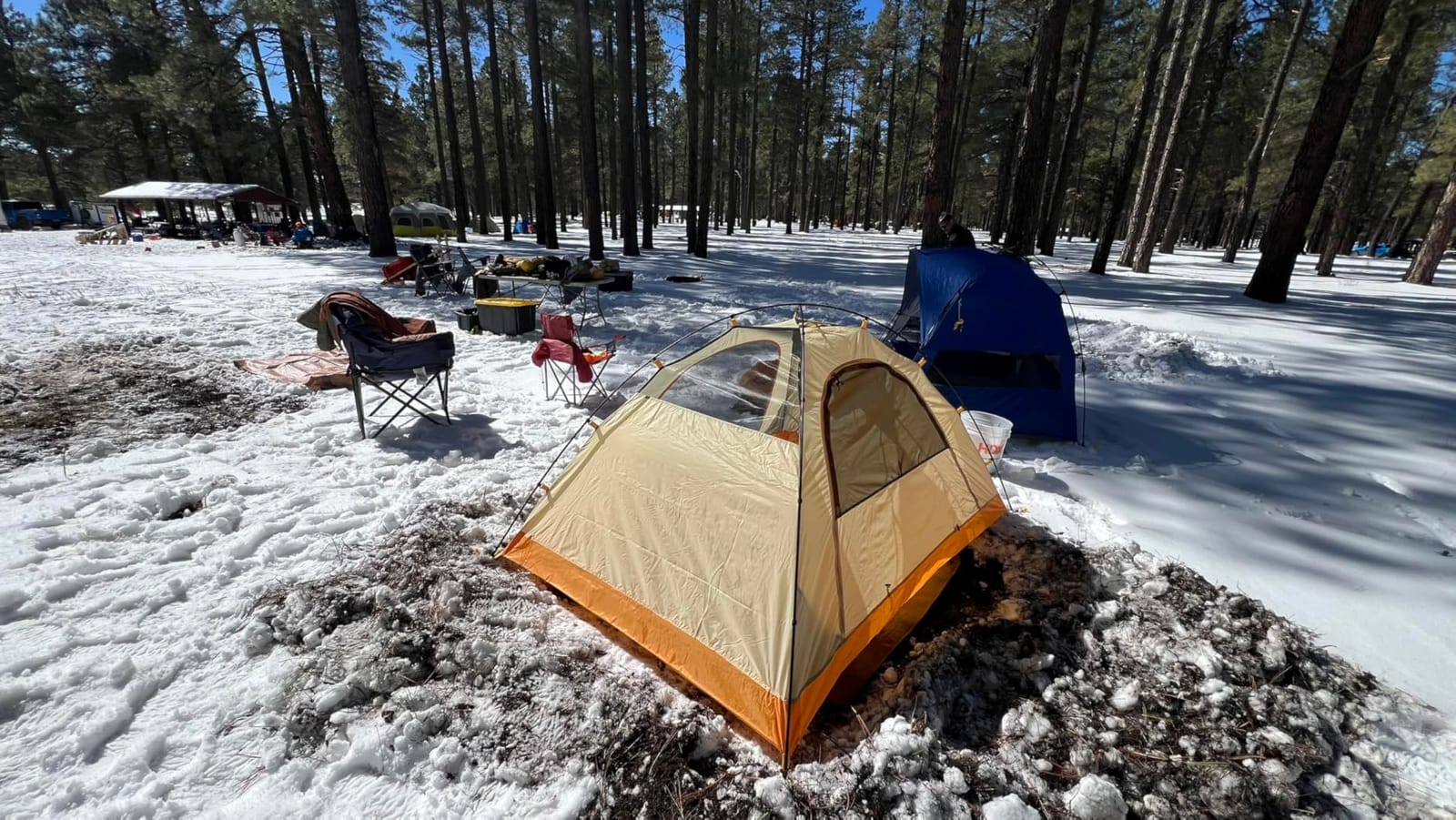
Group winter camping punishes expensive gear. What matters is that a shelter is easy to pitch, easy to replace and does not trap condensation, and this one clears all three at a price point that suits a set of tents. Its 6.4 lb weight packs to 18 by 7 by 7 inches, so a group leader can carry a spare or a repair kit alongside their own.
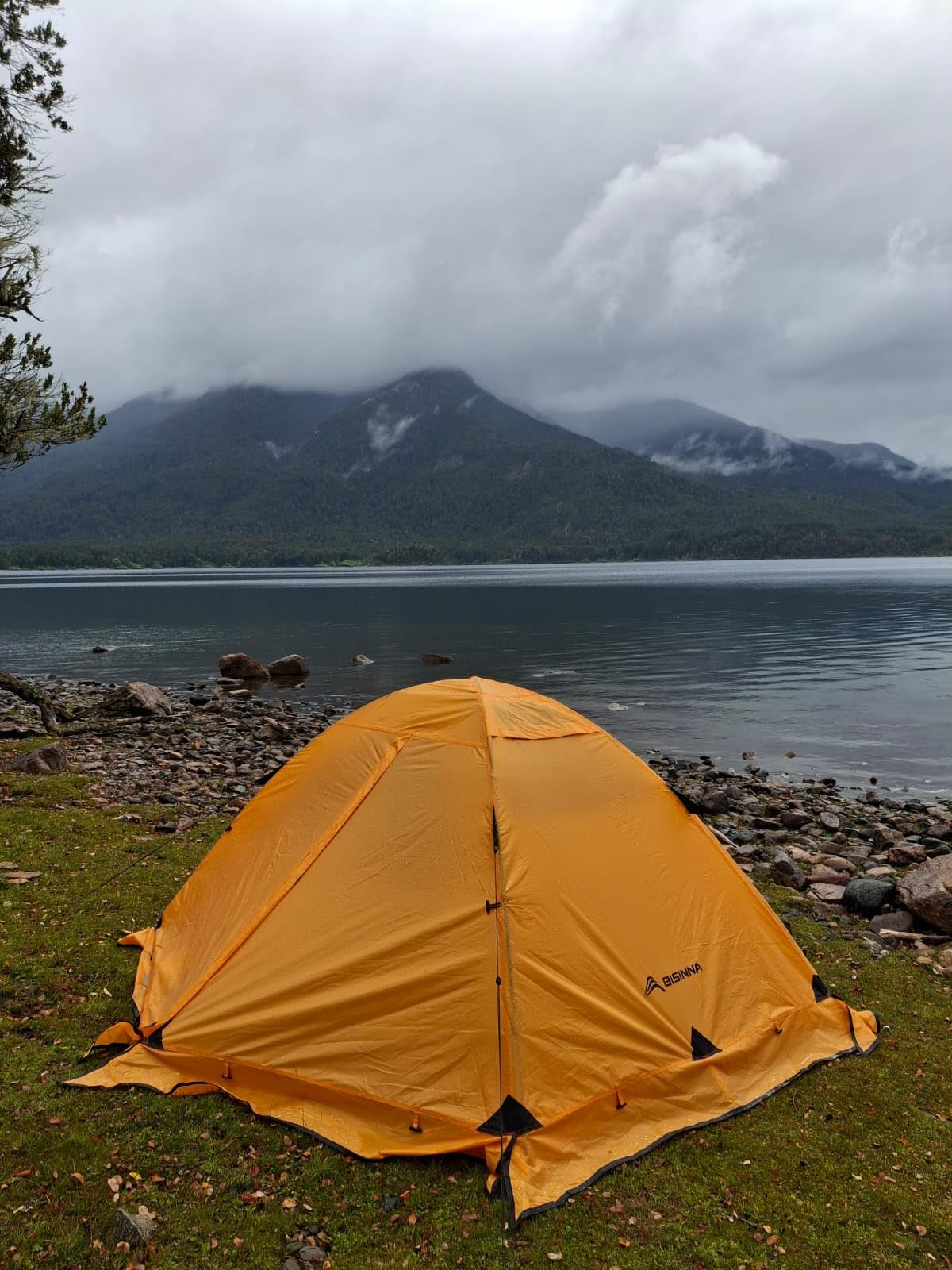
Where it earns its place
The waterproof foyer, a covered area outside the inner tent, gives wet boots and a pack a dry home they would otherwise bring into a small interior, and owners consistently single out fabric quality as a surprise for the price while reporting no drafts and no condensation at that scout camp.
The limits to plan around
The advertised two-person interior is snug, several owners treat it as a one-person tent, and length is tight for campers around 6 ft 4 in. The bottom fabric and fly are thinner than the product photos imply, and with 69 ratings the long-term durability record is thinner than the other tents here, with one owner reporting aluminum poles snapping in multiple places after two weeks.
11. ShinHye Ultralight 4 Season Tent – Best Sealed Seams and Venting
1/2 Person Backpacking Tent for 4 Season, Winter Ultralight Extreme Cold Weather Tents for Camping Easy Setup Waterproof Double Layer Tent for Family Outdoor Hiking Mountaineering (Green- 2 Person)
5.5 lb packed to 16 x 7 x 7 in
86.6 x 55 x 43.3 in outer
4543 sq in floor
PU 5000mm
Two doors and two vents
Pros
- PU 5000mm coating with double-stitched sealed seams
- Snow skirt blocks cold wind at the fly base
- Two doors and two vents move air and reduce condensation
- Packs to 16 x 7 x 7 inches at 5.5 lb
- 8.5 mm 7-series aluminum alloy poles
Cons
- Review base of 57 ratings is among the thinnest
- Warranty runs only 90 days
- 41.3 in interior height is modest for two
- Included aluminum stakes may be light in hard ground
The build spec on this one pairs PU 5000mm coating with double-stitched sealed seams across 210T polyester and 210D Oxford fabric, one of the stronger wet-weather builds in the group. In sustained rain and wet snow, the seams are what actually decides whether your gear stays dry.
Two doors and two vents give it a ventilation setup that most shelters in this class skip entirely, and owners report fast, easy pitching with no experience required.
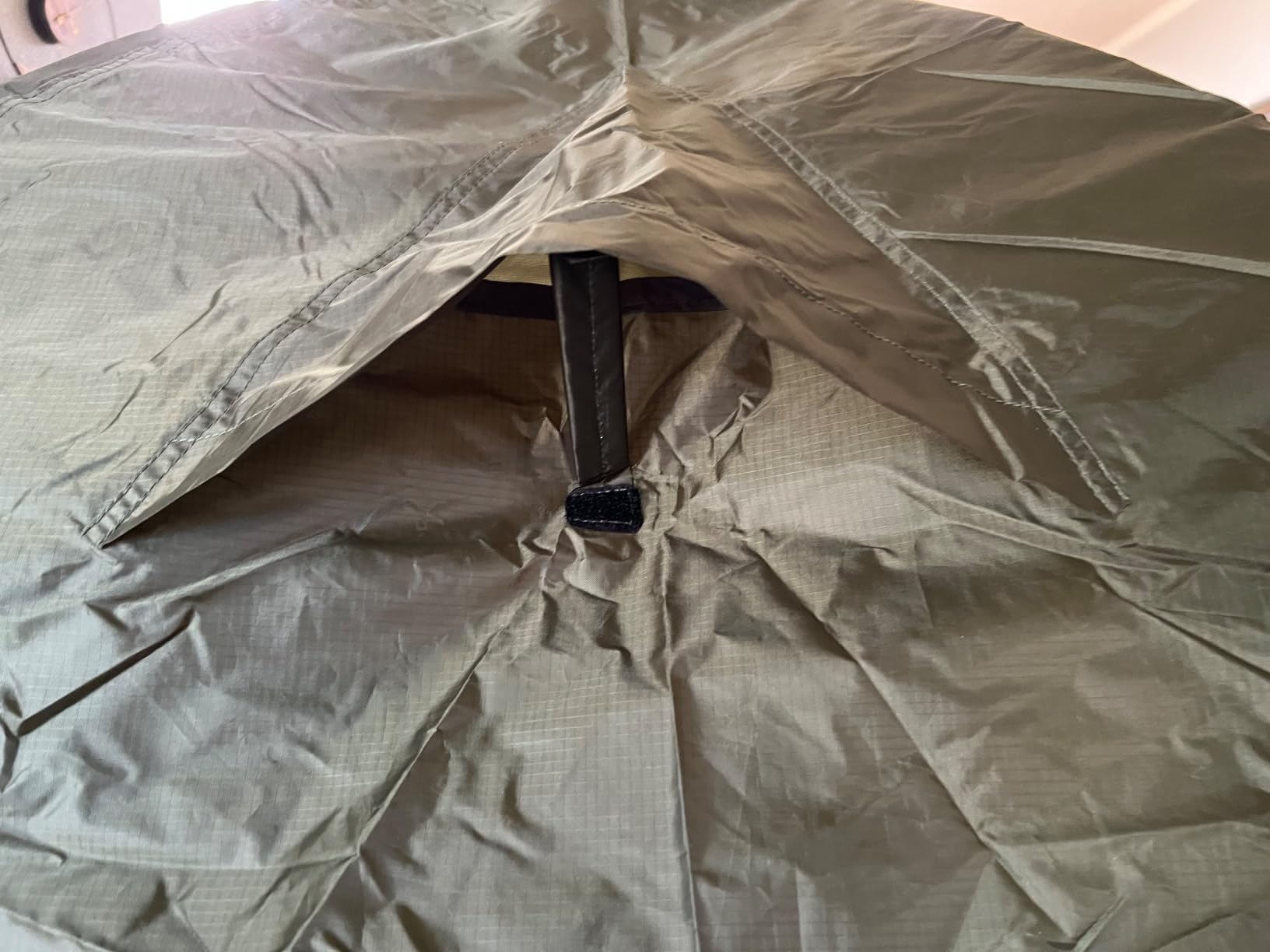
At 5.5 lb and a 16 by 7 by 7 inch packed size, it is one of the more portable 4-season double-walls here, the inner tent can be used alone in warm weather, and the snow skirt blocks cold wind and snow at the base of the fly, the specific failure point that turns a 3-season tent into a cold one in wind-driven snow.
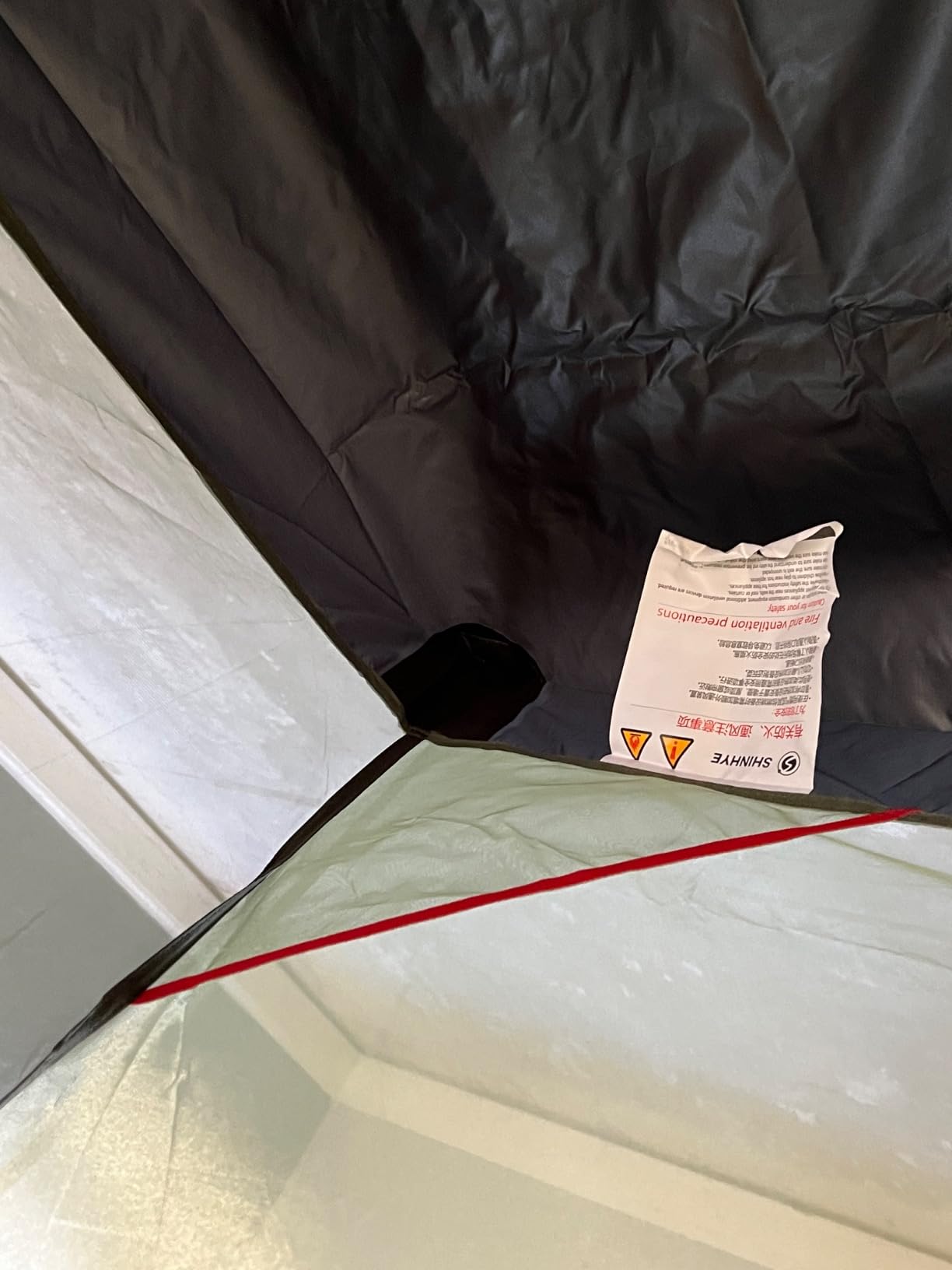
Why the warranty tells you something
A 90-day warranty is the shortest here, and it is worth weighing against the 4.5 average from 57 ratings. Short warranty plus a small review base means less long-term owner history, so treat it as a well-specified newer shelter rather than a proven one. Excellent specifications and a thin evidence base are different things, and only one of them helps you in a storm.
Where space becomes the issue
The 41.3 inch interior height is modest for two campers sitting up, and the 4543 square inch floor is comfortable rather than generous. The included aluminum stakes may be light for hard or rocky ground, so bring your own if that is your terrain, though at 5.5 lb with this level of seam sealing it is a strong pick for anyone moving through winter on foot.
12. REDCAMP Hammock Hot Tent – Best Headroom for a Stove Camp
REDCAMP Large Hammock Hot Tent with Stove Jack for Camping, Army Green
7.9 lb packed
11.8 x 6.6 x 6.2 ft
77.88 sq ft floor
Two stove jack openings
210T polyester
Pros
- Tall 6.2 ft headroom for a hot tent at this weight
- Dual stove jacks give placement flexibility
- No tent poles to carry or break at 7.9 lb
- Two 3-zipper doors also support hammock setups
- Snow skirts block drafts and ground moisture
Cons
- Tarp poles are a separate purchase
- 210T fabric is lighter than canvas hot tents
- Waterproofing relies on standard treatments and seam sealing
- Smallest review base in the group
Headroom is the feature that separates this from the other hot tents here. A 6.2 ft peak across an 11.8 by 6.6 ft floor means you can stand, move around a stove and hang wet clothing without ducking, which is the whole point of a hot tent. It is also the only pole-free design in the group: no poles to carry, no pole sections to snap in the cold and no hubbed frame to fight with gloves on, and 7.9 lb covers the whole shelter.
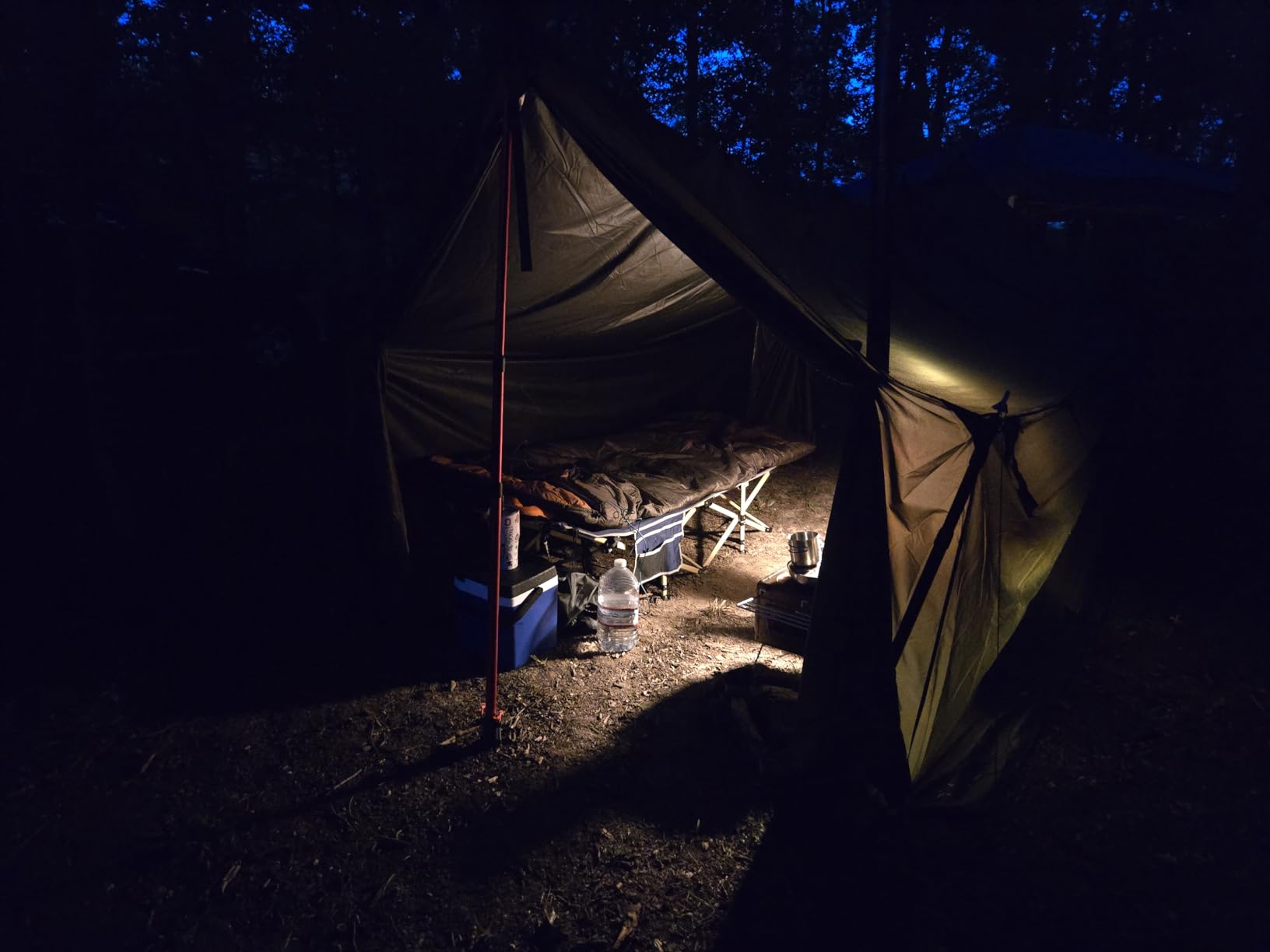
Two stove jack openings give you placement flexibility a single-jack tent does not, so you can move the stove away from the door and away from the sleeping area as conditions and wind direction change. Mesh doors and windows improve airflow in warmer conditions, and the two 3-zipper doors also work for hammock setups if you are combining a hang and a shelter in one camp.
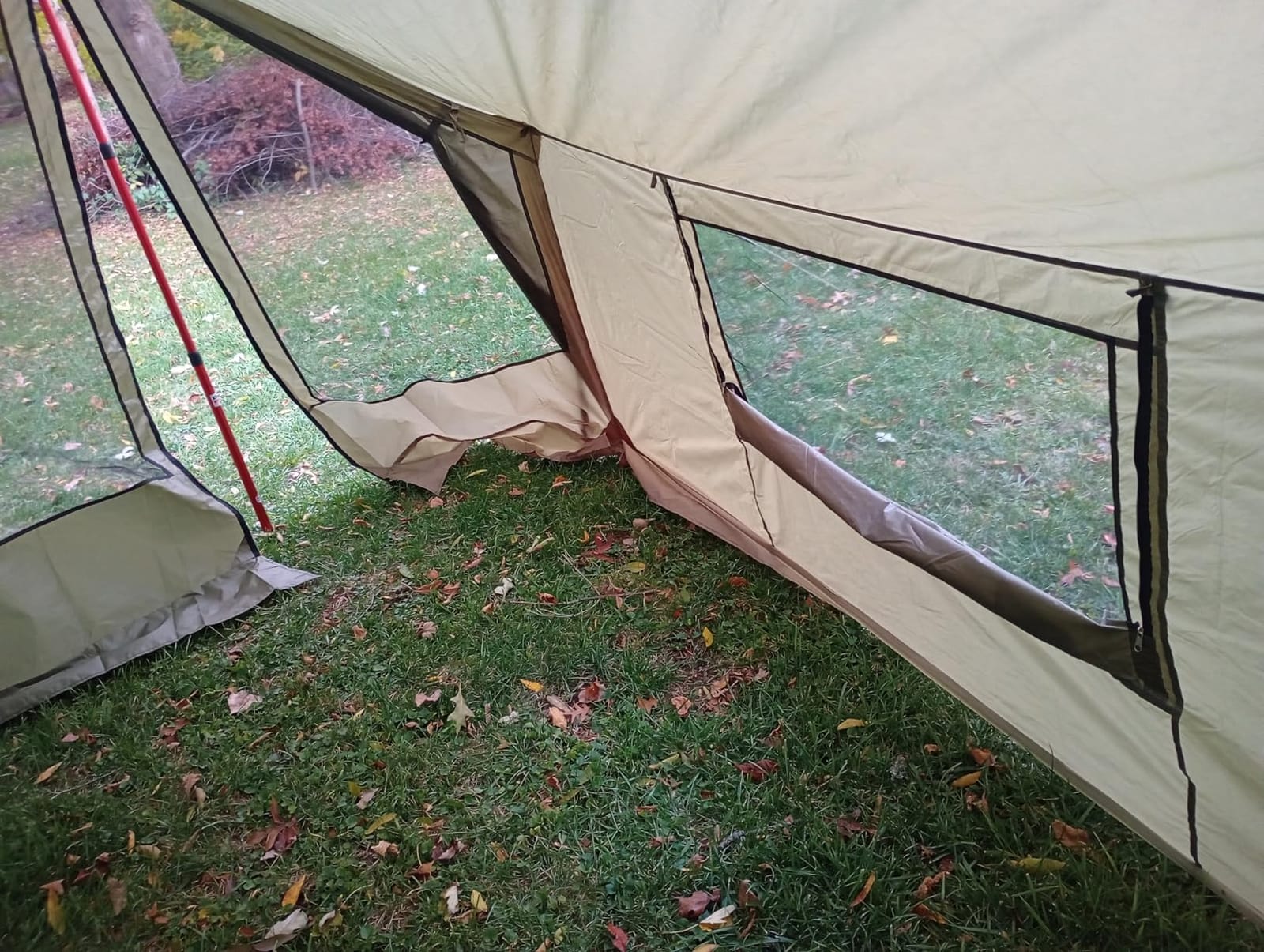
What pole-free actually costs
A pole-free tent needs a tarp pole or a ridgeline to hold its shape, and those tarp poles are not included, so budget for that before you commit and treat the stated 7.9 lb as the shelter weight alone. The six stainless-steel triangular guy line attachment points are a real strength in wind, and the snow skirts handle drafts and ground-level moisture well.
Where the evidence runs out
With 47 ratings, this has the smallest review base in the group, and 210T fabric is lighter than canvas or heavier synthetic hot tents. Waterproofing relies on standard treatments and seam sealing rather than a rated hydrostatic head, so treat it as a fair-weather fabric rather than a storm fabric, and confirm whatever stove you run carries a CSA 4.98 or ANSI Z21.103 low-oxygen shutoff before you buy.
How We Chose These Cold-Weather Tents
We scored every shelter on seven criteria in the same order, using published specifications, owner reviews and the failure modes that recur in cold-weather forums. No product reached this list on price alone.
1. Waterproofing that includes the seams. A hydrostatic head rating on a fly is meaningless if the seams are not sealed, so we weighted factory-sealed or double-stitched seams above raw coating numbers.
2. Ventilation design. Vents, mesh upper walls and doors matter more in winter than most specs suggest, because moisture that cannot leave the shelter turns to frost on the inside of your fly.
3. Pole material and geometry. Aluminum or composite poles bend under snow load instead of snapping. Fiberglass poles are the most common source of catastrophic failure reported by owners.
4. Packed weight against interior volume. A tent has to be carried, but it also has to be heated, and those two numbers pull in opposite directions. We favored shelters that are honest about both.
5. Livability for the stated occupancy. Manufacturer capacity ratings are optimistic across the category, so we compared floor area against real sleeping footprints rather than the label.
6. Pitchability in the cold. Anything that cannot be raised by one person in gloves is a tent you will resent. Freestanding frames and clip-on designs scored well here.
7. Owner evidence. We weighted review volume and specificity heavily. A tent with 2500 reviews describing snow and condensation outcomes tells you more than a spec sheet with a better number on it.
We also passed over several shelters that did not survive this screen. Cheap 3-season dome tents with mesh-heavy walls were excluded outright, because below freezing they become condensation traps rather than warm shelters. We dropped any shelter whose stated occupancy could not be reconciled with its floor area, and any hot tent without a fire-resistant floor or a clear instruction to remove the inner before burning a stove.
One more practical note. If you are planning to check conditions before you go, our weather radio picks are more useful than any tent feature when the forecast is turning.
What Actually Makes a Tent Work Below Freezing
Double-wall versus single-wall
A double-wall tent has an inner tent and a rainfly, and the trapped air between them is an insulating layer you get for free. A single-wall tent uses one fabric wall, which is warmer to the touch but far more likely to wet out from the inside.
Below freezing, that internal condensation becomes frost, and frost is the reason single-wall owners report ice on the inside of the fly even in a dry shelter.
Insulated versus uninsulated shelters
There are two ways to insulate a tent: fabric-insulated designs use thick solid canopy material, and quilted-insulated designs add loose fill between layers. Fabric insulation breathes and packs small. Quilted insulation is warmer for the weight but bulky, and most owners accept the bulk as a trade for a dark, quiet, warm interior.
Neither approach replaces a good sleep system. A 0 F sleeping bag and an R-5 closed-cell pad under your sleeping pad will do more than any tent on this list.
Pole material under snow load
Poles should be firm but flexible, so they bend rather than snap. Aluminum bends in a way that is often recoverable; fiberglass fractures. When snow accumulates, the geometry that sheds it is what protects the frame.
Every tent on this list uses aluminum poles. That alone puts them ahead of most budget 3-season tents.
Size: the smallest tent that fits
Volume is the enemy of warmth. The more air inside a shelter, the more energy your body and your stove have to replace, so the correct cold-weather size is the smallest one that fits your sleeping setup and your gear.
Ignore the capacity label. Reviewers of nearly every tent here report that a manufacturer two-person tent sleeps one comfortably and two with gear stored outside.
Wall construction weight and denier
Fabric weight is written as denier, and higher denier means thicker, more durable fabric. It also means more weight and, for many 210T and 300D fabrics, less breathability, which pushes condensation back toward you.
Look for a balance: a coated canopy for weather protection, and mesh or vents for moisture escape.
Guy-out points, snow skirts and vestibules
Snow skirts block spindrift and ground-level wind, which is where most of the cold comes from in a wind-driven storm. Multiple guy-out points let you tension the fly without leaning on the poles, and vestibules give wet boots and packs a home outside the sleeping chamber.
Reviewers consistently rank tents that cannot be pitched solo, that have a single door, or that have no vestibule as deal breakers.
Stove jacks and heater safety
A stove jack is a reinforced, usually silicone-coated opening that lets a tent stove pipe vent outside while heat stays in. It is the single feature that converts a shelter into a hot tent.
Safety is non-negotiable here. Unvented combustion in an enclosed space produces carbon monoxide, so any heater or stove used inside a tent must carry a low-oxygen shutoff certified to CSA 4.98 or ANSI Z21.103. Fire-resistant stove jack liners and a fireproof floor matter just as much, and manufacturers like POMOLY build them directly into the floor.
Seasonality, the trade nobody mentions
A 4-season tent in July is a sauna, and a hot tent with no fly insulation is worse. Many of the shelters here solve this by letting you use a layer alone, which is why modular designs such as the AYAMAYA and the Naturehike Dune earn their place on a winter list.
If you genuinely only need winter shelter once, renting is cheaper than owning a tent you will use for three months of the year.
Condensation vs Leak: How to Tell the Difference in the Field
Condensation is the loudest complaint in cold-weather camping, and it is also the most commonly misdiagnosed. It forms on the inside surface of a shelter, appears evenly or in predictable patterns, and appears most heavily where warm moist air meets the coldest surface.
A leak forms on the outside, appears in discrete spots that match a seam, a pole hole or a zipper, and spreads from that point after sustained rain.
Field diagnosis, step by step. First, look at where the water is. Inside the shelter is condensation; outside is a leak. Second, check the pattern: uniform frosting or beading across a whole panel is condensation, while a concentrated trail from one point is a leak. Third, touch test. Condensation on a single-wall canopy feels like a cool, damp film; a leak feels like a directed stream.
Managing condensation. Vent early and vent often, before the moisture has somewhere to condense. Keep the interior surface of the fly warm by staying close to it or briefly running a stove to warm the fabric. Sleep with your bag zipper slightly open to the vent so your breath escapes rather than pooling. And store anything damp outside the inner tent in the vestibule rather than bringing it into the sleeping chamber.
Moisture absorbers. DampRid-style products and rechargeable desiccants do work, and a passive absorber hanging near the peak of the inner tent can pull a surprising amount of water out of the air overnight. They are a supplement, not a fix, and they work best in a small sheltered space where the volume of water vapor is low to begin with.
One thing to set expectations on: no absorber replaces a vent. Owners who run a hot tent with no high vents, like the POMOLY Chalet 70 Pro, report heavy condensation no matter what they hang inside.
Which Cold-Weather Tent for Which Temperature
Here is the mapping we use when someone tells us how cold it is going to be. These are our judgment calls from the specifications and owner reports, not laboratory measurements, and no shelter on this list will hold a temperature on its own.
Around freezing to 40 F, shoulder season. Any 4-season double-wall here works, and at that range a 3-season tent often survives. The AYAMAYA or the BISINNA are the sensible picks because they pitch fast and vent well.
Mid 20s to low 30s F, wet snow and sleet. Choose a higher waterproof rating with sealed seams. The Clostnature at PU 5000mm and the ShinHye with its double-stitched seams and two vents are the strongest pair here. Pack a footprint for the shelter with the non-tarp floor.
Below 20 F, dry cold with wind. Insulation, floor area and wind sealing decide the outcome. The GEERTOP 2P, the Clostnature and the Underwood all have snow skirts, taped seams and aluminum frames, and all three are small enough to heat efficiently.
Single digits with a stove in camp. A hot tent changes the equation entirely. The Naturehike Dune gives you the headroom and the sealed doors, the Naturehike Massif gives you the layout, and the POMOLY gives you the fireproof floor. Any of them needs a heater with a certified low-oxygen shutoff.
Multi-day trips carrying the tent. Weight decides. At 4.4 lb the OneTigris Stella and the 4 lb Underwood Aggregator are the two lightest complete shelters here, and both are realistic to carry for days in winter conditions.
Before you travel, it is worth remembering that cold-weather gear failures usually show up as wet feet and wet insulation rather than as hypothermia directly. That is why the layering advice in our cold-weather base layer guide matters as much as the shelter choice, and why dry socks matter more than a fourth tent.
Frequently Asked Questions
How to stay warm in a tent when it’s cold?
Three levers matter, in order. First, your sleep system: a sleeping bag matched to the expected low, plus a closed-cell foam pad under your sleeping pad, because you lose more heat into the ground than into the air. Second, the shelter: the smallest tent that fits, pitched tight, with snow skirts sealed and vestibules closed. Third, heat: a hot tent with a stove jack, or a certified heater with a CSA 4.98 or ANSI Z21.103 low-oxygen shutoff. Clothing you can put on without leaving the bag matters more than any single item of gear.
What is the best winter tent with stove jack?
The Naturehike Dune is our pick for warmth, because its 70.8 inch peak and four double-layer doors give you both headroom and venting around a stove. The POMOLY Chalet 70 Pro wins on safety, with an integrated fireproof silicone and fiberglass floor and an included ember mat. The Naturehike Massif wins on layout, with a sleeping room, hall and vestibule. Whichever you choose, remove the inner tent before burning anything and use a heater with a low-oxygen shutoff.
How to eliminate condensation in a tent?
You cannot eliminate it, but you can control when it forms. Vent high before you sleep so moisture leaves as vapour rather than condensing as frost. Keep the inner surface of the fly warm by staying close to it or briefly running a stove. Leave your bag zipper cracked open to the vent so breath escapes instead of pooling. And keep damp gear in the vestibule, outside the sleeping chamber, where it cannot raise the humidity inside.
What is the best moisture absorber for a tent?
A passive desiccant such as DampRid hung near the peak of the inner tent is the most useful option, and a rechargeable silica gel product works well in small tents. The critical placement is high and central, where the air is wettest. Absorbers are a supplement, not a fix: a tent with no high vents will still build condensation no matter what you hang inside it.
Does Damprid work in a tent?
Yes, though most owners describe it as a supplement rather than a solution. It works by pulling water vapour out of the air, so it is most effective in a small, sealed tent with limited internal volume. In a large hot tent with a stove running it will fill up quickly and need regular replacement. The tents on this list that already have vents, such as the AYAMAYA and ShinHye, reduce the load on any absorber you add.
What are the best camping tents according to reviews?
Across owner reviews, the GEERTOP 2 Person Backpacking Tent leads on the balance of feedback volume, taped-seam waterproofing and dual vestibules. The Clostnature 4 Season Backpacking Tent wins on waterproofing with a PU 5000mm fly and factory-sealed seams, and the OneTigris Stella wins on light weight at 4.4 lb. Among hot tents, the Naturehike Dune is the most consistently praised for heat retention and storm survival.
Do 3-season tents work in winter?
They survive shoulder season, roughly above freezing, and owners routinely push them a little colder in dry conditions. Below that, mesh walls lose heat, light poles can snap under snow load, and there is rarely a snow skirt to stop spindrift. If you want one shelter that genuinely handles winter, choose a 4-season design with aluminum poles, sealed seams and a snow skirt, and use a 3-season tent for the rest of the year.
Is fiberglass or aluminum better for winter tent poles?
Aluminum is the better choice, and every tent on this list uses it. The important property is that poles should be firm but flexible so they bend under snow load rather than fracturing. Fiberglass poles snap, and owners report those failures repeatedly in high wind and heavy snow. Pole diameter matters too, since wider poles resist bending under a loaded fly. The advantage only shows up when the tent is properly tensioned and guyed out.
Our Verdict on the Best Camping Tents for Cold Weather
The GEERTOP 2 Person Backpacking Tent is our pick for the best camping tents for cold weather, because its 6.9 lb packed weight, taped-seam 3000mm fly, snow skirt and dual vestibules cover the actual failure points in winter: wind-driven snow, moisture, and nowhere to put wet gear.
Buy the Clostnature instead if water is the problem, since its PU 5000mm coating and factory-sealed seams are as strong as any here. Buy the OneTigris Stella if the tent is going on your back, and the Underwood Aggregator if you are camping alone and want the smallest warm space you can find.
If you plan to run a stove, start with the Naturehike Dune for warmth and headroom, the POMOLY Chalet 70 Pro for its fireproof floor, or the Naturehike Massif for a basecamp layout. Whichever route you take, pair it with a certified low-oxygen shutoff, a closed-cell pad under your sleeping pad, and a real look at the forecast before you drive out. Our guide to cold-weather equipment behaviour covers the other side of the same problem if you are winterising gear at home.