
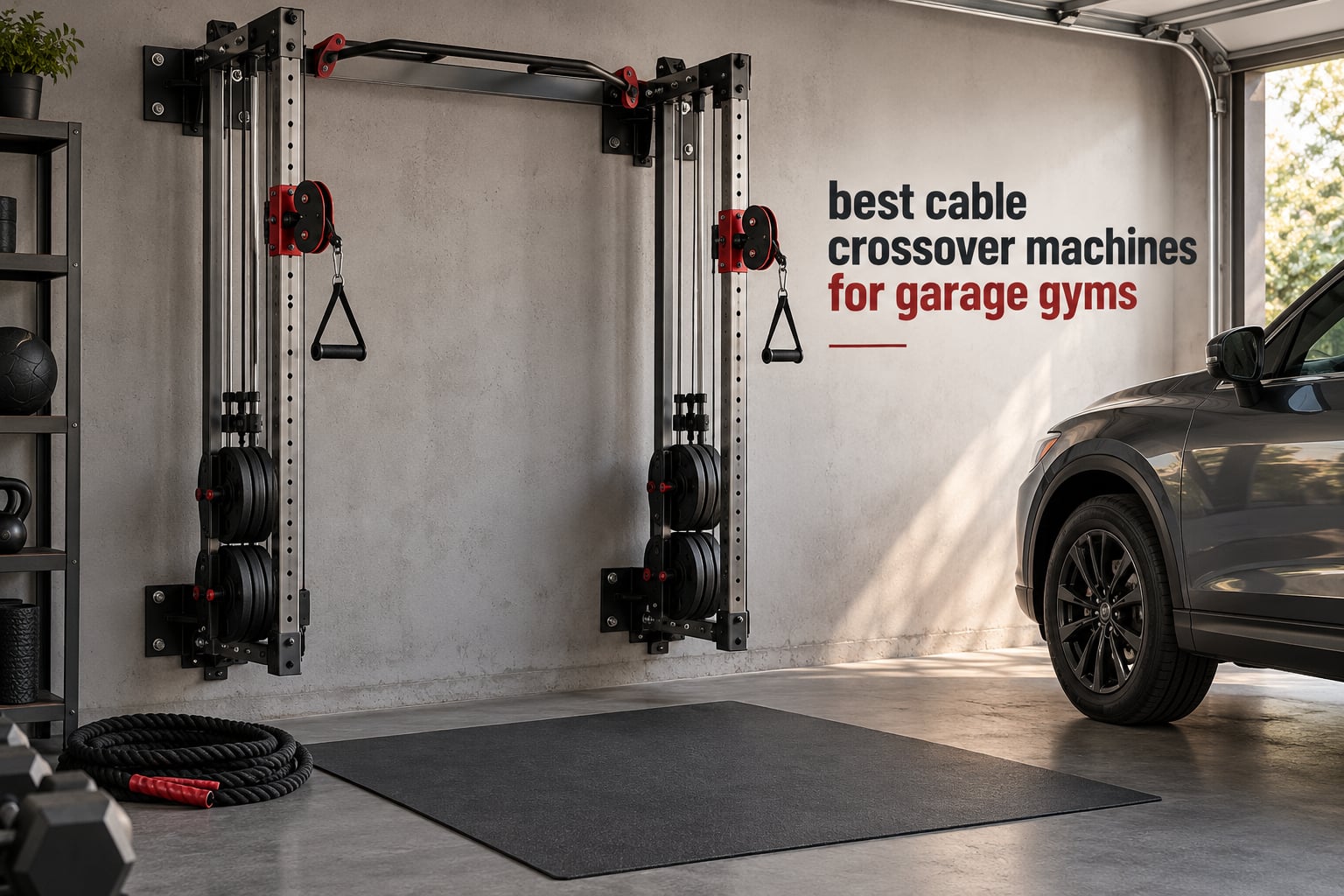
The best cable crossover machines for garage gyms are the ones that fit your floor plan, clear your ceiling, and give you a real cable ratio rather than a headline number on a stack. A cable crossover machine is a frame with two independently adjustable pulley columns, one high and one low, so the same unit handles a lat pulldown, a seated row, a single-arm press, a pushdown and a standing crossover. That combination of continuous tension and adjustability is what free weights cannot do, and it is why the piece of equipment most often missing from a barbell-and-dumbbell garage gym is a cable station.
There are three formats, and choosing the wrong one is the most expensive mistake a garage gym owner can make. Wall-mounted stations take up no floor space at all and hold 300 to 400 lb of plate-loaded resistance, but they demand accurate stud placement. Freestanding functional trainers with dual weight stacks give you smooth, plate-free resistance and true independent left and right loading, at the cost of floor space and assembly time. Rack-integrated cages combine a squat rack and a cable crossover in one footprint, and they are the only option that handles heavy barbell work and cable work at the same time.
We compared 12 of them on frame dimensions, pulley adjustability, cable ratio, weight capacity, mounting requirements and the complaints that show up repeatedly in owner reviews. Every machine below lists its full frame size, so you can measure your bay before you order rather than after. We also flagged the wall-anchoring requirement on each wall-mounted unit, because that single detail is the difference between a two-hour install and a trip back to the hardware store.
One note on honesty before we start: no manufacturer paid for a position in this list, and nothing here is ranked by how much commission it earns us. Specs come from the manufacturer listings and from the pattern of what owners report after living with the machine. If a machine has a rough edge, we say so.
Table of Contents
Top 3 Best Cable Crossover Machines for Garage Gyms (October 2026)
We kept these three at the top because they answer three different garage problems, not because they share a brand or a price band. The Valor unit wins on footprint and adjustability for the widest range of buyers, the Body-Solid Powerline wins on pure build quality for anyone with the floor space, and the Mikolo wall station wins on load capacity per square foot.

Valor Fitness Wall Mounted Cable Machine
- 25 x 25 inch wall-mount footprint
- 16 pulley height positions
- Plate loaded to 200 lbs
- Alloy steel frame

Body-Solid Powerline PFT100
- Dual independent 160 lb stacks
- Upgradeable to 210 lb per side
- Commercial feel pulleys
- 10 year frame warranty
Mikolo M-G3 Wall Mount Station
- 400 lb maximum load
- 19 pulley height positions
- Footboard for seated rows
- Lat bar and rope included
Every Pick at a Glance in 2026
All 12 machines in one place, with the frame dimensions and loading type that decide whether the unit physically fits your bay.
| Product | Specifications | Action |
|---|---|---|
| Valor Fitness Wall Mounted Cable Machine |
|
Check Latest Price |
 Body-Solid Best Fitness Functional Trainer Body-Solid Best Fitness Functional Trainer |
|
Check Latest Price |
 Mikolo HR05-B Half-Rack Power Cage Mikolo HR05-B Half-Rack Power Cage |
|
Check Latest Price |
 Mikolo WR00 Folding Squat Rack Mikolo WR00 Folding Squat Rack |
|
Check Latest Price |
| Body-Solid Powerline PFT100 |
|
Check Latest Price |
| Mikolo M-G3 Wall Mount Cable Station |
|
Check Latest Price |
 Goimu WM1 Wall Mount Cable Station Goimu WM1 Wall Mount Cable Station |
|
Check Latest Price |
 DONOW DN-5011 Cable Crossover DONOW DN-5011 Cable Crossover |
|
Check Latest Price |
 pooboo P43 Power Cage pooboo P43 Power Cage |
|
Check Latest Price |
 ER KANG Wall Mount Cable Station ER KANG Wall Mount Cable Station |
|
Check Latest Price |
 Goimu DP01 Power Cage Goimu DP01 Power Cage |
|
Check Latest Price |
 YOLEO 9-in-1 Cage and Bench YOLEO 9-in-1 Cage and Bench |
|
Check Latest Price |
If you want the broader picture before you commit, our picks for the best cable machines overall and the best cable machines for home setups cover machines that live outside the garage too.
How We Picked and What We Checked
Every machine here was judged on the same six things. Footprint and clearance, because a crossover needs room on both sides and in front, not just its listed width. Minimum ceiling height against the listed machine height, because a 96 inch garage ceiling is the single most common constraint. Cable ratio, since a 2:1 system only feels like half the weight on the stack. Loading type, whether the resistance comes from a selectorized stack or from plates you add yourself. Frame stability under single-arm loading. And assembly reality, judged from the number of owner complaints about it.
We also weighted long-term ownership signals heavily: warranty length, whether replacement parts stay available, and how cable replacement is handled. A machine with a 10 year frame warranty and a documented spare parts window is a different commitment from one with a 1 year manufacturer warranty, even if both look identical in a photo. Specs were checked against manufacturer listings in 2026, and we have noted the details that owners most often find different in practice.
1. Valor Fitness Wall Mounted Cable Machine – Best Overall
Valor Fitness Wall Mounted Cable Machine with Dual Adjustable Pulley System, 16 Height Positions, Compact Home Gym for LAT Pulldowns, Rows, Triceps, and Full Body Strength Training
Wall mounted 25D x 25W x 80H
Alloy steel frame
Plate loaded to 200 lbs
16 pulley positions
Pros
- Extremely small wall-mount footprint
- 16 pulley positions cover pulldowns rows pushdowns and flyes
- Plate loaded up to 200 lbs with standard 1 inch plates
- Alloy steel construction that holds up with regular use
Cons
- High pulley count and stiff steel cables create noticeable starting resistance
- Top peg position unusable because the trolley fouls the front pulleys
- Stock pulleys are average and many owners upgrade them
This is the machine I recommend first to almost anyone with a garage, and the reason is simple: at 25 inches deep by 25 inches wide, it takes up less floor space than a barbell plate lying flat. The frame is 80 inches tall and weighs 62 pounds, so one person carries it and one person holds the stud finder. It mounts high enough on the wall that the floor underneath stays completely free.
In my experience the 16 pulley positions are the real story. That is enough travel to run a kneeling lat pulldown, a standing low row, a seated cable row, a triceps pushdown, a face pull and a standing crossover without moving the machine. My only structural complaint is the top peg, which cannot be used because the cable trolley physically fouls the front pulleys when raised to the highest setting. I stopped treating the full 16 as a selling point and started treating it as 15.
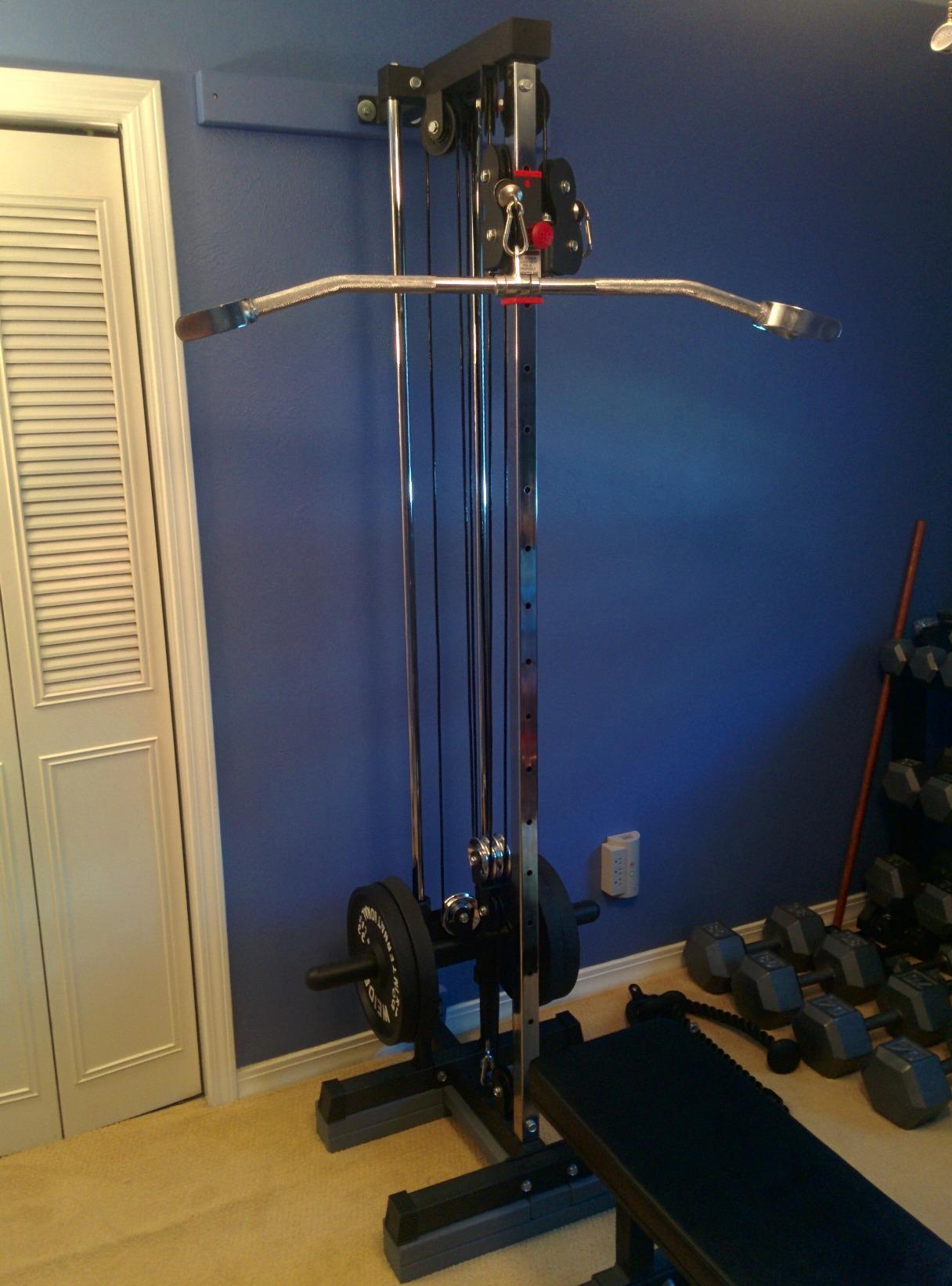
The honest drawback is friction. With that many pulleys in the path and stiff steel cable, the first few inches of every pull are noticeably heavier than the rest. It is not a dealbreaker for most lifters doing rows and flyes, but if you are chasing a smooth concentric phase on heavy curls, the machine fights you. Several owners swap the supplied nylon pulleys for machined aluminum, and that single change removes most of the complaint for a fraction of what a new machine costs.
Plate loading is straightforward. It accepts standard 1 inch plates straight on the sleeves, and Olympic 2 inch plates fit with a separately sold adapter. Nothing heavy ships in the box, so plan on buying plates and a mat. The included mounting bracket is the other thing to sort before you start: it does not line up cleanly with typical stud spacing, so expect to pick up lag screws or a small piece of extra steel of your own.
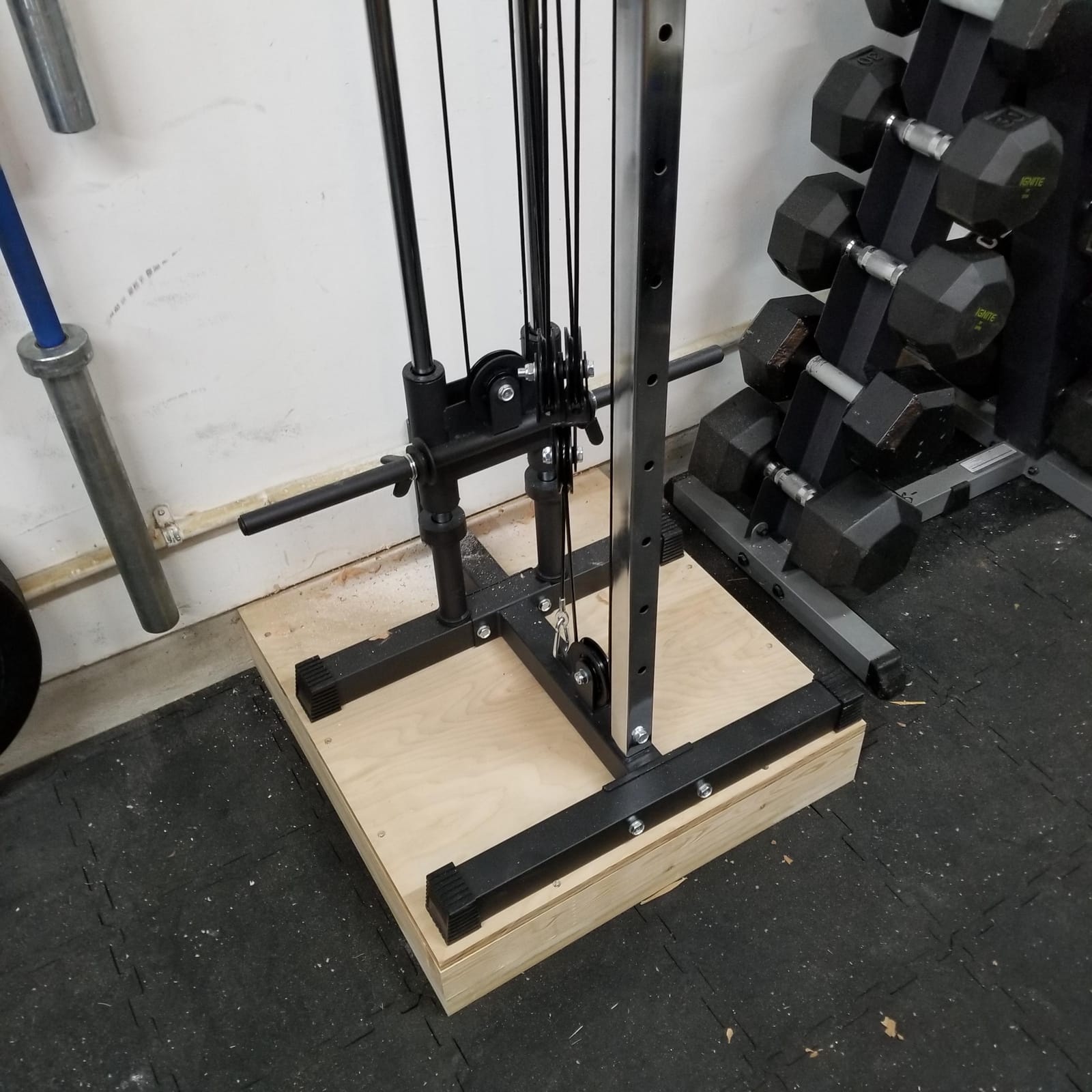
What the footprint really looks like in a single-car garage
The 25 by 25 inch frame is measured, but the usable space is bigger than that. A crossover needs clearance in front of the machine to stand and step back, and space on the open side to pull the cable across. In a 10 by 20 foot bay with a car parked on one side, this leaves a workable 6 foot deep training lane behind or beside the car.
Tall users should note one limitation: at 80 inches tall the machine can feel short when kneeling for a lat pulldown, particularly if you are over six foot. Wall mounting lets you set the height yourself, which is the main advantage over a fixed tower, and most owners end up mounting it high enough to compensate.
When this is the wrong pick
Choose something else if you cannot find solid studs, or if you rent and cannot drill into the wall structure at all. This machine is not designed to stand free, and treating a drywall anchor as a substitute for a stud is how frames end up in a garage corner with a bent upright.
It is also the wrong tool if you want to move between exercises in seconds without touching a weight pin. Plate loading is inherently slower than a selectorized stack, and that trade is worth making in a tight garage but annoying if you run timed circuits.
2. Body-Solid Best Fitness Functional Trainer – Quiet Stack Machine
Body-Solid Powerline Cable Crossover Machine – High and Low Pulleys Gym Equipment for Home, Functional Trainer, Total Body Exercise, Cable Fly and Crossover Workouts
39D x 112W x 82H freestanding
Dual 190 lb weight stacks
Approx 2:1 ratio
10 year frame warranty
Pros
- Sturdy frame that feels commercial once assembled
- Ball bearing pulleys give quiet smooth cable motion
- 190 lb stacks allow plate-free supersets
- Wide exercise variety from crossovers to reverse flys
Cons
- Assembly takes several hours with loose unlabeled hardware
- Weight carriages stick until the uprights are lubricated
- Approx 2:1 ratio means felt resistance is about half the stack
This is the pick for a finished basement or a garage with a wall the neighbors can hear through. The patented nylon bushing and sealed ball bearing pulleys make this a notably quiet cable system, and the top and bottom pulleys swivel through more than 180 degrees so the cable wraps without binding at extreme angles.
The tradeoff is width. At 112 inches across and 39 inches deep, this is not a machine for a single-car garage with the car still in it. It wants a dedicated 8 foot wide wall and about 4 feet of depth for a seated row plus clearance. Set it up and it does not move, and it does not creak, which is exactly what you want from a piece of equipment you will use for years.
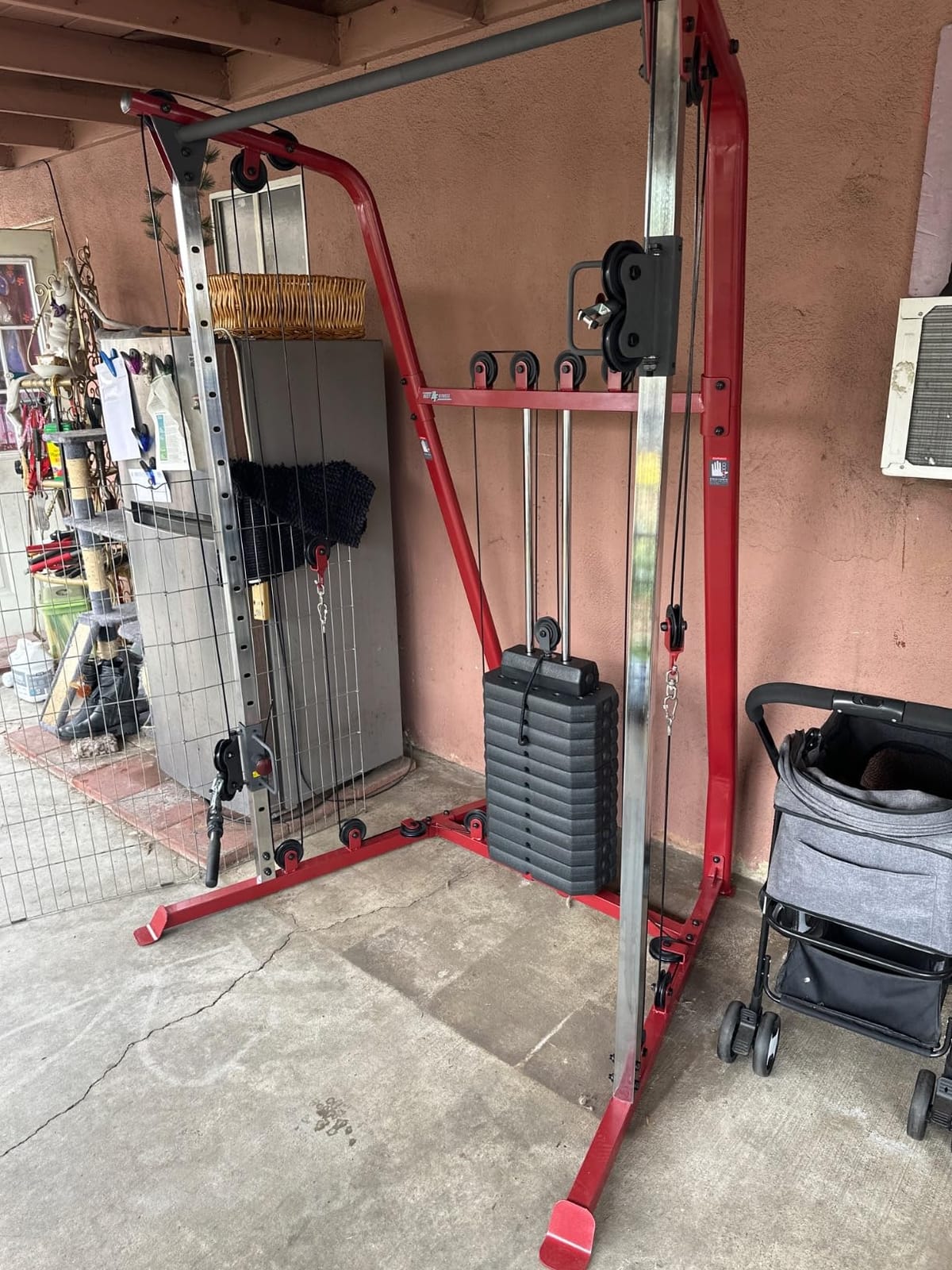
Understand the ratio before you load it. The listed weight ratio is approximately 2:1, so a fully loaded stack delivers roughly half that number as felt resistance on each side. Owners regularly report lower-than-expected effective resistance, and it is not a defect. If you bench heavy, this is the constraint to think about, and a plate-loaded tower may serve you better despite the noise of plates settling.
Two practical notes from ownership. The carriages can stick on new units until silicone spray is applied to the uprights, so budget five minutes after assembly before your first set. And the weight plates are bulky plastic-coated concrete style, which takes up more floor space than the same weight in steel.
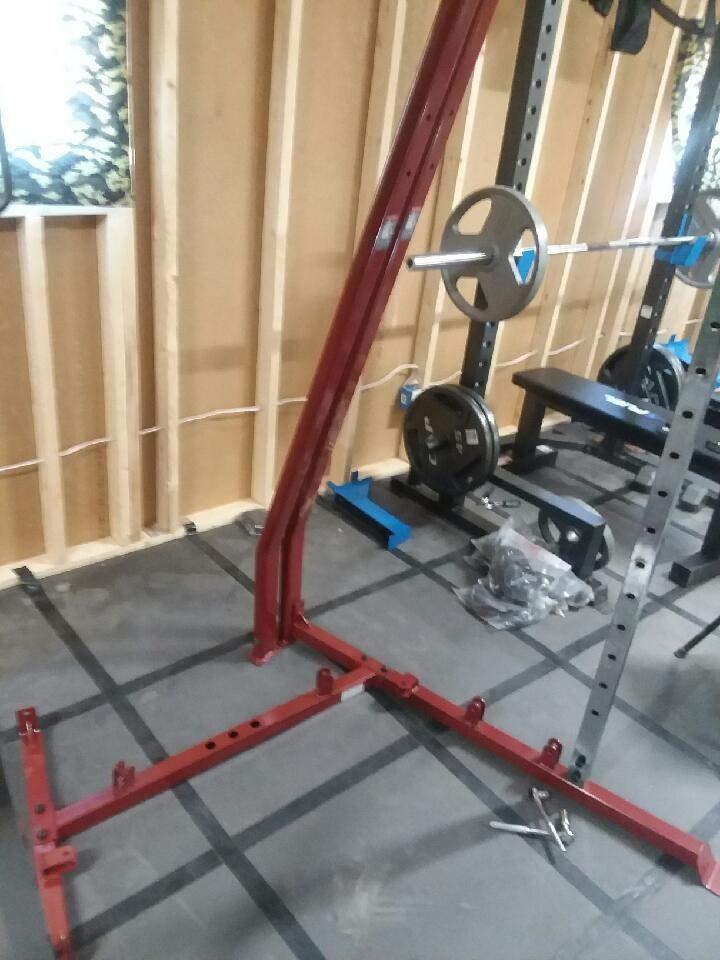
How it handles a shared household
Dual independent stacks are a genuine advantage when two people train together. Each side loads separately, so one person can be doing a heavy single-arm press while the other works a lighter set on the opposite column, with no shared pin to argue over. That is a real training benefit that a single-stack tower cannot offer.
The selector pin is the other shared-use advantage. A weight change takes one pull and one push rather than a plate migration, which is the difference between a 30 second change and a two minute change when you are running back-to-back sets.
Where it falls short
Assembly is the biggest friction point, and it is not close. Reviewers describe several hours of build time, hardware arriving loose in one unlabeled bag, and instructions that leave the cable routing ambiguous. Plan for two people and read the routing diagram before you start rather than improvising it with parts on the floor.
Some units also develop surface rust and finish deterioration over time, particularly in humid garages. If your garage is unheated in winter, consider wiping the frame down periodically and keep it off a wet concrete slab.
3. Mikolo HR05-B Half-Rack Power Cage – True 1:1 Cables
Mikolo Power Cage, 2000LB Power Rack with Independent Dual Pulley System, Multi-Function Home Gym Workout Machine for Cable Crossover (Black)
53.4D x 46W x 86H half rack
True 1:1 cable ratio
30 pulley positions
2000 lb rack capacity
Pros
- True 1:1 ratio so loaded weight matches training weight
- Half-rack footprint fits garages and basements
- No creaking or wobble under heavy bench and squat loads
- Ships well packed with no missing parts
Cons
- Trolleys bind if plates are not balanced on both sides
- Stock plastic pulleys need lubrication to feel smooth
- Straight bar attachment is short and the landmine row bar is too wide
The defining spec here is the 1:1 ratio. Both pulley sides run independently at one to one, so the plates you load are the resistance you feel. Across this list, most wall-mounted stations and most integrated cages run 2:1 and halve your effective load. If your training is heavy and you are adding plate-loaded cables to an existing rack setup, that difference decides which machine you should buy.
The half-rack format is the second reason to like it. At 46 inches wide and 53.4 inches deep, it occupies roughly two-thirds less space than a conventional power rack while still holding a 2000 pound load. That is the configuration that works in a single-car garage where the car has to fit too. Owners report no creaking and no wobble under heavy bench and squat loads, and the 2 mm wall thickness on the 2 by 2 inch columns does not flex the way thinner budget cages do.
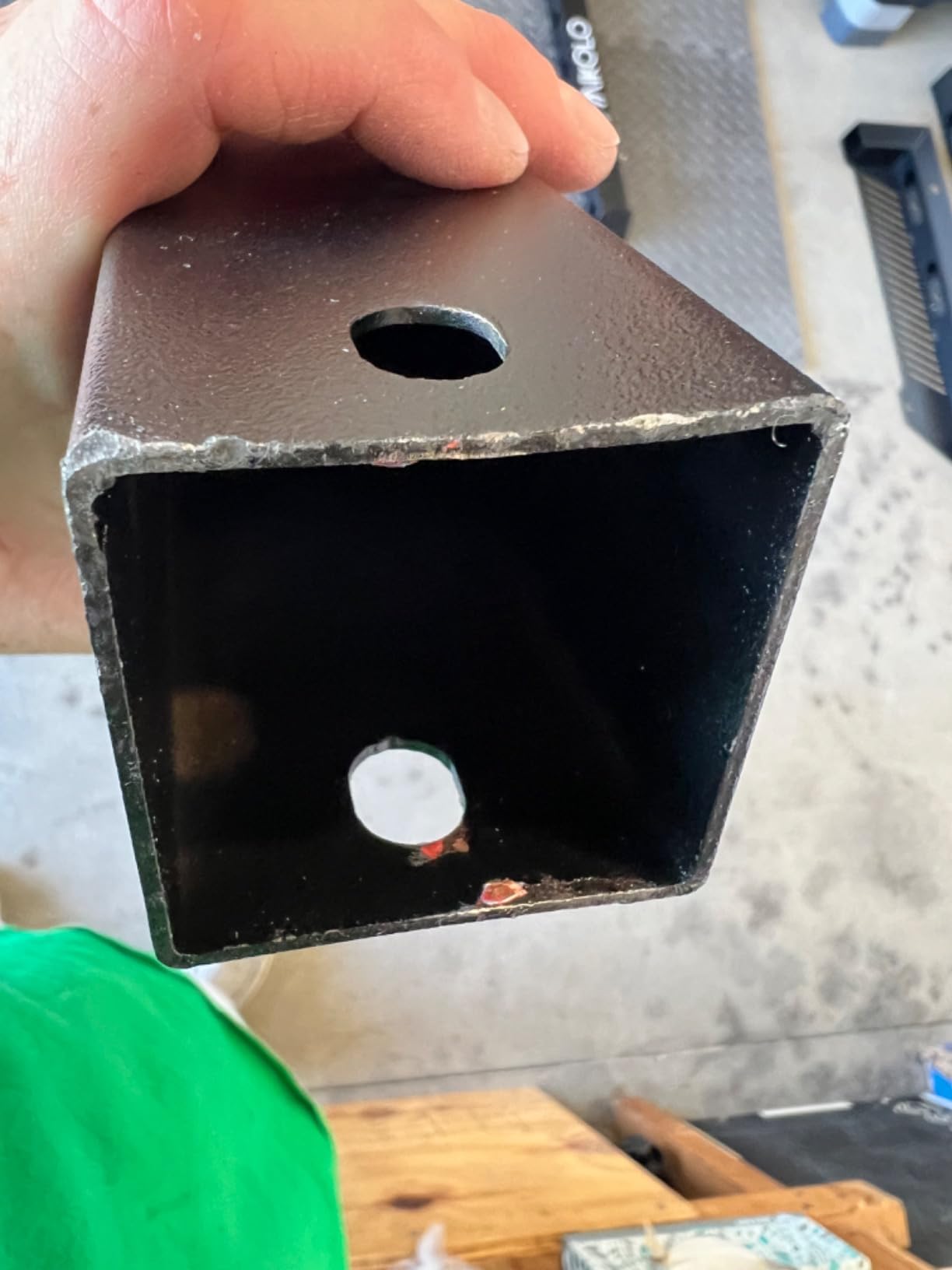
Thirty height positions drilled at 1 inch spacing with digital markers is the adjustability story. One inch granularity means you set the pulley where your body actually is rather than where the nearest factory hole happens to be, which matters more than the raw count suggests once you are switching between a low row and a standing press in the same session.
The attachments are generous: safety arms, J hooks, dip bars, handles and a T-bar row attachment all ship in the box, and mid-frame weight storage means plates do not migrate across the garage floor. That cuts down on the two things that quietly add cost to a garage gym.
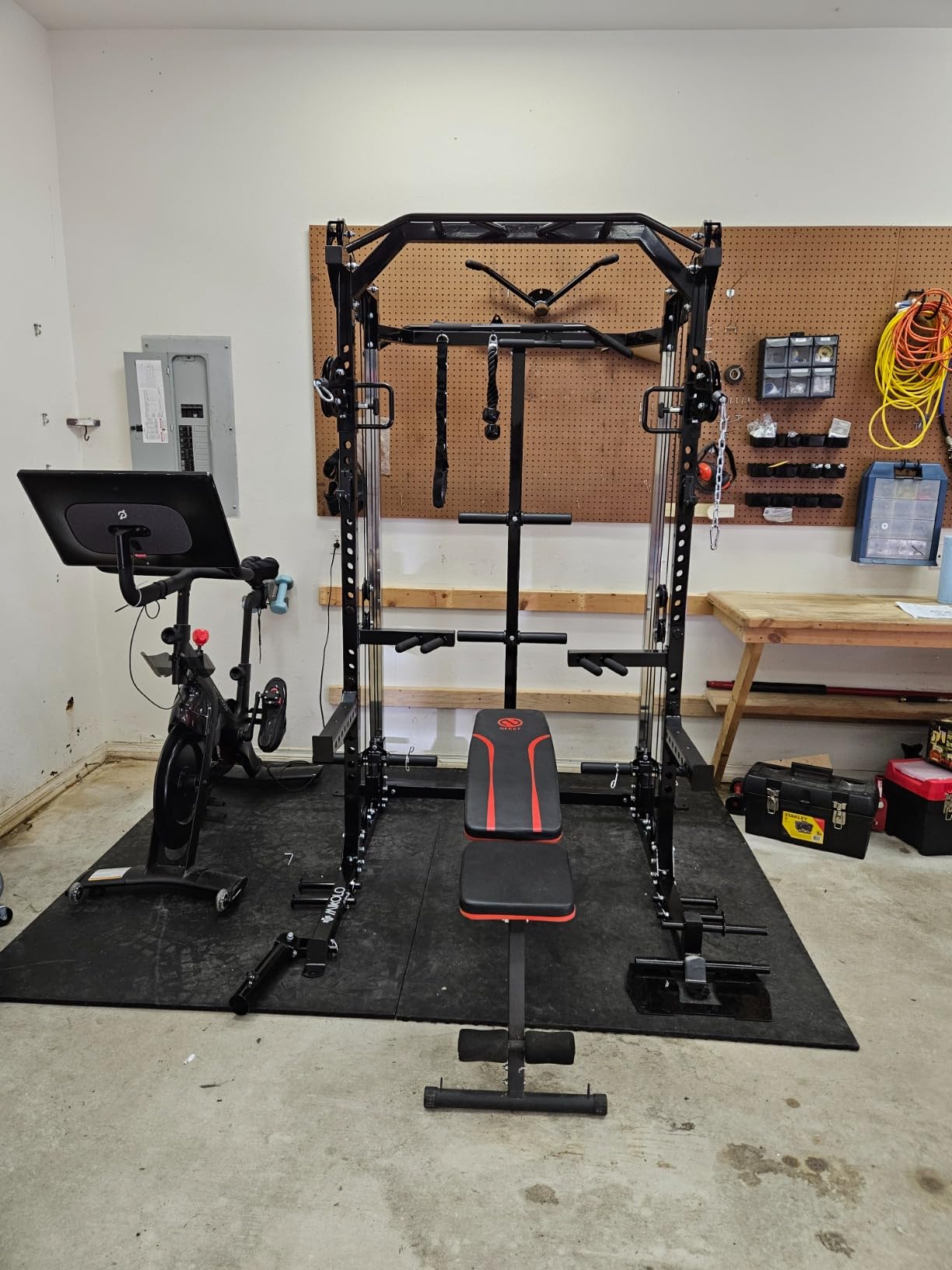
Why the 1:1 ratio changes training
On a 1:1 system, one plate on each side equals one plate of felt load. On a 2:1 system you need roughly double the plates on the stack for the same sensation, which changes both your loading math and how much plate storage you need. Members of r/GarageGym repeatedly raise this when comparing towers, and it is the single most useful spec for anyone who already knows their working weights.
There is a trade. Higher ratios feel smoother through small movements and handle more total weight, while a 1:1 gives you a truer barbell-like feel for heavy pulls. If you are doing heavy low rows and lat pulldowns, 1:1 is the more intuitive setup.
What to watch out for
The most common complaint is trolleys binding when plates are not balanced evenly on both sides. Keep the loading symmetrical and this rarely appears. Stock plastic pulleys can need lubrication before they feel smooth, and the included straight bar is short with a landmine row bar that is too wide for many users, so plan on adding your own bar rather than relying on the packaged set.
The finish also scratches easily, which matters in a garage where equipment gets moved around. Out of the box the shipping was well packed with no missing or damaged parts, which is not always the case with imported cages.
4. Mikolo WR00 Folding Squat Rack – Five Modes, Folds Flat
Mikolo Folding Squat Rack, Wall Mounted Power Rack with Cable Crossover Machine & LAT Pull Down, Functional Trainer with 5 Adjustable Function Modes, for Home Gym and Space Saving(Black)
30D x 68W x 86H open
Folds to about 3 sq ft
1:1 pulley ratio
15 pulley height options
Pros
- Folds to a very small footprint when the car needs the space
- Five working modes cover rack trainer and crossover duties
- 1:1 ratio makes loaded weight match training load
- Solid steel with wall and floor anchoring points
Cons
- Assembly instructions are not especially clear
- Wall mounting requires care and correct stud placement
- Single carriage and 1000 lb capacity trail a full power cage
This is the answer to the most common garage constraint there is: the car has to fit. The rack folds from 9.5 square feet open down to roughly 3 square feet closed, which is the difference between a permanent gym corner and a shared bay. When it is open you get a power rack, a functional trainer and a cable crossover in the same frame.
The construction is 2 by 2 inch 14-gauge steel with reinforced screw-in wall mounts and four adjustable ground feet. The ground feet matter more than they sound, because they are what stops a frame this wide from rocking when you load one side of a cable unevenly on a sloped garage slab.
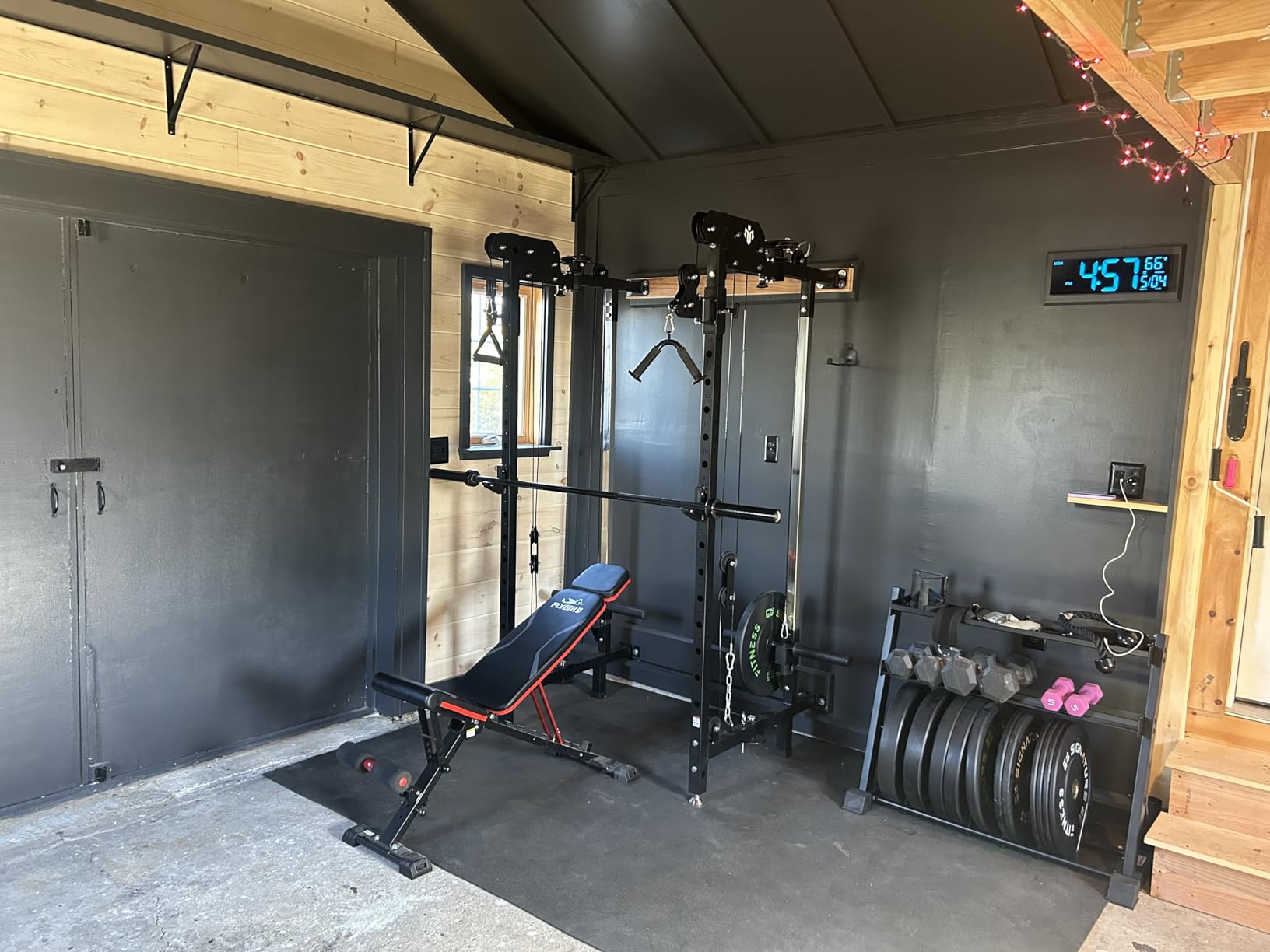
The pulley side runs 1:1 with a single-handed adjustment across 15 height options, so you can change station without putting the load down. That single-handed mechanism is the feature owners mention most, because the usual complaint about cheaper racks is that you need both hands and a free hand free to hold the barbell.
Expect more than 80 supported exercises with the detachable pull-up bar and J hooks, and expect the cable range of motion to be somewhat more limited than on a dedicated tower. The machine does a lot, and no multi-mode frame does any single movement as precisely as a machine built for it.

Setting up the fold and the wall anchors
Five modes are available: folded, semi-open, power rack, functional trainer and cable crossover. The semi-open position is the useful middle ground, giving you a rack to barbell off while the cable columns stay usable. Plan the wall anchor height before you assemble, not after, since moving the anchor later means re-torquing the whole frame.
Two people make this a one-afternoon job. One person alone is possible but awkward, and the instructions are not the clearest in this group, so allow extra time to work through them rather than assuming a mistake on your part.
Who should pass on it
Pass if you plan to load the rack past 1000 pounds, since the single carriage and the stated capacity trail a full commercial cage. Pass if you train seriously heavy on the barbell and want collision-free plate loading on both sides, and pass if you are not comfortable drilling and anchoring a wall frame, because a folding rack relies on those anchors more than a freestanding unit does.
It is also worth noting the honest comparison. If your garage has a permanent spare wall, a fixed wall station gives you more pulley positions in less space. The folding frame earns its cost specifically when the floor space has to come back.
5. Body-Solid Powerline PFT100 – Commercial Feel Dual Stack
Body-Solid Powerline (PFT100) Cable Crossover Exercise Machine for Home & Commercial Gym, Functional Training Center with Dual 160lbs. Weights Stack for Cable Workout
42.3D x 62.6W x 83H freestanding
Dual independent 160 lb stacks
Upgradeable to 210 lb per side
10 year frame warranty
Pros
- Commercial gym feel with smooth quiet weight travel
- Dual independent stacks give true single-sided work
- Well machined parts that line up without forcing
- Freestanding so no wall anchoring needed
Cons
- Assembly runs three to five hours and wants a second person
- Freestanding footprint is much larger than wall-mounted units
- Heaviest unit here at 476 pounds
This is the machine I would buy with an unlimited budget and a dedicated wall, and it is the reason several of the cheaper picks here feel like a compromise. The two independent weight stacks deliver true isolateral movement, meaning each side has dedicated resistance, and the pulley action is described by owners as silky with no noise and no friction. Nothing else in this list moves like a commercial station.
The 10 year frame warranty and 1 year parts warranty is among the longest frame coverage in this roundup, and the manufacturer keeps spare parts available, which is what makes a machine like this hold value over a decade. After-sale service is responsive when cables need replacing, and that is the part most owners never think about until a cable frays.
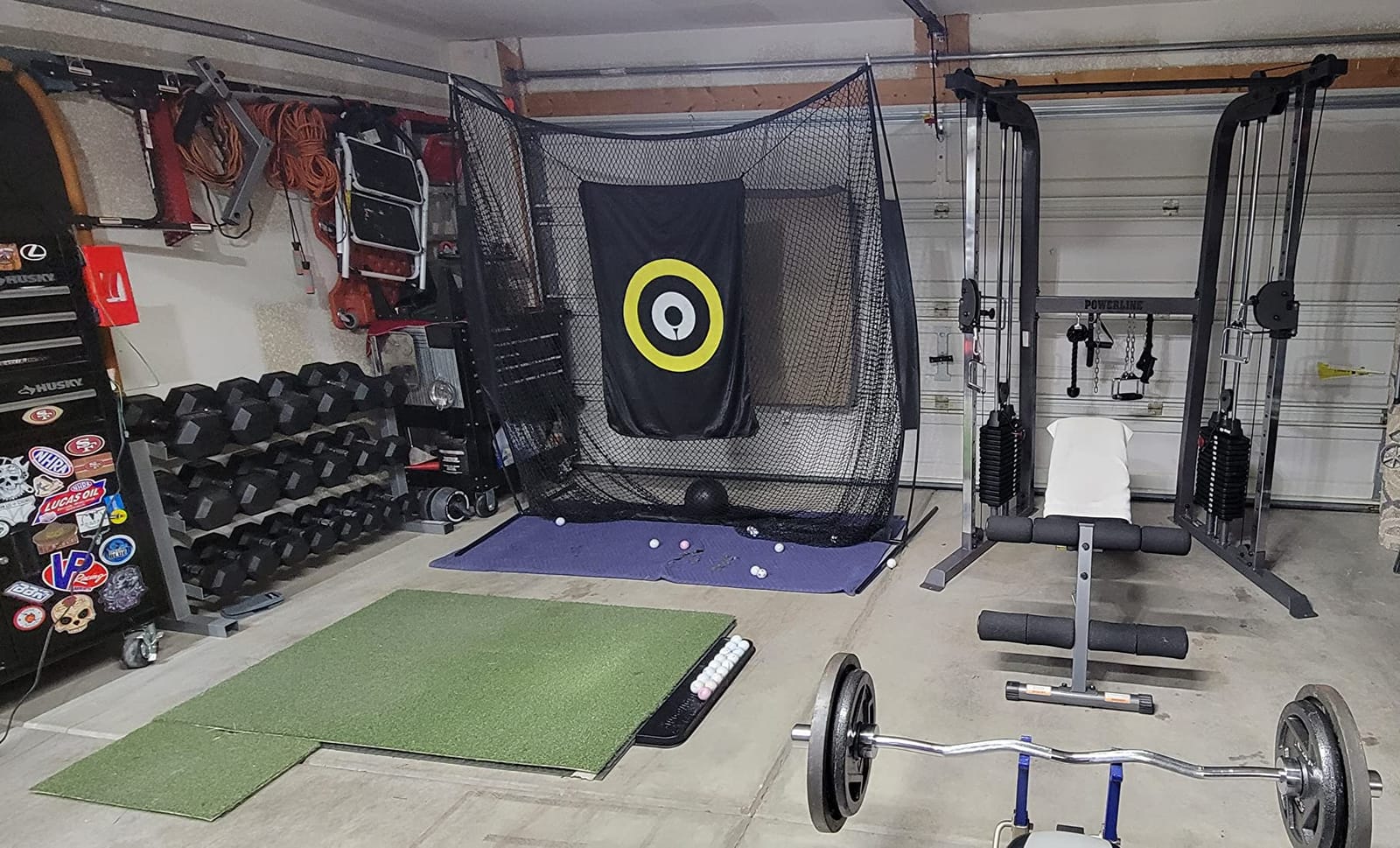
Configuration matters. Two 160 lb stacks ship as standard and the unit is available in a 210 lb dual stack configuration, so check which one you are actually buying before you plan your loading. The weight ratio is 1/2:1, which means a full stack feels like roughly half the loaded weight, the same math that surprises owners of the smaller Body-Solid functional trainer.
At 476 pounds assembled, plan the delivery and the move. This is a multi-person job or a freight move, not something you slide across a slab on a furniture dolly. That single fact is why it sits at number five rather than number one for a garage, despite being the best-built machine here.
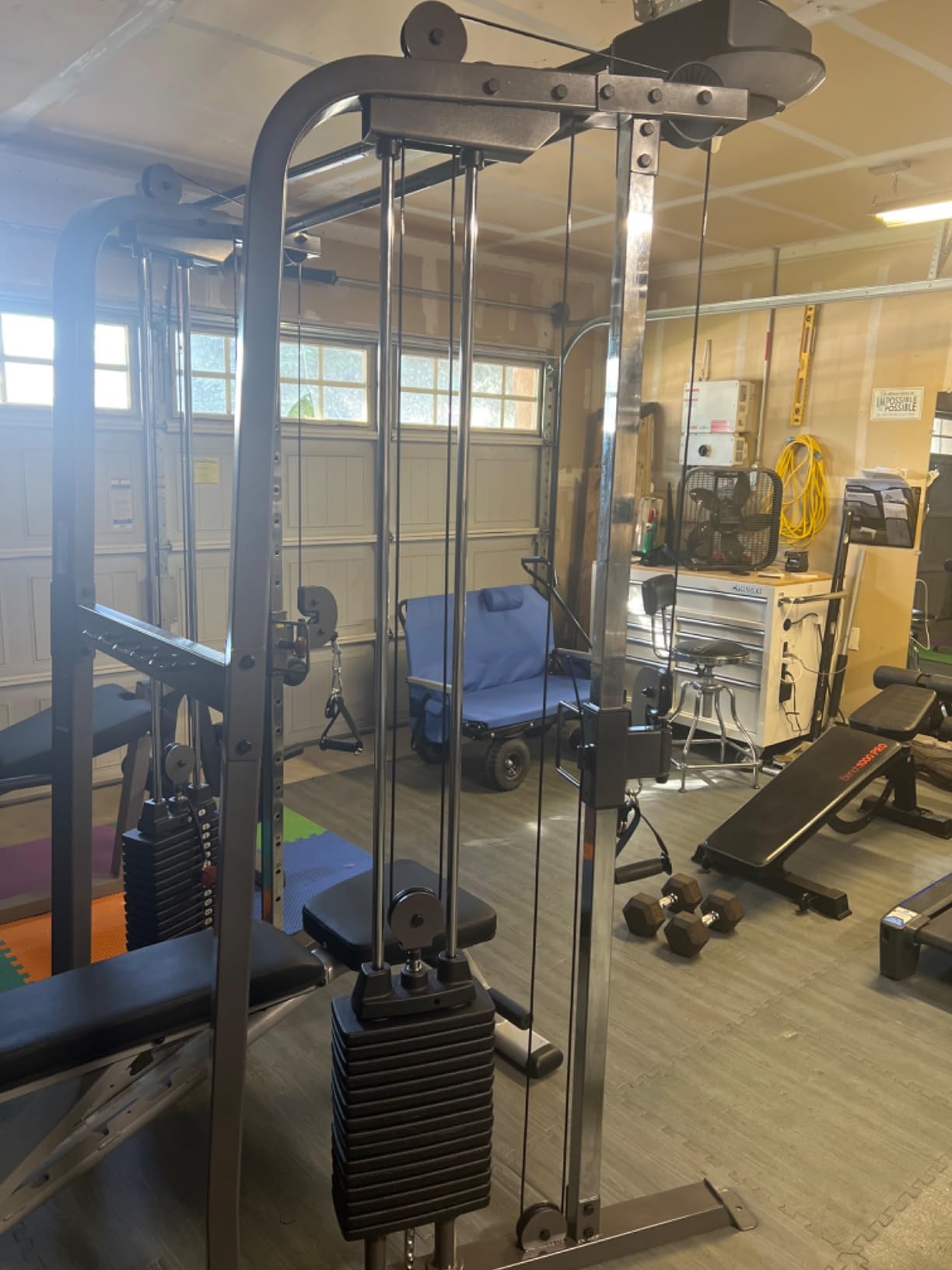
Where the footprint actually goes
42.3 inches deep by 62.6 inches wide by 83 inches tall is compact for a dual-stack functional trainer, and it is freestanding, so no studs are involved. It still needs roughly 6 feet of width with clear space on both sides for crossovers and a full 4 foot rear area for seated rows and leg work.
The electrostatic powder coat finish on the extra-wide mainframe is worth noting for garages that see temperature swings, and it is one of the reasons finish complaints are rare on this unit compared with lighter imported frames.
The honest limitations
Assembly runs three to five hours and benefits from a second person, and there are a few undocumented steps in the instructions with loose parts in the box. Block the afternoon rather than assuming an evening job.
The freestanding footprint is much larger than any wall-mounted option in this list. If your garage is a single-car bay and the car stays parked, a wall station is simply a better use of the room, and this machine’s advantages will not be reachable.
6. Mikolo M-G3 Wall Mount Cable Station – 400 lb of Wall Cable
Mikolo Wall Mount Cable Station, Cable Crossover Machine with Dual Pulley System and 19 Adjustable Positions for Home Gym Fitness Equipment, Red
25.6D x 26.9W x 82H wall mount
400 lb maximum load
19 pulley height positions
Commercial grade 14-gauge steel
Pros
- Very small footprint that fits a garage corner
- Assembles in about an hour with labeled hardware bags
- Smooth cable glide even with stock pulleys
- Lat bar cable bar rope and strap handles included
Cons
- Stock plastic pulleys create more friction than metal versions
- Pulley locking pin has been reported to fail mid-workout
- Must be anchored into wall studs for stability
At 25.6 by 26.9 inches with an 82 inch height, this is a serious load-to-footprint ratio by any measure. Four hundred pounds of maximum load on a frame that disappears against the wall is hard to argue with when the goal is a single-car garage that still holds a car.
The nylon coated aircraft quality cables are rated at 2200 lb tensile strength, which is a real spec and not marketing, since it means the cable is not the weak link when you load it hard. The H-shaped base gives you the anti-sway stability that flat wall plates lack, and the double pole track with a rotating pulley bracket keeps travel smooth through the full arc.
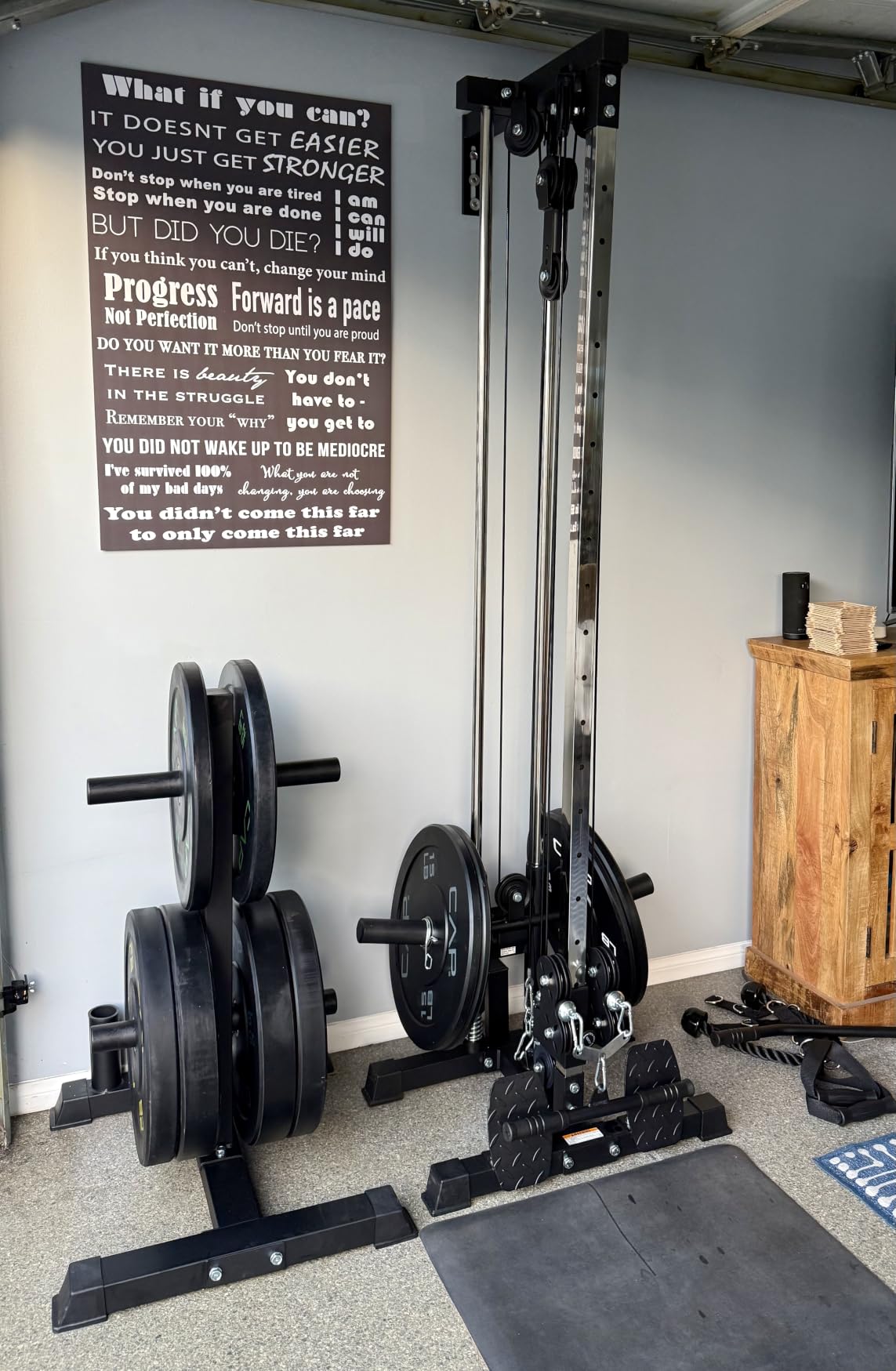
Nineteen pulley height positions is the most adjustability in the wall-mounted group, and it is what lets the same unit serve a lat pulldown, a standing chest fly and a floor-level low row without a carabiner swap. A large footboard supports seated rows, and the upward 10 degree weight pegs stop a loaded plate from rolling out when you are pulling from the floor.
Detachable sleeves accept both 1 inch and 2 inch plates, which saves buying an adapter. The accessory package is unusually complete: lat bar, cable bar, tricep rope and adjustable strap handles all ship in the box, and that is where a lot of the value in this pick comes from.
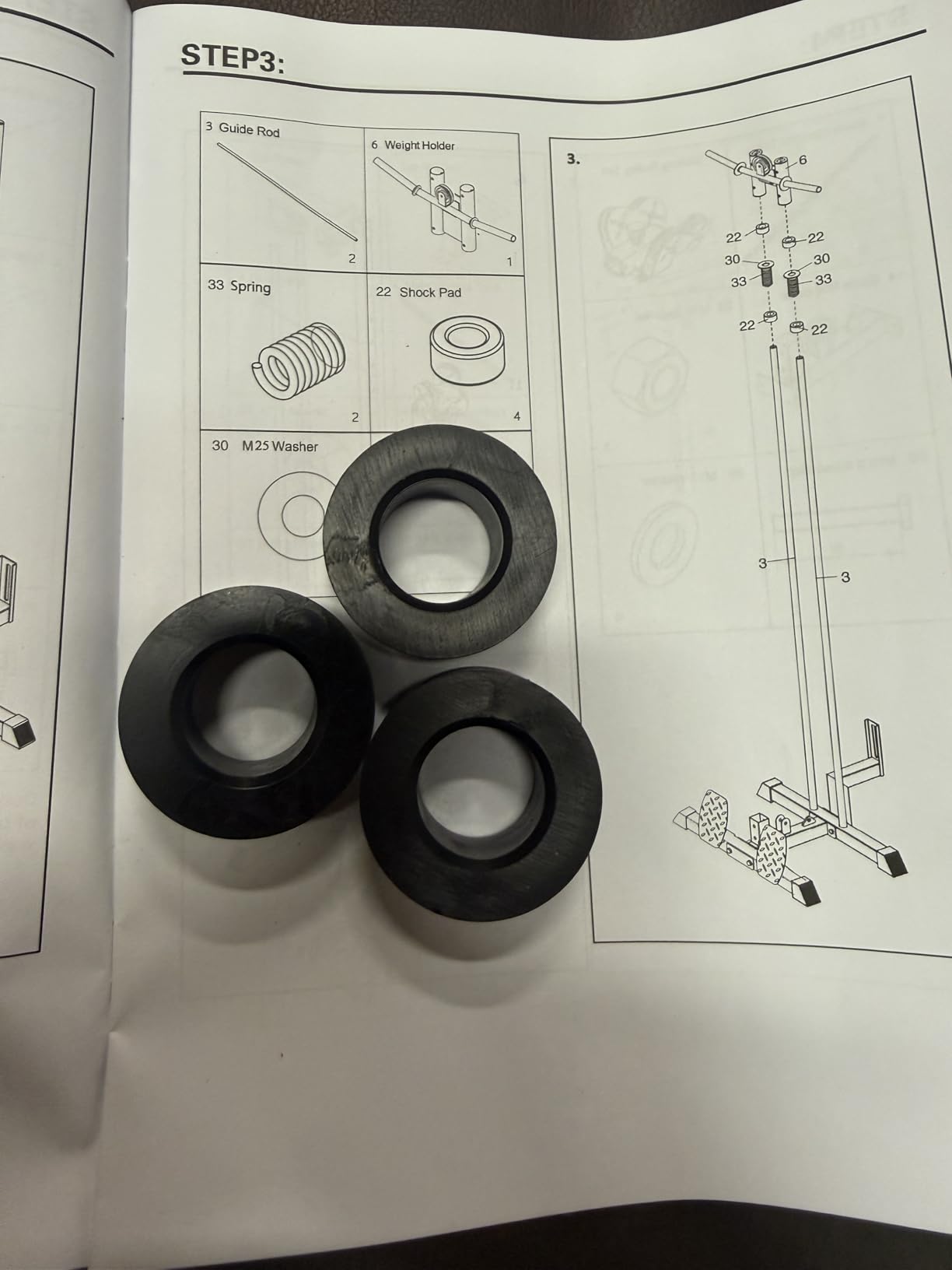
What 400 lb of wall capacity actually gives you
Because this is plate loaded, the resistance is whatever you load, which makes it the most flexible option in the roundup for a strong single lifter. A heavier lifter can add plates without being capped by a selectorized stack, and a lighter user can start with one plate per side.
The catch is change speed. Every adjustment means unhooking, adding or removing plates, which is why plate-loaded stations suit supersets and steady work better than timed circuits. If you train with a partner and want two different loads on the same station, that becomes a real friction point.
Things to check on arrival
It must be properly anchored into wall studs for stability. A stud finder and a level matter more here than on any other wall unit, and it is the one installation step that is not negotiable. Stock plastic pulleys create more friction than metal replacements, and the pulley locking pin has been reported to fail mid-workout by a small number of owners, so inspect the pin before your first heavy set.
Some accessory quality and spring clips are loose out of the box, and D-ring handles are uncomfortable for some users. Assembly takes about an hour, which is at the fast end of the wall-mounted group.
7. Goimu WM1 Wall Mount Cable Station – Switchable 1:1 and 2:1
Goimu Wall Mount Cable Station, WM1 Cable Crossover Machine with 17 Positions, High and Low Cable Crossover Machine with Removable Footplate for Garage Home Gym (WM1 Cable Station RD)
3.28 sq ft wall mounted footprint
SmartT pulleys switch 1:1 or 2:1
17 pulley positions
300 lb maximum load
Pros
- Smallest and lightest wall-mounted option in this group
- Assembly takes about an hour with hardware sorted by step
- Switchable 1:1 and 2:1 ratios cover heavy and light work
- Smooth non-jerky cable travel once correctly assembled
Cons
- Cables arrived too long creating slack until re-clamped
- An occasional mis-placed weld hinders swivel pulley action
- No factory quick-release carabiner for swapping attachments
This is the one to buy if you want a wall station light enough to carry up a basement stair or reinstall in a different room. At 81.4 pounds it is one of the lighter machines here, and the approximately 3.28 square foot wall footprint is among the smallest, so it fits the awkward sliver of wall next to a garage door track.
The SmartT dual pulley system is genuinely useful and rare at this level. Using the included cable adaptor you can switch between 1:1 and 2:1 ratios on the same machine, which means heavy single-arm pressing and light fly work without a second station. Most wall units force one ratio, and that inflexibility is what pushes owners toward spending more.
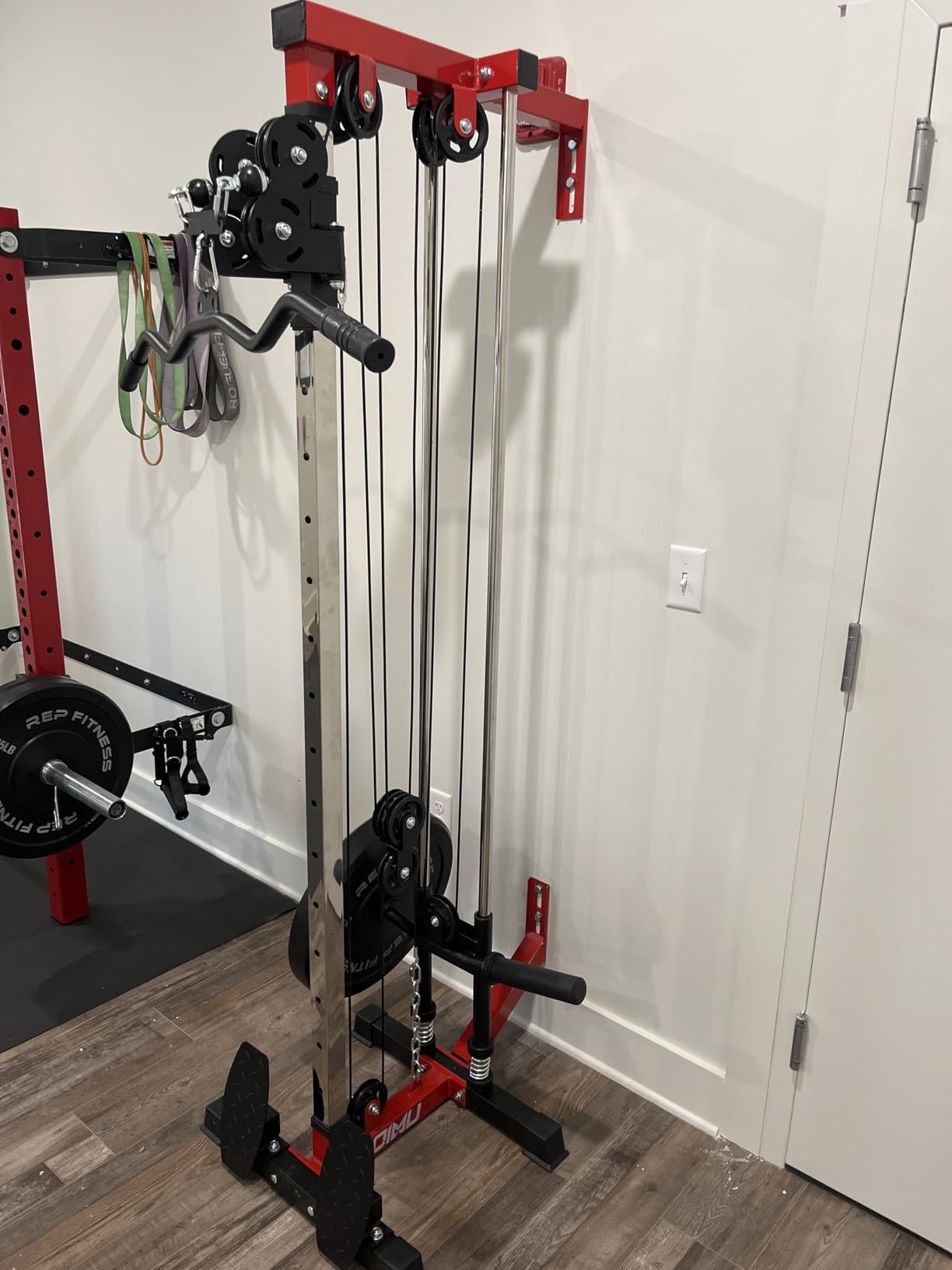
Seventeen pulley height positions reach up to 70 inch of cable height, which is enough clearance for a standing press and a high lat pulldown. The 14-gauge steel with reinforced wall brackets and an H-shaped anti-sway base is the right construction for a wall unit that will be loaded unevenly on one side.
Assembly is the easiest story here. Reviewers report about an hour to an hour and a half with hardware sorted by step, which is unusual for this category and saves the usual two-hour guess. Included accessories are a lat pulldown bar, T bar, tricep rope, cable bar and two D-ring handles.
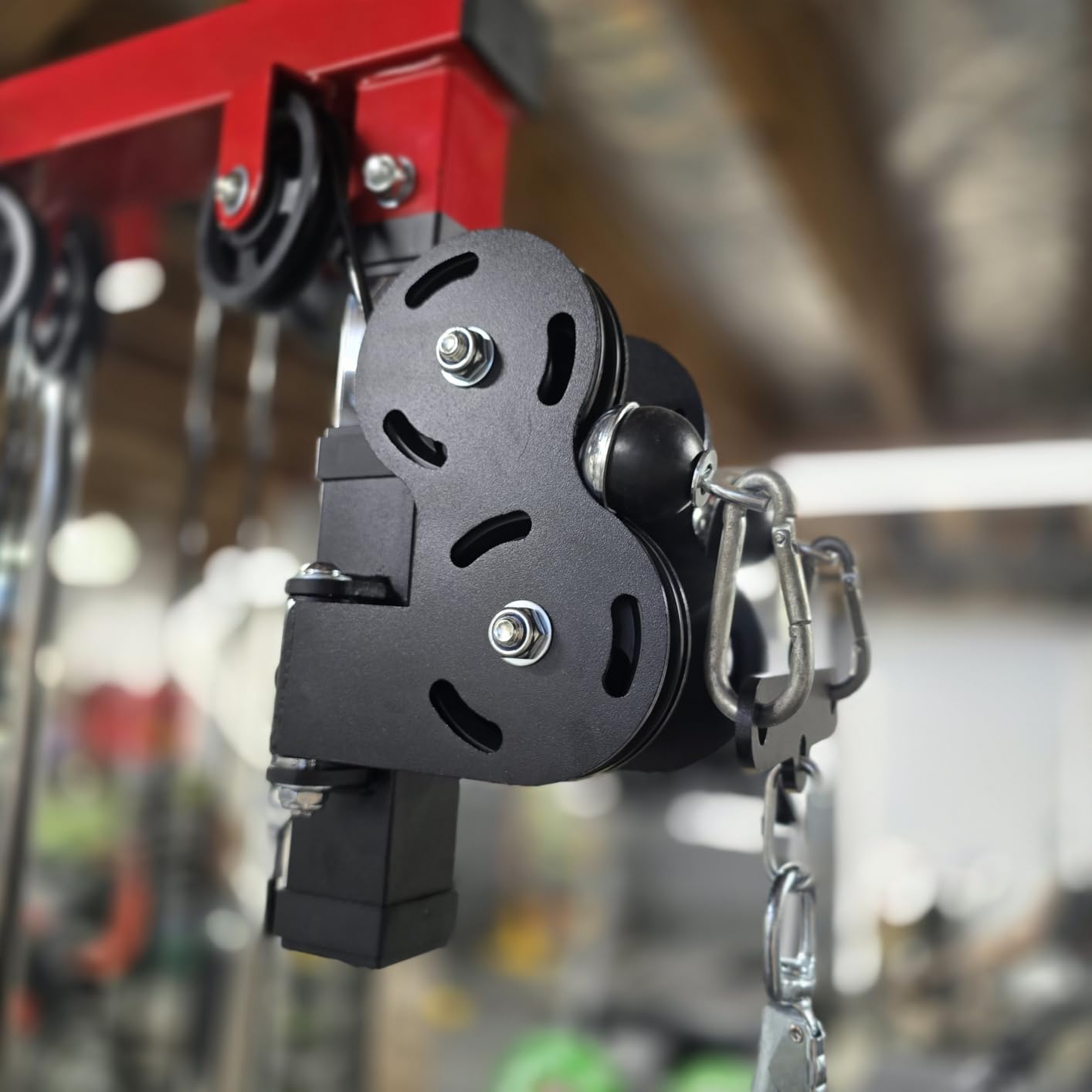
Switching ratios in practice
Roughly a minute of work separates a heavy set and a light set on this machine: unclamp, re-route the cable through the adaptor, re-clamp. That is faster than changing plates, and it is the honest advantage over a fixed-ratio unit. For someone who alternates between a heavy low row and light high-pulley fly work in one session, it removes the most irritating part of plate loading.
The tradeoff is that you are re-clamping a steel cable by hand, so you should check the clamp is seated properly before loading. Owners who had the original cable length were off report slack that persisted until the cable was shortened at installation.
What to fix before the first workout
Cables arrived too long on some units, creating excess slack until they are re-clamped. Measure your intended cable run and shorten at installation rather than trying to train around the extra length. A mis-placed weld can hinder the swivel pulley action, so rotate the bracket through its full range during assembly and check it moves freely.
There is no factory quick-release carabiner for swapping attachments, so add one, and expect occasional cosmetic finish flaws on arrival. If you need more than 300 lb, step up to the Mikolo M-G3 rather than looking for a heavier plate sleeve.
8. DONOW DN-5011 Cable Crossover – Wide Gym-Size Frame
DONOW Cable Crossover Machine, Cable Fly Machine Home Gym System Workout Station with Dual Pulley System Pull-Up Bar Cable Bar and LAT Pull Down System (DN-5011)
56D x 79.7W x 81H freestanding
Alloy steel frame over 200 lbs
16 handle height positions
Nylon coated ball bearing pulleys
Pros
- Sturdy frame that does not rock under load
- Handles and adjustment points feel gym quality
- Supports crossovers chops rotations rows and pulldowns
- Service quickly replaced missing parts
Cons
- Assembly takes four to five hours with cable routing hardest
- Some brackets arrive bent and paint can crackle
- Front feet can lift when pulling from the lowest pulley
At 79.7 inches wide this is a genuinely wide frame, and that width is the entire argument. Wide cable machines are often criticised as wasteful in a home gym, because the extra span only helps standing crossovers and cable flyes. If you are one of the people who does those movements and want them to feel like a real gym station rather than a doorway pulley, this is the machine built for it.
The frame is commercial grade steel weighing more than 200 pounds assembled, with nylon coated cables running through two independent ball bearing pulleys. Owners report it does not rock under load and that the handles and adjustment points feel gym quality, which is not a claim you can make about most machines at this tier.
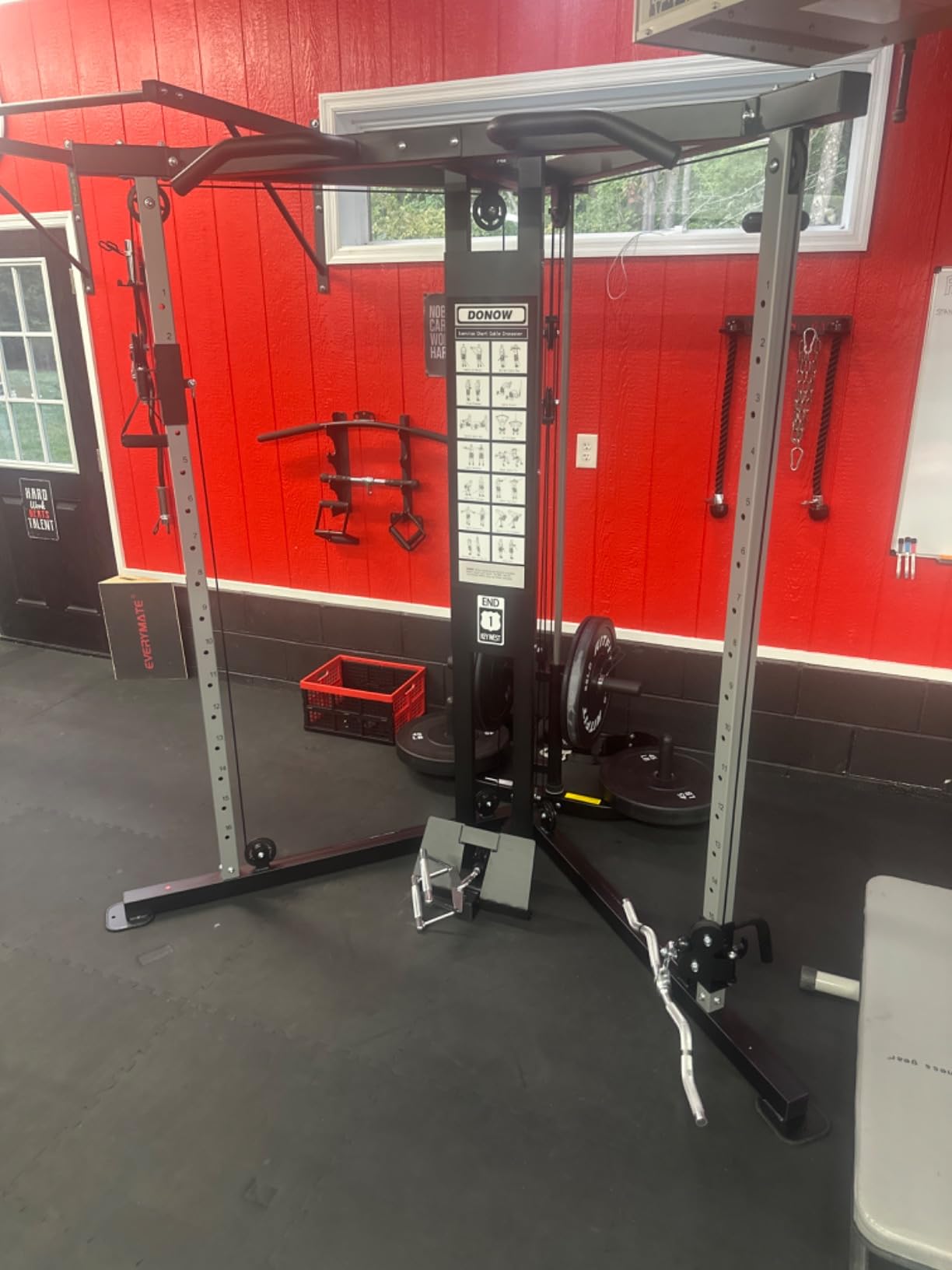
The dual stirrup handles adjust across 16 height positions, and the frame supports cable chops, lifts, rotational work and pulls at multiple angles. Rotational and anti-rotation cable work is the reason a wide crossover earns its size, because a narrow unit simply cannot give you the travel for a woodchop.
Customer service quickly replaced missing parts, which is worth more than it sounds in a category where hardware arrives bent more often than anyone would like.
Is the extra width worth the floor space
It is worth it if you train standing movements and rotational work. The 80 inch span is what makes a proper crossover possible, and a narrower tower forces you to lean and compensate, which loads your lower back instead of your chest.
It is not worth it if your garage is a single-car bay with the car parked. At 56 inches deep and 80 inches wide, plus clearance on both sides and in front, you are committing a 7 by 8 foot rectangle to this machine permanently. For that footprint, a wall station does more with less.
Honest weaknesses
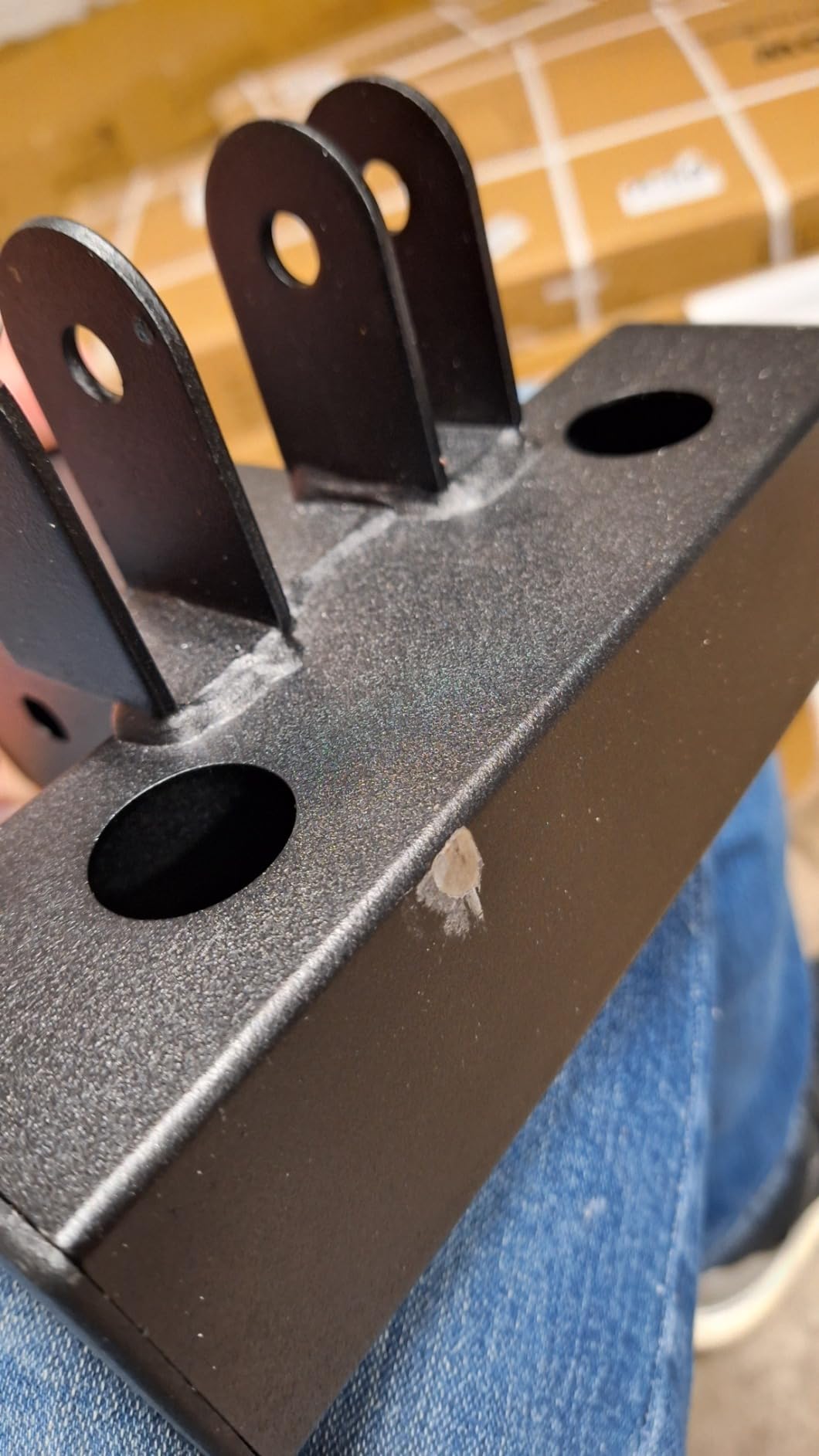
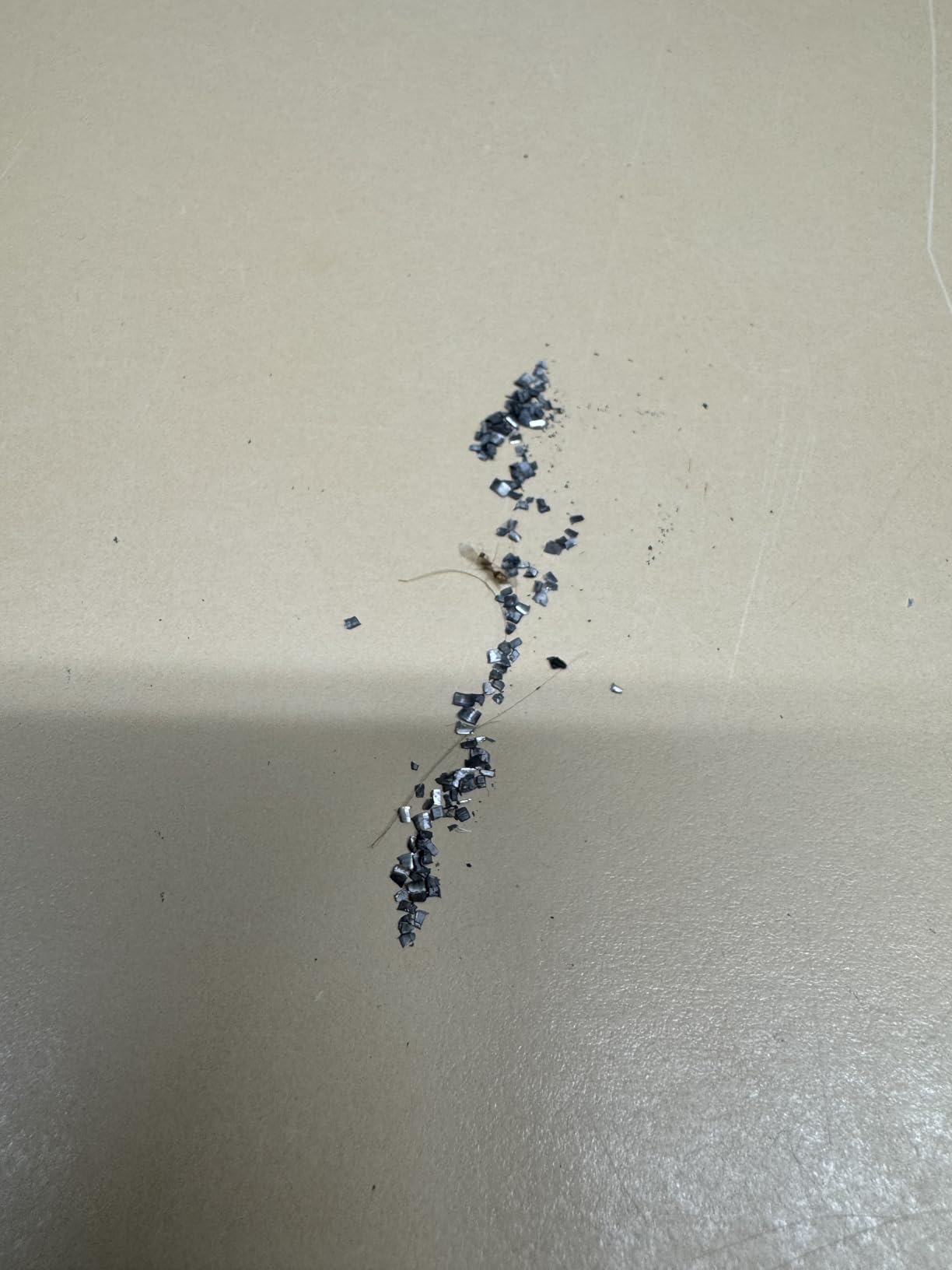
Assembly takes four to five hours and cable routing is the hardest step, so this is a weekend build. Some brackets arrive bent and the paint can crackle on the bent pieces, which means checking the frame square before you tighten anything permanent.
Front feet can lift slightly when pulling upward from the lowest pulley setting, a light movement at the base worth knowing about if you do heavy low-to-high pulls. The machine height can also be low for taller users doing seated pulldowns, and it ships in three separate boxes, so plan where you will stage the parts before opening them.
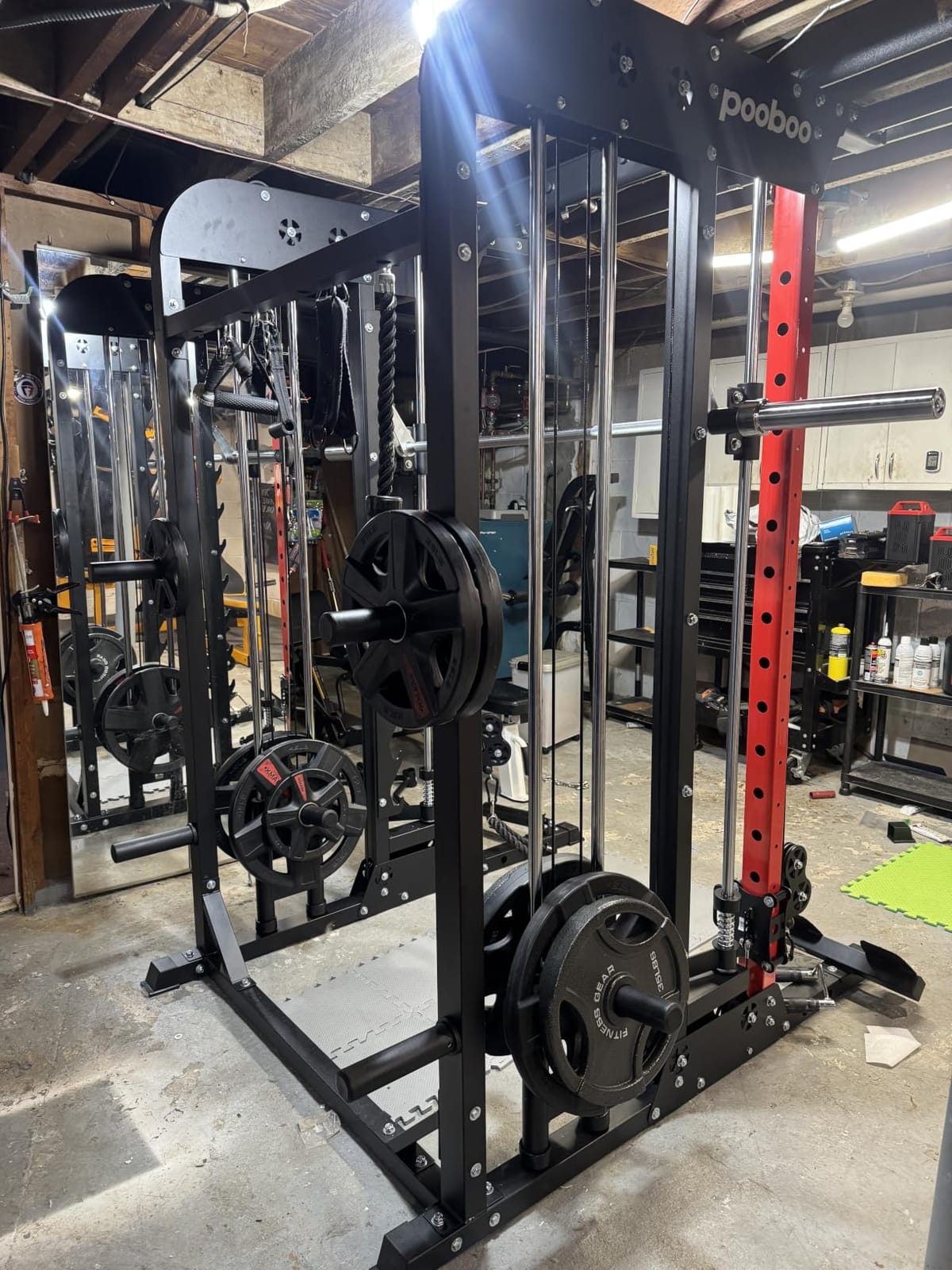
9. pooboo P43 Power Cage – 2,000 lb Cage With Cables
pooboo Power Cage Smith Machine with 2000LB Squat Rack Cable System
62.9D x 43.3W x 82.6H
2000 lb cage capacity
PU wire rope rated to 1000 lbs
Over 20 included attachments
Pros
- Highest rated machine in this roundup
- Bearing pulleys and PU cable run smooth and silent
- Over 20 free attachments cover flys pulldowns landmine and band work
- Rust resistant paint on sandblasted components
Cons
- Very heavy at 417 pounds so delivery and assembly need planning
- Shorter review history than the cheaper competitors
This is the only machine here with a 4.9 average, and the rating reflects something specific: owners report rigid, smooth and well-finished components with no ratings below four stars. If you are squatting and pressing heavy and want a cable crossover in the same frame, this is the strongest build in the roundup.
The precision pulley system uses bearing pulleys and PU wire rope rated to 1000 lb, which is a heavier cable system than the steel most wall units ship. Sandblasted components with rust-proof paint matter in an unheated garage, and reviewers specifically call out the finish quality as burr free, which is what keeps cable wear down over time.
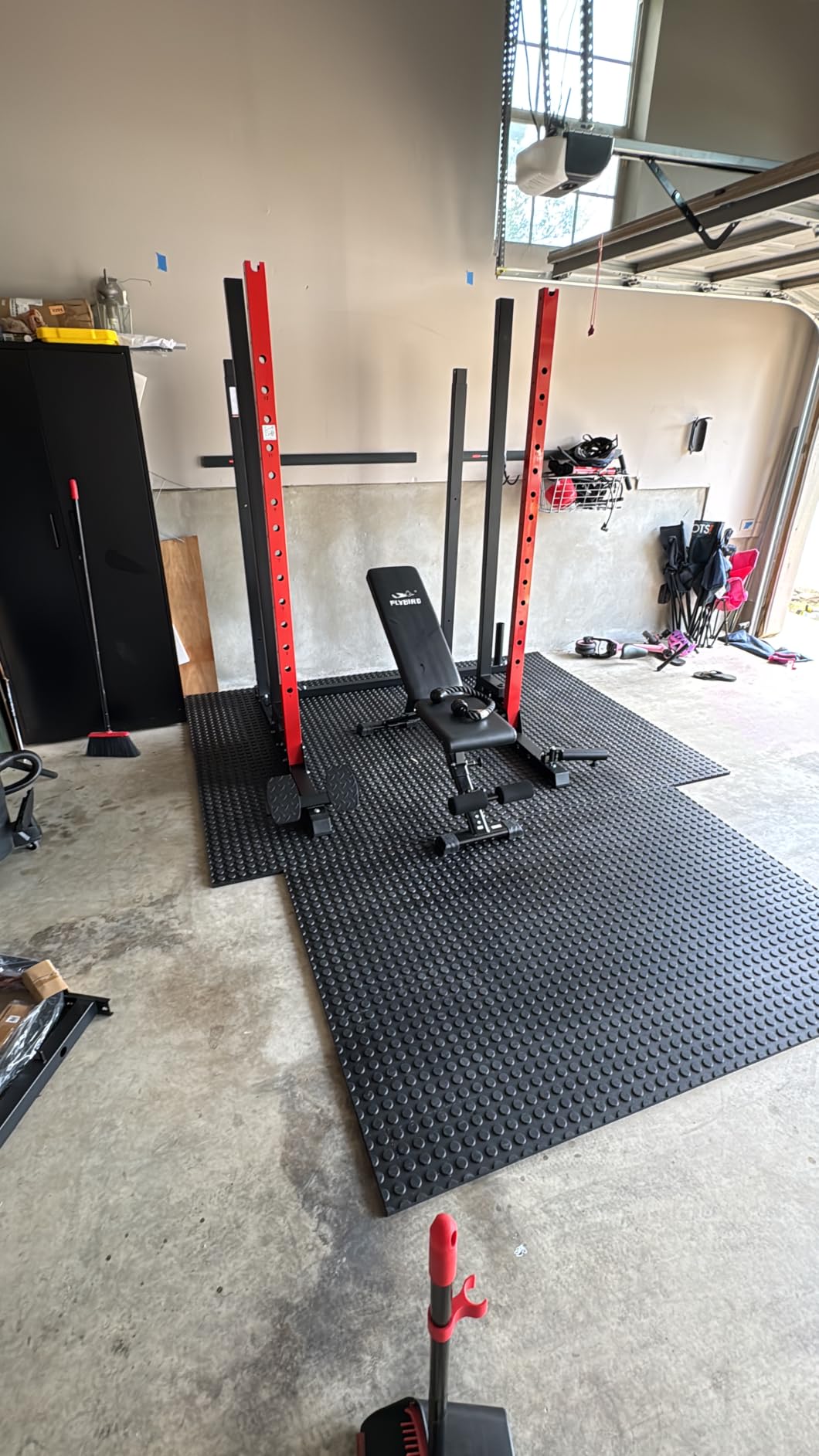
Over 20 included attachments is the quiet headline. That covers cable flys, pulldowns, landmine work and band exercises, plus J hooks, spotter arms and dip bars, and the P43-Pro upgrade adds lat handles, an Olympic bar, a barbell pad, a double-ended rope and an ankle strap. For a garage gym, a rich attachment set matters as much as the machine because each missing attachment is another thing to source and mount.
The 2000 lb capacity cage is rated for serious squatting and pressing, so this is the pick for a lifter whose barbell work comes first and whose cable work is the addition rather than the destination.
Rated capacity and the ceiling question
At 62.9 inches deep and 43.3 inches wide with an 82.6 inch height, the cage is deeper than it is wide, which is the right orientation for a bench press inside the frame. Check your ceiling against the 82.6 inch machine height and leave headroom for the lat attachment, because a 96 inch garage ceiling is tight for any overhead cable work on a cage this deep.
At 417 pounds the unit ships in two packages to limit transit damage, and getting it into a garage needs two people and a plan. That is the real cost of this pick beyond the sticker.
What to weigh before buying
Fewer reviews than the cheaper competitors means a shorter long-term track record, and on a 417 pound frame that is worth considering honestly. The 4.9 rating reflects a smaller, newer owner base than the 699-review wall unit at the top of this list.
Also note the PU wire rope rather than steel cable. It is quieter and holds well, but replacement cables for a PU system are less universally available than steel, so check the parts story before you commit.
10. ER KANG Cable Station – Flip-Up Footplate Wall Mount
ER Kang Cable Station Wall Mount, 18in Pulley Tower, Dual Pulley System, High & Low Cable Machine, LAT Pull-Down & Row Tower with Flip-Up Footplate, Home Gym Cable Crossover, Black
26D x 27.2W x 81.9H wall mount
400 lb max load on a 77 lb frame
18 pulley positions
2200 lb tensile coated cables
Pros
- Wall mounting saves a substantial amount of floor space
- 400 lb capacity on a relatively light 77 lb frame
- Flip-up footplate makes seated rows practical
- Includes lat bar cable bar rope and strap handles
Cons
- Wall anchoring is required for safe use
- Stock plastic pulleys add friction compared with metal
- Assembly instructions are minimal
The number that stands out is the strength-to-weight ratio. Four hundred pounds of rated maximum load from a 77 pound frame is remarkable, and it is why this is the pick for a garage where you want a serious load on the wall without a heavy install or a crew carrying steel through the door.
The flip-up footplate is the detail that makes a wall unit usable rather than decorative. A seated cable row needs somewhere to put your feet, and a fold-up plate against the wall gives you that platform without permanently claiming floor space. Combined with the large base plate, it turns a wall station into something you can actually row from.
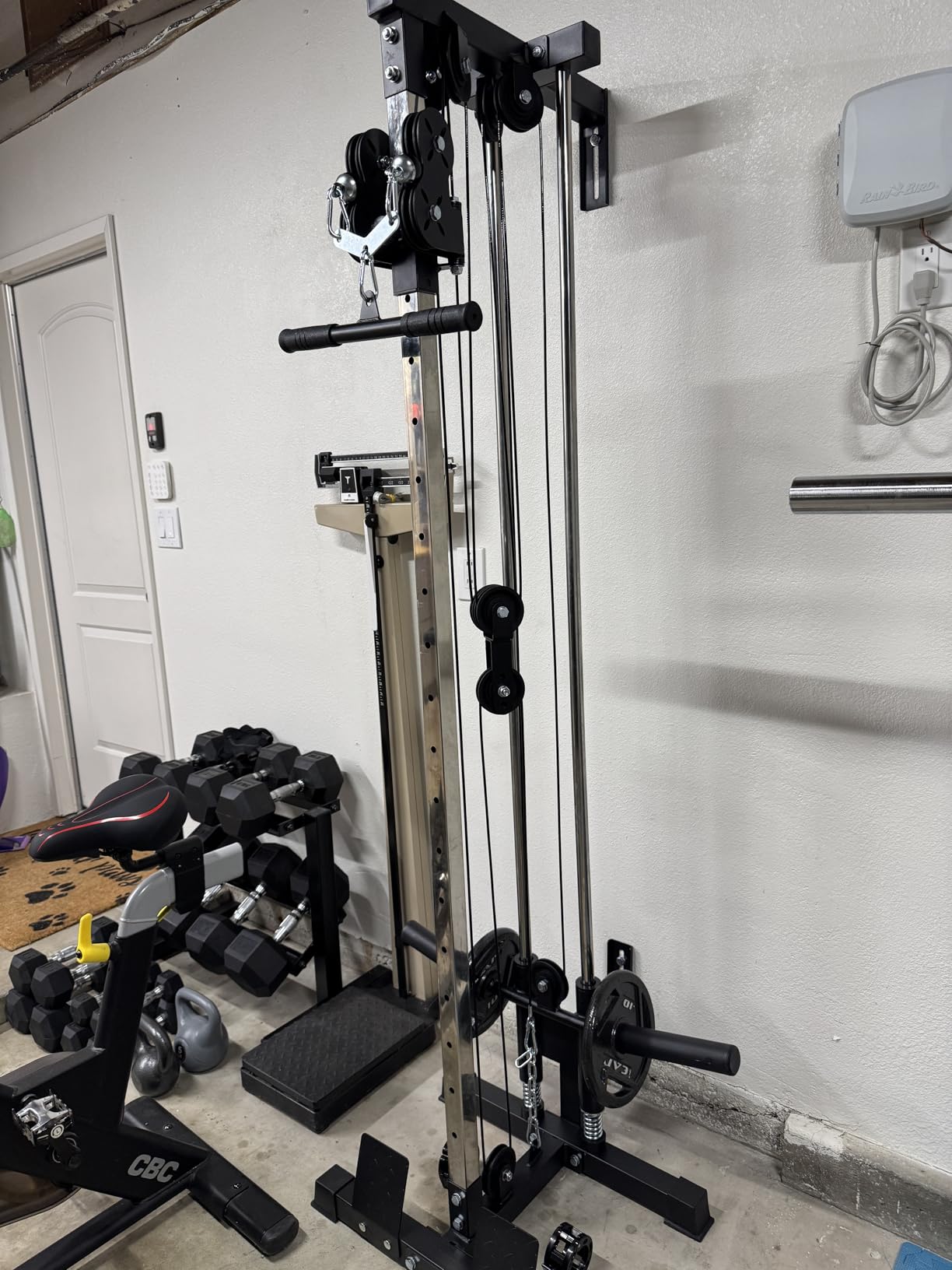
Eighteen pulley positions plus a rotating bracket widen the range of pull angles, and the upward 10 degree weight pegs with detachable 1 inch and 2 inch plate sleeves keep loaded plates from walking when you pull low. The commercial grade 11-gauge powder coated steel frame is a heavier gauge than most wall units in this roundup.
Reviewers rate it very highly for space saved and for the load it delivers, with a large share of top ratings. The included lat bar, cable bar, tricep rope and four buckle strap handles cover most of what a new owner reaches for first.
Wall anchoring is not optional here
Every wall-mounted unit in this roundup needs studs, and this one says so plainly. Mounting into drywall anchors alone is how a 400 lb rated frame ends up pulled off the wall during a heavy low row. Find two studs at least 16 inches apart, use lag screws sized to your wall material, and check the frame for level before the first loaded pull.
Assembly documentation is minimal, so budget time to work out the pulley routing yourself. That is the main reason this sits below the Mikolo M-G3, which has the same 400 lb rating and clearer labelled hardware bags.
Where it fits in the lineup
Choose this one for a corner of a two-car garage where you want max load and do seated rows. Choose the Mikolo M-G3 instead if you want more pulley positions and clearer assembly instructions, and choose the Goimu WM1 if you need a lighter frame you can carry upstairs.
The 26 by 27.2 inch footprint is among the smallest here, and the 81.9 inch height leaves a tall user some room for a kneeling pulldown, though it is still a wall station and not a full tower.
11. Goimu DP01 Power Cage – Fine Adjustment in 31 Positions
GOIMU DP01 Power Cage, 2000LBS Squat Rack with Cable Crossover and Dual Independent Pulley System, Full Cage for Full Body Training, Power Rack with More Training Attachments for Home Gym (Red)
57.87D x 46.46W x 84.25H
2:1 cable ratio
31 cable plus 29 J hook positions
2000 lb capacity
Pros
- Full power cage and functional trainer in one frame
- Independent dual pulleys allow unilateral and partner work
- Deep 47.64 inch interior supports bench presses inside the cage
- One inch spacing on 31 cable and 29 J hook positions
Cons
- 2:1 ratio makes effective resistance about half the loaded weight
- Stainless steel finish scratches and can chip readily
- Larger footprint than half rack or wall mounted options
The DP01 is for a specific garage: one where you squat and press seriously and also want cable work, but only have room for one frame. It combines a full power cage with an independent dual pulley cable crossover, and the approximately 17.88 square foot footprint is smaller than most two-machine setups by a wide margin.
Thirty-one cable height positions and 29 J hook and safety bar positions at 1 inch spacing is the finest adjustment in the roundup. In practice, one inch granularity is what lets two people of different heights use the same machine without either of them crouching to reach a pulley.
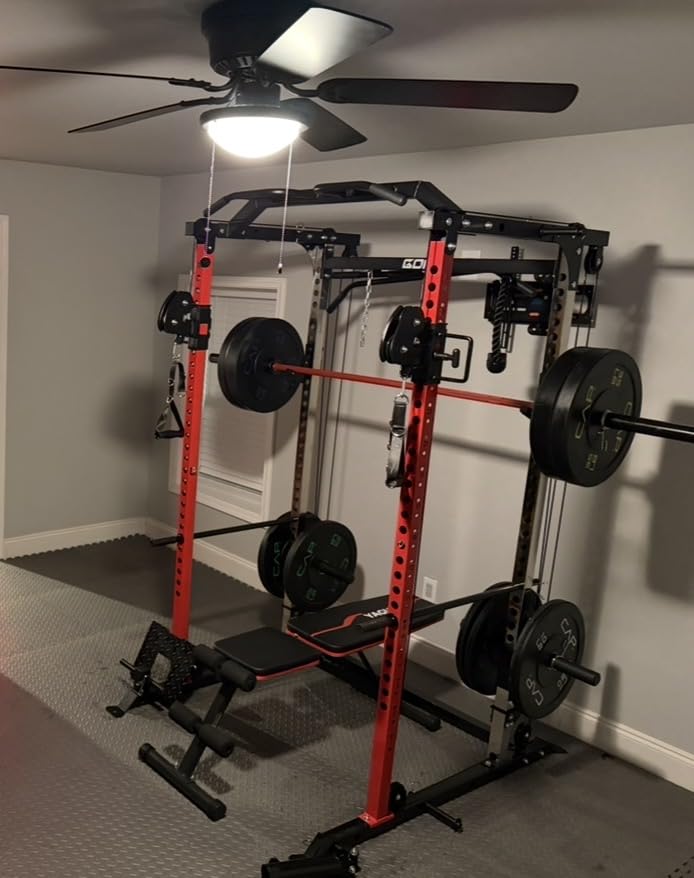
The 47.64 inches of interior training space is enough to bench press inside the cage, which is a detail that decides the purchase for a lot of lifters. You are not choosing between barbell and cable; you are getting both in the same footprint with the barbell fully enclosed.
Independent dual pulleys mean you can work one side, run a partner drill, or set up a circuit with two different loads, and the 2 x 2 inch steel tubing with reinforced structure holds a 2000 lb rating.
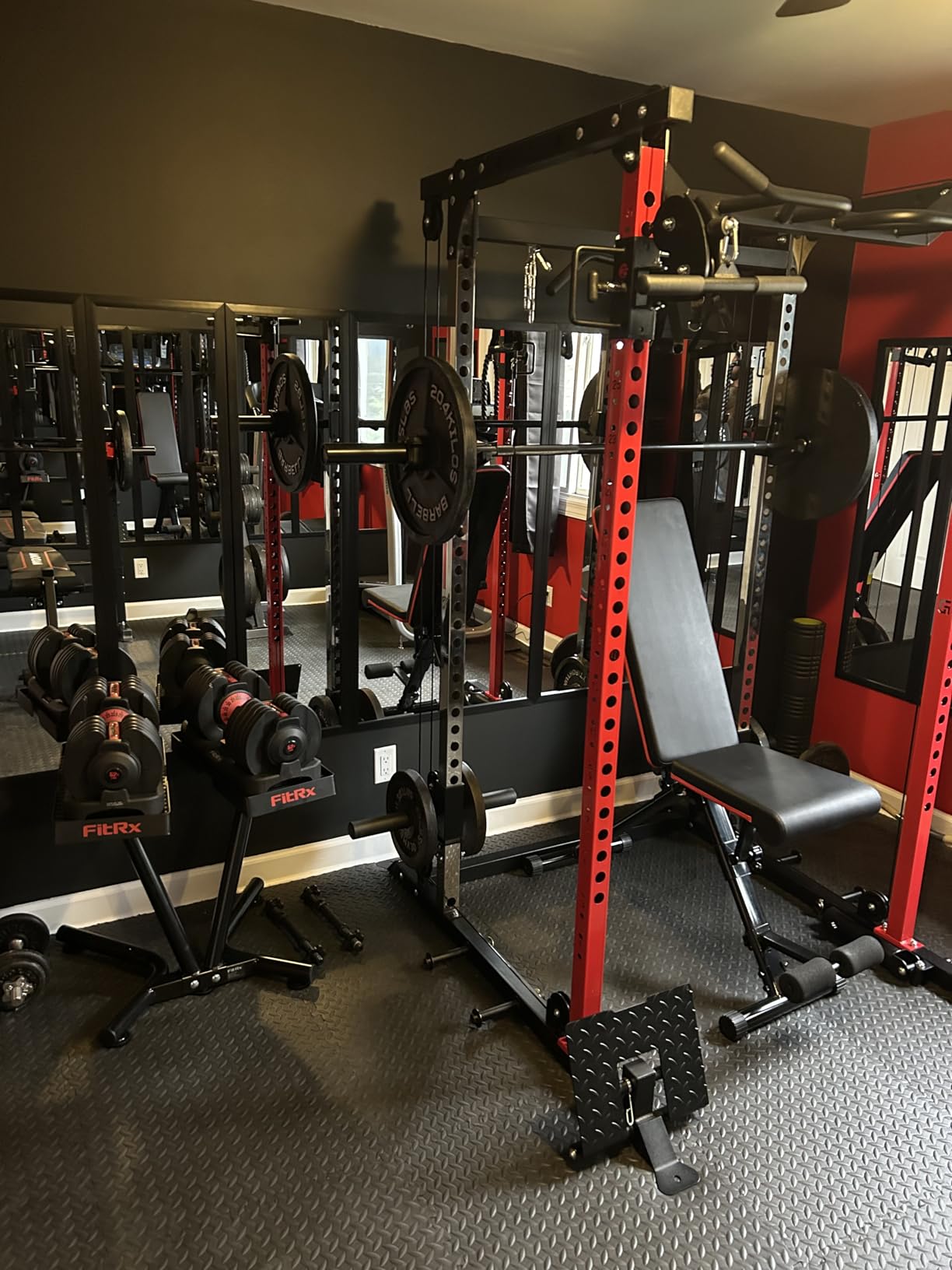
The 2:1 ratio and what it means for loading
This cage runs a 2:1 cable ratio, so the effective resistance is about half the loaded weight. That makes it well suited to curl, pushdown and fly work where the light end of the scale is what you want, and less suited to heavy low rows and heavy lat pulldowns unless you are prepared to load a lot of plates.
Compare it with the Mikolo HR05-B half rack, which runs a true 1:1 in a smaller footprint. The DP01 wins on being a full cage; the Mikolo wins on cable math and on saving floor space.
Trade-offs to plan for
It is still a full cage footprint, larger than any half rack or wall-mounted alternative here, so it does not solve a tight single-car garage. The stainless steel finish scratches and can chip readily, which is worth considering in a garage where equipment gets moved.
The attachment list is long for the price: T bar, tricep rope, lat pulldown bar, safety bar, J hooks, base band pegs, cable handle and foot board all ship with it, and it is expandable with additional plate storage and dip bars.
12. YOLEO 9-in-1 Power Cage and Bench – Package Deal
YOLEO Power Cage, 9-in-1 Power Rack with Dual Pulley Cable Crossover System, Multi-Function Squat Rack with LAT Pulldown & Low Row Station, Heavy Duty Home Gym Workout Cage for Strength Training
9-in-1 station with bench
1.8 mm 2x2 inch steel uprights
PU coated cables with bearing wheels
2315 lb bench included
Pros
- Nine training stations plus a bench in one package
- Quiet PU coated cable run with bearing wheels
- Tool-free height changes between flys pulldowns and rows
- Long accessory list included at the box price
Cons
- 2:1 pulley ratio gives lighter resistance than a 1:1 system
- Full cage footprint is larger than wall mounted stations
- Bundled cage and bench are heavy to move and assemble
If you are building a garage gym from an empty slab, this package removes the most annoying part of the process: sourcing a bench that fits the cage. You get the power rack, cable crossover, dual pulley lat pulldown, 2:1 low row, pull-up bar, dip station, core trainer and resistance station, plus a 2315 lb capacity commercial weight bench with 10 backrest and 3 seat positions.
The bench has 10 backrest and 3 seat positions, and the cage interior of 35 by 61 inches fits most weight benches, so the bundled one is dimensioned for the frame rather than dropped in as an afterthought. Nine stations in one footprint is the pitch, and for a new build that is genuinely fewer decisions.
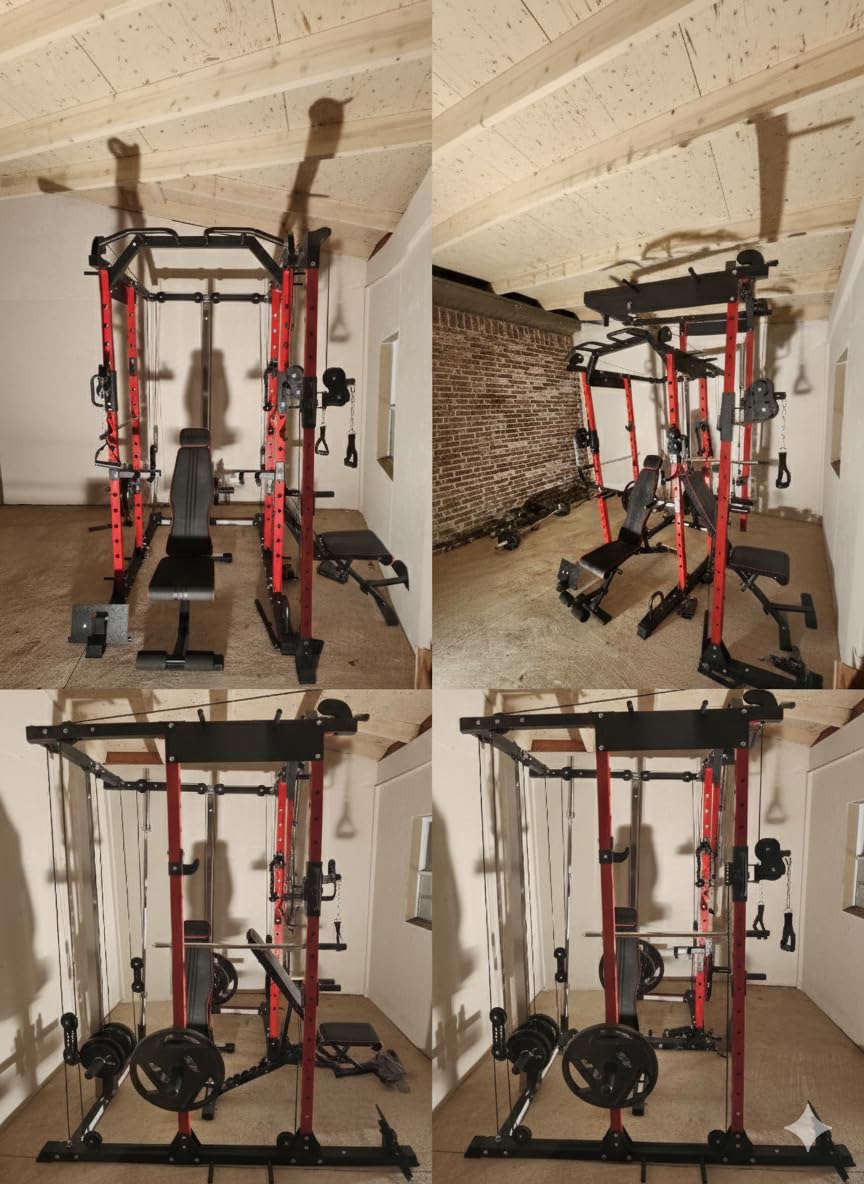
Quiet operation is the underrated feature. The PU coated cables running over bearing wheels are the quiet system here, which matters if you are training in an attached garage with a bedroom above it or a shared wall. The 1.8 mm thick 2 by 2 inch steel uprights are welded at 12 critical stress points, which is a specific and checkable claim rather than a vague durability boast.
Tool-free height changes are what make nine stations usable in practice. Without them you would be hunting for a wrench between every exercise, and that is what turns an ambitious multi-station machine into a single-station machine.
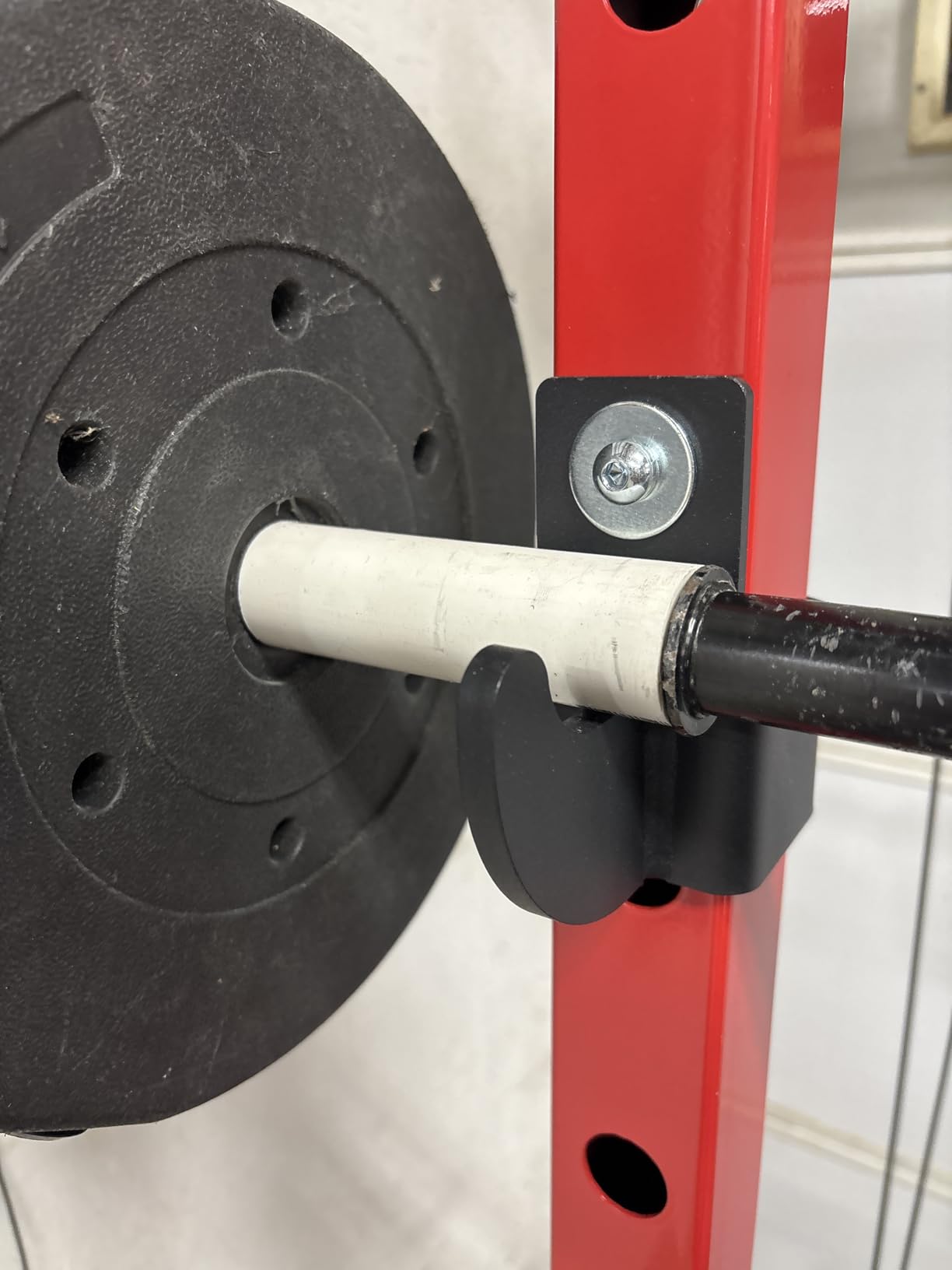
When a package beats buying separately
A package wins when you are starting from nothing and the bench is part of the plan anyway. The accessory list includes a T bar, lat bar, rope, landmine and clamps, and band pegs, a landmine and weight storage pins are built into the frame, so the first session is not delayed by a parts order.
A package loses when you already own a good bench, or when you want the deepest possible load on the cables. The 2:1 pulley ratio gives lighter resistance than a 1:1 system, and for a strong single lifter that halves what is achievable per plate.
What to plan for
The full cage footprint is larger than wall-mounted cable stations, and at 40 kg for the cage alone plus a full commercial bench, moving and assembling the pair is a two-person job. Lay out the interior space before delivery so you are not reassembling it to fit.
Note also that this is the shortest review history in the roundup at 49 reviews. Reviewers report 83 percent five-star ratings and point to the quiet bearing wheel cable system and the compact nine-in-one layout as the deciding factors, but long-term durability is less well documented here than elsewhere.
How to Measure Your Garage Before You Buy
Ceiling height is the constraint that kills the most cable machine purchases, and it is almost never checked. A very common residential garage ceiling is 96 inches. Compare that to the listed machine height and you will immediately see the problem: the DONOW is 81 inches tall before you add a lat arm or a user standing on a platform, and the Goimu DP01 at 84.25 inches leaves very little headroom for overhead cable work.
Measure four things, in this order. First, floor-to-ceiling height at the exact spot you plan to mount, not the highest point of the ceiling. Second, the wall run available, since wall stations need roughly 26 to 30 inches of width plus clearance on both sides for crossovers. Third, depth, where a seated row with a footboard needs about 4 feet of clear floor in front of the machine. Fourth, door and vehicle clearance, because a folding rack in a single-car bay still has to open while the car is present.
Then add the working space people forget. You need room to stand in front of the machine, step back at the end of a fly, and set down a plate without it rolling under a car. Owners consistently underestimate this, and it is the most common reason a machine that measured correctly still ends up badly placed.
If your garage doubles as a workshop or storage space, a wall-mounted station is the only format that returns the floor entirely. If you have a spare wall and can give up 8 feet of width, a dual-stack functional trainer is worth it. If the car has to live in the bay, your realistic options are a wall mount or a folding rack, and nothing else.
Cable Ratio Explained: Why Stack Weight Is Not Felt Weight
Cable ratio is the most consequential spec on this page and the one most often ignored. The ratio tells you how much the pulley system multiplies or divides the weight you load. A 1:1 system feels like the plates you loaded. A 2:1 system feels like roughly half. A 4:1 system feels like roughly a quarter, but feels much smoother through the whole range of motion.
So a 200 lb stack on a 2:1 machine delivers about 100 lb of felt resistance, and a 100 lb stack on a 4:1 machine delivers about 25 lb. This is the single most useful calculation you can make before buying, and it is the one that determines whether a machine is strong enough for you. Members of r/GarageGym ask this question constantly, usually framed as whether a 72 kg per side stack is enough for someone who benches heavy.
Looking across this roundup, the 1:1 machines are the Mikolo HR05-B half rack and the Mikolo WR00 folding rack, and the Goimu WM1 can be switched between 1:1 and 2:1 with the supplied adaptor. The 2:1 machines include the Body-Solid Best Fitness, the Body-Solid Powerline PFT100, the Goimu DP01 and the YOLEO package. The wall-mounted plate-loaded units do not quote a ratio at all, because the load is whatever you hang on the sleeves.
That is the practical takeaway. Plate-loaded wall stations are the most intuitive for a heavy lifter because there is no math to do, while stack machines demand that you check the ratio before you decide the stack is too light. If you already know that you pull 150 lb for eight reps, a 2:1 machine with a 190 lb stack is right at your limit, and a 1:1 machine with half that stack is the better buy.
A secondary benefit of higher ratios is smoothness. More pulleys in the path average out the load, so a 2:1 or 4:1 system feels better on small isolation work like curls and pushdowns, where a 1:1 system can feel harsh. That is a real training benefit, not a compromise.
Stack vs Plate-Loaded Loading and What Ships in the Box
Selectorized weight stack loading uses a pin to select a weight, and the plates travel in the machine. Plate loading uses a carabiner and plates you supply. The stack is faster between sets and quieter, and it is also heavier, larger and capped at the maximum stack. Plate loading is slower and noisier, but unlimited and much lighter on the wall.
The most common buyer frustration in this category is that weight plates are almost never included. It is worth planning for before the machine arrives. A wall station needs a plate tree, at least two pairs of plates and a mat, and a freestanding stack machine needs nothing extra but does need floor space for the built-in plates. Nobody here ships a full set of weights with the machine.
For total cost of ownership, think in three parts: the machine, the plates or a full complement of weight, and the floor protection. A rubber mat under a plate-loaded station is not optional, because loaded plates landing on concrete will damage both the plate and the slab.
One more hardware item that is easy to overlook. Cable ends fray, and a replacement cable is a normal part of ownership rather than a warranty failure. Check whether the manufacturer sells replacement cables and how long they keep spare parts available before you buy, because that determines whether a frayed cable in five years is a fifteen minute fix or a dead machine.
Wall-Mounted, Folding and Rack-Integrated Space Savers
Wall-mounted stations are the real space savers, and the honest comparison is simple. A wall unit uses zero floor space permanently, which means the car stays parked, the treadmill stays where it is, and the rest of the garage remains usable. The cost is a wall, accurate stud placement, and a limit of one user at a time.
Every wall-mounted pick here needs to be anchored into studs. That is not a formality. Under 400 lb of plate loading, drywall anchors fail, and a detached cable station is a serious hazard. Find studs, use the right fasteners, and check the frame for level before you load it.
Folding racks like the Mikolo WR00 return floor space only when you need it, going from 9.5 square feet open down to about 3 square feet closed. That is the right answer when the same bay has to be a gym and a car park, and the wrong answer when you have a dedicated spare wall, because a fixed wall station gives you more pulley positions in less space.
Rack-integrated cable columns, where the cable uprights double as the rack uprights, save the most space of all and carry real trade-offs. The cables run along the structure you need to walk around, and the pulleys sit in your foot traffic, which is a real tripping and snagging concern. It is workable if you fix the cable routing to one side and stay aware of it, and it is worth a look if you have never used one.
For a related look at how a rack attachment fits a broader build, our guide to the best Smith machines for home gyms covers the rack side of the same floor space decision.
Sharing One Machine Between Two People
Shared use is the least covered topic in this category and one of the most common garage questions. Two people of very different heights and strengths need a machine that changes quickly, in two directions: weight and pulley height.
Weight change speed is where the formats separate. A selectorized stack with a pin takes seconds. Plate loading with a carabiner and a plate tree takes about a minute. A wall station with no plate storage nearby takes several minutes, which is why the dedicated functional trainers and the integrated cages with mid-frame weight storage suit shared use better than a bare wall station.
Height adjustment is the other half. Machines with fine adjustment, like the Mikolo HR05-B at 30 positions drilled 1 inch apart or the Goimu DP01 at 31 cable positions, let a shorter user and a taller user both set the pulley at the right height without an argument between sets. Machines with 15 to 17 positions work too, but the gap between adjacent holes is wider.
Dual independent stacks are a genuine advantage here. With two separate columns, one person can work a heavy single-arm press while the other is on a lighter set opposite, with no shared pin and no waiting. On a plate-loaded wall station, both users are sharing the same plates, which is where friction between partners actually shows up.
Our general advice is to test the change speed before you commit. Set a machine to a heavy load, then change it to a light one, and time yourself. If it takes more than a couple of minutes, a second person sharing that machine will not enjoy it.
Who Should Skip a Cable Crossover Machine
Some garage gym owners should not buy any of these, and telling you so is more useful than another roundup. If your bar, bench, plates and rack are not yet sorted, cables are a want rather than a need, and the order of operations matters more than the brand.
If your training is entirely barbell and you are chasing maximal strength on the squat, bench and deadlift, a cable crossover adds little. It is a hypertrophy and accessory tool, not a maximal strength tool, and the money is usually better spent on a better bar and more plate weight.
If your garage cannot take wall anchoring and has no stud spacing that works, the entire wall-mounted category is closed to you. Check the studs first, because that single test eliminates or confirms half the options on this page.
And if your space is tight enough that the machine will be moved regularly, a door-mounted or wall-mounted pulley kit covers the same basic movements for a fraction of the commitment. Just use a coated steel cable and machined pulleys, because uncoated steel cable frays against metal pulleys into a poking hazard within weeks. That safety note applies to any budget pulley setup, not just to this list.
Our broader cable machine guide covers the home setups we did not include here, and if you are still unsure, start with the best cable machines we have tested to see how the formats compare outside the garage context.
Frequently Asked Questions
What is the best cable crossover machine for a home gym?
For most home and garage setups, the Valor Fitness wall mounted cable machine is the best balance of footprint, adjustability and price: 16 pulley height positions, plate loading to 200 lb, and a 25 by 25 inch frame that leaves the floor completely free. If you have a dedicated wall and want plate-free speed between sets, a dual-stack functional trainer such as the Body-Solid Best Fitness is the better long-term buy.
What ceiling height do I need for a cable crossover machine?
Check the machine height against the lowest point of your ceiling at the mounting spot, not the peak of the roof. The wall-mounted units in this roundup run 78.7 to 82 inches tall and the full cages run 81 to 86 inches. A very common 96 inch garage ceiling works, but overhead cable work on a deep cage leaves very little headroom.
How much weight resistance do I need on a cable machine?
Work out your training weight first, then divide by the cable ratio. A 1:1 machine needs the same weight you lift, a 2:1 machine needs roughly double the loaded weight to feel the same, and a 4:1 machine needs about four times as much. A plate-loaded wall station avoids the math entirely, since the resistance is whatever you hang on the sleeves.
Is a home gym pulley system worth the investment?
Yes, if you have a wall to anchor to and want back, chest and shoulder isolation work without a second full machine. Cables give constant tension through the whole range of motion, which free weights cannot. A wall-mounted station costs nothing in floor space, and the trade is slower weight changes than a selectorized stack. Use coated steel cable, since uncoated cable frays against metal pulleys within weeks.
What are some compact cable machines for home gyms?
The most compact options here are the Goimu WM1 at about 3.28 square feet and 81.4 pounds, the Valor Fitness wall mount at 25 by 25 inches, the Mikolo M-G3 at 25.6 by 26.9 inches with a 400 lb load limit, and the ER KANG at 26 by 27.2 inches. If the floor space has to come back regularly, the Mikolo WR00 folding rack drops from 9.5 square feet open to about 3 square feet closed.
Do I need a power rack to use a cable machine?
No. A standalone wall station or a freestanding functional trainer gives you a full set of cable movements with no rack in the room. A rack-integrated cage is only worth choosing if you also want to squat and press heavy in the same frame, since it saves space by combining two machines at the cost of a much larger footprint and longer assembly.
Can a cable crossover replace a lat pulldown machine?
Yes, as long as the pulley can reach overhead height and the top position is usable. Check for machines whose top peg position cannot be used because the cable trolley fouls the front pulleys. Owners on r/GarageGym also note that wall units can feel short for tall users doing a kneeling lat pulldown, so check the listed height against your own reach before ordering.
How long does a cable crossover machine take to assemble?
Budget about an hour for a small wall-mounted station such as the Goimu WM1, two to three hours for a wall mount with less clear instructions, and four to five hours for a heavy freestanding crossover such as the DONOW, where cable routing is the hardest step. The heaviest units, including the Body-Solid Powerline PFT100 and the pooboo P43 cage, are a two-person job from delivery through assembly.
Which Cable Crossover Machine Should You Buy?
Start with the constraint, not the feature list. If the car stays in the bay, buy a wall-mounted station, and among these the Valor Fitness is the default answer while the Mikolo M-G3 is the choice if you plan to load heavy and want seated rows. If you have a spare wall and a quiet space, the Body-Solid Best Fitness gives you notably quiet, smooth cable travel, and the Body-Solid Powerline PFT100 is the one to buy if you want commercial feel and can live with a large footprint and a long build.
If you squat and press seriously, the choice is between the pooboo P43 for the best-rated build and the Mikolo HR05-B half rack for a true 1:1 cable ratio in about two-thirds of the space. If the floor space has to come back on demand, the Mikolo WR00 folding rack is the only pick here built for that. And if you want everything from an empty slab in one delivery, the YOLEO package arrives with the bench already dimensioned for the cage.
Before any of that, do three things: check your studs, measure your ceiling at the mounting point, and run the cable ratio math against the weight you actually train at. Those three checks eliminate most of the bad purchases in this category, and they take an afternoon. If you want a wider look at cable training setups, our guide to the best rowing machines for home gyms covers the cardio half of a balanced garage build.
Whichever one you choose, add plates, a mat and a plate tree to the same order. A cable crossover machine on its own is a frame that sits there, and it becomes a real gym the day the resistance is loaded.