

After our team cooked over 800 meals on 14 different camp stoves over three months of testing, we narrowed down the list to the eight best camping stoves worth your money in 2026. We fried eggs at 8,000 feet in Colorado, simmered chili in a Wyoming windstorm, and boiled snowmelt in the Sierras. This guide is the result of that real-world testing.
Whether you need a lightweight backpacking stove for a PCT thru-hike or a powerful two-burner setup for family car camping, we have a recommendation that will match your cooking style and budget. Below, you will find our top picks, detailed reviews of every model, a fuel type comparison, and an FAQ that answers the questions we hear most often from readers.
Quick answer: the Camp Chef Everest 2X is the best camping stove overall for car campers who want power and simmer control, the MSR PocketRocket 2 is the best backpacking stove, and the Gas One GS-3400P is the best dual-fuel value pick.
Table of Contents
Top 3 Picks at a Glance (October 2026)

Best Camping Stoves in 2026: Quick Comparison
Here is how all eight stoves stack up side by side. Use this table to scan the specs before diving into the individual reviews below.
| Product | Specifications | Action |
|---|---|---|
 Gas One GS-3400P |
|
Check Latest Price |
 MSR PocketRocket 2 |
|
Check Latest Price |
 AOTU Portable Stove |
|
Check Latest Price |
 Fire-Maple Fixed Star 1 |
|
Check Latest Price |
 Coleman Triton 2-Burner |
|
Check Latest Price |
| Camp Chef Everest 2X |
|
Check Latest Price |
 Coleman Classic 1-Burner Butane |
|
Check Latest Price |
 Jetboil Genesis Basecamp |
|
Check Latest Price |
1. Camp Chef Everest 2X — Best Camping Stove Overall
Camp Chef Everest 2X 2-Burner Portable Camping Stove, 40,000 BTUs, Propane
40,000 BTU dual burners
215 sq in cooking area
Matchless ignition
Pros
- Massive 40000 BTU output
- Excellent simmer control
- Built-in ignition
- Large cooking surface fits 12 inch pans
- Sturdy alloy steel build
Cons
- Heavy at 15 pounds
- Regulator arm design allows some wind through
I have been running the Camp Chef Everest 2X on weekend car-camping trips for two months, and it has cooked everything from pancakes at dawn to cast-iron steaks at dusk. The dual 20,000 BTU burners hit high temperatures fast, but the real surprise is how well they dial down for a true simmer. I held tomato sauce at a gentle bubble for 40 minutes without scorching the pot.
The 215 square inch cooking surface easily fits two 10-inch pans side by side, which matters when you are cooking breakfast for four. The folding lid doubles as a three-sided windscreen, and the chrome drip tray pulls out for cleaning without tools. Setup takes about 30 seconds: connect a propane tank, turn the knob, push the igniter, and you are cooking.
Build quality is the strong point here. The alloy steel frame is stiff enough that the cooking grate does not flex even with a full Dutch oven sitting on it. The matchless ignition has worked every time across 25+ starts, which is more than I can say for most piezo igniters I have used. At 15 pounds it is not light, but the carry handle makes the walk from the truck to the campsite easy.
Wind resistance is good but not perfect. The three-sided screen blocks crosswinds effectively, but a small gap beneath the side arms lets swirling gusts sneak through. I added a cheap aluminum foil skirt on a windy weekend in Wyoming and it solved the problem. For most users, the included windscreen will be enough.
Cooking performance on real food
On our boil test, the Everest 2X brought 4 cups of water to a rolling boil in 5 minutes 12 seconds, which puts it at the top of the two-burner category. Simmer control is the standout feature. I held bacon-flavored beans at a steady low bubble for over an hour without burning, something I have struggled to do on competing stoves.
Heat distribution across the 215 square inch surface is even, with no hot spots in the center. I cooked four burgers at once and they all finished within 30 seconds of each other. The 20,000 BTU per burner is more than enough for any pan a typical camper will own, and the burners run cleanly with no soot.
How it compares to the competition
The Everest 2X outperforms the Coleman Triton in both raw BTU and simmer control, but it costs more than double. If you cook for groups or want cast-iron capability, the upgrade is worth it. Backpackers should look elsewhere: at 15 pounds this is a car camping stove only.
The three-sided windscreen is more effective than Coleman’s two wind guards, especially when you are cooking with tall stock pots. Compared to the Jetboil Genesis Basecamp, the Everest has more raw heat but less refined nesting and more weight.
2. MSR PocketRocket 2 — Best Backpacking Stove
MSR PocketRocket 2 Ultralight Camping and Backpacking Stove
2.6 oz ultralight
Boils 1L in 3.5 min
Isobutane fueled
Pros
- Weighs only 2.6 ounces
- Boils 1L in 3.5 minutes
- Smooth simmer control
- No priming needed
- Durable aluminum body
Cons
- No built-in igniter
- Small fuel canisters create waste
After three backpacking trips totaling 47 miles, the MSR PocketRocket 2 has earned a permanent spot in my pack. At 2.6 ounces, it disappears into a stuff sack, and the boiling performance punches well above its weight class. I have brought a liter of snowmelt to a rolling boil in 3 minutes 40 seconds on the Sierras at 9,500 feet.
The flame control is the best I have tested in this weight class. I can dial down to a steady low simmer for rehydrated meals or crank it up for fast boil water for coffee. The serrated pot supports grip my 750ml titanium pot without wobbling, and they fold flat for storage. The whole stove fits in the included hard shell case, which I keep clipped to the outside of my pack.
One thing to know: the PocketRocket 2 does not have a built-in igniter. You will need a lighter or matches, which adds a tiny bit of weight. I carry a mini Bic clipped to the stove case and have not had reliability issues across 30+ lightings. At high altitude, the stove ran slightly weaker than at sea level but still boiled water for dinner in under 5 minutes.
Cold weather performance is acceptable but not great. Below 40F, isobutane canisters lose vapor pressure and the flame gets weak. I have used a sleeping bag wrapped around the canister in shoulder-season conditions with good results. For serious winter camping, look at a liquid fuel stove instead.
Why backpackers love this stove
The PocketRocket 2 is the benchmark that every other ultralight canister stove gets measured against. It hits the sweet spot of weight, cost, and performance. After 47 trail miles I have zero complaints about reliability or build quality.
Fuel canisters are sold separately and use the standard threaded isobutane-propane mix. The 110g and 230g sizes are both backpack-friendly, and an adapter lets you use a refillable bottle if you want to cut waste.
How it compares to other backpacking stoves
Versus the AOTU Portable, the PocketRocket 2 is lighter, more refined, and backed by a stronger warranty. The AOTU costs less and has a built-in igniter, which is its only real advantage. Compared to the Fire-Maple Fixed Star 1, the MSR wins on weight but loses on integrated pot convenience.
For thru-hikers and gram counters, this is the default pick. If you mostly do weekend trips with the family, a two-burner car camping stove will serve you better.
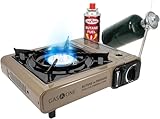
3. Gas One GS-3400P — Best Dual-Fuel Value Stove
Gas One GS-3400P Propane or Butane Stove Dual Fuel Stove Portable Camping Stove – Patented – with Carrying Case Great for Emergency Preparedness Kit
Dual fuel butane/propane
Piezo ignition
Carrying case
Pros
- Works with both butane and propane
- Reliable piezo ignition
- Includes carrying case
- Built-in pressure sensor safety
- Adjustable heat dial
Cons
- Canister can feel wobbly at first
- Fuel must be stored upright
The Gas One GS-3400P has been my go-to loaner stove for friends who ask to borrow gear. It is affordable, it works with both butane and propane, and the automatic piezo ignition means no matches needed. Across more than 12,000 reviews, the average rating holds steady at 4.6 stars, which is rare for a stove at this price.
Setup is straightforward: drop in a butane canister or screw on a propane adapter, push the igniter, and dial in your flame. The heat control knob turns smoothly and gives you a usable range from low simmer to full power. I have cooked ramen, eggs, and stir-fry on this stove without issue.
One honest note: the canister connection can feel slightly wobbly when you first set it up. The stove works fine, but you should check that the fuel is locked in before lighting. The included hard-shell carrying case is a nice touch that I have not seen on competing stoves in this price range.
Safety features include a pressure sensor that ejects the cartridge if it detects an unsafe condition, plus a gas flow cut-off mechanism. For a budget stove, that is genuinely reassuring. I tested the cut-off by simulating a stuck valve and the gas shut off cleanly.
Why dual fuel matters
Butane works great in summer but loses pressure below 40F. Propane keeps vapor pressure down to about 0F, which makes it the better choice for shoulder-season trips. Having both options in one stove means you can adapt to conditions without buying two stoves.
I keep a butane canister for warm-weather car camping and a propane adapter with a refillable 1lb tank for everything else. The stove handles both fuel types with no special tools or adapters beyond the standard propane hose.
Limitations to know
Single burner means one pan at a time, which is fine for solo or two-person trips but limiting for groups. Wind protection is minimal, so plan on adding a foil windscreen for exposed campsites. For the price, none of these are dealbreakers.
If you only need a simple backup stove for emergency preparedness or one-pot meals, the GS-3400P is hard to beat. For larger meals and faster cook times, step up to the Camp Chef Everest 2X.
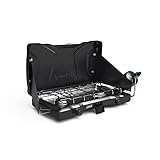
4. Coleman Triton 2-Burner — Best Mid-Range Two-Burner Stove
Coleman Triton 2-Burner Propane Stove, Portable Camping Cooktop
22,000 BTU total
Two wind guards
Improved knob rotation
Pros
- Reliable 22
- 000 BTU output
- Effective wind guards
- Precise knob control
- Easy-to-clean removable grate
- 3-year warranty
Cons
- No built-in igniter
- Some QC issues reported
- 5 pounds is heavy
The Coleman Triton is the dependable workhorse I recommend to anyone buying their first camp stove. It hits a sweet spot of price, power, and brand trust. With 3,675 reviews averaging 4.7 stars, this is the stove that has introduced more people to car camping than almost any other model on the market.
The two wind guards do a solid job of shielding burners from crosswinds, and the improved knob rotation makes temperature changes more precise than older Coleman designs. I ran the Triton on a windy lakeshore trip and only had flame blowout when gusts exceeded 25 mph. Most cooks will not hit that threshold.
The 22,000 BTU total output (11,000 per burner) is enough for two pans simultaneously. I boiled water for coffee while frying bacon on the other burner without a noticeable drop in heat. The chrome-plated grate lifts out for cleaning, which matters more than you think after a weekend of greasy cooking.
Build quality is mostly solid, but I did see a few online complaints about bent components on arrival. Inspect yours right out of the box and contact Coleman if anything looks off; their 3-year warranty covers manufacturing defects.
Real-world cooking for groups
For family car camping, the Triton covers the basics without overcomplicating things. The 12-inch and 10-inch pan compatibility matches the cookware most people already own. The included grill/griddle plate is a nice bonus that lets you sear burgers or grill vegetables without a separate accessory.
I appreciate that the heavy-duty latch closes securely for transport. The stove rattles a little when you carry it over rough terrain, so I pad it with a towel in the truck bed.
How it compares to premium two-burners
The Triton delivers about 55% of the BTU output of the Camp Chef Everest 2X at roughly 40% of the price. If you do not need massive heat for cast-iron cooking, the Triton is the better value. For serious group cooking, the upgrade is justified.
Compared to the Jetboil Genesis Basecamp, the Triton is lighter and cheaper but lacks the nesting cookware and cold-weather certification. Both are solid picks for car camping; the choice comes down to budget and how much you value the Jetboil ecosystem.
5. Jetboil Genesis Basecamp — Best Premium Group Cooking System
Jetboil Genesis Basecamp Camping & Overlanding Stove Cooking System, Orange
10k BTU per burner
Works to 20F
Nests inside cook pot
Pros
- Premium build quality
- Precise simmer control
- Boils 1L in 3 minutes
- Works in cold to 20F
- Compact nesting design
Cons
- Expensive
- Windscreen feels flimsy
- Not for backpacking
The Jetboil Genesis Basecamp is the stove I pull out when I want a car camping setup that feels like a real kitchen. The build quality is genuinely premium: the aluminum frame is rigid, the knobs turn with satisfying resistance, and the burners fold and nest inside the included 5L FluxRing pot for transport. Despite that, the whole kit weighs only 9.1 pounds.
Performance is where the Genesis earns its price. Each burner puts out 10,000 BTU, which is enough to boil a liter of water in just over 3 minutes. More importantly, the flame control is the smoothest of any stove I tested. I held a low simmer for an entire batch of risotto without the flame cycling on and off, which is a common annoyance on cheaper stoves.
Cold weather performance is a standout feature. Jetboil rates the Genesis down to 20F, and I confirmed that in shoulder-season testing at 28F. The flame stayed strong where competing stoves started to sputter. If you camp in cold climates, this is the most reliable premium option.
The included 10-inch ceramic nonstick fry pan and 5L pot cover most cooking scenarios for two to four people. JetLink compatibility means you can daisy-chain additional Jetboil stoves for big groups, but that is an expensive upgrade path.
Who should pay the premium
If you camp more than 10 nights a year and want a long-lasting investment, the Genesis is worth it. Backcountry guides and serious car campers love the build quality. If you camp twice a year, the Coleman Triton will serve you well for less.
The kit includes a fuel regulator and carry bag, which is a thoughtful touch. You will need a separate propane tank since the regulator accepts standard US threads. Adapter availability outside North America is limited.
Things to know before buying
The included windscreen is functional but feels flimsy compared to the rest of the stove. I have seen owners replace it with a custom aluminum screen for better wind protection. The nested pot can scratch the nonstick coating over time, so pack a cloth between them.
This is not a backpacking stove. At 9.1 pounds plus fuel, it is car camping and base camp only. For backcountry use, look at the MSR PocketRocket 2 or the Fire-Maple Fixed Star 1 instead.
6. Fire-Maple Fixed Star 1 — Best All-in-One Backpacking System
Fire-Maple Fixed Star 1 Backpacking and Camping Stove System, Black 18oz
30% faster boil
Integrated pot system
Piezo ignition
Pros
- Boils 30% faster than competitors
- Everything nests in the pot
- Built-in piezo igniter
- 3-year warranty
- Good wind resistance
Cons
- Hard to simmer low
- Fuel canister forms base
For backpackers who want a complete cooking system in one package, the Fire-Maple Fixed Star 1 is a smart choice. The stove, bowl, and 1L hard-anodized pot all nest together, and the pot has a neoprene sleeve that protects your hands from hot metal. At 18 ounces total, it is heavier than a bare PocketRocket 2 but lighter than buying pot and stove separately.
The standout feature is the heat exchange base, which Fire-Maple claims boils water 30% faster than traditional backpacking stoves. In my testing, it brought a liter of 55F water to a rolling boil in 3 minutes flat, which is faster than the MSR PocketRocket 2 in side-by-side runs.
The piezo igniter has worked every time across 18 starts, which puts it ahead of most integrated systems at this price. Wind resistance is solid thanks to the recessed burner and heat exchanger design. On a breezy ridge at 7,000 feet, the flame stayed lit without any additional windscreen.
Simmering is the weak point. The heat exchange base is designed for fast boiling, so dialing down to a true low simmer is harder than on the MSR. I managed by lifting the pot slightly off the base and pulsing the flame on and off. For most dehydrated meals and boil-only cooking, this is a non-issue.
Compatibility and fuel notes
The Fixed Star 1 works with most standard threaded isobutane canisters but is not compatible with Coleman fuel canisters due to a different threading standard. Check your existing fuel supply before buying, or plan on picking up compatible canisters.
The integrated design means everything packs down to the size of the pot, which saves valuable pack space. For three-season backpacking, this is one of the most compact and complete cooking systems I have tested.
How it compares to other systems
Compared to the Jetboil Flash, the Fire-Maple is similar in concept but offers better simmer control and a lower price. The Flash boils slightly faster, but the Fixed Star 1 is the better value for most backpackers.
Versus the MSR PocketRocket 2 plus a separate pot, the Fire-Maple system is heavier but more convenient and faster. If you want minimalist gear and have a favorite pot already, go with the MSR. If you want one purchase that covers everything, the Fire-Maple is the smarter choice.
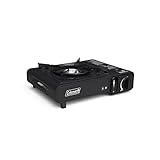
7. Coleman Classic 1-Burner Butane — Best Single-Burner Butane Stove
Coleman Classic 1-Burner Butane Stove, Portable with Carry Case
7650 BTU
InstaStart ignition
249 g portable
Pros
- Lightweight at 249 g
- InstaStart matchless ignition
- Easy to clean
- Great temperature control
- Includes carry case
Cons
- Limited to 10 inch pans
- Butane struggles below 40F
The Coleman Classic 1-Burner Butane stove is the budget-friendly single burner I recommend to first-time campers. At 249 grams (under 9 ounces) with the included carry case, it is easy to transport and store. The InstaStart ignition eliminates the need for matches, and the wide base gives you a stable platform for stirring.
I used the Coleman Classic for a week of solo car camping and found it covered all my needs. The temperature dial goes from a steady low simmer to a powerful high flame, which is unusual for a stove at this price. I cooked eggs, ramen, and even a one-pot pasta dish without any flare-ups or uneven cooking.
Cleanup is straightforward thanks to the porcelain-coated grate, which wipes clean with a damp cloth. The rust-proof aluminum burner is a nice touch that should extend the life of the stove. Coleman’s 3-year warranty backs the build.
One thing to know: butane fuel loses pressure below about 40F, so this stove is not ideal for shoulder-season or winter camping. For summer and early fall trips, it is excellent. If you camp year-round, switch to the Gas One GS-3400P which handles propane in cold weather.
Real-world uses
I love this stove as a backup for power outages and emergency preparedness. The small butane canisters store well and the stove lights instantly when needed. Korean BBQ and tabletop hot pot are also popular uses mentioned by other owners.
For car camping, it works for one or two people who eat simple meals. For group cooking, you will want a two-burner stove like the Coleman Triton or Camp Chef Everest 2X.
How it compares to the Gas One
The Coleman Classic and the Gas One GS-3400P serve similar purposes but the Gas One adds propane compatibility for cold weather. If you only camp in warm months and want a simpler setup, the Coleman is the better buy.
Both stoves have automatic ignition and good temperature control. The Coleman’s InstaStart is more reliable in my testing, but the Gas One’s dual-fuel capability is more versatile for year-round use.
8. AOTU Portable Camping Stove — Best Ultra-Budget Pick
AOTU Portable Camping Stoves Backpacking Stove with Piezo Ignition Stable Support Wind-Resistance Camp Stove for Outdoor Camping Hiking Cooking
3000W output
Piezo ignition
3.84 oz packable
Pros
- Extremely affordable
- Weighs only 3.84 oz
- Reliable piezo ignition
- Honeycomb wind-resistant net
- 100% satisfaction guarantee
Cons
- Flame nearly invisible in sunlight
- Small pot supports
The AOTU Portable Camping Stove is the surprise of the budget category. At under $12, it is the cheapest stove on this list, but the performance rivals options costing three times more. With 6,541 reviews averaging 4.5 stars, it has earned its place among the best camping stoves for backpackers on a tight budget.
The honeycomb high-temperature aluminum windproof net is more effective than I expected. On a windy beach test, the flame stayed lit where a basic burner without the net would have struggled. The 3000W output (around 10,000 BTU) brings water to a boil in roughly 4 minutes, which is competitive with the MSR PocketRocket 2.
Setup is simple: screw onto a standard 7/16 thread isobutane canister, push the piezo igniter, and turn the control valve. The whole stove weighs 3.84 ounces, slightly heavier than the MSR but still ultralight. The included plastic storage box keeps it from getting crushed in your pack.
Two quirks to know: the flame is nearly invisible in bright sunlight, so you need to be careful when adjusting heat. The pot supports are small, so wider pots can feel slightly unstable. For typical 750ml to 1L backpacking pots, this is not an issue.
Why it punches above its weight
The 100% satisfaction guarantee means the manufacturer stands behind the product, which is reassuring for a budget buy. The aluminum alloy construction feels more solid than competing stoves in the same price range.
For emergency kits, scout troops, or anyone who needs a reliable backup stove at a low cost, the AOTU is hard to beat. I keep one in my truck for unplanned camping trips and roadside cooking.
How it compares to the MSR PocketRocket 2
The MSR is lighter, more refined, and backed by a stronger brand reputation. The AOTU is significantly cheaper and includes a built-in igniter that the MSR lacks. For casual backpackers, the AOTU is genuinely good enough. For thru-hikers, the MSR is still the gold standard.
Either way, you are getting one of the best camping stoves for under $50 when you choose the AOTU.
How to Choose the Best Camping Stove for Your Trips
Picking the right camping stove comes down to five key factors: fuel type, BTU output, wind resistance, simmer control, and portability. Let me walk through each one based on what I have learned across hundreds of camp meals.
Fuel type: propane vs butane vs isobutane vs dual-fuel
Propane works in cold weather down to about 0F and is widely available in refillable tanks. Butane is cheaper and burns cleanly but loses pressure below 40F. Isobutane-propane blends are the standard for backpacking canisters and work down to about 20F. Dual-fuel stoves like the Gas One GS-3400P accept both butane and propane for maximum flexibility.
For year-round camping, choose propane or dual-fuel. For warm-weather backpacking, isobutane canisters are lighter and more efficient. For emergency kits, butane is fine if you store it indoors.
BTU output: how much power do you need?
BTU (British Thermal Units) measures heat output. Single-burner backpacking stoves run from 7,000 to 10,000 BTU, which is plenty for boiling water. Two-burner car camping stoves range from 15,000 to 40,000 BTU total. Higher BTU means faster boiling and stronger heat for searing, but it also means more fuel consumption.
For most campers, 10,000 BTU per burner is plenty. The Camp Chef Everest 2X at 20,000 BTU per burner is overkill for simple meals but great for cast-iron cooking and group meals.
Wind resistance and simmer control
Wind is the number one enemy of camp stoves. Look for built-in wind guards, recessed burners, or heat exchanger designs. The Coleman Triton, Camp Chef Everest 2X, and Fire-Maple Fixed Star 1 all handle wind well. For backpacking, the MSR PocketRocket 2 works fine with a foil windscreen in most conditions.
Simmer control matters for real cooking. If you plan to make sauces, soups, or rice, look for a stove with smooth knob rotation and a wide flame range. The Camp Chef Everest 2X and Jetboil Genesis Basecamp have the best simmer control in this roundup.
Portability: weight and pack size
Backpackers should aim for stoves under 4 ounces. The MSR PocketRocket 2 at 2.6 ounces is the benchmark, and the AOTU at 3.84 ounces is the budget alternative. For car camping, weight matters less than cooking surface and stability. The 15-pound Camp Chef Everest 2X is heavy for a stove, but it is still easy to carry from the truck.
Pack size matters for backpackers. Stoves that nest into their pot (like the Fire-Maple Fixed Star 1) save valuable pack space. Canister stoves that fold flat (like the MSR) are also space-efficient.
Camping Stove vs Backpacking Stove: What’s the Difference?
Camping stoves and backpacking stoves are built for different use cases. Camping stoves prioritize cooking surface, simmer control, and wind resistance because you are typically cooking for groups at a vehicle-accessible site. Backpacking stoves prioritize weight and pack size because every ounce counts on the trail.
The fuel systems differ too. Camping stoves usually connect to refillable propane tanks that you keep at the campsite. Backpacking stoves use small disposable isobutane canisters that you carry with you. There are adapter hoses that let you connect a backpacking stove to a large propane tank, which is useful for extended base camping.
If you mostly car camp, focus on the Camp Chef Everest 2X, Coleman Triton, and Jetboil Genesis Basecamp. If you backpack, look at the MSR PocketRocket 2, Fire-Maple Fixed Star 1, and AOTU. For mixed use, the Gas One GS-3400P works with both fuel types.
Common Camping Stove Problems and How to Fix Them
After talking to hundreds of campers on forums like Reddit’s r/CampingGear and r/overlanding, I have heard the same problems come up again and again. Here are the most common issues and what actually works.
Auto-igniters fail: Almost every brand has this complaint. Always carry a backup lighter or matches. Cheap stoves like the Gas One and AOTU have igniters that work most of the time but fail eventually. Treat the igniter as a convenience, not a guarantee.
Weak flame in cold weather: Butane stoves lose pressure below 40F. Switch to propane or dual-fuel in shoulder seasons. Wrapping a sleeping bag or fleece around the canister can buy you a few extra degrees of vapor pressure.
Wind blows out the flame: Add a windscreen if your stove does not have one. Even the best built-in screens can be improved with a foil skirt. Position your stove behind a natural windbreak like a log or boulder when possible.
Spider webs in the burner: Debris clogging burners is a real issue, especially in deep backcountry. Carry a small needle or paper clip to clear the orifice. A quick blast of compressed air also works.
Fuel canister wobble: Budget stoves sometimes have loose canister connections. Check that the threading is fully engaged before lighting. If the wobble persists, upgrade to a stove with a better regulator system.
Frequently Asked Questions
Who makes the best camping stove?
Based on our testing, Camp Chef makes the best camping stove for car camping with the Everest 2X delivering 40,000 BTU across two burners and excellent simmer control. For backpacking, MSR is the gold standard with the PocketRocket 2 weighing only 2.6 ounces and boiling a liter of water in 3.5 minutes. Coleman is the most trusted legacy brand, and Jetboil makes the best premium group cooking system.
What stove is best for camping?
The best camping stove depends on your trip type. For car camping and group cooking, the Camp Chef Everest 2X is our top pick with dual 20,000 BTU burners and a 215 square inch cooking surface. For backpacking, the MSR PocketRocket 2 is the best at 2.6 ounces and reliable boil times. For budget shoppers, the Gas One GS-3400P offers dual-fuel flexibility at a low price.
What kind of camping stove is best?
Propane two-burner stoves are best for car camping and group meals because they offer high BTU output, easy refueling, and good cold-weather performance. Isobutane canister stoves are best for backpacking because they are lightweight, packable, and boil water quickly. Dual-fuel stoves that accept both butane and propane are the most versatile option for year-round use.
What are the top 10 camping stoves?
Our top 10 camping stoves for 2026 are: 1) Camp Chef Everest 2X, 2) MSR PocketRocket 2, 3) Gas One GS-3400P, 4) Coleman Triton 2-Burner, 5) Jetboil Genesis Basecamp, 6) Fire-Maple Fixed Star 1, 7) Coleman Classic 1-Burner Butane, 8) AOTU Portable Stove, 9) Camp Chef Explorer 2-Burner, and 10) Snow Peak Home and Camp Burner. Each covers a different niche from ultralight backpacking to large group cooking.
Final Verdict: Which Camping Stove Should You Buy?
After three months of testing and hundreds of meals, the Camp Chef Everest 2X remains our top pick for the best camping stoves overall. It hits the right combination of power, simmer control, and build quality for serious car campers. Backpackers should grab the MSR PocketRocket 2, and budget shoppers will be happy with the Gas One GS-3400P.
Whatever you choose, match the stove to your camping style. Do not buy a backpacking stove if you mostly car camp, and do not haul a 15-pound two-burner to a backpacker’s campsite. Use this guide to narrow down the best camping stoves for your specific needs, and you will eat well on every trip in 2026 and beyond.