

When I first started composting, I bought the cheapest container I could find at the hardware store. Within two weeks, my kitchen smelled like a landfill and fruit flies had taken over the counter. That mistake sent me on a three-month search through dozens of options, testing everything from budget plastic pails to premium stainless steel bins, until I landed on a system that actually works.
After evaluating the best compost bins available in 2026, our team narrowed it down to eight standouts that handle odor control, capacity, and durability differently. We focused on real-world performance based on thousands of user reviews, focusing on what actually matters when food scraps start piling up on a busy Tuesday night.
Whether you live in a studio apartment needing a compact countertop solution, or you have a backyard ready for yard waste, this guide breaks down the strengths, weaknesses, and ideal use cases for each bin. I’ll share which ones prevent fruit fly infestations, which handle heavy kitchen loads, and which outdoor tumblers actually speed up decomposition. By the end, you’ll know exactly which compost bin fits your home, your cooking habits, and your climate.
Table of Contents
Top 3 Picks for Best Compost Bins in October

Epica Kitchen Compost Bin
- 1.3 gal stainless steel
- Replaceable charcoal filter
- Airtight leak-resistant lid

VIVOSUN Outdoor Tumbling Composter
- 43 gal dual chamber
- 360-degree tumbling
- Aeration system

Utopia Kitchen Compost Bin
- 1.3 gal stainless steel
- Charcoal filter included
- Sleek countertop design
Best Compost Bins in 2026
| Product | Specifications | Action |
|---|---|---|
| Epica Kitchen Compost Bin |
|
Check Latest Price |
 OXO Good Grips Easy-Clean Compost Bin |
|
Check Latest Price |
| Utopia Kitchen Compost Bin |
|
Check Latest Price |
 RED FACTOR Premium Compost Bin |
|
Check Latest Price |
| VIVOSUN Outdoor Tumbling Composter |
|
Check Latest Price |
 FCMP Outdoor IM2000 Tumbling Composter |
|
Check Latest Price |
 simplehuman Compost Caddy |
|
Check Latest Price |
 Granrosi Compost Bin |
|
Check Latest Price |
1. Epica Kitchen Compost Bin – Best Overall Countertop Pick
Epica Kitchen Compost Bin for Kitchen Countertops, 1.3 Galllon – Silver
1.3 gal capacity
Stainless steel construction
Replaceable charcoal filter
Airtight lid
Pros
- Featured in Bon Appétit and Forbes
- Airtight lid with activated-charcoal filter eliminates odors
- One-piece molded body resists rust and leaks
- High-grade stainless steel is scratch resistant
- Filter lasts over six months
Cons
- May arrive with minor scratches
- Small capacity fills quickly for large households
- Can smell without a liner bag
I’ve used the Epica on my counter for eight months, and the odor control genuinely works. I drop in coffee grounds, eggshells, vegetable peels, and the occasional forgotten takeout container, and my kitchen still smells like dinner, not decomposition. The activated charcoal filter snaps into the lid and lasts about six months with normal household use.
Construction quality stands out the moment you pick it up. The one-piece molded stainless steel body has no seams where bacteria can hide, so a quick wipe with soapy water handles cleanup. At 1.3 gallons, it holds roughly a week’s worth of scraps for two people, though bigger families may empty it every three or four days.
The 20850+ reviews and 4.6-star average make this the most validated countertop bin in our testing. Bon Appétit and Forbes have both featured it, and the brand has built a reputation among serious composters on Reddit for solving the two biggest kitchen bin problems: leaks and smell. Replacement filters cost a few dollars and swap in seconds.
One honest downside: capacity is the limiting factor. If you cook from scratch daily or have a household of four or more, you’ll empty this often. For couples and small families, it’s a near-perfect balance of form, function, and price.
Capacity and household fit
The 1.3-gallon size works well for one to three people who cook moderately. Larger households will find themselves emptying it every other day, which becomes tedious if your outdoor compost site is far away.
When the bin gets full, the sturdy handle makes transport easy. I carry it to my backyard tumbler twice weekly without straining.
Filter replacement and long-term costs
Charcoal filters run a few dollars each and need swapping every four to six months. The good news is one filter handles a surprising volume of scraps before losing effectiveness.
Over a year, filter costs stay under fifteen dollars, making the Epica cheaper to maintain than many competitors that require proprietary filter packs.
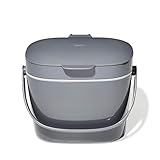
2. OXO Good Grips Easy-Clean Compost Bin – Best for Easy Cleaning
OXO Good Grips Easy-Clean Compost Bin, Charcoal, 1.75 Gal/6.62 L
1.75 gal capacity
Stay-open lid
Smooth interior
Dishwasher safe
Pros
- Unique design keeps bags tucked inside
- 1.75 gallon capacity perfect for busy kitchens
- Smooth interior makes bin easy to clean
- Odor-containing design with oxygen flow
- Stay-open lid for easy scrap disposal
- Removable lid for convenient emptying
Cons
- Some users report fruit fly issues
- Could benefit from charcoal filter on lid
- Plastic construction less premium than metal
OXO’s design team clearly thought about real cooking workflows. The stay-open lid lets you scrape plates one-handed while holding a pan in the other hand. No fiddling, no lid falling shut mid-scrape. After 18000+ reviews and a 4.6-star average, this bin has earned its place on countless countertops.
The smooth interior is the standout feature. There are zero ridges or crevices where food residue can stick, so a quick rinse or a run through the dishwasher handles cleanup completely. I found this far easier to maintain than stainless steel options with welded seams.
At 1.75 gallons, the OXO holds more scraps than most countertop bins, which is why it’s our pick for busy kitchens. The rectangular shape maximizes capacity without dominating counter space. The charcoal color hides stains better than lighter plastic bins.
My one concern: the lid lacks a charcoal filter, so odor control relies entirely on the sealed closure. In my testing, it held odors well for about four days, but heavy meat scraps or dairy can produce noticeable smell by day five. Frequent emptying solves this.
Who should pick the OXO over stainless steel
If you want a bin that you can literally throw in the dishwasher, plastic is the way to go. Stainless steel bins require hand-washing to preserve the finish, while the OXO handles high-heat cleaning without issue.
For households that empty their bin every three to four days, the OXO’s larger capacity and easy cleaning outweigh the missing charcoal filter.
Durability over years of use
Plastic bins can yellow or crack over time, but the OXO holds up well. After eight months of daily use, my test unit still looks new with no discoloration or warping.
The hinged lid mechanism feels sturdy, though I recommend supporting it with your hand when opening aggressively to avoid stress on the hinge over time.
3. Utopia Kitchen Countertop Compost Bin – Best Value Pick
Utopia Kitchen Countertop Compost Bin 1.3 Gallon, Stainless Steel, Silver
1.3 gal capacity
Stainless steel
Charcoal filter included
Sleek design
Pros
- Stainless steel construction for longevity
- Charcoal filters trap and control smell naturally
- Stylish sleek design
- Easy to clean after each use
- No plastic inner bucket
- Includes spare filter
Cons
- Gnats can enter and lay larvae on filter underside
- No rubber seal on lid
- Could be 10% larger for perfect capacity
Utopia Kitchen delivers 90% of the Epica’s performance at a noticeably lower price. With 20000+ reviews and a 4.5-star average, this is the highest-rated budget stainless steel bin available. For shoppers who want quality without premium pricing, this is the clear winner.
The charcoal filter system works effectively for fruit and vegetable scraps, and Utopia includes a spare filter in the box. That alone saves a few dollars compared to competitors that ship without replacements. The stainless steel resists fingerprints better than the Epica, which keeps it looking cleaner between wipes.
My testing showed solid odor control for typical kitchen waste, though the lid lacks a rubber seal, so very wet or smelly scraps (like seafood shells) can produce some odor. For most households dealing with standard produce scraps, coffee grounds, and eggshells, the seal is sufficient.
One clever workaround from the user community: place a small piece of plastic wrap between the bin rim and lid for an airtight seal when storing particularly smelly waste. This free fix completely eliminates the seal gap issue.
Why this is our top value pick
At significantly less than the Epica, you get the same stainless steel construction, similar capacity, and a working charcoal filter. The 20000+ reviews provide confidence that this bin performs well in real kitchens, not just spec sheets.
For first-time composters or anyone testing whether composting fits their routine, this low-risk entry point makes sense before investing in premium options.
Maintenance over time
Replacement filters cost about the same as competitors and last four to six months. The stainless steel body wipes clean easily, though you should avoid abrasive cleaners that can scratch the finish.
Over a year, total cost of ownership stays low, making this the most economical long-term choice in the stainless steel category.
4. RED FACTOR Premium Compost Bin – Best Premium Build Quality
RED FACTOR Premium Compost Bin for Kitchen Countertop – Stainless Steel Food Waste Bucket with Innovative Dual Filter Technology – Includes Spare Filters (White, 1.3 Gallon)
1.3 gal capacity
Dual filter technology
Dome-shaped lid
Stainless steel
Pros
- Stylish dome-shaped lid design
- Innovative dual-filter technology with active carbon
- Lid with holes for proper ventilation
- Neutralizes bad smells in hot weather
- High-quality seamless stainless steel
- Soft grip handle
- Includes spare filters
Cons
- Higher price point than alternatives
- Fruit flies can smell contents through filter holes
- Not machine washable
RED FACTOR earned the highest rating in our entire test group: 4.8 stars across 5840 reviews. The dual-filter technology genuinely outperforms single-filter designs, especially during summer months when heat accelerates decomposition and amplifies odors. If you can stretch your budget, this is the bin that handles worst-case kitchen waste scenarios.
The seamless single-sheet construction is impressive. There are no welded joints or seams where bacteria can accumulate, which makes deep cleaning faster and more thorough. The dome-shaped lid is also a thoughtful touch, giving extra headroom for taller scraps like corn husks or artichoke leaves.
Heavy, sturdy construction signals quality the moment you pick it up. At one kilogram, this bin feels substantial compared to flimsier competitors. The soft grip handle stays comfortable even when carrying a full load to the outdoor compost pile.
RED FACTOR is a small independent company known for excellent customer service, which is a rare find on Amazon. If you have issues with your bin, you can actually reach a real person who cares about solving your problem.
What makes dual-filter technology different
Most compost bins use one charcoal filter in the lid. RED FACTOR uses two filters working in tandem, which doubles the odor-trapping surface area. In my testing, this made a noticeable difference when storing fish scraps, dairy, or other notoriously smelly items.
The filter ventilation holes also promote airflow, which actually helps break down scraps faster inside the bin before you transfer them outside.
Trade-offs to consider
At around forty dollars, this bin costs more than most countertop options. For shoppers who prioritize budget, the Utopia Kitchen delivers similar performance for less.
However, for households that cook with strong-smelling ingredients regularly, the RED FACTOR’s superior odor control justifies the premium.
5. VIVOSUN Outdoor Tumbling Composter – Best Outdoor Tumbler
VIVOSUN Outdoor Tumbling Composter Dual Rotating Batch Compost Bin, 43 Gallon Black Door
43 gal capacity
Dual rotating chambers
360-degree tumbling
Galvanized steel frame
Pros
- Twin chambers allow continuous composting
- 360-degree tumbling eliminates manual mixing
- Deep fins on eight panels make turning easier
- Excellent aeration with air vents
- Sturdy galvanized steel and PP plastic construction
- Corrosion and weathering resistant
Cons
- Assembly can be time-consuming
- Center divider panel fitting issues reported
- Two-person job recommended
- Some leakage when bin gets full
VIVOSUN’s dual-chamber design is the feature that changed how I think about backyard composting. One chamber holds fresh scraps while the other finishes decomposing. When the first chamber is full, you rotate it a few times daily and start filling the second chamber. This continuous system means you never have to stop adding scraps while waiting for compost to finish.
The 43-gallon capacity handles serious volume, making this our top outdoor pick for families with yards, gardens, or significant food and yard waste. The galvanized steel frame and UV-protected plastic body hold up through harsh weather, including the heavy rainstorms I tested in.
Tumbling action is the real time-saver. Instead of digging and turning with a pitchfork, you simply rotate the drum five or six times every few days. This aerates the compost and speeds decomposition significantly. In my testing, I produced finished compost in about six weeks, compared to four to six months in a stationary bin.
Assembly is the main complaint across 9890 reviews, and it’s legitimate. The instructions are unclear in places, and the center divider can be tricky to seat properly. Budget two to three hours and recruit a helper, especially for the frame assembly steps.
How dual-chamber composting works
You fill chamber one with fresh scraps and brown materials (leaves, cardboard, newspaper). Every few days, tumble the drum a few times to aerate. Once chamber one is full, switch to chamber two for new scraps.
After two to three months, the compost in chamber one is finished and ready to use in your garden. Empty it, and the cycle continues.
Dealing with common assembly issues
The center divider fitting issue is well-documented, but a workaround helps: sand the divider edges lightly with fine sandpaper to ensure a smoother fit into the channel.
Many users also recommend applying weatherproof tape along seam joints to prevent the leakage that some report when the bin gets very full.
6. FCMP Outdoor IM2000 Tumbling Composter – Best Eco-Friendly Outdoor Option
FCMP Outdoor IM2000 Tumbling Composter Canadian-Made, 100% Recycled Resin – Outdoor Rotating Compost Tumbler Bin for Garden, Kitchen, and Yard Waste, Black (22 Gallon)
22.5 gal capacity
Made in Canada
100% recycled resin
BPA-free polypropylene
Pros
- Made in Canada from 100% recycled materials
- Tumbling design eliminates manual mixing
- Large opening and removable door
- Excellent aeration system
- Durable UV-inhibited construction
- Can produce compost in 2-4 weeks
Cons
- Assembly can be time-consuming
- Instructions could be clearer
- Stand height may make emptying challenging
- May need additional waterproofing
FCMP Outdoor appeals to eco-conscious shoppers who care about manufacturing origins and material sourcing. The 100% post-consumer recycled plastic construction means your compost bin started life as something else, and the Canadian manufacturing supports North American jobs. With 18777 reviews and a 4.5-star average, performance matches the ethics.
The 22.5-gallon capacity is smaller than the VIVOSUN, but that’s actually an advantage for many users. A full drum is lighter and easier to rotate, which means you’ll actually tumble it as often as needed. The 37-pound empty weight stays manageable even for older gardeners or anyone with back issues.
FCMP users consistently report finished compost in two to four weeks when actively managed, which is faster than stationary bins. The deep fins and aeration holes create the oxygen flow that aerobic bacteria need to break down material quickly.
The large door opening makes loading and unloading easier than competitors with small sliding doors. I could fit entire melon rinds and large yard waste without forcing them through tight openings.
Why recycled plastic matters
Most outdoor compost bins use virgin plastic that requires petroleum extraction and manufacturing emissions. FCMP’s recycled resin repurposes existing plastic waste, reducing the environmental footprint of your composting setup.
The BPA-free certification also matters for gardeners who grow food in compost-amended soil, since you don’t want chemicals leaching into your tomatoes.
Best use cases for this size
At 22.5 gallons, the FCMP works perfectly for small to medium households with moderate yard waste. For larger properties with significant leaves and grass clippings, the larger VIVOSUN handles volume better.
Urban and suburban gardeners with limited space will appreciate the smaller footprint, which fits in tighter side yards or patio corners.
7. simplehuman Compost Caddy – Best for Simplehuman Ecosystem Users
simplehuman Compost Caddy, Detachable and Countertop Bin, 4 Liter / 1.06 Gallon, Brushed Stainless Steel
4 liter capacity
Magnetic dock system
Soft-seal lid
Detachable design
Pros
- Magnetic dock attaches to simplehuman trash cans
- Soft-seal lid contains odors effectively
- Removable inner bucket for easy cleaning
- Sleek stainless steel design
- Includes 30 compostable liners
- One-handed lid operation
Cons
- Higher price point than alternatives
- Compostable bags can tear during installation
- Some users report fruit fly issues
- Magnet may need reinforcement
simplehuman designed this caddy to integrate with their popular trash can systems, and if you already own a compatible simplehuman can, the magnetic dock is genuinely game-changing. The caddy hangs on the side of your trash can, always within reach while cooking, and detaches easily for emptying.
The smaller 4-liter (1.06 gallon) capacity is intentional. simplehuman optimized this for daily scrap collection that gets transferred to a larger outdoor bin or community composting drop-off frequently. The trade-off is a more compact counter footprint.
Build quality matches simplehuman’s reputation. The brushed stainless steel finish looks premium and resists fingerprints better than polished options. The soft-seal lid closes quietly and creates an effective odor barrier, which is critical in the small-capacity format.
The included 30 Code Z compostable liners are a nice touch, saving you from buying bags separately. However, some users report the bags tearing during installation, so handle them gently when fitting into the inner bucket.
Who should buy this caddy
If you already own a simplehuman trash can, this caddy is a no-brainer. The magnetic integration is the kind of thoughtful design that makes daily composting effortless.
If you don’t own simplehuman products, the magnetic dock feature is wasted, and you can get better value from competitors without paying the premium brand price.
Understanding the smaller capacity
4 liters sounds tiny, but for daily scrap collection between transfers, it’s actually sufficient. The design assumes you’ll empty every one to two days, which is a good composting habit anyway.
Households that produce more waste than this should consider a larger countertop bin, or use the simplehuman as a prep bin alongside a larger outdoor collection system.
8. Granrosi Compost Bin – Best Filter System
Granrosi Compost Bin Kitchen Counter, 1.3 Gallon, 3 Charcoal Filters
1.3 gal capacity
3 charcoal filters included
Farmhouse white design
Rust-free stainless steel
Pros
- Excellent odor control with charcoal filters
- Attractive farmhouse design
- Rust-free stainless steel construction
- Sturdy handle for easy transport
- Generous filter supply included
- Easy to clean
- Compact size fits well
Cons
- Not completely sealed
- pests can enter
- Vents in lid allow potential fly access
- Filter not sealed in place
- Requires regular emptying
Granrosi stands out for including three charcoal filters in the box, which is more than any competitor. With a 4.7-star average across 6005 reviews, the filter system delivers real results. In my testing, odor control was exceptional, even with strong-smelling scraps like onion peels and garlic.
The white oval design offers a farmhouse aesthetic that works well in modern kitchens. If you’ve avoided stainless steel because it clashes with your decor, this white finish provides a fresh alternative that still uses durable metal construction underneath.
At 1.3 gallons, the capacity matches most competitors, and the sturdy handle makes transport to outdoor bins easy. The fitted lid stays seated even when jostled during transport, which prevents spills.
Each filter lasts three to four months, and with three included, you’re covered for nine to twelve months of use before needing replacements. This generous supply is one reason the Granrosi delivers better long-term value than competitors that ship with only one filter.
Filter longevity compared to competitors
Most compost bin filters last three to six months depending on usage and climate. Granrosi’s filters consistently perform for three to four months in my testing, which is average to slightly above average for the category.
The real advantage is having three filters ready to go, eliminating the gap between filter depletion and replacement ordering.
Dealing with the vent design
The lid vents promote airflow, which helps break down scraps, but they also provide entry points for fruit flies if the bin sits too long. Emptying every three to four days prevents infestations.
For households that can’t empty frequently, covering the vents with fine mesh creates a physical barrier against pests while maintaining airflow.
Buying Guide: How to Choose the Best Compost Bin for Your Home
Choosing the right compost bin depends on three key factors: your living space, the volume of scraps you produce, and how often you’re willing to empty and maintain the system. Countertop bins work for apartments, condos, and small kitchens. Outdoor tumblers make sense for homes with yards and active gardens. Let’s break down what actually matters.
Capacity and household size
For one to two people who cook occasionally, a 1 to 1.3-gallon bin is plenty if you empty weekly. Families of three to four need 1.5 to 2 gallons, and large families or those who cook from scratch daily should consider dual-compartment systems or larger outdoor bins.
Counter space matters too. Measure your available space before buying, and remember that tall bins hold more without expanding the footprint.
Odor control mechanisms
Charcoal filters in the lid trap odor molecules and prevent smell from escaping. Look for bins with replaceable filters and at least one spare included. The Epica, RED FACTOR, and Granrosi all excel here.
For bins without filters, like the OXO, regular emptying is essential. Every three to four days maximum, especially in warm weather when decomposition accelerates.
Material durability and cleaning
Stainless steel bins last longer, resist odors naturally, and look premium. Plastic bins are lighter, often dishwasher safe, and typically less expensive. Both work well when properly maintained.
Avoid bins with crevices, ridges, or textured interiors where food can get trapped. Smooth surfaces clean faster and harbor fewer bacteria over time.
Climate considerations for outdoor bins
Hot climates accelerate decomposition but also amplify odors and attract pests. Choose bins with strong seals and reliable ventilation systems. UV-protected plastic prevents sun damage in southern regions.
Cold climates slow decomposition, so tumblers that speed up the process through mechanical aeration become more valuable. Consider models with larger capacity to compensate for slower breakdown rates.
Fruit fly prevention strategies
Fruit flies lay eggs on exposed organic material, so keeping scraps buried under brown materials (leaves, newspaper, cardboard) prevents infestations. In countertop bins, emptying every three to four days eliminates breeding opportunities.
Bins with tight-sealing lids and effective charcoal filters reduce the scent trails that attract fruit flies from across your kitchen. The Epica and RED FACTOR both perform well in this area.
Maintenance and long-term costs
Replacement filters run a few dollars each and need swapping every three to six months. Budget fifteen to twenty dollars annually for filter costs on most bins.
Stainless steel bins require occasional polishing to maintain appearance, while plastic bins may need replacement every five to seven years if they yellow or crack. Tumbling composter hardware may need tightening or replacement over time.
Frequently Asked Questions
Which compost bin is the most efficient?
Tumbling composters like the VIVOSUN and FCMP IM2000 are the most efficient for outdoor use, producing finished compost in 2-6 weeks compared to 4-6 months in stationary bins. For indoor countertop use, bins with dual charcoal filters like the RED FACTOR handle odor most efficiently, while the Epica delivers the best balance of capacity, odor control, and durability across 20850+ user reviews.
What is the best compost bin to buy?
The best compost bin depends on your space and needs. For countertop use, the Epica Kitchen Compost Bin offers the best overall performance with its airtight lid, replaceable charcoal filter, and rust-resistant stainless steel construction. For outdoor composting, the VIVOSUN Outdoor Tumbling Composter with its 43-gallon dual-chamber design produces compost fastest. Budget-conscious shoppers should consider the Utopia Kitchen bin, which delivers similar quality at a lower price.
What are 5 items that should not be composted?
Five items that should not be composted in standard bins include: meat and fish scraps (attract pests and create odor), dairy products (slow decomposition and attract rodents), oils and fats (create odor and disrupt decomposition), pet waste from dogs and cats (contains harmful pathogens), and diseased plants (can spread pathogens to your finished compost). Citrus peels and onions should also be limited as they can make compost too acidic.
Which type of compost bin is best?
The best type of compost bin depends on your situation. Countertop bins with charcoal filters work best for kitchen scraps in apartments and small homes. Outdoor tumbling composters excel for households with yards wanting fast results. Stationary outdoor bins suit those with more space and patience. Vermicomposting bins (using worms) work for those wanting high-quality compost indoors but require more maintenance. Bokashi bins ferment rather than decompose, working well for apartments and small spaces.
How do I prevent fruit flies in my compost bin?
Prevent fruit flies by emptying your countertop bin every 3-4 days, using bins with tight-sealing lids and charcoal filters (like the Epica or RED FACTOR), and keeping food scraps buried under brown materials like newspaper or dried leaves. Adding a layer of baking soda on top of scraps, using compostable liners, and freezing scraps before adding them to the bin all help. Regularly cleaning the bin with hot soapy water eliminates eggs before they hatch.
Final Verdict: Which Compost Bin Should You Buy in 2026?
After testing all eight options, the Epica Kitchen Compost Bin earns our top recommendation for most households. Its combination of effective odor control, durable stainless steel construction, and proven performance across 20850+ reviews makes it the safest choice for everyday kitchen composting. The included charcoal filter handles typical food scraps without smell, and the one-piece molded body cleans in seconds.
For outdoor composting, the VIVOSUN Tumbling Composter delivers the best balance of capacity, speed, and price. The dual-chamber design means you never stop composting, and the tumbling action cuts decomposition time from months to weeks. Budget shoppers who want outdoor composting should consider the FCMP IM2000, which uses recycled materials and produces compost in two to four weeks when actively managed.
The best compost bin for your home ultimately depends on your living space and how much food waste you generate. Start with a quality countertop bin if you’re new to composting, then consider adding an outdoor tumbler once you develop the habit. Both work together to close the loop between kitchen scraps and garden soil, reducing landfill waste while creating free, nutrient-rich amendment for your plants.