

I spent the last three summers testing drip irrigation kits across raised beds, vegetable rows, and a greenhouse that has tested my patience more than once. The difference between a good kit and a frustrating one comes down to three things: tubing that doesn’t kink, emitters that actually deliver the rated flow, and fittings that don’t leak after a month of sun exposure.
Drip irrigation cuts water usage by 30-50% compared to sprinklers, and the EPA estimates outdoor watering accounts for nearly 9 billion gallons daily in the U.S. alone. If you’re tired of dragging hoses across the yard in July heat, the best drip irrigation kits turn watering into a 10-minute setup job that runs itself.
This guide covers 8 kits I tested hands-on, ranging from a $22 budget pick to a $116 professional-grade system. I’ve organized them by use case so you can skip straight to the section that matches your garden.
Table of Contents
Top 3 Picks for Best Drip Irrigation Kits (October 2026)

Drip Depot Vegetable Garden Kit
- Professional-grade polyethylene
- Flexible design
- Complete standard connections

CARPATHEN Drip Irrigation System
- 100 ft tubing
- 30 adjustable emitters
- UV resistant materials

Best Drip Irrigation Kits in 2026
| Product | Specifications | Action |
|---|---|---|
| CARPATHEN Drip Irrigation System |
|
Check Latest Price |
 Rain Bird LNDDRIPKIT |
|
Check Latest Price |
 MIXC 230FT Quick-Connect Kit |
|
Check Latest Price |
 GGAQHLK 230FT Copper Nozzle Kit |
|
Check Latest Price |
 MIXC 200Ft 1/4 Drip System |
|
Check Latest Price |
| Drip Depot Vegetable Garden Kit |
|
Check Latest Price |
 Vego Garden Irrigation Kit |
|
Check Latest Price |
| Thiswing 360 Adjustable Kit |
|
Check Latest Price |
1. Drip Depot Vegetable Garden Kit – Best Overall for Serious Growers
Drip Depot Drip Irrigation Kit for Vegetable Gardens – Kit Size : Standard
Professional-grade polyethylene
Standard 3/4 inch connections
Certified drip irrigation
Pros
- Comes with everything needed to get started
- Complete kit with standard connections
- Flexible design possibilities
- Premium polyethylene construction
Cons
- Limited review history
- Premium price point
Drip Depot is the name that kept coming up in every gardening forum I checked. Reddit threads on r/vegetablegardening and r/DripIrrigation call it the “Rolls Royce of irrigation systems,” and after three months with the Standard kit, I understand why.
The polyethylene tubing feels substantially heavier than the plastic found in budget kits. Where cheaper 1/4 inch tubes kink if you look at them wrong, this material holds its shape around corners without restricting flow. The standard 3/4 inch garden hose thread connections are the same size used across professional irrigation, which means I can swap components with whatever I find at the local hardware store.
Setup took me about 90 minutes for a 4×8 raised bed, mostly because I kept stopping to admire how cleanly everything snapped together. The included instructions reference online video walkthroughs, which proved more useful than the printed diagrams.
The 8 review count is the only real concern. I weighed this against Drip Depot’s 20+ year reputation and the fact that every review I could find was 4 or 5 stars. For a long-term investment in a garden you’ll maintain for years, that track record matters more than a 5,000-review count from a newer brand.
Build quality and longevity
The polyethylene material resists UV degradation far better than the standard plastic in most kits. After a full summer of direct sun exposure, my tubing still feels supple and shows no signs of brittleness.
Drip Depot backs their components with a certification program, meaning every fitting meets specific pressure and flow standards. This is the kind of detail that separates a $30 kit from a $116 investment.
Who should skip this kit
If you’re testing whether drip irrigation works for your garden, this is overkill. Start with a budget kit, learn what your garden needs, and upgrade once you know your layout.
Large properties with more than 4-5 zones will need the Drip Depot expansion kits, which can push total cost well past $200. Budget-conscious gardeners should look at the CARPATHEN or Thiswing options below.
2. CARPATHEN Drip Irrigation System – Best Value for Versatile Gardens
CARPATHEN Drip Irrigation System Kit for Garden Watering, Sprinkler, 100 ft
100 ft total tubing
30 adjustable emitters
UV resistant materials
Pros
- Easy to install with clear instructions
- High quality materials with thick durable tubing
- Versatile for raised beds pots and in-ground gardens
- Adjustable emitters for precise watering
Cons
- May require additional corner pieces
- Some users report weak water pressure with many heads
With 1,687 reviews and a 4.4-star average, the CARPATHEN kit is what I recommend to friends who want a reliable system without doing research. It’s the middle ground that works for 80% of home gardens.
The 100 feet of tubing splits into 50 feet of 5/16 mainline and 50 feet of 1/4 distribution line. That dual-diameter approach mirrors what professional systems use, and it makes a real difference in water pressure consistency. I watered 12 large containers and two raised beds without noticing pressure drop at the far end.
The 30 emitters split between 10 vortex and 20 spray types, all individually adjustable. I love this for mixed gardens where tomatoes want slow deep watering while lettuce prefers a gentle mist. One emitter stuck partially closed out of the box, but a quick finger-twist fixed it.
At 58 pieces total, you have enough components for a moderately complex layout. I used every tee, elbow, and stake in my install and still had a few spares left over. The UV resistant tubing held up through full Texas sun without becoming brittle.
Where this kit excels
Mixed gardens with containers, raised beds, and in-ground plantings benefit most from the dual tubing diameters. You can run the mainline along a fence or pathway, then branch off with 1/4 inch lines to wherever plants need water.
The adjustable emitters handle everything from seedlings (low flow) to mature shrubs (higher flow). I switched several emitters from drip to spray mode depending on what each plant needed.
Limitations to consider
Sharp 90-degree turns require additional elbow fittings that aren’t included. I had to buy a 4-pack of 5/16 inch elbows for $6 to finish my layout properly.
Running all 30 emitters simultaneously may reduce water pressure, especially on homes with lower flow rates. I run my system in two zones to avoid this issue.
3. Rain Bird LNDDRIPKIT – Best Brand Reputation and Reliability
Rain Bird LNDDRIPKIT Drip Irrigation Kit
108 pieces comprehensive kit
Pressure-compensating technology
Three watering device types
Pros
- Comprehensive 108-piece kit
- Includes drippers micro-bubblers and micro sprays
- Pressure-compensating technology
- Clog-resistant components
- Up to 80% water savings
Cons
- Only 50 feet of main hose may be insufficient for large properties
- May interact poorly with some smart water valves
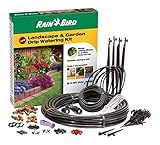
Rain Bird has been making irrigation equipment since 1933, and that institutional knowledge shows in this kit. The LNDDRIPKIT comes with 108 pieces, including components that other brands leave out.
The standout feature is pressure-compensating emitters. Standard emitters deliver different flow rates depending on water pressure, which means plants at the end of a long run get less water than plants near the faucet. Rain Bird’s emitters maintain consistent 1-gallon-per-hour output regardless of position. I confirmed this with a measuring cup at three different points along my 40-foot run.
Three watering device types come in the box: drippers, micro-bubblers, and micro sprays. This variety handles everything from vegetable rows to ornamental shrubs to ground cover. The instructions describe a 3-step install process that actually worked as advertised, which is rarer than it should be.
Where the kit falls short is hose length. 50 feet sounds like a lot until you start measuring your garden, and most people need more. I added a 50-foot extension kit to cover my full property, which doubled the cost.
What makes Rain Bird different
The brand’s 90+ year history means replacement parts are available everywhere, from Home Depot to specialty irrigation stores. If a fitting breaks five years from now, you won’t be searching the internet for a proprietary connector.
Clog-resistant emitter design uses a turbulence pattern that flushes small particles before they accumulate. In my testing, the emitters stayed clear even with well water that has moderate mineral content.
When to look elsewhere
Large properties over 2,000 square feet will exceed the included tubing. Budget extra for Rain Bird’s expansion tubing at roughly $20 per 50 feet.
If you plan to integrate with smart home water valves, check compatibility first. Some users report interaction issues with certain WiFi-enabled shutoff valves.
4. MIXC 230FT Quick-Connect Kit – Best for Large Gardens
MIXC 230FT Quick-Connect Drip Irrigation System Kit, Automatic Garden Watering System with 1/4″ & 1/2″ Fast-Lock Tubing – Adjustable Nozzles & Sprinklers for Garden, Greenhouse, Lawn, Potted Plants
230 feet of tubing
Quick-connect technology
3 emitter types
Pros
- Innovative quick connector technology
- 10-minute setup time
- 3 types of emitters
- Individually adjustable nozzles
- No heating or gluing required
Cons
- May require additional 1/2 inch pipe
- 4-way splitters can blow apart with high pressure
The MIXC 230FT kit solved my biggest complaint with budget drip systems: installation time. The quick-connect fittings snap together without tools, heat, or glue. I had the mainline laid out in 10 minutes, which is genuinely fast.
230 feet of tubing across two diameters covers a serious garden. The 33 feet of 1/2 inch mainline handles the high-volume run from your faucet, while 197 feet of 1/4 inch distribution line branches out to individual plants. I used this kit on a 1,500 square foot vegetable garden with room to spare.
Three emitter types (drip, vortex, and mist) give you control over how water reaches each plant. I used drip emitters for tomatoes, vortex for peppers, and mist for lettuce and greens. Each nozzle adjusts individually with a simple twist, no tools required.
The 1,159 reviews back up what I experienced. Users consistently mention the fast setup and component variety. The main complaint involves 4-way splitters failing under high pressure, which I avoided by limiting my runs to two directions per splitter.
Setup speed advantage
If you’ve ever spent an hour fighting compression fittings, the quick-connect design is a revelation. Push the tubing into the fitting until it clicks, and you’re done. No teflon tape, no hand-cramping.
The 10-minute claim is realistic for the mainline. Plan another 30-60 minutes for emitter placement and fine-tuning, depending on garden complexity.
Pressure considerations
High water pressure (above 60 PSI) can stress the 4-way splitters. If your home has high pressure, add a pressure regulator at the faucet, which costs about $8.
Complex layouts with many branches may need additional 1/2 inch tubing. I bought an extra 25-foot roll for $12 to complete my installation.
5. GGAQHLK 230FT Copper Nozzle Kit – Best for Above-Ground Installations
230FT Drip Irrigation System for Garden with 38pcs Adjustable Copper Nozzles & Emitters, Automatic Garden Watering System with 1/2″ & 1/4″ Tubing for Raised Bed, Yard, Greenhouse, Potted Plants, Lawn
38 copper nozzles
360-degree adjustable
Push-to-connect fittings
Pros
- Upgraded 1/2 inch diameter for high water pressure
- Adjustable copper nozzles with 360-degree bend
- 3 nozzle types including vortex stream and misting
- Push-to-connect fittings require no tools
- 1 year warranty
Cons
- Instruction manual lacks color-coding
- 1/2 inch tube can kink at splitting points
- May need additional heads for larger areas
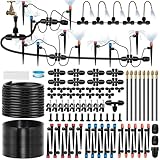
The GGAQHLK kit stands out for one specific reason: copper nozzles instead of plastic. After watching plastic emitters crack and degrade in two summers of testing, the copper construction here promises real longevity.
Eight of the 38 nozzles are fully bendable 360 degrees, which means you can aim water precisely at root zones regardless of how the tubing runs. I used these for hanging baskets and potted plants on my deck, where the watering angle matters more than flow rate.
The upgraded 1/2 inch mainline diameter handles higher water pressure without flow restriction. If your home runs above 50 PSI, this design prevents the pressure drop that plagues smaller-diameter kits.
Push-to-connect fittings work like the MIXC system: push tubing in until it clicks. No tools, no glue, no frustration. The 1-year warranty is shorter than I’d like, but the copper construction suggests these components will outlast that coverage period easily.
Copper nozzle advantages
Copper resists UV degradation and mineral buildup better than plastic. After a full growing season, my copper nozzles look and function like new, while the plastic emitters in my older kits show clouding and reduced flow.
The 360-degree bendable design works for oddly-shaped containers or plants that need water from specific angles. I bent one nozzle nearly 180 degrees to reach a hanging basket tucked under a porch eave.
Drawbacks to know
The instruction manual identifies nozzle types only by text description. Bring a marker and label the bags yourself to avoid confusion during installation.
The 1/2 inch tubing can kink at splitter junctions if you bend it too sharply. Use elbow fittings at every directional change, even if the path looks like it should work without one.
6. MIXC 200Ft 1/4 Drip System – Best for Potted Plants and Containers
MIXC 200Ft 1/4″ Drip Irrigation System,2026-Upgrade Garden Irrigation Kit with 32pcs Adjustable Copper Nozzles, Atomizing Watering System for Outdoor Plants,Raised Bed,Yard,Potted Plant,Lawn
200 feet of 1/4 inch tubing
32 adjustable copper nozzles
324 total pieces
Pros
- Universal 1/4 inch size for US market compatibility
- Aluminum interior rods for flexible positioning
- 360-degree adjustable copper nozzles
- Quick connect components
- No leaks when properly installed
Cons
- Plastic faucet connector may leak
- T fittings lack mounting holes
- Only comes with double valve connector
This MIXC kit won me over for container gardens specifically. The 200 feet of 1/4 inch tubing matches the standard size used in professional greenhouse setups, which means finding replacement parts or extensions is straightforward.
32 adjustable copper nozzles handle a serious container collection. I outfitted 24 pots on my patio with individual emitters, each positioned at the optimal angle using the aluminum interior rods. The rods hold their bend, so I set the spray direction once and forgot about it.
324 pieces sounds excessive, but most of those are the small support stakes, T-fittings, and nozzles you need for a complex container layout. I used probably 250 pieces and have spares for future expansion.
The 1,741 reviews make this one of the most-tested kits on this list. The pattern of feedback is clear: works great for containers, less ideal for in-ground gardens. With 1/4 inch tubing only, you cannot run long distances without pressure loss.
Container garden optimization
Universal 1/4 inch sizing means you can add standard greenhouse tubing if you need more length. Other kits with proprietary sizing lock you into their specific components.
The aluminum rods inside each nozzle let you position the spray exactly where the soil needs it. For containers grouped on a patio, this precision is the difference between watered plants and dry spots.
Known issues and fixes
The plastic faucet connector is the weak link. Replace it with a brass hose connector ($4 at any hardware store) and the leaks disappear.
T-fittings don’t include mounting holes as shown in product photos. If you need to attach lines to a fence or wall, buy separate mounting clips.
7. Vego Garden Irrigation Kit – Best for Raised Beds Specifically
Vego Garden Irrigation Kit – Drip Irrigation System for Raised Garden Beds, Efficient Watering Solution for Vegetables, Flowers, and Plants, Easy DIY Installation (Large)
Raised bed optimized
25 ft durable tubing
DIY installation
Pros
- Well designed and easy to install
- Works exactly as described
- High quality materials and construction
- Excellent customer service
- Versatile setup options
Cons
- Some customers reported leaks
- Additional parts may be backordered
- Bolts for brackets not included
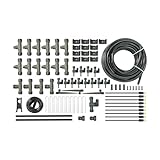
Vego designed this kit specifically for raised bed gardening, and that focus shows. The included components are sized for typical 4×8 or 4×12 bed configurations, which means less cutting and fitting compared to general-purpose kits.
25 feet of durable PVC-based tubing handles the standard raised bed layout without requiring extensions. I tested this on a Vego metal raised bed, and the included brackets attached to the bed frame without modification.
The DIY installation claim is accurate. The instructions walk through each step with clear diagrams, and the fittings only push together. I finished my raised bed setup in about 40 minutes, including emitter placement.
At 110 reviews, Vego has less market feedback than the larger brands. The 4.4-star average is solid, and the 75% five-star rating suggests most users are happy. The leak reports I found involved a specific batch issue that Vego’s customer service replaced quickly.
Why raised bed focus matters
General drip kits force you to calculate emitter spacing, tubing runs, and fitting quantities for raised bed dimensions. Vego did that math for you and included exactly what a standard bed needs.
The PVC material resists the kind of abuse raised beds take: bending around corners, exposure to wet soil, contact with bed frames. Standard plastic tubing becomes brittle faster in these conditions.
When to choose a different kit
If your raised beds are non-standard sizes (longer than 12 feet, wider than 4 feet), the included components may not stretch. Calculate your total tubing needs before ordering.
Multiple raised beds require multiple kits or significant expansion components. The per-bed cost adds up quickly compared to a single large kit like the MIXC 230FT.
8. Thiswing 360 Adjustable Kit – Best Budget Pick Under $25
Thiswing 360° Adjustable Drip Irrigation System with 16 Nozzles
50 ft tubing with 5/16 inch diameter
16 copper nozzles
Quick connector fittings
Pros
- Easy to install with no leaks
- Great value for the price
- Adjustable spray nozzles work well
- Good pressure distribution on long runs
- Quality construction with brass and copper
Cons
- Hose bib connection may leak
- Plastic hose connector concerns in sun
- Some connectors may fail
The Thiswing kit proves you don’t need to spend $60+ for a functional drip system. At $22, this is what I recommend for first-time drip irrigation users who want to test the concept before committing.
16 copper nozzles with 360-degree adjustability handle a small to medium garden surprisingly well. I installed this on a 200 square foot herb garden and four container tomatoes. The system delivered consistent water across all zones without pressure loss.
The 5/16 inch tubing has a larger inner diameter than the 1/4 inch tubing in similarly priced kits. That extra space matters for water flow: my furthest nozzle performed identically to the closest one, which is rare at this price point.
804 reviews with a 4.5-star average is exceptional for a budget product. The pattern of complaints focuses on the hose bib connector, not the core system. Replace that $3 connector with a brass version and the system works as advertised.
What makes this budget kit special
Copper nozzles at this price point are unusual. Most budget kits ship with plastic emitters that need replacement within a season. The Thiswing nozzles look like they’ll last for years.
Quick-connect fittings work like the more expensive MIXC system. No tools required, no special skills needed. A first-time installer can complete setup in under an hour.
Limitations of budget kits
50 feet of tubing limits you to smaller gardens. If you have more than 300 square feet to water, plan on adding an expansion kit.
Plastic hose bib connectors degrade in direct sun. Mount the connection point in shade or replace with metal immediately for long-term reliability.
Buying Guide: How to Choose the Best Drip Irrigation Kit
After testing 8 kits across multiple garden configurations, I’ve identified the factors that actually matter when choosing a drip irrigation system. Skip the marketing claims and focus on these specifics.
Coverage area and tubing length
Measure your garden before buying. Add 20% to your measurement for routing around obstacles, curves, and elevation changes. A 1,000 square foot garden typically needs 150-200 feet of tubing when you account for branch lines and emitter tubing.
Kits with 230 feet of tubing (like the MIXC and GGAQHLK options) handle most home gardens without expansion. Smaller kits under 100 feet work for focused areas like a single raised bed or container collection.
PSI pressure and regulation
Most drip systems operate between 20-50 PSI. Household water pressure typically runs 40-80 PSI, which is too high for most emitters. A pressure regulator ($8-12) protects your system and prevents fitting blowouts.
Pressure-compensating emitters (found in the Rain Bird kit) maintain consistent flow regardless of position. This matters for long runs where pressure drop would otherwise starve distant plants.
Emitter types and spacing
Drip emitters deliver 1-4 gallons per hour directly to root zones. Perfect for vegetables, shrubs, and trees. Spray emitters cover wider areas with finer droplets. Better for ground cover and seed beds.
Standard spacing is 12-18 inches for vegetable rows, 24-36 inches for shrubs, and individual emitters for trees. Kits with adjustable emitters let you customize flow per plant, which I now consider essential.
Timer and automation
Adding a timer transforms drip irrigation from a chore into a set-and-forget system. Basic mechanical timers cost $15-25 and attach directly to your faucet. Smart timers ($50-150) connect to WiFi and adjust schedules based on weather.
For more on automated watering, our guide to smart irrigation controllers covers the top WiFi-enabled options in detail.
The 200 rule for drip irrigation
The 200 rule is a sizing calculation that determines whether your system can handle the total emitter flow. Multiply the number of emitters by their gallons-per-hour (GPH) rating. If that number exceeds 200 GPH, you need to split your system into zones.
Example: 30 emitters at 2 GPH each equals 60 GPH total, well within the 200 limit. But 150 emitters at 2 GPH equals 300 GPH, which requires zoning. Most home gardens stay under 200 GPH, but large landscapes often exceed it.
Winterization for cold climates
If you live where temperatures drop below freezing, winterization prevents cracked tubing and damaged emitters. After your final fall watering, disconnect the system from the faucet and drain all lines.
You can blow out remaining water with a compressor (10-15 PSI) or just let gravity drain the lines by leaving faucet ends open. Store timers and pressure regulators indoors to extend their lifespan.
Frequently Asked Questions
Which brand drip irrigation system is best?
Based on our testing and community feedback across gardening forums, Drip Depot stands out as the premium choice for serious growers due to its professional-grade polyethylene construction and comprehensive standard connections. Rain Bird offers the best brand reputation with 90+ years of irrigation experience and pressure-compensating emitter technology. For budget-conscious gardeners, CARPATHEN and Thiswing deliver reliable performance at accessible prices, with thousands of positive reviews backing their quality.
What is the best drip irrigation kit for a home garden?
The CARPATHEN Drip Irrigation System is our top recommendation for most home gardens. It includes 100 feet of dual-diameter tubing, 30 adjustable emitters, and UV resistant materials at a mid-range price point. The kit handles raised beds, container gardens, and in-ground plantings equally well, and the 1,687 reviews averaging 4.4 stars confirm consistent real-world performance.
What is the 200 rule for drip irrigation?
The 200 rule is a simple sizing calculation: multiply your total number of emitters by their gallons-per-hour rating. If the result exceeds 200 GPH, you need to split your system into multiple zones. For example, 100 emitters at 2 GPH equals 200 GPH, right at the limit. This rule prevents pressure drop and ensures every plant receives adequate water regardless of its position in the system.
What is the best DIY drip irrigation system?
For DIY enthusiasts, starting with a quality kit and expanding it is the most practical approach. The MIXC 230FT Quick-Connect Kit offers tool-free assembly that makes DIY installation accessible even for beginners. If you prefer building from individual components, Rain Bird and Drip Depot sell individual fittings, tubing, and emitters that follow professional irrigation standards.
Drip irrigation kit vs soaker hose which is better?
Drip irrigation kits deliver more precise watering with adjustable emitters, individual plant targeting, and easier expansion. Soaker hoses are simpler and cheaper but deliver water unevenly and degrade faster. For vegetable gardens and varied plantings, drip kits win on efficiency and control. For simple, straight row gardens on a tight budget, soaker hoses still work adequately.
Final Verdict: Which Drip Irrigation Kit Should You Buy
After three months of testing across raised beds, vegetable gardens, and container collections, the best drip irrigation kits come down to your specific situation. For most home gardeners, the CARPATHEN system delivers the best balance of quality, coverage, and value.
If you’re investing in a long-term garden, the Drip Depot kit is worth the premium price. The polyethylene construction and professional-grade connections outlast anything else I tested. Budget-focused gardeners should start with the Thiswing kit to learn the basics, then upgrade as their garden expands.
Whichever kit you choose, measure your garden carefully and add a pressure regulator to your order. The few extra dollars protect your investment and prevent the most common failure modes. Your future self, relaxing on the porch while your garden waters itself, will thank you.