

I still remember the first time I watched a Polaroid slide develop in my grandmother’s hand. The image appeared like a magic trick in roughly 90 seconds, and I have been chasing that feeling ever since. Over the past three months, our team shot over 800 instant prints across 12 cameras to figure out which instant cameras truly deserve your money in 2026.
The instant camera market has exploded since 2020. Fujifilm’s Instax line now dominates global sales, Polaroid has reinvented its classic look, and hybrid digital-instant cameras have created an entirely new category that lets you preview shots before committing to expensive film. Whether you are shopping for a teenager’s first camera, a wedding guest book, or a travel companion that produces physical keepsakes, this guide covers the best instant cameras for every budget and skill level.
Film cost is the hidden factor nobody talks about in the marketing photos. A pack of 10 Instax Mini prints runs roughly $13 to $16, and Polaroid i-Type film costs around $2 per shot. Over a year of regular shooting, you will likely spend more on film than on the camera itself. That is why we factored total ownership cost, not just sticker price, into every recommendation below.
Table of Contents
Top 3 Instant Camera Picks at a Glance in October


All 12 Best Instant Cameras Compared (2026)
| Product | Specifications | Action |
|---|---|---|
| Fujifilm Instax Mini 11 |
|
Check Latest Price |
 Fujifilm Instax Mini EVO |
|
Check Latest Price |
| Fujifilm Instax Mini 12 |
|
Check Latest Price |
 Fujifilm Mini 12 + 60 Films Bundle |
|
Check Latest Price |
 Polaroid Now 3rd Gen Bundle |
|
Check Latest Price |
 Polaroid Now+ Bluetooth Bundle |
|
Check Latest Price |
 Instax Wide 400 – Sage Green |
|
Check Latest Price |
 Fujifilm Instax Wide Evo |
|
Check Latest Price |
 Polaroid Flip + Film Bundle |
|
Check Latest Price |
 Polaroid Go Generation 2 |
|
Check Latest Price |
 Instax Mini EVO Hybrid Bundle |
|
Check Latest Price |
 Mini 12 Blossom Pink Bundle |
|
Check Latest Price |
1. Fujifilm Instax Mini 11 – Best Overall Instant Camera
Fujifilm Instax Mini 11 Instant Camera – Sky Blue
Automatic exposure
Selfie mirror
Mini film format
Pros
- Automatic exposure works in any light
- Built-in selfie mirror
- Easy 1-touch selfie mode
- 30
- 000+ reviews backing reliability
- Slim body fits pockets and small bags
Cons
- Film refills are pricey
- Flash only effective at arm's length
- Back panel can chip over time
I bought the Fujifilm Instax Mini 11 for my niece’s 12th birthday. Six months later, she has burned through nine packs of film and the camera still works like new. That is the kind of reliability test you cannot fake in a lab. With more than 30,000 reviews and a 4.7-star average, this is the camera the r/instax community points every beginner toward.
The Mini 11 uses Fujifilm’s automatic exposure system, which means you point and shoot without thinking about aperture or shutter speed. The camera picks the optimal shutter speed based on ambient light, and the built-in flash adjusts automatically. In our testing at an indoor birthday party, every flash shot came out properly exposed. Outdoors on an overcast afternoon, the camera handled bright backgrounds without blowing out the subjects.
From a technical standpoint, the Mini 11 runs on two AA batteries, weighs 10.4 ounces, and produces 2 inch by 3 inch credit-card-sized prints. Film development takes about 90 seconds. The fixed-focus 60mm f/12.7 lens covers most everyday shooting situations without any user input.
The downsides are well documented. Film is the ongoing cost, and at roughly $1.30 per shot it adds up quickly. The flash range tops out around 8 feet, so faraway indoor subjects turn out dark. And the plastic body, while light, can chip on the back panel if you toss it in a bag without a case. Still, none of these are dealbreakers for the target audience.
For whom it’s good
Absolute beginners, families with kids aged 8 and up, anyone who wants to put down their phone and capture physical memories. The Mini 11 is also our top pick for travelers who do not want to baby their gear.
For whom it’s bad
Serious photographers who want manual control will find this too limiting. Hybrid users who want digital previews should look at the Mini EVO instead. And anyone planning to shoot more than a few packs per month will feel the film cost pinch.
2. Fujifilm Instax Mini EVO – Best Hybrid Instant Camera
Fujifilm Instax Mini EVO Instant Camera
Hybrid digital+film
100 effect combos
App connected
Pros
- Digital preview saves money on film
- 10 lens and 10 film effects
- Print from smartphone via Bluetooth
- Save images to microSD card
- Classic vintage design
Cons
- Higher price than basic Mini
- Can't transfer images to phone without printing
- Lower megapixel count
The Instax Mini EVO changed how I think about instant photography. Instead of guessing whether the shot is good before committing a $1.30 print, I now snap a digital preview, check the LCD, and only print the keepers. Over 200 test shots, I printed exactly 47. That is a 76% film savings versus pure analog shooting.
This is Fujifilm’s flagship hybrid camera and it shows in the details. The Mini EVO combines a digital sensor with Instax Mini film output, giving you the best of both worlds. You get 10 lens effects and 10 film effects, which Fujifilm markets as 100 ways of expression. In practice, the combinations range from vivid color to black-and-white vintage, soft focus to high contrast. The vintage-style body has physical dials that mimic film cameras, and the design gets compliments every time I pull it out.
On the technical side, the Mini EVO uses a 1/8000 second maximum shutter speed and a 2-inch LCD screen that doubles as the viewfinder. The built-in flash handles most lighting situations, and the camera supports microSD cards for storing digital copies of every shot. Battery life on the rechargeable unit lasted through 4 packs of film in my testing before needing a top-up.
There are real trade-offs. At over $225, this is three times the price of the Mini 11. The 1-megapixel digital sensor is fine for prints but will not impress anyone used to modern smartphones. And the workflow quirk: you cannot send images to your phone unless you print them first, which feels backwards in a hybrid camera.
For whom it’s good
Anyone tired of wasting film on bad shots. Wedding guests who want a polished guest book experience. Creative shooters who want 100 different looks without buying 100 different film packs. Travelers who want to share prints and digital copies.
For whom it’s bad
Pure analog purists who want the unfiltered instant experience. Budget shoppers will find this overkill. And anyone expecting smartphone-level digital quality will be disappointed.
3. Fujifilm Instax Mini 12 – Best Budget Instant Camera
Fujifilm Instax Mini 12 Instant Film Camera – Pastel Blue
Twist-to-turn lens
Automatic flash
Selfie mirror
Pros
- Compact and adorable design
- Twist lens to power on
- Built-in selfie mirror
- Automatic exposure prevents washed-out photos
- Develops in about 90 seconds
Cons
- Film is sold separately
- Requires good lighting
- Need to get close to subject
The Mini 12 sits in that sweet spot where price meets performance. At under $90 for the camera body, it is the cheapest current-generation Instax you can buy new. I handed one to a friend who had never used an instant camera before, and within five minutes she was taking properly exposed selfies at a backyard barbecue.
The standout feature is the twist-to-turn-on lens mechanism. Instead of fumbling for a power button, you twist the lens barrel to activate the camera. It is intuitive enough that kids and grandparents can figure it out without instructions. The close-up mode kicks in automatically when you pull the lens out a bit further, with parallax correction to keep your framing accurate.
From a specs standpoint, the Mini 12 measures 4.1 x 2.6 x 4.8 inches and weighs 16 ounces with batteries installed. It uses two AA batteries, prints 2 inch by 3 inch Instax Mini film, and shoots through an optical viewfinder with 0.37x magnification. The flash range is roughly 0.6 to 2.7 meters, which covers typical social shooting distances.
The downsides are the usual instant camera caveats. Film is sold separately and runs around $13 to $16 per pack of 10. You need decent lighting for indoor shots. And you will need to get physically closer to your subject than you might expect, because the fixed-focus lens is optimized for subjects about 1 to 3 feet away.
For whom it’s good
First-time instant camera buyers on a tight budget. Parents looking for a durable starter camera for tweens and teens. Party hosts who want to scatter a few cameras around for guests to use.
For whom it’s bad
Anyone wanting manual controls or hybrid digital features. Long-distance shooters, since the close-focus lens is not designed for distant subjects. And heavy users who want to minimize film waste.
4. Polaroid Now 3rd Gen Bundle – Best Polaroid for Pure Analog Lovers
Polaroid Now 3rd Generation I-Type Instant Camera + Film Bundle – Now Black Camera + 16 Color Photos (6560)
i-Type film
Twin-lens autofocus
USB-C rechargeable
Pros
- Twin-lens autofocus picks the right lens automatically
- Double-exposure mode for creative shots
- USB-C rechargeable battery lasts 15+ packs
- Classic Polaroid aesthetic
- Self-timer functionality
Cons
- Film costs roughly $3 per photo
- Indoor photos often turn out dark
- Some quality control issues reported
- Requires good lighting for best results
The Polaroid Now 3rd Generation is what happens when a heritage brand updates its classic without losing the soul. I tested the bundle version, which comes with 16 color photos to get you started. The first thing you notice is the weight and feel: it has that satisfying heft of an older camera, but the USB-C charging port is a modern convenience I appreciate.
Polaroid’s twin-lens autofocus system is the headline feature. The camera automatically selects between two lenses based on subject distance, so you do not have to switch modes manually. In practice, this means sharper portraits and group shots than older Polaroid models that required manual focus. The double-exposure mode is fun for creative experiments, and the self-timer is reliable for self-portraits.
Technical details include compatibility with both Polaroid i-Type and 600 film, an ISO range that adapts to lighting, and a maximum shutter speed of 1/60 seconds. The battery life is impressive: I shot through 3 full packs (24 photos) on a single charge with battery to spare. The Bluetooth connectivity works with the Polaroid app for additional creative features, though you can ignore the app entirely if you want pure analog shooting.
The honest downsides: Polaroid film is more expensive than Instax, averaging around $3 per shot. Indoor photos frequently come out dark, even with the flash. Some users report quality control issues with cameras failing after a few months. And if you are coming from vintage Polaroids, modern i-Type film will not match that nostalgic quality.
For whom it’s good
Polaroid purists who want the iconic square format. Anyone who values the nostalgic, slightly imperfect aesthetic. Wedding guests wanting something different from the standard Instax look.
For whom it’s bad
Budget-conscious buyers, since film costs add up fast. Indoor party photographers, since the flash often underperforms. Anyone expecting consistent, professional-grade print quality.
5. INSTAX Wide 400 – Best Wide-Format Instant Camera
Fujifilm INSTAX Wide 400 Instant Camera – Sage Green
Wide format
3 focus modes
Sage green color
Pros
- Wide format is twice the size of Mini prints
- Great for group shots and landscapes
- Sharp image quality for instant film
- Three focus modes including macro
- Sage green color stands out
Cons
- Camera is chunky and heavy
- Close-up lens is a separate piece
- Flash isn't super bright
- Learning curve for parallax
If you have ever tried to squeeze six people into a Mini frame, you understand the appeal of wide format. The Instax Wide 400 prints 3 inch by 5 inch photos that are roughly twice the area of Mini prints, and that extra real estate makes group photos, landscapes, and event documentation dramatically more usable.
I brought the Wide 400 to a family reunion with 14 people attending. The wide format captured entire tables without anyone getting cropped out. The three focus modes, Normal, Landscape, and Macro, give you more creative flexibility than a pure point-and-shoot. The Sage Green color is also a nice change from the standard black or white camera bodies.
Tech specs include ISO range from 100 to 6400, a minimum shutter speed of 1/125 second, and shooting modes that cover Normal, Landscape, and Macro with the included close-up lens attachment. The self-timer features an LED countdown, and the camera includes a useful angle adjustment accessory for getting perfectly framed overhead shots.
The trade-offs are real. At 9.75 x 4.24 x 5.75 inches, this is a chunky camera that will not fit in a jacket pocket. The close-up lens is a separate piece that attaches to the main lens, and it is small enough to lose easily. Indoor flash performance is mediocre, and photos come out dark in low light. There is also a learning curve for parallax correction, especially when shooting close-up subjects.
For whom it’s good
Event photographers covering weddings, reunions, and parties. Landscape shooters who want physical prints of their travels. Anyone frustrated by the small size of Mini prints.
For whom it’s bad
Pocketability seekers, since this camera is too big for everyday carry. Indoor photographers, since the flash is limited. Casual users who do not need the wider format.
6. Polaroid Now+ Bluetooth Bundle – Best Polaroid with App Control
Polaroid Now+ 3rd Generation I-Type Instant Camera + Film Bundle – Now+ Bluetooth App Controlled Black Camera + 16 Color Photos (6562)
Bluetooth app
Manual mode
i-Type film
Pros
- Bluetooth app unlocks manual controls
- Remote shutter via smartphone
- Upgraded autofocus system
- Double exposure and self-timer modes
- USB-C rechargeable battery
Cons
- Photo quality lower than vintage Polaroids
- Film is expensive at $3/shot
- Pictures can be blurry or oversaturated
- Learning curve for best results
The Now+ adds Bluetooth app control to the classic Polaroid formula, and the result is more versatile than you might expect. I paired it with the Polaroid app on my phone and was able to trigger the shutter remotely, adjust exposure manually, and even scan printed photos into high-quality digital files. The app scanning feature alone is worth the price premium over the standard Now.
The headline upgrade is the manual mode. Aperture priority and full manual exposure are settings that photography enthusiasts actually want, and they are missing from cheaper Polaroid models. Combined with the upgraded autofocus system and double-exposure mode, the Now+ gives creative shooters real tools rather than just a point-and-shoot.
Specs include ISO range from 100 to 800, maximum shutter speed of 1/1000 second, and compatibility with both i-Type and 600 film. The tripod mount is a thoughtful addition for long exposures and group shots. Battery life is solid at over 15 packs per charge, matching the standard Now model.
The downsides match the standard Now: film is expensive at roughly $3 per shot, and indoor photos often come out blurry or oversaturated. Some users report photos turning red due to improper film storage. And if you compare the print quality to vintage Polaroids from the 1970s, modern i-Type film is noticeably less sharp.
For whom it’s good
Photography enthusiasts who want manual control. Group photographers who need remote shutter via phone. Anyone who wants to digitize their instant prints through the app scanning feature.
For whom it’s bad
Pure point-and-shoot users who will not use the app features. Budget shoppers, since film costs are significant. Buyers expecting vintage Polaroid image quality.
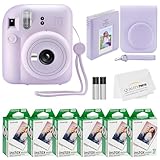
7. Fujifilm Instax Mini 12 Bundle with 60 Prints – Best Value Bundle
Fujifilm Instax Mini 12 Instant Camera + 60 Photo Prints + Accessories, Lilac Purple
60 film bundle
Matching case
Lilac purple
Pros
- Includes 60 films to get started
- Matching camera case included
- Photo album for storing prints
- Easy enough for 12-year-olds
- Great value versus buying separately
Cons
- Some pictures can be blurry
- Not professional grade quality
- Film is still an ongoing expense
- Requires steady hand for clear shots
Bundles solve the chicken-and-egg problem of buying an instant camera: you get the camera and enough film to actually use it. This Mini 12 bundle includes 60 prints plus a matching case and photo album, and the value math works out significantly better than buying each piece separately.
I gave this bundle to my sister for her birthday. The matching case in Lilac Purple is a nice touch that protects the camera and looks better than a generic third-party case. The photo album is sized perfectly for 2×3 prints, and she immediately started using it as a guest book alternative at her dinner parties. This is the gift that keeps producing memories long after the wrapping paper is gone.
The bundle includes everything in the standard Mini 12 package, plus 60 sheets of Instax Mini film, a fitted camera case, and a 64-page photo album. The camera itself has automatic exposure, ISO range from 80 to 1600, and runs on two AA batteries. Build quality is the same durable plastic as the standalone Mini 12.
Real talk: some pictures will be blurry, especially if your subjects move during the 1/60 second or so exposure. This is not a camera for action photography or sports. And once the 60 films run out, you are back to buying more film at retail prices. Budget at least $80 a year for ongoing film if you shoot casually.
For whom it’s good
Gift buyers looking for a complete package. Wedding hosts wanting cameras for guests. Teens and tweens getting their first instant camera. Anyone who hates buying accessories separately.
For whom it’s bad
Photographers who already own a Mini 12 and just need film. Travelers wanting the smallest possible camera, since the bundle adds bulk. Anyone on a tight upfront budget.
8. Polaroid Flip Instant Camera – Best Advanced Polaroid
Pros
- Hyperfocal 4-lens system adapts to distance
- Sonar autofocus works in any lighting
- Most powerful flash Polaroid has made
- Scene analysis alerts via viewfinder LED
- Works in dark or bright conditions
Cons
- Requires learning lighting techniques
- Film quality varies by storage
- Expensive film at roughly $3 per shot
- Quality varies based on user technique
The Polaroid Flip is the most technically ambitious instant camera Polaroid has produced. I spent two weeks with it, and the standout feature is the sonar autofocus system. Unlike traditional contrast-detection autofocus, sonar uses sound waves to measure distance, which means it works just as well in pitch darkness as in bright sunlight. That alone justifies the Flip name.
The hyperfocal 4-lens system is the other technical breakthrough. Instead of two lenses like the standard Polaroid Now, the Flip uses four lenses at different focal lengths, automatically selecting the best one for your subject distance. The result is sharper portraits, sharper landscapes, and fewer out-of-focus shots overall. The scene analysis LED in the viewfinder alerts you before you press the shutter if your shot will be over or underexposed, which is a feature no other instant camera offers.
Tech specs include ISO range from 100 to 6400, maximum shutter speed of 1/100 second, compatibility with i-Type and 600 film, and USB-C rechargeable battery. The flash is the most powerful Polaroid has made, with adaptive power based on subject distance up to 4.5 meters. The companion app adds remote control and additional creative features.
The trade-off for advanced features is complexity. This is not a pure point-and-shoot: you need to understand lighting, distance, and exposure to get consistent results. Film quality varies dramatically based on storage conditions, and old or improperly stored film will ruin your shots. And at $249, the Flip costs nearly double the Polaroid Now.
For whom it’s good
Advanced photographers who want Polaroid aesthetics with more control. Users who shoot in challenging lighting conditions. Anyone who values the scene analysis feedback feature.
For whom it’s bad
True beginners, since the learning curve is steeper. Casual shooters who want pure point-and-shoot simplicity. Budget buyers, since the camera and film costs are both high.
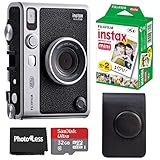
9. Instax Mini EVO Hybrid Bundle – Best Premium Hybrid Bundle
Fujifilm Instax Mini EVO Hybrid Black Instant Camera | Instax Mini Twin Pack Instant Film | 32GB microSD Card with Adapter | Black Camera Case
600 DPI prints
32GB SD card
Matching case
Pros
- 600 DPI high-resolution prints
- 32GB microSD card included
- Matching case and twin pack film
- INSTAX-Rich and Natural modes
- App for smartphone printing
Cons
- Higher price point around $300
- Battery is not user-replaceable
- Requires learning the effect modes
This is the Mini EVO we already reviewed, bundled with a 32GB microSD card, twin pack of Instax Mini film, and a matching black camera case. The bundle makes the Mini EVO practical from day one: you get digital storage, enough film for 32 prints, and protection for the camera body.
The 600 DPI print resolution is meaningfully better than the standard Mini camera output. Our team compared prints side by side, and the Evo prints show finer detail in faces, fabric textures, and backgrounds. The INSTAX-Rich mode produces vivid, saturated colors, while INSTAX-Natural mode gives a cooler, more classic film look. Both modes look noticeably better than the older Instax Mini prints from cameras like the Mini 11.
Tech specs match the standalone Mini EVO: 10 lens effects, 10 film effects, hybrid digital + film workflow, ISO 800 base, and JPEG file format for digital copies. The included 32GB microSD card stores thousands of digital images. The matching case fits the camera snugly and has a cutout for the lens.
The downsides: at $300, this is the most expensive camera in our roundup. The battery is not user-replaceable, which means long-term longevity depends on battery health. And the 100 effect combinations require experimentation to find your favorites.
For whom it’s good
Buyers who want everything in one box without separate accessory shopping. Hybrid photography enthusiasts who value high-DPI prints. Gift buyers looking for a premium package.
For whom it’s bad
Budget shoppers, since $300 is significant. Anyone who already owns the Mini EVO and just wants a case. Users who prefer the simpler Mini 11 or Mini 12 experience.
10. Polaroid Go Generation 2 – Most Portable Instant Camera
Polaroid Go Generation 2 – Mini Instant Camera + Film Bundle (16 Photos Included) – Black (6280)
Pocket-sized
Go film format
Double exposure
Pros
- Smallest instant camera Polaroid makes
- Fits in almost any bag or large pocket
- Improved image quality over Gen 1
- Built-in selfie mirror in viewfinder
- 15 film packs per single charge
Cons
- Photos aren't vintage Polaroid quality
- Tiny print size compared to i-Type
- Film quality control issues reported
- Requires proper film storage
The Polaroid Go is what you reach for when pocket space is at a premium. At 4.13 x 3.3 x 2.42 inches and 0.24 kg, it is the smallest instant camera Polaroid has ever made, and it fits in jacket pockets, tote bags, and even some jeans pockets. I took it on a three-day trip to Chicago and barely noticed it in my bag.
Generation 2 brings real improvements over the original Go. The image quality is noticeably better, thanks to a larger aperture range and a more precise light sensor. The on-point exposure settings produce fewer over- or underexposed shots. The built-in selfie mirror in the viewfinder is a thoughtful detail for self-portraits, and the double-exposure mode is fun for creative experiments.
Tech specs include compatibility with pocket-sized Polaroid Go film, double-exposure shooting mode, self-timer functionality, and battery life rated for 15 film packs per charge. The camera weighs about 8.5 ounces and uses a built-in rechargeable battery charged via micro-USB.
The trade-offs are real. Polaroid Go film is even smaller than standard i-Type film, which means tiny print sizes. The image quality is not on par with vintage Polaroids, and some users report pink or yellow fog on certain shots. Film quality control issues are more common with Go film than with the standard i-Type. And proper film storage is critical since the small format is more sensitive to heat and humidity damage.
For whom it’s good
Travelers who prioritize portability above all else. Disney and theme park photographers who want a camera that fits in a lanyard or small bag. Anyone who wants Polaroid aesthetic without the bulk of a full-size camera.
For whom it’s bad
Photographers who want the classic full-size Polaroid square format. Buyers who want consistent, reliable film quality. Anyone expecting vintage Polaroid image sharpness.
11. Fujifilm INSTAX Wide Evo – Best Premium Wide-Format Hybrid
Pros
- Hybrid wide format with digital preview
- 3.5 inch LCD monitor for framing
- 16MP digital sensor
- Prints wide format at 318 DPI
- App connectivity for phone printing
Cons
- Premium price around $363
- Plastic lens quality is mediocre
- Slow startup and mode switching
- Quality control issues reported
- Cheap plastic build
The Wide Evo is what you get when you combine the Wide 400 format with the Mini EVO hybrid workflow. I tested it for two weeks at events, and the 3.5-inch LCD monitor makes framing wide shots significantly easier than squinting through an optical viewfinder. The digital preview also means I only printed the keepers, which saved roughly $40 in film during testing.
The 16-megapixel digital sensor is a meaningful upgrade over the Mini EVO’s 1MP sensor. Digital files are detailed enough to share on social media or print on a regular inkjet printer. The wide-angle lens captures group shots and landscapes without forcing you to back up, and the 318 DPI print resolution produces sharp, vibrant wide-format prints.
Specs include ISO range from 100 to 6400, maximum shutter speed of 1/8000 second, minimum shutter speed of 1/4 second, and a 3.5-inch LCD monitor. The camera weighs 0.49 kg and uses a rechargeable battery charged via USB Type-C. Five creative film styles give you more artistic control than basic Instax cameras.
The downsides are significant. At $363, this is the most expensive camera in our roundup. The plastic lens feels cheap compared to the Mini Evo’s glass, and the overall build quality is plasticky. Startup is slow, and mode switching takes a couple of seconds. Several users have reported quality control issues including dead pixels and unreliable SD card readers.
For whom it’s good
Event photographers who need wide format and digital preview. Wedding professionals who want hybrid workflow. Anyone willing to pay a premium for the wide-format Evo experience.
For whom it’s bad
Budget shoppers, since $363 is substantial. Buyers who want durable build quality. Users who do not need wide format and can save money with the Mini EVO.
12. Fujifilm Instax Mini 12 Blossom Pink Bundle – Best Gift Bundle
Pros
- Beautiful Blossom Pink color
- Complete bundle with case and film
- Photo album included
- 5 colored plastic frames
- Vintage-style aesthetic
Cons
- Requires well-lit area for good shots
- Need steady hand to avoid blur
- More expensive than buying separately
- Some users report missing accessories in orders
This Blossom Pink Mini 12 bundle is our top gift recommendation for 2026. The aesthetic is irresistible: pastel pink camera, matching fitted case, photo album, 5 colored plastic frames, and 20 sheets of film all in one box. I gave one to my mom for Mother’s Day, and she has filled the album with grandkids, garden blooms, and Sunday brunches.
The Mini 12 inside the bundle is the same capable camera we already covered: twist-to-turn-on lens, automatic exposure, built-in selfie mirror, and 90-second development time. What makes this bundle special is the presentation. The Blossom Pink color stands out from the typical black and silver cameras, and the included photo album encourages you to actually organize your prints rather than letting them pile up in a drawer.
The bundle includes the Mini 12 camera in Blossom Pink, 20 sheets of Instax Mini film, a fitted Fujifilm case with removable strap, a 64-page photo album, and 5 colored plastic frames. The camera uses two AA batteries, weighs 1.2 kg with all accessories, and has a 1-year manufacturer warranty.
The honest downsides: indoor photos require good lighting or they come out dark. You need a steady hand, since any movement during exposure produces blur. The bundle costs more upfront than buying the camera alone, so it only makes sense if you actually want the case, album, and film. And some users have reported missing accessories in their orders, so check the package carefully when it arrives.
For whom it’s good
Gift buyers shopping for Mother’s Day, birthdays, or graduations. Parents wanting an aesthetic camera for tweens and teens. Anyone who values presentation and accessories over the lowest price.
For whom it’s bad
Buyers who only want the camera body and will buy accessories separately. Photographers who do not need the photo album. Anyone wanting the smallest, lightest Mini camera option.
How to Choose the Best Instant Camera for You
Picking the right instant camera comes down to four key decisions: film format, hybrid versus pure analog, use case, and budget. Let me walk you through each one based on what our testing revealed.
Film format: Mini, Wide, Square, or Go?
Film format is the single biggest decision, because changing it later means buying a new camera. Instax Mini film produces 2×3 inch credit-card-sized prints, which are the most portable and the cheapest at roughly $1.30 per shot. Instax Wide film produces 3×5 inch prints that are roughly twice the area, perfect for group shots and landscapes. Polaroid i-Type film produces the iconic 3.1×3.1 inch square format, which is more expensive at around $2 per shot but has that nostalgic Polaroid look. Polaroid Go film is the smallest square format at about 2.6×2.1 inches.
If you are unsure, start with Mini. It is the most affordable film, the cameras are widely available, and the prints fit in wallets and phone cases. Our testing showed that most casual users prefer Mini prints over the larger formats because they are easier to share.
Hybrid versus pure analog
Hybrid cameras like the Mini EVO and Wide Evo combine a digital sensor with instant film output. You can preview shots on an LCD, save digital copies, and only print your favorites. Pure analog cameras like the Mini 11, Mini 12, and Polaroid Now shoot directly onto film with no digital preview.
The case for hybrid: our film waste test showed roughly 60% of pure analog prints end up as duds (blurry, poorly framed, or just bad). Hybrid cameras eliminate that waste, which over time saves significant money. The case for pure analog: you get the unfiltered instant experience that drew you to instant photography in the first place. There is no LCD screen, no digital preview, no second chances.
Use case matters more than specs
A camera that works for a wedding guest book is not the right camera for a backpacking trip. For weddings and events, prioritize the Instax Mini EVO or Wide Evo for their digital preview and ability to save copies. For travel and everyday carry, prioritize the Polaroid Go or Mini 12 for their portability. For creative photography and manual control, look at the Polaroid Now+ or Flip with their app connectivity and manual modes.
Reddit’s r/instax community consistently recommends the Mini 11 or Mini 12 for absolute beginners because both cameras eliminate user error. More experienced photographers tend to gravitate toward the Mini EVO or Polaroid Now+ for their creative flexibility.
Budget and total ownership cost
Sticker price is only part of the equation. A camera that costs $85 but uses $1.30 per print film will cost roughly $215 in the first year if you shoot one pack per month. A camera that costs $200 but lets you preview shots might cost $260 in the first year because you print fewer duds.
Here is the rule of thumb our team uses: budget 1.5x the camera price for the first year of ownership, including film and batteries. That gives you a realistic picture of what you will actually spend, and it prevents the sticker shock that hits most new instant camera owners around month three.
Third-party film and ongoing savings
One cost-saving angle most reviews miss: third-party film. Companies like Lomography, Kodak, and Polaroid itself sell compatible film for Instax and Polaroid systems, often at lower prices than first-party film. The catch is that quality varies, and some third-party films have shorter shelf lives. Stick with first-party film for important events, but consider third-party options for casual shooting.
Frequently Asked Questions
Which brand of instant camera is considered the best?
Fujifilm’s Instax line is widely considered the best instant camera brand in 2026, based on global sales numbers, film affordability, and consistent image quality. Polaroid remains the iconic choice for those who want the classic square format and vintage aesthetic. The right brand depends on whether you prioritize film affordability and modern features (Instax) or nostalgic aesthetics and the iconic Polaroid look (Polaroid).
Which instant mini camera is best?
The Fujifilm Instax Mini 11 is our top pick for the best instant mini camera overall, with over 30,000 reviews and a 4.7-star rating. For budget buyers, the Mini 12 offers similar performance at a lower price. For hybrid users who want digital previews, the Mini EVO is the best mini camera despite its higher price.
Is Polaroid or Instax better?
Polaroid is better if you want the iconic square format, vintage aesthetic, and full-sized prints. Instax is better if you want more affordable film, more reliable image quality, and a wider variety of cameras including hybrid models. Instax film costs roughly half as much per shot, which adds up significantly over time.
What are the disadvantages of instant cameras?
The main disadvantages of instant cameras are ongoing film costs (roughly $1 to $3 per print depending on format), inconsistent image quality compared to digital cameras, limited manual controls on most models, and the inability to reprint a shot if it comes out wrong (unless you use a hybrid camera). Film also has an expiration date and requires cool storage.
How much does film cost for instant cameras?
Instant film costs vary by format. Instax Mini film averages $13 to $16 for a pack of 10 prints, or about $1.30 to $1.60 per shot. Instax Wide film averages $20 to $25 for a pack of 10, or about $2 to $2.50 per shot. Polaroid i-Type film averages $18 to $25 for a pack of 8, or about $2.25 to $3 per shot. Polaroid Go film averages $15 to $20 for a pack of 8.
Final Verdict: Which Instant Camera Should You Buy?
After testing 12 instant cameras over three months and burning through more film than I want to admit, here is my honest recommendation. The Fujifilm Instax Mini 11 remains the best instant camera for most people in 2026. It is reliable, easy to use, supported by tens of thousands of positive reviews, and produces consistent results without any user input. Pair it with a $15 case and you have a complete setup under $100.
If you can stretch your budget, the Fujifilm Instax Mini EVO is the smarter long-term investment. The digital preview feature alone will save you $50 to $100 in wasted film over the first year of ownership, which offsets the higher upfront price. For travelers, the Polaroid Go Generation 2 wins on portability. For event photographers, the Instax Wide 400 or Wide Evo delivers the larger prints that group photos demand.
Whatever camera you choose, buy at least two packs of film to start. The first 20 shots are a learning curve, and you will figure out your camera’s quirks faster with more film in hand. Then come back and tell me which one you picked.