
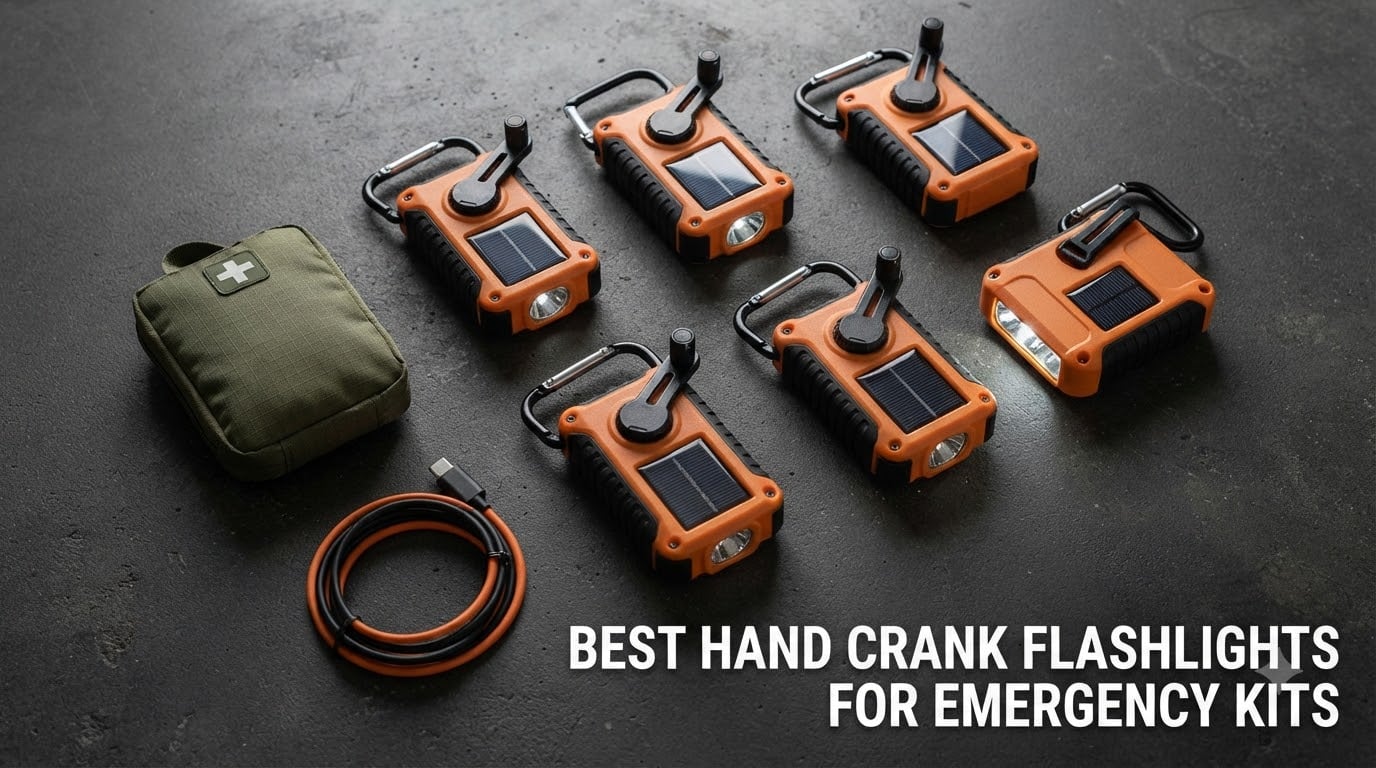
A hand crank flashlight is an LED torch with a small dynamo generator built into the handle. Turn the crank and it makes electricity that recharges an internal cell, so the light works with no batteries, no wall outlet and no sunlight. That makes it the one lighting tool in an emergency kit that cannot be defeated by a box of dead AAAs or a week of overcast weather. We picked the best hand crank flashlights for emergency kits after reading through thousands of buyer reviews, then checked every claimed runtime and charging ratio against the manufacturer data.
This roundup covers ten crank-powered lights, from 10-lumen pocket models to a 1000-lumen lantern that doubles as a phone charger. We tell you how much light each one actually produces, how long a minute of cranking lasts, and where in your kit it belongs. We also spend time on the failure modes that prepared-kit owners rarely think about, because a crank flashlight that dies quietly in a drawer is worse than useless.
A note on what we did not include: this list is crank flashlights only, so there are no NOAA weather radio combos here. The radio-plus-light category is genuinely important, and our guides to hand crank radios and full emergency kits cover that side. What follows is every crank flashlight worth putting in a kit, car, go bag or drawer.
Last updated in 2026. All ratings and review counts are pulled directly from the current customer review data for each product.
Table of Contents
Top 3 Picks: Hand Crank Flashlights for Emergency Kits in 2026
Our three standouts differ in what they do rather than in quality. The Simpeak pair is the best all-round buy, the Mudder pack is the sturdiest solar option, and the Coghlan’s dynamo is the one you can add to a go bag without noticing the weight.

Simpeak 2-Pack Crank Solar Flashlight
- 200 lumens
- Crank and solar charging
- 86g each
- Carabiner clip
Mudder 4-Pack Crank Solar Flashlight
- Water resistant
- Crank and solar
- Four per pack
- Buckle clip

Best Hand Crank Flashlights at a Glance in October
Every light below runs without batteries. Runtime is what the manufacturer lists for the brightest mode, and the crank ratio is minutes of cranking against minutes of usable light, which is the number that matters most.
| Product | Specifications | Action |
|---|---|---|
| Simpeak 2-Pack Hand Crank Solar Flashlight |
|
Check Latest Price |
 Evelots 4-Pack Hand Crank Flashlight Evelots 4-Pack Hand Crank Flashlight |
|
Check Latest Price |
 Guyuyii 4-Pack Hand Crank Flashlight Guyuyii 4-Pack Hand Crank Flashlight |
|
Check Latest Price |
| Coghlan’s Dynamo Flashlight |
|
Check Latest Price |
| Mudder 4-Pack Hand Crank Solar Flashlight |
|
Check Latest Price |
 VFAN Rechargeable Hand Crank Flashlight VFAN Rechargeable Hand Crank Flashlight |
|
Check Latest Price |
 Oudain 4-Pack Hand Crank Solar Flashlight Oudain 4-Pack Hand Crank Solar Flashlight |
|
Check Latest Price |
 Leelosp 2-Pack Hand Crank Solar Flashlight Leelosp 2-Pack Hand Crank Solar Flashlight |
|
Check Latest Price |
 BFVV 4-Pack Hand Crank Flashlight BFVV 4-Pack Hand Crank Flashlight |
|
Check Latest Price |
 ErayLife Rechargeable Hand Crank Flashlight ErayLife Rechargeable Hand Crank Flashlight |
|
Check Latest Price |
1. Simpeak 2-Pack Hand Crank Solar Flashlight: The One Most Kits Need
Simpeak 2-Pack Hand Crank Solar Powered Flashlight, Emergency Rechargeable LED Survival Flashlight, Quick Snap Carbiner Dynamo Flash Light Torch for Outdoor Sports, Green
200 lumens
Crank and solar panel
86g each
2-year warranty
Pros
- Over 10 minutes of light per minute of cranking
- Solar panel also charges from lamp light
- Built-in carabiner clips to a backpack
- Two lights so you can cover two kits
- Two-year manufacturer warranty
Cons
- Not water resistant
- Modest 200-lumen output for a room or yard
This is the light we recommend to most people, and the reason is the review count. With more than 5000 ratings averaging 4.5 stars, it has the largest body of buyer feedback in this roundup, which means the failure reports are already public and the design has survived them.
The charging maths is the part that matters. Simpeak claims more than ten minutes of light for every minute of cranking, which is one of the better ratios in the category. In practice that means a two-minute wind-up before bed gives you twenty-plus minutes of beam, enough to find the fuse box, check the pipes or walk the outside of the house.
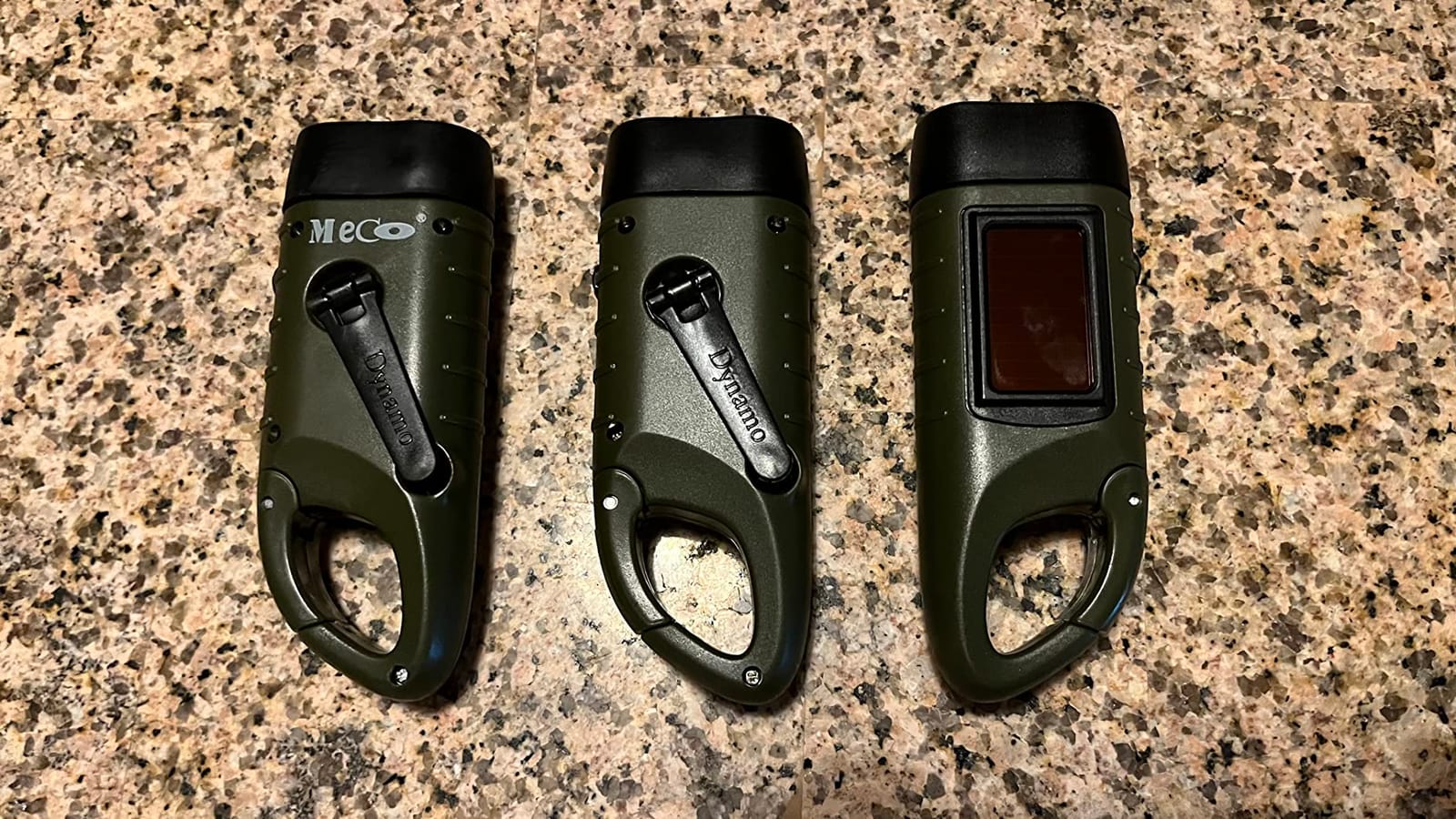
The 200-lumen output is genuinely useful rather than decorative. That is bright enough to light a hallway end to end and to follow a path across a yard, which is well past what most crank torches manage. It is still not a searchlight, so do not expect to read a map across a field.
At 86 grams and 124 by 45 by 32 mm, it disappears into a jacket pocket or the side pouch of a go bag. The built-in carabiner means it clips to a backpack strap rather than rattling loose at the bottom of a bag where you will not find it.
What you get for the effort
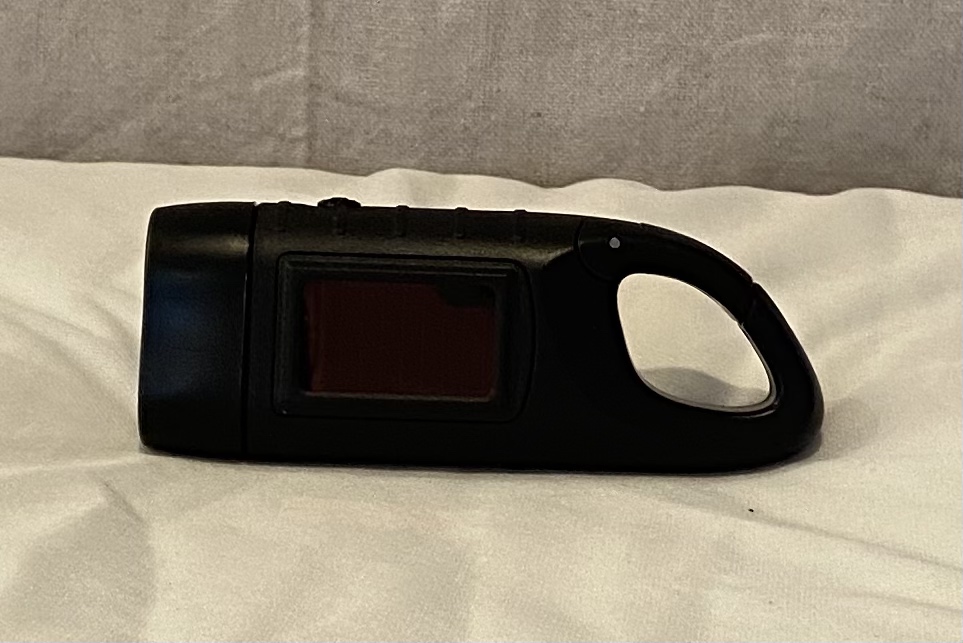
The solar panel is a genuine second input, and it absorbs both strong sunlight and ordinary lamp light, so a bulb on a table is enough to top the cell up slowly. It is a trickle, not a replacement for cranking, but it means a light left on a windowsill all week is not simply draining to nothing.
The two-year warranty is unusual in this category and worth something on its own. Most of the cheaper crank lights here carry no warranty at all, which tells you how the manufacturers expect them to be treated.
Where it falls short
It is not water resistant, and the listing says so plainly. That rules it out for marine kits, boat lockers and anything that will sit in a wet car trunk through winter. For a home blackout box or a bedroom drawer, it is a good fit.
The 200 lumens is a single bright figure with no mode information supplied, so expect one useful beam rather than a low, high and strobe menu. People who want signalling modes should look further down this list.
2. Evelots 4-Pack Hand Crank Flashlight: Spread the Light Around the House
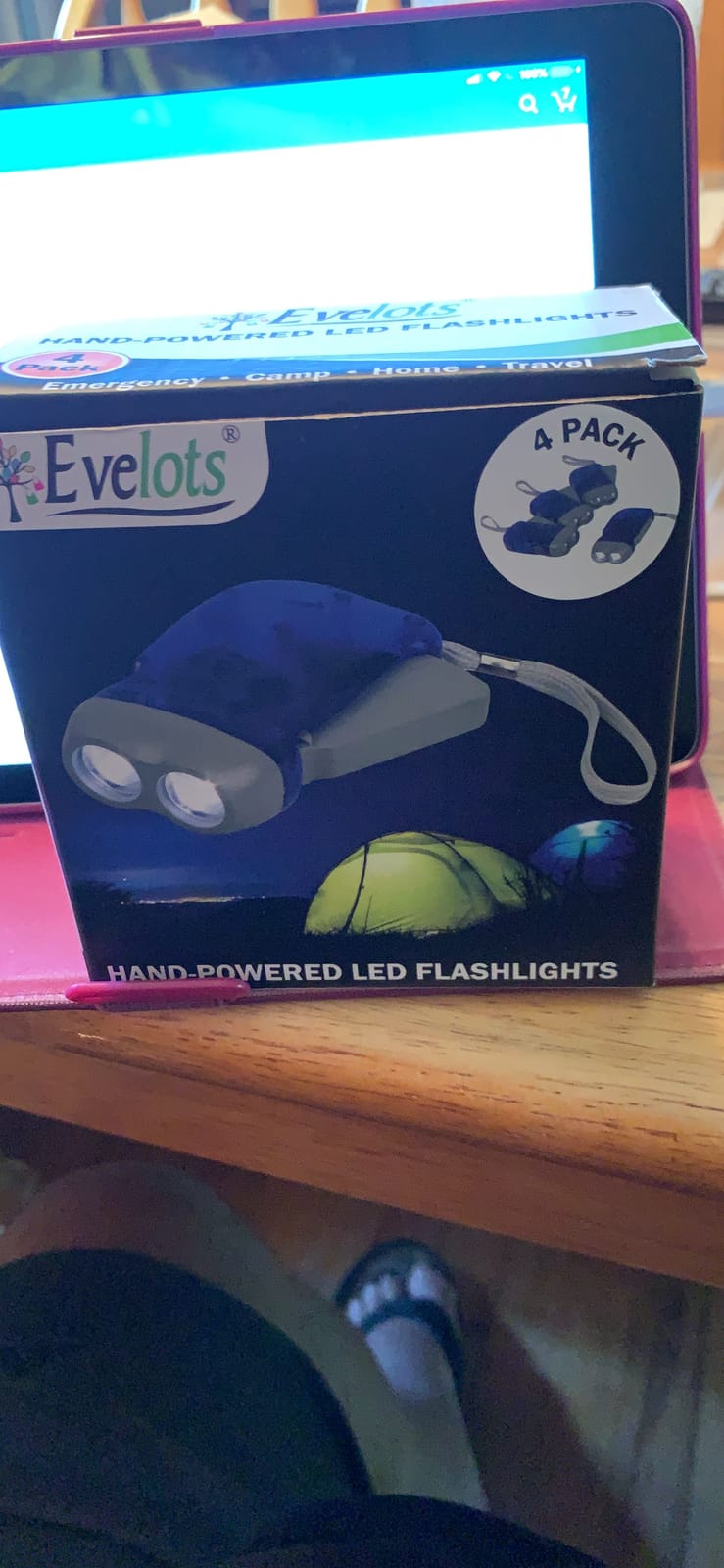
Evelots 4-Pack Hand Crank Flashlights for Emergencies, Double LED
Two LED lamps per light
NiMH cell included
4 x 2 x 1 inch
Four per pack
Pros
- Four lights let you cover home car backpack and go bag
- Two LED lamps give broad close-range light
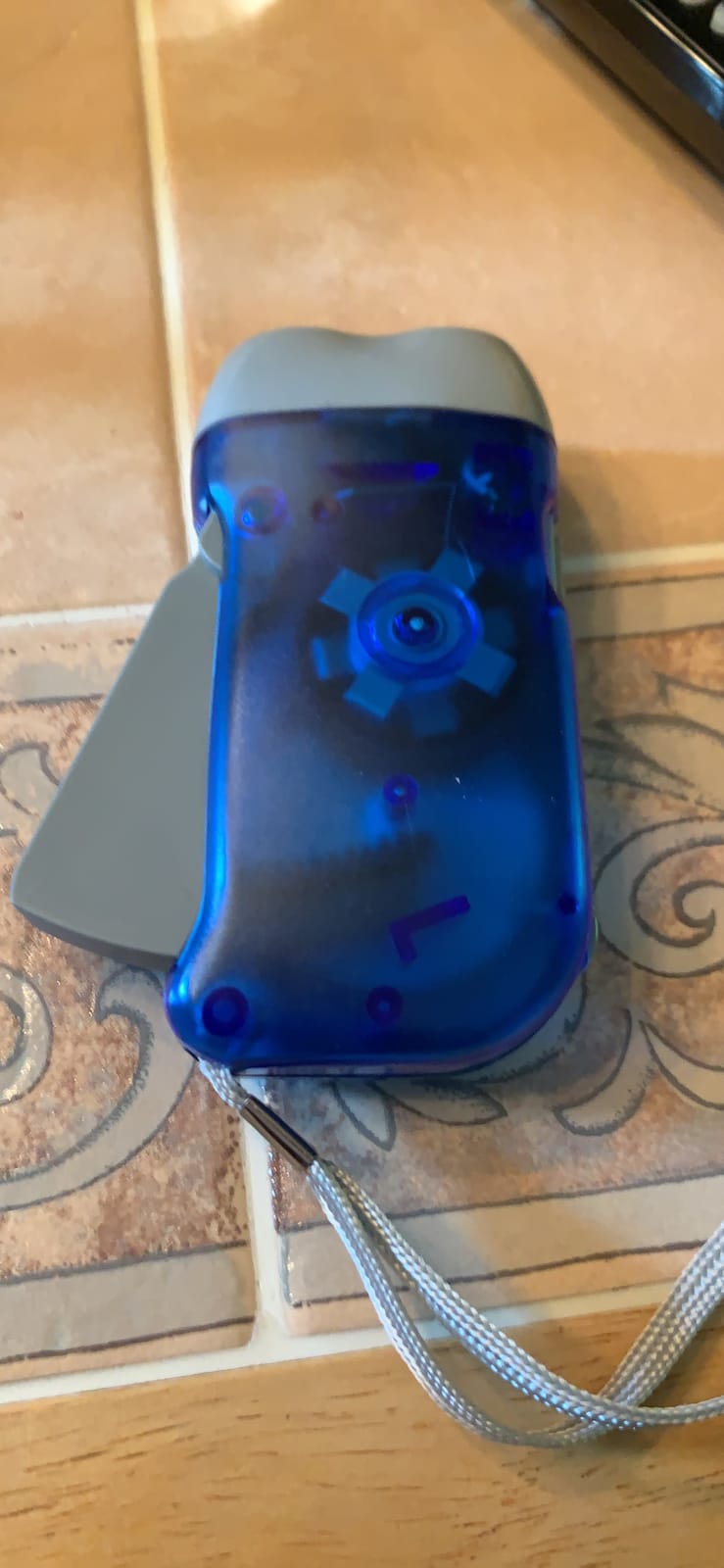
- Crank-lock toggle stops accidental winding
- Carry strap included
- Long-standing seller with easy returns
Cons
- Not water resistant
- Basic plastic construction
- No manufacturer warranty
The strongest argument for this one is arithmetic of placement rather than performance. Four lights at once means one in the kitchen drawer, one in the car, one in a go bag and one in a bedside table, and each location is covered the moment the power goes out.
Each light carries two LED lamps rather than one, which widens the beam for finding things at close range. The NiMH cell is a sensible choice for a device that may sit unused for years, because NiMH tolerates long storage far better than a lithium-polymer pack that sits half-charged.
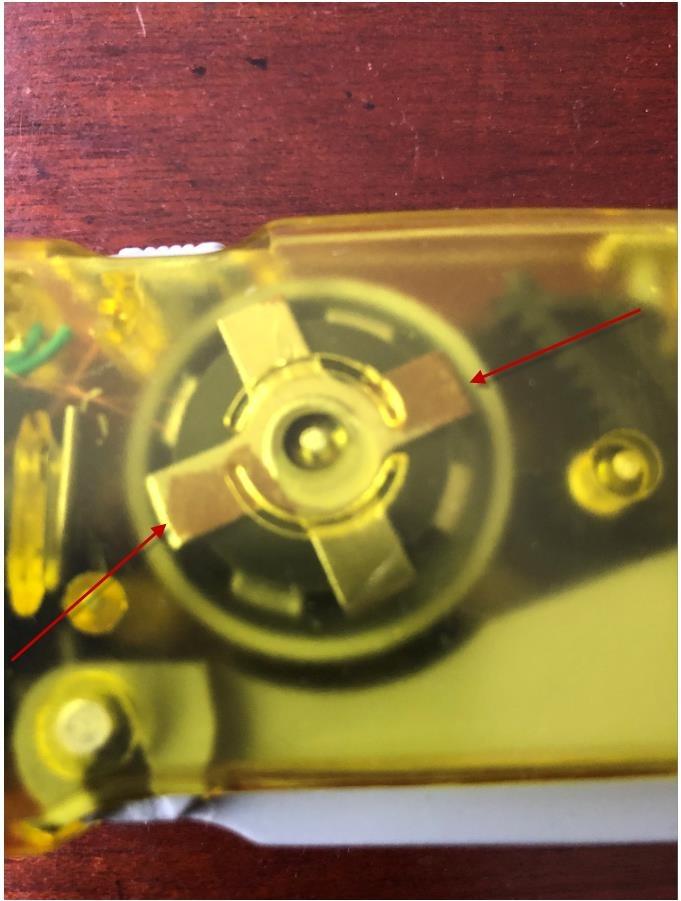
The crank-lock toggle is the detail most people miss and most people appreciate. Without it, a light rolling around a bag winds itself down and arrives flat when you need it. With it, the crank stays put.
Size is 4 by 2 by 1 inch per light and each one weighs under three ounces, so adding four to a kit costs almost nothing in weight or space.
Why the pack format wins
Buyers consistently describe the same use case: distributing cheap identical lights so no room is unlit. Reviewers report placing them in the car, the kitchen and a backpack, then finding that the second battery-free light was the one actually used.
Because they are identical, a broken one is never a problem. Swap in another from the pack and keep going, which is exactly the redundancy philosophy a go bag is built on.
Where it falls short
There is no published lumen figure, and reviewers describe the light as ample rather than bright. Treat it as a finder light for a fuse box or a bag, not a room-lighting tool.
The plastic body feels basic and carries no warranty, so it will not survive being dropped in a rocky ravine. It is built for drawers, glove boxes and home kits.
3. Guyuyii 4-Pack Hand Crank Flashlight: The One Kids Can Use
Guyuyii 4 Pack Hand Crank Flashlight Features 3-LED and Wrist Straps
20 lumens
Three LED lamps
Lithium ion cell
Wrist straps
Pros
- No batteries or assembly needed for instant light
- Simple crank a child or senior can work
- Lightweight pocket-sized body with wrist strap
- Four-pack spreads across car kitchen and go bag
- Sized for fuse boxes and tents
Cons
- Modest 20-lumen output for close range only
- Colors arrive at random
- Not water resistant
This is the crank light to buy for a household with children, and the reason is the crank itself. There is nothing to unfold, no switch sequence and no charging port, so a seven-year-old can wind it and get light immediately. In a blackout that simplicity is worth more than lumens.
Three LED lamps give 20 lumens of output. That is close-range only, enough to find a light switch or a torch in a cupboard, and not enough to scan a garden. Buyers are candid about this and still rate the pack well because of what it does not need.
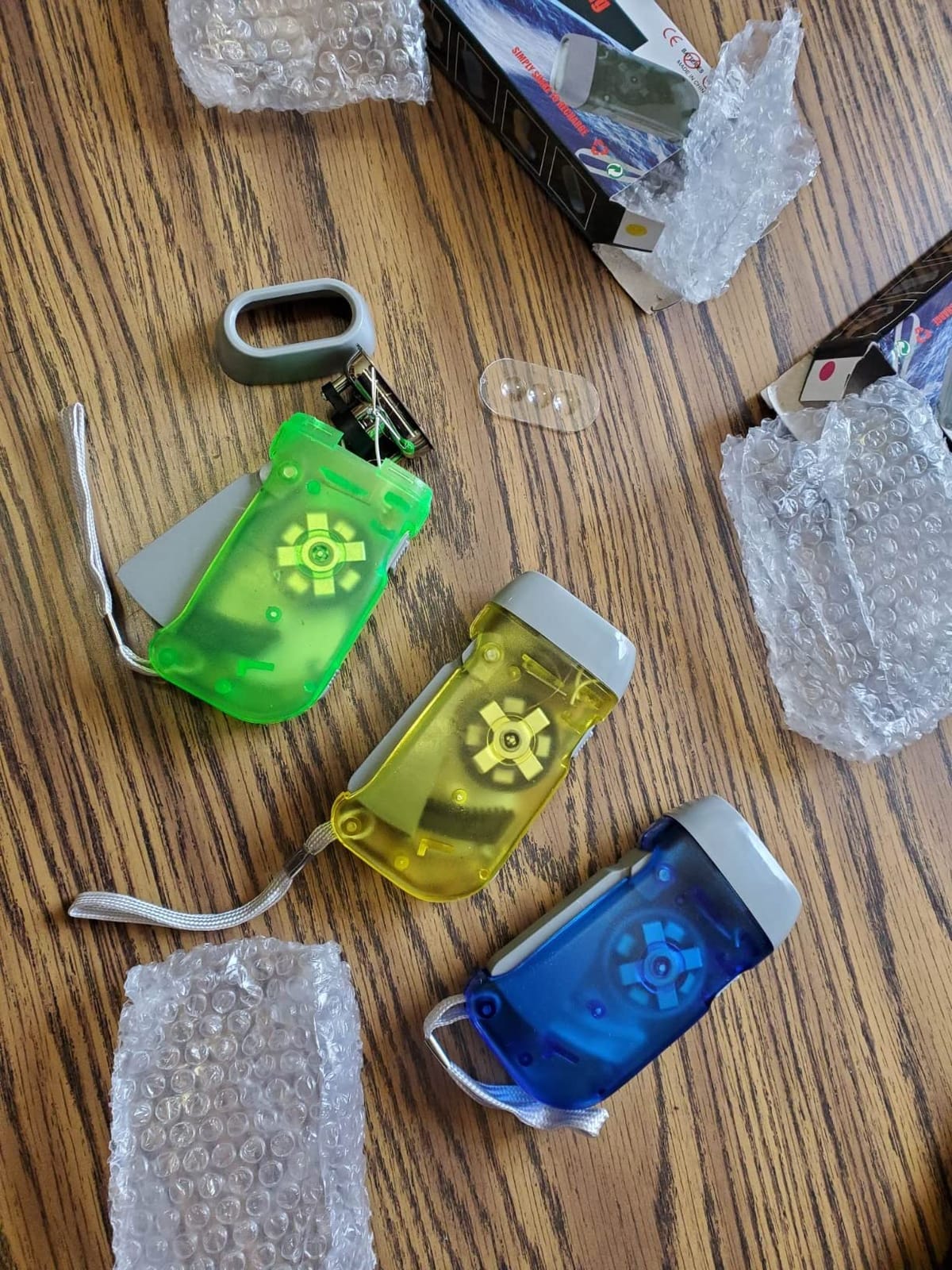
Each light ships with a wrist strap, which stops a small object from disappearing under a sofa in exactly the situation where you cannot get down on the floor to look. The lithium-ion cell gives a listed 30 minutes of runtime.
They are sold in sets of 4, 12, 24 and 48 as well, so if you run a classroom, a shelter or a scout group you can cover many people with identical lights that need no servicing.
Who this works for
The wrist straps and pocket sizing make these the ones to hand to children in a home kit or a school preparedness exercise. Reviewers repeatedly describe them as gifts for kids’ bags because there is no battery compartment for a child to swallow.
They also suit older adults for the same reason. A crank with no menu and no charger is the least intimidating emergency light on this list.
Where it falls short
Twenty lumens is the honest limit here, and it is a real one. If your blackout plan involves checking a breaker panel in a dark basement, this will frustrate you.
The colours arrive at random rather than as a chosen set, and the light is not water resistant. Check each one before distributing them if a specific colour matters to your setup.
4. Coghlan’s Dynamo Flashlight: Small Enough to Forget You Packed It
Coghlan’s Dynamo Flashlight – Rechargeable Handheld LED Light for Emergency, Camping, and Survival – Compact and Lightweight Crank Flashlight for Reliable Portable Illumination
10 lumens
1.12 oz
1.75 x 1.25 inch
Water resistant
Pros
- Only 1.12 oz so it adds no weight to a pack
- One minute of cranking gives up to 7 minutes of light
- Two bright LEDs for low-light navigation
- Sturdy clip for hands-free bag attachment
- Water resistant with no batteries to replace
Cons
- 10 lumens means a short dim beam
- Runtime is short relative to the crank time needed
The case for this light is weight. At 1.12 ounces and 1.75 by 1.25 inch, it is the lightest unit on this list with a stated weight, which means it can go in a go bag, a first aid pouch or a jacket pocket without you having to make room or cut something else out.
Coghlan’s rates it at one minute of cranking for up to seven minutes of light. That is the weakest ratio here, and it is worth being honest about: to get an hour of light you would need to wind for close to nine minutes.
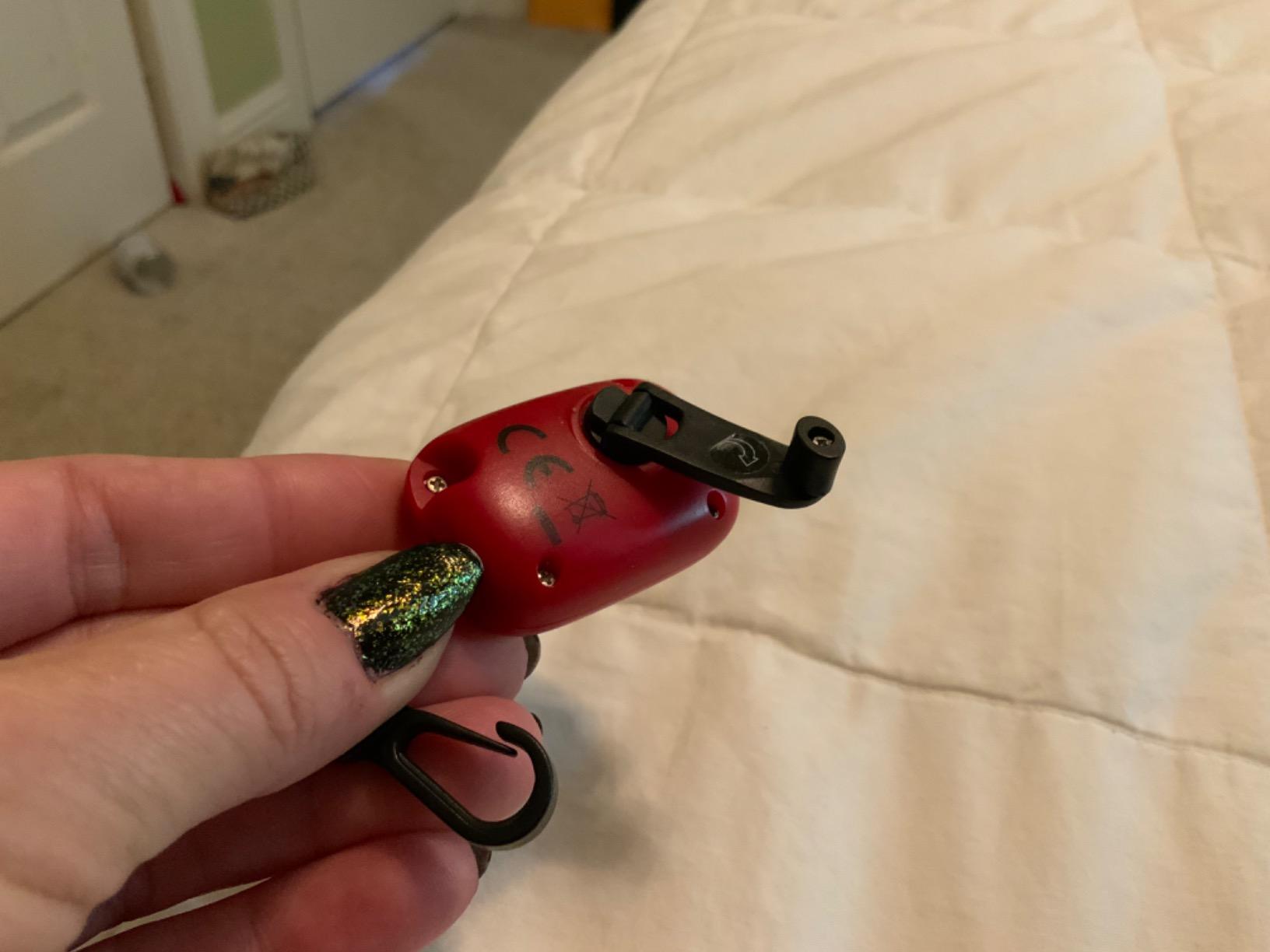
What makes it worth carrying anyway is that it is water resistant, has no bulb or battery to fail, and clips to a belt or pack strap so your hands stay free. Coghlan’s is a long-established outdoor brand, which matters more than it sounds when you are choosing something for a kit that may sit untouched for years.
The clip is genuinely sturdy rather than decorative. Reviewers use it the way they would use a carabiner on a keychain light, clipped to a shoulder strap and forgotten about.
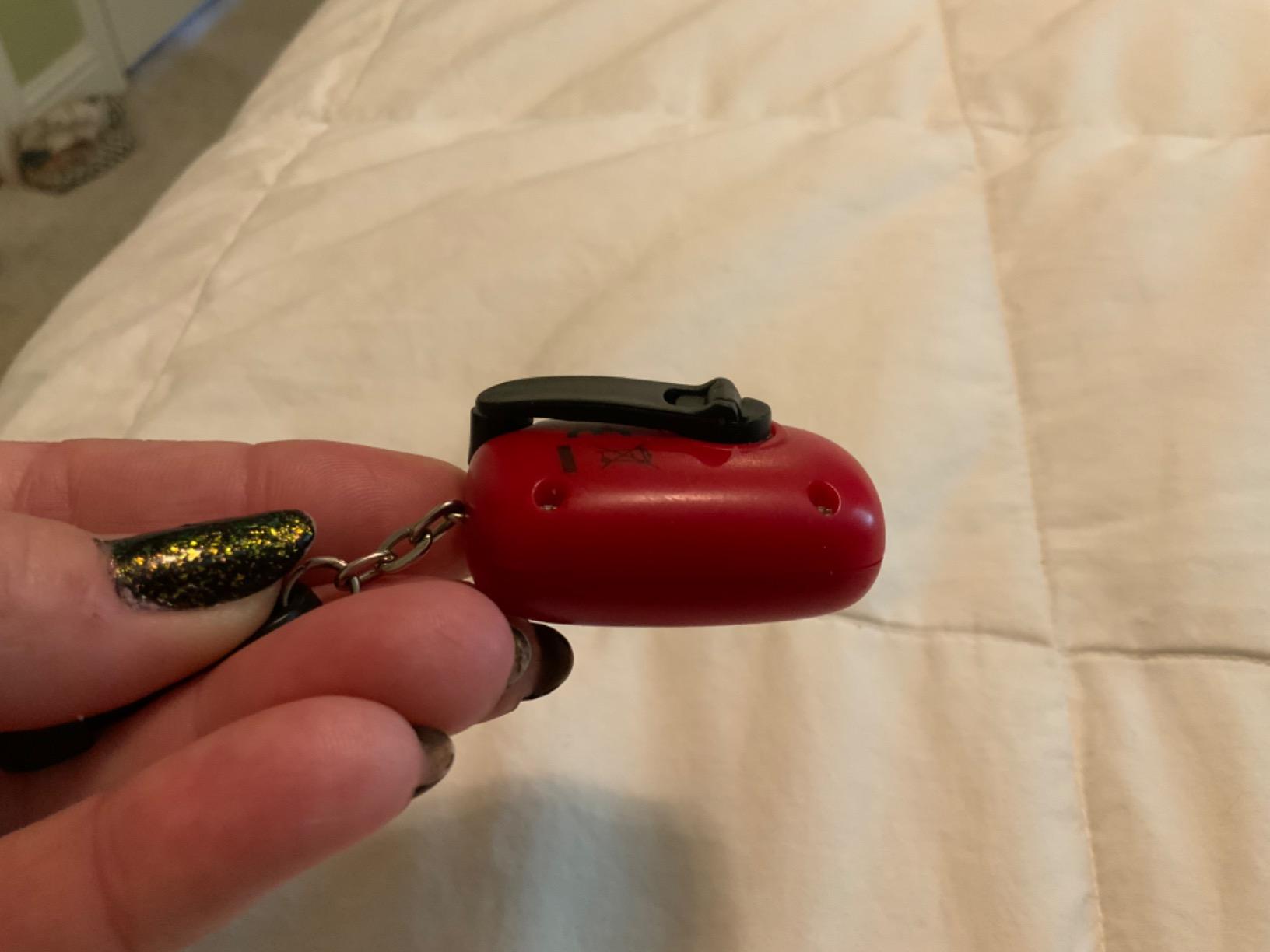
Why size decides this one
Every gram in a 72-hour bag is a decision somebody has already made. Reviewers of go-bag gear consistently treat this torch as the item that costs nothing to add and might be the one that works if the rest of the kit is waterlogged.
It is also the single-light purchase on this list, so it is the simplest one to slip into an existing kit rather than having to plan around a four-pack.
Where it falls short
Ten lumens is barely brighter than a phone screen. It is a navigation-by-feet light, and everyone who owns one describes it that way rather than pretending otherwise.
With roughly 350 reviews behind it, this has a thinner feedback history than most of the list. The design is old and simple, which cuts both ways in terms of how much long-term failure data exists.
5. Mudder 4-Pack Hand Crank Solar Flashlight: Sturdiest of the Solar Set
Mudder 4 Pack Hand Crank Solar Flashlight LED Emergency,Yellow, Black
Solar and hand crank
Water resistant
4.92 inch long
4 lights per pack
Pros
- Solar panel charges from sunlight and lamp light
- About 10 minutes of light per minute of cranking
- Solid clip that feels less flimsy than expected
- Four lights to spread around the house and car
- Water resistant with noticeable weight in the hand
Cons
- Brightness is moderate rather than bright
- Solar charging is slow compared with cranking
- Some colors crank more stiffly than others
- No warranty
The 4.6-star average is earned by people who used these through real power cuts rather than in a drawer. At 13.44 ounces for the pack, these feel like objects rather than toys, and reviewers specifically call out the clip as feeling sturdier than the category average.
Charging is dual, with the solar panel absorbing strong and medium sunlight as well as lamp light, and the crank as backup. One minute of cranking yields about ten minutes of light.
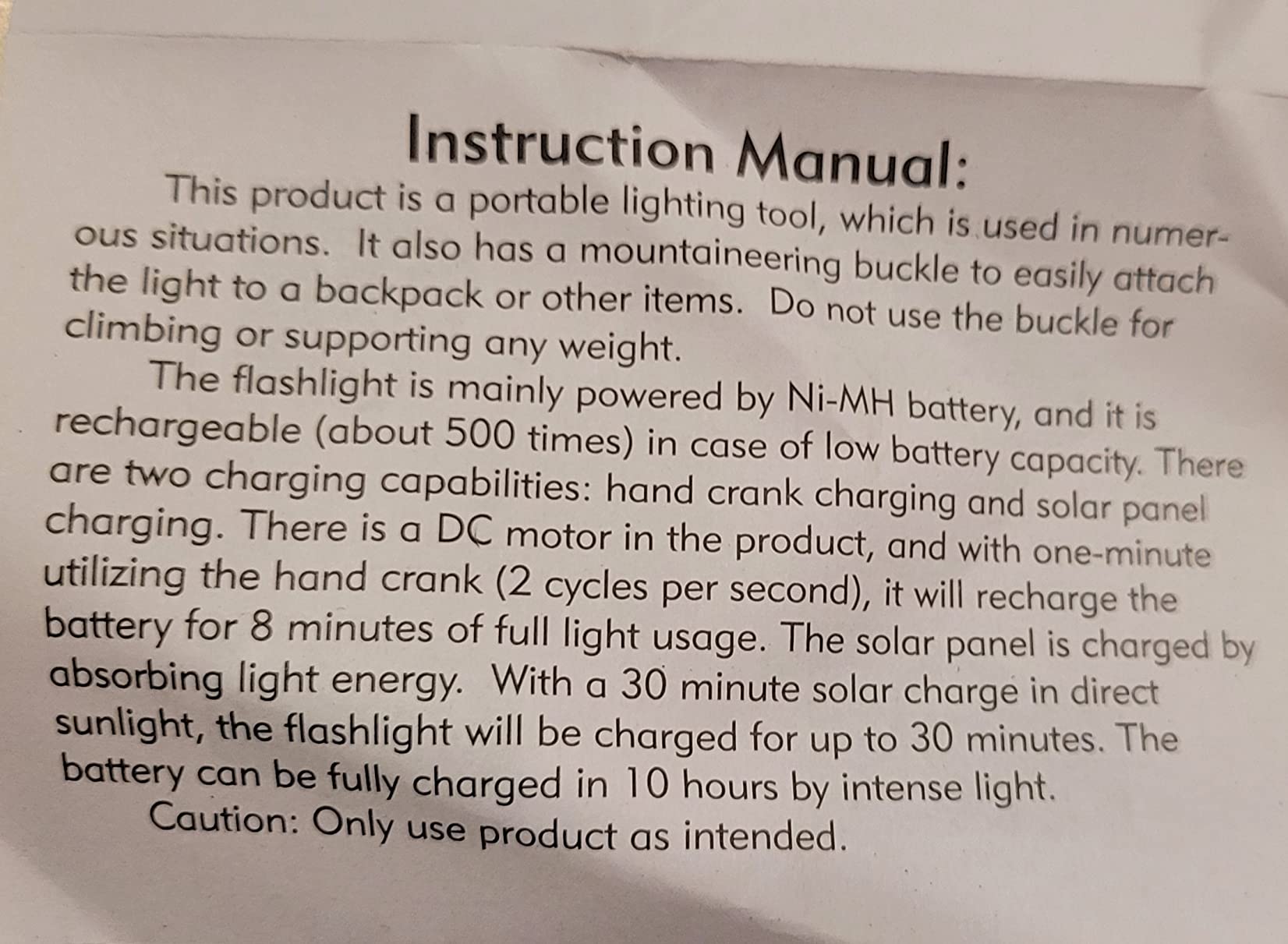
Four per pack means the same placement advantage as the other multi-packs here, and reviewers use them across the house and in vehicles rather than concentrating them in one bag.
They come in black, yellow, green, red and blue combinations, which is a small but real advantage if you are trying to colour-code lights by kit location.
What the reviews say after real outages
The strongest feedback comes from people who used them during genuine grid failures rather than in a drawer. The recurring comment is that the light is noticeably brighter on crank charge than on solar, so the panel is a maintenance input rather than a primary one.
Several reviewers note that a full day of sun produced only an hour or two of usable light, which matches what the physics suggests for a panel this small. Plan to crank, not to solarise.
Where it falls short
Brightness is described as moderate, not bright. If you need to signal someone across a yard at night, this is not the tool.
A few buyers report that units in mixed colour packs crank more stiffly than others, and there is no manufacturer warranty behind any of the four.
6. VFAN Rechargeable Hand Crank Flashlight: Runtime You Can Count On
VFAN Rechargeable Hand Crank Flashlight/Generator/USB Charger for Phone and Emergency Survival Situations (Orange)
2600mAh cell
18 hours flashlight runtime
USB phone output
5V at 600mA
Pros
- About 18 hours of flashlight use and 12 hours of side lantern
- Crank output up to 5V 600mA at 120 rpm
- USB port charges phones GPS trackers and smartwatches
- Cranks easily and feels comfortable in the hand
- Limited lifetime warranty
Cons
- Phone charging is inconsistent across devices
- Runtime is short if you rely on cranking alone
- Heavy at 310g for a hand light
- No indicator that cranking is recharging the cell
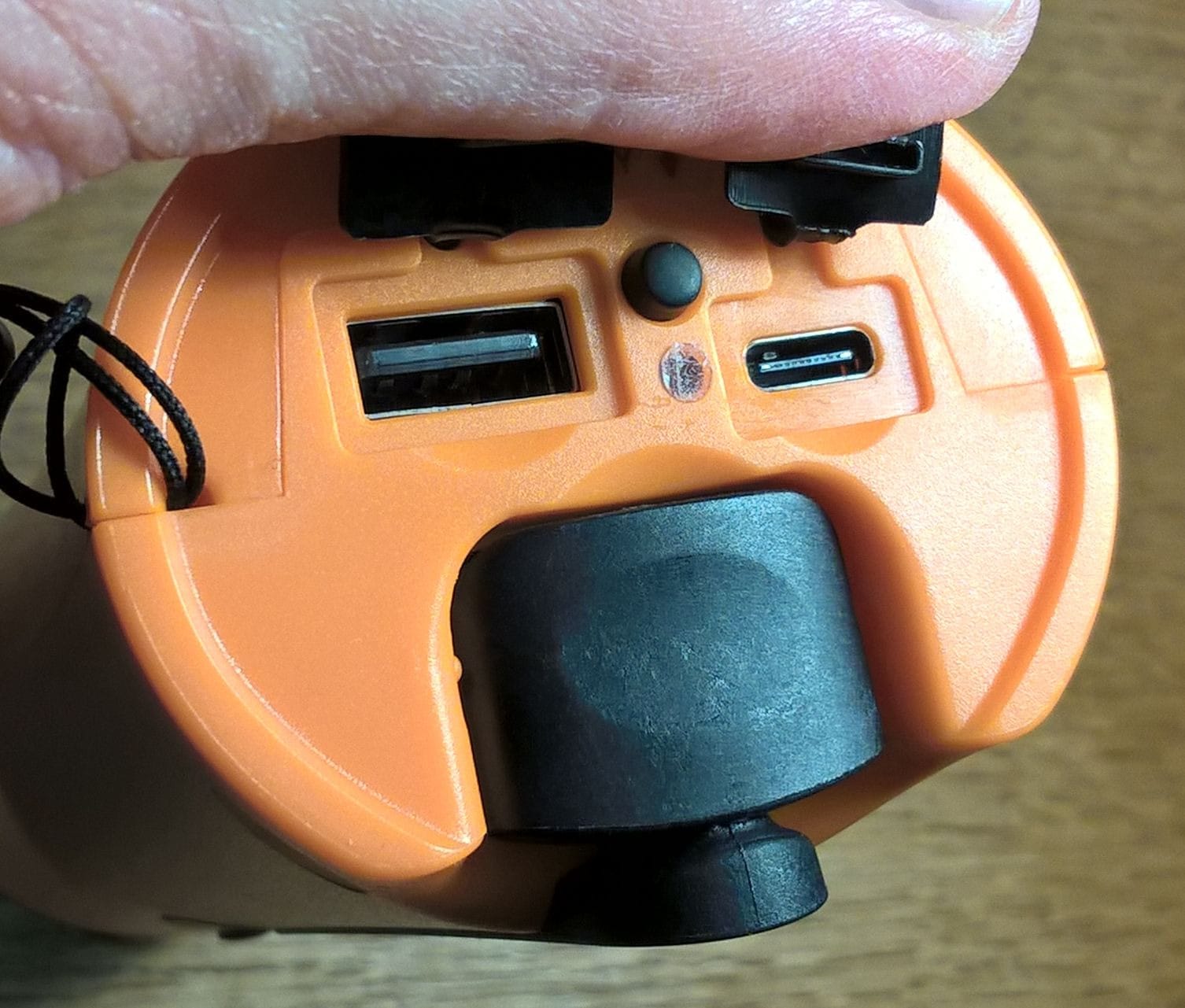
This is the only light here with a real battery bank behind it. The 2600mAh lithium-ion pack gives roughly 18 hours of flashlight use or 12 hours as a side lantern, which is an order of magnitude more than every other crank torch on this list delivers from a single wind-up.
The generator spec is the honest headline: 5V at 600mA at 120 rpm, and about 30 minutes of light per minute of cranking. That is a real output figure rather than a marketing round, and it is why this unit exists.
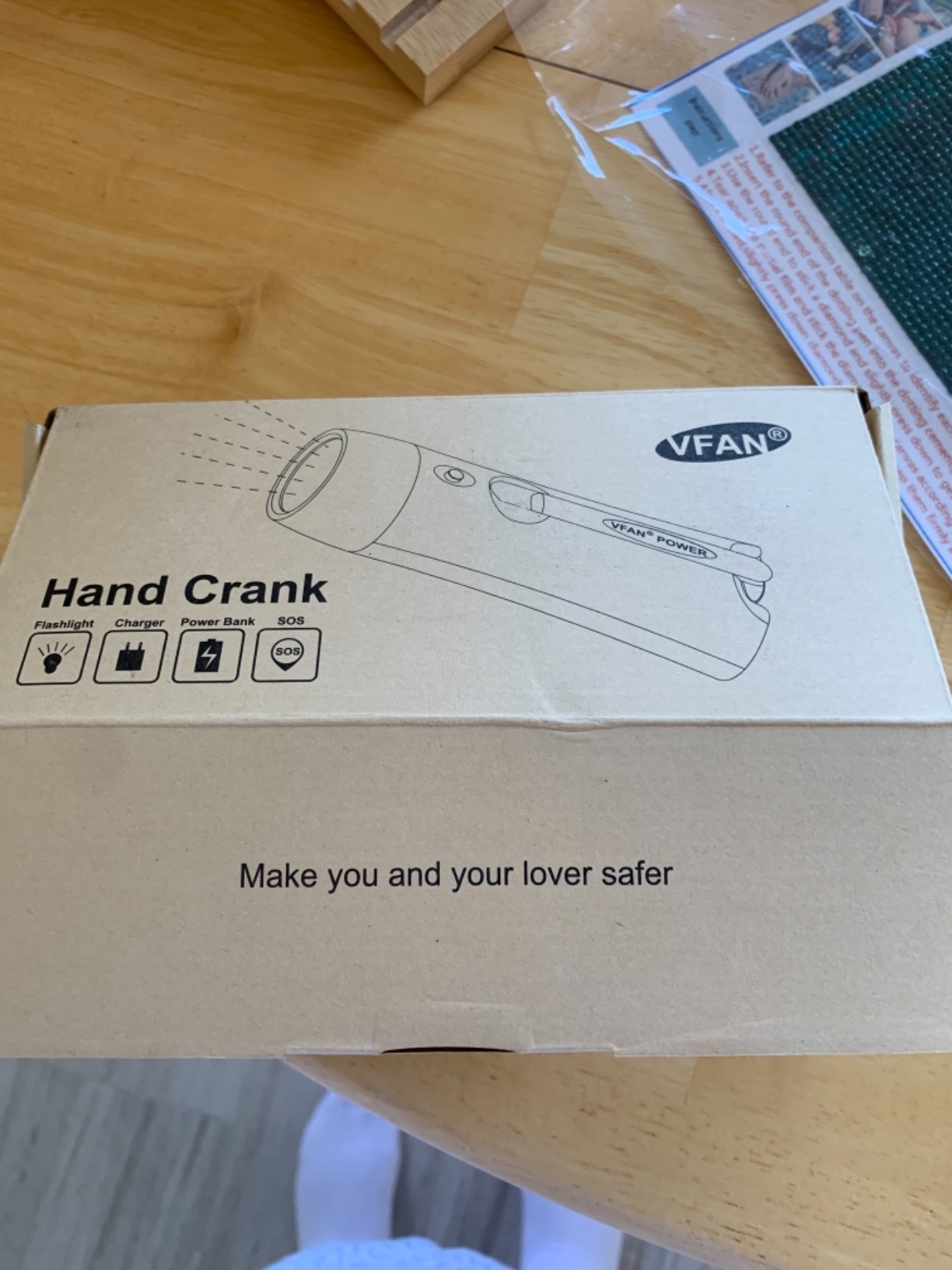
The 1.5W LED throws 150 metres and it cranks comfortably in one hand, with reviewers describing the grip as genuinely good over long sessions. At 7 by 2 by 2 inch it functions as a lantern, a torch and a power bank in one body.
A limited lifetime warranty is included, along with a Type-C cable, which makes this the best-supported product in the roundup on paper.
When the phone-charging feature earns its place
The USB port is the reason to choose this over a cheaper pack light. It will top up a phone, a GPS tracker or a smartwatch, and for a go bag that matters because a dead phone is a dead map.
That said, reviewers are consistent about the caveat: phone charging works for some devices and not others, with several buyers unable to recharge an iPhone at all. Test it with your own phone before it is the only phone charger you own.
Where it falls short
At 310 grams it is a heavy object for a hand torch, more than three times the weight of the Coghlan’s. In a pack you carry on foot every day, that is a real cost.
There is no indicator telling you whether cranking is actually putting charge into the cell, so you are guessing. That matters when you are tired and rationing your effort in a real outage.
7. Oudain 4-Pack Hand Crank Solar Flashlight: The One That Survived a Ten-Day Outage
Oudain 4 Pack Hand Crank Solar Powered LED Flashlight with Carabiner Clip
50 lumens
Crank and solar charging
86g each
Water resistant
Pros
- Used through a ten-day blackout without a failure
- Solar panel plus crank gives two charging routes
- Carabiner clip for backpacks and camping bags
- Flat body stands upright to light a room hands-free
- Lightweight at 86g and durable when dropped
Cons
- Roughly 18 lumens of usable light
- Not waterproof despite the water-resistant rating
- Crank knob has loosened on some models
- Army green is hard to spot if dropped outdoors
The single most useful review in this entire roundup describes four of these lights being cranked every night through a ten-day outage after a hurricane, with none of them failing. That single data point is why this pack sits where it does in our ranking.
Charging is dual, with the solar panel storing energy for long use and the crank as the fallback when it runs out. At 86 grams and 4.88 by 1.77 by 1.26 inch each light is the same size and weight as our top pick.
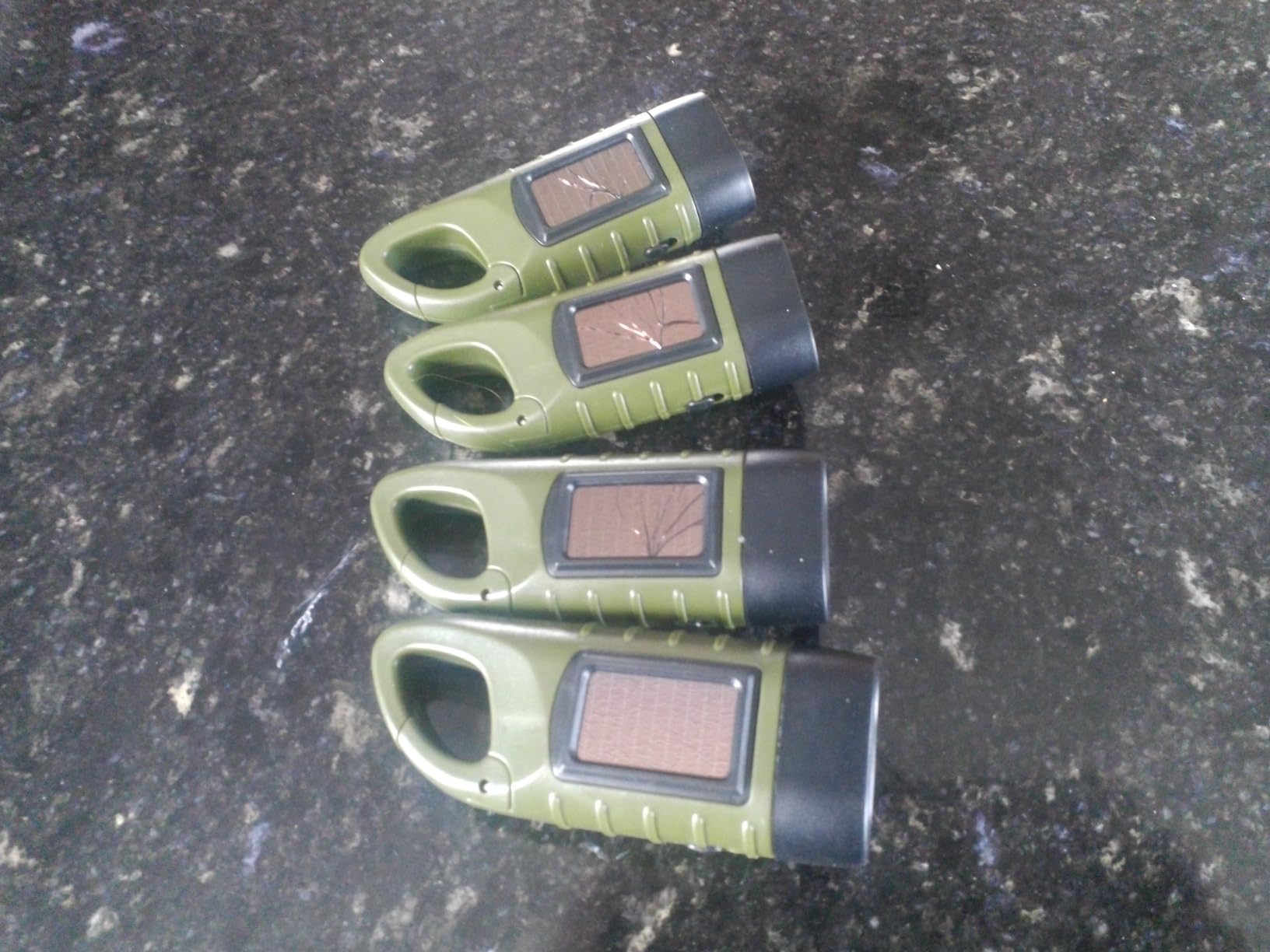
The body is flat enough to stand upright in a cup, which reviewers use to light a room hands-free during a blackout. That is the practical version of ambient lighting from a crank torch, and it is worth more than a headline lumen number.
The carabiner keychain clip attaches to backpacks and camping bags without needing a separate carabiner of your own.
What long outages actually need
Long blackouts reward distribution and endurance over brightness. Four lights means one per person, or one per room, and each one can be topped up by solar during daylight and cranked at night.
No batteries means no rotation schedule and no expiry date in the way alkaline cells have one. For a kit that will sit in a closet for years, that is the argument that decides it.
Where it falls short
Usable light is closer to 18 lumens than to the listed 50, which is a meaningful gap and the main complaint in the reviews. It lights a space, not a distance.
The water-resistant rating is not the same as waterproof, and the crank knob has come loose on some units. Army green also disappears against soil and leaves, so keep these inside the kit rather than in a car boot.
8. Leelosp 2-Pack Hand Crank Solar Flashlight: The Sturdier Two-Pack
Leelosp 2 Pcs Hand Crank Solar Flashlight Emergency LED,Army Green
100 lumens
Crank and solar panel
NiMH cell
12.5 x 5 x 3 cm
Pros
- Over eight minutes of light per minute of cranking
- Solar panel charges from sunlight and artificial light
- Built-in hook for a backpack or belt
- Crank handle stores inside the body so it cannot snag
- Sturdier materials than typical bulk crank lights
Cons
- Modest brightness rather than a primary light
- Not water resistant and the panel can crack if dropped
- Buying in bulk adds up compared with single lights
This pack sits in the entry end of the category, and it is repeatedly described by buyers as better made than the usual bulk crank flashlight. The NiMH rechargeable cell is the right chemistry for a device that will sit unused, and 100 lumens is more than most of this category manages.
Charging is capacitor-style, with roughly eight to ten minutes of usable beam per minute of cranking. The solar panel absorbs both strong sunlight and artificial light, so a desk lamp will keep it slowly topped up.
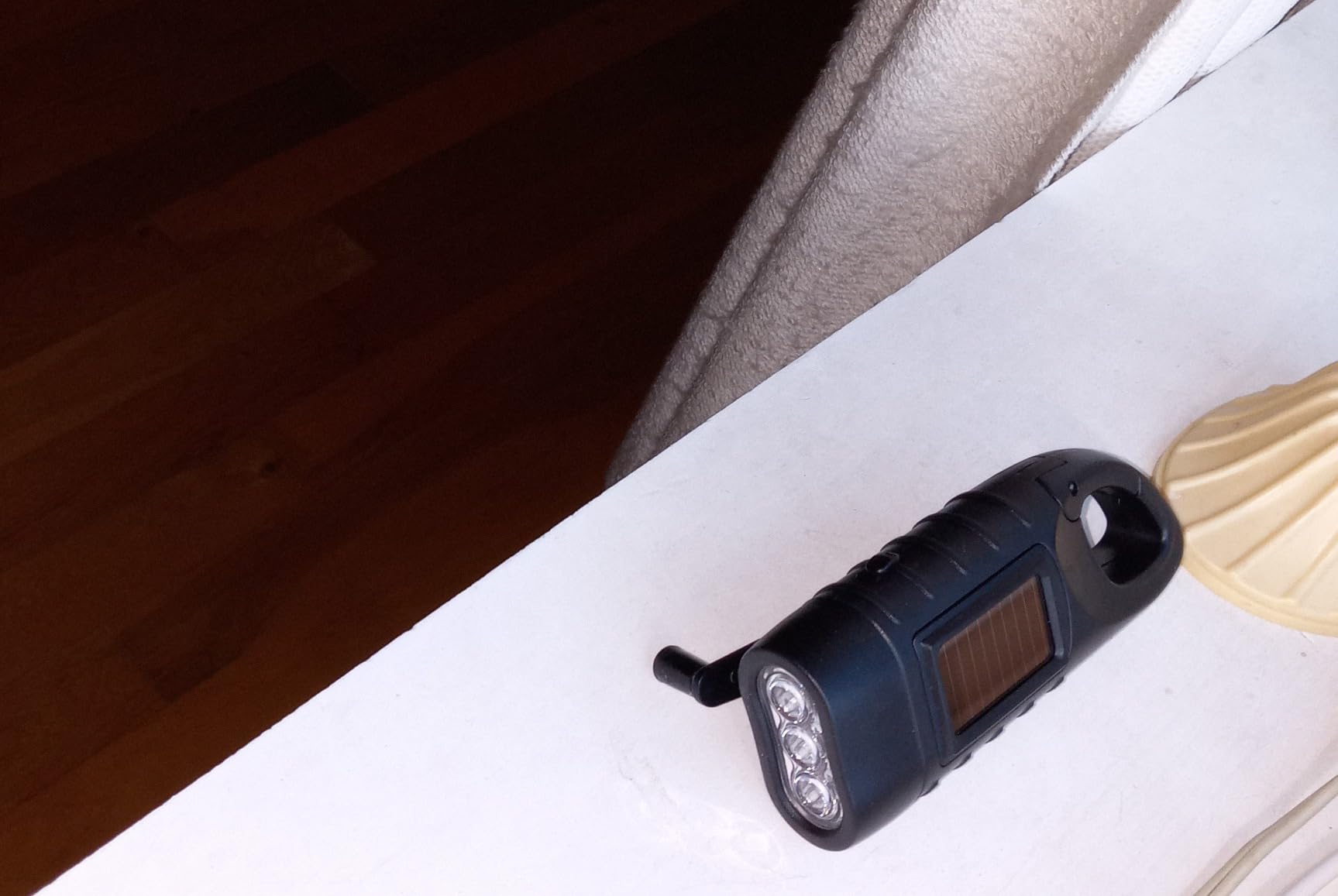
The crank handle folds into the body, which is a small thing that matters in a packed bag because it will not catch on fabric or snag in a pocket. A built-in hook handles the attachment side, so no separate clip is needed.
Buyers frequently purchase these in quantity for donation and gifting, which is another way of saying they survive being handed to people who have never used a crank light before.
Why this is the value pick
Two lights at this price point means you can cover a car and a home kit without buying two separate products. Reviewers describe them as capable of lighting a room for a while, which is more than the 10 and 20 lumen models manage.
The sturdier-than-expected construction shows up in comments about dropping them and about the grip feeling solid in the hand. For a kit item that gets handled rarely and roughly, that is a fair trade.
Where it falls short
Brightness is still modest, so this stays a close-range light rather than something you carry to find a stalled car on a dark road.
It is not water resistant, and reviewers warn that the solar panel can crack if the light is dropped on a hard surface. That is a real risk for a device whose only job is to survive emergencies.
9. BFVV 4-Pack Hand Crank Flashlight: The Glove Box and School Bag Filler
4 Pack Hand Crank Emergency Flashlight, No Battery Required, 3 LED Lights
Three LED lamps
4 x 2 x 1 inch
Crank lock switch
Four per pack
Pros
- Press the handle and power stores in the built-in cell
- Easy to crank one-handed including by children
- Small enough for pockets purses and drawers
- Clear shell and assorted colours appeal to kids
- Crank lock prevents accidental winding in a bag
Cons
- Runtime per crank is short and light is dim at distance
- No strobe or blinking mode
- Not waterproof and only handles damp conditions
- Thin plastic shell can crack
- Only a 30-day warranty
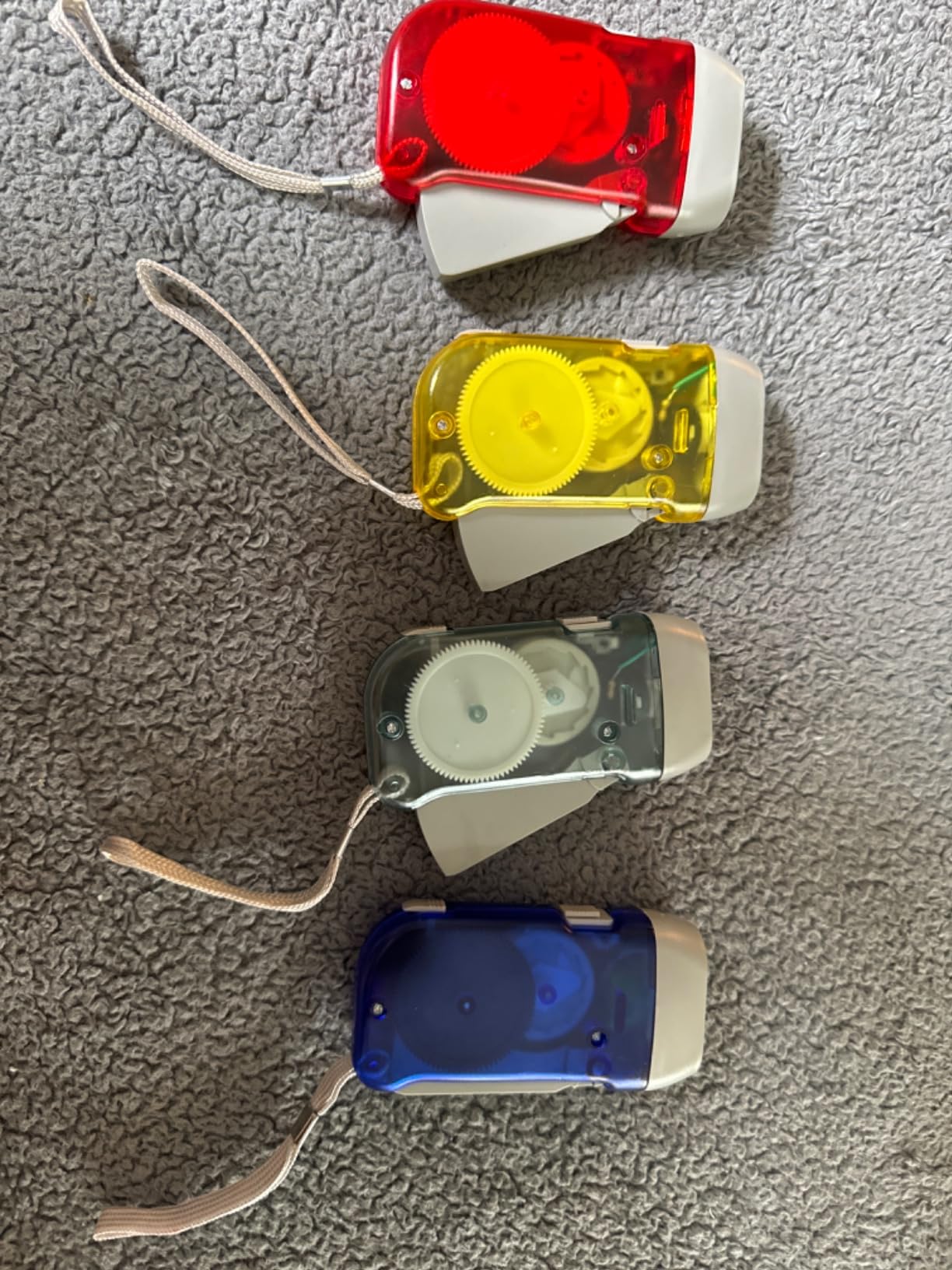
The design intent here is obvious once you pick it up. A clear plastic shell, assorted colours and a press-to-crank body are aimed at children and at anybody who has never opened a battery compartment, and reviewers buy them for exactly that reason.
Three LEDs give short-range light, and the whole point is that there are no replacement batteries to chase. Buyers describe the pack as perfect for a kitchen, a glove box or a survival kit where four cheap identical lights cost almost nothing to lose.
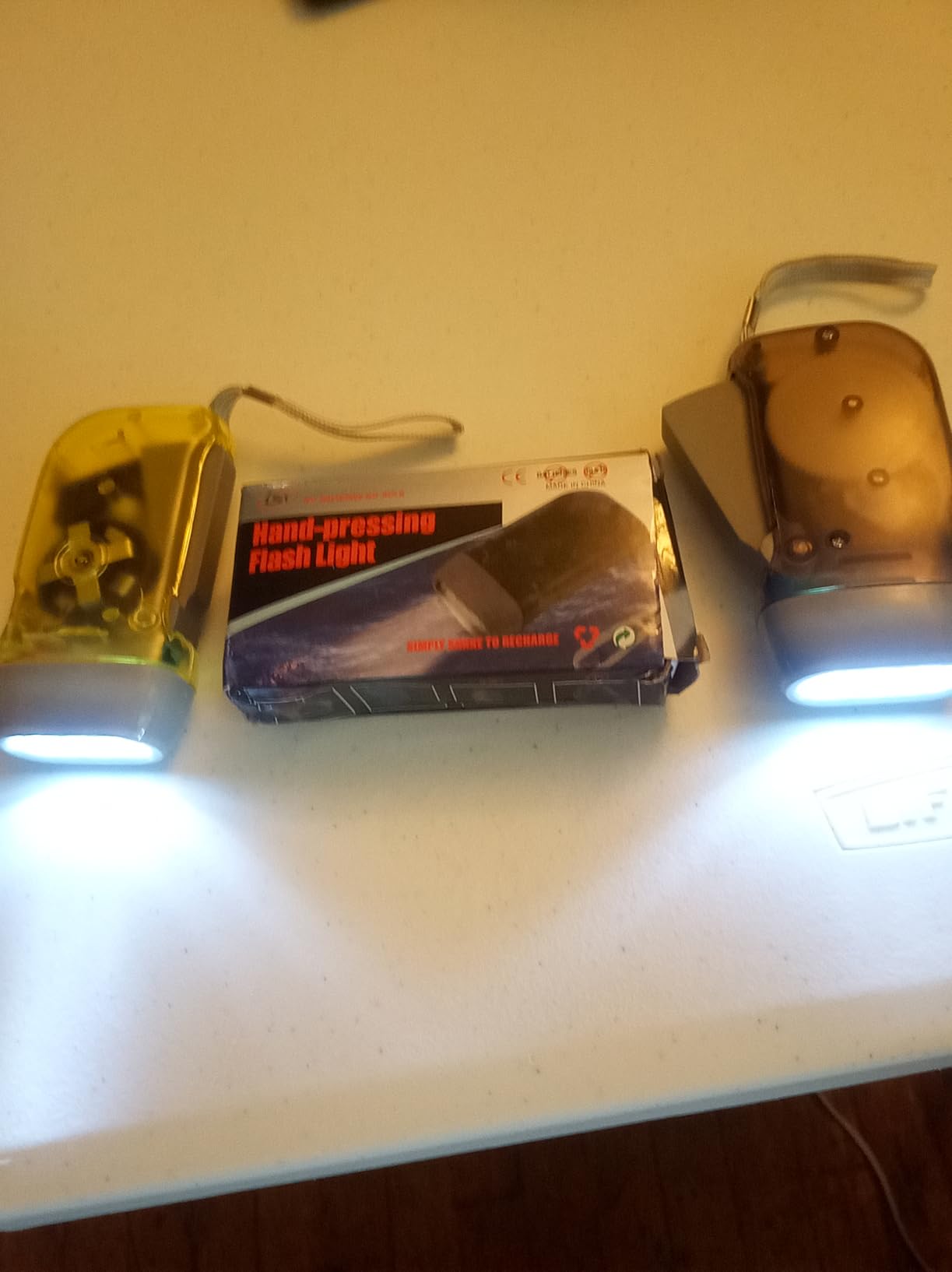
The crank lock is the standout feature. It stops a light from winding itself flat while rattling in a bag, which is the most common way an otherwise working crank torch gets wasted.
At 4 by 2 by 1 inch with a hand strap, they are genuinely pocketable and light enough for a child to carry without complaint.
Where this pack works best
Multiple-kit households are the natural home for this. Reviewers describe handing them out so every room and every vehicle has one, which is a distribution strategy no single-light purchase can match.
They also work as a teaching tool. A child who has wound one understands the whole concept of stored energy before the emergency ever happens, which is a genuine advantage in a preparedness conversation.
Where it falls short
Runtime per crank is short and there is no strobe or blinking mode, so it cannot be used for signalling. The thin plastic shell can crack if the body is pressed hard, and it is not waterproof.
Thirty days of warranty is the shortest cover on this list. Treat these as expendable first-line lights rather than as equipment you depend on.
10. ErayLife LED Rechargeable Hand Crank Flashlight: The Bright One in the Group
ErayLife LED Rechargeable Hand Crank Flashlight
1000 lumens
800m beam distance
IPX4
Three light sources
Pros
- 1000-lumen main beam reaching up to 800 metres
- Six modes across three independent light sources
- 8 to 20 hours of runtime depending on mode
- Red flashing side light for emergency signalling
- Crank and USB recharge both work
- One-year warranty and shoulder strap included
Cons
- Charging input is micro-USB rather than USB-C
- Included cable is short
- Shoulder strap stitching can loosen
- Bulky at 0.3 kg for a flashlight
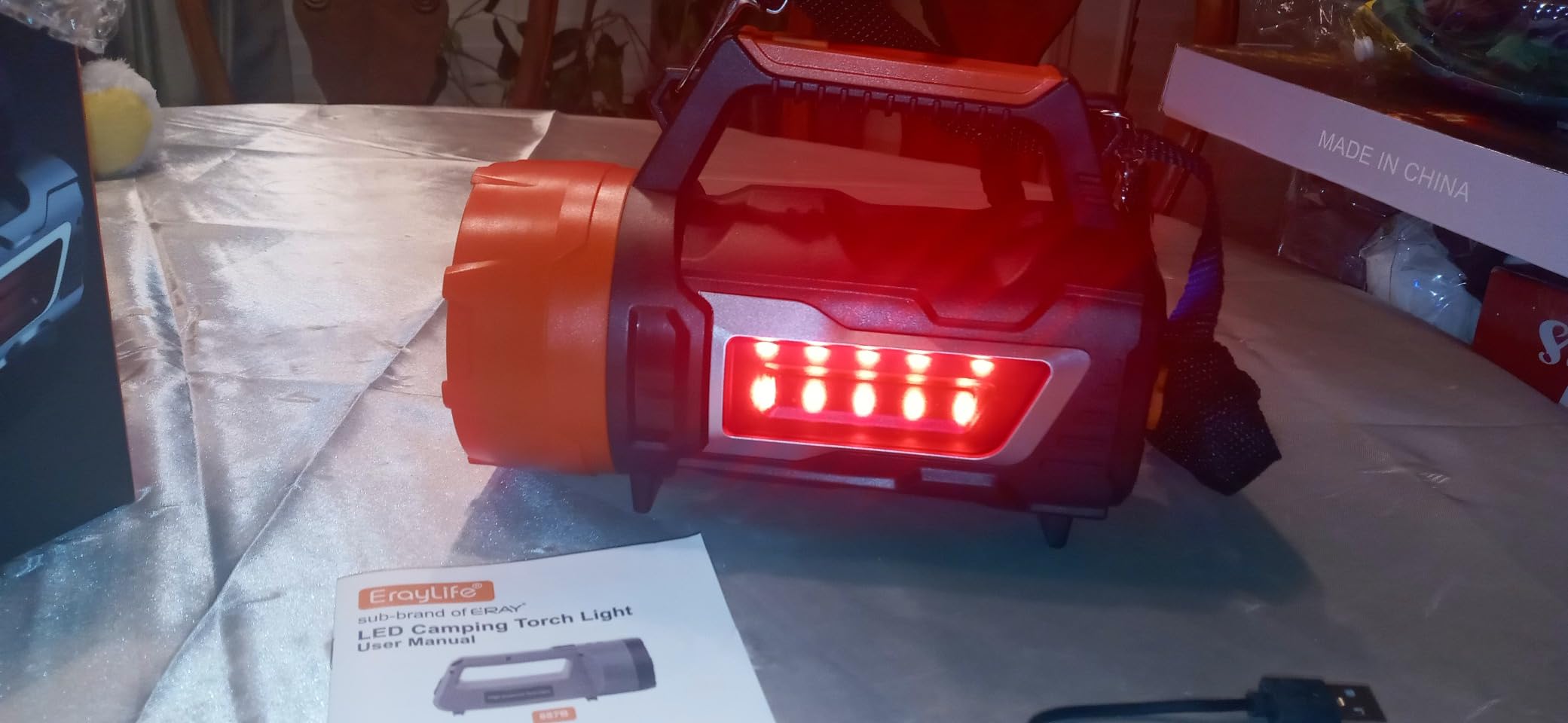
The 1000-lumen main beam reaches up to 800 metres, so it lights a yard, a road or a search area properly, and six modes across three independent light sources give you real control over it.
Everything above it tops out at 200 lumens or less, so this is a genuine step change in what a crank-powered light can do.
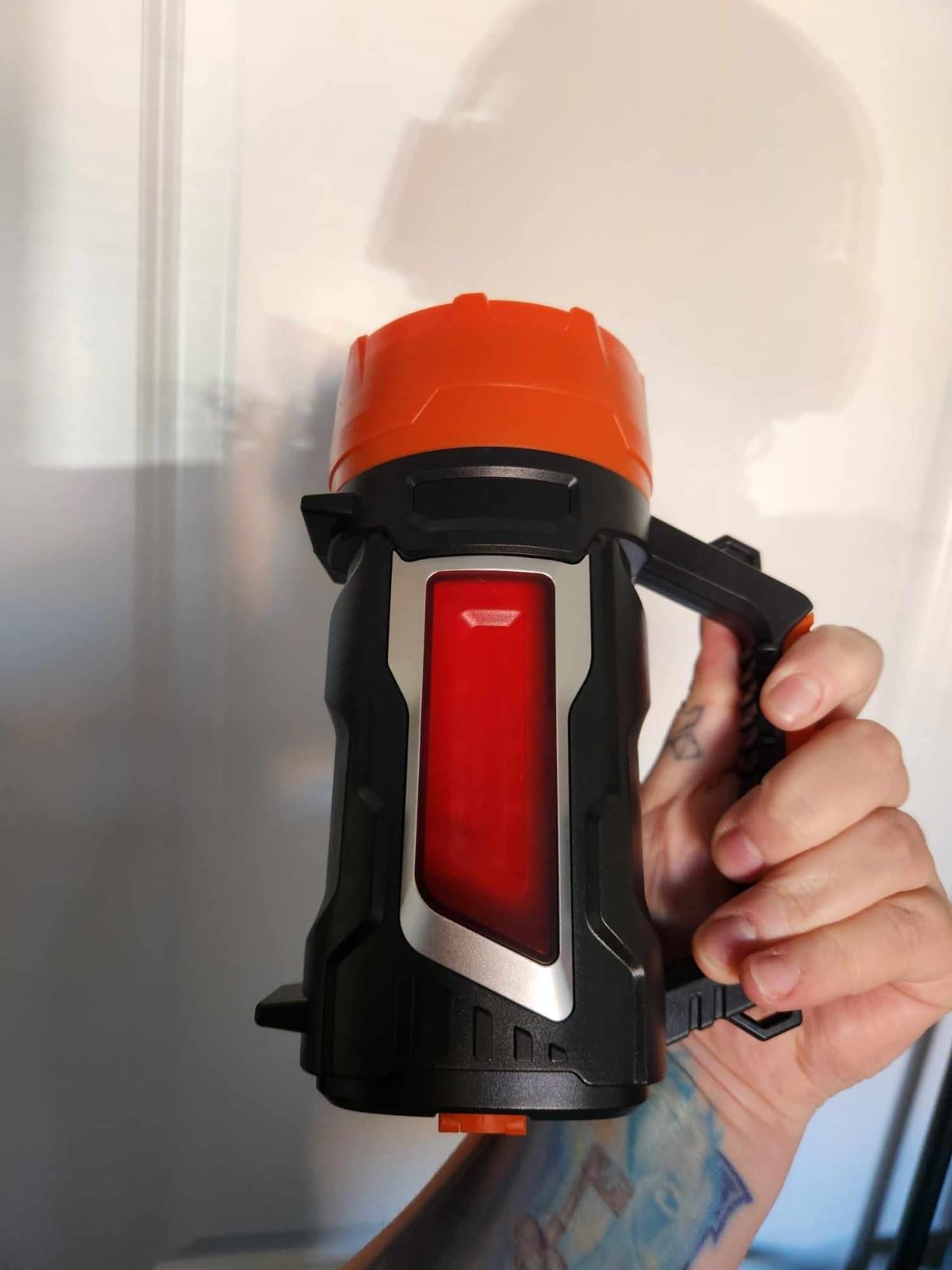
Cranking gives 10 to 20 minutes of light per minute of turning, and run times run from 8 to 20 hours depending on brightness and flash mode. A red flashing side light is included specifically for outages and signalling.
Most rivals here top out between 10 and 200 lumens, and this is one of only two in the roundup with a stated water rating. IPX4 means protection against splashing water from any direction, which is the number that matters for a car boot in winter or a campsite in rain, and we explain the ratings in the buying guide below.
The 5000 Kelvin output is on the cooler side of neutral white, which makes colours look accurate when you are checking wiring or watercolour maps.
When you need real brightness
If your emergency plan involves leaving the house, signalling for help or finding a vehicle breakdown at night, this is the only light on the list that does the job. Everything above it tops out between 10 and 200 lumens.
It also charges devices when you are off-grid, and reviewers like that the crank and USB paths both genuinely work rather than one being decorative.
Where it falls short
The charging input is micro-USB, not USB-C as the manual implies, and the USB-A port is output only. Bring your own cable if you have standardised on USB-C.
At 0.3 kg and 5.1 by 6.9 by 4.29 inch it is a bulky object for something described as a flashlight, and there is no radio function despite the emergency positioning. The included cable is also on the short side.
Which Light Goes Where: Car, Home, Go Bag, Camping
The most common mistake in emergency kit building is putting one light in one place. A crank flashlight that is in the house is no help when the car dies nine miles from a junction, so placement matters more than the model you choose.
Car emergency kit: the Oudain or Simpeak packs are the right call, and the reason is the carabiner or clip that lets you loop them onto a headrest hanger or into a door pocket. Avoid anything not water resistant for a car boot, and never choose the army green models for a car because you will lose them against a boot liner.
Home blackout box: the BFVV or Guyuyii packs win here. Several lights in different rooms beats one bright light you have to find, and the simpler the crank the better when half the household is fumbling in the dark. Keep one at the fuse box.
72-hour go bag: the Coghlan’s dynamo for weight, the ErayLife if you need beam distance, and the VFAN if you want to top up a phone so your offline maps still work. A go bag is carried, so every gram counts and the 1.12-ounce option is the only one here you will not notice.
Camping and hiking: the Mudder pack, because it is water resistant and the buckle clip holds a pack strap properly. Pair it with the kind of headlamp that r/Survival commenters consistently recommend, since a crank light and a hands-free light solve different problems.
If you are building whole kits rather than single items, our guides to emergency kits for home, car and survival and roadside emergency kits cover where a light sits inside a larger kit layout.
How Much Light Do You Actually Need?
Between 100 and 300 lumens is the sweet spot for an emergency light, and 100 to 200 lumens is enough for nearly every household task. At 100 lumens you can find a fuse box, walk a hallway and read a water meter. Above 300 lumens you are paying for headroom you will rarely use while cranking a torch with one hand.
Below 50 lumens is a finder light. That is enough to locate a torch, a phone or a fuse, and not enough to read a map or search a cupboard properly. Several lights on this list sit in that band and are honest about it.
Only one product here goes above 300 lumens, and it does so by carrying a large lithium-polymer battery rather than by cranking harder. That is the physical reality of the category: a small dynamo cannot deliver a lot of current, so crank flashlights stay in the low hundreds of lumens unless they are really battery lights with a crank attached.
Lumens also tell you very little about beam shape. A wide flood at 100 lumens is more useful indoors than a narrow spot at 300, and none of these products publish candela figures, so treat the lumen number as a brightness guide rather than a distance claim.
One honest aside on the Navy SEAL question that shows up in search results: special operations units carry mainstream high-quality battery lights, not crank models. They optimise for reliability under abuse and for runtime on standard cells. The takeaway for a home kit is that a good battery flashlight plus spare cells is your primary light, and a crank flashlight is your backup.
Power Sources Decoded: Crank vs Solar vs Battery vs USB
A crank flashlight is never only a crank flashlight. Most models here add at least one more input, and the more inputs a light has, the less likely a single failure ends it.
Hand crank: the universal input. One minute of turning yields anywhere from seven minutes on the Coghlan’s to about thirty on the VFAN. Cranking is genuinely tiring, so budget one minute of effort per half hour of light and treat the ratio as the real spec.
Solar panel: a trickle input, not a real one. Reviewers of the Mudder pack report a full day of sun producing only an hour or two of usable light, so a solar panel is maintenance that keeps a cell from going flat in a drawer. It is not a substitute for cranking during a dark storm.
Replaceable batteries: only the BFVV model is listed with an alkaline battery type, and even there the design intent is that you never touch a cell. A light that runs on AAA cells has an expiry date; a crank light with a NiMH or lithium cell does not.
USB input: the ErayLife and VFAN take USB. This is the input that actually matters for long-term storage because you can top the battery up from a power bank every few months and never have to crank.
USB output: both of those can also charge a phone, which is the feature that turns a light into a genuine go-bag device. Test your own phone first, because charging success varies by device.
The battery chemistry is worth caring about more than most buyers realise. NiMH, used in the Evelots and Leelosp lights, tolerates years of storage far better than a lithium-polymer pack left half-charged. If your kit has a five-year shelf life, the NiMH models are the safer bet.
Decoding IPX Water Ratings So You Know What Waterproof Means
Most crank flashlights have no water rating at all, and several listings here say plainly that they are not water resistant. That is a meaningful gap for anyone whose kit lives in a car, a boat locker or a wet basement.
IPX3 means protected against sprayed water from any angle, which covers rain and a knocked-over drink. IPX4 adds protection against water splashing from any direction and is the rating on the ErayLife light, the only product here with a formal IPX standard on the spec sheet.
IPX5 covers continuous water jets, IPX6 powerful jets, and IPX7 means temporary immersion. Only treat a light as submergeable at IPX7, and even then treat the claim cautiously with crank devices whose crank cap is a seal point.
Water resistant is not waterproof in everyday language. It means it survives getting wet, not that it survives being left wet in a bag for a week with paper dissolving around it.
Failure Modes and the Six-Month Test Drill
The honest problem with this category is that crank lights die slowly and quietly. On r/preppers, users report that crank-powered flashlights and radios collected over the years have all failed, through internal battery or capacitor failure rather than anything dramatic. A NiMH cell left uncharged for years develops high internal resistance and will not take a charge no matter how long you crank it.
The second common failure is mechanical. Reviews of budget models mention crank knobs coming loose and plastic gear trains cracking, and one commenter described the materials in cheap crank flashlights as a joke. Neither failure announces itself; the light just gets shorter and shorter with each wind-up.
The third failure is a lithium-polymer cell that has swollen after long storage. That is the most dangerous of the three and the reason we prefer NiMH chemistry for long-rotation kits.
Here is the drill. Every six months, take each crank light out and do five things. First, wind it for a full minute and time how long the light lasts, then write that number on the light with a permanent marker. Second, check that the crank handle is tight and that no plastic is cracked or gummy. Third, press the crank lock if the model has one so it does not drain in the bag. Fourth, top the cell back up over USB if the model supports it, or leave it cranked at full charge. Fifth, rotate any spare cells stored outside the kit.
If the runtime you measure is more than half of what you wrote last time, the cell is going. Replace it now rather than finding out in week two of an outage. That five-minute routine twice a year is the entire difference between a crank flashlight and a paperweight.
It is worth adding one zero-failure backup layer regardless. Low-lumen glow sticks and small AAA LED lights cost almost nothing and have no moving parts, which is why prepared-kit communities keep them alongside the cranks.
Frequently Asked Questions
Are hand crank flashlights any good?
Yes as backup, no as a primary light. A crank flashlight cannot be defeated by dead batteries, no charger or no sunlight, so it works in exactly the situation where you need it most. The catch is speed and brightness: cranking is tiring, and most models top out between 10 and 200 lumens. Use a quality battery flashlight as your main light and a crank light as the last resort.
What is the best flashlight for an emergency kit?
A battery-powered LED flashlight with fresh spare cells is the best flashlight for an emergency kit, because it is brighter, faster and easier to use. Add a hand crank flashlight beside it rather than instead of it. The crank light covers the scenario the battery light cannot: dead cells, no charger, no sunlight and several dark days ahead of you.
How many lumens should an emergency light have?
Between 100 and 300 lumens is the right range, and 100 to 200 covers almost every household task such as finding a fuse box, walking a hallway or reading a meter. Below 50 lumens is a finder light only. Only one crank flashlight in this roundup exceeds 300 lumens, and it does so by carrying a large battery rather than a stronger crank.
Can a hand crank flashlight charge a phone?
Some can. The VFAN unit has a USB output rated at 5V and 600mA from its 2600mAh cell, and the ErayLife lantern can charge devices when off-grid. Phone charging success varies by device, with some buyers unable to recharge an iPhone at all, so test it with your own phone before it becomes your only charging option.
How long do you have to crank a hand crank flashlight for a full charge?
It depends on the model and on what you consider full. One minute of cranking yields about 7 minutes of light on the Coghlan’s dynamo, roughly 10 minutes on most solar packs, 10 to 20 minutes on the ErayLife lantern and about 30 minutes on the VFAN unit. A realistic rule is to crank once before you use the light and once whenever the beam starts to dim.
Do hand crank flashlights work when the battery is dead?
Yes, that is the entire point of the category. Cranking spins a dynamo that generates current directly, so the LED lights as long as you turn the handle, even if the internal cell is dead or missing. The one limit is stamina: the light stays on only while you crank, so it is a beacon and a short-answer tool rather than a room light.
The Bottom Line on Hand Crank Flashlights
Buy the Simpeak 2-Pack if you want one decision that covers most situations: 200 lumens, over ten minutes of light per minute of cranking, a solar backup, a carabiner and a two-year warranty. It is the best hand crank flashlight for emergency kits because it is the one with five thousand reviews behind it and nothing serious in the failure column.
Add the Oudain or Mudder packs if you want light in more than one place, the VFAN if you need to charge a phone from a go bag, and the ErayLife if you genuinely need a beam that reaches across a yard. Keep a good battery flashlight as your primary and treat the crank light as the layer that still works when everything else is dead.
Then run the five-minute test twice a year and write the runtime on the body of each light. For more kit planning, see our guides to emergency first aid kits and emergency food kits to finish the box around it.