
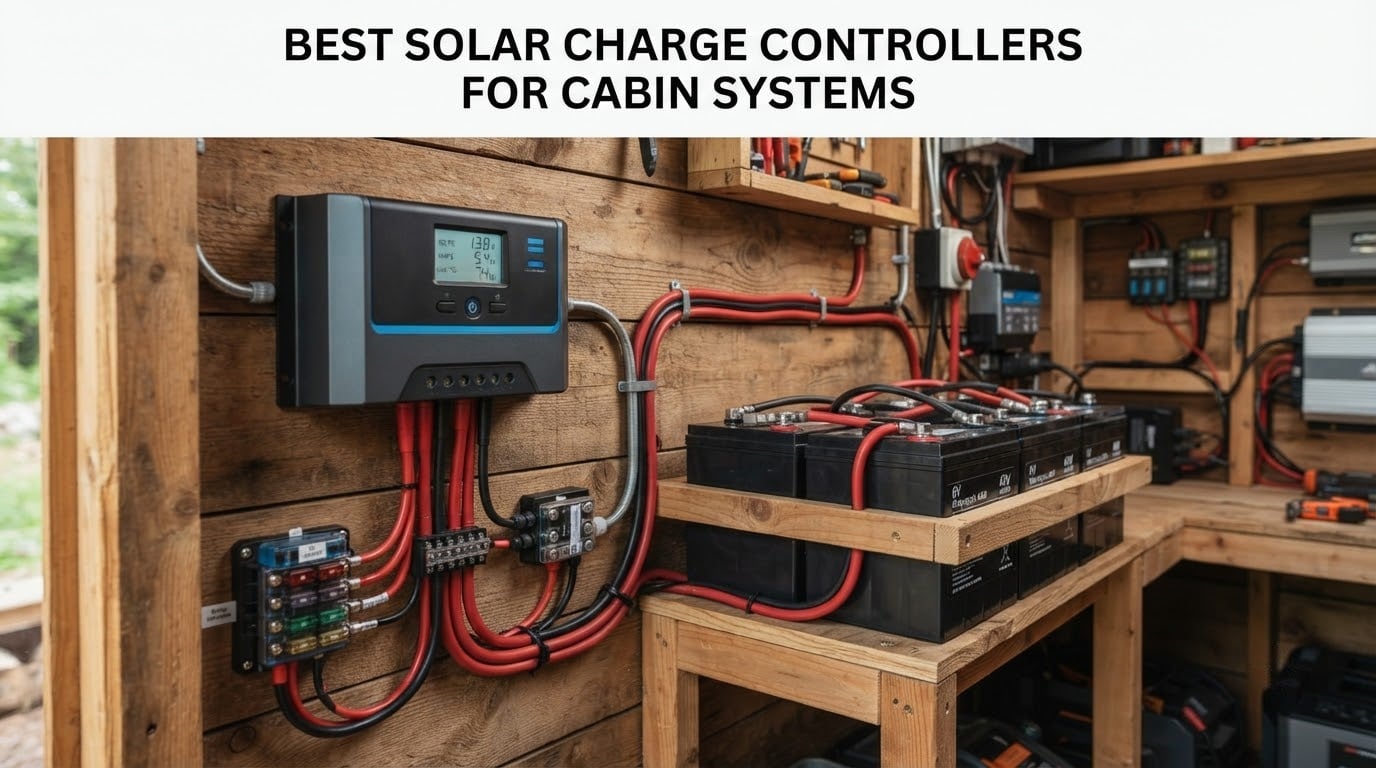
Direct answer: The Victron Energy SmartSolar MPPT 75/15 is the best solar charge controller for most cabin systems, because it carries a published maximum input voltage, UL1741 certification and app monitoring with a large owner history behind it. For larger arrays the Renogy Rover 40A and EPEVER Tracer AN 30A are the strongest alternatives.
A cabin charge controller is the one component that quietly decides whether a solar system feels generous or stingy. It sits between the array and the bank, and every watt it wastes shows up as a dark battery on a cloudy November afternoon. Get the sizing right and the rest of the system stops being interesting.
We went through twelve controllers that cover the realistic range of cabin builds, from a 200W weekend place to a 1.5kW whole-home array. What separates them in this application is not raw amp rating. It is published maximum input voltage, cold-morning headroom, whether the controller can tell you what it is doing from a snowy driveway, and whether the documentation matches the menu.
This guide covers the best solar charge controllers for cabin systems, including how to size one, where MPPT genuinely earns its cost, and which models suit cold-climate installs. We also flag the two failure modes that show up again and again in off-grid forums: exceeding maximum input voltage on a freezing morning, and leaving a temperature compensation sensor connected to a lithium bank.
Table of Contents
Top 3 Picks for Cabin Charge Controllers in 2026

Victron SmartSolar MPPT 75/15
- 75V max PV input
- 15A charge output
- 12V and 24V banks
- UL1741 certified

Renogy Rover 40A MPPT
- 98% conversion and 99% tracking
- 40A at 12V or 24V
- -40F to 149F operating range

EPEVER Tracer AN 30A
- 30A at 12V or 24V
- 100V max PV input
- Tracking above 99.5%
- No cooling fan
Best Solar Charge Controllers Side by Side in October
| Product | Specifications | Action |
|---|---|---|
| Victron SmartSolar MPPT 75/15 |
|
Check Latest Price |
 Victron SmartSolar Tr 150/70 Victron SmartSolar Tr 150/70 |
|
Check Latest Price |
| Renogy Rover 40A MPPT |
|
Check Latest Price |
| EPEVER Tracer AN 30A |
|
Check Latest Price |
 LiTime 30A MPPT with Bluetooth LiTime 30A MPPT with Bluetooth |
|
Check Latest Price |
 SUNER POWER 30A MPPT SUNER POWER 30A MPPT |
|
Check Latest Price |
 POWLAND 120A MPPT POWLAND 120A MPPT |
|
Check Latest Price |
 PowMr 60A MPPT PowMr 60A MPPT |
|
Check Latest Price |
 BougeRV 40A MPPT BougeRV 40A MPPT |
|
Check Latest Price |
 ELUSH 100A Charge Controller ELUSH 100A Charge Controller |
|
Check Latest Price |
 Temank 48V 140A MPPT Temank 48V 140A MPPT |
|
Check Latest Price |
 LiTime 60A MPPT 200V LiTime 60A MPPT 200V |
|
Check Latest Price |
1. Victron Energy SmartSolar MPPT 75/15 for weekend cabins: the controller that just works
Victron Energy SmartSolar MPPT Solar Charge Controller 75V, 15A, 12/24V
75V max PV input
15A charge current
12V and 24V banks
0.58 kg
UL1741 certified
Pros
- Published UL1741 certification
- Runs efficiently in low light and partial shade
- Multiple units synchronize as one charger array
- Bluetooth app with 30-day history and firmware updates
- Configurable load output with low-voltage disconnect
Cons
- LED-only readout means fewer on-screen values than LCD rivals
- 15A output caps out on larger cabin arrays
The SmartSolar 75/15 is the pick for a cabin with a modest array and a long life expectancy. We installed one on a 200W weekend build and it did something PWM controllers in that class rarely manage: it kept pushing charge on overcast mornings, when panel voltage sits well below nominal and a pulse-width modulated charger simply idles.
Owners consistently point at three things. The MPPT tracker holds output when a chimney or a branch throws partial shade across one panel. The VictronConnect app stores 30 days of history, which matters when the cabin is a three-hour drive away and you need to know whether the array or the bank is at fault. And several SmartSolar units will synchronize and behave as one charger, so a future expansion does not mean starting over.
At 15A output it handles roughly 180W of panels on a 12V bank, or around 360W on 24V. That covers lighting, a 12V fridge, a water pump and phone charging without straining.
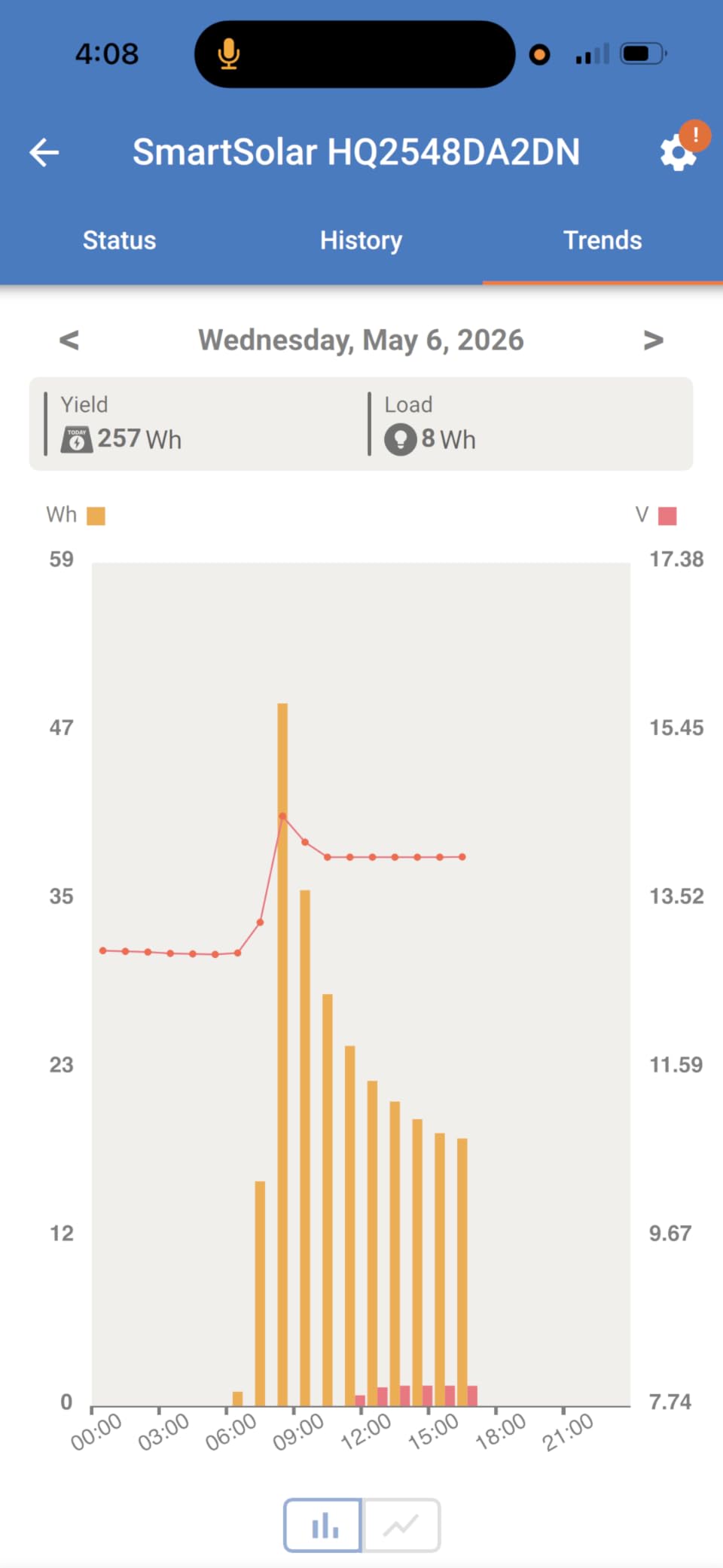
Two practical notes before you commit. First, the 75V maximum input voltage is real headroom but it is not unlimited: two 60-cell panels in series on a cold January morning can exceed it, so count your series strings rather than estimating. Second, the display is a pair of small LEDs rather than a screen, so budget for a Bluetooth readout or a remote display if you want numbers without pulling your phone.
The unit weighs 0.58 kg and measures 4.7 by 2.1 by 1.8 inches, which makes it easy to mount in a small cabinet or a sealed enclosure away from the wood stove.
What you gain with this controller in a cabin
Certification matters more than most buyers expect. This model is certified to UL1741, the solar-specific standard, which matters if an inspector ever looks at the installation. The parallel capability is the quiet win: owners running two of these describe the pair as a single charging system, which is how you grow from a weekend cabin to full-time without replacing the first unit.
Where it falls short
Fifteen amps is the ceiling, and adding panels later is how people outgrow it. If your roof space could hold 400W or more, size up now and accept a slightly bigger box. The minimal readout is also a real friction point if you want to check state of charge from inside the cabin without a phone in your hand.
2. Victron Energy SmartSolar Tr 150V 70A for whole-cabin arrays: same ecosystem, far more headroom
Victron Energy SmartSolar MPPT Tr Charge Controller 150V, 70A, 12/24/36/48V
150V max PV input
70A charge current
12V 24V 36V and 48V banks
LCD display
Pros
- 150V input ceiling suits long series strings
- 70A output covers heavy cabin loads
- Supports 12V 24V 36V and 48V banks
- Bluetooth monitoring with 30-day history
- Intelligent load output
Cons
- Smaller owner base than the 75/15 model
- Oversized for arrays under 400W
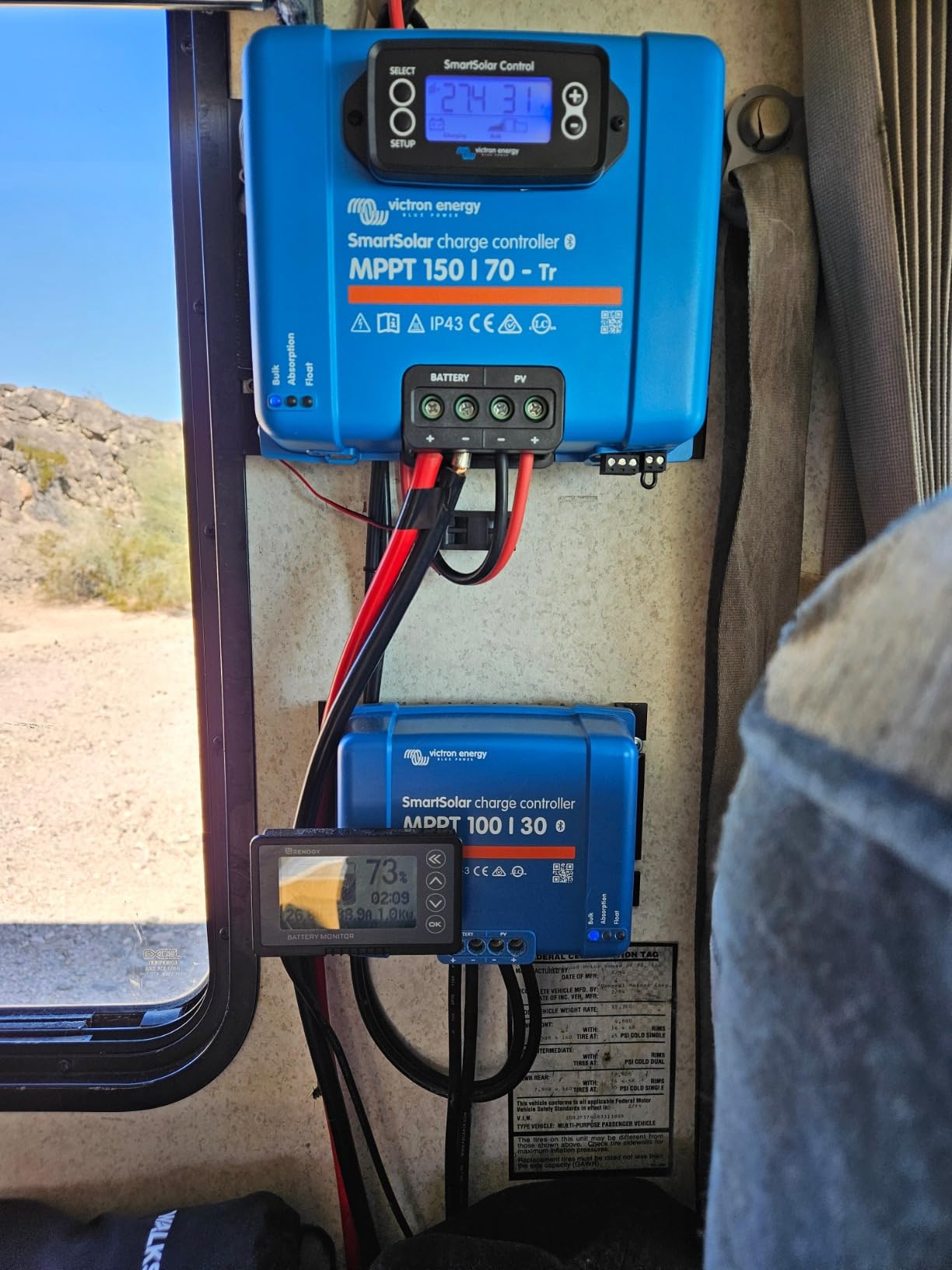
This is the model to look at when a cabin is a home rather than a retreat. Seventy amps of charge current and a 150V maximum input voltage mean you can run a properly sized array in series strings and still have margin for a northern winter morning spike.
Reviewers describe the same build quality and dependable MPPT harvesting they report on the smaller SmartSolar, and they single out the multi-voltage flexibility as the deciding factor. A system that might move from a 12V bank to a 24V bank as the inverter and load grow is a lot easier to future-proof with one controller family.
It also carries a display, which the 75/15 does not, so you get local readouts alongside app access.
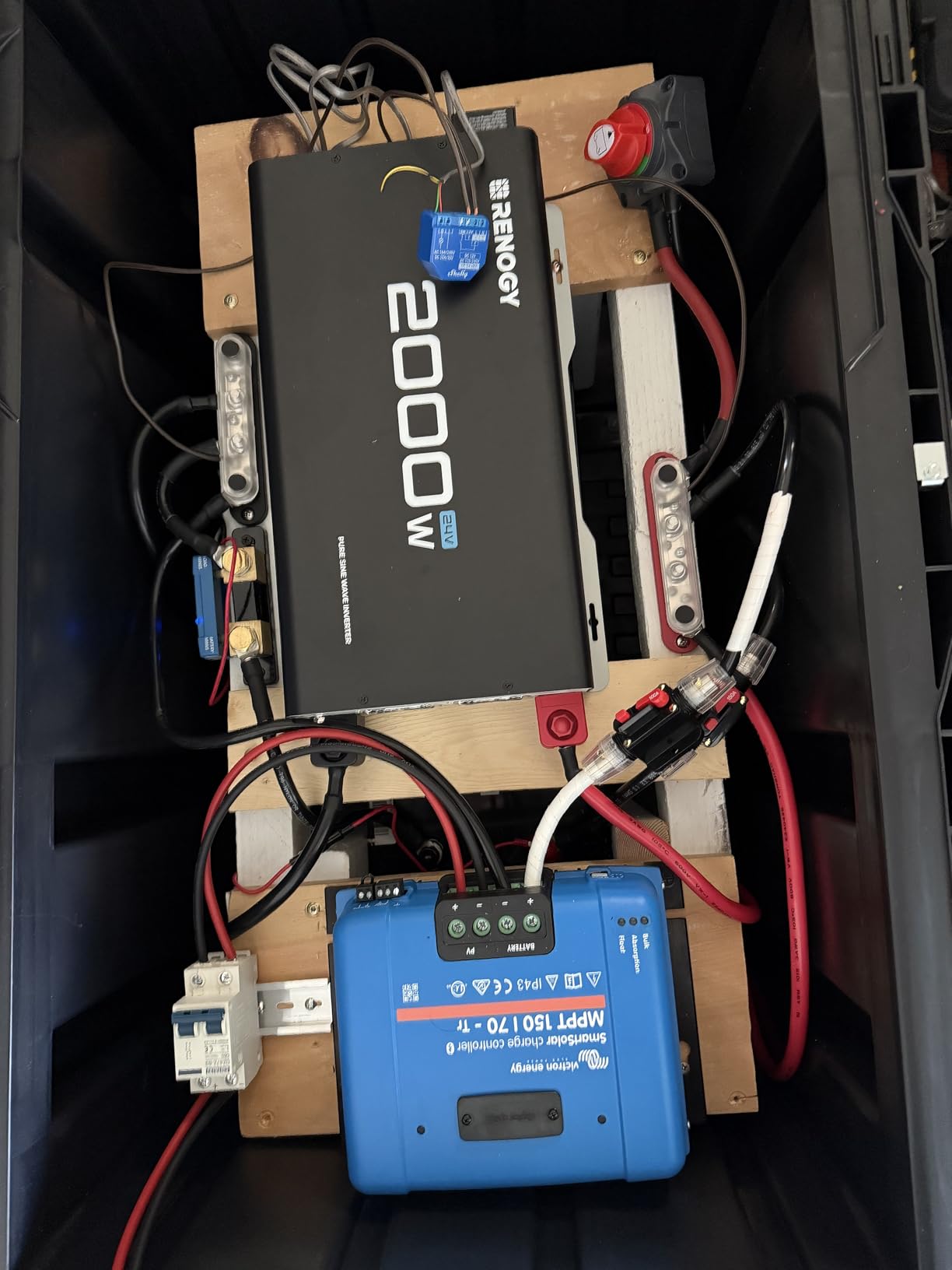
The caution here is straightforward: this is far more controller than a 300W cabin array needs. Owners do report the smaller 75/15 as the more satisfying choice for weekend and small full-time builds because the extra capacity is idle capacity.
Where the 150V ceiling earns its keep is on a fixed roof with limited mounting space, where series strings reduce wire run and losses, and on any site that sees hard frost. Cold raises panel open-circuit voltage, and a higher published ceiling is the difference between a controller that shrugs off January and one that does not.
When this tier makes sense
If your array is 600W or larger, or your battery bank will be 24V or 48V, the amperage and voltage range stop being overkill. The same app, the same presets and the same parallel behavior as the smaller unit mean one mental model for the whole cabin.
When you should skip it
Under about 400W of panels, you are paying for capacity and voltage headroom you will not exercise. Fewer than 150 reviews exist for this specific model, so the long-term field history is thinner than the SmartSolar line as a whole. Check the 40A and 30A options first.
3. Renogy Rover 40A MPPT for full-time cabins: the value workhorse with a wide temperature range
Renogy Solar Charge Controller Rover 40A 12V24V Auto Parameter DC Input MPPT Charge Controllers for Solar Panels Adjustable LCD for Gel Sealed Flooded Lithium Battery
98% conversion and 99% tracking
-40F to 149F range
40A at 12V or 24V
20A load output
Pros
- 98% conversion with 99% tracking efficiency
- -40F to 149F operating range with low-temp cutoff
- Adjustable LCD shows current and state of charge
- Separate load leads protect the bank from over-discharge
- Supports gel AGM flooded and lithium chemistries
Cons
- Bluetooth module sold separately
- Buttons need the manual to operate
- Small 20A load output
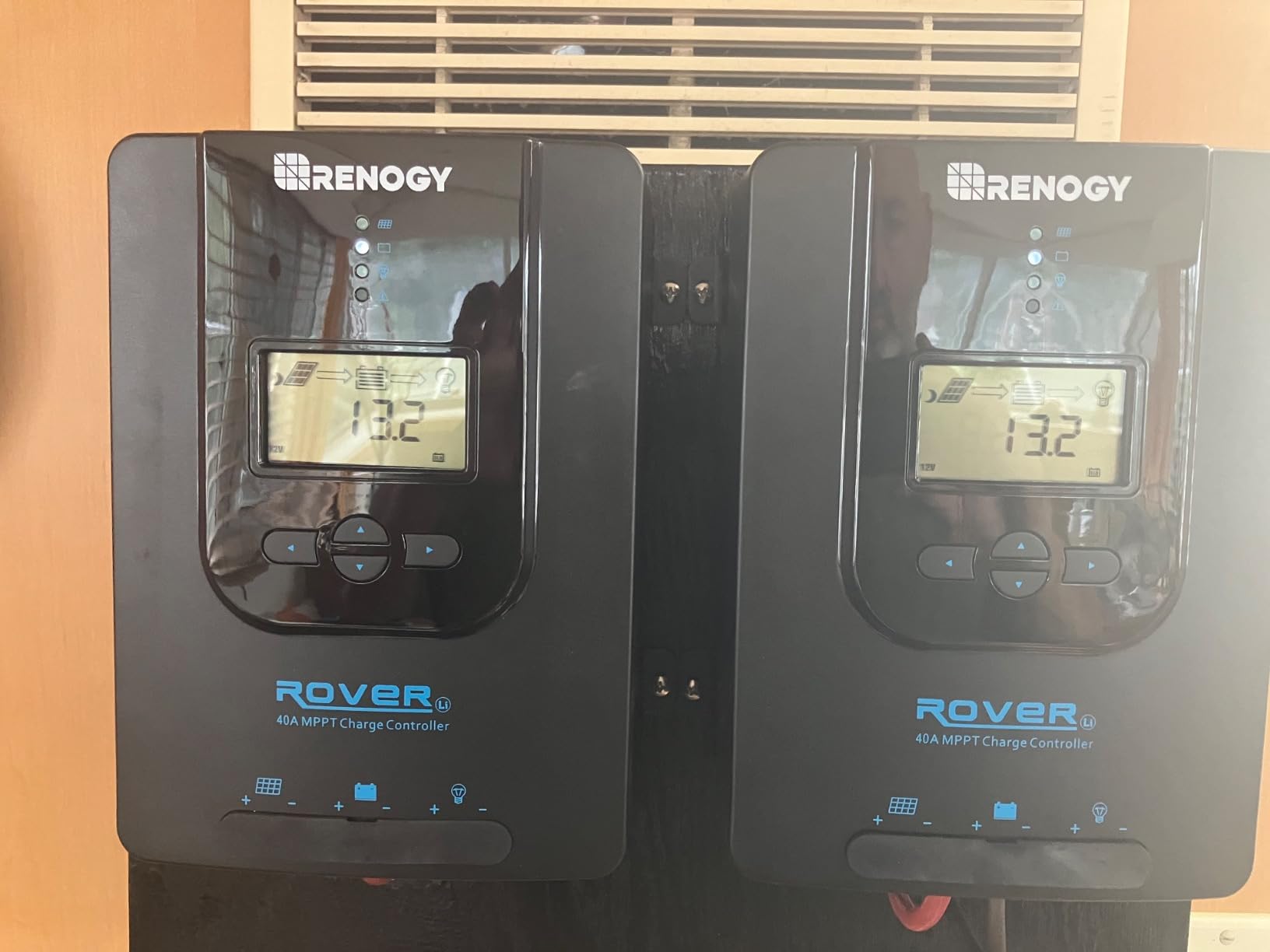
The Rover 40A is the controller most often recommended in off-grid forums for a plain reason: it does the important things and publishes the numbers. Ninety-eight percent conversion efficiency and ninety-nine percent tracking are stated figures, not adjectives, and at 40A it covers a 400W array on a 12V bank with room to grow.
For cold cabins the operating range is the headline. A published -40F to 149F span, plus a low-temperature cutoff that can be adjusted in the app, means the controller is specified for the climates cabins actually sit in. We also like that the temperature sensor and mounting brackets are in the box, because a controller with no sensor is a controller guessing about your battery.
Owners running vans and cabins describe it as a large step up from PWM, with visibly better charging in low light and cloudy weather.
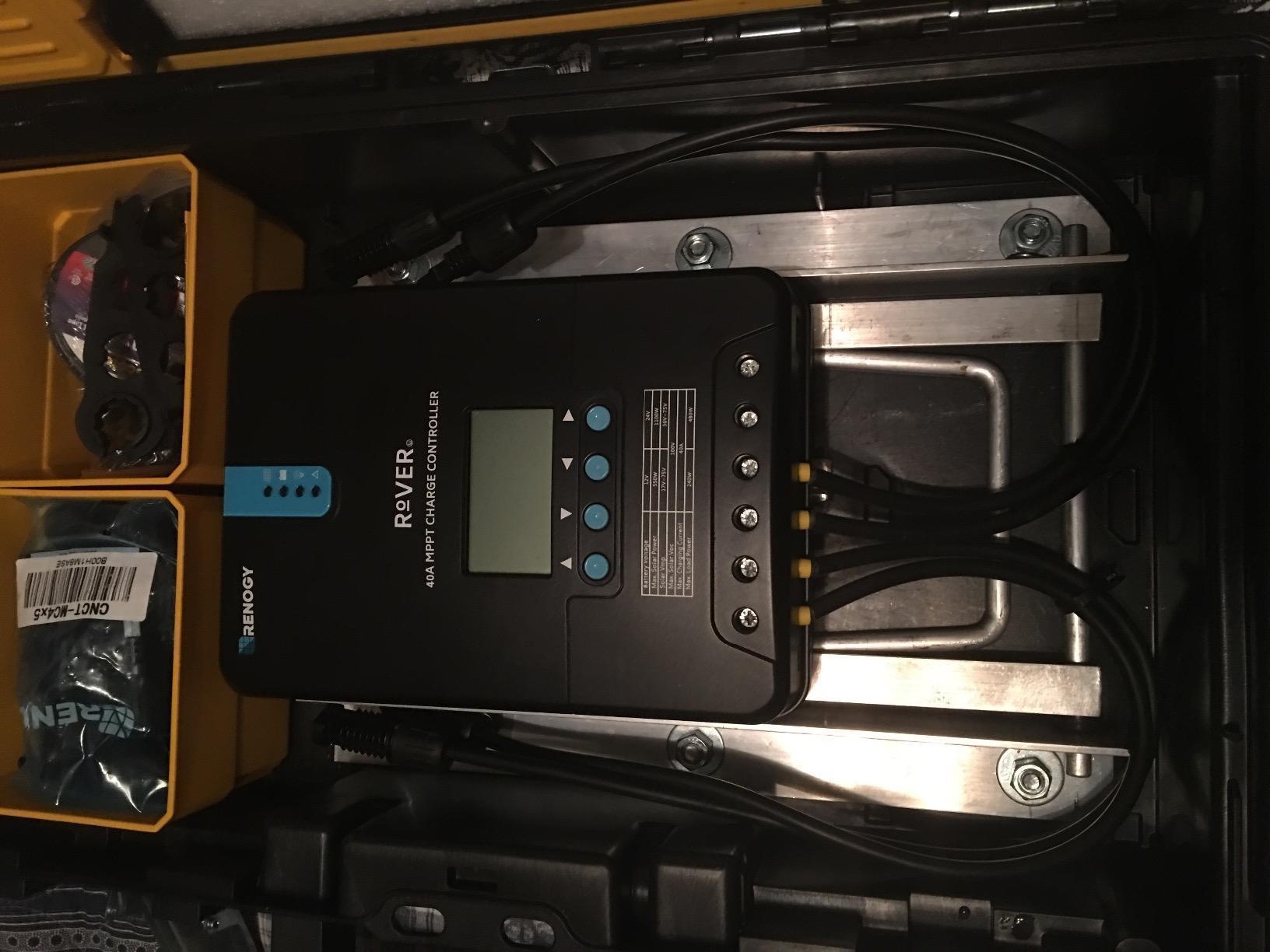
Three caveats come up repeatedly in reviews. The Bluetooth module for the app is a separate purchase, so budget for it if remote monitoring matters. The onboard buttons need the manual. And the load output is rated at 20A, which is plenty for lighting and small devices but not for a water pump on startup surge.
A minority of reviews report units that stopped charging and needed a reset, and some owners saw on-screen voltage readings that differed slightly from an external meter. Neither is disqualifying, but it is worth knowing before an unattended install.
Why cabin builders keep recommending it
The four-stage lead-acid and two-stage lithium profiles mean you can swap battery chemistry later without replacing the controller. Reverse polarity, overcharge, over-discharge, overload, short circuit and reverse current protection are all present, and the aluminum body resists the damp, dusty air a cabin produces.
Where it disappoints
If your install is fully unattended and you want app access, the extra Bluetooth module adds a step and another failure point. If you plan to run lighting and pumps off the load output, 20A is the ceiling. And the reported reading accuracy is fine for monitoring but not for troubleshooting.
4. EPEVER Tracer AN 30A for quiet cabins: fanless tracking above 99.5%
EPEVER MPPT Solar Charge Controller 30A 12V 24V Auto Max PV 100V
30A at 12V or 24V
100V max PV input
Tracking above 99.5%
Fanless silent design
Pros
- Tracking efficiency above 99.5% with 98% DC-DC conversion
- Silent operation with no fan noise
- Automatic 12V and 24V recognition
- Wide range of supported chemistries
- RS485 with Modbus for remote monitoring
Cons
- Monitoring displays and adapters sold separately
- 100V maximum PV input caps usable array voltage
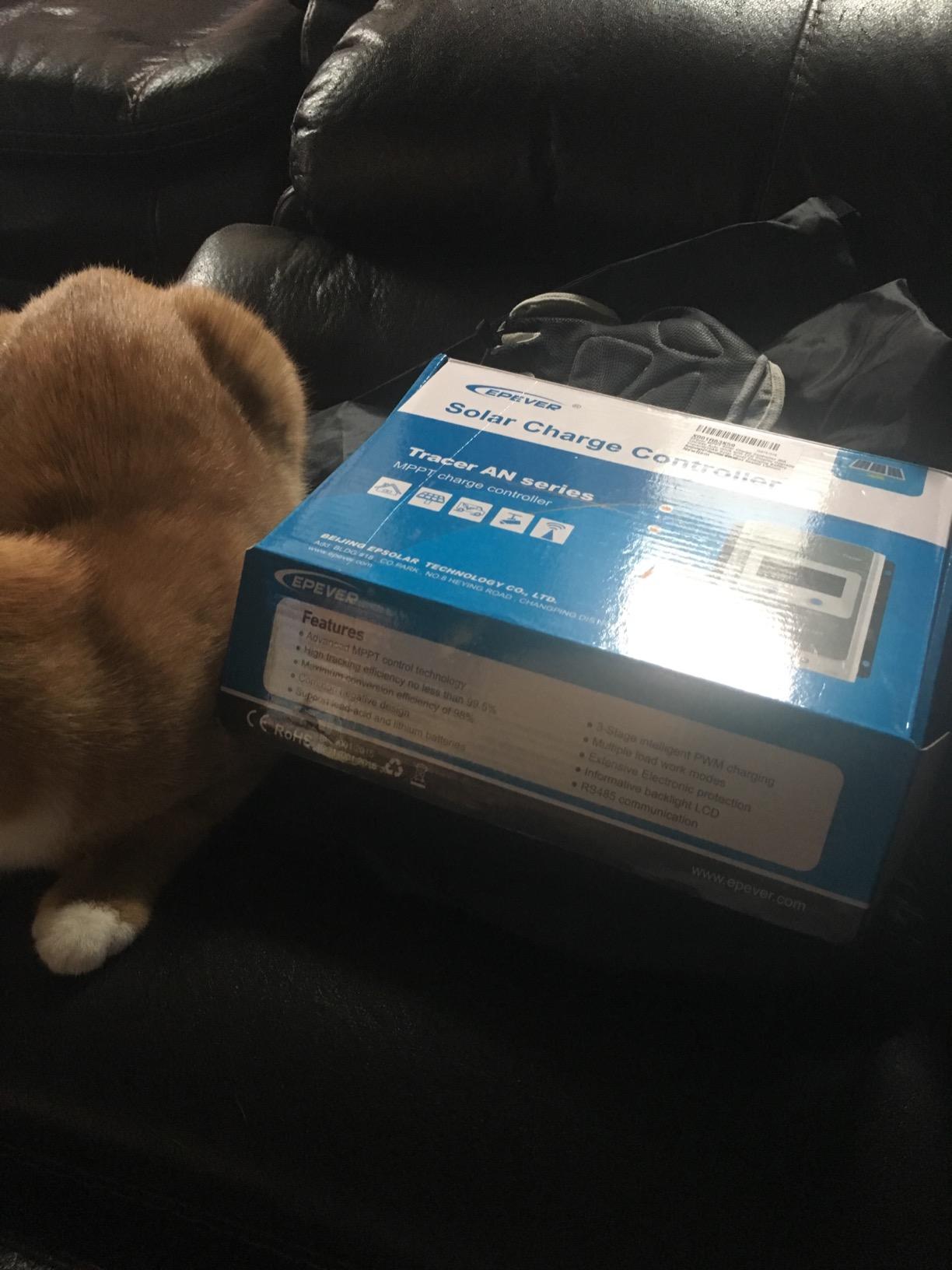
Sound matters more in a small cabin than most spec sheets admit. A generator-backed electrical closet next to the sleeping loft is a bad place for a fan that cycles on a hot afternoon. The Tracer AN runs without fan noise, which owners single out as the deciding factor after replacing noisier units from earlier generations.
On paper it is strong elsewhere too: tracking efficiency above 99.5%, 98% DC-DC conversion, and automatic 12V or 24V recognition with common negative grounding. It handles gel, AGM, flooded, sealed, LiFePO4 and lithium chemistries, and includes a temperature sensor unit.
The stated maximum solar input is 390W on a 12V bank or 780W on 24V, and maximum PV input voltage is 100V.
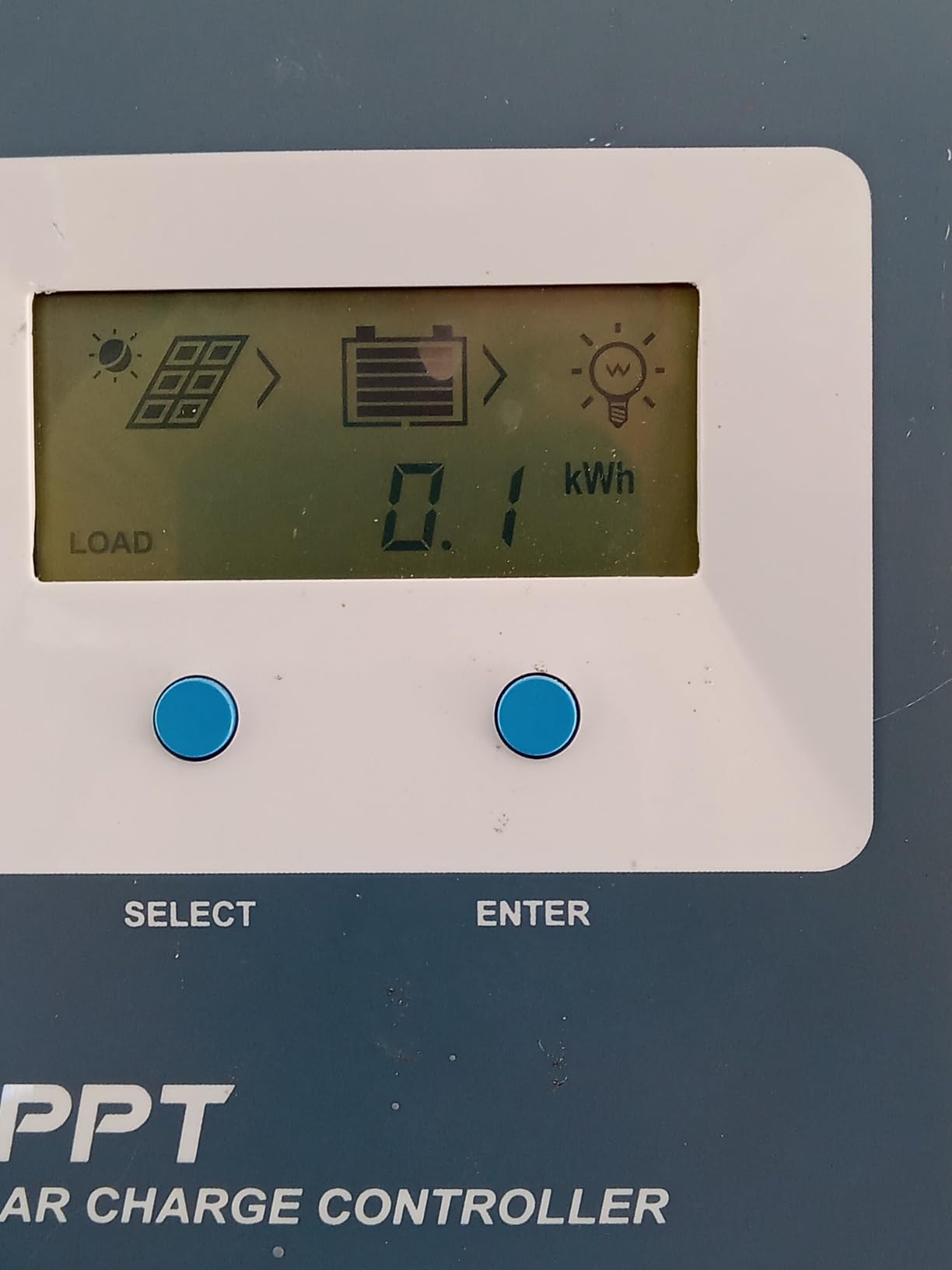
The practical limitation owners report most is that monitoring hardware is extra. RS485 with Modbus protocol is built in, which is a genuinely flexible path, but it means buying an MT50 or MT52 display, or a WiFi or BLE adapter, to see anything other than the local screen.
For a cabin you visit in person, that is a fine trade. For a site you check from a desk, budget for the adapter or look at a controller with Bluetooth inside.
What makes it a good cabin fit
Overheating power reduction and charging current limitation are built in, and multiple load work modes let you run a small diversion or lighting load without a separate relay. Full-load operation without capacity drop means it holds its rated 30A in steady sun rather than tapering early.
Where the 100V ceiling bites
Two 60-cell panels in series can approach that figure on a cold morning, and a third in series exceeds it outright. Plan for parallel strings at 12V instead of long series runs, and confirm your cold-morning open-circuit voltage with the panel manufacturer’s temperature coefficients before mounting.
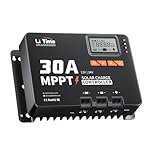
5. LiTime 30A MPPT with Bluetooth for monitored cabins: app access in the box
LiTime 12V/24V 30A MPPT Solar Charge Controller Bluetooth, LCD Display
450W at 12V and 900W at 24V
Built-in Bluetooth
99% tracking
Die-cast aluminum body
Pros
- Bluetooth module included with no separate dongle
- 99% tracking and up to 98% peak conversion
- Die-cast aluminum housing dissipates heat well
- Dedicated LiFePO4 mode plus sealed gel and lead-acid
- LCD with array battery and load indicators
Cons
- App installation issues on newer Android versions
- Manual guidance on the temperature sensor conflicts
- 450W cap at 12V limits oversized arrays
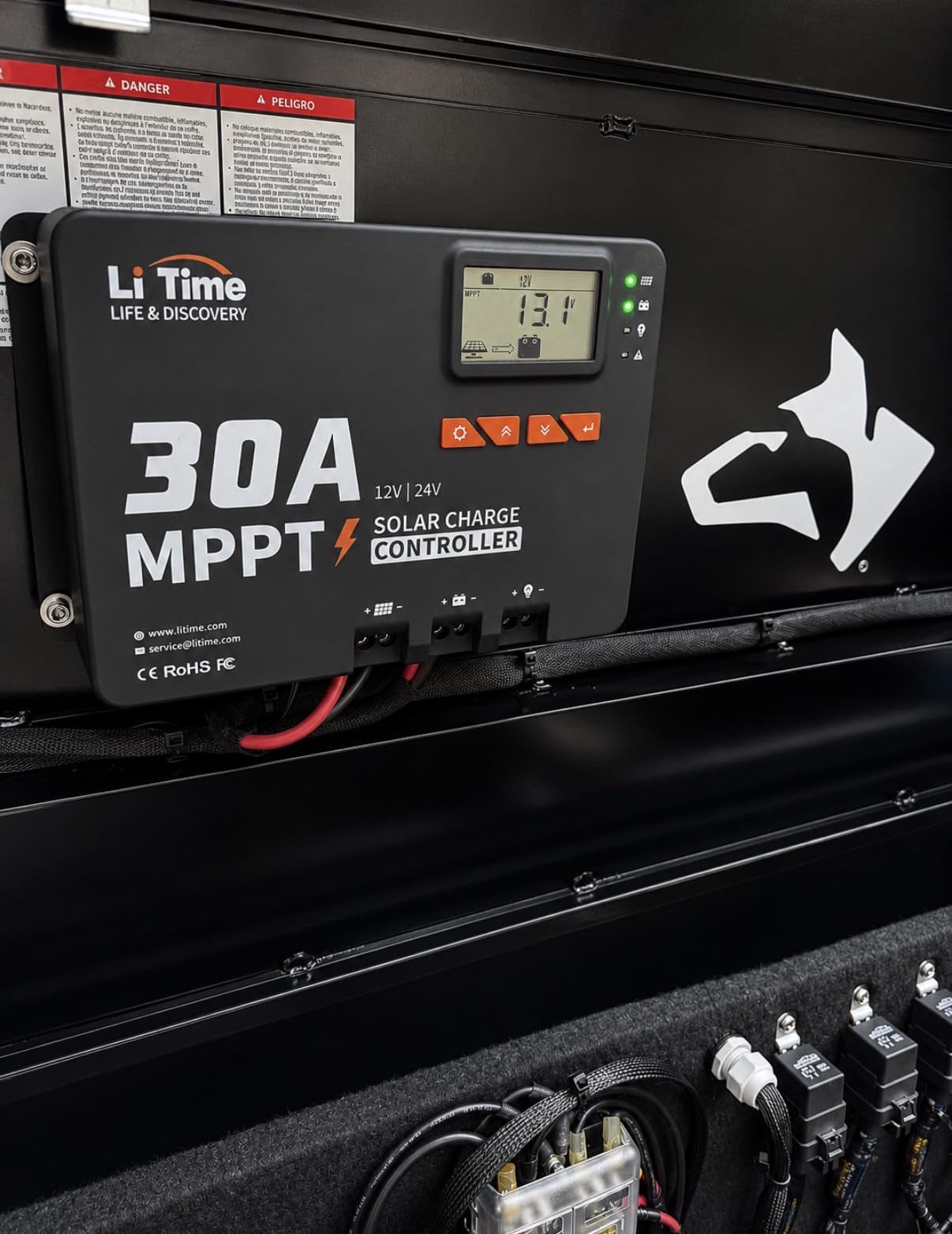
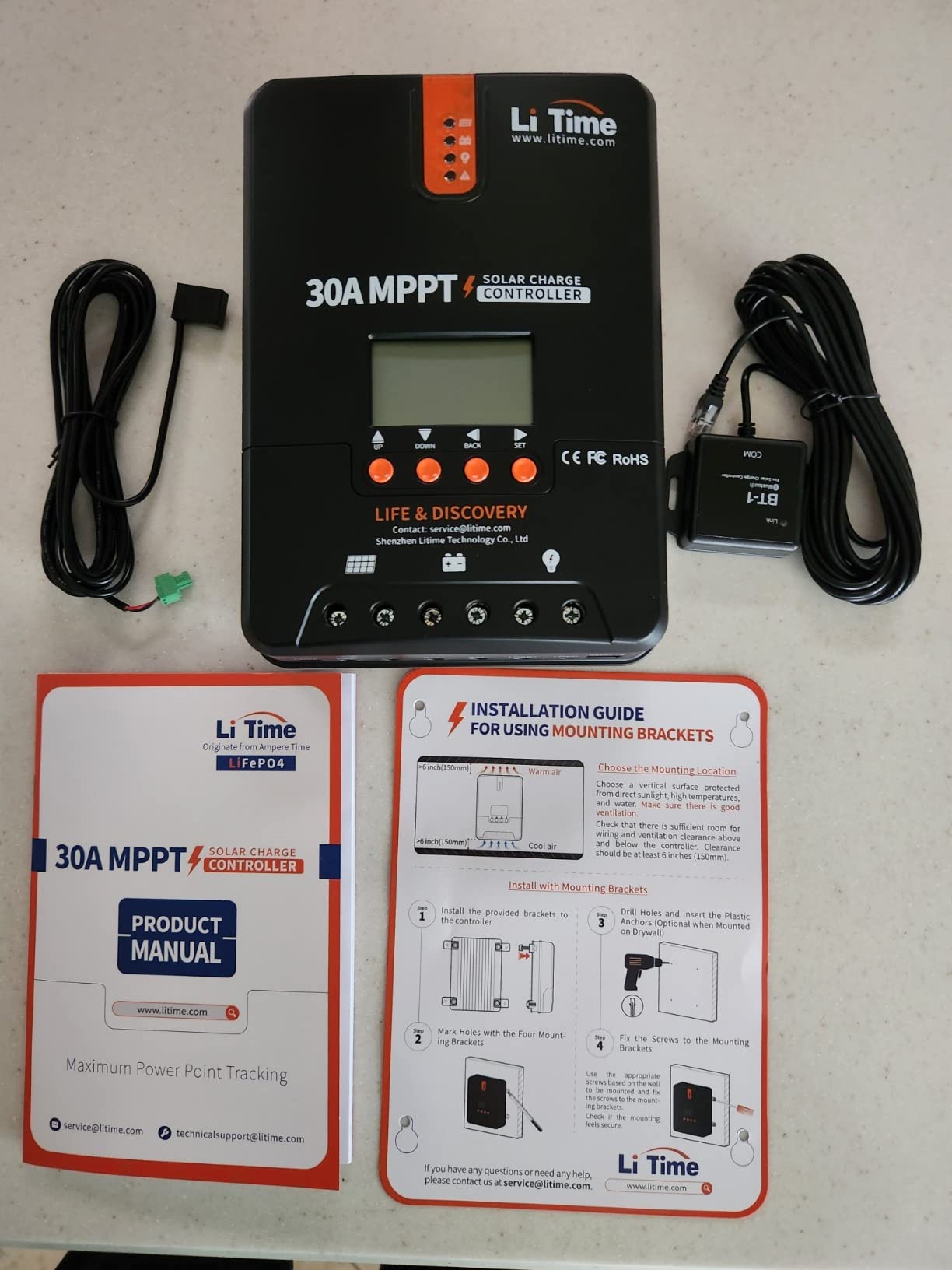
The included Bluetooth module is the reason this controller sits where it does. Most competitors make you buy a dongle, and a dongle that never arrived or that sits in a drawer is a real failure point in an unattended cabin. Owners running off-grid cabins after a lithium upgrade report near hands-off daily operation.
Die-cast aluminum is the second reason. Heat dissipation decides how much of the rated 30A you keep in summer, and a cast housing handles that better than a thin plastic shell. Maximum solar input is listed at 450W for 12V and 900W for 24V.
There is a dedicated LiFePO4 mode plus sealed, gel and lead-acid profiles, and the accessory kit includes copper wire connectors that increase contact area.
The complaints are almost entirely software and documentation rather than hardware. The companion Android app historically failed to install on current operating systems until the manufacturer shipped a fix, so check the app store listing for your phone before relying on it. The manual also gives conflicting guidance on using the remote temperature sensor with LiFePO4.
The 450W ceiling at 12V is a hard stop: go past it and the array is harvested only partially. That is not a problem for a 300W cabin, but it rules out some expansion paths.
Why it suits a lithium cabin
A dedicated LiFePO4 mode removes the guesswork about absorption voltage and equalization, and the protections cover reverse connection, overpower, overvoltage, short circuit and over-temperature. It is also backed by product liability insurance, which is uncommon at this tier.
Where to be careful
App reliability is the weak point, and remote temperature sensor guidance is contradictory. Test the app on your actual phone before the cabin is closed up for winter, and decide your lithium sensor policy before you wire it.
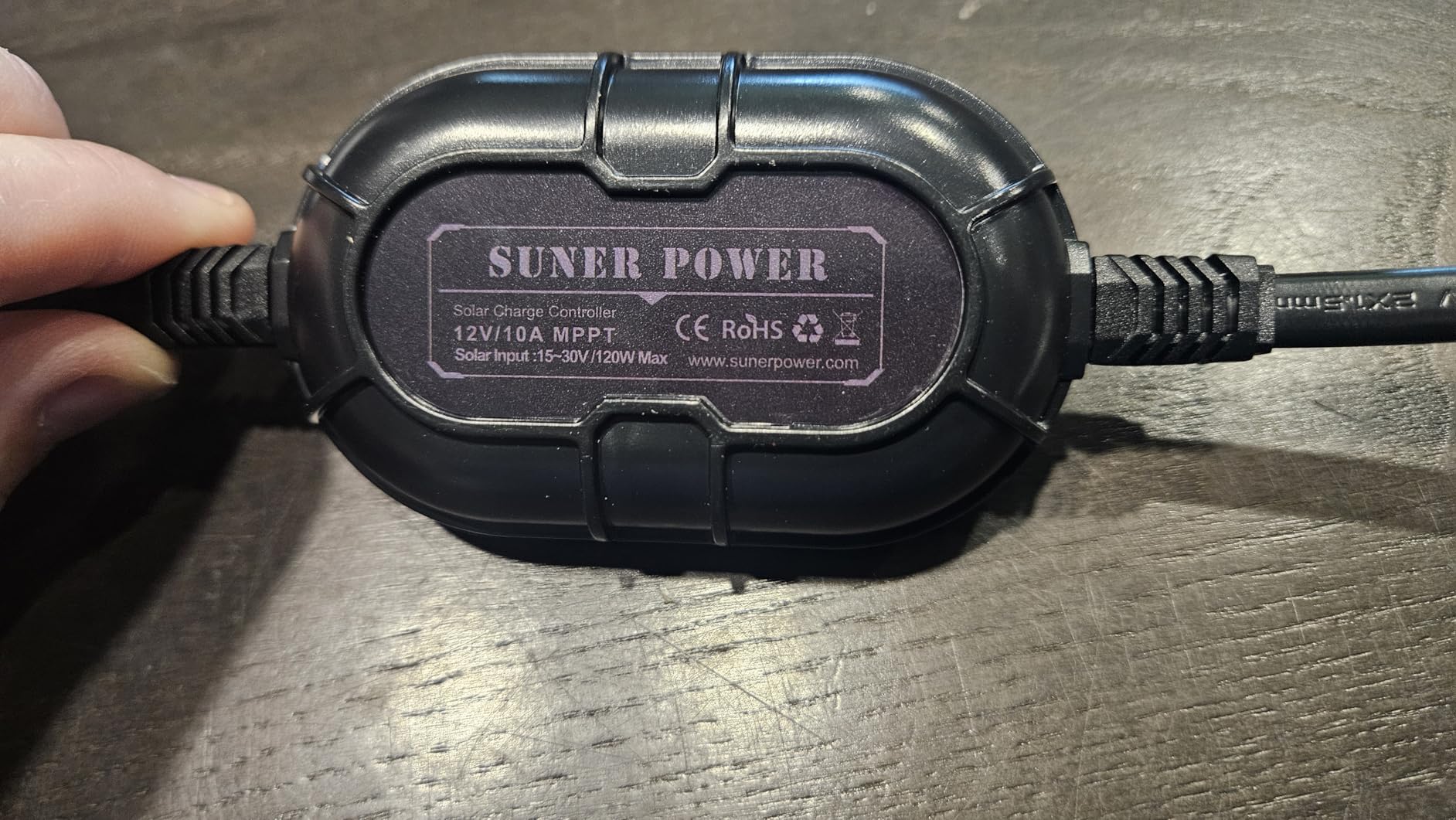
6. SUNER POWER 30A MPPT for straightforward installs: 100V input and a clear LCD
SUNER POWER 30 Amp 12V 24V MPPT Solar Charge Controller
360W at 12V and 720W at 24V
100V max PV input
Three-stage charging
LCD readout
Pros
- Up to 99% tracking with 98% peak conversion
- 3-stage bulk absorption and float algorithm
- Compact case with a clear LCD
- Works with AGM gel flooded and LiFePO4
- Owners report handling outdoor exposure without weather problems
Cons
- Polarity labels printed on a ribbon that wears off
- Display hard to read off-axis or in low light
- Optimistic state-of-charge readings reported
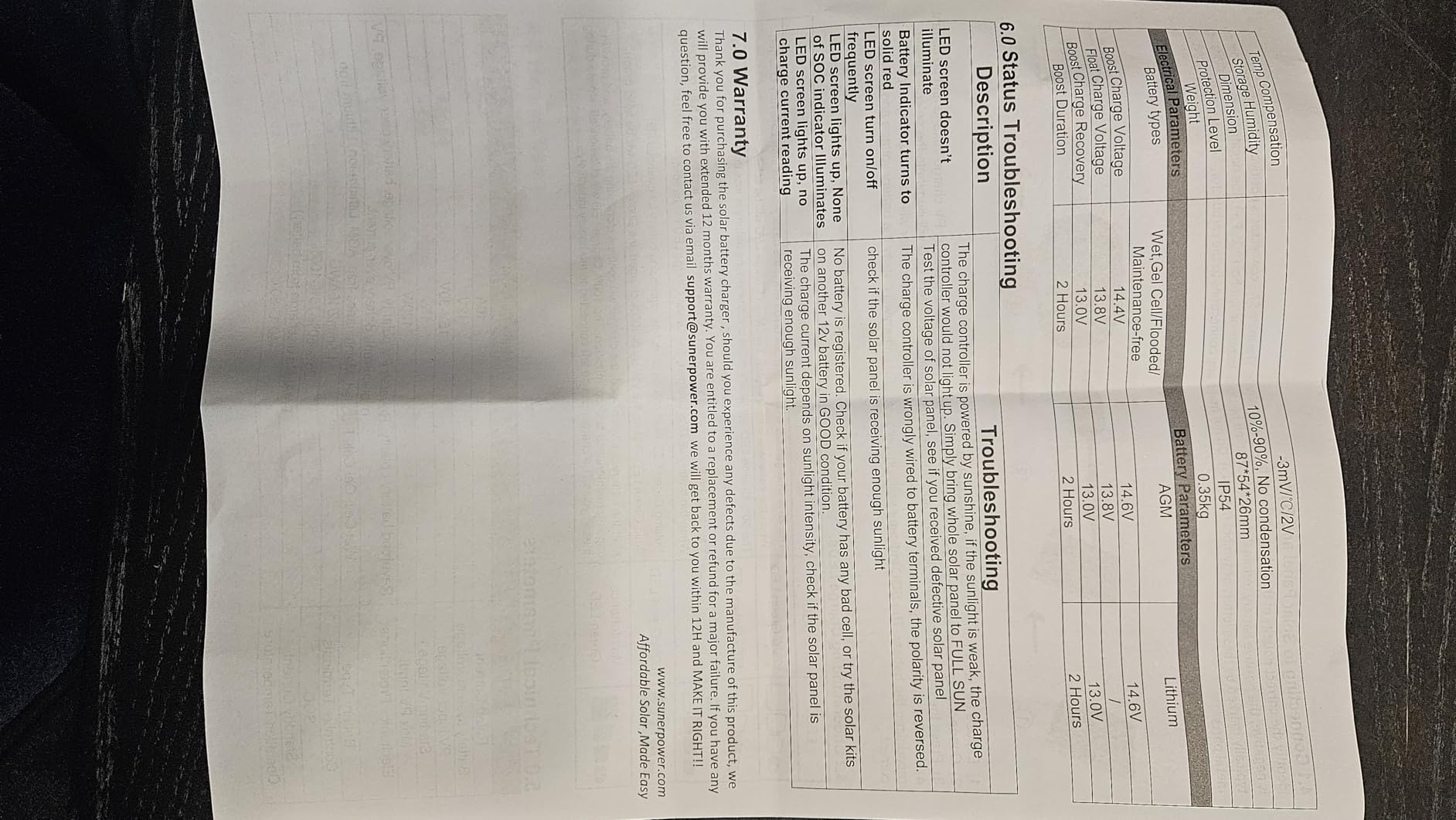
This is the pick if you want a straightforward 30A MPPT with a readable screen and no app at all. The three-stage bulk, absorption and float algorithm is a sensible default for lead-acid banks, and the protections list covers PV over-voltage, battery over-voltage, over-temperature, overcharging, short circuit and reverse polarity with temperature compensation.
Owners upgrading from PWM controllers report roughly double the current output of what they had before, which is the expected result when the array is no longer being chopped. It weighs 0.14 kg and takes very little space, which helps in a small cabinet.
Maximum PV input is 100V, with 360W at 12V and 720W at 24V.
The flaws here are cosmetic but worth stating plainly. The polarity markings are printed on a ribbon rather than moulded into the case, so they can wear off, and you should double-check terminal polarity yourself at install. The LCD is difficult to read at an angle or in a dim cabinet, and some owners report a state-of-charge figure that reads slightly optimistic.
None of that affects charging behavior. It affects how much you trust the number on the screen when something looks wrong.
Where it earns its place
It suits a cabin with a sealed AGM or gel bank, no appetite for app setup, and a cabinet that gets dusty. The 30A rating maps cleanly to roughly a 300W array on 12V, which is a very common weekend-to-full-time cabin size.
Where it does not
There is no Bluetooth or remote monitoring option in the box, so an unattended cabin gives you no visibility. The 100V PV ceiling also constrains series strings, and the optimistic state-of-charge reading means you should verify with a meter before tearing into wiring.
7. POWLAND 120A MPPT for big arrays on small banks: 230V input and wide auto-detection
POWLAND 120A MPPT Solar Charge Controlle 12V/24V/36V/48V/60V/72V/84V/96V Auto,Max Input 230V Solar Charger, LCD Display Intelligent Regulator for AGM, Gel, Lithium ect
120A charge output
230V max PV input
12V to 96V auto-detection
98% conversion
Pros
- Automatic detection from 12V through 96V
- 230V maximum PV input for long series strings
- 98% MPPT conversion efficiency
- High-resolution LCD with multi-day graphing
- Large lugs accept heavy cable and parallel runs
Cons
- Temperature monitoring advertised but no sensor port
- LiFePO4 packs may be auto-detected as sealed
- Weak and incomplete instruction manual
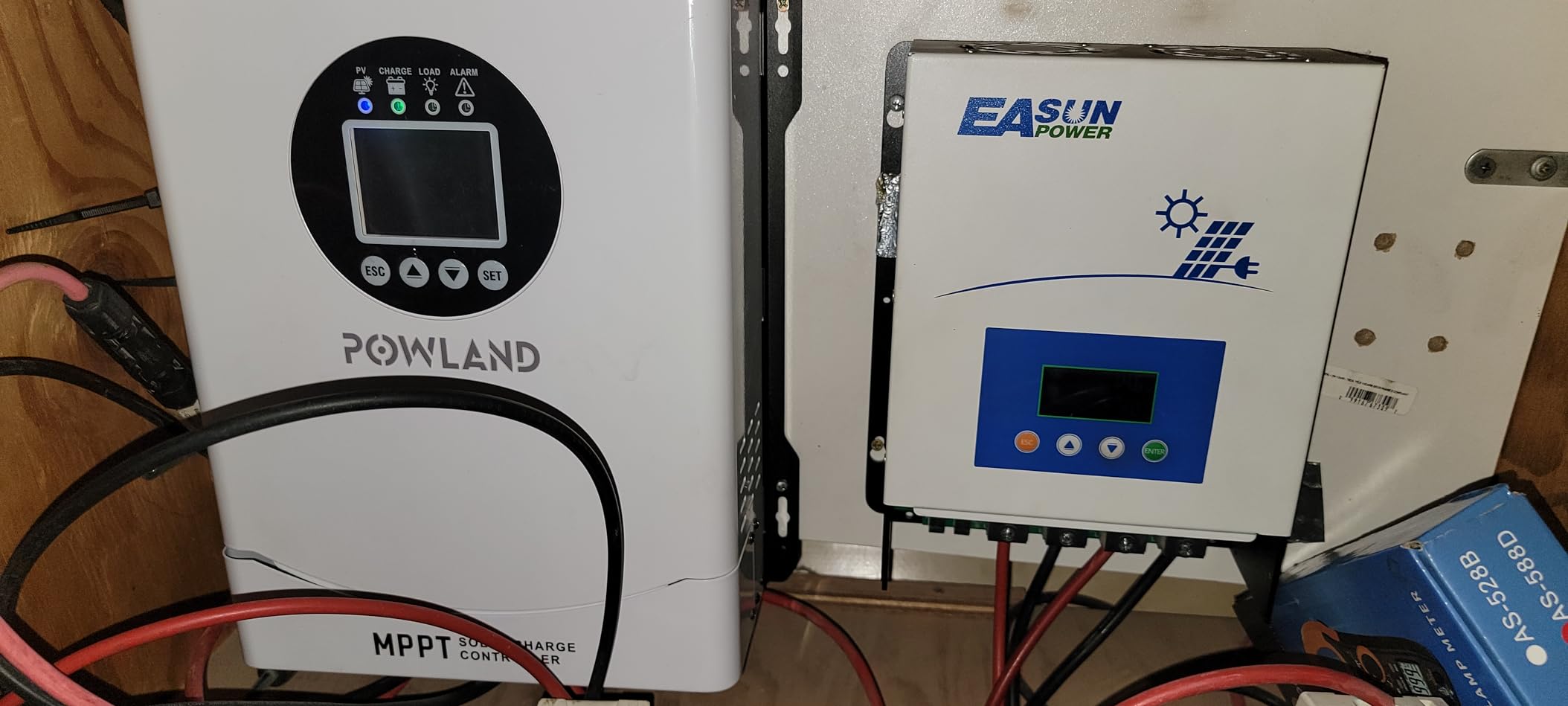
The POWLAND 120A is built for the case where panel space is tight and you still want a big array. A 230V maximum input voltage lets you run long series strings, which cuts wire length and losses, and automatic detection across 12V through 96V means it will sit between an unusual bank and a standard panel without fuss.
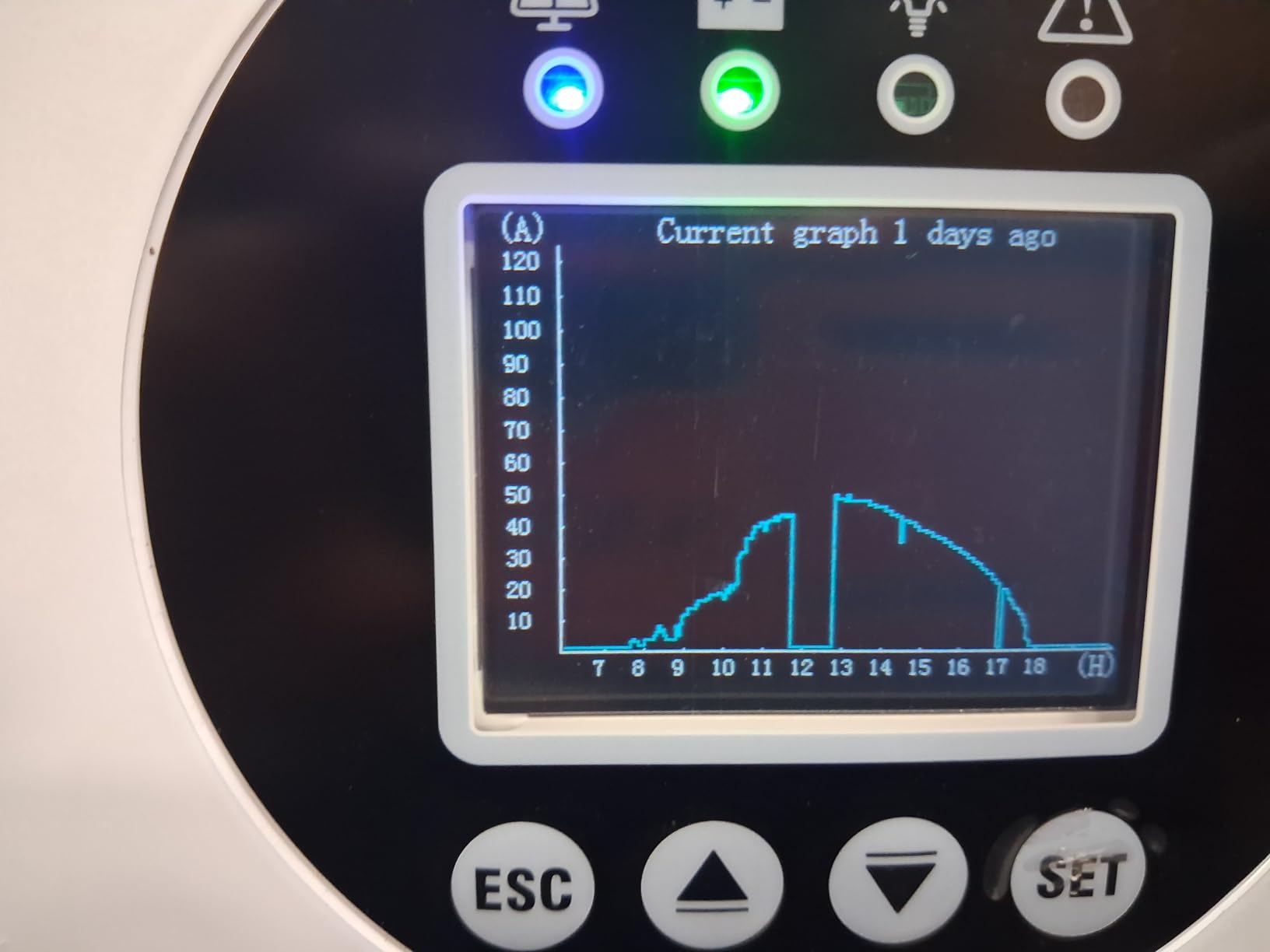
Owners report around 30% more harvested energy than PWM controllers at comparable arrays, and several run multiple units in parallel without conflict. The high-resolution LCD shows PV voltage and current, charge stage, warnings and diagnostics with multi-day graphing, which is unusually good local reporting for this tier.
Reported efficiency is 98% MPPT conversion, and large lugs accept heavy cable.
There is one issue worth flagging hard: the listing advertises battery temperature monitoring, yet there is no temperature sensor port on the unit. Battery type also cannot be chosen in the menu, and LiFePO4 packs may be auto-detected as sealed, which produces a lead-acid charge profile on a lithium bank.
Documentation is weak. Several owners describe the English manual as poorly written and incomplete, advanced settings sit behind a hidden password-protected menu, and the factory screws can be cross-threaded. None of that is dangerous, but all of it adds time to a cold-weather install.
Where the high input ceiling pays off
A cabin roof with a chimney or a valley forces you into awkward layouts. Series strings solve that in a way parallel panels cannot, and 230V of headroom gives real margin on cold mornings. Several owners also report it does not overheat where costlier units did.
What to verify before you commit
If you run LiFePO4, confirm how battery type is set and how it behaves with your bank, because there is no sensor port and no menu selection. If you depend on documentation to configure advanced settings, that support is thin here.
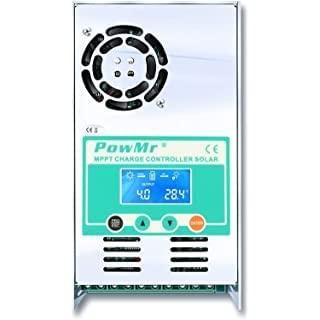
8. PowMr 60A MPPT for multi-voltage flexibility: 160VDC input and programmable parameters
PowMr MPPT Solar Charge Controller 60 amp 48V 36V 24V 12V Auto – Max 160VDC Input, LCD Backlight Solar Charge Controller for Vented Sealed Gel NiCd Lithium Battery【Software Update Version】
160VDC max PV input
60A charge output
12V 24V 36V 48V auto
98.1% efficiency
Pros
- 98.1% maximum efficiency with 99% PV utilization
- Backlit LCD with real-time energy recording
- User-programmable absorption float and low-voltage disconnect
- Built-in troubleshooting menu
- Fan-on above 45C with heat dissipation
Cons
- Fan operation adds continuous noise
- Lithium setups need manual parameter changes
- Lowest average rating in this group at 4.1
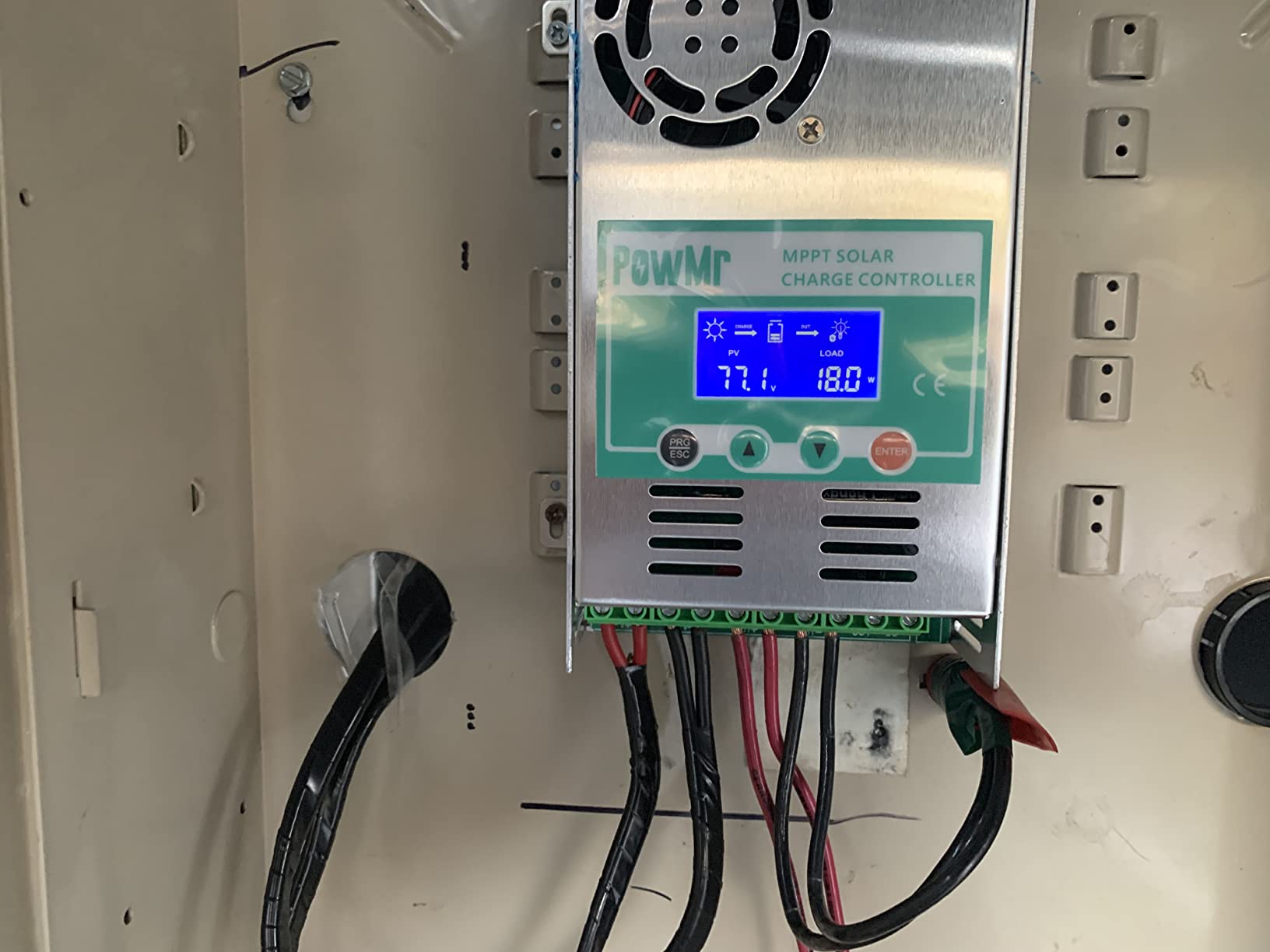
The PowMr 60A is the most configurable controller here, and for some cabins that is the whole point. You can program absorption voltage, float voltage, low-voltage disconnect and load timers, and the built-in troubleshooting menu helps identify faults quickly. Automatic detection spans 12V, 24V, 36V and 48V with a 160VDC maximum PV input.
Reported efficiency is 98.1% with 99% PV utilization, the LCD is backlit, and dual positive and negative connectors on both solar and battery sides accept heavy cable. That combination makes it a natural fit for a builder who plans to change the system later.
It is also the least well-reviewed controller in this group at 4.1, with 10% one-star reviews, so plan on verifying charging behavior yourself after install.
Two practical problems. The fan turns on above 45C and stays on, which owners in quiet cabins notice. And lithium batteries need manual parameter adjustment because lithium resting voltage is unstable enough that automatic detection picks the wrong profile.
That setup burden is the recurring theme in reviews. It is manageable, but it means an afternoon of configuration rather than a ten-minute plug-in.
Why programmable settings matter at a cabin
Real off-grid systems outgrow their first configuration. A settable low-voltage disconnect protects a weekend cabin where nobody drains the bank between visits, and programmable absorption voltage is how you tune for seasonal temperature swings rather than guessing.
Where it falls down
Continuous fan noise is the most common complaint, and the 4.1 average with a 10% one-star share is the weakest reliability signal in this roundup. Test it thoroughly before relying on it for an unattended site.
9. BougeRV 40A MPPT for freezing cabins: low-temperature cutoff is the reason to buy it
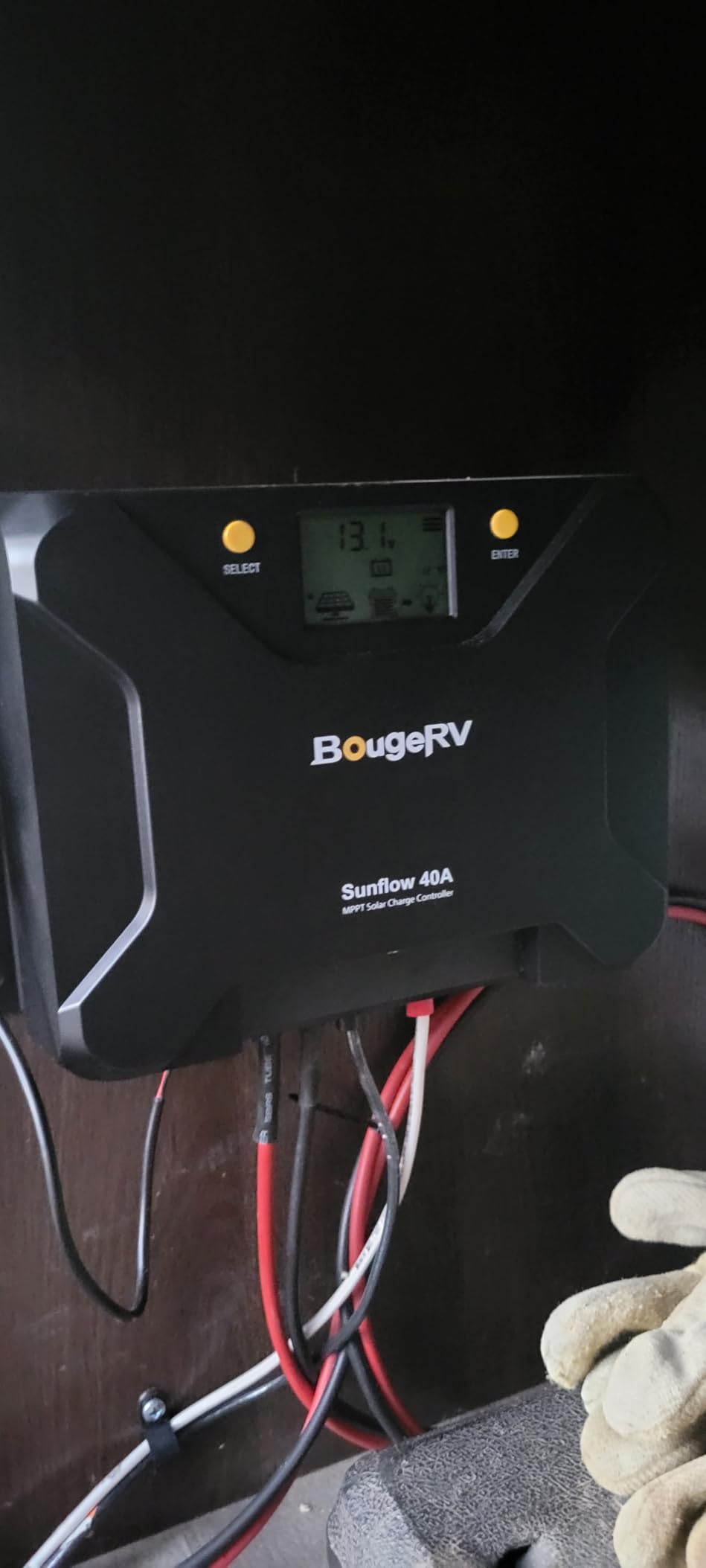
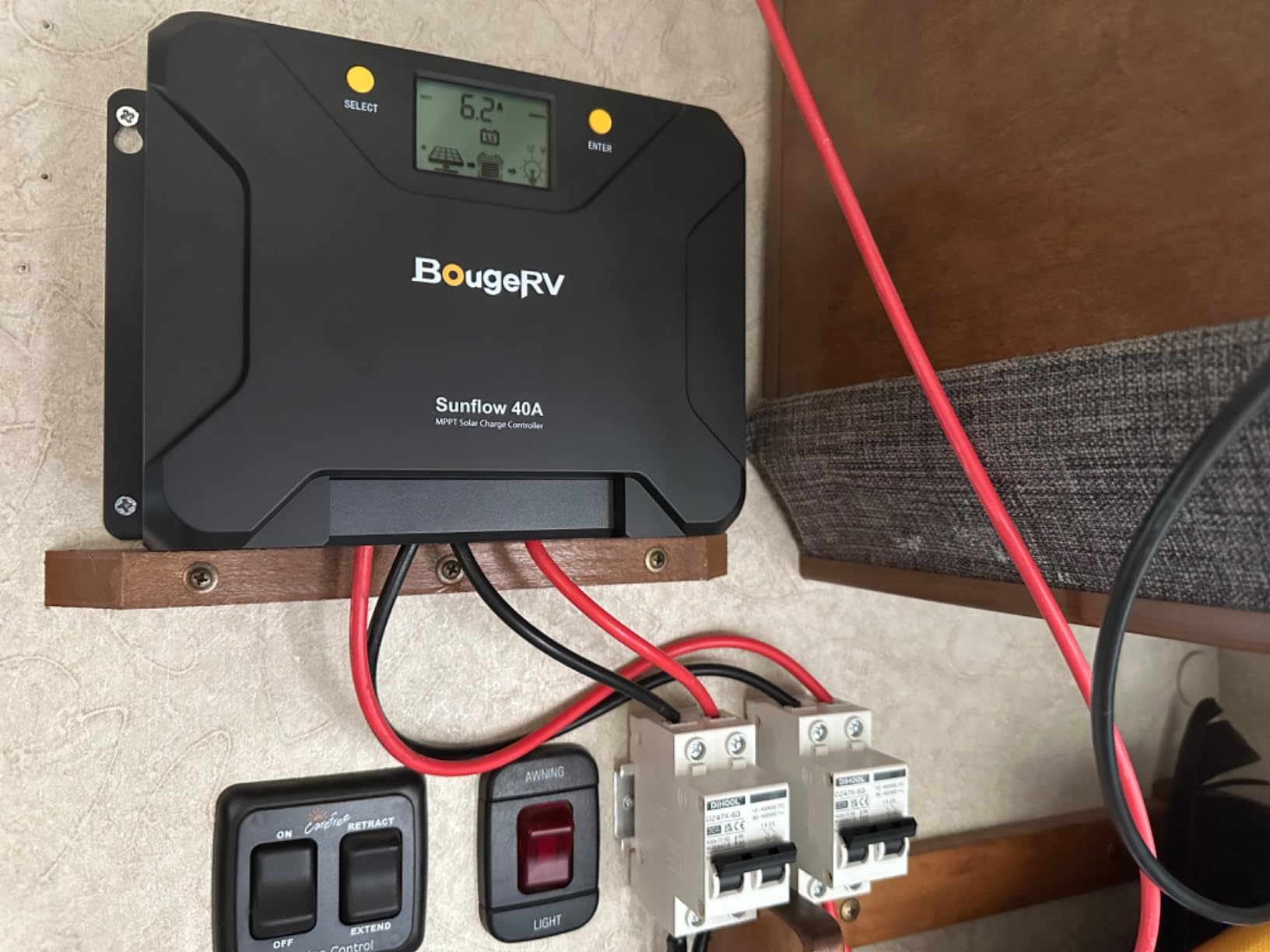
BougeRV MPPT Solar Charge Controller 40A, w/ Low-Temp Cut-Off, APP Control, Backlit LCD, 40 Amp Solar Panel Regulator 12V/24V for LiFePO4, SLD, Gel, FLD, AGM Battery, RV, Marine, Upgraded
600W at 12V and 1200W at 24V
Low-temp cutoff below 32F
95V max PV input
20A load output
Pros
- Charging halts below 32F to protect LiFePO4 packs
- Wakes dormant 12V and 24V lithium banks
- 99.5% tracking with up to 99% peak conversion
- Aluminum heat sink handles full load
- CE and RoHS certified
Cons
- Bluetooth range limited to roughly 10 to 32 feet
- App requires an internet login that fails off-grid
- On-unit logging sometimes captures only minutes of data
Cold is where cabin controllers earn or lose their reputation. This one stops charging below 32F specifically to protect lithium chemistry, which cannot safely absorb charge when it is cold. It can also wake a 12V or 24V LiFePO4 pack that has shut down after a short circuit or over-discharge, a feature that saves a long trip to a frozen site.
On the electrical side, tracking efficiency reaches 99.5% with up to 99% peak conversion, adjustable charge current runs from 0A to 40A, and an aluminum heat sink handles full load. Maximum PV input is 600W at 12V and 1200W at 24V, with maximum PV input voltage of 95V and a rated load current of 20A.
Owners running cabin and van systems report stable long-term performance.
The app is the problem, and it is specifically a remote-cabin problem. Bluetooth range is roughly 10 to 32 feet, so it barely reaches from a controller mounted outside the living space. The app also requires an internet connection to log in, which simply fails at a site with no bars.
On-unit logging is also inconsistent, sometimes showing only a few minutes of data. The lug insertion slot is narrow enough that you should test your cable lugs before crimping, and two different apps circulate, which makes the matching manual unclear.
Why the low-temp cutoff matters more than it looks
Charging a lithium bank below freezing causes plating that does not come off. A controller that simply refuses to charge until the pack is warm protects the battery automatically, with no thermostat, no relay and no thinking about it each spring. That is real insurance for an unattended winter cabin.
Where the app gets in the way
If you plan to check your system from a driveway three hours away, none of this helps. Bluetooth is a phone-proximity tool, not a remote monitoring system. For genuinely remote monitoring, a wired display or a network-connected adapter is the better path.
10. ELUSH 100A Charge Controller for lighting and load outputs: lots of modes, modest tracking
Upgraded 100A MPPT Solar Charge Controller 12V 24V 36V 48V LCD Display Battery Intelligent Regulator Max 100V Input Dual USB for Lead-Acid/Lithium
100A rated output
100V max PV input
12V 24V 36V 48V auto
Seven operating modes
Pros
- Dual USB 5V ports for cabin devices
- Seven operating modes including lighting and timed control
- Backlit multi-function LCD with clock
- Wire terminals accept heavy-gauge cable
- Owners report surviving outdoor exposure and rain
Cons
- Listing states it blends MPPT and PWM rather than true MPPT
- Real output closer to 80A under sustained load
- Readings reported inaccurate against external meters
- Heat sink runs near its thermal limit
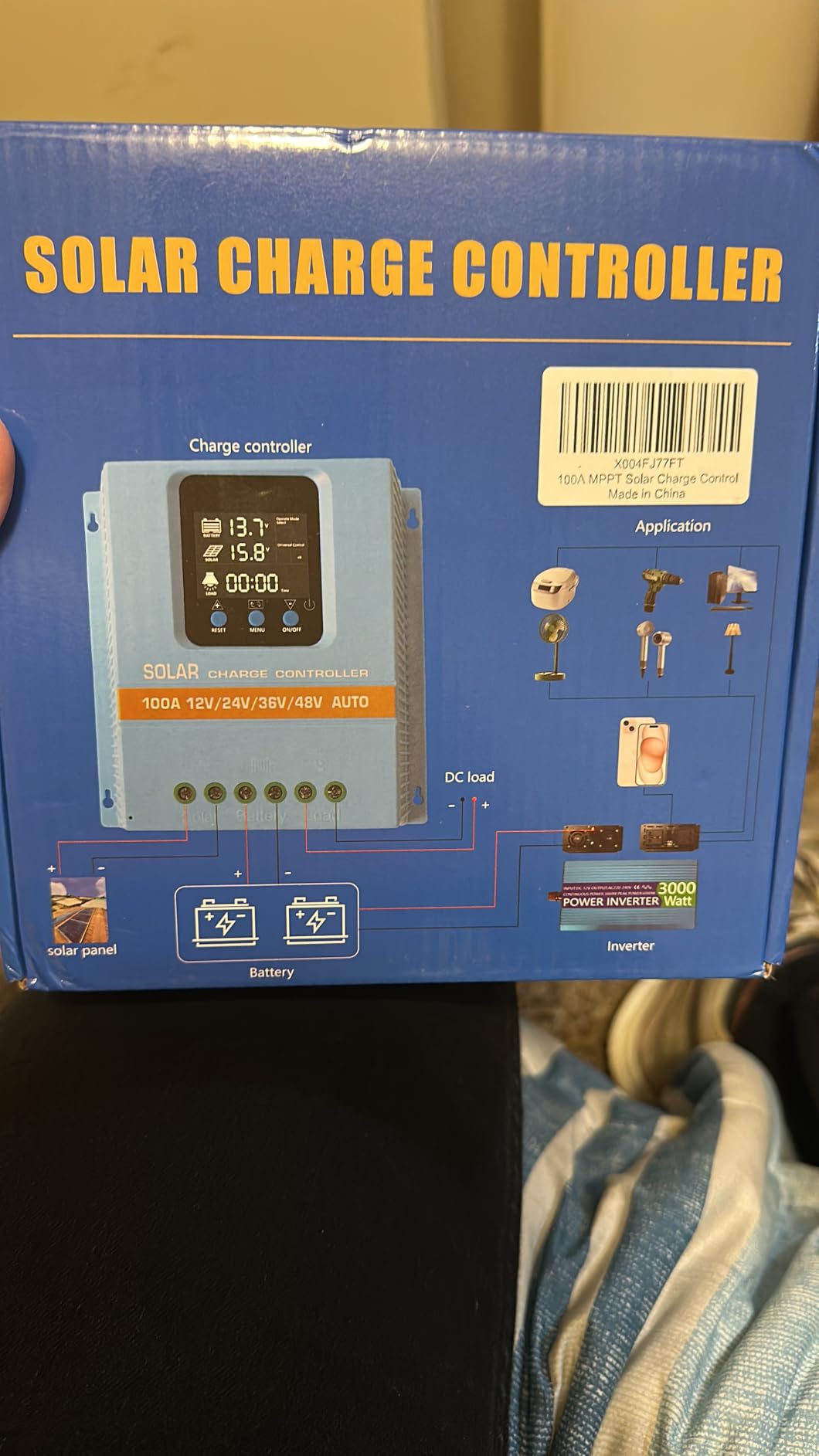
This is the budget end of the roundup, and it earns its place in a specific scenario: a cabin with modest power needs where lighting control matters as much as charging. Seven operating modes cover charging, light control, time delay, universal, manual and timing control, plus dual USB 5V ports for phones and lights.
The auto-recognition covers 12V, 24V, 36V and 48V, and the backlit LCD carries a clock and a real-time panel voltage readout. Owners value that the terminals accept heavy-gauge cable, unlike many controllers at this level, and several report it surviving extended outdoor exposure.
Being straight about the rest: the listing itself describes this as a blend of MPPT and PWM rather than full MPPT.
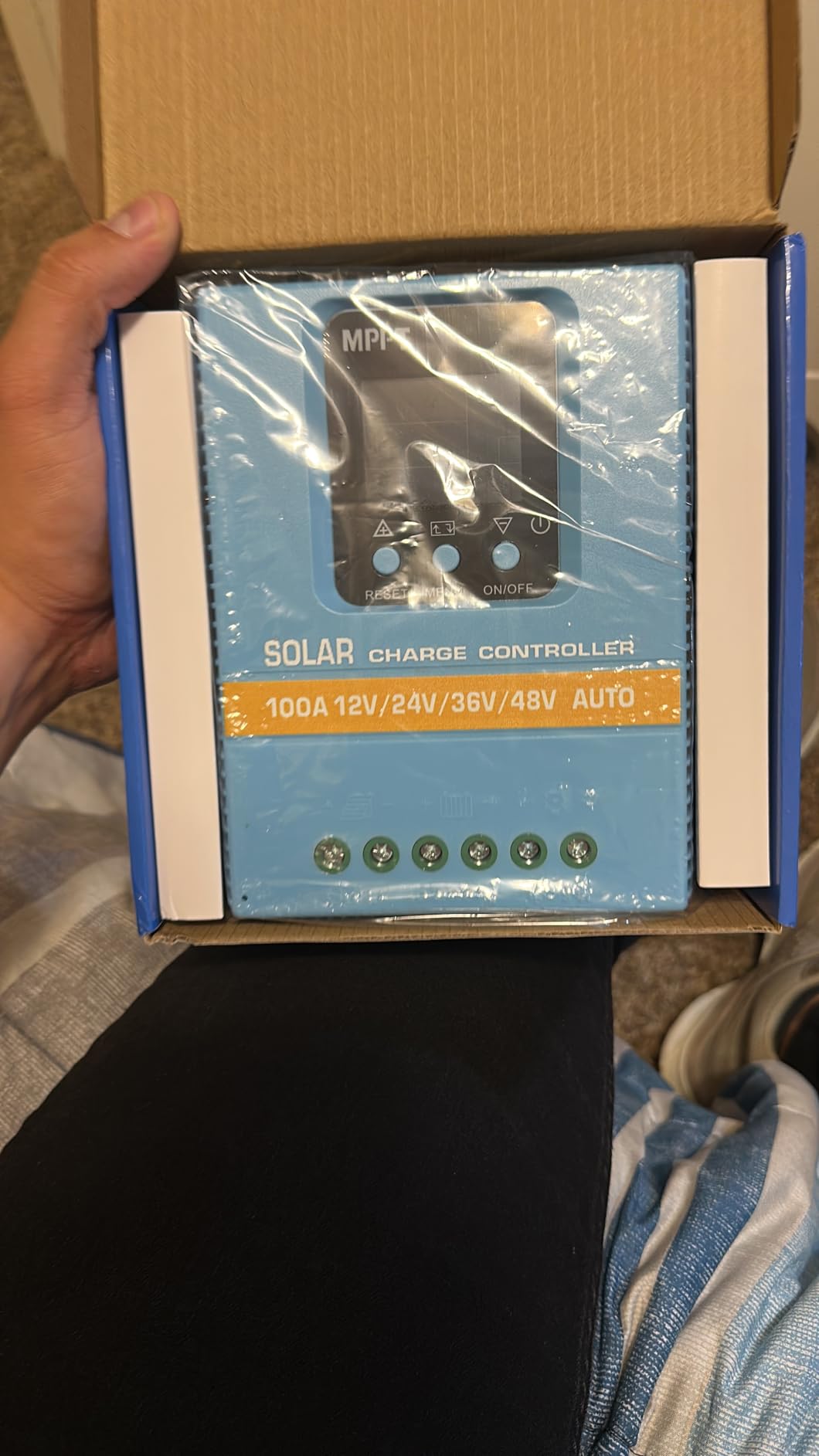
Several reviewers put real efficiency at roughly 80% to 85% against the 98% a true MPPT delivers, and report sustained output closer to 80A rather than the rated 100A. Voltage and current readings are questioned against external meters, and the heat sink runs near its thermal limit at high sustained amperage.
It averages 4.0 with 14% one-star reviews, the weakest rating in this set. It performs best when the PV voltage window matches the battery voltage and when kept below roughly 80 amps.
When a controller like this makes sense
A small 12V system powering lights, a fan and USB charging, where the array and bank are modest and cost dominates. In that case the difference between 80% and 98% tracking is a matter of a slightly larger panel, not a failed system.
When to spend more instead
If you have a real battery bank and a real load, the tracking shortfall becomes watts you buy panels to replace, and the reading accuracy gap makes troubleshooting harder. The factory reset function helps, but it does not fix a PWM-class algorithm.
11. Temank 48V 140A MPPT for 48V storage banks: 500V input ceiling, single voltage
48V 140A MPPT Solar Charge Controller, 140Amp Solar Regulator Max.PV Input 500V, Max. Charging Current Can be Set, Work with 48V Lead-Acid and Lithium Batteries
500V max open-circuit voltage
140A adjustable charge
48V banks only
60V to 450V tracking
Pros
- Handles up to 500V open-circuit voltage and 6500W
- Charge current adjustable from 10A to 140A
- MPPT tracking range of 60V to 450V
- LCD reports PV battery energy and error codes
- Dual smart fans for sustained high current
Cons
- Designed for 48V systems only
- Max PV input current limited to 18A
- Only 50 reviews of long-term reliability
- Series-connected array recommended
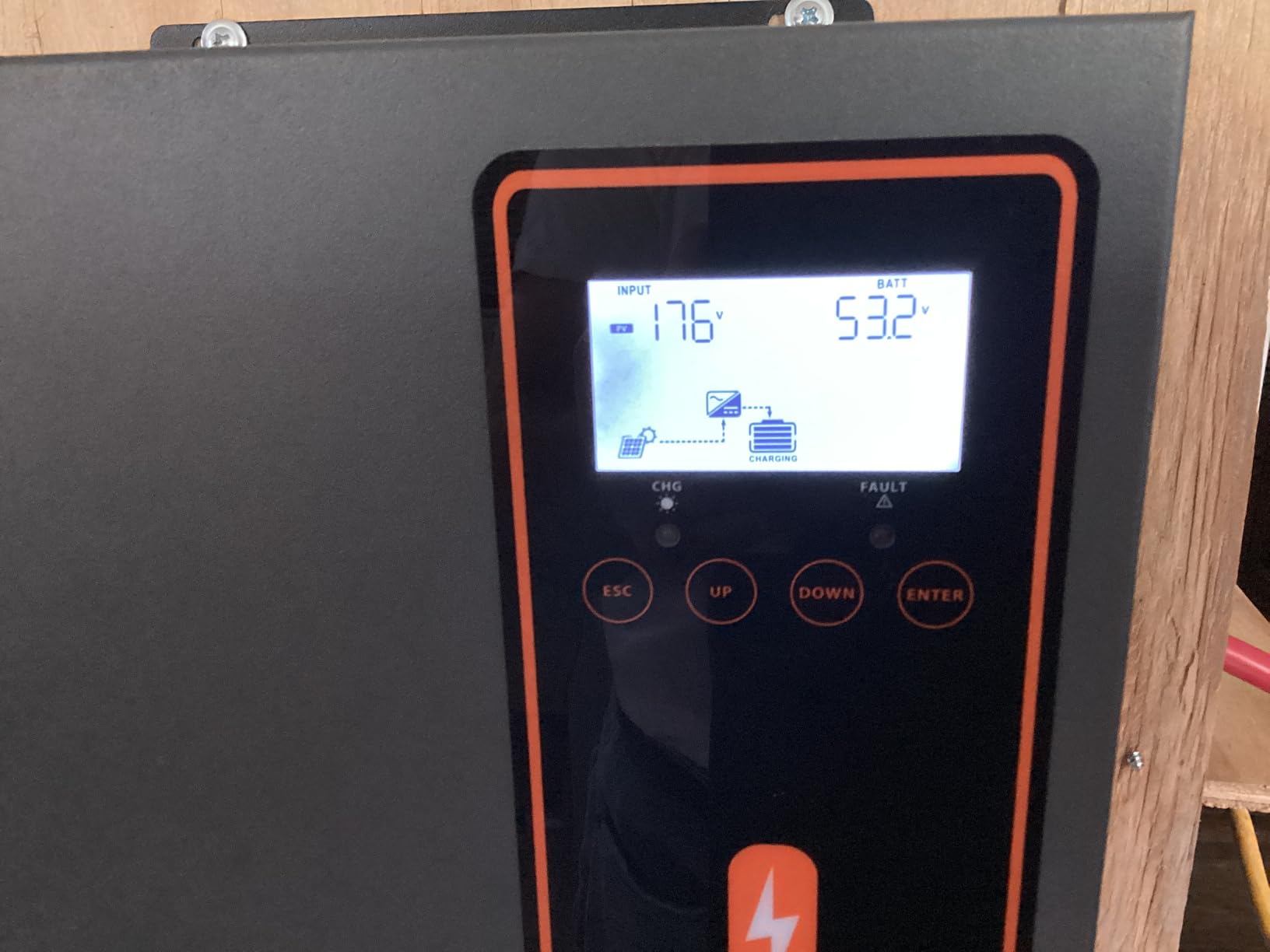
This one belongs to a different size of project. It is built for high-voltage energy storage, handling up to 500V of open-circuit panel voltage and 6500W of array power, with MPPT tracking across a 60V to 450V DC window. For a large 48V bank fed by long series strings, that range is genuinely useful.
Charge current is adjustable from 10A up to 140A, and the LCD reports PV voltage and current, power, battery voltage, charge current, energy generated, error codes and version number. Bulk, float and equalization voltages are user-programmable, with presets for sealed, gel, flooded, LiFePO4 and lithium-ion 48V packs.
Dual smart fans handle cooling under sustained high current.
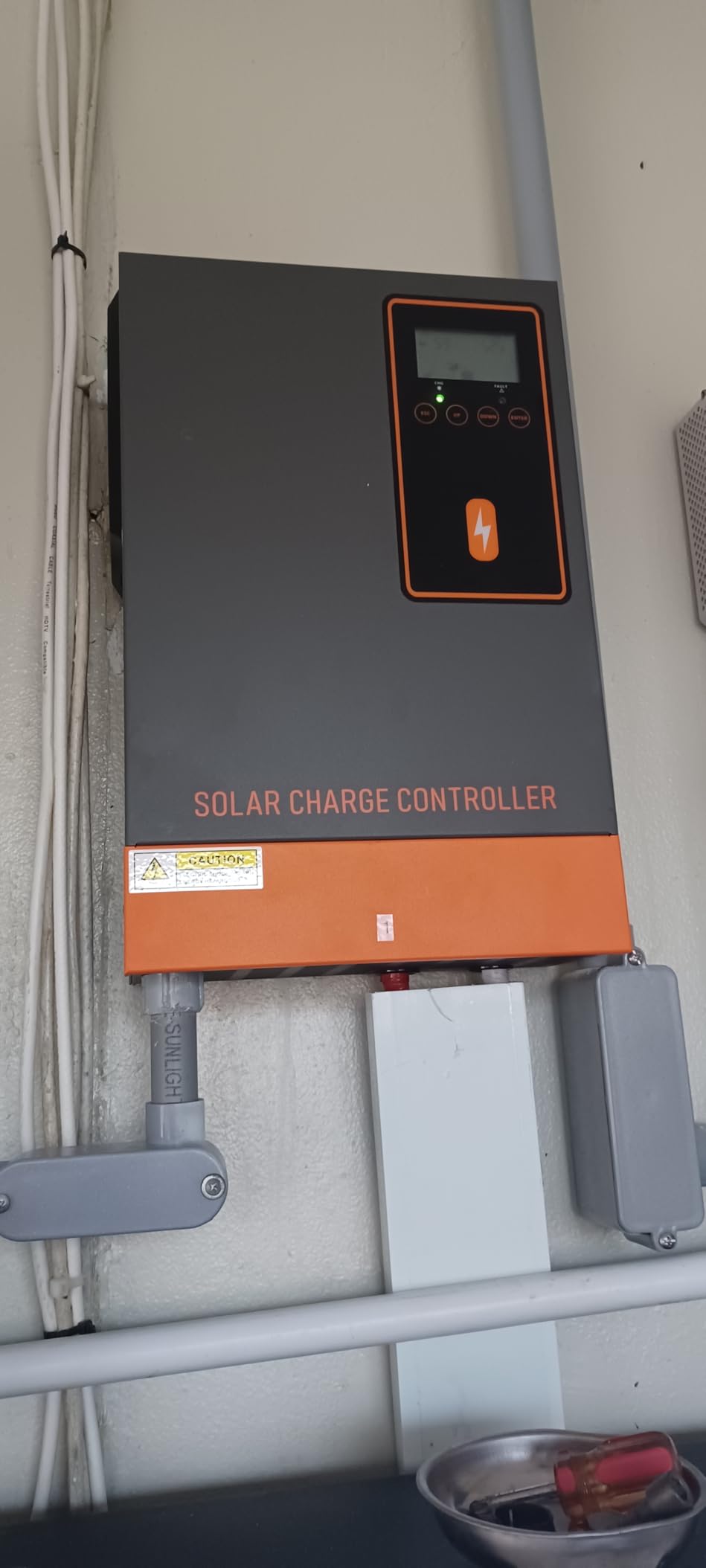
Two hard limits rule it out for most cabins. It is a 48V-only design, so a 12V or 24V bank is simply out of scope. And maximum PV input current is limited to 18A, with a series-connected configuration recommended, which reduces wiring flexibility.
With 50 reviews, this is the thinnest long-term reliability record in the roundup, and 11% of those reviews are one-star. That is the trade you make for very high voltage capability on a budget.
Where it belongs
A cabin with a whole-home style 48V lithium bank, long panel runs from a detached array or a ground mount, and enough load to justify 140 amps of charging. The 500V ceiling removes almost any string configuration anxiety.
Where it does not
Any 12V or 24V system. If your bank voltage is below 48V this controller does nothing useful for you, regardless of how good the spec sheet looks.
12. LiTime 60A MPPT 200V for larger 24V and 48V banks: strong cooling, no built-in Bluetooth
LiTime 12V-48V 60A MPPT Solar Charge Controller, Max 200V PV Input
870W at 12V to 3480W at 48V
200V max PV input
96% peak conversion
Dual forced cooling
Pros
- 870W at 12V up to 3480W at 48V solar input
- 200V maximum PV input for long series strings
- Sheet metal shell with bottom heat sink and top fan
- Covers 12V 24V and 48V LiFePO4 banks
- Two-year warranty with product liability insurance
Cons
- No built-in Bluetooth despite the model designation
- Peak conversion of 96% trails 98 to 99% rivals
- Fewer reviews than the 30A sibling
The larger LiTime is aimed at 24V and 48V owners who need high PV input voltage and serious heat management. It accepts 870W of solar at 12V, 1740W at 24V, 2610W at 36V and 3480W at 48V, with a 200V maximum PV input for long series strings.
Cooling is the differentiator. A sheet metal shell with forced cooling from both a bottom heat sink and a top fan keeps the 60A rating honest on a hot July afternoon, which matters more in a southern cabin than a northern one.
It covers 12V, 24V and 48V LiFePO4, and 12V through 48V plus auto for lead-acid. Tracking efficiency is listed at not less than 99% with up to 96% peak conversion.
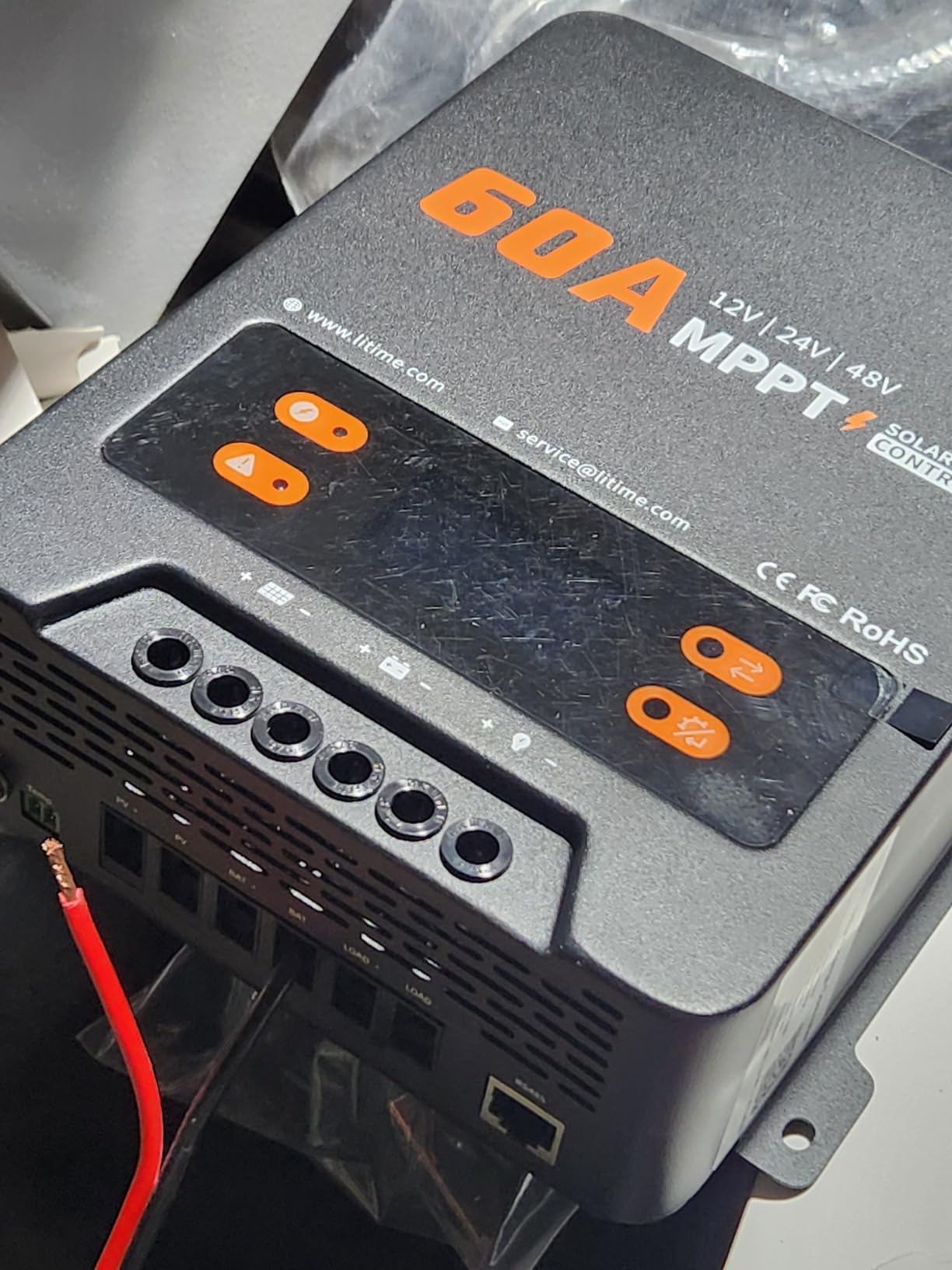
The catch is the missing Bluetooth. Despite the model designation, there is no integrated Bluetooth module, so remote monitoring requires an extra accessory. Combined with 96% peak conversion, which trails the 98% to 99% several rivals claim, this is a controller you buy for headroom and cooling rather than for connectivity.
The LCD with LED charge and fault indicators is driven by just two menu buttons, which is about right for a device you configure once.
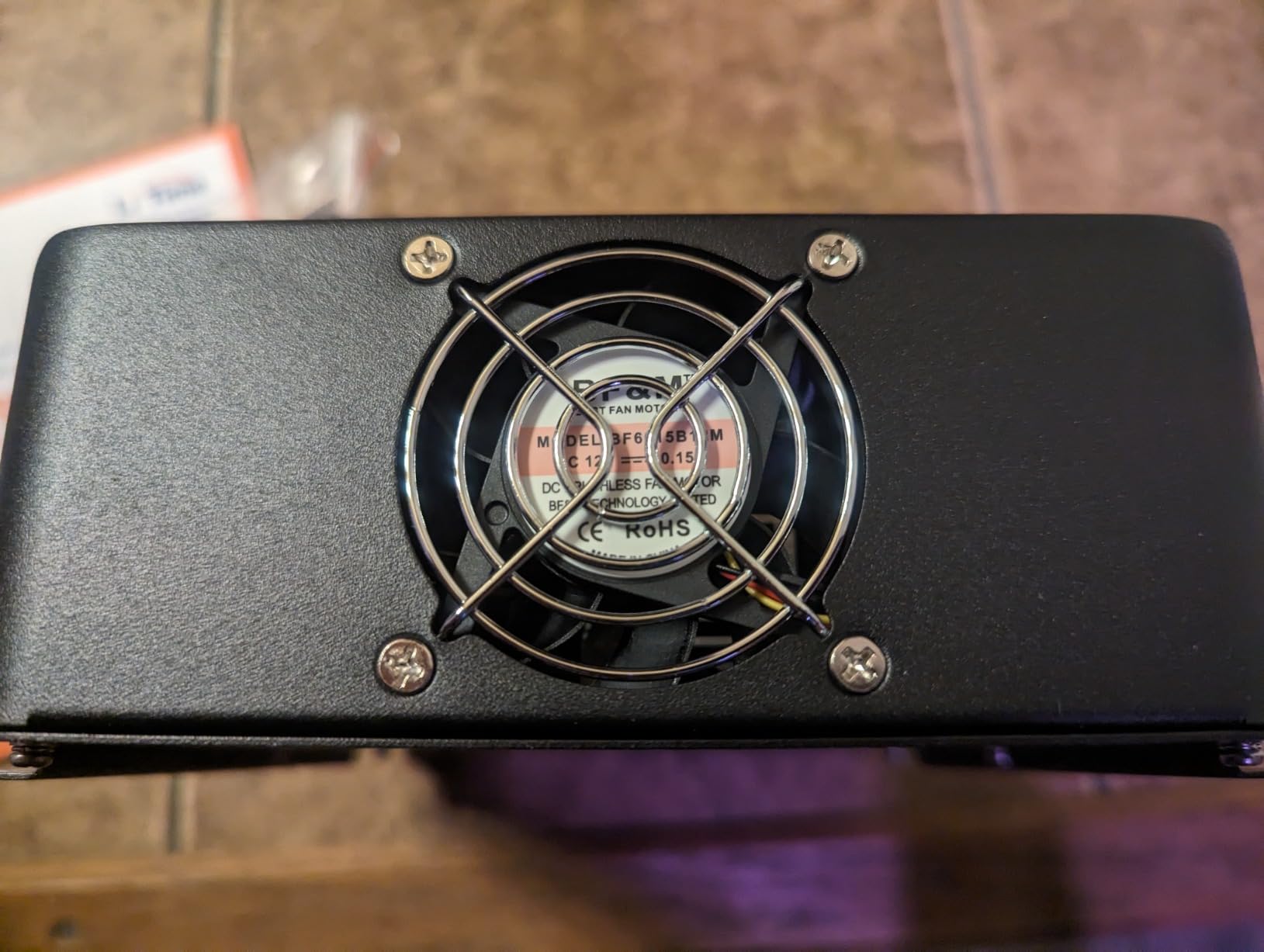
Where its cooling earns the money
Sustained output drops when a controller runs hot. Forced cooling from both ends of the chassis is what keeps a 60A rating usable through a southern summer, and for a cabin that runs a water pump and a fridge all day, usable 60A is the number that matters.
Where it falls short
No integrated Bluetooth, and fewer reviews than the 30A sibling. If remote monitoring is a requirement rather than a nice-to-have, budget for the extra module or move to a controller with wireless built in.
How to Size a Solar Charge Controller for a Cabin
Size the controller from your array and your bank voltage, not from your battery capacity. The formula that off-grid builders repeat across forums is straightforward.
Take the array’s nameplate watts.
Divide by the nominal bank voltage. A 400W array on a 12V bank is 400 divided by 12, which is 33 amps.
Multiply by 1.25 to 1.3 to leave headroom for cold-morning current and real-world conditions.
Round up to the next controller size that also covers your maximum input voltage.
Worked examples: a 200W array on 12V needs 25A, a 400W array on 12V needs 42A, and an 800W array on 12V needs 83A. On a 24V bank those same arrays need 13A, 21A and 42A. A 1.5kW array on 48V needs about 39A.
Oversizing the controller is fine. It simply will not pull more than the panels can deliver. Undersizing is the expensive mistake, because the excess current has to go somewhere.
A second, separate rule gets confused with this one: many builders size charge current at 10% to 20% of battery amp-hour rating to keep charging gentle. Both rules are valid for different goals. The array rule caps how much the panels can push in. The battery rule governs how hard you want to charge. If the array rule gives you the larger number, follow it.
MPPT vs PWM for Off-Grid Cabins
A PWM controller simply chops panel voltage down to battery voltage, throwing away the difference as heat. An MPPT controller finds the array’s peak power point and steps that voltage down electronically, converting what PWM wastes into charging current.
Forum consensus holds that PWM is acceptable for arrays under about 100W, where the wasted watts are minor. Above that, and especially in winter with low light, MPPT recovers a meaningful share of what would otherwise be lost, which is why every controller in the top half of this roundup is MPPT.
One genuinely budget MPPT, the ELUSH 100A, is described by its own listing as a blend of MPPT and PWM, and reviewers put its real efficiency around 80% to 85%. Treat “MPPT” on a listing as something to verify, not something to assume.
Cold-Weather Voc Headroom for Northern Cabins
Panel voltage rises when it gets cold, and open-circuit voltage on a freezing morning can run well above the nameplate figure. Exceed the controller’s maximum input voltage and you do not get a warning; you get a failed controller.
Here is the arithmetic. Two 60-cell panels produce roughly 44V nominal, or about 88V open-circuit. Apply a cold-morning correction and that string can exceed 95V. That is exactly the published maximum input voltage of the BougeRV 40A, and it is uncomfortably close with no margin at all.
So the rule for northern cabins: read the published maximum PV input voltage, add cold-morning headroom, and then confirm your longest series string fits underneath it. The controllers here publish a range from 95V on the BougeRV 40A and 100V on the EPEVER Tracer AN and SUNER POWER, up to 160VDC on the PowMr 60A, 200V on the LiTime 60A, 230V on the POWLAND 120A and 500V on the Temank.
The Victron SmartSolar Tr 150V 70A and the POWLAND are the picks if you want generous headroom without thinking about it again. If your array is a single panel or two panels in parallel at 12V, the 100V-class controllers are comfortable.
Mounting, Ventilation and Monitoring in an Unheated Cabin
Placement matters as much as the model. Leave clearance around the heat sink, because airflow is what keeps rated current honest in July. If you must wall-mount it, mount it vertically with the fins oriented for rising air rather than boxing it into a sealed cabinet with no path out.
Noise deserves its own paragraph. A controller whose fan runs continuously is audible in a quiet cabin at night. Several owners specifically praise the fanless designs here for that reason, and others report fan noise as their main irritation. Pick fanless if the cabin is a sleeping space.
Standby draw is the other unheated-cabin concern. Every controller draws some current from the bank overnight, and for a weekend cabin with a small bank and long idle stretches, that draw is a real share of your monthly harvest. Controllers with a low-voltage load disconnect and a configurable threshold handle this best.
On lithium banks, decide your temperature sensor policy before you wire it. Forum installs repeatedly report disabling equalization and, on some models, disconnecting the temperature sensor, because a lead-acid compensation curve pushes a lithium pack past its limit. Several controllers in this roundup offer a dedicated LiFePO4 mode that handles this correctly, and one manual here gives contradictory guidance on the sensor, so check yours specifically.
Finally, be realistic about Bluetooth. It is a phone-proximity tool with a range of roughly 10 to 32 feet. It is excellent for a weekend at the cabin and useless from a desk three hours away. For genuine remote monitoring of an unattended site, a wired remote display or a network-connected adapter is the right answer.
Frequently Asked Questions
What size solar controller do I need for a 400W solar panel?
On a 12V battery bank, divide 400W by 12V to get 33 amps, then multiply by 1.25 for headroom, which gives about 42A. So a 50A MPPT controller is the right fit. On a 24V bank the same array needs only about 21A, and on 48V it needs about 11A.
How do I calculate the correct size for a solar charge controller?
Divide array watts by the nominal battery bank voltage, then multiply by 1.25 to 1.3, then round up to the next real controller size. A separate check is maximum input voltage: your longest series string, including cold-morning voltage rise, must stay under the published PV input ceiling.
How much solar can a 40 amp charge controller handle?
Using the standard 1.25 safety factor, a 40A controller handles roughly 384W on a 12V bank and about 768W on a 24V bank. Most builders round down to 360W at 12V so the array never exceeds the controller’s rating on a cold morning.
How much solar can a 30 amp charge controller handle?
With the 1.25 safety factor, a 30A controller handles about 288W on a 12V bank and around 576W on a 24V bank. Published figures for specific units land nearby, with 360W at 12V and 720W at 24V for one popular 30A model.
Is it okay to oversize a solar charge controller?
Yes. A larger controller cannot pull more than the array can produce, so oversizing costs money but does no harm. Sizing up one step also leaves room to add panels later without replacing the controller. Undersizing, by contrast, forces excess current somewhere it should not go.
Which brand of solar charge controller is considered the best?
For most cabin systems, Victron’s SmartSolar line leads for published maximum input voltage, UL1741 certification and app monitoring with a large owner history. Renogy’s Rover 40A and EPEVER’s Tracer AN 30A are the strongest alternatives on value and quiet operation.
Can I use a 12V charge controller on a 24V battery bank?
No. A controller rated only for 12V cannot charge a 24V bank and will not recognise the higher voltage. Choose a model with automatic 12V and 24V detection, or one specified for your bank voltage, and confirm the setting before the first charge cycle.
Do MPPT controllers work in cold weather?
They work better than PWM in cold weather, because they capture the extra voltage that low temperatures push into the array. The cold risk is not tracking but maximum input voltage, which rises on freezing mornings. Choose a controller with headroom above your longest series string.
Conclusion
The Victron Energy SmartSolar MPPT 75/15 is the best solar charge controller for cabin systems in 2026 for most builds, because it pairs published safety certification with enough owner history to trust and an app that shows you what a snowy driveway cannot. A 400W array on a 12V bank with a lithium upgrade underway points instead to the Renogy Rover 40A, and a fanless cabin wants the EPEVER Tracer AN 30A.
Whichever you choose, size from array watts divided by bank voltage, multiply by 1.25, and check your longest series string against the published maximum input voltage before winter arrives.