
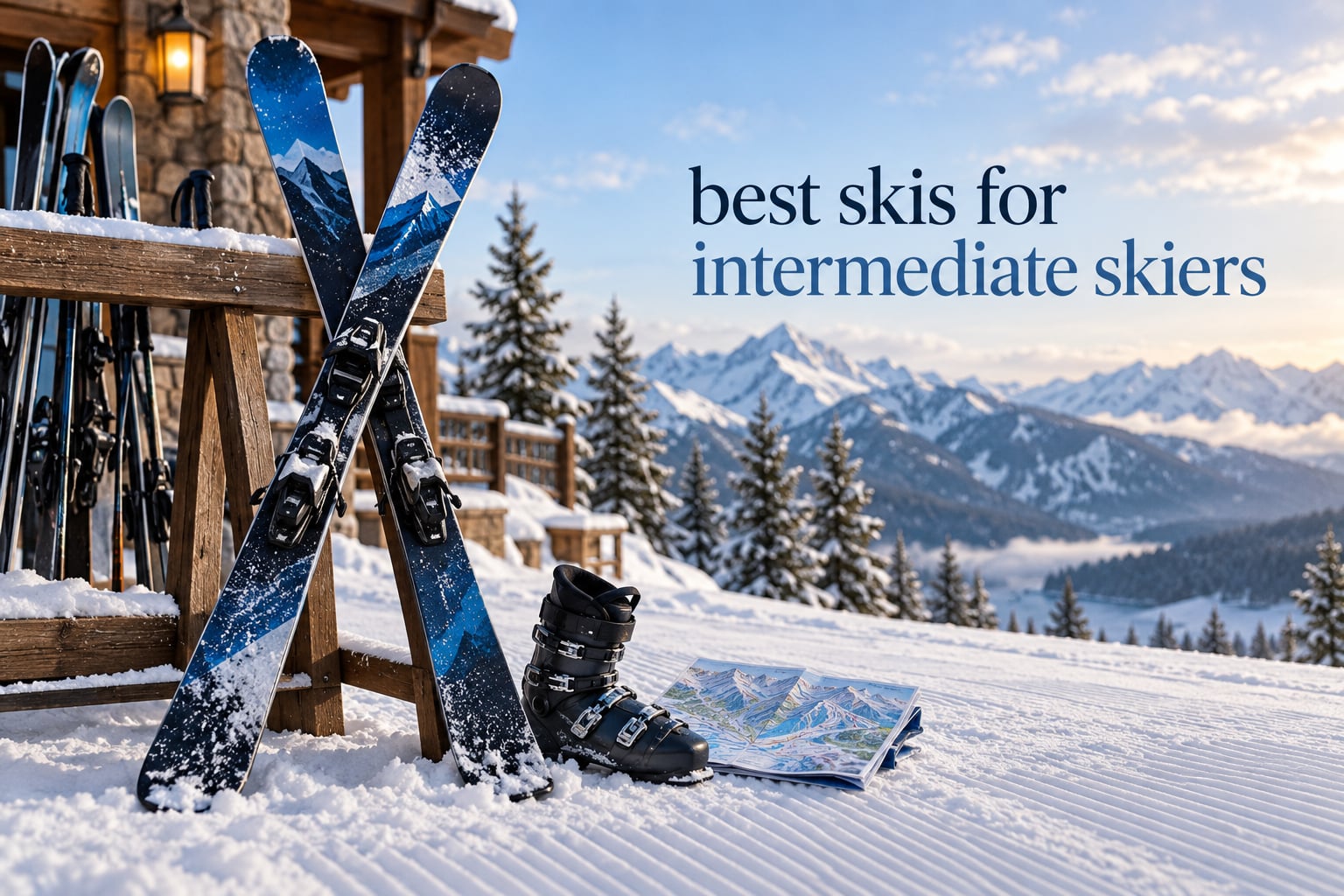
Our pick for the best skis for intermediate skiers is the K2 Mindbender 85, an 85 mm all-mountain ski with Slantwall sidewalls and an All-Terrain Rocker profile that stays predictable on hardpack and stays usable in bumps and light snow. The one fork to settle first, though, is terrain: if you ski mostly groomed Eastern hardpack, you want something nearer 76 to 86 mm underfoot, and if you ski variable Western mountain, you want closer to 90 mm.
That fork matters more than any brand. Shops lean toward the widest, most expensive ski in the room, and that advice lands badly with someone who plans 60 percent of their days on groomers. Readers still building fundamentals should start with our best skis for beginners guide instead, then move up a band at a time.
Everything below is built on published manufacturer specifications and the review and forum record, not on a season of private testing. Where a spec is not published, we say so rather than guessing. Model years run one ahead of the season, so the 2026/27 season is mostly next year’s models, and older model years stay on the market for seasons afterwards.
Table of Contents
Key Specs for Intermediate Skiers
Waist width: 85 mm to 96 mm suits most intermediates. Below 80 mm is piste-leaning, above 100 mm starts fighting your turn speed.
Flex: medium, forgiving at walking pace and supportive once you are charging.
Profile: tip and tail rocker makes turn initiation easy; full camber holds better on ice.
Length: chin to nose for trees and bumps, closer to the forehead for groomers and stability.
Bindings: most people need their release force set from actual body weight, not assumed from age.
Construction: a poplar or wood core with fibreglass or titanal reinforcement is the sweet spot between dampening and edge hold.
What Counts as an Intermediate Skier?
An intermediate skier links clean turns on green and blue runs, can hold a parallel ski on a moderate slope, and starts to charge steeper terrain with control rather than fear. In practice that means you can ski most of a mountain, but you still rely on the snow being reasonably friendly, you do not yet carve long arcs at speed on demand, and you would rather not fight a stiff ski in variable conditions.
If that describes you, you do not need a narrow piste ski, which will feel nervous and twitchy at low speed. You also do not need a 100 mm powder ski yet, because its extra width will make short turns feel vague until your technique catches up. Sit in the middle of the range and upgrade later.
Top 3 Picks for Best Skis for Intermediate Skiers (October 2026)

K2 Mindbender 85
- 85 mm all-mountain waist
- Slantwall Hybritech sidewalls
- All-Terrain Rocker profile
- Three lengths 163-177 cm

Rossignol Arcade 80
- Complete ski and binding package
- Poplar core with VAS dampening
- Extended sidecut for grip
- Five lengths 150-182 cm

Fischer Curv GT 76
- E-Triple Radius sidecut
- Titanal reinforcement
- RSW 10 GW bindings included
- Three lengths 159-173 cm
All 10 Skis at a Glance in 2026
| Product | Specifications | Action |
|---|---|---|
| K2 Mindbender 85 |
|
Check Latest Price |
| Rossignol Arcade 80 |
|
Check Latest Price |
| Fischer Curv GT 76 |
|
Check Latest Price |
 Volkl Blaze 86 Volkl Blaze 86 |
|
Check Latest Price |
 Fischer Ranger 90 Fischer Ranger 90 |
|
Check Latest Price |
 Dynastar Menace 90 Dynastar Menace 90 |
|
Check Latest Price |
 HEAD Discovery 74 HEAD Discovery 74 |
|
Check Latest Price |
 Rossignol Nova 8 Rossignol Nova 8 |
|
Check Latest Price |
 LINE Chronic 94 LINE Chronic 94 |
|
Check Latest Price |
 Blizzard Stormbird 76 Ca Blizzard Stormbird 76 Ca |
|
Check Latest Price |
Quick picks: the K2 Mindbender 85 for the best all-round intermediate ski; the Rossignol Arcade 80 if you want bindings in the box; the Fischer Curv GT 76 for quick, on-piste turns; the Volkl Blaze 86 for bumps, tight trees and light touring; the Fischer Ranger 90 for one pair that handles every kind of mountain; the Dynastar Menace 90 for a complete system with GripWalk bindings; the HEAD Discovery 74 if you want a large size range and a flex that adapts as you improve; the Rossignol Nova 8 for women who want a carving-focused ski; the LINE Chronic 94 for park laps and freestyle; the Blizzard Stormbird 76 Ca for bulletproof hardpack and ice.
1. K2 Mindbender 85 – All-Terrain Rocker With Slantwall Response
K2 Mindbender 85 Men’s All Mountain Skis, 170cm
85 mm all-mountain waist
100% wood core
Slantwall Hybritech sidewalls
All-Terrain Rocker
163, 170, 177 cm
Pros
- All-Terrain Rocker profile for varied terrain
- Slantwall sidewalls add agility and response
- Wood core keeps the feel natural
- Three lengths cover most adult heights
Cons
- Only three lengths available
- Skis only with no bindings in the box
- Two-year manufacturer warranty is the only two-year cover here
The K2 Mindbender 85 is the ski I would put an intermediate on without knowing anything else about them. The All-Terrain Rocker profile handles the two things an intermediate actually needs, which is easy turn initiation when the snow is soft or chopped, and enough camber underfoot to keep an edge on a firm groomer.
What stands out in the specification is the Slantwall sidewall, cut at a 30 degree angle in K2’s Hybritech construction. The stated benefit is agility and responsiveness while holding accuracy and power, which in practice translates to a ski that feels less like it is fighting you when you shorten your turns in a tight spot.
Length options run 163 cm, 170 cm and 177 cm, so if you are a shorter intermediate you are not forced into a ski that is too long for you. That matters more than most spec sheets suggest, because a ski that is too long is the fastest way to feel like a beginner on a slope you used to enjoy.
How it feels on groomers and in variable snow
On a groomed run the 85 mm waist and the all-terrain rocker give a forgiving platform that does not punish a late start to the turn. The rocker in the tip means the ski wants to come around rather than hold you in a straight line, which is what makes it forgiving when the snow turns chopped or slightly wet.
The trade-off is that full camber-plus-rocker hybrids are never quite as laser-like as a pure carving ski, and a 85 mm waist will not float you through genuinely deep snow. On days when the mountain delivers fresh powder, this is a ski you take off-piste-adjacent, not one you point down the fall line with.
Who should skip it
Skip it if your days are almost entirely long-trail carving on a groomed Western mountain and you have already moved past the stage where a forgiving platform helps. A stiffer, narrower frontside ski will reward you more there.
Also skip it if your height takes you above the 177 cm ceiling, because a ski you cannot size properly is a compromise no matter how good the model is. And budget for bindings separately, since this is a ski-only package.
2. Rossignol Arcade 80 Xpress – Ready-to-Ski System With Bindings
Rossignol Arcade 80° Xpress – All Mountain Skis with bindings for Men and Women
Complete ski and binding package
Poplar and fibreglass build
Tip and tail rocker
Sintered base
150-182 cm
Pros
- Bindings included so it is a complete package
- Poplar core damps vibration well
- Extended sidecut grips at speed and manoeuvres at low speed
- Five lengths from 150 to 182 cm
Cons
- Ski and binding package means fewer binding choices
- An 80 mm carving platform has limited deep-snow range
- Mounting and tuning still apply
The Rossignol Arcade 80 Xpress is the pick for anyone who wants to walk out of a shop with a working ski and stop thinking about setup. It ships with the Xpress binding system attached, which removes the single most common source of first-day frustration for intermediates.
Rossignol describes the construction as fibreglass over a poplar core in a cap build, with the poplar keeping vibration low and the cap construction reducing weight. The Xpress package adds a sintered base and VAS vibration-absorbing material, and the tip and tail rocker delivers what the brand calls a balanced blend of precision and playfulness.
Five sizes are offered, from 150 to 182 cm, which is among the widest size spreads in this group. For a family buying for a teenager and an adult at the same shop, that matters more than any single spec line.
What you get and what to check
The extended sidecut is the piece to understand here. A longer sidecut arc grips harder when you are moving fast and across the fall line, and it still handles at low speed, which is exactly the trade an intermediate needs on a mixed-terrain day.
Check the binding release force before your first run. The included bindings mean your only decision is where on the chart to set the release, and that should be based on your actual body weight, not on a guess.
Who should skip it
Skip it if you already own good bindings, because you are paying for a component you do not need and giving up the freedom to run a higher-force binding later as your skiing progresses.
It is also not the right tool if your days are spent in deep snow, since an 80-class carving platform is a frontside ski with off-piste manners, not the reverse.
3. Fischer Curv GT 76 – Quick, Titanally Reinforced On-Piste Ski
FISCHER Men’s The Curv GT 76 Snow Sports Versatile Maneuverable Responsive Alpine All Mountain Skis with RSW 10 GW Powerrail Brake 85 [G] Bindings Included, 166 cm
76 mm class on-piste ski
E-Triple Radius sidecut
Titanal reinforcement
RSW 10 GW bindings included
159-173 cm
Pros
- E-Triple Radius makes aggressive turns and transitions easy
- Titanal adds edge grip and rebound
- RSW 10 GW bindings with an 85 mm brake included
- Three lengths from 159 to 173 cm
Cons
- Narrower platform limits deep-snow and tree days
- Listed weight is high for a ski in this class
- Less damped than a pure wood core on repeated impacts
The Fischer Curv GT 76 is the pick for an intermediate who wants to carve, not float. Everything in its specification points at quick edge-to-edge handling on the piste, and the E-Triple Radius sidecut is the headline: multiple radii let the ski tighten up in the middle of a turn and open out at the ends, which is how it manages both aggressive turns and easy transitions.
The reinforcement package is heavier-duty than a typical beginner ski. Titanal underfoot improves edge grip and rebound, sidewall construction supports the edges for stability and strength, and Diagofiber adds torsional stability so the ski does not twist when you load it in uneven snow.
Bindings are included, and the brake is sized to an 85 mm platform, so the package is coherent rather than a mismatch. Sintered bases and an on-piste rocker round out the setup.
Where it is quick and where it is limited
A 76 mm waist carves beautifully and pivots easily, which is what makes it fun on groomers and on scraped-off afternoon runs. The on-piste rocker helps the tip follow a turn rather than wash out when you are linking short arcs.
The limitation is straightforward: this ski has no meaningful float, and tight trees or soft snow will feel like work. If you mostly ski groomers and occasionally want to duck into the side alleys, that is fine. If trees are a weekly habit, look at the 86 and 90 options instead.
Who should skip it
Skip it if you are a larger skier who needs a stiffer platform to hold an edge at speed, because a 76 mm on-piste ski prioritises agility over stability and the listed weight works against long-edge contact.
Also skip it if you plan to keep the same bindings you already own and want the freedom to choose a stiffer, more capable binding later.
4. Volkl Blaze 86 – Lightweight Hybrid for Bumps, Trees and Touring
2025 Volkl Blaze 86 Skis
86 mm waist
Milled multilayer woodcore
Hybrid resort and touring
173 and 180 cm
Pros
- Lightweight for its class thanks to the milled core
- Handles bumps and tight trees well
- Hybrid design suits side-to-side and lift-assisted touring
- True to size
Cons
- Only two lengths offered
- One-year warranty is the shortest in the group
- 86 mm still needs decent snow for full edge hold
The 2025 Volkl Blaze 86 is the pick for an intermediate whose good days are spent in the bumps, the trees and the ungroomed strips between runs. The 86 mm waist is the sweet spot for that: wide enough to behave in chopped snow and soft edges, narrow enough to still pivot in a tight line.
The construction detail that matters is the Multilayer Woodcore, which Volkl mills out along the bottom of the ski to remove material and cut weight. Lower weight is what makes a ski nimble in bumps and easier to carry on a lift-assisted or touring setup, and it is the reason this ski feels smaller than its dimensions suggest.
Two lengths are offered, 173 and 180 cm, and the fit guidance is that these ski true to size. For a quiver with one pair of boots, that simplicity is a feature rather than a limitation.
Why the width and weight work together
Waist width controls float; weight controls how easily you can change direction. A wide ski that is heavy is frustrating in bumps, and a narrow ski that is light is exciting but twitchy at speed. The Blaze 86 is built to move between those extremes, which is why it works for side-country days as well as in-resort skiing.
Be honest about the snow though. On a hard, scraped, icy morning, a wider ski is slower to get onto edge and less precise in a short turn, so save it for the part of the day when the surface is decent.
Who should skip it
Skip it if you need a long sizing ladder, since two lengths is a narrow window and the wrong length is a bigger mistake than the wrong model. Check your height against 173 and 180 before committing.
Also consider the one-year warranty before buying, which is the shortest coverage here, and set your expectations that this is a hybrid resort ski rather than a true alpine touring setup with proper bindings and skins.
5. Fischer Ranger 90 – The One-Pair Answer for Variable Mountain Days
Fischer Ranger 90 Men’s All-Mountain Skis, Dark Blue, 170cm
90 mm all-mountain waist
Full poplar core
Shaped Ti 0.5 laminates
Sintered base
170 cm
Pros
- Full poplar core balances low weight with energy
- Shaped Ti laminates dampen vibration and add torsional stiffness
- Verdict-driven design for progressing intermediates
- True to size
Cons
- Only a single 170 cm length offered
- One-year warranty
- Skis only with no bindings included
The Fischer Ranger 90 is the pick for the skier who wants one pair of skis to cover a whole mountain. At 90 mm it sits in the middle of the intermediate band: wide enough to have real presence in variable snow and soft edges, narrow enough to carve a groomer without feeling like you are steering a boat.
The construction is the interesting part. Unlike the wider Rangers, this one gets a full poplar wood core, which keeps weight down while still delivering energy and stability. Shaped Ti 0.5 laminates sit underfoot and extend into the extremities of the ski, where they work on both vibration damping and torsional stiffness for edge grip and composure on firmer snow.
The stated user is a progressing intermediate or a less aggressive all-mountain skier who wants a dependable tool. That matches the physics of a 90 mm ski, which is at its best when conditions are mixed rather than uniformly perfect.
Where the 90 mm width earns its keep
On a day with a firm base, soft top and a few inches of new snow, a 90 mm ski gives you a platform that neither bogs down nor feels twitchy. It is also a forgiving width at low speed, so a late start to the turn is not punished the way it would be on a narrower ski.
The full poplar core is the reason it stays lively rather than dead, and the titanal underfoot is why it still holds when the firm snow reappears on the last run of the day. A ski like this is a genuine one-ski quiver.
Who should skip it
Skip it if your height does not work with a 170 cm ski, because there is a single length listed and no second option to fall back on. A compromise length is a real compromise.
Skip it if you want the shortest possible turn arc in every situation, because a 90 mm all-mountain ski is a compromise by design and pure carvers will always outcarve it on a clean groomer.
6. Dynastar Menace 90 – Poplar Core Ski System With GripWalk Bindings
Dynastar Menace 90 Ski System with Xpress 11 GW Ski Bindings (Men’s), 170
90 mm class ski system
Poplar core with cap construction
Look XP 11 GW bindings included
170 cm
Pros
- Complete system with Look XP 11 GW bindings
- Bindings work with alpine and GripWalk boot soles
- Poplar core for balanced elasticity and low weight
- Moderated rocker adds tolerance in variable snow
Cons
- Listed for a single 170 cm length
- Listing shows a snowboarding sport type that looks like a data error
- Only one review on record
The Dynastar Menace 90 is a ski-and-binding system rather than a bare ski, which makes it the simplest option for an intermediate who wants to upgrade from rental gear without a second purchase. The Look XP 11 GW bindings are the useful part: they accept traditional alpine soles and GripWalk soles, so you are not locked out of newer boot technology.
The core is poplar, described as balanced for elasticity, resistance and weight, wrapped in a cap construction that keeps weight down and allows enough flex for agility. Fiberglass reinforcement in tuned weights adjusts the dynamic feel, and the moderated rocker is a middle ground between full camber and full rocker, adding tolerance through the curves.
A note on the data: this listing carries a snowboarding sport type tag, which is almost certainly a catalogue error on a ski product, and it has a single review at a five out of five rating. We would not read much into one review in either direction.
How the moderated rocker helps you
Moderated rocker is the term to look for if you dislike both extremes. It softens the start of a turn and adds a little float in variable snow without giving up the flat contact you want on a hard groomer, which is exactly the trade an intermediate is looking for.
The GripWalk compatibility is worth more than it first appears. If you are planning to keep the same boots for years, being able to move to a modern binding-and-boot ecosystem later without replacing everything at once is a quiet but real saving.
Who should skip it
Skip it if you already own bindings you trust, since the package then contains a component you will not use, and if you are buying separately because you want to run a higher-force binding as your skiing progresses.
Also weigh the thin review record. A five out of five from one buyer tells you almost nothing about longevity or edge hold, so treat the spec sheet as the deciding evidence here rather than the rating.
7. HEAD Discovery 74 – Widest Size Range and Adaptive Flex
HEAD Discovery 74 All Mountain Alpine Skis w/ PR 10 Promo Bindings (2026 w/ PR 10 Promo Gripwalk Bindings, 177cm)
74 mm frontside waist
Auxetic adaptive flex
Superframe construction
PR 10 GripWalk bindings
149-177 cm
Pros
- Five sizes from 149 to 177 cm
- among the widest ranges in the group
- Auxetic tech softens at low speed and stiffens when carving
- Superframe construction resists twisting in churned snow
- Bindings included
Cons
- Marketed at beginner level
- which may be too soft long term
- 74 mm waist has very little off-piste range
- Bright finish shows scrapes easily
The HEAD Discovery 74 is the pick for an intermediate who is still finding their feet on technical terrain, and for anyone who keeps outgrowing a size range. Five lengths are offered, from 149 to 177 cm, which means a short intermediate is not forced into a ski that is too long and a taller one is not stuck with a short ski.
Auxetic tech is the feature that makes it interesting for a progressing skier. It provides a natural flex at slower speeds and stiffens when you really start to carve, so the ski grows with your speed rather than feeling either floppy or punishing. That is precisely the behaviour an intermediate wants.
Under the hood, Superframe construction uses a fully wrapped fibreglass structure to add torsional strength and keep the ski stable on churned-up snow, over a lightweight synthetic core that stays responsive without weighing you down.
Where it works and where it runs out
The All-Mountain Rocker uses early rise in the tip with regular camber through the rest of the ski, which gives a mix of forgiveness at the front and an honest platform underfoot. The brand positions it as equally at home on bulletproof snow and in powder, which is optimistic for a 74 mm waist, so take the soft-snow claim with a grain of salt.
What it will do well is give you confidence on firm, steep, ungroomed runs where a nervous ski would shake you out of your rhythm. The adaptive flex means that as your speed builds, the ski holds rather than folding.
Who should skip it
Skip it if you ski a lot of powder or trees, because a 74 mm waist will feel narrow there, and skip it if you are a strong skier who charges immediately, because the beginner-level positioning means the soft end of that flex is where you will spend most of your time.
It is also not the ski to buy if you want a wide size range for a reason other than fit, such as reselling a pair later. Buy it for the sizing and the adaptive flex, not for the terrain.
8. Rossignol Nova 8 – Women’s Carving Ski With Titanal Edge Hold
ROSSIGNOL Women’s Nova 8 Skis with Xpress W 11 GW Bindings – Precision Carving & Smooth Performance Skis, 156 (RRNPX01-156)
Carving-focused ski
Line Control Technology
Full poplar woodcore with titanal
Xpress W 11 GW bindings
149 and 156 cm
Pros
- Line Control Technology cuts counter-flexing for precise power transmission
- Titanal layer adds torsional stiffness and edge hold
- Full poplar core is light and shock absorbing
- Bindings included and GripWalk compatible
Cons
- Only two lengths
- 149 and 156 cm
- Listed weight is high for this class
- Carving focus leaves little off-piste range
The Rossignol Nova 8 is the pick for a woman intermediate who wants a carving ski rather than an all-mountain compromise. The design brief is smooth edge-to-edge transitions, stability and effortless carving on groomed runs, which is a different goal from versatility.
Line Control Technology is the piece that delivers the stability claim, by reducing counter-flexing so power goes to the edge rather than into the flex pattern. Add a titanal layer for torsional stiffness and the full poplar core for shock absorption, and you have a ski that stays composed on hard-packed snow and quiet through repeated impacts.
Bindings are included, with the Xpress W 11 GW system giving GripWalk compatibility. Sizes run 149 and 156 cm, so check your height carefully against that window.
Carving behaviour on hard-packed snow
A dedicated carving ski trades forgiveness in the side passages for precision on the piste. On hard-packed snow, where the surface is consistent and your edges have something to bite into, that trade is worth it: the ski tracks cleanly, holds an arc and tells you exactly what it is doing.
If you spend most of your time on variable snow or in trees, a wider all-mountain platform will be more forgiving. This one rewards commitment to a line and a clean surface.
Who should skip it
Skip it if your height puts you outside 149 and 156 cm, because two sizes is a tight window and there is no obvious alternative within the same model.
Skip it if you want one ski to cover the whole mountain. A carving platform at this level is happy on groomers and a bit lost in soft snow, and that is the trade you are making by choosing it.
9. LINE Chronic 94 – Lightweight Freestyle All-Mountain Pick
LINE Unisex Chronic 94 Skis | Sustainable Durable Lightweight Wear-Resistant All-Mountain Skis with Symmetric Flex, Thick-Cut Sidewalls & Thin Tips | for Freestyle, All Mountain & Groomers, Size 178
94 mm all-mountain waist
Aspen veneer core
Thin tip for low swing weight
178 cm
Pros
- 94 mm waist balances control and stability
- Thin tip lowers swing weight for tricks and spins
- Thick-cut sidewalls resist impact and wear
- Listed weight is 7 pounds
Cons
- Single 178 cm length only
- Freestyle-oriented shape may not suit piste-focused skiers
- Limited warranty
The LINE Chronic 94 is the pick for an intermediate who spends part of every session in the park and still wants a ski that can carve a groomer. The 94 mm waist sits at the wide end of the intermediate range, and the brand positions that as the balance point between nimble control and stability.
The thin tip is the defining feature. It cuts swing weight, which is what makes spins, flat tricks and quick redirects in the park feel manageable rather than heavy, and it is also why the ski stays lively when you are striding through variable terrain between features.
Construction is an aspen veneer core for a lively, responsive flex, wrapped in thick-cut sidewalls that add impact resistance and durability, which matters for a ski that gets used on rails and hard landings as well as on snow.
Park use and piste use together
Most freestyle-capable all-mountain skis are designed by people who carve first and hit the park second. This one is the reverse, and you will feel that in how easily it moves in the air and in how much control it gives you over a jump’s take-off.
The trade is on the piste. A 94 mm waist with a thin tip is less precise in a long carve than a dedicated frontside ski, so if your time is almost entirely on groomers, this is more ski than you need.
Who should skip it
Skip it if you are not near 178 cm, since it is the only length offered, and skip it if you want a traditional all-mountain ski with maximum edge hold on hardpack.
Also check that your boots and bindings are set up for what you are doing. Many intermediate skiers who buy a freestyle-capable ski are not ready to replace a piste binding setup, and mixing intent between the two is where setups get compromised.
10. Blizzard Stormbird 76 Ca – Full Camber Edge Hold on Bulletproof Snow
Blizzard Stormbird 76 Ca Men’s Frontside Alpine Downhill Ski (Burgundy/Anthracite, 170 cm)
76 mm frontside waist
Full woodcore
2 mm rocker with full camber
Sandwich partial sidewall
155-170 cm
Pros
- Full camber with a small 2 mm rocker holds an edge on firm snow
- Sandwich partial sidewall delivers solid edge grip
- Fluxform and Trueblend construction for dampening
- Four sizes from 155 to 170 cm
Cons
- Narrow waist leaves no off-piste or powder range
- No bindings included
- One-year warranty
The Blizzard Stormbird 76 Ca is the pick for an intermediate who skis hard, cold, Eastern hardpack and wants an edge that bites. At 76 mm with full camber, this is a demanding frontside ski, and the one that will feel most solid once you are genuinely charging.
Construction is a full woodcore with a 2 mm rocker and early rise tip and tail over full camber, in a sandwich partial sidewall build. Fluxform All Mountain and Trueblend are the damping technologies, and the partial sidewall is the part that matters for edge grip.
Four sizes are offered from 155 to 170 cm, which covers a lot of intermediate heights, and it comes as a ski only, so bindings are on you.
What full camber actually gives you
Camber is the arch underfoot that loads the ski as you stand on it, and it is what lets an edge bite into hard snow. Add 2 mm of rocker and early rise at tip and tail and you keep a little forgiveness in the ends without losing the platform in the middle.
That combination is ideal for a day of scraped, icy, low-tide groomers. It is the wrong tool for soft snow, where the ski will feel like it is fighting you and your tips will dive.
Who should skip it
Skip it if your days include off-piste, trees or powder, because a 76 mm frontside ski is not built for that and no amount of technique changes the physics. Skip it if you are still building parallel turns, since the demand here is real.
Also confirm you already own compatible bindings before you commit, since this is a ski-only package and the partial sidewall build is a good place to spend money on a proper mount and tune.
How to Choose: Width, Length, Flex and Setup
Waist width is the first decision, and it is the one to get right. The number underfoot controls how much snow a ski floats on and how quickly it can be moved from edge to edge. A narrower ski carves and turns faster; a wider ski floats and rides through variable snow. For intermediates, sit in the middle and move in one-millimetre steps as your skiing develops.
The practical bands look like this: 74 to 80 mm for groomers, ice and firm conditions; 85 to 88 mm for mixed terrain with occasional trees and softer snow; 90 to 96 mm for variable mountain days and real powder days. The rule we would give an intermediate is not to go much wider than 96 mm yet, because the wider the ski, the more technique you need to keep it moving in a short turn.
Length sets your turning circle. A longer ski has a longer effective edge and a wider turn radius, which is more stable at speed; a shorter ski is quicker, easier to move and better in tight spaces. The chin-to-nose rule is the classic starting point for intermediates on groomers, and chin-to-forehead suits someone who wants stability or who skis bigger terrain.
Chin to nose: best for tight trees, bumps and short days on small slopes.
Chin to eyebrow: the standard intermediate compromise on varied terrain.
Nose to forehead: best for long groomers, big vertical and stability, especially for heavier skiers.
Add weight before length: if you are a heavier skier, take the longer option in the range rather than a wider ski.
Because length changes turn radius, an 86 mm ski in a 180 cm length and an 86 mm ski in a 170 cm length do not ski the same. Longer is more stable and slower to turn; shorter is more agile and twitchier at speed.
Flex determines whether the ski is fun or frustrating. Soft flex is forgiving and easy to flex, which suits beginners and small skiers. Stiff flex is stable and powerful but punishes imperfect timing. Most intermediates want medium flex: forgiving at slow speed, with support once they start charging. This is why the HEAD Discovery 74’s Auxetic behaviour is a sensible design, since it softens and stiffens on demand.
Older and heavier intermediates should change the flex and the bindings, not the width. Skiers over 50 or over 200 pounds are usually sold a wider ski when what they actually need is a stiffer flex and a correctly set binding, so that the ski responds instead of folding. Many shops will recommend a wide ski to a self-described intermediate simply because that is what sells, which is the single most common mismatch we see in buyer feedback.
Bindings and DIN are a safety decision, not a preference. Have a shop set your release force from your actual body weight and ability, following the chart that comes with the binding, and never borrow a value from a friend. Forums are consistent on this point: release force must be set for real body weight, and second-hand setups are where people get hurt.
Demo before you commit. Buying blind is the main reason buyers regret a ski, and demo anxiety is real if you are not confident enough to judge a ski fairly. A good workaround is to ski two or three demos on the same run, on the same slope, in the same conditions, and compare how each one felt rather than which one looked best in the shop.
Budget for the full picture. The ski is only part of the outlay, because demo fees, mounting, and a tune all add up, and a new boot setup can cost more than the skis themselves. A rule of thumb is to set your release force properly before deciding whether new boots are the missing piece, since boots sit between you and the ski and change everything above them.
Used skis are reasonable if you inspect them. Check that the edges are not rounded, the base is not gouged, the bindings are not rusted, and the ski is straight. Look for a ski whose length fits you rather than the cheapest one you find, and expect to pay for a fresh tune and new bindings either way.
One ski or two? With one pair of boots and a limited budget, a single well-chosen all-mountain ski in the 85 to 90 mm band beats two mediocre skis. Add a second pair only once you know which terrain you actually ski most, and once you can tell a ski apart from your technique on a bad day. If you will progress past intermediate within a season or two, our guide to the best all-mountain skis is the next step.
One safety note. A better ski does not make terrain safer. Wear a helmet, stay in control on runs you can actually ski, and if you are heading out of bounds, treat avalanche education and the gear that goes with it as non-negotiable, because most of the terrain discussed in this guide is in-bounds terrain. If you are still kitting out a beginner in the household, our best gifts for skiers roundup covers the accessories worth spending on.
Frequently Asked Questions
What is the best ski length for an intermediate skier?
Most intermediate skiers do best with a ski between their chin and their nose on groomed terrain, and closer to the nose or forehead if they want more stability at speed or ski bigger mountains. Length changes turn radius, so a longer ski is more stable but slower to turn, while a shorter ski is quicker in trees and bumps but twitchier at speed. Pick the length that matches your height and ability first, then adjust within the range for the terrain you actually ski.
What is the best ski width for an intermediate skier?
For most intermediates the useful band is 85 mm to 96 mm underfoot. Below about 80 mm you are on a piste-leaning carving ski, which is fast and precise but unforgiving in soft snow and tight trees. Above 100 mm you gain float but lose turn speed, which makes short turns feel vague until your technique catches up. Pick your width based on where you ski, not on what is newest.
How do I choose skis as an intermediate?
Work through the decisions in order: terrain first, then waist width, then flex, then length, then turn radius, then construction. Terrain decides whether you want a frontside or all-mountain platform, width decides float and turn speed, flex decides how forgiving the ski feels, and length decides your turning circle. Construction, dampening and sidewall type matter last. Demo two or three options on the same slope before you buy anything.
What are the best skis for older intermediate skiers?
Older and heavier intermediates usually need a stiffer flex and a correctly set binding rather than a wider ski. A medium-to-firm flex holds an edge at speed instead of folding, and a binding release force set from your actual body weight keeps your legs safe in a fall. Wider skis get recommended to these skiers constantly, but extra width makes a ski slower to turn without adding stability, so fix the flex and setup first and treat width as a terrain decision.
What flex should an intermediate skier buy?
Medium flex is the right default for most intermediates: forgiving at slow speed, with enough support to hold an edge once you are charging. Soft flex suits beginners and smaller skiers, while stiff flex rewards strong technique and punishes late turns. A useful signal that you have outgrown your current ski is that it feels easy and boring, which usually means you need more flex and slightly more length rather than a different brand.
Conclusion: The One Ski to Buy First
The best skis for intermediate skiers come down to one question: where do you ski most? If the answer is groomers, trees and a bit of everything in between, the K2 Mindbender 85 is the pick we would start with, at 85 mm underfoot with an All-Terrain Rocker profile and Slantwall sidewalls that make it responsive without being twitchy.
If you want bindings in the box, the Rossignol Arcade 80 Xpress saves you a setup step. If your terrain is bumps and tight trees, go to the Volkl Blaze 86. If you want one pair for a whole mountain, the Fischer Ranger 90 at 90 mm is the honest answer.
Pick that one ski, ski it for a full season, and let your technique set the timing on the next upgrade. Demo two or three before you commit, get your bindings set from your actual body weight, and do not let anyone talk you into a ski wider than you can turn. If your days are more flat terrain than slopes, our picks for the best cross country skis are a better fit for that use case.