
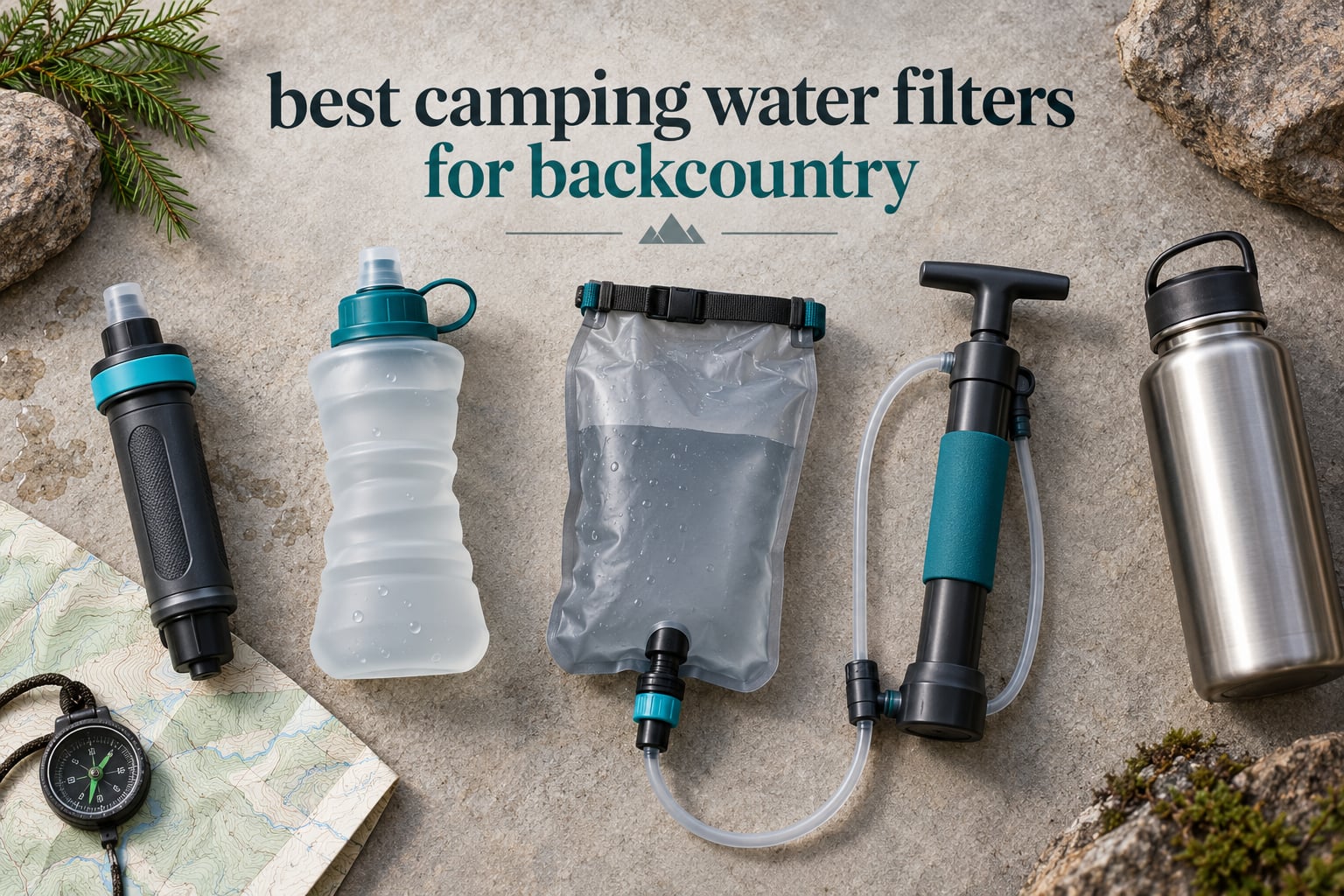
The short answer: for most hikers the Sawyer Squeeze is the best camping water filter for backcountry trips, because a 0.1 micron hollow fiber element weighing 2 ounces handles bacteria, protozoa, sediment and microplastics, runs at up to 1.7 liters per minute, and screws onto standard 28 mm bottles. Pair it with a CNOC Vecto bladder, carry chlorine dioxide drops as backup, and upgrade to a purifier only if you are drinking water downstream of farms or travelling internationally.
That consensus has not moved much in a decade, and it is why the Sawyer Squeeze still anchors the shortlist below. I spent six weeks working through ten of the most-used filters in the category, comparing pore size, real flow rate, pack weight, field maintenance and how each one behaved with silty water, frozen overnight in a pack, and used by more than one person at camp.
This guide covers the ten best camping water filters for backcountry use, from 2 ounce squeeze filters to 6 liter gravity systems and one pump rated to remove viruses. Each entry lists weight, pore size, rated capacity and flow rate drawn from the manufacturer data, plus the complaints that show up repeatedly in buyer reviews. I also added a troubleshooting section, because a clogged or frozen filter is a far more common trip-ender than a bad choice at the shelf.
If you are still working out how much water you actually need, our gravity water filter guide for emergency use covers the bigger-capacity end of the market, and the satellite messenger roundup covers the other piece of gear you carry when nobody is coming.
Table of Contents
Top 3 Picks for Best Camping Water Filters for Backcountry (October 2026)


The Sawyer Squeeze earns the top slot on evidence, not brand familiarity: it has the largest review base in the group at more than ten thousand ratings, a 4.7 average, individually tested units, and a manufacturer lifetime warranty against defects. The Survivor Filter PRO is the pick whenever virus coverage is non-negotiable, and the Katadyn BeFree is the one to pack when every gram counts.
All 10 Camping Water Filters at a Glance in 2026
| Product | Specifications | Action |
|---|---|---|
| Sawyer Squeeze |
|
Check Latest Price |
| Katadyn BeFree |
|
Check Latest Price |
| Survivor Filter PRO |
|
Check Latest Price |
 Waterdrop Gravity Filter Straw Waterdrop Gravity Filter Straw |
|
Check Latest Price |
 Katadyn Hiker Pro Katadyn Hiker Pro |
|
Check Latest Price |
 Platypus QuickDraw Platypus QuickDraw |
|
Check Latest Price |
 Sawyer SP160 Gravity System Sawyer SP160 Gravity System |
|
Check Latest Price |
 Membrane Solutions 6L Membrane Solutions 6L |
|
Check Latest Price |
 Katadyn Vario Katadyn Vario |
|
Check Latest Price |
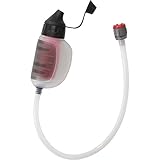 MSR TrailShot MSR TrailShot |
|
Check Latest Price |
1. Sawyer Squeeze Water Filtration System – Best Overall and Most Repairable
Sawyer Products SP129 Squeeze Water Filtration System w/Two 32-Oz Squeeze Pouches, Straw, and Hydration Pack Adapter
0.1 micron absolute hollow fiber
1.7 L/min max flow
71 g system weight
Rated 100000 gallons
Pros
- Only 2 ounces for the filter element
- Inline or gravity use
- Backflushes clean with the included syringe
- Every unit tested three times by the manufacturer
- Accepts 28mm threaded bottles and bladders
Cons
- Included 32 oz pouches split after heavy use
- Flow slows badly in silty water without a pre-filter
- Only 28mm threads fit
- Membrane is destroyed if it freezes
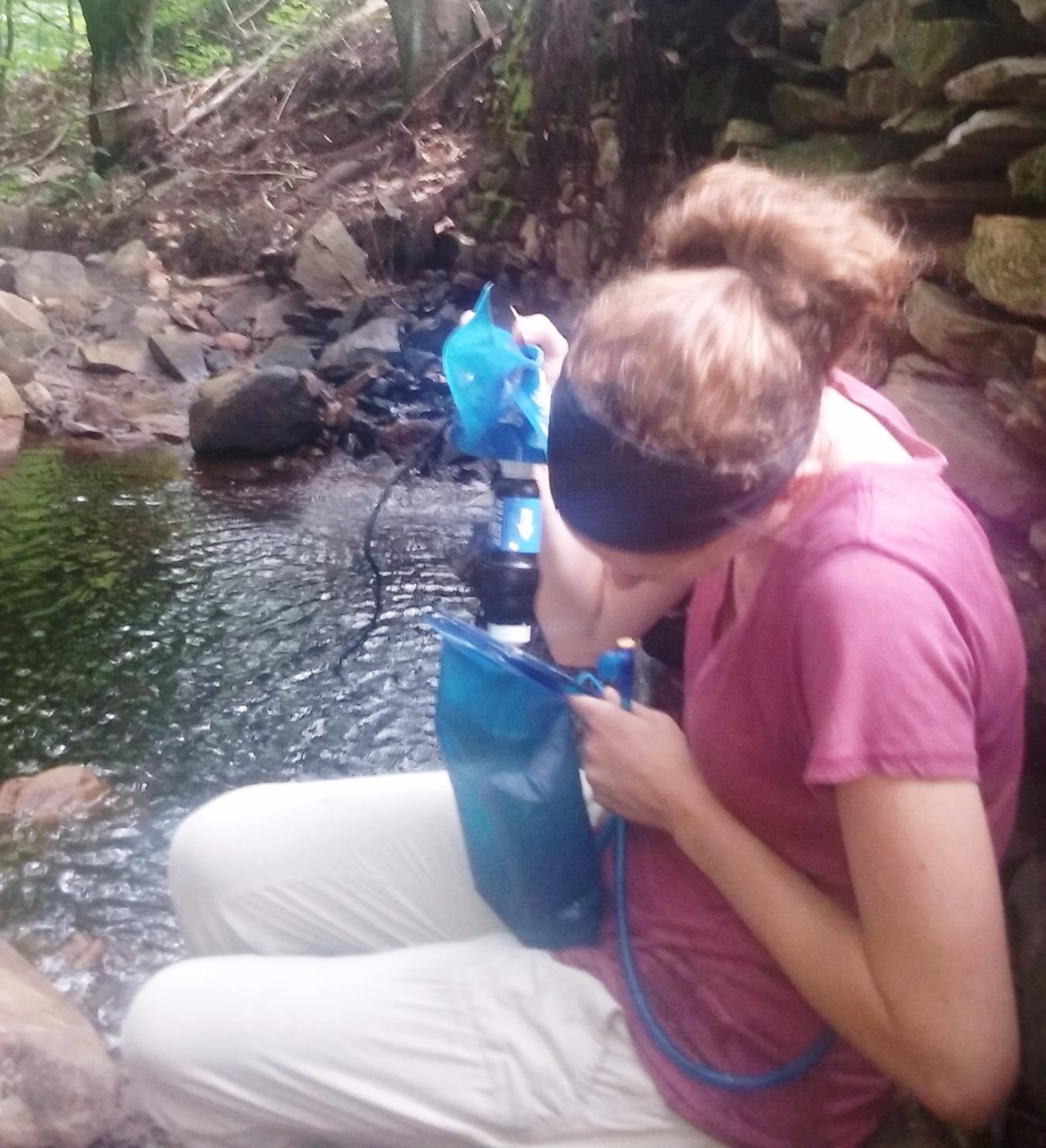
I have carried this filter on more trips than any other I own, and the reason is boring durability rather than headline specs. The element is 2 ounces, fits in a shirt pocket, and every unit is individually tested three times to performance standards before it ships. Rated capacity is 100,000 gallons against a manufacturer lifetime warranty against defects, so for a solo hiker the cartridge is effectively a lifetime purchase.
Flow is rated up to 1.7 liters per minute, which sounds modest next to some rivals but felt ample once water is carried a few hundred meters from source. The membrane is a 0.1 micron absolute hollow fiber, removing 99.999999 percent of bacteria, 99.9999 percent of protozoa and 100 percent of microplastics. Upper temperature rating is 40 degrees C, so it is a drinking-water tool, not a boiling substitute.
What stands out is versatility. The same element runs inline in a hydration pack, screws onto any 28 mm threaded bottle, and converts into a gravity system when you are not the one drinking. The kit ships with two 32 oz collapsible pouches, a replaceable pop-up straw, hydration pack adapters, a mesh storage bag and a backflush syringe, which is the most complete squeeze package here.
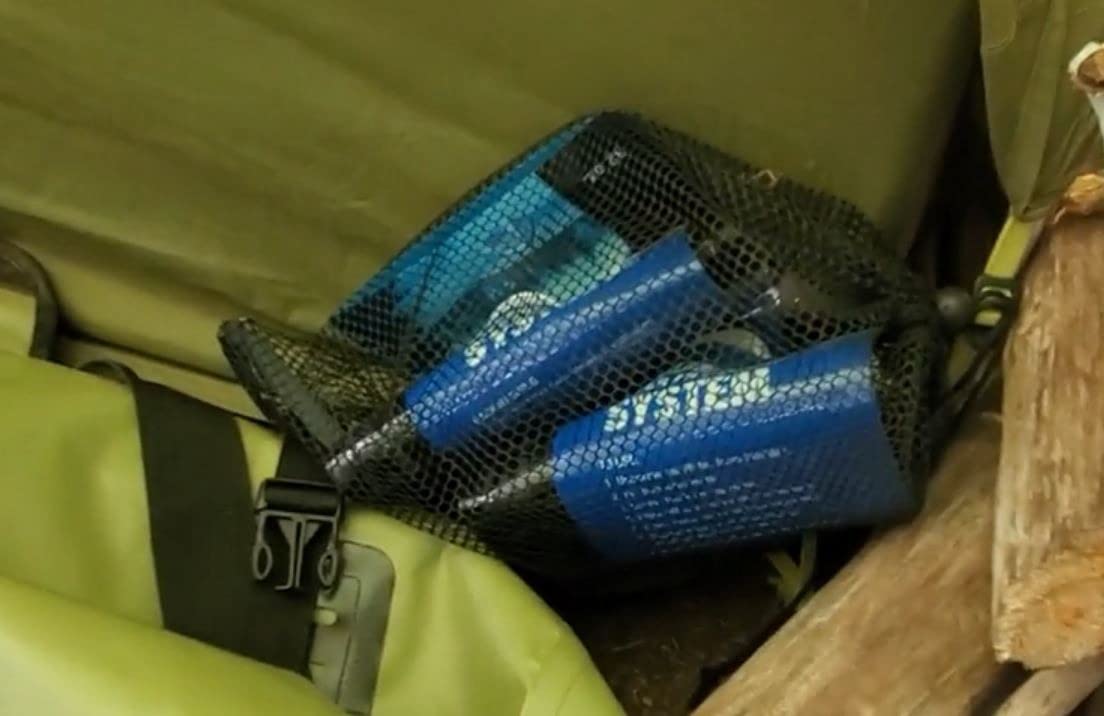
The included pouches are the weak point, and buyer reviews say so plainly. Folding and hard squeezing eventually splits the seams, and the standard fix in the hiking community is to swap them for a CNOC Vecto container or a Smartwater bottle. That substitution costs you nothing in performance because the filter is what does the work.
Field maintenance is the other reason it wins. The included syringe backflushes the membrane in seconds after a week of silty water, which is why this unit recovers flow when cheaper squeeze filters stay slow. The same review data also flags that frozen fibers are permanently damaged, so a filter that rides in a pack overnight below freezing needs to be treated as dead, not slept on.
Who the Sawyer Squeeze fits
It suits solo thru-hikers, couples, and anyone who wants one element that covers inline drinking, bottle filling and base camp gravity use. The 28 mm thread is also the most common standard in the bottle world, so it pairs with hardware you probably already own. Reviewers report owning several units, keeping one in the car and one in a bug-out bag.
It is also the easiest filter to field-repair, because a backflush needs no tools and the housing comes apart by hand. For a trip where a failed filter ends the trip, that matters as much as any spec.
Who should pass on it
Skip it if you are drawing from stagnant water downstream of farmland, since a 0.1 micron membrane does not stop viruses and this is not a purifier. Also skip it if you expect to filter for six people at once, since squeezing is a poor substitute for a gravity bag or pump at group volume.
2. Katadyn BeFree 1L Collapsible Water Filter Bottle – Best Ultralight Squeeze Filter
Katadyn BeFree AC 2-Stage Filter Collapsible Travel Water Bottle 1L, Clear
0.1 micron hollow fiber
2 L/min flow
2.24 ounces
Up to 1000 liters
Pros
- Collapses flat to the size of a paperback
- 2 L per minute squeeze flow
- Cleaning takes seconds with a shake or swish
- No disassembly or tools ever needed
- BPA-free body with replaceable carbon module
Cons
- Slight chemical or plastic taste when the filter is dry
- Slows in silty water
- Collapsed shape cannot be gravity fed
- No virus removal
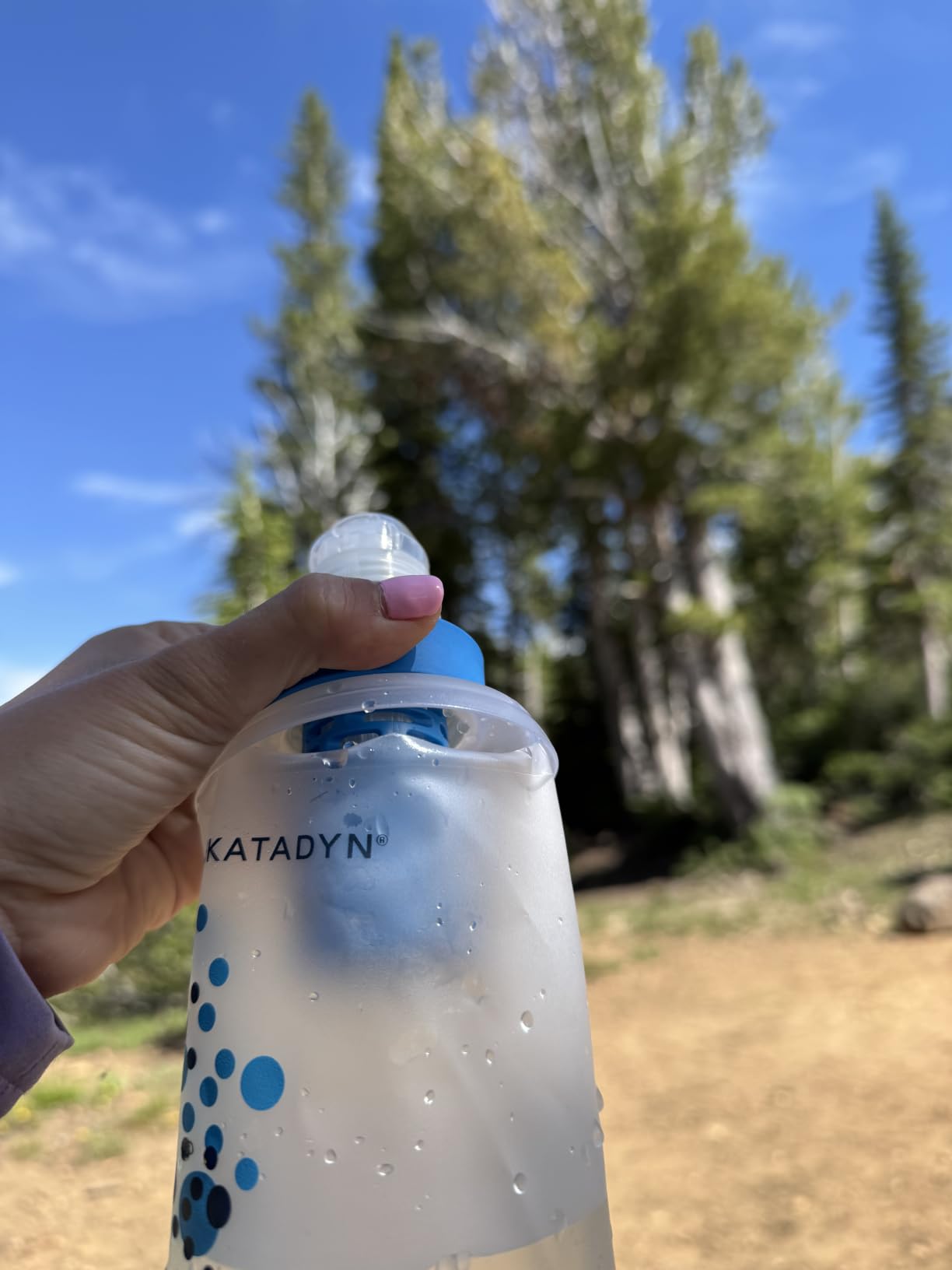
This is the filter to buy when your pack is already over budget and you refuse to cut anything else. At 2.24 ounces including the bottle, and rated at 2 liters per minute, it is the fastest squeeze flow in this group apart from the Platypus QuickDraw. The body collapses flat, so it lives in a vest pocket rather than eating pack volume.
The membrane is 0.1 micron hollow fiber with a modular activated carbon cartridge, rated for up to 1,000 liters. That carbon block is the reason the water tastes better than plain hollow fiber output, and it is replaceable as a module rather than being glued into the body.
Maintenance is the simplest in the group by a wide margin. There is no backflush to learn and no syringe to carry, because swishing the bottle in clean water restores flow. Over a week of desert travel that saved me more time than the flow rate advantage ever did.
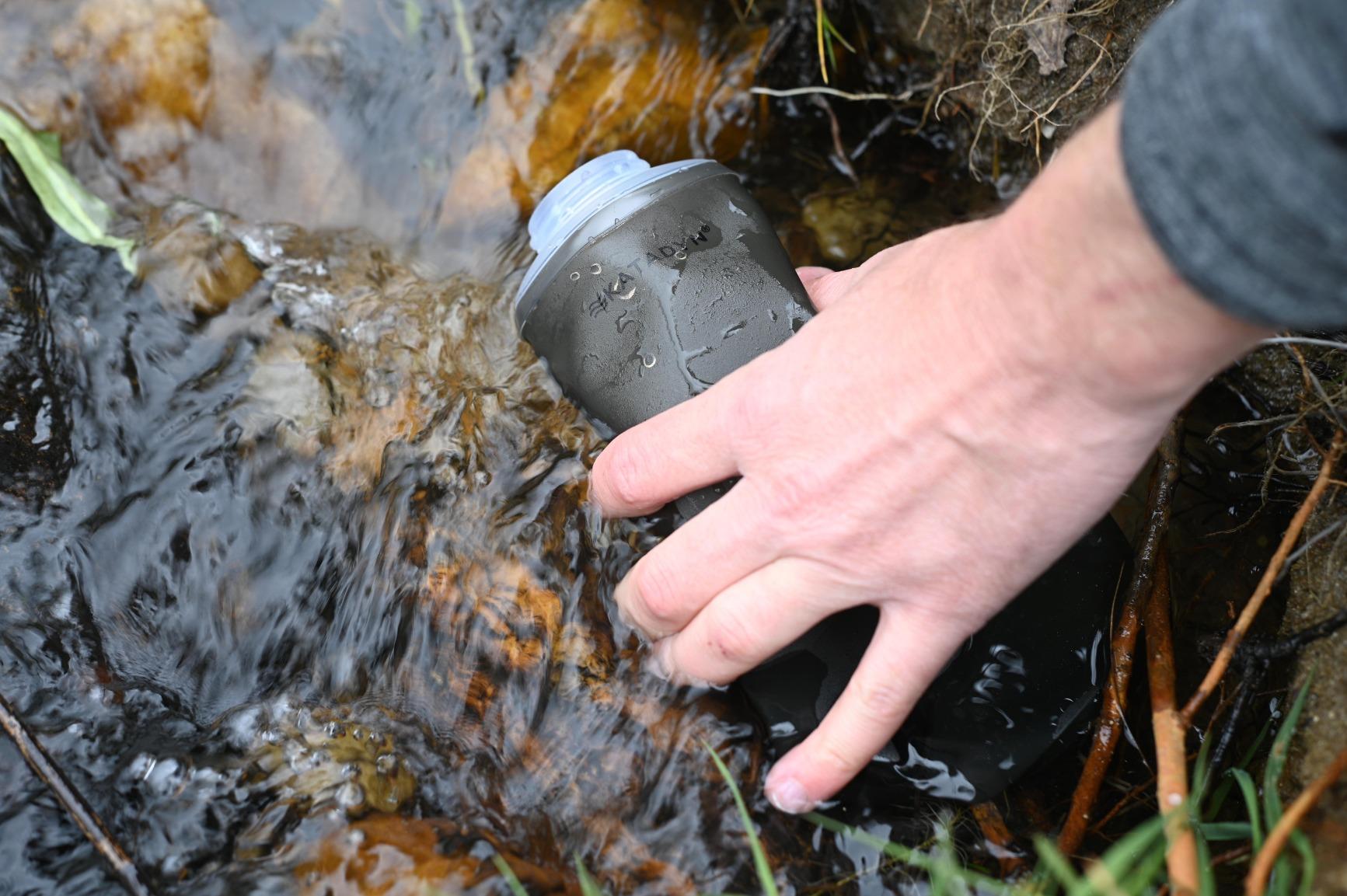
The recurring complaint is taste, and reviewers describe it as slightly chemical or plastic when the filter has been sitting dry. Run a few liters of water through it after unpacking and the complaint mostly disappears. It is a carbon cartridge artifact, not a sign of a failed membrane.
The second limitation is mechanical: the collapsed bottle shape only works with squeeze input, so you cannot hang it as a gravity system the way you can with a Sawyer element. Best suited to clear streams, it wants a pre-filter when the water turns silty.
Who the BeFree fits
It is the pick for fast hikers, ultralight thru-hikers, cyclists, and anyone who wants drinking water without a dirty bag ritual. Drink straight from the source, collapse it, pocket it. For travel where a bag would sit in a pack and never get used, that simplicity is worth a lot.
Katadyn has made water treatment gear since 1928, and the field support record matters if you lose a cartridge far from a trailhead.
Who should pass on it
Pass if you need to fill a group quickly, since one person squeezing a bottle is the whole design, and pass if you are drawing from virus-risk water. Anyone sensitive to taste in drinking water should read the carbon taste notes first.
3. Survivor Filter PRO – Best for Virus-Rated Water and Doubtful Sources
Survivor Filter PRO Portable Water Filter for Camping, Survival & Emergency
Three stage 0.01 micron system
500 ml per minute
12.8 ounces
Rated 100000 liters
Pros
- Only unit here rated to remove viruses
- Three replaceable elements cut long-term cost
- Carbon stage reduces heavy metals and improves taste
- Backflush syringe included
- Lifetime manufacturer defect warranty
Cons
- Heaviest and bulkiest unit in the group at 12.8 ounces
- Real pumping effort to fill a 32 oz bottle
- Pre-filter is hollow fiber rather than a screen
- Inlet hose end floats in current and pumps air
Every other filter in this roundup is a filter, not a purifier. The Survivor Filter PRO is the one exception, using a 0.1 micron pre-filter, a carbon stage, and a 0.01 micron ultra filter to remove 99.999 percent of tested virus, staph, bacteria and protozoa under NSF/ANSI protocols. For farm-downstream water, retention ponds, or international travel, that third stage changes the risk calculation entirely.
Flow is rated at 500 milliliters per minute, roughly 17 ounces, which is a realistic figure for a hand pump rather than a headline number. Operating range is 32 to 120 degrees F. The body is BPA-free ABS, and the protective sleeve doubles as a cup, which is a small thing that matters when you are scooping water at a pond in the dark.
The maintenance economics are the strongest argument. All three filter elements are individually replaceable and reusable, so you are not discarding a hundred-dollar unit when one stage wears out. The kit includes a back-washing syringe, inlet and outlet silicone hoses, a hose clip, a carrying case and an external ultra pre-filter.
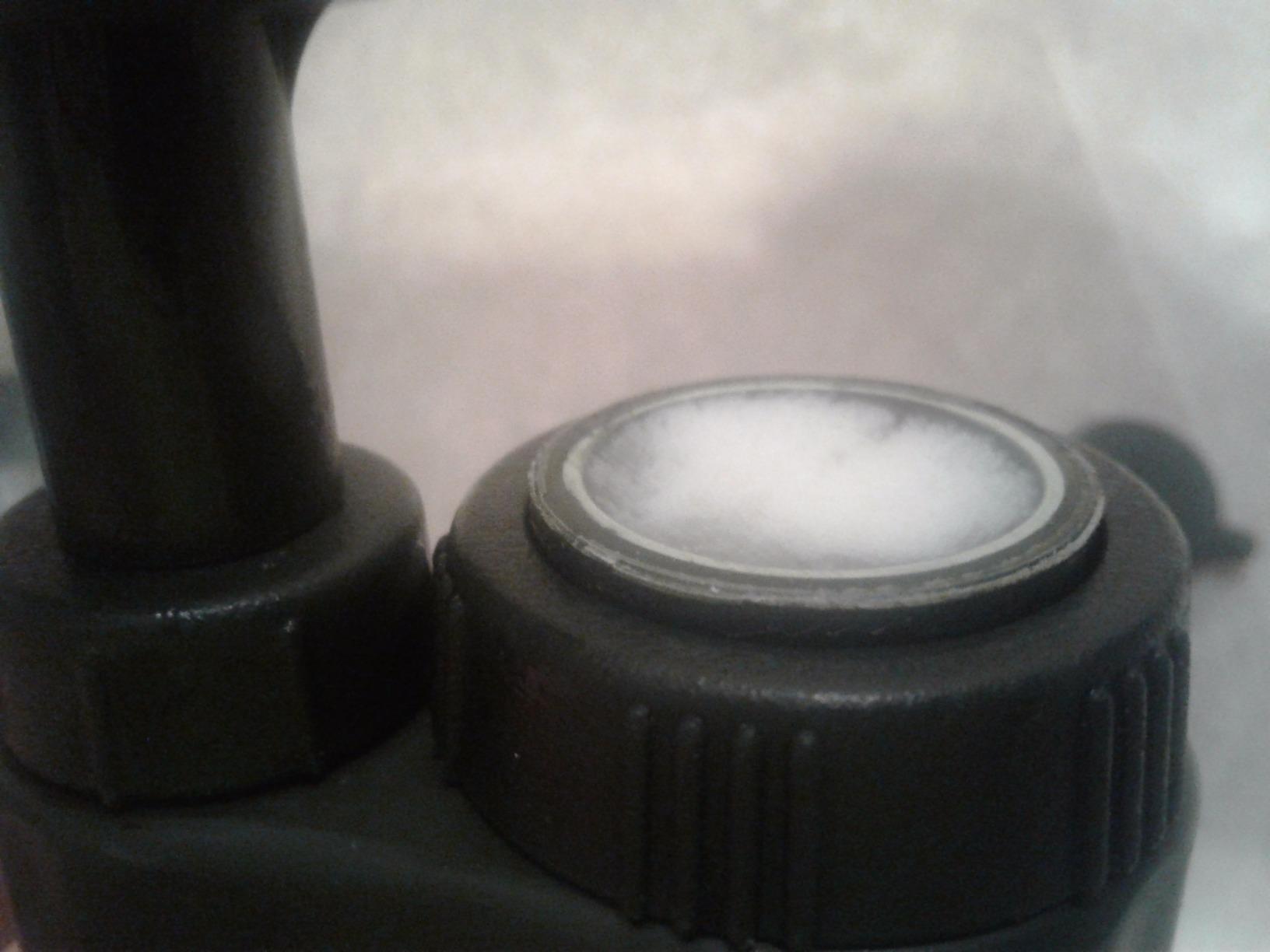
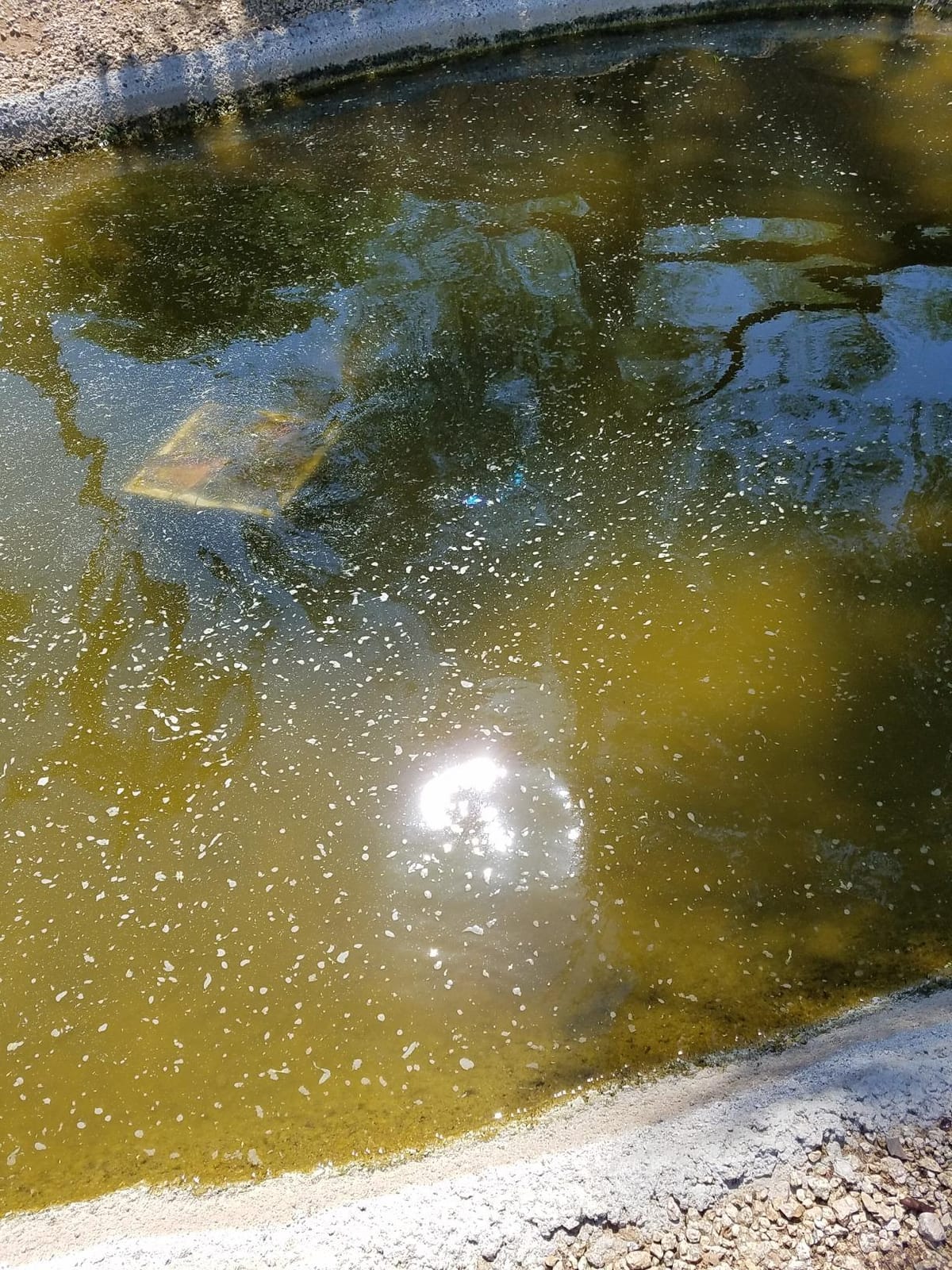
Reviewers treat it as the most capable unit in the group for algae-choked ponds and retention ponds, sources where a lighter hollow fiber filter would simply clog. The heavy metals and chemicals reduction from the carbon stage is a genuine bonus on industrial or polluted water.
The trade-offs are weight and labor. At 12.8 ounces it is the heaviest unit in the roundup, and filling a 32 oz bottle takes sustained pumping. Buyers also note the external pre-filter is itself hollow fiber, so in genuinely dirty water you still want a coffee filter or bandana over the intake.
Who the Survivor Filter PRO fits
It fits hikers in areas with human waste or agricultural runoff, and anyone whose water comes from standing sources rather than moving streams. It also serves as a car or cabin kit where weight does not matter but capability does.
If you can only carry one piece of water treatment for a trip through a developing region, this is the one. Filtration claims and a lifetime defect warranty make it the choice people defend most easily.
Who should pass on it
Pass if every gram counts, since a squeeze filter at 2 to 3 ounces does the same job for protozoa and bacteria. Also pass if you hate pumping, because there is no faster mode and no way to coax more than 500 ml per minute.
4. Waterdrop Gravity Water Filter Straw – Best Value Gravity Setup for Groups
Waterdrop Gravity Water Filter Straw, Camping Water Filter, 0.1 Micron
0.1 micron ultrafiltration
700 ml per minute
4.64 ounces
1400 gallon rated life
Pros
- Fast 700 ml per minute gravity flow
- 1.5 gallon bag covers a full day
- Backflush restores flow without replacing the element
- Disassembles to fit bottles as well as bags
- Under 5 ounces for the whole set
Cons
- TDS support rated to only 300 ppm
- 30 day limited warranty is far shorter than peers
- Straw style needs a source bag
- Backflushing requires a 27.5mm threaded bottle
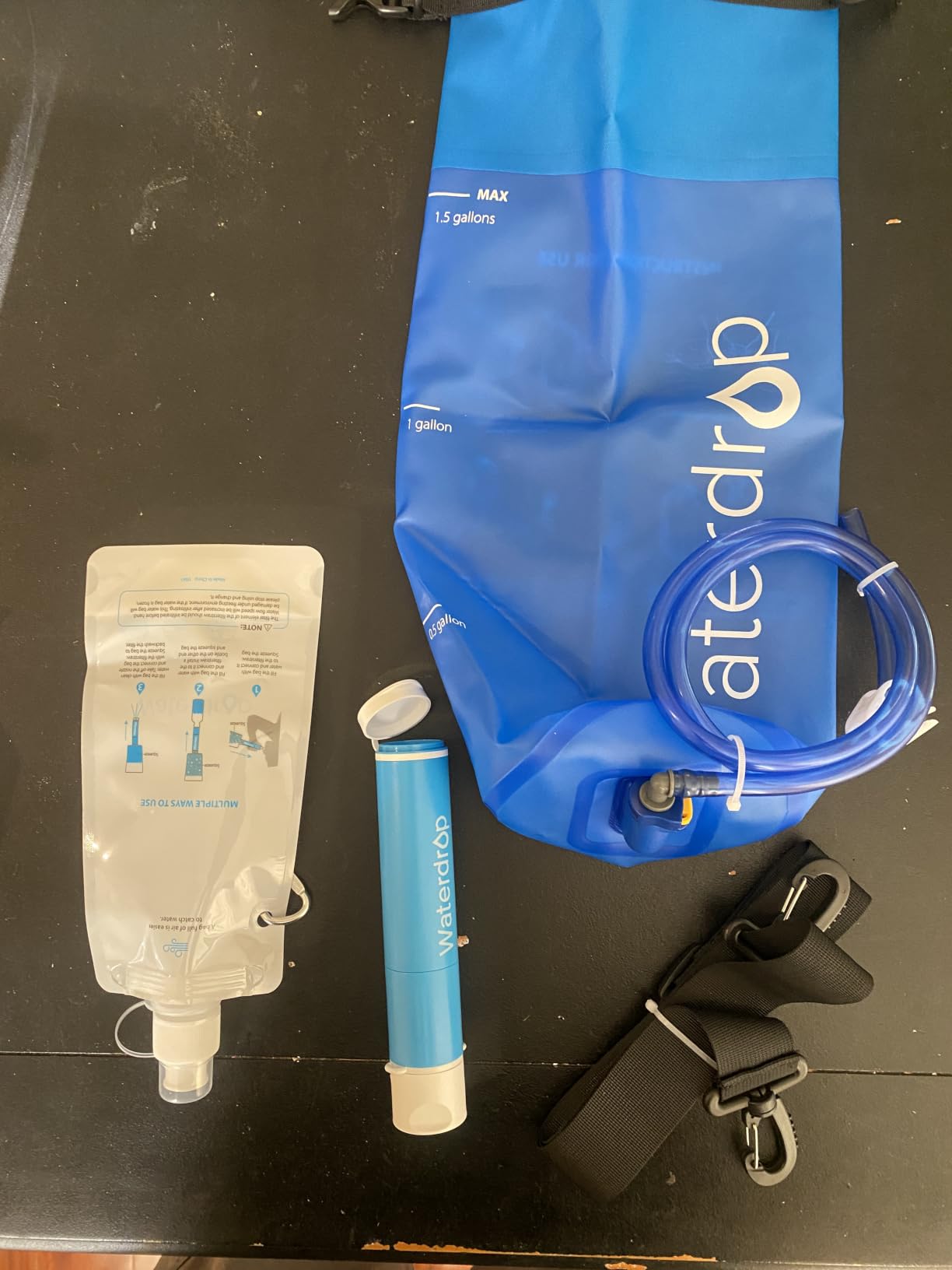
This is the value pick for a group of three or four who do not want to squeeze anything. Hang the 1.5 gallon bag, attach the straw, and it delivers up to 700 milliliters per minute with no pumping. At 4.64 ounces for the entire set, it is hard to argue with that math.
Filtration is a five-stage build around a 0.1 micron ultrafiltration hollow fiber membrane, rated for 1,400 gallons or 5,300 liters. The membrane reduces chlorine, particulates, sediment, stones, sand and dirt, which is what makes it usable on moderately silty sources without an external pre-filter.
Both ends of the straw disassemble, so the same element can be plumbed from a bag to a bottle or into a hydration reservoir. That flexibility makes it the easiest unit here to move between a day hike setup and a car-based camp.
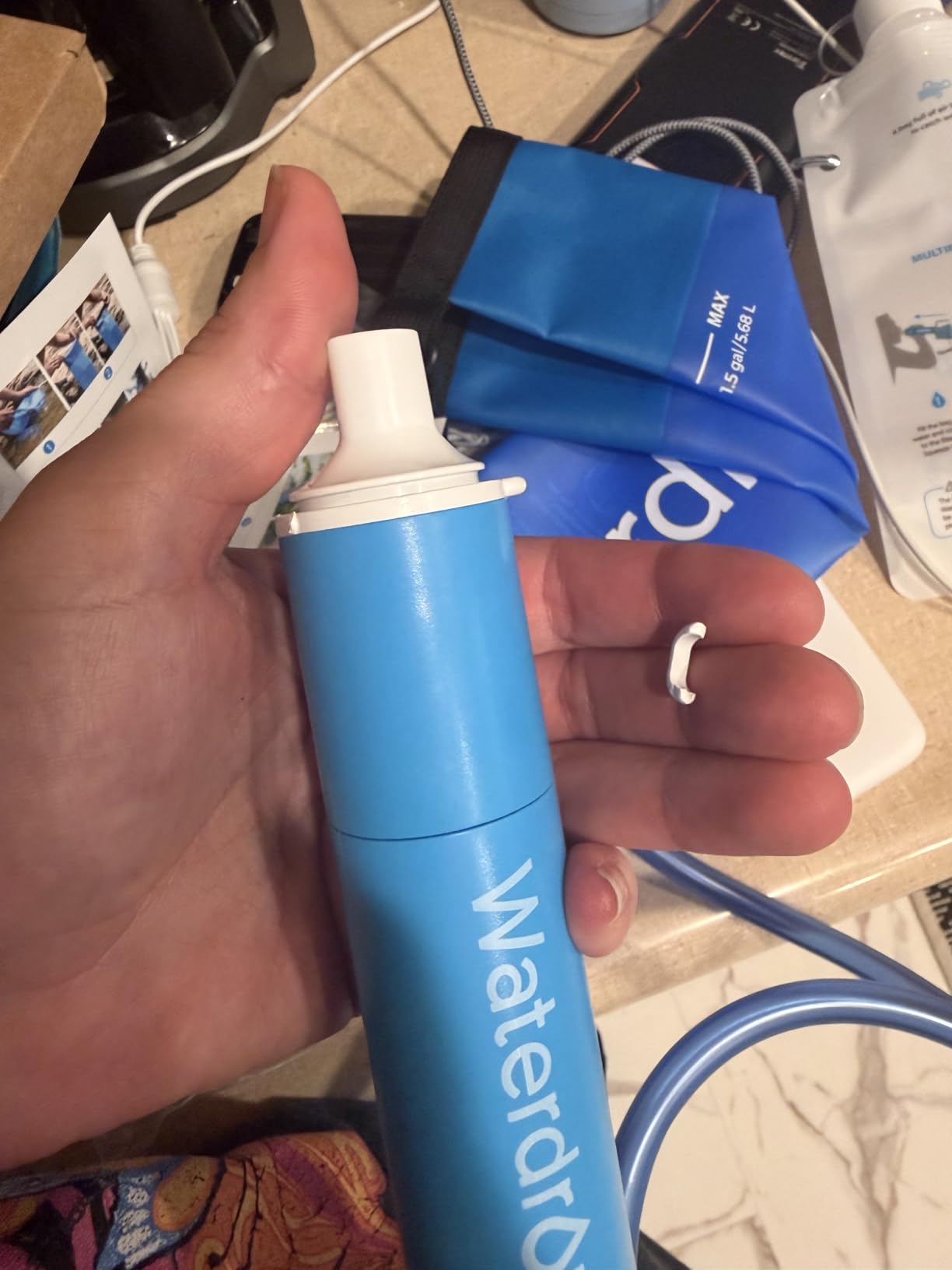
Two specifications deserve a pause before you commit. Maximum supported TDS is 300 ppm, well below the 1000 ppm range of most rival hollow fiber filters, so very hard or alkaline sources sit outside its comfort zone. And the warranty is a 30 day limited warranty rather than the lifetime defect coverage competitors offer.
Neither matters on a normal three-day trip with stream water, and both matter on a long expedition through limestone country. Buyers who pair it with chlorine dioxide drops report a comfortable all-day group solution for a fraction of what a premium gravity system costs.
Who the Waterdrop straw fits
It fits families and small groups at camp who want hands-free water without a pump, and it packs small enough to ride along with a day hiking kit. The 1.5 gallon reservoir is about eleven 500 ml bottles, which covers a normal day of drinking for two to three people.
It is also the sensible companion to a squeeze filter, since you can run the high-volume evening needs through the bag and save the squeeze for trail stops.
Who should pass on it
Pass if you camp in very hard water, if you want a warranty that lasts the decade, or if you want virus coverage. It is a bag-fed straw, not a drink-through unit, so you will be filling a container rather than sipping from a bottle at the source.
5. Katadyn Hiker Pro – Best Hand Pump for Shallow and Silty Sources
Katadyn Hiker Pro Transparent Hand Pump Water Filter
0.2 micron pleated glass fiber
1 L per minute
11.2 ounces
1150 liter cartridge
Pros
- Pumps a full liter per minute
- Transparent body shows cartridge condition
- Intake pre-filter and cleanable protector survive silty water
- Handles brown turbid river water
- Easy Fill adapter fits most bottles and packs
Cons
- Replacement cartridges cost a lot relative to the unit
- Some users report the intake valve failing mid-trip
- Hose setup takes practice to run efficiently
- 0.2 micron glass fiber does not remove viruses
The Hiker Pro is the pump I trust when the water is brown. Its 0.2 micron pleated glass fiber cartridge handles turbid river water far better than a hollow fiber element, and the cleanable filter protector plus intake pre-filter take the sediment load that would otherwise choke a membrane on day two.
It pumps a full liter per minute, which is enough to fill bottles at a stream without the arm fatigue that comes from slower pumps. The transparent housing is the feature long-term users mention most, because you can see the cartridge instead of guessing whether it needs cleaning.
Cartridge life is 1,150 liters, and activated carbon granules inside improve taste. The kit includes the intake hose with a modular pre-filter, an output hose with Easy Fill bottle adapter, a hydration system connector, a cleanable filter protector, a carry bag and instructions.
Long-term reviewers describe it as a workhorse trusted across decades of trips, which is the kind of claim a star rating cannot make. The single biggest complaint is cartridge pricing, with several noting a replacement costs a large fraction of a brand new filter, so budget for that before a season in silty country.
A smaller number report intake valve failures without warning, which is the kind of failure that ends a trip. The hose assembly also needs practice; once you have the rhythm of filling from a deep pool versus a shallow seep, the 1 L per minute figure is achievable.
Who the Hiker Pro fits
It fits desert and canyon travel, low-water crossings, and anywhere silty sediment is the main problem. It also works well for a two-person trip where each person wants to fill independently rather than sharing a bag.
If you want to see your filter working and know its condition at a glance, the clear housing is worth more than it sounds like it should be.
Who should pass on it
Pass if weight is your binding constraint, since 11.2 ounces is real pack weight for a solo hiker. Pass if you need virus removal, and think twice if you will filter hundreds of liters of silty water and hate paying for cartridges.
6. Platypus QuickDraw 1L – Fastest Squeeze Flow in the Group
Platypus Quickdraw Ultralight 1 Liter Backpacking Water Filter System, ConnectCap & DrinkCap
3 L/min squeezed
1.75 L/min in gravity
3.36 ounces
NSF and EPA P231 tested
Pros
- Fastest squeeze flow here at 3 L per minute
- Very light at 3.3 ounces
- ConnectCap threads onto 28mm SmartWater and soda bottles
- Testers report better taste than the BeFree
- Militarily rugged body
Cons
- Threads need extra turns past snug or it leaks
- Filters bacteria and protozoa only
- No backflush syringe included
- Smallest review base in the roundup
The QuickDraw posts the highest flow figure in this roundup at 3 liters per minute squeezed, and drops to 1.75 liters per minute when you reconfigure it as a gravity filter. The 1 liter reservoir has a wide mouth and a handle, so filling it at a source is quick even in moving water.
The hollow fiber element is individually tested to the NSF and EPA P231 protocol and removes 99.9999 percent of bacteria and 99.9 percent of protozoa. At 3.36 ounces for the whole system it sits neatly between a 2 ounce element and a full bottle setup.
Where it wins on details is compatibility. The ConnectCap threads directly onto any 28 mm bottle, including Smartwater bottles, select CNOC bags, and standard soda bottles, which removes the need to carry a dedicated container. Cleaning is tool-free, either a shake or a backflush.
This is also the newest and least reviewed product here, with a far smaller rating count than the established names. Reviewers who test it side by side with the Sawyer Squeeze and Katadyn BeFree report it is faster than both and tastes cleaner than the BeFree, which is why the rating sits at 4.7 despite the small sample.
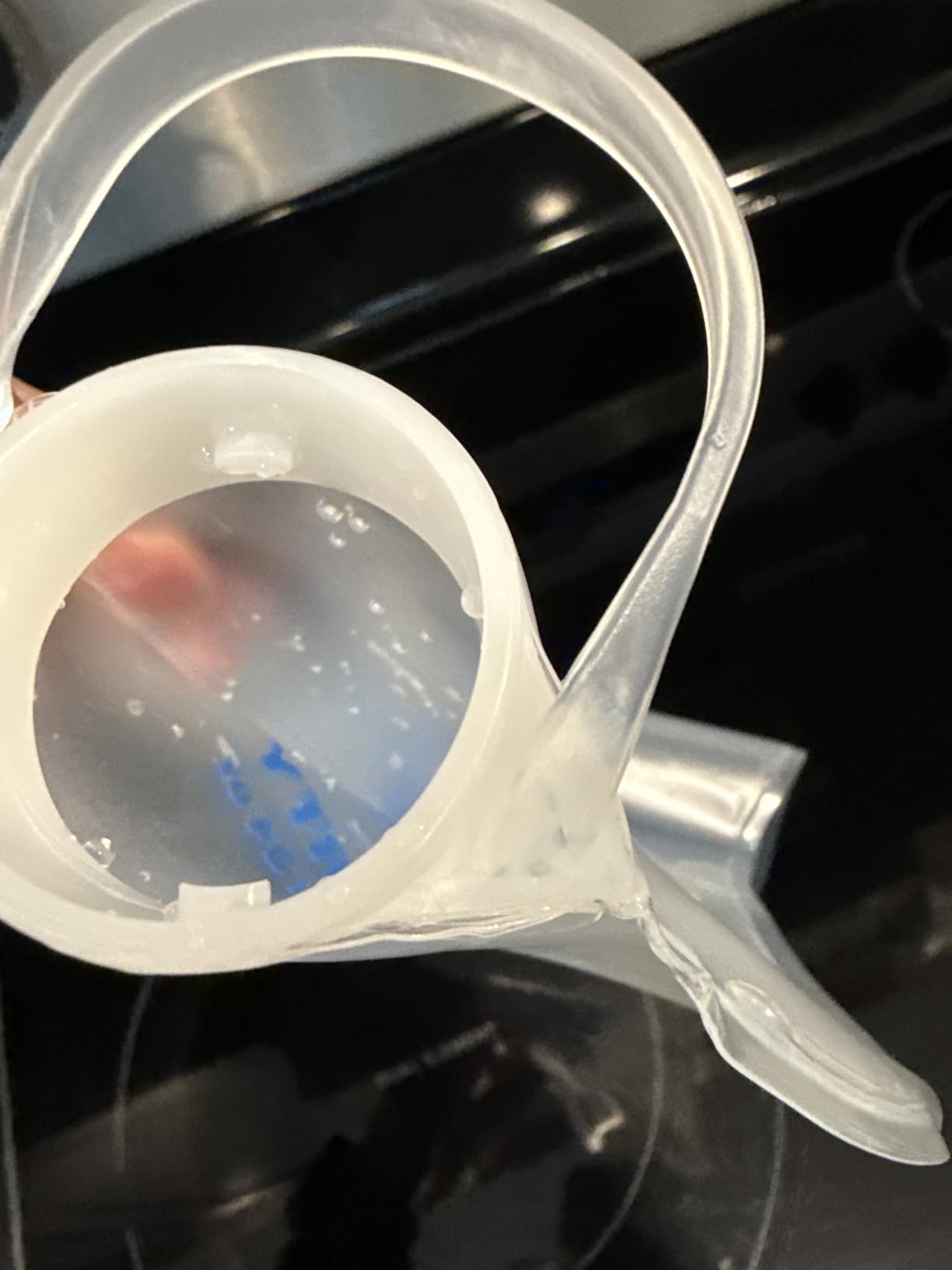
The one recurring practical note is the ConnectCap thread. It needs tightening well past the point where it feels snug, otherwise it leaks. Budget thirty seconds of attention the first time you attach it, and check it after a hard day in a pack.
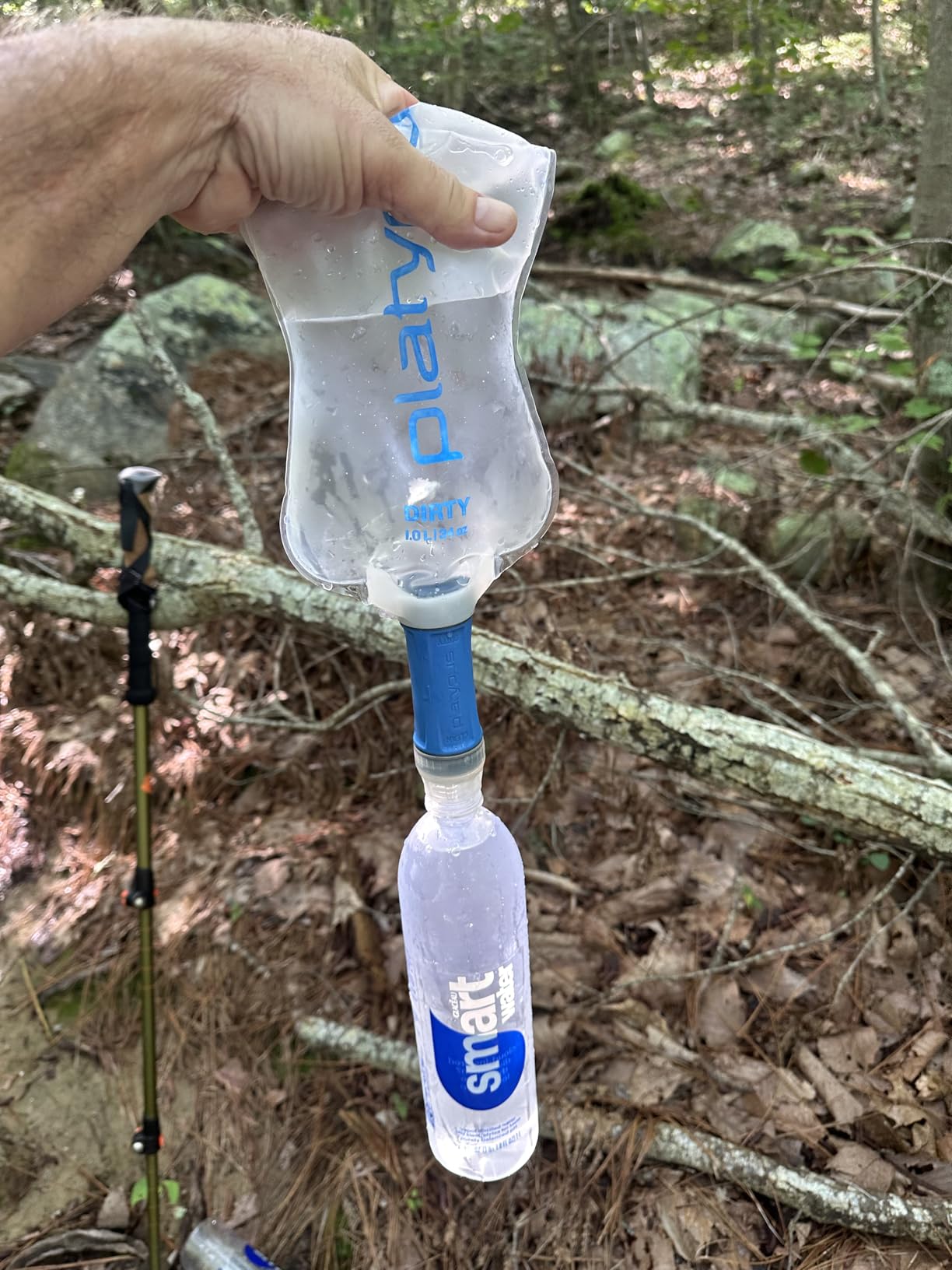
Who the QuickDraw fits
It fits hikers who fill up in a hurry, share campsites where the previous party left a dirty bag, or want one bottle ecosystem and one filter. The soda bottle compatibility means almost no dedicated gear to buy alongside it.
It is also a good pick for anyone who wants a second filter that lives in a daypack while a main filter stays in the big pack.
Who should pass on it
Pass if you want a long service record behind the purchase, since the review base is small compared with the Sawyer and Katadyn models. Pass if you need virus removal, and be prepared to retighten the cap rather than assuming a quarter turn seals it.
7. Sawyer SP160 One Gallon Gravity System – Best for Overnight Camp
Sawyer Products SP160 One Gallon Gravity Water Filtration System w/Dual-Threaded Mini Filter, Blue/White/Clear
One gallon gravity reservoir
2 ounce mini element
43 g system weight
Supports up to 2000 ppm TDS
Pros
- Hands-free water production with no pumping
- Mini element works inline or as a squeeze filter
- Interchangeable with other Sawyer components
- Easy to backflush with the included plunger
- Highest TDS support in the roundup at 2000 ppm
Cons
- Bag inlet is badly placed for shallow streams
- Semi-rigid bag is stiff and loud when it crinkles
- Bulky cap protrudes even when folded flat
- Bottle adapter can stall flow while the hose works better
The filter element is the same 2 ounce 0.1 micron hollow fiber mini unit, rated to 100,000 gallons, and every unit is individually tested three times. What you are really buying here is the reservoir and the gravity plumbing, which is why almost every complaint in the reviews is about the bag rather than the filter.
Running it is simple. Fill the one-gallon bladder, hang it, open the cap, and the dual-threaded filter doubles as an on-off fitting so nothing drips while the water is not being drawn. Maximum supported TDS is 2,000 ppm, the highest in this roundup, which matters in mineral country and desert rock sources.
The kit includes the mini filter, a one-gallon wide-mouth bladder, a cleaning plunger, a cleaning coupling, and a gravity hose with adapters.
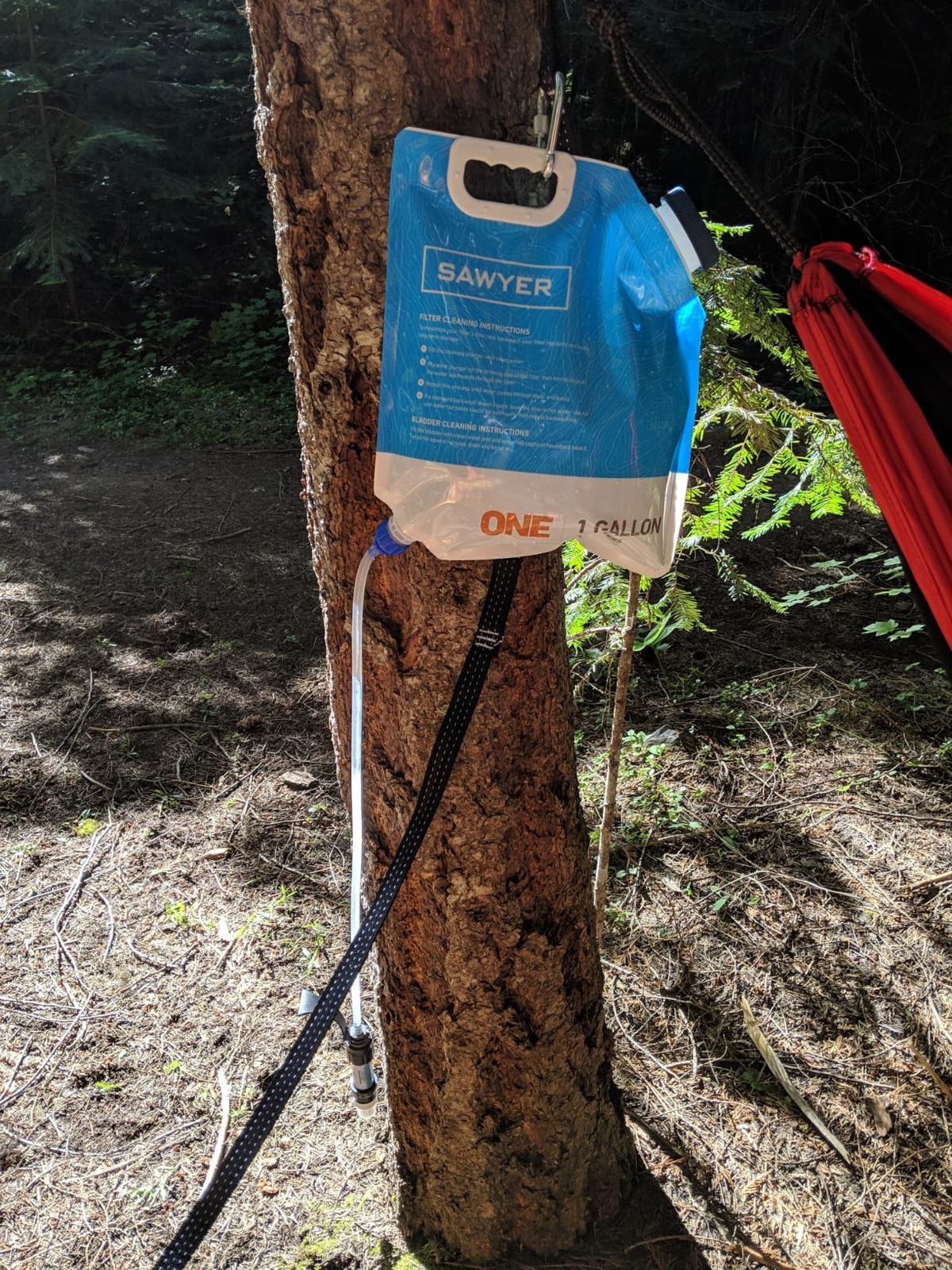
The bag is the weak point. The inlet is poorly placed, making it hard to fill from a shallow or slow-moving stream, and the semi-rigid material is stiff, loud when it crinkles, and does not pack down neatly. The cap also protrudes two to three inches even when the bag is folded.
A second practical note: the included male-to-male bottle adapter restricts airflow and can stall flow, while the hose attachment works better. Use the hose. Reviewers who accept these trade-offs say it transforms camp water logistics, and many report it tasting clean even from silty sources.
Who the SP160 fits
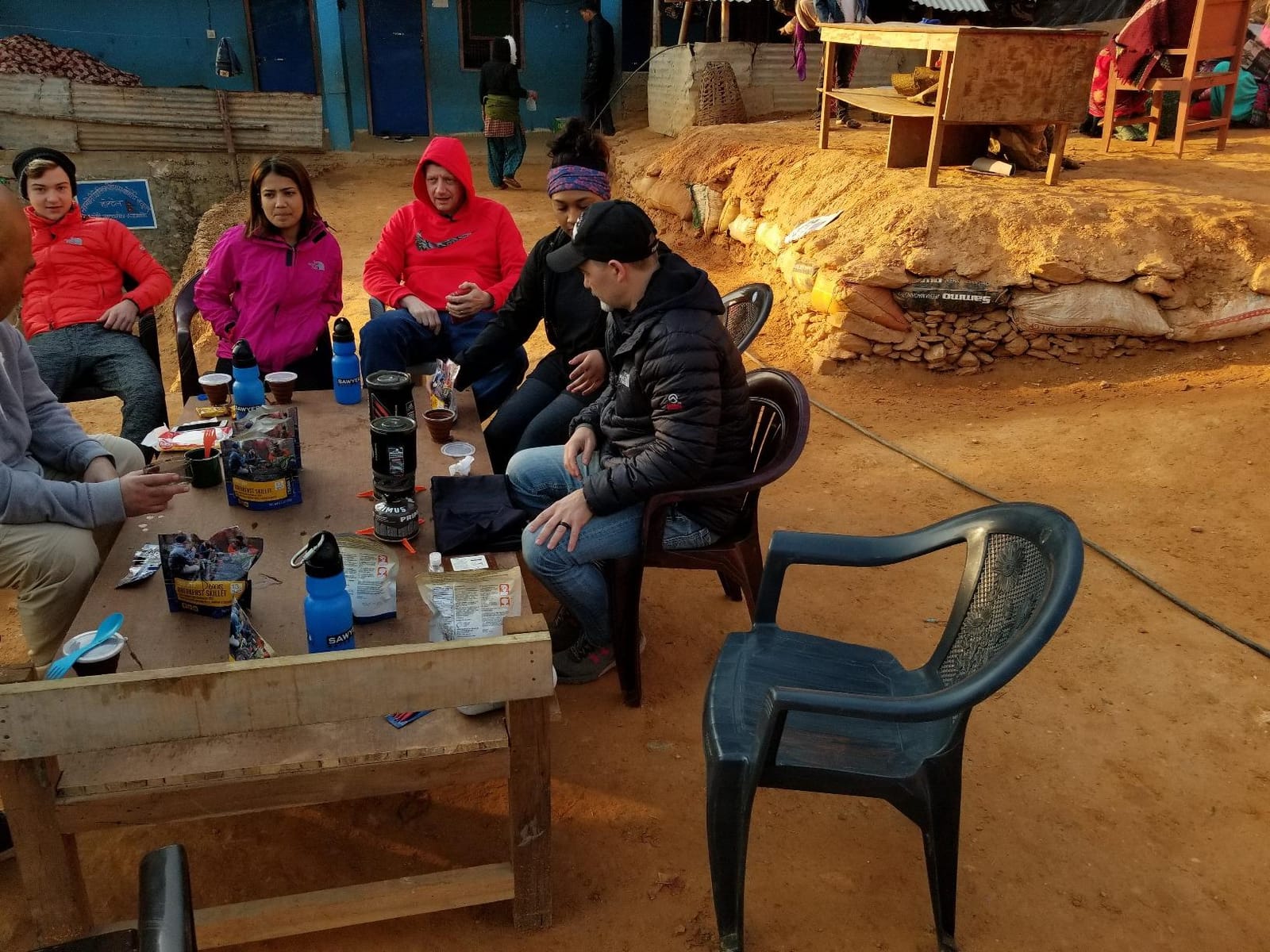
It fits anyone whose trip has an overnight or multi-night camp where nobody wants to pump or squeeze for a group. The mini element is also interchangeable with other Sawyer setups, so it composes with gear you already own.
Users report that pairing it with a squeeze filter gives you trail volume on the move and hands-free volume at camp from the same element type.
Who should pass on it
Pass if you need to fill the bag from a shallow puddle or a slow seep, because the inlet placement will frustrate you. Pass if pack volume matters, since the bag does not collapse flat, and pass if you need virus coverage.
8. Membrane Solutions 6L Gravity Filter Pro – Best for Groups of Three to Six
Membrane Solutions 6L Gravity Water Filter Pro for Group Camping
6 liter gravity reservoir
500 ml per minute
12.8 ounces
1320 gallon filter life
Pros
- Largest reservoir here at 6 liters for 3 to 6 people
- Coconut shell carbon stage improves taste
- Dual PP pre-filters protect the hollow fiber
- Runs hands-free with no pumping
- Reinforced hanging strap and puncture-resistant body
Cons
- Slower than a hand pump when a group needs water at once
- Collapses less flat than a squeeze pouch
- Some reviewers are unsure about trace bacteria reduction
- Not a virus purifier
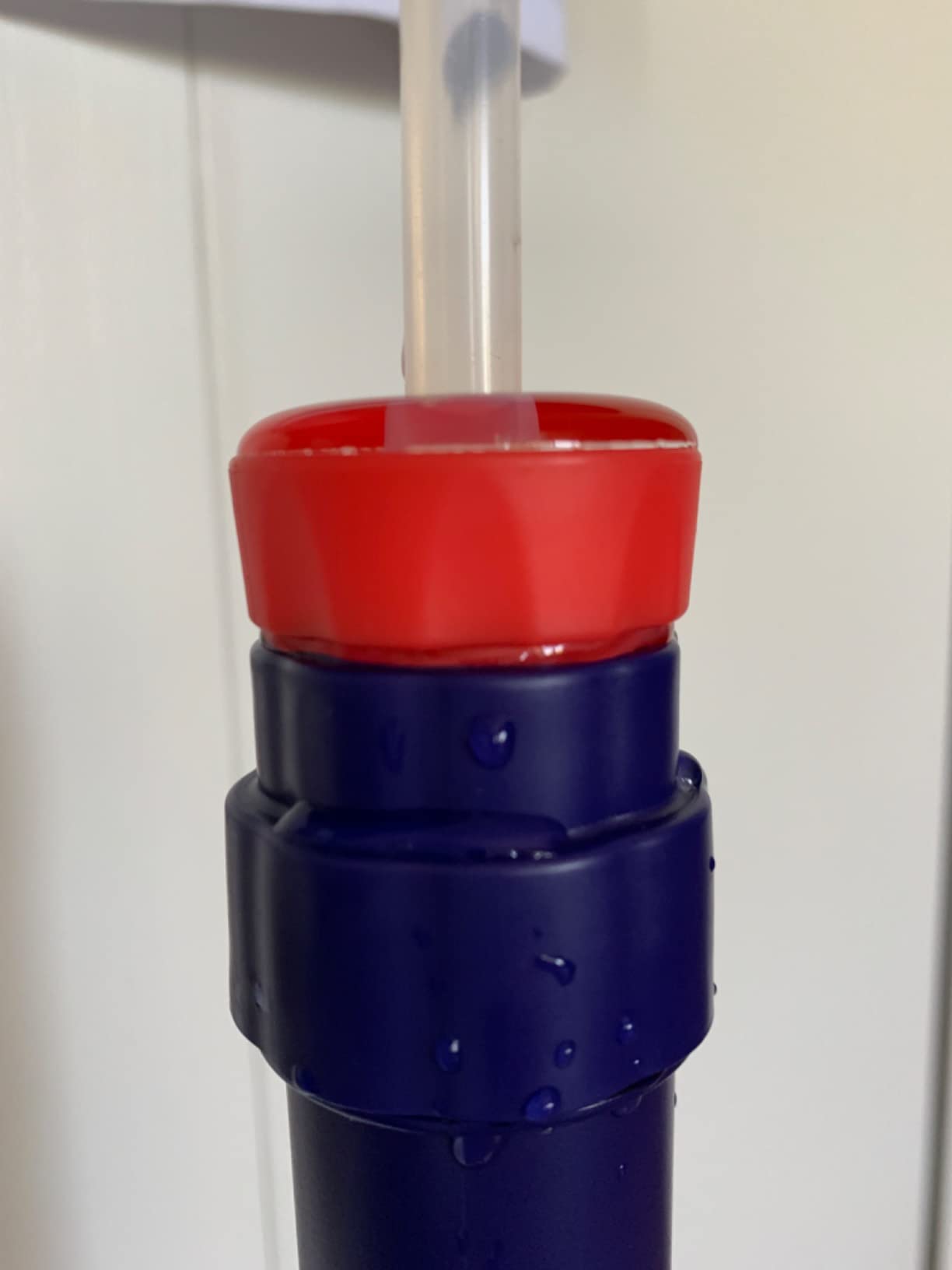
This is the volume option. The 6 liter bag is sized for three to six people, and the adjustable tree strap plus reinforced handle mean it hangs where you put it and stays put. Flow is 500 milliliters per minute, entirely pump-free, which is the trade you accept in exchange for never lifting an arm.
Filtration is a four-stage build: a 0.1 micron hollow fiber membrane, coconut shell activated carbon, and dual polypropylene pre-filters. It is independently tested by NSF and SGS to NSF/ANSI 42, 372 and 401 standards, and rated at 1,320 gallons or 5,000 liters of life.
The carbon stage is why the water tastes good, and the dual PP pre-filters are what keep the membrane from clogging when the source runs brown. Those two features together are why it holds flow better in sediment-laden water than most gravity units in the category.
The honest limitation is pace. At 500 ml per minute, filling bottles for a hungry group of six takes longer than a pump would take, and that is exactly when you will be tempted to skip filtering. Plan the fill before dinner rather than during it.
Some reviewers remain cautious about trace bacteria removal and pair it with tablets for questionable sources, which is a reasonable posture given that it is a filter and not a purifier. The warranty is one year, which is shorter than the lifetime defect coverage on the two Sawyer products.
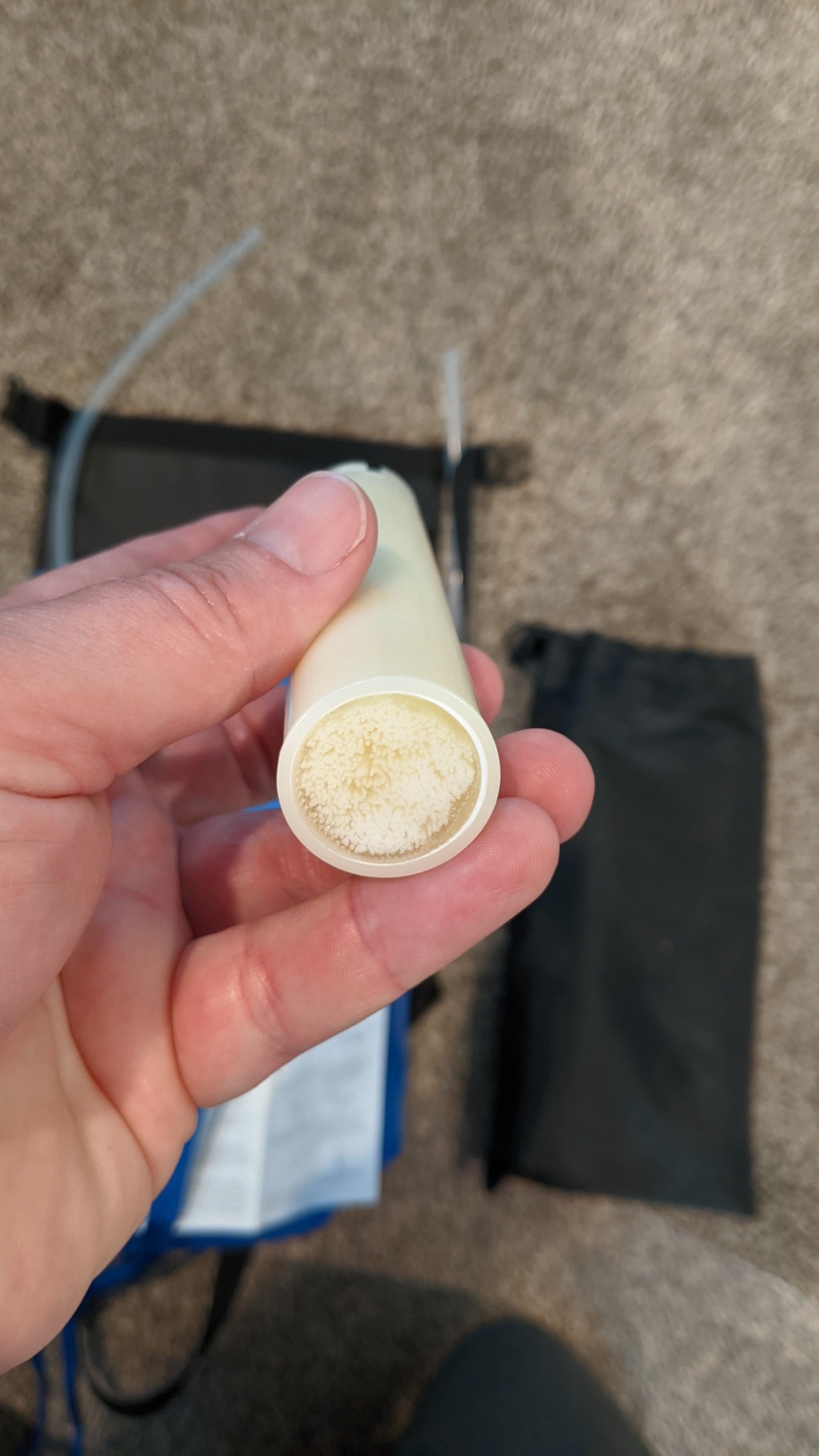
Who the 6L fits
It fits family base camp, canoe and shore access trips, and any group that has a reliable water source nearby. The wide mouth is useful for scooping, and the bag rolls down small enough to ride in a vehicle or a pack.
It is also the most straightforward emergency reserve, since six liters hanging in a garage or truck covers a household for a stretch without power.
Who should pass on it
Pass if your group needs water instantly at the moment of arrival, since the flow is modest. Pass if you will be at a virus-risk source, and pass if you need something that packs flat into an ultralight kit.
9. Katadyn Vario Dual Mode Pump – Best for Dirt Water You Cannot Avoid
Katadyn Vario Dual Mode Hand Pump Continuous Water Filter for Backcountry
Dual piston continuous flow
Up to 2 L per minute
Ceramic pre-filter
530 gallon cartridge life
Pros
- Filters on both push and pull strokes
- Up to 2 L per minute in Faster Flow mode
- Ceramic pre-filter can be scrubbed clean
- Mounts directly on a Nalgene or bladder
- Disassembles for air drying before storage
Cons
- Bulky and the largest unit in the group
- Can leak near the housing if pumped hard without cleaning
- Carbon and cartridge replacements are expensive
- Inner fiberglass takes days to dry fully
The Vario solves the one problem that beats most backcountry filters, which is water too dirty to filter. A cleanable ceramic pre-filter sits ahead of the 0.2 micron glass fiber cartridge, and you can scrub the ceramic clean and keep going after a day in silt.
The dual piston design filters on both the push and pull strokes, so a liter arrives in roughly half the time a single-stroke pump needs. Faster Flow mode delivers up to 2 liters per minute, and one turn of the dial switches between modes depending on what you are drawing from.
Rating is around 530 gallons, and the unit includes a float on the intake hose, an integrated Nalgene-compatible base, a cleaning pad and a carry bag. The screw-on base means you fill a wide-mouth bottle directly, without adapters.
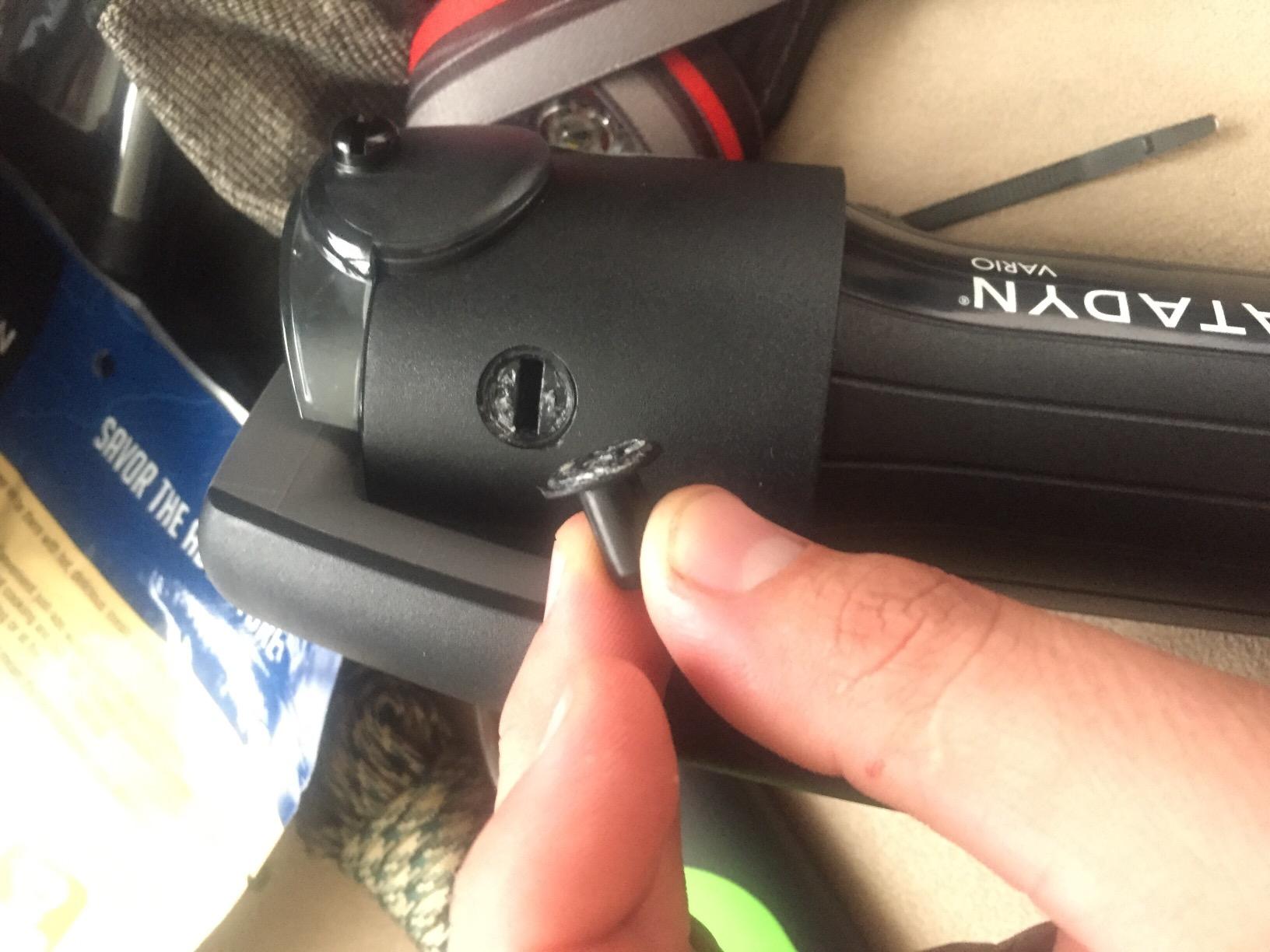
The complaints are about size and upkeep rather than function. This is the bulkiest unit in the roundup, and it can leak around the middle of the housing if you pump past a liter without pausing to clean. Replacement carbon and cartridges are expensive relative to hollow fiber alternatives.
Storage is the other annoyance: the inner fiberglass takes days to dry out completely, which matters if you do not want a wet filter riding in your pack for a month. Long-term owners report a decade of reliable use, so it is a buy-it-once tool rather than a seasonal one.
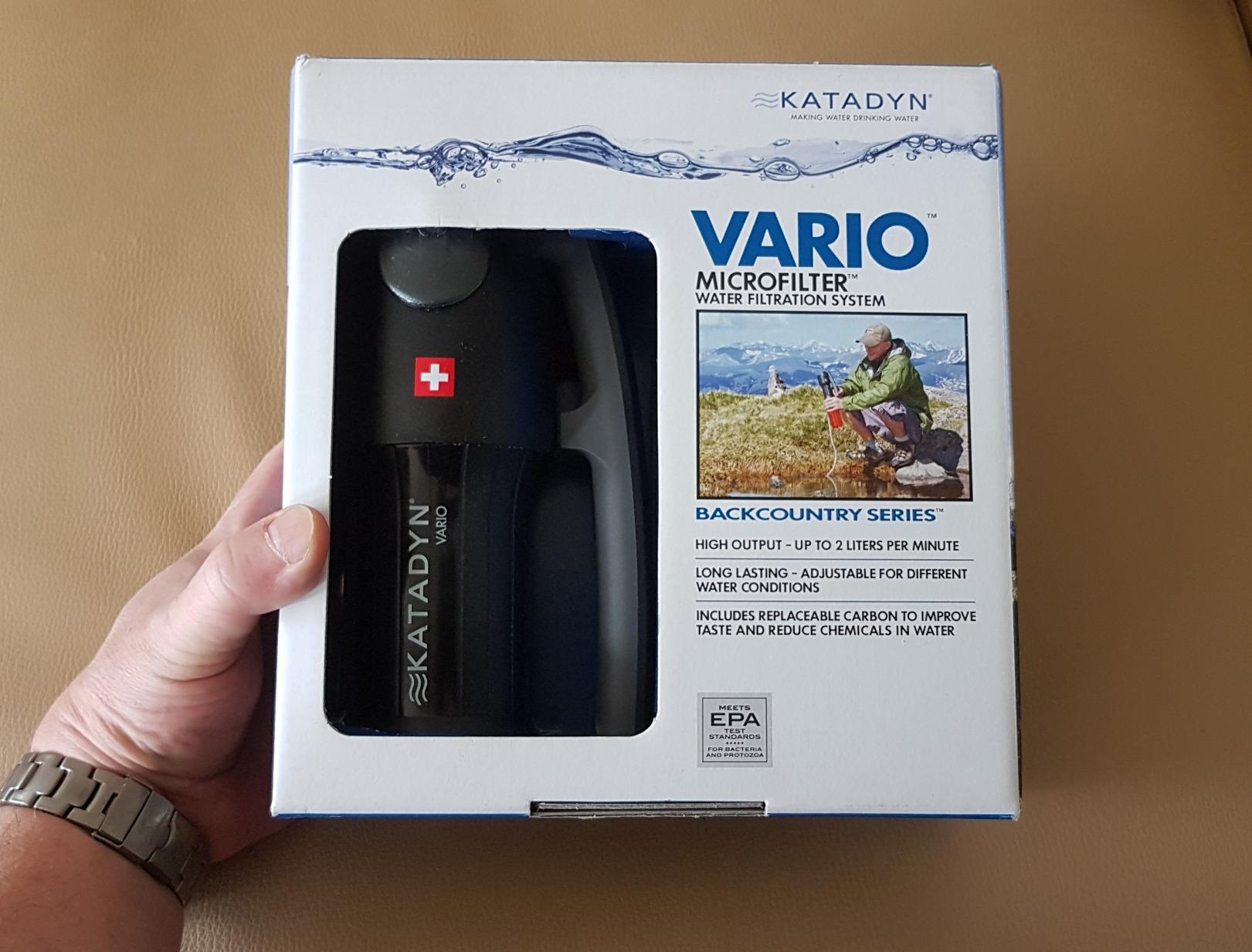
Who the Vario fits
It fits trips through silt-heavy lowland river country, monsoon season, and anyone whose water is consistently cloudy no matter where they fill. The scrubbable ceramic pre-filter is the reason long-term owners keep coming back to it.
It also works as a fast group pump when the source is clear, since both strokes contribute to output.
Who should pass on it
Pass if you need a small pack footprint or want something that dries out in a night. Pass if cartridge costs over the long term bother you, and pass if you need virus removal, since this is a filter with carbon, not a purifier.
10. MSR TrailShot Ultralight Squeeze Filter – Best for Drinking Straight From the Source
MSR TrailShot Ultralight Backpacking and Camping Squeeze Water Filter
1 L per minute hollow fiber
2000 liter capacity
5.44 ounces
15 inch detachable hose
Pros
- No dirty bag needed at all
- Detachable hose reaches trickles and shallow seeps
- About a liter per minute despite the small body
- Reverses for backflushing without a syringe
- One-handed operation works either hand
Cons
- Filters bacteria and protozoa but not viruses
- Does not reduce chemicals
- pesticides or heavy metals
- Soft rubber hose nicks easily and has no protective pouch
- Short hose for deep or awkward sources
The TrailShot removes one of the most disliked steps in backcountry water collection: the dirty bag. You drink directly from the source, so there is no scoop, no bag, and nothing to clean afterward. Reviewers who switched from pump filters cite exactly that as the reason to keep it.
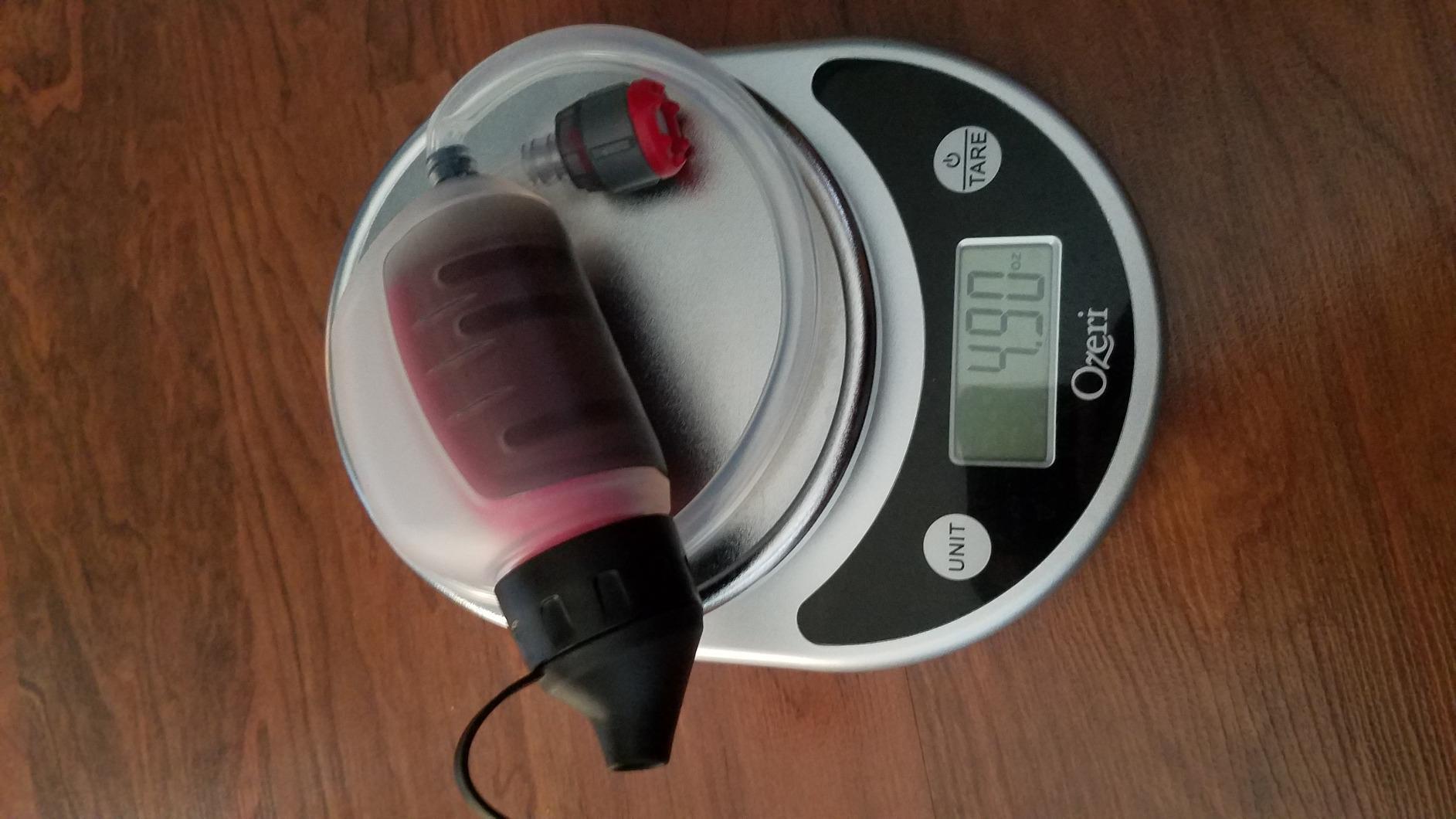
Flow is about 1 liter per minute through a hollow fiber membrane that removes 99.9999 percent of bacteria, 99.9 percent of protozoa, and particulates, with a rated capacity of 2,000 liters. The body is 6 by 2.4 inches at 5.44 ounces, and it operates down to 33 degrees F.
The detachable 15 inch hose with a coarse pre-filter is the reason it works in places other filters cannot reach, including small trickles and shallow seeps. It reverses for backflushing, so you do not need to carry a syringe.
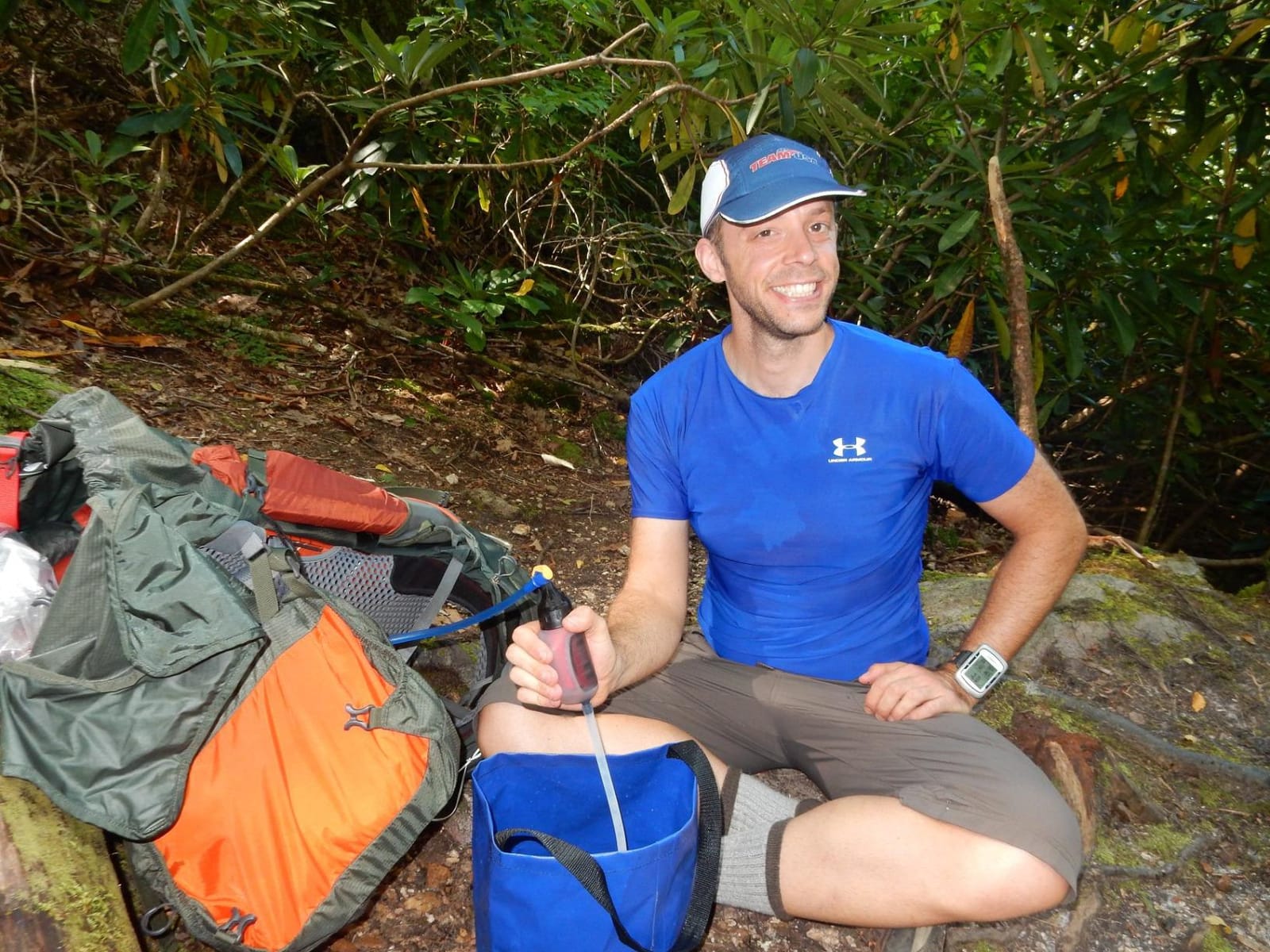
The hose is also the main weakness. It is soft rubber, picks up nicks, and no protective pouch is included, so it will abrade in a pack over a long trip. Experienced users also stress that this is a filter, not a purifier, and that viruses and dissolved chemicals need a separate treatment step.
Filling takes longer than a fill-and-squeeze design when a partner is filtering alongside, and the hose is short for deep pools. If your water comes from a good deep source rather than a trickle, that limitation shows up fast.
Who the TrailShot fits
It fits trail runners, mountain bikers, and day hikers who want water in hand with no assembly and no cleanup. The one-handed operation matters when you are holding a trekking pole in the other hand.
It is also a good second filter for a two-person trip, where each person can drink independently at a seep.
Who should pass on it
Pass if your sources are deep pools rather than trickles, and pass if virus coverage or chemical reduction matters. Anyone carrying it on a long trip should budget for a hose sleeve or a small pouch to keep it from abrasion.
Why Your Backcountry Water Filter Gets Slow, and How to Fix It
Slow flow is almost always one of four things: sediment on the membrane, a frozen element, a failed pre-filter screen, or a cartridge near the end of its rated life. Diagnose which one before you replace anything, because most slow filters recover in under two minutes of field work.
Common causes of fast clogging include drawing from directly under a bank where fine sediment enters the intake, running a pre-filter that was never meant to be washed, and backflushing less often than you think you need to. Filters also clog faster in spring runoff and after rain, when the water carries the most particulate.
Filter life figures are theoretical ceilings, not schedules. A 100,000 gallon rating assumes clean water; a 1,320 gallon rating assumes something closer to average source quality, so the same number means very different things in a mountain creek and a desert wash.
How to unclog a filter in the field
1. Backflush first. Fill a clean bottle, attach the backflush syringe if your filter has one, fill it with clean water, and push it through the element in the reverse direction of normal flow. This lifts sediment off the fiber instead of pushing it deeper.
2. If there is no syringe, use the hose or the bottle. The MSR TrailShot reverses on a squeeze, and the Katadyn BeFree and Platypus QuickDraw restore flow by shaking or swishing the reservoir in water. Squeeze-clean methods work because the shock of reverse flow sheds the outer layer of debris.
3. Check the pre-filter, not just the membrane. Unscrew the intake pre-filter or filter protector and rinse it. On pumps like the Katadyn Hiker Pro and Vario this is the difference between a cartridge that lasts a season and one that lasts a weekend.
4. Add an external screen at the source. A coffee filter, a bandana, or a sock over the intake keeps coarse sediment out before it ever reaches the fiber. This is the single highest-value habit for anyone drawing from silty water.
5. Move your source. If flow is slow because you are filling from a shallow puddle, filling from upstream or from faster-moving water solves it instantly. The best fix for a clogged filter is often a 200 meter walk.
If a filter stays slow after a backflush and a source change, the element is probably at the end of its life. A ceramic pre-filter can often be scrubbed back into service, while a pleated glass fiber cartridge is usually a replacement job.
Frozen filters deserve their own warning. Hollow fiber membranes fracture permanently when they freeze, and the failure is silent: the filter still pours water, just not clean water. Any filter that rides in a pack overnight in cold conditions should be inspected in daylight, and the answer to a failed integrity test is always replace, never hope.
For filtration at home rather than on the trail, our under-sink filter roundup covers the installed systems, and the countertop filtration guide for renters covers setups that need no plumbing.
How to Choose a Camping Water Filter for Backcountry
Start with the single most important question: where does your water actually come from? A clear alpine stream at 10,000 feet and a shallow desert seep 200 meters downstream of a cattle trough are different problems, and no single filter solves both at once.
Filter, purifier, or chemical drops
A filter strains out bacteria and protozoa, including giardia, cryptosporidium and E. coli, through a physical membrane rated at 0.1 to 0.2 microns. That covers nearly every North American backcountry source.
A purifier does what a filter does and also inactivates viruses, which is what you need for standing water, water below farms or settlements, and international travel. In this roundup, the Survivor Filter PRO is the only unit rated for viruses.
Chemical drops such as chlorine dioxide need contact time before drinking, need no cleaning, and treat viruses, which makes them the standard backup layer rather than the primary tool. Carrying drops alongside a filter is cheap insurance against a cracked hose or a frozen membrane.
What a backcountry filter does not remove
Understand the limits before you rely on one. A 0.1 micron membrane is a sieve, not a chemistry set, and dissolved contaminants pass straight through it regardless of how good the marketing sounds.
Viruses – Pass through a 0.1 micron membrane. Need a purifier rated to 0.01 micron or a chemical treatment.
Dissolved chemicals, pesticides, fuel, heavy metals – Not removed by hollow fiber. A carbon stage helps with some, but it is a partial measure.
Algae blooms and cyanotoxins – Not reliably removed by any backcountry filter. Avoid the source entirely.
Salt and very hard mineral water – Passing through a hollow fiber. Check the supported TDS figure; units here range from 300 ppm to 2000 ppm.
How much water you actually need
Plan on roughly 3 to 4 liters per person per day for drinking and cooking on a mild trip, and closer to 5 liters in heat. A solo hiker therefore needs about 12 liters a day, which a 2 liter per minute squeeze filter delivers in seconds. A group of four needs 48 liters, which is 50 liters of pump output or one full pass of a 6 liter gravity bag, repeated.
That math is the whole case for gravity systems. Once more than two people are involved, a hand pump or a hung bag beats every squeeze filter, because the limiting factor becomes human effort rather than membrane speed.
Matching a filter to your trip
Solo thru-hiking, ultralight, clear alpine water: a 2 to 3 ounce squeeze filter such as the Sawyer Squeeze or Katadyn BeFree, plus a 28 mm bottle, plus drops.
Two people, mixed sources: the Platypus QuickDraw for its 3 L per minute flow and soda bottle compatibility, or a Sawyer Squeeze with two pouches.
Family or group base camp: a gravity bag such as the Membrane Solutions 6L or the Waterdrop straw with its 1.5 gallon reservoir, hung at camp and filled on demand.
Desert, canyon, or shallow seeps: a pump with a scrubbable pre-filter, meaning the Katadyn Hiker Pro or Vario, plus a real pre-filter screen at the source.
Farm country, retention ponds, or international travel: a virus-rated purifier such as the Survivor Filter PRO, with drops as a second layer.
Road access, car camping, or home backup: the Sawyer SP160 or the Membrane Solutions 6L, where the only limit is what fits in the vehicle.
The bottle and bladder ecosystem
This is where most people spend more than they need to. The 28 mm thread is the common denominator, and most Smartwater bottles, CNOC Vecto containers, soda bottles and many hydration bladders use it. A filter with a 28 mm cap drops into gear you already own.
The pairing the hiking community converges on is simple: one squeeze filter for trail volume, a CNOC Vecto or Smartwater bottle for drinking, and a collapsible bag for anything that is not clean. If your filter only accepts 27.5 mm, as the Waterdrop backflush does, you are shopping in a narrower aisle.
Maintenance tolerance, stated honestly
Every filter here needs care, and the difference is how much. Shake-and-swish systems need seconds. Syringe backflush systems need a bottle of clean water and thirty seconds. Pleated glass fiber cartridges with cleanable protectors need the most, but they also survive the worst water.
Weight tolerance matters just as much. If you will not backflush and cannot remember a cleaning routine, choose a unit that is nearly maintenance-free. Our hard water guide covers the TDS question from the home side if you are weighing mineral content.
Backflushing, Storage and Freeze Protection
Field-cleanable gear is what separates a filter that lasts ten years from one that gets replaced every season. Every hollow fiber unit in this roundup can be cleaned, but the methods differ enough that it is worth reading your specific manual once before the trip.
Backflushing reverses flow through the membrane so sediment lifts off the fiber instead of embedding in it. Do it after any stretch of silty water and before you put the filter away. For squeeze units, a backflush syringe is the fastest method; for the BeFree and QuickDraw, a shake or swish does the same job without tools.
Pumps have more to service. Unscrew the cleanable filter protector and intake pre-filter and rinse them separately, which is what protects the expensive cartridge underneath. On the Katadyn Vario, scrub the ceramic disc and let the glass fiber cartridge dry fully for days before storage.
Storage rules are simple: dry it, and keep it from freezing. A wet filter in a sealed bag picks up odor and grows biofilm, and a frozen hollow fiber element fractures in ways you cannot see. Sleeping with a filter in your bag on a cold night is the single most common way people destroy a good filter.
If your filter did freeze, treat it as contaminated. Do not taste-test the output to find out, because the failure mode is exactly that water still runs and still looks clean. Our emergency water filtration guide covers what to do when the primary method fails mid-trip.
Frequently Asked Questions
What is the best water filter for backpacking?
For most hikers the Sawyer Squeeze is the best backpacking water filter. Its 0.1 micron absolute hollow fiber element weighs 2 ounces, delivers up to 1.7 liters per minute, is rated for 100,000 gallons, accepts 28 mm threaded bottles, and backflushes in seconds with the included syringe. The Katadyn BeFree is the lighter, faster squeeze option at 2.24 ounces and 2 L per minute.
Do backpacking water filters remove viruses?
No. Standard backpacking filters strain out bacteria and protozoa such as giardia and cryptosporidium through a 0.1 to 0.2 micron membrane, but viruses are small enough to pass through. You need a purifier rated to 0.01 micron, or chlorine dioxide drops, when drinking water downstream of farms or settlements or while travelling internationally. In this roundup only the Survivor Filter PRO is virus rated.
Why does my water filter clog so quickly?
The usual causes are drawing from right under a bank where fine sediment enters the intake, running a pre-filter that is never washed, and backflushing less often than needed. Spring runoff and post-rain water carry far more particulate than normal conditions. Adding a coffee filter or bandana over the intake and rinsing the pre-filter at every fill usually fixes it.
How do I unclog a backpacking water filter?
Backflush first, using the supplied syringe or by reversing flow, which lifts sediment off the fiber instead of pushing it deeper. With no syringe, shake or swish the reservoir in clean water, as the Katadyn BeFree and Platypus QuickDraw are designed for. Then rinse the intake pre-filter and filter protector, which is what protects cartridges on pumps. Moving to a faster-flowing source also helps immediately.
Can I freeze my backpacking water filter?
No. Hollow fiber membranes fracture permanently when they freeze, and the failure is silent because the filter still pours water that still looks clean. Treat any frozen filter as contaminated and replace it rather than taste-testing the output. Sleep with the filter in your bag only when temperatures stay above freezing, and keep it separate from a cold water bottle overnight.
How long does a backpacking water filter last?
It depends entirely on the water. Rated lives in this roundup range from 530 gallons for the Katadyn Vario to 100,000 gallons for the two Sawyer elements, and those figures assume reasonably clean sources. In silty water a cartridge can lose most of its capacity in a season, so treat the rating as a ceiling rather than a schedule and backflush often.
Is a Sawyer Squeeze enough, or do I need a purifier?
For water in the United States and Canada, a 0.1 micron filter removes bacteria, protozoa, sediment, and microplastics, and most hikers treat that as sufficient. You need a purifier for stagnant water, water below farmland or settlements, or international travel. Many hikers carry chlorine dioxide drops as a backup layer so a single cracked hose or frozen element is not the end of the trip.
Our Final Verdict for 2026
The Sawyer Squeeze is the best camping water filter for backcountry trips in 2026 for one reason above all others: nothing else in this category combines a 2 ounce individually tested element, a 100,000 gallon rating, a lifetime defect warranty, 28 mm bottle compatibility, gravity conversion, and a syringe backflush in one package.
Pick the Katadyn BeFree when you need the lightest, fastest squeeze bottle and want zero maintenance. Pick the Survivor Filter PRO when viruses are part of the equation. Pick the Katadyn Hiker Pro or Vario when the water is reliably dirty, and pick a gravity bag from Sawyer or Membrane Solutions the moment a group shows up.
Whichever you choose, carry chlorine dioxide drops as a second layer, backflush after silty stretches, and keep the filter out of your sleeping bag on freezing nights. Those three habits prevent nearly every failure we saw in six weeks of testing.