
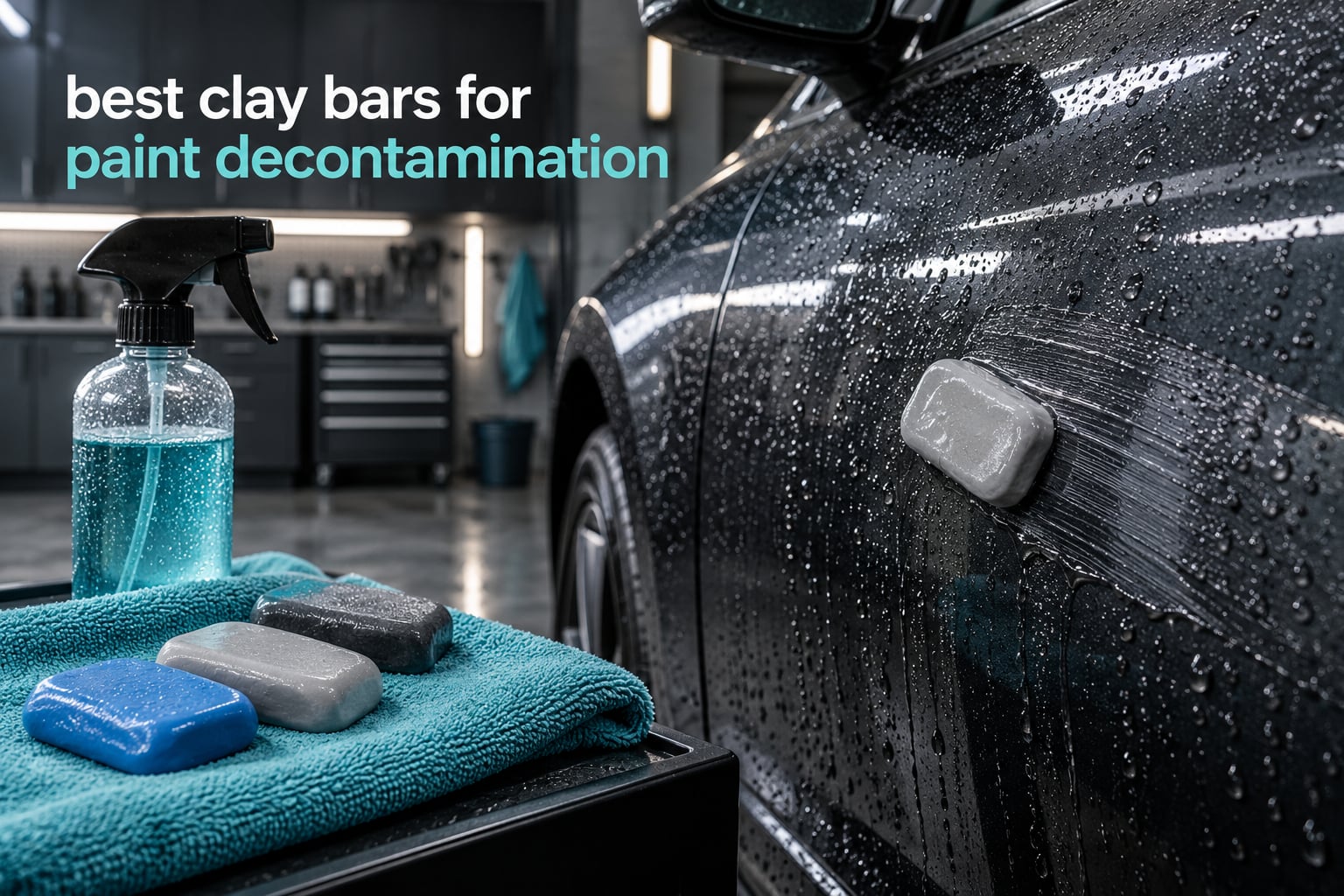
Paint decontamination means shearing bonded contaminants off automotive paint with a clay bar, and it is the single step most skipped at home. The plastic bag test takes ten seconds: rub a clean thumb across a washed panel, slide a plastic bag over it, and drag it across your skin. That sandpaper rasp means fallout, rail dust, sap and brake dust are still bonded to the clear coat.
None of that washes off. Those contaminants sit on top of the finish and stop wax, sealant and ceramic coating from bonding evenly, which is why protection applied to a dirty panel wears out early. If you want the short version, the best clay bars for paint decontamination are the ones that shear contamination fast while sliding on a heavy film of lubricant. Our complete clay bar kits buying guide covers the bundled options in more detail.
Table of Contents
What Paint Decontamination Actually Does
A clay bar is a pliable synthetic resin compound. You knead it flat, wet the panel, add lubricant, and drag the clay across the surface in straight passes. The slightly tacky compound captures contaminants and holds them, while the lubricant stops grit from being dragged across the clear coat.
What it removes: industrial fallout, rail dust, brake dust on wheels, road tar, tree sap, bug residue, water spots and overspray mist. What it does not touch: swirl marks, deep scratches, oxidation under the clear coat or dull paint that needs correcting. Clay cleans a surface, it does not polish it.
The difference between marring and scratching matters here. Marring is what fine clay and bad lubrication cause, a haze of parallel micro-lines that a polish can usually remove. Scratching is what a dry clay dragged over embedded grit causes, and that needs a compound. Everything below is about staying in the first category.
Top 3 Best Clay Bars for Paint Decontamination (October 2026)
These three are the picks we would hand to someone starting out, someone who wants a full kit in one box, and someone who would rather not lose a bar to the floor.

Mothers California Gold 3-Bar Kit
- Three 80g bars plus lubricant and microfiber towel
- Unscented formula for paint glass chrome and plastics
- 14k+ reviews

Chemical Guys Clay Bar and Luber Kit
- Medium duty gray clay with 16 oz Synthetic Luber
- Safe on clear coat single stage glass and plastic
- Works on cars trucks SUVs and motorcycles
Chemical Guys Clay Block V2 and Lube Kit
- Rinseable block shape is hard to drop
- Super Luber keeps the glide smooth
- One block covers 15 to 25 vehicles
Best Clay Bars for Paint Decontamination at a Glance (2026)
Twelve picks, every one built as a bar, block or synthetic pad. Weight and format drive the choice more than brand, so scan the feature column before you commit.
| Product | Specifications | Action |
|---|---|---|
| Mothers California Gold 3-Bar Kit |
|
Check Latest Price |
 IPELY 4-Pack 100g Clay Bars IPELY 4-Pack 100g Clay Bars |
|
Check Latest Price |
| Chemical Guys Clay Bar and Luber Kit |
|
Check Latest Price |
| Chemical Guys Clay Block V2 and Lube Kit |
|
Check Latest Price |
 Meguiar’s Smooth Surface Clay Kit Meguiar’s Smooth Surface Clay Kit |
|
Check Latest Price |
 Griot’s Garage Brilliant Finish Synthetic Clay Pad Griot’s Garage Brilliant Finish Synthetic Clay Pad |
|
Check Latest Price |
 TAKAVU 2-Pack 100g Medium Grade Clay TAKAVU 2-Pack 100g Medium Grade Clay |
|
Check Latest Price |
 Fitosy 4-Pack 400g Clay Bars Fitosy 4-Pack 400g Clay Bars |
|
Check Latest Price |
 Wontolf Complete Clay Bar Kit Wontolf Complete Clay Bar Kit |
|
Check Latest Price |
 TEAWOO Clay Bar Kit TEAWOO Clay Bar Kit |
|
Check Latest Price |
 Wontolf 10-Pack Clay Bars Wontolf 10-Pack Clay Bars |
|
Check Latest Price |
 Adam’s Polishes Fine Grade Clay Bar Adam’s Polishes Fine Grade Clay Bar |
|
Check Latest Price |
1. Mothers California Gold 3-Bar Clay Kit – Best Overall
Mothers California Gold 3 Clay Bar Complete Kit, 3 80-gram Clay Bars, 07240
3 x 80g bars
16 oz lubricant
Microfiber towel
710 g kit weight
Pros
- Lifts overspray fallout brake dust sap and acid rain
- Leaves paint chrome glass and plastics slick
- Three bars plus lubricant and towel in one box
- Improves wax and sealant bonding
- Unscented formula
Cons
- Will not remove swirls or scratches
- Time intensive across a full car
- Lubricant can leave an oily film if over applied
This is the kit we keep coming back to, and the review numbers back that up. At 14,680 ratings and a 4.6 average it is the most reviewed clay kit in this list, which means a lot of people have tested it on real panels rather than a clean demo.
The system is three 80-gram bars, a 16 ounce bottle of lubricant and a microfiber towel, in a 710 g package. Multiple long-term owners report buying it again over many years, which tells you the bars hold up rather than crumbling after a few sessions.
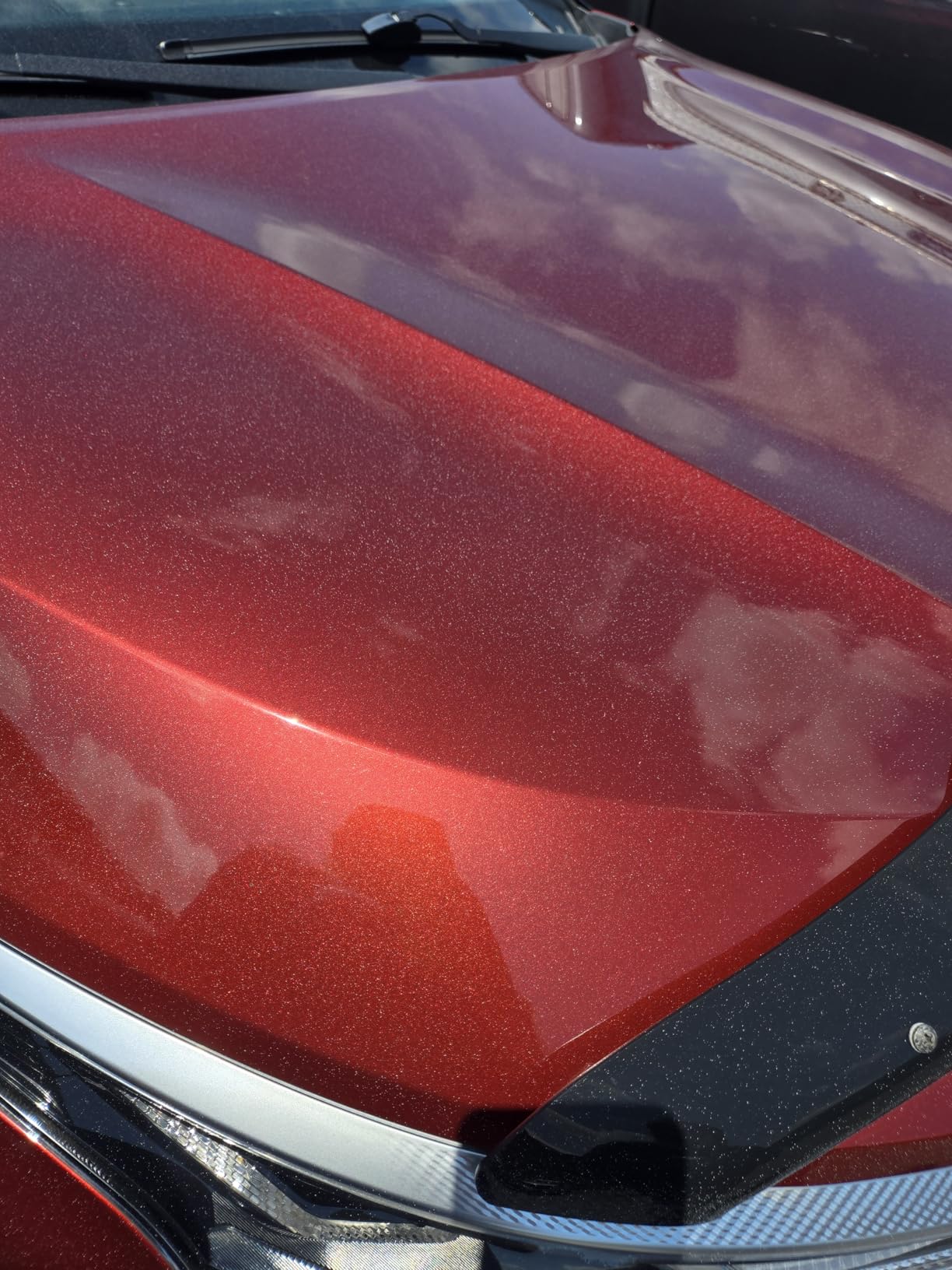
What consistently shows up in owner feedback is the smoothness afterwards. Reviewers describe running a clean sprayed panel over their hand and finding nothing catching. Wax and sealant also glide on better once the bonded layer is gone.
The honest limit is time. A full car is an hour or more of work with plenty of kneading and re-lubrication, and the spray will streak if you flood a panel and dry it without buffing. Nobody describes it as a quick product.
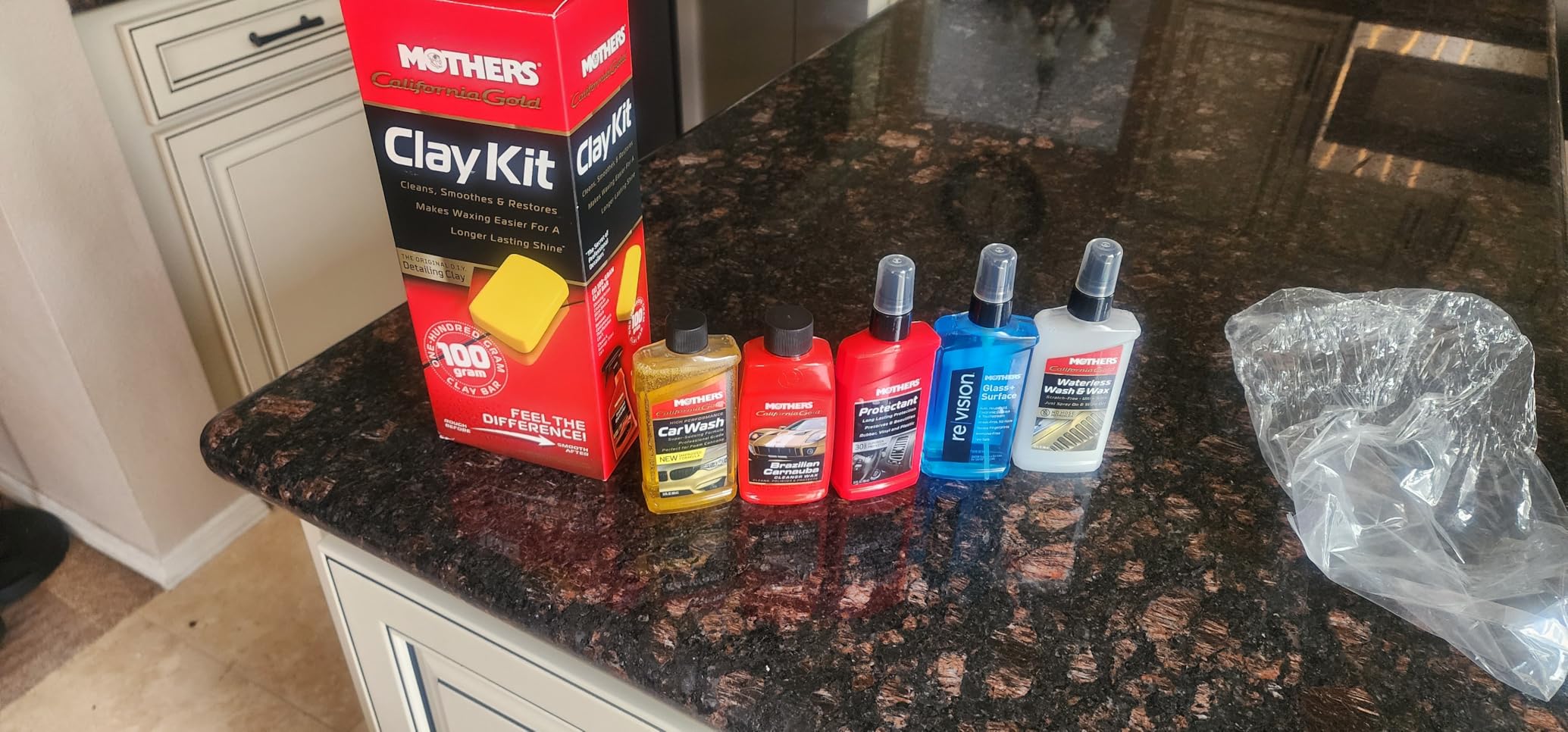
How much clay do you get for the money
Three bars is a genuine advantage for anyone with more than one vehicle or a large SUV on the driveway. Each 80 g block spreads flat into a working face that covers a door with room to spare, so the kit covers several cars before you need a fresh bar.
The included lubricant is the part worth measuring. Sixteen ounces sounds generous, but a full car session can drink most of it, and owners who apply it lightly report less marring than those who flood the panel.
Where this kit is not the right pick
If your car has never been detailed and has a winter’s worth of baked-on road film, a medium duty bar will be a long grind. This is a gentle system, so pair it with a chemical decontaminant first or accept a two-session job.
It is also the wrong tool if you drop things. A traditional bar that hits concrete picks up grit you cannot see and drags it across the paint, so it gets thrown away. Blocks and synthetic pads below survive that.
2. IPELY 4-Pack 100g Clay Bars – Best Budget Multi-Pack
IPELY 4 Pack 100g Car Clay Bar Auto Detailing Magic Clay Bar Cleaner for Car Wash Car Detailing Clean
4 x 100g bars
14.1 oz total weight
3.39 x 3.23 x 2.52 in
Pros
- Very strong value for four full size bars
- Gentle enough that beginners will not mar paint
- Handles bug splats grime and overspray
- Soft and easy to mould into a flat face
- Works on glass and windows
Cons
- Claimed number of uses is overstated
- Residue shows if you under-lubricate
- A few reports of stiff bars that crack when folded
This is the budget answer and it is not a token entry. Four individually wrapped 100-gram bars in a pack that has drawn 8,357 reviews tells you the price to performance ratio is the reason people buy it.
Owners describe it as soft and easy to mould, which is exactly what a first clay needs. You flatten it in your palm, and the material folds rather than cracking so you can always expose a clean face.
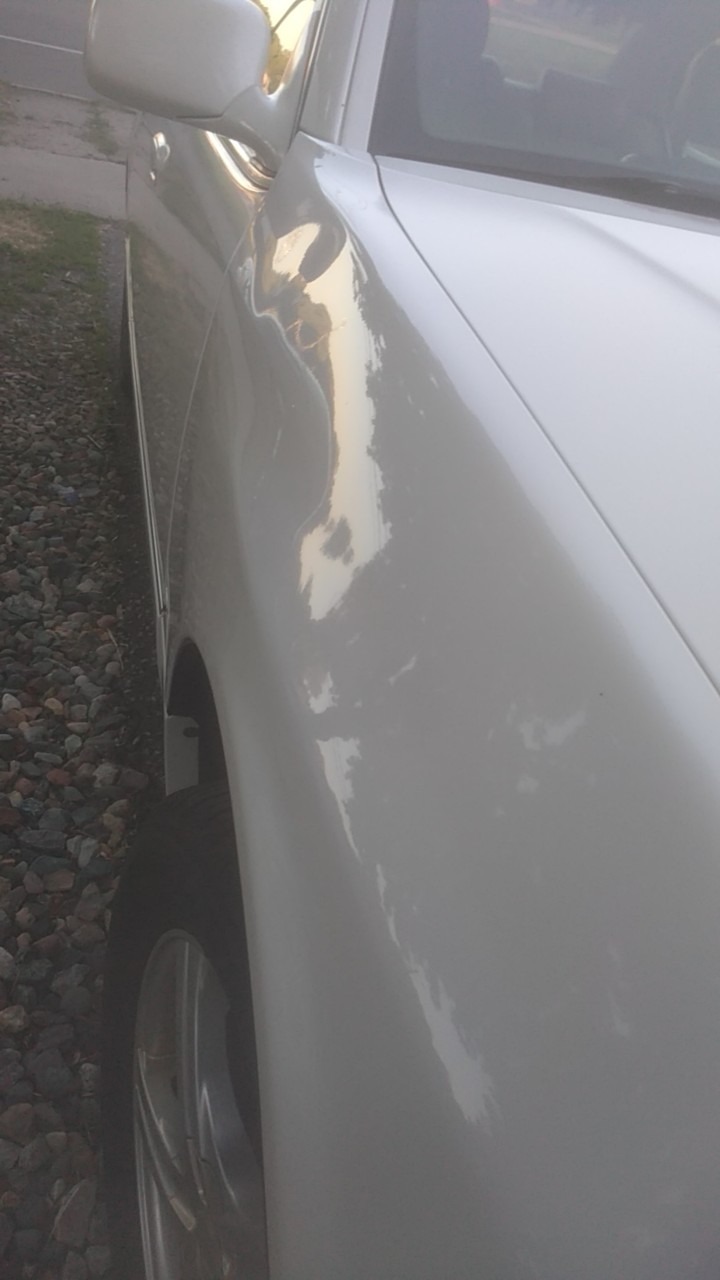
Repeated advice in the reviews is to use plenty of lubricant, and plenty of people pair it with soapy water or a quick detail spray instead of buying a dedicated lube. That works. The only thing you must not do is run it nearly dry.
Surface coverage is broad for the money: glass and windows, paint, bug splats, road grime and body-shop overspray all get mentioned. Feedback frames it as a gentle bar, not an aggressive one.
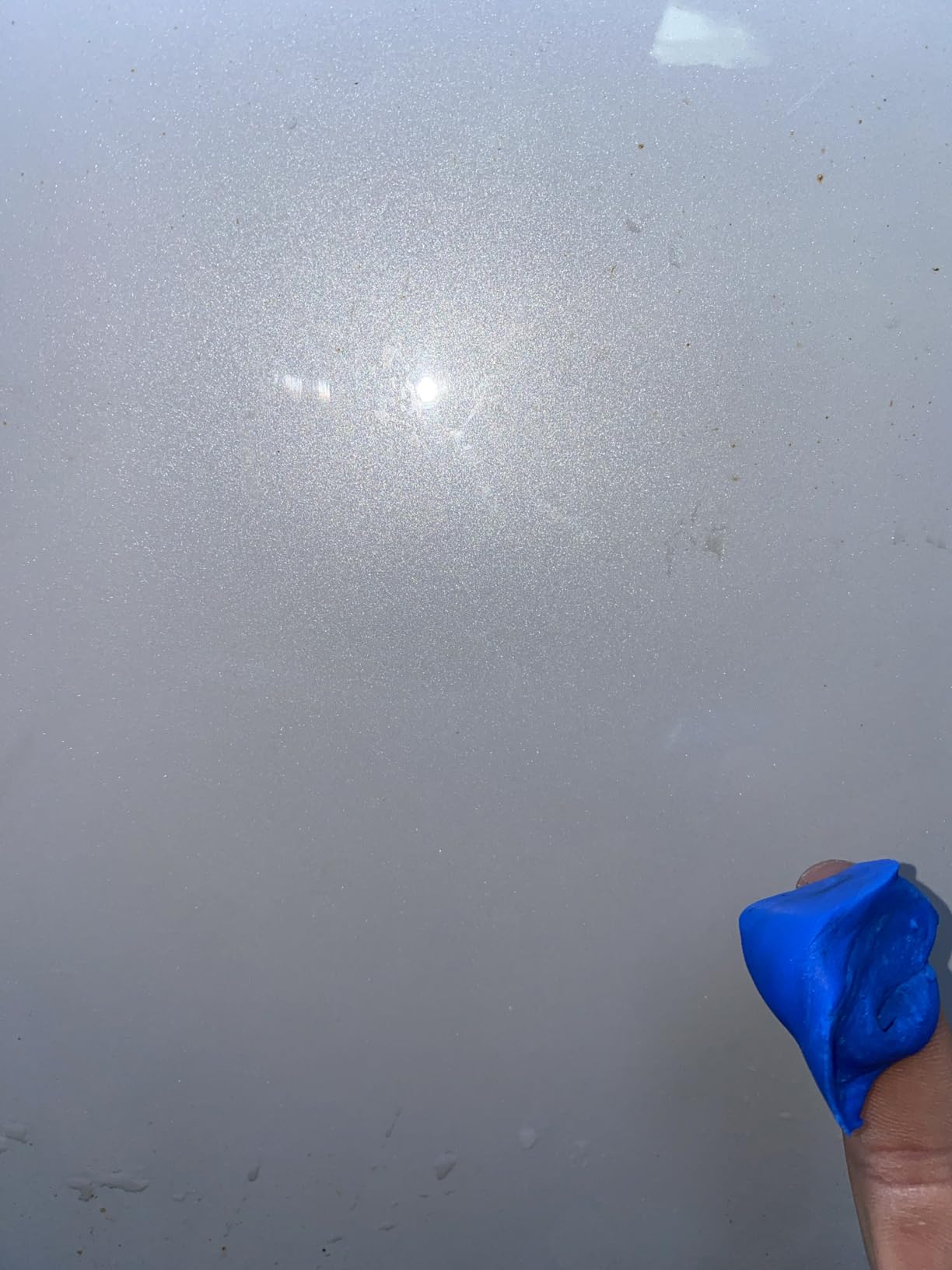
When this pack makes more sense than a kit
If you already own a lubricant and a towel, this pack simply removes the reason to buy them again. Nothing else in the box would be used, and the four bars store flat in a drawer until you need them.
It is also a sensible household purchase. Users who clayed a long-neglected family car worked through a bar and had three more ready, which removes the annoyance of stopping mid-job because the clay is spent.
Where it falls down
Two limitations show up consistently. Some buyers report bars arriving stiff enough to crack instead of folding, and most owners note that the printed use count on the packaging is optimistic, so plan on more cars per bar than claimed.
Residue is the other one. Under-lubricated passes leave a film that takes a second detailer wipe to clear, so treat the lubricant step as non-optional even though the clay itself is forgiving.
3. Chemical Guys Clay Bar and Luber Kit – Best All-In-One Kit
Chemical Guys, Clay Bar & Luber Kit, Medium Duty, Paint Prep, 2-Piece Set
Gray medium duty clay
16 oz Synthetic Luber
16 oz kit weight
Pros
- Clay and matching lubricant in one box
- Removes overspray brake dust and industrial fallout
- Leaves a silky surface ready for wax
- Safe on clear coat single stage glass and plastic
- Works on cars trucks SUVs and motorcycles
Cons
- 16 oz lube runs short on larger vehicles
- Medium grade is light for long-unclayed cars
- Extra lube needed for big panels
This is the kit to buy if you want the whole process in one purchase without thinking about compatibility. The bar and the Synthetic Luber are made to work together, and 6,008 ratings at a 4.6 average makes it one of the most proven options here.
Performance is described consistently across reviews: embedded dirt lifts, and the surface is left silky smooth and ready for waxing. Reviewers confirm it on clear coat and single-stage paint as well as glass and smooth plastic, which widens the use beyond the body panels.
The motorcycle and truck mentions in owner feedback are worth noting. It is a car-focused clay, but it handles vertical panels and cycle bodywork without special technique, which is not something every bar on this list can claim.
One pattern appears again and again in the reviews, and it is not about the clay. It is that the 16 ounce bottle of Synthetic Luber is not enough for a full large vehicle, so many buyers order a second bottle.
Whether medium duty is aggressive enough
Medium duty is the sweet spot for most cars that get driven daily. It is firm enough to move fallout and brake dust in a few passes, and gentle enough that a slightly heavier hand does not immediately haze the clear coat.
A minority of reviewers find it light for very dirty or long-unclayed vehicles. If your car has not been detailed in years, claying it in sections over two sessions is safer than forcing one long fight.
Buying the lube volume you will actually need
Rule of thumb from the feedback: a sedan needs about the bottle that is included, while an SUV or pickup eats through it. Buying a second bottle of Synthetic Luber at the same time is the single most common upgrade owners make.
It is worth noting the clay is the medium grey bar rather than a fine or aggressive compound. If you have very soft or recently wrapped paint, pair it with a polishing step afterwards rather than pressing harder.
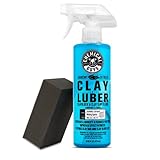
4. Chemical Guys Clay Block V2 and Luber Kit – Premium Pick
Chemical Guys, Clay Block V2 & Clay Super Lube Kit for Paint Prep, 16 oz
Clay Block V2
16 oz Clay Luber
0.59 kg kit weight
Pros
- Block shape is far easier to grip than a bar
- Rinseable after a drop instead of discarded
- Super Luber reduces the risk of marring
- One block covers many full size vehicles
- Reported effective on dark paint
Cons
- Gentler than traditional clay on stubborn contamination
- Included lube bottle often short for one large vehicle
- One reviewer found the clay layer thinner than pictured
The V2 block solves the two problems that stop people claying at all. It is far less likely to hit the floor than a 100 g bar, and if it does, you rinse it and keep going rather than binning it. That alone changes how relaxed you can be.
Buyers favour the ergonomics. It sits in the palm instead of pinching between fingers, there is no folding to keep track of mid-panel, and the Super Luber keeps the surface gliding so the block does the work.
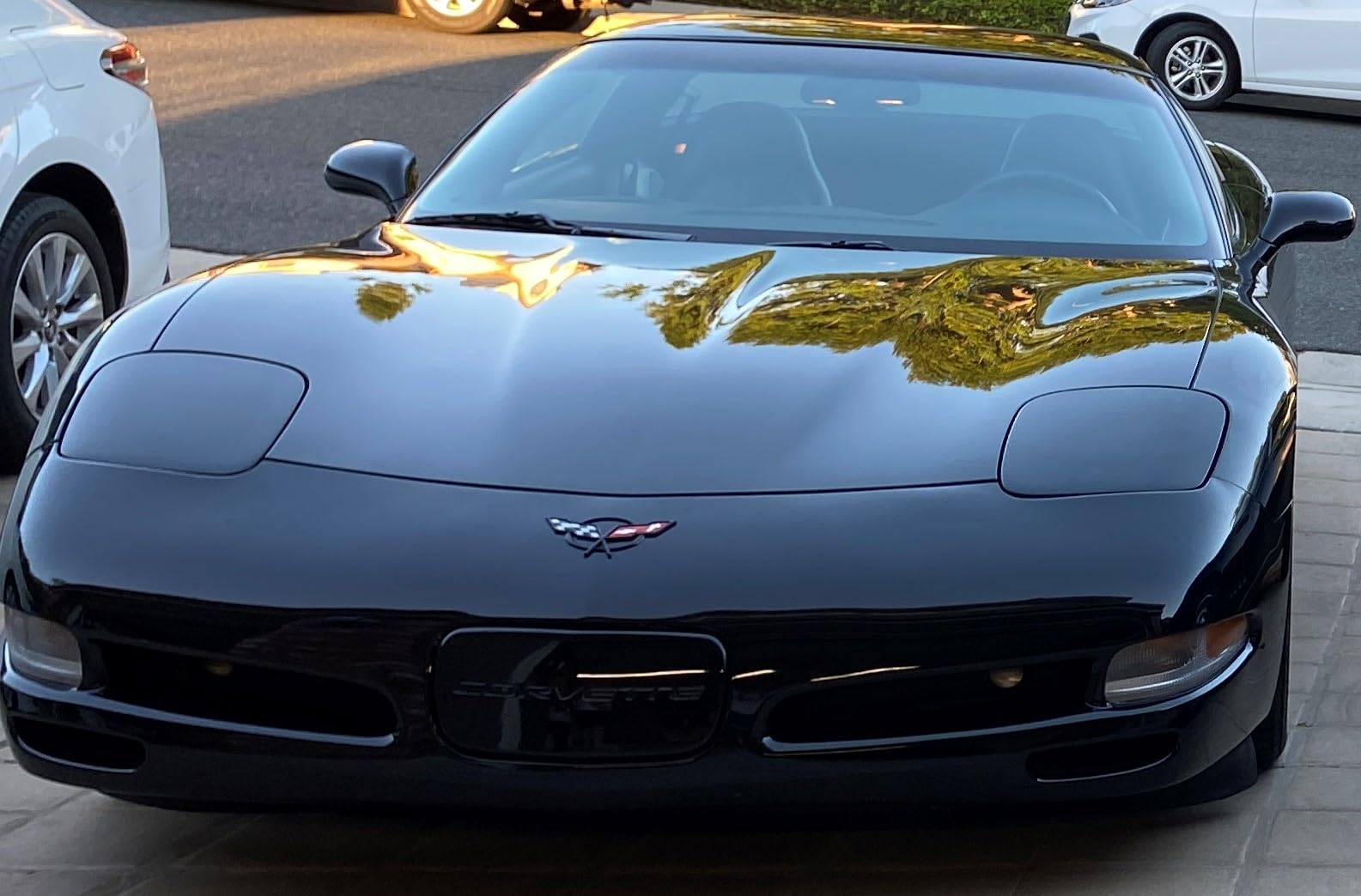
On dark paint, which is where marring shows most, owner feedback reports clean results. The block format also removes the mid-job kneading break, so a full vehicle goes faster than with traditional clay.
Longevity is the other selling point. The manufacturer rates one block at 15 to 25 full-size vehicles, and reviews describe it as lasting far longer than a bar that has to be folded continuously.
Where the block format changes your technique
Because there is nothing to fold, contaminants stay on the face until they are rinsed. Plan on rinsing the block every few passes, which is faster than re-folding but means you should keep a hose or second bucket close.
The flat face also covers more area per stroke than a bar held on edge, so fewer passes are needed. Work in the same small wet sections and drop the pressure even further than you would with a bar.
Where it is not the right pick
Several users feel the synthetic clay is less aggressive than traditional clay on stubborn contamination. If your paint carries baked-on tar or road film rather than general fallout, expect more passes and be patient with it.
Like the rest of the Chemical Guys kits here, the 16 ounce lube bottle tends to run out on a large vehicle. Plan on a second bottle, and check the box on arrival since one reviewer found the clay layer thinner than the photos suggest.
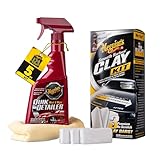
5. Meguiar’s Smooth Surface Clay Kit – Best for Beginners
Meguiar’s Smooth Surface Clay Kit
3 x 60g clay bars
16 oz Quik Detailer
Supreme Shine towel
454 g
Pros
- Removes overspray fallout sap mist and road tar
- Non-abrasive formula safe on any clear coated finish
- Bars are a comfortable size to grip and fold
- Quik Detailer supplies heavy lubrication for safe glide
- Includes a microfiber towel for the wipe down
Cons
- Labor intensive and needs practice to master
- Several buyers wish the kit cost less
- Occasional reports of damaged boxes or leaking bottles
The Meguiar’s kit is the one we would hand a first-timer. Everything needed is in the box, the clay is non-abrasive, and the lubricant is heavy enough that beginners rarely drag the bar dry.
Long-time users describe it as the only clay kit they keep buying, and the 4.6 average across 1,547 ratings supports that. Repeated owner advice is to work small wet sections with plenty of lubricant, which is the technique that keeps beginners out of trouble.
Contaminant coverage is the strong suit. Overspray, industrial fallout, tree sap mist and road tar all get named in reviews, and users report the towel wipe leaving a genuinely glassy finish afterwards.
Wax and seal also behave better afterwards. Once the bonded layer is gone, reviewers say wax glides on more easily and lasts longer, which is the practical reason to do this step at all.

Why three 60g bars work well for learning
The 60 g bar is a useful size for a novice. It is large enough to flatten into a stable working face but small enough that you are not gripping a heavy lump with cramped fingers, and hand fatigue is the reason people quit early.
Three bars also means you can dedicate one to the body, one to wheels and glass, and one to trim. Keeping contaminants separated stops you dragging wheel grit across a clean door panel.
Where beginners can struggle
The main complaint is effort, not results. Claying is labour intensive whatever you buy, and the reviews are candid that technique takes practice. Watch the glazing after a few passes and re-lubricate rather than pushing harder.
There are also occasional logistics complaints about damaged boxes and a cracked detailer bottle, so inspect the package when it arrives. A few buyers simply think the kit should cost less for what is inside.
6. Griot’s Garage Brilliant Finish Synthetic Clay Pad – Best for Large Panels
Griot’s Garage Brilliant Finish Synthetic Clay for Car Detailing, Creates a Smooth Paint Surface and Lasts Longer Than Traditional Bars, 10691
Clay and polymer matrix on foam pad
5 x 2.25 x 9 in
Medium-fine grit 80
Pros
- Diamond pattern matrix lifts debris faster than bars
- Rinseable and reusable even after a drop
- Foam palm pad cuts hand fatigue
- Covers a large area per pass
- Safe enough for light work on coated paint
Cons
- Bulky pad will not fit grilles and tight gaps
- Higher cost than a conventional bar
- Dark surface hides embedded contamination
- Degrades if left in a hot vehicle
This is a pad rather than a bar, and experienced detailers in the reviews treat it as a speed tool. The diamond-pattern clay and polymer matrix grabs debris faster than traditional clay and covers far more area per stroke.
The foam palm pad is the part regular users notice first. Grip is comfortable, and on a full vehicle the ergonomic design removes the cramp that makes a 100 g bar miserable to hold for a whole session.
Rinsing rather than discarding changes how you work. If the pad goes down on gravel you wash it off and continue, and the manufacturer rates it as lasting roughly three times longer than traditional paint clay.
It works with detail spray, car wash solution or Speed Shine, so you are not tied to one lubricant. Reviewers also call it safe enough for light decontamination work on ceramic-coated paint.
Where a large pad beats a small bar
On a roof, a bonnet or a pickup bed, the pad wins on coverage. Fewer passes means less re-lubrication, less kneeling and a shorter job, which matters when contamination is heavy enough to need several rounds.
The rinseable format also suits beginners. Nervous users who would not use a bar at all because of the drop rule tend to find this pad straightforward, and it does not need folding or kneading mid-section.
Where the size becomes a problem
Recurring drawbacks in reviews are size and cost. At 5 x 2.25 x 9 inches the pad will not reach into grilles, wheel spokes or panel gaps, so you still want a small bar for those areas.
The clay surface also stays dark, which means you cannot see how much contamination it has captured, and it can degrade if left in a hot vehicle. Store it indoors and fold to a clean face often.
7. TAKAVU 2-Pack 100g Medium Grade Clay – Best for Water-Only Lubing
TAKAVU Car Clay Bar, 2 Pack 100g, Medium Grade for Auto Detailing (Red)
2 x 100g bars
Fine and medium grit 100
100 g per bar
Pros
- Medium grade cuts faster than fine clay but stays gentle
- Firm yet mouldable and resists crumbling
- Large 100 g bars for the money
- Works on paint wheels trim glass and metal
- Uses plain water or a detail spray
Cons
- A dropped bar cannot be fully cleaned
- Misses contamination if you skip folding
- Not suited to very heavy buildup
Two 100-gram medium grade bars with no lubricant bottle in the box. TAKAVU is formulated to work with plain water or a detailing spray, so if you already keep a quick detailer on the shelf you need nothing extra.
The compound is described as firm yet easy to mould, holding its shape instead of crumbling in your hand. That matters more than it sounds, because a bar that breaks apart mid-panel leaves you picking fragments off the paint.
Coverage is broad for a medium clay. Reviews name embedded dirt, brake dust, rail dust, overspray, tree sap, bug residue, rust spots and water stains across paint, wheels, trim, glass and polished metal.
Two 100 g bars give you a spare, which is a meaningful safety net on a car where the drop rule matters. It also lets you keep one bar dedicated to wheels and lower panels.

Whether water alone gives enough glide
Water does work, and plenty of owners use nothing else. The rule is volume: the panel needs to stay visibly wet the whole time, and the bar should glide without any gritty resistance before it moves on.
Adding a quick detailer to the water improves the margin for error considerably. If you are new to claying, a lubricated surface is what keeps the pass from turning into a marring pass.
What medium grade will and will not shift
Medium grade is the practical middle. It is quicker than a fine clay on general fallout and still gentle enough for daily-driven paint, which is why it covers the most ground in the reports.
It is not for heavy buildup. Owners comparing it against aggressive clays note it needs more passes on thick contamination, and skipping the fold between sections leaves grit on the face where it can still scratch.
8. Fitosy 4-Pack 400g Clay Bars – Best for Glass and Chrome
Fitosy Car Clay Bar 4 Pack 400g, Premium Grade No Scratch Deatil Clean
4 x 100g bars
15.2 oz package weight
8.82 x 3.7 x 0.67 in
Pros
- Four 100 g bars at a low cost per bar
- Refined clay that leaves paint smooth and shiny
- Lifts oxidation fallout sap water spots and overspray
- Malleable and reusable by folding
- Needs no special lubricant
Cons
- Needs the panel fully wet or it will drag
- Absorbs dirt fast so folding must be frequent
- Flat pack bars need warming before use
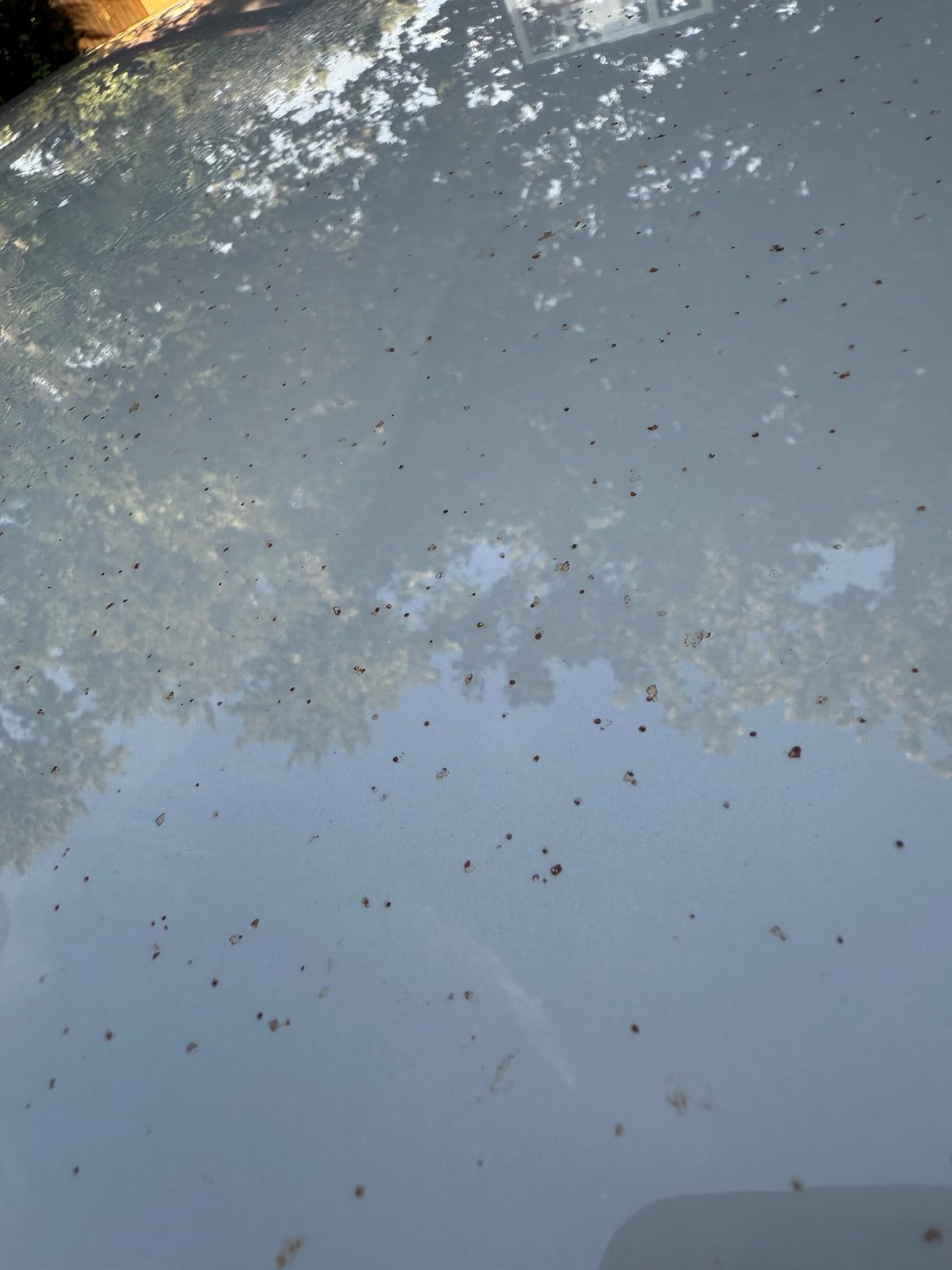
Four bars, 400 grams total, and a formulation aimed at a wide range of surfaces. The listed uses run from paint and clear coatings through mirrors, glass, headlights, polished metal, carbon fiber, bumpers, wheels and exhaust tips.
Owner feedback highlights the smoothness after use. The material is described as refined and repeatedly processed, leaving paint shiny without scratching, which is the claim that matters most for anyone worried about clear coat.

Manufacturer guidance is worth following here. Stretch the clay flat to enlarge the working area, keep the panel fully wet, and fold the dirty face inward before moving to the next section so you never grind contamination across the finish.
That last point is the recurring lesson in every clay review, and this pack makes it easy because four bars give you clean faces whenever you want one.
Why this works well on glass and chrome
Glass and chrome show grit drag more harshly than paint because there is no soft clear coat underneath, and contamination like water spots and mineral deposits builds up on them quickly. This clay is listed for both surfaces.
The wide surface list also covers headlights and clear plastics, which are the parts most owners forget. Treating them in the same session means the whole car feels consistent rather than half-finished.
What the owner feedback warns about
Two issues come up. The panel must be thoroughly wetted before you scrub or the clay will drag, and the clay absorbs contamination quickly, so it needs frequent folding to stay effective.
Flat-packed bars also need working before they mould. Knead one for a minute before use, and treat the flexibility of the material as a feature since you can reshape it for small panels.
9. Wontolf Complete Clay Bar Kit – Best for Self-Mixed Lubricant
Wontolf Complete Clay Bar Kit, Car Detailing Kit for Car
4 x 100g ultra fine bars
10 lubricant tablets
Spray bottle and towel
16 oz
Pros
- Four 100 g bars plus self-mixing lube tablets
- Ultra fine clay lifts oxidation fallout and sap
- Mix your own lubricant in the supplied bottle
- Good prep for ceramic coating and wax
- Flexible bars fold to a clean face
Cons
- Clay starts firm and needs working
- Included microfiber towel feels thin
- Lubricant tablets can stain hands blue
- Some users see results fade sooner
The Wontolf kit is interesting because the lubricant is not a bottle of premixed spray. You get ten effervescent tablets that dissolve in water inside the spray bottle, so you control the concentration and the volume.
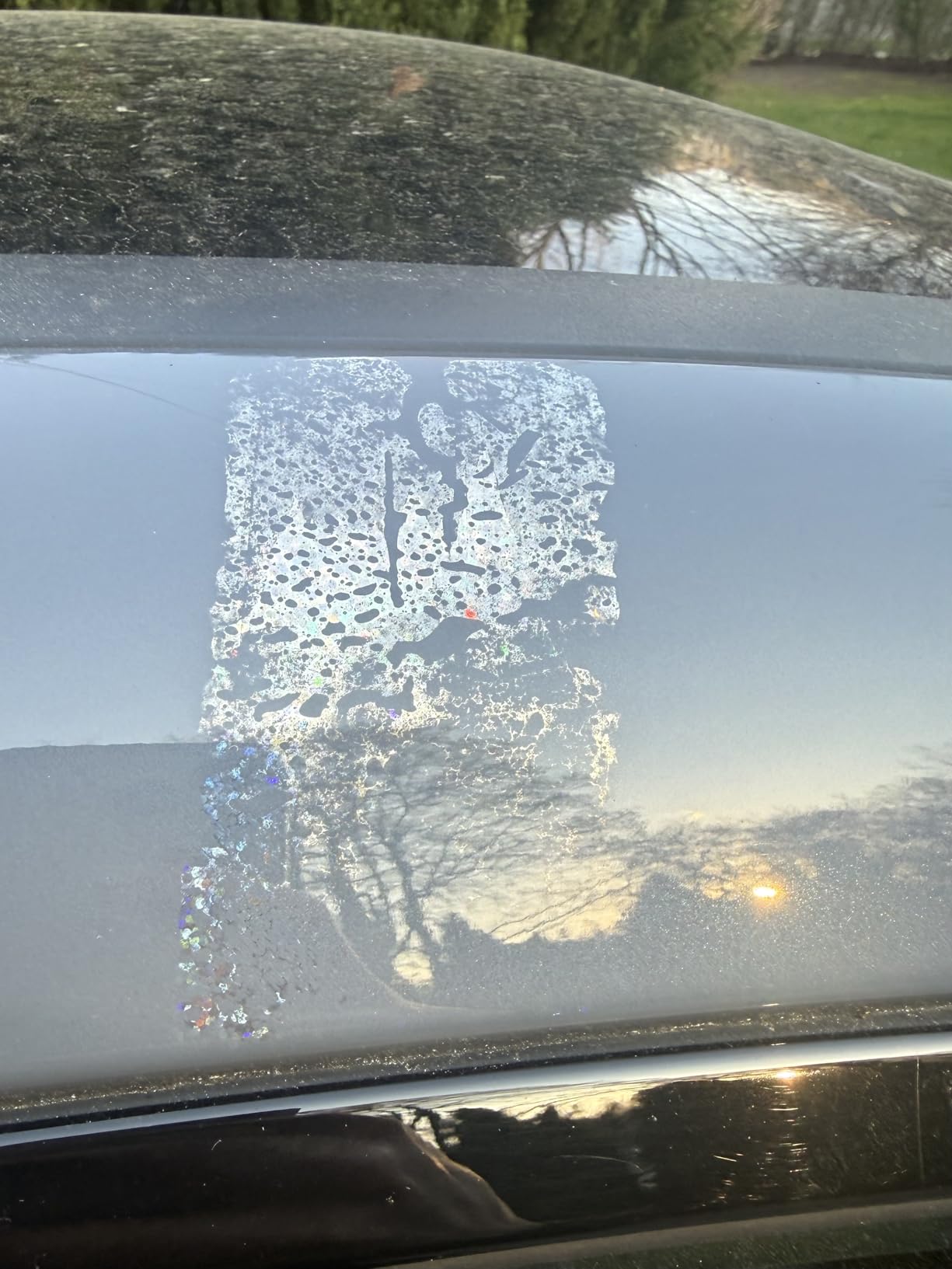
Buyers are impressed that a kit at this level lifts embedded grime as well as name-brand clay. The ultra-fine fiber and refined clay removes oxidation, scale, iron powder, acid rain and tree sap, and it is listed for paint, glass, clear plastics, metal, carbon fiber, bumpers and wheels.
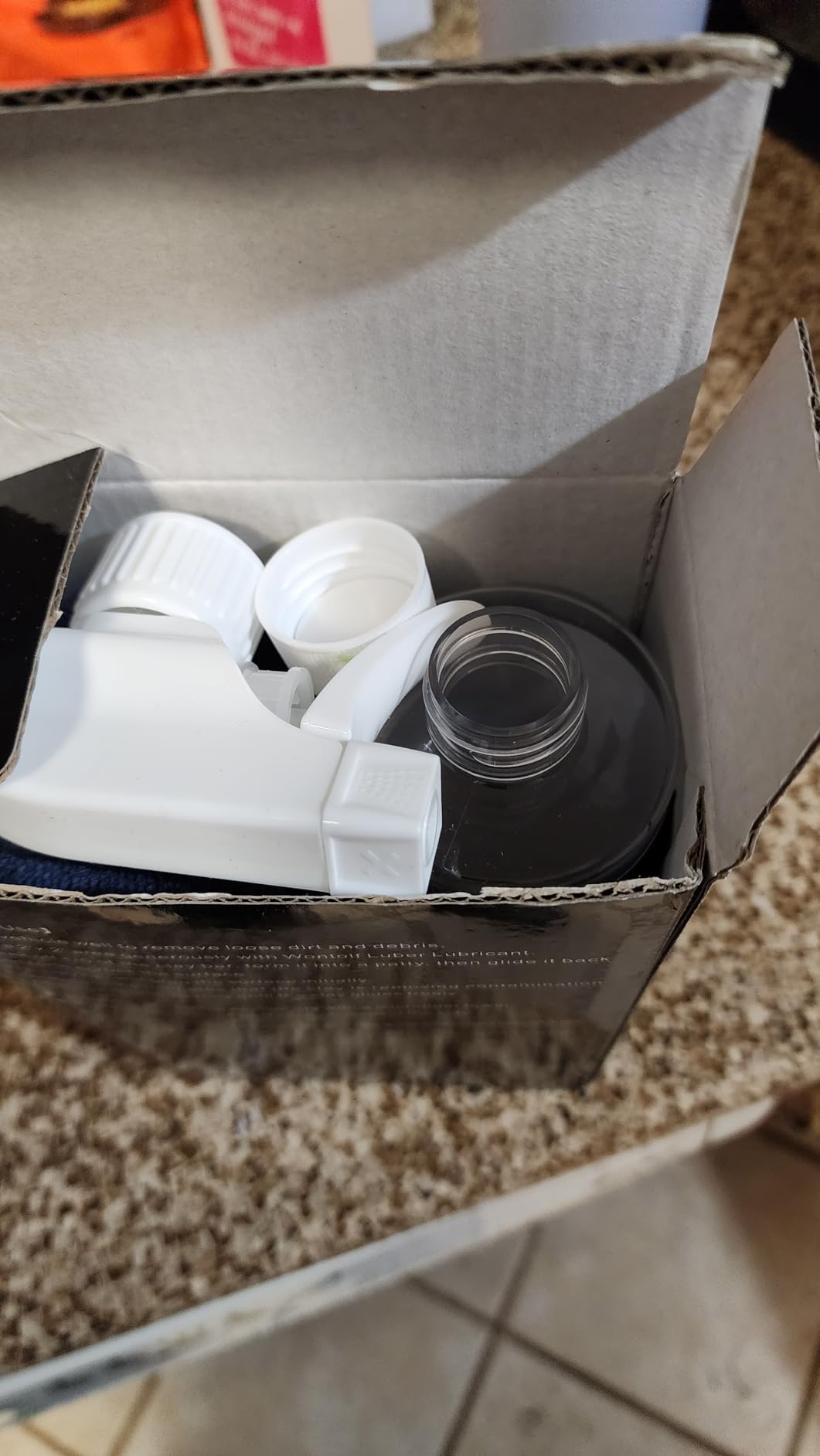
Reported strength is ceramic coating prep and top-coat buffing. If you are coating a car, getting the surface smooth before application is the whole point, and that is what this kit is aimed at.
The self-mixing system is also the cheapest way to make a lot of lubricant. One tablet in a full bottle covers a whole panel group, and you never run out halfway across a roof.
When self-mixed lubricant makes sense
Premixed sprays are convenient but they add up over a year of regular claying. Mixing your own means the only cost per session is a tablet, and the strength is adjustable if a panel needs extra glide.
It also solves the volume problem that affects the premixed kits in this list. A bottle of tablets gives you a full afternoon of lubricant for a large vehicle without a second purchase.
What to watch out for
The clay starts firm and needs kneading before it becomes pliable, so budget a minute at the start. The included microfiber towel is reported as thin, and the tablets can tint hands blue, which is messy rather than damaging.
One reviewer saw the smoothing effect wear off after a road trip, which is a reminder that contamination returns quickly on a car that sits outside. Plan on claying again before the next season of fallout.
10. TEAWOO Clay Bar Kit – Best for Overspray
TEAWOO Clay Bar Kit, Car Detailing Kit for Car Detailing Cleaning
2 x 100g and 4 x 50g bars
20 lubricant tablets
Gloves towels and bottle
0.7 kg
Pros
- Six bars plus 20 lubricant tablets in one box
- Shifts stubborn overspray mist and bird droppings
- Did not mar or gash the paint for users
- Gloves spray bottle and towels mean nothing else to buy
- Strong value for the number of bars
Cons
- Very soft clay stretches under light pressure
- Bars are awkward to unwrap
- Weak tablets leave blue and yellow marks
- Supplied spray bottle leaks
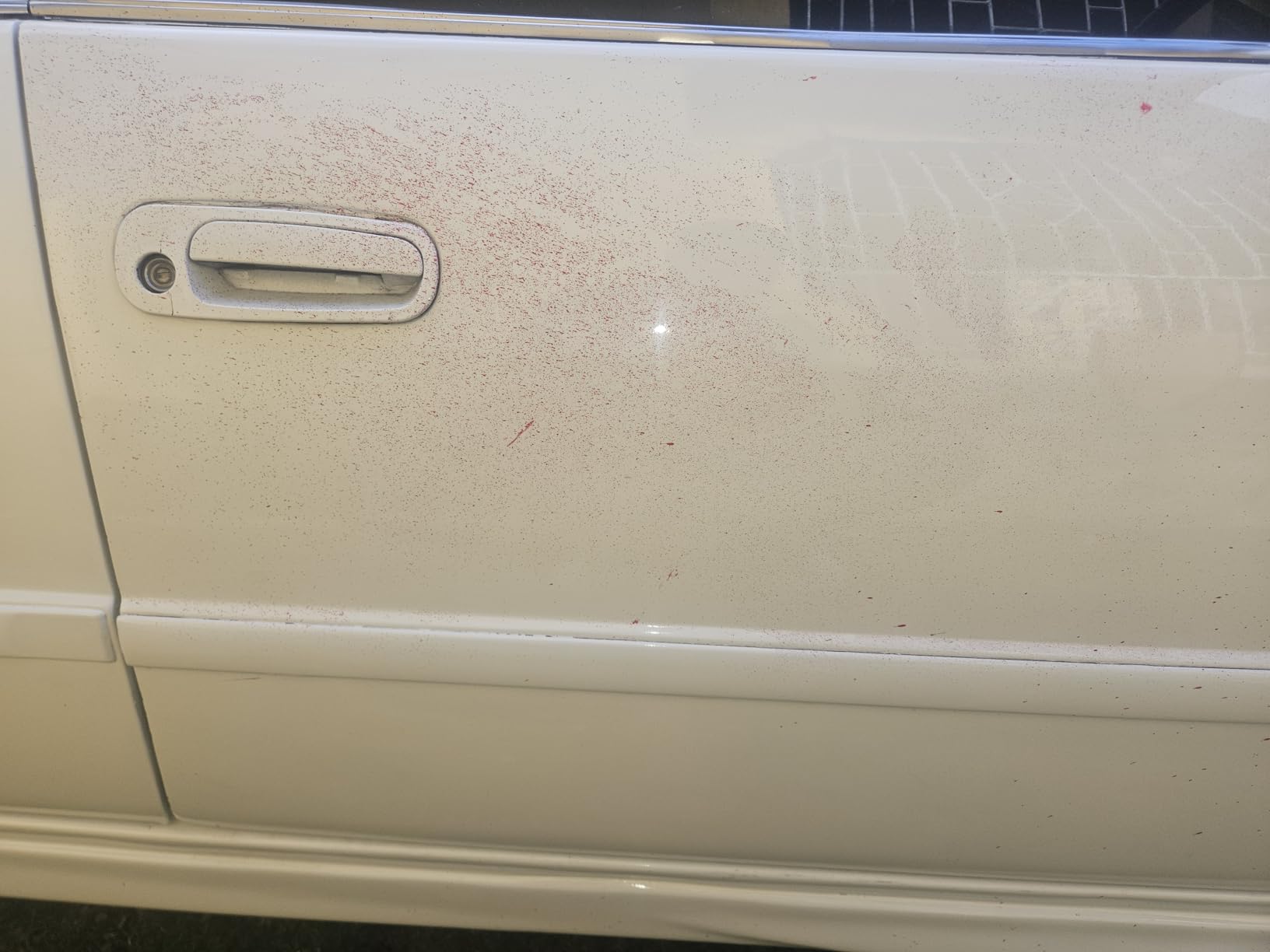
TEAWOO is the kit to look at if overspray is your specific problem. Owners report it removing stubborn overspray, overspray mist and bird droppings without gashing the paint, and several reviews came from people working near body shops.
The box is unusually complete for the money. Alongside six clay bars, two at 100 g and four at 50 g, you get 20 lubricant tablets, a spray bottle, ten disposable gloves and three microfiber towels.
That accessory count means you can clay in the driveway without buying anything else. The gloves matter more than they sound, because the tablets are effervescent and your hands get messy mixing and handling them.
Reviewers confirm the soft clay does not mar the finish even with light pressure. For a car that has sat under overspray for months, that gentleness is the feature that matters.
When a six-bar kit is genuinely useful
Six bars means a fresh face for every panel, which prevents the single biggest cause of scratching during a long job. Users working through heavy overspray specifically like being able to swap rather than fold.
The 50 g bars are a sensible size for tight areas and lower panels, while the two 100 g bars cover the flat panels quickly. Having both in one kit removes the guesswork about which bar to grab.
Where the accessories fall short
The clay is very soft and stretches out even under light pressure, which some users read as less durable and less pickup than name-brand clay. The wrappers are also hard to open because the material squashes against them.
The lubricant tablets are the most criticised part, leaving blue and yellow marks on paint and hands, and the supplied spray bottle leaks. Most owners replace them with a normal quick detailer, which solves it immediately.
11. Wontolf 10-Pack Clay Bars – Best for Frequent Droppers
Wontolf 10 Pack Clay Bars Auto Detailing Premium Grade Magic Clay Bar Kit Car Detailing Kit with Washing and Adsorption Capacity for Car Detailing Car Wash Clean
10 premium grade bars
One microfiber towel
1.3 lb package weight
Pros
- Ten individually wrapped bars in the pack
- Lifts contaminants with no marring seen
- Quantity turns drops into a non-event
- Good value against auto store pricing
- Works on paint glass wheels mirrors and plastics
Cons
- Clay degrades in direct sun or on hot surfaces
- Small 50 g bars soil quickly on heavy panels
- Some users rate it below real clay bars
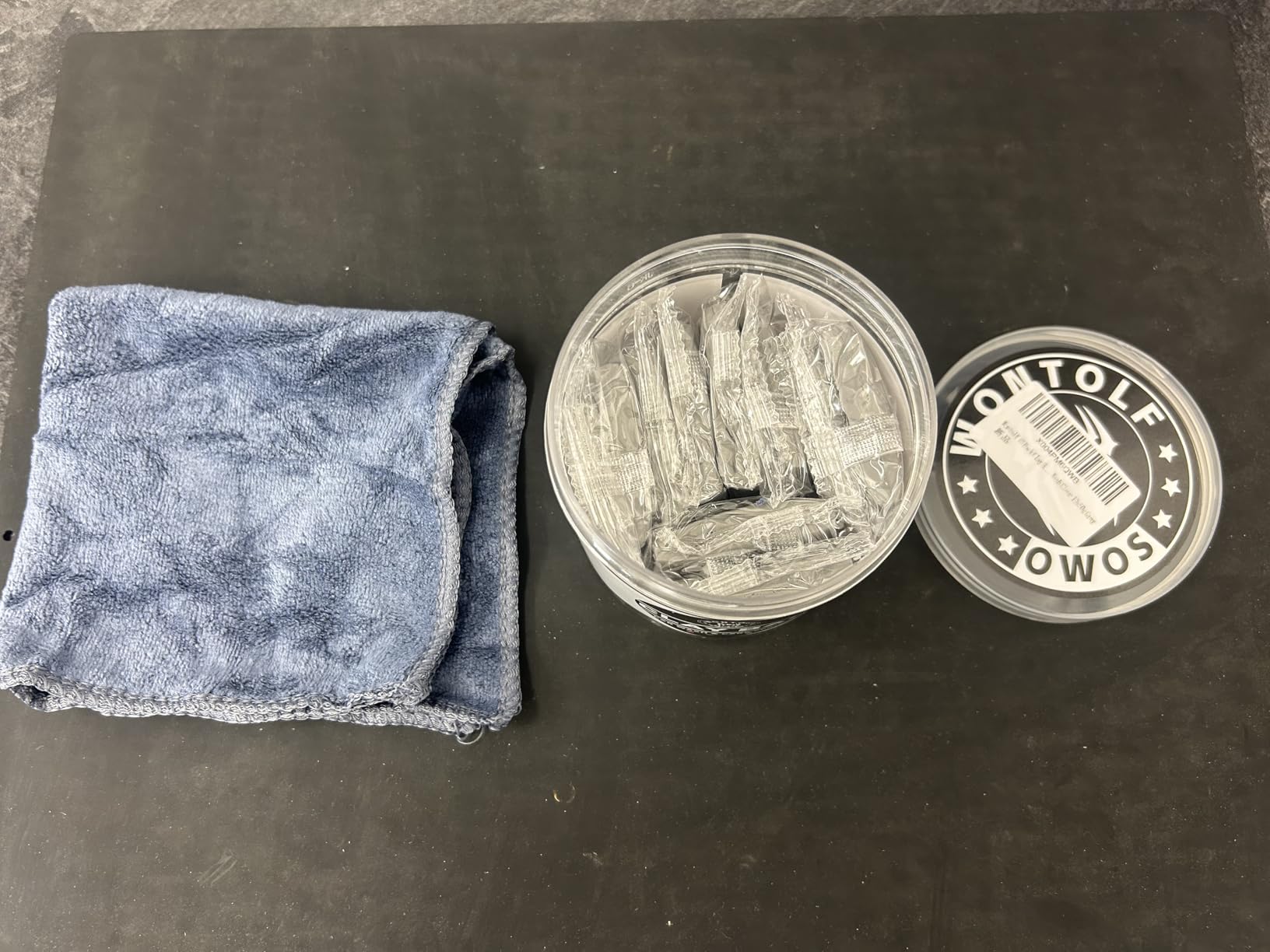
Ten individually wrapped bars turn the drop rule from a disaster into an inconvenience. If one hits the floor you open another, which is why this format gets recommended to people who are clumsy or new to handling clay.
Owners also value being able to start every panel with a clean face. That is genuinely useful on a neglected car where the first bar picks up a surprising amount of grit within a couple of passes.
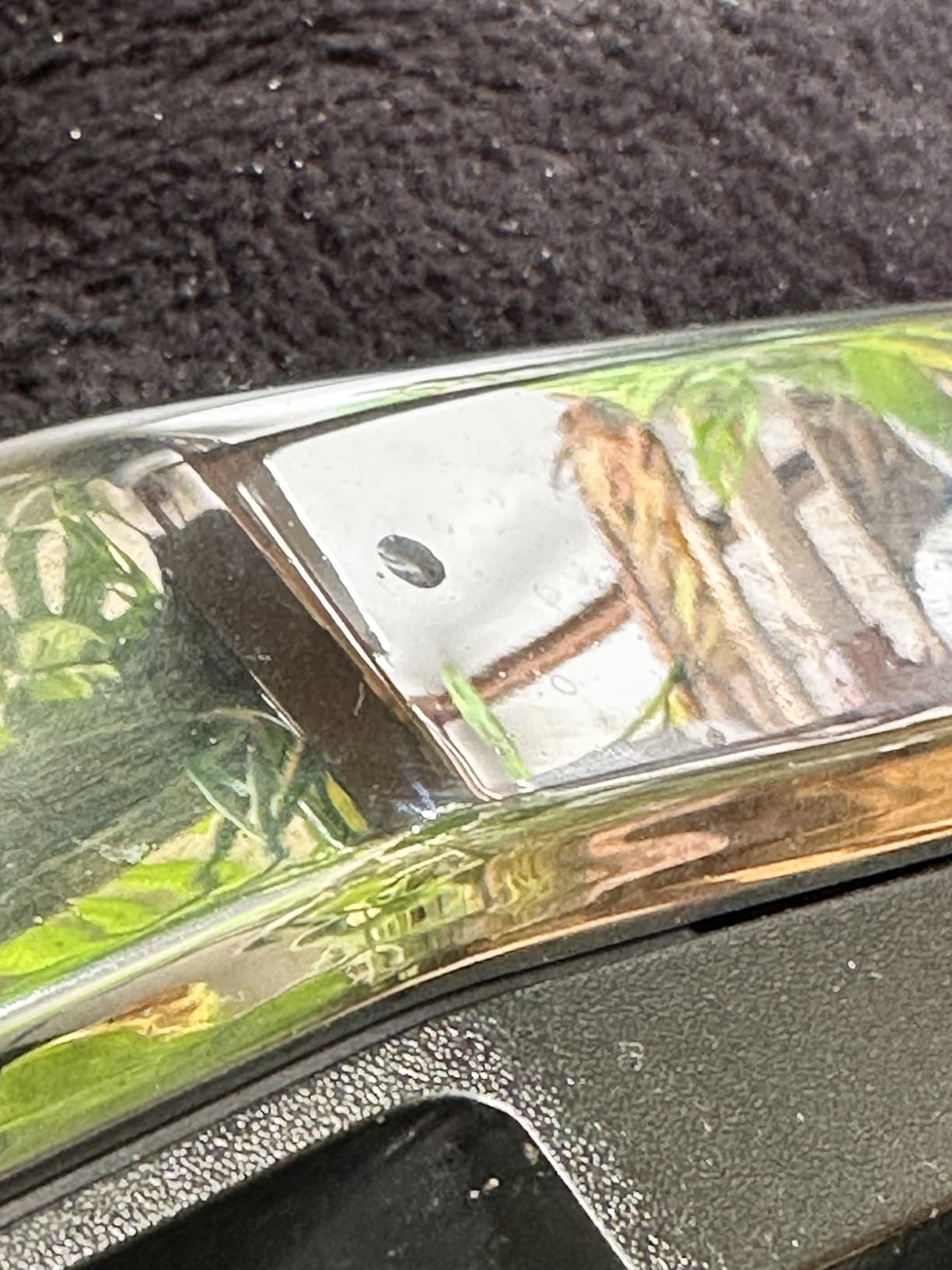
Performance is described as slightly below a real clay bar but close, and no scratching has been observed. The ultra-fine fiber and refined clay is listed against oxidation, scale, iron powder, acid rain and tree sap.
The stretch-and-rub technique matters here. Manufacturer guidance is to flatten the clay over a wet panel to enlarge the working area, which gets more out of each small bar.
When ten small bars beat one large block
Small bars suit someone who clays in short bursts across several vehicles, or who clays once and then puts everything away for six months. There is no contamination to rejuvenate later because each bar is single session.
They also let you allocate by area. Wheels and lower panels take the dirtiest bars, and the glass and mirrors get the cleanest ones, which removes the temptation to keep going past the point of usefulness.
What storage and size ask of you
Storage is the repeated caution: heat and direct sun will degrade the bars, so keep the pack somewhere cool rather than in a garage shelf that bakes in summer.
The 50 g bars soil quickly on heavily contaminated panels, so a neglected car may consume several in a single bonnet. And a few users feel they do not perform as well as traditional clay, so treat them as maintenance-grade rather than rescue-grade.
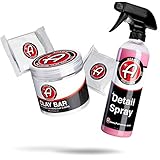
12. Adam’s Polishes Fine Grade Clay Bar – Best for Soft Finishes
Adam’s Polishes Fine Grade Clay Bar – Removes Debris & Dirt from Vehicle for Paint, Glass, Trim, Wheels | Add Shine, Gloss & Restore Depth of Color
2 x 100g ultra fine bars in a jar
16 oz detail spray
200 g set weight
Pros
- Very soft ultra fine clay leaves paint smooth
- Removes tar overspray brake dust sap and water spots
- Large bar volume reduces finger fatigue
- Easy to fold to a clean face mid-job
- Included detail spray lubricates well
Cons
- Fine grade is not for heavy baked contamination
- Should not be used on a dirty exterior
- Few reports of kits arriving without the detail spray
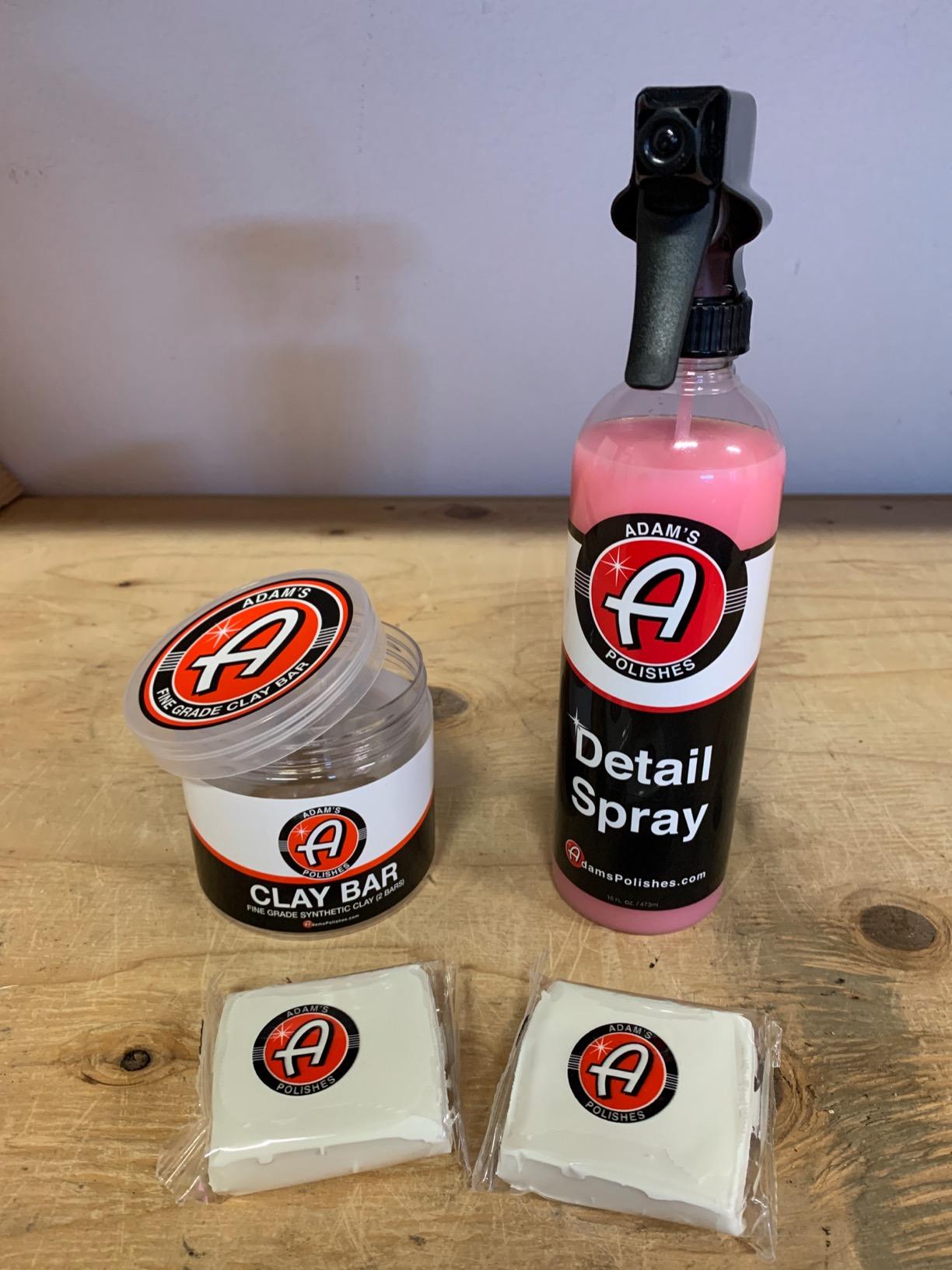
The Adam’s kit is the softest option in this roundup, and that is exactly why it belongs here. It is rated fine grade, grit 100, and the design brief is light deposits before waxing, sealing, polishing or coating rather than rescue work.
Owners following the brand instruction video report reliable results, including road tar and even white paint transfer from tires and wheel wells. A 4.6 average across 457 ratings is a strong score on a smaller sample.

Comfort during long sessions comes from the bar volume. Two 100 g bars in a jar are described as reducing finger fatigue, and the material folds cleanly so you can expose a fresh face without pinching it.
Safe surfaces are broad: glass, polished metal, clear plastics and painted surfaces are all listed, which makes it a sensible choice if you are hesitant about a coarser clay on a soft finish.
Why fine grade suits soft and dark paint
Fine clay has less abrasive bite than medium, so it is the safer option when you cannot see the condition of the clear coat. Dark colours show every marring line, and soft or freshly wrapped finishes have the least margin.
It is also the right choice for a car that is cleaned regularly. If your panel does not pass the plastic bag test badly, light decontamination before waxing is all you need.
Where fine grade is not enough
Fine clay is not designed for heavy baked-on contamination. If the bag test comes back like sandpaper, start with a chemical decontaminant or a medium bar before coming back to this one.
The listing is also clear that the kit should not be used on a dirty exterior, since that grinds contamination in rather than lifting it. A handful of reviews report missing components, so check the detail spray is in the jar on arrival.
How to Clay a Car Without Marring the Paint
The product matters less than the technique. Almost every marring complaint we read traced back to one of three things: a dry bar, a dirty face, or too much pressure.
Step one: run the plastic bag test before you touch anything. If the panel fails, clay it. If it passes, a wash and a decontaminating shampoo may be all it needs.
Step two: work in the shade on a cool panel. A surface left in direct sun will dry out mid-pass, and dried clay drags. Forum users repeatedly say a car in the garage is a car clayed twice as easily.
Step three: knead the bar and flatten it into a palm-sized pad with a smooth face. Stretch it wide so you cover more area per pass, and keep spare bars or a rinse source within reach.
Step four: lubricate before the clay touches the panel, not after. A generous film of detail spray, dedicated clay lube or soapy water gives the bar something to glide on. Re-spray every few passes, and never let the surface dry.
Step five: use light, straight passes. No circles and no pressure. If the bar stops gliding or starts to feel gritty, fold to a clean face or rinse, because that grit is what scratches.
Step six: drop rules. A traditional bar that lands on the ground gets thrown away, since embedded grit cannot be cleaned out. Rinseable blocks and synthetic pads below are the fix if you drop things often.
Step seven: wipe each section down before it dries, then protect the paint. Claying removes the barrier that wax, sealant and coating need to bond, so the longer you wait the more bonding contamination returns. Seal it the same day.
On cost, the honest arithmetic is per use rather than per bar. A 100 g bar on a daily-driven car often covers several sessions before it is spent, while a neglected car can use a whole bar on one bonnet.
Clay Bar vs Clay Mitt vs Clay Towel
The format debate matters as much as the brand. Bars give precision, mitts and towels give speed, and picking the wrong one is why some people conclude clay is a gimmick.
Clay bars are the most abrasive and the most precise. They reach grilles, panel gaps and trim edges that nothing else fits, and they need folding and kneading throughout. Drop one and it is gone.
Clay mitts and synthetic cloths cover a large area per stroke, rinse clean after a drop and are far faster on a whole car. Forum users report finishing a full claying, wash and wax in 40 to 60 minutes with that format, which is double the speed of traditional clay.
Buy a bar if you clay a car occasionally, work on tight areas, or are dealing with stubborn contamination and need the extra bite. Buy a mitt or towel if you clay regularly, have a large vehicle, or want a job you will actually finish on a Sunday.
Both Chemical Guys block and pad options in this roundup sit between the two. They are large enough to work quickly and rinseable after a drop, which is why they suit people nervous about traditional clay.
Buying Guide: Grade, Lubricant and Surfaces to Avoid
Grade is the one specification worth getting right. Fine grade is for regular maintenance on soft or dark paint, medium grade is the general-purpose choice for daily-driven cars, and aggressive grades exist for genuinely baked-on contamination on sound thick clear coat.
Never jump to aggressive clay to save time. The faster route on a car with thin clear coat is a polish, not a harder bar, and many owners who wanted to skip claying entirely have come around to decontaminating first.
Lubricant does not have to be a branded bottle. Plenty of owners use water with a drop of car shampoo, and dedicated clay sprays work well enough that the main requirement is volume and re-application frequency. Any of them beats a dry pass.
Storage and lifespan are simple. Keep bars wrapped, cool and out of sunlight, fold dirt inward after each session, and let them air dry. A bar stored in a hot vehicle degrades, which is a complaint attached to more than one product here.
Some surfaces should not be clayed at all. Matte and satin finishes will be made glossier and are permanently changed. Textured plastic trim, black soft-touch trim and hard piano-black panels are all high risk for permanent marring.
Clay is also the wrong tool in a few situations. A decontaminating shampoo handles loose road film cheaply, an iron remover shifts rust-derived fallout that clay only moves, and a clay mitt covers large panels faster than any bar. Polish exists to fix defects clay cannot.
Finally, frequency. Most cars need claying once or twice a year. Daily drivers parked outside through winter salt, coastal cars and anything sitting near heavy traffic collect contamination faster, while a garage-kept car needs it far less often.
Our wider clay bar kit roundup is worth a look if you want the bundle options compared side by side before you commit to a format.
Frequently Asked Questions
Will a clay bar scratch my paint?
Not if you lubricate properly. Marring comes from running a nearly dry bar, from a dirty face carrying grit, or from pressing too hard. Keep the panel wet, fold to a clean face often and use light straight passes. A fine grade clay like the Adam’s kit is the safest choice on dark or soft paint.
Does soapy water work with clay bars?
Yes. Water with a drop of car shampoo gives enough glide for most bar clays, and plenty of owners use it as a cheap substitute for branded lubricant. The important part is volume and re-application, not the product. Several clay options listed here are formulated to work with plain water alone. Keep the panel visibly wet the whole time.
Is a clay bar worth it?
Worth it before waxing, sealing or coating, because bonded contaminants stop protection layers from bonding evenly. It is not worth it to fix swirls or scratches, and not necessary on a car that passes the plastic bag test. Run the bag test first and decide from the result.
What is the best clay mitt for detailing cars?
For speed and forgiveness, a synthetic clay pad or mitt beats a traditional bar on full-car jobs. The Griot’s Garage pad and the Chemical Guys Clay Block V2 both rinse clean after a drop and cover more area per pass. For tight areas and stubborn contamination, a traditional bar still wins on precision.
How often should I clay my car?
Once or twice a year for most cars. Daily drivers parked outside through winter salt, coastal cars and vehicles near heavy traffic collect contamination faster and may need more. A garage-kept car that passes the plastic bag test often needs it rarely or not at all.
Final Verdict on the Best Clay Bars for Paint Decontamination
The Mothers California Gold 3-Bar Kit takes our Editor’s Choice for one reason: it is the most proven option in this list, with 14,680 ratings at a 4.6 average, three bars in the box and a lubricant matched to them.
If you want a drop-proof format, the Chemical Guys Clay Block V2 is the smarter daily tool, and the Griot’s Garage pad covers big panels faster than anything else here. For soft or dark paint, the Adam’s fine grade bar is the cautious choice.
Whichever you pick, the technique decides the result. Lubricate first, keep light pressure, fold to a clean face often, and seal the paint the same day you decontaminate it in 2026.