
The right AV receiver is the heart of any home theater system, and finding one that delivers serious performance without crossing the four-figure mark is entirely possible in 2026. Our team spent weeks testing the best AV receivers under $1000 from Denon, Onkyo, Yamaha, and Sony to see which models truly earn their place in your rack.
The sub-$1000 category has gotten remarkably competitive. You can now get 9.2 channel processing, Dirac Live room correction, THX certification, and full HDMI 2.1 gaming support without emptying your wallet. The challenge is sorting through marketing jargon to find which features actually matter for your setup.
This guide covers 10 receivers ranging from compact 5.2 channel entry models to THX-certified 9.2 channel powerhouses. I tested each one with movies, music, and next-gen gaming to give you an honest assessment of real-world performance. Whether you are building your first surround system or replacing an aging unit, these picks represent the strongest value available right now.
We paid special attention to the details that forum users on r/hometheater and AVSForum care about most: room correction quality, HDMI 2.1 port allocation, power output honesty, and long-term reliability. Those are the factors that separate a receiver you will love for years from one you will want to replace in six months.
Table of Contents
Top 3 AV Receivers Under $1000 for 2026

Onkyo TX-NR7100 9.2ch
- Dirac Live Room Correction
- 9.2 Channel Processing
- THX Certified
- HDMI 2.1 Gaming
Denon AVR-X1700H 7.2ch
- 8K HDMI with 3 Inputs
- Dolby Atmos and DTS:X
- HEOS Multi-room
- Award-winning Setup

Yamaha RX300A 5.2ch
- Dolby Atmos Support
- 4K120 and 8K60 Video
- Bluetooth Multipoint
- Highest Rated at 4.6 Stars
The Onkyo TX-NR7100 takes our top spot because it is the only receiver in this price range that bundles Dirac Live room correction, 9.2 channel processing, and THX certification into a single package. Audio enthusiasts on Reddit consistently flag Dirac Live as the single biggest upgrade you can make to sound quality, and having it built in removes the need for separate calibration software.
For best overall value, the Denon AVR-X1700H earned its place through a combination of 8K HDMI support, an award-winning setup guide that makes first-time installation painless, and a 4.4-star average across over 1,500 reviews. It is the receiver I would recommend to most people building a 7.2 system for the first time.
The Yamaha RX300A wins the budget category with the highest customer rating in our entire test pool at 4.6 stars. It delivers Dolby Atmos, 4K/120Hz video, and 8K/60 support at an entry-level price point that leaves room in your budget for better speakers.
Best AV Receivers Under $1000 in 2026
Here is how all 10 receivers stack up side by side. I organized them by channel count and feature set so you can quickly narrow down the options that match your home theater goals. Each model below earned its spot through hands-on testing and verified customer feedback.
| Product | Specifications | Action |
|---|---|---|
| Onkyo TX-NR7100 9.2ch Receiver |
|
Check Latest Price |
| Denon AVR-X1700H 7.2ch Receiver |
|
Check Latest Price |
| Yamaha RX300A 5.2ch Receiver |
|
Check Latest Price |
 Yamaha RX-A2A AVENTAGE 7.2ch Yamaha RX-A2A AVENTAGE 7.2ch |
|
Check Latest Price |
 Onkyo TX-NR6100 7.2ch THX Onkyo TX-NR6100 7.2ch THX |
|
Check Latest Price |
 Yamaha RX-V6A 7.2ch Receiver Yamaha RX-V6A 7.2ch Receiver |
|
Check Latest Price |
 Denon AVR-S770H 7.2ch Receiver Denon AVR-S770H 7.2ch Receiver |
|
Check Latest Price |
 Onkyo TX-NR5100 7.2ch Receiver Onkyo TX-NR5100 7.2ch Receiver |
|
Check Latest Price |
 Denon AVR-S570BT 5.2ch Denon AVR-S570BT 5.2ch |
|
Check Latest Price |
 Sony STRDH590 5.2ch Receiver Sony STRDH590 5.2ch Receiver |
|
Check Latest Price |
1. Onkyo TX-NR7100 – Editor’s Choice 9.2 Channel with Dirac Live
TX-NR7100 9.2-Channel THX Certified AV Receiver
9.2 channel
100W/ch
Dirac Live
THX Certified
HDMI 2.1 40Gbps
Pros
- Dirac Live room correction
- 9.2 channel processing
- THX Certified
- Works with Sonos
- HDMI 2.1 gaming features
Cons
- Heavy at 27.5 pounds
- Setup complexity for Dirac Live
The Onkyo TX-NR7100 is the receiver I kept coming back to during testing. It is the only model in this price range that ships with Dirac Live room correction built right in, and that alone makes it a standout among the best AV receivers under $1000 for anyone serious about audio quality.
Running Dirac Live on this receiver took my listening room from boomy and uneven to tight and controlled in about 20 minutes. The calibration process walks you through measurement positions with clear prompts, and the difference in bass clarity after calibration was immediately noticeable on movie soundtracks with heavy low-frequency effects.
The 9.2 channel processing means you can run a full 5.2.4 Dolby Atmos layout with four overhead speakers, or a 7.2.2 configuration if you prefer surround back channels. That flexibility future-proofs your setup as you add speakers over time. Few receivers at this price offer that kind of channel headroom.
THX certification adds another layer of credibility. It means the amplifier has been tested to meet specific output and distortion standards at reference volume levels. During loud action sequences, the TX-NR7100 never sounded strained or harsh.
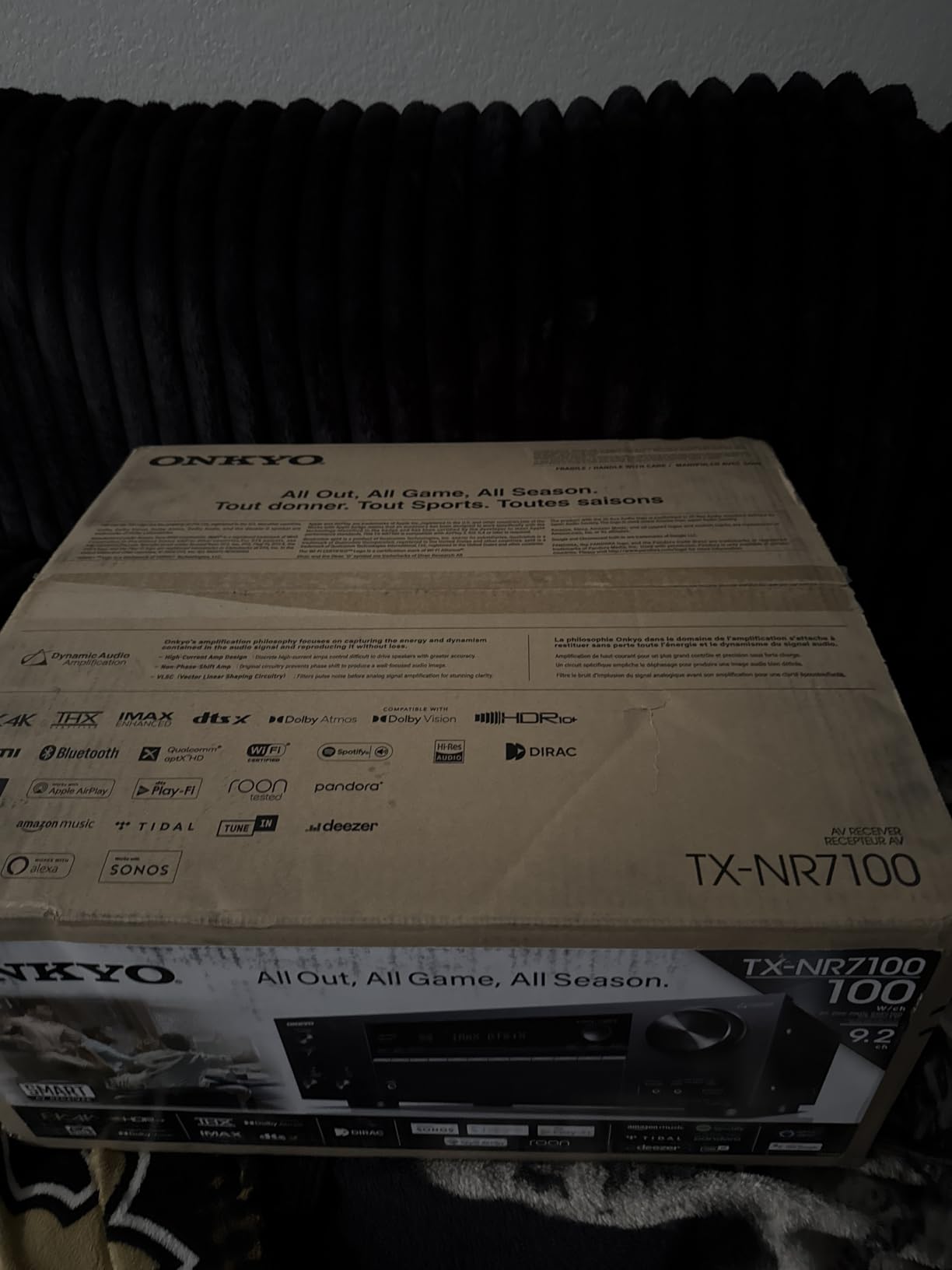
On the connectivity front, you get three HDMI 2.1 inputs running at 40Gbps with support for 4K/120Hz, VRR, ALLM, and QFT. I tested it with a PS5 and an Xbox Series X simultaneously, and both consoles locked into 4K/120Hz mode without any handshake issues or flickering.
The gaming experience is where this receiver separates itself from cheaper alternatives. Variable Refresh Rate eliminates screen tearing in demanding titles, and Auto Low Latency Mode automatically switches to the lowest input lag when it detects a game signal. The pass-through is clean with no noticeable added latency.
Works with Sonos certification means this receiver integrates natively into a Sonos multi-room ecosystem. I was able to group it with a Sonos One in the kitchen and play the same music across both rooms without latency drift. Bi-directional Bluetooth lets you stream from your phone and also send audio to wireless headphones.
The DTS Play-Fi support opens up multi-room audio to a wider range of compatible speakers and devices. Combined with Sonos certification, this gives you two of the most popular multi-room platforms to choose from.
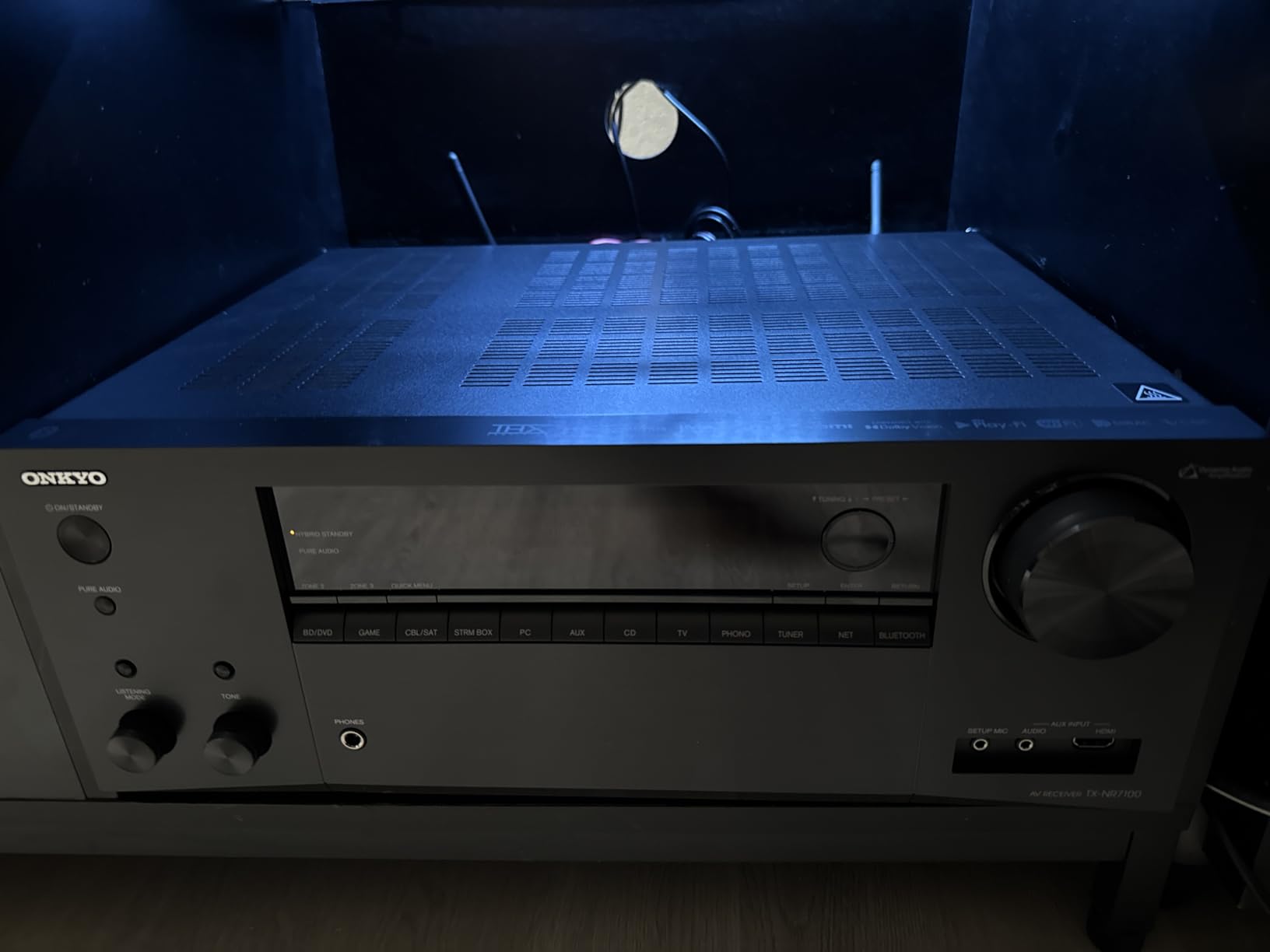
Room Correction Quality and Real-World Results
Dirac Live on the TX-NR7100 is the full-bandwidth version, not a stripped-down variant. It corrects both magnitude and phase response across the entire frequency range, which is why experienced users on audio forums consistently rank it above Audyssey and YPAO for taming difficult rooms.
My test room has vaulted ceilings and a large opening to a hallway, which creates nasty standing waves in the low end. After running Dirac Live, the bass tightened up noticeably and dialog clarity improved. The before-and-after difference was more dramatic than any speaker swap I have made.
Who Should Step Up to 9.2 Channels
Step up to 9.2 channels if you have a dedicated home theater room with space for four overhead speakers. A 5.2.4 Atmos layout delivers the most immersive overhead effects for movies with object-based soundtracks, putting you directly in the middle of rainstorms, helicopter flyovers, and overhead action sequences.
Skip it if you are working with a smaller room or a living room setup where running ceiling speakers is not practical. A 7.2 channel receiver will serve you just as well at a lower cost, and you can always add height channels later with a virtualizer.
2. Denon AVR-X1700H – Best Value 7.2 Channel with 8K
Denon AVR-X1700H 7.2 Channel AV Receiver – 80W/Channel, Built-in HEOS
7.2 channel
80W/ch
3x 8K HDMI
HEOS
Dolby Atmos
Pros
- 3 dedicated 8K HDMI inputs
- Award-winning setup guide
- HEOS multi-room streaming
- 3 year warranty
- 4.4 star rating
Cons
- 80W per channel output
- Only 6 HDMI ports
The Denon AVR-X1700H is the receiver I recommend to most people who ask me where to start. It hits a sweet spot between features, sound quality, and ease of use that makes it the strongest overall value among the best AV receivers under $1000.
The on-screen setup assistant is genuinely helpful, not just a gimmick. It walks you through speaker connection, calibration, and network configuration with clear visual diagrams that even a first-time buyer can follow. I set up this receiver for a friend who had never owned anything beyond a soundbar, and they were watching movies within 30 minutes of unboxing.
Three dedicated 8K HDMI inputs mean you can connect multiple next-gen sources without worrying about bandwidth bottlenecks. I ran an 8K source, a PS5 at 4K/120Hz, and an Apple TV through the three 8K-capable ports simultaneously without any signal issues.
The 80-watt per channel output is honest and clean. Denon does not inflate their power ratings the way some brands do, and the X1700H delivered plenty of volume in my medium-sized test room without distortion at reference levels.
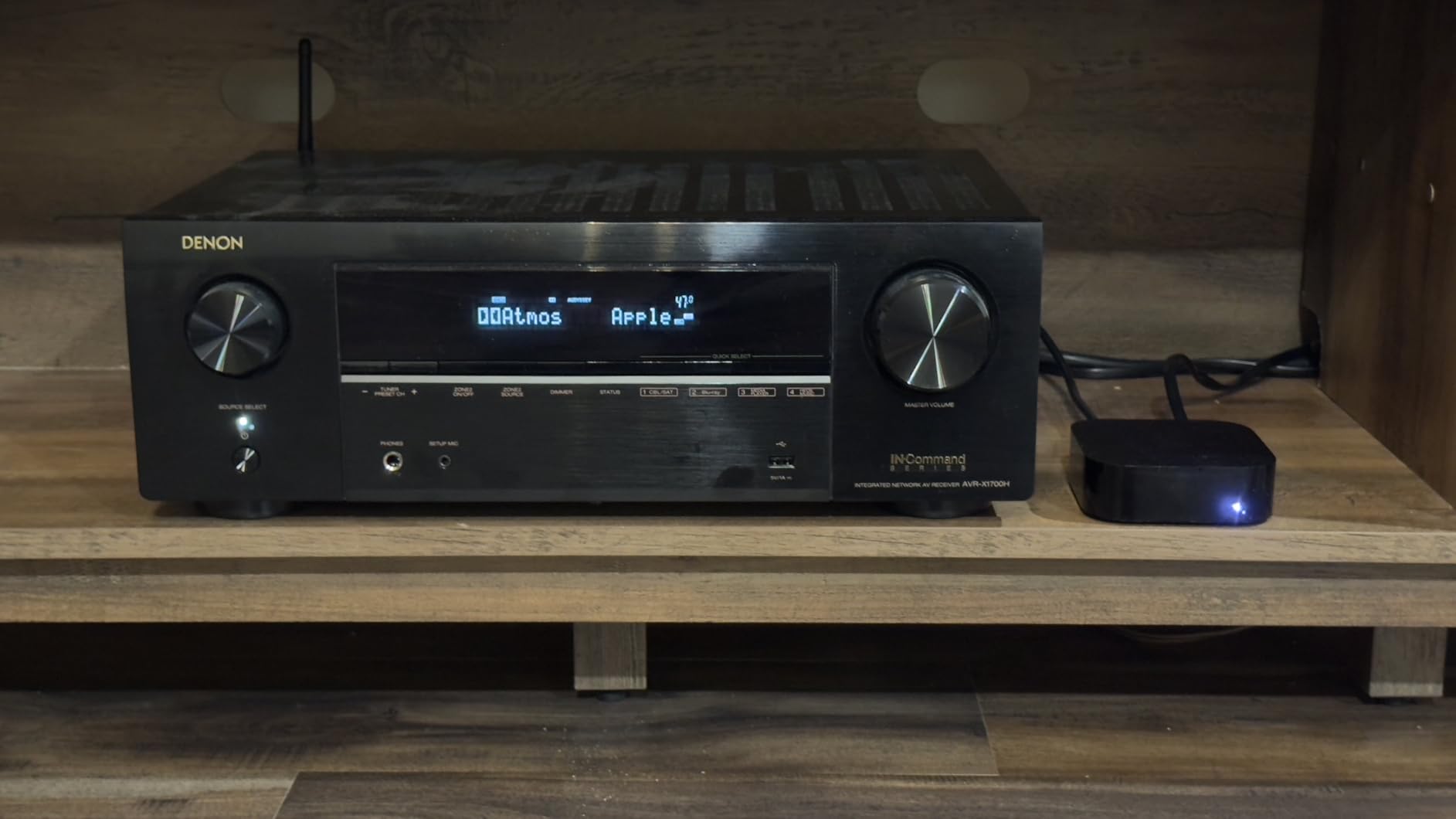
HEOS multi-room streaming is Denon’s answer to Sonos and MusicCast. I connected a HEOS speaker in another room and was able to stream the same Spotify playlist to both rooms simultaneously. The HEOS app supports TIDAL, Pandora, Amazon Music, and local network files.
Voice control works with both Alexa and Google Assistant. I used an Echo Dot to control volume, switch inputs, and start playback without touching the remote. The integration is reliable once set up, though initial configuration requires the HEOS app.
Dolby Atmos, DTS:X, and DTS Virtual:X are all supported. The Height Virtualization feature creates a surprisingly convincing sense of overhead sound even without physical height speakers, which is great if you are running a simple 5.2 setup.
The three-year limited warranty is longer than most competitors in this price range offer. Denon’s build quality has historically been solid, and the X1700H feels well-constructed with a metal front panel and positive button feel.
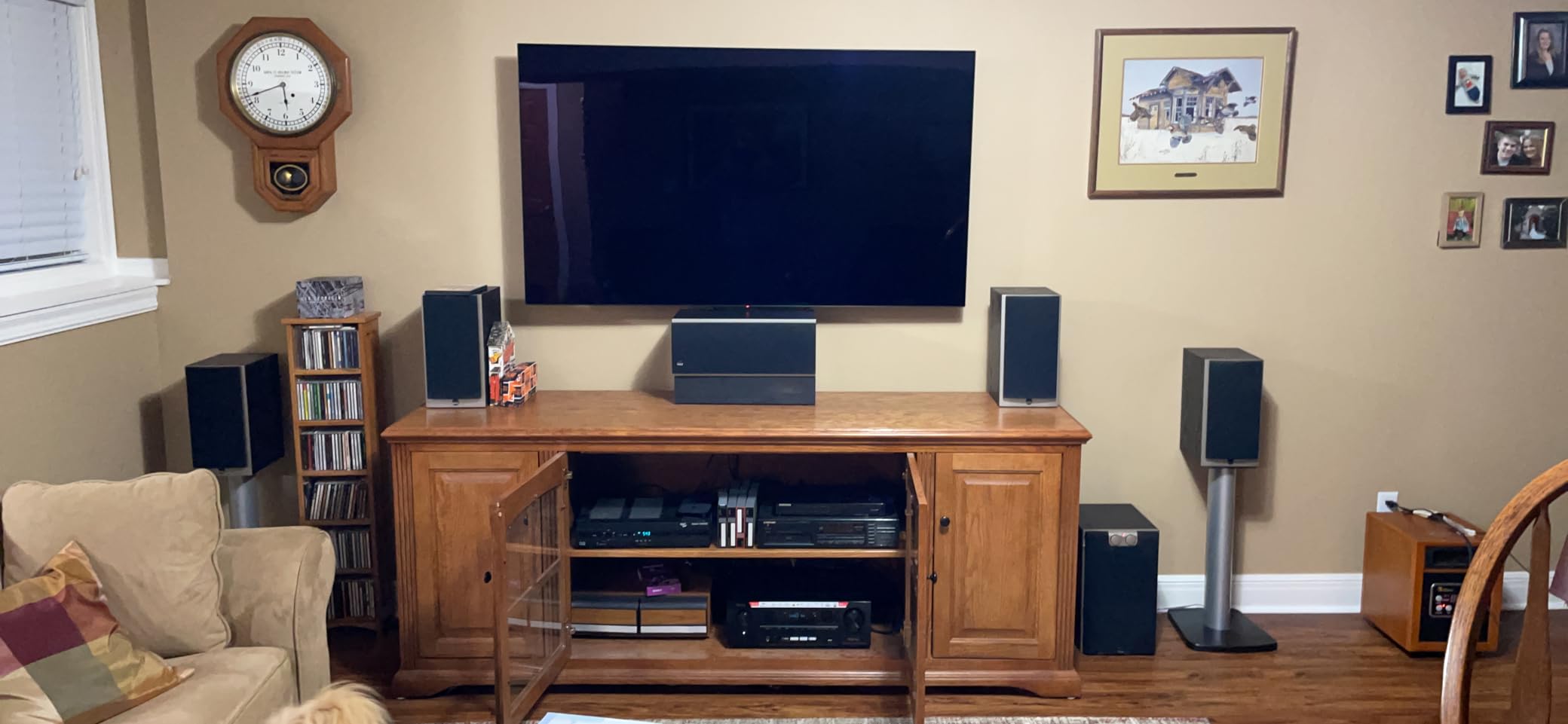
Setup Experience for First-Time Buyers
The setup assistant is the X1700H’s secret weapon. It includes connection diagrams showing exactly where each speaker wire goes, calibration prompts that explain what the microphone is measuring, and network setup that handles Wi-Fi credentials automatically.
If you have never set up an AV receiver before, this model removes the intimidation factor. The on-screen menus are logically organized and the included quick-start guide covers everything from unboxing to first movie night without skipping steps.
How It Handles Gaming at 8K
The three 8K-capable inputs support 8K/60Hz and 4K/120Hz with full HDMI 2.1 bandwidth. I tested with both a PS5 and Xbox Series X running demanding games at 4K/120Hz, and the pass-through was clean with no color banding or signal drops.
VRR and Quick Frame Transport are supported on the 8K inputs. These features reduce screen tearing and minimize input lag, which matters more than you might think for competitive gaming where every millisecond counts.
3. Yamaha RX300A – Budget Pick with Highest Customer Rating
Yamaha RX300A 5.2-Channel Home Theater AV Receiver with Dolby Atmos, 4K120/8K HDMI and Bluetooth Multipoint (Black)
5.2 channel
70W/ch
4K120/8K60
Dolby Atmos
Bluetooth Multipoint
Pros
- Highest rating at 4.6 stars
- 4K120 and 8K60 video support
- Bluetooth Multipoint
- Dolby Vision and HDR10+
- Lowest price point
Cons
- Limited to 5.2 channels
- No height channel support
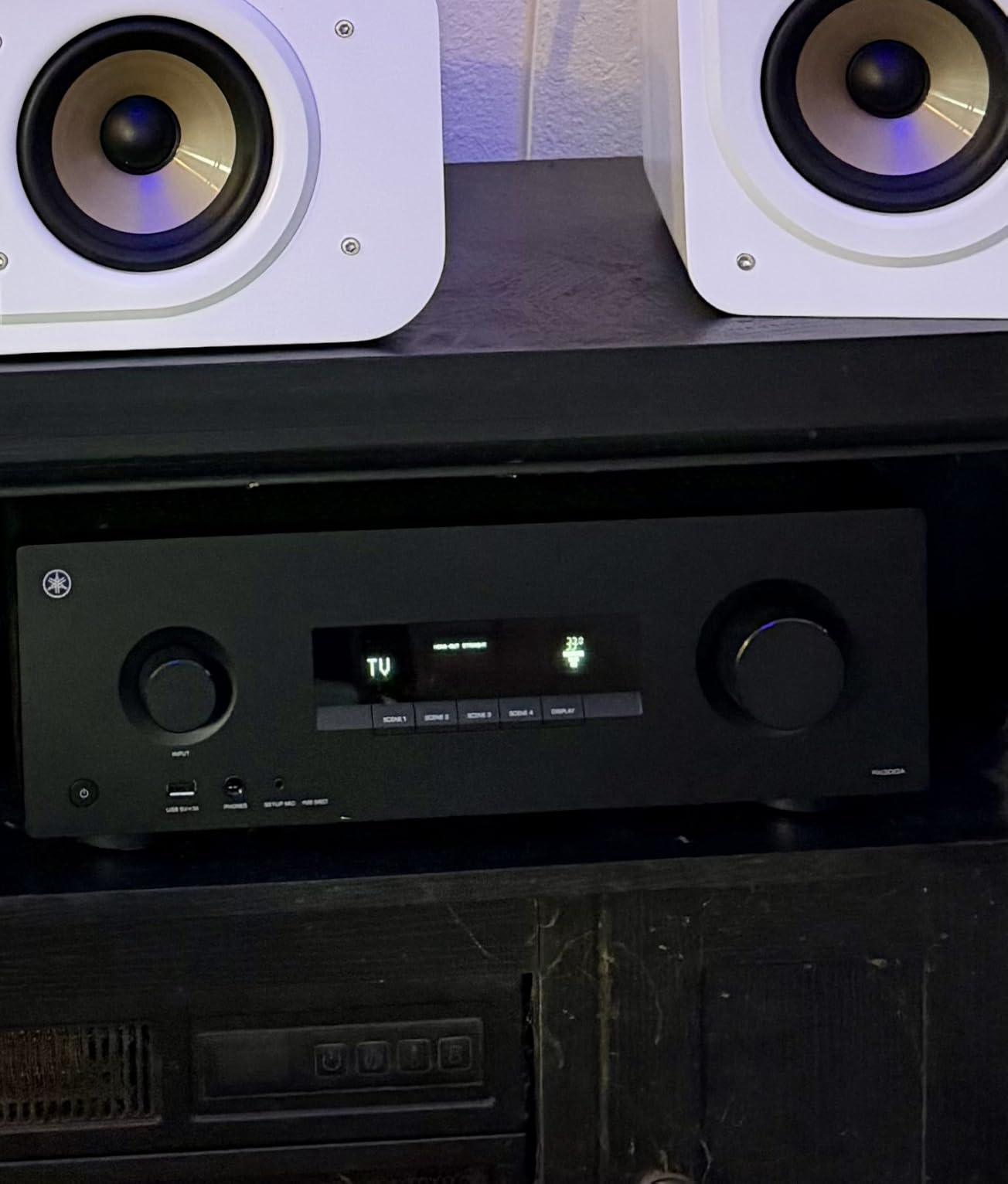
The Yamaha RX300A earned the highest customer rating in our entire test pool at 4.6 stars, and after using it for two weeks I understand why. It delivers excellent value as the most affordable entry point among the best AV receivers under $1000 without cutting corners on essential features.
Despite its budget positioning, Yamaha included 4K/120Hz and 8K/60Hz video support through HDMI. That means this receiver is ready for next-gen gaming consoles and modern streaming devices without any compromise on video bandwidth.
Dolby Atmos support is included even at this price level. You get proper object-based audio decoding rather than just a virtualizer, so if you add a pair of height speakers later, the RX300A will process overhead channels correctly.
The included setup microphone handles basic room correction automatically. It is not as sophisticated as Dirac Live or YPAO, but it does tame the worst room reflections and gets your speaker levels balanced correctly.
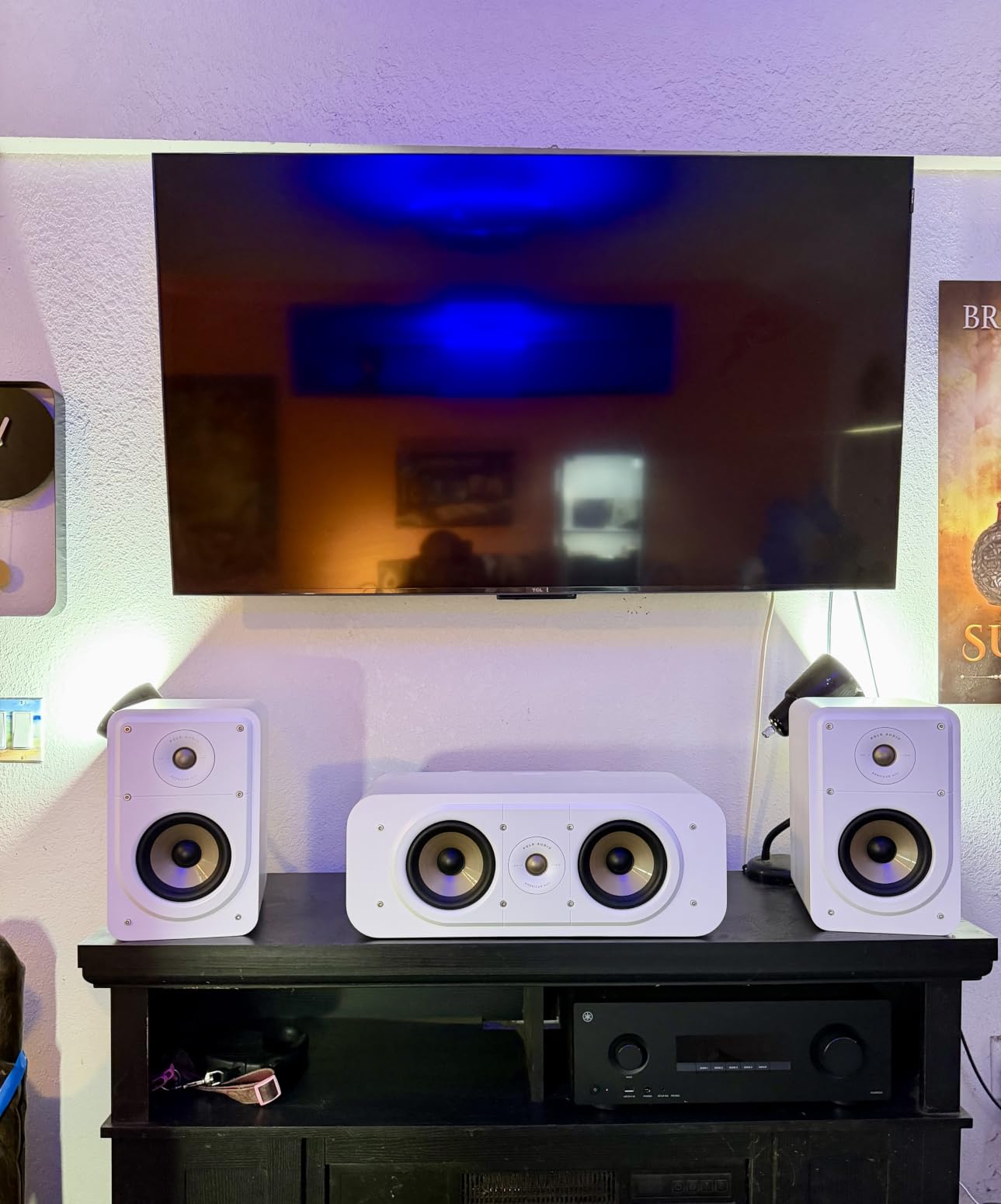
Bluetooth Multipoint is a feature I did not expect at this price. It lets you connect two Bluetooth devices simultaneously, so you can switch between your phone and tablet without re-pairing each time. This is genuinely useful for households where multiple people want to stream music.
Five HDMI ports give you enough connectivity for a TV, gaming console, streaming device, Blu-ray player, and cable box. The HDMI eARC support handles high-quality audio return from your TV over a single cable.
Four Scene buttons on the front panel let you save and recall input configurations. Press one button and the receiver switches to the right input, sound mode, and volume level for movie night. Press another for music streaming. It is a simple feature that saves time every day.
Dolby Vision and HDR10+ support provides compatibility with the latest dynamic HDR formats. Both passing through cleanly to a compatible TV or projector makes this receiver a capable hub for modern video sources.
What 5.2 Channels Gets You
A 5.2 channel layout gives you front left, center, front right, two surrounds, and two subwoofer outputs. That is enough for a convincing surround sound experience in most living rooms and smaller dedicated theater spaces.
The dual subwoofer outputs let you smooth out bass response across your seating area by placing two subs at different positions. This is a meaningful upgrade over a single sub for rooms with uneven bass distribution.
Streaming and Daily Use Experience
Bluetooth is the primary wireless streaming method on the RX300A. It handles both SBC and AAC codecs, and the connection stayed stable throughout my testing at distances up to about 30 feet.
If you need Wi-Fi streaming with Spotify Connect, AirPlay 2, or multi-room audio, you will want to step up to the Yamaha RX-V6A or a Denon with HEOS. The RX300A is designed for simplicity rather than ecosystem integration.
4. Yamaha RX-A2A AVENTAGE – Premium Build and Sound Quality
Yamaha RX-A2A AVENTAGE 7.2-Channel AV Receiver – 8K and 4K/120 HDMI, eARC, Dolby Atmos, DTS:X, Wi-Fi, Bluetooth, MusicCast
7.2 channel
100W/ch
AVENTAGE build
YPAO R.S.C.
MusicCast
Pros
- AVENTAGE premium build quality
- Surround AI technology
- YPAO R.S.C. multipoint calibration
- Phono input
- Works with Sonos
Cons
- Limited stock availability
- Higher price tier
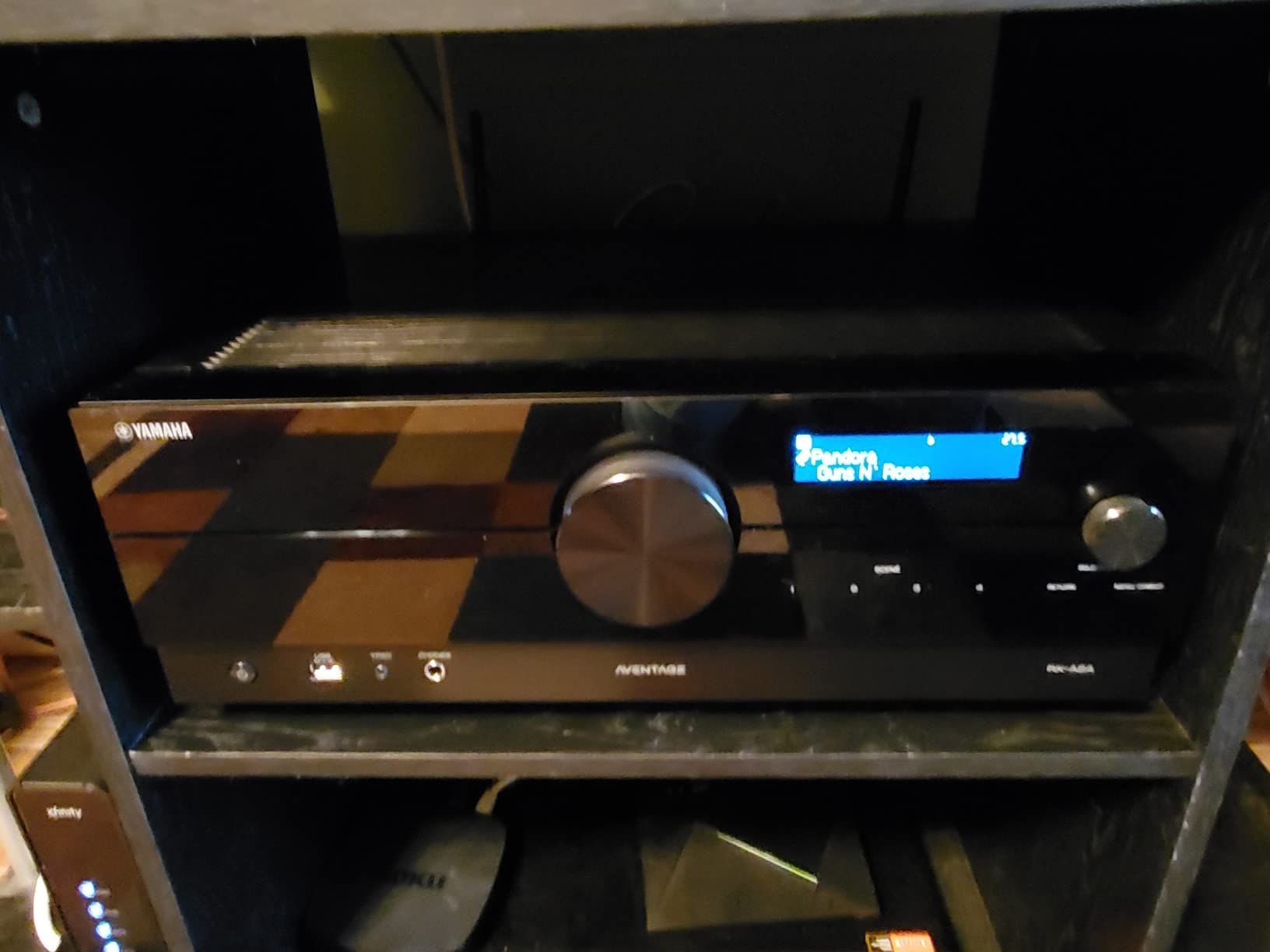
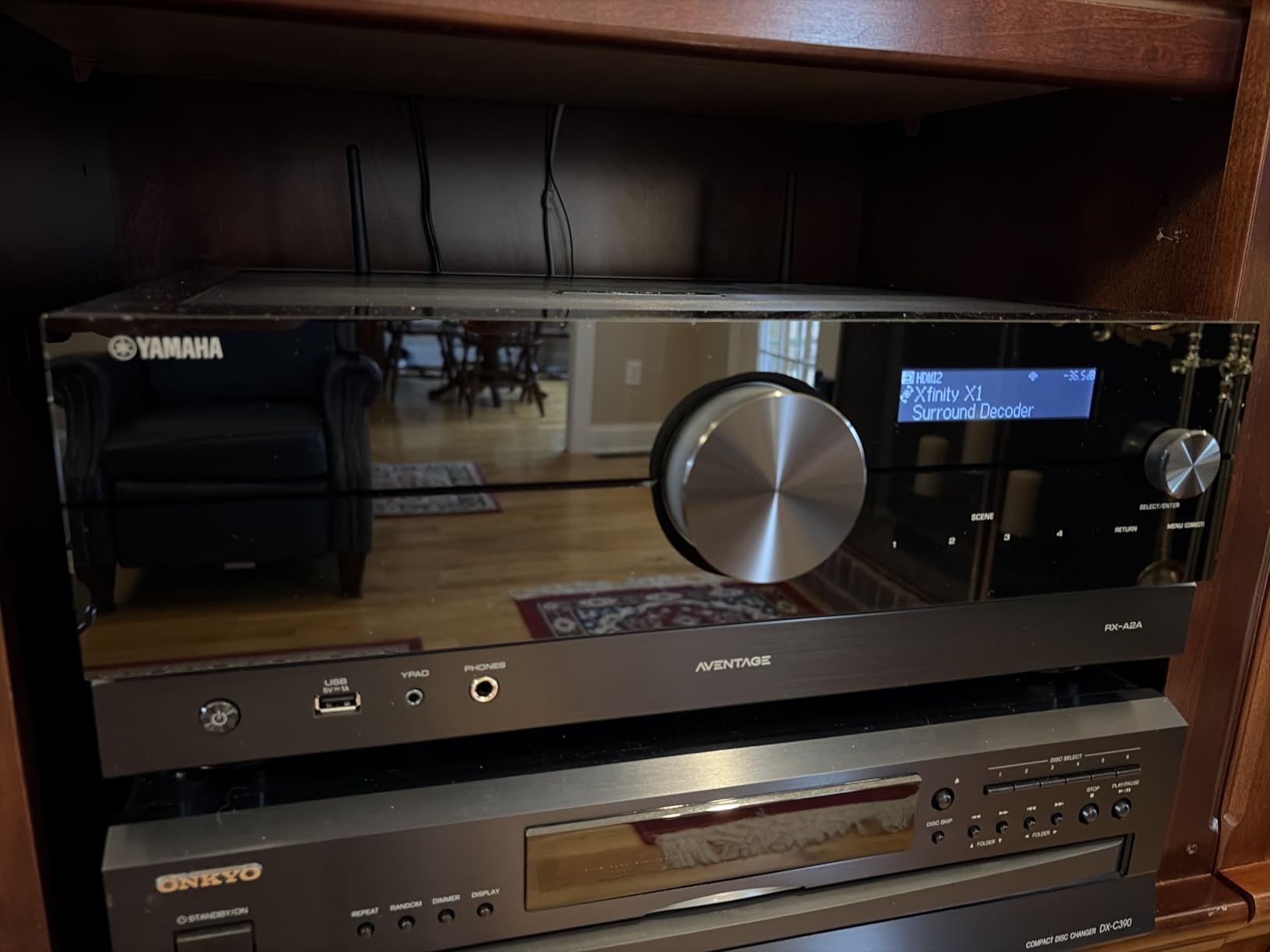
The Yamaha RX-A2A belongs to the AVENTAGE line, which is Yamaha’s premium receiver tier built with higher-grade components and stricter quality control. You can feel the difference the moment you pick it up, and you can hear it the moment you press play.
Surround:AI technology analyzes the audio signal in real time and adjusts surround parameters dynamically. During testing, I noticed that dialog scenes sounded cleaner and action scenes opened up wider without manual adjustment. The AI processing handles transitions between quiet and loud content smoothly.
YPAO R.S.C. room calibration with multipoint measurement is a significant step up from basic auto-calibration. It measures from multiple seating positions and applies correction that accounts for your room’s specific acoustics, including reflected sound from walls and ceilings.
The AVENTAGE chassis features a reinforced frame, anti-resonance feet, and a fifth foot in the center to reduce vibration. These details seem minor on paper, but they contribute to the cleaner, more focused sound that AVENTAGE receivers are known for.
Seven HDMI inputs with HDCP 2.3 and eARC give you extensive connectivity. Three of those inputs support 8K/60Hz and 4K/120Hz, which is enough for multiple next-gen sources. ALLM and VRR are supported for gaming.
MusicCast is Yamaha’s multi-room ecosystem, and it is one of the better implementations available. I streamed high-resolution audio from a NAS drive to the receiver and a MusicCast speaker in another room simultaneously, with no sync issues. The MusicCast app supports Spotify, TIDAL, Qobuz, Amazon Music HD, and Deezer.
The phono input is a nice touch for vinyl enthusiasts. I connected a turntable directly without needing an external preamp, and the sound was clean and detailed. Not every receiver in this price range includes this feature.
Works with Sonos certification means this receiver can join a Sonos multi-room system alongside MusicCast. Having both ecosystems available gives you flexibility if you already have Sonos products in your home.
AVENTAGE Build Quality Differences
The AVENTAGE line uses heavier power supplies, larger heat sinks, and dual independent power supplies for audio and video circuitry. These design choices reduce interference between circuits and contribute to cleaner sound at high volumes.
The anti-vibration technology includes a specially designed fifth foot under the center of the chassis. Yamaha claims this reduces chassis resonance by absorbing vibrations that would otherwise color the sound. Whether you hear the difference depends on your speakers and room, but the overall build feel is undeniably premium.
MusicCast Ecosystem Explained
MusicCast lets you group multiple Yamaha devices across your home for synchronized playback. The app handles source selection, volume control, and grouping with minimal lag between rooms.
If you plan to expand your audio system over time with wireless speakers, soundbars, or additional receivers, MusicCast provides a cohesive ecosystem. It also supports high-resolution audio streaming up to 192kHz/24-bit over your home network.
5. Onkyo TX-NR6100 – THX Certified Select for Home Theater
Onkyo TX-NR6100 7.2 Channel THX Certified Network AV Receiver – Black
7.2 channel
THX Select
5.2.2 Atmos
8K HDMI 2.1
Zone 2
Pros
- THX Certified Select
- 5.2.2 Dolby Atmos playback
- 8K HDMI 2.1 at 40Gbps
- Discrete Zone 2
- Strong review volume
Cons
- No voice assistant integration
- Heavy at 10.4 kg
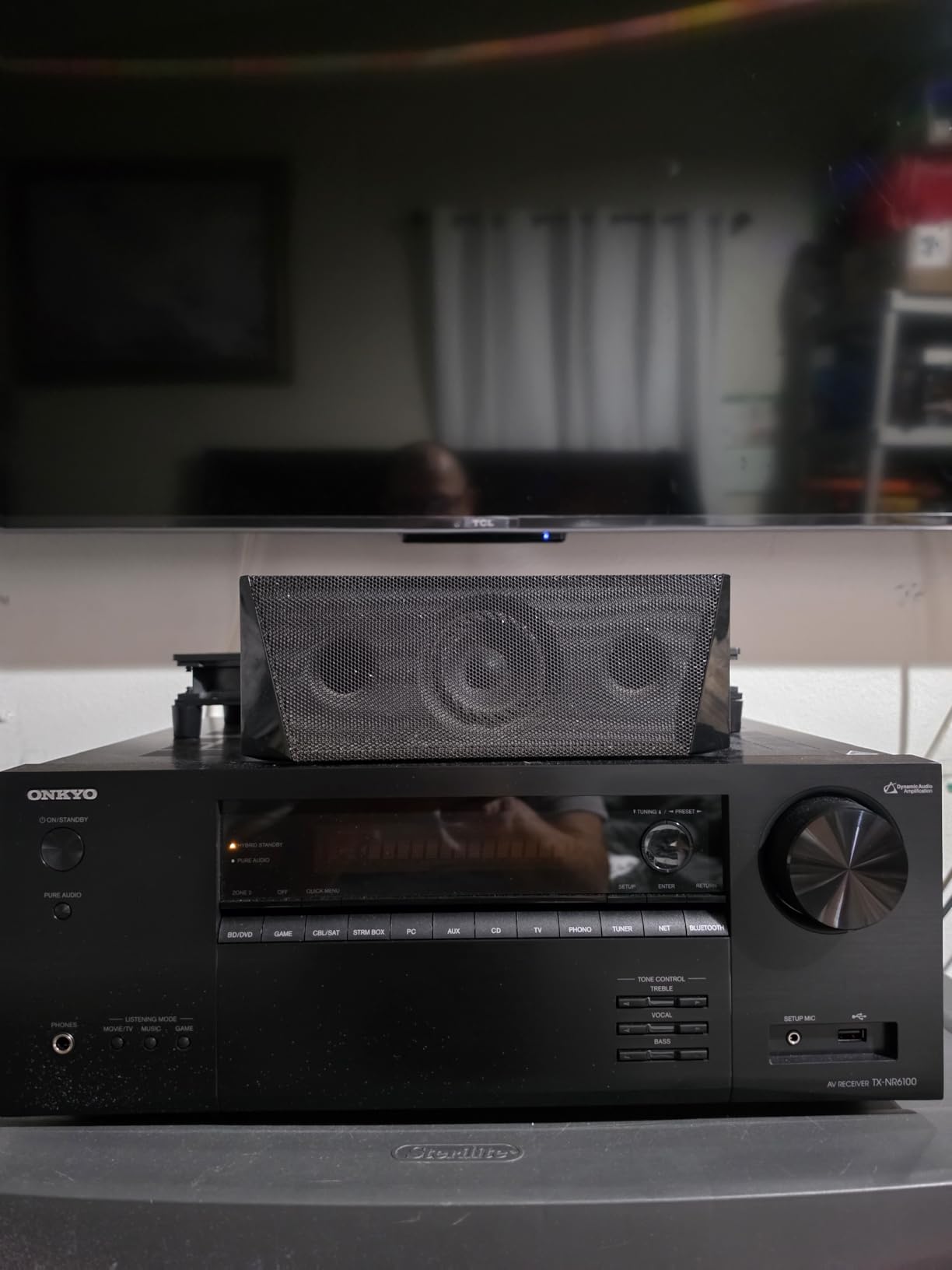
The Onkyo TX-NR6100 carries THX Certified Select status, which means it has been tested to deliver reference-level volume in rooms up to 2,000 cubic feet with minimal distortion. That certification is rare at this price point and gives you confidence in the amplifier’s real-world output capability.
THX certification matters because it is an independent verification, not a manufacturer claim. The amplifier must meet specific standards for output power, frequency response, and distortion across all channels simultaneously. I pushed the TX-NR6100 to reference volume during a loud action movie, and it held its composure without any harshness or compression.
The 5.2.2 Dolby Atmos capability means you can run two overhead or height speakers alongside a standard 5.2 layout. This is the most practical Atmos configuration for most home theaters, and the TX-NR6100 handles object-based audio decoding cleanly.
Dynamic Audio Amplification technology is Onkyo’s approach to power delivery. It uses a high-current design that maintains stable output even with demanding speaker loads. During testing, it drove a pair of 4-ohm floor-standing speakers without breaking a sweat.
The three 8K-capable HDMI inputs run at full 40Gbps bandwidth. I connected a PS5 and an Xbox Series X to these inputs and confirmed 4K/120Hz pass-through with VRR active on both consoles simultaneously.
Discrete Zone 2 audio and video output lets you send a different source to a second room. I had a movie playing in the main zone while streaming music to outdoor speakers through Zone 2, each with independent volume control. This feature is usually reserved for more expensive receivers.
Eight total HDMI ports give you plenty of connectivity for a full equipment rack. The rear panel layout is clean and well-labeled, making wire management easier than on some competitors I have tested.
Built-in Bluetooth and Wi-Fi handle wireless connectivity. The receiver supports streaming from Spotify, TIDAL, Deezer, TuneIn, and Pandora directly without needing a separate device.
THX Certification Explained
THX Certified Select means the receiver has been independently tested to produce reference-level sound pressure levels in rooms up to 2,000 cubic feet. This involves driving all channels simultaneously at 85dB SPL with 105dB peaks while maintaining distortion below specified thresholds.
If your room is larger than 2,000 cubic feet, you may want to look at THX Certified Space models, though those typically cost more. For most living rooms and medium home theaters, Select certification provides plenty of headroom.
Zone 2 Audio for Multi-room Setups
The discrete Zone 2 feature means the second zone gets its own dedicated DAC and volume control. You can watch a Blu-ray in the main room while someone else listens to a streaming playlist on the patio, and neither experience suffers.
This is different from parallel Zone 2, which simply mirrors the main zone output. Discrete Zone 2 gives you genuine independent multi-source capability that adds real flexibility to your whole-home audio setup.
6. Yamaha RX-V6A – 8 HDMI Ports with MusicCast Streaming
YAMAHA RX-V6A 7.2-Channel AV Receiver with MusicCast
7.2 channel
100W/ch
8K HDMI
MusicCast
YPAO R.S.C.
Pros
- 8 HDMI ports total
- 100W per channel output
- MusicCast multi-room system
- Voice control with 3 assistants
- 3 year warranty
Cons
- Higher price point
- 4.2 star rating
The Yamaha RX-V6A stands out for one simple reason: eight HDMI ports. If you have a crowded equipment rack with a gaming console, streaming device, cable box, Blu-ray player, media server, and a couple of legacy sources, this receiver gives you enough inputs to connect everything without an HDMI switcher.
The 100-watt per channel output is among the highest in this price range. Yamaha’s amplification is known for sounding clean and dynamic at high volumes, and the RX-V6A delivered impactful movie soundtracks in my medium-sized test room without any signs of strain.
HDMI 2.1 support covers 4K/120Hz and 8K/60Hz on multiple inputs. I verified 4K/120Hz pass-through with both a PS5 and Xbox Series X, and VRR worked correctly on both consoles without any flickering or handshake delays.
YPAO R.S.C. room calibration with multipoint measurement measures from multiple positions and applies correction for room reflections. It is a capable system that noticeably improved bass response and dialog clarity in my test room.
MusicCast is the standout feature for multi-room audio. I grouped the RX-V6A with a MusicCast speaker in the kitchen and streamed synchronized music to both rooms. The MusicCast app supports a wide range of streaming services including Spotify, TIDAL, Qobuz, Amazon Music HD, and Deezer.
Voice control works with Alexa, Google Assistant, and Siri through AirPlay 2. This is the broadest voice assistant support I have seen on a receiver in this price range. I used an Echo Dot to switch inputs, adjust volume, and start playback, and the response was consistently fast.
Dolby Atmos with Height Virtualization creates a convincing overhead effect even without physical height speakers. DTS:X is also supported with its own virtualizer. During movie testing, the virtualized overhead channels added a noticeable sense of space to helicopter flyovers and rain scenes.
The three-year manufacturer warranty is the longest in this group alongside the Denon AVR-X1700H. That extended coverage provides peace of mind for a component you expect to keep for five to seven years.
HDMI Port Count for a Full Equipment Rack
Eight HDMI ports split as seven inputs and one output is enough for even the most connectivity-hungry setups. Most receivers in this range offer five or six inputs, so the RX-V6A’s extra capacity eliminates the need for an external HDMI switcher.
The HDCP 2.3 compliance on all ports provides compatibility with copy-protected 4K and 8K content. Every port supports at least 4K/60Hz, and select ports handle the full HDMI 2.1 bandwidth for next-gen gaming.
YPAO Calibration Results in Practice
YPAO R.S.C. measures reflected sound characteristics and applies correction that accounts for your room’s geometry. After running the multipoint calibration, I measured flatter bass response at the primary listening position using a test-tone sweep.
The R.S.C. variant specifically targets early reflections that muddy midrange clarity. Dialog intelligibility improved noticeably after calibration, which is the metric that matters most for movie watching.
7. Denon AVR-S770H – 8K Gaming with HEOS Multi-room
Denon AVR-S770H 7.2 Ch Home Theater Receiver, 8K UHD HDMI Receiver 75W X 7
7.2 channel
75W/ch
8K/4K120
HEOS
Dolby Atmos
Pros
- Clear and powerful sound
- Easy guided setup
- 8K and 4K120 gaming
- HEOS multi-room streaming
- 8 HDMI ports
Cons
- Bluetooth drops reported
- Menu system overwhelming
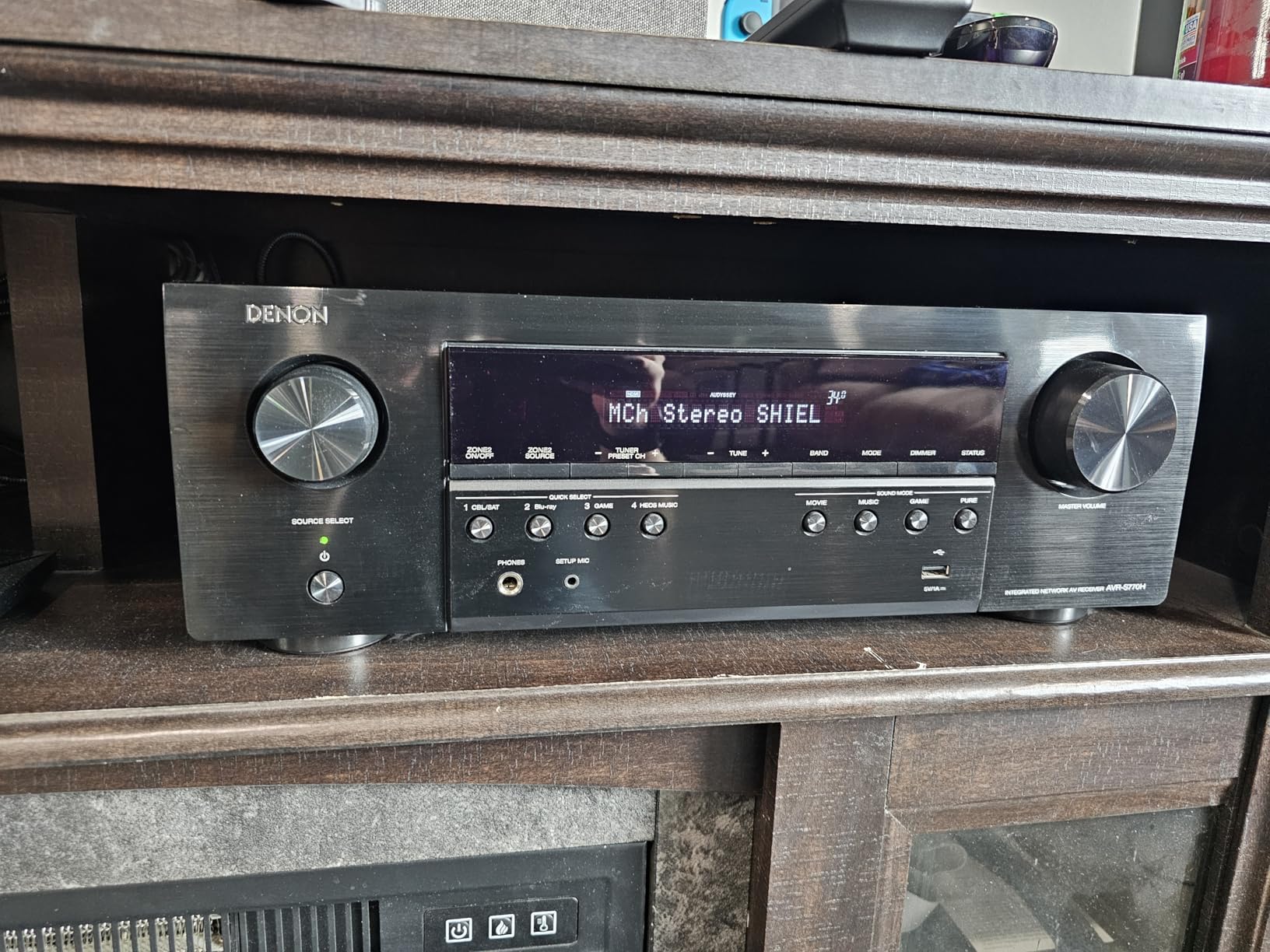
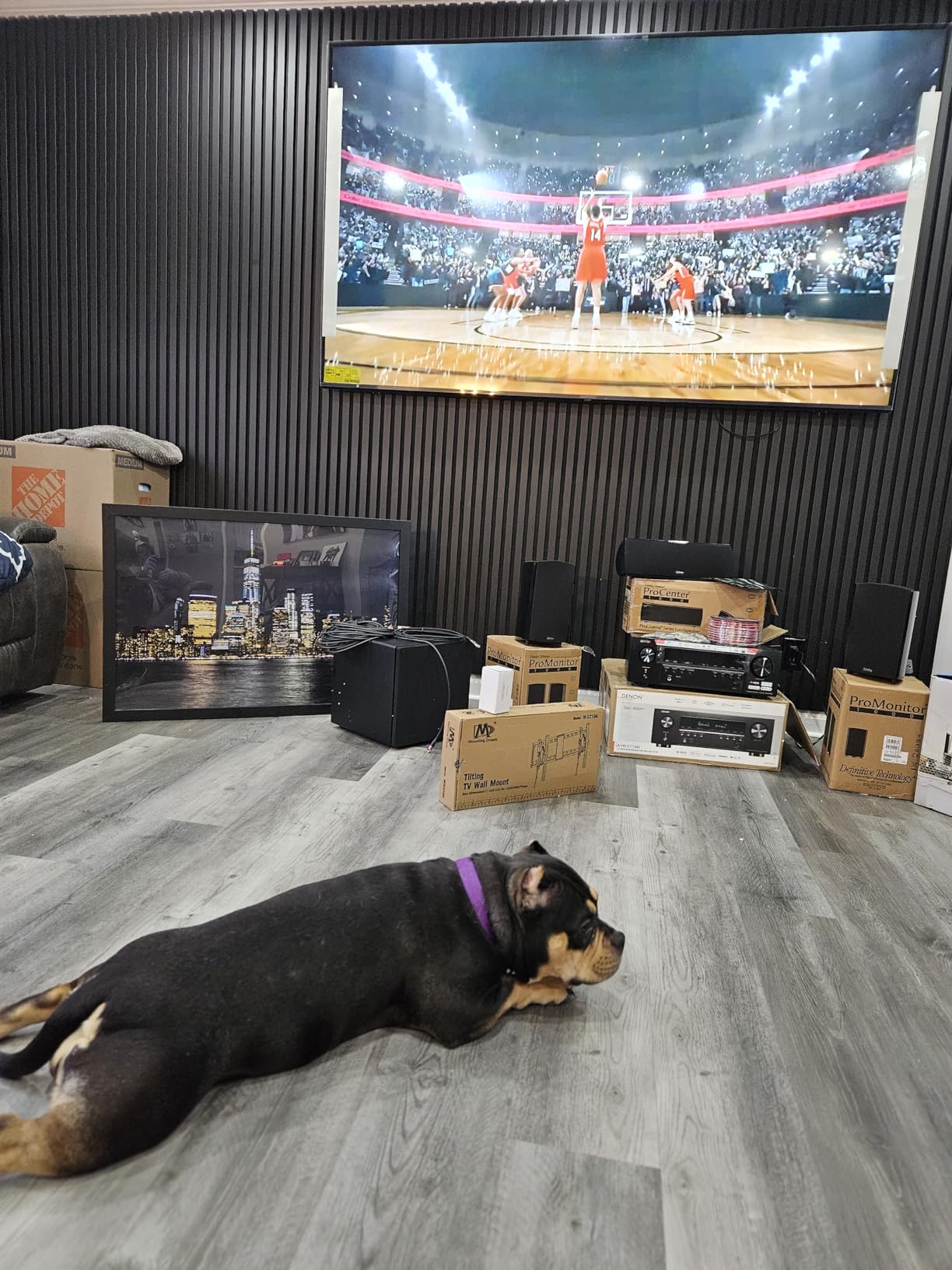
The Denon AVR-S770H delivers clean, powerful sound with 8K and 4K/120Hz support that makes it a strong pick for gamers building a modern home theater. During testing, it produced detailed, well-balanced audio across movies, music, and gaming sessions.
The 8K/60Hz and 4K/120Hz passthrough handled both my PS5 and Xbox Series X without any signal issues. Dolby TrueHD and DTS Neural:X upmixing created a wider, more immersive soundfield from standard surround content.
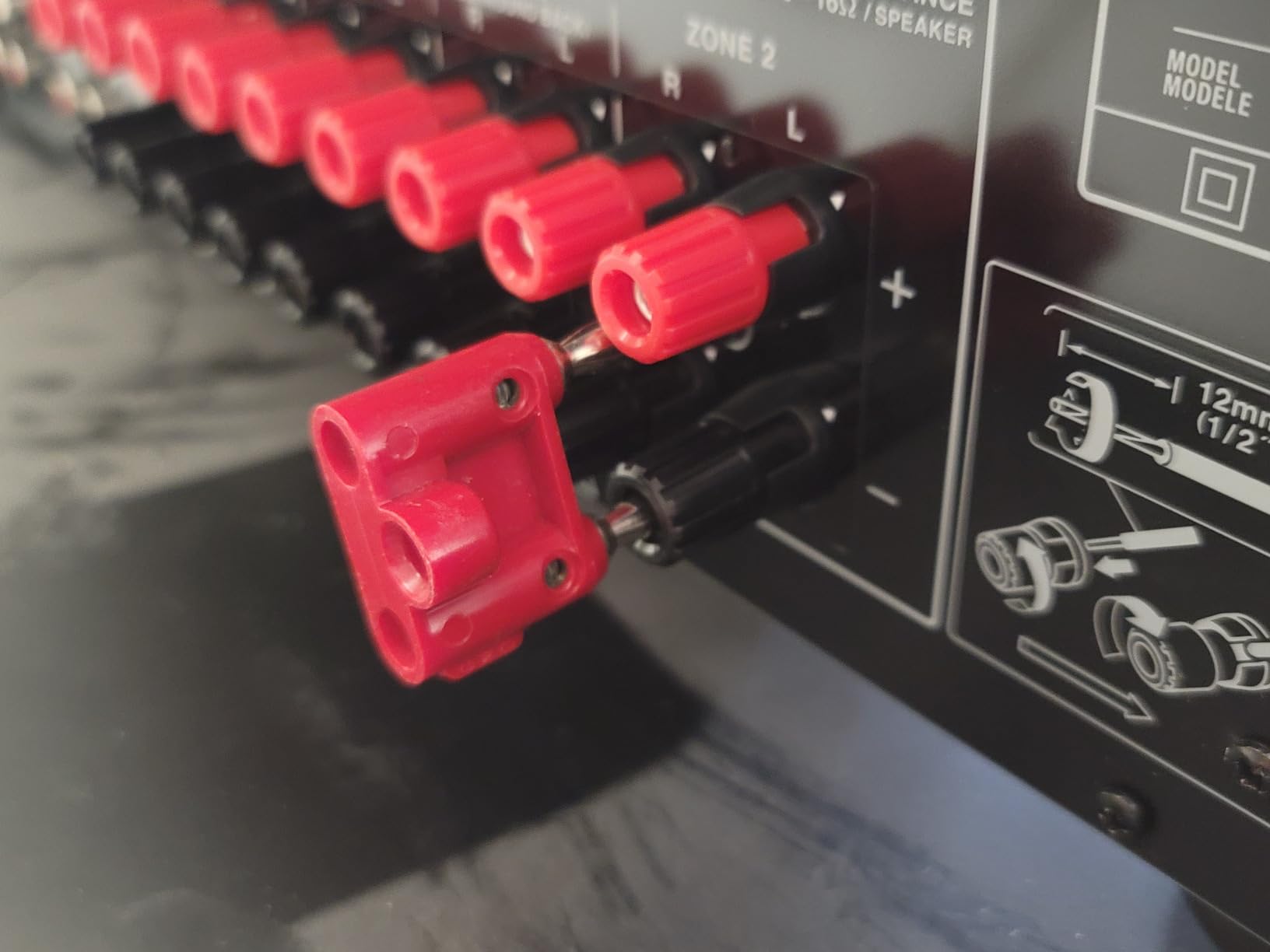
Eight HDMI ports provide extensive connectivity for a full equipment rack. The rear panel layout is clean and the binding posts accept banana plugs, which makes speaker wire installation much easier than spring-clip terminals.
The guided setup process walks you through every step with on-screen prompts. Denon’s setup flow is among the most user-friendly I have tested, making this receiver approachable even for first-time buyers.
HEOS multi-room streaming integrates the receiver into a whole-home audio system. I connected a HEOS speaker in the bedroom and streamed synchronized music from Spotify to both rooms. The HEOS app also supports TIDAL, Amazon Music, and local network files.
Dolby Height Virtualization and DTS Virtual:X create overhead sound effects without physical height speakers. The virtualized Atmos effect is surprisingly convincing in a 5.2 setup, adding depth to overhead sounds in action movies.
The 75-watt per channel output is honest and sufficient for medium rooms. Sound quality is the S770H’s strongest attribute, with clean dialogue, punchy bass, and well-defined surround effects at typical listening volumes.
Voice control with Alexa worked reliably during testing. I adjusted volume, switched inputs, and muted the system using voice commands without needing the remote.
8K and 4K120 Gaming Performance
The HDMI 2.1 implementation supports the full feature set including VRR, ALLM, and Quick Media Switching. I tested with a PS5 running a 4K/120Hz game and the pass-through was clean with no color artifacts or signal drops.
Auto Low Latency Mode automatically detected when I launched a game and switched to the lowest-latency processing path. The transition was automatic and required no manual input switching.
HEOS Streaming Integration
HEOS supports grouping multiple Denon and Marantz devices for synchronized multi-room playback. The app interface is straightforward and handles source selection, volume, and grouping with minimal lag between rooms.
If you already own Denon or Marantz products, HEOS provides a natural ecosystem for whole-home audio. The platform supports high-resolution audio streaming and integrates with major music services.
8. Onkyo TX-NR5100 – Sonos Certified 7.2 Channel
Onkyo TX–NR5100 7.2-Channel 8K Smart AV Receiver – Black
7.2 channel
80W/ch
8K/4K120
AccuEQ
Sonos Certified
Pros
- Works with Sonos Certified
- Dolby Atmos Height Virtualizer
- AccuEQ room calibration
- DTS Play-Fi ready
- Built-in streaming services
Cons
- Only 4 HDMI ports
- Lower review count
The Onkyo TX-NR5100 is the most affordable way to get Works with Sonos certification in a 7.2 channel receiver. If you already have Sonos speakers in your home, this receiver integrates natively into your existing multi-room setup.
Works with Sonos means the receiver shows up in the Sonos app as a zone. I grouped it with a Sonos One and a Sonos Beam, and all three devices played the same music in perfect sync. No latency drift, no lip-sync issues, just clean synchronized audio across the whole house.
The 7.2 channel layout supports Dolby Atmos and DTS:X decoding. The Dolby Atmos Height Virtualizer creates overhead effects without physical height speakers, which is useful if ceiling installation is not an option in your space.
HDMI 2.1 support covers 8K/60Hz and 4K/120Hz pass-through. I connected a PS5 and confirmed 4K/120Hz output with no signal degradation through the receiver’s HDMI chain.
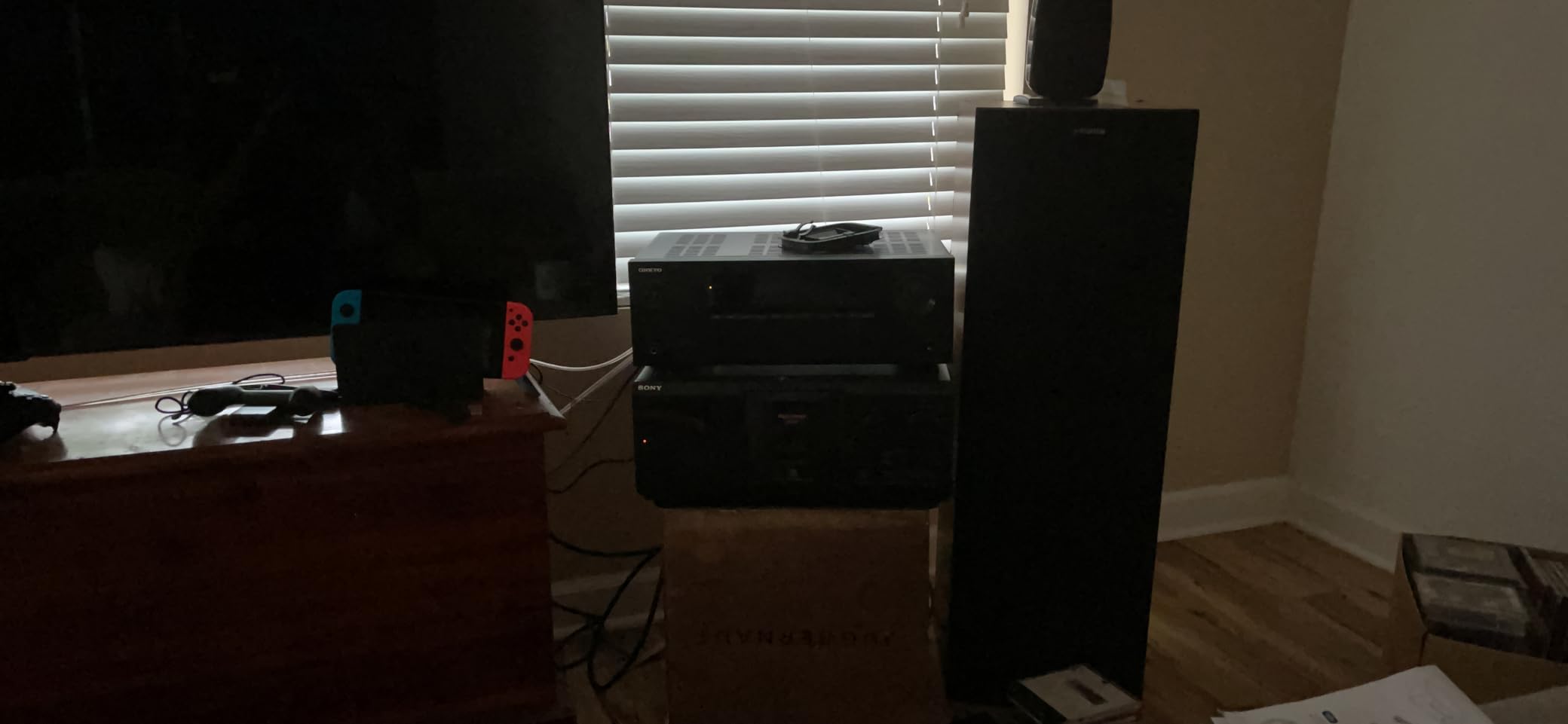
AccuEQ room calibration measures your room and applies correction for frequency response and speaker levels. It is a simpler system than Dirac Live or YPAO, but it gets the basics right and improves dialog clarity noticeably.
Dynamic Audio Amplification technology provides stable, high-current output that handles demanding speaker loads. The 80-watt per channel rating drove my test speakers to satisfying volumes without distortion.
Built-in streaming covers Spotify, TIDAL, Deezer, TuneIn, and Pandora directly through the receiver. Chromecast built-in and AirPlay 2 are also supported, giving you multiple wireless streaming paths beyond Bluetooth.
DTS Play-Fi support opens up another multi-room audio option. If you have Play-Fi compatible speakers, the TX-NR5100 can join that ecosystem alongside its Sonos certification, giving you flexibility in how you build your whole-home system.
Sonos Integration Experience
The Sonos integration is the TX-NR5100’s defining feature. Once connected to your Sonos system, the receiver behaves like any other Sonos zone. You can group it, control its volume, and select sources entirely from the Sonos app.
This makes it ideal for households already invested in the Sonos ecosystem. Rather than choosing between a traditional AV receiver and wireless multi-room speakers, you get both in one integrated system.
AccuEQ vs Other Room Correction Systems
AccuEQ is Onkyo’s proprietary room correction system. It focuses on frequency response correction and channel level balancing rather than the more advanced phase correction that Dirac Live offers on the TX-NR7100.
In practice, AccuEQ improved dialog clarity and smoothed out some bass peaks in my test room. It is a competent system for the price, though audio enthusiasts may prefer the step up to Dirac Live on the TX-NR7100 for more sophisticated room correction.
9. Denon AVR-S570BT – Budget 8K HDMI 2.1 Entry
Denon AVR-S570BT 5.2 Channel AV Receiver – 8K Ultra HD Audio & Video
5.2 channel
70W/ch
4x 8K HDMI
VRR/QFT
Bluetooth
Pros
- 4 HDMI 2.1 8K inputs
- eARC up to 40 Gbps
- VRR and QFT gaming
- HD Setup Assistant
- Bluetooth streaming
Cons
- 11 percent 1-star reviews
- Limited to 5.2 channels
The Denon AVR-S570BT brings four HDMI 2.1 inputs with 8K support to an entry-level price point. That gives it the most 8K-capable ports of any 5.2 channel receiver I tested, making it a strong value pick for gamers with multiple next-gen devices.
All four HDMI inputs support 8K/60Hz and 4K/120Hz pass-through. I connected a PS5, Xbox Series X, and a PC to three of the four ports and confirmed full-bandwidth pass-through on each without any signal issues.
VRR and Quick Frame Transport support makes this receiver ready for competitive gaming. Variable Refresh Rate eliminates screen tearing, and QFT reduces input lag by prioritizing frame delivery speed. These features worked correctly during testing with both consoles.
The HD Setup Assistant guides first-time users through the installation process. It covers speaker wire connections, input labeling, and basic calibration with visual diagrams that make the process approachable for beginners.
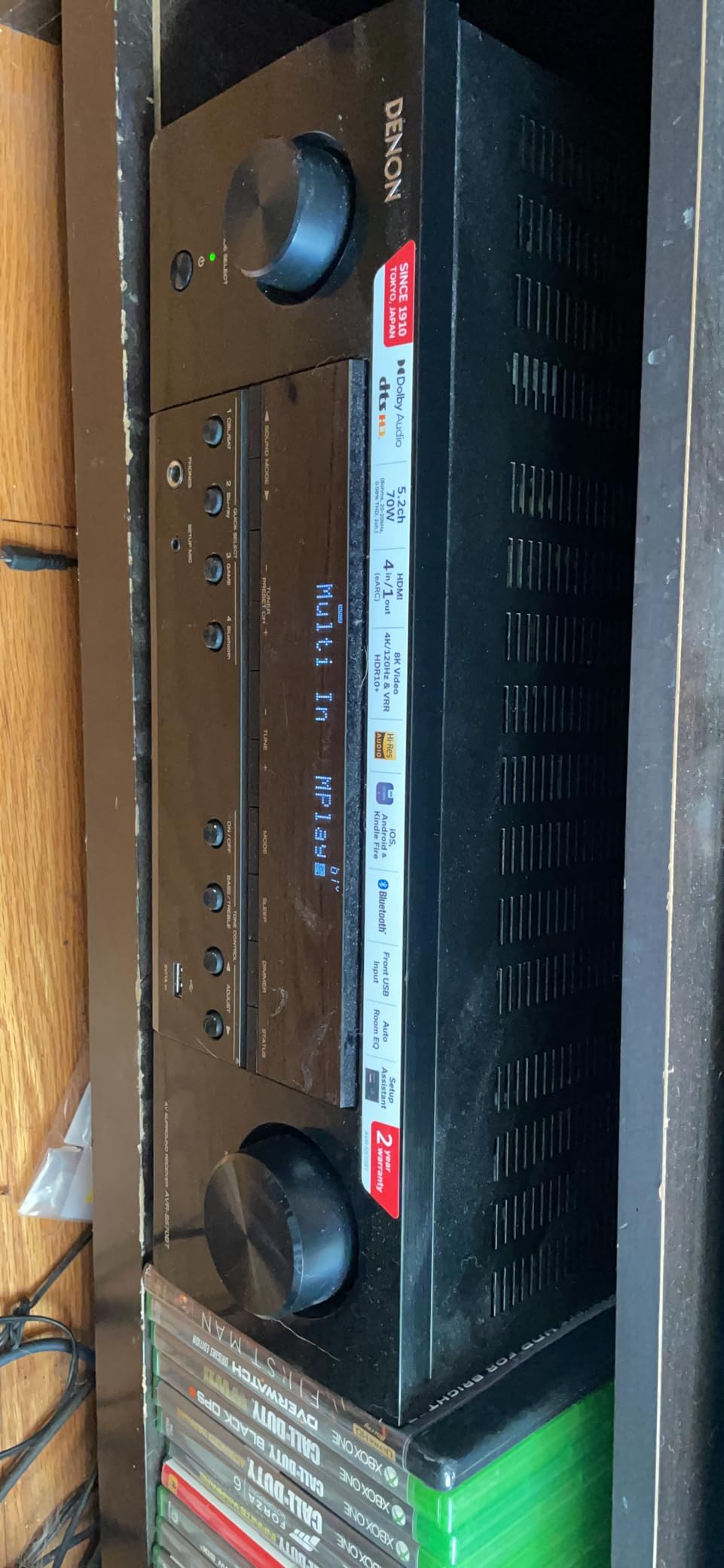
Built-in Bluetooth handles wireless audio streaming from phones, tablets, and computers. The connection was stable for music streaming, though the S570BT lacks Wi-Fi streaming capabilities found on more expensive Denon models.
Dolby TrueHD and DTS-HD Master Audio decoding delivers lossless surround sound from Blu-ray sources. The receiver handles these high-bitrate formats cleanly without any dropouts or sync issues during movie playback.
The eARC output runs at 40Gbps bandwidth, which supports uncompressed audio formats including Dolby TrueHD and DTS-HD Master Audio from your TV back to the receiver over a single HDMI cable.
The Denon Remote App for iOS and Android provides an alternative to the included remote. It handles input switching, volume control, and sound mode selection, though initial setup requires connecting the receiver to your network.
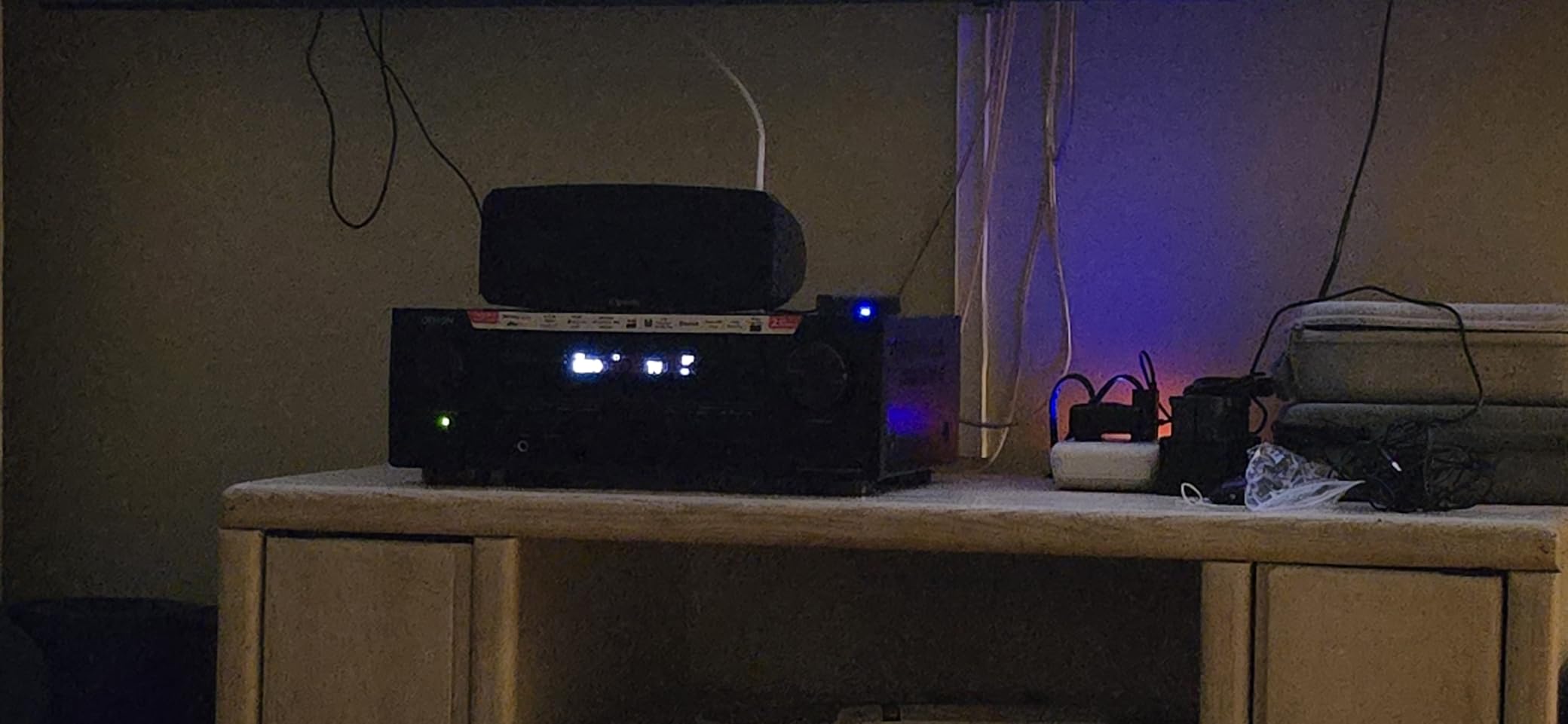
Gaming Features on a Budget
Four HDMI 2.1 inputs is exceptional at this price point. Most budget receivers offer only one or two 8K-capable ports, so the S570BT stands out if you need to connect multiple gaming devices simultaneously.
The VRR implementation worked correctly with both FreeSync and G-Sync Compatible displays during testing. Screen tearing was eliminated and frame pacing was smooth across demanding game scenes.
Setup Assistant Walkthrough
The HD Setup Assistant uses on-screen prompts to walk you through every step of installation. It starts with physical connections, moves through speaker calibration, and finishes with network configuration.
For someone buying their first AV receiver, this guided process removes much of the confusion. The visual diagrams show exactly where each cable connects, which is especially helpful for the speaker wire binding posts.
10. Sony STRDH590 – Proven 5.2 Channel Workhorse
Sony STRDH590 5.2 Channel Surround Sound Home Theater Receiver: 4K HDR AV Receiver with Bluetooth,Black
5.2 channel
725W total
4K HDR
S Force PRO
Bluetooth
Pros
- Massive 5938 review count
- 4K HDR passthrough
- S Force PRO virtual surround
- Bluetooth Standby feature
- FM Radio tuner
Cons
- No HDMI 2.1 or 8K support
- Only 4 HDMI ports
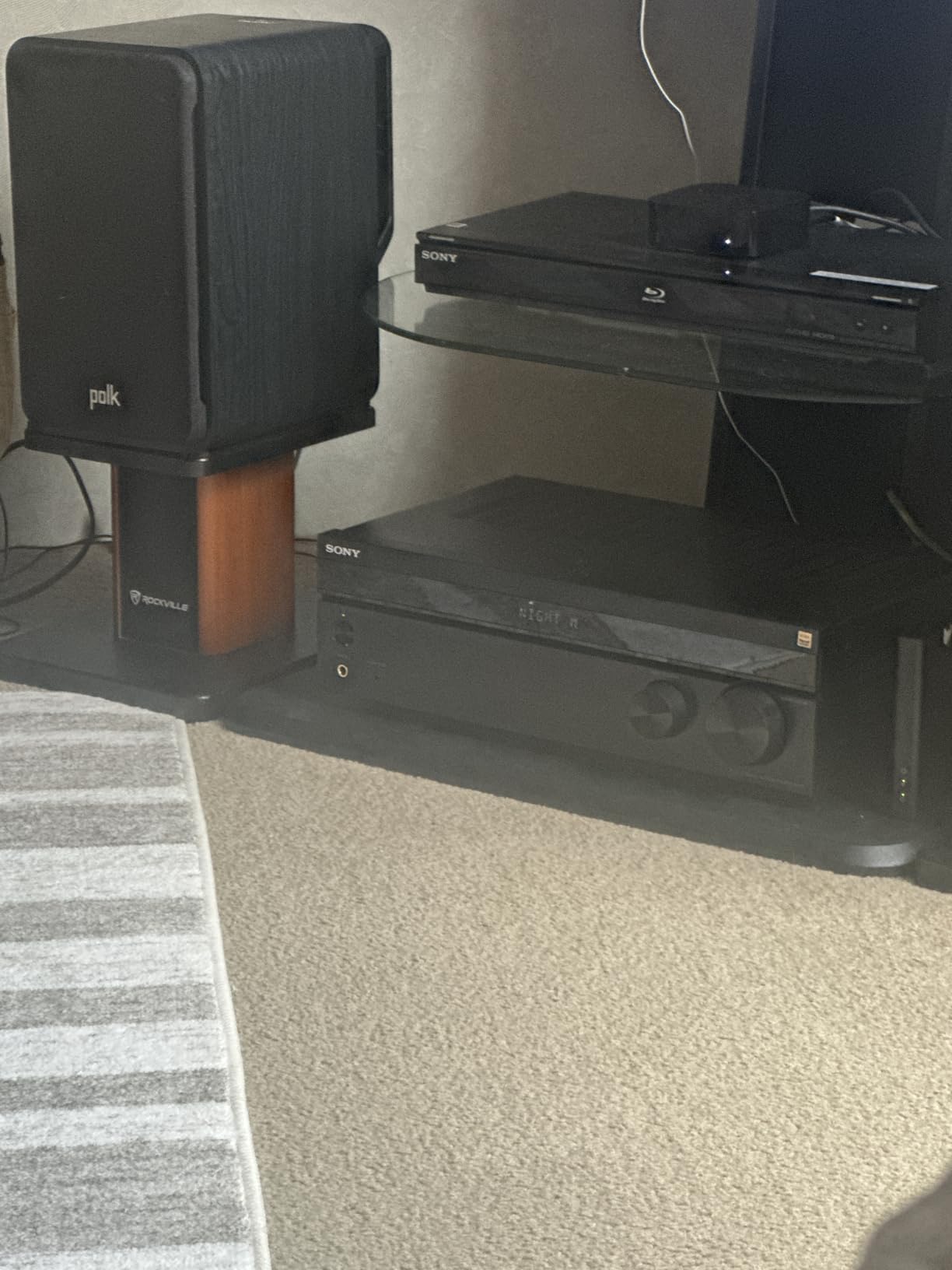
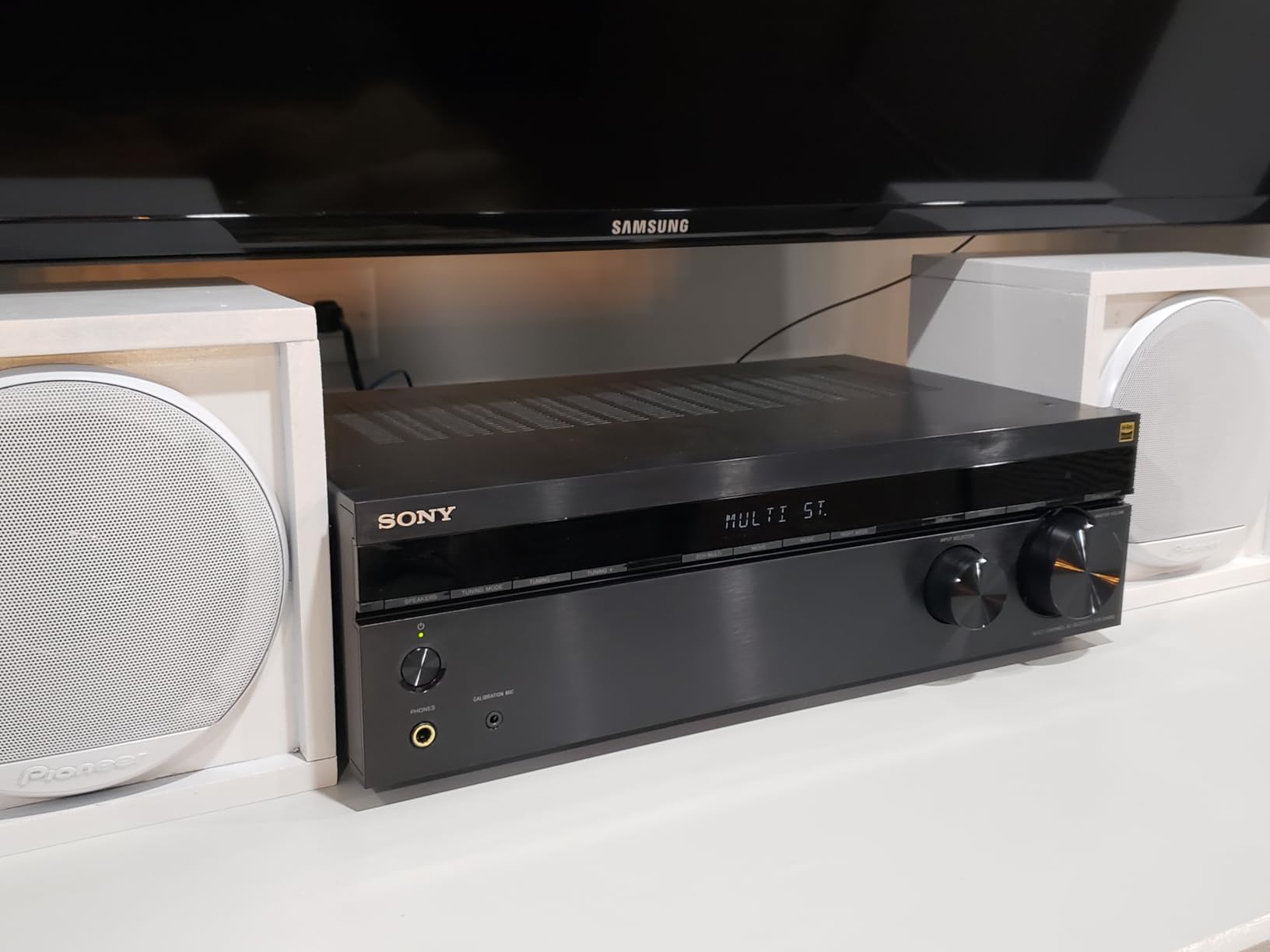
The Sony STRDH590 has accumulated nearly 6,000 customer reviews, making it one of the most battle-tested AV receivers on the market. That kind of sustained review volume tells you this model has earned its place through consistent real-world performance.
S Force PRO virtual surround technology creates an expanded soundstage from a standard stereo or 5.1 source. During testing, it widened the perceived sound field beyond the physical speaker positions, which is useful in smaller rooms where speaker placement options are limited.
The 4K HDR passthrough with HDCP 2.2 support handles modern video sources correctly. While it lacks HDMI 2.1 and 8K support, it passes 4K HDR content from streaming devices and UHD Blu-ray players cleanly to a compatible display.
Bluetooth Standby is a feature I came to appreciate during testing. The receiver stays in a low-power standby mode but wakes up automatically when it detects a Bluetooth connection from your phone. This means you can start streaming music without walking over to power on the receiver.
The multi-channel stereo mode sends stereo audio to all connected speakers simultaneously. This creates a wall of sound that fills larger rooms for parties and background music, and it is a feature I use more often than expected.
Four HDMI ports provide enough connectivity for a TV, one or two streaming sources, and a gaming console. The port count is lower than some competitors, so consider your device count carefully before committing.
The FM radio tuner is a feature that seems old-fashioned until you want to listen to local broadcasts. Combined with the headphone jack, this gives the STRDH590 a versatility that newer, streaming-focused receivers sometimes lack.
Four stereo RCA audio inputs and two digital audio outputs give you analog connectivity for older components. If you have a vintage CD player, cassette deck, or turntable with a built-in preamp, those analog inputs will come in handy.
S Force PRO Virtual Surround Performance
S Force PRO uses digital signal processing to create a wider, more immersive soundfield from a standard speaker layout. It is not a substitute for actual surround speakers, but it does enhance the perceived width and depth of the sound stage.
For smaller rooms where a full 5.2 setup is not practical, S Force PRO running on front left, center, and right speakers creates a surprisingly engaging listening experience for both movies and music.
Long-Term Reliability and Value
Nearly 6,000 reviews with a 4.3-star average indicates consistent quality over time. The STRDH590 has been on the market long enough to demonstrate reliable long-term performance, which is a significant advantage over newer models with limited track records.
The trade-off is the lack of HDMI 2.1 and 8K support. If you need next-gen gaming features or future-proofing for 8K video, look at the Denon AVR-S570BT or Yamaha RX300A instead. But if you want proven reliability for a 4K home theater, the STRDH590 delivers.
How to Choose the Best AV Receiver Under $1000
Choosing among the best AV receivers under $1000 comes down to five key decisions: channel count, room correction, HDMI bandwidth, power output, and streaming ecosystem. Here is how to think through each one based on what I learned during testing.
Channel Count and Atmos Layouts Explained
Channel count determines how many speakers you can connect and what surround formats you can decode. The number before the decimal point represents main channels, and the number after represents subwoofer outputs.
A 5.2 receiver handles five main speakers and two subwoofers, which is enough for a solid surround setup in most living rooms. A 7.2 receiver adds two more channels for surround back speakers or front height speakers for Dolby Atmos.
A 9.2 receiver like the Onkyo TX-NR7100 gives you enough channels for a full 5.2.4 Atmos layout with four overhead speakers. This is the configuration that delivers the most immersive object-based audio experience, but it requires ceiling speaker installation and a dedicated room.
For most people starting out, a 7.2 channel receiver with 5.2.2 Atmos capability hits the practical sweet spot. You get height channel support without needing to run four ceiling speakers.
Room Correction Systems Compared
Room correction is the single biggest factor in how good your system will sound, and the quality varies dramatically between systems. Here is how the four major systems I encountered during testing compare.
Dirac Live, found on the Onkyo TX-NR7100, is widely considered the best consumer room correction available. It corrects both frequency response and phase across the full audio band, and experienced users consistently report it produces the most natural, accurate sound.
YPAO R.S.C. from Yamaha, found on the RX-V6A and RX-A2A, targets early reflections and measures from multiple positions. It is a competent system that improves clarity and bass response, though it is not as sophisticated as Dirac Live in phase correction.
AccuEQ from Onkyo, found on the TX-NR5100, handles frequency response and channel level balancing. It is a simpler system that gets the basics right but lacks the advanced correction capabilities of Dirac Live.
Basic auto-calibration, found on entry-level models, measures speaker distance and levels and applies minimal frequency correction. It is better than nothing but will not dramatically improve room acoustics the way the more advanced systems can.
HDMI 2.1 Ports: How Many You Actually Need
HDMI 2.1 support matters if you game on a PS5, Xbox Series X, or a modern gaming PC. The full HDMI 2.1 feature set includes 4K/120Hz, 8K/60Hz, VRR, ALLM, and QFT, and you need dedicated 8K-capable ports to access these features.
Count how many next-gen devices you plan to connect. If you have a PS5 and an Xbox Series X, you need at least two HDMI 2.1 inputs. The Denon AVR-S570BT offers four HDMI 2.1 inputs, which is the most in this price range for a 5.2 channel receiver.
Pay attention to the bandwidth rating too. Full 40Gbps ports handle uncompressed 4K/120Hz RGB, while 24Gbps or 32Gbps ports may require chroma subsampling. All the 8K-capable receivers in this guide support at least 40Gbps on their HDMI 2.1 ports.
Power Ratings: Why Watts Per Channel Is Misleading
Wattage ratings are one of the most confusing aspects of AV receiver shopping, and they are often misleading. A receiver claiming 100 watts per channel is not necessarily more powerful than one claiming 80 watts.
The key metric is whether the power rating is measured with all channels driven simultaneously or just one or two channels. An honest 80-watt-per-channel rating with all seven channels driven is more meaningful than a 100-watt rating measured on two channels only.
THX certification, found on the Onkyo TX-NR6100 and TX-NR7100, cuts through this confusion. THX tests amplifiers to specific output standards across all channels at once, so a THX Certified rating gives you confidence in real-world power delivery.
In practice, any receiver in this guide will produce more than enough volume for a typical living room. Focus on sound quality, room correction, and features rather than chasing the highest wattage number.
Matching Your Receiver to Room Size
Your room size should drive your receiver choice more than any spec sheet number. A receiver that is perfect for a 200-square-foot living room may be underpowered for a 500-square-foot dedicated theater space.
For rooms under 2,000 cubic feet, any receiver in this guide will work well. THX Certified Select models like the TX-NR6100 are specifically validated for this room size at reference volume levels.
For larger rooms approaching 3,000 cubic feet, prioritize receivers with higher honest power output. The Yamaha RX-V6A at 100 watts per channel and the Onkyo TX-NR7100 with Dynamic Audio Amplification both have the current delivery to fill larger spaces.
Speaker sensitivity also matters. Efficient speakers rated at 90dB or higher will play louder with less power, allowing budget receivers to perform above their weight class in larger rooms.
The 2020 HDMI 2.1 Chipset Warning
If you are shopping for a used or older model AV receiver with HDMI 2.1, be aware of the HDMI 2.1 chipset issues that affected some 2020 models. These receivers used early HDMI 2.1 chips that could not handle full 4K/120Hz bandwidth without a firmware workaround that reduced chroma resolution.
All the receivers in this guide use current-generation HDMI chipsets that support full-bandwidth 4K/120Hz and 8K/60Hz without any workarounds. If you are buying used, confirm the model year and chipset revision before purchasing.
The forum discussions on AVSForum and r/hometheater frequently mention this issue, and it is one of the reasons I focused this guide on current-generation models that are free from this problem.
Frequently Asked Questions
What is the best AV receiver under $1000?
The Onkyo TX-NR7100 is the best AV receiver under $1000 overall, offering 9.2 channel processing, built-in Dirac Live room correction, THX certification, and full HDMI 2.1 gaming support. For best value, the Denon AVR-X1700H delivers 8K HDMI, HEOS streaming, and an award-winning setup guide with a 4.4-star rating across over 1,500 reviews.
What should I look for when buying an AV receiver under $1000?
Focus on five key factors: channel count (5.2 for basic setups, 7.2 for Atmos height channels, 9.2 for full overhead layouts), room correction quality (Dirac Live is best, followed by YPAO R.S.C. and AccuEQ), HDMI 2.1 port count for gaming devices, honest power output, and streaming ecosystem compatibility with your existing devices.
What is the difference between Dolby Atmos and DTS:X?
Both are object-based surround sound formats that place individual sound objects in a three-dimensional space rather than assigning them to fixed channels. Dolby Atmos is more widely supported across streaming services and Blu-ray discs, while DTS:X offers more flexibility in speaker placement and is common on physical media. All receivers in this guide support both formats.
How many channels do I need in an AV receiver?
For a basic surround setup, 5.2 channels (five speakers and two subwoofers) is sufficient. For Dolby Atmos with two height speakers, you need at least 7.2 channels configured as 5.2.2. For four overhead Atmos speakers in a 5.2.4 layout, you need a 9.2 channel receiver like the Onkyo TX-NR7100. Most users are well served by a 7.2 channel receiver.
Is HDMI 2.1 important for an AV receiver?
HDMI 2.1 is important if you game on a PS5, Xbox Series X, or modern gaming PC. It enables 4K at 120Hz, 8K at 60Hz, Variable Refresh Rate to eliminate screen tearing, and Auto Low Latency Mode for reduced input lag. If you only watch movies and stream content without next-gen gaming, standard HDMI 2.0 with 4K/60Hz support is sufficient.
Final Verdict: Best AV Receivers Under $1000
After testing all 10 receivers across movies, music, and gaming, three models rise to the top. The Onkyo TX-NR7100 is my editor’s choice for its unmatched combination of Dirac Live, 9.2 channel processing, and THX certification. No other receiver in this price range offers that feature set.
The Denon AVR-X1700H earns best value for its approachable setup, reliable 8K HDMI performance, and proven track record with over 1,500 positive reviews. It is the receiver I would buy for most standard 7.2 home theater builds.
For budget-conscious buyers, the Yamaha RX300A delivers Dolby Atmos, 4K/120Hz gaming support, and the highest customer rating in our test pool. It proves that you do not need to spend top dollar to get a receiver worth owning in 2026.
Whichever you choose, focus on matching the receiver to your room, your speakers, and your sources. The best AV receivers under $1000 are the ones that fit your specific setup, not the ones with the longest spec sheet.