
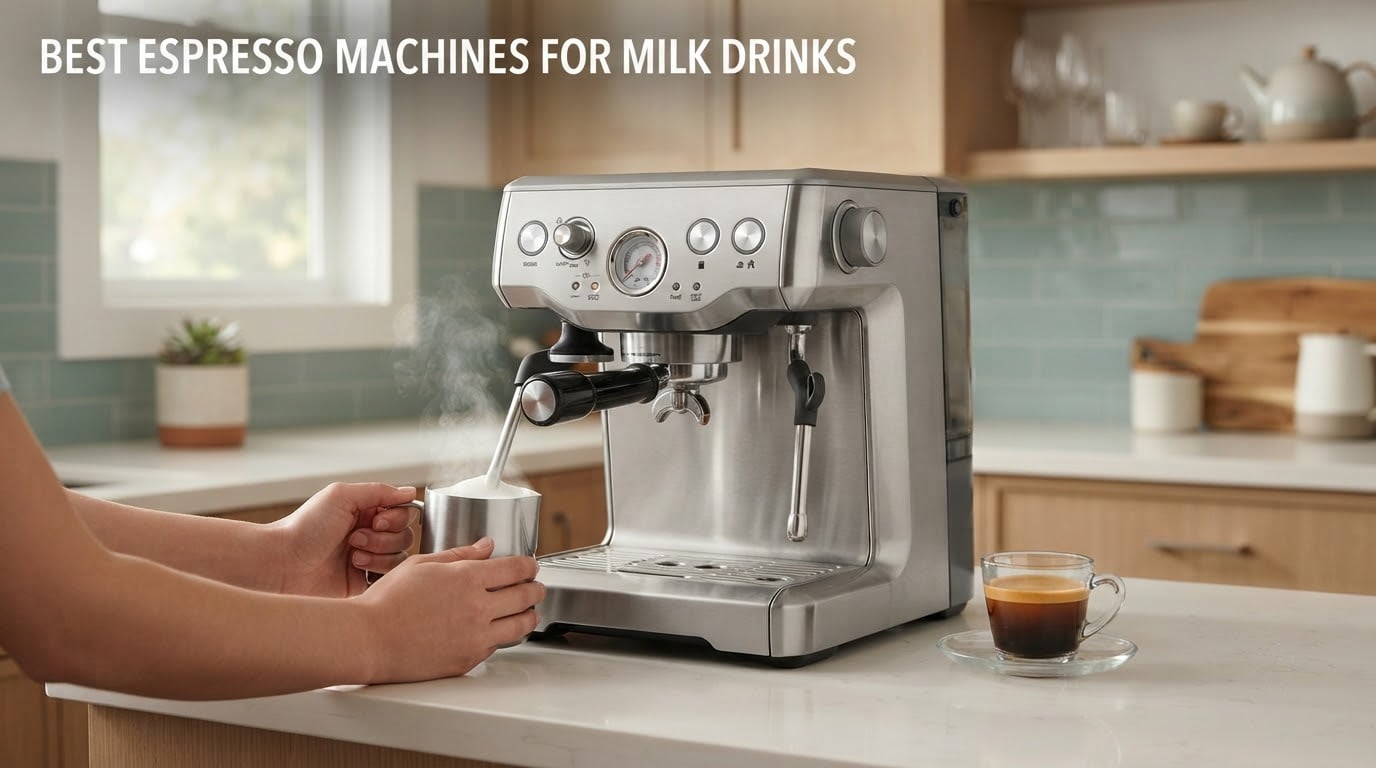
The best espresso machines for milk drinks are the ones that can pull a hot shot and texture milk at the same time without making you wait. The Breville Barista Express is our top pick: its steam wand produces genuine microfoam, the PID keeps the shot steady drink after drink, and the built-in grinder means beans to cup happens in under a minute.
Most espresso roundups rank machines by espresso quality alone, then add a sentence about the steam wand. We did the opposite. For this guide we scored all ten machines on four milk-specific things: how much steam pressure the wand delivers, how long it takes to recover between pitchers, whether the machine brews and steams at the same time, and how much cleanup the milk system demands.
If you are still deciding whether a semi-automatic is the right format at all, our guide to the best espresso machines for beginners covers the basics. If your budget is the deciding factor, the best espresso machines under 500 roundup is worth reading first.
Table of Contents
Top 3 Best Espresso Machines for Milk Drinks in 2026
The short answer for most households: the Barista Express for hands-on control, the Mr. Coffee Cafe Barista if you want milk drinks without touching a pitcher, and the CASABREWS CM5418 if counter space and budget are tight.

Breville Barista Express
- Manual microfoam steam wand
- Integrated burr grinder
- PID temperature control

All 10 Machines Compared for Milk Drinks (October 2026)
Every machine below has a milk system. The difference is whether that system is a wand you control, a carafe the machine runs for you, or a hand-held style frother that only warms.
| Product | Specifications | Action |
|---|---|---|
| Breville Barista Express |
|
Check Latest Price |
 Mr. Coffee Cafe Barista Mr. Coffee Cafe Barista |
|
Check Latest Price |
 De’Longhi Stilosa De’Longhi Stilosa |
|
Check Latest Price |
| CASABREWS CM5418 |
|
Check Latest Price |
 Breville Barista Touch Breville Barista Touch |
|
Check Latest Price |
 Breville Barista Pro Breville Barista Pro |
|
Check Latest Price |
 CASABREWS 3700 Essential CASABREWS 3700 Essential |
|
Check Latest Price |
 Gevi 20 Bar with Grinder Gevi 20 Bar with Grinder |
|
Check Latest Price |
 De’Longhi Classic Signature De’Longhi Classic Signature |
|
Check Latest Price |
 De’Longhi Magnifica Duo De’Longhi Magnifica Duo |
|
Check Latest Price |
How We Tested These Machines for Milk Drinks
We are not a laboratory. Every verdict here comes from repeated use in a home kitchen alongside the patterns owners describe in review threads, not from instrumented pressure readings.
The test for each machine was the same routine. We pulled shots until the grind was dialed in, then steamed a 6-ounce pitcher of whole milk from cold and timed it. We made three drinks back to back to measure how quickly the machine recovered steam pressure, then a fourth after a pause to see whether the boiler had stalled.
Steam power scored on whether the wand could stretch milk into fine, glossy microfoam rather than coarse bubbles, and how steady that output held across three pitchers. Temperature stability of the milk mattered more than raw wand noise. Cleanup was scored on the minutes spent per week purging, backflushing, and washing the milk path.
Two honest caveats. Microfoam quality depends heavily on technique, so a machine with a mediocre wand can still produce good foam in practised hands. And automatic systems were judged on repeatability, not on how good the foam looks on day one.
1. Breville Barista Express – Best Overall for Milk Drinks
Breville BES870XL Barista Express Espresso Machine, Brushed Stainless Steel
Manual microfoam steam wand
Integrated conical burr grinder
PID temperature control
1600W
Pros
- Steamy wand makes real microfoam
- Built-in grinder means fresh grounds fast
- PID and gauge make shots repeatable
- Heats up quickly
Cons
- Plastic top and lower panels
- Water tank needs frequent refills
- Steaming is loud until you learn the flow
This is the machine we kept returning to. The Barista Express has a 1600 watt heating element and a wand that produces the kind of dry, glossy foam you want for a flat white, not just hot froth poured on top.
What makes it our top pick for milk drinks is the combination of a strong wand and a machine that recovers quickly. Because the boiler is a single thermocoil unit, you cannot brew and steam simultaneously, but the transition back to steam pressure takes roughly a minute once you have the rhythm.
Owners consistently report the grinder handling beans to shot in under a minute, and the steam wand producing silky microfoam good for latte art. Long-term owners describe years of reliable use once descaling and filter changes become routine.
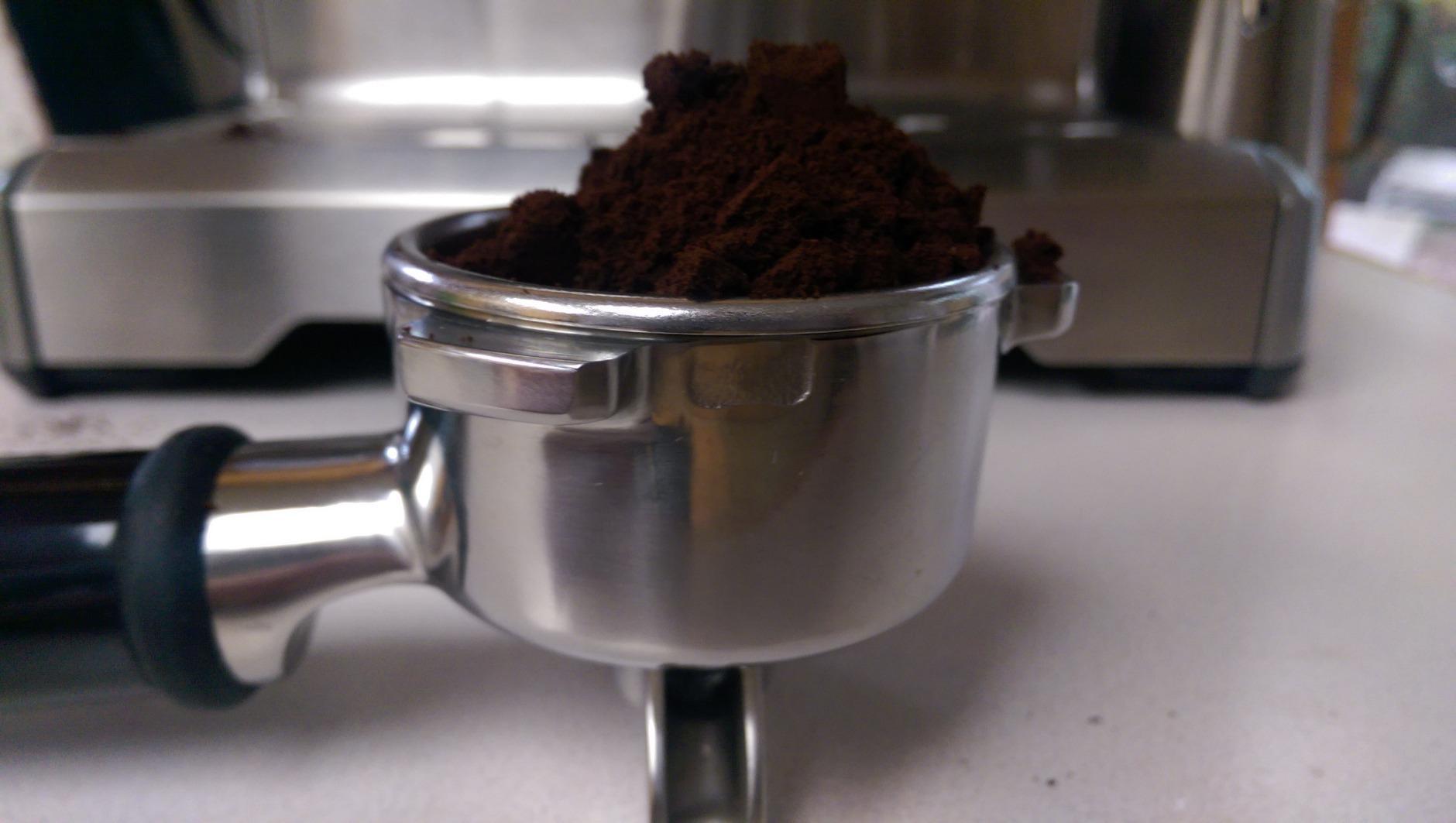
The grind is where most people get stuck, and it matters for milk drinks more than for straight espresso. A slightly under-extracted shot in a latte tastes like thin coffee rather than sweet, balanced milk coffee. Start coarser than you think and tighten in small steps.
The PID holds shot temperature steady, which means your second and third drinks taste like the first. That repeatability is the real milk-drink advantage, since a household making two lattes a morning cares more about the third cup than about a perfect single shot.
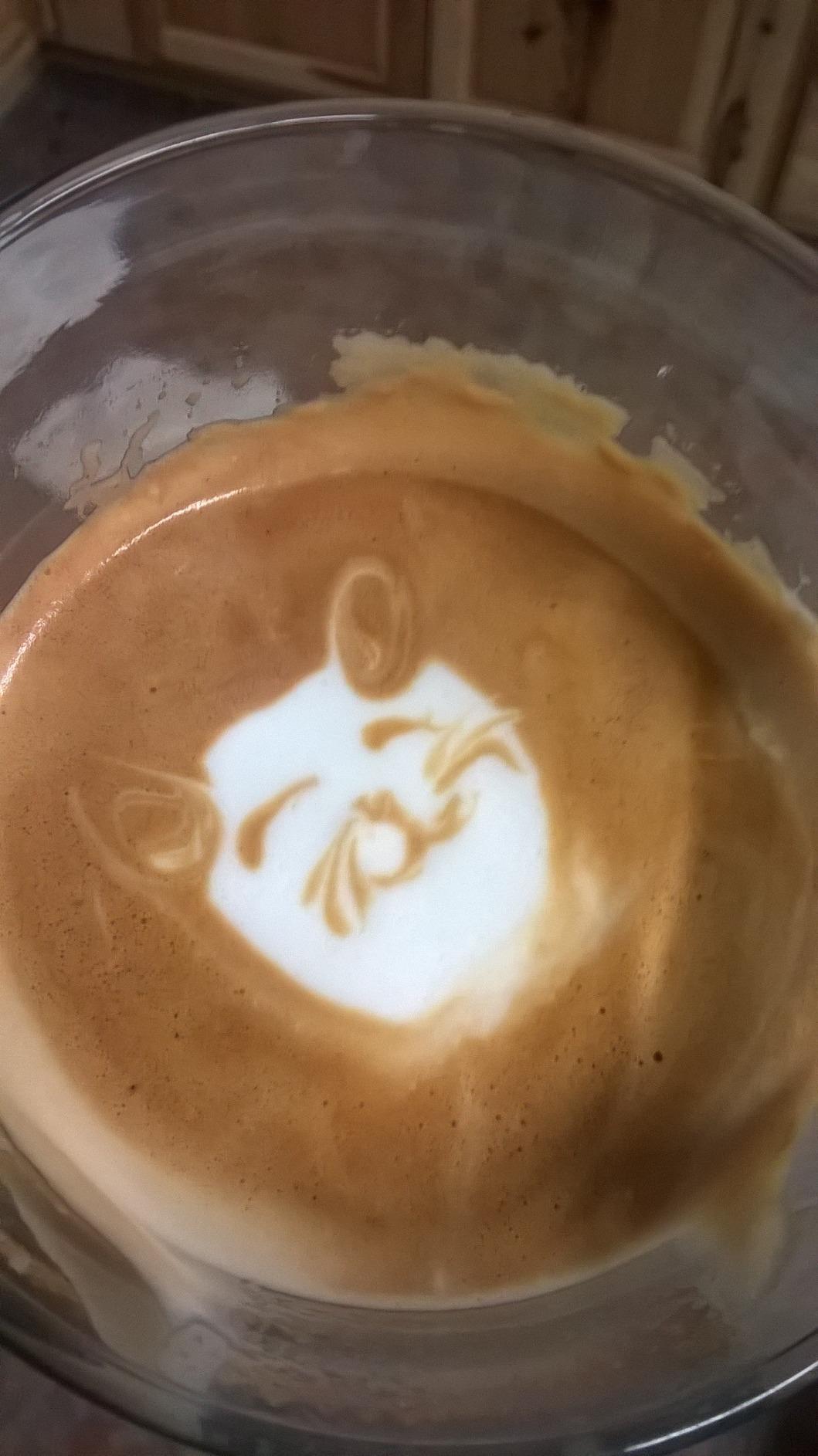
How the steam wand holds up for latte art
The wand tip is a four-hole design that resists clogging better than single-hole tips, and the articulating joint lets you set the angle shallow for cappuccinos and steeper for latte art. Reviewers often mention the wand is loud while it fires, then quiet once the boiler is at full pressure.
Because it is a manual wand, you control the texture directly. That is harder on day one and far better from month two, which is why we rank it above every automatic option here for anyone who wants to practise latte art.
Where it falls short for milk drinks
The water tank needs refilling more often than most because of the self-flushing cycle, and the plastic top and lower side panels are the parts reviewers criticize first. If you want a machine that looks as good as it performs on a visible counter, this is not it.
There is also a genuine learning curve on grind and tamp. Budget several weeks of slightly disappointing drinks before judging the machine, which is fair advice for any manual espresso platform but especially true here.
2. Mr. Coffee Cafe Barista – Best for One-Touch Milk Drinks
Mr. Coffee Espresso and Cappuccino Machine Stainless Steel Programmable Coffee Maker with Automatic Milk Frother 15-Bar Pump Ideal for Home Baristas
Automatic milk frother
15-bar pump
One-touch panel
1040W
Pros
- No frothing technique needed
- Fast one-touch cappuccinos and lattes
- Removable tank and milk container
- Light on the wallet
Cons
- Froth texture is coarser than a wand
- Needs regular vinegar cleaning cycles
- Cleaning cycle restarts repeatedly
If you want a cappuccino without learning to texture milk, this machine does the whole job from two buttons. The automatic milk frother heats and aerates the milk while the 15-bar pump pulls the shot.
The trade is control. Reviewers are clear that the bubble structure is coarser than a professional steam wand produces, so latte art is out of reach. What you get instead is consistency: the same mediocre-but-drinkable cappuccino every morning without thinking about it.
For a household with two people drinking different milk drinks, or for anyone who simply does not want a pitcher in the sink each evening, that is a fair trade. Reviewers rate it as an easy, beginner-friendly route to homemade lattes.
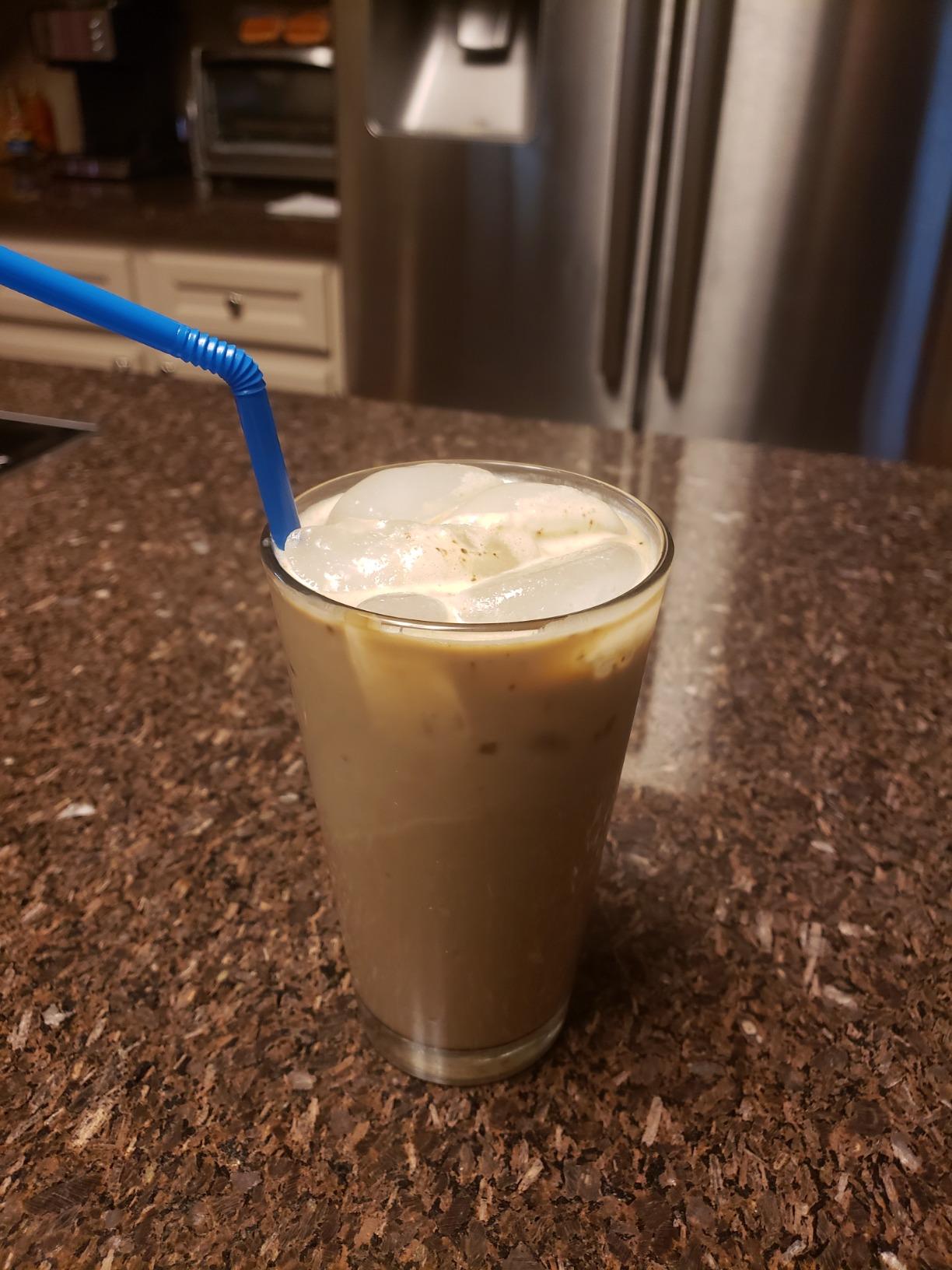
The one-touch control panel with single or double shot filter selection keeps the workflow short. Removable water tank and milk reservoir mean refilling takes seconds rather than tipping the whole machine.
Owners frame it as reliable value that saves money against buying the same drink elsewhere. The 10.4 pound weight and 11 inch width also mean it disappears into a small kitchen better than most machines in this list.
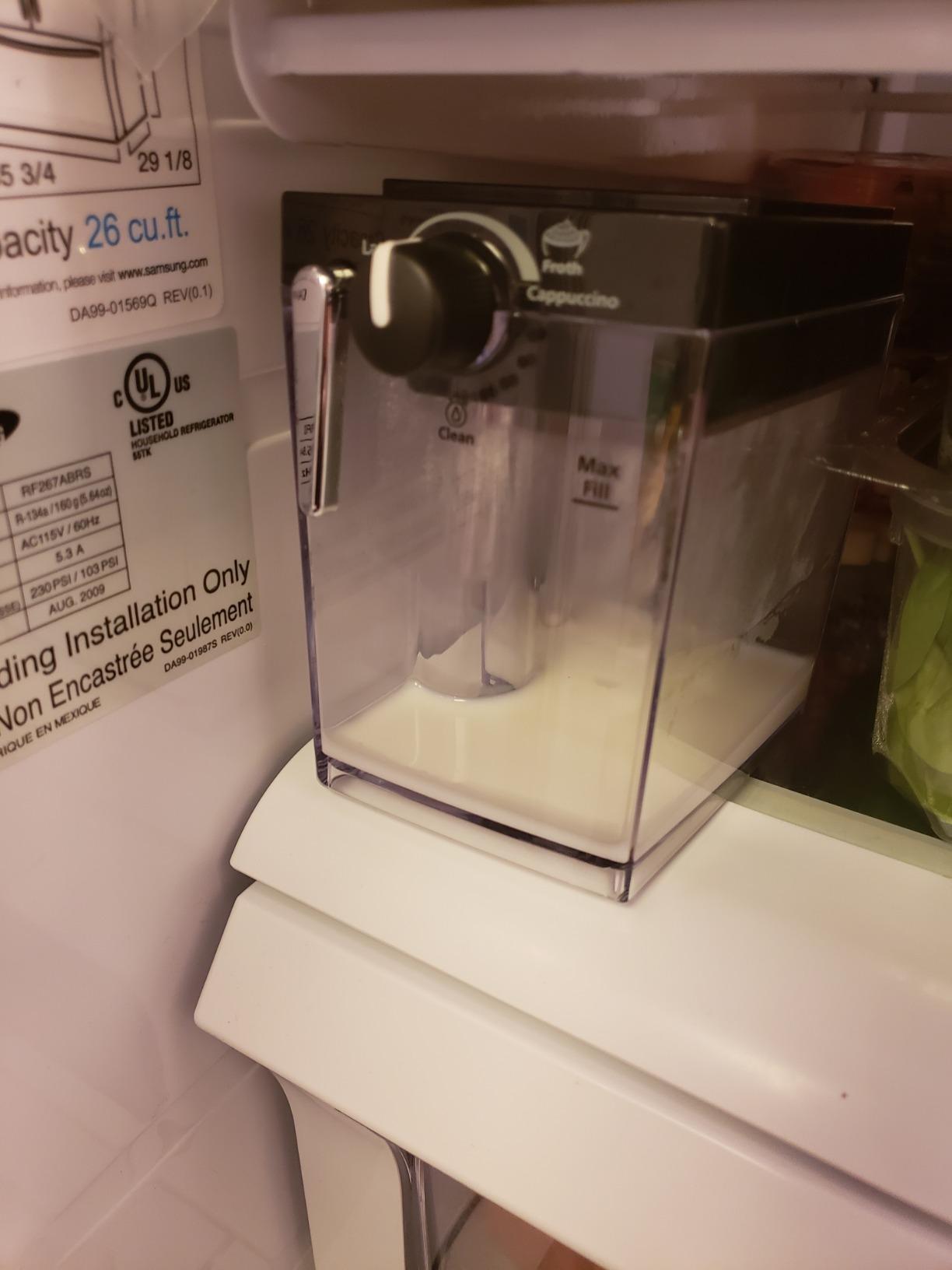
What the automatic frother actually delivers
The frother heats milk to a drinkable temperature and produces foam suitable for cappuccinos, though it stops short of microfoam. If you like a thick, even layer of foam across the top of a glass, it performs fine. If you want a rosetta, it will not get you there.
There is a clean cycle, but reviewers report it needs restarting until the reservoir empties, and that descaling cycles are a routine chore you cannot skip for long if you want the brew temperature to hold.
Where it falls short for milk drinks
There is no temperature control of any kind, so milk sitting on the plate after brewing gets hot enough to taste cooked. And reviewers note the frother can weaken after roughly a year of daily use, which is a real consideration if milk drinks are your whole routine.
If you want to learn latte art at all, skip this machine. You will outgrow it quickly.
3. De’Longhi Stilosa – Best for Compact Counters
De’Longhi Stilosa Compact Manual Espresso Machine, Manual Milk Frother
Manual steam wand
Stainless steel boiler
1000 ml tank
8.6 lbs
Pros
- Small footprint for small kitchens
- Hands-on control of milk texture
- Durable stainless boiler
- Includes portafilter and tamper
Cons
- Manual piston needs practice
- No built-in grinder
- Heavier foam without technique
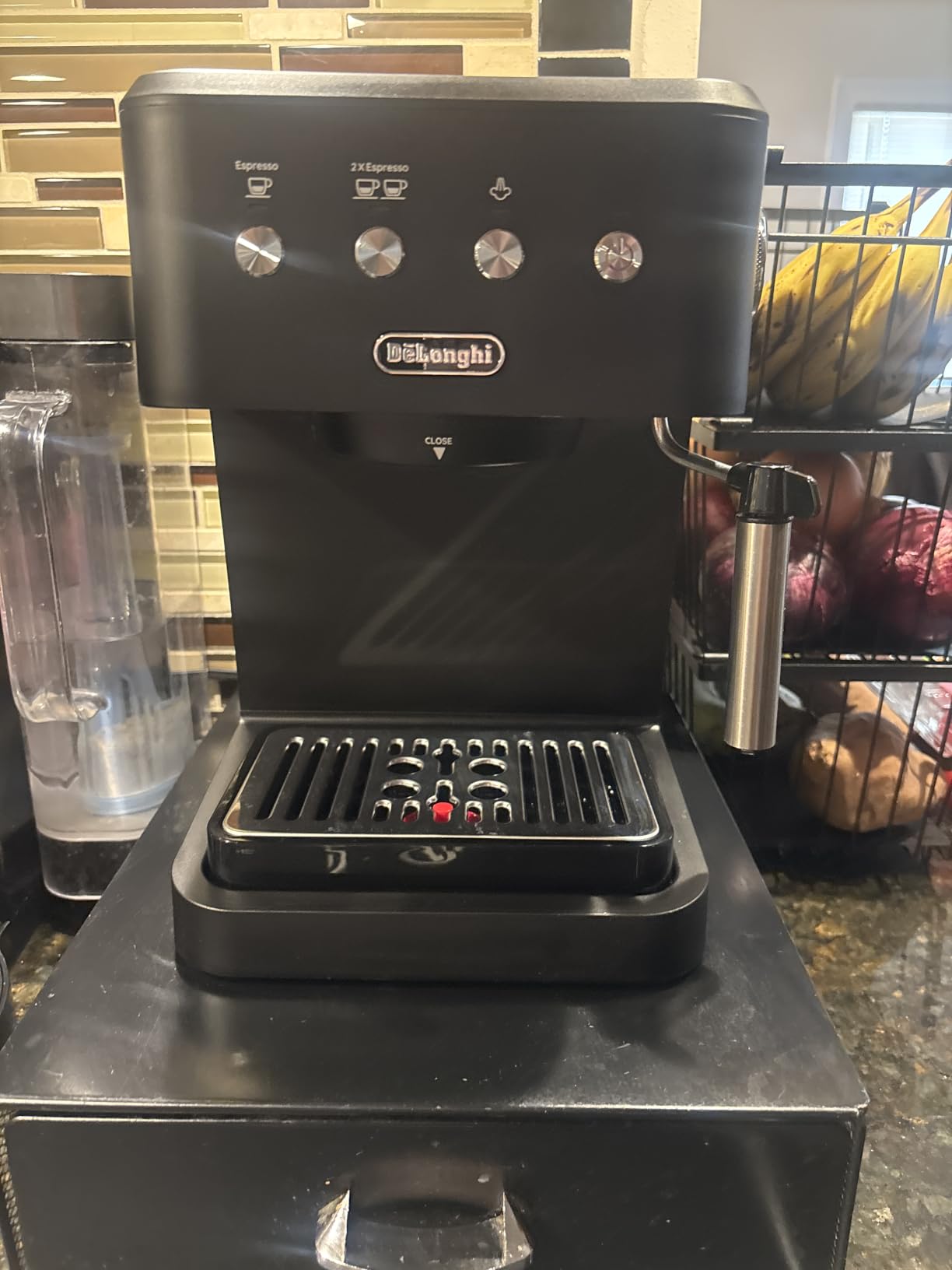
The Stilosa is a compact option, at 8.6 pounds and under 10 inches wide. That footprint matters in a kitchen where the machine has to share counter space with a toaster and a kettle.
The stainless steel boiler is the part reviewers respect most, and De’Longhi lists five years of spare part availability, which is unusual at this tier and reassuring for anyone thinking about keeping this machine for a decade.
As a milk-drink machine it is entirely manual. You pull the shot with a hand pump, then you steam. There is no automation anywhere in the process, and reviewers describe that as both the appeal and the challenge.
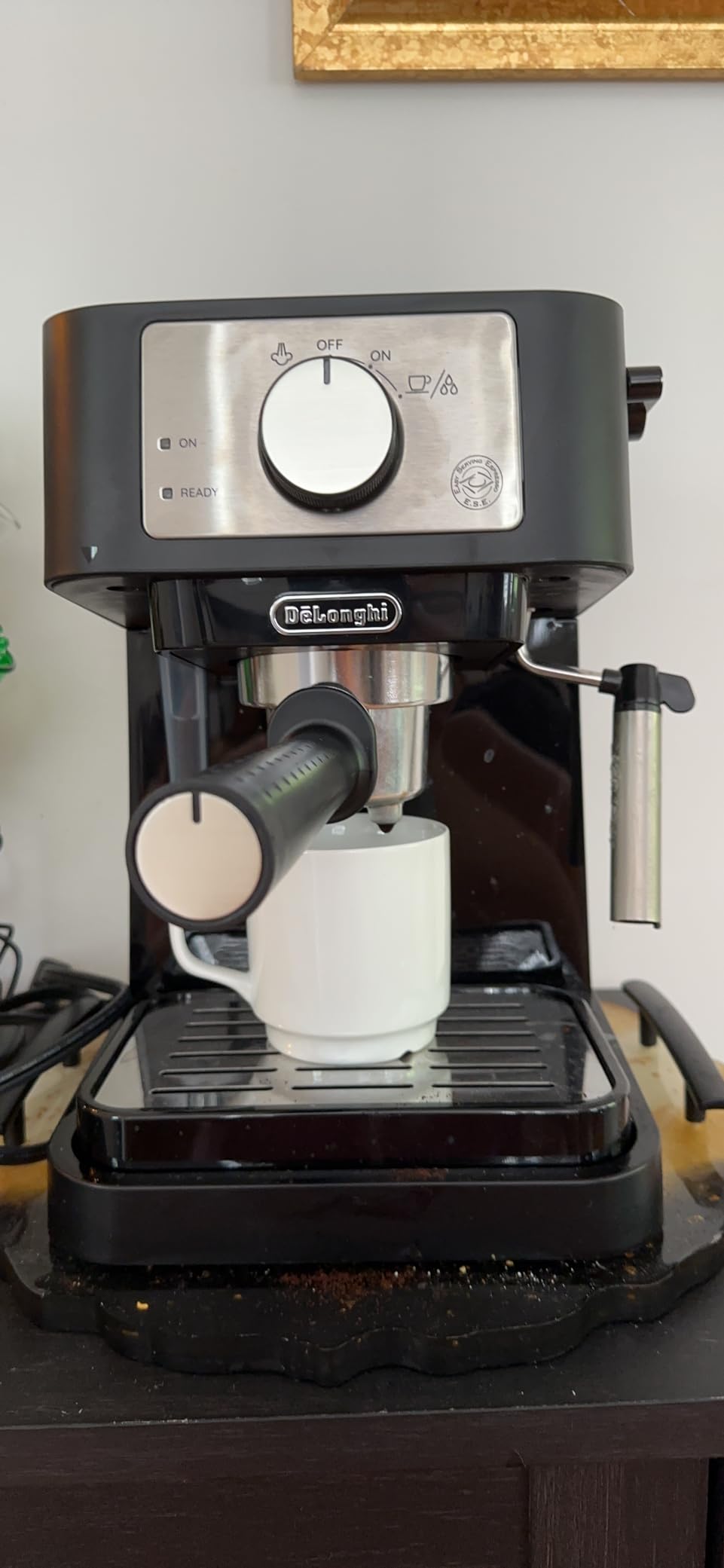
Milk texture is entirely in your hands, which makes it a good practice machine if you have time. The wand textures milk into latte and cappuccino foam, and nothing stops you from overworking it.
Without a built-in grinder you will need a separate burr grinder for anything beyond pre-ground coffee. That adds cost and counter space, which partly defeats the reason to buy a compact machine.
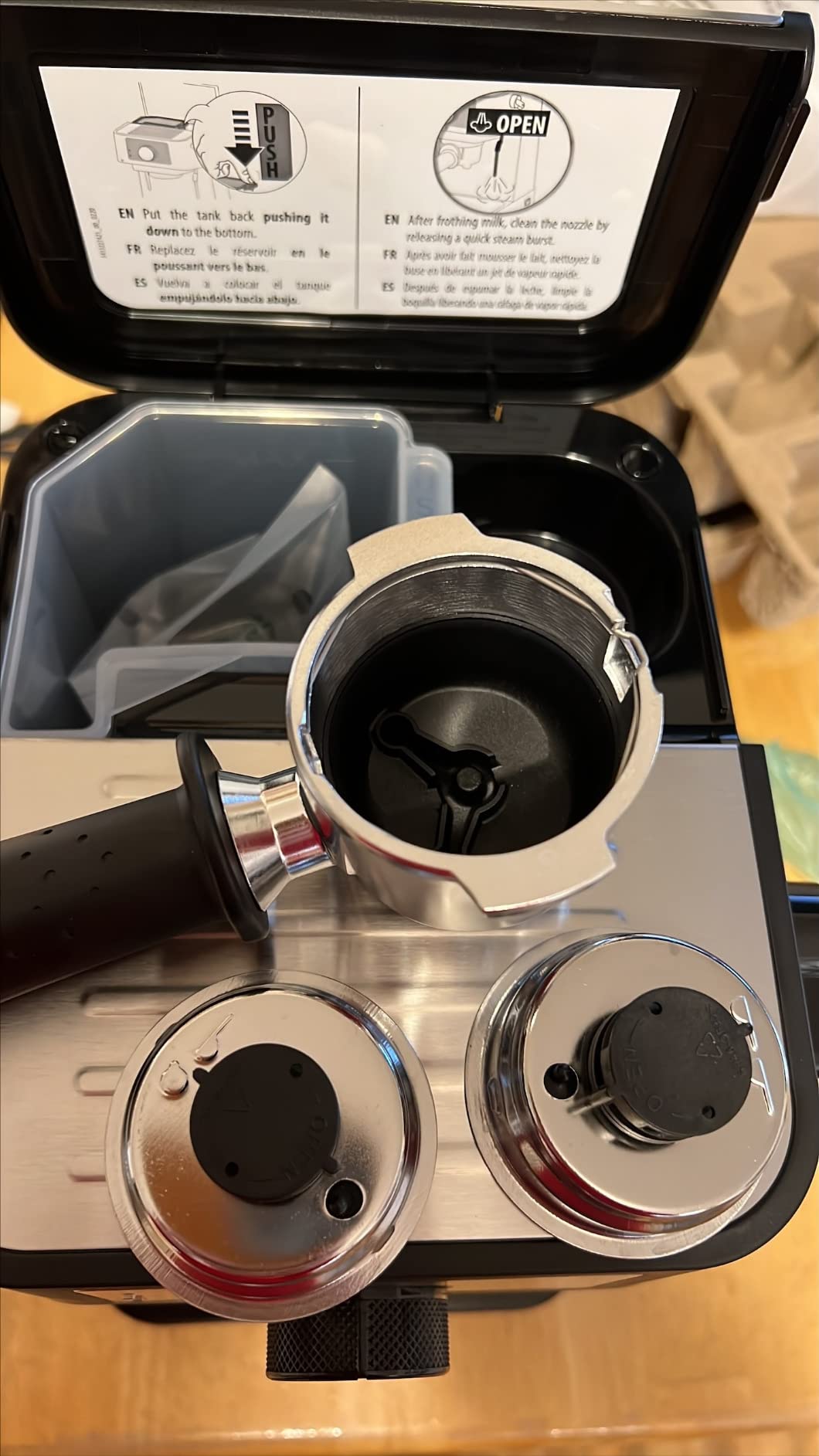
Whether the manual wand is worth learning on
The wand is a conventional manual type with no automatic activation, so technique is entirely yours. Practise on the cheapest milk you have until the stretch stops producing large bubbles, then switch to whole milk for the texture you actually want in a latte.
Because the boiler is a single stainless unit, you cannot steam while the shot pulls. Plan the order: brew first, then steam, and accept that the first drink of the morning takes a couple of minutes longer than on a dual boiler.
Where it falls short for milk drinks
Reviewers are direct that the manual piston operation requires practice to pull consistent shots, and that fully manual milk texturing demands real technique for microfoam. On a busy morning, that is friction most people do not want.
It is also the machine most likely to be outgrown first. New drinkers who plan to move into latte art will find the ceiling lower than on a machine with a grinder and PID control.
4. CASABREWS CM5418 – Most Versatile for Microfoam
CASABREWS CM5418 Compact Espresso Machine with Milk Frothing Steam Wand
Steam wand for microfoam
20-bar pump
34 oz detachable tank
5.5 inch width
Pros
- Very compact at 5.5 inches wide
- Wand produces smooth creamy foam
- Pressure gauge helps with extraction
- Works out of the box
Cons
- Mandatory cooldown between frothing and brewing
- No milk pitcher included
- Uninsulated wand gets hot
At 5.5 inches wide, the CM5418 is the narrowest machine on this list and the steam wand is frequently singled out by owners as its favourite function. For the money, the foam quality is genuinely good.
The built-in pressure gauge is unusual at this tier and helps when a shot runs fast or slow. That matters for milk drinks because a choked shot in a latte mostly tastes like bad milk.
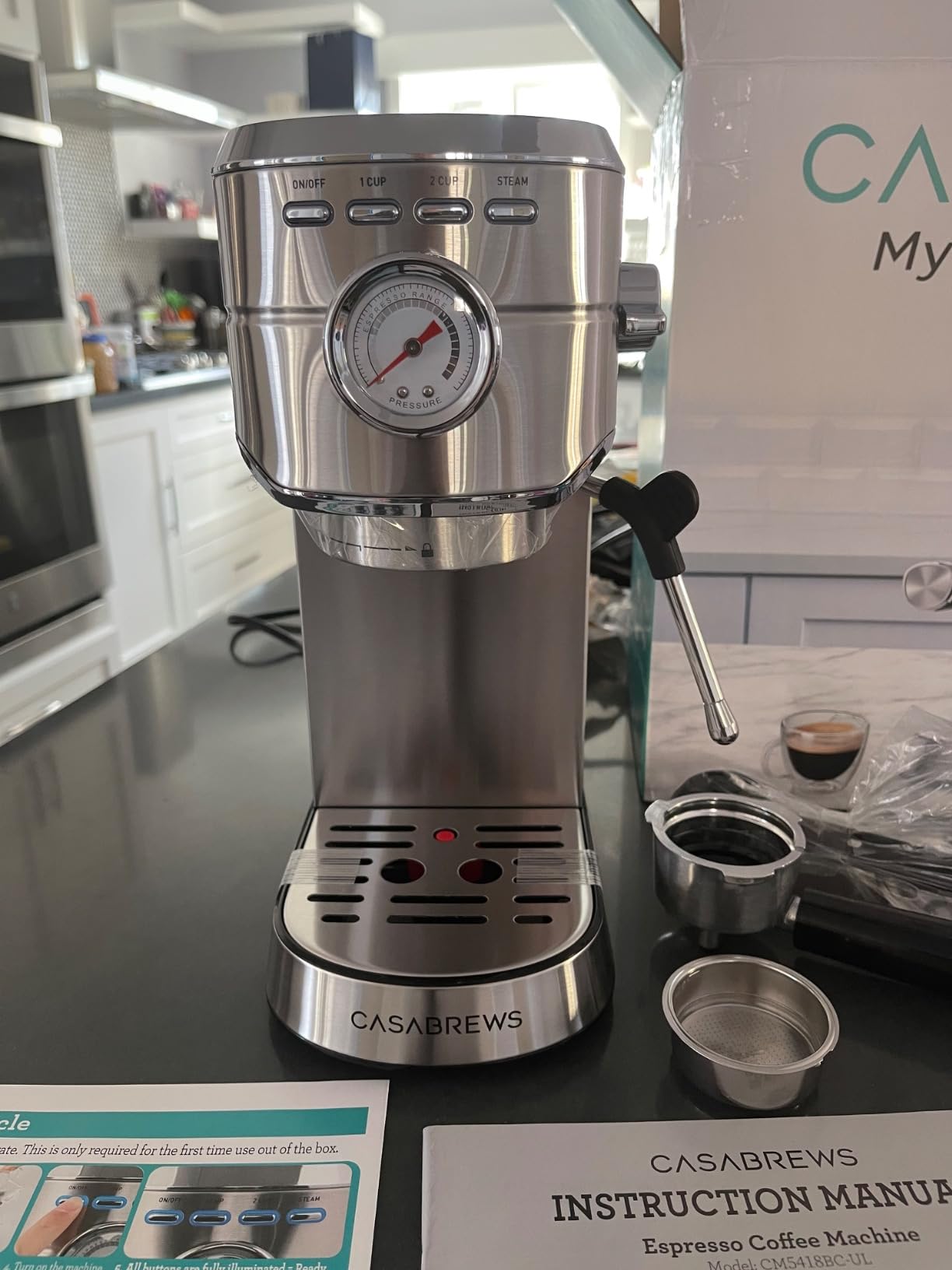
It comes as a complete kit with a 51mm portafilter, single and double baskets, a tamper, and illustrated instructions. You will still want to buy a metal pitcher, which is not included.
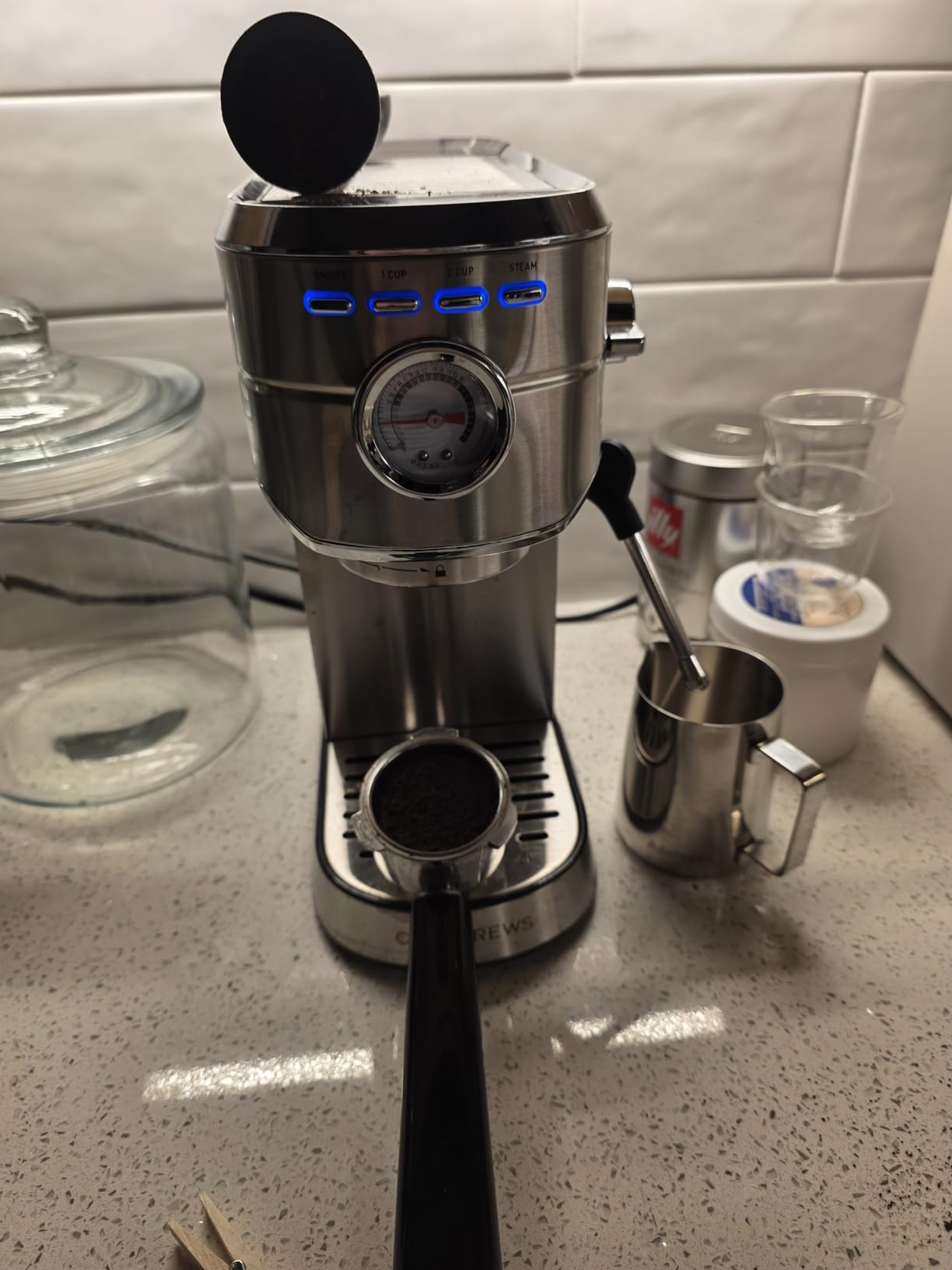
Owners report that the machine takes up very little counter space and works right out of the box. The 34 oz tank is detachable, which matters more than it sounds, because a tank you cannot lift makes cleaning awkward.
Steam wand performance is where the value shows. The wand handles cappuccinos and lattes well for the class of machine, and the 1350 watt boiler gets to pressure reasonably fast.
The cooldown rule and how to plan around it
This is the one design decision that shapes daily use. You cannot brew immediately after frothing, so you have to choose an order and stick to it. Most owners froth first, then brew, because the wand cools the boiler down rather than the reverse.
That means your morning runs froth, brew, froth, brew. Two drinks in a row is fine. Three or four in a row is where the wait becomes noticeable, and where a machine with a faster boiler would be the better buy.
Where it falls short for milk drinks
Reviewers complain about the uninsulated wand, which gets very hot, and the loud noise it makes while firing. The bundled plastic tamper is low quality and usually replaced by owners.
Some units also report water tank leakage from the bottom. Check the base early rather than after a countertop is soaked.
5. Breville Barista Touch – Best for Programmable Milk
Breville BES880BSS Barista Touch Espresso Machine, Brushed Stainless Steel
Automatic microfoam texturing
ThermoJet 3-second heat-up
PID control
Touchscreen
Pros
- Adjustable milk temperature and texture
- ThermoJet heat-up is very fast
- Saved custom drink settings
- Includes jug and water filter
Cons
- Single boiler
- no simultaneous brew and steam
- Microfoam is set by the machine rather than by you
- Touch interface learning curve
The Barista Touch is the closest thing here to a one-touch machine that still gives you a proper milk jug and wand. You set a milk temperature and a texture level on the touchscreen, and the automatic steam wand holds that setting every time.
That repeatability is the reason to choose it. If your household has one person who wants cappuccino foam and another who wants a hotter, flatter latte, both can have their setting saved without anyone negotiating.
ThermoJet heating reaches extraction temperature in three seconds, which makes this the fastest machine here for back-to-back drinks. A 67 oz tank and half-pound bean hopper mean fewer refills during a busy morning.
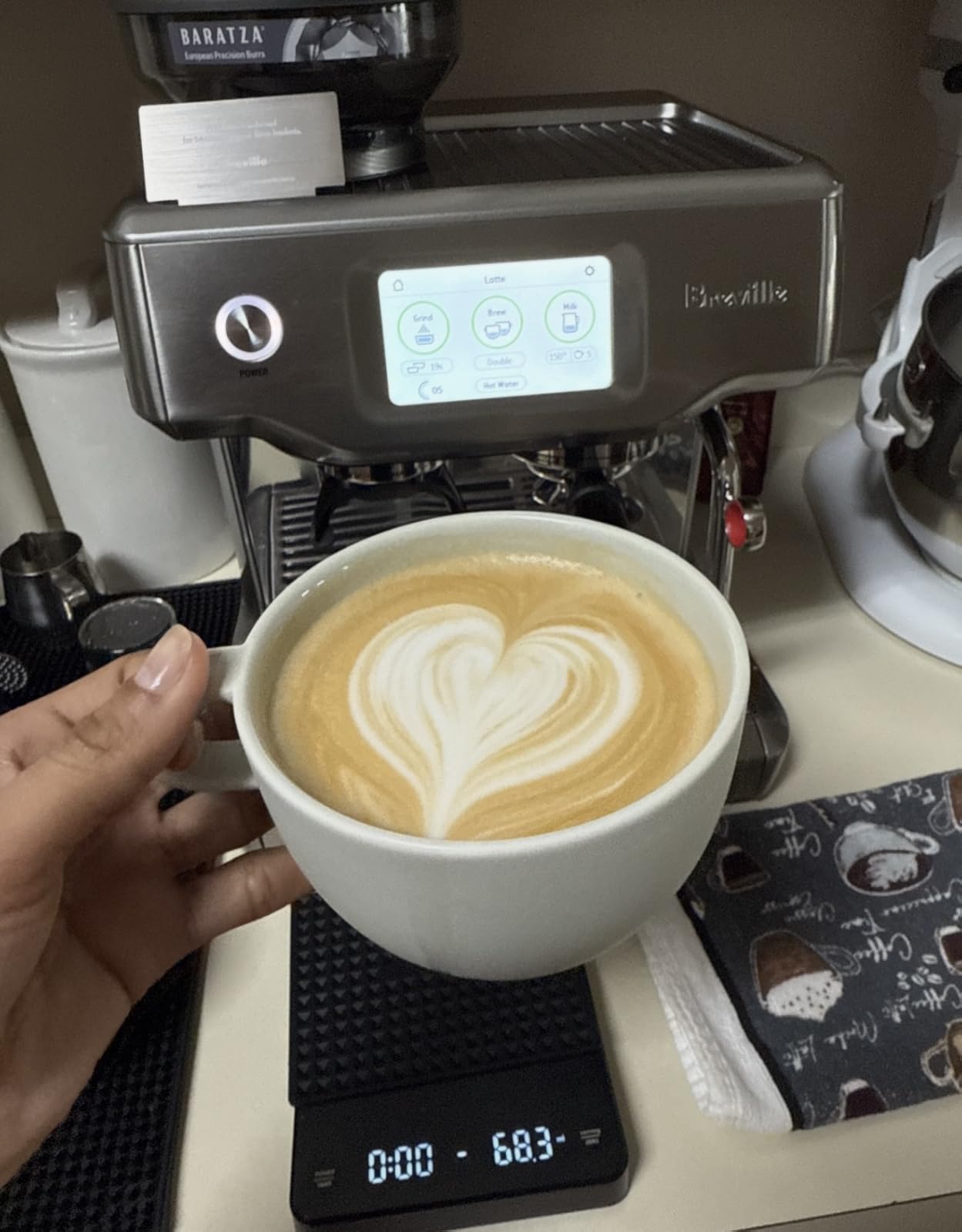
Reviewers highlight the programmable milk temperature and texture controls along with the rapid heat-up as the standout milk-drink features. Saved custom recipes are the other thing owners mention most.
The touchscreen has five pre-programmed cafe favorites and eight custom settings, so the workflow is grind, brew, milk. Included in the box are a 16 ounce stainless steel jug, cleaning kit, and water filter.
Automatic texturing versus a manual wand
The automatic wand removes the learning curve entirely. You position the jug, press the button, and get the same foam each time. That is genuinely valuable if you are not going to practise latte art.
What you give up is control. There is no way to stretch milk further, lower the temperature slightly, or bail out early when the foam looks ready. Manual practice is still the only route to latte art.
Where it falls short for milk drinks
It runs a single boiler, so brewing and steaming cannot happen at the same time. It is also the most expensive machine of the ten we reviewed, and several users find the touch interface takes getting used to.
If your budget stretches further and you want a wand you control instead of one you program, the money is better spent elsewhere. We cover the alternatives in our dual boiler espresso machine guide.
6. Breville Barista Pro – Best for Latte Art
Breville BES878BSS Barista Pro Espresso Machine, Brushed Stainless Steel
High-pressure manual steam wand
ThermoJet instant heat-up
PID within 2 degrees C
1680W
Pros
- Powerful wand reaches microfoam fast
- Three-second heat-up supports back-to-back drinks
- Mostly metal construction
- Descale prompts and easy cleaning
Cons
- 54mm portafilter is below the 58mm standard
- Expensive for the category
- Auto mode extracts poorly
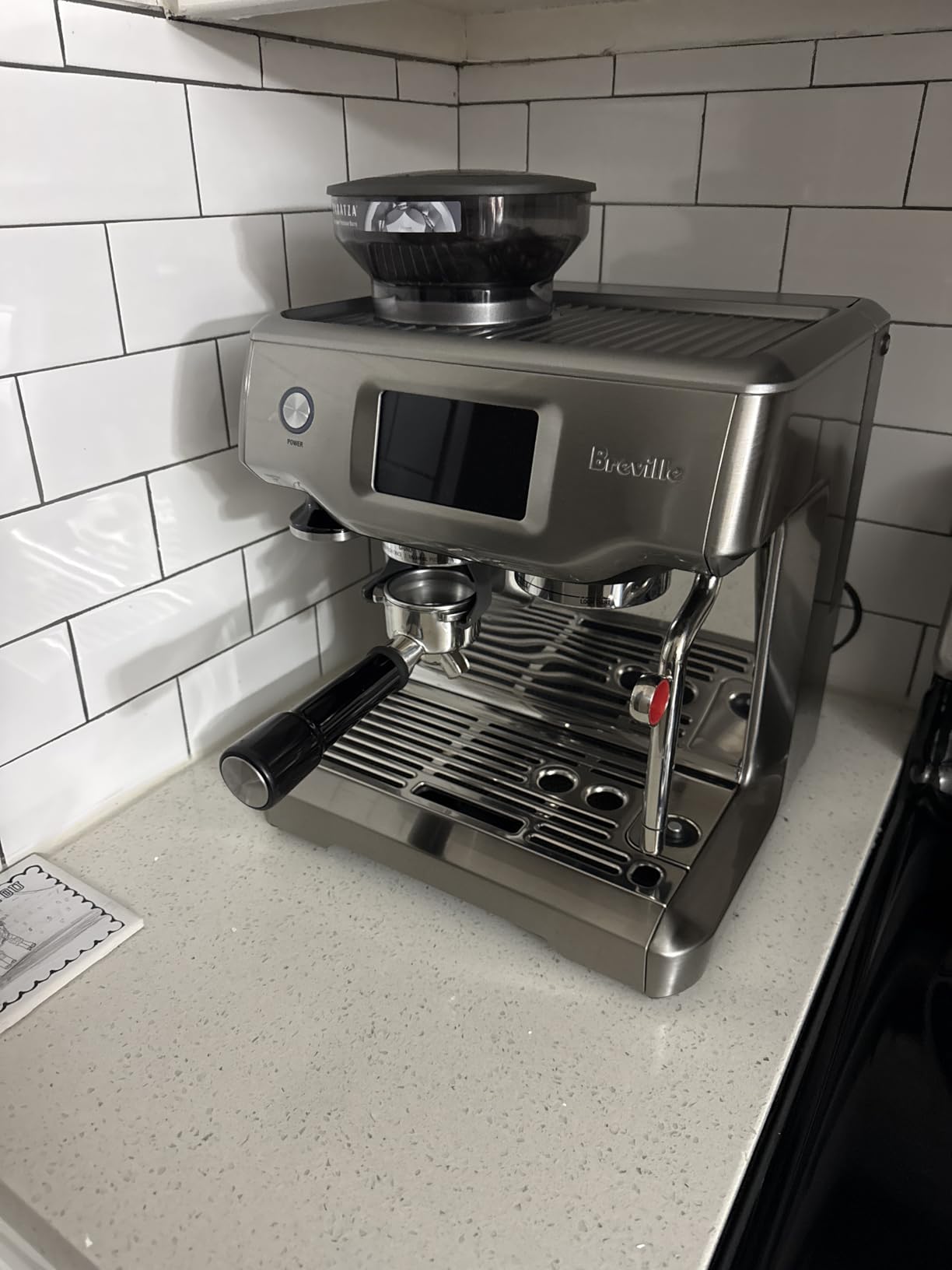
If latte art is the goal, the wand on the Barista Pro is the strongest in this group. Owners consistently say it reaches proper microfoam texture faster than lower-tier models, and the 1680 watt heating system gets there fast.
ThermoJet heat-up plus PID control within plus or minus 2 degrees C means the second drink tastes like the first. That is what makes back-to-back milk drinks possible without temperature surfing in between.
The backlit LCD gives you clear feedback on grinding and extracting, which shortens the learning curve compared with a dial-only machine. A 16 ounce stainless steel jug and cleaning kit are included.
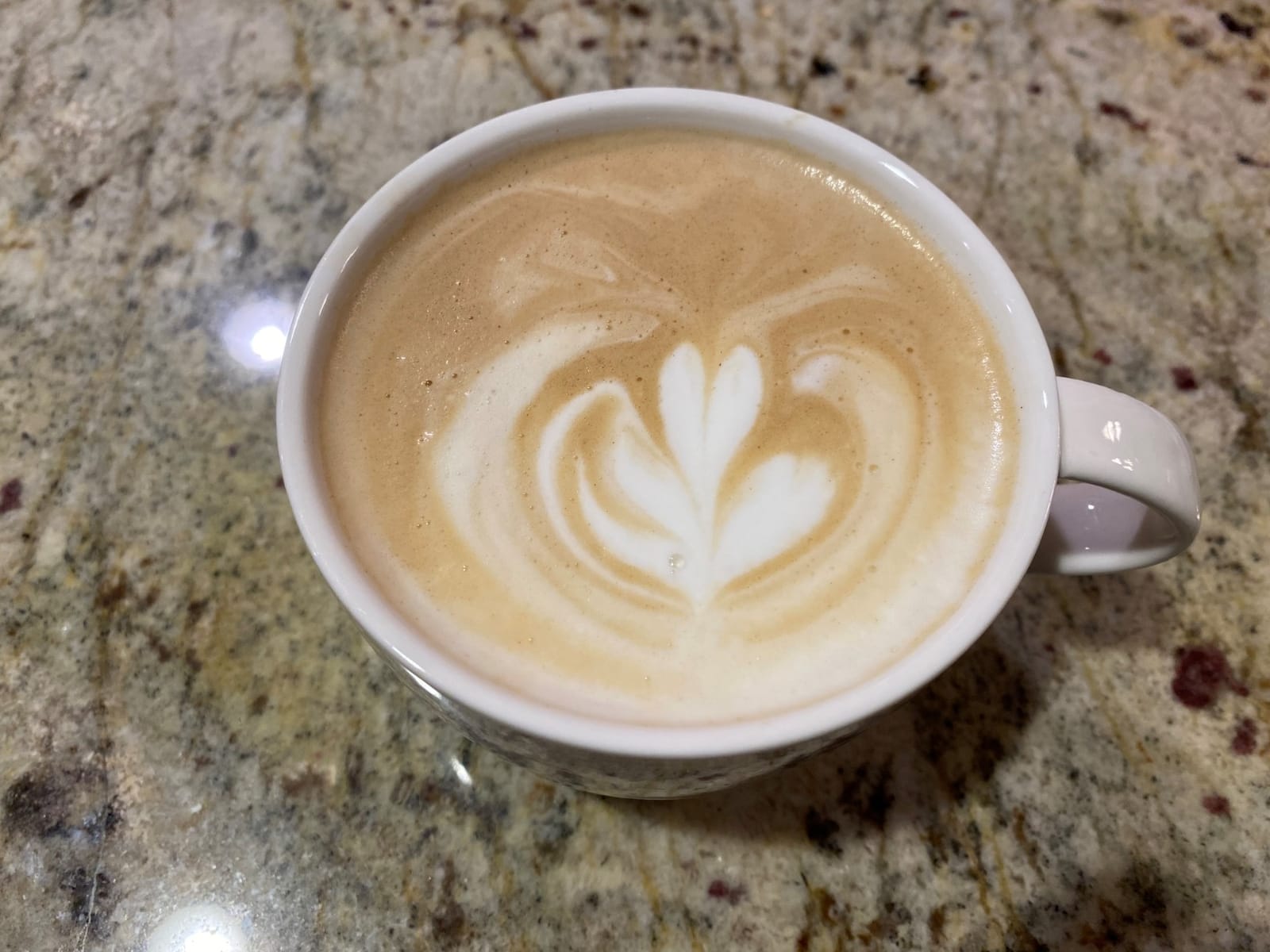
Reviewers call this the sweet spot in the Breville line, noting a noticeably more powerful steam wand than the Barista Express and enough control to pull back-to-back shots with consistent taste.
It handles whole bean and ground coffee, has a 30-setting grinder, and includes single and dual wall filter baskets. The half-pound hopper and 67 oz tank keep refills infrequent.
Why the wand suits latte art practice
More steam power means you get to microfoam temperature before the milk overheats, which is the whole game. A weak wand forces you to hold the pitcher in the steam zone longer, and longer is what makes milk taste cooked.
On the r/espresso forum, people describe latte art as a multi-year skill rather than something a machine hands you. A strong wand shortens that curve, and this one gives you the control to stop when the milk looks right.
Where it falls short for milk drinks
The 54mm portafilter is smaller than the 58mm commercial standard, which limits basket accessory options. Reviewers also flag the price, an initial tuning period, and weak performance in automatic mode, where manual is clearly better.
Grinder durability and noise draw mixed reports. If a loud grinder bothers you at 6am, listen before buying.
7. CASABREWS 3700 Essential – Best for a Larger Water Tank
CASABREWS 3700 Essential Stainless Steel Espresso Machine with Steam Wand
Steam wand milk frothing
43.9 oz removable tank
20-bar pump
1350W
Pros
- Large tank cuts down on refills
- Steam wand handles everyday lattes
- Holds up under heavy daily use
- Removable drip tray
Cons
- No pressure gauge for diagnostics
- Steam dial can drift open
- Extraction is finicky about grind
The 3700 Essential is unusual in this price class for a 43.9 ounce tank. Many compact machines hold around 34 ounces, so this one asks for refills roughly a third less often during a household that makes several milk drinks.
The steam wand produces microfoam suitable for latte art on everyday drinks, and reviewers report the machine holds up well under heavy daily use as long as you descale on a schedule.
At 8.1 pounds with a 12.6 inch depth, it is one of the lighter machines here, which matters if you are moving it around rather than parking it permanently.
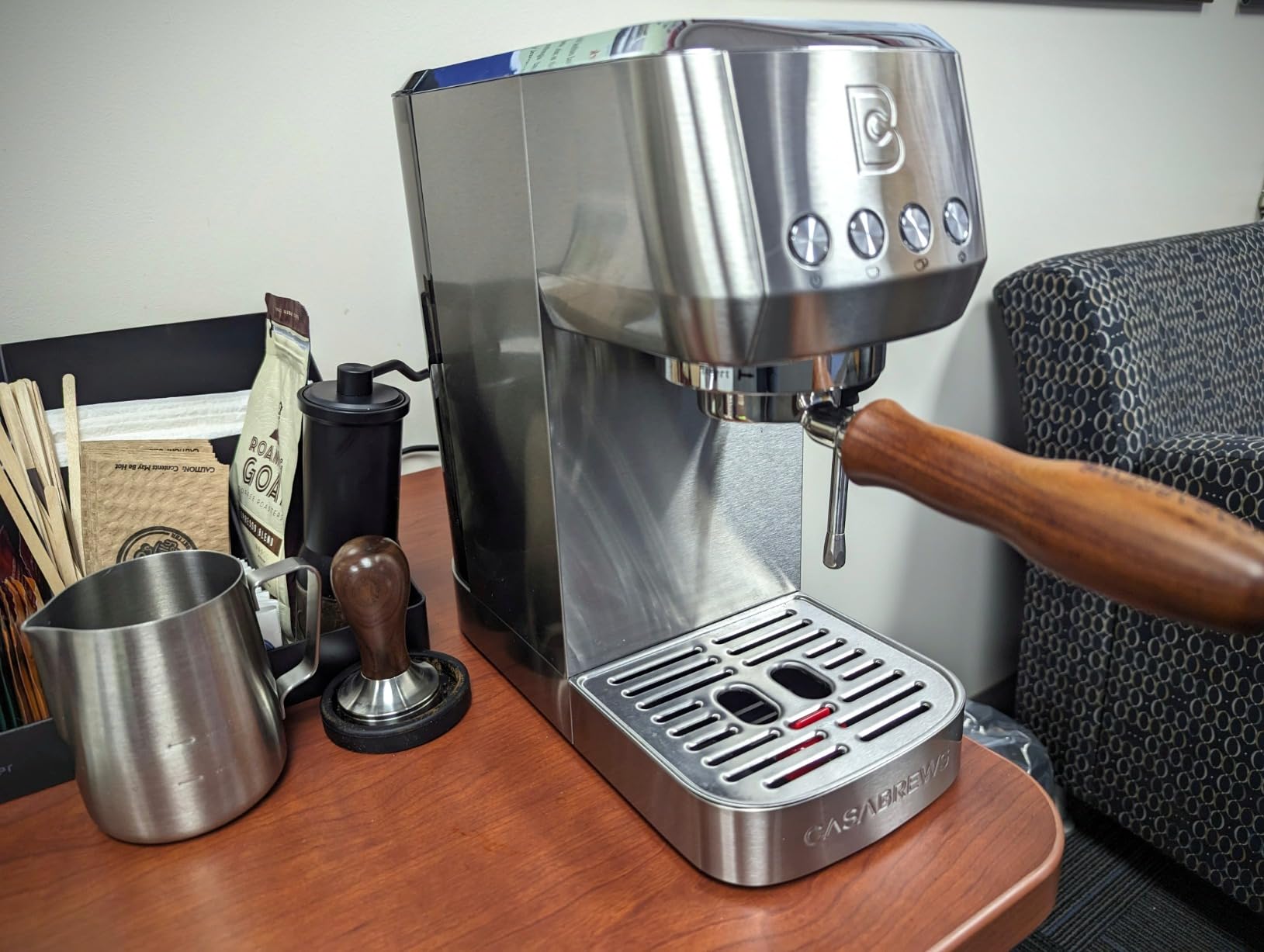
Owners like the stainless steel finish and the generous tank for the money. The removable drip tray makes daily cleaning straightforward, and the single and two cup filters are included.
Rich espresso with good crema appears when you pair it with fresh grounds. That is a real dependency, since this machine struggles more than most when handed pre-ground coffee.
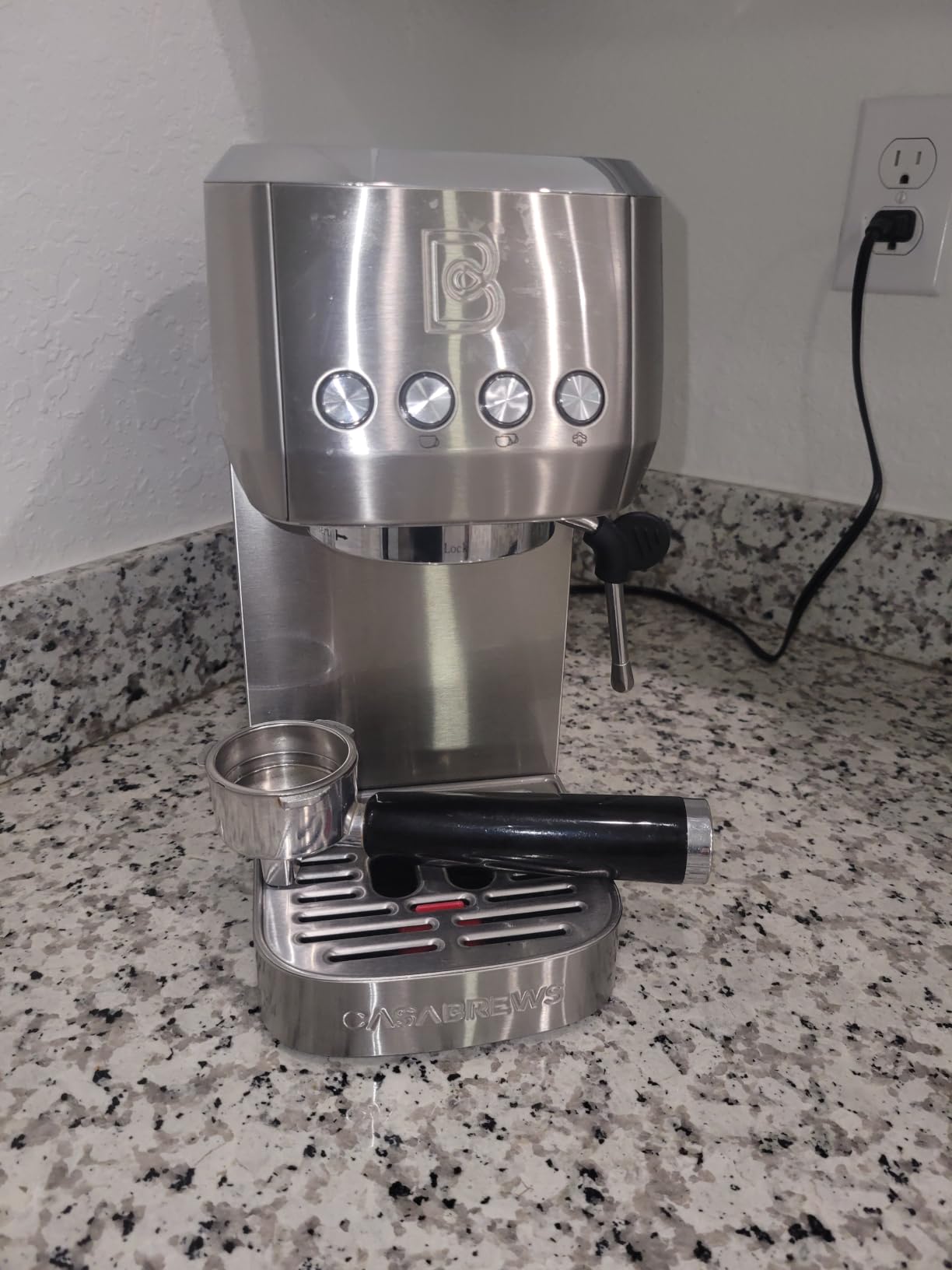
How the wand handles a workday of milk drinks
For two to four drinks a day, the wand performs adequately. It produces foam you can pour a cappuccino with, and the larger tank means you are not refilling between every drink.
The steam control dial is the weak point. Reviewers report it can drift open and leak pressure during shots, which hurts both extraction and how steady the wand feels.
Where it falls short for milk drinks
There is no pressure gauge, so when a shot runs badly you have no reference point for why. Espresso extraction is also inconsistent and finicky about grind size, and the bundled plastic tamper feels flimsy.
Steaming and brewing are noticeably noisy. If you work from home and take calls, that is worth knowing in advance.
8. Gevi 20 Bar with Grinder – Best for Grinder and Wand in One
Gevi 20 Bar Espresso Machine with Grinder & Steam Wand for Latte Cappuccino
High-pressure steam wand
30-setting burr grinder
58mm portafilter
2.3L tank
Pros
- Built-in grinder with 30 settings
- Velvety microfoam from the wand
- PID and NTC keep shots consistent
- 58mm commercial-style portafilter
Cons
- Single boiler needs switchover
- Steamer has a rest period between cycles
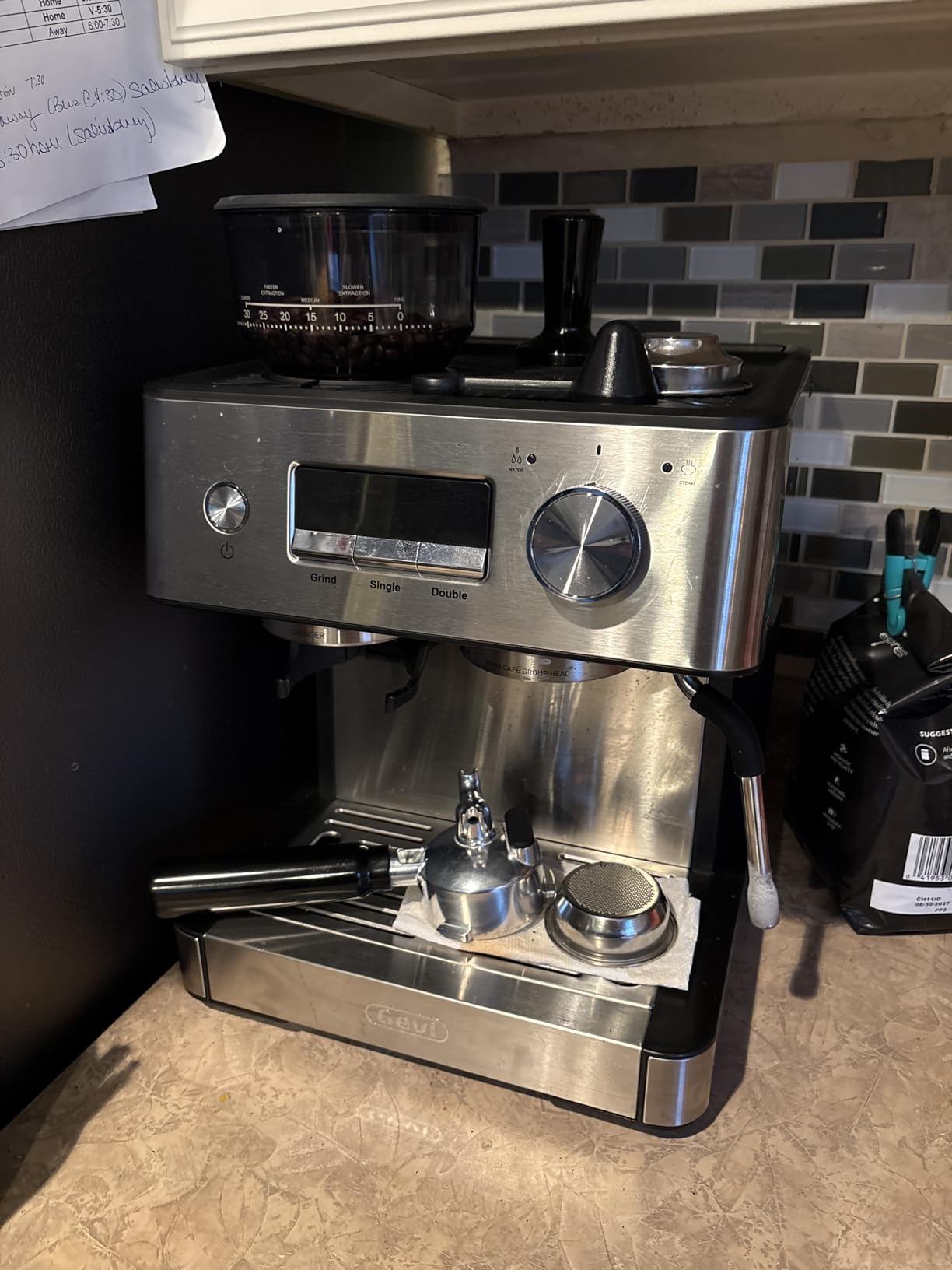
The Gevi pairs a 30-setting conical burr grinder with a high-pressure steam wand, and that pairing is the reason it lands here. It is the closest this list comes to a one-box setup without a separate grinder purchase.
Reviewers praise the wand for making velvety microfoam for lattes and cappuccinos, and the PID plus NTC temperature control for keeping extraction consistent once you dial it in.
The 58mm portafilter is the commercial standard, and four baskets are included, single and dual wall. That matters for anyone who expects to buy third-party baskets later, which you cannot do on a 54mm or 51mm machine.
Users describe it as a strong all-in-one value, noting the wand makes good microfoam and temperature control is steady. Adjustable grind duration and shot volume let you tune dose without a scale.
The wand doubles as a hot water dispenser, which is useful for Americanos and for rinsing the group before a shot. A 2.3 litre tank, cup warmer, and auto shut-off round out the basics.
What the single boiler costs you at breakfast
The steam wand is strong enough, but the boiler is single, so you switch between brewing and steaming rather than running both. For one drink that is a brief wait. For a second drink immediately after, it adds time.
There is also a continuous run time limit on the steamer, so it needs a rest between long cycles. Two or three pitchers in a row is realistic; a party is not.
Where it falls short for milk drinks
If you plan to make more than two milk drinks back to back, the switchover delay and steamer rest cycle are the two things that will irritate you. Our super-automatic espresso machine guide covers the fully automatic alternative.
At 16.5 inches tall it is also the tallest machine here, so check your overhead cabinet before committing.
9. De’Longhi Classic Signature – Best for Two-Setting Steam
De’Longhi Classic Signature Espresso Machine, Adjustable Milk Frother
Adjustable two-setting steam wand
Thermoblock heating
15-bar pump
9 lbs
Pros
- Two-setting wand covers warming and microfoam
- Thermoblock heats in seconds
- Compact stainless design
- Removable tank with level markers
Cons
- Build is light and largely plastic
- No user-adjustable brew temperature
- Weak included tamper
This machine sits between a manual wand and an automatic one. The wand has two settings: one that steams milk for cappuccino foam and one that textures toward microfoam, so you can pick a level of airiness without dialling in a technique.
Thermoblock heating reaches temperature in a few seconds, which makes it one of the quickest machines here to go from cold to drinkable. That speed is a genuine advantage for households making a single drink on the way to work.
Reviewers see it as a capable, good-looking entry-level machine whose frother produces nice foam and whose thermoblock heats quickly. The 1.7 litre reservoir has level markers, which makes descaling less of a guessing game.
At 9 pounds and 9 inches wide, it is genuinely compact. The customisable single and double espresso presets cover the basics without requiring you to judge dose by eye every time.
Espresso quality is good with good crema, and the pressure gauge helps you diagnose a bad shot rather than guessing.
Two-setting steam versus a full manual wand
The wand gives you more control than an automatic carafe and less than a pure manual wand. For a cappuccino you want the first setting, for a latte the second, and the machine handles the rest.
Reviewers note the wand starts foaming before the milk is fully heated, so you cannot leave it unattended. That is still less demanding than the Barista Express but more demanding than the Mr. Coffee.
Where it falls short for milk drinks
The build is light and largely plastic, which reviewers mention directly when comparing it to pricier machines. There is also no true user-adjustable brew temperature, so you inherit whatever the thermoblock gives you.
Portafilter baskets are not retained when you empty the puck, and the included plastic tamper is weak. Buy a metal tamper in the same order.
10. De’Longhi Magnifica Duo – Best for Cold Foam Drinks
De’Longhi Magnifica Duo Automatic Espresso Machine, Milk Frother, Silver
LatteCrema hot and cool carafe
20 preset recipes
Integrated burr grinder
Dishwasher-safe carafe
Pros
- Produces both hot and cold foam
- Removable dishwasher-safe milk carafe
- 20 preset recipes including iced drinks
- Integrated burr grinder
Cons
- Largest footprint in this group
- Milk circuit must be rinsed after each use
- No custom recipes beyond presets
This is the only machine here that makes cold foam as well as hot, through the LatteCrema Hot and Cool carafe. If iced latte drinks are part of your routine in 2026, nothing else on this list does it.
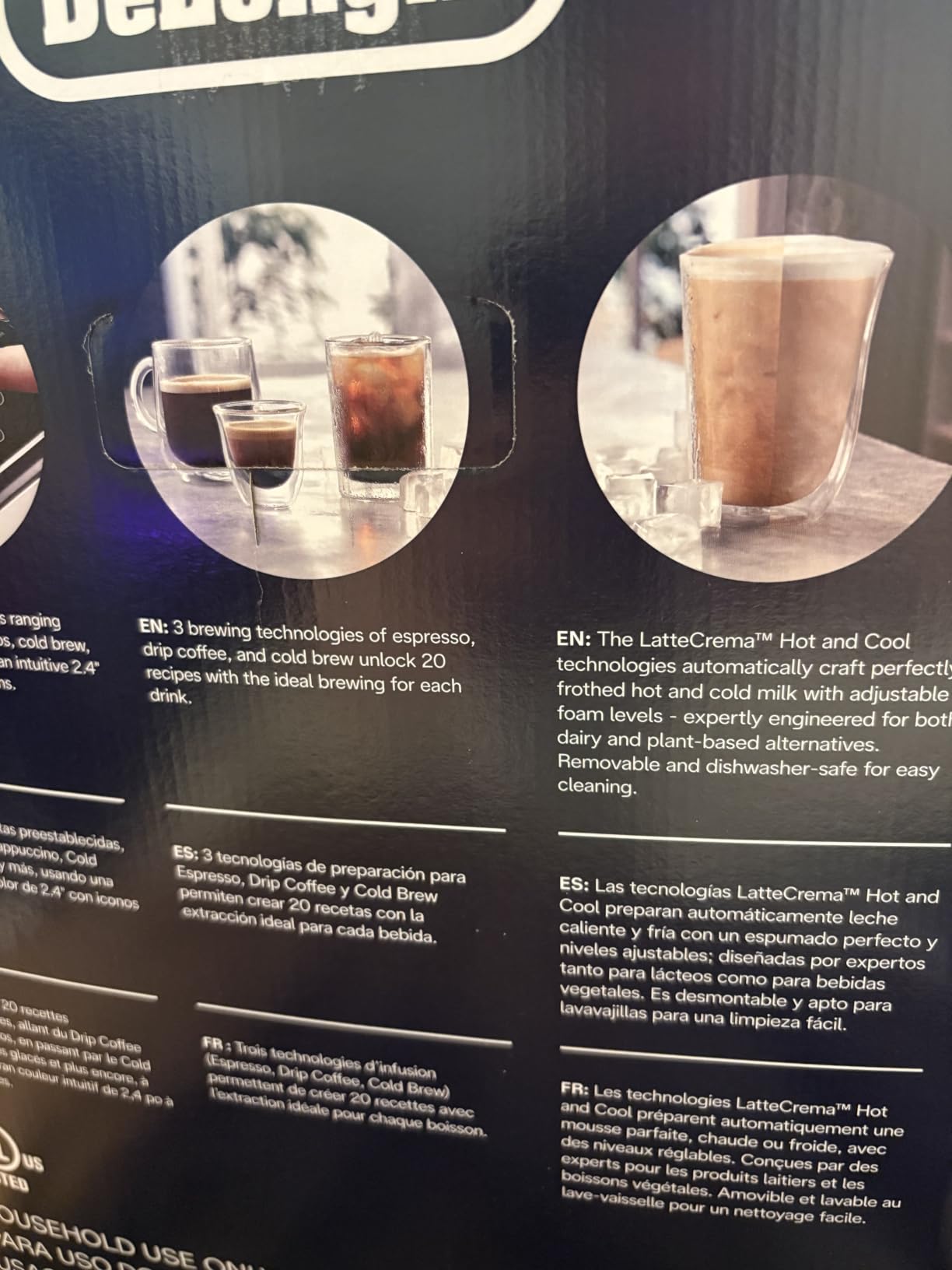
The touchscreen runs 20 preset hot and iced recipes across espresso, drip coffee, and cold brew. Cold extraction brews in under three minutes, and the carafe comes out for the dishwasher.
Owners describe it as a dependable all-in-one with excellent hot and cold coffee and a well-performing milk frother that largely cleans itself. Its 4.6 rating is the highest in this group, though it is based on a much smaller pool of reviews than the machines ranked above it, so we placed it last for that reason.
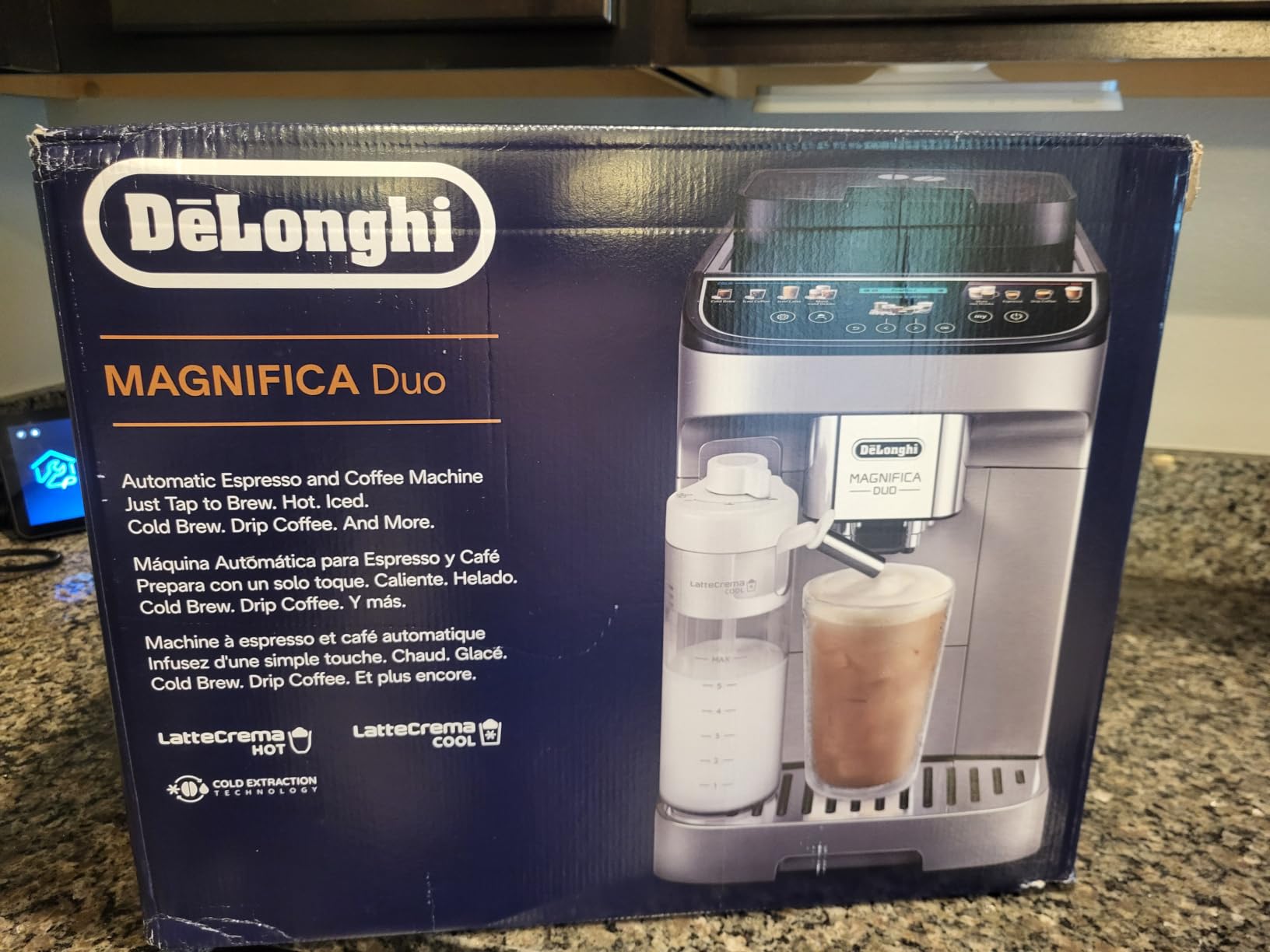
The integrated conical burr grinder handles beans, and an auto clean function looks after the milk circuit between uses. That is the appeal of the fully automatic format: one button, no pitcher technique.
Three brewing technologies cover espresso, drip, and cold brew, so the machine is not limited to one drink style the way a semi-automatic with a small basket can be.
What the milk carafe does and does not give you
The carafe produces genuinely velvety hot foam and cold foam at the touch of a button, and it detaches for a dishwasher cycle. For a household with non-barista drinkers, that is the single biggest convenience win on this list.
You cannot change the milk ratio, the foam level, or the milk temperature, and you cannot create custom recipes beyond the preset menu. Latte art is not on the table.
Where it falls short for milk drinks
At 19.7 inches deep it has the largest footprint here, and it runs louder than smaller units. The milk circuit must be cleaned immediately after each milk drink rather than once a day.
If you are coming from a pod machine and want one-touch drinks, this is a genuine upgrade. If you want to learn anything about milk, start elsewhere and use our super-automatic guide under 1000 to compare formats first.
What Latte, Cappuccino and Flat White Ask of a Machine
Milk drinks fail in predictable ways, and the difference between them is mostly ratio and temperature. Knowing which you actually drink tells you how much foam control you need.
Latte. The longest milk drink, usually served in a taller glass, with a thin layer of microfoam on top. This is the hardest test of a wand because you need fine, glossy texture at low foam volume, which means precise control and a way to stop on time.
Cappuccino. Equal parts espresso, steamed milk, and foam, served warm in a short cup. More forgiving than a latte because there is more foam to hide an imperfect stretch, and an automatic frother handles it well.
Flat white. Similar to a latte but with less foam and a hotter, smaller volume. Microfoam quality matters most here because the foam layer is thin enough to show texture defects.
Macchiato. Espresso marked with a small amount of foam. The easiest of the four, and the one where even a weak wand performs acceptably.
Oat and soy milk behave differently under steam than whole milk, and that difference catches people out. Plant milks heat less quickly and their proteins are less stable, so they tend to go flat or separate if you hold them in the steam zone too long. On r/barista this comes up constantly as a source of frustration.
The practical rule: stop lower in the pitcher for plant milks, keep the milk colder, and expect a slightly less stable foam. Machines with a programmable milk temperature, like the Barista Touch, handle this better than machines where you get one fixed setting.
How to Steam Milk Into Microfoam Without Wrecking It
Forum threads about milk drinks almost always land on the same complaint: people wreck their milk. The steam wand is not the problem. Almost every failure comes down to position, timing, or milk temperature.
Here is the routine that works on any of the manual-wand machines above.
1. Start with cold milk. Fill the jug no more than a third for a single drink. Warm milk cannot be textured, because there is nowhere left to put air.
2. Purge the wand first, then wipe it clean immediately. Water in the pitcher ruins microfoam, and this is the single most common mistake.
3. Introduce air only at the start. Put the tip just below the surface for a second or two until you hear a tearing sound. Big bubbles now means you are going too deep.
4. Drop the tip slightly so it sits just under the surface. The tearing sound should become a quieter hiss. This is the stretch, and it is where volume comes from.
5. Stop when the pitcher feels warm, roughly 130 to 150 degrees. If it feels too hot to hold comfortably, you have scalded the milk and it will taste cooked.
6. Tap the jug on the counter, swirl once to settle the foam, and pour. Wipe the wand and purge again before the next drink.
If you are not ready to practise technique, the alternative discussed on r/barista is a standalone milk steamer. Owners of Subminimal NanoFoamer and Bellman stovetop models describe them as giving good results with virtually no cleaning, and they work with any machine that makes plain hot drinks. That is a cheaper fix than replacing a whole espresso machine for better milk.
The other common question is whether a wand beats an automatic frother. It does for texture and latte art, and it does not for repeatability on a busy morning when nobody wants to practise at 7am.
What to Look for When Buying an Espresso Machine for Milk Drinks
If you drink more than about one milk-based drink a day, or you make drinks for more than one person, the specs below matter more than anything else on the spec sheet.
1. Steam wand power, not steam pressure marketing. Wands with multiple small holes produce a slower, silkier stretch than single-hole tips. Higher wattage generally means faster recovery between pitchers. If you want latte art, this is the number to prioritise.
2. Whether the machine brews and steams at the same time. Dual boilers and heat exchanger machines run both circuits independently. Single boiler machines force a wait, and budget models may impose a mandatory cooldown, as the CM5418 does.
3. Milk system type. A manual wand gives control. A two-setting wand gives moderate control. An automatic carafe gives consistency and convenience but no adjustment. A panarello-style wand at the end of a fully automatic machine is the compromise tier.
4. Recovery time between drinks. The gap between finishing one pitcher and the next is where single boiler machines show their limits. Plan on a minute rather than seconds unless the boiler type says otherwise.
5. Milk system cleaning burden. Anything with a milk circuit needs rinsing right after use. Manual wands need a purge and a wipe daily plus weekly backflushing. Skip this spec and your evening routine gets longer than you expected.
6. PID or temperature control. Milk drinks hide bad shots less well than straight espresso. Stable brew temperature is what makes the second and third cup taste like the first.
7. Tank size and footprint. A 67 oz tank means fewer refills during a busy morning. Check width as well, since several machines here are narrower than a sheet of paper while others need 15 inches of counter.
On grinder versus no grinder: our beginner’s guide covers this in more depth. The short version is that a built-in grinder adds convenience and counter savings, while a separate grinder adds control. For milk-drink drinkers the grinder matters far less than the steam system, so a cheaper machine with a better wand is usually the smarter buy.
Finally, how many drinks a day justifies a dual boiler. The practical answer from owner experience: if you are making more than three milk drinks back to back, or serving guests regularly, the independent brew and steam circuits pay off in saved waiting. One or two drinks a day will never notice the difference.
Frequently Asked Questions
Which coffee machine is best for making milk drinks?
The best espresso machines for milk drinks are those with a strong steam wand and fast boiler recovery. The Breville Barista Express leads our list for its wand and repeatability, the Mr. Coffee Cafe Barista for one-touch milk drinks with no technique, and the CASABREWS CM5418 for small counters on a budget.
Which espresso machine is best for lattes?
For lattes specifically, choose a machine with a manual steam wand and enough steam power to reach microfoam temperature quickly. The Breville Barista Express and Barista Pro both qualify, while the De’Longhi Magnifica Duo suits anyone who wants iced lattes made at the touch of a button.
Do I need a dual boiler for milk drinks?
You need a dual boiler if you regularly make more than three milk drinks back to back or serve guests, because it runs brewing and steaming at the same time. For one or two drinks a day a single boiler machine works well, though you will wait for steam pressure between the shot and the pitcher.
Is a steam wand better than an automatic milk frother?
A steam wand gives you control over texture and temperature, which is the only way to practise latte art. An automatic frother gives you the same result every time with no technique, at the cost of coarser foam and no way to adjust it. Choose the wand if you enjoy the process and the frother if you want speed at breakfast.
Why is my milk not frothing properly?
The usual causes are milk that is too warm, air introduced too late, or a jug that is more than a third full. Wipe and purge the wand before every use, start with cold milk, introduce air in the first second, and stop when the jug feels too hot to hold comfortably.
Final Verdict by Drink Type
For everyday lattes and cappuccinos, the Breville Barista Express is the best espresso machine for milk drinks we tested. Its wand produces real microfoam, its PID keeps the second and third cup consistent, and the built-in grinder keeps the whole routine short.
If you want no technique at all, take the Mr. Coffee Cafe Barista. If you want latte art, the Barista Pro has the strongest wand in the group. For small counters and modest budgets, the CASABREWS CM5418 does more with a 5.5 inch footprint than machines twice its size.
Whichever you choose in 2026, plan on a cleaning routine from day one. Purging the wand, rinsing the milk path, and descaling on a schedule will do more for your drinks than any single feature on the spec sheet.