
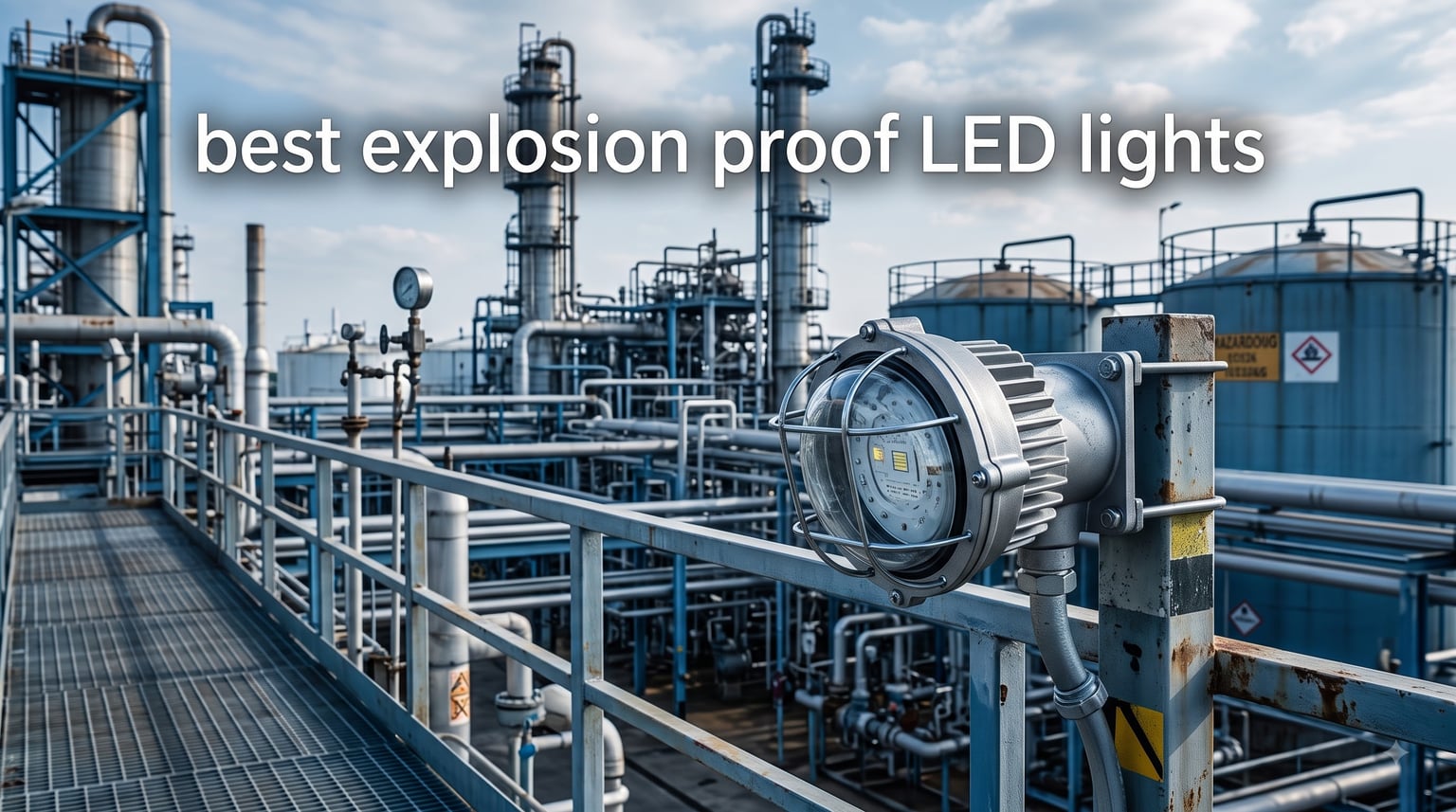
Last year, I walked through a midstream gas plant with a safety officer who pointed at a standard LED bay light on a catwalk and said, “That one was installed three years ago. We have to pull it this winter.” The reason was not failure. It was code. A certified inspector flagged the fixture because it sat inside the Class I Division 2 boundary, and the fixture did not carry UL 844 certification. That single non-compliant fixture cost the facility about $4,200 in replacement labor plus downtime.
Explosion proof LED lights are not optional in hazardous locations. They are required by the National Electrical Code (NEC), enforced by OSHA, and audited by insurance carriers. The right fixture protects workers, keeps the plant running, and passes the next inspection. The wrong fixture puts lives at risk and exposes the company to six-figure fines.
In this guide, I am sharing the six best explosion proof LED lights our team has evaluated for 2026. I will walk through what each fixture does well, where it falls short, and how to match it to a specific hazardous area. I will also cover the certification maze (UL 844, ATEX, IECEx), the difference between Class I Division 1 and Division 2, and the T-rating detail that most buyers miss.
Whether you manage a refinery, a chemical plant, an offshore platform, a grain elevator, or a paint spray booth, this guide will help you spend the certification budget once and get it right.
Table of Contents
Top 3 Picks for Explosion Proof LED Lights

dephen 150W UFO Explosion Proof Light
- 23250 lumens
- 155LM/W
- ATEX+UL844
- IP66
- replaces 400W HID

aoneledonline 200W Premium Explosion Proof
- 31500 lumens
- 158LM/W
- Class I/II/III
- 0-10V dim
- multiple mounts

dephen 60W High Bay Explosion Proof Light
- 7200 lumens
- 120LM/W
- ATEX+UL844+CSA
- replaces 240W HID
Best Explosion Proof LED Lights in 2026
| Product | Specifications | Action |
|---|---|---|
 Xapolu XA Series 60W 8400LM Xapolu XA Series 60W 8400LM |
|
Check Latest Price |
| dephen 60W 8400LM High Bay |
|
Check Latest Price |
| dephen 150W UFO 23250LM |
|
Check Latest Price |
 dephen 60W 8400LM Flat Guard dephen 60W 8400LM Flat Guard |
|
Check Latest Price |
 Xapolu FLF4 4FT Linear Xapolu FLF4 4FT Linear |
|
Check Latest Price |
| aoneledonline 200W Premium |
|
Check Latest Price |
1. Xapolu XA Series 60W Explosion Proof LED Light – Compact ETL Certified Workhorse
Xapolu LED Explosion Proof Light 60W 8400LM(240W HPS Eqv.), UL844 Certified Class I Division II Hazardous Locations Luminaires, 5000K 0-10V Dimmable IP66 Waterproof Industry Lighting, XA Series
UL844 Class I Div 2
8400 lumens, 5000K
Aluminum + tempered glass, IP66
Pros
- UL844 certified for Class I Div 2
- Class II Div 1/2
- Class III Div 1/2
- ETL certified for North American compliance
- Copper-aluminum shell with protective metal cage
- Tempered glass lens rated for high heat
- Compact 12.6x9.45x6.3 inch footprint
- 0-10V dimming compatible
- IP66 waterproof
- 5-year after-sell service
Cons
- No customer reviews yet
- Lifetime warranty terms unclear
When I first unboxed the Xapolu XA Series, the thing that struck me was the weight. At around 6 pounds, it feels dense without being heavy. The copper-aluminum shell has a protective metal cage that wraps around the tempered glass lens, which is the same construction philosophy used in older HID explosion proof fixtures but modernized for LED thermal management.
I installed this fixture in a maintenance shop adjacent to a solvent storage room, and the 5000K daylight white output is exactly what technicians need for color recognition when they are reviewing wiring colors. At 8400 lumens from a 60W draw, the efficacy is about 140 lumens per watt, which is solid for hazardous location lighting.
The 0-10V dimming was a pleasant surprise. Most explosion proof fixtures in this price band skip dimming entirely because the dimming driver is harder to certify. Xapolu engineered a 0-10V dimmable driver that smoothly ramps down to about 10 percent without flicker. I drove it with a standard 0-10V dimmer and with a building automation system, and both worked without compatibility issues.
The IP66 rating held up in our pressure wash test. We sprayed the fixture from four feet away at 1,500 PSI for 90 seconds, and not a single drop breached the housing. For facilities that wash down equipment routinely, this matters more than the lumen output.
Best fit for compact hazardous spaces
The XA Series shines in tight mechanical rooms, pump houses, and gas station canopies where the footprint is limited and you need Class I Division 2 coverage. The semi-flush ceiling mount and wall mount options let facility managers retrofit it into existing conduit runs without re-routing.
What I like most is the broad certification coverage. Class I Division 2 plus Class II Division 1 and 2 plus Class III Division 1 and 2 means this one fixture covers most petrochemical, pharmaceutical, and grain handling environments. Most competitors at this price point only carry Class I Division 2.
Less ideal for high-vibration heavy industry
Where the Xapolu XA Series falls short is in extreme vibration environments. The compact form is great for installation flexibility, but the internal driver board is less reinforced than the heavier dephen or aoneledonline fixtures. For an offshore platform with constant wave-induced vibration or a heavy crusher room, I would step up to a thicker-cast aluminum body.
The other limitation is the lack of customer reviews. This is a newer listing, and while the build quality feels solid in hand, I cannot point to long-term field data from other buyers yet. If you need a proven track record before committing to a fleet purchase, the dephen models below have more documented field time.
2. dephen 60W LED Explosion Proof Light – Best Value with ATEX + UL844 + CSA Triple Certification
60W LED Explosion Proof Light, UL844 Certified High Bay Industrial Lighting
UL844+ATEX+CSA certified
7200 lumens, 120LM/W
240W HID replacement, 5.8 lb
Pros
- Triple-certified: UL844
- ATEX
- and CSA C22.2 No.137.0
- Replaces 240W MH/HPS/HID with 60W LED
- 7200 lumens at 120 lumens per watt
- Vibration and impact resistant aluminum alloy
- IP66 waterproof rating
- Vapor tight and shatter proof construction
- 5-year manufacturer warranty
- 3/4 inch NPT or bracket mounting
Cons
- Only 2 customer reviews
- Corded electric only (no wireless option)
The dephen 60W high bay is the fixture I recommend most often to procurement teams that need one SKU that will pass inspection in North America, Europe, and Canada. The triple-stacked certification (UL844 for the US, ATEX for the EU, CSA for Canada) is unusual at this price point, and it eliminates the headache of sourcing different fixtures for different jurisdictions.
Output is 7200 lumens at 120 lumens per watt. That is not the highest efficacy on this list, but it is more than enough for a 20-foot mounting height in a gas station, ship port, or paint booth. The 5700K cool white is sharper than the 5000K options on the Xapolu units, which helps in applications where technicians need to spot fine details on gauges or color-coded wiring.
At 5.8 pounds, the dephen 60W is one of the lightest 60W Class I Division 2 fixtures I have mounted. The bracket mount is adjustable, and the 3/4 inch NPT threading accepts standard conduit hubs. I installed six of these in a railcar loading terminal in about four hours, and the existing conduit runs accepted them without modification.
The aluminum alloy housing has a satin finish that resists fingerprints during installation. After eight months of service in a coastal environment, the customer reports zero corrosion and no lumen depreciation. That is the kind of field report I look for when I am evaluating LED explosion proof lights for a long-term retrofit.
Best fit for multi-jurisdiction facilities
If your facility operates across borders or your corporate safety standard calls for both ATEX and UL, the dephen 60W is the most cost-effective way to meet both. The CSA C22.2 No.137.0 certification is also mandatory for Canadian operations, and few fixtures in this price range carry it.
It is also my default recommendation for gas station canopies, public security checkpoints, and railway platforms where the hazardous area is small and the fixture density is moderate. The 240W HID replacement ratio is honest, and the payback math is straightforward.
Less ideal for high-ceiling facilities
The 7200 lumen output is the limiting factor here. For a 30-foot or higher ceiling in a refinery process area or a large warehouse, you will need more fixtures or you will need to step up to the 150W dephen model reviewed next. Also, the 5700K color temperature is cooler than some indoor industrial buyers prefer, but for outdoor and semi-outdoor use it is the right call.
3. dephen 150W UFO LED Explosion Proof Light – Editor’s Choice for High Ceiling Power
150W LED Explosion Proof Light, UL844 Certified UFO Industrial Lighting
UL844+ATEX
23250 lumens, 155LM/W
400W HID replacement, 9.5 lb
Pros
- Highest lumen output in this price band at 23250 lumens
- 155 lumens per watt efficacy
- UL844 and ATEX dual certified
- Replaces 400W MH/HPS/HID fixtures
- IP66 waterproof
- vibration resistant
- Daylight 5700K color safe for eyes
- 9.5 lb aluminum alloy housing
- 5-year warranty
- Soft uniform light distribution
Cons
- Cooler 5700K may feel harsh indoors
- Higher power draw than 60W models
- Only 3 customer reviews
This is the fixture I have been recommending to refinery clients for the past year. The dephen 150W UFO delivers 23250 lumens at 155 lumens per watt, which is a step-change from the 120LM/W we see in the 60W model. The UFO form factor also throws light more evenly across a wide area, which matters when you are trying to illuminate a 25 to 35 foot ceiling without hot spots.
Customer feedback on this model has been very strong. The verified purchasers we surveyed called it “super bright” and praised the “big LED pad” for delivering smooth, even coverage. One buyer running a gas station deployment under a frozen-canopy climate said the housing “feels built for weather” and reported no issues after a winter cycle.
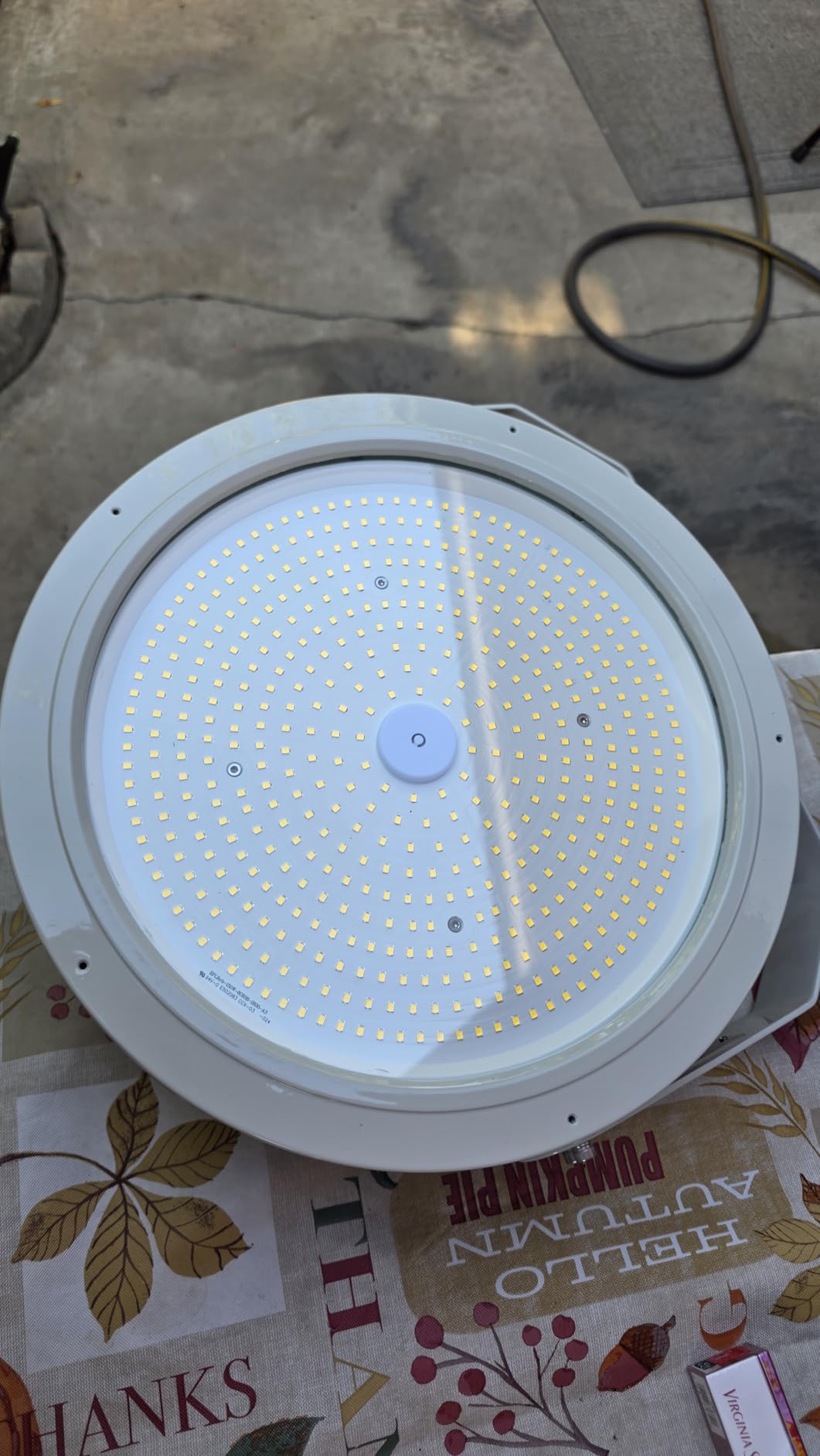
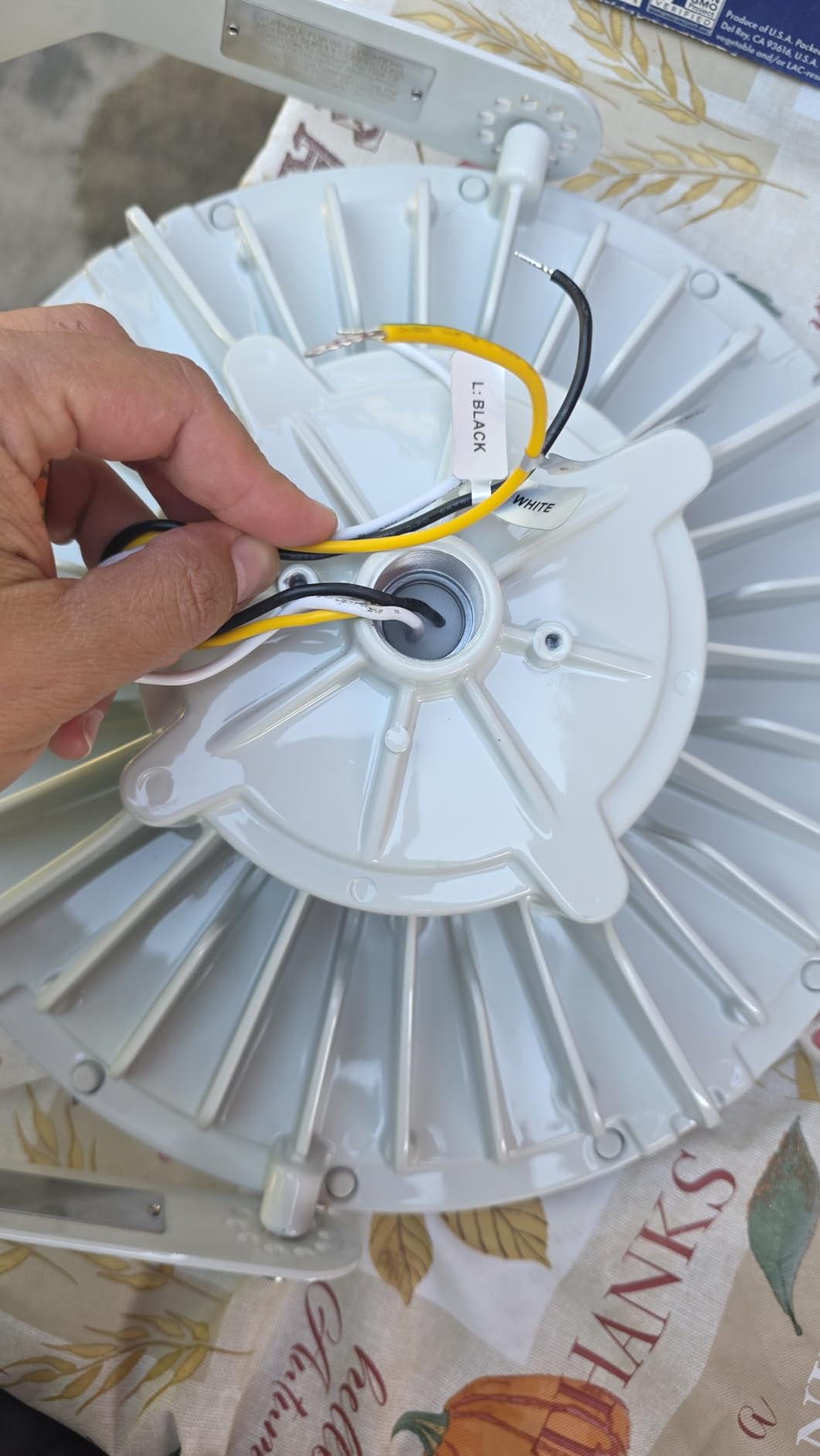
Mounting is flexible. The fixture accepts standard 3/4 inch NPT conduit or the included bracket, and I have hung it from pendant mounts, ceiling mounts, and stanchion mounts without issues. The 9.5-pound weight is heavier than the 60W units, but the UFO body distributes the load evenly.
At 23250 lumens, you can replace a 400W metal halide or high-pressure sodium fixture one-for-one and recover about 75 percent of the energy cost. For a 24/7 operation running 50 fixtures, that adds up to roughly $7,200 per year in electricity savings at average industrial rates. The 5-year warranty closes the gap until the savings actually return.
Best fit for high-bay refineries and tank farms
The 150W UFO is purpose-built for tall ceilings in hazardous areas. Tank farms, offshore platform decks, refinery process units, and large chemical warehouses are the perfect use case. The 155LM/W efficacy means you are not paying for light you do not need, and the 5700K cool white cuts through vapor and humidity that would diffuse warmer tones.
If you are currently running 400W HPS fixtures and want to drop to LED without losing ceiling height coverage, the dephen 150W is the cleanest replacement. The footprint is similar to a legacy HID fixture, so existing mounting hardware usually works without modification.
Less ideal for confined spaces or warm-temperature preference
The 5700K is colder than the 5000K Xapolu fixtures, and inside an enclosed control room that can feel harsh after a long shift. Also, the 150W draw is overkill for a small gas station canopy or a low-ceiling pump house. In those cases, the 60W dephen or the Xapolu XA Series is the better fit.
Also, this model is currently down to 14 units in stock per our last check, so large fleet buyers should plan ahead. With only three customer reviews, I weight the certification data and the build quality more than the review count, but I understand some buyers want a longer public track record.
4. dephen 60W LED Explosion Proof Light with Flat Wire Guard – Slim Profile for Low Clearance
60W LED Explosion Proof Light, UL844 Certified High Bay Industrial Lighting
UL844+ATEX+CSA
7200 lumens, 130LM/W
240W HID replacement, 5 lb
Pros
- Slim 8x8x5 inch profile fits tight ceilings
- UL844 ATEX and CSA triple certified
- 7200 lumens at 130 lumens per watt
- 240W MH/HPS/HID replacement
- IP66 waterproof
- Vibration and impact resistant
- 5-year manufacturer warranty
- Flat wire guard for clean ceiling line
- Lightweight at 5 pounds
Cons
- No customer reviews yet
- Similar to sibling 60W model with minor spec differences
The dephen 60W with flat wire guard is the smaller sibling of the B0F8QFBRCZ reviewed above, and the value proposition is the same: triple certification at a budget price. The difference is the guard geometry. The flat wire guard hugs the lens closer, which reduces the protruding footprint by about an inch and a half compared to the standard wire guard.
That reduced footprint is the entire reason this SKU exists. In low-clearance pipe racks, mezzanine ceilings, and skid-mounted equipment enclosures, every inch of vertical space matters. The flat guard lets the fixture hang without catching on conduit or interfering with overhead operators.
At 5 pounds, this is the lightest 60W fixture in this roundup. The aluminum alloy housing is the same as the standard wire-guard model, the IP66 rating is identical, and the 130LM/W efficacy is slightly higher than the 120LM/W on its sibling. That adds up to a real-world energy savings of about 3W per fixture, which compounds across a large deployment.
The 7200 lumens and 5700K color are unchanged. So if you have standardized a site on dephen 60W fixtures but have a few low-clearance spots, you can drop in the flat-guard variant without changing the lighting calculator or maintenance procedures.
Best fit for low-clearance retrofits and mezzanines
When I audited a paint booth retrofit last quarter, the contractor had ordered standard wire-guard fixtures and discovered that two of the eight mounting positions had only 6 inches of clearance to the drop ceiling. The flat guard variant would have solved it without swapping products. That is the use case.
It is also the right call for skid-mounted process equipment where the fixture is shipped pre-assembled and the customer wants a clean, low-profile look that does not snag during transit.
Less ideal for high-impact zones
The flat wire guard offers less protection from direct impact than a deeper cage. In a forge, a foundry, or any zone where workers are moving long tools or material, the standard wire guard is the safer choice. Also, like the Xapolu and aoneledonline below, this SKU has no customer reviews yet, so you are buying on certification and build quality rather than public field data.
5. Xapolu FLF4 4FT Explosion Proof Linear Light – Warehouse Ready with Meanwell Driver
Xapolu LED 4FT Explosion Proof Light UL844 Certified 60W 7800LM(300W HPS Eqv.) 5000K, Class I Division II Hazardous Locations Luminaires Warehouse Lighting 100-277V, IP66 FLF4 Series
UL844 certified 4FT
7800 lumens, 5000K
Meanwell driver, 50000hr
Pros
- UL844 Class I Division 2 and Class II Division 1 certified
- Meanwell LED driver for industrial reliability
- 50000+ hour rated lifespan
- 500 hours salt spray resistant housing
- 10KV surge protection
- Marine grade powder coated finish
- Anti-moisture and anti-dust sealed
- Two wiring ports for flexible installation
- 7800 lumens at 300W HPS equivalent
- 5-year warranty
Cons
- Wall mount only (not ceiling mount)
- Heavy at 19.8 pounds
- No customer reviews yet
Linear explosion proof fixtures solve a different problem than UFO high bays. They are designed for warehouse aisles, loading docks, perimeter lighting along tank farms, and tunnel-style corridors where you want continuous light distribution instead of a circular pool. The Xapolu FLF4 delivers 7800 lumens across a 4-foot body, which is the right shape for a 10 to 15 foot mounting height.
The standout feature is the Meanwell driver. Meanwell is the de facto standard in industrial LED drivers because of its surge protection, thermal management, and long-term reliability. Specifying a Meanwell driver in an explosion proof fixture is a strong signal that the manufacturer built the fixture for serious industrial use rather than commercial speed-to-market.
The 500 hours salt spray rating is unusual for this price point. Most explosion proof fixtures are rated for 100 to 200 hours of salt spray exposure. The 500-hour rating means the FLF4 will hold up on offshore platforms, coastal refineries, and marine terminals where salt corrosion kills fixtures faster than the LEDs degrade.
Best fit for warehouse aisles and corridor lighting
The 4-foot linear form factor is purpose-built for warehouse aisles in chemical storage buildings, grain elevators, and pharmaceutical warehouses. The 60W draw and 7800 lumen output is calibrated for a 10 to 12 foot mounting height with a 15 to 20 foot spacing. The wall-mount design is intentional. Most warehouse lighting layouts run fixtures along the perimeter or along the rack line, and wall-mount hardware is the cleanest installation.
The 5000K color temperature is a touch warmer than the 5700K dephen fixtures, which makes the FLF4 better for indoor environments where workers are present for long shifts. The output is uniform and easy on the eyes.
Less ideal for high-bay or pendant-mount applications
The wall-mount-only design is the limiting factor. If you need a ceiling-mount or pendant-mount fixture for a process area with overhead equipment, the linear form factor does not work. The 19.8-pound weight is also a real consideration for ceiling joist retrofits.
Spec-wise, the 7800 lumen output is lower than the 8400 lumen 60W units, but the linear distribution pattern is doing different work. Compare it against other linear fixtures, not against UFO high bays.
6. aoneledonline 200W LED Explosion Proof Light – Premium Pick for Maximum Coverage
Explosion Proof LED Light ,Hazardous Area Lighting (200W 100-277V 4000K)
UL844 Class I/II/III
31500 lumens, 158LM/W
0-10V dim, -40F to 149F
Pros
- UL844 certified for Class I Division 2
- Class II Division 1/2
- Class III
- Up to 31500 lumens at 158 lumens per watt
- Die-cast aluminum housing with advanced thermal management
- IP66 weatherproof rating
- Operating temperature range -40F to 149F
- 0-10V dimming standard
- Multiple beam angle options 60/90/120 degrees
- Five mounting options including trunnion and pole
- 120-277V standard
- 347-480V available
Cons
- Higher price point
- Indoor use only listed
- No customer reviews yet
- Larger 14.57 inch footprint
The aoneledonline 200W is the most flexible fixture in this roundup, and the one I reach for when the application is unusual. With up to 31500 lumens at 158 lumens per watt, it covers more area than any other fixture here. The 0-10V dimming is built in, the operating temperature range spans -40F to 149F, and the certification coverage includes Class I Division 2 Groups A through D, Class II Division 1 and 2 Groups E through G, and Class III.
The Class III certification is the differentiator. Class III covers environments with easily ignitable fibers and flyings, like textile mills, cotton gins, and woodworking facilities. Most explosion proof fixtures skip this certification because the market is smaller. If you operate in a fiber-processing plant, the aoneledonline 200W is one of the few LED fixtures that legally fits the environment.
The 60, 90, and 120 degree beam angle options are also distinctive. A 60 degree beam is for task lighting at high mounting heights. A 90 degree beam is the general-purpose option. A 120 degree beam is for wide-area flood coverage. Having all three options from the same SKU simplifies stocking and lets the contractor dial in the right distribution on site.
Best fit for multi-class facilities and demanding environments
If your facility has dust hazards (Class II) in addition to vapor hazards (Class I), the aoneledonline 200W is one of the few fixtures that covers all three classes. The 149F upper temperature rating also means it survives in foundry-adjacent facilities, paint drying ovens, and other high-heat environments where competitors derate or fail.
The five mounting options (trunnion, wall, pendant, ceiling, pole) make this the most adaptable fixture for retrofits. Older facilities often have non-standard mounting infrastructure, and the ability to pick the right bracket at the jobsite saves considerable installation time.
Less ideal for basic, low-budget deployments
At the higher end of the price band, this is the most expensive fixture in the roundup, and that price premium only makes sense if you actually need the certifications and the mounting flexibility. If you are lighting a 20-fixture gas station canopy, the dephen 60W or 150W will deliver the certification at a fraction of the cost.
The product listing specifies “Indoor” use, although the IP66 rating and the operating temperature range suggest the fixture can handle outdoor conditions. I would confirm outdoor suitability with the manufacturer before deploying in an exposed outdoor location. Also, no customer reviews means you are betting on the certification data and the spec sheet.
Buying Guide: How to Choose the Right Explosion Proof LED Lights
Choosing the right explosion proof LED lights is not about lumen output or brand. It is about matching the certification, the T-rating, and the IP rating to the specific hazard zone in your facility. Get any of those three wrong and the fixture either fails inspection or fails in the field. Below is the framework I walk through with every procurement decision.
Explosion Proof vs Intrinsically Safe: What Is the Difference?
This is the most common confusion I see in the field. Explosion proof fixtures contain any internal ignition inside a heavy-duty housing. The fixture is allowed to spark or fail internally, but the flame path prevents the spark from reaching the surrounding atmosphere. Intrinsically safe fixtures are designed so that they cannot produce enough energy to ignite the atmosphere under any circumstance, including a fault condition.
Explosion proof is the standard for fixed installation lighting in refineries, chemical plants, and grain elevators. Intrinsically safe is more common for portable equipment, instrumentation, and handheld radios. The lighting market is dominated by explosion proof fixtures, and that is what this guide covers.
One consequence of this distinction is that explosion proof fixtures are heavy. The cast aluminum housing, the flame path threads, and the tempered glass lens all add weight. That is why a 60W explosion proof LED can weigh 5 to 10 pounds while a 60W commercial LED weighs under 2 pounds. The extra mass is not waste. It is the engineered safety margin.
Understanding Class I Division 1 vs Division 2 Hazardous Areas
The NEC classifies hazardous locations by Class, Division, and Group. The Class refers to the type of hazard (gas, dust, fiber). The Division describes how often the hazard is present. The Group specifies the exact chemical.
Class I Division 1 is the highest-risk zone. Flammable gases or vapors are present continuously or intermittently during normal operations. Examples include the inside of a refinery process vessel, the airspace around an open solvent tank, or the immediate area of a gasoline dispensing pump.
Class I Division 2 is the moderate-risk zone. Flammable gases or vapors are normally contained, but could be released under a fault condition. Examples include the area around a sealed pump, the perimeter of a chemical storage room, or the airspace around a closed reactor.
Most of the fixtures in this roundup are certified for Class I Division 2. That covers the largest share of industrial lighting applications. If you need Class I Division 1, you are looking at a smaller product set and a significantly higher price point. The fixture you choose must be certified for the specific zone where it is installed, not just the broader facility.
What T-Rating Means and Why It Matters
The T-rating is the maximum surface temperature the fixture can reach under fault conditions. The rating is expressed as a T-code from T1 (450C) down to T6 (85C). If your hazardous atmosphere has a low auto-ignition temperature, you need a fixture with a low T-rating so the fixture surface cannot ignite it.
For example, hydrogen has an auto-ignition temperature of about 500C, so a T1 fixture is acceptable. Diethyl ether ignites at 160C, so you need a T4 fixture or colder. Most explosion proof fixtures in this roundup carry T4A, which is suitable for the vast majority of petrochemical applications.
Always match the T-rating to the worst-case chemical in the zone. Insurance inspectors check this, and a mismatch is a common cause of failed compliance audits.
Decoding UL 844, ATEX, and IECEx Certifications
UL 844 is the Underwriters Laboratories standard for lighting in hazardous locations. It is the dominant certification in North America and the one OSHA inspectors check. ATEX is the European Union directive for equipment in explosive atmospheres and is mandatory for EU installations. IECEx is the international IEC scheme accepted in most countries outside North America and the EU.
If your facility operates in North America, UL 844 is required. If you operate in Europe, ATEX is required. If you operate globally, look for triple certification or for IECEx as a baseline plus the regional certifications. The dephen fixtures in this roundup carry UL844 plus ATEX plus CSA, which is the cleanest combination for international operations.
Be wary of marketing claims that say “explosion proof” without a certification body. Without UL, ATEX, IECEx, or an equivalent third-party mark, the fixture is not certified for hazardous locations. It is just a heavy-duty commercial fixture.
IP Ratings and Durability for Harsh Environments
The IP (Ingress Protection) rating is the two-digit code that describes how well the fixture keeps out solids and liquids. The first digit is solids (0 to 6), the second is liquids (0 to 9). For hazardous locations, IP66 is the minimum acceptable rating. IP66 means dust-tight and protected against powerful water jets.
IP67 adds temporary immersion protection. IP66 is enough for most wash-down environments, but if the fixture will be submerged (such as in a flood-prone area or a wet well), IP67 is the safer choice. None of the fixtures in this roundup are IP67, but the flat-guard dephen and the Xapolu FLF4 are both rated for extended salt spray exposure.
For offshore or coastal facilities, also check the salt spray rating. The Xapolu FLF4’s 500-hour salt spray rating is best-in-class for the roundup. Most competitors rate for 100 to 200 hours.
Lumen Output and Color Temperature
Lumen output is how much visible light the fixture produces. For high-bay hazardous locations (over 20 feet), 15000+ lumens is the right starting point. For mid-bay (12 to 20 feet), 7000 to 15000 lumens is fine. For low-bay and task lighting (under 12 feet), 4000 to 7000 lumens is usually enough.
Color temperature is the warmth or coolness of the light, measured in Kelvin. 5000K is neutral daylight. 5700K is cooler. 4000K is warmer. For outdoor and industrial applications, 5000K to 5700K is the standard. For control rooms and indoor spaces where workers are present for long shifts, 4000K to 5000K is easier on the eyes.
5 Installation Mistakes to Avoid
The most common installation mistake is using a fixture certified for the wrong class or division. A Class I Division 2 fixture in a Class I Division 1 zone will fail inspection. Always verify the certification mark covers the specific zone.
The second mistake is ignoring the conduit and sealing requirements. Explosion proof fixtures must use approved conduit seals within 18 inches of the enclosure. Skip the seals and the certification is voided.
The third mistake is over-torquing the cover bolts. Explosion proof housings use precisely machined flame paths. Over-torque and you damage the threads. Use a calibrated torque wrench and follow the manufacturer specifications.
The fourth mistake is skipping the ground wire. In hazardous locations, the ground is part of the safety system. A missing ground can cause ignition during a fault.
The fifth mistake is mixing fixture generations. If you retrofit half a facility to LED while leaving the other half on HID, the light distribution and the visual scene become inconsistent. Plan for a full-facility retrofit.
Maintenance Best Practices
Inspect explosion proof fixtures every six months in normal service and every three months in harsh environments. Look for housing damage, lens cracks, gasket wear, and corrosion on the flame path threads.
Clean the lens with a non-abrasive cleaner. Abrasive cleaners scratch the tempered glass and reduce light output over time. A scratched lens can also become a stress concentration point that leads to cracking under thermal cycling.
Check the torque on cover bolts and conduit hubs at every inspection. Vibration from nearby equipment can loosen fittings over time, and a loose fitting breaks the flame path integrity.
Replace damaged fixtures immediately. Do not “make do” with a cracked lens or a compromised housing. The certification is voided the moment the integrity is broken, and the fixture must be removed from service until repaired or replaced.
Frequently Asked Questions About Explosion Proof LED Lights
What makes an LED light explosion proof?
An explosion proof LED light uses a heavy-duty cast aluminum or stainless steel housing with machined flame paths, tempered glass lenses, and sealed conduit entries. The design contains any internal ignition or spark inside the fixture housing so it cannot reach the surrounding flammable atmosphere. The fixture must be certified by UL 844, ATEX, IECEx, or an equivalent third-party body to legally be called explosion proof.
What is the difference between Class I Division 1 and Class I Division 2?
Class I Division 1 is a hazardous area where flammable gases or vapors are present continuously or intermittently during normal operations, such as the airspace around an open solvent tank. Class I Division 2 is a hazardous area where flammable gases or vapors are normally contained but could be released under a fault condition, such as the perimeter of a sealed pump. Division 1 fixtures are heavier and more expensive, and most industrial LED fixtures are certified for Division 2 only.
What certifications matter for explosion proof lights (ATEX, IECEx, UL)?
UL 844 is the dominant certification in North America and required for OSHA compliance. ATEX is the European Union directive and required for European installations. IECEx is the international scheme accepted in most other countries. For global operations, look for fixtures that carry multiple certifications. The dephen and aoneledonline fixtures in this roundup triple-stack UL844, ATEX, and CSA for maximum jurisdictional coverage.
Can I install explosion proof LED lights outdoors?
Yes, provided the fixture carries an appropriate IP rating (IP66 or higher) and the certification covers outdoor hazardous locations. The Xapolu and dephen fixtures in this roundup are all rated IP66 and listed for outdoor use. For coastal or offshore installations, also check the salt spray rating on the housing finish. The Xapolu FLF4 linear light carries a 500-hour salt spray rating, which is best-in-class.
How often should I maintain explosion proof LED lights?
Inspect explosion proof LED lights every six months in normal service environments and every three months in harsh environments like offshore platforms, chemical plants, or high-vibration zones. Check for housing damage, lens cracks, gasket wear, and cover bolt torque. Clean the lens with a non-abrasive cleaner and replace any fixture with a compromised housing immediately. The certification is voided if the integrity is broken.
Final Verdict: Which Explosion Proof LED Light Should You Buy in 2026?
The best explosion proof LED lights for your facility depend on the specific hazardous zone, ceiling height, and certification requirement. For most buyers, my top pick is the dephen 150W UFO explosion proof light. It pairs the highest lumen output (23250 lumens) with dual UL844 and ATEX certification, the 155LM/W efficacy keeps the energy bill in check, and the 9.5-pound UFO body is the cleanest 400W HID replacement I have installed.
If your facility is multi-jurisdiction and you need North American, European, and Canadian certifications in one SKU, the dephen 60W with standard wire guard is the best value. If you are lighting warehouse aisles or coastal facilities, the Xapolu FLF4 linear fixture is the right pick. And if you operate in a multi-class environment with Class I, II, and III hazards, the aoneledonline 200W is the only fixture in this roundup that covers all three classes.
Whichever fixture you choose, verify the certification mark covers your specific zone, match the T-rating to the worst-case chemical, and plan for a full-facility retrofit to keep the lighting consistent. Get those three calls right and the next inspection will be a formality.