

The best hand coffee grinders for travel solve a problem most of us only notice when we are three time zones from home: hotel coffee is bad, airport coffee is worse, and buying pre-ground beans on a road trip means your cup tastes flat within a day of grinding. A manual burr grinder changes that. It needs no power outlet, no adapter, no battery, and no counter space, and it fits in the side pocket of a daypack.
We spent weeks putting twelve of the most highly rated portable burr grinders through their paces in hotel rooms, on camper vans and at kitchen counters, comparing grind consistency, packing size, how long the settings hold, and how much arm work a 20 g dose actually takes. What follows is the short version: which grinder suits which kind of trip, and where each one falls short.
If you are still building out your kit, our picks for the best coffee grinders overall cover the countertop options, and the best burr coffee grinders guide explains burr geometry in more detail than you need before a trip. This list stays focused on grinders you can put in a bag.
Table of Contents
Top 3 Picks for Best Hand Coffee Grinders for Travel (October 2026)
Our best overall pick is the TIMEMORE Chestnut C3S Pro, which pairs an all-metal body with roughly 36 levels of adjustment and a foldable handle. The 1Zpresso Q Air is the pick for anyone pairing a grinder with an AeroPress, because it nests inside the plunger. The CEVING Mini is the budget option, offering 40 external settings and a ceramic burr at the lowest tier.

TIMEMORE Chestnut C3S Pro
- S2C hexagonal conical burr
- Fully metal aluminium body
- Foldable crank handle
- About 36 grind levels

1Zpresso Q Air
- Fits inside an AeroPress plunger
- 30 clicks per rotation
- Heptagonal stainless steel burr
- About 15 g capacity

Hand Coffee Grinders for Travel in 2026 at a Glance
Every grinder below uses a hand crank and conical burrs, so the differences come down to burr material, adjustment range, batch size and how the body packs. Ceramic burrs run quiet and cool but slowly. Steel burrs run faster and produce fewer fines but transfer more heat. Steel grinders on this list weigh more.
| Product | Specifications | Action |
|---|---|---|
| TIMEMORE Chestnut C3S Pro |
|
Check Latest Price |
| 1Zpresso Q Air |
|
Check Latest Price |
| CEVING Mini |
|
Check Latest Price |
 Alpaca Ventures Hand Grinder Alpaca Ventures Hand Grinder |
|
Check Latest Price |
 Hario Mini-Slim Plus Hario Mini-Slim Plus |
|
Check Latest Price |
 Vivaant Manual Grinder Vivaant Manual Grinder |
|
Check Latest Price |
 VEVOK CHEF Manual Grinder VEVOK CHEF Manual Grinder |
|
Check Latest Price |
 CIRCLE JOY Mini CIRCLE JOY Mini |
|
Check Latest Price |
 JavaPresse Manual Grinder JavaPresse Manual Grinder |
|
Check Latest Price |
 MAVO Wizard MAVO Wizard |
|
Check Latest Price |
 SimCoker Portable Burr Mill SimCoker Portable Burr Mill |
|
Check Latest Price |
 Rsoilch Ceramic Hand Grinder Rsoilch Ceramic Hand Grinder |
|
Check Latest Price |
How We Chose These Travel Grinders
Every grinder on this list runs on a hand crank with no electrical component, so we scored the things that actually change the trip. Weight and body diameter decided how easily each one fits beside a travel kettle, and burr material and diameter predicted fines and cranking effort.
We also paid attention to adjustment resolution, because a coarse stepped dial makes espresso nearly impossible to dial in, and to batch size, since most hotel brew methods need 15 g to 25 g of coffee at a time. Cleaning matters more than it looks too, because a grinder you cannot dry properly in a hotel sink becomes a grinder you stop using.
Finally we read long-term owner reports rather than first impressions. A grinder that still produces an even cup after two years of daily use is worth more to a traveller than one with a slightly better week-one grind.
1. TIMEMORE Chestnut C3S Pro Review: The Best Hand Coffee Grinder for Travel Overall
TIMEMORE Chestnut C3S Pro Manual Coffee Grinder, Stainless Steel S2C Conical Burr Coffee Grinder, Hand Coffee Grinder with Foldable Handle, Adjustable Grind Setting for Travel/Camping/Home, Black
S2C hexagonal burr
All-metal body
Foldable handle
About 36 grind levels
430 g
Pros
- Highest rated in this roundup at 4.8
- Full aluminium body resists knocks and heat
- Foldable crank packs flat
- Built-in bearing keeps the handle turning smoothly
Cons
- Higher cost than most grinders here
- 25 g capacity needs repeat batches
- Settings adjusted by feel rather than numbered clicks
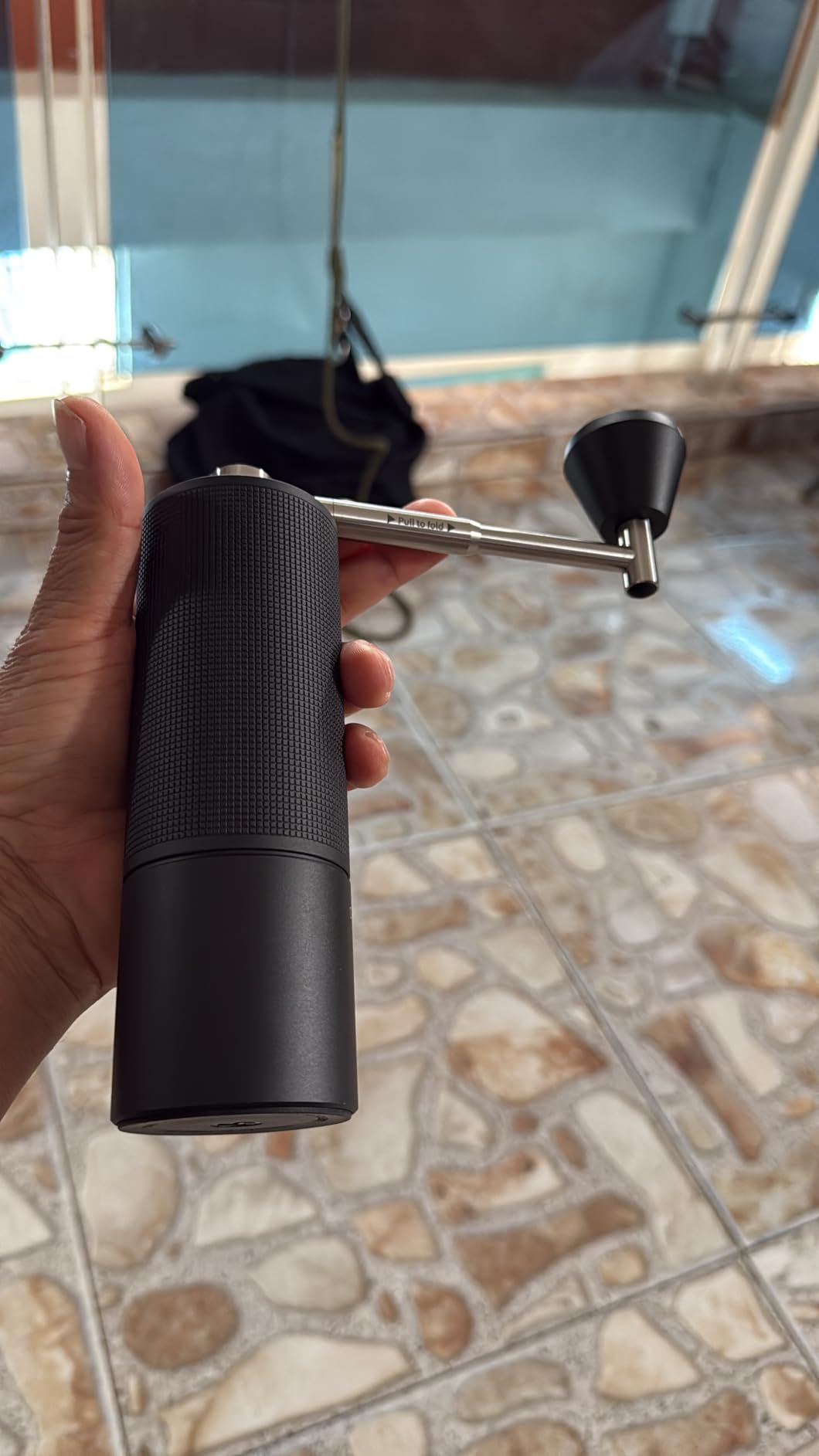
This is the grinder I reach for first when packing. The 52 mm body is narrow enough to sit in a mug bag beside a filter, and at 430 g it disappears into a rucksack rather than announcing itself. The crank folds flat against the body, which is the feature that actually decides whether a hand grinder lives in your bag or at home.
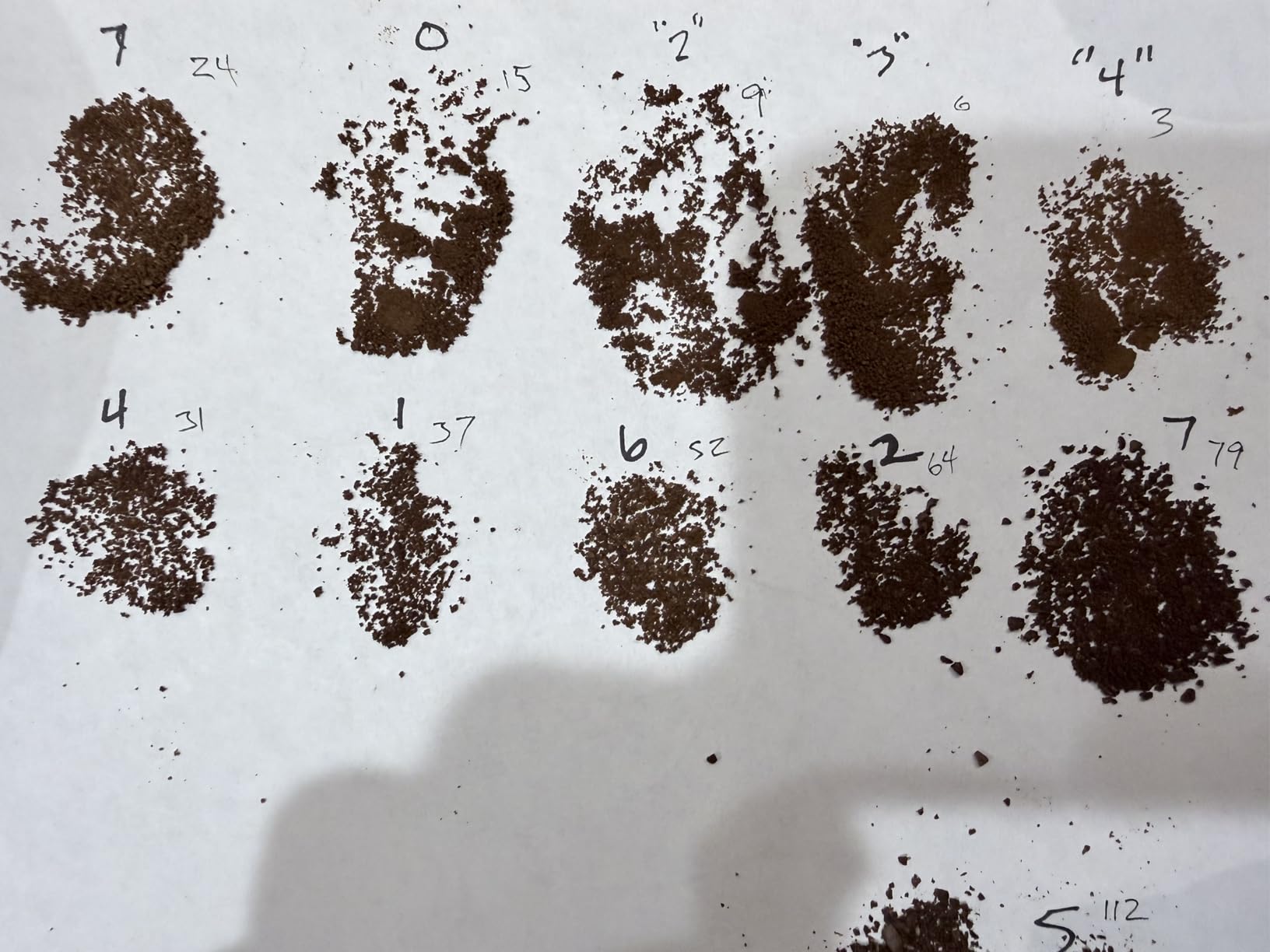
Grind quality is where it separates from the budget group. The S2C burr is machined on a five-axis CNC at 55-58 HRC hardness, and the result is an even particle spread with fewer fines than the ceramic options here. Cups taste sweeter and cleaner, especially on light-roast filter work.
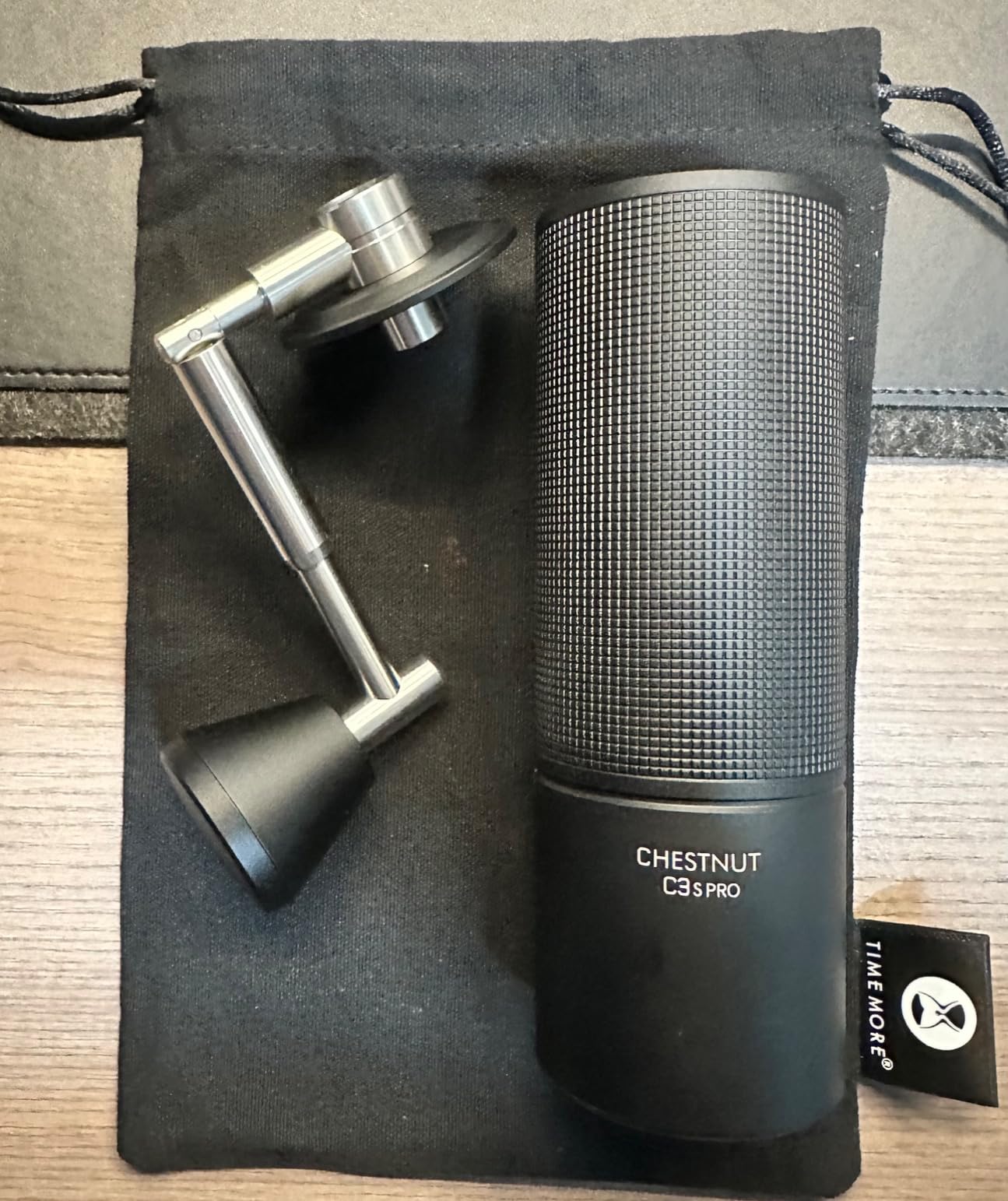
Adjustment runs through roughly 36 levels on a nut below the burr, and the built-in bearing means the handle keeps spinning after you let go, so a dose grinds down with less wrist effort than most of this list. I found espresso-adjacent settings reachable, though you work the dial by feel rather than by a numbered ring.
Capacity is the trade-off. At 25 g you are doing a small pour over in one pass and a double espresso in one pass, but a larger batch means a second grind. Owners on coffee forums describe roughly three minutes of cranking for a 20 g dose on filter work.
Why this is the best travel grinder for most trips
The body is machined metal from the crank collar down, so it survives being dropped into a checked bag and it dissipates heat instead of holding it. That matters more than it sounds: a plastic-bodied grinder gets hot on repeated doses, and heat is what flattens aromatics.
It also handles the widest brew range of anything we tested, from fine espresso to French press, without a rebuild. If you brew more than one style on the road, this removes the need to pack a second grinder.
When to pick something else instead
If your trips are ultralight backpacking where every 100 g is contested, the weight is the argument against it. And if you need to hit the same setting repeatedly across weeks without re-dialing, a numbered click ring is easier to trust than a nut you adjust by feel.
Budget buyers should also look elsewhere. This one sits at the premium end of a list that includes genuinely capable options far cheaper.
2. 1Zpresso Q Air Review: Best Travel Grinder for AeroPress Setups
1Zpresso Q Air Manual Coffee Grinder-Black, Mini Slim Travel Sized Fits in the plunger, Stainless Steel Conical Burr, Numerical Adjustable Setting for Pour Over French Press Cold Brew.
Fits inside AeroPress plunger
30 clicks per rotation
Heptagonal steel burr
About 15 g
Pros
- Nests inside the AeroPress plunger
- Shares burr internals with the higher Q model
- Numerical click adjustment is repeatable
- Steel burr only in the grinding path
Cons
- 15-20 g capacity means one cup at a time
- Plastic body feels cheap and can crack on hard drops
- Crank gets harder to turn as settings get finer
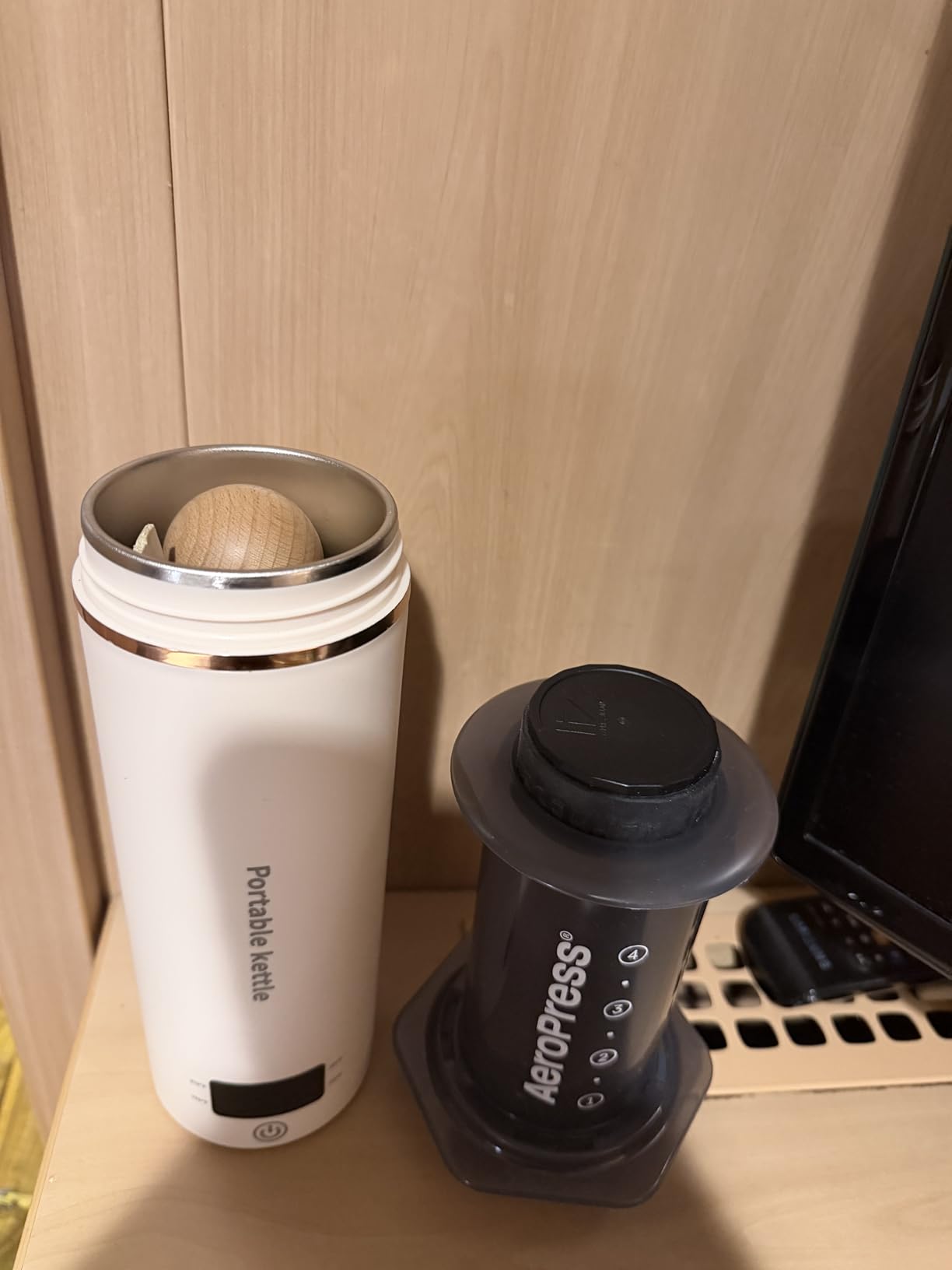
The defining feature is the one every travel forum keeps coming back to. At roughly 127 mm tall and 49 mm across, the body drops inside the plunger of an AeroPress, so the whole brewing kit packs as one cylinder with the grinder nested inside it. That single design decision beats every other consideration for hotel and office use.
Inside, the heptagonal stainless burr is factory calibrated to limit wobble, and the adjustment gives you 30 clicks per rotation on a numbered scale. Repeatability is the real win. Once you find the setting that works for a given coffee, you return to the same number the next morning instead of guessing.
The burr is rated by the manufacturer for 100 to 200 kg of grinding, which puts it far beyond a travel duty cycle. It clears 15 g in under 30 seconds, and the fact that only steel sits in the grinding path means no plastic flavour carry-over into the cup.
The adjustment covers pour over, French press and cold brew comfortably. Owners on r/Coffee note it is not the tool for Turkish-style ultra-fine work, where a dose can take the better part of a minute per cup, and effort rises noticeably at the finest settings.
Why it pairs so well with an AeroPress
An AeroPress wants roughly 15 g of medium-fine coffee, which is exactly one load. There is no second pass, no leftover bed, and no need to guess a halfway setting because the dose is fixed. Grinder and brewer were designed around the same number.
It also disassembles fully, so you can rinse the parts in a hotel sink and dry them before repacking. For a trip built around hotel rooms, that round trip matters more than any spec on the box.
Where it falls short
The body is plastic and reviewers consistently flag that it feels cheap in the hand and can crack if dropped on stone or tile. If your packing style involves tossing gear into a bag without a case, buy a protective pouch.
Consistency also cannot approach a good countertop electric grinder, which is fine for a travel kit and frustrating if you start comparing against the machine at home. Our coffee makers with built-in grinders guide covers the electric alternative if you want a comparison point.
3. CEVING Mini Review: Best Budget Hand Grinder for Travel
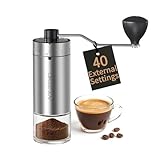
CEVING Mini Manual Coffee Grinder With 40 Adjustable Settings, Black
40 external settings
Ceramic conical burr
30 g capacity
325 g body
Pros
- 40 settings changed from the outside without opening the body
- Ceramic burr runs cool and quiet
- 325 g is genuinely light for the class
- Three-part body cleans without tools
Cons
- Not built for large batches
- Cleaning must be dry only with the brush
- Grind performance varies between the ceramic and steel variants
Few grinders give you this much adjustment for this little money. Forty external settings are dialled from a ring outside the body, which means you can change coarseness on a campsite without dumping your grounds into the grass or losing the setting to a stray knock.
The ceramic conical burr keeps heat low and noise low, which makes it a good pick for a small hotel room at 6 am. At 325 g and 6.7 by 2.3 by 7.4 inches, it packs into a laptop sleeve without much negotiation.
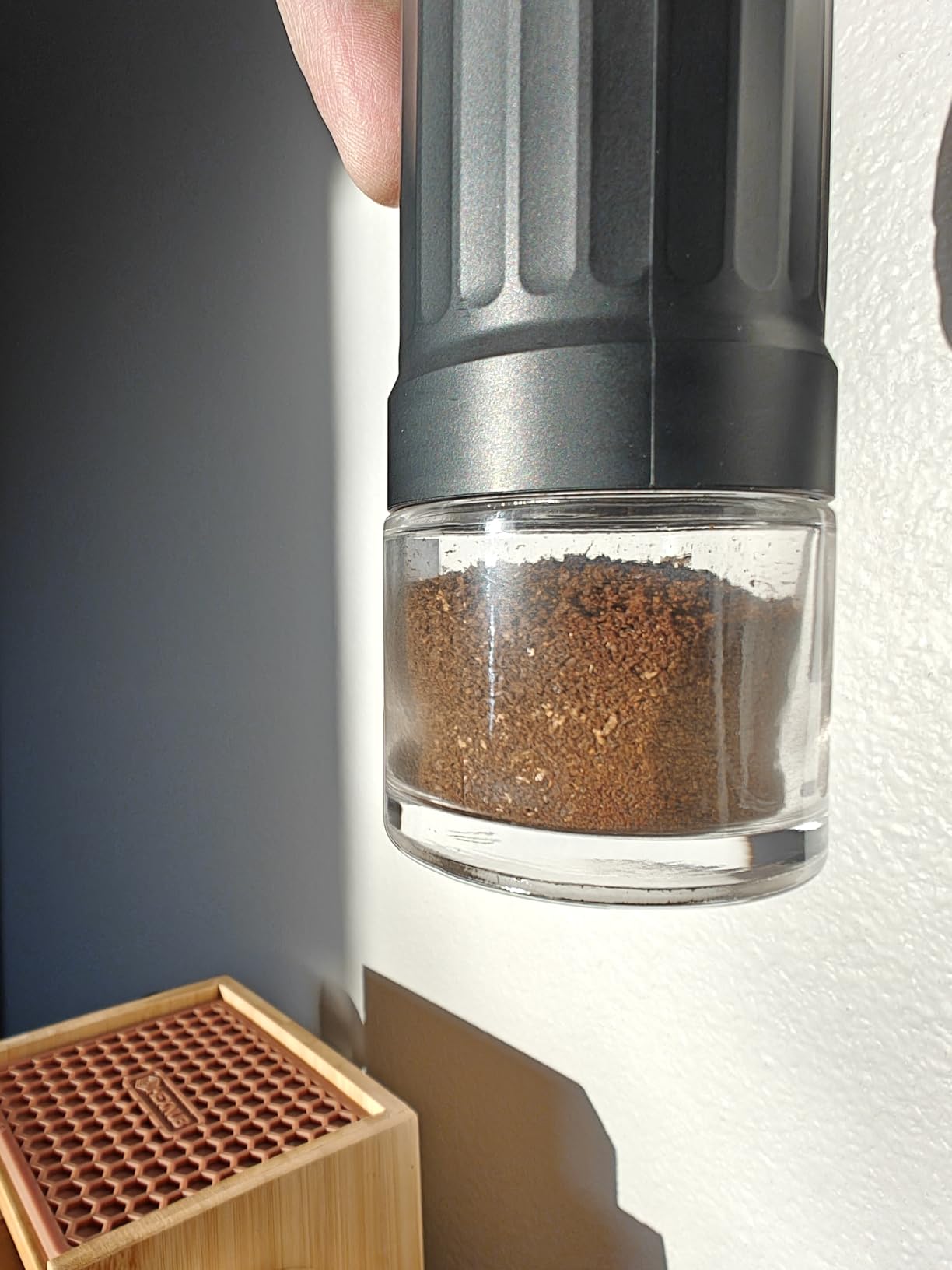
The body breaks into three parts including the lid, so cleaning is genuinely simple. Use the included brush or a dry cloth, and keep water away from the burr. Reviewers are consistent on that point: rinsing a grinder is the fastest way to make tomorrow’s cup taste stale.
It ranks at the top of the manual coffee grinder category and draws roughly 1,900 ratings at 4.4, with about 70 percent five-star scores. The manual grinder category rank is a useful signal here, because it is measured against thousands of owners rather than a handful of reviews.
Why it works as a first travel grinder
The wide external adjustment means you can serve AeroPress in the morning, pour over at midday and French press in the evening without owning three devices. That flexibility is usually the first thing budget grinders give up, and this one holds on to it.
It is also the rare low-cost grinder that people describe as quiet. If your trip involves shared rooms or early starts, the ceramic burr keeps the noise down.
When it is the wrong choice
The 30 g chamber is the limit. It suits one mug, one AeroPress or a small pour over, and it is not a batch brewer, so anyone wanting a full French press for two should look at the larger catch cups here instead.
Note also that the brand sells both ceramic and steel versions under similar names, and the two grind differently. Check the listing carefully so you know which burr you are actually getting.
4. Alpaca Ventures Manual Grinder Review: Best for Repeatable Numbered Settings
Manual Coffee Grinder, Adjustable Conical Burr, Espresso – Alpaca Ventures
45 numbered clicks
420 steel burr at 57 HRC
Dual bearings
25 g aluminium chamber
Pros
- 45 audible clicks make settings repeatable
- Hardened steel burr handles fine work
- Aluminium catch cup survives knocks
- Dual bearings give low-effort cranking
Cons
- 25 g chamber needs repeat batches for pour over
- No carrying case included
- Brush cleaning only with no water
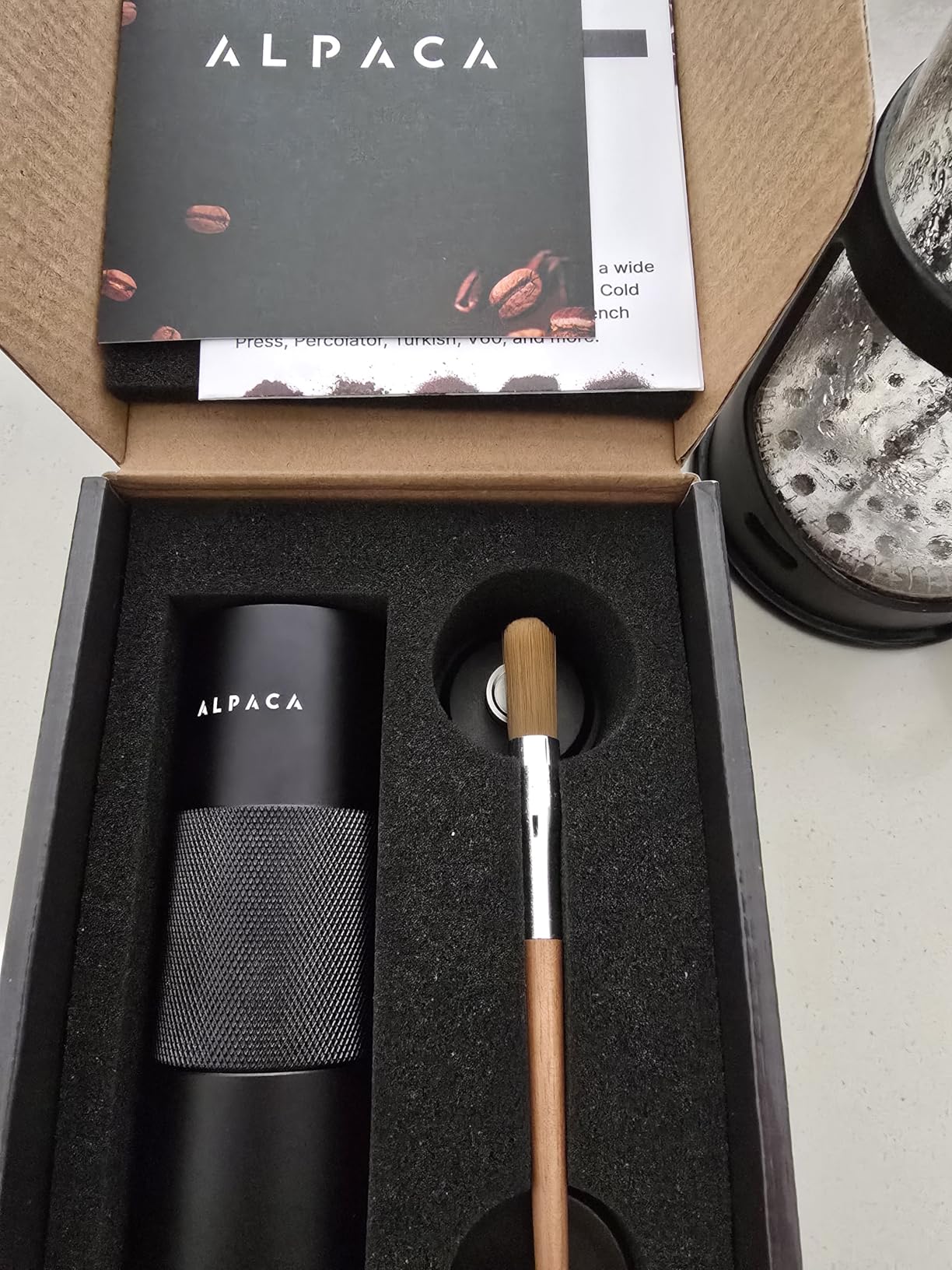
The 45 numbered clicks are the reason to look here. Each detent is audible and counted, so when a recipe asks for a 30-click setting you can return to exactly that number weeks later, on a different trip, in a different country. Repeatability is the single most underrated feature in a travel grinder.
The burr is 420 stainless steel hardened to 57 HRC sitting on a 430 stainless bearing assembly, and the dual-bearing design keeps the crank smooth under load with no handle play. A double espresso dose takes about a minute, which is faster than the ceramic options here.
The grounds chamber is aluminium alloy rather than glass, which removes the most common travel failure. Glass jars crack when a bag is dropped onto concrete, and owners of glass-jar grinders consistently mention replacing them. This one dents and keeps working.
The knurled body grip helps when your hands are cold or wet, and the whole unit is brushed steel and aluminium, so it reads as a tool rather than a kitchen gadget.
Why it suits espresso-leaning travellers
Steel burrs hold an edge better than ceramic at fine settings, and 45 clicks across the usable range means you can actually chase a fine espresso grind rather than accepting the coarse end of a stepped dial. Coffeeforums users who shoot espresso on the road favour click systems for exactly this reason.
The aluminium chamber and included brush also mean nothing glass to break and nothing that requires water, which keeps packing simple.
Where owners report trouble
The 25 g chamber means a full pour over takes roughly one and a half loads, and the second pass is a fresh grind with its own adjustment risk. Capacity is the most common complaint in the reviews.
A small number of owners report a loose handle and wobbly shaft developing after several years of daily use. There is no case in the box either, so add a pouch if you are hard on gear.
5. Hario Mini-Slim Plus Review: Best Quiet Hand Grinder for Travel
Hario “Mini-Slim Plus” Ceramic Coffee Mill
Ceramic conical burr
Detachable crank
Slim body
13 g capacity
Pros
- Ceramic burr gives better grinds than most cheap hand grinders
- Very quiet operation
- Handle detaches for compact packing
- Takes apart easily for cleaning
Cons
- Waisted cylinder is hard to grip while cranking
- Capacity covers only a cup or two
- Plastic body can crack if dropped
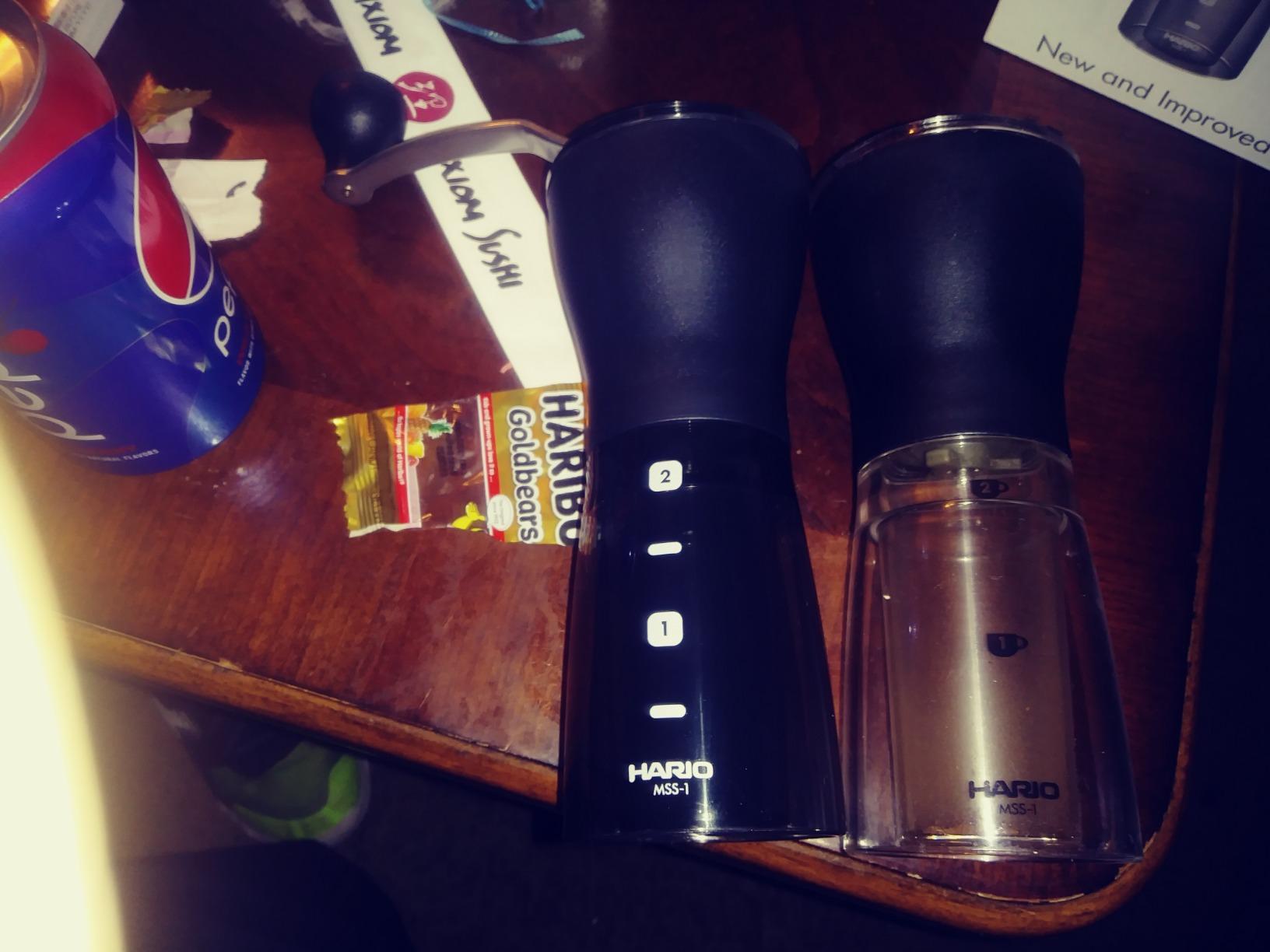
This mill has been a packing-list regular for years, and the reason is simple: ceramic burrs move slowly and quietly, so you can grind at 5 am in a hotel room without waking anyone. It is the quietest option in this roundup by a clear margin.
The detachable crank and slim cylindrical body mean it slots into a jacket pocket. Hario upgraded the octagonal shaft coupling on this version, which adds traction when the handle is turning, and the ceramic burr shaves beans instead of cracking them, which means less fines in the catch cup.
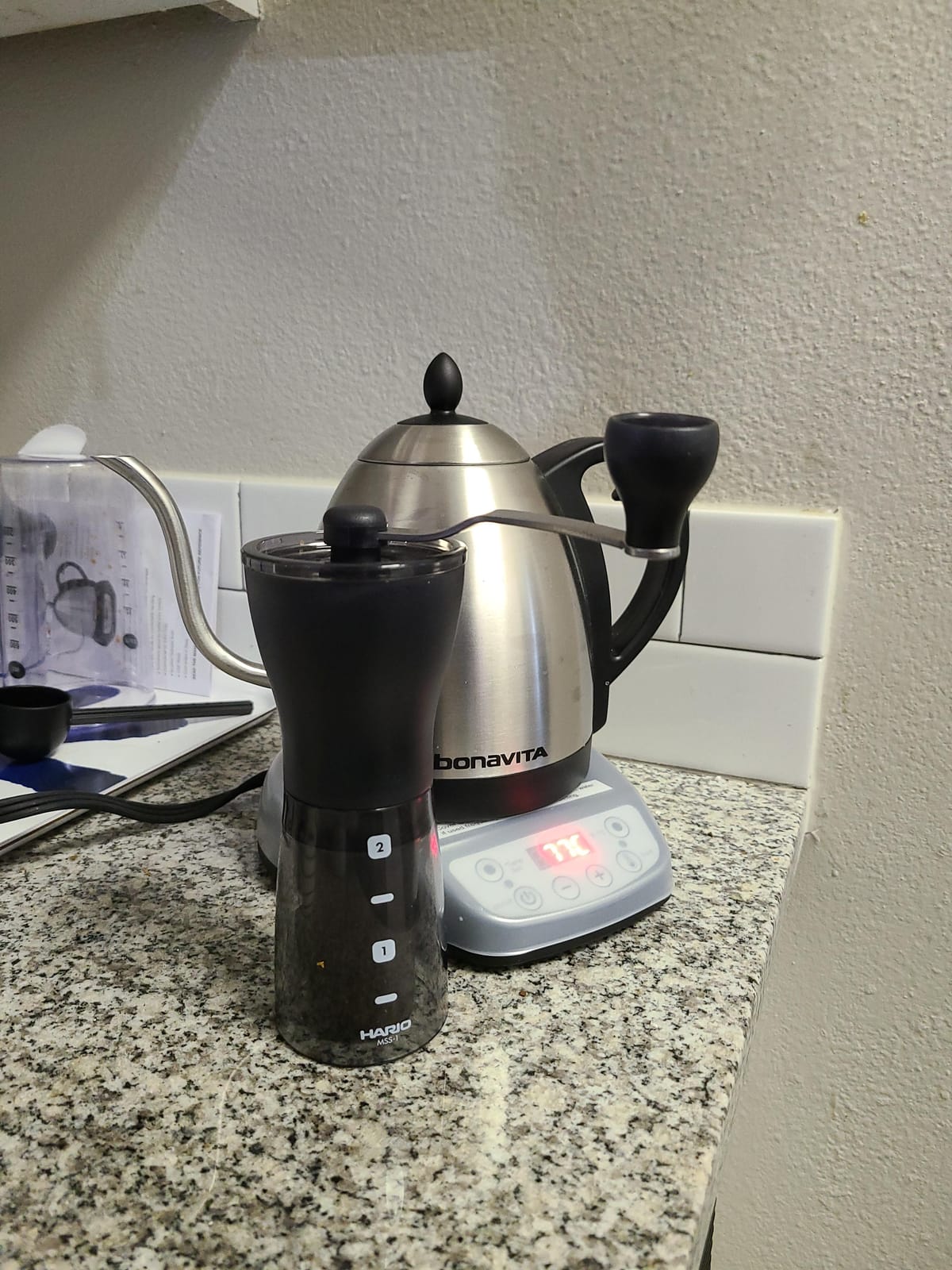
Consistency sits noticeably above most blade-style travel grinders, and reviewers use it as the reference point for what a small ceramic hand mill should produce. At 4.5 across close to 6,000 ratings, it is the longest-reviewed grinder in this group.
Cleaning is straightforward because the unit comes apart into few pieces and the handle is removable. There is also an upgraded ergonomic handle, which helps, though not as much as the shape change might suggest.
Why it works for shared rooms and small campsites
Noise is the underrated feature here. On an aeroplane, in a hostel or at a campsite at dawn, a quiet grinder changes the whole routine. Electric travel grinders are loud by comparison, and their motor noise is exactly what people complain about in small spaces.
The ceramic burr also runs cool, so there is no heat build-up across several cups, and the light body means it adds almost nothing to a pack weight.
When the grip becomes the problem
The waist in the middle of the cylinder is designed for palm grip, and it works well for holding. It is less good for cranking, especially with smaller or weaker hands, and that is the most common complaint in the reviews by a wide margin.
Lighter roasts are also noticeably harder to grind on a slow ceramic burr, so if your travel bag is filled with light filter roasts, test before you commit.
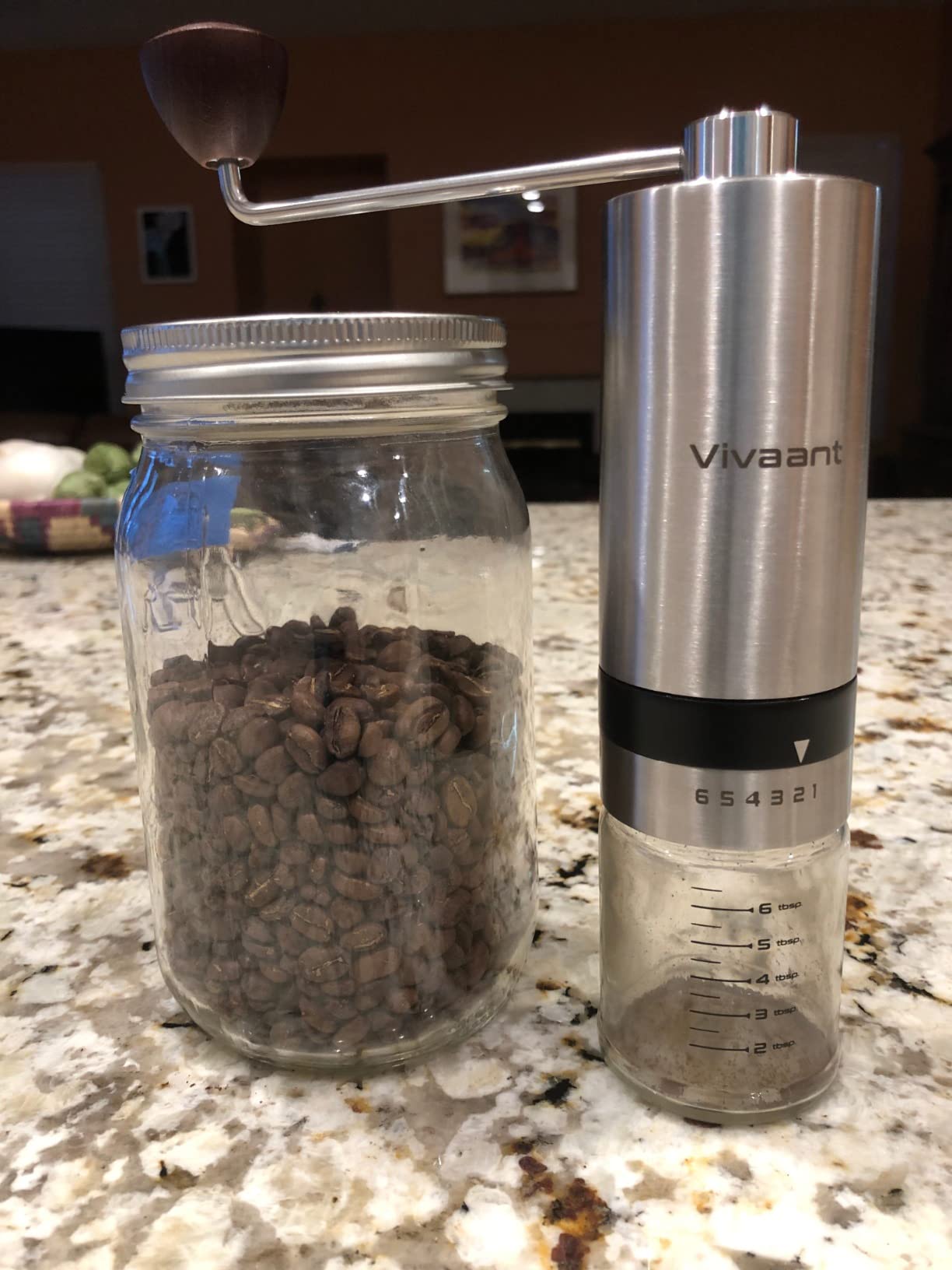
6. Vivaant Manual Grinder Review: Best for Measured Dosing in Hotels
Vivaant Manual Coffee Grinder Hand Crank, Stainless Steel Conical Burr Mill
Dragon Tooth steel burr
6 grind settings
32 g marked glass jar
Lifetime warranty
Pros
- Steel burr grinds quickly for its size
- Marked glass jar makes dosing visible and repeatable
- Compact body with quiet operation
- Backed by a lifetime warranty
Cons
- Only six grind settings
- Body mixes glass
- metal and plastic
- Finest settings need noticeably more effort
The marked glass jar is the feature that wins this grinder its place in a hotel room. Volume gradations let you dose straight into the brewer instead of weighing beans first, and you can see the yield without opening anything.
Underneath, the Dragon Tooth stainless conical burr is claimed to grind faster and more consistently than a ceramic burr of the same size, and in practice it moves noticeably quicker. It assembles and disassembles in seconds, which is the point when you are doing it over a hotel sink.
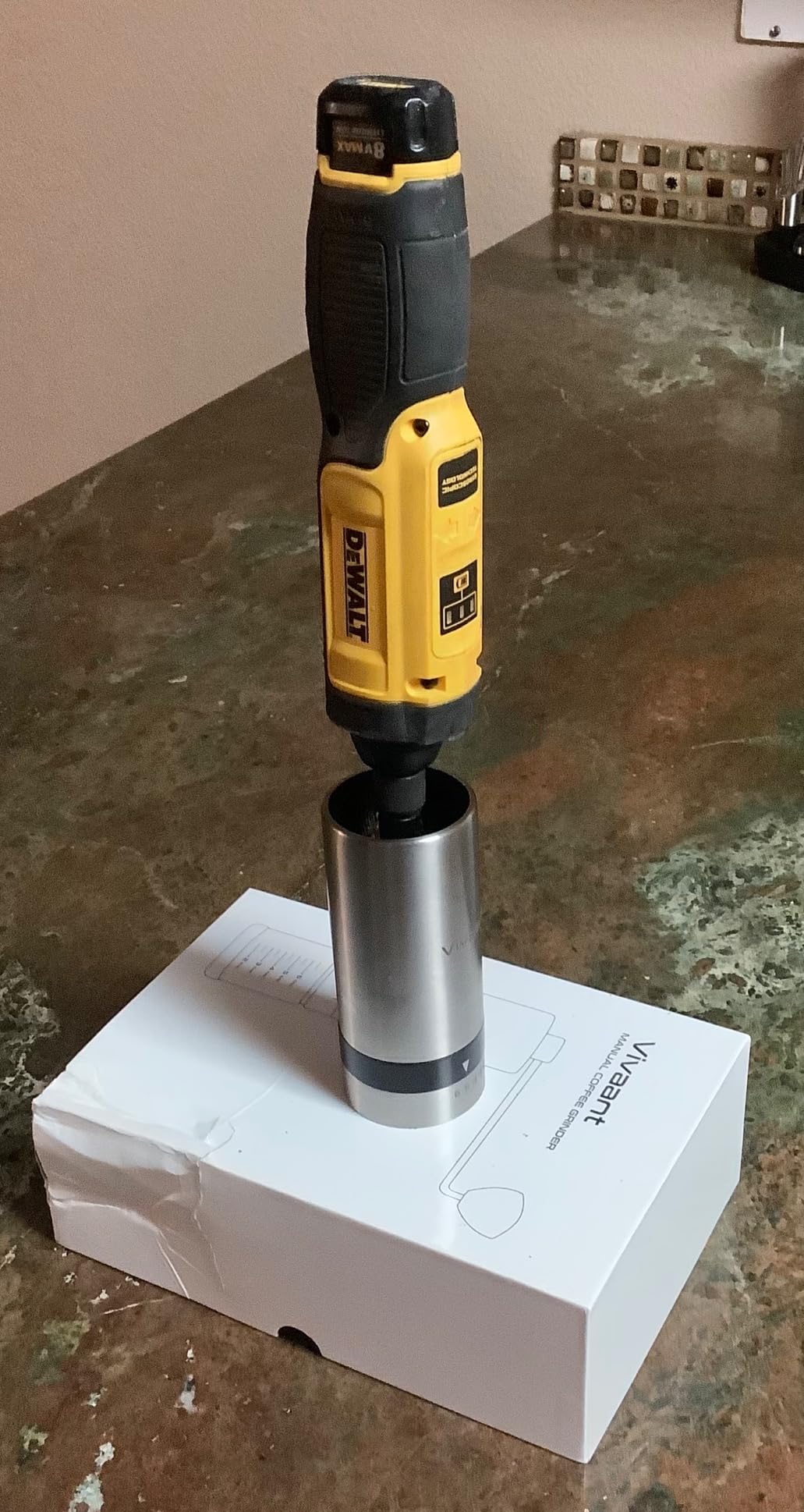
It carries a 4.7 average across 770 ratings with 84 percent five-star scores, one of the strongest rating profiles in this roundup. Owners cite the glass dosing marks and the quiet, compact package more than anything else.
Adjustments happen from outside the body, so you can change coarseness without taking the grinder apart and without losing grounds. The body is 2.13 inches across and 8 inches tall, which packs flat against a travel kettle.
Why dosing accuracy matters more than grind range
In a hotel room you have no scale, no funnel and limited counter space. Volume marks inside the catch jar turn a weak ratio into a repeatable one, and that is usually worth more than a dial with forty settings you never calibrate.
The lifetime warranty also stands apart on this list. Most budget grinders offer a short defect window, so a long warranty is a reasonable signal about expected lifespan.
Where the six-step dial holds you back
Six settings is coarse. The step between espresso and fine filter is wide, so if you move between brew styles in the same trip you will spend time searching for a middle ground that does not exist.
The body also mixes glass, metal and plastic, so it is not as rugged as the all-metal grinders here, and fine settings take real effort on the crank.
7. VEVOK CHEF Manual Grinder Review: Best Hand Grinder With a Carrying Bag Included
VEVOK CHEF Manual Coffee Grinder Stainless Steel Burr Grinder 6 External Adjustable Setting Vintage Hand Coffee Grinder Portable Hand Crank Conical Coffee Bean Grinder Mill for Home,Camping
Steel conical burr
6 external settings
48 g glass jar
Carrying bag included
Pros
- Steel burr produces fewer fines than ceramic grinders at this price
- Grinds roughly twice as fast as a comparable ceramic model
- Long crank gives good leverage
- Carrying bag included in the box
Cons
- Only six grind settings
- Glass jar is fragile in transit
- Body itself is not dishwasher safe
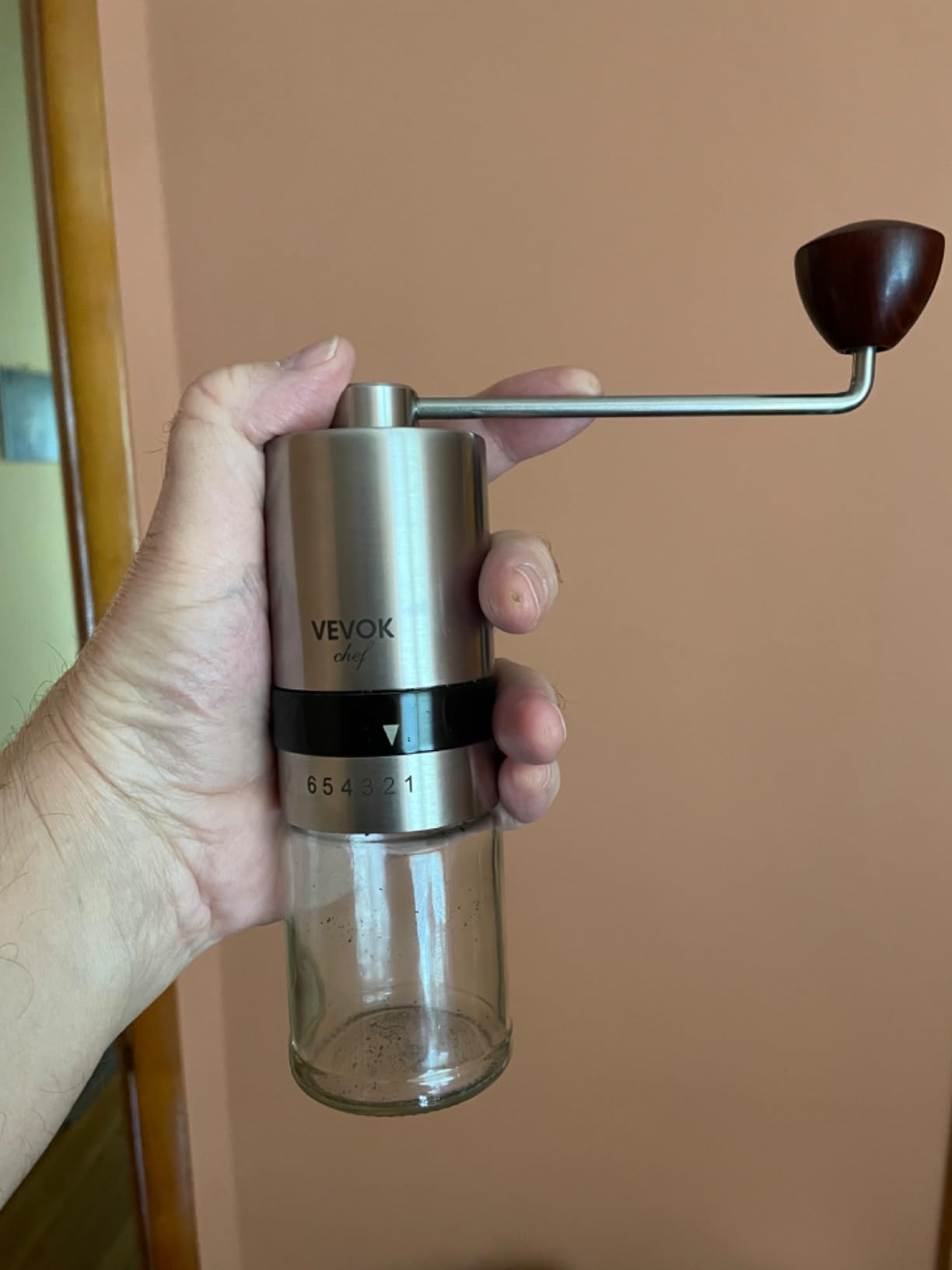
This is the pick if your trips involve moving hotels every night. A carrying bag comes in the box and the crank handle detaches, so the whole thing goes into a pouch rather than loose in a bag where a bottle can roll into it.
The conical stainless steel burr is the reason the cup tastes clean. A batch takes roughly 45 seconds, which is quick for a hand grinder, and owners repeatedly compare it favourably against ceramic-burr models at the same tier, citing fewer fines and clearer flavour.
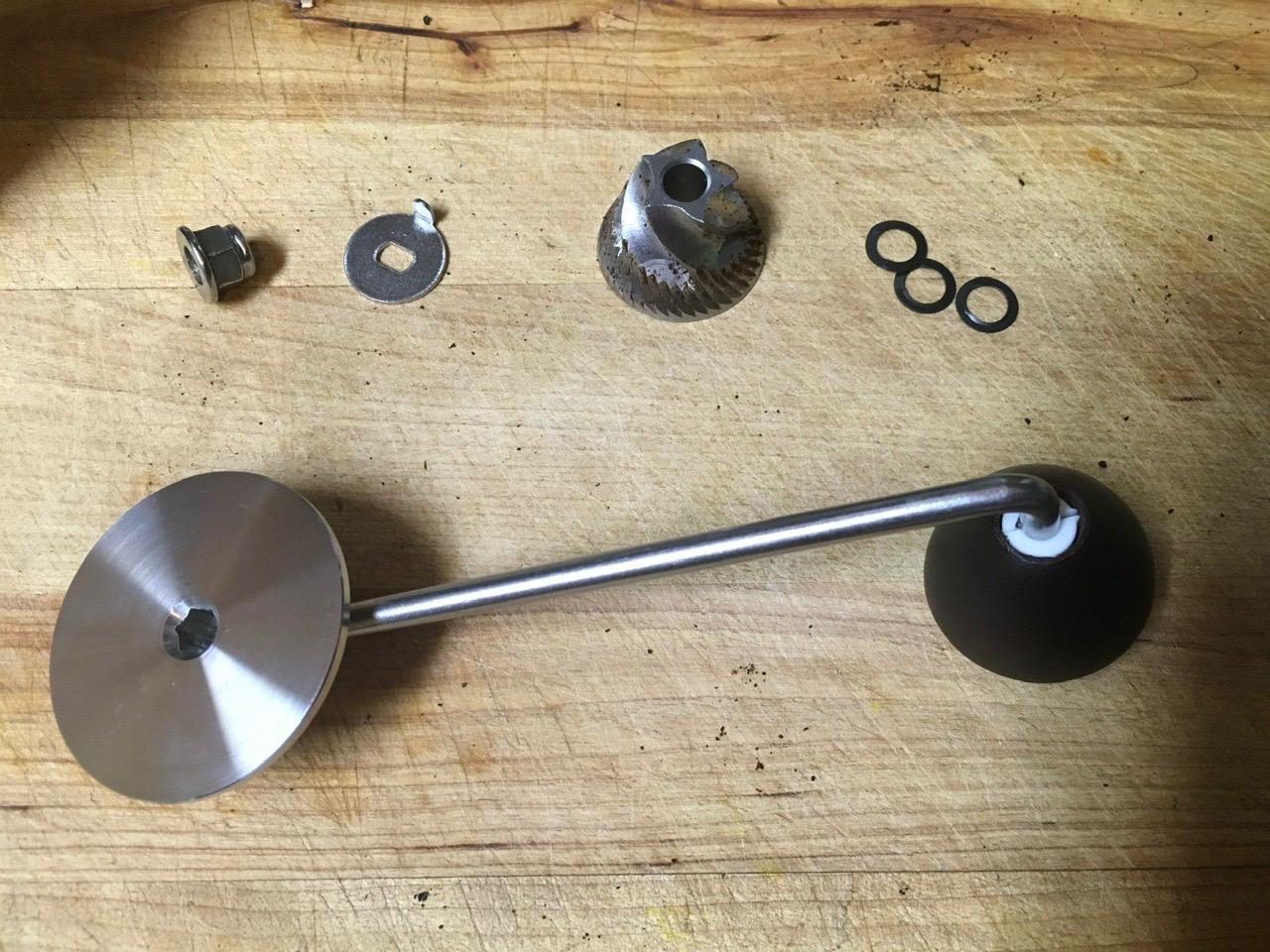
The 48 g glass grounds container is the largest catch cup in this roundup, so a French press for two is a single pass rather than two. The glass also shows how much coffee is in the jar, which is handy when dosing by eye.
The long crank and the weight of the body work together to give good mechanical advantage, so less force is needed per revolution than on the small plastic grinders. At a 4.4 average across roughly 1,400 ratings with 73 percent five-star scores, the feedback is consistent.
Why the catch cup size changes trip planning
Almost every other grinder here tops out between 15 g and 30 g. At 48 g you can brew a two-cup French press or a batch pour over in one grind, which is the difference between a two-minute coffee stop and a five-minute one when you have a train to catch.
It also suits cold brew, where the coarse end of a six-step dial is exactly right and the larger chamber lets you start a batch before you leave the flat.
When the glass becomes a liability
Glass jars crack. That is the single most cited drawback, and it matters more for a travel grinder than for a kitchen one because travel means drops. The jar is also the only part that can be washed normally.
Six settings is coarse dialling, so treat this as a filter and immersion grinder rather than an espresso option.
8. CIRCLE JOY Mini Review: Best Travel Grinder for Moka Pot and AeroPress
CIRCLE JOY Mini Manual Coffee Grinder with 40 External Adjustable Settings and Ceramic Conical Burr, Portable Stainless Steel Hand Coffee Grinder for Home and Travel
40 external settings
Ceramic conical burr
Extra-long handle
30 g capacity
Pros
- Extra-long handle reduces hand fatigue
- 40 external settings cover a wide brew range
- Detachable handle for compact storage
- Clear glass hopper shows how much is ground
Cons
- Heavy at 465 g for a travel grinder
- Three small hopper sections are awkward to fill
- Unclear cleaning guidance
The long handle is the reason this grinder exists in my kit. A longer crank means more travel per stroke and less torque at the wrist, and when you are grinding a moka pot or an AeroPress dose in a campsite that difference is obvious after the third cup.
Forty external settings give it the same wide range as the grinders costing several times more, and they are adjusted from a ring outside the body so you do not have to tip grounds out to change size.
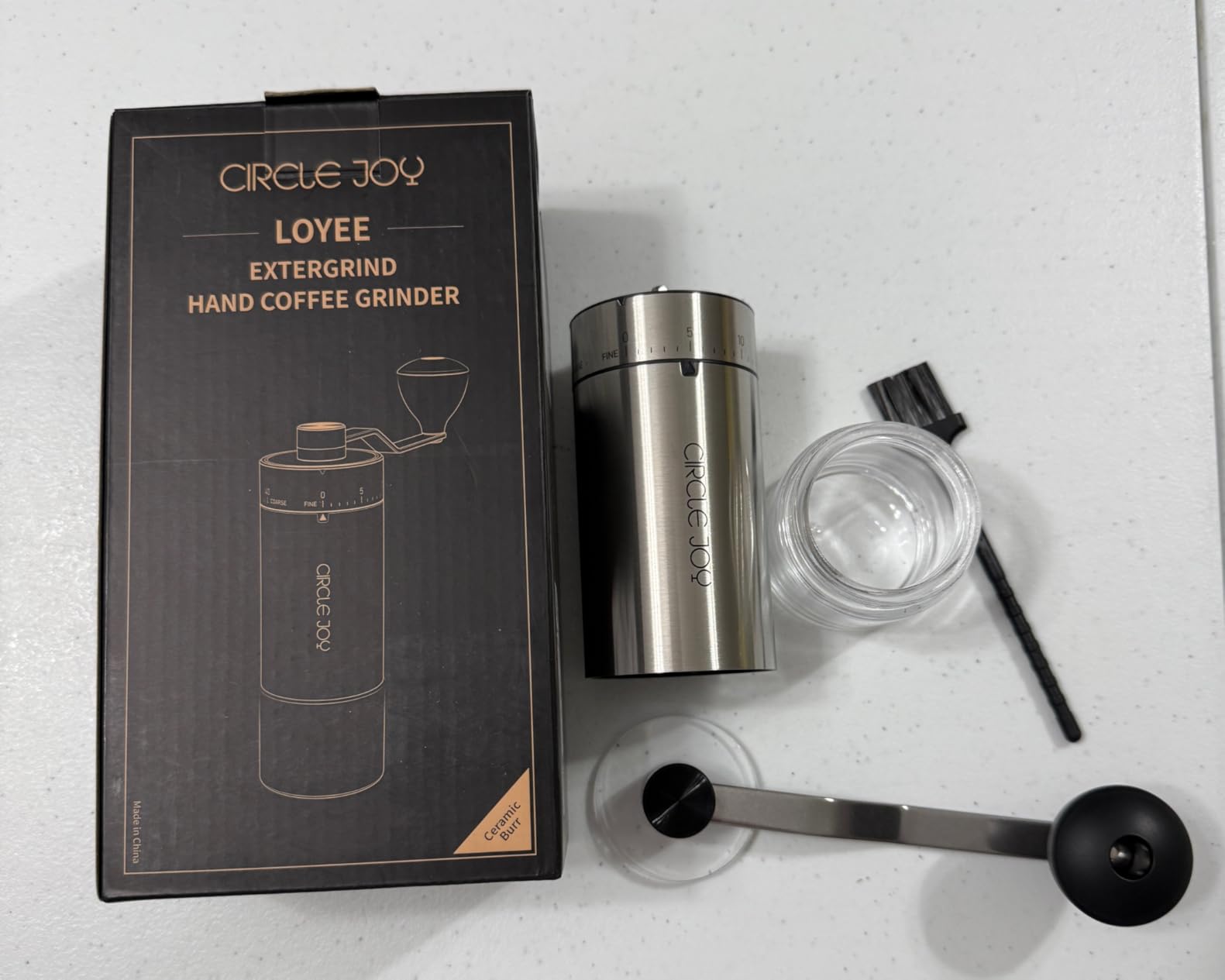
The clear glass hopper lets you watch the dose build, which is useful when you are working out the right ratio for a new coffee. The body is stainless steel with ceramic burrs, so it is quiet and does not transfer much heat into the grounds.
Owners generally find it satisfying for camping trips where the goal is simply a decent cup rather than a competition brew. It draws around 460 ratings at 4.3.
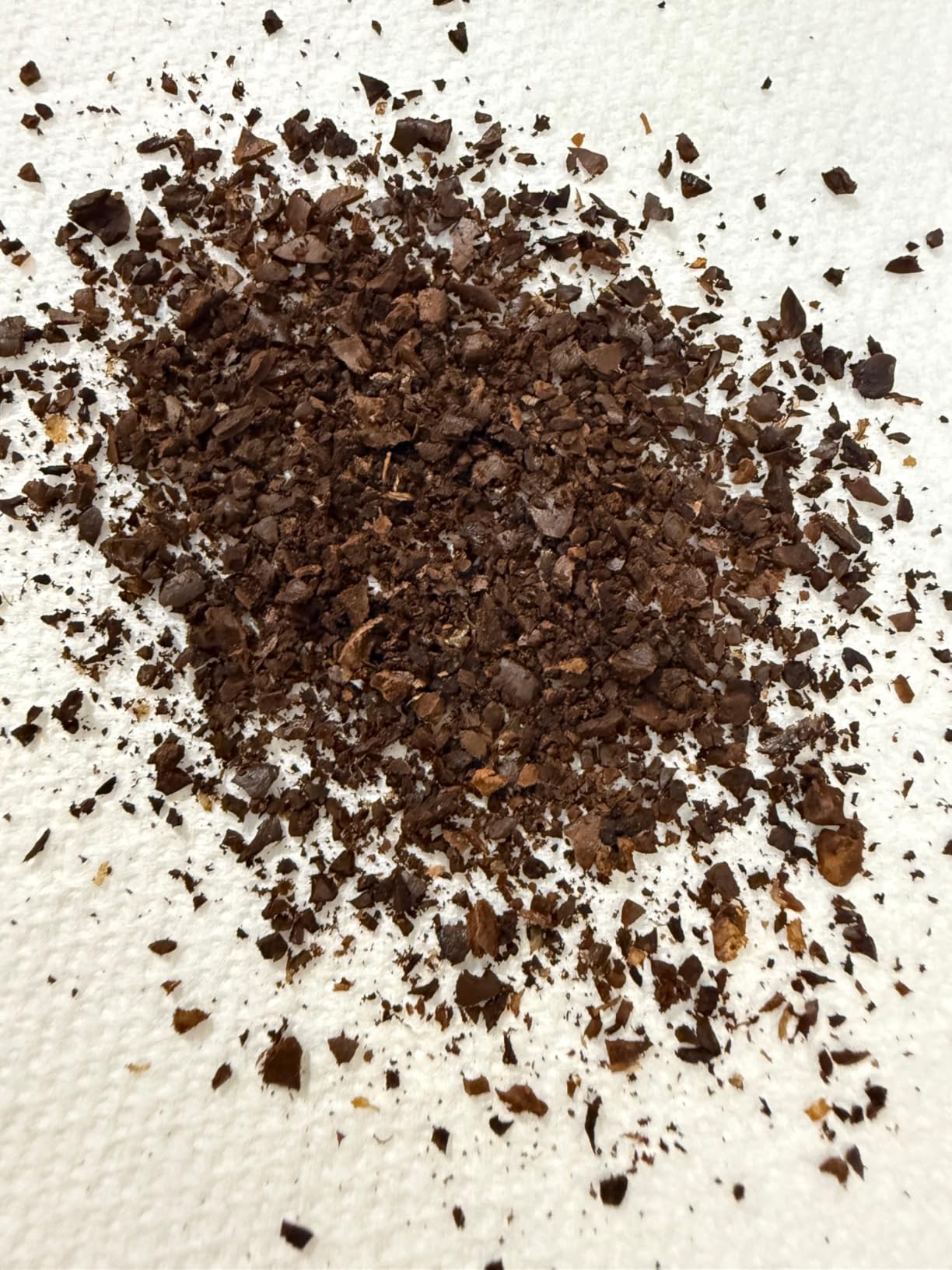
Why a longer handle matters more than specs
Grinding effort is the factor that decides whether you keep using a hand grinder on day five of a trip. Longer crank arms reduce the force needed to break beans, and reducing fatigue is the same as making the grinder feel lighter.
The 40-step range also means one grinder covers moka pot, AeroPress and pour over, which is a lot of flexibility from a compact body.
When the hopper design works against you
The body splits into three small hopper sections that reviewers find awkward to fill evenly, and grounds can spill during transfer. At 465 g it is also among the heavier grinders here, so it is not the choice for ultralight packing.
A small number of owners report consistency fading within a couple of months of regular use, and the cleaning guidance advises against water without explaining what to do instead, so bring your own brush.
9. JavaPresse Manual Grinder Review: Best Popular Starter Grinder for Travel
JavaPresse Manual Stainless Steel Coffee Grinder – 18 Adjustable Settings, Portable Conical Burr Grinder for Camping, Travel, Espresso – With Hand Crank
18 grind settings
Ceramic conical burr
Removable handle
9.4 oz body
Pros
- Most-reviewed grinder in this roundup with 25000-plus ratings
- Removable handle and slim body for packing
- Ceramic burr is rated to outlast comparable steel burrs
- Quiet and completely battery-free
Cons
- Bean capacity of roughly 2.5 tablespoons
- Some units show burr wobble and an off-centre cone
- Noticeable fines at coarse settings
- No numeric reference on the adjustment
JavaPresse has the largest review base in this group by a wide margin, and that matters when you are buying something you cannot easily return from abroad. Tens of thousands of owners have run this grinder, so the failure modes are well documented rather than a surprise.
For travel, the removable handle and 9.4 oz body are the practical wins. It packs small, runs silently with no batteries or cords, and the glass inlay catch cup at the base shows the dose accumulating.
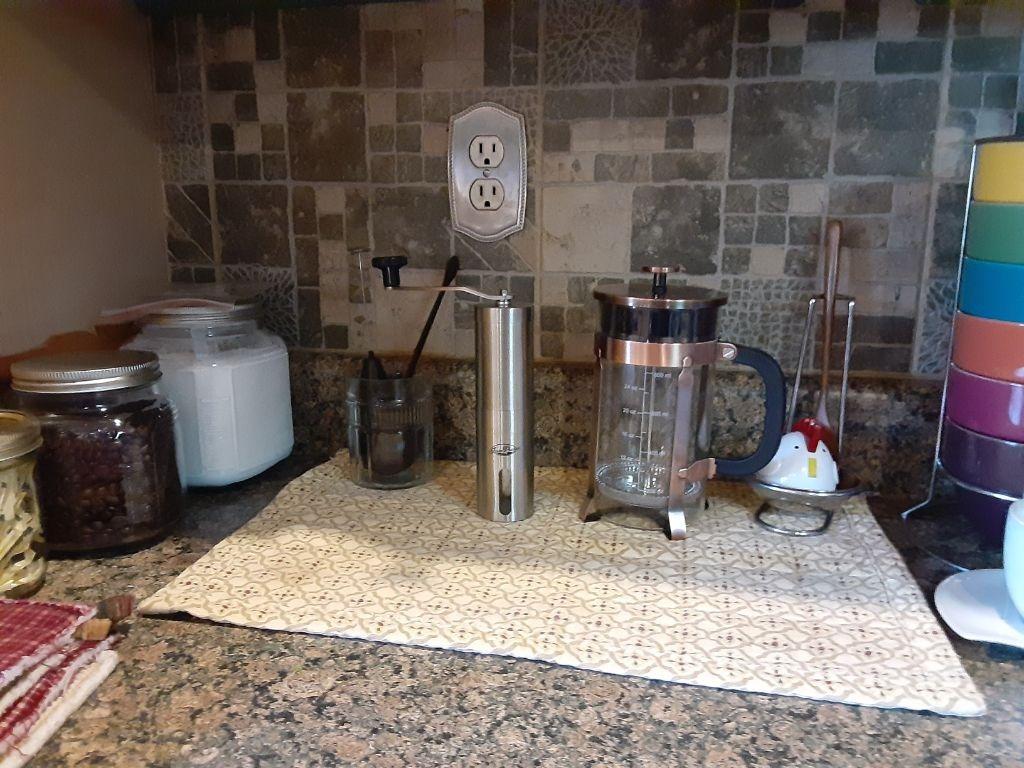
The ceramic conical burr is patented and rated by the manufacturer to last longer than comparable stainless steel burrs, and many owners report years of near-daily use with performance intact. Customer service also draws repeated praise for replacing defective units.
Eighteen settings cover French press, pour over, drip and a rough espresso range. The adjustment knob has audible detents and holds its position, which is better than the free-spinning dials on some cheaper models.
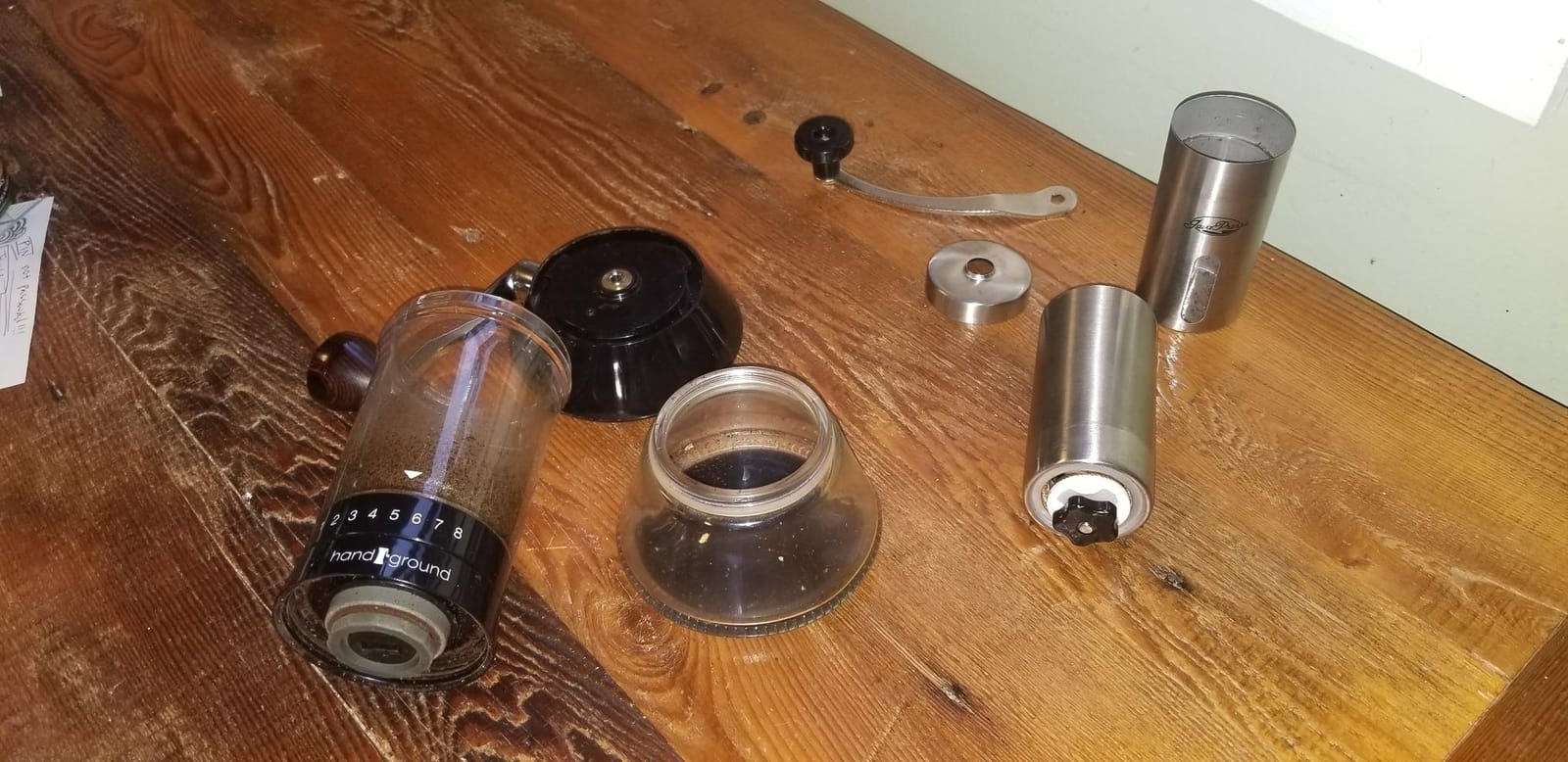
Why the review volume is worth something
With ratings this numerous you can see the long tail of complaints rather than the happy path. Burr wobble on a small share of units, fines at coarse settings and the tiny bean capacity are all visible before you buy, and you can decide whether they matter for your trip.
It is also a good first travel grinder. If you are unsure whether hand grinding fits your routine, the low commitment and the possibility of replacement make it a safe place to start.
When it will not keep up
Roughly 2.5 tablespoons of beans is a single mug. Anything larger means multiple grind sessions, which is tedious in a hotel room, and the off-centre cone reported on some units can reduce consistency.
There is also no numeric reference on the dial, so you learn the settings by trial and error rather than by counting clicks, and the plastic handle knob can crack if dropped on a hard surface.
10. MAVO Wizard Review: Best Travel Grinder With a Storage Pocket
MAVO Manual Coffee Grinder, Wizard Hand Coffee Grinder, Capacity 25g with CNC Stainless Steel Pentagon Conical Burr, Adjustable Setting, Burr Coffee Bean Grinder for French Press, Pour Over Black
CNC pentagon steel burr
24 clicks at 0.04 mm
Double-bearing shaft
25 g capacity
Pros
- Finely graduated adjustment at 0.04 mm per click
- Double-bearing centre axis for even particles
- Storage pouch doubles as a travel case
- Very little coffee left in the chamber
Cons
- Paint can flake after a few uses
- Shallow threading makes assembly awkward
- Needs real effort at the start of each grind
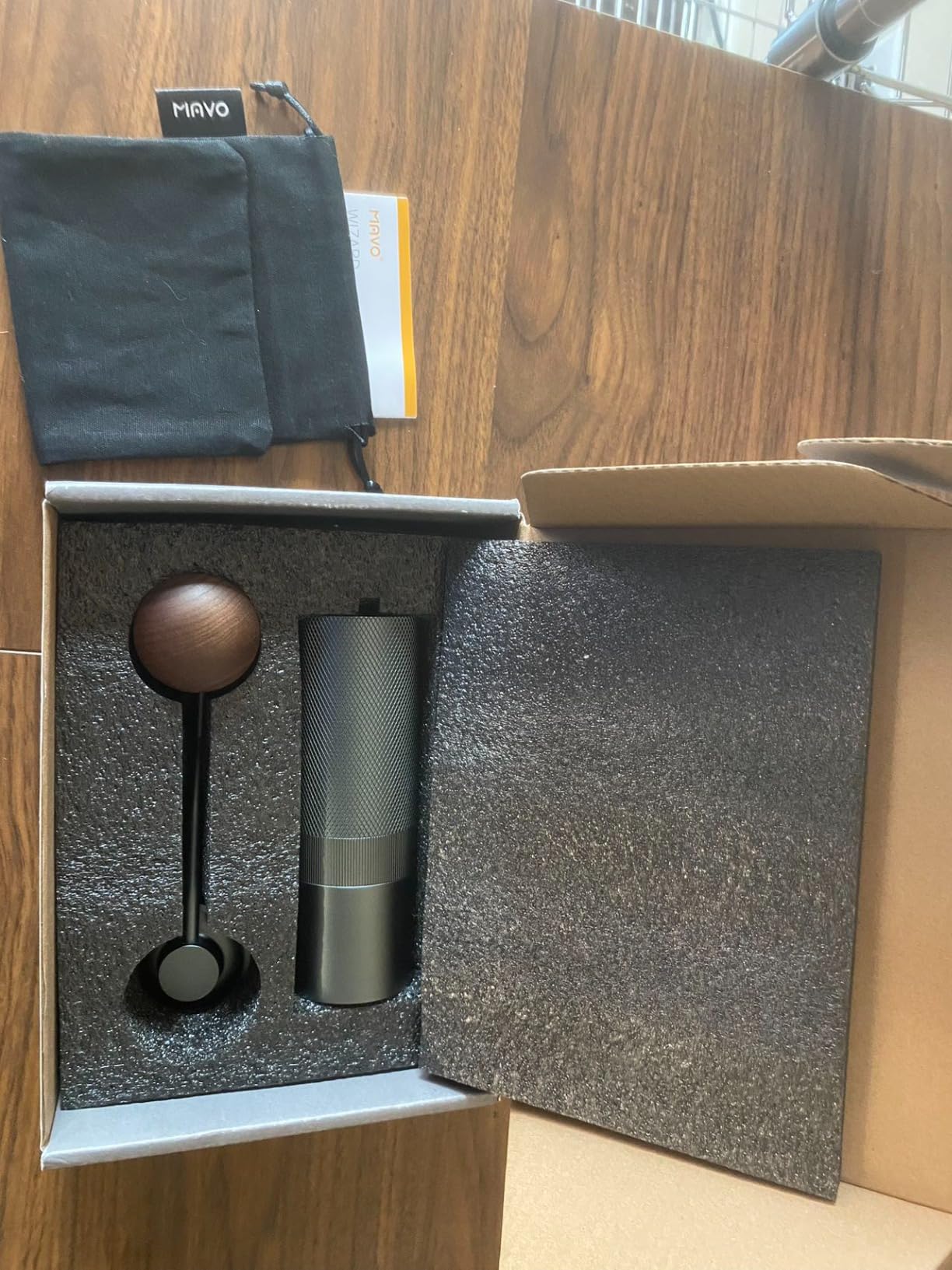
The included storage pocket is the travel feature that sets this apart. It is a proper pouch that protects the body and, according to owners, can even hold a small scale, so the whole kit lives in one object rather than spreading through a bag.
Adjustment is the other strength. Twenty-four clicks per revolution at 0.04 mm per click is finer than most grinders here, and the double-bearing centre axis keeps particle distribution even, which owners compare favourably with electric grinders on pour over and AeroPress.
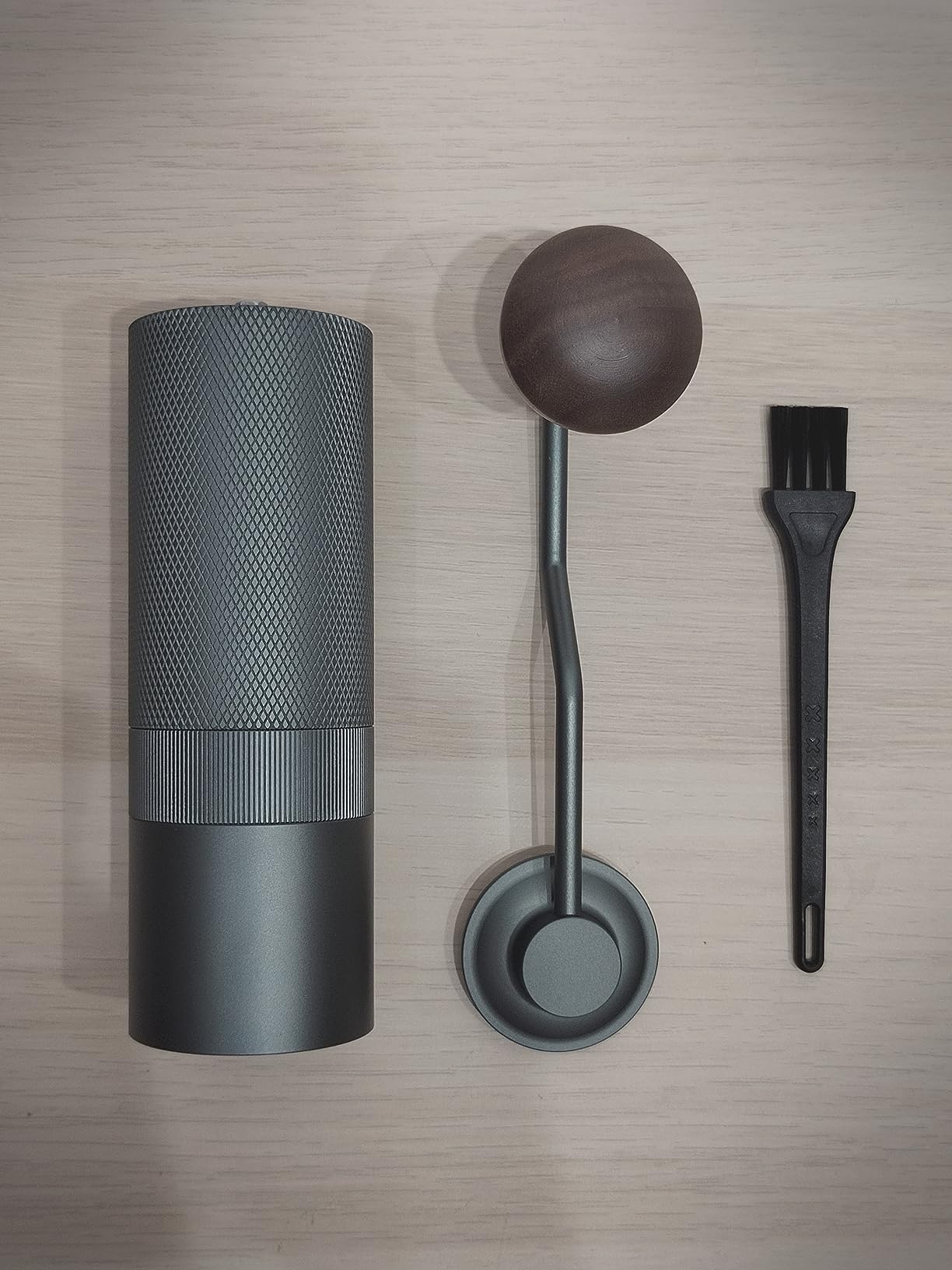
The burr is 420 stainless steel, CNC machined in a pentagonal profile at 55-58 HRC, and the aluminium body has built-in bearings and a non-slip grip. Very little coffee remains sitting in the chamber after a 20 g dose, which reduces waste when you are brewing one cup.
Reviewers are split, though. It carries a 4.4 average from about 180 ratings with 78 percent five-star scores, but also a noticeable one-star share, and the complaints are about finish rather than function.
Why the click increment matters
At 0.04 mm per click you can move in small, controlled steps. That is what makes espresso-adjacent work possible on a hand grinder, because large steps leave you stuck between too coarse and choking the crank.
The double-bearing axis also cuts the wobble that produces fines, so cups stay clear even when you are not grinding right at a marked setting.
When the finish gets in the way
Owners report paint flaking after only a few uses, and shallow threading makes assembly awkward in cold or gloved hands. Both are cosmetic, but paint near beans is a consideration for anyone sensitive to it.
It also needs real effort at the start of each grind and has to be reset to zero and not over-turned, or the burr can be damaged. Read the instructions before the trip.
11. SimCoker Portable Burr Mill Review: Best Grinder for Pocket Packing
SimCoker Manual Coffee Grinder, Portable Burr Mill
Ceramic conical burr
304 stainless body
20 g capacity
300 g weight
Pros
- Body is smaller than a mobile phone
- Lightweight stainless steel at 300 g
- Ceramic burr gives consistent grounds and preserves aroma
- Cleaning brush and travel bag included
Cons
- Smallest capacity here at 20 g
- Stainless body with plastic elements
- Very few public reviews on long-term durability
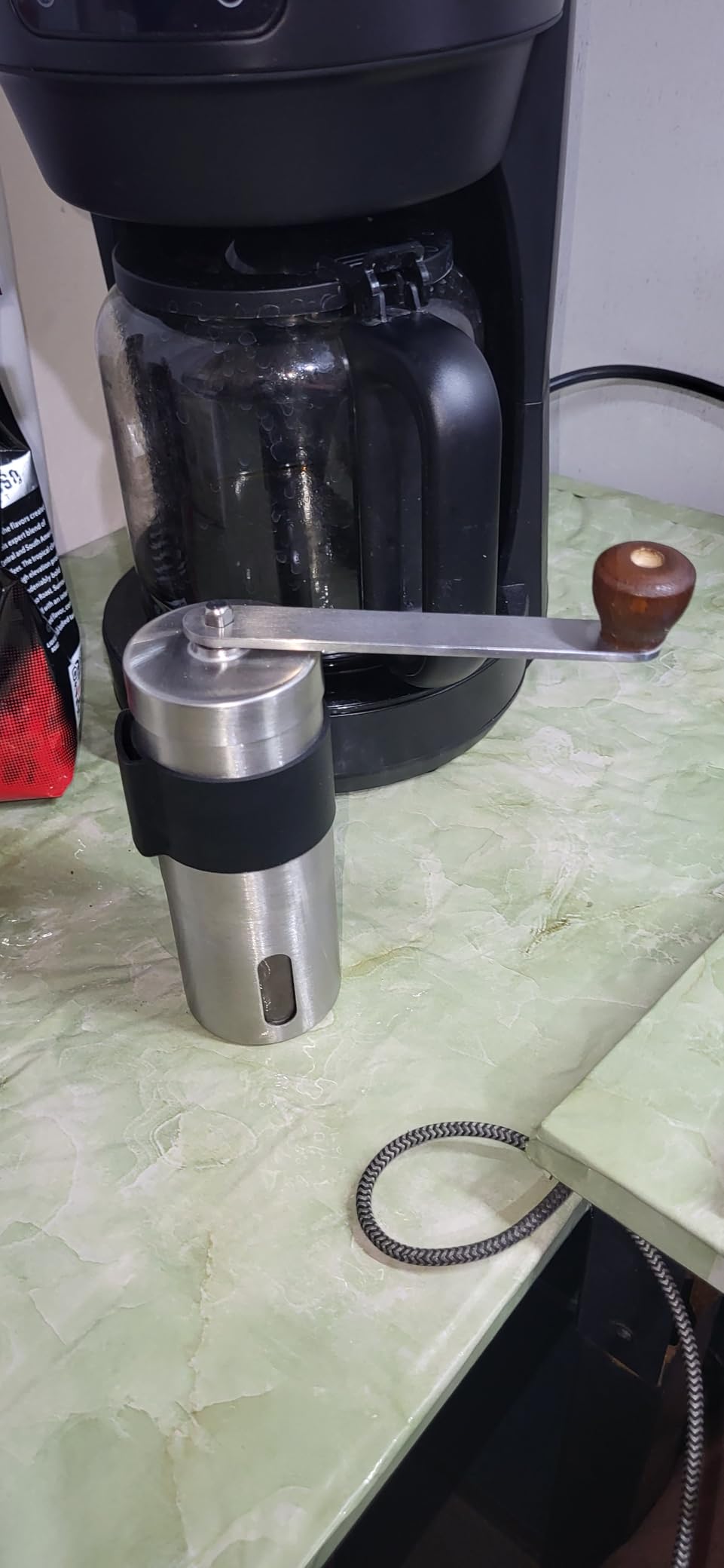
This is the smallest grinder in the roundup. At 2.1 inches wide and 5.4 inches tall, the body is smaller than a mobile phone, which means it can go in a jacket pocket rather than occupying a slot in your pack.
The ceramic conical burr produces consistent grounds and preserves aroma, and the 304 stainless steel body is described as rust-resistant and durable. At 300 g it is the lightest option here that still uses proper conical burrs.
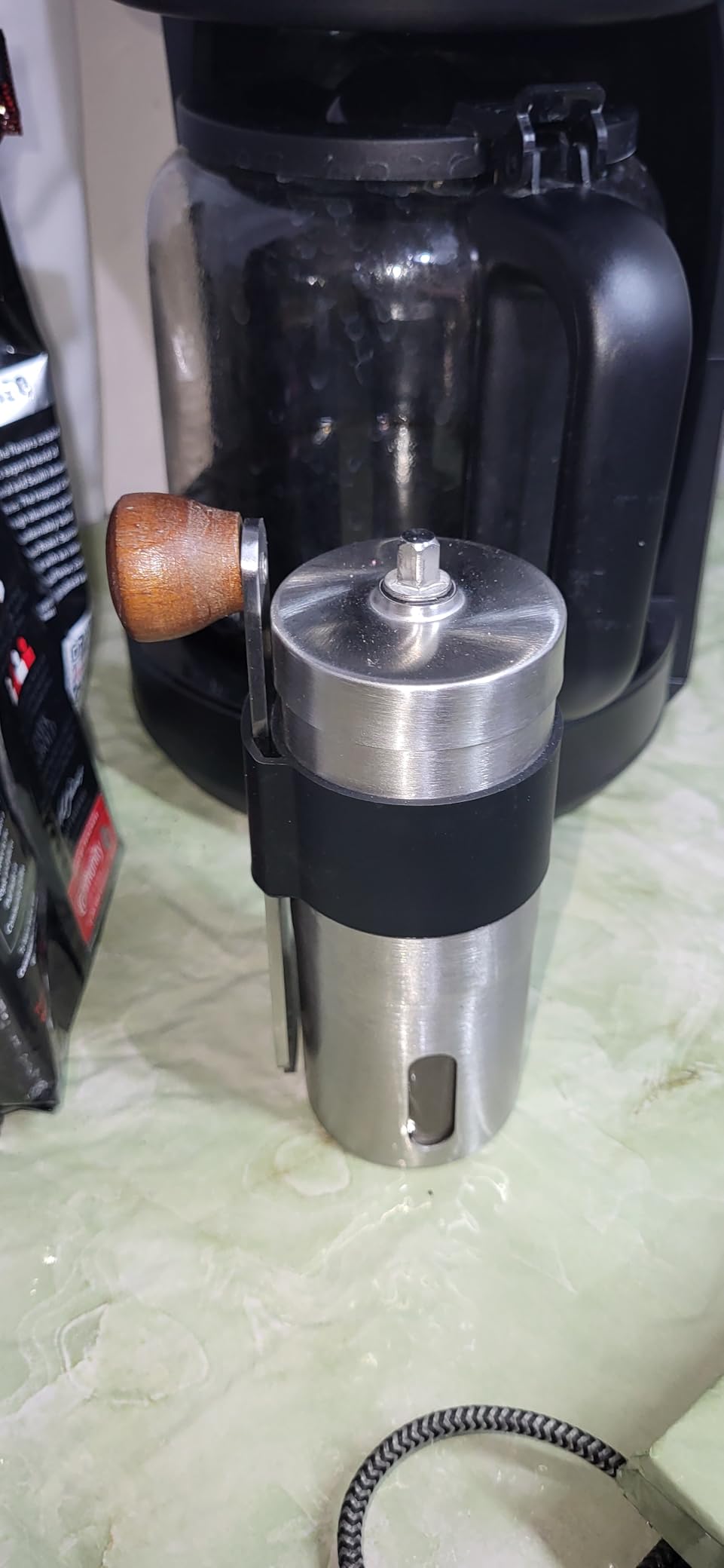
Both a cleaning brush and a travel bag are included, so nothing extra needs buying before the first trip. The 20 g grounds container is a single cup or a small pour over, and the unit is listed as dishwasher safe, which is unusual for a hand grinder.
Ratings sit at 4.2 across 619 reviews with 64 percent five-star scores. The feedback concentrates on size and weight, which reviewers treat as the main travel advantage.
Why size beats capacity on some trips
On a walking trip or a bike tour, the volume your grinder occupies matters as much as its mass. A grinder that fits a pocket changes when you are willing to stop for coffee, because there is no decision about whether to unpack anything.
The included pouch also means it stays clean in a rucksack, which matters more for a pocket-sized item than for a larger grinder with a wider base.
When the 20 g chamber becomes the limit
Twenty grams is the smallest capacity here, so a two-cup pour over means two grinds and two chances to be slightly off. If you are hosting or brewing for a group, this is the wrong tool.
Long-term feedback is thin at this review count, and the stainless body includes plastic elements, so it is less likely to survive a decade of travel than the all-metal grinders in this list.
12. Rsoilch Ceramic Hand Grinder Review: Best Budget Espresso-Able Travel Grinder
Rsoilch Manual Coffee Grinder With Ceramics Burr For Espresso,French Press,5 Adjustable Settings,Hand Maker with Built-In Burr,For Home Use and Camping Travel,Coffee Bean Grinders With Hand Crank
Built-in ceramic burr
5 grind settings
10.4 oz body
5.51 in tall
Pros
- Very low cost for a functioning burr grinder
- Compact and light at 10.4 oz
- Ceramic burr feels sturdy and grinds evenly
- Disassembles easily for cleaning
Cons
- Beans stick at the top of the chamber
- Grinding a full batch takes several minutes
- Adjustment knob can slip out of position
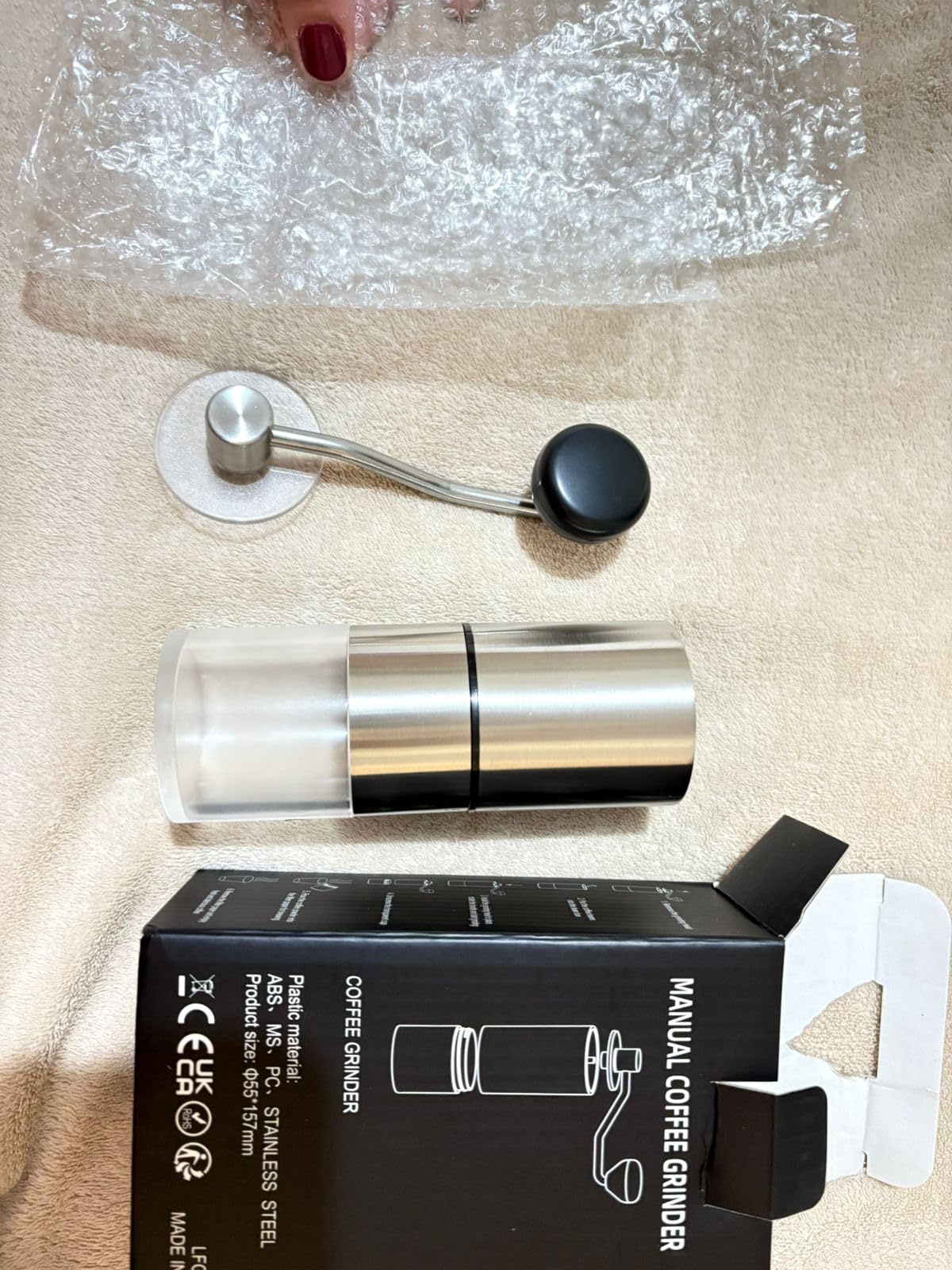
At 2 by 2 by 5.51 inches and 10.4 ounces, this is the lightest grinder here and the cheapest by a wide margin. It uses real conical ceramic burrs rather than blades, which puts it above the blade grinders in most hotel rooms.
Five settings span French press through espresso, and the body disassembles for cleaning without tools. If you want a hand grinder for one trip without spending much, this does the job.
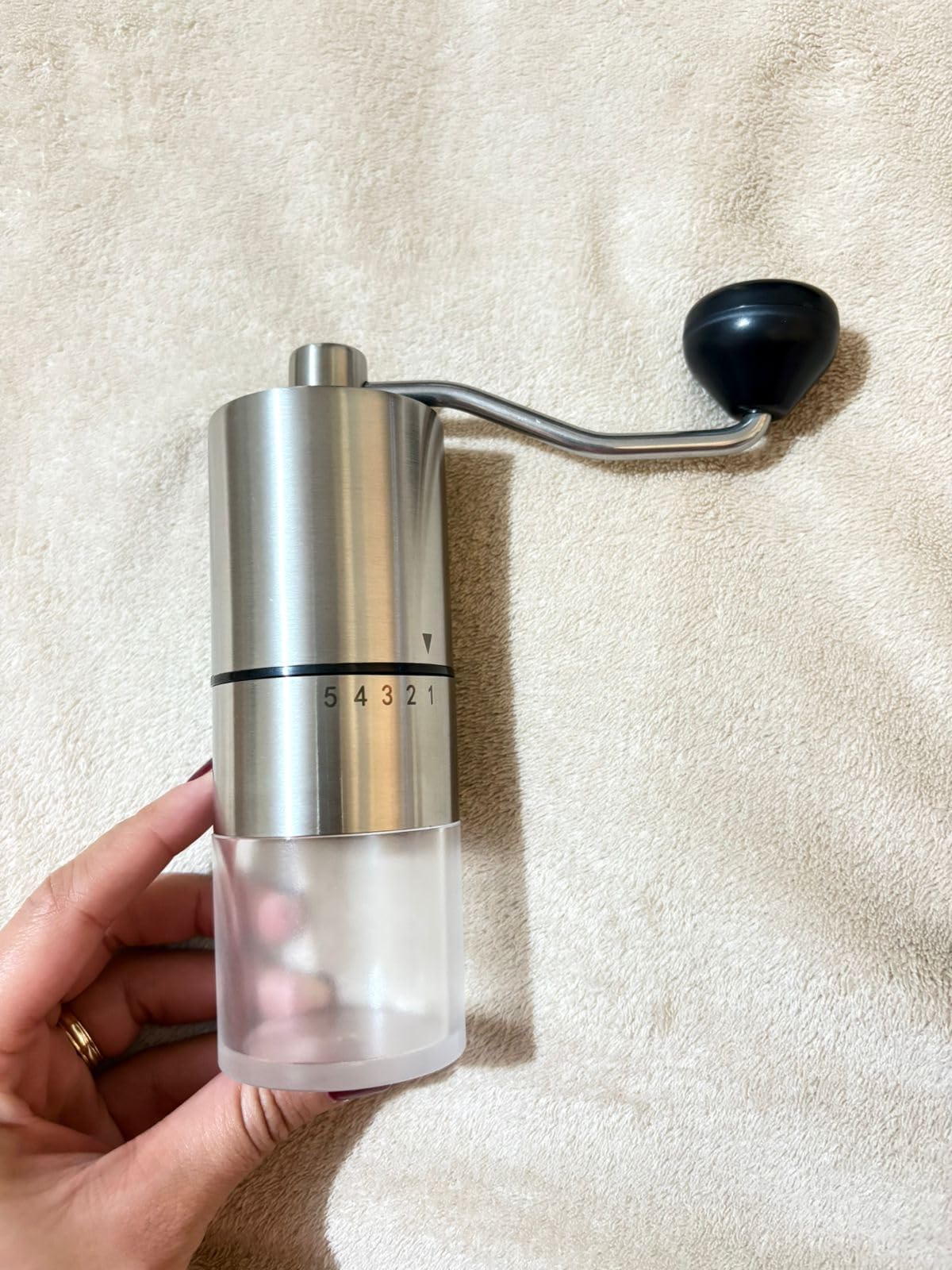
Owners accept it as a travel or backup grinder. The ceramic burr feels sturdy, grinds beans fairly evenly and holds about a cup of grounds. At 4.2 across 621 ratings with 61 percent five-star scores, expectations are lower and most people meet them.
The main practical issue is that beans can lodge at the top of the chamber and need to be pushed down by hand, which interrupts the flow of a morning routine.
Why it still earns a place in a travel kit
The combination of low mass and real burrs is rare at this price. Most ultra-light options use blades, which produce a wide range of particle sizes and therefore a muddy cup.
It is a sensible backup that lives in a pocket while your main grinder stays in the pack, or a first grinder for someone who wants to test the idea of hand grinding on a single trip.
When the small compromises catch up
Grinding a full batch takes several minutes and can leave the hand sore, and the adjustment knob slips out of position unless you hold it carefully while cranking. Numbered settings also run in the opposite direction to what the listing implies, which costs you a few mistakes at the start.
Ground coffee can also remain unground in the chamber, so you lose yield on every dose. If you grind daily at home, spend more and buy something with a better bearing.
How to Choose a Hand Coffee Grinder for Travel
Weight and body diameter come before everything else
Compare weight against the rest of your kit, not against other grinders. A 500 g grinder feels negligible next to a full carry-on and heavy next to a bikepacking setup. Body diameter matters more than people expect because grinders get stored in the narrow gaps between clothes and hard objects, and anything above about 55 mm stops fitting into a mug pocket.
Burr material sets the character of the grind
Ceramic burrs run slowly, quietly and cool. That makes them the better choice in shared rooms, cold weather and for anyone with a wrist that tires easily. Steel burrs run faster, produce fewer fines and hold an edge at fine settings, which is why the espresso-capable options here all use steel. If you brew one style only, match the burr to the brew.
Adjustment range matters more than the number on the box
A 40-step dial sounds better than a 6-step one, but resolution is what counts. External rings are easier to adjust without spilling grounds, internal mechanisms are more sealed and consistent when packed. Click systems with audible detents let you return to the same setting next week, and numbered rings beat anything adjusted by feel.
Batch size decides how often you grind
Match the chamber to your brew method. A 15 g chamber suits an AeroPress or a single cup. Twenty-five to thirty grams covers a typical pour over. Anything above 40 g lets you do a French press for two or start a cold brew batch in one pass. Under-grinding a brew in two passes doubles your work and your chance of getting the ratio wrong.
Cleaning and water discipline save the grinder
Any grinder you pack should come apart without tools and be cleaned with a dry brush. Water left in a chamber encourages stale flavours and rust, and in a hotel room there is rarely a drying rack. Prefer stainless or aluminium grounds chambers over glass if you travel hard.
Warranty and replacement parts are worth reading
A long warranty is a simple proxy for expected lifespan and for a manufacturer that intends to stay in the business. Replacement parts and a serviceable design matter even more if you are travelling for months rather than weeks, because a broken shaft should not end the trip.
Can You Bring a Hand Grinder on a Plane?
Yes. Hand coffee grinders travel in carry-on luggage without difficulty because they are small manual tools with no batteries, no fuel and no liquids. Security rules generally treat them like ordinary hand tools, and none of the grinders here trigger a liquid or blade restriction. Keep it in the main cabin rather than checked baggage, since checked bags get thrown and grinders with glass catch cups do not enjoy that.
Pack the handle separately or folded if it detaches, put the whole grinder in a pouch, and keep grounds out of the body before you pack it. Loose coffee in a grinder smells through everything else in the bag.
On the ground, clean with the brush in the box and never rinse. If you need to rinse a part, dry it fully before reassembling. Our full coffee grinder testing guide covers burr care in more detail if you are buying one for home use as well.
Grind Settings by Brew Method for Travel
Start by picking the brew method on the road, then find the setting once and reuse it. Here is the order we would work in with any of the grinders above.
Espresso and moka pot sit at the fine end, where steel burrs and click systems perform best. Aeropress sits just above that and is the easiest fine grind to hit because the dose is small and the brew is forgiving.
Pour over sits in the middle and rewards the widest adjustment ranges, since small changes in grind size visibly change extraction time. French press and cold brew sit at the coarse end, where almost any grinder including the five-step options performs well.
If you are moving between methods, buy the grinder with the widest range rather than the one with the best single setting. A grinder that is excellent at one brew and terrible at another will end up unused.
Frequently Asked Questions
What is the best manual coffee grinder for travel?
The TIMEMORE Chestnut C3S Pro is the best overall pick because of its all-metal body, foldable crank and roughly 36 levels of adjustment. If you brew with an AeroPress, the 1Zpresso Q Air is better still because the body nests inside the plunger.
Are handheld coffee grinders any good?
Yes. A conical burr hand grinder produces a much narrower particle range than the blade grinders in most hotel rooms, and it grinds fresh. You trade speed and batch size for consistency, and on filter and immersion brews the difference is easy to taste.
Can I bring a hand coffee grinder on a plane?
Hand grinders are small manual tools with no batteries, fuel or liquids, so they pass airport security in carry-on luggage without issue. Keep the grinder in the cabin rather than checked baggage, and pack it in a pouch so a hard landing cannot crack a glass catch cup.
Can a manual grinder make espresso?
It can, but only with a steel burr and a fine, repeatable adjustment system. Grinders like the Alpaca Ventures with 45 numbered clicks and the MAVO Wizard with 0.04 mm click increments can approach espresso, while ceramic burrs and coarse six-step dials struggle below filter range.
How long does it take to grind coffee by hand?
A 15 g to 20 g dose for filter or AeroPress typically takes about 30 to 45 seconds of cranking on a steel burr grinder and closer to a minute on a ceramic burr model. A double espresso dose can take a minute or more, and hand grinders tire after several cups in a row.
How do I clean a manual coffee grinder while traveling?
Take it apart, brush the burrs and chamber with the included brush or a dry cloth, and never use water. Water left in the chamber causes stale flavours and rust, and a hotel room rarely has a drying rack. Empty the grounds before packing and clean after every use.
Final Verdict
The best hand coffee grinders for travel are the ones you will actually pack. The TIMEMORE Chestnut C3S Pro is our pick for most trips because the all-metal body, foldable handle and wide adjustment range handle every brew method in one cylinder. If you brew with an AeroPress, the 1Zpresso Q Air packs into the plunger and saves you a separate case. If cost matters most, the CEVING Mini gives you 40 settings and a ceramic burr without asking much.
Whichever you choose, buy it for the grind range you need rather than the number of settings printed on the box, keep it in the cabin, and clean it with a dry brush. Updated for 2026, these twelve held up to weeks of hotel rooms, camper vans and kitchen-counter testing, and our ranking reflects what survived that, not what looked best on paper.