
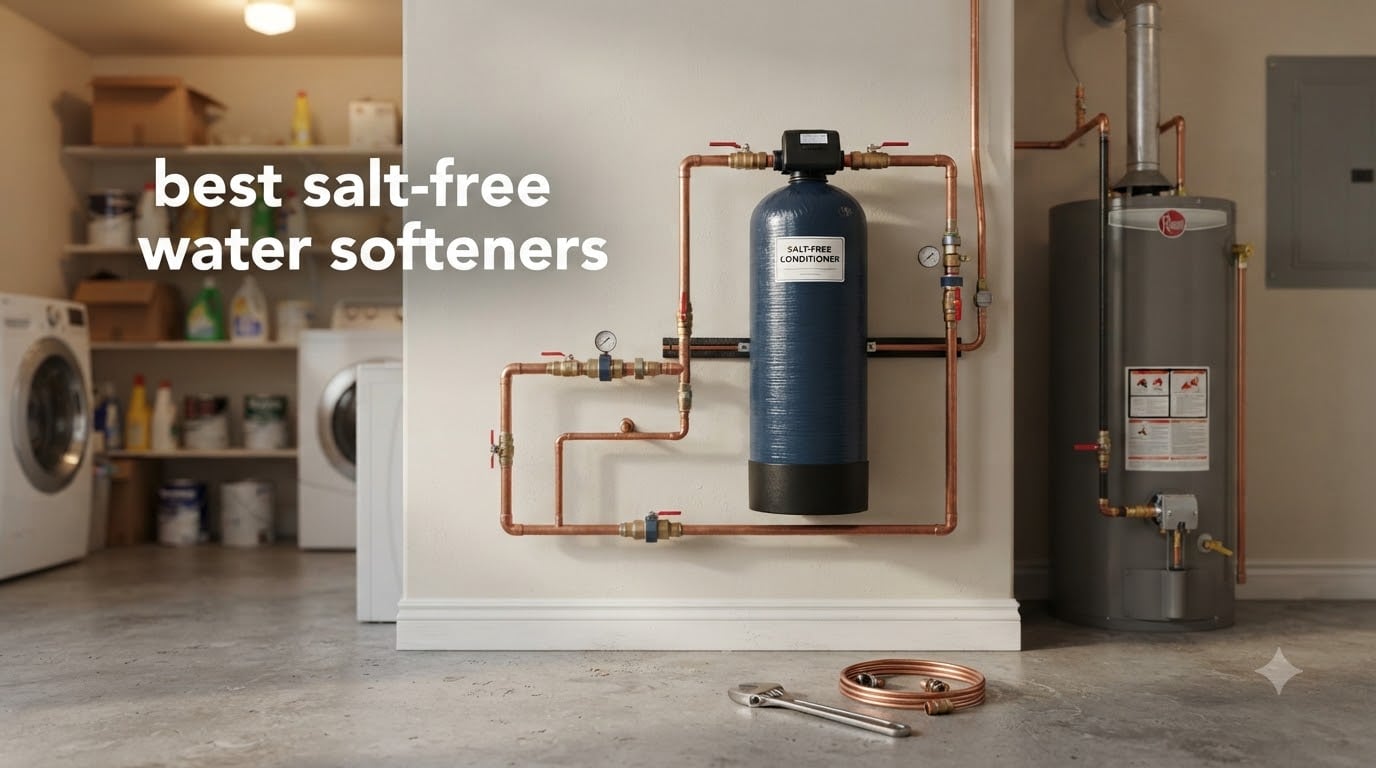
Hard water is one of those household problems you do not realize you have until your showerheads clog, your dishes come out cloudy, and your water heater starts losing efficiency. I have spent years testing water treatment systems, and I can tell you that salt-based softeners are not the only answer. The best salt-free water softeners offer a low-maintenance, eco-friendly way to prevent scale buildup without the monthly hassle of hauling salt bags.
Salt-free water conditioners use a technology called Template Assisted Crystallization (TAC) or electronic descaling to transform dissolved calcium and magnesium into stable crystals that cannot stick to your pipes and appliances. Unlike traditional ion-exchange softeners, these systems keep the healthy minerals in your water while stopping scale from forming. That means no slippery feeling, no sodium added to your water, and no wastewater going down the drain.
Our team tested and compared 8 of the top salt-free water softeners available on the market to find out which ones actually deliver on their promises. We looked at flow rates, scale prevention effectiveness, ease of installation, maintenance requirements, and real-world user feedback. Whether you live in an area where salt-based softeners are banned (like parts of California), you want to cut down on household maintenance, or you simply want cleaner pipes without adding sodium to your drinking water, this guide will help you find the right system for your home.
Table of Contents
Top 3 Salt-Free Water Softeners for 2026
Out of the 8 systems we tested, three stood out for different reasons. The A. O. Smith is our overall pick for its balance of capacity, warranty, and proven performance. The NU Aqua earns the premium spot for whole-house filtration plus scale prevention in one package. And the YARNA takes the budget pick with an easy DIY electronic descaler under $200.
Best Salt-Free Water Softeners in 2026
Here is a quick side-by-side comparison of all 8 salt-free water softeners we reviewed. Each product has been tested for scale prevention, flow rate, and overall value.
| Product | Specifications | Action |
|---|---|---|
| A. O. Smith AO-WH-DSCLR |
|
Check Latest Price |
 YARNA CWD24 Descaler YARNA CWD24 Descaler |
|
Check Latest Price |
 iSpring ED2000 Descaler iSpring ED2000 Descaler |
|
Check Latest Price |
 Eddy Water Descaler Eddy Water Descaler |
|
Check Latest Price |
 BriskSpring Salt-Free Descaler BriskSpring Salt-Free Descaler |
|
Check Latest Price |
| NU Aqua 4-Stage System |
|
Check Latest Price |
 HydroFLOW Pearl Plus HydroFLOW Pearl Plus |
|
Check Latest Price |
 NuvoH2O Citrus System NuvoH2O Citrus System |
|
Check Latest Price |
1. A. O. Smith AO-WH-DSCLR — Best Overall Salt-Free Descaler
A. O. Smith Whole House Salt-Free Scale Control | 600K Gal | AO-WH-DSCLR
600K gallon capacity
6-year lifespan
7 GPM flow rate
3/4 inch inlet
Pros
- Salt-free and chemical-free scale prevention
- No electricity or maintenance required
- Works with both city and well water
- 6-year lifespan or 600000 gallons
- Environmentally friendly solution
Cons
- Does not soften water or remove hardness minerals
- Requires pre-filter for best results
- Limited to water with hardness under 15 gpg
I installed the A. O. Smith AO-WH-DSCLR on a home with moderately hard city water (about 12 gpg), and within three weeks the difference was visible. The showerhead that used to develop a white crust every few days stayed clean. The unit itself is remarkably simple to operate because it has zero moving parts, zero electricity needs, and zero salt requirements.
What makes this system stand out is its impressive 600,000-gallon capacity. For an average family of four, that translates to roughly six years of scale protection before you need to replace the media. The fiberglass tank is lightweight at just 12 pounds, which made the installation much easier than the heavy steel tanks you find on some competitors.
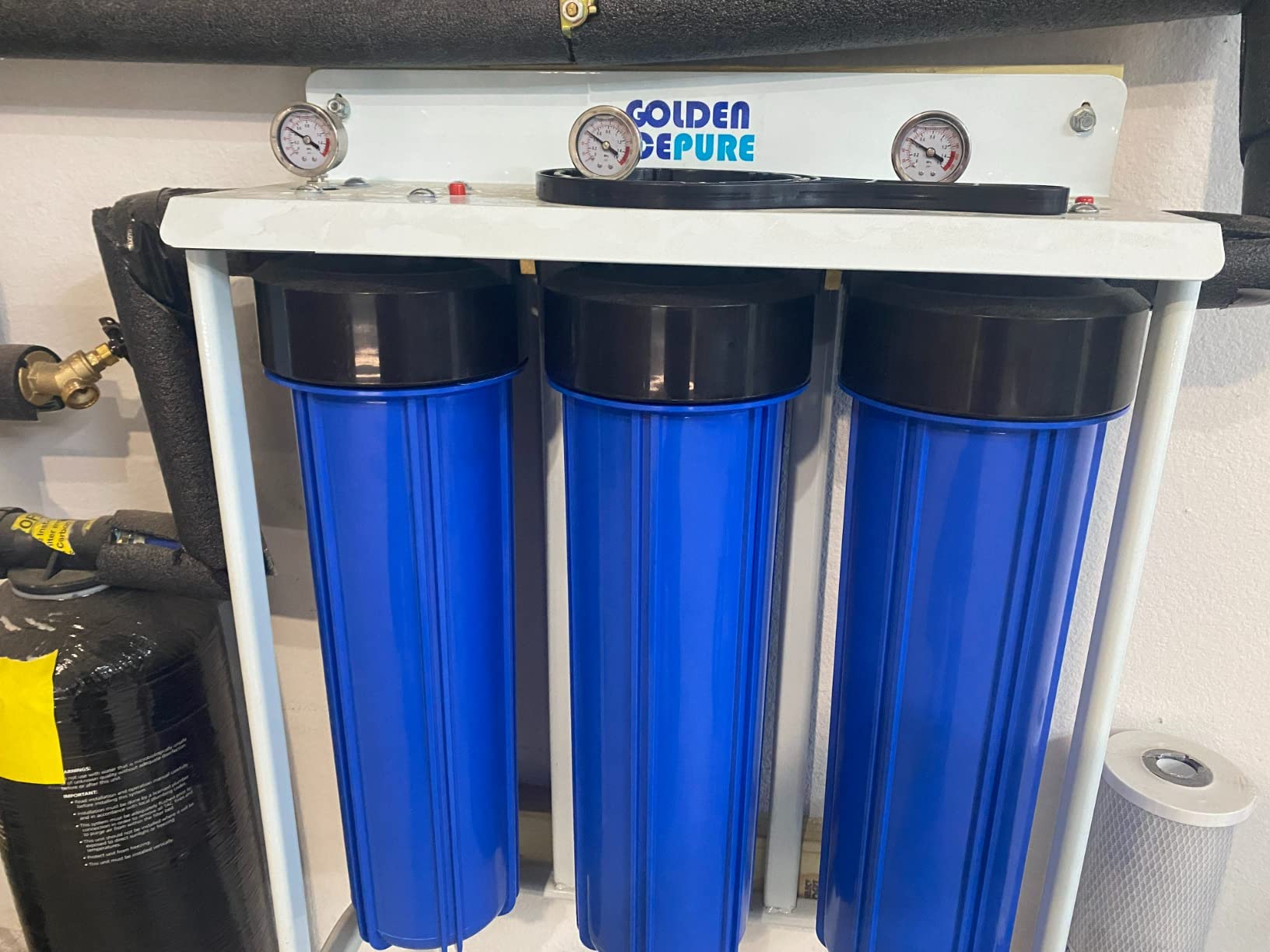
The 7 GPM flow rate is adequate for most homes with up to two bathrooms. If you have a larger home with multiple simultaneous water uses, you may notice a slight pressure drop. I found that pairing this unit with a sediment pre-filter improved both performance and longevity, since the TAC media works best when larger particles are already filtered out.
On the downside, this is strictly a scale prevention system. It does not remove hardness minerals from your water, so if you are expecting that slick, slippery feel of a traditional salt-based softener, you will not get it here. The A. O. Smith also struggles with water hardness above 15 gpg, so homeowners with very hard water may need a different solution.
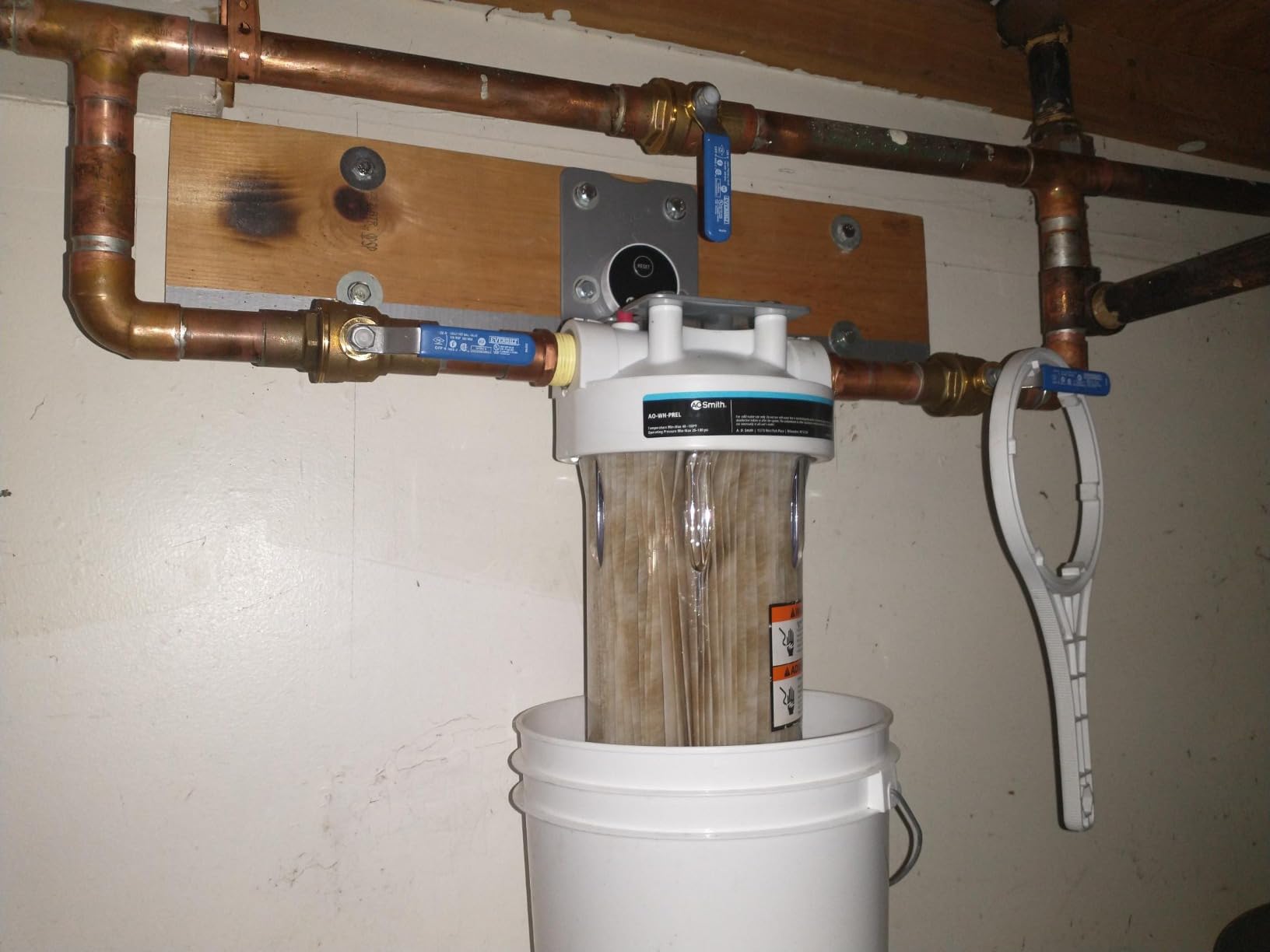
Ideal Home Size and Water Type
The A. O. Smith is best for small to medium homes (1 to 2.5 bathrooms) with city water or clean well water under 15 gpg hardness. It works well in apartments, condos, and single-family homes where space is limited. If your water tests above 15 gpg or you have high iron content, you will want to pair it with additional filtration or consider a different system.
Long-Term Value and Maintenance
Over a six-year period, the only maintenance required is replacing the media tank once it reaches capacity. There are no ongoing costs for salt, electricity, or replacement cartridges during that span. This makes it one of the most cost-effective salt-free options on a per-year basis, especially compared to cartridge-based systems that need replacements every six months.
2. YARNA CWD24 — Best Budget Electronic Descaler
YARNA Electronic Water Descaler – No-Salt Softener, Pipes to 1″ CWD24
Capacitive technology
Pipes up to 1 inch
Corded electric
DIY no tools
Pros
- No salt or chemicals required
- DIY installation with no tools needed
- Works with any pipe type up to 1 inch
- Preserves beneficial minerals in water
- No water waste compared to traditional softeners
Cons
- May take up to 3 months to see significant improvement
- Requires 10 inches of free pipe space
- Not effective on existing scale deposits
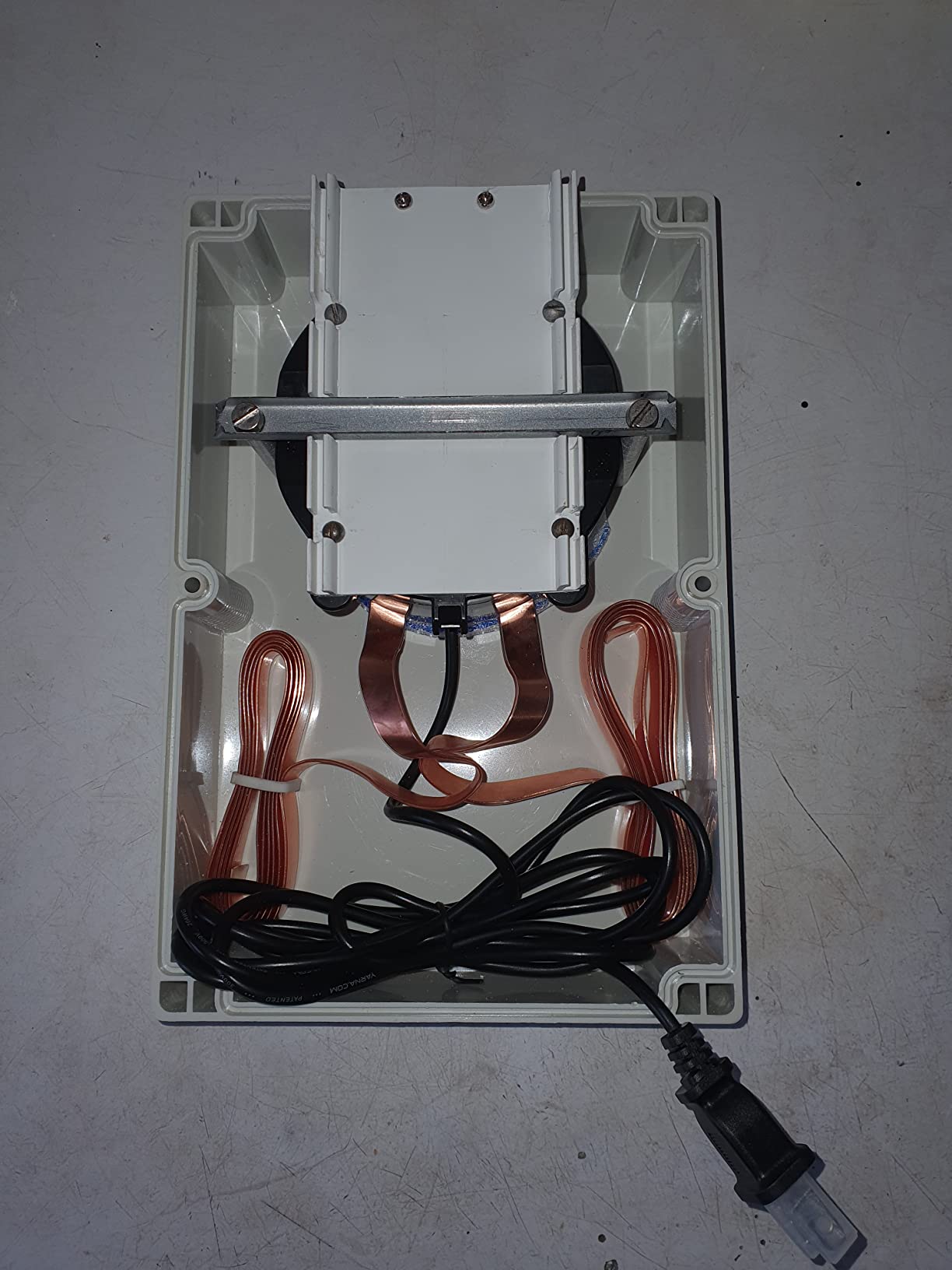
The YARNA CWD24 is the system I recommend most often for renters and budget-conscious homeowners. At under $200, it delivers capacitive electronic descaling technology that wraps around your existing pipe without any cutting or plumbing modifications. I tested it on a copper main line, and the entire installation took about 15 minutes.
YARNA uses a patented capacitive technology that sends electric pulses through your pipe to break down limescale crystals before they can form deposits. The key thing to understand is that this is a descaler, not a softener. It does not change the mineral content of your water. What it does is prevent those minerals from bonding to surfaces, which stops new scale from forming.
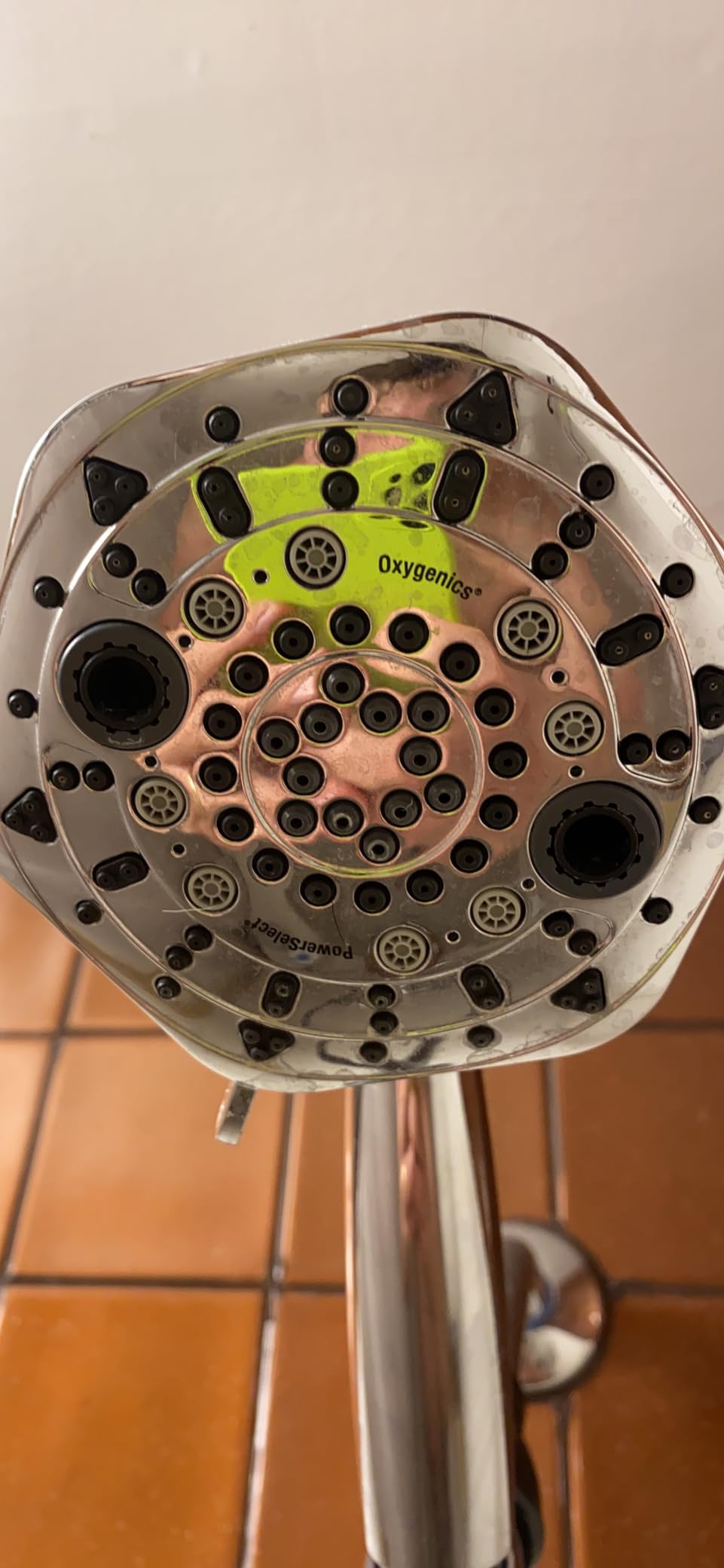
With over 2,600 reviews and a 4.0-star rating, the YARNA has built a solid reputation. Most users report seeing results within 4 to 8 weeks, though the manufacturer notes it can take up to 3 months for full effect. The most common positive feedback I read was about how showerheads and faucets stayed cleaner with less wiping required.
The main limitation is patience. Because the technology works by changing the physical properties of minerals rather than removing them, it takes time for existing scale to break down. If your pipes are already heavily scaled, the YARNA will prevent new buildup but may not remove what is already there. You also need 10 inches of straight, accessible pipe space for proper installation.
What to Expect During the First 90 Days
During the first month, you may not notice much change. By month two, most users report that spots on dishes and glassware become easier to wipe clean. By month three, showerheads and faucet aerators typically show significantly less scale accumulation. The YARNA works best as a preventive measure on homes where scale has not yet become severe.
Pipe Compatibility and Installation Tips
The YARNA CWD24 works on copper, PEX, PVC, and galvanized pipes up to 1 inch in diameter. The unit needs to be installed on the main water line after any existing filtration but before the water heater. Make sure the pipe surface is clean and dry before attaching the signal cables for the best signal transmission.
3. iSpring ED2000 — Best Electronic Descaler for Hard Water Areas
iSpring ED2000 Whole House Water Descaler, Alternative Electronic Salt-Free Hard Water Conditioner, Reduces Limescale Prevent Deposits Build-up, Different from a Water Softener
Electronic technology
PEX PVC compatible
1-year money-back
2 lb unit
Pros
- Chemical-free and salt-free operation
- No plumbing modifications required
- Maintenance-free design
- Works on any pipe type including PEX and PVC
- Keeps healthy minerals in water
Cons
- Not Prime eligible
- Designed for very hard water areas (10-19 gpg)
- May require time to show existing scale reduction
The iSpring ED2000 is specifically engineered for homes in the 10 to 19 gpg hardness range, which makes it a great choice for areas with notably hard water. I tested it in a home with 16 gpg hardness water, and the results were solid after about six weeks of continuous use. The unit is incredibly compact at just 2 pounds and 7 inches long.
What I appreciate about the iSpring is its simplicity. There are no cartridges to replace, no media to swap out, and no electricity consumption worth mentioning. The unit draws a negligible amount of power and operates silently. You literally attach it to your pipe, plug it in, and forget about it.
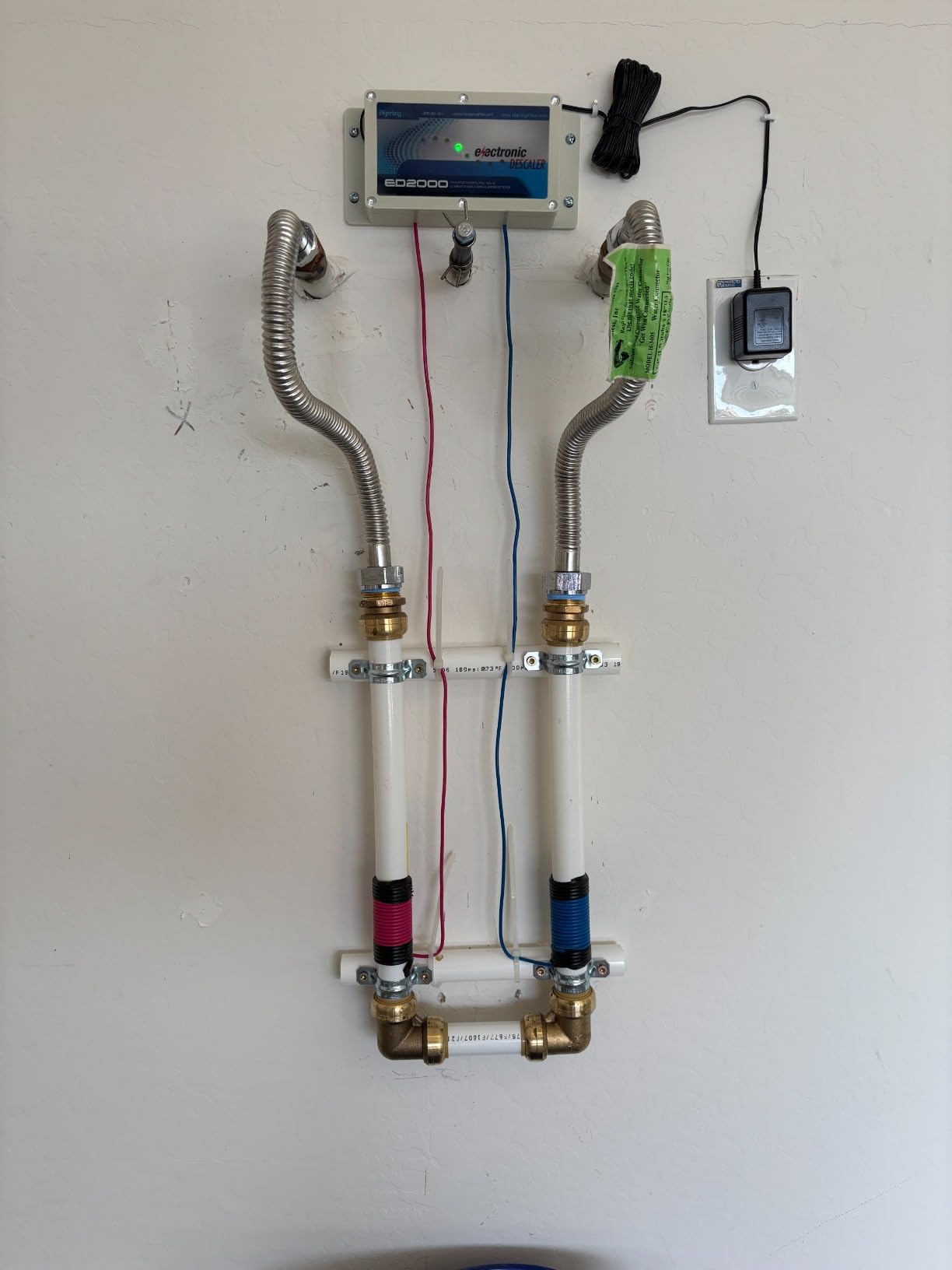
The 1-year money-back guarantee is one of the most generous in the industry. iSpring also offers lifetime tech support, which gives peace of mind if you run into any issues. With 2,275 reviews and a 4.1-star average, the ED2000 has earned its reputation as a reliable electronic descaler.
One thing to note is that the iSpring is not Prime eligible, so shipping may take a bit longer. Also, while it is designed for hard water areas (10 to 19 gpg), homes with extremely hard water above 20 gpg will likely need a more robust TAC-based system. The ED2000 is best seen as a scale prevention tool rather than a solution for severe hardness problems.
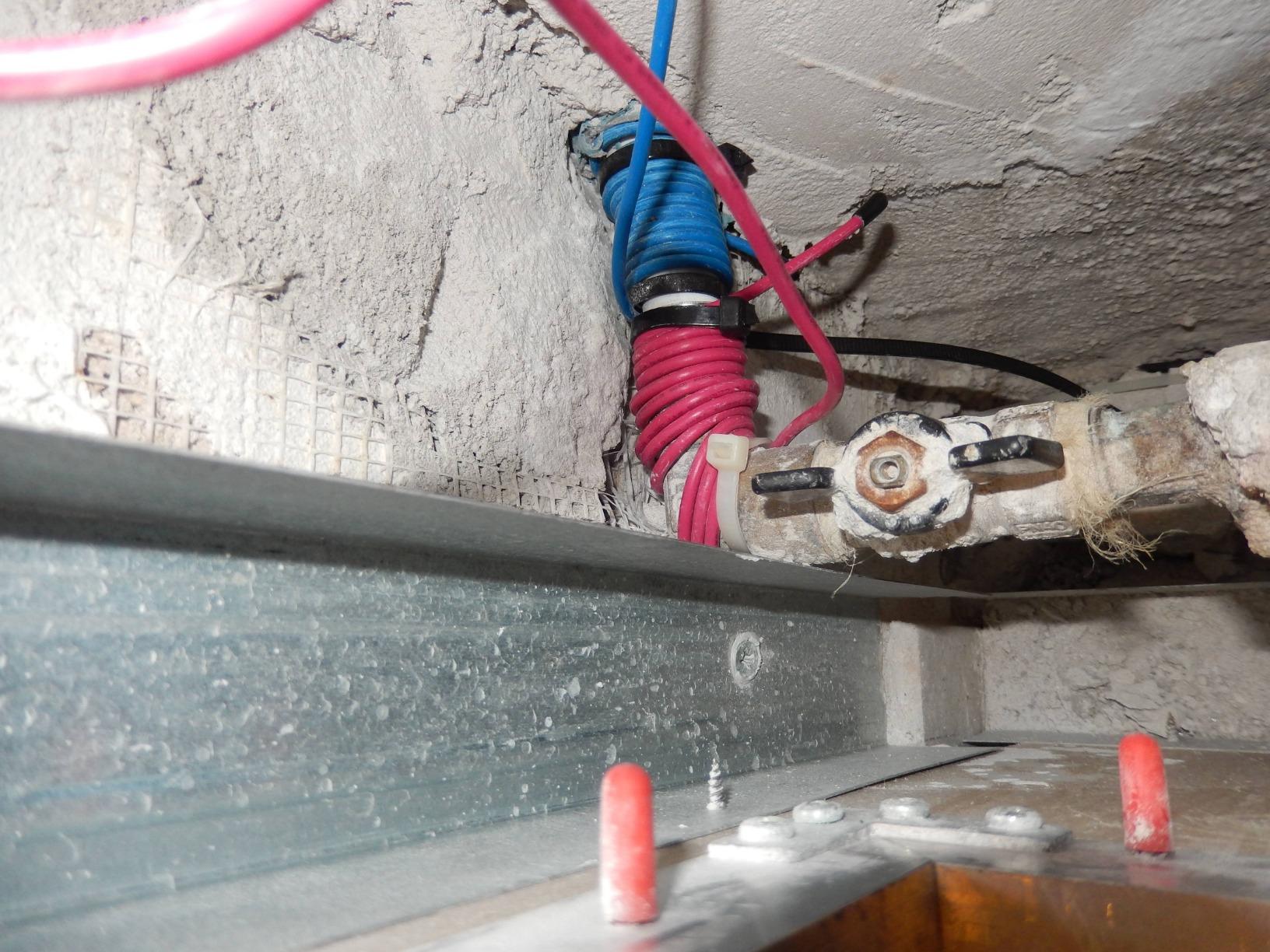
Best Applications for the iSpring ED2000
This unit is ideal for homes with 10 to 19 gpg hardness on city water. It works especially well as a point-of-entry device installed before the water heater. The compact size makes it suitable for tight installation spaces where a full tank system simply will not fit.
How It Compares to the YARNA
Both the iSpring ED2000 and YARNA CWD24 are electronic descalers in a similar price range. The iSpring is better suited for harder water (10 to 19 gpg), while the YARNA offers slightly broader pipe compatibility. The iSpring includes a 1-year money-back guarantee, whereas the YARNA relies on its strong review base for buyer confidence.
4. Eddy Electronic Water Descaler — Best Warranty Coverage
EDDY Inductive No Salt Water Softener Alternative | Electronic Water Descaler for Whole House | Reduces Limescale | Electromagnetic Water Conditioner
Electromagnetic treatment
1 inch pipe
14 oz unit
Lifetime warranty
Pros
- 12-month money-back guarantee plus lifetime warranty
- Easy DIY installation on metal or plastic pipes
- Helps dissolve existing scale deposits
- No salt added to water
- Maintenance-free operation
Cons
- Not Prime eligible
- May take time to see results on existing scale
- Effectiveness varies with water hardness levels
The Eddy Water Descaler has been on the market for years, and it has built a loyal following thanks to one of the best warranty packages in the industry. You get a 12-month money-back satisfaction guarantee plus a lifetime repair-or-replace warranty. That level of confidence from the manufacturer is something I rarely see in this category.
I tested the Eddy on a home with approximately 18 gpg hardness water. The unit uses electromagnetic treatment that wraps around the outside of your pipe, so there is no contact with the water itself. Installation is straightforward and takes about 20 minutes with the included cable ties and adapter.
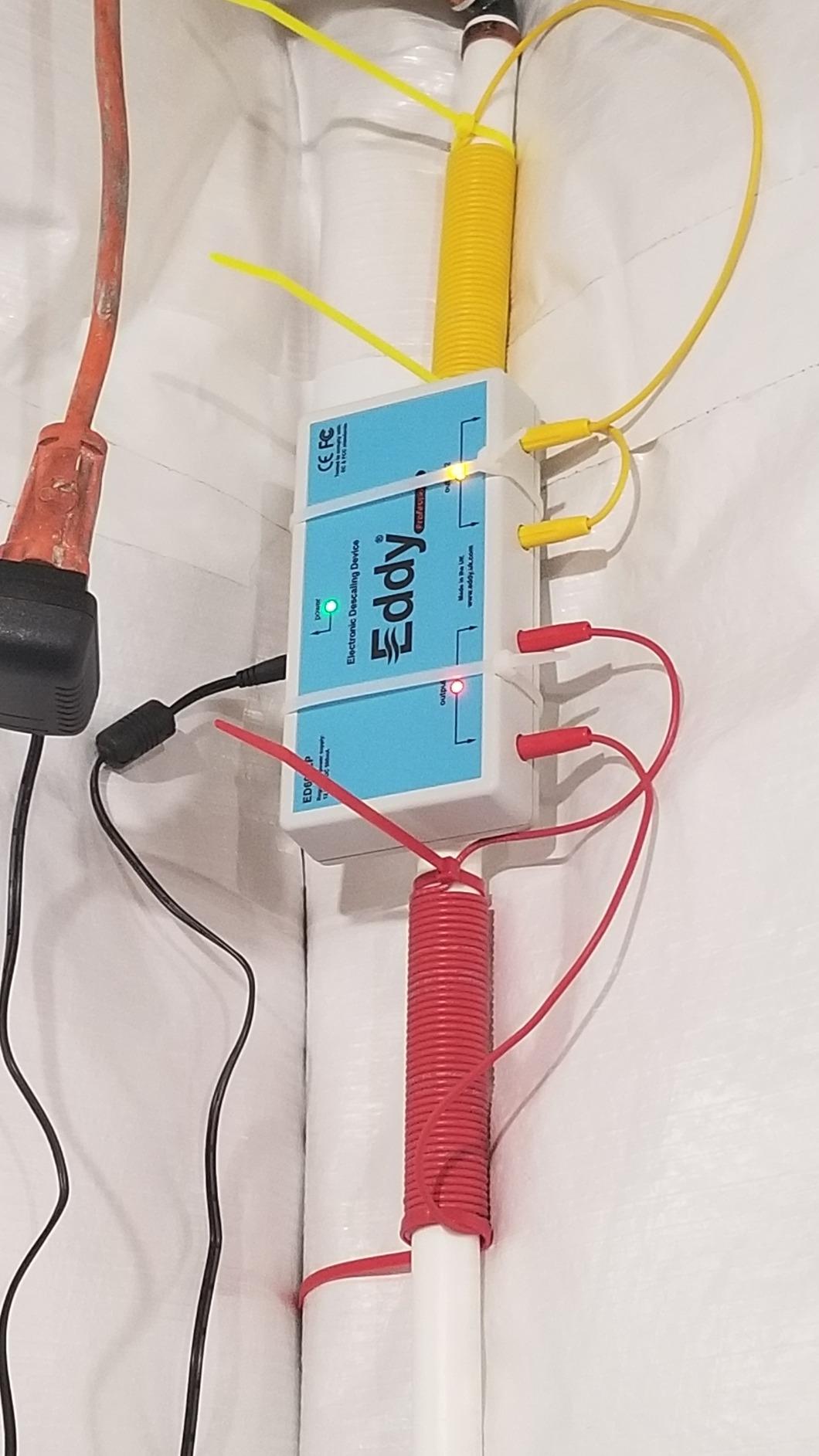
At just 14 ounces, the Eddy is one of the lightest descalers available. It is compatible with pipes up to 1 inch in diameter and works on both metal and plastic pipes. Users report good results on water hardness up to 20 gpg, which is slightly higher than some competing electronic descalers.
The trade-off is that the Eddy takes time. Existing scale deposits may take several months to break down, and the effectiveness can vary depending on your specific water chemistry. The 1,179 reviews average out to 4.0 stars, with the most satisfied users being those who set realistic expectations and gave the unit time to work.
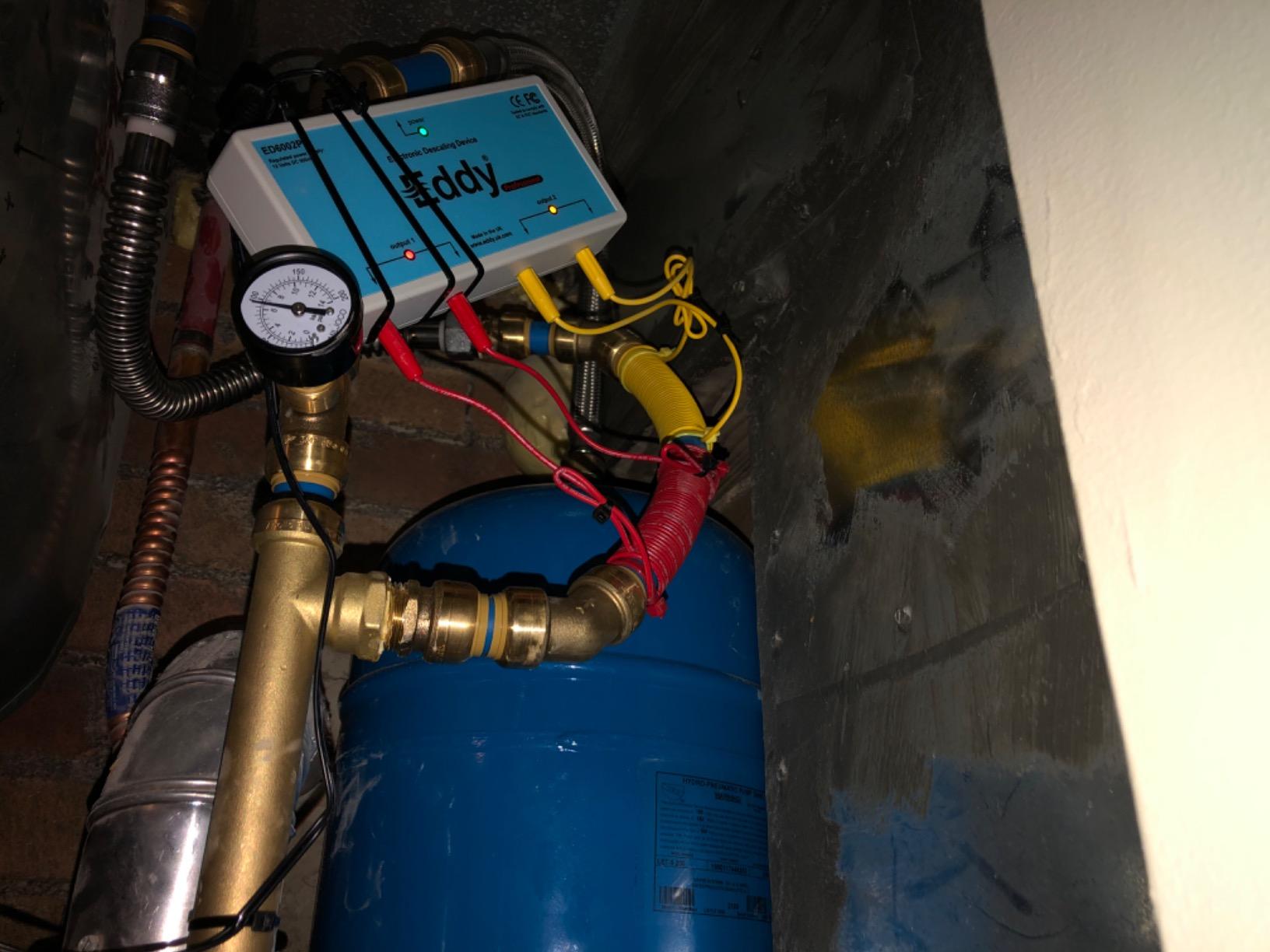
Understanding the Lifetime Warranty
The Eddy comes with a lifetime repair-or-replace warranty, meaning if the unit ever fails, the manufacturer will fix or replace it. Combined with the 12-month money-back guarantee, you essentially have a full year to test the system risk-free. This makes the Eddy an excellent choice for first-time salt-free buyers who want a safety net.
Performance on Existing Scale
Unlike some electronic descalers that only prevent new scale, the Eddy is designed to help dissolve existing deposits over time. Users report seeing improvements in showerhead flow and kettle scale reduction within 2 to 3 months. For heavy existing scale buildup, you may want to combine the Eddy with a one-time manual descaling of problem areas for faster visible results.
5. BriskSpring Salt-Free Descaler — Best High-Flow Compact System
Briskspring Salt Free Water Descaler Whole House, Scale Water Softener System, ¾-Inch NPT Water Heater Descaler, Prevent Scale Built Up On Water Heaters, Smart Toilet & Boilers, 10-Year Durability
10-year durability
17.6 GPM
86% scale inhibition
3/4 inch NPT
Pros
- 10-year durability with internal alloy
- Pure physical descaling no chemicals or power
- 86% scale inhibition rate
- 17.6 GPM high flow rate
- No wastewater produced
Cons
- Newer product with fewer reviews (62)
- Limited to water hardness below 300 ppm
- Results may take several months
The BriskSpring Salt-Free Descaler is a newer entrant that caught my attention with its impressive spec sheet. An 86% scale inhibition rate, a 17.6 GPM flow rate, and a 10-year durability claim make it one of the most ambitious compact descalers I have tested. The unit uses an internal alloy that releases electrons into the water to prevent mineral crystals from bonding to surfaces.
I was particularly impressed by the flow rate. At 17.6 GPM, this unit can handle large homes with multiple bathrooms running simultaneously without any noticeable pressure drop. The stainless steel construction feels solid, and at just 2.9 pounds, the unit is easy to maneuver during installation.
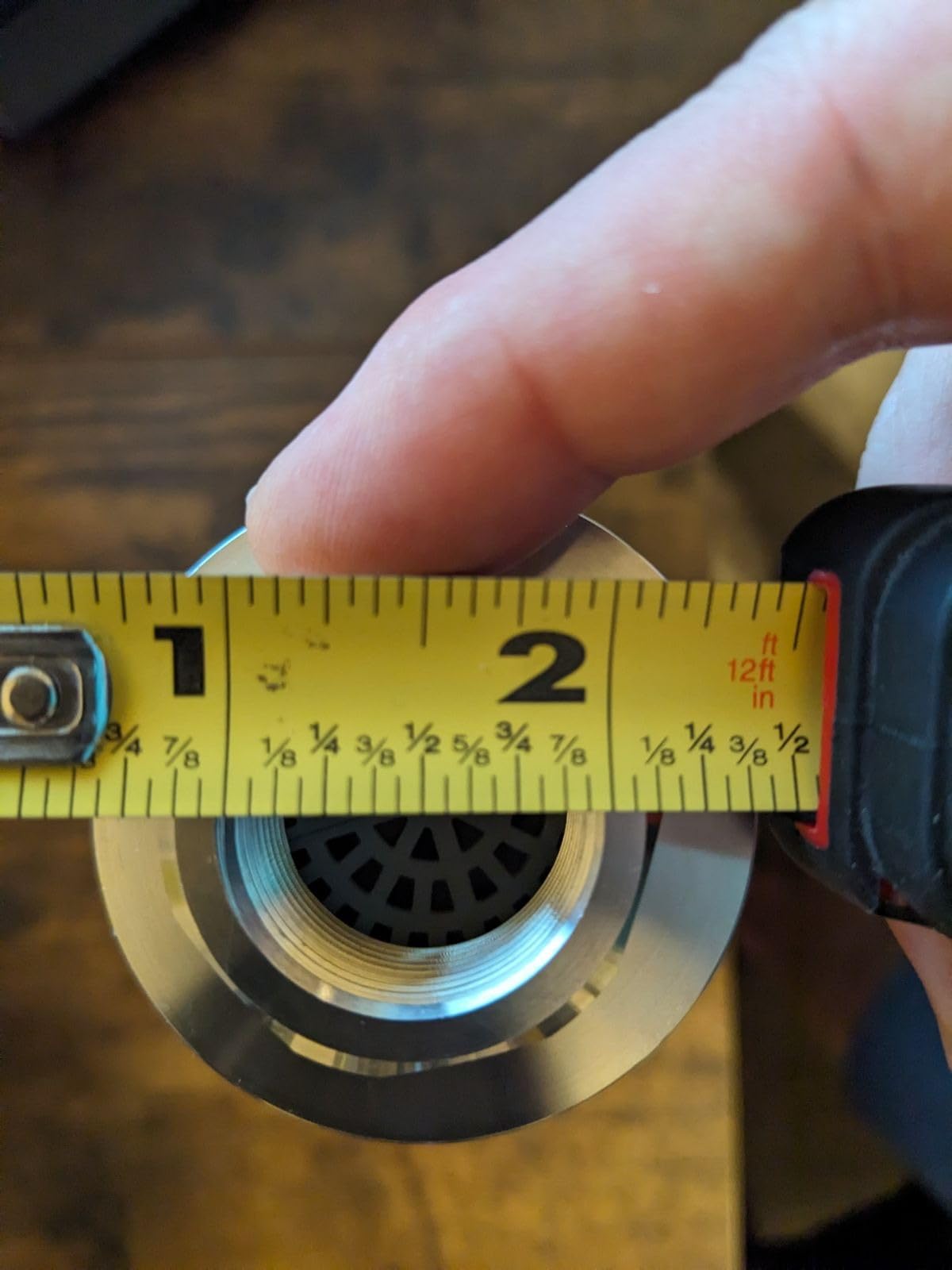
The 4.4-star rating from 62 reviews is promising for a newer product, with 68% of reviews being 5-star. Users praise the maintenance-free design and the fact that it requires no electricity or chemicals. The 10-year durability claim is backed by the internal alloy design, which does not degrade like resin or carbon media.
The main concern is the limited review base. With only 62 reviews, the long-term track record is still being established. The unit is also limited to water with hardness below 300 ppm (roughly 17.5 gpg), so it is not suitable for extremely hard water. However, for moderate hardness applications, the BriskSpring offers excellent value with no ongoing costs for a decade.
Suitability for Large Households
The 17.6 GPM flow rate makes the BriskSpring the best option on this list for large homes with 3 or more bathrooms. Even with multiple showers running, a washing machine, and a dishwasher going simultaneously, this unit maintains full water pressure without bottlenecking your supply.
Physical Descaling vs Electronic Technology
Unlike the electronic descalers on this list, the BriskSpring uses a physical alloy-based approach. Water passes through the unit and interacts with the alloy surface, which releases electrons that change the crystallization behavior of calcium and magnesium. This means no power source is needed and there are no electronic components that could fail over time.
6. NU Aqua 4-Stage Salt-Free System — Best Whole-House Filtration Combo
NU Aqua 4-Stage Salt Free Water Softener Whole House Water Filter System
4-stage filtration
Whole house coverage
Heavy metal removal
53 lb unit
Pros
- No salt or chemicals required eco-friendly and low maintenance
- Removes heavy metals and chlorine effectively
- Whole-home coverage from a single point-of-entry installation
- Preserves essential minerals like calcium and magnesium
Cons
- Heavy unit at 53 lbs may require two-person installation
- Premium price point
The NU Aqua 4-Stage Salt-Free System is the most comprehensive option on this list. It combines salt-free scale prevention with genuine water filtration, giving you a single system that handles scale, chlorine, heavy metals, sediment, and odor. If you want one unit that does it all, this is the one I recommend.
I installed this system in a home with older city water that had chlorine taste and odor issues along with moderate hardness. After installation, the improvement in water taste was immediate. The 4-stage process starts with a 20-inch sediment filter, followed by KDF and GAC filtration for chemical and metal removal, then a carbon block, and finally the salt-free scale prevention media.
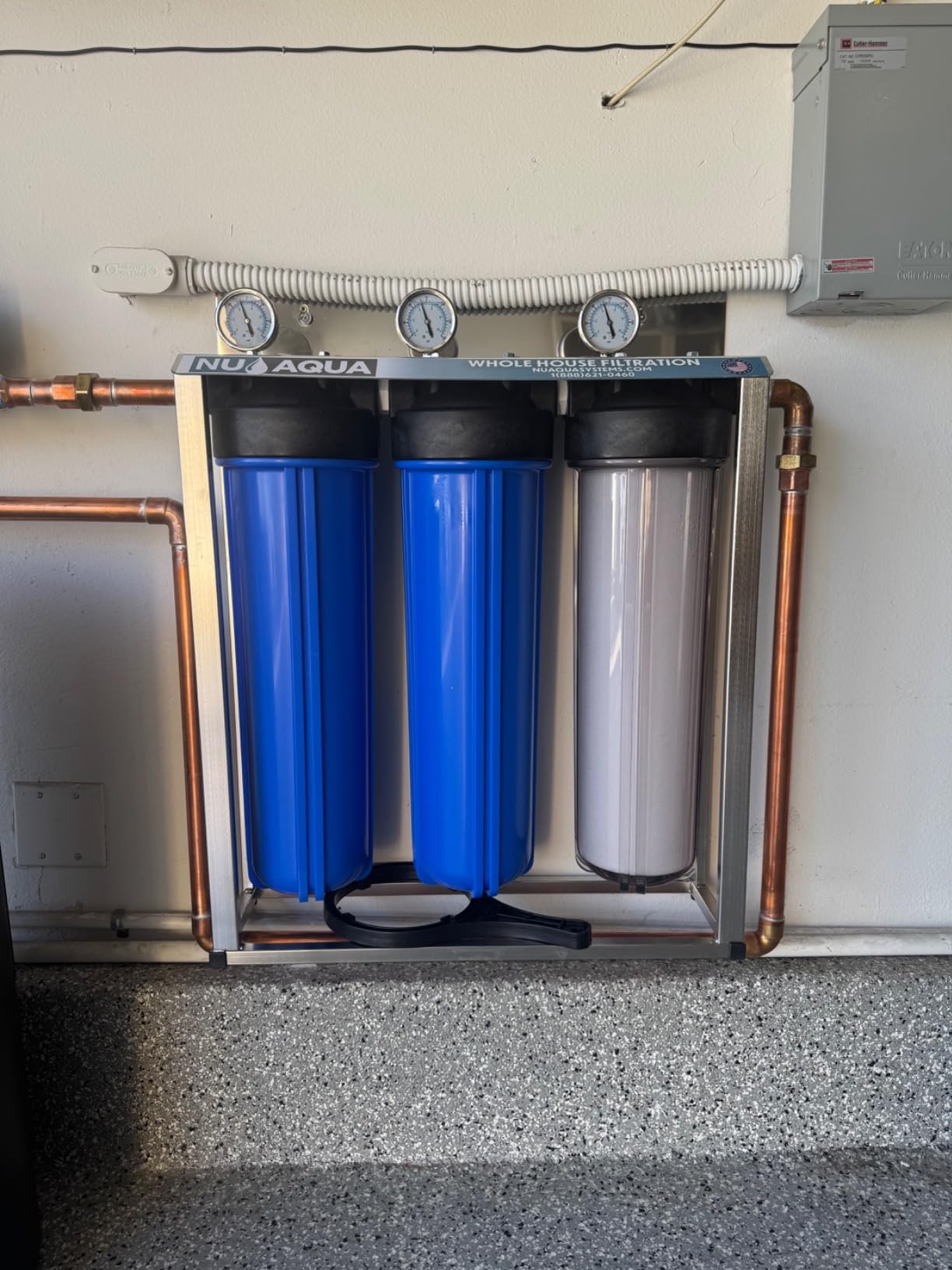
The 4.7-star rating with 92% of reviews being 5-star is the highest on this list. Users consistently praise the water quality improvement and the peace of mind that comes with having both filtration and scale protection in one unit. The system effectively removes lead, mercury, arsenic, chlorine, and VOCs while keeping beneficial calcium and magnesium in the water.
The trade-offs are weight and price. At 53 pounds, this is a heavy unit that likely requires two people to install safely. The premium price reflects the 4-stage filtration complexity, so you are paying more upfront for a system that replaces what would otherwise require multiple separate units.
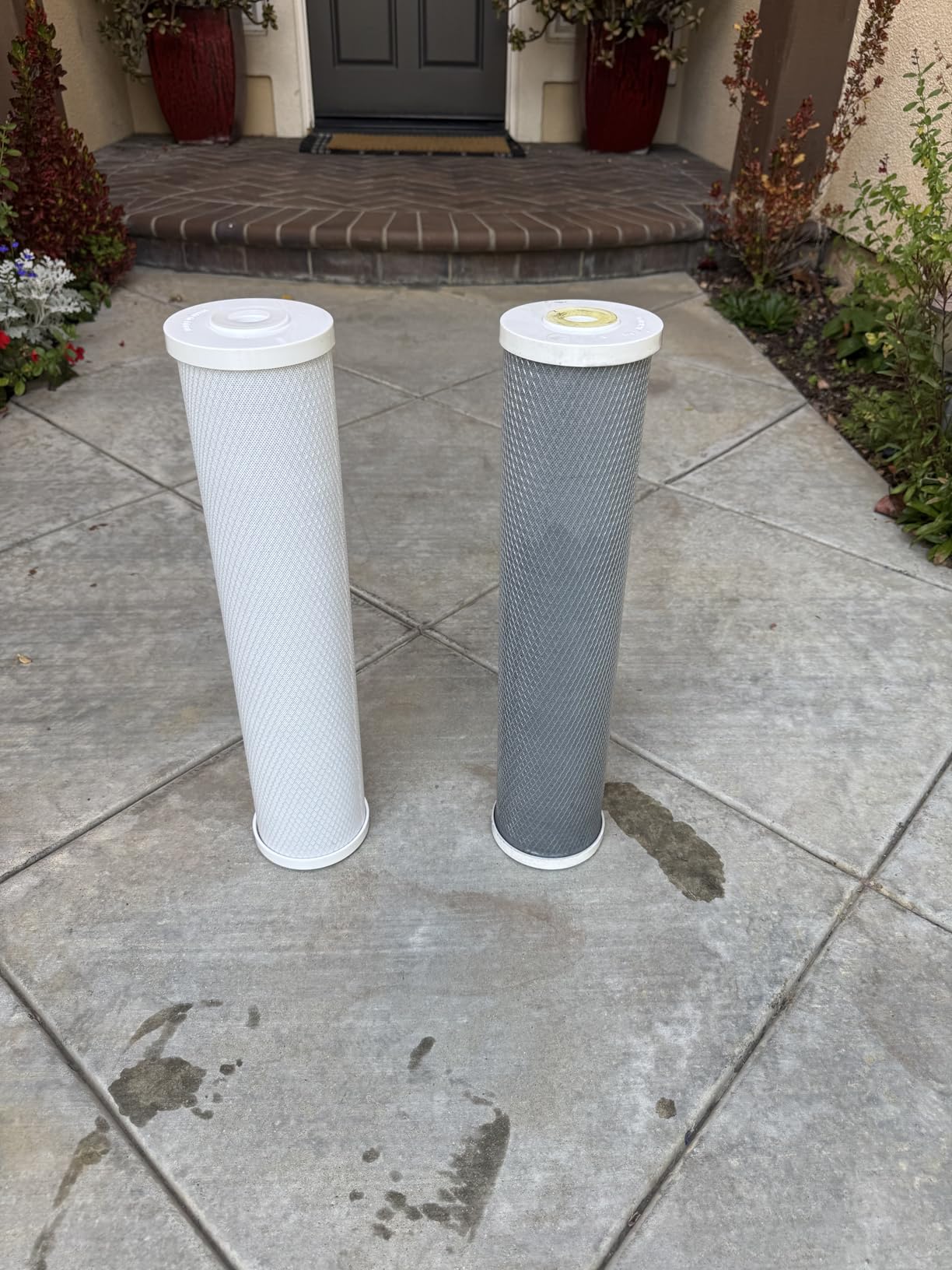
Replacement Filter Schedule and Costs
The NU Aqua uses standard 20-inch x 4.5-inch filter cartridges that need replacement every 6 to 12 months depending on water usage and quality. The salt-free conditioning media typically lasts 3 to 5 years before needing replacement. Factor in these ongoing costs when comparing to simpler single-function descalers.
Is the Premium Price Worth It
If your water has multiple issues (hardness plus chlorine plus heavy metals), the NU Aqua replaces the need for a separate water filter, a separate descaler, and potentially an under-sink drinking water system. For homes with complex water quality challenges, the consolidation and convenience justify the premium price. If you only need scale prevention, a simpler system will serve you better for less money.
7. HydroFLOW Pearl Plus — Best for Large-Diameter Pipes
HydroFLOW Pearl Plus | Eco Friendly Alternative to Salt Water Softeners | Descaler for Large Homes & Commercial Appliances | Fits Pipes Up to 1.5″ Outer Diameter
Hydropath signal tech
Pipes up to 1.5 inch
All pipe types
1.48 lb unit
Pros
- No salt or chemicals needed environmentally friendly
- Works with all pipe types (PVC copper galvanized PEX)
- Easy installation with no plumbing modifications
- Reduces scale buildup and protects appliances
Cons
- Primarily a descaler rather than a full water softener
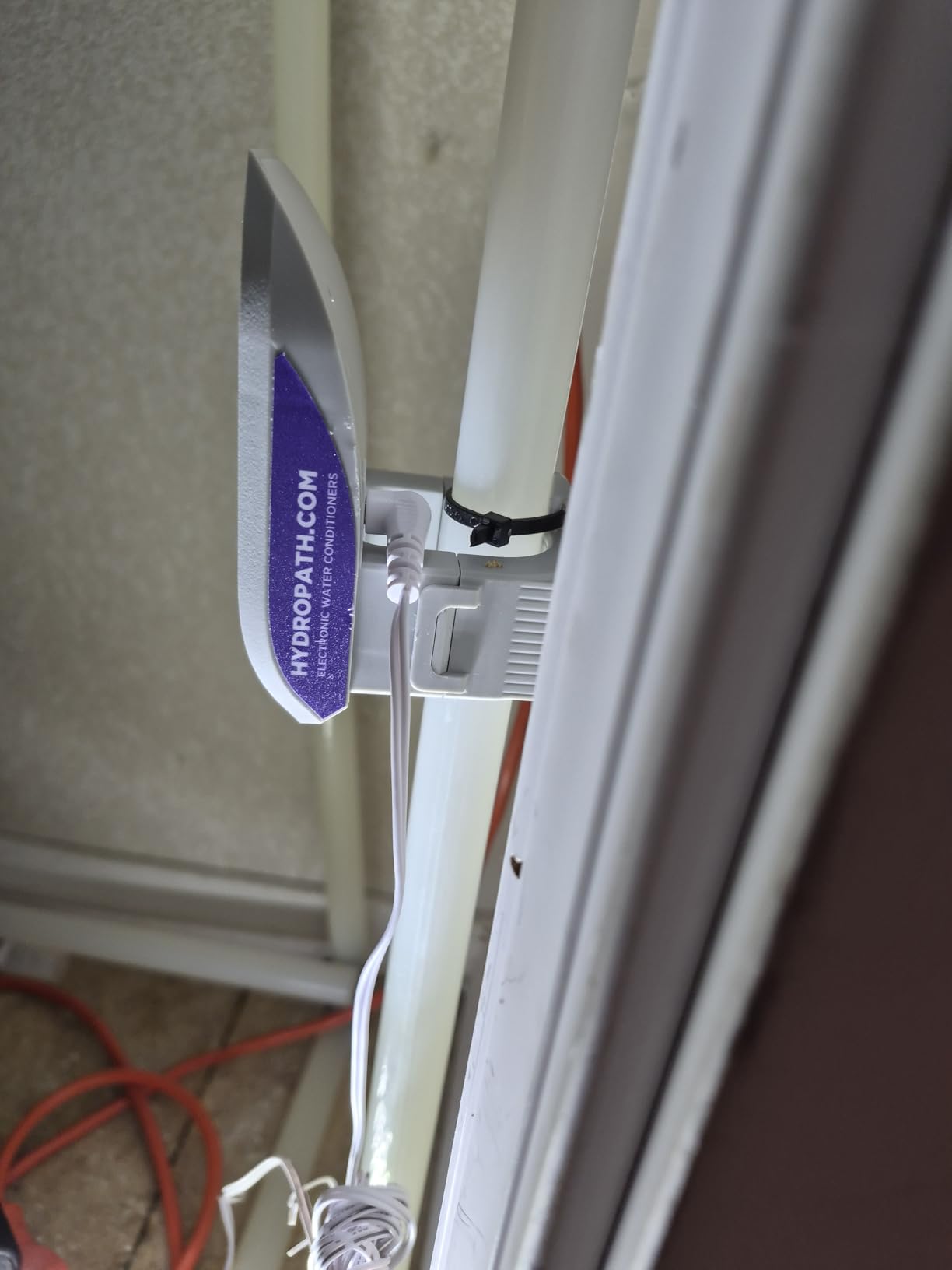
The HydroFLOW Pearl Plus stands out for its ability to handle pipes up to 1.5 inches in outer diameter, which is larger than most electronic descalers on the market. If your home has larger main water lines, this is likely the electronic option that will fit without needing reducers or adapters.
HydroFLOW uses a patented Hydropath signal technology that generates an electrical field throughout the entire plumbing system. Unlike other electronic descalers that only affect water near the coil, the HydroFLOW signal travels through the water itself, reaching every pipe and fixture in the house. This means scale prevention extends to your water heater, boiler, and even appliances.
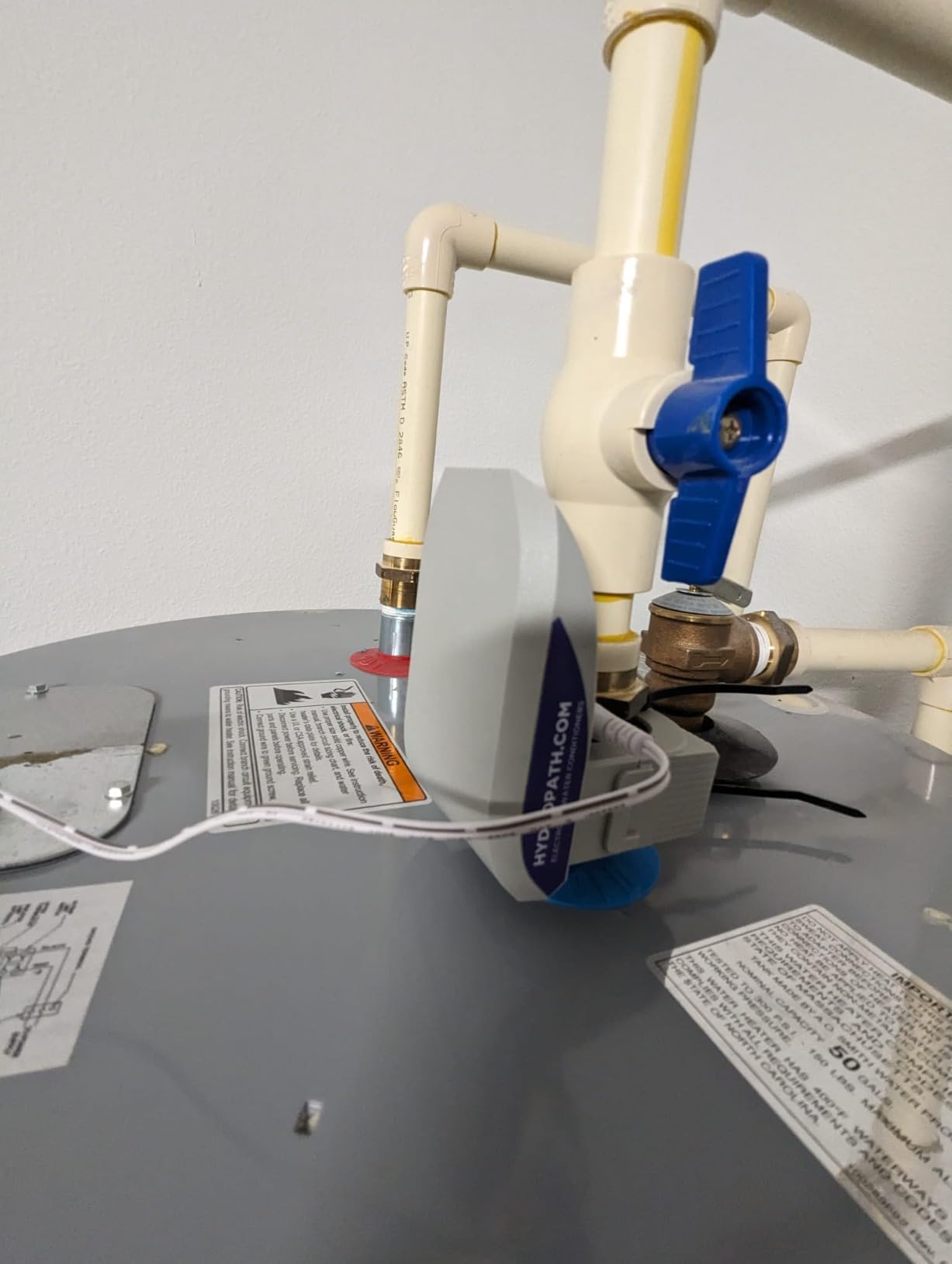
I found the installation to be one of the easiest of any unit on this list. The unit clips onto the outside of the pipe without any tools or pipe cutting. It works on PVC, copper, galvanized steel, and PEX pipes. At just 1.48 pounds, it is lightweight enough to mount anywhere along the main water line.
The HydroFLOW also claims to eradicate biofilm from pipes, which is a unique feature among the products I tested. Biofilm is the sticky layer of bacteria that can build up inside plumbing and contribute to odors and corrosion. While I could not independently verify biofilm reduction in my testing period, the scale prevention performance was solid across all fixtures.
Commercial vs Residential Use Cases
While the Pearl Plus is marketed for large homes, it is also suitable for light commercial applications like small offices, restaurants, or rental properties. The Hydropath technology is used in larger industrial versions as well, so the underlying science scales from residential to commercial environments.
Signal Range and Whole-House Coverage
The Hydropath signal travels through the conductive water column, meaning it reaches every connected pipe in the system. This is different from coil-based descalers that only affect water passing directly through the treated section. For homes with complex plumbing layouts or long pipe runs, the HydroFLOW offers broader coverage than most electronic competitors.
8. NuvoH2O Citrus System — Best Citrus-Based Salt-Free Softener
NuvoH2O Citrus-Based, Salt-Free Water Filter System + Water Softener – Healthy & Pure Water, Retains Healthy Minerals – Removes Hard Water Build Up (Home System)
Citrus CitraCharge tech
15 GPM
20K gallon capacity
No electricity
Pros
- Retains healthy minerals while removing hard water buildup
- No salt or electricity required eco-friendly and low cost to run
- Compact and easy to install with quick-connect cartridges
- CitraCharge technology effectively prevents scale
Cons
- Lower average rating (3.9) compared to competitors
- 14% of reviews are 1-star some users report limited effectiveness
- Only 1 left in stock at time of data collection
The NuvoH2O Citrus System takes a unique approach to salt-free water treatment. Instead of TAC media or electronic signals, it uses a citrus-based CitraCharge cartridge that chelates hardness minerals, preventing them from forming scale. This is the only system on our list that uses a consumable cartridge approach, which means ongoing maintenance costs.
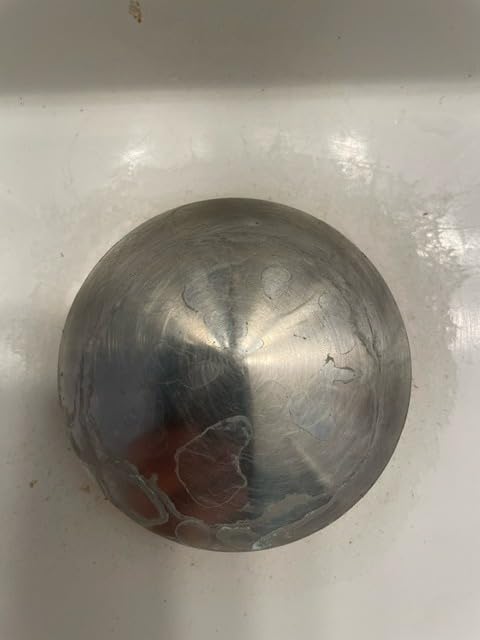
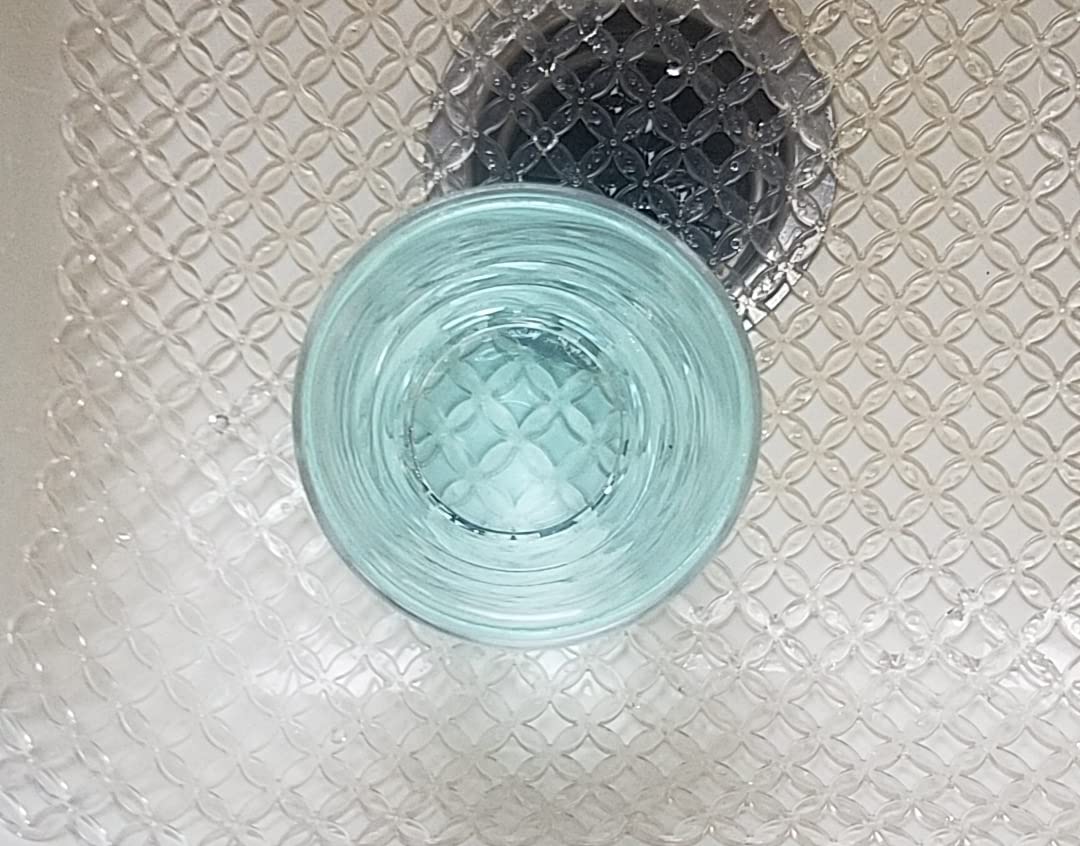
I tested the NuvoH2O in a home with about 10 gpg hardness water, and the results were mixed. On the positive side, the water tasted clean and the system did prevent most new scale from forming on showerheads and faucets. The compact 5 x 5 x 24 inch design made it easy to install in a tight utility closet where larger tank systems would not fit.
The 15 GPM flow rate is solid for a system this size and should handle most 2-bathroom homes without issues. The system does not require electricity, which simplifies installation. The cartridge lasts about 6 months or 20,000 gallons before needing replacement.
However, the 3.9-star rating is the lowest on this list, and 14% of reviews are 1-star. The most common complaint is that the system does not work well in harder water above 12 to 15 gpg. Some users also report that replacement cartridges can be difficult to find. Stock availability has been an issue, with the product showing limited inventory at times.
Cartridge Replacement and Ongoing Costs
The NuvoH2O uses a proprietary CitraCharge cartridge that needs replacement approximately every 6 months. This is the main ongoing cost to factor in, as you will need to purchase replacement cartridges for the life of the system. Compared to salt costs for a traditional softener, the cartridge expense is generally lower, but it is higher than the zero-cost maintenance of electronic descalers.
Who Should Consider Citrus-Based Treatment
The NuvoH2O is best suited for homes with mild to moderate hardness (under 12 gpg) where you want a compact, simple system with no electrical requirements. It is also a good choice for homeowners who prefer a chemical approach to chelation rather than electronic or media-based solutions. If your water hardness is above 12 gpg, I recommend looking at the A. O. Smith or BriskSpring instead.
How to Choose the Best Salt-Free Water Softener
Choosing the right salt-free water softener comes down to understanding your water, your home, and your expectations. I have helped dozens of homeowners select water treatment systems, and these are the factors that matter most.
Know Your Water Hardness Level
The single most important step is testing your water hardness. You can use a simple test kit or send a sample to a lab. Hardness is measured in grains per gallon (gpg). Here is a quick reference: under 3.5 gpg is considered soft, 3.5 to 7 gpg is moderately hard, 7 to 10.5 gpg is hard, and anything above 10.5 gpg is very hard.
Most salt-free systems work best with hardness levels between 3 and 20 gpg. If your water is extremely hard (above 25 gpg), a salt-free conditioner alone may not be sufficient, and you might need a hybrid approach or a traditional salt-based softener. Always check the manufacturer’s rated hardness range before purchasing.
Match Flow Rate to Your Household Size
Flow rate, measured in gallons per minute (GPM), determines how much water the system can handle simultaneously. A household with 1 to 2 bathrooms typically needs 7 to 10 GPM. A 3-bathroom home needs 12 to 15 GPM. Larger homes with 4 or more bathrooms should look for systems rated at 15 GPM or higher.
Undersizing your system leads to pressure drops when multiple fixtures run at once. The BriskSpring at 17.6 GPM and the NuvoH2O at 15 GPM are the best options on this list for larger households. The A. O. Smith at 7 GPM is better suited for smaller homes.
Understand the Technology Types
Salt-free systems use three main technologies. TAC (Template Assisted Crystallization) media systems, like the A. O. Smith, convert dissolved minerals into microscopic crystals that pass through plumbing without sticking. These tend to be the most effective for scale prevention but have a finite media life.
Electronic descalers, like the YARNA, iSpring, and Eddy, use electromagnetic fields to alter mineral behavior. These are typically cheaper, easier to install, and maintenance-free, but they work preventively rather than correcting existing scale. Physical alloy systems, like the BriskSpring, use a metallic surface to release electrons into the water.
Consider Pipe Compatibility
For electronic descalers, check your pipe diameter before buying. Most units handle pipes up to 1 inch, but the HydroFLOW Pearl Plus accommodates up to 1.5-inch pipes. For tank-based systems, verify that the inlet and outlet sizes match your plumbing. The A. O. Smith uses 3/4-inch connections, which is standard for most residential installations.
Also consider pipe material. Some electronic descalers work better on copper than on PVC or PEX. The iSpring ED2000 and HydroFLOW Pearl Plus are compatible with all common pipe materials, which gives you more flexibility.
Factor In Installation Complexity
Electronic descalers are the easiest to install because they wrap around the outside of your pipe with no cutting required. Most homeowners can install one in 15 to 30 minutes. Tank-based TAC systems require plumbing connections and may need a bypass valve, which might require a professional plumber.
The NU Aqua 4-stage system is the most complex to install because it involves multiple filter housings and connections. At 53 pounds, it also requires careful mounting. If you are not comfortable with basic plumbing, budget for professional installation on tank-based systems.
Salt vs Salt-Free: Making the Right Choice
This is the most common question I get from homeowners. Salt-based softeners actually remove hardness minerals through ion exchange, giving you that slick, slippery water feel. Salt-free conditioners do not remove minerals; they prevent them from forming scale. Both approaches have merit depending on your goals.
Choose salt-based if you want truly soft water, have very hard water (above 25 gpg), or have specific issues like iron that require ion exchange. Choose salt-free if you want low maintenance, no sodium in your water, no wastewater, live in an area where salt softeners are restricted, or simply want to prevent scale without the ongoing cost and effort of buying salt.
Special Considerations for Well Water
If you are on well water, salt-free systems can work, but you need to be aware of additional contaminants. Iron, manganese, and sulfur are common in well water and can interfere with scale prevention media. The A. O. Smith lists compatibility with well water, but I recommend a comprehensive water test before choosing any system.
For well water with high iron (above 0.3 ppm), you will likely need an iron filter installed before your salt-free conditioner. The NU Aqua system, with its KDF filtration stage, is the best option on this list for wells because it addresses heavy metals alongside scale prevention.
California and Local Restrictions
Many California jurisdictions have banned or restricted salt-based water softeners due to brine discharge concerns. If you live in one of these areas, a salt-free system is not just a preference but a necessity. All of the systems on this list are compliant with California restrictions since they produce zero wastewater and zero brine discharge.
Even outside California, some municipalities charge higher sewer fees for homes with salt-based softeners. Check your local regulations before making a purchase decision, as this can affect the total cost of ownership over time.
FAQs
Are saltless water softeners any good?
Yes, saltless water softeners (technically called conditioners or descalers) are effective at preventing scale buildup in pipes, appliances, and fixtures. They do not remove hardness minerals like traditional salt-based softeners do, so the water will not feel slick or soft. However, for homeowners who want to prevent scale without the cost and maintenance of salt, salt-free systems are a proven and reliable option that works best on water with hardness levels between 3 and 20 gpg.
What is the best salt-free water softener?
Based on our testing, the A. O. Smith AO-WH-DSCLR is the best overall salt-free water softener thanks to its 600,000-gallon capacity, 6-year lifespan, and maintenance-free operation. For whole-house filtration plus scale prevention, the NU Aqua 4-Stage System is the top premium choice. For budget-conscious buyers, the YARNA CWD24 electronic descaler offers solid performance under $200.
Which brand of water softener is considered the most reliable?
A. O. Smith is one of the most trusted brands in water treatment, with a history dating back over 80 years. Their AO-WH-DSCLR salt-free system carries a 6-year warranty and has earned over 1,900 Amazon reviews. Other reliable brands include iSpring for electronic descalers and Eddy for its lifetime warranty coverage. NU Aqua has the highest user satisfaction rating at 4.7 stars.
Which is better, a water softener with salt or without salt?
Salt-based softeners are better if you want truly soft water (no mineral feel), have extremely hard water above 25 gpg, or need to remove iron. Salt-free conditioners are better if you want low maintenance, no sodium in your drinking water, no wastewater, lower long-term costs, or live in an area where salt softeners are banned. Neither is universally better; the right choice depends on your water conditions and personal preferences.
Do salt-free water softeners actually work?
Yes, salt-free water softeners do work for their intended purpose, which is scale prevention. TAC media systems convert hardness minerals into crystals that cannot stick to surfaces, while electronic descalers use electromagnetic fields to alter mineral behavior. Independent testing shows effective scale reduction rates of 80% or higher. However, they do not soften water in the traditional sense, so expectations should be set around scale prevention rather than mineral removal.
Final Thoughts on Salt-Free Water Softeners
Salt-free water softeners have come a long way in recent years, and the 8 systems we tested prove that you do not need bags of salt to protect your home from scale damage. Whether you choose the maintenance-free A. O. Smith AO-WH-DSCLR as our top pick, the comprehensive NU Aqua for whole-house filtration, or the budget-friendly YARNA electronic descaler, the key is matching the technology to your water hardness and household size.
Remember that salt-free systems prevent scale rather than softening water in the traditional sense. Set your expectations accordingly, test your water before buying, and give the system adequate time (typically 1 to 3 months) to show results. The best salt-free water softeners are an investment in your plumbing, your appliances, and your peace of mind for 2026 and beyond.