
Noise is the reason most people replace a window air conditioner, not cooling power. When a compressor starts grinding before it finally dies, the noise is usually the first sign the motor is worn out. That is why we spent weeks reading the customer reviews on every budget model rather than trusting the spec sheet alone, and why the decibel rating appears beside every pick below.
This roundup covers the best window air conditioners under 500 dollars across the full capacity range, from 5,000 BTU bedroom units to a 10,000 BTU model for a 450 sq. ft. living space. Every unit here runs on standard 115V household current, so none of them needs a new circuit. We named each winner by capacity, noise level, warranty length, and the complaints buyers actually report, because the gap between a 5,000 BTU machine and an 8,000 BTU machine is a room-size decision, not a quality decision.
If you already know the size of your room, jump to the section below. If you are still working it out, the buying guide near the end covers BTU math, efficiency ratings, and window fit. We also link out to our quiet window air conditioner picks for bedrooms if sleep is the deciding factor.
Table of Contents
Top 3 Picks for Window Air Conditioners Under $500 in 2026
Best Window Air Conditioners Under $500 (October 2026)
The table below lists every model in this roundup with its cooling capacity, published noise figure, and the feature that separates it from the others in its group. Most of the picks here carry a remote control, three carry app control, and only one carries an inverter compressor.
| Product | Specifications | Action |
|---|---|---|
 Frigidaire 5000 BTU Window AC Frigidaire 5000 BTU Window AC |
|
Check Latest Price |
| Midea EasyCool 5000 BTU |
|
Check Latest Price |
 GE 5000 BTU Window AC GE 5000 BTU Window AC |
|
Check Latest Price |
 DELLA 5000 BTU Window AC DELLA 5000 BTU Window AC |
|
Check Latest Price |
 Senville 6000 BTU Window AC Senville 6000 BTU Window AC |
|
Check Latest Price |
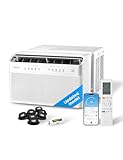
| Midea U-Shape 8000 BTU |
|
Check Latest Price |
 hykolity 8000 BTU WiFi hykolity 8000 BTU WiFi |
|
Check Latest Price |
 LG 8000 BTU Window AC LG 8000 BTU Window AC |
|
Check Latest Price |
 Frigidaire 8000 BTU Window AC Frigidaire 8000 BTU Window AC |
|
Check Latest Price |
 GE 10000 BTU WiFi GE 10000 BTU WiFi |
|
Check Latest Price |
1. Frigidaire 5,000 BTU Window-Mounted Air Conditioner – Best Overall for Small Rooms
Frigidaire 5,000 BTU Window-Mounted Air Conditioner, Cools Up to 150 Sq. Ft., Quiet Operation, Effortless Temperature Control, 2 Fan Speeds, Auto Restart, White
5000 BTU,150 sq ft
52 dB
450W
SEER 11
Auto Restart
Washable filter
Pros
- Quietest published figure among the 5000 BTU picks from a major brand
- 17656 reviews give real long-term data
- Two fan speeds with a washable filter
- Auto Restart after an outage
- 78 inch cord with adjustable side panels
Cons
- No remote control
- 150 sq ft ceiling
- No sleep or energy saving mode
This is the model we keep coming back to because the review volume is extraordinary. At 4.3 stars across more than 17,000 ratings, it has enough long-run history to tell you how it behaves after three summers, not just after three weeks. Roughly seven out of ten ratings are five stars.
The Frigidaire FFRA051WAE runs a rotary scroll compressor at 450 watts and pulls 52 dB on its published spec, among the lowest figures for the 5,000 BTU machines in this group. That number sits below a quiet refrigerator hum and well under a bedside fan, which is why it works in a bedroom or a home office where a louder machine would be unusable overnight. If you want a direct comparison, our bedroom-focused roundup goes deeper on sleep use.
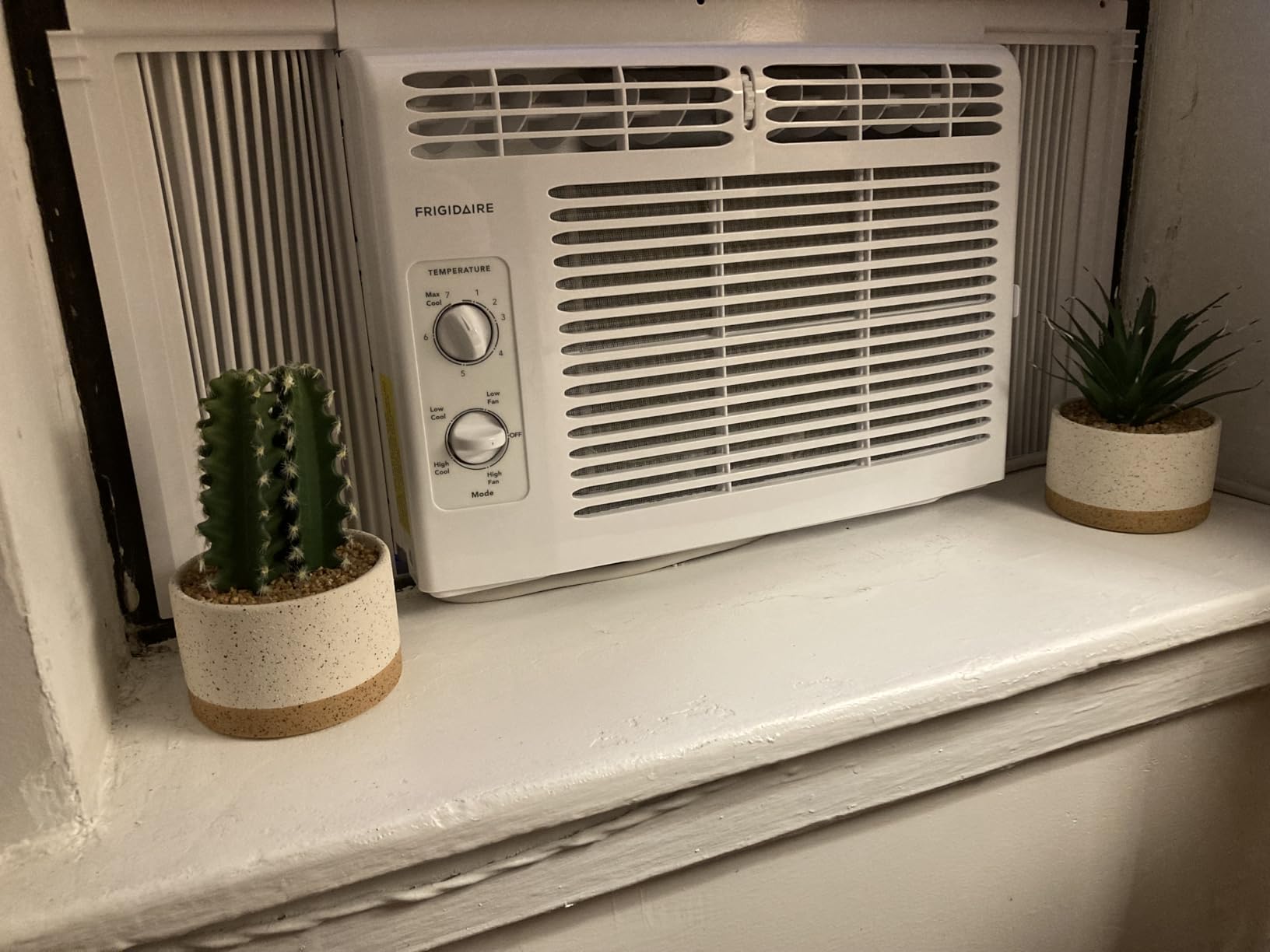
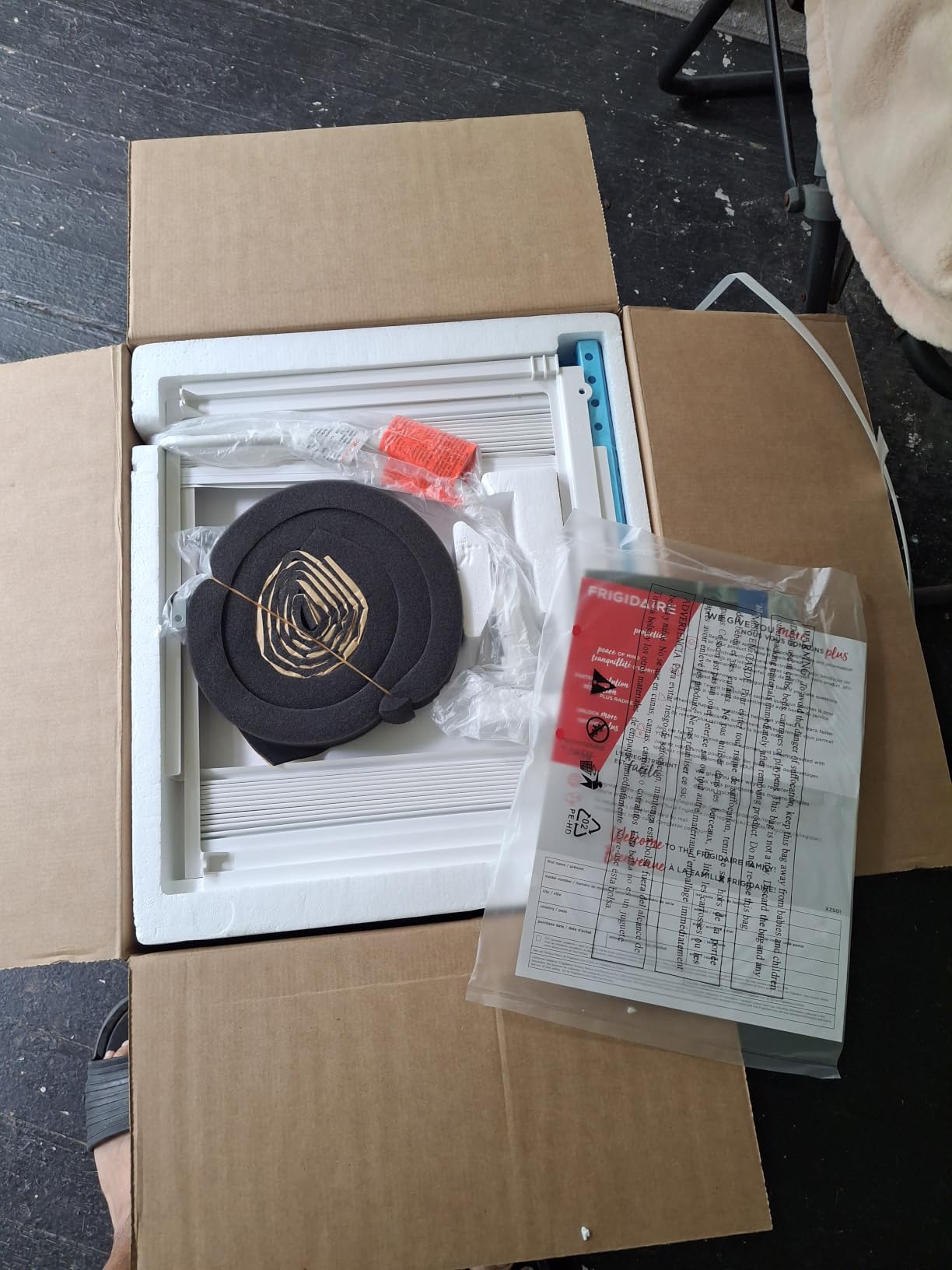
The physical design is deliberately plain. White plastic, a touch control panel, a washable mesh filter, and a 78 inch three-prong cord that reaches most wall outlets without an extension. The window opening needs to be at least 23 inches wide and 13 inches high, with a maximum width of about 36 inches, and the adjustable side panels fill the gaps on either side.
Two fan speeds give you low and high, and the temperature control holds its set point rather than hunting. Auto Restart restores whatever settings you had running after a power outage, which matters if you are away during a storm. The unit measures 15.25 inches deep by 16 inches wide by 21 inches high and weighs 35.3 pounds, so one person with a screwdriver can get it into a first-floor window.
Is this the quietest model in the roundup?
No. The Midea U-shaped model below publishes a 32 dB figure, which is roughly ten times quieter than a traditional rectangular design. What makes the Frigidaire the pick here is that its 52 dB is already low, and its review history confirms the noise claim holds up outside a test lab.
Where the Frigidaire falls short
There is no remote, no sleep mode, and no energy saving mode, so every adjustment happens at the panel on the unit itself. The 5,000 BTU capacity is genuinely limited to about 150 sq. ft., and a sunny west-facing room will outrun it on a July afternoon.
2. Midea 5,000 BTU EasyCool Window Air Conditioner – Top Rated
Midea 5,000 BTU EasyCool Small Window Air Conditioner – Cool up to 150 Sq. Ft. with Easy-to-Use Mechanical Controls and Reusable Filter, Perfect for Small Bedroom, Living Room, Home Office
5000 BTU,150 sq ft
57 dB
450W
SEER 11.0
7 temp settings
Bracket incl.
Pros
- Highest rated model in the group at 4.4 stars
- 12198 reviews and the top seller in the category
- Seven temperature settings with two cooling speeds
- Two-way air direction for targeted cooling
- CEER 11.0
- Light enough for a one-person install
Cons
- No remote or thermostat
- Audible on low settings
- Plastic shell can crack if dropped
- 150 sq ft limit
At 4.4 stars across more than 12,000 ratings, this is the highest-rated model in the roundup with a deep review history behind it, and it sits at the entry end of the price range. Reviewers repeatedly say it cools faster than the same-BTU machines from bigger-name brands, which matches the 450 watt draw and the CEER 11.0 rating on the spec sheet.
Seven temperature settings give you far more control than the two-position sliders on most entry models, and two-way air direction lets you aim the louvres toward the bed or the desk rather than straight down. Airflow efficiency is listed at 145 CFM per watt, and the removable filter rinses out under a tap in seconds.
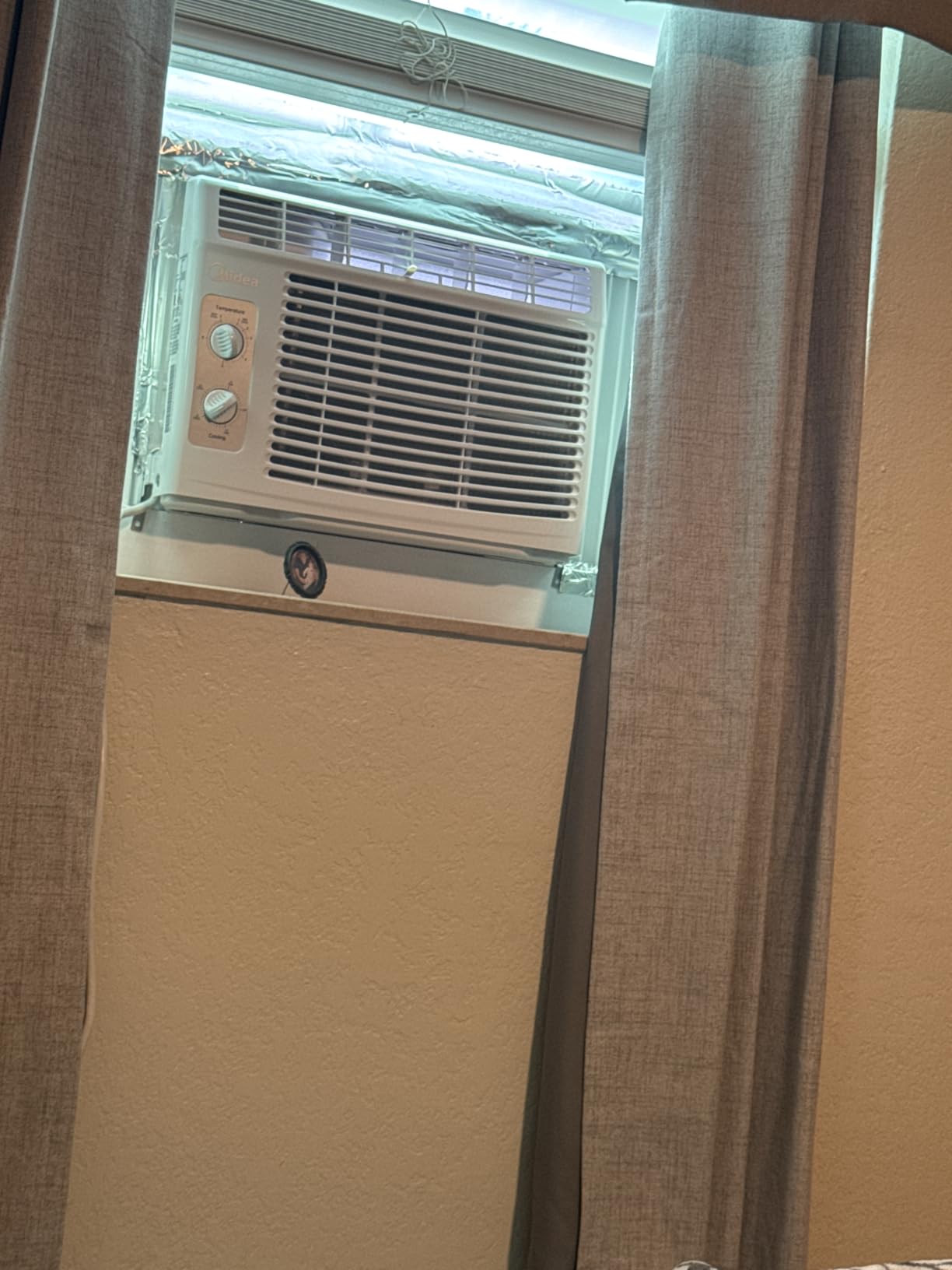
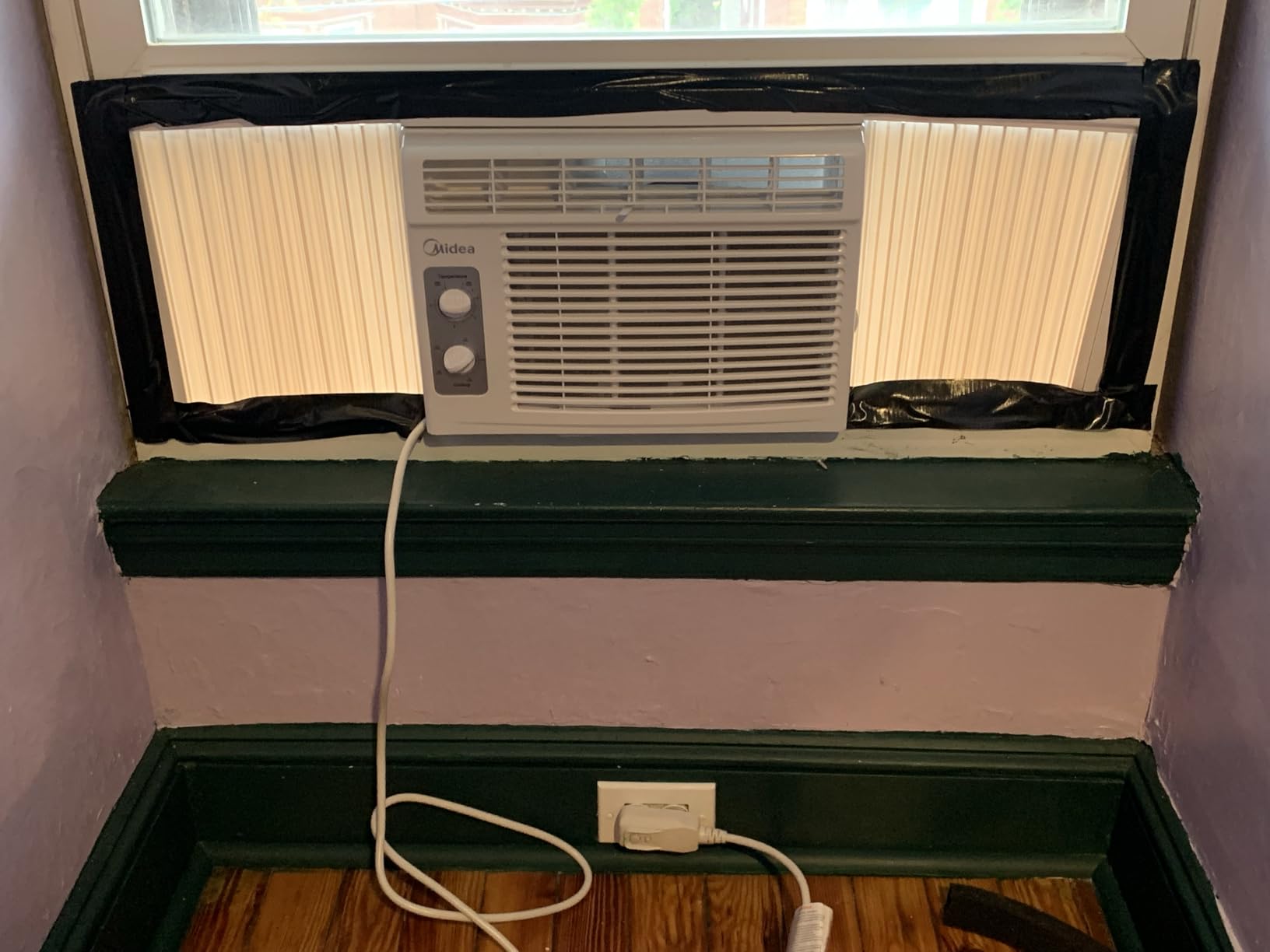
Installation is the easiest here. The window opening runs from 23 inches wide to 26 inches wide with a minimum height of 13 inches, the copper core resists corrosion better than the aluminium alloy used in some rivals, and a window bracket is included in the box. At 35.3 pounds, most people can lift it into place unaided.
The reviews also name the failures honestly. The most repeated complaint is the absence of a remote and a true thermostat, which leaves you adjusting at the panel, and several owners mention audible noise on the low setting even though the 57 dB figure sounds high on paper.
Is this better than the Frigidaire for a bedroom?
It cools hard for the wattage and has finer temperature control, so for a home office where you sit at a desk all day it is the stronger machine. For an overnight bedroom, the Frigidaire publishes the quieter figure at 52 dB against 57 dB, and that five-decibel gap is the difference between noticeable and background.
Where the Midea falls short
Without a remote, a thermostat, or any timer, you cannot schedule it or adjust it from bed. The all-plastic cabinet is light but fragile, and 5,000 BTU is the smallest capacity tier, so it covers bedrooms and small offices rather than living spaces.
3. GE 5,000 BTU Window Air Conditioner – Lowest Power Draw in the Group
GE Window Air Conditioner 5,000 BTU AC Unit for Small Spaces up to 150 sq ft with Manual Controls & 2 Cooling Modes, Easy Install Kit, White
5000 BTU,150 sq ft
52 dB low and 56 dB high
440W
SEER 11
EZ Mount kit
Pros
- Lowest wattage in the roundup at 440W
- Compact 16.36 inch chassis suits tight windows
- Ten mechanical temperature settings with no electronic beeps
- No manual draining in normal conditions
- Auto restart after outages
Cons
- Lowest average rating here at 3.8 stars
- Analog thermostat reads inaccurately in hot rooms
- No timer or sleep mode
- Some units degrade within weeks
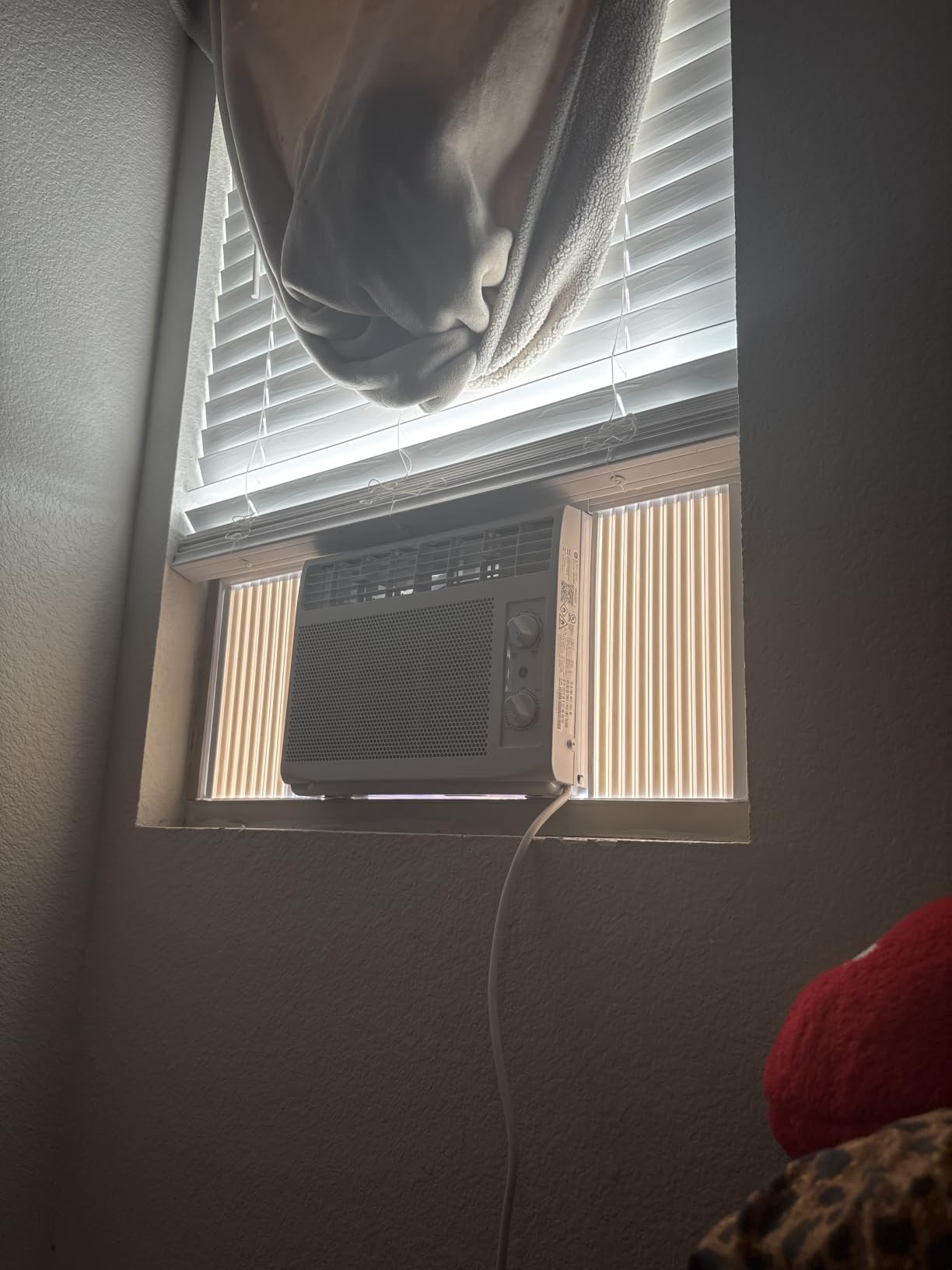
The GE AWAS05BWA looks like the sensible pick on paper. It draws 440 watts, the lowest figure in this group, and the EZ Mount kit in the box includes foam insulation to seal the gap around the chassis. Owners do confirm that it cools a small room effectively and runs quietly.
Our reservation is the customer data. At 3.8 stars across 1,973 ratings, it is the weakest average score here, with about 19 percent of ratings landing at one star. The recurring theme in those reviews is not cooling failure but control failure: the analog thermostat stops reading indoor temperature accurately, settings stop responding, and the unit resets itself.
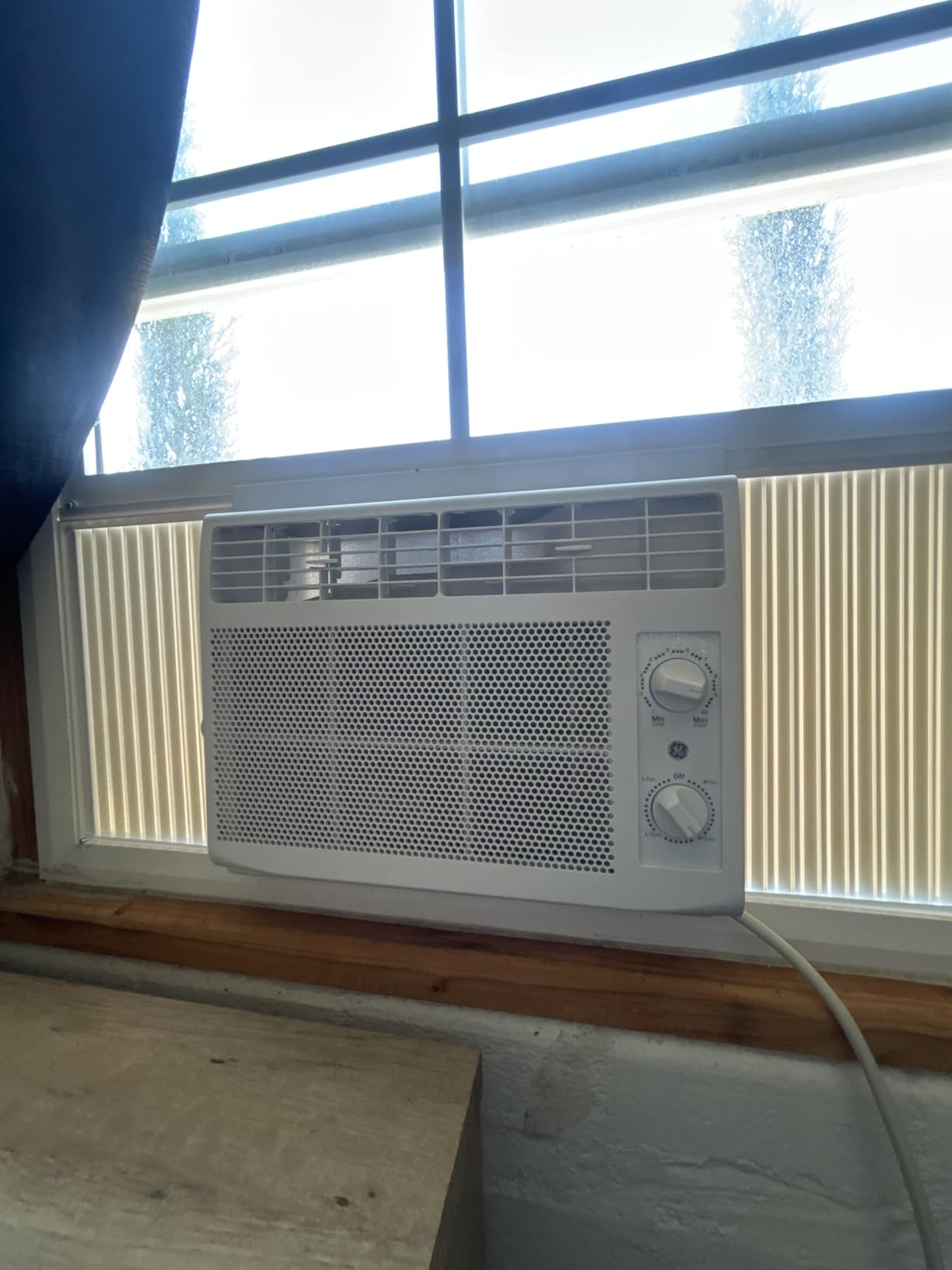
Fan speed is the other complaint. Owners report that the low and high settings sound nearly identical, which makes the two-speed design feel like one speed. Two cooling modes are published at 52 dBA low and 56 dBA high, which is respectable if the speeds actually differ on your unit.
Physical specs are tidy: 36.5 pounds, 15 inches deep by 16.36 inches wide by 12.56 inches high, washable filter, and a double-hung window fit from 27.13 to 36 inches wide. The slightly narrow minimum width rules out some older sashes, so measure before you commit.
Is the low power draw worth the weaker reviews?
If your summer energy bill is the deciding factor, the 440 watt rating is the best number in this roundup and roughly 10 watts below the other 5,000 BTU models. Over a full season that gap is small in dollar terms, and the control complaints are the part buyers actually live with. We would take the Frigidaire or the Midea instead unless the draw is your top priority.
Where the GE falls short
There is no remote, no timer, and no sleep mode, so all control happens on the mechanical panel. The thermostat inaccuracy in hot weather is the most common complaint, and with the lowest average rating in the group we would expect some early units to disappoint.
4. DELLA 5,000 BTU Window Air Conditioner – Smallest Footprint Option
DELLA Window Air Conditioner, 5000 BTU, Reusable Filter, Cools Up To 150 Sq. Ft,Energy Saving AC Unit with Easy to Use Mechanical Control,Easy Install Kit,Efficient Cooling For Smaller Areas
5000 BTU,150 sq ft
51-55 dB
460W
CEER 11.0
UL Listed
Install kit
Pros
- Lowest published noise figure among the 5000 BTU models at 51 dB
- Compact chassis needs no window modifications
- CEER 11.0 with a 341 kWh annual consumption figure
- Rotary switch controls are simple and tactile
- Reusable filter and full install kit in the box
Cons
- Only 465 ratings to judge it by
- Reviews of the brand report fan rattle and compressor noise
- No remote or smart features on this variant
- Listed quiet figure does not match every owner report
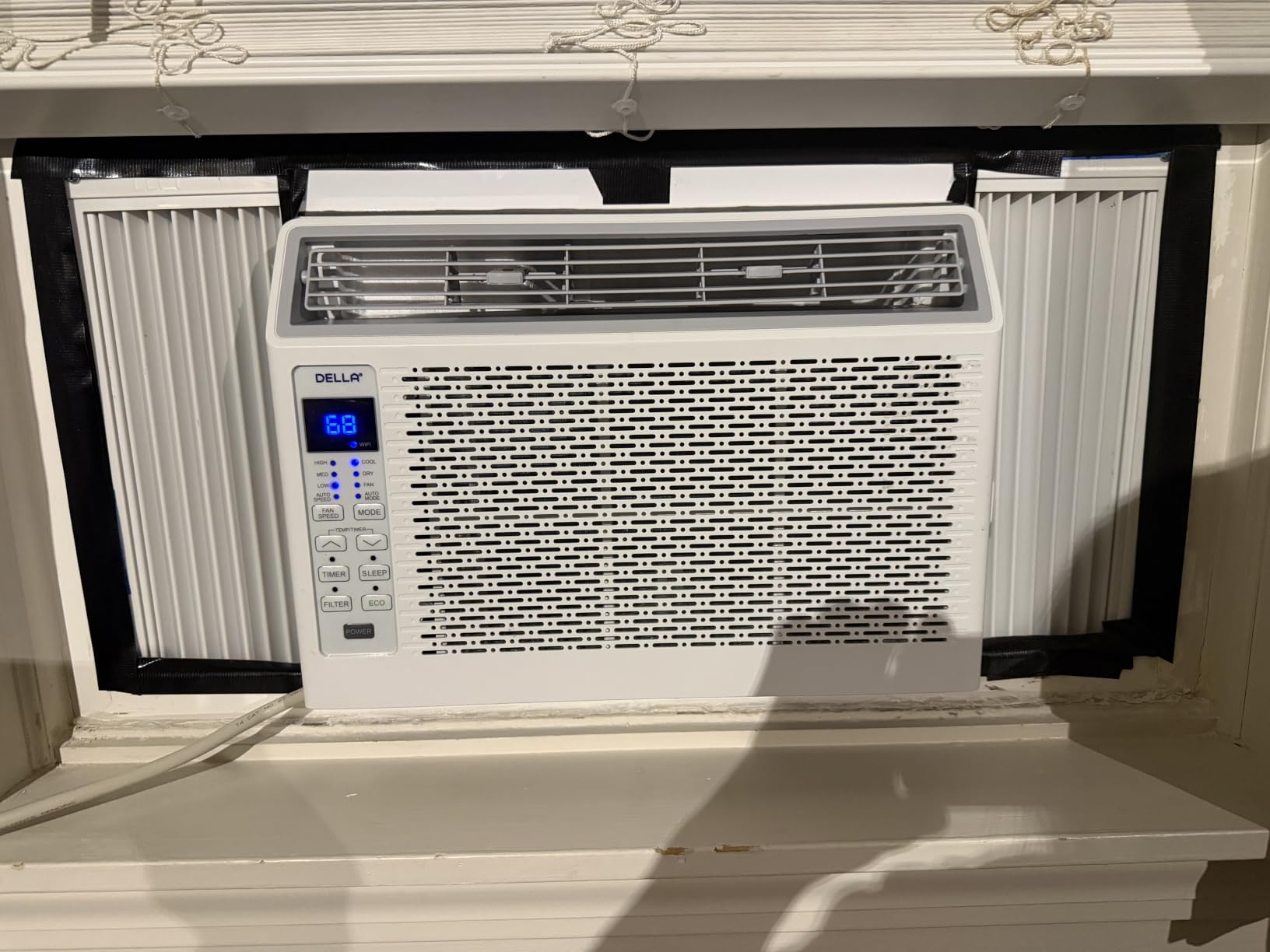
This model is interesting mostly for its dimensions. At 13.66 inches deep by 15.98 inches wide by 12 inches high, it is the smallest chassis here, which means it drops into narrow vintage sashes without any window modification. It needs an opening 23 to 34 inches wide with a minimum height of 14.5 inches.
The published noise figure of 51 dB is the lowest among the 5,000 BTU picks, and the 341 kWh annual consumption figure is the smallest published number in the roundup alongside a CEER of 11.0. Indoor cooling runs from 61F to 88F with two fan-only speeds and manual horizontal swing, on 115V at 460 watts.
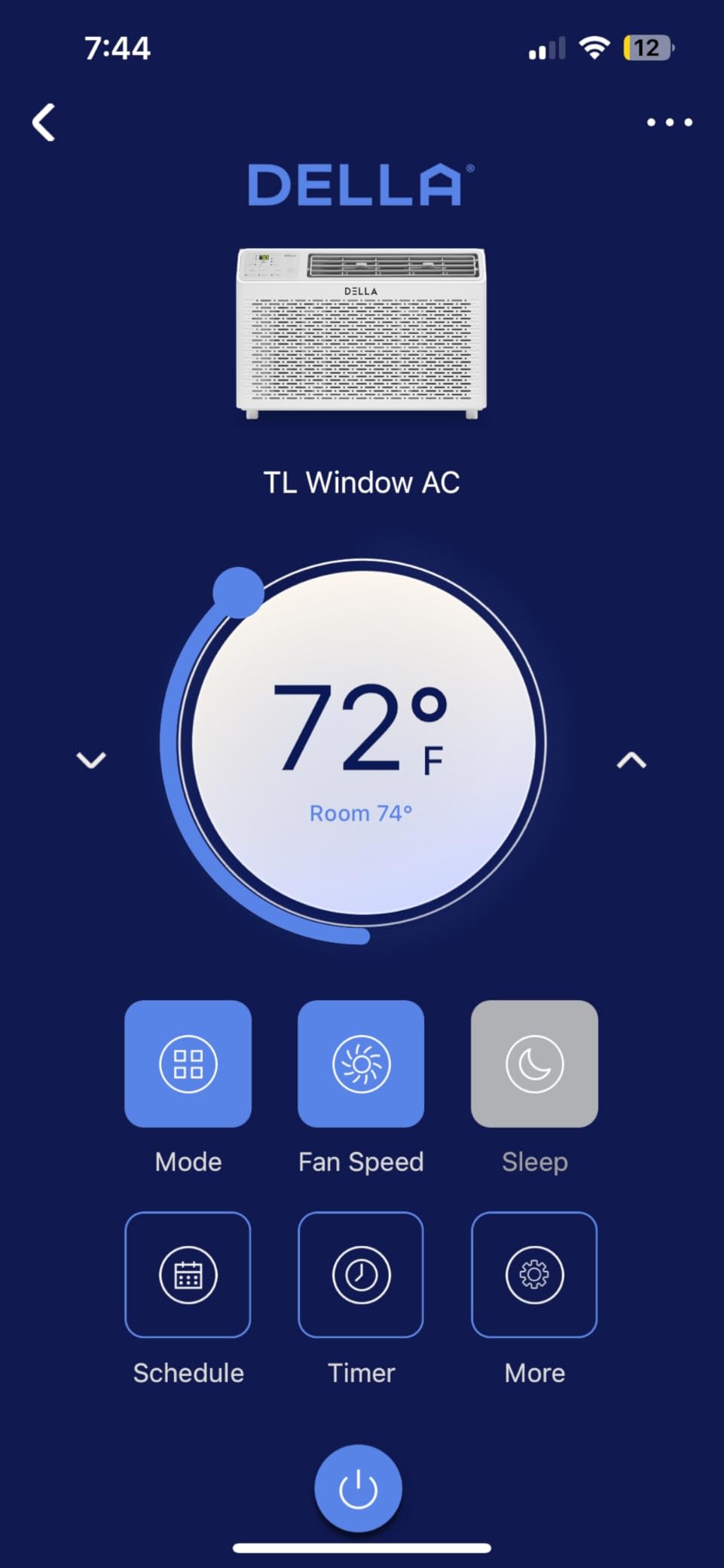
Here is the catch. Only 465 ratings back this listing, so the long-term reliability picture is thin, and several reviews filed against the brand describe heavy fan noise and compressor rattling that does not match the spec sheet. Owners of the mechanical version are generally positive about cooling small rooms, but the quiet claim is inconsistent across the product line.
With 465 ratings at a 4.0 average, this is the thinnest evidence base among the small models, and that is exactly why we placed it fourth rather than higher despite the attractive noise figure.
Is a 465-review model worth the risk?
For a bedroom where you will run it on low overnight, the tiny footprint and the published 51 dB figure make it worth a look, since it is the only unit here that fits a very tight window without trimming. If you want the spec sheet to be the last word, pick a model with thousands of ratings behind it.
Where the DELLA falls short
There is no remote, no app, and no timer on this mechanical variant. The reported rattle and the gap between the listed 51 dB and what owners hear are the two things to weigh before buying.
5. Senville 6,000 BTU Window Air Conditioner – Best 6,000 BTU Coverage
Senville Window Air Conditioner, Cools Up to 250 Sq Ft, 6000 BTU
6000 BTU,250 sq ft
56 dB
700W
SEER 16
Remote included
Washable filter
Pros
- Highest average rating in the roundup at 4.5 stars
- 250 sq ft coverage from a 0.5 ton machine
- Remote control at this tier is unusual
- SEER 16 is the highest listed figure here
- Washable reusable filter
Cons
- Only 140 ratings so long-term durability is unproven
- 700W draws more than either 5000 BTU model
- Narrow window width requirement near 18.5 inches
- 1 year manufacturer warranty
The 6,000 BTU tier is the awkward middle of the market, and the Senville SENVWAC-06CMN06 fills it well. It cools up to 250 sq. ft. from a 0.5 ton machine, the largest room any sub-6,000 BTU unit here covers, and it includes a remote control that most models at this tier omit.
The published SEER of 16 is the highest efficiency figure in this group, though that number is the manufacturer seasonal rating rather than the CEER used on the other models. On noise it lists 56 dB, and the washable reusable filter keeps upkeep to a rinse under the tap.
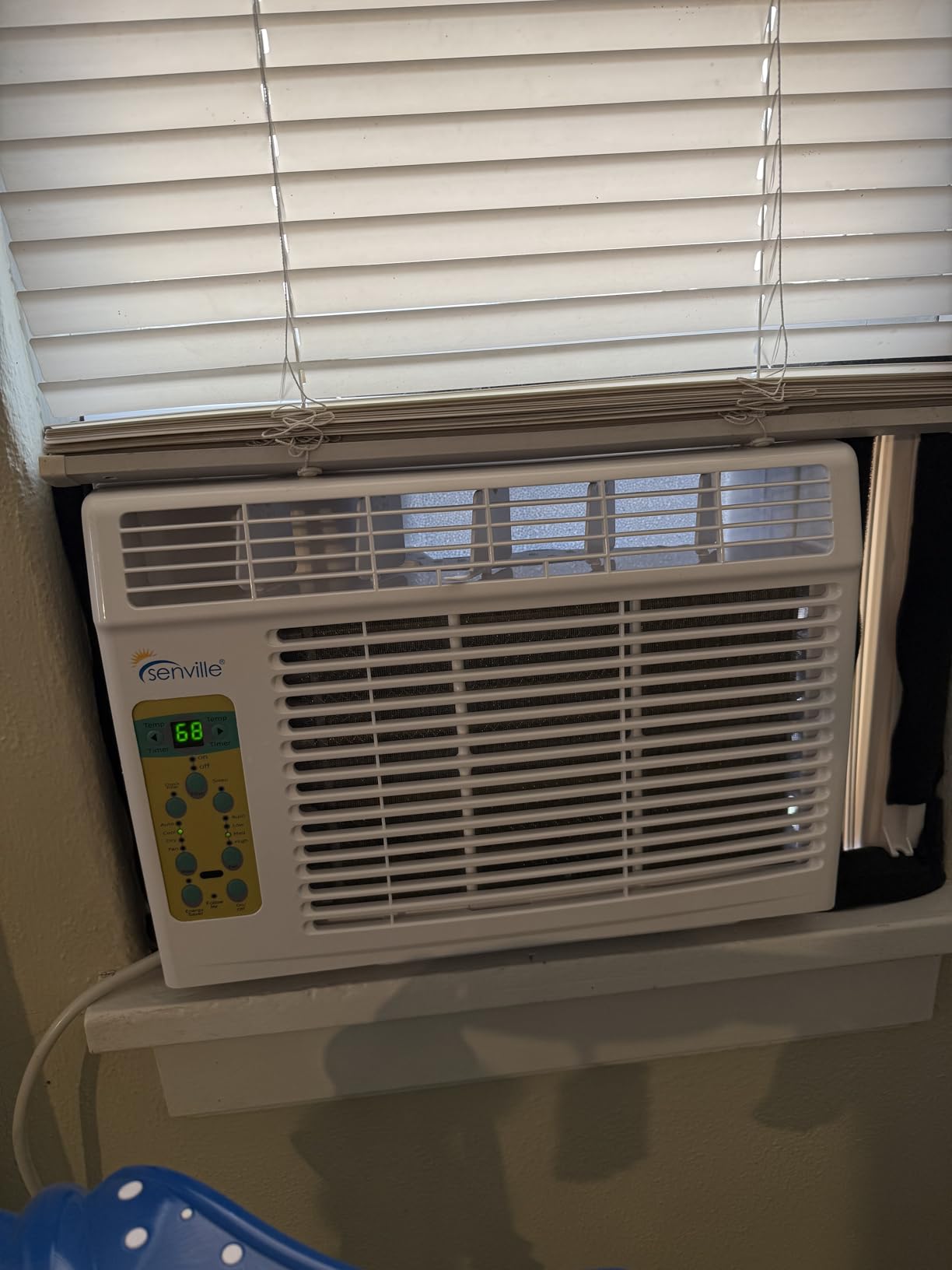
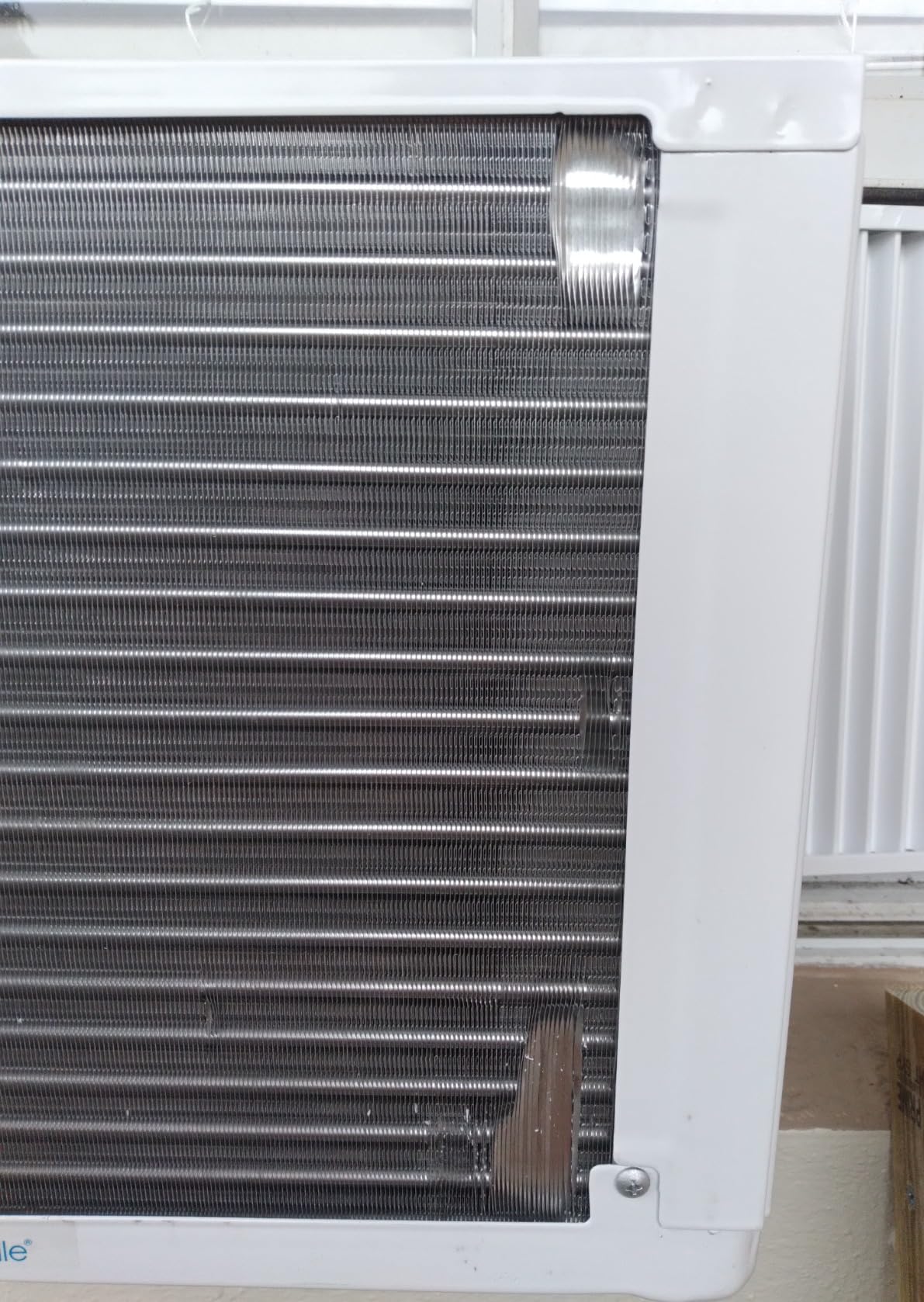
Buyers like the cooling for the room size, the remote, and how easily it drops into place. The problem is the sample size. At 140 ratings and a 4.5 average, the data is too young to say anything about how the compressor holds up after four or five summers, and most owners bought it recently.
Two practical details matter before you commit. The window opening requirement is narrow, around 18.54 inches wide with a height between 13 and 24 inches, so it will not fit the wide sashes most other models here do. And at 700 watts, it draws more than either of the 5,000 BTU models.
Is it worth buying a model with only 140 ratings?
It is worth it if you need 250 sq. ft. of cooling and a remote at the same time, because no other model here delivers both in this capacity range. If a large review history matters more to you, the LG and Frigidaire 8,000 BTU models below have hundreds of ratings and more cooling headroom.
Where the Senville falls short
There is no app control, no sleep or eco mode, and only a 1 year manufacturer warranty. The narrow 18.54 inch window requirement rules out many standard double-hung sashes, and the 700 watt draw is high for a machine this small.
6. Midea 8,000 BTU U-Shaped Smart Inverter Window AC – Best Value
Midea 8,000 BTU U-Shaped Smart Inverter Window AC, Cools 350 Sq Ft, Ultra Quiet, Alexa/Google Compatible, 37% Energy Savings
8000 BTU,350 sq ft
32 dB
710W
SEER 15
ENERGY STAR
Wi-Fi and voice
Pros
- Quietest model in the roundup at 32 dBA
- DC inverter compressor with over 37 percent energy savings
- First window air conditioner to earn ENERGY STAR certification
- Wi-Fi plus app
- remote
- and Alexa or Google Assistant
- Window stays open for fresh air
Cons
- Heaviest unit for its cooling capacity at 55.6 pounds
- 14 percent one-star reviews around installation and app pairing
- Needs at least a 22 inch wide window opening
This is the only model in the roundup with an inverter compressor, and it changes what you can hear. The published 32 dBA figure is the lowest here by a wide margin, quieter than a quiet office, which is why people who run it overnight rarely mention it in their reviews at all.
The U-shaped chassis is the physical reason for the quiet operation and the efficiency. Instead of stretching accordion side panels to fill a wide window, the unit keeps its depth front to back and leaves the sash mostly closed, so less outdoor heat leaks in through gaps and the compressor does less work. That is also why the window can stay cracked open for fresh air while the unit runs.
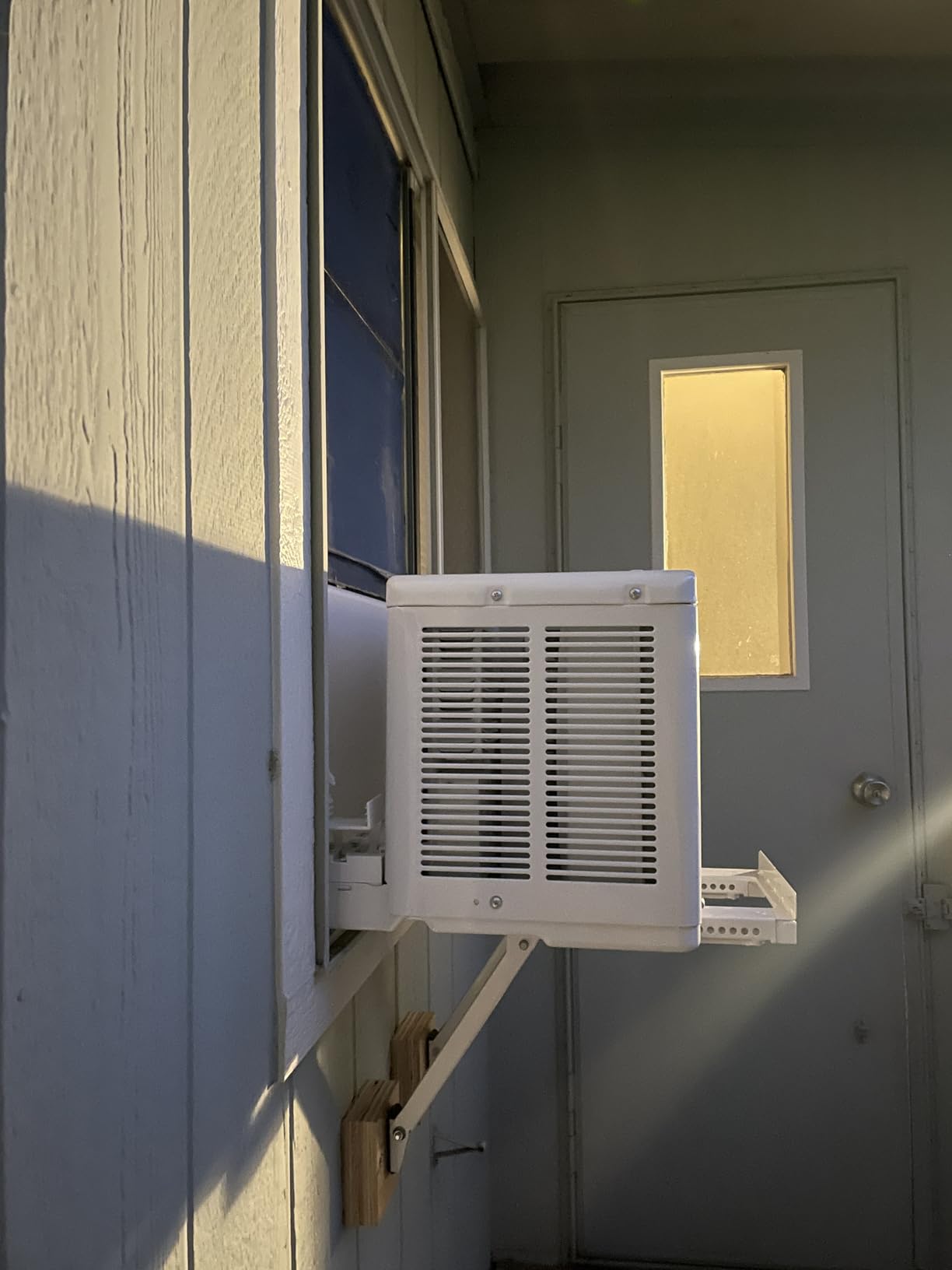
It is the first window air conditioner to receive ENERGY STAR certification, and the DC inverter compressor delivers over 35 percent energy savings against a conventional fixed-speed machine. Control comes through Wi-Fi and the Midea app, a remote, and voice assistants. Roomside airflow is listed at 215 CFM high and 150 CFM low, and annual energy consumption is published at 1700 kWh.
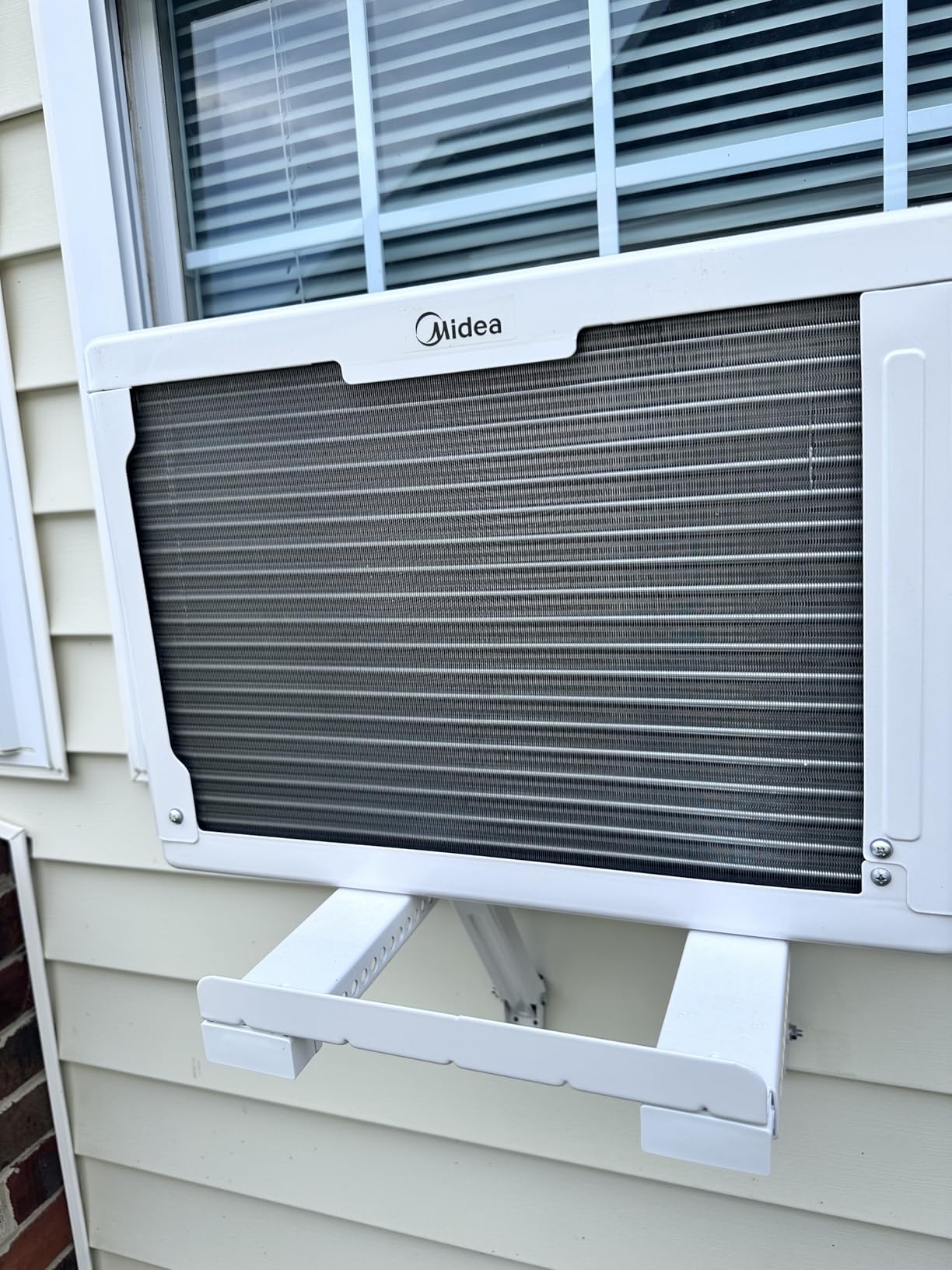
The negatives are physical and setup related. At 55.6 pounds it is heavy for its 8,000 BTU capacity, and the cabinet is nearly 22 inches wide, the widest of the ten. About 14 percent of ratings are one star, focused on units arriving bent or failing to fit a standard window and on app pairing being fiddly. If you need a large-room option, our large room roundup covers the higher capacity tiers.
Why are window air conditioners so loud?
Three things drive the noise: compressor type, fan speed, and how much outdoor air leaks around the chassis. Inverter compressors step up and down gradually instead of switching on full blast, and a deep U-shaped cabinet seals the window rather than leaving gaps. A conventional unit fighting heat that leaks in through its side panels simply runs its compressor harder and louder.
Who should skip this model
Skip it if your window opening is narrower than 22 inches, if you cannot get a second person to help lift 55.6 pounds into a second-floor window, or if you dislike the app setup. The quick-snap bracket fits single-hung and double-hung windows from 22 to 36 inches wide, but the weight still argues for a support brace.
7. hykolity 8,000 BTU WiFi Window Air Conditioner – Best App-Controlled Value
8,000 BTU WiFi Window Air Conditioner, Smart Window AC Unit with Remote, Energy Saving, Easy Install Kit, Cools up to 350 Square Feet
8000 BTU,350 sq ft
CEER 11.0
SmartLife app
3 fan speeds
0.5-24 hr timer
Pros
- App
- remote
- and touch control in one package
- Eco Mode and Sleep Mode with a 0.5 to 24 hour timer
- Three fan speeds plus four operating modes
- Buyers report strong cooling in 240 to 400 sq. ft. rooms
- Drops into standard double-hung windows with the included kit
Cons
- 14 percent one-star reviews including units that stopped cooling within days
- Reported weight over 60 pounds needs two people
- Fan speeds sound similar and the unit cycles roughly every 15 minutes
- Controls and app take time to learn
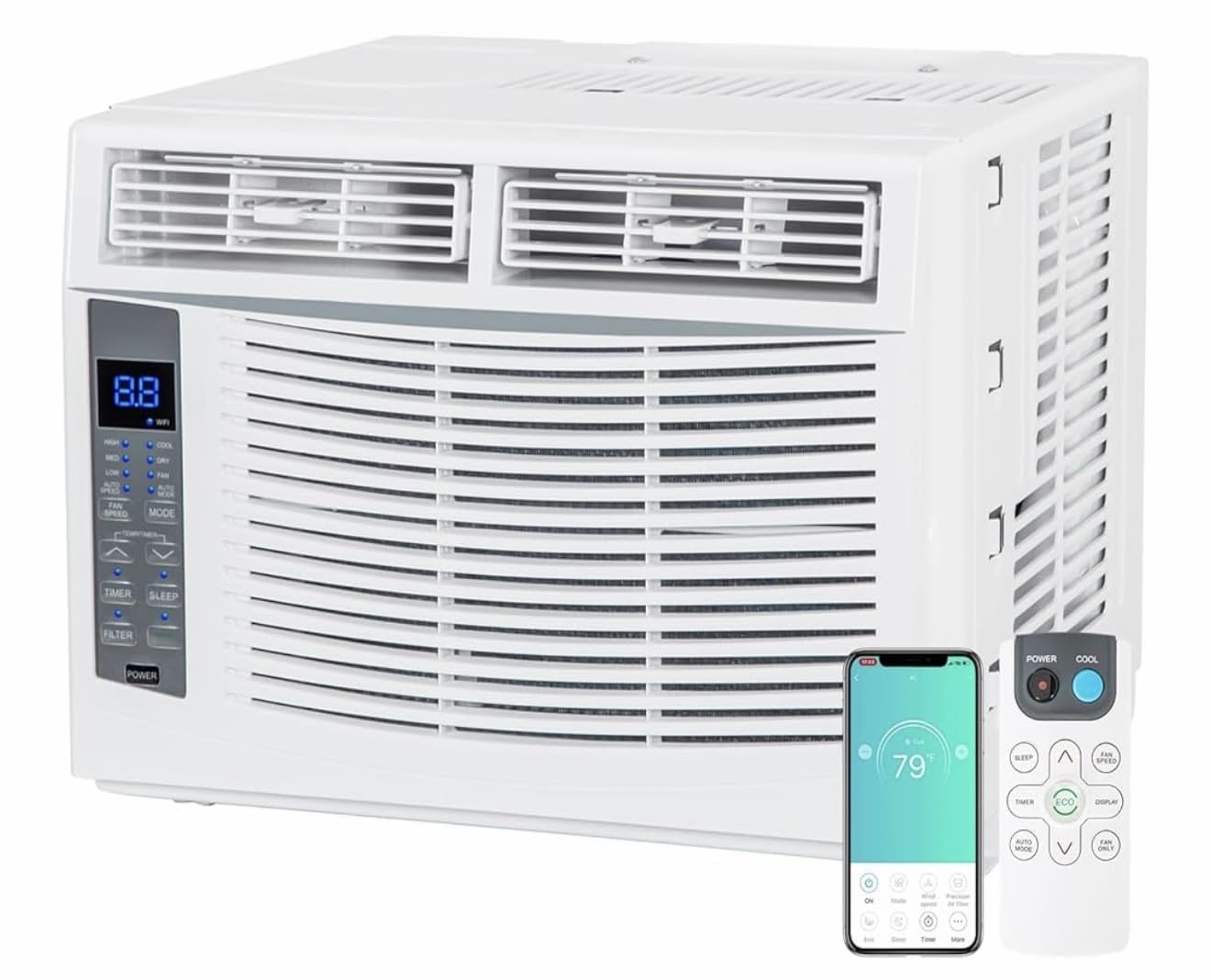
The hykolity ACB-2608 does something the branded smart models charge far more for: app control, a remote, and a full timer at a mid-range price. It cools up to 350 sq. ft. and runs four modes, including cooling, dry, fan, and auto, with three fan speeds that adjust automatically.
Control runs through the SmartLife app, a remote, and a touch panel. The programmable timer can be set anywhere from half an hour to 24 hours, and Eco Mode and Sleep Mode both cut power once the room settles, on a CEER 11.0 rating. Buyers report strong cooling in rooms between 240 and 400 sq. ft.
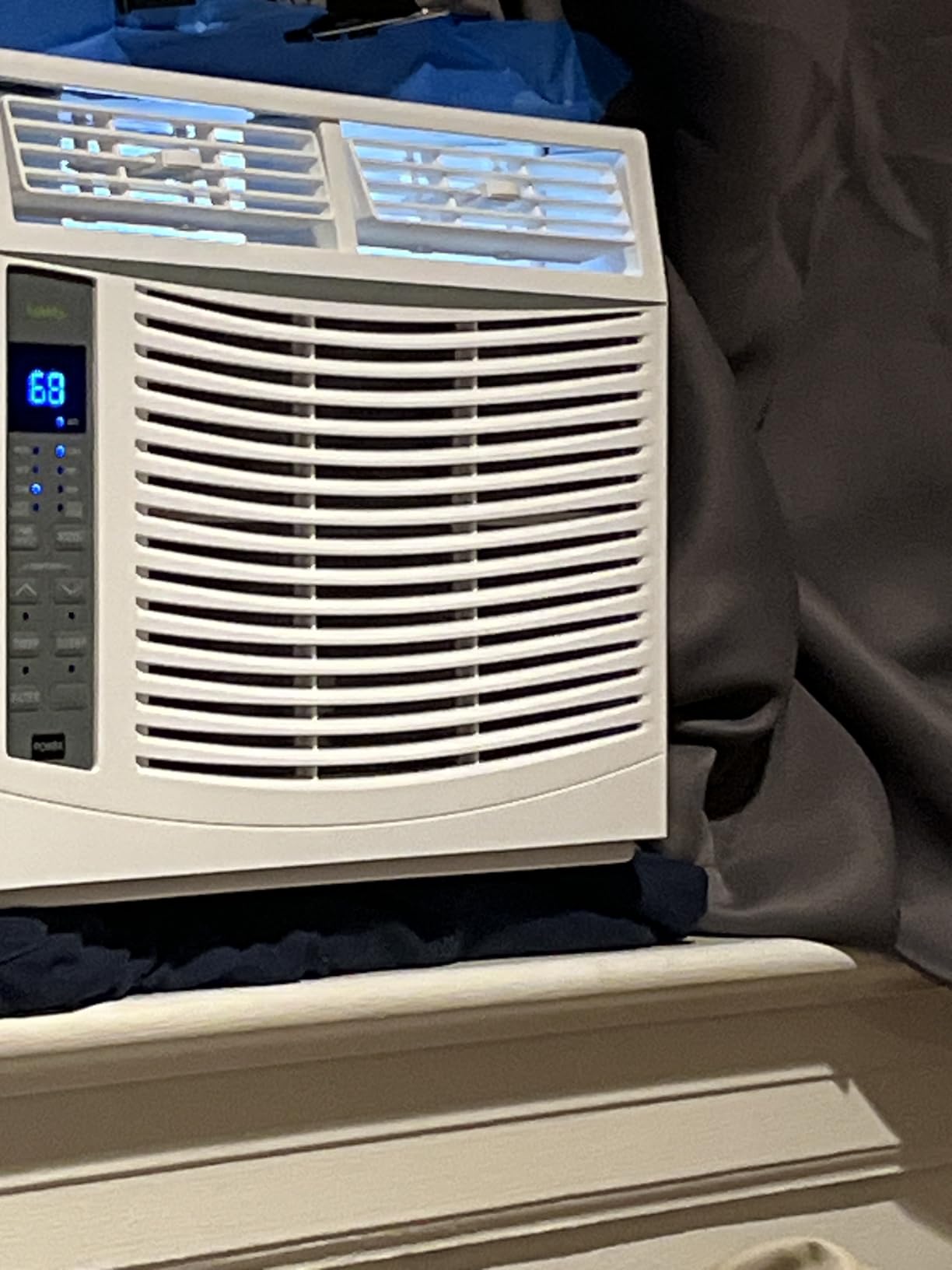
The catch is build and durability. The larger cabinets of this model are reported at over 60 pounds, which means two people for a second-floor install, and 14 percent of ratings are one star, with some owners reporting machines that stopped cooling within a day or two. The compressor also cycles on and off roughly every 15 minutes once the room reaches set point, which some people find annoying and others barely notice.
Controls and app take a little getting used to, and the fan speeds sound closer to each other than the labels suggest. The window opening needs 23 to 36 inches wide with a minimum height of 14.5 inches, and an install kit is included.
Is a smart window air conditioner worth the premium?
App control earns its place when you want to start cooling before you get home or shut the room down when you leave. It earns less when you sit in the room all day, because a remote does the same job. This model proves the feature does not require a premium price, which is the main reason it makes our list.
Where the hykolity falls short
The early-failure cluster in the reviews is the main concern, along with a reported weight above 60 pounds and a compressor duty cycle some owners find noisy. If you want a proven brand name and a large review history for the same capacity, the LG model below is the steadier choice.
8. LG 8,000 BTU Window Air Conditioner – Best for Extreme Heat
LG 8,000 Window Air Conditioner, 115V, 350 Sq.Ft. (14′ x 25′ Room Size), Quiet Operation, Electronic Control with Remote, 3 Cooling & Fan Speeds, Auto Restart, 8000 BTU, White
8000 BTU,350 sq ft
53 dB low mode
660W
220 CFM per watt
Remote
Pros
- Remote with electronic controls and three cooling speeds
- 53 dB in low mode keeps a 350 sq. ft. room sleepable
- Auto Restart and Auto Cool for unattended use
- Owners report it holds larger spaces cool in 95 to 100F heat
- Airflow efficiency of 220 CFM per watt is the best here
Cons
- 57 pounds is heavy for an upper floor window and needs a brace
- Filter reminder light can stay on and distract
- Instructions are unclear
- Occasional shipping damage to the cabinet
The LG LW8024RD is the pick we would send to a house that stays hot all afternoon. Owners report it holding large, sunlit spaces cool in 95 to 100F heat, well past its rated 350 sq. ft., and the 220 CFM per watt airflow efficiency is the highest figure in this roundup. That air mover is what makes the 660 watt draw feel effective.
At 4.3 stars across 402 ratings, LG is the steadiest brand name here, and buyers in the reviews mention purchasing it repeatedly for rental properties. Electronic controls come with a full-function remote, three cooling and fan speeds, Auto Cool mode, and Auto Restart after an outage. A filter light reminder signals when the washable filter needs cleaning.
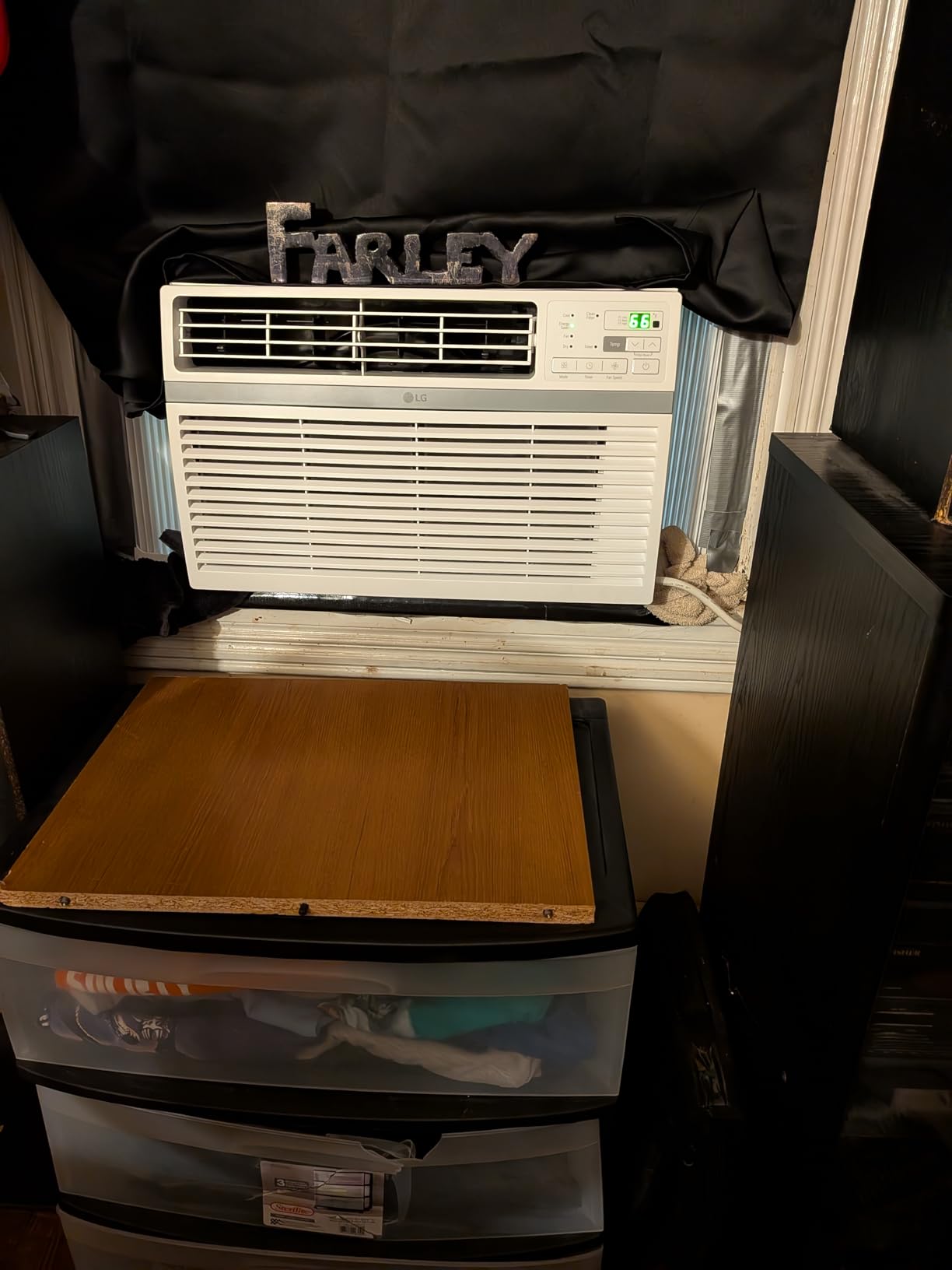
Noise is published at 54 dB, dropping to 53 dB in low mode, which keeps a 350 sq. ft. bedroom usable for sleep. Note that 53 dB is well above the Midea U-shaped unit, so if quietness is your first priority rather than raw cooling in heat, that model ranks higher.
The physical complaints are the ones to plan around. At 57 pounds it is genuinely hard to hold in a window alone, and a support brace is advisable on anything above ground level. Owners also mention a filter reminder light that stays on after cleaning, unclear instructions, and occasional cabinets arriving dented or warped from shipping.
Is LG or Frigidaire the better window air conditioner?
They are close, and the deciding factor is capacity and airflow rather than brand. LG publishes the better airflow number here at 220 CFM per watt and earns praise for cooling in extreme heat, while Frigidaire offers more operating modes for the money. Frigidaire also carries a far larger review history on its small model.
Where the LG falls short
Weight is the big one at 57 pounds, followed by a filter light that stays on and instructions that reviewers find hard to follow. The 53 dB low mode is quiet enough for sleep but not the quietest option we list.
9. Frigidaire 8,000 BTU Window Air Conditioner with Remote – Best Feature Set for 350 Sq. Ft.
Frigidaire 8,000 BTU Window Air Conditioner with Remote Control, Cools Up to 350 Sq. Ft., Quiet Operation, Eco Mode, 3 Fan Speeds, Auto Restart, White
8000 BTU,350 sq ft
54 dB
714W
Eco Sleep Dry modes
24 hr timer
Pros
- Remote plus Eco Mode
- Sleep Mode
- and a 24 hour timer
- Six way directional airflow across three fan speeds
- Dry Mode dehumidification and a condensate tray that rarely fills
- Buyers report cooling 300 to 350 sq. ft. rooms in high heat
- Feature set usually found above this price band
Cons
- Lowest efficiency rating here at 10.9
- 714W is the heaviest draw in the 8000 BTU group
- Some rattle reports and a remote with no display
- Chassis is closer to 18 inches wide than the listed figure
Where the LG spends its money on airflow, the Frigidaire FHWC083TC1 spends it on modes. Eco Mode, Sleep Mode, Dry Mode for dehumidification, a 24-hour on and off timer, six-way directional airflow, and a Clean Filter alert are packed into the 8,000 BTU tier, which is unusual at this budget level.
At 4.3 stars across 195 ratings, reviews highlight the remote, the timer, and the ability to cool an entire small home when paired with a box fan. Reported performance includes 300 to 350 sq. ft. rooms in Arizona heat, and the condensate tray rarely fills thanks to the Dry Mode.
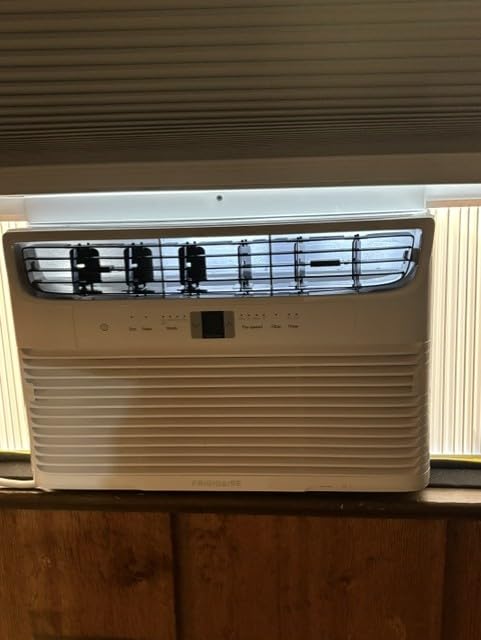
The trade-offs are efficiency and acoustics. It publishes the lowest efficiency rating in the roundup at 10.9, and its 714 watt draw is the heaviest among the 8,000 BTU models, so operating cost is the price of the feature set. Some owners also report rattling and a cheap-feeling remote with no display, which means walking over to check the current setting.
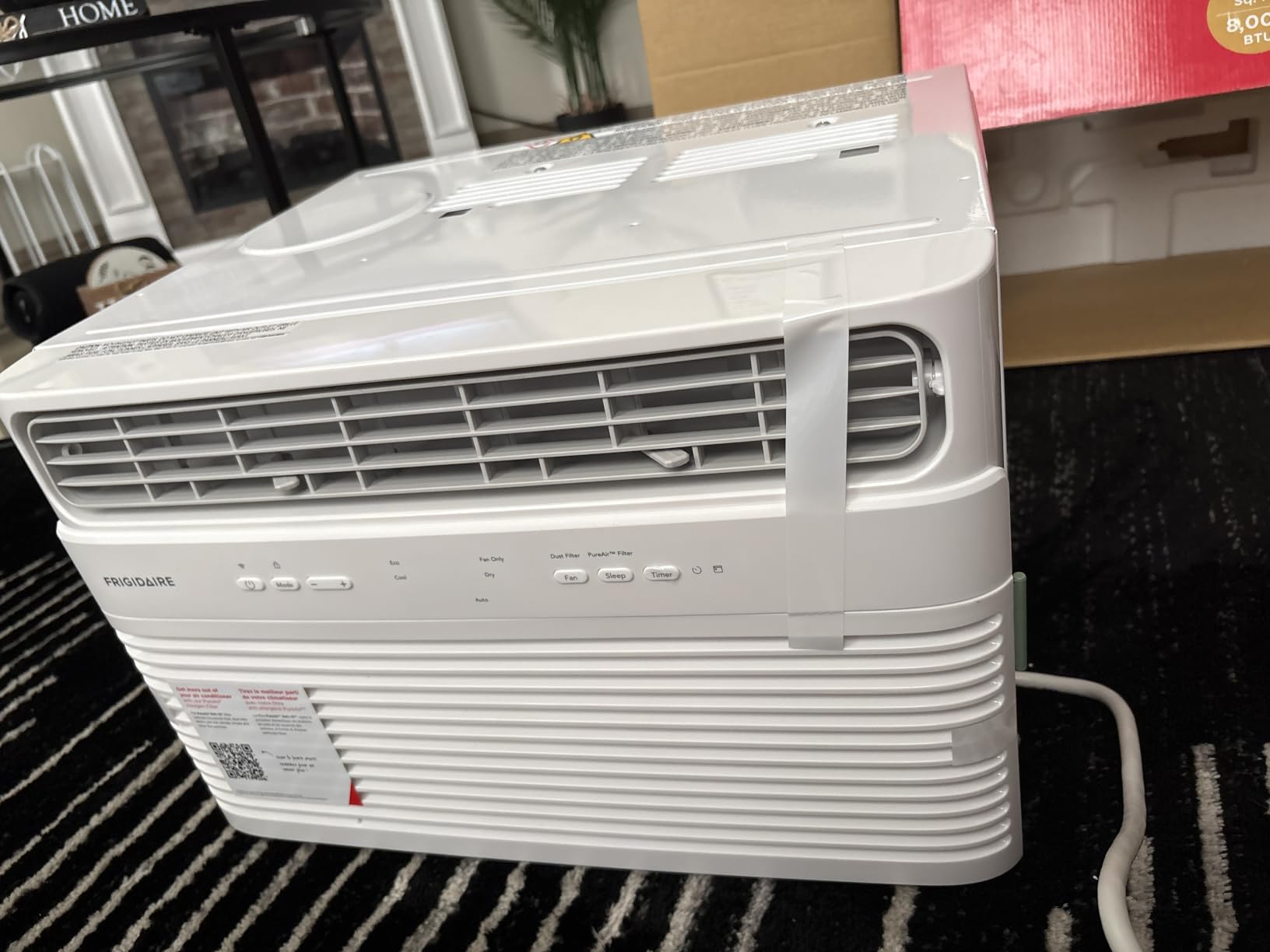
Measure carefully before ordering. The listed width is 15.8 inches, but owners report the cabinet is closer to 18 inches, and the window opening needs a minimum height of 14.4 inches with a maximum width of 36 inches. It weighs 45.4 pounds, noticeably lighter than the LG.
Is an older window air conditioner cheaper to run?
Usually not. An efficiency rating near 10.9 is the weakest in this roundup, which means more watt-hours for every hour of cooling, so a cheaper purchase usually costs more per season to operate. Inverters like the Midea U-shaped model change that math by ramping rather than cycling at full power.
Where the Frigidaire falls short
It has the weakest efficiency figure in the roundup and the highest draw in its capacity group, so the feature list is paid for at the socket. The display-free remote and some rattle complaints are the other recurring gripes.
10. GE 10,000 BTU WiFi Window Air Conditioner – Best for Large Rooms
GE Window Air Conditioner 10000 BTU, Wi-Fi Enabled, Energy-Efficient Cooling for Medium Rooms, 10K BTU Window AC Unit with Easy Install Kit, Control Using Remote or Smartphone App
10000 BTU,450 sq ft
63 dB
865W
SmartHQ app
Alexa and Google
Eco Mode
Pros
- Largest cooling capacity here at 10000 BTU for 450 sq. ft.
- SmartHQ app with Alexa and Google Assistant plus remote
- Eco Mode genuinely cycles the compressor and fan off
- Quieter than the older 12000 BTU models it replaces
- Slide out washable filter and an EZ Mount kit
Cons
- Highest power draw in the roundup at 865W and the loudest at 63 dB
- Listed efficiency of 2.6 is the weakest figure here
- Wi-Fi drops and the app reverts to a default set point
- Smart claims overstate support with no HomeKit or public API
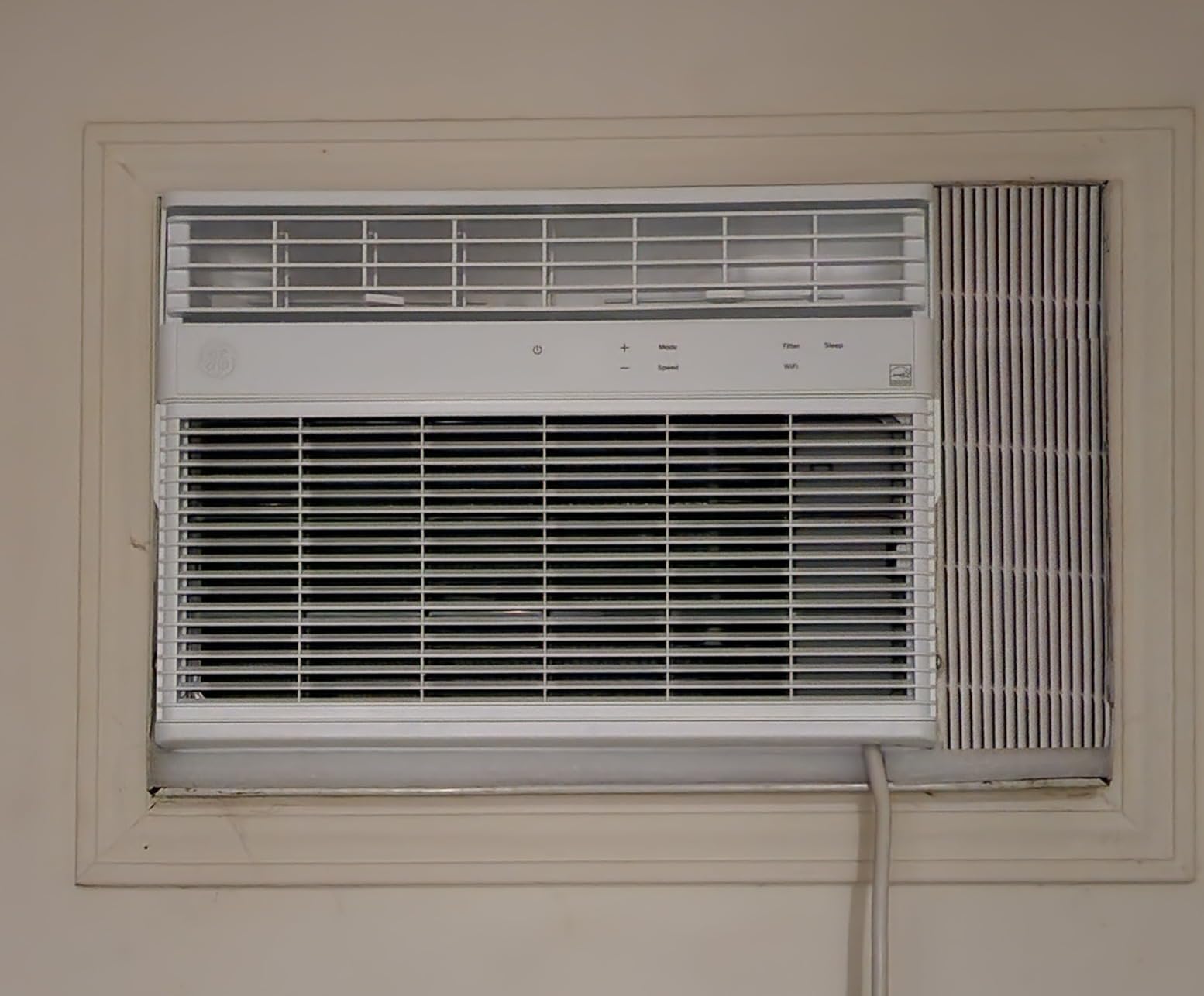
This GE AHEK10AC is the only 10,000 BTU model in the roundup and the natural choice for a 450 sq. ft. living space, an open-plan apartment, or a home office that doubles as a workspace. At 4.2 stars across 444 ratings, cooling power is the part owners praise most, and they also like that it runs quieter than the 12,000 BTU models it replaces.
Eco Mode is the feature worth knowing about, because it actually shuts the fan and compressor off once the room is cool rather than just cycling the fan. Three cooling modes and three fan speeds are on top of that, and the slide-out washable filter is cleaned on a 30-day cycle. SmartHQ app, Alexa, and Google Assistant are all supported, along with a remote.
Everything has to be weighed against the power draw. At 865 watts this is the highest consumption figure in the roundup, and the listed 63 dB is also the loudest, closer to a busy office than a bedroom. The 2.6 efficiency figure is well behind every other model here, which means the highest operating cost of the group as well.
Wi-Fi is the other weak point. Owners report connection failures and an app that reverts to a default set point, and there is no native HomeKit support or public API despite the smart home framing. A bright backlight from the foam air separator also draws complaints at night. The EZ Mount kit fits double-hung windows from 25 to 36.625 inches wide by 14.563 inches high, and the unit weighs 58 pounds.
Is a 10,000 BTU unit too much for a 400 sq. ft. room?
No, 10,000 BTU is a normal match for 400 to 450 sq. ft. in moderate climate. It only becomes oversized in a small, shaded, well-insulated room, where the unit would cool the air quickly and then leave it humid because it removes moisture more slowly than it lowers temperature.
Who should skip this model
Skip it for a bedroom, because 63 dB is the loudest figure here and the operating cost is the highest. It also makes a poor choice if smart control is a priority, since the app and Wi-Fi are the least reliable features on an otherwise capable machine.
How to Choose a Window Air Conditioner Under 500 Dollars
Match the BTU rating to your room, not the number
The starting rule is 20 BTU per square foot, so a 200 sq. ft. bedroom lands near 4,000 BTU and a 400 sq. ft. living space near 8,000 BTU. Standard sizes step up from there: 5,000 BTU covers roughly 150 to 250 sq. ft., 6,000 BTU covers about 250 sq. ft., 8,000 BTU covers up to 350 sq. ft., and 10,000 BTU reaches 450 sq. ft.
Adjust for conditions rather than adding capacity arbitrarily. West-facing or top-floor rooms need about a 10 percent increase, high ceilings need more than low ones, and single-pane or older windows leak more heat than modern double-hung sashes. Is 8,000 BTU too much for 200 sq. ft.? Usually yes. An oversized machine cools the air fast, then cycles off, and because it pulls moisture at a fixed rate the room can end up cool and damp, which is the condition that promotes mold around the chassis and sill.
Read the efficiency rating before the price tag
Three numbers get mixed up constantly. EER is the cooling BTU divided by the watts used at full load. CEER adds a weighted high-load factor and is the standard for window and through-the-wall air conditioners. SEER and SEER2 are seasonal ratings for the same kind of equipment, with SEER2 being the current test standard. For window air conditioners, compare CEER to CEER and ignore the SEER figures that appear on some listings.
The practical difference: at 12 versus 15 CEER on the same 8,000 BTU room, the higher-rated machine uses meaningfully fewer watt-hours per hour of cooling over a long summer. That is why a higher purchase price on an efficient model can be cheaper over five years than a cheap one. Check the Energy Star label, and note that only the Midea U-shaped inverter in this roundup carries that certification.
Translate decibels into what you will actually hear
The gap between the models here is larger than the numbers suggest. A quiet refrigerator runs around 40 dB, a normal conversation sits near 60 dB, and a window air conditioner at 63 dB competes with both of them. The Midea U-shaped model at 32 dB is quieter than most bedroom background noise, the Frigidaire and DELLA units at 51 to 52 dB read as a steady hum, and the GE 10,000 BTU at 63 dB is plainly audible across a room at night.
Published sound power figures come from a laboratory, so treat them as a ranking rather than a promise. Our cross-check was reasonably consistent: the units with low published figures drew quiet comments in reviews, while the loudest spec in the group, the GE 10,000 BTU at 63 dB, drew sustained noise complaints.
Check the window fit before anything else
Measure the opening, not the whole window. Most models here need a minimum width between 18.5 and 27 inches and a minimum height of 13 to 14.5 inches, with most topping out around 36 inches wide. The Senville needs a specific 18.54 inch opening, the GE 5,000 BTU starts at 27.13 inches, and the Midea U-shaped unit needs at least 22 inches of width and accepts both single-hung and double-hung sashes. If your opening is narrower than the minimum, the model simply will not go in.
Every model listed here runs on 115V and plugs into a standard outlet, so none requires a new circuit. Higher-capacity models do need a support bracket, and some cities require one by law. Anything above 50 pounds on a second or third floor should be braced regardless of local rules. If your window is unusual and you need a different form factor, our portable air conditioner guide for apartments covers the alternatives, and we also cover air conditioners for RVs where a dual-hose portable is the usual answer.
Install it level and seal the gaps
The most common complaint from new owners is water dripping into the room, and it almost always traces back to installation rather than a defect. Check the unit on its bubble level before you tighten the sash, because a tilted chassis sends condensate toward the room side instead of out the back. Clear the drain path, and keep the unit running in the dry or fan-only mode if you are away for long stretches.
Seal the gap between the chassis and the sash with the foam kit most models include. That seal is what keeps outdoor heat out and street noise down, and on U-shaped models it is already handled by the cabinet itself. A 10,000 BTU machine also deserves a second set of hands on install at 58 pounds.
Frequently Asked Questions
What is the most reliable window AC brand?
Among the models we reviewed, LG and Frigidaire have the most consistent long-term records. The Frigidaire 5,000 BTU carries more than 17,000 ratings at 4.3 stars, and the LG 8,000 BTU holds up in extreme heat across hundreds of ratings. Brand alone does not guarantee reliability though, so read the one-star reviews for your specific model before buying.
What is the best and most affordable window air conditioner under 500 dollars?
The Midea EasyCool 5,000 BTU is our most affordable pick with the highest rating in the roundup at 4.4 stars across more than 12,000 ratings. It offers seven temperature settings, a CEER 11.0 rating, two-way air direction, and a 450 watt draw for a bedroom or small office.
Is 8000 BTU too much for a 200 sq ft room?
Yes, 8000 BTU is oversized for a 200 sq. ft. room. At the standard 20 BTU per square foot, a 200 sq. ft. space needs closer to 4,000 BTU, and 5,000 BTU is the usual next size. An oversized machine cools the air quickly and then cycles, which can leave the room cool and humid instead of genuinely comfortable.
Is 12000 BTU enough for a 400 sq ft room?
A 12,000 BTU window unit is more than a 400 sq. ft. room needs in most cases, since 8,000 to 10,000 BTU covers that space. A 12,000 BTU model is generally sized for 550 to 650 sq. ft. If you live in a hot climate, add about 10 percent for west-facing windows or a top floor.
Why are some window air conditioners louder than others?
Noise comes down to compressor type, fan speed, and how much hot outdoor air leaks around the chassis. Inverter compressors ramp up gradually rather than switching to full power, and a deep U-shaped cabinet seals the window instead of stretching accordion side panels across the gap. A unit fighting leaked heat runs its compressor harder and louder.
Do window air conditioners need a support bracket?
For small 5,000 BTU models around 35 pounds, a bracket is optional on the ground floor, though some cities require one by law. From 8,000 BTU upward the weight climbs past 50 pounds, and anything installed above the ground floor should be braced so the window sash is not carrying the full load.
Our Final Window Air Conditioner Picks for 2026
The Frigidaire 5,000 BTU is the safest choice in this roundup because its 4.3 stars across more than 17,000 ratings make it the most proven model here, and its 52 dB published noise keeps a small room comfortable at night. For the best window air conditioners under 500 dollars in a 350 sq. ft. space, the Frigidaire 8,000 BTU gives you the most operating modes, while the LG 8,000 BTU moves the most air and handles extreme heat better than anything else at this budget.
Step up to the Midea U-shaped 8,000 BTU if quietness matters most, since its 32 dBA inverter operation and ENERGY STAR certification change both sleep quality and running cost, and step up to the GE 10,000 BTU only when you genuinely need 450 sq. ft. of capacity and can accept the noise and the higher power draw. Measure your window first, brace anything heavy, and level the unit before you tighten the sash.