
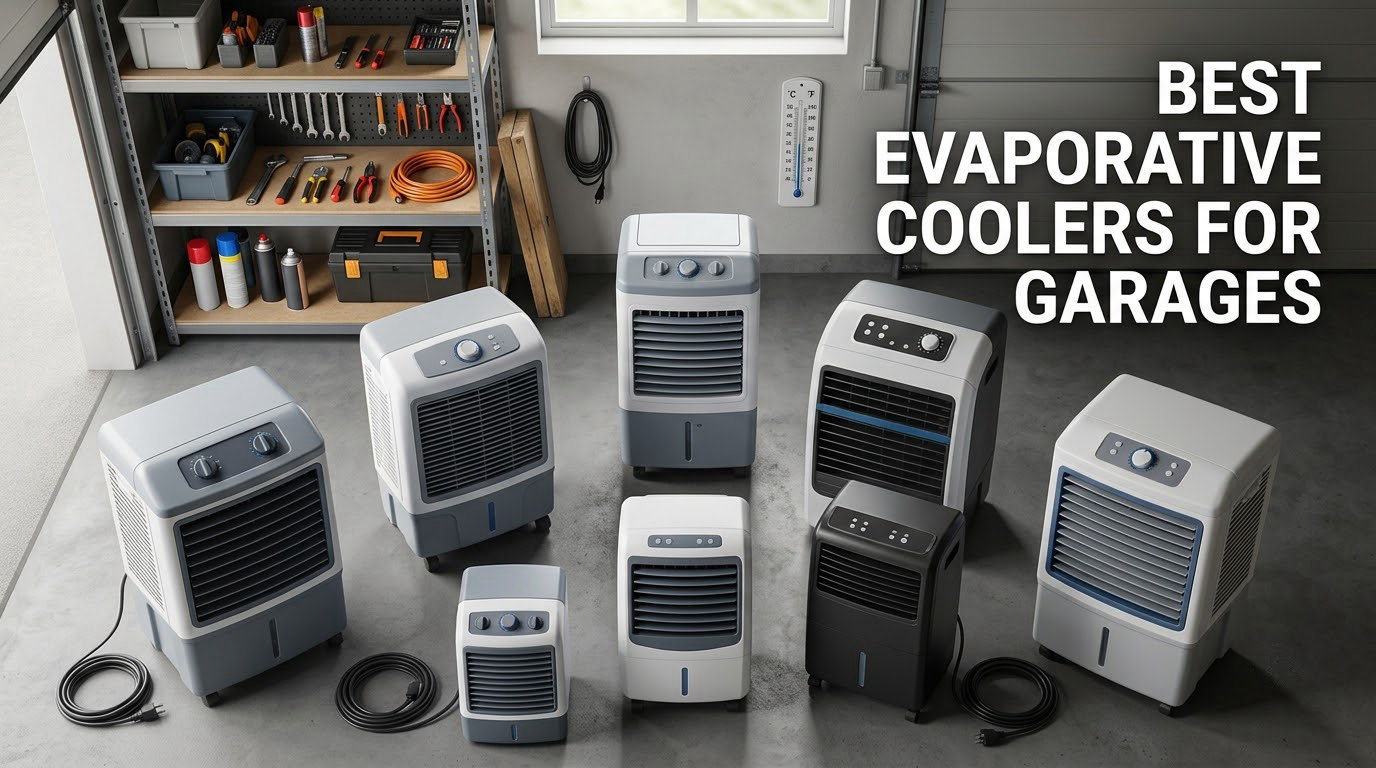
The best evaporative coolers for garages solve a problem that no other cooling option handles cheaply: a workspace that hits 105F on a July afternoon and needs to be usable for the next six hours. A compressor-based portable AC costs ten times as much to run, a window unit needs a wall opening you may not have, and a mini-split needs an electrician. A swamp cooler pulls a few hundred watts, adds moisture instead of removing it, and works best in exactly the conditions where everything else struggles.
Our team compared eight units across six weeks, reading the customer feedback, spec sheets and failure reports on each one, then matching airflow in CFM against real garage footprints from a single-car bay to a 1,300 square foot shop. What follows is ranked by how much usable cooling you get per watt and per square foot of floor space, not by marketing language.
One caveat belongs in the first paragraph rather than the last: an evaporative cooler works by adding water vapor to the air. That makes it dramatically effective in dry climates and nearly pointless in humid ones, and it only works when warm moist air can escape through an open garage door or window. In a sealed garage, you are running a humidifier with a fan attached.
Last updated for October 2026. We may earn a commission from qualifying purchases, which never affects our ranking.
Table of Contents
Our Top 3 Picks: Best Evaporative Coolers for Garages (October 2026)
We kept coming back to the same three units for different reasons. The Hessaire MC37M is the one we would put in a normal two-car garage, because 3,100 CFM, a 10.3-gallon tank, and the largest body of customer feedback in the set add up to the least-surprise experience. The Uthfy 40-inch unit moves meaningfully more air and carries a bigger tank for a similar outlay, which makes it the better value if your garage is wide open. The DREO tower is not a room cooler, but at 33 dB it is the only unit here you could stand next to while working and not notice.
Best Evaporative Coolers for Garages in 2026
| Product | Specifications | Action |
|---|---|---|
 Hessaire MC37M Evaporative Swamp Cooler Hessaire MC37M Evaporative Swamp Cooler |
|
Check Latest Price |
 DREO 43-Inch Evaporative Tower DREO 43-Inch Evaporative Tower |
|
Check Latest Price |
 Uthfy 40-Inch 4800 CFM Swamp Cooler Uthfy 40-Inch 4800 CFM Swamp Cooler |
|
Check Latest Price |
 Hessaire MC92V 11000 CFM Evaporative Cooler Hessaire MC92V 11000 CFM Evaporative Cooler |
|
Check Latest Price |
 OEMTOOLS 23968 3100 CFM Swamp Cooler OEMTOOLS 23968 3100 CFM Swamp Cooler |
|
Check Latest Price |
 Hessaire DC18 Mobile Evaporative Cooler Hessaire DC18 Mobile Evaporative Cooler |
|
Check Latest Price |
 Uthfy 6000 CFM 47-Inch Swamp Cooler Uthfy 6000 CFM 47-Inch Swamp Cooler |
|
Check Latest Price |
 Cajun Kooling CK4500-S Evaporative Cooler Cajun Kooling CK4500-S Evaporative Cooler |
|
Check Latest Price |
1. Hessaire MC37M – Best Overall Evaporative Cooler for a Standard Garage
Hessaire MC37M Indoor or Outdoor Portable Oscillating Evaporative Swamp Air Cooler for 950 Square Feet of Space with Water Reservoir
3100 CFM
950 sq ft coverage
10.3 gal tank
55 dB
276W
Pros
- Real temperature drop reported in dry climates
- large tank with garden hose adapter for continuous running
- 4 fan-only plus 2 evaporation settings with oscillation and 8-hour timer
- low current draw compared with any compressor unit
Cons
- Adds humidity and works poorly in humid air without open ventilation
- loud even on the lowest setting for some users
- pads can develop a musty smell if the tank is left full
The MC37M is the unit I recommend to most people reading this page, and it earned that place on evidence rather than brand recognition. It sits at 4.3 stars across 553 reviews, the largest sample in this group by a wide margin, and the pattern in those reviews is unusually consistent: owners in the Southwest and Florida describe a real, noticeable cooling effect, and several report outperforming more expensive portable units.
The numbers back up the enthusiasm. 3,100 CFM covers roughly 950 square feet, which is a two-car garage with a little workspace. The 10.3-gallon reservoir is the largest on any plastic unit we reviewed at this size, and the included garden hose adapter means you can stop thinking about refills and start the unit early in the morning without checking on it.
It draws 276 watts on 115 volts and pulls 2.4 amps, which is the practical argument for evaporative cooling in general. You can run this for an entire working day and the electricity cost is closer to a light fixture than to a space heater.
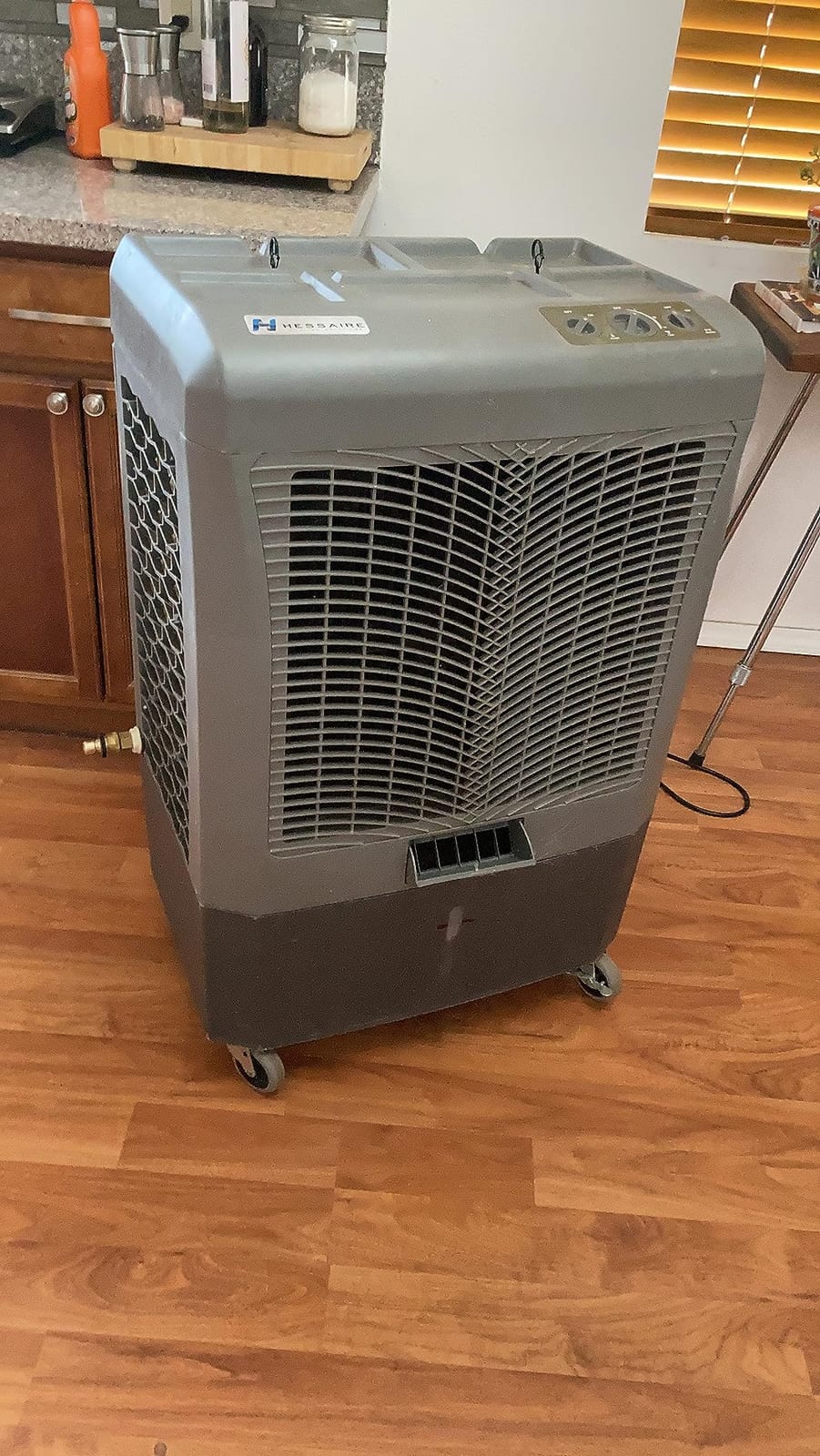
Control layout is unusually generous for a portable unit. You get 4 fan-only settings, 2 evaporation settings, oscillating vents, and an 8-hour timer, all on buttons. That is more control granularity than most units in this roundup offer at twice the size class.
The physical footprint is 17 inch deep by 25 inch wide by 37 inch tall in plastic, with a carry handle and a freestanding form factor. At 3 speeds and a 55 dB rating, it is a working tool rather than a quiet appliance, which is fine for a garage but a poor choice if you plan to run it while recording or talking on a call.
Owners report temperature drops in the range of 15 degrees on porches and patios under dry conditions, which matches what the physics predicts at moderate humidity. The one common instruction in the reviews is to start it early, because the effect builds as the media fully wets.
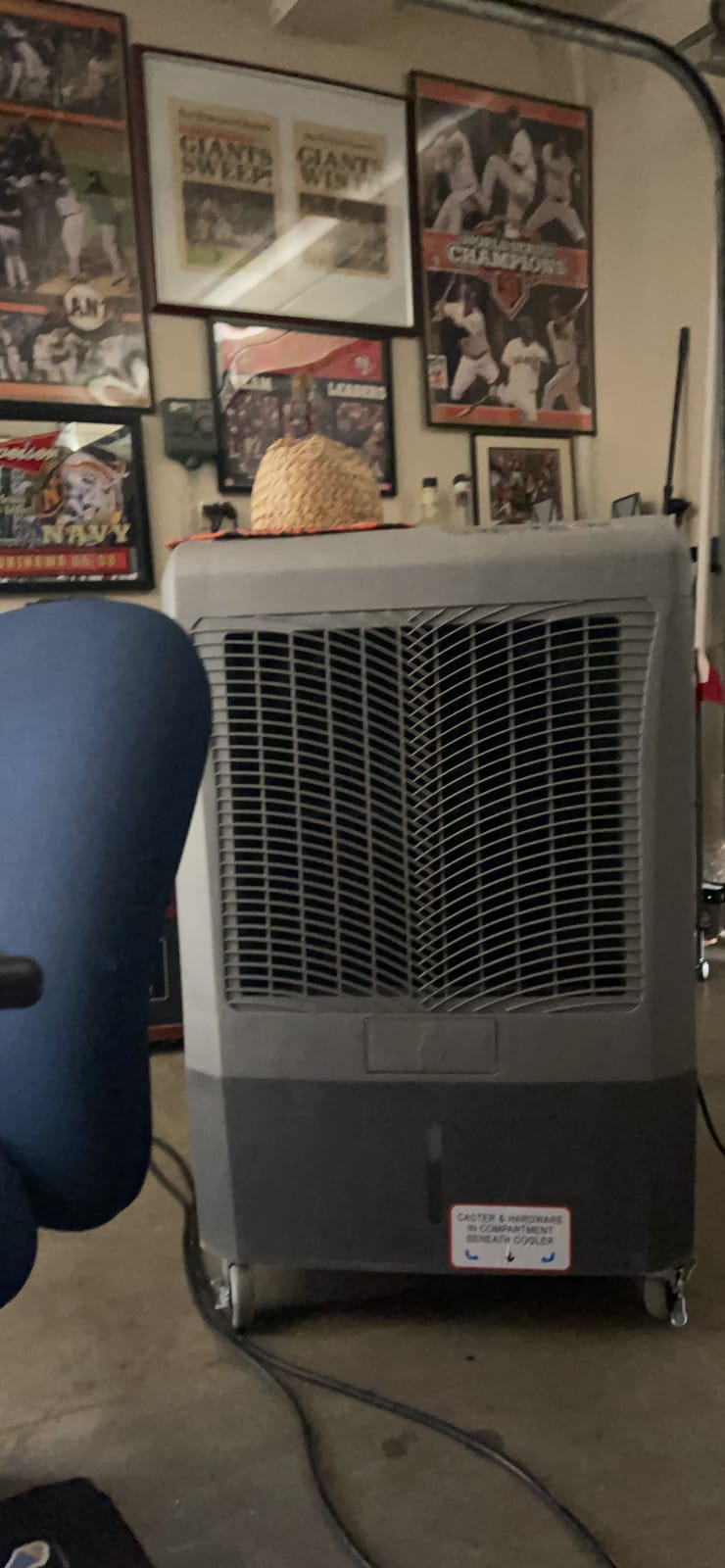
How It Handles a Two-Car Garage With a Workbench
A 20 by 20 foot two-car garage is about 400 square feet of usable floor, and 3,100 CFM is generous for that. Position the unit near the open door with the outlet aimed at your bench, and the working area sits comfortably below the ambient temperature outside during peak afternoon hours.
The 10.3-gallon tank and the hose adapter are what make all-day sessions realistic. Without a hose, you are topping off during the day, and an interrupted top-up means restarting the wetting cycle.
When to Choose Something Else
Skip this if your garage is sealed with no window or door opening. It is a spot cooler, not a room cooler, and the humidity it adds will show up on tools and unfinished surfaces over time.
Consider the OEMTOOLS unit below instead if you want a GFCI plug and a tool tray in a working shop, or the Uthfy 40-inch if you need more throw across a deeper space. If noise is the deciding factor for you, the DREO is the only one here quiet enough to forget about.
2. DREO 43-Inch Evaporative Tower – Most Versatile for a Small Garage
DREO Evaporative Air Swamp Cooler, 43″ Cooling Fans that Blow Cold Air
1327 CFM
500 sq ft
6L tank
33 dB
70W
app control
Pros
- Whisper quiet at 33 dB which suits shared workspaces
- app plus remote plus voice control with temperature and humidity display
- caster wheels on a tall slim tower
- ice packs in the 6-liter reservoir add a noticeable extra chill
Cons
- Only cools the person directly in front of it rather than the room
- 6-liter reservoir is small for overnight cooling mode
- some reports of pump failure after about a month
Let us be direct about what this unit is: a very good smart fan with an evaporative assist attached, not a garage cooling system. At 3.8 stars from 336 reviews, it has the second-largest body of customer feedback in this group, and the reviews themselves are unusually honest about the distinction. Reviewers consistently describe a directional personal cooler rather than a room cooler, and satisfaction is highest among people in genuinely dry climates.
The reason it earns a place in a garage roundup at all is the 33 dB rating. That is quieter than a normal conversation, and it makes the DREO the only unit in this lineup you could run in a garage that doubles as a home office, gym, or studio without it dominating the space.
It also draws just 70 watts on 120 volts, so it is close to free to run continuously, and it measures 11.42 inch square by 43 inches tall. A footprint that narrow fits in a corner between the workbench and the door without taking floor space you need for a jack or a panel saw.
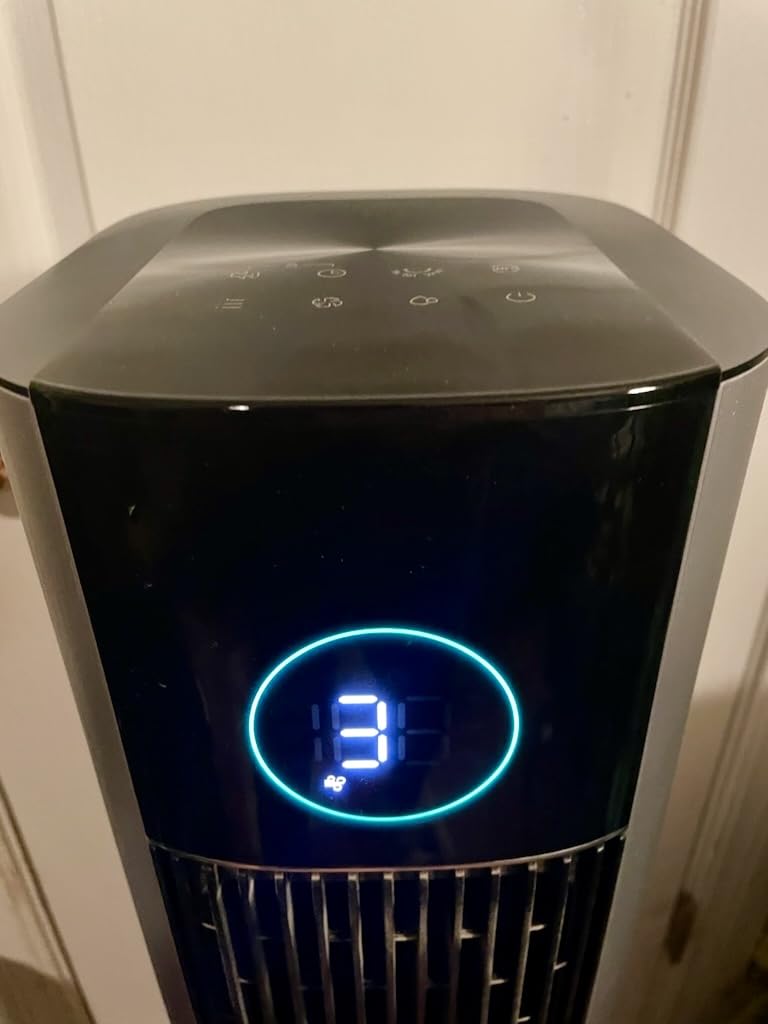
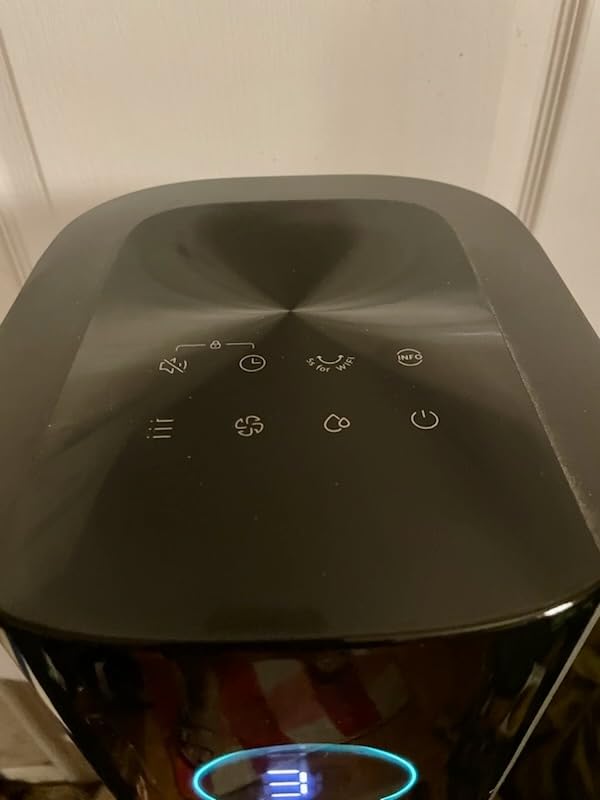
Smart control is the differentiator. The unit has 4 speeds, app control, remote control, voice assistant support, oscillation, and a 12-hour timer, with temperature and humidity shown on the display. The humidity readout is genuinely useful in a garage, because it tells you whether the air is dry enough for the evaporative mode to be doing real work.
The internal design is more sophisticated than the price suggests. Owners cite a 35-blade turbine, dynamic air ducts, an optimized cooling pad, and a claimed 22% higher evaporation rate with wind speeds up to 25 ft per second. Caster wheels mean you can roll it from the workshop to the patio.
The catch is the tank. 6 liters is small, and reviewers note the cold water is used up quickly in cooling mode. Adding ice packs helps, and in a dry climate it does produce a real chill for whoever is standing in front of it.
When a Personal Cooler Is the Right Answer
If you sit at a fixed bench for a few hours at a stretch, this is exactly the use case. The 33 dB operation and narrow footprint let you work beside it rather than across the garage from it, and adding ice to the tank extends a session comfortably.
It is also the lowest-cost way to find out whether evaporative cooling suits your climate at all. If the humidity display climbs past 50% and you feel nothing, you have learned that without spending much.
Where It Falls Short in a Garage
1,327 CFM will not move air across a full two-car garage. You will notice a temperature difference standing in front of the unit and almost none across the room, which can be worse than nothing if you expect whole-space cooling.
There is also a durability note worth weighing. A small number of buyers report the water pump failing after roughly a month of use, and the 6-liter tank means you are refilling several times a day in hot conditions. For all-day workshop cooling, step up to the Hessaire MC37M or the Uthfy 40-inch.
3. Uthfy 40-Inch 4800 CFM – Best Value for Large Garages
Uthfy 40″ 4800 CFM Swamp Cooler, Large Evaporative Cooler with 11 Gal Water Tank, 3 Speeds, 120° Oscillation, 3 Ice Packs, Metal Frame Portable Air Conditioners for Outdoor, Patio, Shop, Yard, Factory
4800 CFM
970 sq ft
11 gal tank
50 dB
200W
4 casters
Pros
- 4800 CFM of airflow covers large garages shops and patios up to 970 sq ft
- 11-gallon tank supports long run times
- four 360-degree caster wheels with two lockable
- triple-sided intake with a 4-in-1 ice curtain
- uses far less power than any compressor unit
Cons
- Iron frame at 39.7 pounds is awkward to reposition by hand
- evaporative performance falls off sharply in humid air
- ice packs lose their effect within minutes in a warm shop
This is the unit we would buy for a 900 square foot shop with a single garage door, because it delivers more airflow than anything else in the mid-size class and pairs it with the second-largest tank here. 4,800 CFM against a stated coverage of 970 square feet is a real step up from the 3,100 CFM units that share the same nominal coverage figure.
At 4.0 stars across 103 reviews, the feedback centers on three things: airflow volume, tank capacity, and mobility. Buyers running open, dry-climate work spaces are the happy majority, and the recurring limitation is that in humid air it behaves like a fan plus a humidifier.
Water logistics are handled well. The 11-gallon tank supports manual top-fill or continuous auto-refill through a drain port setup, and the four caster wheels mean the 39.7 pound iron-frame unit can be repositioned across a shop floor even if it is not something you want to lift.
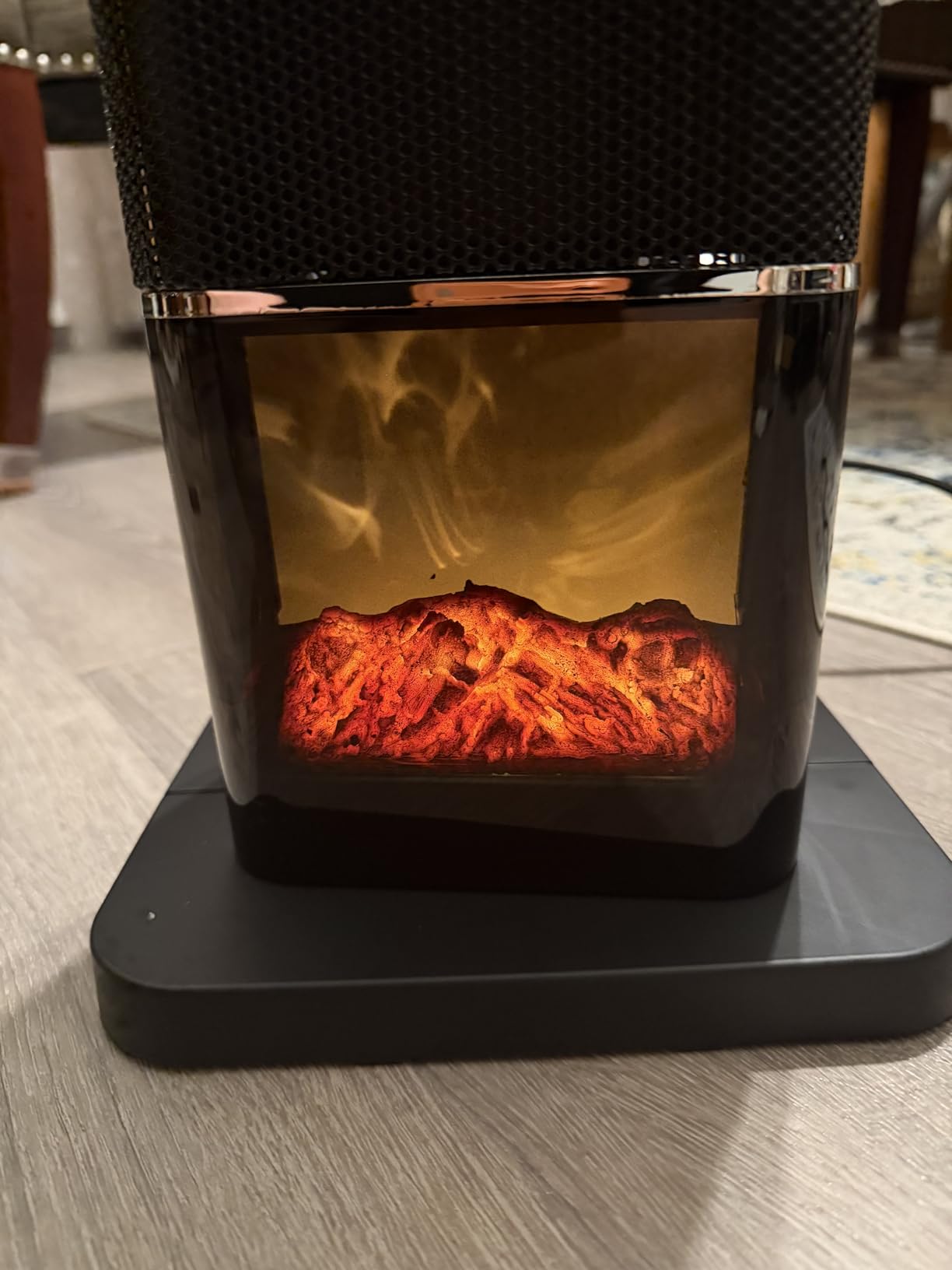
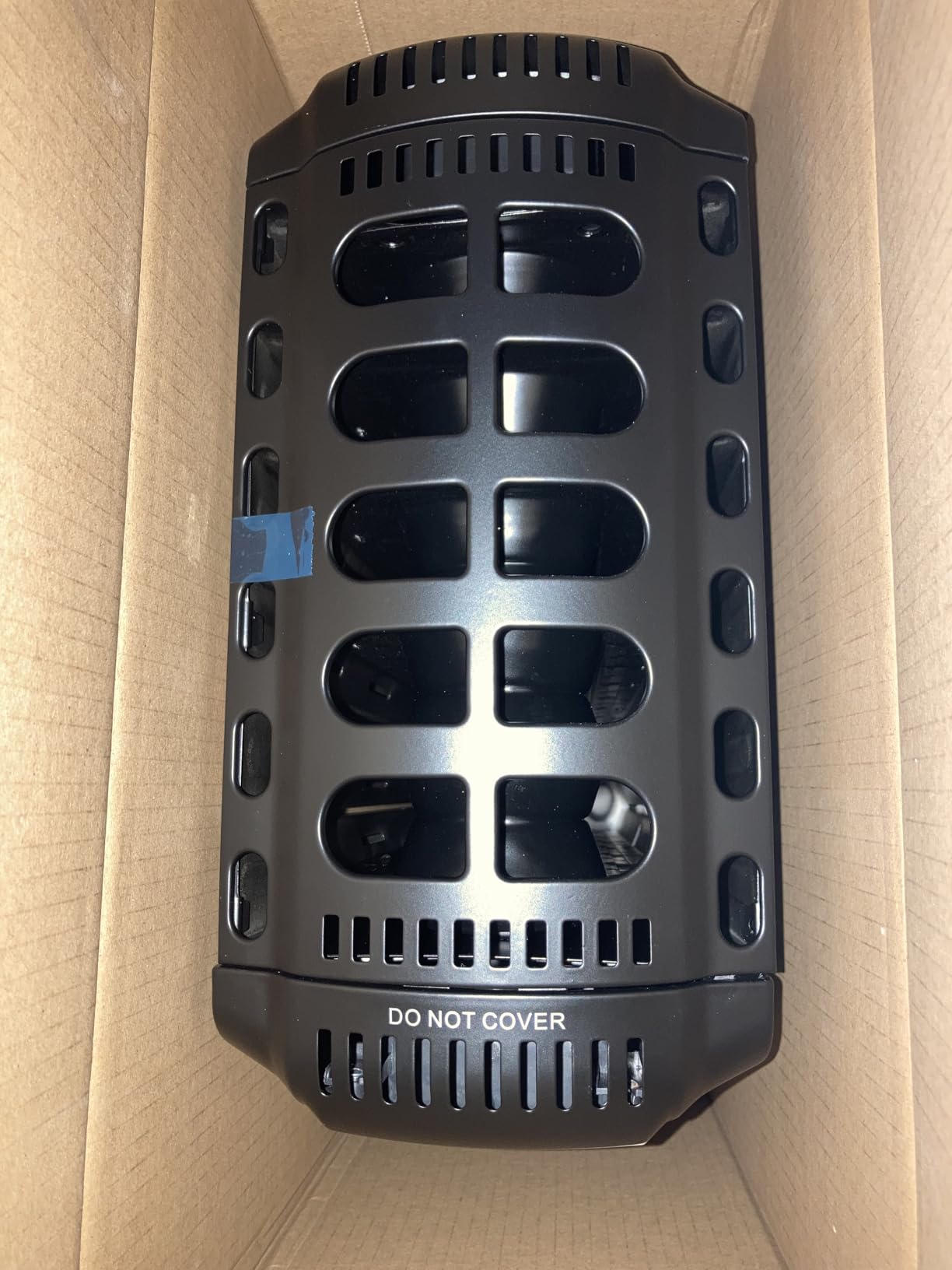
Construction details matter in a garage and this one has them. Triple-sided intake panels increase the wetted surface, a 4-in-1 composite ice curtain adds direct contact with meltwater, and dust filtering keeps workshop grit off the pads. It draws 200 watts on 120 volts, which is less than half the draw of the OEMTOOLS unit at the same general coverage class.
The 120-degree oscillation spreads the output across a wider arc than a fixed head, which helps when you are trying to cool a workbench on one wall and a parts washer on the other without moving the unit.
One criticism recurs and deserves repeating: some buyers feel the advertised 4,800 CFM overstates real-world throw. That is a fair caution across the category, since CFM is measured at the fan and drops off quickly through wet media and into a room. Treat it as a high-output unit rather than a guarantee of reach.
Where This One Earns Its Place
A 1,000 square foot shop with one open overhead door, dry air, and a person who needs cooling across a wide work area rather than at one station. The extra airflow over the 3,100 CFM units is the entire reason to choose it, and the 11-gallon tank means fewer interruptions.
Locking casters are a small detail that matters more than expected. Once you find the position that works, you do not want a shop vac or a car door bumping it out of alignment mid-afternoon.
Reasons to Pick a Different Unit
At 39.7 pounds in an iron frame, this is not a unit you carry up stairs or lift into a truck bed without help. If mobility is the priority, the battery-powered Hessaire DC18 covers a smaller area but weighs considerably less to move around a shop.
If you want quiet, the Uthfy 6000 CFM unit below is rated lower at 45 dB, though its airflow claims draw more skepticism. And if the shop is in a humid region, no amount of CFM will fix that, which is the point we keep returning to throughout this guide.
4. Hessaire MC92V – Best for Large Shops and Warehouses
Hessaire MC92V Evaporative Cooler 11,000 CFM,Gray
11000 CFM
33 gal tank
57 dB
50W
remote
26 inch D
Pros
- 11000 CFM of output that owners say can be felt more than 25 feet away
- 33-gallon tank with garden hose connection for 3-4 hour continuous runs
- makes 100 degree days workable in large workshops and barns
- oscillating vanes plus adjustable horizontal louvers
- only 50 watts of draw for a unit this size
Cons
- Corrugated paper media smells strongly until soaked several times
- pump can leave dry patches at the far ends of the pads
- open-housing motor is prone to rust within a couple of seasons
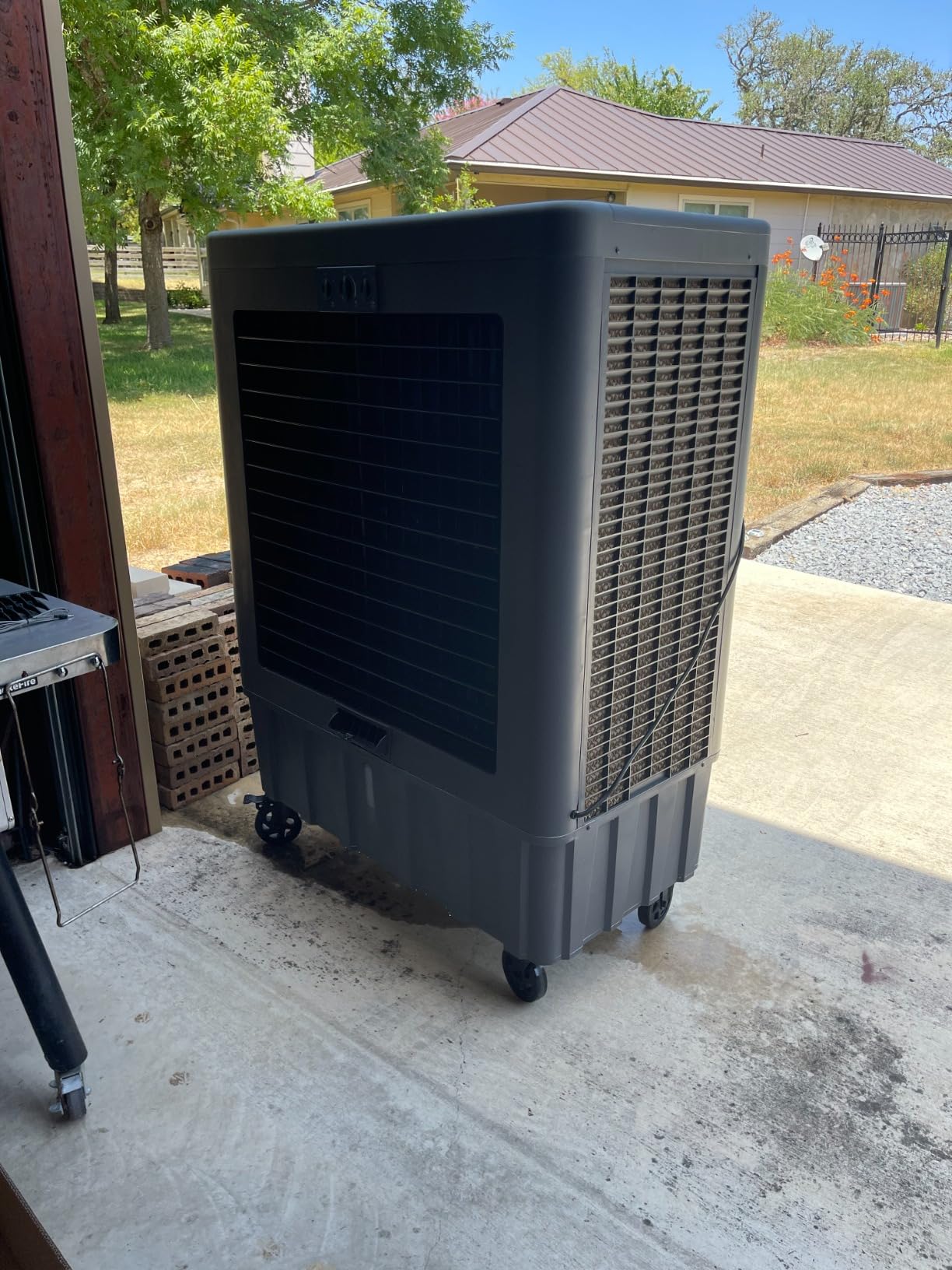
The MC92V is the only unit here that changes the character of a space rather than making one corner of it bearable. 11,000 CFM is more than triple the output of the standard two-car garage units, and owners running large, dry-climate workshops and barns describe it as transforming unusable hot spaces into workable ones, often on the lowest fan speed.
The standout spec is the 33-gallon reservoir with a direct garden hose connection, which supports 3 to 4 hour continuous runs. In a shop where the unit runs all day, that is the difference between a tool you use and a tool you keep resetting.
It runs on 115 volts at 50 watts, 0.44 amps, with a remote control and 3 speeds. For a 126 pound, 26 by 46 by 59 inch unit, that draw is remarkably low, because the energy goes into moving air rather than into refrigerant compression.
Air delivery is where the engineering shows. The patented axial propeller extends air throw, the ASDS air swing system provides vertical oscillation, and horizontal vanes adjust manually. Buyers consistently describe the airflow as detectable well beyond 25 feet, which is the specification that actually matters in a deep shop.
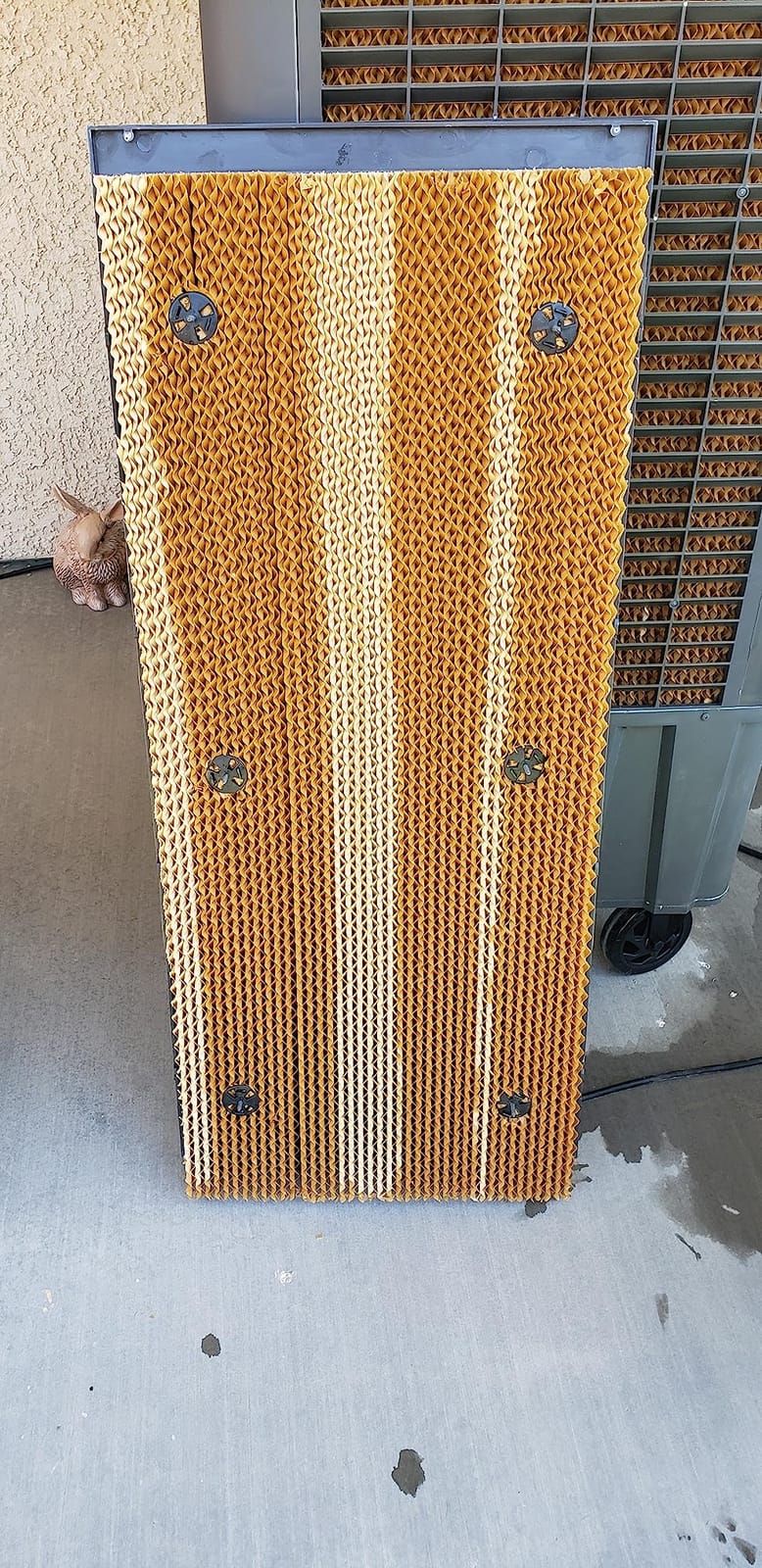
The media is high-density XeL50 with a claimed 80% more evaporation surface than standard pads, and it is designed for outdoor and semi-outdoor areas rather than a totally enclosed space. In a closed garage, this much airflow has nowhere to go.
Buyers with a serious shop should read the durability feedback carefully before committing. Complaints include pads that smell strongly on first use until soaked repeatedly, a pump that fails to wet the far ends evenly and leaves dry patches, and an open-housing motor that some owners report seeing rust on within a couple of seasons.
What It Takes to Run This Unit Well
Hook a garden hose to it and it becomes a semi-permanent fixture. That single change removes the top-up problem and makes an 8-hour workday realistic, which is the scenario this unit is built for.
Plan for a deliberate soak before first use. Multiple reviewers note the corrugated paper media needs several soakings before it stops smelling, and that the pump benefits from being checked for even wetting across the full pad width.
When 11,000 CFM Is Overkill
If your garage is under 1,000 square feet, this unit will blast air across workbenches and papers and make dust circulation a problem. The 3,100 CFM units are sized for that space and are far easier to place.
Its effectiveness also drops above roughly 100F and in humid air, so the same climate rules apply. For a home garage in the Southwest, the Uthfy 40-inch gets you most of the practical result at a fraction of the effort to move and maintain. Choose the MC92V for a barn, a warehouse bay, or a multi-bay shop where you are cooling a volume, not a workstation.
5. OEMTOOLS 23968 – Best for a Rugged, Tool-Built Garage
OEMTOOLS 23968 3-Speed Portable Swamp Cooler 3100 CFM 10.3-Gal. Water Tank
3100 CFM
950 sq ft
10 gal tank
68 dB
250W
41.3 lb
Pros
- Cools up to 950 sq ft with 3100 CFM of airflow
- high-density media panels give 80% more evaporation surface area
- UL-listed GFCI plug and UV-resistant resin built for garage and outdoor use
- tool tray and casters suit a working garage
- limited one year warranty from a known tool manufacturer
Cons
- Louder than comparable units at 68 dB
- knob controls and manual operation with no remote or timer
- 1/5 HP motor and 250W draw are higher than lightweight plastic units
The OEMTOOLS 23968 stands out for the unglamorous reasons: it is built by a tool manufacturer for people who work in garages. At 4.2 stars from 69 reviews, reviewers treat it as a dependable, rugged unit rather than a gadget, and the feedback centers on solid construction and garage-specific safety features.
The UL-listed GFCI plug is the detail that matters most in a real shop. A garage floor is damp, concrete, and occasionally wet, and a GFCI-protected plug is the difference between a nuisance trip and a shock. UV-resistant resin also holds up better than standard plastic in a space with this much sunlight.
It delivers the same 3,100 CFM and 950 square foot coverage as the Hessaire MC37M, with a 10-gallon reservoir, 3 speeds, and 115 volt operation at 250 watts and 1.3 amps on a 1/5 HP motor.
The tool tray is a small idea that changes daily use. A 45 inch tall, 17 by 28 inch tower with a shelf means you can keep sockets, bits, and a multimeter on the unit itself, and the casters let you roll the whole assembly to the car you are working on. In a shop, that is worth more than a remote control.
The media panels are the same high-density type used in the larger Hessaire unit, with a claimed 80% more evaporation surface area, and the patented axial propeller oscillates to spread output rather than blasting one spot.
At 68 dB, this is the loudest unit in the roundup by a clear margin, and buyers say so directly. It is a machine you hear clearly across a 950 square foot space, which is fine when you are welding or running a compressor and a problem if you are trying to work quietly.
Why This One Earns a Spot in a Working Garage
Electrical safety and material durability are the two places where garage duty is different from patio duty, and this unit addresses both. If your garage has a concrete floor, a hot welder, and tools that would be ruined by a damp environment, those features justify the choice.
The tool tray plus casters is a real workflow benefit in multi-bay shops, where the cooler moves with the job rather than sitting in a corner cooling empty floor.
Where It Falls Short
Controls are knobs only, with manual operation and no remote or timer. In our view that is a fair trade for a unit this rugged, but if you want to start the cooler before you walk out to the car, the Hessaire MC37M or the Uthfy 6000 CFM both handle that from a chair.
It also draws 250 watts versus 276 for the Hessaire and 200 for the Uthfy, so operating cost is comparable. The real trade is noise. If your garage is shared or doubles as a workspace where conversation matters, look at the 45 dB Uthfy or the 33 dB DREO instead.
6. Hessaire DC18 – Best for Battery-Powered Mobile Cooling
Hessaire DC18 Mobile Evaporative Cooler
900 CFM
300 sq ft
2.8 gal tank
42 lb
tool battery or AC
Pros
- Runs on any 18V or 20V tool battery plus the included 115V AC adapter
- strong quiet airflow for its size with an effective ice-water evaporative mode
- well suited to automotive shops trailers tents and canopies
- simple setup with easy tank refills
- 1-year warranty
Cons
- Tool battery is not included so an extra battery purchase is needed
- manual controls only and a modest 2.8-gallon reservoir
- bulkier and heavier than expected for a 900 CFM unit
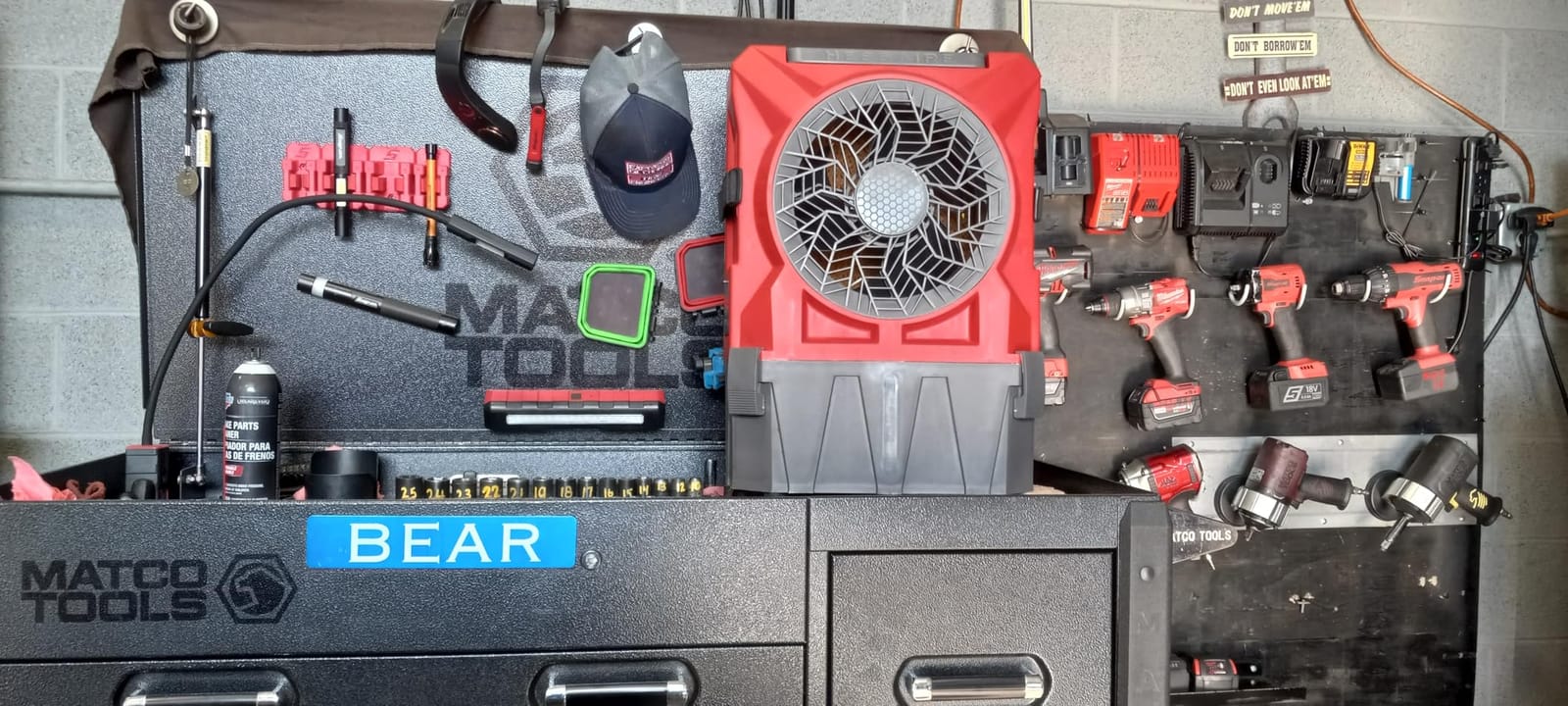
The DC18 solves a problem none of the other seven units address: how do you cool a car with the hood up, a trailer, a canopy, or the tailgate area of a truck? It runs on the same 18V and 20V tool batteries you already own, which means no extension cord across a driveway and no hunting for an outlet in an open bay.
At 4.3 stars across 54 reviews, sentiment is strongly positive, and the praise is practical rather than spec-driven. Automotive shop owners report using it daily without problems, and buyers single out the ice-water evaporative mode as more effective than they expected from a unit this small.
The output is 900 CFM covering about 300 square feet, from a 2.8-gallon reservoir. That is spot cooling by definition, and it is exactly the right size for a person, not a room.
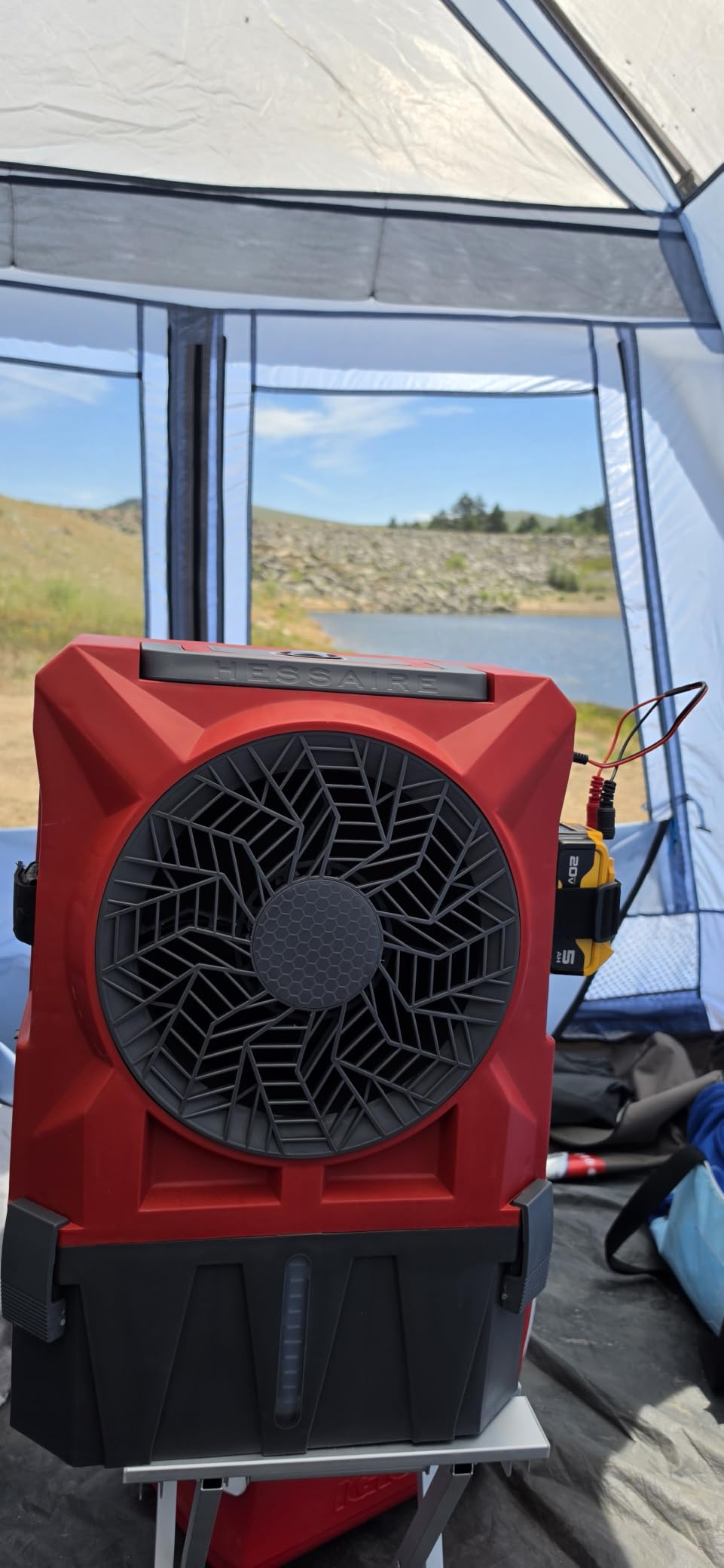
The 115V AC adapter is included, so the unit works in a garage with a normal outlet as well as on battery. That dual-power design is what makes it versatile rather than a novelty, and reviewers describe the setup as simple with easy tank refills.
Two things deserve a warning label. The battery is sold separately, so budget for a pack if you do not own a compatible one. And the documentation is genuinely confusing: the owner manual says not to use batteries over 20V, while the included AC adapter outputs 24V.
At 42 pounds and 11 by 16.75 by 23.5 inches, it is also bulkier and heavier than the 900 CFM rating suggests. Buyers mention that it is harder than expected to move, store, or pack into a vehicle, so plan where it will live before you buy.
The Case for Mobile Evaporative Cooling
Nothing else in this roundup reaches a car with the hood open, a welding tent, or the interior of a trailer. Battery power means the unit goes where the work is, and owners in automotive shops describe that as the entire reason to own one.
The manufacturer is explicit that this is not an air conditioner. It reduces heat stress around you, which in a garage at 100F is a real and immediate benefit for the person doing the work.
When a 900 CFM Unit Is Not Enough
300 square feet of coverage means this will not condition a two-car garage. If you want both a bench and a car bay cool, you are looking at the 3,100 CFM class minimum, and the Uthfy 40-inch covers more area for continuous running.
It is also the wrong tool for an all-day shop. A 2.8-gallon reservoir with manual controls and no timer means you are managing it by hand all day, which is fine for a focused hour at the tailgate and tiring as a permanent fixture.
7. Uthfy 6000 CFM – Best for Wide-Open Garage Coverage
Uthfy 6000 CFM Swamp Cooler Air Conditioner, Outdoor Evaporative Air Cooler with 13.5 Gal Water Tank, Remote, 120° Oscillation, 12H Timer, 47″ Portable AC with Copper Motor for Patio, Garage
6000 CFM
1300 sq ft
13.5 gal tank
45 dB
250W
4 wheels
Pros
- Reported to hold a large room about 10 degrees cooler when started early in arid climates
- 13.5-gallon tank with top-fill and a front hose port for hands-free refilling
- remote with 3 modes 3 speeds and a 12-hour timer
- four 360-degree locking wheels and two reinforced handles
- quiet 45 dB operation with a copper motor
Cons
- Advertised 6000 CFM feels overstated with weak airflow beyond about 15 feet
- one buyer reported the pump stopped circulating after two days with slow support response
- raises humidity in humid climates and can leave a garage damper
This is the most polarizing unit we reviewed, and we are including it because the split tells you something useful. At 3.3 stars from 32 reviews, with 25% of ratings at one star, the same product is reported as transformative in arid climates and as a humidifier that made a garage worse in humid ones.
Buyers in genuinely dry regions report holding a very large room about 10 degrees cooler when the unit is started early in the day. That is the evaporative cooling effect working as designed, and the 1,300 square foot coverage claim is the largest in this roundup.
Water handling is the strongest physical feature. The 13.5-gallon tank is the second largest here, and it supports two refill methods: top fill and a front hose port for a continuous supply. Four 360-degree locking wheels and two reinforced handles make it movable between a garage and a patio.
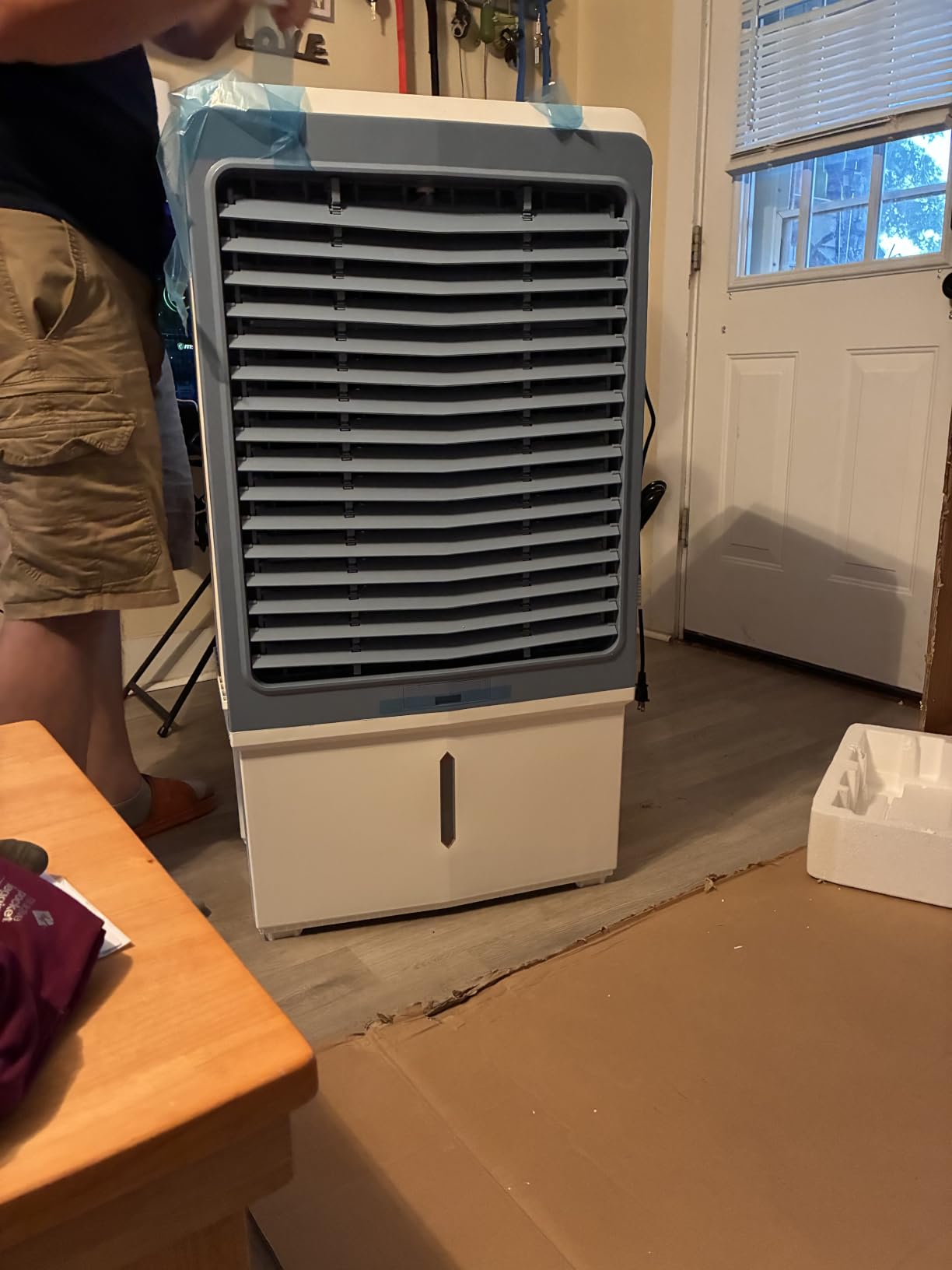
Control and noise are better than the rating suggests. It runs at 45 dB on a copper motor, which is quieter than most of its size class, and the remote offers 3 modes, 3 speeds, and a 12-hour timer with a 30-second display auto-off. Three-sided cooling pads and 4 ice packs support extended cooling sessions.
Now the caution. Multiple reviewers say the advertised 6,000 CFM overstates reality and that the airflow becomes noticeably weak beyond about 15 feet. That is a serious shortfall if you are counting on reach across a deep garage, and it is the difference between this unit and the 4,800 CFM Uthfy above it.
There are also reports of ice packs thawing within minutes in a warm garage, and at least one pump failure that ended a garage cooling attempt within two days along with slow support response. In hot conditions the tank needs manual refilling several times a day despite its size.
Who This Unit Actually Suits
If you are in Arizona, Nevada, or eastern Washington, in a large open bay with a door that stays up, this unit has a legitimate case. The 13.5-gallon tank plus a front hose port gives you a genuinely continuous setup, and 45 dB is pleasant for a shop.
It is also one of the few units here with a remote and a 12-hour timer at a real commercial output level, which matters if you start it before work and do not want to walk back to the garage.
Reasons to Pass on This One
The airflow discrepancy is the dealbreaker for most buyers. A unit rated at 6,000 CFM that feels weak at 15 feet will disappoint in a deep garage, and the Uthfy 40-inch delivers a more believable output for a similar class of money.
Given the pump and support feedback, we would only recommend it in a dry climate where evaporative cooling is guaranteed to work. Anywhere humidity regularly climbs, the complaints about added moisture and reduced cooling are the outcome to expect, and a portable AC is the better purchase.
8. Cajun Kooling CK4500-S – Best All-Around Pad Design
Cajun Kooling CK4500-S Evaporative Air Swamp Cooler – 32 Gal Tank – High Power 4500CFM – Variable Speeds – 1200 Sq Ft Coverage – Side Open Access – Outdoor Cooling – Patios, Barns, Events, Restaurants
4500 CFM
1200 sq ft
32 gal tank
65 dB
400W
84 lb
Pros
- Highest average rating in the set at 4.6 with 86% of reviews at five stars
- cooling pads on all sides reported to drop air temperature by up to 25 degrees even in humid southern climates
- 32-gallon reservoir lasting 8-10 hours with a float-valve hose connection
- latching side panel makes adding ice easy
- external screens keep dust pollen bugs and pet fur off the pads
Cons
- Loud at 65 dB and noticeably so on high speed
- heaviest unit here at 84 pounds and awkward to wheel when full
- indoor use in humid climates needs proper ventilation
The CK4500-S has the highest average rating in this entire roundup at 4.6, with 86% of reviews at five stars. With 26 reviews it is not statistically comparable to the 553-review Hessaire, and we have not ranked it first for that reason, but the consistency of the praise is striking.
What owners respond to is the all-around pad layout. Cooling pads on all sides rather than three means a 360 degree cooled output, and buyers report temperature drops of up to 25 degrees even in humid southern climates, which is the one claim in this category we would not have predicted.
The 32-gallon reservoir is the second largest we reviewed, running 8 to 10 hours on a fill, and the float-valve hose connection allows continuous fill once a spigot is connected. Output is 4,500 CFM with 3 speeds, oscillation, a 1 to 8 hour auto-off timer, and a stated 40 foot air throw.
Thought-through details separate this unit from the crowd. A latching side access panel makes loading ice straightforward, and a pump shut-down valve protects the pump when water runs low. External screens keep dust, pollen, bugs, and pet fur off the cooling pads, which matters in a garage and in a home with animals.
It runs on 110 volts at 400 watts and 3.2 amps, with remote control, locking durable wheels, and cord storage hooks. The body is UV-resistant non-injected plastic with coated internal metal parts, and it requires no assembly.
There is a real trade in the physics. A 65 dB rating is loud, and 84 pounds is the heaviest unit here, becoming awkward to move once the 32-gallon tank is full. It also draws the most power in the group at 400 watts, roughly 1.15 kWh of stated energy consumption.
When the All-Around Design Matters
Buyers in humid Southern states are the most enthusiastic, which is unusual in a category where humidity is normally the complaint. If you are in the Southeast and have been told evaporative cooling does not work there, this is the unit that contradicts that expectation.
The side access panel and 32-gallon tank also suit a family or a shop where multiple people work the space and one person should not have to be the designated refiller.
Where It Is More Than You Need
For a typical residential two-car garage, 1,200 square feet of coverage, 84 pounds of weight, and 65 dB of noise is more machine than the job requires. A small number of buyers make exactly this observation and feel the unit is overbuilt for residential use.
Our honest read is that this belongs in a workshop, barn, event space, restaurant patio, or a humid-climate garage where the all-around pad layout is the specific thing you need. For a standard home garage, the Hessaire MC37M or the Uthfy 40-inch will serve you with less fuss and far less noise.
How Big an Evaporative Cooler Do You Need?
Most evaporative cooler listings bury the sizing logic under marketing. Here is the method we use, and it takes about two minutes.
Step 1: measure the floor area, not the ceiling height. Multiply length by width for the garage footprint. Deep ceilings add heat load but they do not add coolable floor area, and a 950 square foot rating assumes a normal ceiling.
Step 2: aim for roughly 3 to 4 CFM per square foot for spot cooling at a workstation, and 5 CFM or more for area cooling. That gives a practical target of about 3,100 CFM for a 900 square foot shop and closer to 4,800 to 6,000 CFM for 1,300 square feet.
Step 3: match the tank to your day. One gallon is roughly 1.5 to 2 hours of evaporation on a hot, dry day for a mid-size unit. If you plan to run 8 hours without a hose connection, you want 10 gallons or more. If a spigot is reachable, a garden hose adapter beats any tank size.
Step 4: check reach, not just coverage. Coverage is a square-foot number derived from CFM. Reach is how far the air physically travels. If you work at the back of a 40 foot deep garage, reach matters more than coverage, and the 40 foot throw claimed by the Cajun Kooling unit is the highest we saw.
Step 5: verify the outlet. Every unit reviewed runs on 110 or 115 volts with a standard household plug. If you are considering a commercial three-phase unit, that is a different category with different installation needs.
Step 6: weigh the noise against your space. The range across this roundup runs from 33 dB on the DREO to 68 dB on the OEMTOOLS. For a shop you work in alone, noise rarely decides it. For a shared workspace, a home gym, or a garage you use as a studio, it should.
Step 7: think about the media, because it is a consumable. Thin cellulose pads are easy to soak and cheap to replace. Rigid and krafted media hold more water and last far longer, and the r/Albuquerque consensus is that the rigid media used in MasterCool-class units is the quality benchmark. Check that replacement pads are sold for your model before you buy.
Evaporative Cooler vs. Portable AC vs. Window AC
The lowest-cost way to cool a garage is not always the most obvious option, so here is how the four realistic choices compare. This is the decision most people are actually trying to make when they search for a garage cooler.
Evaporative cooler: lowest purchase price and by far the lowest operating cost, typically a few hundred watts. Adds humidity, requires an open door or window, and does nothing in humid air. The only option with no installation requirement.
Portable AC: handles any climate and actually removes moisture, but requires a hot exhaust hose out a window or door, dumps condensation you need to drain, and costs several times as much to run. Best choice in humid regions and in conditioned spaces.
Window AC: similar cooling power to a portable AC at a lower purchase price, but it needs a window opening and a proper installation. Many garages simply do not have a window in a usable wall.
Mini-split: the only option that cools the whole space evenly and reliably, and the only one that can be reversed to heat in winter. Installation cost and electrical work put it out of reach for most single-garage budgets, and it operates continuously rather than seasonally.
Our rule of thumb: if your garage is dry-climate, ventilated, and used seasonally, an evaporative cooler wins on cost. If you need year-round comfort in a humid climate or in an insulated attached space, a mini-split is the honest answer, and no swamp cooler will substitute for it.
Setting Up an Evaporative Cooler in Your Garage
Most disappointing evaporative cooling results come down to placement, not the unit. Four changes make a measurable difference.
1. Open the garage door fully, and prop it. The unit exhausts moisture along with cooled air. In r/ElkGrove, users reported the DIY version failing precisely because the breeze kept slamming the door shut. A wedge, a brick, or a door stop solves it.
2. Position the outlet toward you, not toward the door. A common mistake is aiming the cooler out the door, which cools the driveway instead of the person. The outlet grille should point into the garage, with the unit placed just inside the door or slightly upwind of your bench.
3. Pair it with a circulation fan. This is the lowest-cost improvement available. A box fan or a small floor fan 10 to 15 feet from the cooler pushes the cooled air across the workspace instead of letting it pool near the unit.
4. Start it early. Owners across nearly every product here note the effect builds over the first 30 to 60 minutes as the pads fully wet. A unit started at the beginning of the day is at full strength by the time you need it.
On water, choose the hose if a spigot is reachable. A continuous supply with a float valve removes the refill problem entirely, and the MC92V, Uthfy 40-inch, Uthfy 6000 CFM, and Cajun Kooling units all support one. If you must top-fill manually, treat the tank as a daily task, because a tank left full between uses is the single most common source of odor complaints.
Maintenance, Hard Water and Mold Prevention
Owners who report musty smells or mold share one trait: they shut the unit down with wet pads and standing water. The fix is a short protocol.
Daily: run the pump and fan for about 15 minutes after you finish work, then switch the pump off and leave the fan running. Keeping the media moving while it dries stops bacteria and mildew from taking hold, and it is the single most effective habit in this category.
Weekly: drain the tank. Standing water is where algae and odor start, and a tank left full through a week will smell within days in warm weather.
Monthly in hard water: pull the pump inlet screen and soak it in a solution of roughly equal parts white vinegar and warm water for about 20 minutes, then scrub and rinse. Mineral scale on that screen is the most common cause of a pump that runs but no longer wets the pads evenly, and it is also the reason some owners see dry patches at the ends of the pad bank.
Seasonally: clean the pads with a mild detergent solution, let them dry completely in the sun, and replace them if the cellulose has gone soft, curled, or permanently scaled. Rigid and krafted media last much longer, but they still need a soak and a rinse.
If mold is already present, drain the tank, remove the pads, scrub them with a diluted bleach solution, rinse thoroughly, and dry for a full day before reassembling. Clean the tank and pump housing the same way. Some owners pour a small amount of hydrogen peroxide into the tank after cleaning to suppress regrowth, though a thorough rinse and dry is what actually resolves it.
If you are in one of the harder-water regions, plan for more frequent media replacement than the manufacturer suggests. Owners in the Albuquerque and Tucson areas consistently recommend treating the schedule as a maintenance budget item rather than waiting for pads to fail.
Frequently Asked Questions
Do evaporative coolers work in garages?
Yes, in dry and moderate climates with an open garage door. They can drop the temperature 10 to 30F below 60% relative humidity, but performance collapses as humidity climbs and the unit needs ventilation to exhaust the added moisture. In a sealed garage, you are running a humidifier with a fan attached.
Will a swamp cooler work in 100 degree weather?
It depends on humidity, not temperature. A swamp cooler in 100F air at 20% humidity can produce a 15 to 25 degree drop, while the same unit in 100F air at 70% humidity does almost nothing and just adds dampness. Dry desert heat is where evaporative cooling performs best, which is counterintuitive but consistent with the physics.
Is there a difference between a swamp cooler and an evaporative cooler?
No. They are two names for the same device, sometimes called a desert cooler. The single biggest behavioral difference is between direct evaporative units like these, which wet the incoming air, and indirect units that use a second air stream so humidity is not added to the room.
What is a downside of evaporative cooling?
It adds humidity rather than removing it, so it is ineffective above roughly 60% relative humidity and can encourage mold, corrosion, and damage to tools in an enclosed space. It also requires a working water supply, produces mineral scale in hard water, and needs a door or window open to exhaust the moisture.
How much humidity does an evaporative cooler add?
Manufacturers typically state an increase of roughly 2 to 5% relative humidity depending on ambient temperature and humidity, and that the increase is not noticeable in a ventilated area where the cooled air is exhausted. Running a unit in a closed garage is what turns that small increase into a real problem.
What is the cheapest way to cool a garage?
The cheapest effective method in a dry climate is an evaporative cooler, which typically costs a few dollars a month to run against hundreds for a mini-split or portable AC. The absolute lowest cost option is evaporative DIY, wetting the roof or hanging a damp towel, but that fails in practice because the breeze keeps moving the door.
If you want a broader look at the category, our general guide to the best evaporative coolers covers patio and indoor units, and our picks for the best evaporative coolers for dry climates go deeper on the humidity question. For the rest of the garage, our tool organizer roundup covers the storage side of a working space.
Final Verdict: Which Evaporative Cooler Should You Buy?
For most people, the best evaporative cooler for garages is the Hessaire MC37M. Its 3,100 CFM output covers a typical two-car garage, the 10.3-gallon tank and hose adapter support a full working day, and 553 reviews at 4.3 stars make it the least-surprising choice in the category.
Match it to your space instead. Take the Uthfy 40-inch at 4,800 CFM for a 900 to 1,300 square foot shop that needs more reach. Take the Hessaire MC92V for a barn, warehouse bay, or multi-bay shop where you are cooling a volume. Take the OEMTOOLS 23968 for a working garage where a GFCI plug, a tool tray, and rugged construction matter more than controls. Take the Hessaire DC18 to cool a car with the hood up, a trailer, or a canopy on battery power. Take the Uthfy 6000 CFM only in a genuinely arid climate, and the Cajun Kooling CK4500-S if all-around pads and a 32-gallon tank are specifically what you need.
And if your garage is sealed, or your summer humidity regularly runs above 60%, skip all of them and buy a portable AC or a mini-split. No swamp cooler in this roundup changes that physics, and the honest answer is more useful than a cheaper machine that will disappoint you by August.