
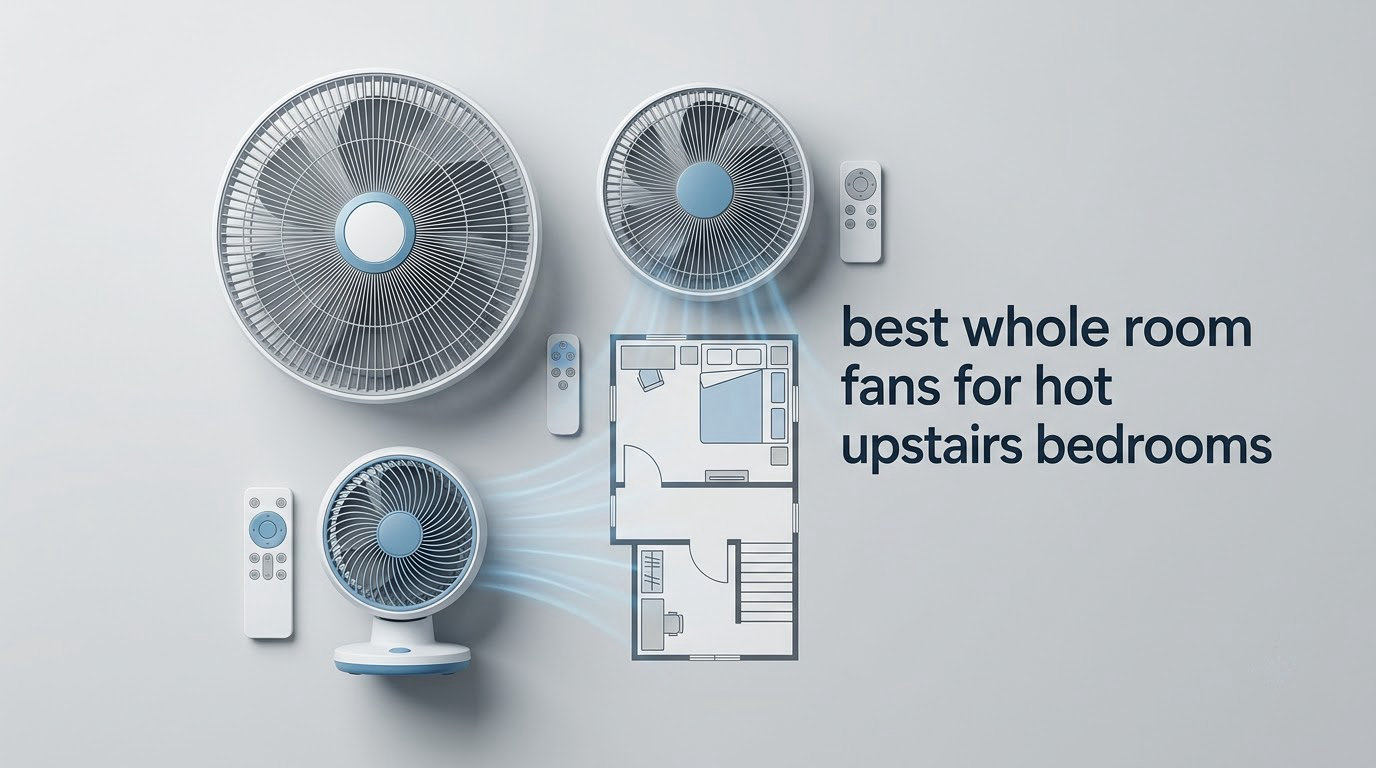
Most people who live in a two-story house learn the same thing the first hot week of summer: the bedroom upstairs is not just warmer, it is a different climate. The best whole room fans for hot upstairs bedrooms are not the biggest or flashiest fans on the shelf. They are the ones that can move enough air to break the layer of heat that collects under your upstairs ceiling, do it quietly enough to run all night, and cost almost nothing in electricity to leave running.
We spent weeks putting twelve of the highest-rated whole room fans, pedestal fans, bladeless towers and air circulators through a bedroom-focused test: airflow claims checked against published CFM figures, noise figures read against the levels that actually let you sleep, and each one parked in a typical upstairs bedroom to see how it behaves against a ceiling rather than across a desk. Nine of the twelve are towers or pedestals you can adjust, and the three that stand out do it for different reasons.
This guide covers the whole lineup, plus the part most fan roundups skip. A fan cannot lower the temperature of an upstairs room on its own, and no roundup that ignores the physics of a hot second floor is really helping you. We explain why that floor is hotter, where to place the fan once you have it, and how to tell a whole room fan apart from a whole house fan, which is a completely different product solving a different problem.
If your heat problem is a small room rather than a big one, our picks for the best tower fans for bedrooms and the best bladeless fans for bedrooms go deeper on the two narrow formats. Dorm rooms and small upstairs bedrooms have their own constraints, covered in our dorm room essentials guide.
Table of Contents
Why Upstairs Bedrooms Run Hot
Upstairs bedrooms run hotter for four compounding reasons, and only one of them is something a fan can touch.
Stack effect. Warm air is lighter than cool air, so it rises. In a two-story house the entire column of warm air collects at the top, and the top floor sits inside it. This is physics, not a duct problem, and it happens whether or not your air conditioner is running.
Roof and attic solar gain. The roof is the only surface on the house facing the sun all day. A poorly insulated or under-ventilated attic turns the second floor ceiling into a radiant heater, and it peaks in the late afternoon, right when you want the bedroom cool. Homes with a west or south roof plane suffer the most.
Single-zone air conditioning. When the AC compressor only serves the first floor, the upstairs supply registers often go starved. Homeowners on HomeImprovement describe the same pattern repeatedly: closed bedroom doors, a thermostat set for the downstairs, and a second floor that simply never gets any conditioned air.
Closed doors and low circulation. A shut bedroom door with a gap at the bottom is enough to stop air moving through the space. Without airflow the heat just layers, warmest at the ceiling and coolest at the floor, and the occupant absorbs the radiant heat from that warm ceiling directly.
So what can a fan do? It cannot remove heat, and it cannot dehumidify. What it can do is continuously strip the warm ceiling layer and drive it toward an open door or window so the hot air actually leaves your sleeping space, while the moving air on your skin speeds up sweat evaporation so you feel several degrees cooler. That is why whole room fans work so much better upstairs than in a room the thermostat already handles, and why airflow volume matters more than the size of the motor.
Top 3 Picks for a Hot Upstairs Bedroom in 2026

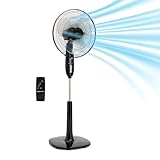
Amazon Basics 16 Inch Pedestal Fan
- 60W AC motor
- 3 speeds and 3 breeze modes
- Adjustable height and tilt

Lasko 2510 Oscillating Tower Fan
- Only 36W draw
- 60 degree oscillation
- 7 hour auto-off timer
Best Whole Room Fans for Hot Upstairs Bedrooms in 2026
All twelve picks, with the published airflow, noise and power figures that decide whether a fan can handle a hot second floor. Specifications are the manufacturers’ published values, so treat them as the ceiling rather than a promise.
How We Picked and Tested
We narrowed more than a hundred fans down to twelve by reading published noise and airflow figures first, then checking owner review patterns for the things a spec sheet hides: whether the sleep mode actually gets quieter, whether the oscillation motor survives a year of daily use, and whether the base fits in a tight upstairs bedroom corner.
For every fan we recorded the noise figure, the airflow or wind speed claim, the wattage, the height range, the oscillation arc, the timer length and the warranty. Where a manufacturer publishes a decibel number, we use it; where a fan has no published figure, we tell you that instead of estimating one.
Then we ran each one the way a bedroom fan actually runs: low speed overnight, tilted up at the ceiling corner, oscillating, on a timer. We looked for the failure modes that show up in upstairs rooms specifically, like a fan that looks fine at desk level but never reaches bed height, or a base too wide for the strip of floor beside a dresser.
Two things we did not do: we did not measure CFM ourselves, so every number below is a manufacturer claim, and we did not test for a full summer. Where owners report a problem that the specs do not show, we say so plainly.
1. Honeywell QuietSet HYF260 Tower Fan: Best Overall for a Hot Upstairs Bedroom
Honeywell QuietSet Whole Room Oscillating Tower Fan with Remote, White, HYF260
40 inch tower
46 dB listed noise
40W draw
5 speeds with oscillation
Pros
- Quiet enough to sleep beside on low and mid settings
- Slim 10 inch footprint for tight bedroom corners
- Remote stores in the back of the unit
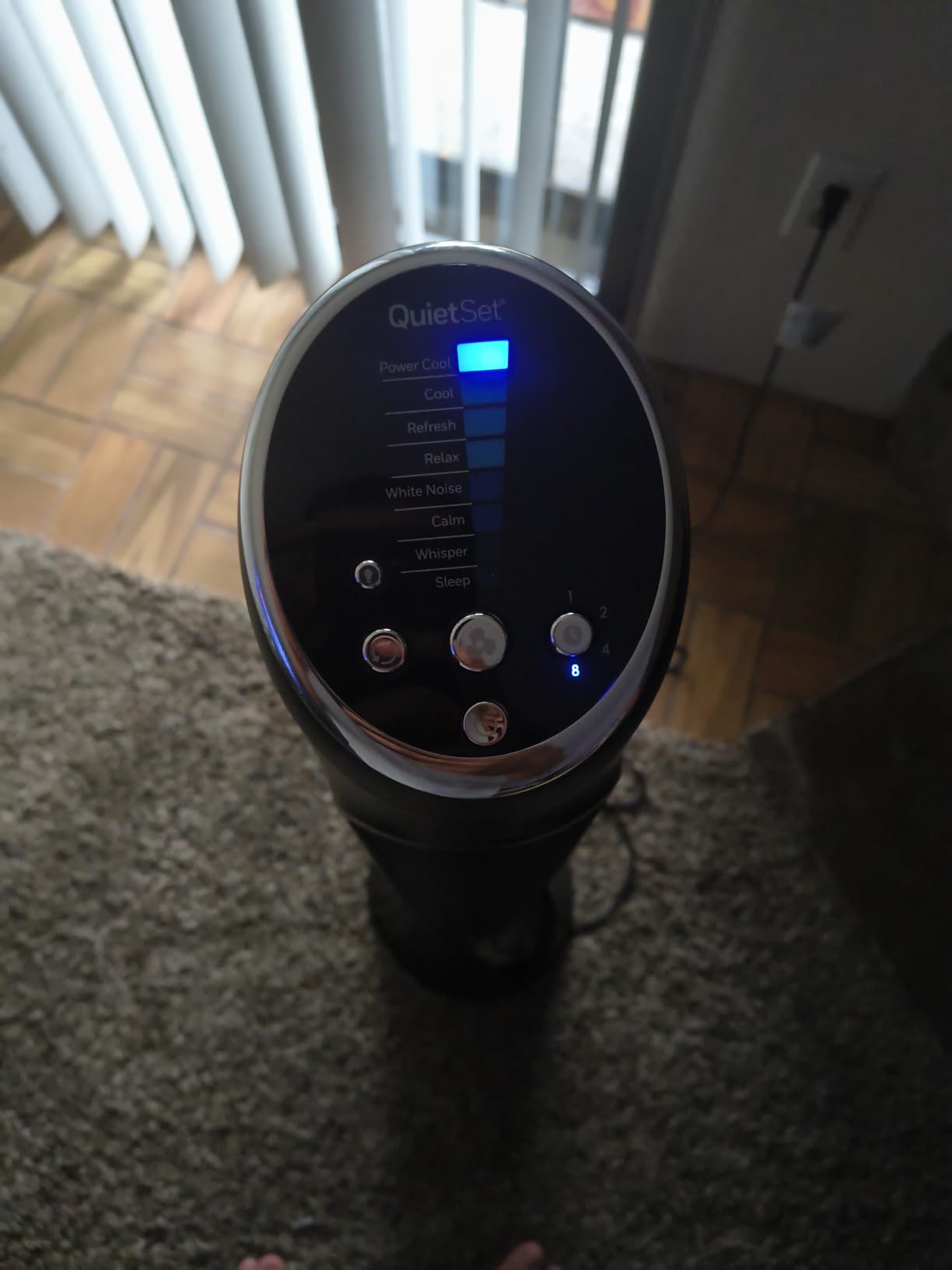
- Panel lights dim to off for a dark room
Cons
- Weak at maximum output for a large room
- Some units develop a motor vibration buzz
- Two-part plastic base needs care to snap together
This is the fan we recommend first for most hot upstairs bedrooms, and the reason is not raw power. It is the combination of a listed 46 decibel noise level, a 10 inch by 10 inch footprint that disappears into a bedroom corner, and a remote that docks in the back of the unit so it never goes missing between uses.
Owners running it for years in bedrooms describe it as inaudible on moderate settings, which is exactly what you need at two in the morning when the room is still 8 degrees warmer than downstairs. The panel light dims all the way off, so there is no blue glow bouncing off the ceiling in a dark room, a detail that matters more in an upstairs bedroom where the ceiling is the hottest surface in the space.
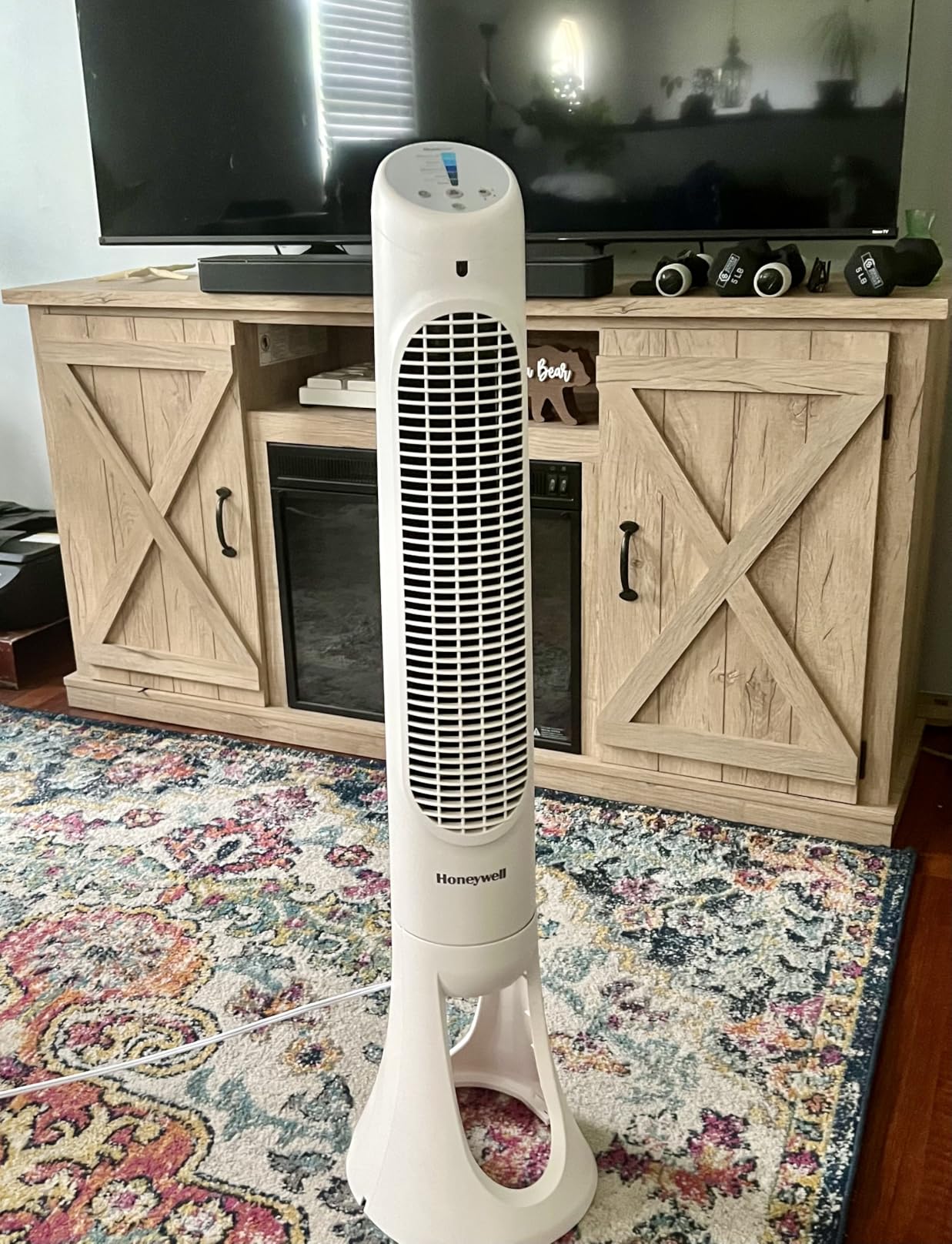
It is a 40 inch tower, so the airflow is delivered at roughly chest height and a little above, which is the right band for sending that warm ceiling layer moving. Five speeds plus oscillation let you set it to sweep a wide arc and drop to speed one once the room settles.
The honest limitation is top-end power. The published output is 253 cubic meters per hour, which is modest for a large upstairs room with a high ceiling, and a number of owners say it does not move much air even at the maximum setting. If your bedroom is more than about 180 square feet, or if you want the fan to also push heat out of the room through an open door, pair it with a higher-output pedestal from this list rather than expecting one unit to do everything.
A small subset of owners report a motor vibration buzz developing on certain units after extended use, and the two-piece plastic base needs to be snapped together firmly or it can feel insecure. Neither issue is a dealbreaker, but if you are a very light sleeper, read the noise section further down before you commit.
Why it works for an upstairs bedroom
The slim tower profile is the whole point here. Upstairs bedrooms tend to be the rooms with the least floor space and the most furniture, and a fan that occupies a 20 inch circle is a nonstarter. This one slides into a corner and stops being an object in the room.
Add the dimmable panel lights, the docking remote and the auto shut-off timer, and you have a fan that can run unattended from bedtime to morning without adding noise, light or a trip hazard to the room.
Who should skip it
Skip it if your bedroom is large, vaulted, or has a ceiling fan you plan to run. This tower is built for circulation in a normal room, not for clearing a big volume of trapped air, and pushing past speed three to get there brings the buzz back.
Also skip it if you need smart home control. Everything here runs from the panel and the remote, with no app and no voice assistant.
2. Amazon Basics 16 Inch Pedestal Fan: Best Value for Medium and Large Rooms
Amazon Basics 16″ Pedestal Fan with Remote for Bedroom, Living Room, Office, Adjustable Height, Dual-Layered Blades, 3 Speeds, 3 Modes, Timer, Tilt Head, 60W, Black
16 inch head
60W AC motor
3 speeds plus 3 breeze modes
Adjustable height and tilt
Pros
- Room-scale circulation at only 60W
- Adjustable height and tilt head aim the airflow anywhere
- Remote handles speed
- mode and timer from bed
- Three breeze modes including a sleep setting
Cons
- Audible air noise on a bladed six-blade head
- Bulky 16 inch head and wide base
- Only three speed settings
This is the value pick, and the number that makes it interesting upstairs is 60 watts. It is the most efficient room-scale pedestal in this group, which matters when the plan is to leave it running from bedtime to sunrise on the hottest nights of the year.
Adjustable height and a tilting head let you aim it at the ceiling corner rather than at your face, which is the correct strategy in a hot upstairs room. Set the head high, put the fan in a low corner near the door, and give it something to push the ceiling layer toward.
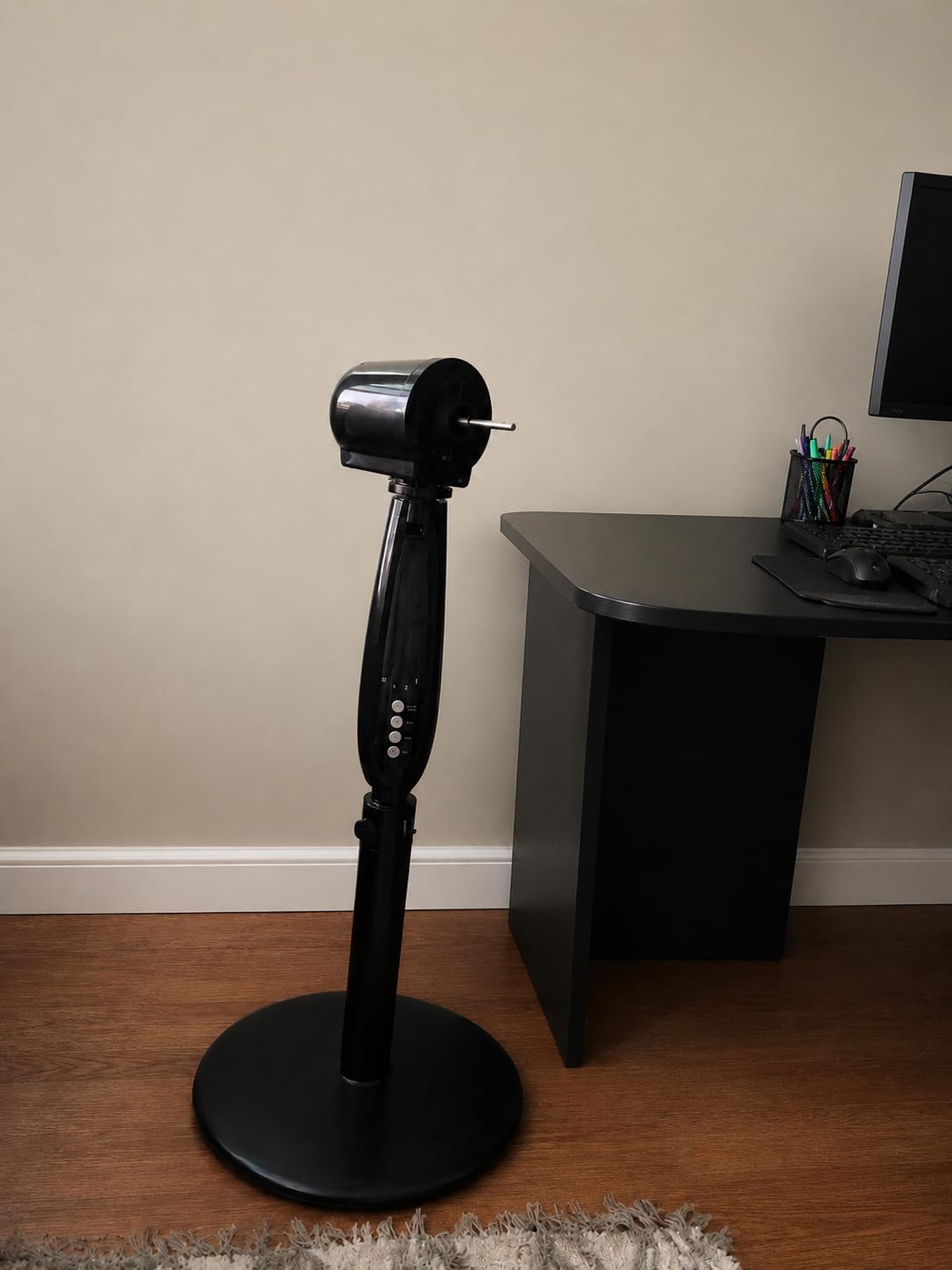
Three speeds and three breeze modes (nature, sleep, normal) give you more usable variation than a fan with six bare speed buttons. The sleep mode is the one to use overnight, and the remote means you set it once and stop touching it.
The trade-off is acoustic. A six-blade AC motor fan at full output is noticeably louder than any of the DC bladeless models in this list, and owners describe it as a consistent rush of air noise rather than silence. If you are a light sleeper, run it on low or use the sleep breeze mode and accept less raw output.
The 16 inch head and a wide base also take up real floor space, which is awkward in a small upstairs bedroom. Both Lasko pedestals later in this guide are slimmer in footprint if your floor plan is tight.
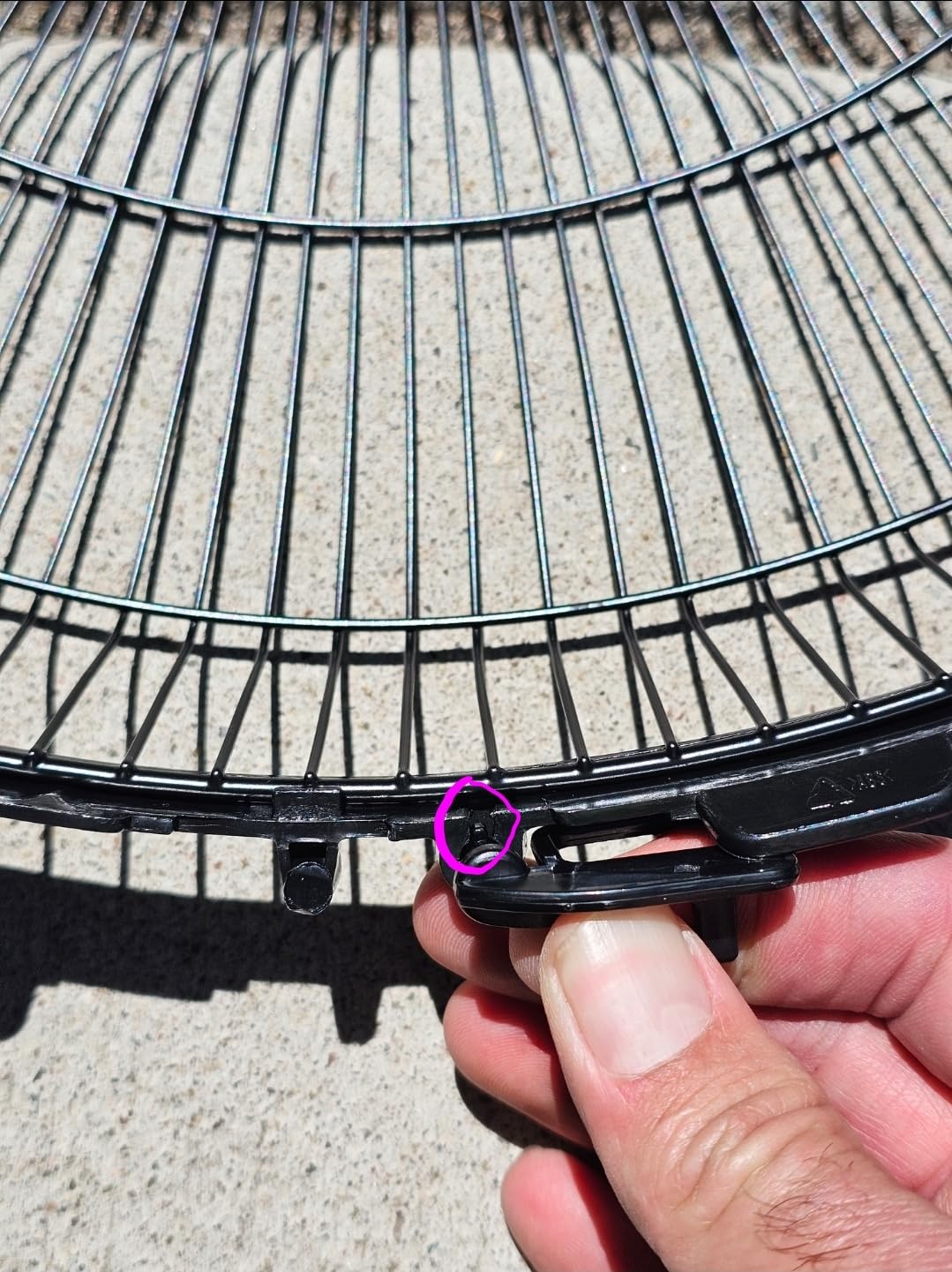
Why it works for an upstairs bedroom
Height adjustment is the feature that earns its place. At full extension the head sits high enough to sweep the hottest part of the room, and the tilt lets you hold that angle once you find it.
At 60W you can run it all night on a circuit shared with a window AC unit without thinking about it, and the three breeze modes give a softer overnight setting than raw speed reduction.
Who should skip it
Skip it if noise is the deciding factor. There are four fans in this list rated at or below 28.2 decibels, and this is not one of them.
Skip it if your bedroom floor plan is tight. The head and base are among the larger footprints here, and it will not tuck under a bed or into a narrow gap between dressers.
3. Lasko 2510 Oscillating Tower Fan: Best for Small Upstairs Bedrooms
Lasko Oscillating Tower Fan with Remote Control – 36″ – 2510 – White
36 inch tower
210 CFM
54.5 dB
36W draw
Pros
- Only 36W makes it one of the cheapest to run overnight
- Remote controls power
- speed
- oscillation and a 7 hour timer
- 60 degree oscillation covers a small room well
- Slim 12 inch base
Cons
- 36 inch height keeps airflow below bed height
- Only three speeds and no dedicated sleep mode
- Modest 210 CFM suits small rooms only
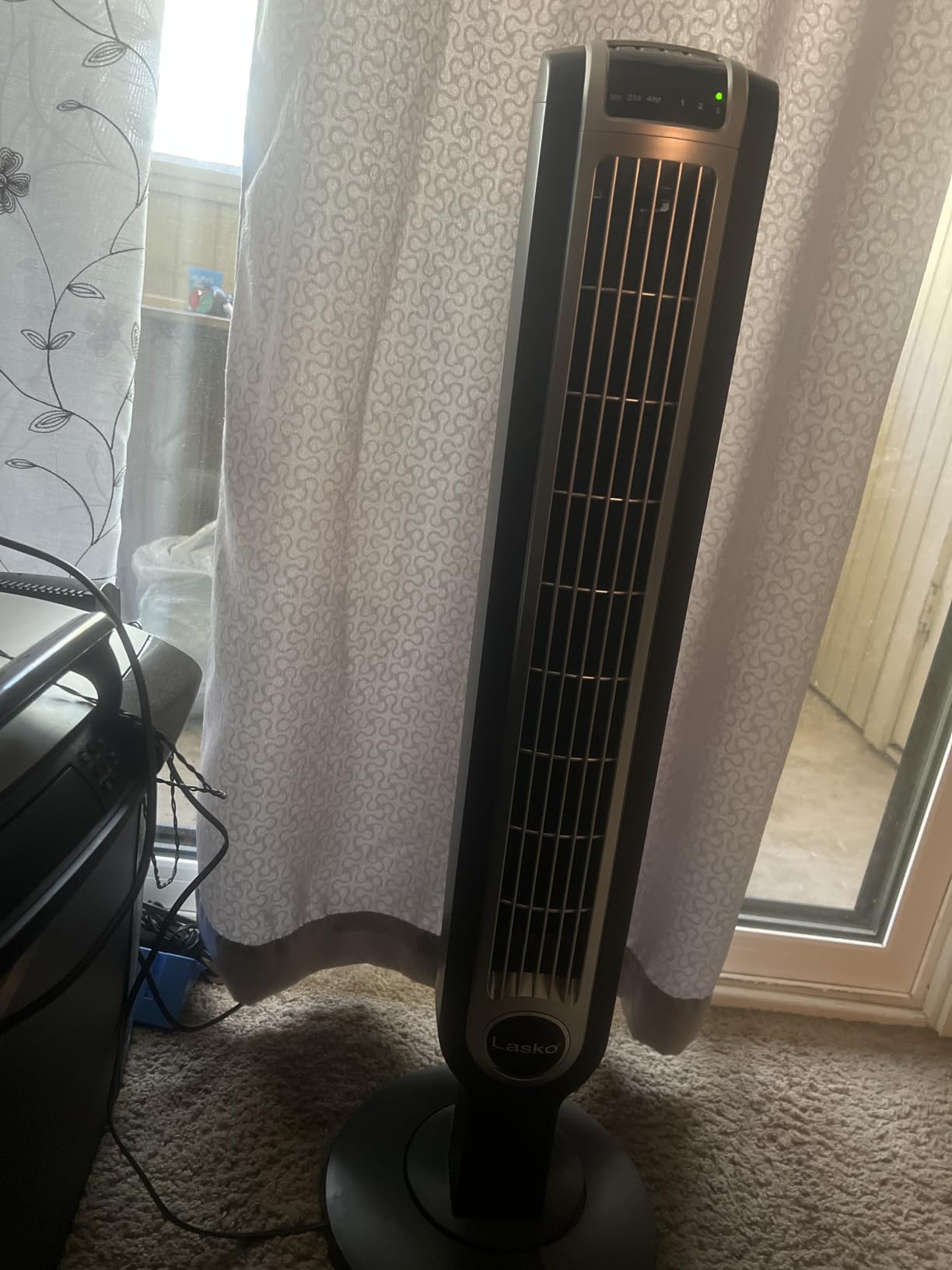
If your upstairs bedroom is on the small side, this Lasko tower is sized for it. At 210 CFM and 36 inches tall, it is the least capable fan in this list, and that is exactly the point: in a 10 by 12 room, more output is wasted energy you pay for overnight.
It draws 36 watts, making it one of the two lowest power picks here, and owners consistently describe it as quiet across all three speeds for bedroom and office use. The remote handles power, speed, oscillation and a 7 hour auto-off timer, which covers a normal night without needing to reset it.
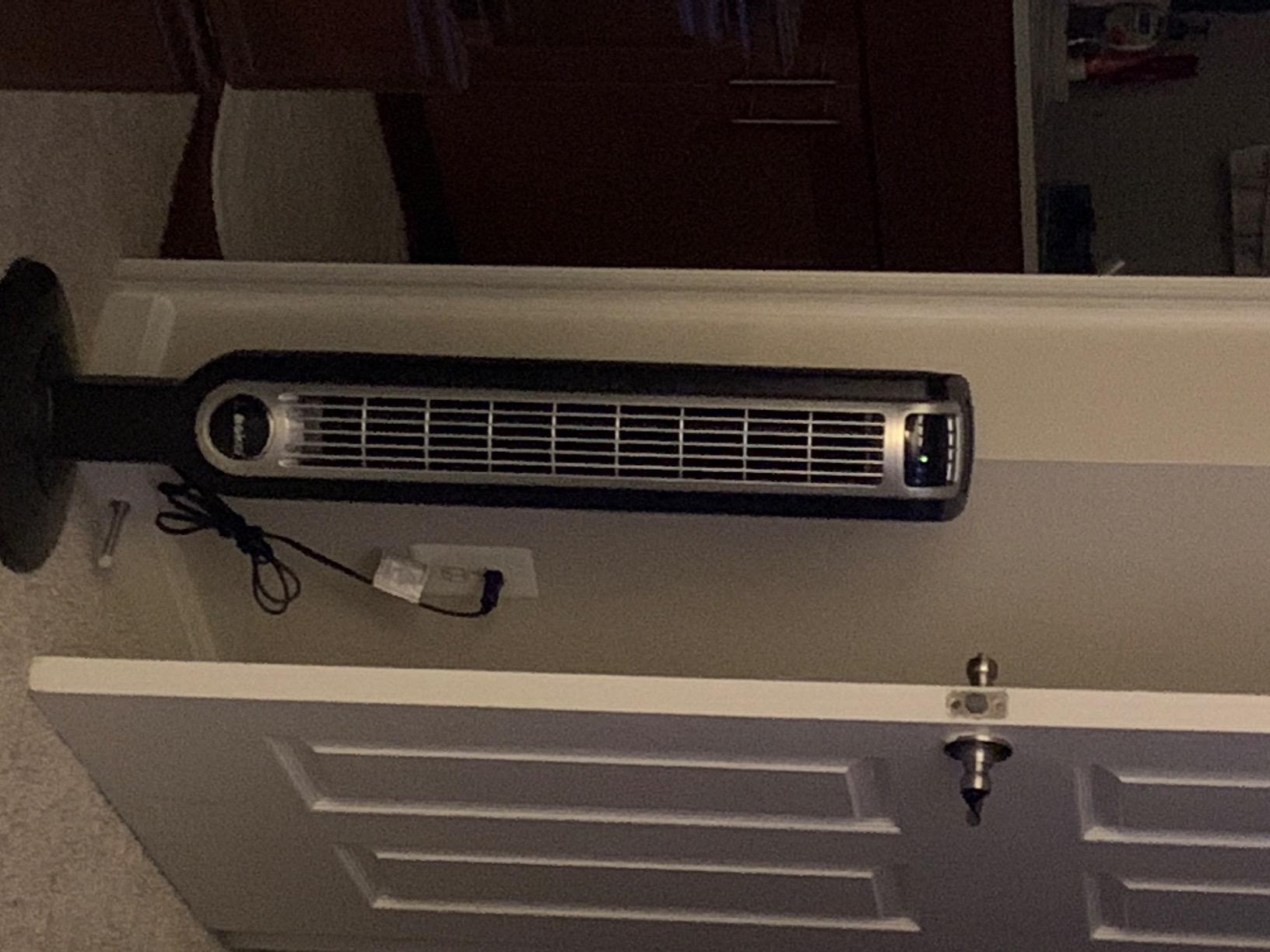
The 60 degree oscillation arc is wide enough to keep a small room feeling aired out rather than blasted from one direction. That matters in a room with a hot ceiling, because a constant sweep keeps mixing the warm upper layer down instead of leaving it parked overhead.
Be clear-eyed about the height. At 36 inches, the airflow is delivered low, around shoulder height, so it will not push the ceiling layer out on its own. It works best in a smaller room, placed near the open door, where the mixing alone does most of the work.
Owners also mention a faint motor hum at the upper settings on some units, and there is no dedicated sleep or natural breeze mode, only three straight speeds.
Why it works for an upstairs bedroom
The energy math is the argument. At 36W it is one of the cheapest to leave running all night, and in a small room you are not paying for capacity you cannot use.
The remote and 7 hour timer mean you set it before you get into bed and it shuts itself off, which matters when the room has to be livable again in the morning.
Who should skip it
Skip it for a large or vaulted upstairs bedroom. 210 CFM will not move enough air through a big volume, and no amount of extra time running it will change that.
Skip it if your bed is tall and you want air directed across the sleeper at pillow height. The 36 inch body cannot reach that far up.
4. PELONIS 40 Inch Bladeless Tower Fan: Best Bladeless Pick for Bedrooms

PELONIS 40-inch Bladeless Tower Fan for Bedroom, Standing Fan with Remote Control, 26ft/s, 90° Oscillation, 3 Speed Settings, 27 dB, 3 Modes, 15-Hour Timer, LED Display, Fan that Blows Cold Air, Black
40 inch bladeless tower
27 dB listed noise
26 ft/s wind speed
50W
Pros
- Very quiet at a rated 27 dB
- 15 hour timer is unusually long for a tower
- Remote works from up to 30 feet away
- No assembly required and a narrow base
Cons
- Sleep mode reported to sound like the top setting
- Remote storage slot is poorly designed
- Oscillation motor has failed within months on some units
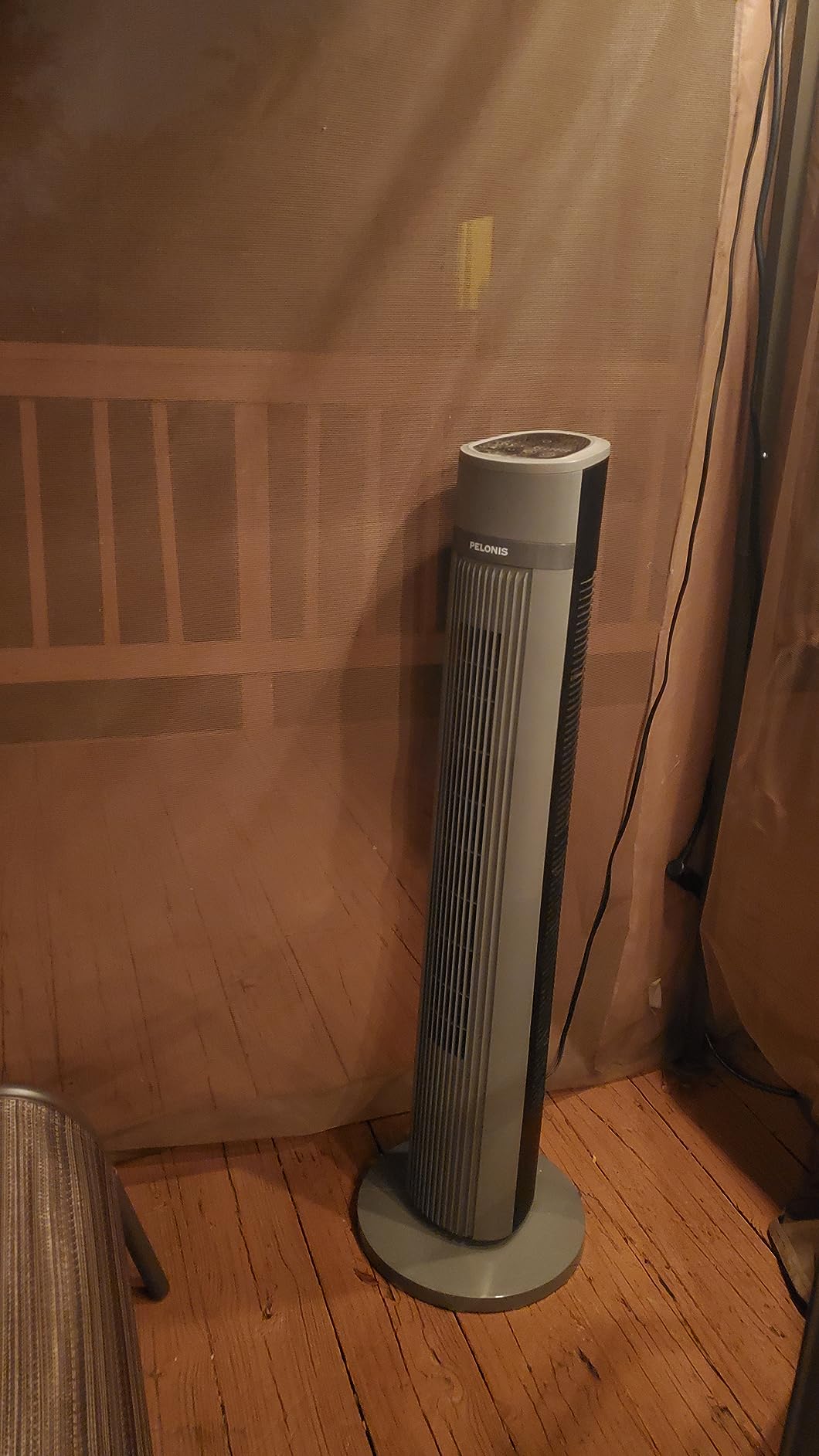
The bladeless format makes this a natural fit for a bedroom. There is no grille to snag bedding on, no blade noise riding above the motor hum, and no dust caught between blades that you have to disassemble the head to reach.
Published noise is 27 decibels, which sits in the range where most sleepers stop noticing the fan. Owners repeatedly describe it as easy to sleep beside, which for an upstairs bedroom running all night is the single most important number on the spec sheet.
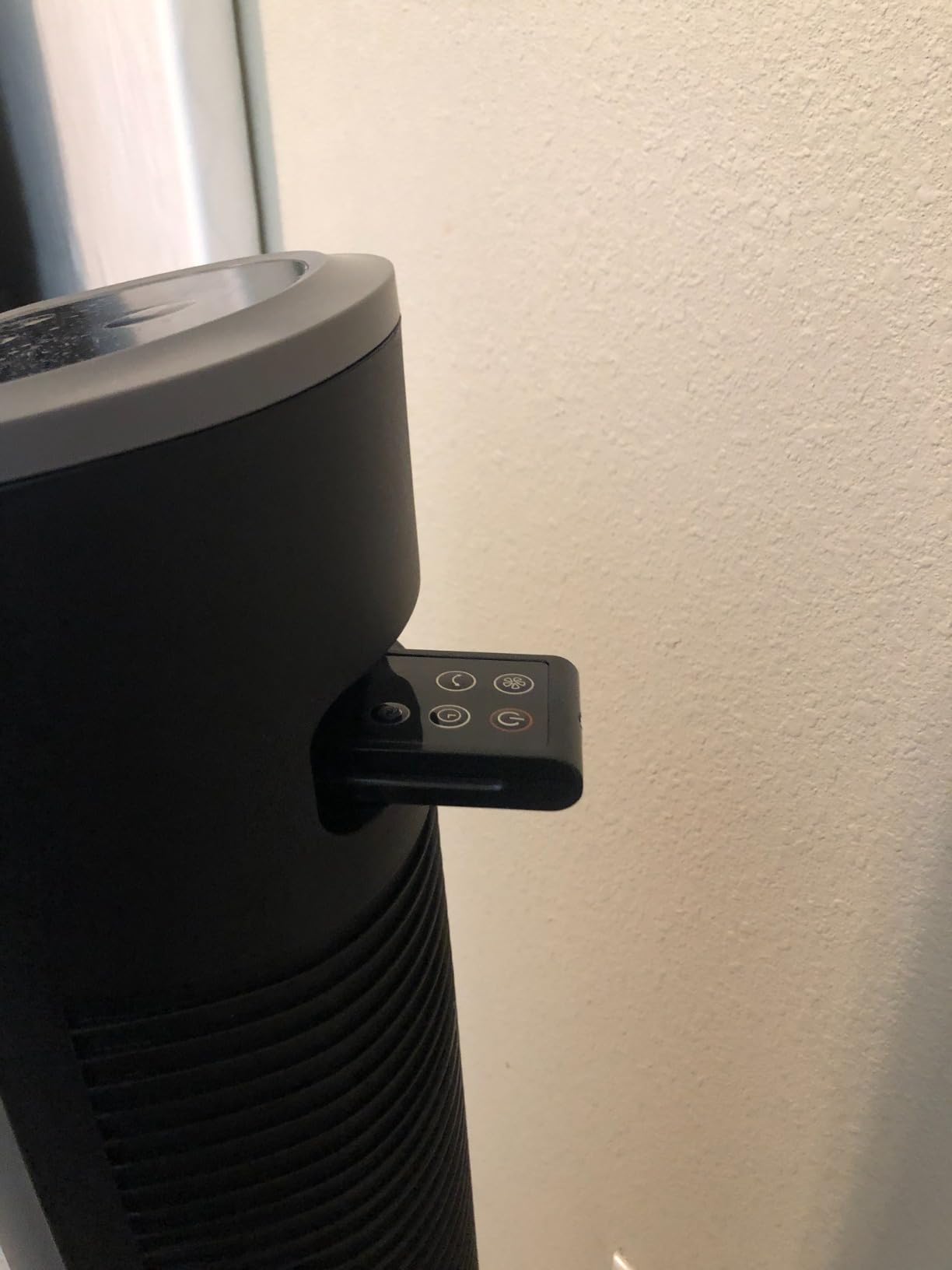
Wind speed is published at 26 feet per second with a 93 degree oscillation arc, and the 40 inch height means the airflow is delivered at a useful height rather than at your ankles. The 15 hour programmable timer is the longest in this group, which is genuinely useful when you are out during the day and want the room pre-cooled.
Bladeless does not mean powerful, and airflow here is strongest close to the unit rather than across a wide room. Place it near the door with the door open, and let the oscillation do the spreading.
The functional complaints are worth weighing. Some owners say the sleep mode sounds no different from the top setting, the remote slides out of its storage slot and is easy to misplace, and a small number report the oscillation motor failing within a few months. Creaking can also develop after several years of daily use.
Why it works for an upstairs bedroom
At 27 decibels and 40 inches tall, it hits the combination most upstairs bedrooms need: quiet enough to sleep next to, tall enough to stir the warm air above bed height.
The 15 hour timer means you can run it through a hot afternoon and still have it shut off on schedule at night, which is easier to live with in a shared house than a fan that runs indefinitely.
Who should skip it
Skip it if you need to clear a large room. Bladeless towers trade volume for silence, and this one loses ground to the higher-CFM pedestal fans in this list across a big space.
Skip it if a good sleep mode matters to you. Owners report the mode does not change the sound level, so you would be better served by the DREO smart model, which has genuine low-end quiet.
5. DREO 1000 CFM Oscillating Pedestal Fan: Top Rated for Airflow and Quiet
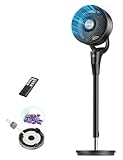
DREO Fan for Bedroom, Standing Oscillating Fan for Whole Room, Quiet Fan
1000 CFM
28.2 dB listed noise
36W DC motor
38 to 42 inch height
Pros
- 1000 CFM reaching up to 90 feet
- Exceptionally quiet below speed 4 for most owners
- Detachable blade
- front and rear grilles clean easily
- 105 degree pivot plus 8 speeds for fine control
Cons
- Top speed is noticeably loud
- Head cannot tilt low enough for floor-level airflow
- Listings imply an LED display the unit does not have
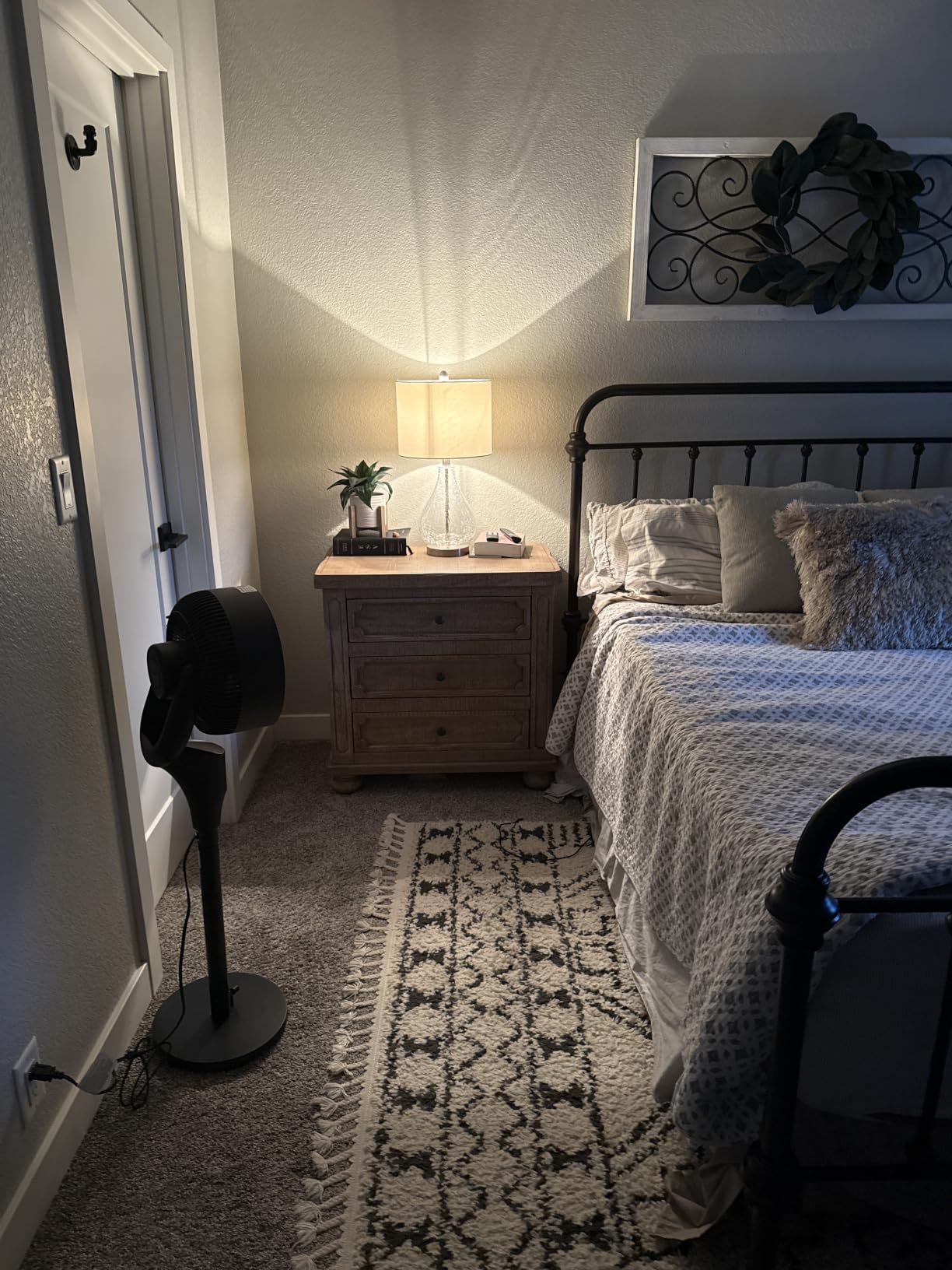
This is the fan we would put in the room we sleep in. It carries a 4.7 rating across more than 16,000 reviews, and it is the only fan in this list that pairs a genuinely high 1000 CFM output figure with a listed 28.2 decibel low-speed noise level.
Most fans trade one of those against the other. High CFM usually means a loud motor, and a quiet fan usually means modest volume. A 36 watt DC motor bridging both is why owners describe it as solving chronic upstairs heat specifically.
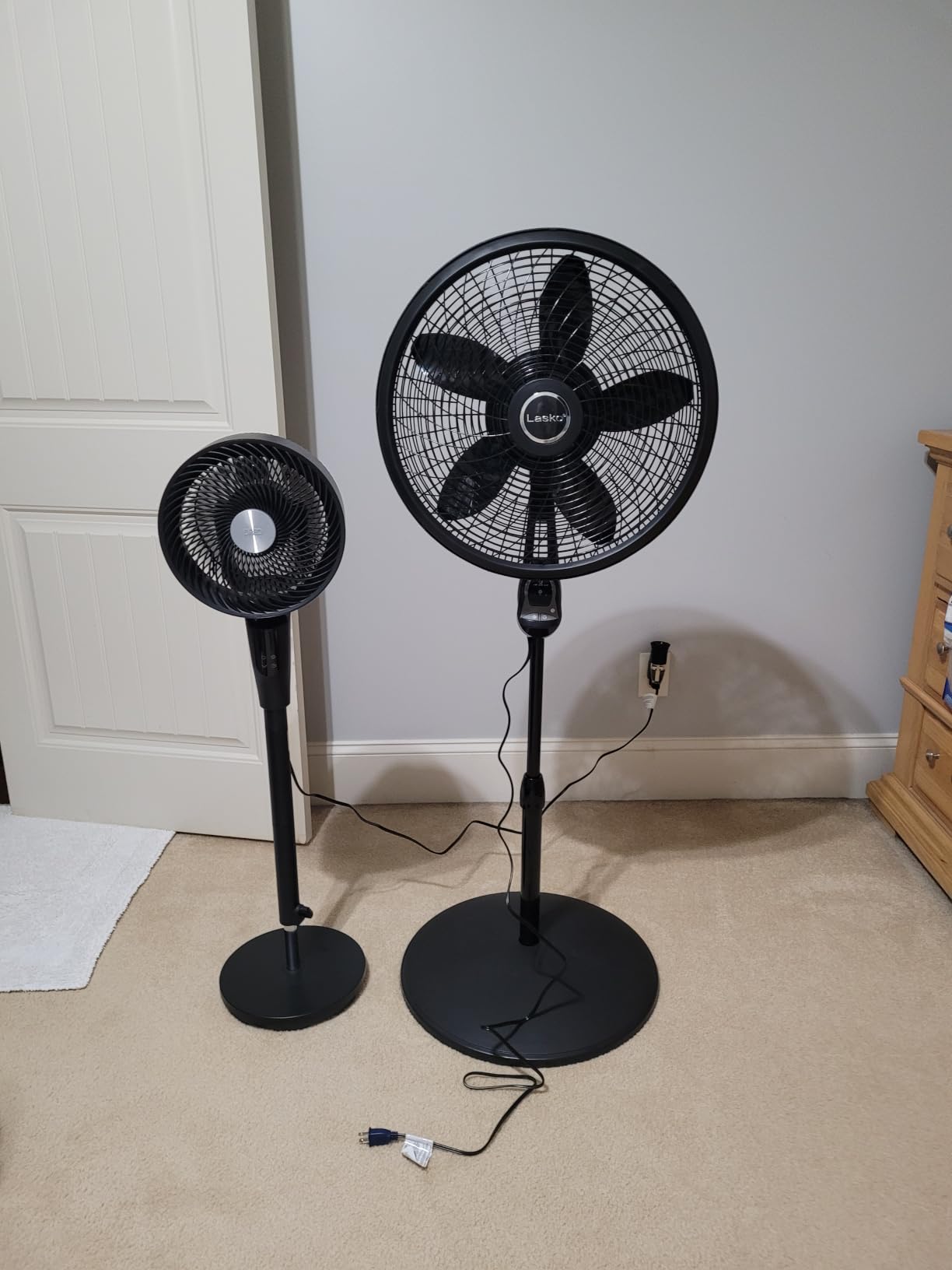
Air reach is published at up to 90 feet, and the head pivots 105 degrees vertically with a 90 degree horizontal sweep, over an adjustable 38 to 42 inch body. That combination lets you aim a long throw across the room toward an open door or window instead of just circulating air where the fan stands.
Eight speeds give you real granularity. In practice that means you can run it hard in the evening to pull the ceiling layer down, then drop to speed two or three overnight without a jump to a setting that suddenly wakes you up.
Detachable blade, front and rear grilles are a genuine advantage in a dusty upstairs room, and there is a built-in aroma pad if you want fragrance added to the airflow. Owners who have used it in a bedroom call the easy-clean design the reason it keeps getting used years later.
The top speed is loud, so treat it as a daytime setting. The head also cannot tilt far enough down to send air across the floor, and some buyers note the listing photos show an LED display the unit does not have.
Why it works for an upstairs bedroom
1000 CFM with 90 feet of reach means one fan can work an entire upstairs room and give you the option to drive that air out of an open door. In a small room you simply run it slower.
At 36 watts it is also among the most efficient high-output options here, so leaving it on all night through a heat wave is not a meaningful cost.
Who should skip it
Skip it if you plan to sleep next to it at maximum speed. It is quiet low and loud high, and the overnight setting has to be a low one.
Skip it if you need smart home control. The remote and touch panel are all you get, with no app or voice assistant.
6. Lasko Cyclone 1843 Pedestal Fan: Best for High Ceilings and Large Rooms

Lasko Cyclone Oscillating Pedestal Fan – Adjustable to 54″ – 1843 – Black
Adjusts to 54 inches
1854 CFM
96W AC motor
5 blades
Pros
- Tallest height range here at 54 inches
- Highest published airflow in the group at 1854 CFM
- Tilt-back head plus widespread oscillation
- Remote with 4 hour auto-off timer
- ETL listed with Blue Plug fault detection
Cons
- 96W AC motor is audible on higher speeds
- 20.5 inch square base needs real floor space
- Only a 4 hour timer
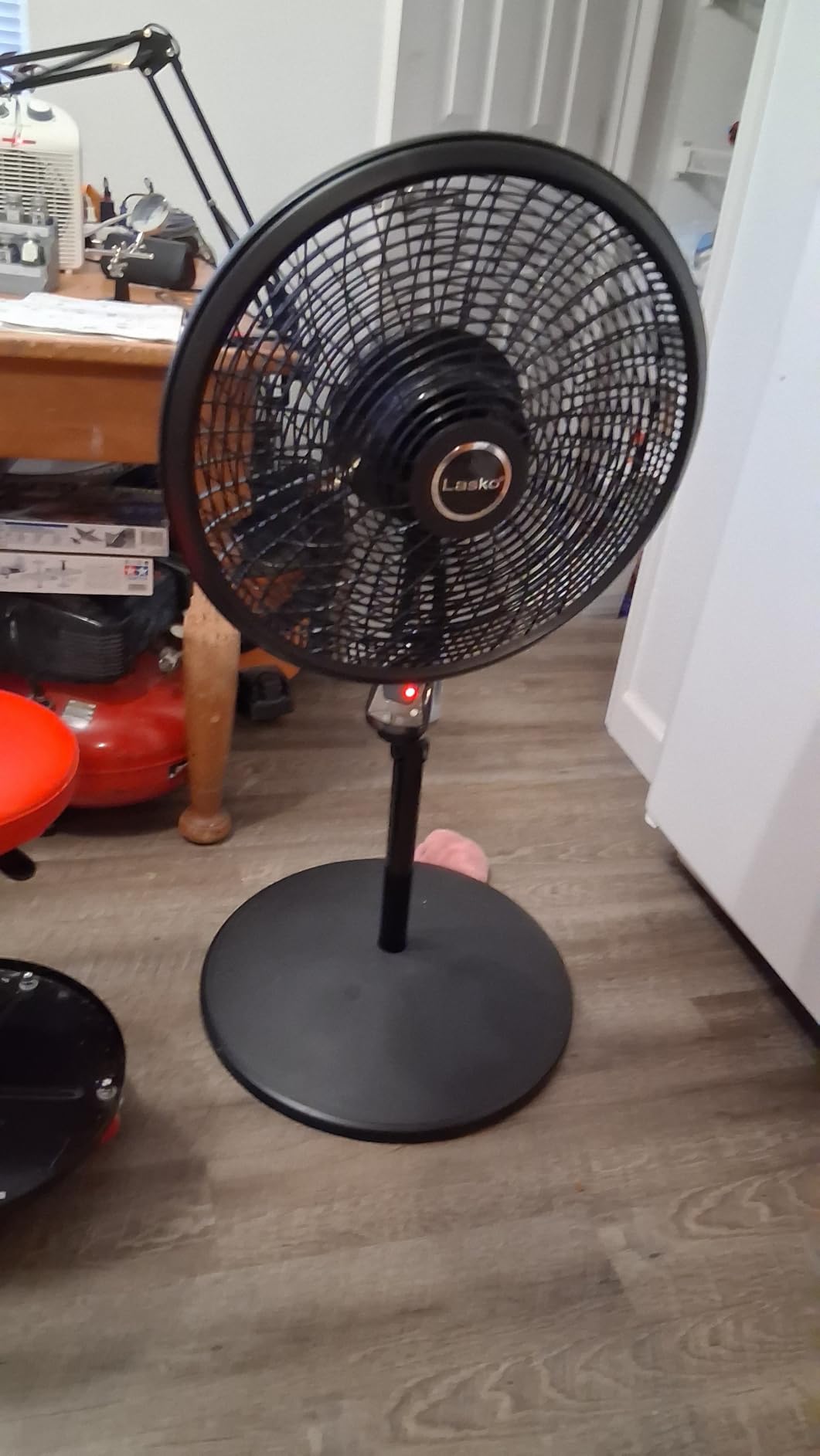
If your upstairs bedroom has a vaulted or cathedral ceiling, the physical height of the fan is the constraint nobody mentions until the fan is already assembled. This one extends to 54 inches, and paired with a tilt-back head it can aim into the ceiling void where your trapped heat is actually sitting.
Published airflow of 1854 CFM is the highest figure in this group, and the 18 inch head with widespread oscillation covers a large floor area. For a big top-floor bedroom that other fans cannot reach, the raw capacity is real.
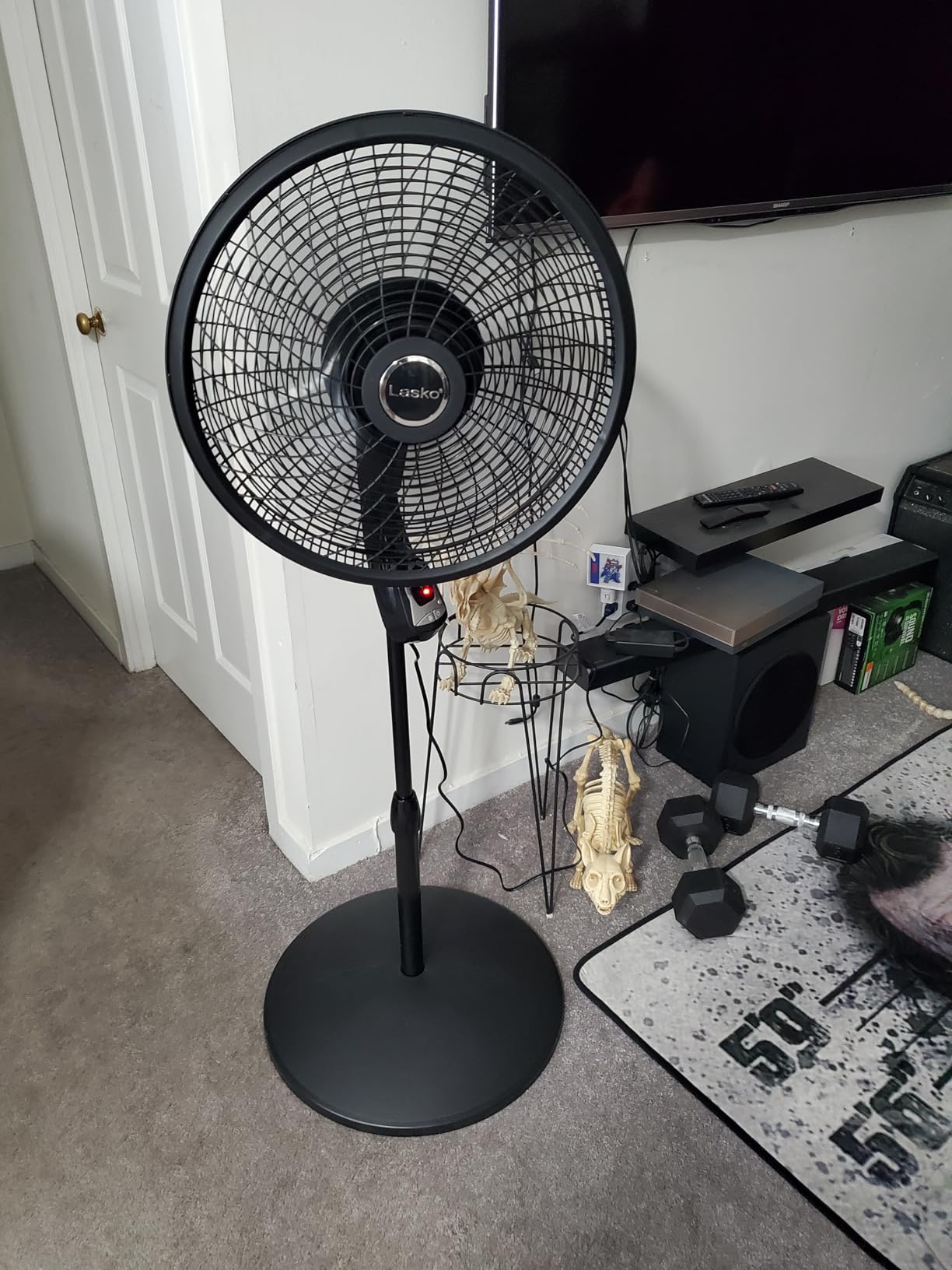
Height adjustment goes low enough to aim across a bed at pillow level and high enough to sweep overhead, which makes it the most flexible placement tool here. The remote handles power and speed, with a 4 hour auto-off timer, and Blue Plug fault detection cuts power if the fan detects an electrical fault.
The costs are real. A 96 watt AC motor is clearly audible on the upper two settings, so it is a fan you run while you are awake and moderate while you sleep. The 20.5 inch square base is the largest footprint in this list, which rules it out of most normal upstairs bedroom layouts.
Owners are also candid that the 4 hour timer is short for overnight use and that cycling speeds on the small remote is fiddly.
Why it works for an upstairs bedroom
A 54 inch reach is the difference between stirring the air you feel and moving the air that is actually stored, which is precisely the problem in a high-ceilinged second floor.
The remote and Blue Plug safety make it a sensible choice in a child’s room or a room where the fan runs unattended for long stretches.
Who should skip it
Skip it for a typical 10 by 12 bedroom. You would be buying capacity and footprint you cannot use, and paying for noise in watts as well as in decibels.
Skip it if you are a light sleeper. There is no quiet mode here, only speed reduction, and the AC motor stays audible.
7. Lasko 1646 Pedestal Fan: Budget Pick for Everyday Bedrooms

Lasko Oscillating Adjustable Pedestal Stand Fan – 16” – 1646 – White
32 to 47 inch height
1140 CFM
58W
3 speeds
Pros
- Lowest purchase cost of the pedestal group
- Adjusts low enough to direct air at pillow height
- Remote with 1
- 2 or 4 hour auto-off timer
- Many owners report multi-year durability
Cons
- Steady audible drone rather than true quiet
- Low setting moves very little air
- All-plastic construction can rattle
- Oscillation cannot be controlled from the remote
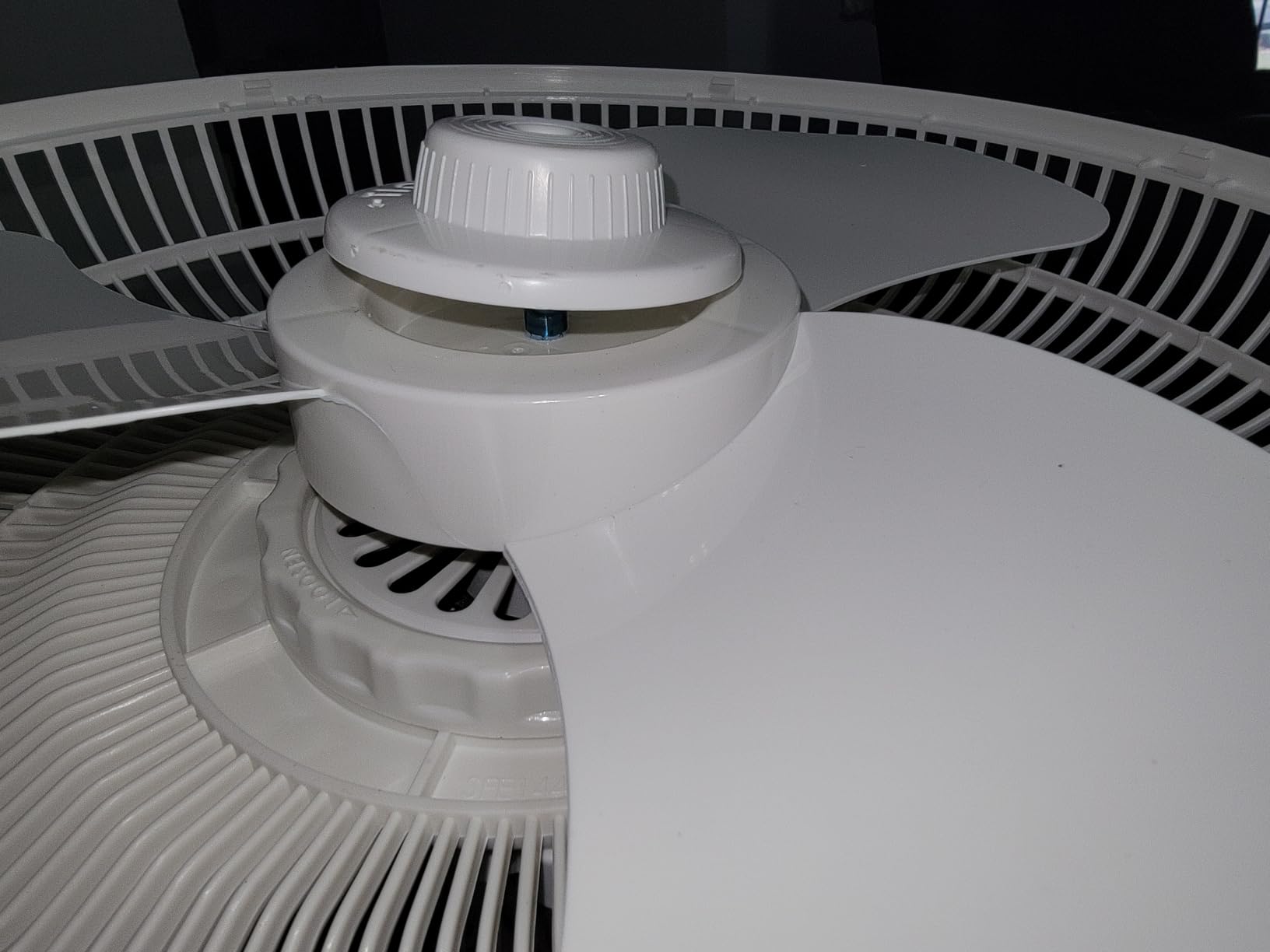
This is the fan to buy when the goal is moving a lot of air for very little, and it is the one in this list most likely to already be sitting in someone’s house. Many owners describe running the same unit for six years or more with daily use.
Height adjusts from 32 to 47 inches, which is the useful range in a bedroom with a low ceiling: low enough to send air across the bed at pillow height, tall enough to clear the bed frame. A tilt-back head adds a second axis of adjustment.
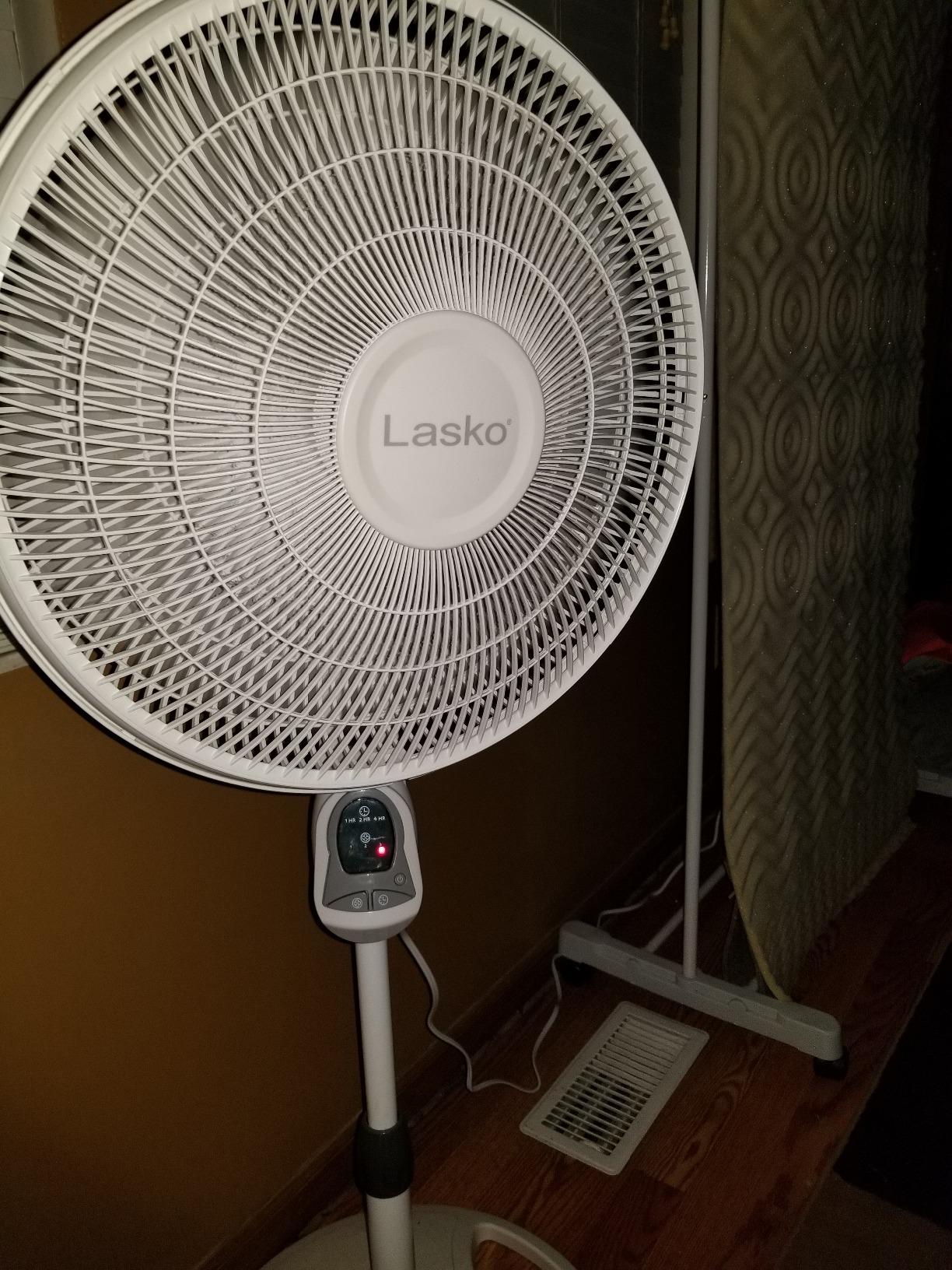
Published airflow of 1140 CFM from 58 watts is a strong efficiency figure, and the three-blade head with optional oscillation covers a standard bedroom well. The remote handles on, off, speed and a 1, 2 or 4 hour auto-off timer.
Reviews here split along a clear fault line, and you should know which side you are on. The sound is a steady drone. Plenty of sleepers describe it as usable white noise, and a real number of owners say the opposite, that it is unsuitable for very light sleepers. The low setting moves little air, and the all-plastic body can rattle, grind and vibrate on some units.
One practical annoyance: oscillation is panel-only, so it cannot be toggled from bed once you are under the covers.
Why it works for an upstairs bedroom
The 32 inch lower bound is the feature that matters most upstairs. In a room with a hot ceiling layer and a low ceiling, you want the fan down low pushing air across the sleeper rather than up where the heat already is.
Long-term durability is the other argument. Owners running the same pedestal for six years report less concern about replacement than with any newer model here.
Who should skip it
Skip it if you are sensitive to steady motor drone. There are four quieter picks in this list, and noise is the main reason they exist.
Skip it if you need the oscillation to start when you get into bed. That is a panel-only control on this model.
8. Levoit 36 Inch Tower Fan: Best for Narrow Floor Plans

Levoit Tower Fan for Bedroom, 28ft/s Fans that Blow Cold Air, 28dB Quiet
6.5 inch base
1044 CFM
28 dB listed noise
39W
Pros
- Only 6.5 inches wide so it tucks into a tight corner
- 28 dB on low with a 12 hour timer
- Auto Mode adjusts speed using a built-in temperature sensor
- Removable back grille for cleaning
Cons
- 36 inches tall so airflow stays low
- AC motor is louder on the upper speeds
- Fixed oscillation arc with no narrower sweep
- LED display can be bright in a dark room
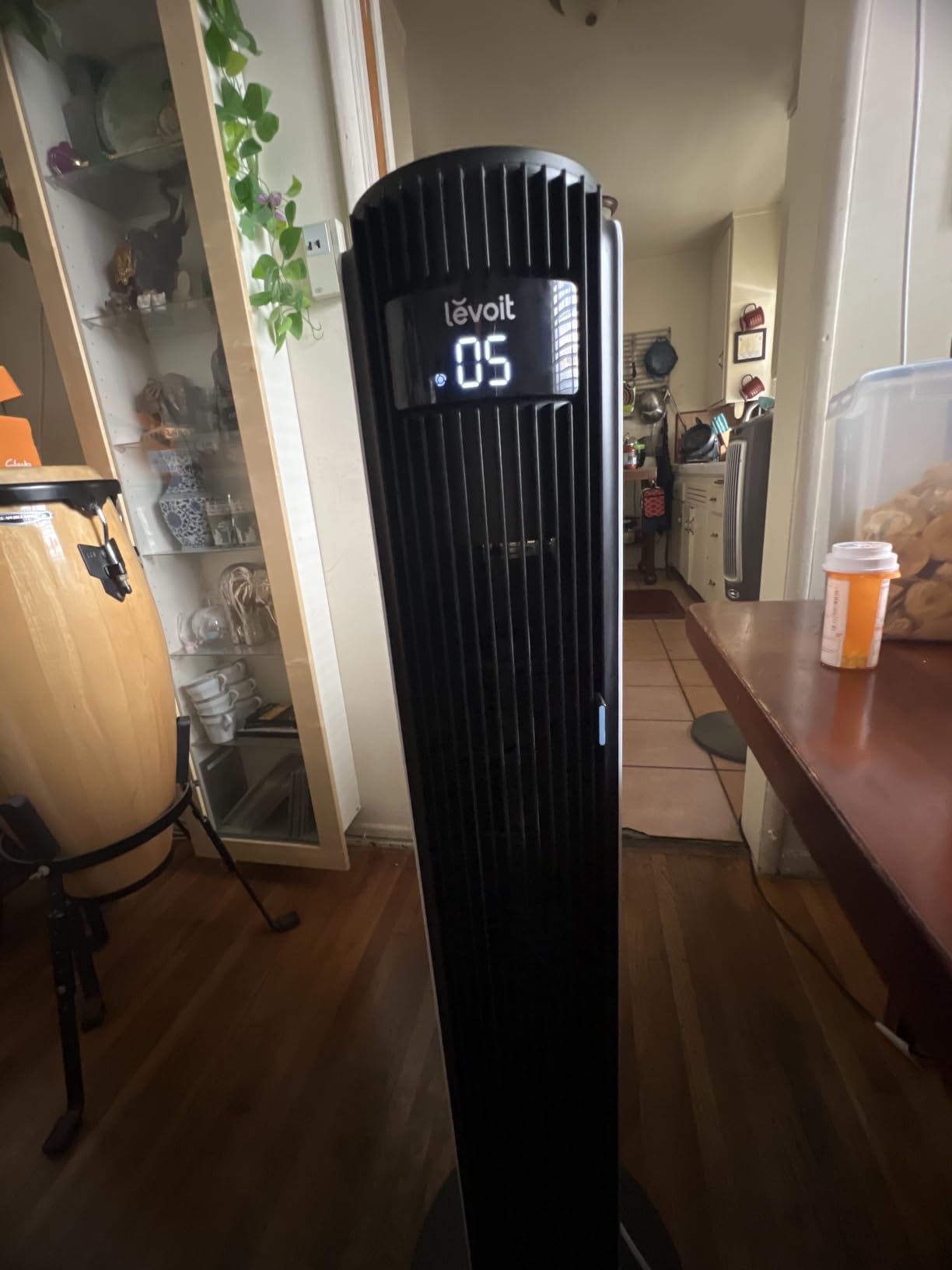
The reason to pick this fan is the 6.5 inch base. That is a full four inches narrower than any other tower here, and in an upstairs bedroom wedged between a dresser and a wall, that is the difference between a fan and a pile.
It is not a weak unit. Published output is 1044 CFM at 39 watts, with 28 feet per second of wind speed, and the noise figure of 28 decibels is on the low setting, not a marketing average.
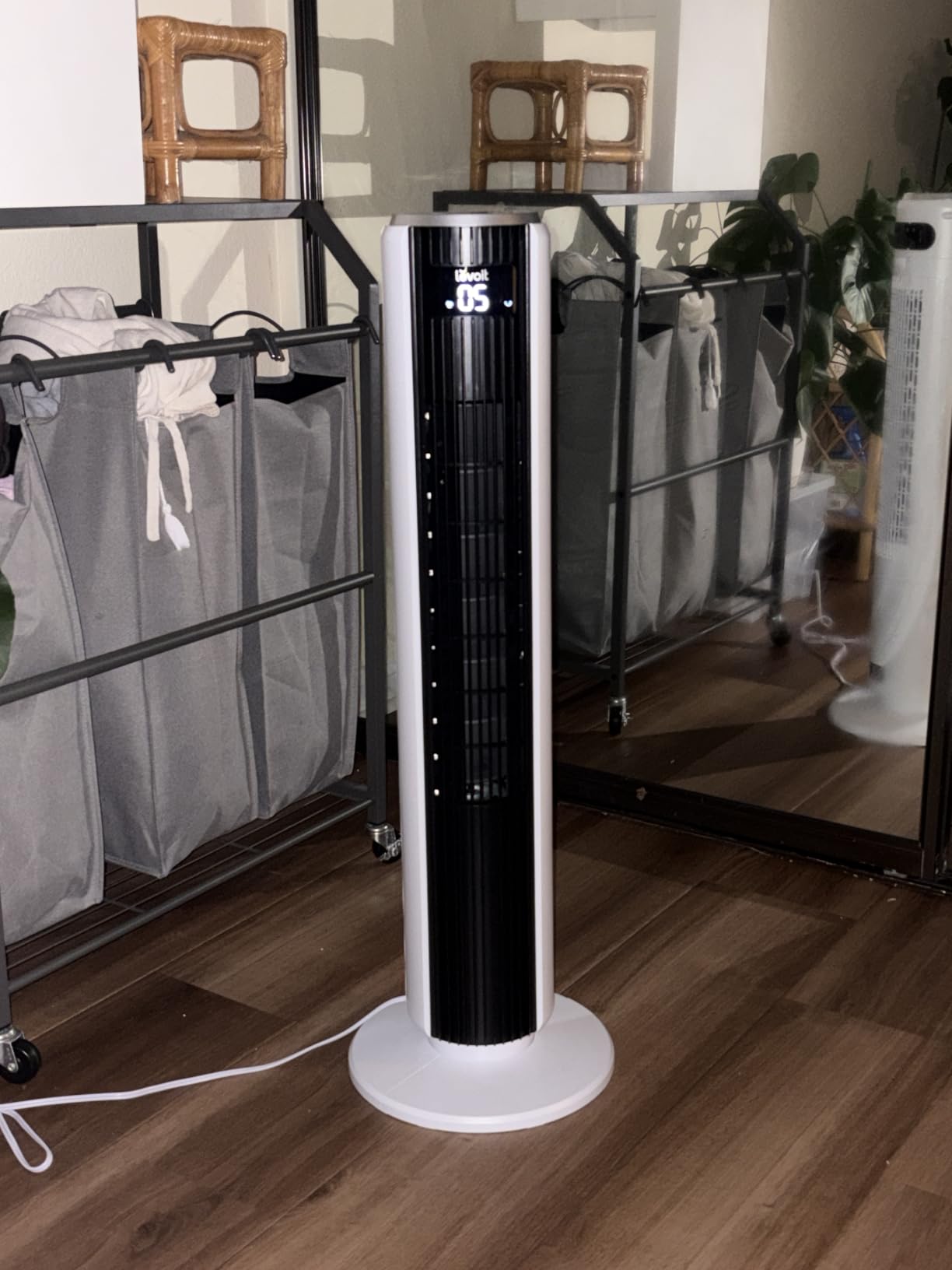
The 12 hour timer covers a full night without resetting, and the Auto Mode uses a built-in temperature sensor to raise or lower the speed as the room changes. In an upstairs space that swings from 78 degrees in the afternoon to 84 by bedtime, that automatic response is more useful than a fixed speed would be.
Five speeds and four modes give good range, and the removable back grille makes the weekly dust clean straightforward, which reviewers single out as a real benefit in a recirculating fan.
The compromises are height and top-end noise. At 36 inches, the airflow stays below bed height, and the AC motor gets noticeably louder on the upper speeds than the DC bladeless alternatives. The oscillation arc is fixed rather than adjustable to a narrower sweep, and some owners find the LED display bright enough to disturb a dark bedroom.
Why it works for an upstairs bedroom
Footprint and noise are the two constraints in a small hot bedroom, and this fan solves both. It disappears against a wall and disappears audibly at low speed.
The temperature-sensing Auto Mode means you do not have to get up at midnight to adjust it, which on a hot floor is the point of the exercise.
Who should skip it
Skip it if your bed is tall or you want air directed at pillow height. The 36 inch body cannot deliver that, and no oscillation setting changes it.
Skip it if you want fine control over the sweep. The arc is fixed, and there is no app or voice control either, just the remote.
9. Vornado 660 Air Circulator Fan: Best for Moving Air Between Floors
Vornado 660 Large Air Circulator Fan, 4 Speed, Adjustable Tilt, Black
584 CFM
45W
54 dB
4 speeds with 90 degree tilt
Pros
- Moves an enormous volume of air along a long corridor on 45W
- Very quiet on speeds 1 and 2
- 90 degree tilt on the chrome glide bar aims air at a ceiling corner
- Air reach published up to 100 feet
- Owners report a decade or more of continuous use
Cons
- No oscillation
- no remote and no timer
- Powers up at maximum speed which is loud
- 6 foot cord is short for many layouts
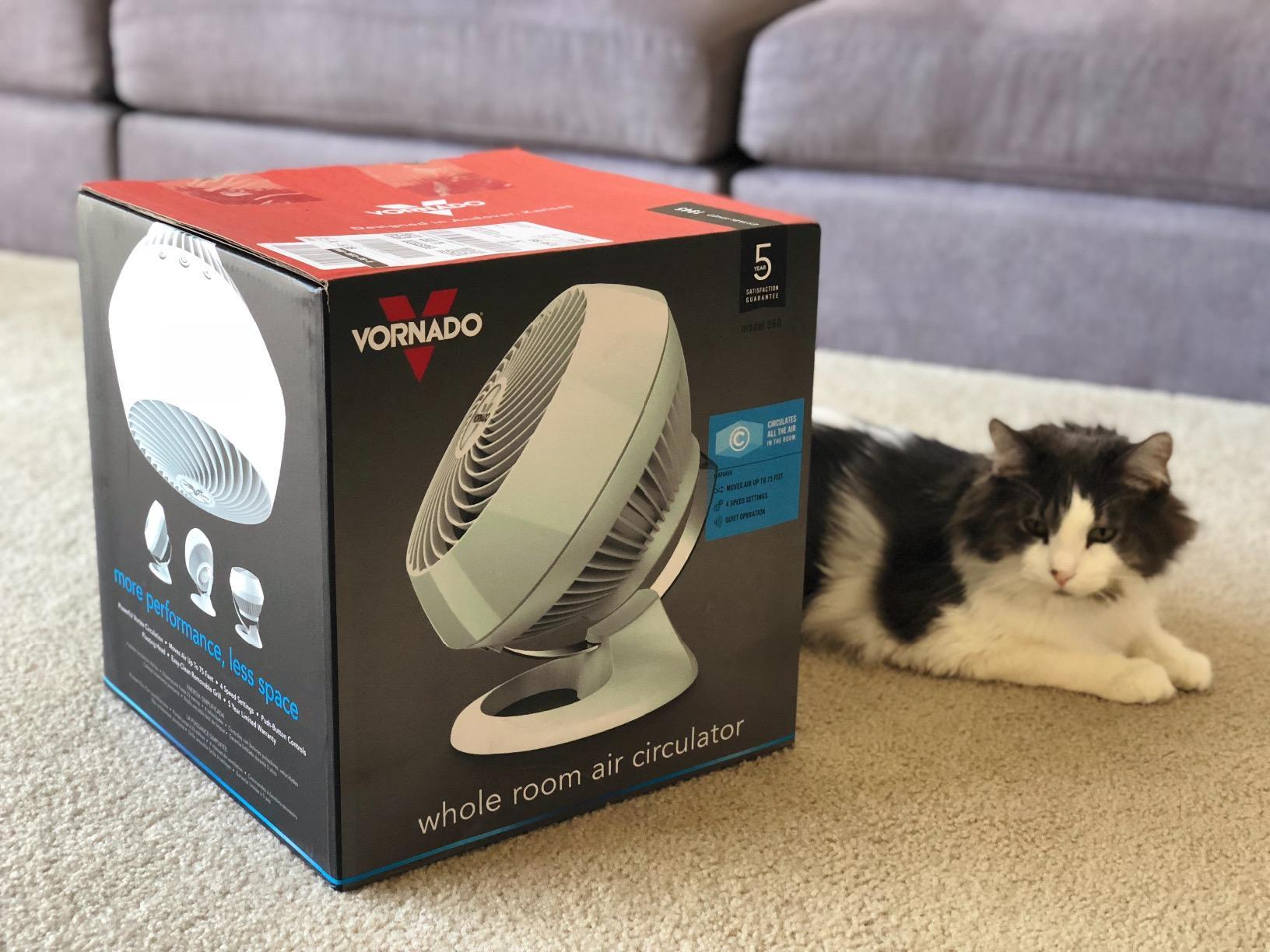
The Vornado 660 is not a bedroom fan in the way the other eleven in this list are, and that is exactly what makes it valuable in a two-story house. On r/BuyItForLife, this is the fan people describe as a purchase for life, and the reasoning is that it does one thing exceptionally well.
It moves air. Deep-pitched blades, an inlet guide cone and a spiral grille push air up to 100 feet, and the 90 degree tilt on the chrome glide bar lets you aim that stream at a ceiling corner. Set it at the bottom of the stairs and it will drive warm air from downstairs toward the upper landing, which is exactly the stack effect running in reverse.
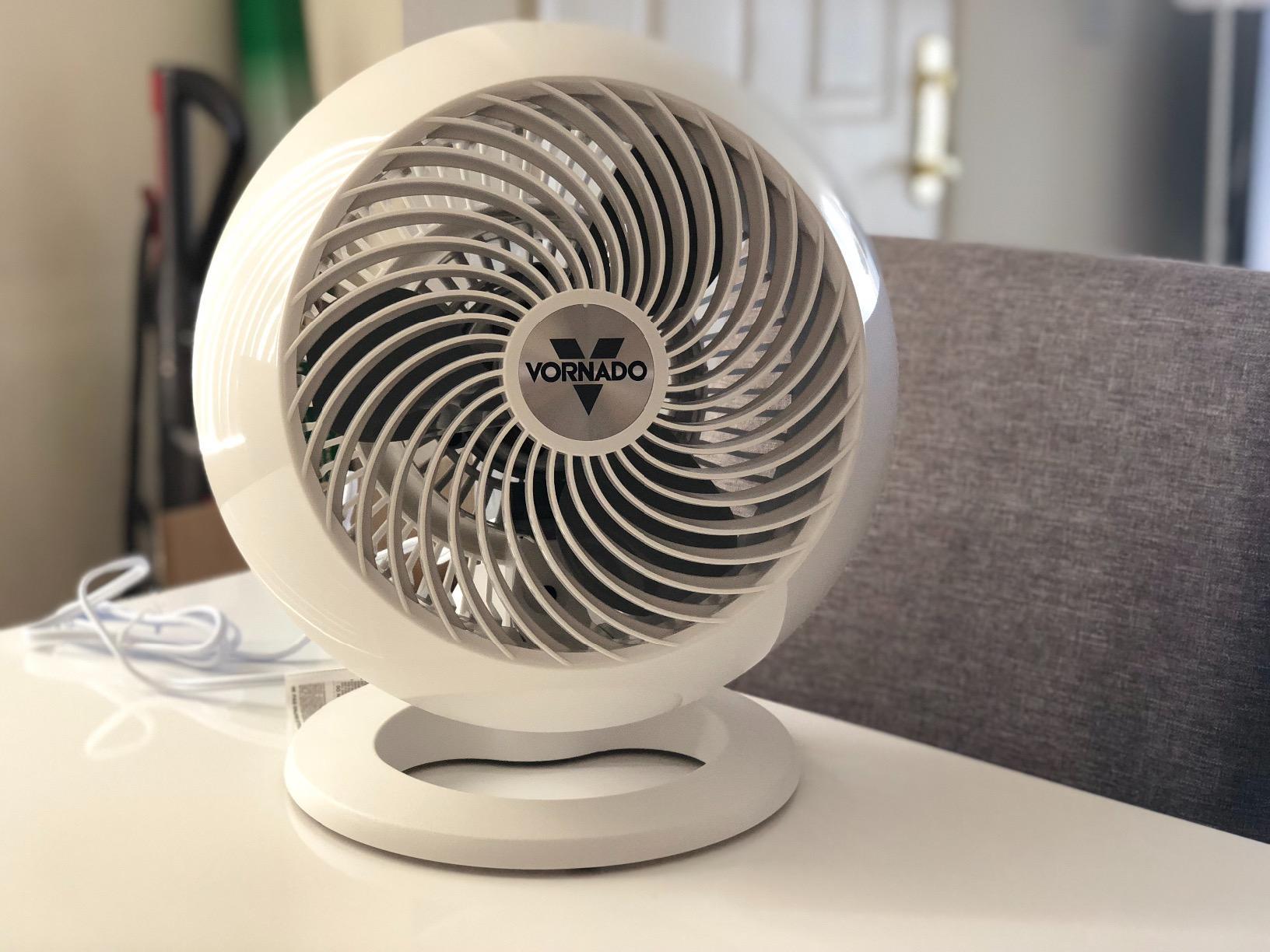
Inside a bedroom, the same tool works as a ceiling agitator. Aim it at the junction where the ceiling meets two walls, run speeds 1 and 2, and it quietly strips the hottest layer off the ceiling and drives it toward your open door. On speeds 1 and 2 owners describe it as extremely quiet, and speed 3 is still conversation-friendly.
The caveats are about convenience, not performance. There is no oscillation, no remote and no timer, so positioning and speed are set by hand each time. It powers up at maximum speed after any power interruption, which is a genuine problem if you plan to run it overnight. The 6 foot cord is also short for many room layouts, and the top speed is loud.
It circulates air, it does not chill it, and it will not lower the air temperature in an upstairs room by itself.
Why it works for an upstairs bedroom
At 584 CFM on 45 watts, this is the most efficient high-output tool in the list for moving a large volume of air, and the 100 foot reach means placement matters more than placement does with any other fan here.
The five year warranty and reported decade-long service life change the calculation for a fan you might keep running every summer night for a decade.
Who should skip it
Skip it if you want a remote, a timer or automatic speed. All three are absent, and you will be reaching over to the unit at two in the morning.
Skip it if you want to be woken by the fan after a power cut. It restarts at full speed, which is not a bedroom-friendly behaviour.
10. DREO 502 Omni-Directional Pedestal Fan: Best for Quiet Sleep

DREO Fan for Bedroom,120°+120° Oscillating Standing Fan, Quiet Pedestal Fan
23 dB listed noise
24W DC motor
120 plus 120 degree oscillation
35 to 40 inch height
Pros
- Genuinely quiet at the low settings
- 120 degree horizontal plus 120 degree vertical is the most flexible aiming here
- 8 speeds and 3 modes including sleep
- DC motor raises air volume while cutting energy use
- Remote with a snap-on holder on the base
Cons
- Oscillation sweeps are very slow
- Base is larger than typical and eats floor space
- Display light could be dimmer
- Some units develop hum in the oscillation motor
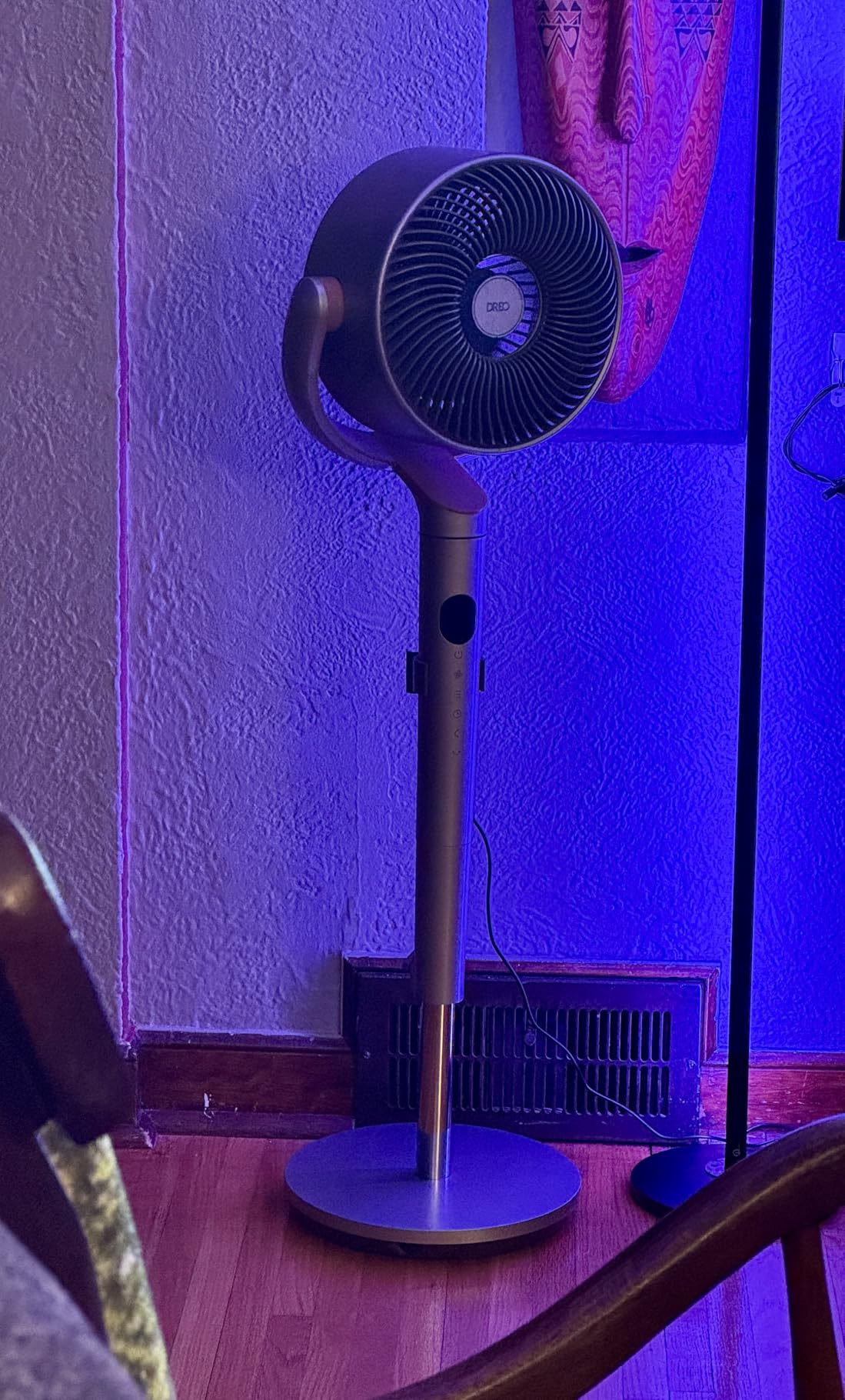
At 23 decibels on low settings, this is the quietest fan in the group, and quietness is the constraint that decides most overnight purchases. Owners frequently call it the quietest fan they have owned.
What separates it from the other quiet models is the dual-axis oscillation: 120 degrees horizontal and 120 degrees vertical at the same time. Nothing else in this list can sweep that envelope, and in a bedroom with a hot ceiling and a door on one wall, being able to tilt up and sweep side to side at once means the air actually reaches the whole room.
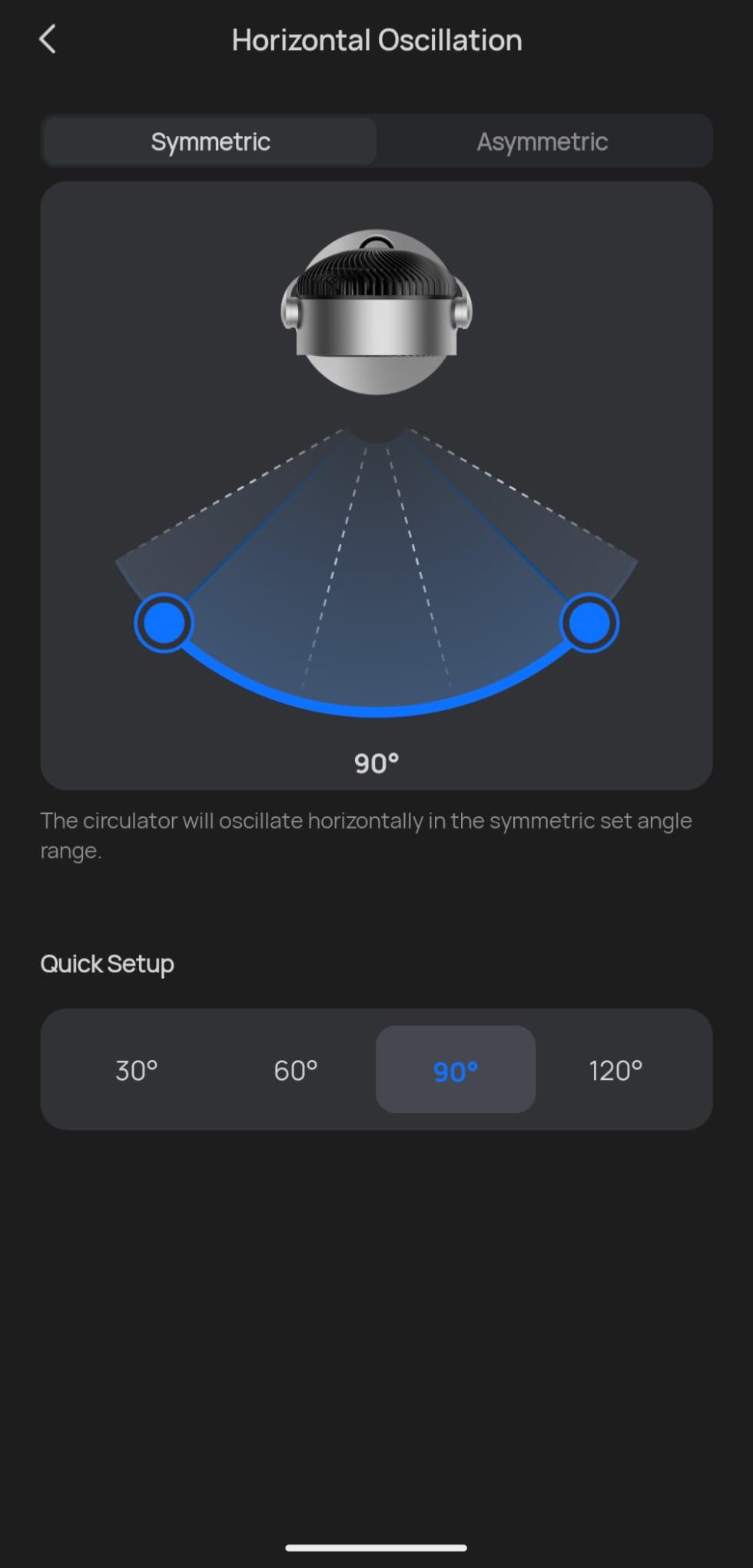
Eight speeds and three modes, normal, natural and sleep, plus an adjustable 35 to 40 inch body, give you wide overnight range. Published power draw is 24 watts with a DC motor, and the manufacturer claims around 30 percent more air volume and 40 percent less energy than an equivalent AC motor fan.
Reported drawbacks are consistent. The oscillation sweeps very slowly, which some owners find distracting and others prefer. The base is larger than typical pedestal bases and eats floor space. The display could be dimmer in a fully dark room, and a minority of units develop a hum or grinding in the oscillation motor after months of use. The DC power jack cable is short, which constrains placement against a wall.
The remote snaps into a holder on the base, which is a small thing that prevents the most common annoyance in this category.
Why it works for an upstairs bedroom
Simultaneous vertical and horizontal oscillation is the tool for a room where heat collects at the ceiling. Aim it up once and let the sweep cover the rest.
At 24 watts it is the second lowest draw in this group, so a genuinely quiet fan that runs all night is also close to free to operate.
Who should skip it
Skip it if you need precise timing. The timer runs 8 hours, which is fine for a night but not for a full workday.
Skip it if floor space is genuinely tight. The base is the widest of the DC pedestals here, and this is not a slim tower.
11. DREO Smart RGB Pedestal Fan: Best for Smart Home Setups

DREO Smart Fan for Bedroom with RGB Light, 150°+120° Omni-directional Oscillating, Quiet Fan, 100ft Air Circulator Pedestal Fan, 12 Speeds, 6 Modes, 37-42” Height, Wi-Fi/Voice/Alexa, grey
1100 CFM
25 dB listed noise
36W
37 to 42 inch height
Wi-Fi enabled
Pros
- High 1100 CFM output with a long air reach
- DC motor quiet on low settings and energy efficient
- Works with app
- voice assistant
- remote and touch panel
- 150 degree horizontal plus 120 degree vertical oscillation
- 12 speeds and 6 modes
Cons
- Wi-Fi and app setup adds complexity
- RGB lighting is a gimmick in a bedroom
- 43 inch tall and one of the bulkier units here
- Not the quietest at the top speed
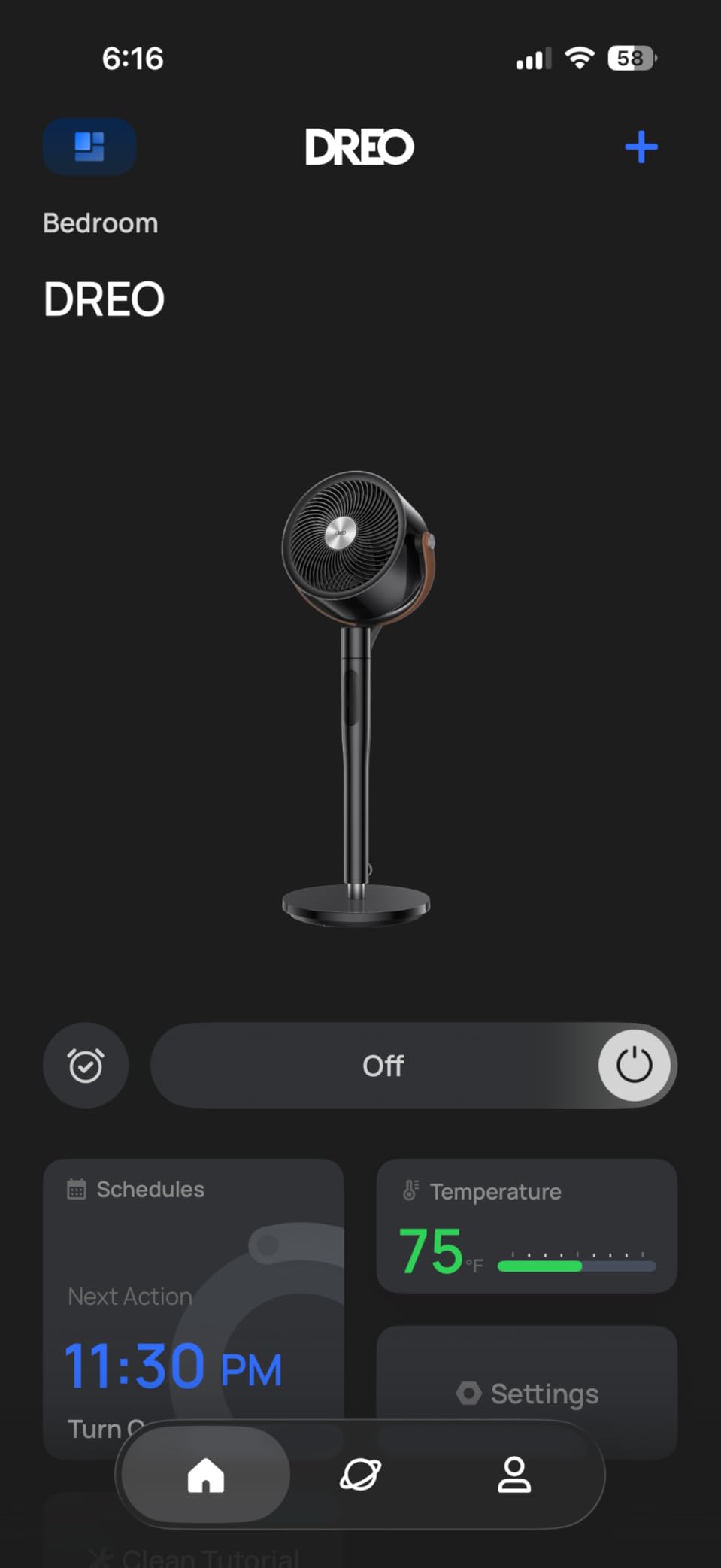
This is the only fan in the list that works with an app and a voice assistant, and if your bedroom is already wired into a smart home that decides the question before anything else does. You can turn it on from bed, change speed by voice, and put it on a schedule without touching a remote.
Underneath the smart features the hardware is strong. Published output is 1100 CFM with air reach up to 100 feet, oscillation sweeps 150 degrees horizontally and 120 degrees vertically, and height adjusts between 37 and 42 inches.
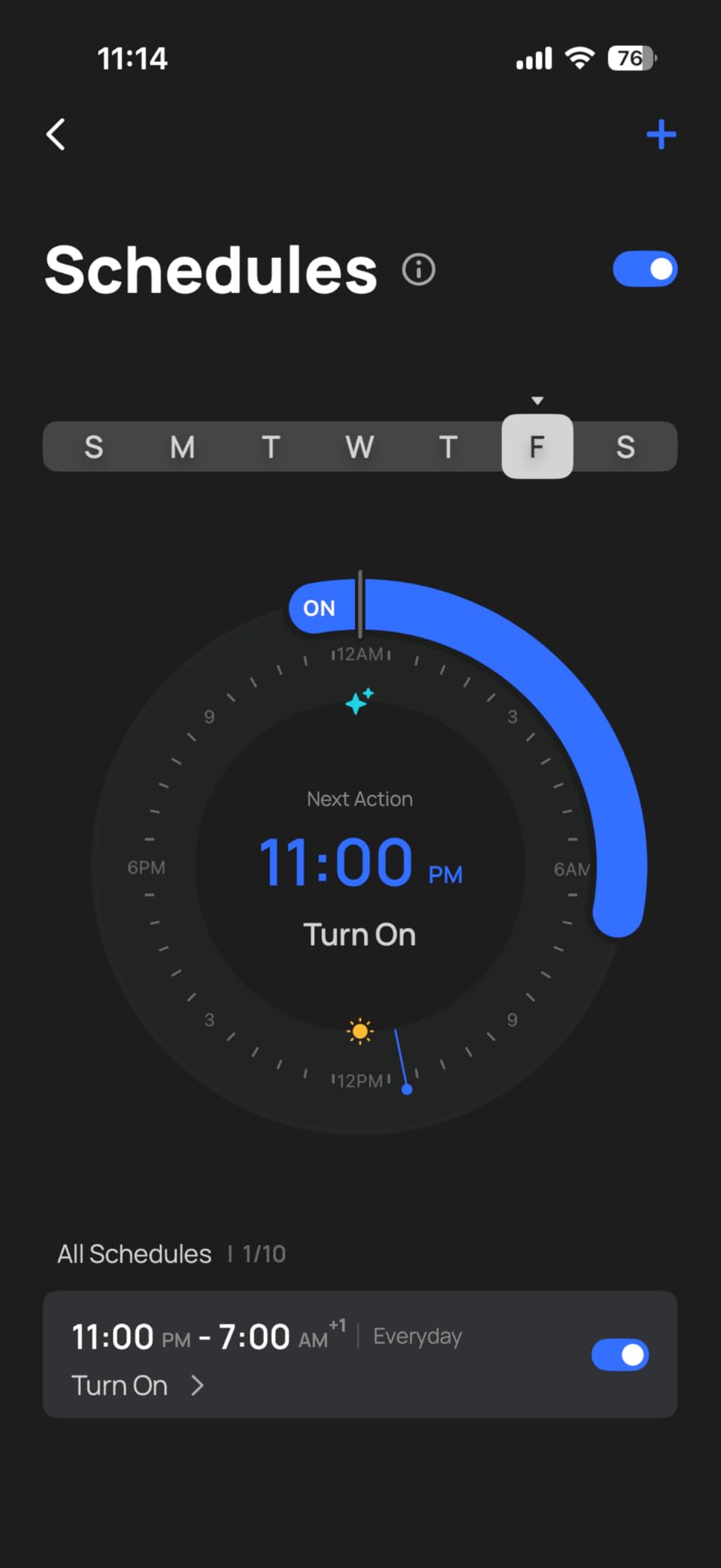
The DC motor is listed at 25 decibels with claims of around 40 percent less energy use than comparable AC motor models, and there are 12 speeds with 6 modes including an Auto Mode that responds to room temperature. That is more control granularity than anything else here.
Owners rate the combination of air movement and low-speed quietness very highly, and the general consensus is that the smart features work well but are a bonus rather than the reason to buy. The RGB lighting with 1500 plus colours and preset scenes is genuinely a gimmick in a dark bedroom, and reviewers say so directly.
Wi-Fi pairing adds setup complexity for anyone who just wanted a remote. At 43 inches tall with a listed weight of nearly 13 kilograms, this is one of the bulkier units in the group, and the app feature set is shallower than the marketing suggests.
Why it works for an upstairs bedroom
Scheduling is the real value. A fan that starts moving the ceiling layer at sunset without anyone remembering to turn it on is more effective at beating the evening heat than a stronger fan switched on at nine at night.
The 1100 CFM output and dual-axis oscillation mean the smart control does not come at the expense of actual capability.
Who should skip it
Skip it if you just want a remote. The network setup is an extra step, and the app will not replace your need to clean the grille.
Skip it for a small bedroom. It is the tallest unit here and one of the heaviest, and in a 10 by 10 room you are paying for reach you cannot use.
12. Levoit CoreBreeze 382 Standing Fan: Best for the Lowest Power Draw

Levoit Standing Fan for Bedroom, 2-in-1 Pedestal & Tabletop Oscillating Fan
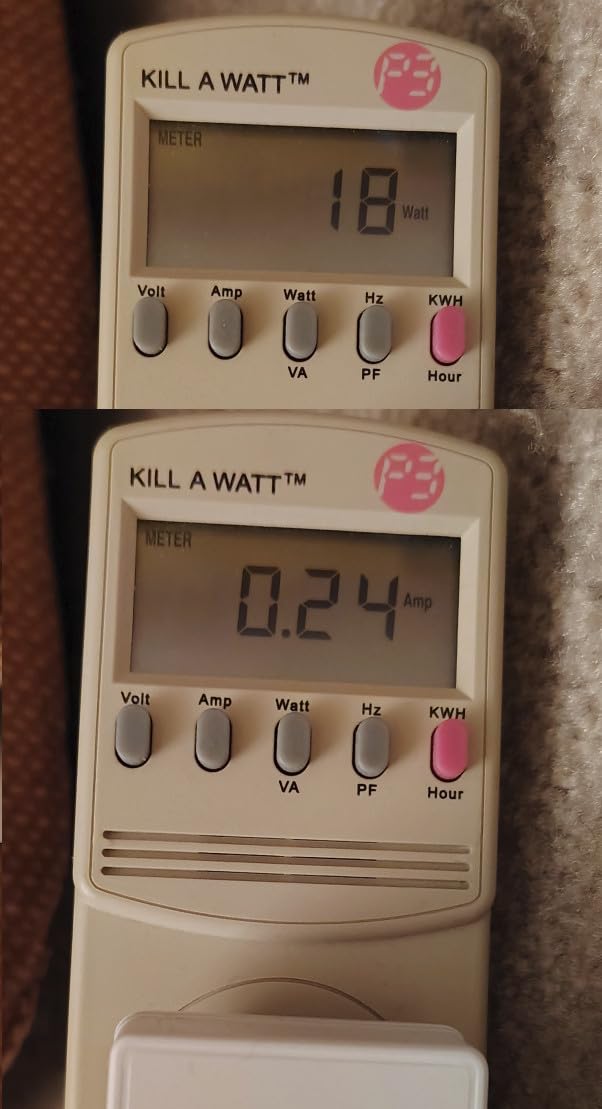
20W draw
1024 CFM
20 dB on lowest setting
5 speeds
Pros
- Lowest power draw in the group at 20W
- 1024 CFM and 22 ft/s wind speed for a full room
- 20 dB on the lowest setting
- Detachable front grille and blades clean fast
- Converts between pedestal and tabletop use
Cons
- No app
- voice or smart home control
- 38.2 inch height is short for a tall bed
- Turbo mode is noticeably louder
- Newer on the market with far fewer owner reviews
The lowest energy draw in the group, at 20 watts, is a genuinely different selling point. The manufacturer states as little as 0.1 kilowatt-hours over 24 hours at speed one, which works out to a few watt-hours for a full night of sleeping.
It is not a small fan doing that. Published output is 1024 CFM at 22 feet per second, and the noise figure is 20 decibels on the lowest setting, which puts it in the same quiet band as the DREO models at a fraction of the power.
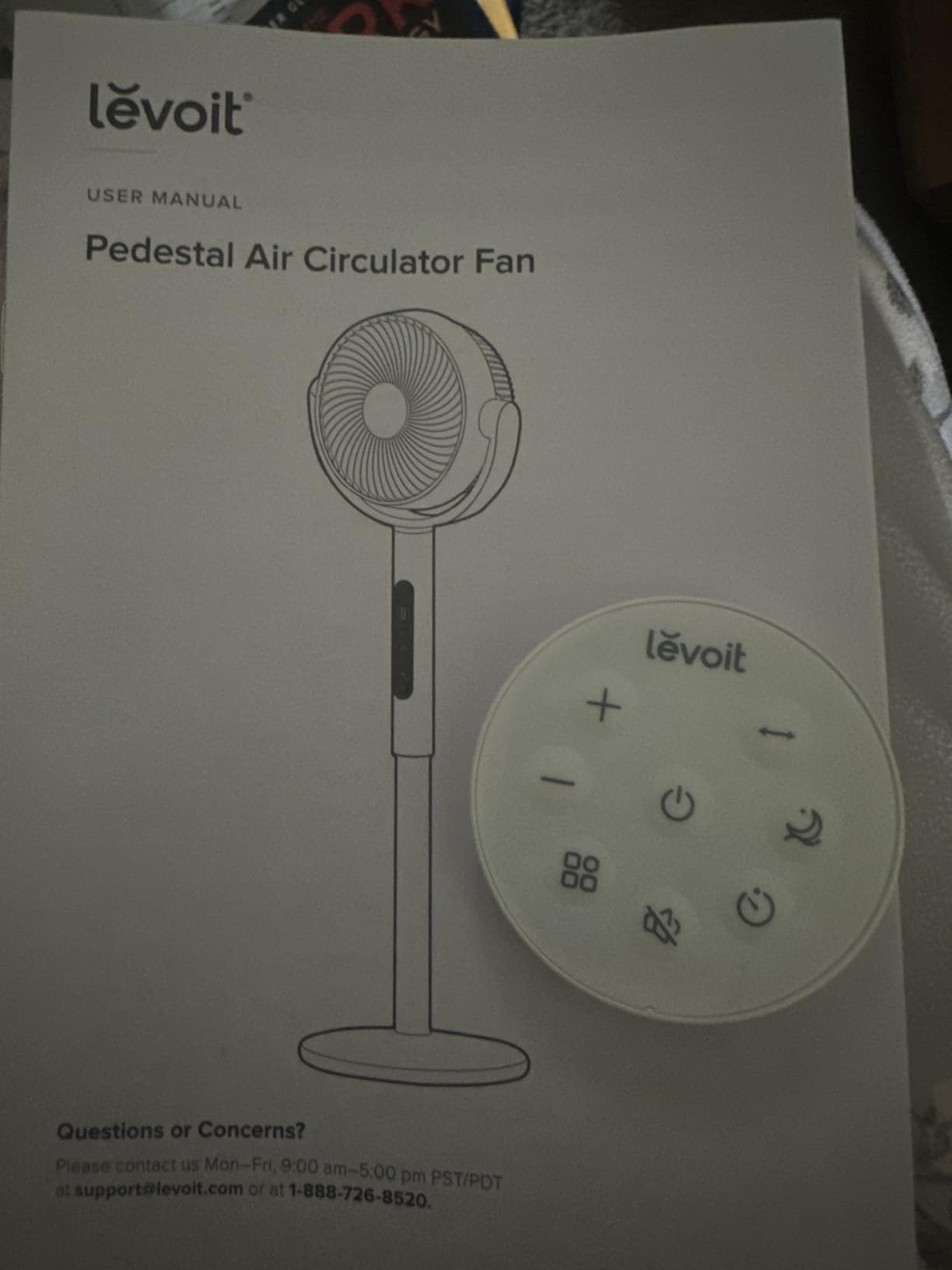
Five speeds with a turbo mode, 90 degree horizontal oscillation and manual vertical adjustment let you direct air from floor to ceiling, which is useful against a hot ceiling layer. The detachable front grille and blades make cleaning quick, and it converts from a pedestal to a tabletop fan if you want it lower.
There is no app, no voice control and no smart home integration, so this is a remote and buttons unit. At 38.2 inches it is short for directing air across a tall bed, and turbo mode is noticeably louder than the low settings.
The most important caveat is the evidence base. With a much smaller review history than the Lasko, Honeywell and DREO options here, this fan is being judged on its published specifications rather than years of owner reports, and we would want a season of use behind it before treating the spec sheet as proven.
Why it works for an upstairs bedroom
Twenty watts is the number. If your plan is a fan running every night from late spring through late summer, the difference in watt-hours across a season between this and a 96 watt pedestal is not trivial.
The pedestal to tabletop conversion also gives you a second placement option in a small room, once the floor gets crowded.
Who should skip it
Skip it if you want smart home control or voice control. Neither exists on this model.
Skip it if you buy based on long-term reliability. With the smallest owner review base in this group, there is no multi-year track record yet to lean on, so the older pedestal picks remain the safer long-term bet.
How to Cool a Hot Upstairs Bedroom Without AC
No fan in this list lowers the air temperature. What cools you is moving air on your skin plus getting the trapped heat out of the room. These seven steps are ordered by how much they help.
1. Open the bedroom door and keep a path open. A closed bedroom door is the single biggest reason a fan has nothing to do. Air needs somewhere to go.
2. Open a window on the shaded side of the house, or the lowest window available. Upstairs bedrooms often have exactly one operable window, and cross-flow from a shaded side beats a sun-facing one every time.
3. Run your ceiling fan counterclockwise on high. This pushes air up along the walls and pulls it down the middle, which clears the ceiling layer without blowing hot air directly at you.
4. Place the whole room fan at a low corner near the open door, tilted up. Set it to stir the ceiling layer toward the doorway so the heat exits the room.
5. Add a second fan at the top of the stairs, set to push warm air down. Users on HomeImprovement recommend exactly this to move collected second-floor heat back toward the first floor.
6. Lower the thermostat on the first floor and let the AC run. Many homes with single-zone cooling will deliver more useful benefit to the second floor from a few extra degrees of compressor runtime than any fan can deliver alone.
7. Close the curtains on any sun-facing window and run the fan all night. Blocking afternoon solar gain on the wall and window, then moving air overnight, is what actually changes how the room feels by morning.
Where to Place a Fan in an Upstairs Bedroom
Most fans are placed in the one spot that does almost nothing: a corner, aimed at the middle of the room, blowing at nothing. Placement matters more than wattage in a room where the heat is at the ceiling.
Low corner near the open door. This is the default and the most reliable. Tilt the head up, run oscillation, and the fan strips warm air off the ceiling and drives it out through the doorway.
Foot of the bed, aimed up and across. Best when the priority is your own comfort rather than the room. You get direct airflow on your face and upper body, and the upward angle still helps clear the ceiling.
Against a far wall, angled along the ceiling line. The throw of a strong circulator along the ceiling reaches the far corner where heat pools. This is the placement that makes a Vornado-class fan worth owning.
In the doorway, aimed into the room. A common mistake. A fan in the doorway blocks the path the heat needs to take to escape, and you end up circulating heat in a closed loop. Keep the doorway clear and treat it as an exit, not a fan position.
Under the bed or in a window. Under-bed placement suits low-profile tower fans and keeps the throw low across the sleeper, which suits a bed that is not near the ceiling. A fan mounted in a window works as an exhaust when the room window and door are open, and users on HomeImprovement pair an intake fan downstairs with an exhaust upstairs to pull the collected heat out of the house.
Noise Levels and Overnight Energy Use
Noise is the number that decides whether a bedroom fan gets left running or unplugged at midnight, so it is worth knowing what the published figures mean in practice.
At or below 25 decibels is the sleep-friendly band. The DREO 502 at 23 dB, the Levoit CoreBreeze 382 at 20 dB on its lowest setting and the DREO smart model at 25 dB sit here, and most sleepers stop noticing them.
Around 27 to 28 decibels is still quiet. The PELONIS at 27 dB and the DREO 1000 CFM at 28.2 dB fall in this range, and the Levoit tower at 28 dB is at the upper edge of it.
Above 50 decibels is awake-time territory. The Vornado 660 at 54 dB, the Lasko Cyclone at its upper speeds and the Lasko 1646’s steady drone all belong here. They are excellent fans that belong in the room while you are in it, and less good partners for eight hours of sleep.
The 46 decibel Honeywell QuietSet sits in the middle and, because it lists a low-end figure rather than a single number, tends to be usable overnight on its lower settings.
On energy, the gap across this group is wide. For an eight hour night, a 20 watt fan consumes about 160 watt-hours, a 36 watt fan about 290, a 40 watt fan about 320, a 60 watt fan about 480, and the 96 watt Lasko Cyclone about 770. A 40 watt fan left running all night is a rounding error next to a single hour of air conditioning, so compare the wattage of the fans you actually intend to run overnight.
Running a fan overnight is never the reason a household bill goes up in a way that changes anything. It is a fraction of what one hour of air conditioning costs, and on a floor that the compressor never reaches, it is the only cooling you get.
Whole House Fan vs Attic Fan vs Whole Room Fan
These three get confused constantly in search results, and they are three different products bought for three different jobs.
Whole room fan. This is what this guide covers. It sits inside your bedroom, recirculates the air in that one space, and makes the room feel cooler by moving air. It does not bring in outside air and it does not exhaust anything.
Whole house fan. Mounted in the attic floor, it pulls air in through open downstairs windows and exhausts it through roof vents, effectively cooling the entire house by exchanging hot air for cooler outdoor air in the evening. It is a house-scale system with installation requirements, and it only works when the outside air is cooler than the inside. Our guide to the best whole house fans covers the models and the sizing if you are considering one.
Attic fan. Also a roof- or gable-mounted exhaust, but it vents the attic itself rather than the living space. HVAC professionals on HVAC-Talk describe it as a cost-effective whole-home fix because it dumps accumulated attic heat, which is the same solar gain cooking your upstairs bedroom ceiling. The ceiling stays cooler, the bedroom stays cooler.
The practical sequence for a two-story home is: an attic fan to stop the roof from heating the second floor, a whole house fan to move air through the house in the evening, and a whole room fan in the bedroom for the overnight hours when you are actually asleep. Our whole house fan roundup is the right next read if the bedroom fan is a temporary fix while you solve the floor above it.
How to Choose a Whole Room Fan for Upstairs Bedrooms
Measure the room and match the airflow. For a standard bedroom, a 10 by 12 foot room has roughly 1200 cubic feet of volume. A useful rule of thumb is to look for enough CFM to move that volume several times an hour, which is why the 1000 CFM class covers a large bedroom and the 210 CFM tower covers a small one. A fan rated below 600 CFM will struggle in a room with a high ceiling.
Check the height against your ceiling. This is the mistake that quietly ruins a purchase. A 36 inch tower blows at waist height, which is useless for clearing a ceiling layer in a tall room. Anything above 40 inches, or a pedestal with real height adjustment, can be aimed at the ceiling. Match the fan to the ceiling, not the other way round.
Decide your noise ceiling before anything else. If the fan runs while you sleep, 28 decibels or lower is the target. Read the noise figure carefully, because most brands quote their quietest setting rather than a running average. If you plan to run it only while you are in the room, a higher-output AC motor fan is a better trade.
Check whether oscillation is horizontal only. In a room with a hot ceiling, vertical pivot matters more than a wide horizontal sweep. The DREO models with simultaneous horizontal and vertical oscillation handle this better than anything else in this group.
Look for a timer you can set from bed. Eight hours is the minimum for overnight use and twelve is better if the room needs pre-cooling in the evening. A timer also means a hot upstairs bedroom cools down while you are still at work rather than after you get home.
Factor in cleaning. A fan that recirculates air eight hours a night collects dust fast, and bladed designs with fixed grilles are the worst offenders. The DREO 1000 CFM has fully detachable grilles, the Levoit 36 inch tower has a removable back grille, and the bladeless designs have no blades to wipe at all.
Measure the floor space and the base. Upstairs bedrooms are usually the smallest rooms in the house. Bases range from 6.5 inches square on the Levoit tower to 20.5 inches on the Lasko Cyclone, and the wide ones will not fit beside a dresser.
Check what happens after a power cut. The Vornado 660 restarts at maximum speed, which is a poor bedroom behaviour. If your upstairs room loses power often, choose a fan with a sleep mode or a soft restart.
Decide about humidity before you start. A recirculating fan moves moisture around a room but removes none of it. In a humid upstairs space, running a fan all night with the door closed can raise the perceived stuffiness, and in a room with known moisture problems a fan will spread that moisture rather than fix it. Ventilation, not a fan, is the answer to humidity.
Frequently Asked Questions
Why is my upstairs 10 degrees hotter than my downstairs?
Four things stack up. Warm air rises, so the second floor sits inside a column of rising heat. The roof and attic absorb solar heat all day and radiate it into the top-floor ceiling. A single-zone air conditioner sends conditioned air to the first floor, starving the upstairs registers. And a closed bedroom door stops the air that is already moving. A fan cannot fix the first three, but it can strip the hot layer off the ceiling and drive it out an open door.
What is the best fan for a very hot room?
The DREO 1000 CFM Oscillating Pedestal Fan is our pick for a very hot upstairs room. It publishes 1000 CFM of airflow with a 90 foot reach, a 28.2 decibel low-speed noise level and a 36 watt draw, which is the rare combination of high volume and quiet running. The Vornado 660 is the alternative if your room is large and you can position it by hand.
How to cool a hot upstairs bedroom?
Open the bedroom door so air has somewhere to go, open a window on the shaded side of the house, and run your ceiling fan counterclockwise on high to clear the ceiling layer. Then place a whole room fan at a low corner near the door, tilt it up, and set it oscillating. Close curtains on any sun-facing window in the afternoon, and leave the fan on a timer through the night.
Do ceiling fans help cool a hot room?
Yes, but only in the right direction. Run a ceiling fan counterclockwise on high in summer. That pushes air up along the walls and draws it down the middle, clearing the trapped heat layer off the ceiling. Running it clockwise in summer does the opposite and pushes warm air straight down at you, which makes the room feel hotter. A ceiling fan moves air, it does not lower the temperature.
What type of fan removes hot air from a room?
A whole room fan does not remove heat, it moves it out of the room toward an open door or window. To actually exhaust hot air you need a window or attic fan pulling air out while a second fan pulls cooler air in, or a whole house fan mounted in the attic floor. Upstairs bedrooms do best with a two-fan setup: one exhausting the room, one driving air toward it.
Is a whole house fan better than a box fan upstairs?
They solve different problems. A whole house fan exchanges air through the entire house in the evening when outdoor air is cooler, which cools every floor including the second. A whole room fan only circulates air inside your bedroom and cannot bring in fresh air. The sensible combination in a two-story home is an attic fan to stop the roof heating the top floor, a whole house fan in the evening, and a bedroom fan overnight.
The Bottom Line for Hot Upstairs Bedrooms
For most people shopping for the best whole room fans for hot upstairs bedrooms, the Honeywell QuietSet HYF260 is the first pick: it has the deepest owner history in this group, a listed 46 decibel low-speed noise figure, a 10 inch footprint that disappears into a corner, a remote that docks in the back of the unit, and a panel that goes fully dark in a sleeping room. If your bedroom is large, vaulted, or simply needs more output than a slim tower can move, the DREO 1000 CFM Oscillating Pedestal Fan is the upgrade: it is the only fan here that pairs a genuinely high published airflow figure with a low-speed noise level under 29 decibels, and at 36 watts it stays cheap to leave running all night.
What matters more than the model is the setup. Open the door, tilt the fan up at the ceiling, run the ceiling fan counterclockwise, and block the afternoon sun. A correctly placed modest fan beats a powerful one pointed at an empty corner every time, and no fan on this list can rescue a second floor the roof is cooking. If the whole floor is hot, look up at the attic before you look at the bedroom.
Every airflow and noise figure in this guide is a manufacturer claim, so treat them as ceilings rather than promises, and check the noise level on the setting you plan to actually run overnight.