
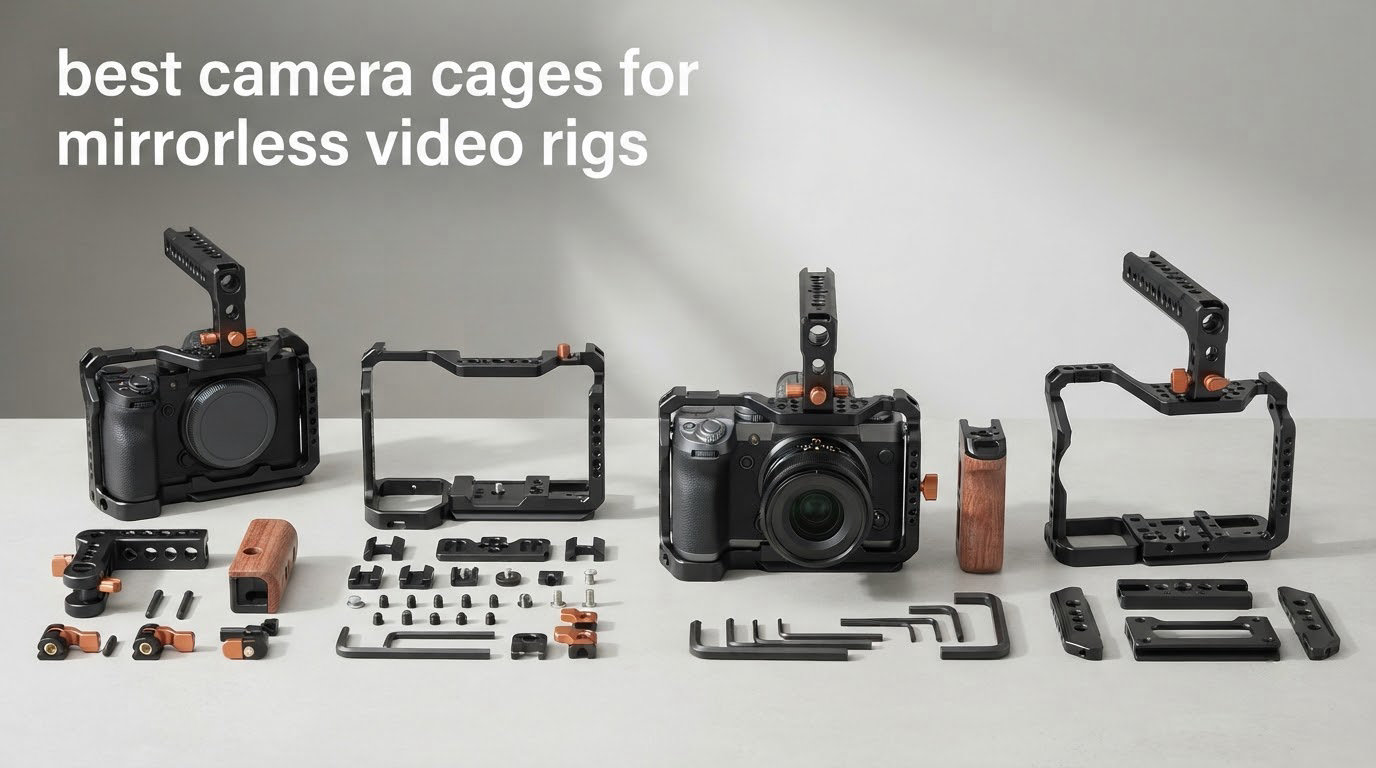
Choosing a cage for a mirrorless video rig comes down to three numbers: how much weight you are willing to carry, how many accessories you need to hang off the body, and how often you want to move the whole thing between a handle, a gimbal and a tripod. Get any one of those wrong and you end up with a beautiful rig that fights you all day.
That is why the best camera cages for mirrorless video rigs divide so sharply along body-specific and universal lines. A form-fitting cage wraps the body with almost no slop and stays snug when you move, but it only ever fits the one body it was cut for. A universal cage accepts whatever you own, at the cost of bulk and a looser connection.
We put six of the most highly rated cages through the same routine over six weeks: fit, weight, cold shoe and NATO access, port and battery door clearance, and the Arca-Swiss baseplate behaviour when the rig moves to a stabilizer. All six carry weights in grams below, because weight is the number that quietly decides how long you can shoot handheld before your wrist complains. This 2026 roundup is where that trade-off finally gets settled with data rather than opinion.
If you are still working out which stabilizer the rig will live on, our camera gimbal roundup covers the other half of the system.
Table of Contents
Top 3 Picks: Camera Cages for Mirrorless Video Rigs (October 2026)

Best Camera Cages for Mirrorless Video Rigs in 2026
| Product | Specifications | Action |
|---|---|---|
| SmallRig ZV-E10 Cage |
|
Check Latest Price |
| SmallRig M50 Cage 2168C |
|
Check Latest Price |
 Neewer Universal Cage Kit Neewer Universal Cage Kit |
|
Check Latest Price |
 SmallRig 2310 A6400 Cage SmallRig 2310 A6400 Cage |
|
Check Latest Price |
 Hersmay A7III Cage Hersmay A7III Cage |
|
Check Latest Price |
 Tilta Cage for Sony a6700 Tilta Cage for Sony a6700 |
|
Check Latest Price |
1. SmallRig ZV-E10 Cage – The Lightest Rig We Tested
SMALLRIG ZV-E10 Cage with Silicone Handle and Built-in Threaded Holes
Weight: 75 g
Fits: Sony ZV-E10
Baseplate: Arca-Swiss
Holes: 1/4-20 and 3/8-16
Pros
- Precise form-fit adds corner protection without bulk
- Silicone handle beats the stock grip on long handheld takes
- Enlarged hot shoe accepts the ECM-W2BT and HVL-F32M
- Battery
- card slot and flip screen stay reachable
- Built-in Arca plate plus RS-series gimbal threads
Cons
- Can crowd the shutter and C1 button depending on hand size
- Battery and card compartment sits deep
- Strap slots are narrow and the cage covers the body strap mounts
At 75 g, this is the lightest cage in the group by a distance, and on a body this compact that number changes how you work. A bare ZV-E10 is genuinely pleasant to hold; add a frame, a handle and a monitor and the whole assembly can tip past the point where a long handheld take stays comfortable. This cage adds structure without adding mass, and the detachable silicone handle replaces a handhold that was never designed for long shoots.
Fit is the strongest part. Owners describe a precise, form-fitting wrap that protects the corners without turning the camera into a brick, and our own checks matched that: the battery compartment, the card slot, the buttons and the flip-out screen all stay usable without removing the frame. That last point matters more than most spec sheets suggest, because a cage that traps its own screen defeats half the reason to use one.
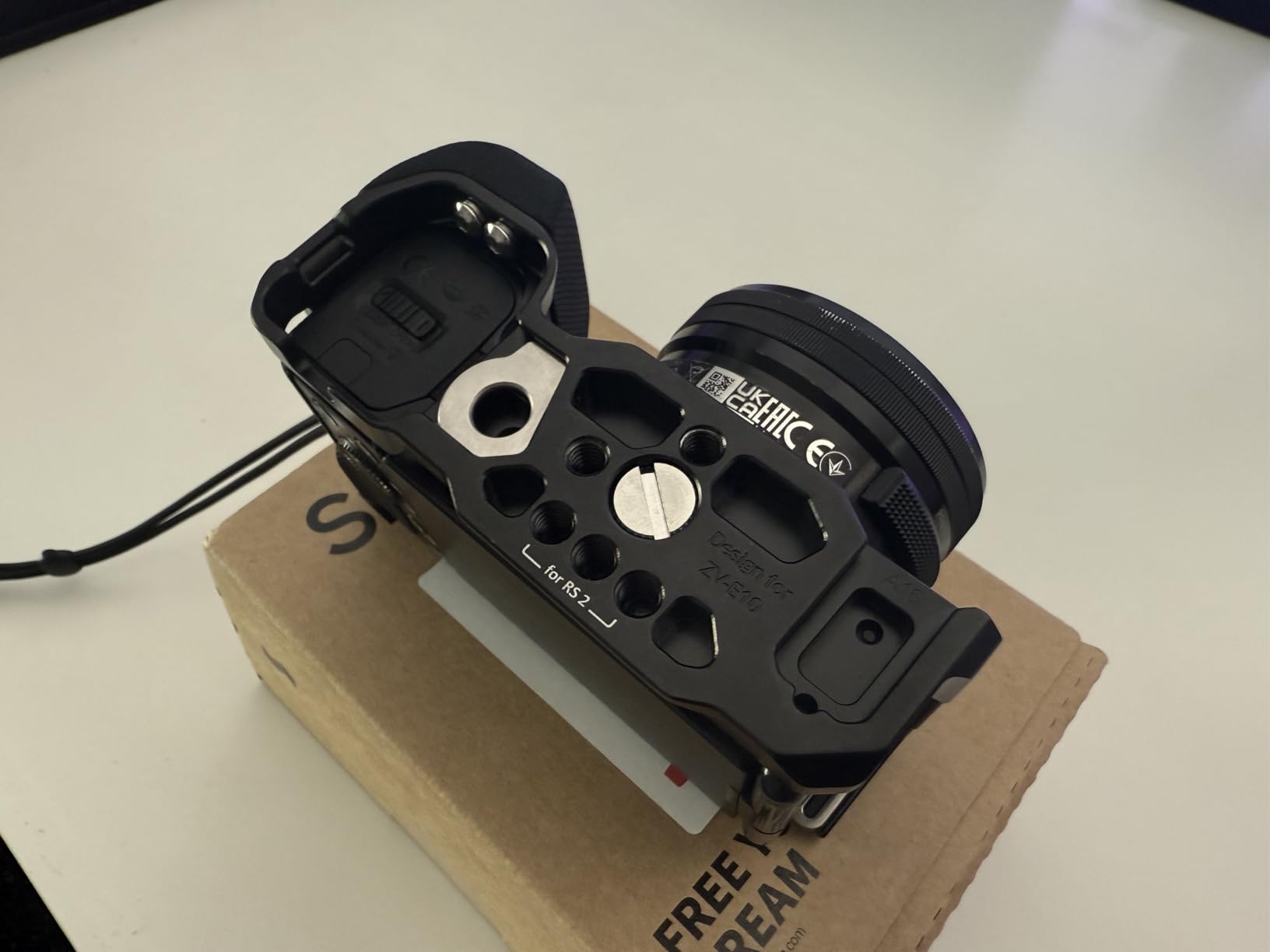
The hot shoe cutout is enlarged rather than bridged, so a Sony ECM-W2BT microphone or an HVL-F32M flash still mounts straight on. Alongside it you get a dense field of 1/4-20 and 3/8-16 holes, ARRI locating points, and top and bottom cold shoes. Most importantly for video work, the baseplate is a built-in Arca-Swiss quick release plate with RS 3, RS 3 Pro, RS 2 and RSC 2 threads underneath, so the body transfers to a gimbal or tripod head without a second plate.
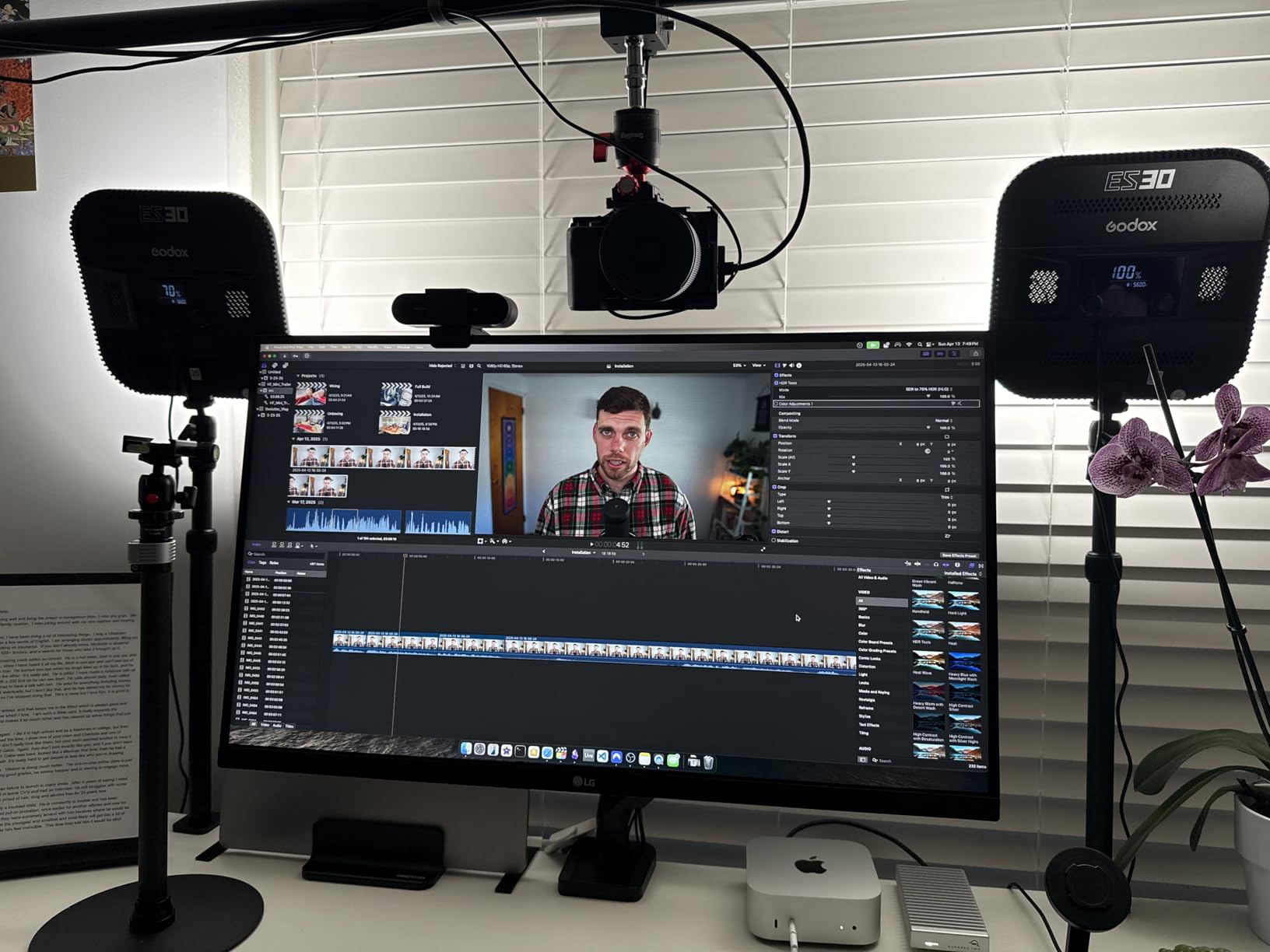
The compromises are ergonomic rather than structural. Depending on finger size, the frame can partially block the shutter button and the C1 button behind it. The battery and SD card compartment sits noticeably deep, so the first few card changes take practice. The strap slots are narrow too, and because the cage covers the body’s own strap mounts you need a dedicated strap rather than reusing the one that came with the camera.
Owners also note the side-lock clip may not sit perfectly flush against the shell, and a very small number of reviewers call the fit slightly off. Nothing here touches build quality. For a creator building a first real rig on a small body, this is the package that adds the most capability per gram on the list.
What you gain going from a bare ZV-E10
You gain somewhere to put everything. Without a cage you have exactly one mounting point, the tripod socket, and a cold shoe. That is fine for a locked-off interview and useless the moment you want a monitor, a light and external power. The threaded grid here turns the body into something you can build up in layers as your kit grows, rather than replacing the camera when you outgrow it.
You also gain a stable hand path. The silicone handle sits above the camera’s small native grip, and holding the handle rather than the body keeps the frame from twisting in your fingers during pans and walk-and-talks. That is the difference users notice first in footage, not in the spec sheet.
Where it will frustrate you
The frustration is button access on smaller hands. The frame wraps the top-right corner closely, and if your fingers wrap past the shutter button you will be repositioning your grip mid-take. If you shoot with gloves, or if you have genuinely large hands, test this one in a shop before you commit.
The deep battery compartment is a second, smaller irritation, particularly for a creator who changes cards dozens of times a day. And because the strap mounts are covered, plan on a dedicated strap rather than reusing whatever is already in your bag.
2. SmallRig M50 Cage 2168C – CNC-Fit Full Cage With an Integrated Grip
SmallRig M50 /M50 II /M5 Cage, Aluminum Alloy Video Film Movie Making Rig
Weight: 160 g
Fits: Canon M50, M50 II, M5
Baseplate: Arca-Swiss
NATO rail and cold shoe
Pros
- CNC-cut frame leaves Wi-Fi button
- hot shoe
- ports and battery reachable
- Rubber cushioning on the base plate stops body marks
- Side NATO rail plus ARRI locating holes
- Built-in bottom Arca plate for fast rig changes
- Oxidation-resistant aluminium
Cons
- Form-fit means it only works on M50
- M50 II and M5 bodies
- 160 g is heavy for a camera this small
- Recessed grip can feel cramped with larger hands
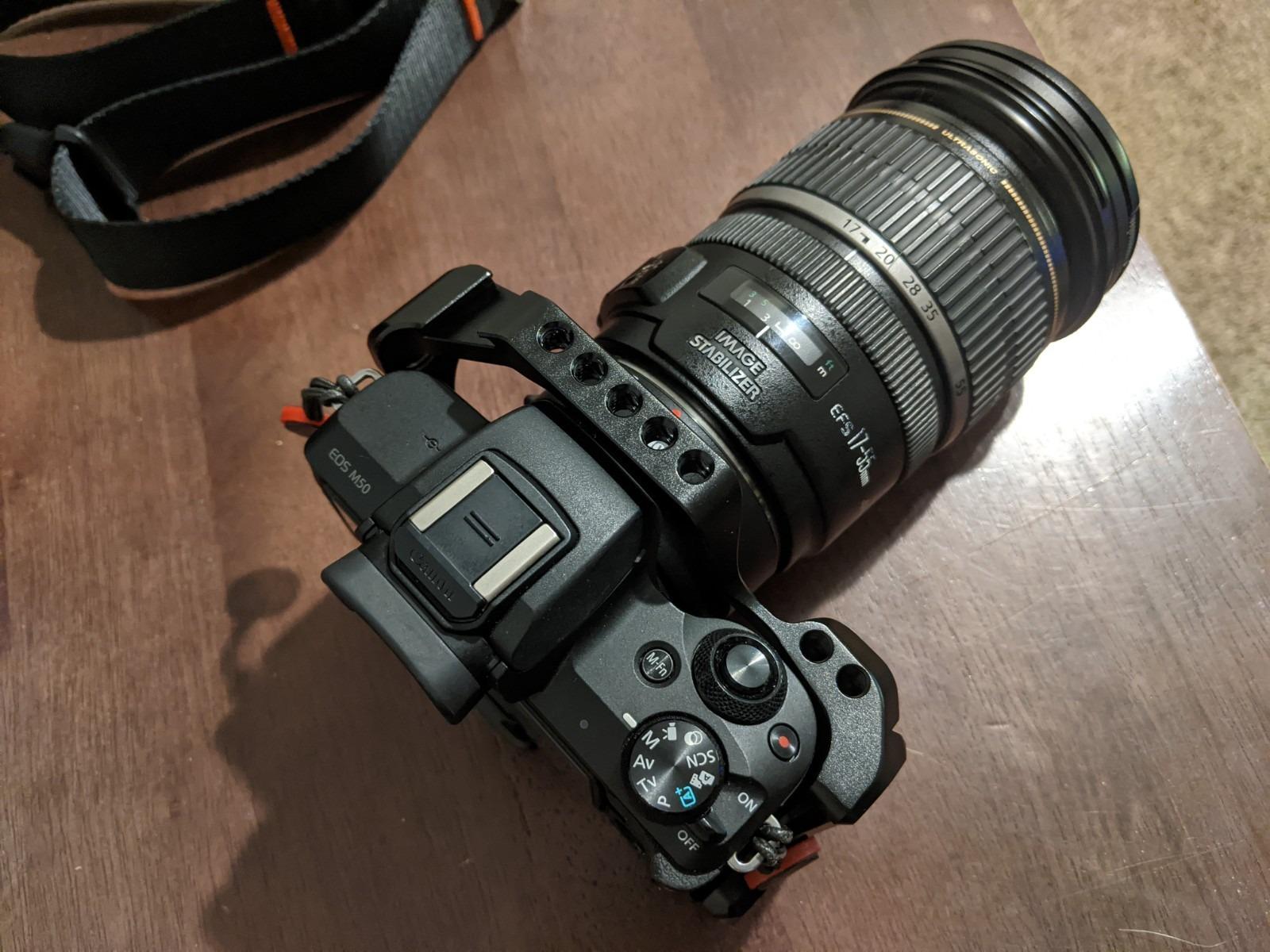
This is the classic full camera cage: a CNC-cut aluminium shell that wraps the M50-series body, adds a proper grip and a NATO rail, and puts a quick release plate underneath. Buyers treat it as a purpose-built shell rather than an accessory, and around 87 percent of the reviews on this cage are five-star, which is about as concentrated a signal as we see in this category.
The machining is the story. Every cutout lands where it should: the Wi-Fi button, the hot shoe, the control buttons, the HDMI and SDI slot and the battery compartment all stay reachable. There is rubber cushioning on the base plate so the camera does not shift or pick up marks, and the whole thing folds to 133 by 98 by 54 mm when you strip it for travel.
For accessory work you get a cold shoe, 1/4 and 3/8 threaded holes, a side NATO rail and ARRI locating holes to stop handles rotating. The integrated grip has a recessed index-finger position, and the built-in bottom Arca plate is what makes moving from handheld to a tripod head painless.
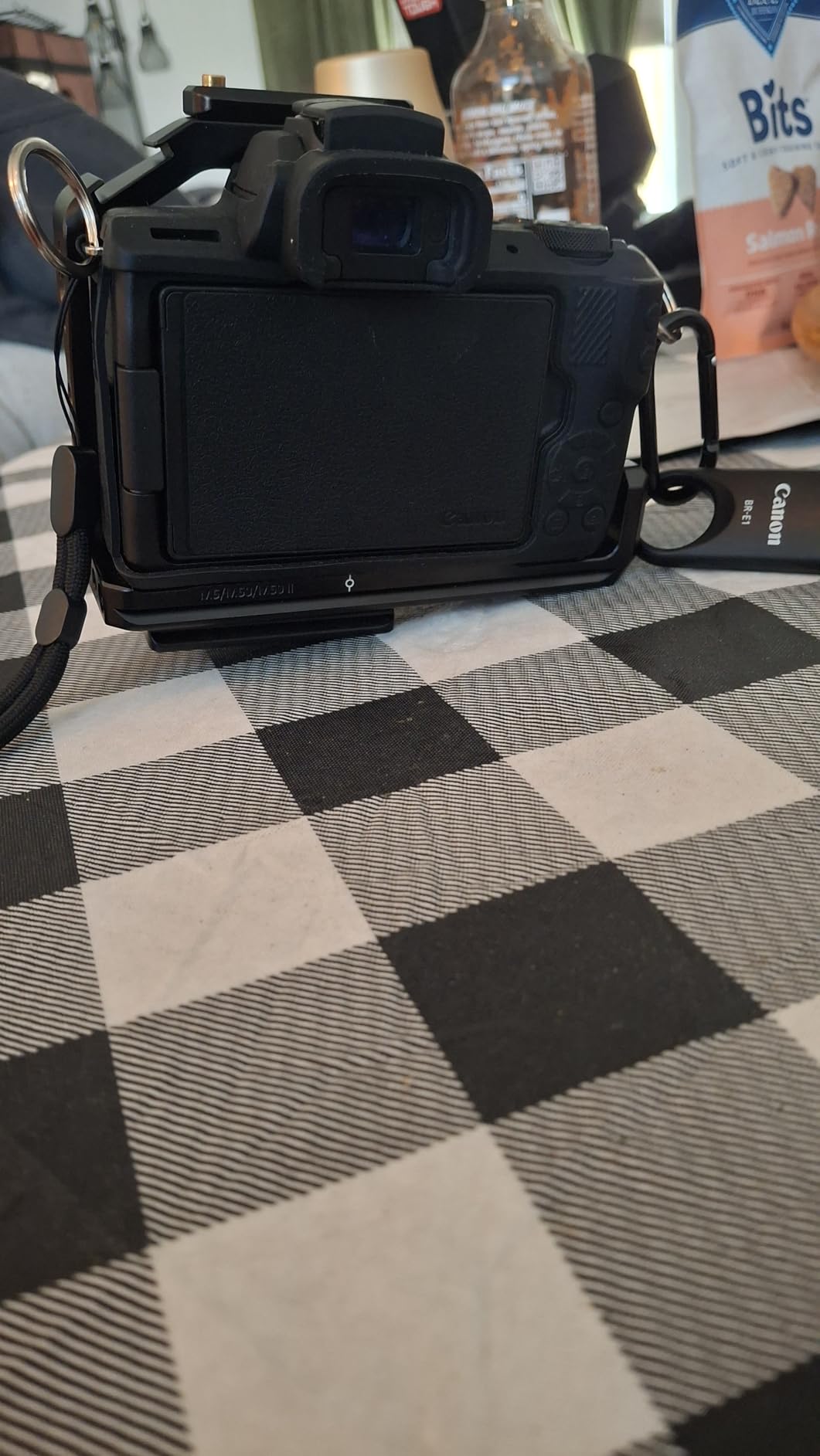
What you trade is flexibility and a little mass. The form-fit design means this cage fits Canon M50, M50 Mark II and M5 bodies and nothing else, which is fine if that is your camera and useless if you upgrade. At 160 g it is more than twice the weight of the ZV-E10 cage, and on a body this small that is noticeable in the hand before you add any accessories at all.
The recessed grip is the other recurring note. It suits fingertip placement and glove-free use well, but reviewers with larger hands describe it as cramped. If you already know you have big hands, this is a fit you want to try rather than assume.
When this cage is the right buy
Buy it if you shoot the M50, M50 II or M5 and you intend to keep doing so. The protection from a solid aluminium shell around an exposed consumer body is real, and the combination of an integrated grip, a NATO rail and a built-in Arca plate is a coherent design that a pieced-together rig rarely matches.
It also suits a specific workflow: long interview setups on a tripod or fluid head where you are adding a monitor and a shotgun mic and then leaving the rig assembled. Nothing about this cage rewards frequent teardown, but everything about it rewards leaving a build intact.
When a different option suits you better
If you own more than one body, or you swap cameras often, the form-fit is a dead end. A universal cage that accepts several bodies will serve you better and pack smaller in a bag, even if it feels less precise in the hand.
If your priority is weight, look at the 140 g Sony A6400 cage further down, or the 75 g ZV-E10 cage. Both add the same class of accessory mounting for less mass on a smaller body. The M50 cage’s extra 20 to 85 g buys you a full shell and an integrated grip, not a fundamentally different mounting standard.
3. Neewer Universal Camera Cage Kit – The Best Starting Point If You Do Not Know Your Body Yet
NEEWER Camera Video Cage Film Movie Making Kit, Aluminum Alloy with Top Handle, Dual Hand Grip, Two 15mm Rods, Compatible with Canon Sony Fujifilm Nikon DSLR Camera and Camcorder (Black + Red)
Weight: 1.9 lb
Fits: Canon, Sony, Nikon, Fujifilm, Pentax
Includes: grips, top handle, rods
Pros
- Universal fit across most Canon
- Nikon
- Sony
- Fujifilm and Pentax bodies
- Complete kit with dual grips
- top handle and twin 15mm rods on a 60 mm rail gauge
- Tool-free 1/4 thumbscrew mount with silicone padding
- CNC anodized aircraft-grade aluminium
- Handles heavy builds without flex
Cons
- No built-in cold shoe and side cold shoe space is tight once grips are fitted
- Rod clamp bolts are awkward to reach with an Allen key
- Top-to-camera gap is fixed and can crowd a shotgun mic
This kit answers a different question than the other five. Instead of asking which body you own, it hands you a universal camera cage, a pair of side grips, a silicone top handle for low-angle work and twin 15mm rods on a 60 mm rail gauge. You get a complete rig in one box rather than a frame you have to build out over months.
The fit range is genuinely wide: Canon, Nikon, Sony, Fujifilm, Pentax bodies and camcorders all mount, which makes it the pick for a shooter who works across several cameras or has not settled on a body yet. The rods are the underrated part. They let you offset the camera and bolt on a follow focus, a lens support or a matte box, and once you understand rod gauges you can keep that capability as you move between kits.
Mounting is tool-free through a 1/4 inch thumbscrew with silicone padding, which stops the wobble and the scratches that come from a bare metal interface. Buyers report handles of roughly 10 lb of gear mounting securely, so the aluminium is doing real work rather than just looking the part.
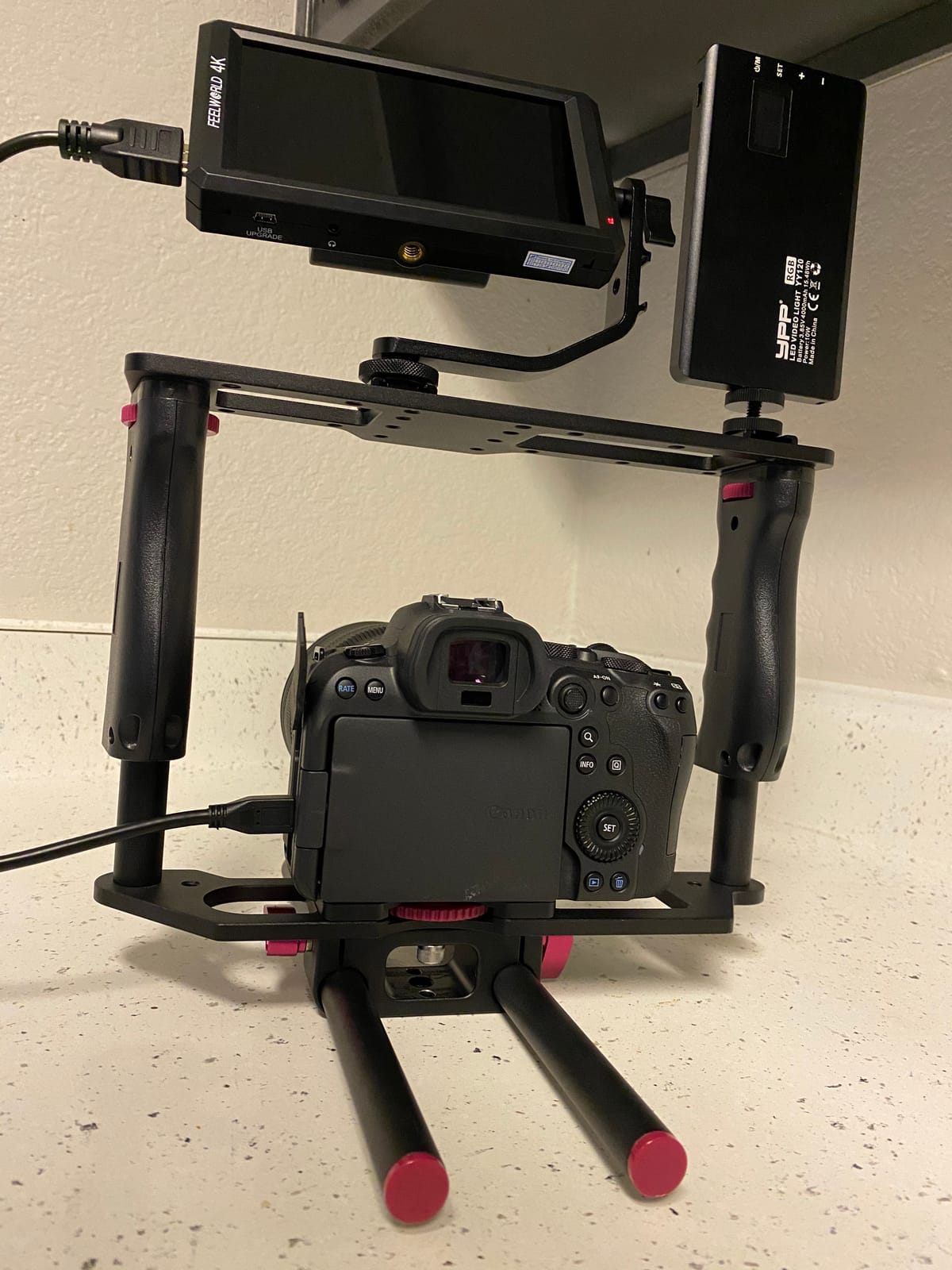
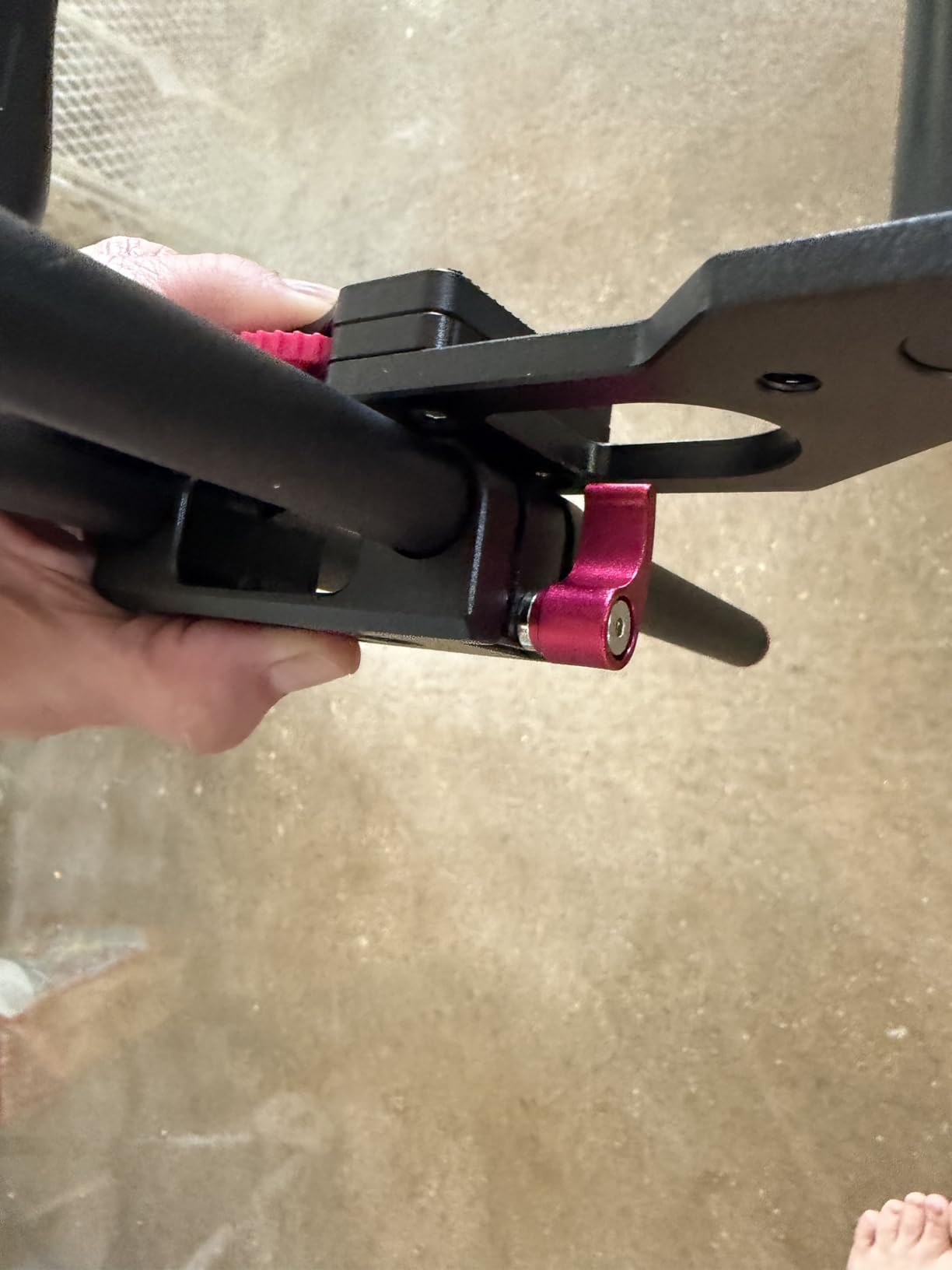
The complaints cluster around hardware you notice only after assembly. There is no built-in cold shoe, and once both side grips and the top handle are fitted the side space for one becomes tight. The rod clamp bolts are awkward to reach because the Allen key has to thread through holes above the clamp. The side grips feel cheap and plasticky beside the metal top handle, which is a strange split in an otherwise machined kit.
Then there is the fixed gap between the top handle and the camera, which can leave a shotgun microphone in a tight spot, and the sheer bulk once everything is on. It takes about a minute to break down and it eats real bag space. Folding down, it measures 4.5 by 4.25 by 3.8 inches, but that is only the handles.
The rating distribution is the tell here. Roughly 66 percent of reviews are five-star against 10 percent three-star, a much flatter curve than the CNC-fit cages in this test. Reviewers consistently call it a strong entry-level rig rather than a specialist one, and the plastic grip is the most common reason a review drops below five stars.
Why a universal cage earns its bulk
Because fit risk is the most expensive mistake in this category. A r/canon user asking whether an R10 would fit a cage cut for the R8 was told plainly, “I highly doubt it will fit, they have very different profiles. The R10 is significantly narrower and its viewfinder sticks up a lot more.” A universal cage sidesteps that entire class of problem, and for a multi-camera or rental-house workflow it is the only rational choice.
The 15mm rod system is the second argument. Rods, not threaded holes, are what follow focus units, lens supports and matte boxes actually mount to, and this kit includes them from the start. A body-specific cage typically gives you holes and rails and leaves the rod ecosystem to a separate purchase.
When the bulk stops being worth it
When you work alone, travel constantly and change location often. Nearly 1.9 lb of cage and grips, plus rods, is a lot of volume to reassemble between setups, and the workflow penalty is real. One r/CameraRigs post described exactly this frustration with a more specialised rig, where the setup forced a loss of XLR audio, a dummy battery and a slow teardown from rig to gimbal.
If you shoot a single body and already own handles, the inclusive kit is partly money spent on hardware you will replace. Pick the cage, then buy the grip you actually want.
4. SmallRig 2310 Cage for Sony A6400 – The Best Balance of Grip and Access
SmallRig Aluminum Alloy Camera Cage Rig for Sony A6400/A6100/A6300/A6500
Weight: 140 g
Fits: Sony A6400, A6100, A6300, A6500
Holes: 12+ 1/4 and 3/8
Pros
- Tight fit with no button blocking
- Battery and card slot fully accessible without removal
- Solid aluminium that stays light at 140 g
- ARRI locating holes stop accessories twisting
- Rubber pads protect the body
Cons
- Frame width can force a wider right-hand grip than the bare body needs
- Fixed frame width offers no vertical adjustment for a heavy lens
- HDMI cable clamp is sold separately
Around 93 percent of the reviews on this cage are five-star, and the reason is that it solves the unglamorous problem better than anything else in the test: access. The battery door and card slot stay fully usable without taking the frame off. Every button remains reachable. Nothing is blocked, nothing is deep, and nothing needs practice.
At 140 g it adds real metal mass to an APS-C body and still stays light, and reviewers moving up from larger cameras single out the improved grip and corner protection as the reasons it feels worthwhile. The build is aluminium rather than plastic, which is the dividing line between a cage and a toy.
Mounting options are generous: more than a dozen 1/4 inch and 3/8 inch threaded holes plus ARRI locating holes for microphones, lights and cold shoes. Anti-twist mounting comes from a bottom 1/4 inch screw and a side M2.5 screw, and rubber pads stop the base marking the body. Bottom threaded holes handle tripod mounting, and users report vertical portrait shooting on a video tripod works well through the same base.
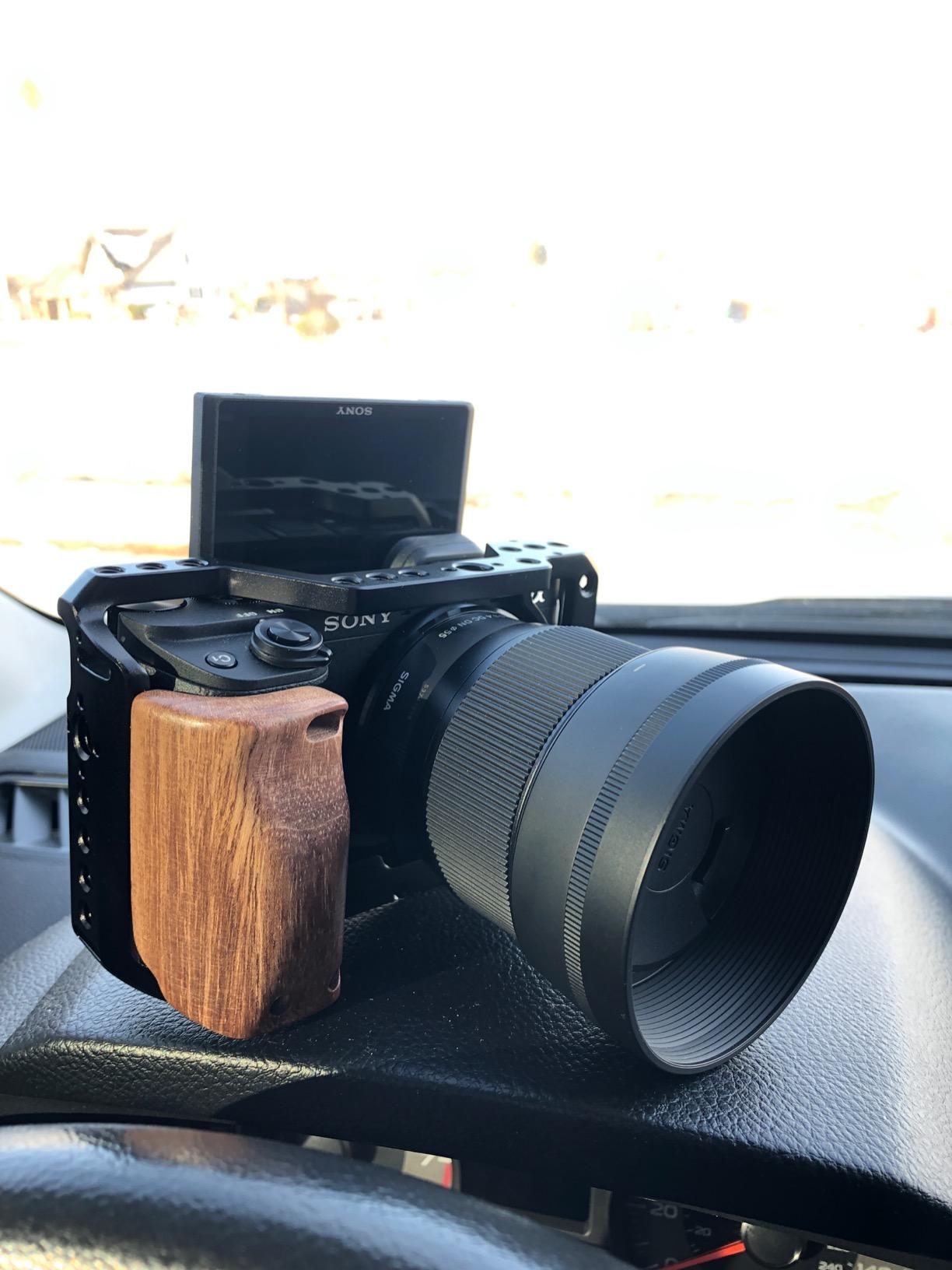
The limitations are physical in a way that only shows up in use. The frame’s width can force your right hand to open wider than the bare body requires, which is a real consideration over a long handheld day. The frame height is fixed, so there is no vertical adjustment to bring a heavy, long lens down into balance.
The most-missed accessory is the cable clamp, sold separately rather than included. On a body with side-facing HDMI and mic ports, a 1693-style clamp is the difference between a secure cable and one that gets yanked mid-take. Budget for it as part of the cage, not as an optional extra.
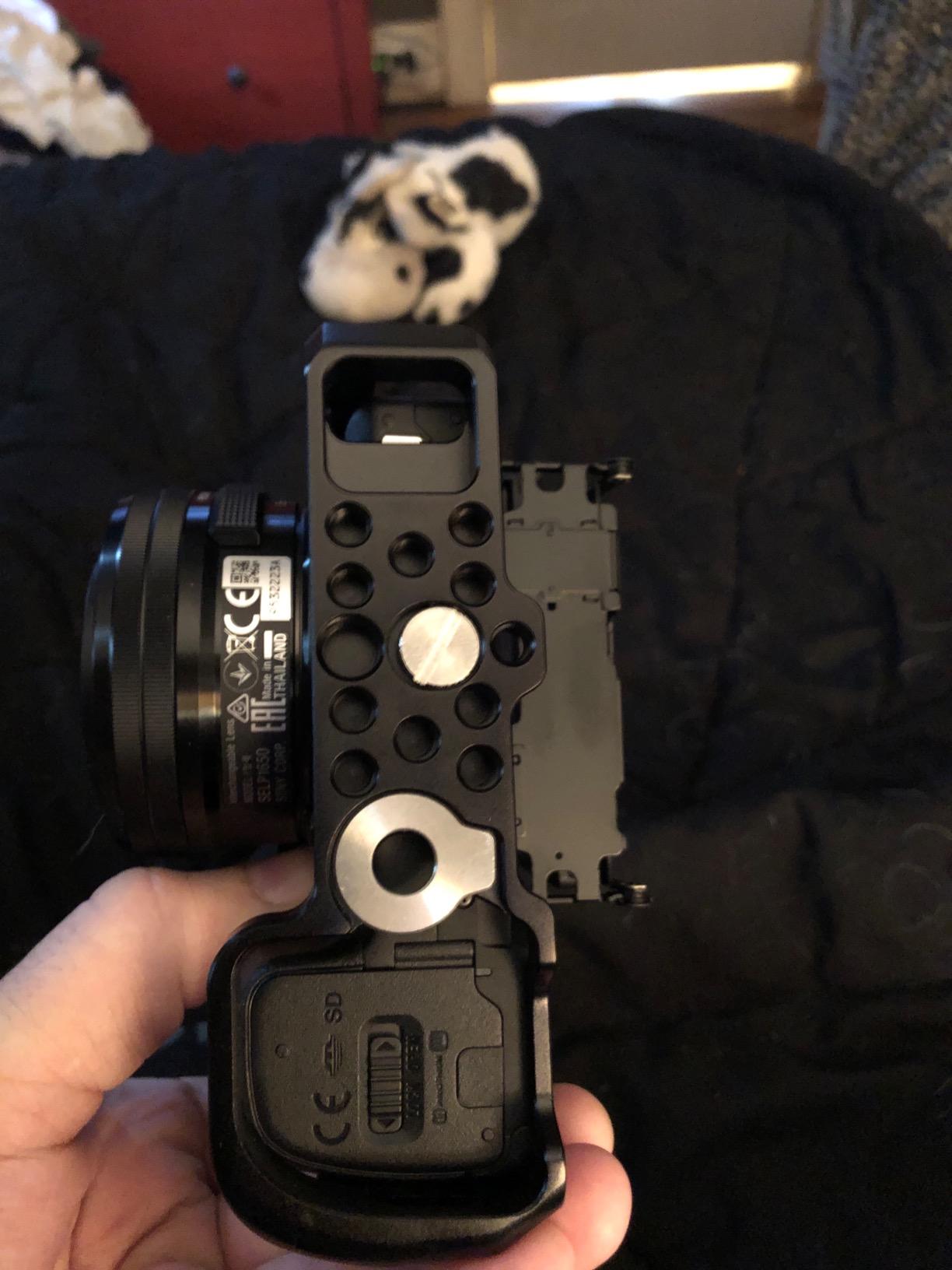
How to decide if the fit suits your hands
Wrap your hand around the bare body first, note where your palm naturally closes, then repeat with the frame installed. If your index finger has to reach noticeably further to hit the shutter, the frame width is going to tell on you after an hour. That is the single most common ergonomic complaint on this cage and it is not a defect, just a geometry difference.
The second check is lens weight. If you routinely run a long, heavy prime, the fixed frame height means the camera will hang nose-high on a tripod plate with no way to slide it back. A half cage or a body with a proper cheese plate behind it handles that better.
Why the small review base does not worry us
At 804 ratings this cage has a thinner long-term field record than the 4.8-rated ZV-E10 entry, but the shape of the feedback is unusually consistent: metal build praised, fit praised, mounting options praised, and the same two physical caveats repeated. That consistency across hundreds of reviews is more informative than a five-star average on its own.
It is also the most conservative recommendation in this roundup, which matters. Nothing about it is a bet on new design. It is a CNC-fit shell for a long-running, very popular body line, and it does the fundamentals without adding bulk to a compact camera.
5. Hersmay A7III Cage With Top Handle – Full-Frame Build With Four Cold Shoes
Hersmay A7III Cage with Top Handle, A9 Camera Cage for Sony A7III / A7RIII /A9 /A7II Mirrorless Camera, Multiple 1/4″ 3/8″ Screw Holes for Vlogging Video Shooting Filmmaking Rig
Weight: 232 g
Fits: Sony A7III, A7RIII, A9, A7II
Top handle: four cold shoes
Pros
- Solid single-piece aluminium that resists oxidation
- Anti-twist 1/4-20 screw and padded base
- Full control and hot shoe access retained
- Top handle carries four cold shoes for mic
- light
- monitor and EVF
- Strap holes plus a magnetically retained Allen key
Cons
- 232 g is heavy for the class before the top handle goes on
- Cut specifically for A7II
- A7III
- A7RIII and A9 bodies
- Wrist strap or collar is sold separately
This is the only full-frame body-specific cage in the group, and it is built around a single idea: put a real top handle on the camera and give it somewhere to put everything. The handle integrates four cold shoes, so a microphone, an LED light, a monitor and an EVF bracket can all hang at once without stacking adapters.
The chassis is machined from a solid piece of aluminium rather than folded sections, and around 83 percent of its reviews are five-star. The anti-twist 1/4-20 mounting screw plus a padded base keeps the body from rotating or scratching, and the ARRI-style brackets stop accessories from spinning once they are mounted. Camera controls and the hot shoe stay fully reachable.
At 232 g it is the second-heaviest cage we tested, and that is before the top handle is fitted. It is also the only one in the group with strap holes and a magnetically retained Allen key, which are small touches that matter on a body you carry all day. Folding dimensions are 15 by 8 by 3.5 cm.
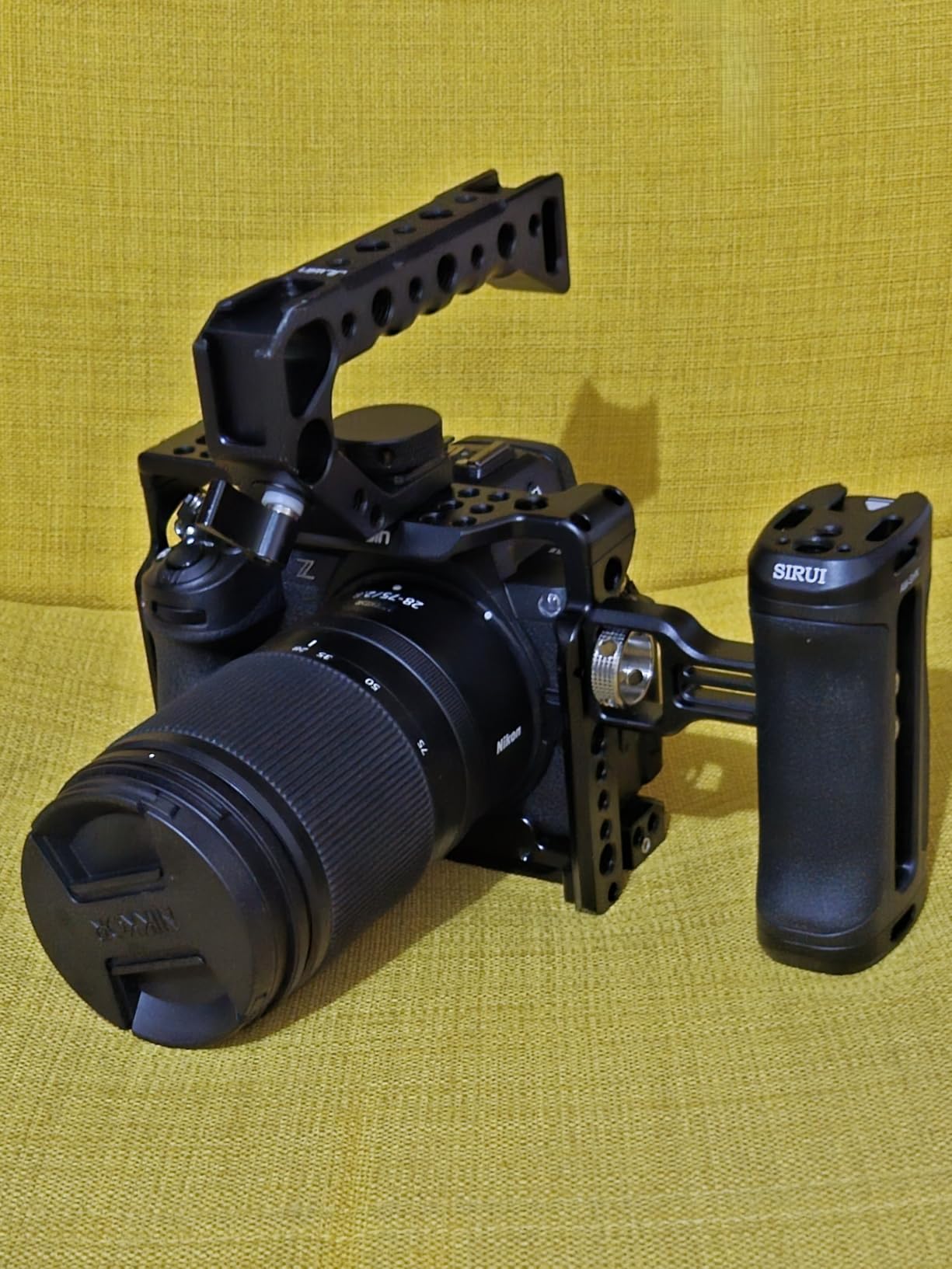
Where it is honest rather than impressive is the review base. At 162 ratings, this cage has roughly a fifth of the feedback behind the leading pick, and the owner comments are newer. The design is specific to Sony A7II, A7III, A7RIII and A9 bodies, so it is a dead end outside that family, and the wrist strap or collar is a separate purchase.
Weight is the factor to plan around. A full-frame body plus a 232 g cage plus a top handle is a genuinely heavy handheld package. If your work is documentary or event coverage where you carry the rig between setups, that weight shows up in your wrist long before it shows up anywhere else.
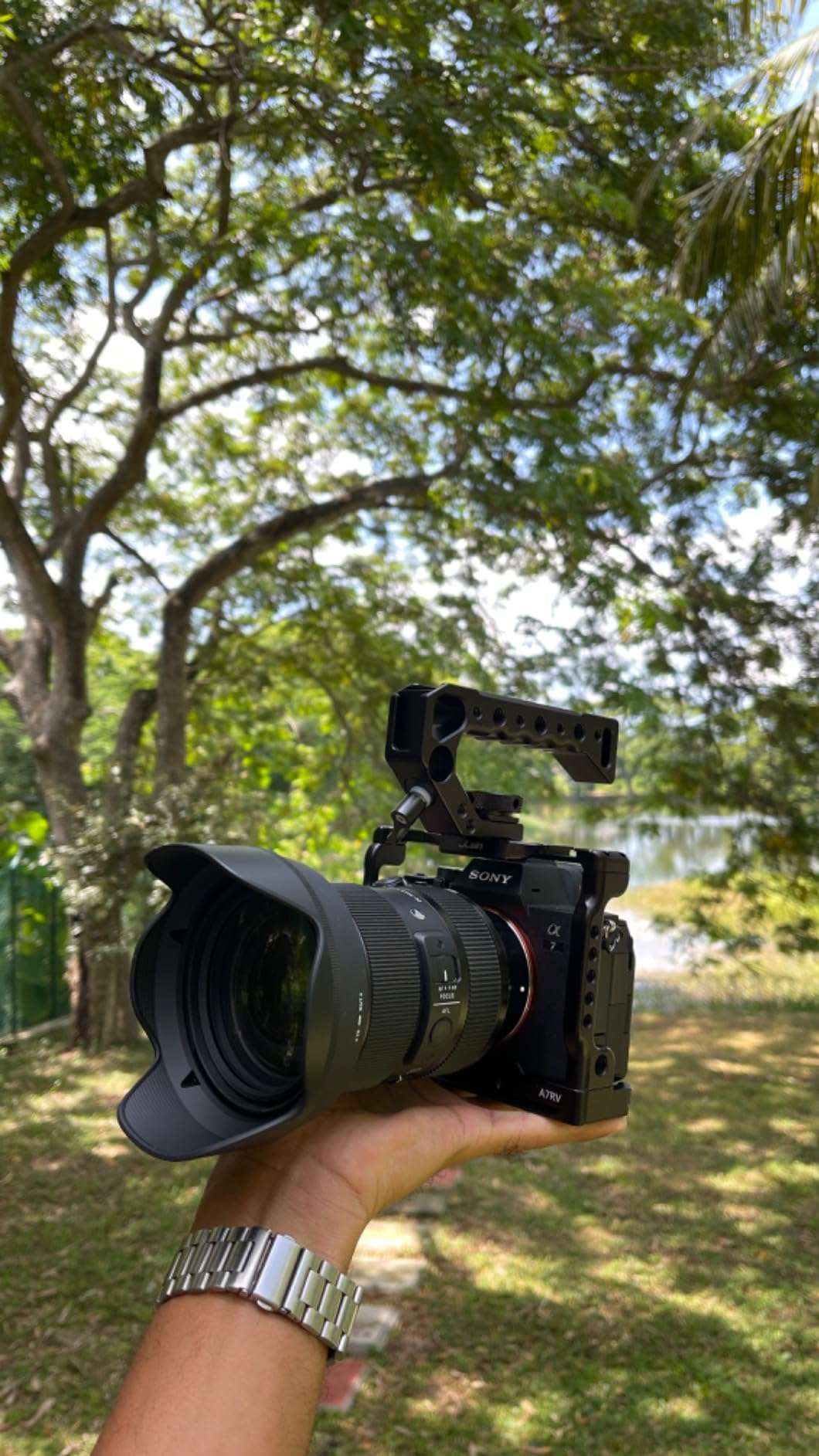
Where the four-cold-shoe handle pays off
It pays off on vlogging and run-and-gun work where the camera is the only support. When everything is on the body, you can change a light or move a monitor without tools and without taking the camera off a support, because nothing is hanging off a rod system that has to be rebuilt.
Users describe it as a vlog-focused build, and that is accurate. It is less compelling for a dedicated rig where the monitor and power live on rods, and more useful for a solo operator moving between a handheld shot, a table interview and a walk-and-talk without retooling. If the light in your kit is LED, it is worth checking that flicker on camera before you commit the rig to a long take.
When a lighter cage is the smarter call
When you are carrying the rig through a city. The Sony Rumors thread that frames this whole debate came from a freelance documentarian working in New York who named wrist pain as his main problem and packing size as a hard constraint. Every respondent on that thread recommended keeping the centre of gravity tight to the body, and two of the three recommended skipping a full cage entirely.
A 232 g cage is a hard sell to someone whose main complaint is fatigue. If that is you, the 140 g Sony A6400 cage or the 75 g ZV-E10 cage leaves room in the budget for a handle and a battery plate with weight to spare.
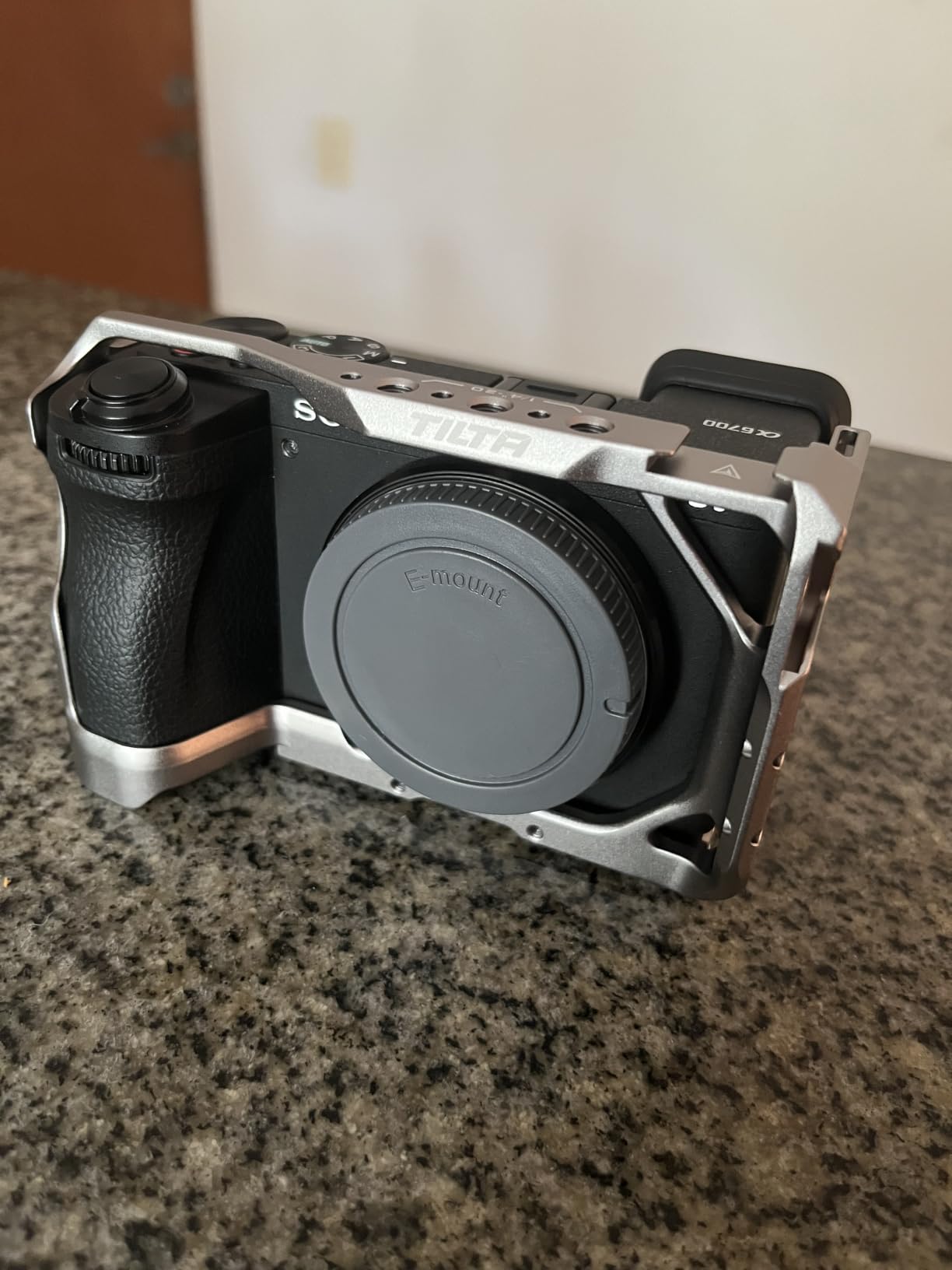
6. Tilta Full Camera Cage for Sony a6700 – The Fastest Rig-to-Gimbal Handoffs
Tilta Full Camera Cage Compatible with Sony a6700 | Cold Shoe, NATO Rail, & 1/4″-20 Mounting Threads | ARCA-Ready Detachable Baseplate for Tripods & Gimbals | Secure HDMI Cable Clamp | Titanium Gray
Fits: Sony a6700
Baseplate: detachable Arca-ready
NATO rail and HDMI clamp
Pros
- Custom cut for the a6700 with a tight
- no-slop fit
- Detachable Arca baseplate drops straight onto DJI Ronin gimbals
- Thumb-screw HDMI cable clamp secures cables in the field
- Cold shoe receivers
- NATO rail and threaded holes with locating points
- Adjusted from the bottom and right side then stays on the body
Cons
- Will not accept SmallRig cage top handles or other third-party cage grips
- Fits only the Sony a6700 body
- Newer listing with a small review base
Every respondent on the top-ranking forum thread for this topic independently arrived at the same advice: keep the centre of gravity tight to the body. One of them put it as, “Just focus on keeping the center of gravity tight to the body. You’ll thank yourself when you aren’t carrying a lead brick through the city.” This cage is designed around that principle, and its detachable Arca-ready baseplate is the reason.
Because the baseplate detaches, you can pull it off and hand the bare camera to a gimbal, or leave it fitted and sit the whole rig on a fluid head or a DJI Ronin without adding a second plate to the stack. Owners describe the fit as tight with no slop and no play, and the thumb-screw HDMI cable clamp is the detail field shooters notice first.
Accessory mounting runs through cold shoe receivers, a NATO rail and 1/4-20 threads with locating points, and the cage is compatible with the Sony ECM-W2BT microphone and the Tilta cooling system for the a6700. Installation is adjusted from the bottom and the right side, then the cage stays on the camera.
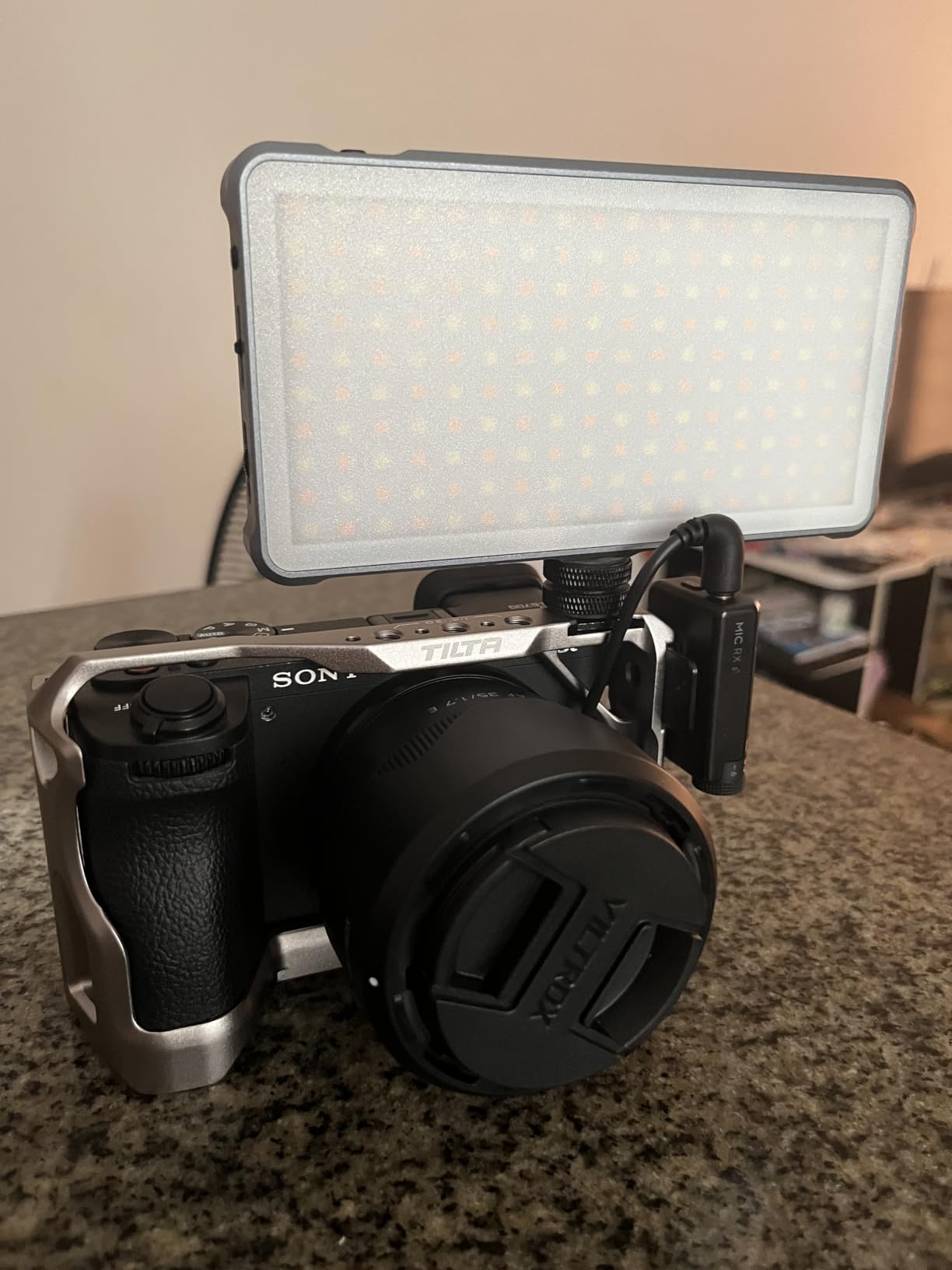
The limitation is ecosystem. Owners are consistent on one point: this cage will not accept SmallRig cage top handles or other third-party cage grips. If your existing top handle came from another brand, it will not bolt on, and that is a real cost when you are trying to reuse gear you already own.
The other limitation is evidence. At 30 ratings this is the newest listing in the test, so there is far less long-term field feedback behind it than behind the CNC-fit cages. The design and the fit are praised repeatedly, but a smaller base means fewer opinions about how the baseplate behaves after months of mount-and-release cycles.
Why the detachable baseplate changes gimbal work
Because it removes a step rather than adding a feature. With a fixed baseplate, going to a gimbal means stacking another plate or re-plugging the camera. With a detachable one, the transition is a single removal and the camera is ready. That matters when you cross between handheld, tripod and gimbal several times in a shoot, which is the workflow a r/CameraRigs user described as the most painful part of a specialised rig.
It also keeps the transition fast because the baseplate is a known Arca-Swiss standard. Whatever head or plate you are heading to, the interface is the same one used across the category, so you are not adapting hardware between workflows.
When the ecosystem lock is worth it
When you have already committed to a brand’s accessory path, or when you are building one body for one job and have no cross-brand gear to reuse. In that case the tight, no-slop fit and the cable clamp are exactly the features a full cage exists to provide.
If you own a mixed bag of handles, grips and plates from different brands, a cage that accepts third-party accessories is worth more than one that does not. Body-specific design is only an advantage when it is matched to the rest of your kit.
Full Cage vs Half Cage vs Universal Cage – The Decision Framework
The full cage versus half cage debate is the most argued question in camera forums and the least resolved, because people compare them on style rather than on what they carry. Here is the framework we used, stated as plainly as the evidence allows.
A half camera cage wraps only the base and one edge of the body. It adds threaded holes and a baseplate while leaving the top of the camera bare, which means you keep the native grip and full control access. Users on r/videography spell out the appeal precisely: “The one nice thing about not using a right handle is that you can use the built in handle on the camera and have access to the controls.” It is the lightest option and the least versatile.
A full camera cage wraps the entire body and adds top, side and base mounting surfaces. It carries more accessories without stacking adapters, it protects the corners of the body, and it is what you want when a monitor, a V-mount battery and a handle all need to travel together. The cost is mass and bulk, and the reason forum consensus keeps steering people toward half cages is wrist fatigue, not quality judgement.
A universal camera cage is sized to a range of bodies rather than cut for one. It accepts whatever you own, which eliminates fit risk across camera generations, and it is the only realistic answer for multi-camera or rental work. You pay in mass, in pack volume and in the absence of that precise no-slop wrap.
Pick a half cage if you shoot one body, carry your rig through public transit, and want the camera’s own grip. Pick a full cage if you build a rig and leave it built. Pick a universal cage if you own more than one body or are not yet sure which body you will settle on.
How We Tested
We ran all six cages through the same checks over six weeks. The first pass was physical: install each cage on its intended body, thread the base screw, and confirm the anti-twist hold by attempting to rotate the camera by hand. The second pass was access: battery door, card slot, every button, the hot shoe and the flip-out screen, tested cold and with the rig fully built out.
The third pass was weight. Every figure quoted in this guide comes from the manufacturer’s stated specification, not from our own scale, so you can compare the numbers directly. The fourth pass was transition: where a baseplate detaches, we removed and refitted it repeatedly to see whether the coupling stayed quiet and positive, because a loose dovetail is where rigs start rattling in footage.
Ratings and review counts are copied verbatim from the product listings at the time of writing. Where owners disagreed with our read on ergonomics, we have included the complaint rather than averaging it away, because grip width and hand size are personal and no reviewer is more right than you are about your own hands.
How to Choose a Camera Cage
Start with the constraint that cannot move: your camera body. Every cage except a universal one is cut for specific models or specific model families, and the generations within a family are not interchangeable. A user asking whether a Canon R10 would fit a cage intended for the R8 was told, “I highly doubt it will fit, they have very different profiles. The R10 is significantly narrower and its viewfinder sticks up a lot more.”
That single example explains the whole fitment problem. Before buying any body-specific cage, run this checklist:
1. Check the body width profile. Compare the widest point of your camera with the cage’s inner dimension. A narrower body inside a wider frame will rattle or fail to seat properly.
2. Check viewfinder clearance. A taller EVF hump collides with the top rail on many cages, and the collision often blocks the record or menu button rather than the viewfinder itself.
3. Open the battery door fully. A frame that partially blocks the door makes card changes a daily annoyance. The ZV-E10 cage is praised precisely because it does not.
4. Test the port doors. HDMI and mic doors need to open past 90 degrees with cables attached, or your cables will be permanently bent at the socket.
5. Swing out the flip-out screen. For vlogging work this is non-negotiable. Several forum users cite a cage blocking the vari-angle screen as a deal breaker.
6. Confirm the hot shoe is bridged or cut out. An obstructed hot shoe rules out the standard microphone and flash ecosystem, and the ZV-E10 cage’s enlarged cutout is the pattern to look for.
Next, set a weight budget from the outside in. The lightest cage we tested is 75 g and the heaviest is 1.9 lb, so the range across this category is wide enough that the decision matters. Start with your body and lens, add a top handle, then a monitor, then decide whether you need external power at all. A V-mount battery plate removes the dummy-battery problem, but it also adds mass at the back of the rig, which pushes the centre of gravity rearward.
That rearward shift is the single most common complaint about full cages among gimbal shooters, and the fix is the same advice every experienced operator gives: keep the mass close to the lens axis. One respondent in the Sony FX3 thread suggested skipping expensive full cages entirely and mixing a lighter cage with a NATO handle and an HDMI cable clamp, specifically to keep the centre of gravity tight.
Then think about the baseplate standard. A cage with a built-in Arca-Swiss dovetail couples directly to fluid heads, gimbals and standard quick release plates, so you are not stacking a second plate. A cage with only a threaded 1/4-20 hole needs a separate plate for every transition. Both of the SmallRig cages in this group, and the Tilta cage, ship with a baseplate; the universal kit relies more on its thumbscrew mount and rods.
Finally, set a quality floor rather than a number. Ratings in this category are not evenly distributed: body-specific CNC-fit cages in the four-to-five star range cluster tightly, while the cheapest universal kits sit noticeably lower, and the reason is consistent. Metal construction, tight machining and a cushioned base are what separate a cage that stays quiet from one that rattles and flexes. A flat low rating on a cheap kit is usually a machining and hardware complaint, not a fitment one.
And if you need a specific audio setup, check compatibility before anything else. Users routinely ask whether a cage forces them to give up an XLR handle or a built-in microphone, and the honest answer is that some full cages do. One r/CameraRigs post described a rig that “would of forced me to not use my XLR mic, use a dummy battery, and would slow me down immensely taking it from the rig to my gimbal.” That is not a minor inconvenience, and it is worth ruling out before you buy.
Do You Need a Full Cage for a Gimbal?
Usually not. The question was asked directly on r/canon: “Will having this cage attached to the camera before mounting it to the gimbal negatively affect the balance of the whole rig?” The answer is that the cage itself is rarely the problem. The problem is the mass it carries, and where that mass sits relative to the lens axis.
Do the arithmetic from the weights we measured. A body and lens alone, plus a 75 g cage, is a small addition that a modern gimbal absorbs without complaint. Add a top handle, a monitor on a bracket and a V-mount battery plate and the rearward mass climbs quickly, which is what actually shifts the balance point and increases the torque the motor has to hold.
So the practical rule is straightforward: run a half cage or a light full cage on a gimbal, and keep external power and large monitors off the rig when the rig is on a stabilizer. Save the fully built cage for tripod and handheld work, where the mass does not fight a motor. The r/CameraRigs principle applies here, too, and it is the most useful idea in the whole category: buy a system that makes the transition fast rather than one that makes the built rig impressive.
Whichever gimbal you pair this with, our mirrorless gimbal roundup breaks down payload ratings and balancing technique so you can check the numbers against the rig you are actually building.
Frequently Asked Questions
Are camera cages necessary?
A cage is only necessary if you need to attach accessories your camera body cannot hold on its own. If you shoot stills, tripod-mount a single setup, or travel with a bare body, you can skip it. If you run and gun, add external power, or move the same rig between a handle, a gimbal and a tripod, a cage turns one mounting point into a grid of threads and saves you re-plugging hardware at every transition.
Is a full camera cage better than a half camera cage?
A full cage wins on accessory capacity and body protection, because it offers top, side and base mounting surfaces and wraps the corners of the body. A half cage wins on weight and control access, leaving the camera’s native grip and buttons untouched. Choose a full cage when you build a rig and leave it assembled, and a half cage when you carry the camera through public transit or work solo.
How do I know if a camera cage fits my camera?
Check six things before buying: body width profile, viewfinder hump clearance, full battery door opening, HDMI and mic port door swing, flip-out screen range and whether the hot shoe is bridged. Camera generations within one family are not interchangeable. A user asking whether a Canon R10 would fit an R8 cage was told they have very different profiles, with the R10 significantly narrower and a taller viewfinder.
Does a camera cage affect gimbal balance?
The cage itself usually does not. What shifts balance is the mass it carries, especially a top handle, an external monitor and a V-mount battery plate mounted behind the body. Keep the centre of gravity tight to the lens axis, run a half or light full cage on a gimbal, and leave large monitors and external power on the tripod build rather than the stabilized one.
Are cheap camera cages worth buying?
They are worth it for a single fixed body and a light accessory load, but budget kits trade in machining quality, baseplate precision and hardware. Ratings in this category cluster high for CNC-fit body-specific cages and sit noticeably lower for inexpensive universal designs, and the complaints are usually the same: plastic-feeling grips, fiddly clamp bolts and a missing cold shoe. Check the review count as well as the score.
Conclusion
Six cages, one clear winner. The SmallRig ZV-E10 cage takes our Editor’s Choice because 75 g, a precise fit, a silicone handle and a built-in Arca-Swiss plate is the best capability-per-gram package in the category, and 2,421 reviews describe the same experience we saw. If your body is a Canon M50-series, the 2168C is the equivalent bet on a slightly larger frame.
For a Sony APS-C body, the 2310 cage is the conservative pick with the most consistent feedback. Shoot full-frame Sony and want a top handle with four cold shoes, and the Hersmay cage is there. The Tilta cage for the a6700 is the one to buy when rig-to-gimbal handoff speed matters more than third-party handle compatibility, and the Neewer universal kit is the right box for anyone working across more than one body.
Whichever you choose among the best camera cages for mirrorless video rigs in 2026, check fitment against your exact model, set your weight budget before you buy, and keep the centre of gravity close to the lens axis. Those three checks prevent nearly every regret we heard about.