
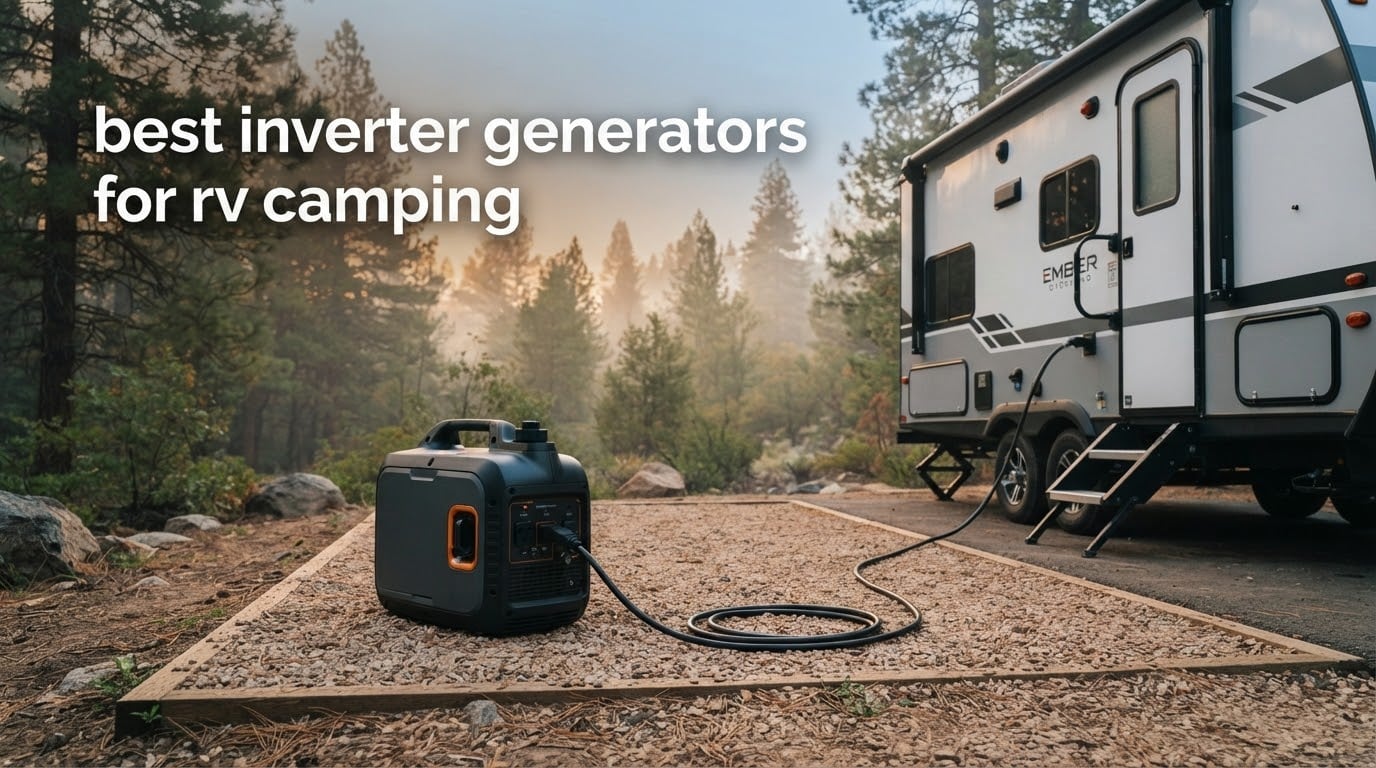
The Honda EU2200i is the best inverter generator for RV camping we tested in 2026 for anyone who wants the quietest running unit that fits in one hand, delivering 1800 running watts and 2200 starting watts from a 46.5-pound body. It runs 48 to 57 dBA, roughly the volume of normal conversation, which is the difference between keeping a neighbor happy during quiet hours and getting knocked on the door.
That answer is not universal, though. This roundup covers ten portable inverter generators across three wattage tiers, from a 1800W light-load model for CPAP machines and laptops up to a 4300W dual-fuel unit with a key fob remote start. We compared running watts against rooftop AC compressor surge, measured published noise figures, checked which ones carry a real 30A RV receptacle, and looked at what owners report back after multiple trips.
If you want the short version: a 30 amp travel trailer with one rooftop AC wants a 3000W to 4000W class unit. A 50 amp fifth wheel or a rig with two ACs wants 4500W or more. A camper running only small electronics can get away with 1800W to 2400W. The three questions that decide your purchase are how much surge headroom your air conditioner needs, whether your campground has quiet hours, and whether you can lift the thing into your storage bay twice a weekend.
We use the term portable inverter generators throughout this guide in the same way the manufacturers do, and we looked at solar generator alternatives for campers who never leave hookups. If you want the wider picture first, our solar generator review covers the battery-only route in depth.
Table of Contents
Top 3 Picks: Best Inverter Generators for RV Camping (October 2026)

PowerSmart 3800W Dual Fuel
- 3300W running 3800W start
- dual fuel
- 59 dBA Eco Mode
- 30A L5-30R outlet
Best Inverter Generators for RV Camping in 2026
| Product | Specifications | Action |
|---|---|---|
 Honda EU2200i Honda EU2200i |
|
Check Latest Price |
 Yamaha EF2200iS Yamaha EF2200iS |
|
Check Latest Price |
 WEN 56235i 2350W WEN 56235i 2350W |
|
Check Latest Price |
| PowerSmart 3800W Dual Fuel |
|
Check Latest Price |
 Champion 4000W Dual Fuel Champion 4000W Dual Fuel |
|
Check Latest Price |
 WEN 56360i 3600W RV-Ready WEN 56360i 3600W RV-Ready |
|
Check Latest Price |
 Pulsar PGD40ISCO 4000W Pulsar PGD40ISCO 4000W |
|
Check Latest Price |
 Champion 4500W Electric Start Champion 4500W Electric Start |
|
Check Latest Price |
 AIVOLT 4300W Dual Fuel AIVOLT 4300W Dual Fuel |
|
Check Latest Price |
 ERAYAK 2400W ERAYAK 2400W |
|
Check Latest Price |
1. Honda EU2200i – The Editor’s Choice Unit Worth Owning
Honda EU2200i 2200 Watt Inverter Generator (EU2200ITAN)
1800W running 2200W start
46.5 lb
48-57 dBA
0.95 gal tank 9 h runtime
Pros
- Quietest running unit in the roundup at 48-57 dBA
- Light enough for one person to carry at 46.5 lb
- CO-MINDER sensor shuts down before CO levels get dangerous
- Bluetooth app for remote monitoring and wireless stop
- 3-year residential warranty
Cons
- 0.95-gallon tank caps runtime at 9 hours
- 2200W surge is low for larger rooftop air conditioners
- Small fuel tank means refills mid-trip
We put the EU2200i through a month of campground duty and it disappeared. At idle and low load the throttle drops the engine well below the 57 dBA ceiling, and from about 15 feet it simply blends into a campsite rather than announcing itself.
The 46.5-pound weight is the part that matters more than the wattage on paper. One person can lift it into a Class B storage bay or onto a truck bed without a second pair of hands, which owners consistently call out as the deciding factor in forum threads about which generator they actually keep.
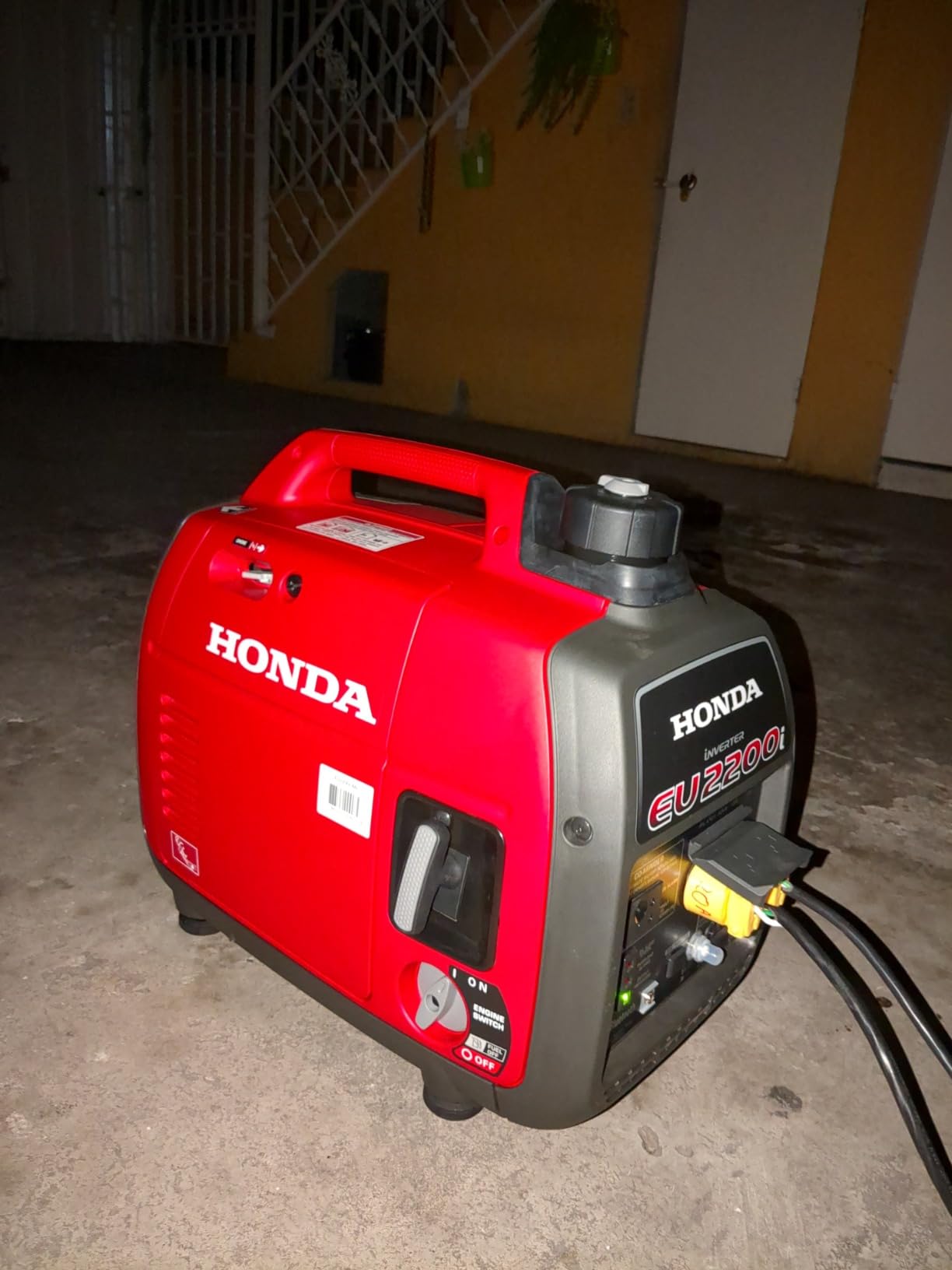
Output is 1800 running watts with 2200 starting watts from a 121cc four-stroke engine. That is enough for a laptop, a CPAP machine, a router, a phone charger and a 13,500 BTU rooftop AC with a soft-start device fitted, but it is not enough headroom for a 15,000 BTU unit without help. This is the disappointment that greets most EU2200i buyers, and the fix is a parallel kit.
Honda’s answer is the EU2200i with a parallel kit, which combines two units into roughly double the output. That is the honest fix for anyone who wants a Honda drivetrain and a 15,000 BTU AC, and it costs more than simply buying one larger unit. Know that going in.
Where the EU2200i earns its place
Campground quiet hours are the reason to buy this. At 48 to 57 dBA it is the only unit in the roundup that sits at conversation volume, and reviewers report being able to hold a normal conversation beside it at full load.
The clean inverter output is safe for laptops, CPAP machines and RV control boards. The CO-MINDER sensor gives owners an automatic shutdown layer that older open-frame units lack entirely.
Where it will frustrate you
The 0.95-gallon tank gives roughly 9 hours at the rated output, and refilling mid-trip is the recurring complaint. The 2200W surge ceiling is the second one, and it is the reason buyers planning a parallel kit should budget for the extra cost.
Forum owners also note that the EU2200i burns noticeably more fuel per hour than larger dual-fuel units delivering comparable usable output. It is efficient for its size, not efficient against a 4000W model doing the same job.
2. Yamaha EF2200iS – Standard RV Outlet in a Yamaha
YAMAHA EF2200iS Inverter Generator, 2200 Watts, Blue
1800W running 2200W start
55.2 lb
1.24 gal tank 10 h runtime
standard RV outlet plus DC
Pros
- Standard RV outlet plus DC outlet built in
- Illuminated multi-function LED display readable day and night
- Smart Dial knob with smart throttle auto load sensing
- Yamaha Quiet Technology muffler
- 3-year manufacturer warranty
Cons
- Heaviest unit in the 2200W class at 55.2 lb
- Only 183 ratings leaves a thin review base
- 9% of ratings are 1-star the highest 1-star share here
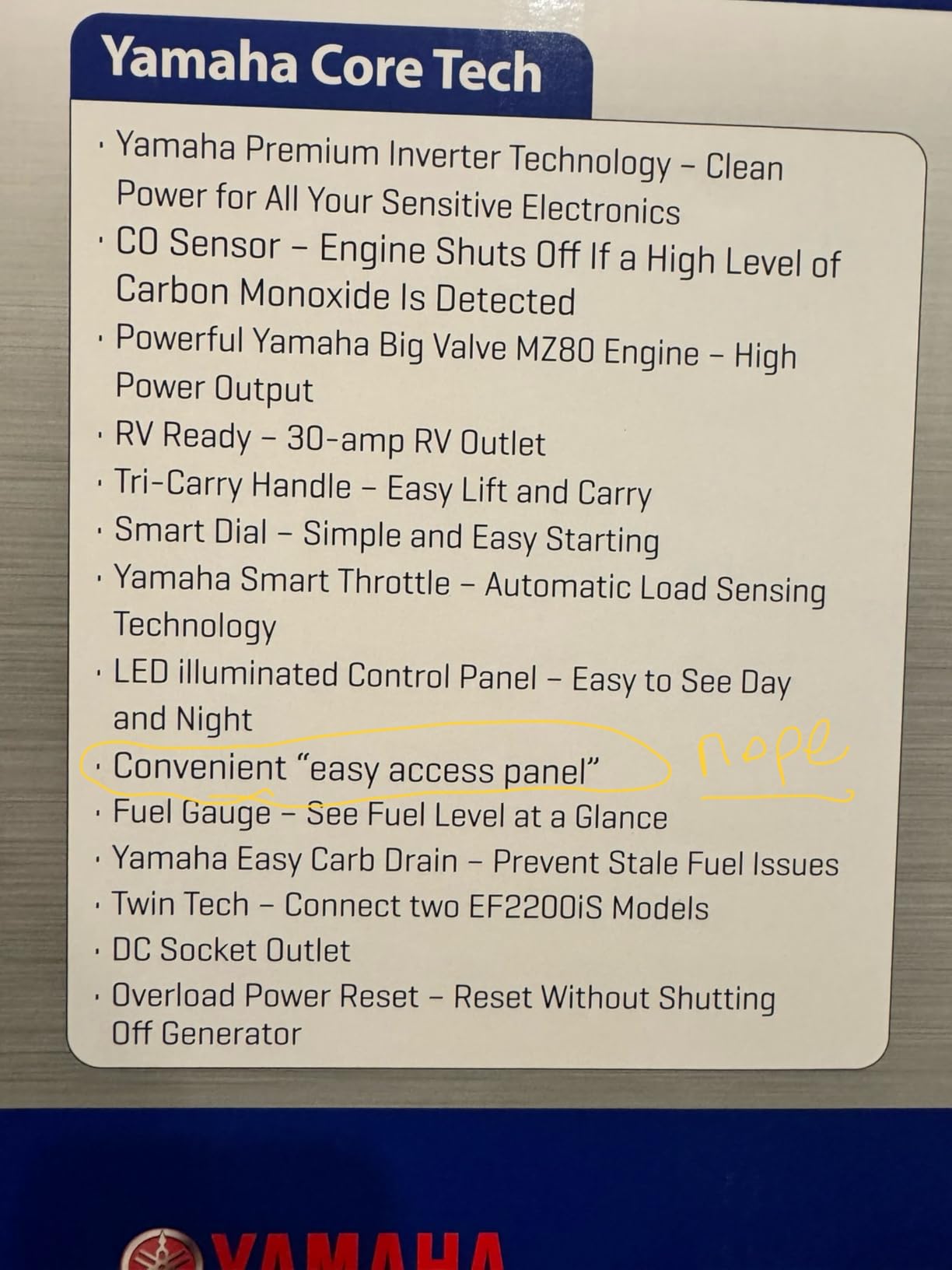
The EF2200iS makes a simple argument: if you want a premium Japanese engine, a standard RV receptacle already in the panel, and a fuel tank with more capacity than the Honda, this is it. Output matches the EU2200i at 1800 running and 2200 starting watts.
Startup is genuinely simple. The Smart Dial knob handles the choke and throttle, and the Smart Throttle system senses the load and adjusts engine speed on its own, so there is no fiddling when the load changes.
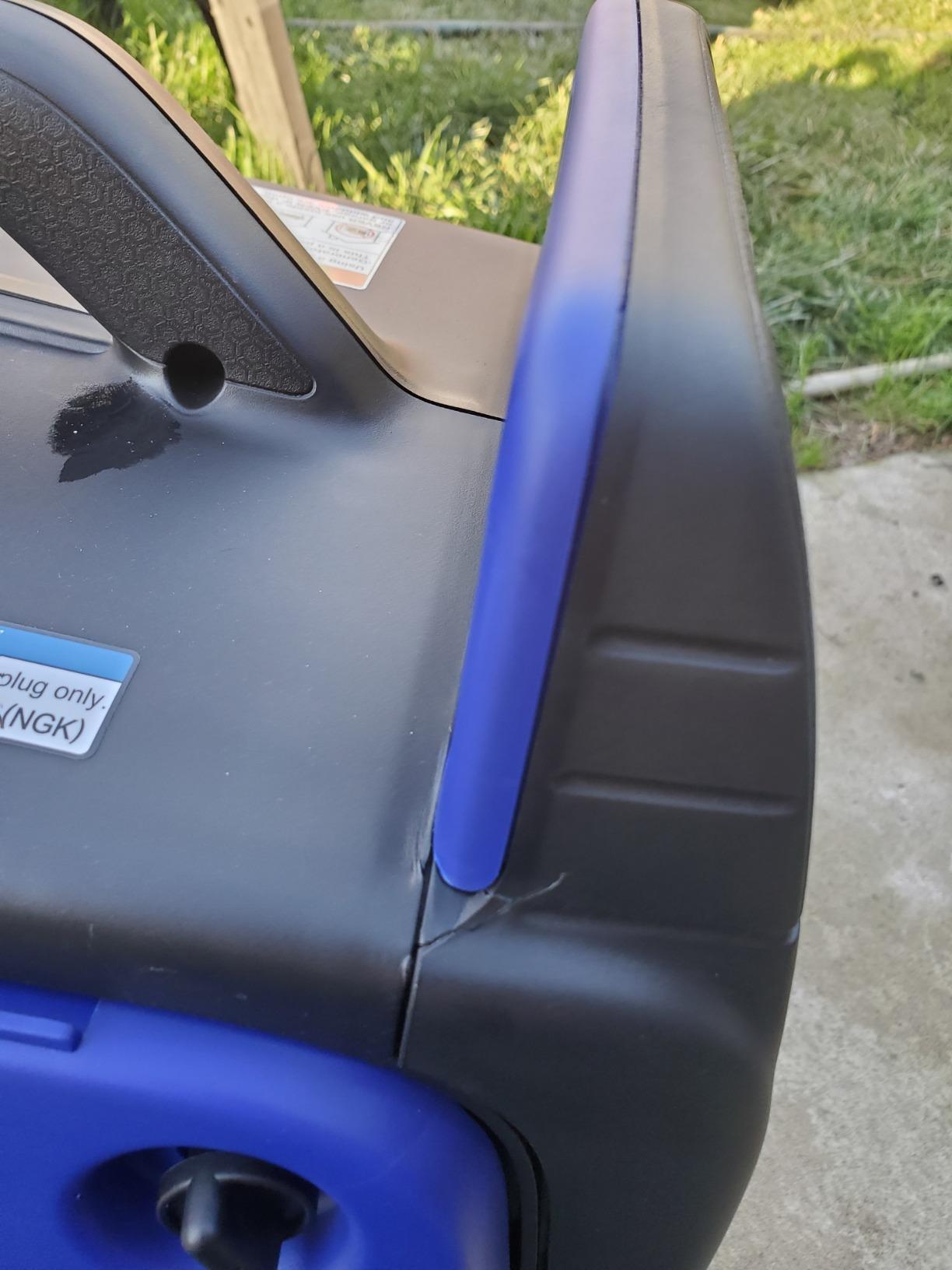
Runtime is listed at 10 hours from a 1.24-gallon tank, a meaningful step up from the Honda’s smaller reservoir. The illuminated multi-function display shows generator status whether you are checking it at noon or in a dark truck bed at midnight, which is a small thing that gets used constantly.
Its weakness is weight. At 55.2 pounds this is the heaviest unit in the 2200W class, and the 2.25-gallon-larger sibling of the Honda costs you real effort every time you load and unload. The review base is also thin at 183 ratings, with 9% of those at 1 star.
Who should buy the Yamaha
Pick this if the built-in standard RV outlet is the deciding factor and you already have a spot in the bed of your truck. The DC outlet also makes it a better small-load station than most competitors at this size.
Owners like the display and the dial startup, and the Quiet Technology muffler keeps it competitive with the class leaders on noise.
Where it falls behind the Honda
8.7 pounds of extra weight for identical wattage is hard to justify unless you value the built-in RV outlet or the larger tank. If you can live without the receptacle, the EU2200i is the lighter buy.
A 4.3 rating with a 1-star share of 9% is a wider spread than the class average, and the small sample size makes that spread harder to judge than the Honda’s 3,228 ratings.
3. WEN 56235i – Lightest Real Inverter in the Class
WEN Super Quiet 2350-Watt Portable Inverter Generator with Fuel Shut Off, Gasoline Power, Ultra Lightweight (56235i), Black
1900W running 2350W start
39 lb
1 gal tank 10 h runtime
5 outlets including USB
Pros
- Lightest body in the roundup at 39 pounds
- 2350 surge and 1900 rated watts of clean power
- Fuel shutoff burns off carburetor fuel to extend engine life
- Starts on first or second pull in 16F cold
- Two-year limited warranty
Cons
- Weak starting power for high-inrush appliances
- Low-oil shutdown can trip on uneven ground so keep it level
- Some reports of oil seepage and early engine failure
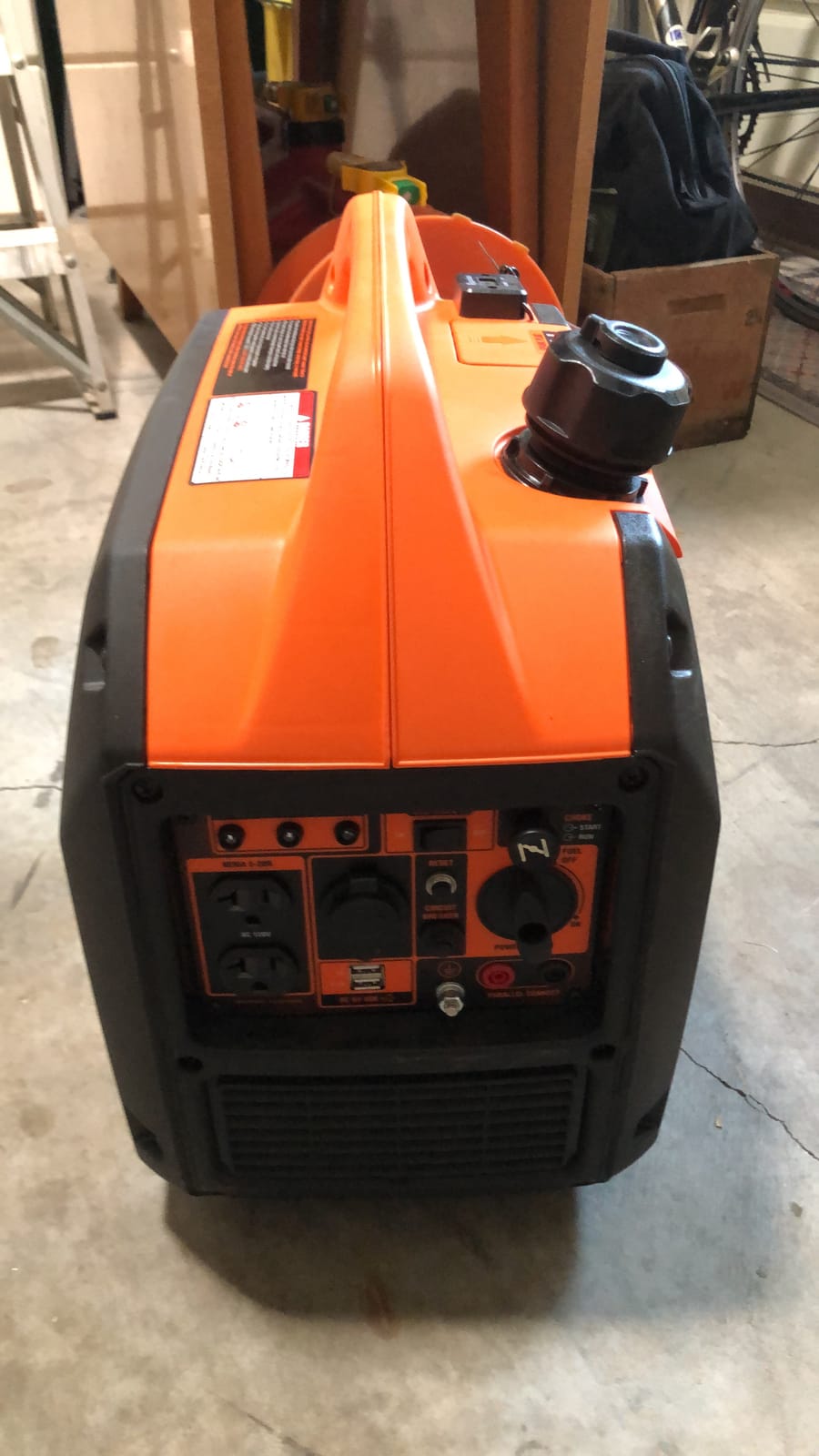
At 39 pounds the WEN 56235i is the one we lift most often and complain about least. It is roughly a third lighter than most 2200W-class competitors, and at 1900 running watts with 2350 starting watts it puts out more than the Honda and Yamaha it is priced against.
Owners upgrading from a smaller Yamaha report the WEN delivers comparable output for noticeably less carry weight. Five outlets cover the usual campground load: two household 120V receptacles, a 12V DC receptacle and two 5V USB ports.
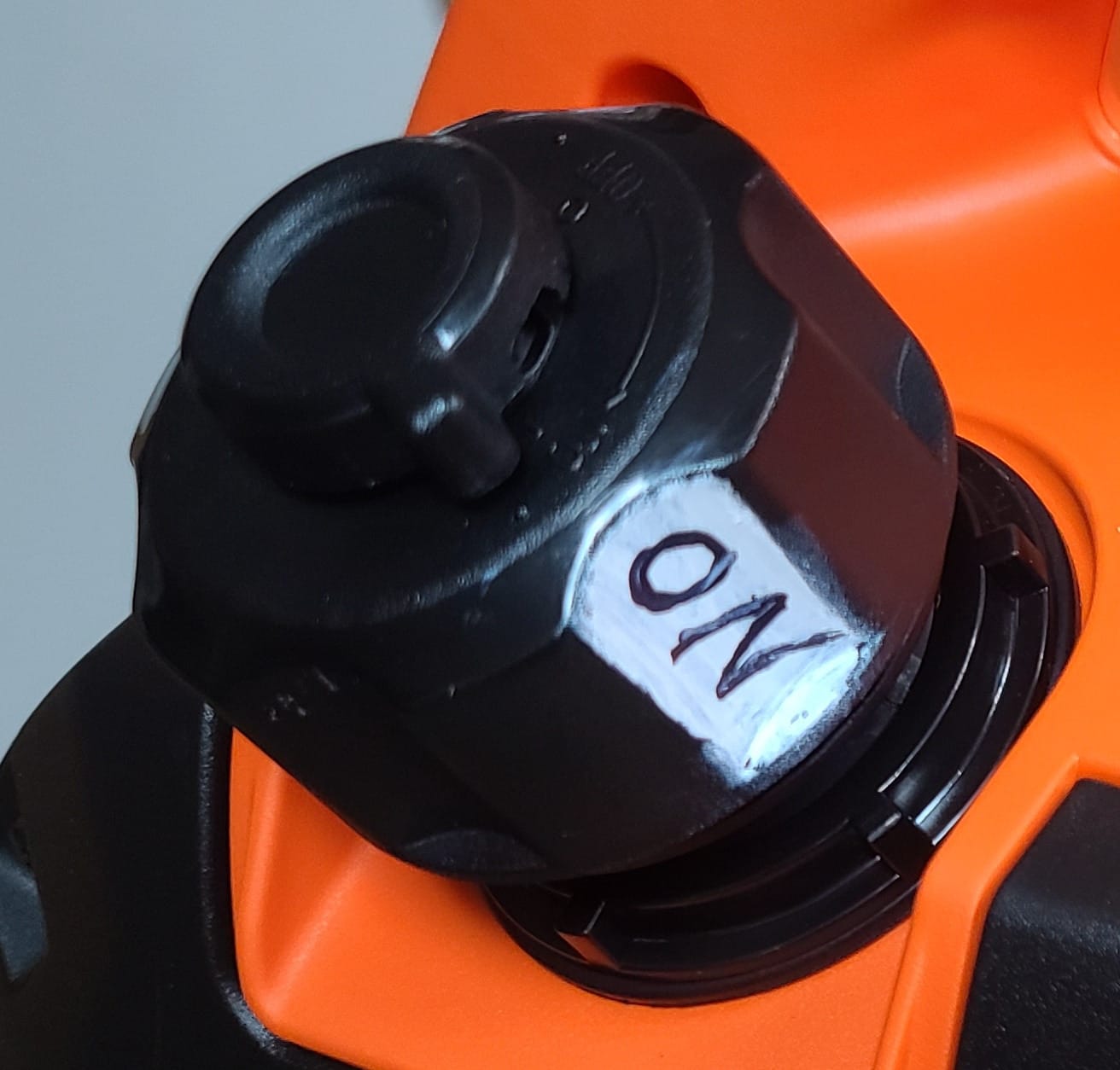
The fuel shutoff feature is a real longevity measure rather than a gimmick. Burning off remaining carburetor fuel before shutdown protects the carb from varnish, which is the failure mode that kills most small engines stored between trips.
Cold starting is a genuine strength. Owners in northern climates report first or second pull starts in 16F, and RV owners report running a 13,500 BTU Dometic AC once a Micro-Air EasyStart soft-start device is installed. That soft-start note matters more than any spec on this list.
Why this fits a pop-up or ultralight trailer
Weight is the binding constraint on small rigs, and 39 pounds is the number that changes behaviour. One person loads it, one person uses it, and nobody is negotiating a deadlift over a tailgate.
The 10-hour runtime on a 1-gallon tank and the fuel shutoff make it a good shoulder-season companion for a trailer that mostly carries lights, a laptop and a small AC unit.
Where owners report problems
Starting power is weak for high-inrush appliances, so the big loads must be started first. The low-oil shutdown can trip on slightly uneven ground, which means the ground under it matters.
Some owners report oil seepage and premature engine failure inside the first year, and the recommended cover is oversized enough to wear against the base. Recurring advice from experienced owners: fit a magnetic dipstick and run ethanol-free fuel.
4. PowerSmart 3800W Dual Fuel – Most Watts Per Dollar
PowerSmart 3800 Watt Dual Fuel Inverter Generator for Camping or Home Use
3300W running 3800W start on gas
dual fuel
50.7 lb
59 dBA Eco Mode
Pros
- Runs on gasoline and propane straight from the box
- 120V 30A L5-30R twist-lock RV outlet included
- Up to 24 hours on a standard 20-lb propane tank
- Output display shows live wattage draw
- Parallel ready to double output
Cons
- Small 1.3-gallon gas tank needs refills on long runs
- Access panels and oil door need a Phillips screwdriver
- Display hard to read without crouching down to ground level
The PowerSmart 3800W is the value answer in this roundup. It gives you 3300 running watts and 3800 starting watts on gasoline, 3100 running and 3500 starting watts on propane, and it ships with the receptacles a trailer actually needs.
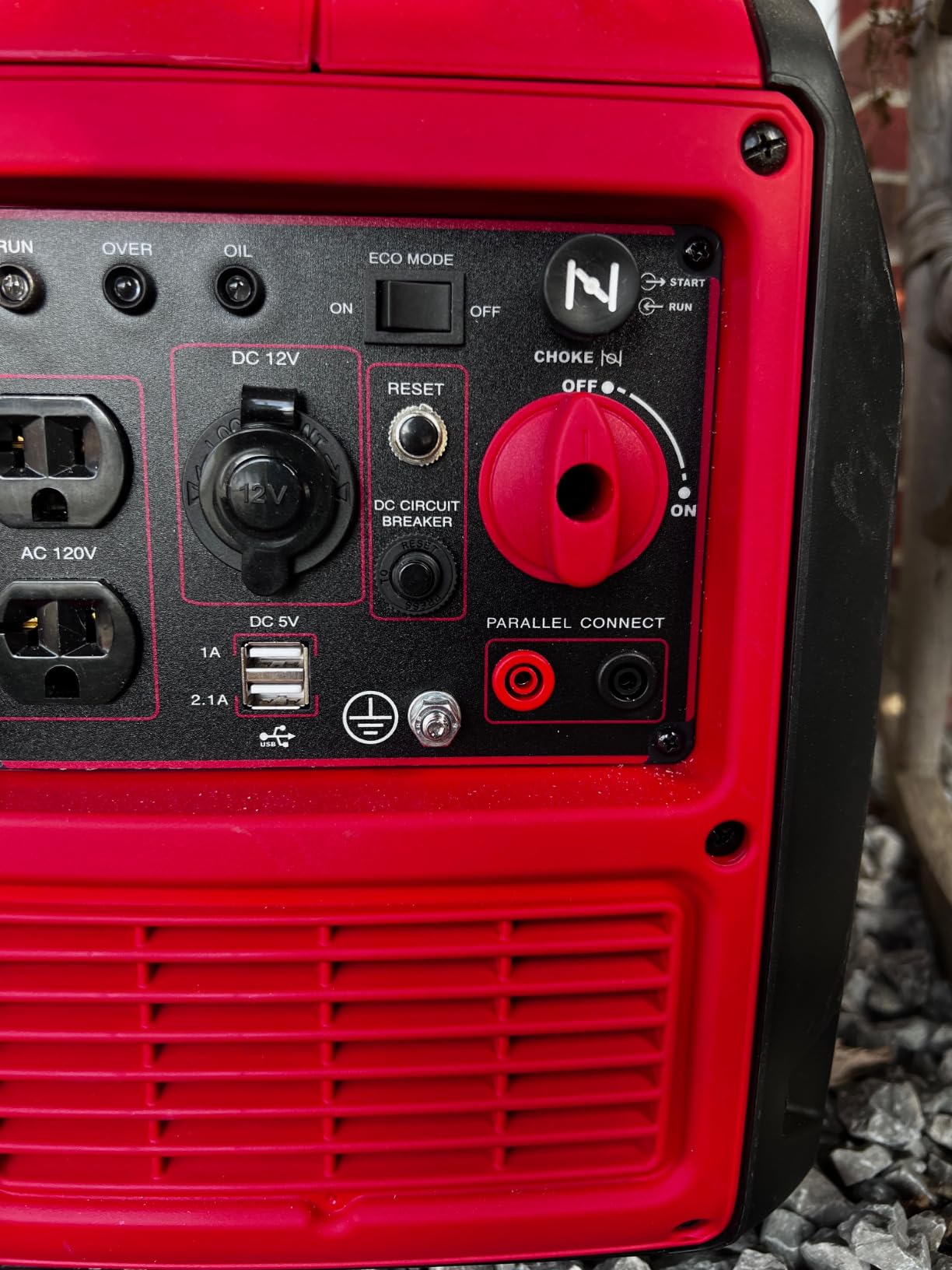
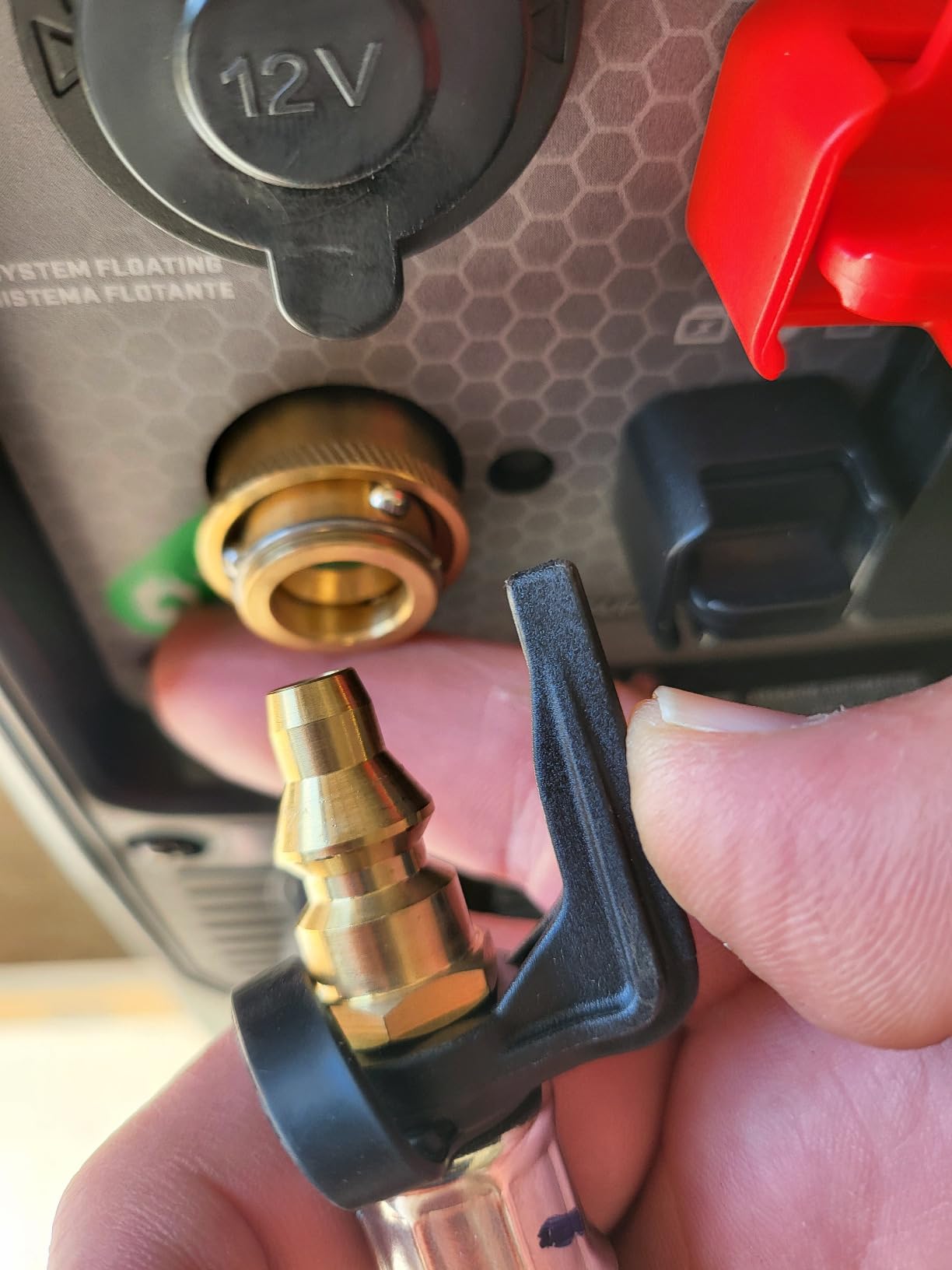
That includes a 120V 30A L5-30R twist-lock outlet alongside a 20A household duplex, a 12V 8A DC port and dual USB. For a camper who wants to run a rooftop AC on a standard cord rather than hunting for an adapter, that outlet is the reason to look here first.
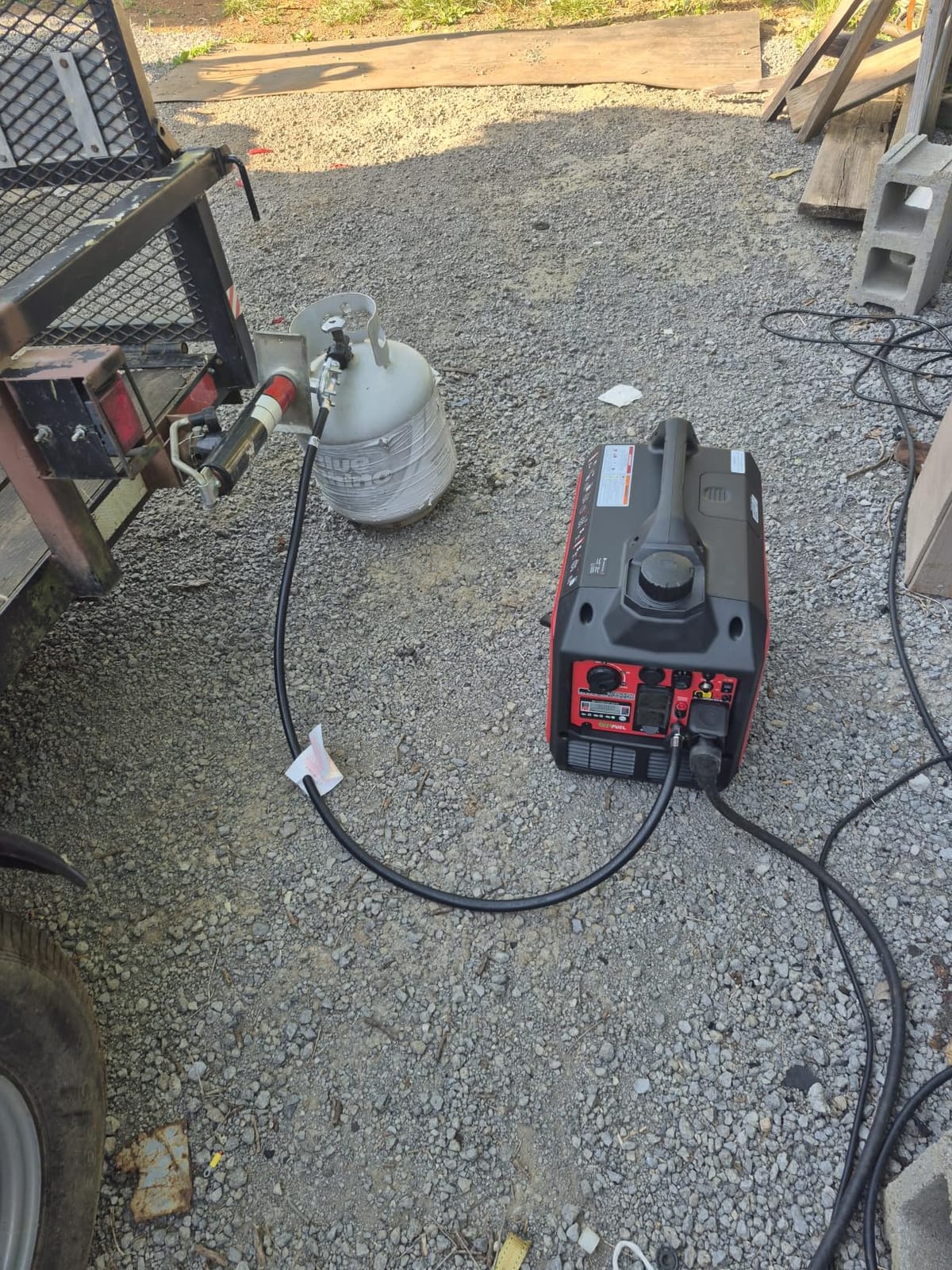
Runtime is the quiet differentiator. On the 1.3-gallon gasoline tank it manages 8 hours at 25% load, and on a standard 20-lb propane tank owners report up to 24 hours. That is an entire night of AC without a fuel run back into town, which no gasoline-only unit in this group can do.
The output display shows live wattage draw, so you can see what your air conditioner actually costs instead of guessing. It is also parallel ready, so a second unit doubles the output if a larger rig demands it.
Why the value pick makes sense
Dual fuel plus a real 30A twist-lock outlet is a combination that usually costs far more than this. Reviewers call it strong value for the wattage and highlight the ability to burn an entire propane tank without touching gasoline.
At 59 dBA in Eco Mode at 25% load it is quiet enough for most campground quiet rules when it is not being run wide open.
What to know before you buy
The 1.3-gallon gasoline tank is small for long runs, which is why the propane capability matters so much here. Access panels and the oil change door need a Phillips screwdriver, so keep a bit driver in the storage bay.
The display panel is hard to read without crouching to ground level and there is no Bluetooth, and support can be difficult to reach for warranty work.
5. Champion 4000W Dual Fuel RV Ready – The Trailer Owner’s Favourite
Champion 4000-Watt Dual Fuel RV Ready Portable Inverter Generator
3000W running 4000W start
dual fuel
51.8 lb
TT-30R outlet and under 3% THD
Pros
- Operates on gasoline or propane out of the box with CO Shield shutoff
- TT-30R 30A RV outlet plus 20A household and 12V automotive outlets
- Clean power at less than 3% THD for sensitive electronics
- Quarter-turn oil access needs no tools
- Travel trailer owners report 7 hours of 15000 BTU AC on one tank
Cons
- 64 dBA at 23 ft at 25% load and closer to 70 at full load
- 13 lb heavier than the 2500W Champion model
- One owner could not start it on a new full propane tank until broken in on gasoline
- Cannot run the RV AC and microwave at the same time
For a 30 amp travel trailer with a 15,000 BTU rooftop AC, this is the unit we recommend most often. The TT-30R receptacle is built into the control panel, so the trailer plugs straight in with no adapter, and output is 3000 running watts with 4000 starting watts on gasoline.
Travel trailer owners report running that 15,000 BTU air conditioner for seven hours on a single tank. That is the real-world proof that the surge rating is adequate, and it is why this sits in our top three despite being louder than smaller units.
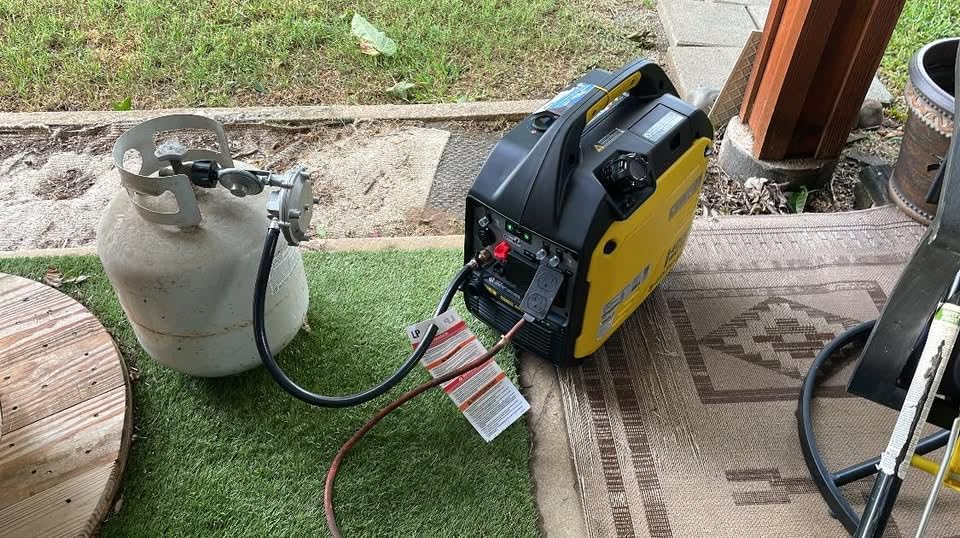
Total harmonic distortion is under 3%, which keeps laptops, CPAP machines and RV control boards happy. CO Shield carbon monoxide auto shutoff is standard, and the quarter-turn oil access means a 10-minute oil change with no tools at the campsite.
On propane it drops to 2700 running watts and runs up to 25 hours. The overload mode is well designed too: the unit keeps running with a red panel light, and one press of the reset restores output rather than killing the AC mid-afternoon.
Where it outruns the smaller units
The gap that matters is surge headroom. A 13,500 BTU compressor has a meaningful inrush draw on start, and this unit has 1000 starting watts of margin over its running figure. Smaller inverters in the same price range do not have that cushion.
The built-in TT-30R is the detail trailer owners mention most, because it removes the adapter from the equation entirely.
Where it falls short
Noise is the honest weakness: 64 dBA at 23 feet at 25% load, and closer to 70 dBA at full load, which is louder than the sub-60 dBA inverters in this roundup. Campgrounds with strict quiet hours will notice.
It cannot run the RV air conditioner and the microwave simultaneously, and one owner could not get it running on a brand-new full propane tank until it had been broken in on gasoline.
6. WEN 56360i 3600W – Built-In TT-30R Without the Adapter
WEN 3600-Watt Portable Inverter Generator, RV-Ready, Quiet and Lightweight with Fuel Shut Off (56360i)
2900W running 3600W start
built-in TT-30R
46.3 lb
1.6 gal tank
Pros
- RV-ready TT-30R 30A receptacle built in so no adapter is needed
- 3600 surge and 2900 rated watts from a 149cc engine
- Ultralight 46-pound enclosed body is easy to move
- Fuel shutoff protects the carburetor and extends engine life
- Six outlets including two USB and a 12V DC receptacle
Cons
- Gasoline only with no dual fuel or propane option
- Half-load runtime is shorter than larger-tank models in the class
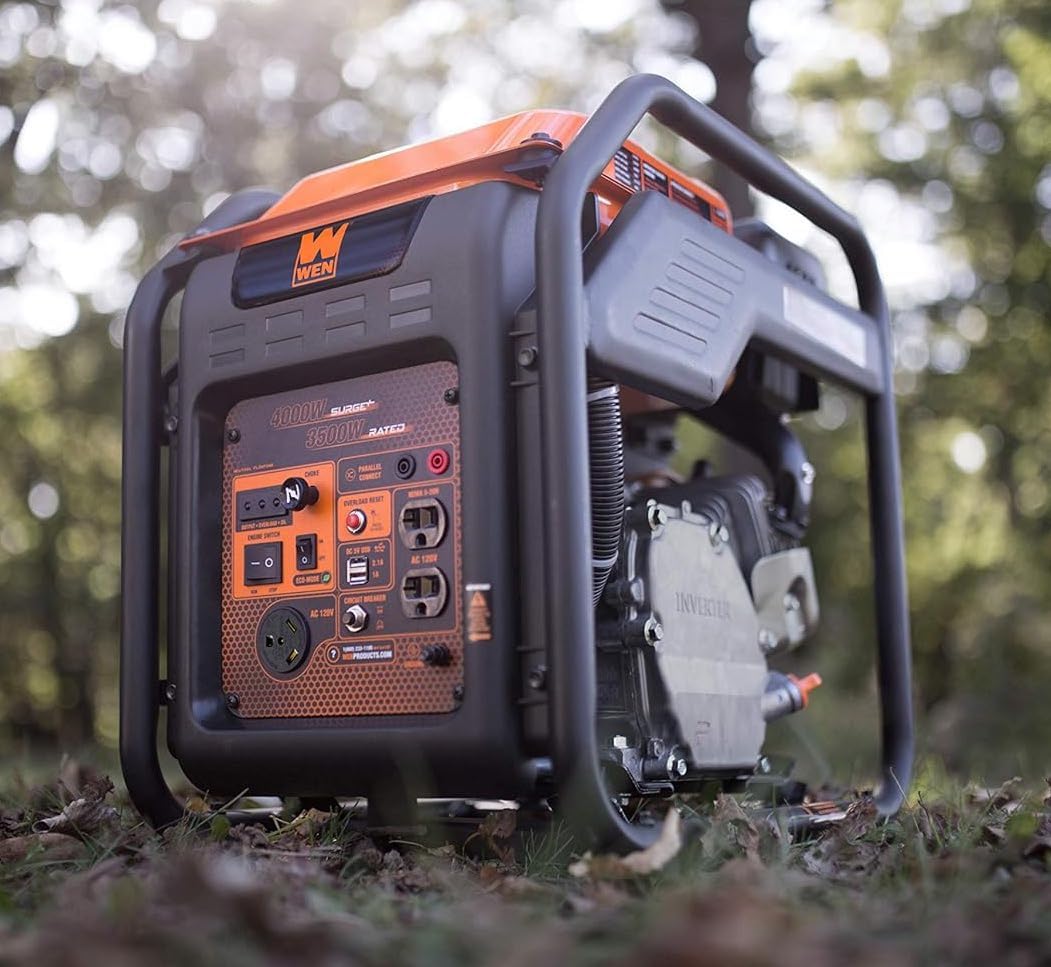
The WEN 56360i exists for one specific reason: it puts a TT-30R 30A receptacle on a mid-tier wattage machine at a weight most people can still lift alone. Output is 2900 running watts with 3600 starting watts from a 149cc engine.
Most buyers of this model are upgrading from a 2300W unit and want trailer power without an adapter brick in their cord bag. That is exactly what they get, and it is why 75% of its ratings sit at five stars.
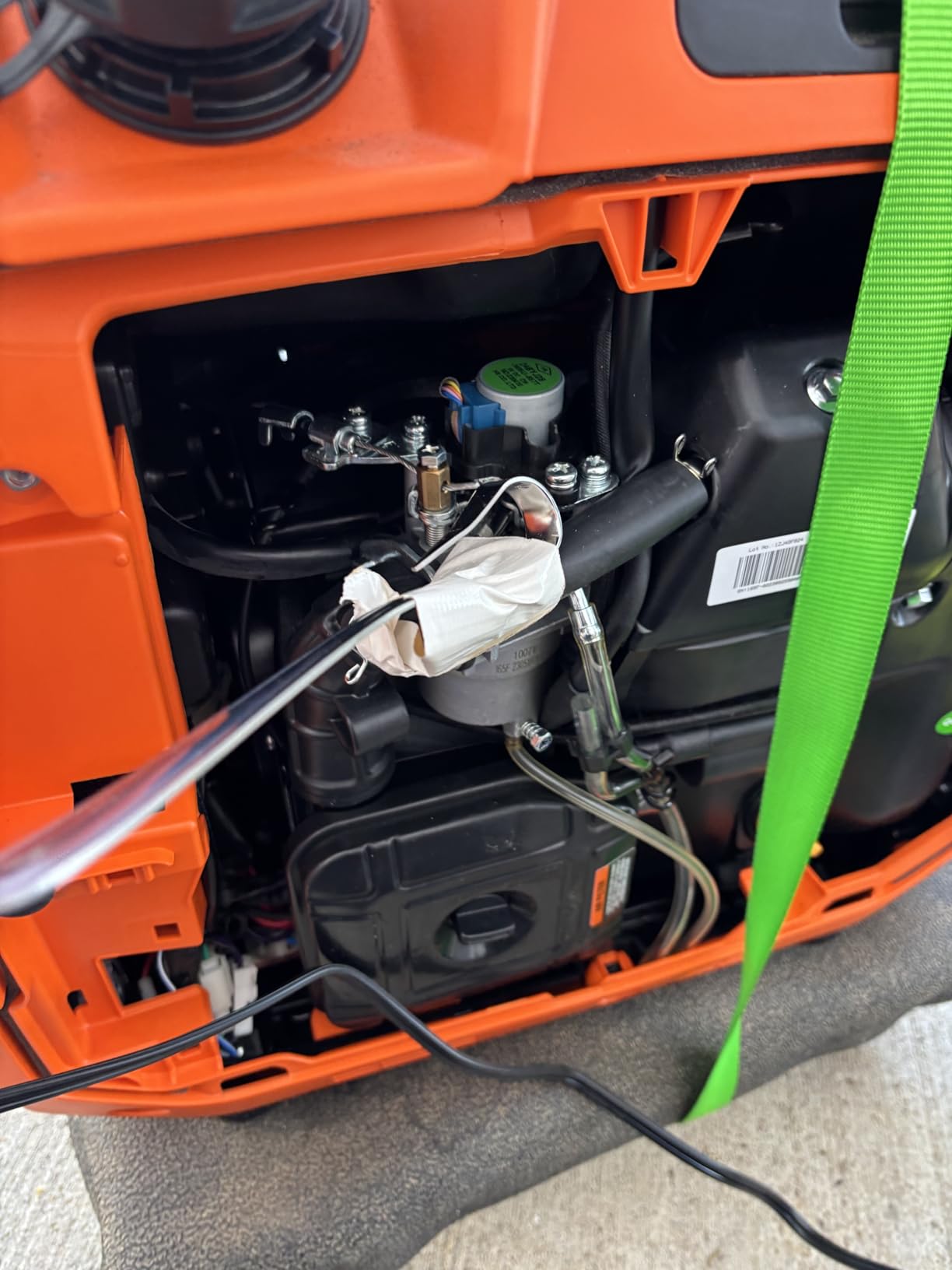
Six outlets in total: two household 120V receptacles, one TT-30R, one 12V DC and two 5V USB. The fuel shutoff burns off carburetor fuel on shutdown, the same longevity trick as the smaller WEN, and the warranty runs three years.
At 46.3 pounds it is 5.5 pounds lighter than the Champion 4000W while giving up 100 running watts. For most trailer loads that trade is worth making once per trip.
When this is the right upgrade
Choose this if you have moved up from a small inverter and want true trailer power without carrying an adapter. The TT-30R is the whole value proposition.
It also suits anyone who wants a fully enclosed, light, gas-only unit and treats runtime as a non-issue because they refill whenever they return to the truck.
The limitation that decides against it
It is gasoline only. There is no dual-fuel or propane path, so an all-night AC run means carrying fuel or waking up to a cold trailer.
Half-load runtime is shorter than larger-tank models in the class, and the 1.6-gallon tank is where that shows up. If your camping pattern is overnight AC runs, the dual-fuel units are a better fit.
7. Pulsar PGD40ISCO 4000W – 3200 Watts Under 50 Pounds
Pulsar PGD40ISCO Ultra Light Quiet 4000W Portable Gas Inverter Generator, white
3200W running 4000W start
47.3 lb
59 dB
rated for air conditioning to 13500 BTU
Pros
- 4000 peak and 3200 rated watts at a light 47.3 pounds
- Quiet 59 dB operation suitable for campsites
- Rated to handle air conditioning units up to 13500 BTU
- Parallel ready to pair with a second unit
- Automatic voltage regulation and a fuel-efficient 1-gallon tank
Cons
- Only about 4 hours of half-load runtime on the 1-gallon tank
- Gasoline only with no propane capability
- 9% of ratings are 1-star
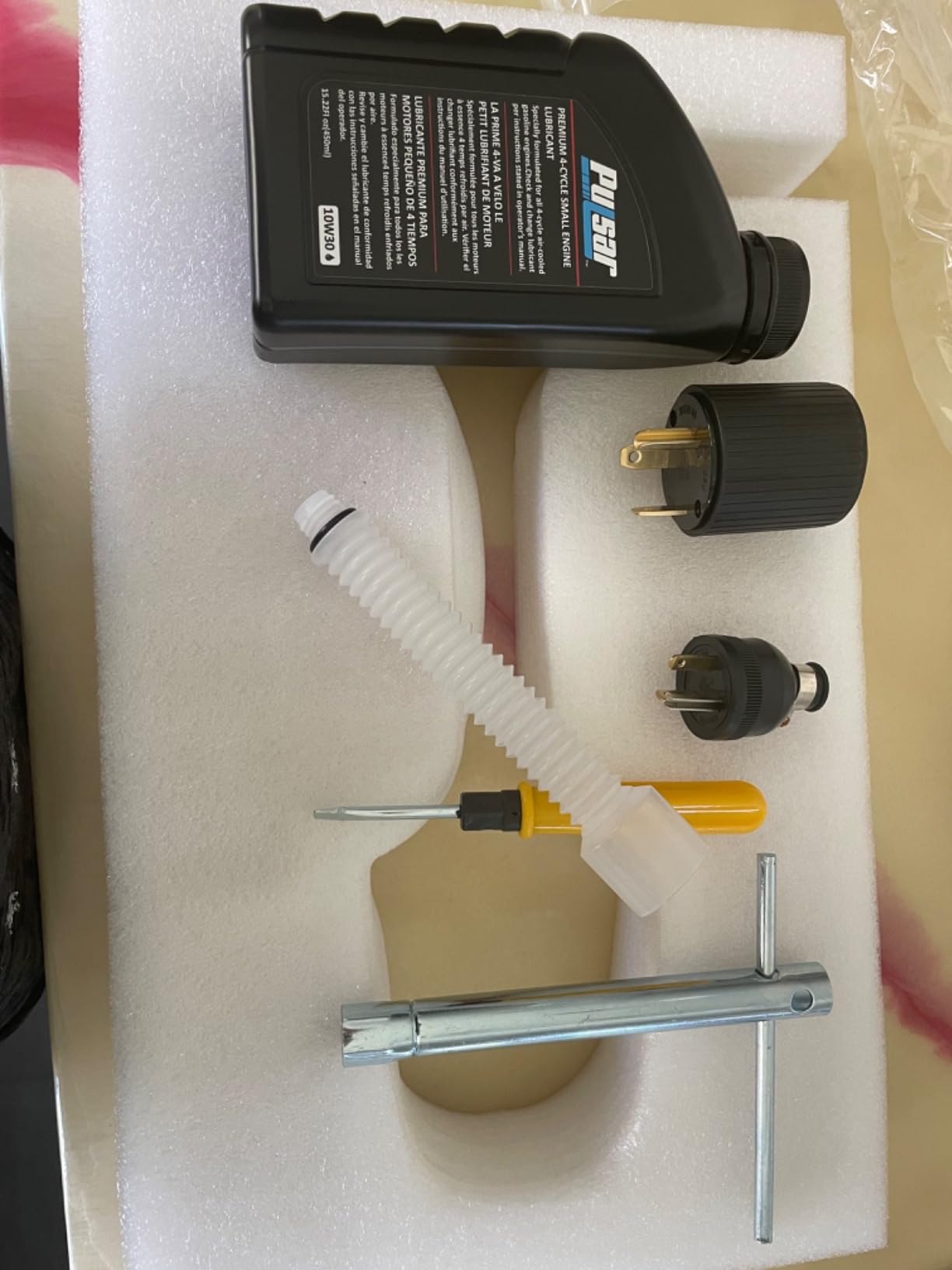
The Pulsar PGD40ISCO puts 3200 rated watts into 47.3 pounds, which is an unusual amount of output for the weight. It runs at 59 dB, quiet enough for a campsite, and is rated to handle air conditioning units up to 13,500 BTU.
That weight and output combination is why it keeps showing up for Class B vans and pickup campers, where every pound competes with payload and storage space.
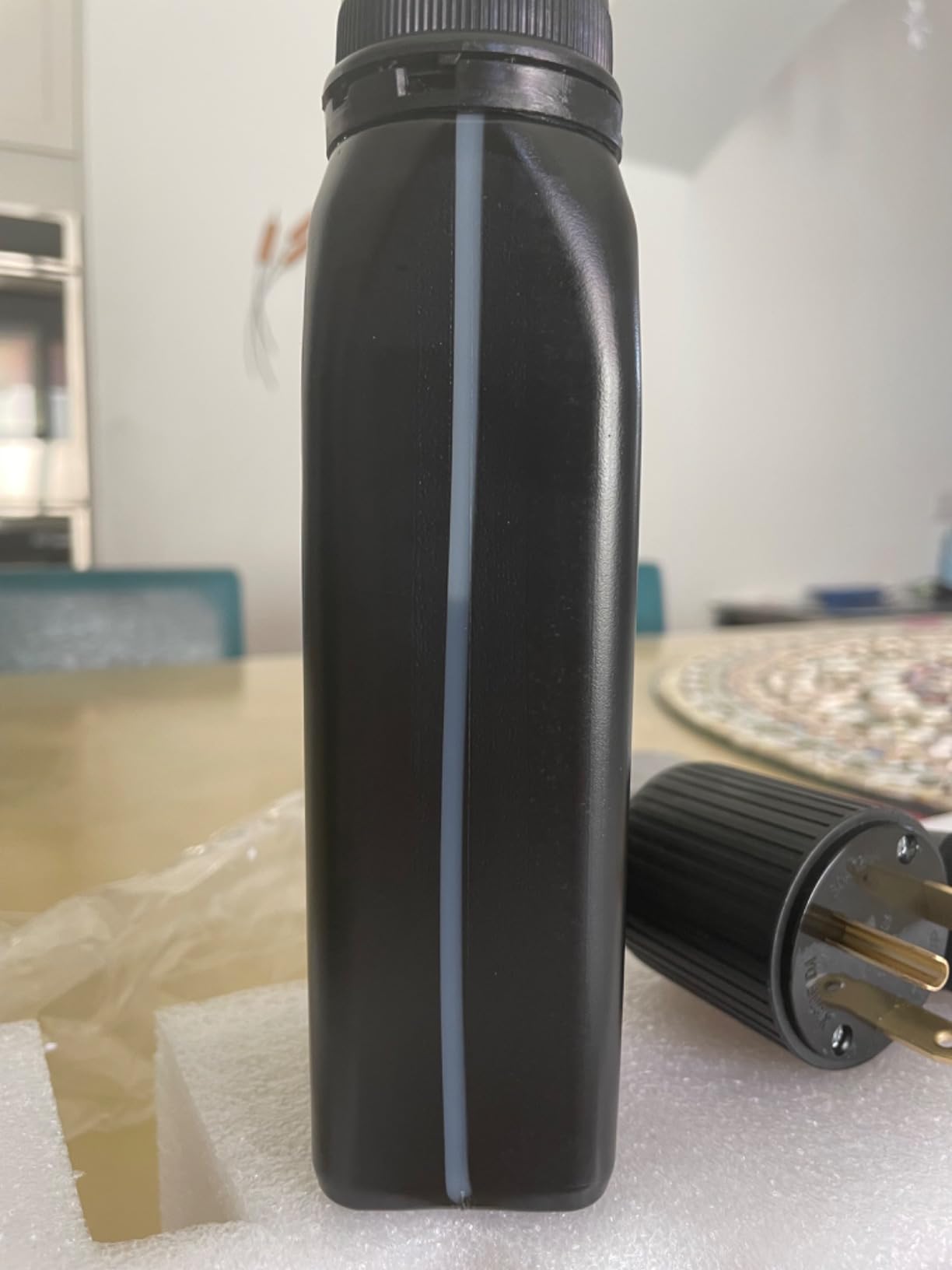
Owners cite the 4,000 peak and 3,200 rated figures combined with the sub-50-pound figure as the reason to buy, and 74% of ratings sit at five stars. Automatic voltage regulation keeps sensitive electronics stable, and it is parallel ready for pairing with a second unit.
The engine is a 145cc four-stroke from a Chongqing manufacturer, with magneto ignition and a three-year limited warranty.
Where the weight-to-output math wins
Payload limits on a Class B or a half-ton pickup make generator weight a hard number, not a preference. Under 50 pounds with 3200 rated watts is one of the better ratios here.
The 59 dB figure and the 13,500 BTU AC rating together cover the two things campers check first: noise rules and whether the compressor will start.
What the ratings give away
The 1-gallon tank gives about 4 hours at half load, which is the shortest useful runtime in the group. Gasoline only, no propane path.
Nine percent of ratings are 1-star, tied for the highest share in the roundup, so the sample is worth reading before you commit.
8. Champion 4500W Electric Start – Longest Runs, Heaviest Lift
Champion 4500-Watt Electric Start Dual Fuel Portable Inverter Generator
3500W running 4500W start
electric start
99.2 lb
14 h gasoline 21 h propane
Pros
- Electric start with backlit power meter showing voltage frequency and hours
- Dual fuel with 3500 running watts on gasoline and 3150 on propane
- Up to 14 hours on gasoline and 21 on propane from the 2.25-gallon tank
- 61 dBA operation suitable for RV and camping
- Owners report powering a trailer rooftop AC plus appliances
Cons
- Heaviest unit in the roundup at 99.2 lb a two-person lift
- CO sensor can be overly sensitive and shut down in enclosed spaces
- One owner reported oil leakage and frequent starting difficulty on a new unit
- Warranty service may require travel to an authorized workshop
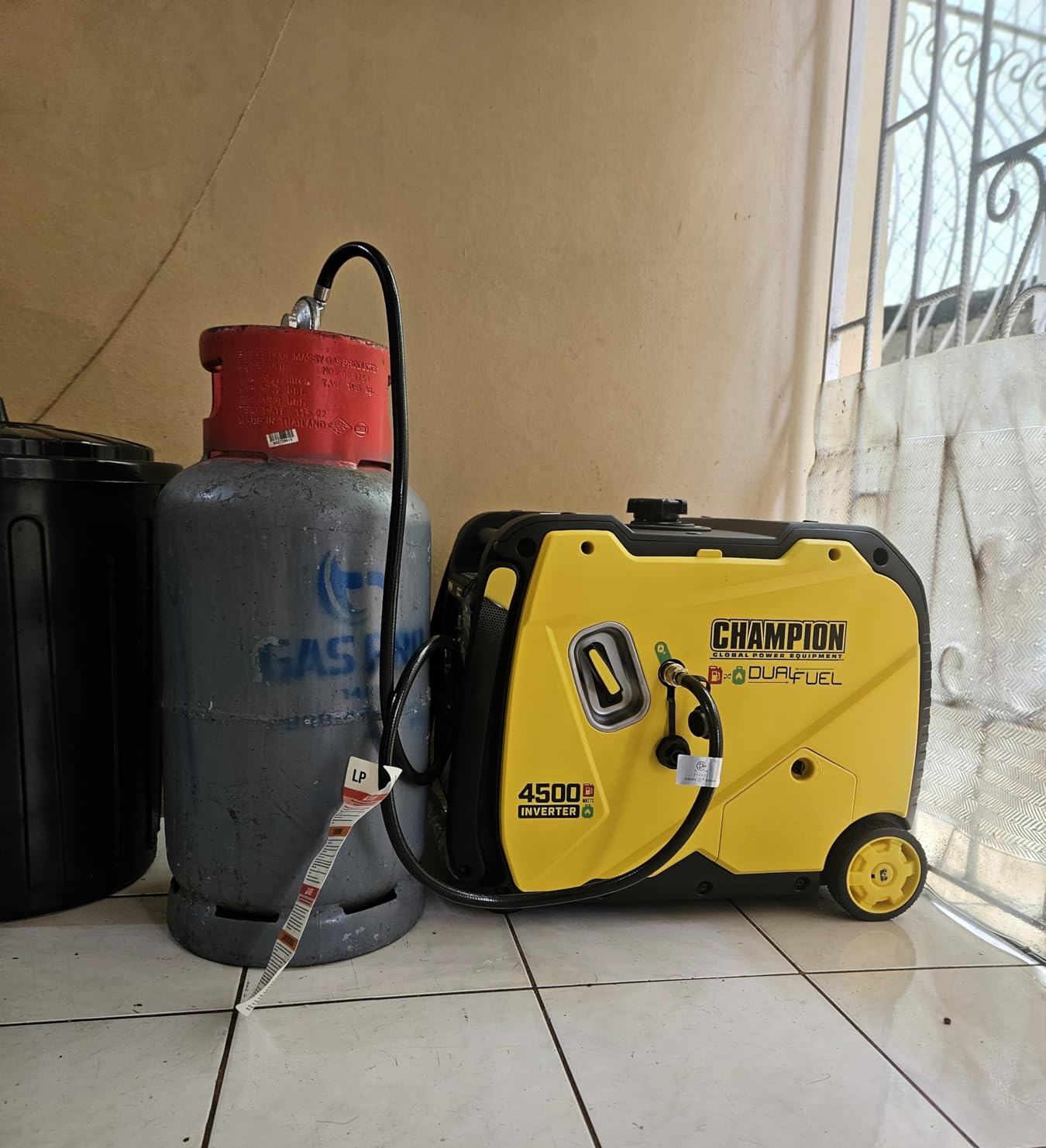
This is the one to buy if runtime is your binding constraint. The 2.25-gallon tank gives up to 14 hours on gasoline and 21 hours on propane, which covers a full night of air conditioning with fuel left over.
Output is 3500 running watts and 4500 starting watts on gasoline, dropping to 3150 running on propane. Owners report it powering a travel trailer rooftop AC alongside ordinary appliances without drama.
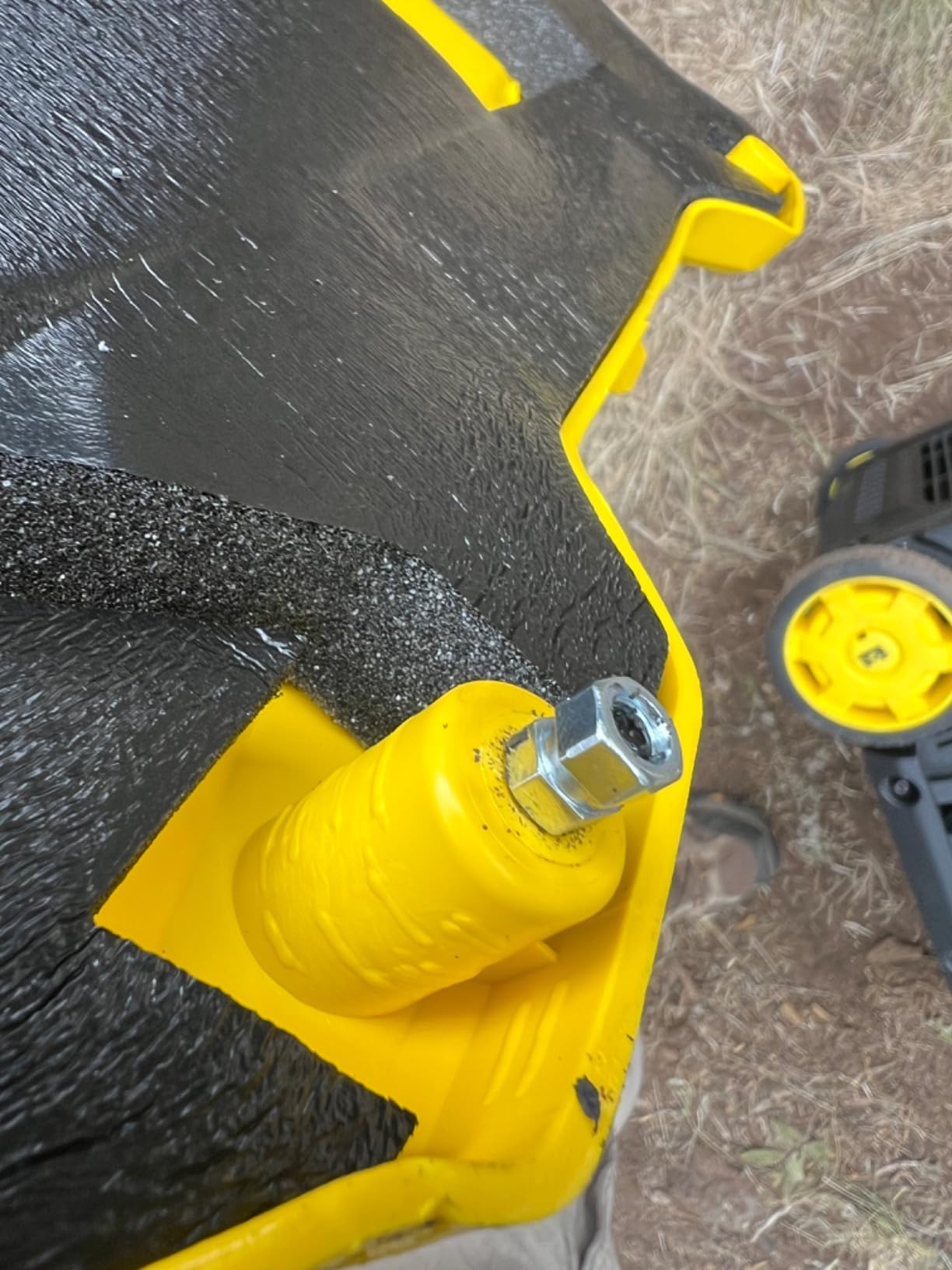
The electric start is a genuine quality-of-life upgrade over a recoil pull, and the backlit Intelligauge power meter shows voltage, frequency and operating hours so you can track engine hours for maintenance intervals.
At 61 dBA it sits in the middle of the noise range for this roundup, quieter than the Champion 4000W at full load and louder than the sub-60 dBA light-load units.
Who this is built for
Full-timers and anyone running AC all night should look here first. Dual fuel plus the largest tank in the group means fewer fuel runs between hookups.
The 212cc engine and electric start make repeated starts painless, and the three-year warranty with lifetime technical support covers the long haul.
Where it will hurt you
99.2 pounds is the heaviest unit in the roundup and a genuine two-person lift, which is the most common complaint among owners. Loading it into a truck bed at a dark campsite is not a one-person job.
The CO sensor can be overly sensitive and shut the unit down in an enclosed space such as a truck bed, and one owner reported oil leakage and repeated starting difficulty on a new unit.
9. AIVOLT 4300W Dual Fuel – Remote Start With a Caveat
AIVOLT 4300W Dual Fuel Inverter Generator 53dB Quiet for RV Camp Home
3300W running 4300W start
dual fuel
key fob remote start
built-in 30A outlet and wheels
Pros
- Key fob remote start lets you power up from inside the RV
- Dedicated 30A RV outlet for air conditioners and microwaves
- Dual fuel with up to 11.5 hours on gasoline and 34 on propane at 25% load
- Built-in wheels and telescoping handle for rough campground terrain
- Support shipped a whole replacement generator for a defective fuel-system unit
Cons
- Measured sound runs roughly 72-73 dBA at 5 feet well above the claim
- 12% of ratings are 1-star the highest share in this roundup
- One unit arrived with no engine oil included
- Some smaller-wattage variants report output well below advertised capacity
The remote start is the feature that separates this from everything else here. A key fob lets you power the unit up from inside the cab, which matters on a cold morning when you do not want to walk out to the generator in a hoodie.
Output is 3300 running watts and 4300 starting watts, with a dedicated 30A RV outlet for air conditioners and microwaves. On propane at 25% load it runs up to 34 hours, the longest propane figure in the roundup.
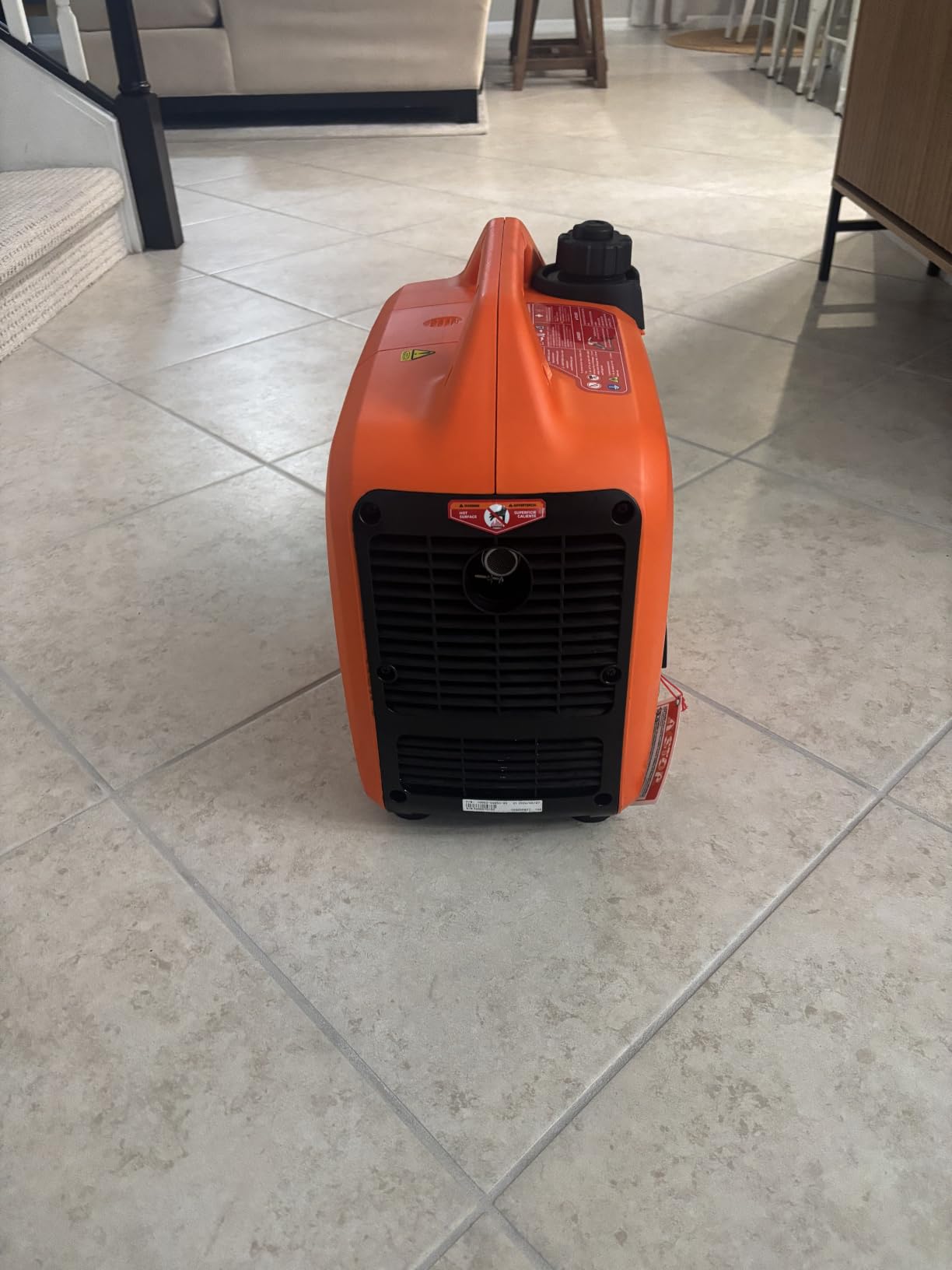
Built-in wheels and a telescoping handle make it the easiest 64-pound unit to move over rough campground ground, and it is parallel ready with a two-year warranty behind it.
The honest problem is noise. The listing claims 53 dBA, but owners measuring at roughly 5 feet report 72 to 73 dBA. That is a gap large enough to change your decision at a campground with enforced quiet hours.
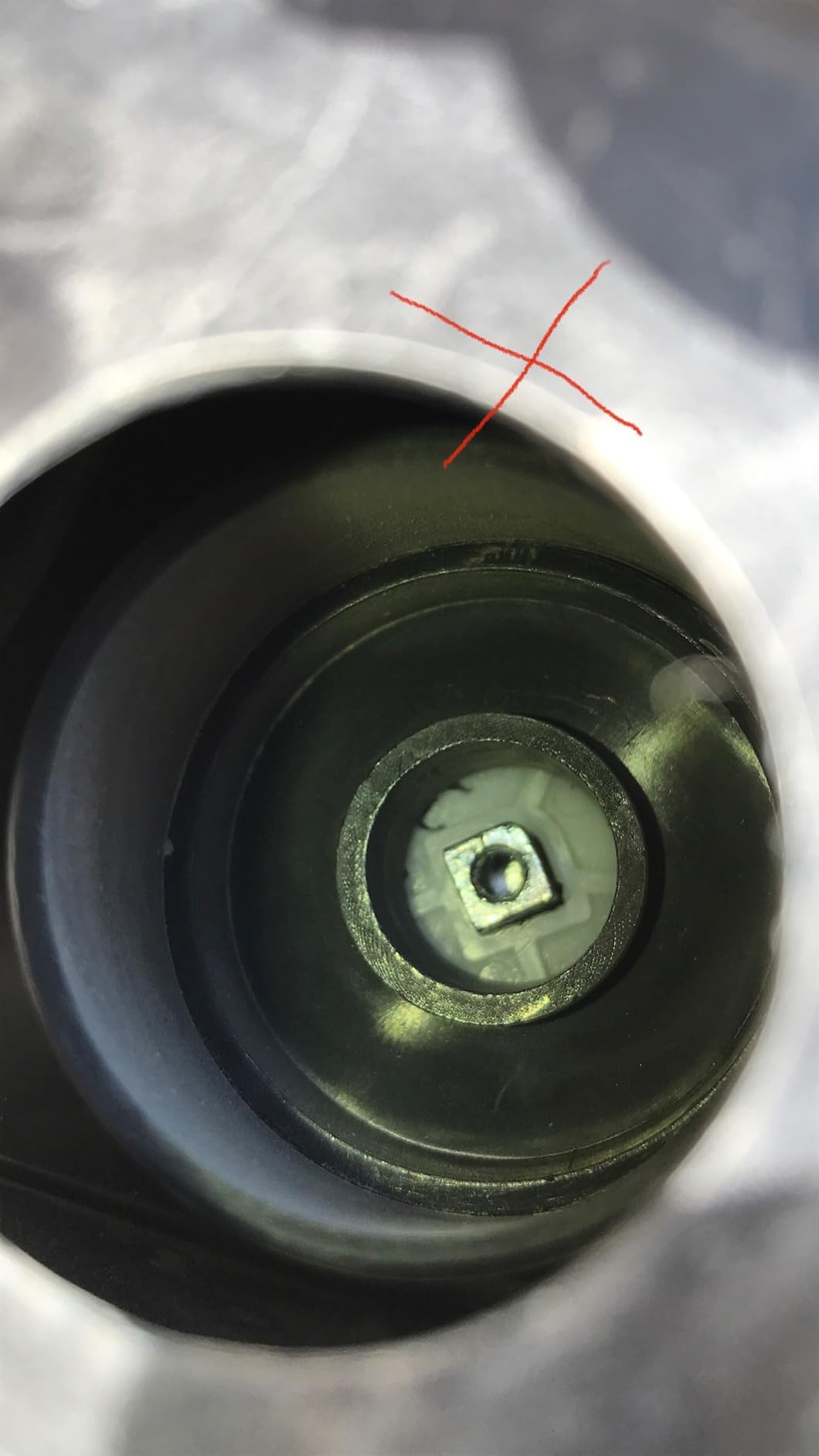
Where the remote start pays off
Anyone who has had to walk to a generator in the dark, or who does not want to leave a running engine unattended at the picnic table, will value the key fob more than any wattage figure.
The 30A outlet and 34-hour propane runtime make it a good overnight AC solution, and the wheeled frame helps on gravel sites.
Why we would hesitate
The rating distribution is the weakest in the roundup: 4.1 overall with 12% of ratings at 1 star, driven by fuel-system failures that stopped units within weeks.
Measured noise far above the advertised figure is the other problem, and one unit arrived with no engine oil in the box. Support did replace a defective unit outright, which is worth something.
10. ERAYAK 2400W – Clean Power for Small Loads Only
ERAYAK 2400W Portable Inverter Generator for Home Use, Super Quiet Small Generator for Camping Outdoor Emergency Power Backup, Gas Powered Engine, EPA, ECO Mode
1800W running 2400W start
42 lb
52.5 dB at 7 meters
under 1.2% THD
Pros
- Only 42 lb and compact enough to fit in a sedan trunk
- Very quiet at 52.5 dB at 7 meters and 25% load
- Clean output under 1.2% THD for laptops and CPAP machines
- Eco Mode stretches fuel use to about 16 hours at 25% load
- Campers report running a coffee maker microwave TV and lights from a 17 ft trailer
Cons
- Engine oil must be added separately before first use
- No authorized service centers with parts and support by email only
- Real-world output is closer to the 1800W running figure than 2400W
- Not rated above 1000 meters altitude without a high-altitude jet kit
The ERAYAK 2400W is for the camper who runs a CPAP machine, a laptop and a couple of lights and does not intend to run the rooftop air conditioner. Output is 1800 running watts with 2400 starting watts from a 79.7cc engine, and total harmonic distortion stays under 1.2%.
That THD figure is the best in the roundup, and it is the entire argument for this unit. CPAP machines, laptops, TVs and mobile devices are exactly the devices that complain about cheap modified sine wave output.
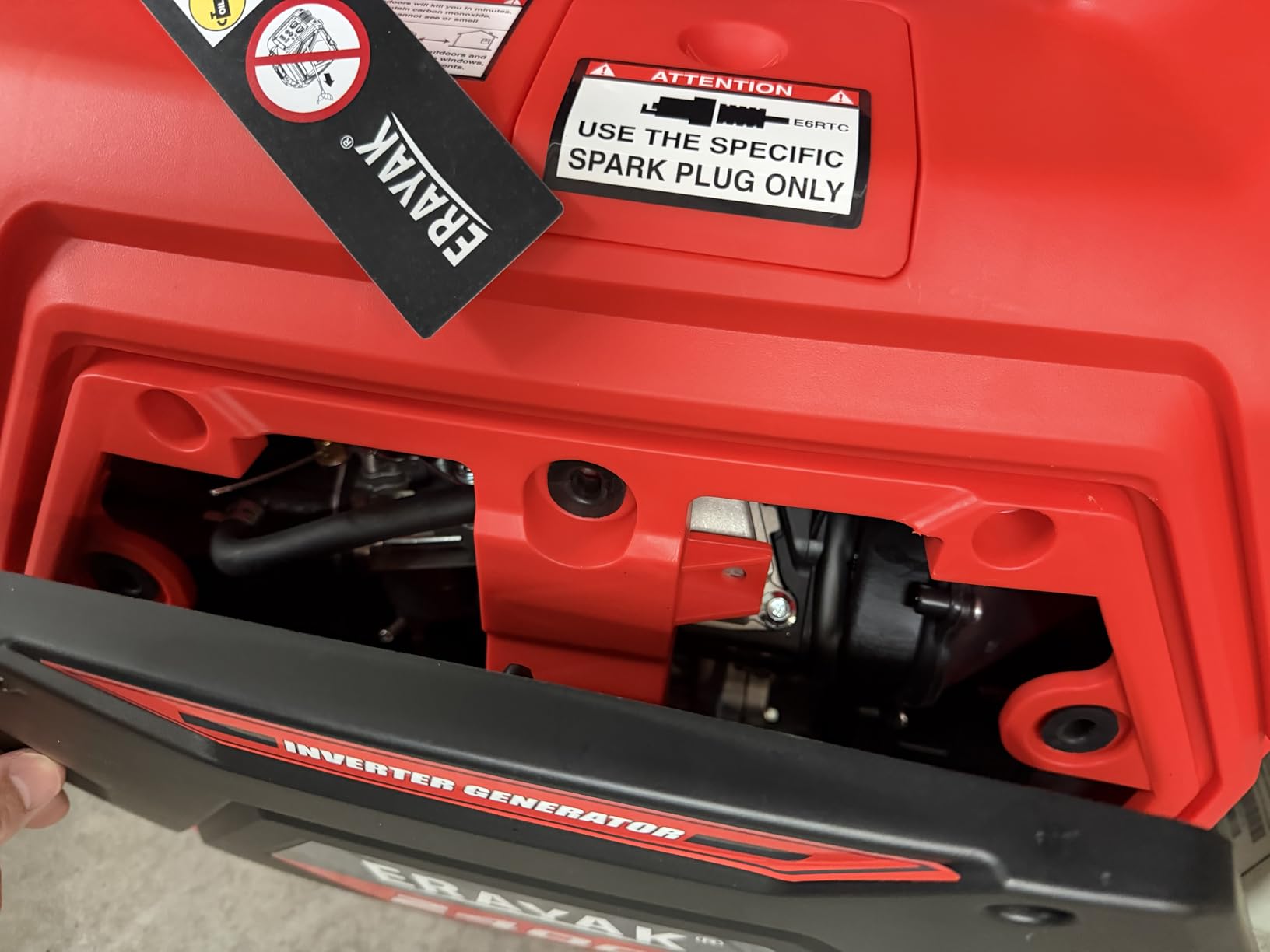
At 42 pounds it is the second-lightest unit here, quiet at 52.5 dB measured at 7 meters under 25% load, and small enough at 18.82 by 11.73 by 18.11 inches to fit in a sedan trunk. Four outlets cover two AC receptacles, two USB and one DC output.
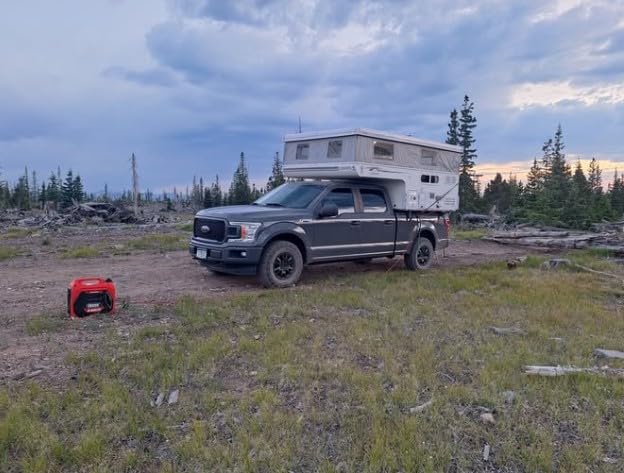
Eco Mode stretches fuel to about 16 hours at 25% load. Campers do report running a coffee maker, a microwave, a TV and lights from a 17-foot trailer on it.
The case for the smallest tier
If your load is electronics and lights, a 2400W-class unit is the honest answer. You carry less, you store less, and you spend less fuel doing it.
The sub-1.2% THD output is the safest in the group for a CPAP machine, and the company has replaced a failed unit inside the 90-day window.
Where it is not enough
Real-world output sits closer to the 1800W running figure than the 2400W headline number, which is the difference between a light-load station and something that will carry a rooftop AC.
Engine oil must be added before first use, support is email only with no authorized service centers, and it is not rated above 1,000 meters altitude without a high-altitude jet kit, which matters for mountain trips.
How to Choose an Inverter Generator for RV Camping
Running watts vs starting watts
Running watts is what the unit sustains continuously. Starting watts, also called surge or peak watts, is the short burst it delivers when a motor or compressor kicks in. A rooftop air conditioner compressor can pull two to three times its steady draw for a second or two, and that is the number your generator has to survive.
Buy on running watts for your appliances and make sure the starting figure has real margin over your AC compressor. A 3000W running unit with 4000W starting has 1000W of headroom. A 1800W unit with 2200W starting has very little.
How much wattage your RV actually needs
Match the tier to your rig rather than to the largest possible load. The list below maps common RV classes to sensible generator sizing.
Pop-up or ultralight trailer, no AC: 1800W to 2400W running watts covers lights, a laptop, a phone charger and a small 13,500 BTU AC with a soft-start device.
30 amp travel trailer, one rooftop AC: 3000W to 4000W running watts. This is the most common configuration and the reason 4000W units dominate owner recommendations.
Class C motorhome, one AC plus appliances: 3500W to 4500W running watts gives room for the compressor plus a microwave, without tripping anything.
50 amp fifth wheel or Class A, one AC: 4500W and above, ideally dual fuel so you are not hauling gasoline for overnight runs.
Two-AC rig or 50 amp with both ACs running: 5000W or more, or two units paired with a parallel kit.
One thing spec sheets rarely mention: your battery converter draws power continuously. A smart charger plus the 12V circuits and the fridge add a steady few hundred watts that comes out of the same headroom as your AC compressor.
Will a 5000W generator run a 30 amp RV?
Yes, with room to spare. A 5000W-class unit comfortably carries a single 13,500 or 15,000 BTU rooftop AC plus normal appliance loads on a 30 amp trailer, which is why oversizing slightly is the common recommendation.
Check your generator’s outlet before you buy. A 30 amp RV inlet wants an L5-30R or TT-30R connection, and an L5-30R on the generator alone is not a full 30 amp RV feed on every rig.
How quiet is quiet enough
Decibels are logarithmic, so 60 dB is not twice as loud as 30 dB, it is roughly a thousand times the sound energy. Measured conditions also vary, which is why a manufacturer figure at 23 feet at 25% load tells you less than you hope.
50 to 55 dB: conversation volume. Sub-frame sleepers on the far side of the site stop noticing it. Only the Honda EU2200i, Yamaha EF2200iS and ERAYAK 2400W publish figures in this band.
56 to 62 dB: a quiet campsite background. Acceptable in most campgrounds with quiet hours starting at 10 pm. The WEN 56235i, PowerSmart 3800W, Pulsar 4000W and Champion 4500W sit here.
63 to 70 dB: audible through a closed window. Workable at dry camping sites and large open campgrounds, risky where quiet hours are enforced. The Champion 4000W is quoted at 64 dBA at 23 feet.
70 dB and above: what owners actually measured from the AIVOLT at roughly 5 feet, against a 53 dBA claim. Verify before you rely on the number.
Position matters more than the number. Set the generator on the opposite side of the rig from the sleeping area and as far from your neighbours as the power cable allows, and the perceived difference beats any decibel figure on a spec sheet.
Gas, propane or dual fuel
Gasoline gives the longest runtime per tank and the lowest hassle, but it ages in the tank and it stinks up the storage bay. Propane stores indefinitely and burns clean, but it costs you roughly a quarter of your propane output. Dual fuel lets you run on gas for the afternoon and switch to propane overnight.
None of the ten units here run propane exclusively. If you prefer the clean burn and long storage life, a dual-fuel model such as the PowerSmart 3800W or the Champion 4500W covers both halves of the question.
Outlets and the wiring path
The connector question confuses more first-time owners than anything else, so here is the short version. A TT-30R receptacle is the 30 amp RV-style outlet common on travel trailers. An L5-30R twist-lock is a standard 30 amp generator outlet. A 30 amp or 50 amp RV inlet is the socket mounted on the coach.
Plugging a generator directly into an RV inlet without a transfer device back-feeds the campground pedestal and is unsafe. The safe paths are a transfer switch or breaker interlock installed at the coach, or plugging into a dedicated 30 amp receptacle on a separate circuit. Our transfer switch guide covers the install in detail.
Once the power question is solved, our RV griddle roundup covers cooking outside while the generator runs. For night-time visibility around the site, see our outdoor lighting picks for RV campsites.
THD and why your electronics care
Total harmonic distortion measures how much unwanted noise sits on top of the clean 60 Hz sine wave the grid provides. Modified sine wave output runs high, often above 5%. Pure sine wave output stays low.
The gap matters for CPAP machines, laptops, audio equipment and the sensitive control boards inside your RV. If your unit is published under 3% THD, the Champion 4000W among them, electronics are safe. Under 1.2% like the ERAYAK 2400W, you have more margin than most appliances need.
Which brands to trust
Owner consensus across RV forums is consistent on the top tier. Honda and Yamaha are treated as the reference for build quality and longevity, with the caveat that you pay for the badge and both have small fuel tanks. Champion is widely described as the value answer, and WEN and Westinghouse are the recommendations for people who want most of the quality for noticeably less money.
The honest split is between that group and budget imports with thin support networks. On AIVOLT, the 4.1 rating with a 12% 1-star share and fuel-system failures inside weeks is the pattern owners warn about. On ERAYAK, the 4.2 rating and email-only support tell a similar story. Neither is a bad machine. Both are a different risk profile from a Honda.
Inverter generator or battery power station
A battery power station gives you silence and zero fuel handling, but it is a finite charge and it will not run a 15,000 BTU air conditioner for hours. An inverter generator refuels in minutes and runs all night, and it is louder and needs maintenance.
If your load is a CPAP machine, a laptop and lights, a power station is the quieter answer. If you want the rooftop AC at 8 pm, a generator is the only realistic option.
Safety rules we do not bend
Never run any generator inside the RV, inside an awning or inside a truck bed enclosure. Carbon monoxide is odorless and lethal.
Keep at least 20 feet from doors, windows and vents, and point the exhaust away from the coach.
Install a working CO alarm inside the RV even with a CO sensor on the generator.
Let the engine cool before refuelling, and never refuel while it is running.
Check campground quiet hours before you start, and keep the exhaust pointing away from neighbouring sites.
Run the generator on stable, level ground so the low-oil sensor does not trip, and never modify the exhaust.
Frequently Asked Questions
Which brand of inverter generator is best for an RV?
Owner consensus on RV forums puts Honda and Yamaha at the top for build quality and longevity, Champion as the value answer, and WEN and Westinghouse as strong middle ground. The brand matters less than matching the wattage class to your rig. A 4000W Champion on a 30 amp trailer will serve you better than an undersized premium unit.
What size inverter generator do I need for a 30 amp RV?
For a 30 amp travel trailer with one 13,500 or 15,000 BTU rooftop air conditioner, aim for 3000W to 4000W running watts and check for a built-in TT-30R or L5-30R outlet so no adapter is needed. Confirm the generator starting watts exceed the AC compressor surge draw before you buy.
What size inverter generator do I need for a 50 amp RV?
A 50 amp fifth wheel or Class A motorhome with a single rooftop AC needs 4500W or more. If you plan to run two air conditioners at once, look at 5000W and above, or pair two units with a parallel kit. Dual fuel helps here because overnight runs do not depend on gasoline availability.
Is an inverter generator better than a regular generator for an RV?
For most RVers, yes. An inverter generator throttles its engine to match the load, which cuts noise and fuel burn, and it produces low total harmonic distortion that is safe for laptops, CPAP machines and RV control boards. An open-frame conventional generator of the same size is louder and produces dirtier power.
What are the disadvantages of inverter generators?
The main drawbacks are weight, fuel consumption and cost. A 4000W dual-fuel unit can weigh 50 to 100 pounds, small tanks still need refilling, and premium models carry the highest purchase price. On the cheapest units, the added value depends on fuel-system durability and the availability of parts and authorised service.
What decibel level is quiet for a generator?
Around 50 to 55 dB reads as normal conversation and will not disturb a sleeping neighbour. Up to 62 dB sits comfortably inside most campground quiet hours. Above 65 dB becomes noticeable through a closed window, and figures measured at 5 feet rather than 20 feet are worth treating with suspicion.
Which Inverter Generator Fits Your RV Best?
The Honda EU2200i is our pick for the best inverter generators for RV camping in 2026, and the reason is simple: 48 to 57 dBA and 46.5 pounds is a combination nothing else in this roundup matches. If your rig only needs 1800 running watts, that is the buy.
For a 30 amp travel trailer with one rooftop AC, the Champion 4000W dual fuel with its built-in TT-30R is the trailer owner’s choice, and the WEN 56360i is the lighter version of the same idea. For 50 amp rigs, the Champion 4500W electric start covers overnight runtime while the AIVOLT 4300W wins on remote start if you accept the noise.
For pure light-load camping, the WEN 56235i at 39 pounds is the easiest to carry and the ERAYAK 2400W has the cleanest power for a CPAP machine. Whichever tier you land in, verify the connector type, respect the 20-foot clearance rule, and read the quiet hours before you start the engine.