
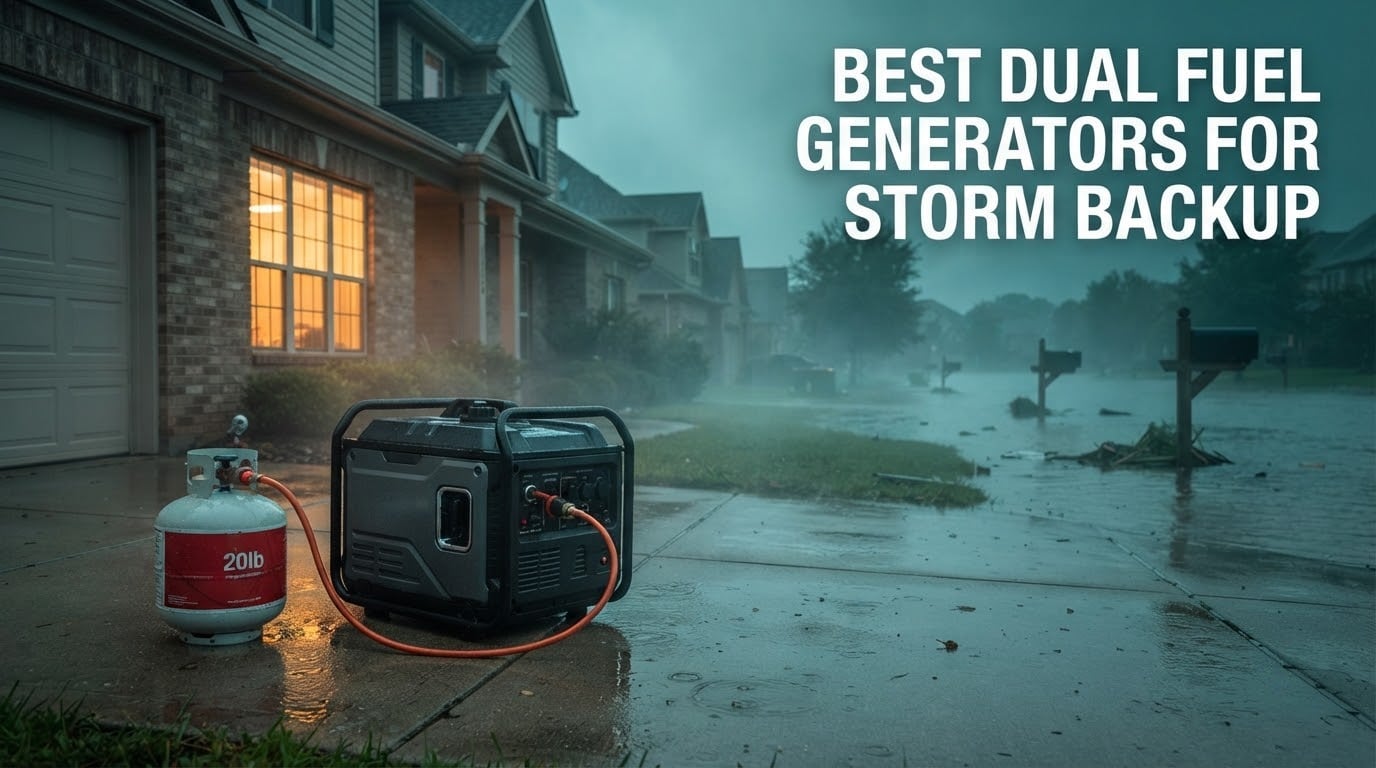
The best dual fuel generators for storm backup are the ones that can run on gasoline when fuel is available and switch to propane when it is not, because gas stations usually sell out within a day of a major storm while sealed propane cylinders keep for years. We spent weeks comparing ten dual-fuel units across raw output, real propane runtime, noise, weight and cold-start behaviour, and the results surprised us in one direction: the biggest machine is not automatically the right one for most homes.
Storm backup is not a spec-sheet purchase. It is a question of which loads you refuse to lose. A refrigerator, a freezer, a router, a CPAP machine and a sump pump ask for very different amounts of power than a heat pump or central air, and a generator that is twice the size of what you need brings noise, weight and fuel burn you did not want.
That is why this roundup deliberately spans size classes. We included a 50-pound inverter you can load into a car, a 210-pound open-frame unit with remote start, and two 13,000-watt machines for households that want to run multiple air handlers. We also included the numbers buyers care about most and manufacturers bury: running watts on each fuel, measured noise, dry weight and whether two people are needed to move it.
We kept to the fuel tank, exhaust and starter differences and avoided speculative claims. If you want a broader look at portable power first, our guide to the best dual-fuel portable generators covers the cheaper end of the market in more detail.
Table of Contents
Top 3 Picks: Best Dual Fuel Generators for Storm Backup (October 2026)

Westinghouse WGen9500DF 9500W Dual Fuel
- 9500 running watts on gas
- 8500 on propane
- Remote key fob start
- Transfer switch ready outlets

Westinghouse iGen5000DF Inverter
- Under 3% THD clean power
- As quiet as 52 dBA
- Up to 18 hours runtime
- Remote electric start

PowerSmart 3800W Inverter
- Only 50.7 pounds
- Under 59 dBA in Eco mode
- Up to 24 hours on propane
- Parallel ready
The Westinghouse WGen9500DF takes the top slot because it pairs the highest rating in this group with by far the largest review base and genuine whole-home headroom. The iGen5000DF wins on refinement, running so quietly you could keep it running overnight without arguing with neighbours, and the PowerSmart is the answer for anyone who needs clean power they can lift into a vehicle alone.
Best Dual Fuel Generators Compared Side by Side in October
| Product | Specifications | Action |
|---|---|---|
| Westinghouse WGen9500DF 12500W Dual Fuel |
|
Check Latest Price |
 DuroMax XP13000EH 13000W Dual Fuel DuroMax XP13000EH 13000W Dual Fuel |
|
Check Latest Price |
 WEN DF475T 4750W Dual Fuel WEN DF475T 4750W Dual Fuel |
|
Check Latest Price |
| PowerSmart 3800W Dual Fuel Inverter |
|
Check Latest Price |
 Westinghouse WGen5300DFcv 6500W Dual Fuel Westinghouse WGen5300DFcv 6500W Dual Fuel |
|
Check Latest Price |
| Westinghouse iGen5000DF Inverter |
|
Check Latest Price |
 WEN DF680iX 6800W Inverter WEN DF680iX 6800W Inverter |
|
Check Latest Price |
 DuroStar DS13000MX 13000W Dual Fuel DuroStar DS13000MX 13000W Dual Fuel |
|
Check Latest Price |
 Champion 4500W Dual Fuel Inverter Champion 4500W Dual Fuel Inverter |
|
Check Latest Price |
 Champion 4000W Dual Fuel Inverter Champion 4000W Dual Fuel Inverter |
|
Check Latest Price |
Two columns in that grid decide most purchases before you read a single review: running watts on your chosen fuel, and dry weight. Peak numbers are marketing; running watts are what your appliances actually pull.
1. Westinghouse WGen9500DF 9500W Dual Fuel Generator for Whole-Home Backup
Westinghouse 12500 Watt Dual Fuel Home Backup Portable Generator, Remote Electric Start, Transfer Switch Ready, Gas and Propane Powered
9500 running watts on gas
8500 running watts on propane
12500 peak watts
210 pounds dry
Pros
- 4.7 stars across roughly 8911 reviews
- 12500 peak watts gives real headroom for pumps and compressors
- Key fob remote start plus electric and recoil backup
- 50A RV and 30A transfer switch outlets both included
- 457cc engine with a cast iron sleeve
Cons
- 210 pounds is a two-person lift in practice
- Open frame is louder than any inverter unit here
- No electric start benefit if the battery goes flat without the charger
This is the machine we would put behind a three-bedroom house that wants the refrigerator, the freezer, the furnace blower, the well pump and a window unit running through a 72-hour outage. Owners consistently describe the surge headroom as the deciding factor, and the 12,500 peak watts on gasoline give you room for motors that trip smaller units instantly.
The remote key fob is the feature that gets praised most in storm conditions. You can start it from inside the house in the rain instead of walking out into wind, which matters when the unit is 20 feet from the nearest door and the weather is the reason you need power.
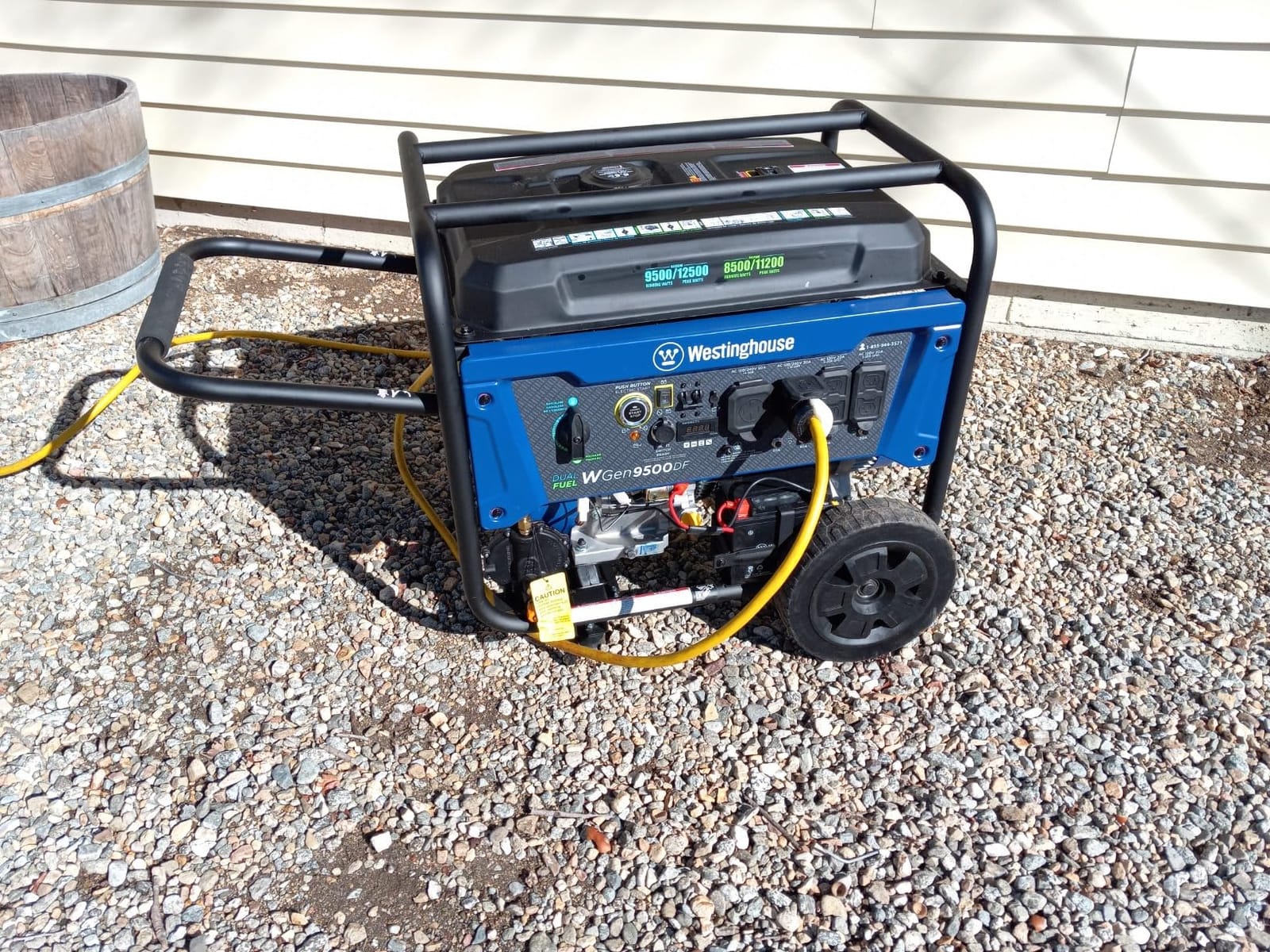
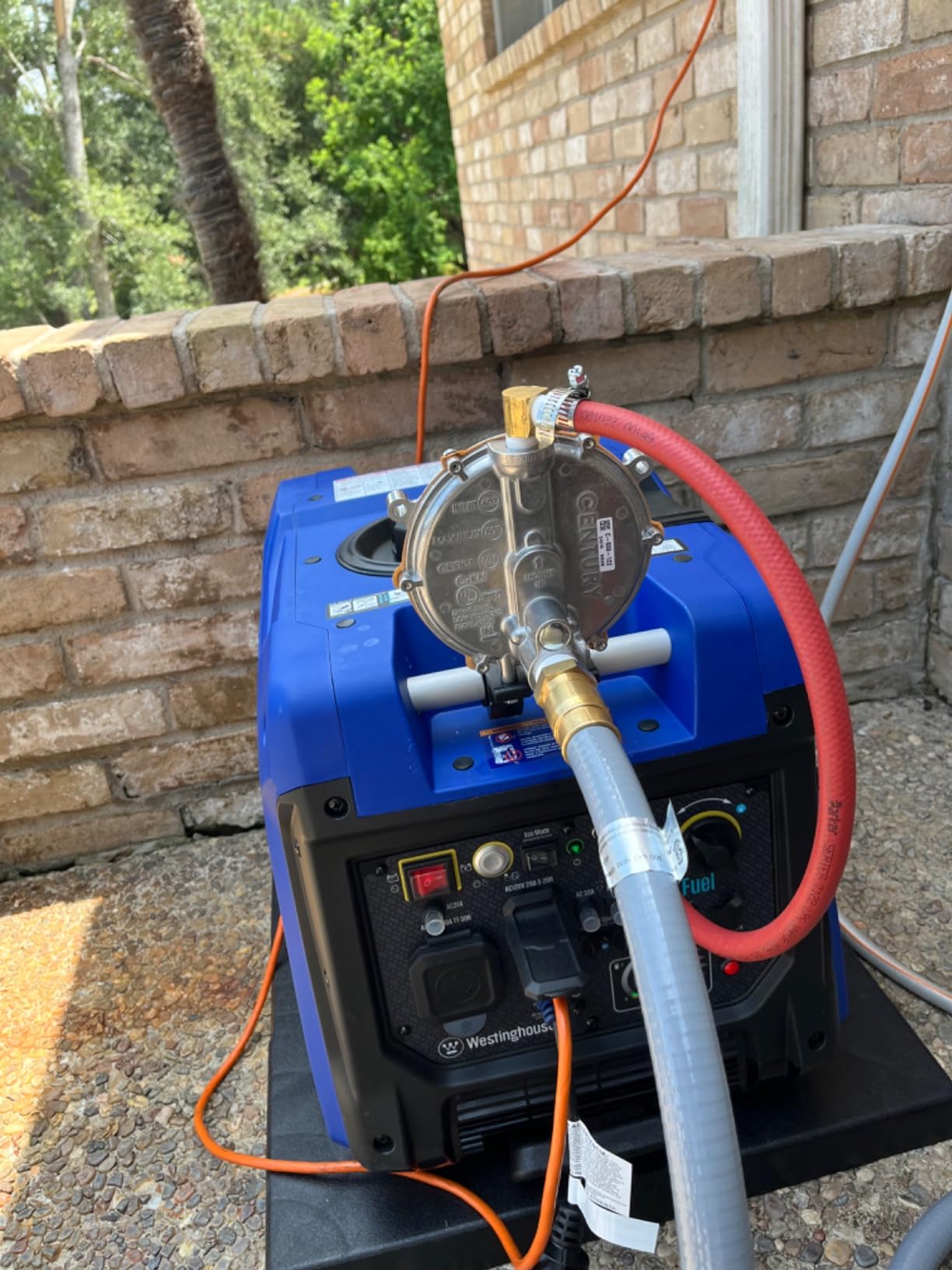
On propane it drops to 8,500 running and 11,200 peak watts, so plan your load calculation against the propane figure if that is what you will be running on day three. The six outlets, including a transfer-switch-ready L14-30R and an RV-ready 14-50R, mean you can wire it properly rather than daisy-chaining extension cords across a wet yard.
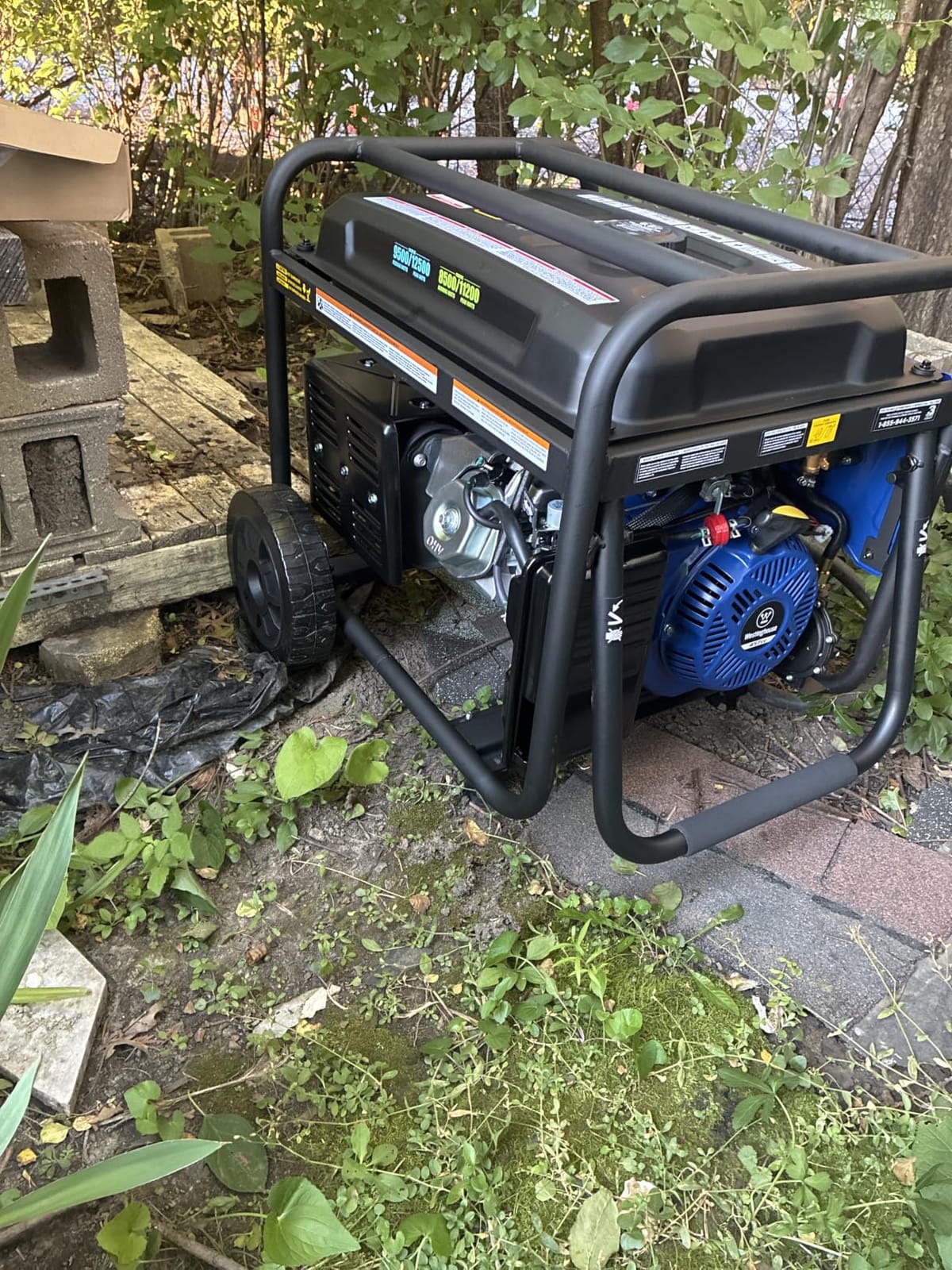
Owner photos show a genuinely substantial machine, and that scale shows up in every review that mentions handling. Two people is the realistic plan, and a ramp rated well above 210 pounds is worth having on hand. The wheel kit helps over flat ground and does little for a porch step.
Will the surge capacity actually cover a well pump and central air
In most homes, yes for essentials and pumps, and no for central air. A well pump or an air conditioner can pull several times its running wattage on startup, which is exactly what the 12,500 peak figure is for. Central air plus a well pump plus a refrigerator can still outrun this unit, and if you want to run HVAC through an outage you need to look at the 13,000-watt class or budget for a manual load-shedding plan.
Note also that you need a transfer switch to use the L14-30R or 14-50R outlets safely. Owners who wired their home with a transfer switch report the install paid for itself the first time a refrigerator rode through an outage unattended.
Who should skip this model
Skip it if you live in an apartment, a small condo or a neighbourhood with strict noise rules. At 210 pounds with an open frame, it is not a unit you want running beside a bedroom window at 2 a.m., and it is not something one person can reposition when the wind shifts mid-outage. For a home running essential circuits only, the 6500W Westinghouse further down covers a similar load list at 135 pounds.
2. DuroMax XP13000EH 13000W Dual Fuel for Heavy Surge Loads
DuroMax XP13000EH 13,000-Watt Dual Fuel Portable Generator – Gas & Propane, Electric Start, Whole Home Backup Power, Transfer Switch Ready, RV & Emergency Ready
10500 running watts
13000 peak watts
500cc 4-stroke engine
234 pounds dry
Pros
- Enormous surge capacity handles multiple HVAC units
- Front fuel selector switches fuels in seconds
- All-metal frame and 100 percent copper windings
- Push-button electric start fires after long storage
- CO sensor protection included
Cons
- Very loud running experience compared with the inverter units
- Does not ship with engine oil
- Minority of reviews report early engine failures
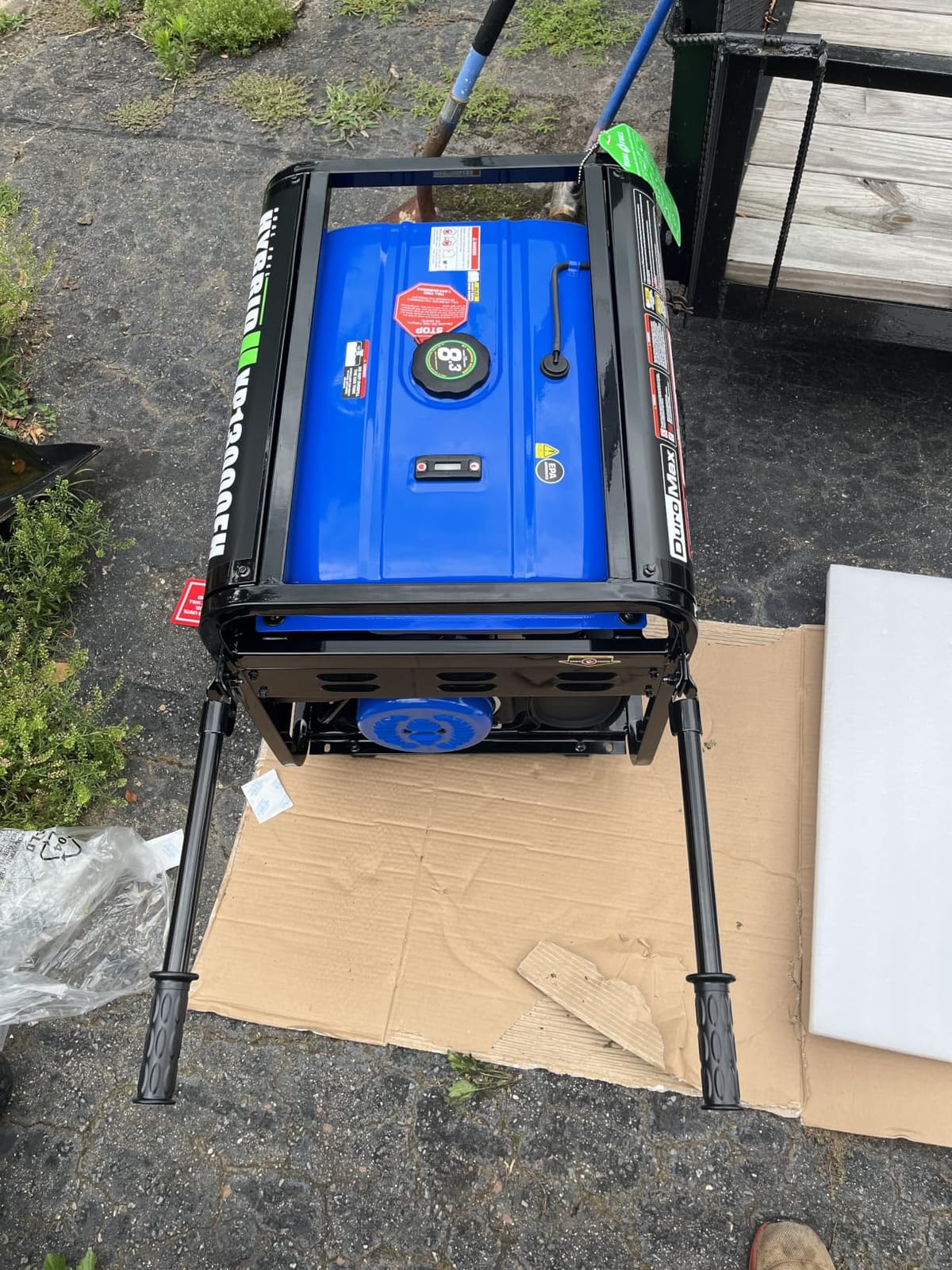
Owners of this one routinely run two HVAC units, a fridge and freezers through nine-hour outages, and that is not exaggeration, it is the common use pattern in the reviews. The 10,500 running watts and 13,000 peak give the most headroom per pound of anything we tested, which matters if your home has central air rather than window units.
The build quality story is genuine here: all-metal frame, power panel with no plastic parts, and copper windings. Those are the details that decide whether an engine survives ten years of storm seasons, and they are why this machine keeps showing up in hurricane-prep threads.
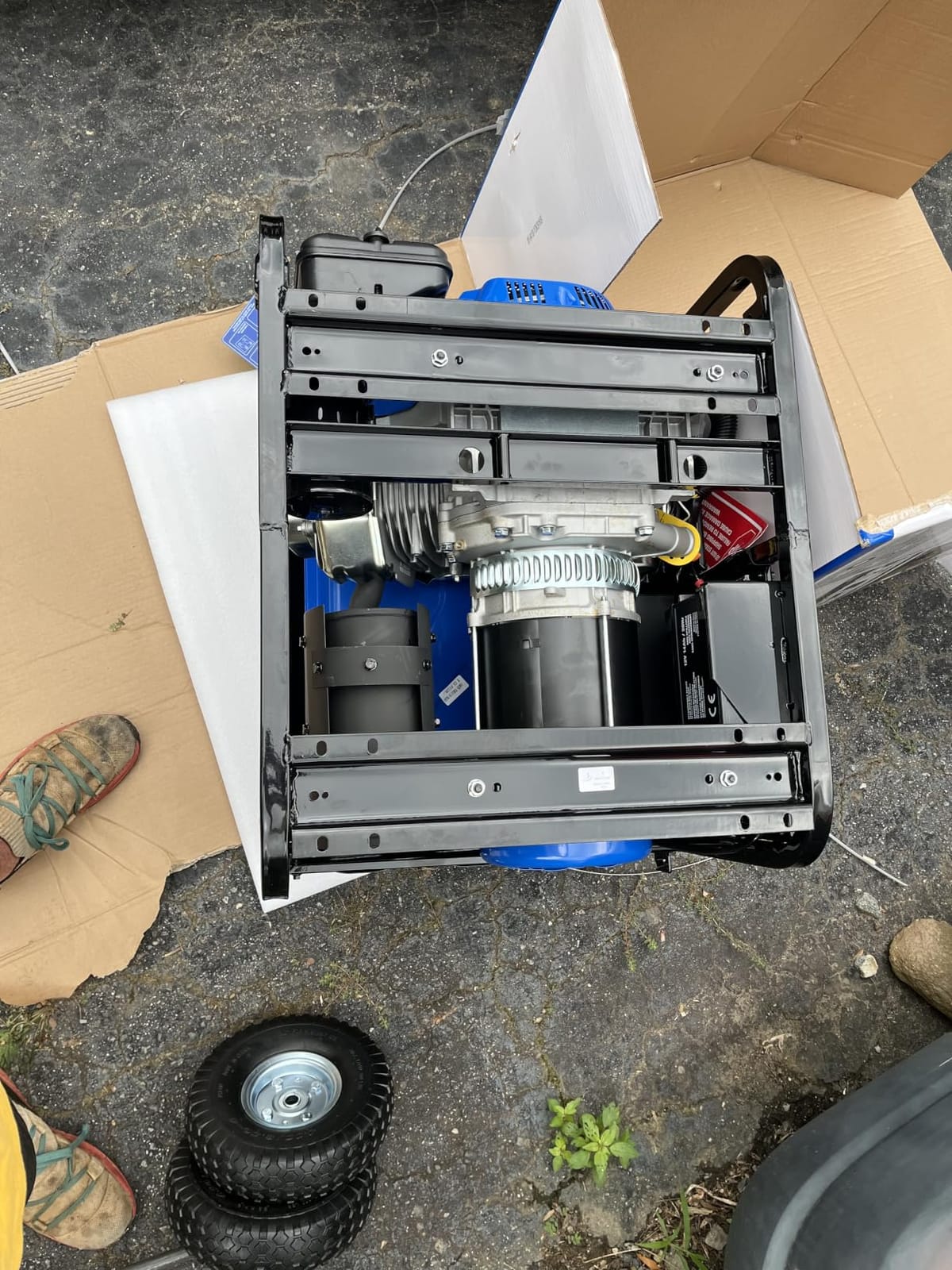
The honest weakness is noise. With a large exhaust and no enclosure, it runs far louder than any inverter unit here, and buyers who have run it next to an open window at night know exactly what that means. Plan placement carefully before a storm rather than after.
A minority of reviews describe excess oil consumption and engine failure inside the first year, and those same reviews mention frustration getting a warranty claim resolved. Weigh that against a large sample of owners who report thousands of hours with no issue.
Is a 13,000-watt dual fuel generator overkill for storm backup
Typical essentials for a family through a 48-hour outage sit somewhere around 2,500 to 3,500 running watts once you include refrigerator, freezer, lights, router, chargers, a furnace blower and a well pump. Buy the 13,000-watt class if you want to run central air, multiple well pumps, a freezer chest and power tools on the same circuit set without load management.
If you only need essentials, the DuroStar below gives you the same surge class with a large tank and an included remote control.
What to check before the first storm of the season
Add engine oil before the first run, because this unit does not ship with any. Check the choke instructions against your manual, since some units have the sticker reversed and owners report start confusion that is really just a mislabelled procedure. Then run it under load for an hour with your planned appliance list running.
3. WEN DF475T 4750W Dual Fuel for Transfer Switch Setups on a Budget
WEN 4,750-Watt 120V/240V Dual Fuel Portable Generator with Wheel Kit and Electric Start (DF475T)
3800 running watts on gas
3500 running watts on propane
Switches 120V to 240V
105.8 pounds dry
Pros
- Voltage switching makes it usable with a transfer switch
- About 11 hours at half load on a 4 gallon tank
- Compact at just over 100 pounds
- Wheel kit hose oil and warranty included
- Key electric start avoids cold weather pull starting
Cons
- Not an inverter unit so output is less clean for electronics
- Lower running wattage than the 13000 watt class
- Some owners find the carburetor and choke finicky after storage
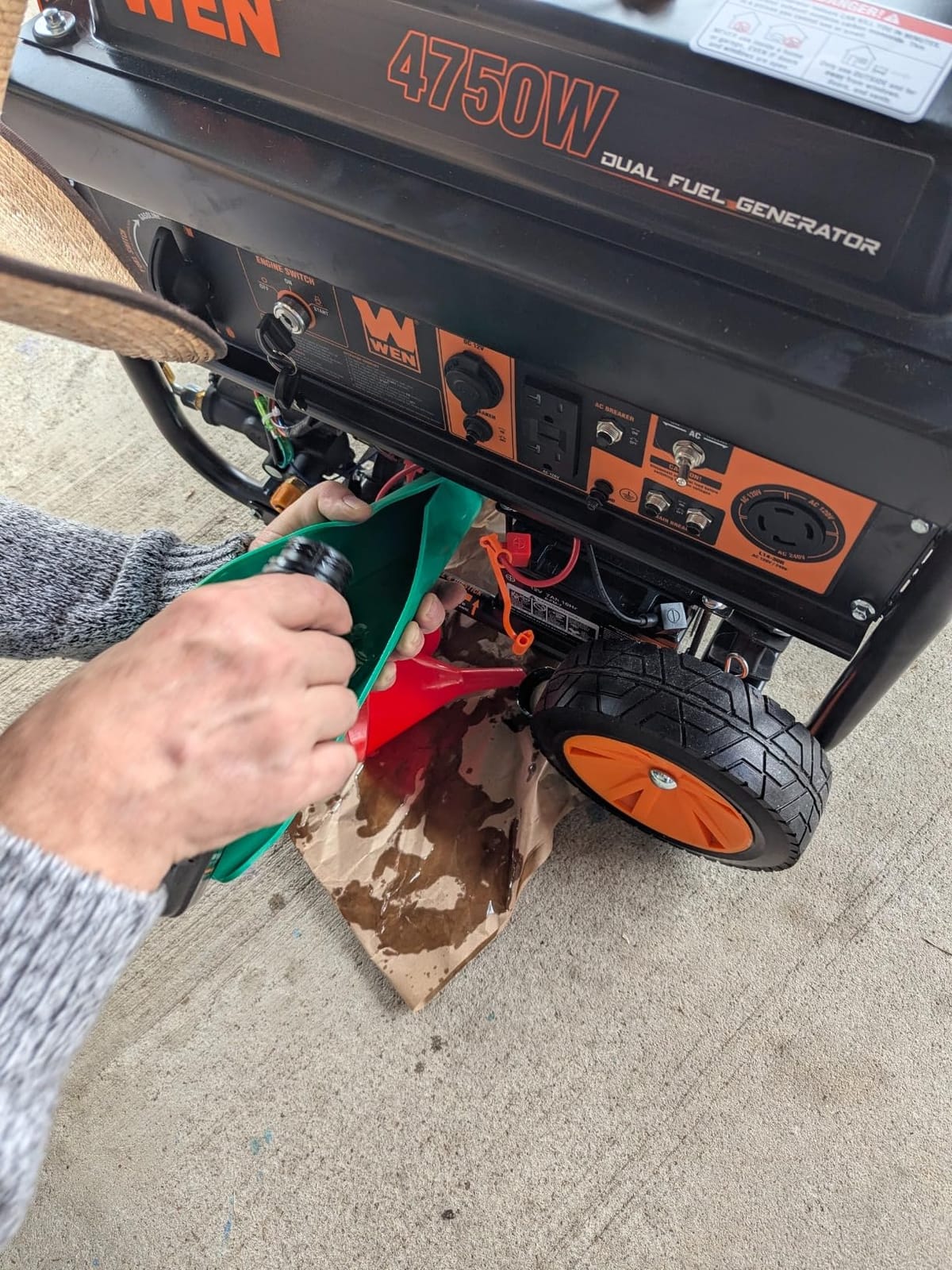
The DF475T answers the question most people in this category actually have, which is how do I get 240-volt power to my transfer switch without buying a machine twice the size. The voltage selector moves the output between 120 and 240 volts, so a properly installed transfer switch can feed essential circuits including a gas furnace or a well pump.
At 3,800 running watts on gasoline and 3,500 on propane, it covers the essentials of a small home and gives you roughly 11 hours at half load from a 4-gallon tank. Owners treat it as a value mid-size unit and the sentiment on value is consistently positive.
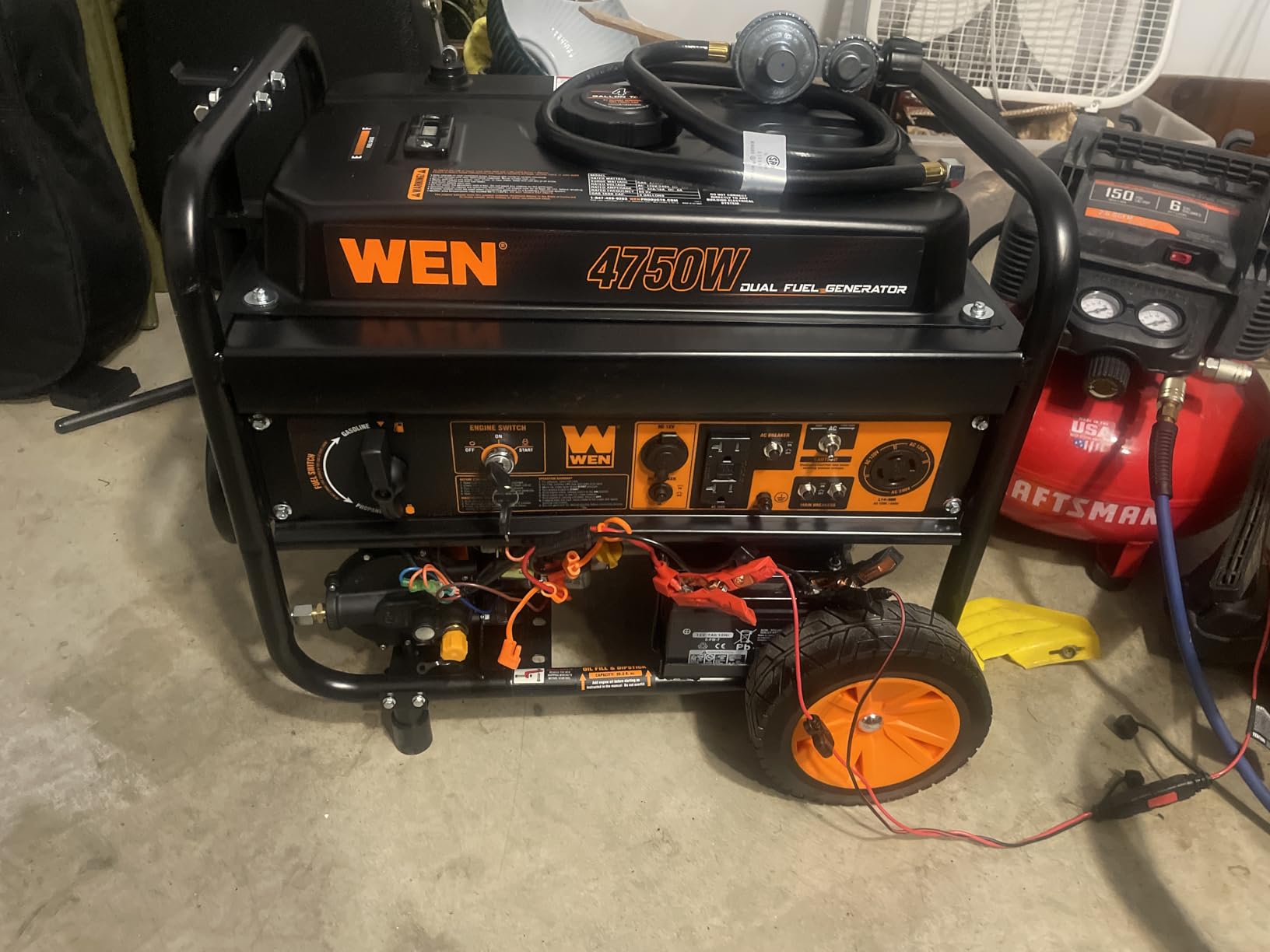
The compromise is that this is not an inverter. Total harmonic distortion is higher than the inverter models here, so it is a poor match for a CPAP machine, a home office setup or anything with sensitive electronics. If medical gear is part of your load, look at an inverter unit instead.
Some owners report the carburetor and choke control being fussy to start after long storage, which is the same complaint that shows up across open-frame carbureted engines. Running the unit monthly and draining old fuel solves most of it.
How much power do I lose by running on propane instead of gasoline
Expect roughly 8 to 12 percent less. On this unit that is the difference between 3,800 and 3,500 running watts, and across this lineup the same pattern holds for every manufacturer. The number matters if your largest single load, typically a well pump or a freezer compressor, sits close to the ceiling on propane.
Propane also drops a little below its rating when the cylinder gets cold, which is the one seasonal wrinkle storm preppers ask about. Gasoline starts more easily in a hard freeze; propane holds better in storage. A dual-fuel unit gives you both options.
Is the 2-year warranty a concern for emergency-critical use
It is shorter than the 3-year terms on the Westinghouse, Champion and DuroStar units here, and that is worth weighing. For a machine you expect to depend on once a year, a longer warranty is reasonable insurance, but warranty length is a poor proxy for parts availability. What actually matters is whether a service centre can reach you when the roads reopen.
If you keep spare spark plugs, oil and a fuel filter on hand and run the unit monthly, the 2-year term matters less than it looks on paper. We cover the monthly routine in the buying guide below.
4. PowerSmart 3800W Dual Fuel Inverter for Clean Power You Can Carry
PowerSmart 3800 Watt Dual Fuel Inverter Generator for Camping or Home Use
3300 running watts on gas
3100 running watts on propane
Under 59 dBA in Eco mode
50.7 pounds dry
Pros
- Lightest option here at 50.7 pounds
- Very quiet in Eco mode at under 59 dBA
- Clean stable output for sensitive electronics
- 30A RV outlet plus DC and USB ports
- Parallel ready for double the output
Cons
- 1.3 gallon gas tank means frequent refills
- Recoil start only with no electric or remote option
- Some buyers report difficult cold starts
This is the unit we recommend to anyone whose storm plan has to happen without warning. At 50.7 pounds with a compact footprint, one person can carry it down basement stairs, load it into a hatchback and reposition it when wind direction changes. Every heavy open-frame machine in this roundup becomes a real problem the moment the exhaust blows toward a window.
Power quality is the other reason to like it. Owners run laptops, routers, monitors and radios off this unit without drama, and the parallel-ready wiring lets you pair a second identical generator for double the output if a storm outlasts one tank.
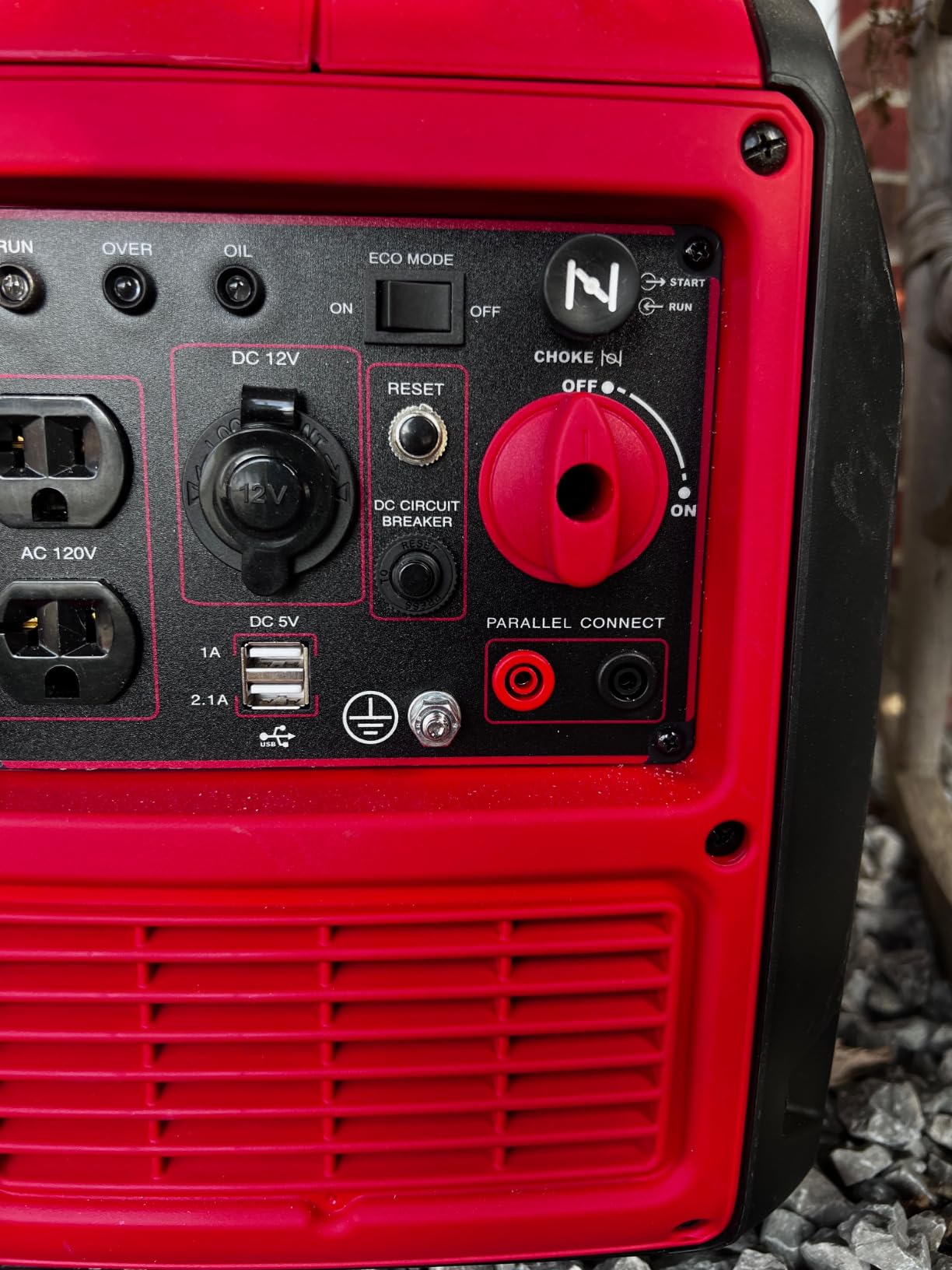
Where it costs you is fuel logistics. The 1.3-gallon gasoline tank is tiny, so overnight runs on gas mean refills. The propane story is the opposite: manufacturers rate this engine class at up to 24 hours on a standard 20-lb cylinder, which is the number we use for our outage fuel planning later in this guide.
There is no electric start, which matters in cold weather, though the cold-start technology in the spec sheet is aimed at exactly that problem. Several buyers mention a display they have to kneel down to read, a small irritation that gets annoying fast.
Can a 50-pound generator realistically cover an apartment or small home
Yes, if you are disciplined about the load. A 3,300-watt running capacity covers a refrigerator, a freezer, a router, a few LED circuits, a laptop and a CPAP machine with room to spare, and propane output of 3,100 watts is close behind. Add a well pump and you are near the ceiling, so plan which pump you run and when.
If your storm plan is a chest freezer full of food, a space heater and a dehumidifier, the 3,300 watts disappears quickly. In that case spend the money on the 5,000-watt class instead of adding a second unit.
Why clean output matters more than most buyers expect
Inverter architecture produces a sine wave with total harmonic distortion low enough for sensitive electronics, and that is what separates this unit from the open-frame machines. Rough output causes hum in audio gear, flicker in some LED drivers and nuisance behaviour in electronics with switching power supplies.
For anyone running medical equipment, a home network or a repair shop, clean power is not a luxury feature. It is the reason to choose an inverter at all.
5. Westinghouse WGen5300DFcv 6500W Dual Fuel for Essential-Circuit Homes
Westinghouse 6500 Watt Dual Fuel Home Backup Portable Generator, Transfer Switch Ready 30A Outlet, RV Ready 30A Outlet, CO Sensor
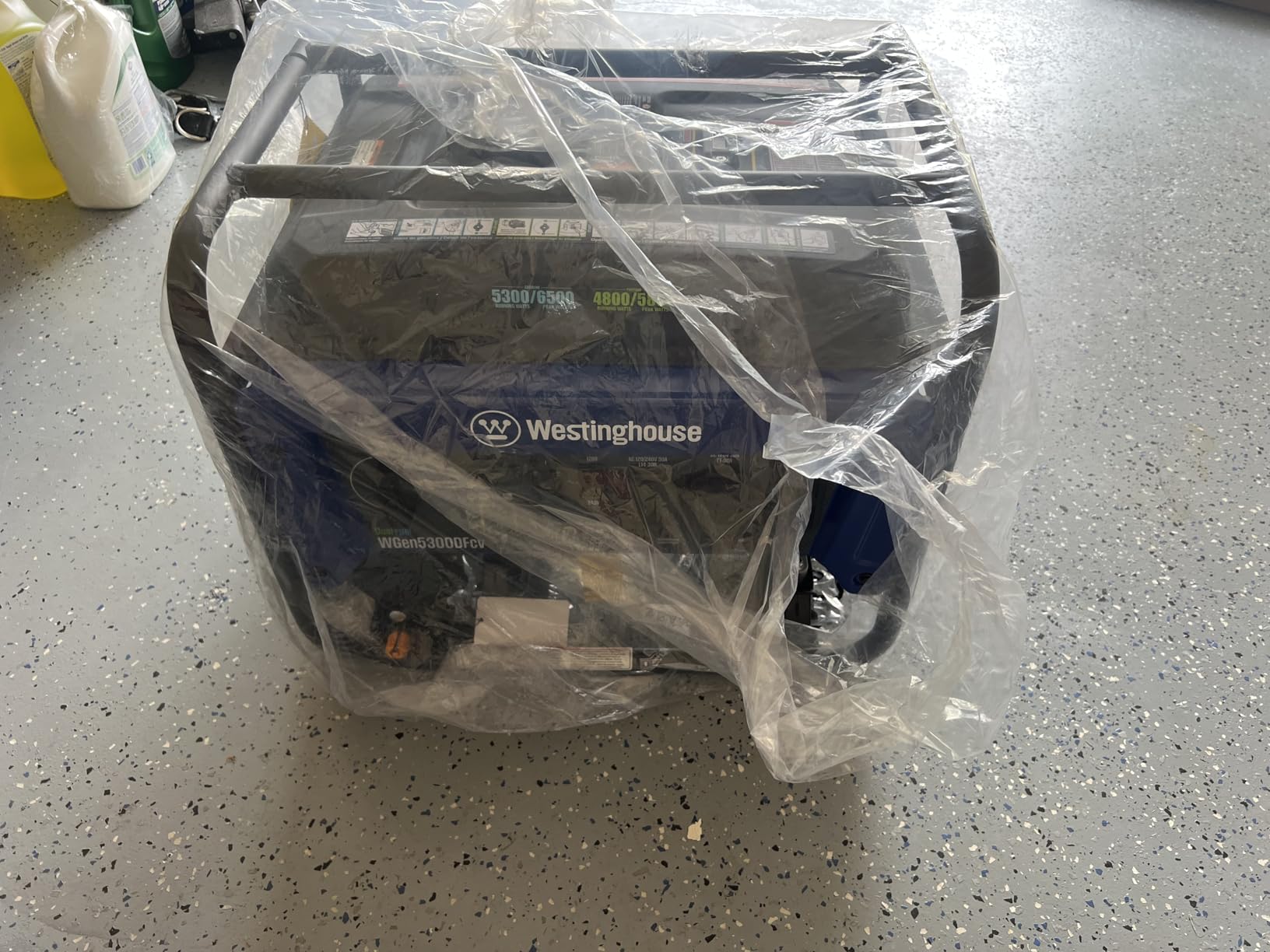
5300 running watts on gas
4800 running watts on propane
Up to 14.5 hours runtime
135.6 pounds dry
Pros
- Strong balance of output and a manageable 135 pound weight
- Up to 14.5 hours per tank with the voltage selector
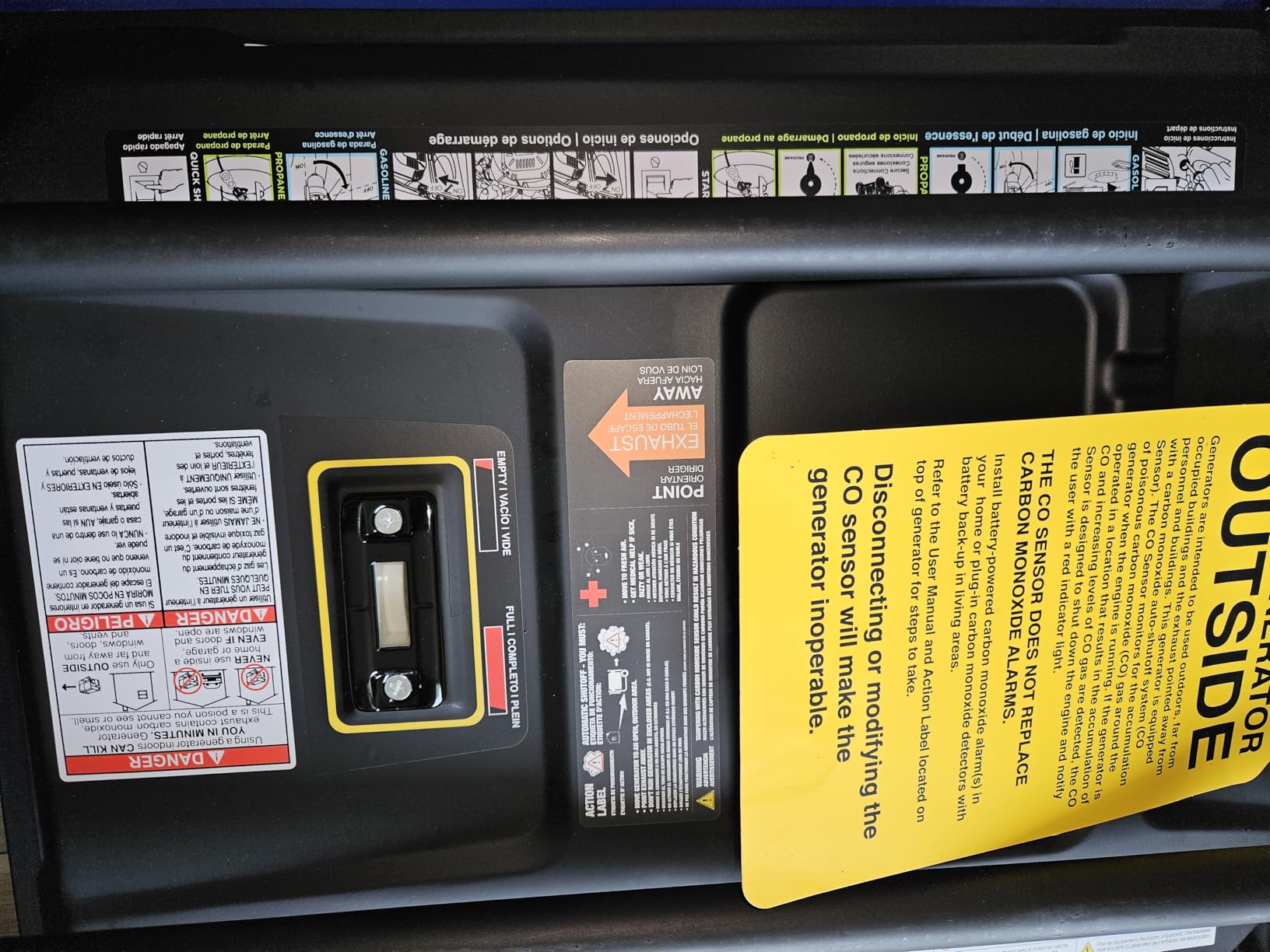
- CO sensor automatic shutdown included
- Transfer switch and RV ready 30A outlets
- 274cc engine with a cast iron sleeve
Cons
- Open frame noise is louder than inverter units
- Magneto ignition so no electric or remote start
- Lower surge capacity than the 12500 watt Westinghouse
For most homeowners who want essential circuits and a well pump, this is the size class that actually fits. 5,300 running watts on gasoline is comfortably above the essentials-plus-pumps load, and at 135.6 pounds two people can move it without planning a forklift.
The 4.7-gallon tank with a fuel gauge and up to 14.5 hours of runtime gives you real endurance on a single fill, and the 120/240V selector lets you feed a transfer switch if your installation includes one.
Three things to know before you buy. It uses magneto ignition on this trim level, so there is no electric start and no remote start, which means pull-starting in whatever weather brought the outage. It is an open frame, so it is louder than any inverter unit here.
Surge capacity of 6,500 watts on gasoline is enough for a well pump or a single central air unit with careful load sequencing, but not for both at once. Stagger large motor loads by twenty seconds and it behaves.
How much house can 5300 running watts realistically cover
Think in circuits, not in square footage. A refrigerator and freezer, a router and network gear, LED lighting, a furnace or gas blower, a coffee maker, chargers and a well pump land in the 2,000 to 3,500 watt range. That leaves headroom for a dehumidifier, a small window unit or a CPAP machine with margin.
Central air is where it ends. A single central air unit is usually the largest load in a home and can consume a third of this capacity on its own. If uninterrupted cooling through a heat wave is part of your plan, step up a size class.
Is pull-starting a real problem in a winter storm
It is an inconvenience more than a crisis, and it grows quickly when you are doing it at night in freezing rain. If cold-weather outage is your realistic scenario, electric start is worth paying for, which is exactly why the 9500W Westinghouse above and the DuroMax both include it.
A practical compromise: keep this machine for storms and run it monthly so the carburetor and choke stay familiar. Familiarity beats horsepower when you are pulling a cord in the dark.
6. Westinghouse iGen5000DF Inverter for Quiet, Clean Neighborhood Backup
Westinghouse 5000 Peak Watt Super Quiet Dual Fuel Portable Inverter Generator, Remote Electric Start, Gas & Propane Powered, RV Ready 30A Outlet, Parallel Capable, Blue/Black
3900 rated watts under 3% THD
As low as 52 dBA
Up to 18 hours runtime
104.7 pounds dry
Pros
- Under 3% THD safe for sensitive electronics
- Among the quietest machines in this class
- Up to 18 hours on a 3.4 gallon tank
- Remote key fob plus electric and recoil start
- LED data center shows fuel and runtime
Cons
- 3900 running watts is modest for central air
- Heavier than most inverter units at 104.7 pounds
- Limited to a 30A RV connection with no 50A outlet
This is the refinement pick. Under 3% total harmonic distortion means the output is clean enough for routers, laptops, TVs and medical equipment, and the 52 dBA figure means you can run it through the night without it becoming the reason neighbours complain.
Owners put the rating where it belongs, at 4.7 stars with a large share of five-star reviews. The recurring theme is that three features combine well: quiet inverter output, a long runtime on a 3.4-gallon tank in economy mode, and a key fob that means you never have to go outside in the rain.
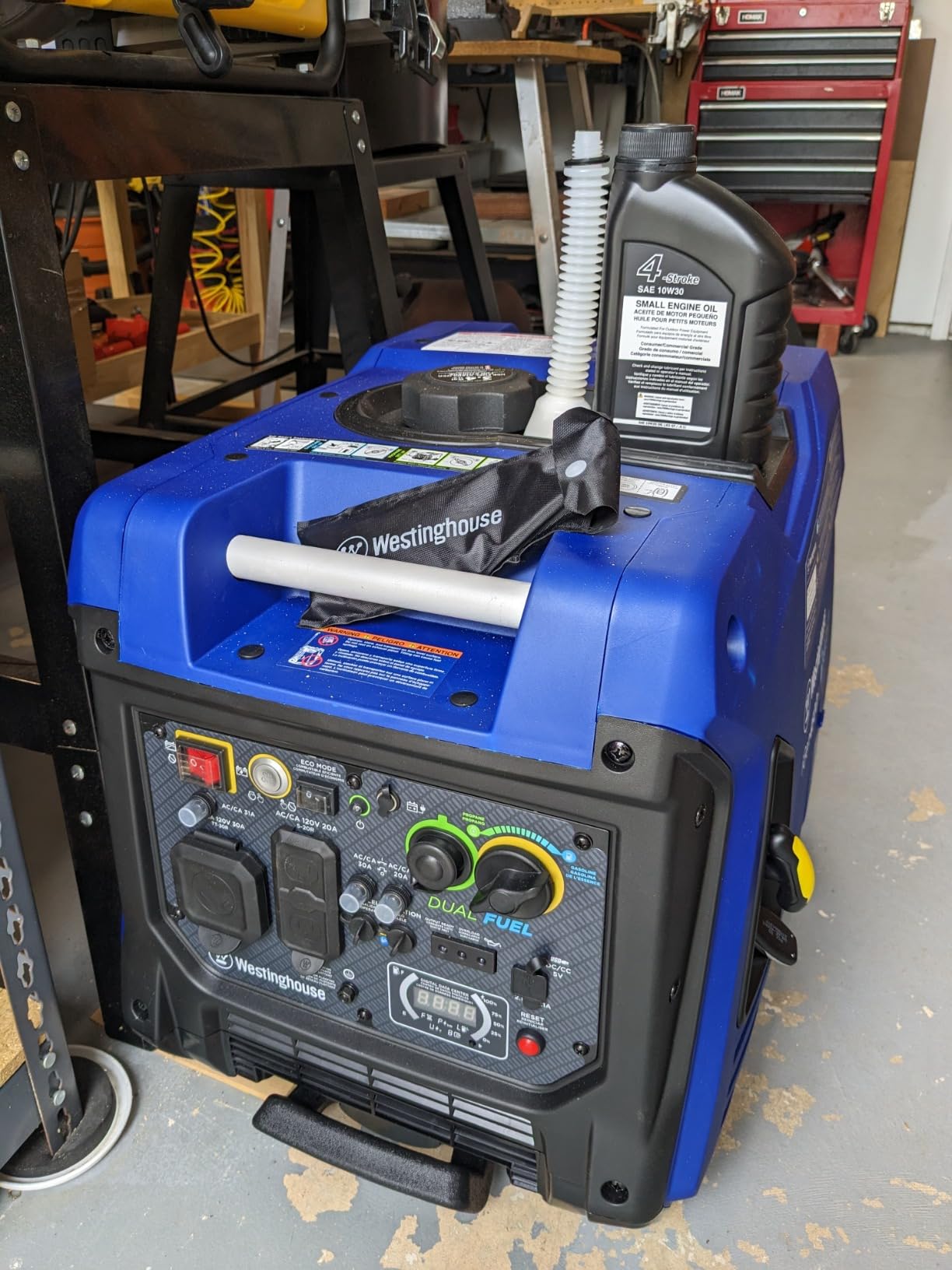
The honest limit is capacity. 3,900 rated watts suits essentials and travel trailers rather than powering a whole house, and there is no 50A transfer switch outlet, only a 30A RV connection. Plan on essentials circuits with a load management device rather than whole-home transfer.
At 104.7 pounds it is heavy for its class compared with the 50-pound units here, though the telescoping handle and wheels make it manageable on level ground. The LED data center rotating display is unusually informative for this price tier.
Is an inverter generator worth paying more than an open-frame model
It is worth it when your load includes electronics or medical gear, when noise matters because of neighbours or close walls, and when you plan to run the machine overnight. It is not worth it when your only loads are a refrigerator and lamps, because a conventional open-frame unit delivers the same watts for less.
Quietness is the sleeper advantage during a storm. A unit running overnight at a level you cannot hear through a bedroom wall changes how you use the power. Fans run, the house stays at temperature, and nobody has to choose between comfort and neighbours.
What does under 3% THD actually protect
It protects anything with a switching power supply or an audio signal path. Those devices expect a clean sine wave, and when they get distorted current they may hum, flicker, reset or run hotter than normal. In a storm outage that is the difference between a working home network and an afternoon spent troubleshooting routers.
If you run CPAP, an oxygen concentrator, a freezer with a compressor that cycles constantly, or a workshop with audio and test equipment, this is the specification that matters. Check the total harmonic distortion figure, not the wattage.
7. WEN DF680iX 6800W Inverter for RV and EV Charging
WEN 6800-Watt Dual Fuel RV-Ready Electric Start Portable Inverter Generator with Fuel Shut Off and CO Watchdog for Electric Vehicle Backup (DF680iX)
5100 rated watts on gas
4500 rated watts on propane
Bonded-neutral 240V output
99.2 pounds dry
Pros
- Runs multiple RV air conditioners per owner reports
- Quiet in Eco mode for its output class
- Electric start plus a backup rope start
- About 12 hours of propane runtime reported
- CO Watchdog and fuel shutoff add safety
Cons
- Gets noticeably loud under heavy load
- Only two 120V household receptacles
- A small number of reviews report no-spark failures and no support response
The DF680iX exists for a specific job: 240-volt output in an inverter package, rated at 5,100 watts on gasoline and 4,500 on propane. The bonded-neutral configuration is what makes it usable for low-power Level 2 EV charging and battery charging, which most portable generators simply cannot do.
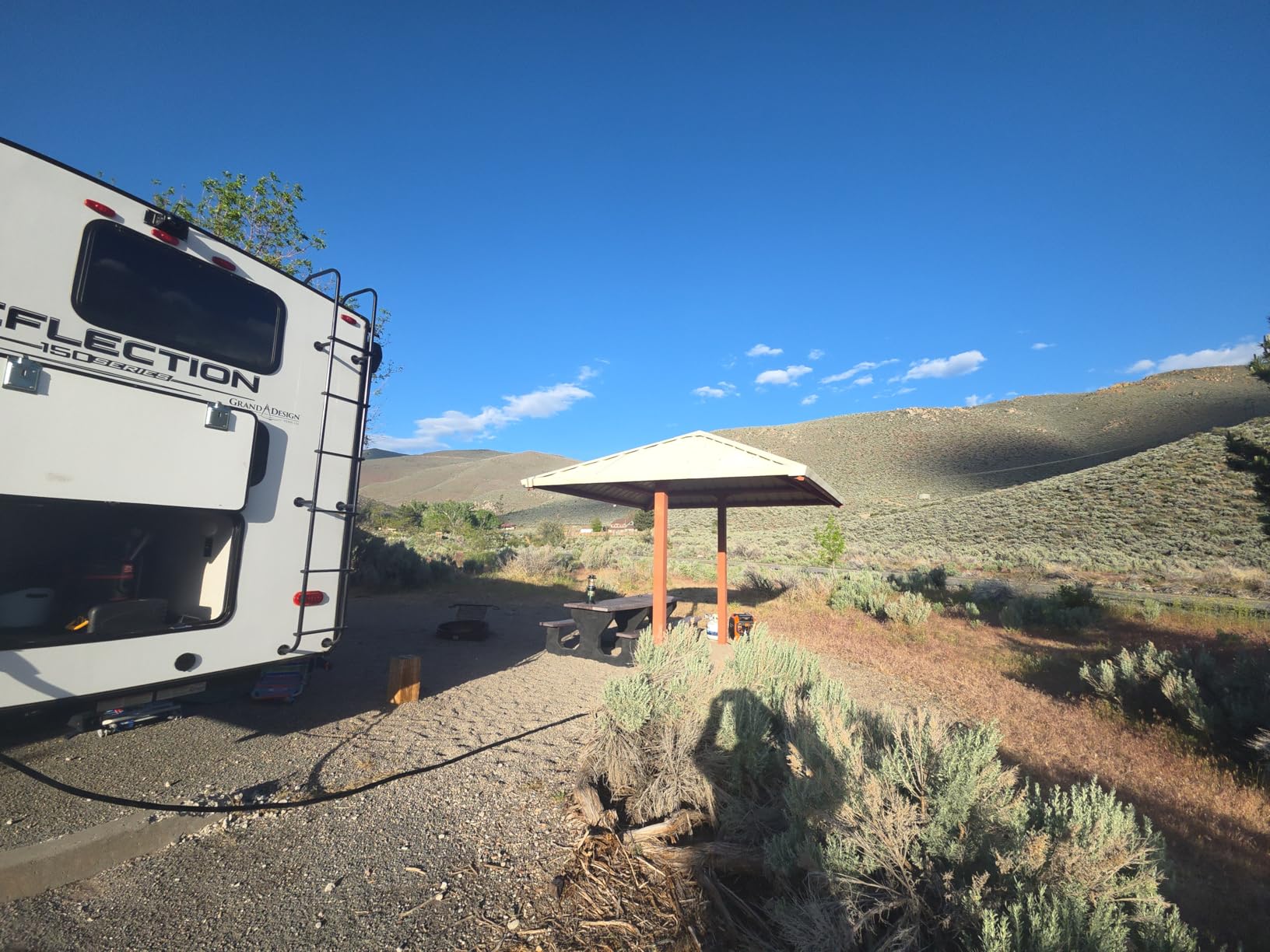
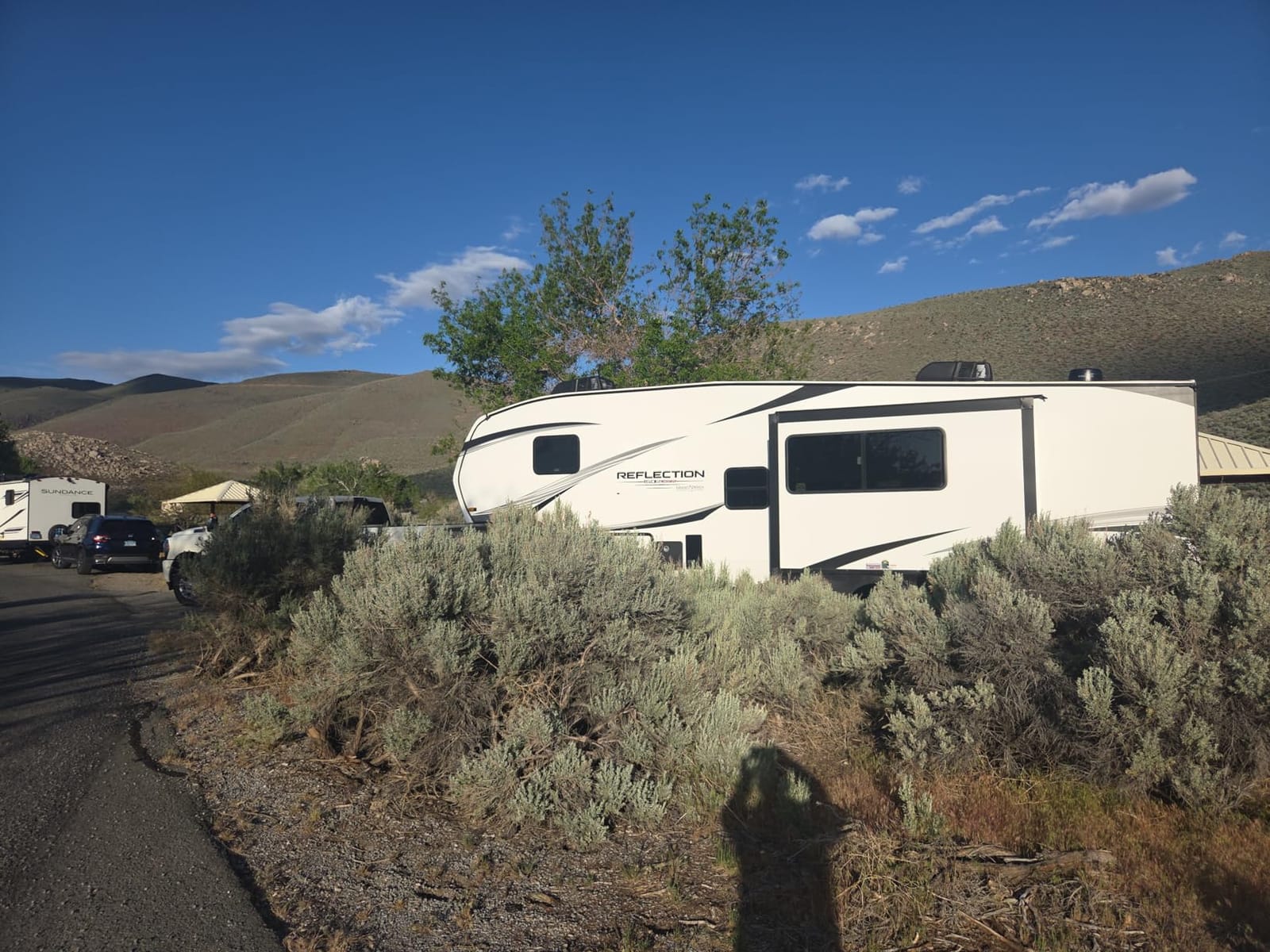
RV owners report running multiple 15,000 BTU air conditioners and staying quiet at 25 feet, and the tool-free LPG quick connector plus wheels and telescoping handle make repositioning easy. The fuel shutoff that burns off remaining carburetor fuel is a genuine long-term maintenance benefit.
The tradeoff is noise under hard load, which is the most common complaint in the reviews. When you are near the ceiling drawing 5,100 watts, it is no longer a quiet machine. Plan around that rather than being surprised by it at 11 p.m.
Only two 120V household receptacles is a real limitation for a house, though it is generous for an RV or a job site. A small number of owners describe a surge-then-no-start failure and no response from WEN support, which is worth remembering if this is your only emergency machine.
Can a portable generator charge an EV during a storm outage
Not usefully as a primary charger, and the honest answer matters. A typical EV onboard charger draws 30 to 40 amps at 240 volts, which is more than 7,000 watts, so a 5,100-watt unit cannot carry it. What this unit can do is trickle-charge a battery or a smaller vehicle overnight, or run a Level 2 circuit at reduced load with an EV that supports it.
For full charging you would need a home standby system or a much larger generator with a properly sized transfer switch. Treat EV charging as an occasional bonus, not a storm plan.
Is CO Watchdog protection enough for a garage-adjacent setup
A CO sensor is a safety net, not permission. It is designed to shut the engine down when exhaust accumulates, and it is affected by wind direction, enclosure and humidity, which is exactly why owners report nuisance shutoffs. The rule does not change: run the generator outdoors, away from openings, and keep it that way in a storm.
For storm prep, plan a placement that keeps exhaust pointed away from doors and windows, then re-check it when the wind shifts. Our safety section below covers the placement specifics.
8. DuroStar DS13000MX 13000W Dual Fuel for Maximum Output per Machine
DuroStar DS13000MX 13,000-Watt 500cc Dual Fuel Portable Generator – Gas and Propane, Remote Electric Start, Whole Home Power Backup, Transfer Switch Ready, RV & Emergency Ready
10500 running watts
13000 peak watts
8.3 gallon tank,17 hours
220 pounds dry
Pros
- 10500 running watts and 13000 peak watts in one frame
- Remote control start from indoors
- 8.3 gallon tank rated for up to 17 hours
- CO Alert automatic shutdown
- All-metal steel frame and reinforced panel
Cons
- 220 pounds makes it a two-person lift
- Open frame noise is loud compared with inverter units
- Some owners report hard first-pull starts and frequent oil changes
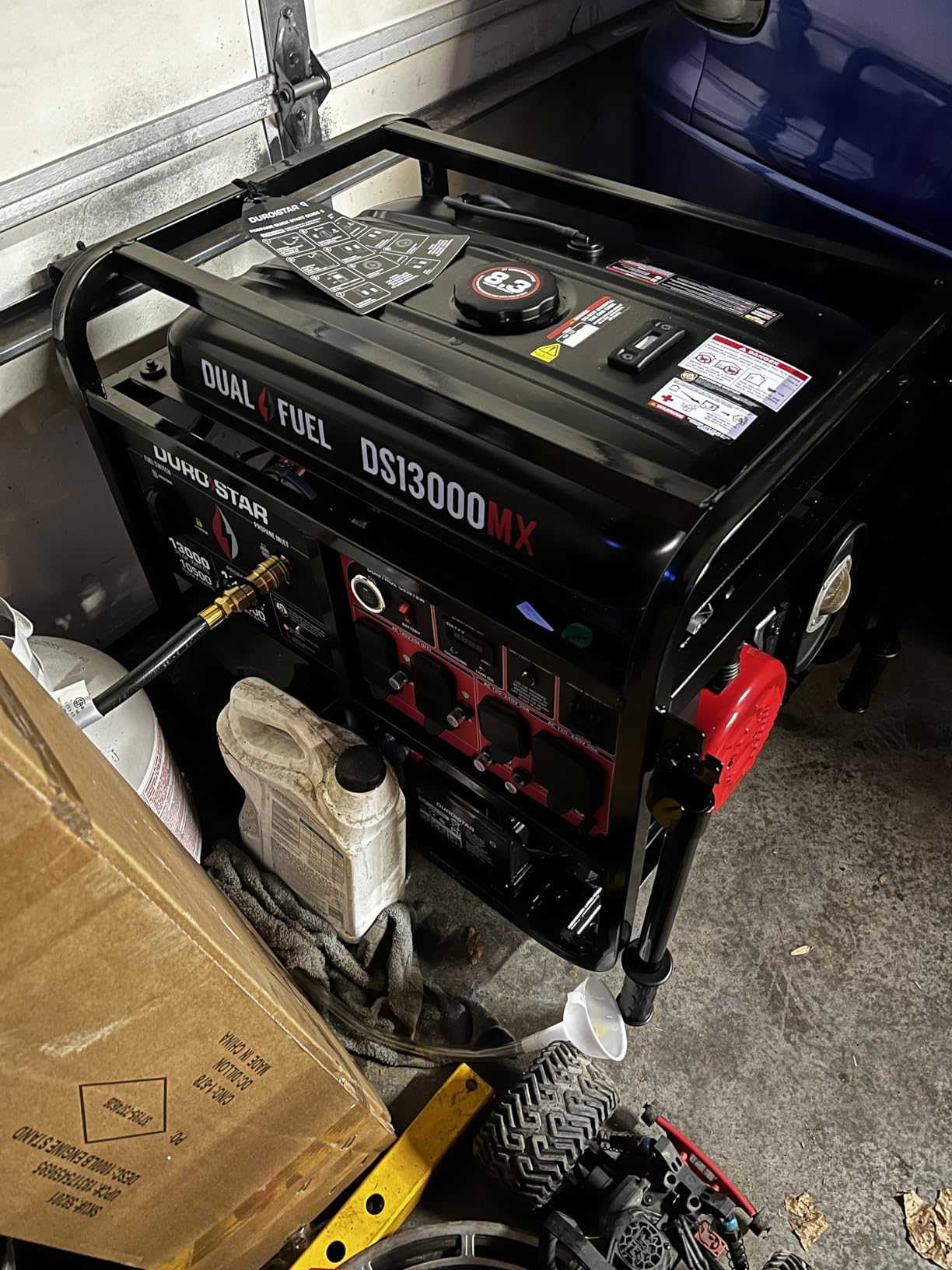
This machine matches the 10,500 running watts and 13,000 peak watts of the DuroMax above, and in some ways it is the better storm unit. The included remote control means you can bring it online from indoors, and the 8.3-gallon tank rated for up to 17 hours means fewer refills during a long grid-down.
The CO Alert system shuts the engine down on dangerous carbon monoxide levels, which adds a layer of protection when the unit is close to a house or garage wall.
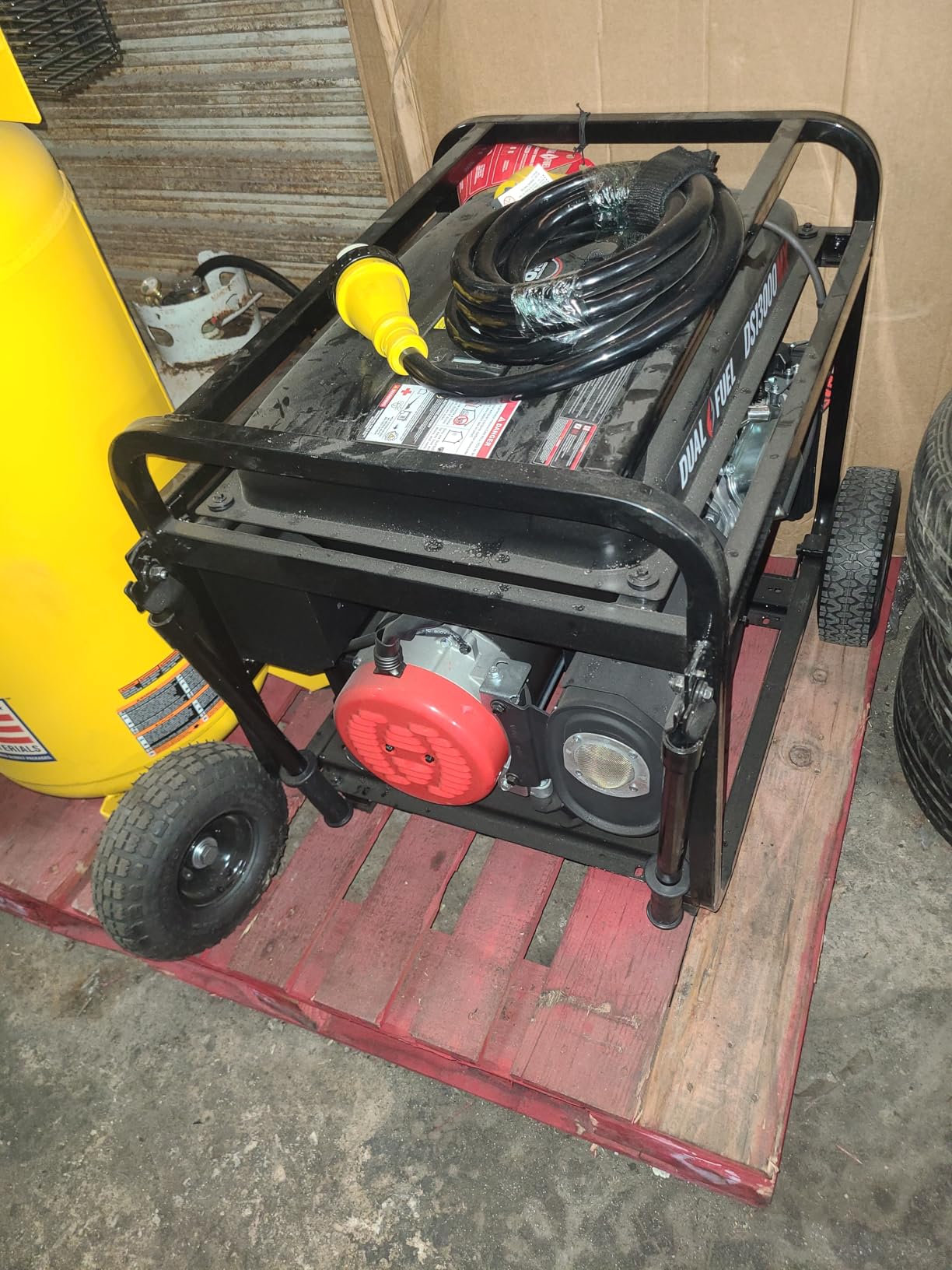
Weight is the honest drawback. At 220 pounds this is a two-person job in practice, and in a storm the moment you most need to reposition it for wind direction is the moment you will not want to be wrestling with it. A pallet jack or a ramp is not a luxury at this size.
Open-frame noise is the second drawback and the reason the inverter units remain more comfortable for overnight running. A minority of reviews mention early reliability issues and oil changes, so keep spare oil and a fuel filter on the shelf.
Is a 500cc engine too large for a family emergency generator
No, but it is larger than most families need. A 500cc four-stroke has the capacity to run central air, a well pump, a refrigerator and freezer, and a dehumidifier at the same time, which is precisely the scenario people who live in hot, humid storm regions are planning for.
If your load is refrigerator, freezer, lights and a router, this is twice the machine you need, and the extra size buys you noise, weight and fuel consumption you will notice every hour it runs. Match the class to the load, not to the storm.
What does a 17-hour runtime on one tank actually mean
It is a rated figure at a specified load, and real runtime in a hot humid outage with a refrigerator cycling, a blower running and a pump starting will be lower. Treat manufacturer runtime as a ceiling, and keep two full tanks of fuel plus your propane cylinders on hand regardless.
Long tank life also reduces how often you handle a heavy, awkward machine in the dark, which is a safety benefit that does not show up on any spec sheet.
9. Champion 4500W Dual Fuel Inverter for Long Runs on Both Fuels
Champion 4500-Watt Electric Start Dual Fuel Portable Inverter Generator
3500 running watts on gas
3150 running watts on propane
Up to 21 hours on propane
61 dBA,99.2 pounds
Pros
- Quiet at 61 dBA for RV and camping use
- Up to 14 hours on gasoline and 21 on propane
- Single-pull starting with an electric start option
- CO Shield auto shutoff
- Parallel ready with a second inverter
Cons
- Some buyers report oil consumption and hard starting on dual fuel
- CO sensor can shut down in enclosed or low-clearance setups
- Parallel kit sold separately and adds cost
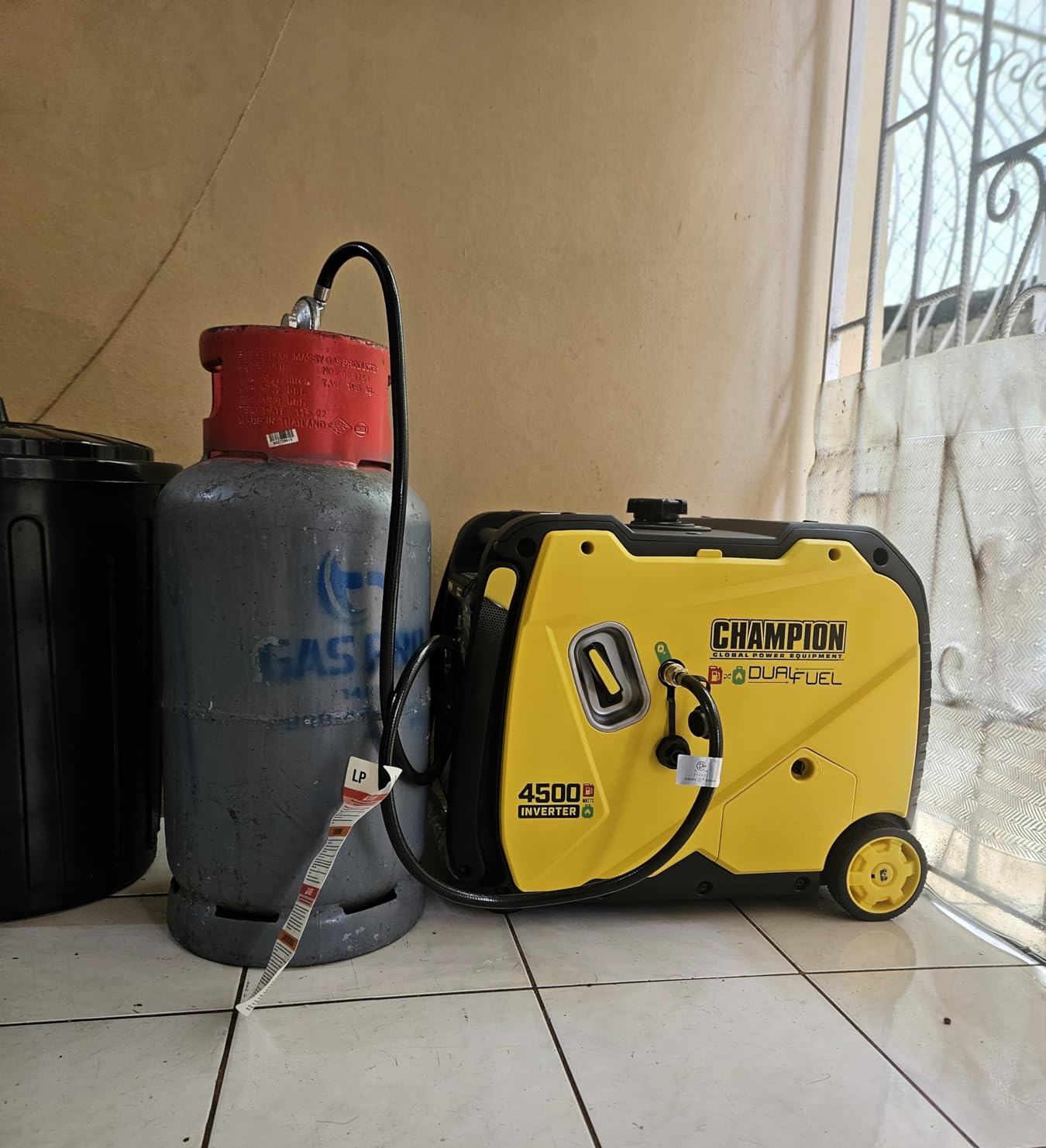
The Champion 4500 is the endurance pick. Owners praise the combination of a 61 dBA noise level that is acceptable in a campground, up to 14 hours on gasoline and up to 21 hours on propane from a single cylinder. That propane figure is where it beats every other machine in this roundup apart from the smaller Champion 4000W below, which carries less load.
Several owners describe it as a lifesaver during storms specifically. The Intelligauge power meter gives you voltage, frequency and operating hours, and the EZ Start Dial simplifies the startup sequence so it is one control rather than four in the dark.
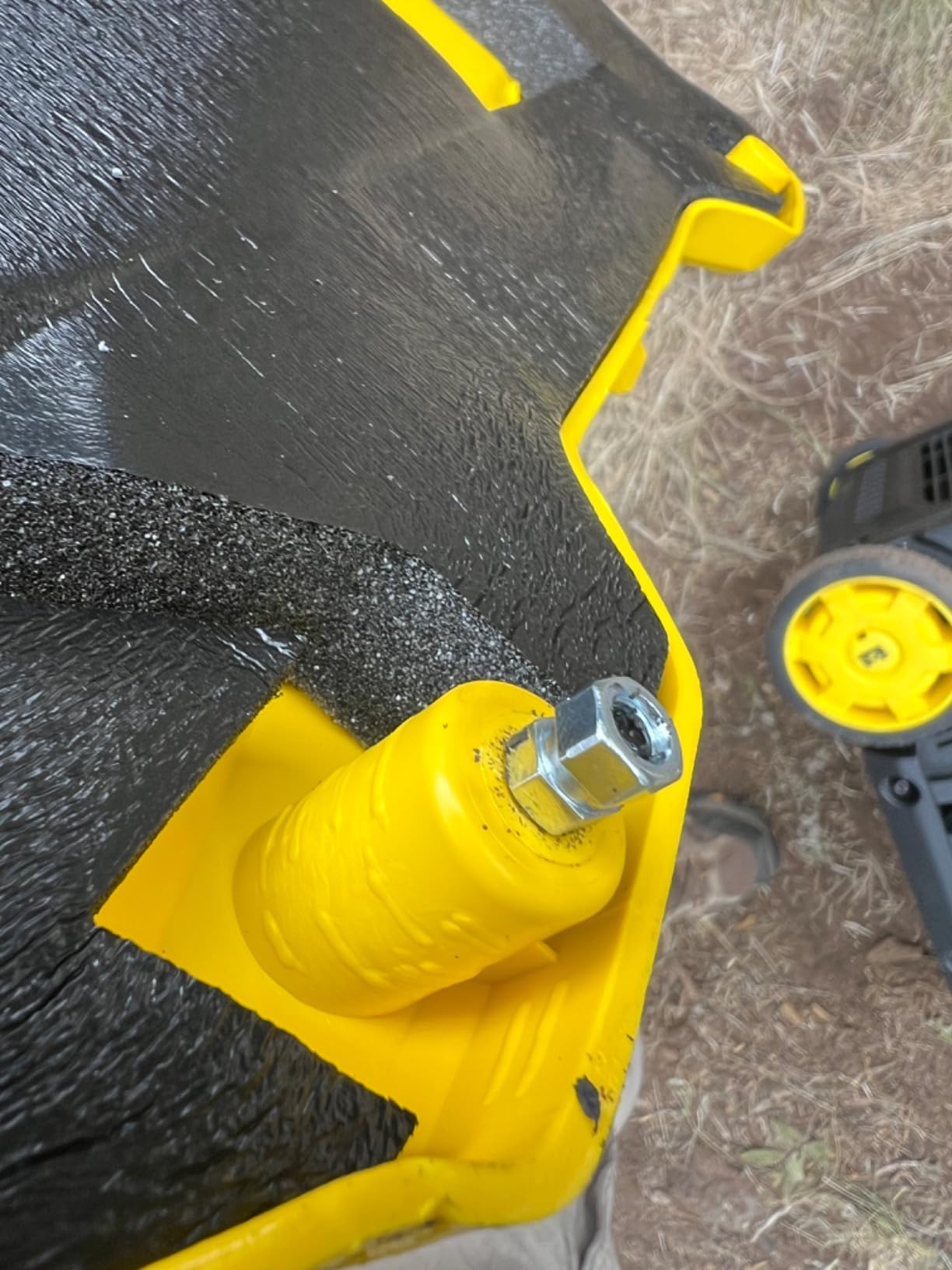
The CO sensor is worth understanding. Owners report it shutting the unit down in enclosed or low-clearance setups, and that is the system working as intended rather than a defect. A CO sensor is not a licence to run a generator in a garage with the door open.
A smaller but real group of reviews mentions oil consumption and hard starting, particularly on the propane configuration. Break the unit in on gasoline first, and the propane start behaviour improves for most owners.
Is the parallel kit worth buying for storm backup
Only if your single unit will run out of headroom. Two parallel-capable inverter models give you double the running watts and roughly double the surge, which is the closest thing to a cheap whole-home solution. The trade-offs are real: two machines to store, refuel and maintain, and about double the noise.
For most households a single unit in the next size class up is simpler and quieter than two parallel machines. Parallel capability is better thought of as insurance you can add later than as a reason to buy two smaller machines now.
What is the disadvantage of a dual fuel generator
The main disadvantages are weight, cost and switching complexity. A dual-fuel unit is heavier than a single-fuel generator of the same output because it carries a fuel valve, a second set of carburetor jets and a regulator connection, and you are paying for two fuel systems rather than one. Propane output is typically 8 to 12 percent lower than gasoline on the same engine, the regulator and quick-connect fittings are another failure point, and gasoline storage still requires fuel stabilizer and periodic draining to avoid varnish in the carburetor.
None of that changes our recommendation for storm regions. The gumming-fuel problem that drives most owners to dual fuel in the first place is solved by having the propane option available, and for most households the trade is clearly worth it.
10. Champion 4000W Dual Fuel Inverter for Lightweight Trailers
Champion 4000-Watt Dual Fuel RV Ready Portable Inverter Generator
3000 running watts on gas
2700 running watts on propane
Up to 25 hours on propane
51.8 pounds dry
Pros
- Lightest premium unit here at 51.8 pounds with a carry handle
- Runs a 15000 BTU RV air conditioner without leaving Eco mode
- Clean output under 3% THD
- Overload protection with a resettable indicator
- Tool-free quarter-turn oil fill door
Cons
- Louder than Champion's smaller models at 64 dBA and higher at full load
- Propane mode can be hard to start before gasoline break-in
- Small 1.54 gallon fuel tank limits real-world gasoline runtime
At 51.8 pounds with a built-in carry handle, this is the easiest machine here to move, and for a homeowner whose plan involves carrying a generator up basement stairs or loading it quickly, that matters more than peak wattage. It also earns its place as an apartment and travel trailer machine.
Owners rate it at 4.6 stars and report running a 15,000 BTU rooftop RV air conditioner without dropping out of Eco mode, with clean output under 3% total harmonic distortion for TVs, PCs, monitors and routers. The overload protection keeps the unit running and shows a red light that resets with one button press.
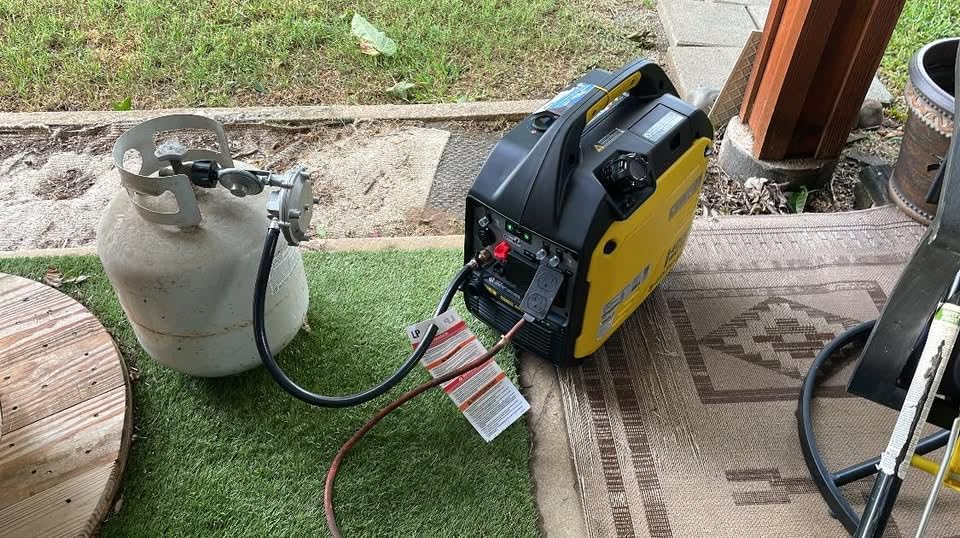
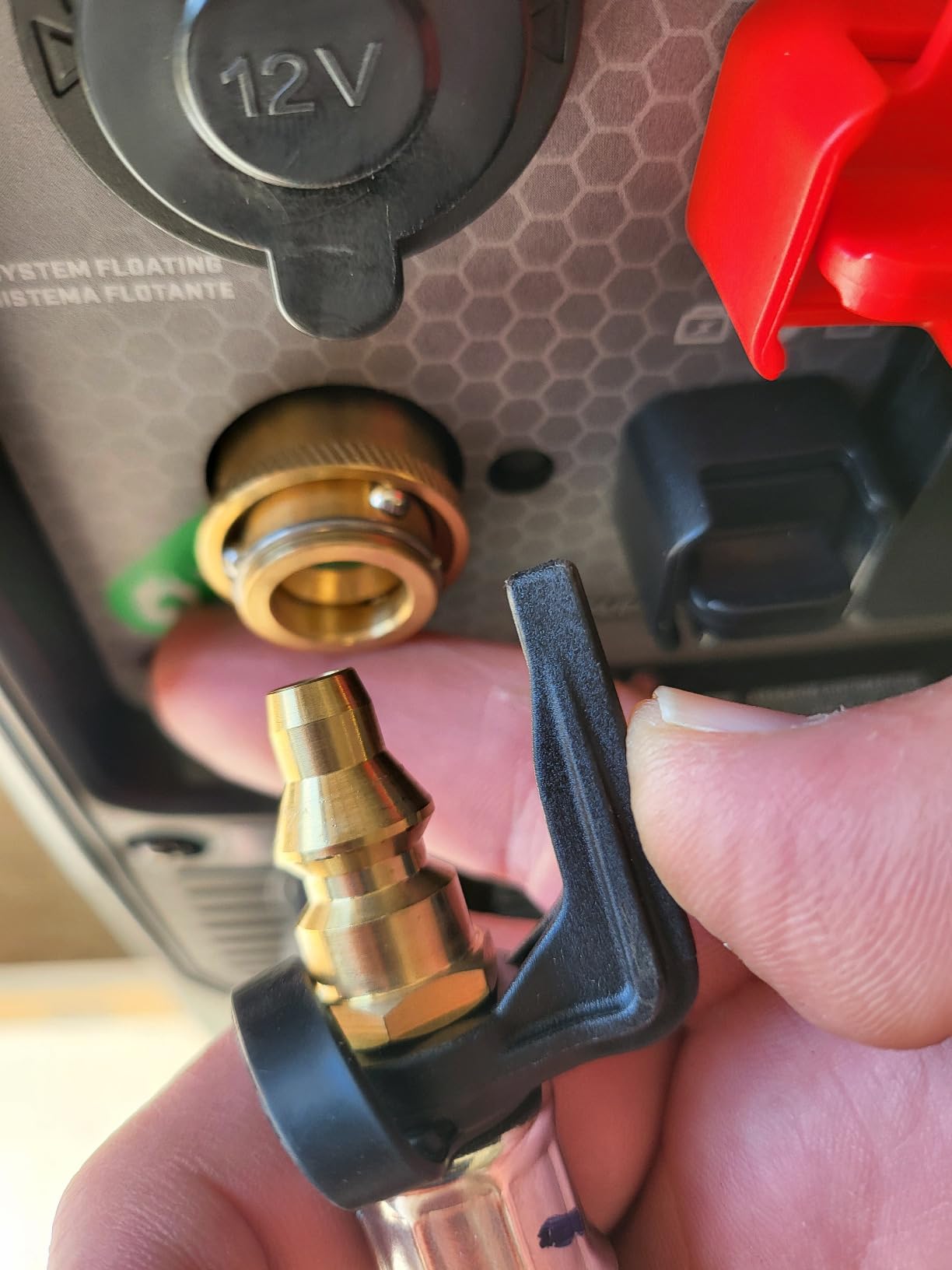
Two honest limits. The 1.54-gallon tank gives roughly 8 to 10 hours of real-world gasoline runtime rather than the rated 10 hours, so plan refills. And the propane mode can be stubborn to start until the unit has been broken in on gasoline, which is exactly what we recommend doing in the break-in schedule below.
Propane runtime is the headline anyway: up to 25 hours from a standard cylinder, the longest figure in this roundup, which is why pairing it with two or three cylinders is a common owner setup.
Is a 3000-watt generator enough for a house
Enough for a small home or apartment if your load is a refrigerator, a freezer, a router, some lighting, a CPAP machine and chargers. That is a legitimate storm plan for many people, especially if you are topping up a cooler rather than freezing an entire week of food.
It is not enough for a well pump plus a furnace blower plus a freezer, and it will not run central air. If your load list crosses those lines, step up to the 3,500-watt class or beyond rather than planning to cycle loads constantly.
Why owners break in a new generator on gasoline first
Because the carburetor needs to establish a fuel line and the engine needs to run hot enough to clear oil from the rings. Thirty minutes under load on gasoline does that. Owners who follow this pattern report that propane starting gets noticeably easier after the first couple of sessions.
It also gives you a chance to shake out any assembly issues from shipping while an electric outlet is nearby and a return is painless. If you are choosing between this and the 3800W PowerSmart, this one wins on propane runtime and on carrying a slightly heavier package with a bigger outlet set, while the PowerSmart carries a 30A twist lock, DC outlet and USB ports the Champion lacks.
How to Size a Dual Fuel Generator for Storm Backup
Step one: write down every load you intend to run
A modern refrigerator with a freezer typically draws 100 to 400 watts depending on the compressor cycle, a chest freezer can draw 150 to 300, a router and network gear run in the 15 to 30 watt range, LED lighting uses a few watts per bulb, a CPAP machine sits around 40 to 80, and an electric space heater draws about 1,500 watts on its own. Check the nameplate on each device rather than trusting a generic list.
Motors change everything. A well pump, a sump pump, a furnace blower and an air conditioner draw a large spike on startup, and that spike is what your peak wattage has to absorb. Add these separately so you can decide which ones run at the same time.
If you are also planning to move fuel around during an outage, a fuel transfer pump is a cheap addition that saves a lot of awkward lifting in the rain.
Step two: separate running watts from surge watts
Running watts are what the machine sustains continuously. Surge or peak watts are what it delivers briefly during startup. Manufacturers advertise peak numbers in headlines because they are bigger, and buyers get burned by that constantly.
Add your running watts together, then check that the largest single motor start does not push you past peak. As a working rule, target a generator whose running watts exceed your total load by 25 to 30 percent, and never run a load above about 80 percent of rated capacity for long periods.
Step three: pick your size class
Small inverter class, roughly 3,000 to 3,800 running watts, covers an apartment or a small home running a refrigerator, freezer, router, lighting and CPAP. Mid inverter class, 3,300 to 5,100 running watts, adds a well pump, a furnace blower, a dehumidifier or a space heater. Open-frame class, 5,300 to 6,500 running watts, is the sweet spot for most three-bedroom homes running essential circuits through a transfer switch.
Large class, 10,500 running watts and 13,000 peak, is for whole-home ambitions: central air, multiple motor loads, power tools and multi-day grid-down running. Buy the size class your load list needs and not one step larger.
Step four: plan your propane cylinders
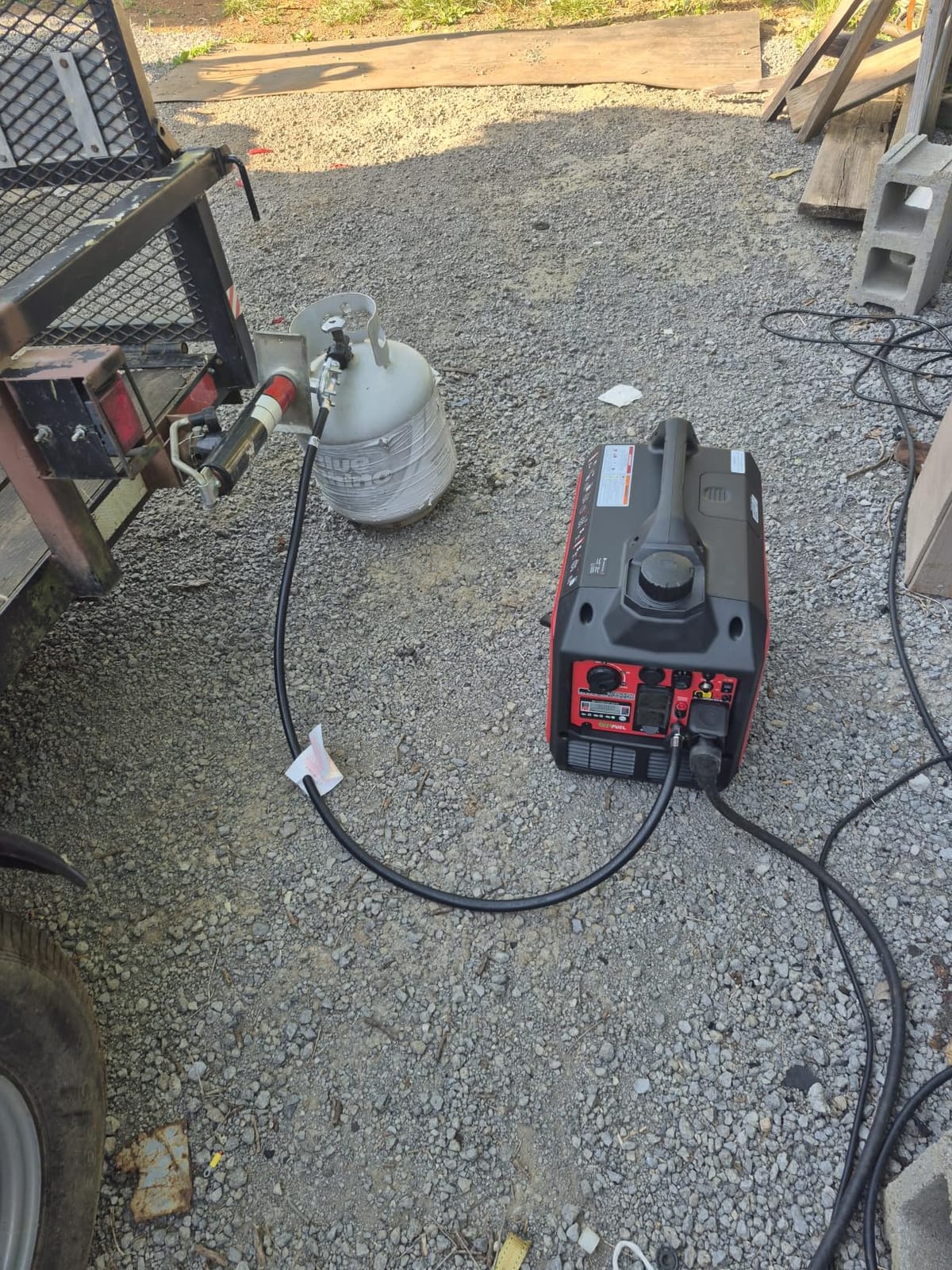
This is the calculation nobody else does, and it is the one that decides whether a dual-fuel machine saves your week. A 20-lb propane cylinder on a mid-size inverter engine is rated at up to roughly 24 hours of running at light load. From that baseline:
24-hour outage: one full cylinder for a mid-size inverter unit, two if you run a larger open-frame machine at moderate load.
72-hour outage: three cylinders for a mid-size inverter, five or six for a large open-frame unit running central air.
120-hour outage: five cylinders for a mid-size inverter, ten for a large unit, plus every spare you can store safely.
Forum consensus is consistent on the minimum: keep at least two 20-lb propane cylinders on hand before storm season so gasoline availability becomes irrelevant. Where you store them matters more than how many, because propane cylinders should stay upright, outdoors or in a well-ventilated shed, away from ignition sources.
Step five: decide inverter or open frame
Inverter units use a digital conversion stage to produce a clean sine wave with low total harmonic distortion, and they run quieter and lighter for the same wattage. Open-frame units are conventional, louder, heavier and cheaper, with rougher output.
Choose an inverter if you are powering electronics, medical equipment, audio gear or anything running overnight near neighbours. Choose an open-frame unit if your loads are purely resistive and mechanical and your priority is maximum watts and maximum endurance per dollar.
The 20/20/20 rule for generator ownership
It is a preparedness habit rather than an official standard, and it comes in a few variations. The common version: run the machine for about 20 minutes under a real load, roughly every 20 days or at least once a month, and service the oil, air filter and spark plug at around 20 hours of runtime. Owners who test their generator on a schedule report far fewer start failures after months of storage, which is the entire point.
The value is simple. A carbureted engine that sits for six months develops varnish, and the first storm of the season is the worst possible time to find out. A 20-minute monthly run under load keeps fuel moving, the choke familiar and any fault obvious while a returns counter is still open.
First run and monthly test schedule
On the first run, add the correct oil, connect a propane cylinder, set the fuel selector to gasoline, and run it for 30 minutes with a couple of loads attached. Change the oil after that first 30 minutes as the manual specifies, then move to propane for another short run so both paths are tested before you need them.
After that, run it monthly for 20 minutes or longer with a real load, and twice a year run through both fuels back to back. Before hurricane season, drain or stabilise the gasoline, check the spark plug and air filter, inspect the propane hose for cracks, and confirm your CO alarm batteries. This maintenance habit matters more to long-term reliability than any feature on the spec sheet.
Carbon monoxide and placement rules
Run the generator outdoors, at least 20 feet from the house, with exhaust pointed away from doors, windows and vents. A garage with the door open is not safe, because carbon monoxide mixes with indoor air and reaches living space long before you notice it. Keep CO alarms working inside, and re-check placement when wind shifts during a storm, which is the moment exhaust direction changes most.
Never run it in rain-driven spray or in an enclosed porch. Use a properly installed transfer switch for anything wired into the house, and a GFCI-protected extension connection for appliances when you are outside. If you are also hardening the house for the same storm, our guide to the best storm doors covers the entry side of that plan.
For a quieter overnight approach, pairing a small inverter generator with a battery power station is a common setup. The generator charges the power station while the power station runs the low-draw electronics silently. Our solar generator backup guide covers that side of the setup.
Frequently Asked Questions
What is the highest-rated dual-fuel generator?
The Westinghouse WGen9500DF holds the top spot in this roundup with a 4.7-star average across roughly 8,911 reviews. It delivers 9,500 running watts on gasoline and 8,500 on propane, includes a key fob remote start, and offers transfer-switch-ready outlets. Among inverter models, the Westinghouse iGen5000DF also rates 4.7 stars for quieter, cleaner output at 3,900 rated watts.
What is the disadvantage of a dual-fuel generator?
The main drawbacks are weight, cost and switching complexity. A dual-fuel unit carries a fuel valve, a second set of carburetor jets and a regulator connection, so it is heavier and more expensive than a single-fuel generator of the same output. Propane power is typically 8 to 12 percent lower than gasoline on the same engine, and gasoline still needs stabilizer and periodic draining to avoid carburetor varnish.
What is the best generator to use during a hurricane season?
For most households, a dual-fuel unit in the 5,000 to 6,500 running watt range covers refrigerator, freezer, well pump, furnace blower and essential circuits through a multi-day outage. Add a transfer switch for anything wired into the house. Choose an inverter model if you need clean power for electronics or medical equipment, and keep two full 20-lb propane cylinders on hand before the season starts.
What is the 20/20/20 rule for generators?
That is a preparedness habit rather than an official standard: run the generator for about 20 minutes under a real load, test it roughly every 20 days or at least monthly, and treat 20 hours of runtime as the interval for checking oil, the air filter and the spark plug. Owners who follow a version of this rule report far fewer start failures after months of storage.
How long does a 20 lb propane tank last on a generator?
A mid-size inverter engine is commonly rated at up to roughly 24 hours on a 20-lb cylinder at light load. Small 3,000-watt inverter models reach up to 25 hours per cylinder. For a 72-hour outage, plan on three cylinders for a mid-size inverter and five or six for a large open-frame unit running central air.
Final Verdict for Storm Season 2026
The best dual fuel generators for storm backup come down to your load list, not the largest number on the box. For most homes, the Westinghouse WGen9500DF is the pick because it combines a 4.7-star average across a huge review base with 9,500 running watts, remote start and the outlet package to wire it properly.
Pick the Westinghouse iGen5000DF if clean power and overnight quiet matter more than raw capacity, the PowerSmart or Champion 4000W if you need to move the machine yourself, and the WEN DF475T if you want 240-volt transfer-switch capability without stepping up a size class. Whatever you choose, buy it before the season, run it monthly, keep at least two propane cylinders on hand, and set it 20 feet from the house with the exhaust facing away from openings.