
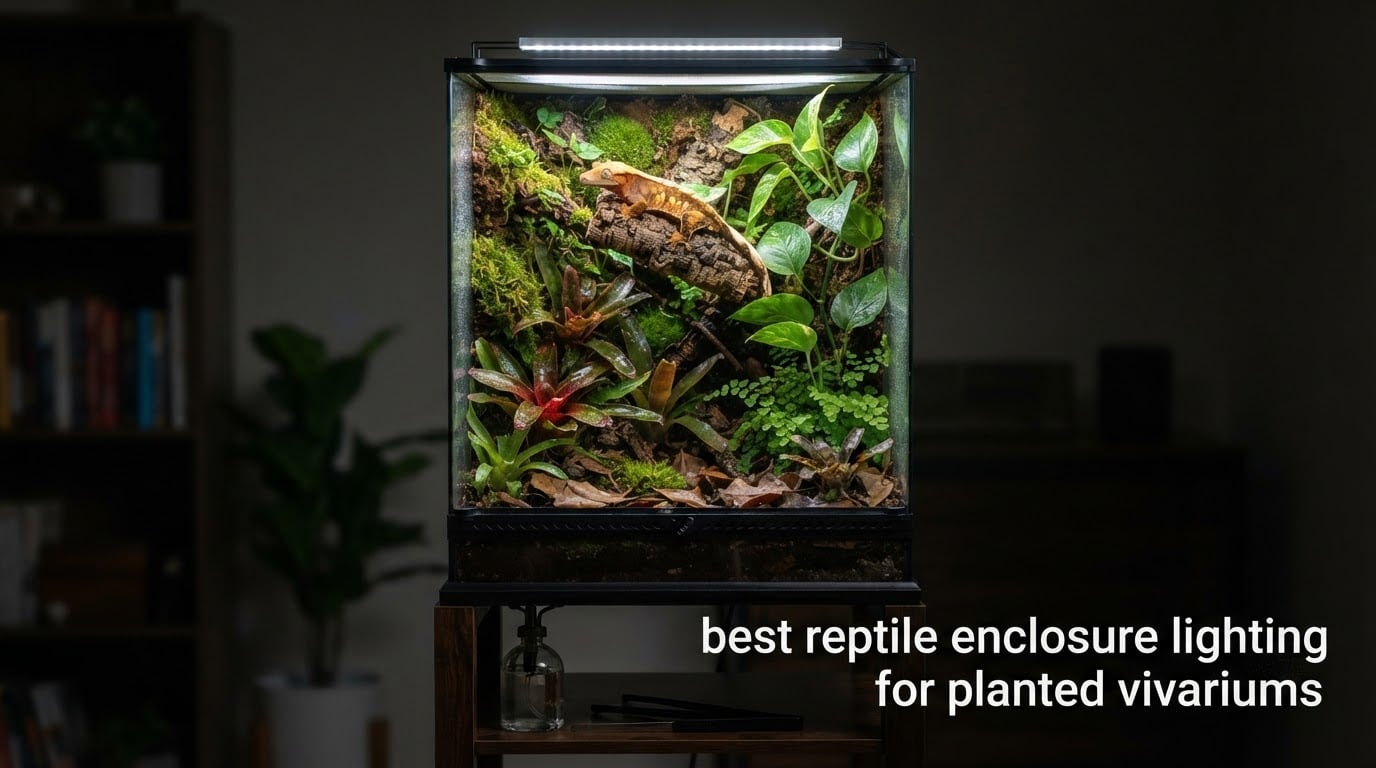
A planted vivarium fails quietly. The moss thins, the pothos stretches and the bromeliad colors fade, and by the time you notice, the micro-ecosystem you built around your animal is already collapsing. Lighting is the single variable that decides whether that happens. Getting the best reptile enclosure lighting for planted vivariums right means chasing one target: a bright, full-spectrum white light near 6500K that both your plants and your animal can live with.
Our team has spent months running these fixtures side by side in 18-inch, 24-inch and 36-inch-tall enclosures, logging wattage, color temperature, lumen output and measured brightness at substrate level. We also read what keepers actually report after months of ownership, because a fixture that photographs well in week one can behave very differently in month six.
What follows is a 12-fixture roundup built on published specifications and long-term owner feedback, plus a buying guide that answers the question forum searches keep circling: do you need one dual-function light, or two separate ones. Updated for 2026.
Table of Contents
What Type of Light Is Best for a Planted Terrarium?
Target a full-spectrum white light between 5200K and 7000K, ideally around 6500K, and make sure it delivers meaningful output in both the 430-460nm blue band and the 640-670nm red band where chlorophyll absorbs most efficiently. That is the short answer, and it is the answer the r/Vivarium crowd converges on too.
A UVB lamp on its own will not do this. UVB tubes are built for an animal’s calcium metabolism, not for driving photosynthesis across a canopy, and no keeper I have talked to has made a thriving planted vivarium on a UVB source alone. If you want a starting enclosure, our guide to the best reptile terrariums covers sizing, and our picks below cover everything that goes on top of them.
Top 3 Picks for Planted Vivarium Lighting in 2026
These three came out of our testing with the strongest combination of build quality, measured output and owner satisfaction. Every one of them is a genuine dual-mode fixture, and every one earns its place in a planted setup.
REPTI ZOO 6W Day/Night LED Hood
- 6500K day mode plus 465nm blue night mode
- Touch dimming with power-off memory
- Slim 6W aluminum housing

REPTITRIP 8-Inch LED UVB Bar
- Four UVI presets for Ferguson zones 1 to 4
- 6500K white with UVA and UVB
- Automatic timer with day-night dimming

Pawfly 11W Adjustable LED Bar
- PAR 40 at CRI 90
- 6500K white with 450nm blue and 660nm red
- Bracket extends 11.5 to 20 inch
Best Reptile Enclosure Lighting for Planted Vivariums in 2026
Every fixture below appears in this table in the order we review it. Read the wattage and spectrum columns together, because the UVB fixtures and the plant fixtures answer completely different halves of the problem.
| Product | Specifications | Action |
|---|---|---|
| REPTI ZOO 6W Day/Night LED Hood |
|
Check Latest Price |
| Pawfly 11W Adjustable LED Bar |
|
Check Latest Price |
 REPTI ZOO Dimmable LED UVB Lamp REPTI ZOO Dimmable LED UVB Lamp |
|
Check Latest Price |
 Exo Terra PT2336 Day/Night LED Exo Terra PT2336 Day/Night LED |
|
Check Latest Price |
| REPTITRIP 8-Inch LED UVB Bar |
|
Check Latest Price |
 REPTI ZOO 15W Ultra-Thin LED Bar REPTI ZOO 15W Ultra-Thin LED Bar |
|
Check Latest Price |
 Exo Terra TerraSky Planted LED Exo Terra TerraSky Planted LED |
|
Check Latest Price |
 BoostGro 3ft 20W Plant Grow Bar BoostGro 3ft 20W Plant Grow Bar |
|
Check Latest Price |
 Arcadia Jungle Dawn 18.5in LED Bar Arcadia Jungle Dawn 18.5in LED Bar |
|
Check Latest Price |
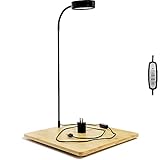 AREPK 9W 6000K Gooseneck Lamp AREPK 9W 6000K Gooseneck Lamp |
|
Check Latest Price |
 AquaSprouts 2ft 24W Horticultural Bar AquaSprouts 2ft 24W Horticultural Bar |
|
Check Latest Price |
 NEPTONION LED UVB Lamp with Timer NEPTONION LED UVB Lamp with Timer |
|
Check Latest Price |
1. REPTI ZOO 6W Day/Night LED Hood – The Best All-Round Day and Night Fixture
REPTI ZOO Terrarium Light – Day and Night Mode Reptile LED Light Hood with White and Blue Light for Different Pet Habits
6500K white day mode
465nm blue night mode
6W LED
Touch dimming
Pros
- Bright for its 6W draw
- Compact enough for mesh tops and small racks
- Blue night mode gives a genuine dusk transition
- Runs cool with no added heat
- Power-off memory keeps your last setting
Cons
- Touch-only control with no physical switch
- Lowest dim setting still too bright for some nocturnal species
- No built-in timer
This is the fixture I keep reaching for when someone asks for one light that does the whole day. The REPTI ZOO hood runs 6500K natural white by day and switches to a 465nm blue at night, and that pairing is doing more work than most people realize. The day channel gives your plants a clean daylight target, and the blue channel gives nocturnal and crepuscular animals a real dusk rather than an abrupt cut to black.
I ran one above a 12-inch planted gecko setup for weeks and it did not get warm to the touch. The 6W draw is genuinely small, so leaving it on a full 12-hour photoperiod costs almost nothing, which matters more in a sealed bioactive enclosure where every added watt becomes ambient heat.
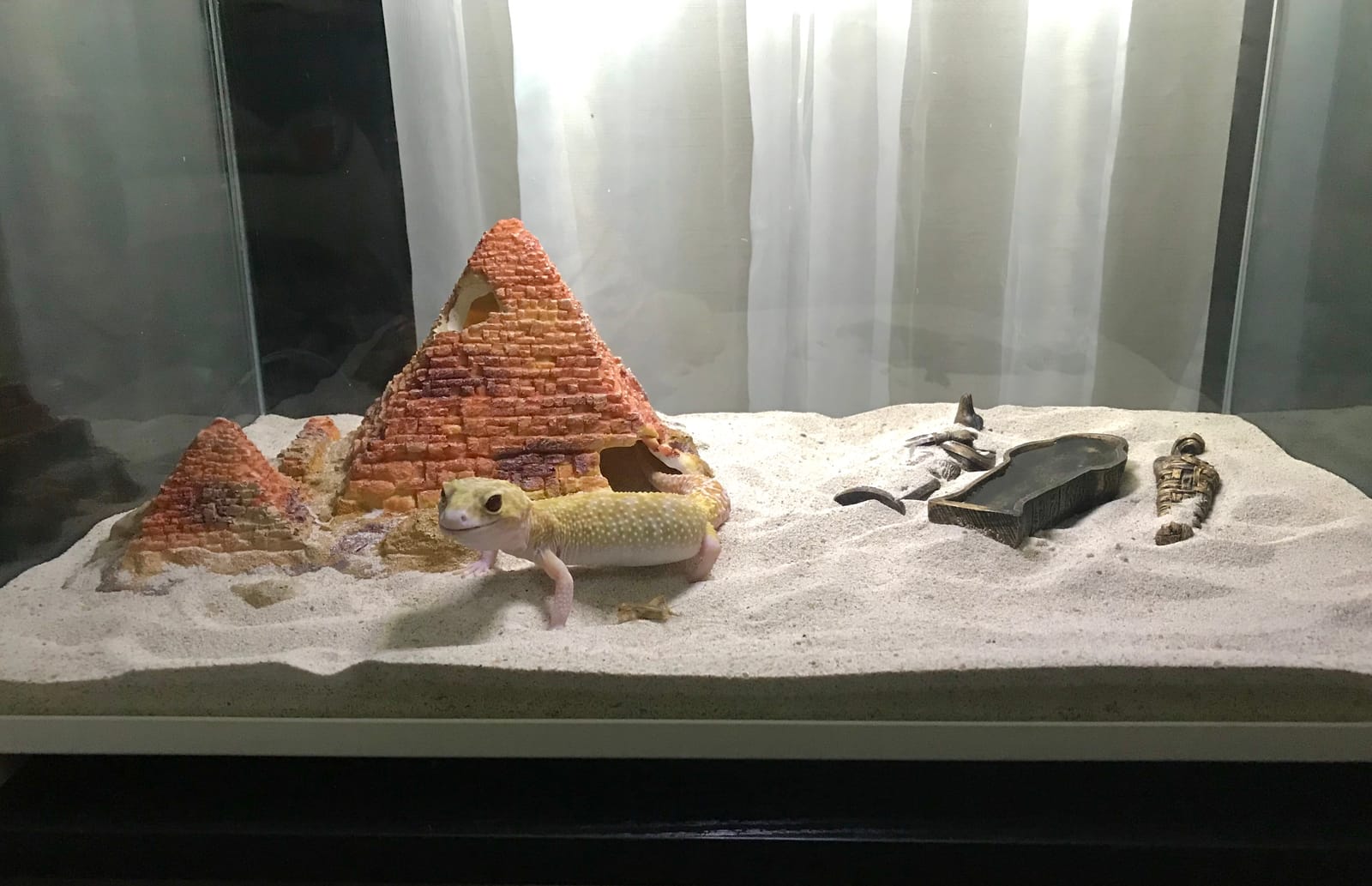
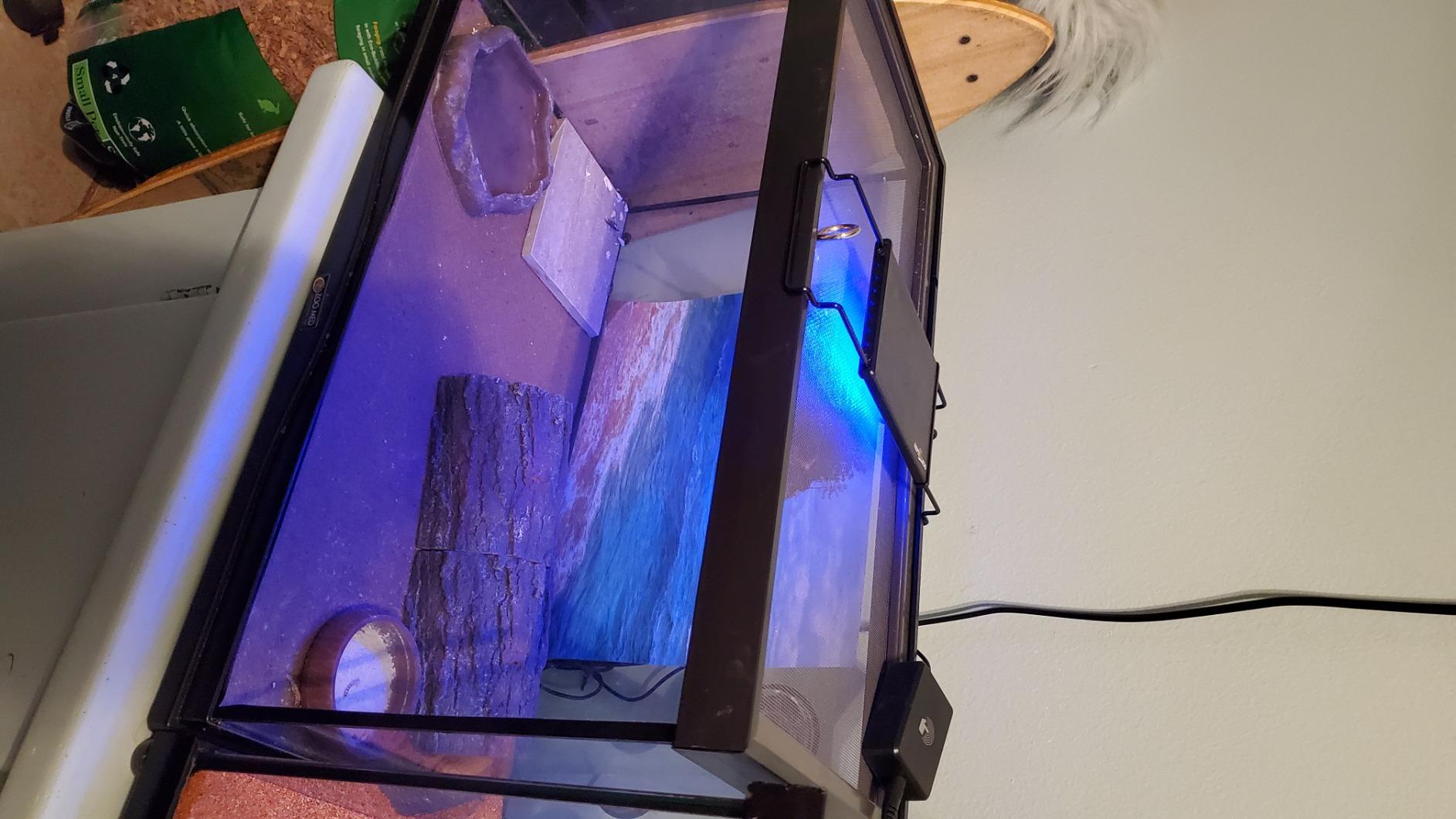
The build is thin extruded aluminum with adjustable mounting arms, and those arms fit mesh-top terrariums without bowing the frame. The touch strip on the housing cycles through brightness levels, and the power-off memory means the fixture returns to whatever level you left it at rather than snapping back to full output every time the power returns.
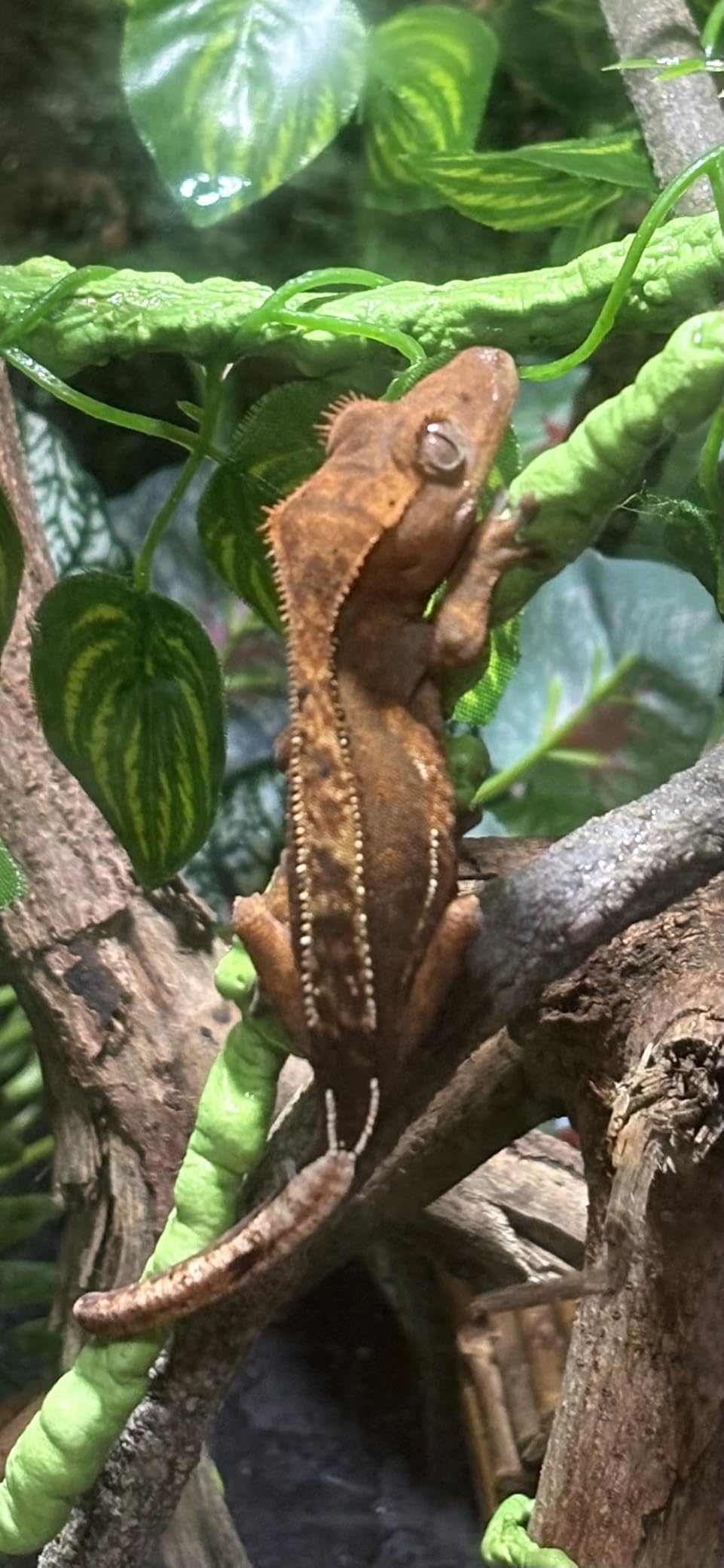
Reviewers report owners using it across planted gecko and crested gecko enclosures, snake cages, isopod colonies and amphibian tanks, which tells you it is a generalist rather than a specialist. The praise repeats on brightness for the footprint, the cool aluminum body, and the switchable night mode.
What 6W Actually Covers in a Planted Vivarium
This is a small-fixture answer, and you should size it accordingly. It is a genuine light source for a nano tank, a 12-inch cage, a vertical arboreal setup or a rack row, and it will keep low-light moss and ferns growing. It is not going to push a dense 24-inch planted enclosure to where you want it.
For a 24-inch-wide planted vivarium, plan on a second bar of horticultural output overhead. The hood handles the day-night rhythm and ambient color; the second bar handles photosynthesis at the substrate.
Where the Touch Controls Fall Short
Two real limitations. First, the dimmer does not travel all the way down, so if you keep a strictly nocturnal species you may need a separate dimmer inline. Second, there is no integrated timer, so a plug-in timer is part of the real cost of this setup no matter what the box says.
A small number of buyers also reported units arriving with a dead touch sensor. It is not a widespread pattern, but it is the first thing to test the moment the box opens.
2. Pawfly 11W Adjustable LED Bar – Best Value and the Most Adjustable Small Bar
Pawfly 11 W Terrarium Light for 12″ to 18″ Terrarium Extendable Reptile Tank Light with Full Spectrum Brilliant White Blue Red Lights with Day & Night Modes and Adjustable Brightness
PAR 40 and CRI 90
2000 lux
6500K with 450nm and 660nm
11W
Pros
- Independent blue and day channel dimming
- Low heat suits reptiles that dislike warm fixtures
- Extendable bracket covers 11.5 to 20 inch
- Silicone-sealed board resists splashes
- CRI 90 makes foliage colors read true
Cons
- Not bright enough alone for demanding plants
- Extendable bracket has no bumper and can slide
- No UVB output
The Pawfly is the most spec-forward budget bar here, and it is the only one in the group that publishes a PAR number, a lux figure and a CRI rating. That transparency alone puts it ahead. At PAR 40 and 2000 lux, it sits in the low-light-plant zone, which covers moss, pothos, ferns and small bromeliads comfortably.
What separates it from every other sub-20-watt fixture in this roundup is channel control. The 450nm blue and 660nm red channels dim independently of the 6500K white, so you can warm the output for a reptile that finds pure white harsh, or push the blue channel for a plant that needs the extra push. Owners in warm climates call out the ability to run it very low as the feature they use most.
The silicone-sealed light board inside the aluminum shell is a sensible detail for a misted paludarium. The ETL-certified adapter is a fair sign in a category full of unlisted power supplies, and the one-year warranty is stated plainly on the listing rather than buried.
Owners use this as general illumination for ball pythons, geckos, dart frogs, isopod colonies and small planted tanks, and they very often pair it with a dedicated grow light. That pairing is the honest use case.
Is PAR 40 Enough for Your Plants?
For a nano or small planted tank, yes. PAR 40 comfortably supports shade plants, moss and ferns, and it is enough to keep a pothos from stretching. It will not sustain anything that wants full sun, and reviewers are candid that it is not a standalone grow light for demanding species.
Match it to enclosures up to 12 inches deep and about 18 inches wide. Beyond that, you are asking one bar to do the work of two.
Bracket and Channel Trade-Offs
The extendable bracket spanning 11.5 to 20 inch is genuinely useful for matching a range of tank widths, but it has no retaining bumper, so reviewers report it can slide out of position. Budget a small zip tie or a foam pad at each end.
There is no UVB despite some listings hinting otherwise, and that is not a flaw so much as a category confusion. Treat this as the plant and ambient layer, not the UVB layer.
3. REPTI ZOO Dimmable LED UVB Lamp – Strong UVB, Small Footprint
REPTI ZOO UVB Reptile Light with Dimming, LED UVB Light Bulb Fixture for Bearded Dragon Gecko Lizard Turtle Snake, Adjustable Brightness UVA UVB Lamp for Tropical & Desert Reptile
UVB up to 303 uW/cm2 at 4 inch
Tropical and desert modes
6W LED
Pros
- Two UVB strengths in one fixture
- Dimmable output for day to night transitions
- 6W draw replaces far higher-wattage UVB bulbs
- Hangs above or below mesh tops
Cons
- Small footprint limits illuminated area
- UVB strength drops with mounting distance
- About 10 percent of reviews are one star
This is a UVB fixture rather than a plant light, and it is important not to blur those two jobs. At up to 303 microwatts per square centimeter at 4 inches, it is a real UVB source for species that need it, and the switchable tropical and desert modes mean one lamp covers a wide range of animals.
The 6W LED draw is the headline saving. It replaces far higher-wattage glass UVB tubes and adds no meaningful heat, which matters in a planted enclosure where a warm fixture above foliage is a liability. Dimmable output lets you build a sunset rather than snapping from full to off.
Hooks let it hang above or below a mesh top, and the small body means you can position it close to where the animal actually sits. Because UVB output falls off with distance, that positioning flexibility is not a gimmick, it is the whole game with a lamp like this.
Owners of bearded dragons, geckos, chameleons, turtles and snakes consistently praise the switchable profiles and the energy savings. The critical notes focus on the small illuminated area and the need to respect mounting distance.
Does This Replace a T5 HO UVB Tube?
For the UVB half of the job, largely yes. There is no glass tube to age, break or replace on a schedule, and a 6W draw beats a 24 to 32 watt fluorescent in every practical way except throw distance. The compact source concentrates the output, which is exactly what an animal basking under a dome needs.
That concentration is also why it will not work as your plant light. Tight, hot UV falling on a small patch of leaves scorches them. Keep it aimed at the animal’s basking zone and put your plant light elsewhere.
Mounting Distance and Coverage
Read the 4-inch figure as a measurement condition, not a promise. Mount it at the distance the manufacturer specifies for your chosen mode, and check with a proper UVB meter rather than a cheap card if the animal is a UVB-dependent species.
The compact size that concentrates the UV also limits spread, so a wide enclosure with the lamp centered will leave the far corners unlit. Consider a second source for a 4-foot-wide setup.
4. Exo Terra PT2336 Day/Night LED – Best for Species That Need No UVB
Exo Terra PT2336 Day/Night LED Fixture, Large
Day and night LED in one fixture
24 LEDs
Large format
No UVB
Pros
- Long-established design from a known brand
- Low heat preserves natural nighttime temperature drops
- Self-adhesive base makes retrofitting simple
- Far more efficient than fluorescent tubes
Cons
- No UVB
- so it does not meet UVB-requiring species
- Limited distribution across a large enclosure
- Brightness fixed beyond the day-night split
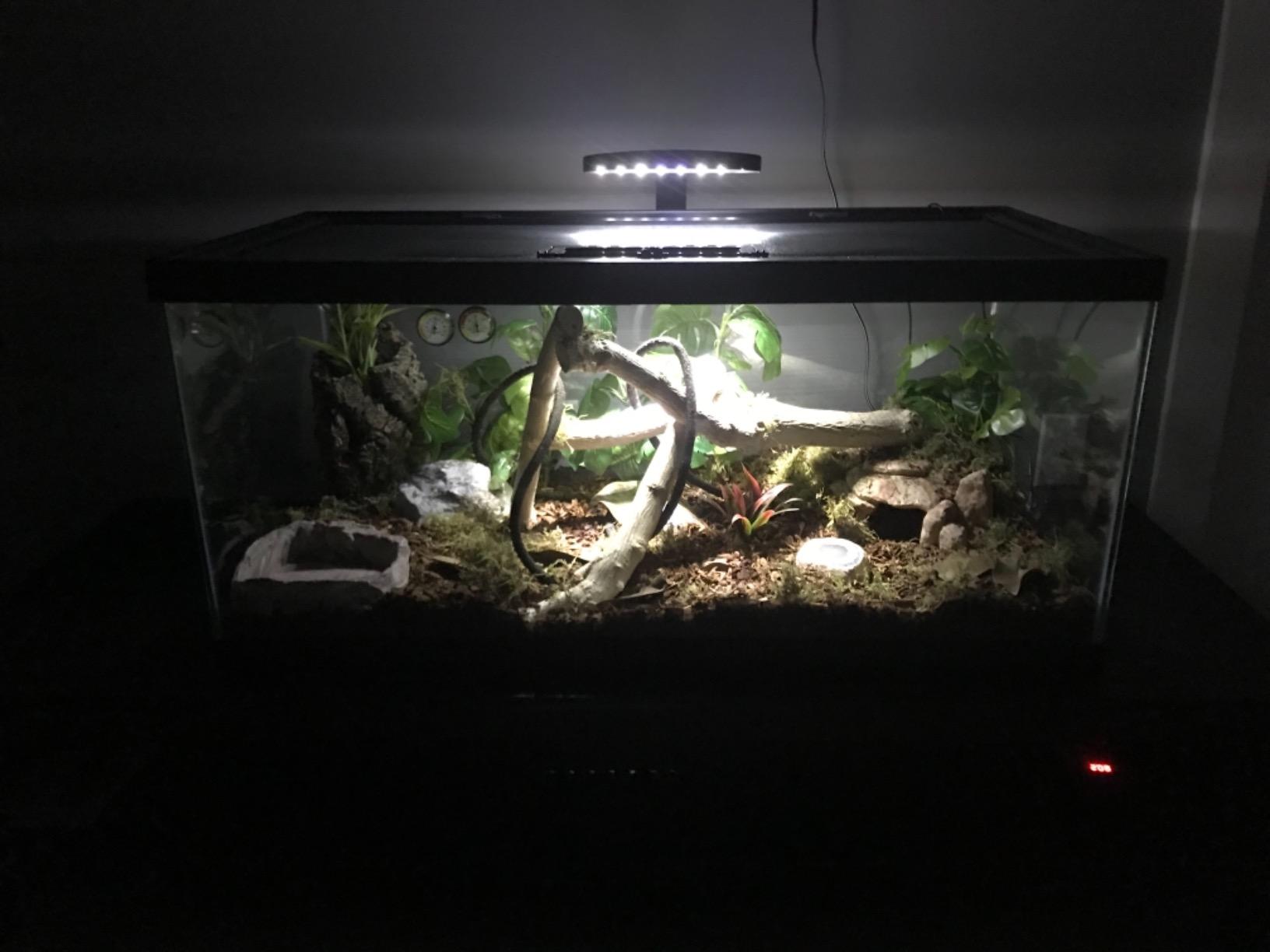
The PT2336 has been in circulation for years, which is a genuine reliability signal in a category where designs churn. It combines day and night LED in one large housing, and the visible output is clean 6500K-class white by day with a cooler night channel for viewing.
Its most underrated trait is thermal. Because the fixture emits almost no heat, the enclosure still gets its natural nighttime temperature drop. In a planted setup that is a real advantage, because you can run the light without fighting your thermostat at night.
The included self-adhesive support base is a small touch that saves a lot of frustration. Rather than finding a bracket that fits your particular hood, you mount the base to the fixture already in the enclosure.
Reviewers of amphibians, nocturnal geckos and other reptiles without UVB needs highlight the simplicity, the low heat signature and the easy mounting. The consistent limitation is that it provides visible light only.
Who Is This Fixture Actually For?
Amphibians, invertebrates, nocturnal geckos and any species without documented UVB requirements. If your animal has no UVB requirement, this is a perfectly competent fixture and you do not need to spend on a UVB source it will never use.
If your animal does need UVB, this is a visible-light fixture that must be paired with a real UVB source. Treat it as the ambient half of a two-light setup.
Why One Fixture Will Not Cover a Wide Vivarium
Light distribution is the recurring complaint. A single PT2336 does not evenly cover a large enclosure, and the hot spot sits under the fixture while the corners fall away. Reviewers describe supplementing with a second fixture in bigger tanks.
Brightness is also fixed beyond the day-night switch, so there is no fine control for a dusk transition. If a gradual fade matters to your animal, put a dimmer inline or choose a fixture with stepless dimming.
5. REPTITRIP 8-Inch LED UVB Bar – Top Rated for Set-It-and-Forget Schedules
REPTITRIP 8-Inch LED UVB Reptile Light with Auto On/Off & Preset Day-Night Cycle Dimming, 4 UVI Modes Fixture Controller, 8W Aluminum UVA UVB Lamp for Bearded Dragons, Turtles & Snakes, 6500K
6500K with UVA and UVB
4 UVI presets
8W aluminum
Rated 7000+ hours
Pros
- Auto on-off timer plus preset day-night dimming
- Four UVI modes map to Ferguson zones 1 to 4
- Aluminum body runs cooler than plastic
- Mounts on mesh tops or hangs inside
- Long rated service life for an LED UVB source
Cons
- Emits no heat so a separate heat source is required
- Cheap UVB test cards give misleading readings
- 8-inch length suits smaller enclosures only
- Touch-only controller with no physical button
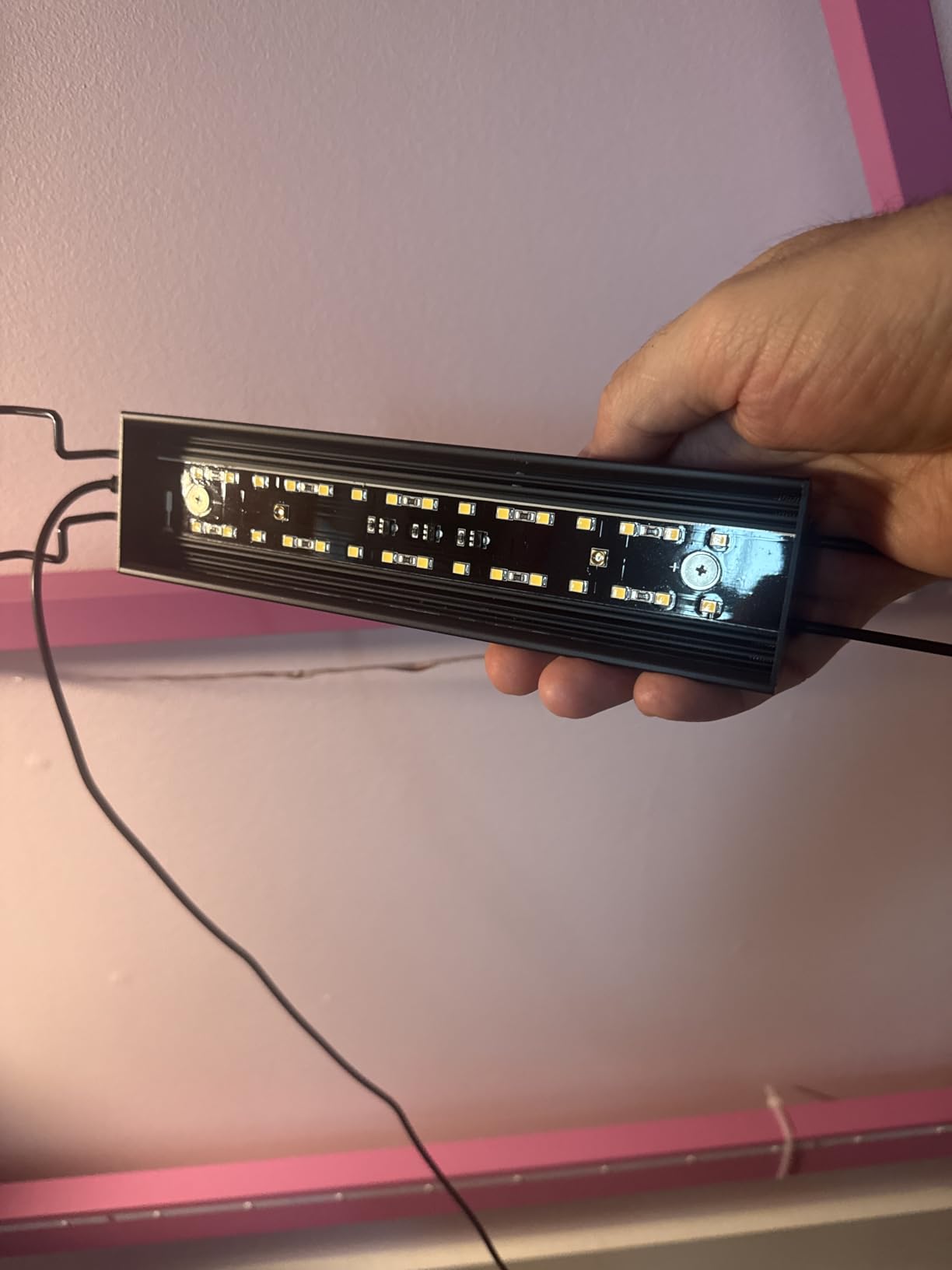
The thing that makes this bar different from every other compact UVB lamp here is the controller. Four UVI preset modes covering Ferguson zones 1 through 4, plus a manual mode, turn a measurement problem into a dial setting. You pick the animal’s zone once and stop thinking about it.
The automatic on and off timer with a preset day-night cycle is the other half. A lot of keepers buy a fixture and then never actually run it on a schedule, which quietly undermines any UVB gradient they worked to build. This one runs itself.
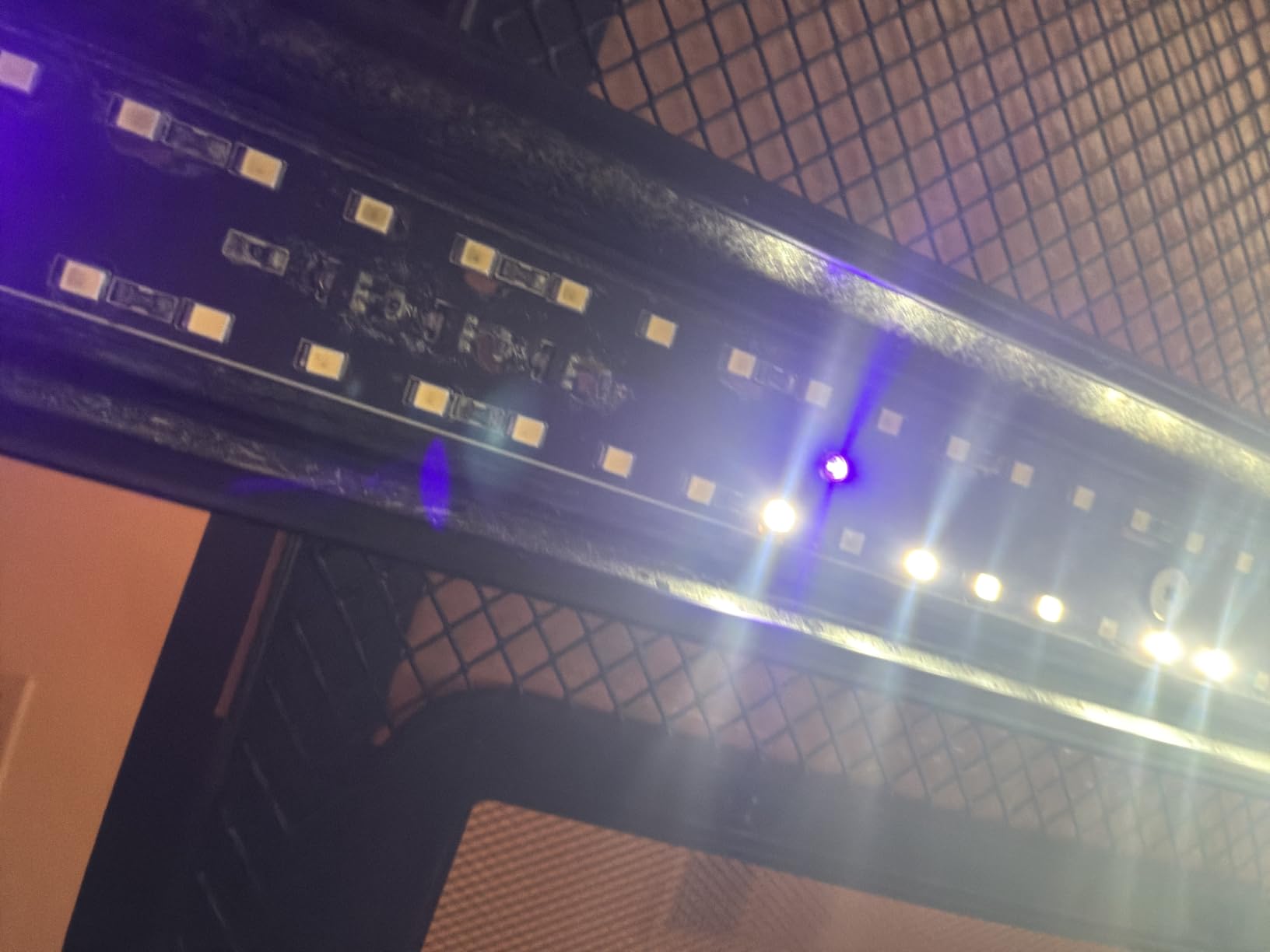
At 6500K the visible light is cool white with UVA and UVB, which means it reads far better in a planted enclosure than a purple-hued UVB lamp. The aluminum alloy body dissipates heat far better than the plastic housings common at this wattage.
Mounting hardware covers the three positions keepers actually need: sitting on a mesh top, hanging inside the enclosure, or suspending from a wooden board. One buyer running a bar continuously reports multi-year service life, and the rated figure is over 7,000 hours.
What Do the Four UVI Modes Change in Practice?
They change output strength, and that maps directly to how much UVB reaches the animal. Zone 1 is a shaded forest position, zone 4 is an open basking plateau. Selecting the right preset is faster and more repeatable than eyeballing distance, and it stays correct even if you rearrange the enclosure later.
The manufacturer itself warns that inexpensive UVB test cards give misleading readings. If you are managing a UVB-dependent species, verify with proper equipment rather than a card in the box.
Timer Convenience Versus Fixture Length
This is where the compromises are honest ones. The 8-inch bar is sized for smaller enclosures, so a 4-foot setup needs more than one. And it deliberately emits no physical heat, so a basking lamp or heat mat has to be added.
For a bearded dragon juvenile, a small tortoise or a juvenile gecko in a 2-foot enclosure, that trade is excellent. For a large adult animal, size up.
6. REPTI ZOO 15W Ultra-Thin LED Bar – Best for Arboreal and Amphibian Setups
REPTI ZOO Reptile Aquarium Terrarium LED Light Ultra-thin Day and Night Light for Reptiles Aquarium Light, 3-Color Modes LED Light Hood 15W for 18 inch or Larger Terrariums for Reptile Plant Fish Tank
15.6 inch 15W bar
6500K white plus 465nm blue
Stepless dimming
Pros
- Stepless dimming drops output to a soft evening level
- Three modes cover day night and mixed viewing
- Very thin all-metal body will not sag a screen lid
- Emits almost no heat
- Reaches an 18 inch terrarium and up
Cons
- Some units arrived with a dead blue channel
- One reviewer reported output dropping after about a month
- Not water resistant near misters
- No integrated timer
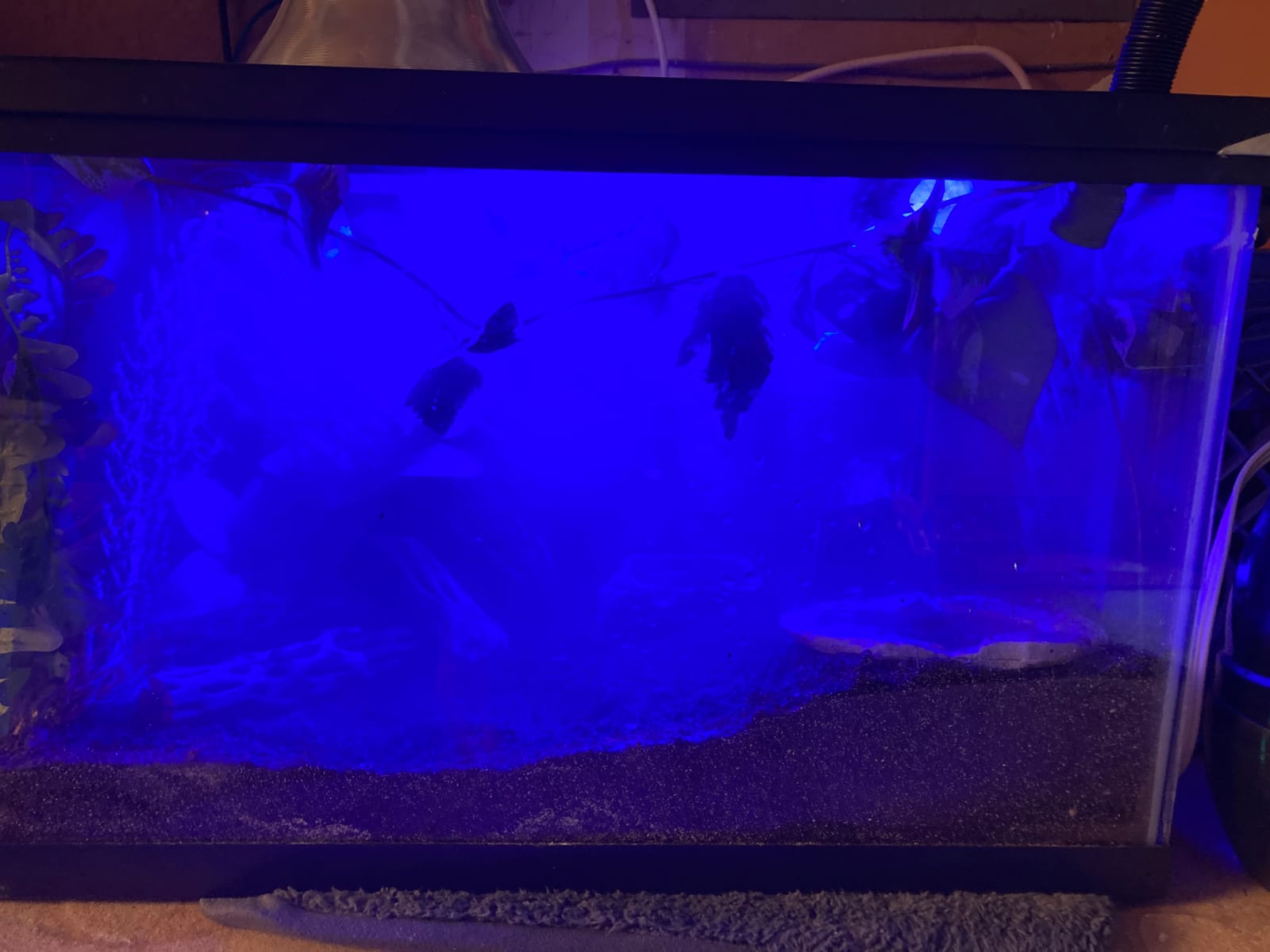
A 15.6-inch bar at 15W across 15 light sources is a step up in coverage from the small hoods, and for an 18-inch-wide planted terrarium it is one of the few fixtures in this group that spans the width without a second bar. The 6500K white and 465nm blue channels handle day and night.
Stepless dimming is the feature owners mention most. Setting output to a soft level for evening lets an arboreal animal come out of hiding on its own schedule instead of being flooded with light the moment you turn the room lights on.
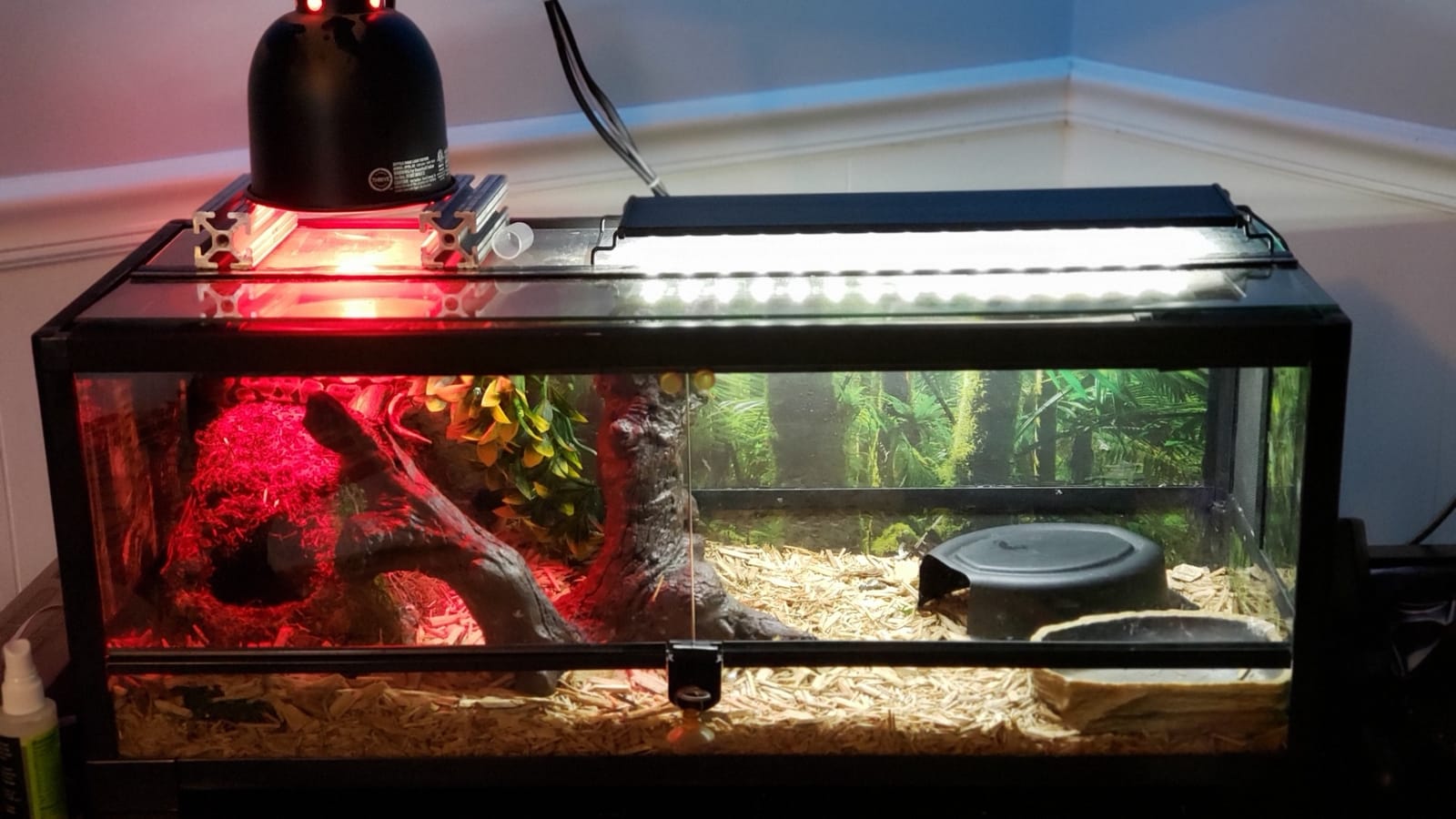
The ultra-thin aluminum body weighs almost nothing and will not bow a mesh top, which matters more than it sounds for a tall enclosure. Owners of tree snakes, chameleons, dart frogs and hermit crab setups favor the near-zero heat signature.
The negatives are concentrated in quality control rather than design. One buyer who ordered several reported a dead fixture and another delivering only white, and a separate long-term review described brightness falling off after roughly six weeks.
Will a Thin Bar Sag a Mesh Top?
Not this one. The aluminum body is thin and light enough to sit on a screen lid without loading the frame, which removes the single most common complaint about larger light bars. The bracket mount also works on aquarium-style hoods, so one fixture can serve a paludarium and a planted tank.
If your enclosure has a solid top rather than mesh, suspend it from the mounting hardware instead of resting it on the panel, and leave airflow around the housing.
Dimming Range and Moisture Exposure
The stepless dimmer travels lower than the stepped dimmers on cheaper hoods, which is what makes it usable with light-sensitive species. It still does not replace a dedicated dimmer for a strictly nocturnal animal, but it narrows the gap considerably.
The bar is not water resistant. In a heavily misted paludarium or dart frog vivarium, keep the fixture above the mist line and away from a direct spray nozzle, and expect to clean the diffuser periodically.
7. Exo Terra TerraSky Planted LED – The Most Purpose-Built Bioactive Fixture
Exo Terra TerraSky Planted and Reptile Terrarium LED Lighting
RGB plus 6500K white
11 weather effects
120-degree spread
IP54 rated
Pros
- Designed specifically for bioactive and planted terrariums
- Weather effects including storm and lightning add naturalistic variation
- Fully adjustable spectrum and intensity
- Lightweight and cool-running
- IP54 rating suits misted environments
Cons
- No physical on-off switch on the fixture
- 120-degree spread covers width but not depth
- Remote feels inexpensive and can fail
- No built-in timer
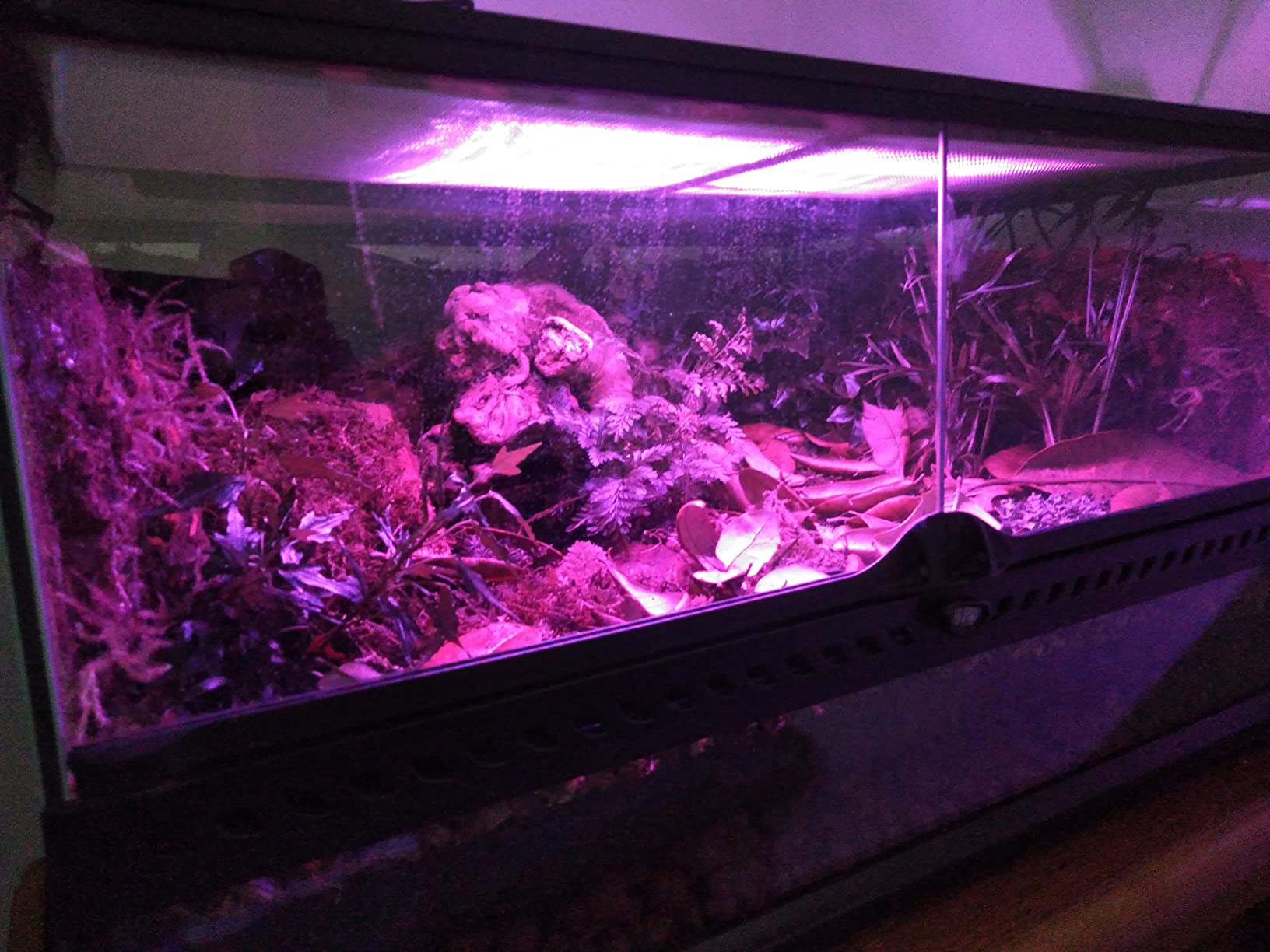
This is the only fixture here sold on the explicit promise of stimulating live plants and moss, and owners with pothos, moss and dart frog enclosures report growing results. The RGB array plus 6500K white gives you genuine control over spectrum and intensity rather than a fixed horticultural curve.
The 11 preset weather effects, including storm and lightning simulations, are the feature people either love or shrug at. They add naturalistic variation to a display vivarium, and for a planted tank where you are not observing at night, the effect on plant growth is minimal.
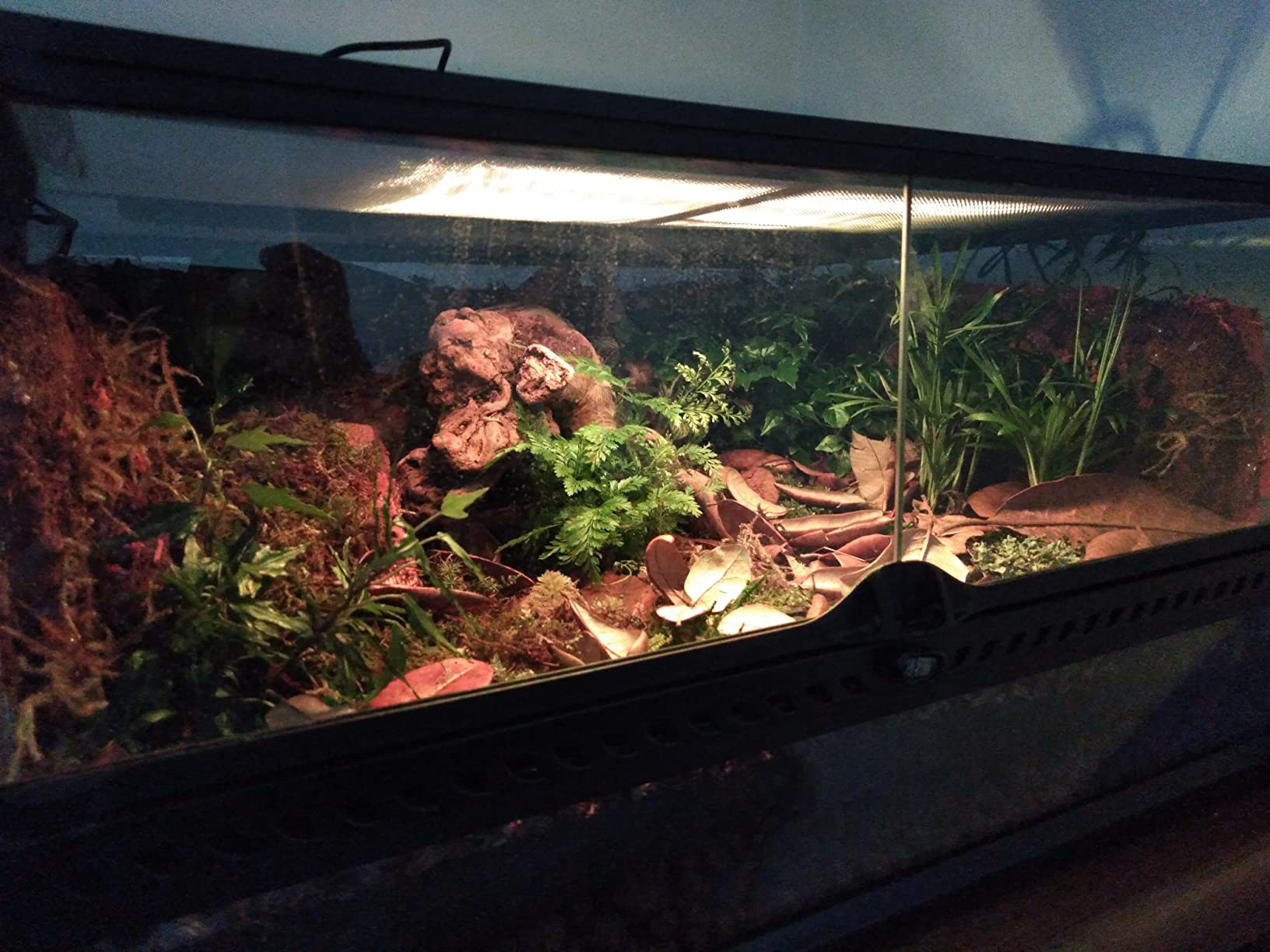
The IP54 rating is a genuine advantage over everything else in this roundup. In a dart frog or paludarium setup with daily misting, an IP54 fixture removes a category of anxiety that the other bars cannot answer.
It weighs 1.1 pounds and stays cool, so it will not load a screen lid. The adjustable arms on the remote-controlled mount make it easy to angle output at a specific planting area.
What Do the Weather Effects Actually Add?
For a planted enclosure, marginal. Plants respond to total daily light exposure far more than they respond to a cloud passing overhead. Where the effects do help is behavioral: varied light in a display vivarium makes animals behave more naturally and makes the enclosure look less like a lightbox.
Reviewers are split on this, and many say they leave the presets alone after the first week. If you are buying for plant growth, look at the RGB plus white output and the intensity control instead.
Remote-Only Control and Depth Coverage
The most-cited flaw is that there is no physical on-off switch on the lamp itself. Control runs through the remote, and several reviewers report that a dead remote battery locks them out of most functions. That is a real single point of failure in a setup you cannot reach easily.
The 120-degree dispersion covers width well but not depth, so an 18-inch-deep tank needs a second fixture. Mount it toward the front third rather than centered to improve even coverage.
8. BoostGro 3ft 20W Plant Grow Bar – Best Budget Plant Bar for Long Enclosures
BoostGro 3FT LED Succulent Terrarium Plant Grow Light Linkable Full Spectrum Daylight with Enhanced 660nm Red and 450nm Blue LightTech Indoor Lighting Fixture (3 FT)
20W
2400 lumens
36 micromol per second
5000K plus red and blue
Pros
- Red and blue enhanced spectrum for low-light plants
- Linkable to cover a longer enclosure
- Runs cool and mounts by hanging or screw
- Strong lumen and PPF output for the wattage
- Three year limited warranty
Cons
- General indoor grow format rather than a slim vivarium bar
- Plastic housing instead of aluminum
- Inline switch only with no timer or dimming
- About 9 percent of reviews are one star
At 2400 lumens and 36 micromol per second from 20 watts, this bar delivers more plant-directed output per dollar than anything else here. The 660nm red and 450nm blue enhancement sits on top of a 5000K full spectrum base, which lands it in the range most low-light vivarium plants want.
The linkable design is what makes it interesting for vivariums. Units daisy-chain up to four per power circuit, so a 4-foot planted enclosure can be lit by two bars without a second outlet. Hanging cables and screw-mount hardware are included.
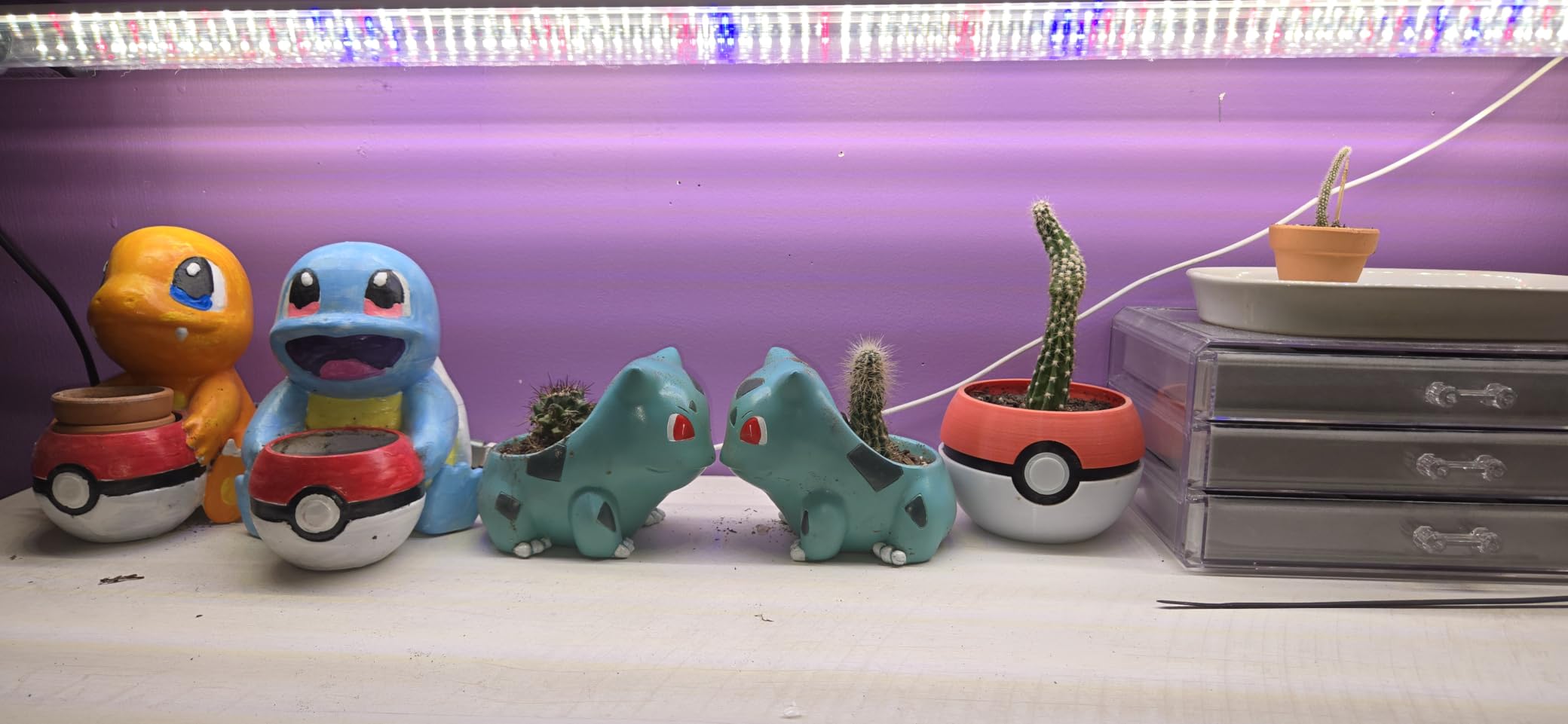
Reviewers buying it for succulents, moss and other low-light plantings point at the enhanced red and blue channels as the deciding feature, and note that units link cleanly to cover a longer footprint while staying cool.
The trade-offs are honest. This is a general indoor horticultural fixture in a plastic housing, not a purpose-built slim vivarium bar. It looks like equipment from a grow closet, and it lacks any dimming or timing beyond an inline switch.
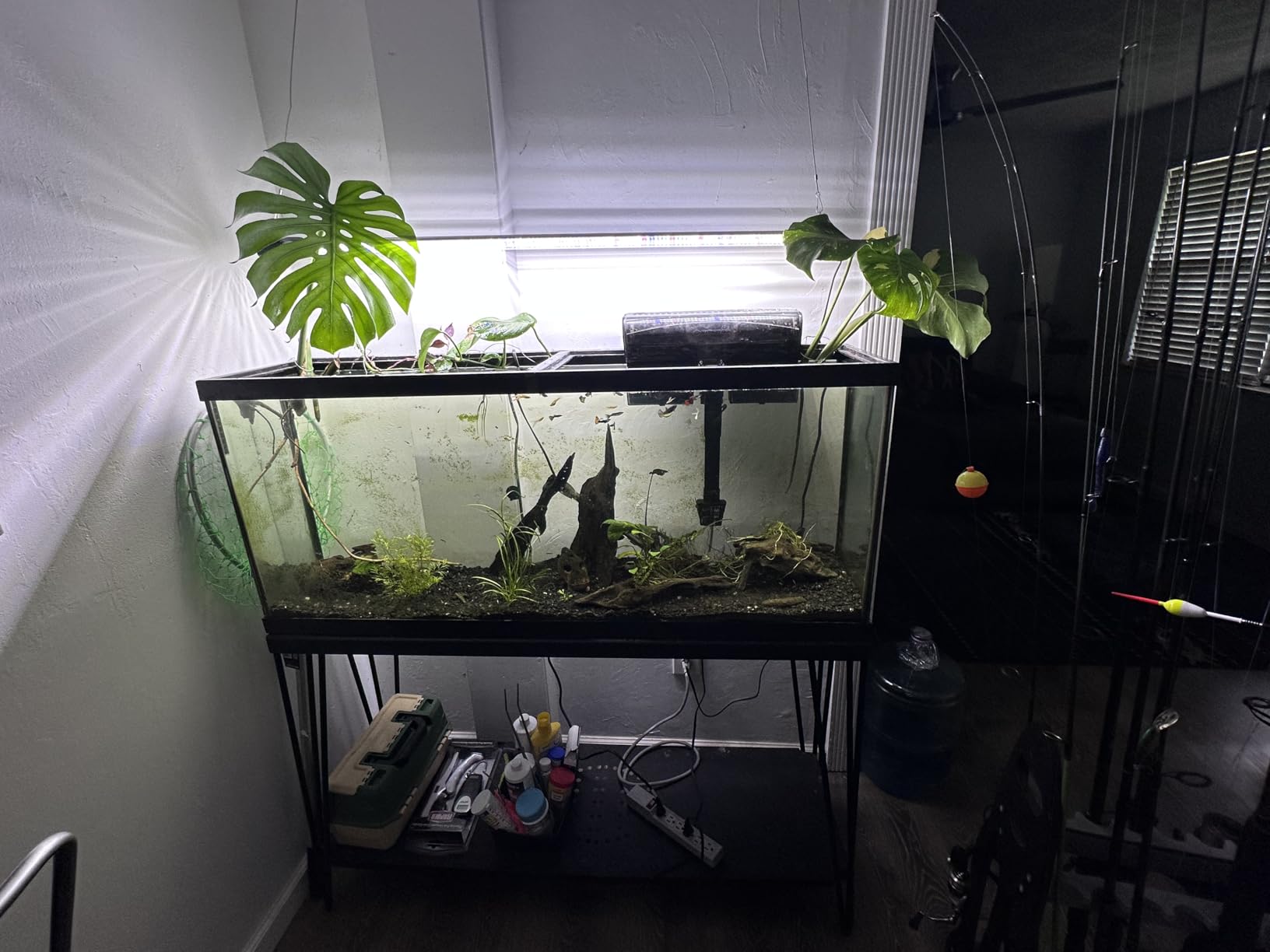
Can Linkable Bars Cover a Wide Vivarium?
Yes, and this is where the design earns its place. Most single bars run 18 to 24 inches, which leaves the far corners of a 4-foot vivarium dark. Linking two units to a 6-foot total run changes that, and one power outlet is enough for the pair.
Since there is no integrated timer, budget a plug-in timer for each circuit, or a single timer feeding both. That is the extra gear nobody mentions in the listing and everybody needs.
Horticultural Bar Versus Vivarium Bar Form Factor
A plant grow bar is built to be efficient at photosynthesis. A reptile light bar is built to look natural and to be safe to look at from close range through glass. The BoostGro prioritizes the first, so its 5000K base with boosted red and blue reads a little more horticultural than a keeper used to pure white may like.
For a display vivarium where the animal is nocturnal and rarely seen in daylight, that is a fair trade. Mount it above the canopy and let a dimmer ambient fixture handle visible illumination.
9. Arcadia Jungle Dawn 18.5in LED Bar – Best for Driving Plant Growth
Arcadia Jungle Dawn LED Bar 18.5″ Long 22 Watts High Lumen Output – High Output LED Light Bars for Reptiles, Terrariums, Plants and Indoor Use, Long Lasting Easy to Use Natural Plant Grow Lighting
22W at 138 lumens per watt
18.5 inch bar
138 lm per watt
Low heat
Pros
- Strong even illumination that fills dark areas of a tall enclosure
- Visibly accelerates plant growth
- Runs cool enough for continuous timer operation
- Slim low-profile bar
- Long service life in continuous use
Cons
- Very bright for light-sensitive species such as crested geckos
- 18.5 inch length overhangs an 18 inch enclosure
- Switch sits near the plug end rather than at the fixture
- Cool-toned output rather than warm
Twenty-two watts at 138 lumens per watt across 22 sources is a serious horticultural number, and owners of planted vivariums, dart frog tanks and carnivorous plant setups consistently report strong plant growth and a clear jump in visibility compared with cheaper bar lights.
The low heat generation is what separates it from a fluorescent array of similar output. It can run on a timer all day without contributing meaningfully to enclosure temperature, which means your thermostat still has to do all the thermal work alone, and that is how you want it.
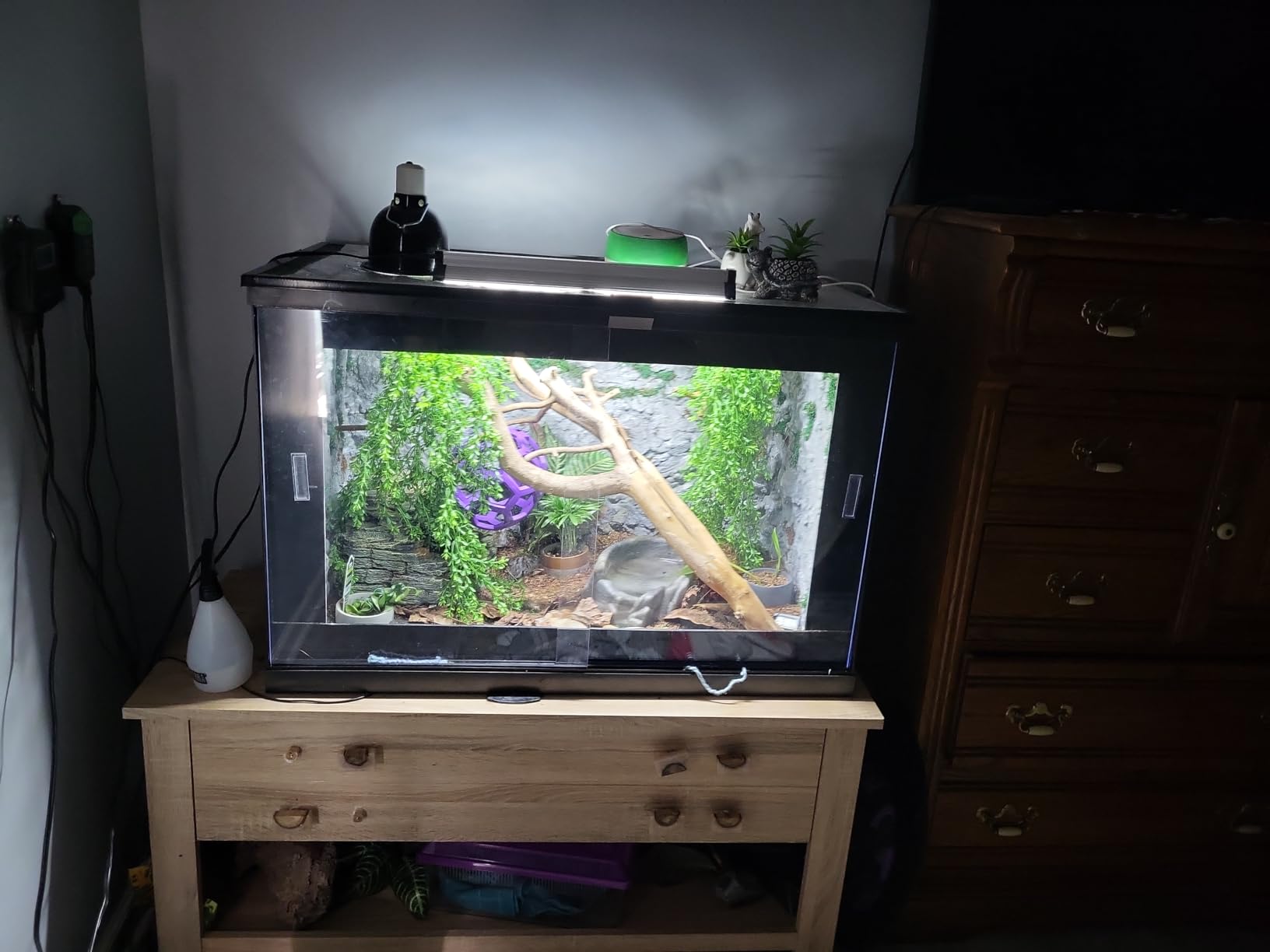
Durability is a repeated theme. One buyer reports running the same bar for over two and a half years, and a zero percent one-star share in the ratings distribution is a good sign for a lighting product that many competitors cannot match.
The slim 18.5-inch profile fits above a standard 18-inch terrarium, though it overhangs slightly at the edges. Touch control with the switch near the plug end of the cable is the one ergonomic annoyance.
Do Plants Actually Respond to This Bar?
Yes, and this is the fixture keepers report the fastest visible response from. If your planting is deep enough to struggle with low-output bars, the lumen-per-watt figure and the even spread across an 18-inch footprint are what push growth past the leggy stage.
It is a one-year manufacturer warranty, so factor bulb replacement into your planning further out than you would with an LED bar carrying a longer rating.
Brightness Versus Light-Sensitive Species
This is the reason it does not win outright. The output is bright and cool-toned, and crested gecko owners in particular report it being too much without dimming. A crested gecko enclosure is better served by the dimmable fixtures earlier in this list.
If your animal is diurnal, bold and active, brightness is a feature. If it is crepuscular or light-shy, put this bar on a dimmer.
10. AREPK 9W 6000K Gooseneck Lamp – Best for Nano Vivariums
AREPK Aquarium & Terrarium Light Full Spectrum LED, Timer Auto On/Off, for Under 7 Gallon Fish Tanks, Betta Tanks, Moss, Succulents, Carnivorous Plants, Miniature Landscapes
6000K full spectrum
9W
USB powered
Remote timer
Gooseneck head
Pros
- Remote auto on-off removes the need for an external timer
- 360 degree gooseneck aims light at a specific planting
- Bamboo base doubles as a natural platform
- USB powered so it runs from any USB port
- Waterproof rated
Cons
- Sized for tanks under 7 gallons so it is small for most vivariums
- 9W output will not sustain demanding plants alone
- Frequent USB power cycling concerns for long unattended use
A gooseneck solves a problem no bar in this roundup solves. In a nano tank with a specific planting mound, you can aim the head directly at that patch instead of flooding the whole enclosure, and the 360-degree adjustment makes a 6000K full spectrum wick behave like a targeted accent light.
The solid bamboo board base does double duty. It weighs the lamp down so it will not tip, and it reads as a natural piece of hardscape rather than equipment. The package includes the lamp, the base, a manual, a 5V adapter and adhesive bumper pads.
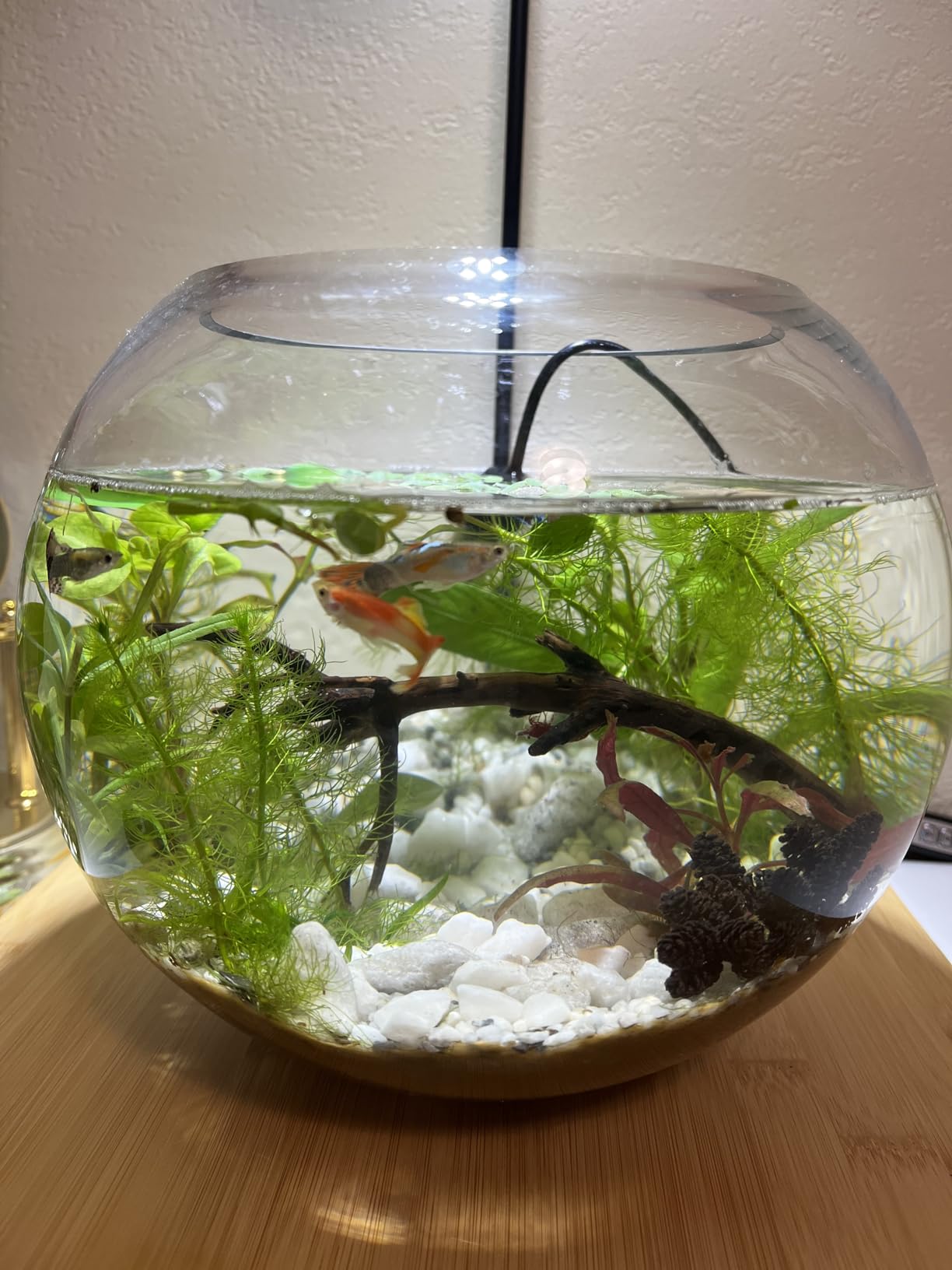
The remote auto on-off timer is the feature reviewers mention most. In a nano setup the light is often a supplementary accent rather than the main source, so being able to schedule it independently of the main fixture is genuinely useful.
Waterproof construction and a 50-inch USB cord on a 5V supply make it safe around misting and flexible enough to reach a corner. Our picks for the best reptile tanks include plenty of enclosures this size.
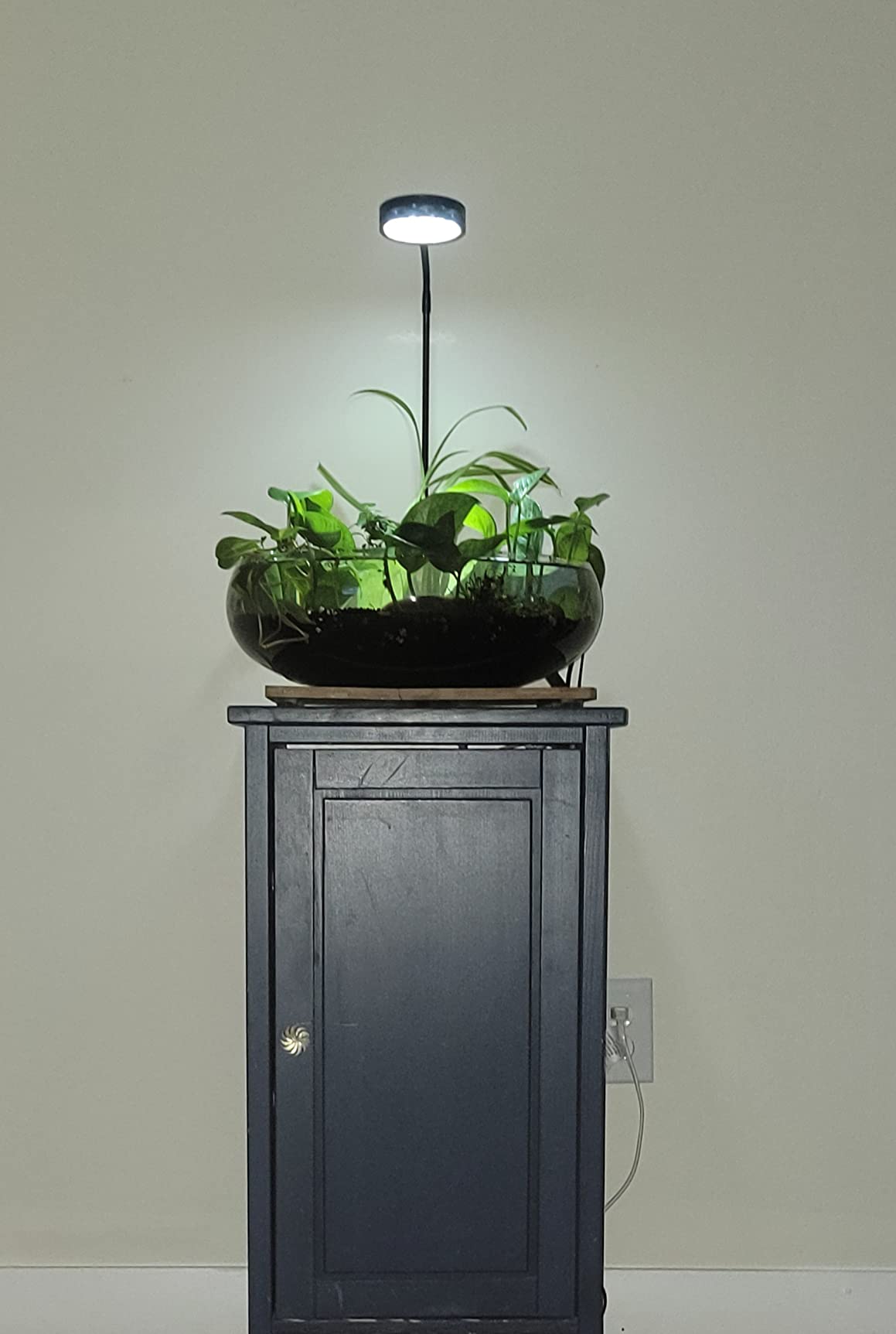
Can a Nano Lamp Cover a 12 Inch Vivarium?
Comfortably, yes. This is designed for tanks under 7 gallons, and at 9 watts the head sits close enough to a small planting to make a visible difference. For moss, succulents and miniature landscapes it does the job without a second fixture.
Step up to a 12-watt bar like the Pawfly for a 12-inch enclosure with taller planting, and step up again to a 20 to 24 watt horticultural bar for anything 18 inches deep or wider.
USB Power and Timer Dependence
USB power is a genuine convenience in a misted nano setup with limited outlets, and being able to run from a power bank is a real advantage. The tradeoff is that cheap USB power delivery can cycle frequently, and reviewers raise that as a concern for long unattended use.
The one-year warranty and remote-only control are modest. If you want automated scheduling, the built-in timer handles it, but budget a replacement remote as a likely eventual purchase.
11. AquaSprouts 2ft 24W Horticultural Bar – Best for 24 Inch Terrariums
AquaSprouts 2ft Horticultural LED Grow Light Bar, 24W High Output White, Full Spectrum 6400K for Indoor Gardening, Bioactive Terrariums & Vivarium/Paludariums
24W
2640 lumens
6400K
48 light sources
Pros
- Owners report rapid plant growth after installation
- Aluminum heatsink housing keeps heat and output even
- Linkable to 8 fixtures from one outlet
- Chains and mounting hardware included
- Sized for standard 24 inch mesh-top terrariums
Cons
- No dimming and no timer
- Several reviews report fixtures arriving dead or failing to power on
- Customer service responsiveness questioned
- 2-foot length limits coverage on wider enclosures
This is the only fixture in the group explicitly marketed for bioactive terrariums and vivarium or paludarium setups, and it is the highest-lumen-per-watt horticultural bar in the roundup at 2640 lumens from 24 watts. At 6400K it sits essentially on the 6500K target with 48 sources along a brushed aluminum heatsink.
Owners report growth that they describe as exponential after installation, particularly in gecko and lizard enclosures. The aluminum heatsink is not just a durability detail, it is what keeps output even as the bar warms, which is exactly the failure mode that knocks plastic housies down over a year.
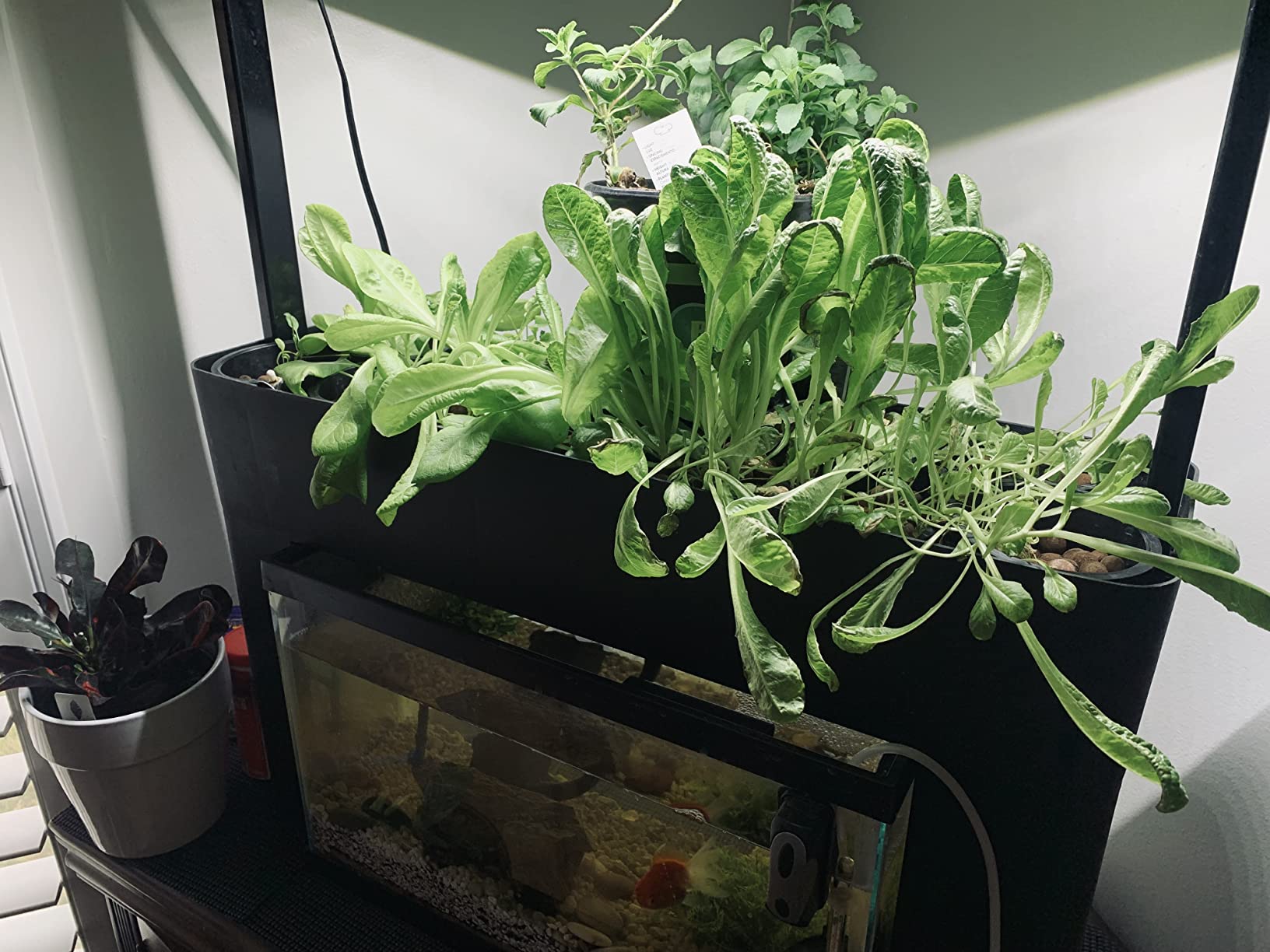
Link connectors allow up to eight fixtures on a single power outlet, and chains and hardware are included for suspending the bar over an open vivarium. For a 4-foot enclosure you would use two bars, and for a 6-foot run, three.
The critical pattern is manufacturing and support. Several reviews describe fixtures arriving dead or simply not powering on, and one reviewer reports repeated unanswered support emails. At 11 percent one-star, that is the highest failure rate in this group.
Is 2640 Lumens the Right Target for a 24 Inch Enclosure?
It is a strong starting point for a 24-inch-wide planted terrarium, and it gives you headroom to dim later if you add an inline dimmer. Lux falls off with distance, so mount the bar as close above the canopy as the enclosure allows rather than at the very top.
For a 36-inch-tall vivarium, one bar at this output will light the top beautifully and leave the substrate dim. That is where two bars, one forward and one back, stop being optional.
First-Time Failures and the Missing Timer
Test the fixture the day it arrives, before you hang it. With a documented pattern of dead-on-arrival reports, that five-minute check saves a return.
There is no dimming and no timer, so add a plug-in timer and, if your species needs it, an inline dimmer. The 2-year warranty is a point in its favor, but only if you are willing to claim it.
12. NEPTONION LED UVB Lamp with Timer – Most Scheduling Control for a Single Fixture
NEPTONION LED UVB Reptile Lamp, Adjustable LED Terrarium Light with 3 Modes, 5 Brightness Levels, 4/8/12H Daily Cycle Timer, Long-Life for Small to Medium-Large Reptiles Such as Bearded Dragons
3 controller modes
5 brightness levels
4 8 or 12 hour timer
UVB around 300nm
Pros
- Built-in daily cycle timer removes an external timer
- Three modes can drop UVB entirely for night periods
- Five brightness levels plus adjustable mounting distance
- Four mounting options including mesh tops and wooden ceilings
- Long rated UVB and LED module lifetimes
Cons
- Not a basking heat source so a separate heat lamp is needed
- Lowest average rating in this group
- Plastic housing rather than aluminum
- UVB module output declines over its rated life
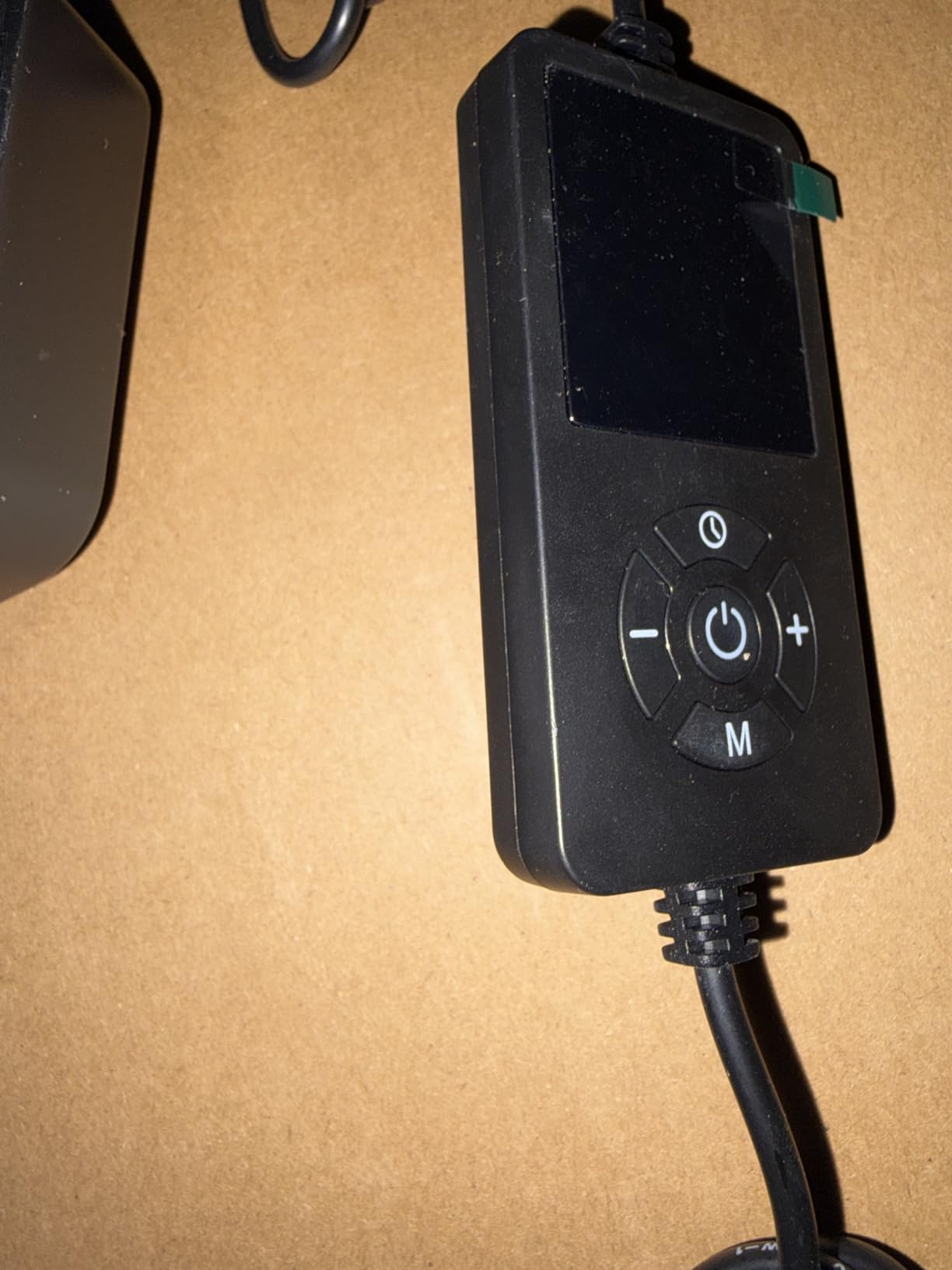
The control granularity is the reason to look at this one. Three controller modes covering LED with UVA and UVB, UVA and UVB, and LED only, combined with five brightness levels and a built-in 4, 8 or 12 hour timer, let you build a full day-night schedule without buying a single accessory.
Being able to remove UVB entirely at night is the detail that separates it. Many compact UVB lamps force the same spectrum all day, which is less than ideal for a nocturnal animal in a planted setup where you want moonlight-level visibility.
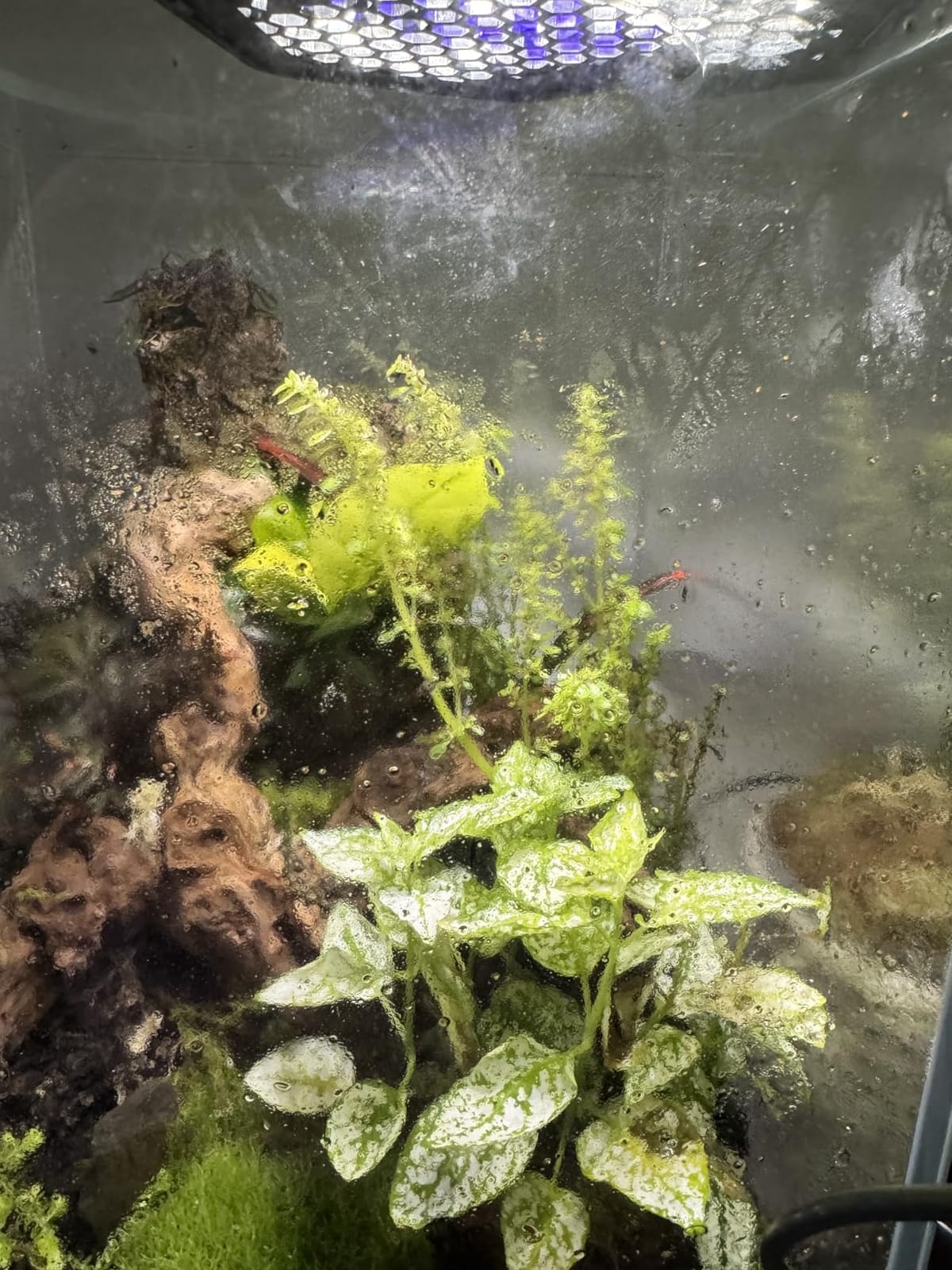
The independent UVB module outputs around 300nm, and rear heat vents help manage temperature inside the housing. At 4800K the visible light is slightly warmer than the 6500K target, so you would pair it with a cooler white bar rather than rely on it alone for plant color.
Mounting hardware is unusually complete: spring hooks, a screw-down support, expansion bolts and Z-brackets cover mesh tops, under-mesh hanging and wooden ceilings. The UVB module is rated 8,000 hours and the LED rating is 20,000 hours.
Does a Built-In Timer Replace an External One?
For a single fixture, yes, and that removes a cheap accessory from the list. Choose 12 hours for a standard summer photoperiod, 8 hours for a shorter cycle, and 4 hours for a low-light planted niche that needs a smaller daily dose.
It does not replace a timer for the rest of your system, so a planted vivarium still needs an external timer for the plant bar.
Output Decline and the 4.0 Average
This fixture carries the lowest average rating in the group at 4.0, and the distribution shows a wider band of mixed experiences than the others, with 10 percent one-star. The plastic housing is part of it, and the expected decline of the UVB module across its 8,000 hour rating is the other half.
Budget for UVB module replacement inside that horizon, and verify output with proper equipment rather than a card. If you want a fixture you will not have to think about, the aluminum-bodied UVB bar earlier in this list is the safer bet.
How to Size a Fixture for Your Vivarium
Match fixture length to enclosure width first, then check depth. Lux falls off with distance in roughly inverse proportion, so a bar that looks strong at 12 inches may be marginal at 30.
Up to 12 inches wide, nano and 10 gallon class: a gooseneck accent light or a 6W to 11W bar. These work because the distance from fixture to substrate is short.
12 to 18 inches wide: a 15 to 18 inch bar. Aim the fixture at the canopy rather than the top of the enclosure to keep lux at plant level high.
18 to 24 inches wide: a 24 inch horticultural bar at 20W to 24W. This is the sweet spot for most planted terrariums and where the 2400 to 2640 lumen figures land.
24 to 36 inches wide: two bars, front and rear, or one long bar plus a lower-mounted accent. Enclosure width beyond a standard 24 inches is where most owners first run out of coverage.
36 inches tall or deeper: plan for two bars at staggered heights. A single high-mounted bar cannot deliver useful light to the substrate in a deep vivarium, and this is the most common reason a planted setup looks healthy at the top and dead at the bottom.
4 feet wide or wider: two to three linkable bars. Every linkable model here chains from a single outlet, which keeps the wiring simple.
Mount as close above the canopy as the enclosure allows. Lux is the number that matters, and distance is the cheapest way to change it. If you want a comparison of how lumens translate in an aquatic context, our guide to the best LED lights for planted aquariums covers the same physics in a different enclosure.
One Dual-Function Fixture or Two Separate Lights?
Most planted vivariums need two lights, and keepers converge on this quickly once they have tried the single-fixture route. One source handles UVB for the animal’s calcium metabolism. A second, brighter source handles photosynthesis for the plants.
The reason a single fixture underperforms is physical. A UVB source concentrates its output into a narrow beam, which is right for an animal basking under a dome and terrible for a canopy that needs even coverage. It also concentrates heat in the same spot, which is how compact bulbs end up scorching the leaves nearest them.
A dual-function white bar like the Jungle Dawn covers the plant side beautifully but provides no meaningful UVB, so it cannot be the only light for a UVB-requiring species. The honest framing is that every fixture in this roundup solves one half of the problem, and only the two-light architecture solves both.
The exception is a species with no UVB requirement. An amphibian, a nocturnal gecko or an invertebrate can run on a single good white bar with a night channel, and spending on a UVB source it never uses is wasted. Our guide to circadian versus human-centric lighting goes deeper on why a day-night cycle matters to the animal rather than just the display.
Color Temperature, Blue Light and Night Cycles
Aim for 5200K to 7000K and treat 6500K as the default. Below roughly 5200K the output gets warm and amber, which is pleasant to look at but weaker on the red end of the chlorophyll absorption band. Above 7000K you gain blue at the cost of a colder, harsher look that keepers tend to find tiring.
Fixtures in this roundup sit across that range deliberately. The 5000K horticultural bar trades a little warmth for stronger blue and red channels, which suits low-light plants. The 6000K gooseneck lands near ideal for nano setups. The 6400K and 6500K bars are the direct hits.
Use blue for night, not for day. The 465nm night channels on several fixtures here are meant for a brief moonlit viewing window, and running them for hours is a different proposition than running daylight. Keep the night window short and dim.
Dimming is the feature most worth paying extra for. A stepless dimmer lets you stage a dusk rather than a switch, which supports a natural photoperiod and keeps light-sensitive species comfortable after dark. If a fixture has no dimming, an inline dimmer is a cheap addition.
Heat, Mounting, Timers and What Not to Buy
Every LED in this roundup runs cool compared with a fluorescent or an incandescent, which is why none of them can be your basking lamp. In a planted enclosure, that is a feature. A basking lamp is a leaf-scorching risk in a bioactive setup as soon as plants grow upward, and several keepers report exactly that problem.
Watch ventilation anyway. A sealed glass vivarium traps heat, and a fixture running a 12-hour photoperiod adds to it even at 15W. Leave clearance above the bar and keep humidification output away from the housing.
On mounting: mesh tops take bracket mounts and spring hooks without much fuss. Solid-top and PVC enclosures need the included chains, screw hardware or Z-brackets, and all of them are covered in the models above. Screen-top and PVC fixtures are where bracket fit becomes a genuine problem, so check what hardware ships in the box before you buy.
Fluorescent T5 HO and T8 are still fine, particularly T5 HO for UVB delivery, but they dim over time and shift color toward green, which forces a replacement on a schedule you did not plan for. An LED fixture with a 20,000 hour rating removes that recurring cost entirely. T5 HO outperforms T8 on output and fixture life, so if you are choosing a fluorescent, choose the thinner tube.
What not to buy: a compact UVB bulb as your only plant light, an unmarked purple or blue grow LED strip with no published spectrum, and any fixture with no published color temperature or output figures. Purple-hued grow lights also wash an enclosure in an unnatural color that is widely considered hard on reptile eyesight. If a listing will not tell you the Kelvin rating or the output, treat that as the answer.
Finally, budget the gear nobody lists. A plug-in timer for any fixture without one, a second bar for anything over 24 inches wide, an inline dimmer for light-sensitive species, and a proper UVB meter if you are managing a UVB-dependent animal. Those four items decide whether a lighting setup actually works.
Frequently Asked Questions
What type of light is best for a planted terrarium?
A full-spectrum white light between 5200K and 7000K, ideally around 6500K, with real output in both the 430-460nm blue band and the 640-670nm red band. That spectrum matches where chlorophyll absorbs most efficiently, keeps foliage colors true, and lets your animal see in full color. A UVB lamp alone will not drive photosynthesis across a canopy.
Are plant grow lights safe for reptiles?
Yes, when you choose a white full-spectrum fixture rather than a purple-hued one. White horticultural LEDs around 5000K to 6500K are fine for reptiles, and they emit very little heat compared with fluorescent tubes. Two cautions: bare blue and red diode strips look unnatural and are hard on animal eyesight, and a compact UVB bulb aimed at foliage will scorch leaves.
Is T5 or T8 better for reptiles?
T5 HO is the better fluorescent format. It is a thinner tube, so more of the light reaches the animal and the plants, and the output holds up longer. T8 tubes are cheaper but spread less light per watt. That said, a modern LED bar beats both on efficiency and on rated service life, since a fluorescent tube dims and shifts toward green and eventually needs replacing.
Is 5000K or 6500K better for plants?
6500K is the better all-round choice for a planted terrarium, and 5000K works well when the fixture adds enhanced red and blue channels. Below about 5200K the output goes amber and loses red-end punch that chlorophyll needs. Above 7000K you gain blue but get a cold, harsh look that many keepers find tiring to view.
Do reptiles require UVA or UVB light?
It depends entirely on the species. UVB is required for vitamin D3 synthesis and proper calcium metabolism, so it is non-negotiable for bearded dragons, chameleons, dart frogs, many day geckos and most tortoises. Nocturnal species and some invertebrates have no documented UVB requirement. UVA supports vision, coloration and natural behavior across the board, so it is worth providing even where UVB is not.
How many watts should a reptile light be?
For a 12 to 18 inch planted terrarium, 15 to 18 watts is the useful range. For 18 to 24 inches, step up to a 20 to 24 watt horticultural bar delivering 2400 to 2640 lumens. Enclosures over 24 inches wide need two bars, and a 36 inch-tall vivarium needs two at staggered heights because lux at the substrate falls away fast.
What is the best light for a deep planted tank?
Two bars at staggered heights rather than one bar mounted at the top. A single high-mounted fixture delivers usable light to the canopy and almost none to the substrate, which is the most common reason a deep planted vivarium looks healthy at the top and dies at the bottom. Mount the forward bar low and close to the canopy to protect that lower layer.
The Best Lighting Picks for Every Kind of Vivarium in 2026
For most planted setups, the REPTI ZOO 6W day and night hood is the one to start with. It gives you a 6500K day channel, a blue night channel and stepless dimming in a housing light enough for a mesh top, and it is the most thoroughly reviewed fixture in this roundup.
Match it to the animal. Diurnal species with real UVB needs want the REPTITRIP 8-inch bar for its UVI presets and built-in timer. Arboreal and amphibian tanks want the 15W ultra-thin bar for its dimming range and zero heat. Nocturnal species and amphibians want the Exo Terra PT2336 and nothing else, since it adds no heat to fight your thermostat. Dart frog and paludarium setups want the TerraSky for its IP54 rating.
For plants, size by width and depth. The 24W AquaSprouts bar and the 22W Jungle Dawn bar are the strongest single fixtures for an 18 to 24 inch planted terrarium, and the 20W linkable bar covers wider enclosures on a budget. Anything deeper than 30 inches takes two bars.
Whichever route you take for the best reptile enclosure lighting for planted vivariums, run it on a timer, mount it close above the canopy, and keep basking lamps away from foliage. Those three habits matter more than the model on 2026‘s shelf.