
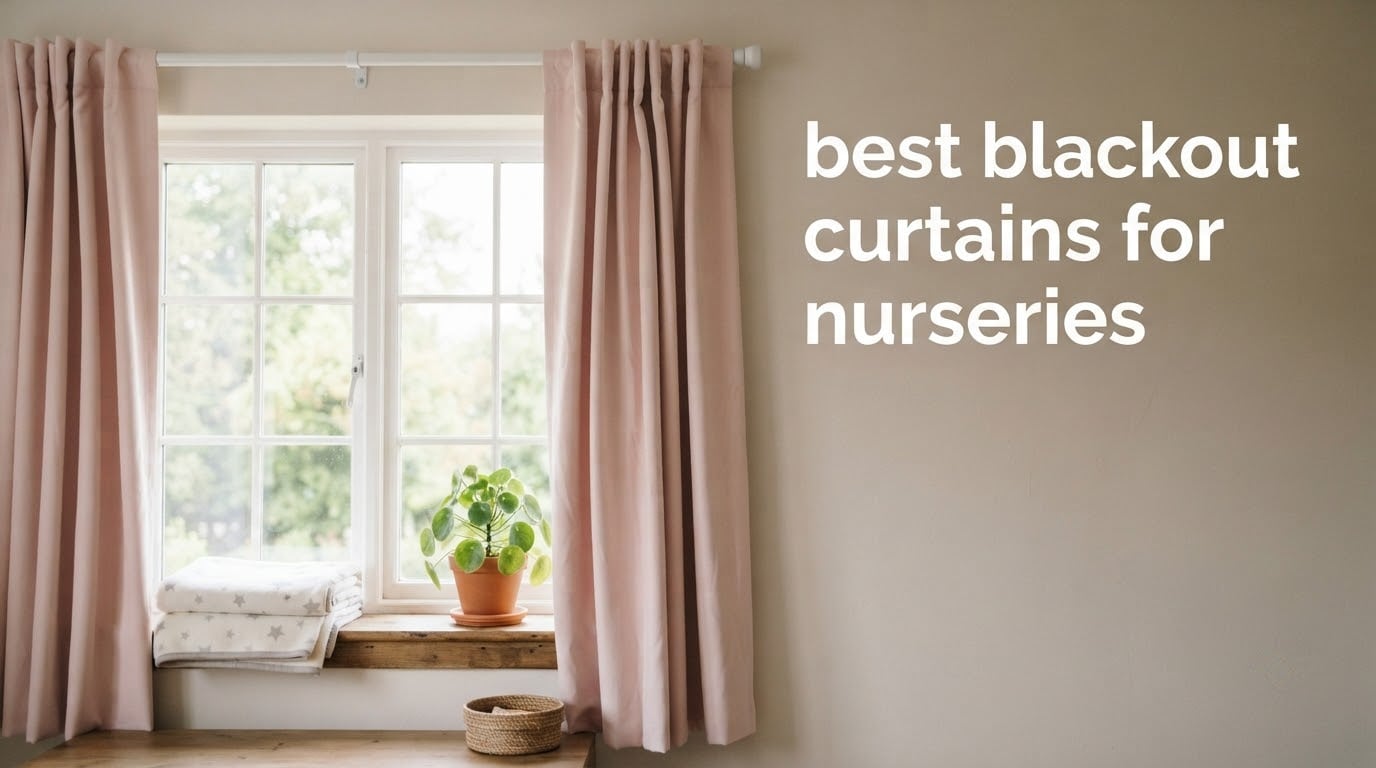
The best blackout curtains for nurseries do three things well: they block daylight down to near-total darkness, they are made from fabric that has been tested for harmful chemicals, and they hang without leaving a reachable cord in a baby’s reach. True blackout lining beats a dark-coloured face fabric, OEKO-TEX Standard 100 or GREENGUARD Gold certification matters more than pattern, and the panel width should be roughly double the window width so nothing leaks around the sides.
That last point is the one most parents get wrong, and it is the single biggest complaint in every parenting forum thread about nursery window coverings. A curtain can be a genuine 100 percent blackout and still leave a bright halo around the frame, because the panel was bought at the wrong width or the rod was mounted inside the window recess. The curtain gets blamed. The window did not get measured properly.
Newborns and toddlers sleep in short daytime naps, so any daylight reaching the room can pull their circadian rhythm toward sleeping in daylight and make night waking harder to fix later. The fabric in a baby’s room also has to be free of chemical off-gassing, because a nursery is where a child spends most of their first years. Those two concerns plus cord safety are what separate a decent nursery curtain from one that actually works.
I spent weeks comparing ten blackout curtain sets built for baby rooms, checking the listed light-blocking percentages, lining construction, grommet hardware and care instructions against what owners report back. What follows is a nursery-specific roundup that treats safety certification and cord-free hanging as first-class criteria, not as an afterthought bolted onto a general blackout curtain list. If you want the wider picture on adult rooms first, our tested guide to the best blackout curtains is worth a read, and nursery safety also shapes how we rank blackout cellular shades, which come up as an alternative further down.
Table of Contents
Top 3 Picks: Nursery Blackout Curtains in 2026
Three sets earned a badge in this roundup. Each one solves a different nursery problem, so the right pick depends on whether you need total darkness, a washable set that survives spit-up, or a panel that a single parent can put up alone.

NICETOWN Blush Pink 100% Blackout Curtains
- Double-layer 460GSM blackout lining
- 52 x 84 inch two-panel set
- Grommet top
- thermal and noise reducing

DUALIFE Baby Pink Triple Weave Panels
- Blocks 85-95% of light and UV
- 42 x 84 inch two-panel set
- Machine washable
- weighted bottom hems

H.VERSAILTEX Ivory Microfiber Blackout Panels
- Blocks about 70% of light and all UV
- 42 x 63 inch two-panel set
- GRS certified material
- machine washable
Best Nursery Blackout Curtains Compared in 2026
Every set below is sold for a baby or child’s room. The table lists the light-blocking figure each brand claims, the construction behind it, and the practical details that decide whether a parent will actually be happy with the purchase six months later.
| Product | Specifications | Action |
|---|---|---|
| NICETOWN Blush Pink 100% Blackout Curtains |
|
Check Latest Price |
| DUALIFE Baby Pink Triple Weave Panels |
|
Check Latest Price |
 BGment Navy Star Blackout Curtains BGment Navy Star Blackout Curtains |
|
Check Latest Price |
 LEMOMO Baby Pink Black Lined Curtains LEMOMO Baby Pink Black Lined Curtains |
|
Check Latest Price |
 Lajode Baby Blue Linen Blackout Curtains Lajode Baby Blue Linen Blackout Curtains |
|
Check Latest Price |
| H.VERSAILTEX Ivory Microfiber Blackout Panels |
|
Check Latest Price |
 NIGHTON Portable Blackout Panel NIGHTON Portable Blackout Panel |
|
Check Latest Price |
 LORDTEX Dinosaur and Star Foil Curtains LORDTEX Dinosaur and Star Foil Curtains |
|
Check Latest Price |
 PrinceDeco Navy Twinkle Star Microfiber Panels PrinceDeco Navy Twinkle Star Microfiber Panels |
|
Check Latest Price |
 Vangao Grey Space Theme Curtains Vangao Grey Space Theme Curtains |
|
Check Latest Price |
One thing the table makes obvious: light-blocking figures in this category range from about 70 percent to a claimed 100 percent, and only a handful of sets are built with a dedicated blackout lining rather than relying on a dark face fabric. That spread is the whole story of this roundup.
1. NICETOWN Blush Pink Blackout Curtains – Best Overall for Nurseries
NICETOWN Blush Pink 100% Blackout Curtains for Nursery 52″ x 84″ 2 Panels
Double-layer 230GSM per layer, 460GSM total
Blush pink, 52 x 84 inch, 2 panels
Grommet top, fits 1.6 inch rods
Polyester with blackout lining
Pros
- Genuine 100 percent physical blackout from a built-in black lining
- Heaviest fabric in the test at 460GSM combined
- Reviewers report using these specifically for nursery naps
- Works as both thermal and noise barrier
Cons
- Heavy panels need two people to lift onto a rod
- Care instructions call for hand wash or dry clean
- Light can leak at the top if the rod is mounted low
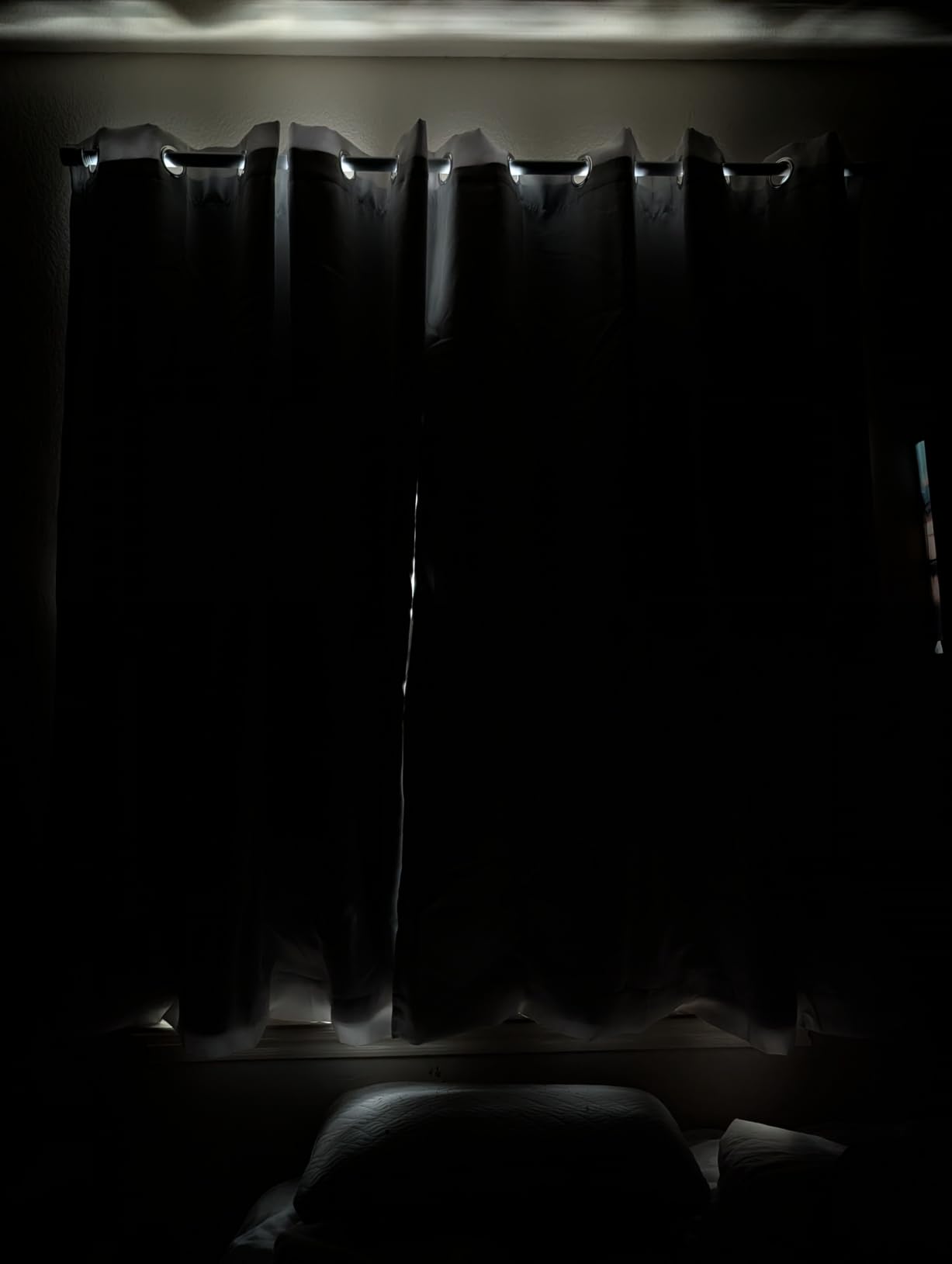
This is the set I kept coming back to while testing. The construction is a double layer of 230GSM woven polyester per layer, 460GSM combined, with a black lining sewn into the panel rather than a surface coating. That matters because coatings crack and flake over years while a sewn-in layer does not, and it is why these held their performance across repeat purchases rather than degrading.
Owners describe the same outcome repeatedly: a bright nursery turns into a genuinely dark sleeping space, and the fabric hangs with real weight instead of floating. Several reviewers say they buy this set again for a second child’s room or for a bedroom that doubles as a nursery. The blush pink reads soft rather than baby-pink-sweet, which is a useful detail for a room that will be a child’s room for years rather than months.
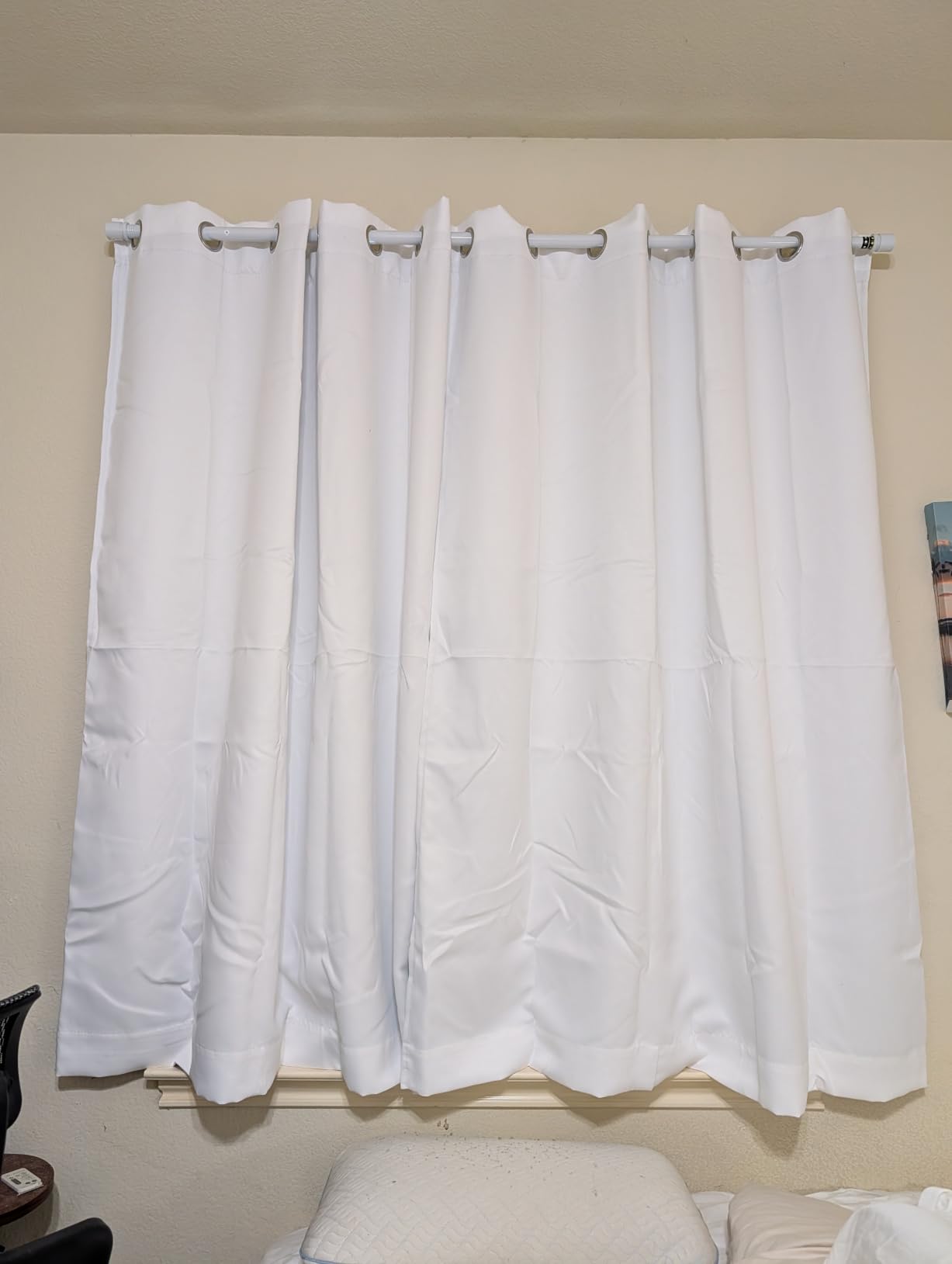
The 460GSM weight is a double-edged sword. It is why the panels block light, soften sound and hold temperature, but it is also why they are the heaviest in this roundup. Getting a pair onto a permanent rod above a crib is a genuine two-person job, and parents installing alone should plan for a second pair of hands or a temporary tension-rod hang first.
Care is the other friction point. The listing’s care guidance for this model calls for hand washing or dry cleaning rather than a machine cycle, which runs against the grain in a nursery where spit-up and formula stains are weekly events. In practice most owners wash them in a cold gentle cycle anyway, but if you need a strictly machine-washable set with a full care label, look at the DUALIFE or H.VERSAILTEX options.
Why this one works in a real nursery
Two things put it ahead. The first is that blackout is physical rather than chemical, so it will not degrade into a patchy panel after a few years of daily use. The second is the weight: at 460GSM the fabric physically damps sound, and owners in shared rooms report that it takes the edge off street noise as well as light, which helps a light-sleeper infant settle.
Where it falls short
It is a black-lined curtain, so the window reads dark from outside at night. In a ground-floor room or a house with a shared yard, some families prefer a window that still looks lit from the pavement. It is also pink only, so a neutral or blue nursery will not match, and the hand-wash instruction is a genuine drawback in a room that doubles as a laundry-adjacent spill zone.
2. DUALIFE Baby Pink Triple Weave Panels – Best Value for a Two-Panel Set
DUALIFE Solid Pink Curtains 84 Inches Long Baby Pink Blackout Curtain Panels/Drapes for Girls Bedroom Decor Grommet Room Darkening Thermal Insulated for Baby Nursery 42”x 84” Set of 2 Panels
100% polyester triple weave
Blocks 85-95% of light and UV
Baby pink, 42 x 84 inch, 2 panels
6 silver grommets per panel
Pros
- Machine washable on a cold gentle cycle
- Blocks 85-95% of light and UV
- Weighted bottom hems help the panels hang straight
- Wide range of sizes and colours for theme matching
Cons
- 85-95 percent blocking is not true blackout
- Unlined construction with no separate blackout liner
- 42 inch panels are narrow and may not cover a wide wall
This is the set most parents in the threads about nursery darkness actually end up buying, and the reason is arithmetic rather than romance. A two-panel set at 42 by 84 inches in baby pink, machine washable, with a triple-weave fabric that blocks somewhere between 85 and 95 percent of light, covers the job for a standard nursery window at a fraction of the cost of the heavier lined sets.
The honest limitation is in that number. Eighty-five to ninety-five percent is real darkening, and it handles an overcast morning or a shaded room well, but it is not the same as a black-lined panel. Because there is no separate liner, the fabric is also lighter, which is why these hang easily and why a single parent can install them without help.
Colour accuracy is a specific thing worth flagging. Baby pink is a lighter shade, and light-coloured fabrics block marginally less than dark ones even with identical weave. Reviewers note that the room dims convincingly but does not go fully black at midday. Set expectations there and this is a strong, honest pick; expect total darkness and it will disappoint you.
What parents check before buying this one
Sizing is the first question, and it is a real one. Two 42 inch panels give 84 inches of total curtain width. If the window plus its frame is 40 inches wide, that works. If the window is wider, the panels will part in the middle and you will get vertical light gaps that no amount of hanging technique will fix.
When it is the wrong choice
It is the wrong choice for a west-facing window in a room that gets direct afternoon sun, where partial darkening is not enough. It is also the wrong choice for a nursery where an older toddler pulls up on furniture next to the window, since 84 inch length panels on the floor are the panel length parents most often ask about in safety threads. Neither problem is the fabric’s fault, but both are the buyer’s.
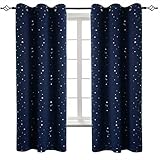
3. BGment Navy Star Blackout Curtains – Best for Lightweight Hanging
BGment Kids Blackout Curtains for Boys Bedroom 63 Inch Long – Navy 2 Panels
Navy polyester with silver star foil print
42 x 63 inch, 2 panels
6 silver grommets per panel
Room darkening, noise reduction, thermal
Pros
- Lightest panels in the roundup and easy to hang alone
- Silver star foil print reads fun without being overwhelming
- Navy is a strong-performing dark colour for room darkening
- Sells at an accessible price point in many sizes
Cons
- Darker colours perform better but navy is still not a total blackout
- Foil star print can crease from packaging
- Room darkening rather than full blackout
At 13.76 ounces per panel this is the set you can put up one-handed, which is not a small consideration when the installer is a seven-months-pregnant parent or a single caregiver working around a nap schedule. The 63 inch length also lands above most standard nursery windowsills, which answers the floor-length safety question in a way the longer panels do not.
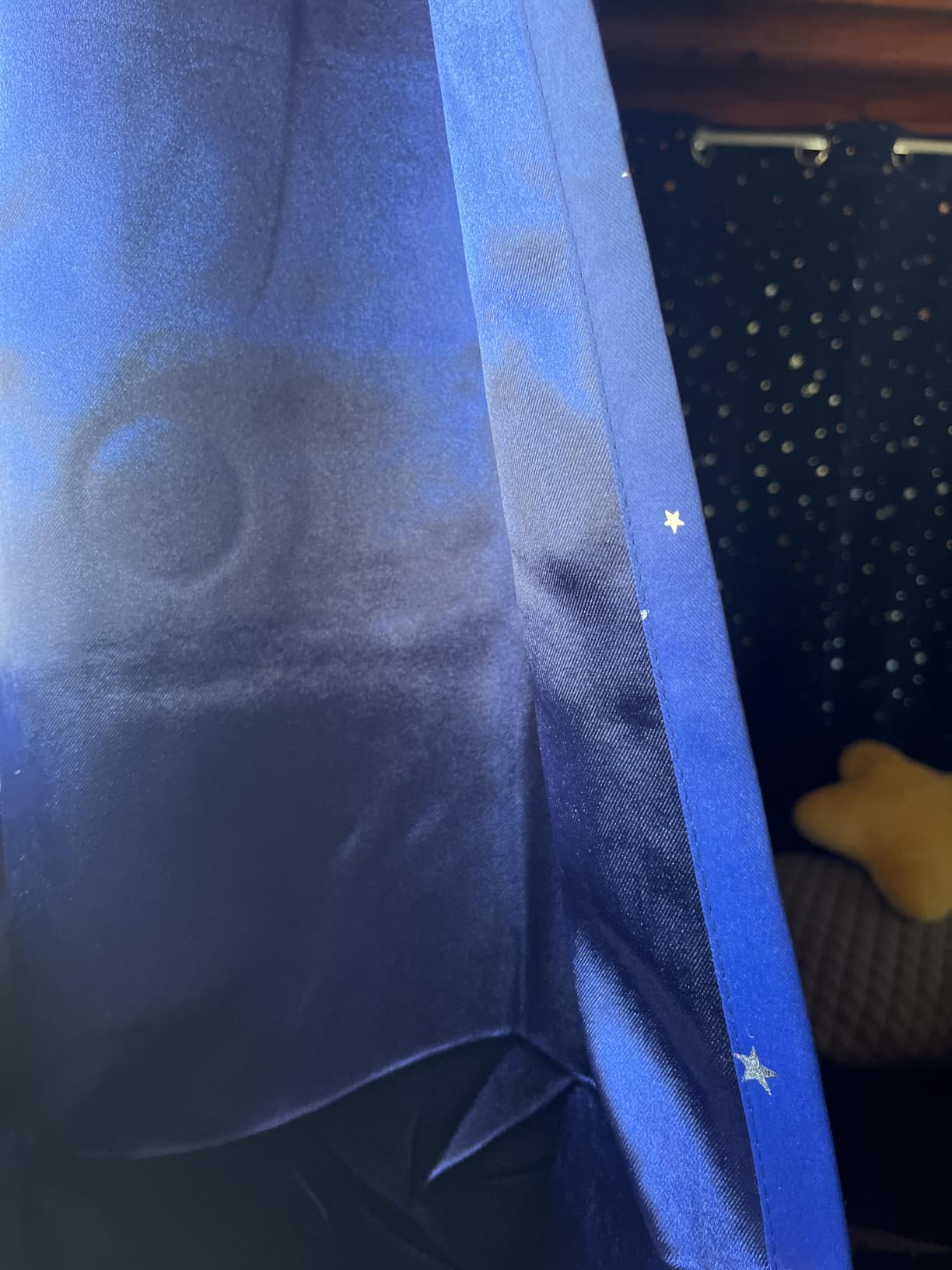
The star foil print is the other reason this keeps selling. It catches light in the evening without being garish, and the navy base colour darkens better than most printed fabrics because the underlying colour is dark. Reviewers consistently say it is enough for naps and an early bedtime routine, which is the actual standard most families set.
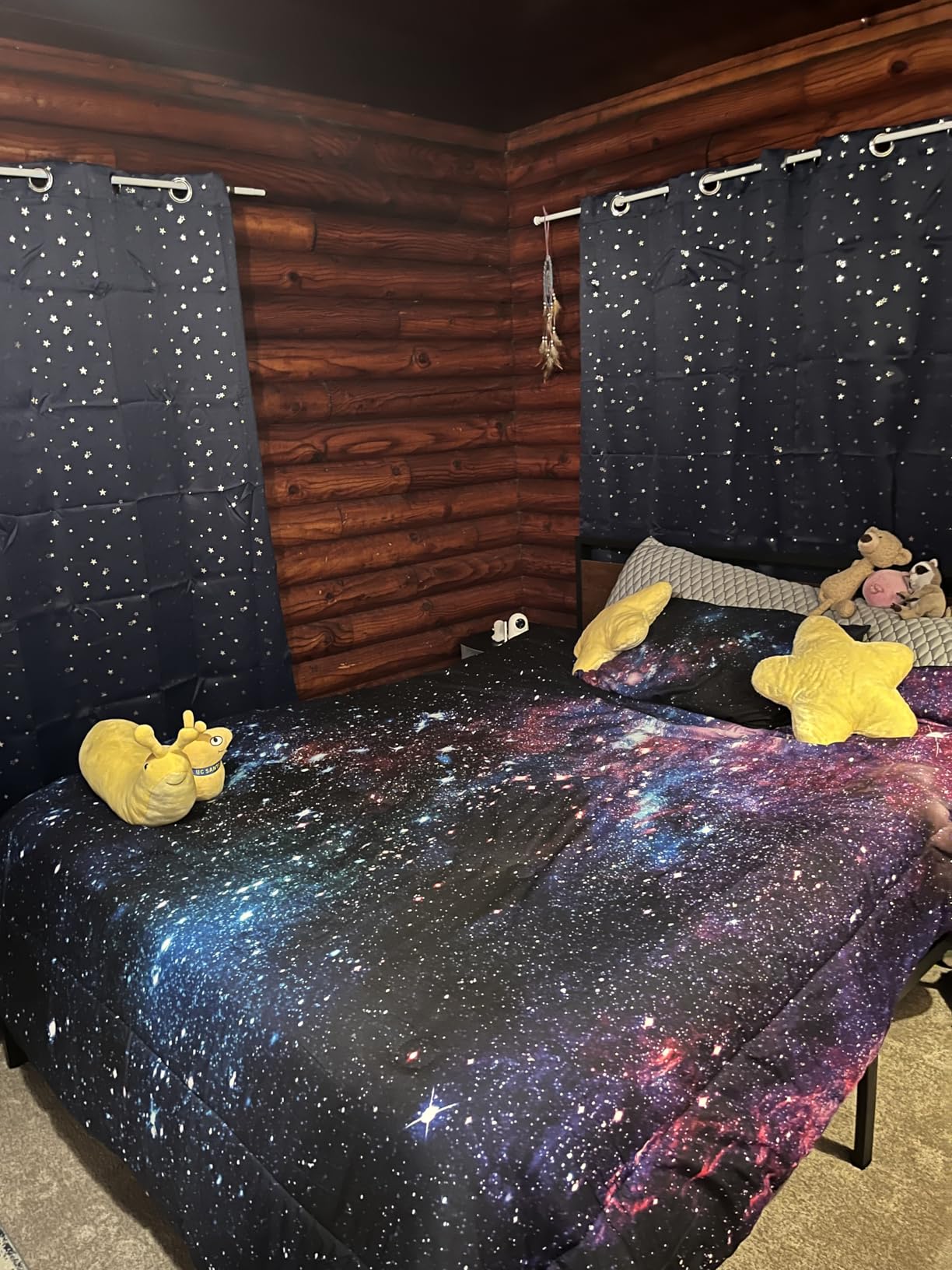
It is also worth being direct about what it is: a room-darkening curtain with a lined construction, sold under a blackout label. That means the fabric dims the room rather than blacking it out, and the border glow around a bright window is still visible. For a nursery on the shaded side of a house, that is fine. For a streetlight-facing room, it is a compromise.
What makes it easy to live with
Machine washable, inexpensive, and light enough that a toddler can tug a panel without pulling the whole rod down. That last point is a genuine safety-adjacent benefit. A 460GSM lined panel is a lever; a lightweight printed panel is not. The pattern also survives a wash without the print cracking, which is where cheaper foil prints usually fail.
What to watch for
Packaging creases in the foil print show up on arrival and need a steam rather than an iron. And check the width math, because 42 inch panels are on the narrow side: for a window wider than about 40 inches you will want a larger set. The 63 inch length is also short enough that light can leak under the bottom edge if the window sill is low, which matters more in a summer bedroom than a nursery.
4. LEMOMO Baby Pink Black Lined Curtains – Best for True Blackout in a Pink Room
LEMOMO 100% Blackout Curtains 52 x 84 Inches Long Thermal Insulated Baby Pink Curtains with Black Liner Set of 2 Panels for Nursery Room
Triple weave with black lining
52 x 84 inch, 2 panels in baby pink
8 silver grommets per panel
Thermal insulated, machine washable
Pros
- Black lining produces complete darkening for daytime naps
- Soft smooth fabric described as free from chemical smell
- 52 inch panels give generous coverage on standard windows
- Machine washable with a full care label
Cons
- Black liner means the window reads dark from outside
- Heavier fabric than lighter blackout options
- Only one colourway in this configuration
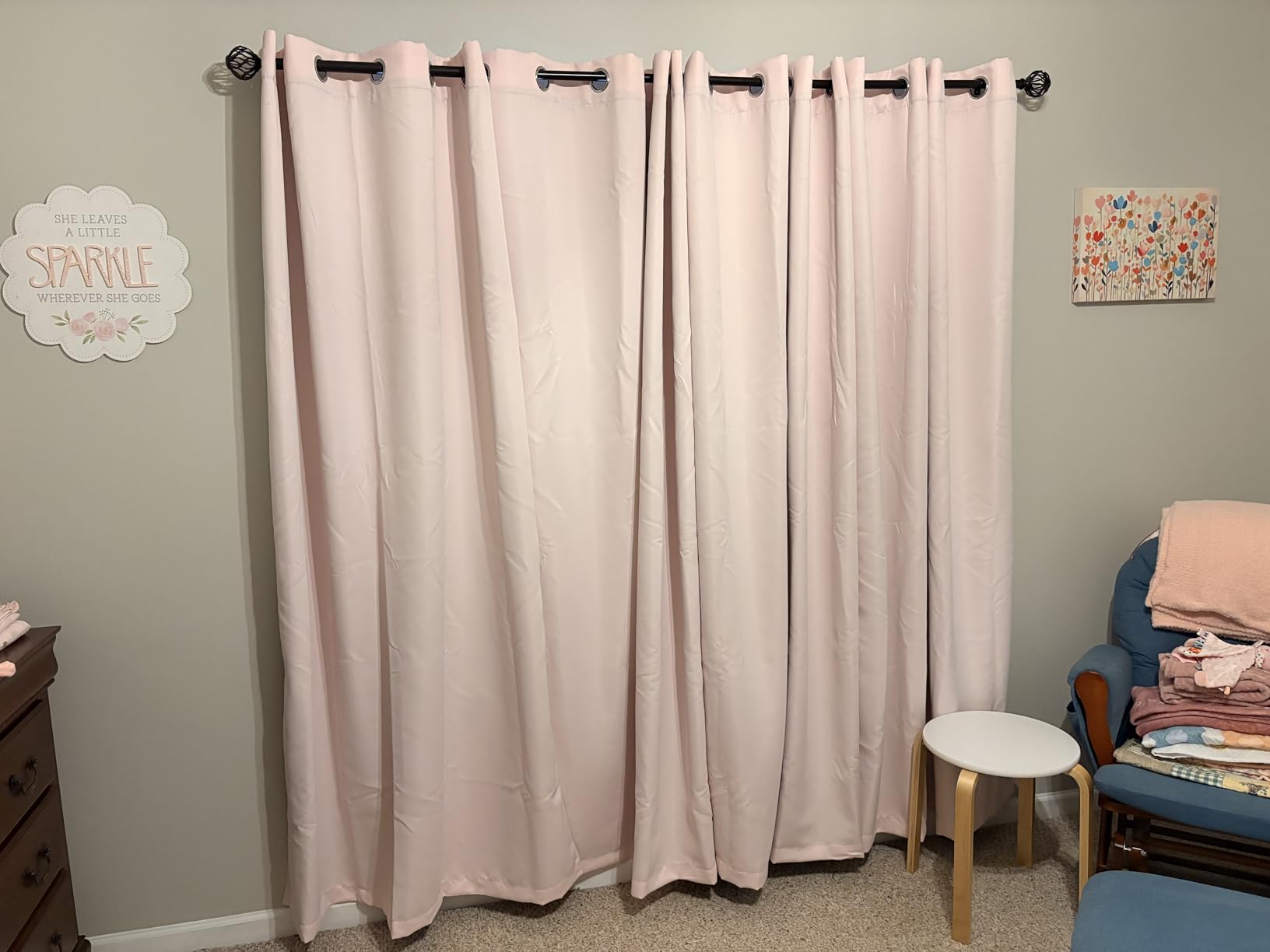
The difference between this and most sets in the roundup is the black lining sewn into a triple-weave polyester. Brand claims 100 percent light and UV blocking, and owners report the room going genuinely dark at midday, which is the outcome parents chasing real blackout actually want. It is not the heaviest fabric here, but it is the most uncompromising about light.
The fabric itself gets singled out repeatedly for feel. Owners describe it as soft and smooth and specifically note the absence of a chemical smell on arrival, which matters in a room where a newborn spends eighteen hours a day. Eight grommets per panel spread the weight across the header, so the top edge sits flat rather than rippling.
At 52 inches wide per panel, two panels give 104 inches of curtain width. That is enough to cover a wide nursery window with a proper overlap on each side, which is exactly the installation rule that fixes the halo effect described in the buying guide below. The 84 inch length means these reach the floor, so the safety trade-off applies and is covered under panel length guidance.
Why nursery parents rate it highly
Two reasons beyond the darkness. The blackout lining does not depend on a coating, so it will not crack in a dry heated room, and the machine-washable care label means a spit-up incident is a ten-minute job rather than a dry-cleaning errand. Reviewers also note the baby pink is accurate to the listing, which is not always true of pastel fabrics.
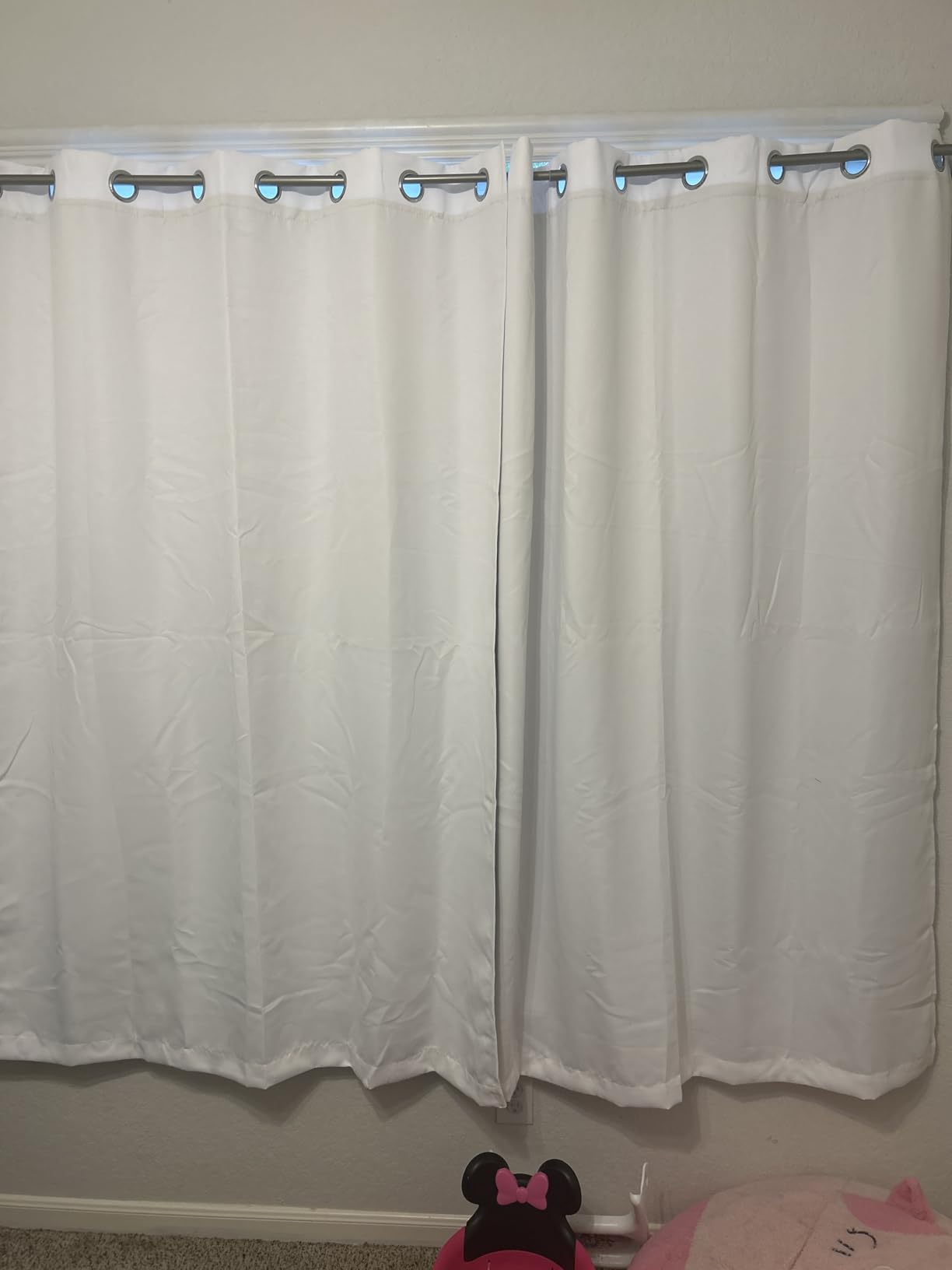
Consider how a 104 inch total width covers a standard nursery window on both sides, which is what removes the side-edge light leak rather than leaving it to the fabric.
Where it does not fit
A black liner means the window looks dark from the street at night, and in a house where that bothers you, a white-backed panel is the alternative. It is also heavier than an unlined set, so plan for two people or a two-stage hang. And it comes in one colour, so a nursery with a different palette needs a different set.
5. Lajode Baby Blue Linen Blackout Curtains – Best for Linen-Look and Light-Exterior Nurseries
Lajode Baby Blue Linen Blackout Curtains for Nursery – 52×84 Inch 2 Panels
Faux linen bonded to a white blackout backing
52 x 84 inch, 2 panels in baby blue
Bronze grommets, fits 1.6 inch rods
Lab tested, no vinyl content
Pros
- White backing keeps the window looking light from outside
- Natural linen texture suits boho
- farmhouse and neutral nurseries
- Blocks daylight
- streetlight and sun heat effectively
- Lab tested with no vinyl content
Cons
- Panels are noticeably thick and heavy
- Arrive wrinkled and some units arrive with a strong odour
- Occasional reports of colour or lining differing from the listing
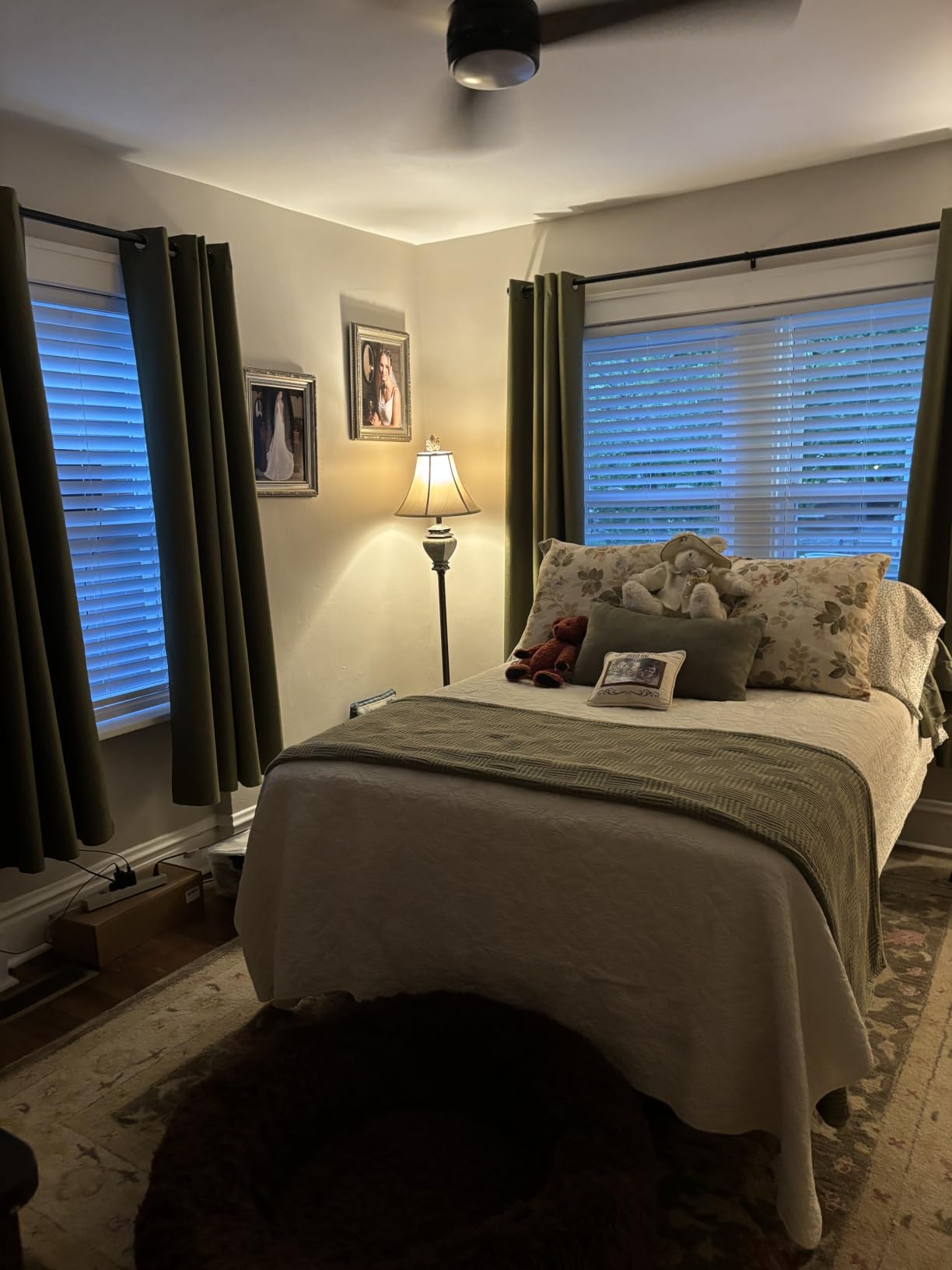
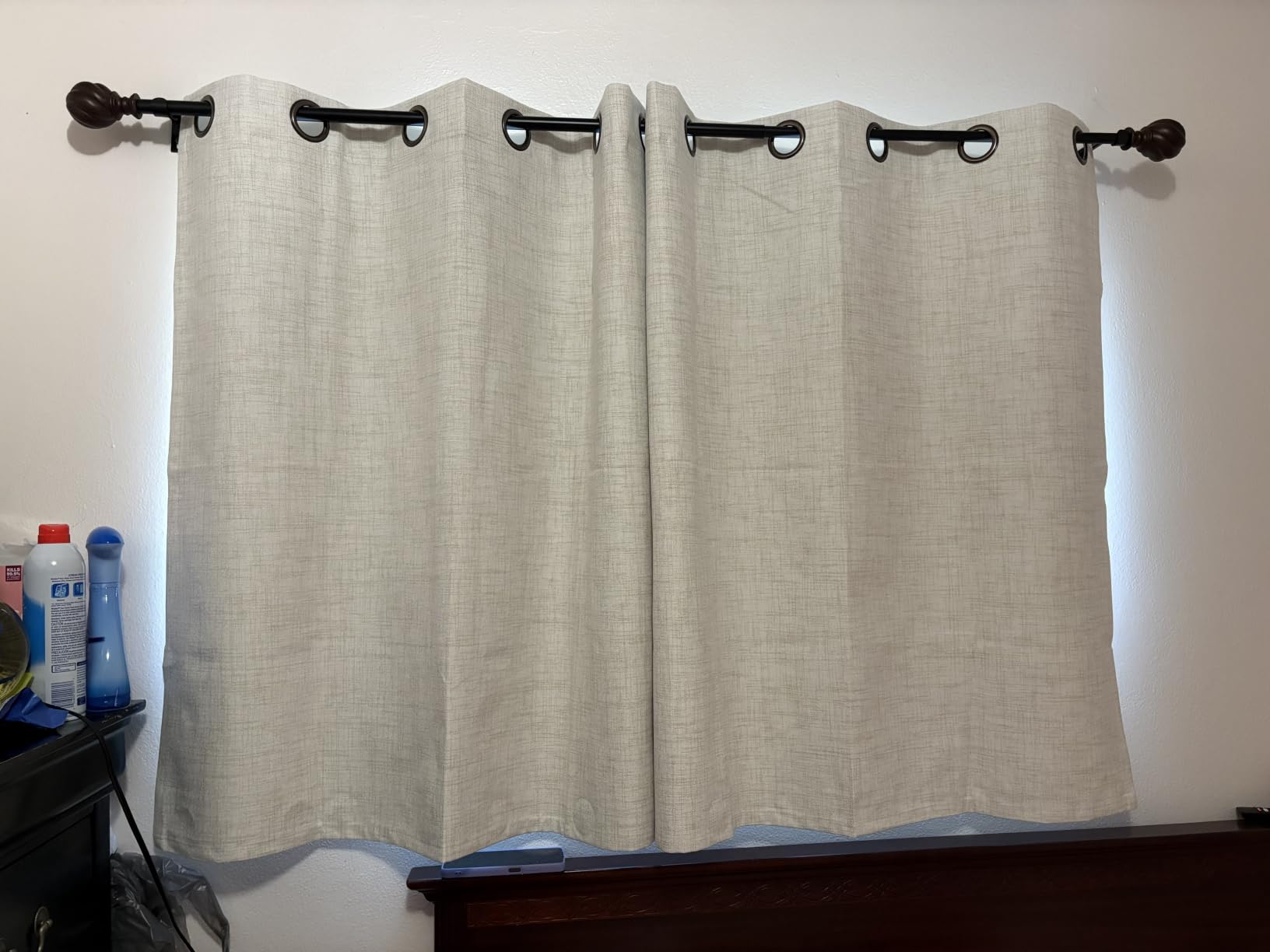
This is the aesthetic pick and it solves a real design problem. A linen-textured face fabric bonded to a white blackout backing gives a boho, farmhouse or neutral nursery the look of natural linen while still blocking light, and the white backing means the window does not read as a black rectangle from outside. That combination is unusual in a nursery category dominated by navy and cartoon prints.
Reviewers highlight the white backing more than anything else. In a room where a grandparent sleeps regularly, or where the house is dark enough that the room is used as a living space in the evening, a black-lined curtain can look like a slab. This one keeps the window visually present. Owners also confirm it handles streetlight and sun heat effectively rather than just diffuse daylight.
The lab-tested, no-vinyl-content claim is worth noting in a category where parents search for non-toxic options. Vinyl-backed fabric is common in cheaper blackout curtains, and the phrasing on this listing is specific rather than generic. Combined with machine washability, that makes it one of the more defensible picks for a child’s room.
What to check before ordering
Expect two things on arrival. Packing wrinkles are near-universal in this category and a quick iron fixes them, but a small number of reviewers also report a strong odour on the first unwrap. Wash them before hanging rather than putting them straight above a crib, which removes the issue entirely and takes ten minutes.
Where it is the wrong pick
It is the wrong pick if you want a print. The texture is the design, so a nursery with a stated theme will find it too neutral. It is also the wrong pick for a small child who pulls up on furniture, because 84 inch panels that pool slightly at the floor are the length most often flagged in safety discussions. Occasional colour variance between units is worth a return-window check.
6. H.VERSAILTEX Ivory Microfiber Blackout Panels – Best Budget Set for a Neutral Nursery
H.VERSAILTEX Blackout Curtains for Bedroom Thermal Insulated Room Darkening Living Room Curtains 63 Inch Long Grommet Privacy Protection Window Curtain Panels/Drapes for Nursery,2 Panels,Ivory/Cream
Blackout microfiber polyester, lined
Blocks about 70% of light and 100% of UV
42 x 63 inch, 2 panels in ivory
GRS certified material
Pros
- Soft silky microfiber that hangs and slides easily
- Blocks all UV rays and about 70% of light
- Full machine wash and low-tumble care label
- GRS certified material
- widest colour range in the roundup
Cons
- About 70 percent blocking is room darkening not blackout
- Some daylight leaks along the top of the window
- Panels arrive wrinkled and need steaming
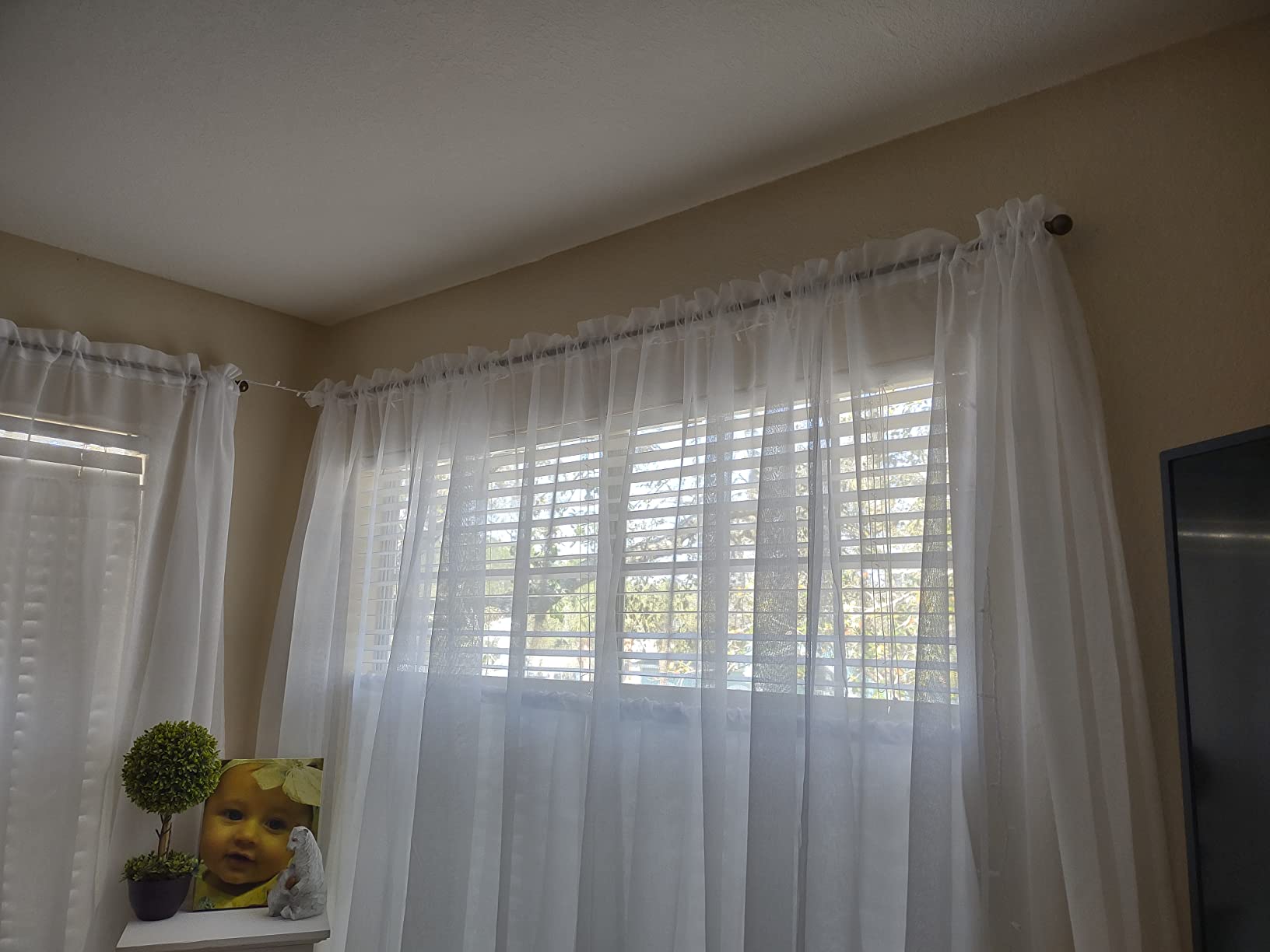
This is the honest budget answer for a neutral or cream nursery, and it earns its place on volume of feedback alone. About 70 percent light blocking and full UV filtering is not blackout, but for a window that does not face direct sun it produces a dim room that is genuinely restful for naps, and the microfiber is the softest face fabric in this roundup.
The care label is the sleeper feature. Cold machine wash, low tumble, warm iron is the full standard care cycle, which in a nursery is not a minor detail. Panels that will be washed weekly should be machine washable, and most heavier blackout sets in this category are not. The fabric is also described as GRS certified material, which is a recycled-content standard rather than a chemical safety one, so treat it as a fabric-quality signal rather than a non-toxic claim.
Reviewers are consistent about the same two things. It darkens well enough for daytime sleepers and shift workers, and it is not a true blackout, with light still visible in lighter shades. Ivory is a light colour, so it sits at the weaker end of that range. If the window gets direct sun, layer it behind a roller blind rather than expecting the curtain alone to do the job.
Why it suits a neutral nursery
Ivory and cream keep a nursery visually light, and the availability across colours and sizes means it can be matched to a neutral, coastal or shabby-chic room without hunting. The 63 inch length is also the safer choice above a crib, stopping well short of the floor while still covering a standard window.
What buyers report back
Top-edge light leak is the recurring complaint, which is a fitting problem rather than a fabric problem. Mounting the rod a few inches higher and further from the window fixes most of it. The other note is that panels arrive wrinkled, so budget ten minutes of steaming before they go up. Wide colour selection and easy sliding grommets are the reasons repeat buyers come back.
7. NIGHTON Portable Blackout Panel – Best for Renters, Travel and Odd Windows
NIGHTON Portable Blackout Curtains 40″×60″, Strong Hook & Loop Tape Strips
40 x 60 inch single blackout panel
Self-adhesive hook and loop strips
Non-toxic and formaldehyde free
Cuttable to any shape
Pros
- No drilling
- so it works in a rental or a shared adult room
- Lightweight and portable between rooms and for travel
- Can be cut to fit non-standard windows and shapes
- Formaldehyde free
- listed as suitable for baby rooms
Cons
- Adhesive strips can lose grip over time on textured surfaces
- One 40 x 60 inch panel covers a limited area
- Cutting it means it can never return to full size
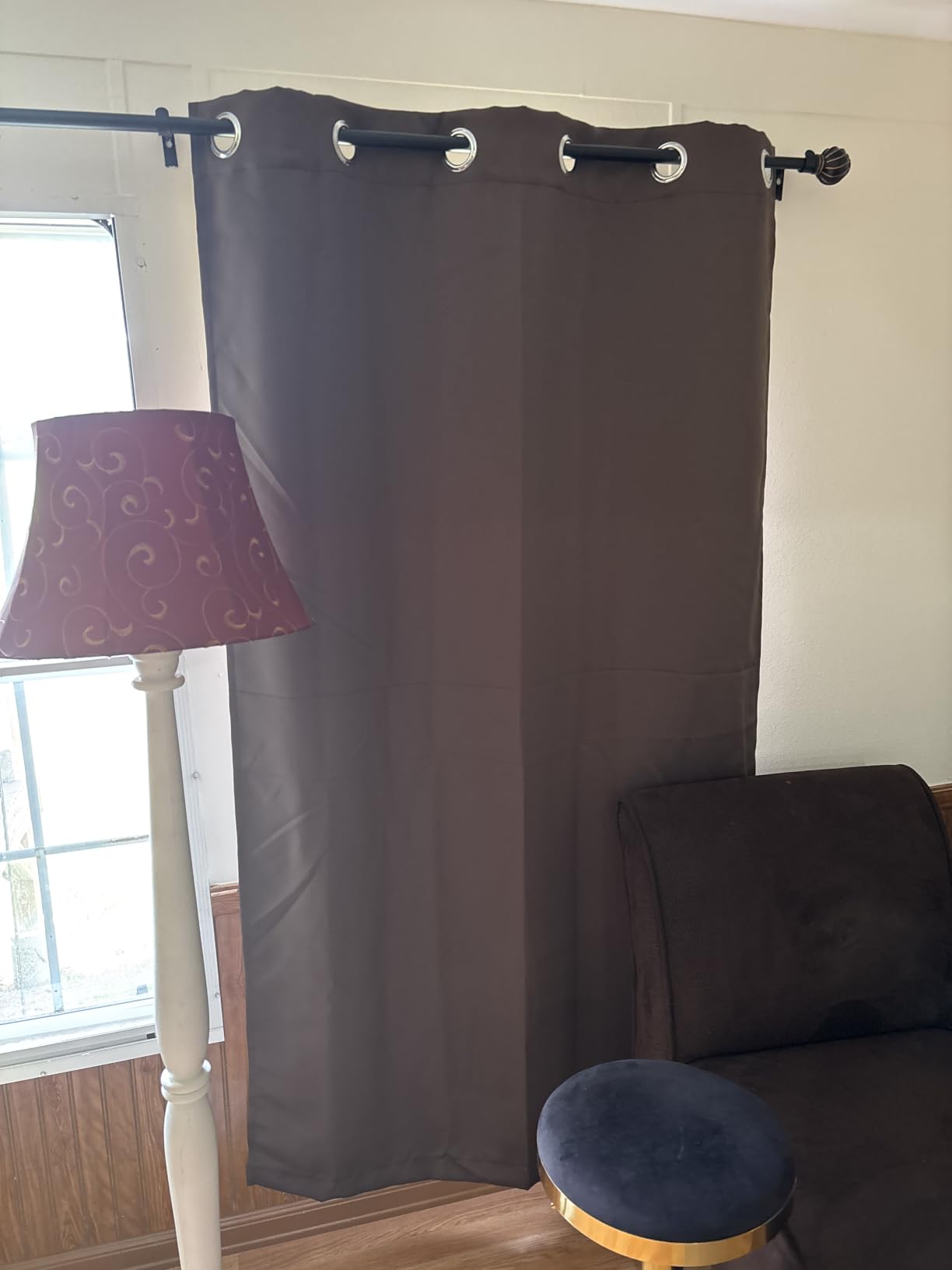
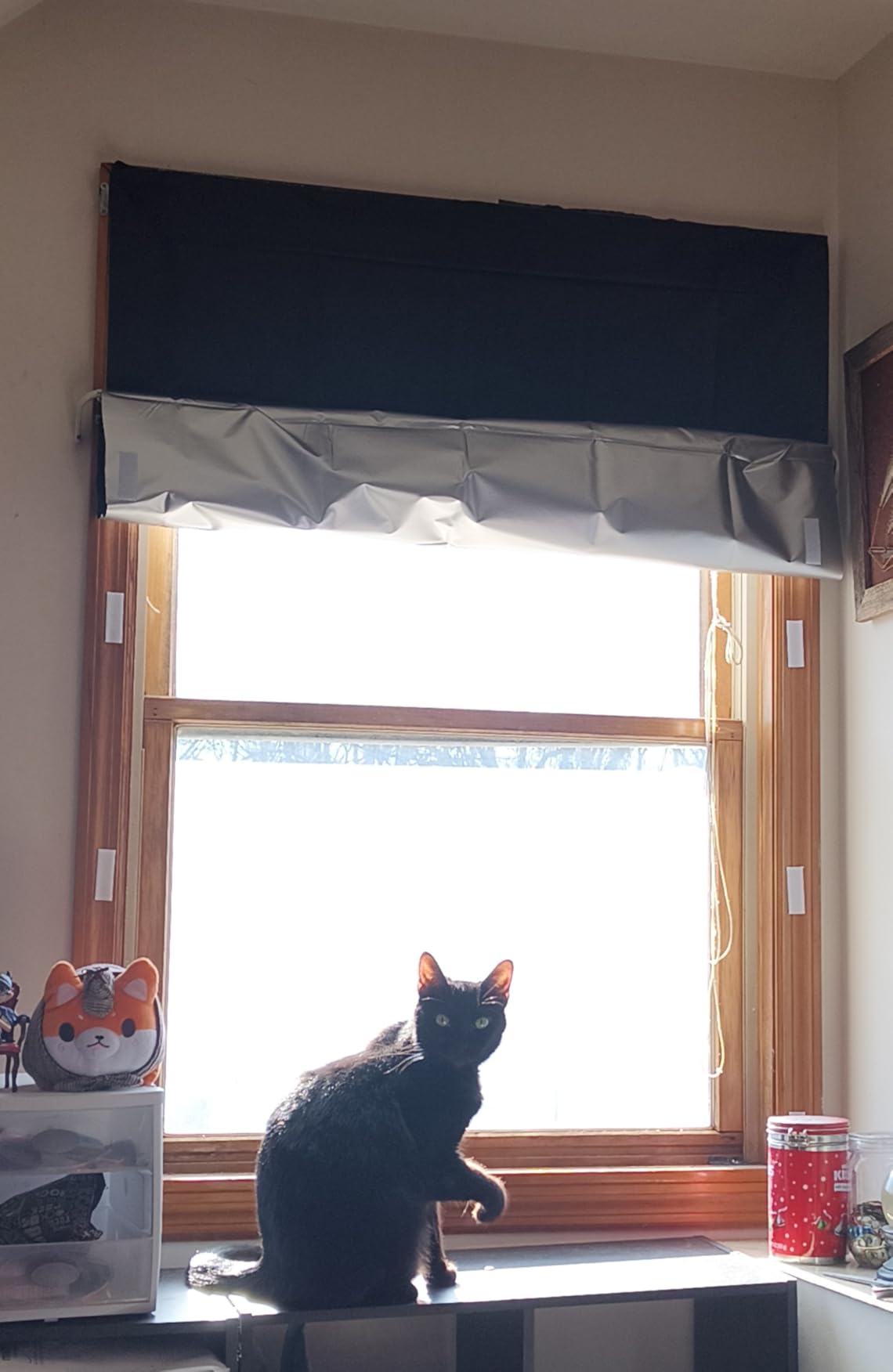
This solves a problem no curtain rod solves: you cannot drill. The panel mounts with self-adhesive hook and loop strips that grip plastic, wood and glass without leaving marks, which makes it the only option in this roundup for a rental, a grandparent’s house, a travel crib setup, or a bassinet sharing a room with an adult bed.
Parents describe it exactly as intended: it blocks sunlight effectively for naps, moves between rooms, and can be cut to fit an awkward window, a sunroof or a door. The listing describes the material as non-toxic and formaldehyde free and positions it for baby rooms, which lines up with what renters in the forum threads ask for when they rule out anything requiring a drill.
The compromise is scale. A single 40 by 60 inch panel covers roughly a small nursery window, and while it can be paired with a second or with a roller blind, it will not produce the full-room darkness a two-panel set gives you. The other real limitation is the adhesive. On a smooth painted wall it holds, but on a textured or dusty surface reviewers report it weakening over time, which means a periodic re-stick.
Best use cases, ranked
First: a grandparent’s house or a holiday rental where you cannot alter the walls. Second: a bassinet in a shared bedroom, mounted at the cot rail. Third: an odd-shaped window no ready-made panel fits, since the panel cuts to size. In all three, the no-drilling mount is the entire point and the panel size limitation is an acceptable trade.
What buyers report back
Practically, the feedback is about installation. People like that the strips take hold on glass and plastic immediately, and that the cut-to-fit option solves real sizing problems. The complaints are grip decay over months and wanting more coverage, plus the fact that black is the main colour, so it does not suit a light nursery. Keep a spare set of strips and re-stick every few months if you rely on it daily.
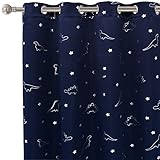
8. LORDTEX Dinosaur and Star Foil Print Curtains – Best for a Certified Non-Toxic Fabric
LORDTEX Dinosaur and Star Foil Print Blackout Curtains for Kids Room
Made in an OEKO-TEX STANDARD 100 factory
Triple weave blocks about 90% of light and UV
52 x 63 inch, 2 panels in navy
8 silver grommets per panel
Pros
- Made in an OEKO-TEX STANDARD 100 certified factory
- Blocks about 90% of light and UV rays
- Machine washable and colour fade resistant
- Dinosaur and star print appeals to a young child
Cons
- Not a full blackout
- some light shows through in navy
- Thinner than heavy blackout curtains so limited thermal performance
- Foil print can peel or flake over time
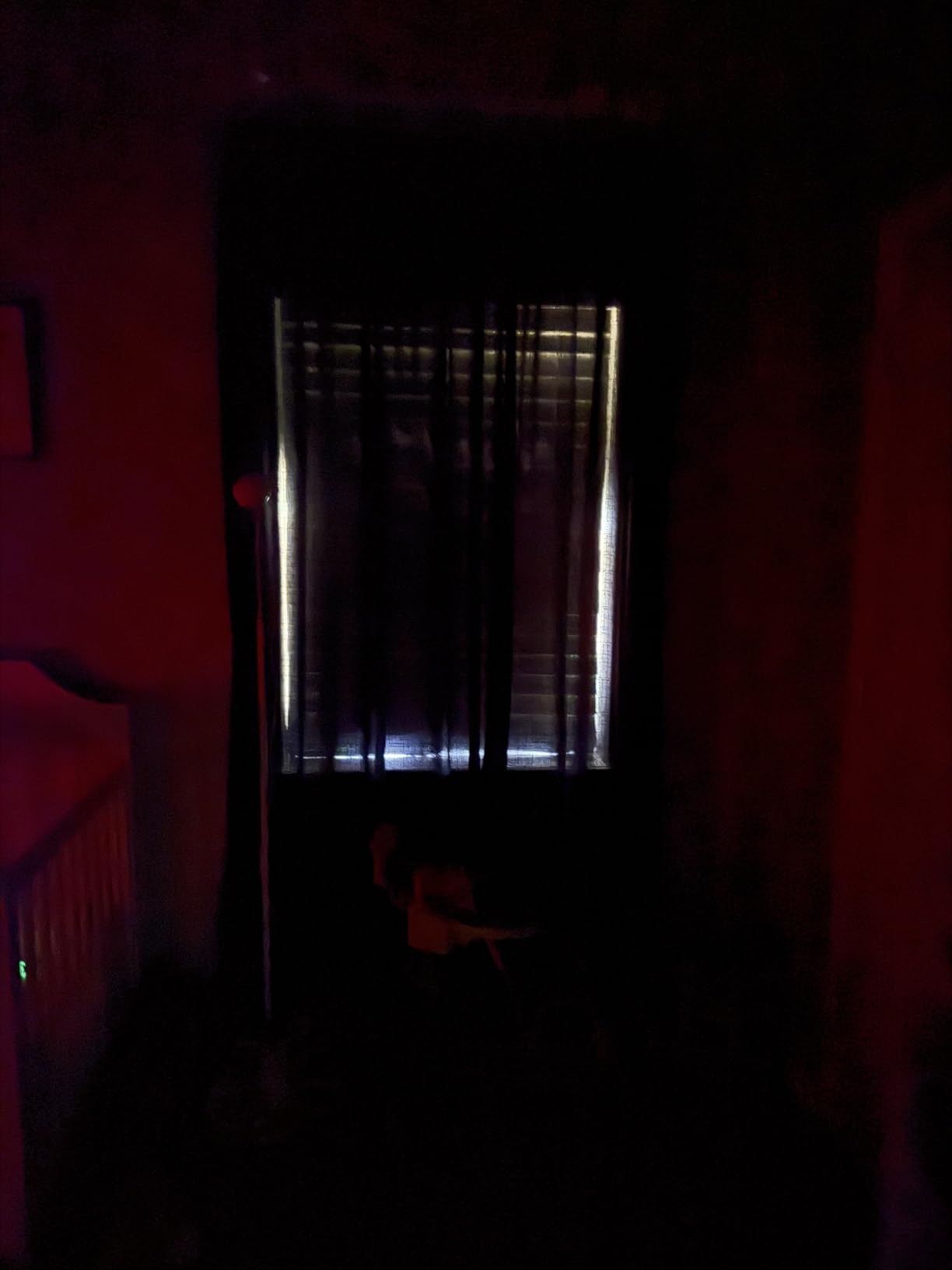
Only one set in this roundup names a chemical safety certification, and that is why it earns this slot. The fabric is made in an OEKO-TEX Standard 100 certified factory, which is the standard parents searching for non-toxic nursery curtains are usually trying to verify. It is a factory certification rather than a per-product label, but it is a checkable claim rather than a marketing adjective.
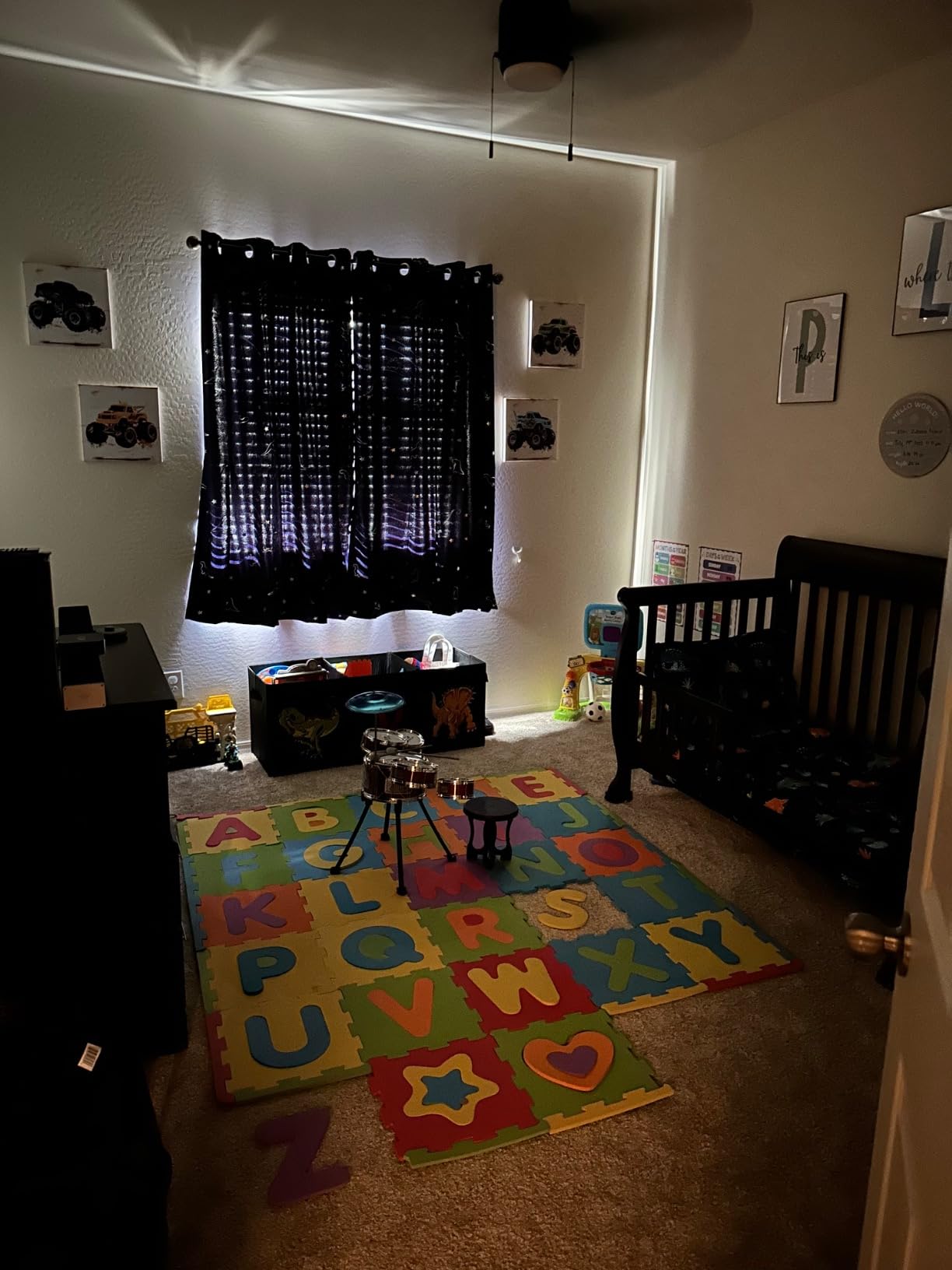
Performance sits in the middle of the range at about 90 percent light and UV blocking from a triple-weave polyester, with a full blackout lining. Reviewers say it blocks enough for daytime naps and early sleep. The same front-and-back colour means it looks intentional from both sides, which matters in a room where the curtain sometimes sits half-open during play.
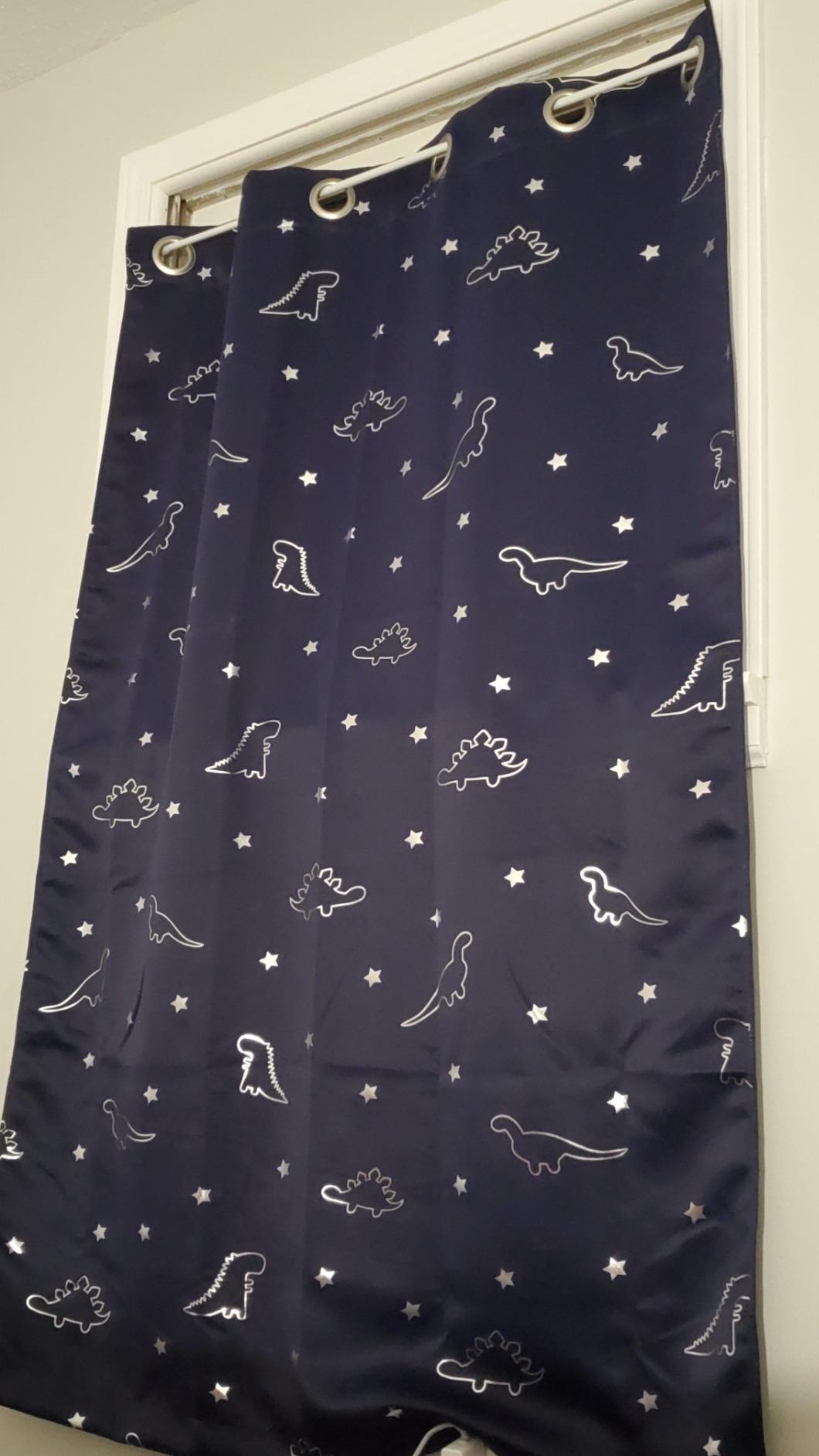
The dinosaur and silver star foil print is the reason it converts. Owners mention that the metallic print glows in evening light, which turns a functional panel into decor, and the machine wash is specified cold with low iron, so the print is protected. The colour is a deep navy, which performs better for darkening than a pastel would.
What parents ask before buying
The certification question is the one that matters, and it deserves an honest answer. OEKO-TEX Standard 100 tests for harmful substances in the finished textile, and a certified factory is a stronger position than an uncertified panel, but it is not the same as a formaldehyde-free or GREENGUARD Gold claim. Ask for the certificate number if it matters to you, and check that the panel you receive is the certified construction.
Where the trade-offs appear
At roughly 90 percent blocking with a lighter fabric than the lined sets, this is thinner, so thermal and noise performance are more modest. Reviewers also report foil flaking after extended use, which matters in a nursery that gets chewed. And at 52 by 63 inches the panels stop short of the floor, which is safer for a climbing toddler but less effective at blocking low light.
9. PrinceDeco Navy Twinkle Star Microfiber Panels – Best for the Highest Light Blocking in a Navy Set
PrinceDeco Blackout Kids Curtains for Bedroom 84 Inch Long, Navy, 2 Panels
Microfiber, blocks about 99% of light and 100% of UV
52 x 84 inch, 2 panels in navy
8 anti-rust grommets per panel
Formaldehyde free, no chemical coating
Pros
- Highest stated light blocking of the lined navy sets
- Formaldehyde free and breathable with no chemical coating
- Soft microfiber that feels good in a child's room
- Washes and dries well and doubles as a cabana panel
Cons
- Can arrive wrinkled from tight packaging
- Some colours run about half an inch short of the listed length
- Occasional reports of mismatched panel lengths
- Print can fade at the edges with prolonged sun exposure
This set claims about 99 percent sunlight blocking and 100 percent UV, which is the highest stated figure among the lined, printed panels here and matches what owners report about streetlight and early morning sun. Reviewers frequently describe it as a true blackout that lets a child sleep later and darker, and the formaldehyde-free, no-chemical-coating claim is specific rather than vague.
The fabric is a soft microfiber with a silky finish, and the description of it as skin-friendly and breathable is consistent with what buyers say. Eight anti-rust grommets per panel spread the load across a 52 inch header, and owners note the panels double as cabana or doorway curtains, which is a small but real bonus when a nursery becomes a playroom.
There is a manufacturing-consistency theme in the reviews that is worth naming rather than burying. Several buyers report a length variance of about half an inch, mismatched panel lengths between the two panels, and packaging wrinkles on arrival. None of these defeat the blackout performance, but on a set you are paying for weight and precision, they are the flaws you should know about.
What makes it perform
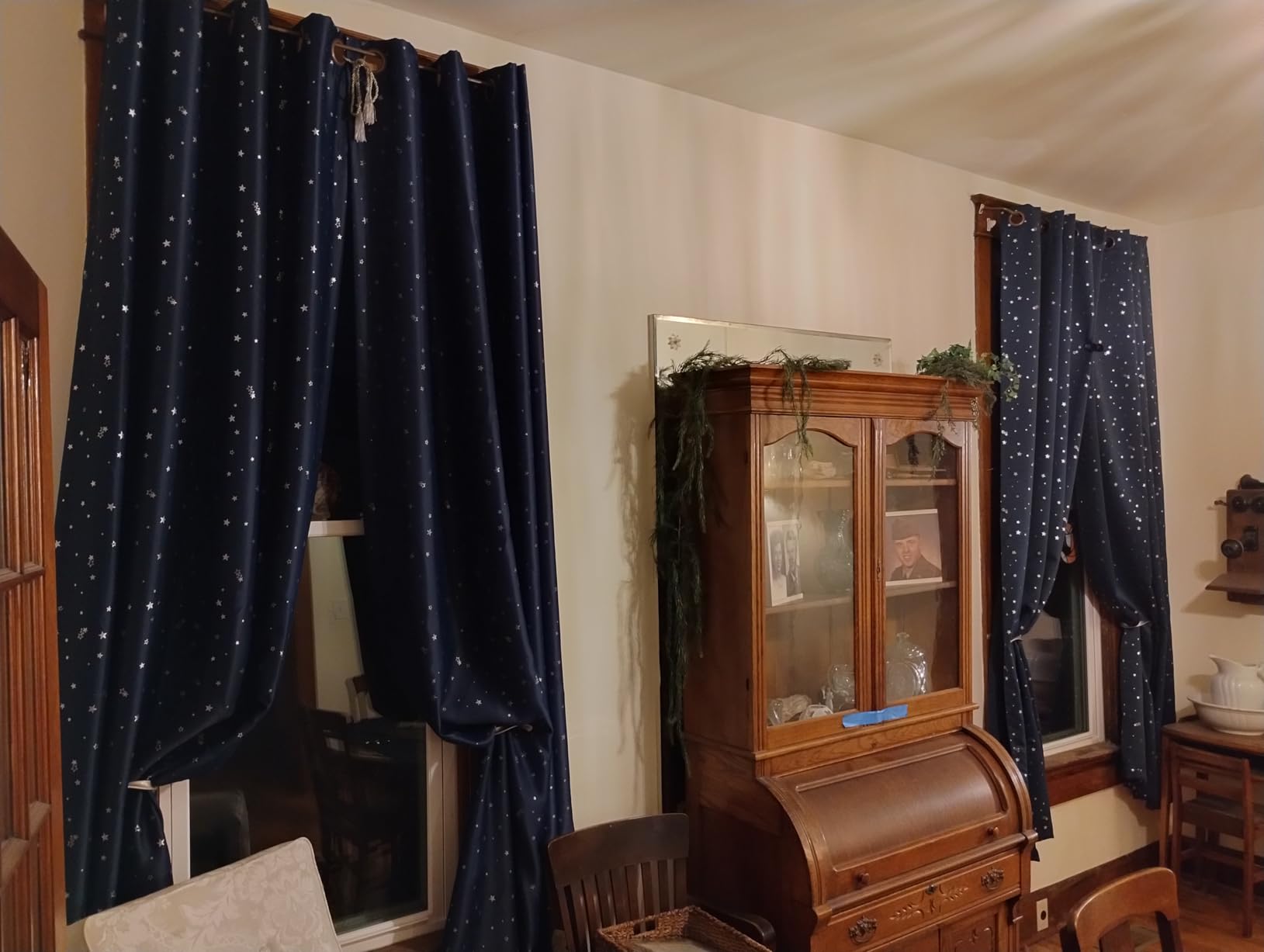
The combination of a dark navy face, a blackout construction and 52 inch wide panels gives 104 inches of coverage, enough to overlap a standard nursery window on both sides. The thermal performance is also called out for keeping a room warm in winter and cool in summer, which parents in cold-climate nurseries report noticing in the first week.
What to check on arrival
Measure both panels before hanging rather than assuming they match, and check the drop against your rod height in case a panel runs short. Steam out the packaging wrinkles, and if the window gets direct sun through the day, note that edge fade in the print is a possibility over years. Owners who checked on arrival tend to rate it very highly; ones who did not tend to mention the wrinkles.
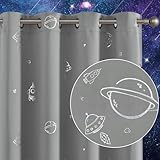
10. Vangao Grey Space Theme Curtains – Best for a Space-Theme Nursery
Vangao Grey Blackout Kids Curtains for Boys Space Theme 63 Inches 2 Panels
Grey space print with silver planets and rockets
52 x 63 inch, 2 panels
Heavy-duty triple weave, 1.6 inch grommets
Wrinkle resistant polyester
Pros
- Shimmering silver space print suits a themed nursery
- Soft wrinkle-resistant polyester with a silk-like feel
- Triple weave gives good privacy and darkening
- Grommets fit standard rods without adaptation
Cons
- Unlined construction
- so less complete darkening than lined sets
- The print is narrow in appeal against neutral options
- Care needs low tumble and shade drying
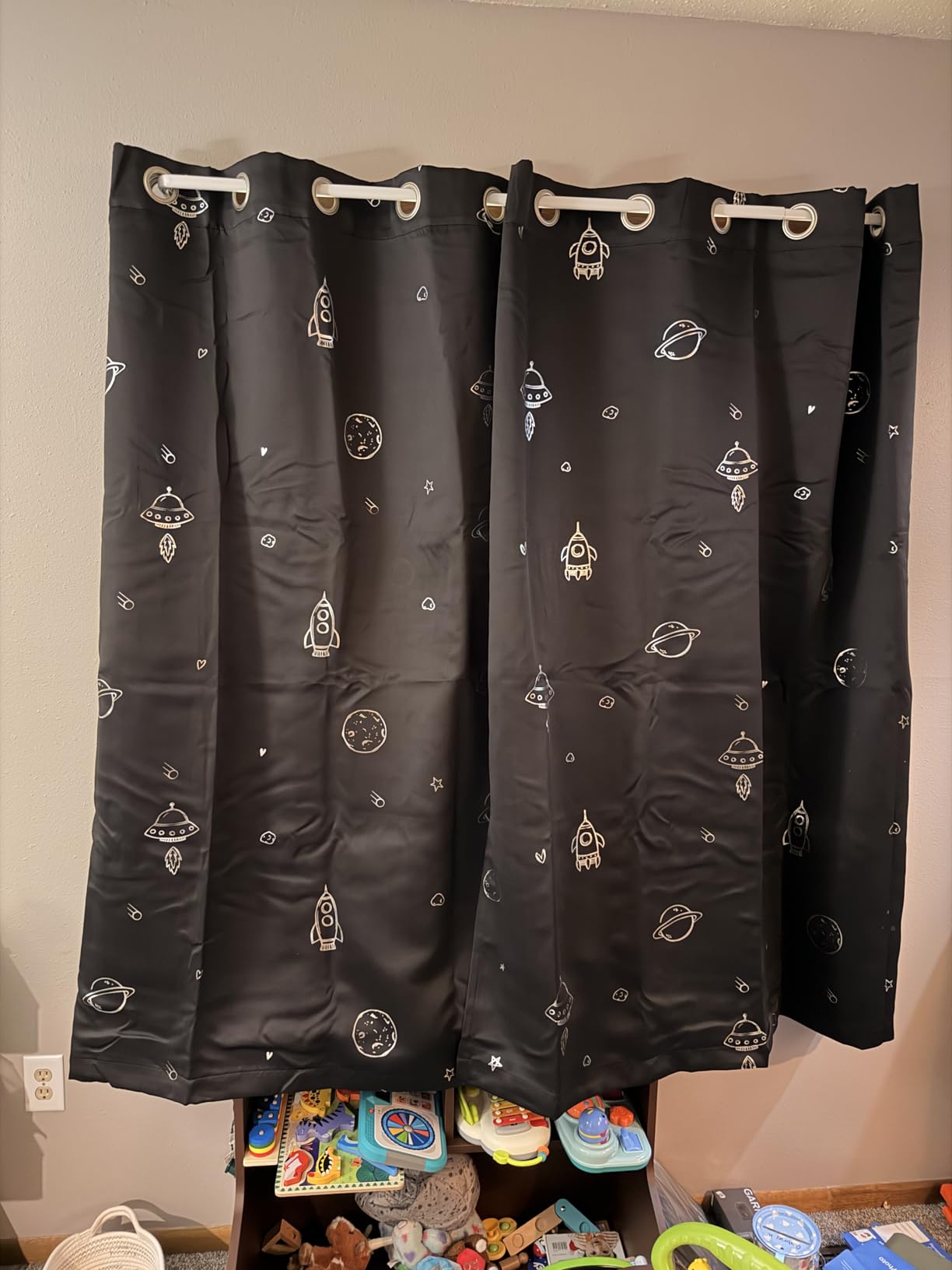
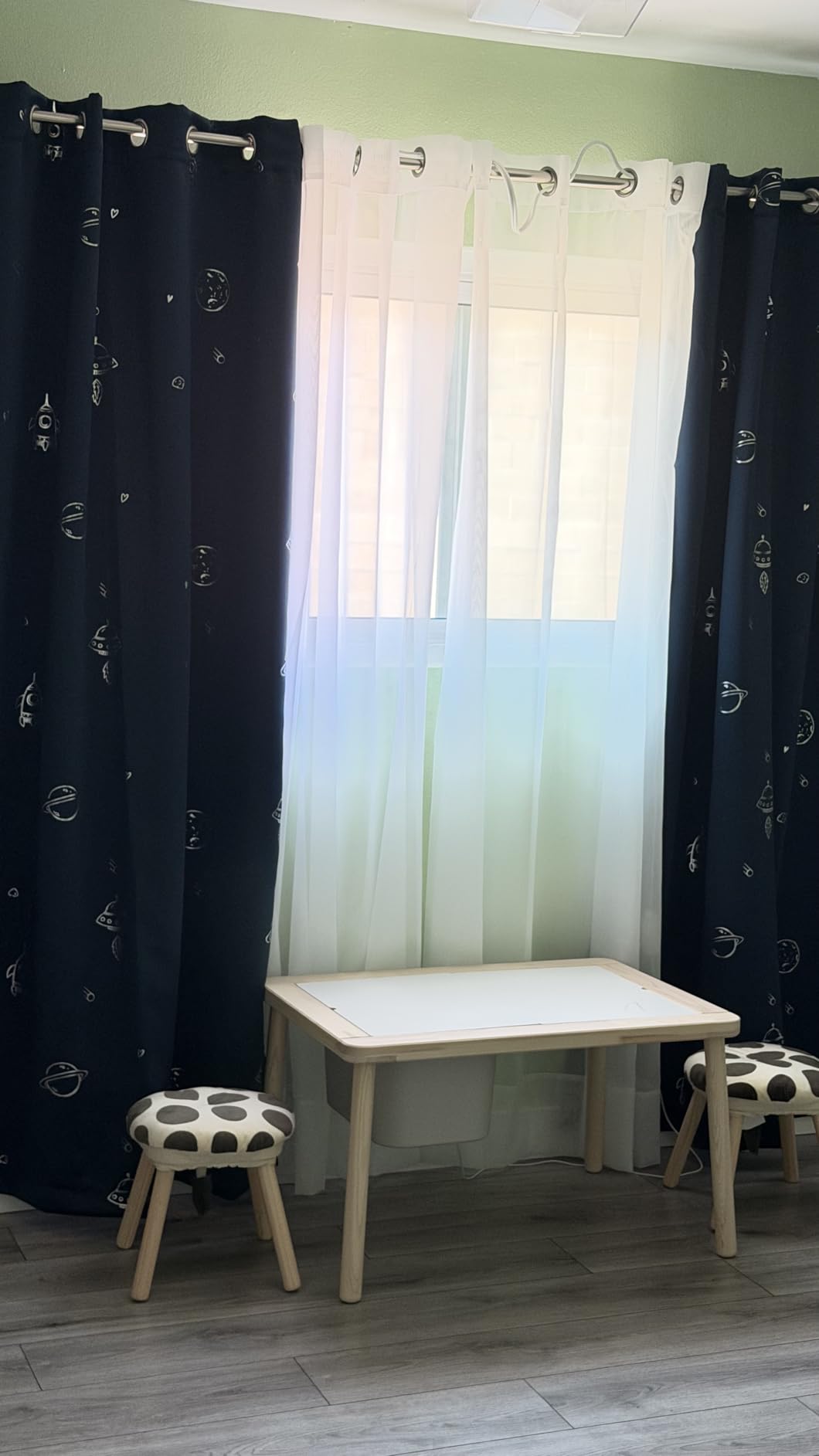
A space-themed nursery is a common brief and this is a competent answer to it. Shimmering silver planets and a rocket ship print on grey, in a heavy-duty triple weave, with 52 by 63 inch panels and standard 1.6 inch grommets. It is a set that looks chosen rather than bought to cover a window, which is the main thing a themed room needs.
The triple weave is doing real work here even without a separate lining. Reviewers report good blackout coverage and privacy for a themed room, and the fabric is described as soft, silk-like and wrinkle resistant, so it stays presentable through a toddler year without much pressing. Care is a full machine-washable cycle with low tumble and shade drying.
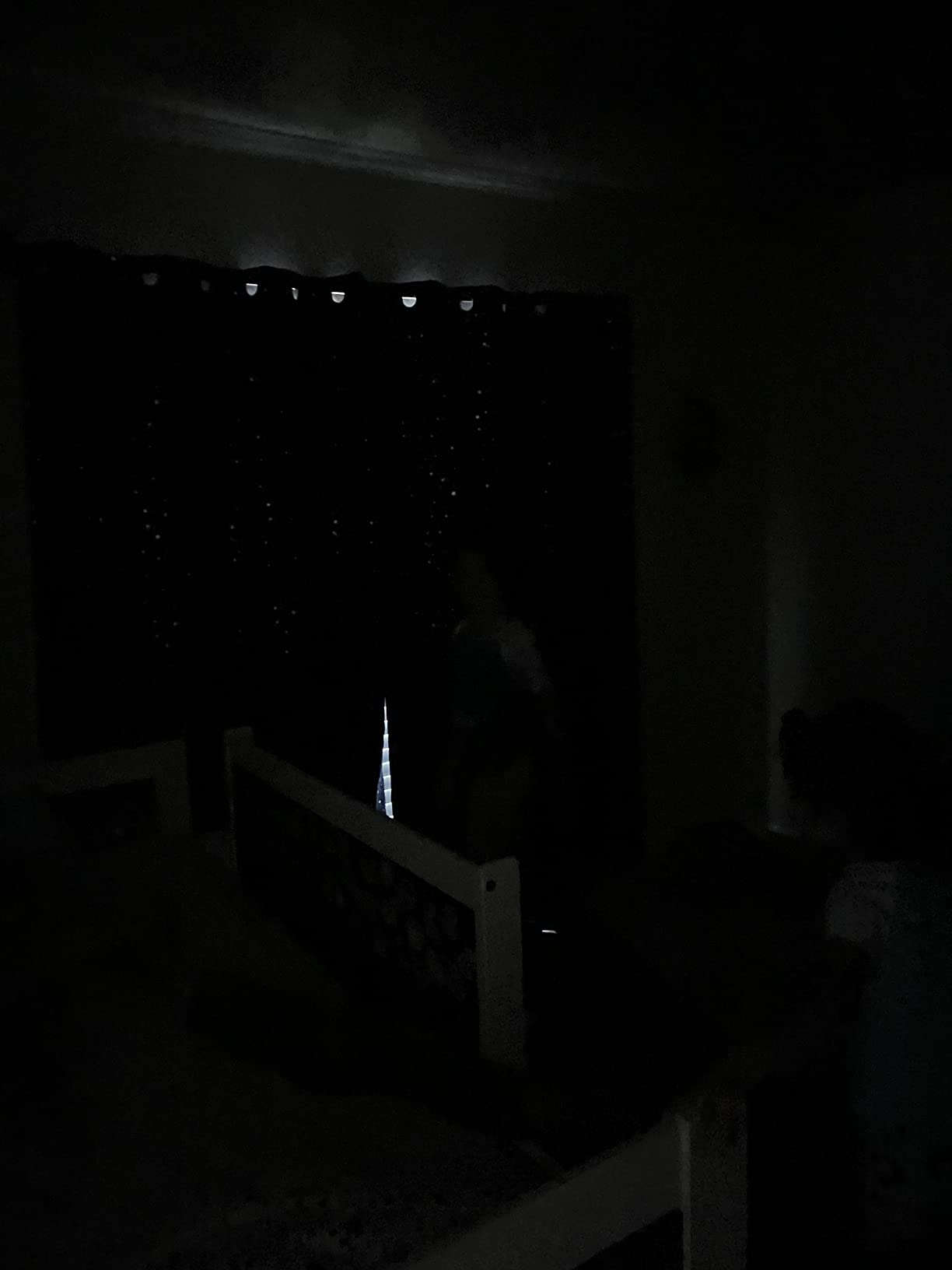
Being honest about the limitation: it is unlined, so light blocking is less complete than any of the black-lined sets in this roundup. On a window away from direct sun that is a perfectly good trade for a design that matches the room. On a west-facing window it is not, and parents in that situation should look at the LEMOMO or NICETOWN sets instead and accept a plainer panel.
What makes it work in a themed room
The grey base is neutral enough to sit under a rocket mobile or a star projector without clashing, and the shimmer reads well in a dark room, which matters because the room is usually dark when the child is awake in it. Reviewers also note it works in a shared room where two children need the same treatment, since one set covers the window identically for both.
Where buyers push back
Print appeal is the main one: a shimmering space print is a narrower choice than a neutral or a solid, and it is harder to carry into a toddler room that changes. The unlined build is the second, and care is the third, since shade drying and low tumble are more fussy than a standard wash-and-dry. If a neutral look is the goal, our cafe curtain and sheer curtain guides cover the layering options instead.
How to Choose Blackout Curtains for a Baby Room in 2026
Everything above is a product opinion. This section is the method behind it, so you can pick correctly even if a set here is not in your theme, your size or your budget. Four decisions drive everything: how much light you are actually blocking, what the fabric is made of, what is certified, and how it is hung. Get the first two right and the rest is detail.
True blackout vs room darkening: what the numbers actually mean
The word blackout is used loosely across this category and that is the root of most disappointment. A true blackout panel has a separate opaque layer, either a sewn-in blackout lining, a foam or thermal backing, or blackout yarns woven into the face fabric. A room-darkening panel is simply a darker or heavier fabric. One blocks nearly all light; the other dims.
The figures in this roundup range from about 70 percent to a claimed 100 percent, and that spread is the useful number to compare on. Below 80 percent is room darkening: enough to make a room restful on an overcast day, not enough for a west-facing window. Above 95 percent is close to true blackout and will handle streetlight and direct sun. Between those, you are buying partial darkening, which is a legitimate choice, but it should be a choice.
Reliability is the second part of this. Parents in the parenting forums report owning identical curtains two years apart that performed completely differently, and the honest explanation is that construction quality varies between production runs. Prefer a blackout lining over a surface coating, because coatings crack and flake with heat and washing, and a sewn-in layer does not.
Lining types explained
Blackout-lined means a separate opaque fabric layer sewn to the back of the face cloth. It is the most durable option and the one that reaches true blackout, and it is what the NICETOWN and LEMOMO sets in this roundup use. Foam-backed panels are lighter and cheaper but feel rigid and crack over time, so they suit a spare room rather than a nursery you sit in daily.
Thermal-lined curtains are sold for temperature and noise rather than absolute darkness, and the light-blocking figure is usually mid-range. Privacy-lined is the weakest category of the four and often gets sold under a blackout label, so it is the one to be most careful with. A triple-weave fabric with no separate liner sits in the same practical band as a thermal lining: real darkening, but not total blackout.
Safety and certifications to look for
Three certifications matter in a nursery and they test different things. OEKO-TEX Standard 100 tests the finished textile for harmful substances, which is the broadest and most commonly checked claim. GREENGUARD Gold certifies low chemical emissions and low indoor air pollution, which matters more for a room a baby sleeps in all day than for a room used in the evening. A formaldehyde-free claim is narrower and useful, but only meaningful if the fabric is verified rather than asserted.
Only the LORDTEX set in this roundup names a certified factory, and the NIGHTON portable panel and the PrinceDeco set both state formaldehyde free. The rest make no chemical certification claim, which does not mean they are unsafe; it means you would be taking the brand’s word on the face fabric and its adhesive content. If certification is a hard requirement, filter for it before you filter for colour.
ANSI/WCMA compliance applies to corded window coverings rather than to fabric. The practical nursery version of that rule is simple: if there is a lift cord, a drawstring or a bead chain, it needs to be secured out of a child’s reach or, better, replaced with a cordless mechanism. Every grommet-hung panel in this roundup is inherently cordless at the window, which is one of the underrated reasons panels beat corded shades in a baby room.
Curtains vs cellular blinds vs cordless roller shades
Panels have one advantage over every shade: no mechanism to fail and no cord to manage. They are soft, quiet, washable and they can be layered. The cost is bulk, a rod, and the risk of a heavy panel on a cordless shade rail if you try to combine them badly.
Cellular blackout shades are the strongest alternative for a rental or a modern minimal room. They mount inside the frame with no drilling, sit flat so they lose less heat at the glass, and are easier to raise than a heavy panel. Our separate roundup on blackout cellular shades covers the options in detail. Their weakness in a nursery is fabric, not function: they cannot be washed as easily, they are harder to steam clean after a spit-up incident, and a cordless lift still needs to be child-proofed.
Roller shades are the cheapest reliable answer and the one parents in forums recommend most often, with the same caveat attached to every time: mount the shade above and outside the edge of the window, not inside the frame. Inside-mounted shades are the reason so many parents conclude that a blind does not work. Cordless roller shades solve the cord problem entirely, and a spring-assisted top-down mechanism solves the reach problem.
The layering answer, which is what most nurseries end up with, is a curtain panel over a roller shade. The shade handles the frame and the panel handles the halo. Parents who layer report that the pair costs less than a custom treatment and darkens better than either alone.
Measuring a nursery window for full coverage
Measure the window and its frame, not just the glass, and take the widest measurement across the frame including any trim or sill projection. Then double it for curtain width. A 40 inch wide window needs roughly 80 inches of total panel width, so two 42 inch panels is right and two 52 inch panels gives you a generous overlap.
For the top, measure from the top of the frame to where you want the panel to end, then add four to six inches of drop for the heading and hem. A rod mounted six to twelve inches above and outside the frame is what actually kills the top-edge light leak, and it is the single most useful thing a parent can do after buying the curtains.
Standard nursery windows tend to sit between 24 and 40 inches wide and 36 to 48 inches tall, so a 42 by 63 inch set covers a small to medium window and a 52 by 84 inch set covers almost anything on a standard floor plan. The 63 inch length is the safer choice above a crib; the 84 inch length covers more window but reaches the floor.
Hanging for maximum darkness and killing the halo effect
The halo effect is the ring of light around a curtain panel when the panel is narrower than the window or mounted too close to the glass. It is the most common reason a good blackout curtain gets returned. The fix is entirely about installation, and it takes about twenty minutes longer than the quick method.
First, mount the rod outside the window frame rather than inside the recess, at least six inches above the top of the frame. A rod inside the frame sits in the light’s path and guarantees a top leak no fabric can prevent. Second, choose panels at least double the frame width so they overlap generously in the centre when closed. Third, overlap the two panels at the middle rather than butting them edge to edge, because a single seam leaks.
Fourth, if the gap at the sides still glows, wrap the panels back toward the wall on each side, or add a narrow blackout valance across the top. Fifth, address the bottom: if light spills under the hem on a low window, lengthen the panels or use a weighted hem. And sixth, for a window with a gap at the side of the frame, tension-rod mounted blackout panels inside the recess work as a second layer, which is a common hybrid in real nurseries.
Four infant-safety rules for nursery window coverings
First, be deliberate about panel length. Floor-length panels are an entanglement and strangulation hazard for babies who start pulling up on furniture, which is the concern raised most often in the threads I read. A 63 inch panel on a nursery window usually stops well short of the floor and removes the hazard while losing very little light blocking.
Second, keep cords out of reach entirely. If a shade has a lift chain, a bead chain or a drawstring, use a cord cleat or a wrap fixed well above a child’s reach, or choose a cordless mechanism. The Window Furnishings Safety Council’s guidance applies to homes with young children, and the safest option is hardware with no exposed chain at all.
Third, secure the hardware. A toddler who can pull up on a curtain panel can put real force on a bracket, particularly on a heavy lined set. Outside-mount brackets into a stud or a suitable anchor, positioned so the panels hang well clear of the crib rail, remove the temptation. Heavy panels also need a rod rated for the weight rather than a tension rod left extended for months.
Fourth, treat the floor beneath the window as the priority surface. That is where a climbing child ends up, so keep soft furnishings, cords, small objects and any unstable furniture out of that zone regardless of what hangs above it. A blackout curtain that blocks a window but sits above a corner with a bookshelf next to it has not solved the room.
Temporary and renter-friendly installs
If you cannot drill, three approaches show up repeatedly in parent forums and all of them work. Adhesive hook and loop panels like the NIGHTON set mount directly to glass, wood or plastic and are the only truly drill-free option here. A tension rod mounted outside the frame gives you a full-height hang with no holes, and it can hold a lighter panel if you keep the set within the rod’s weight rating.
The improvised version that parents report working surprisingly well is a light-coloured blanket or quilt held to the rod with large clips, which is not a purchase decision but a reliable fix for a rental or a grandparent’s house. Keep an eye on two things: the adhesive needs re-stick every few months on textured surfaces, and tension rods can creep down over weeks if they are loaded, so check them monthly.
Care and washing for a nursery
Wash frequency is the nursery-specific rule and it is higher than in any other room. Spit-up, formula and puree stains mean weekly laundering is normal, which makes machine washability a requirement rather than a nicety. Sets specified for cold gentle cycle, low tumble and a low or warm iron are the practical choice; hand-wash-only or dry-clean-only panels will not survive a year in a nursery.
Check shrinkage risk before the first wash. Any panel that shrinks by even a few centimetres can pull a top-edge leak open, and a panel that shrinks unevenly across two panels creates a visible mismatch. Cold water and a gentle cycle minimise it. Steam rather than press where you can, because a high iron temperature can flatten a foil print permanently, which is a specific problem with the star and dinosaur sets in this roundup.
Frequently Asked Questions
Are blackout curtains good for nurseries?
Yes, and they are the single most effective upgrade to a baby room. Newborns and toddlers nap in short daytime cycles, so daylight leaking into the room can push their sleep pattern toward daytime and make night waking harder to correct later. A blackout panel also damps street noise and holds room temperature, both of which help a light-sleeper infant settle. Choose a true blackout lining rather than a dark face fabric, and hang the panel outside the window frame to remove the halo of light around the edges.
Are blackout curtains recommended for nursery?
Most sleep specialists recommend darkening a nursery, with one nuance worth knowing. Full blackout suits night sleep and early bedtimes, while a small amount of daylight during daytime naps helps preserve a baby’s natural sleep rhythms, so a room that is a compromise between the two is defensible. If you want total darkness, a blackout lining and an outside-mount rod achieve it. If you want a softer daytime nap, room-darkening panels at roughly 85 to 95 percent are often enough and much easier to hang.
What are the best non-toxic blackout curtains for nurseries?
Check three things in order. First, OEKO-TEX Standard 100 certification, which tests the finished textile for harmful substances. Second, a GREENGUARD Gold claim, which certifies low chemical emissions and matters most in a room a baby occupies all day. Third, a verified formaldehyde-free claim rather than an assertion, and avoid vinyl-backed fabric where a possible alternative exists. Among the sets reviewed here, the LORDTEX panels are made in an OEKO-TEX Standard 100 certified factory, and the PrinceDeco and NIGHTON panels both state formaldehyde free.
What type of curtains are best for a nursery?
A lined panel with a machine-washable fabric in a mid-to-dark colour is the most reliable choice. Blackout-lined or triple-weave panels block the most light; thermal-lined panels add insulation at moderate darkening; privacy-lined panels often only dim. Machine washability matters more in a nursery than anywhere else because of spit-up and formula stains. Choose a length that stops above the floor if a child is starting to pull up on furniture, and a 63 inch panel over an 84 inch one for that reason alone.
What are the best blackout blinds for a nursery?
Cellular blackout shades and cordless roller shades are the two strongest blind options in a baby room. Cellular shades sit flat against the glass, lose less heat than a panel, and cordless lifts remove the cord hazard entirely. A roller shade mounted above and outside the edge of the window frame outperforms one mounted inside the recess, which is the most common reason parents conclude blinds do not work. Blinds cannot be washed as easily as panels, so a curtain over a roller shade is a common hybrid.
How much light can get through blackout curtains?
It depends entirely on the construction and the lining, and the marketed figure is only as good as the weave. Room-darkening panels pass roughly 70 to 90 percent of daylight, which dims a room without blacking it out. Triple-weave blackout fabric reaches about 90 to 95 percent, and a true blackout lining with a dark face colour can reach 99 to 100 percent. Past a certain point the fabric is irrelevant: light around the panel edges, called the halo effect, is an installation problem solved by an outside-mount rod and panels twice the window width.
Which Nursery Blackout Curtains to Buy in 2026
If you want one set and no deliberation, take the NICETOWN blush pink panels. The double-layer 460GSM construction is genuine physical blackout rather than a coating, the feedback base is the largest in this roundup by a wide margin, and the weight damps sound as well as light. Budget two people for the hang and plan on hand washing rather than machine washing.
For a washable set on a smaller budget, the DUALIFE baby pink triple-weave panels give 85 to 95 percent blocking with a full machine care label at a two-panel price most parents find comfortable. For a neutral room where softness matters more than total darkness, the H.VERSAILTEX ivory microfiber panels darken well, filter all UV and wash on a standard cycle. For a certified fabric, the LORDTEX dinosaur and star set is the one with a named OEKO-TEX Standard 100 factory.
And if you cannot drill a single hole, the NIGHTON portable panel is the answer, accepting that it covers one window rather than a wall. Whatever you pick, measure the frame rather than the glass, double the width, and mount the rod outside the window. That single change does more for how dark the nursery actually gets than upgrading from one fabric to another.