
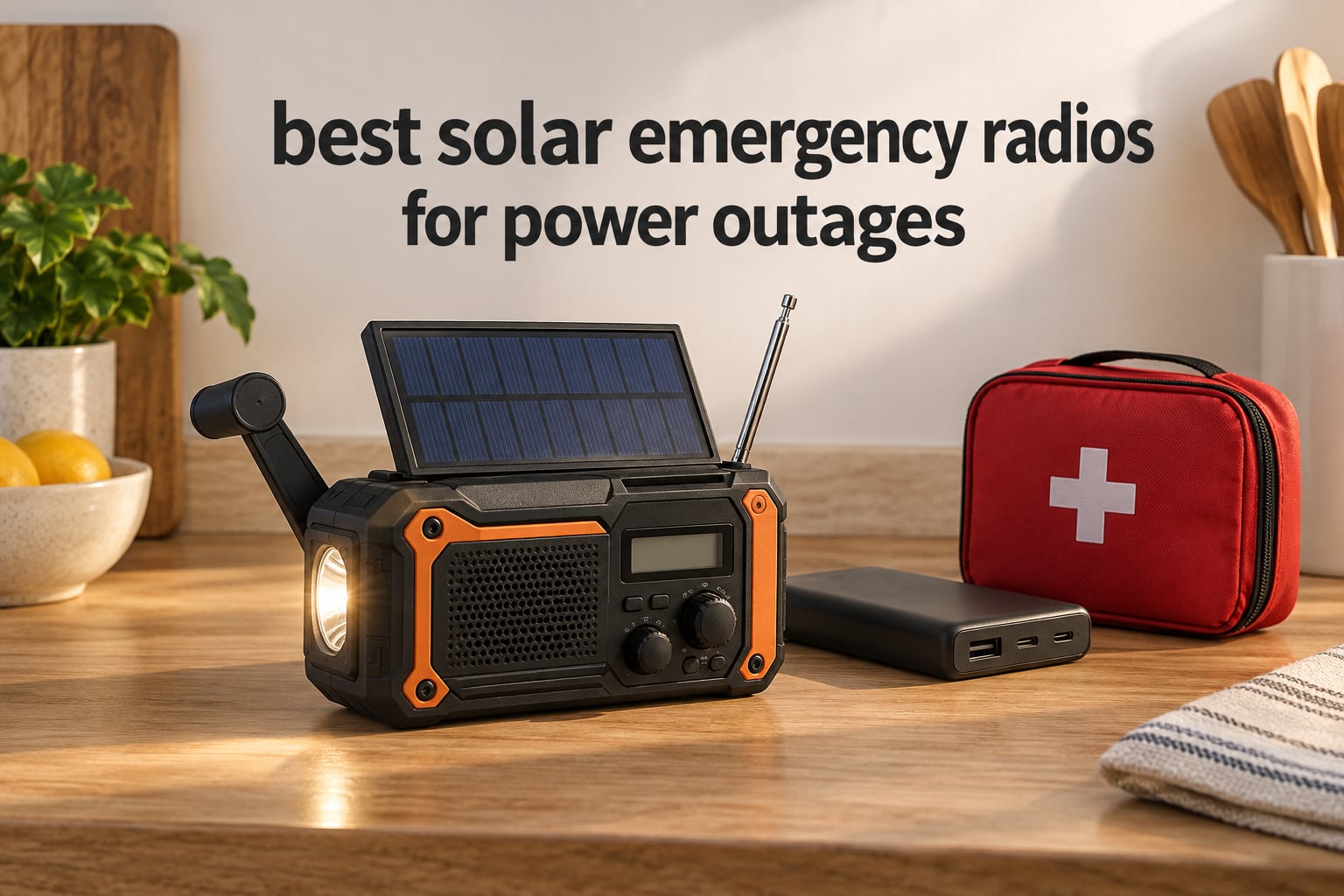
The best solar emergency radio for power outages is the FosPower NOAA Emergency Weather Radio A1. It combines three independent power sources, NOAA weather band reception, a flashlight and a phone-charging output in a unit with more than 37,000 verified reviews behind it. Buy it, charge it from a wall outlet once, and put it in a drawer or on a kitchen counter.
That is the short version. The longer answer takes into account how much battery you actually need, whether you want automatic county-level alerts, how much rain the unit has to survive, and whether “solar” is a real feature or a decorative sticker. This roundup covers 12 solar emergency radios that all run without grid power, ranked on battery capacity, alert behaviour, reception and build.
We spent weeks comparing spec sheets, review volume and owner complaints across the full lineup, then sorted the results by use case. If you want the shorter version of the research, our guide to the best emergency radios overall covers grid-tied models too.
Table of Contents
Are Solar-Powered Radios Any Good?
Yes, but not for the reason most people expect. On every radio we reviewed, the solar panel functions as a trickle charger that maintains a full battery rather than a genuine power source that can revive a dead one. Overcast days add almost nothing.
The parts of a solar emergency radio that genuinely matter during an outage are the pre-charged internal battery, the hand crank, and NOAA weather band reception. Solar earns its place only when the unit sits near a window for days at a time.
One product in this roundup breaks that pattern: the Mesqool CR1030 uses a solar panel over four times larger than the decorative panels on most competitors, which is the only model here where sunlight does real charging work.
Top 3 Picks: Solar Emergency Radios for Power Outages (October 2026)

FosPower NOAA A1 Solar Radio
- 7400mWh power bank output
- 3 power sources
- 1W flashlight plus 4 LED reading light
- NOAA weather band

Raynic CR1009 Pro Solar Radio
- Automatic NOAA alert scanning
- 6-way charging
- 3W flashlight and 2.5W reading lamp
- IPX3 splash resistant

Kaito KA500 5-Way Solar Radio
- Replaceable NiMH battery pack
- 14.5 inch telescopic antenna
- 7 NOAA channels
- AM FM SW shortwave
Best Solar Emergency Radios in October
| Product | Specifications | Action |
|---|---|---|
| FosPower NOAA Emergency Weather Radio A1 |
|
Check Latest Price |
| Raynic CR1009 Pro |
|
Check Latest Price |
| Kaito KA500 |
|
Check Latest Price |
 Eoxsmile Emergency Solar Radio Eoxsmile Emergency Solar Radio |
|
Check Latest Price |
 iRonsnow 2000mAh Solar Radio iRonsnow 2000mAh Solar Radio |
|
Check Latest Price |
 PPLEE 12000mAh NOAA Radio PPLEE 12000mAh NOAA Radio |
|
Check Latest Price |
 Leaton 20000mAh NOAA Radio Leaton 20000mAh NOAA Radio |
|
Check Latest Price |
 yesiwtc 7400mWh Hand Crank Radio yesiwtc 7400mWh Hand Crank Radio |
|
Check Latest Price |
 Mesqool CR1030 Solar Radio Mesqool CR1030 Solar Radio |
|
Check Latest Price |
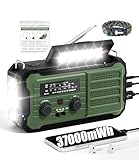 Vokida 10000mAh Emergency Radio Vokida 10000mAh Emergency Radio |
|
Check Latest Price |
 iRonsnow Condor 1 20000mAh iRonsnow Condor 1 20000mAh |
|
Check Latest Price |
 QAUYYW 20000mAh Solar Radio QAUYYW 20000mAh Solar Radio |
|
Check Latest Price |
1. FosPower NOAA A1 — Best Overall Solar Emergency Radio
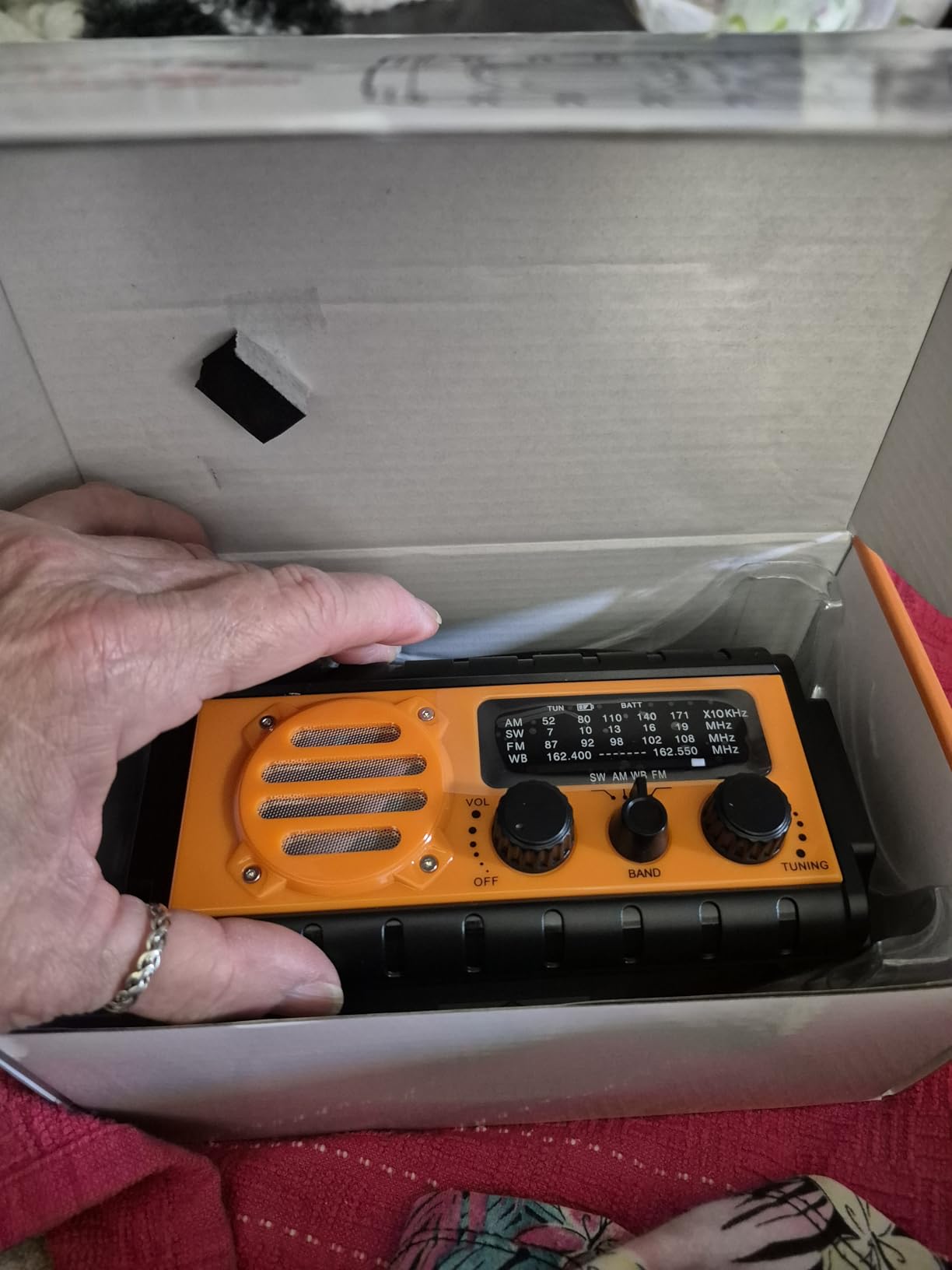
FosPower NOAA Emergency Weather Radio A1 7400mWh Solar Hand Crank (Orange)
2000mAh / 7400mWh pack
Hand crank, solar and 4 AAA batteries
1W flashlight plus 4 LED reading light
Water resistant, 310g
Pros
- Three independent power sources so it cannot be fully dead
- 7400mWh output charges phones and small tablets
- Highest review count in this roundup at 37868
- Limited lifetime warranty
Cons
- 2-watt speaker is modest for audio clarity
- Small built-in antenna limits AM range on some stations
- No SAME county-level alert programming
The FosPower A1 is the radio I keep recommending to households that want one device and no decision-making. It has been in continuous production long enough to accumulate more than 37,000 reviews, and roughly three quarters of those ratings sit at five stars. That kind of volume is the strongest reliability signal available in this category, because a weak unit eventually shows up in the one-star column.
Power comes from three independent directions. The internal lithium pack recharges over USB-C, the hand crank tops it up when the grid is gone, and four AAA batteries act as a last resort. Most owners charge the unit from a wall outlet once a year and then forget about it, which is exactly how we recommend treating it.
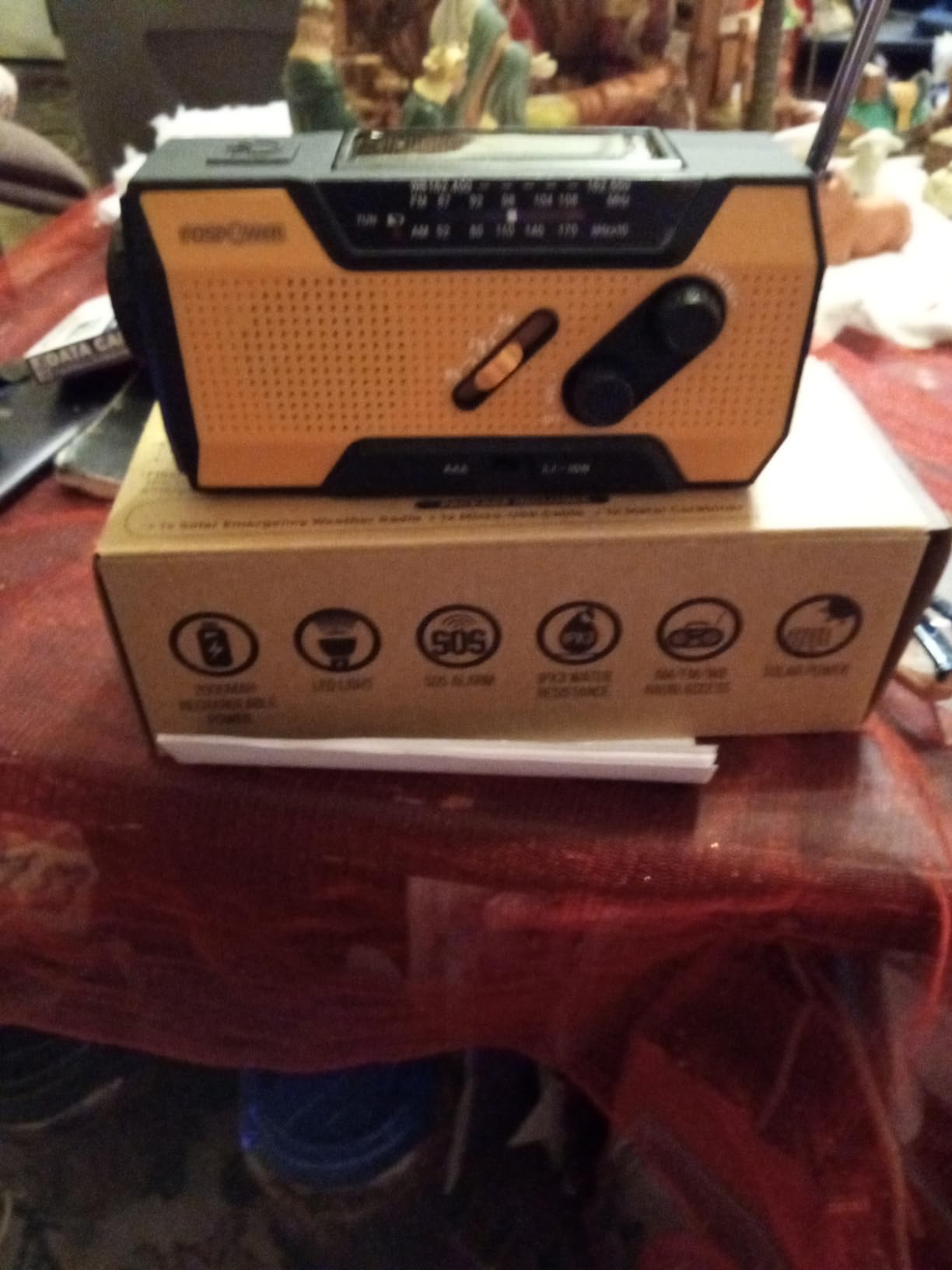
The 7400mWh pack doubles as a power bank for a phone or small tablet. It is not a laptop charger, and it will not run a radio for days, but it is enough to send a few texts and make an emergency call when your phone is flat. Reviews report roughly two watts of speaker output, which is audible but not loud enough to hear from another room.
The main technical compromise is the antenna. It is a short fixed stub rather than a telescoping whip, so reception on marginal AM stations can be weak in rural areas. There is also no SAME programming, which means the radio will not wake you only for your county — you have to listen to all seven channels yourself.
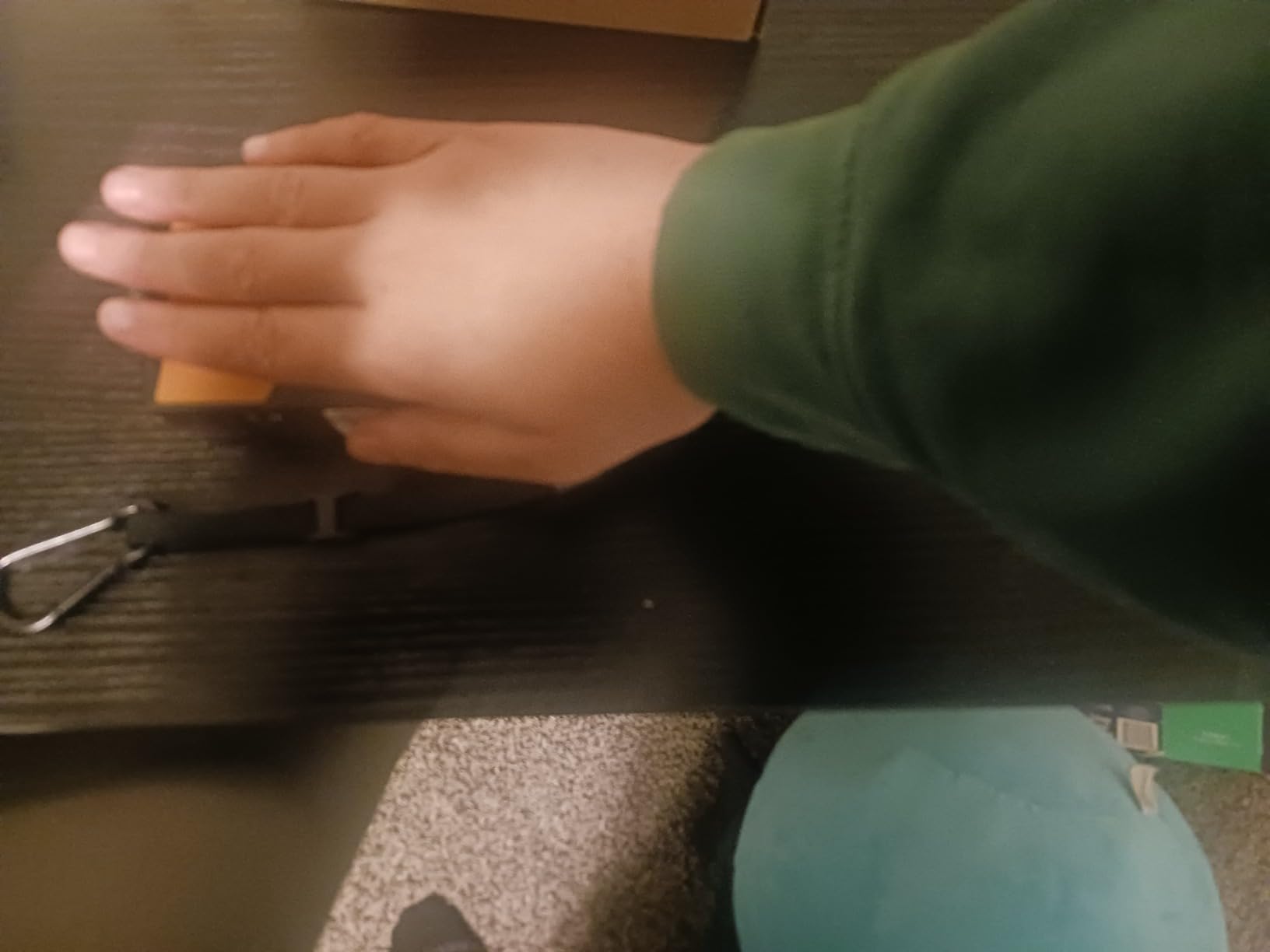
What the FosPower A1 does well during an outage
The reading light and flashlight together are the reason many households buy this model. Four LEDs give you a usable pool of light for finding fuses, food or medication without draining the pack the way a bright torch would. Two light sources let you keep the flashlight for signalling and the panel for reading.
For a phone-charging scenario, the 7400mWh output is generous relative to the class. Owners of the radio consistently describe treating it as a set-and-forget purchase rather than something they fiddle with, and the limited lifetime warranty is stronger than anything else in this roundup.
Where the FosPower A1 falls short
If you live somewhere with weak local AM stations, the fixed antenna will frustrate you. People who want the radio to wake them only for their own county should look at a model with SAME alerting instead.
It is also not the radio for anyone who wants shortwave reception for international or remote-area broadcasts. It covers AM, FM and the NOAA weather band, and nothing else.
2. Raynic CR1009 Pro — Best Value Solar Emergency Radio
Raynic Emergency Radio, 5000mAh/18500mWh Weather Radio, Solar Hand Crank Radio with AM/FM/SW/NOAA Alert, Cell Phone Charger, Headphone Jack, Flashlight and SOS Siren
5000mAh / 18500mWh pack
6 charging paths including AC adapter
3W flashlight plus 2.5W reading lamp
IPX3, 16 ounces
Pros
- Automatic NOAA alert scanning in standby mode
- Six charging options including an AC adapter
- Large LCD with battery level readout
- Compact and light with a 3.5mm headphone jack
Cons
- Only IPX3 splash resistant
- not waterproof
- Rubber port cover does not stay shut
- Short built-in antenna on marginal stations
The Raynic CR1009 Pro packs more functionality into a lower price than anything else here. Six charging paths are listed: internal battery, AC adapter, USB, hand crank, solar panel and three AAA cells. Very few radios at this price include a wall adapter in the box, and that adapter alone is usually the first thing you need.
The feature I value most is automatic NOAA scanning. The radio monitors all seven weather band channels while in standby and fires an alarm with a flashing red light when a severe weather broadcast hits your area. That removes the single most common complaint about cheaper radios, which is that they only alert you if you happen to be listening.
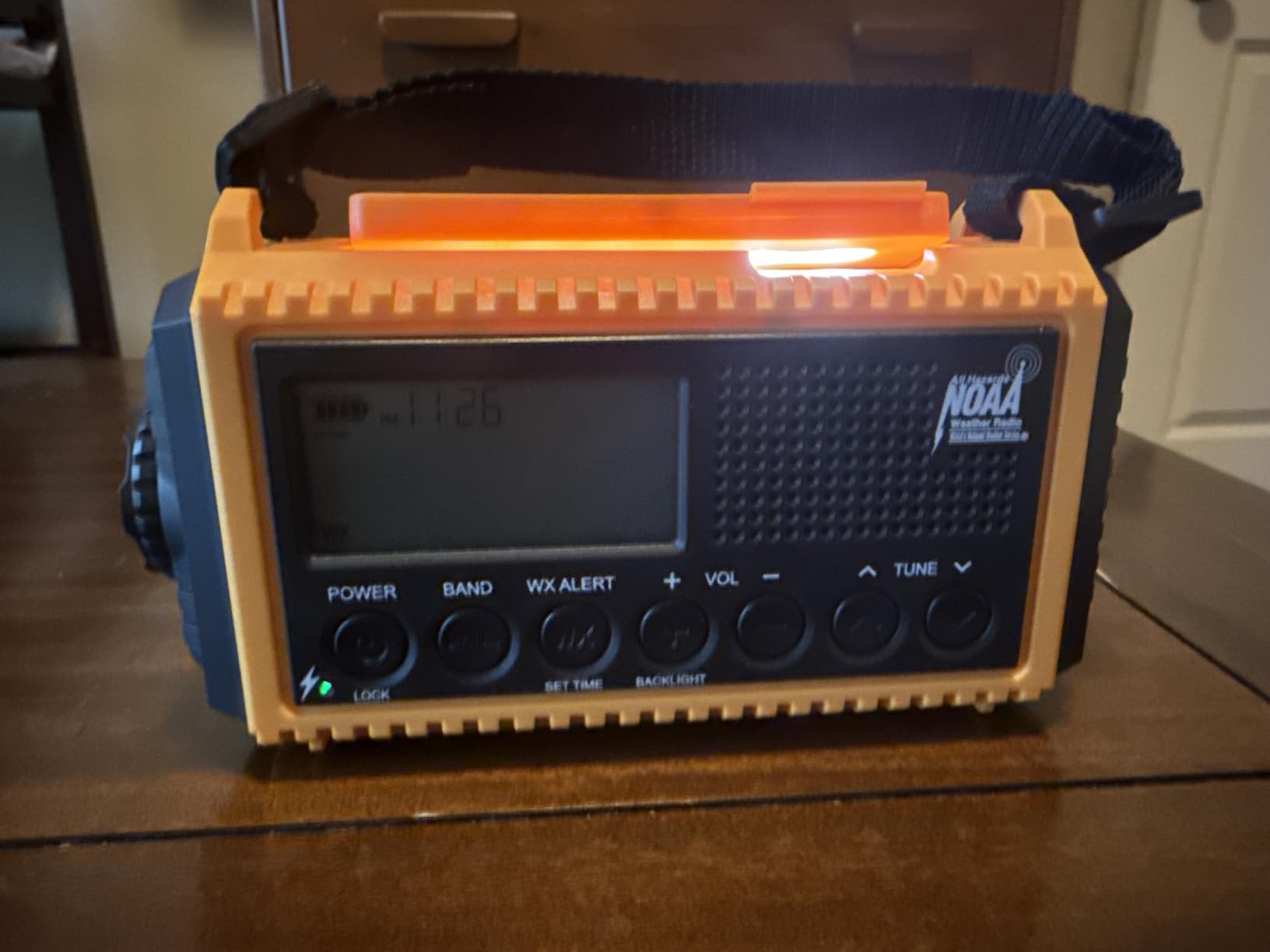
Sound comes from a three-watt speaker, noticeably better than the two-watt units in the same band. A 2.5-watt reading lamp sits alongside the three-watt flashlight, and both draw relatively little power. The large backlit LCD shows battery level and tuned frequency, which matters when you are fumbling in a dark hallway.
Shortwave reception is available for people who listen beyond AM and FM. Owners note that the band takes patience, since you step through wavelengths slowly rather than scanning digitally.
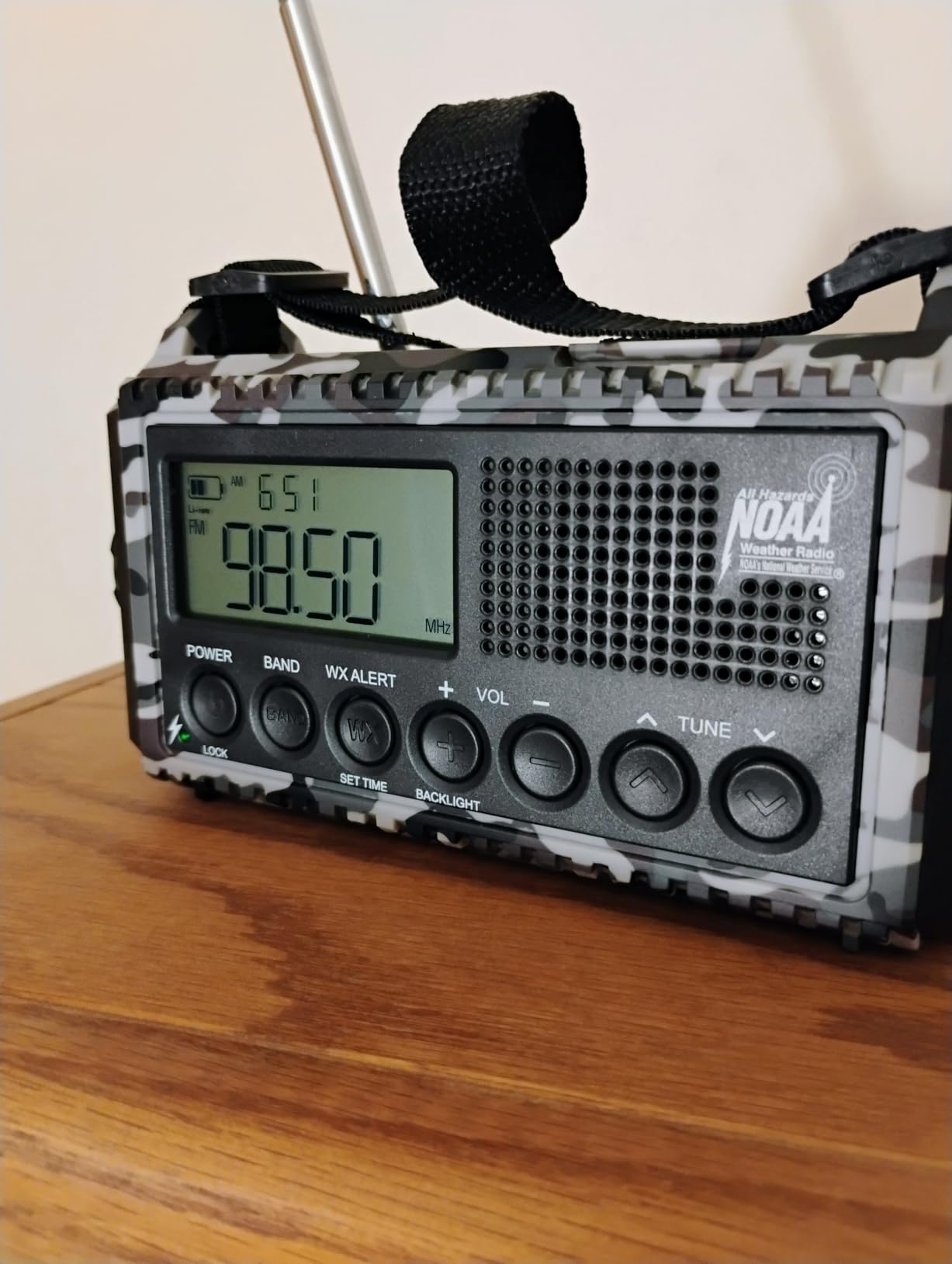
Why the Raynic earns its value badge
For an apartment or a first-stage kit, this radio covers nearly every need. It weighs just over a pound, includes a headphone jack for private listening, and outputs USB so you can top up a phone. Our guide to solar power banks covers what to pair with it if you need more stored energy.
Owners also rate the display highly for readability in low light. Digital auto-scan tuning removes the fiddly analog dial that plagues cheaper models, which is a real usability win during an actual emergency.
Where the Raynic CR1009 Pro falls short
It is splash resistant at IPX3 rather than waterproof, so it should not sit in a wet RV or garage. The rubber flap covering the charging ports is reported by several owners as failing to stay closed, which undermines that rating further.
Some buyers received units without the internal battery installed, so check the box contents the moment it arrives. As with most solar radios, the panel maintains charge rather than restoring a flat battery.
3. Kaito KA500 — Best for Outdoor Homes and Long-Term Ownership
Kaito KA500 5-way Powered Solar Power,Dynamo Crank, Wind Up Emergency AM/FM/SW/NOAA Weather Alert Radio with Flashlight,Reading Lamp and Cellphone Charger, Yellow
Replaceable NiMH battery pack
6-way power including 3x AA
14.5 inch telescopic antenna
8.3 x 2.3 x 5.3 inches
Pros
- Only radio here with a user-replaceable NiMH battery pack
- 14.5 inch telescopic antenna with signal strength indicator
- Seven pre-programmed NOAA channels with PEAS alerting
- USB output for phones GPS and MP3 players
Cons
- Bulkiest unit in the roundup at 8.3 x 2.3 x 5.3 inches
- NOAA coverage limited to the USA and Canada
- 5V AC/DC wall adapter sold separately
The Kaito KA500 is the oldest design in this roundup and still the one I recommend for anyone serious about preparedness. Its decisive advantage is a user-replaceable NiMH battery pack. Every other radio here uses a sealed lithium cell, which means the whole unit becomes landfill once that cell degrades. Swap the pack on the KA500 and it keeps working for decades.
The 14.5 inch telescopic antenna is the other reason to choose it. A long whip with an LED signal strength indicator gives noticeably better reception on distant stations than the stub antennas fitted to most competitors, which matters if you live past the edge of your local NOAA transmitter.
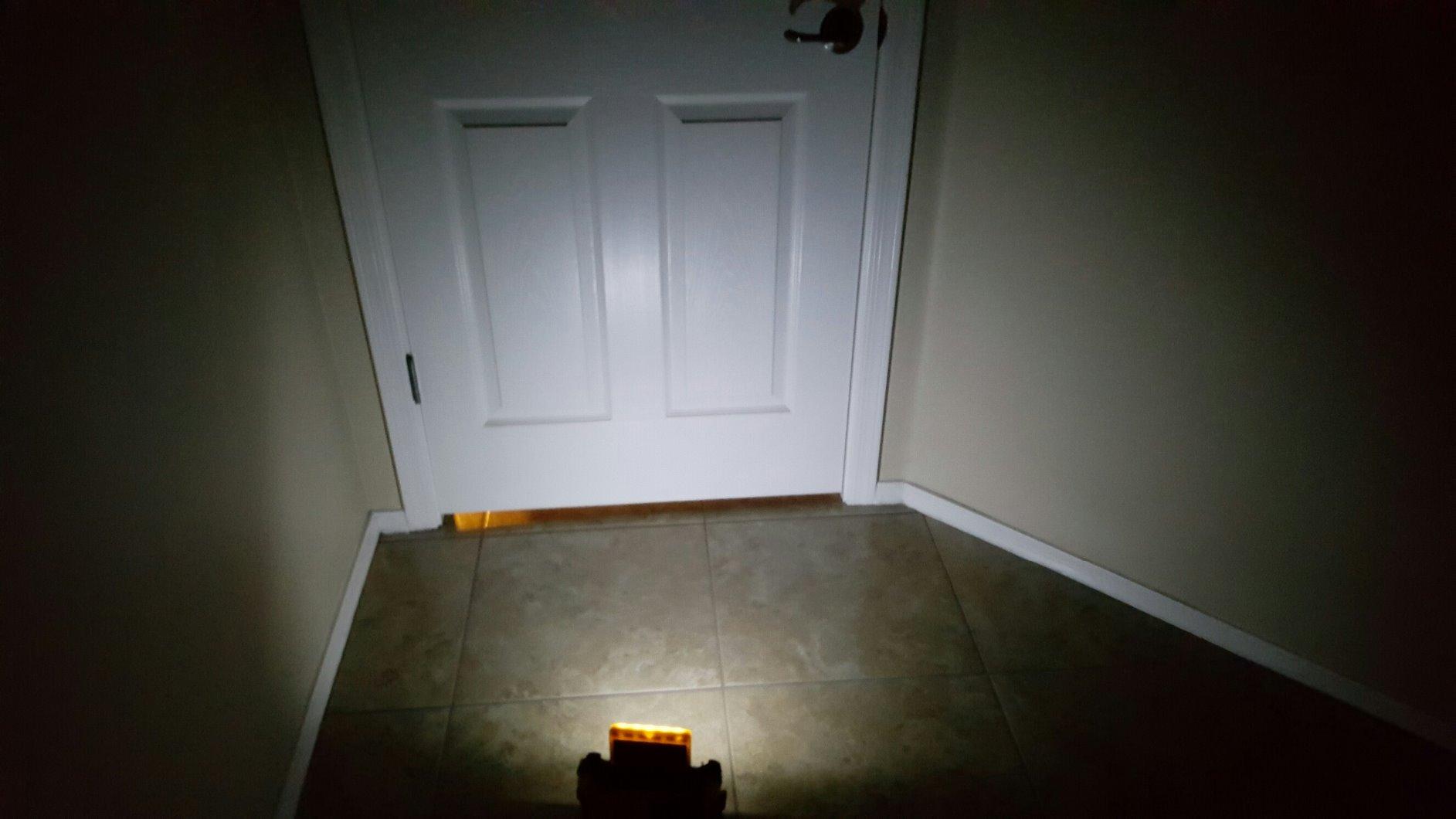
Power options number six: hand crank generator, solar panel, a three-AA compartment, USB input, AC/DC input and the internal NiMH pack. USB output runs in the other direction too, charging phones, GPS units, MP3 players and cameras from the same port.
Five LEDs form the reading lamp, with a separate flashlight and a red SOS beacon that strobes for night visibility. The housing is impact-resistant and water-resistant ABS, and the body is noticeably chunkier than its competitors at 8.3 by 2.3 by 5.3 inches.
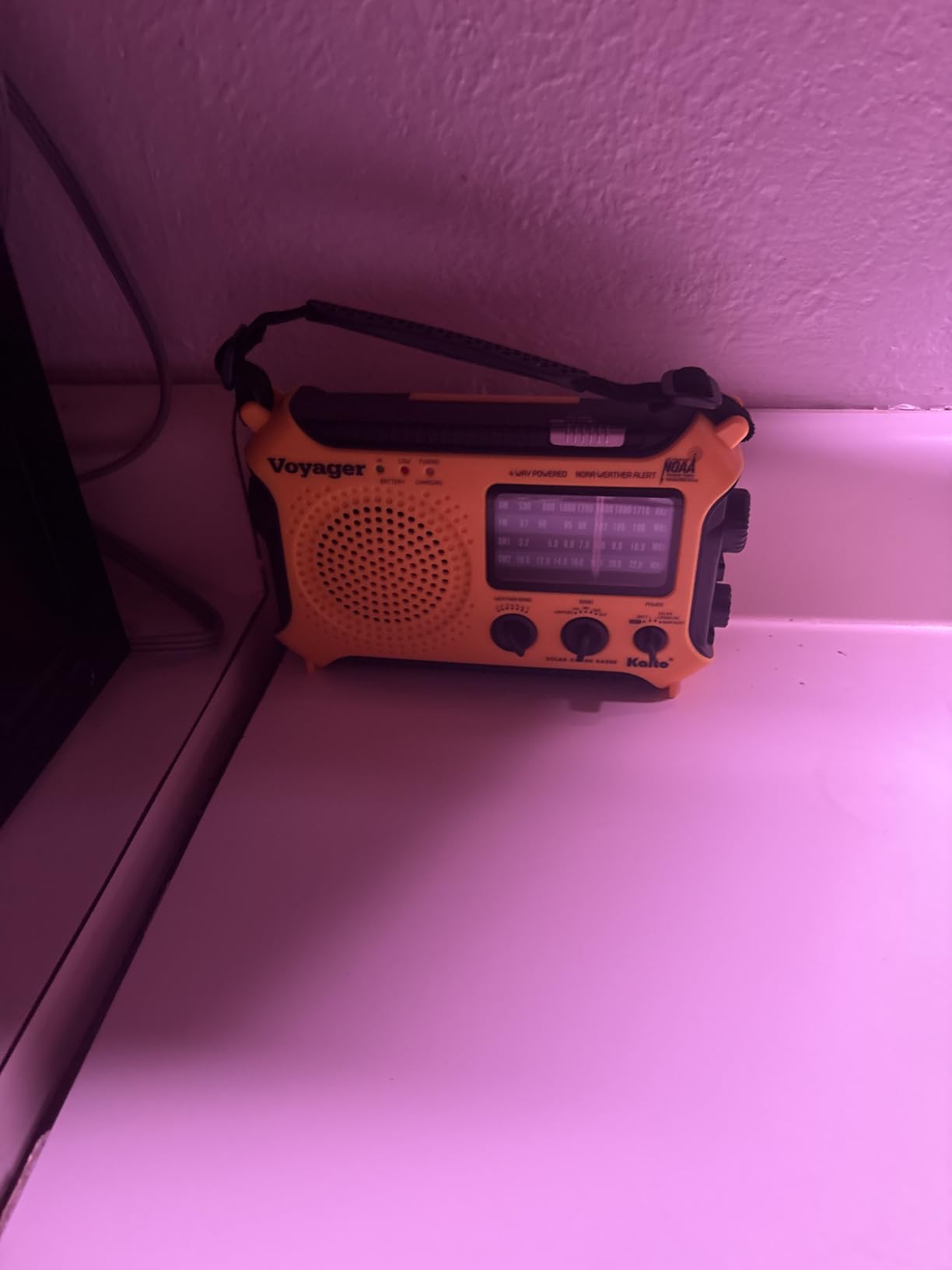
When the Kaito KA500 earns its place
Buy this one if you own a rural property, a cabin, a boat or anything off-grid. The antenna length and the replaceable battery both reward owners who keep equipment for years rather than months. Two-band shortwave coverage is also useful for receiving broadcasts from beyond local AM and FM ranges.
Owners frequently cite the loud, clear speaker as a step above the small drivers used by budget units. If you plan to listen in a workshop, a garage or a basement, that matters.
When to skip the Kaito KA500
Skip it for a go bag. This is the largest and heaviest unit in the group, and the three-AA compartment does not come with batteries fitted, so you are buying two things to get started.
The NOAA alert system covers the USA and Canada only. It is also the only model here where the wall adapter is a separate purchase, and PEAS alerting behaves differently outside US reception areas.
4. Eoxsmile NOAA Radio — Best for Alerts That Wake You Up at Night
Eoxsmile Emergency Radio with NOAA Weather Alert, Solar Hand Crank Portable
5000mAh battery up to 13 hours of FM
NWS-certified 9-second SOS siren
5-watt speaker
3W flashlight plus 2.5W reading lamp
Pros
- NWS-certified alerting fires a loud siren and red flash in standby
- Five power sources for wide resilience
- Up to 13 hours of FM playback per charge
- 5-watt speaker is among the loudest here
Cons
- No water resistance rating worth relying on in real rain
- Charges connected devices slowly at about 1 amp
- Occasional models arrive broken or missing the internal battery
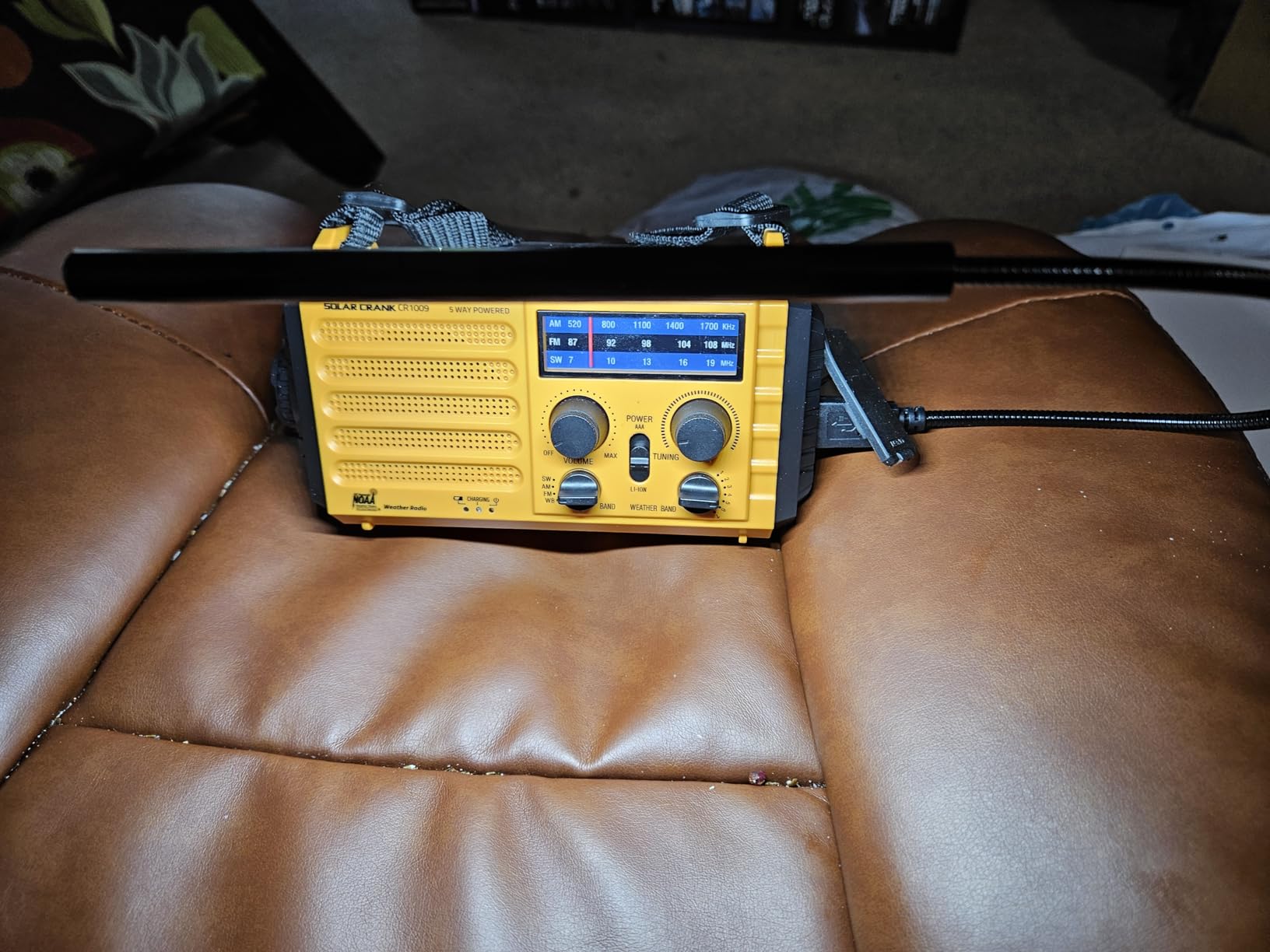
The Eoxsmile is built around one idea: make the alert impossible to sleep through. It carries NWS certification, which means it fires a nine-second SOS siren with a flashing red light when a severe weather broadcast reaches the NOAA band. In a bedroom at 3 a.m. that is a meaningful difference over a soft chime.
A 5000mAh internal battery gives up to 13 hours of FM playback on a full charge, and five power sources cover the gaps: the internal pack, a solar panel, a hand crank, a 5V wall plug and a USB-C cable, plus three AAA cells as backup.
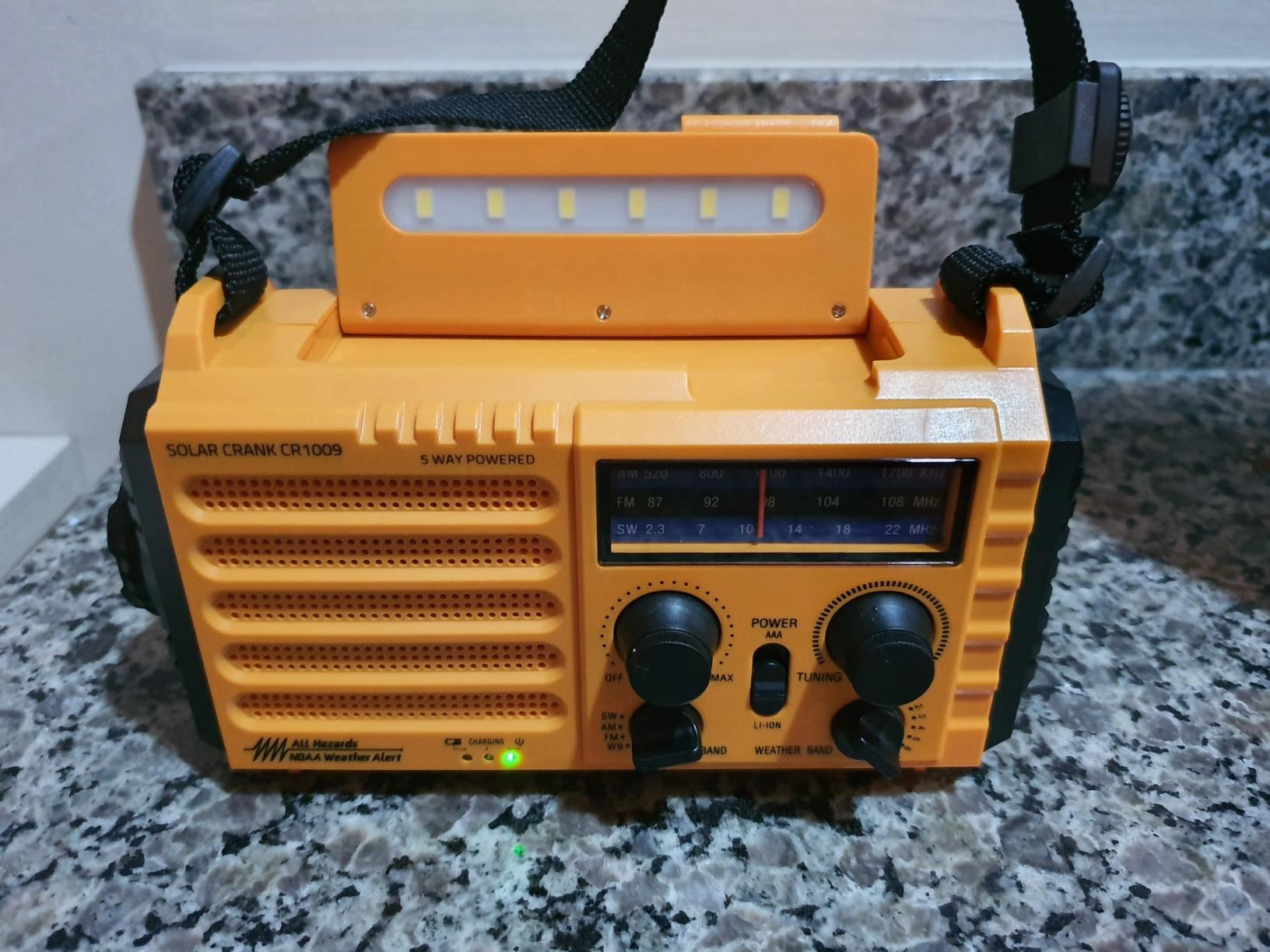
The five-watt speaker is among the loudest we saw, which suits large rooms and garages. A three-watt side flashlight reaches roughly 80 meters, and the flip-up solar panel doubles as a two-level reading lamp. Bands cover FM 88-108 MHz, AM 520-1710 kHz, shortwave from 7-19 MHz and all seven NOAA channels.
A compass, hand strap and hang buckle come in the box, and the USB output will charge a phone. This is a well-rounded kit for the money.
Where the Eoxsmile works best
This is our pick for households in tornado, hurricane and severe thunderstorm territory where overnight warnings are common. The siren volume and the red flasher are what separate it from radios that simply beep quietly in standby.
It also suits older adults and anyone sleeping on the ground floor of a house, because the alert is loud enough to be heard through a closed door. Shortwave coverage is a bonus for listeners beyond local broadcast range.
Where the Eoxsmile is a poor choice
There is no water resistance rating you can rely on. If your kit lives in a garage, car or RV, this is not the radio. Leave it somewhere dry and indoors.
Owners report slow phone charging at about one amp, and a small share of models arriving defective or without the internal battery fitted. Test it fully the day it arrives rather than on the night you need it.
5. iRonsnow 2000mAh — Best Lightweight Radio for Go Bags
iRonsnow Solar Emergency Hand Crank Weather Radio, 2000mAh NOAA AM/FM
2000mAh pack with USB-C charging
1W flashlight with SOS flash mode
5 x 1.8 x 2.4 inches, 7.84 oz
AM FM and NOAA weather band
Pros
- Lightest and most pocketable radio in the roundup
- Battery level indicator with a 4-light charge gauge
- Three recharge paths including USB-C fast charging
- Two-year exchange warranty
Cons
- 2000mAh is the smallest battery here so phone charging is minimal
- Single 1W flashlight with no reading lamp
- Analog dial tuning is fiddly in the dark
At 7.84 ounces and 5 by 1.8 by 2.4 inches, the iRonsnow is the radio you can put in a jacket pocket and forget. That is its entire case, and it is a good one. Most emergency radios are too large to keep on your person, and this one is genuinely easy to carry.
The 2000mAh battery is the smallest in this roundup, which means phone charging works but only for an emergency top-up. A four-light indicator shows charge at 25, 50, 75 and 100 percent, so you always know roughly where you stand without opening anything.
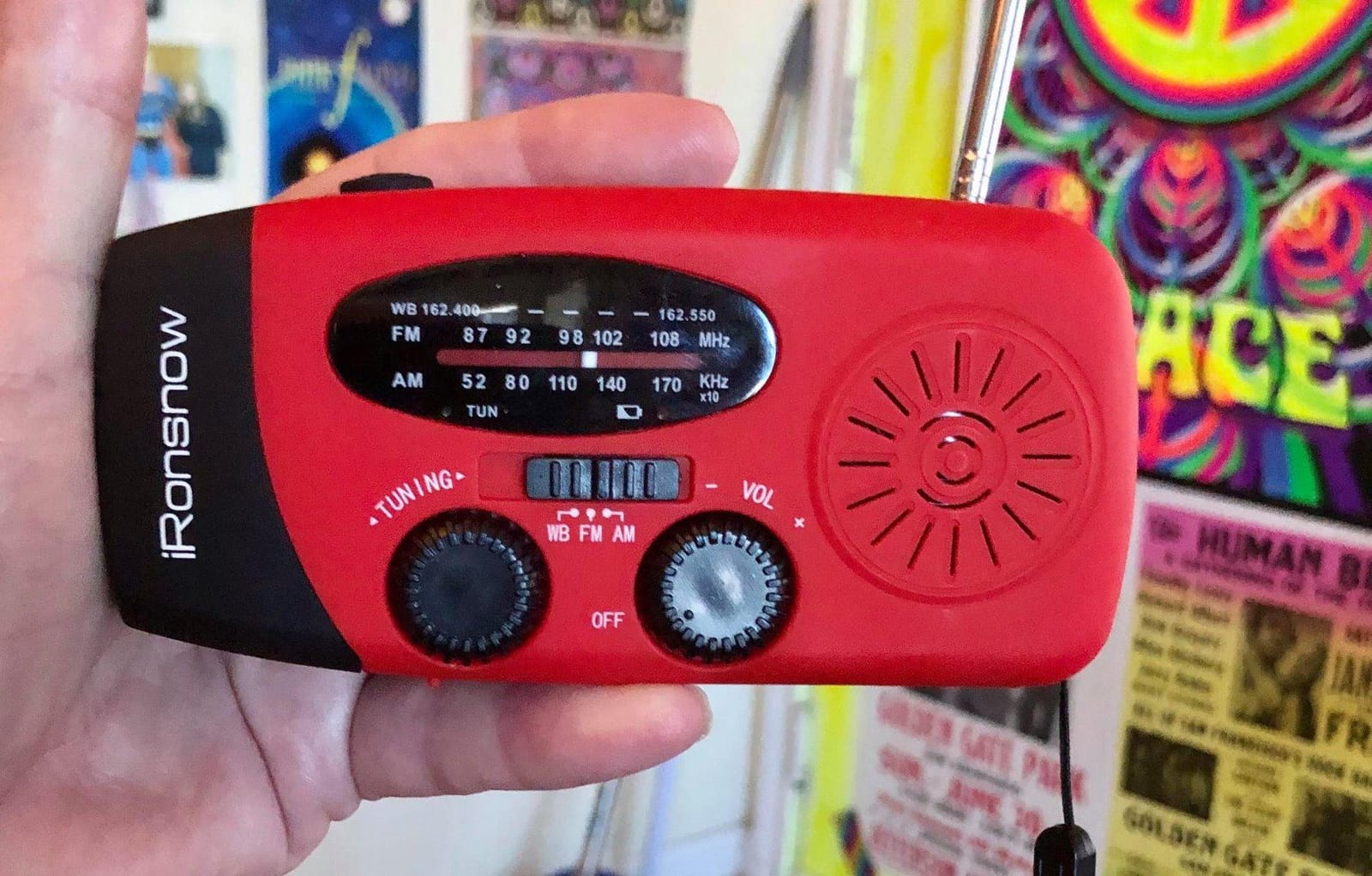
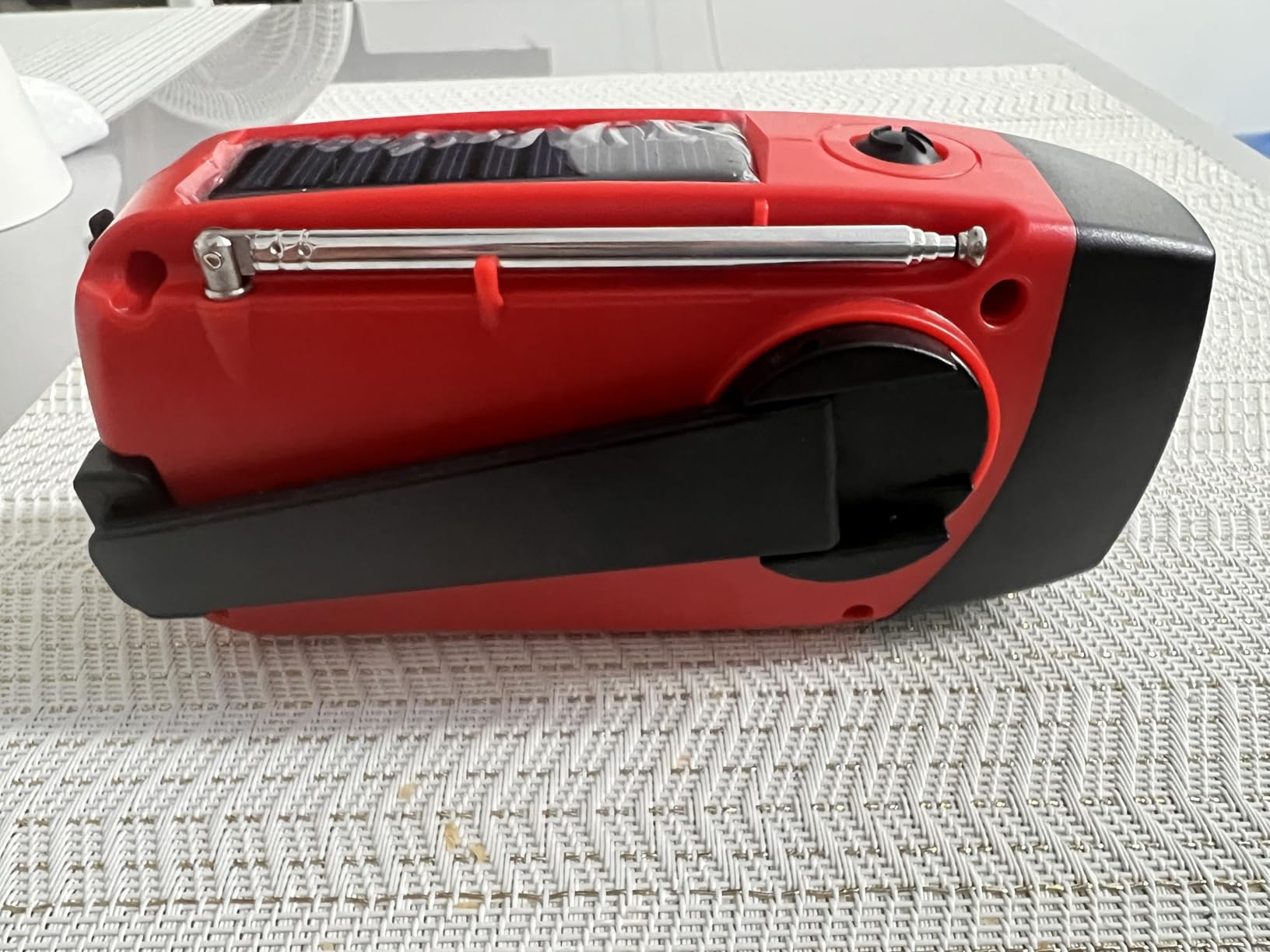
Three recharge paths are available: USB-C fast charging, the hand crank and the solar panel. A one-watt flashlight has three brightness levels on the updated version, and a long-press SOS mode flashes the light as a distress signal. A 3.5mm headphone jack is also included, which many similarly sized radios omit.
Note that older and newer versions ship in parallel, so flashlight configuration can differ from the product listing depending on which version arrives.
Where the iRonsnow fits best
Go bags, cars, desk drawers and suitcases. This is the radio to buy when you want a second unit in case your main radio fails, because it costs little and takes up almost no space. Many preparedness households own two radios for exactly this reason, one at home and one portable.
The 1:1 scale of it also makes it a sensible weekend camping or hiking radio, where every ounce counts and NOAA alerts still reach you in remote areas.
Where it does not fit
Do not rely on it as your power bank. A 2000mAh pack will barely move a modern phone, and there is no reading lamp, so reading in a dark shelter means using the flashlight and draining the same circuit.
The analog dial is fiddly to tune in darkness, which is exactly when you would use it. The two-year exchange warranty is a genuine plus at this tier.
6. PPLEE 12000mAh — Best for Automatic Standby Monitoring
NOAA Emergency Weather Radio with Auto Alert, Solar Hand Crank, 12000mAh
True 12000mAh battery
6 charging options with AC adapter included
LCD shows battery percentage and alerts
6.69 x 2.36 x 3.74 inches, 16 oz
Pros
- 12000mAh battery far larger than others at this price
- Automatic NOAA monitoring of all 7 bands in standby
- Six power options and an AC adapter in the box
- Digital auto-scan tuning is easy in low light
Cons
- Frequency buttons step one channel at a time with no fast scroll
- Small solar panel only maintains charge rather than recharging
- Some buyers report no shortwave band despite the listing
The PPLEE CR1009Ultra solves the battery anxiety that most solar radios share. Its 12000mAh pack is genuinely large, and at this price it undercuts every other high-capacity model we reviewed. Six charging options include an AC adapter in the box, which saves a separate purchase.
Like the Raynic, it monitors all seven weather band channels automatically in standby and triggers a siren plus red flash when an alert is issued. The large LCD shows time, battery percentage, frequency and alert status in real time, which is more information than most competitors display.
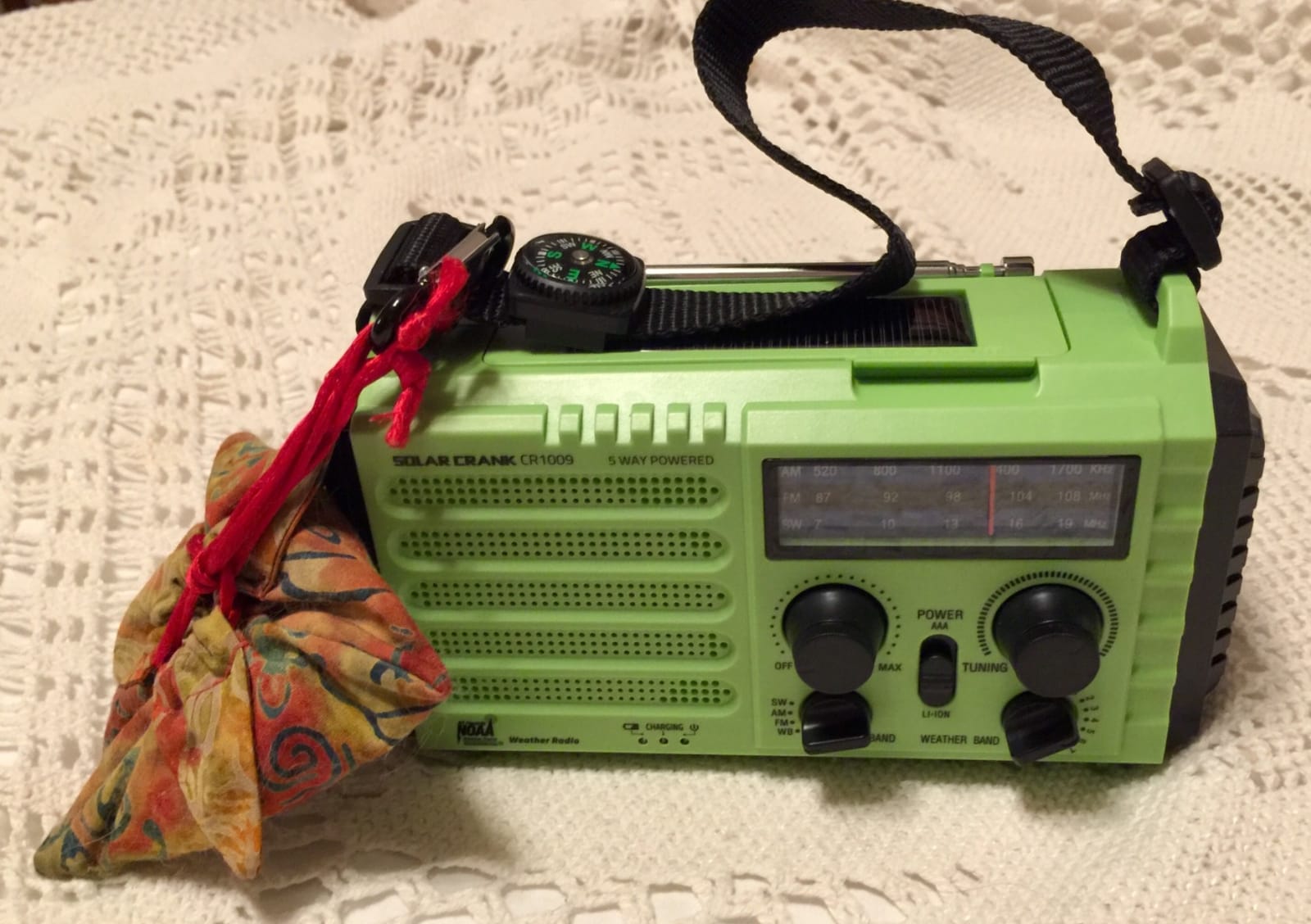
Bands run FM 87-108 MHz, AM 520-1710 kHz, shortwave from 2.3-22 MHz and seven NOAA channels, with a 3.5mm headphone jack for private listening. A three-watt flashlight and a 2.5-watt reading lamp with adjustable brightness cover lighting, and the SOS alarm doubles as a Morse code distress signal.
The body measures 6.69 by 2.36 by 3.74 inches at 16 ounces, and the warranty runs 18 months with a three-month refund window.
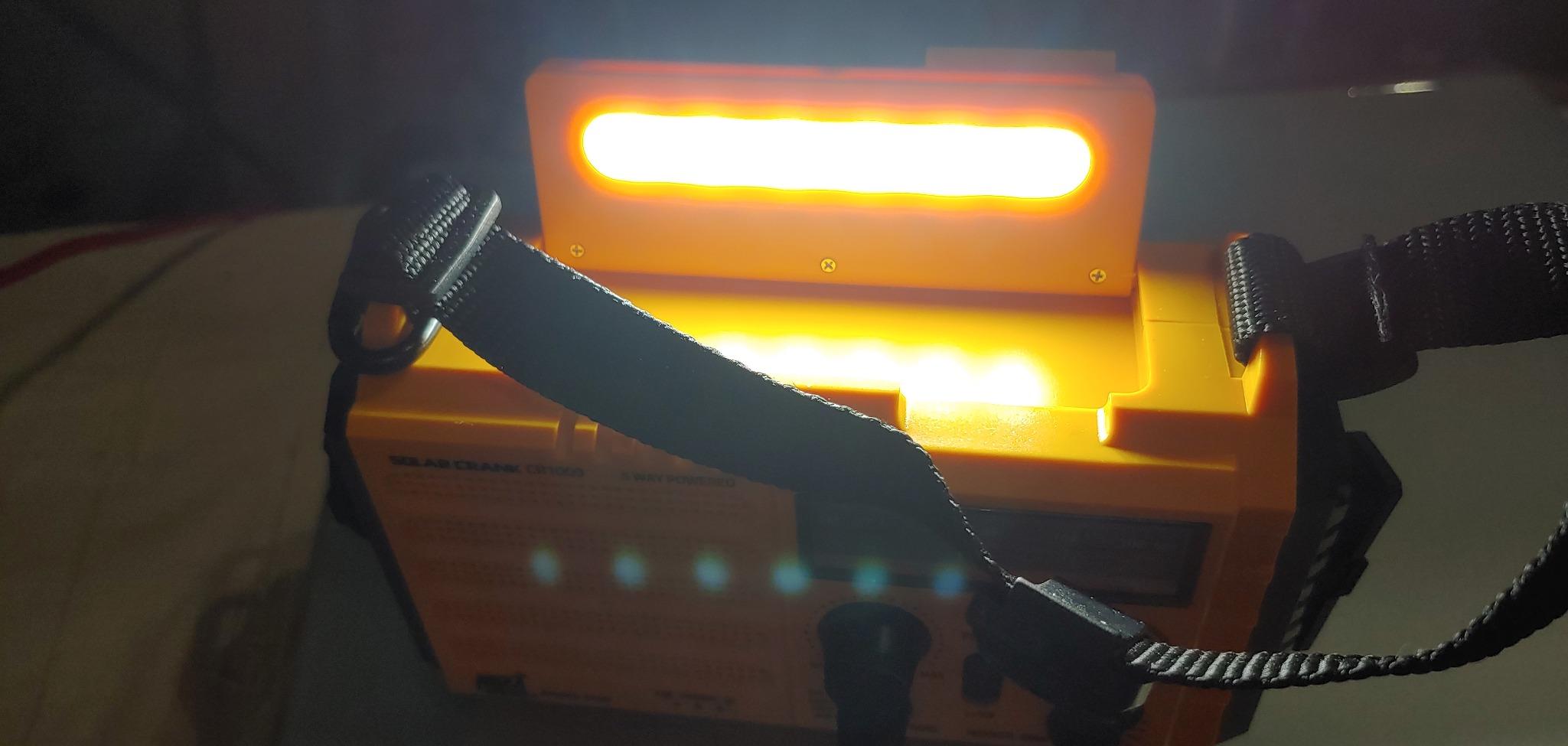
Why the PPLEE stands out
Stored energy is the resource that actually decides whether a radio survives a multi-day outage, and this model carries a lot of it. Users report that the digital auto-scan tuning is far easier to operate in low light than the analog dials fitted to similar-sized units.
It suits a home where someone needs a phone to keep working for medical or business reasons, since the USB output can feed a phone while the radio still has reserve.
Where the PPLEE frustrates buyers
Channel stepping is slow, moving one frequency at a time with no fast-scroll button. On shortwave that makes tuning genuinely tedious, and a handful of buyers report models arriving without the advertised shortwave band.
The solar panel is small and functions only as a maintainer. Sound quality from the small speaker is adequate for spoken alerts rather than music, and the plastic buttons have noticeable play.
7. Leaton 20000mAh — Best for Long Runtime and Warranty Cover
NOAA Weather Radio 20000mAh Emergency Hand Crank Solar Radio AM/FM
20000mAh battery with USB-A output
Extended telescopic antenna, 7 NOAA channels
3-mode flashlight plus 1.3W reading lamp
IPX3, 1.1 lbs, 2-year warranty
Pros
- 20000mAh battery among the largest available here
- FM and NOAA stations tune in easily and clearly
- Flip-up solar panel doubles as a flood light
- Two-year manufacturer warranty
Cons
- Solar panel ineffective for recharging
- as a maintainer only
- No SAME alerts so channels must be tuned manually
- No headphone jack and no shortwave band
The Leaton carries a 20000mAh pack, which puts it in the top tier of capacity in this roundup, and it weighs just over a pound. For a home kit that needs to run for several days without a wall outlet, that combination is hard to argue with.
Reception is the other strength. Owners describe FM and NOAA stations picking up easily and clearly, helped by an extended telescopic antenna and manual tuning across all seven weather channels from 162.400 to 162.550 MHz. A built-in compass is a small touch that helps outdoors.
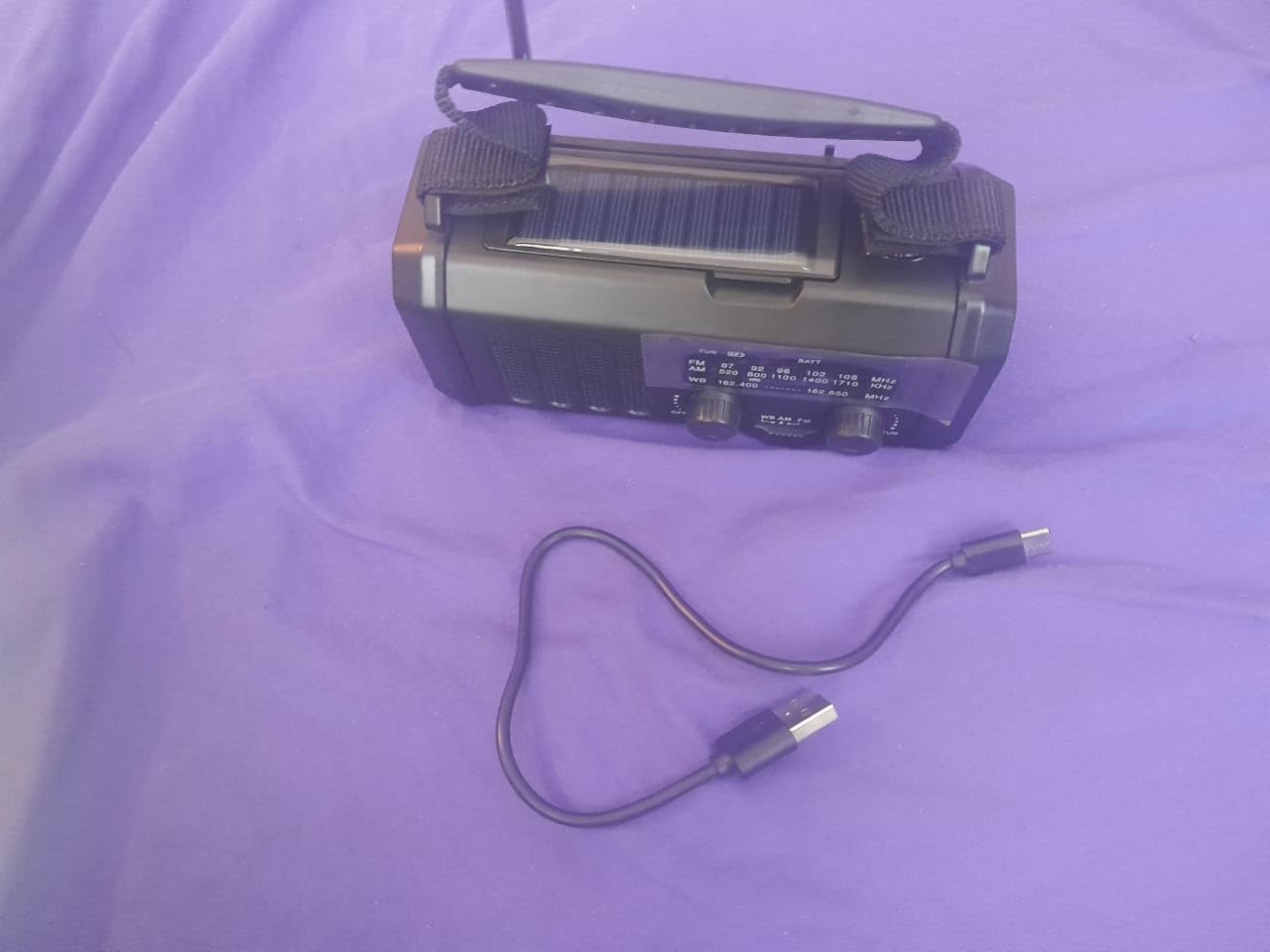
The flashlight has three modes covering high, low and SOS, and a 1.3-watt reading lamp sits alongside it. The flip-up solar panel doubles as a flood light, which is a clever use of a component most brands hide.
USB-A output charges a phone, though it is the only port, so you cannot charge two devices at once. The battery is sealed and not user-replaceable.
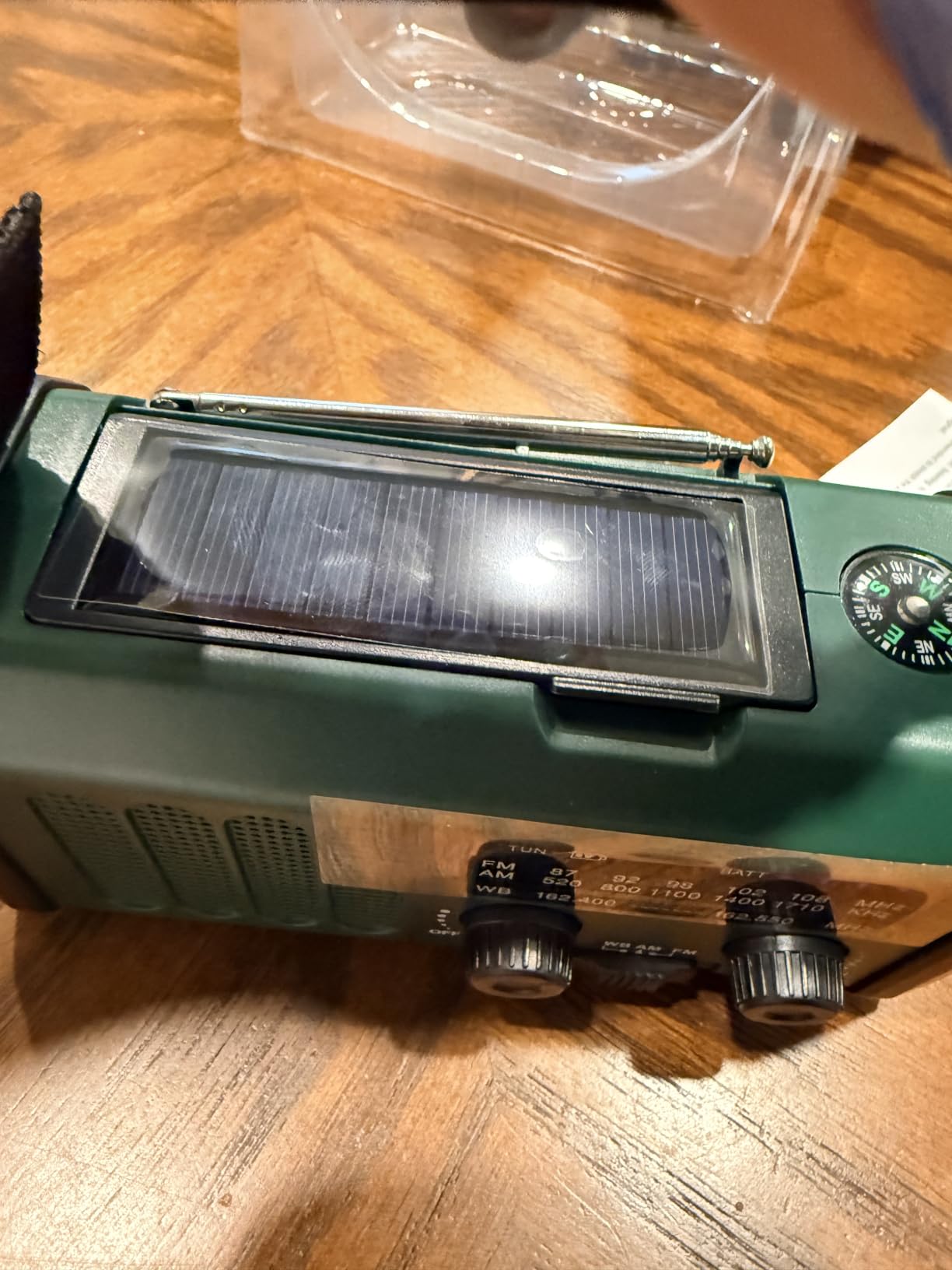
Who should pick the Leaton
Households in areas with infrequent but long outages, and anyone running a home where a phone needs topping up repeatedly. The two-year manufacturer warranty is the longest alongside the Mesqool, and it covers the sealed battery that most competitors leave you stuck with.
Job bags, workshop kits and off-grid cabins all benefit from the combination of capacity, IPX3 splash resistance and a readable LCD display.
Who should look elsewhere
If you want the radio to wake you only for your own county, this is not the model. There is no SAME automatic alerting, so the channel must be tuned manually and checked.
There is also no headphone jack and no shortwave band, which rules it out for shared sleeping spaces and for listeners beyond AM and FM range.
8. yesiwtc 7400mWh — Best Built-In Cables and Speaker Output
Hand Crank Emergency Radio 7400mWh (2000mAh) Solar Hand Crank Radio
7400mWh 2000mAh pack with 3 cables
4 power sources including AAA backup
7.4-watt speaker, 3-mode flashlight
6.49 x 1.9 x 2.9 inches, waterproof
Pros
- Lightning USB-C and Micro USB cables built into the body
- 7.4-watt speaker is the loudest in this roundup
- 4 power sources including AAA backup
- 18-month replacement warranty and lifetime support
Cons
- Analog dial tuning is less precise than digital models
- 2000mAh capacity is small beside 12000 and 20000mAh units
- AAA backup batteries not included
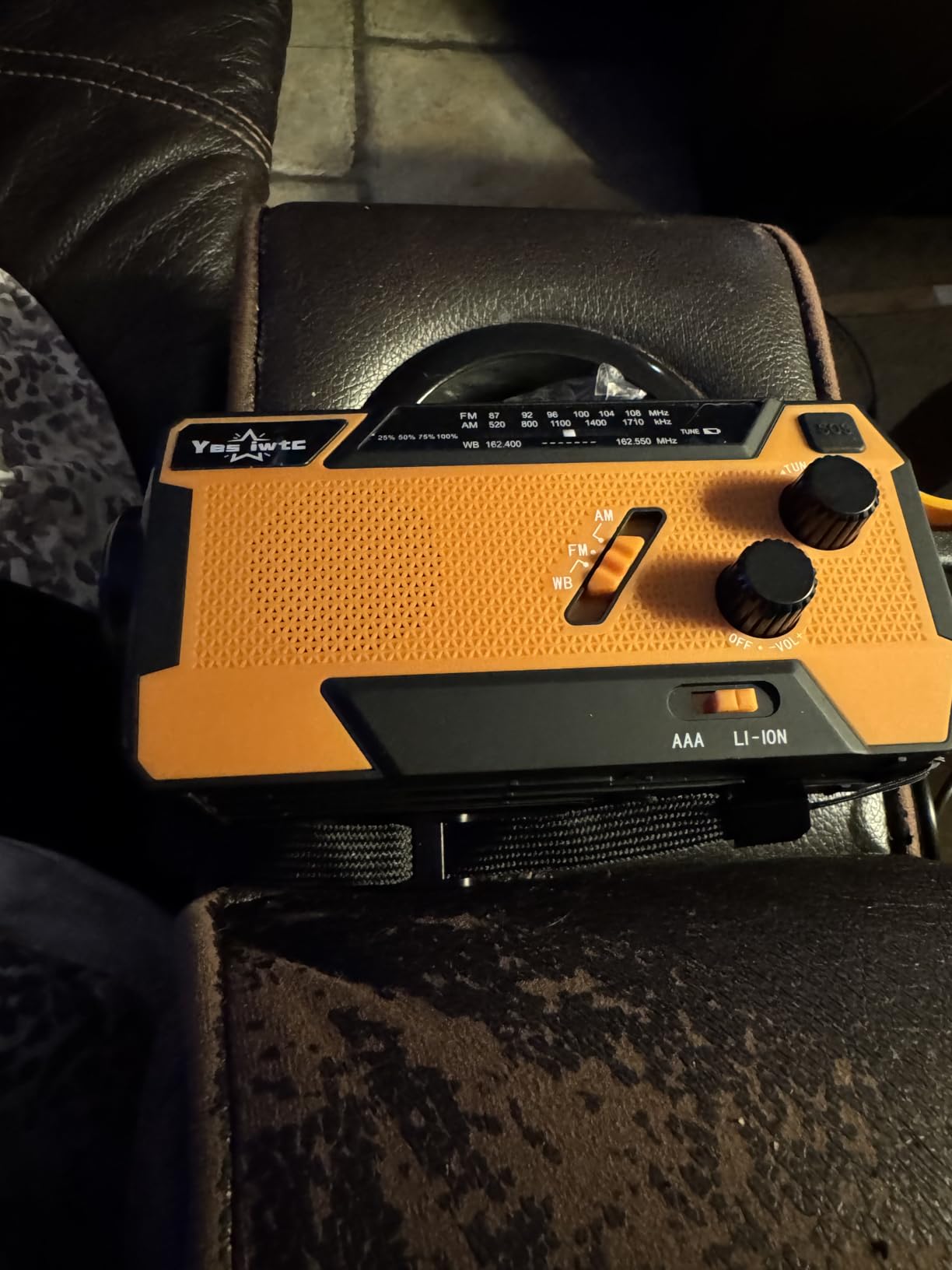
The yesiwtc 090S solves a problem nobody else in this roundup addresses. Three charging cables — Lightning, USB-C and Micro USB — are built into the body on retractable leads. In a blackout, searching a drawer for a matching cable wastes the first ten minutes you may have.
Its 7.4-watt speaker is the loudest of any radio we reviewed, roughly double the output of the common two-watt units. That matters in a basement, a garage or a home where someone is hard of hearing.
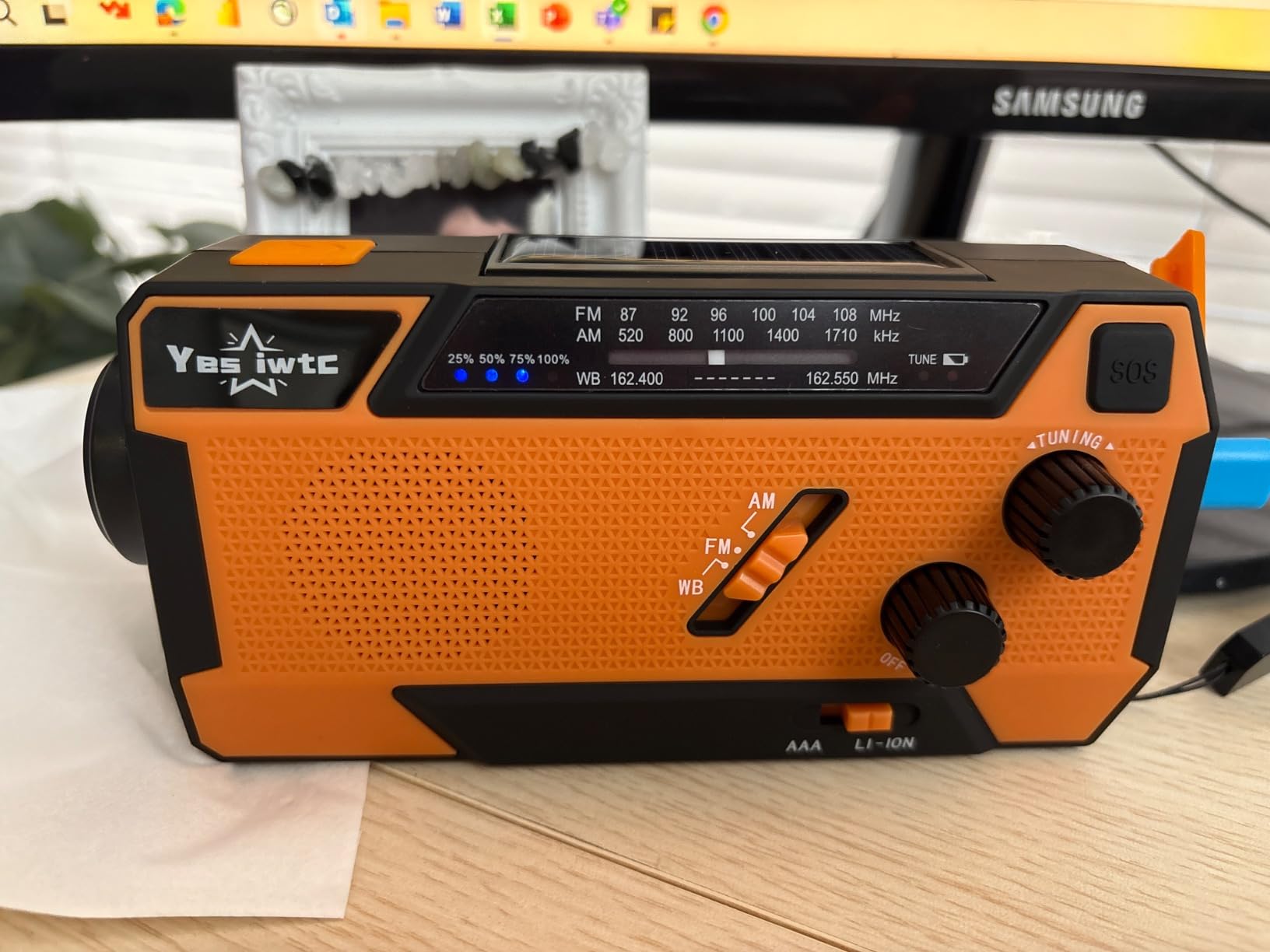
Four power sources cover USB-C, hand crank, solar panel and AAA batteries. A DSP chip and extended antenna drive NOAA plus AM and FM reception. The flashlight has three brightness modes and there are six LED reading lights alongside it, plus a loud SOS alarm and lifetime technical support from the manufacturer.
The body is listed as waterproof and measures 6.49 by 1.9 by 2.9 inches. The 18-month replacement warranty is one of the longer commitments in the group.
Where the yesiwtc makes sense
Households with a mix of devices, or anyone who expects to help neighbours charge phones during a long outage. Three cable types means you can hand someone a working cable without supplying one.
The waterproof rating is unusual at this size and price, which makes it reasonable for a bathroom shelf, a porch or a garage where splash resistance would otherwise be a concern.
Where it does not make sense
The 2000mAh capacity is modest. With three cables but limited stored energy, the cables will help more than the pack, so plan on topping up a phone rather than running it.
Analog tuning is less precise than digital scanning, so shortwave and NOAA hunting is slower. AAA backup cells are not included, so buy a pack of your own if you want that fallback.
9. Mesqool CR1030 — Best Real Solar Charging
Solar Radio Emergency Hand Crank 12000mAh with Clear Signal
8500mm2 monocrystalline solar panel
True 12000mAh lithium battery
260 foot flashlight beam plus reading lamp
6.8 x 2.9 x 4.7 inches, 1.6 lbs
Pros
- Solar panel over 4x larger than typical decorative panels
- Upgraded hand crank at roughly double standard charging efficiency
- True 12000mAh battery rather than an inflated claim
- 3-year replacement or refund warranty
Cons
- Heaviest unit here at 1.6 pounds
- Highest cost in the group
- Analog tuning rather than digital scanning
The Mesqool CR1030 is the only radio in this roundup where solar is a genuine power source rather than decoration. Its monocrystalline panel measures 8500 square millimeters, more than four times the area of the panels fitted to most competitors of this size. Owners describe it as a step up for exactly that reason.
The hand crank is also rebuilt, with a larger copper coil and reinforced magnet that the manufacturer rates at roughly double the charging efficiency of standard dynamos. In practice that means a few minutes of cranking produces a meaningful top-up rather than a token amount.
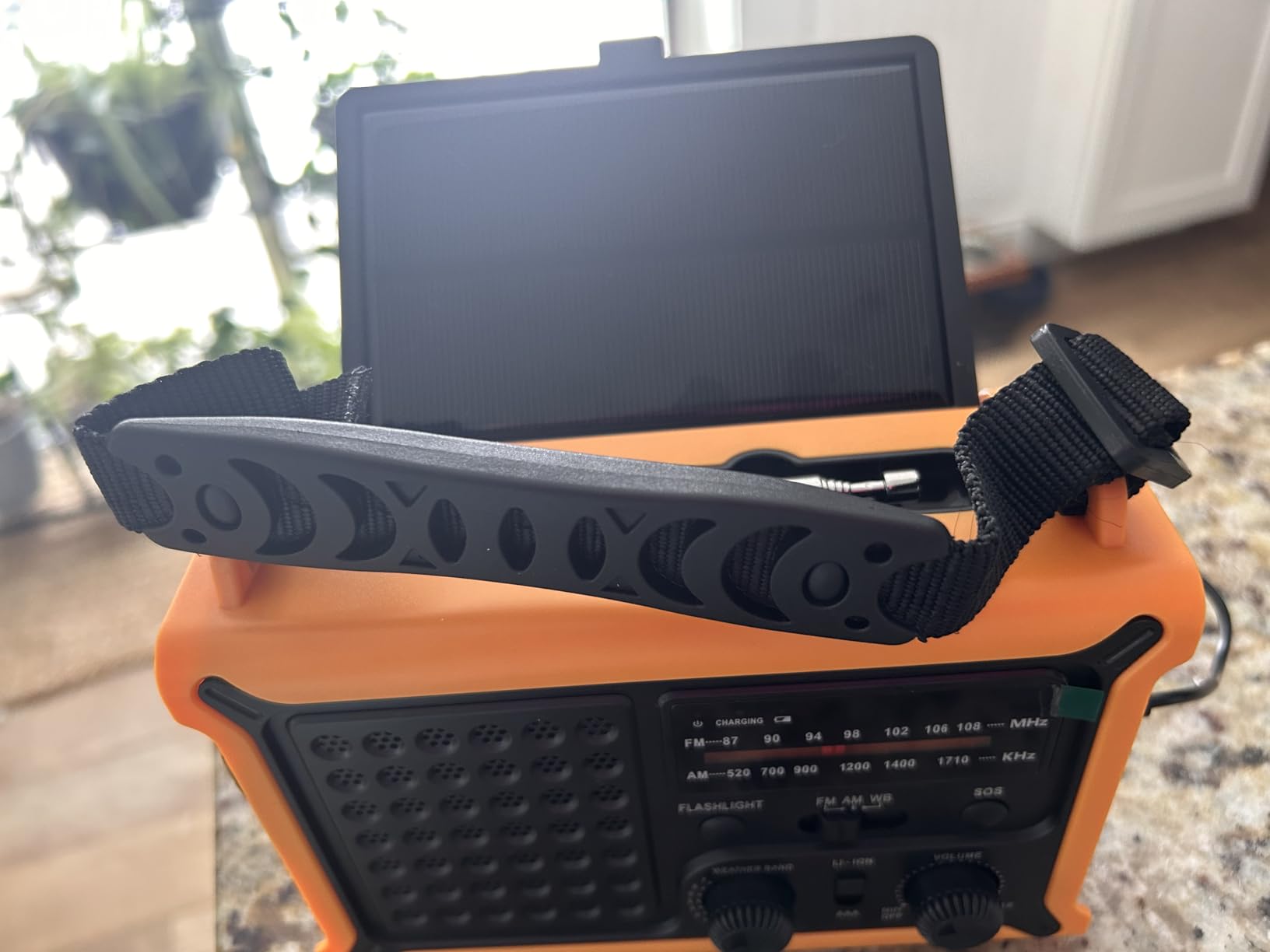
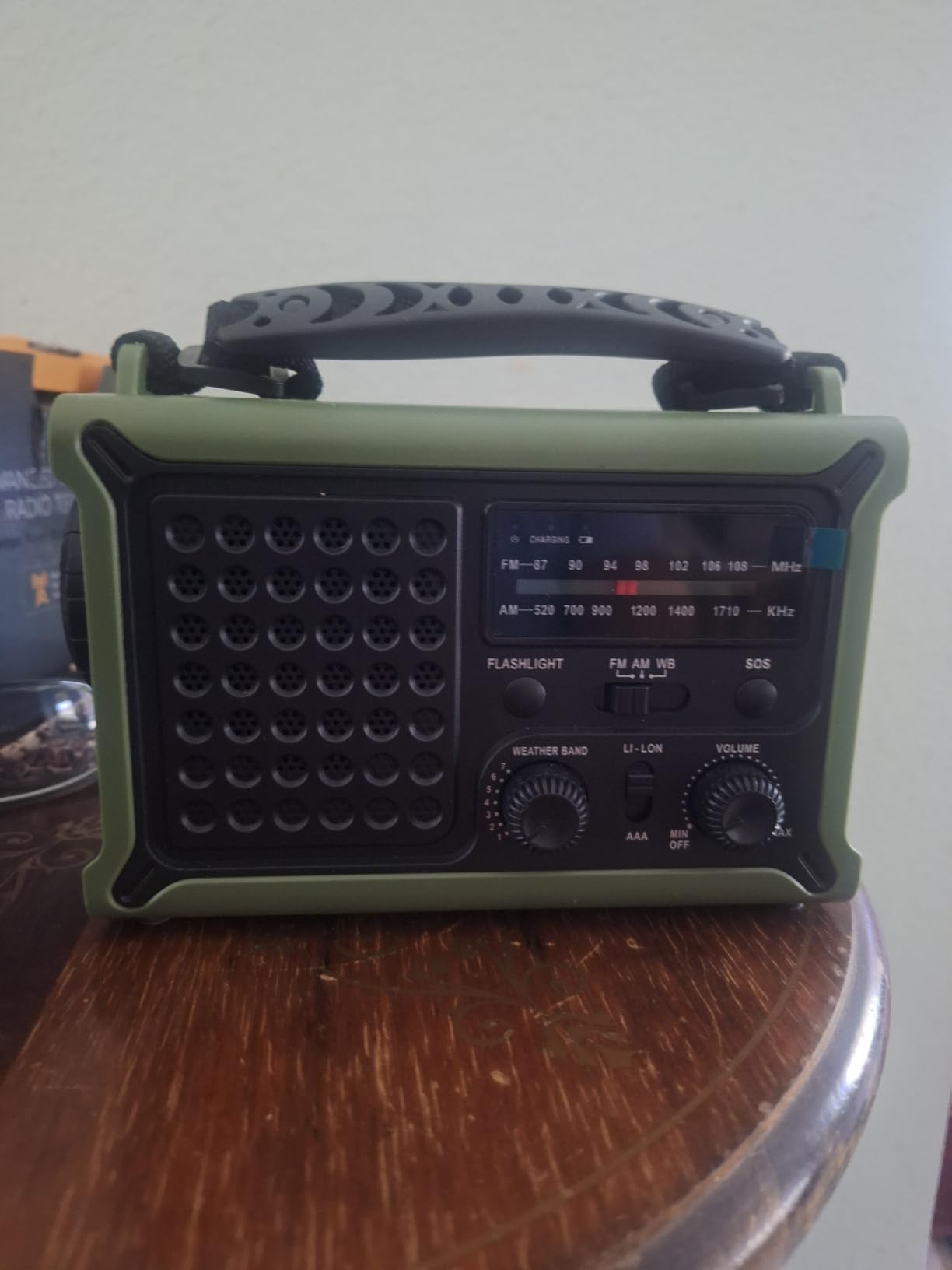
Internal storage is a true 12000mAh lithium battery. A high-sensitivity signal chip with noise reduction and an extended antenna handles NOAA, FM and AM, and reviewers consistently call out clear reception as the stand-out feature.
The flashlight throws a beam reaching about 260 feet, with a frosted flip-up reading lamp beside it. Both have two brightness levels. Bands are NOAA, FM and AM, and the body measures 6.8 by 2.9 by 4.7 inches.
Why solar actually matters on this model
If your kit sits on a windowsill, a porch or a dash for weeks, a larger panel converts that idle time into stored charge. On the small decorative panels used elsewhere, overcast conditions add almost nothing; on a panel this size, a bright overcast day produces a visible gain on the charge indicator.
That makes this the radio to choose for a home without a basement or a garage, where the only place to leave it is in daylight. Our emergency lights guide covers the lighting side of the same windowsill shelf.
Where the Mesqool costs you
At 1.6 pounds it is one of the heavier units here, and it is the most expensive model in the roundup. That combination makes it a poor fit for a go bag or a hiking kit.
Tuning is analog rather than digital scanning, so finding a specific NOAA channel takes patience. The three-year replacement or refund warranty is the best in the group and partly offsets the higher cost.
10. Vokida 10000mAh — Best Boxed Emergency Kit
Emergency Radio Hand Crank Solar, 10000mAh/37000mWh Emergency Weather Radio
37000mWh 10000mAh lithium battery
Automatic NOAA scan across all 7 channels
Flashlight, SOS siren, headphone jack
Bundled with 3 thermal blankets
Pros
- Automatic NOAA scan across all 7 bands in standby
- 10000mAh battery with hand crank and solar
- Headphone jack for private listening which many rivals omit
- 3 thermal blankets and a 5-in-1 paracord bracelet included
Cons
- Only 2-watt speaker output
- Analog tuner rather than a digital display
- Bundled survival extras are the main draw rather than the radio
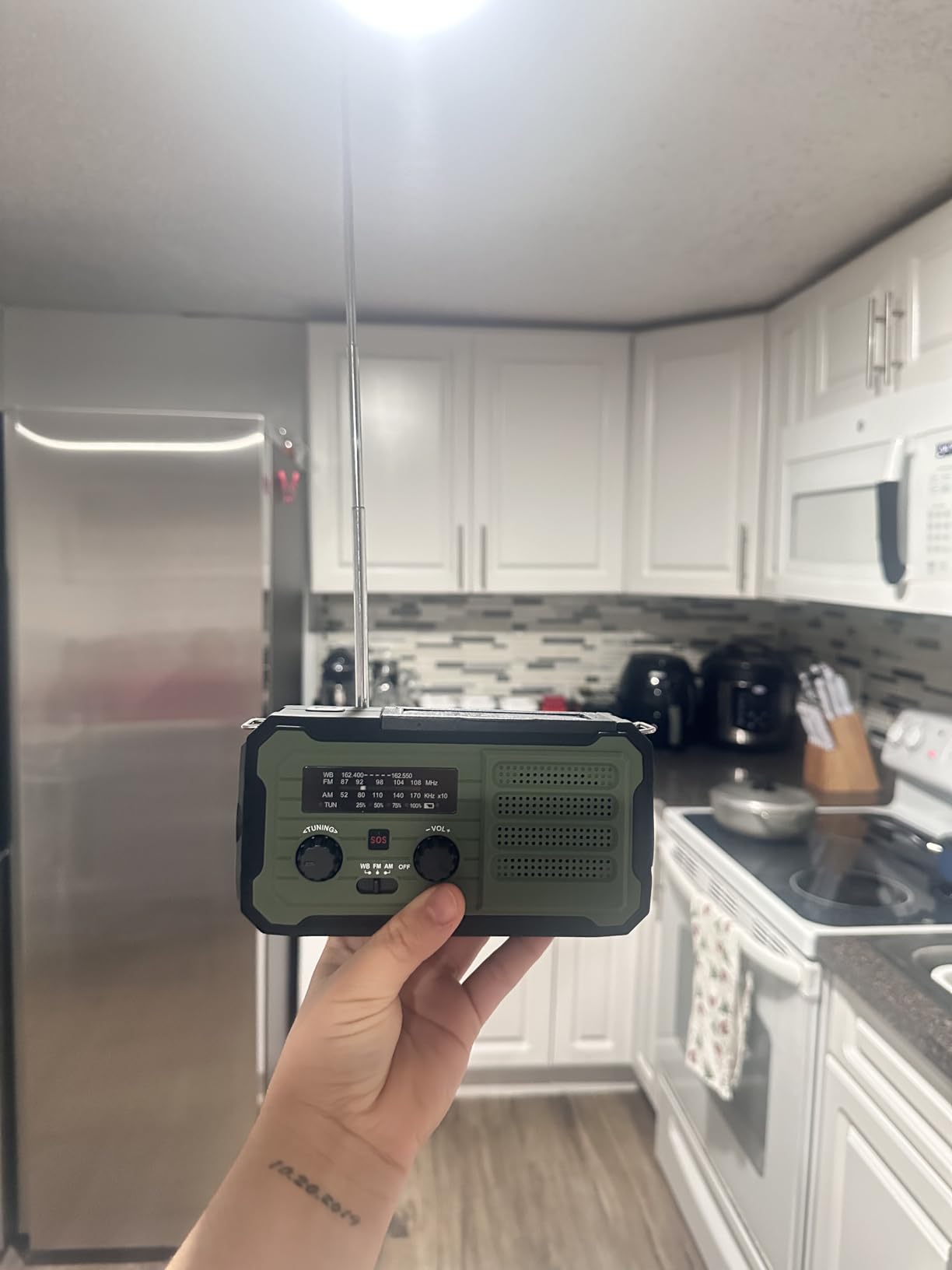
The Vokida YX328 is sold as a one-box emergency kit rather than a radio alone. In the box alongside the radio you get three aluminized emergency thermal blankets weighing 55 grams each and a five-in-one survival paracord bracelet carrying a compass, blade, whistle and magnesium fire rod.
Those extras matter more than they sound. Hypothermia is the leading cause of trouble in the first night of a cold-weather outage, and a heat blanket addresses that risk in a way a second radio does not.
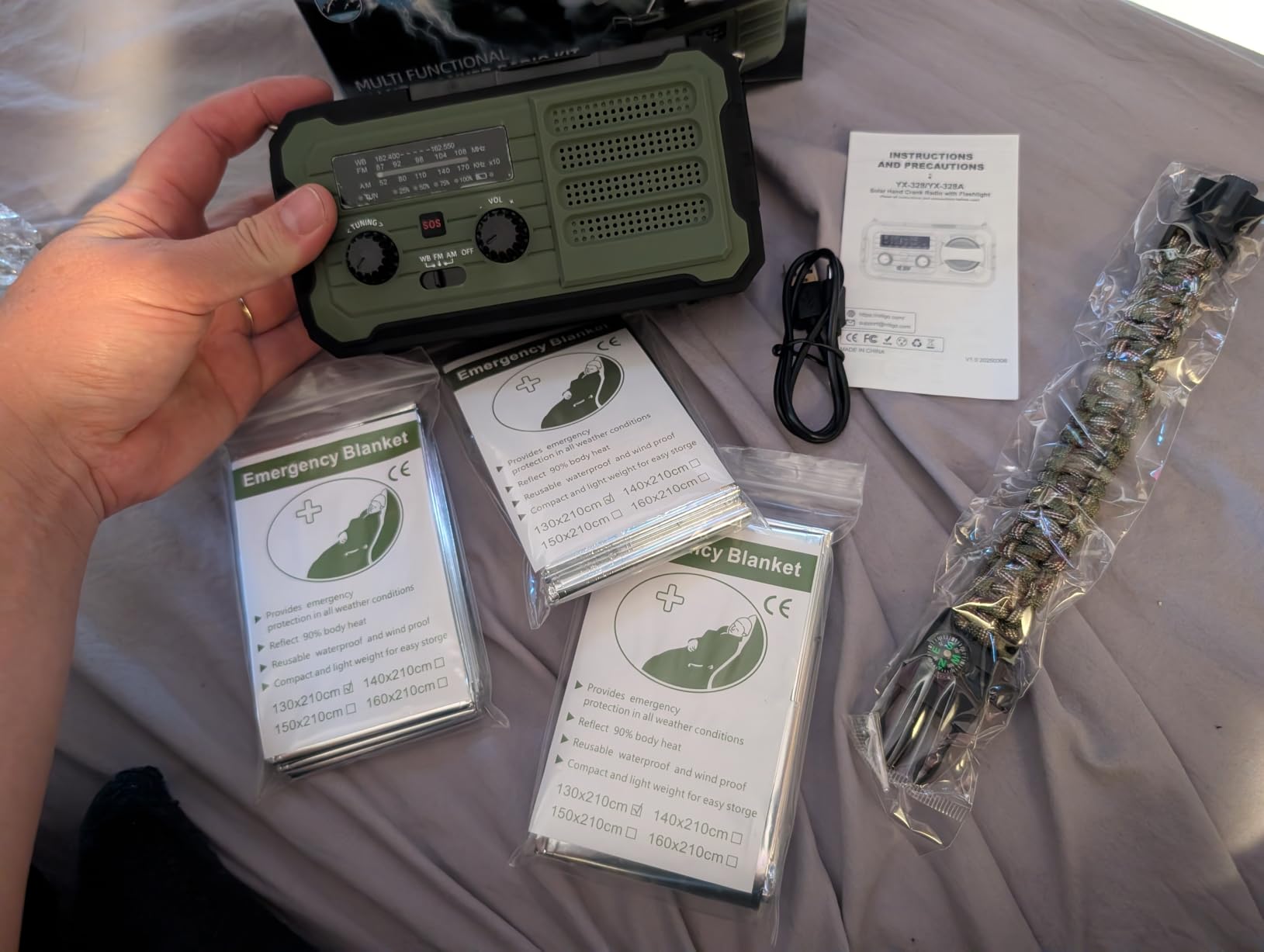
The radio itself is conventional and competent. A 37000mWh, 10000mAh lithium-ion pack recharges through the hand crank, solar panel or internal charging, and automatic NOAA scanning across all seven channels fires in standby so you do not have to listen continuously.
A built-in flashlight, SOS siren with red flashing light, headphone jack and USB port for phone charging round out the feature list. Dimensions are 6.5 by 2.4 by 3.5 inches.
Where the Vokida package pays off
Give this one as a gift and the recipient gets a complete cold-weather kit in a single box rather than a shopping list. That convenience is the real product here.
The headphone jack is worth noting because several competing radios at this capacity omit it. Listening privately matters in a shared shelter, at night, during an unfolding event.
Where the package is less relevant
If you already own a paracord bracelet and thermal blankets, you are paying for gear you have twice. The radio itself is the draw, and there are better standalone radios in this roundup on reception and charging options.
The two-watt speaker is modest, and analog tuning without a digital display means finding a specific NOAA channel takes longer than it should.
11. iRonsnow Condor 1 — Best for Charging Two Devices at Once
Emergency Crank Radio, 20000mAh Solar Hand Crank Weather Radio NOAA/AM/FM
20000mAh 74000mWh battery charging two devices
Bidirectional USB-C input and output
4-mode flashlight plus rear reading lamp
IPX3, 1.8 lbs with survival handle
Pros
- 20000mAh battery at the lowest cost of any 20000mAh unit here
- Charges two devices simultaneously which is rare at this capacity
- 4-mode flashlight plus an unobstructed rear reading lamp
- Solar charging confirmed in real windowsill use
Cons
- Handle fastener breaks for some owners
- Heaviest unit in the roundup at 1.8 lbs
- Battery compartment not accessible and solar panel is small
The iRonsnow Condor 1 does something only one other radio here manages: it charges two devices at the same time. With a 20000mAh pack behind it, that is a meaningful difference for a family with two phones that both need to survive a long outage.
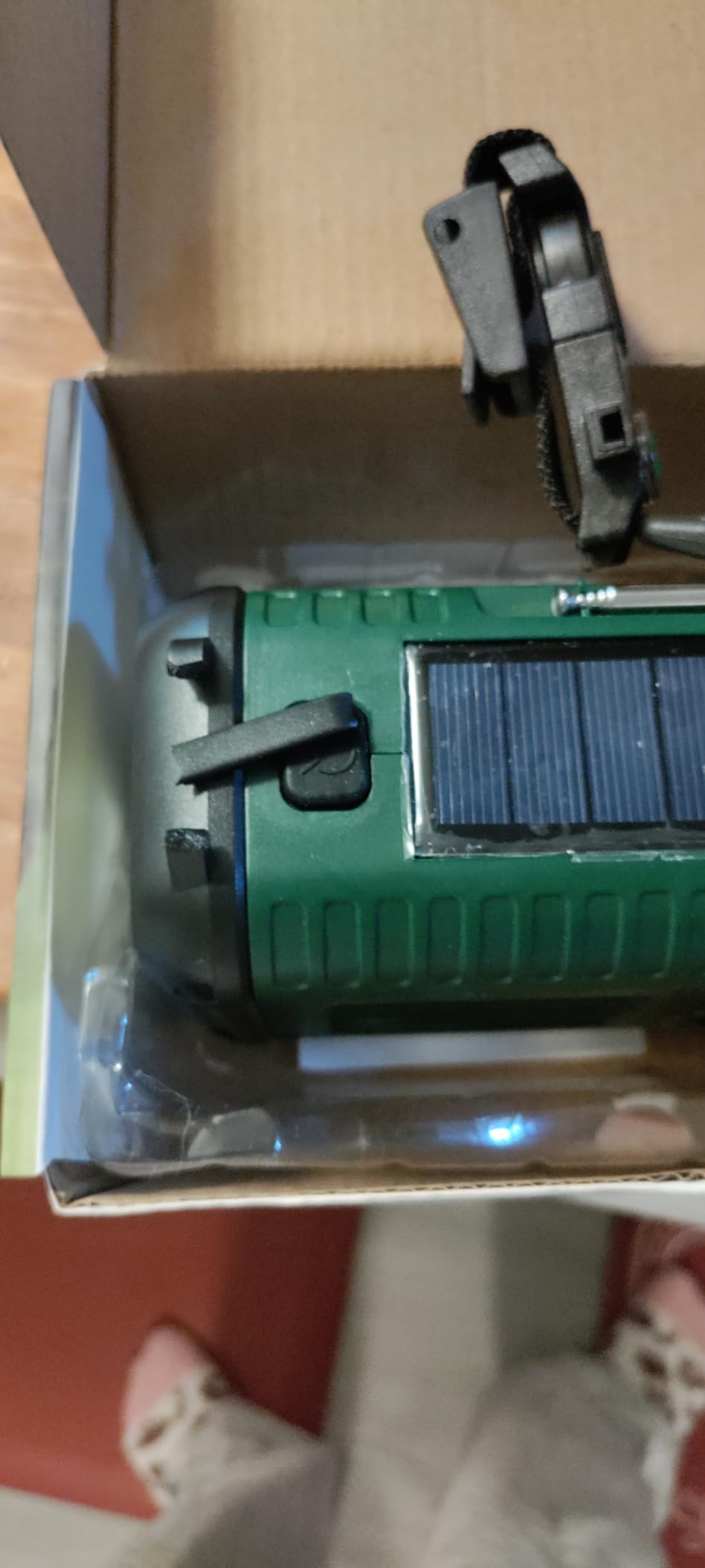
The USB-C port is bidirectional, handling both input and output, and a multifunctional survival handle packs a compass, a cutter, a whistle and a fire starter into the grip. That handle is a clever integration, and also the unit’s biggest weakness.
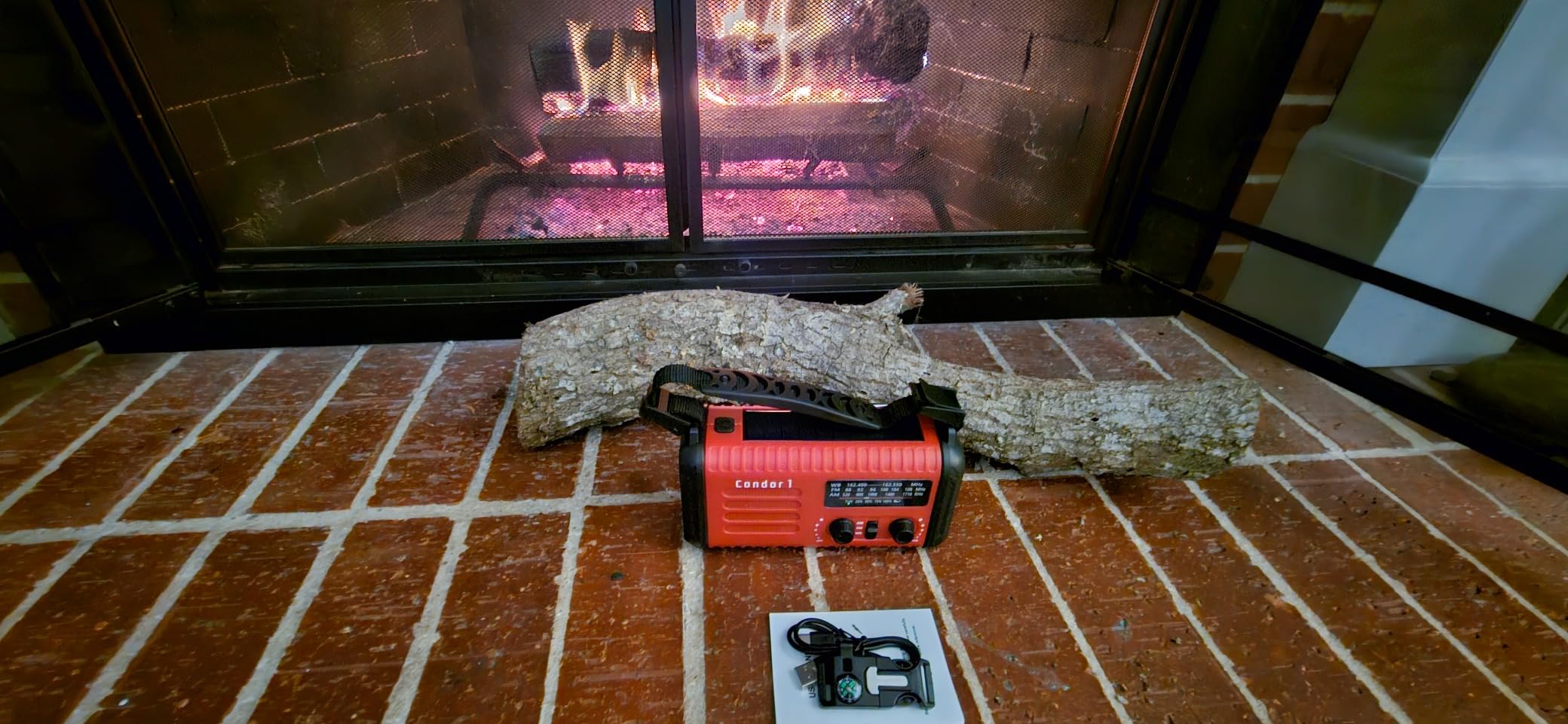
Lighting is a four-mode flashlight covering far beam, low beam, mixed beam and SOS flashing, plus a rear reading lamp positioned where other parts of the body do not block it. Seven NOAA weather stations join AM and FM broadcast bands.
At 1.8 pounds this is the heaviest radio in the roundup, with an IPX3 rating and a 3.5mm headphone jack. One owner confirmed solar charging in real use after leaving the unit on a windowsill indefinitely.
Where the Condor 1 works
Families with multiple devices, or a household where an adult and a teenager both need a charged phone. Buying two smaller radios would cost more space than this single unit.
The survival handle saves you carrying four separate small items, and the four-mode flashlight covers both room lighting and signalling.
Where the Condor 1 disappoints
The handle fastener is fragile for the weight it carries, and some owners report it breaking in transit. Inspect it on arrival rather than assuming it is solid.
This model also carries the highest share of one-star reviews in the roundup, mostly arriving uncharged or dead out of the box. NOAA requires manual channel selection with no automatic alerting, and the sealed battery cannot be replaced. Charge it fully and test it the day it arrives.
12. QAUYYW 20000mAh — Best Water Resistance and Lightness
QAUYYW Solar Hand Crank Emergency Radio, 20000mAh AM FM NOAA Weather Radio
IPX6 waterproof rating
20000mAh with 35 hours of radio playback
52 cm extended antenna
6.2 x 2.2 x 2.8 inches, 10.88 oz
Pros
- IP6 is the highest water resistance rating in this roundup
- 20000mAh battery at only 10.88 ounces
- Up to 35 hours of radio and 50 hours of reading light
- 52 cm extended antenna improves reception
Cons
- NOAA alerts require manual tuning with no automatic alert mode
- Analog AM FM SW NOAA tuning rather than digital scanning
- Only three charging methods with no AC adapter or AAA fallback
The QAUYYW solves the weight-versus-capacity problem better than anything else here. It carries a 20000mAh battery at 10.88 ounces, roughly a third of the weight of other 20000mAh radios in this roundup. Its 6.2 by 2.2 by 2.8 inch footprint fits easily in a vehicle glovebox.
It also has the highest water rating. IPX6 means protection against heavy rain and powerful water jets, which makes it the only unit here I would genuinely leave in a car, a boat or an RV.
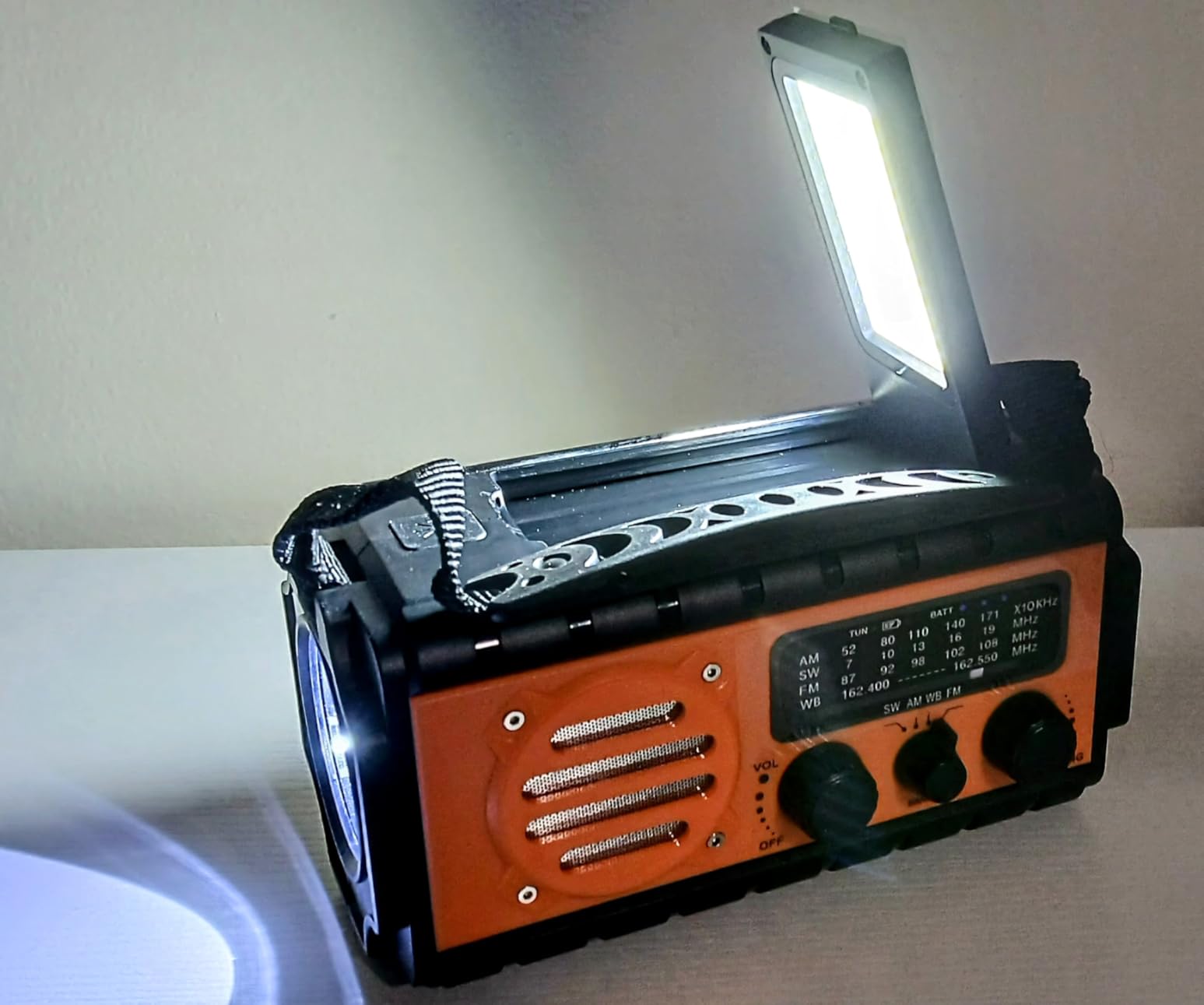
Rated runtime reaches up to 35 hours of radio playback at medium volume and up to 50 hours for the reading light on a full charge. A 52 cm extended antenna gives noticeably better reception than the short stubs used by lighter competitors.
A three-watt flashlight and a three-and-a-half-watt reading lamp with an SOS alarm cover lighting, and a five-watt speaker produces clear, stable sound. Charging runs through USB Type-C, the hand crank and the solar panel.
Where the QAUYYW earns its spot
Vehicle kits, marine use and any location where rain or spray is a given. IPX6 changes the durability conversation entirely compared with the IPX3 units most competitors settle for.
For anyone who wants serious capacity without a heavy brick on the counter, the combination of 20000mAh and 10.88 ounces is hard to argue with. The 12-month warranty is the shortest here.
Where the QAUYYW falls behind
NOAA alerts require the radio to be powered on and manually tuned, with no automatic alert mode. If you sleep through the night and the storm hits while the radio is off, you miss it.
There is no AC adapter and no AAA battery fallback, leaving three charging methods. Tuning is analog across AM, FM, shortwave and NOAA, so finding a specific frequency takes longer than on a digital model.
How We Picked These Radios
We ranked all twelve on four things that actually decide whether a radio works during an outage, rather than on appearance or feature count.
Independent power sources. A radio with only a solar panel is a bad emergency radio. Every model here runs from at least three directions, and we weighted those with USB input or a wall adapter more heavily than those without.
Battery capacity in mAh. Vague runtime claims are meaningless. Larger packs mean more hours of listening, more flashlight use and more phone top-ups, which is what a three-day outage actually consumes.
Alert behaviour. Radios with automatic NOAA monitoring in standby score higher than those requiring manual tuning, because you will not be awake to listen.
Review volume and defect rate. We weighted radios with tens of thousands of reviews more heavily, since long-run defects surface over time. Warranty length and water ratings broke the remaining ties.
We also pulled in findings from preparedness communities, where owners consistently treat solar as a bonus rather than the reason to buy, and recommend running two radios — one at home and one in a vehicle or go bag.
Solar Charging Reality Check: What the Panel Actually Does
Solar on these radios is a maintenance feature. On eleven of the twelve models here, the panel’s job is to replace the small amount of power the radio draws while sitting in standby, so a charged unit stays charged for months in a drawer.
That is genuinely useful, but it is not the same as recharging. Owners on several models describe a solar panel that will not revive a flat battery, and cloudy-day output that is close to nothing. Treat any claim of full charging from sunlight with scepticism unless the panel area is unusually large.
The Mesqool CR1030 is the exception, with an 8500 square millimeter panel more than four times the size of typical units. Even there, full sun is required for meaningful gains, and bright overcast produces a modest top-up rather than a full charge.
The hand crank sits somewhere between the two. An upgraded dynamo like the Mesqool’s coil and magnet design produces a usable top-up in a few minutes of cranking. Standard cranks across the category generally yield only a few minutes of listening, and community discussion consistently describes arms tiring long before the battery is full.
Our practical advice is simple. Charge your radio from a wall outlet the day it arrives, test it, then store it with the panel facing a window if you have one. Use solar as insurance against drift, never as your primary plan.
How to Choose a Solar Emergency Radio
Start with power sources. The best power source for an emergency radio is a pre-charged internal battery topped up over USB, because USB works before the grid fails and after it returns. Hand crank and solar are backups for when that runs out, and AAA cells are the last resort. A radio with only a solar panel is not an emergency radio.
Check battery capacity in mAh. Below 2000mAh, expect only an emergency phone top-up. Between 5000mAh and 12000mAh covers several days of radio and flashlight use. At 20000mAh you can run the radio for well over a day and still have charge for a phone.
Decide how you want alerts. The NOAA weather band broadcasts on seven channels between 162.400 and 162.550 MHz, with continuous forecasts and 24/7 severe weather warnings. Radios with SAME, or Specific Area Message Encoding, can be programmed with your county code so they only wake you for your area. That programming takes about five minutes through the menu on models like the Raynic or PPLEE.
Look at the bands. AM and FM cover local news and talk radio. NOAA covers weather. Shortwave, found on the Kaito, Eoxsmile and PPLEE, reaches international and remote broadcasts and is the band most associated with long-distance emergency communication.
Weight flashlight output by wattage. A one-watt light is adequate for a hallway; a three-watt light reaches roughly 80 meters and works outdoors. Reading lamps matter more than most buyers expect, particularly for finding supplies without draining the main light.
Match water resistance to the location. IPX3 is splash resistant and fine for a kitchen counter. IPX6 survives heavy rain and is the only rating in this roundup we would trust in a vehicle or boat. For an apartment with no outdoor access, indoor reception matters more, and a longer antenna helps through concrete.
Plan for storage. Charge it fully, remove any AA or AAA cells before putting it in a cupboard, and store backup batteries outside the radio. Cells left inside a sealed radio corrode over months and can destroy the battery compartment. A five-minute check every month or so keeps the habit alive.
Pairing matters too. A radio handles information and light; other gear handles warmth and water. Our guides to emergency power inverters and emergency lights cover the rest of a kit that has to work for more than one night.
Frequently Asked Questions
What is the best emergency radio for power outages?
The FosPower NOAA Emergency Weather Radio A1 is the most reliable choice for most households. It offers three independent power sources, NOAA weather band reception, a flashlight and reading light, plus a 7400mWh output that charges phones. Its review volume is far higher than any other radio in this roundup, which makes long-term defects far less likely.
Are solar-powered radios any good?
Solar panels on emergency radios are best treated as trickle chargers that maintain a charged battery, not as a way to revive a dead one. Overcast weather adds almost nothing on most models. The internal battery, the hand crank and NOAA reception are what actually matter during an outage. One model in our roundup uses a panel over four times larger than typical and does charge meaningfully in daylight.
What is the best power source for an emergency radio?
A pre-charged internal battery topped up over USB is the best primary source, because USB charging works before a storm, during the outage if you have a battery bank, and again afterwards. The hand crank is the most useful backup, and AA or AAA cells are the final fallback. Every radio worth buying has at least three of these options.
How long does a solar emergency radio battery last?
It depends almost entirely on capacity and use. At 20000mAh you get roughly 35 hours of radio playback, while a 5000mAh unit gives closer to 13 hours of FM. Flashlight and reading lamp use draw considerably more power than radio playback. Solar and hand cranking are top-ups, so a unit stored half-charged will not hold that state indefinitely.
Can a solar emergency radio charge a phone?
Most of them can, through a USB output port, but the results vary widely. A 20000mAh pack can meaningfully extend a phone’s life over a day or two, while a 2000mAh pack is limited to an emergency top-up for making a single call. The iRonsnow Condor 1 can charge two devices simultaneously, which is unusual at that capacity.
What is the difference between a weather radio and an emergency radio?
A NOAA weather radio is built around reception of the seven weather band channels and is sometimes plug-in only, meaning it dies the moment the grid fails. An emergency radio adds battery, hand crank and solar power so it keeps working when mains electricity is gone. For an outage kit you want the second type, even if it also handles weather.
Conclusion: Which Solar Emergency Radio Should You Buy?
The FosPower NOAA A1 is the best solar emergency radio for power outages for most households, because it has three independent power sources, a phone-charging output, a limited lifetime warranty and more verified reviews than anything else we compared. Buy it, charge it from a wall outlet, and keep it indoors within earshot.
If you want alerts that reach you while you sleep, the Eoxsmile with its NWS-certified siren is the one. For long-term ownership and reception in a rural setting, the Kaito KA500 wins on its replaceable battery pack and telescopic antenna. For real solar charging rather than trickle maintenance, the Mesqool CR1030 is the only model here that delivers it.
Whatever you choose, test it the day it arrives, remove any loose batteries before long-term storage, and check it once a month. A radio that has never been switched on in a real outage is only a guess.