
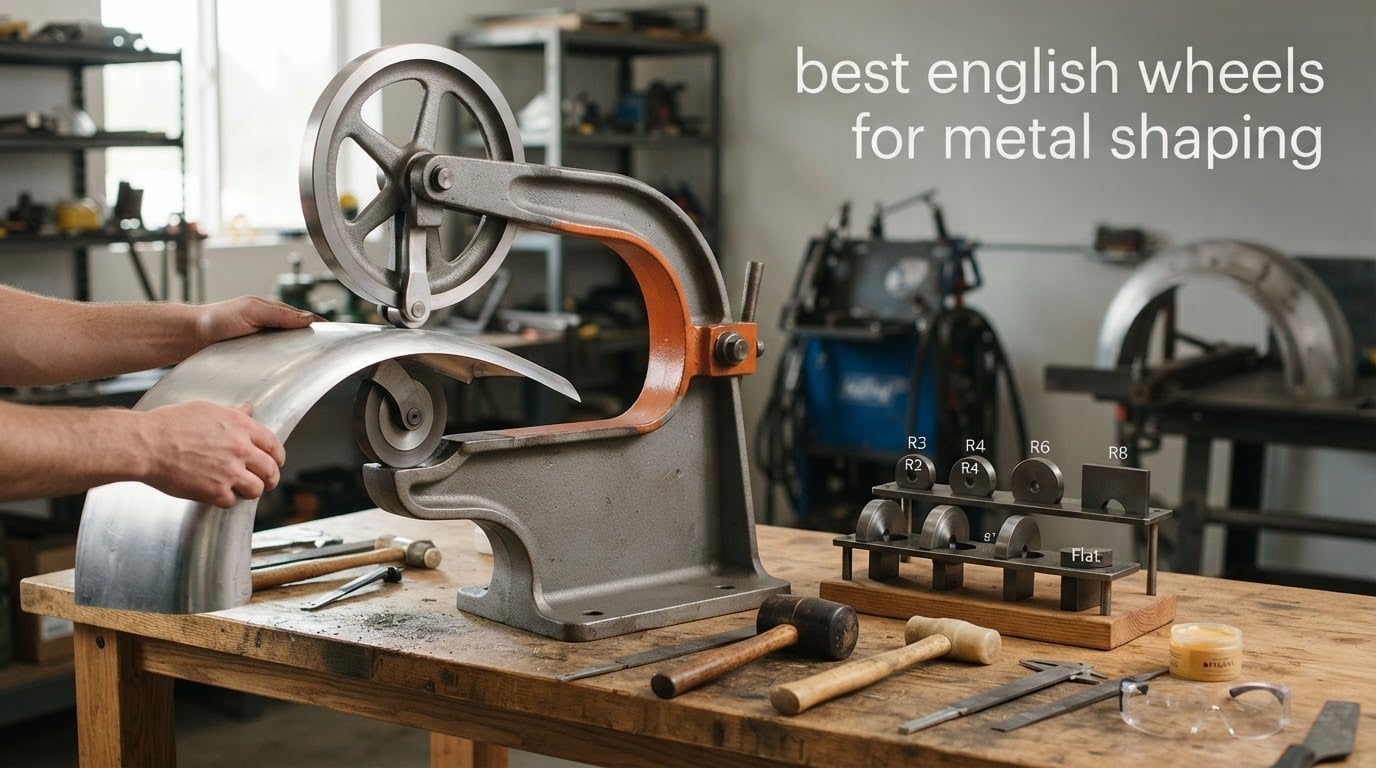
An English wheel is a hand-powered machine that forms sheet metal into compound curves by pressing a panel between a fixed lower anvil and an adjustable upper wheel. Roll the metal across the two wheels in one direction while rotating it in the other and you get the double-curvature surfaces that a bending brake, a slip roller, or a hammer cannot produce on their own.
That matters because compound curves are the whole game in custom metal shaping. A motorcycle tank, a car fender, a seat cowl, an aircraft skin panel, a sculpture, a patch panel for a rusted floor pan. None of those are single-radius bends, and a bending brake is the wrong tool for every one of them. The English wheel is the affordable answer, and it is still the answer after hydraulic power hammers moved into the professional tier.
Before you buy anything, here is the honest part almost every roundup leaves out. English wheels of any tier routinely arrive needing alignment work. The wheels are not concentric with the frame, the anvil sits a fraction high or low, and the first hour of ownership is spent squaring the frame, shimming the spindle, and setting anvil pressure with a feeler gauge and a paper shim. Forums like r/metalworking and The H.A.M.B. have talked about this for two decades. Budget for it and it is a non-issue. Ignore it and you will conclude the tool is defective when it is only untrued.
We spent weeks comparing ten benchtop and large-throat English wheels for metal shaping, checking throat depth, frame mass, die set contents, gauge ratings, and the honest review history behind each listing. The short version: the best english wheel for the money is the one whose throat is wider than the widest panel you expect to run, and everything else on the spec sheet matters less. If you have never shaped metal before, start at 12 to 15 inches of throat. If you restore full-size car panels, you need 24 inches or more and nothing smaller will do.
Table of Contents
Top 3 Picks: Best English Wheels for Metal Shaping (October 2026)

Stark USA Benchtop English Wheel
- 15-3/8 inch throat
- 27 pound fabricated steel C-frame
- Quick-release lower anvil
- Rounded upper wheel edges

KASTFORCE KF5018 English Wheel
- 12 inch throat
- 43 pound steel frame
- Four HRC35 dies at 1 to 5 inch radii
- Forms up to 16 gauge mild steel

KAKA Industrial 28 Inch Throat Wheel
- 28 inch deep throat
- 169 pound steel frame
- Six CNC anvil wheels from 2 to 12 inch radii
- Handles 18 gauge steel and 14 gauge aluminum
Best English Wheels for Metal Shaping in 2026
| Product | Specifications | Action |
|---|---|---|
| Stark USA Benchtop English Wheel |
|
Check Latest Price |
| KASTFORCE KF5018 |
|
Check Latest Price |
| KAKA Industrial 28 Inch Throat |
|
Check Latest Price |
 Quaintfab 15 Inch Throat Mini Quaintfab 15 Inch Throat Mini |
|
Check Latest Price |
 Quaintfab 8 Inch Throat Mini Quaintfab 8 Inch Throat Mini |
|
Check Latest Price |
 Tandagy Stainless Steel Wheel Tandagy Stainless Steel Wheel |
|
Check Latest Price |
 AELIVET 12 Inch Throat Wheel AELIVET 12 Inch Throat Wheel |
|
Check Latest Price |
 Quaintfab 15-3/4 Inch Throat Quaintfab 15-3/4 Inch Throat |
|
Check Latest Price |
 Veemuaro Heavy Duty Benchtop Veemuaro Heavy Duty Benchtop |
|
Check Latest Price |
 Woodward Fab Lil Wheelie Woodward Fab Lil Wheelie |
|
Check Latest Price |
1. Stark USA Benchtop English Wheel – The Most Proven Budget Starter
Stark USA Shaping Sharper Benchtop Fabrication Workbench English Wheel Sturdy Sheet Metal Shaping Bench Motorcycle Automotive Panel Crafting Tool
15-3/8 inch throat
27 pound steel C-frame
Quick-release lower anvil
Chrome upper wheel
Pros
- Largest verified review base in the group at 257 reviews
- Handles motorcycle tanks
- tank covers
- seat cowls and aircraft fillets
- Quick-release lower anvil speeds up wheel changes
- Rounded upper wheel edges reduce scratching
- Mounts on a bench
- in a vise
- or on a welded stand
Cons
- Frame frequently arrives out of square and needs welding
- Noticeable bearing and fork play out of the box
- Lower die retention pins can walk out under load
The Stark USA is the pick we keep coming back to, and the reason is not the machine. It is the 257 reviews. When you are buying your first English wheel, you are buying a learning curve, and the review base is the only honest documentation of what that curve feels like on this specific frame.
Out of the box it is a 27 pound fabricated steel C-frame with a 15-3/8 inch throat, a hardened polished chrome upper wheel, and a quick-release lower anvil. The throat handles panels up to about 30 inches wide at that ratio, which covers tank covers, seat cowls, aircraft fillets, and small compound patches. The rounded upper wheel edges are a genuinely thoughtful touch because a sharp upper wheel edge is what puts a visible scratch line down a finished panel.
What you should know before it lands is that reviewers consistently describe an hour or two of drilling, shimming, and welding to square the frame and remove wheel play. The pin holes for the top wheel are reported as oversized, which causes wobble, and the lower die retention pins can walk out of the dies under load. None of that is fatal. All of it is fixable with a vise, a hammer, and an afternoon.
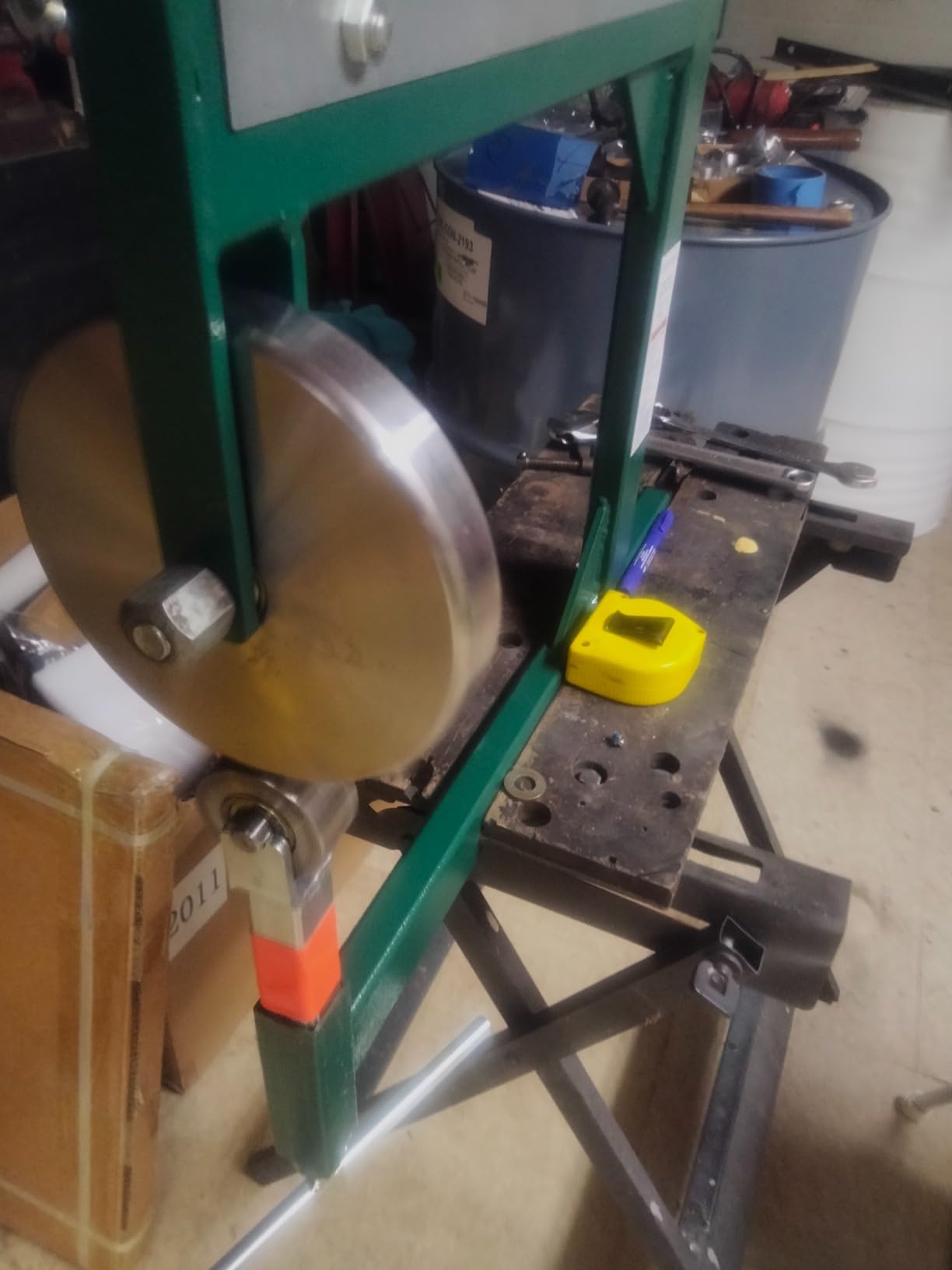
Multiple owners add reinforcing gussets and build a purpose-made stand once they decide the tool is staying. That pattern tells you something useful. People keep this wheel and they modify it, which is what a first machine should invite. Owners also praise the extra lower anvils that come with it and say the panel work is good for the money once modified.
The honest limit is professional car-body results. Reviewers are careful to say this is a learning and hobby-shop tool. If your goal is smooth production panels on a daily basis, look up the list at number three instead.
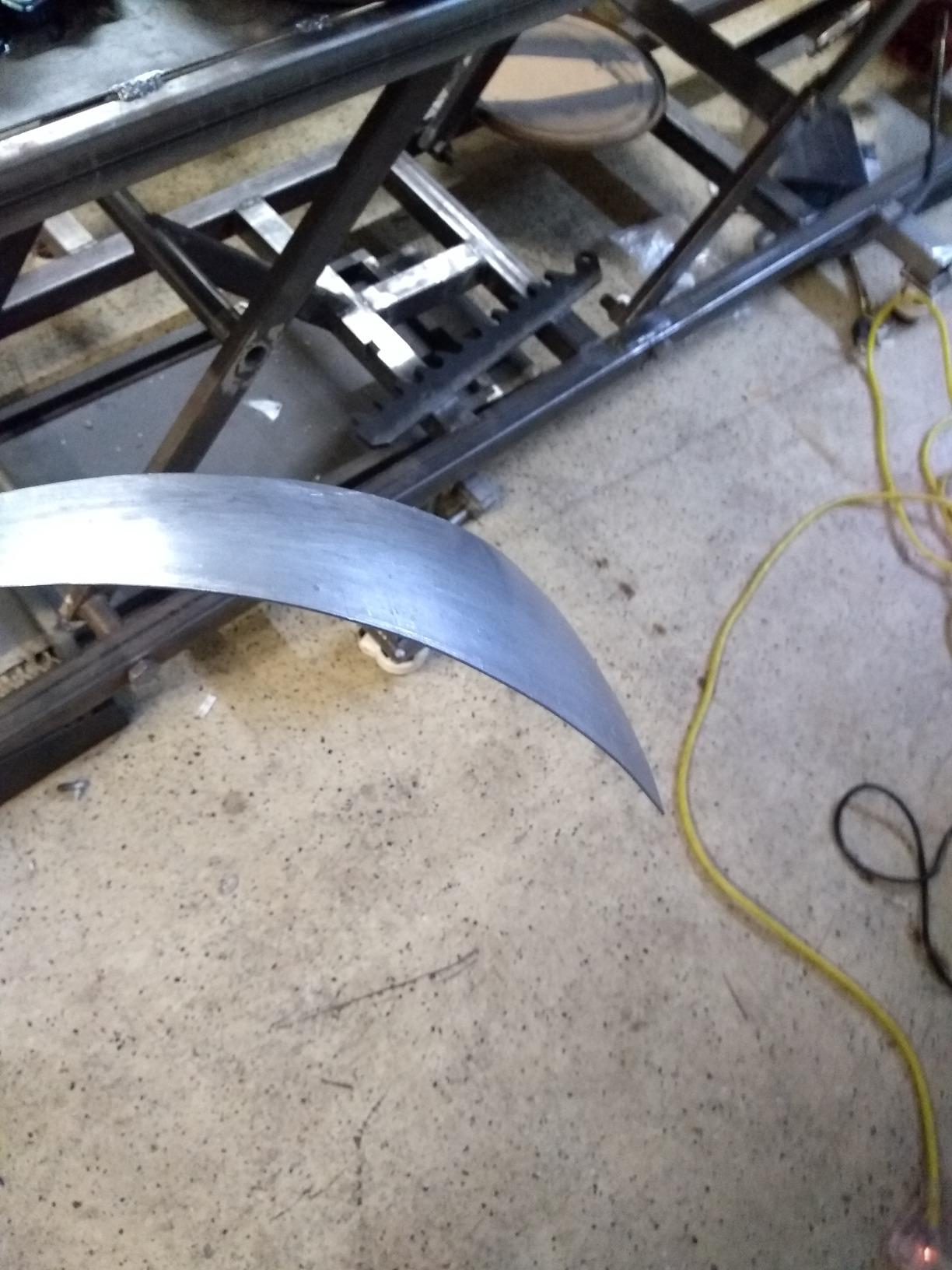
What you get once it is trued
After a few hours of setup this wheel forms compound curves and patch panels well for what it cost. The C-frame gives you enough reference surface to hold a panel square while you roll, and the quick-release anvil means you can move between the included dies quickly once you are learning to read the metal.
The green finish is cosmetic, not protective. Plan on wiping the frame and the spindle down after wet jobs, especially if you are working near a water-based system.
Who should skip it
Skip it if you have zero patience for setup work and want to be forming metal the afternoon it arrives. Skip it if you plan to run 16 gauge aluminum constantly, where frame flex shows up as a faint ridge. And skip it if you need full car panels, because 15-3/8 inches of throat is not enough.
2. KASTFORCE KF5018 – Best Value 12 Inch Throat Benchtop Wheel
KASTFORCE KF5018 Professional Benchtop English Wheel Metal Fabrication Tool 12″ 305mm Throat Depth Forms up to 16 Ga 1.5mm Mild Steel, 4 Lower Die with Radius 1″, 2″, 3″, 5″, Hardness HRC35
12 inch (305mm) throat
43 lb steel frame
Four dies at 1, 2, 3, 5 inch radii
HRC35 hardened
Pros
- 43 pound steel frame stays rigid under forming pressure
- Four heat-treated lower dies at 1
- 2
- 3 and 5 inch radii
- 4.7 average across 58 reviews with 76 percent five star
- Larger throat than most machines in its class
Cons
- Only four die radii compared to seven on some rivals
- Rated only for mild steel up to 16 gauge
- 43 lb weight limits portability
The KASTFORCE KF5018 is the value pick we recommend, and the reason is the mass. At 43 pounds it is nearly 16 pounds heavier than the typical entry benchtop machine, and frame rigidity is what separates a wheel that forms clean curves from one that ridges the panel under pressure.
It carries a 12 inch (305mm) throat, which handles bigger panels than most compact benchtop units, and it comes with four heat-treated lower dies at 1, 2, 3 and 5 inch radii. The top wheel measures 4 by 1.38 inches and both the wheels and dies are hardened to HRC35. Rating is 16 gauge, or 1.5mm, mild steel.
Review feedback is unusually clean for this tier. Out of 58 reviews, 76 percent are five star and the summary notes no one- or two-star reviews at all. Owners cite build rigidity, generous throat clearance for larger panels, and the usefulness of having four die radii rather than two.
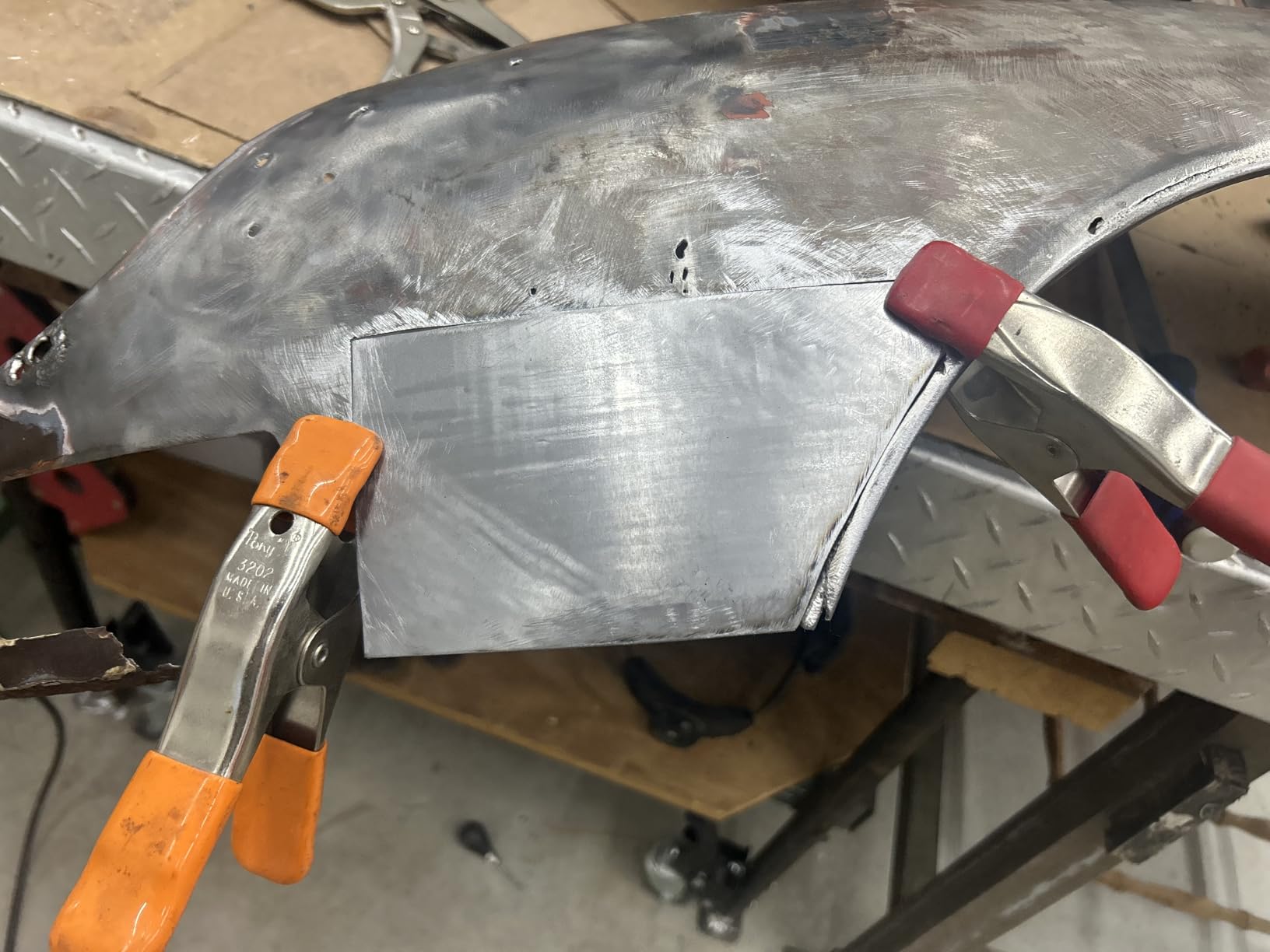
The trade-off is die count. Four radii is workable but thin. A standard seven-piece set gives you a flat anvil plus 1/2, 1, 1-1/2, 2-1/2, 5 and 9 inch radii, and the tight half-inch and broad 9 inch options are what let you take a panel from a tight bead all the way to a gentle crown without hunting for another anvil.
The other trade-off is material. This is a mild steel machine. If aluminum is your primary medium, the 18 gauge steel and 16 gauge aluminum rating on the Quaintfab at number four is a better fit for a similar outlay.
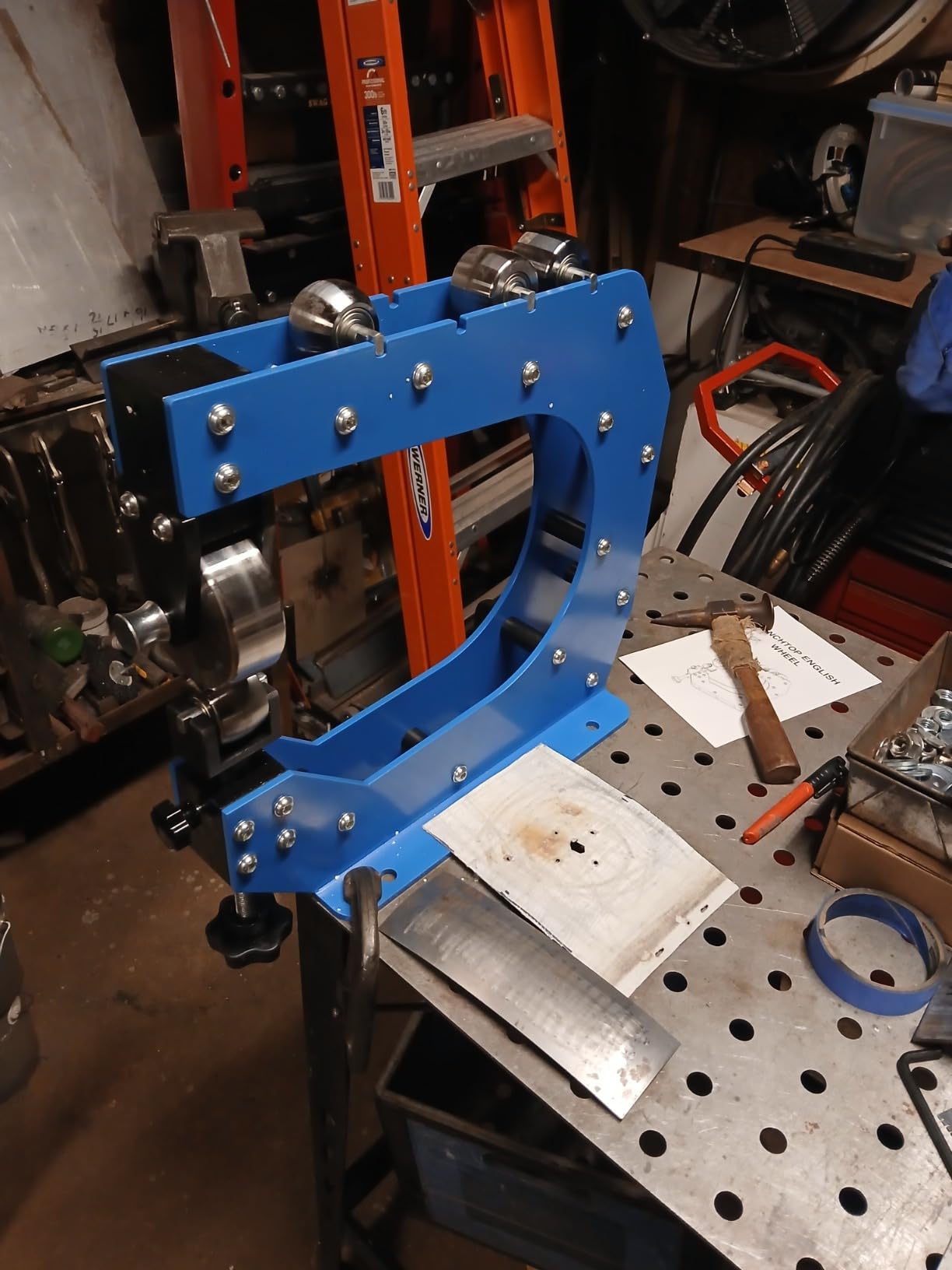
Why the weight matters more than the spec sheet
Forming pressure is what causes frame deflection, and deflection leaves a ridge right where the panel crosses the top of the frame. A 43 pound frame resists that. Light frames that flex can still make a curve, but you fight the tool the whole way and the surface quality suffers on the stiffest alloys you will realistically run.
At 43 pounds you also stop moving it around constantly, which means you will set it up once on a proper bench and leave it there. That is how the alignment stays true.
Who should skip it
Skip it if you need a broad panel. A 12 inch throat suits medium panels, not a half sheet. Skip it if you want to work very thick aluminum, and skip it if portability matters, because 43 pounds is a two-person lift for anyone who moves benches.
3. KAKA INDUSTRIAL 28 Inch Throat – For Full Size Body Panels
KAKA INDUSTRIAL English Wheel,28-Inch Throat 18 Gauge Metal Former for Steel and Aluminum, with 6 Forming Anvil Wheels for Auto Body, Motorcycle, Aviation Fabrication and Restoration F1.2X710
28 inch deep throat
169 lb steel frame
Six CNC anvil wheels
18 gauge steel, 14 gauge aluminum
Pros
- 28 inch throat handles full-size auto body and aviation panels
- Rated 4.9 stars with 91 percent five-star feedback
- Handles 18 gauge mild steel plus 14 gauge aluminum and copper
- Six CNC-finished hardened anvil wheels from 2 to 12 inch radii
- Side tooling rack keeps anvils in reach
Cons
- 169 pound weight makes it a floor machine rather than a bench machine
- Only 28 reviews of owner history
The KAKA Industrial is the only machine here that can handle a full car panel, and that single spec changes what kind of work you are allowed to attempt. A 28 inch deep throat means the panel edge never runs into the frame while you form a crown or a full-length curve.
It is also the only wheel in this group rated for 18 gauge mild steel and 14 gauge aluminum and copper at the same time. For a shop doing restoration plus custom hot rod work, that combination matters more than the sticker does. The frame is solid steel at 169 pounds, which is what keeps a long panel from flexing mid-roll.
Six CNC-finished hardened steel anvil wheels cover 2, 3, 4, 6, 8 and 12 inch radii. That is a broad spread built for large surfaces, and the quick-release lower anvil plus rounded-edge upper wheel are the same features that keep finished panels from getting marred. There is a side tooling rack so the anvils stay organized within reach.
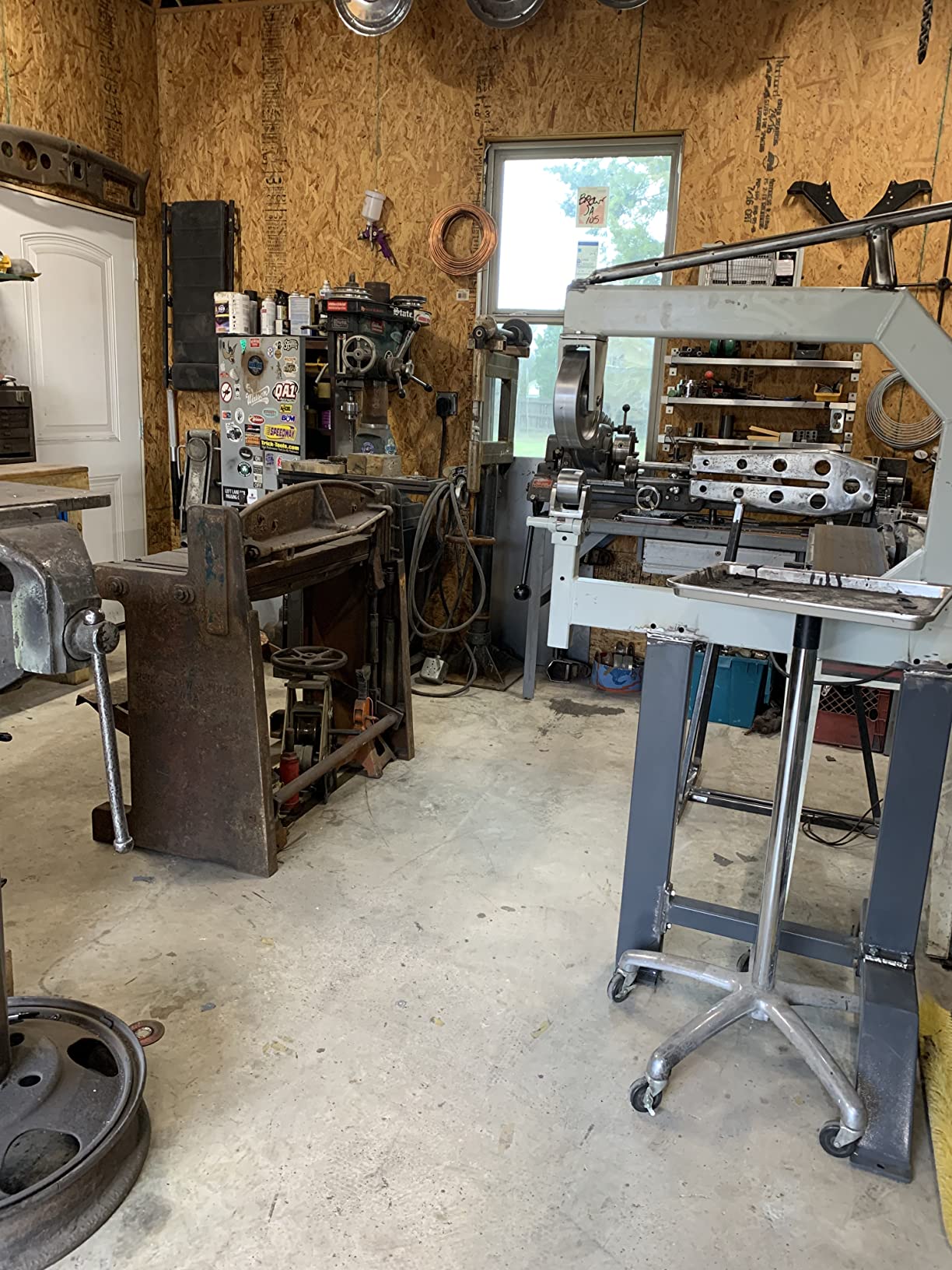
Owner feedback is as clean as it gets: 91 percent five star and 9 percent four star, with no critical reviews at all. Reviewers single out the 28 inch throat and the breadth of the six-anvil set as the standout advantages for full panel work on cars, motorcycles and aircraft.
At 169 pounds this is a floor machine, not a bench machine. Plan your floor space before you commit, and check the anvil set against your actual radii needs, because six dies is generous but it is not the full seven.
What 28 inches of throat actually unlocks
Below about 20 inches of throat you are working on localized sections. A motorcycle tank side, a fender, a patch, a cowl. Once you clear 24 inches you can roll a full door skin, a quarter panel, or a roof panel in one continuous pass without stopping to rotate the metal around the frame.
That single-pass capability is what changes the surface. Every time you stop and reposition, you risk a witness line. One continuous roll on a large panel is simply a different quality of result.
Who should skip it
Skip it if you are still learning. A large-throat machine rewards someone who already knows how to read metal. Skip it if you have a small bench shop and no floor space, and skip it if you only ever work on jewelry-scale parts, where an 8 inch throat is more than you need.
4. Quaintfab 15 Inch Throat Mini – Seven-Piece Die Set With a Micro-Adjust
Quaintfab – Heavy Duty 15″ Throat Depth Mini English Wheel, Vise-mount and Table Mount, 7pcs anvil wheel: 1/2″, 1″, 1-1/2″, 2-1/2″, 5″, 9″, Flat, Form up to 18 gauge steel and 16 gauge aluminum
15 inch throat
42.5 lb unit
Seven-piece die set
HRC40 #45 steel wheels
Pros
- Seven lower dies including a flat anvil for tight to very broad radii
- 15 inch throat forms panels up to 30 inches wide
- Micro-adjustable anvil wheel helps dial in alignment
- Dual mounting as a vise clamp or bolted to the bench
- HRC40 #45 steel rated to 18 gauge steel and 16 gauge aluminum
Cons
- 42.5 lb weight is awkward to reposition
- Loose anvil play if micro-adjustment is not set before forming
- One review reports an 8 percent one-star share
The Quaintfab 15 inch is the machine we would put on a bench for someone learning in a garage with a half sheet of steel and a weekend. The die set is the argument. Seven pieces, including a flat anvil, cover everything from a half inch radius to a 9 inch radius, and that range is what makes one machine usable across most hobby projects.
The wheels and dies are #45 steel hardened to HRC40, and the upper wheel is 3-5/32 inch diameter by 1 inch wide. The micro-adjustable anvil is the feature that deserves attention. Most budget wheels give you two fixed positions, which is not enough resolution to true a machine properly. A micro-adjust lets you bring the anvil to the wheel in controlled increments instead of guessing with shims.
Rating is 18 gauge steel and 16 gauge aluminum, which is the higher alloy rating carried by the benchtop machines here. Buyers favour it for the balance it strikes: a 15 inch throat wide enough for half-sheet panels in a package that still bolts to a bench or clamps in a vise.
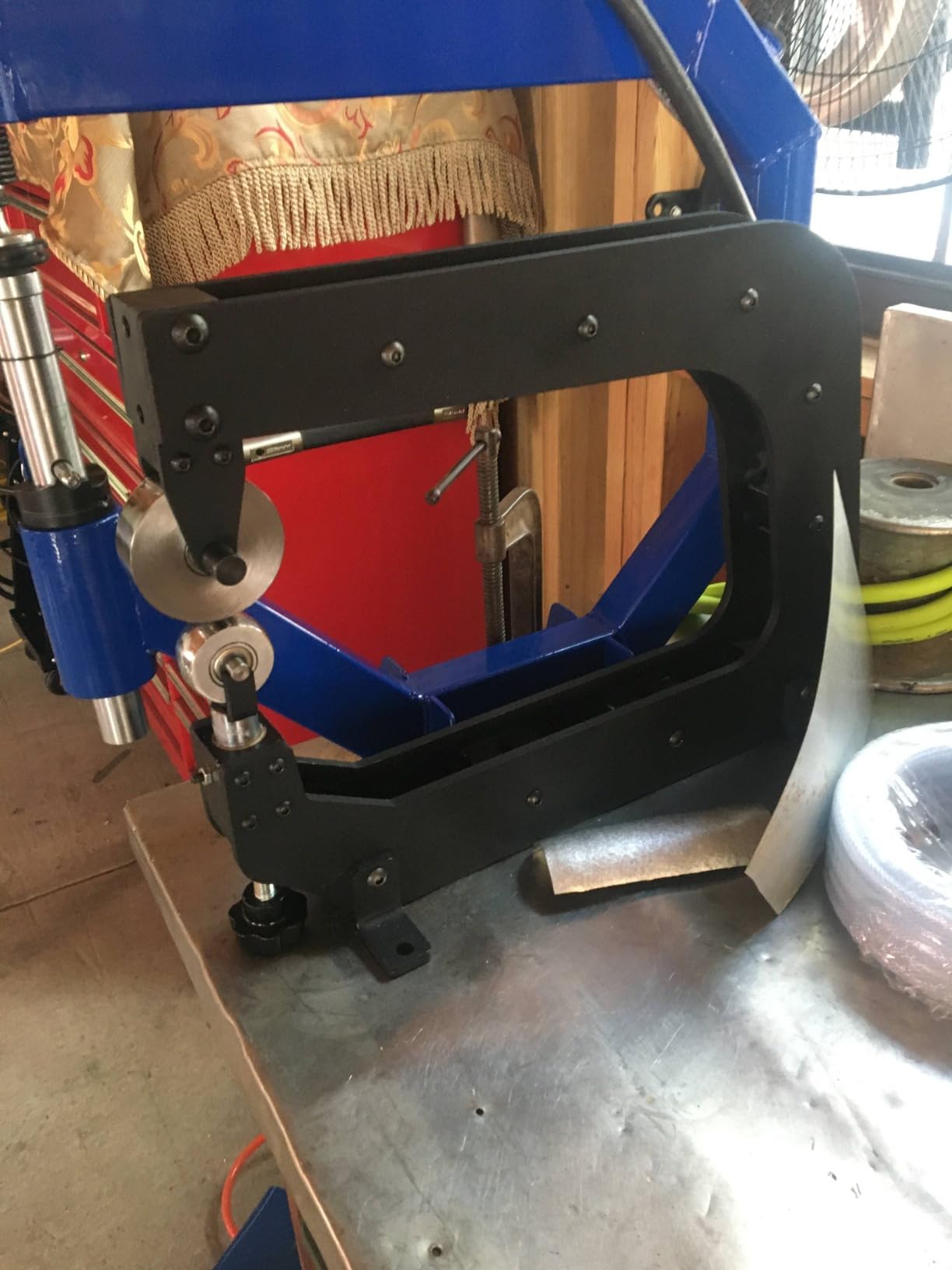
At 42.5 pounds it is a sit-where-you-put-it machine, and that is a good thing for consistency. The dual mounting is genuinely useful, since a vise mount lets you bring the panel to the machine while a bolted mount lets you bring the machine to a large panel on the floor.
The complaint to know about is anvil play. If the micro-adjustment is not set before you start forming, the anvil can drift and leave a consistent crease across the panel. Set it first, check it every few passes, and the problem never appears.
What the seven-piece set gives you
The flat anvil is the one people underrate. It is how you planish a surface flat after a weld, take a dent out, or blend a seam without adding curvature. The 1/2 inch and 1 inch radii handle tight beads and hem turns. The 5 inch and 9 inch radii are the broad crown dies for fender tops and roof panels.
Between those, 1-1/2 and 2-1/2 inch radii are the everyday shaping dies. Having all seven means you can start a panel on one radius and finish it on another without stopping to source a different anvil.
Who should skip it
Skip it if you need full car panels, since 15 inches of throat stops well short. Skip it if your bench is small, because the 42.5 pound unit plus a half sheet of metal is a lot of bench. And skip it if you are buying strictly on review volume, because 22 reviews is a smaller base than the number one pick carries.
5. Quaintfab 8 Inch Throat Mini – Compact Wheel With Rotating Anvils
Quaintfab – 8″ Throat Depth Mini Benchtop English Wheel, Vise-mount and Table Mount(Aluminum Connecting Spacer)
8 inch throat, forms 16 inch panels
HRC40 #45 steel
Wheels rotate 90 degrees
Micro-adjustable anvil
Pros
- Rotating wheels and anvils extend usable throat in one direction
- Perfect 5.0 average across all 12 reviews
- Compact benchtop or vise footprint suits a small shop
- HRC40 wheels rated to 18 gauge steel and 16 gauge aluminum
Cons
- Smallest throat in the group at 8 inches
- Aluminum spacer and frame are lighter duty than welded steel rivals
- Only 12 reviews of long-term history
The 8 inch Quaintfab is the small-shop answer, and its real trick is that the wheels and anvils rotate 90 degrees. That rotation gives unlimited throat depth in one direction, so panels wider than 16 inches are workable if you approach them at an angle. The stated capacity is a 16 inch wide panel, or up to 20 inches on an angular plane.
Construction is #45 steel hardened to HRC40 for both wheels and anvils, with a micro-adjustable anvil wheel and an aluminum connecting spacer. Rated capacity is 18 gauge steel and 16 gauge aluminum, which is honest for a machine this size and the same alloy rating the larger Quaintfab models carry.
Owner response is uniformly positive, with a perfect 5.0 average and 100 percent five-star ratings across all 12 reviews. Nobody reports a defect. What reviewers respond to is the rotating wheel-and-anvil design that effectively extends the throat, and the micro-adjustment that makes truing straightforward.
Where an 8 inch throat still works
Small does not mean useless. An 8 inch throat is plenty for seat cowls, tank covers, small fender sections, aircraft fillets, jewelry-scale aluminum, sculpture, and any localized patch panel. Many hobby projects never need a panel wider than a foot.
The trick is panel orientation. Because the wheels and anvils rotate, you can angle a wider panel into the gap. For a 20 inch panel you accept a slightly more oblique approach and you get the curve anyway.
Who should skip it
Skip it if you plan to run full car panels or anything with a long continuous roll, because the 8 inch throat is the smallest here. Skip it if you want maximum rigidity, since the aluminum spacer and frame are lighter duty than the welded steel machines. And treat the perfect rating with care, because 12 reviews is a small sample.
6. Tandagy Stainless Steel Wheel – Least Expensive Way to Learn
Tandagy English Wheel Heavy Duty English Wheel for Metal Benchtop English Wheel
15-3/8 inch throat
28 pound stainless steel body
Thumb-screw anvil yoke
Green powder coat
Pros
- Least expensive entry point in the group
- Stainless steel body resists rust and corrosion
- Thumb-screw anvil yoke adjustment on both axle sides eases truing
- 15-3/8 inch throat works to 16 gauge mild steel
- aluminum and copper
Cons
- Lowest average rating here at 4.1 with 11 percent one-star
- 15-3/8 inch throat limits it to smaller panels
- Oversized 48 x 35 x 25 inch package for a 28 lb unit
The Tandagy exists for one reason, which is that it is the least expensive way into the craft. For a buyer who has watched a dozen YouTube videos and wants to know whether hand shaping is something they actually enjoy, spending almost nothing to find out is a legitimate strategy.
It is a stainless steel body with a green powder coat, a large C-shaped base with few moving parts, and a 15-3/8 inch throat. The anvil yoke adjusts on both sides of the axle with thumb screws, which is a genuinely useful design detail because two-point adjustment is much easier to true than a single point.
Capacity is 16 gauge mild steel, plus aluminum and copper. Owner feedback frames it as suited to teaching, learning and small-workspace repair rather than large panel work. The single detailed review praises it for making replacement body panels that were no longer available for the car, while noting it may struggle on bigger jobs.
What 28 pounds of stainless steel does for you
Stainless resists rust, and in a garage where the wheel sits near a door all winter, that is a real advantage over painted mild steel. It also means you can wipe it down after any wet job without worrying about the finish.
The 28 pound weight sits in the middle of the group. It is heavy enough to stay put and light enough that you can move it to a different bench with one hand if your shop layout changes.
Who should skip it
Skip it if the lowest rating in the group gives you pause, because at 4.1 with 11 reviews, a meaningful share of owners were not happy. Skip it if you want maximum capability, since the 15-3/8 inch throat and 16 gauge rating are mid-pack. And skip it if you already know you will want a large machine eventually, because you will outgrow this one fast.
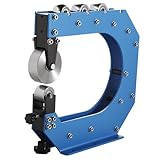
7. AELIVET 12 Inch Throat – Fastest Bench Setup
AELIVET English Wheel, 12 Inch Throat Bench Metal Shaping Tool
12 inch throat
20.67 x 19.49 inch footprint
Pre-assembled frame
Four dies at 1 to 5 inch radii
Pros
- Pre-assembled frame with pre-drilled mounting holes cuts setup time
- Entirely manual
- needs no electricity air or hydraulics
- Four die radii at 1
- 2
- 3 and 5 inch cover weld smoothing and ribs
- 12 inch throat gives ample clearance for medium panels
Cons
- Mounting bolts are not included
- Only 3 reviews
- so field reliability is largely unproven
- Quality depends heavily on operator-applied pressure
The AELIVET is the pick for anyone who dreads the setup session that most English wheels demand. It arrives pre-assembled with the frame already drilled for mounting, so the gap between unboxing and first roll is a matter of four bolts rather than a full teardown and square-up.
It carries a 12 inch throat on a 20.67 by 19.49 inch footprint, which is compact enough to bolt to a normal workbench. Four lower dies at 1, 2, 3 and 5 inch radii handle weld smoothing and rib forming, and the rating is 16 gauge low-carbon steel. Operation is fully manual with no electricity, air or hydraulics required.
Owner feedback is positive but thin. One owner wrote a detailed evaluation crediting the throat clearance, the 16 gauge steel rating and the multi-size die set, while noting the inherent limits of manually powered forming tools on very large panels.
What the micro-adjust problem looks like here
The listing does not advertise a micro-adjustable anvil, which means truing is done with pressure and patience rather than a controlled adjustment. Budget extra time for alignment and expect to check the anvil gap by feel more often during the first sessions.
Also plan to buy your own mounting hardware. The bolts are not included, and a wheel that rocks under forming pressure will never produce a consistent surface.
Who should skip it
Skip it if you need confidence from a large owner base, because three reviews cannot support a long-term durability claim. Skip it if you want an adjustment mechanism rather than a fixed anvil, and skip it if you work in aluminum regularly, since it is rated for low-carbon steel.
8. Quaintfab 15-3/4 Inch Throat – Widest Benchtop Throat in the Set
Quaintfab Professional Benchtop English Wheel 15-3/4″ 400mm Throat Dept Form up to 16 Ga 1.5mm Mild Steel
15-3/4 inch (400mm) throat
15.76 kg alloy steel build
Seven-piece die set
HRC40 #45 steel wheels
Pros
- Widest throat among the benchtop Quaintfab models at 15-3/4 inches
- Seven-piece die set covers 1/2 to 9 inch radii plus a flat anvil
- HRC40 wheels rated to 18 gauge steel and 16 gauge aluminum
- Heavier alloy steel build adds stability over the lighter minis
Cons
- Only 4 reviews of owner history
- No throat depth for full-size panels
- Needs a bench heavy enough to take 35 lb of forming force
The 15-3/4 inch Quaintfab is the step up from the compact model, and the throat is the reason. At 15-3/4 inches, or 400mm, it is the widest benchtop throat in this group, and it still mounts on a bench rather than on the floor.
It shares the same core hardware as the smaller Quaintfabs. Wheels and dies are #45 steel hardened to HRC40, the upper wheel is 3-5/32 inch diameter by 1 inch wide, and the seven-piece lower die set runs from a 1/2 inch radius through 9 inch plus a flat anvil. Rated capacity is 18 gauge sheet metal and 16 gauge aluminum.
Build mass is 15.76 kg, which is the point. The stepped-up weight over the lighter mini models is what stops the frame from deflecting when you put real pressure into a 16 gauge panel. Dimensions are 18.9 by 7.09 by 15.75 inches, and it is vise mountable or bolted straight down.
Why 400mm of throat is a real cutoff
Below roughly 12 inches, you are rotating panels constantly to get a long edge into the machine. Each rotation risks a witness line. Crossing 15 inches lets you complete a typical half-sheet section without repositioning, which is where surface quality starts improving noticeably.
The 9 inch die radius on this set pairs well with that throat. Broad, shallow crowns over long spans are exactly what a wide throat makes possible, and they are what separate a flat fender from a fender with real shape in it.
Who should skip it
Skip it if you want a deep review record, because four reviews is the thinnest base in the group. Skip it if your bench cannot take 35 pounds of forming force, which is a real consideration on a light hobby bench. And skip it for full car panels, since nothing benchtop reaches that.
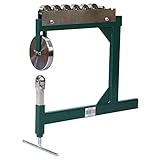
9. Veemuaro Heavy Duty Benchtop Wheel – Simple and Rigid
Veemuaro Heavy Duty English Wheel, English Wheel Metal Shaping Benchtop Machine, Benchtop English Wheel
15-3/8 inch throat
Fabricated steel C-frame
Thumb-screw anvil adjustment
16 gauge mild steel capacity
Pros
- Rigid fabricated steel C-frame described as sturdy
- 15-3/8 inch throat works to 16 gauge mild steel aluminum and copper
- Thumb-screw anvil yoke adjusts on both axle sides for truing
- Smooth on motorcycle tanks tank covers seat cowls and aircraft fillets
Cons
- Only 3 reviews
- all recent
- Very low sales rank suggests limited adoption
- Same 15-3/8 inch throat that restricts full panel work
The Veemuaro takes the simplest possible approach, and in a category full of over-engineered budget machines that simplicity is a feature. A fabricated steel C-shaped base with few moving parts, a 15-3/8 inch throat, and a thumb-screw anvil yoke that adjusts on both sides of the axle support.
Fewer moving parts means less to tune and less to go wrong. Capacity is 16 gauge mild steel plus aluminum and copper. The anvil adjustment design is the same two-sided thumb-screw arrangement that makes truing achievable without a micrometer, and that is the feature we would want on a first machine.
Owner feedback is three recent reviews, none below four stars, describing a straightforward and sturdy benchtop wheel covering the same throat and gauge capacity as other entry-level units. The honest caveat is that the evidence base is thin, so the rating is directionally positive rather than well substantiated.
What a low sales rank does and does not tell you
Low sales rank is not a quality signal on its own. It usually reflects how new a listing is and how little marketing sits behind it. What it does tell you is that replacement parts and support are likely harder to find than on a heavily sold brand, so treat the machine as one you keep rather than one you service.
The dual-side thumb-screw adjustment is worth more attention than it gets. Because you can move the anvil from either side, you can converge on concentricity instead of chasing a single adjustment point that only ever gets one dimension closer.
Who should skip it
Skip it if you need a meaningful owner history, because three recent reviews cannot support a durability claim. Skip it if you want the widest throat available at this weight, and skip it if you plan heavy daily production work where a heavier frame such as the KASTFORCE at number two would flex less.
10. Woodward Fab Lil Wheelie – Brand Name Mini With Sparse Data
Woodward Fab “Lil Wheelie” Mini English Wheel
Mini English wheel format
Model WFEW10
Compact bench footprint
US fabrication brand
Pros
- Recognizable US fabrication brand with a body-shop aftermarket reputation
- Compact mini form factor suits hobby benches and tight shops
- Complete starter tool for small panel work
- Perfect 5.0 rating from both reviews on file
Cons
- Listing publishes almost no specification detail
- Only 2 reviews
- so no performance history
- Priced well above generic benchtop machines with far less published data
The Woodward Fab Lil Wheelie is here because the brand carries weight that the spec sheet does not. Woodward Fab has been building for the body-shop aftermarket for more than thirty years, and in a community-driven category that history is a genuine asset when the listing itself tells you almost nothing.
This is the mini format, model WFEW10, in a compact footprint suited to hobby benches and tight shops. It is positioned as a complete starter tool for small panel work. The rating is 5.0 from both reviews on file.
Two reviews with no written commentary is the entire evidence base. The listing is unusually sparse, offering only the model number and a one-line description, so any evaluation rests on brand reputation rather than documented owner experience. We would call that honest but thin.
When buying on brand name makes sense
Brand reputation earns its premium in one situation, which is when you cannot easily replace a failed part. Budget import machines often have no separate spare parts channel, so a bad bearing means a return rather than a repair. A brand with a service path converts a dead end into a phone call.
It also matters if you plan to expand later within the same ecosystem. Buying small from a maker you can grow with is sometimes cheaper overall than buying a larger generic unit you will outgrow anyway.
Who should skip it
Skip it if you are buying on specifications, because there are none published. Skip it if you want a documented owner history. And skip it if the machine is for large panels, since the mini format and the published data both point to small work only.
How Much Throat Depth Do You Actually Need?
Measure the widest panel you expect to run and buy a throat that covers it with room to rotate. Throat depth is measured from the center of the lower anvil to the back of the frame, and it is the single most decisive spec on the machine. Everything else is a preference.
An 8 inch throat forms panels up to about 16 inches wide, and it can be extended further by rotating the wheels and anvils 90 degrees. That covers tank covers, seat cowls, aircraft fillets, jewelry-scale aluminum, sculpture, and small patch panels. Many hobby projects never exceed that.
A 12 to 15 inch throat is the general-purpose zone. It handles half-sheet panel sections, motorcycle tank sides, fender sections, and bicycle frame work without constant repositioning. Most of the picks in this roundup sit here because that is where the useful overlap between capability and bench space lives.
A 15-3/4 inch throat is where long, shallow crowns become comfortable. A 28 inch throat is a different category entirely, letting you roll a full car panel in one continuous pass. The gap between 15 and 28 inches is the gap between a bench machine and a shop machine.
Cast Iron Frame vs Fabricated Steel Frame
Heavier frames hold alignment better under pressure, and that is the whole argument. Every machine in this group is a fabricated or cast steel frame, and the meaningful comparison is really about mass and how many moving parts the frame contains.
A heavy fabricated C-frame with few parts is easy to keep rigid, and rigid is what prevents the faint ridge that appears where a panel crosses the top of a flexing frame. The 43 pound KASTFORCE and the 169 pound KAKA Industrial both earn their weight by resisting deflection on thicker stock.
Cast iron frames appear in the professional tier that is not represented here. Cast iron machines cost far more because of the mold and the machining, and they are built for shops running production work every day rather than for a weekend.
What Gauge of Steel and Aluminum Can You Shape?
You can use a steel-rated wheel on aluminum, and this is the question that comes up most often on shaping forums. The answer is yes, with one condition. Aluminum work-hardens quickly, so it demands finer pressure control than steel at the same gauge.
Here is how the ratings break down across this group. Machines rated to 18 gauge steel and 16 gauge aluminum include the Quaintfab 8 inch, 15 inch, and 15-3/4 inch models, plus the KAKA Industrial, which also reaches 14 gauge aluminum and copper. Machines rated to 16 gauge mild steel include the Stark USA, the KASTFORCE, the AELIVET, the Tandagy, and the Veemuaro, several of which also list aluminum and copper at comparable or slightly thicker gauges.
The practical rule is simple. Pick a machine rated for at least one gauge heavier in aluminum than your hardest stock, and make sure it has a micro-adjustable anvil. A micro-adjust is the single feature that separates comfortable aluminum work from a fight, because it lets you increase pressure by increments small enough that you are not immediately work-hardening the panel.
Aluminum also shows frame flex more readily than steel at the same gauge, because it has less resistance to deflection under a concentrated load. If aluminum is your primary medium, weight matters more. A 42 pound frame will produce a cleaner aluminum surface than a 27 pound one.
Anvils and Die Sets: Picking the Right Radii
A standard seven-piece set gives you a flat anvil plus 1/2, 1, 1-1/2, 2-1/2, 5 and 9 inch radii, and buying a wheel that includes it saves you sourcing dies separately. Four-die sets in this group cover 1, 2, 3 and 5 inch radii, which is workable for common shaping but leaves you without tight or very broad options.
The flat anvil is the most underused piece. It is how you planish a surface flat after a weld, blend a seam, or take out a dent without adding curvature. A machine that includes one is more useful than a machine that includes a fifth curved die.
Tight radii between 1/2 and 1 inch handle beads, hems, and close-radius transitions. The 1-1/2 and 2-1/2 inch dies are everyday shaping radii. The 5 and 9 inch dies are broad crown dies for fender tops and roof panels, and they pair with a wide throat.
Budget machines sometimes arrive with die pins too tight to insert, and reviewers note that a pass with emery cloth on the pin and the die bore fixes it in a minute. It is a normal part of setup, not a defect.
Do You Even Need an English Wheel?
If all you need is a single-radius bend, you do not need one. A bending brake, a slip roller, or a hand-held slip roll clamp will all do a simple curve faster and more cheaply. The English wheel earns its place only when you need two curvatures at once.
Compare it against the alternatives. A slip roller handles long, shallow, single-curvature bends on a brake, not compound curves. A power hammer and a shrinking hammer cover shrinking, hammering out dents, and general bodywork, which an English wheel does not do. Hammer and dolly work gives you finer control for localized shaping, and experienced metal shapers pair the two tools rather than expecting one to do everything.
Our advice is to start with a mid-size benchtop wheel between 12 and 15 inches of throat. It covers the overwhelming majority of hobby and small-shop projects, and it is small enough that learning on it is inexpensive. For context on how we approach other tool categories, we have also compared the best racing wheels for beginners and the best sim racing wheels using the same tier-by-tier method.
How to True and Align a New English Wheel
Almost every English wheel arrives needing truing, including the ones that cost several times more than the budget models. This is the single most repeated complaint in shaping forums, and it is a setup task, not a fault.
First, set the machine on a flat, rigid surface and bolt or clamp it down. A wheel that can rock will never hold an alignment. Buy your own mounting hardware if the listing does not include it.
Second, check frame squareness at the anvil and at the upper spindle. A fabricated frame that ships out of square is the most common fault in the category, and on lighter machines it means pulling the frame back into square or adding reinforcing gussets before you do anything else.
Third, remove wheel play. Check the upper wheel for bearing and fork play, and if the top wheel pin holes are oversized, add a shim or bushing to take up the wobble. Check the lower anvil for the same thing. Owners of budget machines routinely spend an afternoon here and then never think about it again.
Fourth, bring the anvil to the upper wheel using your micro-adjust if the machine has one, or a shim and feeler gauge if it does not. A strip of paper between the anvil and the wheel should drag with light, consistent pressure. That is your reference point for every future setup.
Fifth, before any real panel, run a flat scrap of sheet and look for a witness line where the metal crosses the top of the frame. A ridge there means frame flex, and the fix is more mass or more bracing, not more pressure.
Maintenance, Lubrication, and Safe Operation
An English wheel has almost no maintenance schedule, which is one of its underrated advantages over a power hammer or a slip roller. What it does need is a wipe-down and occasional attention to the spindle bearings.
Wipe the frame, spindle, and anvils after every job. Metal dust and moisture together are what cause pitting at the spindle, and a five-minute wipe prevents it. If your machine has grease fittings or a bronze bearing at the spindle, service it occasionally and keep it packed.
Check anvil play every few months, not every session. Bearings wear slowly on a hand-powered tool, and an anvil that develops play will start putting a crease in your panels long before you notice anything wrong.
On safety, an English wheel has no motor and no rotating chips, which makes it far safer than most metalworking equipment. The real risks are pinch points at the anvil, sharp edges on newly formed sheet, and hand strain from over-gripping the pressure screw. Wear gloves when handling formed sheet, keep your hands clear of the anvil gap when pressing, and lead with your palm rather than your fingertips.
Commercial shops should follow their own OSHA obligations for machine guarding and training. A hand-powered English wheel is far easier to justify in a shared shop than a powered forming machine, but the training requirement does not go away.
Frequently Asked Questions
What do you use an English wheel for?
An English wheel forms sheet metal into compound curves that a bending brake cannot make. Typical uses include motorcycle fuel tanks, fenders, seat cowls and tank covers, auto body restoration panels and patch work, fender flares, aircraft skin forming, bicycle frames, boat building, custom sculpture, and jewelry-scale aluminum. It is not for dent repair, not for sharp single-radius bends, and not for shrinking. Those jobs belong to a planishing hammer, a brake, or a shrinking hammer.
Why are English wheels so expensive?
Professional English wheels cost far more than entry models because of the frame, the machining, and the volume. A heavy cast iron or thick fabricated frame often weighs 200 pounds or more, the upper wheel and anvil shafts must be precision ground and hardened, and bearings and spindle tolerance determine whether the wheel runs true over years. These machines are also built in low volume, so tooling cost is spread across few units. You are paying for rigidity and repeatability, not for a bigger handle.
What throat depth do I need?
Buy a throat that covers the widest panel you expect to run, with room to rotate. An 8 inch throat handles tank covers, seat cowls, small patches, and sculpture. A 12 to 15 inch throat handles half-sheet sections, motorcycle tank sides, and fender work, and is the general-purpose zone for a home shop. A 15-3/4 inch throat suits long shallow crowns. A 24 inch or larger throat is needed for full car panels.
Can you use an English wheel on aluminum?
Yes, as long as the machine is rated for it and you control pressure finely. Aluminum work-hardens quickly, so you need more pressure resolution than steel at the same gauge, which makes a micro-adjustable anvil the feature to look for. In this roundup the Quaintfab 8 inch, 15 inch, and 15-3/4 inch models are rated to 18 gauge steel and 16 gauge aluminum, while the KAKA Industrial reaches 14 gauge aluminum and copper. Choose a machine rated at least one gauge heavier than your hardest stock.
How to build a homemade English wheel?
The core components are two hardened wheels on shafts, a rigid frame, a pressure screw, and a thrust bearing. Shaping forums describe community-built wheels from a few dollars of parts as entirely sufficient for learning the feel of metal shaping. The honest limit is that a homemade wheel teaches you the stroke, the pressure, and how the anvil radius shapes the curve, but it will not hold alignment the way a squared steel frame with a micro-adjustable anvil does. Learn on one, then buy a real machine.
The Best English Wheel for Your Shop in 2026
The best english wheels for metal shaping are not all the same machine, and the fastest way to choose is to start from the widest panel you will ever run. If that panel is a fender or a tank side, the Quaintfab 15 inch with its seven-piece die set is the most capable benchtop option here, and the KASTFORCE KF5018 is the stronger value if you stay on mild steel.
If your widest panel is a car door skin or a full quarter panel, a 28 inch throat is not optional. That is where the KAKA Industrial earns its place, and where you should stop comparing benchtop machines. If you are still deciding whether you want to shape metal at all, the Stark USA has the deepest owner history in the group and the lowest cost of any machine people here keep and modify.
Whichever one you pick, budget the first afternoon for alignment. Every wheel in this roundup arrives with something to square, shim, or adjust, and getting that right before the first panel is the difference between a tool that teaches you and one that frustrates you.