
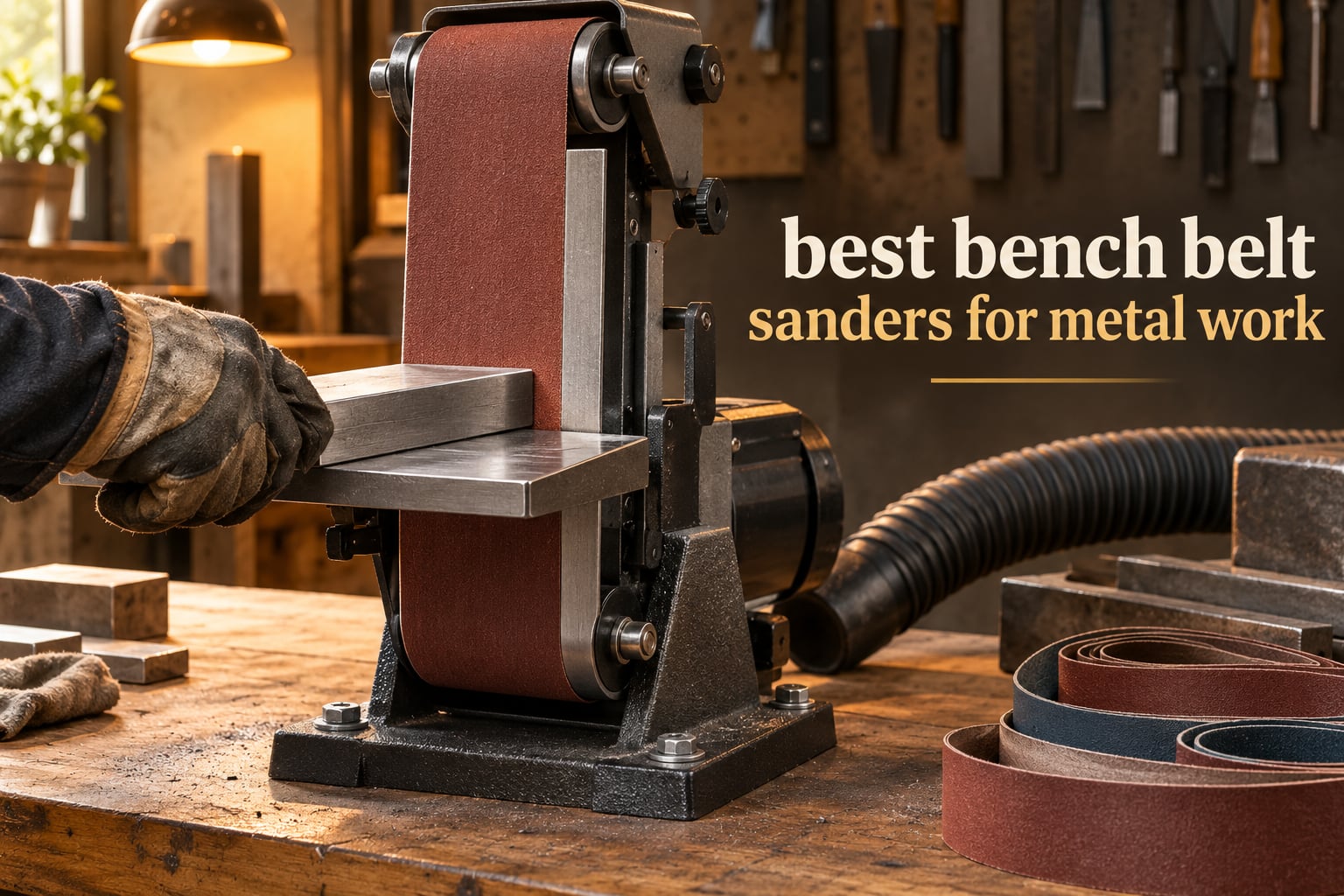
A bench belt sander is the machine that turns a rough piece of bar stock into a flat, square, finished part without you chasing it around with a handheld grinder. The abrasive belt runs over a hardened platen at a steady speed, so the metal meets the grit the same way every single pass. That repeatability is the whole reason metalworkers buy one instead of an angle grinder.
There is a naming problem worth clearing up first. Sellers call these machines belt sanders, bench belt sanders, bench mounted belt grinders and bench grinders almost interchangeably, but they are not the same tool. A bench grinder uses a spinning abrasive wheel to make sparks and let you shape an edge by eye. A bench belt sander runs an endless belt over a flat platen, which is what you want the moment accuracy matters. If your work involves squaring a face, flattening a weld bead or bringing a knife profile to a line, you need the belt.
We compared ten of them for this guide, from a 1×30 entry machine to a 60 pound shop sander with a removable platen. Each one below has a clear job, and each one has a limit worth knowing before you buy. We have also pulled in the sizing rules that keep coming up in the metalworking forums, because choosing the wrong belt width is the single most common reason a new machine disappoints.
If you are still building out the rest of the bench, our bench grinder roundup covers the wheel machine that belongs next to a belt sander, and our bench vise picks cover the other tool you will use constantly with both.
Table of Contents
Top 3 Picks: Best Bench Belt Sanders for Metal Work (October 2026)
These three cover the three most common buying decisions: the best all-round bench belt sander, the best small machine for a tight bench, and the best dedicated machine for sharpening and metal shaping. Each badge here matches the badge on the full review further down.
WEN 6502T 4×36 Belt and Disc
- 4x36 belt with 6 inch disc
- 4.3 amp motor at 3600 RPM
- Cast iron base
- 0 to 90 degree belt tilt

WEN 6515T 1×30 Belt and Disc
- 1x30 belt with 5 inch disc
- 2.3 amp motor at 3160 FPM
- Two separate dust ports
- 16 pound benchtop size
BUCKTOOL BG2600 2×42 Combo
- 2x42 metal belt
- 1/3 HP induction motor at 4480 FPM
- 6 inch bench grinder with LED light
- CSA compliant cast iron tables
Best Bench Belt Sanders at a Glance in 2026
All ten machines, in one place. Belt size, motor output and the job each one fits best. Every row links straight to the full review below.
| Product | Specifications | Action |
|---|---|---|
| WEN 6502T 4×36 Belt and Disc Sander |
|
Check Latest Price |
| WEN 6515T 1×30 Belt and Disc Sander |
|
Check Latest Price |
| BUCKTOOL BG2600 2×42 Combo |
|
Check Latest Price |
 Woodskil 4×36 Belt Disc Combo Woodskil 4×36 Belt Disc Combo |
|
Check Latest Price |
 BUCKTOOL BD4603A 4×36 Direct Drive BUCKTOOL BD4603A 4×36 Direct Drive |
|
Check Latest Price |
 VEVOR 4×36 and 8 Inch Combo VEVOR 4×36 and 8 Inch Combo |
|
Check Latest Price |
 VEVOR 30×1 Variable Speed Grinder VEVOR 30×1 Variable Speed Grinder |
|
Check Latest Price |
 JET J-41002 2×42 Belt and 8 Inch Disc JET J-41002 2×42 Belt and 8 Inch Disc |
|
Check Latest Price |
 KFMK 2×42 Belt and 6 Inch Combo KFMK 2×42 Belt and 6 Inch Combo |
|
Check Latest Price |
 RYOBI BD4601G Refurbished Sander RYOBI BD4601G Refurbished Sander |
|
Check Latest Price |
1. WEN 6502T 4×36 Belt and Disc Sander – Best All-Round Bench Belt Sander for Metal Work
WEN Benchtop Belt and Disc Sander with 4 x 36 in. Belt, 6 in. Disc and Cast Iron Base (6502T)
4x36 belt and 6 inch disc
4.3 amp at 3600 RPM
120V corded
22 by 11 by 12.5 inches
Pros
- Most reviewed machine in this roundup at over 5400 ratings
- 4.3 amp motor gives real torque for a combo machine
- Belt tilts 0 to 90 degrees for flatbed vertical and contour work
- Cast iron base stays put under load
- Tension release lever makes grit changes fast
Cons
- Fence sits high and limits workpiece length on the disc side
- Disc table drifts out of alignment on a single adjustment screw
- Split dust port weakens suction at both stations
Out of everything we looked at, the WEN 6502T is the one we would put on a bench without hesitating. It is the most reviewed machine in this roundup by a wide margin, and the pattern in the reviews is consistent: owners describe it as quiet, accurately tracking and easy to live with, while the complaints all cluster around the disc side rather than the belt.
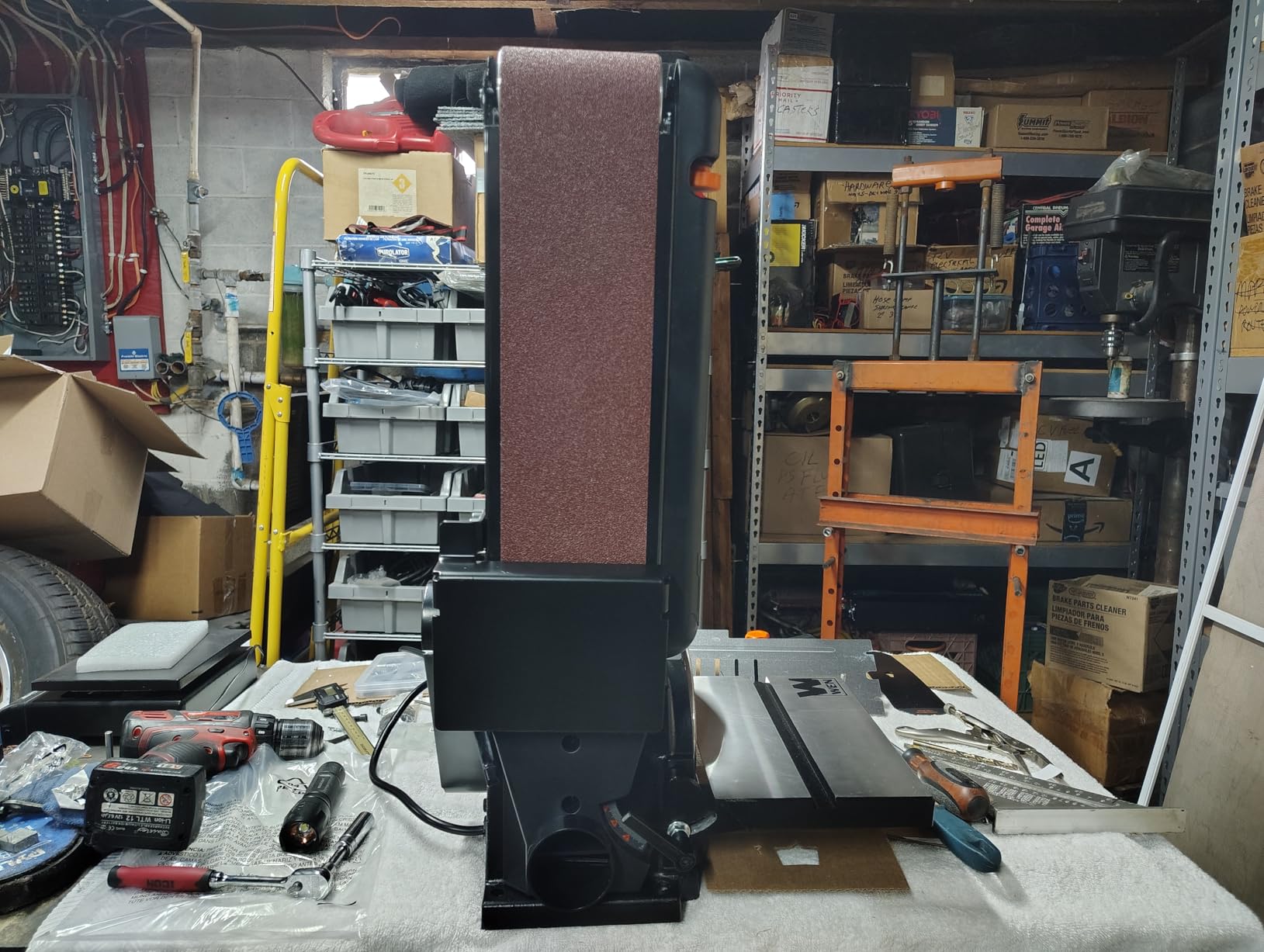
That split matters for metal work. The belt is what you will use, and the 4×36 belt gives you a genuine platen area to work against. The 4.3 amp motor and 3600 RPM are enough to take a bead down or clean up a cut face without the machine sounding like it is about to give up.
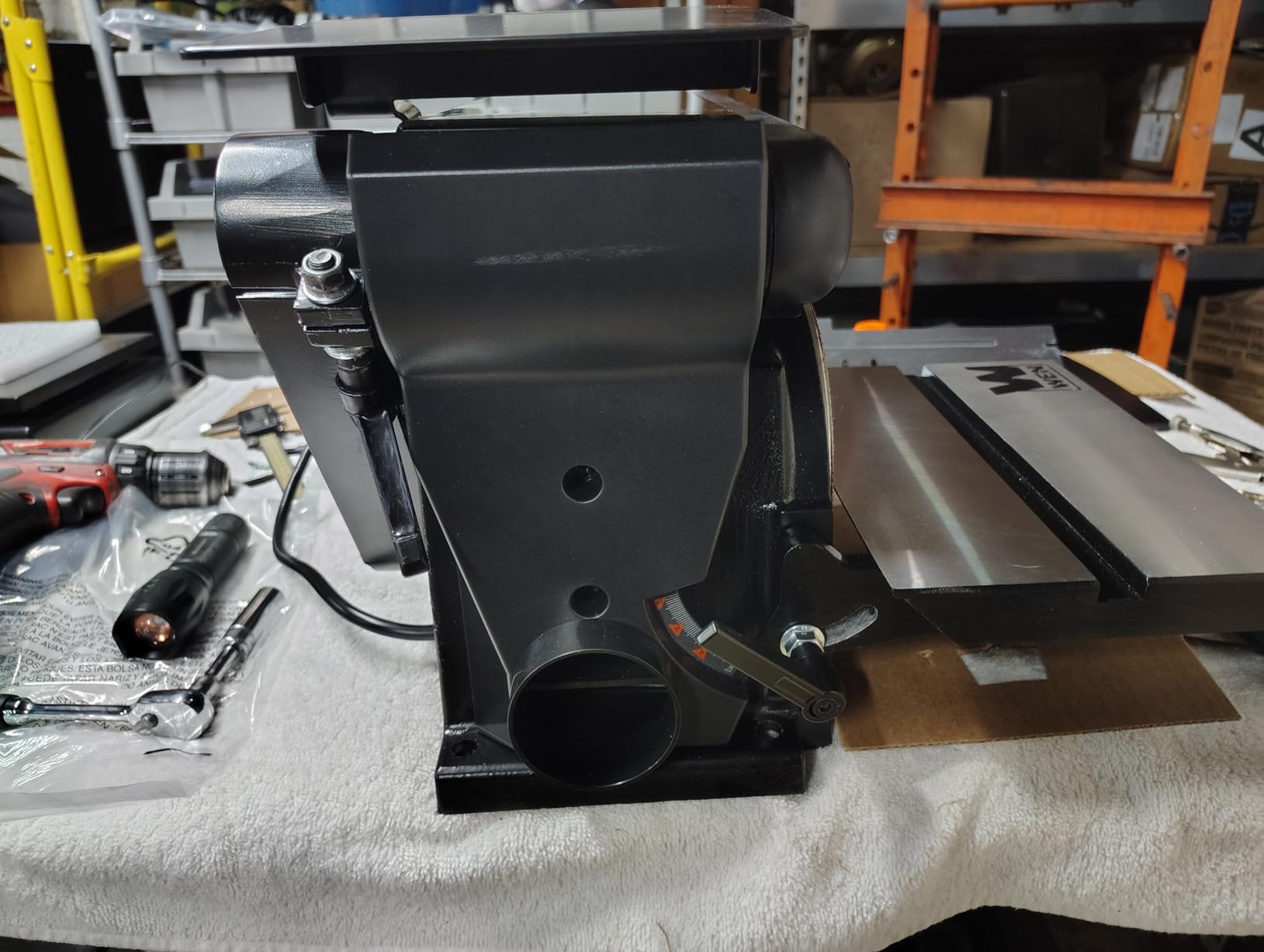
The cast iron base is doing more work than the spec sheet suggests. Combo machines with thin sheet metal bases walk across the bench under pressure, and once a machine moves, the cut stops being flat. Owners consistently report that this one does not move.
The tension release lever is a small detail that saves real time. When you are stepping through grits to shape a part, a lever beats four screws every single change, and over a session the time adds up quickly.
Is the 4×36 belt wide enough for metal work?
For most fabrication and hobby metal work, yes. A 4 inch wide belt gives you a contact patch you can actually control with two hands, which is what you need when squaring a face or cleaning up a weld. It is not a heavy stock removal machine, and it is not trying to be one.
If your work is mostly knife profiles, plate work or general shop cleanup, this is the sweet spot. If you are looking at long bar and thick sections, a 2 inch wide knife style belt is the more honest fit.
What should I know before buying this machine?
The fence height is the one to think about. It sits high on the bed, which limits how much of a long workpiece you can push past the disc side before the fence gets in the way. Plan your workholding around that rather than fighting it.
The dust port is shared between the belt and the disc, so suction drops at both when a vacuum is connected. If dust control matters to you, our workshop lighting guide is a better use of a second accessory budget line than a cheap separator, and a proper shop vacuum does more for a shared port than any splitter will.
2. WEN 6515T 1×30 Belt and Disc Sander – Best Budget Bench Belt Sander for Small Shops
WEN Benchtop Belt and Disc Sander with 1 x 30 in. Belt and 5 in. Sanding Disc (6515T)
1x30 belt and 5 inch disc
2.3 amp at 3160 FPM
120V corded
16 pounds
Pros
- Compact footprint for a crowded bench
- Quiet smooth motor for its size
- Two separate dust ports
- Tracks correctly without adjustment
Cons
- Single speed only
- Sanding disc is glued to the platen
- Disc table and miter gauge lack accuracy
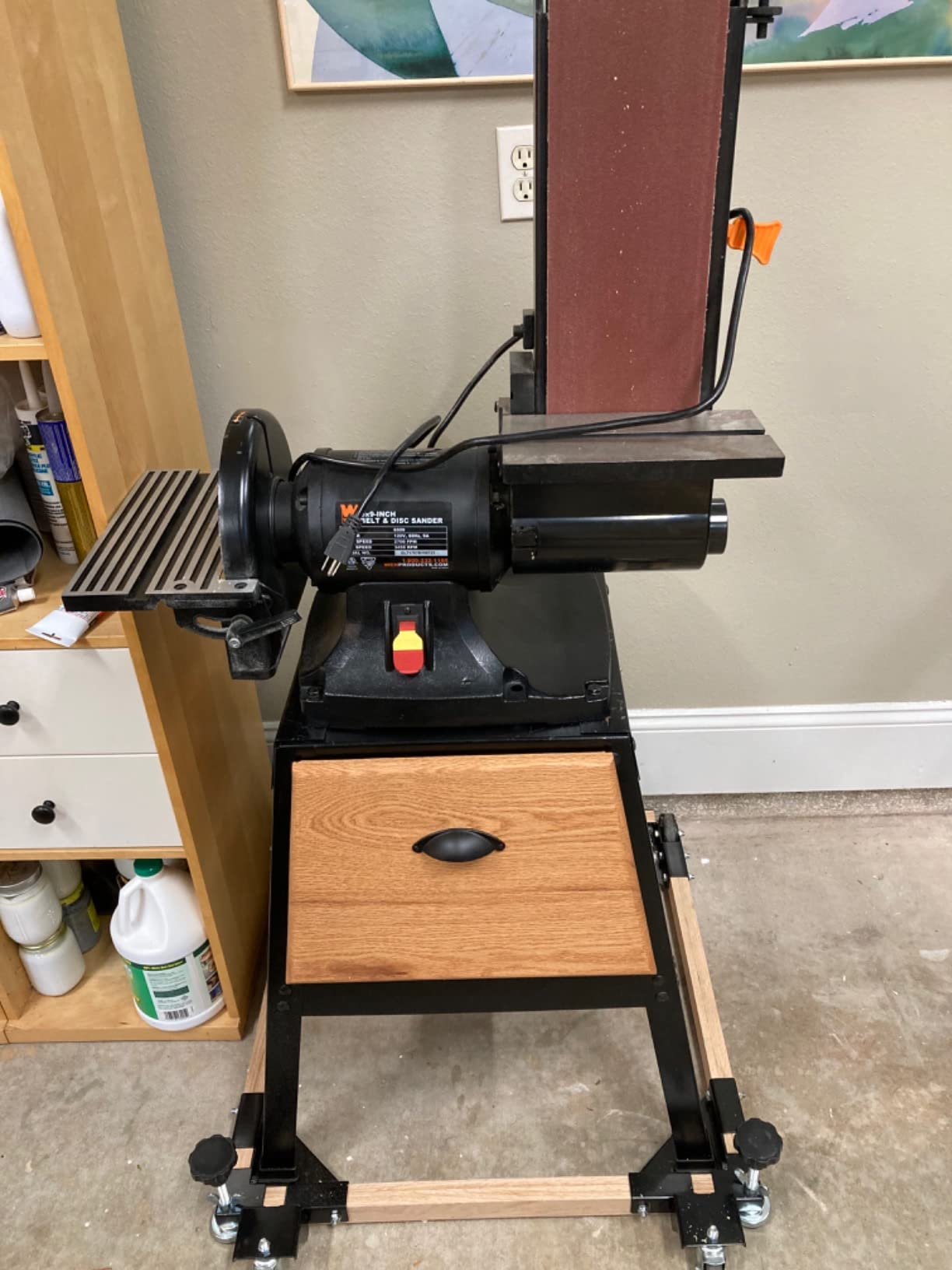
This is the smallest machine in the roundup and the one that fits where nothing else will. At 11.5 by 11.5 by 15.5 inches and 16 pounds, it goes on a small bench, a garage shelf or a rolling cart without any planning.
Owners treat it as a capable small shop sander that punches above what the class usually delivers. The 2.3 amp motor is modest on paper, but at 3160 FPM of belt speed it runs quietly and smoothly, which matters more day to day than raw peak numbers.
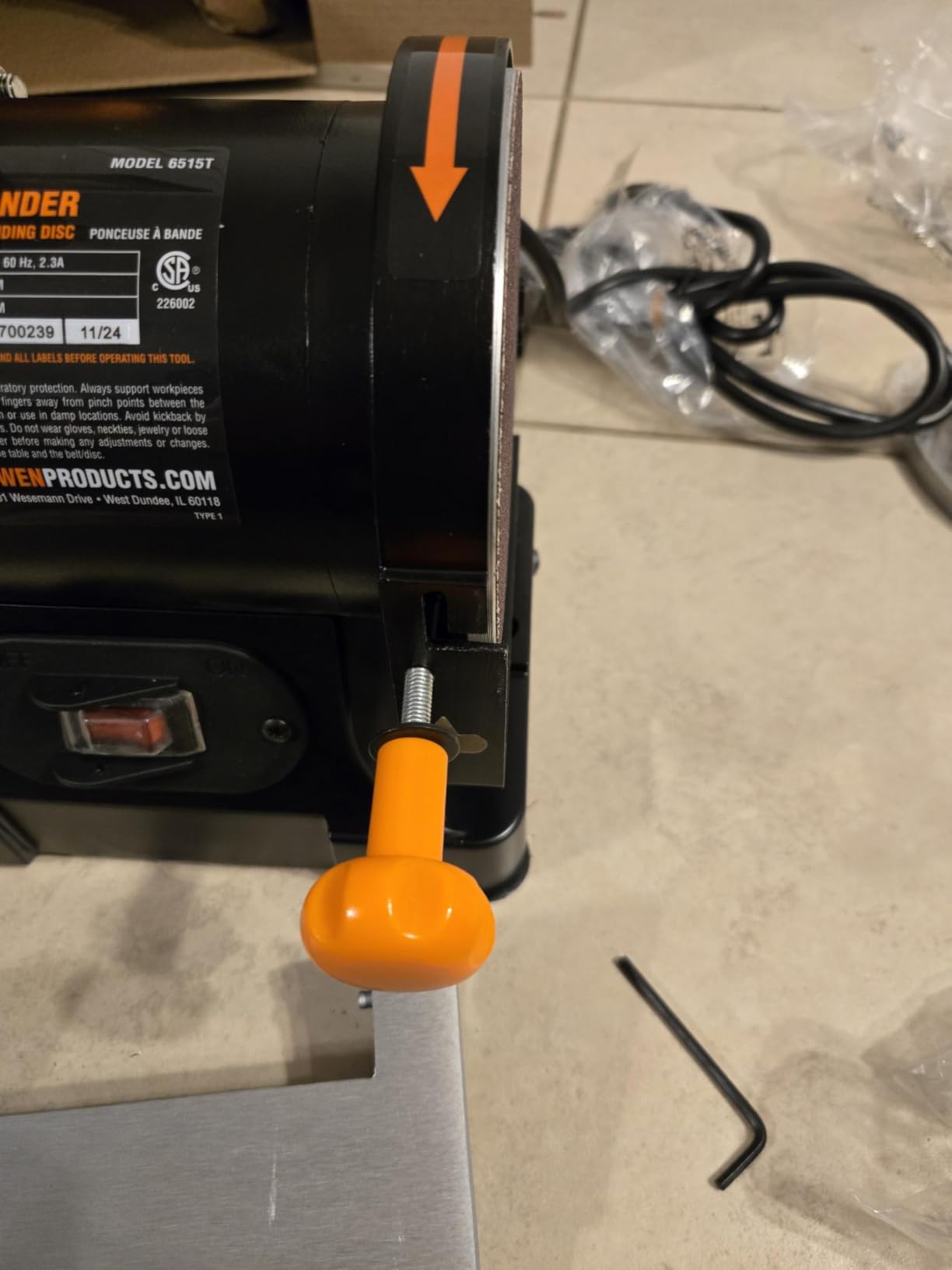
Two separate dust ports is a genuinely useful feature at this level. Most machines in the class split one port between the belt and the disc and deliver poor suction to both. Having one port per station means you can vacuum the station you are actually using.
It also arrives with the basics you would otherwise be chasing, including an 80 grit sanding disc, a 100 grit sanding belt and a miter gauge, plus a two year warranty. The belt tracks correctly out of the box and does not need constant readjustment, according to owners.
Is a 1×30 belt enough for metal work?
Enough for deburring, cleanup, sharpening small parts and finishing edges on already-shaped work. Not enough for squaring thick bar or taking a weld bead down. The 1 inch belt has a narrow contact patch, so you are working with the ends of your fingertips rather than a flat face.
On a recent thread in r/blacksmithing, a beginner evaluating a 30x533mm machine was told plainly that 200W machines are a joke for metalworking and that an angle grinder would serve them better. The 6515T is not in that category, but the warning still applies to the class.
What are the real compromises on this machine?
Single speed is the biggest one. There is no dial to turn when you move from aluminum to hardened tool steel, so you manage heat with pressure and belt choice instead of with the machine.
The sanding disc is glued to the platen and difficult to change, and the disc table and miter gauge are not accurate enough for precision layout work. Treat the disc as a shaping accessory and put your accuracy on the belt side.
3. BUCKTOOL BG2600 2×42 Belt and Bench Grinder Combo – Best Belt Grinder for Metal Shaping and Sharpening
BUCKTOOL 2×42″ Belt Sander 6″ Bench Grinder Combo for Metalworking,3.5A
2x42 metal belt
1/3 HP at 4480 FPM
6 inch wheel with LED light
CSA compliant
Pros
- 2 inch belt is a real metalworking width
- 4480 FPM belt speed cuts cleanly
- Cast iron belt table is rigid
- Quick release tension and tracking
- LED work light on the wheel station
Cons
- 2 inch belt limits wide surface work
- Single speed operation
- Combo layout uses more bench depth
This is the machine in the roundup that most clearly looks like a metal tool rather than a wood shop machine. The 2×42 belt is sized for shaping and sharpening, the cast iron belt table is rigid, and the manufacturer rates the whole thing for continuous load under CSA standards.
The 4480 FPM belt speed is higher than anything else here, and that is not a marketing number on a spec sheet. It is the difference between a belt that cuts and a belt that polishes the workpiece into a glaze. Owners consistently single out the machine’s metalworking and knife sharpening strengths.
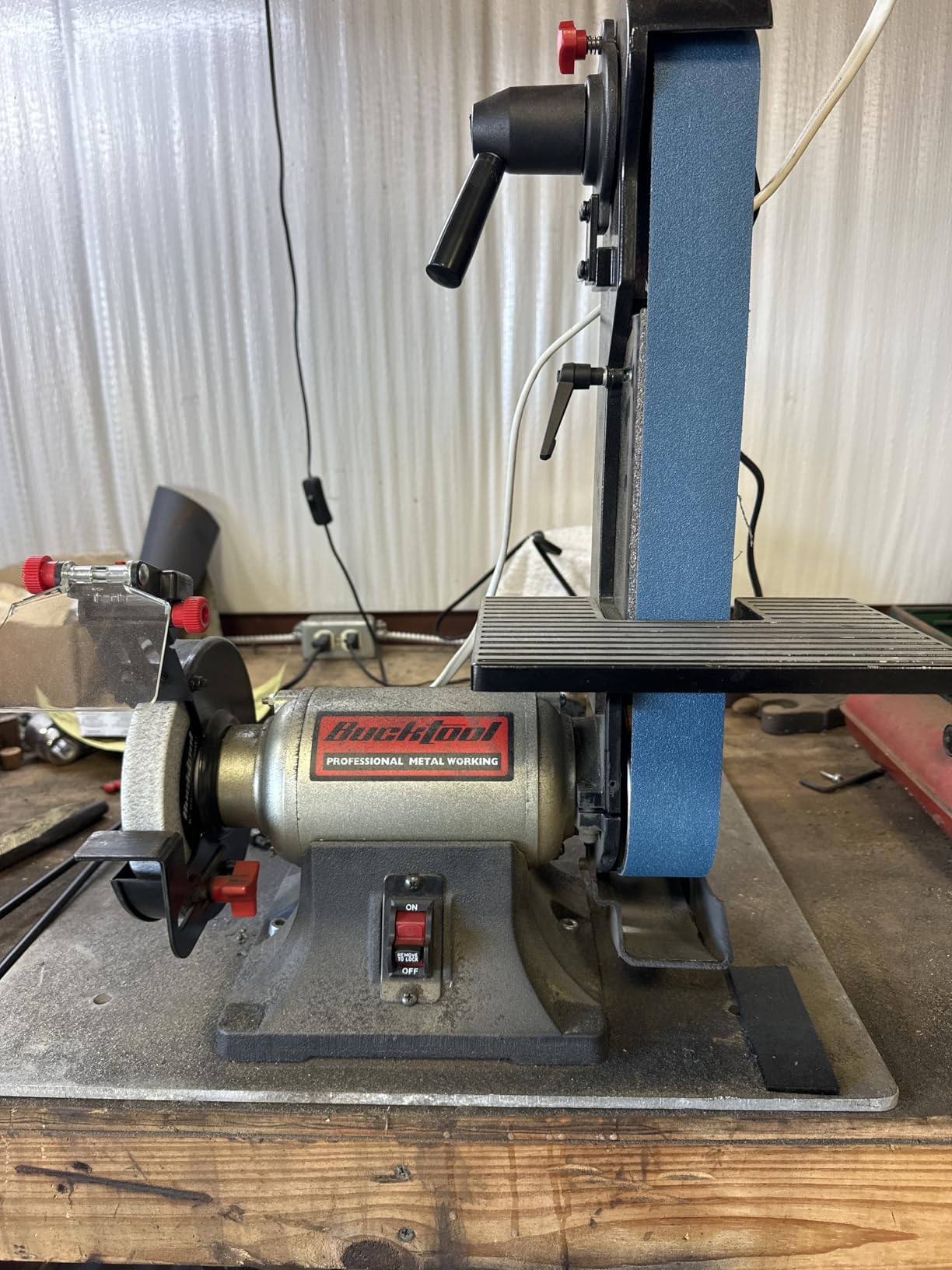
The combination layout earns its keep more often than combo machines usually do. The belt handles shaping and finishing, and the 6 inch wheel with a tool free eye shield and an LED light handles the general cleanup that would otherwise kill a belt. Running a 60 grit wheel on a burr is much cheaper than running a fresh belt on it.
Quick release tension and tracking means the changeover between the belt and the wheel is a matter of seconds, and the belt housing swivels so you can work on long pieces in a more natural position.
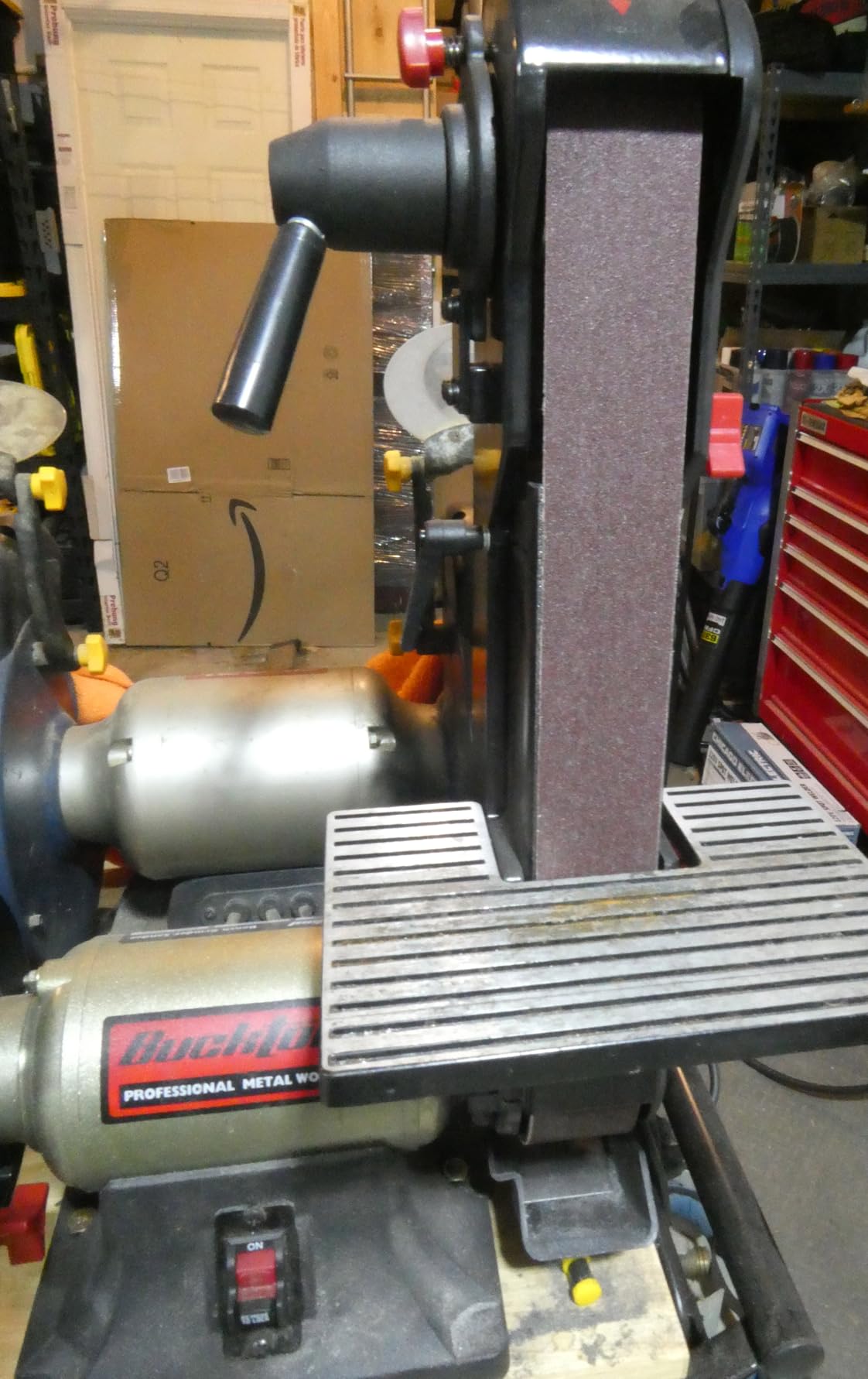
Why is a 2 inch wide belt better for metal than a 4 inch one?
Because the belt wraps less and the contact patch stays closer to the workpiece edge. On a knife profile, a 2 inch belt tracks the line the way a grinding wheel does, while a wide belt tends to wander off the sides of the work. Wider belts win on flat faces, narrow belts win on edges and bevels.
The trade is contact area. A 2 inch belt removes less metal per pass on a wide flat surface, so this is not the machine for flattening a big plate.
Is the 1/3 HP motor enough to avoid stalling?
It is enough for shaping, deburring, sharpening and weld cleanup at normal pressure. It is not enough to take heavy material off a thick casting, and a 1/3 HP motor does not leave headroom for a 2 inch belt the way a 1 HP motor would.
Buyers who push this machine describe it as CSA compliant heavy duty that holds up well, but the honest framing is that it is a controlled finishing and shaping tool rather than a stock removal monster.
4. Woodskil 4×36 Belt Disc Combo – Best All-Round Value for General Shop Sanding
Woodskil 4.3A Belt Disc Sander Combo for Woodworking,4×36″ Belt,6″ Disc
4x36 belt and 6 inch disc
3/4 HP at 1732 FPM
25 pounds
110V corded
Pros
- 3/4 HP motor gives more power than most machines at this level
- Separate dust exhaust ports for belt and disc
- Transparent PC guard shows belt condition
- Belt tracking is easy to correct
- Two year warranty
Cons
- Disc table has a single mounting screw and feels flimsy
- Replacement 4x36 belts are hard to source in the right length
- Noticeable noise
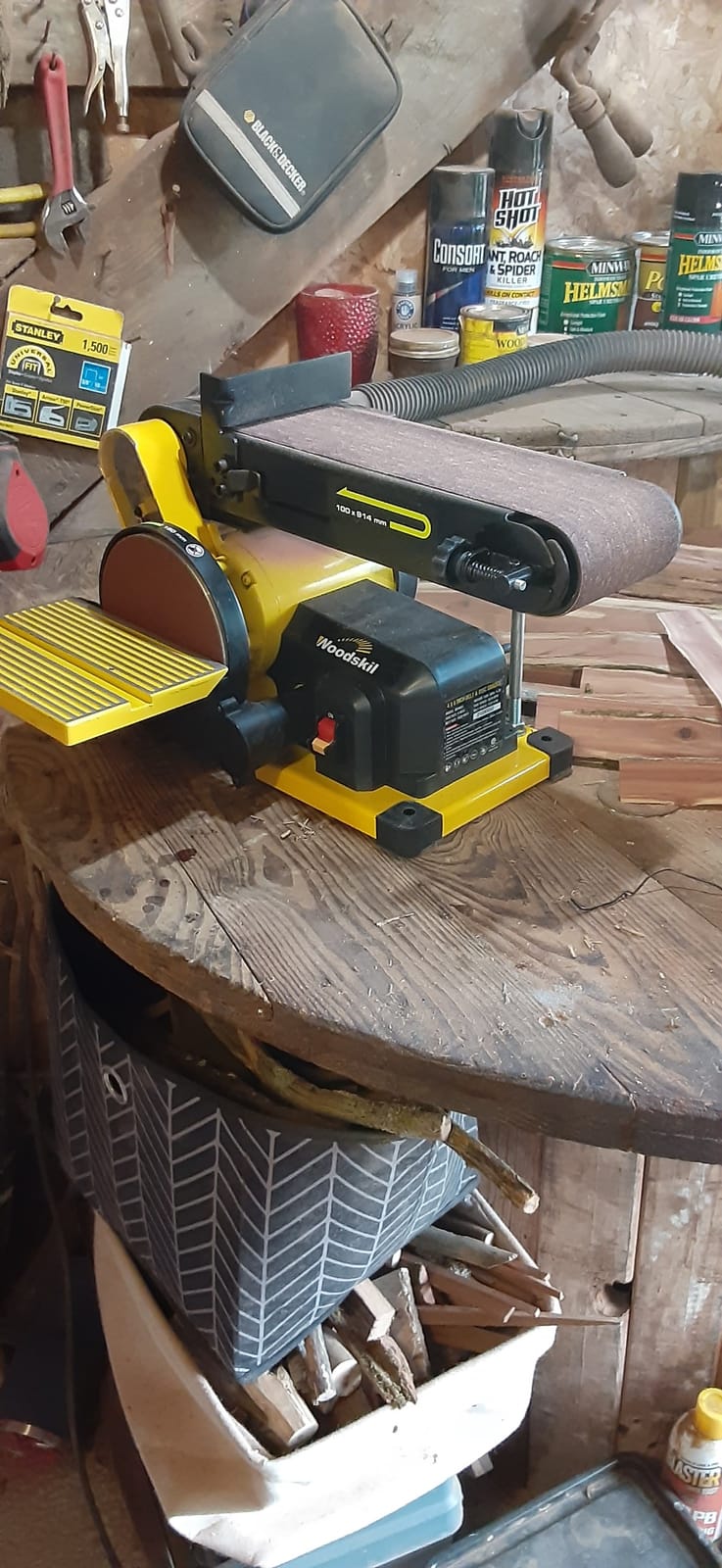
The Woodskil is the one in this roundup where the motor is the headline. A 3/4 HP motor is genuinely unusual at this level, and it is the reason this machine sands metal, plastic and wood without complaint for the owners who bought it.
At 25 pounds it is heavy enough to stay where you put it, and the rubber footed base does not transmit as much vibration as a bare steel plate. Reviewers are consistently surprised by the power relative to what they paid for the machine.
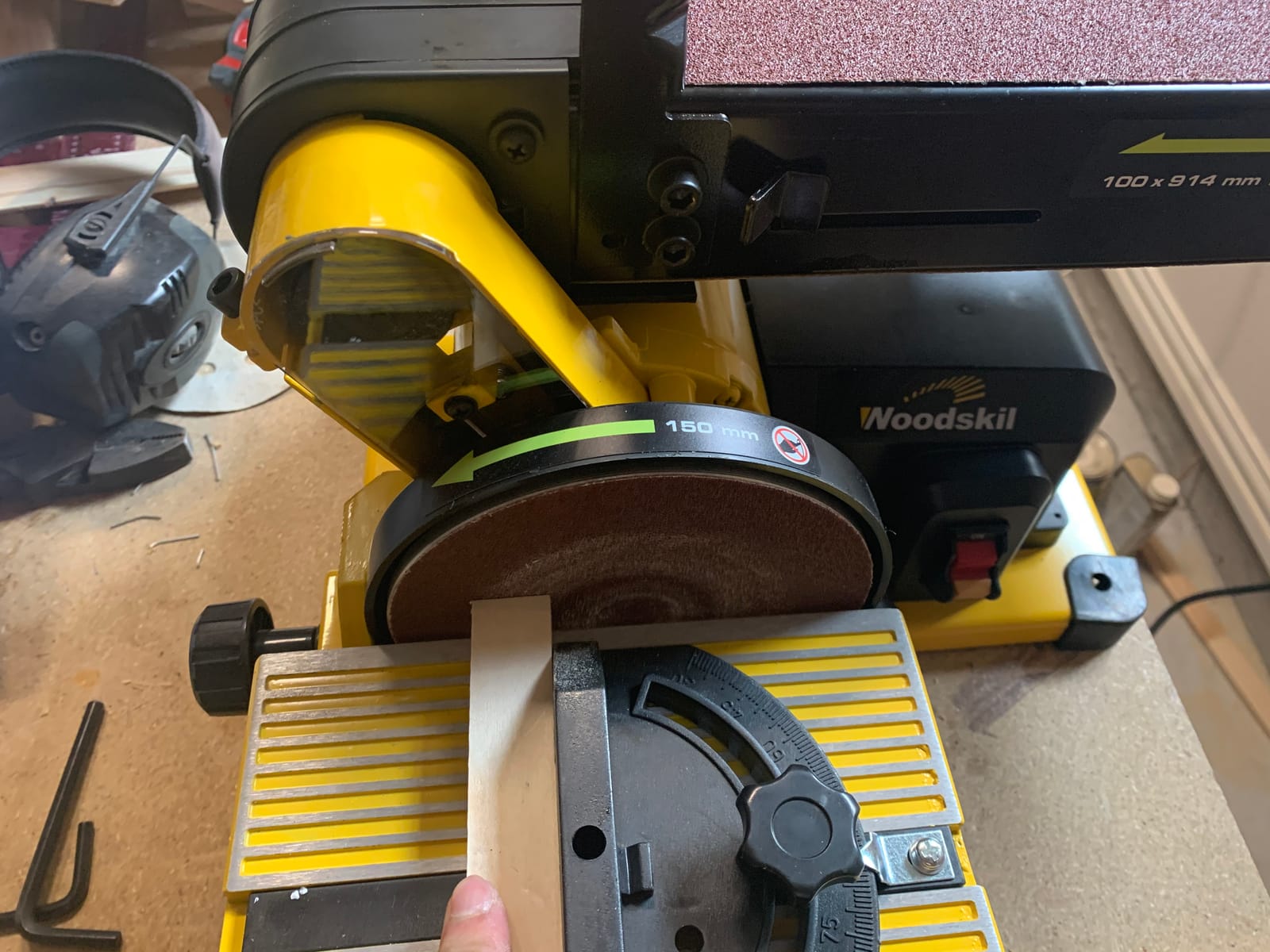
Two details stand out for shop use. The transparent PC belt guard lets you watch the belt surface without stopping to open anything, which is how you spot a glazed belt before it burns a workpiece. The separate dust exhaust ports for the belt and the disc mean you can actually collect what you are generating.
The multi wedge belt drive is marketed as a belt life extension feature, and the belt tracking is described as easy to correct with tension that holds under use rather than drifting as the machine warms up.
Is the 3/4 HP motor the deciding factor on this machine?
On paper and in practice, yes. The Practical Machinist forum is where the sizing heuristic lives: roughly 1 to 1.5 horsepower per inch of belt width. A 4 inch belt at 3/4 HP sits slightly under that line, which is why we would not call this a heavy stock removal machine, but it is far better than the 1/3 HP units in the same price bracket.
For deburring, general cleanup, weld touch up and light shaping, the motor has more than enough headroom. For flattening thick stock, it is the machine that tells you to ease off.
What problems do owners report?
The disc table is the weak point. It has a single mounting screw and reviewers describe it as flimsy, so treat the disc as an accessory station rather than a precision surface.
Sourcing replacement 4×36 belts in the correct length is a real friction point, so buy a spare belt at the same time you order the machine. The machine is also 110V only, and owners note it will not run on a 220V supply without a converter.
5. BUCKTOOL BD4603A 4×36 Direct Drive Combo – Best Bench Belt Sander With Zero Belt Maintenance
BUCKTOOL Bench Belt Disc Sander for Woodworking,4×36″ Belt,6″ Disc,5A
Direct drive belt and disc
3/4 HP enclosed motor
4x36 belt and 6 inch disc
2161 FPM belt speed
Pros
- Direct drive removes routine belt tension adjustment
- Enclosed induction motor runs quietly at full power
- Two cast aluminum worktables
- Rubber footed base resists vibration
Cons
- Table angle markings and miter gauge are basic
- Dust collection wants a specific Y fitting hose
- Larger footprint than a 1x30 machine
Direct drive is the idea worth understanding here. On a conventional belt sander, the belt is driven by the motor shaft through a pulley or a wedge drive, which is what eventually needs re-tensioning. On this machine the belt and disc are driven directly off the motor shaft, so there is no drive to slacken over time.
That is a maintenance story rather than a speed story. Buyers single out the maintenance free drive as the main reason to buy, and the enclosed 3/4 HP induction motor is described as quiet and developing full power rather than tapering off under load.
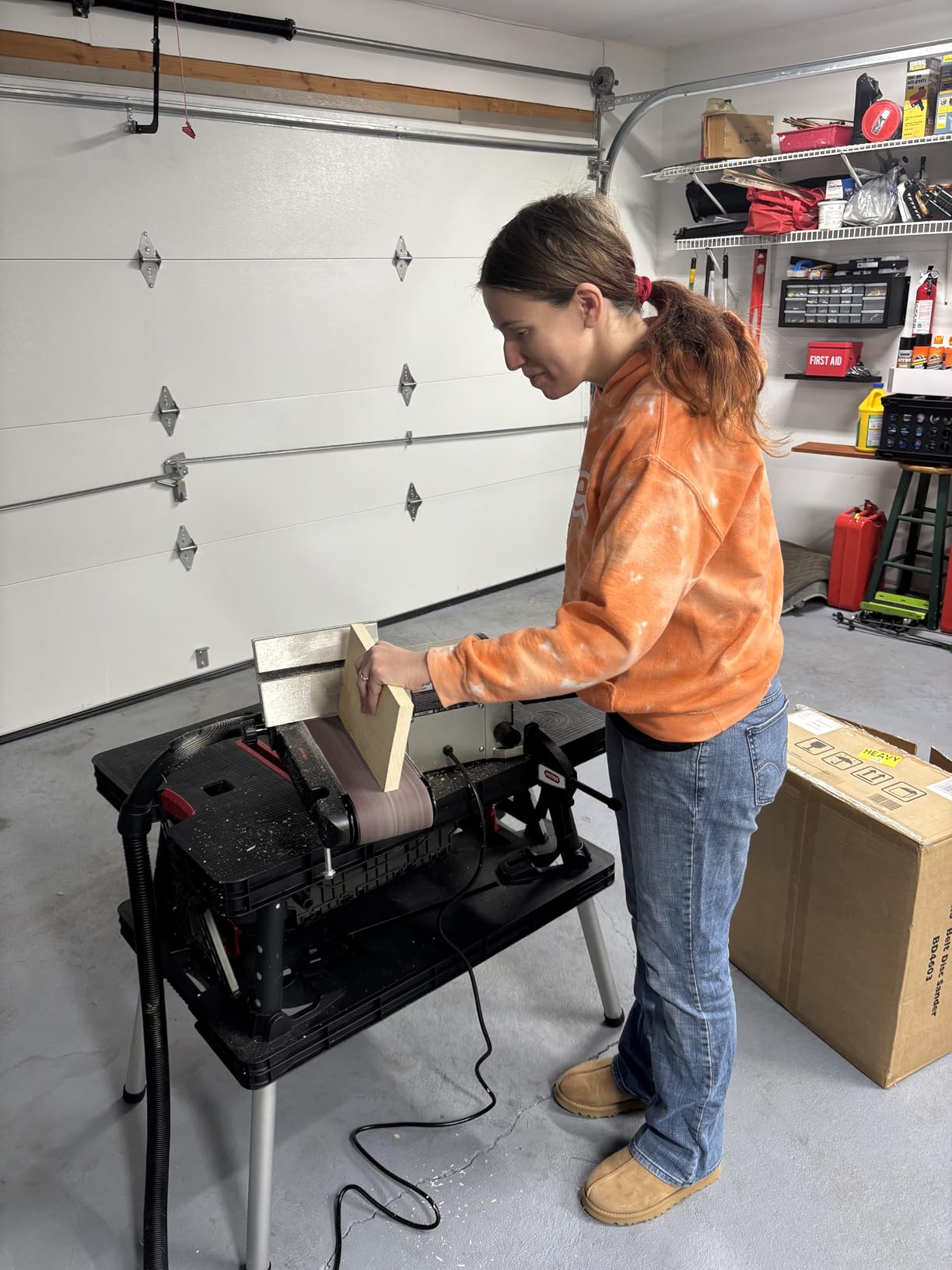
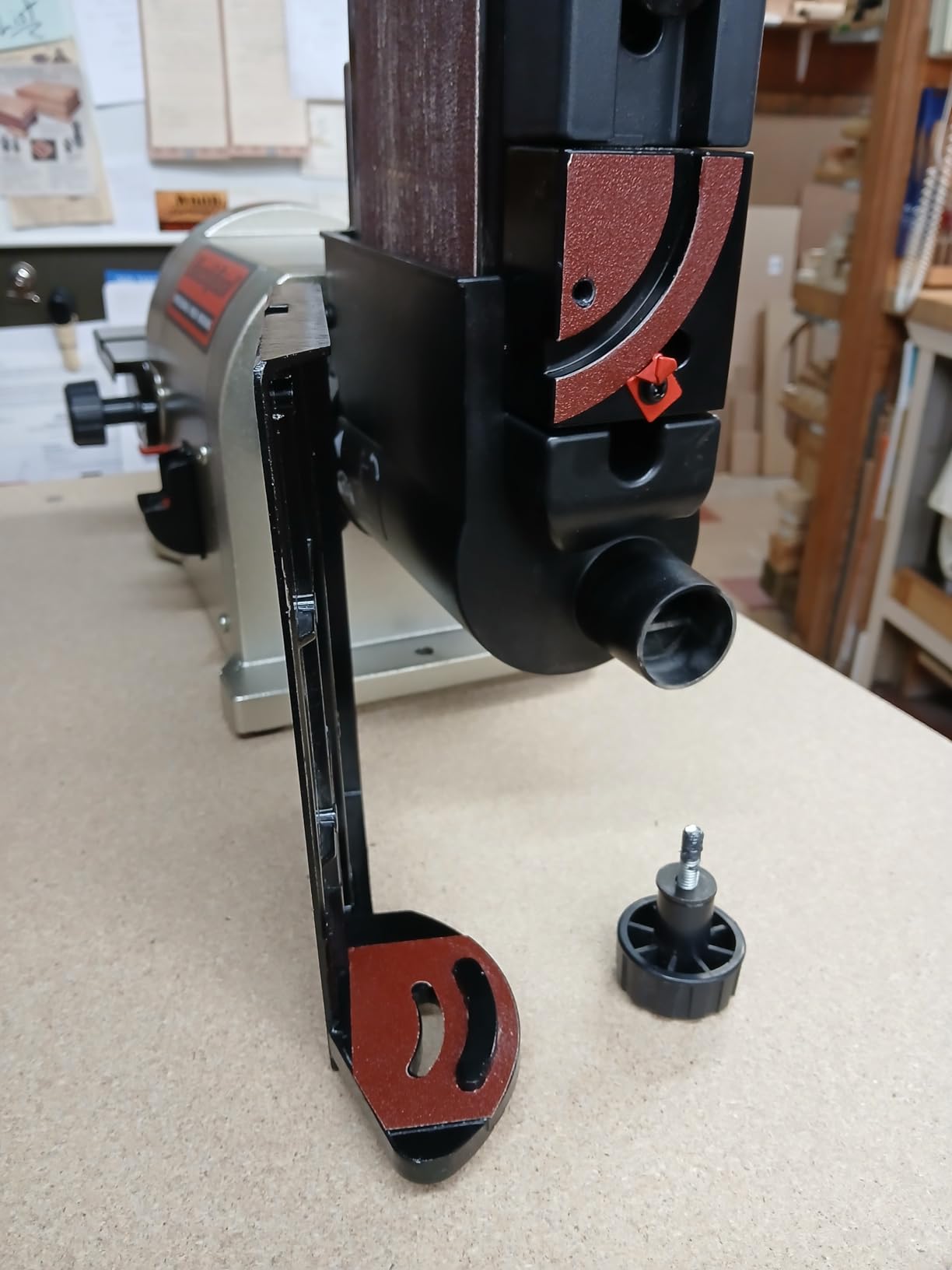
Two cast aluminum worktables cover both the belt and the disc stations, and the rubber footed base is genuinely useful on a machine that puts out real vibration. The belt tilts 0 to 90 degrees and the driven drum handles curved workpieces, which matters when you are finishing a radius.
The manufacturer claims the direct drive layout is 25 percent more efficient than a conventional drive, and the belt runs at 2161 FPM while the disc turns at 3450 RPM.
Is a direct drive sander worth it for metal work?
If you are the kind of person who grinds a lot and thinks about the machine between jobs, yes. You will not be reopening a housing to find a slack belt. If you are a beginner, the difference is invisible until you start logging hours on the machine, at which point it becomes obvious.
It also removes one failure mode. Drive belts stretch, glaze and slip, and a machine that cannot keep tension is a machine that will not track. Fewer parts between the motor and the abrasive means fewer reasons for the cut to wander.
What should I watch out for with this machine?
It is 23.82 by 11.61 by 20.47 inches, so it needs more bench depth than a 1×30 machine. Measure before you commit, especially if you are working in a shared shop corner.
The dust collection needs a specific Y fitting hose to work properly, and table angle markings and the miter gauge are basic. None of that affects metal work on the belt, but plan your dust setup before the first session.
6. VEVOR 4×36 and 8 Inch Belt Disc Combo – Best for Large Worktables and Plate Work
VEVOR Professional 4 x 36 in. Belt Sander with 8″ Disc Sander, 5A Induction Motor Cast Aluminum Worktable for Woodworking, Metalworking
4x36 belt and 8 inch disc
5 amp enclosed induction motor
36.3 pounds
120V corded
Pros
- 5 amp fully enclosed induction motor with real low speed torque
- Spacious cast aluminum table tilts 0 to 45 degrees
- Steel plate base with non slip rubber pads
- Dust collection port for a cleaner bench
Cons
- Heaviest combo machine here at 36.3 pounds
- Lowest rated in this roundup with a visible share of one star reviews
- Steel construction carries more surface rust risk
The VEVOR is the odd one out in this roundup on two axes. It has the biggest table in the group and the widest spread of owner experiences, and we would rather tell you both than pretend the average rating tells the whole story.
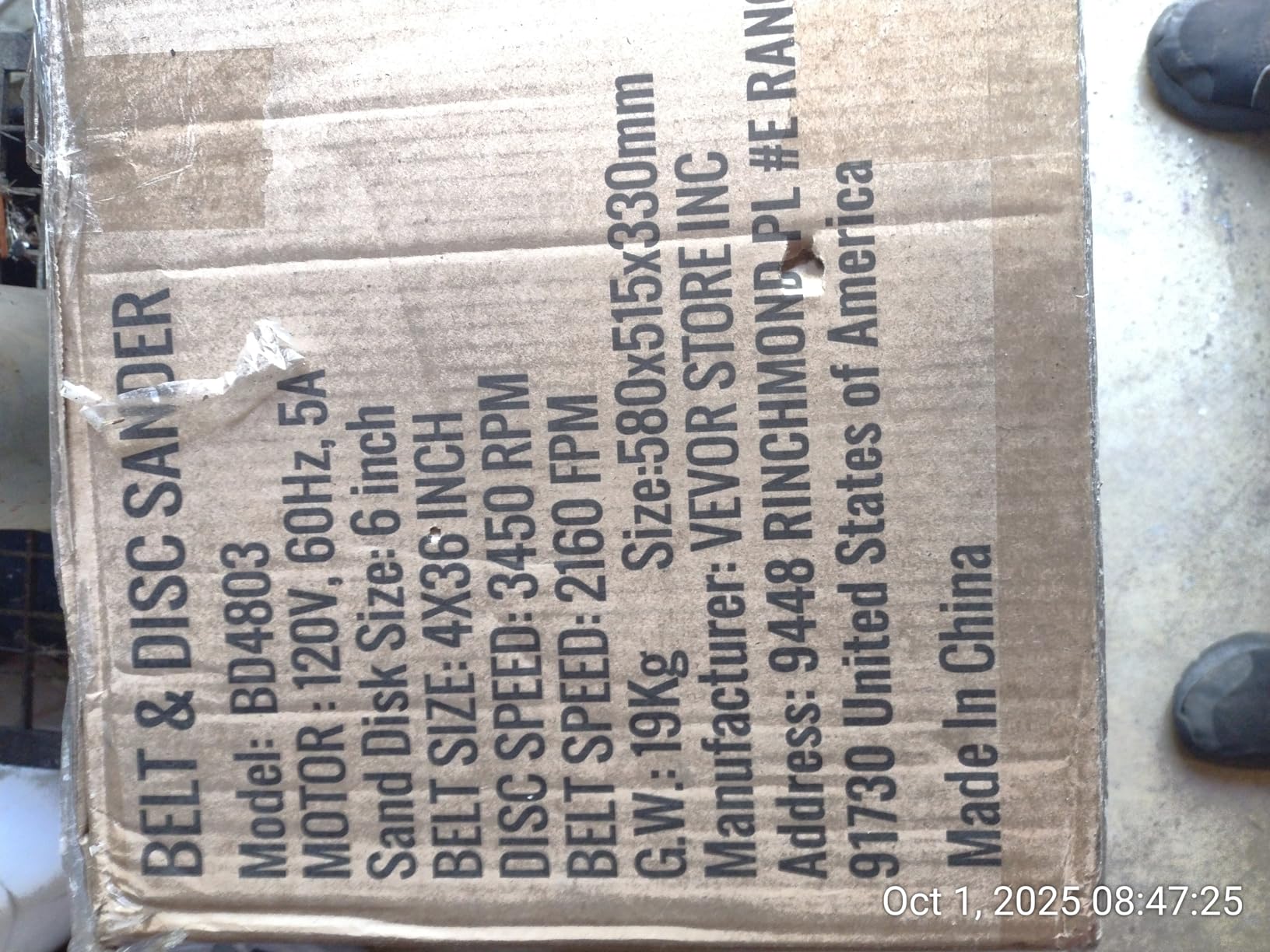
The motor side is genuinely strong. A 5 amp fully enclosed induction motor running at 3450 RPM on the disc and 2160 RPM on the belt is a serious power figure for a machine at this level, and owners acknowledge the motor is the machine’s strength along with the generous cast aluminum table.
The 8 inch disc paired with a cast aluminum worktable that tilts 0 to 45 degrees gives you a genuinely large flat reference surface. For plate work, panel fitting and larger flat components, that table is the reason to choose this machine.
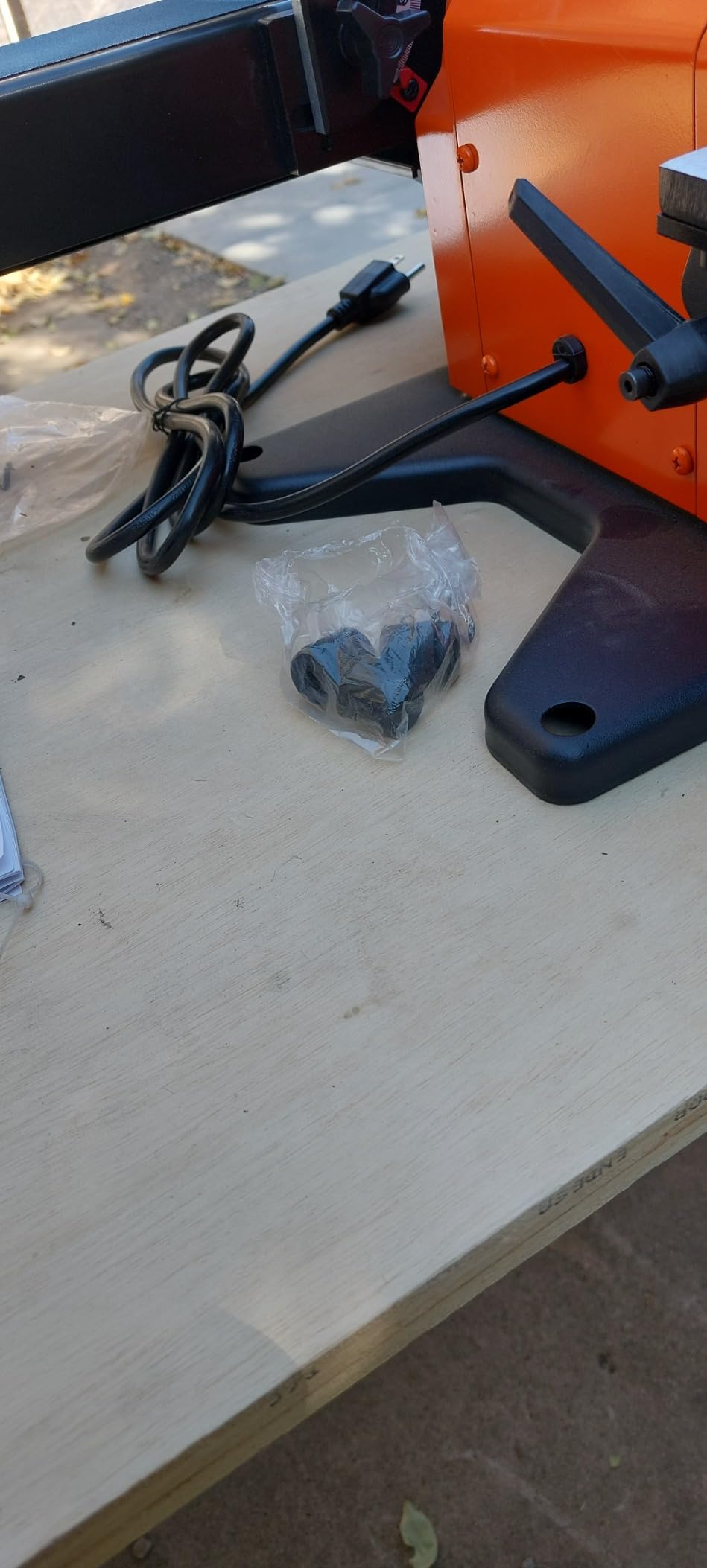
The belt tilts 0 to 90 degrees, so it also handles vertical and horizontal work, and the steel plate base with non slip rubber pads adds real stability for a 36.3 pound machine.
Should I worry about the lower rating?
Somewhat, and honestly. A 4.1 average with a visible share of one star reviews means the machine is not as consistent as the 4.6 rated machines here. The pattern in the complaints is durability and finish consistency over time rather than a failure to work out of the box.
If you want a machine you will forget about for years, the machines rated in the mid fours are the safer bet. If you want the biggest table and the strongest motor in the group and you are willing to service it, this one rewards that.
What about the weight and the finish?
At 36.3 pounds it is the heaviest combo machine in the roundup, and moving it around takes planning. Bolt it down where you want it. The steel construction that gives it that weight also means more surface rust risk than a painted or plated bench machine, so keep it dry and wipe the table down after wet work.
It is 120V corded with a standard dust collection port, so nothing exotic is required to install it beyond a vacuum and a bench that can hold it.
7. VEVOR 30×1 Variable Speed Belt Grinder – Best Variable Speed Bench Belt Sander for Controlled Finishing
VEVOR Belt Grinder Sander, 30 x 1-Inch Variable Speed Belt Polisher with VFD, 550W Polishing Grinding Machine with 2 Grinding Moulds & 3PCS Sanding Belts for Metalworking, Knife Making
1x30 belt with VFD
550W pure copper motor at 5500 rpm
17.4 pounds
Three belts included
Pros
- VFD gives stepless speed control across the whole range
- 550W pure copper motor runs cool and tracks stably
- Switchable flat and circular grinding modes
- Three belts in 100 180 and 240 grit included
- Works horizontally or vertically
Cons
- 1 inch wide belt is an edge and detail tool only
- Compact bench grinder format rather than a full combo machine
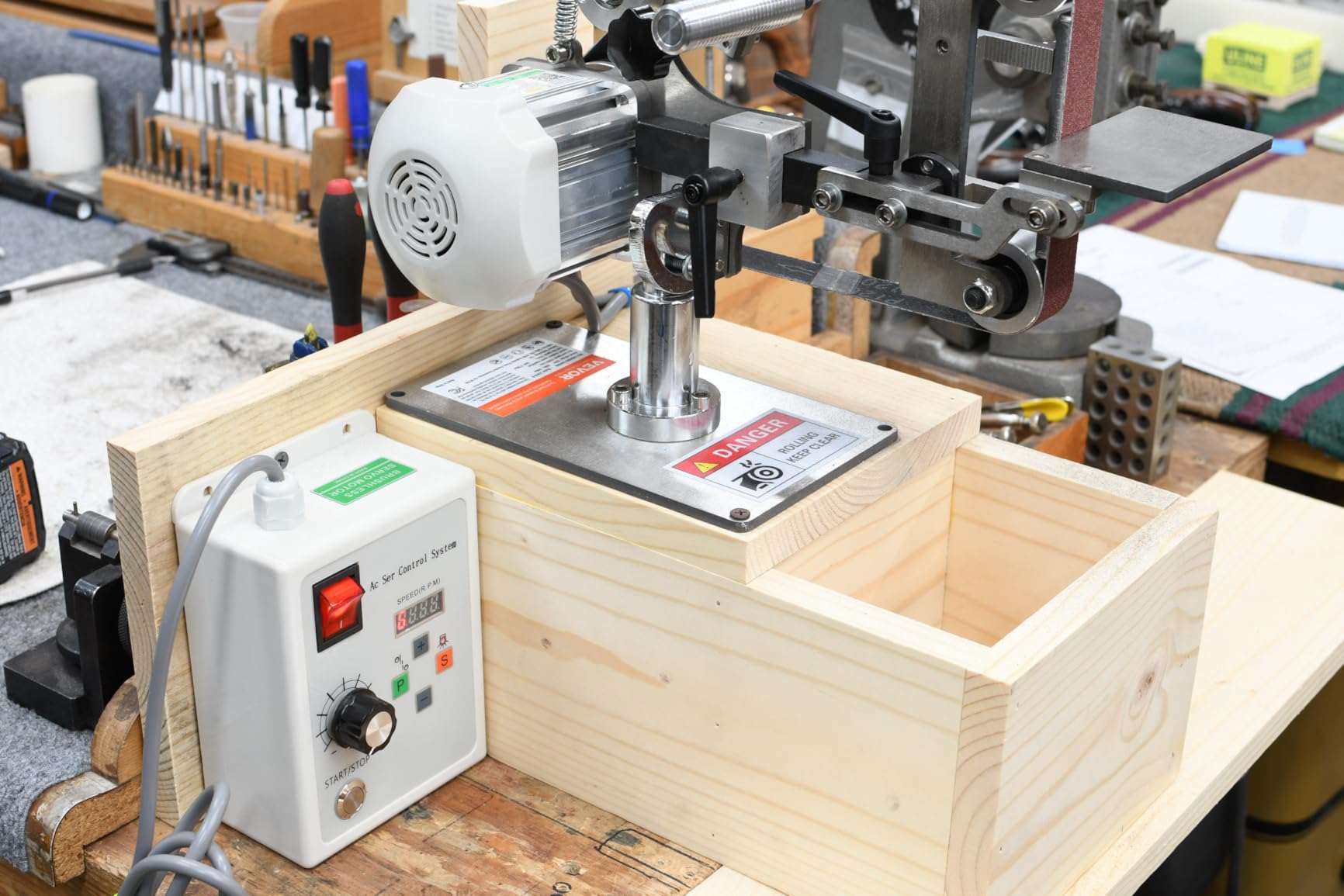
Speed control is the feature that separates this from every other machine here. A VFD lets you steer the belt line speed continuously instead of choosing between two fixed settings, and on metal that is the difference between cutting a part and cooking it.
The 550W pure copper motor runs at 5500 rpm and owners report stable belt tracking with no overheating. That is above the 500W floor that comes up repeatedly in the forums as the minimum worth buying for metal, which is not a low bar to clear.
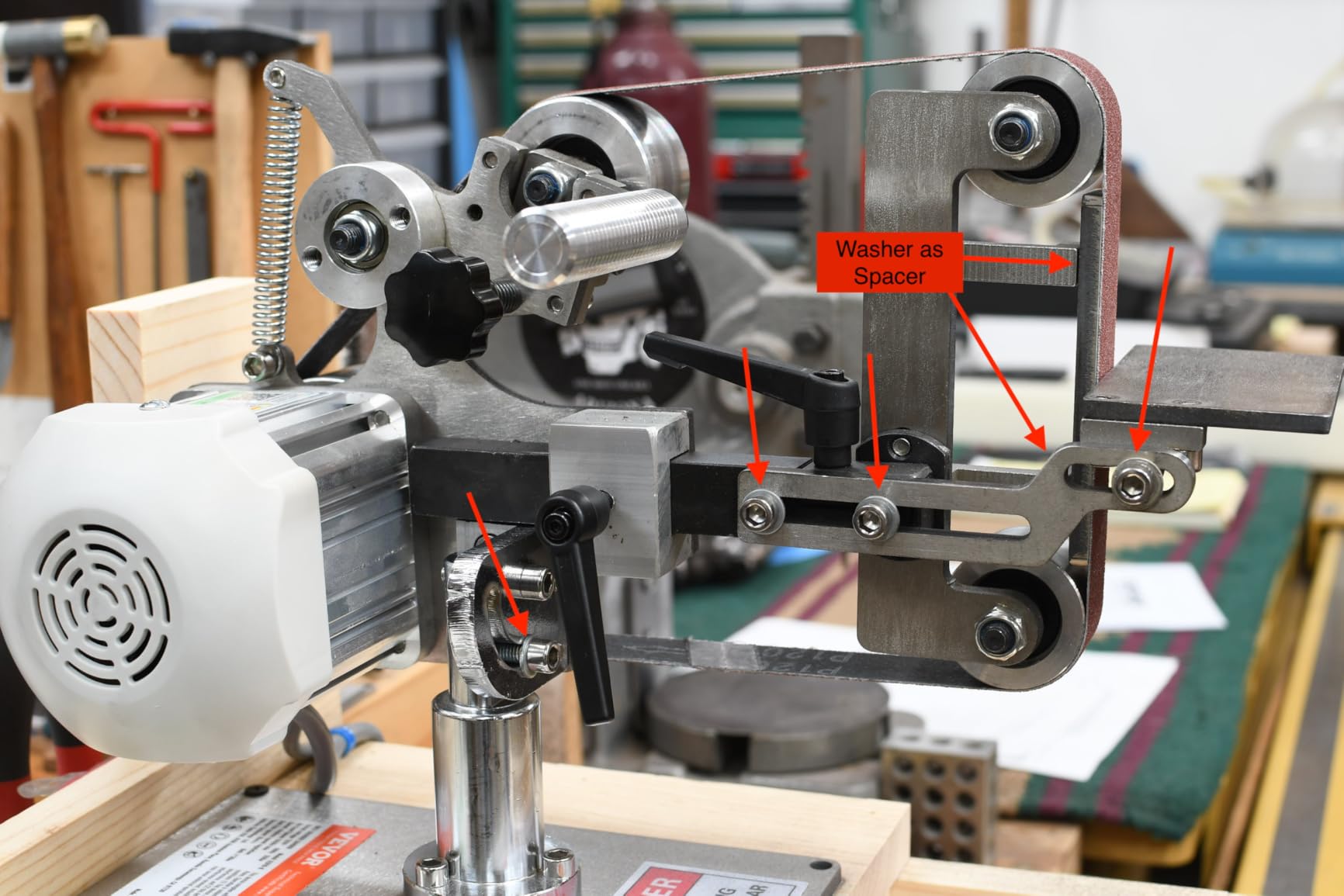
The two grinding modes are a clever bit of design. One is a flat rack for shaping and deburring, the other is a circular wheel for edges and detail work, and you swap between them rather than trying to work around a fixed geometry. It arrives with 100, 180 and 240 grit belts so you can start cutting the same day it is set up.
Reviewers consistently name the stepless VFD control and the interchangeable grinding modes as the standouts, and describe the running as smooth and cool.
Is variable speed worth it on a bench belt sander?
For sharpening and finishing, yes, because you can drop the speed for a fine grit pass and raise it for shaping without changing belts or changing pressure. On stainless and tool steel it also lets you manage heat directly, which is where most burns start.
For pure stock removal, a machine with more raw torque is the better tool. Speed control is a control refinement, not a power source, and a 1 inch belt is not going to become a stock removal machine because the dial goes up.
What are the limits of a 1 inch belt?
A 1 inch wide belt is a line work tool. It is superb on a knife edge, a tang, a chisel or a small bracket, and it will follow a profile the way a belt sander of any other size cannot. It is simply the wrong shape for squaring a face or flattening a plate.
The reinforced steel body and the detachable workbench let you set it up horizontally or vertically, which is worth doing before you start rather than after you have ground a part in the wrong orientation.
8. JET J-41002 2×42 Belt and 8 Inch Disc Sander – Best Shop-Grade Bench Belt Sander
JET 2″ x 42″ Belt and 8″ Disc Sander, 3/4 HP, 1Ph 115V (Model J-41002)
2x42 belt and 8 inch disc
3/4 HP at 6.2 amps
60 pounds
115V single phase
Pros
- Cast iron construction on a heavy duty steel base
- Removable platen for curves and odd shapes
- Deluxe miter gauge locks at 45 degrees both sides
- Adjustable dust deflector and dust chute
- Two year manufacturer warranty
Cons
- Weighs 60 pounds so it is a fixed machine
- Single phase 115V power only
- Larger footprint than the narrower combos
The JET is the only machine in this roundup built the way a shop machine should be, and at 60 pounds you feel the difference the moment you put your hand on the work. Owners treat it as a shop grade investment, and the cast iron frame is the reason it outlasts lighter machines.
Owners cite three things specifically: the cast iron construction, the removable platen, and the accuracy of the miter gauge. The removable platen is the one that changes how you work, because it lets you sand, grind and finish curves and odd shaped pieces that would be impossible on a fixed platen.
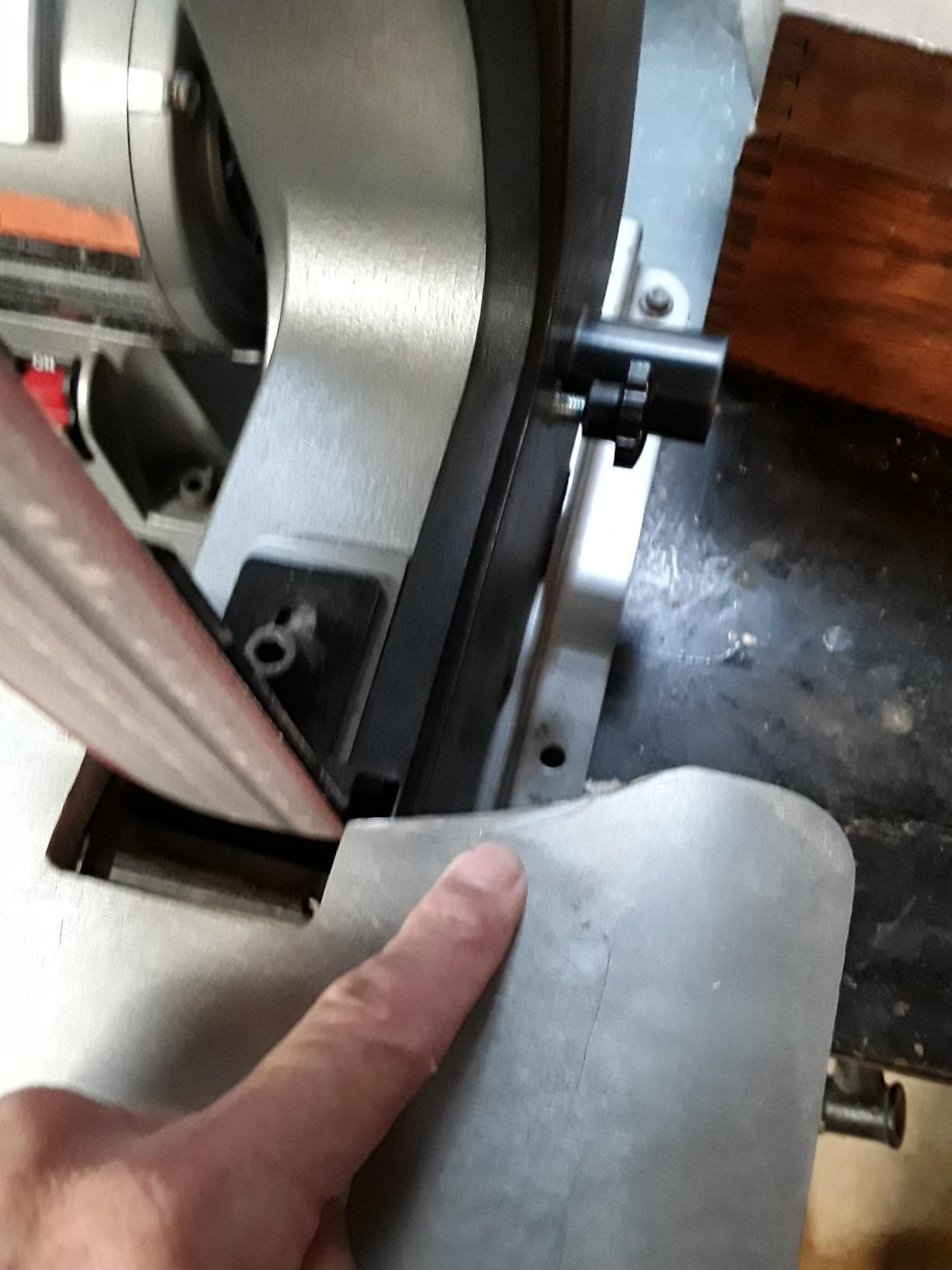
At 6.2 amps and 3/4 HP, this is the most current hungry machine in the roundup, and it is still single phase 115V, which means it runs on a standard shop circuit without any panel work. The adjustable dust deflector and dust chute are set up for a real vacuum rather than a small shop vac.
The abrasive belt is described as removing material and finishing at the same time while reaching into small openings, which is a fair description of what a 2×42 belt with a removable platen is for.
What does a removable platen actually let me do?
It lets you change the geometry of the work support. On a fixed platen you can only push a part straight into a flat surface. With the platen removed and repositioned, you can support a curve or an inside radius so it does not rock while you grind it, which is how you get a clean surface on a shaped part.
For knife makers and anyone restoring a part with compound curves, this is a feature you will use often. For flat plate work it is simply not relevant.
Is a 60 pound machine a problem?
Only if you have to move it. At 22.75 by 20.5 by 20 inches and 60 pounds, this is a fixed shop machine by design, and heavy machines are a feature in metal work because the mass absorbs vibration and keeps the cut steady.
The one limitation worth planning around is power. It is single phase 115V only, so if you later want a 2×72 or 3 phase class machine, you will be looking at a different electrical conversation entirely.
9. KFMK 2×42 Belt and 6 Inch Combo – Best for Knife Making and Sharpening
KFMK 2×42 in. Belt Sander & 6″ Disc Sander Combo, 3.5Amp Bench & 1/2HP Belt Sander for Woodworking, Metalworking & Knife Making, Sharpening
2x42 belt and 6 inch disc
1/2 HP direct drive
3.5 amps
120V corded
Pros
- Large 6-3/4 by 9 inch belt table for long profiles
- 1/2 HP direct drive motor
- Belt runs vertically or horizontally
- Tool rest miter gauge and hex keys included
Cons
- 2 inch belt is a detail and sharpening tool
- Abrasives must be sourced separately
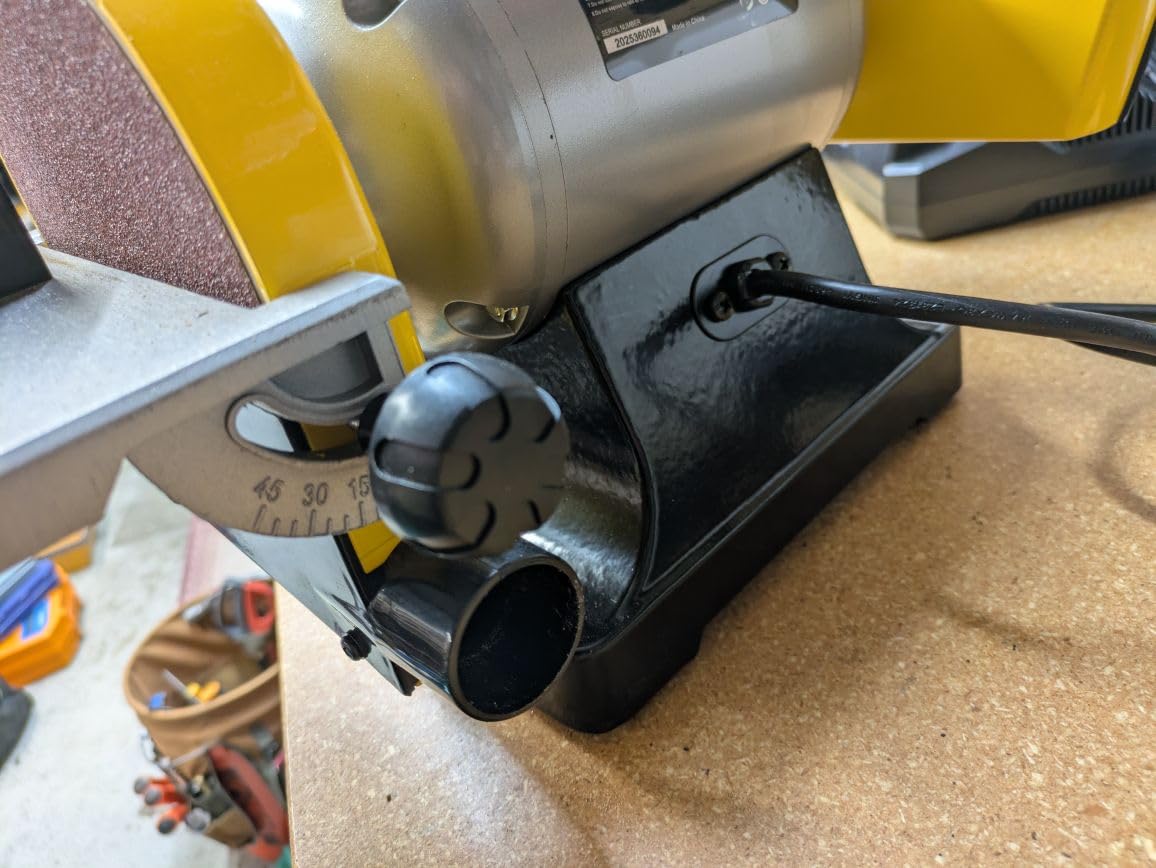
This is the machine to look at if knives are what you make. The 2×42 belt with a 6-3/4 by 9 inch work table gives you the length and the flat support a knife blank needs while you bring a profile to a line, and a tool rest for the belt is included in the box.
The 1/2 HP direct drive induction motor is a sensible match for the job. Knife work is controlled removal with frequent stops and starts, not sustained load, and owners report solid performance for knife making, sharpening and general metalworking at a mid range price point.
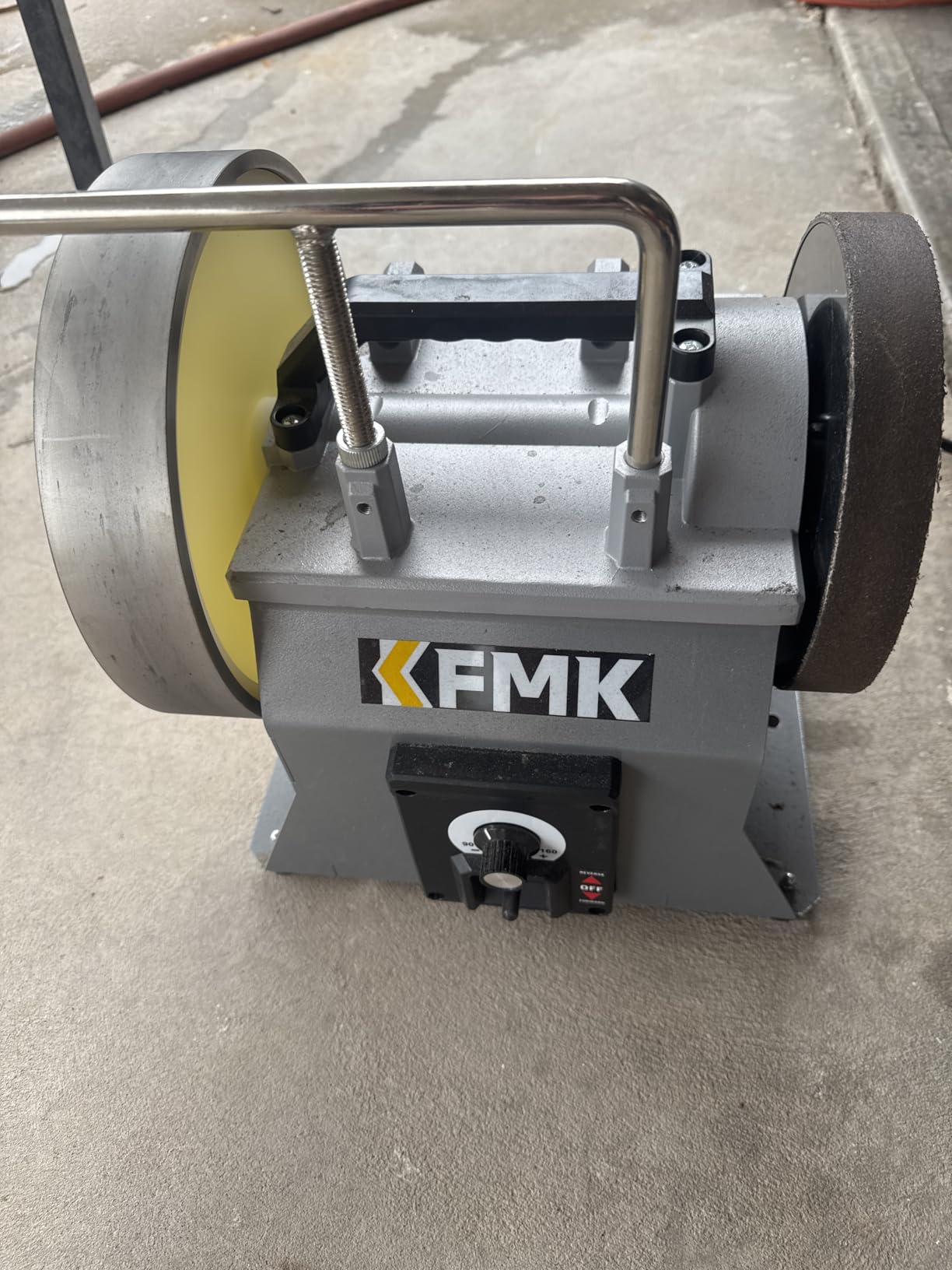
Two worktables is a nice touch. The belt table handles the shaping and sharpening, and the 6 inch disc with a 6-1/8 by 9 inch table that adjusts to 45 degrees handles the cleanup that would otherwise chew through a belt. Using the disc for deburring work is the single best way to extend belt life.
It also arrives with more hardware than most machines at this level: the belt tool rest, a disc miter gauge, a combination flat wrench and three hex keys. That is the difference between opening the machine in five minutes and hunting for the right key.
Is a 2×42 belt the right size for knife making?
For most makers, yes. The 2 inch width keeps the belt on an edge profile instead of letting it wander across the flats, and the 42 inch length gives you enough contact for long bevels. It is the geometry that a 2×30 belt grinder and a 4×36 belt sander both fail to give you.
If you are working on very small parts and pocket knives, a narrower belt still wins. If you are profiling large chef knives, the 2×42 is the more comfortable size to work with.
What do I need to buy alongside it?
Abrasives. The machine arrives as the bare machine with its accessories, not with belts, and a good metal belt is a purchase you should plan for. Start with a 60 or 80 grit zirconia for shaping and a finer grit for the finish.
A dust plan also matters more than people expect, because metal grinding dust gets everywhere. If you are outfitting a new shop, our discussion of dust and surface finishing machines covers extraction habits that apply here as well.
10. RYOBI BD4601G Refurbished Bench Sander – Best Refurbished Option With Multiple Belt Speeds
RYOBI BD4601G Bench Sander Green
Three belt speeds
120V corded
Refurbished bare tool
36 by 4 by 14 inches
Pros
- Three belt speeds give more control than single speed machines
- Refurbished unit is tested and certified to work like new
- Arrives with the relevant accessories
- Standard 120V corded power
Cons
- Refurbished bare tool listing means generic packaging
- Belt and disc abrasives not included
- Listed weight spec is inconsistent and should be confirmed
The RYOBI is here for a different reason than the rest. It is a refurbished unit, which means it is a way into a multi speed bench sander without buying new, and multi speed control is something almost nothing else in this roundup offers.
Three belt speeds let you match the belt to the material instead of managing every job with one setting. On aluminum that is the difference between a clean cut and a loaded belt, and on hardened tool steel it gives you a way to back the speed off without changing belts.
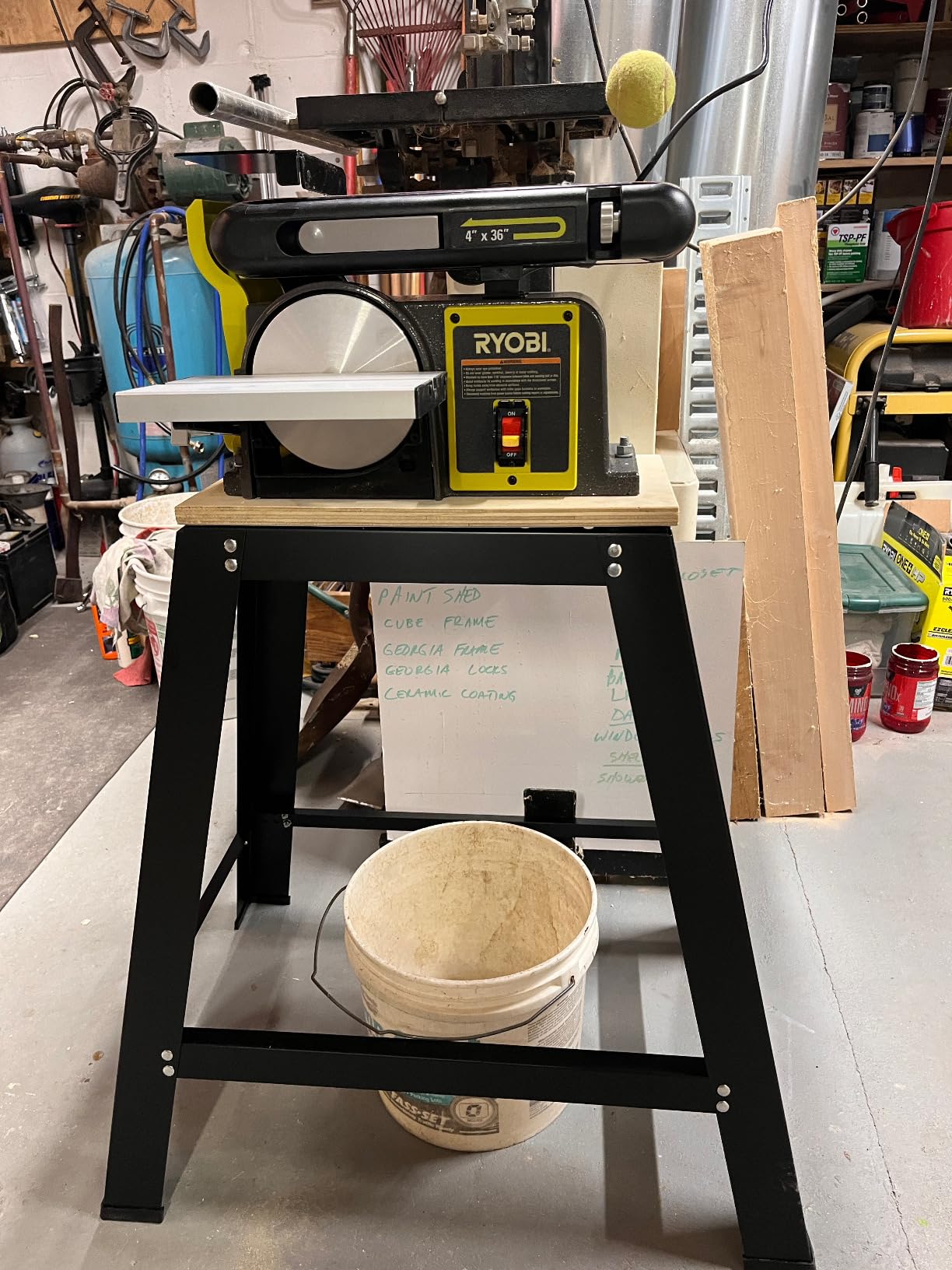
Reviewers rate the build quality favorably and note that it works as expected for shop finishing tasks. The refurbishing process is described as functionality testing, basic cleaning, inspection and repackaging, so the unit has at least been confirmed to run before it reached you.
It is a bare tool listing, so plan on sourcing your own belts and discs. It is 120V corded, which means it plugs into a standard shop circuit with no panel work.
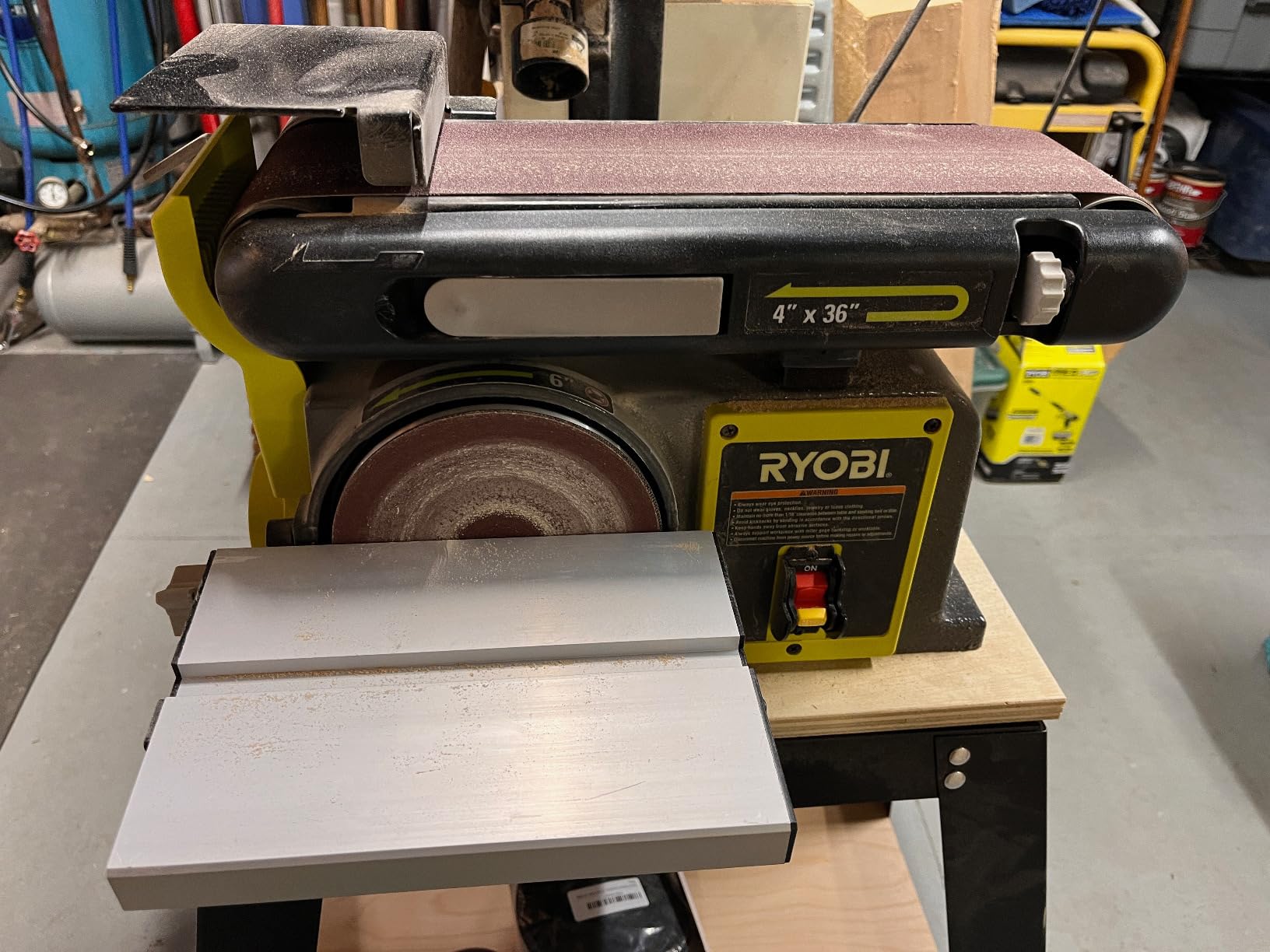
Is a refurbished bench sander worth the risk?
It is if you buy it for the mechanical parts and accept that the cosmetics will not be new. Motors, frames and cast iron tables are the components that determine whether a sander is good, and those are exactly the components that do not wear out quickly on a bench machine.
It is not worth it if you need a warranty, and it is not worth it if the price does not reflect the condition. The listing here covers a tested and certified unit rather than an as-is one, which is the version of this idea we would consider.
What should I confirm before ordering?
Confirm what comes with it. This is a bare tool, so belts and disc accessories are not included, and generic packaging means you should not count on original packaging for storage or transport.
Also confirm the weight. The listed figure of 0.27 g is clearly an error in the spec listing, and owners describe the machine at roughly 34 pounds, so plan the bench accordingly and verify before you commit.
How to Choose a Bench Belt Sander for Metal Work
The reason people cross research this purchase for months and never pull the trigger is that belt grinders come in sizes and classes that are not comparable to each other. A 1×30 and a 2×72 are not a cheap version and an expensive version of the same tool. They are different machines with different jobs, and the mistake is treating them as one purchase decision.
Here is how we would narrow it down, in order.
Step 1: Measure your work, not your ambition
Pick up the largest piece you actually intend to grind and measure it. The long dimension of that piece decides between a knife belt and a wide belt, and the thickness decides whether you need material removal capacity at all. If your work is profiles, bevels and edges, you want a 2 inch wide belt in the 42 to 72 inch length class. If your work is faces, plate and weld cleanup, you want a 3 to 4 inch belt in the 30 to 36 inch length class.
Then measure the space. The 2×72 class is the machine people regret buying before the machine itself disappoints them, because the footprint and the required vertical clearance are real constraints in a small shop. One thread on the Festool Owners Group made the point clearly: trial a mid size machine before committing to the largest one, because a lot of makers outgrow the 2×72 hype and find a 1×42 covered everything they needed.
Step 2: Apply the horsepower per inch rule
The sizing heuristic that circulates in the metalworking forums is roughly 1 to 1.5 horsepower per inch of belt width. A 1 inch belt wants about 1 HP, a 2 inch belt wants 2 to 3 HP, and a 4 inch belt wants 4 HP or more. It is not a law, but it is a good predictor of whether a machine will bog down when you lean on it.
For beginners the companion number is wattage. In a recent r/blacksmithing thread the top reply to a first time buyer was blunt: 200W is a joke for metalworking and you would be better off with an angle grinder, look for more than 500W even if you have to save up. That is the single most useful budget threshold in this guide, and most of the machines here clear it. The ones that do not, we have said so.
Step 3: Match the power supply before you buy
Most of the machines in this roundup run on 120V single phase and plug into a standard shop circuit, which is the easy path. Two of them are 110V only, which matters if your shop is wired for 220V and you were planning to run one circuit for everything.
Going up in class changes the electrical conversation. Larger industrial belt grinders commonly run on 3 phase power, which is a different service, a different disconnect and often a different meter. If you pair a 3 phase motor with a variable frequency drive, you can run it on single phase supply and control speed from a dial instead of a bank of contacts. Know which one you are buying before the machine arrives, because the panel work is the expensive part and it is not optional.
Step 4: Judge tracking, not just power
Tracking is the ability of the belt to stay centred on the rollers as it runs, and it is what determines whether a flat pass stays flat for the length of the belt. A machine with a good tracking adjustment will let you correct a wandering belt in seconds. A machine with a bad one will have you re-adjusting every few minutes, and you will start skipping grit and burning work.
The people who live with these machines consistently rank tracking above peak wattage in quality discussions, and the jump people report when moving up a size is usually tracking, motor strength and metal wheels rather than speed. Metal wheels and a metal platen are widely treated as a clear quality marker, because they hold diameter better and they do not glaze the way plastic wheels can.
Step 5: Plan belts and abrasives before the machine arrives
Buy a spare belt the day the machine is delivered, because you will burn through them. For metal, zirconia is the default abrasive and holds up far better than aluminum oxide on ferrous work. Cubic grit is worth trying on stainless when you want a cool cut, and a fine grit or a leather polishing belt is the right tool for a final edge.
Grit progression is straightforward: rough shaping at 36 to 50, general stock work at 60 to 80, refining at 100 to 120, and finishing from 180 up. On stainless and tool steel, drop to a finer grit and ease the pressure, because heat is what causes cracking and edge damage, not grit itself. A recurring theme in abrasive discussions is that belt cost is really a productivity question, since a belt that keeps working is a belt you are not constantly replacing.
Check belt availability for the size you are buying before you commit. This is unglamorous but it decides how painless the machine is to own, and finding 4×36 replacement belts in the correct length is a known friction point for some sizes.
Step 6: Set up dust collection properly
Metal grinding dust is heavier than wood dust and it gets into everything, including the motor bearings. A machine with a dedicated port per station is easier to collect from than one with a shared port, and a real shop vacuum with a proper hose makes a measurable difference in how long you can work before you need to stop.
Where a specific hose fitting is called for, buy the adapter before the first session. Fighting a mismatched fitting with a shop vac is a good way to convince yourself that dust collection is optional.
When a bench belt sander is the wrong purchase
An angle grinder is the right tool when you are doing one-off work, working in a confined space, or removing weld from a piece you cannot clamp. It is faster to pick up and it goes into corners a bench machine cannot. Metalworking forums make this point consistently, and it is the honest counterweight to buying a machine you will only use twice a year.
A bench belt sander earns its place when you repeat the same class of work, when flatness and squareness matter, and when you want a result you can repeat with a fence and a straight edge rather than by feel. If you do not have that repetition yet, a mid sized machine like the WEN 6502T or the BUCKTOOL BG2600 is a far less costly mistake than a 2×72 you cannot fit.
Frequently Asked Questions
What type of belt sander is best for metal?
The best bench belt sander for metal has a 2 inch wide belt, a cast iron platen and table, a motor rated at roughly 1 to 1.5 horsepower per inch of belt width, and a rigid frame over 30 pounds. That combination holds a flat surface under pressure and stays cool on stainless and tool steel. A 1×30 machine is enough for deburring and sharpening, while a 2×48 or 2×72 class is the right choice for heavy stock removal and knife making.
What is the best belt sanding machine for metal?
The WEN 6502T with its 4×36 belt and 6 inch disc is the best all-round bench belt sander for metal work, with a 4.3 amp motor at 3600 RPM on a cast iron base. The BUCKTOOL BG2600 is better if you want a dedicated 2×42 metal belt, and the JET J-41002 is the choice for a permanent shop machine with a removable platen and a 60 pound cast iron frame.
Do I need a VFD for a belt grinder?
A variable frequency drive is not required, but it is the easiest way to control belt speed on a three phase motor from a single dial instead of a bank of contacts. On a 120V single phase machine it is a bonus rather than a necessity. VFD control matters most when you move between aluminum, mild steel and hardened tool steel and need to manage heat at the belt.
What belt grinders do they use on Forged in Fire?
The grinders shown on Forged in Fire are typically 2×72 and 2×48 class industrial belt grinders, chosen because they look impressive on camera and can handle a blade quickly. A working shop does not need a machine that size to make good knives. Most makers do the same shaping work on a 1×42 or 2×42 machine, and the difference is footprint and cost rather than the quality of the finished edge.
Is a 1×30 belt sander enough for metal work?
A 1×30 belt sander is enough for deburring, cleanup, sharpening small parts and finishing edges on work that is already shaped, and the WEN 6515T is a capable machine in that class. It is not enough for squaring thick bar or taking a weld bead down. Forum advice consistently warns against sub 500W machines for real stock removal, so check wattage before buying in this size.
Final Verdict
For most people building a metal shop, the WEN 6502T is the best bench belt sander for metal work. It is the most reviewed machine in this roundup, the 4×36 belt and cast iron base handle real work, and the complaints that do exist are all on the disc side, which is the part most metalworkers use least.
If your bench space is genuinely tight, the WEN 6515T gives you a capable 1×30 machine with two separate dust ports and a footprint that fits anywhere. If your work is edges, bevels and knife profiles rather than flat faces, the BUCKTOOL BG2600 is the better buy, with a 2×42 metal belt and 4480 FPM of belt speed. If you are outfitting a permanent shop, the JET J-41002 is the one built to outlast the rest.
Measure your bench, check your power supply, and buy a spare belt while you are at it. Then put the machine on a flat surface, square a piece of scrap, and start with a 60 or 80 grit zirconia belt at light pressure. That first flat face is the fastest way to know you bought the right one.