
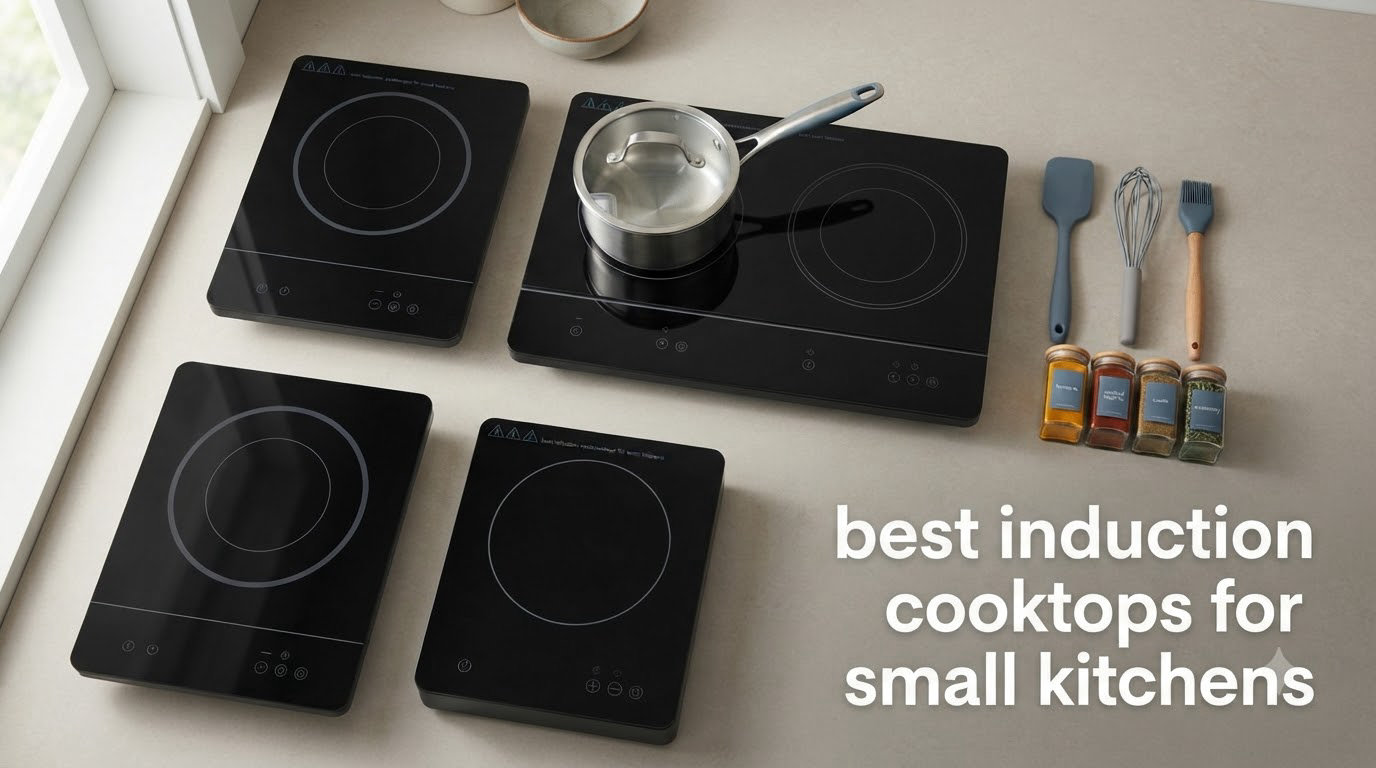
The best induction cooktops for small kitchens are the units that trade raw burner count for counter depth, wattage you can actually reach on a standard outlet, and heat control fine enough for a 1.5 quart saucepan. An induction coil under a glass-ceramic surface heats the pan itself rather than the air around it, so the surface stays cool, response is close to instant, and a 12 inch appliance can do the work of a 30 inch range.
We spent weeks going through specification sheets, owner reviews and forum threads to sort out which units survive a cramped kitchen. The short version: slim single-burner units under 12 inches deep are what most studio and galley kitchens actually need, while dual-burner models trade a much wider footprint for the ability to run a main and a side dish at independent temperatures. Every portable unit below runs on standard 120V household power and none of them require a dedicated circuit.
If you want the wider category first, our guide to the best induction cooktops for home kitchens covers full-size built-in units, and the best portable induction cooktops page goes deeper on countertop-only setups. What follows is the fit-first version, organized around the space you have rather than the brand on the front.
Table of Contents
Top 3 Picks for Small Kitchens in 2026
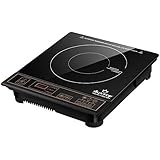
Duxtop 1800W 8100MC
- 1800W on standard 120V
- 15 power and 15 temperature levels
- 11.5 x 13 inch body under 3 inches tall

Nuwave Flex Precision
- 5-degree temperature steps from 100F to 500F
- 2 inch tall body at 10 x 12 inches
- Adjust heat and timer mid-cook

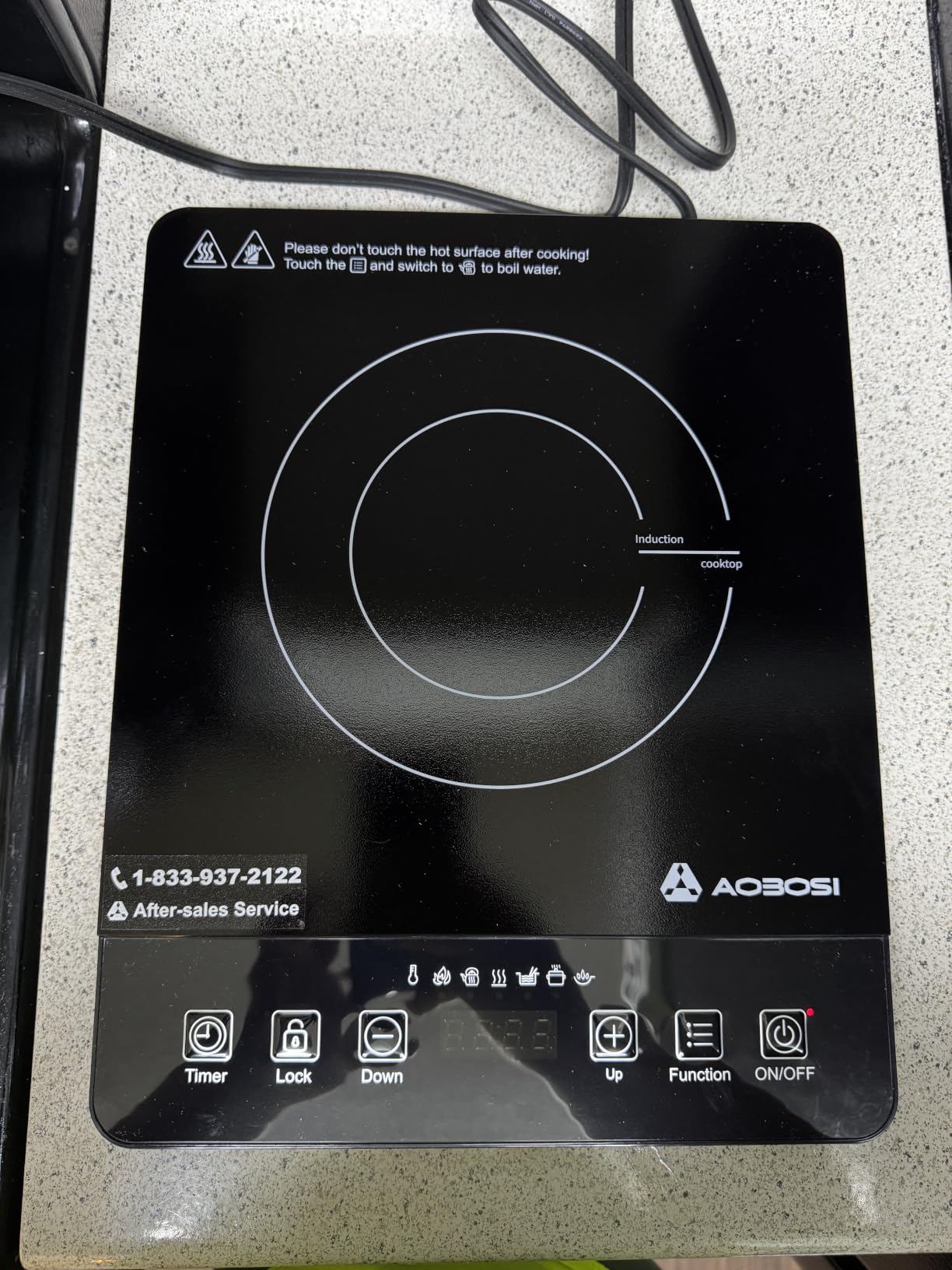
AAOBOSI 1800W
- 20 power levels and 20 temperature presets
- 1.7 inch slim profile at 11 x 13.8 inches
- Boil
- stew and keep warm presets
Best Induction Cooktops for Small Kitchens in 2026
Width is the first filter. Anything under 13 inches wide works on a narrow counter run, while the dual-burner models measure between 20 and 24 inches and need a counter with real length behind it. Wattage matters next: 1800W on a 15-amp circuit is the practical ceiling for a portable unit, and both burners on a dual-burner model share that same 1800W budget.
| Product | Specifications | Action |
|---|---|---|
| Duxtop 1800W Portable Induction Cooktop 8100MC |
|
Check Latest Price |
| Nuwave Flex Precision Induction Cooktop |
|
Check Latest Price |
| AAOBOSI Portable Induction Cooktop |
|
Check Latest Price |
 Amazon Basics 1800W Portable Induction Cooktop Amazon Basics 1800W Portable Induction Cooktop |
|
Check Latest Price |
 ChangBERT CIB-80 Commercial Grade Induction Cooktop ChangBERT CIB-80 Commercial Grade Induction Cooktop |
|
Check Latest Price |
 Nuwave Double Pro Induction Cooktop Nuwave Double Pro Induction Cooktop |
|
Check Latest Price |
 AMZCHEF Double Induction Cooktop AMZCHEF Double Induction Cooktop |
|
Check Latest Price |
 Empava Flex Induction 2 Burner Cooktop Empava Flex Induction 2 Burner Cooktop |
|
Check Latest Price |
 OMEO Portable Induction Cooktop OMEO Portable Induction Cooktop |
|
Check Latest Price |
 COOKTRON 2 Burner Induction Cooktop COOKTRON 2 Burner Induction Cooktop |
|
Check Latest Price |
Only three of these ten carry a commercial safety certification, and only two can drop into a countertop cutout. That matters more than most buyers expect, because a cooktop without pan detection or overheat protection behaves differently in a small kitchen where a hot pan sits within inches of a wall.
How to measure your small kitchen before you shop
Most fit problems are discovered after delivery, and they are almost always a measurement mistake rather than a product defect. Measure these five things before you pick a model.
Measure the counter run, not the wall
Run a tape along the usable counter length and subtract the sink, the dishwasher edge and anything that overhangs. A portable unit needs its full width plus roughly an inch of ventilation space at the back for air to circulate, and built-in models need the manufacturer’s clearance spec on top of that.
Check counter depth
Most base cabinets are 24 inches deep, but a countertop with a backsplash on a shallow galley run often leaves only 19 to 21 inches of usable depth. A 12 inch deep portable unit leaves about 9 inches of free work surface behind it, which is where the counter space savings actually come from.
Get the cutout dimensions for a built-in model
If you are cutting a countertop, the cooktop cutout is smaller than the cooktop itself. The finish overlaps the cutout edge, so a 20.5 inch wide cooktop may need a cutout near 19 inches. Order the unit first and use the published cutout figure rather than measuring the appliance you happened to see in a showroom.
Confirm the circuit and the outlet location
All ten units here are 120V plug-in appliances rated up to 1800W, which is at the limit of a standard 15-amp kitchen branch circuit. A dedicated 20-amp circuit gives you headroom, but it is not required for any of the portable models listed in this guide.
Know your pan inventory before you narrow the model
Induction needs a magnetic base. Count the saucepans and skillets you already own that pass a magnet test before you commit, because a single unusable pan can leave a one-burner kitchen unable to cook two dishes at once. Our guide to the best cookware sets for induction cooktops covers which materials actually work.
One more check worth doing: look down the counter and confirm the ceiling above has no deep cabinet directly over the intended spot. A fan-cooled induction unit needs somewhere for heat to go, and an enclosed overhead cabinet forces it to run harder and longer.
The three fit categories: slim single, wide dual, and drop-in flexible
Every induction cooktop that fits a small kitchen falls into one of three buckets, and the bucket matters more than the brand.
Slim single-burner units measure roughly 10 to 13 inches wide and under 3 inches tall. They are the only realistic option for a counter with less than 16 inches of free run, and they are what most apartment renters and RV owners end up with. The trade is obvious: one dish at a time.
Wide dual-burner units run from 20 to 24 inches across. Two independent zones let you sear and simmer at the same time, which is the difference between an induction setup that feels like a real kitchen and one that feels like a compromise. They also share a single 1800W circuit, so both zones cannot run at full power at once.
Drop-in flexible units can be installed into a counter cutout or simply plugged in on the counter. For a remodel off gas, this is the only category that lets you change your mind later without a second installation.
There is a fourth path that fits narrow kitchens surprisingly well: a small built-in cooktop as the primary burner plus a portable unit stored in a cabinet for the occasional extra burner. That is the arrangement the r/inductioncooking consensus keeps arriving at, and it is the most realistic setup for a remodel where the wall space is fixed.
1. Duxtop 1800W Portable Induction Cooktop 8100MC review
Duxtop 1800W Portable Induction Cooktop Countertop Burner, Gold 8100MC
1800W
15 power levels 200-1800W
15 temperature settings 140F-460F
11.5 x 13 x 2.5 inches, 5.8 lbs
Pros
- Reaches full 1800W on a standard 120V outlet
- Compact 11.5 x 13 inch footprint stores vertically
- Push buttons work with wet or gloved hands
- 170 minute timer with auto pan detection
- ETL approved with voltage warning messaging
Cons
- Single burner only
- Requires magnetic cookware
- Some clad multi-layer pans emit a high pitched sound
This is the unit we keep coming back to, and the reason is unglamorous: 17338 reviews at a 4.4 average is a far larger sample than anything else in this guide. That much history tells you something a spec sheet cannot, which is whether the unit still heats correctly after two years of daily use and whether the control panel survives being wiped with a wet cloth a hundred times.
It measures 11.5 inches deep by 13 inches wide and 2.5 inches tall, so it slides into a cabinet or a narrow shelf that a 20 inch dual-burner never will. The body is glass with push-button controls rather than a touch panel, and that single design choice removes the failure mode that owners complain about most on other induction units.
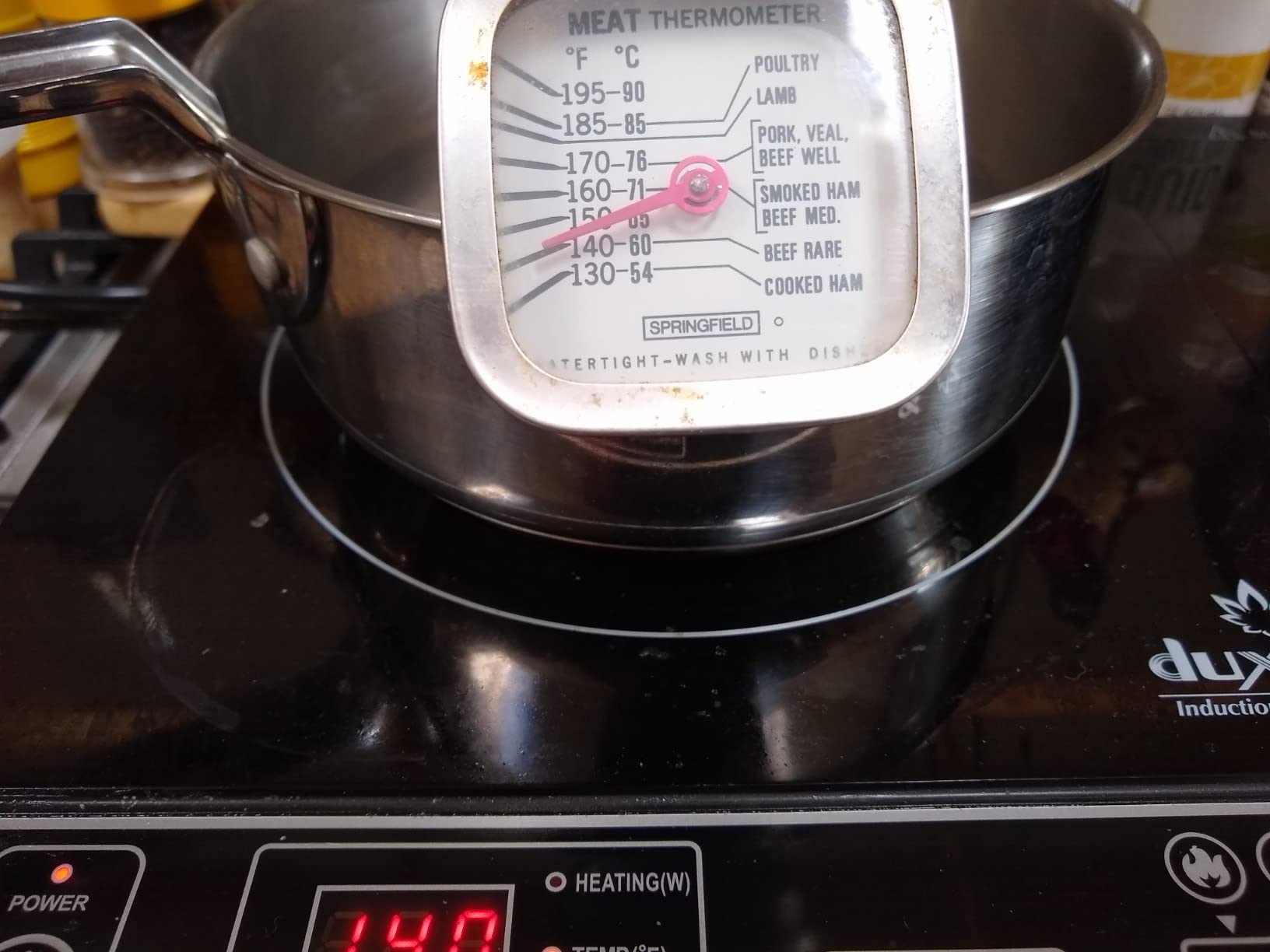
Control granularity is 15 power levels from 200W to 1800W and 15 temperature settings from 140F to 460F. That is not the widest range here, but it is wide enough to hold a low simmer for a curry without dropping to a bare boil, which is the specific gap that makes cheaper units frustrating.
Safety is handled with auto-pan detection that shuts the unit down after 60 seconds when nothing is on the surface, and the unit is ETL approved with low and high voltage warning messages. A 170 minute countdown timer covers most braises without needing a repeat.
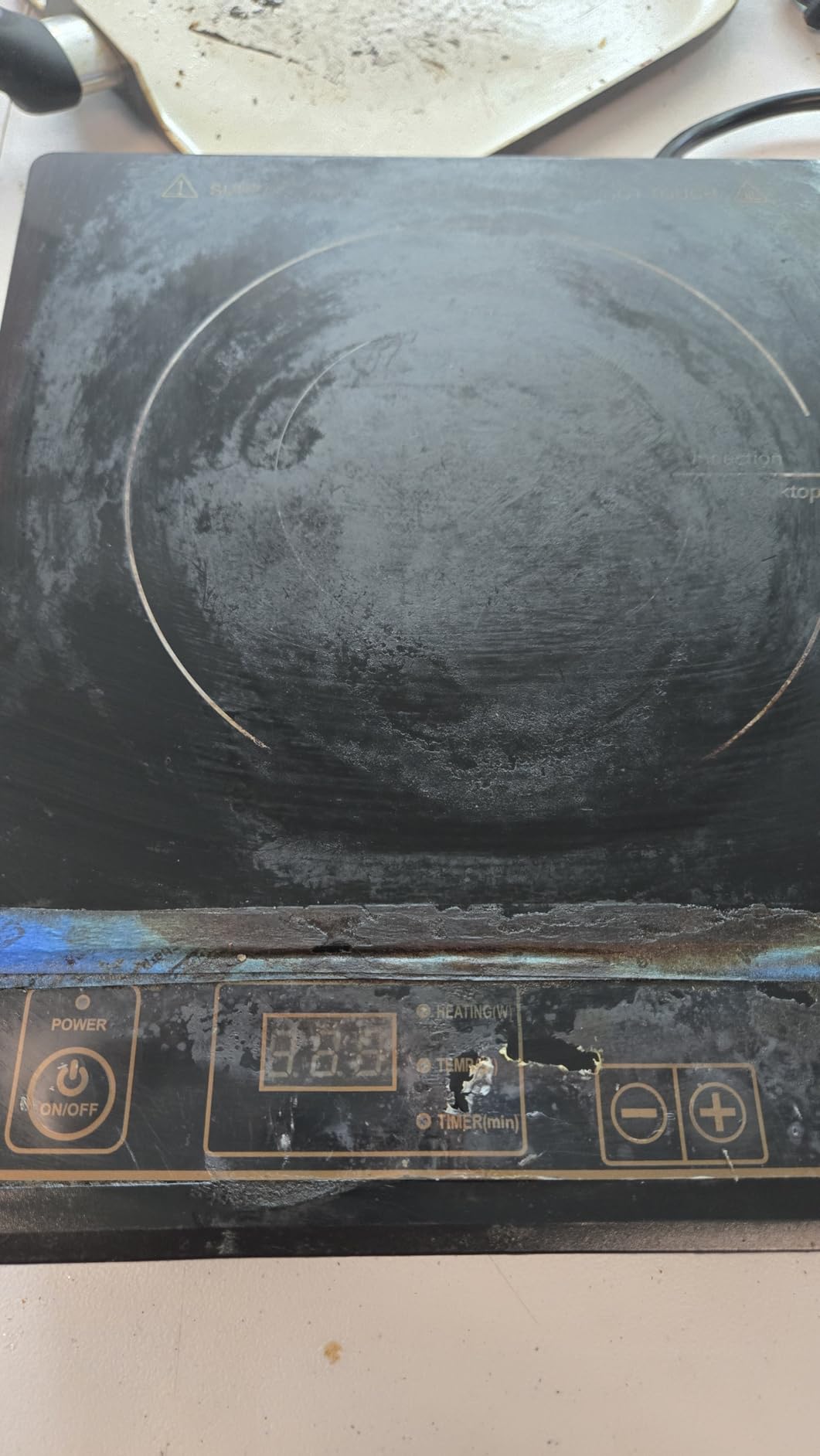
What to check on your own counter
Set it at the back of your counter and see whether you can still slide a 10 inch skillet forward of the coil without hitting it. The 11.5 inch depth is generous for a single burner, and on a shallow counter that extra half inch can be the difference between usable and not.
Where owners report friction
The recurring complaints in reviews are cookware compatibility and the single-burner limit, both of which are the deal rather than a defect. A third, smaller theme is sound: some clad multi-layer cookware produces a high-pitched noise while heating, which is normal for induction and stops when the pan settles.
2. Nuwave Flex Precision Induction Cooktop review
Nuwave Flex Precision Induction Cooktop, 6.5” Heating Coil, Black
1300W
5F temperature steps from 100F to 500F
6.5 inch coil
10 x 12 x 2 inches
Pros
- Finest temperature granularity in this group
- Only 2 inches tall so it clears low cabinets
- Heat and timer adjust mid-cook without restarting
- Shatter resistant ceramic glass surface
- Patented coil insulation for even heating
Cons
- Single burner only
- Lower peak output than 1800W competitors
- Requires magnetic cookware
If your cooking involves low and slow work like a browning butter, a slow caramel or a delicate scramble, this is the unit with the best control in the group. Temperature runs from 100F to 500F in 5F increments, and about three quarters of the reviews are five star with the precision steps named as the reason.
The body is 10 inches deep by 12 inches wide and just 2 inches tall, which makes it the easiest of the slim units to slide into a shallow cabinet. The 6.5 inch coil is held closer to the pan by patented insulation, and owners report no hot or cold spots across the base of a standard skillet.
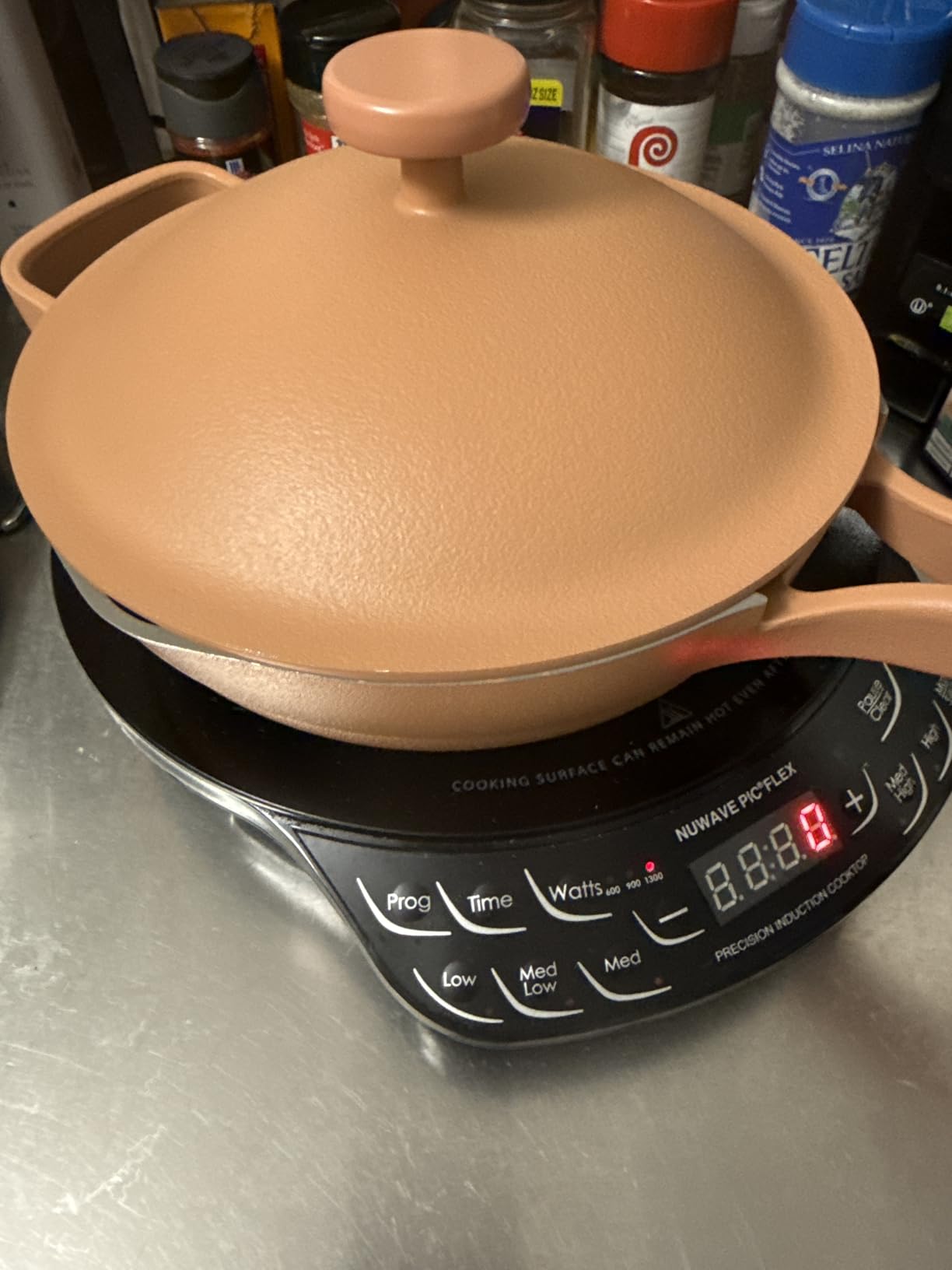
Unlike most competitors, you can change heat and cook time mid-cook without the unit resetting. For a cook working on one pot while a second is resting, that is a real workflow difference rather than a spec-sheet line.
The honest limitation is power. This unit is listed at 1300 watts in the specifications with three wattage settings of 600, 900 and 1300W, so a large stockpot at a rolling boil takes longer than it would on an 1800W burner. For a family of one or two it rarely matters.
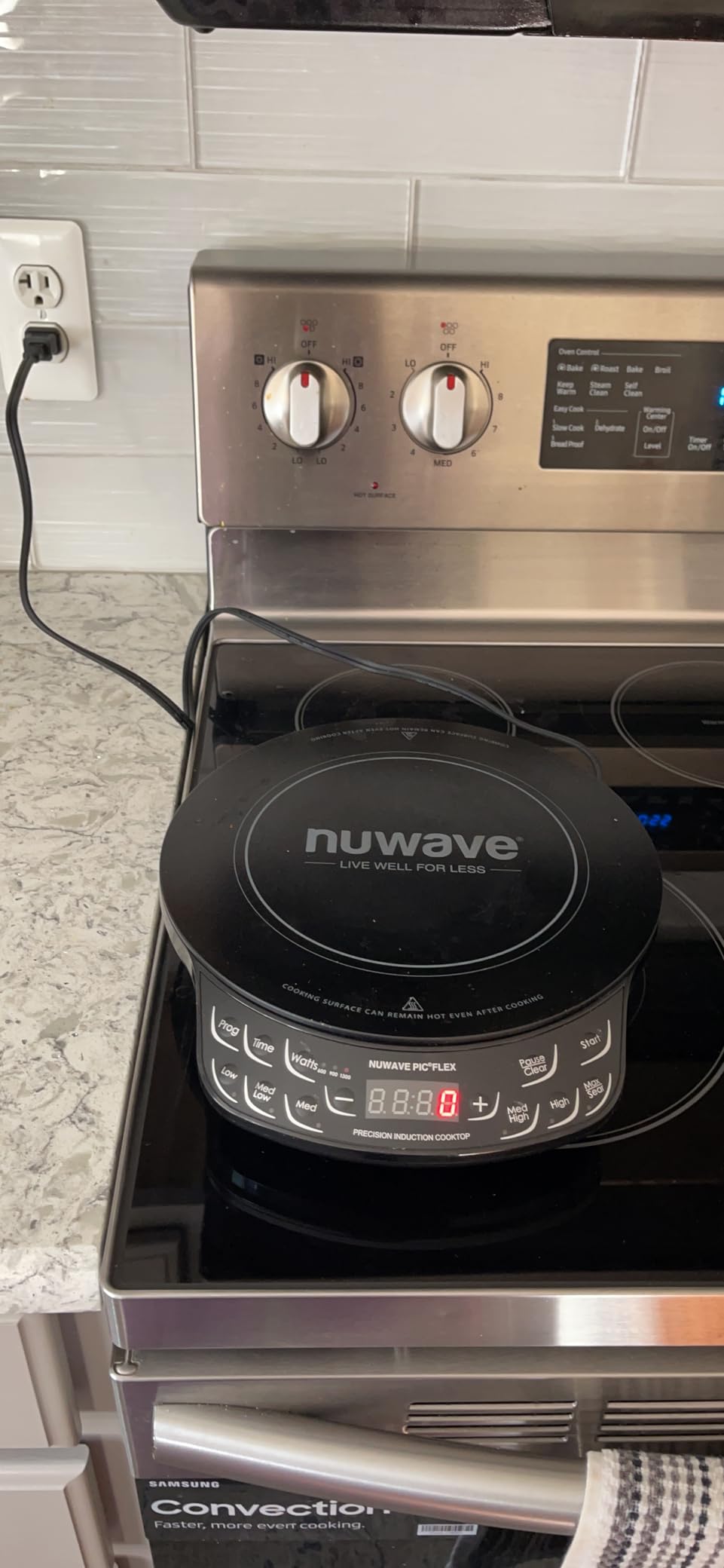
How fine is fine enough
Count your current dishes. Browning butter, holding a chocolate ganache, or rendering a sauce at a specific temperature are all cases where 5F steps earn their place. Pasta and stir-fry are not, and there an 1800W burner wins.
What to know before buying
There is one cooking zone and no second burner, so plan a sequence rather than a parallel line of cooking. The touch panel needs a dry finger, which is the one weakness of a unit this otherwise well built for small spaces.
3. AAOBOSI Portable Induction Cooktop review
AAOBOSI Portable Induction Cooktop, 1800W, 20 Temp & Power Levels, Timer
1800W
20 power levels and 20 temperature presets
6.8 inch coil
11 x 13.8 x 1.7 inches
Pros
- 20 power levels and 20 temperature presets for fine control
- Slim 1.7 inch body clears almost any cabinet
- Boil
- hot pot
- stew and keep warm presets
- 4 hour timer with child lock and residual heat indicator
- 6.8 inch coil spreads heat evenly
Cons
- Single burner only
- Requires magnetic cookware
- Shorter brand track record than established names
This carries the highest average rating in the group at 4.5 stars across 2535 reviews, and the control layout is the reason. Twenty power levels and twenty temperature presets from 120F to 465F give more steps than anything else here, including the 18-step commercial unit further down this list.
At 1.7 inches tall and 11 by 13.8 inches, it is one of the slimmest bodies we covered, which matters if your only storage is a shallow cabinet above a small refrigerator. The 6.8 inch coil is larger than the 6 inch and 6.5 inch coils common on budget portables, and reviewers consistently single out even heat across the pan base.
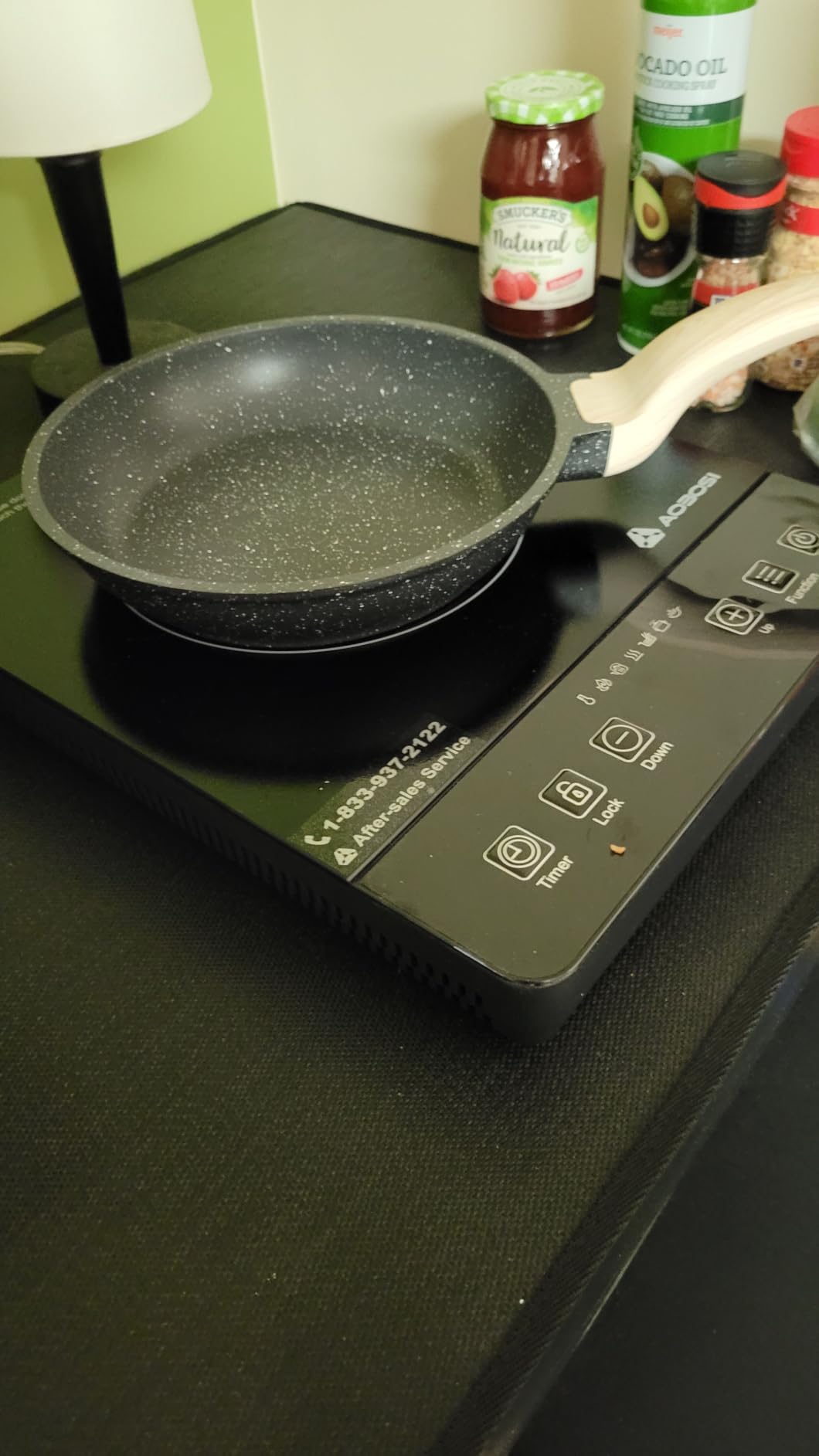
Four preset modes cover boil, hot pot, stew and keep warm, so a stew does not need you to remember which power level held a simmer last time. A 4 hour timer, child lock and residual heat indicator round out the safety set, and roughly three quarters of reviews are five star.
The 1-year warranty is the main thing to weigh. Longer-standing brands on this list offer two years, and a warranty difference of that size does matter for an appliance that gets used daily.
Who this suits first
Buy this one if you cook a lot of sauces and slow braises in a small kitchen and want granular control without paying for a commercial unit. The preset modes genuinely help on a weeknight when attention is elsewhere.
The honest trade
Brand history is the trade. Established names in this category have decades of failure data behind them, and a newer brand with a 1-year warranty gives you less protection if the coil or control board fails in year two.
4. Amazon Basics 1800W Portable Induction Cooktop review
Amazon Basics 1800W Portable Electric Induction Cooktop, Burner and Child Lock, Overheat Protection, Timer, 8 Power Settings, Temperature Control Up to 440°F, for Cookware Diameter 5.7″-8.2″, Black
1800W
8 power levels 300-1800W
160F-440F range
Cookware 5.7-8.2 inches, 6.2 lbs
Pros
- Full 1800W output at the entry point
- Boils a quart of water in roughly four to five minutes
- Child lock
- auto-pause and overheat protection
- 3 hour timer with LED display
- Weighs 6.2 lbs and wipes clean
Cons
- Only 8 coarse power steps
- 160F floor is too hot for gentle work
- Small cooking area creates hot and cool spots
- Some owners report mid-cook cutouts
- Not compatible with aluminum cookware
This is the lowest-rated unit we included at 4.1 stars, and we included it anyway because it solves a real problem: getting full 1800W output into a small kitchen without spending much. Owners report boiling a quart of water in about four to five minutes, which is the same figure the higher-rated 1800W units produce.
The safety suite is better than the rating suggests, with a child lock, auto-pause, overheat protection and a voltage warning system. It weighs 6.2 lbs and the tempered glass top wipes clean, so moving it between the counter and a table is easy.
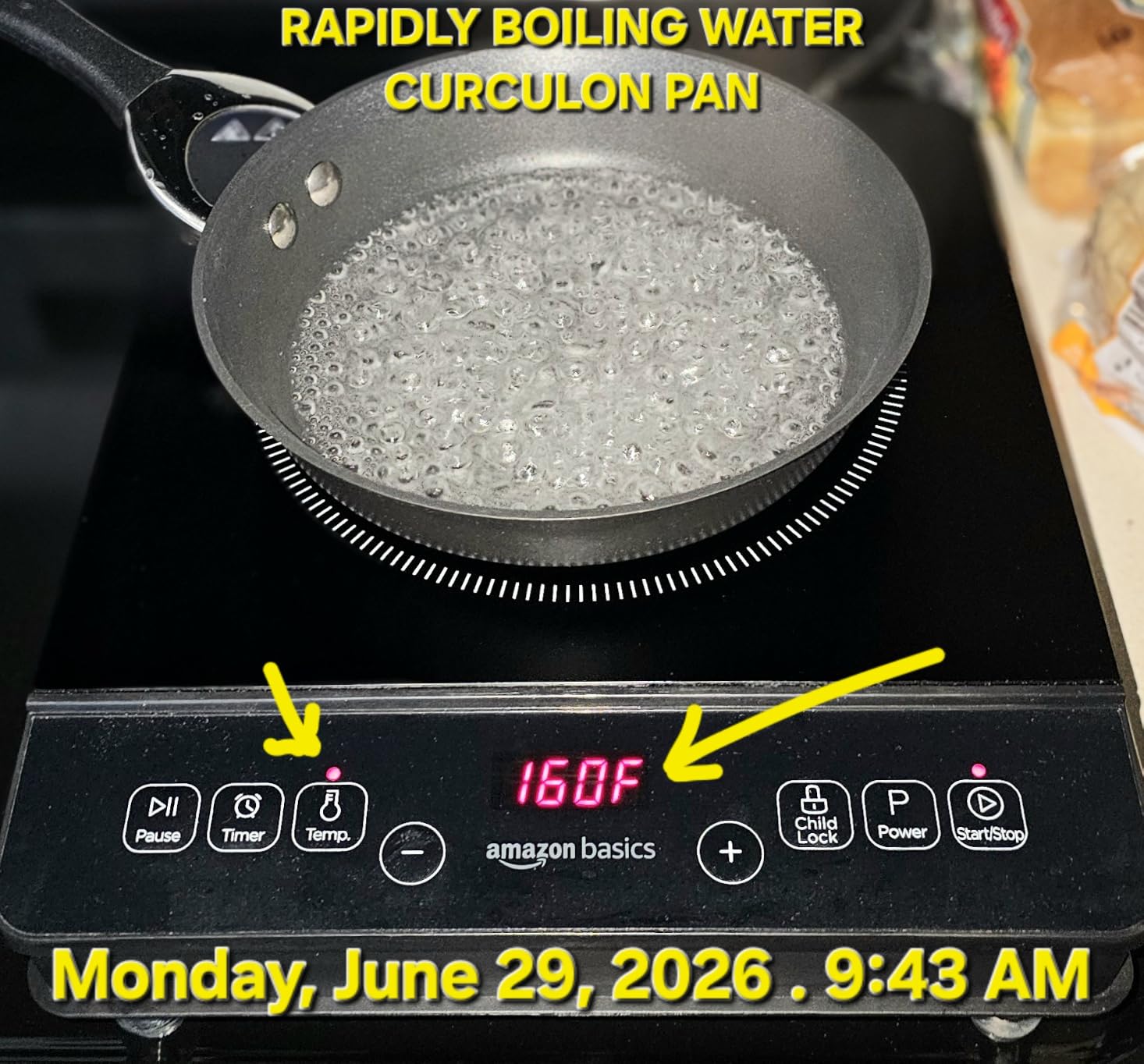
The problem is control. Eight power levels from 300W to 1800W and a 160F to 440F range means there is nothing usable between a bare simmer and a rolling boil. For a household cooking for one, that is a tolerable trade. For someone who makes sauces, it is not.
Two more things to know. The published cookware range of 5.7 to 8.2 inches means small pans are off the table, which connects directly to the most common complaint on the r/inductioncooking forum about units failing to register 1 and 1.5 quart pots. And some owners report the burner cutting out after about ten minutes and needing a power cycle, so treat it as a backup burner rather than a sole appliance.
Where this is the right buy
A studio kitchen cooking for one person, a weekend rental, or a second burner for a party table. In those situations the price and the 1800W output outweigh the coarse controls.
Where it will frustrate you
Any kitchen that relies on low and slow heat, or on small saucepans under 5.7 inches across. Check your pan inventory before you buy, because the minimum diameter is a hard specification, not a guideline.
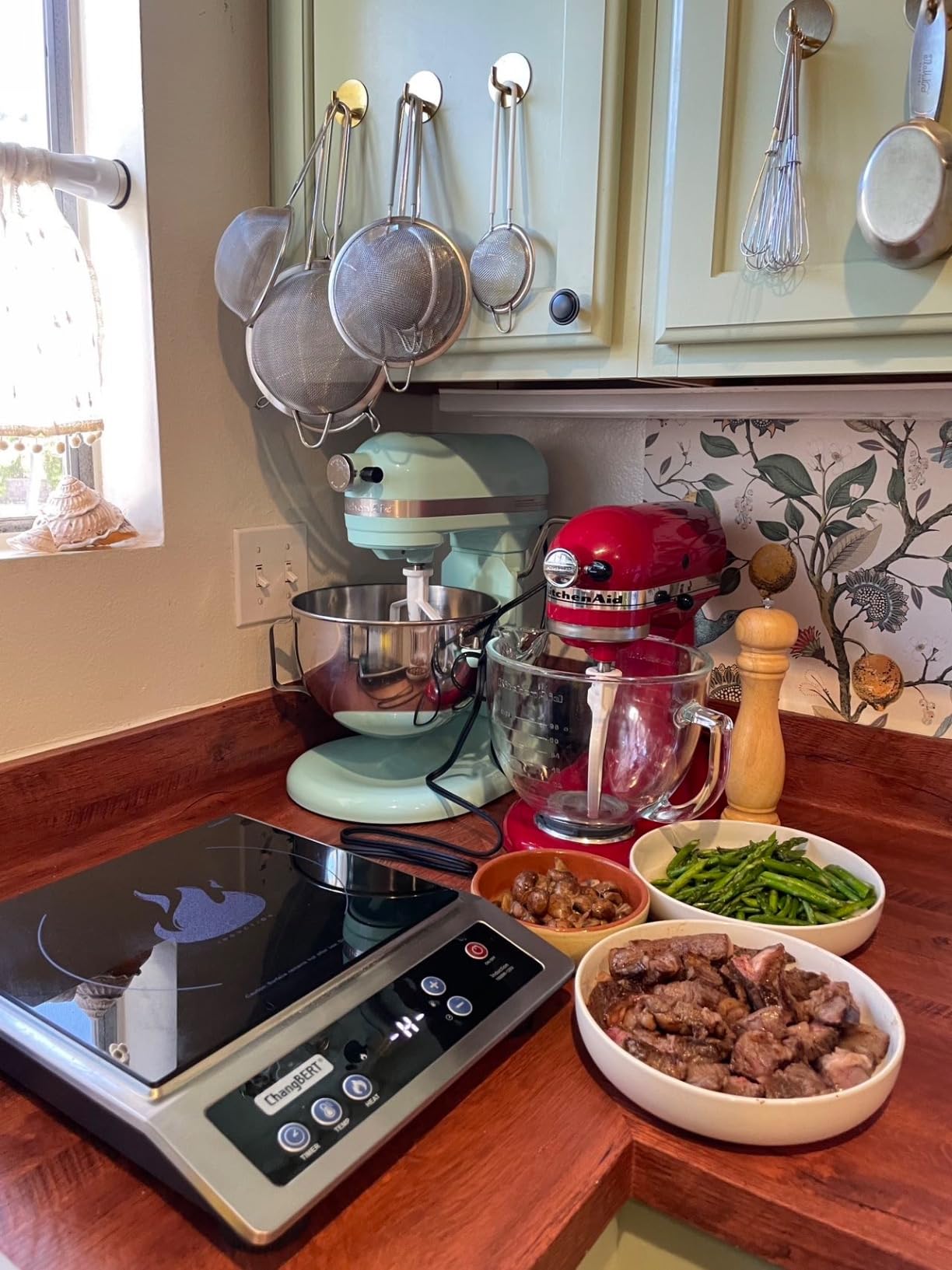
5. ChangBERT CIB-80 Commercial Grade Induction Cooktop review
ChangBERT Induction Cooktop, Commercial Grade Portable Cooker, Large 8” Heating Coil, Premium Stainless Steel Countertop Burner with NSF Certified, 10 Hours Timer Powerful 1800W Professional Hot Plate
1800W
8 inch heating coil
18 temperature levels 120-460F
15 x 12.2 x 2.8 inches, 6.1 lbs
Pros
- Only unit here with NSF certification and ETL listing
- 8 inch coil spreads heat most evenly
- 10 hour countdown timer for long holds
- Stainless housing rated for a 100 lb surface load
- Full suite of overheat
- hot-surface and circuit-failure protection
Cons
- 15 x 12.2 inch footprint is large for one burner
- Push buttons only
- Single cooking zone
This is the only unit in the guide that carries NSF certification alongside an ETL listing to UL commercial standard 197, and that certification is the entire reason to look at it. NSF is the standard used by restaurant and catering kitchens, so if you cook commercially or run a rental property, this is the only portable model here that passes.
It also has the largest coil at 8 inches, which is why owners report more even heating than the 6 to 6.8 inch units on this list. Temperature runs from 120F to 460F across 18 levels in 20F steps, with 9 power levels from 200W to 1800W and a 10-hour countdown timer, the longest continuous hold here.
The stainless housing is rated to support up to 100 lbs on the surface, and the circuitry is continuous-duty rather than intermittent. That is a different construction standard from the glass-and-plastic portables, and it explains the roughly 77% five star share among 1407 reviews.
Protection is comprehensive: auto-pan detection, overheat, hot-surface, small-article and circuit-failure detection. Published energy efficiency is 83%, and the warranty is two years for home use and one year for commercial use.
Buying it for a small kitchen
It works, but measure first. At 15 by 12.2 inches it is one of the larger single burners in this guide, so on a shallow counter it takes a meaningful share of your work surface. A knob version also avoids the touch-panel failure question entirely.
What commercial certification means for you
NSF listing matters if you are subject to health-department or food-service rules, and it is a reasonable proxy for build quality even at home. The push-button panel and the 2-year home warranty both support the same conclusion.
6. Nuwave Double Pro Induction Cooktop review
Nuwave Double Pro Cooktop Induction Countertop Burner, Portable, 50°F-575°F
1800W total
50F-575F in 5 degree steps
8 inch coils on both zones
23.6 x 14.2 x 2.6 inches, 14 lbs
Pros
- Two fully independent zones with separate controls
- Widest temperature range here at 50F to 575F
- Dynamic Watt shifts power between burners
- 8 inch coils are larger than most competing dual units
- Seamless glass with no grooves to trap food
Cons
- 23.6 inch width needs a long counter
- Heaviest unit here at 14 lbs
- Each burner drops to 900W when both run
- A minority report sensor drift or cutouts
This is the closest any of these gets to a real range, and the reason is the two independent zones. Each side has its own controls, so a main dish at 375F and a side at 140F run at the same time without fighting over a shared setting.
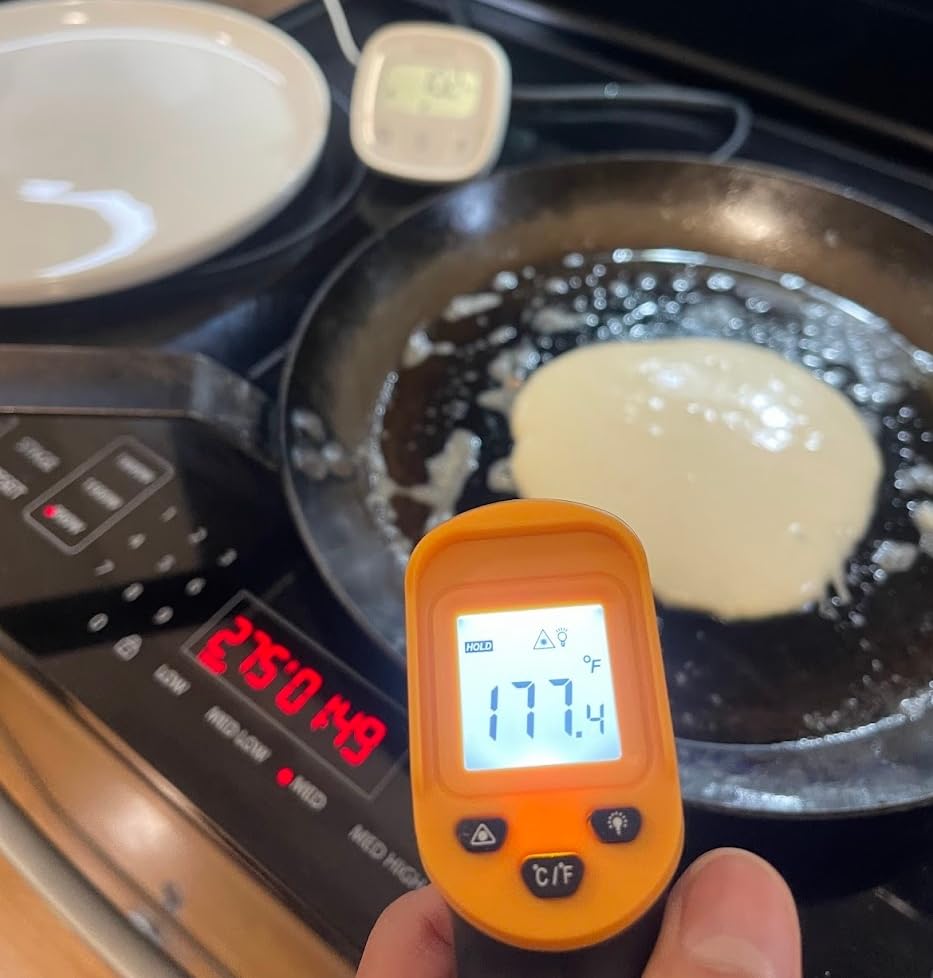
The temperature range is the widest in the group at 50F to 575F in 5 degree increments with 5 presets, which is why reviewers single it out for candy making and low temperature work. Dynamic Watt Technology moves power between burners rather than splitting it evenly, and both coils measure 8 inches.
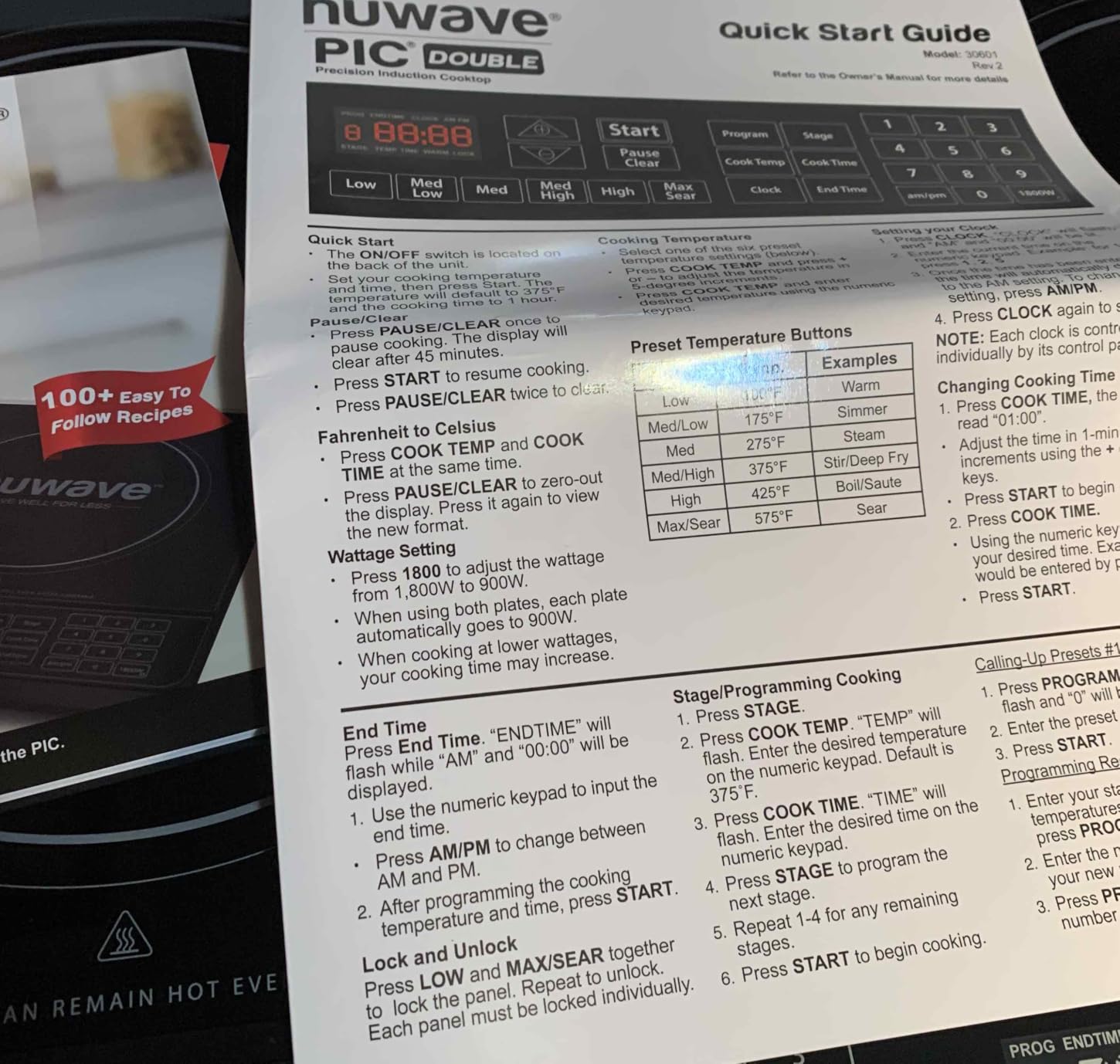
Several owners replaced a full range with this unit and report that it outpaces gas for boiling. Owners also point to the seamless edge-to-edge ceramic glass, which has no grooves to trap crumbs, a genuine advantage in a kitchen where the counter doubles as a prep area.
The footprint is the catch. At 23.6 inches wide and 14.2 deep, this is the largest unit in the guide, and at 14 lbs it is the heaviest. It needs a real counter run, which rules it out for anything under about 26 inches of free length. When both burners run, each drops to 900W to stay within a 15-amp circuit, and a minority of reviews report temperature sensor drift or units refusing to reheat after a few months.
Is the width worth it
If your counter has 26 inches or more of clear run and you regularly cook for more than one person, yes. Two independent zones is a capability no slim portable offers, and the temperature range is the broadest we tested in this class.
What to watch in year one
Check the temperature readout against a known boil early on, because a minority of owners report sensing drift within a few months. Owners also warn that a pan bumping the touch panel can jump the number-pad to an unintended temperature.
7. AMZCHEF Double Induction Cooktop review
AMZCHEF Double Induction Cooktop, 1800W 2 Burner, ETL Certified
1800W across two zones
18 power and 20 temperature levels
Cookware 4.7-9.4 inches
20.2 x 11.8 x 3.5 inches
Pros
- Accepts cookware from 4.7 inches up
- the smallest range here
- 18 power levels and 20 temperature steps
- 10 hour timer with child lock and residual heat reminder
- Two zones with independent control
- Black ceramic glass wipes clean
Cons
- Shared 1800W ceiling caps each side at level P13 when both run
- 20.2 inch width
- Single circuit for both zones
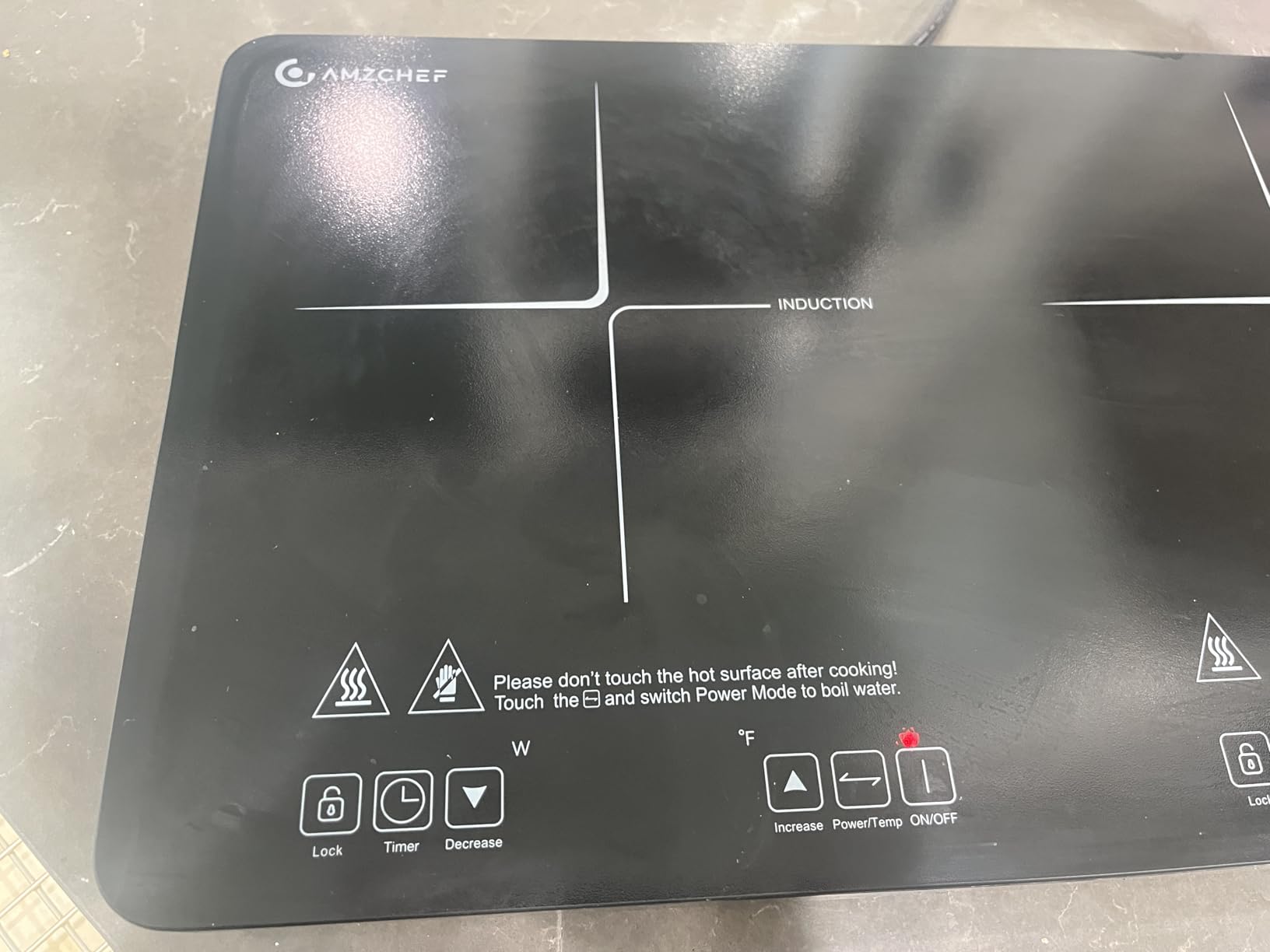
The reason this unit appears in a small kitchen guide is its stated cookware range of 4.7 to 9.4 inches. That is the widest pan acceptance in the group and the only dual-burner model here that will register a small 1 quart saucepan, which is the single most repeated worry on the r/inductioncooking forum.
Control granularity is also better than most dual-burner competitors at 18 power levels from 100W to 1800W and 20 temperature steps from 100F to 465F. A 10-hour timer, child safety lock and residual heat reminder are included, and the black ceramic glass surface wipes clean without grooves.
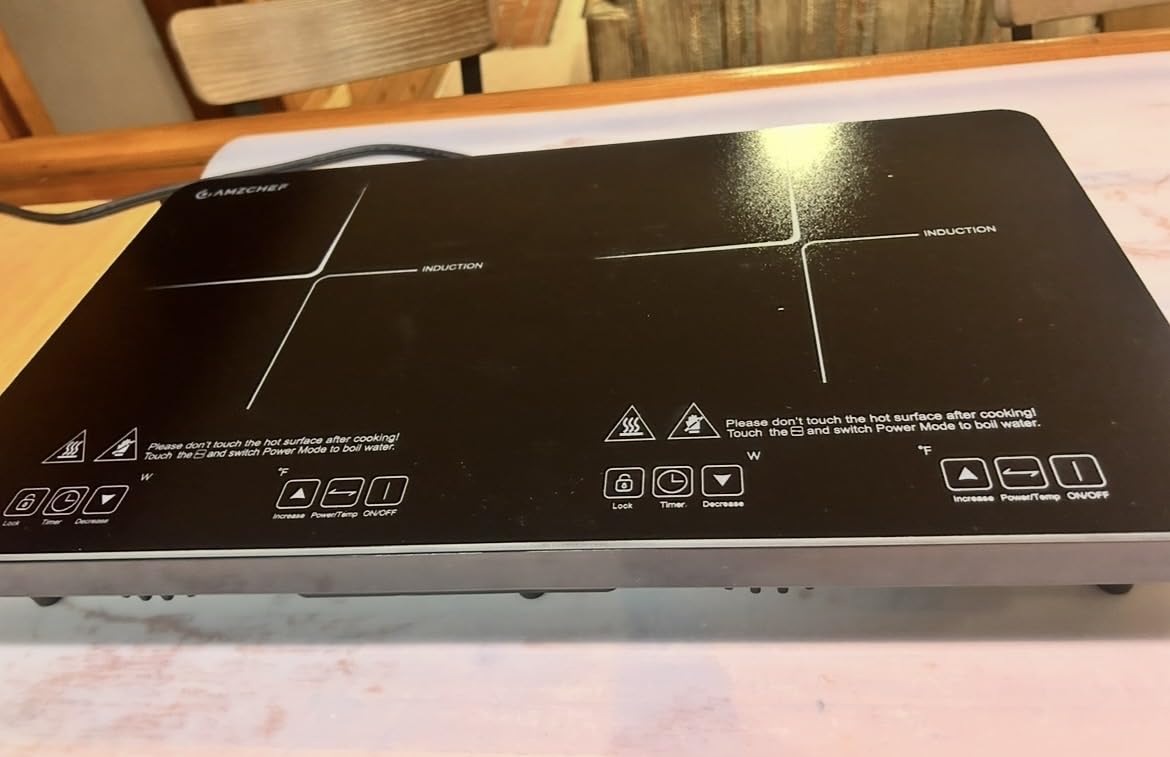
It runs on 110-120V and is ETL certified, so it plugs into a standard outlet without any circuit work. Owners also like that it is light enough to move between the counter, a table and outdoor use, which matters when counter space is the reason you chose it in the first place.
The shared power budget is the real limitation. With both burners active, each side caps at power level P13, and neither reaches full output at the same time. The rating of 4.3 across 754 reviews reflects buyers who are otherwise happy but want more headroom.
Pan detection on small saucepans
Place your smallest everyday pan in the center of each zone before you buy anything else. If it registers and the unit does not beep an error, you have solved the problem that most often makes a compact induction setup unusable for one.
Two zones, one circuit
Plan around a 1800W total. If you need both burners at maximum heat simultaneously, this is the wrong unit. For most small kitchens, where one burner is a side dish and the other is a main, the shared budget is not noticeable.
8. Empava Flex Induction 2 Burner Cooktop review
Empava Flex Induction Cooktop 2 Burner, Horz. Countertop/Drop-in, Plug in
1800W across two burners
18 temperature levels 120-460F
Built-in or countertop
20.5 x 14.1 x 2.9 inches, 12.3 lbs
Pros
- Can be dropped into a cutout or used as a countertop appliance
- Two zones with 18 temperature levels
- 1-599 minute timer
- Melt
- keep warm and simmer presets plus pause
- Installation kit included
- Child lock and auto shutoff
Cons
- 20.5 inch width is among the largest here
- 12.3 lbs is awkward to move after install
- Only a 1-year manufacturer warranty
- A 12 inch variant exists but this unit is the 20 inch version
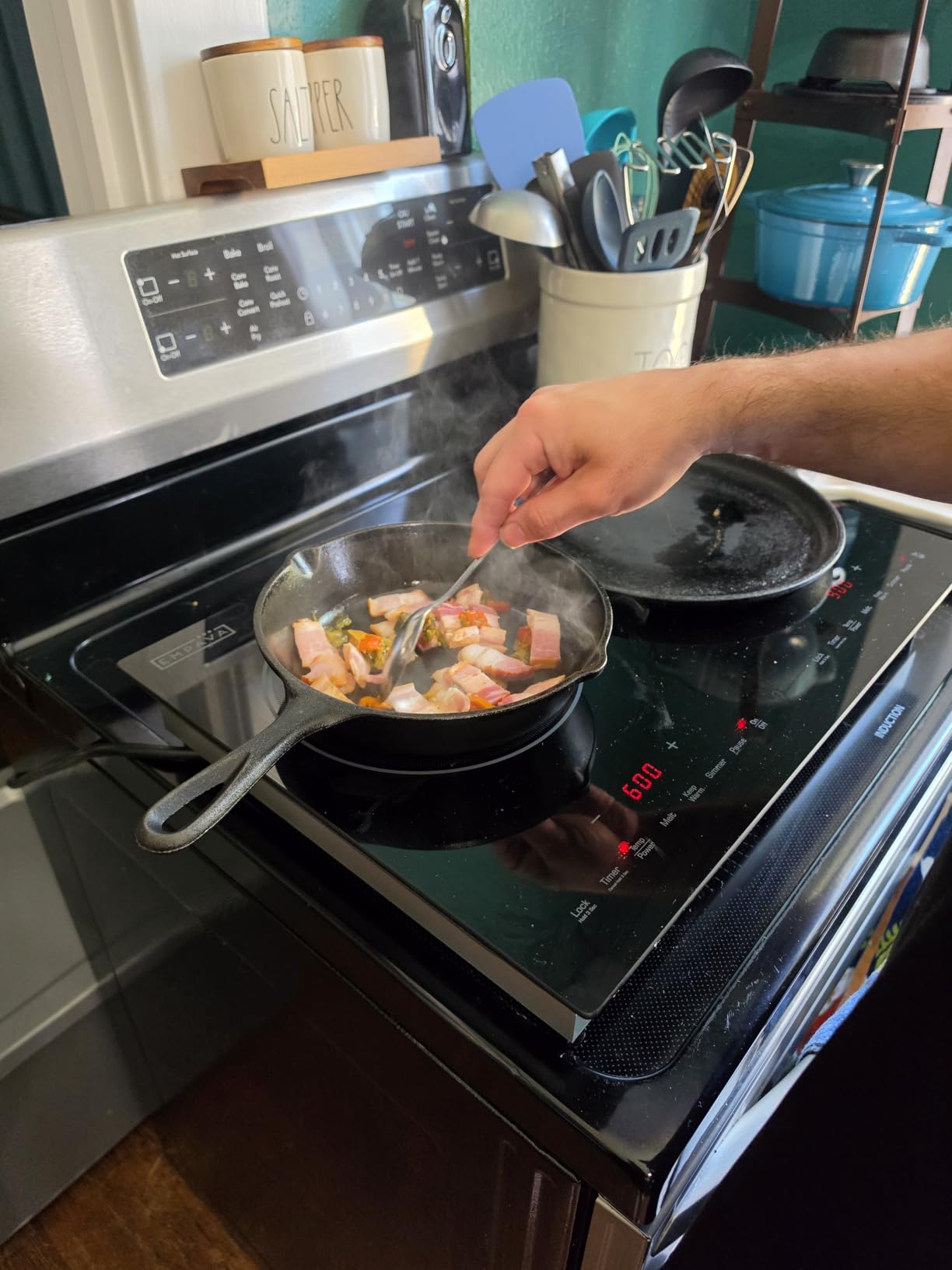
This is the only unit in the guide that works as both a built-in cooktop and a portable countertop appliance, and that flexibility is why it earns a place in a small kitchen guide. You can test it on the counter during a remodel, then drop the same model into a cutout when the new surface is installed.
It carries 18 temperature levels from 120F to 460F across two zones, with melt, keep warm and simmer presets plus a pause function. The timer range of 1 to 599 minutes is unusually long, and the unit is cTUVus certified with a pan sensor, child lock and auto shutoff.
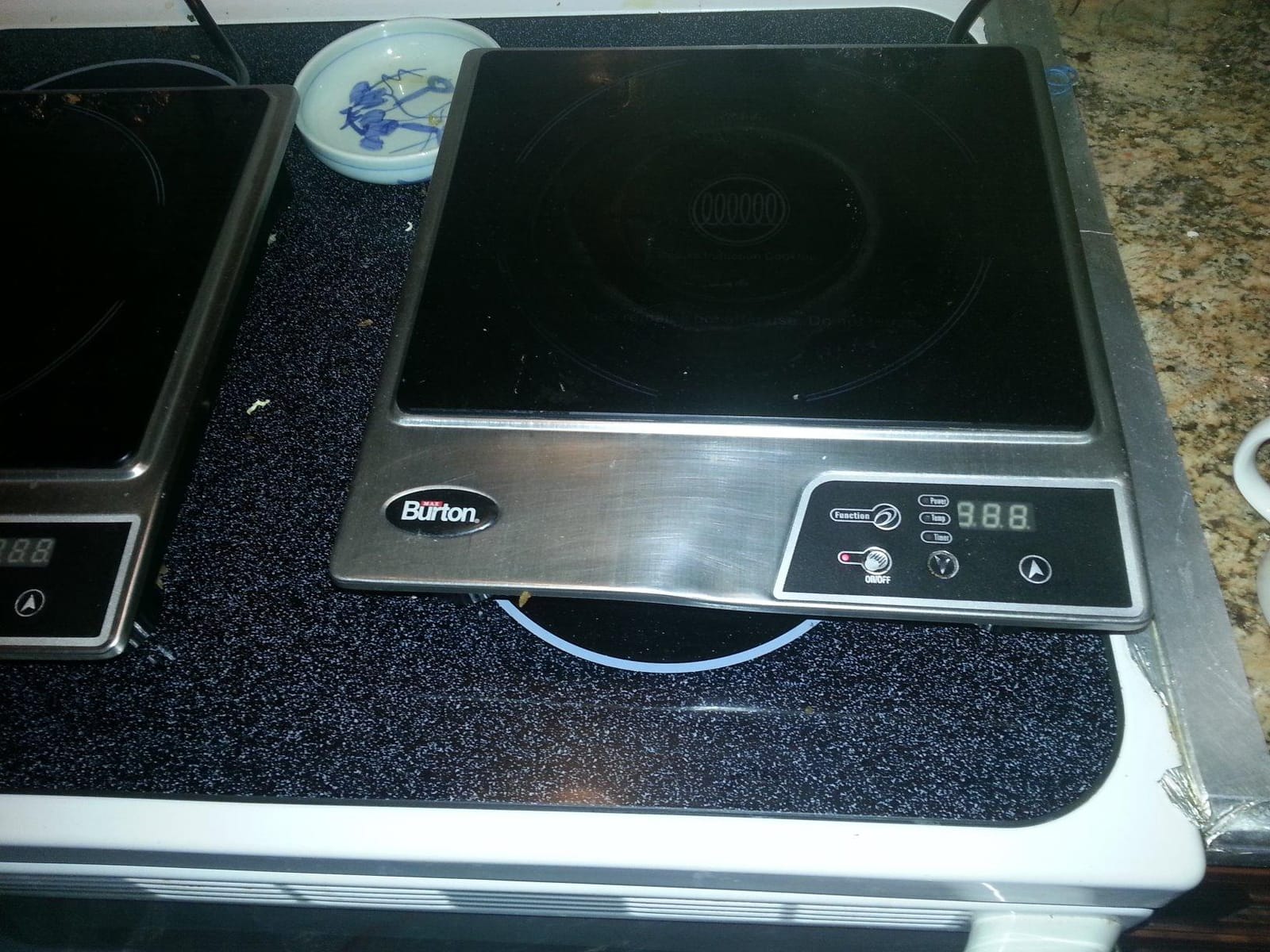
The installation kit is included, which removes one common source of remodel friction. Owners rate the unit at 4.4 across 725 reviews, with roughly 76% five star, and the install flexibility is named as the deciding factor in most of them.
Be clear-eyed about the size. At 20.5 inches wide, 14.1 deep and 12.3 lbs, this is among the largest and heaviest units here, and that weight becomes annoying the moment you want to move it. The 1-year manufacturer warranty is the shortest protection among the dual-burner options, and a 12 inch version exists as a separate variant for genuinely tight counters.
Remodel or rental decision
Owners and renters both benefit here, but for opposite reasons. If you are cutting a counter during a remodel, the drop-in option keeps the appliance in your plan permanently. If you rent, you can start on the counter and take it with you.
What to confirm before ordering
If your counter is under 20 inches of usable width, this specific unit is too large. Check whether the 12 inch variant exists in the finish and control layout you want before you commit to a size you will regret.
9. OMEO Portable Induction Cooktop review
OMEO Portable Induction Cooktop Hot Plate Countertop Burner 1800 Watts Induction Burner with LCD Sensor Touch, LED Display, 10 Temperature Levels, Child Safety Lock, Auto Shutoff Function
1800W
10 temperature levels 140-460F
LCD sensor touch with LED readout
14.56 x 11.42 x 2.36 inches, 5.5 lbs
Pros
- Full 1800W output in a low-cost package
- 5.5 pound body is easy to carry between rooms
- 2.36 inch tall profile clears shallow cabinets
- LED display shows live temperature and power
- Child lock and auto shutoff
Cons
- Only 10 temperature steps
- Single burner only
- Requires magnetic stainless steel or cast iron
- Long narrow footprint is awkward on a small counter
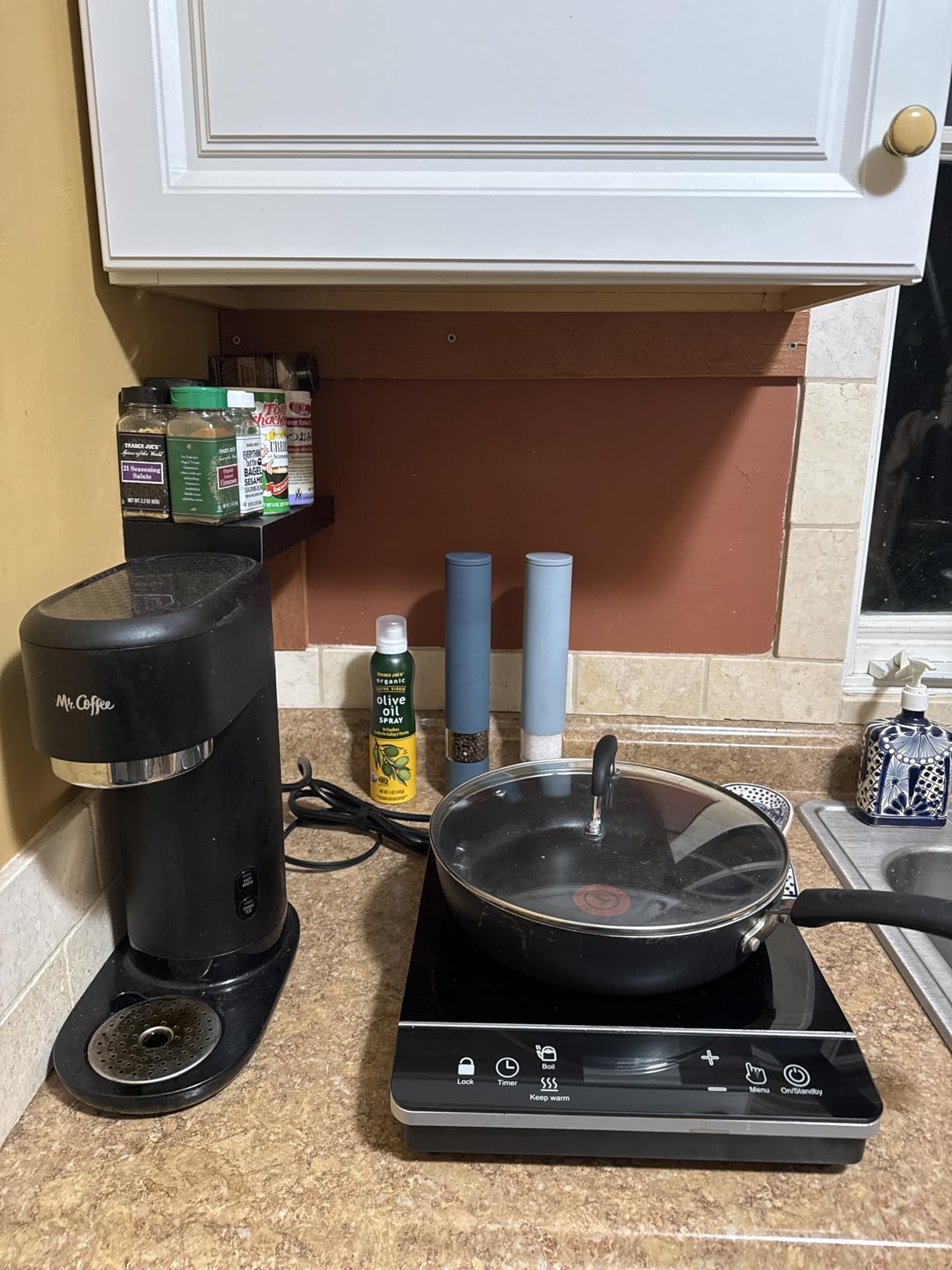
This is the one to consider if you plan to move the cooktop between a kitchen counter, a dorm room and an outdoor table. At 5.5 pounds it is among the lightest units we covered, and 2.36 inches tall clears most cabinet openings.
It still delivers full 1800W output with an LCD sensor touch panel and an LED display that shows live temperature and power, which is a genuinely useful readout when you are cooking at low temperatures in a small pan. Child safety lock and auto shutoff with no-cookware detection are included, and the manufacturer lists dorm, indoor and RV use as intended applications.
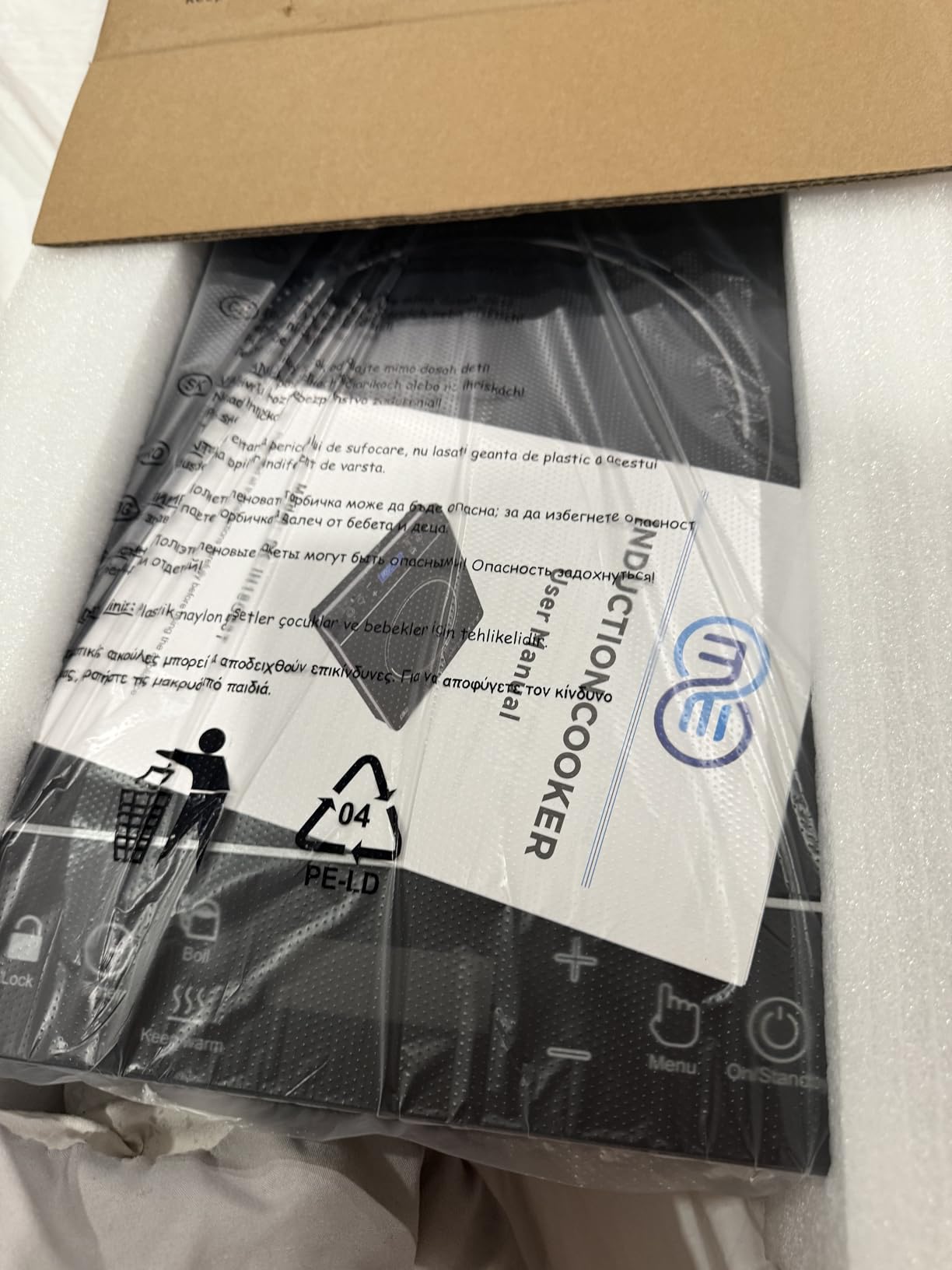
Ten temperature levels from 140F to 460F is the fewest of the single burners in this guide, and it shows in reviews. Compared with the 20 steps on the AAOBOSI or the 18 on the commercial unit, you have coarser control and a higher minimum temperature, which rules it out for very low heat work.
The listed dimensions of 14.56 by 11.42 inches are long and narrow, so plan the counter orientation carefully. A double burner variant also exists if you want to move up to two zones later, which is worth considering before you settle for one.
Who should pick this one
RV owners, students and anyone cooking from a temporary kitchen during a remodel. The 5.5 lb weight and 2.36 inch height are the deciding features, and the 1800W rating means you are not sacrificing boil speed to get them.
Where the 10 steps show
If you make browning butter, melt chocolate, or hold a sauce at a specific temperature, choose a unit with 18 or 20 steps instead. The 140F floor here is also higher than the 120F on most competitors.
10. COOKTRON 2 Burner Induction Cooktop review
COOKTRON Portable Induction Cooktop 2 Burner, 1800W with Booster
1800W across two zones
1 minute booster
9 power levels, 10 temperature settings 140-464F
22.05 x 12.2 x 1.9 inches, 12.6 lbs
Pros
- 1 minute booster gives instant maximum heat
- Two independently controlled touch zones
- Only 1.9 inches tall
- the slimmest dual-burner body here
- 4 hour timer is longer than most dual units
- Child lock
- cookware detection and residual heat indication
Cons
- 22.05 inch width demands a long counter
- 12.6 lbs is the heaviest dual-burner option
- Only 9 power levels and 10 temperature steps
- Both zones share a 1800W total budget
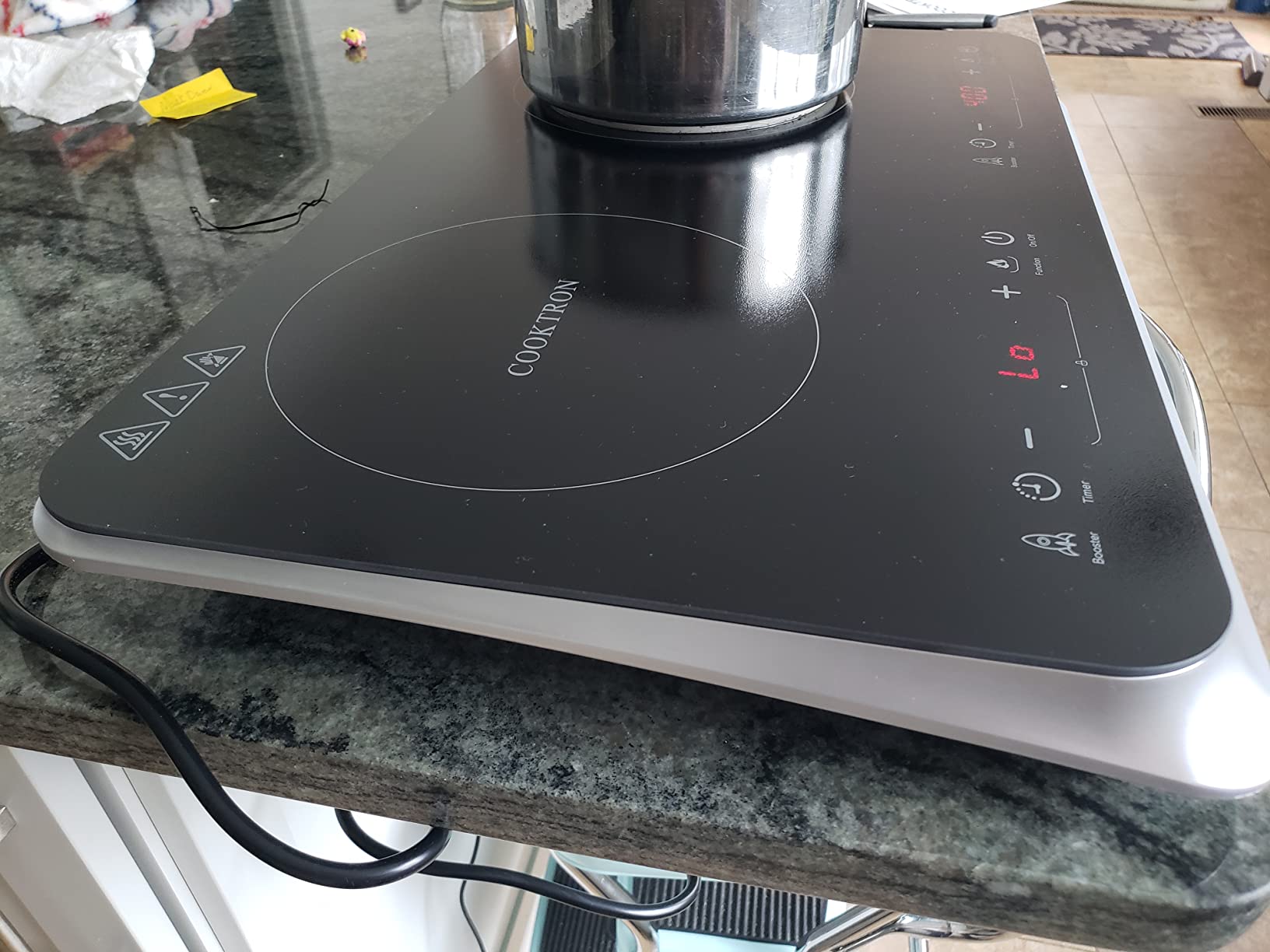
The booster is the feature that separates this from every other dual-burner unit in the guide. A one-minute burst of maximum heat gets a large pot to a boil immediately instead of waiting through a slow ramp, and it is the first thing reviewers mention.
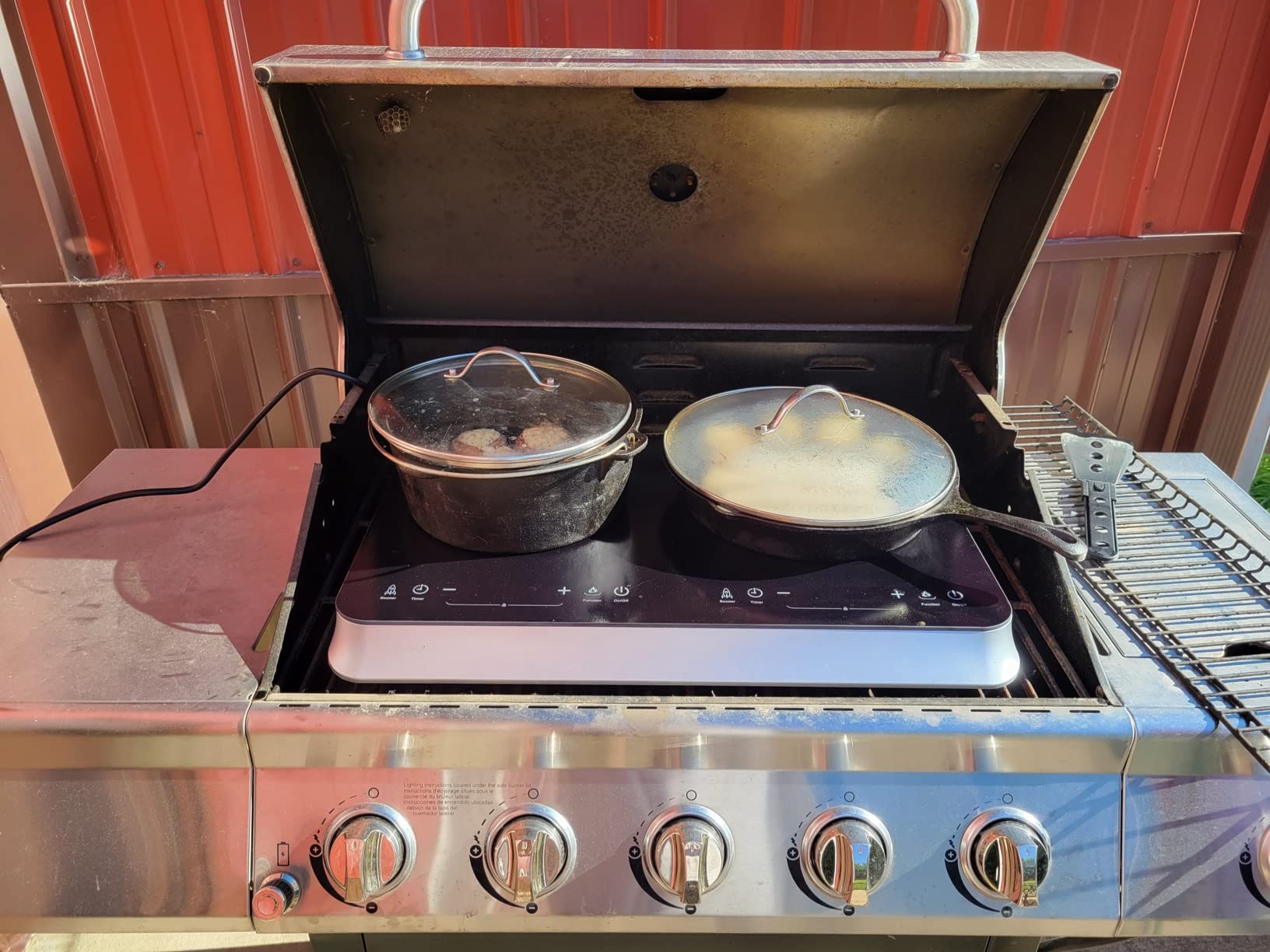
At 1.9 inches tall, this is the slimmest dual-burner body in the group, which matters on a counter with a window sill or a raised backsplash. Two zones are independently controlled, the 4 hour timer runs longer than most competing dual units, and child lock, cookware detection, residual heat indication and auto shutoff are all present.
There is also a knob-control variant in the same range, which is worth serious consideration if you want physical dials. For an older user or anyone cooking with wet or gloved hands, that avoids the touch-panel reliability question entirely, and physical controls are a recurring owner preference on forums.
Control granularity is the trade. Nine power levels and 10 temperature settings from 140F to 464F is the coarser end for a dual-burner unit, and both zones share a 1800W total budget. At 22.05 inches wide it needs a long counter, and at 12.6 lbs it is the heaviest dual option here.
Booster versus more steps
Decide which matters more to you. If you mostly boil water and sear, the booster wins. If you cook a low-temperature dish on one zone while another runs, the 20-step AMZCHEF gives you more control at the same shared wattage.
Before you measure
Confirm 24 inches or more of clear counter run and check what sits above it. A 1.9 inch tall body helps with overhead clearance, but the width is what actually constrains the layout.
Cookware compatibility: the magnet test and minimum pan size
Induction heats the base of the pan directly, so a pot only works if its base is ferromagnetic. This is the number one reason a cooktop gets returned, and it costs you a refrigerator magnet to check before you buy.
How to run the magnet test
Take a refrigerator magnet and press it to the flat bottom of each pan you intend to use. If it grabs firmly, the pan will work. If it slides off or barely catches, the pan is aluminum, copper, plain stainless without a bonded steel layer, glass or ceramic, and it will not heat.
What works and what does not
Stainless steel with a bonded magnetic base works, as do cast iron and enameled cast iron. Most tri-ply clad stainless works on the bonding layer. Aluminum and copper by themselves do not, which surprises people who own well-made pans that predate induction.
Minimum pan diameter is the make-or-break spec
This is the most repeated worry on the r/inductioncooking forum and the specification most editorial roundups skip. Published cookware ranges in this group run from 4.7 inches on the AMZCHEF dual unit to 5.7 inches on the Amazon Basics model, and a pan smaller than the stated minimum may not register at all.
Owners running 1 quart and 1.5 quart saucepans report units that simply will not detect the pan, particularly on smaller burners. If your everyday pot is under 5 inches across, choose a model with a published minimum of 4.7 inches or lower, or budget for a new saucepan.
If most of your cookware fails the magnet test, an adapter disc is an option but it sits between the coil and the pan, so heat transfer drops and the surface still gets hot. Replacing two or three core pans is usually the better path. Our cookware guide for induction sets out the material options in more detail.
Electrical requirements: 120V circuits and breaker trips
Every portable unit in this guide is 120V and plug-in, so the short answer to the most common installation question is no, you do not need an electrician. The longer answer explains the breaker trips that owners complain about.
The wattage math
A 15-amp 120V branch circuit supports roughly 1800W continuously. Every 1800W burner in this guide sits right at that ceiling, which is why a dedicated 20-amp circuit is a comfort but never a requirement. Nuwave’s Flex unit, at 1300W with 600, 900 and 1300W settings, has the most headroom of the set.
What trips a kitchen breaker
The problem is never the cooktop alone. It is the cooktop plus everything else on the same 15-amp circuit, and the usual culprits on a kitchen branch circuit are a microwave, a kettle, a toaster, a dishwasher or a refrigerator on a shared outlet.
If a breaker trips when you run the burner and the microwave together, the fix is a dedicated 20-amp circuit rather than a different cooktop. Dual-burner units make this worse by design: on the Nuwave Double Pro, each burner drops to 900W when both run, and on the COOKTRON and AMZCHEF models both zones share a single 1800W budget, so the manufacturers manage the draw for you.
Do I need an electrician
Not for any unit in this guide. You need an electrician only if you are cutting a counter and hardwiring a built-in cooktop, or if your existing circuit cannot handle the load and you want a new one run. The portable and drop-in flexible models on this list plug into a standard outlet.
For RV, boat and off-grid use, do the inverter math before you buy. An 1800W burner draws about 15 amps at 120V, and a shore power connection or power station has to support that continuous draw plus your refrigerator, which is why forum testers compare background power draw between budget models rather than headline wattage alone.
Induction vs gas vs radiant electric in a small kitchen
Induction is not the best choice for everyone, and the honest downsides are worth stating plainly. If you own a wall of copper or aluminum cookware, or you are used to judging heat by the size of a gas flame, you will have an adjustment period.
Against gas: there is no visible flame, so a simmer takes practice to read, and you lose the ability to char a steak by moving the pan over an open flame. Heat control is far more precise once you learn it, response is near instant, and the surface stays cool enough to set a dish down on.
Against radiant electric: there is no meaningful downside on speed, since induction boils water faster and loses less energy to the room. Radiant elements do not require magnetic cookware, which is a real advantage for a household with a mixed pan collection.
Against both: cookware cost is the genuine expense. A full magnetic set is a real purchase, and long-term owners on r/HomeImprovement point to durability as the thing that matters most, citing an induction cooktop they have had for about eight years. They also advise buying the highest power rating available, because more power means a quicker boil.
For a galley or studio kitchen, the counter space argument usually settles it. Owners on Houzz describe losing more than 30 inches of work surface to a full-size range, and a 12 inch deep portable unit gives that back without a remodel.
Buying guide: the 8 criteria that matter in a tight kitchen
These are the criteria we used, in the order that matters most when counter space is the binding constraint.
1. Counter width, measured
Measure the clear run after the sink and dishwasher, then subtract an inch of ventilation space at the back. Anything at or under 13 inches wide fits a cramped counter. A dual-burner unit at 20 to 24 inches needs 26 inches or more to sit comfortably.
2. Counter depth and body height
Body height decides whether the unit fits in a cabinet when you are not using it. The AAOBOSI at 1.7 inches and the COOKTRON dual at 1.9 inches are the slimmest here, while the AMZCHEF dual at 3.5 inches is the tallest and needs clearance.
3. Minimum detectable pan diameter
This is the most-overlooked spec and the most common forum complaint. Check the published cookware range against your smallest everyday pot before you buy. Published ranges in this group run from 4.7 to 9.4 inches.
4. Number of power and temperature levels
Eight levels is coarse and leaves nothing between a simmer and a boil. Fifteen is workable, and 18 to 20 steps is what you want for sauces, candy and low-and-slow work. Nuwave’s Flex goes further with 5F increments across a 100F to 500F range.
5. Wattage you can actually reach
On a 15-amp circuit, 1800W is the ceiling and it affects how fast a large pot boils. This is the advice owners repeat most often: in a small footprint, take the highest power rating available.
6. Controls: physical or touch
Touch panels are the most common failure point reported by owners, and a forum case of non-stop beeping with a control panel fault on an expensive unit is a useful warning. If you cook with wet hands, wear gloves, or want the appliance to keep working for a decade, push buttons and knobs are worth prioritizing. The Duxtop and ChangBERT use physical controls, and the COOKTRON offers a knob variant.
7. Safety and certification
Look for pan detection with auto shutoff, overheat protection, a residual heat indicator and a child lock. Only the ChangBERT in this guide carries NSF certification alongside an ETL listing to UL commercial standard 197, and only the AMZCHEF and Empava units are cTUVus or ETL certified among the dual-burner models.
8. Warranty length and support
Warranties in this group range from one year to two. On an appliance used daily, the two-year terms on the Duxtop and ChangBERT give a longer runway, and both are established brands with far more failure history published than the newer names.
One more practical note on noise. Owners of budget portables report a loud cooling fan that runs continuously, and while none of the listings here publish a decibel figure, fan behaviour under sustained use is worth a question if your kitchen is open to living space.
Our broader guide to kitchen appliances for small kitchens covers the other space-saving appliances that pair with a compact cooktop, and induction ranges for modern kitchens covers full-size installs for anyone with the space.
Frequently Asked Questions
What are the best small induction cooktops?
The best small induction cooktops are slim single-burner units under 13 inches wide for cramped counters, and dual-burner units around 20 to 24 inches wide if you have 26 inches of clear run. Look for 1800W output on standard 120V power, a published minimum pan diameter, and 15 or more power levels. The Duxtop 8100MC and the AAOBOSI C5-A are the strongest single-burner picks, while the Nuwave Double Pro suits anyone cooking two dishes at once.
What to look for when buying a portable induction cooktop
Check six things: counter width and depth, body height for storage, minimum detectable pan diameter, number of power and temperature levels, wattage on a standard 15-amp circuit, and whether controls are physical or touch. A unit with 8 power steps cannot hold a gentle simmer, and a narrow pan range will not register your smallest saucepan. Owners also weigh warranty length and whether cooling fan noise suits an open-plan kitchen.
Do I need an electrician to install an induction cooktop?
Not for a portable unit. Every model in this guide runs on 120V and plugs into a standard outlet, so no installation work is required. You would need an electrician only for a hardwired built-in cooktop, or to run a new 20-amp circuit if your existing kitchen branch circuit cannot handle the load alongside a microwave, kettle or dishwasher.
What is the downside of an induction cooktop?
The main downsides are cookware cost, the loss of a visible flame, and a learning curve for reading heat without one. Induction only works with ferromagnetic cookware, so aluminum and copper pans are excluded until you replace them. Small saucepans can also fail pan detection on models with a high minimum pan diameter, and budget units with only 8 power steps cannot hold a simmer between a boil and warm.
Are portable induction cooktops worth it?
Yes for renters, studio kitchens, RVs and temporary kitchens during a remodel, because they install instantly, cook faster than gas and free up counter space. As a permanent primary cooktop they are weaker, because one burner means one dish at a time. The arrangement owners recommend most often is a small built-in cooktop for daily cooking plus a stored portable unit for the occasional second burner.
Which induction cooktop has the best 2 burners?
The Nuwave Double Pro is the strongest two-burner option here, with two fully independent zones, 50F to 575F temperature control in 5F steps, 8-inch coils and Dynamic Watt power sharing, though it needs 23.6 inches of counter width. The AMZCHEF double is the compact alternative at 20.2 inches wide and accepts pans as small as 4.7 inches. The Empava Flex can be dropped into a countertop cutout or used as a portable appliance.
Which brand of induction cooktop is the most reliable?
Reliability is best judged by years of ownership data rather than spec sheets. An r/HomeImprovement owner reports running a Frigidaire induction cooktop for about eight years, and established brands such as Duxtop carry review counts above 17000. Physical push buttons and knobs tend to outlast touch panels, which owners repeatedly identify as the most common failure point. Certification is also a marker: the ChangBERT CIB-80 is both NSF certified and ETL listed to UL commercial standard 197.
Can induction cooktop work on a 15 amp circuit?
Yes. Every unit in this guide is 120V and rated up to 1800W, which is the practical ceiling of a 15-amp branch circuit. The catch is shared load: a 1800W burner alongside a microwave, kettle or toaster on the same circuit will trip the breaker. Dual-burner models handle this by sharing one 1800W budget, so neither burner reaches full power when both are running.
Conclusion: which induction cooktop fits your small kitchen in 2026
The Duxtop 8100MC is the best induction cooktop for small kitchens overall, because it pairs full 1800W output with a 11.5 by 13 inch body, physical push buttons and the deepest review history in the category. The AAOBOSI C5-A is the pick if control granularity matters more than brand history, with 20 power and 20 temperature levels in a 1.7 inch body. The Nuwave Flex leads on precise low-temperature work at 5F increments.
If you cook two dishes at once and have 26 inches of counter to give, the Nuwave Double Pro is the strongest two-burner unit, and the AMZCHEF double is the compact alternative that accepts 4.7 inch pans. For a remodel off gas, the Empava Flex is the only model here that works both dropped into a cutout and unplugged.
Measure your counter, run the magnet test on your smallest pot, and pick the narrowest unit that covers your cooking. That one habit eliminates nearly every return in this category.