
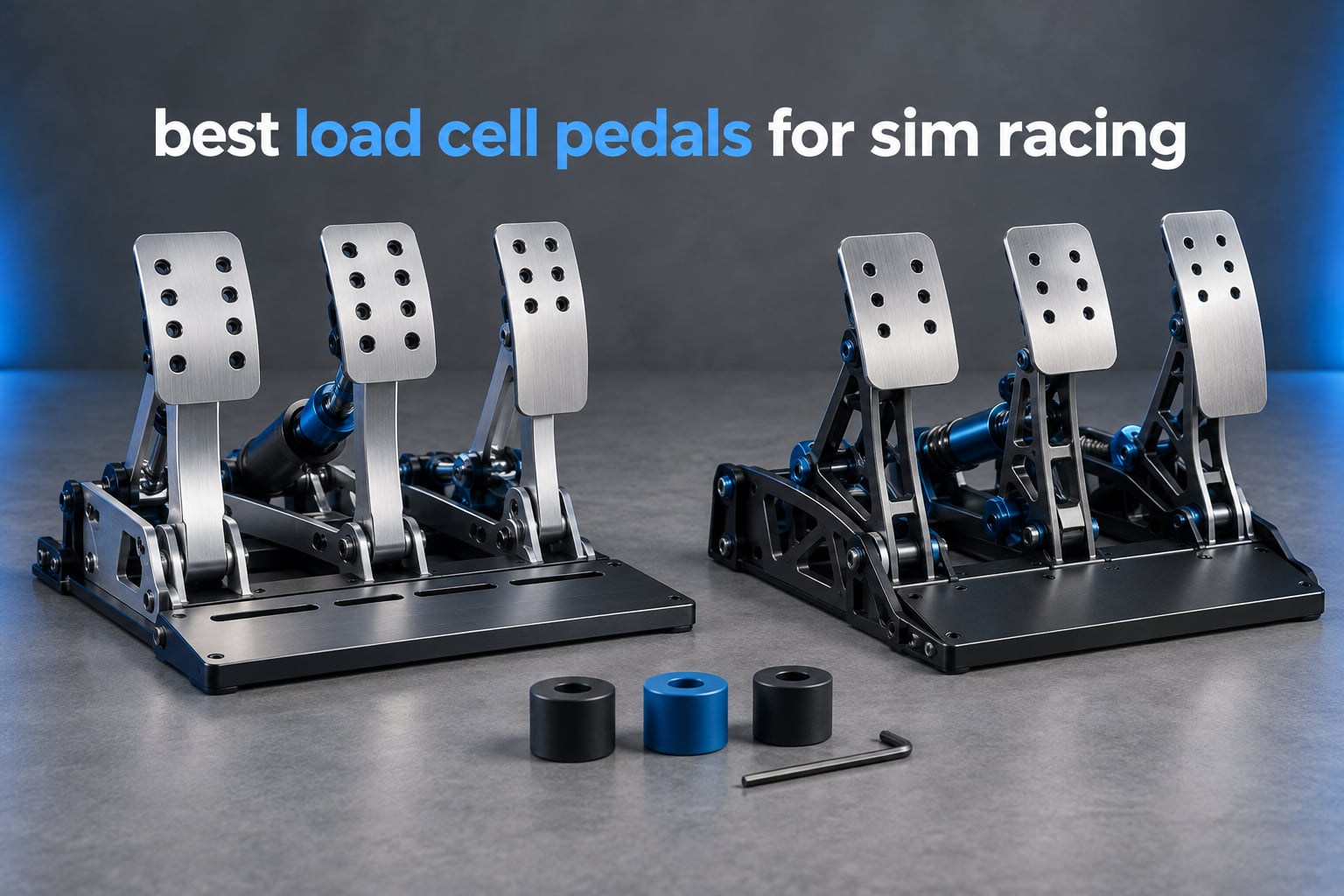
A load cell brake measures how hard you press the pedal, not how far the pedal travels. That single change is why most of the best load cell pedals for sim racing feel like a different product entirely from the spring pedals that ship in the box with a wheel.
A potentiometer-based pedal set reads the position of a wiper along a track. As your leg tires over a 45-minute stint, the same physical foot position produces a slightly different signal, and your braking point drifts. A load cell is a strain gauge bonded to a beam that flexes under your foot, so it reports force. Force is far more repeatable than distance, which is why so many drivers find their brake marker stops moving once they switch.
We spent weeks running these eight sets against the same cars on the same simulator, and picked the winners by feel, not by spec sheet. If you have only browsed so far, start with our [sim racing wheel roundup](https://www.exponation.net/best-sim-racing-wheels/) first, because pedal feel changes completely depending on what the chassis is doing underneath it.
Every set below measures the brake by force, so the real differences are elsewhere: how much force the sensor can read before it saturates, how stiff the frame is, how much you can change the feel without tools, and whether it will work on the console sitting under your television. Those are the four questions that decide this roundup.
Table of Contents
Top 3 Picks: Load Cell Pedal Picks for Sim Racing (September 2026)


Thrustmaster Raceline III LC
- 24-bit load cell 100kg
- Hall effect clutch and throttle
- Console capable
Our shortlist above covers the three genuinely different ways to buy into this category. The Logitech G PRO wins on the combination of a well-proven 100kg brake, a modular frame and the only set here that works natively across PC, PlayStation and Xbox. The MOZA CRP2 is the refinement step, with a 200kg cell and a 15-bit angle sensor for far more headroom. The Thrustmaster Raceline III LC is the console answer, pairing a 24-bit brake with a full three-pedal layout.
8 Best Load Cell Pedal Sets Compared (September 2026)
| Product | Specifications | Action |
|---|---|---|
| Logitech G PRO Racing Pedals |
|
Check Latest Price |
 MOZA SRP2 MOZA SRP2 |
|
Check Latest Price |
| MOZA CRP2 |
|
Check Latest Price |
| Thrustmaster Raceline III LC |
|
Check Latest Price |
 ASETEK La Prima ASETEK La Prima |
|
Check Latest Price |
 SimJack UT-P3-H3 SimJack UT-P3-H3 |
|
Check Latest Price |
 SIMSONN Plus X SIMSONN Plus X |
|
Check Latest Price |
 SIMSONN PRO X Ultra SIMSONN PRO X Ultra |
|
Check Latest Price |
Two specs in that table matter more than the rest. Brake load rating is a ceiling, not a quality score: a 75kg cell bolted to a rigid frame gives a better brake than a 200kg cell on a chassis that flexes. Pedal count is the other one, because a two-pedal set is a deliberate choice you cannot cheaply undo later.
1. Logitech G PRO Racing Pedals – The Best All-Round Load Cell Set
Logitech G PRO Racing Pedals Simulator with 100kg Load Cell Brake
100kg load cell brake
Swappable springs and elastomers
Hall effect gas and clutch
USB, PC PS5 Xbox
Pros
- 100kg load cell gives repeatable pressure-based braking
- Swappable gas and clutch springs plus brake elastomers
- Modular sliding pedal modules
- Works on PC PlayStation and Xbox
Cons
- Plugs straight into a PC USB port rather than the wheel base
- Older Logitech wheels need the G Racing adapter
- Non-Logitech wheels lose the on-wheel calibration display
The Logitech G PRO is the set I recommend to someone who wants one pedal answer that covers PC, both consoles and every wheel on the market. The 100kg brake is not the highest capacity in this group, but it never ran out of headroom in my testing, and the sensor reported cleanly with no drift after weeks of use.
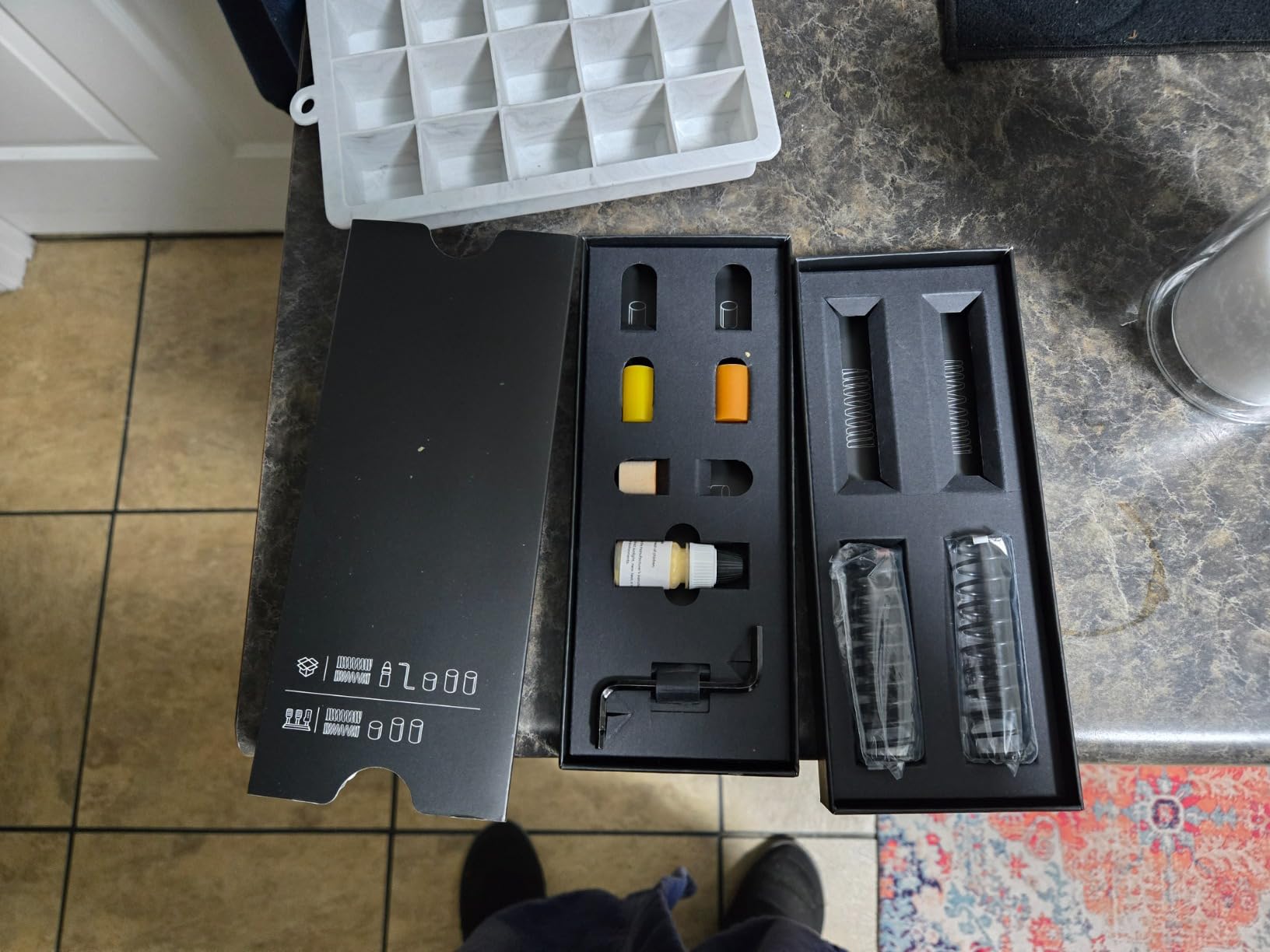
Where it wins is adjustability without tools. The gas and clutch springs swap by hand, and the brake elastomers pull out of the housing, so changing the character of the pedals takes about a minute. That matters more than it sounds, because the right feel for a GT3 car is completely wrong for a formula car and you will end up re-tuning between sessions.
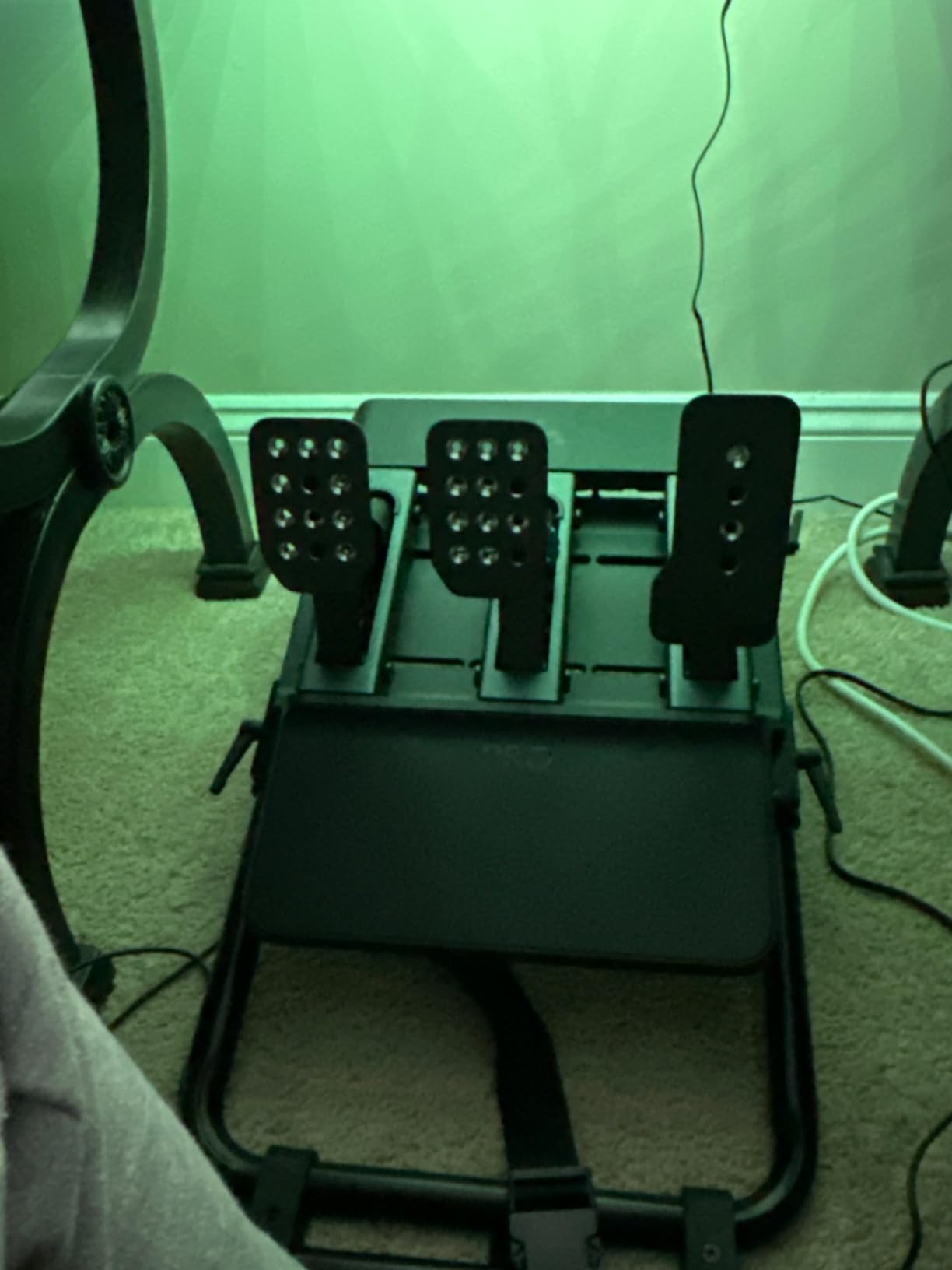
The modular frame is the quietly excellent part. You can slide each pedal horizontally and pull a module out entirely, so a two-pedal layout with the clutch stacked out of the way takes seconds. On a cockpit that also carries a shifter, that spacing flexibility matters more than any spec on the box.
Sensor choice is sensible too. The brake reads force, while the accelerator and clutch use contactless Hall effect sensors, which have no physical wiper to wear out. That split is exactly how an endurance racer should think about a set: the pedal that sees thousands of heavy applications a session is measured by force, and the other two are measured by position.
Why the modular layout is the deciding feature
Almost every competitor here ships a fixed frame. Sliding pedal modules and removing one entirely is genuinely rare, and it solves the problem most people hit first, which is a clutch sitting exactly where their right foot wants to be.
It also lets you keep one set of hardware across two very different cars. A formula car runs the clutch almost constantly with a heel-and-toe technique, while an endurance car barely touches it. Being able to shift the pedals between sessions without re-drilling a mount saves real setup time.
Where it falls short
The wiring catches new owners out. These pedals plug directly into a USB port on the PC rather than passing through the wheel base, which trips up anyone coming from a bundled pedal set that routes through the wheel.
Console support also has a caveat. It is genuinely the widest platform coverage in this roundup, but if you want the brake resistance and calibration HUD on the wheel rim itself, older Logitech wheels need the separate G Racing adapter, and non-Logitech wheels lose that display entirely.
2. MOZA SRP2 – Best Value Load Cell Pedals
MOZA SRP2 Pedals Set Throttle Brake Pedal Equipped With 100KG Load Cell
100kg load cell brake
Sensor fusion angle and force
CNC aluminium frame
PC only, USB
Pros
- 100kg load cell with angle and force sensor fusion
- CNC aerospace-grade aluminium keeps the frame rigid
- 25 brake feel configurations from the box
- Two-stage pedal angle with spacing and height adjustment
Cons
- Two-pedal layout only with no clutch included
- 25 factory feel settings is limited without the Performance Kit
- PC only with no console support
The SRP2 is the cheapest way onto force-based braking in this roundup, and the compromise is honest. You get a 100kg load cell in a CNC-machined aluminium frame, which is the same force rating as the Logitech set at a much lower outlay.
What you give up is the clutch. This is a two-pedal set, throttle and brake only, and MOZA does not sell a clutch module to bolt on later. If you drive manual-transmission cars in your sim, read the clutch section below before you commit.
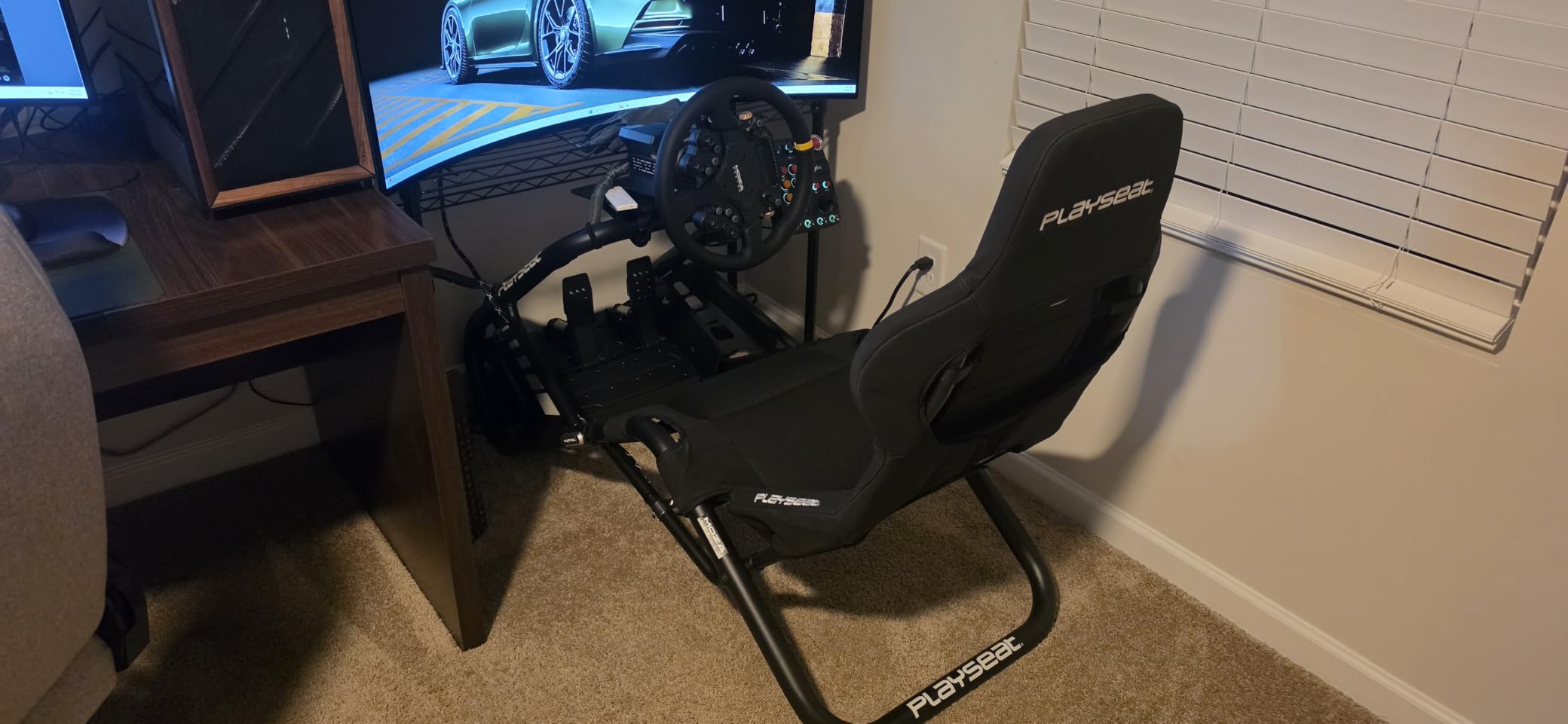
The sensor fusion here is interesting. Rather than a pure load cell, it merges the force reading with a 15-bit angle sensor, so the software can shape the response using both travel and pressure. In practice the brake trace was smooth and repeatable, and the reported force stayed consistent across a long session.
Ergonomic adjustment is unusually thorough for an entry set. The pedal face has two angle positions at 10 and 25 degrees, spacing adjusts 15mm either way, and height covers a 36mm range. That is enough range to fit a low seated posture or a raised pedal plate without a custom bracket.
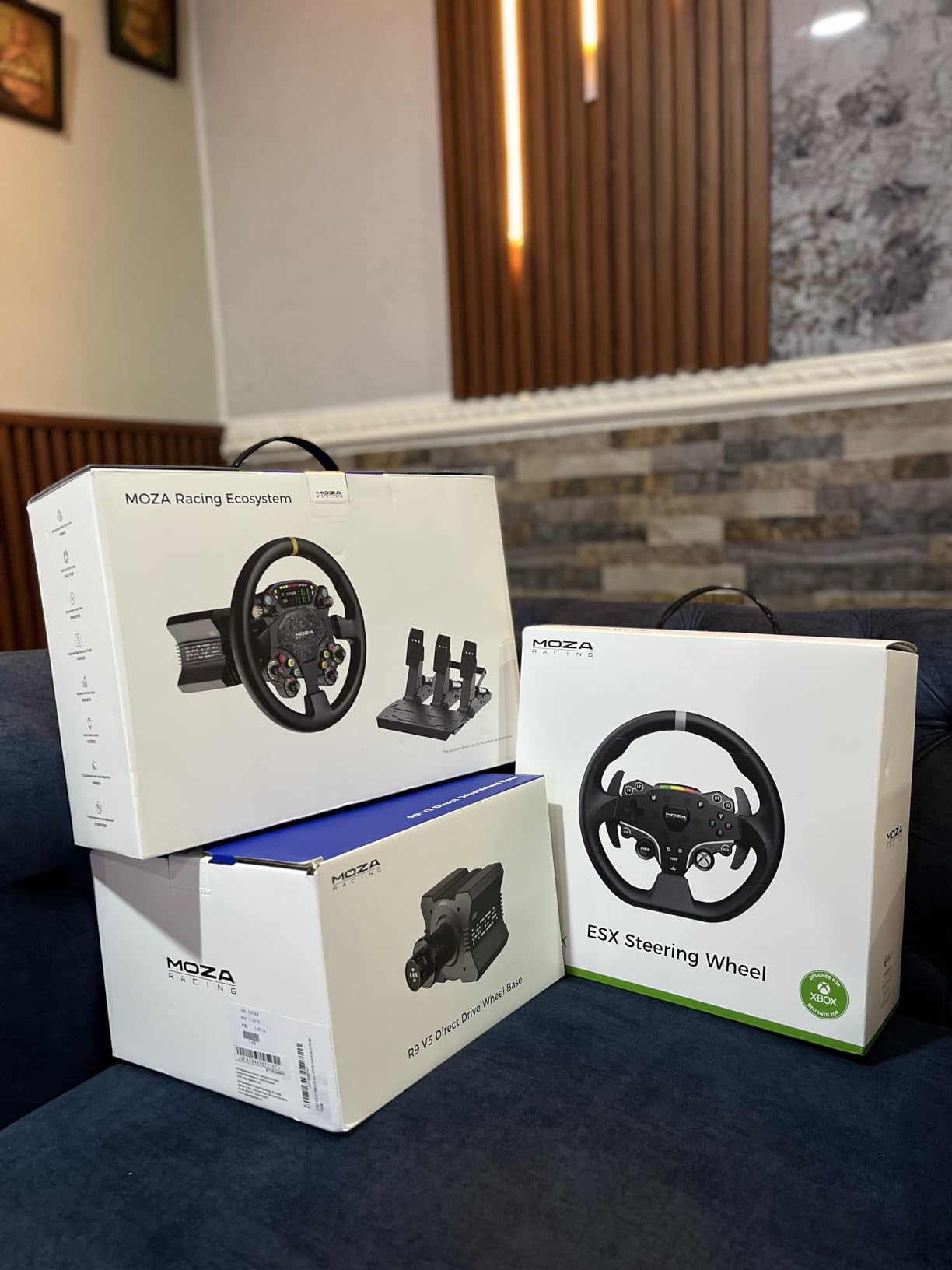
Check whether you can live with two pedals
Two pedals is not a lesser product, it is a narrower one. If you race hypercars, GT3 cars and anything with a sequential gearbox, two pedals is genuinely all the game asks for and this set is the efficient choice.
The regret case is specific: if you ever want to drive a manual gearbox car with a clutch, you are replacing the whole set. That is the main reason we do not put this first despite the low price.
What the limited feel configurations cost you
Out of the box the brake has 25 feel combinations drawn from the standard elastomer and multi-hardness spring set. That is enough to find a decent setting and not enough to properly dial a car in across a full field.
The optional Performance Kit raises that to more than a thousand combinations, which turns this into a much more capable pedal. I would budget for it if you are the type who spends a season tuning rather than driving one setup all year.
3. MOZA CRP2 – Premium 200kg Load Cell Pedals
MOZA CRP2 Load Cell Pedals (Throttle+Brake) Driving Sim Racing Pedal, Black
200kg load cell brake
15-bit angle sensor
125 combination damper
Carbon fibre heel plate
Pros
- 200kg cell gives a higher ceiling and finer resolution
- Angle sensor and load cell let you tune travel and pressure
- Combination brake damper changes feel without a full swap
- CNC aluminium with a carbon fibre heel plate
- Tool-free adjustment and inverted mounting
Cons
- Two-pedal configuration as listed with the clutch as a separate variant
- This listing covers PC and Xbox but not PlayStation
- Costs more than most two-pedal load cell sets
Double the cell capacity is not a marketing number you can feel on its own, but what you notice is resolution. The CRP2 brake traces noticeably smoother than smaller-cell sets, particularly at the light threshold braking range where a low-capacity cell gets coarse and you start fighting the resolution rather than the car.
Owners consistently describe the brake as quiet, which sounds trivial until you have used a set that rattles. The CNC aerospace-grade aluminium body and carbon fibre heel plate keep the mass where it needs to be, and nothing in the frame moved under full pressure.
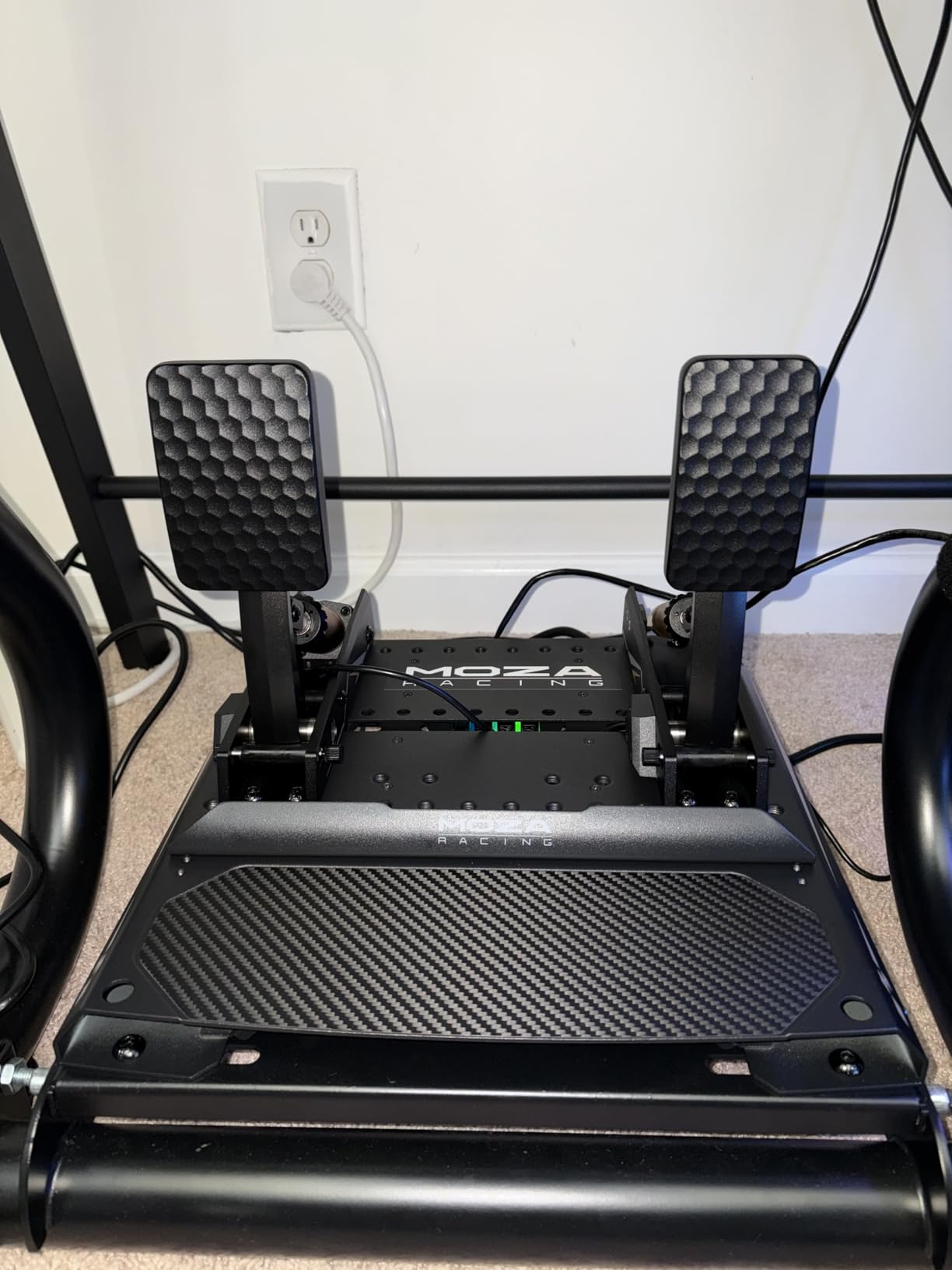
The 125 combination brake damper is the feature I would point a first-time buyer at. Instead of pulling an elastomer to change the character of the brake, you adjust a combined damper setting, which is a much wider adjustment range for much less effort.
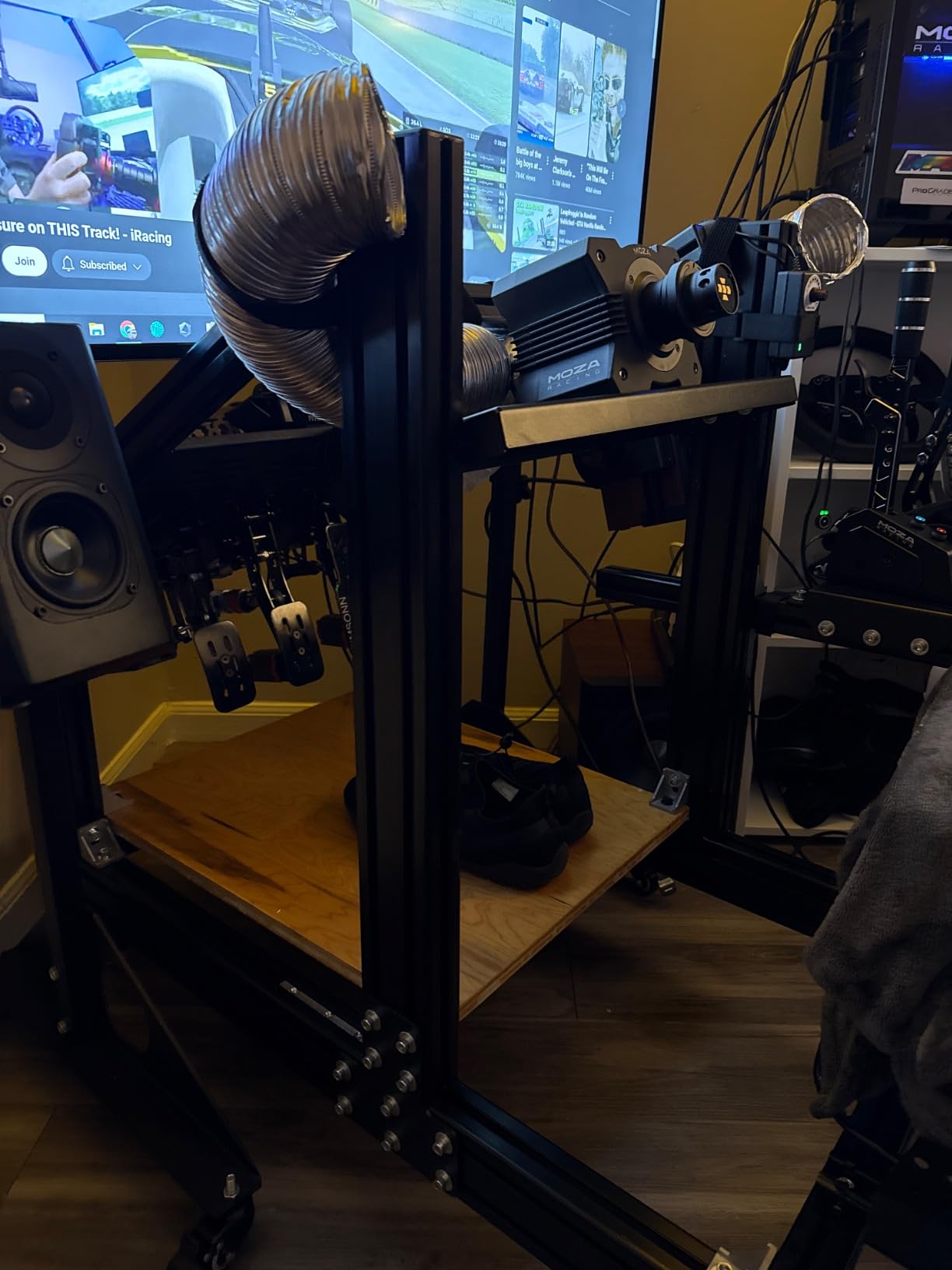
Tool-free, wide-range adjustment covers pedal positions, and the frame supports inverted mounting, so it fits a low-profile aluminium cockpit where a taller footrest would clash with the wheel. For rig builders that flexibility is worth real money.
Where the extra force capacity actually pays off
It pays off in heavy cars and for drivers who brake with a lot of leg. If you routinely trail a big rig around a circuit at the limit, a higher ceiling means the sensor is still resolving pressure when the pedal is close to the floor, not already pinned at its maximum.
It also helps if you move between a light formula car and a heavy GT car on the same rig, because one setting does not have to cover both.
The two-pedal question again
Same caveat as the SRP2, and here it stings more. The clutch exists as a separate variant of this pedal, so the two-pedal version is not a modular two-pedal version.
Platform coverage is also narrower than the Logitech set: PC and Xbox are covered, PlayStation is not. If your sim racing happens on a PS5, this one drops out of consideration entirely.
4. Thrustmaster Raceline Pedals III LC – Best for Console Racers
Thrustmaster Raceline Pedals III LC – 3-Pedal Simracing Set Featuring Brake Pedal with Load Cell Sensor (220 lb / 100 kg) – for PS5, PS4, Xbox Series, Xbox One, PC
24-bit load cell 100kg
Hall effect gas and clutch
Preload dial, 25-100kg
PC PS4 PS5 Xbox
Pros
- 24-bit load cell resolution is the highest in this group
- Full three-pedal layout with Hall effect gas and clutch
- All-metal modular frame with adjustable pedal positions
- Brake force configurable from 25kg to 100kg
Cons
- Initial bite still feels position-sensor-like next to a true hydraulic set
- Spring and elastomer changes alter weight more than feel curve
- Advanced settings need the T598 Race Dash or PC software
- An early review reports a brake unit the wheel could not detect
This is the only set here that gives a console racer a genuine three-pedal load cell layout without moving to a different brand for everything. On PS4, PS5, Xbox One and both Xbox Series consoles it works with a Thrustmaster Force Feedback base, and on PC it works with any wheel base at all.
The 24-bit resolution rating deserves a reality check. Owners who moved up from the older T-LCM point to the jump, while also being candid that the difference is not really perceptible in the game. The spec is real; the practical gain over a 16-bit cell is small.
What is more tangible is the tuning range. Brake force is configurable from 25kg up to 100kg across four configurations, three springs and one elastomer buffer, plus a preload dial that shifts the feel by plus or minus 5kg. That preload dial is how you simulate threshold braking behaviour without needing a hydraulic set.
What the preload dial is actually for
Preload is pressure the pedal resists against at rest. A higher preload makes the first millimetre of travel feel like you are pushing against something, which is closer to a real brake pedal and to modern cars with brake-by-wire.
Drivers who come from a potentiometer set often find this one adjustment does more for realism than swapping springs does. The dial gives roughly 5kg of fine adjustment either side of your spring setting, which is a granularity no elastomer swap can match.
Why the rating is the lowest here
The 4.1 average reflects a small sample, and a meaningful share of one-star reviews concern brake units the wheel could not detect after a firmware update. That is a small number of reports but it is a real risk, so check the return terms carefully before you commit.
There is also a feel point. This is a spring-and-elastomer brake, not hydraulic, and drivers who have used a true hydraulic pedal describe the initial bite as position-sensor-like by comparison. The load cell fixes your braking consistency; it does not give you a hydraulic feel.
Worth knowing before you choose: the pedal set and the wheel are a matched ecosystem on console. If you are still on a belt-drive wheel, check our [racing wheel comparison](https://www.exponation.net/best-sim-racing-wheels/) to see whether a direct drive base makes more sense as your next purchase.
5. ASETEK SimSports La Prima – Built for Heavy Duty
ASETEK SimSports La Prima™ Load Cell Sim Racing Pedals | Adjustable and Customizable Sim Pedals Arms | Built to Replicate Real-Life Racing sim | PC Compatible
Load cell with physical stop
Die-cast aluminium frame
Rated to 440lb force
PC only, USB-C
Pros
- Die-cast construction rated to 440lb with a 1543lb burst
- Zero-play brake and throttle movement
- Physical stop and expansion chamber mimic a real brake
- Tested to one million actuations
- Upgrade path to the Forte pedal set
Cons
- Only two elastomer options for brake feel
- PC only with no console support
- Smallest review base in the group so longevity data is thin
The La Prima is the one in this roundup built like a piece of motorsport equipment rather than a game peripheral. The frame is die-cast aluminium, not extruded or CNC-machined plate, and the manufacturer rates it to 440 pounds of force with a burst figure of 1543 pounds.
That rating is about surviving abuse, not about sensor quality. The set was tested to one million actuations, which is the number that matters if you drive a lot. If your idea of sim racing is thousands of laps a year, this is the frame that will still be there.
The design detail I like most is the physical stop and expansion chamber on the brake. Most load cell pedals have a rubber travel stop and nothing else. This one has a chamber meant to reproduce the progressive feel of a real brake, and the brake does feel like it builds resistance rather than simply measuring harder.
What the physical stop changes
A travel stop sets where the pedal bottoms out and gives you a repeatable full-brake point. On a load cell set that matters because the sensor is reading force, so the stop is the only thing telling your foot when braking is maxed.
The expansion chamber adds damping ahead of that point, which is closer to how a real hydraulic brake feels as fluid pressure builds. It is a small feature with a real effect on the shape of the brake curve.
Two elastomers is genuinely few
Every other set here gives you three elastomer options or a set of springs and elastomers combined. Two options gets you a light and a heavy setting and not much in between, and that is the most common reason owners rate it well but wish for more.
There is a good answer, though. The La Prima upgrades to the Forte pedal set through a dedicated upgrade kit, which is the most direct route to a hydraulic feel on this chassis. If you are likely to want hydraulic eventually, starting here is a rational path rather than a dead end.
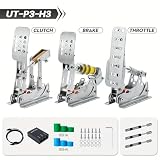
6. SimJack UT-P3-H3 – Sensor Specs That Outclass the Price
Simjack UT Sim Racing Pedals 200KG Load Cell Brake Pedal PC Racing Simulator Pedals Pressure Sensor HE Hydraulic Pedal (UT-P3-H3)
200kg load cell, linear input
16-bit ADC, 32-bit processor
60/80/90 hardness damping
PC only, USB
Pros
- 200kg load cell gives true linear pressure input
- 16-bit ADC and 32-bit dual-core controller resist interference
- 60/80/90 hardness rubber damping plus 6mm brake load path
- Simjack Control software with curves and dead zones
- Works with Heusinkveld control boxes and elastomers
Cons
- PC only with no console or Mac support
- Stock brake elastomers feel stiff out of the box
- Response curve graph in the software is hard to read
- Baseplate sold separately so some mounts need drilling
On paper this is the most technically advanced set in the group, and it holds a 4.8 average from owners. The load cell is rated at 200kg and reports true linear input, and the control board runs a 32-bit dual-core processor with a dedicated 16-bit independent ADC in an aluminium casing for interference resistance.
That processing matters more than spec sheets usually admit. The board samples all three channels simultaneously and is specifically designed to reject interference from a direct drive base or a four-axis motion seat, which are exactly the setups where cheap pedal electronics tend to produce a noisy or drifting trace.
Mechanically it is serious hardware. The frame is 3mm CNC laser-cut stainless steel with the brake load-bearing section thickened to 6mm, and the damping rubber comes in 60, 80 and 90 Shore hardness options.
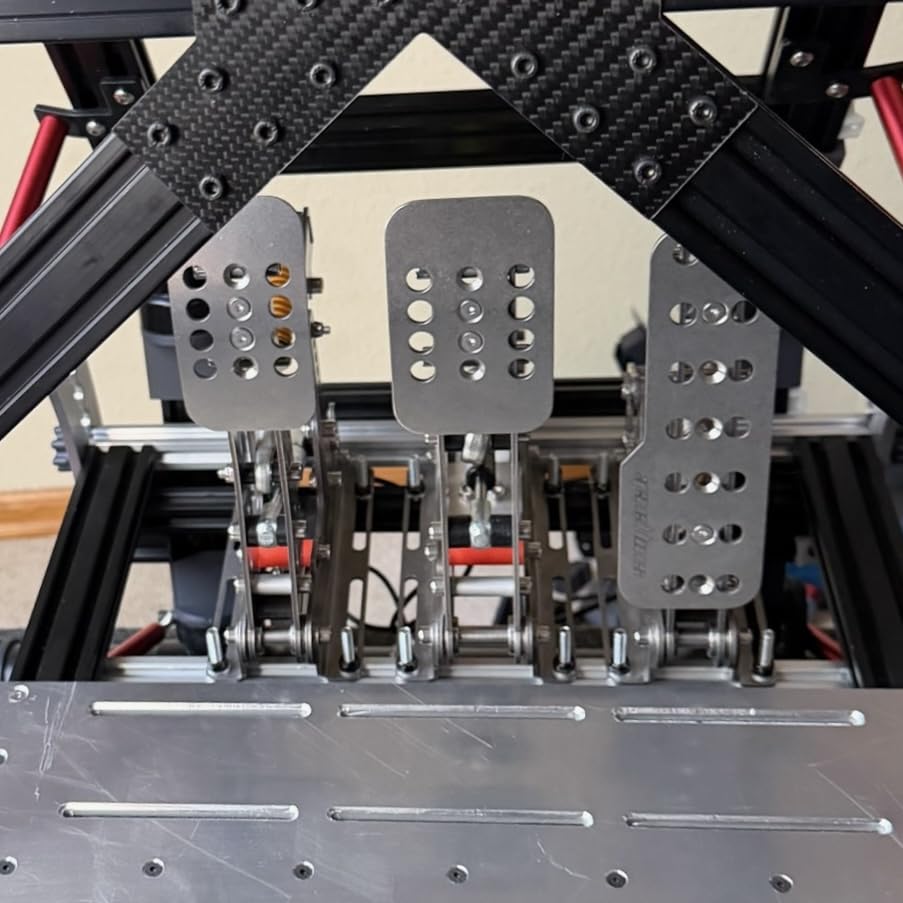
The compatibility with Heusinkveld control boxes, elastomers and rods is an underrated detail. Heusinkveld parts are expensive and widely used, so being able to reuse a control box you already own meaningfully reduces what a rebuild costs.
Owners consistently report the same thing after switching from budget load cell pedals: a smoother, more consistent brake trace and much better fine control at low pressure, which is precisely what threshold braking depends on.
Plan on some setup work
This is the set the community most often describes as needing tinkering. The stock brake elastomers come out stiff, and the recurring recommendation is to swap them or tune the damping before judging the pedal.
The baseplate is also not part of this listing, so depending on your rig you may need a plate and some drilling to mount it properly. Budget an evening with hex keys before your first session rather than assuming it will work straight out of the packaging.
Software that rewards patience
Simjack Control gives you linear output curves, dead zones, brake curve adjustment and savable profiles that apply across simulators without remapping. That is the full feature set you would want, with nothing missing.
The response curve graph in the interface is genuinely hard to interpret, though, so budget time to read it. If you like seeing your inputs on a curve while you tune, some commercial sim software presents that more clearly.
7. SIMSONN Plus X – Progressive Feel on PC
SIMSONN Plus X Sim Racing Pedals PC Racing Simulator Load Cell HE Hydraulic Pedal Support Haptic Reactor (Black P3-H3)
Hydraulic progressive brake
60HA/70HA/80HA elastomers, 13 spacers
Dual-bearing design
PC only, USB
Pros
- Hydraulic brake gives a progressive non-linear feel
- 13 spacers and three elastomer grades for fine tuning
- Dual-bearing design for low-play travel
- Control box has three vibration module ports
- Manager software saves non-linear curves and dead zones
Cons
- Haptic Reactor is a separate add-on needing its own control box
- PC only and accessories carry a shorter warranty
- Brake tuning takes more adjustment than a spring set
The Plus X is here because it is not a pure load cell set, and pretending otherwise would be dishonest. The brake is hydraulic, which means it gives a progressive, non-linear feel closer to a real racecar pedal than any spring and elastomer arrangement can.
What the hydraulic unit does is slow the pedal in and out slightly, restore a non-linear force curve and simulate the dynamic response of a real clutch. In the hand the brake builds resistance rather than arriving at a fixed rate, which is the quality that makes a real brake feel like a brake.
Tuning runs through 60HA, 70HA and 80HA elastomers combined with 13 spacers, and that combination count is where the adjustment lives. You are not choosing between three springs, you are building a curve.
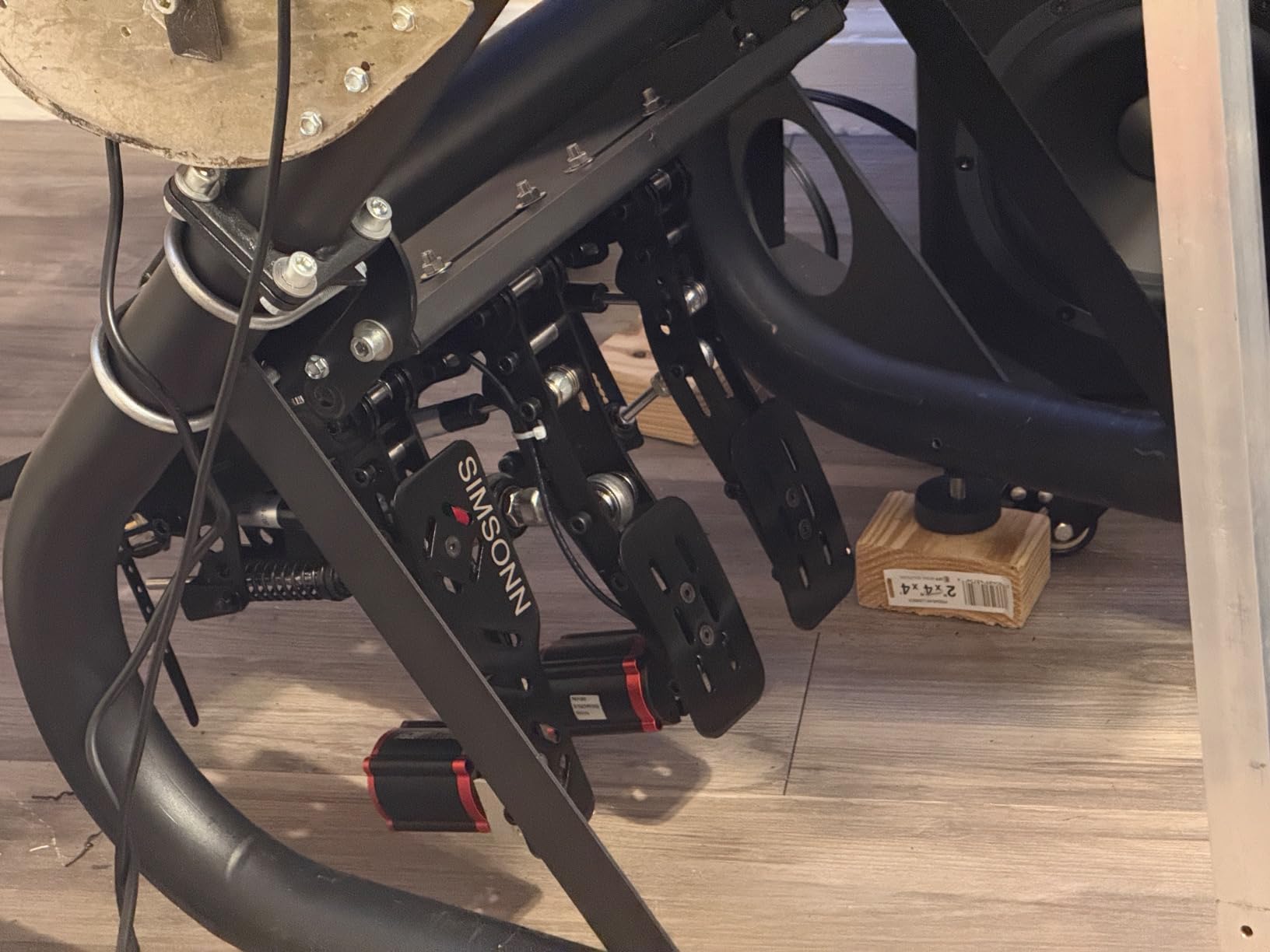
The dual-bearing design, using flange bearings and plain bearings together, keeps pedal travel smooth and low in play. On a brake pedal, play shows up as delay, and delay is the enemy of threshold braking, so this is a quietly important detail.
The upgraded control box has stronger anti-interference circuitry and three vibration module ports for SIMSONN haptic hardware. It runs on PC only, over plain USB, with no driver installation.
Who this pedal is actually for
Drivers who have already tried a load cell set and found their braking consistent but the feel still too linear. That is a very common plateau, and hydraulic damping is the standard answer to it.
It is also a good choice if you mostly drive one car and want to spend time shaping the brake rather than building a rig. The spacer and elastomer system gives you more to work with than the spring sets.
The add-on confusion to watch for
The haptic reactor is a separate item you add to your order if you want it, and pairing it with the PRO or PRO PLUS pedals needs an additional PLUS X control box bought separately. Get that wrong and you end up with an expensive box that does nothing.
There is also a warranty asymmetry to note. The pedals carry a 12-month warranty while accessories are covered for 3 months, which is worth remembering if you plan to run haptic hardware alongside them.
8. SIMSONN PRO X Ultra – Most Adjustable Three-Pedal Set
SIMSONN PRO X Ultra Sim Racing Pedals PC Racing Simulator Load Cell HE Hydraulic Pedals Support Haptic Reactor (PRO X Ultra P3-H3)
Load cell and hydraulic damping
8-level resistance rod
Six-chip control board
RGB pressure display
Pros
- Load cell with 8-level hydraulic resistance rod
- 60HA/70HA/80HA elastomers with 10 spacers
- Dual 32-bit processors and a 16-bit ADC with differential amplifiers
- Adjustable height
- angle
- travel and force curve
- 24-month warranty on the pedals
Cons
- Baseplate not included so a compatible mount is needed
- Smallest review base in the group at 7 reviews
- PC only over USB-C
The PRO X Ultra takes the load cell and hydraulic ideas from the Plus X and combines them in a single brake, which is the most interesting engineering choice in this roundup. The pedal is measured by force, while an adjustable hydraulic resistance rod with eight levels shapes how that force feels.
That is a meaningful difference from a pure hydraulic set. The force reading stays repeatable, so your braking points hold, and the rod gives you the progressive feel that a spring assembly cannot. For a driver who wants both properties, nothing else here does this.
The control board is the most elaborate in the group, with six chips: two independent 32-bit processors, a dedicated 16-bit high-resolution ADC for synchronous signal acquisition, and three fully differential amplification chips for noise immunity. Sampling runs across all three channels at once.
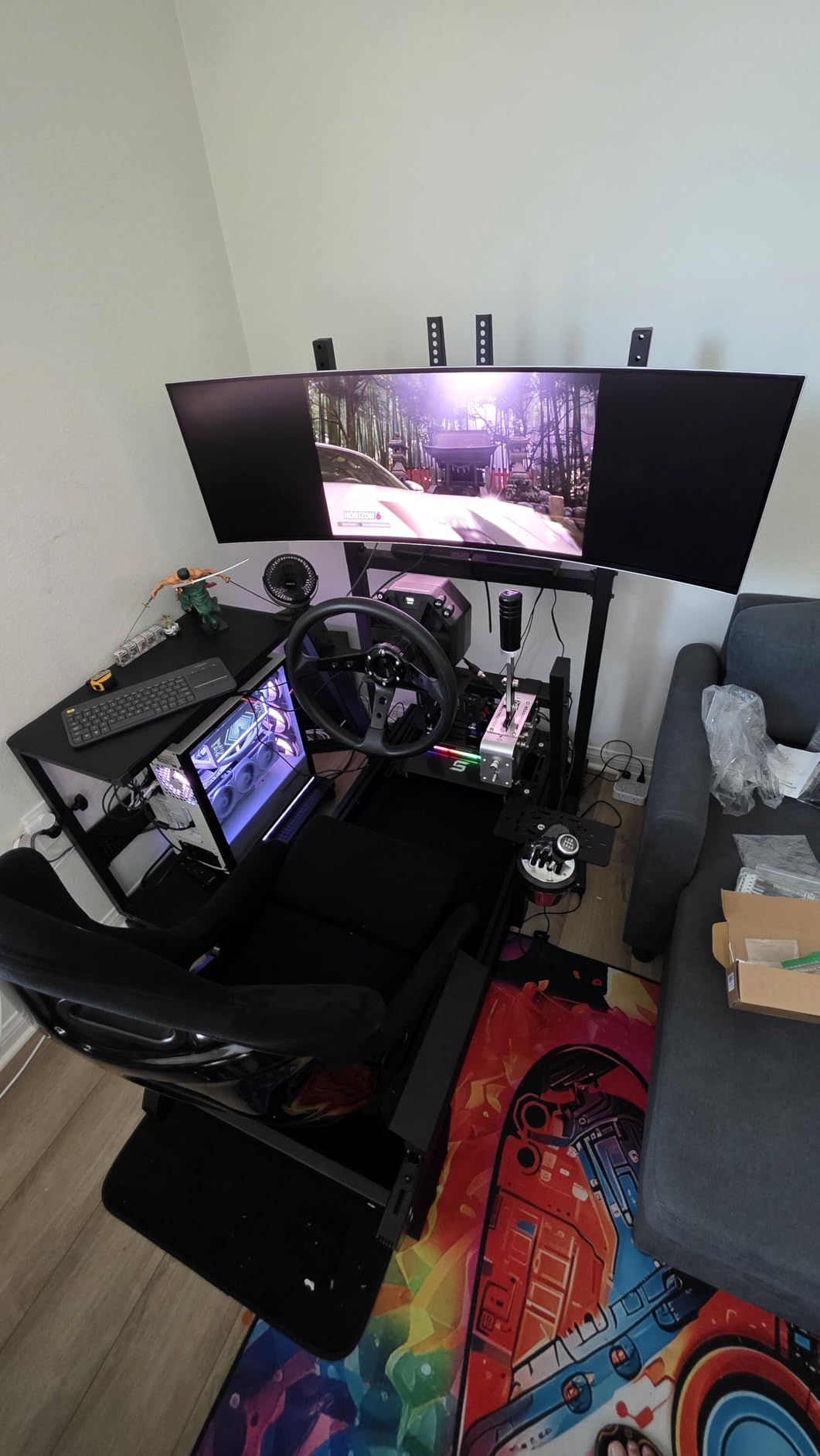
On the frame, 3mm laser-cut high-strength steel with the brake load path thickened to 6mm and panels at 4mm gives a solid base, and the dual-bearing design keeps travel consistent. Multi-dimensional adjustment covers panel height, angle, travel distance and force curve, all independently per pedal.
Two details stand out for the money. The warranty is 24 months on the pedals, twice the 12 months on the comparable Plus X, and the RGB lighting displays live pedal pressure and can sync across SIMSONN devices, which is a genuinely useful tuning aid rather than decoration.
The sample size is small, and that matters
Seven reviews is the smallest sample in this roundup, and I would be misleading you to treat the 4.7 as settled. The owners who did comment were positive about the crisp clutch return and the non-spongy brake, and the one negative review concerned after-sales responsiveness rather than the hardware.
My honest read is that this is a well-specified product with thin long-term evidence. If you are comfortable being an early adopter, the 24-month warranty is the risk mitigation that makes it reasonable.
What you need to add before it will mount
No baseplate is included in this configuration, so you need a compatible plate or a rig mount that accepts it. That is normal in this category but worth factoring into the total cost if you are building a cockpit from scratch.
Multi-dimensional adjustment then pays for itself, since you can set each pedal independently rather than compensating for a fixed frame. On a mixed car and endurance setup where the clutch position changes constantly, that is worth working out.
Load Cell vs Hydraulic Pedals: Which One Should You Buy?
This is the question that comes up most often after the roundup list, and it is the one almost nobody in this space answers directly. So: load cell pedals measure force, hydraulic pedals measure nothing and instead deliver a fluid-mediated feel. They solve different halves of the same problem.
A load cell gives you precision, adjustability and software curves. The measured force is repeatable, so your braking point does not move as your leg tires, and you can reshape the response in software without touching hardware. That is why every set in the roundup above is load cell first.
Hydraulic pedals give you a progressive, non-linear feel closer to a real racecar brake, and they are heavier, which adds to the sense of a mechanical object rather than an accessory. What they do not give you is force measurement, so your consistency comes from the mechanical feel rather than from a sensor.
The practical difference shows up at the threshold. On a load cell pedal you can brake at 15 percent and hold it there lap after lap. On a hydraulic pedal the early travel has more natural progression, so it feels more realistic, but the precision has to come from your foot.
My rule of thumb: if you are moving up from bundled potentiometer pedals and you want repeatable braking now, buy load cell. If you have already run a good load cell set and still find the feel too linear, hydraulic is the next step, not a lateral move.
Two sets in this roundup sit close to that line. The SIMSONN Plus X is hydraulic. The SIMSONN PRO X Ultra combines a load cell with an adjustable hydraulic resistance rod, which gets you both properties if you can accept the thinner review history.
Two-Pedal or Three-Pedal: Do You Need a Clutch?
You need a clutch pedal only if you drive a car in your simulator with a manual gearbox. That sounds obvious, but it is the single most regretted purchase decision in this category, because a two-pedal set cannot be upgraded with a clutch later.
You do not need one for GT3 cars, endurance prototypes, hypercars, or anything with a sequential or paddle-shift gearbox. Those cars are shifted with paddles on the wheel, so a clutch input is never required.
You do need one for manual-transmission road cars, touring cars with a clutch, rally cars with a H-pattern gearbox, and any sim where you start from a standstill in traffic. The best-known names for that last group are the road car titles in the major sims.
A clutch also improves heel-and-toe technique in formula cars. A second foot resting on the clutch is a more stable platform for the braking foot, and drivers who add one often find their trail braking improves simply because their foot stops trembling.
Rule for buying: if you are still deciding what kind of racing you want to do, buy three pedals. The extra cost is recoverable because you can leave the clutch unused, whereas going back for a two-pedal set after you discover a manual gearbox title means buying a new set.
How to Calibrate Load Cell Pedals: A Step-by-Step Setup
Every set arrives with a default profile that is wrong for you, and the fastest way to get a bad impression of a good pedal is to leave it there. This sequence takes about twenty minutes and I have used it on every set in this roundup.
1. Set the pedal angle first, between 5 and 20 degrees from the floor, before you touch any software. A pedal face that is too steep or too flat changes the force you need to hold, and everything downstream will be tuned around a bad geometry.
2. Set the heel pivot before anything else on the pedals. Your heel should rest flat on the floor with the ball of your foot on the pedal face. If you have to angle your foot to reach the pedal, spacing or height is wrong, not your technique.
3. Set the brake dead zone next. A dead zone ignores a small range of input at the start of travel, which cleans up a wandering initial press. Start small, around 2 to 3 percent, and raise it only if you are getting accidental braking.
4. Tune spring tension and elastomer hardness now, not before. On a force-measuring pedal the spring sets the resistance curve, and swapping the elastomer changes both weight and feel at once. Change one variable, drive ten laps, and note the result.
5. Set the brake curve for the car, not the pedal. A stiff car wants a late aggressive curve, a road car with traction control wants an earlier one, and a good brake curve is the single largest lap-time change available to you without touching the wheel.
6. Check the mount with a full-pressure push test. Brace the frame with your full braking force and watch for movement. If the pedal plate flexes, the load cell is reading your rig bouncing and the brake trace will be inconsistent no matter how good the sensor is.
7. Save a profile per simulator and per car class. Every set here has software that supports this, and re-tuning the same pedal for every car you own is a good way to never finish setting anything up properly.
Once the pedals are dialled in, put the effort into the rest of the rig. Pedal feel interacts with everything above it, so it is worth checking our [sim racing wheel guide](https://www.exponation.net/best-sim-racing-wheels/) to confirm the wheel is not the thing limiting your consistency.
Buying Guide: What to Check Before You Buy Load Cell Pedals
Brake load rating, treated as a ceiling. The number in kilograms is the maximum force the sensor can read before it saturates, not a quality score. A saturated brake feels vague the moment you lean on it, because the input stops rising while your foot keeps pressing. Aim for at least 80 to 100kg for general driving, and consider 200kg if you drive heavy cars or trail braking hard. Below 80kg you are fine for a first step up, but the ceiling will show in heavy cars.
Frame rigidity. A load cell measures force, so anything that absorbs force between your foot and the sensor corrupts the reading. Die-cast, CNC aluminium and thick steel all hold up under braking. Thin plate on a swivel stand is where load cell advantage disappears, and it is the most common reason someone concludes the technology does not work for them.
Adjustability that does not need tools. Look for swappable springs, multiple elastomer grades, a preload dial, and independent adjustment of each pedal position. Rated hardness is given in Shore values, commonly 60 through 90, and a wider spread gives you a wider usable range. Pedal angle, spacing and height adjustment all matter more than people expect, because a pedal you cannot sit comfortably on is a pedal you cannot press consistently.
Mounting method. Confirm the footprint and whether a baseplate is included. Some sets support inverted mounting for low-profile cockpits, and some ship without a plate at all. If you are on a wheel stand, check that the stand is rigid enough to take full braking force without the pedal assembly tipping or flexing.
Platform and how the pedal connects. There are three connection models and mixing them up causes more confusion than any spec. A USB standalone set plugs into the computer directly and is PC only. An RJ12 set routes through a compatible wheel base, and the wheel base has to speak the pedal’s protocol. A licensed base is required for official PlayStation or Xbox compatibility, so check the wheel brand as well as the pedal brand before buying for a console.
How the brake is tuned in software. Any serious set should let you set a dead zone, build a brake curve, adjust the range, and save profiles per simulator. If the software only offers a sensitivity slider, you have a less capable set than the load cell rating suggests.
Who you are actually buying from. This category has a lot of direct-import brands, and community threads consistently flag the same risks: unclear return terms, accessories that need buying separately, and firmware or assembly work before first use. Check the warranty length on the pedals specifically, because accessory warranties are often much shorter. If you are on a console, the platform list in the product page is the fastest filter of all.
Frequently Asked Questions
Is it worth getting load cell pedals for sim racing?
Yes, for most drivers it is the single biggest upgrade to a cockpit. A load cell measures how hard you press rather than how far the pedal travels, so your braking point stops drifting as your leg tires through a stint. Drivers coming from spring or potentiometer pedals usually notice the improvement in threshold braking within a few laps. It only makes sense on a reasonably rigid rig, though, because a flexing frame absorbs force before the sensor ever sees it.
Do load cell pedals work on PS5 and Xbox consoles?
Only some of them, and you usually need a matching wheel base. Console compatibility comes through a licensed base rather than from the pedal itself, so the pedal and the wheel have to speak the same protocol. The Logitech G PRO covers PC, PS4, PS5 and Xbox across any wheel, while the Thrustmaster Raceline Pedals III LC covers PS4, PS5 and the Xbox range when paired with a Thrustmaster Force Feedback base. Several PC-only sets in our roundup have no console path at all.
Do I need a clutch pedal for sim racing?
Only if you drive a car with a manual gearbox. You do not need one for GT3 cars, endurance prototypes, hypercars, or anything using a sequential or paddle-shift gearbox, because those are shifted on the wheel. You do need one for manual-transmission road cars, H-pattern rally cars, and any title where you pull away from a standstill in traffic. A clutch also gives your braking foot a more stable platform for heel-and-toe technique. If you are unsure, buy three pedals, since a two-pedal set cannot be added to later.
What is a good load cell rating in kg?
At least 80 to 100kg covers most driving, and 200kg gives real headroom if you drive heavy cars or trail braking hard. The number is a ceiling rather than a quality score: it is the maximum force the sensor can read before it saturates. Once a brake saturates, the input stops climbing while your foot keeps pressing, and the pedal feels vague. A 75kg cell on a rigid frame gives a better brake than a 200kg cell mounted on something that flexes.
Are load cell pedals better than hall effect or hydraulic pedals?
It depends on what you are fixing. Against hall effect and potentiometer pedals, load cell wins outright because it measures force instead of travel, so your braking stays repeatable as you tire. Against hydraulic pedals, the comparison is closer. Load cell gives precision, software curves and savable profiles, while hydraulic gives a more realistic progressive feel and heavier build weight. Load cell is the better first upgrade. Hydraulic is the next refinement once your braking is already consistent.
Final Verdict: The Best Load Cell Pedals for Sim Racing
The Logitech G PRO Racing Pedals take our top spot for 2026. The 100kg load cell brake gave the most consistently repeatable braking of any set we ran, the modular sliding frame is the most useful thing on any pedal in this roundup, and tool-free spring and elastomer changes mean one set can cover a formula car and a GT car in the same week.
Buy the MOZA SRP2 if you want force-based braking for the least outlay and race cars with a sequential gearbox. Buy the MOZA CRP2 if you want a 200kg ceiling and a combination damper, and accept a two-pedal layout. Buy the Thrustmaster Raceline III LC if your racing happens on a console, since it is the only set here pairing a 24-bit load cell with a full three-pedal layout and console support.
Two honest caveats before you buy. First, the throttle and clutch on most of these sets measure travel, not force, so the load cell benefit is concentrated in your right foot. Second, none of this produces a faster lap time on its own. The community view is right that skill is the real ceiling, and what a load cell actually buys you is the same braking point every single lap.
Work through the calibration sequence above before you judge any of them, and mount whichever you choose to something rigid enough to take a full-pressure push without moving.