
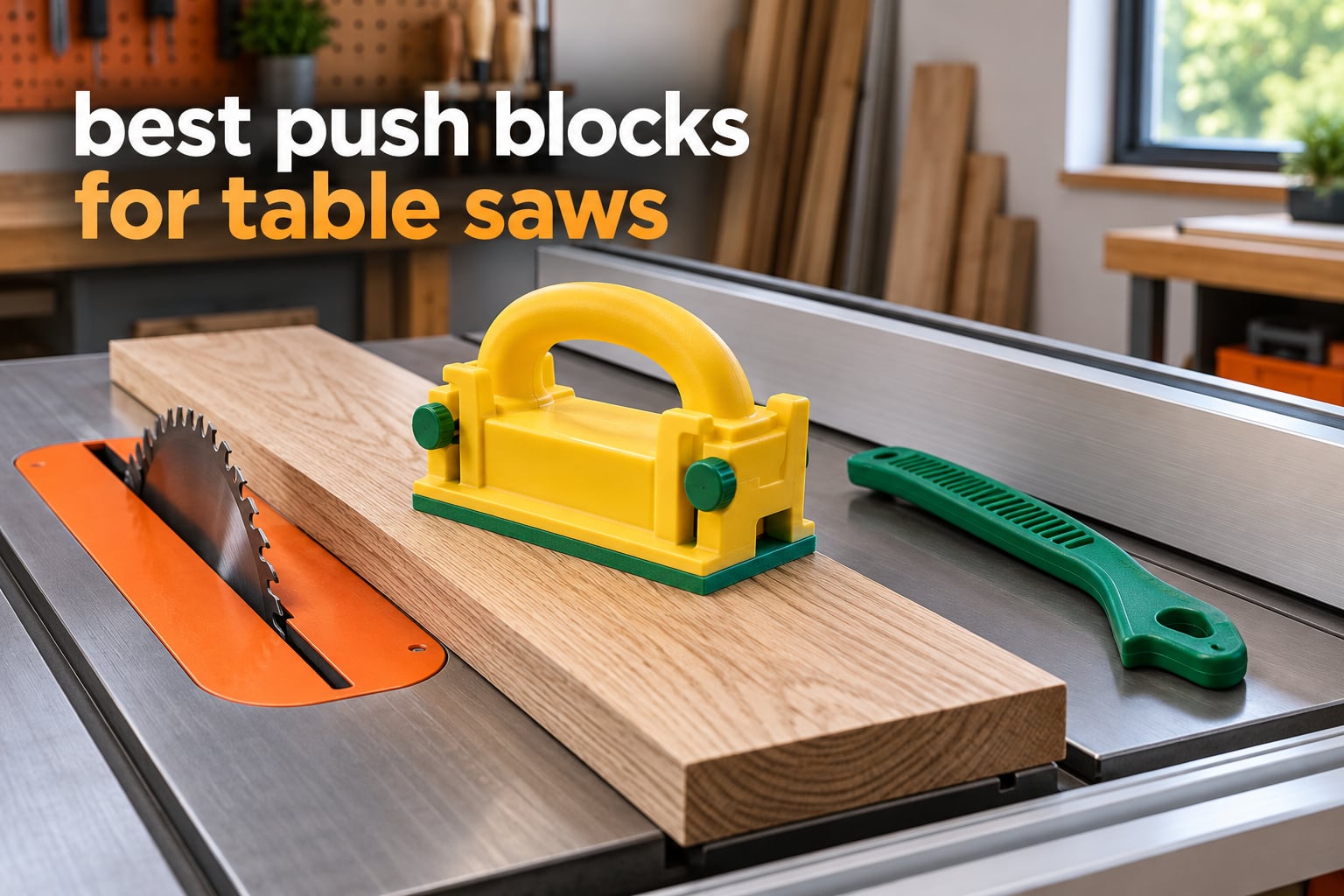
A table saw blade spins fast enough to turn a rounding error into a lost finger, and most of the worst table saw injuries happen because a board pinched the blade or twisted off the fence mid-cut. A push block is the cheapest way to keep your hands on either side of the cut line while the workpiece stays flat and tight against the fence.
The best push blocks for table saws apply three pressure vectors at once: downward so the workpiece cannot lift, inward so it cannot drift off the fence, and forward so the cut tracks straight. Our best overall pick, the Peachtree 5-Piece Safety Push Block and Push Stick Set, covers more configurations than any single tool we tested, and the MICROJIG GRR-RIP BLOCK GB-1 carries the highest owner rating in the group.
We spent several weeks running these eight through cabinet-grade rip cuts, thin strip work, and jointer duty, and we compared them on grip, top-surface contact, narrow-rip capability and handle comfort rather than on marketing language. If you are still choosing a saw, our tested table saw picks for home workshops cover the machines these tools were used on.
Table of Contents
Top 3 Best Push Block Picks for Table Saws in 2026

Peachtree 5-Piece Safety Kit
- Five tools in one set
- Washable foam grip pads
- High-visibility orange

POWERTEC Grab 71794
- Dual retractable end holders
- Textured anti-slip padding
- Offset ergonomic handle
All 8 Push Blocks at a Glance (October 2026)
| Product | Specifications | Action |
|---|---|---|
| Peachtree 5-Piece Safety Push Block and Push Stick Set |
|
Check Latest Price |
| POWERTEC Grab Push Block with Retractable Holder 71794 |
|
Check Latest Price |
 MICROJIG GRR-RIP BLOCK Smart Push Block GB-1 MICROJIG GRR-RIP BLOCK Smart Push Block GB-1 |
|
Check Latest Price |
 Milescraft GrabberPRO 3406 Milescraft GrabberPRO 3406 |
|
Check Latest Price |
 Zebekk Push Block F03-2 Zebekk Push Block F03-2 |
|
Check Latest Price |
 MICROJIG GRR-RIPPER 2GO GR2-GO MICROJIG GRR-RIPPER 2GO GR2-GO |
|
Check Latest Price |
 Fulton Safety Push Blocks 2-Pack Fulton Safety Push Blocks 2-Pack |
|
Check Latest Price |
 Fulton Magnetic Push Sticks 2-Pack Fulton Magnetic Push Sticks 2-Pack |
|
Check Latest Price |
1. Peachtree 5-Piece Safety Push Block and Push Stick Set – Best Overall
Safety Woodworking Push Block and Push Stick Package 5 Piece Set In Safety
Weight: 2.1 lb
Dimensions: 6 x 6 x 16 in
Parts: long block, 2 short blocks, 2 sticks
Pros
- Five tools cover most shop configurations
- Washable foam pads grip well
- Bright safety orange is easy to find
- Light enough to move one-handed
Cons
- Small blocks feel light duty
- Angled-handle block not for between blade and fence
- No storage box or bag
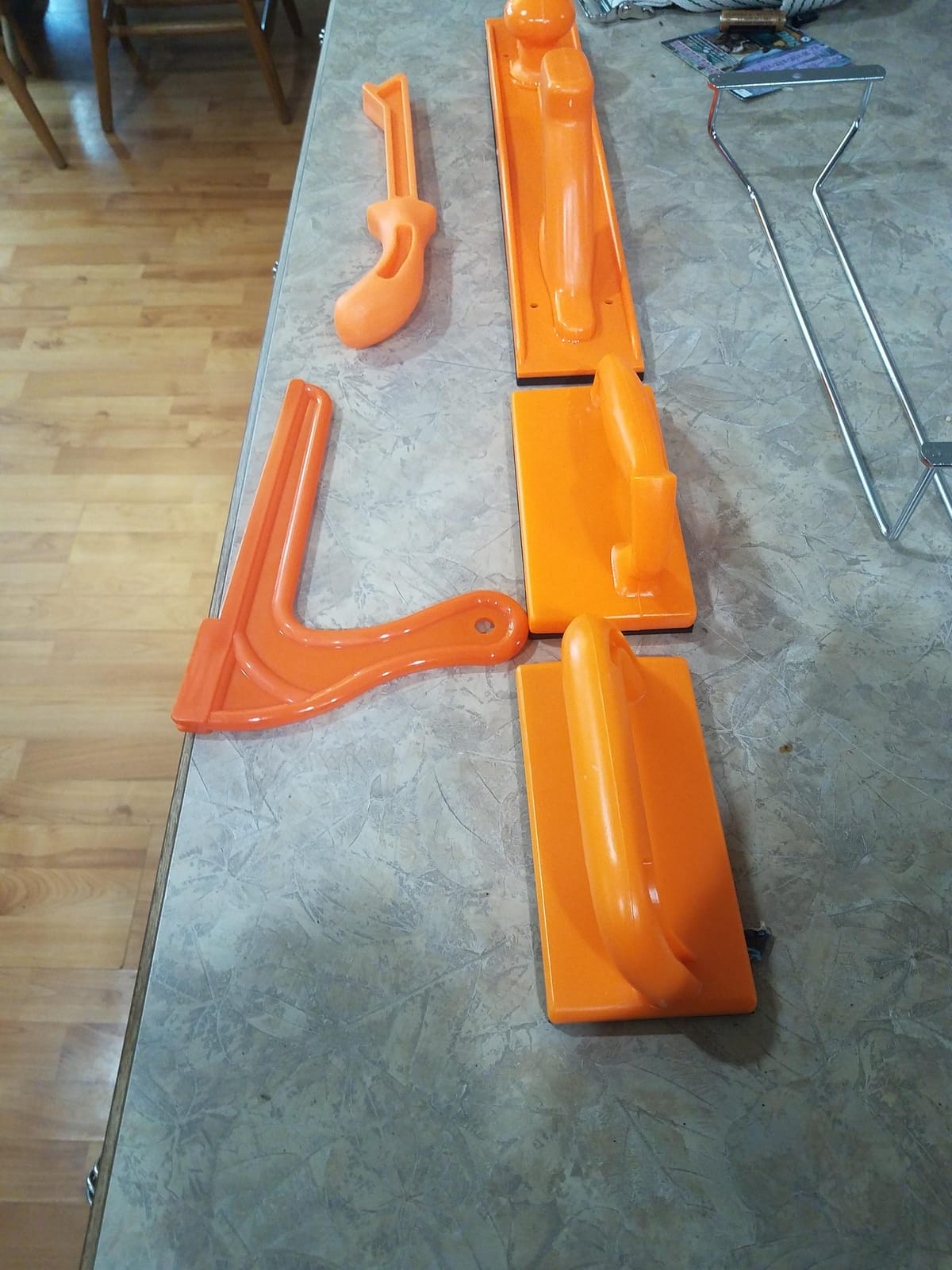
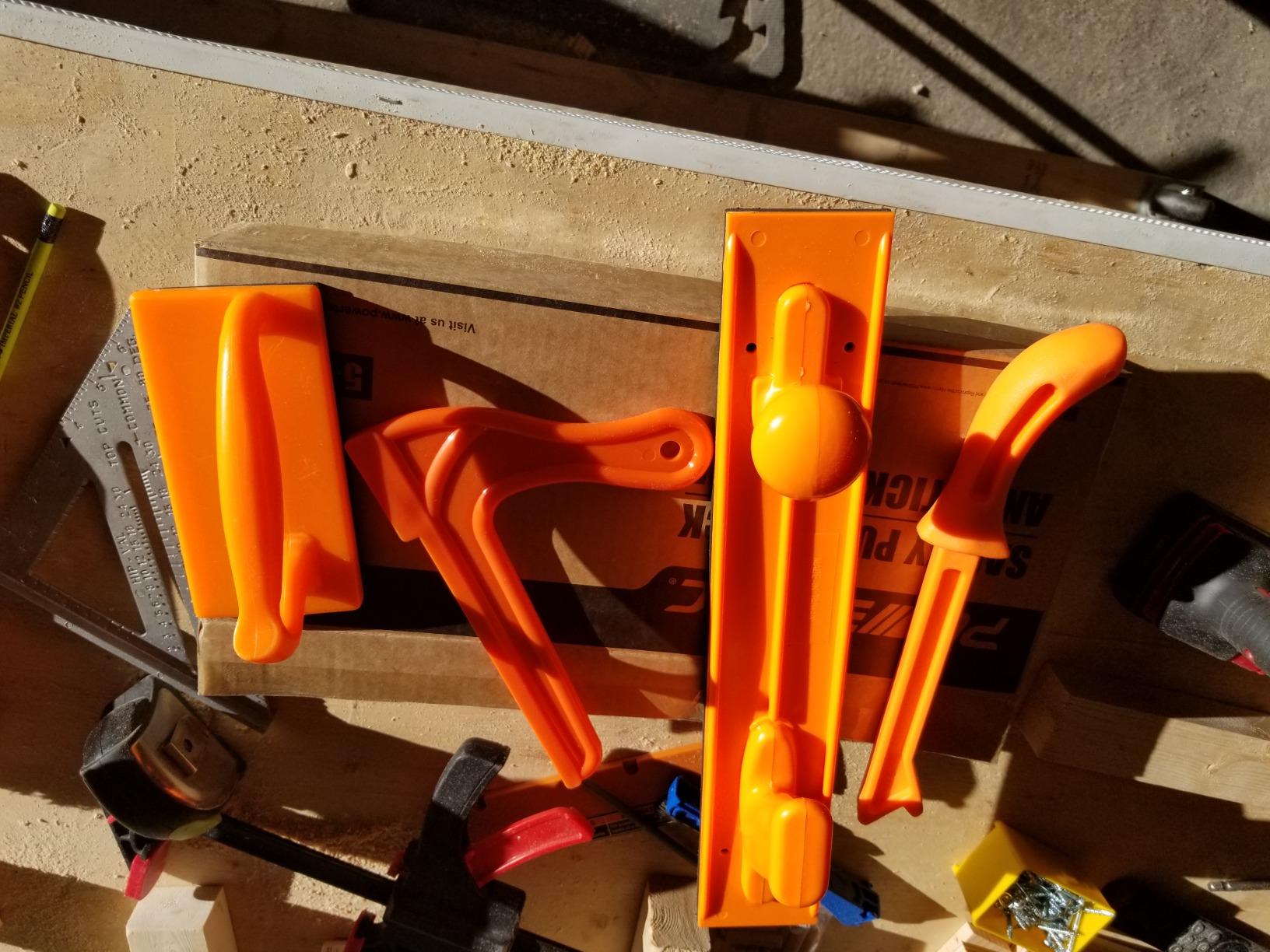
This set replaced more of my shop drawer than any other tool I tested. It ships with a 16 inch long push block, two 3 by 6 inch short blocks with angled and offset handles, an 11.25 inch standard stick and an 8.5 inch narrow V-style stick.
For a beginner, that matters more than any single premium feature. You are not deciding in the hardware aisle whether the block you bought handles narrow rips on the fence side, because the right tool is already in the box.
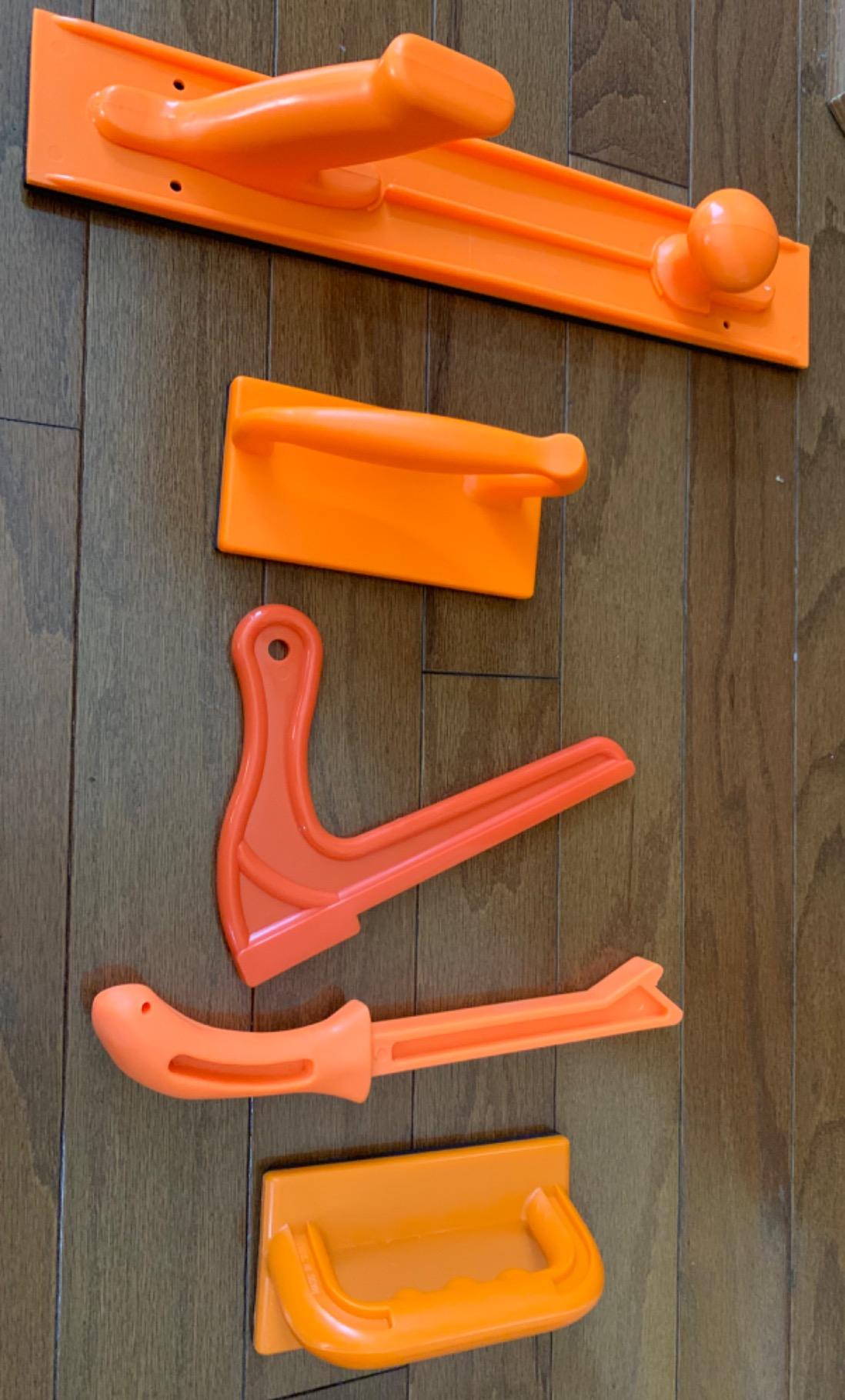
The high-visibility orange did more for my awareness than I expected. When the block is on the workpiece I can see exactly where my hands are relative to the blade without looking down, which is the habit that keeps people safe on a first solo rip.
The foam rubber pads are washable with warm water and need roughly 24 hours to dry before reuse, so plan cleaning around a project rather than mid-cut. Reviewers report 76 percent five-star ratings, and the common praise is variety plus grip rather than any individual piece.
What it covers that single blocks do not
The two short blocks are the reason this set wins for mixed work. One is shaped for jointer and shaper duty, where you push down and forward on a wide panel, and the second works at a different angle for narrower feeds. The V-style stick is the narrow-rip tool in the box.
Where the foam pads let you down
The rubber is foam, not the dense high-friction compound used on premium blocks, so it collects sawdust faster and needs cleaning more often. Grip slippage on dusty material is the single most common complaint in woodworking forums, and this set is not immune to it.
One reviewer also notes that the angled-handle block should not be used between the blade and the fence, which is a specific configuration a beginner will try without knowing why it is discouraged.
2. POWERTEC Grab Push Block 71794 – Best Value With Retractable Holders
POWERTEC Grab Push Block with Retractable Holder, Anti-Slip Pad & Offset Handle for Improves Control. Ideal for Table Saws, Router Tables, Band Saws, Jointers & Fence Systems (71794)
Weight: 10.6 oz
Dimensions: 9.45 x 3.94 x 3.94 in
Model: 71794
Pros
- Retractable holders add control on edge work
- Textured padding grips without slip
- Offset handle keeps the hand clear
- Sturdy feel for a single block
Cons
- Single block rather than a kit
- Deflector guard is a separate purchase
This is the block we kept reaching for on panel work, and it is the one tool in our set with a storage solution built into the design. Dual retractable holders at both ends lock into position when engaged and flip flat when you do not need them.
That holder feature is the quiet advantage. A push block that lives in a drawer is a push block you grab with one hand while the other is already near the blade, which is exactly the moment you should not be improvising.
At 9.45 inches long and 10.6 ounces, it is light enough to move across the table without breaking your feed rhythm, and the textured anti-slip padding on the contact face held oak and maple without a slip in our testing.
Owners rate it 4.6 across 3,870 reviews, with the retractable holders and the padded face drawing most of the praise. Several reviewers compared it directly to homemade wooden push aids and found it better behaved.
What the retractable holders actually do
They are not decoration. Engaged, they give the block a positive connection to the end of the workpiece for vertical resawing and edge routing work where the block would otherwise skate on a narrow face.
The model also accepts an optional deflector guard plate if you run it on a router table and want chip deflection, which is a separate purchase and the main reason some owners rate it down a notch.
Where the single-block design falls short
There is no second block, so doubled pressure on a jointer or shaper, which is where two push tools genuinely help, is not possible without buying another unit.
The handle is a fixed offset rather than adjustable, so there is no way to change the push angle for a tall panel or a thin edge the way a multi-leg block allows.
3. MICROJIG GRR-RIP BLOCK GB-1 – Top Rated Grip in the Group
MICROJIG GRR-RIP-BLOCK Smart Push Block for Routers, Jointers, Band and Table Saws, Woodworking Tool, Extreme Grip, GB-1, Yellow/Green
Weight: 2.24 oz
Dimensions: 9 x 3.5 x 3.5 in
Warranty: 3-year limited
Pros
- Strongest grip rating in the group
- Smart hooks grab the workpiece end
- Angled handle holds work to the fence
- Bridges with optional connector for panels
Cons
- Body is bulky for narrow router table work
- Hooks cannot be locked down against release
- Premium cost for a plastic tool
The GB-1 carries a 4.8 owner rating across 2,700 reviews, the highest score of any product we tested. The reason is mechanical: auto-retracting Smart Hooks at both ends grab the end of the workpiece and retract automatically as the block travels.
That end connection is what separates it from a plain sled. A block that only pushes on the top surface can let the workpiece rotate at the tail, and a rotating workpiece is a kickback waiting for the wrong cut.
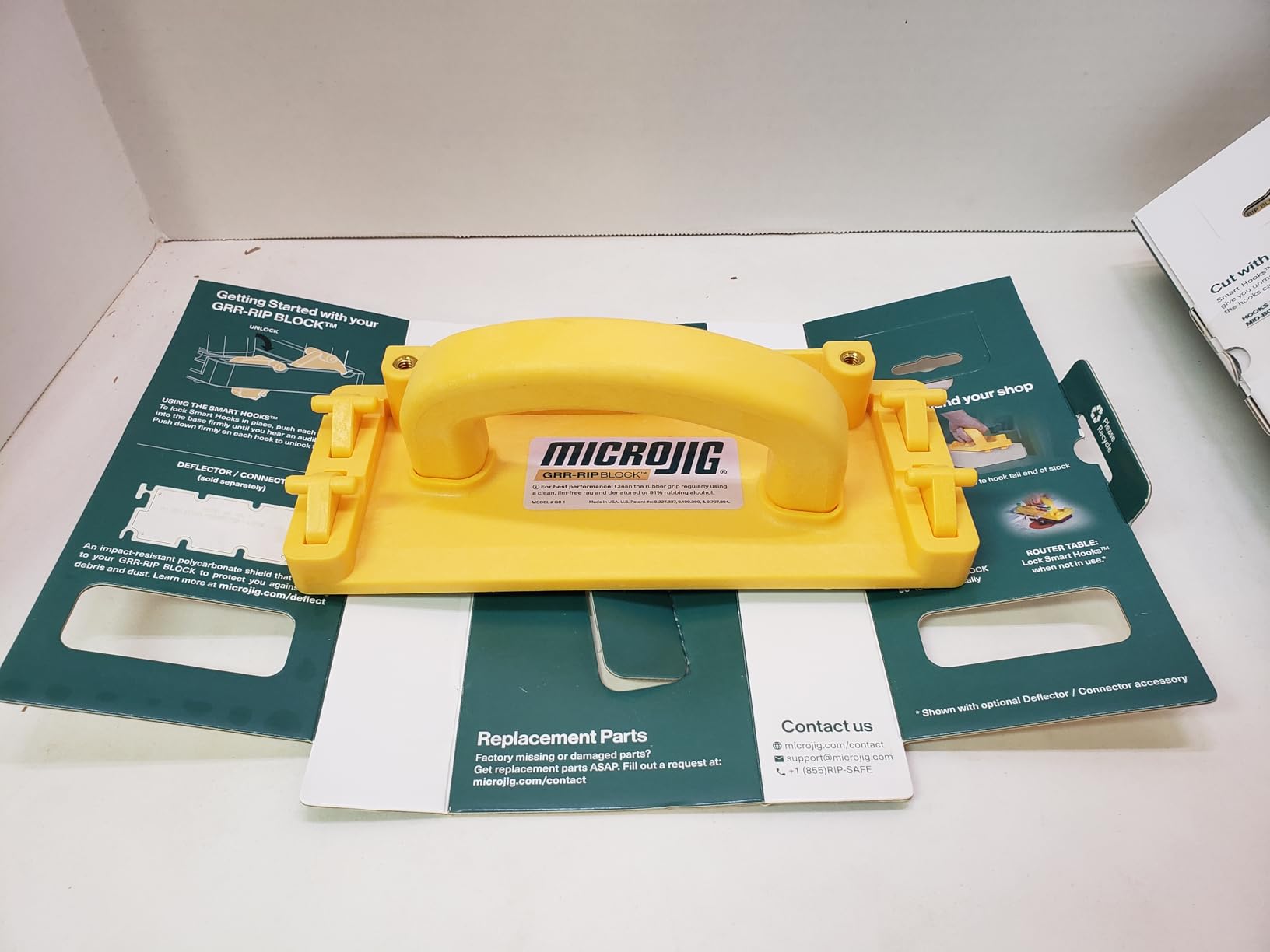
The Green GRIP podular surface sits between your hand and the workpiece, and owners repeatedly describe the difference in confidence more than in numbers. Several note it became the default tool they reach for without thinking.
The 90-degree flip guide turns the same block into a vertical platform for veneers, band saw resawing and router table work, which is where the optional Deflector/Connector piece becomes useful for bridging two blocks across a large panel.
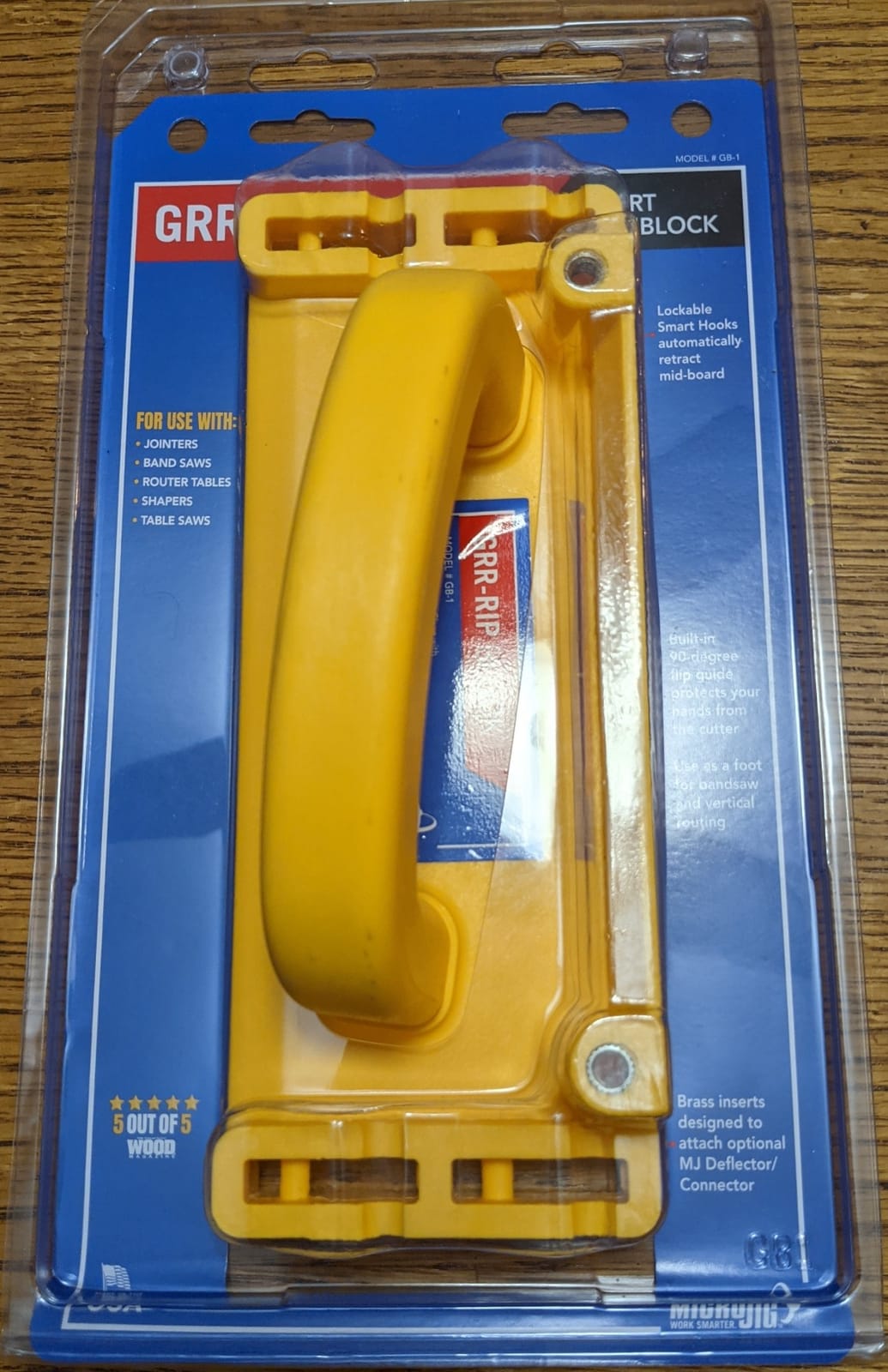
Why the smart hooks change the feed
Because the hooks retract as the block advances, you can start with the block fully engaged and still push through a long rip without repositioning. On a fixed-hook design you would stop and reset at some point in every cut.
For thin strips, that end engagement is what keeps the offcut square against the fence instead of drifting away from the blade on the last few inches.
Where its bulk works against you
At 9 by 3.5 inches the body is wide. On a router table with a small fence opening, or on a narrow jointer, that footprint makes it awkward in a way the slimmer push sticks in this group are not.
Reviewers also point out that the hooks can be locked open but not locked down against accidental release, so it deserves the same respect as any blade-adjacent tool rather than being treated as a permanent fixture.
4. Milescraft GrabberPRO 3406 – Best Multi-Leg Block for Narrow Rips
Milescraft 3406 GrabberPRO – Push block for Table Saws, Router Tables, Band Saws & Jointers
Weight: 16 oz
Legs: 1, 1/2, 1/4, 1/8 inch
Warranty: 3-year limited
Pros
- Interchangeable legs reach down to 1/8 inch
- Support foot keeps block level on short boards
- Heel can be trimmed for push force
- Three-year limited warranty
Cons
- Handle is large for small hands
- Rubber grip loses bite as it wears
- Bulkier than two slim push sticks
The GrabberPRO solves narrow rips with four interchangeable legs sized 1 inch, 1/2 inch, 1/4 inch and 1/8 inch, plus a support foot that keeps the block level on short material. It cuts clean strips as thin as 1/8 inch when the right leg is fitted.
Changing legs is a thumbscrew job, not a rebuild, so you are not reconfiguring the tool between every cut. That is the practical difference between owning a multi-leg block and renting one from a neighbor.
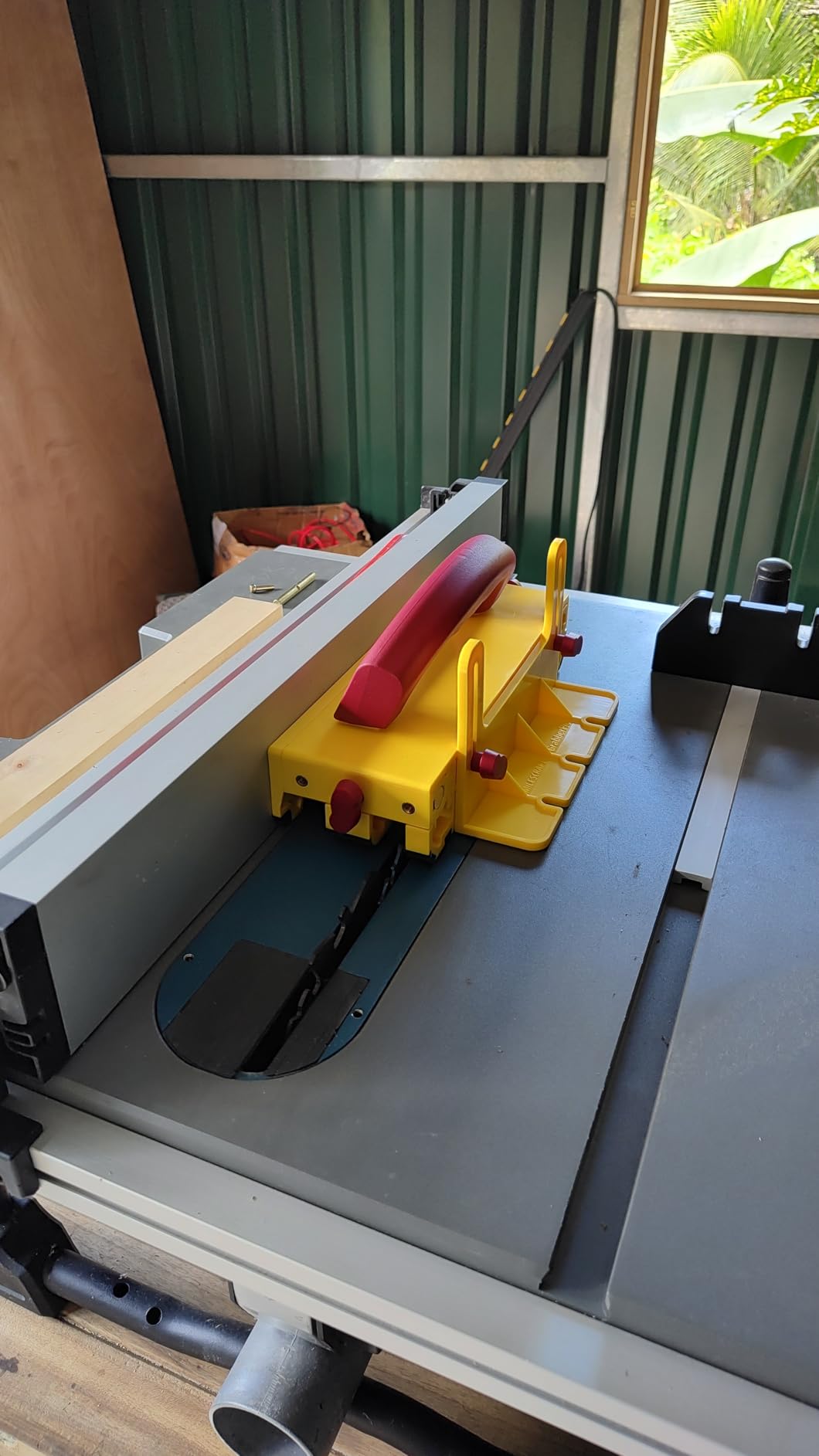
Forums have long carried a thread titled something close to the best push block I have ever used, but so pricey I make reasons to use it, and the GrabberPRO is the version of that conversation that lands in a more comfortable place. It gets a 4.7 across 2,011 reviews.
The adjustable heel is the underrated part. Owners cut through it and lower it when they want more forward push against hard wood, which turns a passive push into something closer to a firm forward drive.
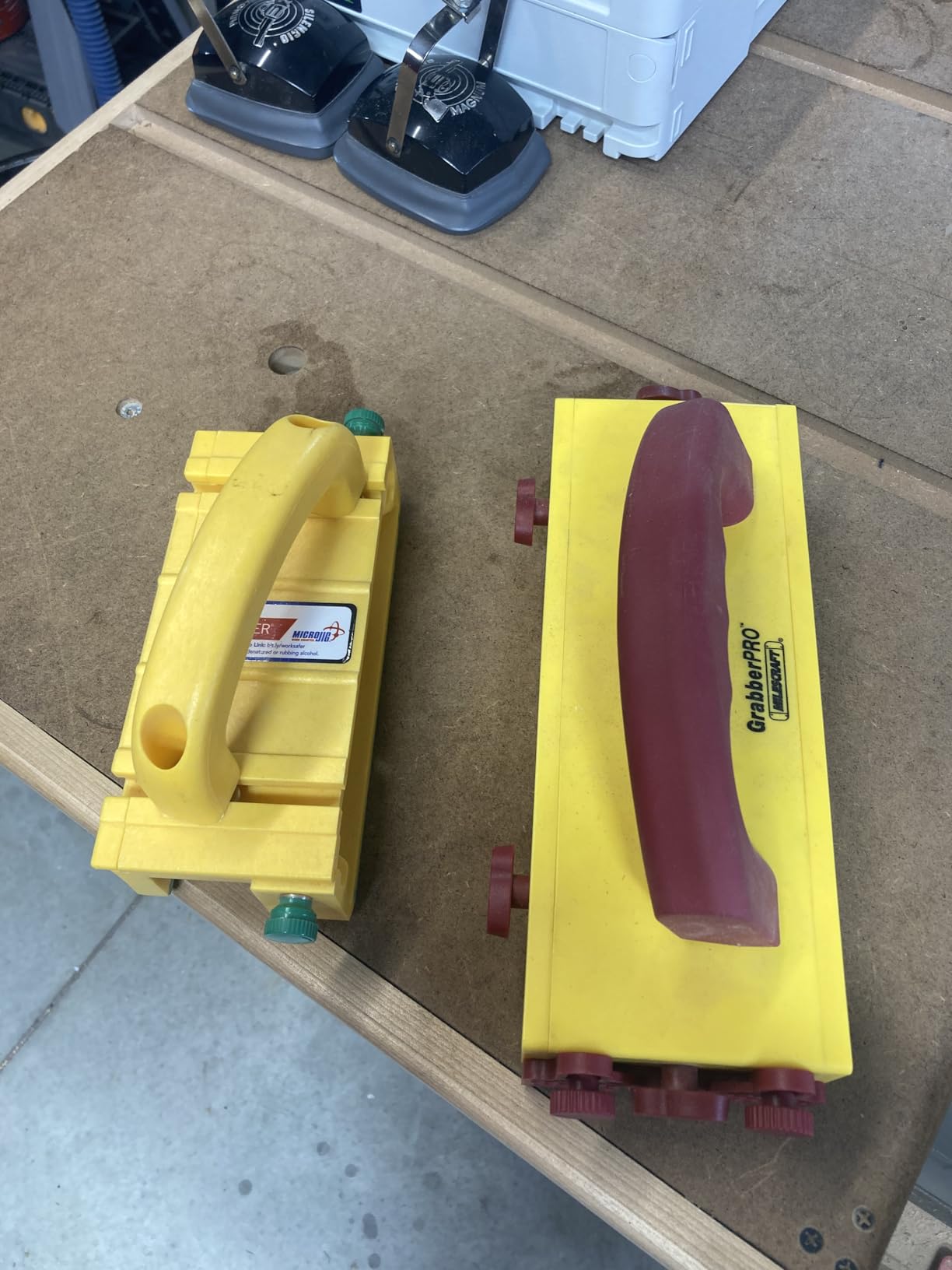
How the interchangeable legs change the job
The leg straddles the blade so you keep grip on both sides of the cut, and the leg width decides how narrow a rip you can hold. A 1/8 inch leg means the blade passes under a slim bridge and your hands stay at the ends.
That is genuinely different from a flat sled on narrow work, where the block has to ride on top and your hand sits further from the cut line.
Where the handle and pad disappoint
The handle runs large. Reviewers with smaller hands note it is comfortable but not a perfect fit, and that is worth knowing before you commit if your grip is on the small side.
The bottom rubber grip loses bite over time and needs cleaning with rubbing alcohol, which is maintenance, not failure, but it is a habit you have to keep up or the tool will slide on you mid-cut.
5. Zebekk F03-2 – Best Weight and Grip for General Ripping
Zebekk Push Block for Table Saws, Router Tables, Band Saws & Jointers
Weight: 1.8 lb
Dimensions: 7.01 x 5.61 x 4.49 in
Cuts to: 1/4 inch
Pros
- Weighty feel is stable on thick material
- Sliding top adjustment is quick
- Works with any fence system
- Grippy base cleans with alcohol
Cons
- No end stub catch to hold the workpiece
- Small amount of assembly required
- Shows cosmetic wear after about two years
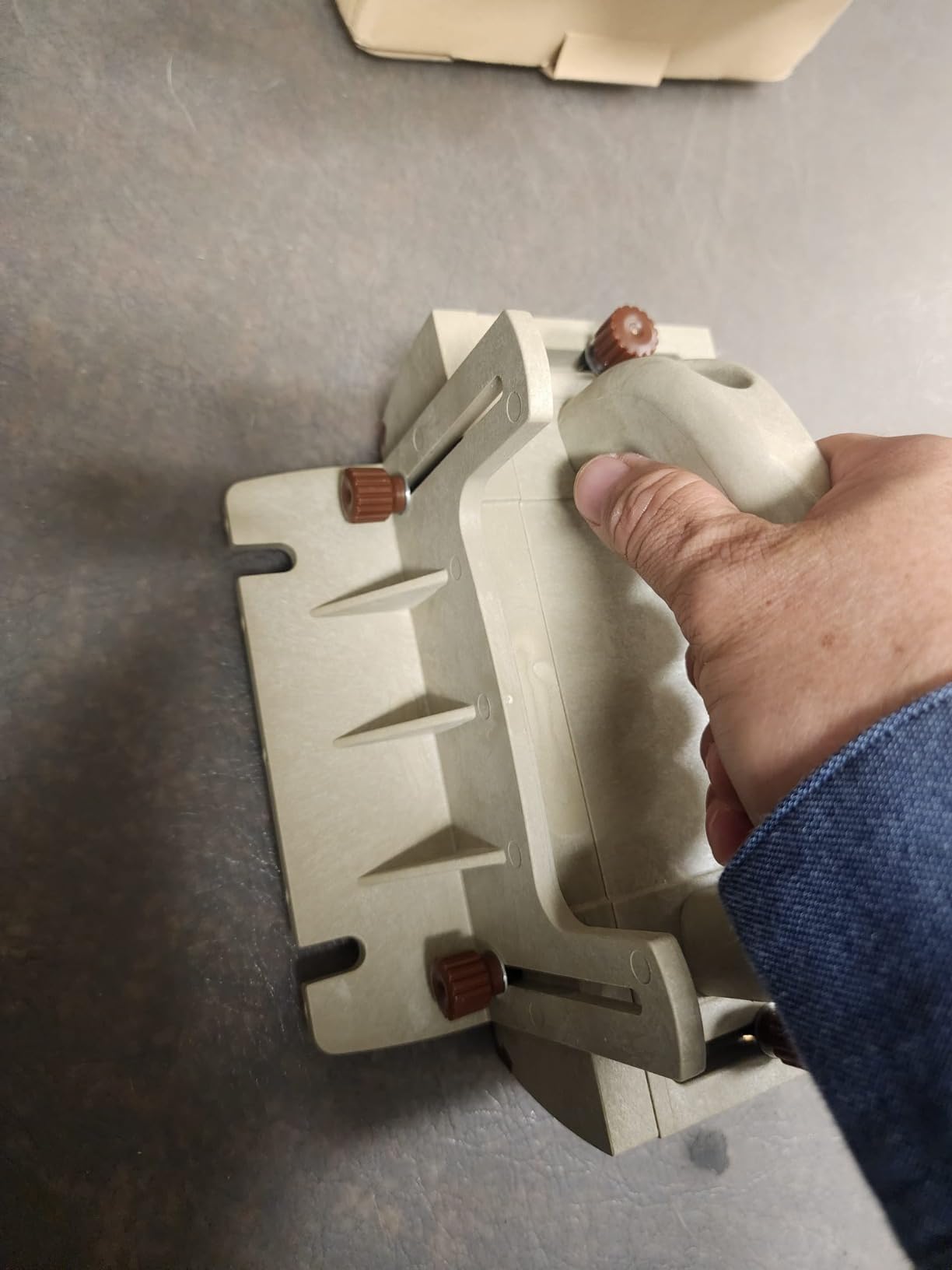
The Zebekk F03-2 is the only tool in this roundup at 1.8 pounds, and that mass does real work. On a thick panel, a heavier block stays planted where a light block can skate as the blade breaks through.
The top sliding adjustment sets cut width without taking the tool apart, and the fence-independent design means it works with any table saw rather than needing a specific rail or accessory.
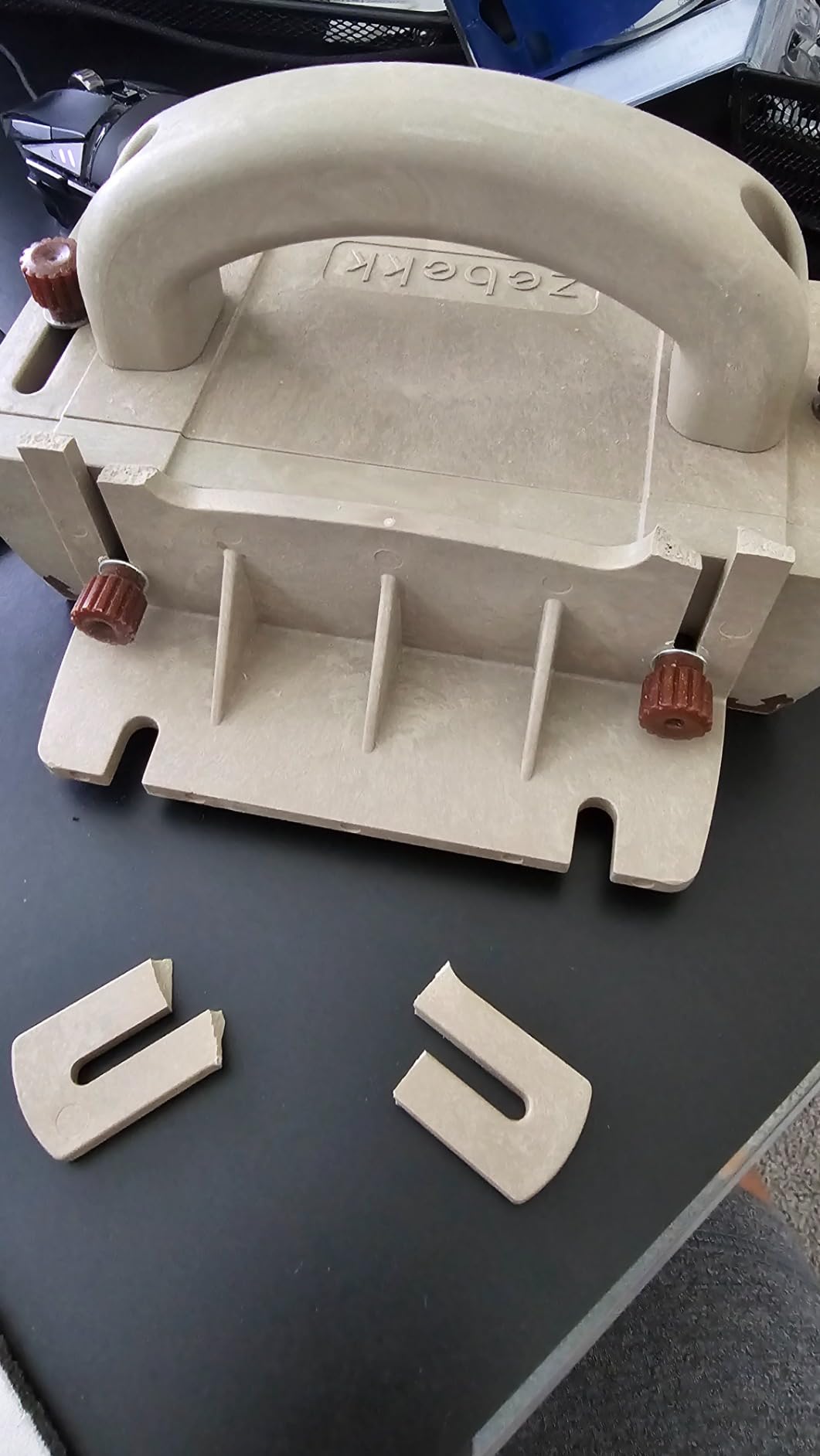
It rates 4.6 across 1,161 reviews, and owners who work in injection-molded plastics or in wood call the build quality comparable to blocks costing noticeably more. The balance support leg is what keeps it level on material that is not perfectly square.
It cuts down to 1/4 inch, which is the practical floor here. Fine strips and face-frame parts still want a thinner leg or a dedicated stick.
What the sliding top adjustment gives you
The top surface adjusts to match your material, so the downward pressure stays consistent whether you are ripping a wide panel or a narrower board. You are matching the block to the workpiece, not forcing the workpiece to match the block.
Owners also like that the high-friction base can be cleaned with alcohol, which matters in a shop where a coated surface is the difference between control and a slip.
Where the missing end catch shows
There is no end stub catch, which is the most common complaint in the reviews. Without it the block pushes the workpiece but does not grab its end, so the tail can rotate slightly on thin material.
Plan on a few minutes of assembly with the included hardware out of the box, and expect cosmetic wear after a couple of years of regular service.
6. MICROJIG GR2-GO – Best Carry-Over Block for Thin Rips
MICROJIG GRR-RIPPER 2GO Push Block for Routers, Jointers, Band and Table Saws, Woodworking Tool, Extreme Grip, GR2-GO, Yellow/Green
Weight: 12.32 oz
Cuts down to 5/16 inch
Warranty: 3-year limited
Pros
- Tall body keeps hands farther from teeth
- Green GRIP pads hold without slip
- Color code sticker reads fence clearance
- Ships fully assembled
Cons
- Top-only contact loses grip as dust builds
- Hand position sits over the blade
- One block only for long material
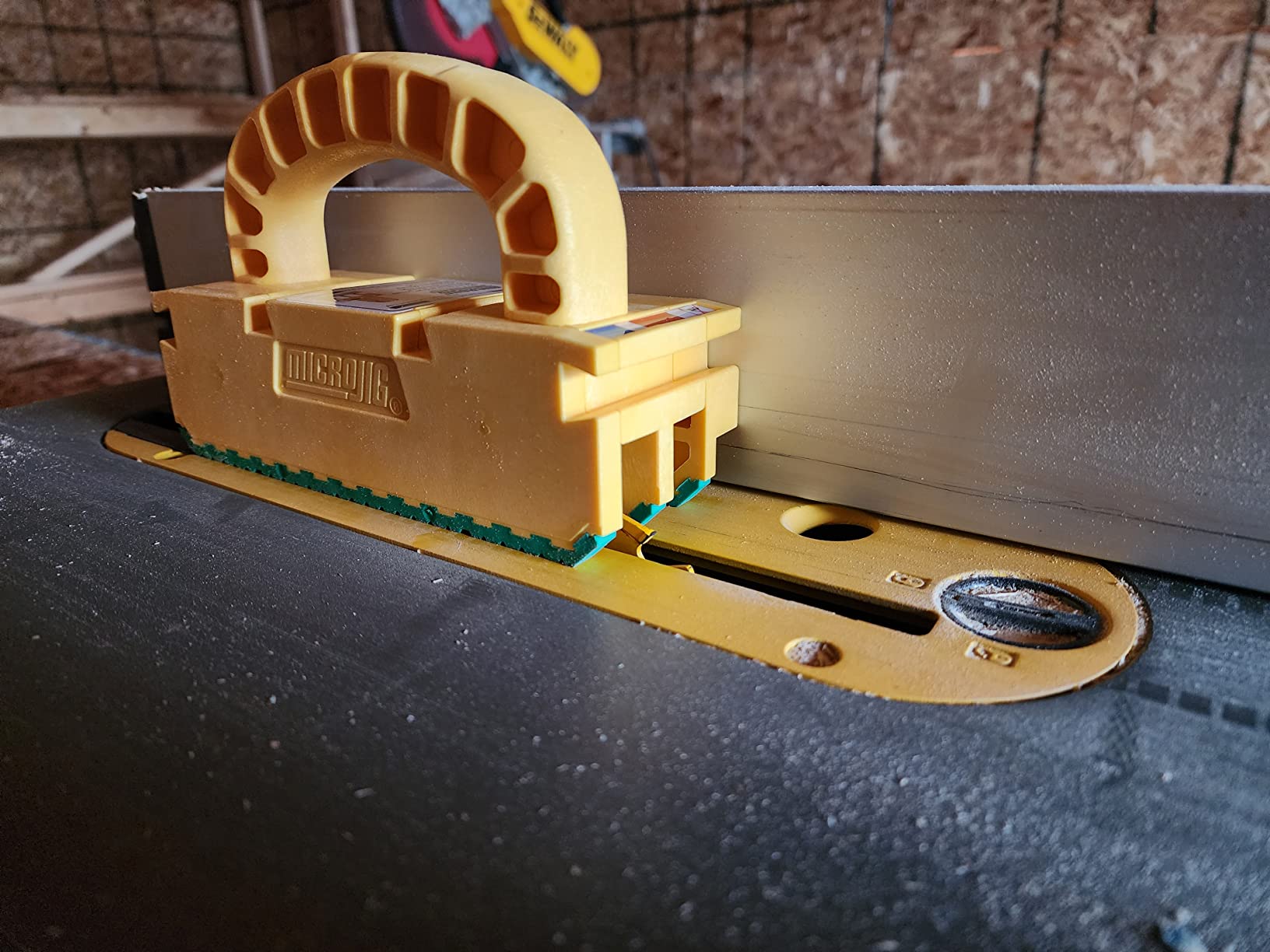
The GR2-GO handles cuts down to 5/16 inch through a precision leg and tunnel system that feeds both sides of the cut. It ships fully assembled, with a color code index sticker that maps to your rip fence scale so you can read clearance at a glance instead of crouching to sight the gap.
Owners give it 4.7 across 973 reviews and several report it made their push sticks redundant. The tall body is the reason: it puts your hand higher and further back relative to the blade than a flat sled does.
The dovetail grooves on the body accept custom accessories, and two blocks can be used together for longer cuts once you add outfeed support.
Why the tall body changes hand position
A block that pushes only on the top surface leaves your hand level with the workpiece. The 2GO stands proud of the material, so the force travels down through the tool rather than through your wrist, and it also runs on router tables, jointers and band saws.
Where top-only contact bites back
Because the pads contact only the top surface, sawdust builds up on them and grip fades after several cuts. Wipe them between passes; do not wait until the block starts to slide.
Some users are unsettled by the hand position sitting over the blade line. If that bothers you, a block that straddles the cut will feel more natural, and the reviewer comments say as much.
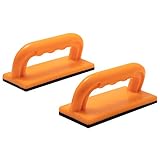
7. Fulton Safety Push Blocks 2-Pack – Best Budget Pair
Safety Table Saw Push Blocks for Woodworking 2PK
Weight: 15.5 oz
Sole: 3 by 6 inch
Material: polyethylene
Pros
- Two blocks allow doubled pressure
- Simple angled handles suit jointing
- Durable molded plastic
- Easy to keep near the saw
Cons
- No top-surface engagement feature
- Basic design with no adjustment
- Rubber sole collects dust quickly
Two blocks in the pack is the point. On a jointer or shaper, doubled pressure is the difference between a clean pass and a board that snipes, and on a router table the second block is there when you need to reach past a fence.
Each one has a 3 by 6 inch non-slip rubber sole and an angled handle, in bright safety orange so the tool is easy to find in a cluttered shop.
The set rates 4.7 across 959 reviews, with owners describing them as no-frills tools that simply work on jointers, router tables and light table saw duty.
Where two blocks beat one
Doubled pressure on a jointer means both hands stay on the workpiece instead of one hand riding the outfeed side with nothing between it and the cutter. That is a real safety gain, not just a comfort gain.
Owners also like the angled handles for feeding panels, and the orange color means you can see the block position relative to the blade at a glance.
Where the basic design stops you short
There is no bottom extension to engage the top surface of the workpiece, so on thin or narrow material the block pushes without controlling the tail.
There is no adjustment either, so this is not the tool for strips. Save it for panel work, jointing and the wide rips you would otherwise push by hand with a sled.
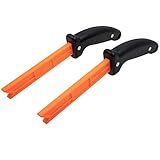
8. Fulton Magnetic Push Sticks – Best for Narrow Strips and Storage
Magnetic Push Sticks for Table Saw 2 Pack
Weight: 12 oz
Length: 12 inch
Model: 11552
Pros
- Built-in magnets keep the sticks within reach
- Notched end engages narrow material
- Bright orange tip shows position
- Contoured handle reduces fatigue
Cons
- Less workpiece grip than a full block on wide material
- Magnets only help on ferrous surfaces
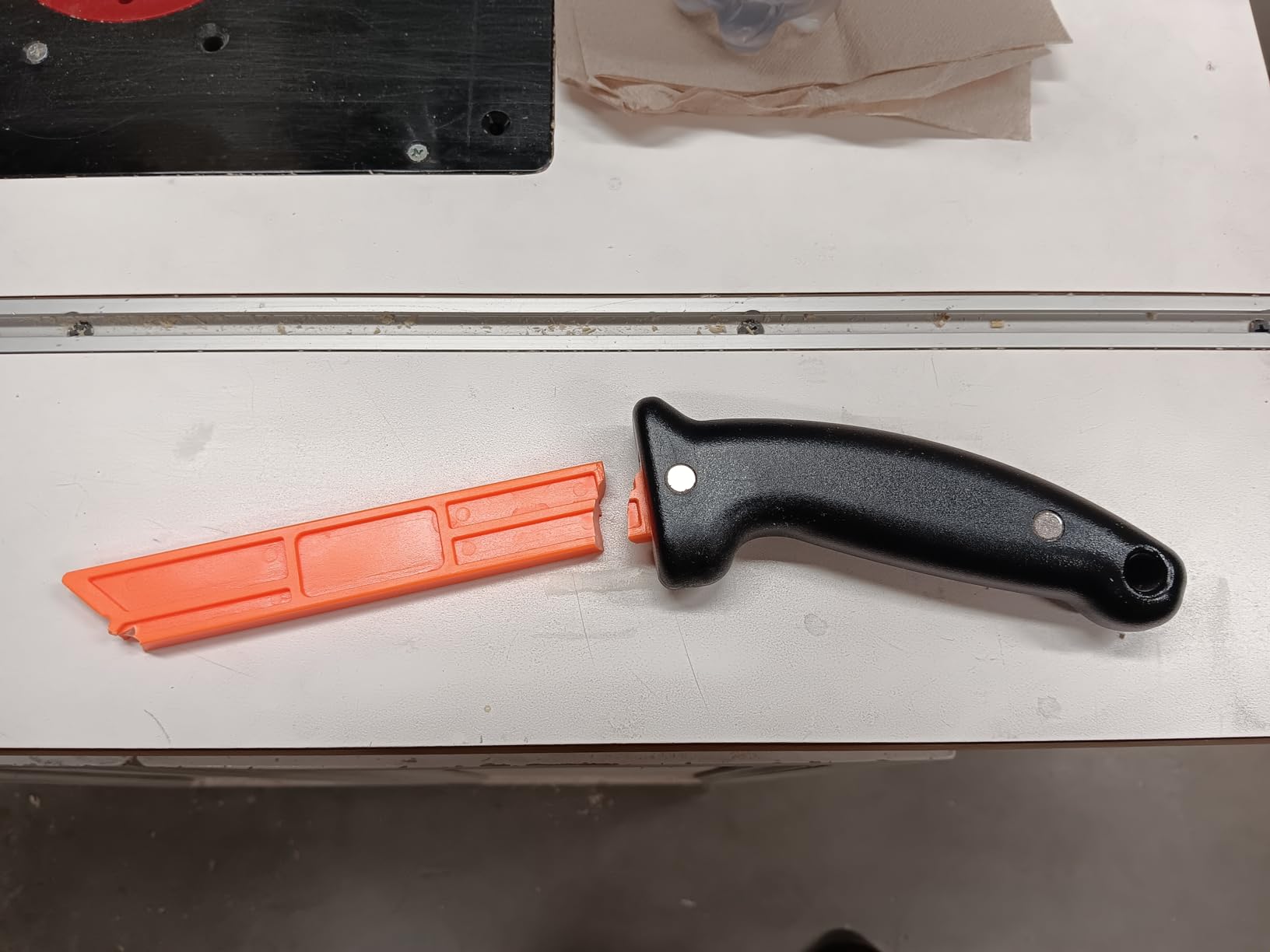
Two 12 inch sticks with built-in dual magnets solve the most boring and most important problem in this category: where the safety tool lives when you need it. They stick to the saw cabinet or a steel surface and are right there.
The 90 degree notched end engages narrow material positively, and the bright orange tip makes the stick position obvious relative to the blade during the pass.
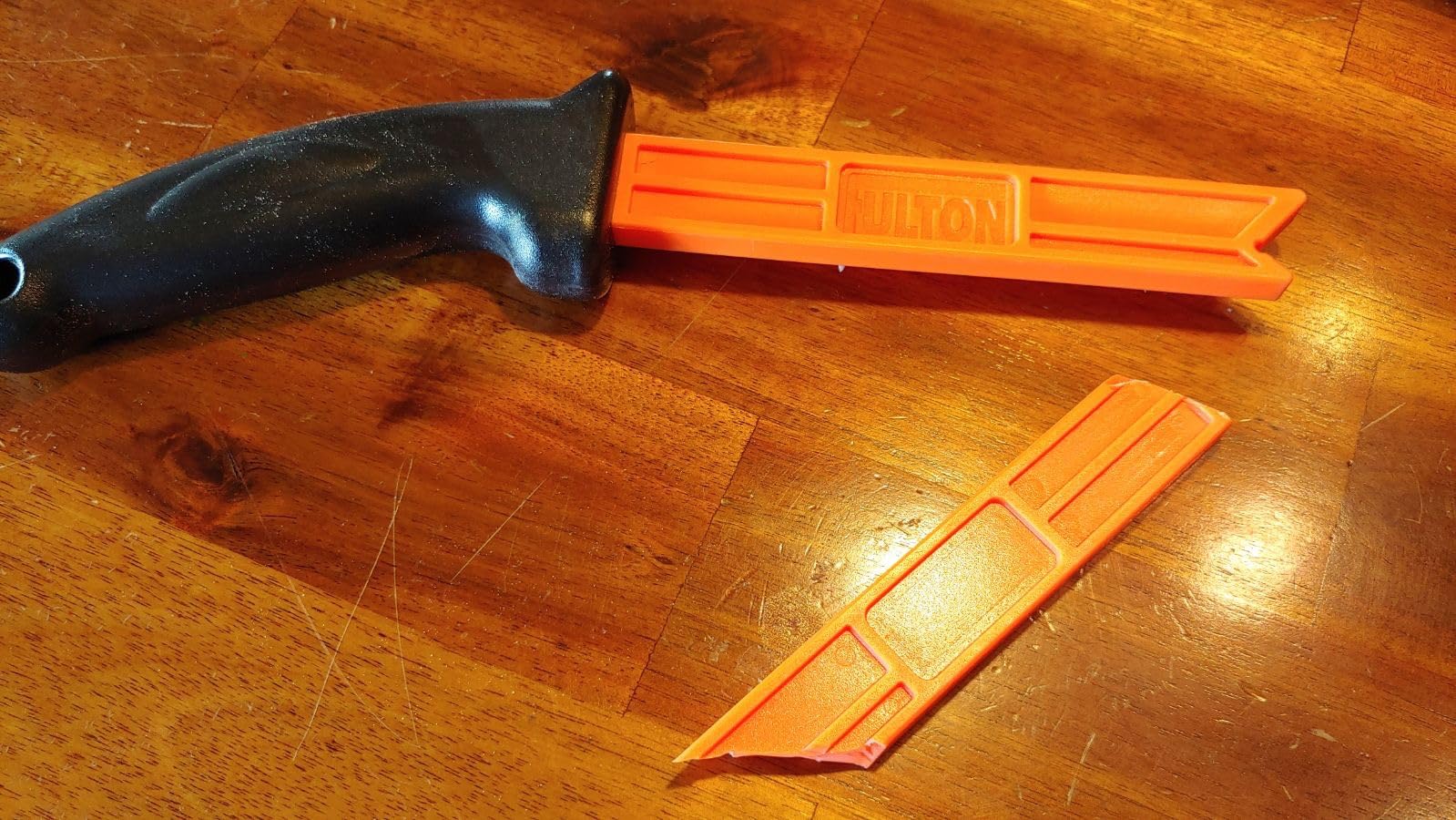
They rate 4.7 across 994 reviews. A handle hole for hanging storage adds a second way to keep them visible, and the contoured handle is comfortable over a long run.
These are the tools we use for trimming edges down to a strip on the table saw, because a stick holds a narrow workpiece without needing a wide base sitting on top of it.
What the magnets and notched tip solve
A lost push aid is a push aid you will grab for with your fingers instead. The magnets make that failure mode much less likely, provided your saw has a ferrous surface nearby.
The notch is the functional part on narrow material. It gives the stick something to bite into so the workpiece cannot ride up and climb the blade.
Where a stick cannot replace a block
On wide or heavy material a stick gives you far less grip than a full push block, and you are relying on downward pressure from your arm alone. For a heavy panel, that is a lot to ask of a 12 inch stick.
Keep them as the narrow-rip companion to whichever block you choose rather than as a replacement for one.
How to Choose a Push Block for Your Table Saw
Grip base comes first, and the honest truth is that sawdust defeats every rubber pad eventually. Dense high-friction compound on a hard surface holds better and wipes clean with alcohol, while foam pads are softer, cheaper and need washing instead.
Top-surface contact is the second criterion. A sled that only pushes on top lets the tail of the workpiece rotate, and a block with an end hook or adjustable leg stops that rotation. The Peachtree set and the GRR-RIP BLOCK both engage the workpiece end.
Narrow-rip capability is where the price spread comes from. The Fulton 2-pack suits wide panel work, the GR2-GO reaches 5/16 inch, and the Milescraft GrabberPRO reaches 1/8 inch with its thinnest leg.
Microjig model numbers are the biggest source of confusion in this category. The GRR-RIPPER 3D GR-100 is the original full 3D system with an adjustable center leg. The GR-100+ is the updated version of that design. The GRR-RIPPER Advanced GR-200 adds a handle option and a stronger stabilizer. The GR2-GO is the compact single-block version that ships assembled. The GRR-RIP BLOCK GB-1 is a one-legged block with Smart Hooks and a flip guide rather than a straddling leg. All of them are Microjig, and the GRR-RIP BLOCK GB-1 is the version in our roundup.
Push block, push stick or featherboard solves different problems. A push block keeps your hand off the workpiece and controls rotation. A push stick keeps your hand off the blade but gives up top-surface grip. A featherboard holds material against the fence and works alongside a push block rather than replacing one. Experienced woodworkers also still run sacrificial sticks across the blade with double-sided tape for resawing, which works but consumes the stick every time.
High-visibility color deserves more weight than most roundups give it. Orange and yellow tools are easier to track relative to a spinning blade, and that is a genuine safety property, not decoration.
How to Use a Push Block Safely on a Rip Cut
No push block replaces a properly aligned riving knife. If the rear teeth close the kerf behind the cut, the workpiece pinches and kicks back no matter what is holding the top.
Step one: set blade height to about 1/8 to 1/4 inch above the workpiece so the teeth reach below the top surface without carving into it, and confirm the riving knife sits in the kerf behind the blade.
Step two: stand to one side of the blade line rather than directly behind the workpiece, so a kickback travels away from you instead of into your hip.
Step three: apply three pressures together. Push down to stop the workpiece lifting, push in toward the fence to stop drift, and push forward evenly to drive a straight cut.
Step four: keep the block engaged until the workpiece has passed entirely beyond the rear teeth of the blade, then release. Letting go early is the most common way a controlled cut turns into a throw.
Three rules matter more than the tool. Never crosscut with a miter gauge against the rip fence. Clean the rubber pads between cuts. Add outfeed roller support for long material so a heavy workpiece cannot bind as it leaves the table.
Frequently Asked Questions
What are the best push blocks for table saws?
For most shops, the Peachtree 5-Piece Safety Push Block and Push Stick Set is the best overall choice because it covers panel work, narrow strips and jointer feeds in one box. The MICROJIG GRR-RIP BLOCK GB-1 has the highest owner rating for grip and end-of-workpiece control, the Milescraft GrabberPRO 3406 goes narrowest with its 1/8 inch leg, and the Fulton 2-pack is the simplest option for jointer and router table pressure.
Is the Microjig GRR-RIPPER worth it?
It depends on how often you rip. If you cut narrow rips several times a week, the GRR-RIPPER line earns its cost quickly because a stranded cut costs a board, not just a blade. If you rip a few boards a year, a mid-range block such as the POWERTEC 71794 or the GR2-GO gives you the tunnel-and-leg control you actually need at a fraction of the outlay. The premium buys confidence and setup options, not a new safety category.
Is the GRR-RIPPER from Microjig?
Yes. Every GRR-RIPPER model comes from Microjig, which makes the model numbers the only way to tell them apart. The GR-100 is the original 3D system, the GR-100+ is its updated version, the GR-200 GRR-RIPPER Advanced adds handle and stabilizer options, the GR2-GO is the compact single-block version, and the GRR-RIP BLOCK GB-1 is the one-legged Smart Hook block.
How thick should a push block be?
The base should be wide enough to cover the workpiece you are cutting without tipping, and the contact surface should match the material thickness. Multi-leg blocks such as the Milescraft GrabberPRO solve this with interchangeable 1 inch, 1/2 inch, 1/4 inch and 1/8 inch legs, while sliding-top designs like the Zebekk F03-2 adjust to suit the material. A block that overhangs the workpiece gives you push force instead of control.
Should I use a push block or a push stick?
Use a push block when you need downward and inward pressure on wide or heavy material, and a push stick for narrow strips where a slim tool that will not ride on top of the workpiece is better. A push stick gives up top-surface grip, so it cannot stop the tail of a panel from rotating. Many woodworkers keep one of each, which is why the Peachtree five-piece set ranks as our best overall pick.
Can a push block prevent kickback?
A push block reduces kickback risk by applying controlled pressure and keeping both sides of the cut under control, but it cannot prevent it on its own. A push block is not a substitute for an aligned riving knife, correct blade height, a clear path for the workpiece to travel, or a stance that keeps you out of the line of a throw. Every product in this roundup is an aid to a safe cut, never a replacement for the setup around it.
Final Verdict on the Best Push Blocks for Table Saws
The Peachtree 5-Piece Safety Push Block and Push Stick Set is our best push block for table saws overall, because it solves more real shop situations than any single tool and its foam pads wash clean. Buy the MICROJIG GRR-RIP BLOCK GB-1 if grip and end-of-workpiece control matter most to you, and the Milescraft GrabberPRO 3406 if narrow rips are your regular work.
Whichever one you choose, make the blade height, the riving knife and your stance the priority and treat the push block as the last line of defense, not the first. That is the combination that keeps 2026 and every year after it uneventful.