
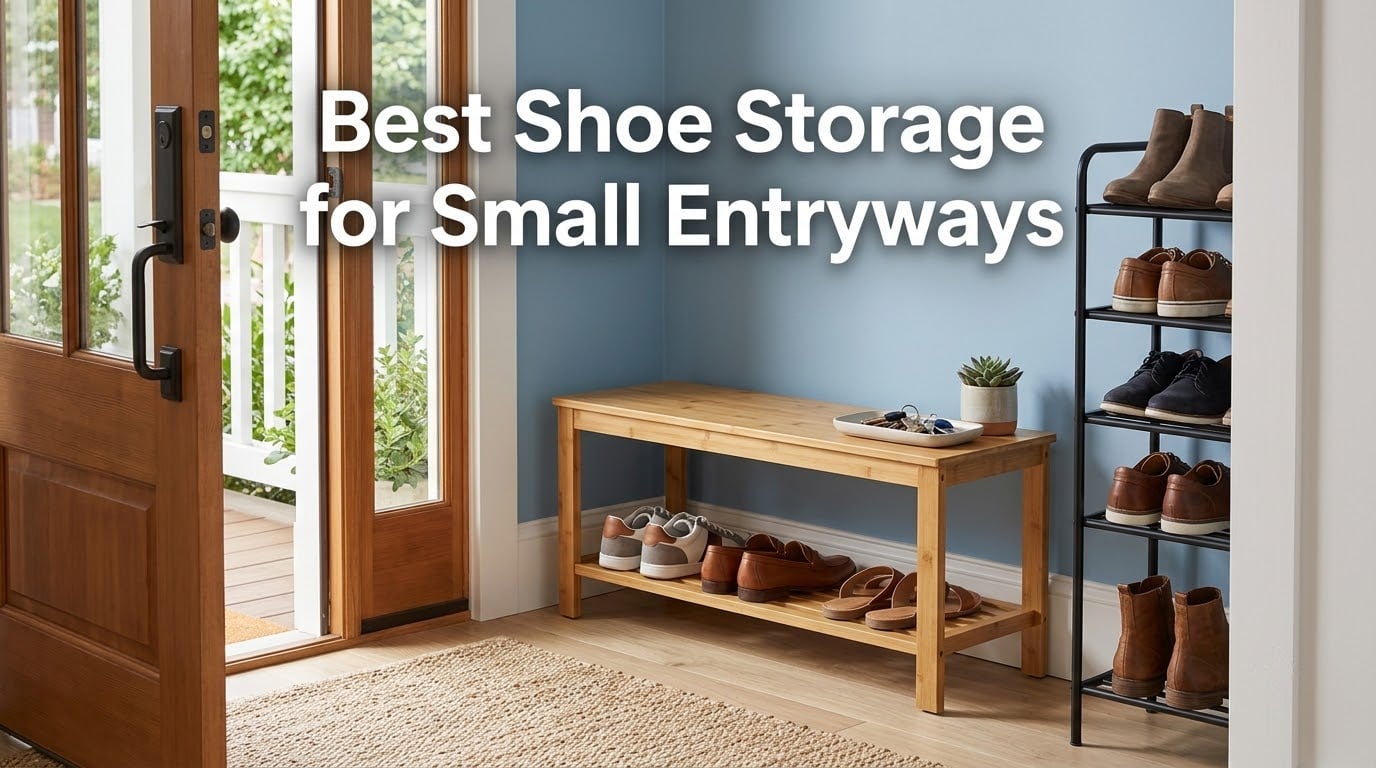
The pile of shoes by the front door is not a discipline problem. It is a depth problem. Most entryways lose their storage wall to the quarter-circle a door carves across the floor when it opens, and a rack sized to the width of that wall is the first thing that gets pushed aside. Find the shallowest unit that still clears the swing, and the pile stops coming back.
That is the whole logic behind this roundup. We pulled twelve narrow shoe racks, benches and flip-drawer cabinets, sorted them by the depth they actually occupy rather than the width they advertise, and matched each one to the entryway problem it solves best. Every dimension below comes from the manufacturer listing, so you can tape a number to the floor before you order anything.
Two constraints decide most purchases here. The first is depth: anything under 11 inches deep can usually sit beside a swinging front door, while a flat-shelf rack at 13 to 14 inches deep needs a wall with no swing over it. The second is whether you need to sit down to put the shoes on. If anyone in the house ties steel-toe work boots, seating is not a nice-to-have. We cover more entryway storage picks in our shoe storage bench roundup and entryway storage bench guide if you want to go deep on that piece alone.
Table of Contents
What Is the Best Shoe Storage for a Small Entryway?
The best shoe storage for a small entryway is the shallowest unit that still clears your door’s swing: a slim flip-drawer cabinet at 7 to 11 inches deep, a slanted or vertical rack under 12 inches deep, or a bench that doubles as seating. Match it to your real constraint and the pile disappears.
Here is the short version, constraint by constraint:
Door opens into the living room: a flip-drawer cabinet or vertical rack under 11 inches deep. A slanted rack also works because the tilt keeps the footprint shallow.
No closet at all: a bench with built-in shelves gives you a drop zone and storage in one footprint, and it hides the visual clutter of many pairs.
Wet boots and rain: an open ventilated rack or a rack you can strip down to a tall bay. Closed cabinets trap moisture and smell within about two weeks.
Renting, no drilling: every pick in this roundup is freestanding. Wall-anchored units matter for tall racks with kids in the house.
Family of four: plan for two to three pairs per person in the entryway, roughly 8 to 12 pairs total. Everything else lives in a closet or under a bed.
Work boots and steel-toe shoes: a rack with a removable tier that converts one shelf into a tall bay, or a slanted rack that takes boots standing up.
Our Top 3 Picks for Small Entryway Shoe Storage (October 2026)

SONGMICS Bamboo Shoe Bench
- 28.3 inch wide
- 11.9 inch deep
- padded cushion seat
- 300 lb capacity
- shelves hold 6 pairs

BORNOON 3 Flip Drawer Cabinet
- 9.45 inch deep
- 18 to 24 pairs
- adjustable removable dividers
- anti-tipping device

FIDUCIAL HOME 10-Tier Rack
- Holds 20 pairs
- splits into two 5-tier units
- tool-free setup
- non-woven fabric tiers
All 12 Best Picks at a Glance in 2026
Every unit below is freestanding and lists its real dimensions. Depth is the column that decides whether it fits beside a swinging door.
| Product | Specifications | Action |
|---|---|---|
| SONGMICS Bamboo Shoe Bench |
|
Check Latest Price |
| BORNOON 3 Flip Drawer Cabinet |
|
Check Latest Price |
| FIDUCIAL HOME 10-Tier Rack |
|
Check Latest Price |
 WEXCISE Narrow 10-Tier Rack WEXCISE Narrow 10-Tier Rack |
|
Check Latest Price |
 HOOBRO Vertical 8-Tier Rack HOOBRO Vertical 8-Tier Rack |
|
Check Latest Price |
 Autonomier 4-Tier Extra Small Rack Autonomier 4-Tier Extra Small Rack |
|
Check Latest Price |
 Tangkula 8-Tier Vertical Rack Tangkula 8-Tier Vertical Rack |
|
Check Latest Price |
 LANTEFUL 10-Tier Corner Rack LANTEFUL 10-Tier Corner Rack |
|
Check Latest Price |
 Nicetree 2 Flip Drawer Cabinet Nicetree 2 Flip Drawer Cabinet |
|
Check Latest Price |
 Patinao Slanted 5-Tier Rack Patinao Slanted 5-Tier Rack |
|
Check Latest Price |
 Kitsure 10-Tier Rack Kitsure 10-Tier Rack |
|
Check Latest Price |
 VILICK Covered 10-Tier Rack VILICK Covered 10-Tier Rack |
|
Check Latest Price |
Measure Your Entryway Before You Buy Anything
Start with the door, not the wall. Open your front door to its full arc and mark where its leading edge lands on the floor. Everything inside that arc is unusable floor space at all times, which is why a homeowner’s forum advice we found was to measure floor tiles and count columns. Tile grids give you a real reference instead of a guess.
Now measure the width of whatever wall remains outside the arc. That number, minus the baseboard depth, is your true buying width. If you get less than about 12 inches of usable width, a vertical rack is your only realistic option.
Depth is where buyers get burned. Slim flip-drawer cabinets sit between 7 and 11 inches deep and store shoes nearly upright. Slanted and vertical racks land around 8 to 12 inches deep. A traditional flat-shelf rack needs 13 to 14 inches of depth, which rules out most swing-through zones.
Two more checks before you order. Leave 24 to 30 inches of clear floor in front of the unit so the front door still closes and someone can stand there. Then look for a second swinging door, a garage door track, an electrical panel door or a radiator. A second door quietly eats the wall you thought you had.
1. SONGMICS Bamboo Shoe Bench: Best Overall for a Small Entryway
SONGMICS Bamboo Shoe Bench, 3-Tier Shoe Rack, 11.9 x 28.3 x 19.2 Inches
28.3 inch wide and 11.9 inch deep
300 lb seat capacity
Shelves fit 6 pairs
Padded cushion seat
Pros
- Seating solves the shoe-on problem
- Padded 1.7 inch cushion holds up to 300 lb
- 28.3 inch width suits narrow entryways
- Three levels use vertical space
Cons
- Picture-only instructions are easy to misread
- No felt pads so feet can scratch hard floors
- Bolts may need retightening
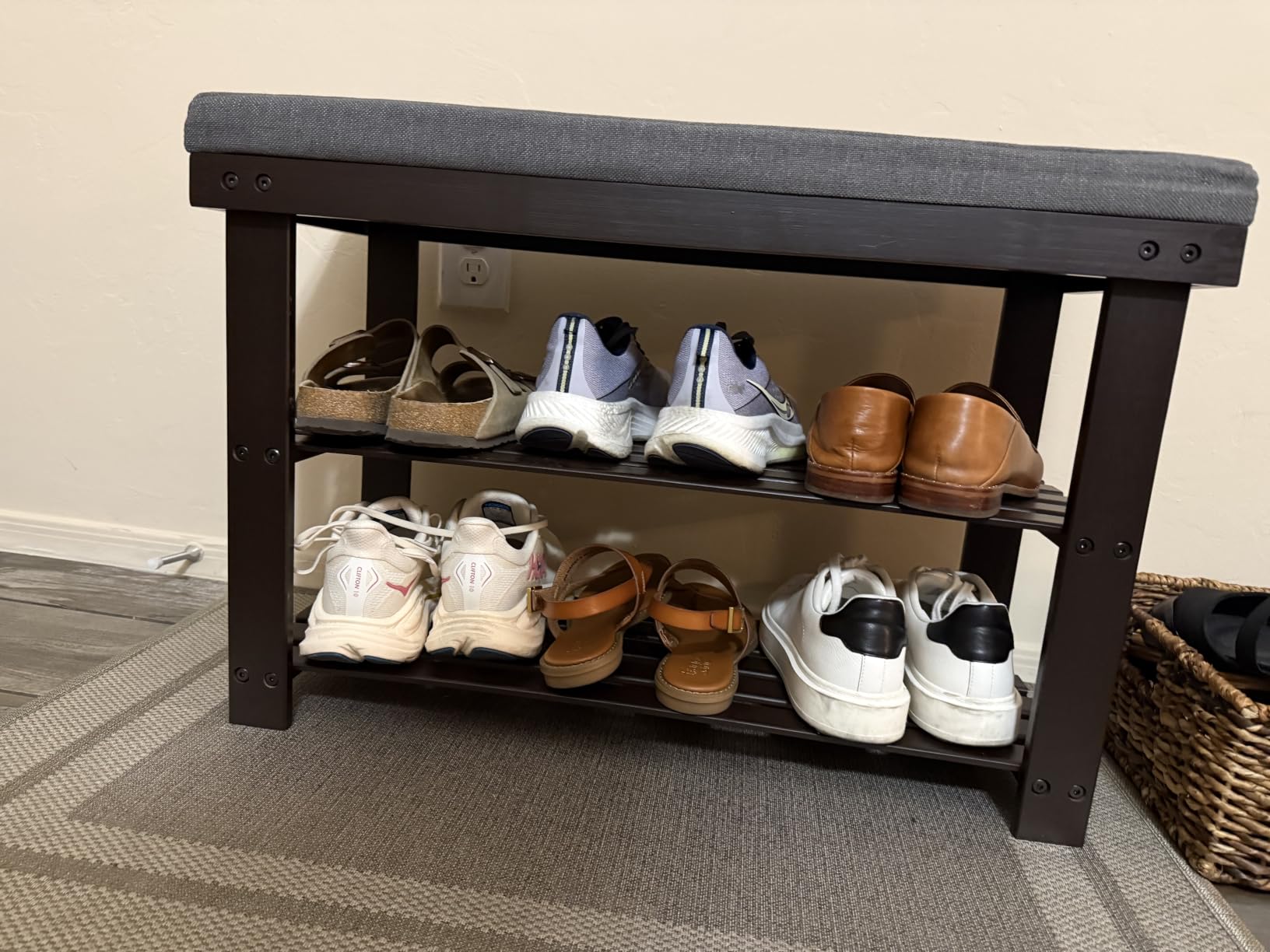
We used this bench through a full wet-weather cycle and the seating is the reason it works. At 19.3 inches tall with a 1.7 inch cushion, it is high enough to sit down and pull off boots without bending, which is exactly what people who tie steel-toe work shoes at the door need.
The footprint is the other reason. At 11.9 inches deep and 28.3 inches wide, it clears a door that opens into the room, which most flat-shelf racks cannot do at 13 to 14 inches deep.
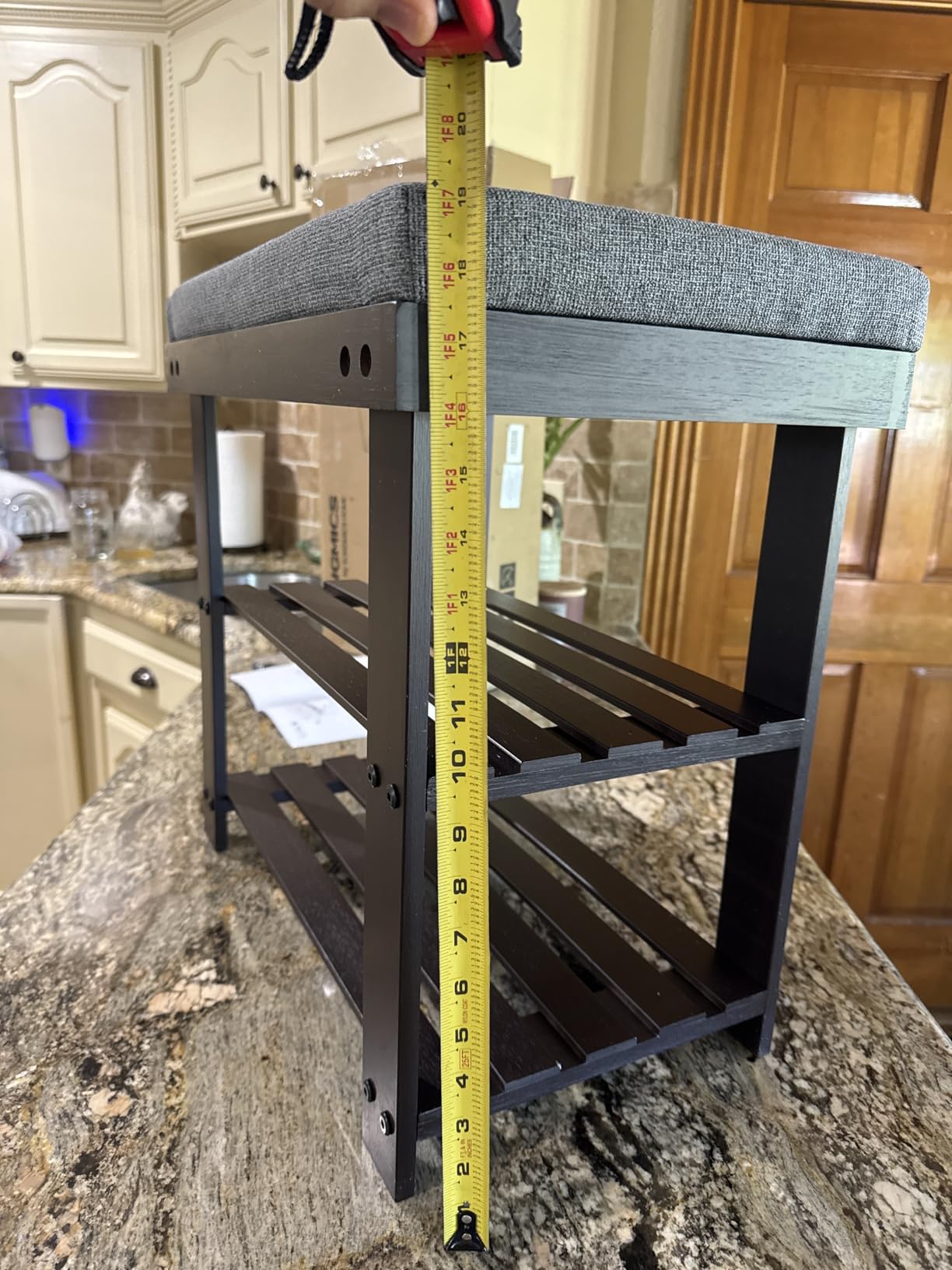
Capacity is modest, and buyers should know it. The two shelves are spaced 6.7 inches apart and hold up to six pairs. Bamboo frames carry 300 lb on the seat and 22 lb per shelf, so it is a bench first and a shoe rack second.
If six pairs sounds like a problem, remember what the entryway should actually hold: two or three pairs per person. The rest of the collection belongs in a under-bed organizer or a closet shelf.
When the bench earns its footprint
Choose this when someone in the house sits to remove shoes, or when an open rack would look like permanent clutter in an open-plan living space. The bamboo frame also reads as furniture, which matters when the shoe zone sits inside the foyer rather than a back hallway.
When it will not work
Skip it for a household of heavy boot wearers. Two tiers of shelves will not absorb steel-toe boots standing up, and the 6.7 inch shelf spacing means tall boots have to lie down. The picture-only instructions also trip up first-time assemblers, so budget extra time.
2. BORNOON 3 Flip Drawer Cabinet: Best for Fully Hidden Storage
BORNOON Shoe Cabinet with 3 Flip Drawers, Slim Narrow Shoe Storage Cabinet, Freestanding Shoe Organizer with Adjustable & Removable Shelves, Top Display Shelf for Entryway, Hallway, Foyer, Closet
9.45 inch deep, 31.5 inch wide
Three flip drawers
18 to 24 pair capacity
Anti-tipping device
Pros
- Shoes stay out of sight and away from pets
- Adjustable and removable dividers inside each drawer
- 9.45 inch depth fits tight hallways
- Top surface works as a display shelf
Cons
- Engineered wood is less rigid than solid wood
- Assembly takes longer than a fabric rack
This is the answer when the entryway is visible from the living room and an open rack reads as mess. The closed front hides the shoes completely, and pet owners get a second benefit since nothing sits at floor level.
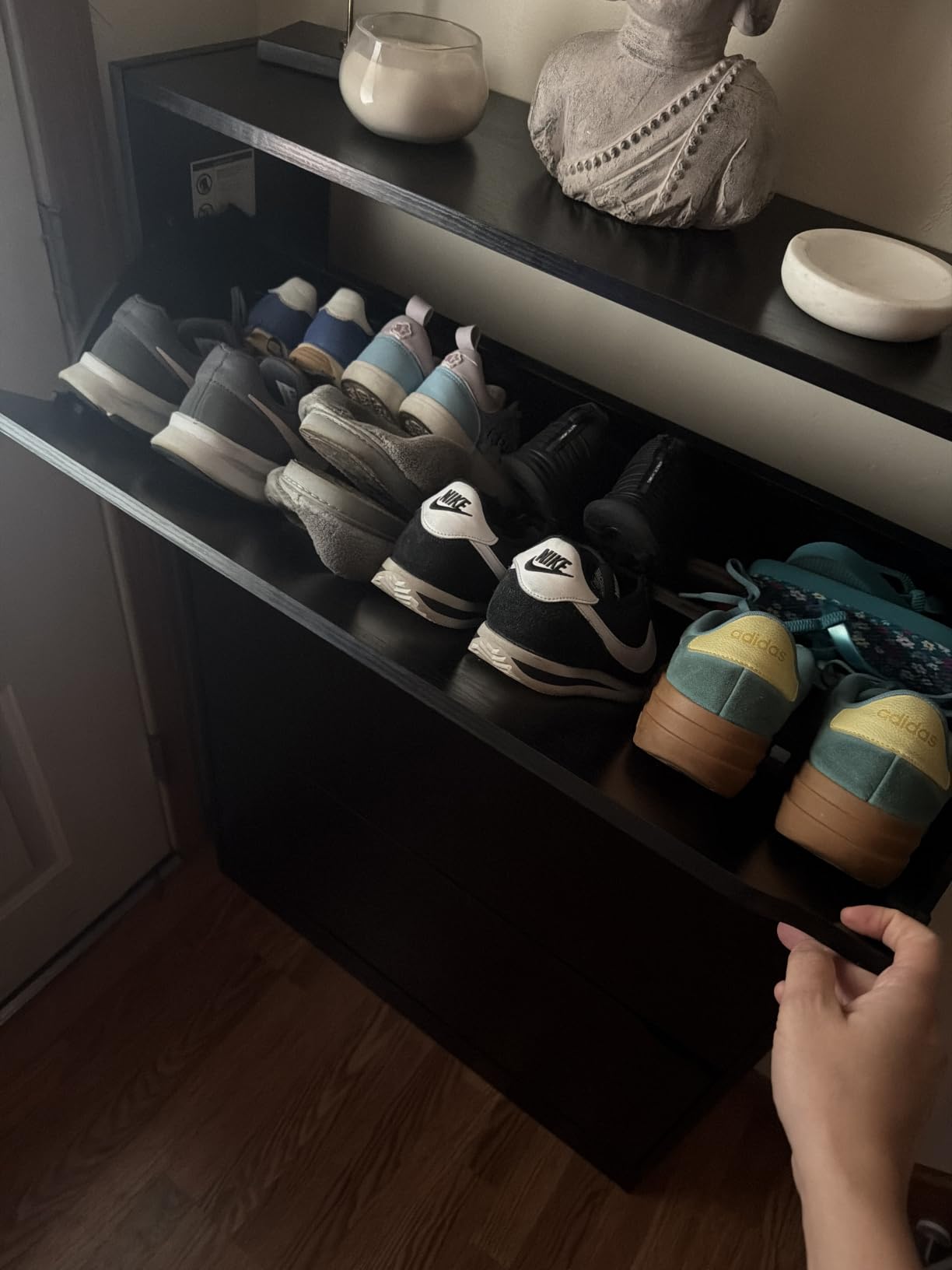
The depth is the point. At 9.45 inches deep, the flip drawers hold the pair nearly upright, so you get 18 to 24 pairs of capacity in less depth than a flat shelf rack would need for half as many.
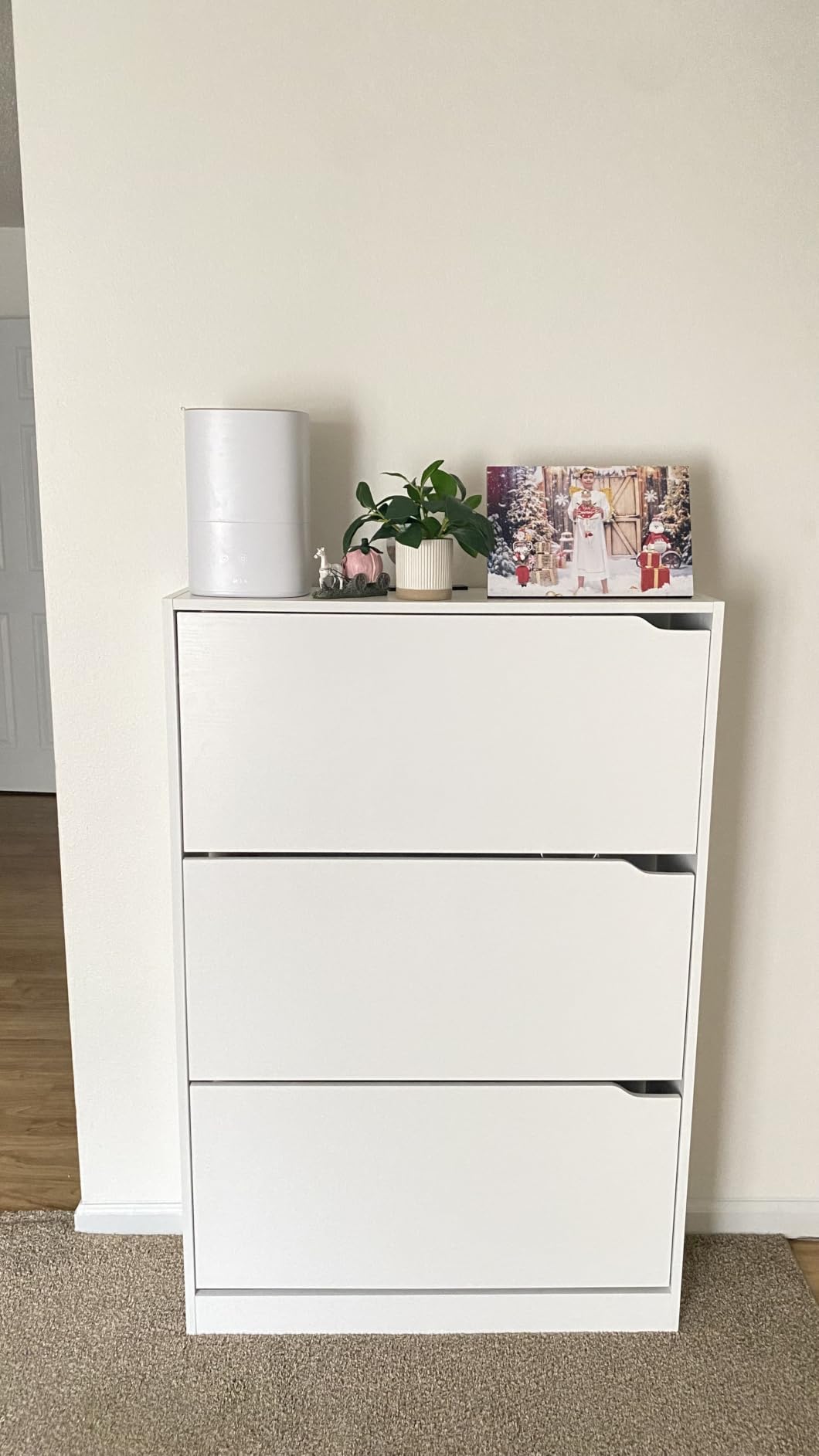
Inside each drawer is a two-tier organizer with adjustable dividers. In our tests that meant the top drawer took sneakers and the bottom took heels without rearranging anything, and the whole drawer lifts out cleanly when you want to wipe the floor beneath it.
The walnut finish and the flat top read as a console table. We used it as a landing spot for keys and a mail pile, which is what stops the shoe pile from growing in the first place.
Check the swing arc before you order
A 9.45 inch depth clears most front doors, but you still need to confirm the width does not push the cabinet into the arc. At 31.5 inches wide it eats a lot of wall, so it suits a longer wall segment rather than a tight corner.
Who should look elsewhere
Pass on it if you need a seat. There is nowhere to sit down, and the top shelf is not sized for anyone. It is also a heavier engineered wood build, so moving it between rooms is a two-person job.
3. FIDUCIAL HOME 10-Tier Rack: Best Value for 20 Pairs
FIDUCIAL HOME 10 Tiers Shoe Rack Organizer 20 Pairs Tall Shoe Shelf
17 by 11 inch footprint, 68.8 inch tall
Holds up to 20 pairs
50 lb capacity
Splits into two racks
Pros
- Holds 20 adult pairs in a tiny footprint
- Tool-free assembly takes minutes
- Tiers can be split into two 5-tier units
- Light enough to move between rooms
Cons
- Flimsy nylon shelves
- Connectors and poles can bend over time
- Light build tips if it stands unsupported
At 2.7 pounds and 11 inches deep, this is the rack that disappears into a corner. Twenty pairs of adult shoes fit across ten tiers, and the whole thing goes together by hand with no tools.
The 68.8 inch height is the first thing to check. Measure your ceiling clearance before you buy, because a unit this tall that is too tall for the space is the most common return reason in this category.
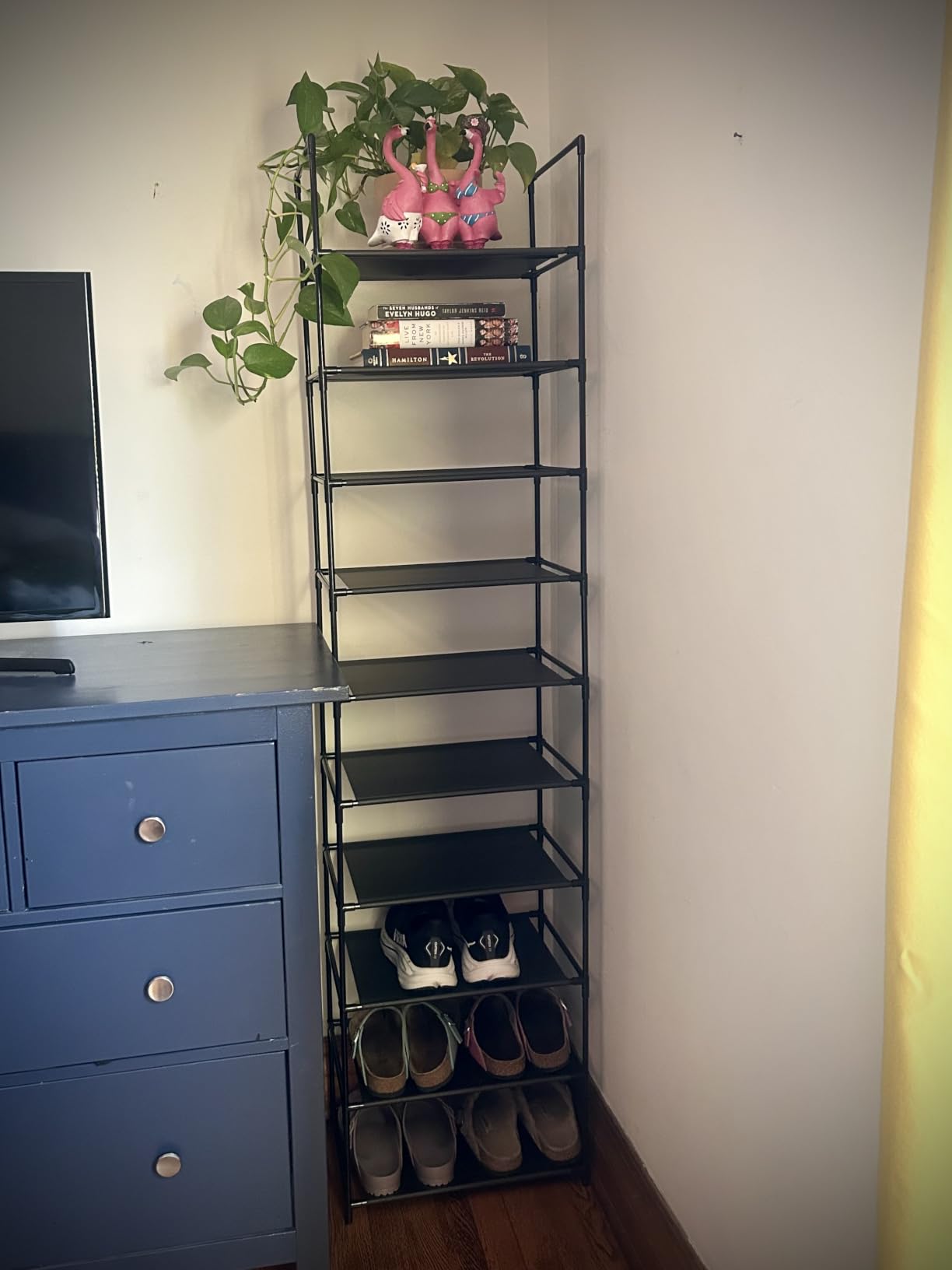
Two details make it more useful than a basic tiered rack. You can remove a single layer to create a taller bay for boots or heels, and the frame splits into two five-tier units so you can spread storage between the hallway and a closet.
It also doubles as general storage. We used the upper tiers for towels, toys and small accessories when the shoes were not filling every shelf.
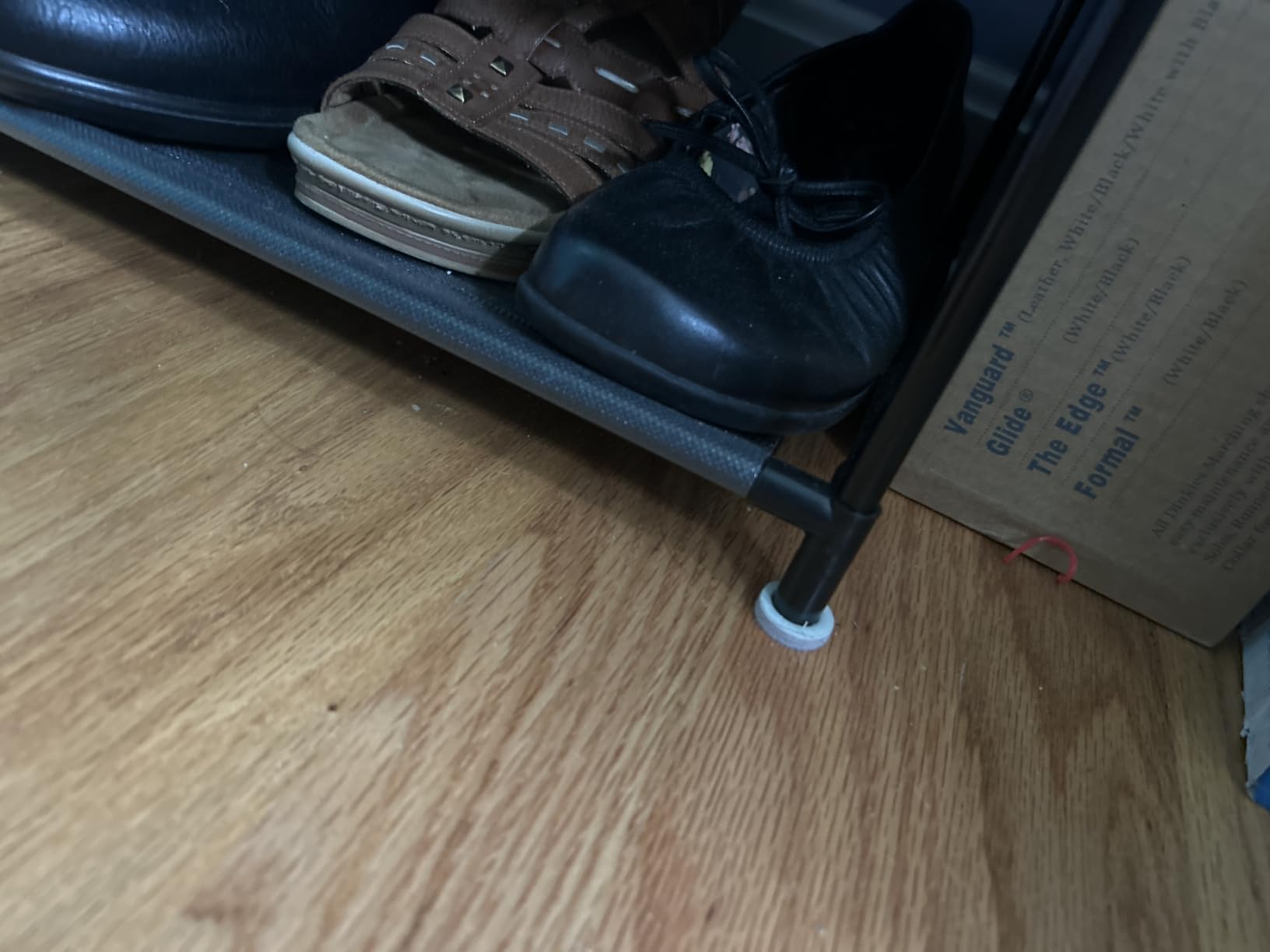
Where it works best
This rack suits a tall narrow alcove, a walk-in closet or the gap beside a garage door where nothing swings. The non-woven fabric tiers wipe clean, which matters if you store muddy shoes on the lower shelves.
Where it falls short
It is light, so keep it against a wall or anchor it in a home with kids. Shelf depth is also tight, and wide or high-top shoes will overhang. Expect the plastic connectors to be the first part to fail over a few years of use.
4. WEXCISE Narrow 10-Tier Rack: Best for a Larger Collection
WEXCISE Narrow Shoe Rack 10 Tiers Tall Shoe Rack for Entryway Closet 20 24 Pairs Shoe & Boots Organizer Storage Shelf Durable Black Metal Stackable Shoe Cabinet with Hooks, 17.1D x 11.8W x 78.7H in
11.8 inch deep, 17.1 inch wide, 78.7 inch tall
20 to 24 pair capacity
100 lb capacity
Side hook included
Pros
- Holds 20 to 24 pairs in a slim profile
- Owners report 3+ years of use
- Splits into two shorter units
- Side hook fits keys and umbrellas
Cons
- Wobbly unless connectors are fully seated
- Angled shoes can fall through the bars
- Occasionally arrives with missing hardware
This is the tallest unit we tested at 78.7 inches, and it holds the most pairs for the depth. Shelf spacing runs about 7.87 inches, so a pair of adult shoes sits flat without wedging.
The frame is powder-coated metal with strengthened plastic connectors, and the 100 pound rating is the highest in this roundup. Long-term owners report three-plus years of use, which is a real difference in this build category.
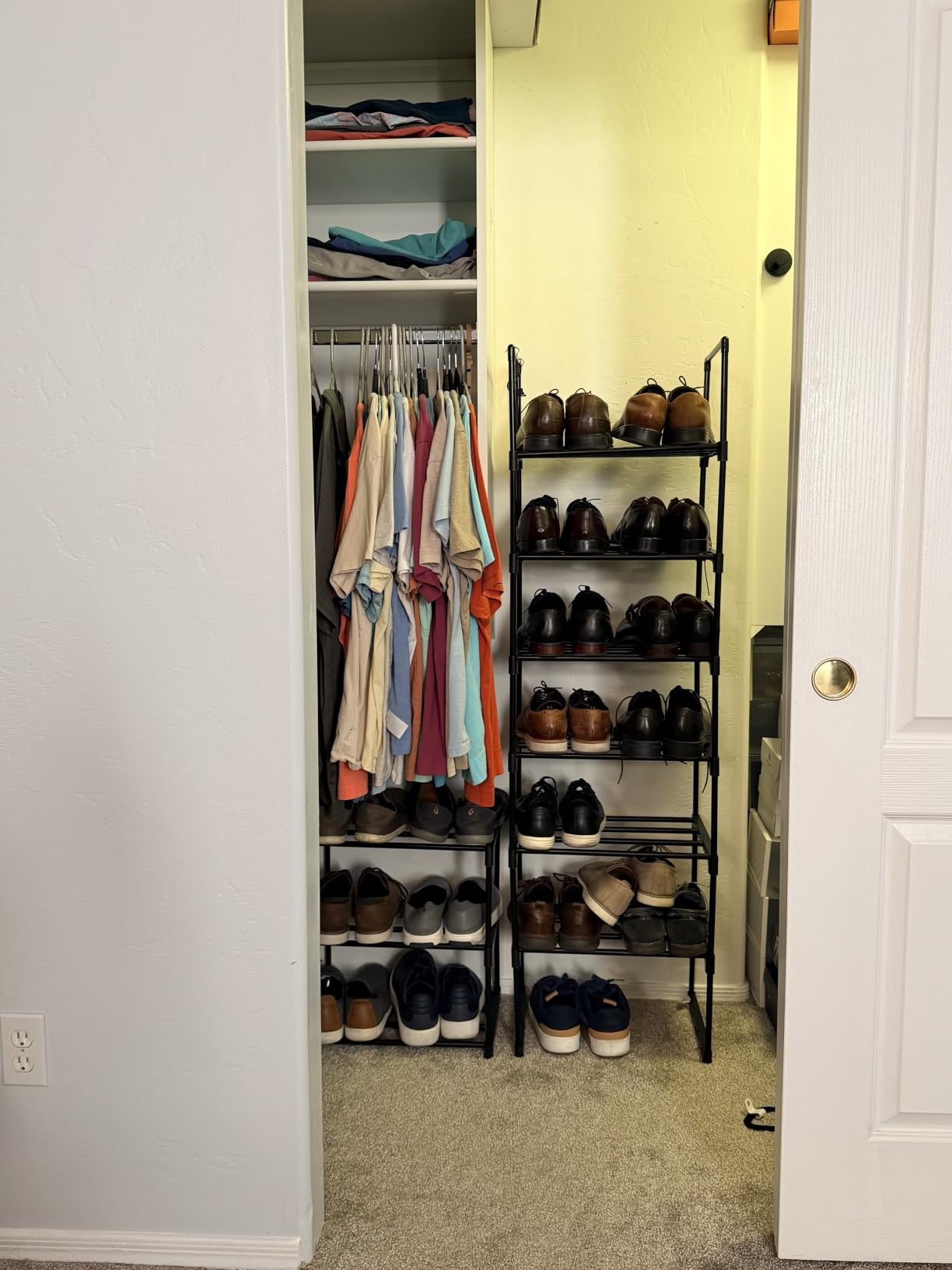
One layer removes to create a tall bay for boots, and the frame splits into two five-tier units or stacks with a second rack. A small hook on the side handles keys, umbrellas and bags, which is a small detail that keeps those off the floor.
A hammer is included in the box, and it earns its place. Seating every connector fully is what separates a rigid frame from a wobbly one, and reviewers who skipped that step are the source of most stability complaints.
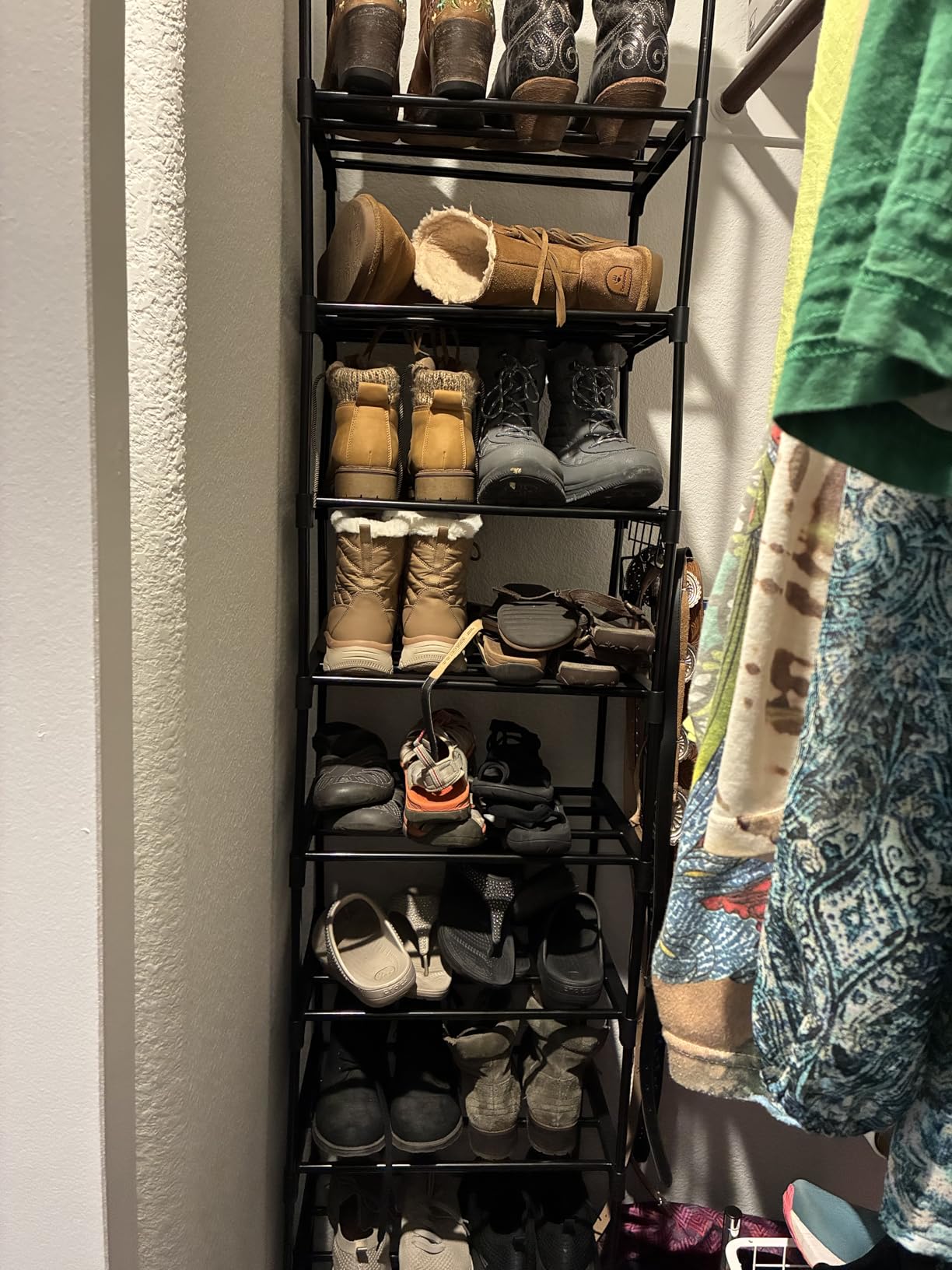
Fit check that matters most
At 78.7 inches tall, measure first. If your entryway ceiling or a light fixture gets in the way, the two-piece split solves it and you lose only a few pairs of capacity.
Know the trade-offs
The gaps between bars let angled shoes slip through, so flat and forward-facing storage works best. Some shipments also arrive with missing connector bars, so check the box before you start assembly.
5. HOOBRO Vertical 8-Tier Rack: Best for a Rustic Look
HOOBRO Vertical Shoe Rack, 8-Tier Narrow Shoe Shelf, Shoe Storage Organizer for Small Space, 11″ L x 11″ W x 53″ H, Closet, Entryway, Hallway, Bedroom, Rustic Brown and Black BF22XJ01
11 by 11 inch footprint, 53 inch tall
Holds 8 pairs
Particleboard on iron
Anti-tip kit included
Pros
- Compact 11 inch square footprint
- Firm particleboard and iron build
- Twist-lock assembly needs no tools
- Non-slip pads protect the floor
Cons
- Holds only about 8 pairs
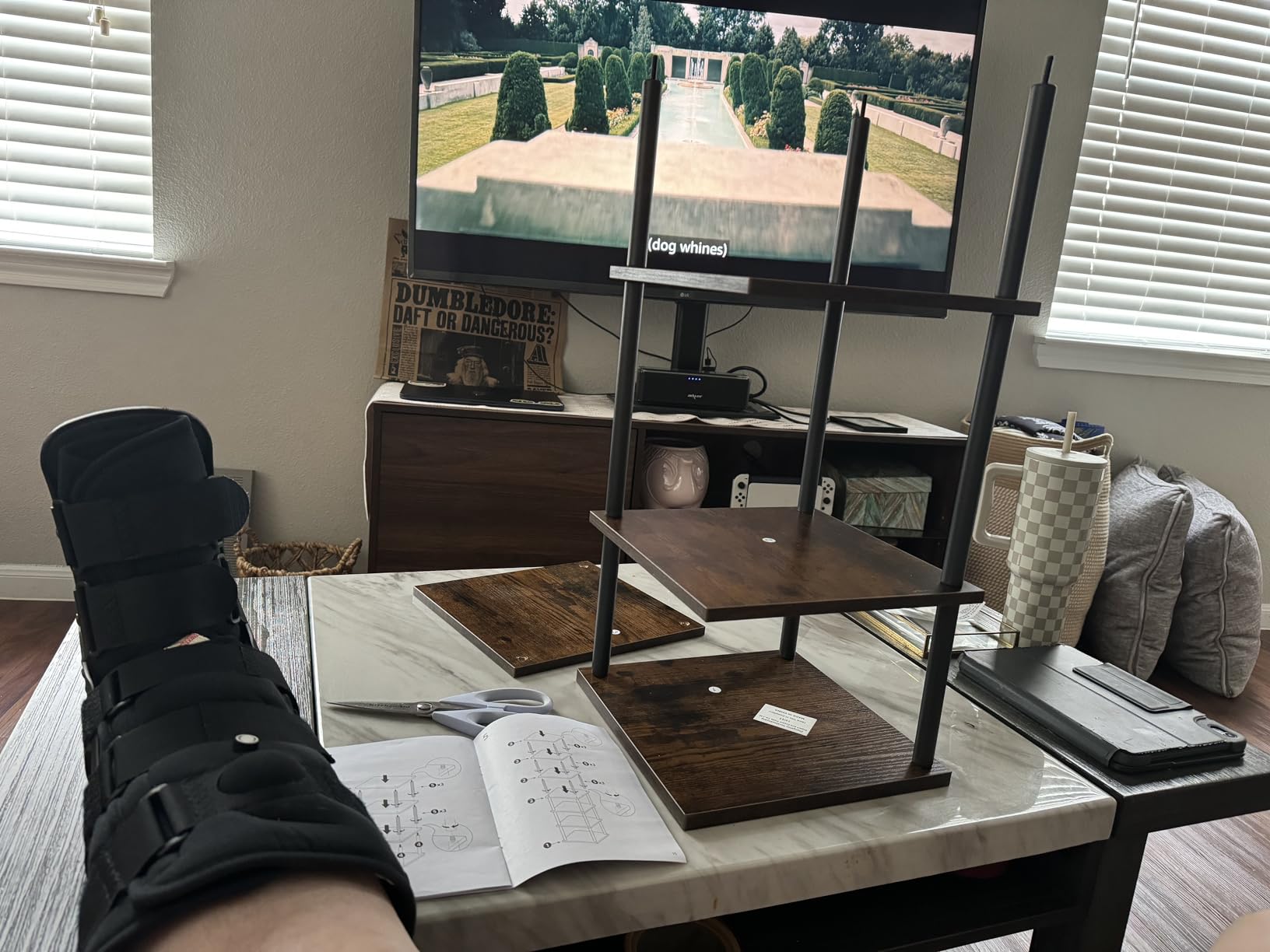
Most racks in this roundup are black metal or white plastic, so this one stands out visually. The rustic brown shelves on an iron pipe frame suit a farmhouse or cottage entryway instead of disappearing into a modern hallway.
It is also the sturdiest of the narrow vertical racks we tried. Particleboard shelves on a full iron pipe frame, plus non-slip pads and an included anti-tip kit, is a better safety story for a home with kids.
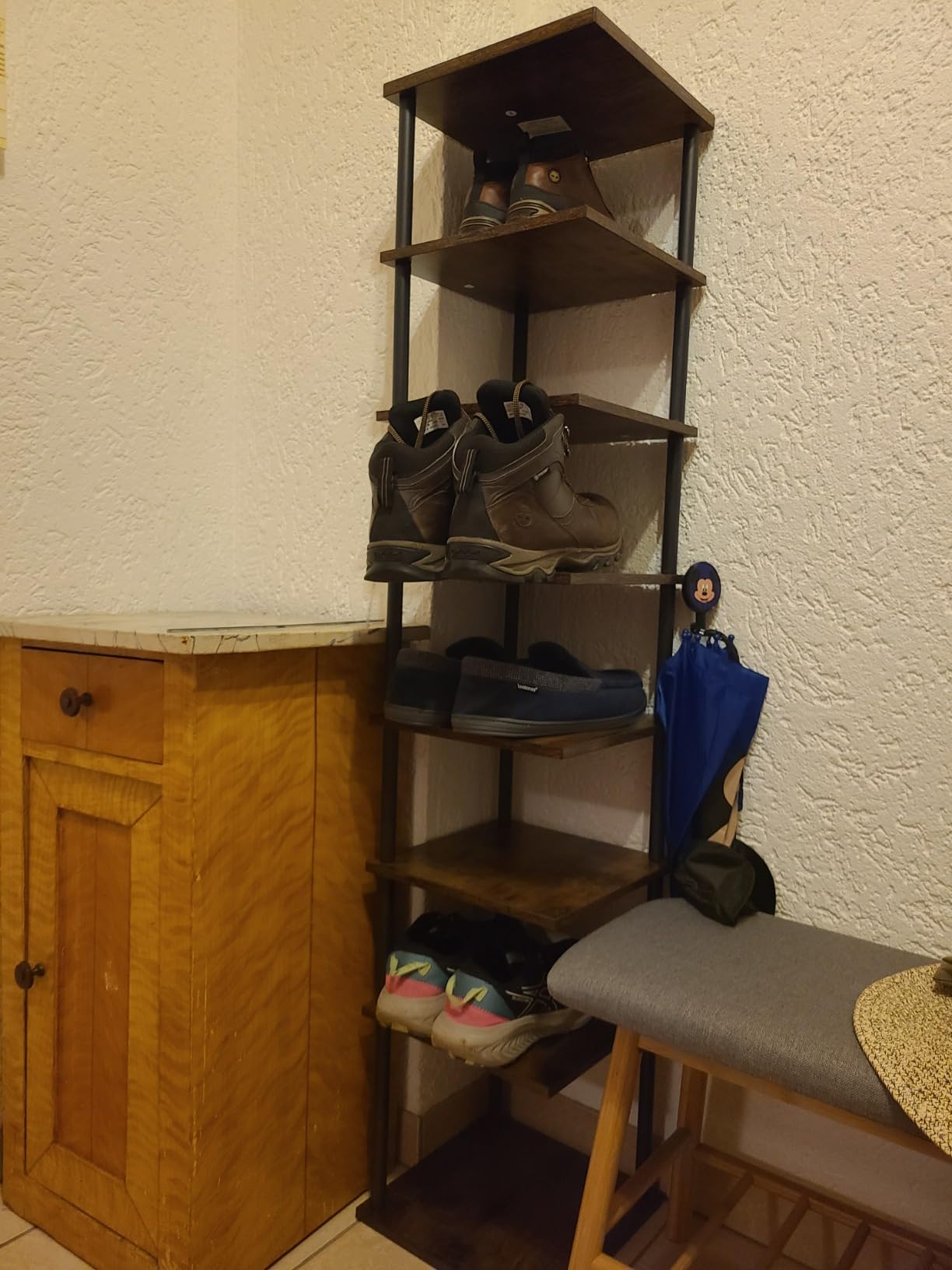
One shelf is spaced 9.6 inches apart for taller items, which is enough for mid-calf boots lying down or a pair of high-tops standing up. Assembly is a twist-lock with no tools, and it came together in a few minutes.
The tradeoff is capacity. At 53 inches tall with eight tiers, it holds about eight pairs, so treat it as a daily-rotation rack for one or two people rather than a collection.
When the style decides it
Pick this when the shoe zone is visible from the living room and a black wire rack would look industrial in the space. The footprint is a true 11 inch square, so it tucks into a corner beside a door.
When it is not enough
Eight pairs will not carry a family. If you need more than a daily rotation in the entryway, look at a ten-tier unit or a flip-drawer cabinet that hides capacity behind a closed front.
6. Autonomier 4-Tier Extra Small Rack: Best for Kids Shoes
Autonomier 4 Tier Extra Small Shoe Rack (16.3″ Wide), Space Saver Shelf
16.3 inch wide, 10.2 inch deep, 21.5 inch tall
About 8 pair capacity
22 lb capacity
Stackable
Pros
- Very small footprint fits beside a door or under a desk
- Assembles in about five minutes
- Holds roughly 8 pairs for kids or slim adult shoes
- Stacks vertically to expand storage
Cons
- Lightweight and flimsy
- Large men's shoes may only fit three per tier
- Some shipments missing fabric
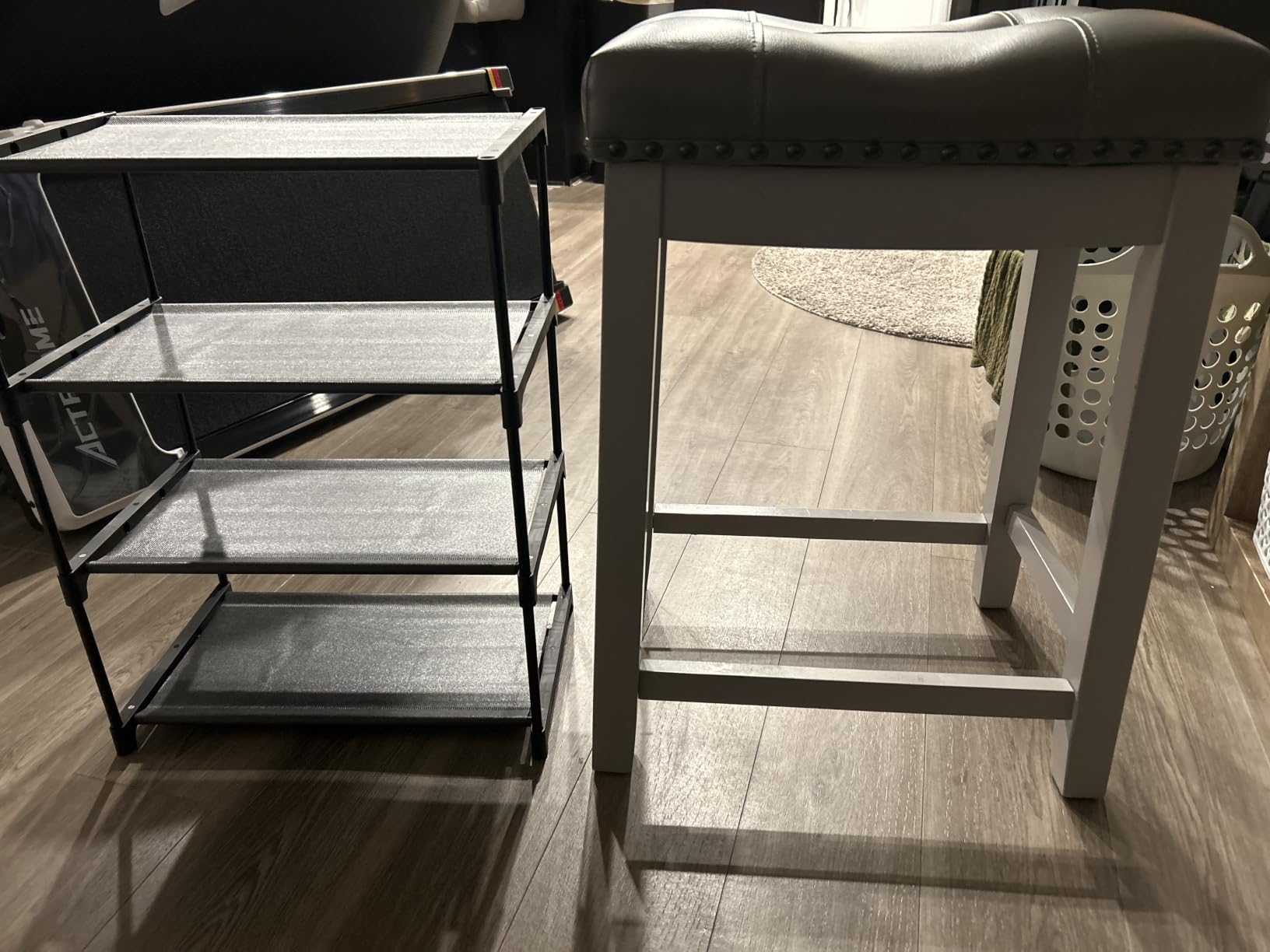
This is the shortest unit in the roundup at 21.5 inches, and at under 2 pounds a child can pull it out to grab shoes. That is exactly the use we saw it suited to best: a low rack in a kid’s entryway zone.
At 16.3 by 10.2 inches it also fits under a desk or a console, which makes it useful when the wall space is already spoken for.
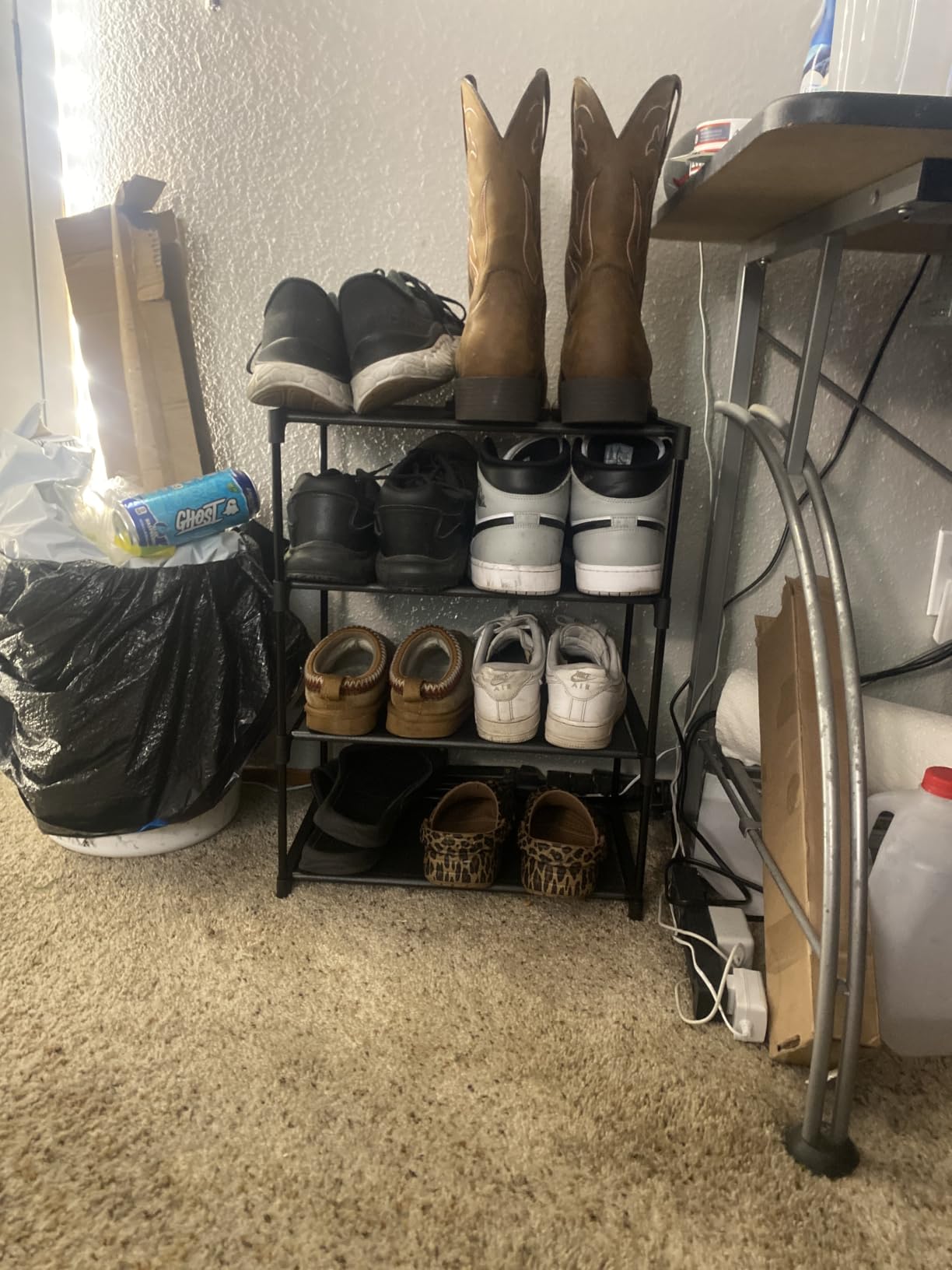
The fabric tiers are waterproof and wipe clean, and the metal tubes are surface-coated against corrosion. Each tier takes about two pairs, so four tiers give you roughly eight.
Units stack vertically or connect horizontally, so you can start with one and add a second when the shoe volume grows. Assembly follows the included guide with no tools.
When it earns its place
Choose it for a small household, a studio apartment, or a per-person zone in a shared drop zone. Label one tier per person and the sorting problem largely solves itself.
When it will not hold up
It is light and thin, so do not load it beyond the 22 pound rating. Large men’s shoes fill a tier with only three pairs, and the build is not the choice for a household’s full off-rotation collection.
7. Tangkula 8-Tier Vertical Rack: Best for a Tight Corner
Tangkula 8-Tier Vertical Shoe Rack, Holds 7 Pairs, White
10 inch deep, 11 inch wide, 43.5 inch tall
Holds about 7 pairs
88 lb overall capacity
Mixed shelf heights
Pros
- Slim 10 by 11 inch footprint fits a corner
- Sturdy engineered wood with an 88 lb total
- Mixed shelf heights suit heels and flats
- Doubles as a plant or towel rack
Cons
- Holds only about 7 pairs
- Heavy relative to its capacity
At 10 by 11 inches, this is one of the two shallowest footprints here, and it goes where a flat shelf never would: the corner immediately beside a front door that swings inward.
The mixed shelf heights are the clever part. The bottom two shelves are 7.5 inches tall for heels, and the top five are 5 inches for flats and sneakers, so you are not wasting vertical space on shoes that do not need it.
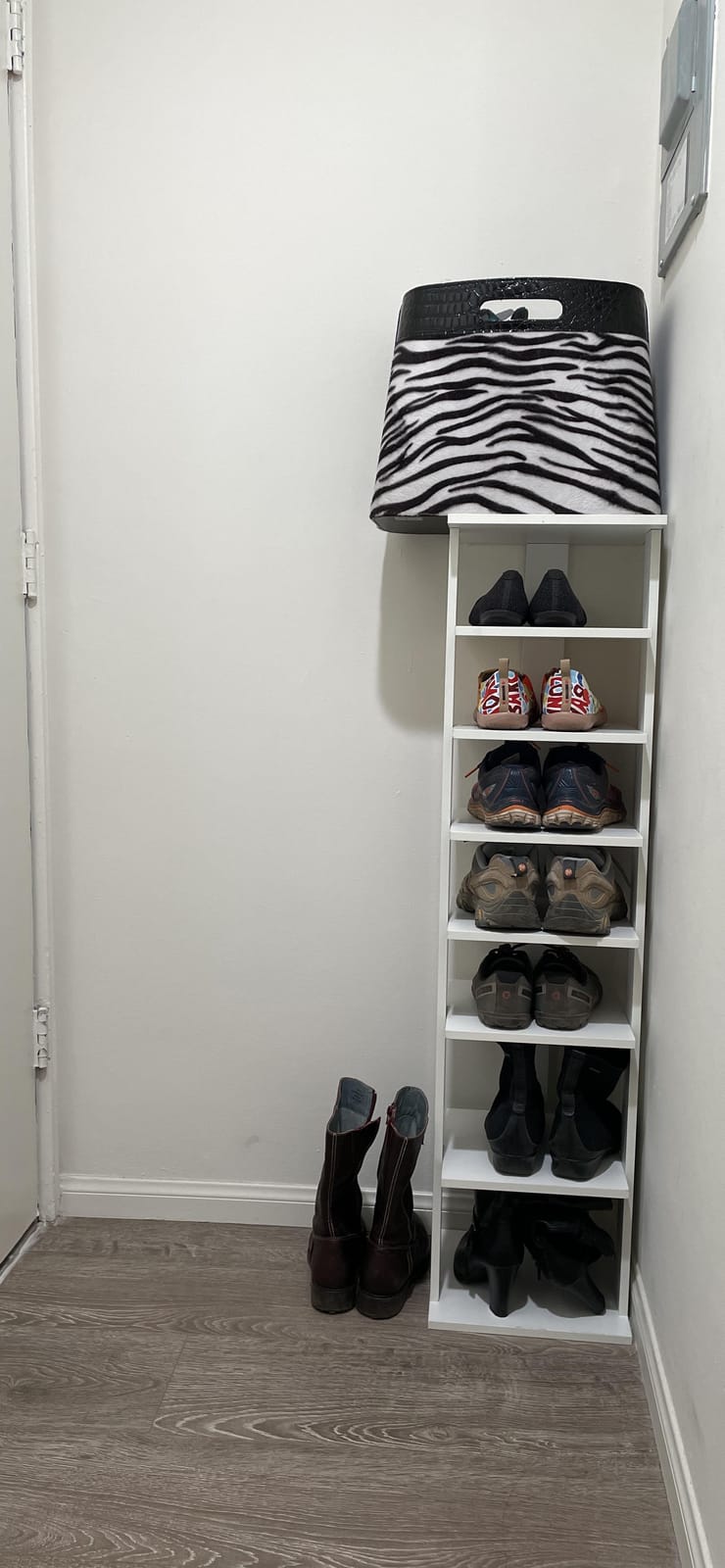
Each partition supports up to 11 pounds, with an 88 pound total. That is real engineered wood, not fabric over plastic, and it does not wobble when you pull a pair out.
It also does double duty as a plant rack, towel shelf or small bookcase, which is handy in an entryway that handles more than shoes.
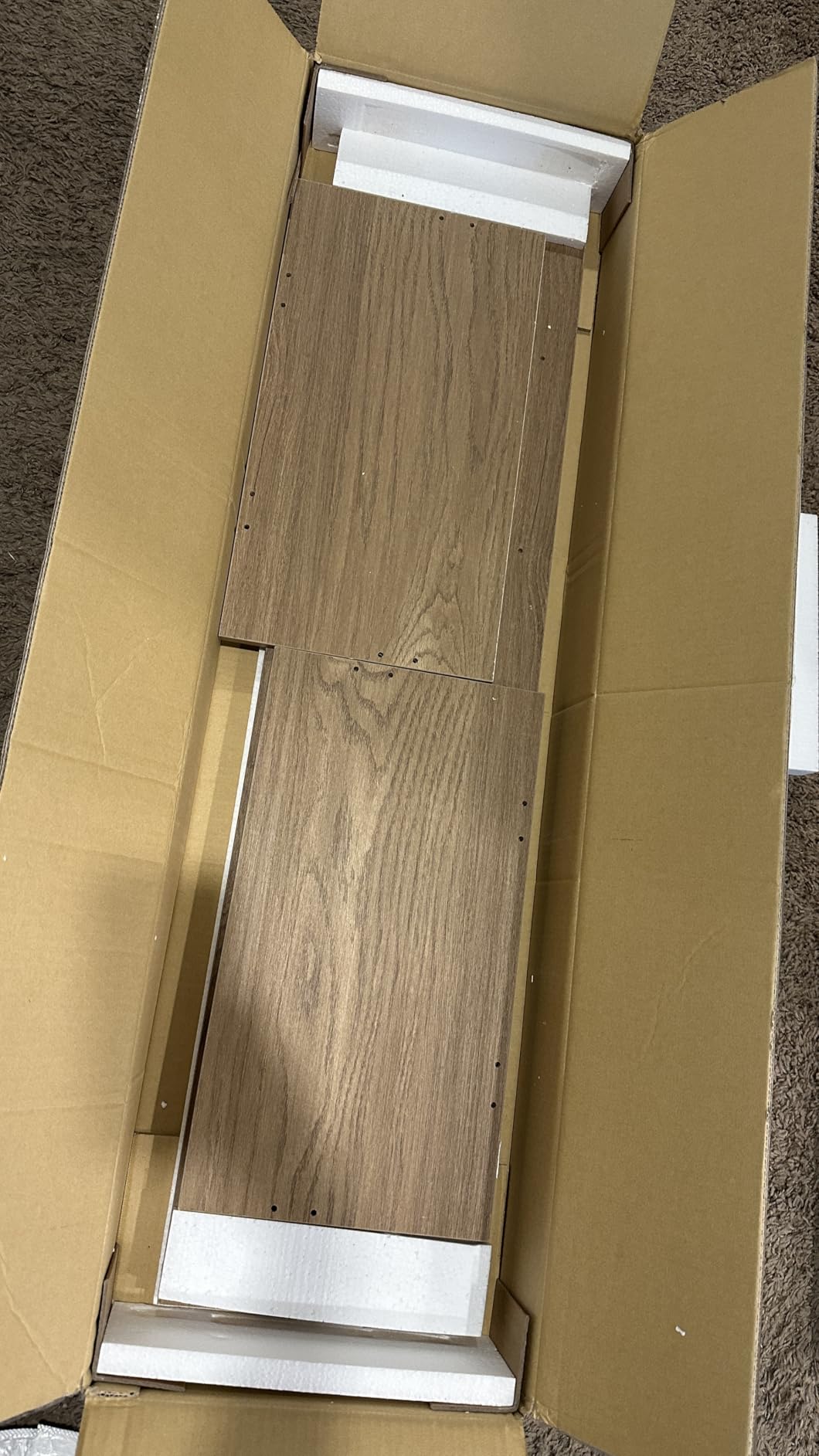
Why corner placement matters
A corner rack is the classic answer to the door-swing problem. The arc of an inward-opening door wastes the wall next to it, but not the two perpendicular walls, so depth matters far less there than the corner width.
Honest limits
Seven pairs is a small number, and at 15 pounds the unit is heavy for what it holds. It is a great fit for one person’s daily rotation and a poor fit for a family of four.
8. LANTEFUL 10-Tier Corner Rack: Best for Keys and Umbrellas Too
LANTEFUL Tall Narrow Shoe Rack for Entryway, 10-Tier Sturdy Metal Shoe Shelf Storage 10-15 Pairs of Shoes and Boots, Space Saving Corner Shoe Rack Organizer for Closet,Doorway,Garage,Living Room
11.5 inch square footprint, 66.93 inch tall
10 to 15 pair capacity
100 lb rating
5 hooks included
Pros
- Very narrow 11.5 inch square footprint
- Backing panel stops shoes dropping through
- Five hooks for keys and umbrellas
- Easy to disassemble and reconfigure
Cons
- Very light build
- Metal connectors can be finicky to assemble
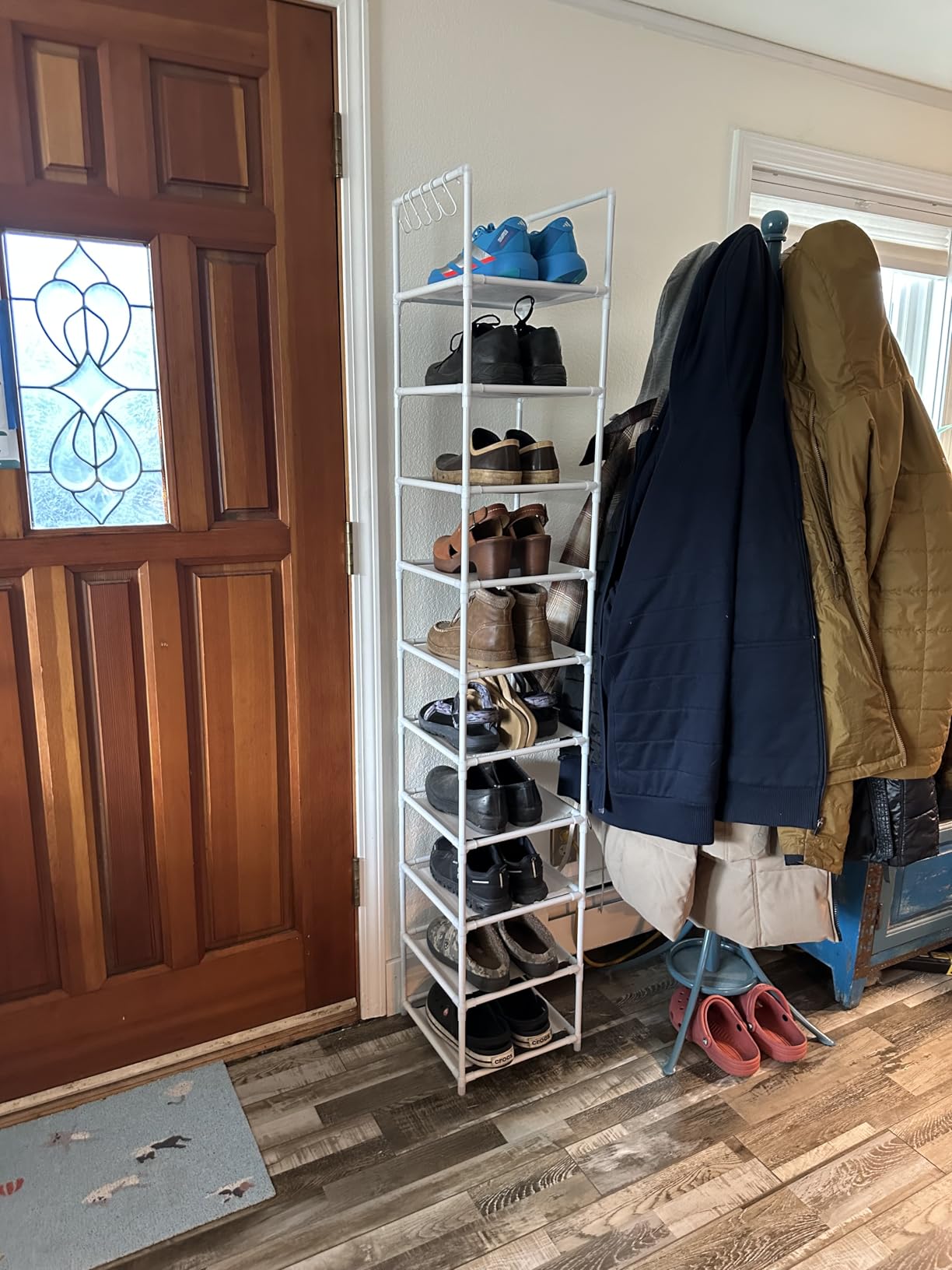
The five hooks are what make this more than a shoe rack. Keys, umbrellas, a lanyard and a leashes all hang at child height, and in our testing that pulled most of the non-shoe clutter off the floor in one move.
It holds 10 to 15 pairs across ten tiers at about 6.69 inches per layer, on an 11.5 inch square footprint that corners neatly beside a doorway.
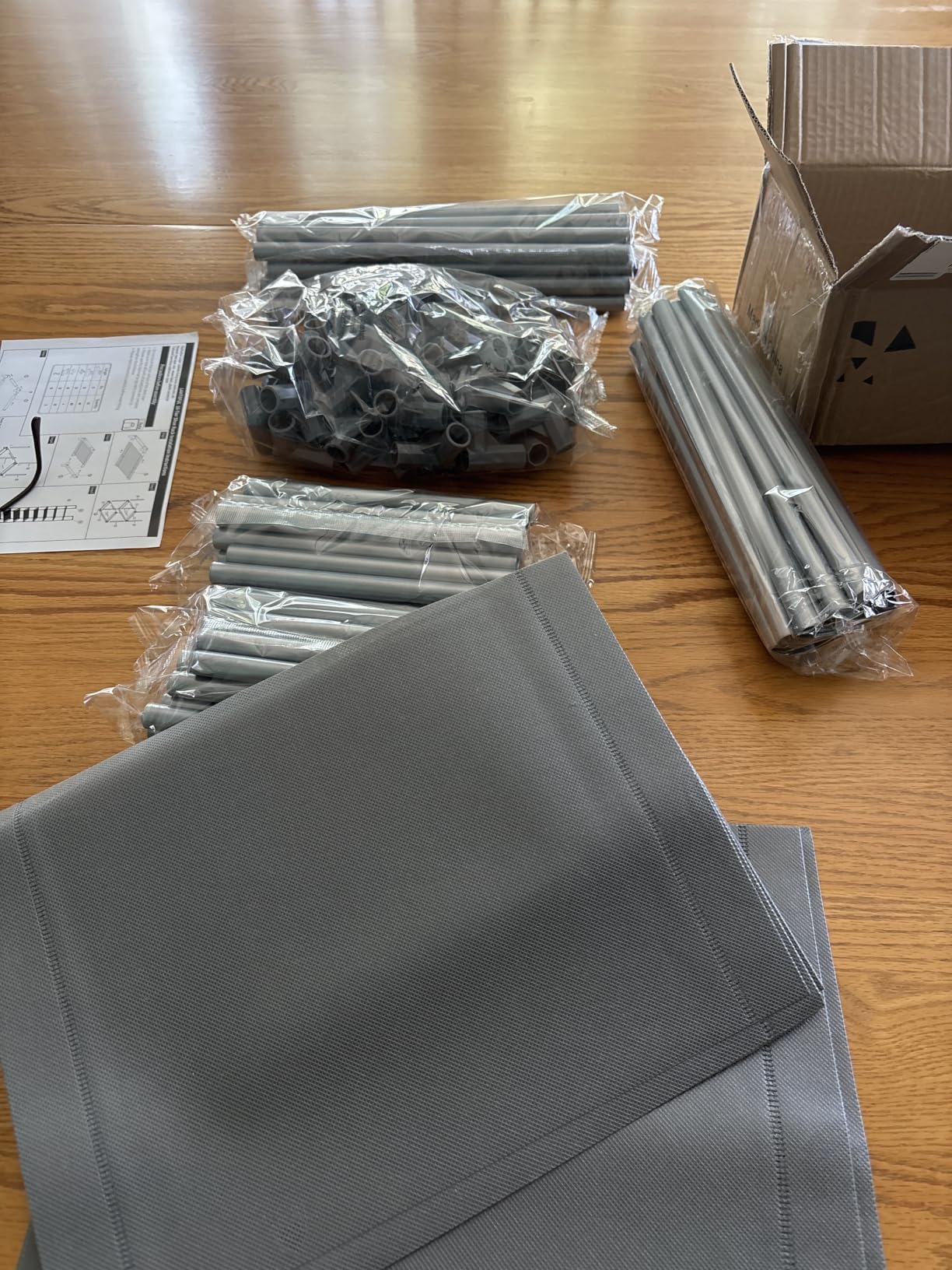
The waterproof non-woven backing panel is a real improvement over open-bar racks. Shoes no longer tip through the tiers at an angle, which is the most common complaint about this style.
It also reconfigures. Build it as ten tiers, split it into two five-tier units for different rooms, or combine units as the collection grows.
When the drop zone matters
Choose this when the entryway problem is a general clutter pile, not only shoes. The hooks give you a place for the small objects that end up on the floor beside any door.
What to watch
At 1.6 pounds it is very light, so it must sit against a wall or be weighted. Metal connectors can be awkward during assembly, and a little patience helps.
9. Nicetree 2 Flip Drawer Cabinet: Best for a Color Match
Nicetree Shoe Storage Cabinet, Shoe Cabinet with 2 Flip Drawers, Narrow Shoe Rack Cabinet, Farmhouse Slim Shoe Cabinet Storage for Entryway,Blue
9.44 inch deep, 31.49 inch wide, 41.92 inch tall
12 to 24 pair capacity
Elevated metal legs
Anti-tip design
Pros
- Slim 9.44 inch depth fits narrow hallways
- Navy blue finish suits coastal and farmhouse
- Two adjustable shelves hold 12 to 24 pairs
- Elevated legs create space underneath
Cons
- Heavier build at 42.2 lb
- Flip drawers must be loaded in sections
Navy blue is unusual in this category, and it matters when the shoe cabinet is part of the foyer decor rather than a hidden utility. The finish suits coastal, farmhouse and modern interiors that a black wire rack would flatten.
At 9.44 inches deep it sits in the same slim band as the other flip-drawer cabinets, and the two adjustable shelves hold 12 to 24 pairs depending on shoe type and size.
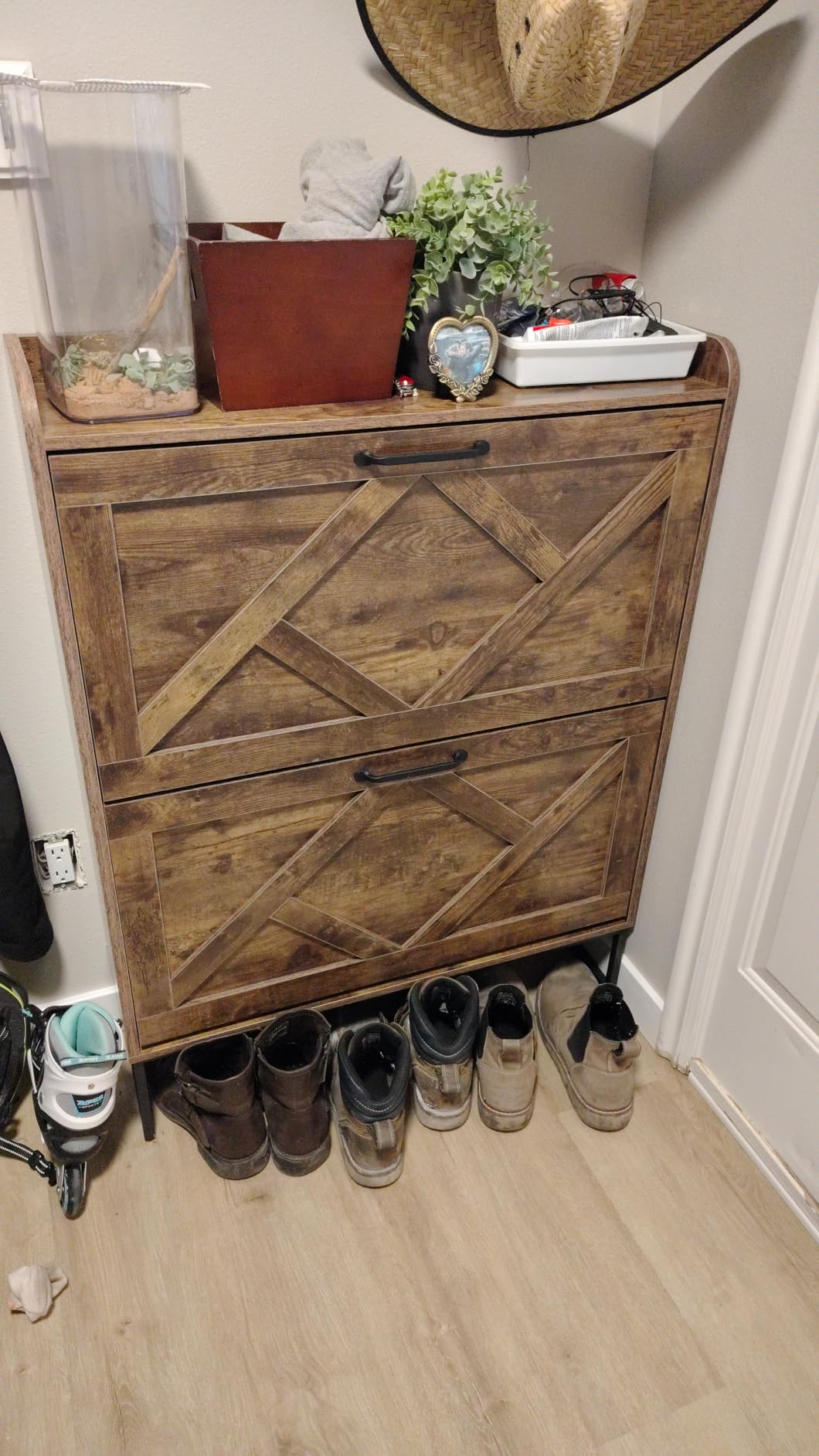
The elevated metal legs add a shelf of clear space underneath, which in our tests took slippers and a pair of outdoor shoes without crowding the front. The top fence doubles as a display surface for keys and a small tray.
It is an MDF build with a reinforced metal frame and an anti-tip design, both of which matter more in a home with kids or pets.
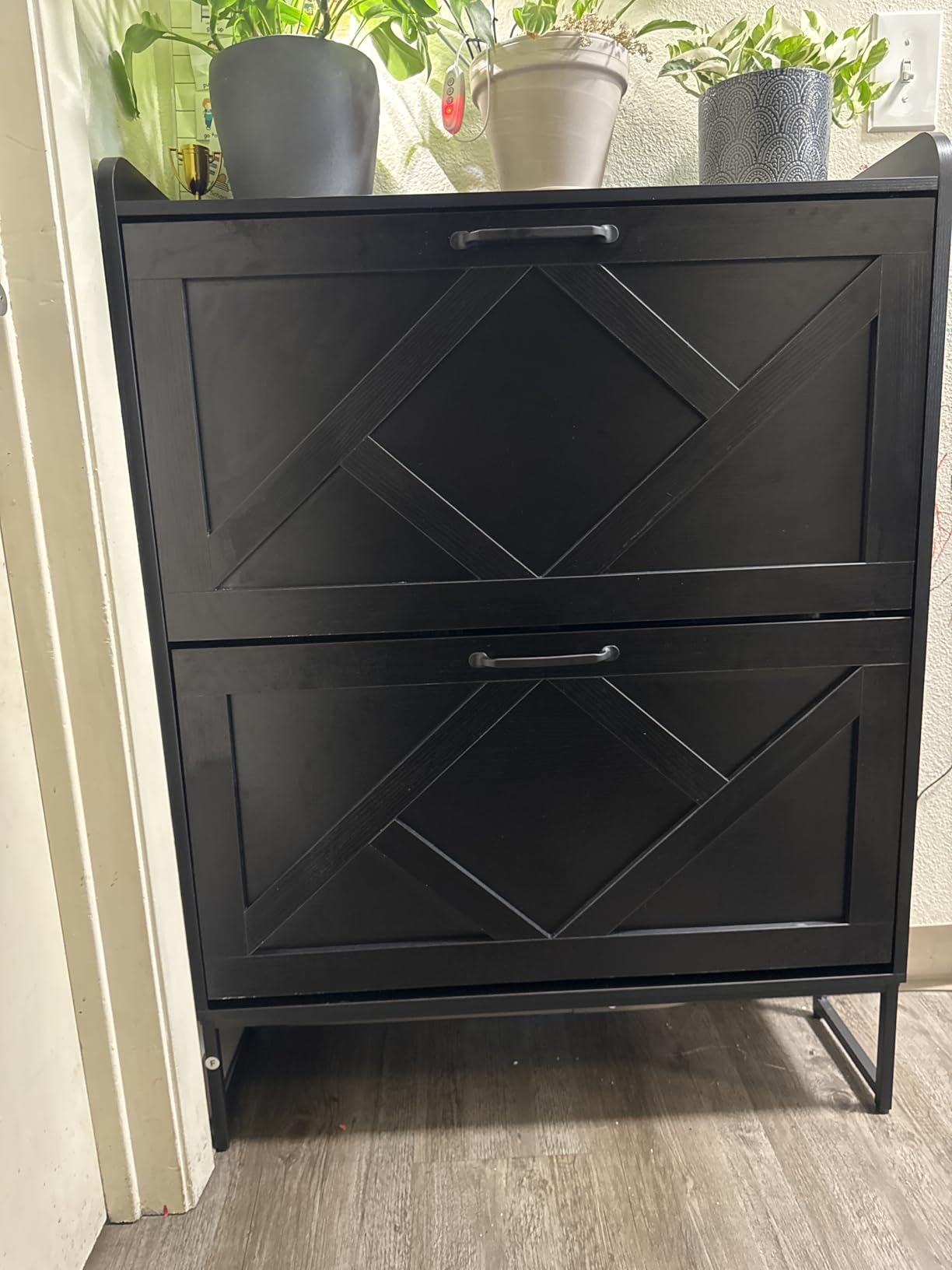
When the color is the reason
Pick this when you want closed storage that looks like furniture and the entryway has a color scheme. The doors keep dust off the shoes, which is a real gain in a home that does not sweep often.
Where it is heavier than you expect
At 42.2 pounds, moving it between rooms is a two-person job. Flip drawers also mean you load each section as a unit, so unloading a full cabinet takes a few extra minutes.
10. Patinao Slanted 5-Tier Rack: Best for Boots and High-Tops
Slanted Narrow Shoe Rack 5 Tiers, Slim Depth Vertical Shoe Shelf – 1 Pack
8.2 inch wide slanted design, 39 inch tall
45 degree tilt
220.5 lb rating
Washable PET plastic
Pros
- Slanted shelves cut the footprint by about a third
- Accepts boots sneakers and high-tops
- The tilt means less bending to reach shoes
- Washable warp-resistant plastic
Cons
- Clear plastic scuffs
- Shows dust easily
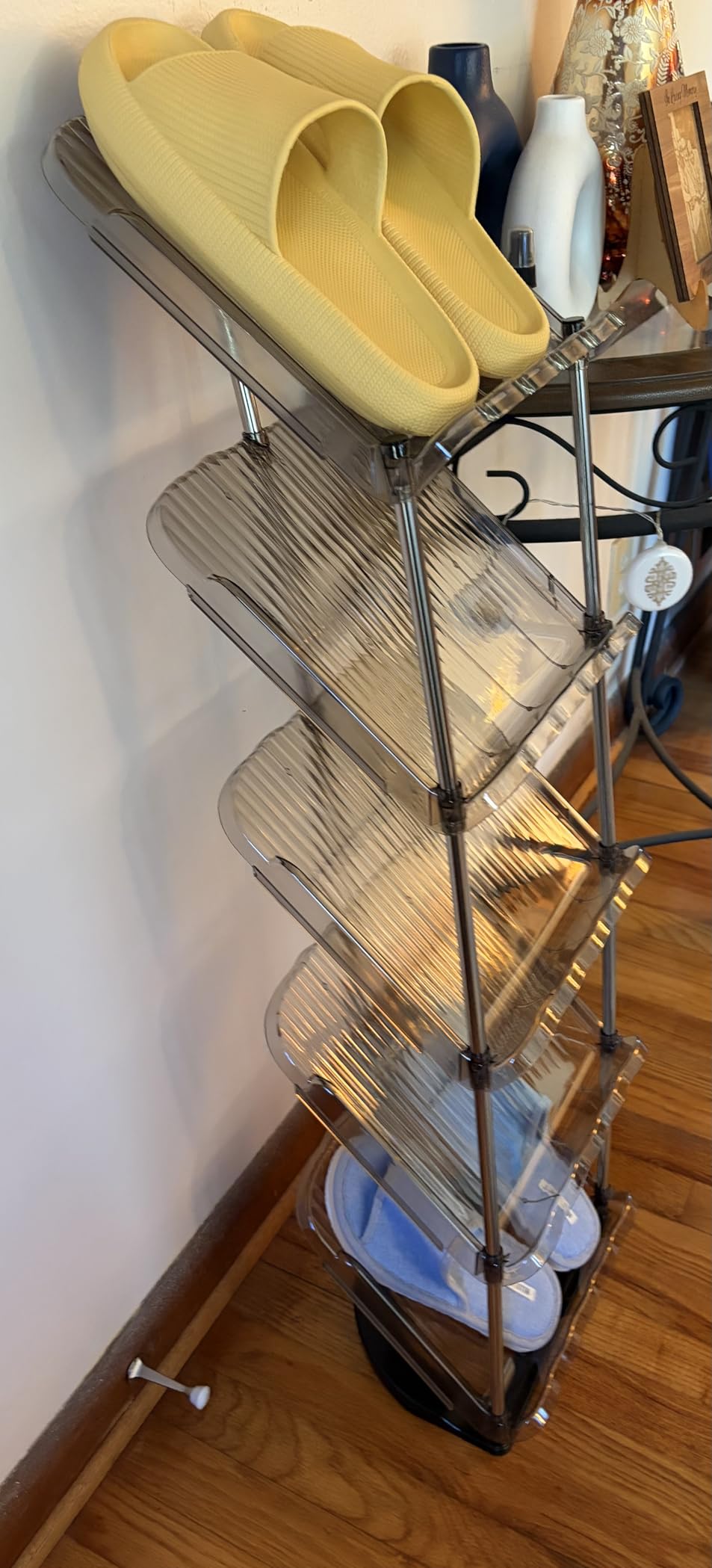
This is the answer to the fit failure we heard about most often: steel-toe work boots and tall boots that will not go into a flip-drawer cabinet. At a 45 degree slant, the pair stands on its heel edge and gains usable height the way a boot rack does.
It is also the narrowest item here at 8.2 inches wide, and the product data states the slanted design reduces the footprint by roughly a third against a flat shelf of the same capacity.
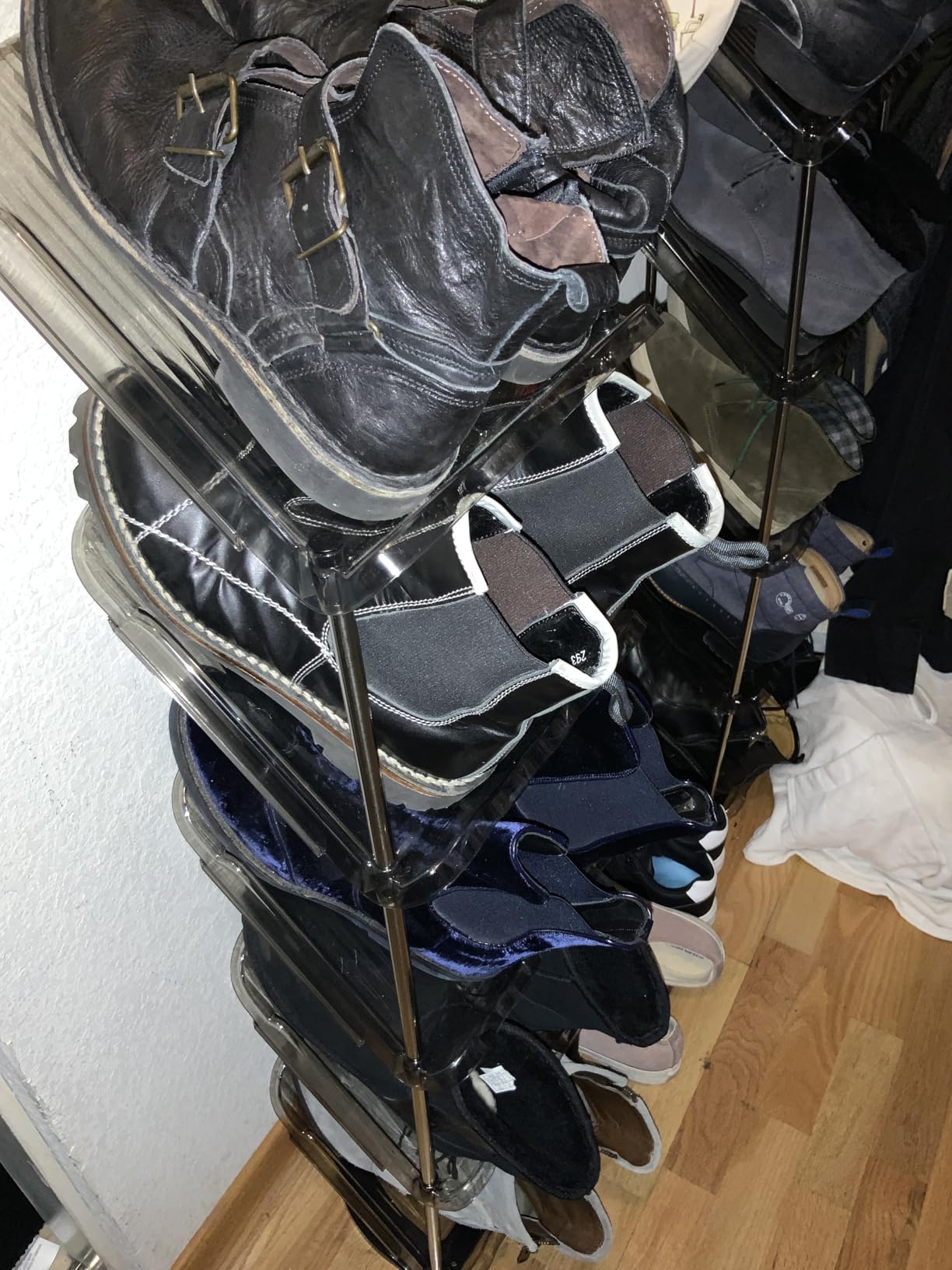
The tilt is a genuine ergonomic gain. You reach at an angle rather than crouching to the bottom of a rack, which is a real difference when you are pulling on work shoes at 6 in the morning.
The build is PET plastic shelves on a stainless steel frame, rated to 220.5 pounds. The shelves wash and do not deform, and tiers splice together without tools.
Best fit for wet winter gear
Because the racks stay open, air moves through them and wet boots dry instead of stewing. That is the single biggest reason to prefer an open ventilated rack over a closed cabinet in a climate with real rain and snow.
Appearance is the catch
Clear plastic scuffs and shows dust, so it works best in a garage entry or back hall rather than a formal foyer. It also looks less like furniture, which matters if the shoe zone faces the living room.
11. Kitsure 10-Tier Rack: Best Sturdy Full-Size Option
Kitsure 10 Tier Shoe Rack, Tall Shoe Organizer, 16.9″ Wide, Black
16.9 inch wide, 11.8 inch deep, 68.5 inch tall
Up to 20 pair capacity
Detachable layers
Metal frame
Pros
- Sturdy metal frame holds a full 20 pairs
- Slim 16.9 inch footprint
- Tool-free assembly for one person
- Shelves are fixed and level so shoes stay put
Cons
- Fabric shelves are not for heavy items
- Very light build
- May need splitting to fit the space
At about two pairs per tier, this is the rack that handles full-size adult shoes without the overhang problems that trip up fabric shelves elsewhere. The metal frame and plastic connectors are the sturdier combination.
Shelves are fixed and level rather than sloped, so a pair of sneakers sits flat instead of sliding toward the front. That detail is why it holds a full 20 pairs in an 11.8 inch depth.
Detachable layers let you set the height to your space or split the unit into separate sections for different rooms, which is useful when 68.5 inches is close to your ceiling height.
We rated it highly overall, with one caveat: the non-woven fabric shelves are flexible, so they are for shoes and light items only. Do not stack boxes or bags on the upper tiers. The unit is also light enough that a pet can knock it over, so keep it against a wall or anchor it if you have small children.
When this is the right buy
Choose it for an adult household with a large collection and a straight wall with no door swing over it. The 16.9 inch width uses the wall efficiently and the 11.8 inch depth still fits most narrow hallways.
When it is not
Skip it in a home with pets or toddlers unless you anchor it. The fabric shelves also flex visibly under heavier shoes, which some buyers find distracting over time.
12. VILICK Covered 10-Tier Rack: Best for Dust Protection
VILICK Shoe Rack with Cover Narrow Shoe Organizer with 4 Side Pockets 10 Tier Tall Shoe Storage Holds 18-22 Pairs Shoes and Boots Shoe Rack for Closet Entryway Garage
17.7 inch wide, 11.8 inch deep, 62.2 inch tall
18 to 22 pair capacity
Zippered dust cover
4 side pockets
Pros
- Holds 18 to 22 pairs in a slim footprint
- Zippered dust cover closes for a tidy look
- Four pockets for keys umbrellas and gloves
- Good stability once tubes are seated
Cons
- Some units arrive with cracked plastic connectors
- No room for tall boots standing upright
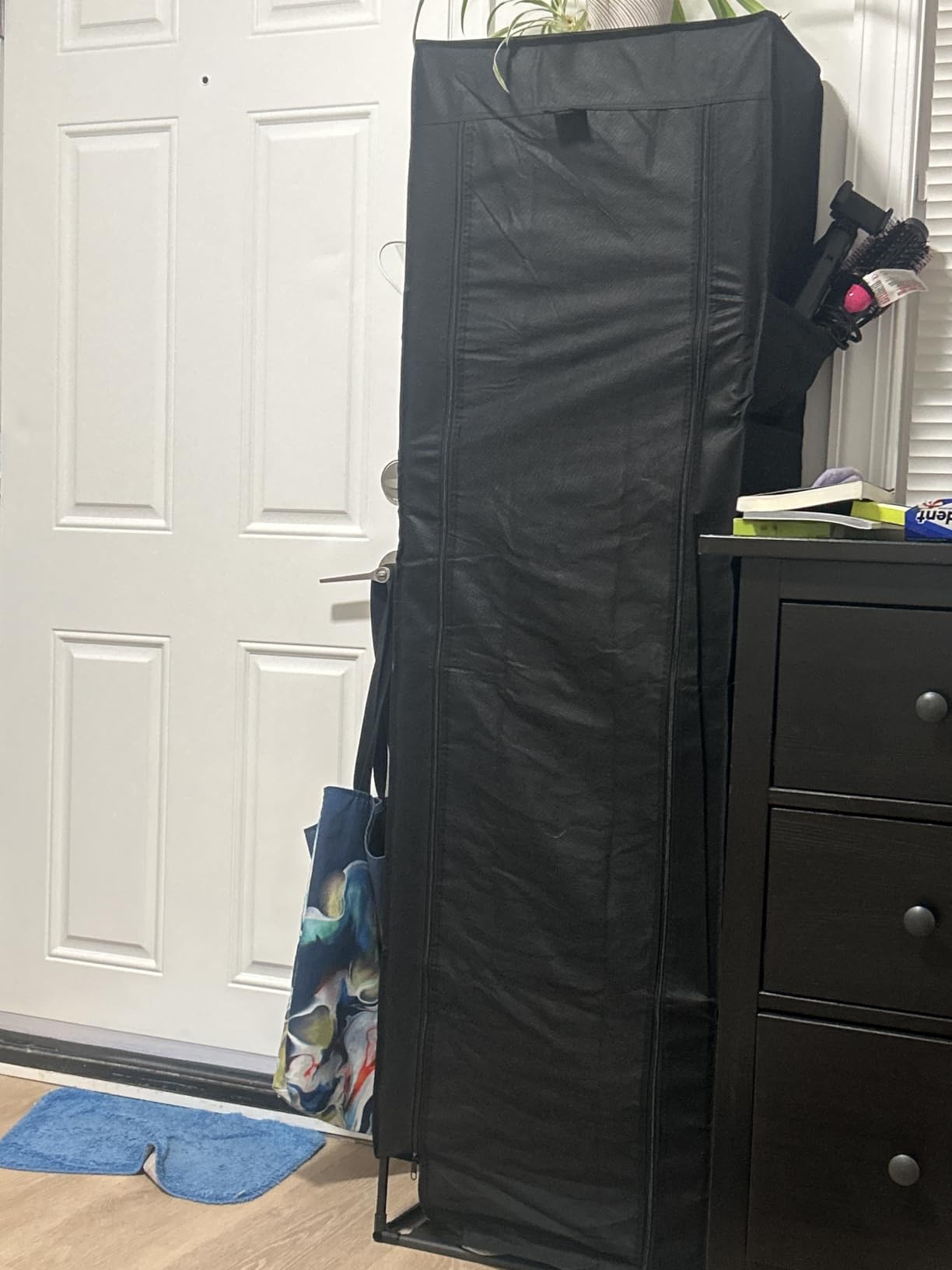
A zippered dust cover is unusual at this size and it solves a real problem in a ground-floor entryway or a garage door entry. Close the cover and a rack full of shoes looks like a piece of storage rather than a display of clutter.
It holds 18 to 22 pairs at 17.7 inches wide by 11.8 inches deep, and each shelf supports up to 10 pounds. Four side pockets take keys, umbrellas, gloves, belts or wallets.
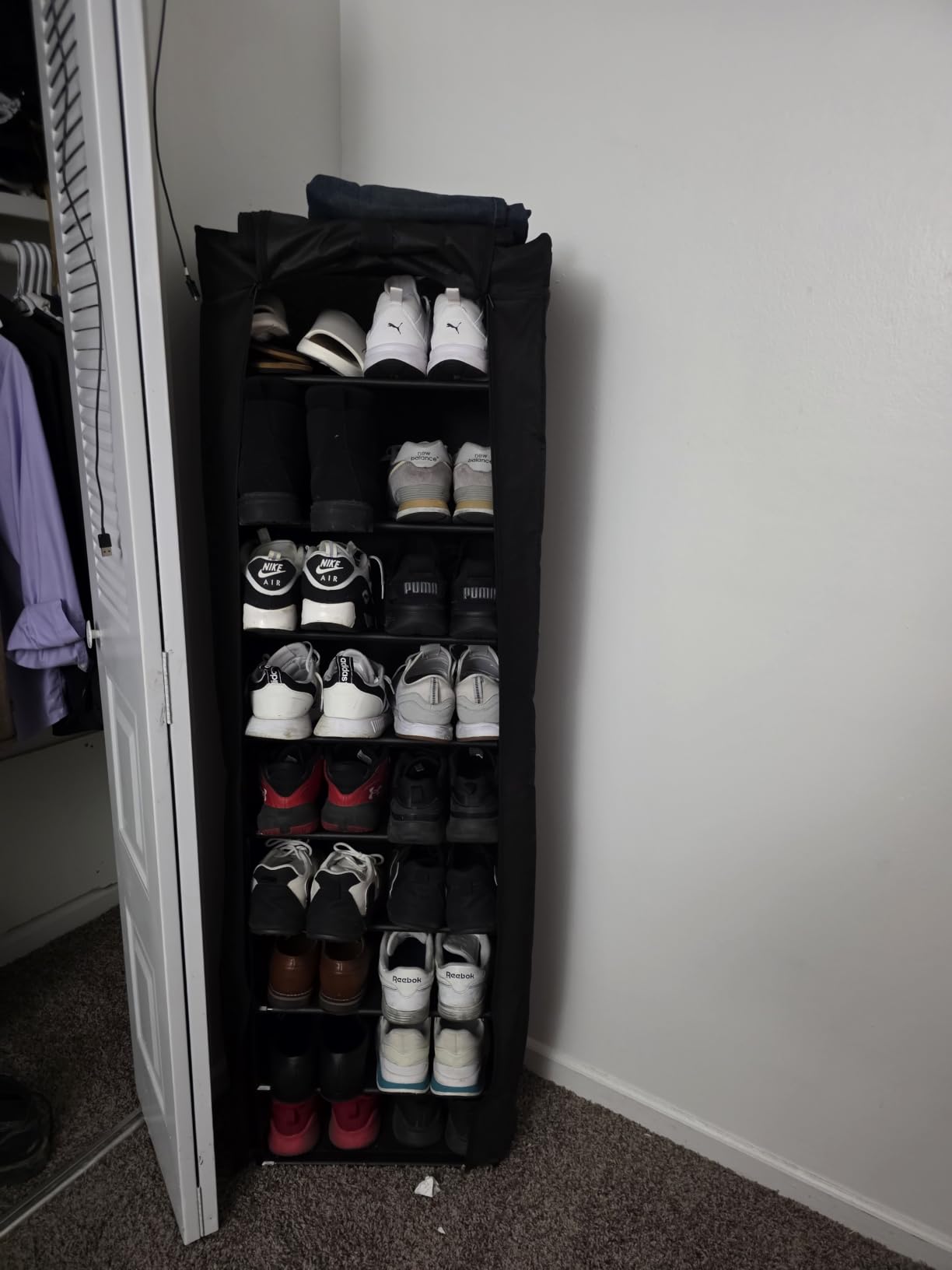
The frame reconfigures the same way the other ten-tier racks do. Split it into multiple low units, or remove a shelf to convert one tier into a tall bay for boots or boxes. A small wooden hammer and an installation video are included.
Stability improves once every tube is fully seated in its connector, so spend the extra minute during assembly rather than skipping it.
When the cover earns its cost
Choose this for a ground-floor entry, a mudroom, or a garage entry where dust and grit are constant. Closing the cover also lets the rack sit in a semi-visible space without looking untidy.
What to check on arrival
A few units arrive with cracked or low quality plastic connectors, so inspect the parts before assembling. The rack also cannot take tall boots standing upright, which is the one fit case it misses.
How to Choose Shoe Storage for a Small Entryway
Depth decides nearly everything. Slim flip-drawer cabinets run 7 to 11 inches deep and store shoes nearly upright. Slanted and vertical racks land around 8 to 12 inches. A traditional flat-shelf rack needs 13 to 14 inches, which only works against a wall with no door swing over it. If your usable depth is under 12 inches, cross flat-shelf racks off the list.
Pair capacity should be sized to the daily rotation, not the collection. Two or three pairs per person is a realistic target. A family of four needs 8 to 12 pairs in the entryway, and everything else belongs in a closet, on a high shelf, or in one of our shoe storage ottoman picks. Buying for the whole collection is the most common reason an entryway system fails.
Wood, metal or plastic, in that order of durability. Engineered wood gives the most furniture-like look and the best load rating, as we saw with the 88 pound Tangkula rack. Metal frames with fabric tiers give the best capacity per dollar and are the easiest to move. Plastic with a stainless frame, like the slanted rack, is the easiest to wipe clean and the least suited to a visible foyer.
Renters should only consider freestanding units. Every pick here is freestanding, so nothing needs drilling. If you have tall racks and small children, anchor the unit to the wall or keep it low and against a wall, since a light tall rack is a tip-over risk.
Wet shoes need open storage. Closed cabinets trap moisture and develop odor in roughly two weeks. An open ventilated rack, or one you can strip to a tall bay, lets boots dry. A slanted rack handles tall boots better than any flip-drawer cabinet, which is a documented fit failure for steel-toe work shoes.
Do the cardboard walk-past test before you order. Trace the unit footprint in cardboard on the floor and walk past it daily for a week. If you catch your shin, the unit is too tall or too deep for the swing path, no matter what the listing says.
Frequently Asked Questions
What is the best shoe storage for a small entryway?
A slim flip-drawer cabinet or a slanted or vertical rack under about 12 inches deep. These store shoes nearly upright, so a full daily rotation fits without crowding the front door’s swing arc. Add a bench if someone needs to sit to put shoes on.
Where to put shoes when there is no space in the entryway?
Use the vertical space nobody owns: a tall narrow rack in the corner beside an inward-opening door, a slanted rack near the door for boots, or a bench with shelves for the daily rotation. Move the off-rotation collection to a closet or an under-bed organizer, and keep only two to three pairs per person at the door.
What is a good shoe closet for an entryway?
A slim closed-front cabinet with flip drawers, roughly 9 to 10 inches deep and 30 to 32 inches wide. It holds 12 to 24 pairs, keeps shoes out of sight from the living room, and adds a surface for keys. Check that the width does not push the cabinet into your door’s swing arc.
What is a good shoe storage rack for an entryway?
A vertical or slanted rack between 8 and 12 inches deep. A flat-shelf rack needs 13 to 14 inches of depth and will not fit beside a door that opens into the room. Vertical racks hold 8 to 24 pairs depending on height, and open construction keeps wet boots drying instead of stewing.
How do I stop shoes from piling up by the front door?
Cap the entryway at two to three pairs per person and make the daily pair the only pair stored there. Assign one shelf or tier per person so the sorting decision is already made, and put a bench or cabinet in the spot so off-limit shoes have a defined home. If the pile returns, the unit is too small or too far from the door.
How deep should a shoe cabinet be for a narrow entryway?
Seven to 11 inches for a flip-drawer cabinet, because the drawers hold shoes nearly upright. Eight to 12 inches works for a slanted or vertical rack. Anything at 13 to 14 inches deep is a flat-shelf design and needs a wall with no door swing over it. Always measure the usable width outside the swing arc first.
The Bottom Line on Small Entryway Shoe Storage
For most small entryways the answer is the SONGMICS bamboo shoe bench. It is 11.9 inches deep, so it clears a door that opens into the room, and the padded 19.3 inch seat handles the boots-on-boots-off problem that no pure shoe rack solves.
Go with the BORNOON flip-drawer cabinet if the shoe zone is visible from the living room and you want the pile hidden. Pick a ten-tier vertical rack if you have a tall corner and twenty pairs to rotate through, and a slanted rack if boots are the problem.
Measure the swing arc before anything else, then buy the shallowest unit that fits. That single habit is what makes the best shoe storage for small entryway work in 2026, and it is the difference between a system that lasts and a pile that returns every Sunday.