
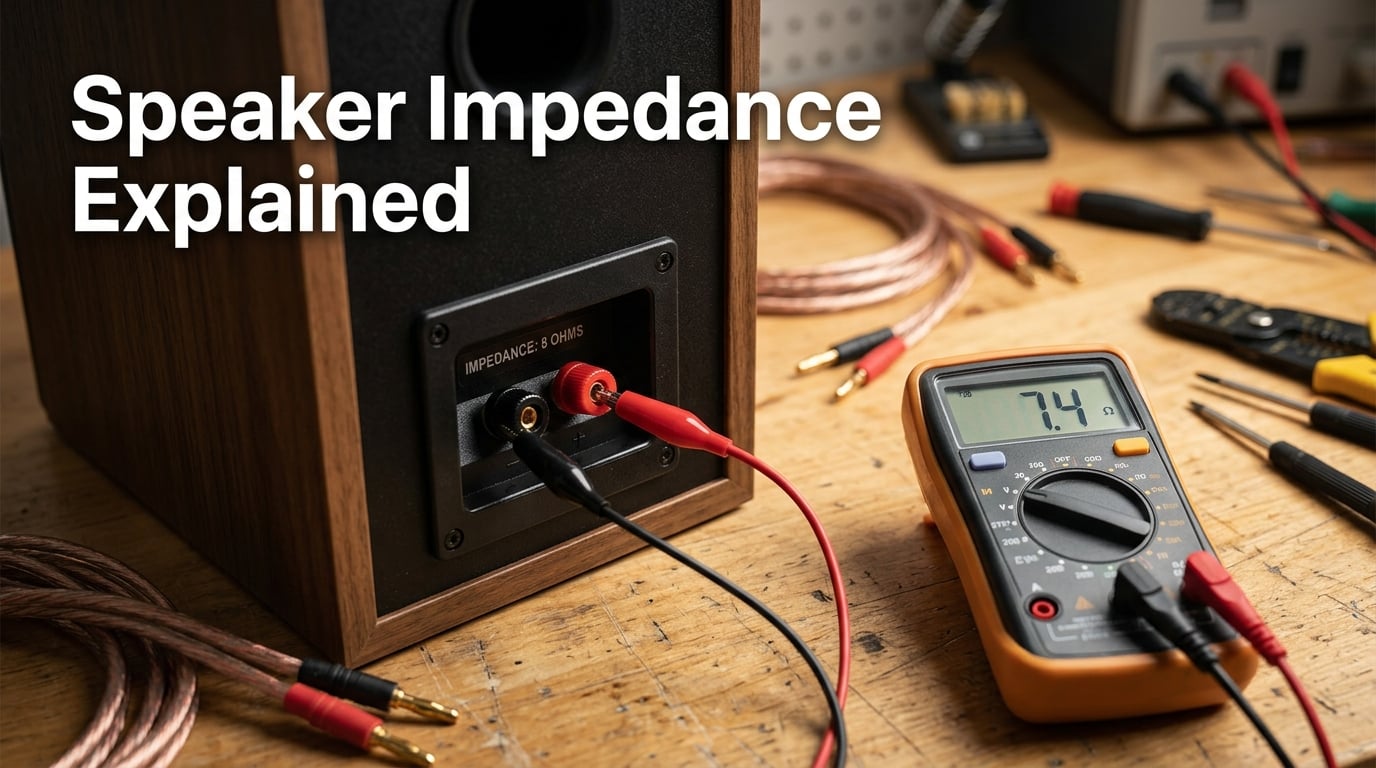
Speaker impedance is the electrical resistance a speaker places on an amplifier, measured in ohms (Ω). It controls how much current flows from your amp into the speaker and, ultimately, how safely your system runs.
I have spent the last several years testing audio gear in my workshop, and I have lost count of how many blown amplifiers trace back to a basic impedance misunderstanding. This guide breaks down what speaker impedance really means, why the ohms rating on the back of your speaker matters, and how to avoid the mistakes I have made myself.
If you have ever wondered whether a 4Ω speaker is “better” than an 8Ω one, or whether mixing impedances will damage your amp, you will find a clear answer here.
Table of Contents
What Is Speaker Impedance and How Is It Measured?
Speaker impedance is the total opposition a speaker offers to the alternating current (AC) coming from an amplifier, measured in ohms (Ω). Unlike simple DC resistance, impedance changes with frequency because the voice coil and magnet assembly behave like a mix of resistors, inductors, and capacitors.
Think of impedance as the speaker’s “load” on the amplifier. A lower impedance means the speaker draws more current for a given voltage, while a higher impedance pulls less.
The water analogy helps a lot here. Imagine water flowing through a pipe. A wider pipe (lower impedance) lets more water through with less effort, while a narrow pipe (higher impedance) restricts the flow. Your amplifier is the pump, and the speaker is the pipe. Match the wrong sizes and either the pump strains or the flow stalls.
Two terms come up constantly in this space. DC resistance (DCR) is the static resistance of the voice coil measured with direct current. AC impedance is what the amplifier actually sees in real use. An “8Ω” speaker usually has a DCR closer to 6Ω, because impedance rises and falls as the audio signal changes frequency.
Why Speaker Impedance Matters for Your Amplifier
Impedance matters because your amplifier is designed to deliver power into a specific load range. Push a load lower than the amp can handle and the output stage draws more current than it was built for, which causes overheating and, in the worst case, failure.
Most home amplifiers are rated for 8Ω speakers minimum. Many modern receivers can also handle 6Ω or 4Ω loads, but they typically deliver less power at 8Ω and more at 4Ω. The fine print on the back of your amp is not just legal boilerplate; it tells you the minimum impedance the output stage is built to drive.
Here is what actually happens electrically when impedance is too low. The current draw climbs. Heat builds in the output transistors. Protection circuits may trigger and shut the amp down, or worse, the amp simply cooks itself over hours of casual listening. I have personally watched a vintage Pioneer receiver shut off mid-song because a friend wired four 4Ω bookshelf speakers in parallel, dropping the load to 1Ω.
The flip side, an impedance that is too high, is usually harmless. You just get less volume and waste amplifier capability. Speakers that are too high in impedance will not damage anything, they simply do not play as loud.
Common Speaker Impedance Ratings: 4Ω, 6Ω, and 8Ω Compared
Most consumer speakers fall into three nominal impedance ratings: 4Ω, 6Ω, and 8Ω. The table below summarizes what each rating typically means for current draw, common use, and amplifier requirements.
| Nominal Rating | Current Draw | Common Use | Amplifier Requirement |
|---|---|---|---|
| 4Ω | Higher current | Car audio, subwoofers, high-efficiency PA | Must be 4Ω capable or higher |
| 6Ω | Moderate current | Some home theater, in-wall speakers | Most modern AV receivers |
| 8Ω | Lower current | Home stereo, home theater, hi-fi | Any standard amplifier |
Car audio almost universally uses 4Ω speakers because car electrical systems run on 12V and need lower impedance to produce meaningful volume. Home stereo and home theater equipment typically uses 8Ω because household AC power can deliver higher voltage cleanly, and the resulting lower current is easier on amplifier output stages.
If you see a 6Ω rating, that is usually a manufacturer compromise for in-wall or background-music speakers designed to be friendly to a wider range of amplifiers.
The 83% Rule for Speakers Explained
The 83% rule for speakers states that, for an amplifier rated to handle a given minimum impedance, the connected speaker’s nominal impedance should be no lower than 83% of that rating to leave a safe operational margin. It is a safety heuristic used by installers and audio engineers to keep amplifiers well within their comfort zone.
The math is straightforward. If your amplifier is rated for 4Ω minimum, 83% of 4Ω is 3.32Ω. So the rule suggests keeping your real speaker load above roughly 3.3Ω. If your amp is rated for 8Ω minimum, your load should stay above about 6.6Ω.
Why 83% specifically? It comes from derating guidelines borrowed from electrical engineering, where components are typically run at 70 to 80 percent of their stated maximum to extend lifespan and account for variations in manufacturing, temperature, and aging. The 83% figure has become a popular shorthand for that margin in audio circles, even though it is not a hard industry standard.
In practice, I treat this as a “stay clearly above the red line” rule rather than a precise cutoff. If your amp says 4Ω minimum, a single 4Ω speaker is fine, but wiring two 4Ω speakers in parallel puts you at 2Ω, which is well below the safe margin. The 83% rule is a quick sanity check for those edge cases.
Series vs Parallel Speaker Wiring: Calculating Total Impedance
When you wire more than one speaker to a single amplifier channel, the way you connect them changes the total impedance the amp sees. The two basic configurations are series and parallel, each with its own formula.
Series wiring adds impedances together. If you wire two 8Ω speakers in series, the total load is 8 + 8 = 16Ω. Three 8Ω speakers in series becomes 24Ω. Series wiring is simple and predictable but produces high total impedance, which means quieter playback for a given amplifier setting.
Parallel wiring drops impedance. For two speakers of identical rating, the formula is impedance divided by the speaker count. Two 8Ω speakers in parallel give 8 ÷ 2 = 4Ω. Four 8Ω speakers in parallel give 8 ÷ 4 = 2Ω, which most home amps cannot handle. Parallel wiring extracts more volume but creates the highest risk of overloading an amplifier.
For mixed ratings in parallel, use the formula 1 / (1/Z1 + 1/Z2 + 1/Z3). An 8Ω and a 4Ω speaker in parallel calculate to 1 / (1/8 + 1/4) = 1 / (0.125 + 0.25) = 1 / 0.375 = roughly 2.67Ω, well below what most amps can safely drive.
Many whole-home audio installs use a series-parallel hybrid: two 8Ω speakers in series (16Ω) on each channel, then multiple channels in parallel to balance volume zones. Always calculate the final load before connecting, and never go below your amplifier’s stated minimum.
How to Test Speaker Impedance With a Multimeter
You can get a useful impedance reading with a basic digital multimeter, even though true AC impedance requires specialized equipment. The multimeter will read DC resistance, which is typically 80 to 90 percent of the nominal impedance rating. Here is the step-by-step process I use.
- Disconnect the speaker. Unplug the speaker wires from the amplifier completely. Testing while connected will give false readings because the amplifier’s circuitry interferes.
- Set your multimeter to resistance mode. Turn the dial to the Ω symbol, usually in the 200 or 2k range for typical speaker ratings.
- Touch the probes to the speaker terminals. Place the red probe on the positive (+) terminal and the black probe on the negative (−) terminal. Polarity does not matter for a resistance reading, but stay consistent.
- Read and interpret the result. A speaker labeled 8Ω typically reads between 5.5 and 7.5Ω on a multimeter. A 4Ω speaker usually reads between 2.5 and 3.5Ω. A 6Ω speaker falls between those ranges.
- Look for shorts or open circuits. A reading near 0Ω indicates a short in the voice coil. An “OL” or infinite reading means the coil is broken. Either result means the speaker needs repair or replacement.
For a more accurate AC impedance measurement, an LCR meter is the right tool. It sends an AC signal at specific frequencies and reports true impedance rather than DC resistance. I keep a cheap LCR meter in my toolbox for troubleshooting vintage speakers, where the original rating is sometimes unknown.
A safety note worth repeating: never test impedance while the speaker is connected to a powered amplifier. You can damage the multimeter, the speaker, or the amplifier. Always disconnect first.
Frequently Asked Questions About Speaker Impedance
Which speaker is better, 4 ohm or 8 ohm?
Neither is universally better. A 4 ohm speaker draws more current and typically plays louder on the same amplifier, which is why car audio and subwoofers often use 4 ohms. An 8 ohm speaker draws less current, runs cooler, and pairs with the widest range of home amplifiers. The ‘better’ choice depends on your amplifier rating and use case rather than the number itself.
Is higher or lower speaker impedance better?
Higher impedance is safer for your amplifier because it limits current draw, but lower impedance usually produces louder output at the same amplifier setting. The best choice is the impedance that matches what your amplifier is rated to handle. Running a load much higher than the rating wastes amplifier power; running it much lower risks overheating and damage.
What is the 83% rule for speakers?
The 83% rule is a safety guideline that says your connected speaker load should stay above 83% of your amplifier’s minimum rated impedance. For a 4 ohm minimum amp, that means keeping the load above about 3.3 ohms. For an 8 ohm minimum amp, stay above roughly 6.6 ohms. It is a buffer margin, not an industry standard, designed to keep amplifiers well inside their safe operating range.
Can I use a 4 ohm speaker with an 8 ohm amp?
Usually yes, as long as your amplifier is rated for 4 ohm loads. Most modern AV receivers handle 4 ohms on at least some channels, and dedicated stereo amps often have a 4 ohm switch or are 4 ohm stable. Using a 4 ohm speaker with an amplifier rated only for 8 ohm minimum can overheat the output stage and is the most common cause of home amplifier failure.
How do I measure speaker impedance without paperwork?
Use a digital multimeter set to resistance mode and touch the probes to the speaker terminals after disconnecting the speaker from any amplifier. A reading of 2.5 to 3.5 ohms suggests a 4 ohm speaker, 5.5 to 7.5 ohms suggests an 8 ohm speaker, and readings in between suggest 6 ohms. For true AC impedance across frequencies, an LCR meter gives much more accurate results.
Final Thoughts on Matching Speakers and Amplifiers
Speaker impedance explained in three sentences: it is the load your speaker places on the amplifier, measured in ohms, and it must stay above your amplifier’s minimum rating to keep the system safe. Match the rating, calculate total impedance for any multi-speaker setup, and your gear will run cool and sound right for years.
The single best next step is to check your amplifier’s manual for its minimum impedance rating, then measure your speakers with a multimeter to confirm what you actually own. That small bit of homework prevents the most expensive mistake in home audio.