
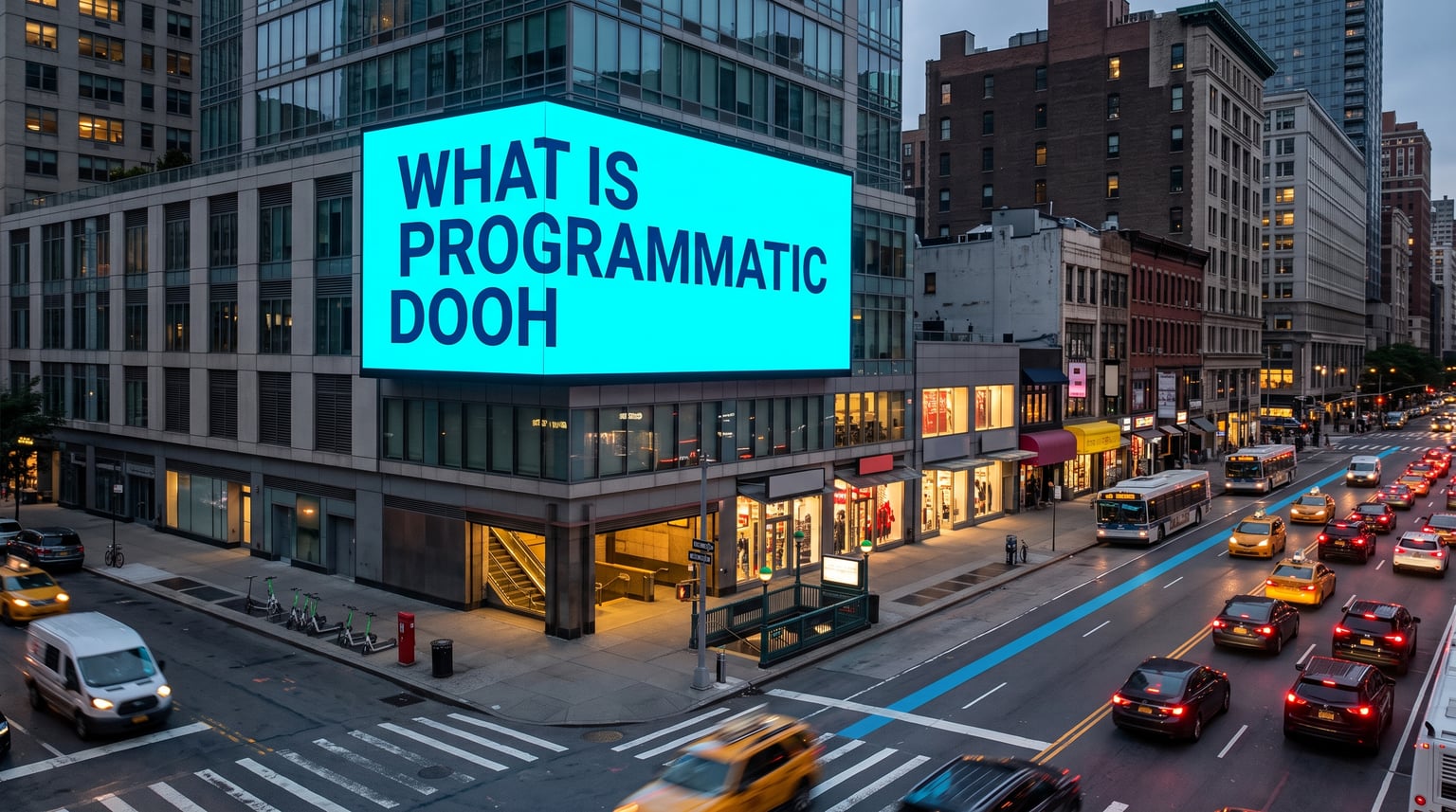
Programmatic DOOH (pDOOH) is the automated buying, selling, and delivery of digital out-of-home advertising through real-time bidding on digital screens in public spaces. It applies the same programmatic technology that transformed online display ads to billboards, transit displays, and place-based screens, letting advertisers purchase audiences instead of static panels.
If you have ever wondered how brands trigger a coffee ad the moment the temperature drops, or how a single campaign adjusts across hundreds of screens by time of day, the answer is programmatic digital out-of-home. In this guide, I will walk you through exactly what pDOOH is, how the technology works, why advertisers are moving budgets into it, and how it differs from the static billboards of the past.
By the end, you will understand the four moving parts of the ecosystem, the formats you can buy, the targeting options available, and how measurement actually works in 2026.
Table of Contents
What Is Programmatic DOOH (pDOOH)?
Programmatic DOOH, often shortened to pDOOH, refers to the automated buying, selling, and delivery of out-of-home ads via real-time bidding on digital screens. The “programmatic” part means software handles the transaction. The “DOOH” part means the ad runs on a digital screen in a public location rather than on a website or app.
To put it another way, DOOH stands for Digital Out-of-Home, which is any advertising screen you encounter away from home. That includes digital billboards, transit displays, elevator screens, airport panels, and gas pump video walls. OOH, by contrast, is the broader category that includes both digital and traditional static formats like printed billboards and bus benches.
So what is DOOH in marketing terms? It is the digital evolution of outdoor advertising. Where a static billboard shows one ad to everyone for two weeks, a DOOH screen can run multiple ads in a single hour and swap creatives based on data signals. Programmatic simply adds an automated auction layer on top of that flexibility.
Industry forecasts suggest pDOOH will account for roughly 65% of national DOOH spend by 2026, up from less than 30% just a few years ago. That shift mirrors what happened in online display advertising during the early 2010s, when automated buying replaced manual insertion orders.
How Does Programmatic DOOH Work?
Programmatic DOOH works by connecting advertisers to digital screen inventory through three core platforms, the same way programmatic display and video work online. The transaction happens in milliseconds, and the ad can change based on context in real time.
The Three Platforms Behind Every pDOOH Transaction
When an ad is bought programmatically, three pieces of technology talk to each other:
- DSP (Demand-Side Platform): The tool advertisers use to discover inventory, set targeting, and bid on impressions. Examples include DV360, StackAdapt, The Trade Desk, and Hivestack.
- SSP (Supply-Side Platform): The tool media owners use to make their inventory available to buyers, manage pricing, and deliver ads. Examples include Vistar Media, Broadsign, and Place Exchange.
- Ad Exchange: The marketplace where DSPs and SSPs meet to run real-time auctions on each available impression.
A DOOH platform, then, is the broader stack of DSP, SSP, and exchange technology that enables this automated buying and selling of digital screen inventory. Some vendors, like Vistar and Hivestack, operate across all three layers. Others specialize in one side.
The Real-Time Bidding Process Step by Step
Here is what actually happens in the milliseconds before an ad plays on a digital billboard:
- A screen becomes available (because the previous ad ends or a new time slot opens).
- The SSP sends a bid request to the ad exchange describing the screen, location, time of day, and audience signal.
- Eligible DSPs evaluate the request against an advertiser’s campaign rules and submit bids in under 200 milliseconds.
- The highest bid wins, the creative is served, and the screen displays the ad within seconds.
- The system logs the impression for billing and measurement.
Because each auction is independent, a single screen can serve a different winning bidder every loop. I have seen campaigns where the same panel shows a coffee ad at 7 a.m., a sneaker ad at noon, and a streaming ad at 8 p.m., all without a human touching the schedule.
Direct Buying vs Programmatic Buying
Programmatic is not the only way to buy DOOH. Advertisers can still negotiate directly with media owners for fixed placements over weeks or months. Programmatic is the better fit when you want flexibility, audience targeting, or to combine DOOH with online video and display in a single omnichannel plan. Direct buying still wins when you absolutely need a specific billboard in Times Square for a launch event.
Benefits of Programmatic DOOH Advertising
Programmatic DOOH delivers the same advantages programmatic brought to online advertising, but applied to physical screens. Our team has run pDOOH campaigns for retail, CPG, and B2B brands, and the six benefits below show up consistently.
- Automation saves time: Campaigns launch in days instead of weeks. There are no insertion orders to chase or PDF contracts to circulate for each venue.
- Real-time optimization: Bids, budgets, and creatives can be adjusted mid-flight. If a campaign over-delivers on Tuesday, the system can throttle it automatically.
- Targeted delivery: Ads reach specific audiences by location, time, weather, and demographic signals, not just whoever happens to walk by.
- Flexible budgeting: Brands can start small, test, and scale. CPMs typically range from $4 to $50 depending on the screen quality and venue.
- Better measurement: Impressions, footfall lift, and even online conversions can be tied back to specific DOOH plays.
- Omnichannel integration: pDOOH can be planned alongside display, video, and CTV inside the same DSP, so budgets shift based on performance.
Beyond efficiency, pDOOH is also immune to ad blockers and ad fraud in the traditional sense. The screen physically plays the creative, so bots cannot click on it and fraudsters cannot spoof impressions the way they can with web traffic. That alone has shifted budget from uncertain digital channels into OOH.
Traditional OOH vs Programmatic DOOH: Key Differences
The shift from traditional OOH to programmatic DOOH is similar to the leap from print advertising to programmatic display. Same core medium, completely different buying model. The table below compares the two side by side.
| Dimension | Traditional OOH | Programmatic DOOH |
|---|---|---|
| Buying process | Manual negotiation, IO-based, weeks to launch | Automated auction, self-serve, launch in days |
| Targeting | Location and time only | Location, time, weather, audience, event, context |
| Creative swaps | Static for the campaign duration | Dynamic, swaps by trigger or time of day |
| Measurement | Estimated impressions, vendor-reported | Logged impressions, footfall, attribution, brand lift |
| Minimum spend | Often high, monthly commitments | Flexible, daily budgets possible |
| Optimization | Limited, mostly upfront planning | Real-time, mid-flight adjustments |
| Integration | Standalone channel | Omnichannel, planned alongside CTV and display |
The biggest practical difference shows up in measurement. Traditional OOH relies on traffic counts and panel-based estimates that advertisers cannot always verify. Programmatic DOOH logs every play and ties it to audience data, which makes ROI conversations much easier to have.
Types of Programmatic DOOH Formats
Programmatic DOOH is not a single thing. It includes every kind of digital screen you can buy programmatically, from a highway billboard to a screen on an elevator wall. Here are the five main format categories.
1. Large Format
Large format DOOH covers digital billboards, highway panels, and building-mounted spectaculars. These are the highest-impact, highest-CPM formats, often used for brand awareness in major metros. Programmatic access is growing fast here, and a handful of networks now expose their premium panels through SSPs.
2. Place-Based
Place-based screens live in venues where people linger, such as gyms, malls, doctors’ offices, hotels, and office lobbies. Because the audience is captive, advertisers pay a premium for the dwell time. Programmatic buying makes it easy to assemble these screens into a national network for vertical-specific campaigns.
3. Transit
Transit DOOH includes screens in airports, subway stations, bus shelters, taxis, and rideshare vehicles. Some examples you have probably seen are the digital panels at JFK, the LCD screens inside subway cars, and the ads at the pump. Programmatic transit buying is a strong fit for travel, hospitality, and QSR brands chasing people on the move.
4. Point of Purchase
Point of purchase (PoP) screens sit at the moment of decision, in stores, restaurants, gas pumps, and self-checkout lanes. They drive measurable lift because the ad runs seconds before a transaction. Brands running pDOOH PoP campaigns often pair them with same-day sales data to verify impact.
5. High Impact
High impact formats are the showstoppers: building wraps, 3D anamorphic screens, and full-motion spectaculars. Programmatic access is still limited here, but it is growing. Brands typically use these for launch moments or tentpole campaigns where the medium itself is part of the story.
Almost any example of DOOH advertising you can think of fits into one of these five buckets. That range is part of why programmatic buyers like pDOOH so much. A single campaign can hit a commuter in the morning, a shopper at lunchtime, and a traveler at dinnertime, all from one DSP seat.
Targeting Capabilities in Programmatic DOOH
The biggest upgrade pDOOH delivers over traditional OOH is targeting. Instead of buying a panel and hoping the right people see it, you can now buy an audience and let the system pick the screens that reach them. Here are the main targeting levers available in 2026.
Location-Based Targeting
You can target by city, neighborhood, zip code, or even a radius around a specific store. A coffee chain can buy every screen within half a mile of its locations, so the ad always runs near a place to redeem.
Time-of-Day Scheduling
Campaigns can be tuned to specific dayparts. A breakfast brand runs from 6 to 10 a.m., a streaming service from 7 to 11 p.m. Time-of-day bidding lets you spend aggressively during the slots that matter and stay quiet the rest of the day.
Weather and Contextual Triggers
Trigger-based creative swaps are one of pDOOH’s most famous features. When the temperature drops below 50 degrees, a hot chocolate ad plays. When rain hits, an umbrella brand activates. These triggers run automatically through the DSP without a media buyer needing to touch the schedule.
Audience Targeting
Using third-party data, advertisers can target by demographic, lifestyle, or behavioral segment. Commuters, business travelers, parents with young kids, frequent gym-goers, and dozens of other audiences can be reached across DOOH screens programmatically.
Dynamic Creative Optimization
Creatives can be assembled on the fly from multiple assets, so the headline, image, or call-to-action changes based on the screen, the time, or the audience. One campaign might show a dozen variants without anyone designing a dozen static posters.
Privacy is a fair question here. Most pDOOH targeting uses aggregated, anonymized data, not personal identifiers. There are no cookies on a billboard, and the targeting signals come from panel data, location trends, and contextual rules, not from tracking individual consumers. That privacy-by-design stance is one reason pDOOH has grown quickly in regions with strict data laws.
Measurement and Attribution in Programmatic DOOH
Measurement is where pDOOH used to lag behind online, and where it has caught up the most. The honest answer, though, is that not every dashboard tells you what you actually want to know. Here is how the measurement really works.
Ad Plays vs Audience Impressions
This is the question I get most often. An ad play is every time the creative runs on a screen, regardless of whether anyone is looking. An audience impression is the subset of plays estimated to be viewed by real people, weighted by traffic, dwell time, and screen visibility. Most pDOOH platforms report both. Advertisers should ask which one a number refers to before comparing it to online CPMs.
Footfall Attribution
Footfall attribution measures whether people exposed to a DOOH ad later visit a store. It works by matching mobile location data (anonymized and aggregated) between people who were near the screens and people who visited the advertiser’s location. A 12 to 25 percent lift is typical in well-run campaigns.
Cross-Channel Attribution
Because pDOOH is bought through the same DSPs as display and video, exposure data can flow into multi-touch attribution models. A user who saw a DOOH ad on Monday and clicked a display ad on Wednesday can be tied together in a single conversion path. That is a major shift from traditional OOH, which usually sat outside attribution entirely.
Brand Lift Studies
Brand lift studies measure whether the campaign moved the needle on awareness, consideration, or purchase intent. They use exposed versus control audiences and require a panel provider. They are more expensive, but for big brand campaigns they provide the kind of evidence CMOs ask for.
Verification and Transparency
Verification services like Hivestack’s proof-of-play logs and third-party audits confirm that ads actually ran on the screens they were supposed to. Advertisers concerned about whether dashboards reflect real delivery can request these reports and reconcile them against their own data.
Agencies I have spoken with say the biggest remaining gap is connecting pDOOH exposure to online conversions in a way that holds up to scrutiny. The technology exists, but it is still maturing. Buyers should expect more clarity on this every year.
Frequently Asked Questions About Programmatic DOOH
What is an example of DOOH advertising?
A common example of DOOH advertising is a digital billboard in a major city that swaps creatives every few seconds based on the time of day or weather. Other examples include video screens at airports, subway stations, gas pumps, elevators, and inside retail stores. Any digital screen in a public place where ads can run qualifies as DOOH.
What is a DOOH platform?
A DOOH platform is the technology stack that enables automated buying and selling of digital out-of-home ad inventory. It typically includes a DSP for advertisers, an SSP for media owners, and an ad exchange that runs real-time auctions between them. Vendors like Vistar Media, Hivestack, Broadsign, and Place Exchange operate parts of this stack.
What does DOOH mean in marketing?
DOOH stands for Digital Out-of-Home and refers to advertising on digital screens in public spaces. In marketing, DOOH means using electronic displays such as billboards, transit panels, and place-based screens to reach consumers outside their homes. It is the digital evolution of traditional out-of-home (OOH) advertising.
What is the difference between DOOH and OOH advertising?
The difference between DOOH and OOH advertising is the screen technology. OOH (out-of-home) is the broad category that includes any ads in public spaces, including static printed billboards and posters. DOOH (digital out-of-home) is the subset of OOH that uses digital screens capable of running multiple creatives, swapping content in real time, and supporting programmatic buying.
Final Thoughts on Programmatic DOOH
Programmatic DOOH has moved from a curiosity to a default channel for outdoor campaigns in just a few years. If you wanted a quick recap of what is programmatic DOOH, here it is: pDOOH is the automated, real-time-bidding layer applied to digital out-of-home screens, and it gives advertisers the targeting, measurement, and flexibility that static OOH could never deliver.
For anyone planning outdoor media in 2026, the practical next step is straightforward. Open a DSP with pDOOH inventory, test a small campaign against your existing channels, and measure the lift. The dashboards have improved enough that you no longer have to take the medium on faith.