
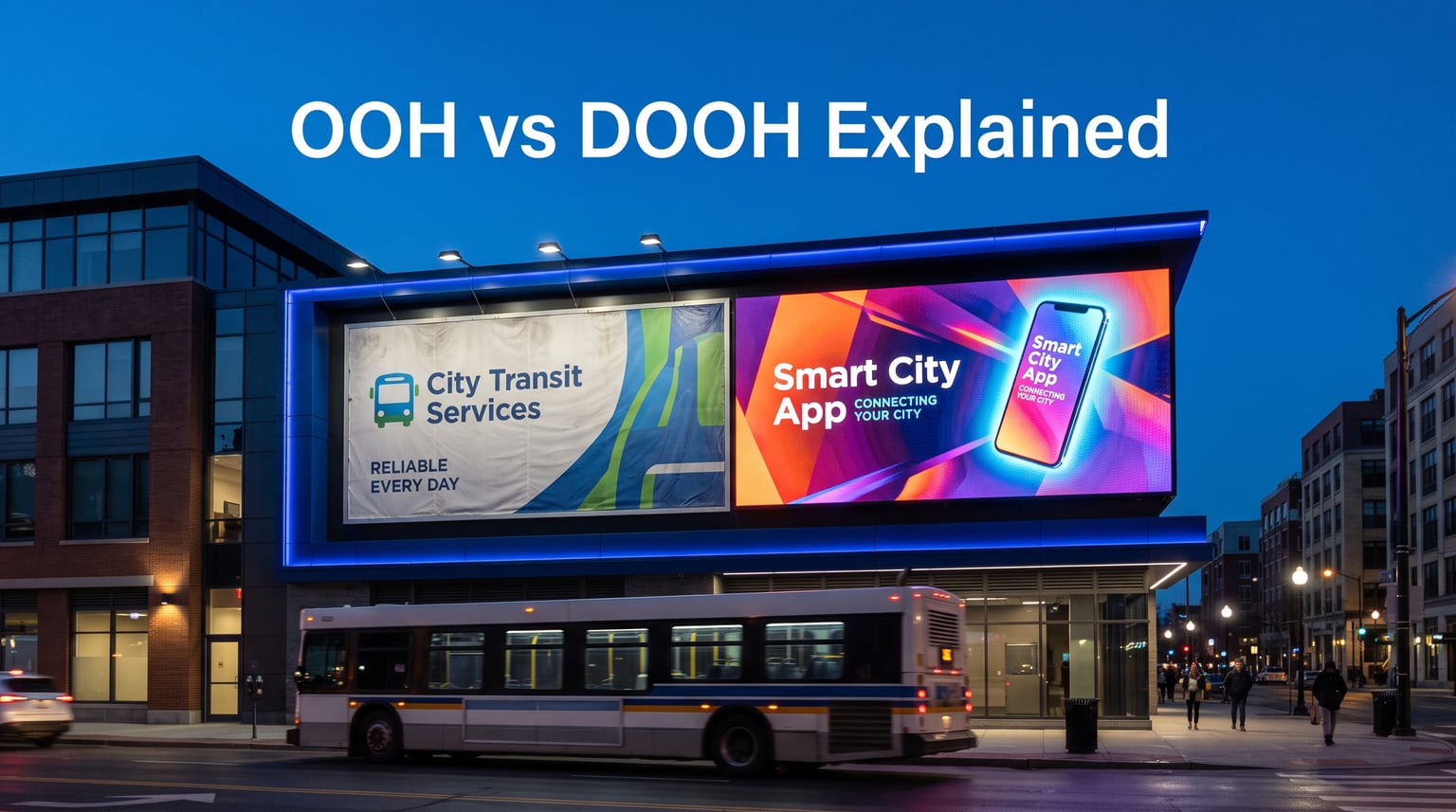
If you have ever stared at a billboard on the highway or watched an ad change on a screen at an airport, you have already met OOH and DOOH advertising. Both formats live outside your home, but they work in very different ways and produce very different results for advertisers.
In this guide, I will walk you through the OOH vs DOOH debate the way I explain it to clients. You will get clear definitions, a side-by-side comparison, the real cost differences, and a simple decision rule for picking the right format. By the end, you will know exactly when to choose static billboards and when dynamic screens deliver better results for your specific campaign.
OOH advertising is not going away in 2026. If anything, the line between physical and digital outdoor media is blurring fast, which makes understanding the difference more important than ever. Whether you are launching a brand, scaling an established product, or just curious how those massive screens in Times Square actually work, this guide will give you the full picture.
Table of Contents
What Is OOH (Out-of-Home) Advertising?
OOH stands for Out-of-Home advertising. It is any advertising that reaches consumers while they are out in public places, rather than in their home, on their phone, or at their desk. OOH is the original physical media channel, and it has existed for over a century, long before the internet changed the rest of the marketing world.
The most common OOH formats include billboards, bus shelters, transit ads on buses and trains, posters in malls, street furniture like benches and kiosks, and place-based media in venues like gyms, airports, and coffee shops. These ads are static, meaning the creative is printed, posted, and left in place for a fixed period, usually two to four weeks. The production cycle is physical: a designer creates the artwork, a printer outputs it on vinyl or paper, and a crew installs it on location.
Because OOH is always-on once installed, it delivers 24/7 exposure to everyone passing the location. You skip the auction pressure of online ads and pay one flat rate for the full posting period. That simplicity is a big reason OOH still earns roughly 70% of total out-of-home revenue in many mature markets, even as digital screens multiply around it.
One under-appreciated strength of OOH is its perceived permanence. A printed billboard feels like a brand statement, not a fleeting digital impression. In a market saturated with programmatic banners and skip-able video, that physical presence carries real psychological weight with consumers and decision-makers alike.
What Is DOOH (Digital Out-of-Home) Advertising?
DOOH stands for Digital Out-of-Home advertising. It is the digital evolution of OOH, using screens instead of printed posters to deliver ads in public spaces. The format borrows the reach and visibility of traditional OOH and adds the flexibility, targeting, and measurement that marketers expect from digital media.
The term DOOH emerged in the early 2000s as digital signage networks expanded in transit hubs, malls, and city centers. The acronym was popularized by industry bodies like the Digital Place-Based Advertising Association (DP-AA) and the Out of Home Advertising Association of America (OAAA) to describe any electronic screen used for advertising outside the home. In short, DOOH is simply OOH that runs on a screen rather than paper or vinyl. The “D” was added to the existing OOH abbreviation to mark the shift from static to dynamic.
Common DOOH formats include large-format digital billboards on highways, screens inside airports and subway stations, retail digital signage near checkout counters, elevator screens in office towers, and interactive kiosks in shopping districts. Because the creative lives on a screen, advertisers can update messaging within minutes, run different ads at different times of day, and even trigger content based on weather, traffic, sports scores, or breaking news.
The biggest shift DOOH introduced was not the screen itself, but the workflow around it. With traditional OOH, every creative change required printing and a crew visit. With DOOH, a new creative can be uploaded from anywhere in the world and played on the same network within minutes. That single change rewrote how outdoor advertising gets planned, bought, and measured.
OOH vs DOOH at a Glance: Key Differences
The main difference between OOH and DOOH is that OOH is static and printed, while DOOH is dynamic and digital. That single shift drives every other difference in cost, flexibility, targeting, and measurement. Below is the side-by-side view I share with clients before any planning conversation.
| Feature | OOH (Traditional) | DOOH (Digital) |
|---|---|---|
| Medium | Printed posters, vinyl, paint | LED or LCD digital screens |
| Creative updates | Fixed for the campaign period | Anytime, often within minutes |
| Flexibility | Low — one message for all hours | High — daypart, weather, or event triggers |
| Targeting | Location and audience demographics | Location, time, context, audience data |
| Measurement | Estimated impressions, traffic counts | Verified impressions, real-time analytics |
| Buying model | Direct buy, fixed periods | Direct or programmatic (pDOOH) |
| Production cost | Higher per cycle (printing and posting) | Lower per change (digital file only) |
| Lead time | Weeks to plan and post | Hours to days, sometimes same-day |
| Best for | Mass awareness, long-term brand presence | Timely, targeted, measurable activations |
Both formats still share the same core strength: reaching people when they are away from home and unable to skip, mute, or block the message. That shared advantage is what keeps outdoor advertising relevant even as digital channels compete for every marketing dollar.
The decision between OOH and DOOH is rarely binary. Smart media plans often combine both, using OOH for the always-on anchor and DOOH for the responsive, time-sensitive layer that fills in around it.
Benefits of Traditional OOH Advertising
OOH advertising shines when you want mass awareness, predictable costs, and creative that simply cannot be ignored. Even in 2026, with screens everywhere, traditional OOH still packs a punch that digital cannot fully replicate. Here is why it remains a foundation of many brand plans.
Here are the benefits I look for when recommending a traditional OOH plan:
Mass reach with a single buy. One billboard on a busy highway can deliver millions of impressions over a month, often at a low cost-per-thousand compared with paid social or display.
Always-on visibility. The ad runs 24 hours a day, 7 days a week, with no ad-blockers and no scrolling past. That continuous exposure is hard to replicate online.
Strong brand recall and trust. Physical presence in a real environment signals legitimacy. The Association of Outdoor Advertising reports OOH drives some of the highest aided and unaided recall numbers of any offline channel.
Proven ROI. OOH is one of the few offline channels with a long-running ROI study. The widely cited 495% ROI figure referenced by OAAA comes from decades of econometric analysis, and our team has seen similar uplifts in client work for retail and FMCG brands.
Simple buying model. You pick the location, book a period, and pay a fixed rate. No bidding wars, no algorithm changes, no creative moderation reviews to wait on.
Local relevance and landmark status. A well-placed OOH panel can become a local landmark. People give directions by it, photograph it, and share it on social organically.
A planner on r/advertising once told me, “the best OOH plans focus on real reach and site quality, not fancy audience numbers.” That line stuck with me. A poorly placed digital screen still wastes impressions just as much as a poorly placed poster does, and no amount of data overlays can fix a bad location choice.
Benefits of DOOH Advertising
DOOH advertising wins when you need flexibility, faster decision-making, and proof that the campaign worked. If OOH is the static poster on the wall, DOOH is the live feed you can edit on your lunch break. That agility is what pulls budget away from traditional formats.
Here are the benefits I lean on when a client wants DOOH in the mix:
Dynamic creative with daypart targeting. A coffee brand can show a hot drink in the morning and an iced drink in the afternoon on the same screen. No reprint needed.
Real-time updates. News, weather, sports scores, or stock prices can all trigger content swaps. Brands have famously run reactive DOOH campaigns during major events within hours of a goal, a verdict, or a cultural moment.
Programmatic buying (pDOOH). DOOH inventory can be purchased through demand-side platforms, similar to online video, using real-time bidding and audience signals. This opens outdoor advertising to performance marketers who previously ignored it.
Improved measurement. Many DOOH networks now offer impression counts with verified exposure data, dwell time, and even footfall attribution when paired with mobile location data.
Faster go-to-market. A campaign that takes four weeks to post in print can go live in a day on a digital network, which is a huge advantage for product launches and time-sensitive promotions.
Creative testing at scale. You can run three versions of an ad across the same network on different days and compare performance data within a week.
Industry forecasts suggest DOOH is growing roughly twice as fast as traditional OOH, and that gap is widening as more screens come online in retail and transit. That does not make OOH obsolete; it just means DOOH is taking a larger share of new media budgets and forcing traditional operators to invest in digital inventory.
How Programmatic DOOH Works
Programmatic DOOH (pDOOH) works by automating the buying, selling, and delivery of digital out-of-home ads through software platforms. The screens run the same way they always have, but the way advertisers buy them is closer to how you would buy a banner ad online than how you would book a printed billboard.
Here is the simplified flow of a programmatic DOOH campaign from impression to play:
Inventory goes live. The screen owner (a media owner or network) lists available slots and audience data on a supply-side platform (SSP). Each slot has metadata like location, time windows, and audience composition.
Audience signals are loaded. The advertiser’s demand-side platform (DSP) is fed first-party and contextual data, like weather, daypart, location, or nearby event triggers. This shapes which slots the bidder targets.
Bids happen in real time. When a screen becomes available for a play, the system checks if it matches the campaign criteria (location, audience, time window) and places a bid within milliseconds.
Creative is selected. The winning bid’s creative is delivered to the screen’s content management system, often with rules for which version to play under which conditions.
The ad plays. The screen displays the creative for its full loop, alongside other ads and editorial content. Each play is logged for delivery verification.
Reporting updates. Impressions, plays, and delivery data flow back to the advertiser’s dashboard, often in near real time, with optional third-party verification.
The practical effect is that a national brand can buy 200 screens in 12 cities for next week without making a single phone call. That kind of speed and scale was simply not possible in the printed OOH world, and it is the single biggest reason programmatic DOOH keeps gaining share.
One nuance worth flagging: in DOOH, the word “impression” can mean either an ad play (one loop of your creative on a screen) or an audience impression (an estimated number of people who saw it). Always confirm which definition your vendor is using before you compare CPMs across networks.
OOH vs DOOH Cost Comparison
OOH and DOOH cost structures differ more than their raw dollar amounts suggest. OOH front-loads production and posting costs, while DOOH front-loads screen and platform fees but keeps ongoing production costs low. Understanding this distinction is the difference between a budget that works and one that surprises you mid-campaign.
A traditional OOH campaign needs to pay for design, printing, posting, and a fixed rental for the panel. Once it is up, the only additional costs are potential maintenance or extension fees. Production runs several hundred to a few thousand dollars per panel depending on size.
A DOOH campaign avoids most printing and posting costs because creative is just a digital file. However, you typically pay a higher CPM (cost per thousand impressions), plus any DSP or SSP fees, and you still need to design multiple creatives if you want dayparting or contextual triggers.
Here is how the cost shapes compare in plain terms:
OOH: Higher setup cost, predictable run cost. Easier to forecast total spend across a long campaign.
DOOH: Lower setup cost, ongoing CPM-based cost. Easier to scale up or down mid-campaign based on results.
Both: Premium locations like Times Square, Piccadilly Circus, and Dubai highways carry premium pricing regardless of format.
Programmatic DOOH: Adds platform fees of roughly 10 to 20 percent on top of media cost, but unlocks flexibility most direct buys cannot match.
On Reddit’s r/programmatic, agency buyers often point out that “programmatic DOOH dashboards look beautiful, but delivery has to be audited.” That is fair advice. The cost savings only matter if the impressions actually play and reach real audiences. Always ask vendors for delivery screenshots, third-party verification, and clear definitions of an “impression” before you sign anything.
When to Choose OOH vs DOOH for Your Campaign
Choose OOH when your priority is sustained brand presence and mass reach, and choose DOOH when you need speed, targeting, and measurable response. Real-world budgets often blend both, and that hybrid approach is usually the smartest play for any brand with more than a single campaign to run.
Use this quick decision rule to shortlist the right format before you brief an agency:
Pick OOH if: Your goal is broad awareness over weeks or months; your message is stable across the campaign; your budget favors a flat, predictable spend; or your audience is hard to find in any single digital channel.
Pick DOOH if: You need to launch within days; your message changes by time, weather, or location; you want pixel-level performance reporting; or you are running retargeting ads online and want to reach the same audience outside the home.
Pick both if: You want OOH for the brand “halo” and DOOH for the responsive activation. This is a common structure for product launches, seasonal promotions, and event marketing.
Different industries also tend to favor different mixes. Retail and quick-service restaurants often lean on DOOH for proximity-based, dayparted messaging near stores. Finance and automotive brands often anchor on traditional OOH for sustained category presence. Entertainment and tech brands usually blend both to combine spectacle with targeting precision.
I will be direct: for most small businesses, classic OOH with a few well-chosen billboards still delivers more practical value than a single-screen DOOH buy. For mid-market and enterprise advertisers, a hybrid OOH plus pDOOH plan usually outperforms either format on its own, both on reach and on reporting quality.
Sustainability and the Future of OOH and DOOH
Both formats have a sustainability story to tell, and both face real pressure to improve. OOH has historically used paper, vinyl, and ink for production, though many operators now run on recycled or FSC-certified substrates. DOOH skips print waste, but it depends on power-hungry LED screens running 24/7, sometimes in climate-controlled enclosures.
The honest answer is that there is no “green by default” option yet. Screen manufacturers are pushing low-power LEDs and solar-assisted units, and OOH printers are phasing out solvent-based inks in favor of UV-curable and latex alternatives. If sustainability matters to your brand, ask each vendor for an environmental product declaration, or EPD, before you sign the insertion order.
Looking ahead, three trends will shape both formats through 2026 and beyond:
Better measurement. Independent verification bodies are pushing DOOH toward the kind of audience-level data online ads have had for a decade. Expect impression standards to keep tightening.
AI-driven creative optimization. Dynamic creative tools can swap headlines, images, and CTAs in real time based on which version is converting best, closing the loop between offline exposure and online action.
Deeper omnichannel integration. DOOH is increasingly bought alongside connected TV, audio, and display, so a single campaign can follow a commuter from the elevator to their phone to their home TV.
Expect the line between OOH and DOOH to keep blurring. Some operators now run hybrid panels that print a static base layer and overlay digital messaging, and audience measurement is slowly converging into a single currency across both formats.
FAQs
What is the difference between DOOH and OOH?
OOH stands for Out-of-Home advertising and uses printed or static physical media like billboards and posters. DOOH stands for Digital Out-of-Home advertising and uses digital screens that can update creative in real time and be bought programmatically.
What do OOH and DOOH stand for?
OOH means Out-of-Home advertising, which includes any ad a consumer sees outside their home. DOOH means Digital Out-of-Home advertising, which is the digital screen version of OOH where creative is displayed on LED or LCD displays.
What is the origin of the word DOOH?
The acronym DOOH was coined in the early 2000s as digital signage networks expanded in malls, transit hubs, and city centers. Industry bodies like the DP-AA and OAAA popularized the term to describe any electronic screen used for advertising outside the home, essentially saying this is the digital version of OOH.
How does DOOH work?
DOOH works by delivering ad creative to digital screens through content management systems, often via programmatic platforms. Advertisers can update messaging, run dayparted content, and target audiences using first-party and contextual data through demand-side platforms.
Is OOH advertising still effective in 2026?
Yes, OOH advertising is still one of the most effective offline channels for building brand awareness and recall. Studies consistently show it has a strong ROI, and OOH works particularly well when paired with mobile and online retargeting in omnichannel campaigns.
Is DOOH more expensive than OOH?
DOOH is typically more expensive on a cost-per-thousand basis than static OOH, but it saves on printing and posting costs and gives you more flexibility. Total spend depends on location, time of day, and whether you buy directly or through programmatic channels.
Final Thoughts on OOH vs DOOH
The OOH vs DOOH decision is not about which format is “better” overall. It is about which format fits your goal, your timing, and your budget. Both formats live in the same real-world environment, and both deliver reach you simply cannot get from a phone screen alone.
If you want predictable, mass-reach brand building, traditional OOH still earns its place in 2026. If you want speed, targeting, and measurement, DOOH and programmatic DOOH give you a clear path forward. The smartest plans we run for clients almost always combine both, using static OOH for the big awareness anchor and DOOH for the responsive, data-led activation around it.
Start with your goal, not the medium. The right format becomes obvious once you know whether you are trying to be seen everywhere or be seen by the right people at the right moment.