
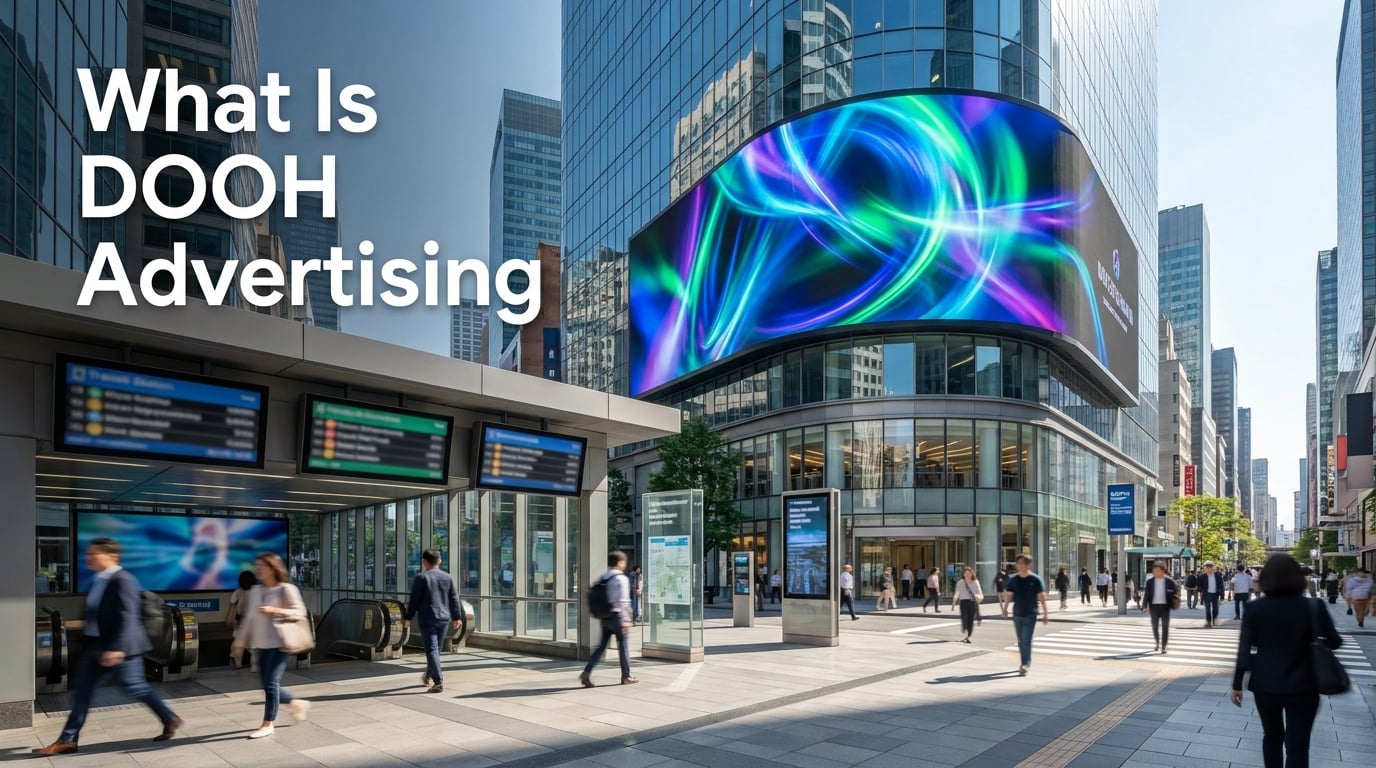
DOOH stands for digital out-of-home and refers to advertising media displayed on digital screens that are placed in shared environments outside the home. These screens range from towering digital billboards on highways to small displays inside elevators, gas pumps, and shopping malls.
I have spent the past several years studying how brands blend physical-world visibility with digital targeting, and DOOH advertising sits at the center of that shift. If you are a marketer, agency professional, or curious business owner, this guide breaks down exactly what DOOH means, how it works, and why it has become one of the fastest-growing channels in 2026.
By the end of this article, you will understand how DOOH differs from traditional OOH, which formats exist, how programmatic buying works behind the scenes, and the metrics advertisers use to prove return on spend. You will also see real-world examples and clear answers to the most common questions buyers ask before running their first campaign.
Table of Contents
What Is DOOH Advertising?
DOOH advertising is the digital evolution of traditional out-of-home (OOH) media. Instead of printed posters or static vinyl billboards, ads run on LED, LCD, or projection screens that connect to a content management system and can be updated remotely.
The term covers any digital screen an audience encounters outside the home. That includes digital billboards, transit displays, airport screens, retail signage, gas-pump toppers, and even connected devices in gyms or rideshares. The Out of Home Advertising Association of America (OAAA) reports that DOOH revenue now accounts for more than a third of total OOH spend, a clear sign that buyers are shifting budgets toward digital inventory.
At its core, DOOH advertising transforms a one-way broadcast medium into a flexible, data-aware channel. A brand can change its message by hour, location, weather, or audience profile without sending a crew to swap a printed panel. The same screen that shows a coffee ad at 7 a.m. can rotate to a smoothie ad by 10 a.m. and a happy-hour promotion after 5 p.m., all scheduled in advance or triggered automatically.
OOH vs DOOH: What Is the Difference?
The difference between OOH and DOOH comes down to medium and flexibility. Traditional OOH uses printed or painted formats that stay fixed for weeks at a time. DOOH uses digital screens connected to networks that deliver dynamic content on demand.
Here is a side-by-side look at how the two channels compare:
| Feature | OOH (Traditional) | DOOH (Digital) |
|---|---|---|
| Medium | Printed vinyl, paint, static poster | LED, LCD, projection, e-paper screens |
| Content updates | Manual install, weeks of lead time | Remote upload, minutes to deploy |
| Creativity | Single static image per campaign | Video, animation, motion, dayparted copy |
| Targeting | Location only | Location, time, weather, audience, context |
| Measurement | Estimated impressions | Verified impressions, foot traffic, brand lift |
| Buying model | Direct or agency, fixed periods | Direct, programmatic, or real-time bidding |
| Interactivity | None | Mobile integration, QR codes, sensors |
| Lead time | 4 to 6 weeks typical | Same-day to a few days typical |
Both formats still play a role in a media plan. Many brands use DOOH to deliver short, dynamic bursts of attention while keeping classic OOH for long-term, broad-reach awareness. The smartest buys often combine the two so the printed billboard builds familiarity in a neighborhood while the nearby digital screen retargets the same audience with timed offers.
How Does DOOH Advertising Work?
DOOH advertising works by linking digital screens to a central content management system (CMS) or ad server. Advertisers upload creative assets, schedule when and where they run, and the screens display the content automatically.
Behind the scenes, three layers keep the system running:
Screen hardware: LED panels, LCD monitors, or projection units installed at the venue and rated for outdoor or indoor conditions.
Network and connectivity: Cellular, wired, or Wi-Fi connections that keep the screens online and synced with the ad server.
Software platform: A CMS or ad server that stores creative, schedules delivery, and reports on playback.
When a campaign goes live, the ad server pushes creative files to each screen based on the agreed schedule. The screen confirms playback in near real time, giving advertisers proof-of-play logs instead of rough estimates. Modern networks also support sensors like cameras or proximity beacons that trigger creative swaps when conditions change, such as switching to a sunscreen ad the moment UV readings spike.
Common Types of DOOH Formats
DOOH covers a wide variety of screen types and venues. The format you choose should match where your audience spends time and the action you want them to take.
The most common DOOH formats include:
Digital billboards: Large roadside panels that replace traditional printed billboards along highways and city centers, often with rotating slots shared by multiple advertisers.
Transit advertising: Screens inside buses, subway cars, taxis, rideshares, and on station platforms where dwell time is high.
Airport advertising: Backlit panels, video walls, and baggage-claim displays in terminals that reach business travelers and tourists.
Retail and point-of-purchase: In-store screens, end-cap displays, and check-out lane monitors that influence buying decisions at the moment of choice.
Place-based advertising: Screens in gyms, restaurants, hotels, doctors’ offices, and apartment lobbies where audiences have a captive few minutes.
Gas-pump and elevator advertising: Small-format screens in high-dwell-time locations that pair well with mobile retargeting.
Each format captures a different mindset. A commuter scrolling on the subway has different attention than a parent waiting at a gas pump or a traveler checking a flight board. Our team usually starts a DOOH plan by listing the moments that matter most to the brand and matching those moments to the right venue.
What Is Programmatic DOOH (pDOOH)?
Programmatic DOOH, often shortened to pDOOH, is the automated buying and selling of digital out-of-home inventory through demand-side platforms (DSPs), supply-side platforms (SSPs), and real-time bidding (RTB) systems.
If you have bought display ads or connected TV (CTV) inventory programmatically, the workflow feels familiar. The main difference is that the “ad unit” is a physical screen slot tied to a place and time window, not a banner on a website. The same DSP you use for online video can now bid on a digital billboard in Times Square or a video wall in a shopping mall.
Programmatic DOOH works in three main ways:
Open exchange (RTB): Inventory is auctioned in real time across many buyers, similar to display advertising.
Programmatic direct: A buyer and seller agree on fixed pricing and targeting rules, then automate delivery.
Private marketplaces (PMP): Invitation-only auctions where select buyers bid on premium inventory.
For advertisers, pDOOH unlocks dayparting, weather-based creative swaps, and event-triggered messaging. For example, a streaming service can run a DOOH campaign only when local humidity rises above 70 percent, or a quick-service restaurant can push lunch ads during weekday commute hours. Programmatic pipes also let media buyers fold DOOH into the same reporting dashboards they already use for paid search and social.
Key Benefits of DOOH Advertising
DOOH advertising offers a unique mix of scale, attention, and accountability that other channels struggle to match. Here are the benefits our team sees most often when working with advertisers.
High-impact visibility: Large digital displays in public spaces grab attention in ways mobile banners rarely do.
Dynamic, real-time content: Update creative across hundreds or thousands of screens in minutes, with no printing or installation.
Privacy-safe targeting: Reach audiences based on context, location, and time without relying on third-party cookies or personal identifiers.
Programmatic efficiency: Automate buying, bidding, and optimization using the same DSPs you may already use for online campaigns.
Measurable outcomes: Pair screen impressions with mobile location data, foot traffic, and brand-lift studies to prove ROI.
Adblock-proof reach: DOOH cannot be skipped, muted, or blocked by ad-blocking software.
Omnichannel amplification: Reinforce online video, social, and search campaigns with physical-world reminders.
The OAAA notes that 73 percent of consumers view DOOH advertising favorably, and 76 percent report taking action after seeing a digital out-of-home ad. Those numbers explain why budgets keep shifting from static to digital formats. When a campaign blends DOOH with mobile and social, brands often see a measurable lift in unaided recall and store visits, even within a short four-week flight.
Real-World Examples of DOOH Advertising
DOOH campaigns are everywhere once you start looking. Here are a few examples that show how brands use the channel in practice.
Streaming services and product launches. Major streaming platforms use DOOH in launch cities to build buzz before opening weekend. They pair digital billboards with social posts and count QR-code scans to gauge lift. Some even trigger creative based on the trailer playing on a connected TV nearby, so the outdoor screen feels like an extension of the living room.
Quick-service restaurants. Fast-food chains run time-of-day campaigns on screens near offices and transit hubs, switching from breakfast to lunch menus automatically as the day progresses. Weather-triggered creative lets a coffee brand push iced drinks on hot days and hot lattes when temperatures drop.
Retail and fashion. Flagship stores use storefront digital signage to display dynamic lookbooks that change with the weather or trending inventory in real time. Inside the store, point-of-purchase screens highlight promotions tied to the customer’s browsing history on the retailer’s app.
Automotive. Car brands stream cinematic DOOH ads at gas stations and along commuter routes, often synchronized with mobile retargeting for follow-up impressions. Dealerships also use DOOH on-site to refresh offers without reprinting window clings.
Public health and policy. Cities and health agencies use DOOH networks to push rapid-response messaging during emergencies, weather events, or vaccination drives. Because the screens can be updated in minutes, they serve as a real-time public-information channel.
How Is DOOH Advertising Measured?
Measurement is one of the biggest improvements DOOH brings over traditional OOH. Static billboards relied on rough traffic counts; DOOH can layer in verified impression data, audience attributes, and outcome studies.
The most common DOOH measurement metrics include:
Verified impressions: Independent third parties estimate audience size using traffic, transit, or footfall data.
Foot traffic attribution: Mobile location panels measure how many people visited a store or venue after seeing the ad.
Brand lift studies: Pre- and post-campaign surveys measure awareness, consideration, and purchase intent.
QR-code and URL scans: Direct response tracking through custom codes or short URLs.
Proof-of-play logs: Each screen records exactly when and how long an ad ran.
For programmatic buyers, DSPs fold DOOH data into the same dashboards used for display and video, making it easier to compare return on ad spend across channels. A growing number of media owners also offer outcome-based pricing, where advertisers pay only when the campaign hits agreed thresholds for foot traffic or store visits.
How to Plan a DOOH Campaign That Works?
A solid DOOH plan starts with clear objectives, tight audience mapping, and the right mix of screens. Treat DOOH like any other performance channel: define what success looks like before you spend a dollar.
Here is the workflow our team uses when planning a first campaign:
Define the goal: Pick one primary objective, such as awareness, store visits, or product launch buzz.
Map audience moments: List the times, places, and contexts where your buyer is most receptive.
Choose formats: Match each moment to a screen type, balancing reach with dwell time.
Set targeting rules: Use dayparting, weather, location, and audience attributes to refine delivery.
Build creative variants: Prepare multiple versions so dayparting and context triggers can swap messages automatically.
Pilot, measure, then scale: Run a small test with clear KPIs, review foot traffic and lift data, and expand only after the pilot proves out.
Keep creative short and bold. Most viewers glance at a screen for two to five seconds, so the message and brand mark need to land instantly. Pair the visuals with a single clear call to action, whether that is scanning a QR code, visiting a store, or searching a branded term online.
Privacy Considerations in DOOH
Privacy is one of DOOH’s quiet advantages. Because targeting relies on context rather than personal identifiers, advertisers can reach the right audience without relying on third-party cookies or device-level tracking.
DOOH networks use aggregated signals such as traffic counts, weather, time of day, and venue type to decide which creative to play. There is no personal profile attached to the person walking past the screen. As regulators tighten rules around online tracking, this privacy-by-design approach makes DOOH a useful hedge against signal loss on the open web.
Frequently Asked Questions
What is an example of DOOH advertising?
A digital billboard along a highway is a classic example. Other examples include video screens at airports, digital menu boards in quick-service restaurants, elevator screens in office buildings, and dynamic displays at gas pumps.
What is the difference between DOOH and OOH advertising?
OOH uses printed or static formats that stay in place for weeks, while DOOH uses digital screens connected to a network. DOOH supports dynamic creative, real-time updates, programmatic buying, and richer measurement than traditional OOH.
What is the DOOH business model?
The DOOH business model sells screen impressions to advertisers, either directly, through agency partners, or programmatically via demand-side platforms. Screen owners earn recurring revenue based on play count, time of day, audience size, and targeting attributes such as location or context.
What are the benefits of DOOH?
Key benefits include high-impact visibility, dynamic and real-time content, privacy-safe targeting, programmatic efficiency, measurable outcomes, adblock-proof reach, and the ability to amplify other digital channels through omnichannel campaigns.
Final Thoughts on DOOH Advertising
DOOH advertising has grown from a niche upgrade to printed billboards into a full-funnel channel that blends the scale of out-of-home with the precision of digital media. If your brand needs attention in the physical world and accountability in your dashboards, DOOH deserves a seat in your 2026 media plan.
Start by mapping where your audience already spends time, pick two or three screen formats that match that journey, and pilot a small campaign with clear measurement goals. Once you have proof of lift, expand into programmatic DOOH and let real-time data shape the rest of the year.