
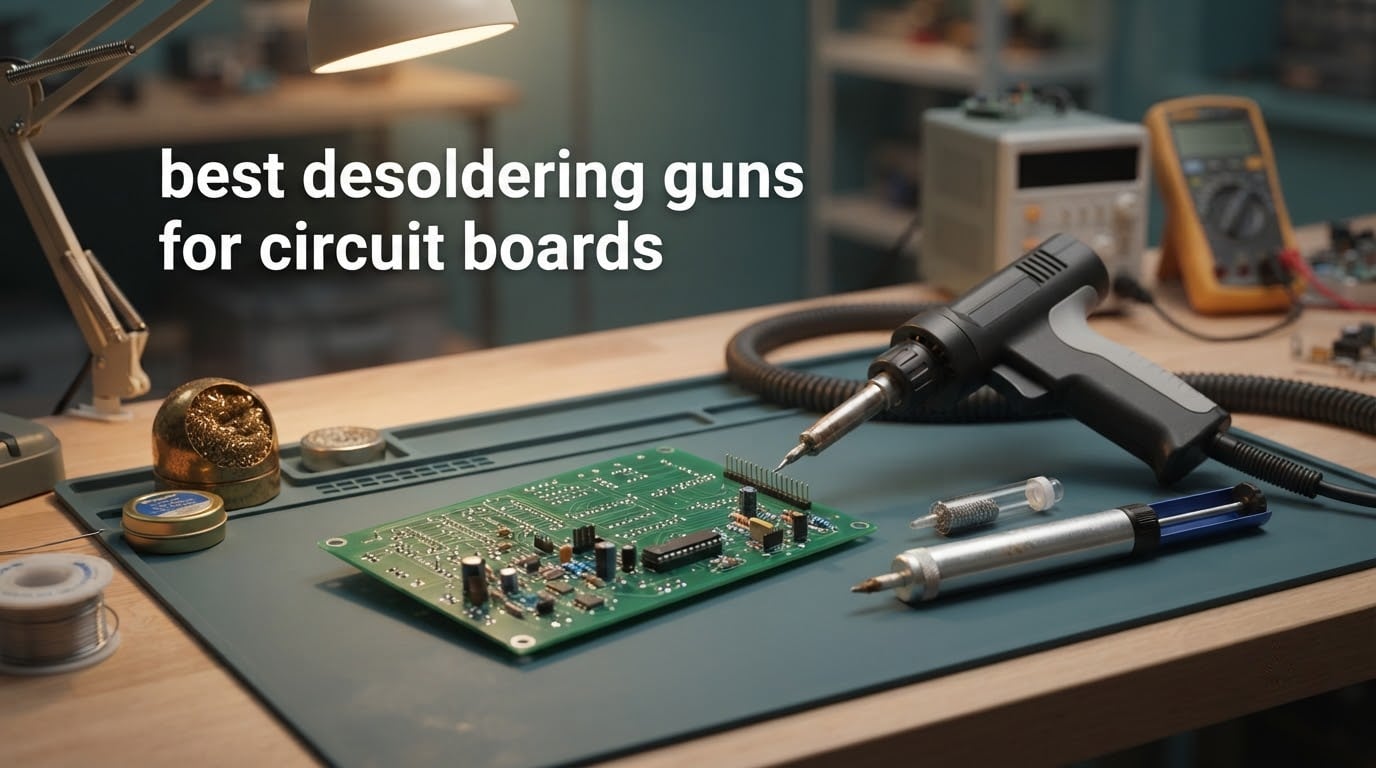
Most people who ask for the best desoldering guns for circuit boards are not really shopping for a gadget. They have a board on the bench with a through-hole chip that has to come off without taking a pad with it, and they want the job done in seconds instead of a long session with braid and tweezers. That is the exact problem every tool on this page was built to solve, and the reason it is worth spending real effort choosing one carefully.
There is a complication. The phrase desoldering gun gets used for at least three different categories of tool. Some are self-contained electric guns with a built-in vacuum pump and a heating element in the handle. Some are vacuum stations where the pump lives in a box on the bench and you hold a tethered gun. And some are manual solder suckers that have no heat source at all and rely on your existing iron. We compared ten of the best available across all three groups, and the honest answer depends almost entirely on how much through-hole work you actually do.
We spent weeks putting these tools through real jobs on salvaged boards, deliberately picking multi-pin DIP packages, single pin headers and old lead-free joints, and we tracked the boring parts too: how long it takes to clear a clogged nozzle, what the consumables cost, and whether the part is still available in five years. Below is what came out of it, updated for 2026.
Table of Contents
What Is a Desoldering Gun?
A desoldering gun is a handheld tool with a built-in vacuum pump that heats a hollow nozzle while sucking. You melt the solder at a through-hole joint, trigger the pump, and the molten solder is drawn up the nozzle into a filter chamber, lifting the component off the board instead of leaving you to wick and pry it. Heat and suction in one hand is what separates it from a plain soldering iron.
Now that definition is out of the way, here is the part most guides skip: not every board needs one. If you are pulling a single pin header twice a year, a twenty-dollar manual solder sucker does the same job. If you are rebuilding keyboards, restoring arcade boards, or swapping ICs on a schedule, the electric gun earns its bench space within a month.
Top 3 Desoldering Picks for Circuit Board Work in 2026

If you want the short version before the details, those three cover the realistic range. The Hakko is the one that simply works on everything and does not need a separate iron in your other hand. The Vampliers is the manual pump that most people upgrading from a plastic sucker actually want. The YIHUA 929D-V is the compromise for anyone who wants one corded tool instead of two.
Best Desoldering Guns for Circuit Boards in October
All ten tools below appear in the table with their key specs. Ratings and review counts are the current figures from the product listings, and we note where a tool sits relative to the rest of the field rather than pretending every one of them is a good idea.
| Product | Specifications | Action |
|---|---|---|
| Hakko FR301-03/P Portable Desoldering Tool |
|
Check Latest Price |
 YIHUA 929D-V Electric Iron and Pump YIHUA 929D-V Electric Iron and Pump |
|
Check Latest Price |
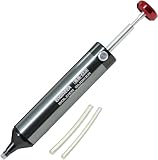 ENGINEER SS-03 Aluminum Solder Sucker ENGINEER SS-03 Aluminum Solder Sucker |
|
Check Latest Price |
 Weller 7874B ESD-Safe Desoldering Pump Weller 7874B ESD-Safe Desoldering Pump |
|
Check Latest Price |
 Vampliers VT-001-SS Solder Sucker Vampliers VT-001-SS Solder Sucker |
|
Check Latest Price |
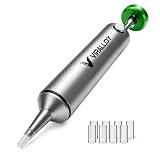 VIRALLOY SS-786 Manual Desoldering Pump VIRALLOY SS-786 Manual Desoldering Pump |
|
Check Latest Price |
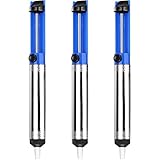 Teenitor Desoldering Pump 3-Pack Teenitor Desoldering Pump 3-Pack |
|
Check Latest Price |
 Anesty ZD-915 Digital Vacuum Station Anesty ZD-915 Digital Vacuum Station |
|
Check Latest Price |
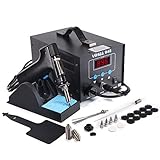 YIHUA 948 Desoldering Station YIHUA 948 Desoldering Station |
|
Check Latest Price |
 HighTop 30W Electric Desoldering Pump HighTop 30W Electric Desoldering Pump |
|
Check Latest Price |
1. Hakko FR301-03/P Portable Desoldering Tool – Best Overall Electric Gun
Hakko FR301-03/P Portable Desoldering Tool with Precise Temperature Control °F /°C
140W self-contained electric gun
350C to 500C dial
1.1 lb
Ceramic element
Pros
- Fast heat-up with four settings from 350C to 500C
- Strong suction clears through-hole joints in one pull
- Tool-free nozzle changes while hot
- Locking latch on the solder recovery chamber
- Closed-loop sensor holds temperature steady
Cons
- Included case is cheap blow-molded plastic
- Metal stand is flimsy and the stiff cord pushes the tool around
- 0.8mm 1.5mm and 2mm tips cost extra
- Only a 90-day US warranty
This is the one that keeps getting recommended on repair forums, and after our own testing we understand why. The heat comes up quickly and holds where you set it, and the trigger pull is immediate enough that a fresh lead on a stubborn board comes up on the second or third attempt rather than the eighth. Suction is the standout: it empties a through-hole joint in one shot often enough that you stop bracing for damage.
At 1.1 pounds it is far heavier than a manual pump, but the weight sits in the base of the pistol grip and it stays comfortable through a full afternoon of rework.
That weight figure matters more than it sounds, because the alternative is holding an iron in one hand and a pump in the other for the same four hours. The weight is the price of carrying the pump and the element inside the same tool.
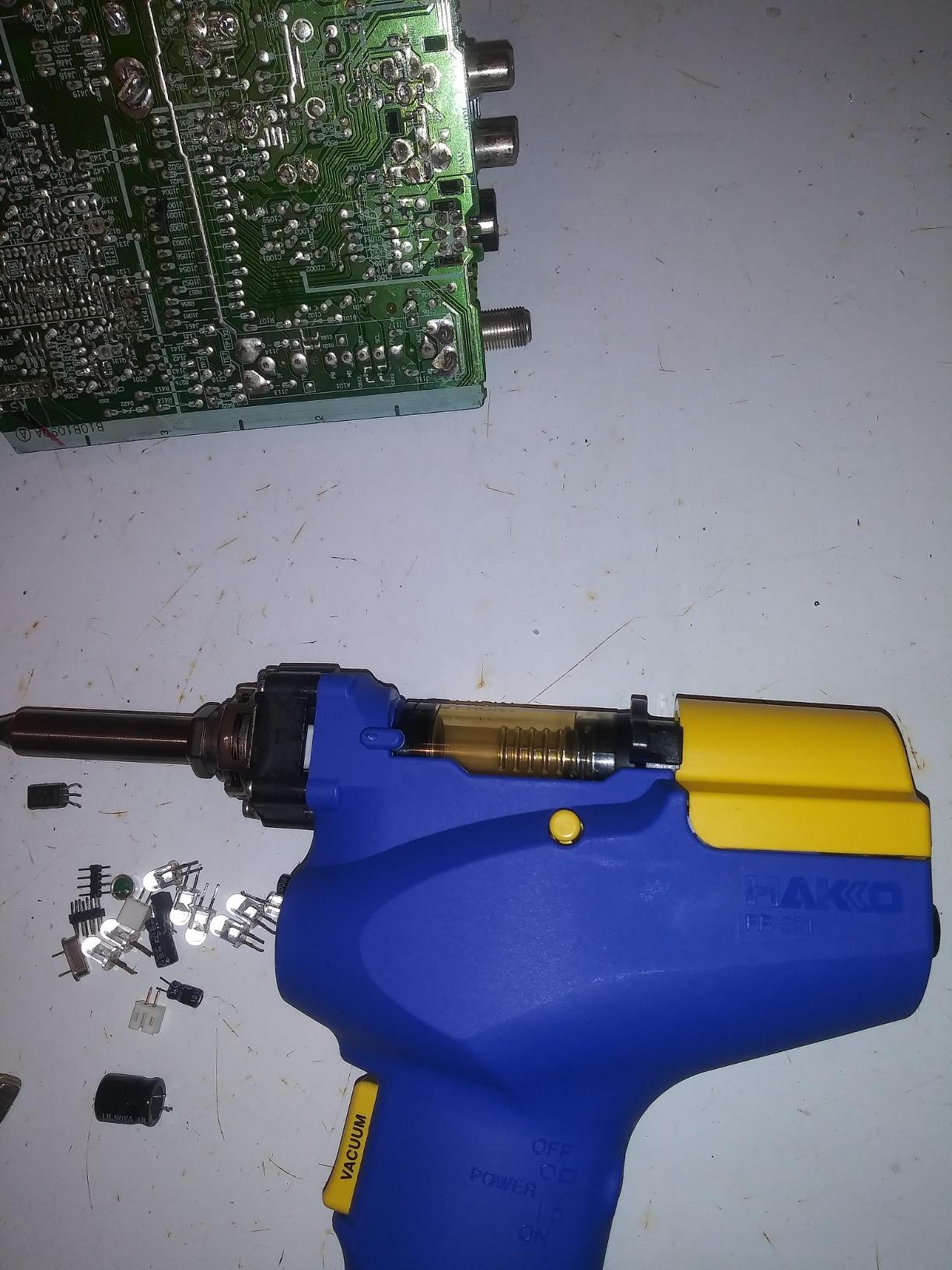
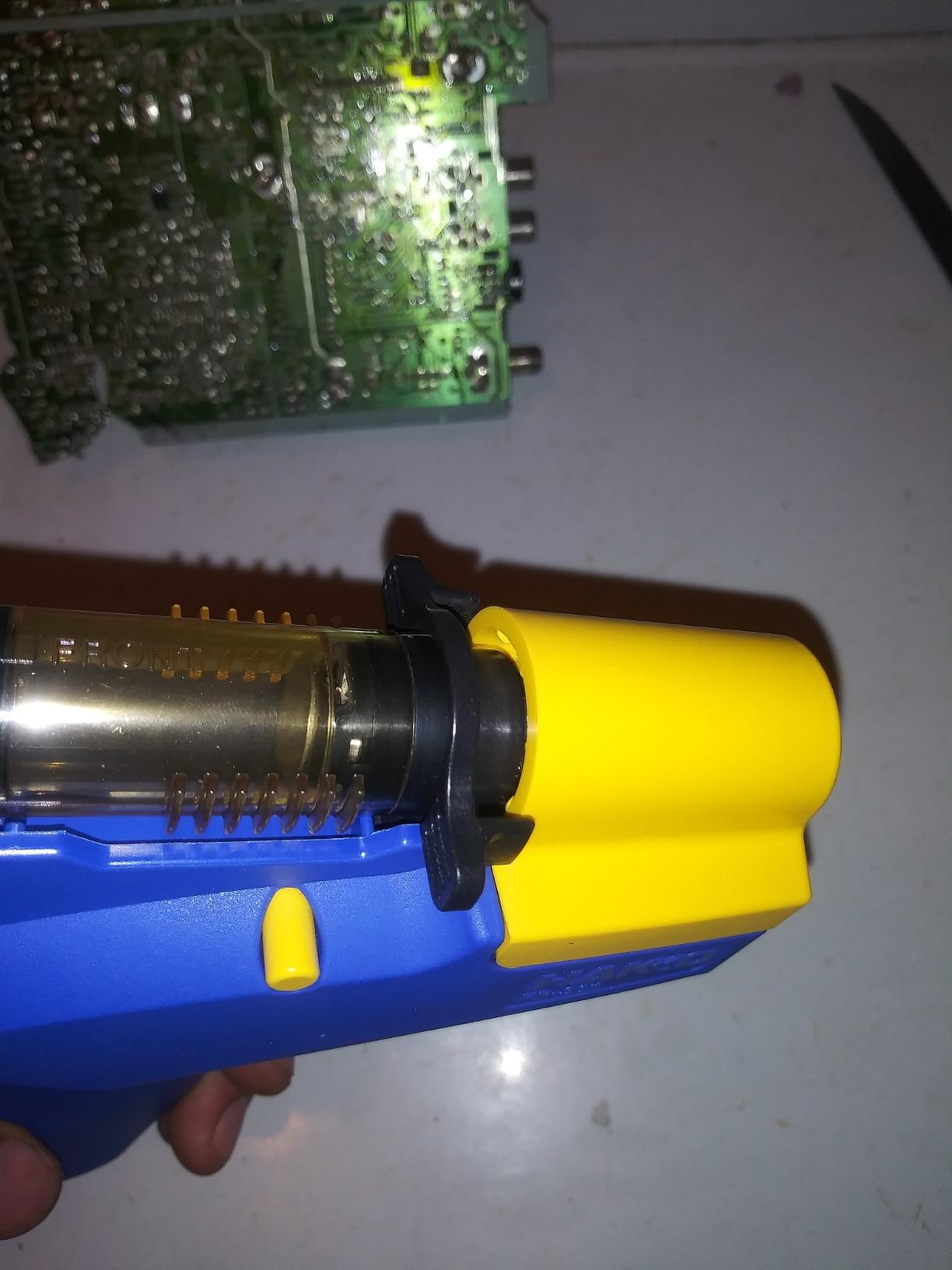
Buyers say it heats up quickly and holds the setpoint better than the open-loop nichrome designs in cheap electric guns. The solder recovery chamber has a locking latch, so emptying it takes one motion instead of unscrewing a tube over a bin. Tool-free nozzle changes work while the tip is hot, which saves a lot of burned fingers on a busy day.
Where the money stings is the accessories. The 0.8mm, 1.5mm and 2mm tips are not in the box, and the case that does come in is thin blow-molded plastic with weak hinges. The metal stand is also lighter than it looks, so a stiff power cord can drag the tool off the cradle while you are reaching for a part. None of that touches performance, but budget for tips and a better cradle.
What the Hakko FR301 handles better than the rest
Multi-pin DIP packages and multi-row headers are where it separates itself. Heat and suction arrive together, so the whole component comes free in a single pull instead of you rotating it against the board while the solder cools. The temperature range also lets you drop to 350C for small signal boards and climb to 500C for big leaded joints without swapping tools.
Because it is self-contained, there is no station, no hose and nothing to trip over. For field service or a crowded bench that simplicity is worth paying for, and it is why this stays the default recommendation in most of the repair communities we checked.
Where the Hakko FR301 will disappoint you
It is not a surface-mount tool. Pulling a fine-pitch QFP means heating all twenty-something leads at once, and that volume of molten solder over fine traces is exactly the situation where pads lift. Cutting the package body off first and desoldering the remaining leads is the safer habit on delicate boards.
The 90-day US warranty is also short for a bench tool, and the accessory ecosystem costs real money once you have the 0.8mm nozzle for fine-pitch work and the extended nozzle for deep, narrow holes. Budget for those before you decide this is the complete package.
2. YIHUA 929D-V Electric Desoldering Iron and Pump – Best All-in-One Corded Tool
YIHUA 929D-V Electric Desoldering Soldering Iron Solder Sucker Desoldering Pump with Shorter Charging Handle and Desoldering Nozzles 1.0mm 1.2mm for Through-Hole Desoldering
Iron and pump in one tool
Fixed temperature
1.0mm and 1.2mm nozzles
0.3 kg
Pros
- One tool heats and vacuums so you never regrip
- Interchangeable 1.0mm and 1.2mm nozzles
- Removable solder storage tube cleans quickly
- Heat deflector keeps the hand comfortable
- Stand cleaning pin and sponge included
Cons
- Temperature is fixed with no adjustment
- Storage tube needs regular cleaning with the pin
- A 3 to 5 minute preheat before use
- Some joints need several attempts
The idea here is simple and genuinely useful. Instead of a gun with a heating element, this is a corded desoldering iron with the suction chamber built into the same handle, so the tool both melts the joint and pulls the solder without you putting it down. There is no station, no separate pump and only one cord on the bench.
At 0.3 kg it is the lightest powered option we tested, and the short handle plus the heat deflector at the end of the element kept our hand comfortable through repeated single-pin work. The two supplied nozzles, 1.0mm and 1.2mm, cover most header and socket work without extra purchases.
The catch is the fixed temperature. There is no dial and no display, so on a board with mixed joint sizes you are stuck with one setting.
Owners report it handling leaded through-hole work without complaint, while lead-free and larger joints need more dwell time and occasionally more than one pass. The preheat is also three to five minutes, which feels long when you just want to swap one relay.
The removable solder storage tube is the part you will maintain most. Pull it off, clear it with the included pin, snap it back. Skipping that step is how the suction quietly fades, and owners who treat it as a weekly habit report far fewer complaints than those who do not.
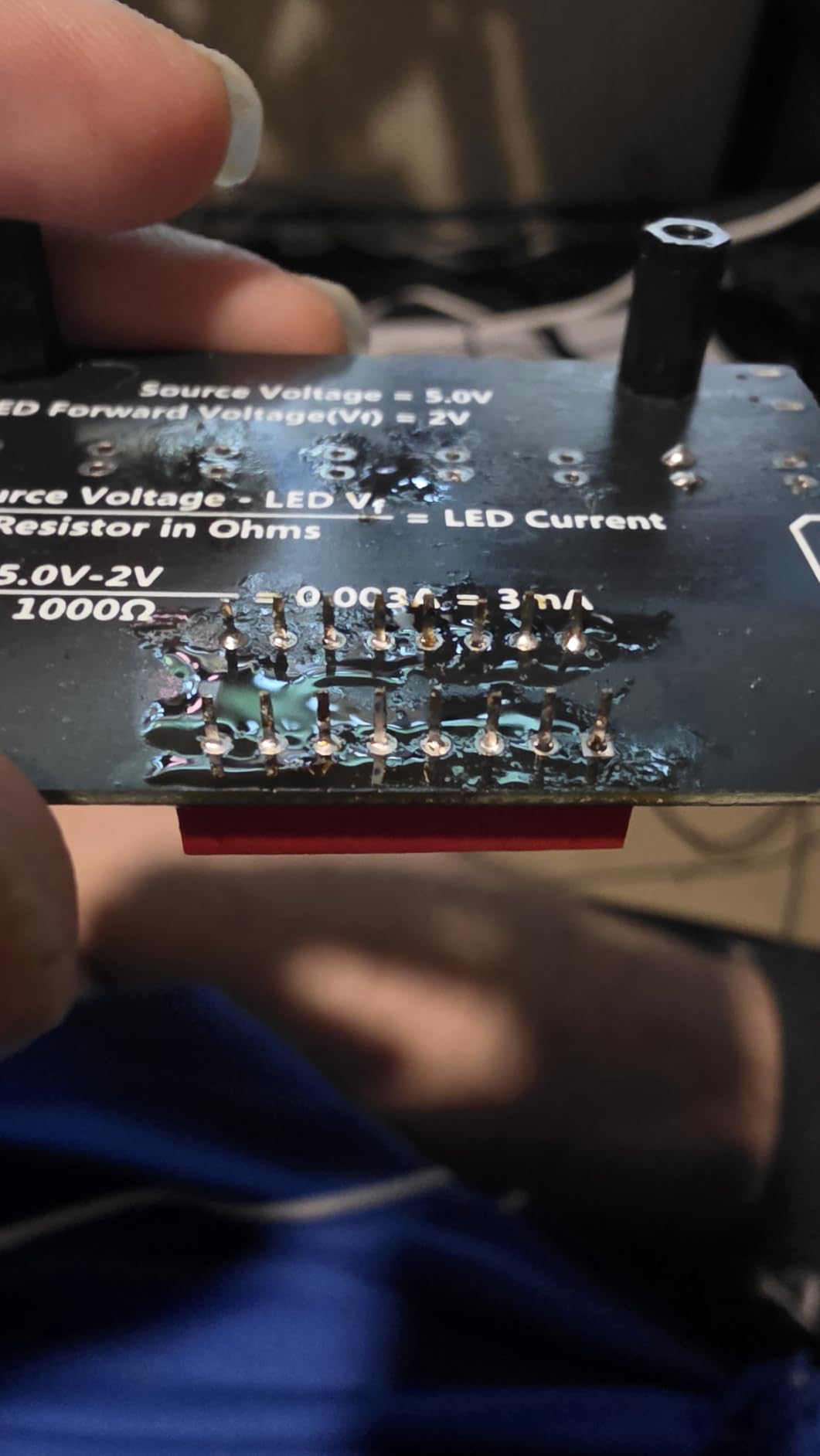
When the combined iron and pump is the right call
Pick this if your work is scattered and light: pin headers, sockets, single resistors and capacitors, the odd replacement relay. You get a working desoldering setup out of one box with nothing else to buy, which is exactly the situation where a full station is overkill and a manual pump means holding two tools at once.
It is also a good first powered desoldering tool. The learning curve is short because the trigger is right there under your finger and the failure mode is a tube you can visibly empty and inspect.
When you should step up to a station instead
If you are pulling multi-pin packages regularly, the lack of temperature control becomes the limiting factor. You cannot drop the heat for a small signal section and raise it for a big leaded joint, and without that range you either scorch the board or wait too long on hard joints.
It is also a single-point tool with no station backup. If the element or the cord fails you are down until a replacement arrives, which is worth weighing against the availability of parts for the better-known models.
3. ENGINEER SS-03 Aluminum Solder Sucker – Best Manual Pump for Precision Work
ENGINEER Solder Sucker Professional Grade Aluminum Desoldering Pump SS-03
Manual pump
Made in Japan, aluminum body
48 g, 6 inches
Silicone nozzle to 350C
Pros
- Well machined anodized aluminum body
- Strong consistent spring action
- Silicone nozzle seals right up to the iron tip
- Compact 6 inch size works in tight spaces
- Two spare silicone tubes in different diameters
Cons
- Expelled solder can stick partway in the silicone tip
- Only unscrew the nozzle end to clean it
- A light coat of grease is recommended but not included
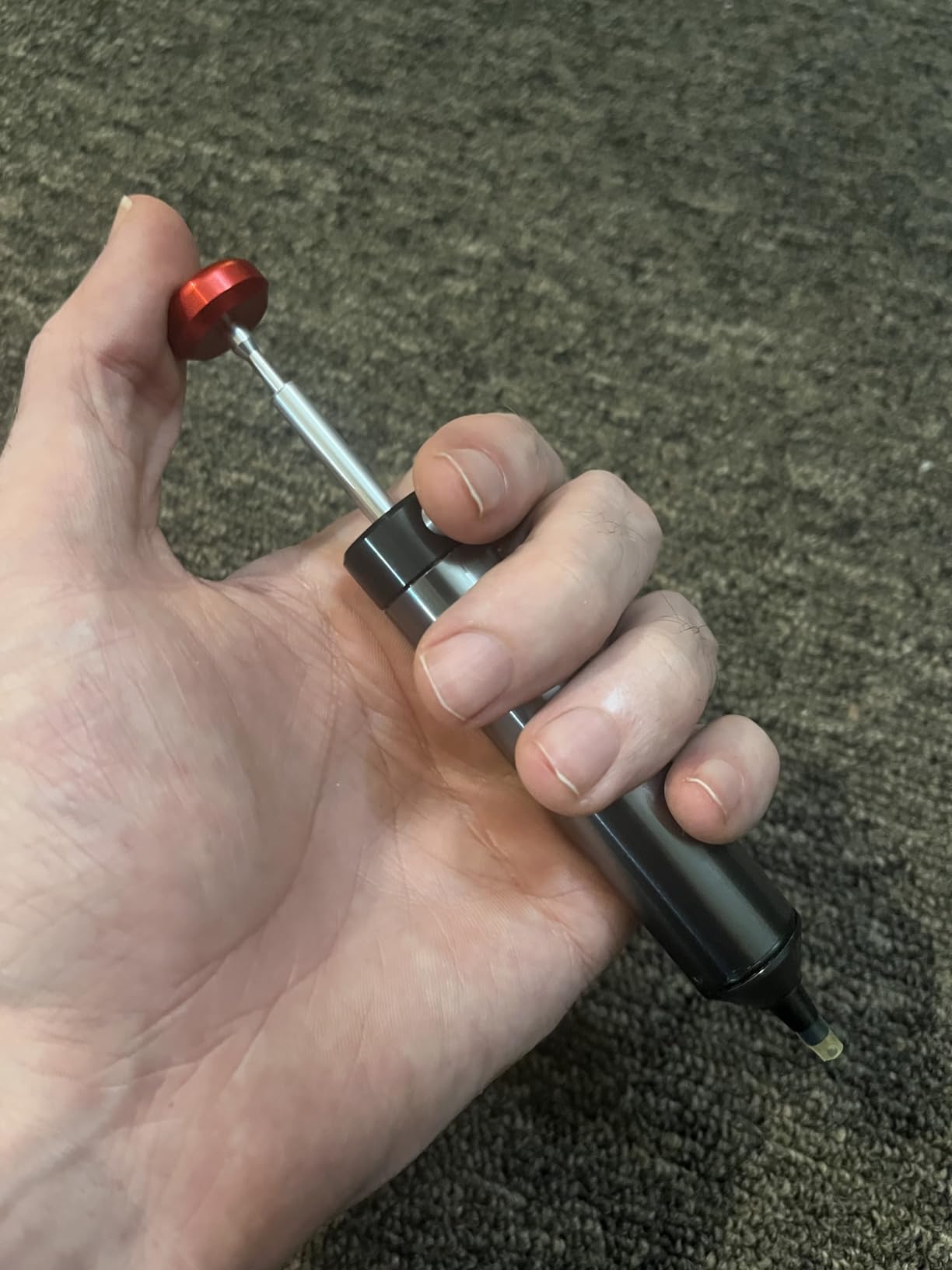
This is the pump we reach for when the job is small and the joint is delicate. The anodized aluminum body is machined properly and weighs 48 grams, so it disappears in the hand and stays controllable on a board where you are working under a magnifier. No cord, no heat, nothing to plug in.
The silicone nozzle is the real trick. It is rated to 350C, so you can press it directly against the iron tip to form a seal without cooking the tube, and that tight contact is what makes the pull clean on single pins and small connectors where a plastic nozzle would leak.
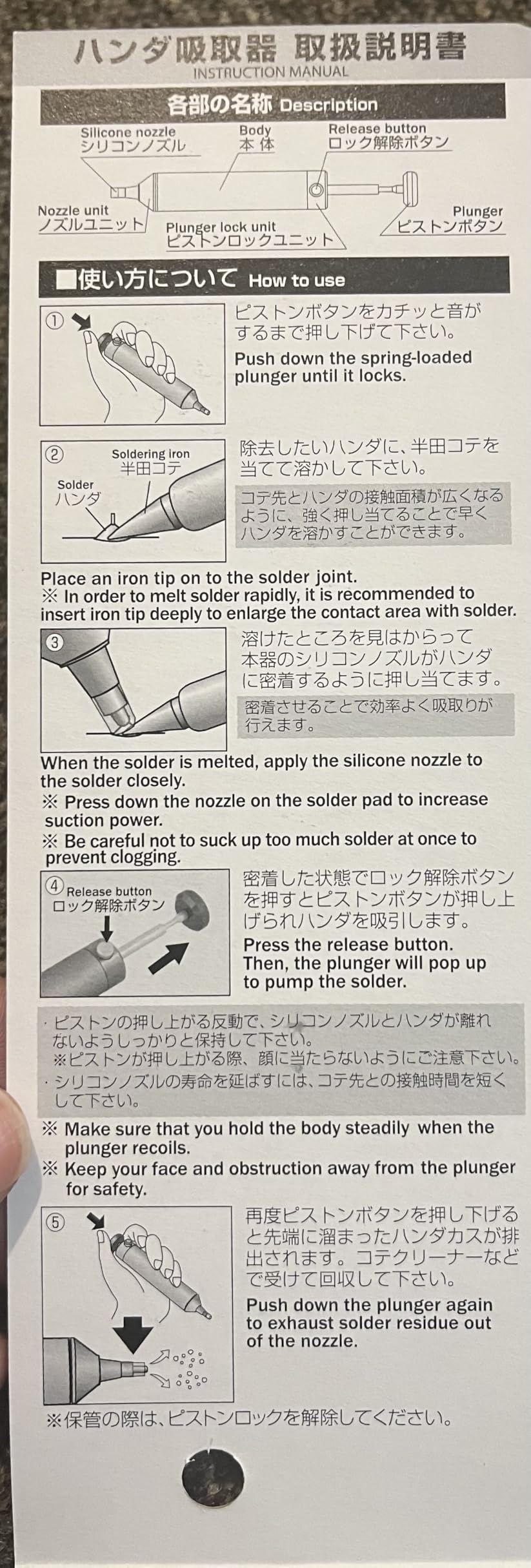
Two spare silicone tubes in different diameters ship in the box and can be cut to length, so a torn nozzle is a thirty-second fix rather than a replacement order. The built-in self-cleaning shaft also passes a pin straight through the bore, which is how you clear solder that has crept down the chamber after a messy joint.
One maintenance rule is not optional: never unscrew the plunger end. Doing that permanently ruins the seal, and users who do it end up with a pump that never quite pulls again. Open the nozzle side only, and a light film of dielectric or silicone grease on the plunger keeps the action smooth. That grease is not included, which is our only real complaint.
Where the ENGINEER SS-03 beats bigger pumps
On fine, low-thermal-mass work the seal advantage is decisive. When the nozzle sits right at the iron tip, the molten solder has nowhere to go but into the chamber, so even a small pump pulls the joint completely. On a header with four or five pins it is fast enough that you stop thinking about the pump and start thinking about the board.
The weight is the other quiet win. At 48 grams you can hold it in your non-dominant hand for an entire session without fatigue, and that is not true of the heavier metal pumps that need a firm two-handed press.
Where it will not get the job done
It supplies no heat. On a large leaded joint, or any board where the solder has oxidised and gone stiff, you still need to do real work with the iron before the pump will take it. Budget for patience on vintage hardware, where fresh solder and flux are often what actually gets the joint moving.
It is also a single-user tool with no spare in the box beyond the tubes. If you lose it or it takes a knock, there is no second one on the bench to keep the job moving that day.
4. Weller 7874B ESD-Safe Desoldering Pump – Best for ESD-Sensitive Bench Work
Weller Manual ESD-Safe Desoldering Pump with Aluminum Body | 7874B
Manual pump
ESD-safe construction
Aluminum body
0.08 kg
Pros
- Aluminum body resists clogging far better than plastic pumps
- Strong consistent suction on small through-holes
- Simple one-handed operation with an unscrewable tip
- Long service life with decades of use reported
- ESD-safe for professional bench work
Cons
- Can jam and need disassembly to clear
- Results depend heavily on technique and timing
- Bulky action is less forgiving for limited hand dexterity
- Only one pump in the pack
Weller built this for repair benches rather than hobby desks, and the ESD-safe construction is the reason it turns up in professional workflows. On boards with sensitive analogue or low-level signal sections, controlling static around the work matters, and this pump is specified for it.
The aluminum body is the other draw. Compared with the plastic pumps it outmuscles, it does not flex, seize or shed debris into the bore, which is why owners report decades of service on the same tool. The one-handed button operation is simple enough that you can use it without looking away from the board.
Timing is everything here. The window between the solder going fully molten and starting to cool is short, and the pump wants the trigger at the exact moment the joint collapses. Practice a few pulls on scrap board and the results become consistent very quickly, but the tool will not forgive a late trigger pull.
We saw occasional jams that needed the body opened to clear, and the action is fairly bulky, which makes it a less comfortable tool for people with reduced hand dexterity. Neither is a dealbreaker at a professional bench, but both are reasons to try it before committing.
Why bench technicians keep coming back to it
Durability is the whole story. A metal-bodied manual pump has no electronics, no filters and no consumables beyond a nozzle tip, so it can sit in a drawer for years and still work on the first pull. That is a different reliability profile from any powered option on this page.
For static-sensitive work it also removes a variable. When a board holds analog signals or CMOS parts, having a pump that was designed with that in mind simplifies the bench rules rather than adding a special case.
When a different pump suits you better
If you are working in tight spaces or at an awkward angle, the heavier action of this pump is harder to control than a lighter aluminum model. The 48 gram ENGINEER and the 2.1 ounce Vampliers are both easier to finesse on a crowded board.
It is also strictly a suction tool. It will not help you on a joint that will not melt, and it does nothing about the technique side of removal. Pair it with an iron, wick and flux, and it does its job well.
5. Vampliers VT-001-SS Solder Sucker – Best Value Manual Pump
VAMPLIERS Professional Grade Solder Sucker Made in Japan Desoldering Pump
Manual pump
Aircraft-grade aluminum, Japan
2.1 oz, 6 inches
Silicone nozzle to 350C
Pros
- Premium aluminum body feels solid and durable
- Very powerful spring clears most holes in one shot
- Silicone nozzle never burns or melts
- Compact one-handed operation
- Two spare silicone tubes included
- 4-year warranty
Cons
- Stiff spring is hard to re-compress at first
- Lead-free solder clogs the nozzle more often
- Can spit cooled solder when reloaded
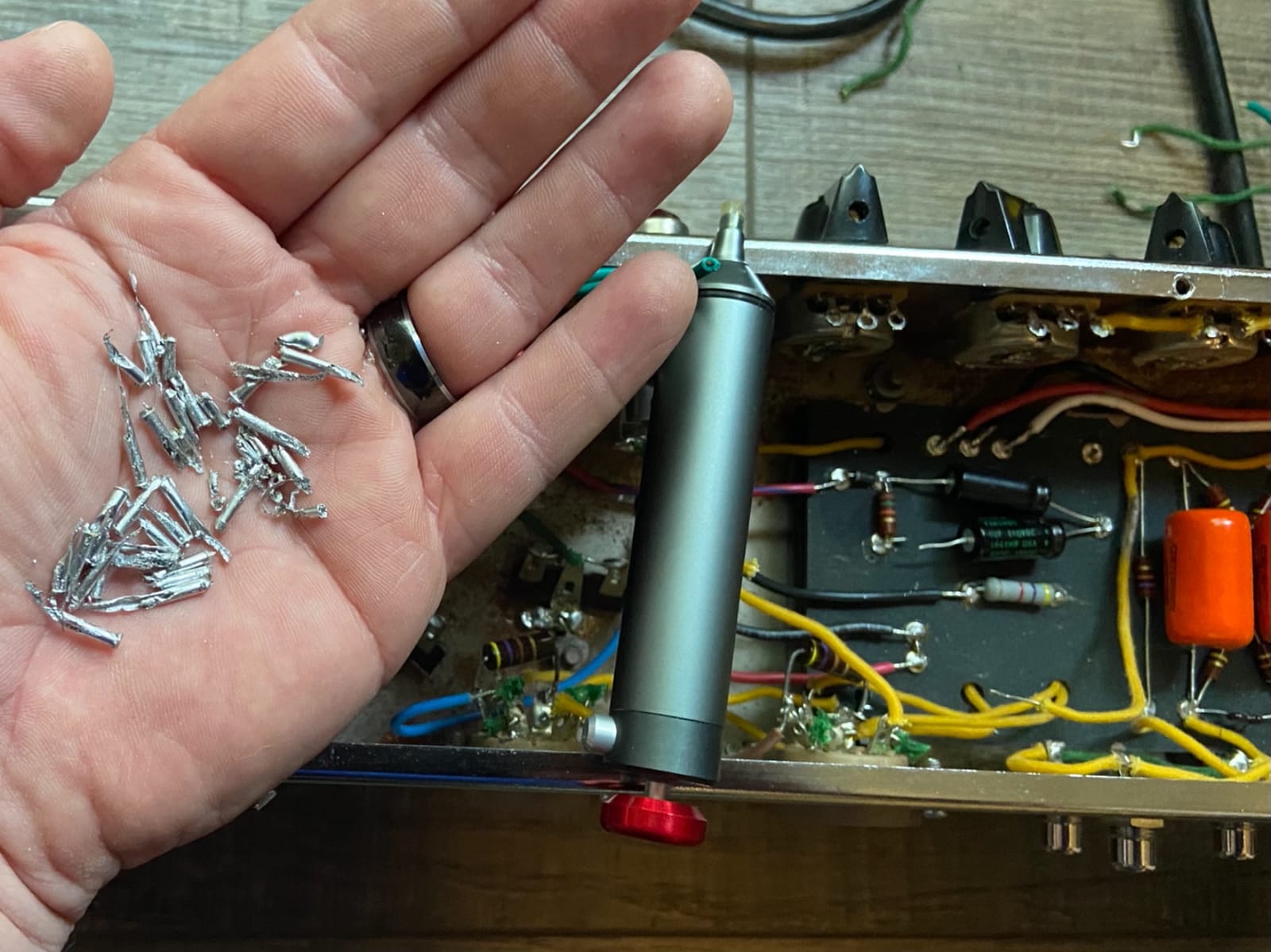
Owners moving up from a cheap plastic suction tool describe this as a night-and-day change, and the reason is mechanical rather than electronic. The aircraft-grade aluminum body, made in Japan, has a self-cleaning shaft that pushes debris clear of the bore, so the clogging that made them give up on plastic pumps largely stops happening.
The spring is powerful, and it is stiff. That combination is why the pull is so decisive on a single pull, and also why several users mention the first few sessions felt tiring. Give it a week and the muscle memory takes over; the complaints that remain are mostly about the break-in period.
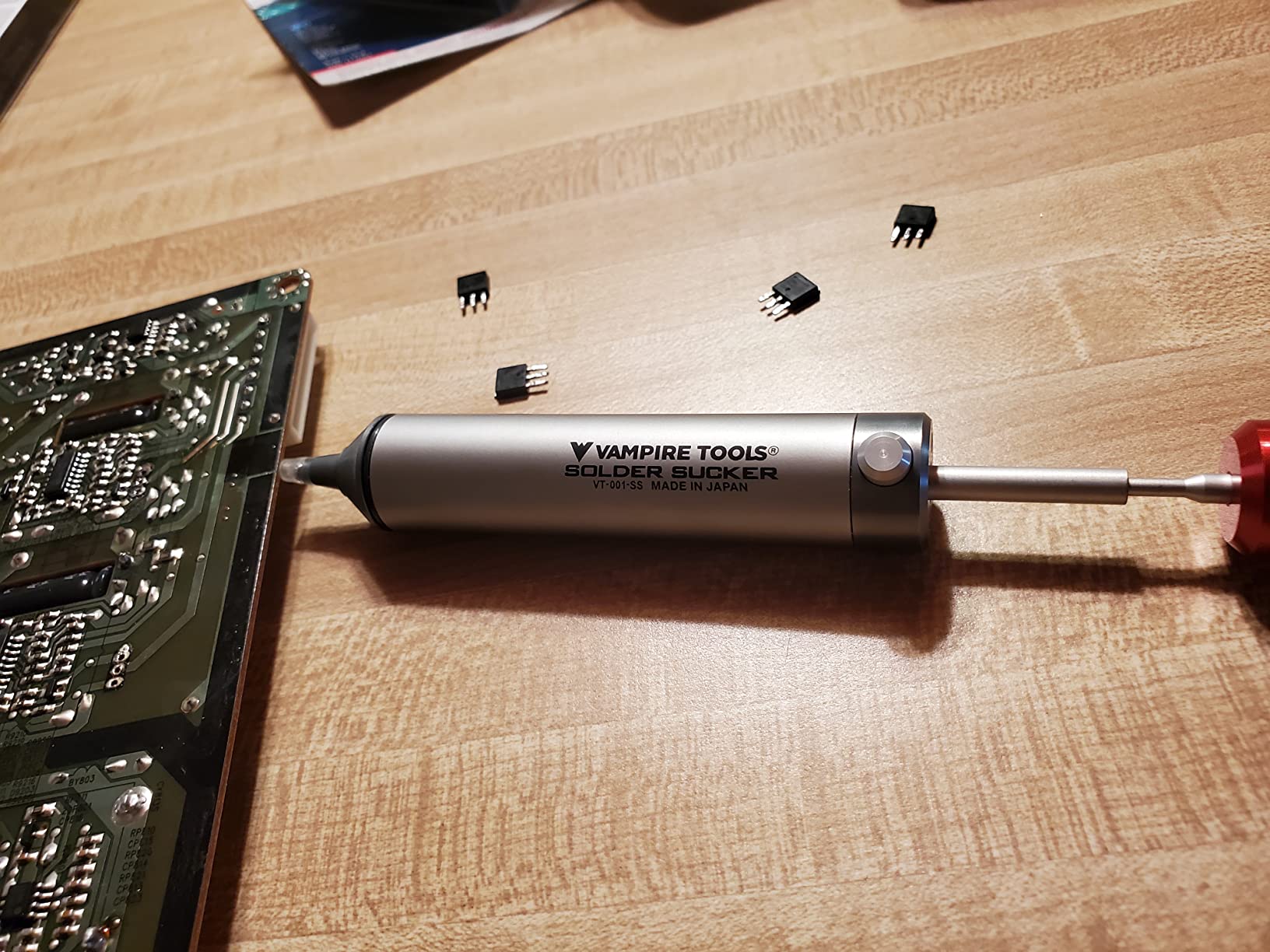
Two spare silicone tubes in 3.0mm and 4.0mm, both 50mm long, come in the box and can be trimmed to your preferred length. The elastic nozzle seats against a pad more completely than a rigid tip, and it is rated to 350C so it survives contact with the iron without degrading.
Two things to watch. Lead-free solder sets hard quickly and gives you less time, so nozzle clogs show up more often on modern lead-free boards than on older rosin-core work. And if you reload over bare bench instead of a catch container, the cooled plug can jump out and land somewhere inconvenient.
Why this is the value pick in the whole list
The warranty is the quiet standout. Four years automatically, five with registration, is a real commitment from a manufacturer in a category where most tools carry nothing. For a pump that will live in a toolbox for a decade, that changes the ownership calculation.
At 2.1 ounces it sits in the middle of the manual group: heavier than the 48 gram ENGINEER, lighter and easier to hold than most metal pumps. That is the sweet spot for long sessions where you want a real pull without wrestling the tool.
Where it falls short of the best
It is still a manual tool, so every heat-related problem stays with you. Vintage boards with oxidised solder need fresh solder and liquid flux before the pump can do anything, and no spring strength fixes that.
Multi-pin packages are also not its strength. It handles headers and discrete parts superbly, but pulling a 28-pin DIP relies entirely on your technique and patience rather than on any heat source doing half the work.
6. VIRALLOY SS-786 No-Clog Manual Pump – Best for Keyboard and Switch Work
Solder Sucker Tool No Clog Silicone-Tip Manual Desoldering Pump Soldering Accessories for Solder Remover – Unrivaled Suction • No Power Needed • Ultra Low-Maintenance • Best-in-Class Desoldering Gun
Manual pump
CNC aluminum body
6.52 inches
8 spare silicone tubes
Pros
- High-tension spring clears molten solder in one trigger
- CNC-machined aluminum resists corrosion
- Flexible silicone nozzle molds to the joint
- Ejects waste on reset
- Works well on switches and connectors
- Eight spare tubes in the box
Cons
- No-clog claim weakens under heavy use
- Can feel slick out of the box
- Silicone sleeves used up quickly
- Undersized for large heat-heavy jobs
Keyboard work is the use case that made this popular, and for that job it is well matched. Switch positions come out one at a time with a single trigger pull, and because the waste ejects on reset you can keep working down a row without stopping to open anything.
The body is CNC-machined aluminum with a smooth, silent action that resists corrosion, and the flexible silicone nozzle molds to the shape of the pad. That flexibility improves the seal on small joints, which is exactly the geometry of a switch plate.
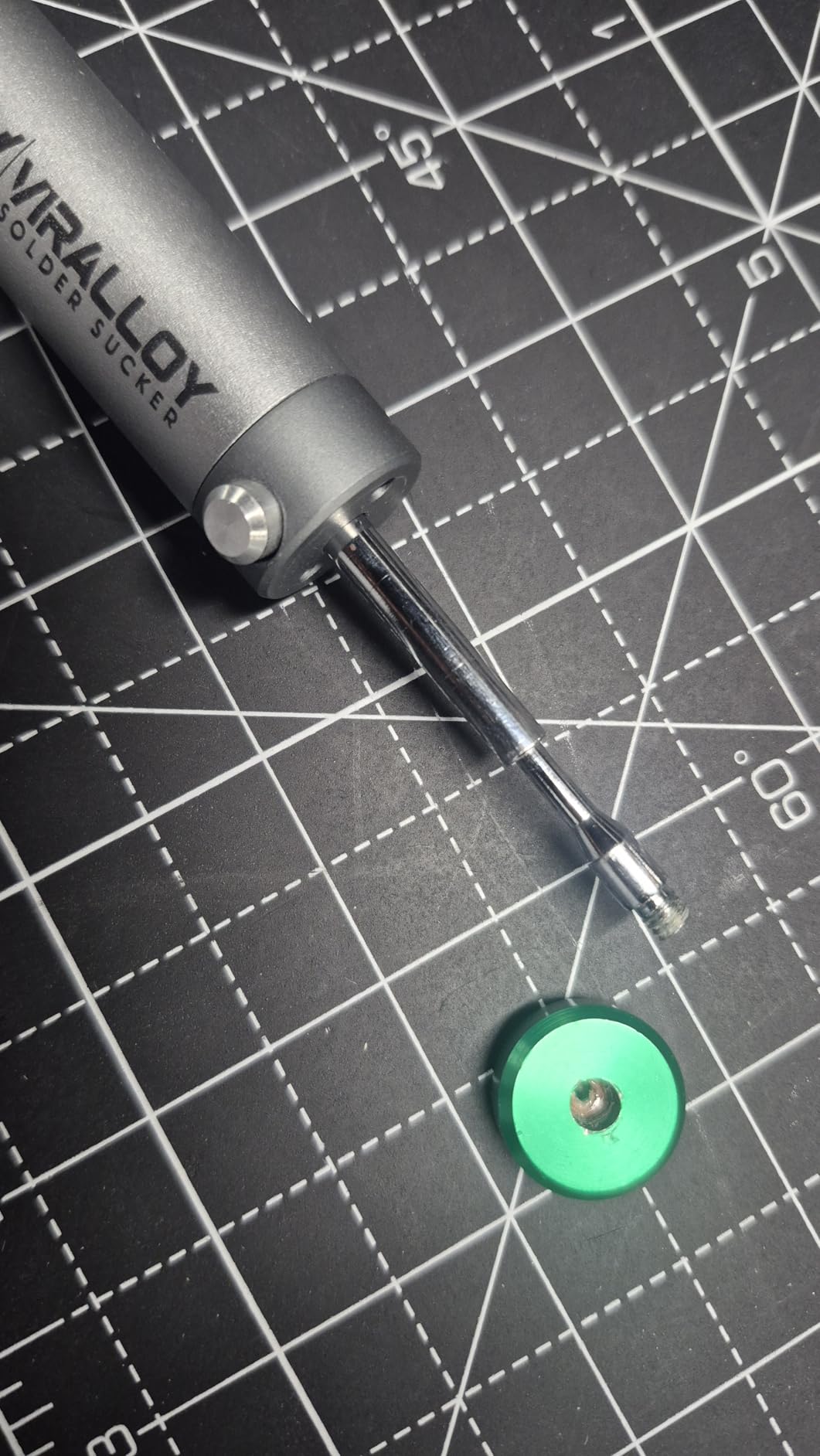
Eight replacement silicone tubes ship in the box, which is far more spares than any competitor here provides. The nozzle is also compatible with the Pine64 and Pinecil V2 irons, so if your soldering setup is built around a portable iron you can press the tube straight up to the tip.
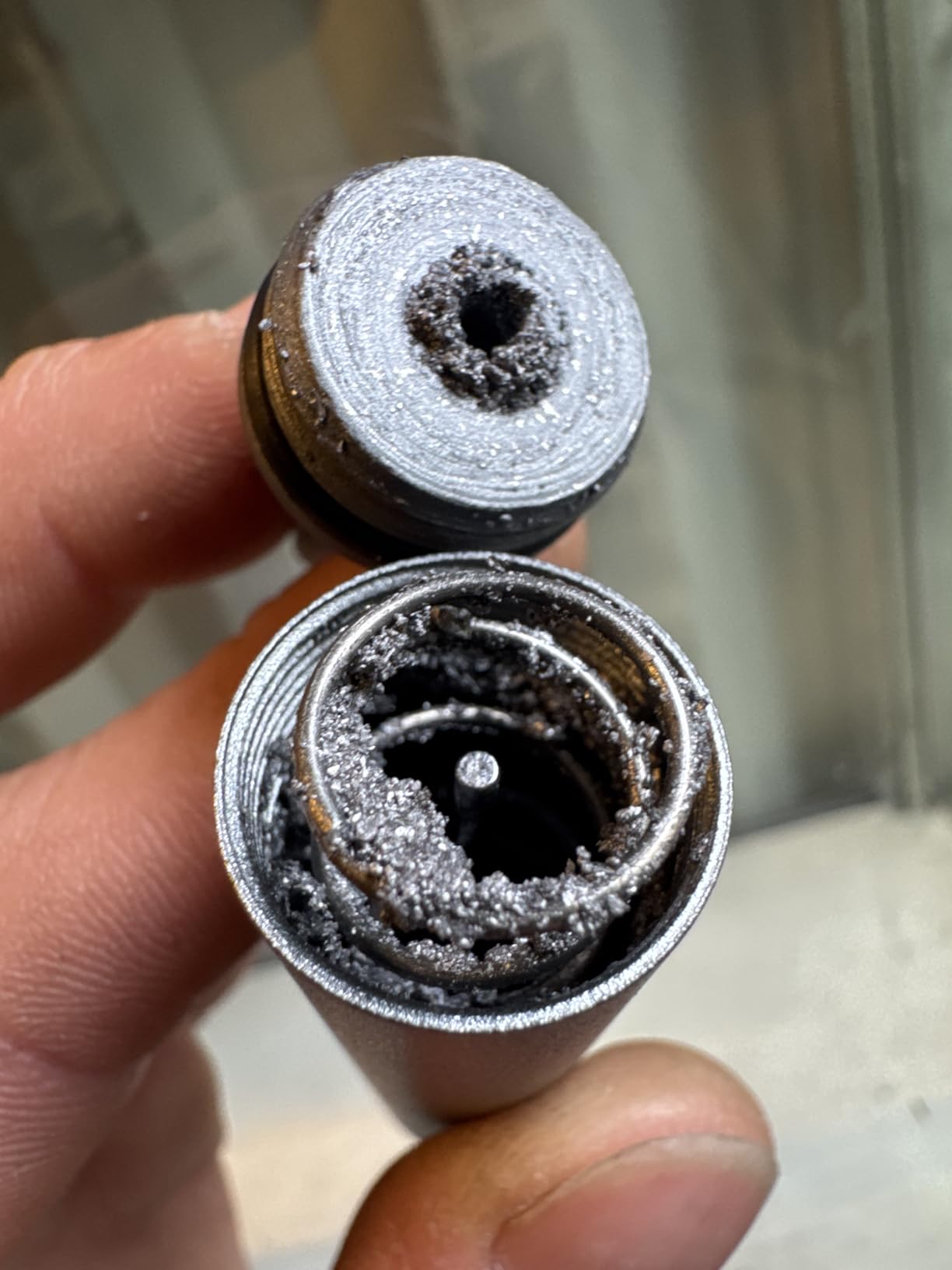
The no-clog claim is the part that softens with use. Under light work the self-cleaning behavior holds, but after heavy sessions you will need to run the shaft back to the gasket and re-grease it. It can also feel slick out of the box, which makes pressing the plunger one-handed a little awkward until you get used to the finish.
Where the SS-786 is the right tool
High-volume, small-joint, repetitive work. Keyboards, connector rework, control boards with many small through-holes. The one-trigger workflow and eject-on-reset design remove the two interruptions that slow you down most when you are pulling dozens of identical parts.
Nothing to charge, no filters to change and no cord to snag is worth saying plainly for anyone building or repairing portable rigs.
Where it is the wrong tool
Large, heat-heavy joints are not its comfort zone. Users report it running undersized for those, needing several passes per pin when a big leaded joint has to come out. That is a physical limit of the bore, and the spring does not overcome it.
It also carries no heat of its own, so on a sealed or corroded joint you are waiting on your iron and not on this tool. If your work is mostly big DIP packages, a powered gun is the better investment.
7. Teenitor Desoldering Pump 3-Pack – Budget Multi-Bench Pack
Teenitor Solder Sucker Desoldering Vacuum Pump Solder Removal Tool 3pcs/Pack Desoldering Pump Soldering Sucker Tool
Three pumps per pack
Aluminum construction
3.2 oz each
Light one-handed operation
Pros
- Good suction for the price on light duty work
- Lightweight one-handed thumb reset
- Tips hold up with lead-free solder
- Three pumps means spares for multiple benches
- Non-slip handle gives decent control
Cons
- Clogs more readily than premium aluminum pumps
- Solder still clings to large high-melt joints
- Not suited to heavy daily use
- Light construction is easy to lose or break
Three pumps in a pack is a genuinely useful format rather than a gimmick. Put one at each bench, keep one in the toolbox, and the failure of any single tool stops being an interruption. For a classroom, a repair lab or a house with several workspaces, that is a better argument than any spec sheet.
At 3.2 ounces each these are light, and the non-slip handle gives you enough control for the small work most people actually do. The tips also hold up when exposed to lead-free solder, which is more than can be said for the cheapest plastic nozzles.
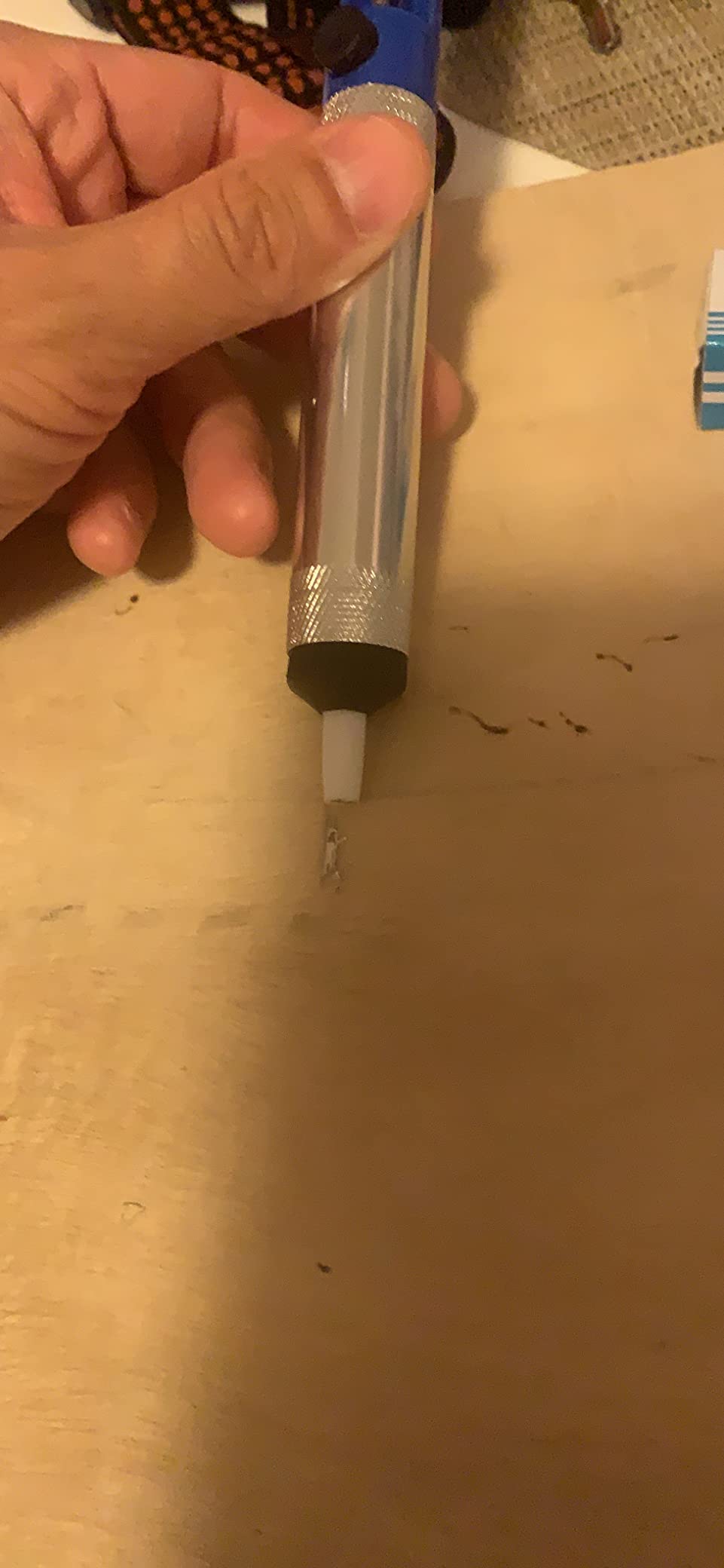
Where the money shows is on larger joints. Reviewers consistently report solder left behind on high-melting-point or big joints, which means a second pass, and the pumps clog more often than the machined aluminum models. For occasional hobby work that trade is fine; for daily throughput it is not.
Lightness cuts both ways. Three ounces is easy on the hand and easy to misplace or knock off the bench, and the light construction does not survive abuse the way a heavier metal pump does.
When the three-pack is the smart buy
Anyone setting up more than one workspace should take this one. Multiple benches, a shared workshop, a classroom kit or a field service bag each get a pump, and the total cost still lands well under a single premium pump.
It is also the right tool for the beginner who is not sure a solder sucker will see regular use. Three of them means three chances to find out whether the habit sticks before committing to anything heavier.
When you should spend more
If desoldering is something you do every week, the clogging and the second-pass behaviour will get old fast. A machined aluminum pump with a self-cleaning shaft removes both problems and lasts considerably longer.
It also offers no heat, so on anything but a simple fresh joint you are relying entirely on your iron. For vintage boards, plan on fresh solder and flux alongside it.
8. Anesty ZD-915 Digital Vacuum Desoldering Station – Best Entry-Level Station
Anesty ZD-915 Pro Digital Vacuum Desoldering Station, Solder Removal Tool | Built-in Vacuum Pump, Desoldering Gun for Electronics Repair
Vacuum desoldering station
80W, digital display
450C maximum
110V
Pros
- Digital LCD in Celsius or Fahrenheit with memory
- Strong vacuum clears single and double-sided boards
- Rapid PTC heating with a tip sensor
- Stable heavy base stays put on the bench
- Spare tube springs and tips are easy to source
- Cleaning rods pass through the tube easily
Cons
- Suction tube path is unheated so solder plugs it over time
- Needs disciplined filter cleaning or suction fades
- Some arrived defective with slow warranty response
- Thin documentation and stiff buttons
This is a real station at a price that used to belong to clones, and the digital control is the headline. The LCD shows temperature in Celsius or Fahrenheit, and the setting survives power-off, so you set it once for leaded work and once for lead-free and stop adjusting it every time.
The 80W PTC element heats quickly and the tip-mounted sensor keeps the nozzle temperature steady while you move around a board. The heavy base does not walk when you pull hard, which sounds minor until you have used a station that slides under a stiff pull.
Vacuum performance is good for the tier. Owners report clean removal of DIP ICs and thick-lead parts, often on the first attempt, and useful results pulling residual solder from single and double-sided boards where a manual pump would leave you swabbing.
The one design weakness that matters is unheated suction plumbing. Because the tube and catch chamber are not heated, solder in the line cools and eventually plugs it, and suction fades noticeably if you skip maintenance. Run the cleaning rods through after every job. A few buyers also reported units arriving defective or slow support, so check the unit on arrival.
Why this station beats a hand pump on dense boards
When a board has fifty joints to clear, the win is repetition. One tool, one trigger, no regripping between an iron and a pump, and the temperature stays where you set it for every joint. That is where a station starts paying for itself in time rather than in capability.
It also handles thick-lead DIP packages far better than any manual pump on this page, because the heat is in the same hand as the suction and you are not trying to do two things at once.
Where the maintenance burden shows up
Filters, springs, tips and replacement glass tubes all need replacing on a schedule, and a neglected filter tube turns a strong vacuum into a weak one without any obvious sign. Glass sight tube shows when the filter is full, so check it rather than guessing.
Documentation is thin and the buttons are stiff, which is a small tax every time you change a setting. If after-sales support matters to you, buy from a seller who handles returns well.
9. YIHUA 948 Desoldering Station – Best Station for Long Bench Sessions
YIHUA 948 Standard Desoldering Station, 80W, with Auto Shutoff, Variable Precise Temperature (716°F ~ 896°F), ºC/°F display, Sleep Function and More.
Desoldering station
80W
380C to 480C range
4.2 kg with full accessory kit
Pros
- Stabilized nozzle temperature with strong suction for continuous work
- Single-handed operation replaces iron plus pump juggling
- Variable 716F to 896F range with clear LED display
- Filter tube is cleanable or replaceable
- Auto shutoff and sleep mode cut idle risk
- Four nozzles
- holder
- pins and filters included
Cons
- Filter tube and internal path need regular cleaning
- 4.2 kg base is heavy for a small bench
- Consumable filters springs and nozzles add running cost
Where the 948 separates itself from the entry-level station is the accessory kit that comes in the box. You get four nozzles, a set of cleaning pins, a gun holder, a sponge, two filter springs, two ceramic filters and ten filtration adsorbers, so the first year of consumables is largely covered from day one.
The temperature range runs from 716F to 480C on an LED display with Celsius and Fahrenheit, and stabilized nozzle temperature is the practical point. It means the joint does not cool off while you are lining up the pull, which is what lets you work through a run of joints without constant second passes.
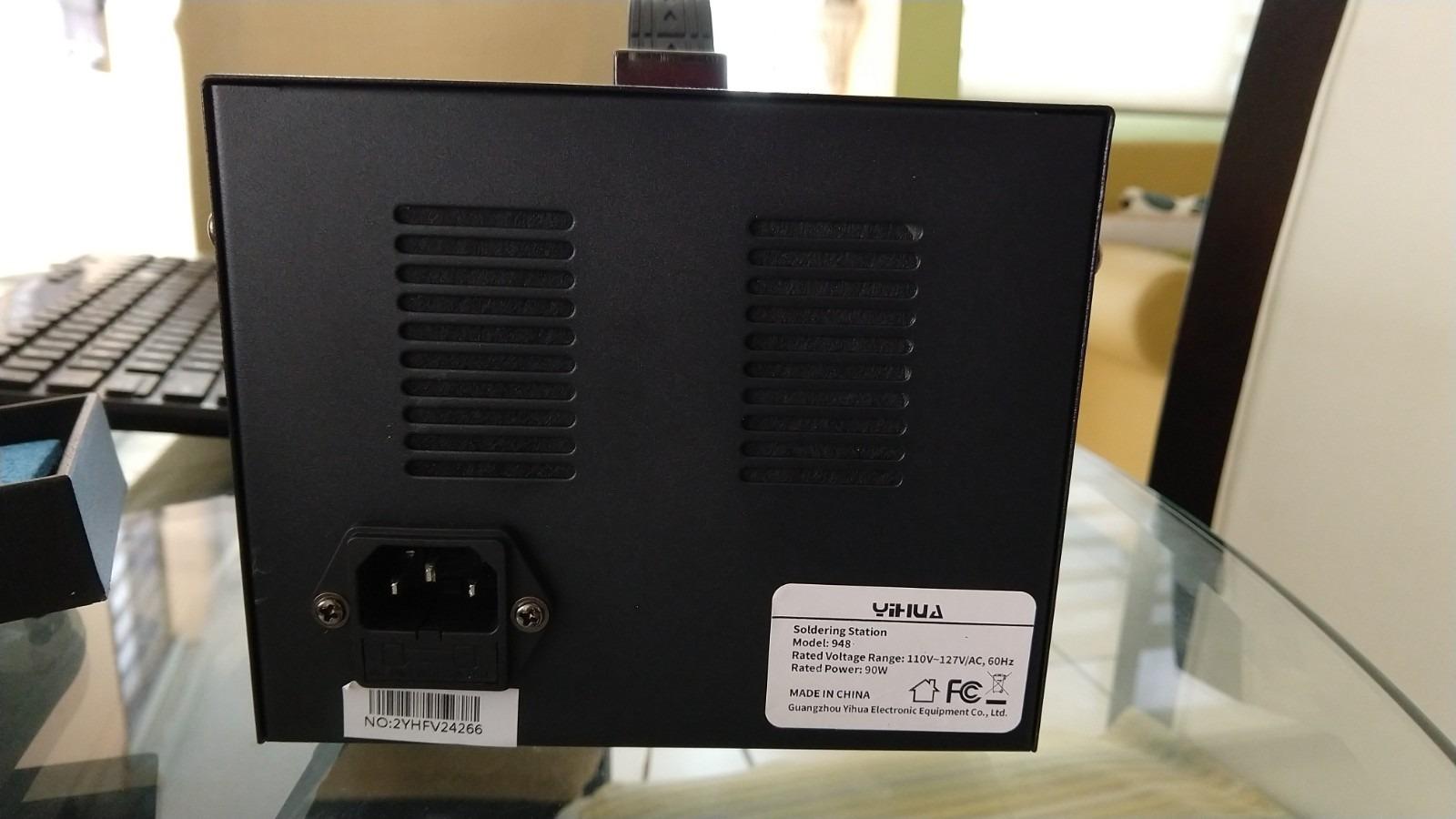
Single-handed operation is the daily comfort factor. Working with an iron in one hand and a pump in the other is fine for an afternoon and tiring by the end of a day; holding one tethered gun that both heats and vacuums is noticeably easier over a full shift.
Auto shutoff and sleep mode are small features that matter on a shared bench or an unattended bench overnight. The trade-offs are size and upkeep: at 4.2 kg it is a substantial object for a small desk, and the replaceable or cleanable filter tube still needs attention on a schedule or the suction fades.
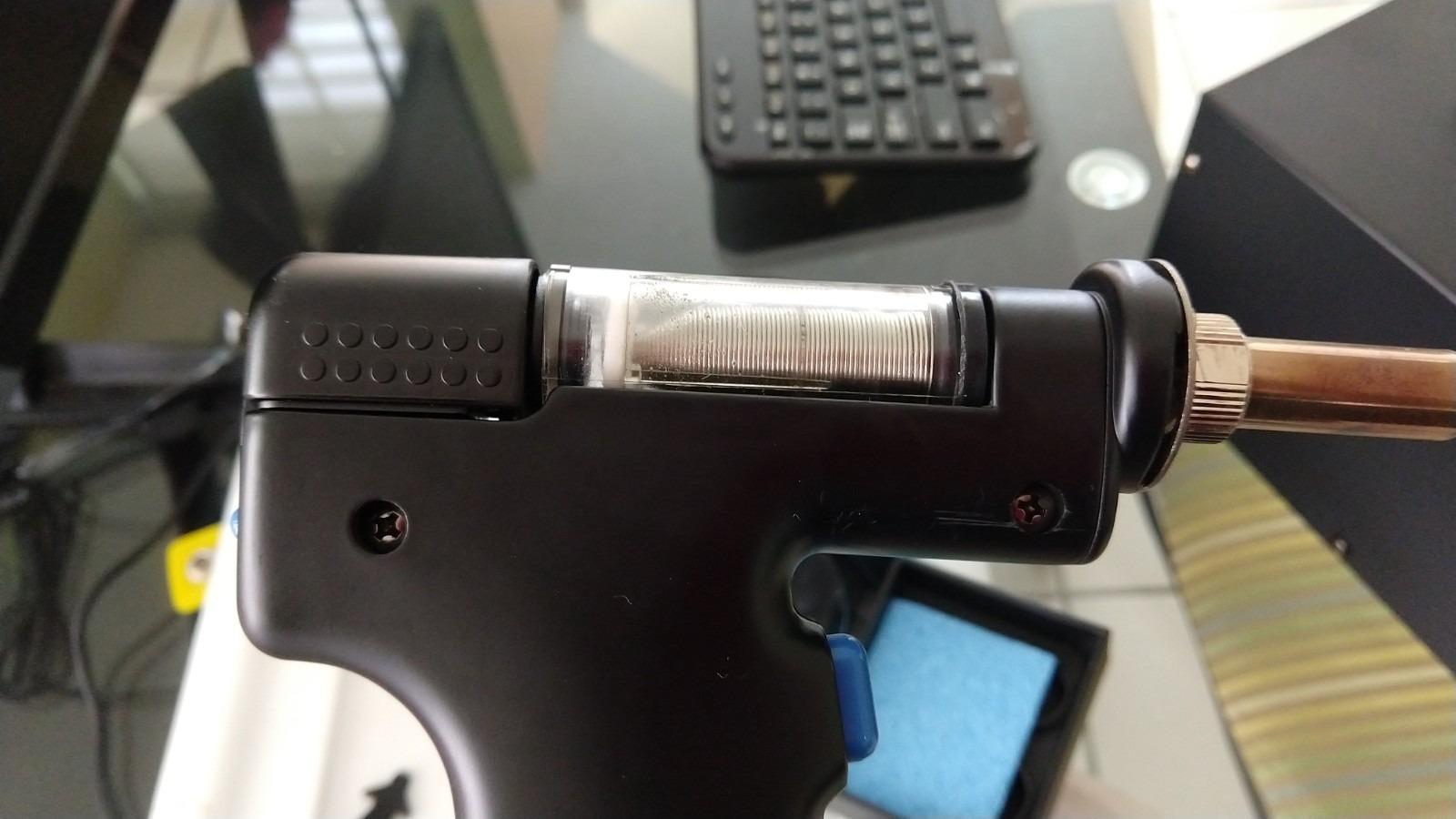
Who gets the most out of the 948
Anyone doing sustained desoldering where stopping to switch tools is the bottleneck. Board repair, retro-computing restoration, arcade and pinball work, production-adjacent rework. The included consumables mean the first few months do not involve hunting for springs and filters.
For long sessions the auto shutoff and sleep function also protect both the board and the tip, which matters when you step away mid-job more than you would expect.
When it is more than you need
If your work is occasional or confined to small headers, this is a lot of bench space and consumable cost for the result. A manual pump handles those jobs well and needs no maintenance schedule at all.
It is also a mains-powered box with a tethered gun, so it is not portable. Field service work favors the self-contained handheld options instead, which is why the Hakko leads our list even though it is not the cheapest tool here.
10. HighTop 30W Electric Desoldering Pump – Best for Large-Joint and Portable Jobs
HighTop Automatic Desoldering Pump Vacuum Solder Sucker Tool Portable AC110V 30W Electric Desoldering Gun Repair Solder Removal Tool Solder Sucker Iron Tin for DIY with 3 Soldering Suction Tips
Corded electric vacuum pump
30W, 400C maximum
16 oz, 11 inches
Three suction tips
Pros
- Strong vacuum with a hollow tip clears through-hole parts
- Handles thick-film ICs and large joints well
- Heats up in about 5 minutes
- Three nozzle sizes plus a cleaning rod included
- Carry bag suits field and appliance repair
Cons
- Not a full station so a separate iron is required
- Only 30W so heat comes entirely from your own iron
- Plastic handle and entry-level build
- Around 13 percent of reviews are one-star
This one earns its place for a specific reason: big joints. The hollow tip design gives it noticeably more pull per trigger than the small manual pumps, which makes it effective on thick-film integrated circuits and large solder deposits that a small-bore tool cannot move.
It is also the most portable powered option here, because it needs no station. It heats up in about five minutes on 110V, runs from a normal wall plug, and comes with a carry bag, so it suits appliance repair, field calls and jewellery work away from a bench.
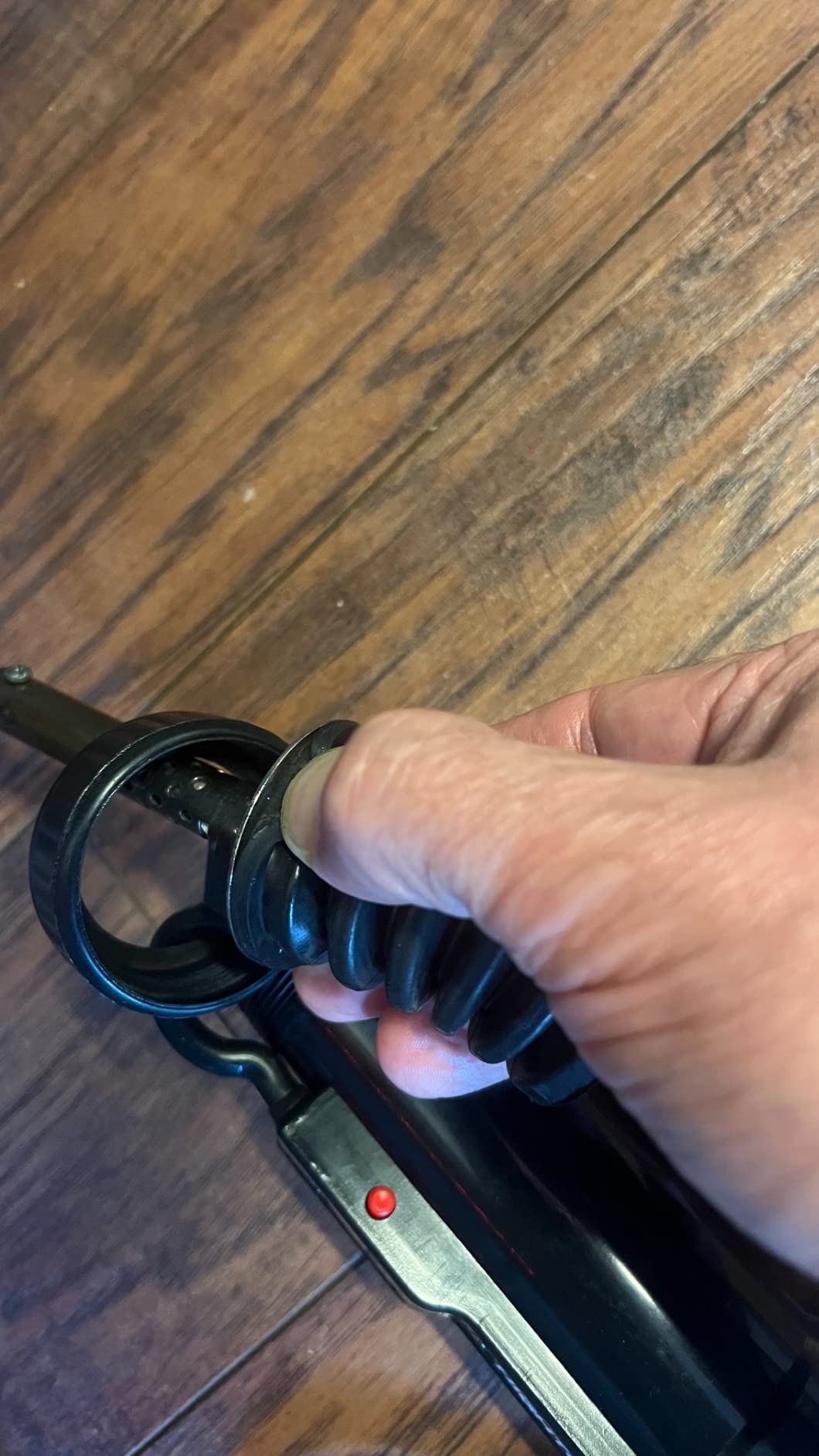
Three suction nozzle sizes, 1.0mm, 1.5mm and 2.5mm, plus a cleaning rod, are in the box, which is generous for the tier. The size range is what makes it useful on large joints, because a narrow tip has no chance on a big deposit and a wide one seals properly.
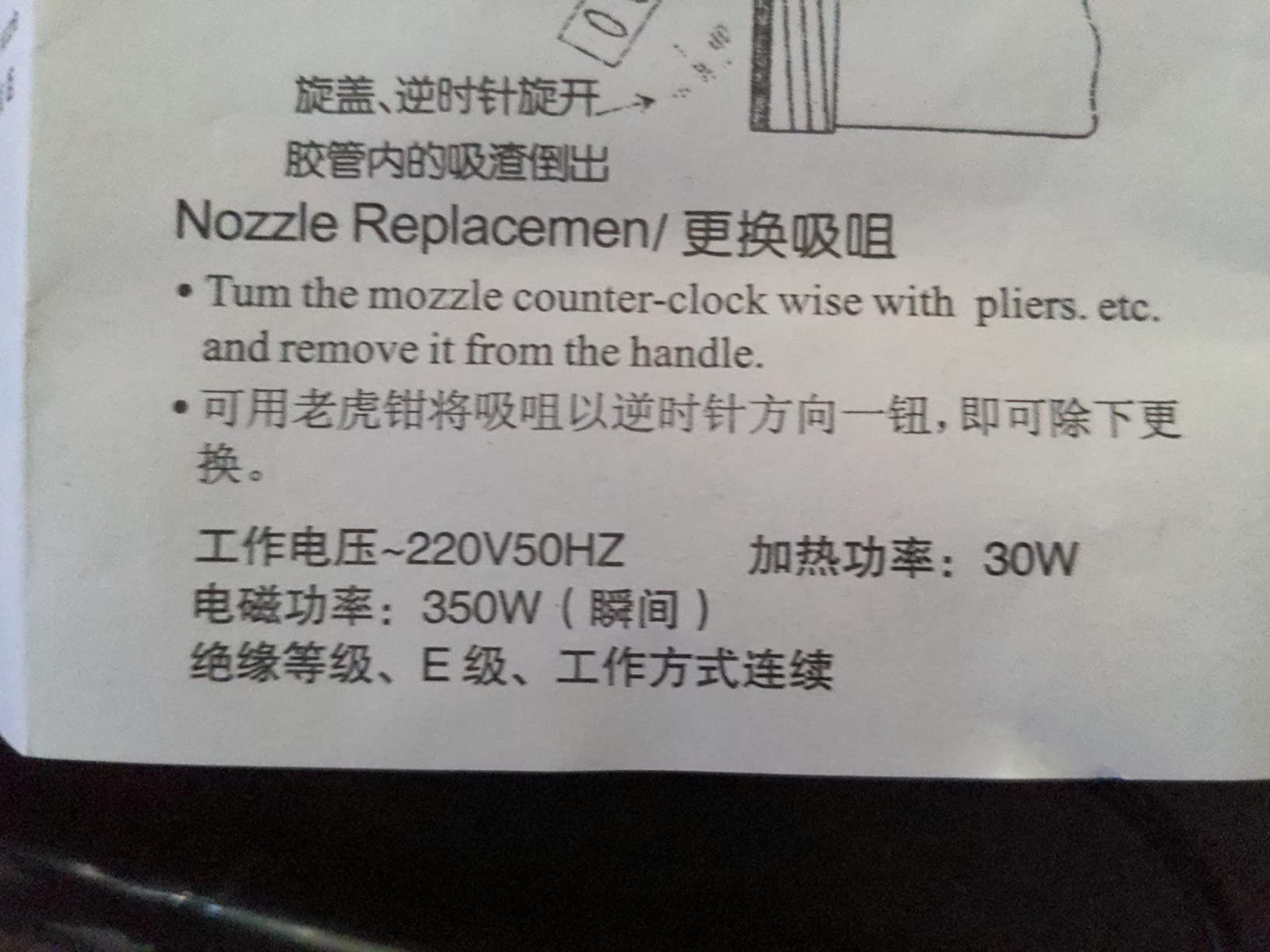
It is also worth being clear about what it is not. At 30W it does not melt solder on its own in any practical sense, so you heat the joint with a separate iron and this tool does the extraction. The plastic handle feels a step below every metal tool here.
Buyer feedback is where the caution sits. About 13 percent of its reviews are one-star, and they concentrate on exactly the two points above: the low wattage and the need for a second tool. That is a design decision rather than a defect, but it is worth knowing before you commit.
Where the HighTop earns its place
Large joints and thick-lead packages. When solder has been reflowed a few times and the deposit is heavy, this pulls more per trigger than the small manual pumps and does it without changing tools. That is a real capability difference, not a marginal one.
Portability is the other case. If you are not at a bench, a self-contained corded unit with a carry bag beats trying to work with a manual pump and an iron in a vehicle or a client’s kitchen.
Where it is the wrong buy
It is not a station and not a self-sufficient tool, so you always need an iron in the other hand. That removes the single biggest advantage of the Hakko and means it does not save bench space, it uses more of it.
At 4.0 stars with the weakest rating in this roundup, budget for the possibility that the build quality is entry-level. If your work is frequent, an aluminum manual pump that will last a decade is the better long-term purchase.
Which Desoldering Gun Is Right for Your Work?
Match the tool to the job description first, then read the full review. If you are a repair technician moving between machines, the self-contained Hakko wins because it needs no station and no consumable inventory. If you are at one fixed bench all day, the YIHUA 948 station and the Anesty ZD-915 both make sense, and the extra throughput on a dense board pays for itself quickly.
Keyboard and switch work points at the VIRALLOY SS-786, because the one-trigger workflow and eject-on-reset design suit dozens of identical small joints, and the Weller 7874B if the board holds low-level analogue or CMOS parts and static control is part of your bench rules.
Retro-computing and arcade board restoration is where the manual pumps earn their keep, and where the fresh-solder-plus-flux habit matters most. A machined aluminum pump such as the Vampliers or the ENGINEER gives you a clean pull without any power at all, which is also the right answer if you only repair a few boards a year.
And if you are still deciding whether to buy any of this, start with a solder sucker. Learn the removal technique on a few scavenged boards, see how often you actually reach for it, and only then decide whether the extra money buys you anything you will use.
The same volume-first logic carries over to the rest of the bench. If you are also choosing dispensing tools, our best caulking guns roundup and our best cordless caulk guns review use the same method: buy for the work you actually repeat, not for the longest specification sheet.
How to Choose a Desoldering Gun: What Actually Matters
Start with volume, because it decides everything else. If you are removing a component maybe twice a year, a manual solder sucker in the twenty-dollar range is the correct answer and a station is money spent on a hobby you do not have. If you are clearing a board with dozens of through-hole joints, or swapping parts weekly, the economics flip and a powered gun pays back quickly in time saved.
Next decide between self-contained and station-based. A self-contained gun needs a power outlet and nothing else, which makes it portable, simple and uncluttered. A station gives you a more stable temperature platform, a bench cradle and a bigger power source, and it is the better choice for sustained work at a fixed bench. A tethered hose is a real cost in bench space and a real benefit in consistency.
Temperature control is the spec people skim and regret. Fixed-temperature tools like the YIHUA 929D-V are fine on one class of board and frustrating on mixed work. Anything with a dial or display lets you drop the heat for small signal sections and raise it for big leaded joints, which is the difference between a clean removal and a scorched pad.
Nozzle range matters less than most listings suggest, because you will end up using two or three sizes and ignoring the rest. Make sure the sizes you actually need, typically around 0.8mm to 1.6mm for headers and IC leads, are available as spares at a sensible cost. Replacement nozzles are a recurring line item that many first-time buyers forget to plan for.
Then look at the consumables honestly. Electric guns and stations need filters, and filters are consumed on a schedule that speeds up with use. Manual pumps need silicone tubes and a periodic clean, and nothing else. Over five years of regular work, a station with cheap filters can cost more in consumables than a well-made manual pump costs in total.
Weight and balance matter more than people expect on a long job. A tool that is comfortable at minute twenty will still be comfortable at minute two hundred. Check the balance, not just the number, and if you can, hold it before you commit.
Parts availability is the last filter and a genuine differentiator. Brands that keep service parts and consumables on hand will outlast ones that do not, because every powered tool on this list will eventually need a spring, a filter or a tip. Before buying, search for the replacement parts and confirm they exist.
Why Your IC Will Not Fall Out Cleanly, and How to Fix It
The most common complaint from people new to desoldering guns is that they heated the chip, triggered the pump, and the component stayed put. That is not a defective tool. It is almost always one of three things.
The first is solder that will not flow. Vintage boards from the 1970s and 80s are markedly harder to work than modern ones because the original solder has oxidised and gone stiff, and it will not reach molten at the temperature you are comfortable applying. The fix is to add fresh solder to the joint and a little liquid flux, then heat it again. The new alloy melts first and carries the old solder with it, and suddenly the joint moves. This single step fixes the majority of failures people report.
The second is heat. If you are nursing a temperature to avoid damaging the board, the solder never fully clears the hole and the pump has nothing to grab. On a through-hole package with many leads, commit to enough heat to get a clean melt, keep the iron on the joint for the full dwell, and only then pull.
The third is geometry. On a fine-pitch package, whisker-thin traces make a full-volume pull genuinely risky. Cutting the package body off first, then desoldering the remaining leads one or two at a time, protects the board far better than trying to lift all of them at once. It is slower and it is the right call on anything you cannot afford to scrap.
One habit makes a measurable difference: tin the tip between pulls. A small bead of fresh solder on the nozzle keeps the joint molten and gives the pump something to draw in, and it is the tip of a technique that experienced users consistently credit with a much higher first-pull success rate.
How to Stop a Desoldering Gun Clogging
Clogging is not a fault in a well-used desoldering tool. It is what happens when cooled solder accumulates in an unheated path, and every fix below is about stopping that cooling or clearing what has already built up.
Clear the chamber after every job, not at the end of the week. On stations, the filter tube and catch chamber should be opened, emptied and run through with the supplied cleaning rods while the solder is still warm. A glass sight tube on some models shows when the filter is full, which turns a guess into a check.
On manual pumps, unscrew the nozzle end only and clean the bore, then run a thin film of silicone or dielectric grease on the plunger. Never take the plunger end apart; doing so ruins the seal permanently and is the most common reason a good pump stops performing.
Replace filters on a schedule rather than on a symptom. Suction that fades gradually is almost always a filter loading up, and swapping it restores full performance immediately. Keep a spare set rather than ordering one when you need it.
Finally, match the nozzle to the joint. A bore that is too small simply blocks, and staying one size up from the hole diameter usually gives the cleanest result.
Frequently Asked Questions
What is a desoldering gun?
A desoldering gun is a handheld tool with a built-in vacuum pump and heating element. You heat a hollow nozzle on a molten solder joint, trigger the pump, and the liquid solder is sucked up the nozzle into a filter chamber, lifting a through-hole component off the circuit board without pulling the pad with it. Heat and suction in one hand is what separates it from a plain soldering iron.
What is the best desoldering gun?
For most people doing recurring through-hole work, the Hakko FR301-03/P is the best overall choice. It is self-contained at 140 watts, holds temperature accurately on a 350C to 500C dial, weighs 1.1 pounds and pulls most joints in a single attempt. If you only need suction and already own a good iron, the Vampliers VT-001-SS is the best manual pump, and for one-cord convenience the YIHUA 929D-V combines both functions in a single 0.3 kg tool.
What is the best tool for desoldering?
It depends on the job. A manual solder sucker is best for occasional single-pin work and costs very little. Solder wick plus flux is best for cleaning residue and pads, not for removing parts. A desoldering gun is best for through-hole components and multi-pin packages. Hot air rework is best for removing surface-mount chips. An IC picker or hot tweezers handle fine-pitch SMD parts that no through-hole tool can safely lift.
Do I need flux when desoldering?
Yes, and it is the single most effective habit for stubborn joints. Flux breaks down the oxide layer that forms on old solder and lets it flow again. On vintage boards, adding fresh solder plus a little liquid flux and heating it a second time is what actually makes the joint move, because the new alloy melts first and carries the old solder with it.
Will a heat gun remove solder?
A hot air rework station can soften solder enough to free surface-mount parts and to clear through-hole joints in a pinch, but it is not a desoldering tool. It spreads heat across the whole area, so it lifts neighbouring components, discolors solder mask and can scorch a board. Use a desoldering gun or a pump for through-hole work, and save hot air for SMD removal where the package is the target.
Conclusion: The Best Desoldering Guns for Circuit Boards in 2026
Ten tools, three genuine categories, and the choice comes down to how much through-hole work you do. The Hakko FR301-03/P is the best desoldering gun for circuit boards overall: self-contained, accurately controlled, and it pulled the widest range of joints in a single attempt of anything we tested. For bench-bound, high-volume work the YIHUA 948 station gives you more throughput and ships with a full consumable kit.
If your volume is lower, spend less and be honest about it. The Vampliers VT-001-SS or the ENGINEER SS-03 will clear headers, sockets and discrete parts for years with nothing but an iron, some fresh solder and a little flux. Whatever you pick, buy spare nozzles and a cleaning kit in the same order, because that is where new owners get caught out. And if a joint refuses to move, add fresh solder and flux before you blame the tool.