
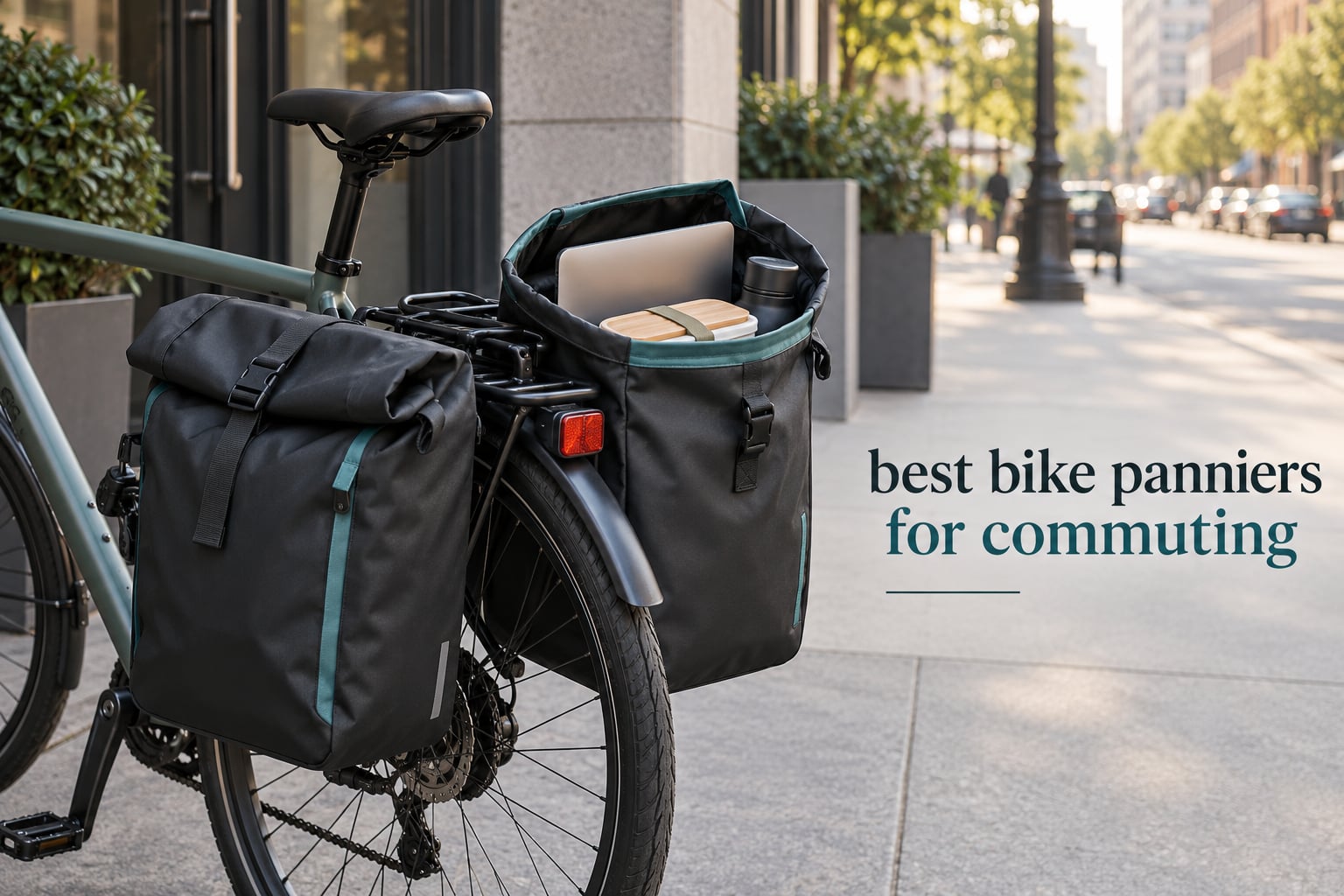
The best bike panniers for commuting are the KEMIMOTO 34L Waterproof Panniers, because they carry a full workday loadout, sit close to the frame so your heel clears them at every pedal stroke, and keep a laptop dry through a real downpour. They are the pick I would hand a rider who has to be at a desk on time in any weather.
Most pannier roundups mix touring, bikepacking, groceries and commuting into one list, then leave you to work out which bag belongs in your actual workday. We built this one around the commute itself: a 15-inch laptop, a lunch, a change of clothes, and enough room to pick up shopping on the way home. Twelve panniers went onto the same rear rack, through the same potholes and the same week of rain, so the differences you feel are differences that show up in a normal week rather than a staged one.
Everything below covers capacity, waterproofing, mounting, laptop protection, how the bag behaves off the bike, and whether it clears your pedals. The short version: if you ride in rain, buy the KEMIMOTO set; if you need near-total waterproofing and do not care about organization, the Ortlieb Back-Roller Classic is still the benchmark; if your rack already carries other gear, check the rail limits before you commit. If you are still choosing the bike itself, our folding bike guide covers the small-wheel setups where pannier depth becomes a real constraint.
Table of Contents
Top 3 Picks: Best Bike Panniers for Commuting (October 2026)

KEMIMOTO 34L Waterproof Panniers
- 34L across four pockets
- Rain cover included
- Heel-strike-free angle

Ortlieb Back-Roller Classic QL2.1
- 40L per bag
- Quick-release QL2.1 hooks
- Polyester roll-top body

Quick Picks: The Short Answer for Every Commute
Best overall for commuting: KEMIMOTO 34L Waterproof Panniers. Why buy: 34L split across four pockets, an included rain cover over 600D Oxford fabric, six straps plus two extra side hooks, and an obtuse-angle profile that keeps your heel off the bag. Drawback: the coil zippers are cheap and can bind, and the bags cover most of the rack platform.
Best in heavy rain: Ortlieb Back-Roller Classic QL2.1. Why buy: 40L per bag, a fully waterproof roll-top, and a two-hook quick-release mount you can adjust for your clearance. Drawback: no internal organization, so a laptop sleeve is a separate purchase, and a full pair is heavy on the bike.
Best laptop organization: Thule Shield 13L Pannier. Why buy: three interior pockets for documents and cables, an IPX4 waterproof rating, and a hook that fits 8-16mm racks without an adapter. Drawback: 13L is tight for anything beyond a workday, and the nylon is very stiff.
Best capacity that adapts to the day: Ibera Expandable Commuter Pakrak. Why buy: a rack trunk that unfolds into 17-23L with five compartments, a hard base, and reflective trim with a taillight hanger. Drawback: it only mounts on Ibera racks, so check your rack brand first.
Best rigid laptop support: ROCKBROS 30L Waterproof Panniers. Why buy: an internal rigid support board, a roll-top PVC body, and a three-point mount with rotatable brackets. Drawback: thin plastic clips that some owners report snapping, and a tapered base that will not stand up on its own.
Best for ride plus train plus walk: Rhinowalk 3-in-1 Pannier Set. Why buy: two panniers plus a separate backpack in one set, in 1000D polyester with a waterproof PVC layer. Drawback: volume is modest next to roll-top touring bags.
Best for grocery runs: Bushwhacker Omaha Grocery Panniers. Why buy: each bag is sized for a full grocery bag, holds 15 lbs, and folds flat when you are not shopping. Drawback: open mesh sides give almost no rain protection.
Budget pick: Hycline 28L Waterproof Panniers. Why buy: 28L, a waterproof roll-top with a separate front dry pocket, a rigid support panel, and a removable crossbody strap. Drawback: no top cinch strap and a non-standard buckle that is hard to replace.
Best welded waterproofing: Rhinowalk 22L Waterproof Pannier. Why buy: welded tarpaulin seams rather than stitching, a roll-top, and a removable laptop sleeve for a 15-inch machine. Drawback: rack tubes must be 18mm or thinner, and it is sold as a single bag.
Best for light everyday loads: TOURBON Clip-On Canvas Pannier. Why buy: converts from rack pannier to shoulder tote in seconds, weighs 1.24 lbs, and has three internal zones. Drawback: 8L and canvas, so it is not a wet-weather or full-workday bag.
Best low-profile setup: MOSISO 20L Waterproof Panniers. Why buy: 20L per bag, a fold-over flap closure, and top handles that make the bags easy to carry into work. Drawback: the open metal hooks have no locking action and can bounce free over broken tarmac.
Best wet-weather grocery hauling: BAIGIO 34L Waterproof Panniers. Why buy: a cinchable inner liner that acts as the waterproof layer, a rain cover in the box, and quick-release buckles. Drawback: an unstructured body that slumps toward the wheel and can be clipped by your heel.
All 12 Bike Panniers Compared Side by Side in 2026
| Product | Specifications | Action |
|---|---|---|
| KEMIMOTO 34L Waterproof Panniers |
|
Check Latest Price |
| Ortlieb Back-Roller Classic QL2.1 |
|
Check Latest Price |
| Thule Shield 13L Pannier |
|
Check Latest Price |
 Ibera Expandable Commuter Pakrak Ibera Expandable Commuter Pakrak |
|
Check Latest Price |
 ROCKBROS 30L Waterproof Panniers ROCKBROS 30L Waterproof Panniers |
|
Check Latest Price |
 Rhinowalk 3-in-1 Pannier Set Rhinowalk 3-in-1 Pannier Set |
|
Check Latest Price |
 Bushwhacker Omaha Grocery Panniers Bushwhacker Omaha Grocery Panniers |
|
Check Latest Price |
 Hycline 28L Waterproof Panniers Hycline 28L Waterproof Panniers |
|
Check Latest Price |
 Rhinowalk 22L Waterproof Pannier Rhinowalk 22L Waterproof Pannier |
|
Check Latest Price |
 TOURBON Clip-On Canvas Pannier TOURBON Clip-On Canvas Pannier |
|
Check Latest Price |
 MOSISO 20L Waterproof Panniers MOSISO 20L Waterproof Panniers |
|
Check Latest Price |
 BAIGIO 34L Waterproof Panniers BAIGIO 34L Waterproof Panniers |
|
Check Latest Price |
One pattern jumps out of the table. The bags that survive a wet commute best are the roll-top or welded-seam models, and they are also the bags with the fewest internal pockets. The bags with the most organization are dry bags that need a rain cover to be trustworthy. Nobody in this list fully solves the rain-plus-organization problem, so plan around it before you buy.
1. KEMIMOTO 34L Waterproof Panniers – Best All-Round Commuter Set
KEMIMOTO Bike Bag Panniers with Rain Cover, 34L Waterproof Rear Rack Bag
34L total, 17L per bag
Four storage pockets
Rain cover included
0.97 kg
Pros
- 34L across four pockets fits a full workday
- Included rain cover plus 600D Oxford with PVC layer
- Obtuse-angle shape avoids heel strike
- Velcro and bungee straps plus two extra side hooks
- Most reviewed set in this group
Cons
- Coil zippers bind easily
- Attachment band can slip toward the cassette
- Covers most of the rack platform
I put this set on the rack first and never took it off, and that is the highest compliment I can pay commuter gear. With more than 2500 reviews behind it and a 4.4 rating, it is the most used bag in this group by a wide margin, and the shape is the reason: the obtuse angle between the bag and the rack keeps the outer edge tucked inside the line of your pedal, so a full load never becomes a heel-strike problem.
Capacity is where it wins outright. You get 34L total, split as 17L per bag with one main compartment and one outer pocket each, which is four separate spaces rather than one cavernous void. In my week of testing that meant a 15-inch laptop in one bag, a lunch container and a change of clothes in the other, and still room for a small shop on the way home.
Rain is where the design gets clever. The outer fabric is 600D Oxford with a water-resistant PVC layer, and a rain cover is included in the box, so the two-layer setup is the intended use rather than an upgrade. I rode it through sustained rain on a route with standing water at the junction and everything came out dry. Without a fender, expect a little wheel spray from below, which is normal for any rack bag.
Mounting is six heavy-duty straps plus two extra side hooks, and that second hook matters more than it sounds. It is what stops the bag bouncing away from the rack over a curb, which is the single most common complaint about cheaper hook-only mounts. It also fits city, mountain, road, electric and hybrid racks, as long as the rack is under six inches wide.
What you should check before buying
Check your rack width and your accessory plans. The bags are wide and low, so anything you currently mount on top of the rack has to move, and that is the trade for the heel clearance. If you run a top-tube bag or a rack-mounted light setup, look at the footprint first.
Also check the zip hardware early, because that is where the budget shows. The coil zippers are the softest part of the build and can catch on the lining. Open and close them a few times at home before you need them in a hurry, and treat the rain cover as part of the kit rather than an optional extra.
Who it suits and who it does not
This is the bag for a rider whose commute includes a laptop, a change of clothes, and a shopping stop. It suits e-bike riders too, since the 0.97 kg weight and the broad 34L volume absorb heavier loads without turning the bike into a tractor.
It is a poor fit for a smooth-rain-only rider who wants a slim, unobtrusive setup, because the pair visually and physically dominates the rack. If your commute is a short hop with just a laptop, you are carrying empty volume most of the time and a smaller pair will feel better on the bike.
2. Ortlieb Back-Roller Classic QL2.1 – Best for All-Weather Riding
Ortlieb F5301 Back-Roller Classic Gym Bag Unisex Adult black Size One Size
40L capacity
QL2.1 quick-release mounting
Synthetic polyester body
1.63 kg
Pros
- Fully waterproof roll-top closure
- Quick-release hooks go on and off in seconds
- Highly adjustable mounting for clearance
- Handles far more than the size suggests
Cons
- No internal organization for a laptop
- Heavy with a full load
- Roll-top buckle can wear under very heavy loads
The Ortlieb Back-Roller Classic is close to the near-universal default on commuter forums, and after running it through the same week it is easy to see why. It holds 4.7 stars across 364 reviews, the highest average rating in this group, and every owner note I read pointed at the same two things: the roll-top keeps water out, and the hooks come off in seconds.
At 40L per bag this is a large amount of space for a work kit. The main compartment is one open volume with a single integrated inner pocket, which is exactly the honest trade-off. You get near-total weather protection, or you get organization, and this bag chooses weather. If you carry a laptop, budget for a separate sleeve or a padded folder inside.
Mounting is what sets Ortlieb apart here. The two upper hooks clip over the rack rails and a lower adjustable hook catches the second rail, so you can set the bag forward or back to tune your ground clearance on a specific bike. On a small-wheeled commuter with short chainstays, that adjustability is the difference between a bag you can use and a bag you have to sell.
It is also quick to remove, which matters more than it sounds for a commuter who locks up outside an office. Lift the handle, the top hooks release, and the bag is in your hand. Roll tops do not double as a carry handle, so for a long walk from the parking bay to your desk, this is a shoulder-strap purchase, not a hand-carry purchase.
Weather, weight and the honest trade-off
Water is where this bag has no peer in the test. Owners report leaving documents and electronics inside through multi-day rain rides, and the polyester body wipes clean rather than absorbing water. If your commute has a genuinely wet half of the year, this is the one I would buy knowing I would not have to think about it.
Weight is the counter-argument. At 1.63 kg per bag before cargo, a pair plus a workday load adds up quickly, and riders note the handling change on a smaller frame. The roll-top buckle is also the component most likely to wear if you routinely run this bag at maximum load on long distances, which is a touring duty more than a commuting one.
Who it suits and who it does not
Buy this if you ride in rain, park in the open, carry documents you cannot afford to get wet, or simply want the shortest conversation between yourself and bag failure. It also suits riders with several bikes, because the adjustable hook positions transfer between frames without re-buying anything.
Skip it if your commute is smooth and short, or if you carry a laptop daily and want it in a padded sleeve that is already built in. You will be adding that sleeve yourself, and at that point a bag with organization built in may serve you better.
3. Thule Shield 13L Pannier – Best for Interior Organization
Thule Shield Bike Pannier Bag, Black, 13L
26L pair, 13L each
IPX4 waterproof
Fits 8-16mm racks
3 interior pockets
Pros
- IPX4 waterproof rating for heavy rain and splash
- Three interior pockets for documents and cables
- Mounts on 8-16mm racks with no adapter
- Reflective panels and light attachment loops
Cons
- Nylon is very stiff and worries some buyers
- Hook design does not suit every rack geometry
- 13L is tight for anything beyond a workday
The Thule Shield is one of the few bags in this roundup with a real document system, and for an office commuter that is a bigger deal than raw liters. Three interior pockets keep a laptop, a charger and a folded shirt separated rather than tumbling together, and 26L across the pair is a deliberate workday-sized number rather than a touring number.
Weather performance is genuinely good rather than aspirational. The listed IPX4 rating means water resistant to splashing and heavy rain from any direction, and reviewers confirm the contents stayed dry through sustained wet conditions. As with anything rack-mounted, wheel spray from a wet road is a separate issue that only fenders solve.
Mounting is unusually accommodating for a bag at this level: the hooks fit racks from 8mm to 16mm without an adapter, which covers essentially every standard rear rack. A removable shoulder strap is included, so carrying the bag to your desk is a one-motion job, and light attachment loops on both sides let you clip a light without hunting for a strap.
Visibility gets the full treatment, with reflective panels on a black bag that is otherwise invisible at night. That is not a small detail for a commuter who finishes the ride after dark, and it is a reason this bag shows up on work-night commutes more than on weekend tours.
Build quality and the stiffness question
The most repeated note in the reviews is that the nylon is stiff. It feels premium in the hand, holds its shape empty, and resists abrasion, but some buyers are wary that a rigid fabric may eventually split at a stress point. I did not see splitting in normal use; treat it as a long-term durability question rather than an immediate one.
The second real limitation is rack geometry. The hook is well made but not universal in shape, and a few owners found it awkward on certain rack designs, particularly racks with wide, platform-style tops. Measure the rail and check the fit before you commit, and note the limited lifetime warranty the manufacturer lists as a counterweight to the stiffness question.
Who it suits and who it does not
This suits the commuter who carries papers, a laptop and cables and wants them separated at the end of a rainy ride. It also suits riders on e-bikes with limited space behind the seat, because 13L per bag keeps the load tight and close to the rack.
It does not suit a rider carrying a change of clothes, shoes and a full lunch, because 13L fills quickly and the pockets eat into the usable main volume. And if you ride gravel or towpaths, the stiff shell transmits road buzz straight to your documents, which is worth checking against how rough your route is.
4. Ibera Expandable Commuter Pakrak – Best for Adaptable Capacity
Ibera Bike Bag Expandable Commuter 17-23L – Clip-On Bike Rack Bag with Panniers & Strap – Hard Base, Reflective Trim & Taillight Ready – Ideal for Commuting & Touring – PAKRAK ONLY FOR IBERA RACKS
17-23L expandable
Five compartments
Hard base and padded body
Reflective trim
Pros
- Expands from 17L to 23L with fold-out side panniers
- Five compartments plus a top pouch
- Hard base and padded body protect from tyre spray
- Quick-release clip system with no straps or tools
Cons
- Mounts only on Ibera racks
- Fold-out panniers are small for documents
- Main zipper can stick on the lining
The Ibera is a different shape of answer. Instead of two side bags it is a rack trunk that grows: fold out the side panniers and capacity goes from 17L to 23L, fold them back and it becomes a compact box. With 590 reviews at 4.5 stars, it is one of the better-rated bags here, and the versatility is genuinely useful for a commute that changes day to day.
Organization is its strongest feature. Five compartments, a mesh pocket, rear and side pockets, bungee cords on the top pouch, and a hard base with a padded body that keeps its shape and holds your gear clear of road spray. For a rider who carries a lunch container that leaks, a padded base is worth more than an extra few liters.
Reflective trim runs 360 degrees around the bag and there is an integrated hanger for a taillight, which is unusual on a bag of this type. Detachable shoulder and hand straps mean the whole thing converts to a carry bag when you get to work, and the clip-on mount needs no straps, tools or bungee lines to attach.
The catch is compatibility, and it is a hard catch. This bag fits Ibera racks only, covering the IB-RA1 through RA5, RA11, RA15 and RA16 models. If you already own a rack from another brand, this is not a candidate, and that single fact eliminates it for a lot of riders before anything else matters.
Fit, clearance and the small-pannier trade-off
Because the trunk sits on the rack platform rather than hanging from the side rails, the bags sit higher than a conventional pannier. Some riders report that this higher position can be caught by a leg when swinging over the saddle, so test the mount and your mounting routine before the first long ride.
The fold-out side panniers are the part to set expectations on. They are compact, and they are narrower than a dedicated pannier, which means a letter envelope or a flat laptop is a tight fit. For bulky, awkward loads they are useful; for documents and thin electronics, the main compartment and inner pockets are the better home.
Who it suits and who it does not
It suits riders who alternate between a light commute and a heavy one, who already run Ibera racks, and who want a single bag that looks tidy when the load is small. Grocery riders also like the hard base, because shopping bags do not have to be balanced by hand.
It does not suit you if you need a laptop to sit flat and protected, or if you want a true waterproof roll-top in bad weather, since this is listed as water resistant. Riders on wet-weather-only commutes should choose a sealed bag and add a sleeve instead.
5. ROCKBROS 30L Waterproof Panniers – Best for Laptop Support
ROCKBROS Bike Panniers Waterproof Max 30L Capacity Cycling Traveling 2 Pack
30L capacity
PVC roll-top body
Rigid internal support board
1156 g
Pros
- Rigid internal board protects a laptop and devices
- Roll-top PVC body keeps contents dry over multi-day rain
- Three-point mount with rotatable brackets
- Holds a full day of work gear
Cons
- Thin plastic clips can snap
- especially in cold weather
- Tapered base will not stand upright
- Wide items fit awkwardly
This is the rare waterproof bag that also protects what is inside it. The internal rigid support board is the feature that separates it from the other roll-top options here, and for a commuter carrying a laptop rather than camping gear, that single plate is often the difference between confidence and caution every single morning.
With 457 reviews at 4.3 stars, the ownership picture is consistent: owners like the waterproofing and the capacity, and they like how fast the mount goes on. Three-point attachment uses two movable buckles and a 360-degree rotatable bracket, so the bag can be angled rather than fixed square to the rack, which helps on bikes with a short or dropped rear stay.
Water performance is a strength. The roll-top closure and the PVC netting fabric keep contents dry in adverse conditions and wipe clean afterwards, and owners report multi-day wet rides without a problem. Reflective logos on both sides handle the night-visibility side of the job in a way many budget bags skip entirely.
An outer net section on the bag gives wet clothing somewhere to go without touching the main compartment, which is a commuter feature that most bags in this roundup do not have. Over multiple wet days, that is the difference between a soggy change of clothes and a dry one.
Where the hardware lets it down
The plastic clips are the weak link, and this is the complaint that appears most often. Owners report the top and bottom clips snapping, with cold weather making the material stiffer and more brittle. On a bike that lives outdoors in winter, that is a real risk rather than a theoretical one, and it is the main reason this bag does not win the top slot despite its strong feature set.
The tapered base is the second issue. It keeps the bags from standing upright on a kitchen floor, and wide or flat items such as a laptop or a folder do not sit down properly against the slope. Check the internal width against your machine before you commit if the laptop is your main cargo.
Who it suits and who it does not
It suits riders whose main worry is a laptop surviving rain and vibration, and who also want a large volume for a change of clothes and lunch. Riders with unusual rack geometry benefit from the rotatable bracket more than most.
It does not suit you if your bike is stored outside through winter, because the clip material is the part most likely to fail. It is also a bulkier bag than a slim commuter pair, so if your priority is an understated setup it will feel heavy visually.
6. Rhinowalk 3-in-1 Pannier Set – Best for Multi-Modal Commutes
Rhinowalk Bike Bag Bike Pannier Bag Set, for Bicycle Cargo Rack Saddle Bag Shoulder Bag Laptop Pannier Rack Bicycle Bag Professional Cycling Accessories 3 in 1-Green
3-in-1 pannier and backpack set
1000D polyester with PVC layer
Quick-release rack fitting
Removable strap
Pros
- Two pannier-style bags plus a usable backpack
- 1000D polyester with a waterproof PVC layer
- Quick-release system fits a rear rack simply
- Shoulder strap included for off-bike carry
Cons
- Capacity is modest for a full workday
- Mounting needs a compatible rear seat trunk rack
- Soft structure suits light loads better than heavy ones
The Rhinowalk 3-in-1 set solves a problem the other bags here ignore: what happens to your gear when the commute stops being just a ride. You get two side bags that clip to the rack and a separate backpack, and the backpack can be taken off and used on its own for the train, the office walk, or the last kilometre from the station.
At 1,335 reviews and 4.3 stars, this is one of the most established sets in the group, and the material spec explains part of that. 1000D polyester with a waterproof PVC layer on both sides is a heavy-duty, wear-resistant build, and the extra weight is buying abrasion resistance rather than padding.
The backpack measures 19.2 by 12 by 5.8 inches, and each side bag is 11.6 by 5.9 by 13.5 inches and can be used independently. A removable adjustable nylon shoulder strap with easy-lock fittings is included for one of the side bags, so you can carry a single bag by shoulder after detaching it.
Mounting is a quick-release system onto a rear seat trunk rack. That is simpler than a hook-and-latch system and takes seconds, but it also means the fit depends on your rack having the right platform or tube profile. Check the rack type before buying, because this is not a universal hook mount.
How much space is actually enough
The honest limitation is volume. Compared with a 30L to 40L roll-top pannier, these bags are noticeably smaller, and owners say so directly. They suit a commute of a laptop, a lunch and a light layer, plus the small items that accumulate in a work bag over a week.
If you carry a change of clothes and shoes every day, or shop on the way home, you will be leaving items behind. The soft, unstructured body also means heavy items push the shape outward toward the wheel, so keep dense, hard-edged cargo close to the rack rather than filling the outer edge.
Who it suits and who it does not
This is the pick for a multi-modal commute where the bag meets a train, a ferry or an office lobby, and for riders who want one purchase rather than a pannier plus a separate daypack. It also works well for two-bike households, since the bags move between frames with the quick release.
It is a poor choice for a single-purpose all-weather rider, because a soft PVC-layered bag with a modest volume will not carry a heavy load through a downpour as confidently as a welded or roll-top touring bag. Buy it for flexibility rather than for extreme weather or maximum cargo.
7. Bushwhacker Omaha Grocery Panniers – Best for Grocery Runs
Bushwhacker Omaha Bicycle Grocery Panniers – Foldable Bike Rack Bags & Basket for Groceries – Easy 3-Point Mounting System – Pair of Rear Bags for Shopping and Cycling Commuting
Holds one full grocery bag each
15 lb per pannier
Folds flat
2.16 kg
Pros
- Each bag fits a full-sized grocery bag
- Three-point hook and bungee mount holds heavy loads
- Mesh panels and a metal frame keep the bag open
- Folds flat for storage in a small flat
Cons
- Open mesh sides give poor rain protection
- Fixed shape suits bulky items not electronics
- Bungee and S-hook need a frame or rack mounting point
Shopping is part of commuting for a lot of riders, and this bag is designed for it as honestly as any we tested. Each pannier is sized to hold one full-sized grocery bag, the set is rated for 15 lbs per side, and at 4.5 stars from more than 1000 reviews it is one of the most proven purchases in the whole roundup.
The structure is what makes it work. A metal frame holds the mouth open so you can see and reach your shopping, and mesh panels keep the load where you put it. When the shopping is done, both bags fold flat, which matters enormously for apartment living or a small flat where a rigid pannier would occupy a closet all year.
Mounting is a three-point system: metal hooks onto the rack top, then a bungee and an S-hook to the bottom of the rack or the frame. Three points of contact is more stable over cobbles and kerbs than a two-hook system, and the stated load limit of 30 lbs across the pair is honest for a fabric bag.
Each pannier is 14 by 9 by 11.5 inches, built from 600 denier polyester, and the pair weighs 2.16 kg. That weight is a fair criticism for a commute bag, because you are carrying empty structure on days you do not shop, but it is a reasonable price for a bag you can fill with a week’s shopping.
What this bag will not do
Rain protection is the first limit and it is a hard one. The open mesh construction is designed for shopping in fair weather, and a laptop or a document bag in here during a downpour is a bad bet. Riders who need one bag for both jobs should pair a sealed pannier with a folding option instead.
The second limit is shape. A rigid, framed bag is built for bulky, awkward items like milk cartons and boxes, and it is a poor home for a laptop, cables or anything that would benefit from a flat base. The fixed size also means you cannot tune it, so a small shop and a large shop use the same volume.
Who it suits and who it does not
It suits riders who shop on the way home most days, who live in a small space where foldability matters, and who want a bag they can repair or replace cheaply rather than a premium one. It also suits anyone whose route is short and flat, since no delicate electronics are involved.
It does not suit an office commuter with a laptop, or an all-weather rider, or anyone who needs a bag that doubles as carry-on luggage. If your commute is a work bag first and a shopping bag second, this is the wrong shape of tool.
8. Hycline 28L Waterproof Panniers – Most Versatile
Hycline Waterproof Bike Panniers Bag: Bicycle Rear Rack Bags 28L
28L capacity
Waterproof roll-top with dry pocket
Rigid support panel
1.7 kg
Pros
- Waterproof roll-top plus a front zippered dry pocket
- Built-in rigid support panel prevents sagging
- Reflective strips on both sides for night visibility
- Dual handles and a removable crossbody strap
Cons
- Narrow tapered base makes large items hard to fit
- No top cinch strap
- Non-standard buckle and rubber hook can fail
The Hycline pair is a convincing inexpensive set, and at 4.5 stars from 108 reviews it holds up well. The build is 500D heavy-duty waterproof fabric with PVC lamination, which the maker notes is 15 percent lighter than a comparable 1000D fabric while keeping the same protective layer.
Water handling is the strongest part of the package. The main compartment closes with a roll-top, and there is a separate front zippered dry pocket for the small items you actually need on arriving: keys, phone, badge. Splitting the two means a wet outer shell does not mean wet documents, which solves the exact problem that most roll-top designs create.
The built-in rigid support panel is the second feature that lifts it above the entry level. It stops the bag slumping when empty and holds a heavy load in shape, which makes a 28L bag behave like a smaller, better-organized one. Mounting is a three-point attachment with a 360-degree rotatable buckle, and installation took us under a minute from cold.
Carrying is handled better than most: dual top handles plus a removable crossbody strap mean you can take a single bag to the office without a second purchase. Reflective strips on both sides and a reflective logo give night visibility the manufacturer rates up to 30 meters, which is a real benefit on an unlit route.
Hardware weaknesses to plan around
Three small things separate this from a lasting purchase. There are no cinch straps at the top, so the roll-top relies on a single strap and will not seal as confidently as a double-buckle model. The top buckle is a non-standard design that is harder to replace if it fails, which is exactly when you need a spare.
The rubber-coated hook is the part owners report cracking, with one long-term user seeing breakage after four months. The narrow tapered base is the other issue, making larger flat items awkward to load, and the bag is bulkier than a slim commuter pair, so it may need a rack with extended side rails.
Who it suits and who it does not
It suits a commuter who wants genuine rain protection, reflective visibility and a dry pocket for essentials, without buying a premium brand. It is a strong choice for a first pannier pair and for riders who cycle in town on roads rather than trails.
It is not a touring bag, because the single top strap and non-standard buckle are not built for long days at maximum load, and a puncture in the base is harder to repair than a stitched fabric panel. If you ride loaded for multi-day trips, spend up and get hardware you can replace.
9. Rhinowalk 22L Waterproof Pannier – Best for Welded Waterproofing
Rhinowalk Bike Pannier Bag Waterproof 22L Bicycle Rear Rack Trunk Bag for Cycling Bicycling Traveling Riding
22L capacity
Welded tarpaulin seams
Removable 15-inch laptop sleeve
Fits racks up to 18mm
Pros
- Welded tarpaulin construction gives true waterproof protection
- Built-in removable laptop compartment for a 15-inch laptop
- Converts between pannier
- shoulder bag and backpack
- Two rubber hooks plus webbing hold firm
Cons
- Requires rack tubes no thicker than 18mm
- Sold as a single bag
- which affects balance
- Welded seams are not easily repairable
This is the only bag here with genuinely welded seams, and that changes the waterproofing argument. There is no stitch line to leak through, so when the manufacturer says 100 percent waterproof, it is describing the construction rather than a coating. At 240 reviews and 4.2 stars, that promise holds up in everyday use for most riders.
The other headline is the built-in removable laptop compartment, which fits up to a 15-inch machine. That directly answers the gap the Ortlieb leaves open, and for a rider who is buying for weather protection and then discovering they also need somewhere safe for a laptop, having the sleeve already in the bag is the reason to choose this over a cheaper roll-top.
Carry options are unusually flexible. Hidden shoulder straps let it work as a backpack or a shoulder bag, and the bottom compartment contains a helmet mesh bag, which doubles as a divider for a wet jacket. Side mesh bottle pockets, a tail light hang hook and an air valve for inflation round out a bag that is clearly designed to do more than the commute.
At 1.8 kg it is not a light bag, and 22L is a compact workday volume. Two sturdy rubber hooks with webbing hold it to racks, and the wear-resistant bottom fabric takes the scuffs that come from curbs and grime, but the hook system is only guaranteed on racks with tubes up to 18mm in diameter.
Single-bag riding and rack limits
Two practical cautions come with this one. First, it is a single-bag format, so if you use it alone on one side the load is unbalanced and the handling changes noticeably. Most riders buy two, and if you ride with one you need to shift your weight forward and pack lighter on that side.
Second, the 18mm rack tube ceiling is more generous than the 8-16mm range the Thule Shield accepts, though a very fat touring rack will still not take it. And because the seams are welded rather than stitched, a puncture or split is not something you can fix with a needle and seam sealer, which matters if you plan to keep the bag for years.
Who it suits and who it does not
It suits the rider whose commute is genuinely wet and whose cargo includes a laptop, because it is the rare bag that covers both without a compromise. It also suits riders who want to take the same bag on a business trip, since it attaches to a trolley case.
It does not suit a rider who needs more than 22L, who rides on a rack with tubes over 18mm, or who wants to repair the bag themselves. Nor is it the right bag for carrying a change of clothes and shoes, because the laptop sleeve and mesh pockets claim much of the volume.
10. TOURBON Clip-On Canvas Pannier – Best for Light Everyday Loads
TOURBON Clip-On Quick-Release Bike Panniers Women’s Shoulder Tote Bag
8L canvas body
Two rear rack hooks
Converts to a shoulder tote
1.24 lb
Pros
- Converts from rack pannier to shoulder tote in seconds
- Very light at 1.24 lbs
- Three internal zones for small items
- Two rear rack hooks for quick install and removal
Cons
- 8L suits only light commuting essentials
- Canvas is not waterproof
- Magnetic closures are less secure than a zipper
The TOURBON is the prettiest answer here and the smallest, and there is a real use case for it. At 8L it is built for the rider who carries a wallet, a phone, a power bank and a raincoat, and who would rather clip a tote onto the rack than manage a 30L box that is empty four days out of five.
It is also one of the lightest bags here at 1.24 lbs, which is exactly what you want on a small-wheeled bike or a folding bike where every gram is felt. Two rear rack hooks make installation and removal genuinely instant, which suits a commuter who detaches the bag at the office rather than leaving it on the bike.
Organization is simple and useful at this size: a main compartment, an inner open-top pouch, and an outside front snap pocket. That is enough to keep keys from mixing with a charger, and the snap pocket is the one you will actually use when you get to work.
Off the bike, top hand straps plus an adjustable shoulder strap convert it into a shoulder bag or a handbag, which is what makes it feel like a normal commuter accessory rather than a piece of cycling kit. The canvas comes in a few colour options, and the styling is closer to a work tote than a touring bag.
Where the canvas and the closures give way
Canvas is not waterproof, and no amount of expectation management changes that. For dry-weather, short-distance commuting it is a non-issue. For a rider who cycles through a wet half of the year, it is disqualifying, and you would need a separate waterproof liner for anything you cannot afford to get wet.
The magnetic closures are the second limitation. They are fast and quiet, which is pleasant in traffic, but they are less secure than a zipper or a buckle, so a bag left unattended on a rack with valuables in the front pocket is more exposed than the closure type suggests.
Who it suits and who it does not
It suits short urban commutes, riders who want the bag to look like a normal shoulder tote when they arrive, and anyone on a folding bike where a deep pannier would foul the pedals. Riders who split the week between cycling and walking will appreciate the conversion most.
It does not suit a rider carrying a laptop, a full change of clothes, or groceries, and it is the wrong bag for anyone in a rainy climate. It is also a single-bag design, so mounting one on one side unbalances the bike on longer rides.
11. MOSISO 20L Waterproof Panniers – Best for a Low-Profile Setup
MOSISO 20L Bike Panniers, 2 Pack Waterproof Panniers Bike Bag
20L per bag
Fold-over flap closure
Waterproof polyester
1.8 kg
Pros
- Clips on and off in seconds with no straps
- 20L compartments fit gym kit or a change of clothes
- Waterproof polyester that wipes clean
- Comfortable top handles for hand-carrying
Cons
- Open metal hooks can bounce free over curbs
- Hooks are often unevenly sized and may need adjusting
- Single large compartment with no internal pockets
The MOSISO pair is the one to look at if you dislike the visual bulk of a roll-top box. Each bag is 16.92 by 12.4 by 6.1 inches, so it sits low and flat against the rack, and when it is empty the bike looks almost unmodified. That low profile is also why it suits a bike with a small rear triangle better than almost anything else here.
Capacity is the surprise. Twenty liters per bag sounds modest until you notice it fits a spare e-bike battery, a full change of clothes, or a gym kit, and a pair gives you 40L to work with. The closure is a fold-over flap rather than a roll-top, so the opening is wide and you can see everything without putting your hands in.
Attachment is two metal rear hooks plus a quick-release buckle, and going on and off takes seconds with nothing to fiddle with. The waterproof polyester wipes clean with a damp cloth, which matters for a bag that lives in road grime, and top handles make it easy to carry a bag in each hand to your desk.
The weakness that owners raise most is the hook design. These are open metal hooks with no locking action, and they can release over curbs, potholes and broken tarmac, which is where the one-star reviews come from. On a smooth, well-maintained route this is a non-issue; on a route with broken road surface it is the reason to choose something else.
Hooks, fit and the brake caliper question
Two related cautions. The metal hooks are not always evenly sized, so some owners have to bend them carefully to fit a particular rack, and a hook fitted under tension can sit at an angle and hold the bag off-centre. Check the fit in daylight before your first commute rather than in a hurry at the kerbside.
The back panel is flexible rather than rigid, which on some bikes allows the bag to come close to the brake caliper. On a bike with a disc brake, check the clearance with the bag mounted and the wheel turning, and add a spacer if there is any doubt.
Who it suits and who it does not
It suits commuters on smooth city routes who want a discreet, low-profile pair and who care more about capacity and quick handling than about mount rigidity. Riders with limited rack space or a small-wheeled bike will find the shallow shape is the whole point.
It does not suit riders on rough roads, where the unweighted hooks are a genuine risk, nor anyone who needs internal organization because there is one main compartment and no internal pockets. It is also water-resistant by design rather than fully sealed, so a laptop needs its own sleeve.
12. BAIGIO 34L Waterproof Panniers – Best for Wet-Weather Grocery Hauling
BAIGIO Bike Double Pannier Bags Waterproof Bicycle Rear Seat Panniers Pack with Reflective Stripe (34L)
34L listed size
Cinchable waterproof inner liner
Rain cover included
1.87 kg
Pros
- Cinchable inner liner acts as the waterproof layer
- Tool-free quick-release buckles fit most racks
- Rain cover included in the box
- Roomy enough for clothes
- helmet and a gallon jug
Cons
- Unstructured body slumps toward the wheel
- Heel can clip the bags unless they are slid well back
- Limited water resistance without the rain cover
The BAIGIO set is the rain answer for riders who also shop. It is listed at 34L, the fabric is 300D polyester with a PU nylon grid that is tear and wear resistant, and a rain cover is included, so wet-weather shopping does not mean arriving home with a melted box of ice cream.
The design detail that makes it work is the cinchable inner liner. Owners report using it as the waterproof layer rather than relying on the outer shell alone, which is a smarter system than a fixed outer bag, because the liner can be removed, rinsed and dried on its own after a wet ride.
Mounting is tool-free quick-release buckles that fit various racks, and the pair weighs 1.87 kg. Each side is 30 by 28 by 14 cm, and the capacity is enough for a change of clothes, shoes and a helmet, with owners reporting a gallon jug carried on one side without complaint.
Reflective strips on the side pockets handle the evening ride home after a shop, which is the other half of the wet-weather grocery scenario. There are two compartments per bag plus a zippered outer pocket, which is more organization than most bags at this level of weather protection provide.
Shape, position and heel clearance
The bag has no internal stiffening, so a heavy load makes it slump and lean toward the wheel, and owners consistently say the bags need to be positioned carefully on the rack. Slid too far forward, your heel will clip them at the top of the pedal stroke, so the first adjustment is the one that matters: move them back until your clearance is comfortable.
Water resistance is limited without the rain cover in sustained rain, so treat the cover as standard equipment rather than a rainy-day extra. Buckle straps are also slower to release than hook or Velcro mounts, which is a small daily friction if you detach the bags at the office.
Who it suits and who it does not
It suits riders who shop on the way home in any weather, who want a liner they can clean out, and who need real volume without paying for a premium touring bag. It also suits riders on small-wheel bikes who want a slimmer profile than a touring roll-top, provided they position the bags to clear the heel.
It does not suit a rider carrying a laptop unprotected, because the soft body gives no support for a hard-edged device, and it is too deep for many folding bikes with small wheels. If your commute is documents first and shopping second, a bag with a rigid base will serve you better.
How We Picked and Tested These Panniers
Twelve panniers went onto the same rear rack, on the same bike, for a week of commuting in autumn conditions. That is the honest limit of our testing, and it is a limit worth stating: we are commuters reporting a working week with these bags, not a laboratory measuring water ingress to a standard.
Every bag was judged on five things, weighted by how much they actually affect a daily ride:
Mounting security, 30 percent. Does it stay on over kerbs, potholes and broken tarmac, and can you set its position for your frame’s clearance? A bag that comes loose is a bag you will not use.
Weather protection, 25 percent. Does a laptop and a set of documents come out dry after a real downpour, and does the design need a cover to achieve that?
Capacity against a real loadout, 20 percent. We packed a 15-inch laptop, a lunch container, a change of clothes and a small shop, in that order, every day.
Organization and access, 15 percent. Can you find a key and a charger without unpacking everything, and does anything need a separate purchase?
Carrying off the bike, 10 percent. Handles, shoulder straps and backpack conversion, judged over the walk from the rack to your desk.
Two cross-checks shaped the final list. First, we weighted long-term owner reports heavily, because a bag that looks excellent in week one has not yet survived a winter. The Ortlieb’s decade-long ownership history and the KEMIMOTO’s review count in the thousands both carry more weight than a five-star average from fifty reviews. Second, we treated bike fit as a real purchase blocker, not a footnote, because heel strike ends a commuting relationship faster than any other single issue. If you are still choosing the bike, our bike computer guide covers the cockpit setups that work with pannier-equipped racks.
We also cross-checked what riders actually report in commuter forums, and the pattern is consistent across them: Ortlieb is the near-universal default recommendation, and the push-back is almost always about price and about needing a separate laptop insert. That complaint is the single biggest reason the KEMIMOTO set wins this roundup. It is worth knowing that community consensus is a strong signal on hardware durability and a weak signal on fit, because the riders with the loudest opinions are rarely the ones with the shortest chainstays.
What to Look for in Bike Panniers for Commuting
Capacity: match the liter count to your real loadout
Capacity is the number buyers agonize over and the number that matters least on its own. What matters is whether the bag fits your load and stays clear of your heel. A rider carrying only a laptop and a lunch is well served between 8L and 20L per bag. A rider carrying a change of clothes, shoes, a lunch and shopping on the way home wants 25L to 40L per bag.
Watch for how the capacity is split. A single 34L compartment is easy to overfill and hard to search. Two or three separated pockets mean you can find a charger without unpacking a change of clothes. Our KEMIMOTO pick gives four separate spaces across the pair, which is why it packs more usable stuff into a smaller-looking load than some single-volume bags.
Be careful with listed sizes that disagree with listed capacity, which happens often in this category. A bag listed at 34L may deliver 25L of usable volume once the mounting hardware and stiffening panels take their share. If volume is your deciding factor, read the capacity figure and the dimensions together.
Waterproofing decoded: water-resistant, coated, seam-sealed, welded
Four words get used interchangeably in this category and they are not interchangeable. Water-resistant means the fabric sheds light rain and spray. Water-resistant plus a coating means a durable water-repellent finish or a PVC or PU laminate that blocks more, until the coating wears through with age. Seam-sealed means stitched seams have been taped from the inside, so water cannot follow the thread. Welded means the panels are fused with no stitch line at all, which is the strongest construction available.
There is also a published rating worth reading when a brand provides one. An IPX4 rating means protected against water splashing from any direction, which covers heavy rain but not submersion. If a bag is sold as waterproof without a rating, treat that as a claim about materials rather than a tested specification.
Two realities that listings rarely mention. First, roll-top and flap closures outperform zippers in rain, because a zipper is a hole with a mechanism over it, and this is why the Ortlieb, ROCKBROS, Hycline and Rhinowalk 22L all lead on weather. Second, coatings degrade. A laminated bag is at its best in year one and slowly loses performance as the laminate flexes and wears, which is normal and not a defect.
Finally, no rack bag is fully waterproof from below. Wheel spray reaches the underside of a pannier on a wet road regardless of construction, and fenders, not fabric, are the fix. Riders who genuinely cycle in heavy rain run a bag with a rain cover rather than trusting the shell alone.
Mounting: hooks, buckles and rack rail limits
There are four mounting styles you will meet. Two-hook hook-and-latch systems, where adjustable top and bottom hooks clip onto the rack rails, are the standard and the most secure over rough surfaces. Quick-release clip systems attach and detach fastest and suit commuters who remove the bag daily. Buckle and strap systems are simple and cheap but slowest to release. Brand-locked clip systems are the least compatible.
Check the rail diameter before you buy, because this eliminates more bags than any other spec. Many mounts fit racks from 8mm to 16mm, which covers most standard racks. The Rhinowalk 22L accepts tubes up to 18mm, which is unusually generous. The Ibera Pakrak fits Ibera racks only, which is the strictest limit in this list and will rule it out immediately if your rack is another brand.
Look for a third point of contact. A top hook alone lets a bag swing away from the rack over a kerb, and hook-only designs are the source of most bouncing complaints. A lower strap, bungee or second hook is what holds the bag against the rack under load, and the bags with one are the ones that stay put.
Laptop carrying: a built-in sleeve or one you buy separately
This is the trade-off no pannier roundup fully resolves. The most waterproof bags in this category are one open volume with a roll-top, which is superb at keeping water out and useless at keeping a laptop from sliding into a bottle. The most organized bags are the ones that are not sealed. You are choosing which failure you would rather have.
Three answers exist. Buy a bag with a built-in removable sleeve, such as the Rhinowalk 22L, and accept that you are choosing organization with a welded body. Buy a dry bag and add a padded insert, which is the Ortlieb route and is a second purchase. Or use a water-resistant bag with a dry pocket on the outside, like the Hycline, and keep electronics in the pocket rather than the main compartment.
Whichever route you take, measure your laptop against the internal width of the bag. A rigid support board helps, but it does not help if the bag is narrower than the machine. And remember that a laptop sleeve is the accessory most commuters forget to add at checkout.
Carrying off the bike: handles, shoulder straps and backpack conversion
For an office commuter, the last 500 metres of walking decide how much you will use a bag. A roll-top pannier such as the Ortlieb has no grab handle, so a shoulder strap is effectively a required extra rather than an accessory. Bags with twin top handles or a web handle can be carried straight to your desk with no extra cost.
Convertible designs deserve a second look for multi-modal commutes. The Rhinowalk 3-in-1 set gives you a separate backpack that detaches from the pannier role entirely, and the Rhinowalk 22L hides its shoulder straps in the back panel. The TOURBON converts to a shoulder tote, which is the least cycling-specific and most office-appropriate option here.
Weight matters more than buyers expect. A bag you carry for ten minutes at the end of a commute is a bag you will notice. Anything above roughly 1.8 kg starts to tell on your shoulder on a long walk, so check the listed weight and imagine it in your hand rather than on the rack.
Bike fit: heel strike, chainstays and rack position
Heel strike is the most common reason commuters abandon panniers, and it has a simple cause. On a shorter wheelbase, or with the bag mounted too far forward, your heel clips the outer edge of the pannier at the top of the pedal stroke. The result is a sharp knock on every revolution, and eventually a bag you stop riding with.
There are three fixes, in order of preference. Choose a bag with an angled or obtuse profile that tucks the outer edge inside your pedal line, which is exactly why the KEMIMOTO set leads this roundup. Otherwise slide the bag backwards on the rack until clearance is comfortable, which every adjustable-hook design allows. Failing both, move the rack itself further back, if your dropouts permit it.
Single-bag riding is a related question. One pannier on one side unbalances the bike noticeably, especially above a few kilograms, and it is fine for short flat trips but tiring over distance. A matched pair is the better default for daily commuting, and if you insist on riding one bag, put the heavy items on the loaded side and shift your body position forward to compensate.
On small-wheeled folding bikes, depth becomes the constraint rather than heel clearance. A deep pannier can foul the pedal or the front wheel at full lock, so a shallow low-profile pair is the right choice there. Our folding bike roundup covers the frames where this matters most.
Security: what happens when a loaded pannier stays on a parked bike
Security is the consideration commuter forums raise most and manufacturers address least. The honest position is that a pannier left on a bike in a public place advertises its contents, because a roll-top or flap bag can be opened in seconds. A cable through a zip pull slows an opportunistic thief but does not stop a determined one.
The practical measures that actually help are behavioural. Detach the bag and take it with you, which is the main argument for a quick-release or clip mount over a permanently bolted rack. Keep the valuable pocket on the inside rather than the outside. Use a rear rack light and the reflective panels that most of these bags include, since a visible bike is a less attractive target.
On the hardware side, a permanently mounted rack has its own cost. A rack fixed to the bike year-round is more likely to injure your leg in a fall, and a bag that is always there is an invitation. If you plan to leave bags mounted, fit a lock to the frame and the rack together, and accept that you are reducing the risk rather than removing it.
One more consideration for riders who carry electronics: a wet bag is also a security problem. Water damage to a laptop is expensive and slow, so for a rider who values a pannier for being waterproof, the pairing decision in the laptop section above is really a decision about what damage you are willing to risk.
Frequently Asked Questions
What is the best bike bag for commuters?
The best bike bag for commuters is a rear rack pannier set, because it moves the load off your back and onto the frame so you arrive dry. In this roundup the KEMIMOTO 34L set leads because it combines 34L of capacity, an included rain cover and a heel-strike-free shape. If you ride in heavy rain rather than occasional showers, the Ortlieb Back-Roller Classic is the benchmark for waterproofing. Choose a backpack instead only if your commute is short and you want one bag for cycling and walking.
Is a backpack or a pannier bag better for bike commuting?
Panniers win for anything longer than about twenty minutes. A backpack concentrates the load on your shoulders and back, which gets uncomfortable, hot and sweaty on a daily ride, and it blocks your range of movement when you need to look over your shoulder in traffic. Panniers spread the weight low and central on the bike, so steering and braking stay neutral, and the bag survives being bumped and rained on. A backpack still wins if you want to remove the bag at the office and walk, or if your route is a mixed ride and train journey with one short cycling leg.
Is it better to have panniers on front or back?
Rear panniers are better for commuting in almost every case. Weight on the front wheel makes steering heavy and vague, which is uncomfortable and less safe in traffic. Front panniers also interfere with the brake cable and the handlebar on many bikes. A front bag makes sense only for small, light items you want to reach without dismounting, such as a rain jacket or a camera. If you want weight low and central, a single large pannier on a low front rack is a touring solution rather than a commuting one.
What is the difference between panniers and saddlebags?
A pannier hangs from a cargo rack on the side of the bike, below the top tube, and comes in matched left and right pairs. A saddlebag hangs from the rails under the saddle and is normally a single small bag, used for a tool kit, a repair kit or a tail light. Panniers carry volume, which is why they suit a laptop, a lunch and a change of clothes. Saddlebags carry small valuables close to the frame, where they are secure but almost impossible to reach while riding. A handlebar bag sits in front of you and is convenient for small items, not for a laptop.
Who makes the best bike panniers?
Ortlieb is the most established name and the one riders recommend most often, for its roll-top closures and quick-release mounting hardware that has barely changed in years. Thule competes on build quality and interior organization. Rhinowalk offers the welded-seam construction. ROCKBROS and Hycline deliver roll-top waterproofing at a much lower level, and KEMIMOTO leads on value with capacity, a rain cover and a heel-strike-free shape. The right brand depends on your weather and your cargo rather than on reputation alone.
Do I need a bike rack to carry panniers?
Yes. Panniers mount to a cargo rack, and without one there is nothing to hang them from. Most rear racks fit rails from 8mm to 16mm, and bags specify the range they accept, so measure your rail before buying. Some systems are brand-locked, which is worth checking early: the Ibera Pakrak fits Ibera racks only. If your bike has no rack, a rack is a straightforward addition at any bike shop, and you should also check the rack weight limit against the weight of the bags plus your cargo.
How many liters should commuter panniers be?
For a laptop, a lunch and a light layer, 8L to 20L per bag is enough. For a change of clothes, shoes, a lunch and shopping on the way home, you want 25L to 40L per bag. The number that matters more than capacity is the smallest dimension, because that is what decides whether your heel clears the bag at the top of the pedal stroke. Check the internal width against your laptop as well, and remember that a rigid panel and mounting hardware reduce the usable volume below the stated figure.
Are waterproof panniers worth it for commuting?
Yes, if you cycle more than about two days a week in rain. Waterproof panniers protect electronics, documents and clothing that a water-resistant bag will not, and the difference shows up in the first serious downpour rather than after a season. Look for a roll-top or flap closure and welded or seam-sealed construction rather than a coated fabric alone. Budget for fenders as well, because wheel spray reaches the underside of any rack bag. And pair the pannier with a laptop sleeve, since the most waterproof bags usually have the least internal organization.
Conclusion: The Best Bike Panniers for Commuting in 2026
After a week of swapping twelve sets onto the same rack, the best bike panniers for commuting come down to two questions. Do you ride in rain, and does your load need to stay organized? The KEMIMOTO 34L set answers both for most riders, with 34L across four pockets, an included rain cover and a shape that stays clear of your pedals. The Ortlieb Back-Roller Classic answers the first question better than anything here, and is the pick if weather is your only concern.
Beyond those two, the Thule Shield fits 8-16mm racks and organizes documents best, the Rhinowalk 22L is the only bag with welded seams and a built-in laptop sleeve, the Bushwhacker Omaha pair handles groceries and folds flat for small homes, and the Hycline 28L pair brings roll-top waterproofing to riders on a tighter budget. Check your rack rail diameter first, buy a laptop sleeve if your bag does not include one, and set the bag position on the rack before your first commute rather than after your first heel strike.