
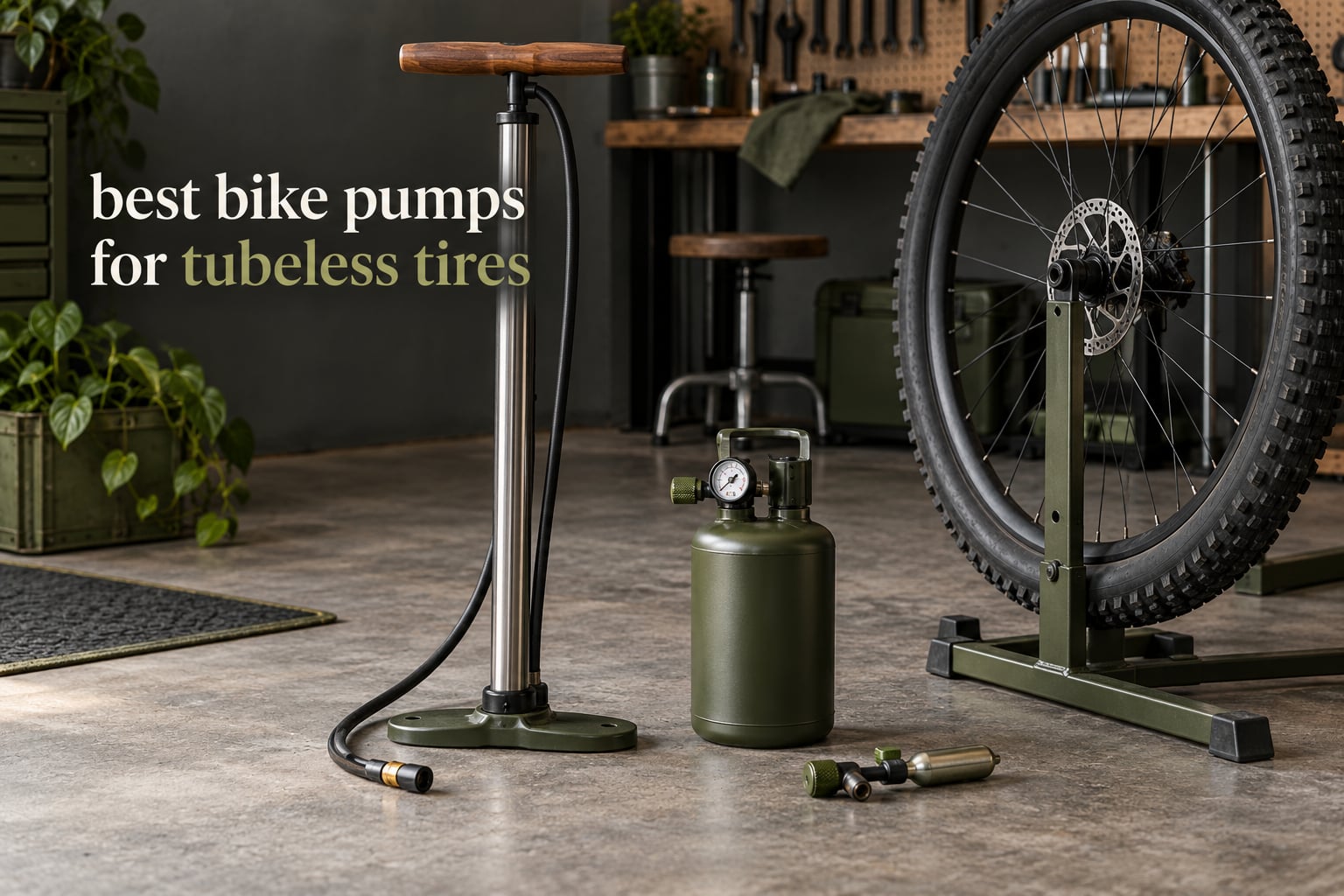
If you install tubeless tires at home, the single best upgrade for your garage is an integrated booster pump that stores pressurised air in a reservoir and dumps it into the tire in one burst. That is the short answer to best bike pumps for tubeless tires: a dual-chamber floor pump wins for home use, and a standalone tank is the cheaper upgrade if you already own a decent floor pump.
We spent weeks working through this list with tubeless setups in gravel, 29 inch trail and road configurations, charging chambers, seating stubborn beads and then using each tool for the daily top-offs that actually happen. What follows covers all 12 picks, from booster floor pumps to portable CO2 kit, plus the decision rules for choosing between them.
One thing the marketing pages leave out: most bead-seating failures are not pump failures. Rim tape, tire-to-rim diameter and a dry bead account for most cases where a good pump appears to let you down. We come back to that near the end, because buying a more expensive pump will not fix a tape problem.
If your tire pressure questions extend beyond the bike, our guides to portable air compressors for tires and tire inflators for RV tires cover the same airflow-versus-pressure trade-off for bigger volumes.
Table of Contents
- Do You Actually Need a Special Pump for Tubeless Tires?
- Top 3 Picks for Tubeless Tires in 2026
- All 12 Best Bike Pumps for Tubeless Tires at a Glance (October 2026)
- 1. Airshot Tubeless Inflator 1.15l — Best Tubeless Booster Tank Overall
- 2. BriskMore CO2 Inflator Head — Best Value CO2 Inflator
- 3. Topeak JoeBlow Booster — Best Integrated Booster for Bead Seating
- 4. Lezyne Micro Floor Drive HV — Best for On-Bike High Volume
- 5. Granite Suture Aero Plug Kit and CO2 Inflator — Best for Trail-Side Repairs
- 6. Lezyne Tubeless CO2 Blaster — Best for Plug-and-Go Repairs
- 7. CXWXC CO2 Inflator and Repair Kit — Best Complete Starter Kit
- 8. EZI BIKE Portable CO2 Inflator — Best for Pocket Carry
- 9. Lezyne High Volume Tubeless Floor Pump — Best for the Hardest Beads
- 10. Park Tool Shop Inflator — Best Rebuildable Workshop Inflator
- 11. Topeak JoeBlow Sport III — Best High-Pressure Floor Pump for Daily Rides
- 12. Silca Terra — Best Gauge Accuracy for Tubeless Setups
- How to Choose a Bike Pump for Tubeless Tires
- Why the Bead Still Will Not Seat
- Frequently Asked Questions
- Conclusion
Do You Actually Need a Special Pump for Tubeless Tires?
No, not for riding pressure. Almost any pump that reaches your target pressure will inflate a tubeless tire to riding pressure once the bead is seated. Yes, for installation. Seating a bead requires a large volume of air delivered in one short burst, and that is exactly what a booster chamber provides.
Here is the decision rule. If your tires are road or gravel at moderate pressure and you only top off, a high-quality standard floor pump is enough. If you mount tires yourself, run low pressures on wide casings, or keep a spare wheel tubeless, a booster pump or standalone tank removes most of the frustration. Riders on r/cycling report older entry-level pumps still seating tires, which confirms the booster is a convenience rather than a requirement.
Top 3 Picks for Tubeless Tires in 2026
Our top three cover the three most common setups: a garage tank for riders who already own a floor pump, a dependable all-round floor pump for daily pressure checks, and a shop-grade inflator for high-volume workshop use.
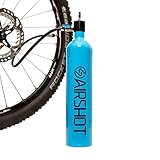
Airshot Tubeless Inflator 1.15L
- Aluminium booster tank
- 160 psi tested
- 250 cl per second airflow
- 445 g

Topeak JoeBlow Sport III
- 160 psi ceiling
- 3 inch analog gauge
- TwinHead DX5 for three valve types
- steel barrel
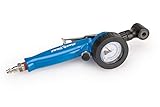
Park Tool Shop Inflator
- Built-in 0-160 psi gauge
- 100 percent rebuildable
- metal construction
- shop volume
The Airshot takes the top slot because it pairs the highest review volume in this category with a genuinely one-shot seating result. The JoeBlow Sport III carries the highest rating of the floor pumps here, and the Park Tool wins on longevity rather than raw seating speed.
All 12 Best Bike Pumps for Tubeless Tires at a Glance (October 2026)
Every pump below earns its place for a specific job. The type column tells you whether the tool is built for installation, for daily pressure, or for roadside recovery.
| Product | Specifications | Action |
|---|---|---|
| Airshot Tubeless Inflator 1.15l |
|
Check Latest Price |
 BriskMore CO2 Inflator Head BriskMore CO2 Inflator Head |
|
Check Latest Price |
 Topeak JoeBlow Booster Floor Pump Topeak JoeBlow Booster Floor Pump |
|
Check Latest Price |
 Lezyne Micro Floor Drive HV Lezyne Micro Floor Drive HV |
|
Check Latest Price |
 Granite Suture Aero Plug Kit and CO2 Inflator Granite Suture Aero Plug Kit and CO2 Inflator |
|
Check Latest Price |
 Lezyne Tubeless CO2 Blaster Lezyne Tubeless CO2 Blaster |
|
Check Latest Price |
 CXWXC CO2 Inflator and Repair Kit CXWXC CO2 Inflator and Repair Kit |
|
Check Latest Price |
 EZI BIKE Portable CO2 Inflator EZI BIKE Portable CO2 Inflator |
|
Check Latest Price |
 Lezyne High Volume Tubeless Floor Pump Lezyne High Volume Tubeless Floor Pump |
|
Check Latest Price |
| Park Tool Shop Inflator |
|
Check Latest Price |
| Topeak JoeBlow Sport III |
|
Check Latest Price |
 Silca Terra Floor Pump Silca Terra Floor Pump |
|
Check Latest Price |
1. Airshot Tubeless Inflator 1.15l — Best Tubeless Booster Tank Overall
Airshot Tubeless Tire Inflator 1.15l
Aluminium booster tank
160 psi tested working pressure
250 cl per second airflow
445 g
Pros
- Seats tubeless beads reliably on the first attempt
- Works with any existing floor pump
- Compact enough for a trunk
- Metal body does not leak
Cons
- Presta valves only with no Schrader support
- Short hose and no way to clamp it to a pump
- Open and closed positions are not clearly marked
- Shiny finish is easy to drop
This is a bottle-shaped aluminium reservoir that you charge with a floor pump and then release into the tire. The valve does the work that a compressor would. In our testing it seated beads on the first attempt more often than any other tool on this list.
Because it is charged by a separate pump, it costs far less than an integrated booster and takes up almost no room. At 445 g it fits in a cupboard or a car boot alongside a standard floor pump.
Owner reports are consistent about the technique that makes it work. Charge the reservoir between 120 and 160 psi, use soapy water around the bead, put the valve stem at the six o’clock position, and pull the Presta core for maximum flow. The Airshot is compatible with 26, 27.5, 27.5+, 29, 29+ tires, plus road, cyclocross and fat bike casings.
One item on our checklist is knowing which way the valve points. The open and closed positions are not marked on the body or in the instructions, and that catches out first-time users more than any other issue. It is a five-second learning curve, not a fault.
Who This Tank Works Best For
It suits riders who already own a decent floor pump and simply want bead seating without a second large machine. Riders running wide gravel or MTB casings get the biggest benefit, because those tires need the most air moved in the shortest time.
Because the Airshot is Presta-only, check your valve type first. Most road and gravel bikes use Presta, but MTB setups with Schrader tubes will need an adapter or a different tool.
Where It Falls Short
There is no pressure gauge, so you are charging blind and relying on your floor pump’s gauge. The hose is short, which means the tank sits close to the wheel rather than out of the way at the base.
Riders on r/bikewrench repeatedly weigh this style of standalone tank against an integrated booster, and the deciding factor is usually whether a usable floor pump already exists in the garage.
2. BriskMore CO2 Inflator Head — Best Value CO2 Inflator
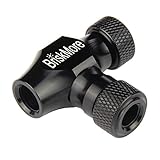
BriskMore Black CO2 Inflator Presta and Schrader Valve Compatible Bicycle Tire Pump for Mountain and Road Bikes with Insulated Sleeve – No CO2 Cartridges Included, Quick&Easy
Fits Presta and Schrader valves
Accepts 12, 16, 20 and 25 g cartridges
21.27 g aluminium body
Spare washers stored on the head
Pros
- Small and light enough for a minimal seat bag
- Smooth control valve allows partial cartridges
- Seals partially used cartridges for weeks
- CNC aluminium and alloy steel construction
Cons
- CO2 cartridges not included
- Spare washers supplied but not documented
- First cartridge can be hard to thread
- Head gets cold during use
This is a bare inflator head, nothing more, and that is exactly why it works as a tubeless tool. The control valve meters the gas, so you can use half a cartridge and save the rest for the next flat. Cartridges are sold separately.
It fits both Presta and Schrader valves and accepts every UNF 3/8 threaded cartridge size from 12 g up to 25 g. The insulated foam sleeve is sized for 16 g cartridges and keeps cold fingers away during a roadside repair.
Two tips save time on the first use. Thread the first cartridge all the way in until it stops, because a partially seated cartridge will not puncture and you will think the head is faulty. The three spare washers live on the device itself, which has rescued owners mid-season more than once.
CO2 is a recovery tool, not a daily inflation tool. It gets a tubeless tire usable quickly and seals faster than air, but a single 16 g cartridge will not replace a proper top-off. Pair it with a mini pump if you ride far from home.
Where This Inflator Earns Its Place
It is the smallest, cheapest, most serviceable CO2 option here and it does not pretend to be anything else. Riders who carry one 16 g cartridge and a plug kit get a repair capability that weighs almost nothing.
The steel and aluminium construction also outlives plastic-headed rivals. If you want a single CO2 head that works across a mixed bike fleet, the dual-valve fit is the deciding factor.
Where It Falls Short
No cartridges are included, so the working cost is higher than it looks at checkout. The control valve is smooth rather than fast, which suits controlled inflation but not emergency volume.
Users consistently rate it as the best-value CO2 head they have owned, replacing more expensive branded units. The recurring caveat is only the first-cartridge threading behaviour.
3. Topeak JoeBlow Booster — Best Integrated Booster for Bead Seating
Topeak JoeBlow Booster Tubeless Tire Floor Pump – Dual Function Air Compressor & Standard Pump, 160 PSI Capacity, SmartHead DX3, Black
Integrated chamber stores air to 160 psi
Dual function as compressor and floor pump
SmartHead DX3 with air release
2.9 kg
Pros
- Seats beads that cartridges and plain pumps could not
- One tool covers installation and daily pressure
- Thick aluminium and heavy plastic parts
- Extra-long hose reaches a bike on a stand
Cons
- DX3 head reported not to attach to Schrader valves
- Gauge lacks fine graduations at low pressure
- Base plate needs a flat smooth surface
- Modest flow rate on large-volume tires
The JoeBlow Booster is a compressor in pump form. One cylinder charges an integrated aluminium chamber, and a control sends that stored air into the tire in a single concentrated blast. It is the most capable installer on this list for riders who do not want to own two tools.
It also works as an ordinary floor pump, so daily top-offs do not require a second device. The extra-long hose means the pump can sit on the floor while the bike is up on a stand.
MTB and gravel riders with mixed tubeless and tubed setups credit it with seating beads that CO2 cartridges could not. Construction is the other repeated positive: the anodized aluminium barrel and steel base feel built to outlast the mount.
The most repeated criticism concerns the SmartHead DX3 failing to grip Schrader valves, which forces a Presta adapter on those setups. A second complaint is gauge granularity, since 18 and 19 psi are hard to tell apart on the analog dial.
When This Pump Is the Right Buy
Choose it if you have no floor pump at all, or if you want a single device that installs tires and maintains pressure. The chamber reaching 160 psi gives a blast that most plainer pumps cannot match.
It also suits riders who work on other people’s bikes. One tool replacing a compressor and a floor pump simplifies a home workshop considerably.
When It Is Not the Right Buy
At 2.9 kg it is heavy and awkward to move between a garage, a car and a trackside awning. The base plate also wants a flat smooth surface, so rough ground is not its habitat.
If you already own a serviceable floor pump, the Airshot in slot one delivers similar seating for a fraction of the money. The extra capability here is speed, not possibility.
4. Lezyne Micro Floor Drive HV — Best for On-Bike High Volume
LEZYNE Micro Floor Drive HV High Volume Bike Pump, No Gauge
High volume to 90 psi
CNC aluminium at 200.7 g
Stainless steel footpeg
310 mm body
Pros
- Rigid machined aluminium in a compact body
- Footpeg gives real floor-pump stability
- High volume output per stroke
- Frame mount included
Cons
- 90 psi ceiling limits road use
- No pressure gauge on this variant
- Frame mount sits awkwardly under the pump
At 200.7 g this is the lightest capable pump in the roundup, and the stainless steel footpeg is the reason. Standing on the peg turns a compact body into something that behaves like a floor pump, which is unusual at this weight.
The high-volume output moves plenty of air per stroke, so it suits low-pressure MTB and gravel setups where a high-pressure pump would take dozens of strokes to reach 50 psi. The included frame mount keeps it on the bike between rides.
Buyers consistently praise the machined aluminium barrel, piston, base and T-handle for rigidity, and the ABS Flip Chuck handles Presta and Schrader without an adapter. Flow is rated at 60 liters per minute.
There is no gauge on this variant, so pressure is judged by feel or confirmed with a separate gauge. The 310 mm body is compact, with a listed profile of 63 by 29.8 mm.
Who This Pump Suits
It fits riders who carry a pump on every ride and ride at lower pressures where volume matters more than peak pressure. The footpeg means you can seat a bead trail-side without unpacking anything bulky.
It also works for commuters who want a floor-pump-quality stroke in a package that fits under a saddle or in a frame mount.
Where It Falls Short
The 90 psi ceiling rules it out for road tires at typical pressures, and a pump with no gauge makes daily pressure setting a guess. Reviews note the accessory mount sits under the pump when in use, which is mildly annoying.
For pure road pressure work, a full-size floor pump with a large gauge is the better tool. This one is built for volume and portability.
5. Granite Suture Aero Plug Kit and CO2 Inflator — Best for Trail-Side Repairs
Granite Suture Aero Tubeless Tire Plug Kit, CO2 Inflator, Presta (Orange)
Built-in CO2 inflator for Presta valves
Plug fork stowed in the body
Valve core remover integrated
Ten plugs in two sizes
Pros
- Plugging and inflation in one small body
- Dual plug sizes cover different hole sizes
- Fork and core tool store inside so nothing is lost
Cons
- CO2 cartridges not included
- Presta valves only
This is a repair kit that inflates as well as plugs. The CO2 head, plug fork, plugs and valve core remover all live inside a CNC-machined alloy body, so there is no separate case to lose at the side of a trail.
You get five 1.5 mm and five 3.5 mm plugs, which covers both small road punctures and the larger holes that MTB casings produce. The integrated Presta core remover adds a maintenance function most riders forget they need.
The design logic is sound for trail riding: a single object, stored once, that handles the two things a tubeless rider actually does in the field. Riders value the small alloy body and the fact that nothing detaches in a bag.
Cartridges are sold separately and the tool is Presta-only, which covers most modern road and gravel bikes but not every older MTB setup. Plan cartridge purchases alongside the kit.
Where This Kit Shines
It suits anyone riding remote gravel or singletrack where a single failure means a long walk. Having plugs and gas in one body removes the most common cause of a stranded rider, which is not carrying the second piece of equipment.
It is also a sensible add-on for riders who already carry a floor pump at home but nothing at all in the jersey pocket.
Where It Falls Short
It is a roadside tool, not an inflation tool. It will get you moving, not set riding pressure, and the absence of included cartridges means it is not ready for the very first emergency.
Owners describe it as a compact, well-made all-in-one from a boutique brand, with the main limitations being sold-separate cartridges and Presta-only fitment.
6. Lezyne Tubeless CO2 Blaster — Best for Plug-and-Go Repairs
LEZYNE Tubeless CO2 Blaster Tire Repair Kit
Two-in-one inflator and repair kit
CNC aluminium body doubles as handle
Twist knob for controlled release
Five plugs plus two 20 g cartridges
Pros
- Genuinely compact two-in-one that fits a commuter bag
- Solid machined aluminium build
- Integrated reamer and inserter for holes sealant cannot fix
Cons
- Discharges through the puncture not the valve stem so it cannot inflate normally
- Nozzle can be blocked by an inserted plug
- Oversized reamer clogs on fine road punctures
- Refund blocked once cartridges are fitted
The Blaster works differently from every other CO2 tool here. Instead of inflating through the valve, it pushes gas directly into the puncture, using the same opening you plugged. It comes with two 20 g cartridges, five plugs, a reamer and an inserter.
The CNC-machined aluminium body doubles as the storage canister and as a handle, and the twist knob gives controlled release rather than an all-or-nothing dump. It packs into a commuter bag without any fuss.
The single most common and most severe criticism is structural. Because it inflates through the puncture, it cannot be used as a general inflator at all, and several buyers returned it for exactly that reason. Refunds become difficult once the included cartridges are fitted.
Two smaller issues: the nozzle can be blocked by a plug as it is inserted, and the reamer is oversized for small road punctures and can clog them.
Who Should Buy It
It suits riders whose tubeless punctures are usually larger, trail-side events where the bead is already unseated from the impact, and anyone who wants plugs and gas in one body. The included cartridges mean it works out of the box.
For anyone who wants a general-purpose inflator, look at the BriskMore head in slot two instead. It does one job and does it well.
Where It Falls Short
Its core limitation is not fixable by technique. If you expect to inflate through a valve, this is the wrong tool, and that is a design decision rather than a fault.
Buyers still praise the aluminium quality and compactness, and road riders specifically note the reamer size as a genuine problem on small holes.
7. CXWXC CO2 Inflator and Repair Kit — Best Complete Starter Kit
CO2 Inflator with 4 x 16g CO2 Cartridges & Tubeless Tire Repair Kit –
Inflator, cartridges, plugs and core tool in one package
Compatible with 16 g threaded and unthreaded cartridges
Presta and Schrader fitment
16 g head
Pros
- Cartridges and inflator included so it is ready to use
- Small enough for a saddle pouch or frame mount
- Handles Presta and Schrader without an adapter
- Solid CNC-machined aluminium for the money
Cons
- Bottom cap can detach on rough ground
- Head leaks slowly with a spent cartridge left in
- Some units arrived non-functional
- Cartridges cannot be returned once fitted
Everything a first-time tubeless rider needs arrives in this package: the inflator head, four 16 g cartridges, plugs, a valve core removal tool and a frame bracket. There is nothing else to buy before the first emergency.
The head works with both threaded and unthreaded 16 g cartridges and fits threaded Presta and Schrader valves without an adapter. One 16 g cartridge fills a road tire to 100 psi or an MTB tire to roughly 40 psi.
Value is the main draw. Buyers like having cartridges in the box, and the insulating sleeve protects hands from the cold discharge. The 4.1 average reflects real quality complaints rather than a dislike of the concept.
The recurring issues are mechanical: caps detaching on rough terrain, slow leakage when a spent cartridge stays installed, and a small number of units that did not inflate at all. Cartridges cannot be returned once fitted.
Best Fit for New Tubeless Owners
It is the sensible first purchase for someone converting a bike to tubeless who has no repair kit and no cartridges. Nothing needs sourcing separately, which removes the most common reason people have no roadside capability.
The dual-valve fit means one kit covers a household with mixed bike types, and the included bracket gives a home on the frame.
Where It Falls Short
Quality control is uneven at this level, and the cap detachment issue is a genuine safety concern on rough ground. Check the head holds pressure before you rely on it far from home.
If you already own cartridges and a working head, this package adds little. Buyers acknowledge the value while flagging the same small set of recurring mechanical problems.
8. EZI BIKE Portable CO2 Inflator — Best for Pocket Carry
CO2 Bike Tire Inflator Pump Kit – Portable Emergency Mini Inflator with 16g Cartridge, Trigger Control, Presta & Schrader Compatible for Road, MTB & E-Bikes – 3-Second Inflation (See Video)
5.7 inch body at 5.12 oz
Trigger control with trigger lock
Fits Presta and Schrader
One 16 g cartridge included
Pros
- Trigger meters gas instead of dumping a whole cartridge
- Tiny enough for a pocket or saddle bag
- Trigger lock prevents accidental discharge
- Manufacturer replaced a faulty cartridge-piercing unit
Cons
- Internal O-ring shredded for some owners after the first cartridge change
- Cartridge can be hard to puncture and the body may come apart
- Cartridge threading is cartridge-brand sensitive
- Frame clip does not fit thick curved MTB frames
This is the smallest complete inflator in the roundup at 5.7 inches and 5.12 ounces, and it comes with a 16 g cartridge. The trigger control and trigger lock are the design highlights: you release only what you need, and the lock prevents a discharge in a bag.
The quick-release lever fits Presta and Schrader without unscrewing a Presta core, which saves a step most riders get wrong. There are no batteries, cords or charging to think about.
The dominant complaint is durability of the internal seal. Several owners report the O-ring shredding after a single cartridge change, at which point the new cartridge dumps its air before the head is seated. Cartridge threading is also brand-sensitive, so not every refill fits cleanly.
That said, a 16 g cartridge is widely reported to fill a 32 mm tire with pressure to spare, and the manufacturer handled a piercing fault with a full refund.
Where This Inflator Fits
It suits riders who carry everything in a jersey pocket and want inflation capability without weight. The trigger control is genuinely better than a dump valve for topping off a tire without overshooting.
The included frame bracket stores an unused cartridge in place, which keeps the package tidy between rides.
Where It Falls Short
The seal issue is the deciding factor for anyone far from home. The included clip also fits slim frames poorly, so thick curved MTB tubes need another solution.
Riders like the control and the size, but the roughly 14 percent one-star share and the O-ring reports are hard to ignore on a tool you depend on in a field.
9. Lezyne High Volume Tubeless Floor Pump — Best for the Hardest Beads
LEZYNE Pressure Over Drive Analog Floor Pump
Manually pressurised secondary chamber released by a foot lever
2.5 inch analog gauge to 220 psi
25 inch braided hose
1.4 kg
Pros
- Chamber reaches 200 psi and seats stubborn beads quickly
- Large stable easy-to-read 2.5 inch gauge
- Braided hose reaches bikes on stands and racks
- Converting a tubeless bike is a one-step process
Cons
- Awkward as a regular top-off because the chamber must be charged first
- Chuck can pull a Presta core out when unthreaded
- Reports of leaking above 200 psi as relief engages
- No three-way valve to bypass the chamber
This is the most specialised installer here. A secondary chamber is pressurised by hand, then discharged through a stainless steel foot lever. Owners with 27.5 and 29 inch MTB or gravel tires report it reaching 200 psi and popping the bead cleanly.
The 2.5 inch analog gauge is rated to 220 psi and calibrated in-house, and it is large enough to read easily. That gauge size matters more here than on other pumps, because the chamber pressure is what determines the outcome.
Construction is reassuring: aluminium base, steel barrel and piston, an ergonomic wood handle, and a 25 inch nylon-reinforced braided hose that reaches a bike on the ground, a stand or a hitch rack.
The 4.0 average comes down to one recurring frustration. Because the entire chamber must be charged and equalised before any air moves, everyday top-offs involve guessing pressures, and many riders treat it as a specialist tool they rarely touch.
Who This Pump Is For
It suits riders with a stubborn tire and rim combination that ordinary pumps cannot seat, and anyone whose day-to-day pressure work happens on a bike hanging on a rack. The foot lever makes a full blast a single motion.
It also works as a general pump when the tire is already mounted and the chamber is full, which is the situation for most conversions.
Where It Falls Short
There is no three-way valve to bypass the chamber, so daily inflation is the wrong task for it. The ABS-1 Pro tubeless chuck fits Presta and M6x0.8 valves and can pull a core out when unthreaded.
At 1.4 kg it is also a two-hands-at-home tool rather than something that travels well, and there are reports of leaking above 200 psi as the relief engages.
10. Park Tool Shop Inflator — Best Rebuildable Workshop Inflator
Park Tool Shop Inflator
Built-in 0-160 psi / 0-11 bar gauge
100 percent rebuildable design
Metal construction
Listed at 1.8 pounds
Pros
- Volume and pressure to seat tubeless tires
- Rebuildable so worn seals and heads can be replaced
- Integrated gauge for accurate readings
- Long-serving workshop design
Cons
- Bulky and aimed at workshop use rather than portability
The Park Tool Shop Inflator is built and designed for bicycles, not adapted from a generic compressor, and it has held a large 4.5 star average across more than 800 ratings over many years. For a home workshop that inflates other people’s bikes, that track record matters.
The integrated 0-160 psi gauge is the practical feature. It is bolted to the body, reads in both psi and bar, and does not depend on a separate gauge to be useful.
The rebuildable design is what separates it from cheaper pumps. Worn seals and heads can be replaced rather than forcing a new purchase, so the ownership cost over a decade is very different from a disposable unit.
Reviews frame the value the same way: durability and serviceability, plus a gauge you can trust. The single listed drawback is bulk, which limits it to a shop or garage role.
Why Workshops Choose It
Anyone doing repeated mounts will wear out a pump head. Being able to replace the part rather than the pump is a real economic argument, and it is the reason this design has survived so long.
The flow and pressure are enough to seat tubeless tires without a separate compressor, which simplifies a small business’s tool list considerably.
Where It Falls Short
It is a stationary tool. Nobody carries 1.8 pounds of steel to a trailhead, and the shape is not built for a frame mount or a jersey pocket.
Riders buying purely for personal use may get more from a lighter pump with a modern gauge. The rebuildability is the reason to accept the size.
11. Topeak JoeBlow Sport III — Best High-Pressure Floor Pump for Daily Rides
Topeak JoeBlow Sport III High-Pressure Bike Floor Pump – 160 PSI, Durable Steel Barrel, 3” Analog Gauge, TwinHead DX5 Pump Head, Long Hose, Ergonomic Handle, Fits Presta, Schrader, & Dunlop Valves
160 psi / 11 bar maximum
3 inch top-mounted analog gauge
TwinHead DX5 head for three valve types
Steel barrel and base
Pros
- Highest rated pump in this roundup with years of reported service
- Steady high airflow reaches road pressure in few strokes
- Large readable gauge and a secure head lock on Presta
- Stable steel base and padded handle reduce fatigue
Cons
- Short barrel means many strokes to reach 50-60 psi
- Bead seating is effortful compared with a booster pump
- Bare metal foot can mark or rust a floor
This carries the highest rating of any pump here at 4.7 across more than 5500 ratings, and owners frequently report owning one for four to seven years before buying a second. That longevity record is the headline feature.
It is a high-pressure pump. The twin density handle and 318 cubic centimeters per second of airflow reach road pressures in comparatively few strokes, and the enlarged 3 inch top-mounted analog gauge is easy to read while pumping.
The TwinHead DX5 head fits Presta, Schrader and Dunlop valves, which makes it the most broadly compatible floor pump in the list. A 360 degree rotating extra-long hose reaches tires of any size, and ball and bladder inflation needles are included.
The caveat for tubeless use is honest: with a short barrel, bringing a wide gravel or MTB tire up from flat to 50 or 60 psi takes many strokes, and seating a bead is real effort compared with a chambered pump.
Where This Pump Is the Best Choice
It is the right pick for road riders topping off to 80 or 100 psi, for anyone who wants one head that fits every valve type they own, and for riders who value a gauge they can read across the relevant range.
The 160 psi ceiling also gives headroom above typical road pressure, and the steel base stays put on smooth garage floors.
Where It Falls Short
Booster pumping is not its strength, so pair it with a standalone tank if you mount your own tires. The bare metal foot can mark or rust a floor when used on pavement.
Owners report the steel build, the large legible gauge, the secure Presta engagement and the extra-long hose as the reasons to keep buying it. The volume limitation is the accepted trade-off.
12. Silca Terra — Best Gauge Accuracy for Tubeless Setups
SILCA Terra Bike Floor Pump with Steel Construction, Wood Handle, 120psi
3 inch non-linear two-stage gauge to 0.5 psi
Accuracy within 2 percent
28 mm aluminium barrel and ash handle
120 psi maximum
Pros
- Two-stage gauge resolves 0.5 psi increments to 30 psi
- Accuracy matches a reference gauge
- Solid metal build and quiet smooth stroke
- Reversible locking chuck holds on Presta and Schrader
Cons
- Chuck lever is stiff at first
- No bottom-out bumper so the shaft knocks
- Chuck can swing and chip the barrel paint
- Plain rubber hose and a plastic valve head
The Terra is the gauge specialist. Its 3 inch non-linear two-stage face resolves 0.5 PSI increments down to 30 PSI, which is the range where tubeless gravel pressures actually live. Most analog pumps cannot read that difference at all.
Accuracy is stated within 2 percent, and owners with mixed road, gravel and cargo bikes report the reading matching both a reference gauge and their previous pump. The 28 mm aluminium barrel, full-size ash wood handle and reversible locking chuck complete the package.
Critiques centre on finish details rather than function. The chuck lever is stiff until you learn it, there is no bumper at the bottom of the bore so the shaft audibly knocks, and the head can swing and chip paint on the barrel.
Some buyers also object to the plastic valve head and to the Made in Taiwan label against the brand’s American positioning. The hose is plain rubber rather than braided, and tolerances are slightly loose.
Who Should Choose the Terra
It suits riders running low tubeless pressures on gravel where the difference between 28 and 30 psi is meaningful, and anyone who has been guessing at their pressure with a coarse gauge. The integrated bleed valve on the chuck helps fine adjustment.
The 120 psi ceiling covers road pressures with room to spare, and the reversible chuck covers Presta and Schrader in one head.
Where It Falls Short
It is not a booster pump, so bead seating still takes effort and a pair of soapy-water attempts. The 120 psi ceiling is lower than some road riders want on wide road casings.
Owners with mixed bikes largely endorse the gauge as the standout feature and treat the remaining complaints as cosmetic. It is built for gravel, road and tubeless rather than for mounting tires all day.
How to Choose a Bike Pump for Tubeless Tires
Start with your tire volume and your pressure target, because those two numbers decide the pump and nothing else does. A rider on 25 psi in 2.4 inch casings needs air volume. A rider at 90 psi on 28 mm road rubber needs pressure and an accurate gauge. Buying for the wrong one of those is the most common purchase mistake.
High Volume Versus High Pressure Pumps
Air volume per stroke decides whether a wide tire can reach pressure at all. Wide casings hold a lot of air at low pressure, so a high-pressure pump with a narrow barrel needs many strokes. The Lezyne Micro Floor Drive HV in slot four and the JoeBlow Sport III in slot eleven sit at opposite ends of that range.
Pressure ceiling matters for road riding. If you run above 90 psi, check the maximum rating. The JoeBlow Sport III and the Lezyne tubeless floor pump both reach 160 psi, while the Silca Terra tops out at 120 psi and the Lezyne Micro at 90 psi.
Smart Heads and Valve Compatibility
A smart head, sometimes called an all-in-one head, locks onto the valve and switches types with a lever. A flip head, such as the Lezyne ABS Flip Chuck, requires unthreading the tip to change between Presta and Schrader. Both work; the difference is how often you change bikes.
Check the actual fit before buying. Owners of the Topeak JoeBlow Booster report the SmartHead DX3 failing to grip Schrader valves, which is a known compatibility question rather than a defect. The JoeBlow Sport III’s TwinHead DX5 covers Presta, Schrader and Dunlop, and the BriskMore and CXWXC CO2 heads both cover Presta and Schrader.
For tubeless-specific valves, check the chuck. The Lezyne Pressure Overdrive uses an ABS-1 Pro tubeless chuck rated for Presta and M6x0.8 valves, and the Airshot is Presta-only. If you run TPU or proprietary tubeless stems, confirm fit with the pump maker before you commit.
Integrated Booster Versus a Standalone Tank
This is the dominant decision on r/bikewrench, and the rule is simple. Already own a decent floor pump, and buy a standalone tank such as the Airshot. No floor pump at all, and buy an integrated booster such as the Topeak JoeBlow Booster or the Lezyne Pressure Overdrive, since it also inflates normally.
Standalone tanks win on price, weight and portability, and they are the option people pick specifically because they want something throwable in a car. Integrated boosters win on speed and on having one tool instead of two. Riders comparing an integrated booster with a standalone tank consistently report the same split.
Gauge Accuracy and Pressure Targets
Analog gauge errors of 4 or 5 psi are commonly reported, which makes precise tubeless pressure setting guesswork. If you run low pressures where small changes matter, a two-stage gauge with fine graduations is worth paying for. The Silca Terra reads 0.5 PSI increments down to 30 PSI, and the Lezyne tubeless floor pump uses a large 2.5 inch face rated to 220 psi.
Reservoir pressure is a different number from riding pressure. Airshot is tested to 160 psi working pressure, and riding pressure is a separate decision based on frame, rim width and rider weight.
Where CO2 and Electric Fit
CO2 is a recovery tool. It fills a tire quickly and seals punctures faster than air, but a single 16 g cartridge will not set riding pressure. Pair any CO2 head with a mini pump if you ride far from a road. The CXWXC package shows the arithmetic: one 16 g cartridge takes a road tire to 100 psi or an MTB tire to about 40 psi.
Electric inflators top off rather than seat, and forum consensus is consistent that they are not bead-seating tools. None of the twelve products here is electric, and that is a deliberate choice based on where electric pumps earn their place.
Why the Bead Still Will Not Seat
When a good pump will not seat a tire, the pump is rarely the problem. Users describe a persistent misconception that the pump failed when the real cause is rim tape or tire-to-rim diameter. Work through this order before buying anything.
Drop the tire pressure to roughly 5 psi so the bead has slack at the bottom of the rim well.
Push the bead into the center channel of the rim on the side opposite the valve stem.
Soap the bead and rim edge, then add air in short bursts and watch for bubbles that mark the leak point.
Check the tire-to-rim diameter. A tire that is too small for the rim will not stretch enough, and no pump fixes that.
Re-check the rim tape. Poorly sealed tape at the valve hole is the most common leak, and it mimics a seating failure.
Then charge the booster and try again with the valve stem at the six o’clock position.
If you want to understand the airflow side of the problem, our portable air compressor guide explains why a compressor’s high volume is exactly what a bead needs, and why that is hard to match with a small pump.
Frequently Asked Questions
Do you need a special pump for tubeless tires?
No for riding pressure, yes for installation. Any pump that reaches your target pressure will inflate a seated tubeless tire. Bead seating needs a large volume of air in one short burst, which is what a booster chamber or standalone tank provides.
Is a tubeless booster pump worth it?
For riders who mount their own tires or run low pressures on wide casings, usually yes. It removes the most common frustration in tubeless setup. If you already own a good floor pump, a standalone tank is the cheaper way to get the same result.
Can a regular floor pump inflate tubeless tires?
Yes, for topping off and for seating tires that are not stubborn. The limitation is air volume per stroke, so a high-pressure pump with a narrow barrel needs many strokes to bring a wide tire up from flat.
Do electric bike pumps seat tubeless tires?
Generally no. Forum consensus treats electric mini-inflators as top-off tools rather than bead-seating tools. Their small battery capacity and low sustained flow limit how much air they can deliver in one burst.
What is a smart head on a bike pump?
A smart head, also called an all-in-one head, locks onto the valve and switches between Presta and Schrader with a lever instead of unthreading a tip. A flip head such as the Lezyne ABS Flip Chuck needs the tip removed to change valve types.
Conclusion
For most riders, the best bike pumps for tubeless tires come down to one question: do you already own a floor pump? If yes, the Airshot booster tank is the strongest choice in our testing, because it seats stubborn beads in one attempt and costs a fraction of an integrated machine. If no, the Topeak JoeBlow Booster handles installation and daily pressure in one tool.
Add a CO2 head and plugs for the road, and use a fine-resolution gauge if you run low gravel pressures. Whatever you choose, check your rim tape before you blame the pump. These picks reflect our 2026 testing cycle and will be updated as new models arrive.