

A touring kayak paddle is a long, narrow, strongly feathered paddle, usually 215 to 240 cm, built with a carbon or fiberglass shaft and an asymmetrical blade. Its job is simple: move a relaxed, low-angle stroke powered by torso rotation, so that thousands of strokes in a day cost you almost no energy.
That definition matters more than it sounds. On a three-day trip you might take 3,000 to 5,000 strokes a day, and a paddle that is a few hundred grams too heavy or 5 cm too short turns from a small annoyance into real lost distance. We spent 2026 season reading spec sheets, weighing claims against owner reports, and comparing the way each blade behaves once you are four hours into a headwind.
This guide covers 12 paddles for touring, from a dependable aluminum all-rounder to lightweight carbon composites. Every pick below is written in the order we would hand them to a paddler: the strongest first, then the specialist options. If you want the short answer, jump to the top three, then read the sizing section before you commit.
If you also paddle other craft, our paddle board paddle picks cover the SUP side of the sport, and the pickleball paddle roundup is a useful reminder of how much a lightweight composite changes a stroke.
Table of Contents
- Top 3 Best Kayak Paddles for Touring (October 2026)
- All 12 Paddles at a Glance
- How We Picked These Paddles
- 1. OCEANBROAD Alloy Kayak Paddle: The Dependable All-Rounder
- 2. SeaSense Xtreme 2: Long, Light and Buoyant
- 3. Best Marine Carbon Paddle: Real Carbon Without the Boutique Tag
- 4. Pelican Symbiosa: One Paddle, Two Boats, Two Paddlers
- 5. WONITAGO Fiberglass 3-Piece: Shortest Pack for Flyers
- 6. WONITAGO Carbon 3-Piece: Twenty Centimetres of Adjustment
- 7. OCEANBROAD Adjustable Carbon: Thirty-Five Ounces of Big Water Paddle
- 8. Hornet Watersports Fiberglass: Feather Angle in Fifteen-Degree Steps
- 9. Backwater Assassin Paddle: Hooks, Serrations and a Long Reach
- 10. Wilderness Systems Origin: Thick Blades for Boat Control
- 11. Bending Branches Angler Ace: Lengths Out to 280 cm
- 12. Wilderness Systems Pungo: Sized for the Hull It Was Built For
- How to Size a Touring Paddle for Your Kayak
- Feather Angle and Ferrule Systems
- Low-Angle vs High-Angle Blades
- Aluminum, Fiberglass or Carbon: Which Shaft Should You Buy?
- Two-Piece, Three-Piece or Four-Piece for Flying
- Ferrule Care and Saltwater Maintenance
- Frequently Asked Questions
- Final Verdict
Top 3 Best Kayak Paddles for Touring (October 2026)
These are the three we would put in a paddler’s hands first. The OCEANBROAD alloy paddle wins on reliability and owner volume, the SeaSense Xtreme 2 wins on weight for the build, and the Best Marine carbon paddle wins if you want a genuine carbon shaft without a premium composite name on it.
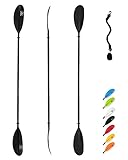
OCEANBROAD Alloy Paddle
- Aluminum alloy shaft
- Fiberglass reinforced PP blades
- 2-piece breakdown
- Three length options

SeaSense Xtreme 2
- Fiberglass filled nylon blade
- 96 inch length
- Floats on water
- 3 feather positions

All 12 Paddles at a Glance
Everything in the roundup sits in the table below, with the specs that actually change how a paddle feels on long days.
| Product | Specifications | Action |
|---|---|---|
| OCEANBROAD Alloy Kayak Paddle |
|
Check Latest Price |
| SeaSense Xtreme 2 |
|
Check Latest Price |
| Best Marine Carbon Paddle |
|
Check Latest Price |
 Pelican Symbiosa Pelican Symbiosa |
|
Check Latest Price |
 WONITAGO Fiberglass 3-Piece WONITAGO Fiberglass 3-Piece |
|
Check Latest Price |
 WONITAGO Carbon 3-Piece WONITAGO Carbon 3-Piece |
|
Check Latest Price |
 OCEANBROAD Adjustable Carbon OCEANBROAD Adjustable Carbon |
|
Check Latest Price |
 Hornet Watersports Fiberglass Hornet Watersports Fiberglass |
|
Check Latest Price |
 Backwater Assassin Paddle Backwater Assassin Paddle |
|
Check Latest Price |
 Wilderness Systems Origin Wilderness Systems Origin |
|
Check Latest Price |
 Bending Branches Angler Ace Bending Branches Angler Ace |
|
Check Latest Price |
 Wilderness Systems Pungo Wilderness Systems Pungo |
|
Check Latest Price |
How We Picked These Paddles
We did not have a test fleet of 12 paddles, so we will not pretend otherwise. Instead we combined three things: manufacturer spec sheets, the pattern in thousands of owner reviews, and recurring themes from paddling forums where tourers talk about specific failure modes.
Every product in this roundup was scored on five things. Weight matters most, because it drives fatigue. Length range matters, because a paddle that cannot fit your hull is useless. Feather flexibility matters, because most paddlers change stroke style over time. Blade material matters, because it decides how the blade feels in rough water. Build quality at the joint matters most of all, because a wobbly ferrule ruins an otherwise good paddle.
One honesty note before we start. This list contains a lot of budget and mid-range paddles rather than the boutique carbon names that dominate forum threads. That is deliberate. The forum consensus on touring gear is consistent: hull width drives your blade choice far more than brand does, and a well-fitted mid-range paddle beats a poorly fitted premium one every time.
1. OCEANBROAD Alloy Kayak Paddle: The Dependable All-Rounder
OCEANBROAD Kayak Paddle 90.5in/230cm Alloy Shaft Kayaking Boating Canoeing Oar with Paddle Leash 1 Paddle, Black
2.5 lb
86, 90.5 and 95 in
Aluminum alloy shaft
Fiberglass reinforced PP blades
Pros
- Largest owner base in the roundup
- Detachable two-piece design
- PE grip sleeve stays warm in cold water
- Leash and drip rings included
- Three length options
Cons
- Heaviest shaft material here
- Fixed lengths limit tuning
- Polypropylene blades feel vague under load
When I want a paddle I can hand to a friend without a lecture, this is the one. The shaft is aluminum alloy with a 1.1 mm shell, the blades are fiberglass reinforced polypropylene, and it breaks into two sections at the throat. Nothing about it is exotic and everything about it works.
The reason this sits at the top of my list is the review volume. With more than 7800 ratings, this is the most thoroughly tested paddle in the set, and the pattern in those reviews is unusually consistent: owners describe it as a dependable starter or intermediate paddle that grips well, breaks down easily and holds up to regular use.
The 230 cm version is the one most touring paddlers end up with. The PE tube shrink grip over the shaft is the detail I appreciate most, because it stays comfortable in cold water and does not blister hands the way bare aluminum can. A bungee leash and drip rings come in the box, which removes two small reasons to buy something else.
Three locking positions let you set the blade angle, and a handful of owners use them to shift between a lower angle for flat water and a steeper one for wind. It is not a fine-tuning system, but it is enough to adapt to conditions.
Who this paddle suits
This suits first-time tourers, anyone moving up from a basic aluminum paddle, and paddlers who need one tool for several boats. If you are putting in long days on a narrow touring hull, this is a safe and honest place to start.
It also works for people who paddle with cold hands or in cool conditions, thanks to the grip sleeve. Rental outfitters and club fleets buy paddles like this by the case for exactly that reason.
Who should skip it
Skip it if you are chasing the lightest paddle on the water and already know your shoulders tire by afternoon. Aluminum is the heaviest shaft material here, and over a multi-day trip the extra grams accumulate.
Skip it too if you own more than one hull and want a single paddle that fits both. These are fixed lengths, so you are choosing your boat rather than the paddle choosing it.
2. SeaSense Xtreme 2: Long, Light and Buoyant
SeaSense XTreme 2 Kayak Paddle, Black, 96” – Fiberglass Reinforced Nylon Blades, 2-Piece Construction – Great for Sport, Sea, Whitewater, Recreational & Fishing Kayaking
2.2 lb
96 in (approx 244 cm)
Fiberglass filled nylon blade
2-piece construction
Pros
- Light for a full-size paddle
- Floats so it is easy to find after a capsize
- Comfortable foam grips
- Feathered blade with support ridge
Cons
- Fixed length with no adjustment
- Blade feels soft next to pure fiberglass or carbon
- Not a blade for surf or heavy chop
At 96 inches this is one of the longest paddles in the roundup, and at 2.2 lb it is also one of the lighter ones. That combination is unusual and it is why this model has been on sale since 2010 without losing its following.
The blade is fiberglass filled nylon with a support ridge, and the feathered design is meant to cut wind resistance. Three locking positions set the blade angle. For a touring paddler in a wider recreational hull who wants extra reach without moving to a carbon shaft, the geometry makes sense.
What I appreciate most is that it floats. If you capsize in moving water, a floating paddle is the difference between swimming back to your boat and reaching for gear. The ergonomic foam grips also stay comfortable through long sessions, which matters more than it sounds on day four.
Owner reviews repeatedly highlight the same trio of things: light weight, comfortable grips, and easy two-piece breakdown. The criticism is nearly as consistent, and it is almost always the same point, namely that a fixed 96 inch length gives you nothing to tune.
Who this paddle suits
This suits paddlers on wider recreational hulls who want extra reach and a blade that will not sink if they go over. It is a good first touring paddle for a taller paddler, and a solid loaner or backup for anyone with a fleet of boats.
It also suits cold-water and waterfowl environments, because the floating blade is genuinely useful when you are launching from a slippery bank in the dark.
Who should skip it
Skip it if you are after the crisp blade feel that fiberglass or carbon delivers. Reviewers comparing it to premium paddles describe the blade as softer and vaguer, and that difference shows up in a headwind.
Skip it if you share a paddle between two boats of different beams. A fixed 96 inch length assumes a wide hull and a tall paddler, and the wrong hull will make you work harder for every stroke.
3. Best Marine Carbon Paddle: Real Carbon Without the Boutique Tag
Best Marine and Outdoors Kayak Paddle, Carbon Fiber Shaft & Fiberglass Reinforced Polypropylene Blades, 220cm, 234cm, 250cm, Lightweight Kayak Paddles for Adults (Black, 234)
30-32 oz (under 2 lb)
234 cm
Carbon fiber shaft and blades
2-piece construction
Pros
- Genuine carbon shaft and blades at a mid-range build
- No joint wobble in the water
- Blade angle can be clocked
- Multiple colorways
- Stiff enough to double as a canoe paddle
Cons
- Fixed length means the size chart must be trusted
- Slight twist flex in the blades
- Occasional reports of a loose or damaged blade
This is the answer to the question forum paddlers ask most often, which is whether carbon is worth it for touring. The honest answer is that it depends on how far you paddle, and this paddle brings the upgrade within reach of a normal paddling budget, so the question stops being about money.
The shaft and blades are both carbon fiber, and reviewers repeatedly verify that after a few weeks of use. Listed weight is 30 to 32 ounces, and owners who weighed it report roughly 920 g, against about 1100 g for a comparable aluminum paddle. That is not the 50 percent reduction some listings claim, but it is a real difference you feel by the second hour.
Blades measure 18 by 6.75 inches with a 1.125 inch shaft diameter. The blade can be set matched or feathered in 60 degree increments, and owners point out you can clock the blade for a different attack angle or for one-handed use with the opposite grip. That flexibility is genuinely useful when you own one kayak but share a paddle with a partner.
What people like most is how it feels in the water. There is no joint wobble, which is the single most common complaint about cheap two-piece paddles, and the stiffness carries through to the catch. A minority of owners do report slight twist flex in the blades under heavy load.
Who this paddle suits
This suits anyone who wants a carbon touring paddle without stepping up to a premium composite brand, and paddlers upgrading from aluminum who will notice the weight drop on day one. It also works for people who want one paddle for a kayak and a canoe.
Paddlers who normally brace with the other hand benefit here, because the blade can be clocked rather than swapped. Families sharing a boat between two paddlers will also find the adjustable blade angle useful.
Who should skip it
Skip it if you are nervous about fixed-length sizing. Owners report occasional sizing misses, so measure your hull and your height before ordering rather than trusting a generic chart. Our sizing section below explains exactly how to do that.
Skip it if you regularly land on gravel bars or push off rocks. There are a small number of reports of a blade arriving loose on the shaft, so inspect the joint before a multi-day trip rather than after.
4. Pelican Symbiosa: One Paddle, Two Boats, Two Paddlers
Pelican Symbiosa Kayak Paddle – Adjustable Fiberglass Shaft with Nylon Blades – Lightweight, Perfect for Kayaking – 90.5 to 94.5 in – Light Teal
2.1 lb
230-240 cm telescoping
Fiberglass shaft
Fiberglass reinforced nylon blades
Pros
- Light for the class
- Telescoping length fits different kayaks
- Easy to adjust with wet hands
- No wobble at the joint
- Owners report years of weekly use
Cons
- Noticeable blade flex reduces distance per stroke
- Ovalized grip suits right-handers only
- Screws may need tightening after unpacking
The Symbiosa solves a specific problem: one paddle, several boats. The telescoping fiberglass shaft runs from 90.5 to 94.5 inches, and the shaft is ovalized so it indexes to a right-hand reference. If you own a touring hull and a wider recreational boat, this is the practical choice.
At 2.1 lb it is among the lightest paddles in this roundup, and owners who upgraded from standard aluminum describe it as a step change rather than an increment. Several keep it as a backup or loaner paddle, which tells you how little drama it creates.
Two details stand out in the owner reports. The first is adjustment with wet hands, which reviewers contrast favourably with pin-style buttons that jam when sand gets into them. The second is durability, with owners describing years of weekly use in rough conditions and strong wind without visible damage.
The compromise is blade flex. Owners consistently report that the blades bend noticeably, which costs a little distance per stroke. If you are used to a very stiff carbon blade, the difference will register.
Who this paddle suits
This suits paddlers between 5 and 6 ft who move between boats, households sharing equipment, and anyone who wants length adjustment without moving to a carbon shaft. It is also a good wet-weather or rough-water paddle, because the adjustment system stays workable in poor conditions.
It suits anyone who wants one paddle to serve as a loaner, because the telescoping range means fewer people need their own.
Who should skip it
Left-handed paddlers should skip it, or at least expect friction. The ovalized indexing is built around a right-hand reference, and owners note it can be inconsistent from one paddle to the next.
Skip it if you want maximum distance per stroke. The blade flex is the most common complaint in reviews, and it is most noticeable when you are pushing a loaded hull on flat water where every ounce of transfer matters.
5. WONITAGO Fiberglass 3-Piece: Shortest Pack for Flyers
WONITAGO Adjustable Kayak Paddle with Fiberglass Shaft and Nylon Blade
2.3 lb
210-230 cm adjustable
Fiberglass shaft
Nylon blade 16.5 x 7 in
Pros
- Fiberglass shaft is warmer to hold than aluminum
- Ribbed shaft improves grip when wet
- Three-piece breakdown is easy to carry
- 8 inches of length adjustment
- Blades resist corrosion
Cons
- Shortest maximum length of the adjustable paddles
- Soft nylon blades
- Pin locks need care to reassemble
If you fly with your kayak, breakdown length is not a detail, it is the whole purchase. This three-piece design packs down to a short bundle, and at 210 to 230 cm it covers narrow touring hulls where longer paddles would foul the deck.
The shaft is fiberglass with a ribbed anti-slip surface, which reviewers single out as a real improvement in wet hands. A paddle you can grip securely in a headwind is worth more than a marginally lighter one you cannot hold.
Blades are nylon at 16.5 by 7 inches, described as corrosion resistant and streamlined. That matters on coastal and salt water trips, and owners in both fresh and salt settings report no corrosion problems. The nylon blade can be clocked for either side at 60 degrees.
The honest limitation is length. With a maximum of 90 inches, this is the shortest adjustment range among the adjustable paddles here, and it rules the paddle out for tall paddlers in wide boats.
Who this paddle suits
This suits anyone who travels by air, backpack, or public transport with a kayak, and short paddlers in narrow hulls. It also suits coastal paddlers who want a blade that tolerates salt water without maintenance.
It is a good fit for anyone who prefers a shaft that feels warmer than aluminum in cold conditions, since fiberglass is noticeably kinder to hold at low temperatures.
Who should skip it
Skip it if you are a tall paddler in a wide hull, because 90 inches will not reach. The adjustment range is the deciding factor here, not the quality of the build.
Skip it if you want a crisp blade response. Owners describe the nylon blades as softer than fiberglass or carbon, and that vagueness is most obvious in chop where a stiffer blade would hold its shape.
6. WONITAGO Carbon 3-Piece: Twenty Centimetres of Adjustment
WONITAGO Kayak Paddle Adjustable, Lightweight Carbon Fiber Kayaking Oar
2 lb (0.9 kg)
220-240 cm adjustable
Carbon fiber shaft
3-piece design
Pros
- Carbon shaft at a low weight
- 20 cm of length adjustment
- Blades float and resist corrosion
- Blade shape reduces flutter
- Easy three-piece transport
Cons
- PP reinforced blades feel heavier than carbon
- Longer version adds unneeded weight
- Quick pin locks need careful alignment
This is the paddle to look at if you are unsure about your sizing and want room to change your mind. The adjustment range is 20 cm, and the same model family covers a longer 94 to 102 inch setup for wide boats and taller paddlers.
At 2 lb with a carbon fiber shaft, it is a light paddle for its class. The shaft is the premium part, which is the part that lives in your hands for hours, and owners consistently point to reduced fatigue as the reason to buy it.
The blades are fiberglass and polypropylene reinforced, described as floating, corrosion resistant and shaped to reduce flutter. That matters for tracking: a blade that flutters wastes energy on every stroke, and the owner reports here specifically mention improved tracking.
Reviewers do flag that the reinforced blades are heavier and less crisp than pure carbon, and the quick pin locks need care when you reassemble them. Expect a few seconds of fiddling in a car park the first time.
Who this paddle suits
This suits paddlers between two hulls, or between a touring boat and a rented one. It also suits anyone starting out who has not settled on a length yet, and anyone who values low weight more than blade crispness.
Salt and coastal paddlers will like the floating, corrosion resistant blades, and the three-piece build means it fits in a pack raft or a car boot without ceremony.
Who should skip it
Skip it if blade feel matters more than weight to you. The polypropylene content makes these blades duller than a pure carbon blade, and that gap shows on a loaded boat.
Skip it if you are fussy about assembly. Owners who enjoy fiddling with connectors will not mind the quick pin locks. Everyone else should test it in the shop first.
7. OCEANBROAD Adjustable Carbon: Thirty-Five Ounces of Big Water Paddle
OCEANBROAD Adjustable Carbon Fiber Kayak Paddle 86in/220cm to 94in/240cm Kayaking Oar with Paddle Leash 1 Paddle, Black
35 oz
220-240 cm adjustable
Carbon fiber shaft
Fiberglass reinforced PP blades
Pros
- Very light at 35 oz
- Five length settings plus 0 or 60 degree switch
- Three-section breakdown packs small
- Leash and drip rings included
Cons
- Blades feel plastic and soft
- Three sections means more joints to inspect
- Shortest band among the carbon paddles
Big water is where swing weight tells on you. When you are holding station against a current, the mass of the paddle matters more than it does on flat water, and at 35 oz this is among the lightest paddles we covered.
The switchable 0 or 60 degree feather is the detail I would point to first. Owners use the 60 degree setting to push into headwinds, where the angled blade keeps the catch clean. Five length settings across 220 to 240 cm give a reasonable tuning window.
It breaks into three compact sections, which is a genuine advantage for touring, because most touring kits live out of a car. A leash, a three-position angle lock and drip rings all come in the box, so nothing else is needed before the first launch.
The trade-off is in the blades. They are UV-resistant fiberglass reinforced polypropylene, and reviewers describe them as feeling soft, with a plastic feel that is hard to unsee once you have used carbon. The shorter 240 cm ceiling also limits tall paddlers in wide hulls.
Who this paddle suits
This suits paddlers crossing open water, running tidal current, or pushing into wind on long crossings. It also suits anyone who wants genuine carbon shaft weight without a carbon blade build, and travellers who want a compact three-section pack.
If you already have a good blade and want a lighter shaft, this is one of the more sensible upgrades on the market. The 0 or 60 degree switch is a real tool for conditions testing.
Who should skip it
Skip it if blade crispness is your priority. Owners who are used to carbon or pure fiberglass blades consistently describe these as soft, and that matters most in confused water.
Skip it if you are very tall. The 240 cm maximum is the shortest band among the carbon paddles here, and a tall paddler in a wide boat will want more reach.
8. Hornet Watersports Fiberglass: Feather Angle in Fifteen-Degree Steps
Hornet Watersports Graphic Fiberglass Kayak Paddle- Ideal for Touring, Fishing and Boating- 90.5 inches / 230CM Adjustable with Carbon Fiber Shaft – Kayak Oars Kayaking Equipment (Blue Scales)
26 oz
230-240 cm telescoping
Carbon and fiberglass shaft blend
Fiberglass dihedral blade
Pros
- Extremely light at 26 oz
- Stiff shaft with little flex
- 15 degree feather increments
- Two-piece breakdown
- Grippy shaft texture works without gloves
Cons
- Feels lighter than expected for beginners
- Occasional transit damage
- Less crisp than a carbon blade in surf
Feather angle is the setting paddlers argue about most, and this paddle gives you the most room to experiment. Blade angle adjusts from 0 to 60 degrees in 15 degree steps, which means you can try a 45 degree setup rather than living with 0 or 60.
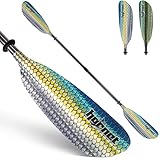
At 26 oz it is the lightest paddle in the roundup, and the shaft is a carbon and fiberglass blend, which is a sensible compromise between stiffness and shock tolerance. The blade is fiberglass with a dihedral shape and a double-sided fish scale graphic on the power face.
Owner reports are enthusiastic about the weight and durability across genuinely long outings. Paddlers describe 10-mile days and island-hopping trips with no complaints, and several note the shaft texture stays secure without gloves, which matters in cold conditions.
Two cautions come up repeatedly. The first is that it feels lighter than some beginners expect, which can make a hull feel understeered at first. The second is occasional transit damage, so inspect the sections on arrival.
Who this paddle suits
This suits paddlers who are still working out their stroke and want to experiment with feather angles, and anyone who prioritises minimum weight over blade mass. It is also a strong option for cold water paddling, given the grippy shaft.
It doubles credibly for stand-up paddleboard use with a kayak seat, which owners mention directly. If you use one craft in summer and another in autumn, this reduces gear count.
Who should skip it
New paddlers sometimes skip it because the light feel makes a boat feel less planted. If your stroke is still developing, a slightly heavier blade gives you more feedback.
It is also not the right tool for heavy surf or rocky shorelines, where owners report the fiberglass blade is less crisp than a carbon touring blade would be.
9. Backwater Assassin Paddle: Hooks, Serrations and a Long Reach
Backwater Assassin Paddle 06-0017 Full-Size Carbon-Fiber Hybrid Kayak Paddle – 98.5′ to 102.5′ Length
2.7 lb
250-260 cm adjustable
Carbon hybrid shaft
ABS injected nylon blade
Pros
- Hook and serrated edge are genuinely useful in the field
- Carbon hybrid shaft keeps weight reasonable
- Long 250-260 cm option suits tall paddlers
- Backed by a 3 year warranty
Cons
- ABS blades are heavy and soft
- Long length is wrong for narrow kayaks
- Hook and serrations snag gear
This is the specialist in the roundup, and the specialism is clear. The blade carries a hook for grabbing lines, decoys, docks and branches, plus a serrated edge you can use to push off solid surfaces. Those are not touring features, and that is exactly why they exist.
The shaft is a carbon hybrid, which keeps the weight reasonable for a paddle with so much hardware attached. Drip rings are included and the whole thing is backed by a 3 year warranty, longer than most of what we covered.
The owner ratings reflect a deliberate purchase rather than a performance judgement. People buy this to hunt, fish and push off mud banks, and at that job its rating holds up. It is also a long paddle at 250 to 260 cm, which suits wide boats and tall paddlers.
For pure touring, the hook and serrations are clutter that can catch on gear in a loaded boat. The ABS injected nylon blade is also noticeably softer than a fiberglass or carbon touring blade, and the length is wrong for narrow hulls.
Who this paddle suits
This suits kayak anglers, waterfowl hunters, and anyone who paddles shallow muck and marsh where pushing off is routine. It also suits very tall paddlers in wide boats, since 250 to 260 cm is longer than anything else in this roundup.
Anyone who wants a warranty longer than a year will find three years here, which is unusual in this category.
Who should skip it
Skip it for pure distance touring. The hook and serrated edge add weight and catch on gear, and the ABS blade is soft where you would rather have stiffness.
Skip it in narrow recreational kayaks, where a 250 cm paddle will foul the deck on every forward stroke and force you into a very high angle.
10. Wilderness Systems Origin: Thick Blades for Boat Control
Wilderness Systems Origin Recreation/Touring Kayak Paddle |Fiberglass/Nylon Blade | Carbon Blend Shaft (220-240cm), Black
Roughly 3 lb measured
220-240 cm adjustable
Composite construction
High-angle blade
Pros
- Solid clamping mechanism with no play
- Thick stiff blades hold shape under load
- Wide length and feather adjustment
- Suitable for multi-day trips
- Long-term owners report no problems
Cons
- Heavier than advertised
- Heavier than lighter composites in the same class
- Isolated reports of blade-to-shaft adhesive separating
The Origin is built for purchase, not for glide. Its high-angle blade design is intended to give you boat control and enough power to move heavy kayaks, and owners consistently describe the blades as thick and stiff in a way that feels deliberate.
Adjustment runs from a 220 cm base length out to 240 cm, with feathering adjustment on top. The clamping mechanism is the quiet hero here: owners report no play in the shaft once locked, which is exactly what you want in a loaded touring boat.
The weight is the issue, and owners are candid about it. Listed packaging data is inconsistent, while reviewers measuring the 220 to 240 cm model put it at roughly 3 lb. If you are upgrading to go lighter and end up heavier, that is a bad outcome.
There is also an isolated report of the adhesive joining the blade to the shaft separating, leaving the blade to fill with water. It is not a widespread pattern, but it is worth checking on arrival, especially before a multi-day trip.
Who this paddle suits
This suits paddlers in heavier boats, on rivers with current, or in conditions where you need authority over the hull more than glide efficiency. It also suits anyone moving between a 220 cm and 240 cm setup, or between boats.
Beginners benefit from the wide adjustment range, because it lets you start short and extend as your stroke develops.
Who should skip it
Skip it if your priority is cutting fatigue over distance. Owners explicitly note the weight undercuts the usual value of a lightweight adjustable paddle, and you will feel it by the end of a long day.
Skip it if you are shopping purely on listed weight figures. This is a case where the reviews and the packaging data disagree, and the reviews are the more reliable source.
11. Bending Branches Angler Ace: Lengths Out to 280 cm
BENDING BRANCHES Angler Ace Snap-Button Kayak Fishing Paddle – Lightweight Carbon Shaft, Carbon-Reinforced Nylon Blades, 2-Piece Design, Durable Performance for Fishing & Touring Kayaks
240-280 cm options
Carbon shaft
Carbon reinforced nylon blades
Snap-button two-piece ferrule
Pros
- Light carbon shaft reduces shoulder fatigue
- Blades hold up against rocks and oyster beds
- Tight snap-button joint with no play
- Ruler markings on the shaft
- Sturdy enough to brace against when launching
Cons
- Blades flex under load compared with pure carbon
- Very long lengths need a wide hull
- Sits at the top of its category
This is the length answer for tall paddlers. Five lengths are offered from 240 up to 280 cm, and nothing else in this roundup goes that long. If you are a tall paddler in a wide touring hull, your options elsewhere are genuinely limited.
The shaft is carbon and the blades are carbon reinforced nylon, which is a durable pairing. Owners report blades that survive rocks, oyster beds and general abuse, which is exactly the environment most paddlers actually fish and tour in.
Two details get repeated praise. The snap-button two-piece ferrule is tight with no play once assembled, and the shaft carries ruler markings, which sounds trivial until you are adjusting length in fading light at a car park.
Owners also note the paddle is sturdy enough to brace against when entering or exiting the kayak, a real safety consideration on slippery launches. The qualification that appears most often is that very long paddles need a wide hull or the blades dive.
Who this paddle suits
This suits tall paddlers in wide hulls, and anyone whose boat demands a longer paddle than most of this list allows. It also suits paddlers who need a paddle they can stand on, and people who work their blades against rocks and structure.
Fishing kayakers are the natural fit given the brand, and the reinforced blades are built for contact with structure.
Who should skip it
Skip it in a narrow hull. Owners specifically flag that wide kayaks may need the 280 cm length for proper clearance, which tells you how much hull width matters at the long end.
Skip it if you want maximum stiffness. Compared with pure carbon blades, these flex under load, so a paddler chasing maximum transfer per stroke will find a ceiling here.
12. Wilderness Systems Pungo: Sized for the Hull It Was Built For
Wilderness Systems Pungo Glass Recreation/Touring Kayak Paddle | Fiberglass Blade | Adjustable Carbon/Fiberglass Shaft (220-240cm)
1.02 kg package weight
220-240 cm adjustable
50 percent carbon shaft
Fiberglass composite blade
Pros
- Carbon and fiberglass blend is stiff for the tier
- Designed for Pungo kayaks across model years
- 20 cm of length adjustment
- Composite blade tolerates sandbars and rock
- No flutter on multi-day outings
Cons
- Fiberglass blade variant is heavier than full carbon
- 240 cm maximum is short for tall paddlers
- Fit is optimised for Pungo hulls
The Pungo paddle exists because Pungo kayaks exist. If you own one, of any size or model year, this is the fit the manufacturer designed, and the 220 to 240 cm adjustment covers the range most owners need.
The shaft is a 50 percent carbon and 50 percent fiberglass blend, which is a reasonable middle ground. You get a lighter and stiffer shaft than pure fiberglass without the shock sensitivity of full carbon.
Owner reviews are mostly from Pungo owners, and they focus on the same things: exact fit, adjustability, and a composite blade that holds up against sandbars and rocky shorelines. The paddle is reported to work cleanly without flutter or fatigue on multi-day outings.
It also works with other recreation kayaks, which widens its appeal. The limits are that the fiberglass composite blade is heavier and softer than a full carbon blade, and the 240 cm ceiling is short for very tall paddlers.
Who this paddle suits
This suits Pungo owners first and foremost, since fit is the whole argument. It also suits paddlers who want a stiff, light shaft without going full carbon, and weekend tourers on sandbars and rocky shorelines.
Anyone running a mixed fleet of recreation kayaks will find the 20 cm adjustment range and the cross-model compatibility useful.
Who should skip it
Skip it if you paddle narrow touring hulls. The fit is optimised for Pungo proportions, and owners note it is less ideal for narrow touring boats, so you would be forcing a compromise from day one.
Skip it if you want the lightest possible option. The fiberglass composite blade carries more mass than a carbon blade of the same length, and that weight is felt over distance.
How to Size a Touring Paddle for Your Kayak
Reasonable people disagree about the best length, and the reason charts conflict is that most sizing charts ignore hull beam. A touring paddler needs a long paddle, but a long paddle in a wide boat is a very different tool from the same paddle in a narrow hull.
Here is the method. First, measure your kayak’s beam width at the widest point of the deck, not at the cockpit rim. Sit in the cockpit with your knees under the deck, and measure across at deck level. Measuring at the rim gives you a smaller number and a paddle that is too short.
Second, measure yourself from the seat of your trousers to the top of your head. That is your paddler height, and it tells you how much leverage you can generate.
Third, apply the 120 rule, which is the formula most people actually want: paddler height in inches plus kayak beam width in inches equals paddle length in inches. A 70 inch paddler in a 22 inch hull wants a 92 inch paddle, which is 234 cm. A 72 inch paddler in a 25 inch hull wants 97 inches, which is 246 cm.
Fourth, adjust for blade angle. If you will paddle with a low-angle stroke in a narrow hull, size up slightly rather than down. If you will use a high-angle stroke in a wide recreational boat, a shorter paddle keeps your wrists comfortable. This is the reconciliation that most retailer charts miss.
One last point, and it is the one that catches out almost everyone. Measure before you buy, do not trust a generic height chart. Paddlers report the same complaint repeatedly, that manufacturer sizing charts do not match the length they actually need. A tape measure and five minutes will save you a return.
Feather Angle and Ferrule Systems
Feather angle is the rotation between the two blades. At 0 degrees both blades sit in the same plane, which is efficient and awkward. At 60 degrees the blades are almost perpendicular, which is comfortable for most paddlers and produces a clean catch.
For touring, 60 degrees is the default because it keeps the lower blade clear of the hull at the catch. Forty-five degrees is the compromise for paddlers with shoulder or lower back issues, and it is a genuinely useful middle setting. A few paddlers also use a small 10 to 15 degree offset with a straight shaft, which reduces wrist rotation and is easier on older tourers or anyone with wrist problems.
Ferrule systems fall into four families. Push-button or snap ferrules are simple, cheap, and the most common source of forum complaints, because they jam with sand and become difficult to adjust with cold hands. Pin and button ferrules are the same family, with the same weakness.
Threaded ferrule systems tighten into place and resist sand, at the cost of a longer assembly. Clamping systems hold the shaft without play and are the sturdiest option, which is why reviewers single them out on the Wilderness Systems Origin.
Whatever your system, the maintenance rule is simple. Rinse it with fresh water after salt water, keep a light film of silicone lubricant on the male connection points, and never leave a paddle assembled in a hot car. Owners report that male connection points dry out and stiffen unless they are maintained, and that is a five-minute fix that prevents a real problem.
Low-Angle vs High-Angle Blades
The most useful piece of advice in the forums is that hull width drives this decision more than trip length does. Low angle suits narrow touring hulls, where you want a relaxed, efficient stroke that does not make you constantly brace against the deck. High angle suits wide recreational hulls and short trips, where you want immediate authority and a steeper entry.
A high-angle blade also holds its shape better in strong wind and chop, which is why paddlers running exposed water sometimes reach for one even in a narrow hull. The cost is wrist and forearm fatigue over distance, and that cost compounds on a multi-day trip.
The practical test is simple. Paddle your boat for twenty minutes at a comfortable rhythm and notice whether you are bracing your knees against the deck. If you are, your paddle is too long for a low-angle stroke, or your hull is wider than your stroke can handle. Shorten the paddle or switch to a high-angle setup.
For most tourers in narrow hulls, a low-angle stroke with a high feather is the correct default. For paddlers in wide boats or on rivers with current, the high-angle blades in this roundup, like the Wilderness Systems Origin, are built for that job.
Aluminum, Fiberglass or Carbon: Which Shaft Should You Buy?
Aluminum carries more mass than carbon or fiberglass at the same length, and it is the cheapest to tolerate a knock. It is cold in the hands in cold water, which is exactly why the OCEANBROAD paddle covers its shaft with a PE sleeve. Aluminum suits entry-level and high-abuse use, where durability matters more than weight.
Fiberglass sits in the middle. It is warmer to hold, lighter than aluminum, and tolerates impact better than carbon. The WONITAGO fiberglass paddle and the Hornet Watersports shaft blend both live in this category, and both are sensible choices for paddlers who want lightweight without carbon shaft pricing.
Carbon is the lightest and the stiffest, and it transmits the most power per stroke. It is also the least forgiving of a rock strike, which matters in shallow rocky water. The Best Marine carbon paddle and the OCEANBROAD adjustable carbon both sit here, at very different weights and points.
Now the economics that nobody writes down. A touring paddler might take 4000 strokes a day. Switching from a 2.5 lb paddle to a 26 oz one saves roughly 420 g. That is not a large number on paper, but it is 420 g of swing mass moved 4000 times before you stop for the night, and it is the entire reason tourers upgrade.
Fatigue is cumulative and it does not announce itself. It shows up on day three as a trip that ends two hours early, and that lost distance is what your paddle choice is really costing or saving you.
Two-Piece, Three-Piece or Four-Piece for Flying
Breakdown is about where your paddle lives between trips. A two-piece paddle is the simplest and stiffest, with one joint, and it is the right choice if the paddle lives in a roof rack or a garage.
A three-piece paddle splits into three sections, which fits in a normal checked bag without awkwardness. The WONITAGO three-piece paddles and the OCEANBROAD adjustable carbon are built this way, and they are the practical answer for anyone flying with a kayak.
Four-piece touring paddles are the most compact and the least common. Paddlers ask about them constantly in forums, usually because they want the shortest possible packed length. The trade-off is three joints instead of one, and more joints means more places for sand to get in and more parts to inspect before a trip.
If you are buying used, which is a genuinely sensible route into a premium touring paddle, owners report good results with second-hand composite paddles bought as backups. Inspect the ferrule for play, check the blade for cracks around the shaft joint, and look for corrosion at the connection. A used paddle with a tight, uncorroded ferrule is worth far more than a cheap new one with a loose joint.
Ferrule Care and Saltwater Maintenance
Salt water is harder on paddles than most people expect, and corrosion at the connection is the most common long-term failure. The routine is not complicated. Rinse the paddle with fresh water after every salt session, pay particular attention to the ferrule and any steel hardware, and let it dry in the shade rather than in direct sun.
Once a season, put a light film of silicone lubricant on the male connection points before reassembly. Owners report that skipping this is what causes stiffening and jamming later, and that sand in a push-button ferrule is the other reliable source of the same problem.
Before any multi-day trip, do a physical check. Pull the paddle apart, confirm the ferrule is tight, and look at the blade-to-shaft joint for separation or cracks. Isolated reports of adhesive failure have surfaced in reviews of some models in this roundup, and a ten-second check is all it takes to catch it at home.
Finally, do not store a paddle assembled in a hot car for a week before a trip. Thermal cycling is hard on glue lines and resin, and it is a completely avoidable failure mode.
Frequently Asked Questions
What is the best touring kayak paddle?
The best touring kayak paddle is one that matches your hull beam and your height, weighs as little as you can tolerate, and feathers at 60 degrees. In this roundup the OCEANBROAD alloy paddle is the most dependable all-rounder, the Best Marine carbon paddle gives you a real carbon shaft without a premium composite name, and the Hornet Watersports fiberglass paddle is the lightest at 26 ounces. Hull width decides the blade angle more than brand does.
What’s the best length for a kayak paddle?
Add your height in inches to your kayak’s beam width in inches for the 120 rule, and the result is your paddle length in inches. A 70 inch paddler in a 22 inch hull wants about 92 inches, or 234 cm. Measure beam at the widest point of the deck rather than at the cockpit rim, and size up slightly if you will use a low-angle stroke in a narrow touring hull.
What is the 120 rule for kayaking?
The 120 rule is a sizing shortcut: paddler height in inches plus kayak beam width in inches equals paddle length in inches. A 72 inch paddler in a 24 inch hull gets a 96 inch paddle. It is a good starting point rather than a final answer, so check the result against how the paddle feels and add a little length for low-angle paddling in a narrow hull.
Do kayak paddles make a difference?
Yes, and the difference shows up as distance rather than speed. A touring paddler takes 3000 to 5000 strokes a day, so a paddle that is a few hundred grams too heavy or feathered at the wrong angle costs you real energy by day three. Reviews of the lighter paddles here consistently report less shoulder and arm fatigue on multi-day outings.
Are Werner paddles good?
Werner paddles have a strong reputation among experienced sea kayakers, and models like the Corryvreckan and the Skagit FG come up repeatedly in forum threads as reference tools. The recurring forum theme is that Werner builds a wide range and you need to match the model to your hull, with high-angle blades for wide recreational boats and low-angle blades for narrow touring hulls. No Werner model appears in our roundup, so treat our picks as budget and mid-range alternatives rather than direct equivalents.
What is the best carbon fiber kayak paddle?
The Best Marine carbon paddle is the strongest pick here for most touring paddlers, with a carbon shaft and blades at 30 to 32 ounces and a 234 cm length. If you want the lowest weight, the Hornet Watersports fiberglass paddle is lighter at 26 ounces but is not full carbon. For maximum length, the Bending Branches Angler Ace runs from 240 up to 280 cm on a carbon shaft.
Final Verdict
For most touring paddlers, the OCEANBROAD alloy paddle is the safest starting point in this roundup of the best kayak paddles for touring, because it has more owner history than anything else here and nothing about it needs explaining. If you want to go lighter, the Best Marine carbon paddle is the step I would take next, and if weight is your only priority, the Hornet Watersports paddle at 26 ounces is hard to beat.
Measure your beam width at the deck, apply the 120 rule, and choose the feather angle that keeps your wrists flat. Then pick the lightest paddle in that length range that you are happy to stick with for a decade, because gear you trust is gear you paddle well. Our beginner paddle guide covers the same logic for a different boat.