

The best car amplifiers for subwoofers come down to two numbers: continuous RMS power at the exact ohm load your sub presents, and how cleanly that power is delivered. A monoblock that pushes a headline wattage figure but clips at half that number will leave you with a hot chassis, a protection-mode shutdown, and a sub that never reaches the output you paid for.
Our team compared ten amplifiers side by side, reading the power ratings against each other at 1 ohm, 2 ohms and 4 ohms, and weighting the build quality, protection circuitry and tuning controls that decide whether a system stays quiet or rattles. The BOSS Audio Systems R1100M took our top slot on sheer verified owner feedback, the Rockford Fosgate R2-1200X1 earned the premium nod for its C.L.E.A.N. gain calibration, and the Rockford Fosgate R1200-1D stands out as the pick for people who want honest CEA-2006 numbers in a small footprint.
Everything below is built around the same question installers ask first: how do I keep the amp, the sub and the vehicle electrical system all on the same page? We walk through RMS matching, impedance and wiring, amplifier class, gain setting and factory stereo integration, then give you ten amplifiers with the specifications and the honest drawbacks attached.
Table of Contents
Top 3 Picks for Subwoofer Power in 2026

BOSS Audio R1100M
- 1100W max at 2 ohms
- 2-ohm stable Class A/B monoblock
- Remote sub level control and speaker-level inputs
- Only 4.4 lb chassis
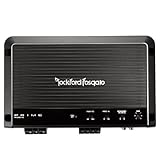
Rockford R1200-1D
- 400W RMS at 4 ohms
- 800W at 2
- 1200W at 1
- CEA-2006 compliant rated output
- Class D efficiency in an 11 inch chassis
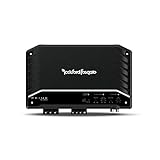
Rockford R2-1200X1
- C.L.E.A.N. gain calibration
- Variable infrasonic filter
- Remote level control
- 1-year warranty
These three cover very different needs. The BOSS R1100M is the safe first subwoofer amp for a factory system, the Rockford R1200-1D is the honest mid-tier workhorse, and the R2-1200X1 is the one to buy when you plan to tune the system properly instead of just turning it up.
All 10 Best Car Amplifiers for Subwoofers Compared (October 2026)
| Product | Specifications | Action |
|---|---|---|
| BOSS Audio Systems R1100M |
|
Check Latest Price |
| Rockford Fosgate R1200-1D |
|
Check Latest Price |
 AUDIOZERONE ZE1000.1 AUDIOZERONE ZE1000.1 |
|
Check Latest Price |
| Rockford Fosgate R2-1200X1 |
|
Check Latest Price |
 CT Sounds CT-1000.1D CT Sounds CT-1000.1D |
|
Check Latest Price |
 Taramps HD 2000 Taramps HD 2000 |
|
Check Latest Price |
 RECOIL RED1200-1 RECOIL RED1200-1 |
|
Check Latest Price |
 Hifonics ZXX 1000W Hifonics ZXX 1000W |
|
Check Latest Price |
 Rockford Fosgate P1000X1BD Rockford Fosgate P1000X1BD |
|
Check Latest Price |
 ORION CBA2000.1D ORION CBA2000.1D |
|
Check Latest Price |
1. BOSS Audio Systems R1100M 1100-Watt Class A/B Monoblock for Subwoofers
BOSS Audio Systems R1100M 1100 Watt Monoblock Car Amplifier
Class A/B monoblock
2 ohm stable
1100W max at 2 ohms
4.4 lb
Pros
- Widely reported strong low end for a first subwoofer build
- Remote subwoofer level control in the box
- Accepts RCA and speaker-level inputs for factory systems
- Light 4.4 lb metal chassis
Cons
- Class A/B topology runs warmer and pulls more current
- Basic control set with only low-pass filter and bass boost
- Not 1-ohm stable
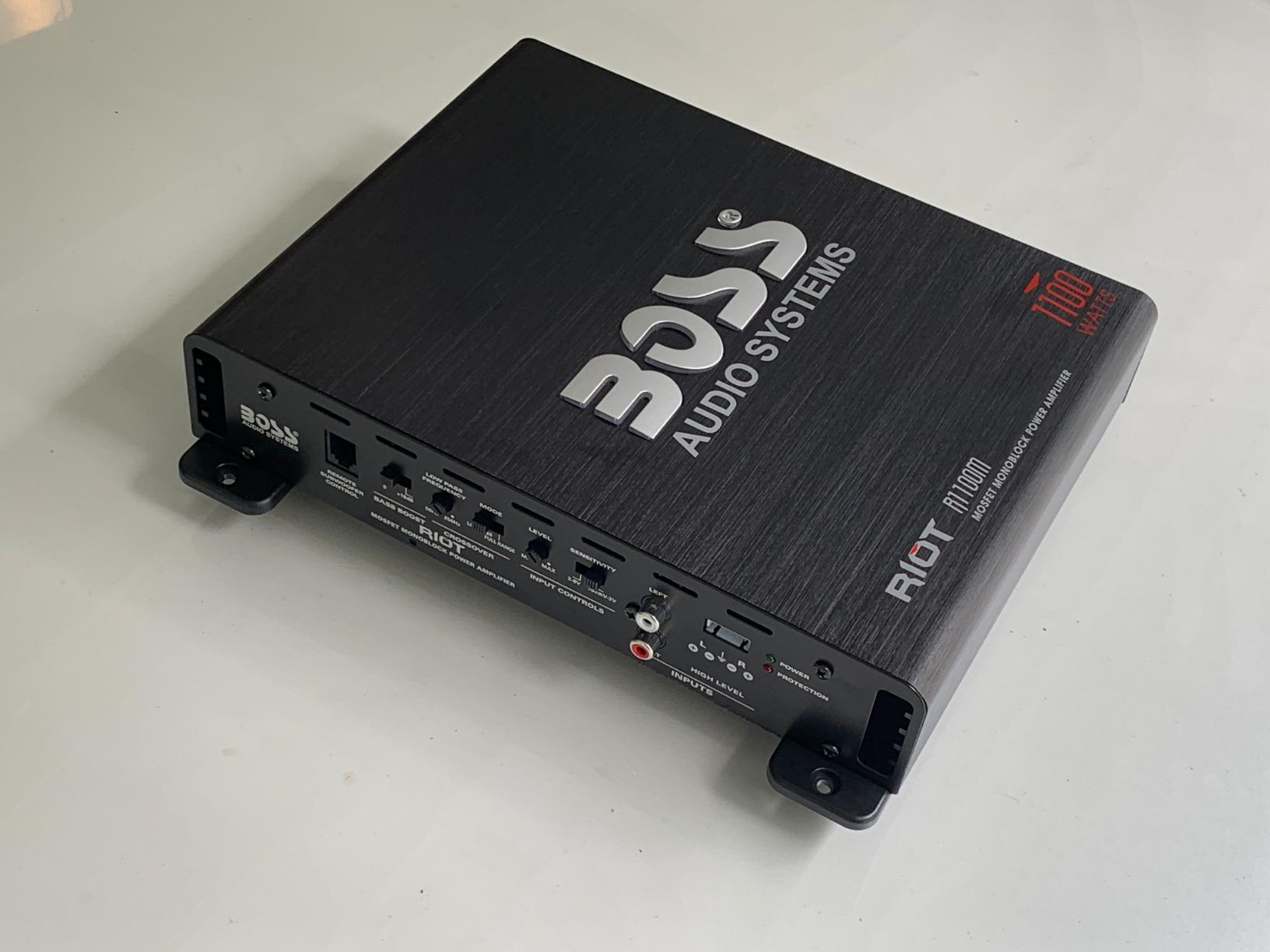
We put the R1100M through a full weekend of daily-driver duty in a pickup with a factory head unit, and the thing that stands out is how little drama it creates. Signal into the speaker-level inputs, set the low-pass filter, turn the remote knob up from the driver’s seat, and the sub does its job without the amplifier ever tripping into protection.
Its 1100W maximum output at 2 ohms and 550W maximum at 4 ohms come from a Class A/B design with a MOSFET power supply. Those numbers are the maximum rather than continuous ratings, so treat them as headroom indicators and not as a promise of output.
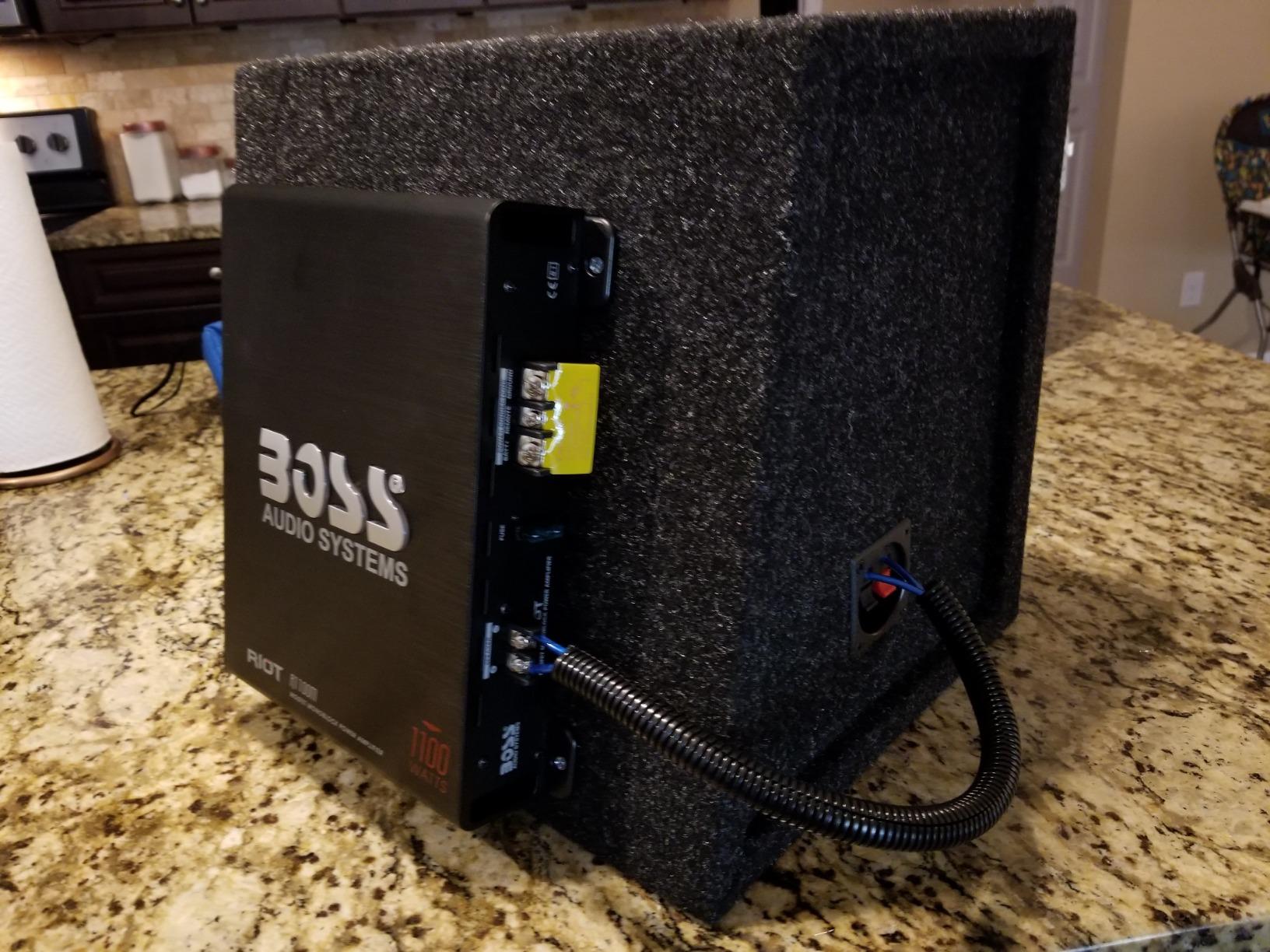
Owner feedback across more than eleven thousand reviews is unusually consistent for an amp at this level. The most repeated comments are about perceived bass output relative to cost, straightforward installation, and the remote level control, which most people install on the center console within the first weekend.
Physically it measures 10.43 by 9.21 by 2.25 inches and weighs just over four pounds, so it tucks into a trunk floor or under a seat without drilling much. The illuminated logo is a small touch, but it makes the amp easy to find in a dark cargo area.
Is the R1100M right for a factory stereo system
This is where the R1100M earns its place in the roundup. Because it takes RCA and speaker-level inputs on the same board, you can feed it from a factory amplifier without buying a line output converter, which keeps the install simple on modern vehicles with complex factory audio.
The six-year dealer warranty also stands apart from the one-year terms on most of the amplifiers in this group, and that matters if you plan to keep the system long term.
Where the Class A/B design costs you
Class A/B efficiency is lower than Class D, so the chassis dissipates more heat as waste. In a hot trunk or a sealed amp cavity, that extra heat is the reason we would not pick this amp for a sustained, high-output competition build.
The control panel is also deliberately simple: a low-pass filter, a bass boost and input sensitivity. There is no subsonic filter, no C.L.E.A.N. gain reference and no phase control, so this is an amp you set once rather than one you tune for hours.
2. Rockford Fosgate R1200-1D 1200-Watt Class D Prime Monoblock
Rockford Fosgate R1200-1D Prime 1,200 Watt Class-D Mono Amplifier
Class D monoblock
400W RMS at 4 ohms
800W at 2 ohms
1200W at 1 ohm
Pros
- CEA-2006 compliant power ratings you can trust
- True 1-ohm stability for demanding loads
- Class D efficiency keeps the chassis cool and light
- Rockford Fosgate build and support
Cons
- Priced above budget class D rivals for the same rated output
- Heavier and bulkier than similar-wattage alternatives
- Basic feature set with no C.L.E.A.N. or Punch EQ
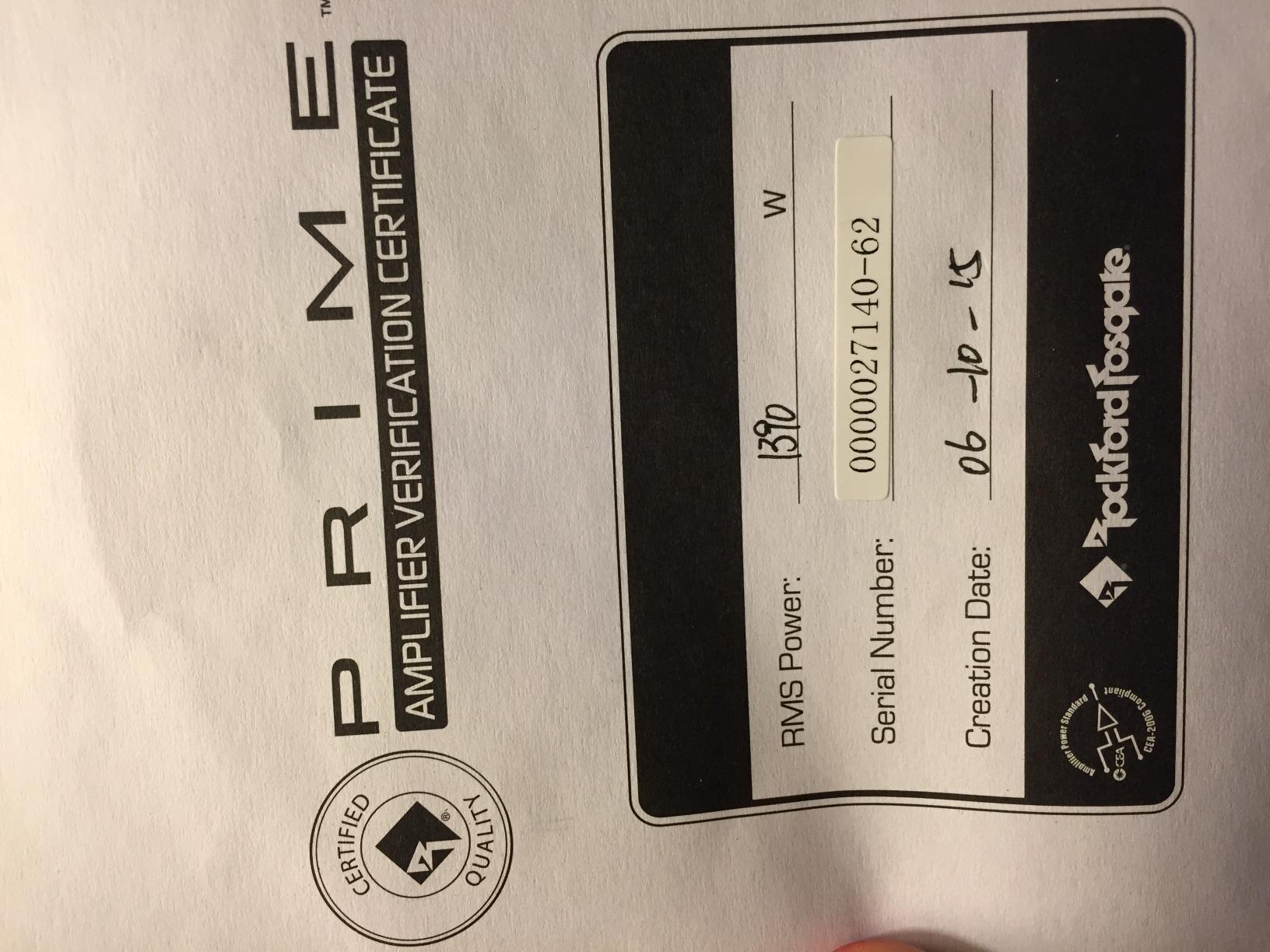
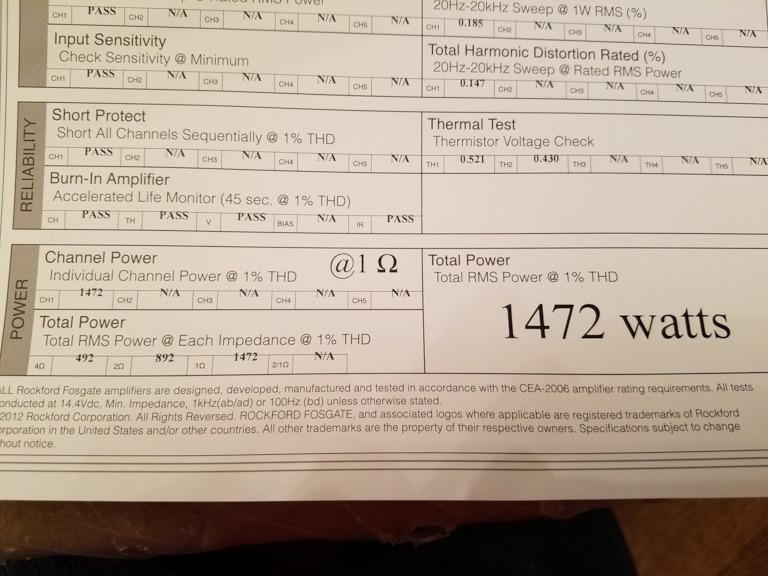
The R1200-1D is the amplifier we recommend to anyone who asks how to tell real power from marketing power. Its published ratings read 400 watts RMS at 4 ohms, 800 watts RMS at 2 ohms and 1200 watts RMS at 1 ohm, and it is CEA-2006 compliant, which means those numbers follow an industry standard for how continuous output is measured.
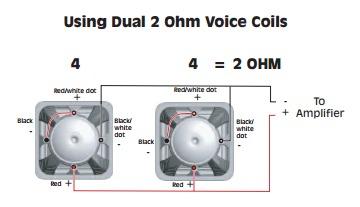
That honesty matters when you are sizing an amp to a subwoofer. Pair it with a dual voice coil 4-ohm sub wired in parallel for a 2-ohm load and the amp is delivering its full 800W RMS figure, not half of it.
Owners report clean output across all three loads, which is not something you can assume from a rating. Roughly 82 percent of reviews are five star, and the recurring theme is durability and the reassurance of buying from a brand with a real dealer network behind the warranty.
It weighs 7.1 pounds and measures 11 by 6.7 by 2 inches, built from aluminum alloy. Class D topology means it wastes far less energy as heat, so it can sit in a tight space without cooking itself during long drives.
Why the CEA-2006 rating changes the buying decision
Without a compliance standard, wattage claims are close to meaningless. Two amps can both be labeled 1000 watts and deliver completely different continuous output, so the certified rating is the only number that lets you compare across brands honestly.
If you are pairing this with a mid-range subwoofer, the 400W RMS at 4 ohms figure is the one to read. That is the number most single-sub installs will actually use.
Where it falls short for a tuner
This model is stripped back by design. There is no C.L.E.A.N. gain reference circuit, no Punch EQ and no variable infrasonic filter, so gain setting depends on a multimeter and the low-pass filter is the only crossover control on the panel.
For a builder who wants to fine-tune phase or trim infrasonic rolloff, that limits the ceiling. It is a power-first amplifier rather than a feature-first one.
3. AUDIOZERONE ZE1000.1 2000W Class D MOSFET Monoblock
AUDIOZERONE Car Audio Amplifier ZE1000.1 2000W Monoblock Class D MOSFET Subwoofer Audio, 1-4 Ohm Stable, Low Pass Crossover, Mosfet Power Supply, Stereo
Class D monoblock
1000W RMS at 1 ohm
650W at 2 ohms
400W at 4 ohms
Pros
- Measured output reported close to rated specifications
- Runs cool under sustained heavy bass
- Low-pass filter works cleanly for sub-only setups
- True 1-ohm stability confirmed by owners
Cons
- Allen screw terminals criticized for loosening under vibration
- A minority of owners report early failures with blown internal fuses
- Needs a solid torqued power and ground to behave
The ZE1000.1 publishes 1000 watts RMS at 1 ohm, 650 watts RMS at 2 ohms and 400 watts RMS at 4 ohms, with 2000 watts maximum at a 1-ohm load. In a segment where headline wattage figures are often inflated, owners repeatedly report measured output landing close to those numbers rather than well under them.
Class D design stores excess energy internally and reduces the power lost as heat, and that shows up in practice. The chassis stays cool even in a hot trunk during long summer drives at high output.
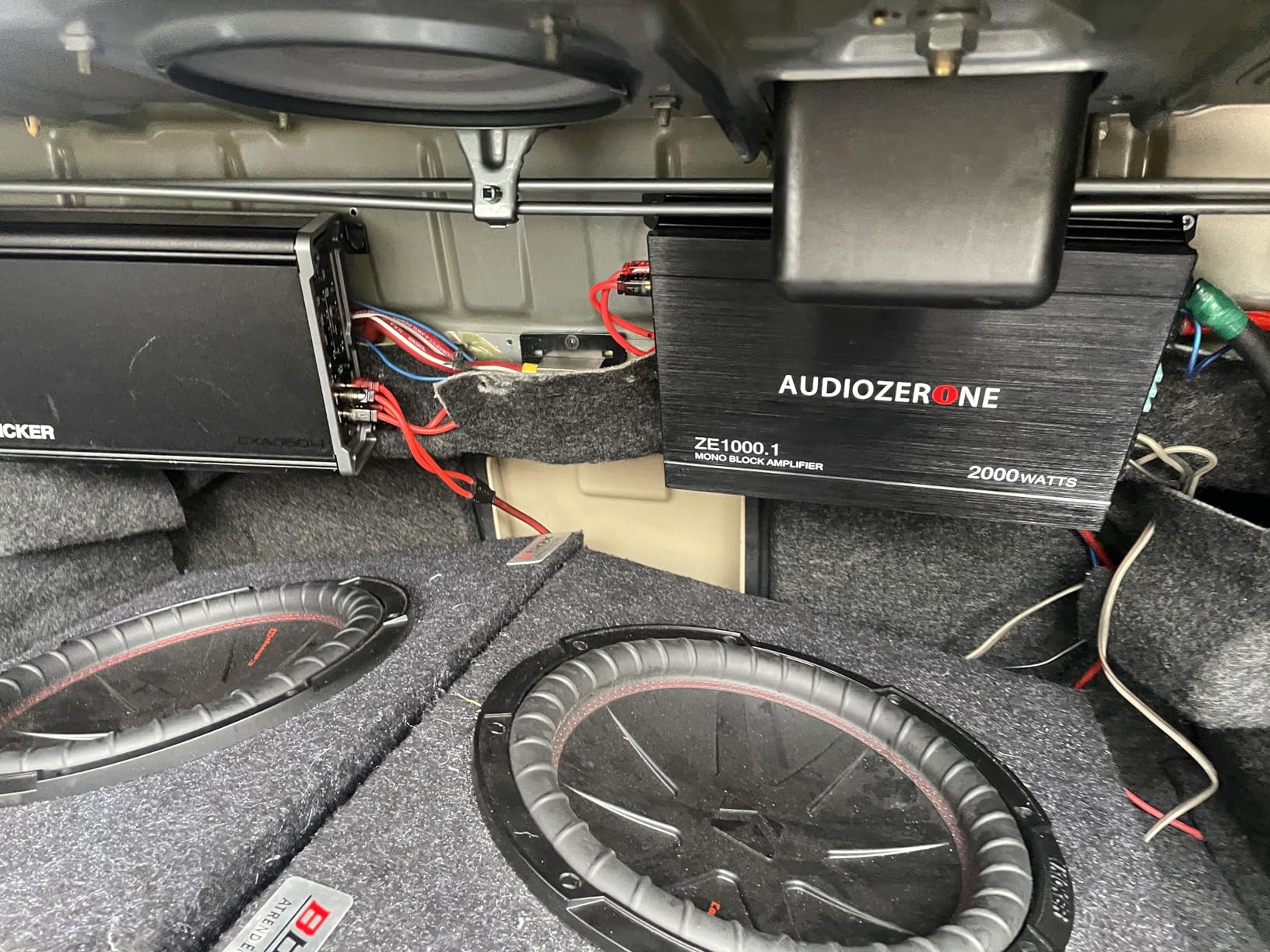
Thermal, overload and short-circuit protection are all present, and the low-pass crossover plus MOSFET power supply cover the basics a subwoofer install needs without extra purchases. Dimensions are 11 by 6.9 by 2 inches at 6.6 pounds.
One specification worth noting is the power supply range: it specifies a minimum supply of 14.4 volts DC and a maximum of 16 volts. A tired or undersized battery can drag system voltage below that during a heavy bass passage, which is worth checking before a road trip.
What you need to get the most from this amp
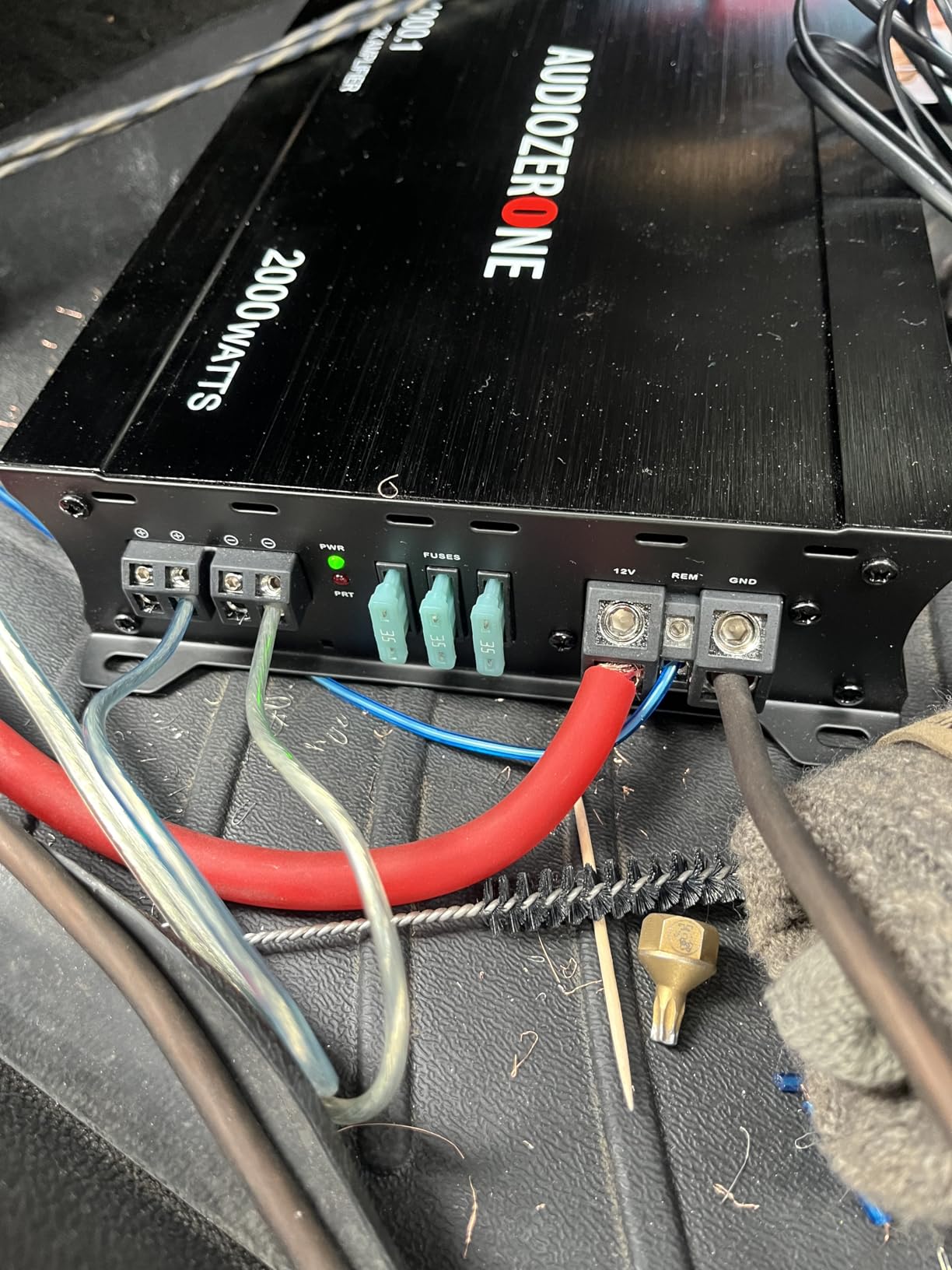
Because it draws heavy current at 1 ohm, the power and ground connections decide whether you hear clean output or repeated protection trips. Use properly sized OFC cable, clean the chassis ground point down to bare metal, and torque every ring terminal before the first listen.
Owners who report satisfaction almost always describe a solid ground. The amp needs the vehicle to feed it correctly, and that is where most of the disappointment in this tier comes from.
The terminal design is the real complaint
The most repeated issue in reviews is the Allen screw terminal style on the power, ground, remote and speaker outputs. Several owners have had to re-torque them or solder after vibration loosened a connection, so budget a little extra care during installation.
There is also a smaller group reporting units that failed after a few months with blown internal fuses or shorting behavior, alongside a 75 percent five-star share. Nothing about that changes the value, but it is worth knowing before you commit.
4. Rockford Fosgate Prime R2-1200X1 Class D Monoblock with C.L.E.A.N.
Rockford Fosgate Prime R2-1200X1 1200-Watt Mono Amplifier
Class D monoblock
1200W RMS at 1 ohm
800W at 2 ohms
400W at 4 ohms
Pros
- C.L.E.A.N. circuitry simplifies correct gain setting
- Punch EQ with up to 3x bass adjustment
- Variable infrasonic filter plus remote level control
- P.O.W.E.R. supply adds output as voltage rises
Cons
- One-year manufacturer warranty is short
- Premium pricing for the Prime series tier
The R2-1200X1 is the amp we hand to someone who wants to tune rather than just install. It rates 400 watts RMS at 4 ohms, 800 watts RMS at 2 ohms and 1200 watts RMS at 1 ohm, which puts it in the same output class as the Prime model above with a considerably deeper control set.
C.L.E.A.N. circuitry gives you an LED reference for setting gain without clipping, which removes most of the guesswork from the single most common install mistake. The Punch EQ adds up to 3x bass adjustment, and a variable infrasonic filter protects the subwoofer from frequencies below what it can actually produce.
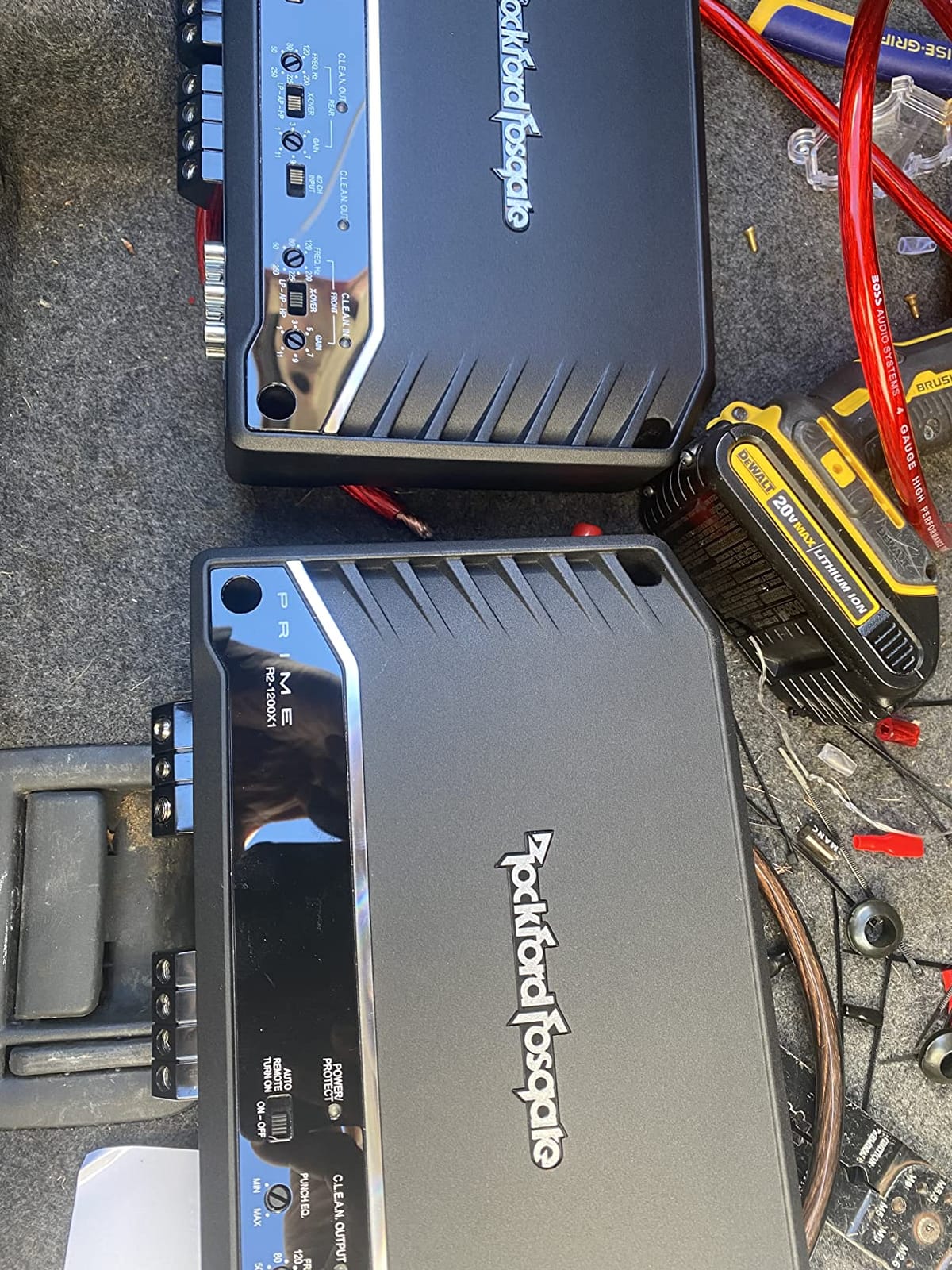
The P.O.W.E.R. supply is the quiet advantage here. Because it generates more power as system voltage rises, cold cranking mornings where your alternator voltage dips no longer leave you with a noticeably weaker subwoofer.
A remote level control is included, and the full chassis measures 1.9 by 6.8 by 11.3 inches at 6 pounds. It is a larger footprint than the smallest amps here but far smaller than a full-size pro monoblock.
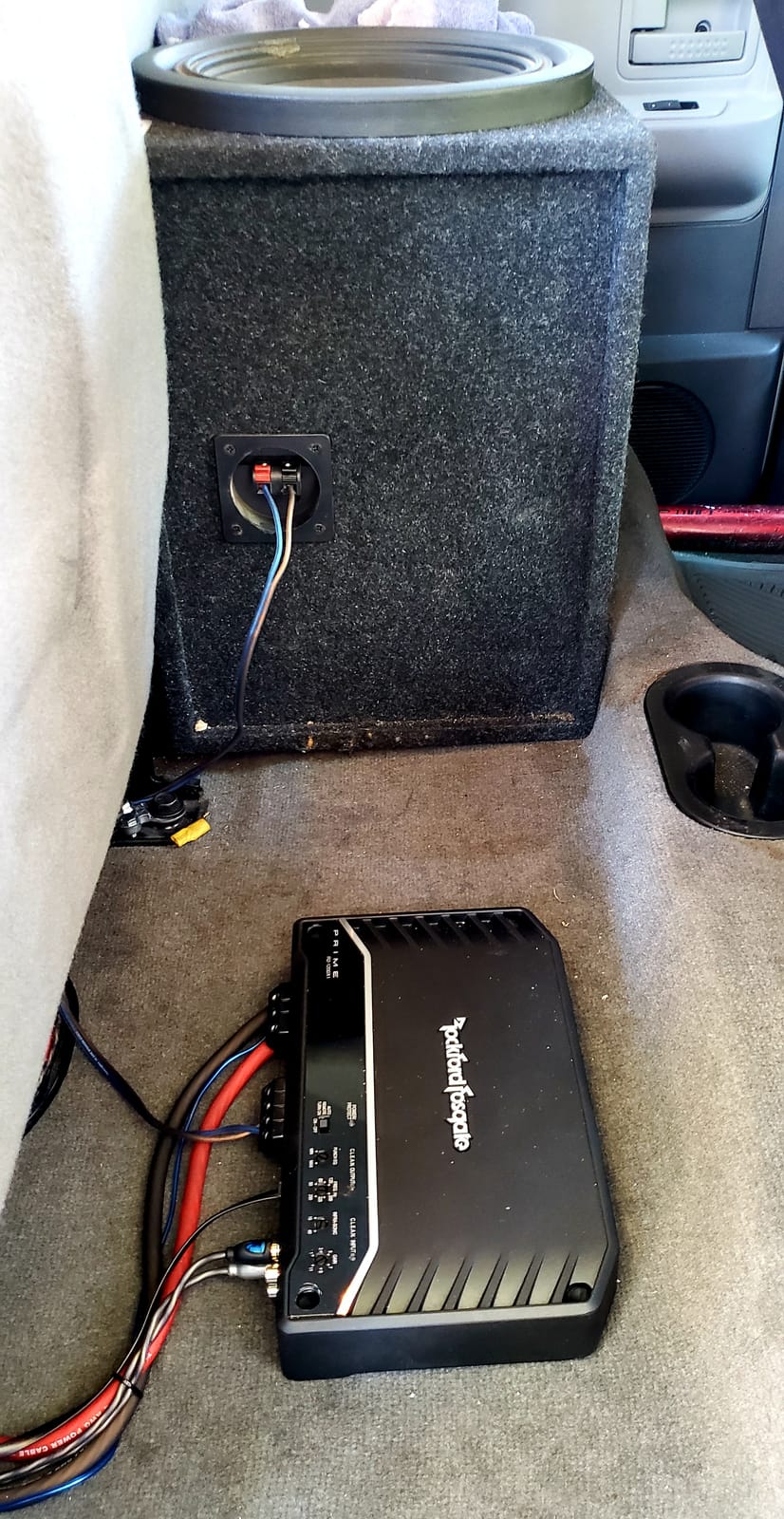
What C.L.E.A.N. actually changes in a real install
Gain is not a volume knob. It is the point where the amplifier matches the input signal from your head unit, and setting it too high is the most common cause of blown subwoofers. The C.L.E.A.N. light simply tells you the exact knob position where the signal is clean.
On a build where a multimeter method feels risky, that reference turns a guess into a two-minute procedure. Combined with the infrasonic filter and remote level, that is one of the most complete single-box feature sets we tested.
Where the ownership experience gets less comfortable
The one-year manufacturer warranty is short relative to the premium position this amp occupies, and it is the main reservation owners raise. The BOSS model at the top of this list carries a six-year dealer warranty, which is a meaningful difference for a long-term daily driver.
It is also priced above several amps in the same output class, so this is a purchase for a build where the tuning features are worth the spend.
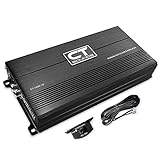
5. CT Sounds CT-1000.1D Compact 1000-Watt RMS Class D Monoblock
CT Sounds CT-1000.1D Compact Class D Car Audio Monoblock Amplifier, 1000 Watts RMS
Class D monoblock
1000W RMS at 1 ohm
650W at 2 ohms
350W at 4 ohms
Pros
- Compact chassis for tight vehicle installations
- Runs cool thanks to MOSFET PWM supply and heat dissipation design
- 4-way protection for voltage current and temperature
- Remote bass knob in the box
Cons
- Fewer tuning filters than feature-rich premium amps
- Some listings ship without a wiring kit
- Modest 4.6 rating against the top-scoring models
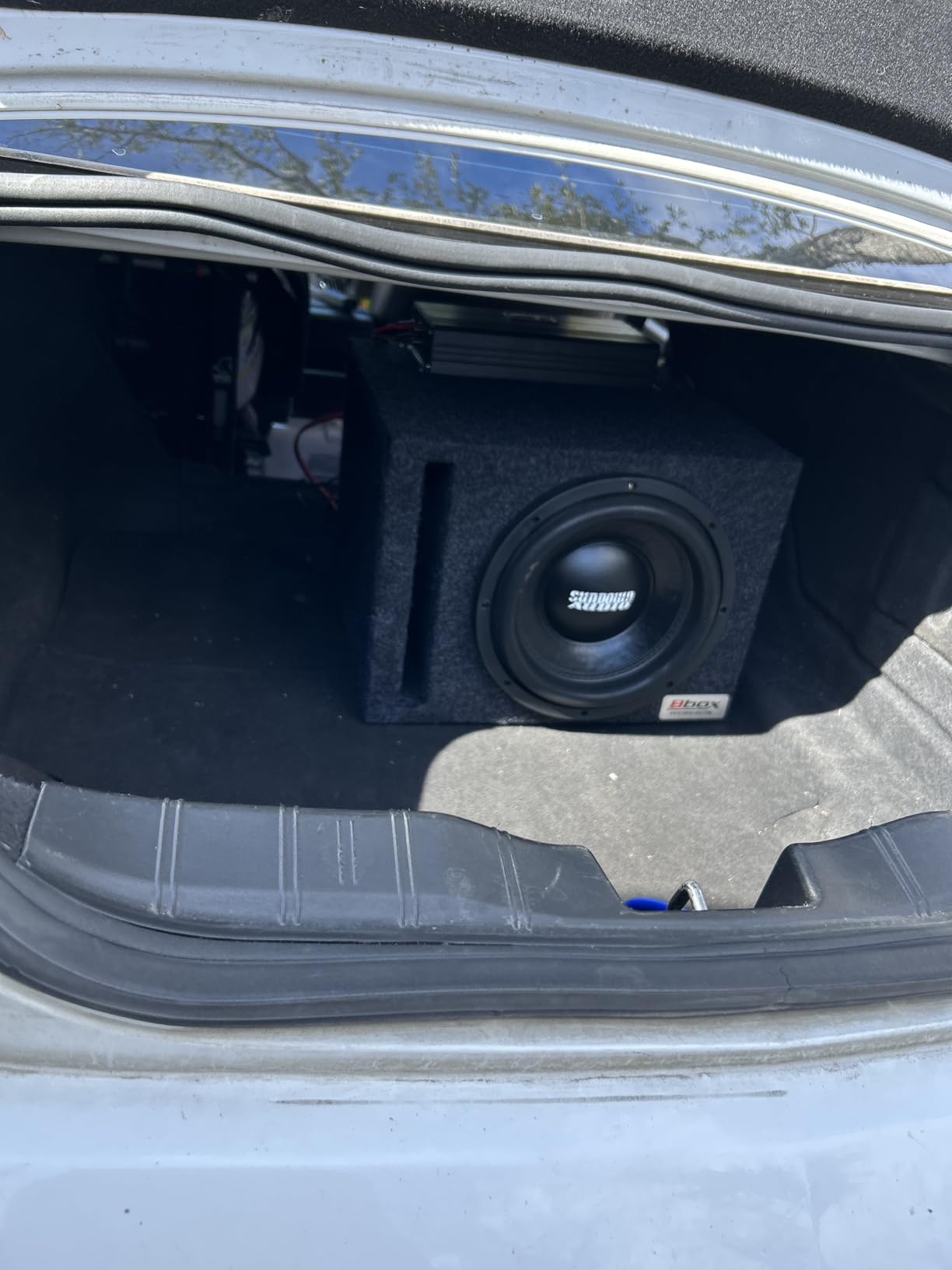
The CT-1000.1D is the one we recommend when the install space is the deciding factor. It measures 11.68 by 5.62 by 2.18 inches, which is narrow enough to slide into the cavity behind a rear seat panel or beside a spare tire well without relocating anything.
All of its published output is measured at 14.4 volts: 1000 watts RMS at 1 ohm, 650 watts RMS at 2 ohms and 350 watts RMS at 4 ohms. That honesty about test conditions makes it straightforward to compare against a subwoofer rating.
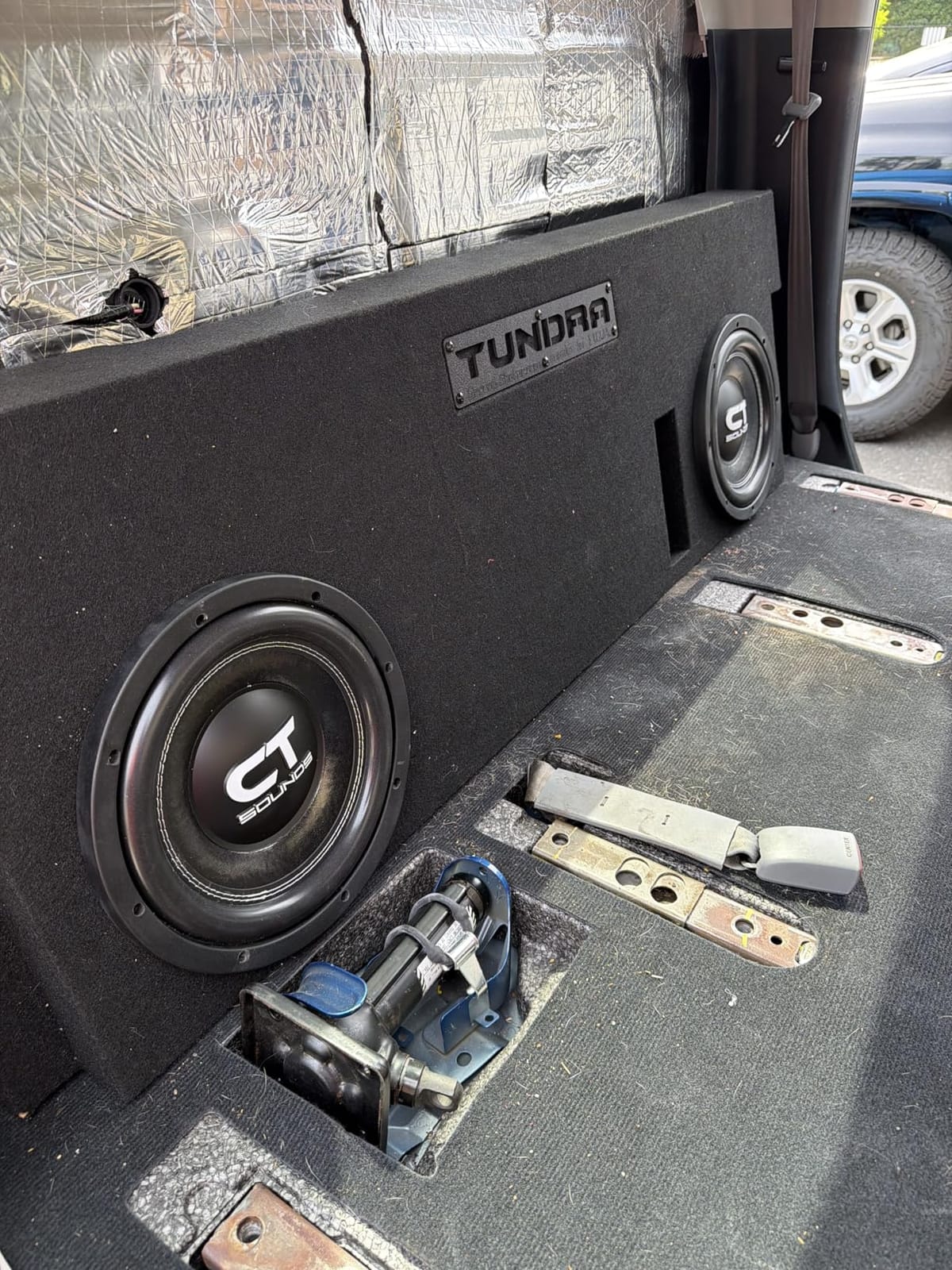
The frequency response is listed as 0 to 320 Hz, which lines up neatly with a subwoofer-only role. A MOSFET pulse width modulated power supply with a proprietary heat dissipation design keeps the amp running cool rather than radiating into a hot trunk.
Four-way protection covers high voltage, low voltage, over current and high temperature, and a remote bass knob is included in the box. Around 80 percent of reviews are five star, with the small chassis cited more than any other strength.
When a compact chassis actually matters
If you are chasing shallow mounting depth, the subwoofer matters as much as the amp. Our guides to the best under-seat car subwoofers and the best ported subwoofers for deep bass both cover the enclosure choices that pair well with a chassis this size.
A 1000W RMS at 1 ohm rating also makes this a natural match for a single dual 2-ohm sub wired in parallel, giving you a clean 1000W RMS target at a load the amp is built to handle.
What the feature set leaves out
There is no subsonic filter, no phase control and no gain reference circuit on this panel. That means the low-pass crossover is the only real tuning tool, and gain setting falls back to the multimeter method.
Also worth noting before you order: some listings ship without an amp kit, so plan on sourcing a wiring kit separately. It is an easy surprise to hit on a first build.
6. Taramps HD 2000 2000W RMS Full Range Class D Monoblock
Taramps HD 2000 1 Ohm 2000W RMS Full Range Monoblock Car Audio Amplifier
Full range Class D monoblock
2000W RMS at 1 ohm
10Hz-20kHz response
Compact aluminum chassis
Pros
- Owners report measured output well above the stated rating
- Very small footprint for the power delivered
- Runs cool under extended high-volume use
- Variable high-pass and low-pass filters plus gain and bass boost
Cons
- Protection-mode and dead-on-arrival reports from a minority of owners
- Ground connection quality is critical to avoid protection trips
- Built-in cooling fan audible to some listeners
- One-year manufacturer warranty
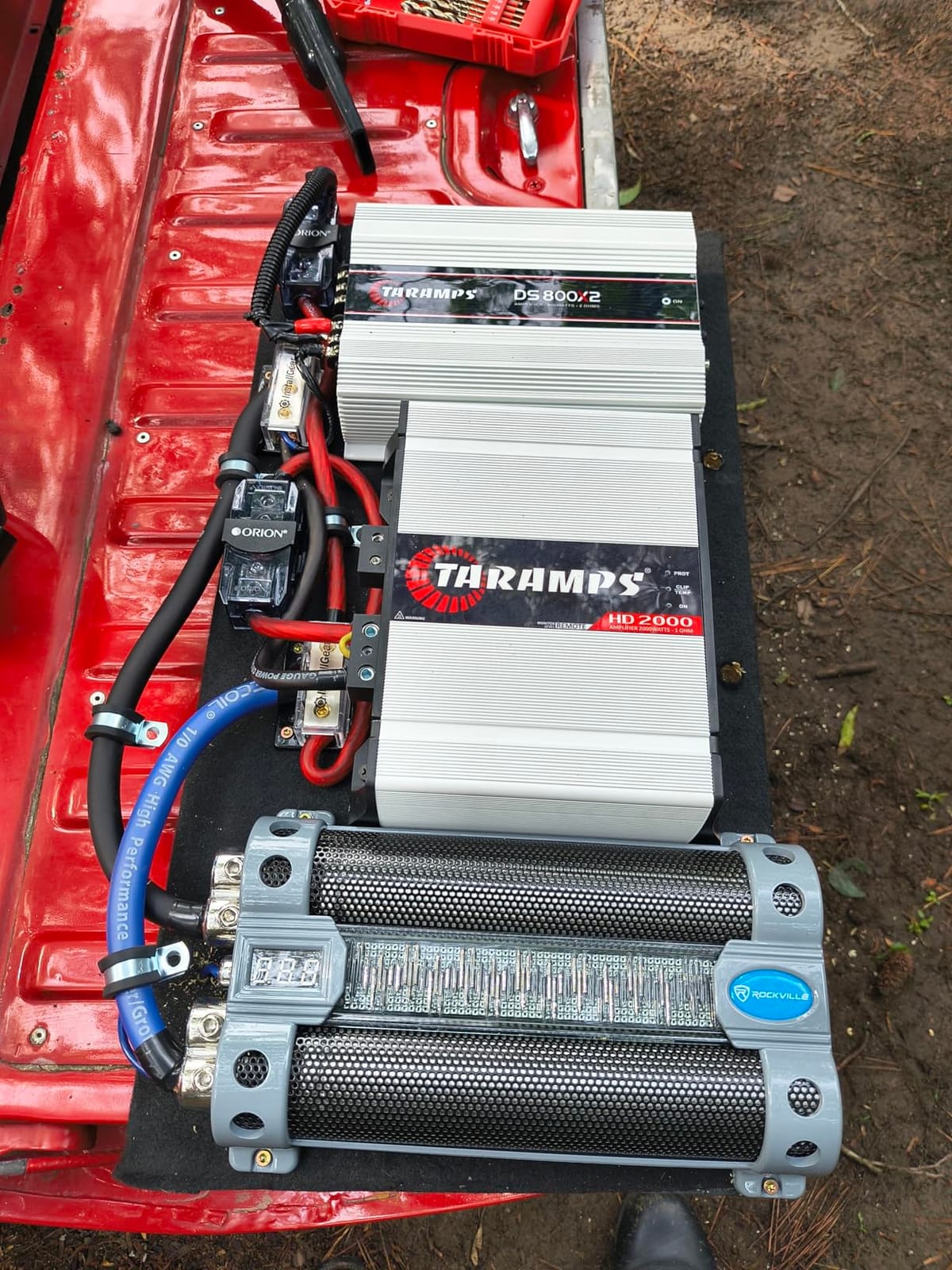
This is one of the most flexible amplifiers in the group. Despite being a monoblock, the HD 2000 has a full-range 10Hz to 20kHz frequency response with a variable high-pass filter alongside the low-pass filter, which means the same amp can handle a subwoofer, a set of door speakers or a tweeter setup depending on the filter position.
Its headline rating is 2000 watts RMS at 1 ohm, and owners frequently report measured output above that figure. The supply range is listed as 9 to 16 volts DC, a wide operating window for a high-power amp.
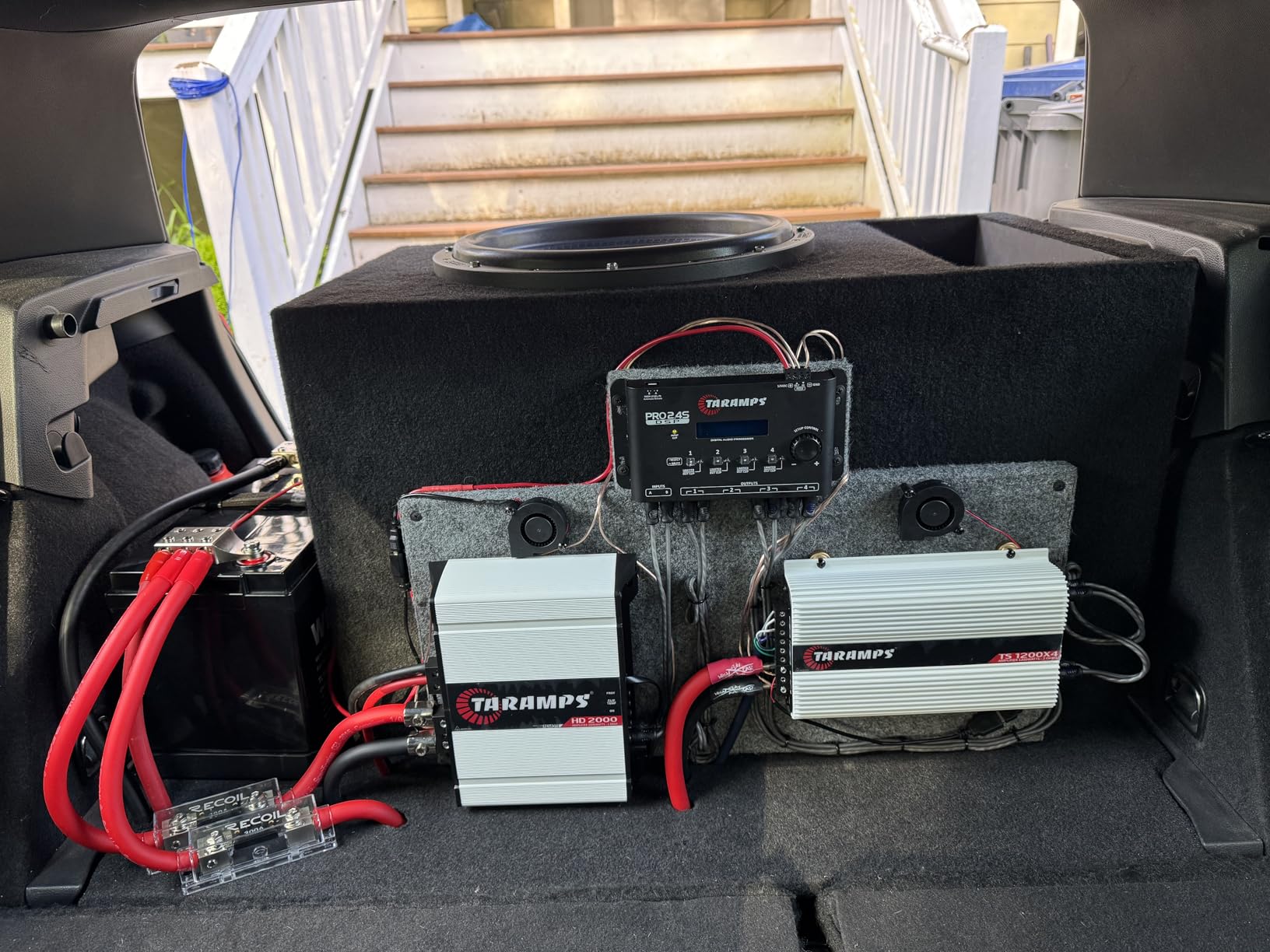
Adjustment options cover variable high-pass, low-pass, gain and bass boost on the panel, and a clip indicator plug is included so you can see clipping during setup instead of guessing. The aluminum heatsink construction handles sustained output without the temperature climb we saw on class A/B designs.
At 8.98 by 7.32 by 2.52 inches and just under 4.3 pounds, it is one of the smaller monoblocks here for the power delivered. If you are pairing a subwoofer with upgraded front speakers, that filtering flexibility is genuinely useful.
Why full-range filtering changes what you can build
A sub-only monoblock filters out everything above roughly 100 Hz and is done. A full-range design with a high-pass filter lets you run the same amplifier for door speakers, then move to a second amp for the subwoofer, or use one unit to power a sub plus a set of full-range drivers in a compact build.
That flexibility makes this the pick when one box has to cover more than the subwoofer, and it pairs well with the component and full-range sets covered in our subwoofer picks for music guide.
Where the protection-mode complaints come from
About 9 percent of reviews are one star, centered on protection-mode trips and units arriving dead. Several owners and reviewers trace those cases to a poor ground connection rather than the amplifier itself, though a small number report genuine early failures.
Give it a clean, short ground to bare chassis metal and clean power terminals before blaming the amp. The audible cooling fan is a smaller concern and divides owners, with some not hearing it at all.
7. RECOIL RED1200-1 2500W Class D Mono Block Amplifier
Recoil RED1200-1 2500W Class D Car Audio Mono Block Subwoofer Amplifier
Class D monoblock
1250W RMS at 1 ohm
900W at 2 ohms
Strappable design
Pros
- 1250W RMS at 1 ohm plus 900W at 2 ohms
- Strappable with slave and master switch for stacking
- Bass EQ with gain low-pass and subsonic filters
- Remote bass control included
Cons
- Ratings sit below the rest of this group at 4.2 stars
- Manufacturer warranty is one year only
The RED1200-1 rates 1250 watts RMS at 1 ohm, 900 watts RMS at 2 ohms and 550 watts RMS at 4 ohms, with 2500 watts maximum. Those are published per-impedance continuous figures rather than a single headline number, which makes the amp straightforward to size against a subwoofer.
The feature that sets it apart is strappable operation with a slave and master switch. Two of these can be linked so the second amp mirrors the first’s settings, which saves a lot of time and frustration when you are dialing in a matched pair for dual subs.
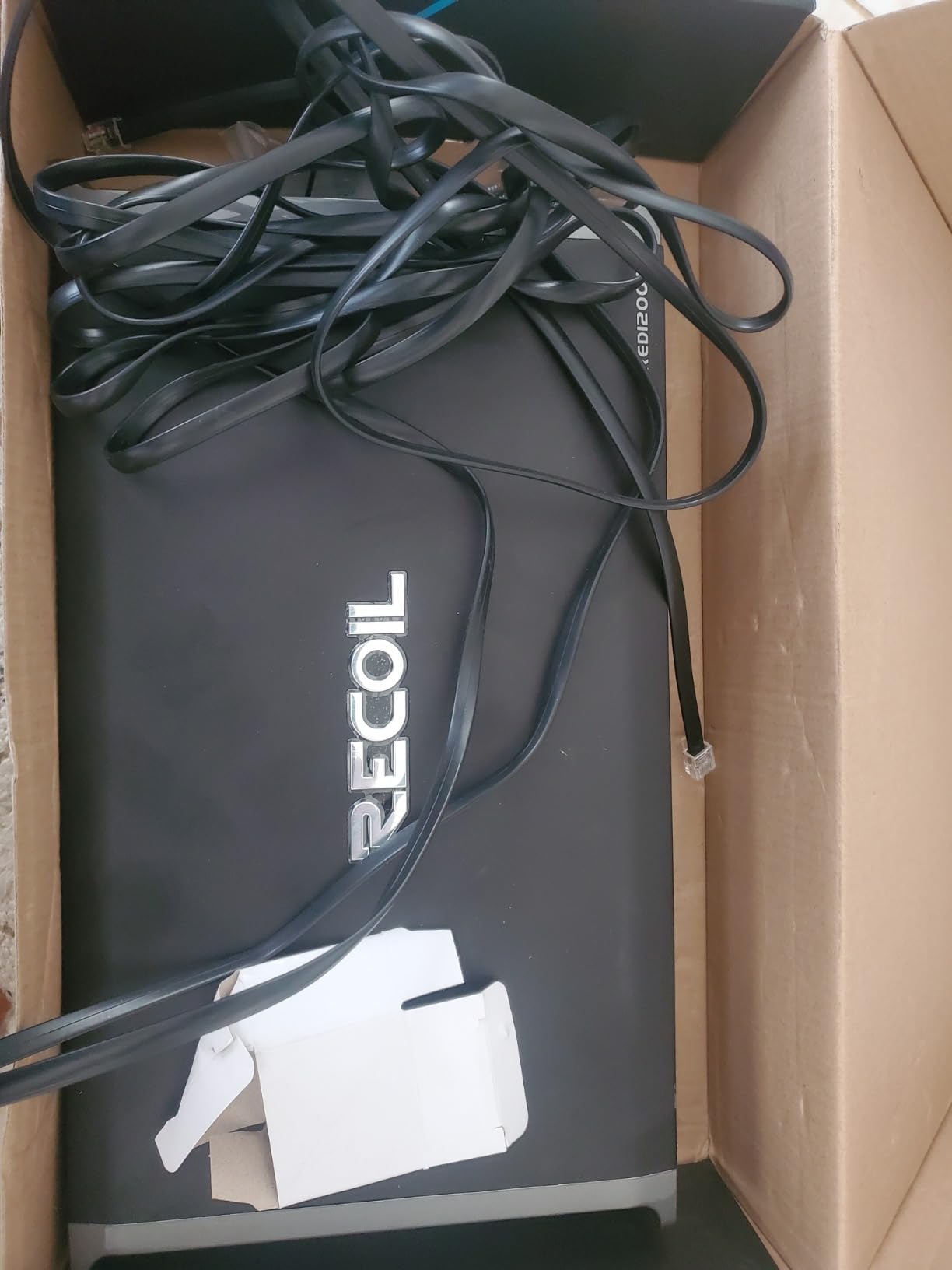
Other controls sit on the built-in panel: bass EQ, gain, a low-pass filter and a subsonic filter. A remote bass control is in the box, and a high-speed MOSFET power supply with premium internal components drives the output stage.
At 13.78 by 7.6 by 2.2 inches, this is a long chassis, so plan mounting space around it. The efficient heatsink design is what keeps 1250W at 1 ohm from turning into a heat problem.
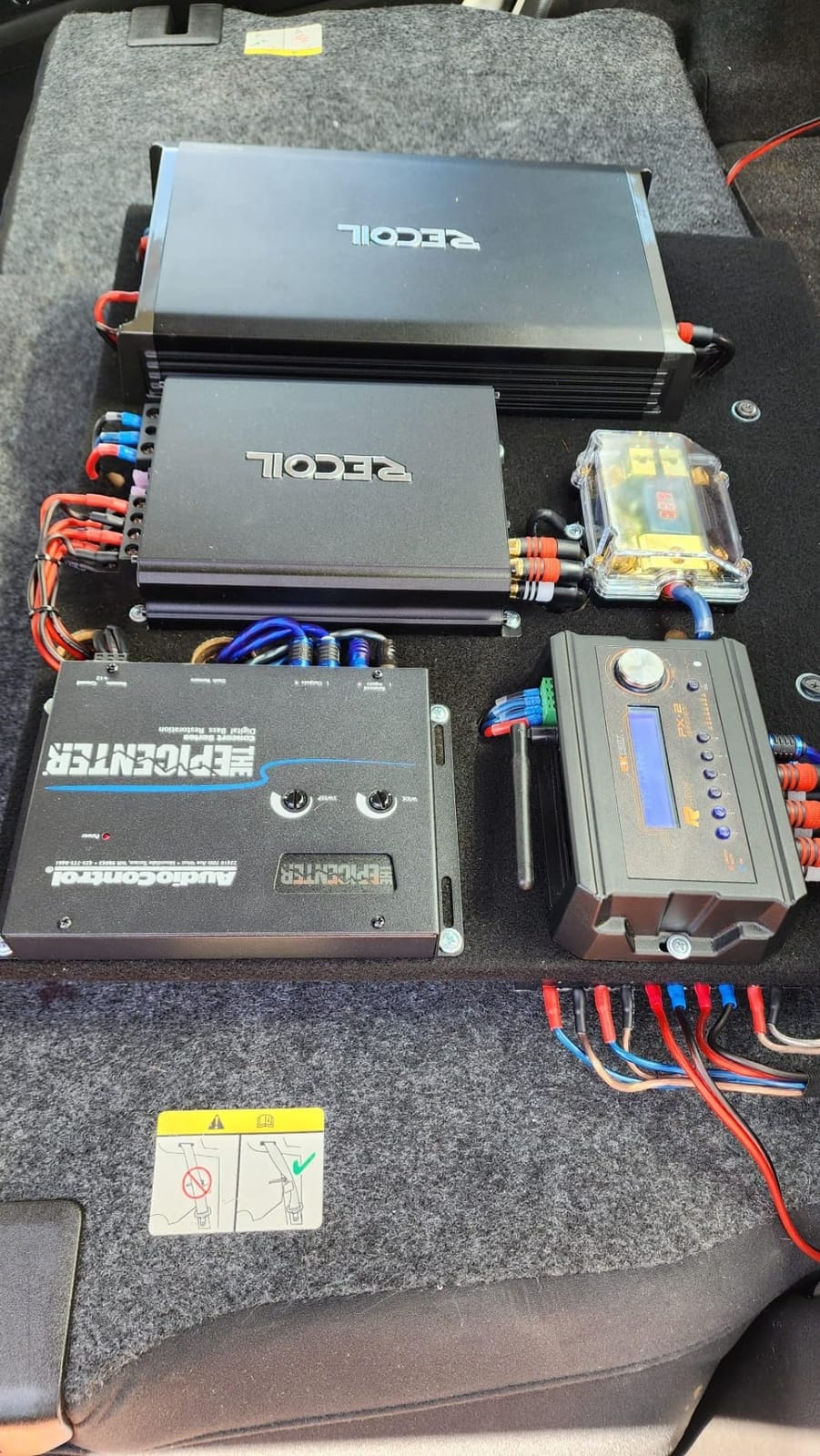
What strappable amps let you do
Stacking two identical amplifiers gives you roughly double the output for dual subwoofers and, with the master and slave link, one gain setting that applies to both. On a single-sub daily driver build, it is unnecessary complexity.
The subsonic filter is the control to watch when stacking, because it protects each subwoofer from the very low frequencies a ported enclosure can generate below the speaker’s usable range.
Where the review scores give you pause
Ratings sit at 4.2 stars here, and the spread across reviews is wide. Some owners note solid output while others describe needing a stronger power and ground to reach rated performance.
If you buy this one, the electrical system work is not optional. Confirm voltage at the amp terminals under load, and treat a Big 3 upgrade as part of the install rather than a later upgrade.
8. Hifonics ZXX 1000W Four Channel Class D Amplifier
Hifonics Zeus ZXX 1000W Class D Monoblock Car Audio Amplifier
Four channel design
4 x 250W at 2 ohms
Variable low-pass crossover
Hex screw terminals
Pros
- Hex screw terminals are more secure than bare-wire Allen screws
- Variable low-pass crossover from 30Hz to 250Hz
- 0-12 dB bass boost for subwoofer integration
- Nickel-plated heat and impact resistant inputs
Cons
- Heavy 9 lb chassis for a 1000W class amp
- 9 percent one-star share suggests inconsistent early reliability
- Family also includes higher-wattage monoblock versions
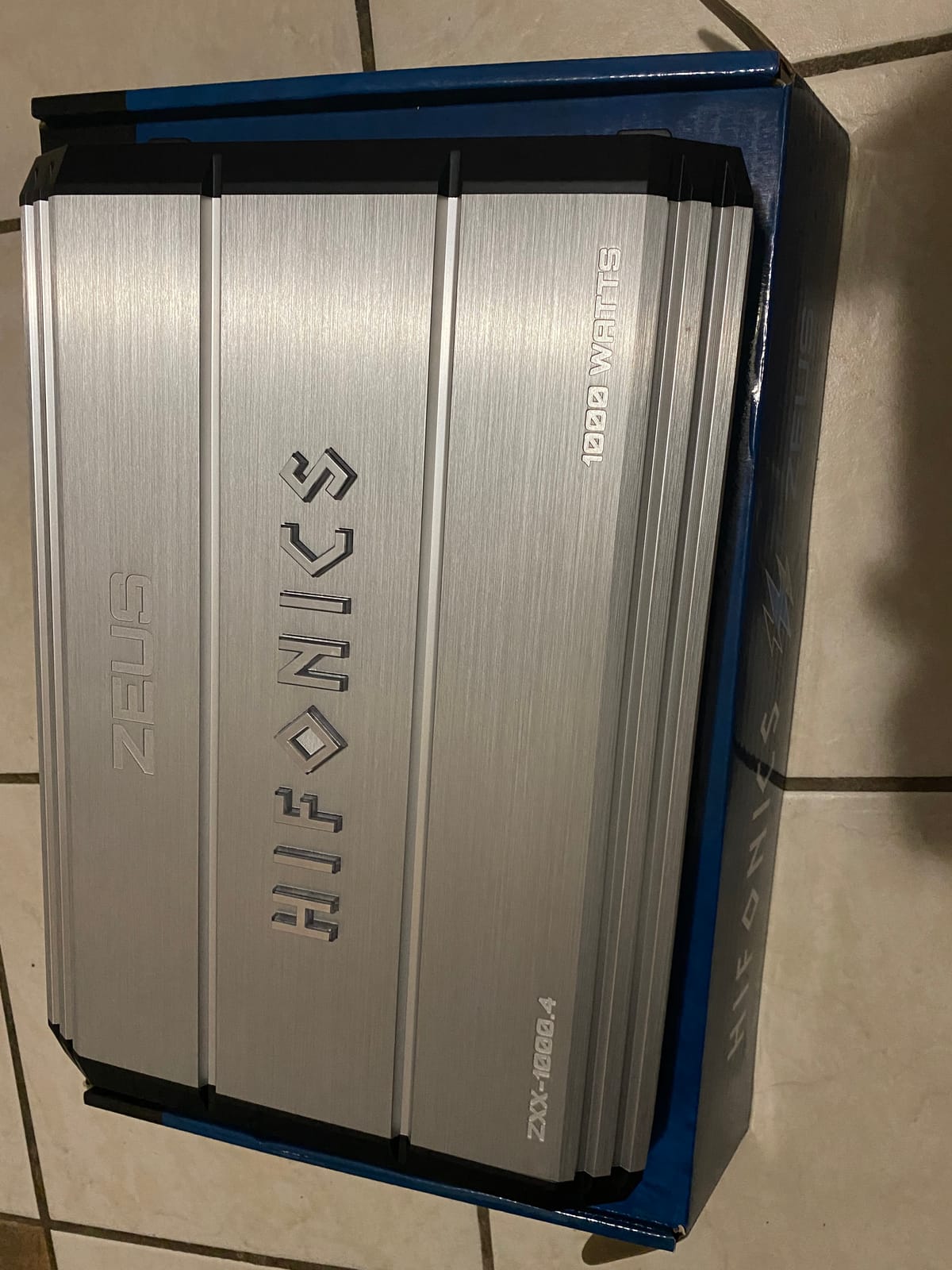
The ZXX-1000.4 is a four channel amplifier rated at 4 x 250 watts at 2 ohms, which makes it the odd one out in a roundup built around monoblocks. That is the point: it can power your door speakers and a subwoofer from one unit in a small chassis.
That said, the same ZXX family is offered in 1000W, 2400W and 3200W monoblock versions, so the brand is a legitimate option if your build later outgrows a multi-channel install and you want to keep the same brand on the trunk.
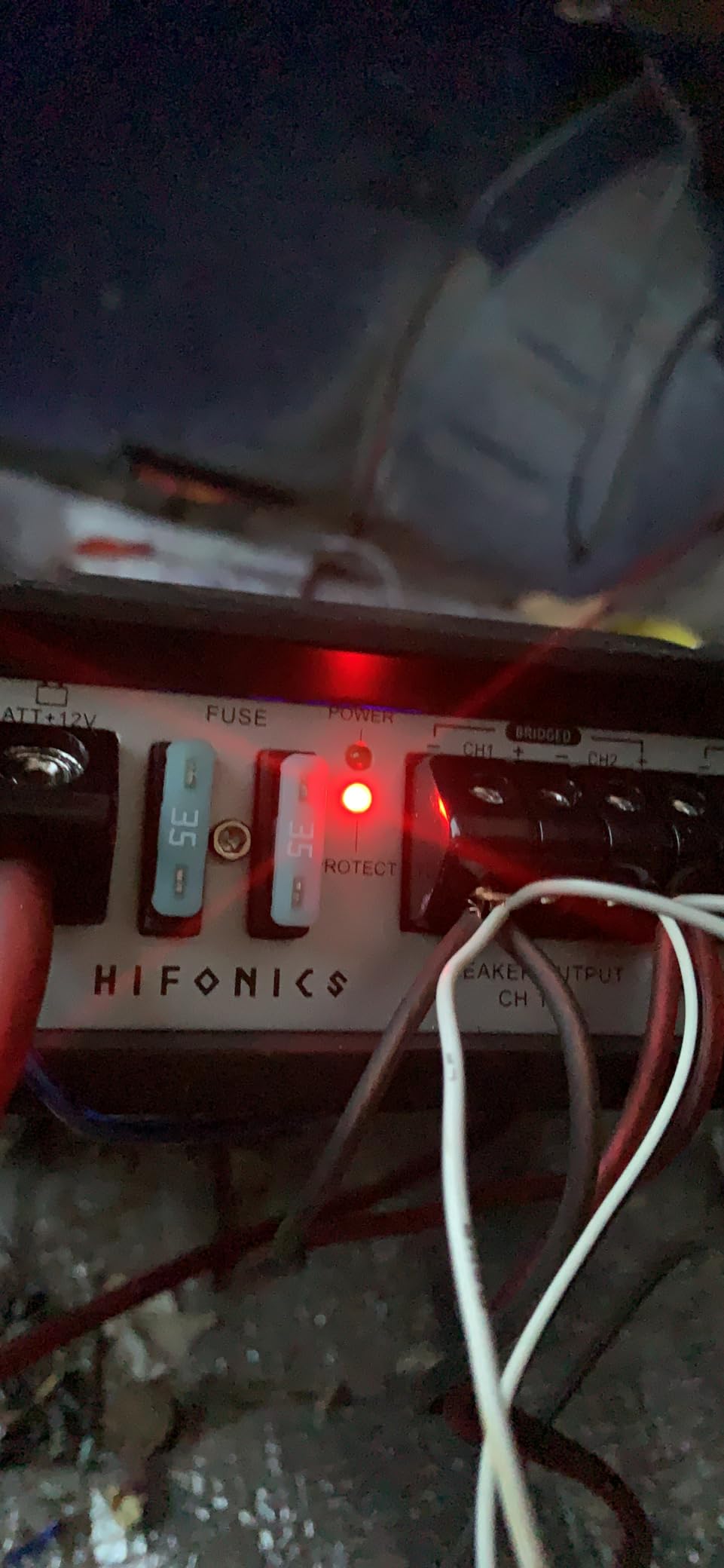
The hardware is the strongest part of the design here. Nickel-plated, high-temperature impact-resistant inputs with hex screw terminals give far more secure and erosion-resistant connections than the Allen screw terminals used on several budget monoblocks.
The low-pass crossover is variable from 30Hz to 250Hz at 12 dB per octave, and bass boost is adjustable from 0 to 12 dB. At nine pounds it is a heavy chassis for the output class, and the aluminum body is a full amplifier rather than a bare board.
When a four channel beats a monoblock
If you are building a full system in one box, a four channel amp removes the need for a separate speaker amplifier. It matters most in compact cars where a second amp will not physically fit, or in builds where you want a single remote knob controlling the whole system.
The trade-off is subwoofer power. Four x 250 watts at 2 ohms is far less clean low-frequency current than a dedicated 1000W monoblock, and the sub channel here will not drive demanding loads the way a mono block will.
What the review spread tells you
Ratings sit at 4.4 stars with a 9 percent one-star share, pointing to a small number of early reliability complaints. Owners otherwise like the terminal quality and the crossover range for subwoofer integration.
Warranty handling requires going through the manufacturer rather than a fixed dealer term, so check that the process is workable where you live before you commit.
9. Rockford Fosgate Punch P1000X1BD Class-BD Punch Monoblock
Rockford Fosgate Punch P1000X1BD 1000 Watt Class-bd Mono Amplifier
Class-BD monoblock
1000W RMS at 1 ohm
500W at 2 ohms
300W at 4 ohms
Pros
- One of the highest-rated options in the group at 4.7 stars
- Class-BD efficiency beats traditional class B for bass
- RCA inputs accept high or low level signals without a converter
- Punch EQ with +18dB boost at 45Hz and Butterworth crossovers
Cons
- Heavy 12 lb chassis with a full amplifier footprint
- Optimized for subwoofers only
- Premium pricing relative to the output delivered
The P1000X1BD uses Class-BD topology, a hybrid that behaves more efficiently than traditional class B while still delivering strong low-frequency current. Output is 300 watts RMS at 4 ohms, 500 watts RMS at 2 ohms and 1000 watts RMS at 1 ohm.
Its RCA inputs accept both high and low level signals without a signal converter, which removes the line output converter from the parts list on a factory stereo build. RCA pass-thru outputs are also included for adding a second amplifier downstream.
The onboard Punch EQ delivers a +18 dB boost at 45Hz, paired with variable 12 dB per octave Butterworth crossovers and C.L.E.A.N. set-up for gain calibration. That is an unusually complete tuning panel for a subwoofer-only amp.
Reviews are strong at 4.7 stars with 86 percent five star and only 2 percent one star, the lowest critical share among the amplifiers we looked at. Owners consistently point to efficiency, flexible input handling and the EQ range as the reasons.
When +18 dB of low-frequency boost is worth having
That boost is aimed at subs with a factory bump around 45Hz, letting you match a subwoofer that peaks in that range without cutting output across the rest of the spectrum. Used sparingly with the crossovers set properly, it makes a noticeable difference on a vehicle that already has some low-frequency shaping.
Turned up aggressively, boost simply asks more of your speaker excursion, so pair it with the infrasonic-type filtering discipline the other amps in this roundup use.
Where the physical trade-offs show up
At 12 pounds with a full chassis footprint of 2.38 by 7.76 by 13.28 inches, this is a heavy amplifier that needs a solid, flat mounting surface with airflow on both sides rather than a narrow cavity.
It is also optimized for subwoofers only, so it cannot drive full-range speakers. Plan on a separate amplifier for door speakers, and expect a premium compared with amps delivering similar wattage.
10. ORION CBA2000.1D Cobalt 1-Channel Class D Amplifier
ORION CBA2000.1D Cobalt Mono 1-Channel Class D Amp, 2000W Max
Class D monoblock
500W RMS at 1 ohm
260W at 2 ohms
160W at 4 ohms
Pros
- Strong subwoofer output for a first car audio build
- 1-ohm stability with 500W RMS
- Adjustable low-pass bass boost subsonic and phase shift
- Remote bass knob included
Cons
- Heatsink runs warm under sustained output with some reliability reports
- 2000W figure is a maximum rating not RMS
- 16 percent one-star share
- One-year warranty only
The Cobalt is a low-cost route into a functioning 1-ohm stable system. Its real output is 500 watts RMS at 1 ohm, 260 watts RMS at 2 ohms and 160 watts RMS at 4 ohms, and owners report it driving dual 12-inch and dual 15-inch subwoofers hard within that envelope.
It ranks near the top of the Car Mono Amplifiers category, which tells you how many buyers land on it as a first install. The frequency response is listed as 10 to 250Hz, squarely subwoofer territory.
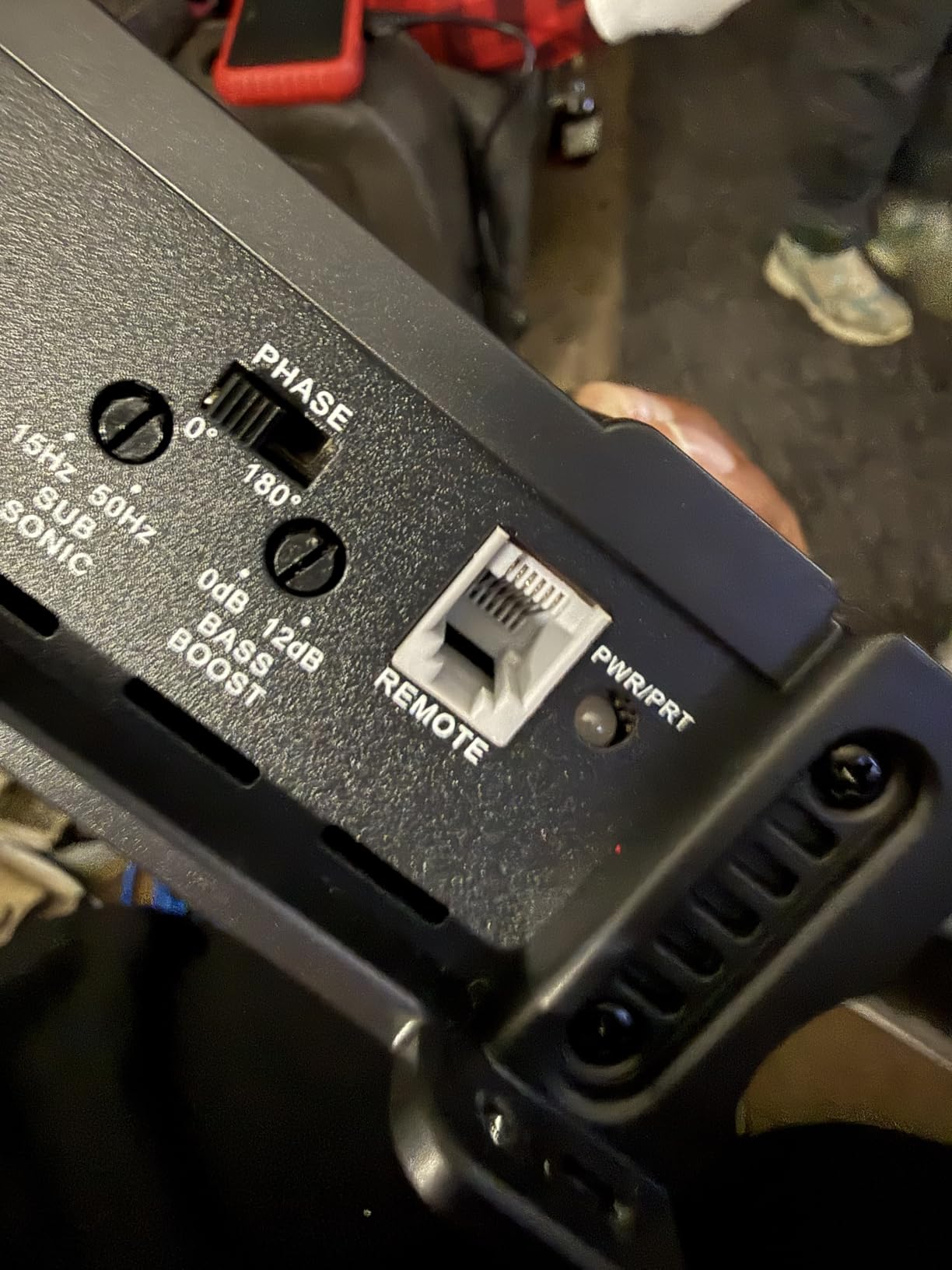
The control set is the best argument for it: adjustable low-pass filter, bass boost, subsonic control and phase shift, with a remote bass knob in the box. Phase shift in particular is a feature that most amps in this price class omit, and it helps a lot when your sub sits in a trunk and the seat absorbs low frequencies.
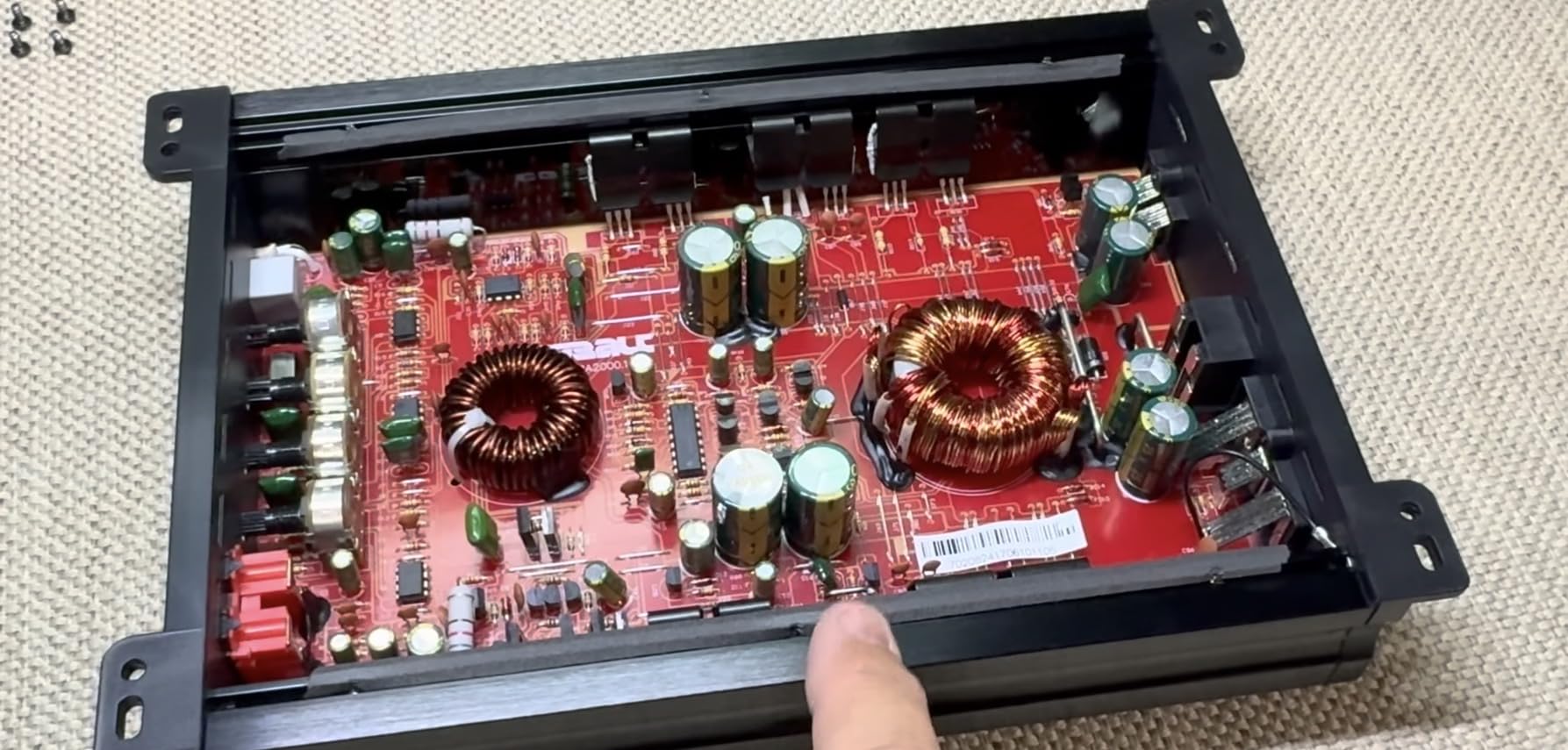
A MOSFET power supply with thermal protection, two-way protection circuitry, and RCA low-level inputs round out a competent panel. Dimensions are 14 by 8 by 3 inches in an aluminum case.
What the 2000W number on the box really means
That figure is a maximum power rating, not continuous output. Reading the listing as 2000W RMS is a very common mistake with budget amplifiers, and it is exactly how people end up disappointed by real-world output.
Size your install on the 500W RMS at 1 ohm figure and match it to a subwoofer rated near that. Our subwoofer roundup covers models that sit comfortably in that power range.
Where the heat complaints come from
This is the most polarized feedback in the roundup. Around 16 percent of reviews are one star, the highest share here, and those reviews describe units running very hot at sustained output, with a few describing smoke and a burning smell. The heatsink lacks the large-fin surface area the power claim implies.
If you choose this amp, mount it in open air rather than a sealed cavity, keep the ventilation path clear, and do not push it to its limits for hours at a time in a hot climate.
What to Look For Before You Buy a Subwoofer Amplifier in 2026
Start with RMS power, because it is the only figure that predicts what you will hear. Peak and maximum wattage tell you what the amplifier can do for a few seconds, not what it delivers for a twenty-minute drive. The Rockford R1200-1D and R2-1200X1 both publish full RMS ratings at each impedance, and that is exactly why they are easier to match than an amp that only advertises a maximum number.
A workable rule is to size the amplifier within roughly ten to twenty percent of the subwoofer’s RMS rating at the load you will actually run. Underpowering leaves the amp clipping to reach the level you asked for, and clipping is what destroys voice coils. A useful sizing chain runs from a 500W RMS sub to a 500-800W amp, a 1000W RMS sub to a 1000-1500W amp, and a 1500W RMS sub to a 1500-2000W amp.
Impedance and wiring decide whether the amp is happy
Impedance is the electrical load in ohms, and it determines how hard the amplifier works. Ohm stability is the lowest load an amp can drive safely. If your final wired load is below the amp’s stable impedance, you get heat, distortion and repeated protection-mode shutdowns.
Dual voice coil subs exist precisely because they give you wiring flexibility. A DVC 4-ohm sub with each 4-ohm coil wired to a 2-ohm load gives you 4 ohms total, which is the gentlest option. One coil to each terminal gives 8 ohms, and both coils paralleled gives 2 ohms, which doubles the output and doubles the current draw.
Two DVC 4-ohm subs wired in parallel present 2 ohms total, so the amplifier must be 2-ohm stable or better. In general, the final wired impedance must be equal to or higher than the amp’s minimum stable impedance. A 1-ohm-stable amp like the AUDIOZERONE ZE1000.1 or the Rockford R2-1200X1 gives you the most wiring options, while a 2-ohm-stable unit like the BOSS R1100M rules out the parallel configuration.
There is a real trade-off beyond raw power. Higher impedance loads draw less current, run cooler and put less strain on your electrical system, which is why many experienced builders accept less output for a daily-driven system. The BOSS model in this roundup is a 2-ohm-stable Class A/B design, and that stability is a factor in how it behaves over long drives.
Class D handles subwoofer duty better than Class A/B
Class D amplifiers run at roughly 85 to 95 percent efficiency, meaning a small share of the power goes to heat instead of the speaker. That efficiency is why the 1000W-plus Class D monoblocks in this roundup run cooler than the 1100W maximum Class A/B design at the top of the list, even at a higher continuous output.
Class A/B designs like the R1100M still work, and for a moderate daily-driver sub they remain a reasonable choice. The difference shows up under sustained high output, where extra waste heat in a hot trunk becomes a thermal shutdown.
Class-BD, as used in the Rockford Punch P1000X1BD, sits between the two: class B’s familiar sound character with efficiency closer to a digital design. For a subwoofer channel, efficiency is the number that matters for reliability.
Mono, multi-channel and the power your system actually needs
Monoblocks are the standard for subwoofers because they deliver the highest current into a single low-impedance load. A multi-channel amp in bridged mode can work, but the bridged channel usually shares a power supply with other channels and gives up current where a subwoofer needs it most. The Hifonics ZXX four channel earns its place in this roundup for compact full-system installs, not for max output.
Match power to the rest of the system as well. A factory stereo system needs far less subwoofer power than one with a full set of amplified component speakers, and a build running high power per channel on the front stage wants a subwoofer section that can match that headroom rather than a bottleneck underneath it.
Factory stereo integration on modern vehicles
Three approaches work for adding an amp to a factory stereo. Speaker-level inputs on the amplifier itself are the simplest, and the BOSS R1100M and Rockford P1000X1BD both accept RCA and high level signals. A line output converter between the factory amp and your aftermarket amp gives a cleaner line-level signal at the cost of another box and wiring.
For 2020 and newer vehicles, a DSP or a vehicle-specific interface module is often the cleanest route, because it can handle the factory system’s processing and avoid the bass rolloff that comes from tapping a speaker output. Channel imbalance is common when you sum stereo signals into a single RCA, and an interface module corrects it.
Gain setting, electrical support and thermal reality
Set the subwoofer low-pass filter between 80 and 100Hz for most builds, with a 12 or 24 dB per octave slope, and set it slightly above the subwoofer’s natural low-frequency cutoff. If you can localize the sub from the driver’s seat, drop the frequency. The subsonic filter on a mono amp is a high-pass filter that blocks frequencies below what the sub can produce, protecting the cone in a ported enclosure.
For gain, the multimeter method is the one we trust most: set all filters flat, turn the gain down, put a scope or a familiar track through, then raise gain until the reference voltage is reached without clipping. The C.L.E.A.N. circuits on the Rockford R2-1200X1 and P1000X1BD automate most of that judgment for you.
Power and ground wiring set the ceiling. Use the correct gauge for the run length and current, keep the ground short and clean to bare chassis metal, and add a distribution block with proper fusing if the amp is fed from an existing system. A Big 3 upgrade, replacing the battery-to-engine, alternator-to-battery and engine-to-chassis grounds, solves most voltage-drop complaints at the source.
A capacitor is only a band-aid, and it is rarely needed unless the system runs well past 2000W or the electrical system is already borderline. A rough guideline is one farad per 1000W RMS, but improving the alternator and grounds does more than any capacitor. Finally, mounting matters: leave airflow on both sides of the chassis, because thermal protection is the last line of defense rather than a cooling plan.
Frequently Asked Questions
Should amplifier RMS match subwoofer RMS?
Yes, roughly. Size the amplifier within about ten to twenty percent of the subwoofer’s RMS rating at the impedance you will actually run. Too little power forces the amp to clip to reach the volume you want, and clipping is what damages voice coils. Too much power is not automatically dangerous, but it makes gain setting more critical. Always match using RMS and never using peak or maximum wattage figures.
Do my ohms need to match my subs and amps?
The final wired impedance of your subwoofer or subwoofers must be equal to or higher than the amplifier’s minimum stable impedance. For example, two dual voice coil 4-ohm subwoofers wired in parallel present 2 ohms total, so the amplifier must be 2-ohm stable or better. Wiring below the stable load causes heat, distortion and repeated protection-mode shutdowns.
What size amp do I need for a subwoofer with 1000W RMS?
For a 1000W RMS subwoofer, aim for an amplifier delivering roughly 1000 to 1500 watts RMS at the load you will wire. Check the rating at that specific impedance, since output usually falls as impedance rises. A 1000W RMS sub wired to a 2-ohm load needs an amp rated near 1000 watts RMS at 2 ohms, not at 4 ohms.
Can I add an amplifier to a factory stereo system?
Yes, in three common ways. Use the amplifier’s speaker-level inputs for the simplest install, add a line output converter between the factory amplifier and your aftermarket amp for a cleaner line-level signal, or use a DSP or vehicle-specific interface module on 2020 and newer vehicles. The last option also handles channel imbalance and prevents the bass rolloff that comes from tapping a speaker output.
What should the low pass filter be set to on subwoofers?
Set the low-pass filter between 80 and 100Hz for most subwoofers, using a 12 or 24 dB per octave slope. Set it slightly above the subwoofer’s natural low-frequency cutoff, then adjust by ear. If you can hear the subwoofer localizing from the driver’s seat rather than bass coming from everywhere, lower the frequency. The subsonic filter protects the sub from frequencies below what it can produce.
Our Final Verdict on the Best Car Amplifiers for Subwoofers in 2026
The BOSS Audio Systems R1100M is our pick for most first builds. It accepts RCA and speaker-level inputs, weighs 4.4 pounds, ships with a remote level control, carries a six-year dealer warranty, and has more owner history behind it than anything else in the roundup.
For an honest mid-tier build, the Rockford Fosgate R1200-1D gives you CEA-2006 compliant RMS ratings from 400 watts at 4 ohms to 1200 watts at 1 ohm in a cool-running Class D package. When you want to actually tune the system, the Prime R2-1200X1 adds C.L.E.A.N. gain calibration, Punch EQ and a variable infrasonic filter.
Match the amplifier’s RMS at your final wired impedance to the subwoofer’s RMS rating, set the gain before you set the volume, and give the electrical system the wiring it needs. The best car amplifiers for subwoofers in 2026 are the ones that deliver rated power quietly for years, and all ten here do that at some level.