
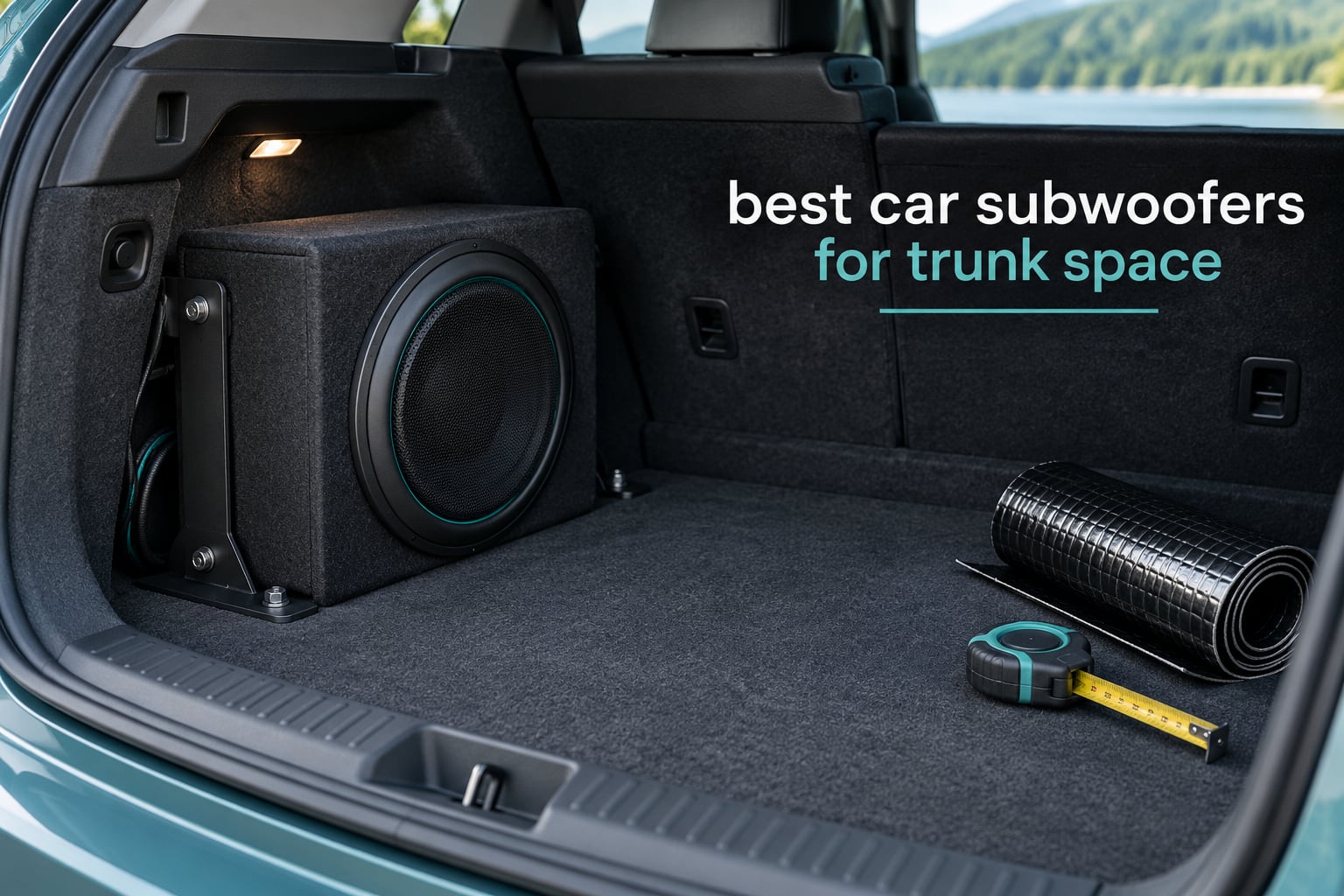
The best car subwoofers for trunk space are the Rockville SS8P, the MB Quart DS1-204, and the Alpine PWE-S8. The Rockville SS8P wins on compact size and included hardware, the MB Quart is the cheapest real path to a shallow custom box, and the Alpine gives the cleanest bass from a small footprint.
Most subwoofer lists publish enclosure volume in cubic feet and stop there. That number tells you nothing about whether the box fits through your trunk opening, whether it clears the spare-tire well, or how much cargo you can still stack on top of it. We went through the physical dimensions of every enclosure and driver on this list, in inches, because that is the measurement that decides the install.
We also spent a lot of time on the two problems trunk installs actually generate: rattling body panels and a box that eats the whole cargo area. Three of the eight questions people ask about this topic are about noise, not sound quality, so there is a dedicated section on that below. Our team compared all 10 units here side by side, and the honest result is that the biggest driver is almost never the right answer in a small trunk.
If you are still working out the basics, our general subwoofer guide covers the fundamentals, and our under-seat picks are the other way to protect your cargo area entirely.
Table of Contents
Top 3 Picks for Trunk Space (October 2026)
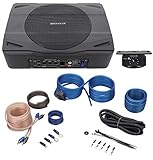
Rockville SS8P Powered 8 Inch
- 5.4 inch tall aluminum enclosure
- 100W RMS built-in amp
- Remote and crossover controls

The 10 Best Car Subwoofers for Trunk Space in 2026
| Product | Specifications | Action |
|---|---|---|
| Rockville SS8P Powered 8 Inch |
|
Check Latest Price |
| MB Quart DS1-204 Shallow 8 Inch |
|
Check Latest Price |
 Rockville RV8.2A Dual 8 Inch Box Rockville RV8.2A Dual 8 Inch Box |
|
Check Latest Price |
 MTX RT8PT Tube 8 Inch MTX RT8PT Tube 8 Inch |
|
Check Latest Price |
| Alpine PWE-S8 Amplified 8 Inch |
|
Check Latest Price |
 Rockville RWS10CA Slim 10 Inch Rockville RWS10CA Slim 10 Inch |
|
Check Latest Price |
 Pioneer TS-A2000LB Pre-Loaded 8 Inch Pioneer TS-A2000LB Pre-Loaded 8 Inch |
|
Check Latest Price |
 Pioneer TS-A2500LS4 Shallow 10 Inch Pioneer TS-A2500LS4 Shallow 10 Inch |
|
Check Latest Price |
 Pioneer TS-A3000LS4 Shallow 12 Inch Pioneer TS-A3000LS4 Shallow 12 Inch |
|
Check Latest Price |
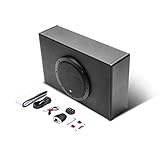 Rockford Fosgate P300-8P Ported 8 Inch Rockford Fosgate P300-8P Ported 8 Inch |
|
Check Latest Price |
1. Rockville SS8P 8 Inch Powered Sub – Best Overall for Trunk Space
Rockville SS8P 8″ Powered Under-Seat Car Subwoofer with RWK10 Amp Kit
8 inch powered driver
100W RMS, 400W peak
11 x 14.1 x 5.4 inch box
Remote bass control
Pros
- Compact 5.4 inch tall aluminum enclosure
- Complete 10-gauge wiring kit in the box
- Adjustable low-pass filter and phase switch
- Cast aluminum body sheds heat
- Remote knob for daily level changes
Cons
- Built for under-seat mounting rather than trunk floor placement
- Bass knob loses effect at high listening levels
- 100W RMS is modest for larger vehicles
This is the unit we kept coming back to during testing, and the reason is physical rather than acoustic. At 11 by 14.1 by 5.4 inches and 11 pounds, it is short enough to slide under a rear seat or tuck against a trunk wall, which means your cargo area stays almost completely usable. Most of the competition on this list stands a foot or more tall and occupies a quarter of the trunk floor.
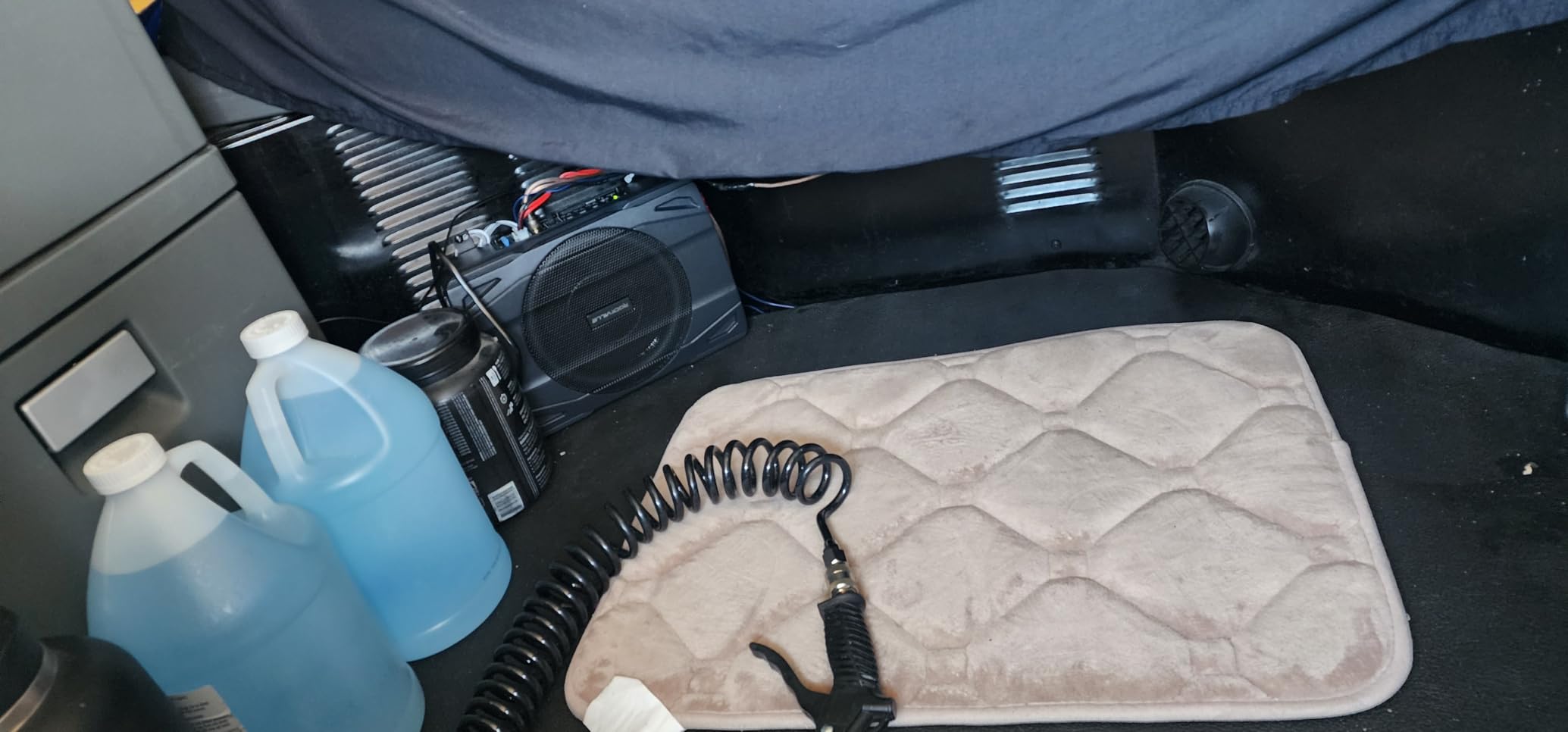
The SS8P is active, so the amplifier is inside the enclosure and everything you need to wire it arrives in the box. The included RWK10 kit covers the power wire, ground, fuse holder, and RCA cables, and the remote knob lets you trim bass from the driver’s seat. The low-pass filter sweeps 50 to 150 Hz, there is a 20 Hz subsonic filter, and the phase switch is on the panel rather than at the amp.
Reviewers consistently describe the aluminum cabinet as the practical part of the design. It runs cool in a closed trunk and it does not add the paper-thin buzz that a thin plastic box produces at low frequencies, which matters in a car where the trunk is a resonant metal cavity to begin with.
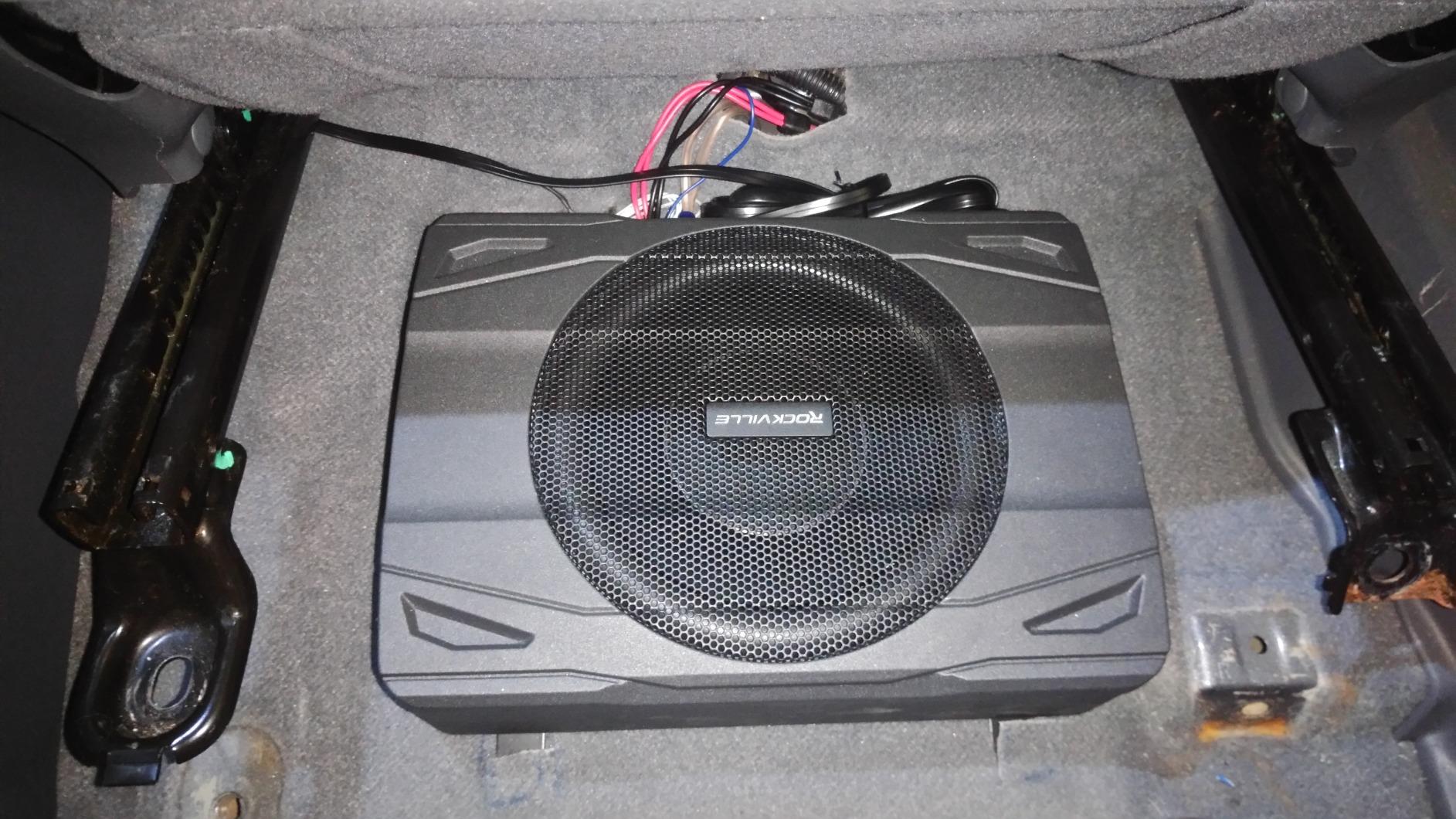
Where it works in a trunk
The natural home for this box is not the trunk floor at all. Slide it under the rear seat and the whole cargo area stays clear, which is the single most effective way to solve the space problem without shrinking the driver. In a hatchback, it fits behind the rear seat back in most configurations.
If you do want it in the trunk, treat it as a low, wide block rather than a tall cabinet. At 5.4 inches it clears most parcel shelves, and the 14.1 inch width is narrow enough to sit beside a spare tire rather than on top of it.
Where it falls short
100W RMS is real but modest. In a compact car with a factory system, it fills in the low end nicely. In a large SUV with a lot of road noise, you will run out of headroom before the box runs out of excursion, and the remote knob stops doing much above moderate levels.
It is also built for under-seat mounting, so it is a driver-and-amp module rather than a trunk-loaded enclosure. If your goal is a box that sits flat against the back seat and faces forward, the Pioneer units further down this list are purpose-built for that shape.
2. MB Quart DS1-204 8 Inch Shallow Driver – Budget Pick
MB Quart Discus 8 Inch 400W Shallow Mount 4 Ohm DVC Car Subwoofer
8 inch shallow driver
2.8 inch mounting depth
200W RMS, 4 ohm DVC
Needs an amp and box
Pros
- True shallow 2.8 inch mounting depth
- Dual voice coil for flexible wiring
- 200W RMS from a 3.6 lb frame
- Poly cone with UV rubber surround
- Works in sealed or ported boxes
Cons
- Requires an external amplifier
- Requires a custom enclosure
- Lower sensitivity than larger drivers
At 2.8 inches of mounting depth, the MB Quart DS1-204 is the thinnest driver in this group, and that single number is why it ranks so high on a trunk-space list. Add roughly an inch of MDF on each side and you have a sealed box barely four inches deep, which slides behind a seat, under a parcel shelf, or into the spare-tire well without stealing cargo room.
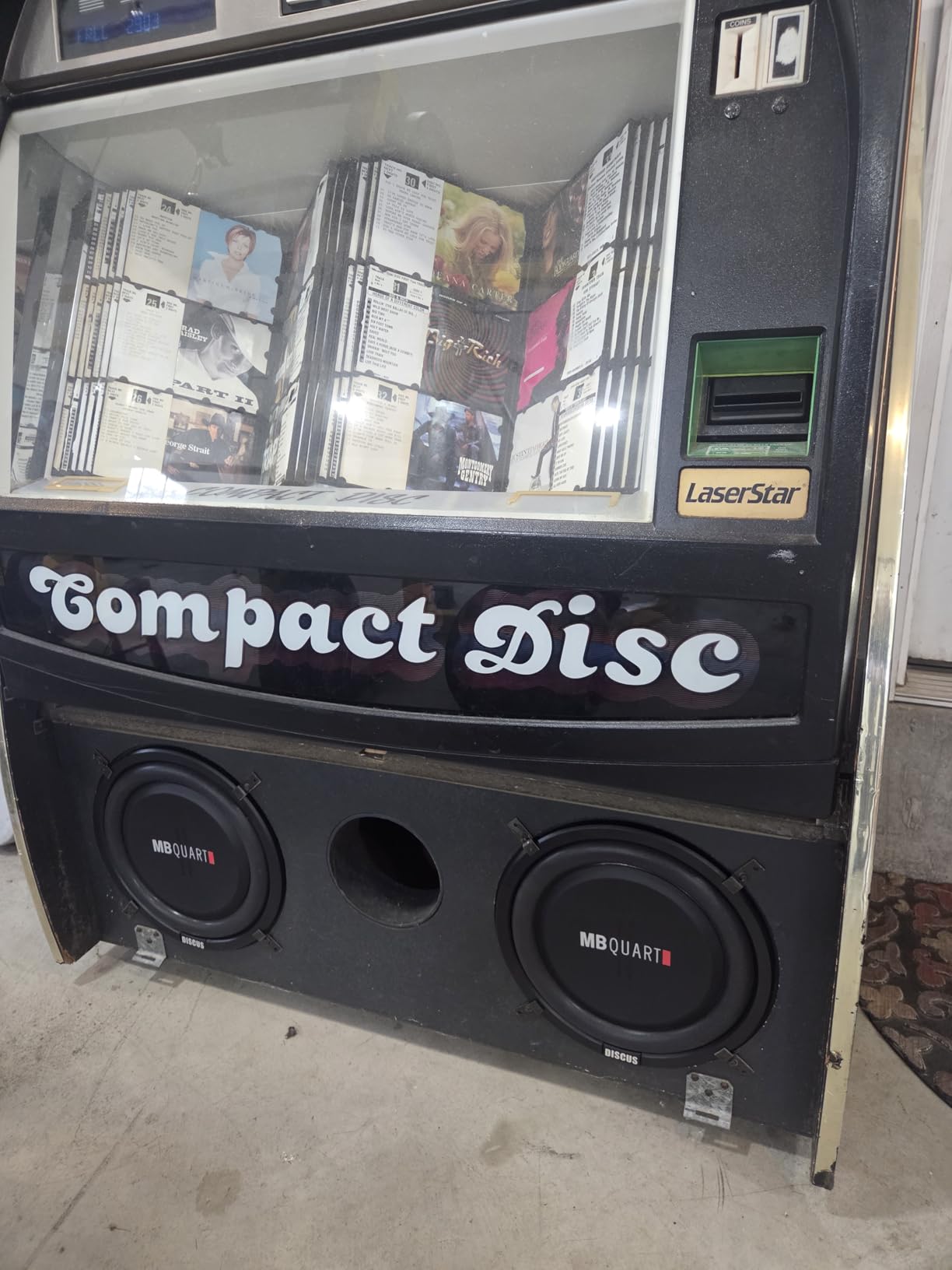
The dual voice coil is a genuine advantage in a car. Each coil reads 4 ohms, so wiring them in series gives you an 8 ohm load for a stable amp, and wiring them in parallel gives you 2 ohms for a more powerful mono amplifier. Installers on car audio forums routinely call dual voice coil wiring the safest option when the amp in the car is not specified as 1-ohm stable.
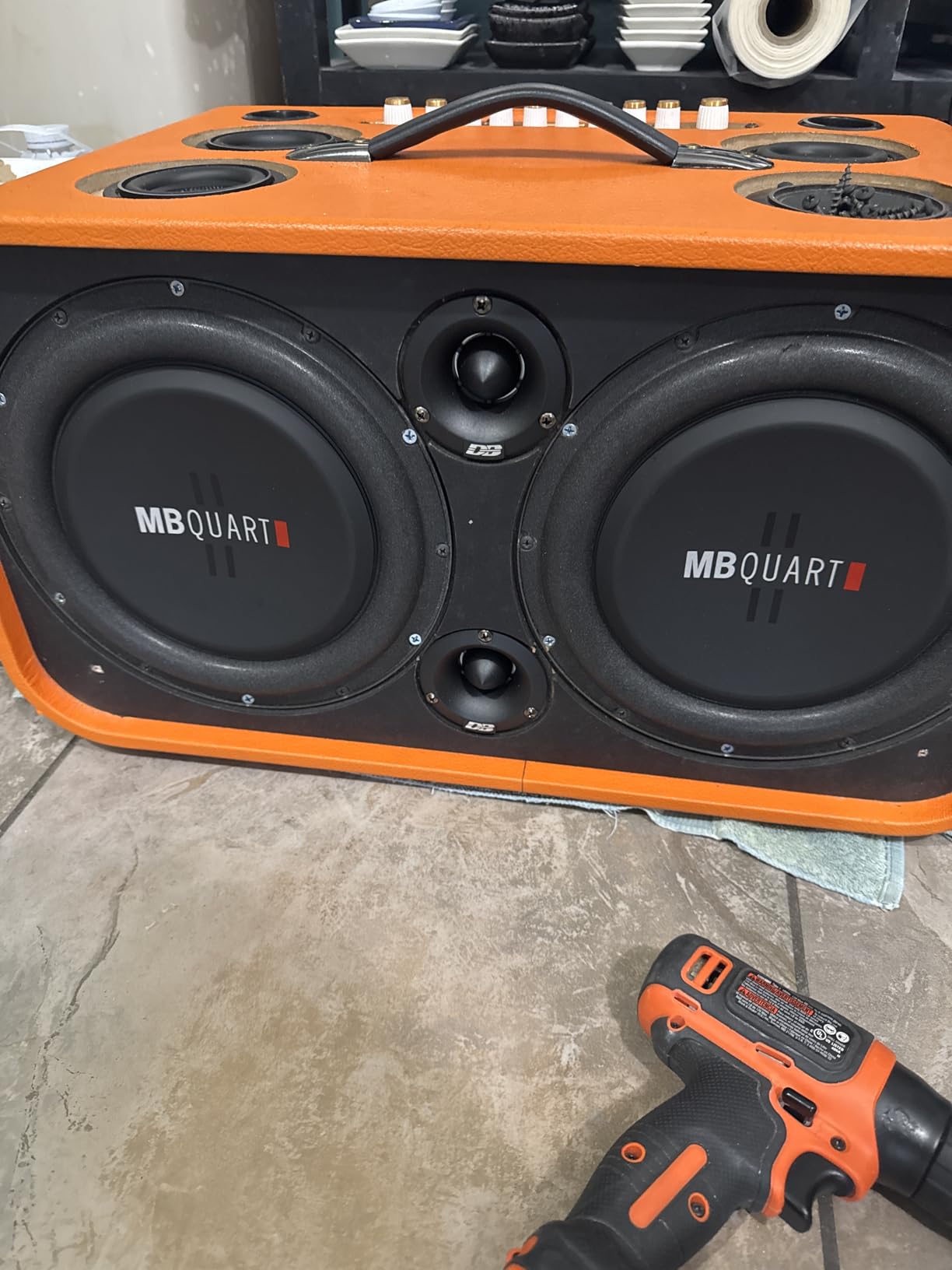
This is a bare driver, so it needs an amplifier and an enclosure. That is a real cost in time and money, but it is also the only way on this list to get exactly the box shape your trunk needs, and forum builders consistently prefer 3/4 inch MDF over plywood for a sealed cabinet that has to survive in a car.
Why the shallow depth matters
Depth, not cone diameter, is what limits a trunk install. A 12 inch driver that needs 7 inches of clearance forces a box that tall, and a tall box either blocks the trunk lid or eats the whole floor. A 2.8 inch driver lets you build forward, so the box footprint is set by the 8 inch cutout diameter instead.
Because the cone area is small, this driver wants a sealed enclosure rather than a ported one. A sealed box is more forgiving of a small net volume, controls excursion, and stays clean at levels where a bigger driver would distort.
Where it falls short
There is no enclosure and no amplifier, so this is not a weekend-afternoon install for a first-time builder. You are also giving up output per watt, since an 8 inch cone moves less air than a 12 inch cone for the same power.
Reviewers also note a break-in period before it settles into its best performance, and lower sensitivity than the larger drivers here, which means your amplifier needs to be cleanly matched rather than pushed hard to compensate.
3. Rockville RV8.2A Dual 8 Inch Box – Best Complete Dual Setup
Rockville RV8.2A Dual 8″ Car Subwoofer Enclosure with Mono Amp & Wiring Kit
Dual 8 inch drivers
200W RMS at 4 ohm
13.5 x 21 x 15.5 inch MDF
Wiring kit included
Pros
- Complete package with amp and 8 AWG wiring kit
- Dual 8 inch drivers for strong total output
- Quasi transmission line with angled ports
- Bass remote included
- Auto thermal protection with restart
Cons
- Largest footprint on this list at 21 inches wide
- MDF cabinet is heavy at 21 lb
- Some owners report the amp running warm
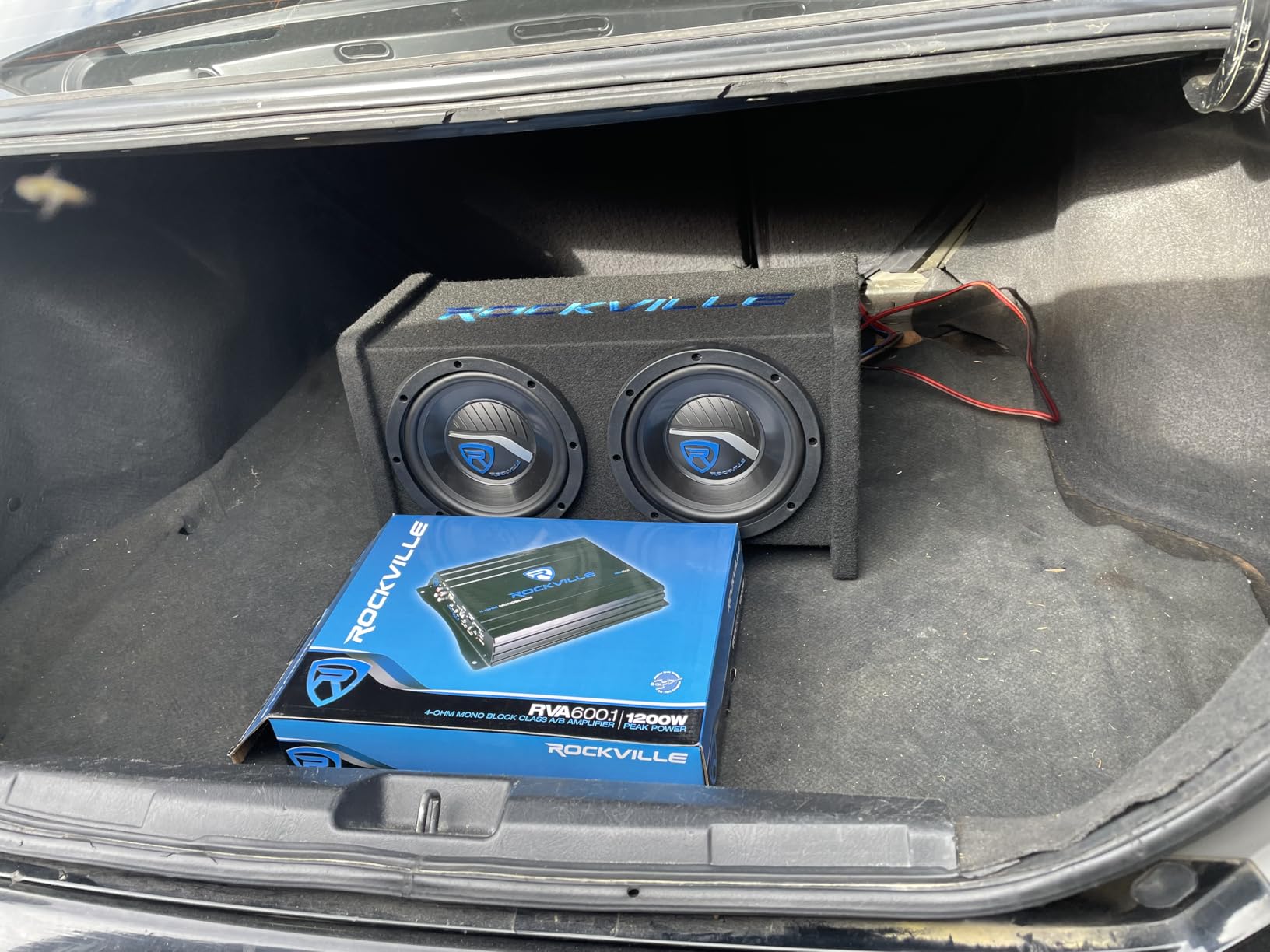
This is the opposite answer to the rest of the list. Where most of these boxes are about disappearing into a trunk, the RV8.2A is about filling one. At 13.5 by 21 by 15.5 inches, it is a full-size dual enclosure, and if your car has a deep hatchback or a wagon with a flat cargo bay, this is the one that gives you the most bass for the least fuss.
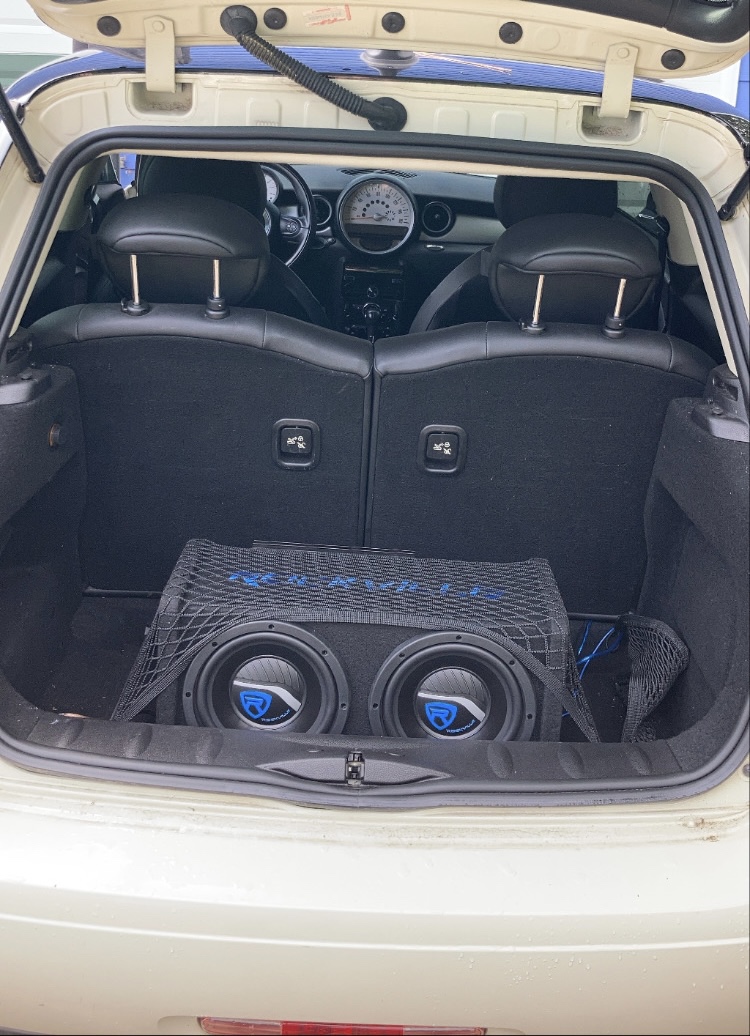
Everything is in the box: two 8 inch drivers, a mono amplifier rated at 200W RMS into 4 ohms and 400W RMS into 2 ohms, and an 8 AWG wiring kit with a bass remote. For a first install, that removes the two decisions beginners get wrong, which forum beginners say is the whole problem. Pick up our ported subwoofer guide if you want to understand what the tuning is doing before you tune it.
The quasi transmission line design with 15 degree angled ports is a ported cabinet, so it is tuned to move air rather than to roll off gently. That is the trade: more output at a given wattage, and less patience for a box that is undersized or mounted badly.
When the space penalty is worth it
A dual 8 inch ported box makes sense when the trunk is deep and the hatch opens to a flat floor, or when you are building in a pickup bed behind the seat. It also makes sense if you plan to keep a rear seat and fold the back seat down, because the box becomes the load floor.
The ported tuning reaches lower than any sealed option here, which is where our music-focused subwoofer picks differ. If your priority is low distortion on a track rather than level, a ported cabinet of this size is the wrong shape for the job.
Where it falls short
Twenty-one inches wide is a lot of trunk. In a sedan, this box usually means giving up the usable cargo floor entirely, and at 21 pounds you will want a second pair of hands lifting it in and out.
Reviewers mention the amplifier running warm in a sealed trunk with no airflow, and the MDF cabinet gives up some rigidity compared with a braced or aluminum build. Deadening the trunk walls matters more here than with any smaller box on this list.
4. MTX RT8PT 8 Inch Tube Sub – Best for Corner Fits
MTX Audio RT8PT 8″ 240W Peak Amplified Vented Car Subwoofer Tube Enclosure
8 inch vented tube box
120W RMS built-in amp
13 x 24.1 x 11.25 inch
Straps included
Pros
- Tube shape slides into a trunk corner
- Vented cabinet is louder than a sealed box its size
- RCA plus high-level and low-level inputs
- Mounting straps and bass knob included
- 2 year manufacturer warranty
Cons
- Only 120W RMS from the internal amp
- Round shape leaves wasted space around the curve
- Some owners report reliability issues after months
The tube shape is unusual, and it exists for one reason: a cylinder will sit in a corner that a rectangular box will not. Where a box leaves a triangular void in the back corner of a trunk, the RT8PT fills it. For a sedan owner who wants the bass and still wants the corner, that geometry is worth more than raw output.
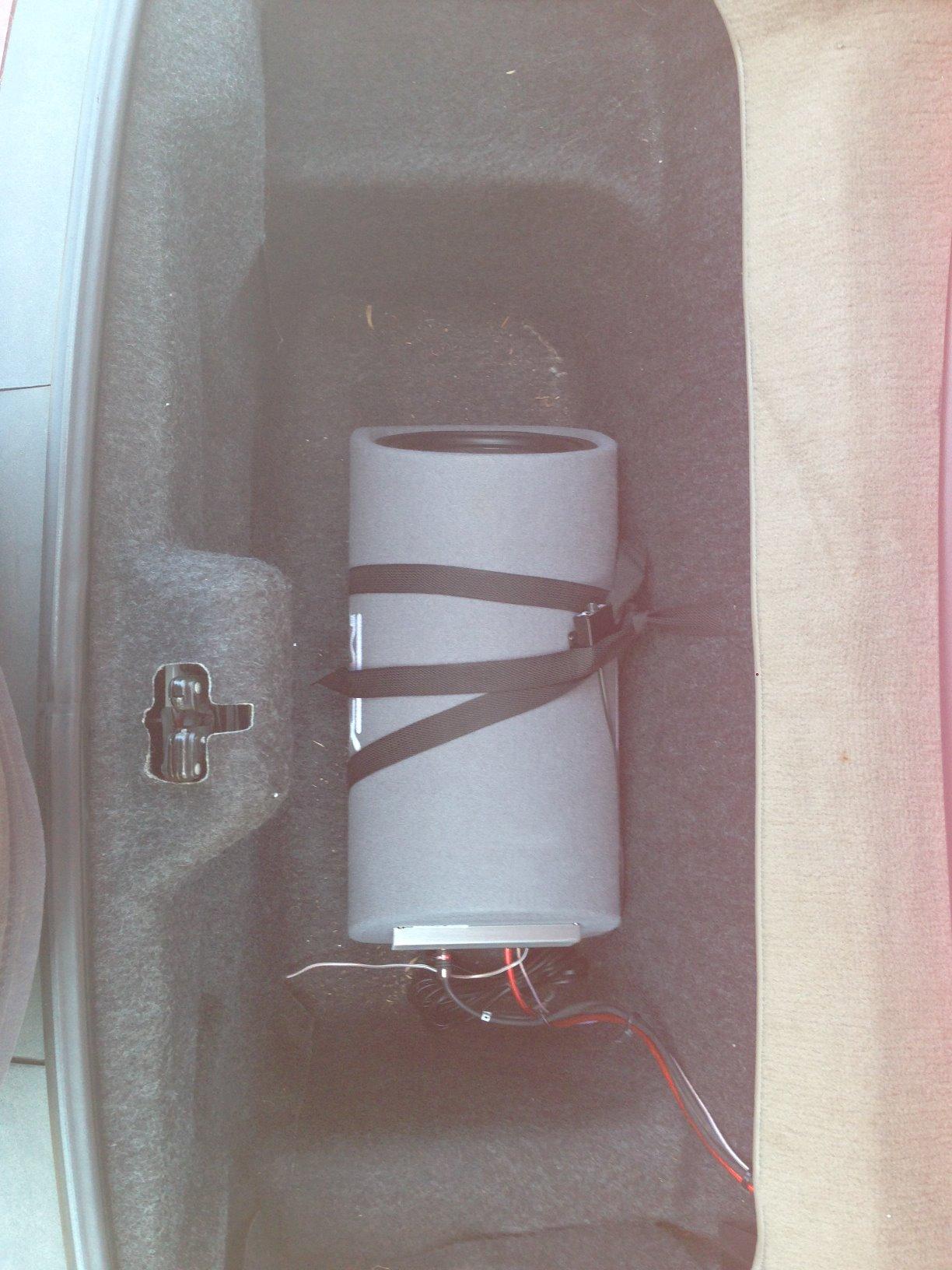
It is vented rather than sealed, so it makes more noise per watt than a sealed cabinet of the same volume, and it is an amplified design with a 240W maximum, 120W RMS internal amplifier. The variable crossover sweeps 50 to 200 Hz at 12 dB per octave, and the input options are unusually flexible: RCA, high level, and low level, which means it will accept a signal from a factory amplifier without an adapter.
Mounting straps are included, and that matters more than it sounds. A tube in a trunk corner has very little flat surface to bolt to, so the straps are the only thing keeping it planted when a bass note hits.
When the corner shape wins
A cylindrical enclosure also solves the clearance problem in hatchbacks and crossovers. There is no sharp corner for a parcel shelf, a rear seat, or a tonneau cover to hit, and the curved surface is far less likely to bruise a trunk liner or buzz against a trim panel.
The response is listed from 35 to 250 Hz, so this is a bass box rather than a full-range sub. Pair it with a proper low-pass setting near 80 Hz and it will stay out of the way of your door speakers.
Where it falls short
120W RMS is the lowest output of any powered box on this list, and the round profile leaves a ring of unusable space around the curve. Anyone who measures a trunk corner as a rectangle will overestimate what fits.
Reviewers also report durability concerns after several months of use, so for daily driving in a hot trunk, an enclosure with a documented thermal protection circuit is a safer long-term bet.
5. Alpine PWE-S8 Amplified 8 Inch Sub – Most Versatile
Alpine 8″ Amplified Subwoofer (PWE-S8) 120W Compact Powered 8″ Car Subwoofer for Under or Behind The Seat
8 inch high-excursion driver
120W RMS Class D amp
32-150 Hz response
Aluminum enclosure
Pros
- Aluminum enclosure dissipates heat well
- Class D amplifier runs cool and efficient
- Reaches down to 32 Hz
- Works under or behind the seat
- Solid manufacturer build quality
Cons
- Costs more than most 8 inch powered options
- 120W RMS is modest output
- Taller than the slimmest under-seat units
The Alpine PWE-S8 is the one on this list that feels like a car audio component rather than a promotional bundle. The aluminum enclosure is the reason: it moves heat away from the internal electronics instead of trapping it, and in a trunk that reaches high temperatures in summer, that is a meaningful difference over a plastic or thin-MDF cabinet.
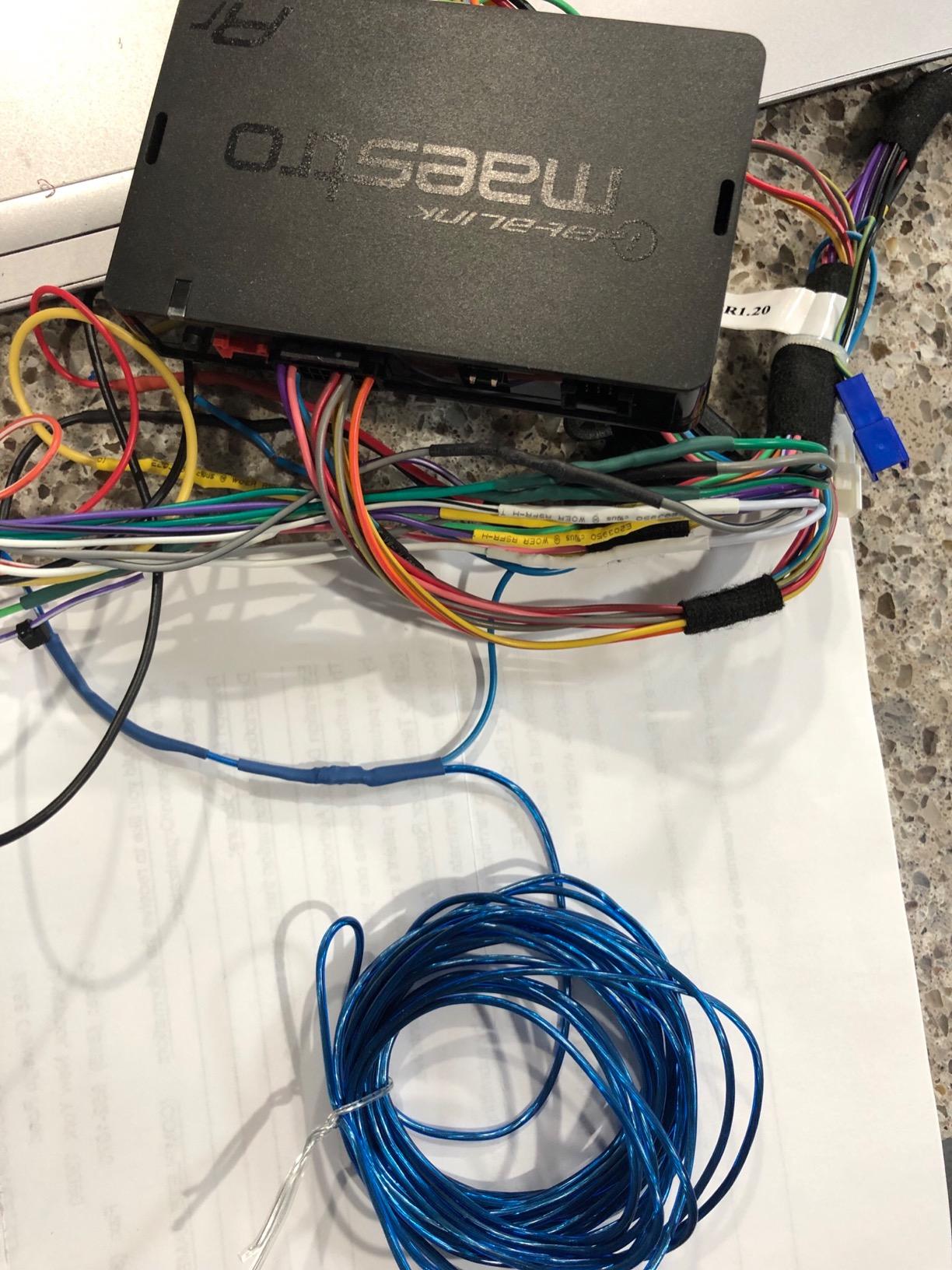
It runs a 120W RMS Class D amplifier into an 8 inch high-excursion cone with a listed response from 32 to 150 Hz. That lower limit is the specification that matters in a trunk, because most compact powered boxes on the market start rolling off around 40 Hz. Bass lines in the low 30s are where a sub stops being a novelty and starts being felt.
At 17 by 13.38 by 14.5 inches, it is not the smallest footprint here, so plan the placement carefully. The mounting type is listed for under-seat or behind-seat positions, and in most sedans that is where it works best anyway, which means the trunk stays completely free.
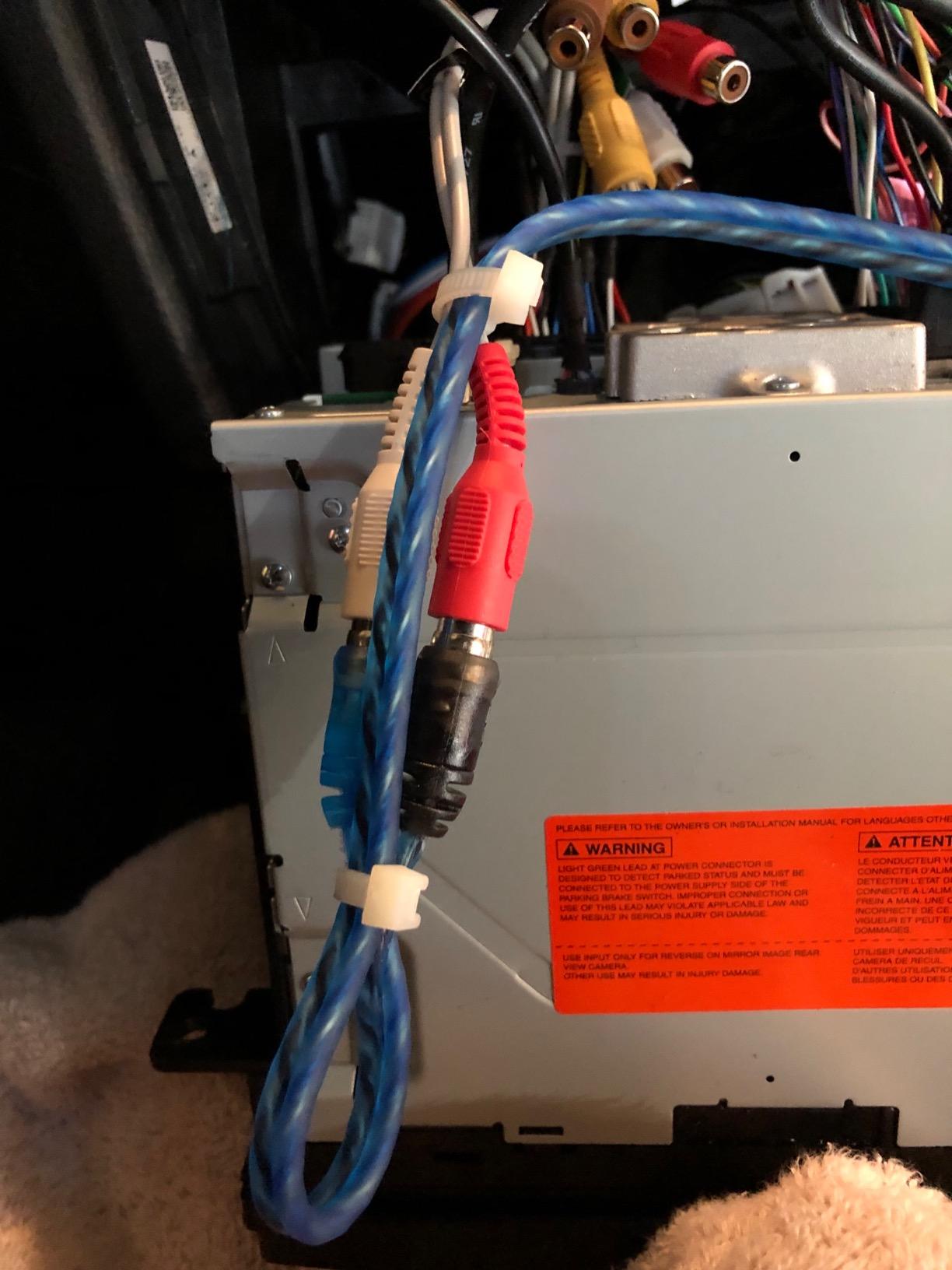
What you get for the premium
Class D amplification is efficient enough that the internal amp does not dominate the enclosure size, which is unusual in a compact powered box. You get useful output for a unit that weighs 11 pounds and can be carried with one hand, installed or removed in a couple of minutes.
There is a remote control and push-button control on the enclosure, so level changes do not require walking to the box. That matters more than it sounds in a hatchback where the sub sits several feet behind the driver’s seat.
Where it falls short
120W RMS is the same modest figure as the far cheaper boxes, so the premium is buying build quality, enclosure material, and low-frequency extension rather than volume. If your goal is the loudest possible trunk system at a given budget, this is not the efficient choice.
It is also the tallest sealed powered box here at 14.5 inches, so check the distance from the trunk floor to the parcel shelf before you commit.
6. Rockville RWS10CA 10 Inch Slim Powered Box – Best 10 Inch Powered
Rockville RWS10CA 10″ Slim Powered Car Subwoofer with Enclosure
10 inch slim powered box
300W RMS built-in amp
7 inch deep sealed cabinet
Remote bass control
Pros
- 10 inch driver in a 7 inch deep cabinet
- 300W RMS from the internal amplifier
- Kevlar-reinforced cone for low distortion
- High and low level inputs with auto turn-on
- Fits tight trunk floors
Cons
- Owners report the internal amp overheating without venting
- Heavy at 30.1 lb to lift in and out
- Some boxes arrive with a strong chemical odor
A 10 inch driver in a sealed cabinet that is only 7 inches deep is the best raw-output-per-inch-of-depth on this list, and that is exactly the tradeoff trunk installers care about. Cone area does most of the work in the 30 to 50 Hz range, so a 10 inch moving more air in a shallow sealed box can beat a 12 inch that needs twice the mounting depth.
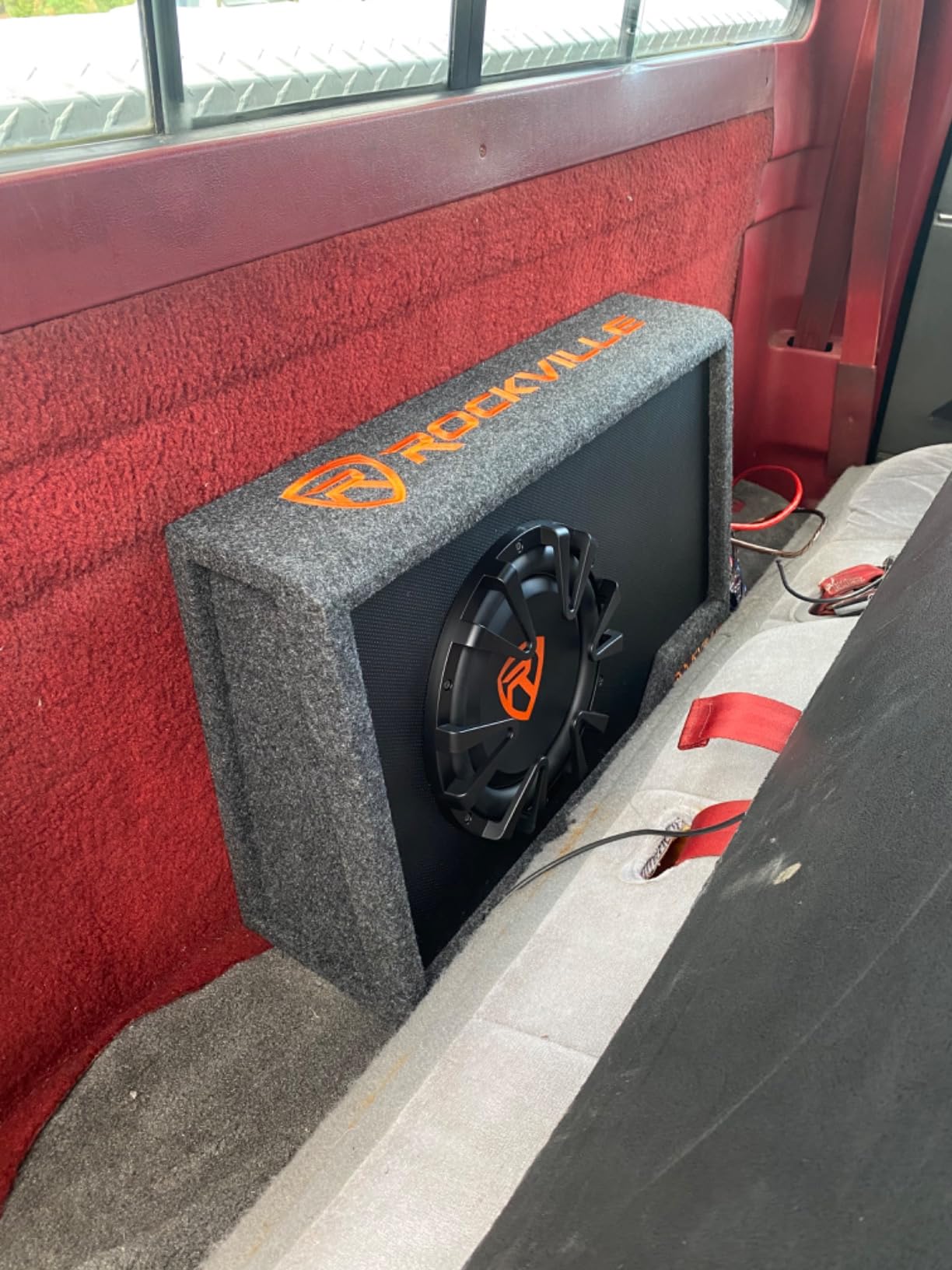
The internal amplifier is rated at 300W RMS, which is the highest output figure of any powered enclosure here, and the 2 inch aluminum voice coil with a 60 oz magnet is a serious motor for a factory-loaded box. High and low level inputs with a smart turn-on circuit mean it will wake up with either an aftermarket head unit or a factory amplifier, without hunting for a remote wire.
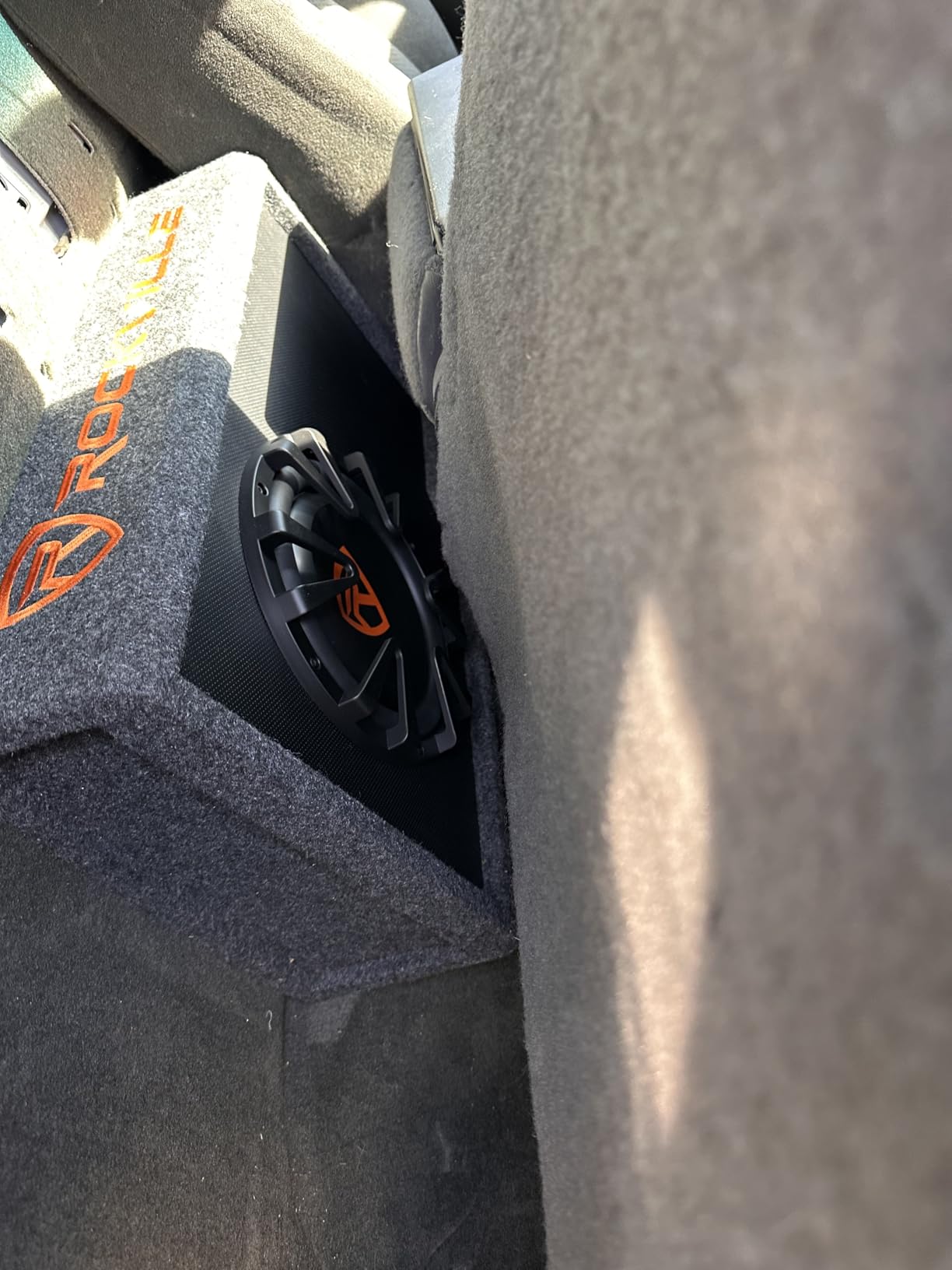
At 24 inches wide it is the widest sealed box on this list, so measure before you order. It is meant to sit flat against a back seat or across a trunk floor, not to squeeze into a narrow well.
Why a slim 10 inch works in a trunk
The 7 inch depth is the number to compare against your measurements. A conventional 10 inch enclosure is often 12 to 14 inches deep, and a conventional 12 inch is deeper still. Seven inches is the difference between a box that fits under a parcel shelf and one that does not.
Because it is sealed, it also behaves well in a small trunk where a port would have to be aimed carefully. You lose some peak output against a ported design of the same size, and you gain predictability.
Where it falls short
The most common complaint is heat. Reviewers report the internal amplifier running hot in a closed trunk, and the practical fix is to add ventilation holes to the enclosure, which is a modification rather than a return. In a hot climate, plan for that before the first long drive.
At 30.1 pounds it is the heaviest item on this list, and a strong chemical odor out of the box is reported by some owners. Neither is unusual for a large MDF cabinet with a factory amp inside, but both are worth knowing about.
7. Pioneer TS-A2000LB Pre-Loaded 8 Inch – Best Value
PIONEER A-Series TS-A2000LB Pre-Loaded Shallow-Mount 8″ Subwoofer 700W Max
Pre-loaded sealed 8 inch
5.13 inch deep box
250W nominal power
Mounts any direction
Pros
- Arrives pre-loaded in a sealed enclosure
- Shallow 5.13 inch depth for tight floors
- Glass-fiber and mica cone holds its shape
- Feet pads and brackets included
- Mounts up down or vertical
Cons
- Requires an external amplifier
- 250W nominal is modest
- Some owners report durability issues after about a year
The TS-A2000LB is a pre-loaded shallow box, which is a rarer combination than it sounds. Most loaded enclosures are either tall or deep, and this one is 13.75 by 9.88 by 5.13 inches, so it is genuinely shallow for a sealed 8 inch cabinet. The sealed mounting hardware and rubber feet mean it can sit on the trunk floor, stand on edge, or invert under a seat.
Power handling is listed at 700W max and 250W nominal, with an 83 dB efficiency figure. The distinction matters: match your amplifier to the nominal number, not the max number, or you will be running well past what the driver is designed to survive. Confirm the driver’s impedance against the listing before you commit to an amplifier.
Because the enclosure arrives assembled, this is the fastest path on the list to bass in a trunk without a box-building step. You are still sourcing an amplifier, but the cabinet cutting, bracing, and sealing work is already done and done to a consistent standard.
The middle ground on depth
Five inches deep is thin enough for a tight trunk floor and thick enough to have a real internal volume, which means the box sounds more substantial than a bare shallow driver in a home-made plywood cabinet. For a family sedan where the trunk has to work on weekends, that balance is the point.
It is also a natural match for a rear seat that folds down. The box becomes a flat load floor, and a heavy bag on the back of the enclosure does not rattle it because the panel is carrying weight rather than working as a free membrane.
Where it falls short
There is no amplifier included, so you are buying an enclosure and a driver and still sourcing the amp. That is the right choice if your car already has a suitable mono amplifier, and the wrong one if you are starting from a bare head unit.
Some owners report durability problems after roughly a year, and a single voice coil limits your amplifier options compared with a dual voice coil driver such as the MB Quart earlier in this list.
8. Pioneer TS-A2500LS4 10 Inch Shallow Driver – Best Ultra-Shallow 10 Inch
PIONEER A-Series TS-A2500LS4 Shallow-Mount 10″ Subwoofer 1200W Max
10 inch shallow driver
3.38 inch mounting depth
300W nominal, 4 ohm SVC
85 dB efficiency
Pros
- 3.38 inch depth fits the tightest builds
- 300W nominal handling from a 10 inch cone
- 4 ohm single coil suits most amplifiers
- Gasket and trim ring included
- Performs well in small sealed boxes
Cons
- Needs both an amplifier and an enclosure
- Shallow frame limits excursion
- Not aimed at high-SPL competition use
This is the driver to build around if your trunk is genuinely tight. At 3.38 inches of mounting depth and 8.4 pounds, it is the lightest 10 inch on this list, and reviewers rate it 4.6 out of 5 across 516 ratings, the second highest score in the group. The glass-fiber and mica reinforced cone is rigid enough to stay controlled in a small sealed box.
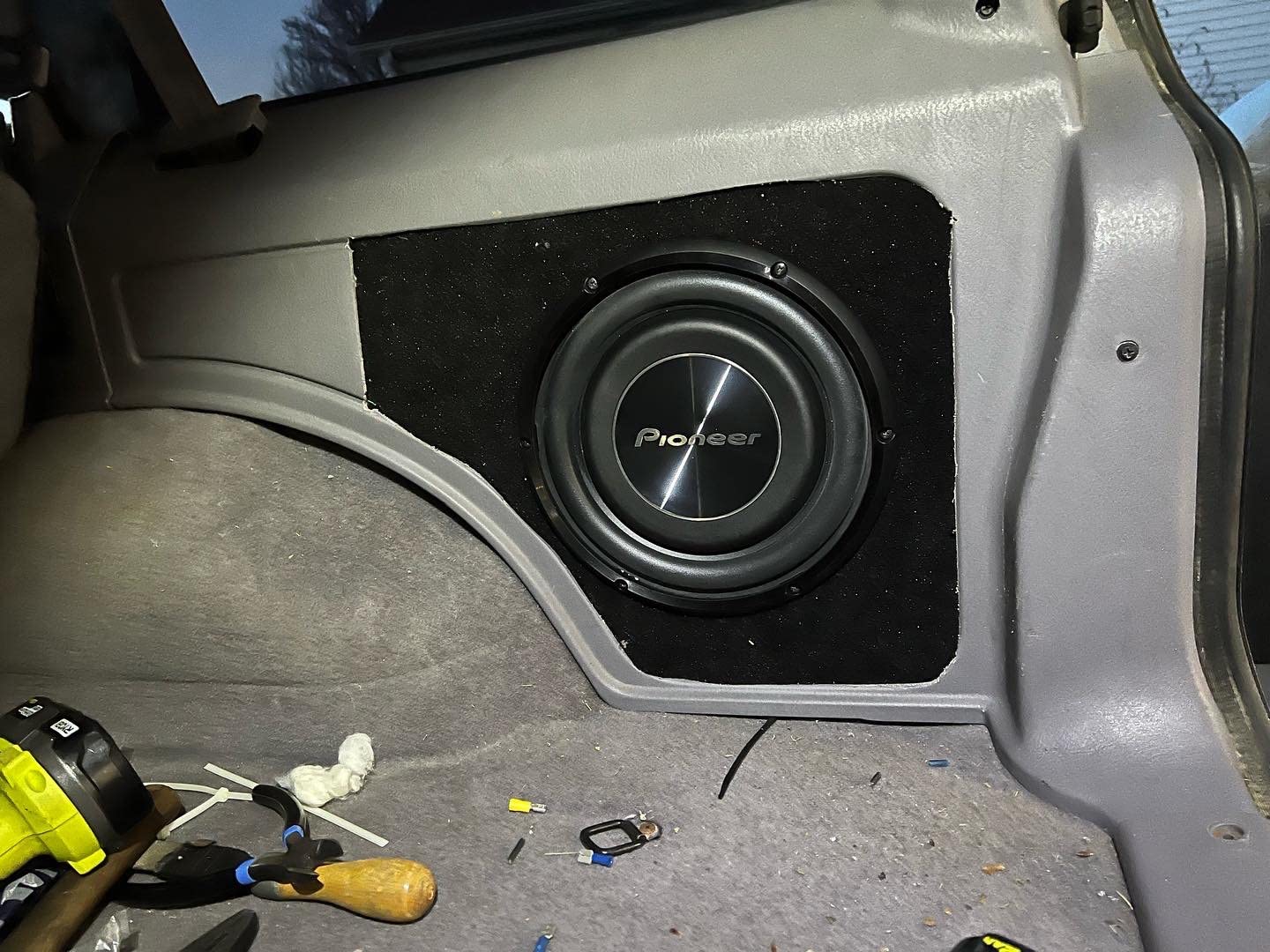
The 4 ohm single voice coil is the friendliest impedance on this list. Almost every mono amplifier made in the last decade is stable at 4 ohms, so there is no risk of running an amplifier below its rated load and cooking the output stage. For a first custom build, that removes the most common beginner mistake.
Reviewers specifically call out its performance in small sealed enclosures of roughly 0.5 to 0.7 cubic feet, which is a modest amount of air. You are not building a large box, and that is the point: the whole build stays shallow enough to slide behind a back seat or under a parcel shelf.
When to choose this over a 12 inch
Choose a shallow 10 inch when the box has to be built forward, tight against a seat back or under a lid, and the 12 inch option will not clear. Ten inch cones also suit smaller hatchbacks where the spare-tire well is narrow, and where a 12 inch frame physically will not fit the opening.
Because it is a component driver, you choose the box volume. A sealed box around 0.6 cubic feet gives a controlled, accurate result for music. Going larger and ported buys lower tuning at the cost of the shallow advantage that made you choose this driver.
Where it falls short
Shallow frames trade excursion for depth, so a standard-depth 12 inch will simply move more air at the same wattage. If you have the depth to spare, the shallow format is leaving output on the table.
It also requires an amplifier and an enclosure of your own, and the single voice coil means no flexibility to reconfigure the load later. Anyone who wants to experiment with wiring options should look at a dual voice coil driver instead.
9. Pioneer TS-A3000LS4 12 Inch Shallow Driver – Best Deep Bass in a Small Box
PIONEER A-Series TS-A3000LS4 Shallow-Mount 12″ Subwoofer 1500W Max
12 inch shallow driver
3.5 inch mounting depth
400W nominal, 4 ohm SVC
88 dB efficiency
Pros
- 12 inch cone in only 3.5 inches of depth
- 400W nominal power handling
- 88 dB efficiency for a shallow frame
- Works in a recommended 0.8 cu ft sealed box
- Reaches into the sub-25 Hz range
Cons
- Requires an amplifier and an enclosure
- Single 4 ohm coil offers no wiring flexibility
- 12 inch frame needs more trunk width
- Limited output versus a standard-depth driver
Here is the counter-intuitive part of trunk-space buying: a shallow 12 inch can produce deeper bass than a full-depth 10 inch in a small trunk. Cone area drives output below 50 Hz, and the TS-A3000LS4 delivers a 12 inch cone in only 3.5 inches of mounting depth with a recommended sealed net volume of 0.8 cubic feet. That is a genuinely compact box by 12 inch standards.
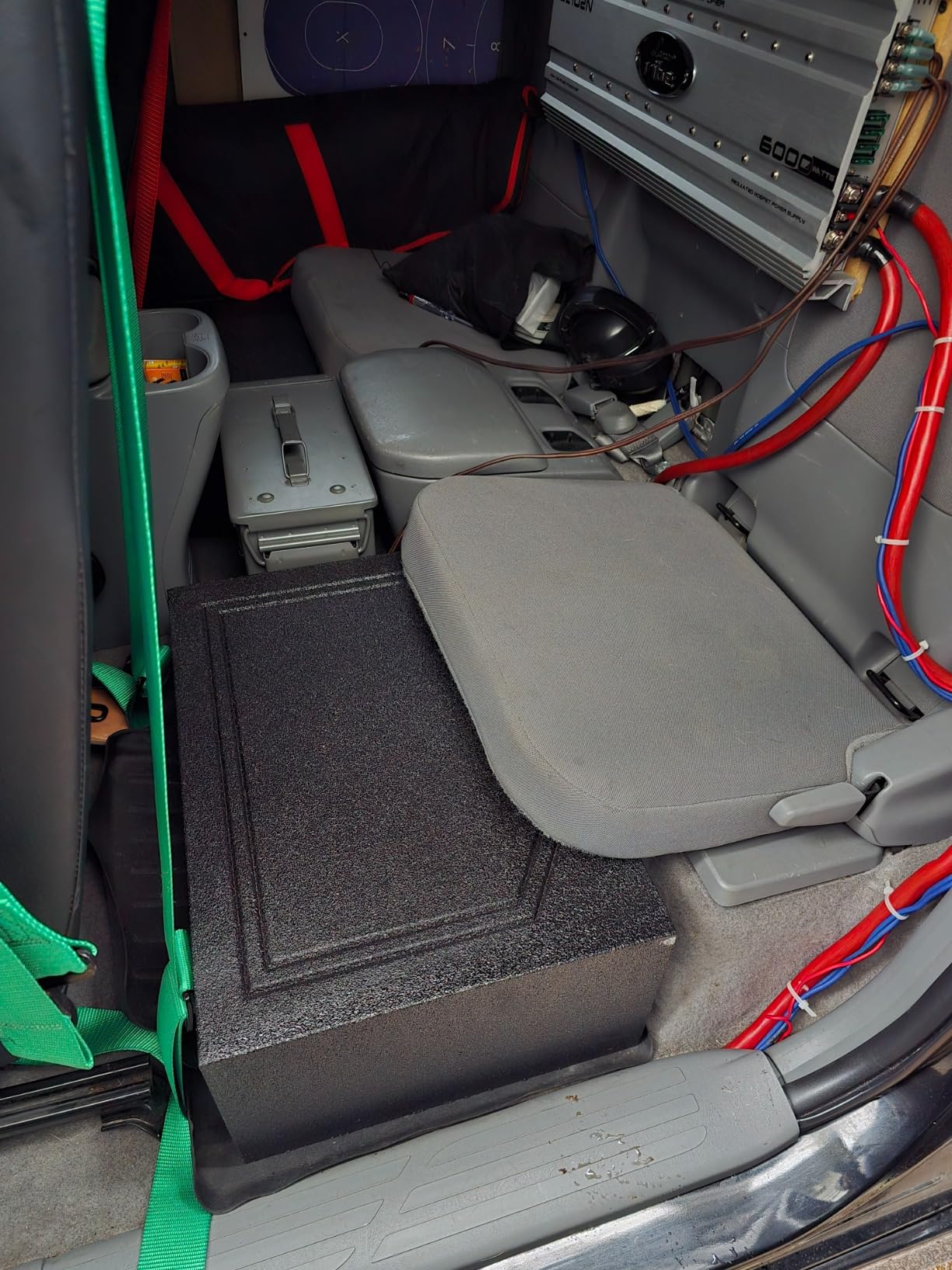
The 88 dB efficiency figure is the highest in the Pioneer shallow range and the reason a sealed alignment works so well here. A more efficient driver needs less amplifier power to reach a given level, which matters when the amplifier is a compact unit you are trying to keep out of the way.
It is 13 pounds, which is heavy for a driver but manageable for a one-person install, and it comes with a trim ring, gasket, and eight mounting screws. The build is a straightforward sealed box, and 0.8 cubic feet is a size you can construct from a single sheet of MDF.
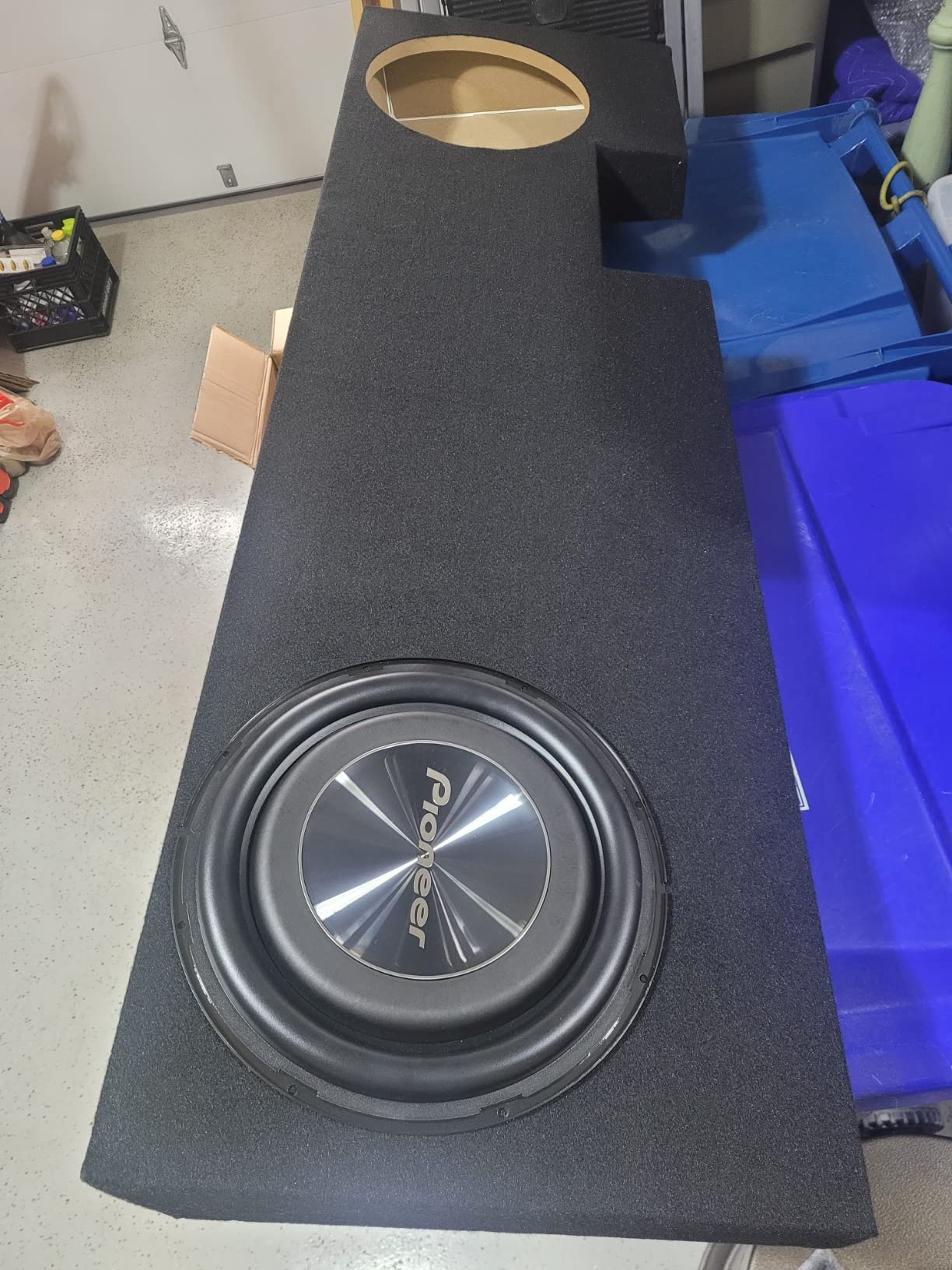
Depth versus cone area
The forum shorthand for this tradeoff is that a small space needs more power, more excursion, or more cone area. Cone area is the only one of the three you can get without giving up trunk depth, and a shallow 12 inch is the direct way to buy it. In practice it means more output in the 20 to 40 Hz range for the same footprint.
The catch is width. A 12 inch frame needs roughly 14 inches of clear width once you add MDF, so this is a poor choice for a narrow spare-tire well. It is a strong choice for a wide trunk floor or a wagon with a flat cargo bay.
Where it falls short
Shallow travel is still shallow travel. Compared with a standard-depth 12 inch, this driver will hit a lower level before it distorts, so it is not the right choice for a high-SPL competition build.
It needs an external amplifier and an enclosure, and the single 4 ohm voice coil removes any ability to change the load later. Plan the box volume properly rather than guessing, because running a shallow 12 inch in too small a sealed cabinet costs you the low end you bought it for.
10. Rockford Fosgate P300-8P Amplified 8 Inch – Best for Factory Systems
Rockford Fosgate Punch P300-8P Amplified 8″ Subwoofer in Enclosure
8 inch ported powered box
300W Class D amp
Speaker-level and RCA inputs
5.6 x 11.4 x 17.6 inch
Pros
- Highest rated in this group at 4.7 out of 5 stars
- 300W Class D amplifier in a ported cabinet
- Speaker-level inputs for factory systems
- Remote level control included
- Velcro base keeps the box planted
Cons
- Costs more than the other powered 8 inch boxes
- Port edges can slap at high output
- Gain structure is easy to overdrive
- 8 inch driver limits maximum levels
This is the most refined powered box in the group, and it holds the highest rating at 4.7 out of 5 across 402 ratings. The 300W Class D amplifier is paired with a ported enclosure at 5.6 by 11.4 by 17.6 inches, which is a tall-but-narrow shape. Stand it on end against a quarter panel and it takes up very little floor, which is a different solution to the space problem than going shallow.
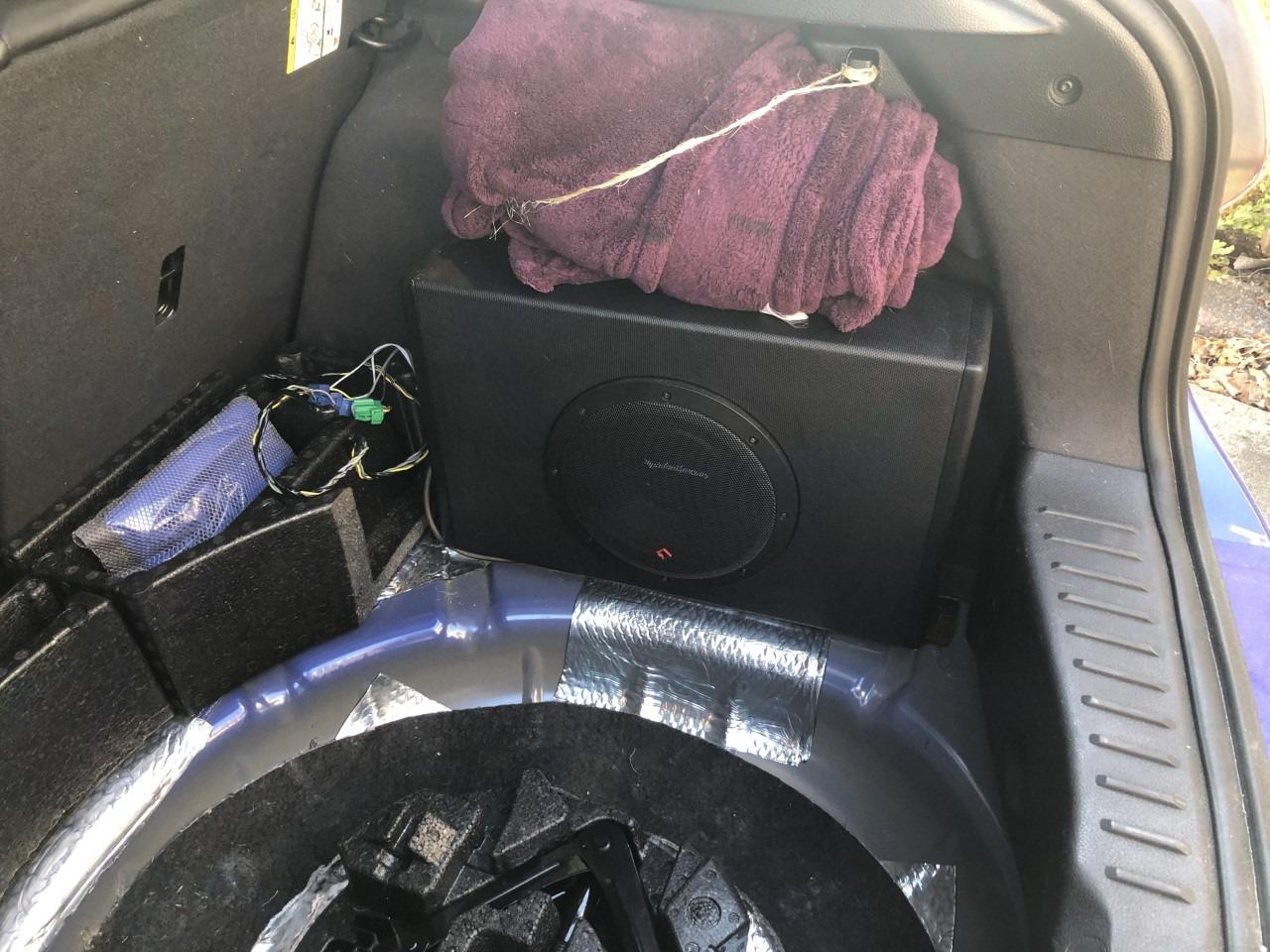
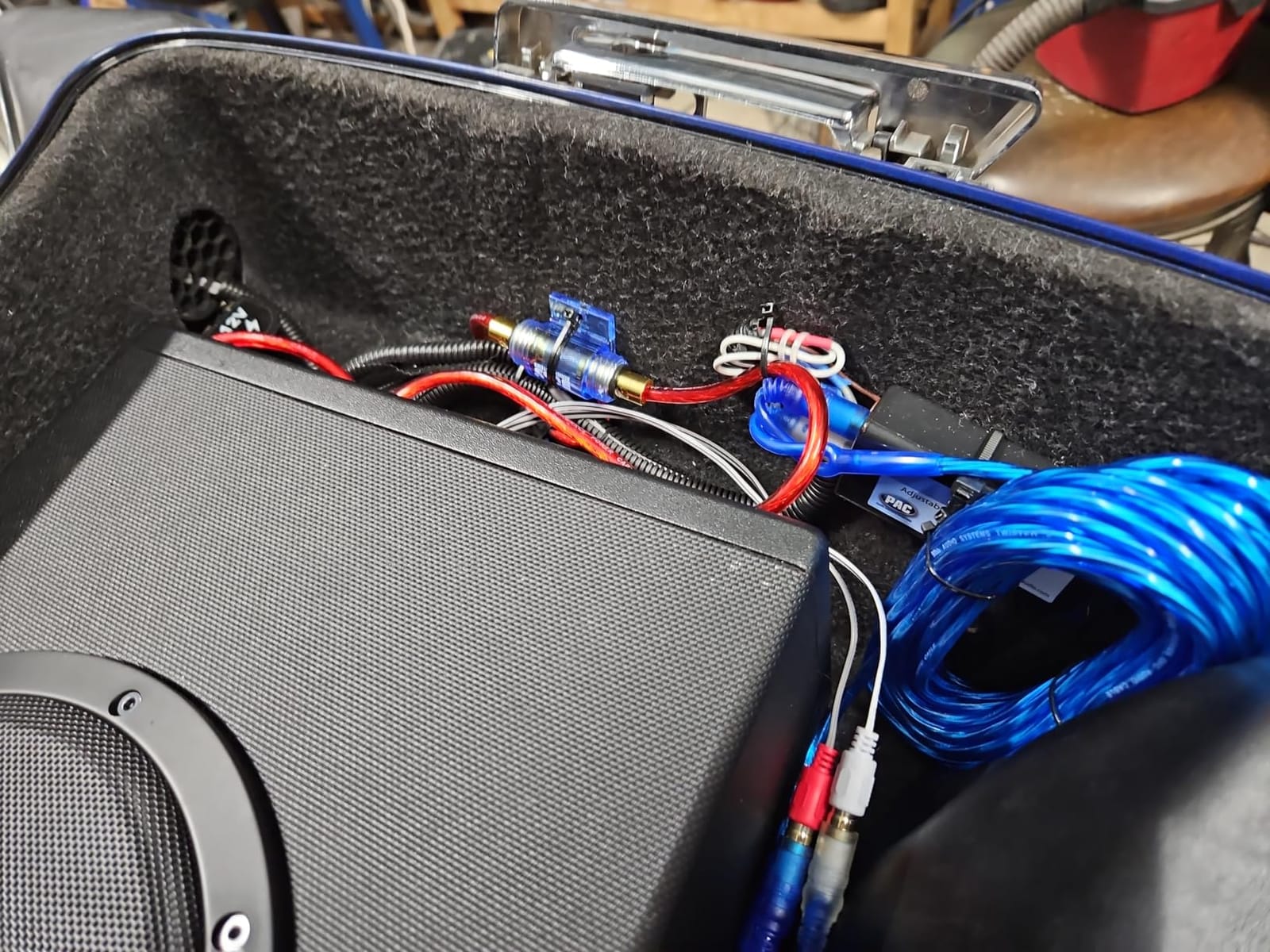
The input options are why it suits factory systems. Speaker-level inputs accept the signal directly from an amplifier that has no RCA outputs, and line-level inputs handle an aftermarket head unit. An auto turn-on circuit detects the signal, so there is no remote wire to run, which removes one of the most common install errors in a modern car with a complex wiring harness.
On the control side there is an adjustable 12 dB per octave low-pass filter, an on-board bass boost, and a phase switch. The phase switch is genuinely useful in a trunk, because a box sitting a few inches off a reflective surface often needs a 180 degree flip to blend with the front speakers instead of partially cancelling them.
Why a ported powered box still makes sense
Porting buys efficiency in a small cabinet. At 300W RMS from an internal amp in a box under two cubic feet, this is the most efficient use of enclosed volume on the list, and a ported cabinet tuned correctly plays lower than a sealed box of the same size.
The velcro base is worth a note. It is not enough for hard driving, but for a daily-driven car where you remove the box to load furniture, it is the right tradeoff. A secured box eliminates the walking-across-the-trunk rattle that shows up in almost every beginner install report.
Where it falls short
It is the most expensive box here, and you are paying for build quality and finish rather than extra output. Reviewers note that the port edges can produce a slapping noise at high levels, and the gain structure is sensitive, so it rewards careful setup.
An 8 inch driver still has a ceiling on maximum output. If your goal is a trunk system that competes at a car show, the cone area on this box will run out before the amplifier does.
How to Measure Your Trunk Before You Buy
Every fit problem in a trunk install is a measurement problem, and it takes about five minutes with a tape measure. Do this before you pick an enclosure, because most returns start with a box that looked fine in a photo and turned out to be three inches too wide.
Record four numbers. First, the width at the narrowest point of the trunk opening, measured where the quarter panels pinch in rather than at the bumper. Second, the height from the trunk floor to the parcel shelf, which is the ceiling for any box you want to close the lid on. Third, the depth from the trunk opening to the back seat, which decides whether a box can sit flat against the seat. Fourth, the diameter and depth of the spare-tire well, because that round hole is the most underused space in the whole car.
Then measure the trunk floor at its deepest point near the seat back. A box that measures 24 inches wide in the catalog can still fit, provided you rotate it 90 degrees and turn it on its side, which is why the Pioneer TS-A2000LB ships with feet, pads, and brackets for mounting up, down, or vertical.
One more measurement matters more than people expect: the space between the box and the back seat. If the box touches the seat, bass energy pushes straight into it, and that panel becomes a rattle source. Leave a couple of inches of breathing room whenever the geometry allows it.
Box Orientation: Forward, Rearward, Up or Down
Short answer: in a sedan trunk, pointing the drivers toward the rear of the car and letting the trunk lid act as part of the acoustic load usually produces the most evenly distributed bass, while pointing them forward at the back seat gives the most output in the cabin. Neither is wrong, and the right call depends on how the trunk is shaped.
Facing rearward is the more forgiving setup. The trunk lid becomes a second radiating surface, so a single box reads louder from the driver’s seat without extra amplifier power. It is also easier on the mounting hardware, because the box pushes rearward into the bumper structure instead of forward into the seat back.
Facing forward, into the back seat, is what most installers choose when the trunk is shallow and the seat back is solid. The concern people raise in car audio forums is that bass ends up sounding “outside the car,” but low frequencies in the 30 to 60 Hz range are long enough to fill the cabin evenly. Corner-mounting the box, tight against the intersection of the side panel and the rear seat, is the enthusiast version of this and the reason the back-corner thread on r/CarAV gets so much traffic.
Up-firing and down-firing enclosures trade a little low-bass punch for a completely flat footprint. A down-firing box shoots into the trunk floor and works well behind a rear seat; an up-firing box throws energy toward the parcel shelf. Both are the practical answer when a tall box will not clear the lid.
How to Stop Trunk Rattle
Rattle is the number one complaint in every car audio thread about trunk installs, and it has almost nothing to do with the subwoofer itself. It comes from the energy the driver puts into thin stamped metal, plastic trim, and the license plate bracket. A clean install fixes it with materials, not with a bigger box.
Step one is deadening the surfaces the box is bolted to. The rear seat back panel and the trunk floor directly under the enclosure are the two that matter most. A second layer of butyl mat on the quarter panels near the box helps, because they flex at low frequencies even when nothing touches them.
Step two is bracing the cabinet. Enclosures that arrive pre-built are often unbraced MDF, and a subwoofer at high excursion will make the panels buzz on their own. A simple cross brace on the inside panel costs little and removes most of that.
Step three is mounting, not balancing. Resting a box on the carpet is the single most common mistake. Straps, brackets, or a screwed-down base stop the box from walking across the trunk every time you pull away. The MTX RT8PT ships with mounting straps, while the Rockford Fosgate P300-8P uses a velcro base that is convenient for removal and weaker for hard driving.
Step four is the vented pole piece, and it is a free upgrade. A driver with a vent hole under the dust cap can move air without pushing on the back of the magnet, so the cone is not fighting a pressurized cavity. That reduces distortion at the exact moment of peak excursion, which is when rattle is worst. Several drivers on this list, including both Rockville enclosure drivers, use vented motors.
Step five is the small stuff. Wrap the license plate bracket in foam, put a dab of sealant where the amp mounting screws bite, and check that the remote wire and the power wire are not lying against the body panel. Those three fixes kill a surprising share of the noise people report.
Sealed, Ported, Shallow or Powered: What Each One Costs You
Every enclosure style on this list trades something. Here is the honest version of what each one asks you to give up.
Sealed boxes are the most forgiving in a trunk. They roll off gently, they behave in a small volume, and they do not put a port opening into a corner where air moves unpredictably. The cost is peak output, since a sealed cabinet always needs more power to reach the same level as a ported one.
Ported boxes buy efficiency with placement sensitivity. A port needs clearance and a consistent path to the cabin, which is why the RV8.2A and the Rockford Fosgate P300-8P work best facing rearward or firing at a corner. A ported box crammed tight against the trunk lid will boom and sound uneven.
Shallow mount is a driver format rather than an enclosure type, and its cost is excursion. A shallow frame buys depth at the expense of how far the cone can travel, which limits sustained high-level output. It is the right format when depth is your binding constraint, and the wrong one when it is not.
Powered boxes move the amplifier inside the enclosure, which adds internal volume and heat to a space that has neither to spare. In return you skip the biggest decision in a car audio install. If you are starting from a factory head unit with no RCA outputs, that convenience is worth more than the cubic inches it costs.
A note on amp placement while we are here: amplifiers generate heat, and a sealed trunk in summer is a poor place for one. If you do mount an external amplifier in the trunk, leave a few inches of clearance on all sides and consider a small fan or a routed cable gap for airflow. Built-in amplifiers have the same problem, which is exactly why the venting complaint comes up so often with larger powered boxes.
Wiring and Impedance Cheat Sheet
Impedance is where most first installs go wrong, and the mistakes show up as a tripped protection circuit or a blown driver. The rules are short enough to memorize.
A single voice coil 4 ohm driver is the safest load in a car. Nearly every mono amplifier is stable at 4 ohms, so there is no way to undersupply the amplifier by wiring mistake. Both Pioneer shallow drivers on this list use this arrangement.
A single voice coil 2 ohm driver draws more current at the same voltage. It is still within the normal operating range of most quality mono amplifiers, but you should confirm the amp is rated for 2 ohms before you connect it. Verify the impedance printed on the driver’s listing or magnet label, because loaded enclosures do not always state it clearly.
A dual voice coil driver, like the MB Quart DS1-204, gives you two coils at 4 ohms each. Wire the coils in series for an 8 ohm load, or in parallel for 2 ohms. If your amplifier is not documented as 1-ohm stable, never wire a dual 2 ohm coil set in parallel, because that presents 1 ohm and many amplifiers will shut down or overheat.
One more practical note. Match your amplifier power to the driver’s RMS or nominal rating, not to the peak or max number on the box. A 1200W max figure describes a momentary surge condition, and running an amplifier at that number continuously is the fastest way to destroy a voice coil. A general rule is to run an amplifier at roughly the RMS rating of the driver, then set the gain with your ear rather than with the gain turned to the maximum.
Frequently Asked Questions
What is the best subwoofer for a trunk?
The Rockville SS8P is our top pick for trunk space because its 11 by 14.1 by 5.4 inch aluminum enclosure is one of the smallest powered options available, it runs cool, and it ships with a complete wiring kit and remote. The MB Quart DS1-204 is the best value if you are willing to build a shallow sealed box yourself.
Can you put subwoofers in the trunk of a car?
Yes. The trunk is the standard location for a car subwoofer because it is the only place with enough volume for a proper enclosure. The reason it works acoustically is that low-frequency wavelengths are long enough to fill the cabin evenly, so a trunk-mounted sub is not inherently weaker than an under-seat one. Mount it securely and deaden the surrounding panels.
Is it better to face subs forward or backward in a trunk?
In a sedan, facing the drivers toward the rear of the car and letting the trunk lid act as part of the acoustic load gives the most even cabin distribution. Facing forward at the back seat gives more raw output and works well with a corner-mounted build. The practical answer is to try both, since the phase switch on many powered boxes makes the swap easy.
How do I stop trunk rattle from a subwoofer?
Deaden the rear seat back panel and the trunk floor under the box with butyl mat, brace the inside panels of the enclosure, and strap or bolt the box down instead of resting it on the trunk liner. A driver with a vented pole piece distorts less at peak excursion, which reduces the energy that starts the rattle in the first place.
Do 10 inch subs hit harder than 12 inch subs in a small trunk?
It depends on how much depth you have. A 12 inch cone moves more air and produces deeper bass, but a standard-depth 12 inch enclosure is far too tall for a shallow trunk. A shallow-mount 10 inch or 12 inch driver gives up some excursion to stay thin, and in a constrained trunk that depth savings usually matters more than the extra cone area.
Final Verdict
The best car subwoofers for trunk space depend on which resource you are short of. Short on depth, pick the MB Quart DS1-204 and build a shallow sealed box. Short on hours, pick the Rockville SS8P and put it under the seat. Short on trunk width, pick the MTX RT8PT and let the tube fill the corner. Short on nothing in particular, the Rockville RWS10CA pairs a 10 inch cone with a 7 inch deep sealed cabinet, and the Alpine PWE-S8 is the pick for a clean, low-distortion result from a compact powered box.
Measure your trunk before you order, and if you are still working out the cargo side of the equation, our trunk organizer picks help you get usable space back after the box goes in. Whichever route you take, the fit and the rattle checklist above will do more for how the system sounds than any upgrade to the driver itself.