
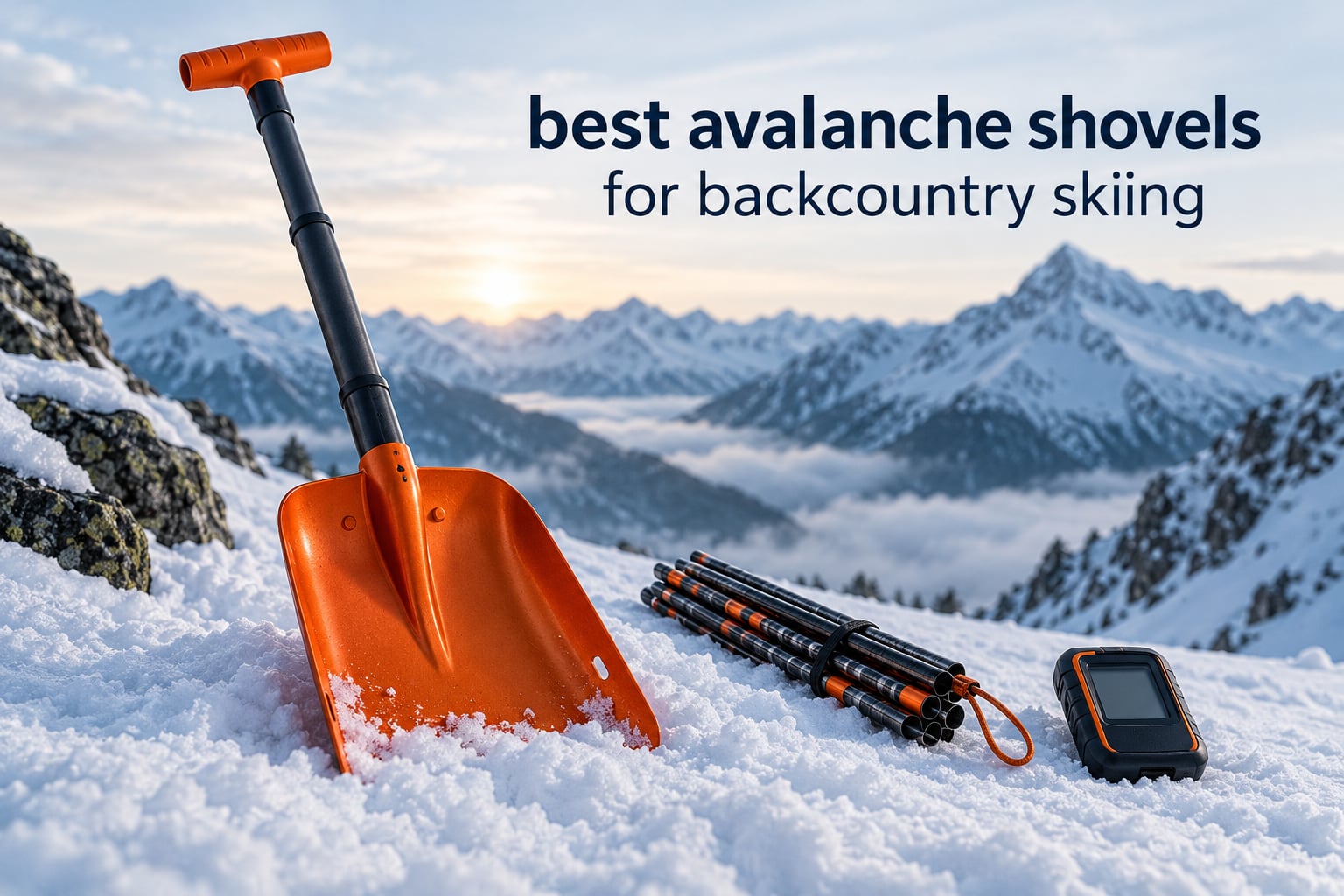
A buried skier typically has about 15 minutes of usable air, and the shovel is the tool that decides what happens in that window. The best avalanche shovels for backcountry skiing share four traits: a hardened or anodized aluminum blade, a telescoping shaft, a grip you can hold with mittens on, and a mode that lets you cut and drag debris instead of lifting it. Pick on those four, then adjust for your trip type.
That is the short answer. The longer version is that a rescue shovel is one of three essentials carried next to an avalanche transceiver and a probe of at least 240 cm, and it is the piece of gear most skiers replace least often and inspect least carefully. Everything below is organized around the decision points that actually separate these ten models: weight, blade volume, hoe conversion, grip geometry and certification.
No shovel on this list replaces an AIARE Level One course, a forecast you read before you leave, and hours of practice with a partner before it matters. If you have not done companion rescue drills, buy the shovel anyway and then book the course. For the rest of the winter equipment decisions, our base layer guide and satellite messenger roundup cover the other half of a safe travel kit.
One note before we get into the list: this is a shovel roundup, not a snow shovel roundup. If you are clearing a driveway, read our snow shovel guide instead. An avalanche shovel is a three-piece aluminum tool sized for a pack, and a household steel blade is both too heavy and too blunt for consolidated slab debris.
Table of Contents
Top 3 Picks for Best Avalanche Shovels for Backcountry Skiing (October 2026)

G2 Backcountry Telescopic Shovel
- Aluminum alloy blade
- Adjustable length and blade angle
- Packs down to 17 inch
- ABS anti-slip handle

BCA Dozer 1T Shovel
- 6061 T6 aluminum blade
- Ovo-concave shaft
- Stompable blade edge
- UIAA certified
SnowBigDeal Shovel with Saw
- Converts to chop and hoe mode
- 13.75 inch saw in shaft
- 6061 series aluminum
- 850 gram weight
Compare at a Glance: 10 Avalanche Shovels in 2026
Weight is the number skiers argue about most, and it is the first column worth checking. The range here runs from 405 g to 850 g for the shovel itself, which is more than 400 g of difference across a ten-model field.
| Product | Specifications | Action |
|---|---|---|
| G2 Backcountry Telescopic Shovel |
|
Check Latest Price |
| BCA Dozer 1T Shovel |
|
Check Latest Price |
 G2 Avalanche Kit with Probe G2 Avalanche Kit with Probe |
|
Check Latest Price |
| SnowBigDeal Shovel with Saw |
|
Check Latest Price |
 Mammut Alugator Light Mammut Alugator Light |
|
Check Latest Price |
 Voile Telepro Voile Telepro |
|
Check Latest Price |
 Ortovox Badger Lightweight Shovel Ortovox Badger Lightweight Shovel |
|
Check Latest Price |
 Black Diamond Transfer LT Black Diamond Transfer LT |
|
Check Latest Price |
 Core Plus Shovel and 240 cm Probe Core Plus Shovel and 240 cm Probe |
|
Check Latest Price |
 BCA Dozer 2T-S with Saw BCA Dozer 2T-S with Saw |
|
Check Latest Price |
The table above lists every shovel in this roundup with its headline specifications. The individual entries below explain what those numbers mean when you are standing in a debris field.
1. G2 Backcountry Telescopic Shovel – Best Overall for Everyday Touring
G2 Backcountry Lightweight Telescopic Avalanche Snow Shovel, Storage Down to 13 inch, Durable Aluminum Alloy Material, ABS Anti-Slip Proof Handle, Compact Storage Size (Blue)
Aluminum alloy blade
Absolute length 17 inch
Extends 24 to 30 inch
Weight 1.1 lb
ABS handle
Pros
- Lightweight and compact
- Aluminum alloy construction
- Pop-up button adjustment
- Adjustable length and blade angle
- Anti-slip ABS handle
Cons
- Short handle means stooping in a deep pit
- Handle can feel loose under load
- Not built for repeated professional use
This is the shovel we keep reaching for when a trip is a normal backcountry touring day rather than an objective. The blade is aluminum alloy, the shaft extends from 24 to 30 inches with a pop-up button, and the whole thing folds to 17 inches and slides into a side pocket without reshaping the pack.
The adjustable blade angle is the feature that separates it from the simplest three-piece shovels. Being able to change the blade-to-shaft angle lets you square the cutting edge to a pit wall instead of driving it in at a shallow angle and fighting yourself. In a two-person excavation where a partner is throwing snow toward you, that small adjustment cuts a surprising amount of wasted motion.
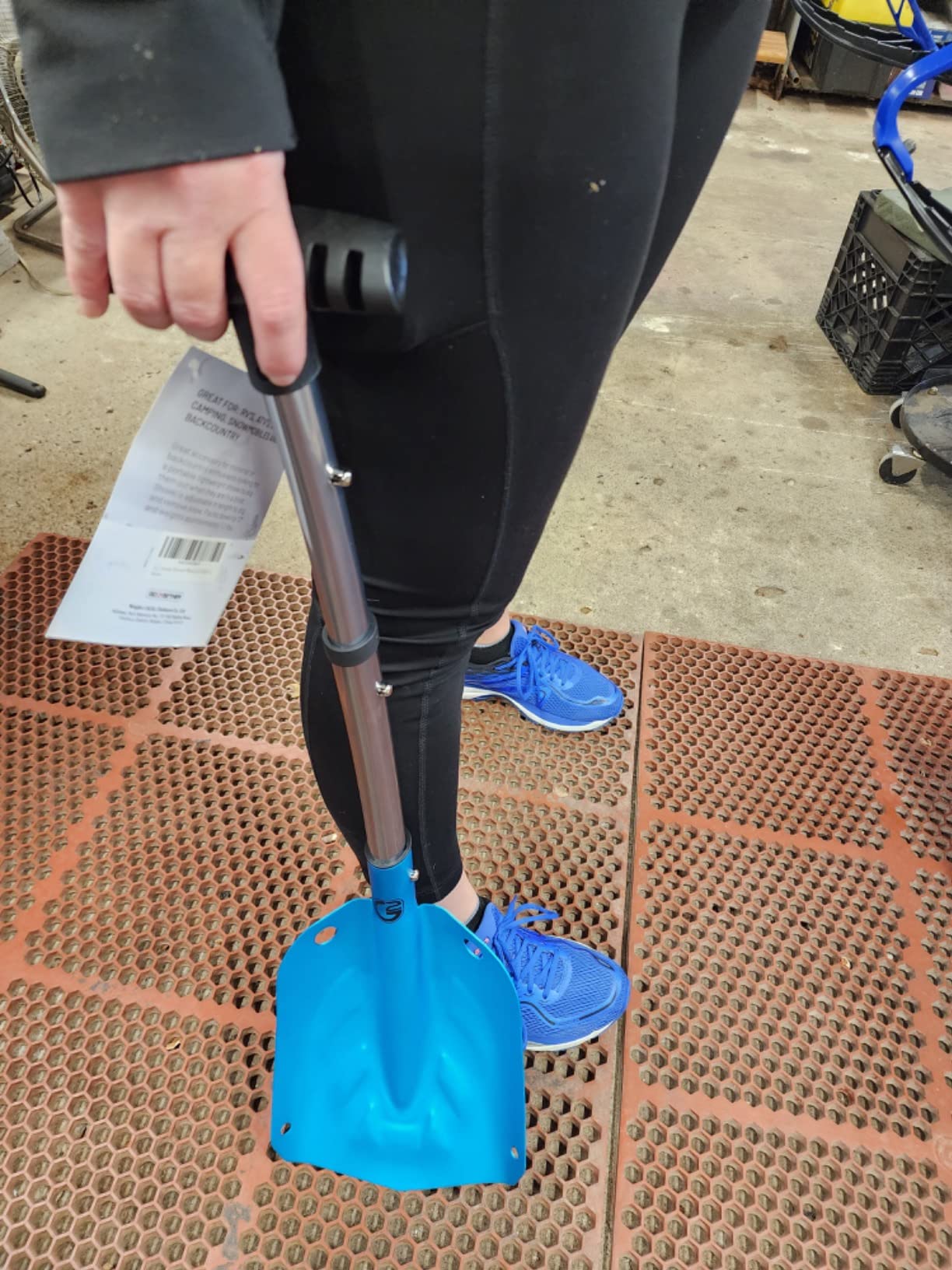
What you give up is reach. The extended length tops out at 30 inches, which is shorter than several of the professional options in this roundup, and the 1.1 lb figure is heavier than the true ultralight picks. In a deep burial with loose debris on top, that difference shows up in your lower back before it shows up anywhere else.
The handle is ABS rather than aluminum, and reviewers consistently describe it as comfortable and grippy but not as rigid as a full metal handle. Push hard on compacted debris and you can feel it flex. It has not been a failure issue in the reviews, but it is the part of this shovel most likely to feel soft in exactly the situation where you want confidence.
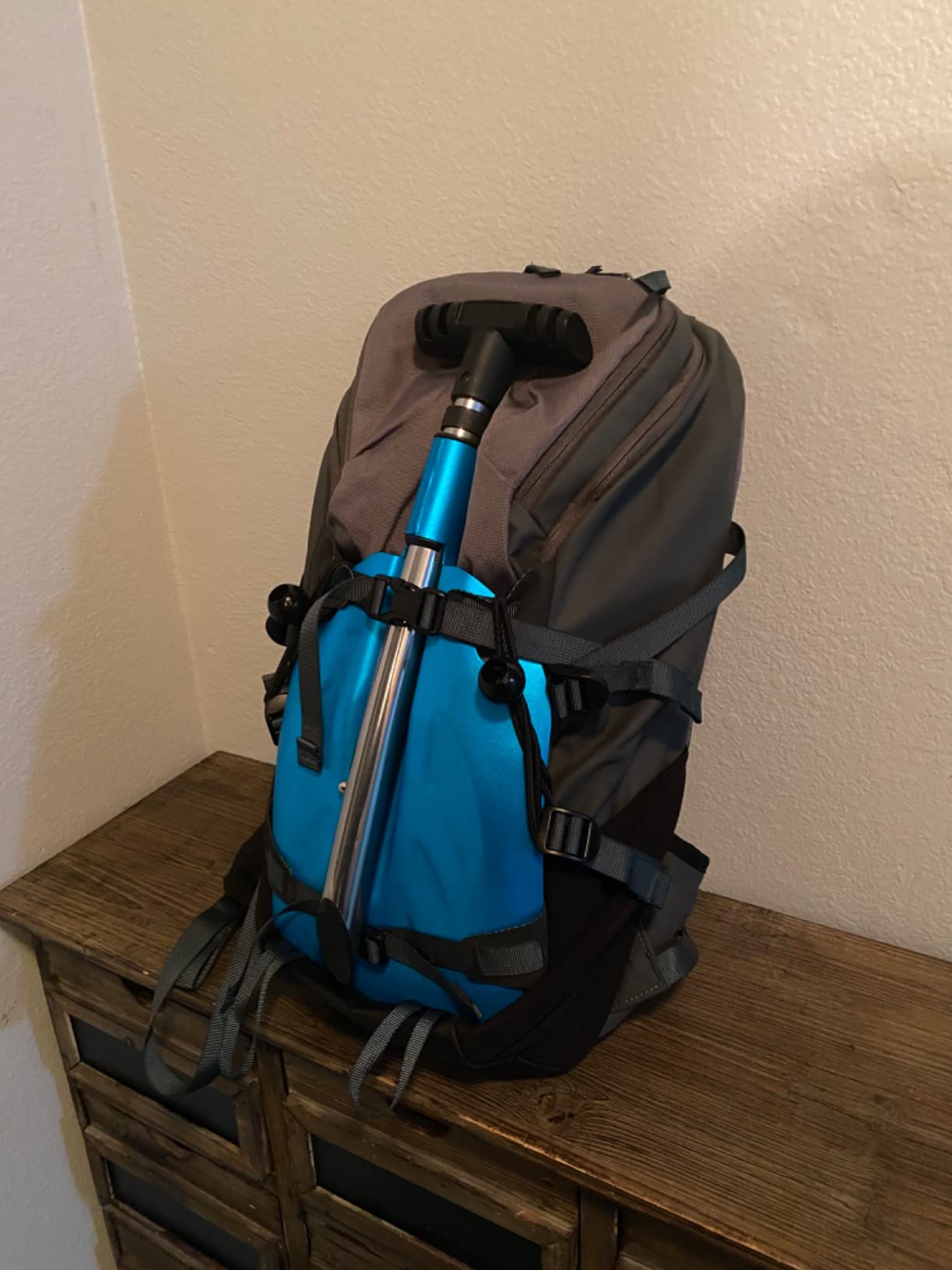
Who the G2 telescopic shovel suits
It suits the skier who tours a few days a week, carries one pack, and wants a shovel that disappears into it. At 1.1 lb with a 17 inch packed length, it is the easiest one here to keep in a side pocket or a lid pocket, and the 4.6 star average across 135 reviews is the largest review base in the roundup.
It also suits anyone who digs snow pits. The adjustable blade angle and the aluminum blade make it a reasonable pit tool, not just a rescue tool, and if you are doing snow study work the flat back of the blade cuts clean pit walls.
Who it does not suit
It does not suit a two-person deep excavation where a short handle matters, and it does not suit a ski mountaineering setup where every 100 g is negotiated. If your typical rescue is a full burial at 150 cm in compacted slab, you want more reach and a stiffer handle than this one gives you.
It also does not suit a guide or a working patroller. The construction is aimed at recreational touring, and the handle tolerance is the first thing that would draw scrutiny on an inspection.
2. BCA Dozer 1T – Best Value for a UIAA Certified Rescue Shovel
Backcountry Access BCA Dozer Shovel for Snow Avalanche Rescue – 1T – Blue
6061 T6 aluminum blade
Ovo-concave shaft
Weight 8 oz
23.6 inch packed
UIAA certified
Pros
- UIAA certified for rescue
- Only 8 oz on the scale
- Spring pins deploy hands free
- Stompable blade cuts hard snow
- Lies flat with no protruding ferrule
Cons
- Short shaft limits leverage in deep pits
- Blade has no attachment holes
- Low profile makes it harder to load large scoops
The Dozer 1T is the most interesting spec sheet in this roundup: 6061 T6 aluminum, 8 ounces, and a UIAA certification for avalanche rescue shovels. That combination of alloy, weight and certification at this level of build quality is what makes it our value pick.
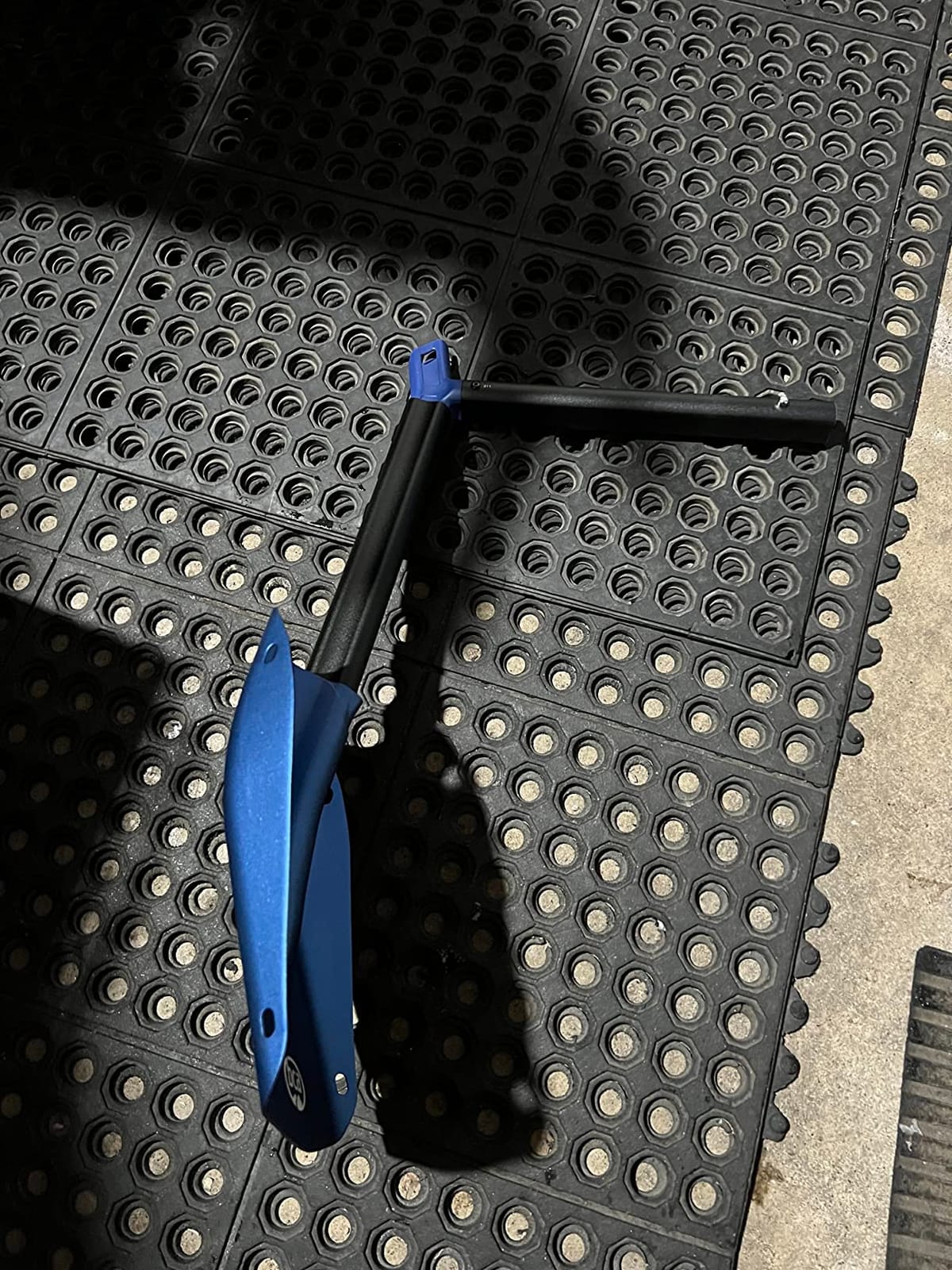
The ovo-concave shaft is the detail guides notice. The shaft is not a simple tube, it is a shaped profile that resists bending, so when you load the blade with heavy wet debris the shaft does not develop the side-to-side flex that makes cheap shovels feel unstable. The low-profile stompable blade has a flat edge you can step on to drive the cutting edge into hard snow, which is the fastest way to start a productive excavation.
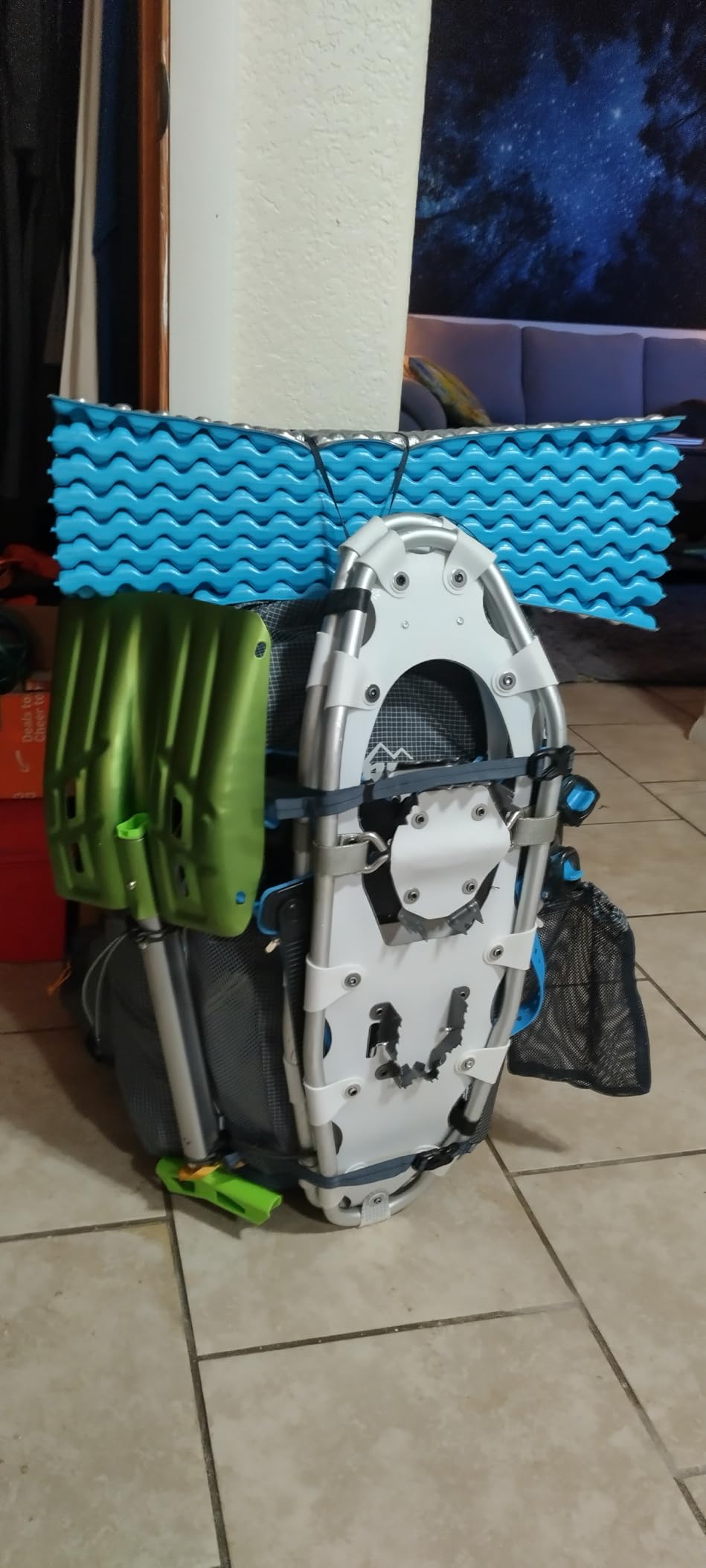
Assembly is hands free. Auto-engaging spring pins at the blade and shaft connection mean you can click it together while wearing gloves and without hunting for a loose pin in the snow, and the whole tool lies flat in a pack with no ferrule sticking out into your other gear.
The tradeoff is scale. At 8 oz and roughly 23.6 inches packed, this is a small-volume tool. In a single-burial probe-and-dig situation it is more than sufficient, and reviewers praise the 1T as the most popular size in the Dozer range. For a large multi-burial excavation with a lot of loose debris, you will be scooping small loads many more times than a larger blade would require.
Who the BCA Dozer 1T suits
It suits anyone who wants a certified, no-questions tool without stepping up to a professional price band. The 6061 T6 blade is the same alloy family used across the higher-spec touring shovels, and the 4.6 star average across 103 reviews reflects a shovel people keep using rather than rotate through.
It also suits guide-level kit checks and ski patrol support roles, where a small, stowed, certified shovel is genuinely useful. BCA builds this model in several variants including a 2T-S with a saw, a 1T-UL and a 2D, so the same platform covers different roles if your group needs more than one.
Who it does not suit
It does not suit the high-volume rescue. If your partner list includes long routes, couloirs with deep debris, or a group that skis fast in a big basin, a bigger blade moves more snow per stroke and the physical load drops noticeably.
It also does not suit snow pit work as well as a flat-backed blade with a serrated edge. This is a digging tool, not a study tool, and the low profile that makes it pack so well is the same thing that limits its load capacity.
3. G2 Avalanche Kit with Probe – Best Shovel and Probe Bundle for New Touring Pairs
G2 Avalance Kit: Lightweight Aluminum Alloy Snow Shovel with Snow Probe and Storage Bag, Folding Design, Easy to Storage and Carry (Orange)
Shovel plus probe
Aircraft aluminum alloy
Probe 240 cm extended
Shovel 1.1 lb
Storage bag
Pros
- Shovel and probe in one purchase
- Probe extends to 240 cm
- Steel tip cuts ice and slabs
- Carry bag included
- Collapses very small
Cons
- Probe and shovel share one bag
- Three piece assembly is fiddly
- Handle fit is inconsistent across production
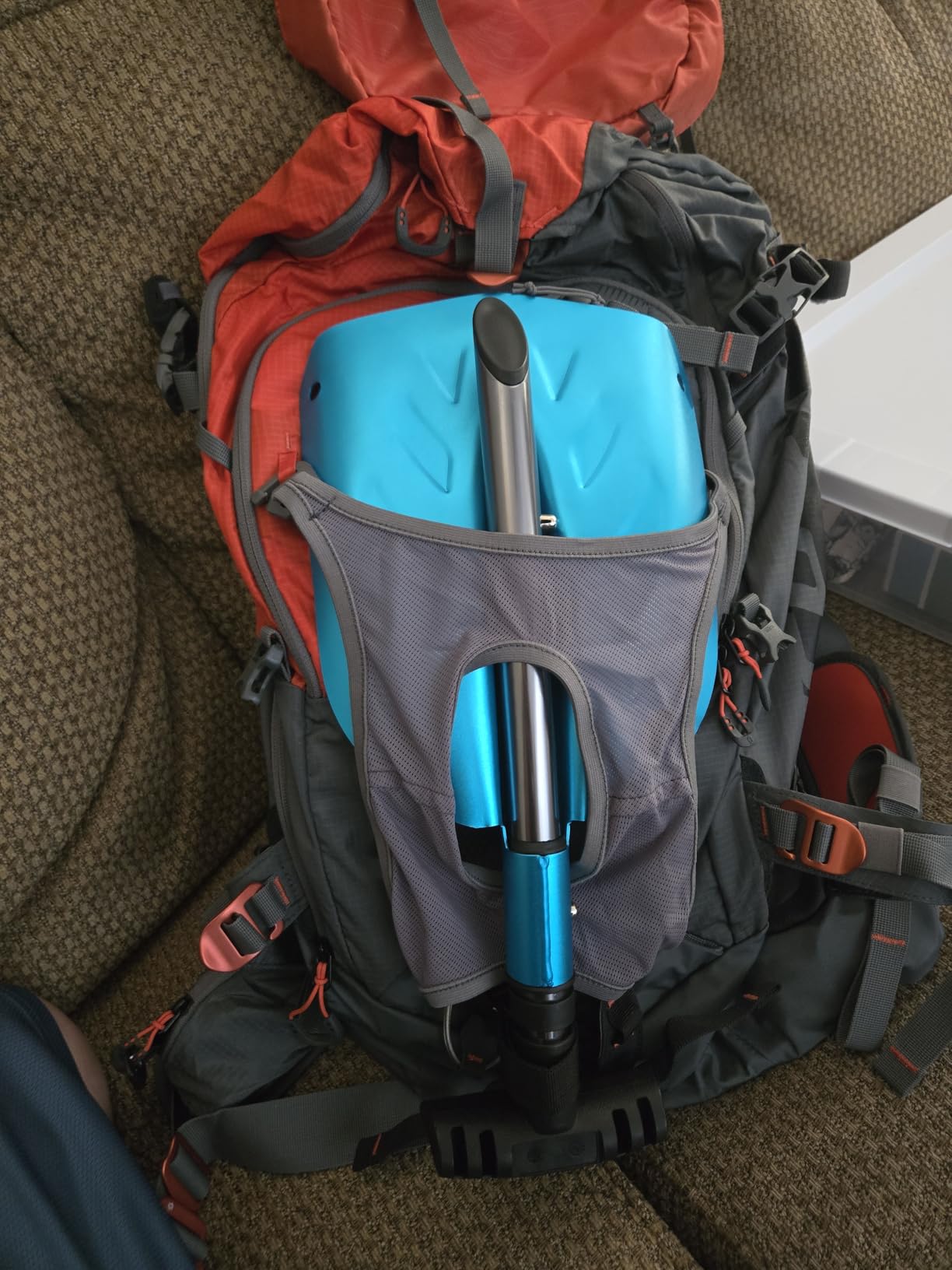
This is the kit we point first-time touring partners toward, and it is the one entry in the roundup where the answer depends on what you are missing rather than what is best. If you already own a probe, buy a shovel. If you own nothing, this covers both halves of the non-electronic part of your kit in one go.
The probe extends to 240 cm, which is the practical minimum for backcountry touring, and the steel tip is designed to cut through ice layers and firm slabs so you can feel the hardness change that tells you where the weak layer sits. The probe packs to 16.9 inches and the shovel to 17 inches, so the whole package disappears into a small pack.
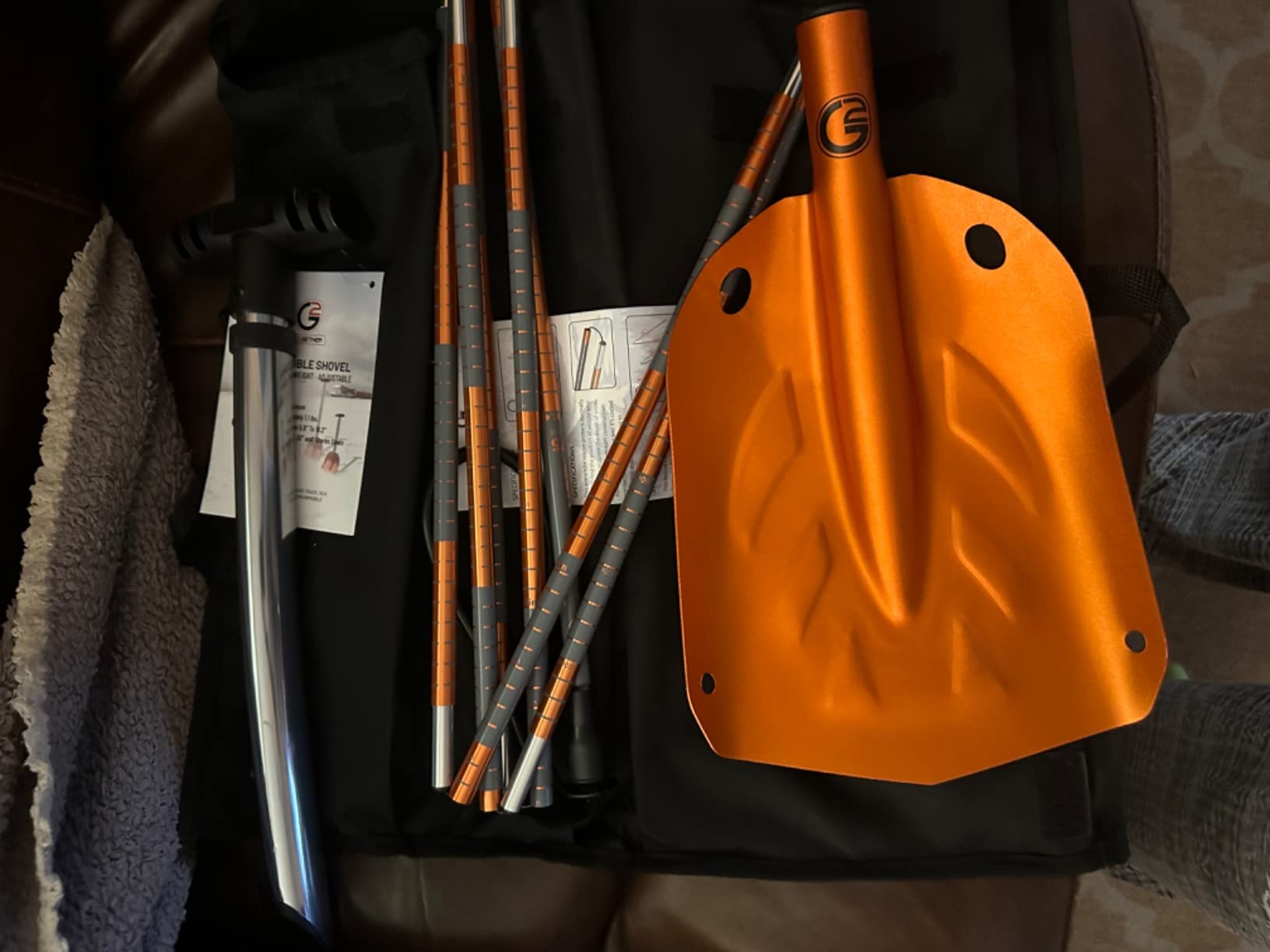
Both pieces are aircraft aluminum alloy, and the probe uses a pull-top-section unfolding design rather than a cable and tensioner, which means there is no cord to stretch or freeze. That simplicity is a genuine advantage in cold weather.
What you give up is refinement. The 4.0 star average across 71 reviews is the lowest-rated product in this roundup, and the complaints cluster around two things: the shared storage arrangement means you have to repack the probe to get at the shovel, and the three-piece shovel assembly is fiddly enough that users report the handle feeling loose on a portion of production.
Who the G2 avalanche kit suits
It suits a pair splitting two purchases: one person buys the kit, the other buys a beacon, and you are both covered for the season. For a couple moving into their first backcountry season, the cost of getting beacon, probe and shovel right at once is lower than buying them one at a time.
It also suits anyone who wants a spare probe for their group. A second probe in the pack is a real safety margin, and having a compact 240 cm probe and a compact shovel in the same bag is more useful than two loose tools.
Who it does not suit
It does not suit skiers who dig regularly and care about tool feel. The handle tolerance complaints are the kind of thing that does not matter on a recreational day and matters a great deal in a rescue where you are the only one digging.
It also does not suit anyone planning to carry a cable-tensioned probe or a probe longer than 240 cm. If your terrain is alpine and your group is committed to long tours, save the money and buy a dedicated professional probe instead.
4. SnowBigDeal Shovel with Saw – Best for Snowmobile Rescue and Clearing Work
SnowBigDeal Emergency Snow Shovel with Saw – Converts from Dig to Chop/Hoe Mode – Portable for Snowmobiles, Skiing, Backcountry, Avalanche Rescue – Winter Survival Gear for Car, Camping – T6 Aluminum
6061 series aluminum
Chop and hoe conversion
13.75 inch saw blade
850 g
Blade 10 by 12 inch
Pros
- Converts from dig to chop and hoe
- Integrated 13.75 inch saw
- 850 g weight
- 6061 aluminum construction
- D-grip handle
Cons
- Breakdown mechanism can stick on first use
- Some units arrive with a crooked blade weld
- Saw bends if forced sideways
The reason this shovel is on the list is the conversion. It flips from a straight digging blade into a 90 degree chop and hoe, which changes the whole motion of excavation from lifting snow to shearing it off in horizontal slices. That is the single most effective technique change a skier can make to their dig speed.
The saw is the second reason. A 13.75 inch blade folds into the handle and cuts wood, ice and firm slab. For snowmobilers digging out a stuck machine or clearing a buried tree, that is worth more than any shovel feature. It also gets used for cutting a hard crust so you can reach the loose debris underneath without spending ten minutes levering at it.

At 850 g the weight is reasonable, and the 6061 series aluminum construction is the right alloy for the job. The blade measures 10 by 12 inches with a 1.75 inch depth, so it is a genuinely large-volume shovel for a compact tool.
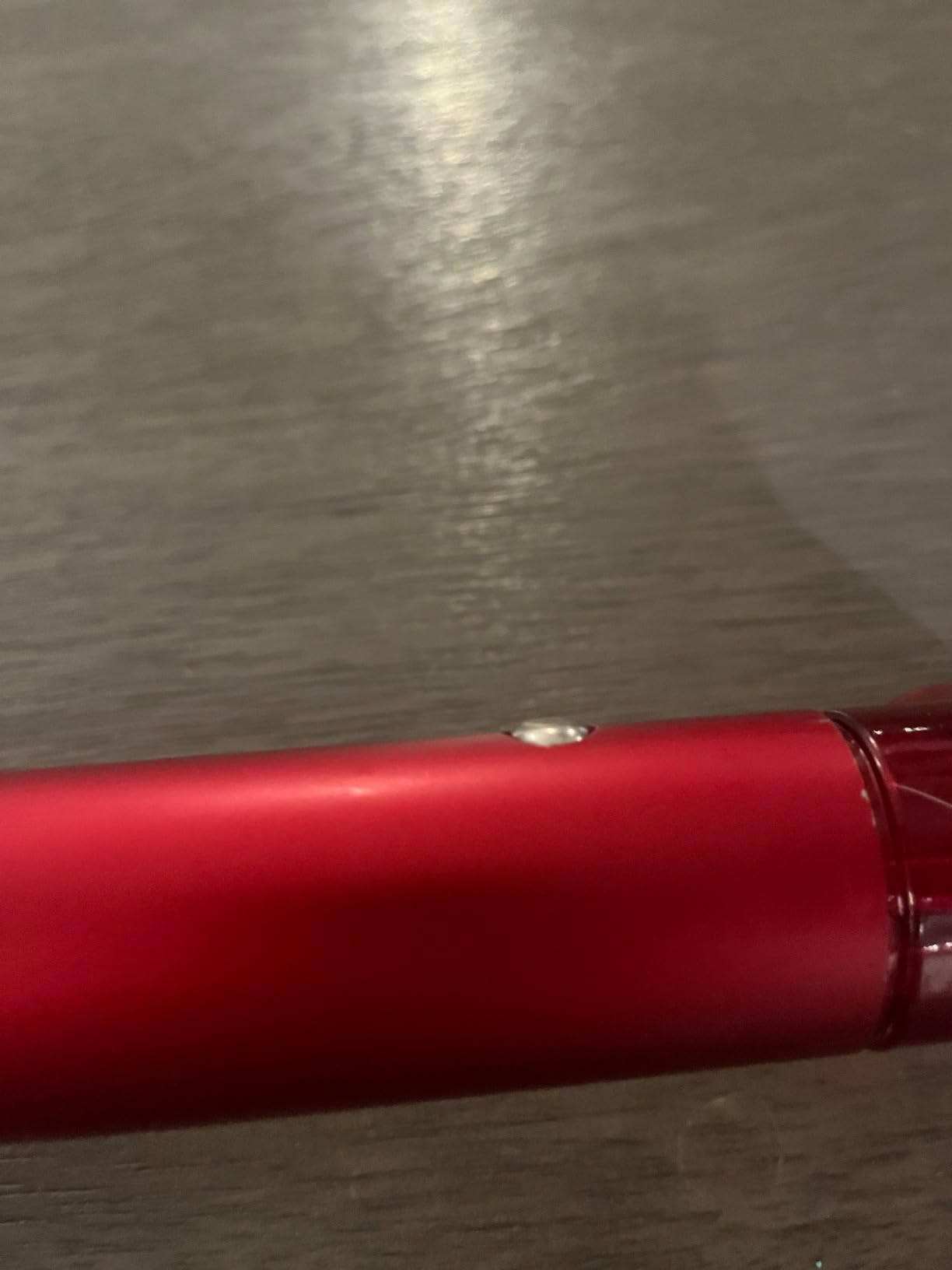
Quality control is the honest concern. Reviewers report the breakdown mechanism sticking on first use, and some report a crooked weld at the blade head. Neither is a safety issue for rescue, both are annoying, and the manufacturer is described as responsive when buyers contact them about replacements. The saw also bends if you force it sideways, which is easy to do on a tree root or a frozen layer edge.
Who the SnowBigDeal shovel suits
It suits snowmobilers, who have a different rescue problem than skiers. Machine extraction involves more hard snow, more digging force and more wood and ice than a human burial does, and this is one of the few compact shovels here with both a saw and a hoe conversion in the same frame.
It also suits skiers who want to dig efficiently and who are willing to practise the conversion. If you have never used a hoe mode, a shovel that converts quickly is easier to learn on than one where the conversion is buried in the manual.
Who it does not suit
It does not suit people who need a certified, uniform tool. This shovel does not carry a UIAA certification, and while the aluminum is appropriate, buyers who want the certification on the label as a decision shortcut should look elsewhere in this list.
It also does not suit anyone who will be careless with the saw end. Because the blade sits inside the shaft, reassembly with gloves on and snow on your hands is a moment when a protruding tooth can find a glove or a palm. Practise the conversion in a safe place before you need it in the snow.
5. Mammut Alugator Light – Most Versatile for Small Packs
Mammut Alugator Light – Neon Orange
Lightweight aluminum design
Telescopic shaft
Attachment holes in blade
Weight 1 lb
Neon orange
Pros
- Highest rated at 4.7 stars
- Sharp blade cuts hard snow
- Space saving blade shape
- Attachment holes for sled or anchor
- Neon orange stays visible
Cons
- Paint on the shaft wears at the joint
- Small blade volume
- Heavier than other premium picks
Mammut’s Alugator Light has the highest star rating in this roundup at 4.7 across 39 reviews, and the design priorities are clear. It is built for people who refuse to give up pack space for a rescue tool, and every decision on it serves that.
The blade is deliberately space-saving, shaped so it nests against the shaft rather than projecting out, and the telescopic shaft keeps the packed profile short. Attachment holes in the blade do double duty: they save weight by removing material, and they let you lash the shovel to the outside of a pack, build a rescue sled, or cut a snow anchor. That is a rare combination in a compact shovel.
Reviewers consistently single out blade sharpness. A sharp edge in hard wind-packed snow is worth more than a large dull one, because you are fighting two things at once when the debris sets up firm, and the edge is what starts the cut.
Who the Mammut Alugator Light suits
It suits skiers on a weight budget who still want a recognizable premium brand and a tool that will last. The neon orange finish has a practical side too, because a shovel that is easy to find inside a pack when your hands are cold is a small but real advantage.
It also suits anyone building rescue sleds or snow anchors regularly, since the attachment holes are the feature that makes those jobs easy rather than improvised.
Who it does not suit
It does not suit high-volume rescue. The compact blade is optimized for packing, not for moving the maximum amount of snow per stroke, and a deep burial with loose debris on top will test your patience.
It also does not suit skiers who care about the cosmetic longevity of the tool. The orange paint on the shaft wears at the joint over time, which is purely cosmetic but visible on a brightly colored tool you will be looking at every time you unpack.
6. Voile Telepro – Best for Long Reach in a Two-Person Excavation
Voile Telepro Avalanche Shovel
Aluminum construction
850 g standard, 710 g mini
39.5 inch extended length
31 inch packed length
Ergonomic grip
Pros
- Highest rated shovel in the roundup
- Longest reach in the list at 39.5 inch
- Professional grade construction
- Mini version at 710 g
- Full size at 850 g
Cons
- Largest footprint in the roundup
- Black only
- Longer reach is wasted on a small pit
The Telepro carries a 4.9 star average, the highest rating of any shovel here, and it earns that score with one specific number: 39.5 inches of extended length. When the comment in every backcountry forum about a flagship shovel is that the handle is too short for a two-person pit, this is the answer to it.
Longer shaft means more leverage per stroke, which matters most when a partner is throwing snow toward you and the pit is deep enough that you are working at arm’s length. It also means you can stand more upright, which is the difference between a dig that stays effective for four minutes and one that degrades after two.
The standard build is 850 g and the mini is 710 g, so you are choosing between two real options rather than one compromise. Both are full aluminum construction with an ergonomic grip that works with gloves on.
Who the Voile Telepro suits
It suits ski patrol, guides, and anyone who spends time in a pit with a partner at depth. The reach is the entire argument, and if your typical rescue involves a full-depth excavation you will feel the difference on every stroke.
It also suits skiers who do a lot of trail and infrastructure clearing, because the leverage translates directly to breaking up compacted snow with a boot on the blade.
Who it does not suit
It does not suit tight-volume or long-pack setups. At 31 inches packed, this is the largest shovel in the roundup and needs deliberate pack planning. If your loading is already tight, the mini version is the one to look at rather than the standard build.
It also does not suit anyone who wants a colour choice, since it comes in black only. That sounds trivial until you are trying to find a black shovel in a black pack with numb hands.
7. Ortovox Badger Lightweight – Best for Large Blade Volume in a Light Package
ORTOVOX Shovel Badger Lightweight Aluminum Avalanche Shovel – Safety Blue
2.5 liter scoop volume
Weight 625 g
70 cm long, 45 cm collapsed
Blade 28 by 21 by 4 cm
Hybrid ergonomic grip
Pros
- 2.5 liter scoop is the largest here
- Only 625 g
- High side walls and center ridge add rigidity
- Non-slip grooves for boot traction
- Centering aid speeds assembly
Cons
- Collapsed length is 45 cm
- One colour only
- Higher price for its weight class
The Ortovox Badger solves a problem the rest of this roundup mostly ignores: how do you carry a large blade without carrying the weight of a large blade. A 2.5 liter scoop in a 625 g package is the best volume-to-weight ratio in the list, and volume is the number that decides how fast you clear debris.
Rigidity is where the design work shows. The blade has a pronounced center ridge and high side walls, which is the standard way manufacturers stop an aluminum blade from flexing sideways under load. Flex costs you energy, because a blade that deflects does less work per stroke. The non-slip grooves along the top edge let you step on the blade to drive it into hard snow, and the centering aid in the shaft socket means assembly does not require lining up a hole in the cold.
Blade dimensions are 28 by 21 by 4 cm, and the tool runs 70 cm long, collapsing to 45 cm. That collapsed length is the practical limitation: it is not a small pack tool, and it needs a real pocket rather than a strap.
Who the Ortovox Badger suits
It suits the skier who wants a serious digging capacity for a serious tour without dropping into the 850 g range. Deep debris, poor structure, a group that skis fast and often triggers things: this is the shovel for that scenario.
The non-slip grooves make it a decent snow pit tool too, because you can stand on the blade edge to cut a clean floor without slipping sideways in soft snow.
Who it does not suit
It does not suit tight pack volumes. A 45 cm collapsed length is the second largest in the roundup, and if you are already carrying skis, skins, a beacon, a probe and a layer system, the space matters.
It also does not suit buyers who want options. It comes in a single safety blue colour, and buyers in this weight class should expect to pay a premium for the aluminum and the brand rather than comparing feature counts.
8. Black Diamond Transfer LT – Best for Ultralight Ski Mountaineering
Black Diamond Equipment Transfer LT Backcountry Snow Safety Shovel, Envy Green
Weight 405 g
7075AL riveted aluminum blade
Removable two piece shaft
Blade perforations for lashing
UIAA certified
Pros
- Lightest UIAA certified shovel available
- Only 405 g
- Riveted 7075AL blade
- Perforated blade for lashing
- Black Diamond warranty
Cons
- Small blade means many more strokes
- Only 405 g of capacity in a deep pit
- Shaft and blade pack as separate pieces
At 405 g, the Transfer LT is the lightest UIAA certified shovel available, and that is the whole pitch. Every gram in it is accounted for: a riveted 7075AL blade, a removable two piece telescoping shaft, and perforations in the blade that reduce weight and double as lashing points for the outside of a pack.
Ultralight forum consensus treats this model as about as light as a certified rescue shovel can reasonably go, and if you are counting grams for ski mountaineering that is a real, legible number. The 4.4 star average across 31 reviews reflects owners who made the weight trade knowingly and are happy with it.
What you accept for that number is blade size. It is a small blade, and small means many more strokes to clear the same volume of debris. That is fine for a probe-and-dig single burial where the debris is loose, and it is a poor trade in a deep excavation with hard debris where you are already fatigued.
Who the Transfer LT suits
It suits ski mountaineers and fast-and-light touring setups where a full gram budget is the constraint. A certified shovel at 405 g changes what a kit is possible, because it is roughly a third of the weight of a conventional touring shovel.
The perforations have a second use that matters more than the weight saving: you can lash the shovel to the outside of a pack, which is a reasonable choice when internal space is the scarce resource, and you can use them to build a rescue sled or a snow anchor.
Who it does not suit
It does not suit long tours where a companion burial is a realistic outcome. The math is unforgiving: a small blade in a large pit means more strokes, more time, more fatigue, and the digging is what limits the clock, not the beacon or the probe.
It also does not suit skiers who carry skis and boots on their back and therefore have no external attachment points. Everything about this shovel assumes you can afford to keep it separate or lash it somewhere sensible.
9. Core Plus Shovel and 240 cm Quick Lock Probe – Best for Fast Probe Deployment
TerraWest Core Plus Avalanche Shovel and 240 cm Quick Lock Probe
Heat-treated 5052 aluminum blade
6061 telescopic shaft
240 cm probe at 299 g
7075 T6 aluminum probe
475 g for both
Pros
- Shovel and 240 cm probe together
- Coated steel cord limits stretch
- Heat-treated blade with non-slip grooves
- Quick-lock probe deployment
- Drawstring carry bag
Cons
- Smaller blade than premium models
- Budget brand in a serious category
- Only a thin body of reviews
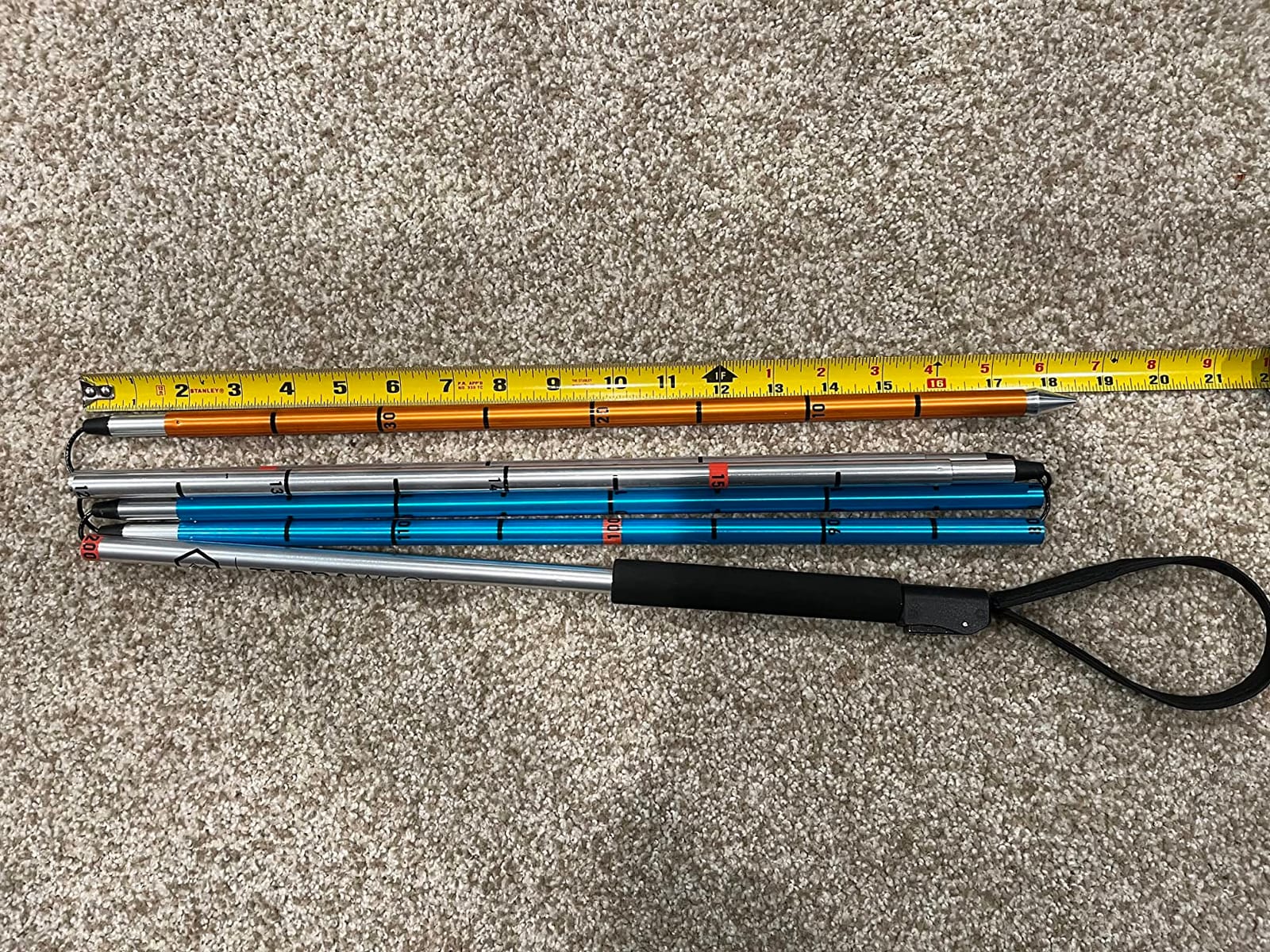
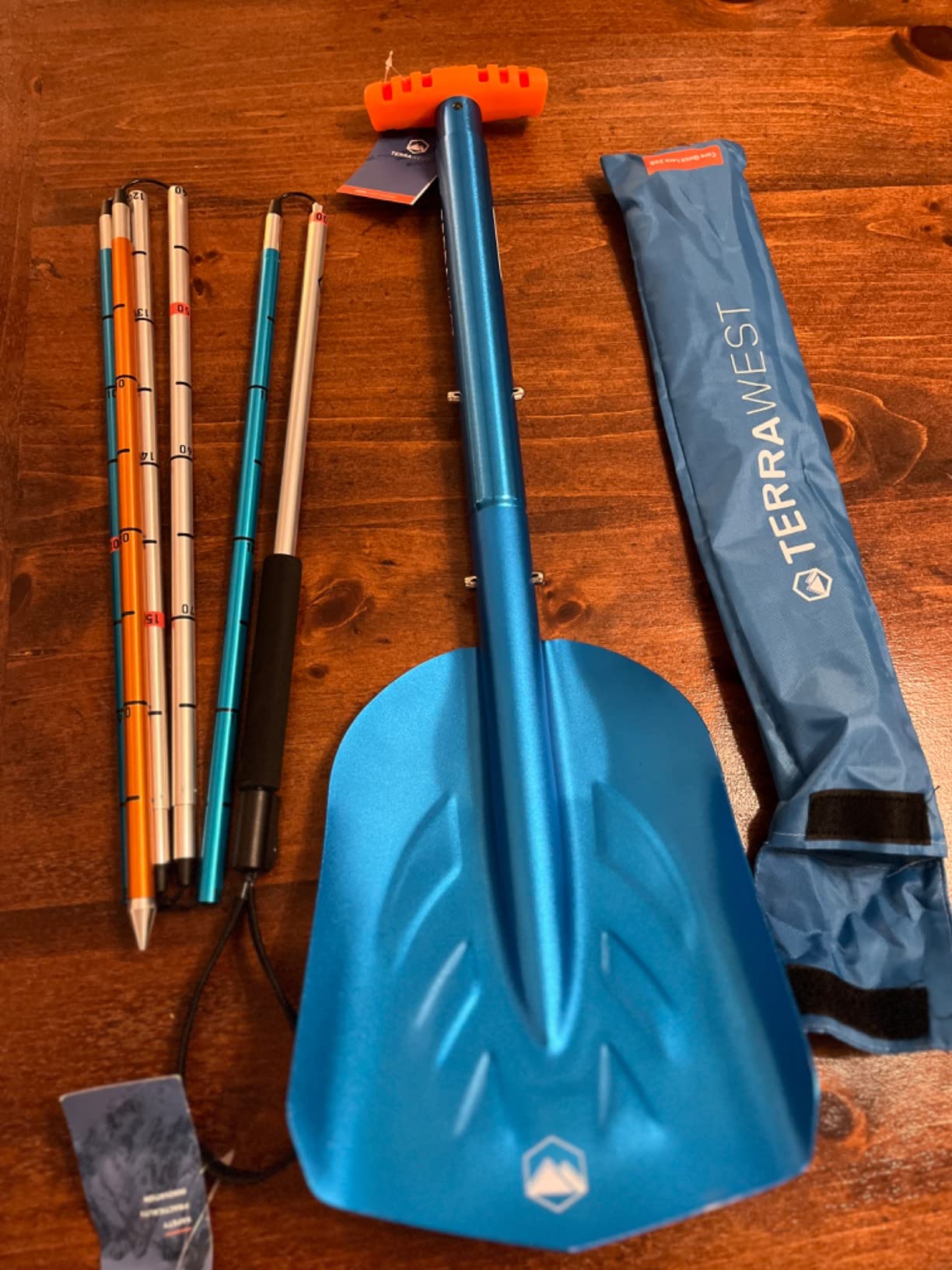
The reason this kit is different from the G2 bundle is the probe mechanism. It uses a coated steel cord tensioning system that limits stretch, and a quick-lock deployment, so the probe goes from packed to ready in one motion without you pulling a section and waiting for the cord to tension itself.
That matters more than it sounds. In a rescue, the slowest part of the probe phase is usually the fumble at the top of the pack, and a mechanism that opens in one movement removes it. The probe extends to 240 cm, weighs 299 g, and is 7075 T6 aluminum, which is a light and stiff alloy for a probe.
The shovel side is a heat-treated 5052 aluminum blade with non-slip grooves on a 6061 aluminum telescopic shaft. The two pieces together come to 475 g, which is the lightest complete shovel and probe package in this roundup.
The honest framing is that 5052 is a slightly softer alloy than 6061 T6, and the blade is smaller than the ones on the premium picks. Under a boot in firm snow it holds up, but if you are comparing tooth-for-tooth against a 6061 T6 stompable blade, this one is the softer of the two.
The 21-review body is thin for a safety category. That is not a quality judgement, it is a data-recency judgement: there is less long-term owner feedback here than on a model that has been on shelves for years.
Who the Core Plus kit suits
It suits a first-season touring skier building a kit on a budget who wants a real probe rather than the cheapest available. The 240 cm length meets the standard most guides and courses work to, and the quick-lock deployment is a genuine piece of engineering that most entry-level kits skip.
It also suits anyone who wants a second probe for a group, because a compact 240 cm probe that deploys in one motion is easy to hand to a partner.
Who it does not suit
It does not suit high-volume excavation work, where the smaller blade and the softer 5052 alloy are the wrong direction. If your partners ski steep terrain daily, buy the shovel separately and spend the difference on a stiffer alloy.
It also does not suit professional or patrol use, where tool standardization matters and where a guide is more likely to be questioned about a component with a thin review history.
10. BCA Dozer 2T-S with Saw – Best for Mitten-Friendly T-Grip Control
Backcountry Access BCA Dozer Shovel for Snow Avalanche Rescue – 2T-S with Saw (Black/Gray)
6061 T6 aluminum
T-grip handle
Integrated quick-deploy saw
25.75 inch compressed
34.25 inch extended
Pros
- Integrated quick-deploy wood saw
- UIAA certified for rescue
- 6061 T6 aluminum construction
- T-grip gives strong leverage
- Fits existing BCA carry systems
Cons
- No hoe mode on this variant
- Heaviest shovel in the roundup at 1.9 lb
- Thin review history
The Dozer 2T-S is the saw-equipped member of the Dozer family, and it is worth including for a specific reason: this variant does not convert to hoe mode. The T-grip is fixed. If you read the rest of the Dozer range as hoe-capable, this one is the exception, and reviewers do call that out.
What it does instead is give you a saw. A quick-deploy wood saw folds into the shaft and comes out in one motion, which is the same argument as the snowmobile saw in entry four, applied inside a certified platform. The construction is 6061 T6 aluminum and it meets the UIAA standard for avalanche rescue shovels, so you are not trading certification for the saw.
At 1.9 lb it is the heaviest shovel in this roundup, and it measures 25.75 inches compressed and 34.25 inches extended. That is a real pack weight for a tool whose main feature is convenience rather than capacity.
Who the BCA Dozer 2T-S suits
It suits skiers who want a certified shovel with a saw and who prefer a T-grip to a D-grip. A T-grip gives you a closed fist around the handle, which transmits more force than an open D when you are loading the blade with hard snow, and it works well in a mitten.
It also suits anyone who already owns BCA packs and gear, since it is built to fit the same carry systems and the same bag layout.
Who it does not suit
It does not suit anyone who wants a full digging conversion set. Without hoe mode you are limited to lifting, which is the least efficient way to move consolidated debris. For most skiers that is a real downgrade from a similar-priced alternative that converts.
It also does not suit anyone optimizing pack weight at 1.9 lb. If weight matters to you at all, this is the wrong end of the range, and the lighter Dozer variants in the same family are built for that.
How to Choose an Avalanche Shovel: Weight, Blade, Hoe Mode and Certification
Aluminum or plastic: the answer is never plastic
Consolidated avalanche debris sets up like concrete within minutes of a slide stopping. A plastic blade flexes under that load, deflects instead of cutting, and can crack or distort in exactly the moment when you cannot afford a second attempt. An aluminum blade is stiffer, stronger and, in most cases, lighter than a plastic equivalent because you do not need as much material to get rigidity.
There is no credible case for plastic in avalanche terrain. The only plastic shovels in circulation are the ones that come bundled into generic department store safety kits, and the consensus in every backcountry forum is the same: unless you bought it by mistake, you are not carrying one.
Blade volume and the under-fill trap
Blade volume, measured in liters, is how much snow you move per scoop. It is usually quoted as scoop volume rather than raw blade dimensions, and it is the number that determines how many strokes a burial costs you.
Here is the counterintuitive part, and it is the most useful piece of advice in this whole guide: a large blade is only faster if you fill it. Under-filling a big blade makes you slower than you would be with a smaller blade you can actually load, because you are moving air and loose snow for every stroke. Choose the volume that matches the debris you expect, not the volume that looks most impressive.
For a typical single burial with loose debris, a mid-size blade is right. For deep excavation in hard debris, volume wins. The 2.5 liter scoop in this roundup is the high end of what a compact pack tool can carry.
Hoe mode, grip type and shaft geometry
Hoe mode, also called adze or clearing mode, converts the blade to 90 degrees so you can chop into the debris and drag it out sideways rather than lifting it. It is the single most effective technique upgrade a shovel can give you, and it is the reason the snowmobile saw shovel in this list earns its place despite a thinner brand profile.
Check for the conversion before you buy, not after. Not every variant in a given range converts, as the fixed T-grip Dozer demonstrates.
Grip type is a smaller decision. A D-grip is an open loop you hook a mitten through, which gives you a very secure hold and good control. A T-grip is a closed handle you wrap a fist around, which transmits more force under load. Both work in gloves, and both work in mittens if the mitten is not the bulkiest thing you own.
Shaft geometry is worth thirty seconds of research. Oval and oblong cross-sections resist bending better than round tubes of the same weight, which is why the Dozer uses an ovo-concave shaft and why premium models do not use plain round tubing.
Weight tiers: ultralight, standard touring, high volume
The community sorts itself into three tiers, and choosing the wrong one is the most common purchase mistake. Ultralight sits under 650 g and targets ski mountaineering and fast-and-light touring. Standard touring runs 700 to 850 g and covers most people. High volume runs 850 g and up, and is for people who dig regularly or dig deep.
Within this roundup, the ultralight end is the Black Diamond Transfer LT at 405 g and the Ortovox Badger at 625 g. The standard middle is the G2 telescopic at 1.1 lb, the Mammut Alugator Light at 1 lb, and the Voile Telepro at 850 g. The high-volume end is the Ortovox’s 2.5 liter scoop.
Do not buy an ultralight shovel if your partners ski fast in avalanche terrain. A lightweight shovel that is too small for the debris is a heavier pack than a standard one you can actually use.
UIAA Standard 156 and how to check it
UIAA Standard 156 is the certification that matters in this category, and it is treated by guides, patrollers and forum regulars as the single most credible quality signal a shovel can carry. It tests the tool rather than the marketing: blade strength and stiffness, blade and shaft dimensions, and handle performance under load.
It is verifiable. The marking appears on the product listing or the blade itself, and models like the Dozer range, the Transfer LT and the Ortovox line carry it. Where a shovel in this roundup does not carry a certification, that is a decision point rather than a disqualifier, but it is one you should make on purpose.
What to skip
Skip plastic blades, full stop. Skip generic avalanche safety kit bundles from brands you have not heard of, where the beacon and the shovel share a listing and neither component has an independent track record. Skip trekking-pole probe attachments as a probe substitute.
Skip steel farm shovels as a rescue backup. They are the right tool for a driveway and the wrong tool for a 150 cm burial, because weight you did not plan for and a blade that cannot get into a confined pit.
Skip shovels that mount to the outside of your pack on a bungee. External mounts are the first thing lost in a fall, and a shovel you no longer have is worth nothing at the moment you need it.
Completing the kit: beacon and probe
A shovel is one of three essentials. The beacon finds a buried partner, the probe locates them precisely, and the shovel is what actually moves the snow. Most standard probes run 240 to 270 cm, with 240 cm the practical minimum for backcountry touring and 270 cm worth having in deep or alpine terrain. Under 200 cm is a summer hiking probe and will not reach.
If you want a starting point on probes and beacons, our backcountry communication guide covers the layer of the kit that matters when the phone has no signal.
Maintenance, inspection and replacement
There is no fixed replacement schedule for an avalanche shovel. What there is, is a five-minute pre-season inspection that catches every failure mode owners actually report: peeling rubberized grips, shafts that no longer lock cleanly, and cam or spring lock mechanisms that have gone stiff.
Work the shaft in and out several times. If it does not extend and lock smoothly and with a positive feel, the lock is worn. Check the blade for cracks along the center ridge and around the shaft socket, which is where stress concentrates. Check the grip surface for peeling, because a grip that comes off in a mitten during a rescue is a functional loss even if the metal is perfect.
A well-made aluminum shovel should last many seasons. A plastic handle or a rubberized grip sleeve is the part that ages first, and it is usually replaceable rather than a reason to replace the tool.
Frequently Asked Questions
Which avalanche shovel is the best?
The best avalanche shovels for backcountry skiing have a hardened or anodized aluminum blade, a telescoping shaft, a mitten-friendly grip and a 90 degree hoe mode, and most weight between 600 and 950 g. Among the ten models reviewed here, the G2 Backcountry Telescopic Shovel is the best overall for everyday touring, the BCA Dozer 1T is the best value for a UIAA certified tool, and the Voile Telepro is the best for long reach in a two-person excavation. A buried victim has roughly 15 minutes of air, so buy the one you will practise with rather than the one with the longest feature list.
What are people saying about the Black Diamond Transfer LT shovel?
Ultralight skiers describe the Transfer LT as about as light as a certified rescue shovel can reasonably go. At 405 g with a riveted 7075AL blade and a removable two piece telescoping shaft, it is the lightest UIAA certified shovel available and holds a 4.4 star average across 31 reviews. The consistent drawback is blade size: it is a small blade, so deep excavation with hard debris means more strokes and more fatigue. It suits ski mountaineering and fast-and-light touring, and it is the wrong tool for long tours with realistic companion burial scenarios.
Do I really need an aluminum shovel, or is a lightweight plastic one fine?
Aluminum, always. Consolidated avalanche debris sets up like concrete within minutes, and a plastic blade flexes under that load, deflects instead of cutting, and can crack at exactly the wrong moment. An aluminum blade is stiffer, stronger and often lighter, because rigidity does not require as much material. The only plastic shovels in circulation come in generic department store safety bundles, and the consensus in every backcountry forum is that they are acceptable only if you bought one by mistake.
How heavy should an avalanche shovel be?
Most skiers fall into one of three tiers. Ultralight is under 650 g and targets ski mountaineering, with the Black Diamond Transfer LT at 405 g as the extreme. Standard touring runs 700 to 850 g and covers most people, which is where the G2 telescopic at 1.1 lb and the Mammut Alugator Light at 1 lb sit. High volume runs 850 g and up for people who dig regularly or dig deep. Do not buy an ultralight shovel if your partners ski fast in avalanche terrain, because a small blade in a big pit costs more time than the weight you saved.
Do I need a shovel if I have an avalanche airbag?
Yes. An airbag reduces the probability of burial, but it does not remove your rescue duty, because your companion still has to dig you out and you still have to dig them out. What an airbag changes is sizing. If you carry one, a compact mid-volume shovel is enough and you can skip the highest-volume blade in this roundup. The Ortovox Badger’s 2.5 liter scoop is the one capacity you no longer need, not the shovel itself.
How often should I replace an avalanche shovel?
There is no fixed schedule. What matters is a five-minute pre-season inspection that catches the failure modes owners actually report. Work the shaft in and out several times and confirm it locks with a positive feel, check the blade for cracks along the center ridge and around the shaft socket where stress concentrates, and look at the grip for peeling, because a grip that comes off inside a mitten is a functional loss even if the metal is fine. On a well-made aluminum shovel, the handle sleeve usually ages first and is often replaceable.
Conclusion
After working through ten shovels, the decision simplifies faster than the spec sheets suggest. If you want one shovel and you do not have a strong opinion, the G2 Backcountry Telescopic Shovel is the best of the best avalanche shovels for backcountry skiing for ordinary touring days: aluminum alloy, 1.1 lb, packs to 17 inches, and the largest review base in this roundup at a 4.6 star average.
Buy something different if your trip type demands it. Take the BCA Dozer 1T if you want UIAA certification and a 6061 T6 blade in a very small package. Take the Voile Telepro if you dig in a pit with a partner at depth and reach is your problem. Take the Black Diamond Transfer LT at 405 g if you are ski mountaineering and counting every gram. Take the SnowBigDeal saw shovel if snowmobiles are part of your equation.
Whichever you choose, the gear does not make you safe. Read the forecast, carry a beacon, probe and shovel together, and practise companion rescue with your partner before the day you need it. The best avalanche shovels for backcountry skiing are the ones in your pack, already assembled, already practised with.