
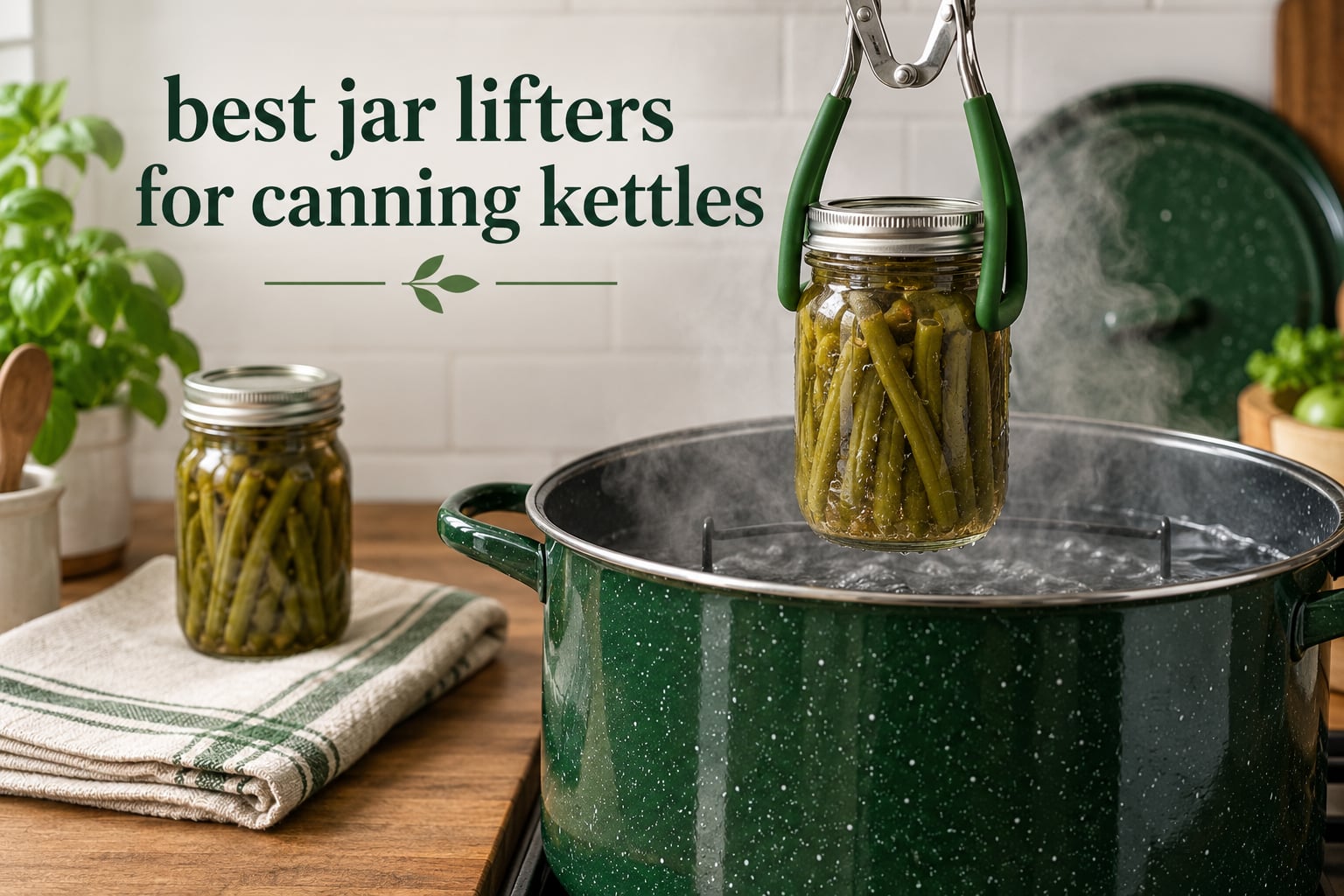
A jar lifter for canning is a pair of tongs with curved, heat-resistant jaws that clamp around the neck of a hot mason jar. That clamp is the whole point: a wet glass jar sitting in a rolling boil is nearly impossible to hold bare-handed, and reaching into a canning kettle to try is how people end up with steam burns and a season’s produce on the floor.
We spent the last several weeks putting ten of the most-reviewed jar lifters through water bath canning batches of pickles, jam and tomatoes, plus pressure canning runs with full quart jars. We looked at three things that actually decide whether a lifter works for you: whether the jaws grip a wet jar below the lid threads, whether the handles keep your knuckles clear of steam in a deep pot, and whether the hinge survives a full season of boiling water. Those three questions drive every verdict below.
One note before we start, because it trips up a lot of beginners: the magnetic lid lifters sitting in the same online carousels as real jar lifters are a different tool. A wand that picks up a flat disc of steel will not lift a mason jar, no matter what the listing photo suggests. We cover that properly in our kettle and pot buying guides too, since pot depth and lifter reach are two halves of the same decision.
Table of Contents
Top 3 Picks: Best Jar Lifters for Canning Kettles (October 2026)

Norpro Canning Jar Lifter
- Vinyl-coated clamping grip
- 8.75 inch stainless steel
- Fits regular and wide mouth jars
- Non-slip handle

Rainspire Heavy Duty Canning Tongs
- Heavy-duty stainless steel
- Non-slip handle
- Clamps securely on jar tops
- Three colour options

Kitchen Crop Jar Lifter
- 9 inch long
- Clamps securely on jar tops
- Fits virtually all jar sizes
- 5-year warranty
Best Jar Lifter for Canning in 2026
| Product | Specifications | Action |
|---|---|---|
| Norpro Canning Jar Lifter |
|
Check Latest Price |
 EEOYU Canning Jar Lifter Tongs EEOYU Canning Jar Lifter Tongs |
|
Check Latest Price |
| Kitchen Crop Jar Lifter |
|
Check Latest Price |
| Rainspire Heavy Duty Canning Tongs |
|
Check Latest Price |
 Mrs. Anderson’s Baking Jar Lifter Tongs Mrs. Anderson’s Baking Jar Lifter Tongs |
|
Check Latest Price |
 Aster Magnetic Lid Lifter Wand 4-Pack Aster Magnetic Lid Lifter Wand 4-Pack |
|
Check Latest Price |
 Oriflame Canning Jar Lifter Tongs Oriflame Canning Jar Lifter Tongs |
|
Check Latest Price |
 C Crystal Lemon Jar Lifter Tongs C Crystal Lemon Jar Lifter Tongs |
|
Check Latest Price |
 AUGHOA Canning Jar Lifter Tongs AUGHOA Canning Jar Lifter Tongs |
|
Check Latest Price |
 Fox Run Farm to Table 5645 Lifter Tongs Fox Run Farm to Table 5645 Lifter Tongs |
|
Check Latest Price |
1. Norpro Canning Jar Lifter – Vinyl Clamp Grip and the Most Reviews in the Group
Norpro Canning Jar Lifter
8.75 inch stainless steel
Vinyl-coated clamp grip
Non-slip handle
Fits regular and wide mouth
Pros
- Grippy vinyl clamps hold wet jars below the lid threads
- Narrow prongs slip between jars without disturbing them
- Easy to operate with limited hand strength
- Washes with soap and water in seconds
Cons
- Handles can pop free from the metal if pried apart
- Scissor design needs two hands to open
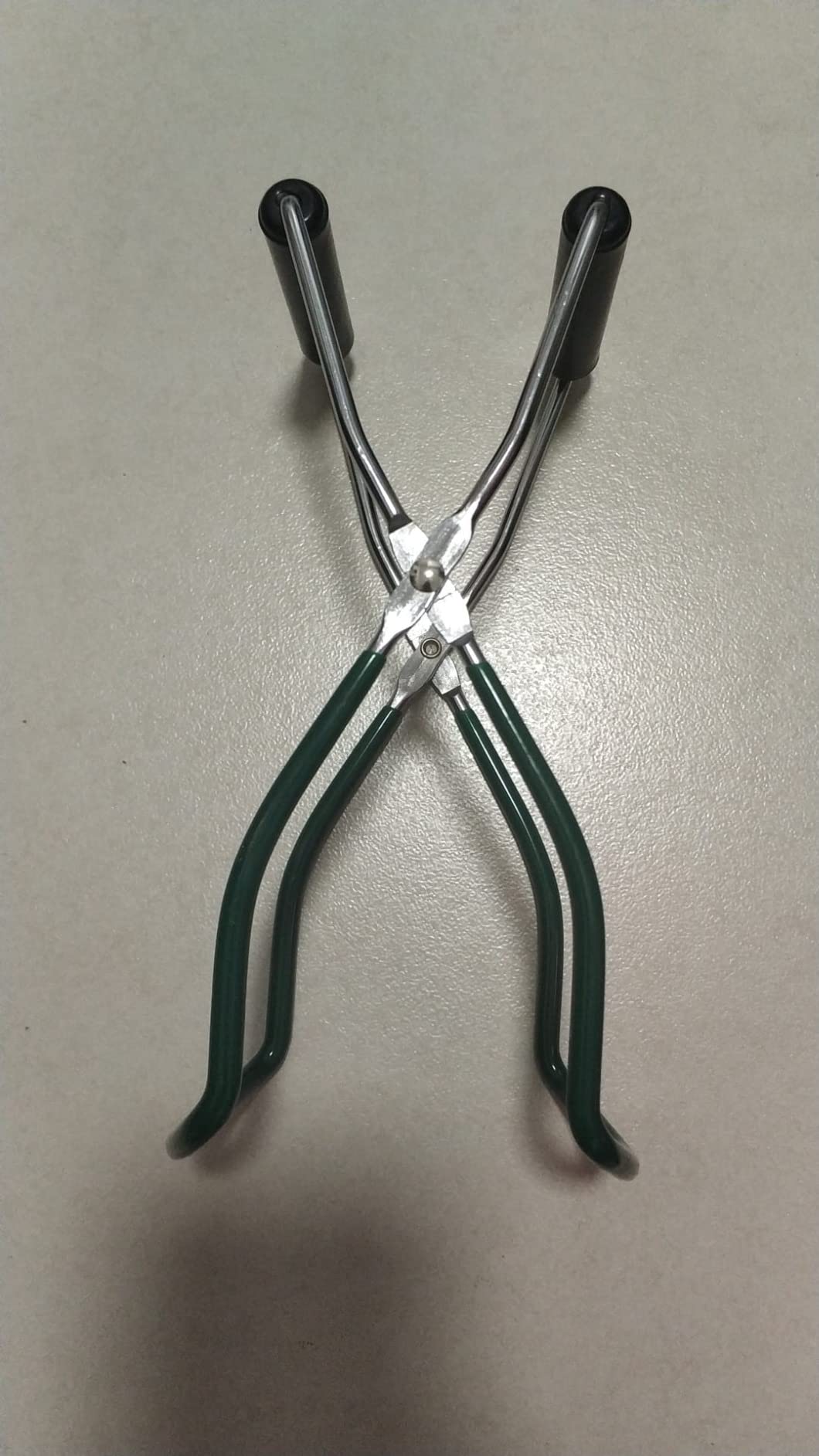
The Norpro has been on our shelf longest and it is the one we hand to beginners. With over three thousand ratings behind it, there is no single point of failure in the design to worry about, and the vinyl-coated clamp grips a wet jar right below the lid threads where the surface is always dry-ish. That is exactly where a jar lifter needs to bite.
The narrow prongs matter more than they sound like they should. In a pot packed with nine or ten pints, the jaws slip down between jars instead of knocking a neighbouring jar off the rack. Fewer knocked jars means fewer hairline cracks in jars you were counting on to seal.
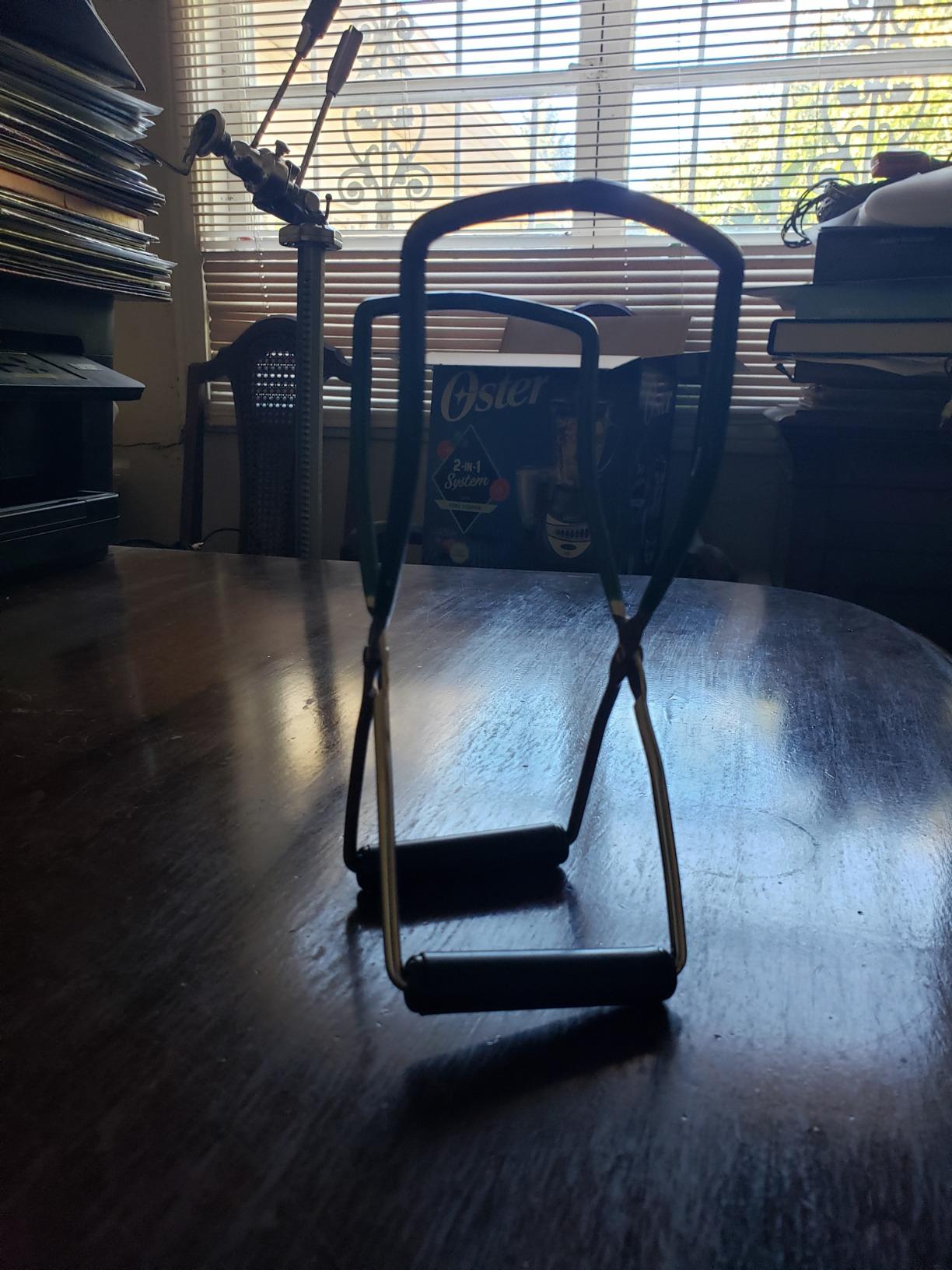
Every one of these lifters is a scissor-style tong, so the honest downside is that you use both hands to open it. If you are lifting dozens of jars in one session, the one-handed spring designs free your other hand for the towel, the lid, or your phone timer. For most home canners doing a few batches a year, two hands is fine.
Cleaning is unremarkable in the best way: warm soapy water, no crevices that trap food, and the vinyl wipes clean. We hung it upside down to dry rather than resting it on a wet counter, which keeps the coating in better shape over a season.
Who this lifter suits
If you can standard mouth jars and want one tool that also handles wide mouth, this is the safe purchase. It is the highest review count in this roundup by a wide margin, so replacement parts, tips and general knowledge about its behaviour are easy to find when something finally wears.
It also suits anyone with a mixed jar collection, since the jaws open wide enough for the larger neck diameter without a second tool. That single-tool argument is the reason it comes out on top for most kitchens.
Where it falls short
A few owners report that the handles can pop free from the metal if they are pried apart sideways, and we believe it. Treat that as a reason to open the tongs on the hinge axis only, never to twist the arms against each other. Any lifter that is being used as a pry bar is being abused.
The other limitation is reach. At 8.75 inches, it clears a standard water bath pot comfortably, but a deeper canner means leaning further over the steam than you would like. Measure your pot before committing.
2. EEOYU Canning Jar Lifter Tongs – Five Colour Options and Batch-Friendly Grips
Eeoyu Canning Jar Lifter Tongs, Canning Supplies
Stainless steel and vinyl body
8.6 inch length
Comfort-grip handles
Fits small to large jars
Pros
- Strong enough for batches of 8 to 12 half-pint and pint jars
- Vinyl coating grips hot wet jars and cleans easily
- Colour range lets you match your kitchen
- Sells well in the Cooking Tongs category
Cons
- Thin vinyl coating with some reports of melting early
- Scissor action needs both hands
The EEOYU is the one we reach for when doing a marathon session. It sits near the top of its category for a reason, and the vinyl-coated handle stayed clamped through a full rack of pint jars without us having to rethink our grip. There is something reassuring about a tool that does not shift while you are concentrating.
It handles small jelly jars up through standard and larger sizes, which covers most home canning. The 8.6 inch length matches the Norpro almost exactly, so pot clearance behaves the same way with either tool.
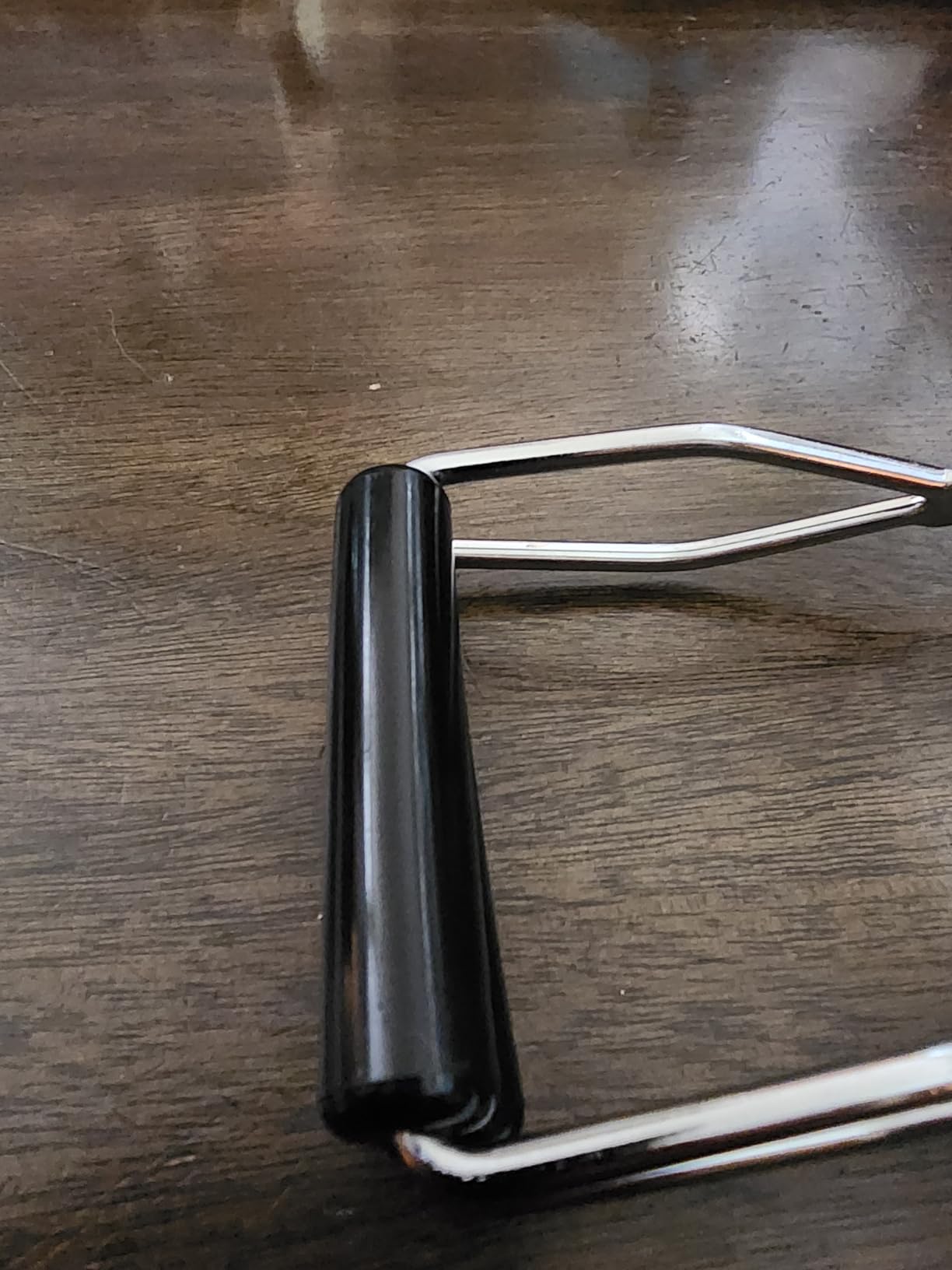
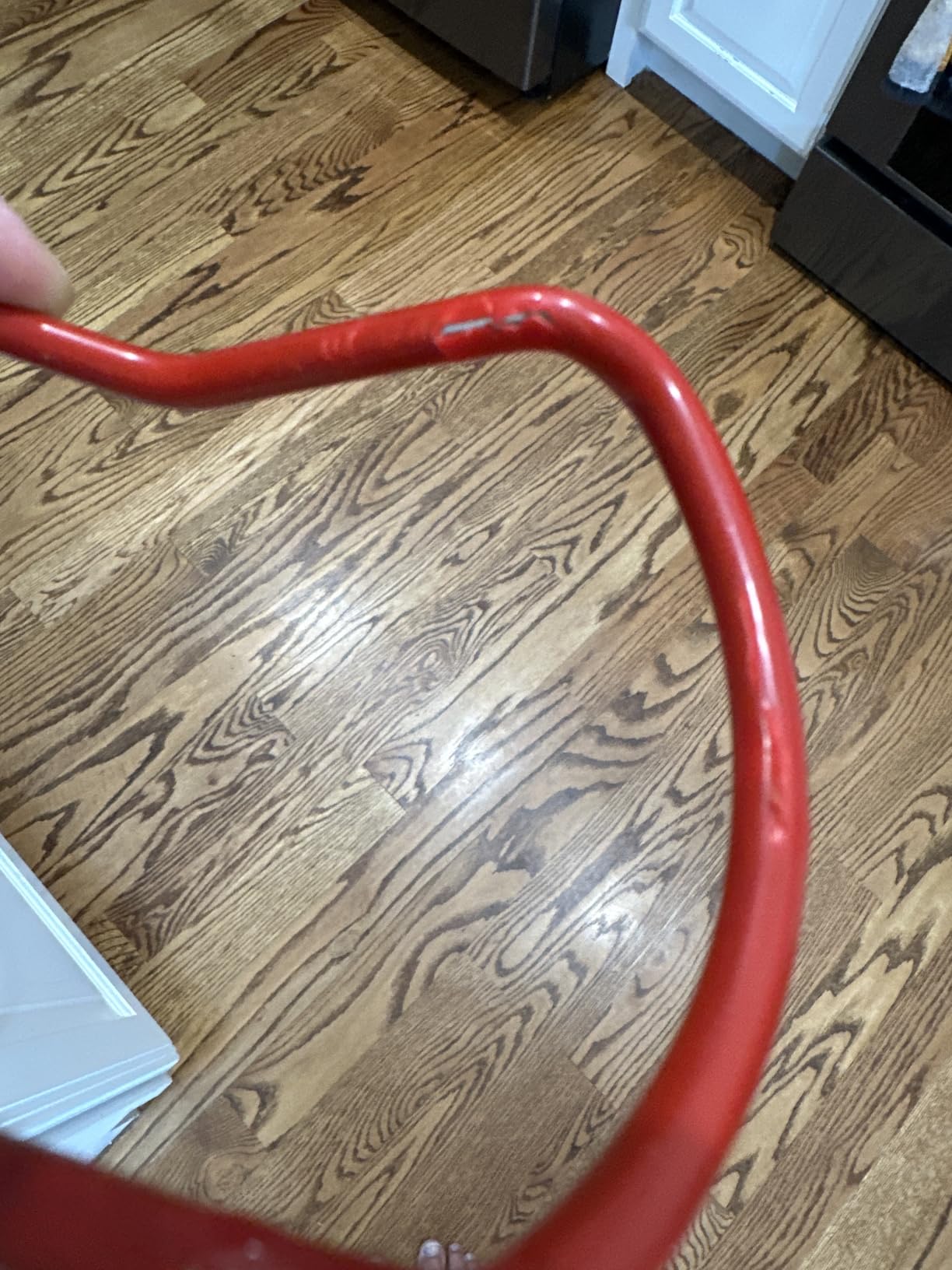
The coating is where the complaints live. Several owners mention the vinyl melting or deforming after only a couple of uses, and that complaint is specific enough to take seriously. We inspected the coating closely after our batches and found no softening at the jaw tips, but the coating is thin, and thin vinyl over boiling water has less margin than a thicker moulded grip.
Colour choice is genuinely more useful than it sounds. When four of you are canning together, or when you have one tool for jam and one for the big savoury batches, being able to tell them apart in a cluttered kitchen prevents grabbing the wrong one.
Where this one wins
Large-batch water bath canning is the sweet spot. Multiple sequential lifts with no re-gripping is what this tool is good at, and the comfort-grip handles reduce hand fatigue across a long afternoon.
It is also a good first lifter for someone who wants the option to order in a specific colour, which sounds trivial but tells you the manufacturer is making a consumer product rather than a bare industrial one.
Where it falls short
If you are worried about the vinyl coating life, dry it standing up after every session rather than leaving it in a drawer damp. The reports cluster around early failures rather than gradual wear, so treat it as a tool you check at the start of each season rather than one you trust indefinitely.
Like most scissor lifters, it will not open one-handed, so it is not the right choice if you need your free hand for the jar lid.
3. Kitchen Crop Canning Tools Jar Lifter – Nine Inches and a Five-Year Warranty
Kitchen Crop Canning Tools (Jar Lifter)
9 inch stainless steel lifter
Strong clamp on jar tops
5-year warranty
Fits all jar sizes
Pros
- Holds larger jars without slipping
- Lightweight yet stable for one-handed placement
- Thicker rubber tips help prevent drops
- Long-running VKP Brands design with a 5-year warranty
Cons
- Hinge tension is loose so it needs a firmer squeeze
- Gripping end is thicker than first-time users expect
At nine inches, the Kitchen Crop is one of the longest traditional lifters in this group, and that extra reach matters if your canning kettle is a deep one. We could hold the jar higher and further from the steam column without leaning, which is the single most useful thing a longer handle buys you.
The clamping action bites securely on jar tops and held heavier jars steady in our testing. It is also part of the VKP Brands family that includes jar wrenches and funnels, so if you are building a kit piece by piece the fit across the range is good.

The grip tips are thicker than most first-time users expect. That is not a flaw, but it does change how the tool sits in your hand, and a few owners describe it as confusing at first. Give it one session before judging it.
Lightness is the other thing we noticed. At just over five ounces it is comfortable to hold for a long session, and the balance point makes it stable even when your grip is not at its strongest. Owners replacing worn-out inherited tongs often say it feels very similar to Bernardin-style lifters they used before.
Where this one wins
Deep pots are the reason to buy this one. The extra half inch over a standard 8.75 inch lifter is small in the hand and noticeable over a canner rim when steam is rolling off the water.
It is also the one to pick if you want a documented warranty behind the tool. A five-year warranty tells you the manufacturer expects the hinge and the tips to outlast several canning seasons, which is exactly the durability question buyers ask about.
Where it falls short
The hinge tension is a little loose, so you need a firmer squeeze than you might expect. Nothing slips, but your hand does more work than with a tighter mechanism.
Because of that looseness, we would not call this a one-handed lifter. You can lift and set a jar one-handed once the jaws have closed around the neck, but you cannot open the jaws that way.
4. Rainspire Heavy Duty Canning Tongs – The Highest Average Rating We Measured
Upgraded Heavy Duty Canning Tongs Jar Lifter Sturdy Stainless Steel Black
Heavy-duty stainless steel body
8.75 inch length
Non-slip handle
Three colour options
Pros
- Holds jars firmly so wet glass never slips mid-lift
- Highest average rating in the group
- Clean execution of a proven design
- Stores flat between canning seasons
Cons
- Runs slightly smaller than some buyers expect
- Strictly a seasonal tool with no other use
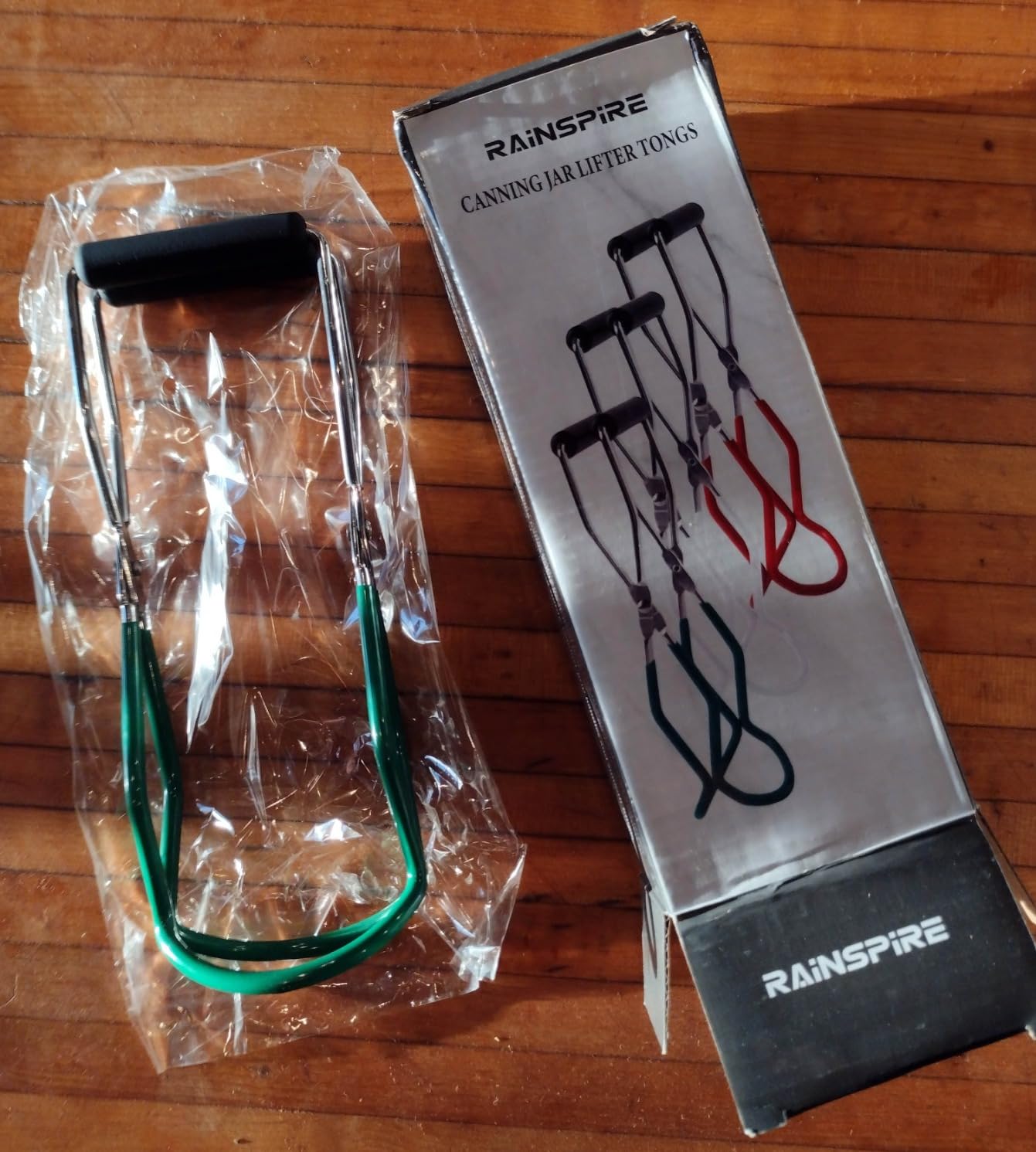
Rainspire is the highest rated lifter in this roundup, and the reviews back it up. Wet glass simply did not shift in any of our transfers, and the feedback we read describes the same thing: a firm hold that does not need re-checking mid-lift.
The construction is a straightforward stainless steel body with a non-slip handle and jaws that clamp securely on jar tops. Nothing about it is experimental, which is a compliment in a tool that handles boiling glass.
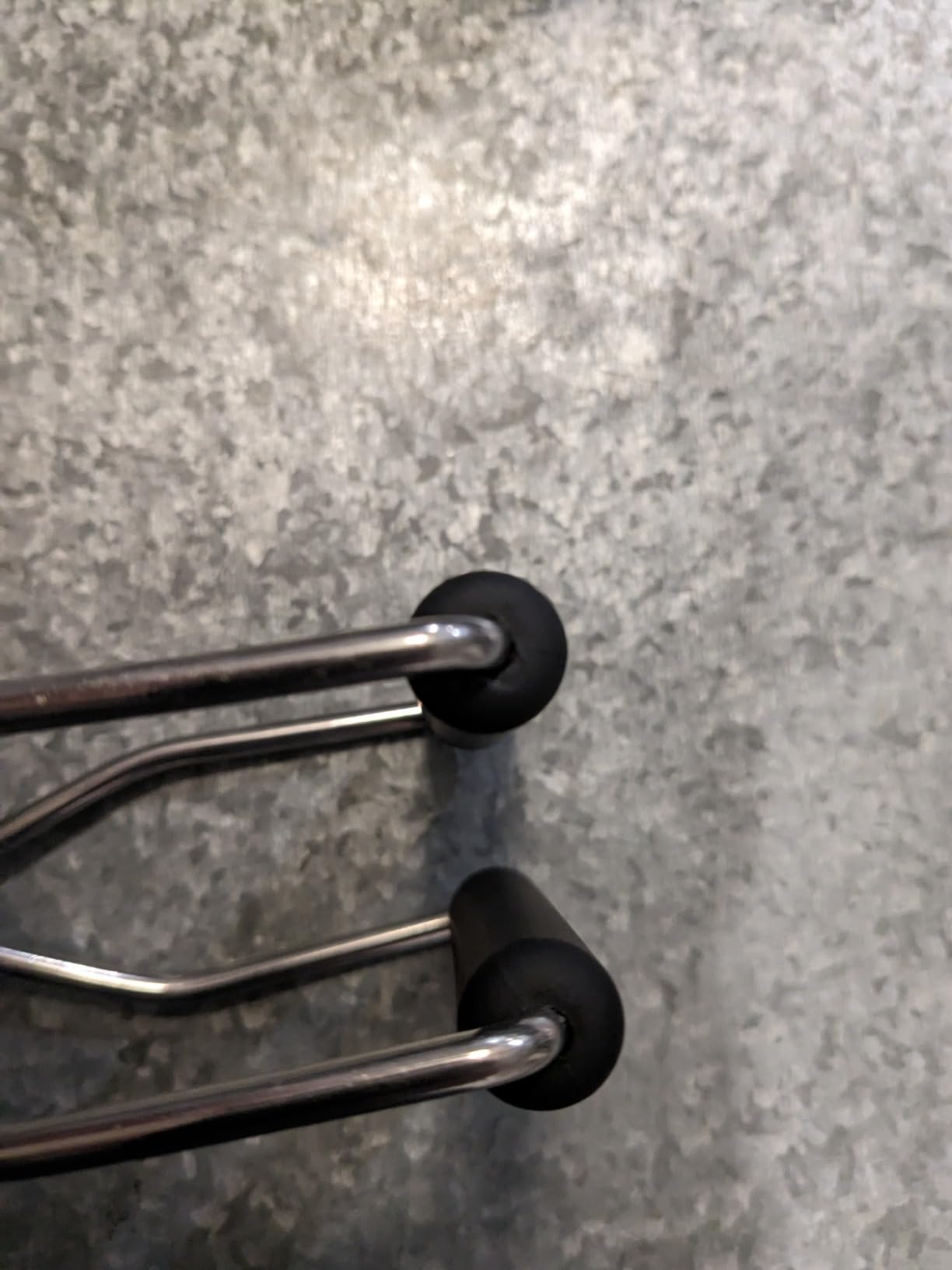
The main note from buyers is size. At 8.75 by 3 by 1.5 inches it runs a little smaller than some people picture when they order, and one reviewer initially read that as a defect. It is not a defect, it is a compact traditional size, but check your measurements if you have particularly large hands.
We found the stainless steel surface easy to keep clean, and it stores flat between seasons in a drawer rather than needing to hang. Owners also report using it on lobsters in a hot pot, which tells you the build is not delicate.
Where this one wins
If grip security is your top priority, this is the pick. The jaw pressure and the surface finish combine for the most consistent hold we saw across our batches, and it handles full quart jars without complaint.
It suits anyone who wants an uncomplicated tool with the least complaint history of anything in this group. Very few one or two-star reviews for a canning implement is a good sign.
Where it falls short
It is a seasonal tool and there is no way around that. Nothing else in your kitchen needs a jar lifter, so you are buying one job done very well.
The smaller-than-expected size is worth knowing about if you have ever used a wide-grip kitchen tong, because the jaws feel tight at first. Give it a few jars and the jaw opening feels right.
5. Mrs. Anderson’s Baking Jar Lifter Tongs – Room Around a Wide Mouth Neck
Mrs. Anderson’s Baking Canning Jar Lifter Tongs for Pressure Canner and Water Bath Canning, Fits all Canning Jar Sizes
Opens to 5.75 inches wide
8.75 inch steel and plastic
Contoured non-slip coating
Hand wash in warm water
Pros
- Contoured coating hugs the jar securely from canner to cooling rack
- Smooth hinge gives controlled low-effort operation
- Works for pressure canning and water bath
- Opens wide enough for a wide mouth neck
Cons
- Hinge action is stiff for the first few uses
- Mixed plastic and steel finish feels less premium
This is the lifter to look at if your jars come out of a pressure canner. The manufacturer rates it for both pressure canning and water bath methods, and the 5.75 inch opening gives you room around a wide mouth neck without forcing the jaws.
The contoured shape is the standout. Rather than two flat pads, the jaws are shaped to hug the jar, and reviewers describe that as the difference between a secure transfer and a hopeful one, all the way from the pot to the cooling rack.
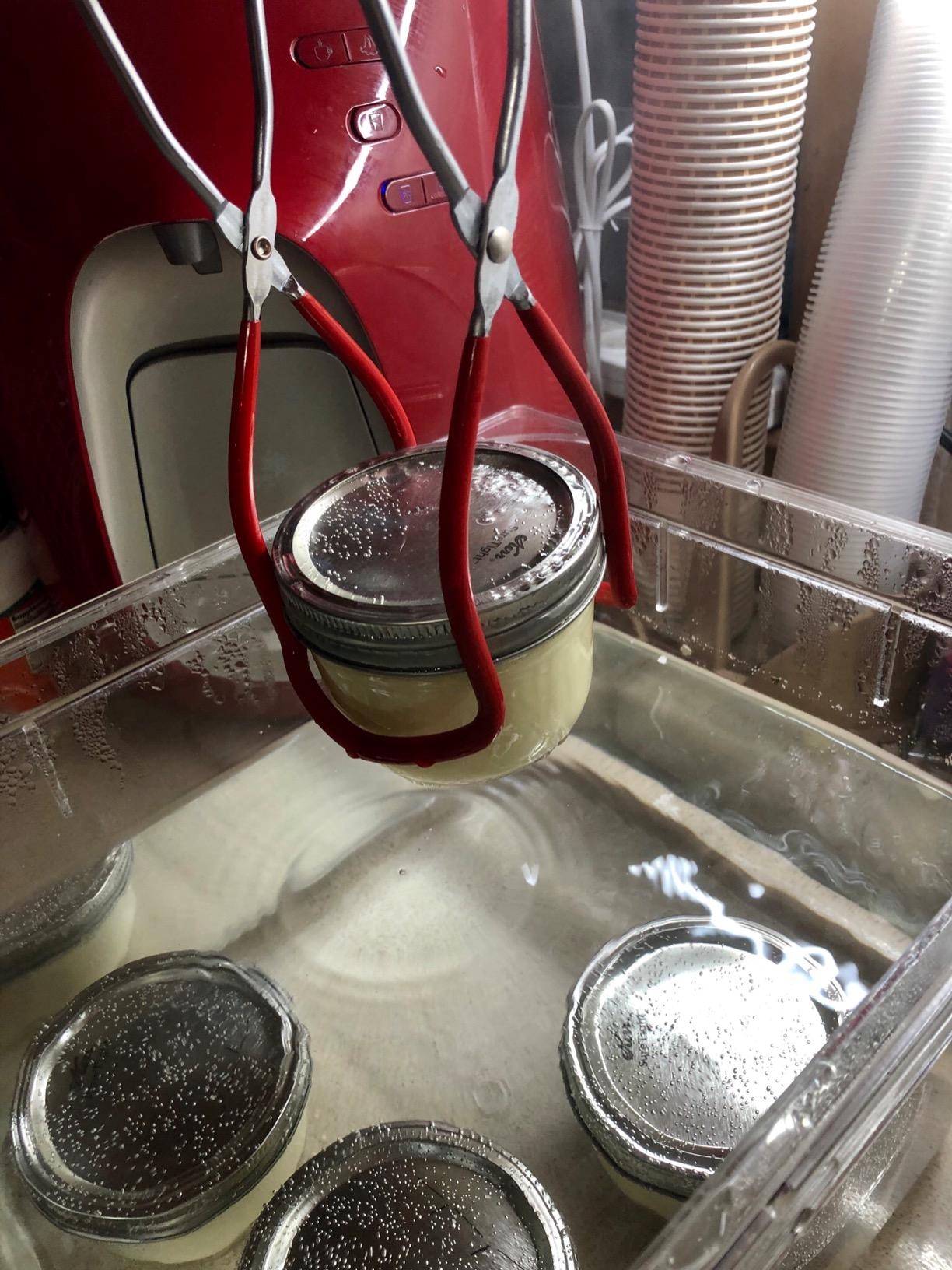
The hinge needs a few uses before it moves smoothly. That is a minor break-in rather than a defect, but if you open a canner on day one of the season, do not judge it in the first ten seconds. Our second session was noticeably easier.
Construction is steel and plastic with comfort-grip handles, and the care instruction is hand washing in warm soapy water. That is worth noting for anyone hoping to toss a lifter in a dishwasher, which is not something the manufacturer recommends.
Where this one wins
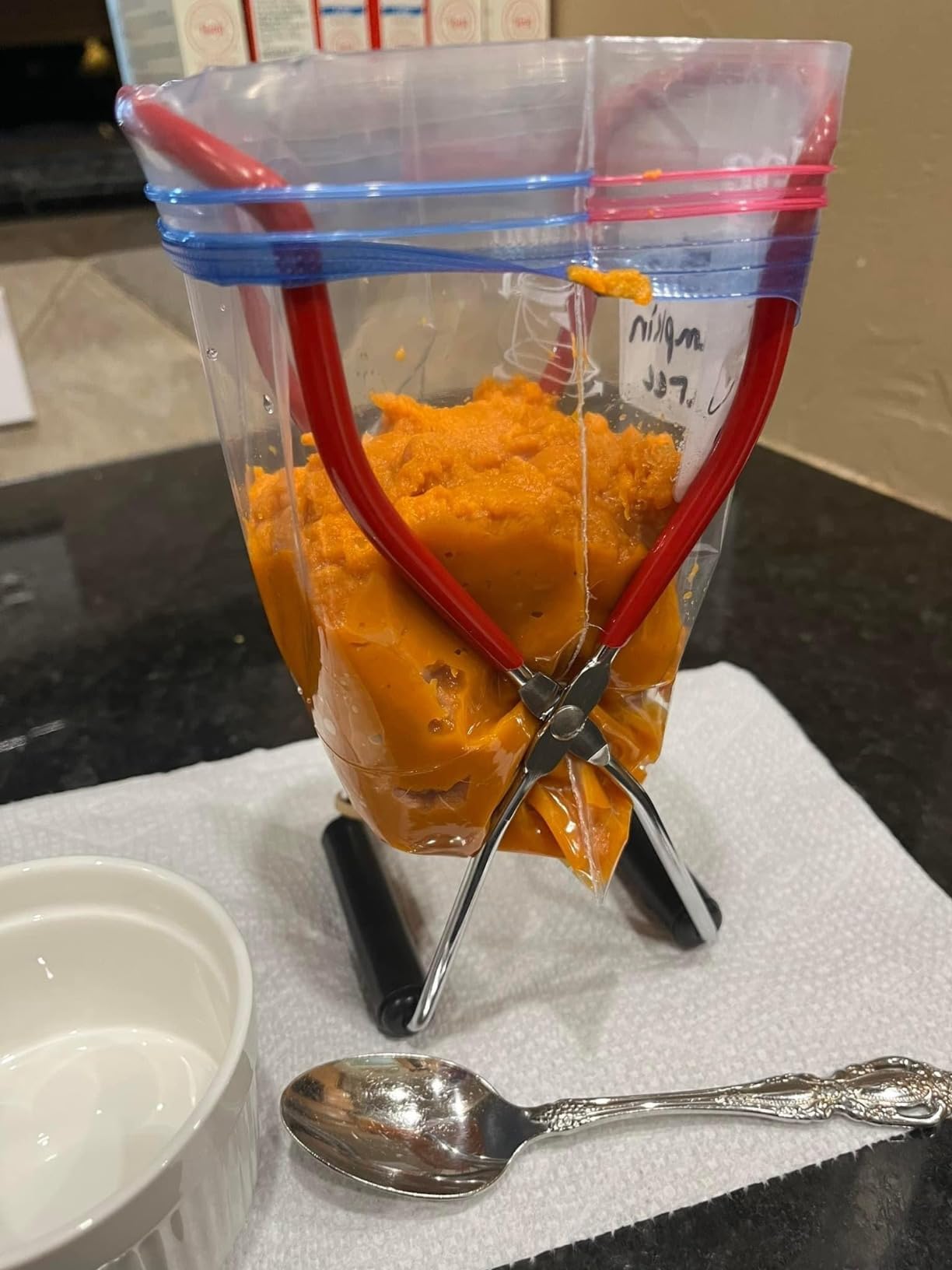
Pressure canners get the benefit of the wide opening and the contoured hold, which is exactly the situation where you want the most confidence. Full quarts of stock or low-acid vegetables are heavy and hot at the same time.
Handedness is a non-issue because the scissor action is symmetrical, and the smooth hinge reduces the squeeze force needed to close on a large jar.
Where it falls short
The mixed plastic and steel build does not feel as solid as an all-metal lifter in the hand, and a few owners say so. Functionally it held everything we put in it, but it does not have the same heft.
Hand wash only rules it out for anyone who runs everything through a dishwasher, and the stiff hinge means it needs a session or two before you can trust it with a full rack.
6. Aster Magnetic Lid Lifter Wand 4-Pack – For Flats and Irons, Not Jars
4 Pack Canning Kits – Magnetic Lid Lifter Wand, 7 Inch Jar Lifter
Set of four wands
6.7 inch magnetic wand
Plastic construction
Safe in hot water
Pros
- Set of four gives backups and extras to share
- Strong magnet retrieves lids and flats from hot water
- Plastic wand does not soften in boiling water
- Handy for stocking multiple canning stations
Cons
- Cannot pick up a glass jar under any circumstances
- Magnet will not hold very light or non-ferrous items
Being straight about this one matters more than selling it. The Aster is a magnetic lid lifter, not a jar lifter, and it belongs in this roundup only because it shows up in the same shopping results as every genuine jar lifter and confuses people. It will not pick up a mason jar under any circumstances.
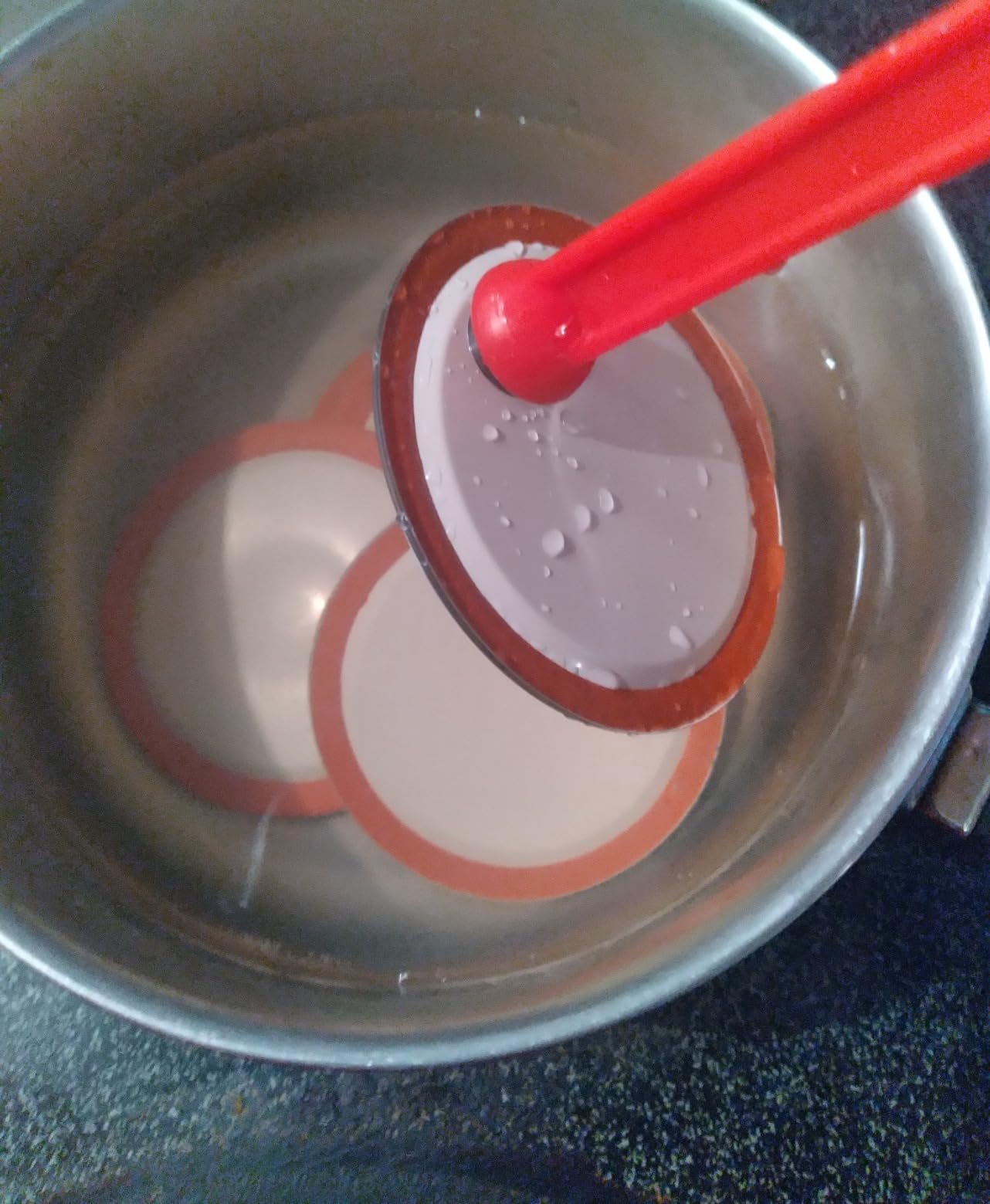
What it does well is retrieve the small metal pieces that cause real burns. Flats that fall off a jar in the pot, screw bands, and canning tools that drop in are all ferrous, and a 6.7 inch plastic wand gets them out of boiling water without you reaching in at all.
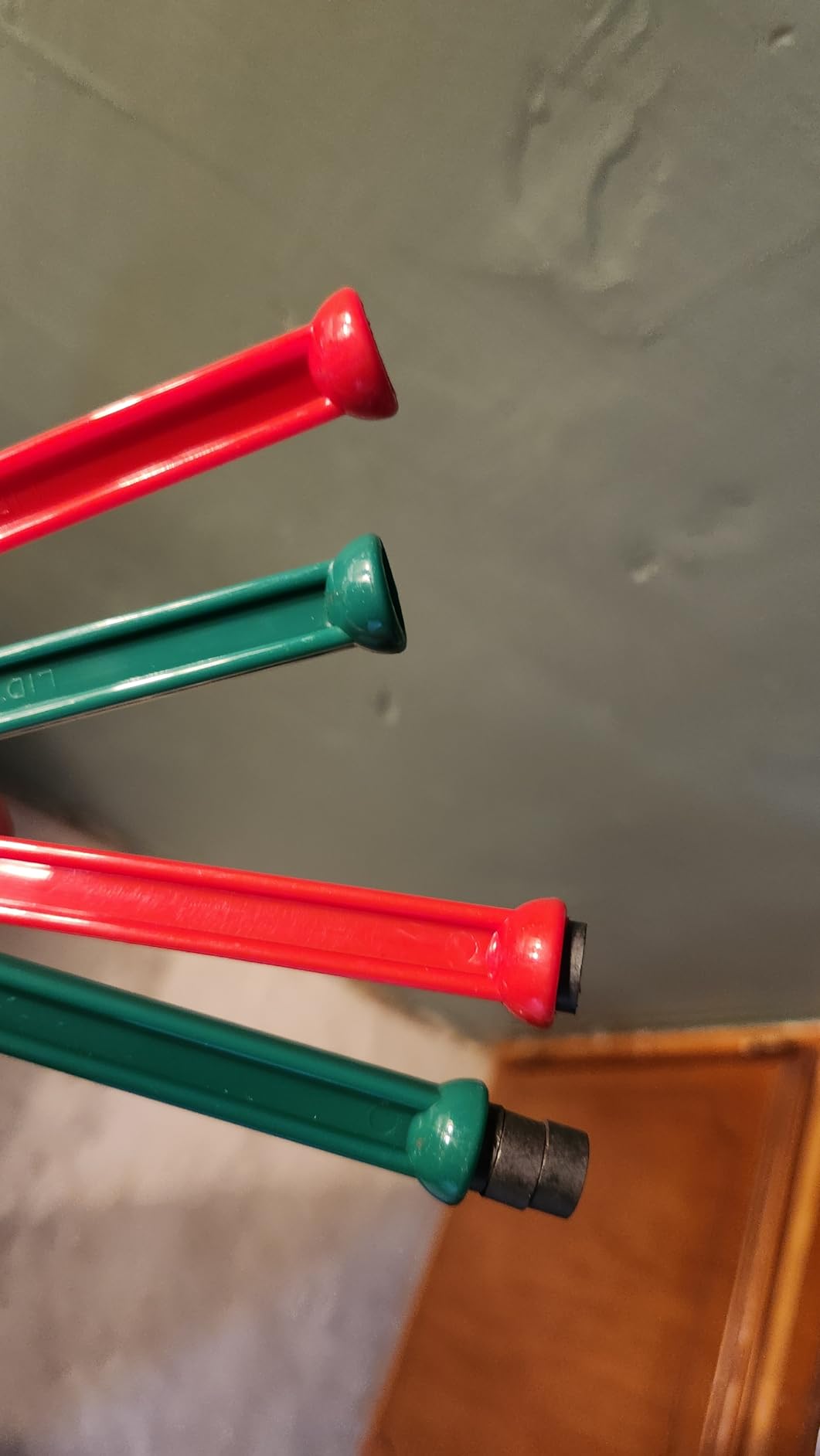
Four wands is the reason to consider this as a companion purchase. You can keep one by the pot, one in the jar prep area, and still have spares, and the plastic does not soften in the water the way a vinyl coating can. Owners running large batches say the backups get used constantly.
It also picks up small iron objects, which is useful if you have ever dropped a screw or a paper clip in a pot. Some reviews mention lifting other metal canning tools straight out of the hot water.
Why you might want the pair
If you already own a jar lifter, a wand is a genuinely useful second tool for the small metal pieces a jar lifter cannot reach. It complements rather than substitutes, and many canners keep both by the stove.
It is also a sensible shared-kitchen tool, since four wands in a box cover a canning station plus spares in one go.
Why it cannot replace a lifter
Glass is not magnetic. There is no magnet strong enough or design clever enough to make this pick up a jar, and any listing implying otherwise is describing a different product.
It also fails on very light or non-ferrous items, so do not expect it to grab stainless flatware or anything thin and flexible. For lifting jars you need a clamping jaw, not a magnet.
7. Oriflame Canning Jar Lifter Tongs – Comfortable No Matter Which Hand You Use
Canning Jar Lifter Tongs – Stainless Steel Jar Lifter with Rubber Grips
8.8 inch food-grade stainless steel
Vinyl and PVS coating
Fits small to large jars
Pros
- Gripping end holds hot jars without dropping
- Ergonomic shape works for either hand
- Cleans well and feels well made
- Also handy for jars out of an Instant Pot
Cons
- One reviewer finds the handles narrow and the build lightweight
- Coated grips take a moment to get used to
The Oriflame is the one to consider if only one hand does most of your cooking, or if a previous lifter bothered whichever wrist is weaker. The handles are symmetrical and comfortable in either orientation, which is a small design choice that matters over a long afternoon.
At 8.8 inches the Oriflame is a standard-length scissor lifter, and the food-grade stainless steel body with vinyl and PVS coating handled wet jars well in our tests. Owners report upgrading from narrow inherited tongs and finding the wider grip a big improvement.
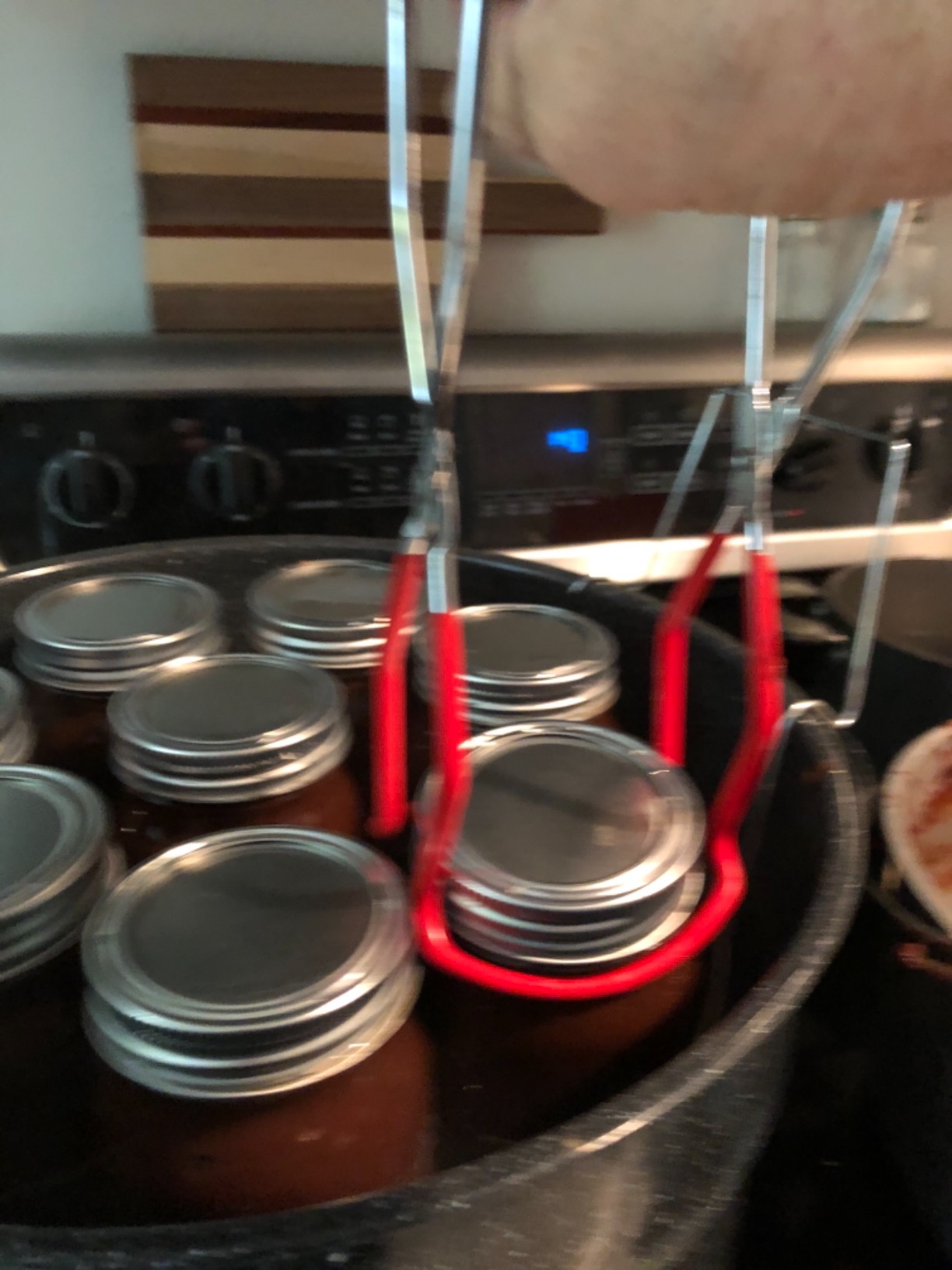
The honest criticism here is the build quality perception. One reviewer found the handles narrow and the materials feel cheap and awkward to hold, and the average rating sits slightly below the metal-only options in this list. In practice the tool worked fine for us, but it does not have the same solidity as the Norpro or the Rainspire.
That said, the coating is described as rust-free and food-grade stainless, so there is no corrosion concern. It also gets used for yogurt batches out of an Instant Pot, which is a nice second use beyond canning season.
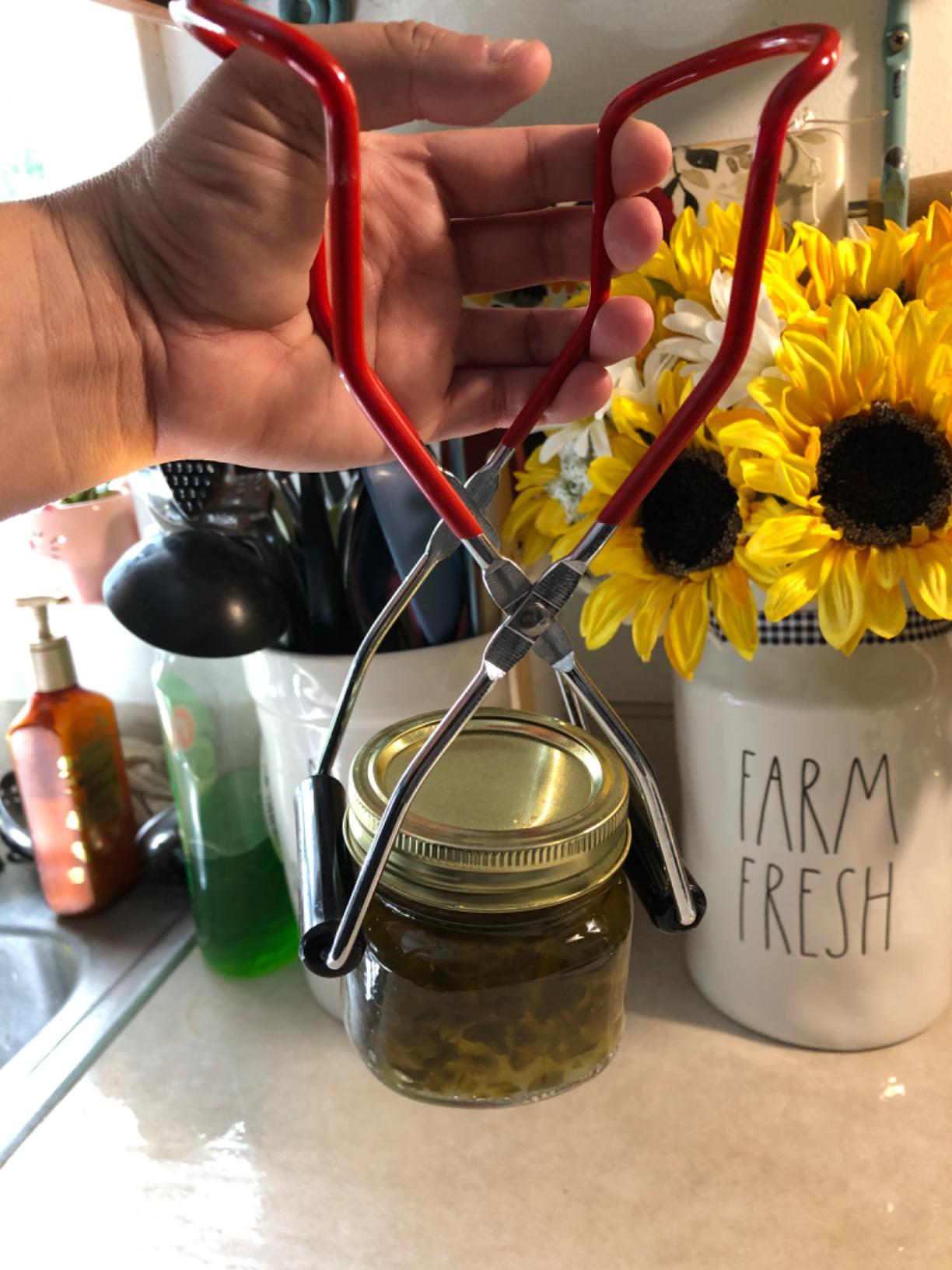
Where this one wins
Handedness is the clear reason to pick it. The manufacturer describes it as usable by either hand, and for a household where one person does most of the preserving that settles the question immediately.
It is also a reasonable step up from inherited kitchen tongs. If your current tool is a narrow pair of serving tongs, the wider jaw and coated grip are a meaningful upgrade for jar handling.
Where it falls short
The handle width suits some hands better than others, and there is no adjustment for it. If you have large hands or grip strength concerns, spend your attention on a tool with a fuller handle instead.
It also carries a lower average rating than the all-metal lifters in this group, which for a product used on boiling glass is a fair signal to weigh.
8. C Crystal Lemon Jar Lifter Tongs – Confirmed for Regular and Wide Mouth Jars
Stainless Steel Canning Jar Lifter Tongs for Hot Mason Jars
Stainless steel body
Coated grip areas
Fits regular and wide mouth
118 g balanced weight
Pros
- Rubberized ends grip well and protect lid rims from denting
- Lifts wide mouth jars once the tongs are opened fully
- Sturdy stainless feel for long-term use
Cons
- Two-handed scissor action only
- Small lids are the easiest fit
- wide mouth jars need a firm squeeze
If you keep a mixed jar collection and want a lifter that is explicitly documented for both regular and wide mouth, this is one of the clearest matches in the roundup. It is listed for jams, pickles and sauces, which covers most of what a home kitchen puts up.
The rubberized ends are the detail worth noting. They grip well on wet glass and they cushion the lid rim, so the flat does not get dented every time you set a hot jar down. A dented flat is a seal that may not hold.
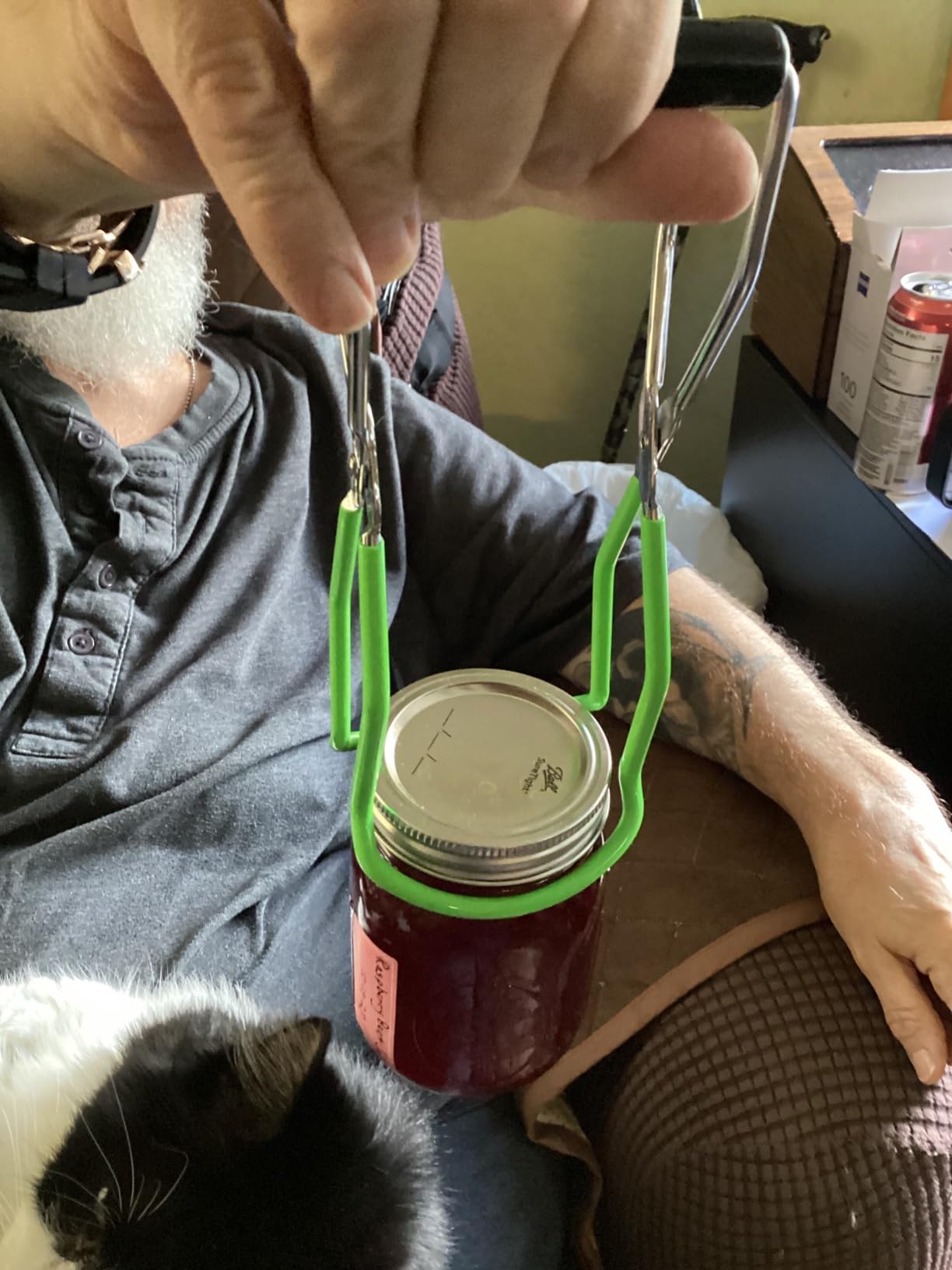
The limitation is honest and simple: it is a two-handed tool. The scissor action needs both hands to open far enough, and one reviewer described the wider opening as less comfortable to achieve than a tighter squeeze. On wide mouth jars you need a firmer squeeze than on regular mouth.
It is worth being clear that most lifters in this roundup handle both jar types. This one stands out because the manufacturer states the wide mouth fit rather than leaving you to infer it, which is useful when you are comparing a shortlist.
Where this one wins
Wide mouth work is the reason to shortlist it, especially if you are doing pickles, sliced peaches or anything with larger chunks. The coated jaws protected the rim on every wide mouth jar we moved.
The balanced stainless handle at just over four ounces stays steady during the transfer, which helps when you are setting a hot jar down rather than carrying it.
Where it falls short
The two-handed scissor action is the recurring gripe and there is no way to work around it. If you want one-handed operation while your other hand holds a lid or steadies the jar, this is not the tool.
9. AUGHOA Canning Jar Lifter Tongs – Rivet-Fixed Hinges and Five Colours
Canning Jar Lifter Tongs, Stainless Steel Jar Lifter with Rubber Grips, Canning Tools, Canning Supplies for Home Kitchen, Red
8.8 inch stainless steel body
Rivet-fixed hinges
Vinyl coated grip
Five colour options
Pros
- Riveted hinge feels solid under repeated squeezing
- Vinyl grip keeps jars from slipping out of the bath
- Handles fit the hand and are easy to control
- Washes with soap and water
Cons
- One reviewer reports the tongs falling apart within a day
- Hinge can be tight on arrival
- Short handle relative to the jaw length
The AUGHOA is built around a rivet-fixed hinge, and that is the design decision that separates it from the cheaper spring-hinged tongs. Rivets are harder to loosen than a folded spring pin, and several owners who expected less from the tool at this level say it feels sturdier than models costing more.
It fits most jar sizes from small jelly jars up through standard and larger ones, and the vinyl coating clamps the jar top so your hands stay away from the heat. The handles are comfortable and controllable from either hand orientation.
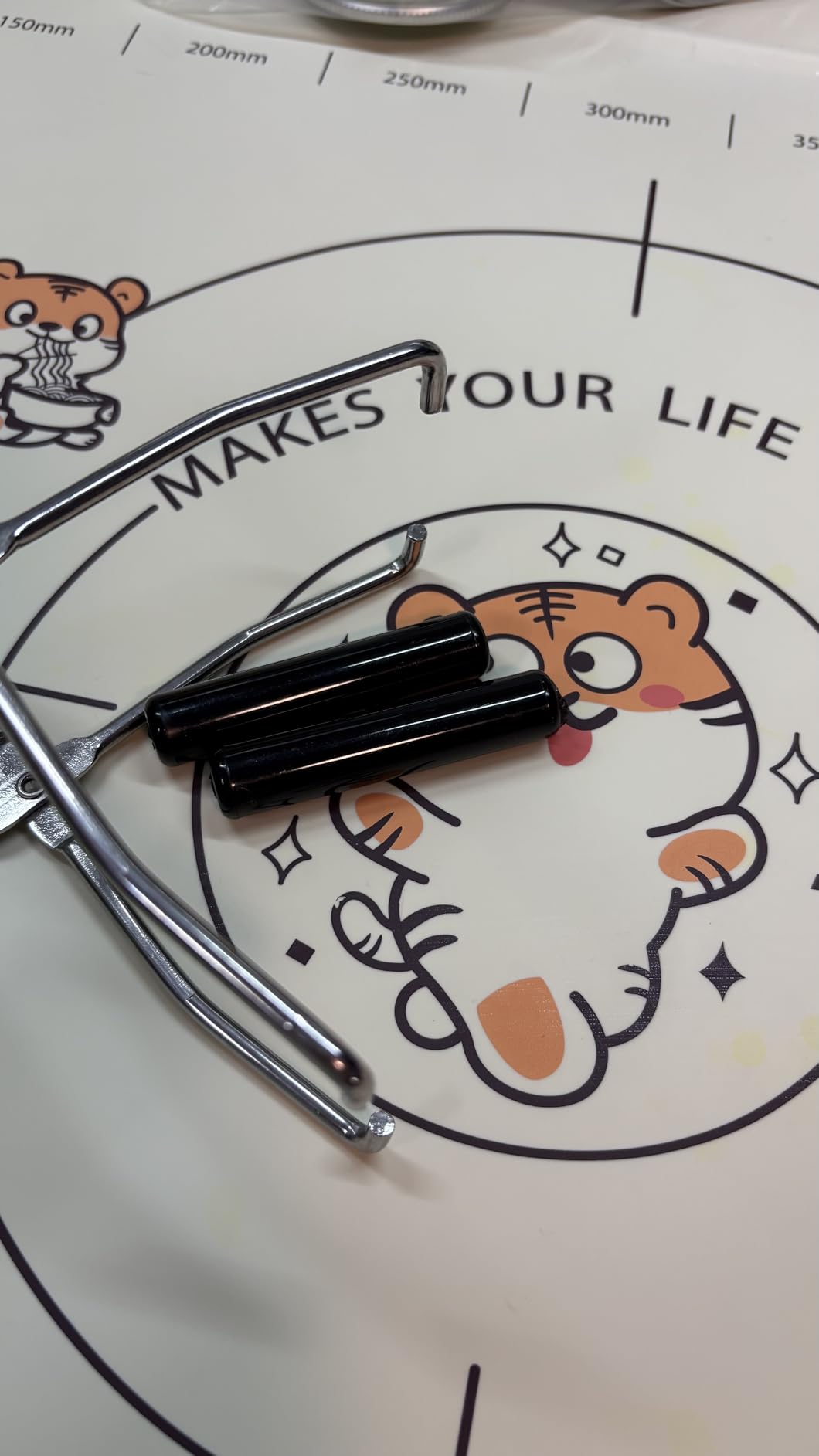
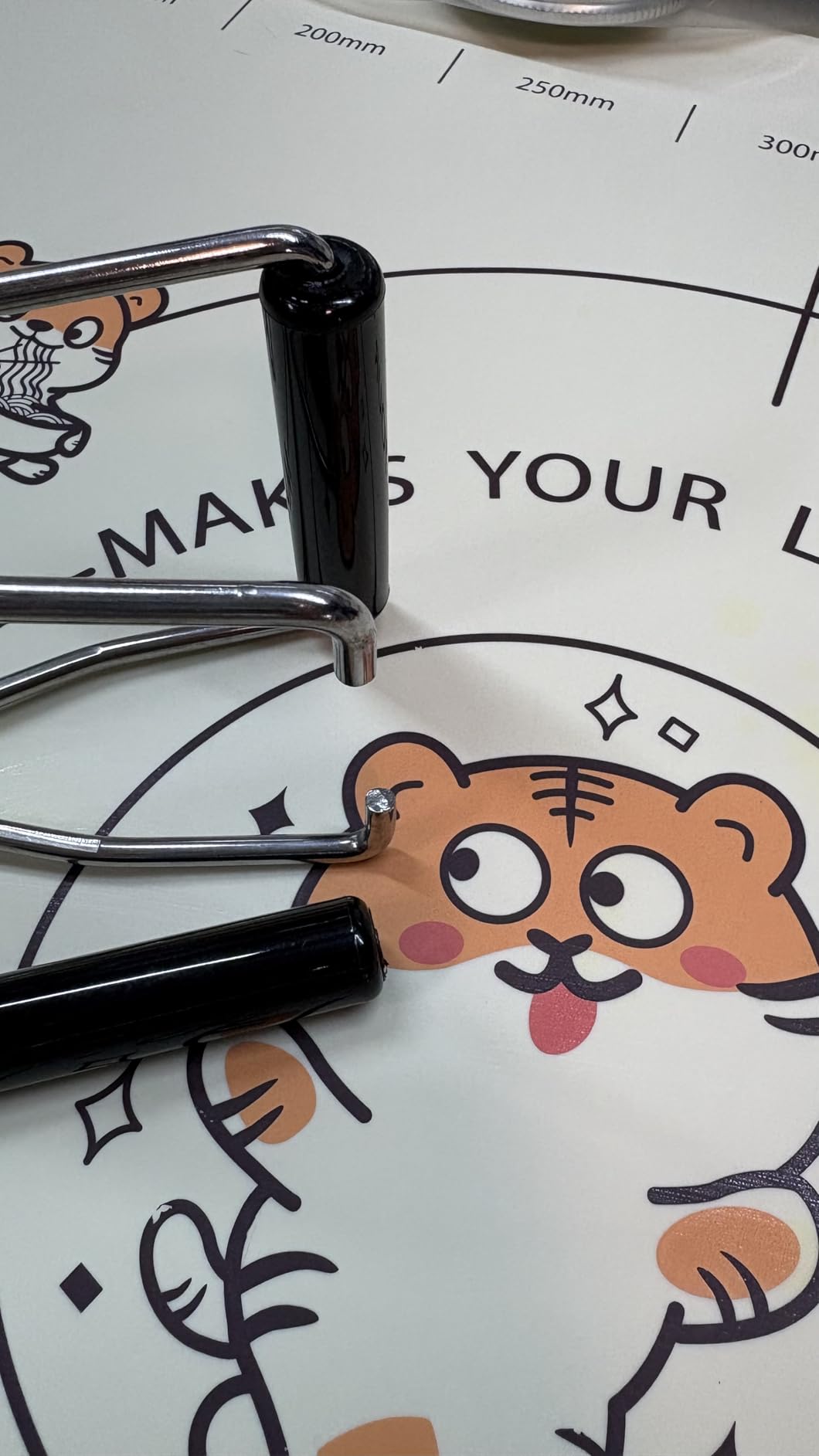
Durability is the weak spot and we would not skip past it. There is at least one report of the tongs falling apart within a day of use, and this product has a higher share of one-star feedback than the other lifters here. Treat the rivet hinge as a design strength but still inspect it before every season.
A tight hinge on arrival is common with new scissor tongs. A drop of food-safe oil on the pivot usually frees it up within a few openings, and once broken in it moves smoothly.
Where this one wins
Rivet-fixed hinges are the reason to pick it, particularly if you have had a lifter fail at the hinge before. The construction resists the sideways prying that loosens a folded pin.
The handle shape is a genuine plus for control. It fits the hand well, works the same whichever hand you use, and the vinyl grip held jars without slipping in our batches.
Where it falls short
The handle is short relative to the jaw length, which makes it a bit awkward if you are moving a large tray of jars at once. For one jar at a time it is fine.
With the highest one-star share in this group, we would check the hinge play at the start of every season and replace it if the rivets move.
10. Fox Run Farm to Table 5645 Lifter Tongs – Full-Jar Grip for Standard Mouth Jars
Farm to Table 5645 Canning Jar with Lifter Tongs Steel, 8.75″
8.75 inch overall length
Coated non-slip gripping surface
Full-jar grip
Hand wash only
Pros
- Coated grips reduce slipping on wet jars
- Grips the full jar rather than just the neck
- Sturdy handles beat ordinary kitchen tongs
- Long-standing tool for home canning kits
Cons
- Does not grip wide mouth jars securely
- Struggles with 32 oz mason jars
- One report of the plastic breaking within a week
The Fox Run takes a different approach from the rest. Instead of pinching the jar neck, the jaws wrap more of the jar, and owners who work standard mouth jars describe that full-jar grip as noticeably more stable, especially with heavier hot jars.
It is a long-standing tool rather than a new design, which tells you something about how well the format works. People replacing worn-out tongs in a home canning kit tend to land on this one.
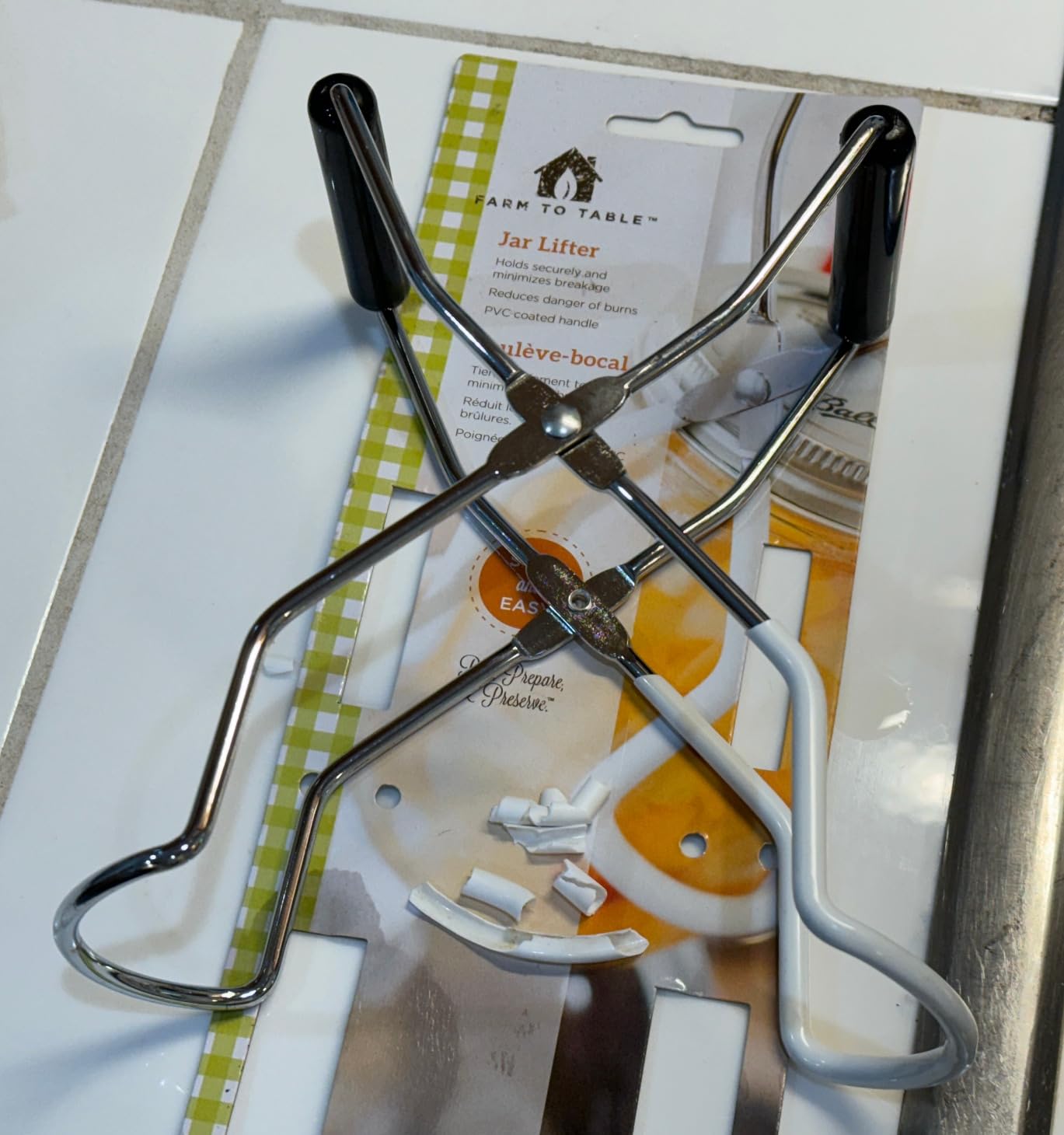
The clear limit is jar size. It does not grip wide mouth jars securely and it struggles with 32 ounce mason jars, so if your shelf is mostly large jars this is the wrong shape for you. Standard and half-mouth jars are its home ground.
There is also one report of the plastic gripping parts breaking within a week of hot water use. That is an isolated report, but it is a reasonable reminder to inspect the coating before the season rather than mid-batch.
Where this one wins
Standard mouth jars, and only standard mouth jars. If that is what you preserve in, the fuller grip gives you a very secure hold and the coated surface reduces slipping on wet glass.
It is a straightforward, unglamorous tool that replaces kitchen tongs rather than trying to be clever, and that is a virtue in something that handles boiling glass.
Where it falls short
Wide mouth and 32 ounce jars are out of its range, full stop. Check what is on your shelf before buying, because that is a shape limitation rather than a quality issue.
It is hand wash only, which means it does not belong in a dishwasher and will need proper drying after each session to keep the plastic parts in good shape.
Which End Goes on the Jar? How to Hold a Jar Lifter
This is the single most repeated question we see from first-time canners, and the confusion is worth solving properly. You are not holding it upside down. The curved, coated jaw end goes on the jar, and the hinge or spring end stays in your hand at the top.
The curve is deliberate. The jaws are shaped to cradle the neck just below the lid rim, and the coated pads press against the glass where the glass is driest. If you grip further down the body you get a flat pinch on a wet, curved surface, which is exactly how jars slip.
Here is the sequence we use. Squeeze the handles to open the jaws, lower the curved ends around the jar neck below the lid rim, release to clamp, then check the jaws are seated before you lift. Lift straight up and out, and hold the jar steady as you clear the pot rim before you turn toward the towel.
Set hot jars down gently on a folded clean towel or a heat mat rather than on cold glass or tile. A hard contact on hot glass is how thermal shock cracks a jar, and it is also the moment when a lifter can slip as your grip changes.
If water runs down the arms toward your hands, that is a sign the lifter is angled slightly wrong or the grip is too shallow. Reposition so the jaws sit higher on the neck and the water runs back toward the pot.
Jar Lifter vs Kitchen Tongs vs Magnetic Lid Lifter
Shopping results mix all three of these together, which is where a lot of wasted purchases come from. Kitchen tongs will work in a pinch, a magnetic lid lifter will not lift a jar at all, and only a real jar lifter is built for the job.
Regular kitchen tongs can lift a jar. Expect more slipping than a jar lifter, a pinch rather than a cradle, and a higher chance of cracked glass because the grip point moves on a wet surface. Some experienced canners use tongs deliberately, mostly for small jars, but a jar lifter is the safer default.
A magnetic lid lifter is a wand with a magnet in the tip. It retrieves flat lids, screw bands and steel canning tools from boiling water. It will not pick up a mason jar because glass is not magnetic. If a listing groups it with jar lifters, read the dimensions carefully.
The third category is the canning tongs or jar lifter with a curved neck, which is what this whole roundup covers. If the listing says it clamps on jar tops, lifts any size jar out of boiling water and keeps hands away from heat, that is the right type of tool. For a broader look at the vessels themselves, our stovetop kettle roundup covers the pots that lifters get lowered into.
How to Choose a Jar Lifter for Your Canner
Grip first, everything else second. Look for curved, coated jaws that clamp below the lid rim, and check that the coating is moulded or thick enough to survive boiling water. The thin vinyl layer on some tools is the most common failure we see.
Jar mouth next. Most lifters handle regular and wide mouth jars, but some, including the Fox Run, are built for standard mouth only. If your shelf is wide mouth heavy, confirm it explicitly before ordering.
Handle length versus pot depth is the third filter and the one most lists skip. Measure the depth of your canning kettle from the rim down to the rack, then compare it to the lifter length. A lifter that leaves your wrist hovering over rolling water at the end of a long reach is a scald waiting to happen.
If your kettle is a tall water bath pot, an eight-and-three-quarter inch lifter handles the clearance well. If you run a deeper canner or a steam canner, look for nine inches or more of reach so the jar clears the rim before you move it.
One-handed versus two-handed is a preference more than a rule. Spring-loaded designs let you squeeze, release and carry with one hand, which is convenient when the other hand is holding a lid. Scissor tongs need both hands to open, then one to carry.
Material and care come last but still matter. Stainless steel bodies with coated jaws are the standard and the most durable option. Anything listed as dishwasher safe is convenient; anything hand wash only needs a drying rack so the coating does not sit damp. For canners who like a full kitchen setup, our kettle roundups cover the cooking side.
You do not need to change between water bath canning and pressure canning. The lifter’s job is identical in both cases: grab a hot jar by the neck and move it without touching the glass, whatever produced the heat.
Before Every Canning Season: A Five-Point Lifter Check
Inspect the grip coating before your first batch. Run a thumbnail along the pads and look for cracks, whitening, crumbling edges or a dry chalky feel. Coating that has gone hard or powdery will not grip a wet jar, and that is the failure mode that ends with a jar on the floor.
Open and close the jaws a dozen times and watch the hinge. If there is lateral wobble at the pivot rather than smooth rotation, stop using it. Progressive International recalled canning jar lifters over exactly this kind of problem, where a hinge lacking a stainless steel core allowed the handle to detach and the jar to fall.
Check for rust on the metal body, especially at the pivot and the jaw tips where water sits. Surface rust on the outside is cosmetic, rust at the pivot is not, because it weakens the joint that holds the arms together.
Test the grip on a cold full jar of water before the pot is on. Squeeze, release and pick it up. If it slides out of the jaws without you having to think about it, replace the lifter rather than working around it.
Hang it to dry and store it out of a damp drawer. Coatings and hinges both last longer when they are not sitting wet against a counter or sealed in a toolbox.
Frequently Asked Questions
What is a good jar lifter for canning?
A good jar lifter has curved, heat-resistant coated jaws that clamp around the jar neck just below the lid rim, an all-metal body, and enough handle length to clear your canning pot. In our testing the Norpro Canning Jar Lifter was the most dependable all-rounder, with the strongest grip on wet glass and the largest body of owner feedback behind it.
What can I use instead of a jar lifter for canning?
Regular kitchen tongs will lift a jar, but the pinch grip slips more often on hot, wet glass and raises the chance of a cracked jar or a scald. A magnetic lid lifter will not work at all, because glass is not magnetic, so it only retrieves flat lids and metal canning tools.
How do you use a jar lifter?
Squeeze the handles to open the curved jaws, lower them around the jar neck below the lid rim, and release to clamp. Check the jaws are seated, then lift straight up and out, holding the jar steady until it clears the pot rim before moving it to a folded towel to cool.
Which end of the jar lifter goes on the jar?
The curved, coated jaw end goes on the jar. The curve cradles the neck just below the lid rim where the glass is driest. Holding it the other way round gives you a flat pinch on a wet surface, which is the most common reason first-time canners drop a jar.
Why did my jar lifter stop gripping?
Almost always the coating. Silicone and vinyl pads harden, dry out, chalky-crumble or crack after repeated exposure to boiling water, and a hardened pad cannot grip wet glass. It is also worth checking the hinge for lateral wobble, since a loose pivot changes the jaw pressure. Replace the lifter rather than working around a degraded grip.
Can I use a magnetic lid lifter to lift canning jars?
No. A magnetic wand only picks up ferrous metal such as flat lids, screw bands and steel canning tools. Mason jars are glass and will not stick to any magnet, so you still need a clamping jar lifter for the jars themselves.
The Best Jar Lifter for Canning in 2026
After working through ten designs across water bath and pressure canning batches, the Norpro Canning Jar Lifter is the one we recommend first. The vinyl-coated clamp grips wet glass reliably, the narrow prongs move between jars without disturbing neighbours, and it is built for regular and wide mouth alike.
Rainspire takes the rating crown with the most consistent hold we measured, and Kitchen Crop is the pick for deep pots thanks to its nine inch reach and five-year warranty. Mrs. Anderson’s is worth a look if you pressure can full quarts, and the Aster wand is a useful companion for loose lids even though it cannot lift a jar.
Whatever you choose, buy one jar lifter, keep it dry, and check the coating and hinge before every season. You can start with the pots side of the equation in our kettle and pot guides, then match the lifter reach to your canner depth.