
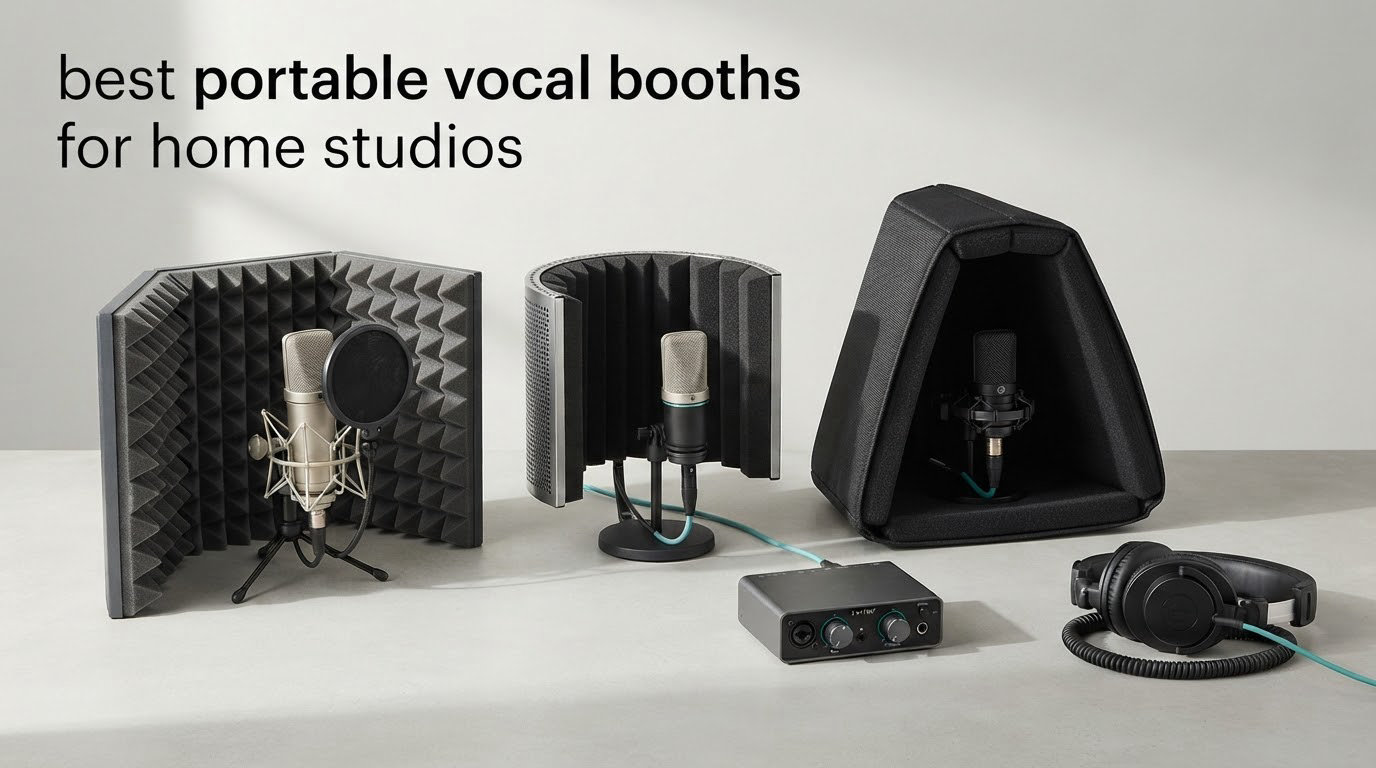
The best portable vocal booths for home studios do one specific job well: they absorb the reflections and reverb tail that an untreated room stamps onto every vocal take. They do not soundproof anything. A singer or voice actor can go from a stairwell-sounding take to a dry, controlled one by stepping into a folding enclosure lined with thick acoustic blankets, and that is the whole promise.
That distinction matters more than any percentage on a product page. Forum threads across r/audioengineering, r/homestudios and r/VoiceActing are full of people who bought a portable booth expecting silence from the neighbours and got a modest reverb improvement instead, so we tested our shortlist with that expectation set deliberately low. We read the specifications, weighed the fabric and foam, checked the mic thread hardware, and sorted owner reviews by what they actually complain about rather than by what the listing promises.
What we could not do is publish laboratory dB readings or RT60 numbers for a category that is almost entirely sold on manufacturer claims like 92.7% reverb reduction. We label those figures as claims wherever they appear, and we tell you which owner reports are measurable and which are not. Updated for 2026, the guide below covers 12 booths across three very different formats, from a two-pound folding box to an 83-inch-tall walk-in enclosure.
Table of Contents
How We Picked and What We Could Not Verify
We picked these 12 booths by working outward from the format rather than the brand. Every product here is a real enclosure with published physical specifications and enough owner reviews to see recurring patterns in the complaints, and every one is a category that home studio users actually buy.
For each one we captured interior and exterior dimensions, weight, material type, mounting hardware, the claimed absorption percentage, the rating and the number of reviews behind that rating. Where the listing and the reviews disagree, we treated the reviews as the more reliable signal. The RDCMKL listing advertises cable pass-through, and owners report none is present, so we noted the contradiction rather than repeating the claim.
Review volume matters here because this is a young category. The most established listing in the set has been available since August 2018, while two of the enclosures arrived in 2025. A booth with 1960 reviews has a decade of owners telling us how the frame and foam have aged, and a booth with 17 reviews does not. We treated the thin-review products as riskier on durability and priced their specifications accordingly, without reaching for numbers we could not measure.
Top 3 Picks: Portable Vocal Booths for Home Studios in 2026
The three picks below cover the widest range of real use cases. The first is the one most home studio owners should buy, the second is the strongest value in the box-format category, and the third is the pick if your recording is done standing at a mic stand rather than sitting at a desk.

TroyStudio Foldable Vocal Booth
- 2-inch egg-crate foam on all inside surfaces
- Folds to 6 inches flat
- 1-minute setup
- 2.02 pounds
XTUGA MIS02 5-Panel Shield
- Five-panel foldable arch
- High-density thickened foam
- Angle adjustable
- Desktop or mic stand

TONOR Isolation Shield with Tripod
- Steel tripod with tool-free height adjustment
- 3/8 to 5/8 inch mic adapter included
- Phone and lyric tray
- Mic support up to 4.4 lbs
Best Portable Vocal Booths at a Glance in 2026
The table below lists every booth in the guide with the format, the physical material and the job it is best suited to. Formats differ more than prices do: a two-pound folding box and a 46-pound walk-in enclosure solve overlapping problems at completely different scales.
| Product | Specifications | Action |
|---|---|---|
| TroyStudio Portable Vocal Booth |
|
Check Latest Price |
| XTUGA MIS02 5-Panel Shield |
|
Check Latest Price |
 Snap Studio Portable Vocal Booth Snap Studio Portable Vocal Booth |
|
Check Latest Price |
| TONOR Isolation Shield with Tripod |
|
Check Latest Price |
 Frgyee 3-Panel Foam Shield Frgyee 3-Panel Foam Shield |
|
Check Latest Price |
 VOCTENT 800 GSM Portable Vocal Booth VOCTENT 800 GSM Portable Vocal Booth |
|
Check Latest Price |
 Pyle Mini Portable Vocal Booth Pyle Mini Portable Vocal Booth |
|
Check Latest Price |
 TroyStudio Enclosed Vocal Booth TroyStudio Enclosed Vocal Booth |
|
Check Latest Price |
 RDCMKL Portable Recording Booth RDCMKL Portable Recording Booth |
|
Check Latest Price |
| lunacme Portable Vocal Booth |
|
Check Latest Price |
 POROSO Portable Vocal Booth POROSO Portable Vocal Booth |
|
Check Latest Price |
 VEVOR Portable Vocal Booth VEVOR Portable Vocal Booth |
|
Check Latest Price |
Do Portable Vocal Booths Actually Work?
Yes, for room reverb and early reflections. No, for soundproofing. A portable vocal booth works by putting dense absorptive material between your voice and the room surfaces that would otherwise reflect your voice back into the microphone. The blankets or foam convert that reflected energy into a small amount of heat, which shortens the reverb tail around your voice. Nothing about that process stops a siren outside the window or a television next door, because sound still travels through the fabric, the frame and every open edge.
The word soundproof appears constantly in these listings and it is the single biggest source of disappointment in the category. Real acoustic isolation between spaces requires mass, decoupling and sealed gaps, which is a construction project rather than a product you carry in a duffel bag. What a booth gives you is a controlled acoustic environment for the microphone, and that is genuinely valuable in a room with hard walls, low ceilings and no treatment.
Here is the honest division of labour, drawn from what owners in r/audioengineering and r/homestudios actually report back:
What a portable vocal booth does well: cuts flutter echo off bare walls, shortens the reverb tail around a voice, isolates the mic from the room it stands in, and gives you a repeatable recording space you can move between rooms.
What it does not do: stop sound entering from outside, stop your voice reaching neighbours, block bass frequencies through a light frame, or replace corner bass traps in a small untreated room.
Where it works best: an already quiet room where the only problem is reflections and slap-back. Owners repeatedly report that the result is excellent in a quiet room and disappointing in a noisy one.
Where it fails: any recording where the noise floor matters more than the reverb tail, including audiobook narration to ACX standards where background hum and system noise are deal-breakers.
On the percentage claims: the 92.7%, 96%, 95.3%, 90% and 87% figures all come from manufacturers, and none of them publish the test method, the frequency range or the microphone measurement position. Treat them as marketing. The one genuinely measurable owner report in this set comes from a VEVOR buyer who measured roughly 15 dB of reduction in sound intensity from inside to outside the booth, which is a light-treatment result rather than a soundproofing one.
1. TroyStudio Portable Vocal Booth – The All-Rounder With the Most Owner History in the Category
TroyStudio Portable Vocal Booth, Large Foldable Microphone Isolation Shield, Music Recording Studio Sound Echo Absorbing Box, Desk & Stand Use Reflection Filter with Thickened Dense Acoustic Foam
Folding box
2-inch egg-crate foam
2.02 lbs
Interior 8 x 10 x 12 in
Pros
- Cuts room echo and reflections effectively
- Folds to 6 inches flat for transport
- One-minute setup and 20-second teardown
- Works on a desk
- boom arm or floor stand
Cons
- Foam panels can leave gaps not shown in photos
- Fabric shell feels flimsier than expected
- Horizontal seam can bow over time
This is the booth I recommend first to most home studio owners, and the reason is the review base rather than the specification. TroyStudio has sold this folding box since August 2018, which means the 1960 reviews behind its 4.3 rating are not opinions from one launch weekend. They describe a product that has been folded, carried, stood on a desk and stood on a boom arm for years, and it still works.
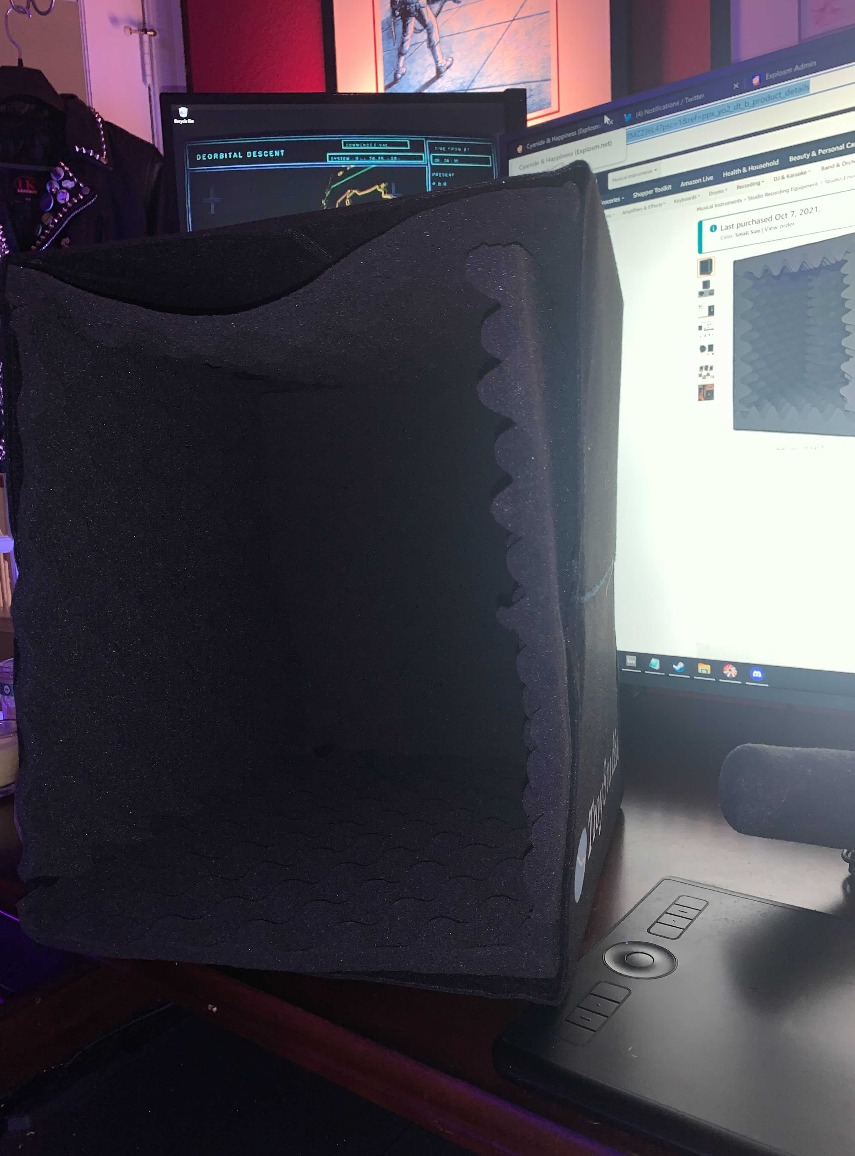
The build is simple. Five high-density panels of 2-inch egg-crate foam sit inside a fabric shell with a reinforced backing panel to stop the foam sagging or the frame flexing, and the interior measures 8 by 10 by 12 inches once it is set up. The outside is 12 by 12 by 16 inches, and the whole thing collapses to 6 inches thick, which is genuinely suitcase portable. The microphone stand pass-through holes and cable holes let a stand or a desk arm pass through the base, so you can keep your existing mounting hardware.
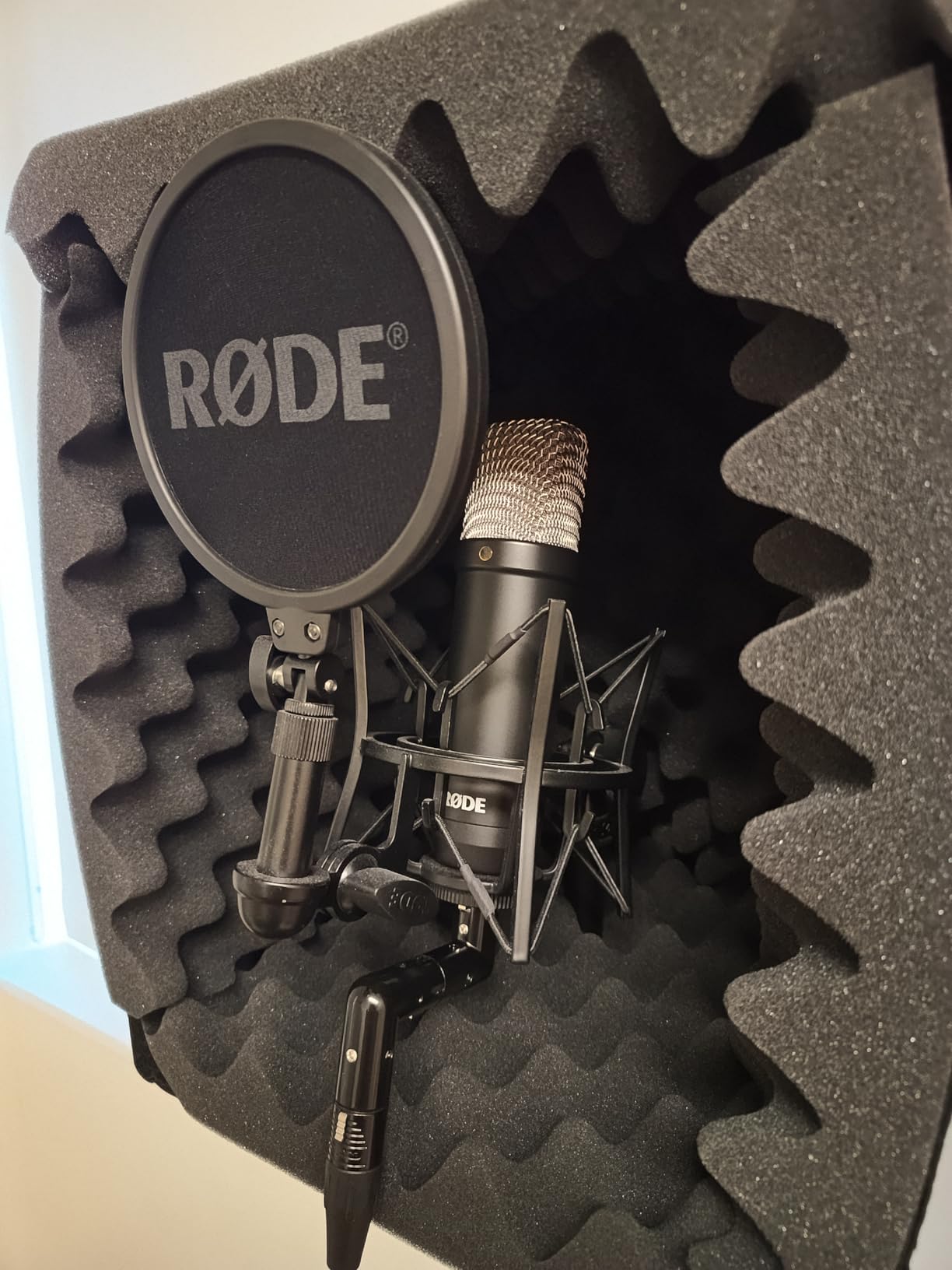
Owners credit it with dramatically cutting echo in untreated rooms, and 65 percent of the reviews are five star. The tone change is the thing people notice: a voice recorded through a reflective wall comes back sounding boxy and smeared, and the egg-crate foam takes that edge off. Several owners report using it with everything from USB desktop microphones to large-diaphragm condensers on a boom arm.
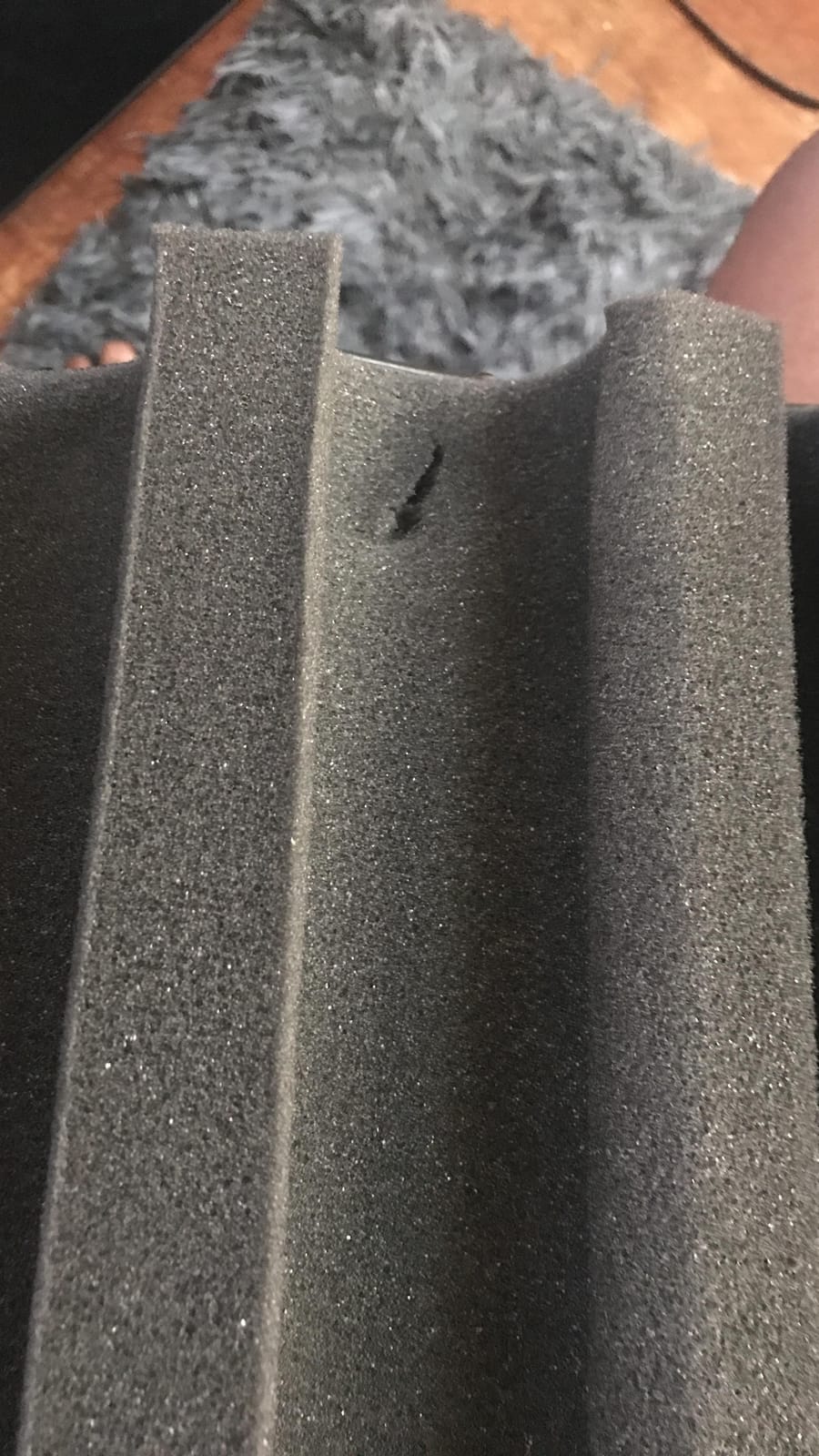
The build quality is where the criticism sits. Reviewers describe the fabric shell as flimsier than expected and closer to cardboard in feel, and they note that the foam pieces do not always fill the frame completely, leaving gaps the product photos do not show. The horizontal seam across the middle is a third recurring complaint, with owners reporting the box bows under weight over time. None of that stops it doing its job, but it is a fabric-and-foam product, not a machined one.
Who should buy the TroyStudio folding box
Buy it if you record in a quiet room and your problem is reflections, and if you want something you can put in a cupboard between sessions. It suits podcasters on a desk, singers tracking demos on a stand, and anyone recording in different rooms across a week. Because it weighs 2.02 pounds, moving it is a non-issue, which is what makes it the practical pick for a home studio that shares space with a bedroom or an office.
The one mounting limitation worth knowing is the stand diameter. It works with stands of diameter smaller than 0.86 inches, which covers most round desk and boom-arm bases but excludes some wide tripod bases. Check your stand before you buy, or plan to use it on a desk.
Who should skip the TroyStudio folding box
Skip it if your room is noisy rather than reflective, because a fabric box will not remove traffic noise, appliances or a neighbour’s television. It is also the wrong tool for anyone who needs a measurable noise reduction figure for audiobook or broadcast delivery, and it is too small to sit inside, so the seated ergonomics problem in a walk-in enclosure does not apply to you at all.
If you care about build feel and longevity more than portability, an 83-inch-tall walk-in enclosure will feel more like studio equipment. The trade is real: you gain a frame and blankets that stand on their own, and you lose the ability to carry the whole thing up three flights of stairs.
2. XTUGA MIS02 Recording Microphone Isolation Shield – Five Panels of Foam for Very Little
XTUGA MIS02 Recording Microphone Isolation Shield, 5 Panels Soundproof Foam
5-panel box
Thickened foam reflectors
3.98 lbs
15.75 in wide
Pros
- Noticeably darkens and smooths the recorded tone
- Works with sensitive condenser and tube microphones
- Stable once assembled and folds flat enough to store
- Good value against larger booths
Cons
- Plastic hinges crack after repeated folding
- Assembly is difficult and hardware gets lost
- Heavy and awkward on a mic stand
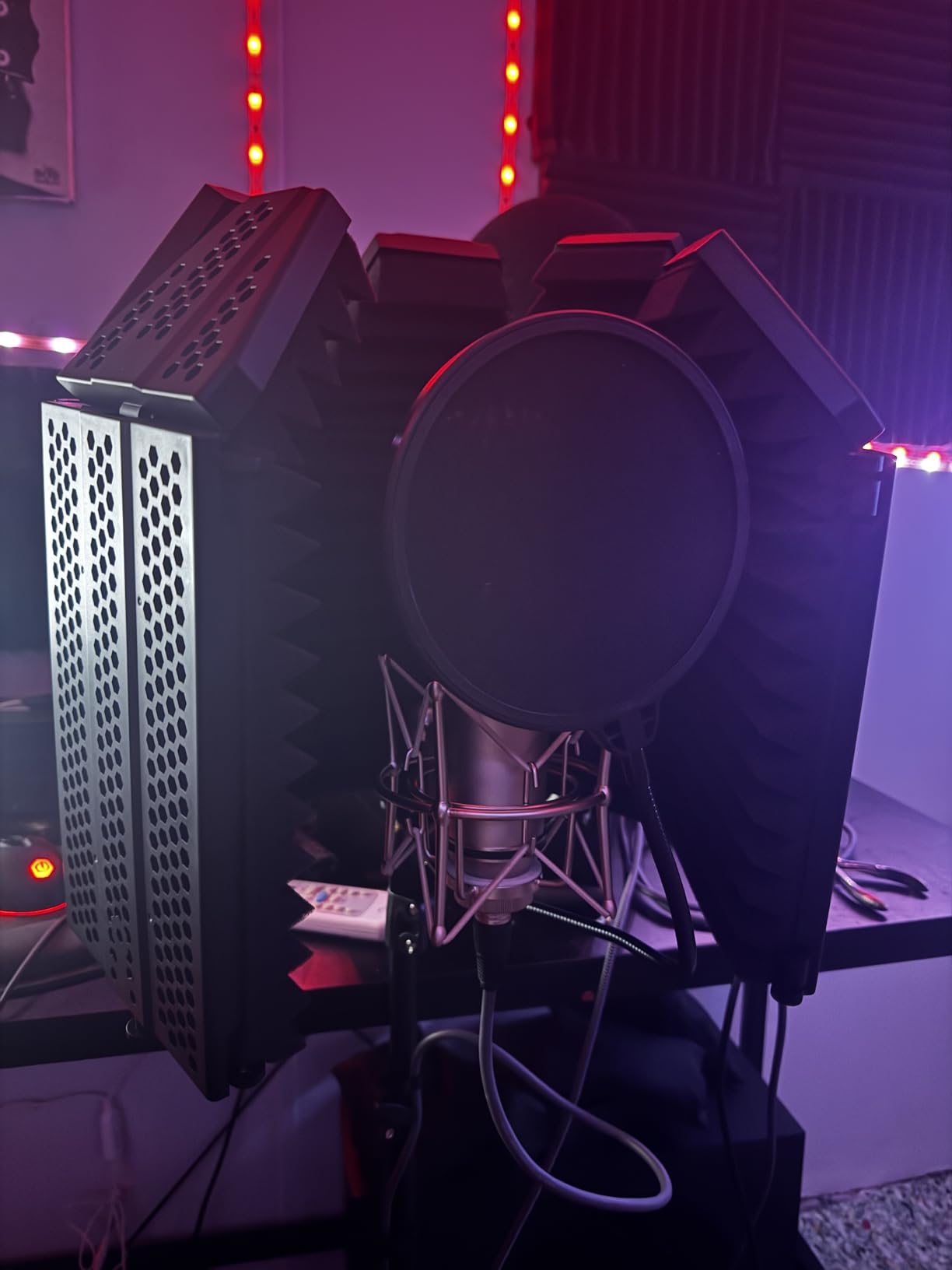
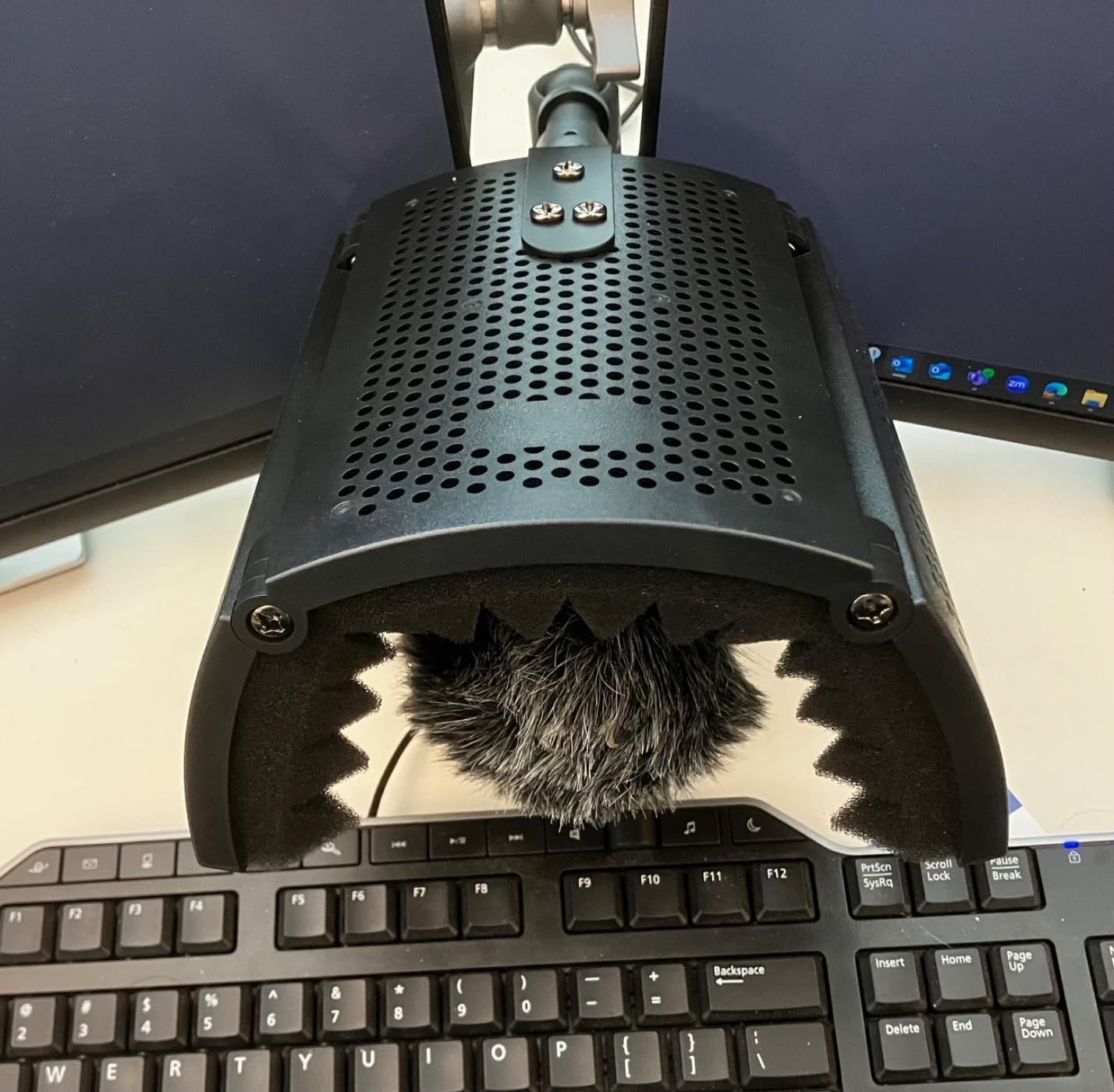
The MIS02 is the value pick in this guide, and the reason is the amount of absorptive surface per unit of effort. Instead of the flat three-panel design most cheap shields use, XTUGA built a five-panel arch with foldable end panels and lined the inside with high-density thickened sponge, so the microphone sits inside a partial box rather than behind a wall. The panels are angle-adjustable, which lets you shape the reflective pattern around the capsule.
Owners consistently report a tonal change once it is installed. The voice comes back darker and smoother because the early reflections off the desk and side walls are being absorbed rather than bouncing back into the capsule. Sensitive condenser and tube microphones benefit most, since those microphones pick up room reflections far more readily than a dynamic microphone does. At 4.3 stars across 1112 reviews, the sample is large enough to treat as representative.
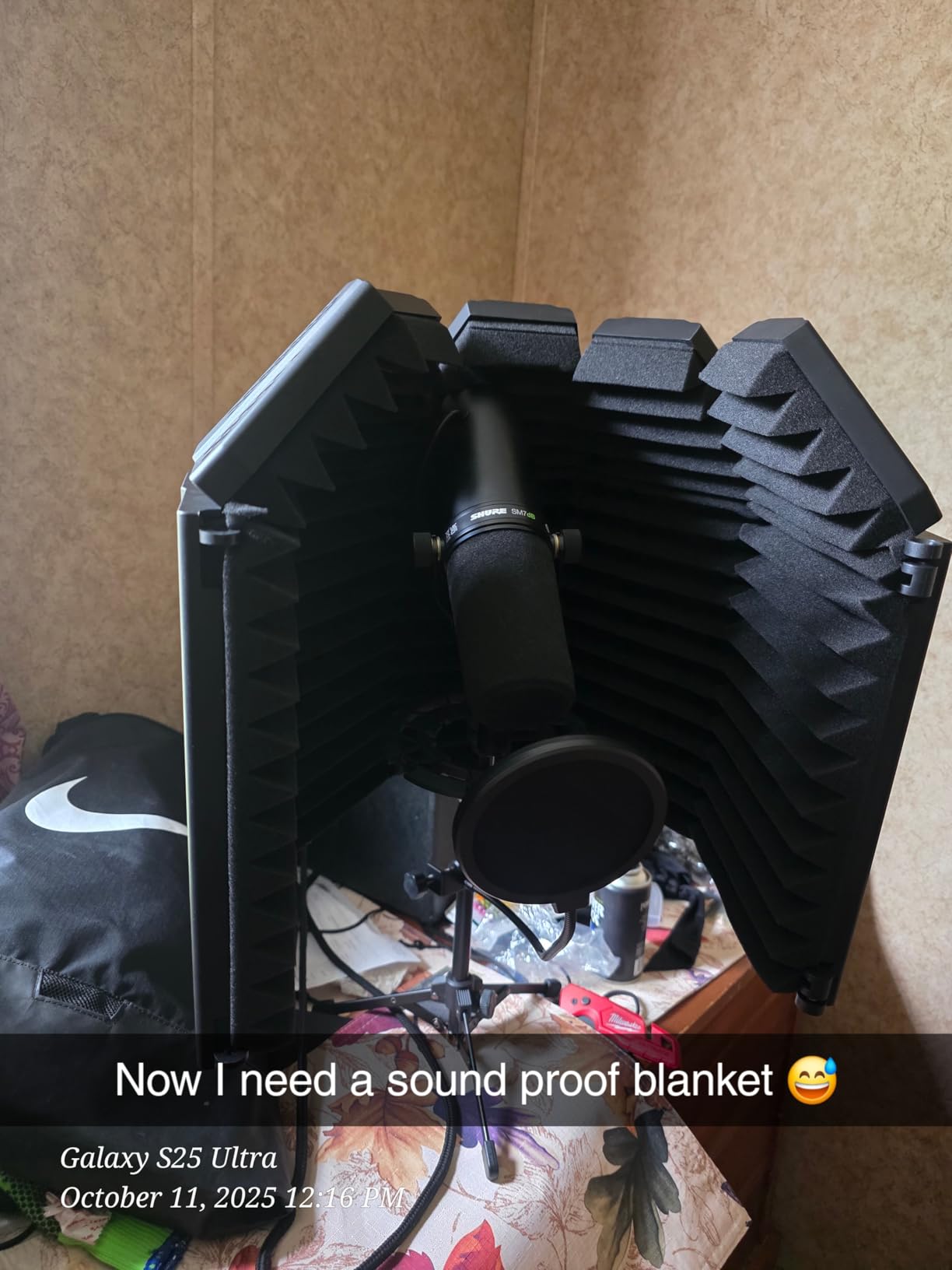
Assembly is the weak point and the single most common complaint. First-time builders report spending an hour or more and losing nuts into unreachable crevices, while experienced builders finish in roughly 12 minutes. The second durability theme is the plastic hinges, which crack after repeated folding cycles. If you fold it away every session rather than leaving it assembled, the hinges are taking the stress that a permanently deployed shield would avoid.
Two further notes. At 3.98 pounds it is heavy and bulky for a desktop unit, and reviewers report it is awkward on a mic stand for that reason. Reviewers also warn that the foam walls can crowd a rear-XLR front-address microphone, so check the depth of your microphone body against the interior before committing.
Who should buy the XTUGA five-panel shield
Buy it if you are working with a condenser microphone at a desk or on a stand, in a room with reflective walls and a reasonably quiet floor. It is the strongest reflection control available in a small footprint, and the foldable end panels let you adjust the angle to match your microphone position rather than accepting a fixed shape.
It also makes sense for anyone who wants the pop-in-booth effect of a walk-in enclosure without the weight or the storage problem. Leave it assembled, and it functions as a semi-permanent desktop isolation station.
Who should skip the XTUGA five-panel shield
Skip it if you are not comfortable with a fiddly build or you plan to fold and unfold it every session, because the plastic hinges are the weak link. It is also the wrong choice for a large-diaphragm tube microphone with a deep body and a rear-XLR connection, where the foam walls leave little clearance.
Anyone who moves their setup between rooms will find 3.98 pounds more annoying than the specification suggests. In that case a lighter folding box is the better tool, and the differences between them are entirely about build feel rather than acoustic result.
3. Snap Studio Portable Vocal Booth – The Full Walk-In Enclosure With a Complete Kit
Snap Studio Portable Vocal Booth, Original & Best for Home Studio Recording
Walk-in enclosure
33 x 33 in footprint
46.2 lbs
Pro Sound blankets
Pros
- Enough room to stand or sit with a mic stand and laptop
- Measurable drop in reflections and ambient background noise
- Sturdy frame with fitted pre-grommeted blankets
- Collapses into two duffel bags for transport
Cons
- Very heavy and awkward to move once assembled
- Interior gets hot during long sessions
- Bulky footprint forces you to rearrange the room
The Snap Studio is the reference walk-in enclosure in this category, and it is the format most people picture when they hear the term portable vocal booth. It is a 33 by 33 inch footprint that reaches 82.68 inches tall, giving 5.5 square feet of interior space and enough headroom for performers up to 6 feet 8 inches to stand inside with a microphone stand, a laptop and a tablet. Several long-term owners, including working voice actors, report that it replaced repeated studio rental bookings for their sessions.
What makes it work is the material rather than the shape. The walls, floor and ceiling are covered in heavy-duty Pro Sound blankets on a PVC frame, and reviewers single out how well the blankets fit and that the fixings are pre-grommeted. 75 percent of the 386 reviews are five star, and the recurring description is that it replicates a studio environment. The listing itself is honest about the limits, describing it as echo reducing and reverb absorbing with a light decibel reduction, and explicitly not soundproof.
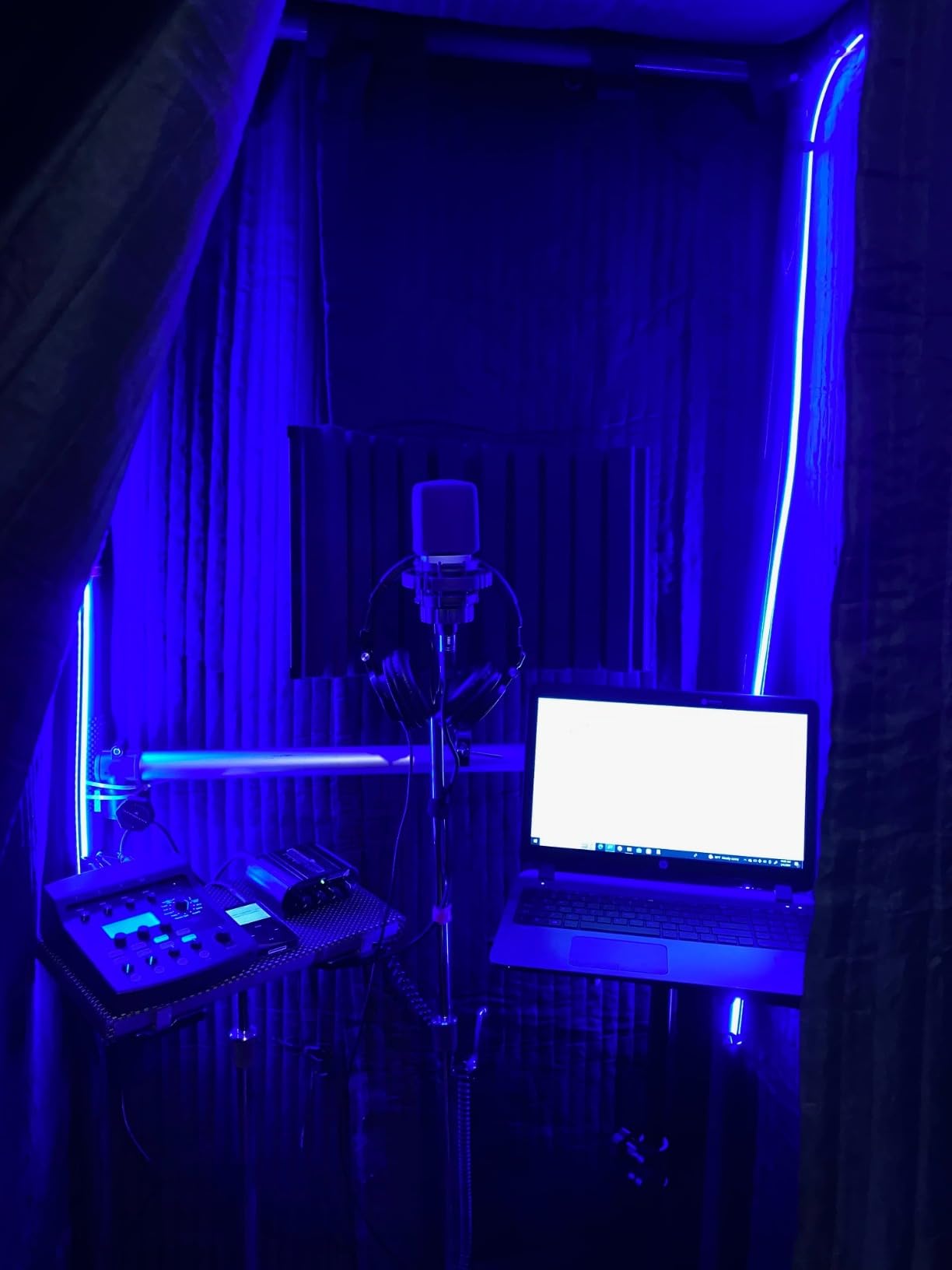
The kit is unusually complete for this category. You get wireless multicolored LED lights with a remote control, a smartphone or tablet mount, a microphone adapter, and two duffel bags for transport. That matters more than it sounds: several owners who bought other enclosures ended up buying a separate light and a separate phone holder, so the total cost of those competitors quietly rises.
Who should buy the Snap Studio enclosure
Buy it if you record in a room you cannot permanently treat, if you move between spaces, or if you need a booth that a whole performer can stand inside rather than a box that encloses only a microphone. Singers tracking demos, rappers running vocal booths in a spare room, and video creators who need a controlled dark space with lighting all fit the format.
It is also the one to consider if you plan to record for long stretches. The interior height means you can stand or sit naturally rather than crouching, which is the ergonomic problem owners raise repeatedly with tabletop walk-in designs.
Who should skip the Snap Studio enclosure
Skip it if you live in a small flat and cannot free a 33 by 33 inch corner permanently, because a 46.2 pound enclosure is genuinely difficult to move once assembled. Reviewers describe it as heavy and awkward, and several note that the footprint forces a room rearrangement every time you want to use it for something else.
Heat is the second objection. Owners report the interior gets hot and stuffy during long sessions and that a clip fan is a worthwhile addition. The upper retaining bands can also bend, which leaves the panels uneven. None of this stops it delivering, but the format demands a permanent corner and some ventilation planning.
4. TONOR Microphone Isolation Shield with Tripod – The Best Stand-Mounted Podcast Setup Here
TONOR Microphone Isolation Shield for Studio with Tripod Stand, Vocal Booth
Box shield on steel tripod
Height 51.2 to 74.8 in
10.14 lbs
Adapter included
Pros
- Steel tripod base resists tipping during recording
- Tool-free height adjustment for seated or standing work
- Effective reverb control in untreated rooms
- Integrated phone and lyric tray
- 3/8 to 5/8 inch adapter in the box
Cons
- Heaviest desktop shield in this guide at 10.14 pounds
- Manufacturer 96 percent claim is unverified
- Needs a stable floor rather than a desk edge
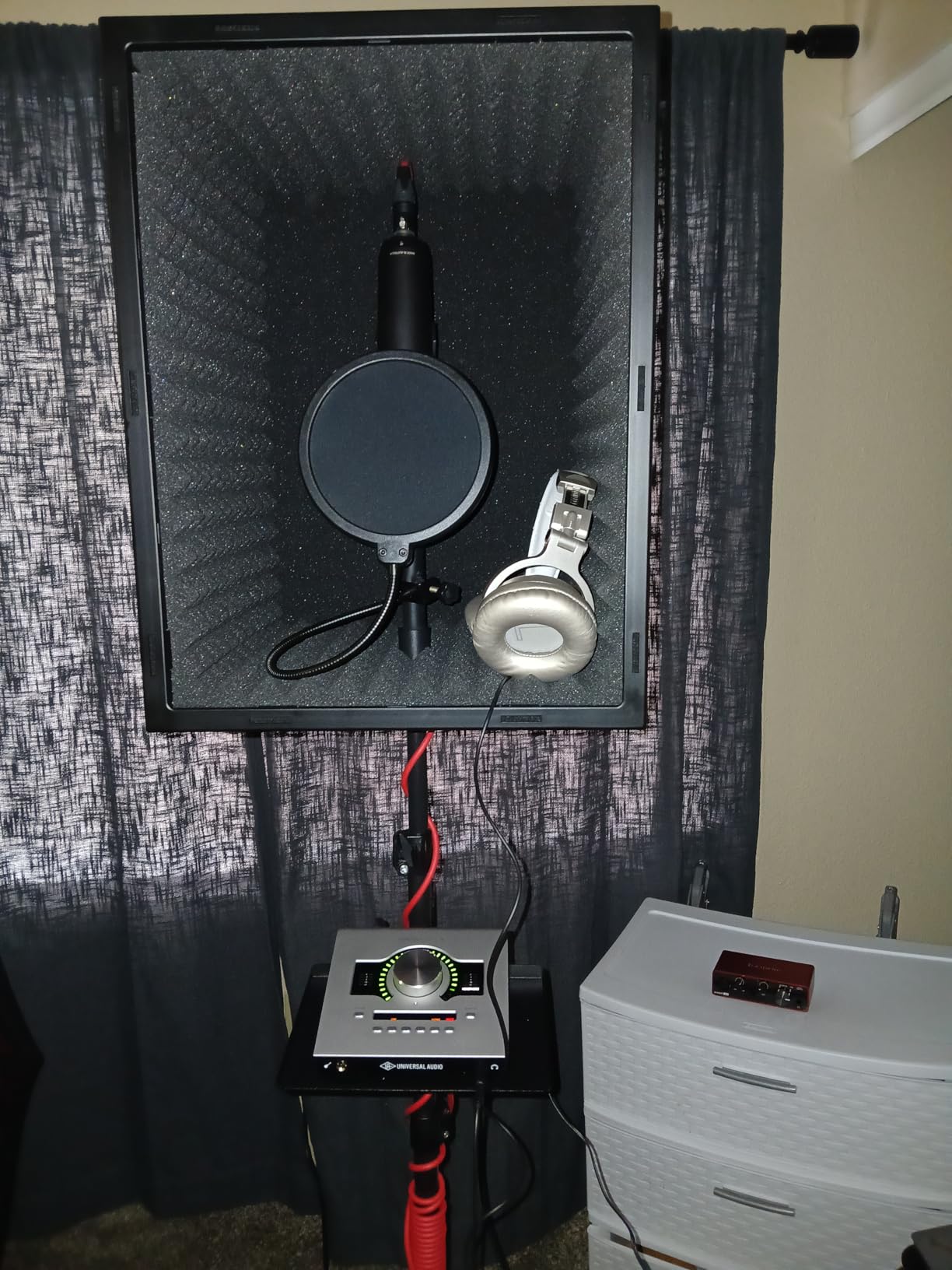
At 4.5 stars the TONOR is among the highest-rated desktop shields in this group, and the design choices explain why. Where most shields fight you with a small clamp or a folding tripod, this one puts a hardened plastic box on a heavy-duty steel tripod with a telescopic knob that adjusts from 51.2 to 74.8 inches. That range covers both a seated desk workflow and a standing podcast session without tools, which is the single most common ergonomic complaint in this category.
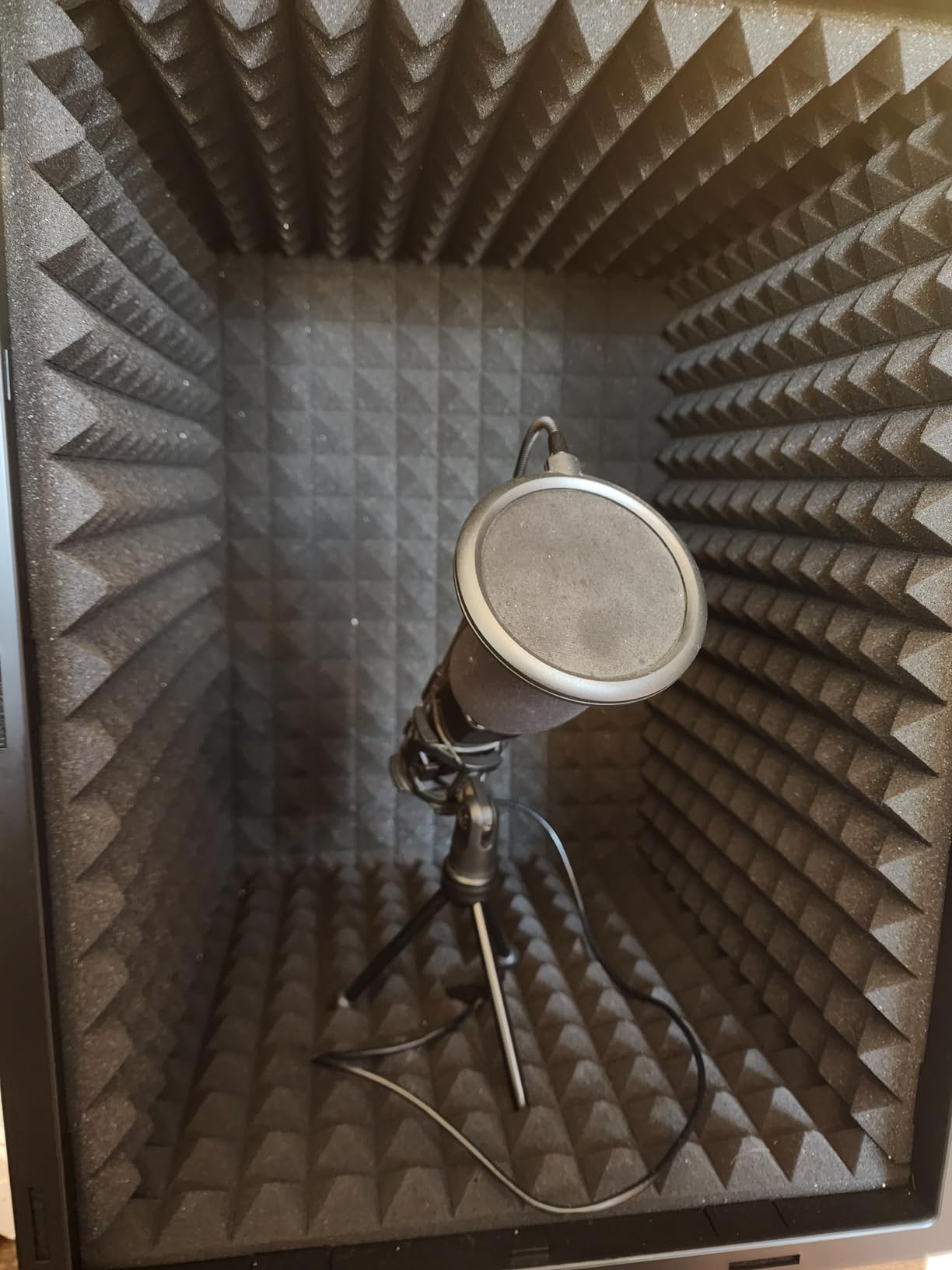
Inside the box are five high-density foam and sound-absorbing panels, with an interior of 12 by 13.6 by 16.7 inches. That is roomy enough for most microphones including large-diaphragm condensers, and the manufacturer rates the support at microphones up to 4.4 pounds. The included 3/8 to 5/8 inch adapter covers the thread mismatch that catches out plenty of buyers, and the microphone pole doubles as a tablet or phone tray for lyrics and scripts.
Owners highlight the stability of the steel tripod and its resistance to tipping during recording, which is the practical difference between a shield and a shield you can actually work with hands-free. The review base of 157 is respectable for a listing that arrived in November 2025, and 78 percent of those reviews are five star. The telescoping adjustment and the included adapters are the two extras most often called out as thoughtful.
Two things to hold in mind. The 96 percent indoor reverb prevention figure is a manufacturer claim with no published test method, so treat it as marketing. And at 10.14 pounds this is the heaviest desktop shield in the guide, which means it wants a floor rather than a desk edge. The stability is the trade.
Who should buy the TONOR tripod shield
Buy it if you record standing at a mic stand, or if you switch between seated and standing work and do not want to rebuild the setup each time. Podcasters and streamers get the most from it because the phone and lyric tray keeps prompts at eye level while the tripod handles the load.
It is also the right desktop choice if your microphone is a heavier large-diaphragm condenser. The interior depth and the 4.4 pound support rating give that class of microphone room to sit properly rather than crowding the foam.
Who should skip the TONOR tripod shield
Skip it if your recording happens at a desk you cannot move away from the floor, because a 10.14 pound steel tripod is not a desk accessory. It is also overkill for a very small room where reflections are minimal, and unnecessary for anyone who only needs a pop-in-booth effect around a small dynamic microphone.
If the priority is absolute portability between rooms, this is the wrong tool and a lighter folding box is the right one. The tripod that makes it excellent for standing work is exactly what makes it a chore to carry.
5. Frgyee 3-Panel Foam Isolation Shield – The Lightest Fix for a Small Reflective Desk
Microphone Isolation Shield, Foldable 3-Panel Sound Absorbing Foam for Condenser Mic, High Density Acoustic Shield with Adapters for Mic Arm Stand -Portable Vocal Booth for Home Recording Studio
3-panel foldable shield
High-density foam
0.77 lbs
7.48 in tall
Pros
- Lightweight and compact enough to carry anywhere
- Noticeable improvement to voice in small rooms
- Folding panels adjust the angle to fit
- Adapter set covers most mic stand threads
Cons
- Smaller than the listing photos imply
- Can weigh down a light boom arm
- Limited reflection control rather than real isolation
This is the smallest and lightest product in the guide at 0.35 kilograms, roughly 0.77 pounds, which makes it the one to take to a different room each session. The construction is a three-panel folding design with high-density absorbing foam on the inner faces, and the panels hinge so you can set the angle to match where your microphone is pointing. It fits a desktop or a microphone arm stand, and at 7.48 inches tall by 10.8 inches wide it takes up almost no desk space.
Owners looking for the cheapest fix for reflection in a tight space are generally satisfied, and several describe the difference in their voice as substantial once the panels are positioned correctly. The adapter set is unusually generous for a product this size, with five included adapters covering 3/8 and 5/8 inch threads in both directions. The listing also carries a lifetime warranty, which is rare in this category.
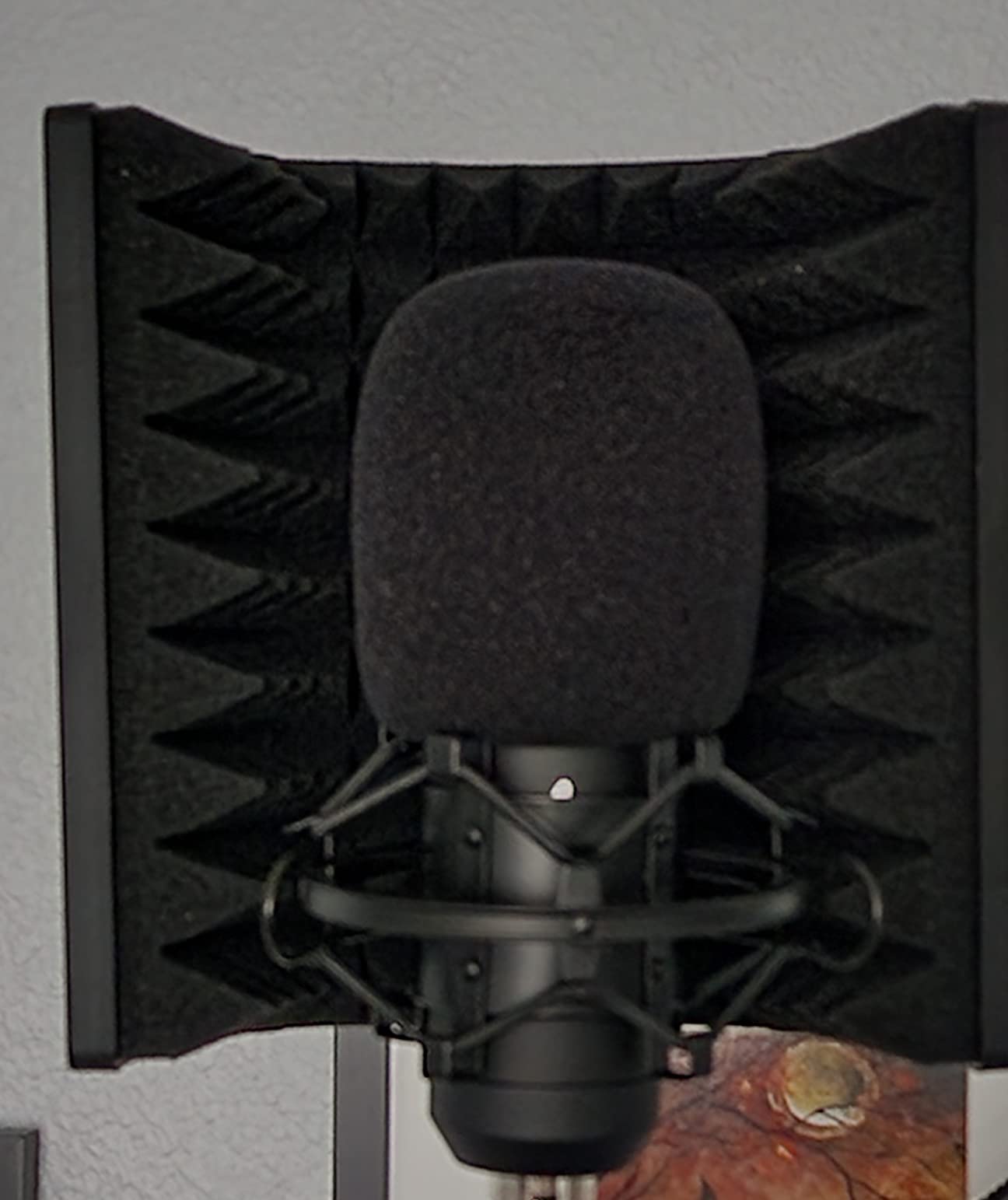
The dominant complaint is scale. A number of owners report that the shield is much smaller than the product photography implies, and that a standard desktop condenser sits above the foam rather than inside it. Two reviewers describe it as ineffective and misdescribed. Measure your microphone first, and note the listing states it is not suitable for Blue Yeti microphones.
The other limitations are physical. Reviewers report it can weigh down a light boom arm, which is worth knowing if you were planning to hang it from a slender arm rather than rest it on a stand. And it provides reflection control rather than genuine isolation, so the gain is audible but modest.
Who should buy the Frgyee three-panel shield
Buy it if you record in a genuinely small space, such as a home office corner, where a full enclosure will not fit and reflections off a nearby wall or monitor are the main problem. It is also the natural travel companion, since a 0.77 pound accessory can go in a laptop bag and be set up anywhere.
For a small dynamic or a compact condenser, the size is a feature rather than a limitation. You are removing the dominant reflection path, not building a room around the microphone.
Who should skip the Frgyee three-panel shield
Skip it if you use a large desktop condenser with a body wider than 10.8 inches, because owners report the microphone ends up sitting above the foam. Skip it too if you want to hang the shield from a light boom arm, since the weight works against the arm rather than with it.
Anyone who needs a repeatable, semi-permanent vocal chain should spend the extra effort on a five-panel or folding box. Three panels will soften a reflection problem, but it will not build the controlled environment a larger shield or an enclosure provides.
6. VOCTENT Portable Vocal Booth – The Thickest Blanket Spec in the Guide
Voctent Portable Vocal Booth for Recording, Sound Booth for Home Studio
Walk-in enclosure
800+ GSM blankets
37.7 lbs
33.5 x 33.5 x 83 in
Pros
- Highest average rating in the group at 4.6 out of 5
- Exceptionally thick and dense blankets that tame reflections
- Reflective white lining doubles as a video lighting surface
- Light bar and interface tray included
Cons
- Heaviest walk-in in the guide at 37.7 pounds
- Small review base of 74 for a recent listing
- 87 percent reduction figure is a manufacturer claim
The VOCTENT is the pick on material specification, and that is not a marketing judgement. It uses 800+ GSM acoustic blanket filled with sound-absorbing cotton and a dense woven polyester outer, which the manufacturer describes as roughly twice as thick as competing booths. Blanket weight is the number buyers in r/audioengineering and r/VoiceActing consistently treat as the real purchase driver in this category, and this is the heaviest blanket specification in the guide.
It runs 33.5 by 33.5 inches at the base and 83 inches tall, and comes in a large and an XL footprint with a choice of finishes. One of those finishes uses a reflective white reverse side, which does two jobs: it brightens the interior for video capture and it returns light toward your face instead of absorbing all of it. Reviewers pick out that lining as a detail the other enclosures in this price range do not offer.
The accessory kit is complete: a light bar, an audio interface tray, an iPad clamp holder and a carrying bag. That combination means you can record voiceover with the interface mounted at a usable height and the script loaded on a tablet without buying anything else. The 4.6 average is the highest in the group, with 82 percent of reviews at five stars.
Two honest caveats. The listing arrived in April 2025, so the 74 reviews behind that rating are a much thinner sample than the 1960 behind the TroyStudio box, and nobody has long-horizon data on how 800 GSM blankets and their fittings age. And the up to 87 percent reduction in reverb and noise figure is a manufacturer claim with no method attached.
Who should buy the VOCTENT enclosure
Buy it if you are recording video as well as audio, because the reflective white lining changes the lighting inside the booth in a way no other enclosure here does. Narrators, streamers and creators who need an interface tray and an iPad mount will also save money, since those are the pieces you would otherwise buy separately.
If you care about material density more than portability, this is the strongest pick. The thicker the blanket, the more of the mid-frequency reflection energy it converts to heat, and that is where the audible change comes from.
Who should skip the VOCTENT enclosure
Skip it if you need to move the booth between rooms. At 37.7 pounds with blankets over the full wall, floor and ceiling, this is a two-person lift and a permanent corner, not a portable item. The 33.5 inch footprint is also larger than the 33 inch standard, which matters in a tight room.
Anyone wary of buying a young product should wait for a larger review base before committing. The specification is genuinely the best in the guide, but the long-term reliability record does not exist yet and cannot be created by the marketing copy.
7. Pyle Mini Portable Vocal Recording Booth – Curved Metal Plates Instead of Flat Foam
PyleUsa Mini Portable Vocal Recording Booth – Use with Standard Microphone,Isolation Noise Filter Reflection Shield for Studio Quality Audio – Dual Acoustic Foam Soundproof Panel PSMRS09 Black
Dual folding shell
Curved perforated metal
5.1 lbs
Mic depth 1 to 5 in
Pros
- Curved diffusion plates add control that flat foam panels cannot
- Deep 2-inch foam lining for small untreated rooms
- Adjustable microphone depth for precise placement
- Reinforced steel and foam construction
- Folds flat for storage
Cons
- Lowest average rating in the group at 4.0
- Fifteen percent one-star reviews report inconsistent results
- Vertical-mount-only design limits placement options
The Pyle takes a different approach from everything else in the guide. Most shields are flat foam surfaces, which absorb energy at the point of impact. This one uses a dual folding shell with curved perforated metal plates, and those plates scatter the reflected sound across a range of angles instead of returning it directly to the capsule. For a very small room where a flat panel would simply bounce a predictable reflection back, that difference is audible.
The foam lining is about 2.0 inches thick, which is competitive with the larger shields, and the enclosure is built from reinforced steel rather than plastic. The feature that reviewers single out most is the adjustable microphone depth, which slides from 1 inch to 5 inch on universal 5/8 inch threading. That control matters because a microphone’s proximity effect and its relationship to the absorbing surfaces are two of the variables that change your tone, and fixing both is unusually precise.
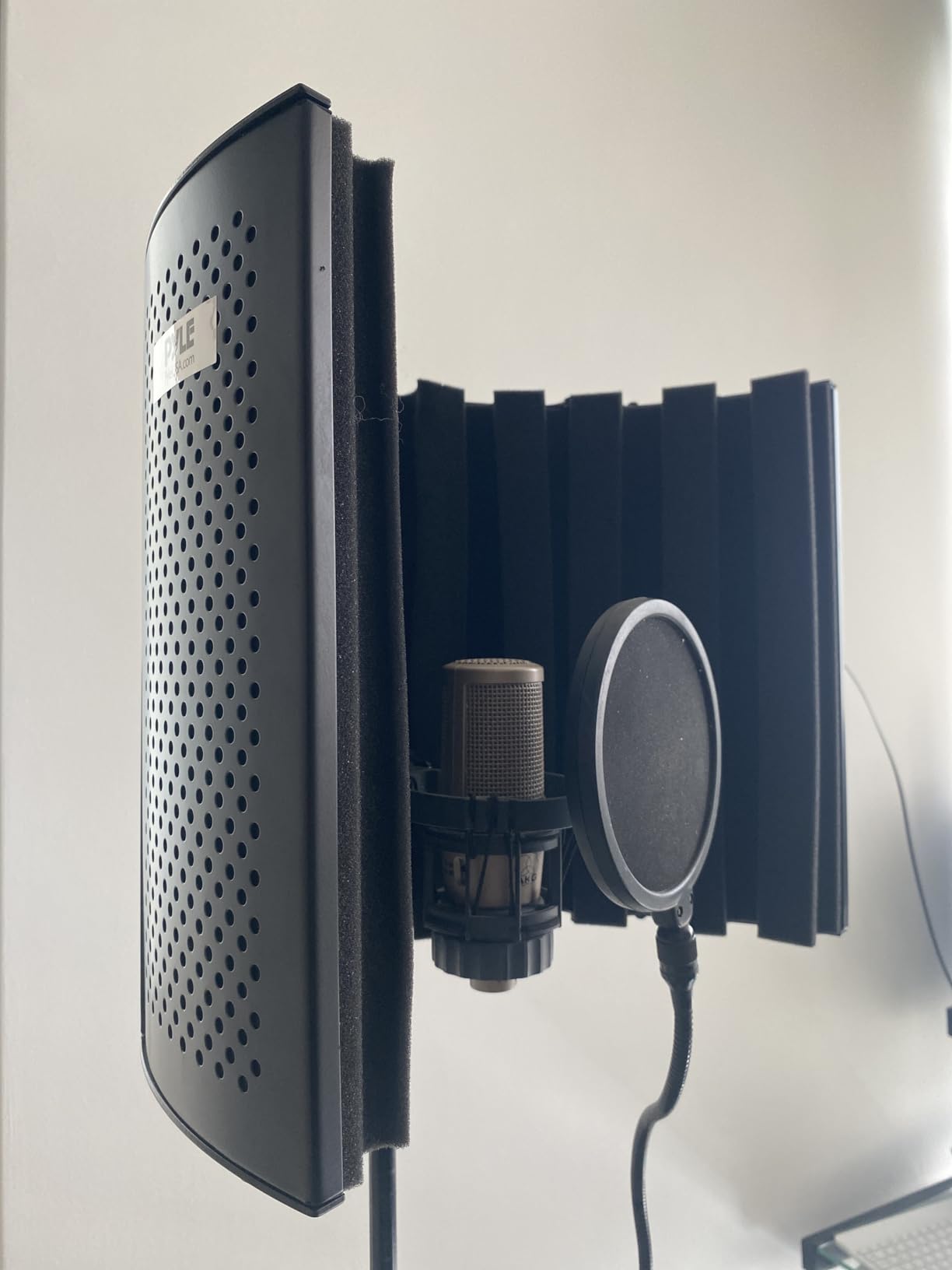
It is also the lowest-rated product in this guide at 4.0 stars across 159 reviews, and the rating distribution is the flattest of the set with 15 percent one-star reviews. Those critical reviews describe inconsistent isolation performance rather than a defect. The vertical-mount-only design is the second structural complaint, since it removes your freedom to place the microphone at other angles.
At 5.1 pounds and 11.82 by 19.69 by 12.21 inches, it folds flat for storage and is lighter than the XTUGA and the TONOR while offering a larger footprint. The trade for the metal plate design is build weight and a rating average that lags the rest of the field.
Who should buy the Pyle mini booth
Buy it if you record in a small hard room where a flat foam panel still leaves a strong predictable reflection, and if you want to fine-tune the microphone position rather than accept whatever spacing the shield forces on you. The 1 to 5 inch depth adjustment is the reason to pick this one specifically.
It is also a good fit for a hybrid desk setup, because the reinforced steel build and the folding dual shell mean it can live in the corner of a workspace and come out for a session.
Who should skip the Pyle mini booth
Skip it if you want a consistently strong result with no caveats, because the one-star share is the highest in the guide and reflects genuine variation in how much improvement owners heard. If your reliability depends on a booth, a product with a 4.0 average and a wide spread of low ratings is a harder sell than one with a tight distribution.
The vertical-only mounting is a hard stop for anyone who needs to angle the microphone away from a wall or a reflective surface in a particular direction. Check your intended mic orientation first.
8. TroyStudio Enclosed Vocal Booth – The Sturdier Sibling With a Laptop on Top
TroyStudio Enclosed Vocal Booth, Portable Microphone Isolation Shield, Foldable Reflection Filter with Acoustic Foam & Panels, Recording Sound Box Home Studio Equipment for Podcast Music Voice Over
Folding box
Felt plus foam panels
2.7 lbs
12 x 12 x 16 in
Pros
- Reinforced front and back panels resist wobble and foam sagging
- One-minute setup and 30-second teardown
- Top surface holds a laptop
- Compact and foldable for travel
- Works with most microphone and stand styles
Cons
- Small interior limits accessory space
- Only fits stands under 0.86 inch diameter
- Handles reflections far better than outside noise
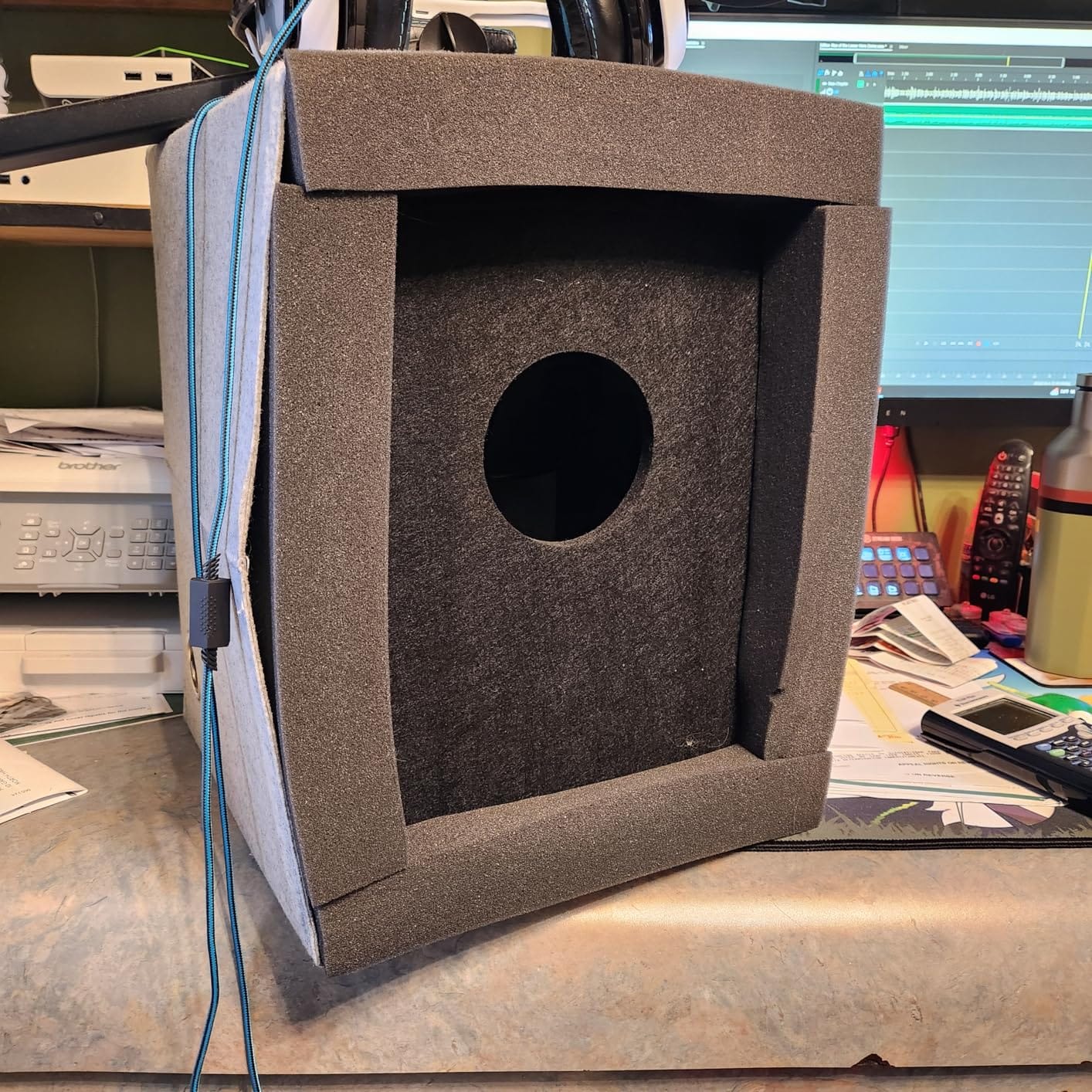
This is the newer TroyStudio model, and its selling point is structure. Where the classic folding box uses a fabric shell with a single backing support, this one adds reinforced front and back panels, four pieces of 2-inch acoustic foam and two high-density felt studio panels. Reviewers credit that structure with keeping the box stable and stopping the foam from sagging, which are the two complaints that most often surface on cheaper builds.
It is also taller than the original at 16 inches, and the extra height is functional: the top can hold a laptop. That turns the booth from a microphone accessory into a small recording station, with the machine running your session right above the capsule. Three frame holes take cables and stand hardware, and the front panel accepts notes or a mounted phone. Setup takes under a minute.
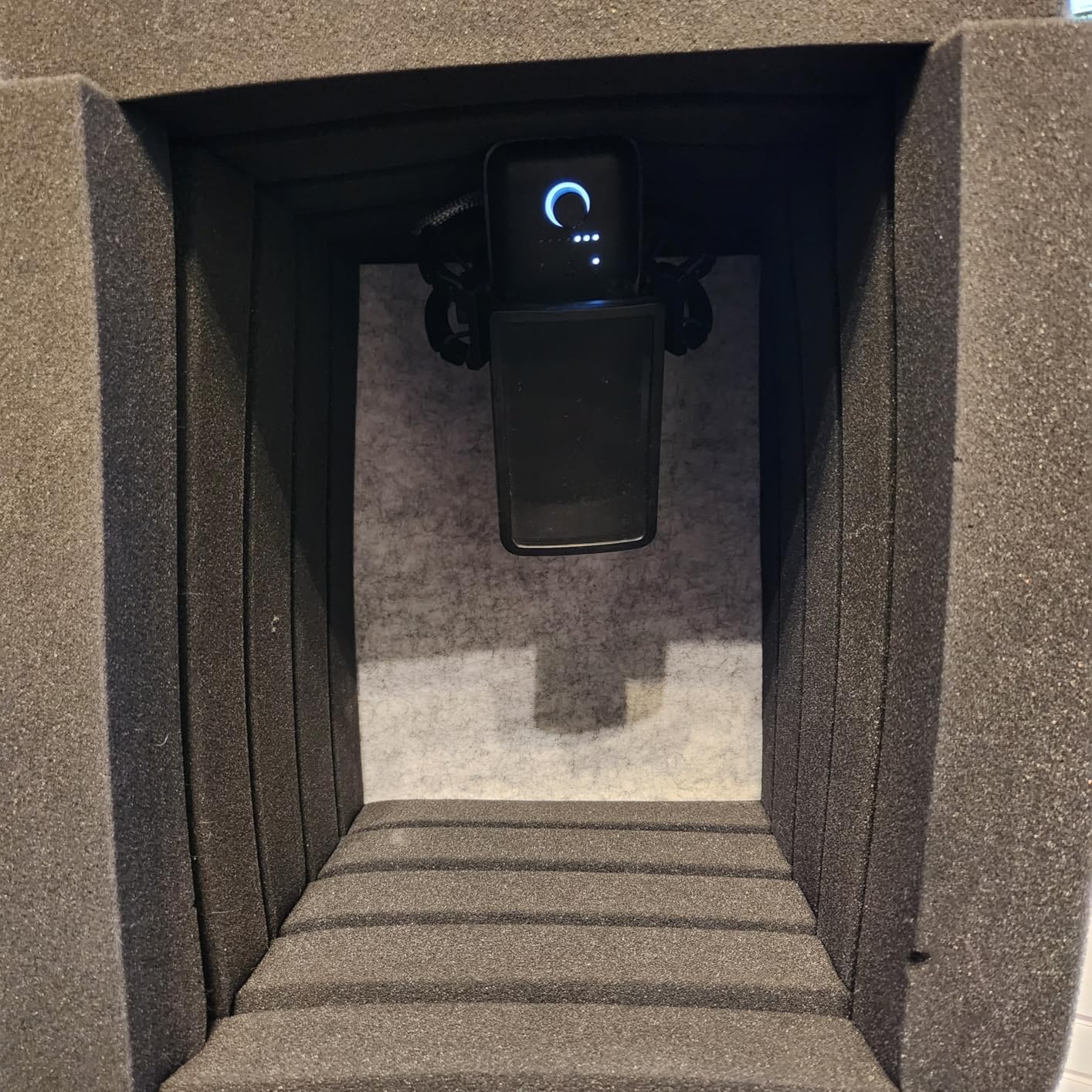
The claimed 95.3 percent room reverberation protection is a manufacturer figure with no method published, so read it as a category-standard claim rather than a measurement. The review base is 55 with a 4.1 average, and 55 percent of those reviews sit at five stars, which is a more mixed distribution than the brand’s older box. Reviewers set the expectation clearly that this addresses echo and reverb in an already quiet room.
At 2.7 pounds and folding to 12 by 12 by 10 inches it is still genuinely portable, just slightly heavier than the older model. Two practical limits: the 8 by 8 inch interior is tight for accessories, and the stand fit is restricted to bases under 0.86 inches in diameter.
Who should buy the TroyStudio enclosed booth
Buy it if you want a laptop inside your booth footprint, which is the specific reason this one exists. Voice actors reading from a screen, podcasters with two microphones, and anyone recording a self-tape in one pass will find the top surface removes a separate stand from the setup.
It is also the better choice if you have previously owned a soft-shell folding box and it sagged or wobbled. The reinforced front and back panels address exactly that complaint.
Who should skip the TroyStudio enclosed booth
Skip it if your room is noisy, because a 2.7 pound fabric box has no chance at real sound reduction. Anyone with a wide tripod base will also find the 0.86 inch stand restriction limiting, so check your hardware before ordering.
If you plan to store accessories inside the booth alongside the microphone, the 8 by 8 inch interior will feel cramped. That is the trade for the laptop top and the smaller footprint.
9. RDCMKL Portable Recording Booth – Fold-Away Enclosure With a Real Travel Bag
RDCMKL Portable Recording Booth, Foldable Vocal Booth for Home Studio
Walk-in enclosure
33 x 33 x 80 in
35.7 lbs
Blanket cover
Pros
- Dark interior with room for a mic
- LED light and gear
- Noticeably cleaner recordings in a reflective room
- Straightforward to set up for most buyers
- Phone holder and travel bag included
Cons
- Owners report no cable pass-through despite the listing
- Assembly instructions missing or unclear
- Cramped and uncomfortable inside for a tall adult
The RDCMKL is a straightforward 33 by 33 by 80 inch walk-in enclosure with a foldable frame and an acoustic blanket cover, and its appeal is the travel bag. It folds down into the included bag for storage between sessions, which is the feature that separates it from the fixed-corner enclosures. At 35.7 pounds it is still a two-person object, but it is a two-person object you can put away between weeks rather than live with permanently.
Feedback on results is genuinely split, and the split has a pattern. Users with a capable microphone in a reflective room report dramatically cleaner recordings and a dark, well-enclosed space that holds a microphone plus a light and other gear. Others found the interior cramped and uncomfortable for a tall adult, struggled with undocumented assembly, and reported no cable pass-through holes despite the listing advertising one. The rating sits at 4.0 across 49 reviews.
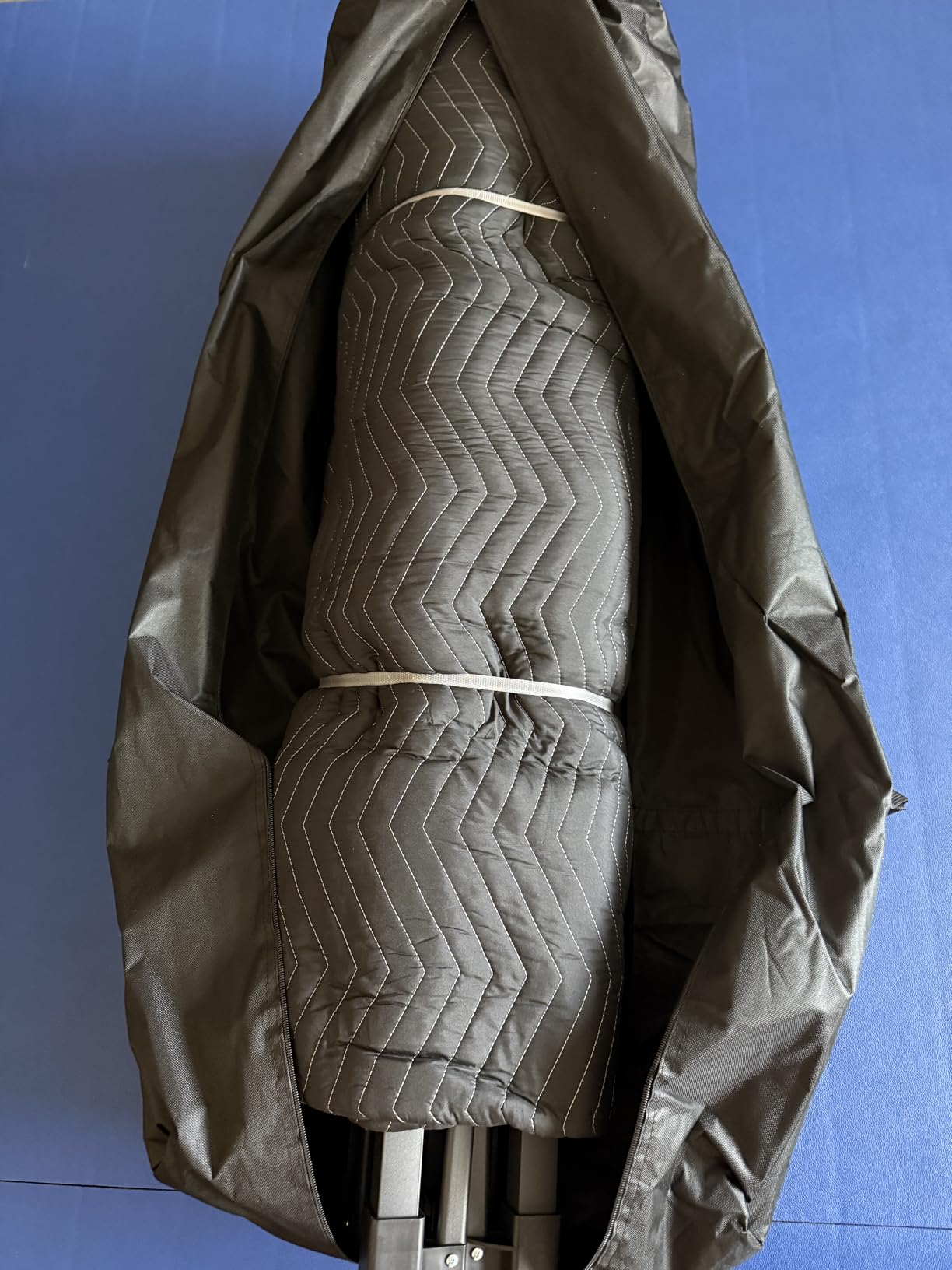
We are flagging the cable pass-through contradiction rather than repeating the claim, because routing microphone and headphone cables out of a sealed booth is exactly the sort of detail that decides whether a walk-in format is workable for you in practice. There is also no shelf or desk surface inside, so an interface has to sit on the floor or on a separate stand beside you. One review states plainly that it does not keep outside sound out, which is consistent with the format rather than a fault in the product.
The listing arrived in April 2025, so 49 reviews is a thin sample and the rating distribution is wide, with a meaningful share of one-star reviews. The phone holder is one of the more useful included items because it keeps lyrics at eye level in a dark interior.
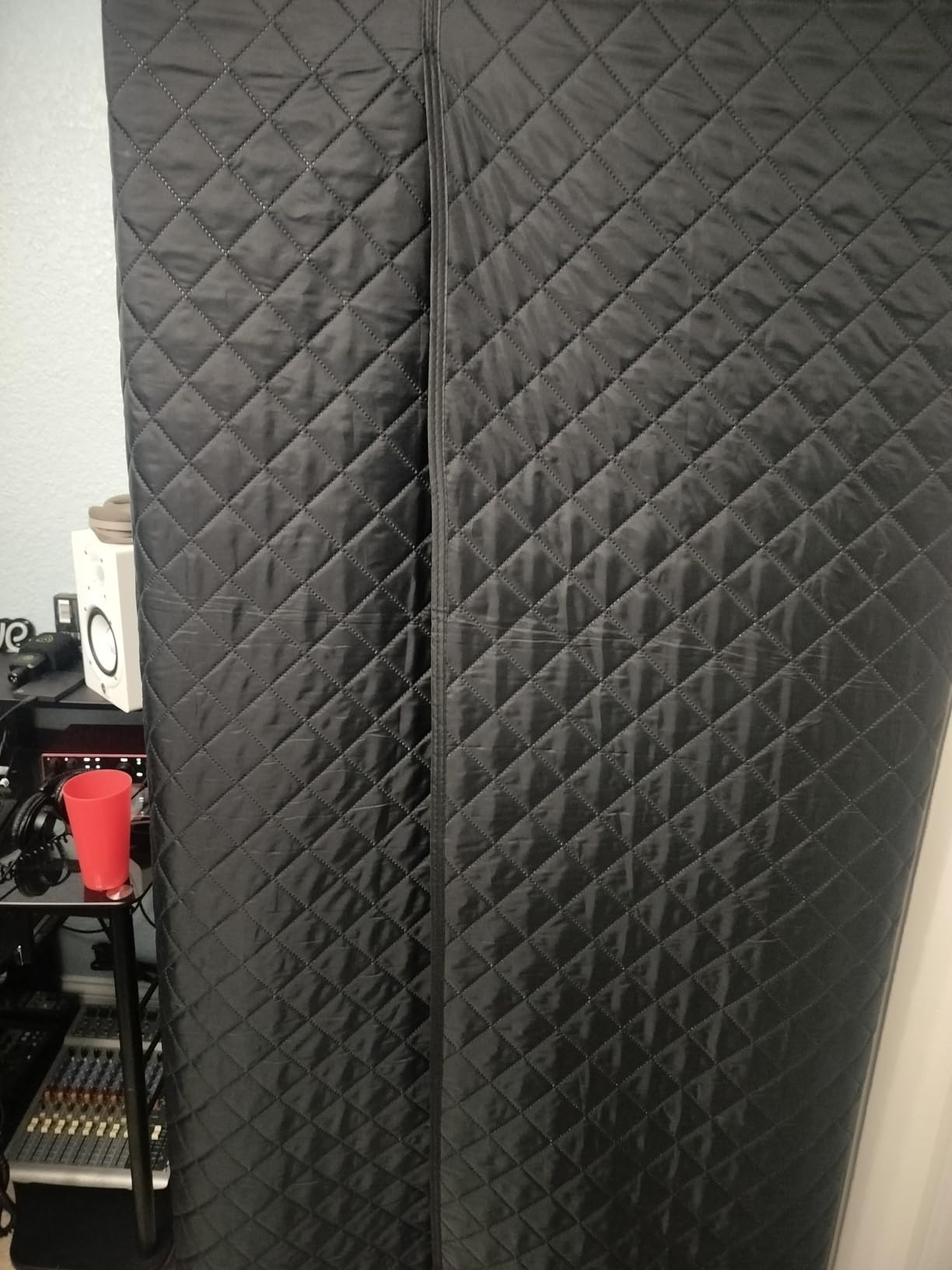
Who should buy the RDCMKL booth
Buy it if you need full walk-in coverage but rent your space or share a room, because folding it into the included bag between sessions is the entire value proposition. It is a good fit for a home studio where the corner it occupies needs to be available for something else half the time.
The dark interior is also a feature for video work, since a blackout shell gives you a controlled lighting environment when paired with the light you bring in.
Who should skip the RDCMKL booth
Skip it if you are a tall performer who will be sitting inside, because owners report the interior is cramped and uncomfortable for long sessions. Skip it if you plan to run an audio interface and a laptop inside, since there is no shelf and no desk surface to put them on.
Buyers who need cable routing should also look elsewhere, given the owner reports of missing pass-through. And with 49 reviews and a 4.0 average, this is the least proven walk-in in the guide, so expect more variation between units.
10. lunacme Portable Vocal Booth – Heavy Blankets and a Pop-Up Frame
Portable Vocal Booth,Recording Booth Sound Booth for Recording Echo-Free Vocals Complete Home Recording Studio Foldable with Travel Bag for Voiceovers, Podcasts & Music
Pop-up enclosure
Thickened blankets
37.2 lbs
46.5 in packed length
Pros
- Cuts reflections and basic ambient noise effectively
- Heavy well-made sewn-together blankets
- Good value against similarly designed competitors
- Portable enough for mobile audiobook recording
Cons
- Pop-up frame is awkward to assemble alone
- Included phone and tablet holders feel low quality
- Runs warm and needs ventilation
The lunacme uses a pop-up frame design where the cover attaches over metal poles, so there is no conventional assembly with dozens of joints. Owners credit the blankets specifically, describing them as heavy and well-made with proper seams, and several note that the result cuts both reflections and basic ambient noise. One reviewer’s client asked for the product link after hearing the recordings, which is the kind of outcome a narrator chasing a consistent voice will recognise.
It is the most mobile of the walk-in enclosures in practical terms, because the package measures 46.5 by 13.5 by 10.5 inches and the included travel bag and phone or tablet stand mean the whole system moves as one unit. That suits narrators recording in different rooms, or on location where a permanent corner is not available.
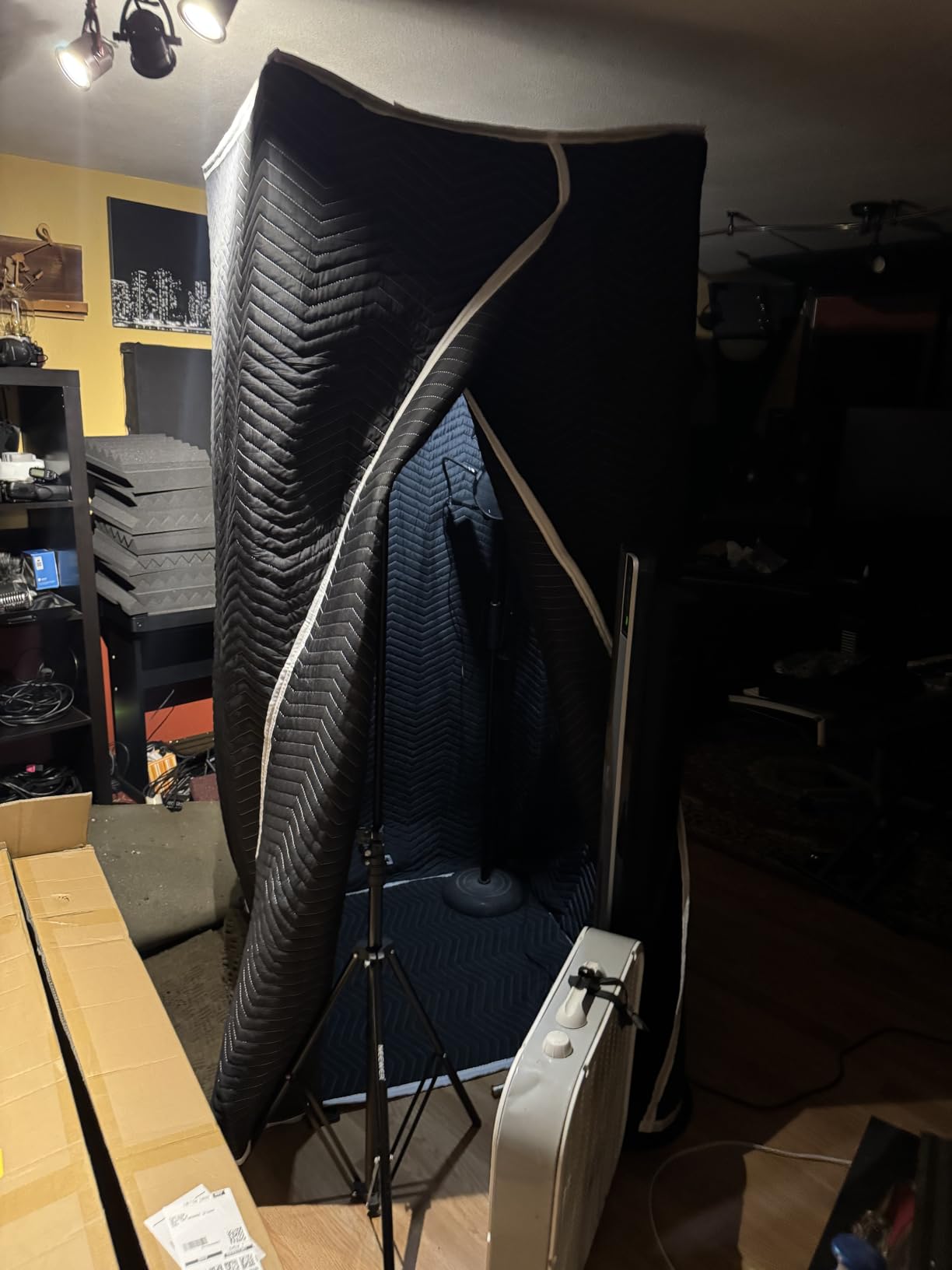
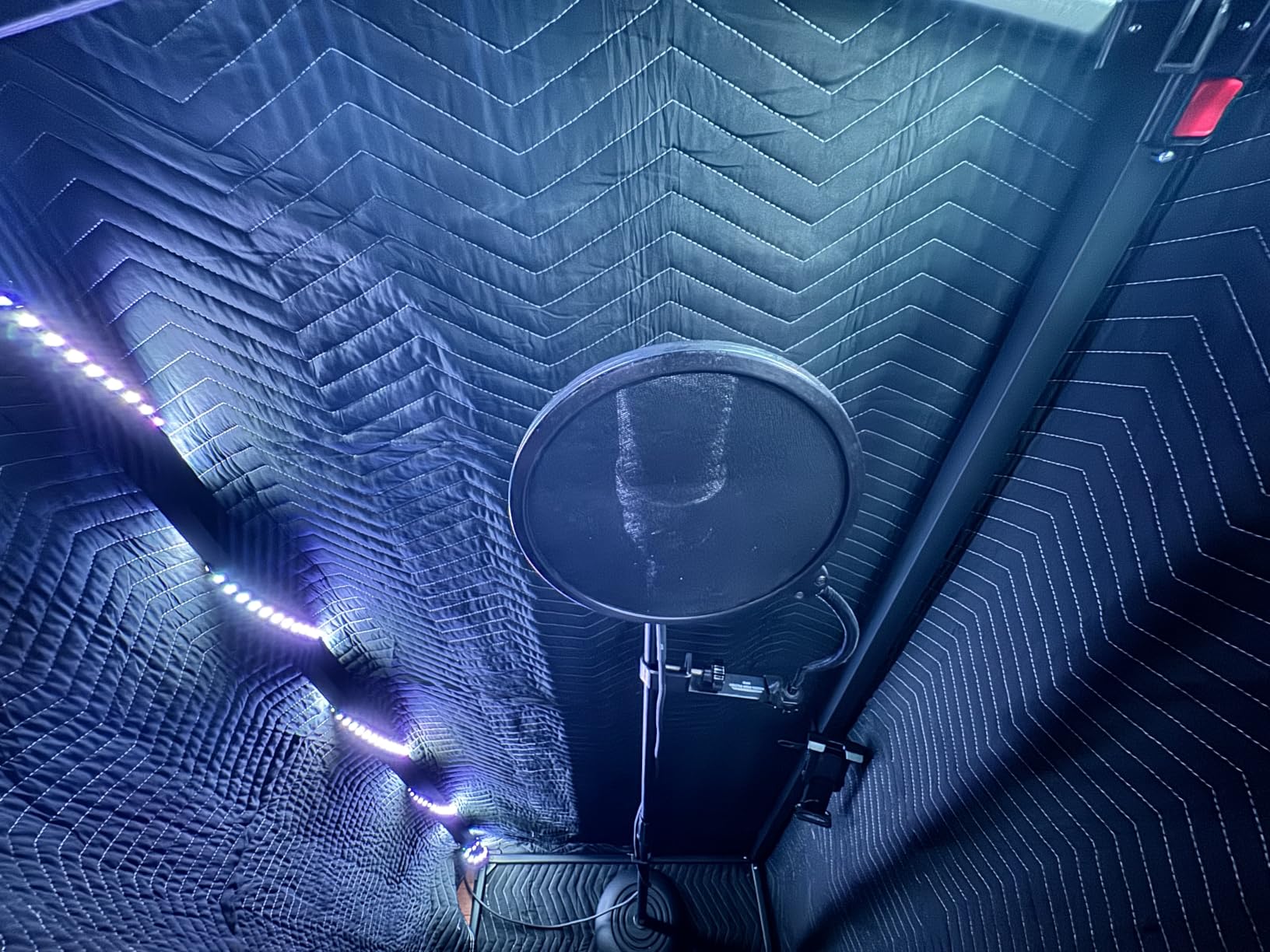
The negative theme is the frame, not the acoustic result. Owners describe the pop-up assembly as awkward and strenuous to do alone, with one buyer timing 15 minutes of struggle before switching brands. Several also report the booth warms up quickly and needs ventilation, and that the ceiling droops for taller users. The included phone and tablet holders are consistently described as low quality, so treat them as a placeholder rather than a reason to buy.
The rating distribution is unusually polarised in a specific way: 46 percent five star and 27 percent three star, with almost no one-star reviews. That pattern suggests most people are satisfied and a sizeable group is unimpressed, rather than a broken product. The claimed up to 90 percent reverberation and noise absorption is a manufacturer figure.
Who should buy the lunacme booth
Buy it if you narrate in more than one location, since the packed length of 46.5 inches and the included bag make it straightforward to move between rooms or to a different site. The heavy sewn blankets are the draw if you have found lighter covers too transparent to the ear.
It is also a reasonable choice for singers who want a walk-in volume without a permanently fixed corner, provided you are willing to wrestle the frame into place with a second pair of hands.
Who should skip the lunacme booth
Skip it if you intend to build it alone and often. The pop-up frame is the most demanding assembly in this guide, and the reviews are specific rather than vague about that. Anyone above average height who needs headroom should also look at the drooping ceiling reports before committing.
Video creators should skip it, because the bundled phone and tablet holders are not good enough to justify the purchase on their own. For lighting, our guide to the best lighting for photo booths covers what actually works in an enclosed space.
11. POROSO Portable Vocal Booth – Full Wraparound Coverage Including the Ceiling
Portable Vocal Booth for Recording, Portable Recording Booth for Home Studio, Acoustic Treatment to Reduce Echo, Sound Isolation Booth, 5-Min Assembly w/Travel Bag, Lights, Phone Holder (2026 Update)
Walk-in enclosure
NRC 0.9 top cover
38 x 38 x 80 in
Five-minute assembly
Pros
- Wraparound blankets and top coverage tame flutter echo
- Reported five-minute assembly
- Wireless LED lighting and phone holder included
- Travel bag suits apartments and shared spaces
- Manufacturer describes it as treatment not soundproofing
Cons
- Heaviest unit here at roughly 54 pounds assembled
- Largest 38 inch footprint in the guide
- Loose top blanket usually means wrong assembly orientation
The POROSO is differentiated by coverage rather than density. The blankets wrap around the walls and continue across the top, and that top cover is specified at NRC 0.9, which is the first published absorption coefficient we have seen on a listing in this guide. Flutter echo comes from parallel surfaces, and a ceiling that is not treated is the usual reason a walk-in booth still sounds live overhead.
Owners credit the full wrap for taming flutter echo, and the rating spread is favourable with 58 percent at five stars. The kit includes wireless LED lighting, a phone and tablet holder, and a travel bag, so a complete recording setup comes in one box. Reported assembly is around five minutes, and the manufacturer includes a note that a loose top blanket almost always means the cover was fitted in the wrong orientation, which is a genuinely useful piece of troubleshooting advice.
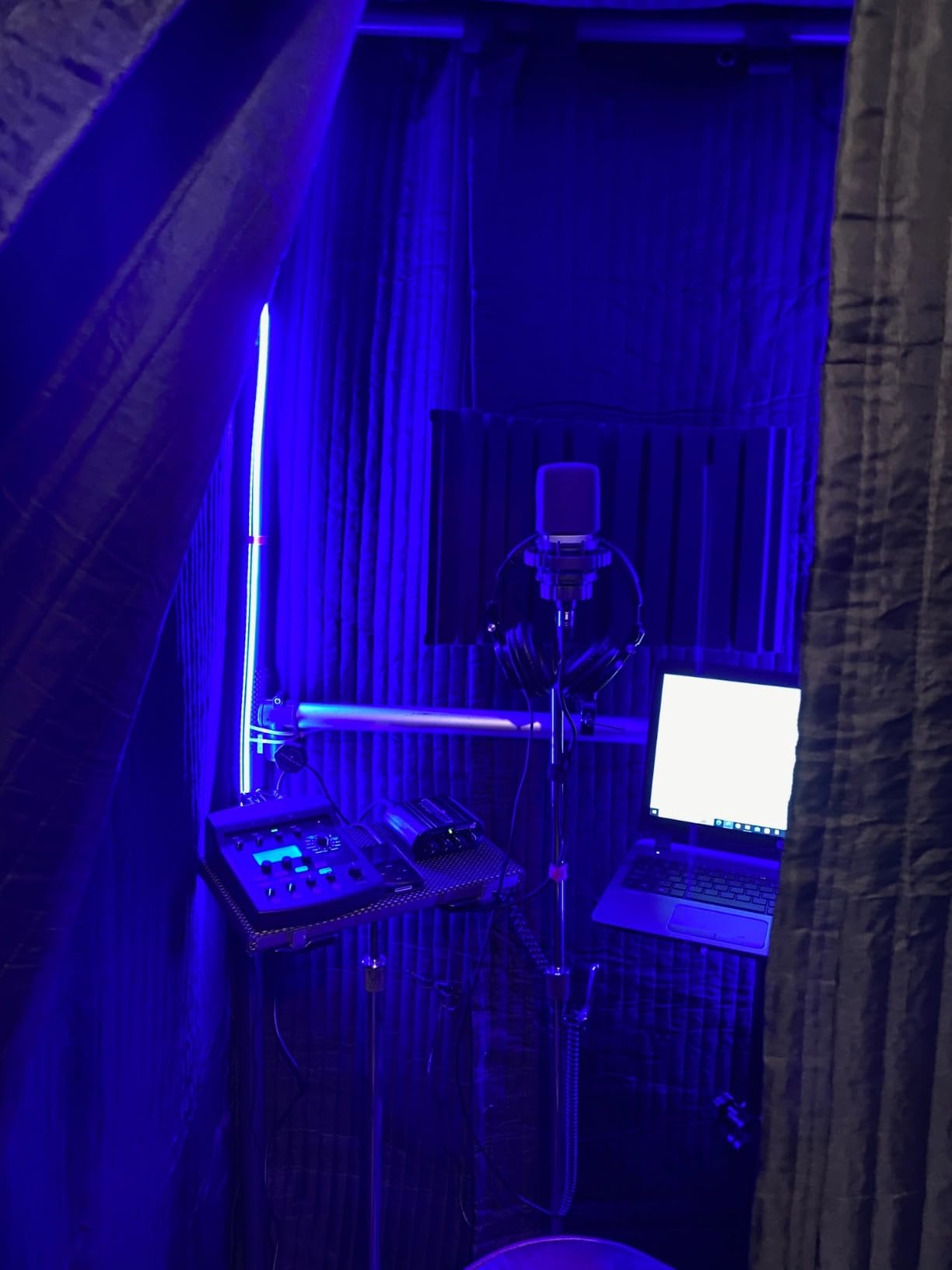
This is also the most honest listing in the guide on the central question. The product copy states plainly that it is acoustic treatment rather than soundproofing, and describes the trade-off as more coverage than a microphone isolation shield and more flexible than treating a room. That framing is accurate, and readers burned by overhype elsewhere in the category will appreciate it.
Two physical limits. The assembled weight is listed at 24.49 kilograms, roughly 54 pounds, which makes it the heaviest unit here. And the 38 by 38 inch footprint is the largest in the guide, so it needs more floor space than the 33 inch enclosures. The 28 reviews are a small base on a recent listing.
Who should buy the POROSO booth
Buy it if your problem is specifically flutter echo from a parallel ceiling and floor, because a treated ceiling is the thing most walk-in booths leave untreated. It is also a good match for a shared apartment where you want a full vocal volume you can put away in the travel bag between sessions.
Video and streaming creators benefit from the bundled wireless lighting, and the full wraparound coverage means you can record without adding your own ceiling treatment later.
Who should skip the POROSO booth
Skip it if your floor space is limited. At 38 by 38 inches it is the largest footprint in the guide, and at roughly 54 pounds assembled it is the hardest to reposition once you have it standing. Plan the corner before you buy.
Anyone who cannot lift a two-person object should choose a tabletop shield instead. And with 28 reviews on a recent listing, there is no long-term data yet on how the wraparound cover and its fittings hold up over years.
12. VEVOR Portable Vocal Booth – The Tallest Interior and an All-Plastic Frame
VEVOR Portable Vocal Booth, 6.56 ft Height, Portable Recording Studio with Travel Bag, Mobile Tablet Stand, Thickened Soundproofing, Sound Isolation Booth for Echo-Free Vocals, Podcasts, Voiceovers
Walk-in enclosure
6.56 ft interior
30.6 lbs
Full PVC frame
Pros
- Tallest interior in the guide at 6.56 feet
- Full PVC frame produces no metal buzz
- Easy to assemble and break down
- Includes travel bag and step-by-step guide
Cons
- Interior is dark and no lights are included
- Damping is less than some buyers expect
- Standard mic stands are bulky for the footprint
The VEVOR is the tallest enclosure in this guide at 6.56 feet of interior height, measured at 32.68 by 32.68 by 78.74 inches overall, and that extra height is the reason it works for a full standing performer rather than a seated vocalist. The fabric is Oxford cloth over acoustic padding, and everything needed is in the box, including zip ties, a step-by-step guide, a phone or tablet stand and a travel bag.
The frame choice is genuinely thoughtful. It is a full PVC frame with no metal in the structure, which removes a specific problem: metal members resonating against the microphone and introducing a buzz into the recording. That is a real failure mode in cheaper builds, and VEVOR has designed it out rather than hoping the padding handles it. Owners report the booth is sturdier than expected, lightweight for its size, and free of chemical odour.
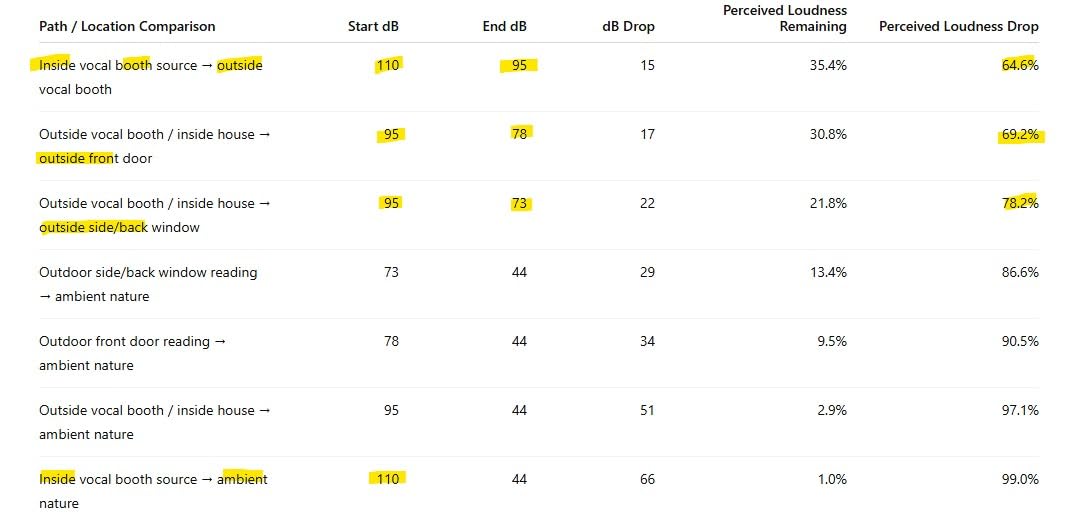
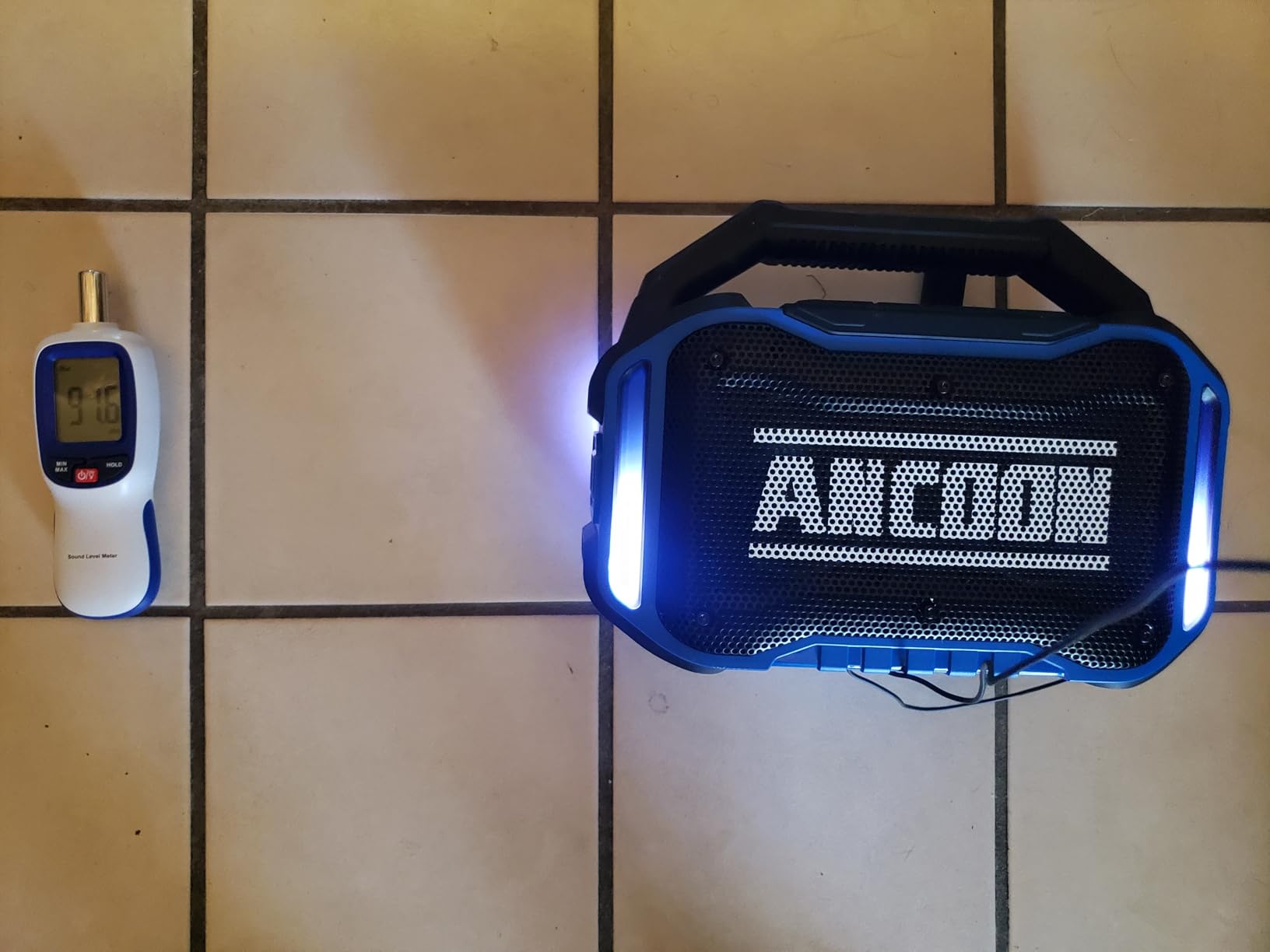
This is the only product in the guide with an owner measurement rather than a manufacturer percentage. One reviewer measured roughly 15 dB of reduction in sound intensity from inside to outside the booth, and found singing essentially undetectable from the property perimeter. That is a light-treatment result and it is the most honest number available in this category, but it is a single owner with a single device, not a laboratory result.
The interior is dark and no lights are included, which owners raise as the main limitation along with damping being less than some expected. A former broadcast voice-over artist found it workable but recommended adding foam panels and a corner-post microphone clamp, since standard microphone stands are too bulky for the footprint. At 17 reviews, this is the thinnest sample in the guide.
Who should buy the VEVOR booth
Buy it if you are a tall performer who wants to stand and move inside the booth, or if you record an instrument and need the vertical space. The 6.56 foot interior is the tallest we measured and it is the reason this booth works where a standard 80 inch enclosure would feel cramped.
The PVC frame is the differentiator for anyone who has recorded in a booth with a buzz and could not work out where it came from. Avoiding metal in the structure is a cleaner solution than trying to damp it with foam afterwards.
Who should skip the VEVOR booth
Skip it if you need video or streaming output, because the interior is dark and no lighting is included, which means buying a light and a mount as an extra cost. The listed 90 percent reduction in echo and ambient noise is a manufacturer claim, and the one real measurement available suggests a much more modest figure.
Be aware that a standard microphone stand is bulky in a footprint this narrow, so plan on a corner-post clamp or a compact arm. And with 17 reviews, you have the least owner data in this guide to fall back on if something goes wrong.
How to Choose a Portable Vocal Booth
Choosing well comes down to eight questions, and the order matters. Start by working out which of the three formats fits your space and your recording position, because that decision eliminates most of the market immediately.
1. Which of the three formats do you actually need
There are three formats, and they solve different problems. A full walk-in enclosure puts the performer inside a blanket-walled volume and is the only one that meaningfully changes the sound of a room around a voice. A box-style isolation shield encloses the microphone and the first 12 inches around it, which is enough to kill the dominant reflection path at a desk or on a stand. A desktop reflection filter is smaller still, usually folding panels that mount on a mic stand, and it is for the tightest spaces where a larger unit will not physically fit.
The mistake is buying a full enclosure for a reflection problem a shield would solve, and paying for mass and a permanent corner you do not need. The opposite mistake is buying a three-panel filter expecting walk-in coverage.
2. What the absorption is made of
Material specification is the most reliable quality signal in this category, and it is the one buyers in r/VoiceActing consistently tell each other to check. For enclosures, look at blanket weight in GSM, where higher numbers mean thicker and denser material. For shields, look at foam thickness and layer count. For a booth like the VOCTENT, the 800+ GSM blanket specification is roughly double what many competing listings offer.
Layer count matters as much as thickness. Two thin layers with an air gap between them perform differently from one layer of the same total thickness, because the gap disrupts the wave. Structure also matters: a reinforced frame and backing panel stop the foam sagging, which is the difference between a booth that works in year one and one that stops working in year three.
3. Treat percentage claims as claims
The 92.7 percent, 96 percent, 95.3 percent, 90 percent and 87 percent figures in this category all come from manufacturers. None of them publish a test method, a frequency range or a measurement position, which makes them impossible to verify and useless for comparison. The single owner measurement in this guide found roughly 15 dB of reduction from inside to outside one enclosure, which is a modest figure entirely consistent with a product that is honestly described as treatment.
Instead of comparing percentages, compare the material specification and the geometry. Thicker material, more layers and a closed box beat any number on a listing. If a manufacturer publishes an NRC or RT60 figure, that is real specification data, and the POROSO is the only listing here that does.
4. Ventilation for sessions longer than an hour
Heat is the most consistent complaint across every walk-in enclosure in this guide. Owners of the Snap Studio describe a clip fan as a worthwhile addition, the lunacme owners report the booth runs warm, and the same pattern shows up in r/homestudios threads asking directly whether a booth gets hot inside. Plan for it before you buy rather than after your first long session.
Ventilation and isolation trade against each other. A USB fan or a gap at the top moves air but lets sound in and out, and a fully sealed booth is warmer and quieter. The workable compromise used by most owners is a clip fan or a small USB fan low in the enclosure, rather than removing a panel or leaving the top open.
5. Portability and where it will live
Walk into this with realistic expectations. Desktop shields range from 0.77 pounds to 10.14 pounds and genuinely move between rooms. Walk-in enclosures range from 30.6 pounds to 46.2 pounds, which is a two-person lift once assembled, and their value proposition is folding them away between sessions rather than carrying them up stairs.
Footprint is the constraint people underestimate. The standard enclosure footprint is 33 by 33 inches, the largest in this guide is 38 by 38 inches, and interior heights run from 80 to 83 inches. Measure the corner you have in mind, including where the door and the walk-in traffic would go, before you commit.
6. Interior space and ergonomics
Seated or standing, and with or without a laptop, changes which booth you need. The r/audioengineering and r/musicproduction threads return to this constantly, with users asking how to use a walk-in booth at a desk and describing some as impractical for a seated workflow. Nothing solves this except choosing the format that matches your posture.
For shields, check interior dimensions against your microphone body. Reviewers of the Frgyee and the XTUGA both report that a larger microphone sits above or crowds the foam, so measure the body depth and the shock mount before ordering. If you record with a laptop, the TroyStudio Enclosed booth has a top surface designed for exactly that.
7. Mic thread and mounting hardware
Microphone stands use two thread sizes. Most microphones have a 3/8 inch thread and most stands have a 5/8 inch thread, so a cheap adapter solves the problem and a missing one stops your recording. The TONOR and the Frgyee both include adapters, and the Frgyee includes five of them covering both directions.
Watch stand diameter too. Several folding boxes in this guide only fit stands with a base under 0.86 inches in diameter, which excludes some wide tripods. Separately, look for a cable or stand pass-through hole, since routing a cable through a sealed booth is otherwise awkward and the RDCMKL has owner reports of the pass-through not existing despite the listing.
8. Setup time and what is in the box
Setup ranges from under a minute for the folding boxes to a reported five minutes for the walk-in enclosures, with the lunacme pop-up frame the outlier that several owners describe as strenuous to build alone. If you are setting up and packing away every session, that time is multiplied by the number of sessions.
Accessories change the real cost. The Snap Studio and the POROSO include lighting, and the VOCTENT includes a light bar, an interface tray and an iPad holder. Products that include none of these need them bought separately, and a dark interior is a real limitation for video work. Our guide to the best lighting for photo booths covers what actually works in a small enclosed space.
When You Should Skip a Booth and Treat the Room Instead
Skip the booth if your problem is noise coming from outside rather than reflections inside. No portable enclosure in this guide is a noise control solution, and the honest way to think about external noise is mass, decoupling and sealed gaps, none of which a duffel bag carries. A r/recording user quoted in discussion put it plainly: portable sound isolation booths are usually considered scams, and the reason is almost always that the expectation was soundproofing rather than reverberation control.
That objection is fair when the product is sold as a soundproof booth. It is not fair when the goal was a drier vocal in a quiet room, which is exactly what every product here does. The distinction is entirely in what you were trying to fix before you opened the box.
There is also a DIY benchmark worth knowing, and it is a high one. Gearspace users report that a boom microphone stand with a duvet hung over it is a perfectly usable solution, because it does something measurable. Any booth has to beat that on consistency, not just on price. The TroyStudio folding box at 2.02 pounds is roughly that idea in a sturdier, more repeatable form.
Treat the room instead when you have a low ceiling, parallel walls and a floor that rings, because a booth cannot fix the reflections outside its own volume. Broadband absorption in the corners and on the first reflection points is the permanent solution, and our guide to the best speakers for home studios covers the placement side of the same problem. Booths and room treatment are not rivals; one changes a small volume around the microphone, the other changes the room itself.
A hybrid approach is what most working home studios end up with. One desktop shield at the desk for day-to-day voiceover, and a walk-in enclosure only when the session needs a controlled volume for a whole performer. That is the route most of the products here are designed for, and it is where the money is best spent in stages.
Frequently Asked Questions
Do portable vocal booths actually work?
Yes, for room reverb and early reflections. No, for soundproofing. A portable vocal booth places dense absorptive material between your voice and the reflective surfaces of your room, so reflected energy is converted to a small amount of heat and the reverb tail around your voice shortens. It does not stop sound entering from outside or your voice reaching a neighbour.
Are portable vocal booths a scam?
They are only a scam if you expected soundproofing. Portable booths reliably reduce reverb, flutter echo and early reflections in an already quiet room, which is a real and audible improvement for voiceover, podcasting and singing. The disappointment comes almost entirely from the word soundproof in the product name, because no fabric enclosure stops traffic noise, appliances or a neighbouring television.
Do portable vocal booths soundproof a room?
No. Soundproofing between spaces requires mass, decoupling and sealed gaps, which is a construction project. A portable vocal booth is acoustic treatment that changes the reflections around your microphone. One owner measured roughly 15 dB of reduction in sound intensity from inside to outside a booth, which is a light-treatment result rather than an isolation result.
What is the difference between a portable vocal booth and a reflection filter?
A reflection filter is a small set of folding panels, usually three or five, that you mount on a mic stand or stand on a desk to absorb the dominant reflection path. A portable vocal booth is a larger enclosure that wraps the microphone, and a walk-in booth wraps the performer. Filters suit small rooms and seated work; booths suit larger rooms and standing performers.
How long does a portable vocal booth take to set up?
Folding desktop boxes in this guide set up in under a minute and tear down in about 30 seconds, according to their owners. Walk-in enclosures report around five minutes for assembly, with one owner timing fifteen minutes of struggle on a pop-up frame design. Check whether the product needs two people, because the heaviest units are a two-person lift once assembled.
Is a vocal booth worth it for home recording?
Yes, if your room is quiet but reflective and reverb is smearing your vocal takes. It is the fastest way to get a repeatable controlled space without permanent construction, and it moves between rooms. It is not worth it if your problem is external noise, and it is not worth a full enclosure if a desktop shield solves your reflection problem at a fraction of the size.
What is the best vocal mic for a home studio?
In an untreated room, a dynamic microphone such as a Shure SM7B or an Audio-Technica AT2020 is far less sensitive to room reflections than a condenser, which makes it the safer starting point. A large-diaphragm condenser gives more detail and air, but only shines in a room that is already controlled. Booths and microphone choice solve different halves of the same problem.
Can I record vocals in an apartment with a portable booth?
Partly. A booth handles reflections inside your own space, so a narrator in a quiet apartment will hear a large improvement in clarity and dryness. It will not stop a neighbour’s television or a street siren reaching your microphone. For external noise, mass, decoupling and sealed gaps are the real answer, so treat the booth as one half of the solution rather than the whole one.
Final Verdict: Which Portable Vocal Booth Should You Buy?
For most home studio owners the TroyStudio Portable Vocal Booth is the one to buy. It has the largest review history in the category, a genuine one-minute setup, a 2.02 pound weight that means you can move it between rooms, and a 4.3 rating across 1960 owners who describe the same result: the boxy smear comes off the voice. Its build is fabric rather than metal, so expect a shell that feels lighter than the price suggests, and accept the 0.86 inch stand diameter limit.
If you record standing at a mic stand, or you alternate between seated and standing work, the TONOR shield on its steel tripod is the better tool, and its 4.5 rating is the highest in the group. If you want walk-in coverage with a full kit already included, the Snap Studio is the established choice with the strongest accessory bundle. If material density matters most to you, the VOCTENT’s 800+ GSM blankets are the heaviest specification we found. For video work with lighting already solved, the POROSO’s wraparound coverage includes a treated ceiling that the others leave bare.
And if the honest answer is that your room is noisy rather than reflective, buy treatment instead of a booth. A portable vocal booth fixes reverb, and reverb is only worth fixing when the noise floor is already acceptable. Check the price and current reviews for the pick that matches your recording position, and take every percentage on the listing as a claim rather than a measurement.