
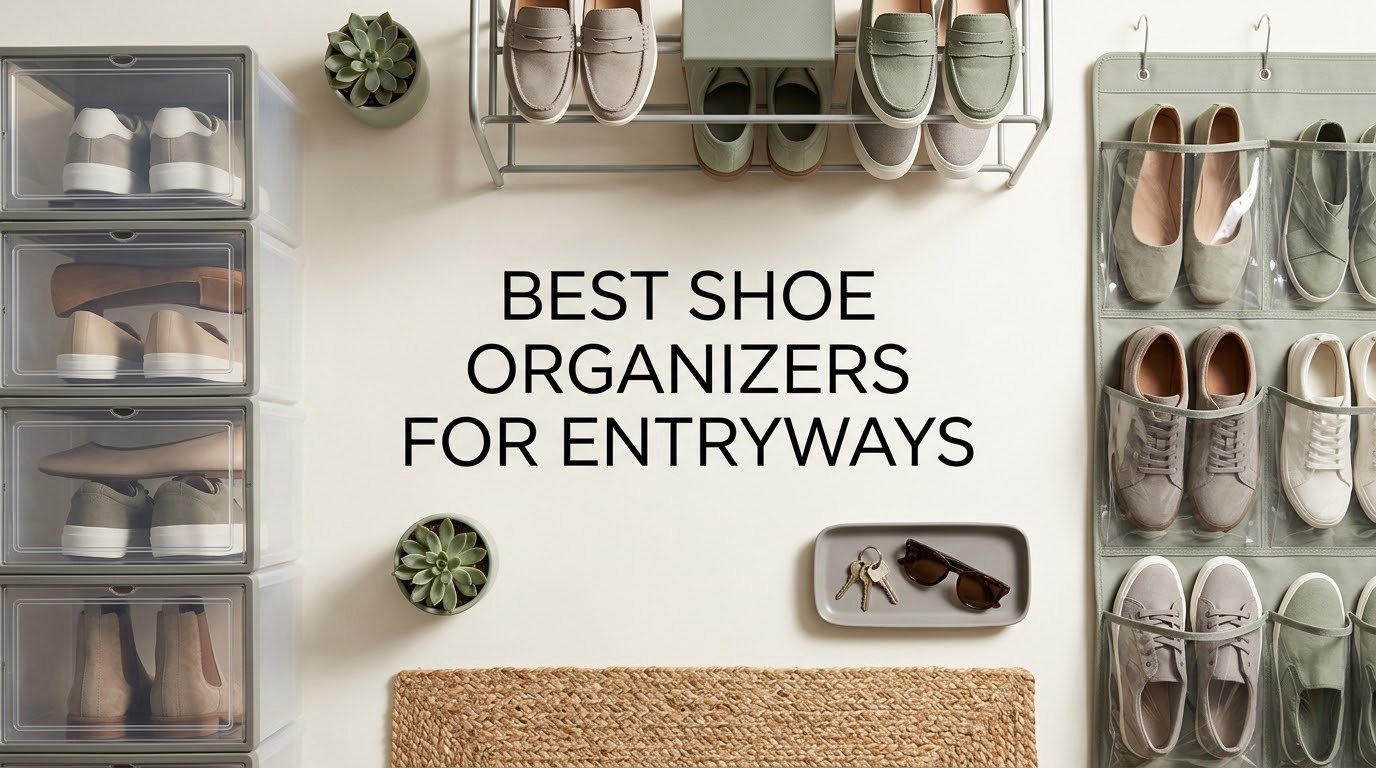
Most entryways fail for the same reason. Shoes come off at the door, land on the floor, and stay there until someone trips over them or shoves them under a bench. The best shoe organizers for entryways fix that by giving every pair a fixed home within a few steps of the threshold.
An entryway shoe organizer is any rack, bench, cabinet, or hanging unit that holds the shoes people take off crossing the front door. Most good ones run 3 to 5 tiers, sit between 27 and 36 inches wide, and stay under 12 inches deep so the door still swings. We compared 10 of them over several weeks, loading each with a real household mix of sneakers, dress shoes, and rain boots.
If your problem is a specific room rather than a general pile, our guides to shoe storage for small entryways and best shoe racks tested and compared go narrower on the details. Everything below was refreshed for 2026 and reflects how the units held up in daily use.
Table of Contents
Top 3 Picks: Best Entryway Shoe Organizers in 2026
The three below are the picks we kept coming back to. The SONGMICS bench wins on the combination of seating, capacity, and rating volume. The VASAGLE mesh rack holds the most pairs per square foot of floor. The BORNOON cabinet is the only one that hides shoes completely while staying under 10 inches deep.
SONGMICS 3-Tier Bamboo Bench
- Bamboo 3-tier bench
- 27.6 in wide
- Sits rated to 286 lb
- Shelves hold 22 lb each

VASAGLE 5-Tier Mesh Rack
- Holds 18-24 pairs
- Only 10.8 in deep
- 4 mesh shelves plus top shelf
- Adjustable feet

BORNOON 3 Flip Drawer Cabinet
- 3 flip drawers
- 9.45 in deep
- Stores 18-24 pairs
- Anti-tip kit included
Best Shoe Organizers for Entryways in 2026
Every organizer below appears with its own capacity, depth, and best-fit scenario. Depth decides most purchases here, because a rack one inch too deep will not clear a door that swings inward.
| Product | Specifications | Action |
|---|---|---|
| SONGMICS 3-Tier Bamboo Shoe Rack Bench |
|
Check Latest Price |
| VASAGLE 5-Tier Metal Mesh Shoe Rack |
|
Check Latest Price |
| BORNOON 3 Flip Drawer Shoe Cabinet |
|
Check Latest Price |
 KEETDY 3-Tier Long Wire Grid Rack KEETDY 3-Tier Long Wire Grid Rack |
|
Check Latest Price |
 HOOBRO 5-Tier Adjustable Mesh Organizer HOOBRO 5-Tier Adjustable Mesh Organizer |
|
Check Latest Price |
 VASAGLE 10-Tier Tall Shoe Storage Cabinet VASAGLE 10-Tier Tall Shoe Storage Cabinet |
|
Check Latest Price |
 Kitsure 10-Tier Vertical Shoe Rack Kitsure 10-Tier Vertical Shoe Rack |
|
Check Latest Price |
 SNTD Expandable 2-Tier Metal Shoe Rack SNTD Expandable 2-Tier Metal Shoe Rack |
|
Check Latest Price |
 Pipishell 3-Tier Bamboo Shoe Rack Bench Pipishell 3-Tier Bamboo Shoe Rack Bench |
|
Check Latest Price |
 Kitsure 3-Tier Non-Woven Shoe Rack Kitsure 3-Tier Non-Woven Shoe Rack |
|
Check Latest Price |
1. SONGMICS 3-Tier Bamboo Shoe Rack Bench – Best Overall Seat and Storage
SONGMICS Shoe Rack Bench, 3-Tier Bamboo Entryway Bench, 27.6 Inches Width
Width: 27.6 in
Depth: 11.3 in
Height: 17.8 in
Bench rating: 286 lb
Shelves: 22 lb each
Pros
- Doubles as a bench rated to 286 lb
- Shelves hold 22 lb each for heavy shoes
- Bamboo finish suits visible entryway walls
- Two wide shelves plus a top surface for bags
- Assembles in about 15 minutes for one person
Cons
- Some pieces arrive chipped or splintered
- Looks smaller than the product photos
- Limited color options at 27.6 in width
This is the organizer I kept at the front door of my own hallway through a wet autumn, and it is the one I recommend first. At 27.6 inches wide and 11.3 inches deep it sat flush against a standard wall without stealing walking space, and the 17.8 inch seat height meant nobody had to bend to the floor.
The 4.6 rating comes from more than 25k reviews, and the reason it holds that score is the seat. Rated to 286 lb with shelves carrying 22 lb each, it took two adults and a leaning toddler without a creak. Two wide shelves plus the top panel swallow roughly 6 to 9 pairs, which covers a two-person household comfortably.
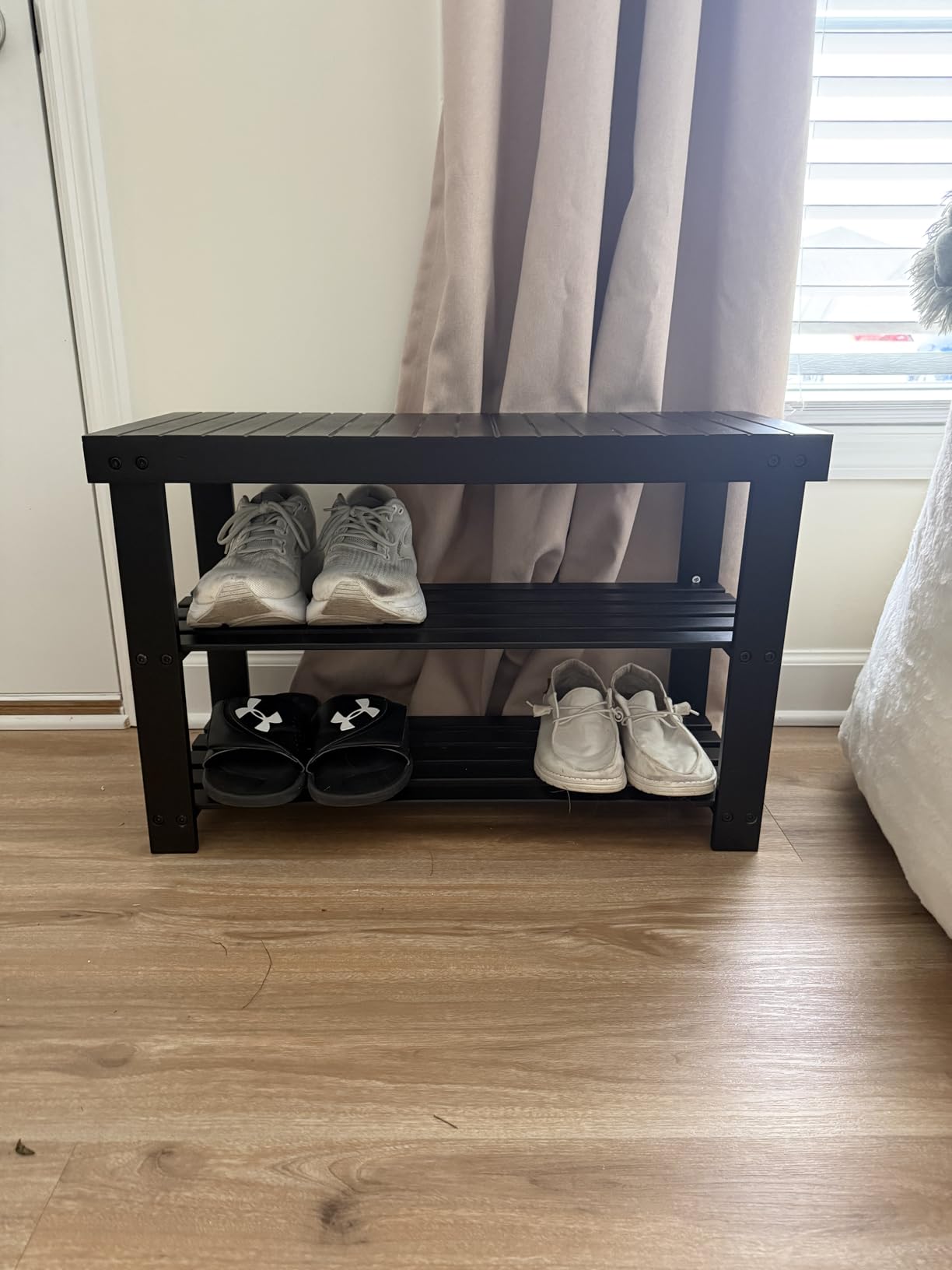
Bamboo sold me more than the specs did. It reads as furniture rather than utility storage, so the bench looks intentional when you walk through the door, which is the opposite of how a wire rack reads. At 8.8 lb it is a one-hand move when you want to clean behind it.
Assembly is where the real complaints sit. Instructions are clear and spare hardware is included, and several reviewers in their 60s and 70s report building it unaided in about 15 minutes. A minority received chipped or splintered panels, so inspect the shelves and top panel before tightening anything.
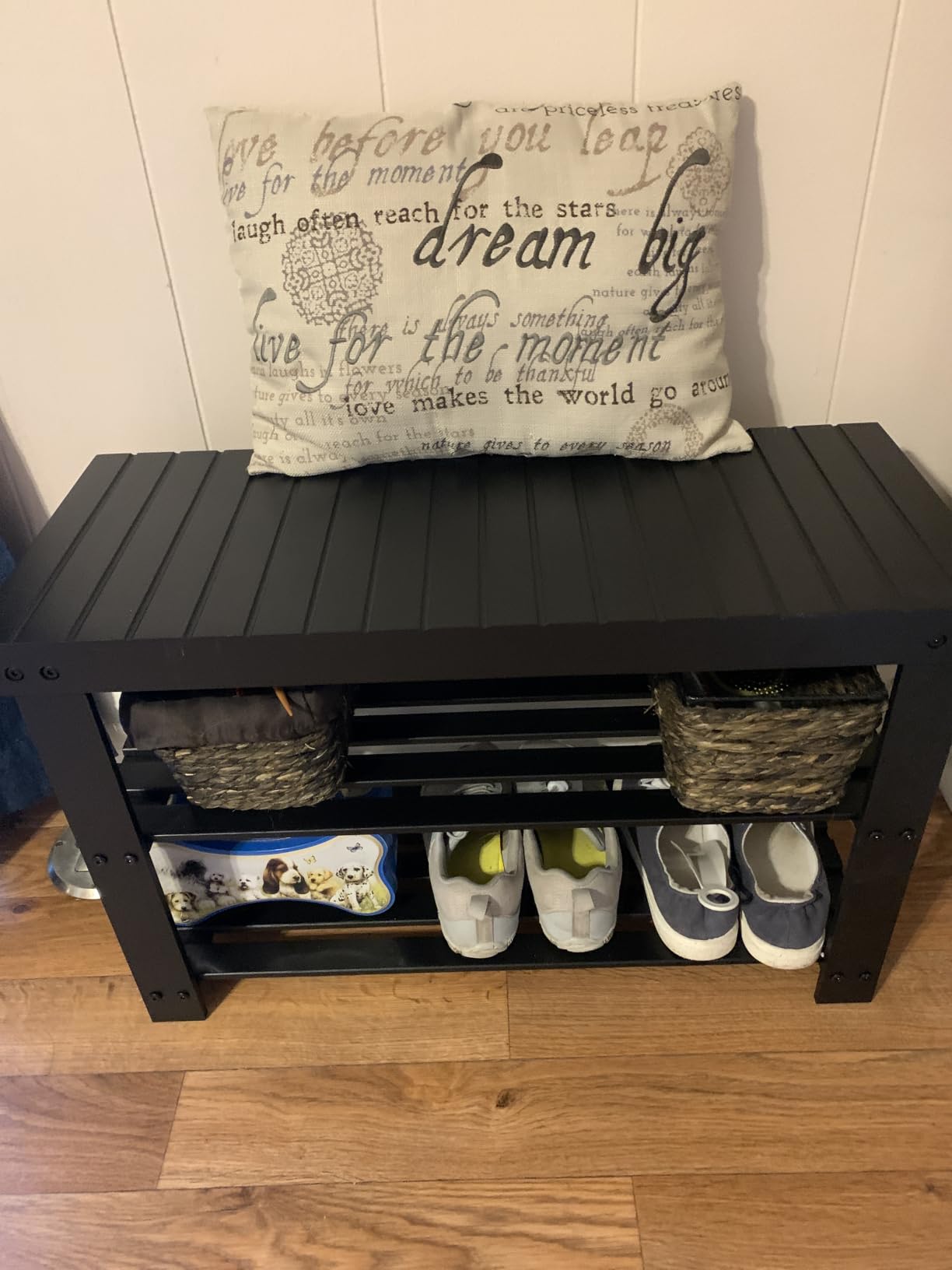
How the bamboo bench handles daily shoes and bags
The top panel earned its place faster than the shelves did. Keys, a phone, a leash, and the mail that would otherwise pile up all fit on it, which is what makes a drop zone feel finished rather than half-done. The two shelves below take daily sneakers at about 3 pairs each.
What it does not do is take boots. Rain boots stand fine on the floor beneath the bench, but they are not what the shelving was built for. If boots are most of your footwear, look at the taller mesh racks further down.
What to check before you buy it
Aim for 27.6 inches of clear width and at least 12 inches of depth, and open every box before assembly. A cracked top panel is the one defect you cannot work around, and a chipped shelf edge is visible the moment the bench is against a wall.
Skip this one for a hallway under 30 inches wide, or if you need more than about 9 pairs in a single unit. The VASAGLE mesh rack or the flip-drawer cabinet hold considerably more in a similar footprint.
2. VASAGLE 5-Tier Metal Mesh Shoe Rack – Best for Pair Capacity in a Narrow Footprint
VASAGLE 5-Tier Shoe Rack, 18-24 Pairs, Metal Mesh
Width: 29.5 in
Depth: 10.8 in
Height: 36.6 in
Load: 66 lb
Five tiers
Pros
- Highest rating in this group at 4.8
- Mesh shelves hold 18 to 24 pairs
- 10.8 in depth saves floor space
- Top shelf doubles as a catch-all surface
- Adjustable feet steady it on uneven floors
Cons
- Particleboard side panels instead of solid wood
- One shelf must come out for high heels
- Needs a screwdriver for legs and brackets
This rack answered the question we hear most: how do you fit a lot of shoes without a wide hallway. Four dense mesh shelves plus a top shelf hold 18 to 24 pairs while the footprint stays at 29.5 by 10.8 inches, shallower than almost every bench on this list.
The 4.8 average is the highest in our group, with 90 percent five-star ratings across nearly 8800 reviews. Adjustable feet were the detail I noticed most once it was down. On an older hallway with a slight slope, they absorbed the wobble that made cheaper racks feel like they were about to tip.
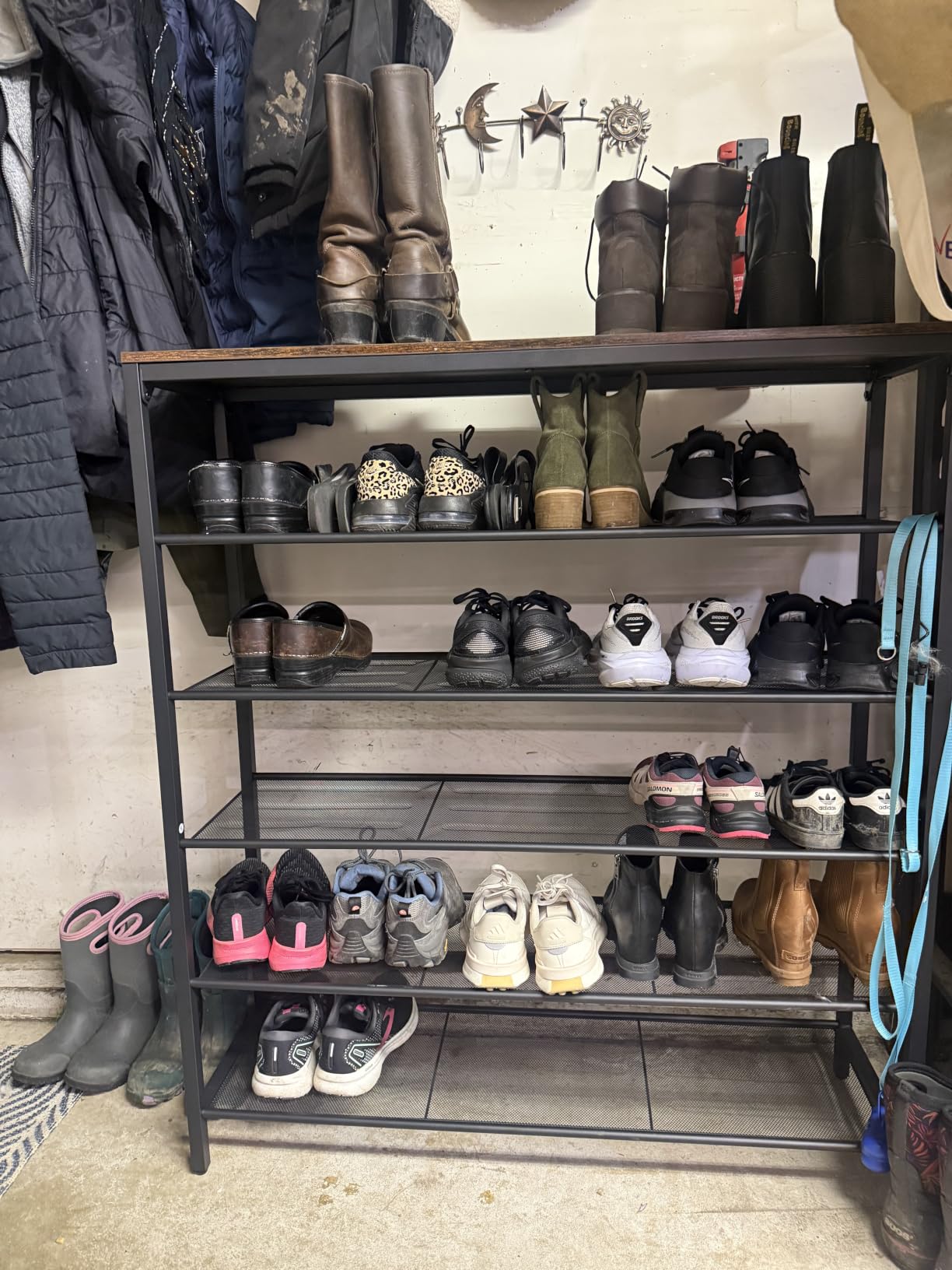
Mesh rather than solid shelves mattered more than expected in a wet-weather entryway. Grit falls through instead of sitting on a surface where it gets ground into leather, and you can see every pair without pulling anything forward. The top shelf doubles as a landing spot for keys and mail.
Assembly needs a screwdriver for the legs and brackets, which takes longer than the label suggests. Shelf removal is easy afterward, and pulling one out is the correct fix when heels or mid boots need more vertical room than the default spacing gives.
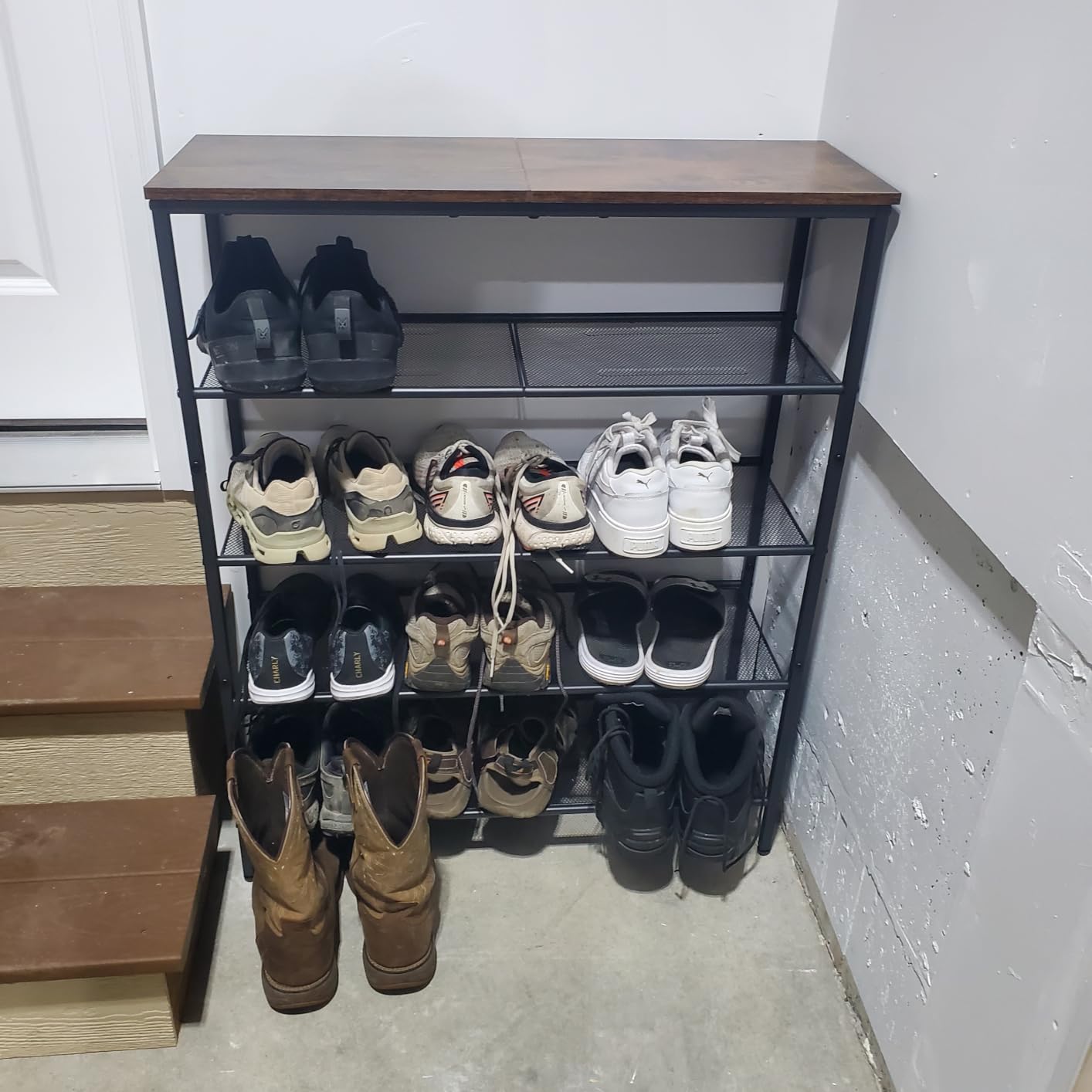
What the mesh shelves do for boots and heels
With one shelf removed you gain roughly double the clearance on that level, and the remaining tiers still hold a workable number of daily pairs. Reviewers run that configuration through winter and switch back for sandals and flats in summer.
Heels are the awkward fit, because mesh is flat. One reviewer takes a shelf out specifically to stop stilettos tilting, so if heels are frequent, the tilting shelves in the HOOBRO rack below are the better match.
When this rack is the wrong call
The particleboard side panels are the honest weakness. They are not solid wood, and in a visible first impression this reads as utilitarian storage next to the bamboo benches. It also needs a screwdriver at build time, so skip it if you want zero tools.
Skip it if a child will climb furniture. At 36.6 inches tall with 66 lb of rated load it is steady, but not a toy, and no wall-anchoring hardware is included.
3. BORNOON 3 Flip Drawer Shoe Cabinet – Best for Hallways Under 10 Inches Deep
BORNOON Shoe Cabinet with 3 Flip Drawers, Hidden Wood Shoe Cabinet,Freestanding Shoe Storage Cabinet for Entryway Hallway.White. 47.2″ H*31.5″ W*9.45″ D.
Width: 31.5 in
Depth: 9.45 in
Height: 47.24 in
Storage: 18-24 pairs
Three drawers
Pros
- Shallowest closed option at 9.45 in deep
- Flip drawers keep shoes hidden and dust-free
- Two-tier panels adjust for flats
- mid boots or heels
- Anti-tipping wall fix kit included
Cons
- Engineered wood rather than solid hardwood
- Requires assembly with the tools provided
If your entryway is a long narrow foyer, depth is the whole game, and this is the shallowest closed unit we tested at 9.45 inches. That is roughly two inches less than the average bench, and in a hallway that narrows near the door, two inches is what makes the difference.
The flip-drawer mechanism is why it earns its place. Instead of hinged doors that need clearance in front of the unit, each drawer tilts out and lifts, so it works in a corridor with no room to stand and open a door. Reviewers credit the clean white finish for adding almost no visual noise.
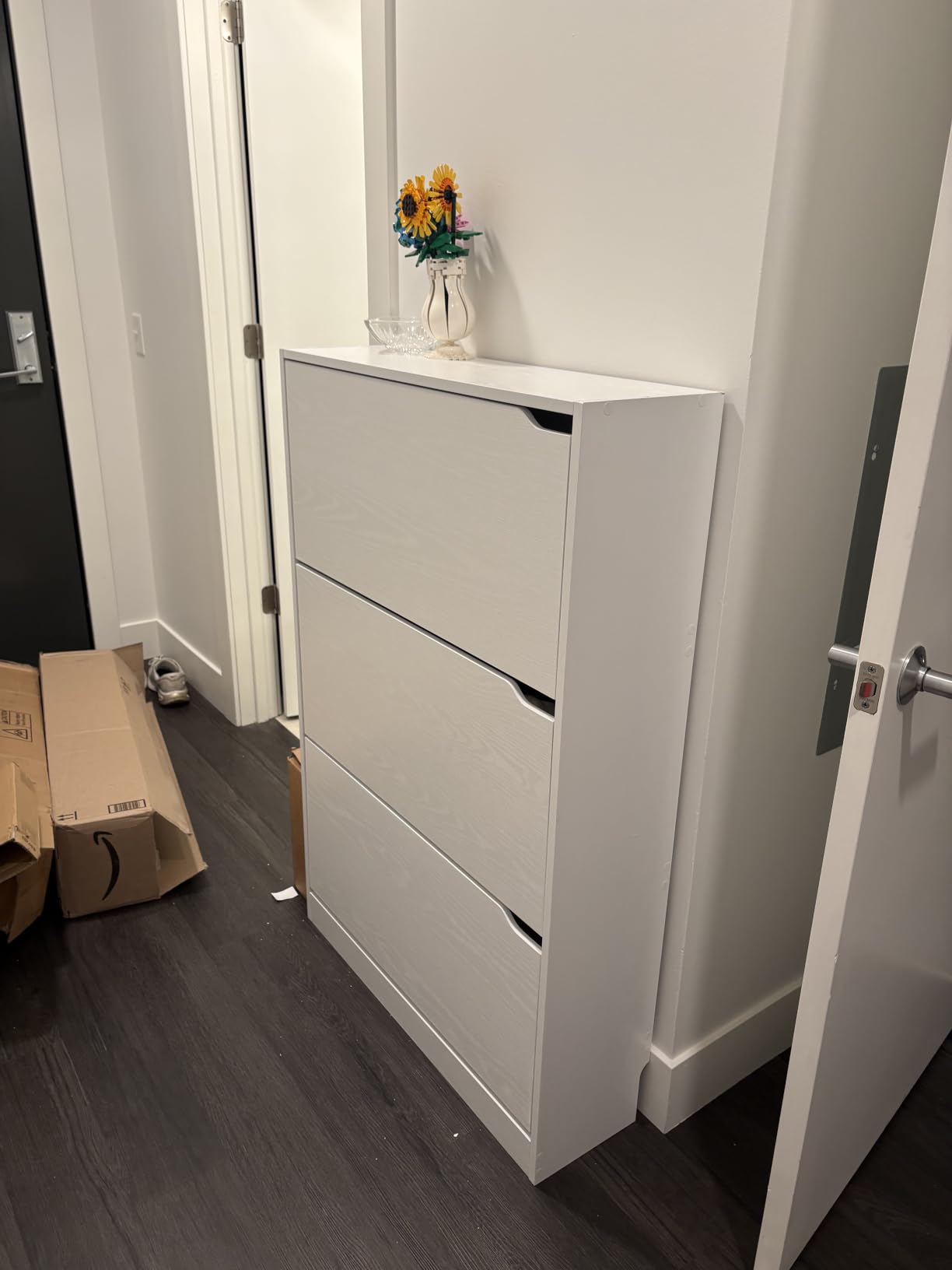
Inside each drawer, two-tier panels sit in grooves. Raise them for flats, lower them for mid boots, or take one out entirely. The cabinet stores 18 to 24 pairs depending on shoe height, and the wide top surface is where most owners put a key tray or a small plant.
At 59.9 lb this is genuinely heavy furniture, and the included anti-tipping wall fix kit is worth fitting if you have children. Assembly needs the tools provided, and the engineered wood panels are best kept clear of heavy objects on top.
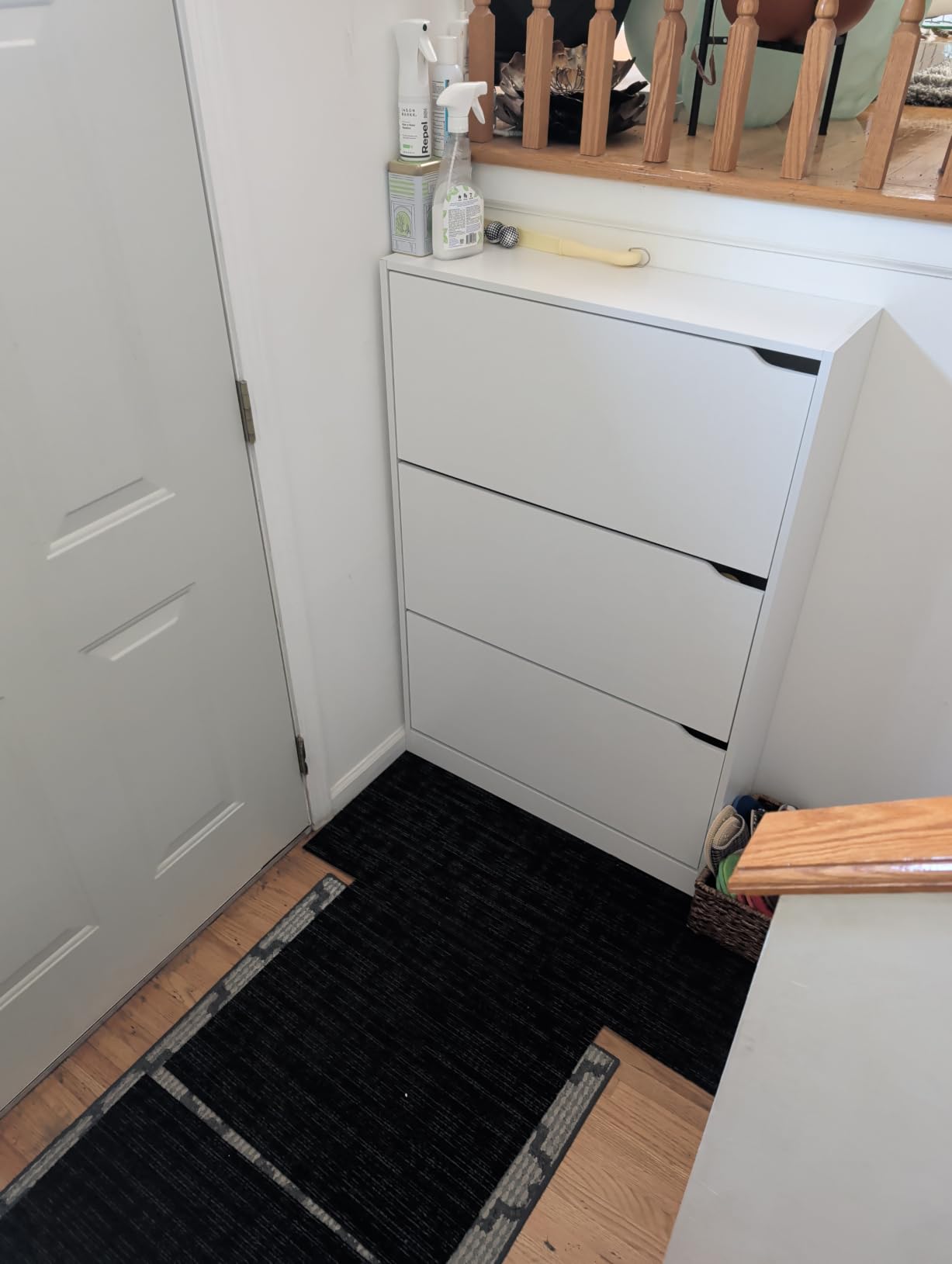
Why closed storage wins for pets and allergies
Open racks give you airflow and fast access, but they are open by definition, which means pet hair and grit land on every pair. Forum discussions about entryway storage keep circling that point, and reviewers of this cabinet credit the enclosed drawers with keeping shoes visibly clean in pet homes.
The flip design also makes the cabinet a visual calm object. Where a mesh rack announces itself the moment you walk in, a white cabinet reads as deliberate furniture, which is often the deciding factor in a visible entryway.
Before you order the flip-drawer cabinet
Confirm 47.24 inches of vertical clearance. That height is the price of the shallow depth, and in a low-ceilinged older hallway no amount of good depth will help. Width is 31.5 inches, wider than most bench options here.
Skip it if you rent and cannot drill, since the anti-tip kit needs a wall. If you need more than 24 pairs, the 10-tier cabinet in this roundup holds 30 in a slimmer width.
4. KEETDY 3-Tier Long Wire Grid Rack – Best Wide Shelf for Boots
KEETDY 3-Tier Long Shoe Rack for Closet Metal Shoe Organizer for Entryway, Wide Stackable Shoe Storage Shelf with Sturdy Wire Grid for Closet Floor, Bedroom, Black
Width: 43 in
Depth: 11.4 in
Height: 24.4 in
Load: 50 lb
8 in shelf spacing
Pros
- 43 in width fits 5-6 pairs per shelf
- 8 in spacing takes snow and rain boots
- Tool-free click assembly in 5-10 minutes
- Wire grid lets dirt fall through
- Two units stack into a 6-tier rack
Cons
- 43 in width needs careful measuring
- Lightweight build can wobble
- No adjustable feet included
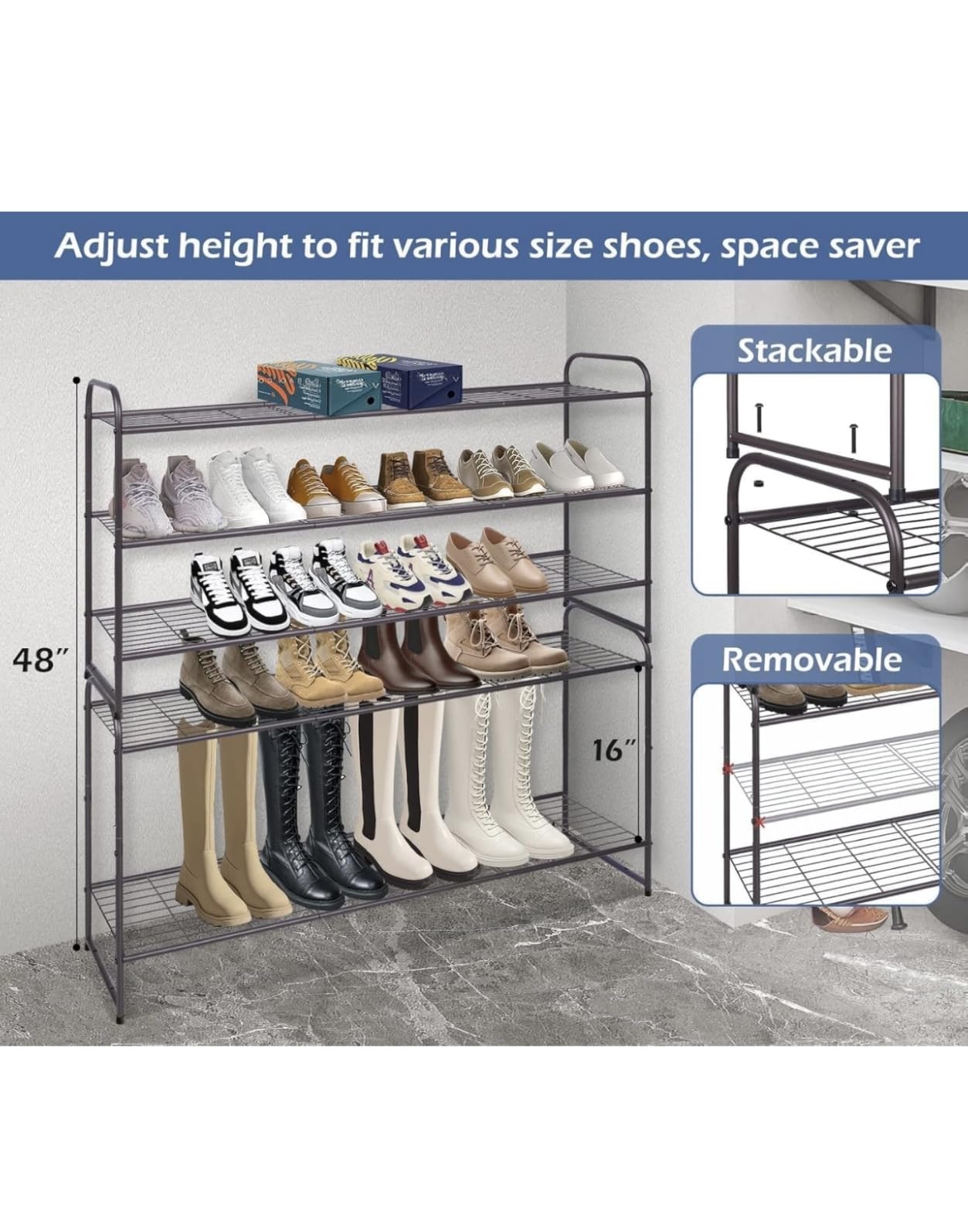
Everything else on this list solves a narrow hallway. This one solves a wide one. At 43 inches across, each shelf takes 5 or 6 pairs instead of 3, and the 8 inch shelf spacing is the tallest here, which is what makes it the pick for winter boots.
The rating is 4.7 across more than 3500 reviews, and reviewers single out the tool-free click assembly as faster than expected at roughly 5 to 10 minutes. No screws means no screwdriver left in the hallway, which matters if you are building this after the kids are asleep.
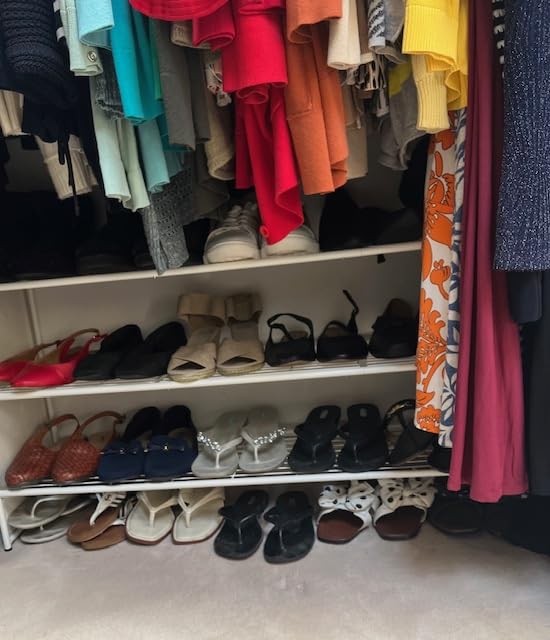
Wire grid shelves let grit fall straight through, a real advantage in a rainy-season entryway where boots come in wet. You can see every pair without shuffling the front row, and the space under the bottom shelf is useful for flip-flops and sandals.
Two units lock into a 6-tier rack, which is the upgrade path most owners describe. The catch is weight. A fully loaded rack can wobble on a hard floor, and there are no adjustable feet to correct it, so felt pads or a wall strap help more here than on the other metal racks.
When 43 inches of width is too much
This is the one product here where a tape measure is not optional. A 43 inch rack needs a wall or closet run at least 45 inches wide, and 43 inches is listed as the minimum width needed to maneuver it into place. In a narrow foyer it simply will not go.
Forum conversations about this rack land on the same frustration, so measure the wall and the path to it before ordering. At 30 inches or less of wall, the expandable rack later in this roundup adjusts to fit instead of forcing you to move furniture.
Who the wide wire rack suits
It suits anyone with a closet or mudroom rather than a hallway, particularly a family of four or more sharing daily shoes. Three tiers at 5 to 6 pairs each is real capacity in one footprint, and the boot spacing removes guesswork from winter storage.
Skip it if the entryway is a design statement. Black wire is honest utility storage and reads that way, even when it is well organized.
5. HOOBRO 5-Tier Organizer with Adjustable Mesh Shelves – Best for Heels and Tall Boots
HOOBRO Shoe Rack for Entryway, 5-Tier Shoe Organizer with Adjustable Mesh Shelves, 16-20 Pairs of Shoes, Spacious Floor Mount, Metal, Industrial, Shoe Shelf for Closet, Rustic Brown BF12XJ01
Width: 29.5 in
Depth: 11.8 in
Height: 31.8 in
Top load: 44 lb
Shelves: 22 lb each
Pros
- Shelves tilt
- level
- or come out for heels and boots
- Each shelf holds 4-5 pairs for 16-20 total
- Two-tone finish works as a room focal point
- 29.5 in width suits a standard wall
Cons
- Particleboard panels rather than solid wood
- Shelf layout is fixed once assembled
- Assembly is still required
The distinguishing feature is that the mesh shelves tilt or level rather than simply coming out. On a flat shelf a high heel sits at an angle until it slides. Tilt the shelf back and the shoe rests against the rear rail, which was the single most useful adjustment on any open rack we tested.
At 29.5 by 11.8 by 31.8 inches with five tiers, it holds 16 to 20 pairs at 4 or 5 pairs per shelf. The rating sits at 4.7 across more than 2500 reviews, and reviewers frequently mention buying a second one for a bedroom or closet.
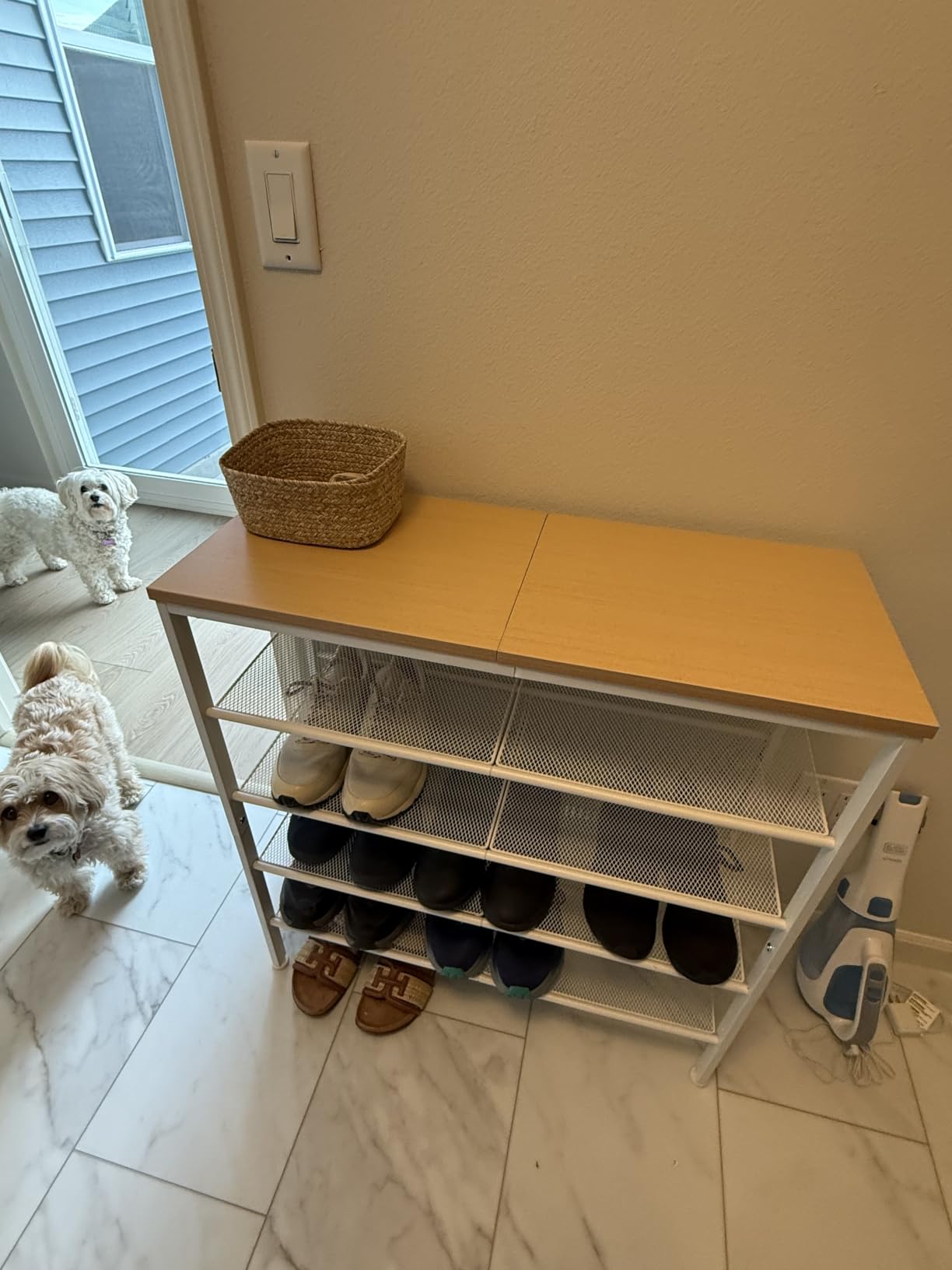
The two-tone finish, matte black frame with rustic brown panels, is more decorative than a plain wire rack. It still reads as storage, but it reads as intentional storage, which matters in a hallway you walk through every day.
Load ratings are specific: 44 lb on the top surface and 22 lb per mesh shelf. That is headroom for a heavy bag or a pair of winter boots on one tier, provided you are not loading every shelf to its limit at once.
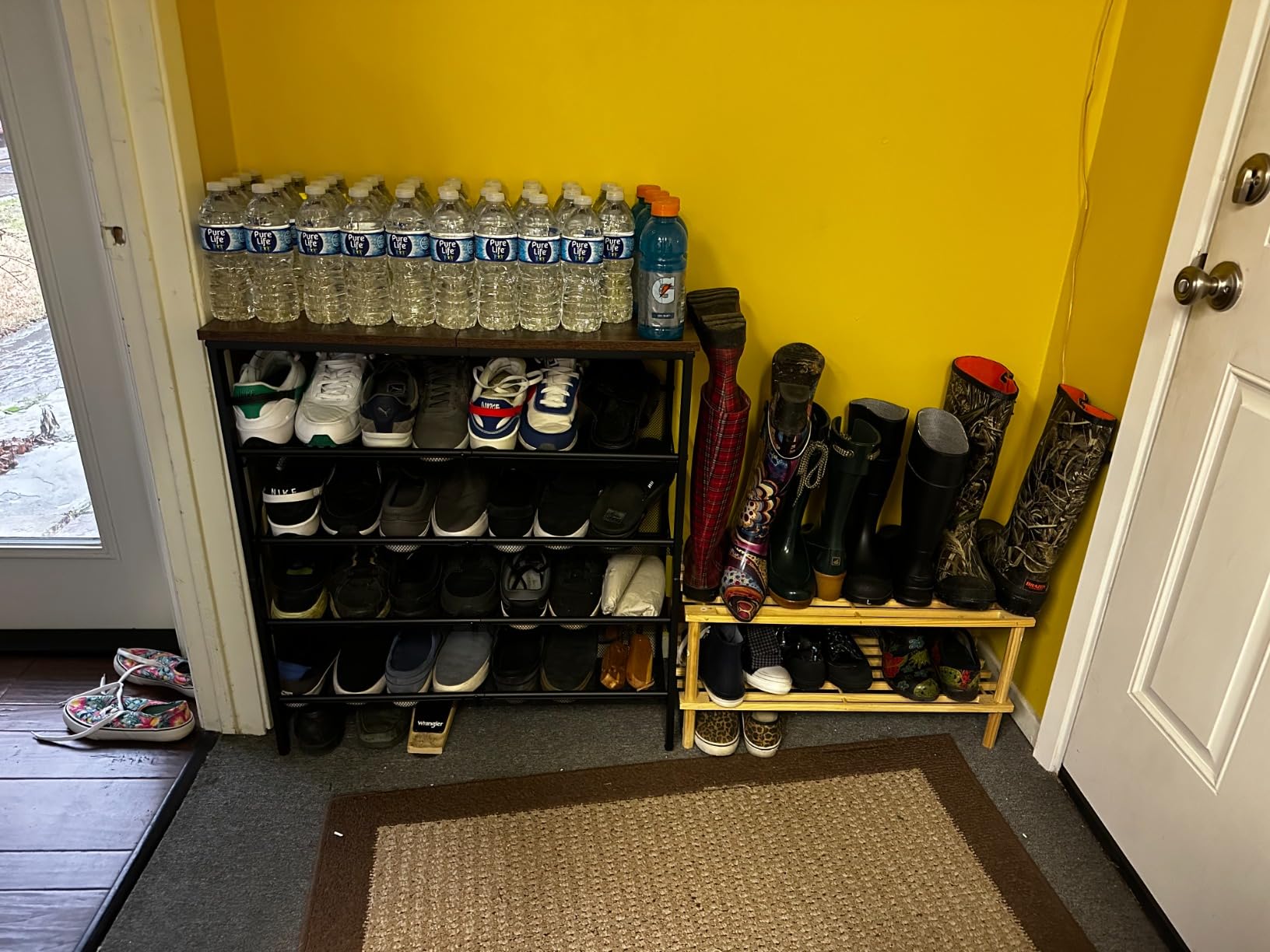
How removable shelves change boot storage
Pulling a shelf out doubles the vertical clearance on that level, which is how mid-calf and knee-high boots get stored without lying on their side. Because shelves come out rather than fold, you can reconfigure the rack each season instead of committing to one layout.
The trade-off is that the layout is set at assembly. If you remove shelves, you may need to rebuild the frame to add them back, so plan the configuration before you tighten the last bracket.
What to know before choosing the tilting-shelf rack
The panels are particleboard and the frame is metal. That combination is sturdy but not heirloom quality, so treat it as functional storage rather than a piece you pass down.
It fits a household mixing heels, boots, and sneakers, and fails a household needing more than 20 pairs or a single tool-free build. The 3-tier non-woven rack later in this roundup builds in four steps with no tools at all.
6. VASAGLE 10-Tier Tall Shoe Storage Cabinet – Best for Large Families
VASAGLE Tall Shoe Storage Cabinet, 10‑Tier, Holds Up to 30 Pairs of Shoes
Width: 24.8 in
Depth: 12.6 in
Height: 73.6 in
Load: 20 lb per shelf
Ten cubbies
Pros
- Holds up to 30 pairs in a 24.8 in footprint
- Large top compartment fits handbags and shoe boxes
- Shelves remove for tall boots
- Anti-tip kit included
- Numbered parts with clear instructions
Cons
- Cubbies narrow for men's shoes and boots
- Heavy at 66.4 lb and slow to assemble
- Particleboard and MDF feel thin up close
At 73.6 inches tall and only 24.8 inches wide, this is the pick for a family of four or five who runs out of shelf space long before floor space. Ten cubbies hold up to 30 pairs, and each is rated to 20 lb, so heavier shoes and boxes are not a problem.
Each compartment measures about 11.8 by 7.1 by 5.3 inches, and shoes go in the same orientation they sit in the box. That sounds minor until you have done it with a toddler waiting in the hallway. A large open top compartment takes handbags, boxed shoes, and baskets.
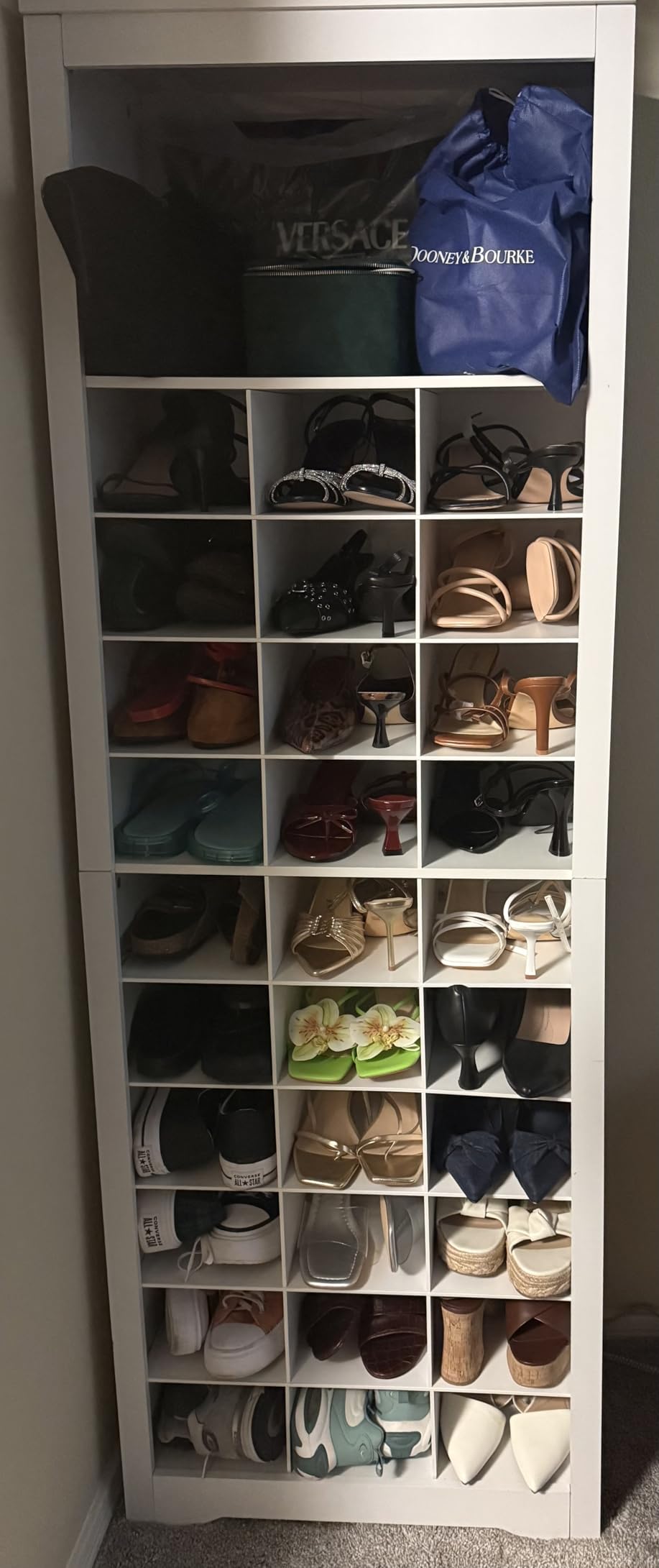
The 4.3 rating across nearly 6500 reviews is lower than the metal racks here, and the reason is consistent. The cubbies are narrow enough that men’s sizes and larger sneakers fit awkwardly, and boots usually mean removing the divider. One reviewer also reported the body pulling apart once stood upright.
At 66.4 lb this is the heaviest item in the group and the slowest to build, with many owners reporting an hour or more for two people. The anti-tip kit is included, and a unit this tall in a walkway is exactly the case where you should use it.
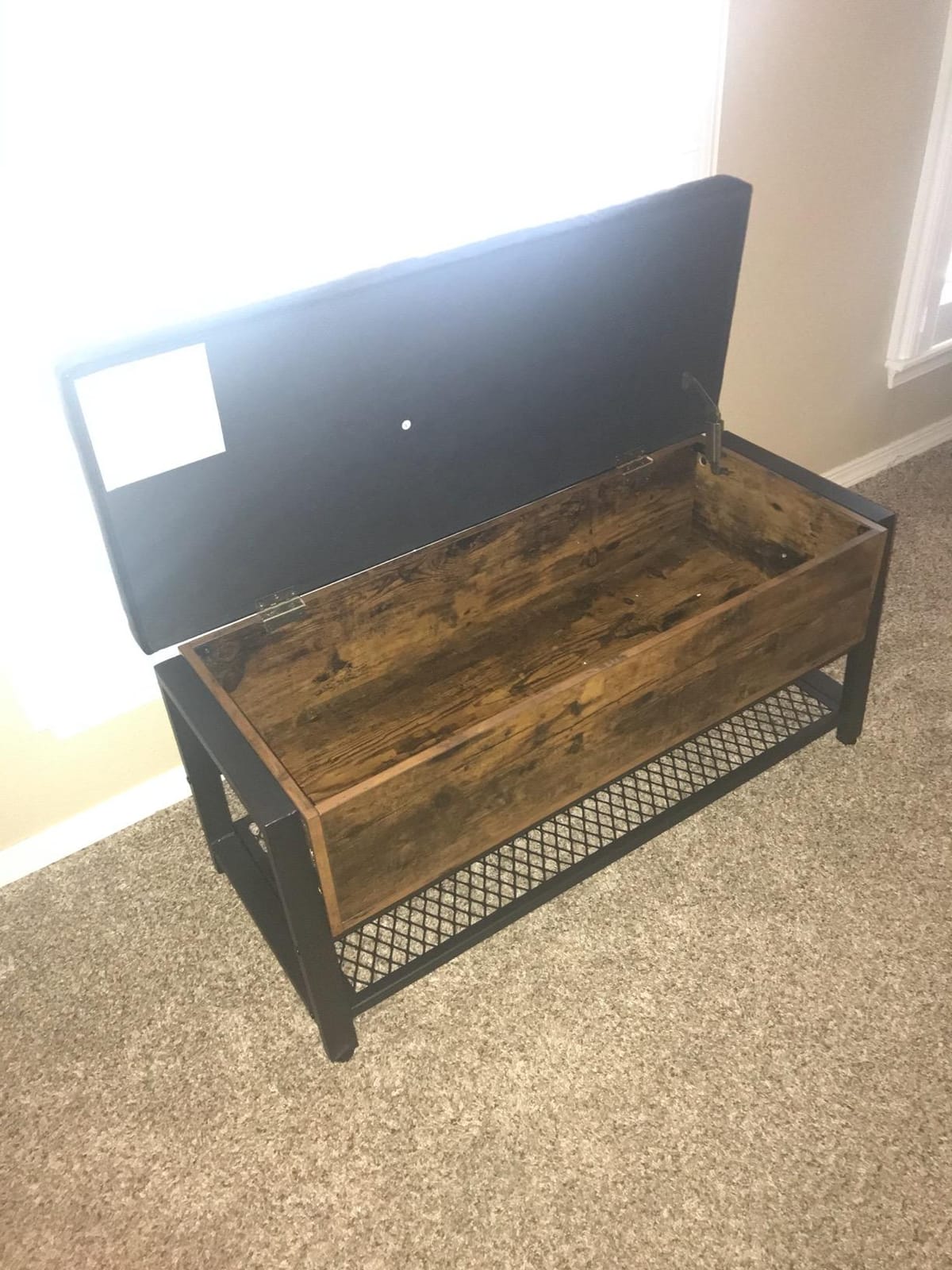
Does 73.6 inches of height work in a real hallway?
It works well against a blank wall with nothing above it, and poorly next to a doorway, where it becomes a visual wall. Check ceiling height first: anything under about 76 inches of clearance rules this out, which is common in older apartments with dropped ceilings.
It works best in a closet, where the height is a benefit rather than a problem. Many owners place one in a hall closet and one in a bedroom closet, which spreads the load and stops the entryway version from becoming overloaded.
Who should skip the tall cabinet
Skip it if one person is building it. The weight and the number of panels make this a two-person job. Skip it if your daily shoes are mostly boots, because the 5.3 inch cubby height is the limiting factor.
For a lot of storage with no drilling and no long build, the Kitsure 10-tier tower later in this roundup holds roughly 40 pairs and assembles tool-free, though its shelves are fabric rather than rigid.
7. Kitsure 10-Tier Vertical Shoe Rack – Best Tall Tower for Apartment Entryways
Kitsure 10 Tier Shoe Rack, Tall Shoe Organizer, 32.2″ Wide, Black
Width: 32.2 in
Depth: 11.8 in
Height: 68.5 in
Load: 20 lb
Four pairs per tier
Pros
- Ten tiers hold about 4 pairs each
- Metal tubes with hard plastic joints
- Tool-free build with an included mallet
- Side hooks for bags
- keys and scarves
Cons
- 32.2 in width is tight for men's or larger shoes
- Fabric sleeves can be pierced by stiletto heels
- Some snap fasteners arrive misaligned
This is the pick when floor space is the constraint rather than width. At 68.5 inches tall with ten tiers and 11.8 inches deep, it holds roughly 40 pairs in a tower occupying about the same floor area as a two-tier bench.
Build quality surprised us for the price tier. Metal tubes and hard plastic corner joints resist the cracking that flimsier fabric organizers suffer, and the 4.5 rating across more than 2200 reviews reflects that. Assembly is tool-free, and a small mallet is included for the button fasteners that seat the joints.
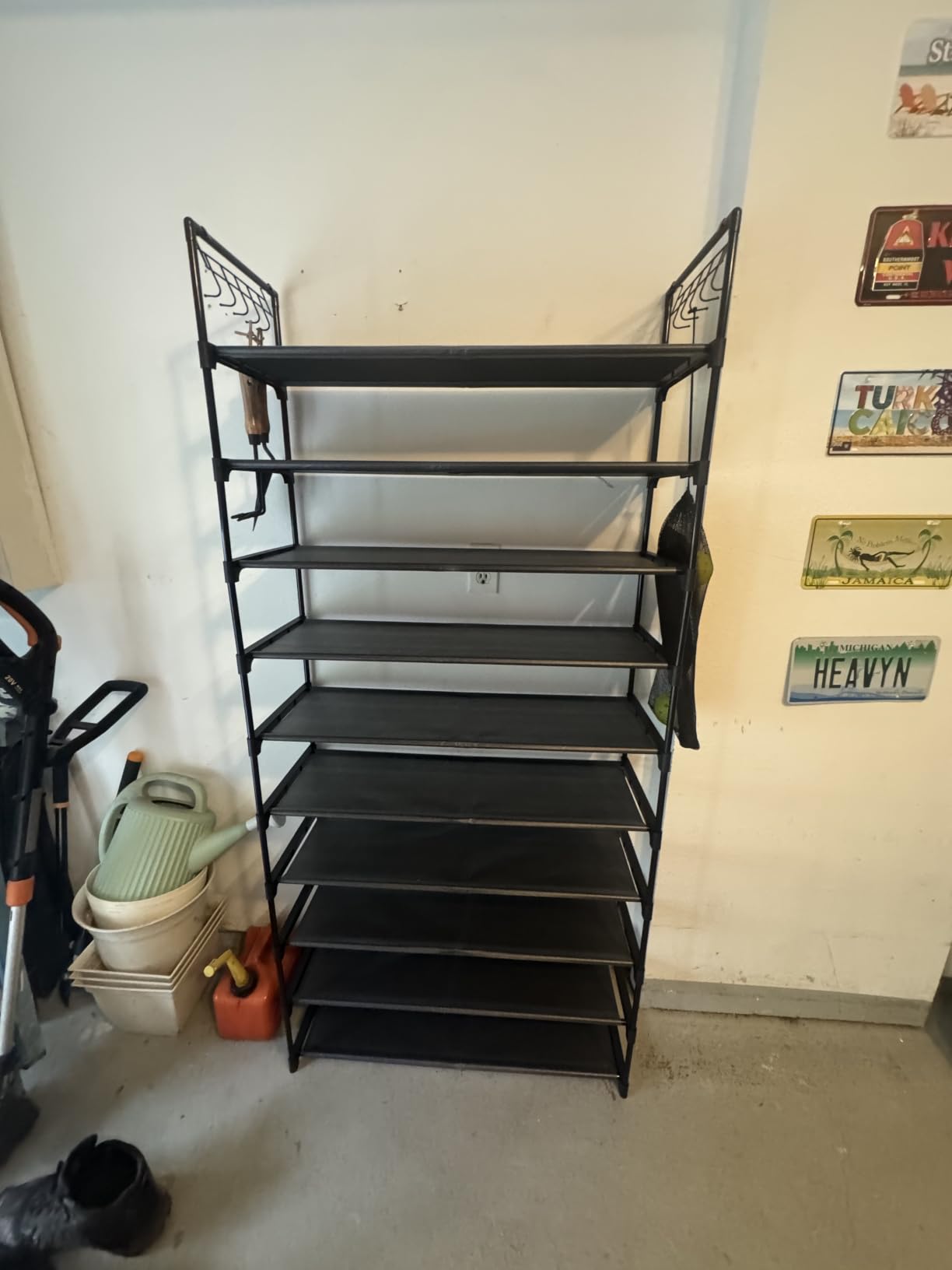
Side hooks along one edge add hanging space for tote bags, keys, belts, and scarves, which is useful in an apartment where the entryway doubles as a coat drop. The modular frame also splits into two smaller racks if one tall tower is more than a single corner can take.
Two things to know upfront. The 32.2 inch width fits about 3.5 pairs per tier comfortably, so a fourth pair of larger shoes hangs off the edge, and the non-woven sleeves can be punctured by sharp stilettos. Some buyers found snap fasteners misaligned inside the poles and fixed them with pliers.
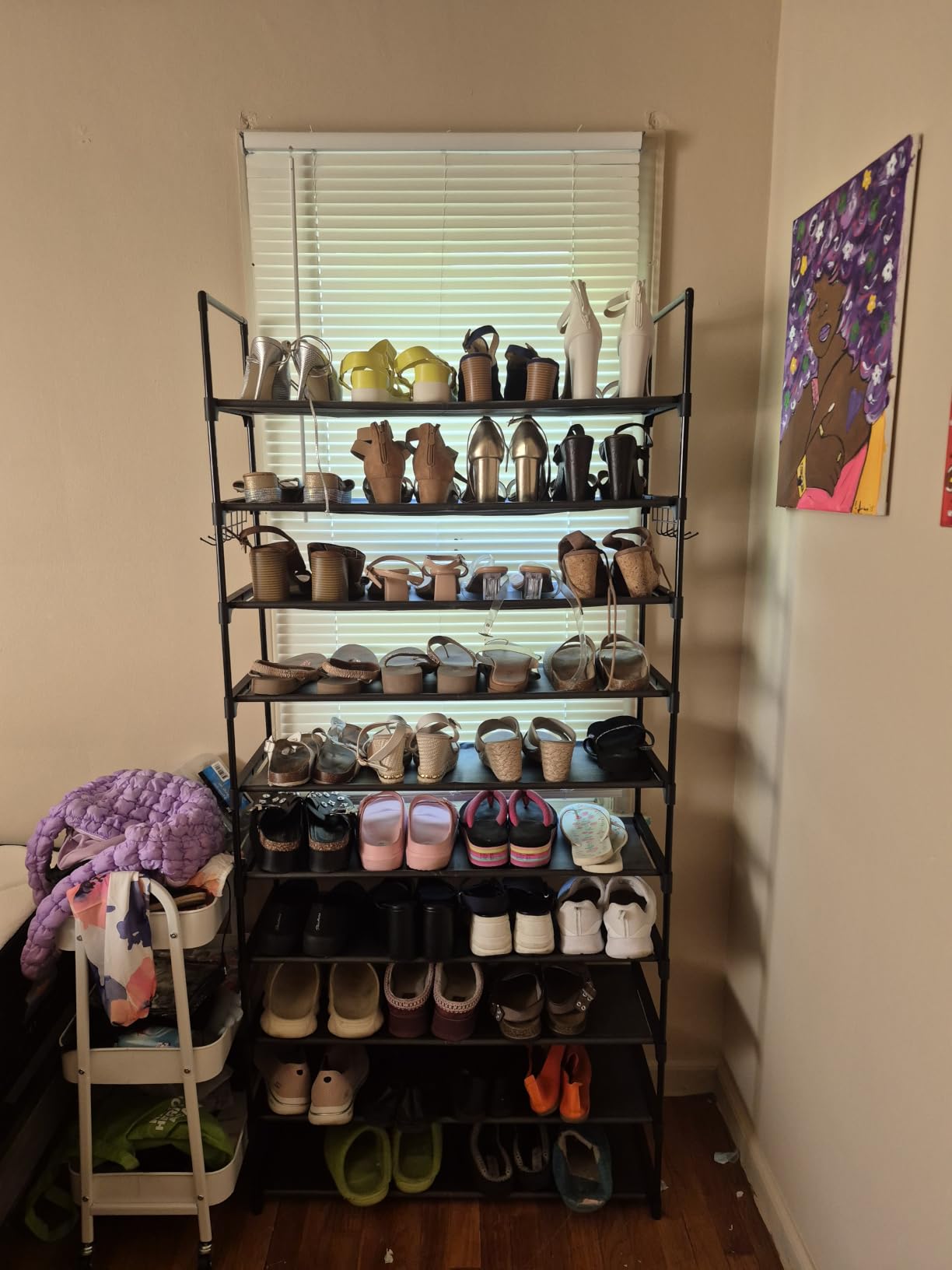
Who a 68.5 inch fabric tower suits
It suits apartments and dorm rooms where the hall closet does not exist and the entryway has one usable corner. A 4.5 rating from more than 2200 reviewers, on a construction method built around metal tubes rather than plastic connectors, is a better durability bet than the price usually implies.
It also suits renters, because a freestanding unit needs no wall fixings. If you have small children, treat the tower as furniture rather than a climbing frame and keep the heaviest pairs on the lower tiers to lower the center of gravity.
When to pick a different vertical option
Choose the VASAGLE tall cabinet instead if you store shoes in boxes, if boots are frequent, or if you want a rigid shelf surface. Its 5.3 inch cubbies clear more footwear types than a fabric tier does.
Skip this tower if your hallway is under 33 inches wide, and skip it if aesthetics lead the brief. Black fabric tiers are tidy but never read as furniture the way the bamboo benches do.
8. SNTD Expandable 2-Tier Metal Shoe Rack – Best Fit for Changing Hallway Widths
Expandable Metal Shoe Rack for Closet, Entryway & Garage, 2-Tier, Black
Width: 18.6 to 30.5 in
Depth: 11.6 in
Height: 17.1 in
Load: 200 lb
Two tiers
Pros
- Extends from 18.6 to 30.5 in as needed
- Height adjusts to fit taller boots
- Taut mesh wire holds heels in place
- Powder-coated metal resists sagging and rust
- Adjustable feet and a build under 10 minutes
Cons
- Only two tiers as configured
- Mesh shelves are hard on delicate shoes
- More tiers require buying additional racks
Most racks force one width forever. This one extends from 18.6 inches to 30.5 inches, so you can pull it narrow in a tight hall and widen it later if the space changes. That flexibility is unusual at this build quality, and 4.7 out of 5 across more than 1500 reviews reflects it.
Height is adjustable too, which lets a boot tier sit taller without stealing space from the shelf above. The taut mesh wire is a genuine plus for heels, since the grid grips the heel and stops it teetering off the front edge the way flat mesh allows.
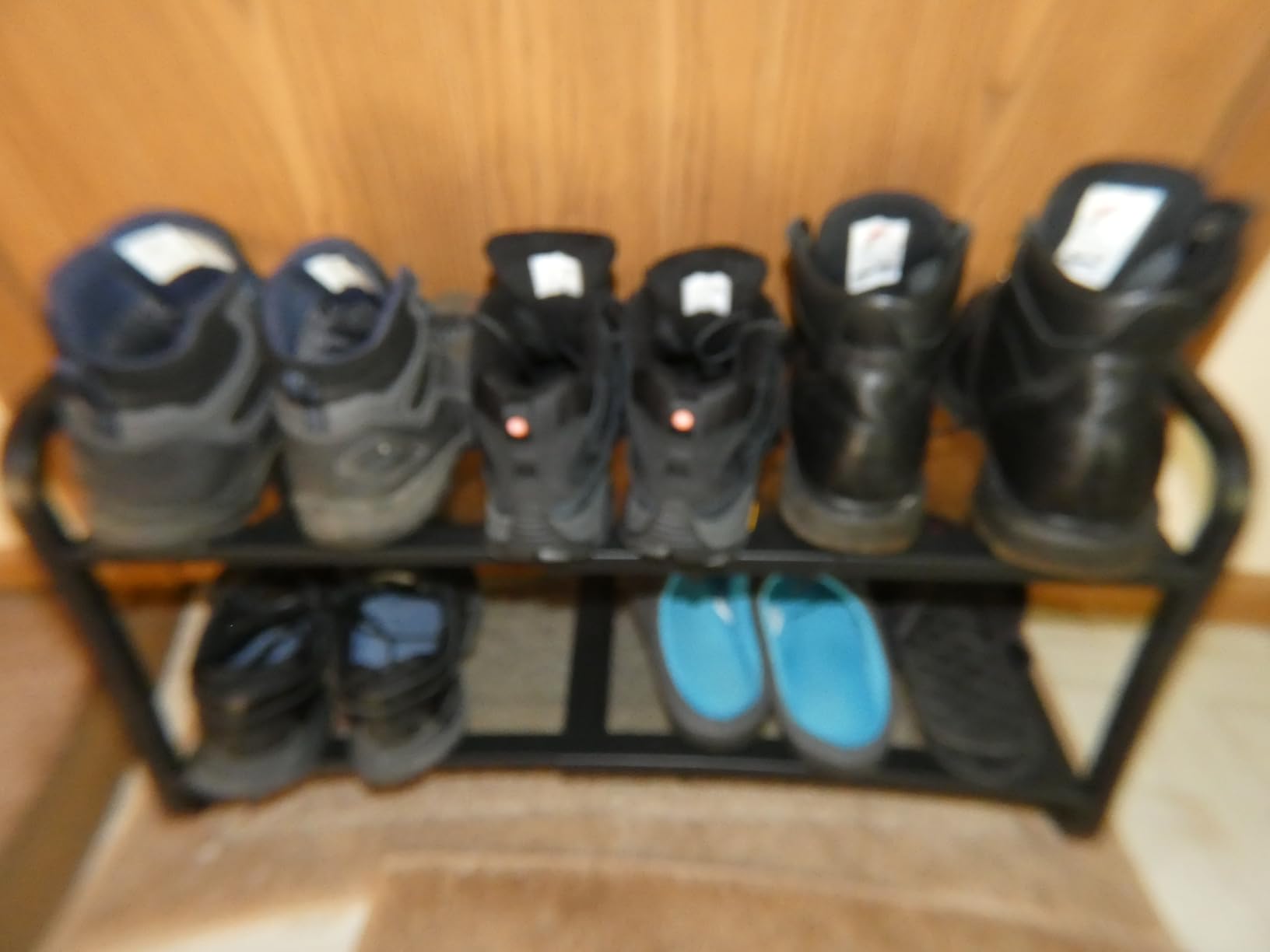
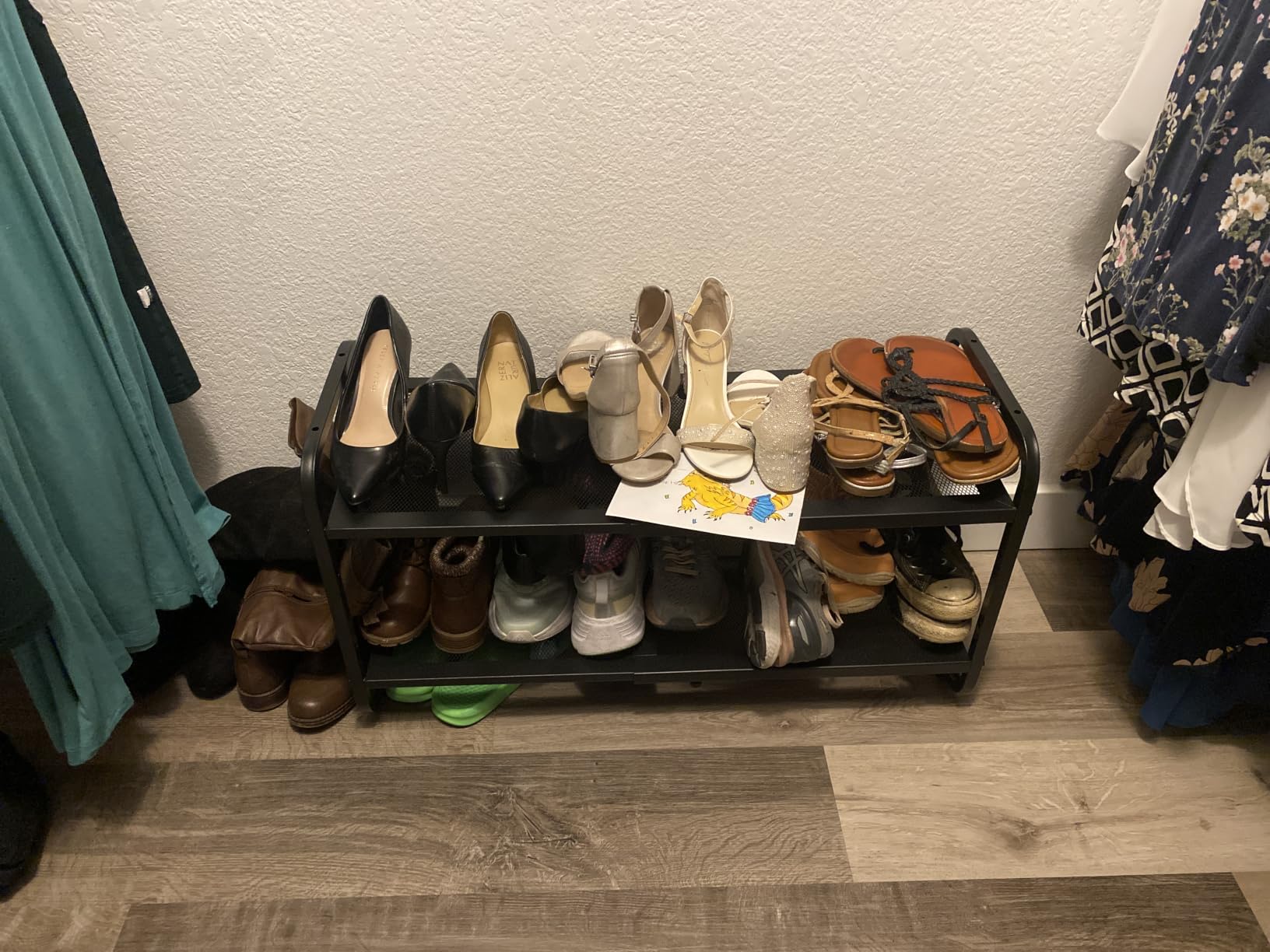
The frame is powder-coated heavy-duty metal rated to 200 lb, and the adjustable feet solve the wobble problem lighter racks suffer on uneven floors. Reviewers also note the shelves wipe clean or rinse, which is the practical answer to an entryway that sees wet shoes daily.
Capacity as configured is up to 8 pairs across two tiers, so a single unit will not carry a family. The stacking path is real, since units combine into 4, 6, 8, or 10 tiers, but that means buying more to get where you need to be.
When expanding width solves a real problem
It solves an entryway you have not finished measuring, or one shared with a door that sometimes swings further than expected. Set the rack at 18.6 inches, walk the hallway with the door open, then widen it to fit the space you actually have.
It also works well as a second unit. One expandable rack by the door for daily shoes and a stacked pair in the closet for overflow is a common arrangement among reviewers, and the 11.6 inch depth keeps both out of the walkway.
What the two-tier limitation means for you
One unit is a low, wide, bench-adjacent piece. If you need more than about 8 pairs in that spot, buy two and stack them rather than expecting one rack to do the work of a five-tier tower.
Consider foot comfort as well. Taut wire grips well and wipes clean, but delicate flats and soft leather can mark against metal mesh over time, and fabric shelves are gentler.
9. Pipishell 3-Tier Bamboo Shoe Rack Bench – Best Warm Bamboo Finish
Pipishell 3 Tier Bamboo Shoe Rack Bench for Entryway, Brown
Width: 27.5 in
Depth: 11 in
Height: 17.5 in
Bench rating: 300 lb
Holds 6-8 pairs
Pros
- Genuine bamboo with a warm stained finish
- Seats up to 300 lb for putting shoes on
- Compact footprint suits small entryways
- Assembles with included tools and hardware
- Weighs only 3.4 lb so it moves easily
Cons
- Joints can loosen and creak when seated
- About 3 pairs per shelf is modest capacity
- Some models arrive with misaligned holes
If you want real bamboo in a warmer, more furniture-like tone than the black SONGMICS bench, this is the pick. At 27.5 by 11 by 17.5 inches it is the most compact bench in the group, and at 3.4 lb it is the easiest to reposition when you want to sweep behind it.
The 4.6 rating across close to 18000 reviews reflects a straightforward unit that does its job. Owners praise the 100 percent natural bamboo, the warm stained finish that matches existing wood furniture, and a bench rating of 300 lb. One reviewer weighing 215 lb reports no give at all.
Capacity is about 6 to 8 pairs, roughly 3 per shelf, which suits a one or two person household and a laundry room. A minority of owners buy multiples instead of one wide model, which works if you have wall space for two 27.5 inch units side by side.
The recurring complaints are mechanical. Joints loosen with use, and some owners recommend a drop of glue on the screws, and creaking under weight is reported too. A few models also arrive with misaligned predrilled holes that need drilling or realignment before the screws seat.
How this bamboo bench compares to the black alternative
The warmer stain is the whole difference, and it is a real one in a visible entryway. The black bench suits a hallway with darker floors and modern fixtures. This one suits warm wood, light walls, and a more traditional feel.
On weight, this bench is rated slightly higher at 300 lb but weighs less than half as much, so it is easier to carry up stairs. On width, the difference is negligible at 27.5 versus 27.6 inches.
When this bamboo bench is the right buy
Buy it for a small apartment, a mudroom, or a laundry room where 3 pairs per shelf is genuinely enough. It is also right if you need seating more than storage, since both bamboo benches here are rated well above 250 lb.
Skip it for a family entryway needing more than 8 pairs, and skip it if you move furniture often. Light weight helps here, but the joints that loosen under repeated moving are the same joints that loosen under repeated sitting.
10. Kitsure 3-Tier Non-Woven Shoe Rack – Budget Pick for Dorm Rooms and Closets
Kitsure Shoe Rack – Non-Woven Shoe Rack Shelf, 27.5″ Wide – 3 Tier, Black
Width: 27.6 in
Depth: 11.8 in
Height: 18.5 in
Three tiers
Stackable
Pros
- Four-step tool-free assembly with a video guide
- Stackable into 6 or more tiers
- Non-woven shelves keep dust off lower shoes
- Compact enough for closets
- dorms and garages
Cons
- Frame and shelves feel inexpensive
- Shelf height cannot be adjusted
- Fabric shelves can be punctured by sharp heels
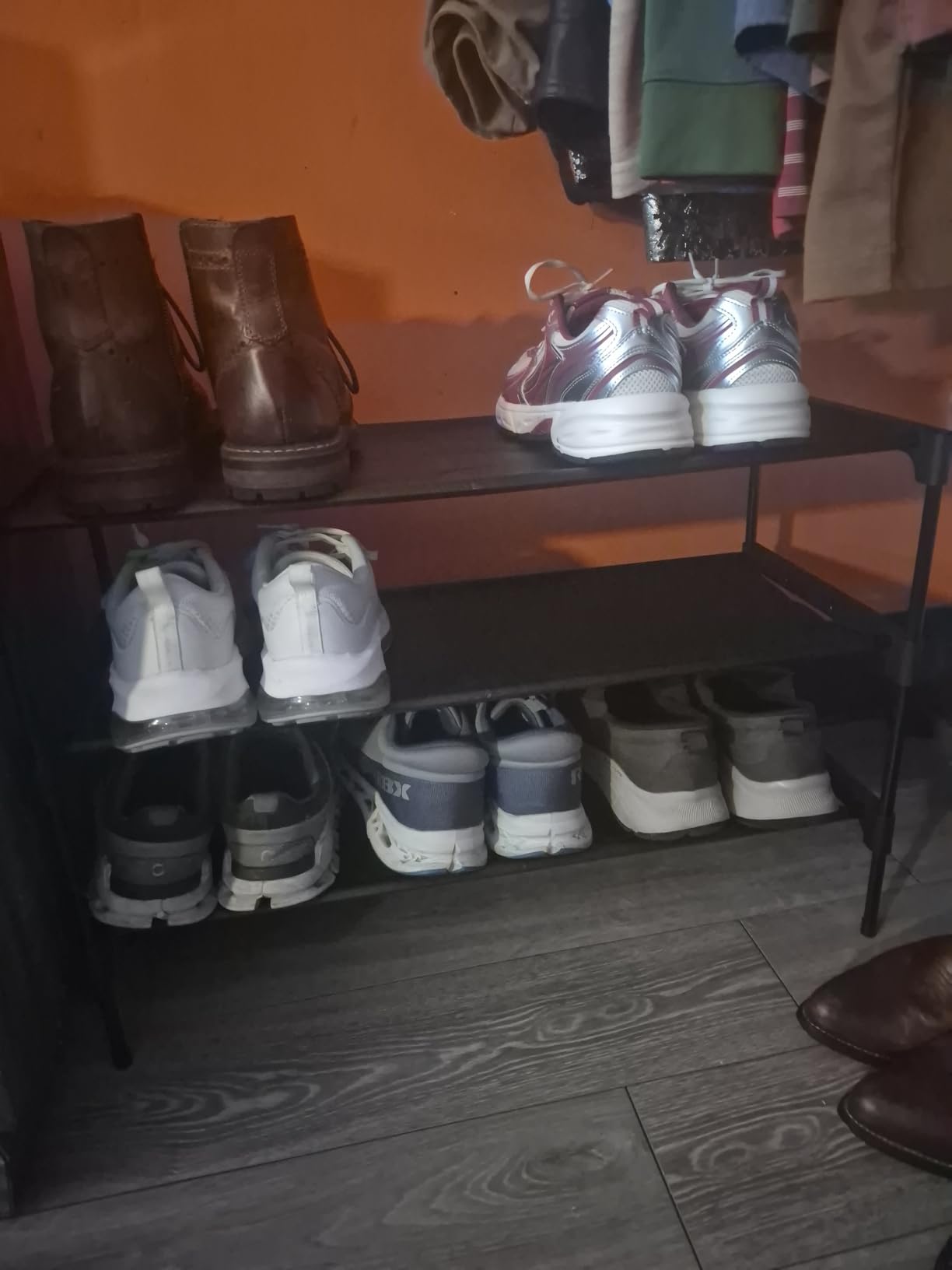
This is the cheapest way to get shoes off the floor, and the 4.3 rating across nearly 17000 reviews is among the largest review counts in this group. At 27.6 by 11.8 by 18.5 inches it fits a closet, a dorm room, or a small entryway without a real build.
Assembly is four steps with no screws or tools, and the instructions come with an installation video. Reviewers note the shelves keep dust off lower pairs, which is more than a bare wire frame would do, and the stackable frame lets two or more units build a taller tower.
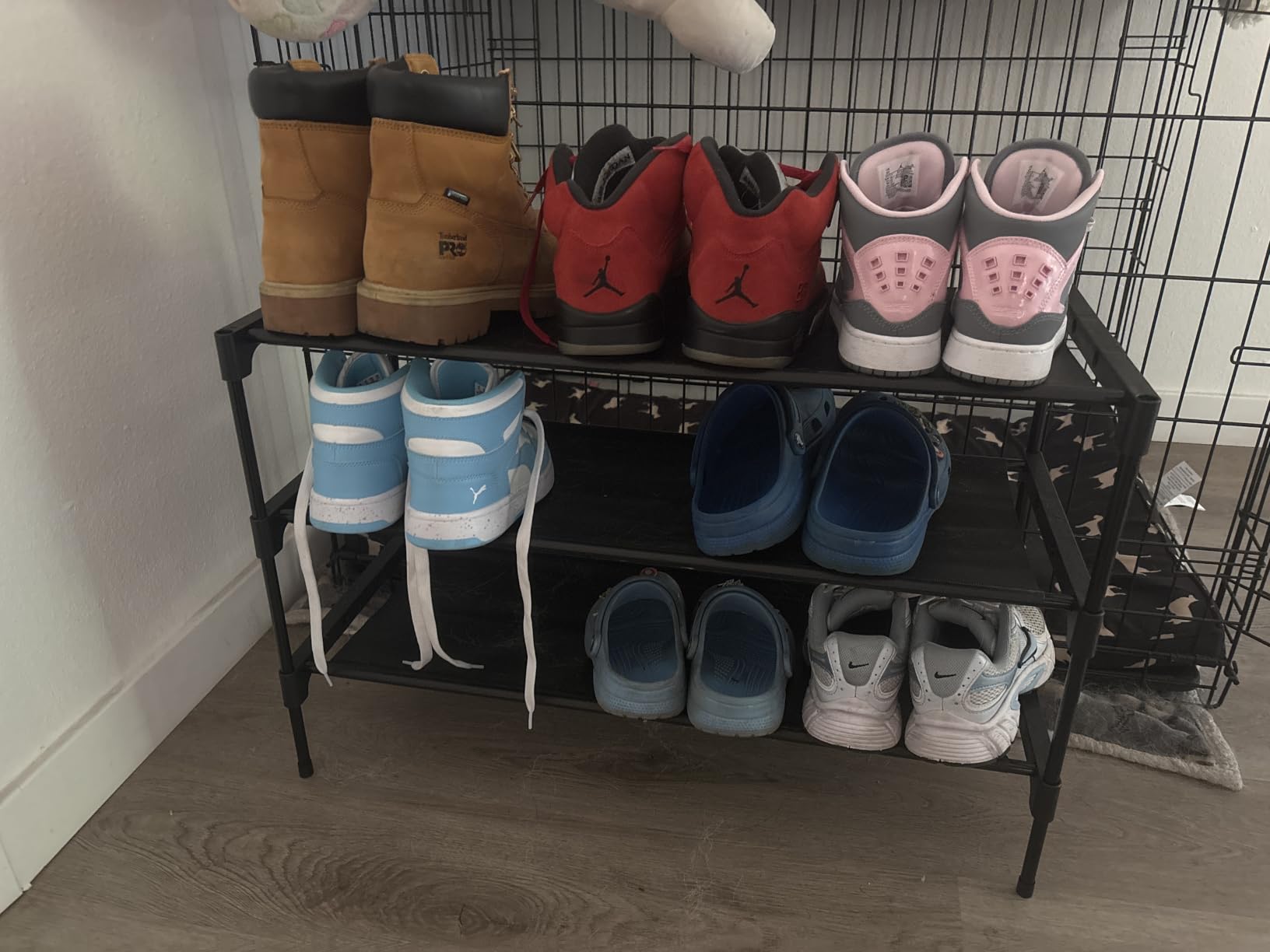
Real capacity runs between 9 and 20 pairs depending on shoe size, and that spread matters more than any listed figure. Measure your largest shoes against the 27.6 inch width before assuming the higher end applies to you.
The honest drawback is that the metal tubes and plastic frame feel inexpensive. It is a practical storage solution rather than a decorative piece, and reviewers say so directly. Shelf height is fixed, so boots live on the floor underneath or lie on their side.
Where a budget rack genuinely makes sense
It makes sense in a rental, a dorm room, a garage, or a second entry door where appearance barely registers. The tool-free build also makes it the easiest unit here to assemble, take apart, and move between two homes or two rooms.
Stacking turns it into a real storage system. Two or three units locked together become a 6 or 9 tier rack, which is the most common way owners escalate beyond the base configuration.
Where to spend a little more instead
Skip it if the entryway is the first thing guests see. It will not read as furniture, and fabric shelves mark easily under stilettos. Skip it if boots are a large share of your footwear, since fixed shelf spacing gives them nowhere to go.
For the same footprint with a warmer look and a seat, the Pipishell bamboo bench holds about the same number of pairs. For a visible hallway where dust and pet hair matter, the BORNOON cabinet is the pick.
How to Store Shoes at the Entrance: Build a Drop Zone Instead of a Pile
A shoe rack solves storage. A drop zone solves the daily friction, and no organizer on this list is enough on its own. Forum conversations about entryway shoe storage rarely ask which rack to buy, because the rack was never the problem.
Start with the mat. Put an outdoor-rated doormat inside the door so grit stops before it reaches the floor. Nothing else you buy works as well if dirt is tracked in first.
Assign tiers by frequency. Daily shoes go on the middle tier within arm’s reach. Boots go on the floor or bottom tier, where a tray can catch water. Occasional shoes go on top.
Add a key tray above the rack. This is the highest-impact single addition. Keys, mail, and dog leashes stop landing on the floor the moment they have a landing spot.
Add hooks at shoulder height. Three or four hooks beside the rack handle coats and leashes, which keeps the floor completely clear.
Reset once a week. Take everything off, wipe the shelves, and put back only the pairs in season. This is what keeps an entryway organized past the first month.
Two additions complete the zone: a boot tray underneath for wet winter footwear, and lighting that reaches the floor. Our guide to lighting for entryways covers the second, and both matter as much as the rack for a space used twice a day.
How to Choose a Shoe Rack for Your Entryway
Measure the entryway before you pick a style
Take three measurements before shopping: the wall width where the unit will sit, the depth available without blocking the walkway, and the ceiling height. Most buying mistakes here come from measuring only the first. If your hallway floor is about 34 inches wide, any rack above 30 inches will not fit without moving something else.
Depth is the second rule, and it is the one most guides get wrong. Prioritize depth over width. A rack two inches too deep stops a door from opening, while a rack two inches narrower simply holds one fewer pair per shelf.
Match capacity to the number of daily pairs
Count what is actually worn each day, not what is owned. One person needs 3 to 5 pairs visible, a couple needs 8 to 12, and a family of four needs roughly 20 to 25. Add margin for wet shoes that should not sit next to dry ones.
Vendors count pairs generously, and real capacity usually runs 15 to 20 percent below the listed figure once larger shoes are counted. Treat the stated number as an upper bound rather than a promise.
Open rack or closed cabinet
Open racks give airflow, fast access, and lower cost, and they display the shoes you own. Closed cabinets, whether flip drawers or hinged doors, keep dust and pet hair off footwear and make a visible entryway look intentional. For allergy sufferers and pet homes, closed storage is the better call.
For furniture-matched options rather than a storage cube, community threads keep returning to the IKEA Bissa for simple shelving, the Brusali for a closed cabinet, and the Hemnes for a bench that doubles as a hall table. Our guides to storage benches for entryways and under bed shoe organizers cover the off-season half of the same problem.
Material and humidity
Bamboo ages well and matches wood floors, but it is engineered, so over-tightened screws can split it. Steel mesh and powder-coated metal handle wet boots and humidity best, and let grit fall through instead of sitting on the shelf. Non-woven fabric is gentle on shoes and wipeable, but it can be punctured by sharp heels and sag under heavy boots. Engineered wood and MDF cabinets hide dust well but feel thin up close.
Stability, anchoring, and tipping
Treat any unit taller than about 30 inches as furniture that can be climbed, particularly with toddlers at home. Two products in this roundup include anti-tip kits, the BORNOON cabinet and the VASAGLE tall cabinet, and both are worth fitting to a wall. For freestanding racks without hardware, adhesive wall straps or felt pads solve most wobble complaints cheaply.
Load the heaviest shoes on the lowest shelves. It lowers the center of gravity and is the cheapest stability improvement available.
Frequently Asked Questions
What is a good shoe storage rack for an entryway?
A good entryway shoe rack is a freestanding unit with 3 to 5 tiers, 27 to 36 inches of width, and under 12 inches of depth. Bench styles add seating, mesh styles add pair capacity, and closed cabinets keep dust and pet hair off shoes. Match it to your daily pair count and confirm the depth clears your door swing before buying.
What is the best shoe rack for a small entryway?
For a small entryway, prioritize depth over width and pick a unit under 12 inches deep. Look for stackable tiers that grow upward, an expandable width that adjusts between 18 and 30 inches, or a shallow closed cabinet under 10 inches deep. A bench adds seating in the same footprint if you have a blank wall.
How to store shoes at the entrance?
Zone the storage by frequency. Daily shoes go on a middle tier within arm’s reach, boots on the bottom or on a boot tray, and occasional shoes on top. Add a key tray above the rack and hooks at shoulder height for coats and leashes, then reset once a week so only in-season pairs stay out.
What is the best shoe organizer for storing a lot of shoes?
For high volume, use vertical space rather than width. A 10-tier cabinet holds up to 30 pairs in a 24.8 inch width, and a 10-tier fabric tower holds roughly 40 pairs in an 11.8 inch depth. Wide 43 inch racks put 5 to 6 pairs on each tier. Add units over time rather than buying one oversized piece.
Are open or closed shoe racks better for entryways?
Open racks are better for airflow, quick access, and cost, and they display the shoes you own. Closed cabinets and flip-drawer units are better for dust, pet hair, and allergies, and they make a visible entryway look more like furniture. Most households use both, with an open rack by the door and a closed cabinet for overflow.
Do shoe racks need to be anchored to the wall?
Anchor any unit taller than about 30 inches, especially in homes with toddlers or pets who may climb it. Some cabinets include an anti-tip wall fix kit, and freestanding metal racks can be secured with adhesive wall straps. For shorter units under 30 inches, adjustable feet and felt pads on uneven floors are usually enough.
Which Entryway Shoe Organizer Should You Buy?
For most homes, the SONGMICS 3-tier bamboo bench is the answer. It seats two adults, holds 6 to 9 pairs, measures 11.3 inches deep, and carries a 4.6 rating across more than 25000 reviews. If you need far more capacity in a shallow footprint, the VASAGLE 5-tier mesh rack holds 18 to 24 pairs at 10.8 inches deep. If the hallway pinches below 10 inches at the door, the BORNOON flip-drawer cabinet keeps everything hidden in 9.45 inches.
Whichever you choose, measure the space and count your daily pairs before ordering, then build the drop zone around it with a mat, a tray, and hooks. That is the whole difference between a pile and a place for shoes to live.