
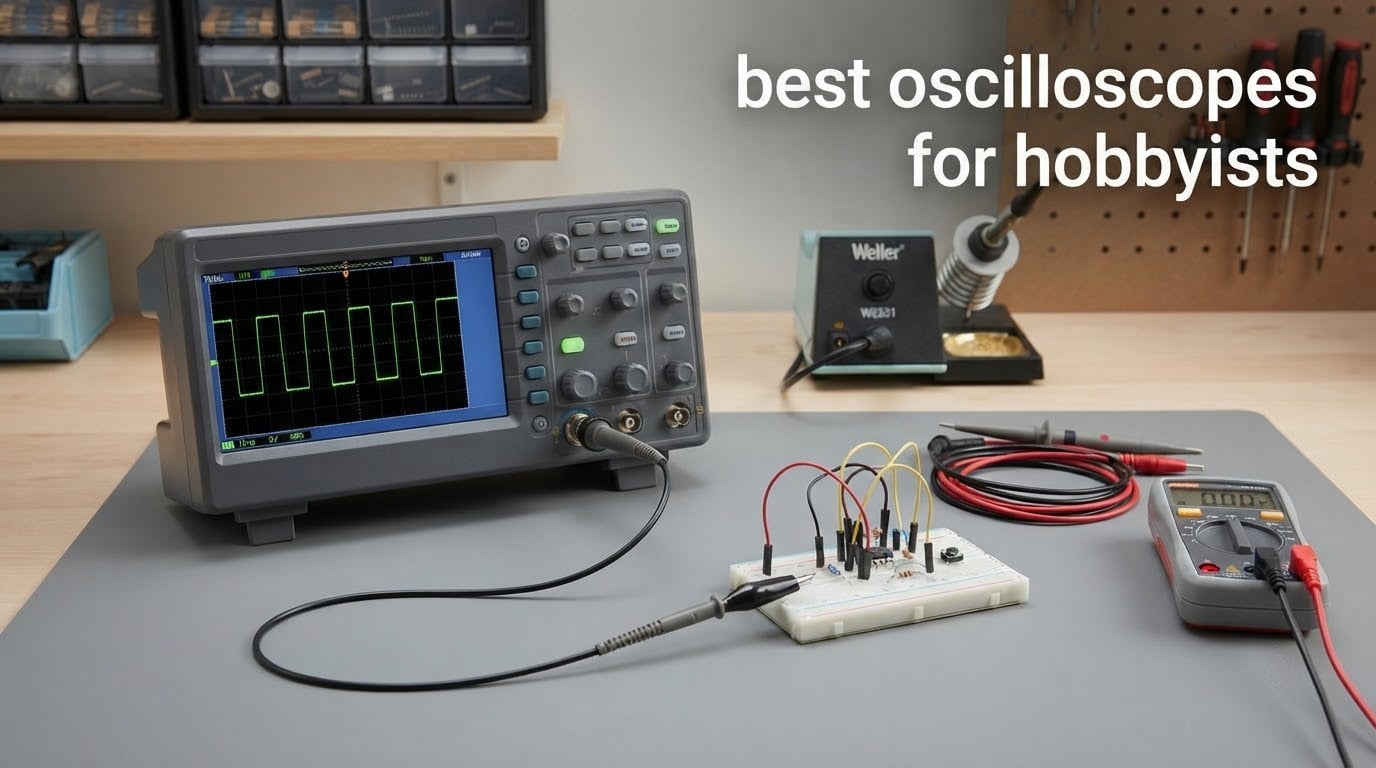
A multimeter tells you what a voltage is right now. An oscilloscope tells you what that voltage has been doing for the last ten milliseconds, and that is the difference between guessing and debugging. If you have ever stared at a multimeter reading that looked fine while a circuit misbehaved, you already know why the best oscilloscopes for hobbyists keep ending up on workbenches across the country.
We spent the last few months working through the current crop of hobbyist scopes, from a pocket device that fits in a shirt pocket to 200 MHz four-channel benches with decode built in. Along the way we compared bandwidth claims against what the screens actually show, checked which ones ship with protocol decoding already enabled, and looked hard at the specs nobody puts on the front of the box: record length, waveform capture rate, vertical sensitivity, and whether the buttons are usable with dry fingers.
This guide covers ten instruments across every budget a hobbyist will realistically consider. If you want to skip ahead, the comparison table below is the fast route. If you would rather narrow it down first, tell us your project type (Arduino and ESP32 work, audio repair, switching power supplies, automotive), your budget range, and whether you need a benchtop, a handheld, or something that talks to a laptop.
Table of Contents
Top 3 Picks for Hobbyist Oscilloscopes in 2026
Three scopes came out ahead on the balance of rating, review volume, and the specs that matter once a real circuit is on the bench. The Siglent SDS1202X-E took the top slot on sampling speed, record depth, and included serial decode. The Siglent SDS1104X-E is the pick if four analog channels and CAN and LIN decode matter to your work. The Rigol DS1054Z earns its place as the glitch-hunting specialist, with 24 Mpts of memory and a 30,000 wfms/s capture rate.
Best Oscilloscopes for Hobbyists in October
Every scope listed here is a real, currently sold instrument with published specifications. The fastest sample rate, channel count, and form factor vary enormously across the range, so read the table before committing.
| Product | Specifications | Action |
|---|---|---|
| Siglent SDS1202X-E |
|
Check Latest Price |
 Siglent SDS1104X-E Siglent SDS1104X-E |
|
Check Latest Price |
 Rigol DS1054Z Rigol DS1054Z |
|
Check Latest Price |
 HANMATEK HO52 HANMATEK HO52 |
|
Check Latest Price |
 Rigol DS1202Z-E Rigol DS1202Z-E |
|
Check Latest Price |
 FNIRSI 2C53T FNIRSI 2C53T |
|
Check Latest Price |
 FNIRSI 1013D Plus FNIRSI 1013D Plus |
|
Check Latest Price |
 HANMATEK DOS1102 HANMATEK DOS1102 |
|
Check Latest Price |
 FNIRSI DSO152 FNIRSI DSO152 |
|
Check Latest Price |
 ZOYI ZT-703 ZOYI ZT-703 |
|
Check Latest Price |
1. Siglent SDS1202X-E: the best oscilloscope for hobbyists overall
Siglent Technologies SDS1202X-E 200 mhz Digital Oscilloscope 2 Channels, Grey
200 MHz bandwidth
2 analog channels
1 GSa/s sampling
14 Mpts record length
Pros
- 1 GSa/s real-time sampling handles most hobby signals cleanly
- 14 Mpts record length is deep for the class
- IIC SPI UART RS232 CAN LIN trigger and decode enabled as standard
- Large 7 inch class display for a two channel bench
Cons
- Only two analog channels
- Single-channel sampling drops when both channels are active
- Mid-range bandwidth will not touch fast edges without careful probing
This is the scope we keep coming back to. At 200 MHz of bandwidth with 1 GSa/s real-time sampling, it has far more headroom than most hobby projects need, and the 14 Mpts record length means you can zoom into a glitch without losing the surrounding context.
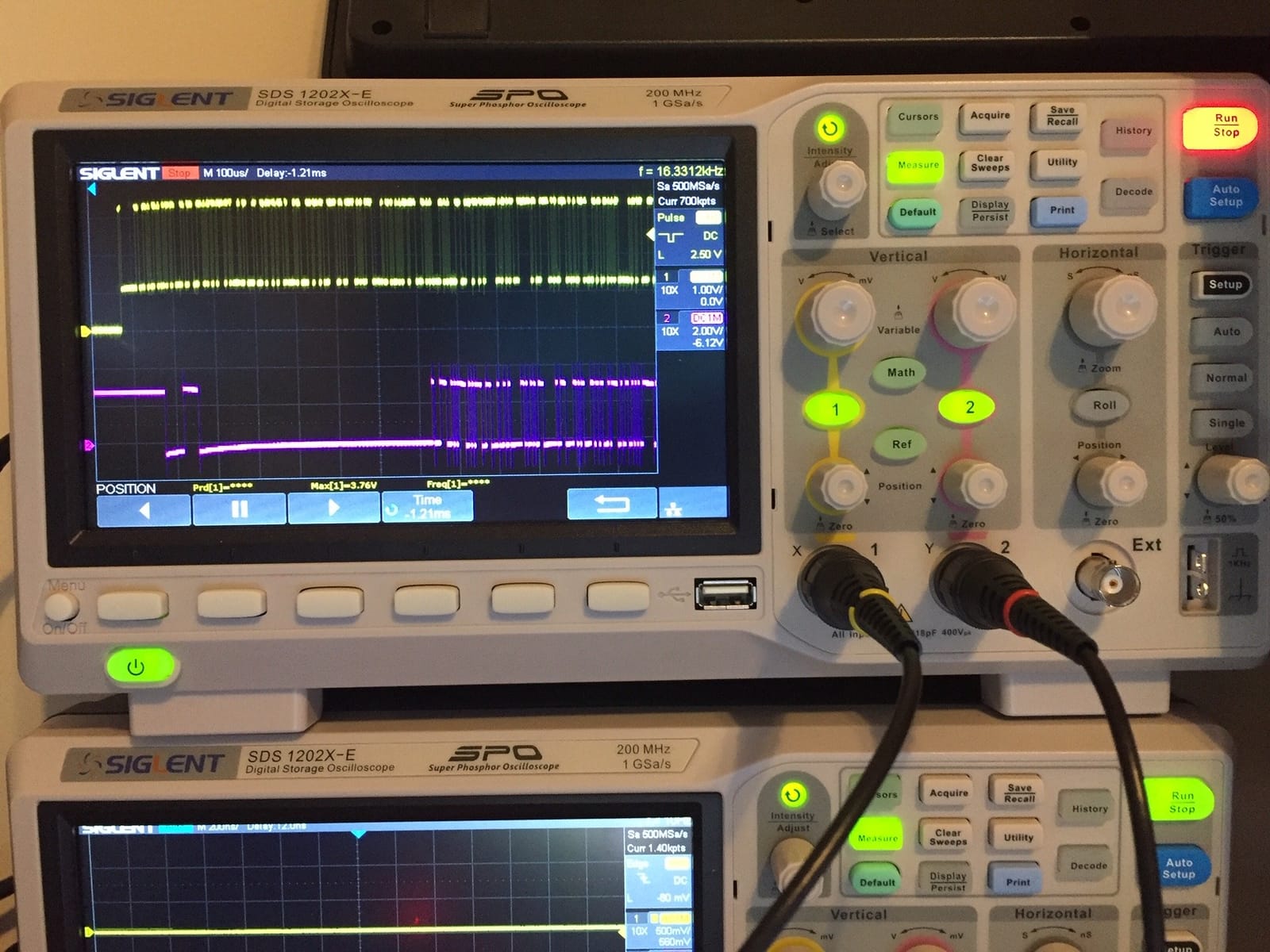
The part that surprised us most is what comes enabled out of the box. IIC, SPI, UART, RS232, CAN, and LIN trigger and decode are standard, not a paid license or a dongle. When you eventually start debugging an ESP32 I2C bus, that alone saves you from the usual forum conversation about which decoder you bought separately.
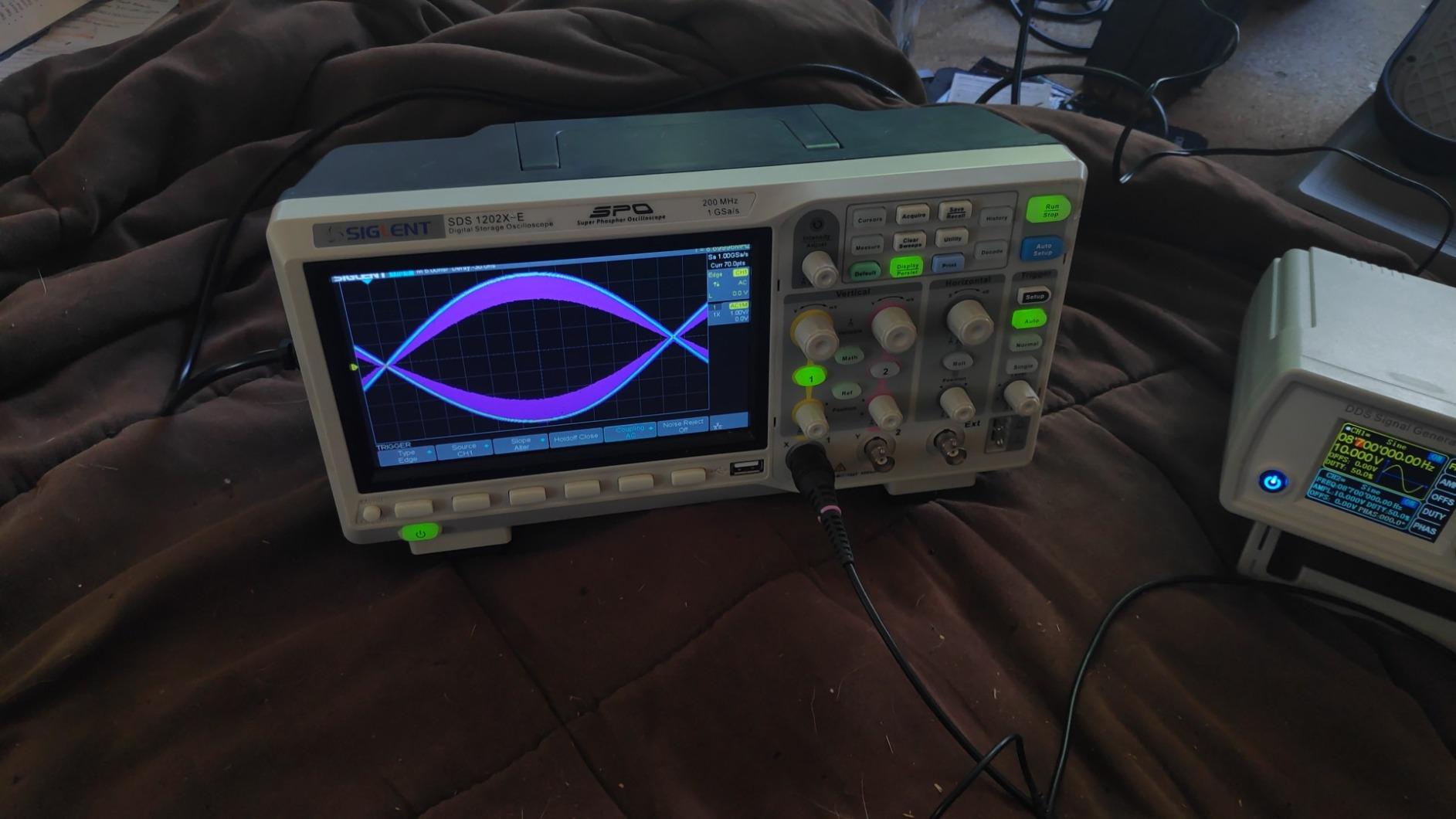
Reviewers consistently point to the sampling speed and record depth as the reasons this model holds a 4.7 average across more than 1,400 ratings. The interface is a clear step up from the button-maze scopes at half the price, and the auto-measure list puts frequency, period, and duty cycle on screen without menu diving.
Physically it is a proper bench instrument at 5.5 pounds, which tells you it is not going anywhere. That matters more than it sounds: a scope that slides around the bench when you press a knob gets used less, and a scope you use is worth more than a scope you admire.
Who this scope suits
Pick the SDS1202X-E if you are working with microcontrollers, motor drivers, power converters, or audio circuits and you want headroom rather than the bare minimum. Two channels is genuinely enough for most debugging sessions, because you can move a probe rather than splitting your attention across four traces.
Where it falls short
If your work regularly needs three or four signals visible at once, such as a three-phase inverter or a timing chain across several chips, step up to a four-channel model. Anyone probing RF above about 70 MHz will also find 200 MHz of bandwidth leaves little margin once the probe and the circuit eat into it.
2. Siglent SDS1104X-E: four analog channels with real vehicle decoders
Siglent Technologies SDS1104X-E 100Mhz Digital Oscilloscope 4 Channels Standard Decoder, Grey
100 MHz bandwidth
4 analog channels
Dual ADC architecture
CAN LIN UART RS232 IIC SPI decode
Web server
Pros
- Only hobby-tier scope here with four analog channels
- Built-in Ethernet and VNC remote screen viewing
- Responsive modern interface reviewers rate highly
- Deep memory rivals scopes costing far more
- Comes with four passive probes and a calibration certificate
Cons
- Sample rate halves to 500 MSa/s with both channels active
- Select knob is twitchy and jumps menu items
- Optional MSO and AWG modules cost a great deal
The community shorthand over on r/ECE is that you should not go below four channels and 100 MHz, and this is the scope that delivers that rule at a price most hobbyists can absorb. Four analog channels means a full SPI bus, an I2C bus with clock and data, and a couple of power rails can all sit on screen together without you moving a single probe.
Unlike several rivals, the CAN and LIN decoders are standard. That is the deciding factor for anyone doing automotive or industrial work, because the alternative is usually a separate interface or a paid upgrade. The built-in web server also lets you view and share the screen across a network, which is a small thing that turns into a big thing the first time you need to show someone a waveform from another room.
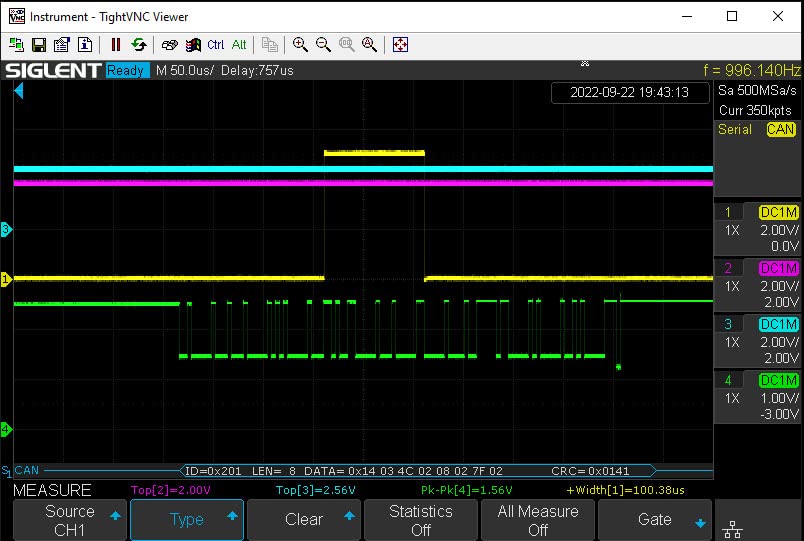
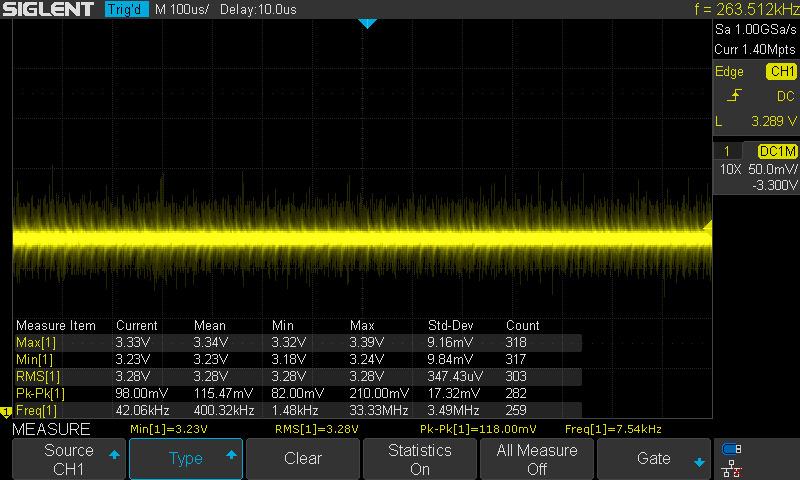
Reviewers rate this the best value four-channel scope in its class, citing the interface, FFT, decode, and remote access. The dual ADC architecture is worth understanding: it holds 1 GSa/s on two channels, and reviewers report a drop to 500 MSa/s once you light up all four.
It ships with a quick start guide, a calibration certificate, four passive probes, and a USB cable. Having four calibrated probes in the box is a quiet quality-of-life win, since replacement probes are the thing people forget to budget for.
Who this scope suits
This is the pick for anyone whose circuits have more than two interesting nodes. Embedded developers, automotive hobbyists, and students working on multi-rail power designs all benefit from the extra channels plus the included CAN and LIN decode.
Where it falls short
The optional mixed-signal and arbitrary waveform generator modules are expensive enough that buying them undermines the whole value argument. Reviewers also flag the select knob as twitchy and the fan as audible, and settings such as the screensaver do not always survive a power cycle.
3. Rigol DS1054Z: the best glitch hunting scope in the roundup
Rigol DS1054Z Digital Oscilloscope, 50MHz, 4 Channel, 1GSa/s, Best Value
50 MHz bandwidth
4 analog channels
24 Mpts memory
30000 wfms/s capture
RS232 UART I2C SPI decode
Pros
- 30000 wfms/s capture and intensity grading expose rare glitches
- Most add-on options enabled from the factory
- Excellent built-in help system for beginners
- Ethernet USB host and device plus four probes included
- Bright screen with colour coding that matches the input jacks
Cons
- Cooling fan is noticeably noisy in a quiet room
- Rotary encoders are mushy and can jump a step
- Channel 4 colour does not match the supplied probe rings
- Menus are slow with functions buried several levels deep
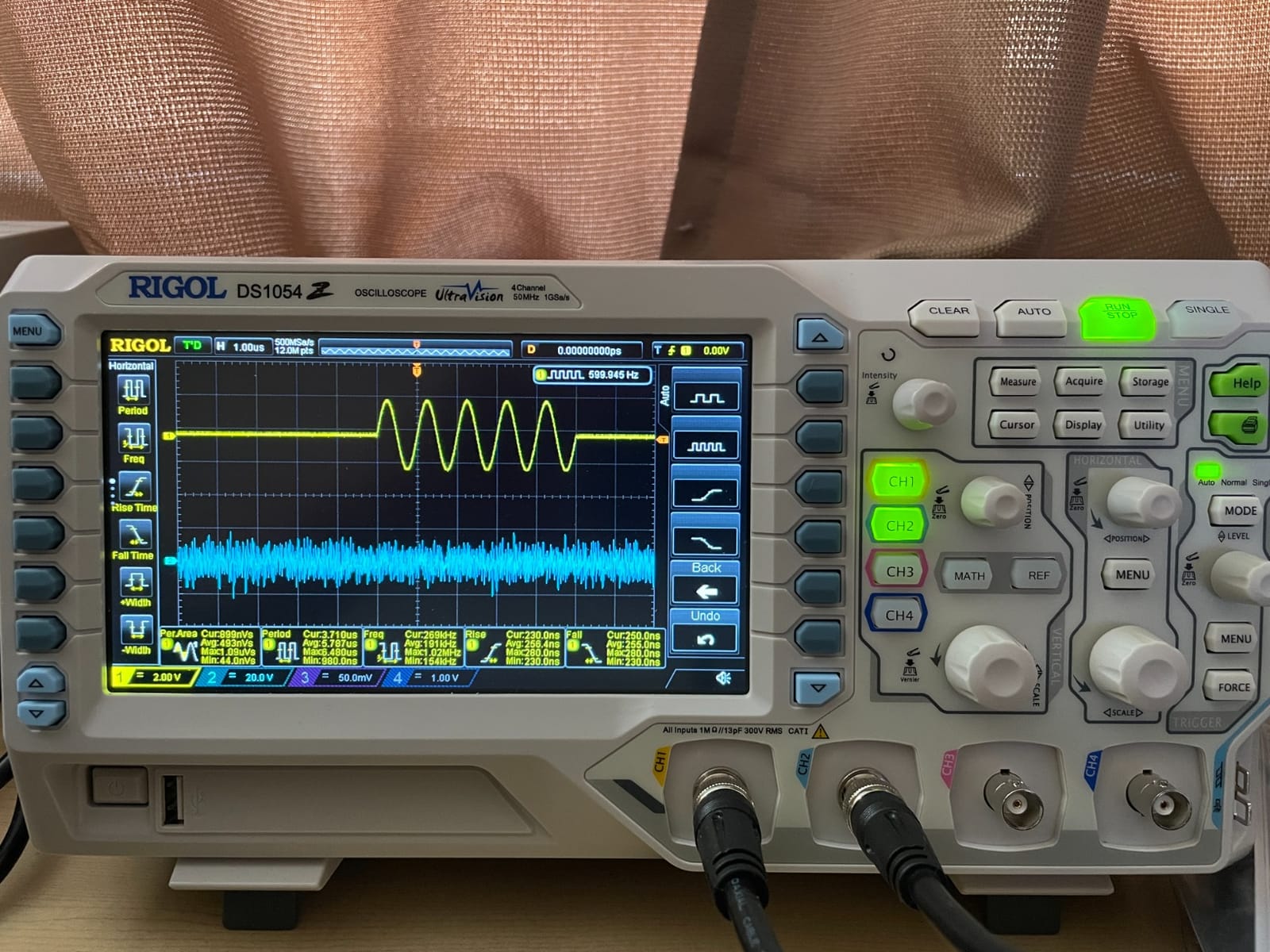
For catching the fault that happens once every forty minutes, the combination of 30,000 waveforms per second and intensity grading is the reason to buy this scope. Instead of showing you the last trace that happened to be on screen, it accumulates a density map that makes a rare event stand out as a bright band.
Memory depth goes to 24 Mpts on a single channel, 12 Mpts on two, and 6 Mpts on three or four. That single-channel figure is the one that matters for glitch hunting, because you can hold a long window at full resolution and still zoom in far enough to see the shape of the offending edge.
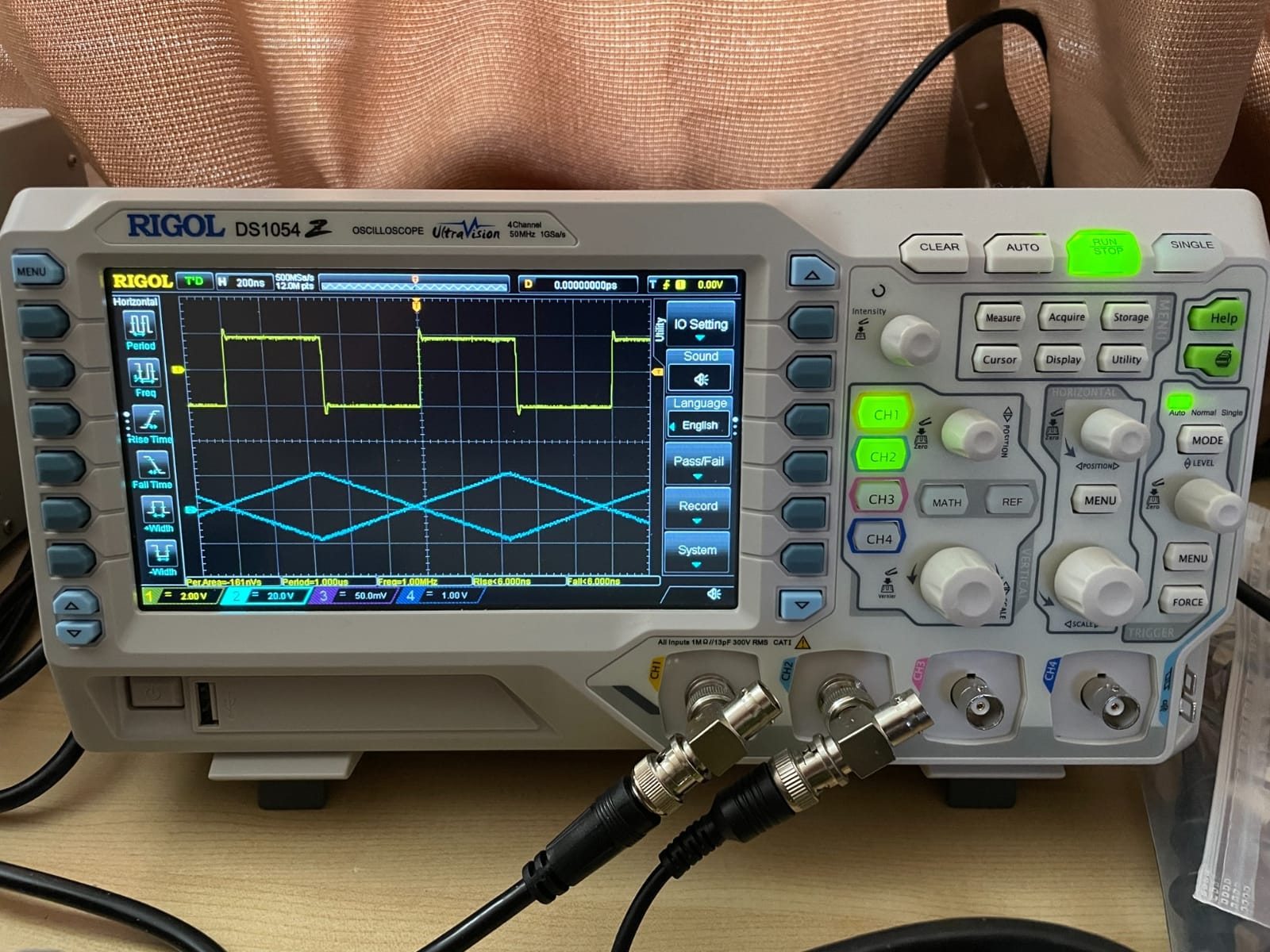
Protocol decoders for RS232 and UART, I2C, and SPI are included, along with FFT and filters. Most of the optional Rigol options are enabled at the factory on this model, which removes the single most common complaint about the brand: paying twice for features other manufacturers include.
The built-in help system is unusually good for a first scope. It explains what each acquisition mode does, and combined with the thorough online documentation it softens what is otherwise a fairly deep menu structure.
Who this scope suits
Buy the DS1054Z if you are chasing intermittent faults, debugging digital buses, or working on anything where a fault that does not reproduce every time is the central problem. The Ethernet, USB host, and USB device ports make it easy to archive captures to a thumb drive or pull them onto a computer.
Where it falls short
Fifty megahertz of bandwidth is modest, and it constrains what you can do with fast edges even though the capture rate is high. Reviewers also mention small DC offset discrepancies between channels, and the fan noise is real in a quiet room at night.
4. Rigol DS1202Z-E: 200 MHz with the deep memory budget scopes skip
RIGOL DS1202Z-E Digital Oscilloscope, 200MHz, 2 Channel, 1GSa/s Sampling
200 MHz bandwidth
2 analog channels
1 GSa/s sampling
24 Mpts memory
7 inch 800x480 TFT
Pros
- Deep 24 Mpts memory at a mid-range price point
- 30000 wfms/s capture with intensity graded display
- Bright 7 inch screen showing many measurements at once
- Included probes are good quality and compensate well
- Three year warranty on the main unit
Cons
- Multifunction knob is too sensitive and overshoots
- USB 2 port makes large 24 Mpoint exports very slow
- No printed manual and a deep menu structure
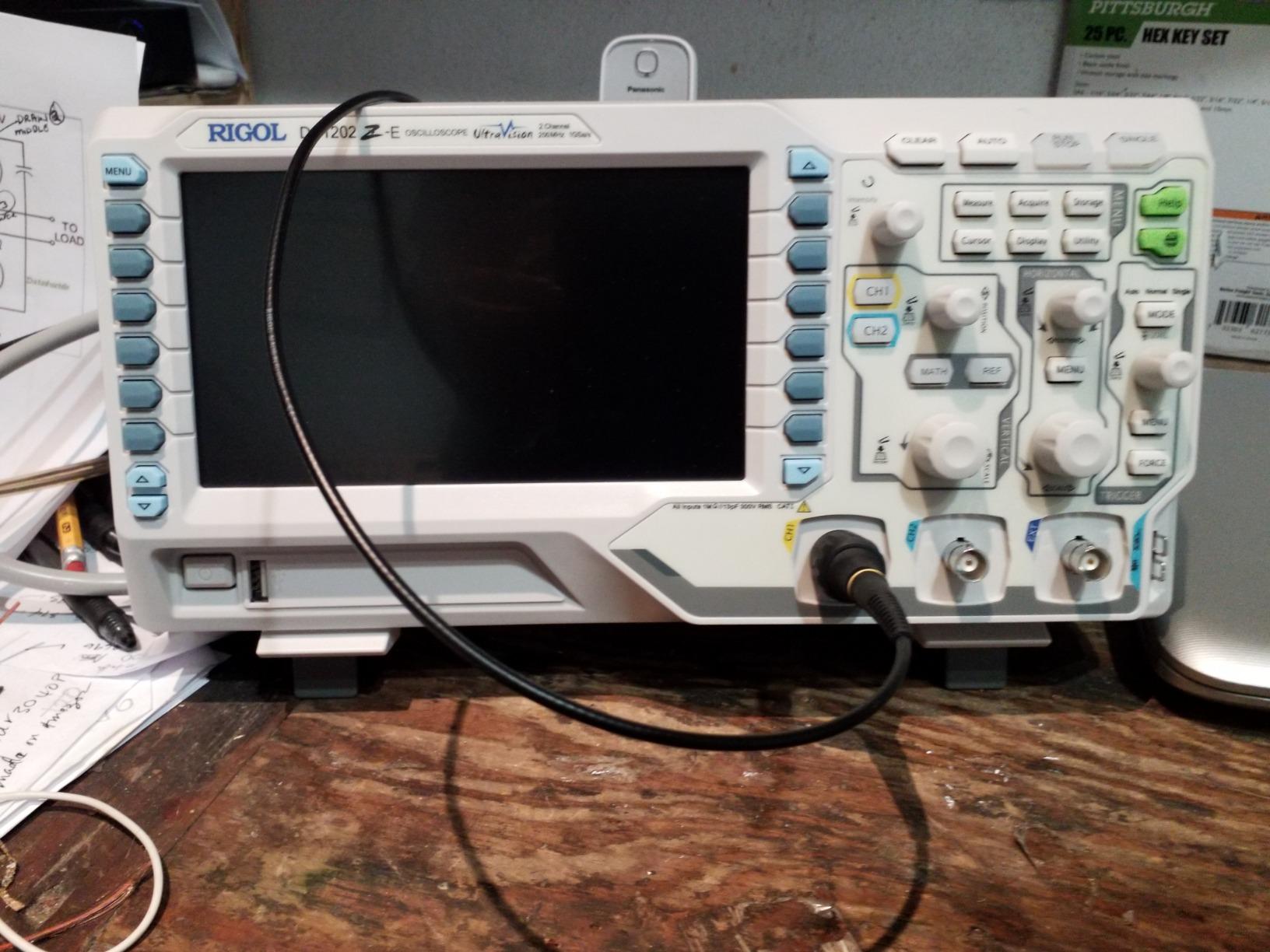
This model combines the two specifications hobbyists most often have to choose between: genuine 200 MHz bandwidth and a record length of 24 Mpts. Most scopes at this bandwidth give you a much shallower memory, which is exactly the trade that makes long captures useless.
The 7 inch 800×480 TFT is bright enough to read across a bench, and it can display a large stack of automatic measurements at once. Waveform record and playback covers up to 60,000 frames, so you can park a fault on screen and compare it against a known good capture later.
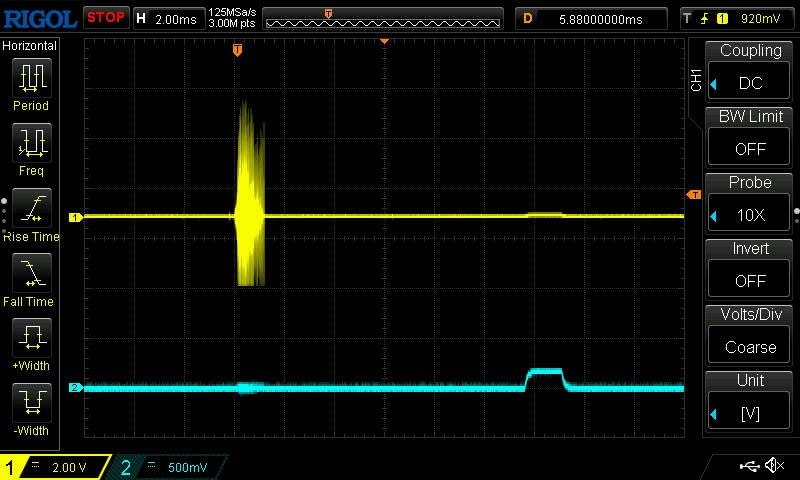
Serial trigger and decode for RS232 and UART, I2C, and SPI is standard, as are USB host, USB device, and LAN ports. The box contains the main unit, a probe, a power cable, and a USB cable, and reviewers frequently mention the out-of-box calibration certificate as a pleasant surprise.
Build quality is a genuine strength here. The enclosure feels like test equipment rather than a rebadged consumer device, and users report good support from the manufacturer when questions come up.
Who this scope suits
Choose the DS1202Z-E for switching power supplies, motor control, fast digital edges, and any project where you want more bandwidth than the four-channel budget models without giving up deep memory. The two-channel limit is the constraint, not the specs.
Where it falls short
The multifunction knob overshoots selections often enough that reviewers mention it in nearly every summary. Exporting a full 24 Mpoint capture over the USB 2 port can take the better part of an hour, so plan on using the front-panel screenshot instead for anything routine.
5. HANMATEK HO52: a two-channel scope and multimeter you can carry
HANMATEK Handheld Digital Oscilloscope 50Mhz Bandwidth with 2 Channels HO52 3.5″ TFT Mini Oscilloscope, 2 in 1 Oscilloscope and Multimeter, Backlit Screen, Auto-Calibration Function, Memory Function
50 MHz bandwidth
2 channel handheld
250 MSa/s sampling
8k record length
4 1/2 digit true-RMS DMM
Pros
- Combines a two-channel scope with a full true-RMS multimeter
- Light and genuinely portable for field and automotive work
- One-key auto setting makes quick measurements straightforward
- USB Type-C handles charging and image and CSV export
Cons
- 8k point record depth limits detailed analysis
- Small 3.5 inch TFT is hard to read on complex traces
- Battery powered so no mains reference for grounded probing
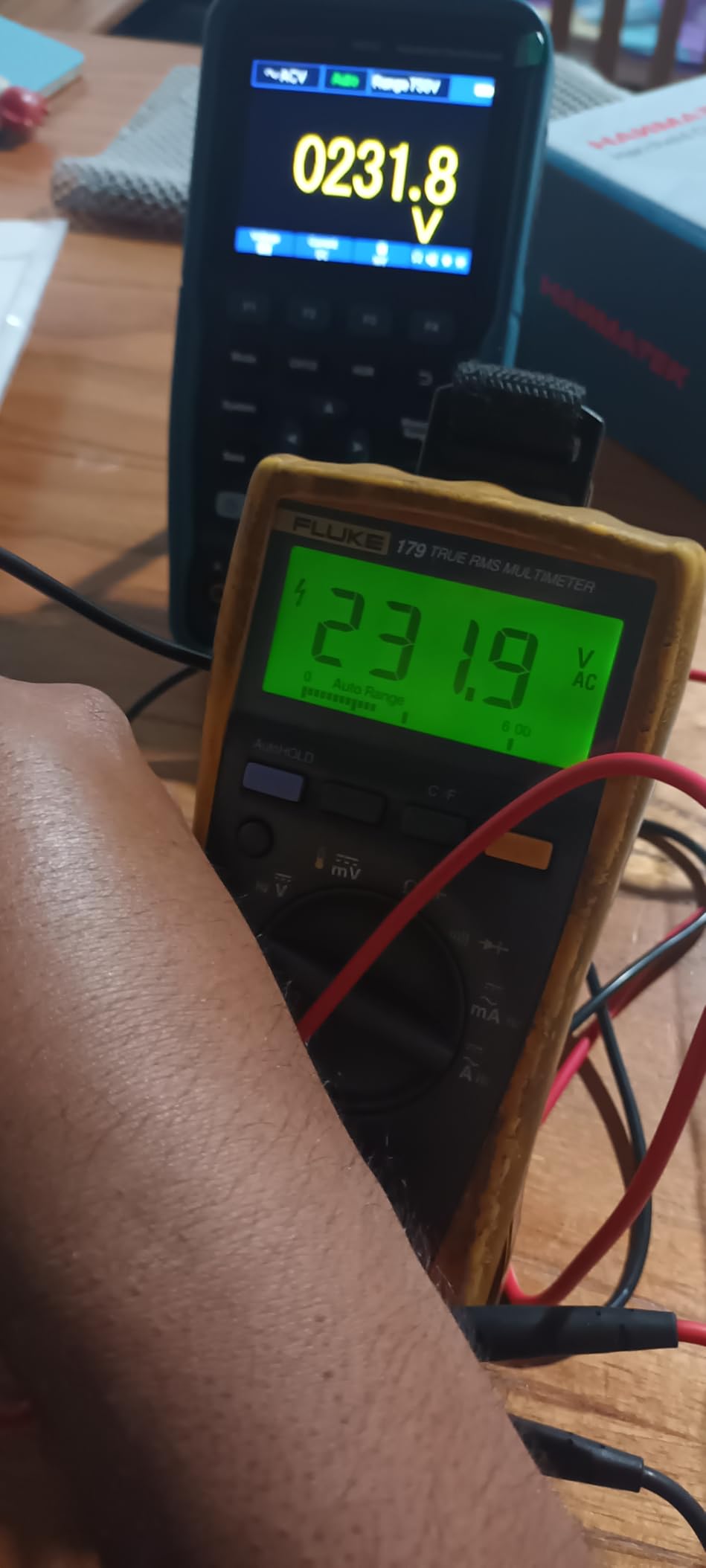
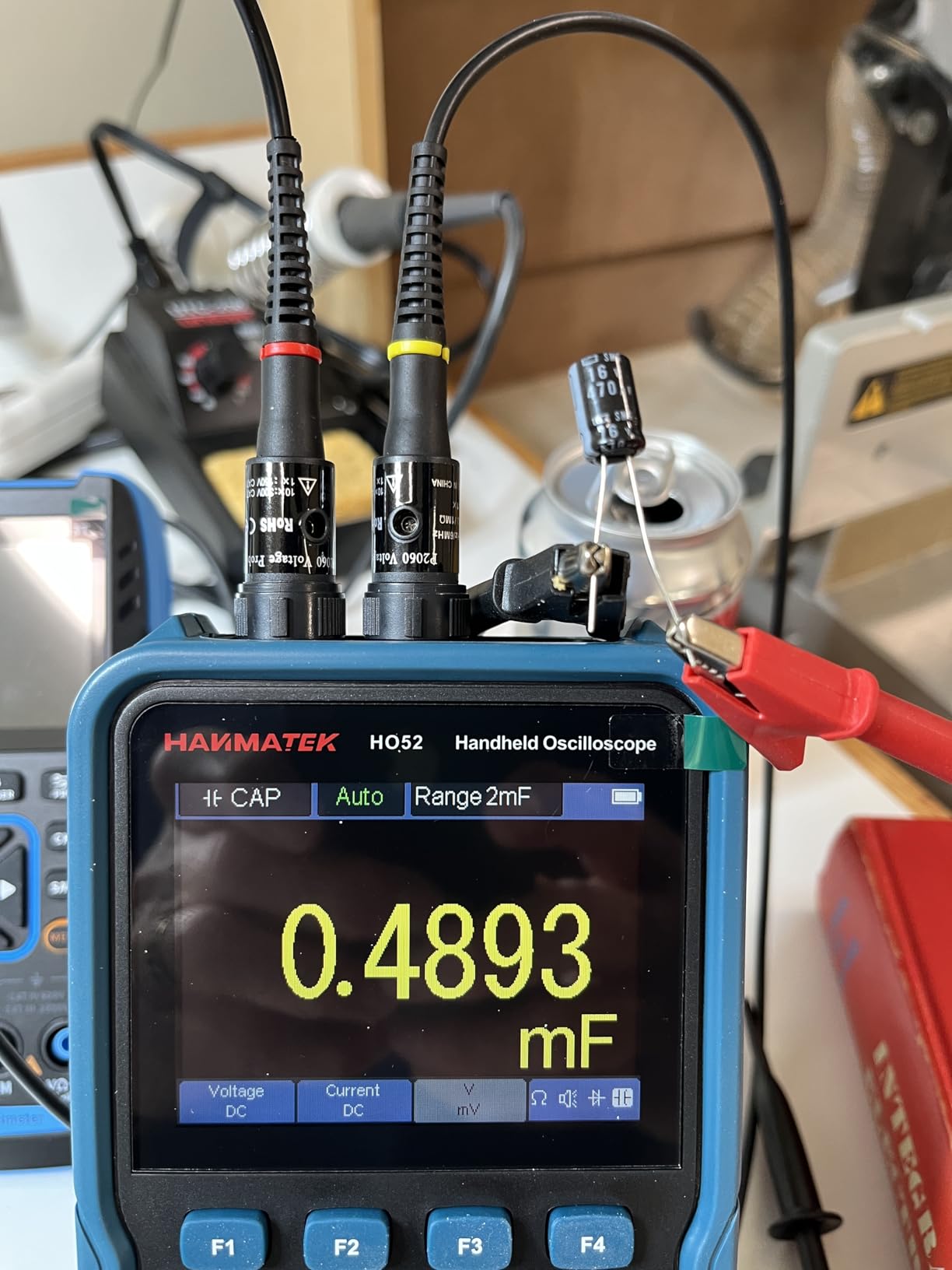
This is the pick when the work does not happen at a desk. The HO52 folds a two-channel 50 MHz scope and a 4.5 digit true-RMS multimeter into a body small enough to sit in a tool bag, and the multimeter is not a token feature: it reads up to 750 V AC and 1000 V DC.
Seven automatic measurement functions, cursor measurement, and XY mode cover the day-to-day checks you would otherwise do by eye. Saving to four setups, four reference waveforms, four images, and four CSV waveform groups gives you just enough storage to compare a good reading against a bad one on site.
USB Type-C handles power bank supply, charging, and PC connection for image and CSV export. That last part matters: being able to pull a capture onto a laptop when you get back is the difference between documenting a fault and losing it.
Owners like it for teaching as much as for field work, since the whole instrument fits in one hand and the auto function does not require a manual to operate.
Who this scope suits
The HO52 makes sense for automotive diagnostics, classroom demonstrations, and anyone troubleshooting equipment away from a bench. It also works well as a second instrument, since it is small enough to keep next to a main bench scope rather than competing with it.
Where it falls short
An 8k point record length and a 3.5 inch TFT mean it will not replace a bench scope for anything detailed, and reviewers are candid about both. It also runs on battery power, so it floats above mains earth, which is a genuine safety benefit for some probing and a genuine limitation for others.
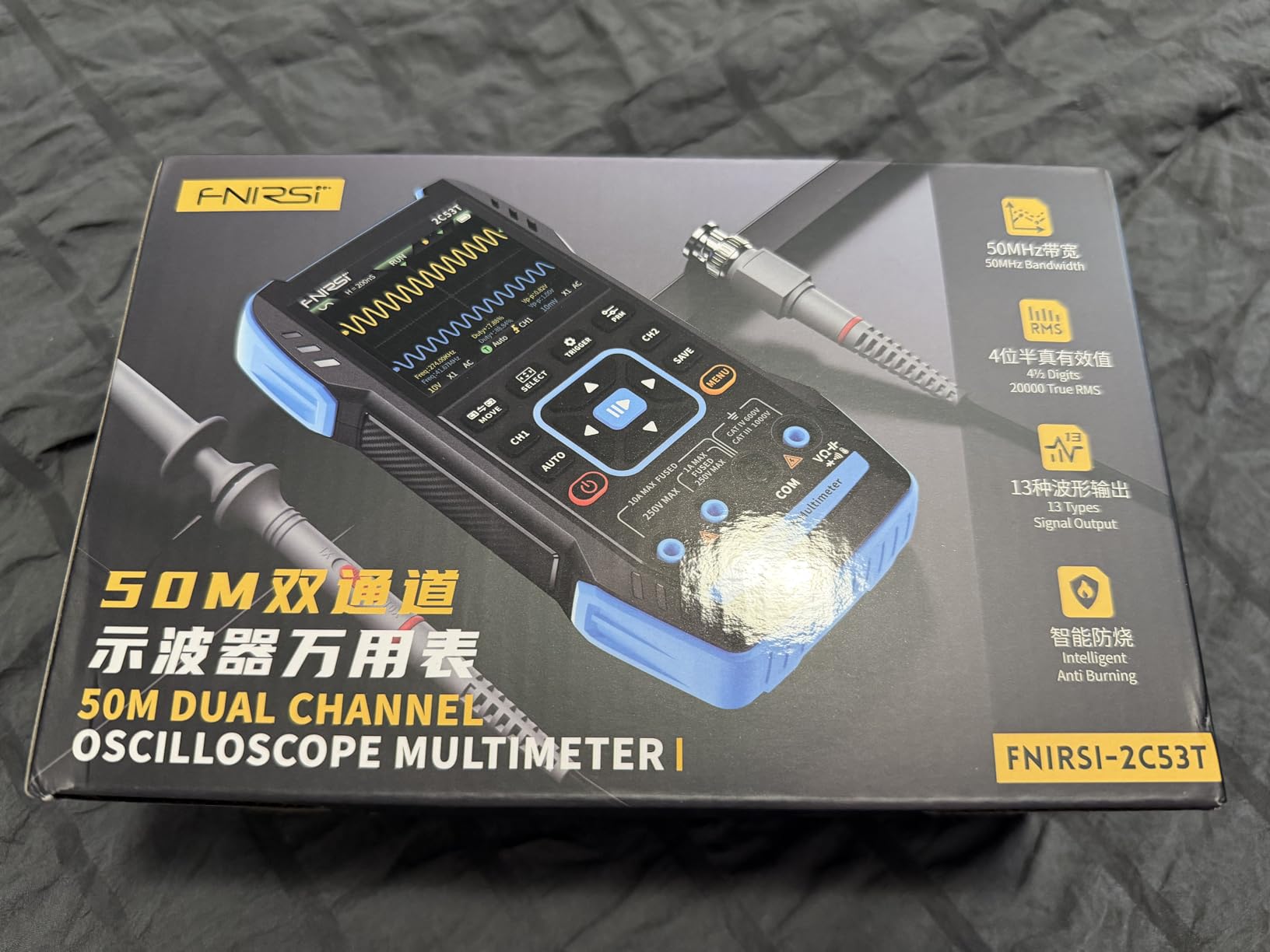
6. FNIRSI 2C53T: the most instruments per dollar on this list
FNIRSI 2C53T 3-in-1 50MHz 2CH Oscilloscope Multimeter DDS Signal Generator
50 MHz 2 channel scope
250 MSa/s
19999-count DMM
DDS generator to 50 kHz
3000 mAh battery
Pros
- Scope multimeter and DDS generator in one inexpensive handheld
- 400 V maximum voltage and built-in high-voltage protection
- Math cursor persistence and XY modes added over the earlier model
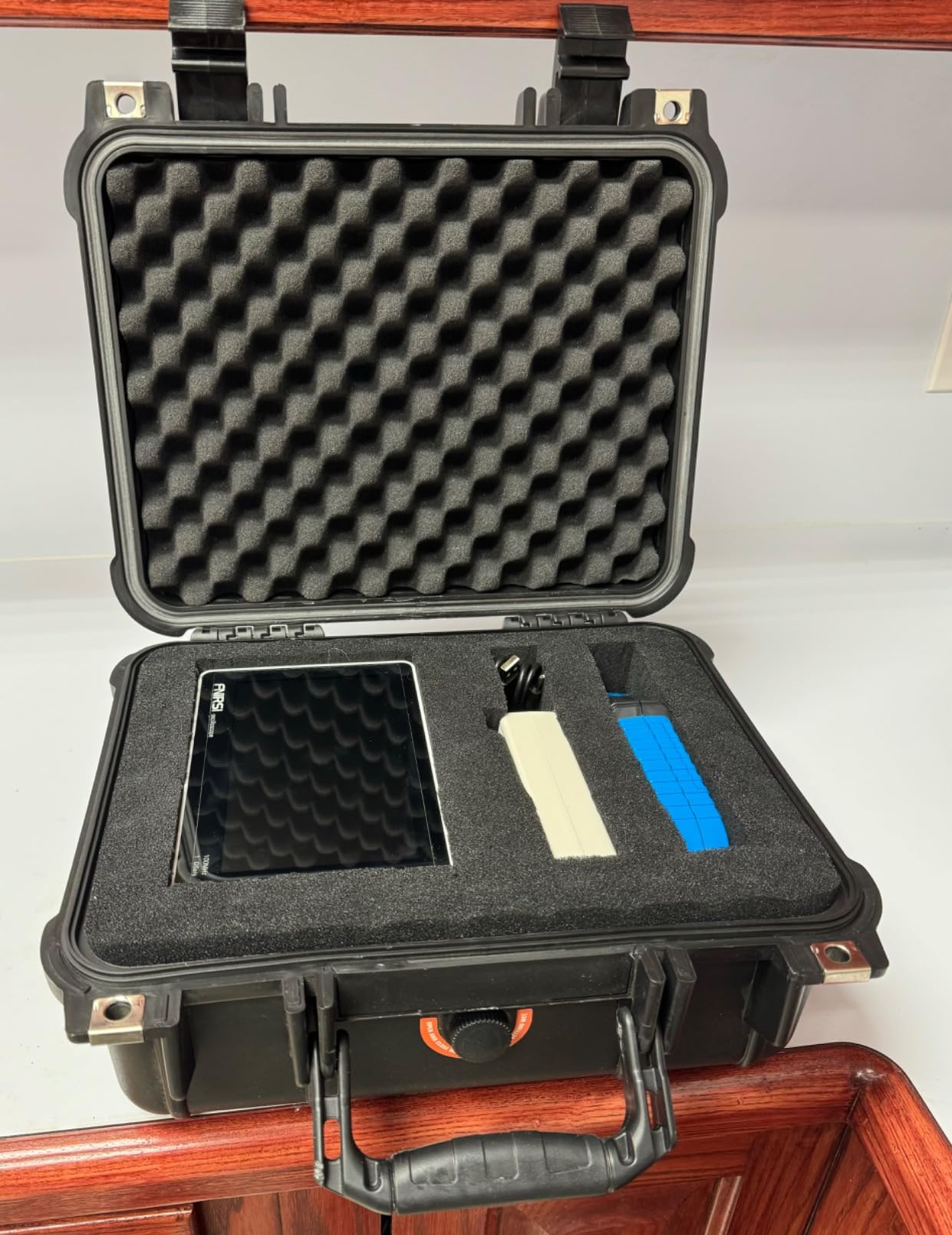
- Storage case and full probe and lead set in the box
Cons
- 1 Kpts record depth is very shallow for real capture work
- Small 2.8 inch LCD
- Signal generator tops out at 50 kHz
- Battery standby is roughly six hours
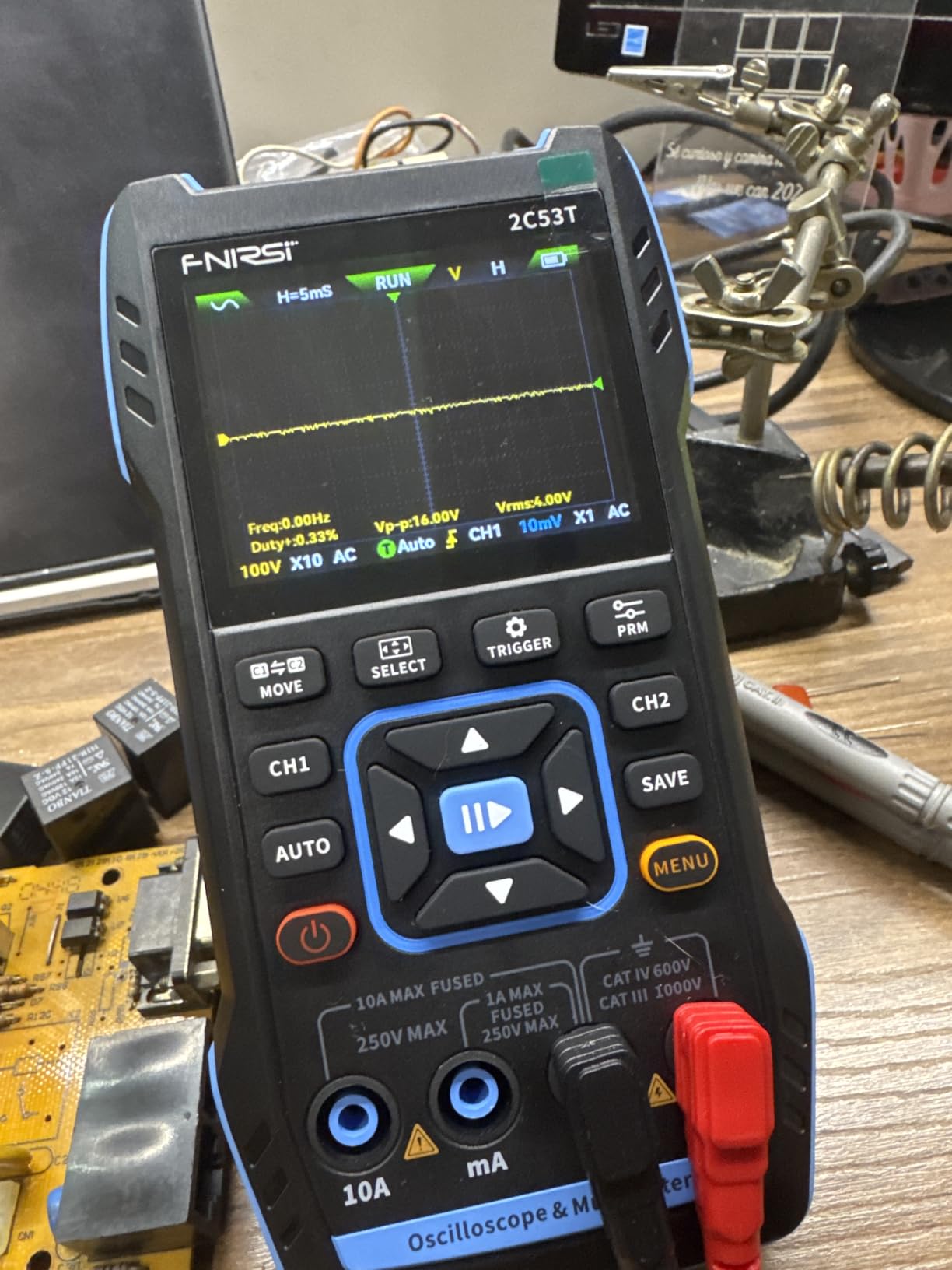
Three instruments in one box is still the pitch here: a two-channel 50 MHz scope, a 4.5 digit 19999-count multimeter, and a DDS signal generator with 1 Hz steps and 13 waveforms. The meter reads AC 0 to 750 V, DC 0 to 999.9 V, current to 9.999 A, resistance to 19.99 megohms, and capacitance to 99.99 mF.
Vertical sensitivity runs from 10 mV per division to 10 V per division, which is where most cheap units get exposed. Being able to see a millivolt of ripple on a 5 V rail without amplifying the noise floor is what makes this useful for supply checks.
Built-in high-voltage protection and a 400 V maximum make it a reasonable companion for automotive work where you want to look at signals that a bare probe cannot survive. One-click save with reference waveform overlay lets you put a known good trace behind a suspect one.
The included kit is generous for the money: a 10x probe, a crocodile clip probe, multimeter probes, a Type-C cable, and a storage case. The generator ceiling of 50 kHz is low, but it is enough for probe compensation and for driving a circuit at audio frequencies.
Who this scope suits
It suits beginners who want to explore electronics without committing to a bench, and hobbyists who need a meter and a signal source as often as they need a scope. The multimeter is strong enough to be a real tool rather than a bonus.
Where it falls short
A 1 Kpts record depth is the honest limit, and it is small enough that you cannot zoom into anything meaningful. It also carries the highest share of one-star ratings in this group, with firmware and hardware problems being the recurring complaint, and the 2.8 inch screen is cramped for anything beyond a quick check.
7. FNIRSI 1013D Plus: a 7 inch touchscreen under two hundred dollars
FNIRSI 1013D Plus 100MHz Oscilloscope, 2 Channel Oscilloscope 7″ TFT Touch
2 channels
100 MHz bandwidth
1 GSa/s sampling
7 inch 800x480 touch display
6000 mAh battery
Pros
- Large 7 inch high-contrast touchscreen at a hobbyist price
- 1 GSa/s sampling and 100 MHz per channel
- 1 GB of storage for 1000 screenshots and 1000 waveform sets
- High-voltage protection to 400 V and battery power
- Lissajous display FFT viewing and touch cursors
Cons
- Touch-only controls are awkward for fine adjustment
- Battery runtime of roughly four hours
- Not a substitute for deep memory or serial decode on a bench
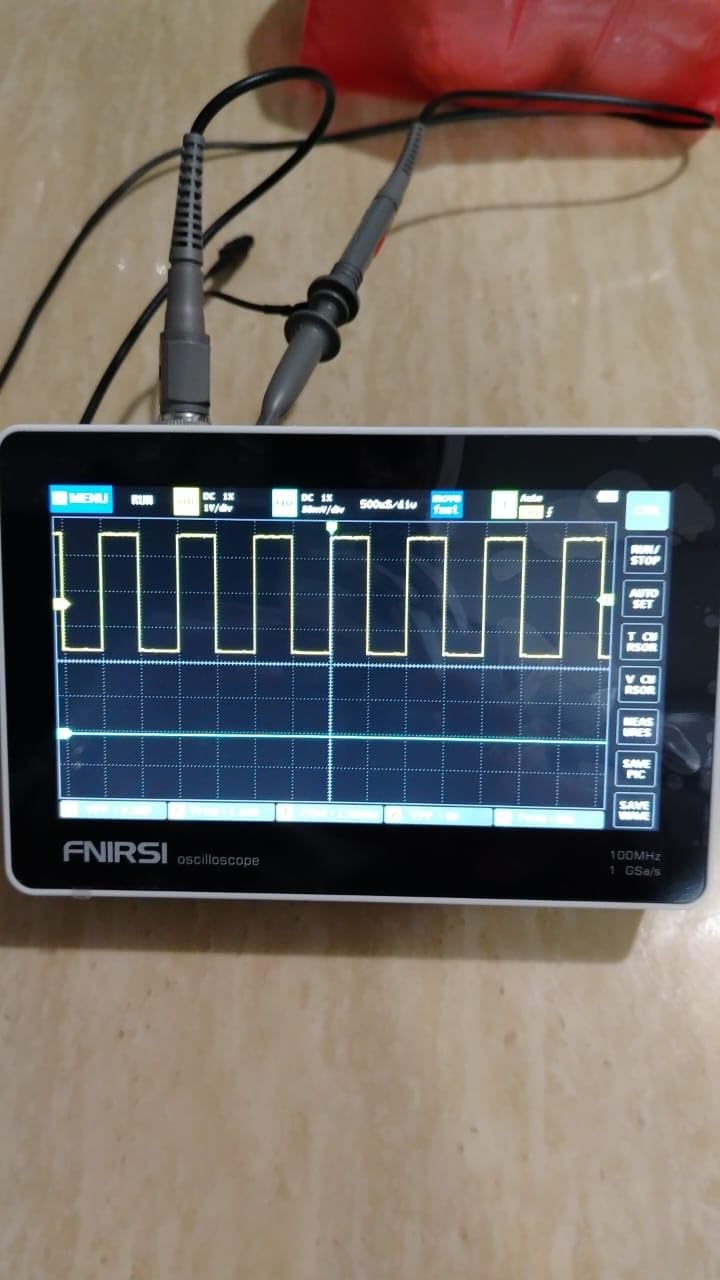
The draw here is a 7 inch 800×480 high-contrast touch display in an ultra-thin portable body. Most scopes at this price give you a five inch panel at best, and a large screen makes a genuine difference when you are reading measurements off a trace across a room.
Underneath the glass it is a 100 MHz two-channel scope sampling at 1 GSa/s, with single, normal, and automatic trigger modes covering periodic and aperiodic signals. Lissajous display, FFT viewing, and touch cursor measurement cover the two analysis modes hobbyists reach for most often.
Storage is the quiet strength: 1 GB of internal space holds up to 1000 screenshots and 1000 waveform sets, with thumbnail browsing so you can find the capture you need without exporting everything. On a battery-powered instrument, that is unusually generous.
Built-in high-voltage protection tolerates up to 400 V continuous, and the 6000 mAh battery gives roughly four hours of use. Type-C charging keeps the downtime short between sessions.
Who this scope suits
It works for learners, presenters, and anyone who wants a readable screen they can carry between a classroom, a workbench, and a car. Battery power and high-voltage protection also make it a reasonable second instrument for field checks.
Where it falls short
Touch-only operation is the most common complaint, because fine vertical and timebase adjustments are awkward without a physical knob. With roughly four hours of runtime and no serial decode, it complements a bench scope rather than replacing one.
8. HANMATEK DOS1102: 110 MHz with scripting and a 7 inch colour screen
HANMATEK 110mhz Bandwidth DOS1102 Digital Oscilloscope with 2 Channels and Screen 7 inch / 18 cm, TFT-LCD Display, Portable Professional Oscilloscope Kit with 500 MS/s *2 Sampling Rate
110 MHz bandwidth
500 MSa/s x 2
7 inch 800x480 colour TFT
10k record length
SCPI and LABVIEW
Pros
- 110 MHz bandwidth with dual 500 MSa/s sampling is unusual in this class
- 7 inch 800x480 true-colour LCD with 2000:1 contrast
- 30 automatic measurements with a customisable menu
- USB host and device ports with SCPI and LABVIEW support
- Six digit hardware frequency meter and current measurement
Cons
- 10k point record depth is shallow
- Entry-level documentation and shallow menus need outside learning
- Only two channels
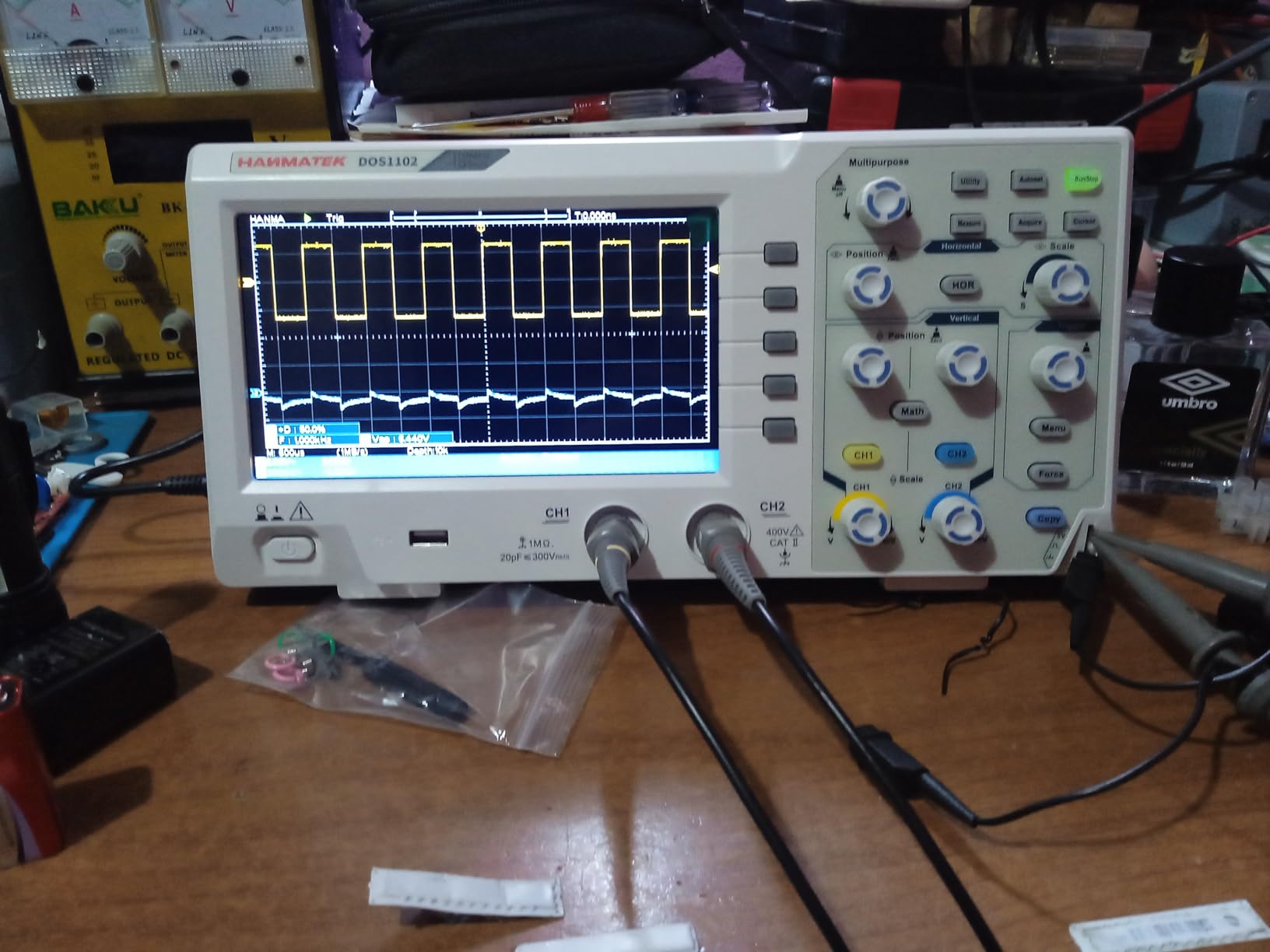
What separates this one is the combination of bandwidth and programmability. It runs 500 MSa/s on both channels simultaneously at 110 MHz of bandwidth, and it speaks SCPI and LABVIEW over USB, which means you can drive measurements from a script instead of clicking through menus.
The timebase spans 2 ns per division to 1000 s per division, and vertical scale runs 20 mV per division to 5 V per division. A six-digit hardware frequency meter covering 2 Hz to 20 MHz handles the case where you just need a frequency and do not want to trust the auto measurement.
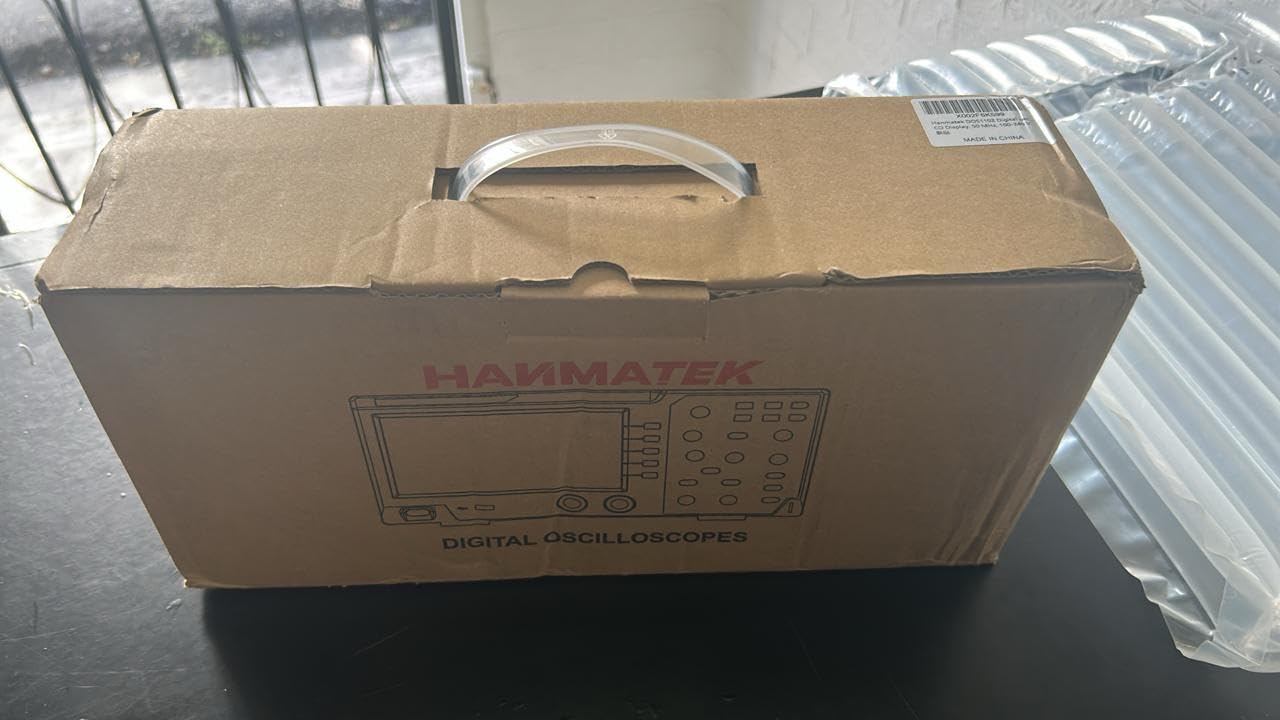
The 7 inch 800×480 TFT shows 65535 true colours at 2000:1 contrast, which is easy on the eyes for long sessions. Thirty automatic measurements and four cursor modes covering dV, dT, and both together give you most of what a bigger bench scope would show.
USB host and device ports support U-disk storage, and the record length stores at least 16 groups of waveforms. Probe attenuation is selectable at 1x, 10x, 100x, and 1000x, which is a small detail that shows the instrument was designed for real probing rather than demonstration.
Who this scope suits
It suits hobbyists who want to automate measurements, run a test sequence, or capture data into a spreadsheet. The dual-channel 500 MSa/s and 110 MHz combination also handles audio, PWM, and general embedded work comfortably.
Where it falls short
A 10k point record depth is shallow, and the documentation is thin enough that you will be reading other people’s guides. There is no serial decode here, so if your project involves I2C or SPI troubleshooting, choose a scope with those decoders included.
9. FNIRSI DSO152: the pocket scope for low-frequency checks
FNIRSI DSO152 Handheld Oscilloscope 200kHz Bandwidth, 2.5MS/s Sampling Rate
200 kHz bandwidth
2.5 MS/s real-time sampling
2.8 inch 320x240 LCD
400 V measurement limit
Pros
- Costs less than most hobby projects and fits in a pocket
- Arrives assembled with nothing to solder or build
- One-key AUTO with long-press baseline calibration
- Type-C handles data charging and firmware upgrades
Cons
- 200 kHz bandwidth limits it to audio-range and low frequency signals
- Small 320x240 screen
- Unsuitable for high-speed digital or RF work
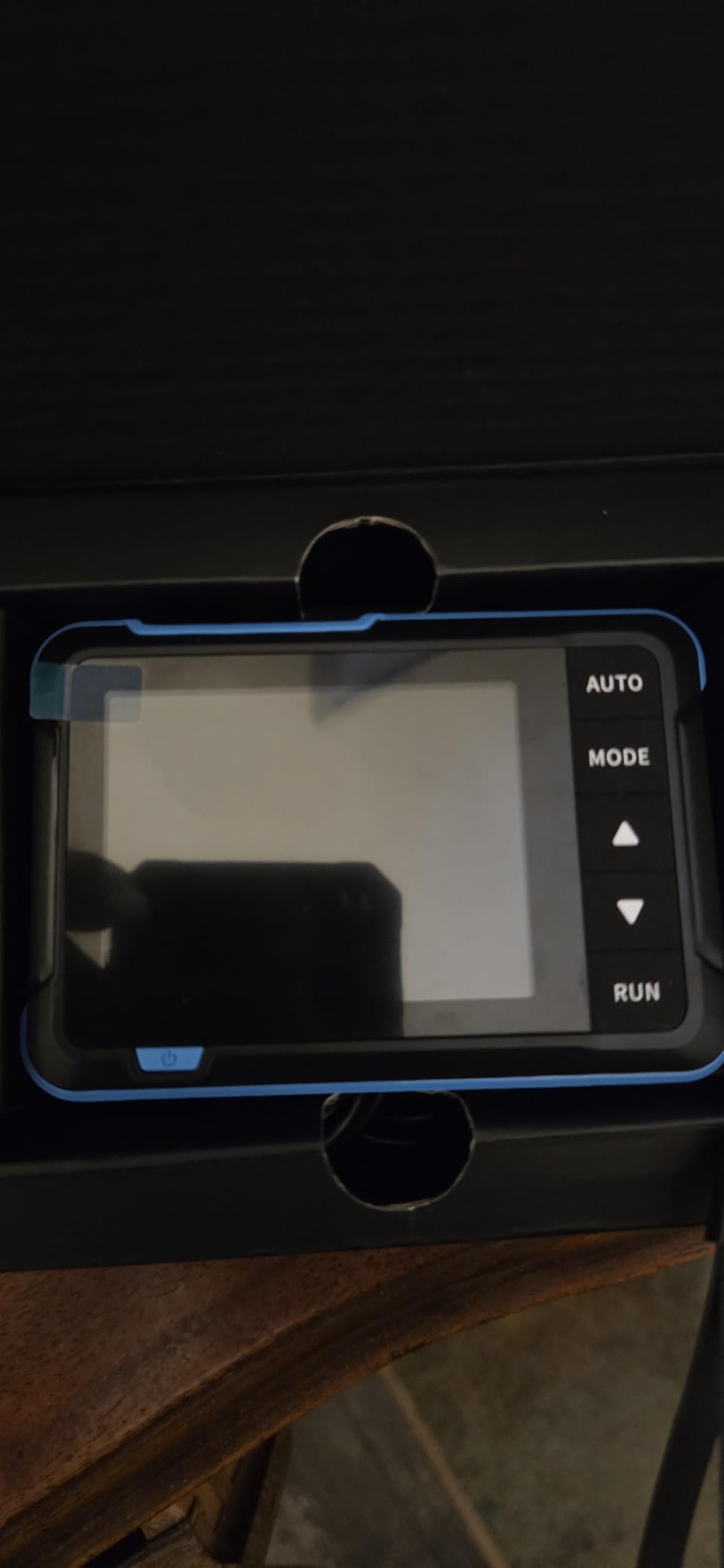
There is a category of work where a DSO152 makes sense and almost nothing else does. If you are checking an audio-range signal, a slow control line, or a sensor output on the move, the 200 kHz bandwidth and 2.5 MS/s sampling are adequate, and the whole thing fits in a pocket.
The included 10x probe measures up to 800 VPP, roughly equivalent to 280 V AC, and voltages up to 400 V are measurable. It runs about four hours on a 1000 mAh battery, and Auto, Normal, and Single trigger modes cover the usual cases.
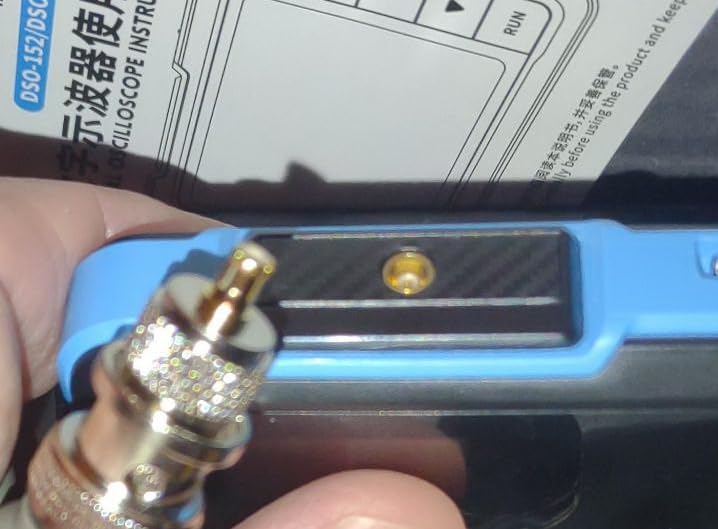
It arrives fully assembled, so there is no soldering, no kit assembly, and no risk of a build fault confusing your first hour with the instrument. The Type-C port handles data transmission, charging, and firmware upgrades, which means the device can improve after you buy it.
Reviewers are consistent about where it fits: an entry-level or supplementary tool, not a bench scope. Users frame it as something you keep in a bag for quick checks rather than something you build a bench around.
Who this scope suits
It suits a beginner who wants to see what a signal looks like before spending more, and any hobbyist who wants a grab-and-go instrument for low-frequency field checks. For teaching the basic idea of a waveform, it does the job at a fraction of the cost.
Where it falls short
Two hundred kilohertz of bandwidth rules out anything fast, including most digital signals and anything RF. The 320×240 display shows you a shape, not a measurement you can read in detail, so keep it as a companion rather than a primary instrument.
10. ZOYI ZT-703: a 3-in-1 handheld with a genuinely good multimeter
3 in 1 Handheld Oscilloscope Automotive Dual Channel 50MHz with Digital Multimeter and Signal Generator
Dual channel handheld
200 MSa/s normal, 280 MSa/s high speed
50 MHz bandwidth
128K storage
25000-count DMM
Pros
- Excellent 25000-count auto-ranging multimeter
- Rechargeable battery with Type-C fast charging and data transfer
- 128K storage depth is deeper than most handhelds at this class
- Includes carry pouch
- two probes
- test leads and charging cable
- Solid construction with good key feel
Cons
- No physical dials so divisions and cursors need menu navigation
- Small crowded screen
- Square wave edges can look deformed at higher frequencies
- Signal generator is limited and mostly useful for probe compensation
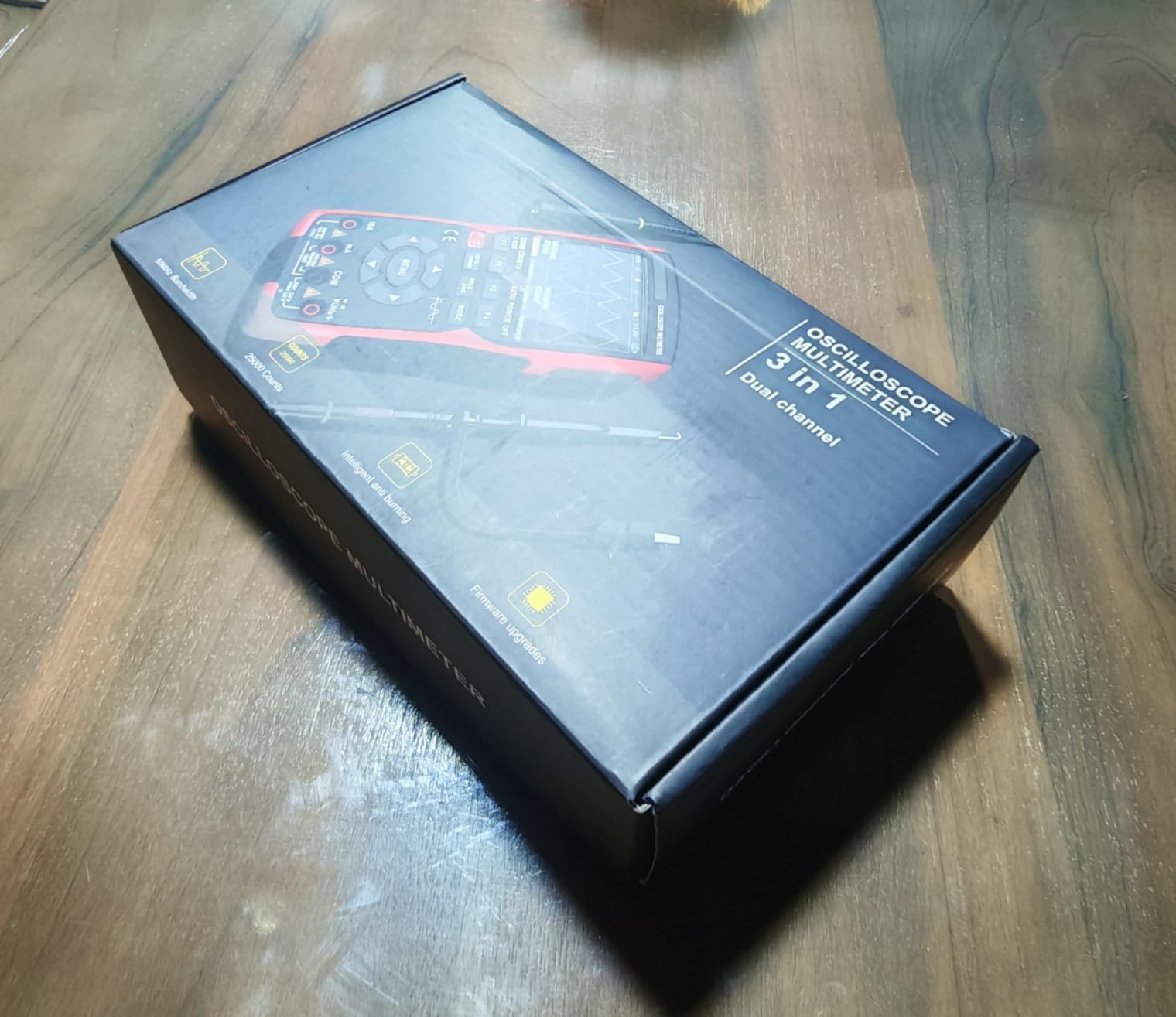
The ZT-703’s argument is its multimeter. A 25000-count auto-ranging meter covering resistance, capacitance, continuity, diodes, and current is genuinely better than the meters bundled with most 3-in-1 handhelds, and for automotive work that is the function you will reach for most.
The scope side offers two channels with AUTO automatic waveform recognition. In normal mode it samples at 200 MSa/s up to 30 MHz of bandwidth, and in high-speed mode 280 MSa/s up to 50 MHz. That 128K storage depth is deeper than most handhelds in the class and lets you hold a capture long enough to see a repeating pattern.
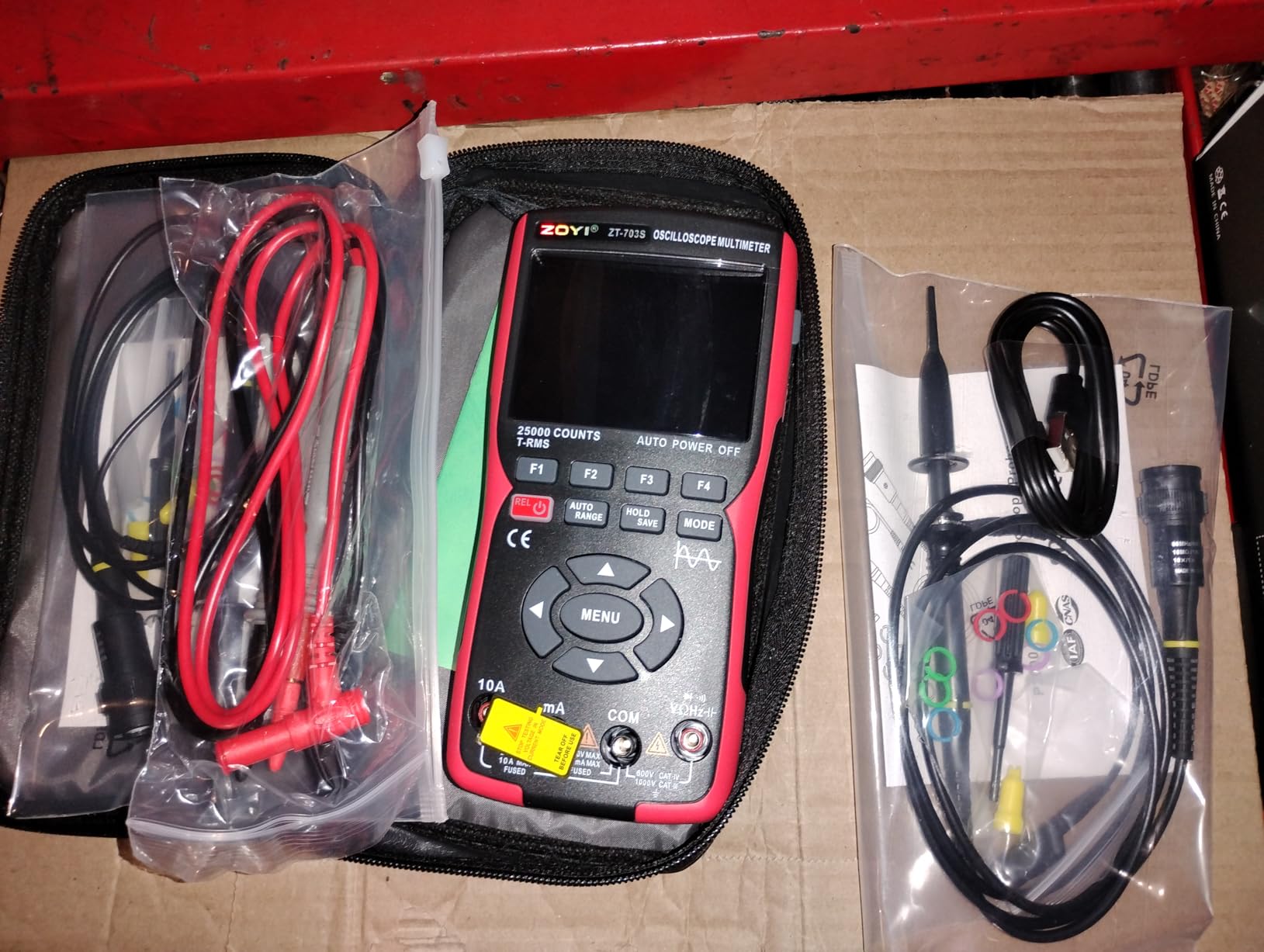
Owners consistently single out the screen as staying legible at reduced brightness, which is exactly what you want in a car or a dim workshop. Construction feels solid, and the key feel is good for a device at this level.
The signal generator outputs sine, square, and triangle with a synchronous display, which is enough for probe compensation and simple demonstrations. Type-C handles fast charging, data transfer, and waveform image storage, and the box includes a cloth carry pouch.
Who this scope suits
It suits automotive hobbyists, field technicians, and anyone who wants one handheld to cover measurement, quick waveform checks, and a basic signal source. The 25000-count meter is a strong reason to pick it over a similar 3-in-1.
Where it falls short
There are no physical dials, so divisions, cursors, and settings all require button-driven menu navigation, which slows fine adjustment considerably. Reviewers also note the screen cannot replace a bench scope, and that square wave rise times can look deformed at higher frequencies.
How to Choose an Oscilloscope for Hobbyist Work
Start with the fastest signal you will actually measure, then work backwards. Everything else on the spec sheet matters less than getting that one number right.
Match bandwidth to the fastest signal, then multiply by three to five
Buy at least three to five times the bandwidth of your highest signal frequency. An Arduino runs its core at 16 MHz, so a 50 MHz scope is technically adequate and a 100 MHz scope is comfortable. Audio tops out near 20 kHz, switching converters work in the tens to hundreds of kilohertz, and RF work usually means you need at least 70 MHz of bandwidth before 100 MHz signals are even visible with attenuation.
Sample rate matters less than the marketing suggests, but do not ignore it. Anything at 1 GSa/s or above gives reasonable headroom on a 100 MHz scope, and cheap scopes often advertise bandwidth their sample rate cannot support.
Two channels or four
Two channels handle the majority of hobby work, and this is where the community splits. Plenty of people regretting a two-channel scope is a recurring theme in the r/AskElectronics threads, and the common regret is not bandwidth, it is having to move a single probe while a fault is in progress.
Four channels pays off when you need a bus plus its clock, a signal plus a supply rail, or a three-phase system. If you can name a project on your list that needs three simultaneous traces, buy four now.
Memory depth is what catches the glitch that ruins your evening
Record length decides how far you can zoom before the pixels run out. A 24 Mpts single-channel capture lets you hold a long window and still inspect the shape of a single edge, while a 1 Kpts depth means the display is essentially a picture with no detail underneath.
Waveform capture rate is the other half. The 30,000 wfms/s figures on the Rigol models exist so intermittent events show up as bright intensity bands on an accumulated display rather than vanishing between frames.
Benchtop, handheld, or scriptable
Benchtop units give you knobs, a large screen, mains power, and a ground reference tied to protective earth. Handhelds are battery powered, which means a floating ground that is safer for some probing and a smaller screen that makes detailed work harder. Scriptable units add SCPI and LABVIEW support so you can drive measurements from code.
What to check on a used scope before you pay
The used market is a legitimate route, and r/ECE regularly weighs a used analog bench against a cheap new digital. Run through this list first:
Look up the calibration date and check whether the instrument has drifted well past it
Run the built-in self-test waveform on every channel and confirm the shape is clean
Connect a probe and check the probe compensation adjustment with the scope’s compensation output
Inspect BNC connectors and probe sockets for bent pins, corrosion, or grime
Power it on and let it run for fifteen minutes to catch fan or overheating faults
Ground Safety Comes Before Waveform Quality
Every benchtop scope in this roundup has its ground reference tied to mains protective earth, and that ground reference also runs to the probe ground clip. This single fact explains the most common piece of safety advice in hobbyist electronics: never clip the probe ground to a point in the circuit that sits at a different potential from earth.
Probing a switch-mode power supply primary, or any mains-connected node, with a standard earth-referenced probe can short the supply through the clip and put mains voltage onto your bench. If that work is on your list, buy a genuine differential probe rated for the voltage, or use a battery-powered handheld where the entire instrument floats above earth. Do not improvise an isolation hack.
USB-attached and laptop-based instruments avoid the problem differently, since a laptop on battery has no earth reference at all. The tradeoff is usually sample depth and screen size, and a ground loop through your USB cable is a real risk when a circuit is referenced to something other than your laptop.
Frequently Asked Questions
What is the best brand for oscilloscopes?
For hobbyist work, Siglent and Rigol dominate the market because both include serial decoding and network ports in models most people can afford. Siglent leans toward faster sampling and included CAN and LIN decode, while Rigol opens up more of its add-on options at the factory and holds deeper memory on some models. The brand matters less than matching the bandwidth, channel count, and record length to your project.
What is a good, cheap oscilloscope for hobbyists?
A cheap scope is good enough if it gives you at least 50 MHz of bandwidth, two channels, and 1 GSa/s of sampling. Below that you are looking at a learning tool rather than a debugging tool, and a scope with only 1 Kpts of record depth will frustrate you the first time you need to zoom in. Buy the cheapest thing with real memory depth, not the smallest thing.
Is 100 MHz good for an oscilloscope?
Yes, 100 MHz is the community standard for hobbyist work because it covers microcontrollers, audio, and most switching power circuits with margin. A common rule of thumb is to buy three to five times the bandwidth of the fastest signal you will measure, so 100 MHz handles signals up to roughly 20 MHz comfortably. It is the point below which most people start to outgrow their scope.
Is 50 MHz good for an oscilloscope?
For Arduino and ESP32 debugging, 50 MHz is genuinely usable because the microcontroller cores run at 16 MHz. It becomes limiting for fast digital edges, switch-mode supplies, and anything with a wideband transient. If you can stretch to 100 MHz, do it, since the difference in price is usually small and the headroom lasts longer.
Is Siglent a good oscilloscope brand?
Yes, Siglent is one of the two brands most hobbyists compare, and reviewers rate its interfaces as more responsive than cheaper rivals. The important detail is which decoders ship as standard: on the SDS1104X-E and SDS1202X-E, IIC, SPI, UART, CAN, and LIN decode are included, while optional MSO and signal generator modules can cost a great deal on top.
Is there a used digital oscilloscope worth buying?
A used scope is worth it when you can verify its condition. Check the calibration date, run the built-in self-test on every channel, test probe compensation with the compensation output, inspect the BNC connectors, and let it run for fifteen minutes to rule out fan and overheating faults. Analog benches from HP and Tektronix remain useful for vintage audio work, but check calibration before you commit.
The Verdict: Which Oscilloscope Should You Buy in 2026
The Siglent SDS1202X-E is our pick for the best oscilloscopes for hobbyists, because 200 MHz of bandwidth, 1 GSa/s sampling, 14 Mpts of record length, and a full set of serial decoders as standard is a combination nothing else in this roundup matches. It carries the highest review volume here as well, so you are buying into a well understood instrument rather than a gamble.
If your work needs four channels, take the Siglent SDS1104X-E and its included CAN and LIN decode. If you are chasing intermittent faults and want memory depth over bandwidth, the Rigol DS1054Z is the better tool, and the Rigol DS1202Z-E gets you 200 MHz without sacrificing deep memory.
For everything below bench level, the HANMATEK HO52 and ZOYI ZT-703 cover field and automotive work, the HANMATEK DOS1102 is the one to buy if you want to script your measurements, and the FNIRSI DSO152 stays in your bag for quick low-frequency checks. Whichever you choose, clip the ground lead to a real ground first every single time.